Monthly Market Monitor

February 2026
Theme in Focus Diversification with liquid alternative strategies: More than a free lunch
According
Chart of the Month

February 2026
Theme in Focus Diversification with liquid alternative strategies: More than a free lunch
According
Chart of the Month
The curse and blessing of artificial intelligence
At the World Economic Forum in Davos, optimism about artificial intelligence (AI) expressed by representatives of the technology sector naturally predominated, but the International Monetary Fund (IMF) voiced pessimistic concerns. According to analyses by the IMF, AI will enhance, transform, or eliminate up to 60 % of jobs in industrialized nations in the years ahead. The number of entry-level jobs could shrink dramatically, with dire consequences for the income prospects of an entire generation. Anecdotal and statistical evidence of a tougher job market for junior talent has already mounted in recent months.
Emerging-market countries in the passing lane Stock markets around the world have carried the upward momentum from 2025 into 2026 and have started off the new year with positive omens. However, the two-and-a-half-year-old bull market has recently left traces of euphoria in the minds of investors, making further share-price gains more difficult. Emergingmarket stocks, though, continue to have greater upside potential. Investors are still underinvested in this equity segment, and the earnings prospects for emerging-
market corporates have improved. The emergingmarket stocks bet is no longer a wager based solely on the argument of them being a cheap bargain.
Diversification with liquid alternative strategies: More than a free lunch
Diversification is the only free lunch that exists on financial markets. That’s why alternative assets absolutely belong in a balanced portfolio. So far, so good. But there’s more behind this common stock-market saying and this word of advice from Investing 101 than one would think. That’s because, like the compound interest effect, the act of combining a variety of uncorrelated hedge fund strategies is a small investment miracle that adds value to an investor’s portfolio precisely in times of richly valued equity markets and geopolitical uncertainty.
Federal Reserve Chairman Jerome Powell has already appeased the US president with a few policy rate cuts thus far during his second term in office, but that’s not enough for Donald Trump. He would like much lower interest rates even though US economic activity has been performing very solidly to date. The ongoing criminal investigation of the Fed chairman is politically motivated in no small part and is an indirect threat to any central bank official following in Powell’s footsteps. The independence of the US Federal Reserve is being openly attacked and is increasingly in doubt. History teaches, however, that independent central banks control inflation much better than those under the influence of a government do. Their job is to be the party killer when economic activity overheats. Moreover, the presidential stance on interest rates is shortsighted also with regard to public debt. A lower federal funds rate would hardly reduce the exploding interest expense on the USA’s mountain of debt because 80 % of it consists of Treasury notes with remaining terms to maturity of more than two years and because international investors arguably would hardly go along with a rollover into exclusively short-term debt.
Taking the pulse of economic activity
Davos: The curse and blessing of artificial intelligence
At the World Economic Forum in Davos, positive talk about artificial intelligence (AI) by representatives of the technology sector naturally predominated, but there was also criticism voiced, including by the International Monetary Fund (IMF). IMF Managing Director Kristalina Georgieva spoke, for instance, about an AI tsunami headed for labor markets that will particularly hammer people just starting out on their careers. According to analyses by the IMF, AI will enhance, transform, or eliminate up to 60 % of jobs in industrialized nations in the years ahead. The number of entry-level jobs could shrink dramatically, with dire consequences for the income prospects of an entire generation. Anecdotal and statistical evidence of a tougher job market for junior talent has already mounted in recent months. The wake-up call from Davos underscores urgent questions about the future of labor markets, education, and social security, for which good answers are needed sooner rather than later.
Germany: (Still) on the lower rungs of the growth ladder
An acceleration by former growth engine Germany was continually anticipated over the last two years, but then had to be shelved by business cycle analysts. So, forecasts for 2026 should be taken all the more with a pinch of salt. However, a little more optimism actually does seem appropriate this time. Although the speed at which fiscal stimulus measures will show up in economic growth data is probably still being overestimated, the omens definitely look promising, as evidenced, for example, by the swiftly filling order books in the arms industry. Moreover, Germany’s employment market may be getting closer to finding a floor. The ranks of the country’s unemployed increased only marginally in the fourth quarter of 2025 while the number of job vacancies advertised rose markedly for the first time in years. A turnaround in the job market and a pickup in consumer sentiment could enable Germany to climb farther up the growth ladder in 2027 – a one in front of the decimal point would be realistic then.
Switzerland: A solid island of ultralow interest rates
Moderate growth, low inflation, stable market interest rates – in the turbulent global macro picture, Switzerland once again constitutes the exception to the rule. The country’s economic growth prospects have stabilized since November, when a headline-grabbing deal was reached with the USA that now imposes the same 15 % tariff on Swiss exports that Switzerland’s European competitors have to contend with. Economic growth in Switzerland looks set to resume edging upward in 2026 at a pace close to the country’s long-term potential growth rate of around 1.5 %. Switzerland’s inflation rate, meanwhile, looks set to stay low but in positive territory, giving the Swiss National Bank (SNB) no reason to veer away from the zero bound. The bar for lowering interest rates below zero remains high, and the probability of the SNB resorting to reaching into that monetary-policy poison cabinet remains low. However, there is relatively a lot suggesting that the Swiss policy rate will stay stuck at 0 % until beyond 2027 and that Switzerland will remain an island of ultralow interest rates.
Unspectacular | Swiss inflation in the comfort zone Swiss inflation and the SNB’s conditional inflation forecast
The bar for lowering interest rates below zero remains high, and the probability of the SNB resorting to reaching into that monetary-policy poison cabinet remains low.
Source: Bloomberg

Fixed
Sovereign bonds
Corporate bonds
Microfinance
Inflation-linked bonds
High-yield bonds
Emerging-market bonds
Insurance-linked bonds
Convertible bonds
Duration
Currencies
US dollar
Swiss franc
Euro
British pound
Equities: Emerging-market countries in the passing lane
• Stock markets around the world have carried the upward momentum from 2025 into 2026 and have started off the new year with positive omens. However, the two-and-a-half-year-old bull market, which the Trumpian tariff blizzard interrupted only briefly last April, has recently left distinct (and foreboding) marks on the minds of investors. For example, the fund managers regularly surveyed by Bank of America (BofA) are currently the most bullish they’ve been since the summer of 2021. A large majority of them have recently reduced their hedges against falling stock prices. At the same time, their average cash allocation has been dialed back to just 3.2 %, the lowest level in the BofA survey’s more than 25-year history. The BofA bull-to-bear ratio indicator has been in deep-red overheated territory lately and gives reason to expect declining or flat share prices and a tendency toward higher volatility over the next three months, at least for the (US) large caps in the S&P 500 index, because as the first weeks of the new year have already shown, 2026 may also be a year of stock rotations that turn previous underdogs into frontrunners.
• While there are definitely caveats about the sustainability of the recent outperformance by (US) small caps in view of their predominantly weak
USA
Japan
Emerging markets
Alternative Assets
Gold
Hedge funds
Structured products
Private equity
Private credit
Infrastructure
Real estate
Scorecard
Macro
Monetary / fiscal policy
Corporate earnings
Valuation
Trend
Investor sentiment
fundamentals, the relative strength of emerging markets could very well continue over the further course of this year. Just a few weeks into 2026, the performance of emerging markets is already more than 5 percentage points ahead of that of developed markets. They are riding a tailwind emanating not just from the weak US dollar. Although the interest-rate-cutting cycle is in its final period also in most emerging-market countries, many central banks are nonetheless likely to deliver further rate reductions in the quarters ahead. Investor skepticism about the growth prospects in emerging economies in general and China in particular is still running high and continues to be reflected in an underweight positioning, which could turn out to be fuel for a further outperformance. Emerging markets remain attractive from a valuation perspective, and the AI trade is less expensive there than it is with US Big Tech stocks. Last but not least,
Although the interestrate-cutting cycle is in its final period also in most emerging-market countries, many central banks are nonetheless likely to deliver further rate reductions in the quarters ahead.
In any case, the domestic and foreign policy developments in recent weeks have not sparked a drastic selloff of US Treasury bonds.
earnings prospects have also improved in the meantime. The emerging-market stocks bet thus is no longer a wager based solely on the argument of them being a cheap bargain.
• Corporate earnings in 2026 will also play a big role in the “Europe or USA?” question. Looking at the Q4 reporting season in progress, the USA (expected earnings growth of +9 %) is still ahead of the old continent (-2 %), but that lead shrinks (+5 % vs. +2 %) when the profit growth figures are measured not on the basis of market capitalization, but in terms of the median of all companies. The gap looks set to close in the quarters ahead. A better performance by cyclical sectors, coupled with rising revenue and profit-margin expansion, could enable Europe to exceed analysts’ expectations this year.
Fixed income: Further rangebound motion for now
• After one year of the Trump 2.0 administration, the (US) bond market appears to have grown more or less accustomed to the erratic policies issuing from the White House. In any case, the domestic and foreign policy developments in recent weeks have not sparked a drastic selloff of US Treasury bonds. Although long-term market interest rates have risen a bit since last autumn, the yield on 10-year Treasurys is hovering in the middle of a wide horizontal channel at a level of 4.3 % at last look. The channel is slowly but surely narrowing and resembles the formation of a flag pattern on the 10-year Treasury chart. This definitely promises suspense in the second half of this year because the Treasury price has to break out to the upside or downside eventually, and that usually happens with amplified momentum. For the time being, though, there’s a lot suggesting a continuation of the rangebound movement, in part because the US Federal Reserve and its chairman, Jerome Powell, were likewise unfazed by the threats from Washington, D.C., in January. The Fed kept its policy interest rate unchanged. It sees a slight stabilization in the employment market and continued vibrant economic activity. Beyond the forecast horizon, a majority of FOMC members see a further need to return interest rates to normal, but there evidently is no hurry. So, short-term market interest rates also look set to tread in place in the months ahead.
Alternative assets: A rally in precious metals
The exponential rally in the price of gold continued into the new year at first, intermittently lifting the price of the yellow precious metal by another 30 % to as high as USD 5,600 per ounce at its peak.
• The exponential rally in the price of gold continued into the new year at first, intermittently lifting the price of the yellow precious metal by another 30 % to as high as USD 5,600 per ounce at its peak. Mounting political risks in the USA, concerns about the stability of the value of paper currencies, and a structural increase in global demand for bullion on the part of central banks and recently also by investors again are widely considered explanations for the explosion in the price of gold. Speculative
investor interest ignited another vertical acceleration in prices in January – not just for gold, but also for silver, platinum, and palladium. The price of silver in particular has recently become a plaything for speculators. Silver’s fundamentals no longer explain the metal’s price surge by as much as 70 % over the first four weeks of this year. On January 27, the trading volume in the largest silver ETF (ticker: SLV) soared to USD 38 billion and was thus twenty times higher than on an average day – an excess that may not just usher in a pause for breath, but may perhaps even herald a major correction in precious metal prices.
• Trend-following strategies (CTAs) rank among the beneficiaries of the extremely strong trends on the commodity markets. The SG Trend Index, for instance, has gained more than 20 % over the last six months. Although a lasting continuation of this torrid momentum is unlikely, anyone who is already invested should keep riding the current trend because, after all, the recent gains had to be earned in exchange for a lot of patience in prior quarters. CTAs lately have proven once more that they add value to a diversified portfolio.
Currencies: US dollar under pressure
• The list of investor concerns has grown longer and longer in recent weeks in view of the US president’s erratic policies across the board. Be it the treatment of (former) allies like Denmark in the Greenland dispute, the constant barrage of new tariff threats against trade partners like South Korea, or the never-ending recruitment drive for the next Fed chair and the corresponding questions about the independence of the US Federal Reserve, trust in the USA is steadily crumbling. It’s a loss of reputation that has been reflected in recent weeks by a massive selloff of the US dollar. After the turn of the year, the US dollar index fell to its lowest level in four years. President Trump poured more gasoline on the fire at the end of January when he said that he wasn’t bothered by the slumping dollar and claimed that the greenback was “doing great.”
• The US dollar is now on the ropes also from a technical analysis perspective. The long-term uptrend in the US dollar index has recently snapped, giving reason to expect further dollar depreciation. Short-term retracements are likely to occur soon at any moment due to the greenback’s oversold condition, but if the dollar doesn’t claw its way back to the uptrend line in the near future, a definitive regime change toward a protracted depreciation phase has to be taken for granted. After years of the greenback being at times massively overvalued, this depreciation phase could guide the US dollar back toward its “fair” value, which – depending on the model consulted – lies 10 % to 20 % below the current level even after the latest declines in the dollar’s worth.
Japan’s policy interest rate of 0.75 % at present is still at a lowish level in international comparison. Meanwhile, the situation looks very different for yields on longterm Japanese government bonds: a full-blown selloff in recent weeks has catapulted long-term market interest rates in Japan to record-high levels, with the yield on the 40-year government bond climbing above the 4 % mark in January for the first time ever. The selloff was triggered by the plans harbored by Japan’s new prime minister, Sanae Takaichi. She has been promising a “responsible fiscal policy,” but at the same time is holding out the prospect of tax cuts and economic stimulus measures. Investors thus fear (justifiably) that Japan’s public finances will spiral out of control after the new elections on February 8. But they are also afraid that in the wake of Japan’s deflation problem in recent decades, an inflation problem now may soon loom. They are accordingly fleeing Japanese sovereign debt. On the heels of the yield movements in recent weeks, (currency-hedged) Japanese government bonds by now have become more attractive than US or German interest-bearing securities. This could spark major reallocations and dislocations also on other bond markets in the months ahead.
Chart in the Spotlight A crash in slow motion | Japanese long-term interest rates hit record high Yield on Japanese government bonds Source: Bloomberg

That dictum, in essence, has to do with the discovery that diversification can reduce portfolio risk without lowering the portfolio’s expected return.
Diversification is the only free lunch that exists on financial markets. That’s why alternative assets absolutely belong in a balanced portfolio. So far, so good. But there’s more behind this common stock-market saying and this word of advice from Investing 101 than one would think. That’s because, like the compound interest effect, the act of combining a variety of uncorrelated hedge fund strategies is a small investment miracle that adds value to an investor’s portfolio precisely in times of richly valued equity markets and geopolitical uncertainty.
The free lunch theory “There is no such thing as a free lunch,” asserted Nobel laureate Harry M. Markowitz, the father of modern portfolio theory (MPT). The wording modification “diversification is the only free lunch (in investing),” on the other hand, is not a quote, but rather a dictum from the school of MPT that was widely popularized by practitioners of the theory (Merton, Sharpe, Statman, Bernstein, Swensen et al.) and by financial economists. That dictum, in essence, has to do with the discovery that diversification can reduce portfolio risk without lowering the portfolio’s expected return. One therefore doesn’t have to pay a “price” in the form of sacrificed returns. In the case of a pure equity portfolio, (idiosyncratic) single-stock risk can be reduced “for free,” for example, by investing not in five, but in 50 or even 500 stocks. By doing that, one doesn’t forgo any expected returns, but merely eliminates
Greater return and / or less risk | Diversification makes it possible Shifting of efficient frontier by blending in hedge funds (liquid alternatives)
“unnecessary” risk. However, the (systematic) market risk of an equity investment – i.e. price fluctuations due to changes in interest rates, recessions, or geopolitical shocks – cannot be completely eradicated by diversifying across numerous individual stocks. That is the price one pays for investing (and for the resulting return).
In the world of Markowitz, the added value of diversification is usually illustrated with the aid of the efficient frontier. For any given return, there is always a portfolio with minimum risk, or minimum volatility. A poorly diversified portfolio lies below the efficient frontier and contains more risk than is actually necessary. By diversifying, one gets closer to the efficient frontier and improves a portfolio’s risk / return ratio without incurring additional costs. If one adds alternative assets (gold, real estate, hedge funds) to a classic portfolio of stocks and bonds, one can even shift the efficient frontier upward so that an additional efficiency gain – i.e. the same return in exchange for less risk – can be achieved. However, since investors ordinarily blend in liquid alternatives only in small doses (seldom exceeding 10 % of a total portfolio), this beneficial effect is usually limited. The benefits of diversification often are not exploited to the full.
Source: Kaiser Partner Privatbank
Correlations are crucial
In order to improve the risk / return attributes of a portfolio through diversification, only one condition needs to be met: the combined assets must not be perfectly correlated, meaning that their prices must not all move in the same direction at the same time (correlation = 1). The lower the correlation between asset A and asset B, the greater the diversification effect (in the form of decreasing portfolio volatility and smaller drawdowns during correction phases). The biggest effect is generated by a correlation of -1, which exists when asset A and asset B always move in opposite directions (i.e. when A zigs, B zags). In the case of a pure equity portfolio, it is therefore better to combine stocks from different cyclical and defensive sectors (e.g. banking, technology, healthcare, utilities) than to bet everything on the Magnificent Seven, which frequently move synchronously, reducing the diversification effect.
However, the diversification effect of a widely spread basket of stocks also has limits. During periods of stress, correlations between normally uncorrelated equity sectors frequently spike. In those instances, diversification routinely stops working right when it is needed most. For a long time, the solution to this problem was a classic mixed portfolio composed of stocks and bonds. The idea behind it is that the two asset classes are inversely correlated, i.e. when stocks lose value, bonds act as a parachute for the portfolio because their prices rise right at that same time. That’s why a 60 / 40 portfolio (composed 60 % of stocks and 40 % of bonds) is considered a sound, diversified investment standard, particularly in the USA. So, it was all the more surprising for many investors when in the year 2022, the correlation between stocks and bonds turned positive and both asset classes suddenly trended downward concurrently. Those who probingly researched that occurrence discovered that the period between 2000 and 2020 was possibly an anomaly because in the decades prior, stocks and bonds were positively correlated and a simple mixed portfolio was less resistant to price downturns on the equity market.
This is precisely where liquid alternatives and hedge funds come into play. Beneath this umbrella term, which unjustly often carries a somewhat negative connotation, there’s a wide variety of investment strategies that all have one thing in common: they all try to earn a return as independent as possible from the performance of the (stock) market. Depending on the strategy, the return’s correlation with the equity market lies in moderately positive territory (e.g. macro: approx. 0.3 to 0.5), close to zero (e.g. equity long / short market-neutral), or even in mildly negative territory (e.g. arbitrage and quant: approx. -0.3 to -0.1).
A nasty surprise | The bond parachute failed to deploy during the last bear market Equities, bonds and the 60/40 portfolio
Source: Bloomberg
Alpha instead of beta… | …and added value instead of risk
Potential hedge fund strategies within a multi-strategy portfolio
Trend & Contrarian: Uses price patterns to detect times of undervaluation or overvaluation, blending momentum and mean reversion strategies across a range of timeframes
Networks: Capitalizes on cross market dynamics and relationships between all instruments, extracting signal based on how assets influence each other
Sentiment: Decodes market participant perception and beliefs from deverse data sources, translating sentiment into actionable forecasts
Defensive: Strategies mitigating equity drawdow risk and enhancing portfolio convexity, attempting to provide stability and protection during market downturns
Stock selection: Identifies undervaluations and overvaluations at the individual security level
Source: Kaiser Partner Privatbank
Arbitrage: Uses price patterns to detect times of undervaluation or overvaluation, blending momentum and mean reversion strategies across a range of timeframes
Patterns: Targets seasonal and cyclical effects to exploit repeating patterns in the instrument universe
Fundamental macro: Leverages fundamental data and macroeconomic inputs to forecast financial instruments, capitalize on inefficiencies and harness risk premia
Yield capture: Exploits yield differences across assets, adapting to market conditions and macro factors to optimize returns
If those correlations hold steady even during periods of stress on the financial market, hedge funds live up to their name and hedge an investment portfolio against price drawdowns.
If those correlations hold steady even during periods of stress on the financial market, hedge funds live up to their name and hedge an investment portfolio against price drawdowns.
*Albert Einstein described the compound interest effect as the 8
Source: Bloomberg
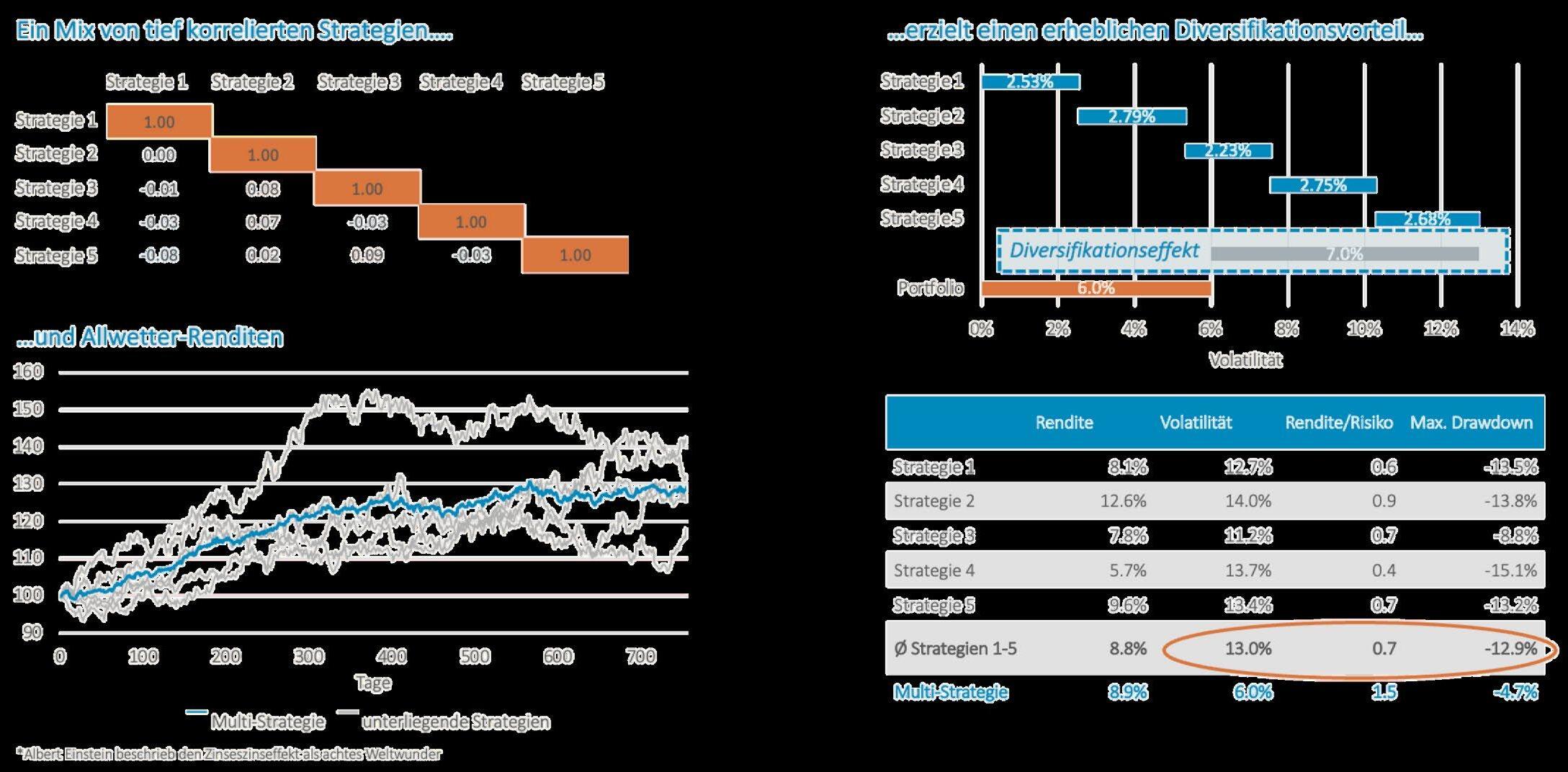
Since many hedge fund strategies exhibit moderate to low correlations also between each other, combining them in a multistrategy portfolio brings about a small investment miracle. 1
The ninth wonder of the world
But it gets even better. Since many hedge fund strategies exhibit moderate to low correlations also between each other, combining them in a multi-strategy portfolio brings about a small investment miracle. The total return of the portfolio is equal to the average of the combined strategy returns, as one would expect. What one might find surprising, however, is the diversification effect: the volatility of the multi-strategy portfolio and its maximum drawdown decrease compared to the average of the individual strategies, considerably in some instances. The risk-adjusted return of the overall portfolio gets greatly improved and is frequently much
better than the risk / return ratios for the individual strategies would lead one to presume. On the performance chart of a multi-strategy portfolio of that kind, this results in a line that trends upward without any major setbacks occurring and which lets an investor sleep easy amid any weather condition on the financial market.
So, such a portfolio of liquid alternative strategies can (and should) be more than a homeopathically dosed additive to a standard portfolio. In fact, a portfolio of liquid alternative strategies is a full-fledged (all-weather) investment strategy in itself. Speaking of the weather, the weather conditions for hedge funds and, by extension, the case for a larger allocation to liquid alternatives have improved on two counts. For one thing, the alpha winter of the 2010s decade is over. Those years marked by globalization, chronic intervention by central banks (ultralow interest rates and quantitative easing), and low volatility on financial markets were a drought period for hedge funds resulting in disappointing performance. But under the new market regime of the 2020s shaped by regionalization, elevated geopolitical uncertainty, higher interest rates, and increased volatility, opportunities for hedge fund managers have boomed – the good performance figures of the last five years, during which the top quartile of (multi-strategy) hedge funds earned double-digit percent annual returns, already reflects the improved climate.
For another thing, at the same time the longer-term prospects for the equity market have dimmed, at least if the “rules” of the past also apply to the future. Although the valuation of the stock market is not a good timing tool in the short run, over the long term it has consistently been a reliable indicator of performance over the next ten years. At the start of 2026, this specifically means that in light of the current priceto-earnings multiple of 22× for the (US) stock market, only marginally positive equity returns at best are to be expected over the next decade, and real returns (after subtracting inflation) are particularly likely to be disappointing. Diversifying into lower-valued non-US equity markets can help to alleviate this “investment problem,” but a multi-strategy portfolio composed of liquid alternatives may be an even better way to continue to earn equity-like returns with nerve-soothing low volatility in the years ahead regardless of the performance of financial markets.
Bloomberg

Performance as of 31 January 2026
Index (USD) EU High Yield 0.80% 0.80% 5.21% 8.03% Bloomberg Pan-European High Yield Index (EUR) Others
This document constitutes neither a financial analysis nor an advertisement. It is intended solely for informational purposes. None of the information contained herein constitutes a solicitation or recommendation by Kaiser Partner Financial Advisors Ltd. to purchase or sell a financial instrument or to take any other actions regarding any financial instruments. Furthermore, the information contained herein does not constitute investment advice. Any references in this document to past performance are no guarantee of a positive future performance. Kaiser Partner Financial Advisors Ltd. assumes no liability for the completeness, correctness or currentness of the information contained herein or for any losses or damages arising from any actions taken on the basis of the information in this document. All contents of this document are protected by intellectual property law, particularly by copyright law. The reprinting or reproduction of all or any parts of this document in any way or form for public or commercial purposes is expressly prohibited unless prior written consent has been explicitly granted by Kaiser Partner Financial Advisors Ltd.
Publisher: Kaiser Partner Financial Advisors Ltd.
Freigutstrasse 16 8002 Zurich, Switzerland
T: +41 44 752 51 11
E: financial.advisors@kaiserpartner.com
Design & Print: 21iLAB AG, Vaduz, Liechtenstein