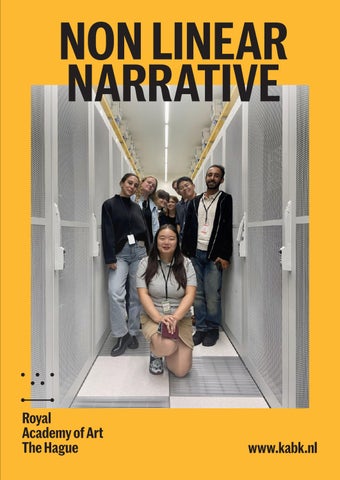
NON LINEAR NARRATIVE
www.kabk.nl
Curriculum
Table of Contents Year 1 Information Design Image Language Material Thinking Evidence-Based Stories Critical Theory and Methods Media Theory and Visual Culture Coding Post-Photography Aurality and Orality Documentary Film MAFAD Project Week Visual Investigations Restorying Climate Worlds in the Ethical Sense
6 8 9 10 11 12 13 14 15 16 17 18 19 20 21
Year 2 Individual Study Project 1 and 2 Thesis Professional Practice Graduation Show Preparation Final Exam Project
22 24 25 26 27 28
Practical Info Feedback Structure Design Phases Deliverables Final Exam Learning Outcomes Year 1 and 2 Credit Points Table Study Support and Counselling Floorplan Collaborative Partners Bios Staff
30 32 38 40 42 45 46 49 50 54
4
Curriculum
Introduction The Master Non Linear Narrative is a two-year educational programme at the Royal Academy of Art (KABK) that merges investigative methods of journalism and forensics with processing technologies of programming and visual arts into a contemporary, progressive design approach: non-linear storytelling. It takes the entanglement of relations in the global information society as a starting point, seeking to identify and interrogate complex socio-political issues and communicate them to a broad audience. Here, storytelling is understood as a way of questioning dominant narratives and uncovering underexposed stories by amplifying underrepresented perspectives and creating new connections between people, experiences, cultures, and forms of knowledge. Operating at the intersection of design, journalism, and technology, the programme is led by an international team of designers, programmers, filmmakers, artists, and thinkers. Each year, a small group of master’s students collaborates with governmental and nongovernmental institutions to conduct research, engage with the lived experiences of the people and communities within their networks, and develop a shared body of knowledge. In the course, their findings are translated into new visual forms of narrative and presented through exhibitions, public debates, and publications.
Master Non Linear Narrative
5
CURRICULUM
YEAR
6
Curriculum
Master Non Linear Narrative
ONE
7
Information Design Niels Schrader
Storytelling Study load: 3 EC per semester
Information Design considers how data is compiled, visualised, connected to lived realities, and then transformed into narratives that move beyond the statistical context. It invites students to analyse, discuss, and question maps, timelines, and relational graphs as tools to represent, structure, and communicate stories. Students learn to navigate four distinct design phases: the generating, safeguarding, releasing, and transferring of knowledge. Each semester revolves around a current politically or socially relevant subject that students investigate in close collaboration with external partners. This approach allows students to apply academic research in a real-world context and develop a social and political understanding of their lived realities. 8
Curriculum
Image Language Linda van Deursen
Storytelling Study load: 3 EC per semester
In this course students reflect upon the construction, appearance, and distribution of visual language. They develop an understanding of the use of images and texts throughout different media in order to arrive at a more conscious and articulate use of visual language. Throughout the course, students collectively study a selection of historic and contemporary visual essays, both in print and film. Underlying methods and making strategies are analyzed and discussed, as well as editing techniques and the relationship between words, spoken language, and images.
Master Non Linear Narrative
9
Material Thinking Ludmila Rodrigues
Storytelling Study load: 3 EC per semester
Material Thinking fosters students’ relation with the physical world while also tapping into digital design processes. It provides space for enhancing technical skills and empowers students’ creative input. The course integrates the academy’s facilities, presenting workshop overviews as well as encouraging students to select materials that align with their research. They will gain hands-on experience with wood, metal, 3D printing, laser cutting, textile work, and will have the opportunity to develop their own approaches. The experience gained will equip students to present their works through a variety of media, being it in scale models, spatial design or multisensory installations.
10
Curriculum
Evidence-Based Stories Maria Luz Nochez
Storytelling Study load: 3 EC per semester
Evidence-Based Stories teaches students how to develop an investigative design practice that draws on journalism’s tools and tactics. The course focuses on public-interest stories related to technology, society, and politics, and on the role that gender, class, age, and ethnicity play in coverage and in shaping public opinion. Participants will discuss contemporary journalism and learn practical skills, including how to construct compelling narratives, apply analogue and digital investigative techniques, organise research and present a final project.
Master Non Linear Narrative
11
Critical Theory and Methods Derica Shields
Theory
Study load: 3 EC per semester
The objective of this course is to offer students practical, quali tative research skills along with critical, theoretical perspectives applicable to research and artistic practices in the digital age. The research methods introduced and practiced are comple mented by discussions on critical theory, or a philosophical approach to culture. This includes a reflexive assessment and critique of culture, including the challenges of power structures and cultural assumptions in psychology, sociology, and history as well as digital, race, and feminist theory. Students gain a deeper understanding of the relation between their artistic practices, and various individual and collective experiences in the contem porary world. 12
Curriculum
Media Theory and Visual Culture Füsun Türetken
Theory
Study load: 3 EC per semester
This course approaches visual culture through interdisciplinary methods drawn from media studies and art history to examine how images constructs meaning, shapes perception, and organizes social and political realities. Students investigate how visual media produce regimes of truth, circulate affect, and influence collective imaginaries across social and cultural contexts, enabling diverse storytelling practices. Situating visual culture within infrastructures of capitalism, coloniality, and algorithmic governance, the course explores the politics of representation, mediation, and visibility. Through artistic research and intersectional perspectives, students explore how contemporary artists reimagine alternative futures. Master Non Linear Narrative
13
Coding Edwin Jakobs
Lab Study load: 5 EC
Coding focuses on software as a creative medium that is shaped by information, interfaces, data structures, and algorithms. It looks at code as a tool for both gathering and presenting research and emphasizes how transforming raw data manifests as visual representations that make information more powerful, consequential, and actionable. In the first year, the course takes the form of both technical workshops and a larger ongoing project. In the second year, the course extends the work done in the first year to apply to specific practices and ongoing areas of research.
14
Curriculum
Post-Photography Katrin Korfmann
Lab Study load: 5 EC
Post-Photography teaches students to use and apply lens-based research methods across various photographic technologies. During the course, students explore several photographic documentation techniques, such as photogrammetry, machinelearning photography, microscopic photography, satellite photo graphy, bio-based photography, and studio photography. Also, innovative post-production, image editing and presentation techniques are introduced, discussed, and practised.
Master Non Linear Narrative
15
Aurality and Orality
Lab
Aurélie Nyirabikali Lierman
Study load: 5 EC
This course looks into storytelling through the language of abstract and concrete sound as well as the (non-)verbal and (non-)human voice. Students explore the art of listening by investigating diversity in perception and perspectives, and by experimenting with hands-on tools and vocal techniques derived from radio documentary, speech acting, performance, and music. Introduced to techniques such as foley art and field recording, they learn to understand the impact of deliberately curated amplification and reflect on the effect of the spatialization of sound and notions of time, while engaging with the emotional and subjective implications of sound.
16
Curriculum
Documentary Film Marleine van der Werf
Lab Study load: 5 EC
Documentary Film focuses on the art of non-fictional storytelling. During the course, students are familiarised with the technical aspects of filmmaking. In particular, they learn how to create a research book, write a film plan, conduct interviews, utilise archival footage and implement audio recording. To deliver a personal approach to their projects, students are encouraged to experiment with alternative content formats, such as mockumentary, XR or vlogs. The course grants students a general understanding of how to write, shoot and edit a short video documentary. It explores narrative structures and visual languages of the genre. With filmmaking being an entirely collaborative practice, teamwork lies at the core of the programme. Master Non Linear Narrative
17
MAFAD Project Week
Collaboration
Guest Teachers
Study load: 1 EC
The MAFAD workshop week is a cross-departmental study com ponent for year one students of the four MAFAD programmes. The focus is on an interdisciplinary interest in the diverse knowl edge histories that come together around contemporary themes to support shared practices in art and design. The days involve guest lectures, collective learning through workshops, and home reading.
18
Curriculum
Visual Investigations
Collaboration
Jake Charles Rees
Study load: 1 EC
This course is a joint study component with the Master Photography and Society. It teaches students how to conduct investigations that draw on the tools and tactics of journalism, focusing on public interest stories related to technology, society, and politics. Participants will discuss the profession and culture of contemporary journalism as well as the developing field of visual investigations, before learning practical skills such as how to develop compelling narratives, utilise analogue and digital investigative techniques, organise research, and present a final story.
Master Non Linear Narrative
19
Restorying Climate
Collaboration
Victoria McKenzie
Study load: 1 EC
Restorying Climate presents climate change as an entangled, interdisciplinary, and social justice problem. Through decen tralizing the literature on climate from African, Indigenous, and other spaces of the ‘Global South’, the course works towards understanding how restorying and restoration are aligned. Students engage in the idea that intervention isn’t just about revelation but using artistic research skills and non-linear storytelling methodologies as a means to interrogate an eco system of change, sustainability, and new ways of being a species on a shared planet.
20
Curriculum
Worlds in the Ethical Sense
Collaboration
Mijke van der Drift
Study load: 1 EC
Worlds in the Ethical Sense is a cross-departmental study component of the Master Artistic Research and Master Non Linear Narrative that focuses on ethics as a basis for artistic practices. The course supports students in their research practice by guiding their investigations of pluriversal forms of engagement with forms of life including the human and the more-than-human. Students interrogate cultural objects, their own work, and their ethical commitments as an artist / designer / maker / researcher.
Master Non Linear Narrative
21
CURRICULUM
YEAR
22
Curriculum
Master Non Linear Narrative
TWO
23
Individual Study Project 1 and 2 All teachers
Study load: 9 EC per project
For their Individual Study Project, students undergo an individual study programme to define their research topics. Personal perspec tives and interests determine the content and scope of the assign ment. A selected group of mentors provide personalized feedback and assess the results collectively. The design and theory teachers monitor the study progress, while lab teachers are available for technical guidance. Overall, the student creates two Individual Study Projects.
24
Curriculum
Thesis Derica Shields and Füsun Türetken
Study load: 10 EC
In the first semester of year 2, students write their thesis. While the format is academic, the topic is entirely open. It is advisable that students focus on the research that will support and enhance their practical work for graduation. By writing the thesis, students learn to utilise their research skills, convert their findings into writing and are able to navigate different academic disciplines. Through presentations and discussions, students learn to articulate their work, situate their insights in a broader scope and develop the ability to finetune their capacity for reflection and investigation.
Master Non Linear Narrative
25
Professional Practice Pia Pol
Study load: 2 EC
During Professional Practice, students learn and exercise entre preneurial skills needed to build an autonomous professional practice. The course is split into two parts: Administration and Dissemination. Administration focuses on management competencies like accounting, funding, and budgeting, while Dissemination pays attention to public positioning, presentation skills, and networking, enabling opportunities to connect with alums and field professionals. The course collaborates with experts from various professional fields, including cultural funds, copyright organizations, and autonomous curators.
26
Curriculum
Graduation Show Preparation Oliver Doe
Study load: 3 EC
To prepare for their graduation show in their second year, this course provides an opportunity for students to plan and discuss the presentation of their final projects. The course encompasses the practicalities of programming and materializing an exhibition, ranging from concept development (e.g. theme, scenography, graphic design, publicity, and signage) and production (e.g. financial overview, logistics, and material resources for build-up and break-down of the show), to the presentation of their final exam including an oral and material presentation. The course offers context for making realistic decisions in relation to their final projects, thereby training students for the reality of their professional life. Master Non Linear Narrative
27
Final Exam Project All teachers
Study load: 26 EC
For their Final Examination, students choose their own examination subject. Personal perspectives and interests determine the content and scope of the assignment. A selected group of mentors provide personalized feedback and assess the results collectively. Over the course of the last semester, students undergo two green light assessments during which they present their progress and plans for the graduation show.
28
Curriculum
Master Non Linear Narrative
29
PRACTICAL
INFO
Feedback Structure Competencies The Master Non Linear Narrative has chosen to adopt the four nationwide competencies for its study programme: Artistic Creation, Research and Reflection, Connecting With the Environ ment, and Working in a Practice. These competencies are aligned with the ‘Dublin Descriptors’, originally established in 1999 and revised in 2025 by the Visual Arts Consultation Group (OBK), in consultation with other arts disciplines in the Netherlands. Through this harmonisation process, the qualities of students from all arts programmes are clearly positioned and recognised within higher education. The competencies are described at a national level in the Visual Arts and Design Professional and Educational Profile and serve as reference points reflecting students’ knowledge, skills, and attitudes. From the first to the second year, and across the MAFAD programme, assessments use the same set of competencies, helping to track students’ development over time. During their two years of study at NLN, students undergo seven different types of evaluation: 1. Admission During the admission procedure, prospective students and the department verify whether they are a good match. General informa tion about the admission requirements and portfolio submission deadlines is published on the KABK website. Candidates apply with a motivation letter, a CV, and their artistic portfolio. They also need to complete a home assignment to demonstrate some basic skills in reporting. The applications are then reviewed by a team of two teachers and one enrolled student, focusing on the artistic quality 32
Curriculum
and motivation. Based on their recommendations, a selection of candidates are invited for an interview with a different team of teachers. If only possible and practical, these talks are con ducted face-to-face, or online otherwise. During this second selection round 16 applicants are eventually admitted to the programme. If necessary, the department works with a waiting list. Interested candidates are recommended to always seek advice prior to the actual admission procedure. 2. Midterm Review To prepare the students for their December and June assessments, the department provides a progress meeting halfway through the semester. During this meeting, students present their ongoing work to a few tutors and their fellow students in order to receive concrete feedback. These conversations allow teachers to check in on the students’ progress, advise them on the remaining workload and deadlines, and align the study load where necessary. The reviews give students the opportunity to express any comments or concerns at an early stage and to take crucial decisions in a timely manner. To stimulate peer-to-peer interaction, the style of these meetings is informal and does not include grades. Students receive a written summary of their feedback to encourage deeper reflection. Non-attendance due to illness or personal circumstances is at the risk of the student since no further collective feedback is provided. 3. Individual Feedback During the individual assessment at the end of every semester, students reflect separately with each supervisor on their work, methods, and progress. The teachers take the learning objectives and deliverables as an indicator of progress, but also look holistically at the overall development of the student. Their feedback Master Non Linear Narrative
33
is disciplinary by nature and aimed at reinforcing personal development. Assessments are also shared in writing, soon after the feedback sessions. Passing into the next year, however, is not decided by individual marks but by the collectives. Individual subjects focus on at least 4 competencies, mentioned in each course description. Students who fail a particular subject do not necessarily fail a specific competency. A lower score in one of the subjects might be compensated by showing exceptional study effort and achieving outstanding study results in subjects with the same main competencies. 4. Collective Assessment Each semester is concluded by the collective assessments. Here, students are required to reflect on their learning progress and achievements based on the competencies / assessment criteria. The evaluation of the artistic quality emerges from the dialogue between professional peers, each from a different background and perspective. This allows for a collective and inter disciplinary evaluation. During the assessment, the team provides qualitative and development-oriented feedback. In this interactive session, student and teachers together formulate feedforward for the coming period. The collectives are open to all the students from the department, which allows peers for note taking. Delib erations, however, take place without the students. It’s here where teachers give a collective grade (pass or fail), link the students’ performance with the competencies and assign 30 study points. Passing the assessment is based on study progression and the successful acquisition of competencies rather than the evaluation of the individual study subjects. Collective feedback is shared with the student in writing.
34
Curriculum
5. Self-Evaluation Before the collective assessments, students fill in a self-evaluation form. These evaluations help students not only to keep track of their own strengths and areas for improvement but also to mentally prepare for the collective evaluations. In conversation with the teaching team, conclusions from the form can be converted into personal learning objectives. The self-evaluation is also a reflection moment, through which students can share personal concerns and / or advice related to the programme. This feedback is then discussed and evaluated together with the class coach. 6. Greenlight In their graduation semester, final exam candidates have three assessment moments leading up to the graduation: two greenlight assessments and one final exam. The final exam is typically planned during the last week of the semester, while the greenlight assess ments are scheduled at the beginning of the term and after its first half. These three checkpoints are conducted by the tutors teaching in the final year of the programme together with the department head and an external examiner. All members of the final exami nation committee are appointed by the KABK Examination Board. During the first greenlight assessment, students present an unrefined proposal of their final project. Each graduate has a maximum of 20 slides to explain the plans for the upcoming exam and to clarify the relevance of the work for a non-academic audience. Upon completion, students receive personalised written feedback and indicate their preference for the two core mentors to supervise their exam. Students who have not yet earned 90 study points by the start of the first green light review are not permitted to participate in that assessment.
Master Non Linear Narrative
35
The second greenlight assessment results in a positive or negative advice. The positive advice, or a ‘green light’, means that the student is progressing well towards the final exam, but does not mean graduation is already certain. Students with a negative advice (‘red light’) get a strong – but not binding – advice to discontinue their project and consider a restart. An ‘orange light’ indicates that the trust into the presented project proposal is not fully established yet and extra measures need to be taken to increase the quality of work. 7. Final Exam During the greenlight assessments and the final exam, the role of the external examiners is to ensure a fair examination process and provide students with additional feedback. Prior to the first greenlight, the examiners receive information about the graduates’ study progress and the thesis abstracts from the first semester. During the final exams the group of examiners is oftentimes complemented by a representative of the Examination Board. They are responsible for safeguarding the quality of the final exams and ensuring that the assessments are carried out according to the Education and Examination Regulations (OER). The final assessment puts the focus on determining whether the student is ready to join the professional practice. The decision is communicated in the form of a simple ‘pass’, ‘pass with distinction’ or ‘fail’, as the department refrains from giving grades to the students. Instead, personalised written feedback on their study trajectory is provided, intended to help with starting their professional career. The written reflection elaborates on the evaluated learning outcomes and includes a listed summary of the general competencies.
36
Curriculum
During the exam, graduates present their work to a total of two assessment committees. This procedure was originally established to reduce the number of panel members to a less intimidating size, but presenting the work twice has proven to provide other significant benefits. It also allows students to improve their presentation based on feedback given after the first of the two rounds. With its built-in rehearsal moment, this routine increases the students’ general level of self-confidence and quality of graduation, while decreasing presentation anxiety. Assessment participation A student who is facing circumstances that prevent them from attending a formal assessment should inform the head of depart ment that they cannot attend and should also inform the student counsellor of their inability to take part in the evaluation with proof of circumstances, such as a medical note. The student counsellor, in conversation with the head, will then give an advice on how to move forward, which may include a delayed opportunity for the assessment. In general, students who do not attend or pass the first or third semester’s collective assessments in December have the oppor tunity to resit the failed assessment in January. Students who do not pass the second collective assessments also have the opportunity to resit the failed assessment. They receive an assignment to catch up on any backlogs and are then evaluated after four weeks’ time, coinciding with the final exam. The department recommends students to familiarise themselves with the official Education and Examination Regulations (OER) on the KABK website before taking part in the assessment reviews.
Master Non Linear Narrative
37
Design Phases Generating knowledge The thesis is the theoretical underpinning of the graduation project. It allows students to explore the wide range of information and resources related to a chosen topic. In its research phase, graduates make an inventory of questions associated with a specific design problem, identify potential sources and collect relevant content or data. During this process, students formulate a research question that helps them to navigate the vast amount of input. Safeguarding knowledge After exploring and gathering information, students start to interpret and assess their findings. Ideally, they manage to formulate an answer to the research question developed earlier. The scope of this answer determines the volume of the thesis, which amounts to about 10.000 words. An additional abstract of 500 words, summarising the main thoughts, is used for the production of the Graduation Catalogue. Releasing knowledge The final exam project, on the other hand, translates the conducted research into a concrete and tangible design outcome. Students are expected to develop an innovative concept and cast the research results into an artistic form. By means of images, typography, interfaces and other media, the designer develops methods of how information is structured, logically arranged and then visually displayed. Where images are not sufficient, sound, texture and even smell or taste are used. Examples include video work, interactive websites and printed books.
38
Curriculum
Transferring knowledge The examination concludes with an exhibition, during which graduates put their final exam project on display. During the preparations for the show, students make their projects accessible for a successful dissemination to wide audience. The implementation is a group effort, during which all students work together on one collective event.
Master Non Linear Narrative
39
Deliverables Final Exam The underlying framework for the final year and its deliverables is a design process consisting of four distinct phases: generating, safeguarding, releasing, and transferring of knowledge. Each of these creates opportunities for the students to advance all of the four competencies adopted by the department. The design phases ultimately determine the following two outcomes for the final exam: 1. 2.
A written graduation thesis in the first semester of year 2 (generating and safeguarding knowledge); An extensive final exam project in the form of an artistic interpretation of the conducted research in the second semester of year 2 (releasing and transferring knowledge).
The deliverables are presented at the end of the second year during the Graduation Show and published in the Graduation Catalogue. As part of the graduation show, students are also expected to deliver a project description of roughly 500 words in the weeks before their final exam.
40
Curriculum
Master Non Linear Narrative
41
Learning Outcomes Year 1 The first year of the study is an exploration of the students’ research qualities. Students learn to connect the knowledge gained in previous studies to the design discipline and how to apply various research methods. Much emphasis is placed on developing an open-mindedness towards understanding of socio-political issues, a holistic understanding of environmental-ethical problems, and acquiring a methodological work process. In this year, the department offers a designated framework of assignments, in which the students train their collaborative skills and gain insight into the complexity of real-life communication challenges. Students are encouraged to develop their own opinions and to position their research within a wider academic context. 1. Artistic Creation Students’ work shows development of their creative and critical abilities through focused exploration. 2. Research and Reflection Students can research topics and articulate results in written and spoken form. They can reflect on these results discursively and in relation to their own creative work. 3. Connecting With the Environment Students can show engagement with the wider social and cultural field that their practice exists within. 4. Working in a Practice Students can realise study conditions that support a creative practice and show the ability to collaborate with others.
42
Curriculum
Learning Outcomes Year 2 The second year of the study is all about working independently. To a large extent, the students themselves are expected to be proactive in seeking feedback and formulating their own research assignments. Based on their own skills and interests, students can choose their means of communication and presentation techniques. Investigating, formulating, designing, as well as disseminating a complex narrative become key objectives. This applies to writing the thesis and developing the graduation work. Additionally, part of the study year is dedicated to professionalising the students’ practice and considering how to proceed after graduation. 1. Artistic Creation Graduates can develop and synthesise their practice-based research process into a critically and socially engaged creative work. 2. Research and Reflection Graduates can reflect on their critically engaged, practice-based research concerns in spoken and written form. They can situate these within a relevant professional context. 3. Connecting With the Environment Graduates can position themselves in society from an articulated vision as a practitioner and in doing so, contribute to the development of their professional field. 4. Working in a Practice Graduates can realise conditions that support a sustainable professional practice and collaborate effectively where necessary.
Master Non Linear Narrative
43
44
Curriculum
CREDIT POINTS TABLE
Year Semester
1
2
1
2
3
4
Material Lab (Ludmila Rodrigues)
3
3
0
0
Image Language (Linda van Deursen)
3
3
0
0
Evidence-Based Stories (Maria Luz Nochez)
3
3
0
0
Information Design (Niels Schrader)
3
3
0
0
Individual Study Project 1
0
0
9
0
Individual Study Project 2
0
0
9
0
12
12
18
0
Media Theory & Visual Culture (Füsun Türetken)
3
3
0
0
Critical Theory & Methods (Derica Shields)
3
3
0
0
6
6
0
0
Coding (Edwin Jakobs)
5
0
0
0
Documentary Film (Marleine van der Werf)
5
0
0
0
Post-Photography (Katrin Korfmann)
0
5
0
0
Aurality and Orality (Aurélie Nyirabikali Lierman)
0
5
0
0
10
10
0
0
OSINT Workshop (Jake Charles Rees), in collab. with MAPS
1
0
0
0
MAFAD Project Week (guest teachers)
1
0
0
0
Restorying Climate (Victoria McKenzie), in collab. with MAR
0
1
0
0
Ethics Workshop (Mijke van der Drift), in collab. with MAR
0
1
0
0
2
2
0
0
Professional Practice Skills (Pia Pol)
0
0
2
0
Thesis (Füsun Türetken & Derica Shields)
0
0
10
0
Final Exam Project
0
0
0
26
STORYTELLING
42
THEORY
12
LABS
20
COLLABORATIONS
4
FINAL EXAM
Graduation Show Preparations (Oliver Doe)
Total
0
0
0
4
0
0
12
30
42
30
30
30
30
120
This overview is subject to change as the Royal Academy of Art monitors its curricula on an annual basis.
Master Non Linear Narrative
45
Study Support and Counselling Head of Department Niels Schrader The department heads at KABK are responsible for the educational programme of their department. Together they guard the quality of the education and make sure the contents of the programme stay up to date. The department head supervises a team of teachers, and is assisted by a coordinator. Coordinator Oliver Doe The coordinator is responsible for the general organisation of the programme, including scheduling classes, meetings, visits, and appointments, as well as keeping an eye on study deadlines, assessments, and admissions. They work on the development of the course with the department head. They should be approached if students have questions about the programme or need advice on organising their studies. Class Coach Ludmila Rodrigues The role of the class coach is to monitor the study progress and development of students within the programme, taking a holistic approach. In this way, they keep students on track with their studies, keep an eye on potential hurdles, and make sure everyone feels positive about their involvement at the Master Non Linear Narrative. The class coach has per semester 1 check-in with students to talk about their studies and general well-being. In collaboration with the head of department, they also chair the collective assesments.
46
Curriculum
Student Counsellor Anne-Margriet Klaver The student counsellor should be the go-to person for students who are facing personal, health, or mental health issues that are impacting their study. A plan can be drawn up with the student counsellor to get the study trajectory (back) on track in a sustainable way. Appointments can be made via the portal, and a referral can be made to the student psychologist if necessary, for longer-term issues. Student Psychologist Anna Diepraam After speaking to the student counsellor you may be referred to the student psychologist. They focus on the psychological support and guidance to students. If the student psychologist is unable to offer a student the help they need, they can help find the right support and treatment instead. To make an appointment with the student psychologist a student first needs to talk with the counsellor. Confidential Counsellor Femke de Haan The confidential counsellor is a designated individual who provides a safe and confidential space for students and employees to discuss sensitive issues, particularly those related to workplace concerns or inappropriate behaviour. Workplace concerns are issues related to equity and well-being of students and staff, and inappropriate behaviour is, for instance, racism, discrimination, sexual intimidation, or bullying. The counsellor provides a listening ear and advises on how to move forward. Master Non Linear Narrative
47
Core mentor All teachers After the first greenlight assessment of year 2, students indicate their preference for 2 core mentors. These mentors are responsible for guiding the student to a successful graduation by specifically providing personal support in the run-up to the final exam, staying in touch with students abroad, and flagging potential study concerns. Graduation Show Producer Oliver Doe The producer of the graduation show leads the Grad Show Prep classes for second year students in semester 4, and is responsible for the overall planning of the final exhibition. This includes organising space divisions, keeping track of deadlines, safety, assisting with the fundraising, and promoting the show. They also advise on the physical production and installation of the graduation works towards a well-curated exhibition. Policy Officer Internationalisation Aparajita Dutta The International Office at KABK helps and advises students who prepare for their journey and stay in the Netherlands. They can be contacted with questions about visas, residence permits, municipal registration, grants and scholarships, international study programmes, accommodation, medical care, insurance, language courses, etc.
48
Curriculum
Floorplan
Entrance Bleijenburg For MA students only
B B0
2 .0 BA
BA .0 13
BA .
BC 4
2
.0 0
0 .0 D
20 .0 BA
BC
20
C
2
01 .0 D 01 .0 BA
18 .0 BA
.0 0
C
BA .0 0
4
BA .0 H C
2 D H .0 BA
16 .0 BA
0
.B D YR C.
00 S.
D
0A .B BA
Floor
BD .0 11
BA .0 2
1
BA .0 19
2
Canteen Courtyard
BD .0 01
07 .0 BD
Master Non Linear Narrative
49
Past Collaborative Partners
2024–2027 Climate Truth Crisis
2024–2025 Closed Cycles
Erasmus+ Cooperation Partnership Project
Dutch Research Council (NWO), The Hague
2022–2023 Testimonies of Change
2021–2022 Books Make Friends
Hivos, The Hague
KB – National Library, The Hague
50
Curriculum
2023–2024 Unmapping Territories
2023 Rewriting Climate Headlines
National Archives, The Hague
Arab Reporters for Investigative Journalism (ARIJ), Amman
2020–2021 Plastic Justice
2020–2021 Facts Not Filters
Plastic Soup Foundation, Amsterdam
Free Press Unlimited, Amsterdam
Master Non Linear Narrative
51
2019–2020 Who Speaks?
2019–2020 Six Degrees of Separation
Dutch Parliament, The Hague
Archaeology Department of the Municipality of The Hague and Stroom Den Haag
2018–2019 Views from Above Greenpeace Netherlands, Amsterdam
52
Curriculum
Master Non Linear Narrative
53
Bios Staff Linda van Deursen is an independent graphic designer. With Mevis & van Deursen (1987–2022) she worked for cultural clients and has produced identities for major cultural institutions such as Stedelijk Museum Amsterdam, Museum of Contemporary Art in Chicago and events such as documenta 14 and Venice Biennial. She has edited and designed numerous books for artists, photographers, architects and designers. Oliver Doe is the course coordinator for the Master Non Linear Narrative programme, and also works independently as an artist, writer, and curator. Their own transmedia practice explores queer language and communication through varying levels of coding and abstraction, incorporating painting, performance, text, and photography amongst other media Mijke van der Drift works on transfeminist and anti-imperial ethics through philosophies of movement, collective action, and counter-cultural production. This work takes the form of writings, performances, and sound pieces, often by way of inter-disciplinary collaborations. Mijke co-authored with Nat Raha Trans Femme Futures (Pluto 2024). Mijke published in Alternatives, Social Text, Journal of Speculative Philosophy, with Cambridge University Press, and many other outlets. Mijke is Tutor (Research) at the Royal College of Art, London and is co-chair of its Union branch. Mijke is founding member of the arts collective Red Forest. Edwin Jakobs teaches Coding in the Master Non Linear Narrative. Before becoming a partner in RNDR he was the lead software engineer at LUSTlab, and a programmer at Treparel, where he was in charge of visualisation and automatic classification of 54
Curriculum
patent documents. He is fluent in numerous codes in the fields of Computer Graphics, Machine Learning, Natural Language Processing, and more, and is the main developer of the OPENRNDR framework application. Victoria McKenzie is an academic-activist, educator and artist. Her work focuses on the interconnections and entanglements of Earth where the realms of the individual, collective (human and more-than-human) and systems align. Trained in Research Architecture and Ecology, Victoria currently runs an architecturalresearch agency called ‘RRA’ Radical Research & Re-storying Agency which is informed by the question: ‘how can the pre-colonial past inform a decolonial future?’. Victoria has taught at various institutions including Sandberg Institute, Gerrit Rietveld Academie and St. Joost School of Art and Design. Katrin Korfmann is an artist working on the cutting edge of photography, post-photography and installation art. Attracted to the spectacles of everyday life in the public space, she captures people in metropolitan motion, creating a fresh perspective on busy urban settings as portraits of contemporary transitions. With a critical attitude towards the world around her, and explicitly in relation to contemporary visual culture, Korfmann uses a myriad of self-photographed images to investigate their historical, social and visual context. Aurélie Nyirabikali Lierman is a composer, radio and vocal artist whose work has been described as pioneering, bold, provocative and delicate. Fascinated by the narrative power of abstract sound and music, she often adds dramatic and documentary elements to a compositional structure. Her main focus is the (non) human voice, as well as her many personally gathered field recordings from East Africa. She collaborates with other artists in a variety of disciplines. Master Non Linear Narrative
55
María Luz Nóchez is an award-winning Salvadoran investigative journalist and editor currently based in the Netherlands. She spent most of her career at El Faro – El Salvador’s leading investigative newsroom – where she reported for over a decade on disinformation, gender, and political repression in Central America, and coordinated and edited the Opinion section until 2023. Alongside her reporting, María Luz has led cross-border collaborations and editorial projects with the International Women’s Media Foundation and Free Press Unlimited, focusing on coverage of women’s and LGBTQI+ rights. Pia Pol currently is head of business development and transformation at Hatje Cantz Verlag in Berlin. Before this role, she studied English Language and Culture and American Studies at the University of Amsterdam and worked as publisher and co-director at Valiz, Amsterdam. She focuses on developing sustainable creative practices from a business perspective and has also explored the possibilities of digital publishing. Jake Charles Rees is a curator, producer and Programme Manager for The Centre for Investigative Journalism in London, UK. He has worked with artists, journalists, documentary film-makers and creative technologists to produce artworks, events and publications about journalism and the emerging field of artistic investigative reporting, as well as lectures on curating, open source intelligence and information. Jake recently founded the nonprofit Center for Artistic Inquiry and Reporting which aims to support artists to reimagine investigative journalism. Ludmila Rodrigues works next to her academic practice as a designer, scenographer, and performer. By bridging architecture, perception and ritual, Ludmila focuses on enhancing human com56
Curriculum
munication, exploring ways of learning through the body. Through the design of performative spaces and choreographic spaces, her works function as open platforms for relation, inviting for audience as co-creator of the experience. Niels Schrader is head of the Master Non Linear Narrative and founder of the Amsterdam-based design studio Mind Design. Together with Ramon Amaro and Sheena Calvert he is co-founder of the Queer Computing Consortium (QCC). In his role as an educator, Schrader focuses on social, political and environmental processes driven and influenced by digital technologies. He has initiated a number of large-scale academic research projects together with governmental and non-governmental organisations like the Dutch Parliament, National Archives, Free Press Unlimited, Greenpeace and Amnesty International. Together with Jorinde Seijdel he published in 2024 Acid Clouds: Mapping Data Centre Topologies (nai010 Publishers). Derica Shields is a writer and editor whose work traces strategies for navigating epistemic violence against radical knowledge transmission, with a particular focus on Black aesthetics and cultures. In 2021, her oral history project A Heavy Nonpresence was published by Triple Canopy with an introductory essay that outlines the co-development of the modern welfare state alongside measures to expel or instrumentalise Black peoples. She was a 2022–2023 resident at Jan Van Eyck Academie, and in 2023, she gave the second annual Sylvia Wynter Lecture at King’s College London. Her book Bad Practice considers the potentials of Black failure and is forthcoming from Book Works. Füsun Türetken is an interdisciplinary thinker, research-based artist, and professor, whose work spans visual culture, media theMaster Non Linear Narrative
57
ory, activism and critical inquiry. Through speculative fiction, she uncovers erased histories and imagines alternative futures, often drawing from archival silences. The figure of the trickster frequently informs her approach to navigating institutional structures, subverting entrenched hierarchies. Her doctoral thesis, On the Most Powerful Catalyst on the Planet, explored how metals function as quasi-agents, influencing political conflicts and shaping capitalist systems. The study examines the role of metals in finance, belief systems, geopolitical relations, digital bodies, and even climate-engineered weapons, shedding light on their complicity in processes of ecocide. Marleine van der Werf is an award winning documentary filmmaker, visual artist and artistic researcher. Rooted in a documentary practice, she develops films, immersive installations and multisensory experiences that explore embodiment, perception and consciousness. Working in close collaboration with people with lived experience, as well as neuroscientists, philosophers and technologists, her practice investigates how subjective realities are shaped and communicated. Through interdisciplinary artistic research, she explores embodiment, disembodiment and the shifting relationship between biological and technological forms of existence. Her research is presented through films, installations, publications and public discourse. The works have been presented internationally at film festivals, museums and media art platforms, broadcast on national and international television, and supported by organisations including the Sundance Institute. Alongside her artistic and research practice, she teaches and supervises projects in the fields of film, installation and immersive media.
58
Curriculum
Master Non Linear Narrative
59
GOOD LUCK
60
Curriculum
AND ENJOY!
Master Non Linear Narrative
61
PUBLICATION DETAILS Published by Royal Academy of Art, The Hague © September 2026 Editors Niels Schrader Oliver Doe Photography Roel Backaert Design Jaap Smit Disclaimer: The information shown in this publication has been compiled with care by the Royal Academy of Art, The Hague, but the correctness and completeness of it cannot be guaranteed. We have done our best to trace all copyright holders with regard to visual material. No rights can be derived in any way from the contents of this publication. nln.kabk.nl
62
Curriculum
Master Non Linear Narrative
63
64
The Royal Academy of Art, The Hague
Curriculum