Industry and Economics
THE LEDGER T H U R S D A Y
D SECTION
,
M A Y
29, 2008
THE MORGAN COUNTY CITIZEN
hay
the
g ro w in g price of B Y K AT H RY N P U R C E L L
|
P H OTO S B Y A N G E L I N A B E L L E B U O N O
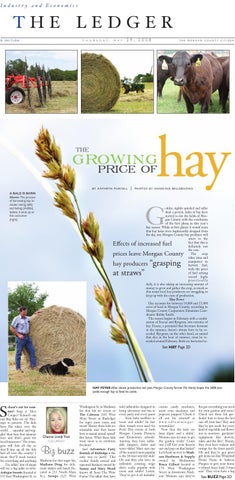
A BALE IS BORN Above: The process of harvesting hay includes raking (left) and baling (middle) before it ends up at the consumer (right).
G
olden, tightly spiraled and taller than a person, bales of hay have started to dot the fields of Morgan County with the conclusion of the first phase in this year's hay season. While at first glance it would seem that hay bales were haphazardly dropped from the sky, any Morgan County hay producer will attest to the fact that this is definitely not the case. The crop takes time and manpower to harvest. And, with the price of fuel setting record highs practically daily, it is also taking an increasing amount of money to grow and gather the crop, so much so that many local hay producers are struggling to keep up with the costs of production. Hay Fever Hay accounts for between 14,000 and 15,000 acres of land in Morgan County, according to Morgan County Cooperative Extension Coordinator Bobby Smith. The season begins in February with a combination of Fescue and Ryegrass, two varieties of hay. Fescue, a perennial that becomes dormant in the summer, doesn't always have to be reseeded. Ryegrass, on the other hand, an annual that dies in the heat of summer, must be reseeded around February. Both are harvested to-
Effects of increased fuel
prices leave Morgan County hay producers “grasping
at straws”
See HAY Page 2D
HAY FEVER After dismal production last year, Morgan County farmer Pat Hardy hopes the 2008 year yields enough hay to feed his cattle.
S
chool’s out for summer! Sing it Alice Cooper! School’s out and Rip Stiks are in! Message to parents: The kids have flat taken over the world . . . squealin’ and wigglin’ their bare foot summer toes and that’s good for local businesses! The youngins will fish all day so they’ll buy up all the fish bait all over the county! I mean they’ll need money for everything and anything . . . I’m talkin’ lots of shops will see a big spike in sales: Antique Sweets (located at 132 East Washington St. in
Dianne Lively Yost COLUMNIST
Biz buzz Madison) for that sugar hit, Madison Drug for delicious shakes and lunch (located at 213 North Main St.), Scoops (123 West
Washington St. in Madison) for that fab ice cream or The Caboose (102 West Main Street in Rutledge) for super snow cones and treats! Honey these kids are insatiable and they know how to spend, spend, spend! But listen: What these kids want most is to celebrate freedom! And Adventure Party Rentals of Rutledge is the only way to party! This rockin’ family owned and operated business owned by Sonny and Mary Wood knows all ‘bout The Wow Factor! I’m talkin’ they have
wild inflatables designed to bring adventure and fun to every party and every guest . . . from baby toddlers to teens and adults! In fact their rentals were used for Field Day events at both Morgan County Primary and Elementary schools! Anyway, they have inflatable jumpers, slides and water slides! Mary says one of the season’s most popular is the 18-foot wet/dry slide! Oh and they also have an inflatable jousting stage that’s really popular with teens and adults! Listen: They’ve got it all includin’
cotton candy machines, snow cone machines and popcorn poppers! Check it all out for yourself at w w w. a d v e n t u r e p a r tyrental.biz! Now that the kids are busy slipin’ and a slidin’, Momma says it’s time to get the garden ready! Come one y’all! Get your bicycle out and pop on that basket! Let’s head on over to Madison Hardware & Supply owned by Madisonian Bruce Gilbert located at 174 West Washington Street in downtown Madison! Momma says they’ve
flat got everything you need for your garden and more! Check out these fab gardenin’ hats to keep the hot sun off your face! Hey and they’ve got seeds for every kind of vegetable and flower not to mention gardenin’ equipment like shovels, rakes and the like! Honey, they even have rockers and swings for the front porch! Oh and they’ve got great gift items too like Whitehall Home Name & Address Plaques to give your home a refined fancy look! I want one! They even have a big
See BUZZ Page 2D
N EWS & F EATURES
May 29, 2008 Page 2D
HAY
from Page 1D
wards the end of May. Bermuda Grass, a third variety of hay grown locally, is cultivated and harvested during the summer. After the summer months, Fescue and Ryegrass combination can be grown and harvested through the fall. The cost of seed totals about $25 per 50-pound bag, according to Pat Hardy, Sr., a local hay producer. "It takes nearly $20 an acre in seed cost," Hardy said. Fertilizer, whether it be granular nitrogen or chicken litter, is also applied to the hay in an effort to aid growth and increase crop yield. Granular nitrogen goes for $525 per ton, according to Smith. Just three years ago, it cost less than $300 per ton. "You have to use gas to make the pellets," Smith said, speaking to the effects of the cost of fuel. "Also, because of the weak dollar, other countries are starting to buy it. Demand is higher, so the price goes up." Chicken litter, an alternative to granular nitrogen, currently costs between $60 and $80 per ton, according to Smith, compared to around $35 per ton previously. Fuel isn't the only reason the cost of chicken litter is increasing. In the past, chicken houses were cleaned five to six times a year, whenever a new batch of chickens came in. Of course, this meant that chicken litter was more readily available. Currently, instead of cleaning the chicken houses out with each batch, poultry produc-
BUZZ
ers are told to put down a thin layer of wood chips between batches. "There's less chicken litter because they (poultry producers) don't clean with every batch; they clean once a year," Smith said. "But, the nutrients in the litter are more concentrated." One ton of granular nitrogen covers roughly 10 acres at a cost of about $60 per acre, Hardy said. Further, the granular nitrogen only lasts for one cutting. Chicken litter, on the other hand, costs between $30 and $35 per acre and lasts for several cuttings. "With the price of fertilizer, you can't find chicken litter," Hardy said. "We used to could buy litter cheap but, one, the price of fertilizer went up and, two, the cost of hauling the litter has gone up." "It costs about three times as much to fertilize this year than last year," David Hilsman, a Morgan County hay producer, said. After seeding and fertilizing, hay doesn't just grow into those perfectly circular bales. Instead, it takes a variety of machinery as well as many gallons of fuel to gather the hay. The process involves cutting, fluffing, raking, baling and hauling. After cutting the hay, it must be fluffed so that it dries and raked into rows so that the hay can be baled. The entire process involves fueling machinery including mowers, tractors, balers and hauling equipment. "The cutter tractor takes 40 gallons at $4 per gallon, it costs $160 [to fill up]," Hilsman said. "I fill up about every day." Based on the amount it
from Page 1D
selection of knives for huntin’ and fishin’! I mean this store rocks like Granny on the porch! It’s allthings-hardware too . . .nails, hooks u-bolts, tools, paint, tow straps . . . Ding dang I’m gonna get rich ‘cause they even sell metal detectors! Hey and you can get your keys made here while you get your lawn mower serviced! Wow! But, the best part is the old-fashioned hardware store atmosphere! Old wood
floors. Bluegrass music! Hey before I go, Madison Main Street Director Ann Huff wanted me to tell y’all that the Summer Concerts on the Green series is startin’ up Thursday evening on June 12 in the park behind Madison Markets and Town 220! Y’all bring a picnic and get ready to party with some fantastic local Country and Bluegrass talent! I’m talkin’ about Britt Potts Ramblin’
takes to fill up his cutter tractor, Hilsman estimates it costs $80 in fuel to fluff, about $40 to rake and about $80 to bale, a minimum cost of $360 in fuel and not including the cost to upkeep the machinery. "On turning it and raking it, we use a small tractor," Hilsman said. "Cutting it and baling it takes a good bit of fuel." The multi-step process of harvesting hay and the fact that steps in the process, like fluffing, have to be repeated tends to be where the majority of fuel is used. "We have four or five tractors we use in the hay fields," Hardy said. "They're fairly new, so they're supposed to be fuelefficient. As much as we use them, fuel is still high." Hay can be hauled to store once its moisture level reaches 14.5 percent with the temperature inside the bale being no more than 100 degrees, according to Hardy. "It has to be put up right," Hardy said. "You set hay out without cover in the wintertime, you lose about 30 percent [of its nutrients]. Put it in the barn, you keep 30 percent." Another cost of harvesting hay comes with hauling it, whether it be to storage or to a consumer. "Hauling it gets expensive," Hilsman said. Further, just as the cost of fertilizer, the cost of machinery is also being affected by the weak dollar in that other countries are starting to produce a demand for machinery previously demanded for use by American farmers. There is currently a waiting list of six to eight months on John Deere-brand balers (and an over-a-year waiting list on Mountain and Emily Prichett! Y’all save this date and I’ll see you there! Momma says y’all drive the speed limit this week ‘cause there are kids out ‘an ‘bout all over the place! Hey and y’all go fishin’ down at the pond, catch you up some big catfish and get out the Fry Daddy! Oh and don’t forget to make up a batch of hush puppies and fried dill pickles! Now that’s nothin’ but good! I’ll see y’all next week: Same time. Same award winnin’ newspaper!
K5 Graduation Day
CONTRIBUTED
Philadelphia Christian School celebrated its K5 graduates with a ceremony Friday evening.This was the first K5 graduation held at the school's Rutledge campus.
Happy Birthday! Happy Birthday to Michael Lee Reid who will be celebrating his birthday on June 1 with his family and friends at his home. With love, Roosevelt, Bernice Shaquan and Roshad Reid
Got moos?
Call 3427440
combines), according to Smith. The majority of machinery used by hay producers runs on diesel. Diesel fuel lasts longer and, until over a year ago, diesel cost less than gasoline. "Some farmers are starting to buy gas trucks again because because they can't afford the cost of diesel," Smith said. Whether indirectly, through the cost of seed and fertilizer, or directly, or directly, through the cost associated with machinery, the cost of fuel is driving hay producers, locally and nationally, into the ground. Hay! How You Doin'? According to Georgia Farm Gate reports, Morgan County produced three tons per acre at $60 a ton for a total value of $2.7 million in 2005. In 2006, the county produced two tons per acre at $70 a ton for a total value of $2.1 million. And, in 2007, the county produced 1.5 tons per acre at $75 a ton for a total value of almost $1.7 million. While price per ton has increased, hay tonnage per acre in Morgan County has been in steady decline for the past three years, so much so that total value has also decreased. To make matters worse, last year's drought wrecked havoc on the crop. Ellen Warren, owner of Full Circle Farm, was used to purchasing 150 round bales and 150 square bales for her cows. "Last year was scarce," Warren said. "I only bought about 50 round bales because that's all they could sell me. They said, ' We don't have enough to feed our own cows, let alone anyone else's.' I had to move my cows because
MORGAN COUNTY CITIZEN there was no grass, no hay." The majority of Morgan County hay producers grow the crop to feed their own livestock. When last year's drought hit, they felt double the effect, with no hay to feed their livestock and no extra to sell. "I had to buy every bit of my hay last year," Hardy said. "In our case, last year we bought a lot of hay because we couldn't make it," Hilsman said. "With the fuel cost last year, it cost a lot to get it in here." Sunny and in the low- to mid-90s makes for ideal hay weather, according to Hardy. The weekly rain has also helped crop production. "So far production's been good," Smith said. "This is one of the best springs we've had in four years because we've had rain on a weekly basis. This year looks good for Ryegrass and Fescue, but the jury's still out on Bermuda Grass." Currently, Smith estimates hay costs to be between $100 and $140 a ton (equivalent to about two round bales), depending on hauling distance, compared to between $50 and $75 a ton just a few years ago. "It costs $120 per ton just for it to come out even for the producer," Smith said. Ray McLean, of Sowhatchet Mule Farm in Madison, saw the uglier side of the cost of the crop recently when he realized the hay he purchased was stolen from his barn. McLean believes that the previous scarcity of hay combined with its current cost made the cause for the crime. "They came six different times," McLean said. "The last time it was 80 something bales. Other times it
was anything from 20 something [bales] to 40 something [bales] and, one time, 50 [bales]. With a lot of it, I'd just gone and stacked it in the barn...I guess they saw us gone and took a chance on it pretty quick." While still feeling the effects of last year, scarcity doesn't look to be a problem for this hay season. Hilsman was able to gather five bales per acre this year, while only being able to come up with one bale per acre last year. Still, with the cost of production, he estimates prices to stay the same. "We bought a lot from south Georgia [last year]," Hilsman said. "We paid $55 to $60 a bale. This year, after the fertilizer and fuel, we're probably going to have about the same amount as we bought last year." "Last year, I know people who were charging $55 per round bale," Warren said, remembering the situation surrounding last year's hay crop. "You would have to have gold-plated cattle for the cost of a round bale." At the current time, hay producers seem to be in agreement that the business of hay production hinges precariously on high fuel costs. "Fuel cost is the number one thing killing us right now," Hardy said. "Everything is tied to fuel cost." "Until the fuel situation changes, I don't think the cost of hay is going to go down because of production costs," Smith said. And, until relief from the cost of fuel comes, hay producers will cling to every straw.
MMH’s Shrader recognized as G.R.E.A.T. Ambassador SPECIAL TO THE CITIZEN Rosalyn Shrader, program manager of the Morgan Memorial Hospital Senior Life Enrichment Center, was recently named a G.R.E.A.T. Ambassador by the Georgia Hospital Association (GHA). This designation celebrates and showcases the commitment and caring that hospital employees bring to their job, community and to the Georgia healthcare industry. The G.R.E.A.T. Ambassador Program, which stands for "Giving Recognition for Excellence, Advocacy and Teamwork," provides hospital employees the opportunity to tell their personal stories about how they chose a health care profession, why they like their job and what they like about working for their hospital. “Ros is an ideal recipient for the G.R.E.A.T. Ambassador recognition,” said Terry Evans, chairman of Morgan Memorial’s Hospital Authority. “She represents everything that Morgan Memorial stands for: putting the patient first.” Her essay outlining not only why she chose the healthcare field, but also why she has stayed in it follows: Why Did I choose the Healthcare Field and Why I am Still In It? “Thirty two years ago I graduated from nursing school armed with years of hard work and student experiences. I was going to save the world! I would be the one to help the doctors cure diseases, relieve pain, bring healthy babies into the world, and help any number of other miracles be performed. I would have the ideal patients whose symptoms were book-perfect. The
CONTRIBUTED
Rosaslyn Shrader (left), program manager of the Morgan Memorial Hospital’s Senior Life Enrichment Center, was recently named a G.R.E.A.T. Ambassador by the Georgia Hospital Association. Pictured presenting her with a certificate of recognition is Terry Evans, chairman of the Morgan Memorial Hospital Authority. course of their illnesses would run smoothly, and all would discharge home healthier than before. Today I am still in the healthcare field because patients do not meet the bookperfect scenarios we learn about in school. Not all patients can be fixed. They hurt. Babies are not always healthy. And miracles don’t always happen. Sometimes patients get sicker. Sometimes they die. Nursing school taught me the basics. My patients have taught me about life. They have taught me how to live with pain and sickness, and just plain feeling bad on a daily basis. They have taught me how to go about normal activities without limbs or sight or hearing. They have taught me how to bury loved ones and go on with the business of living. They have taught me about family and God and how to not lose perspective of the bigger picture. I have had opportunities to work with patients in hospitals, outpatient, nursing homes, public health and home health. I have been
given the chance to be a part of their lives when they are at their worst and at their best. I have taken care of patients in homes without running water or any of the everyday conveniences most of us take for granted. I have witnessed the love between a husband and wife through Alzheimer’s, cancer treatments, through the loss of a child, and countless other experiences. I am amazed at the resilience and hardiness of people who get knocked down over and over; yet they still keep moving forward. I have been blessed with the opportunity to hold the hands of the dying and watch them leave this world with courage, dignity, and hope. I entered the healthcare field naïve and inexperienced. I am still in the healthcare field because of the awe-inspiring experiences I have had. I am grateful that I have been a part of the lives of so many special people and hope that some of my experiences have helped to ease the way and improve the quality of life for those whose paths have crossed mine.”