Economics and business in Morgan County
THE
LEDGER T H U R S D A Y
D SECTION
,
F E B R U A R Y
2 8 , 2 0 1 3
THE MORGAN COUNTY CITIZEN
TOTAL ANNUAL DEMAND BY CUSTOMERS SURVEYED
LAMB AND GOAT
149 lbs.
story and infographic by KATHRYN SCHILIRO
photo by JESSE WALKER
Could Morgan Co. support a food hub?
PORK
1,182 lbs.
The viability of Morgan County housing an area food hub was brought up for discussion among roughly 40 local farmers and producers at a Town Hall-style meeting– hosted by the Chamber of Commerce, Madison-Morgan Conservancy and Cattlemen's Association, among others– on Thursday, Jan. 31. The Morgan County commissioners requested and funded a food hub feasibility study by the University of Georgia's Center for Agribusiness and Economic Development (CAED)– this UGA outreach program works with small producers around the state on issues like feasibility and marketing; they also produce the annual Farm Gate Value Report– last May. The entry-level study, presented to those gathered by the CAED's Dr. Tommie Shepherd, was meant to gauge interest, from both producers and buyers, as to whether a meat-processing food hub in Madison– there's an "overwhelming interest in livestock," Shepherd said– would be viable for the area. Results were shared with the commissioners at their January meeting prior to this meeting of local producers on Jan. 31. The study started with Town Hall meetings in Madison, Athens (aimed at producers as far north as Gwinnett County) and Monticello (aimed at producers as far south as Macon), at which producers present were surveyed about their interest in a food hub-type processing facility.
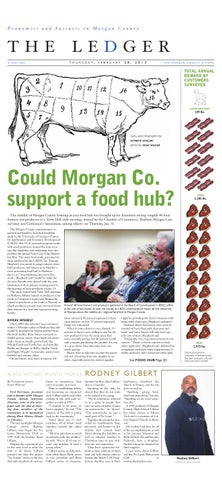
Around 40 local farmers and producers gathered at the Board of Commissioners’ (BOC) office at the end of last month to hear the results of a BOC-commissioned report by the University of Georgia about the viability of a regional food hub in Morgan County.
BUYERS' INTEREST The CAED also surveyed area customers within a 100-mile radius of Madison they felt would be interested in buying product from this local facility; those buyers surveyed included grocery stores– from high-end stores with a focus on locally grown food, like Whole Foods and Earth Fare, to chains like Publix and Kroger, to Bell's, Quality Foods and Piggly Wiggly– restaurants, assisted care facilities and country clubs. On the buyers' end, there is interest. Of
those surveyed, 96 percent expressed at least some interest– in fact, 19 percent expressed being very interested. When it comes down to cost, though, 54 percent of buyers were willing to pay for the new product if it was the same price they were currently paying, but 46 percent would only consider purchasing the product if it was at a price lower than what they were currently paying. Buyers have to take into account the potential cost of moving from one supplier to another, especially given the current supplier
B L A C K H I S TO R Y M O N T H P R O F I L E BY STEPHANIE JOHNS STAFF WRITER Fred Perriman, president and co-founder of the Morgan County African American Museum, came to this newspaper with the idea of choosing four members of the community to be spotlighted during Black History Month in February. This one spotlights Morgan County native Rodney Gilbert, who began the No Limit Motorcycle Club in 1999 with his brother, Ryan Gilbert. Helping the community get to the next level is what the club is all about. Gilbert pointed out that the phrase “No Limits” refers to the fact that club members do not see
limits or boundaries; they cater to people, not races. Prior to establishing bylaws and becoming an organized club, Gilbert said he and other cyclists in the club rode together as early as 1993. “I wanted to do more, to have a purpose,” he said. “The purpose of the club is giving back to the community.” Today there are 21 club members, all of whom work together toward the club’s goals. “All of us guys have so much in common with one another,” he said. “We’re all of one accord, one mindset. It takes a group effort.” Gilbert serves as club president while Ryan Mack serves as vice president and Ryan Gilbert serves as treasurer.
might be providing the buyer's business with items other than meat, Shepherd explained. Demand shows that buyers were most interested in beef, then pork, then goat and lamb– and some buyers will only want specific cuts of meat, Shepherd said. Traceability was of greatest concern to customers– "There's a lot of concern in food safety right now," Shepherd said– followed by compliance with farm labor requirements, liability insurance and a farm food safety plan,
See FOOD HUB Page 2D
BEEF
1,975 lbs. Information based on University of Georgia survey. One item represents 100, and totals have been rounded.
RO D N E Y G I L B E RT Another brother, Ray Gilbert, also is a member. Speaking of the club, he shared that they do not want to be looked at as a gang. “We’re sometimes referred to as a gang by people that can’t see past a number of guys on motorcycles,” he shared. “The motorcycles are just a small part of No Limit.” Together the group has provided air conditioners, fans, firewood, and heaters to the elderly, had canned food drives during the holidays as well as adopted families at Christmas time to give children the real experience. They have sponsored students so they could go on field trips and held charity rides to benefit the Sickle Cell Foundation. Another one of their
fundraisers benefited the March of Dimes, and the list goes on and on. “Anything giving back, that’s our main focus,” he said. “Anything we do is for someone else.” A 1985 graduate of Morgan County High School, Gilbert has taken classes at Athens Tech and is a member of Calvary Baptist Church in Madison. He credits God first for all of his accomplishments as well as his parents, Solomon and Sallie Gilbert. He and his wife, Deborah, have a daughter, Amber, whom he thanked for their support. Learn more about Gilbert and the No Limit Motorcycle Club at www.nolimitriders.com.
Rodney Gilbert PHOTO BY JESSE WALKER
February 28, 2013 Page 2D
N EWS & F EATURES
FOOD HUB which goes hand in hand with traceability; there was little concern by those buyers surveyed with Good Agricultural Practices (GAP) or Hazard Analysis & Critical Control Points (HACCP) certifications. Further, there's a proven positive association with "Locally Grown" and "Family Farmers;" "Pasture-Raised" is preferred to "Grass-Fed;" and the time and distance to market is considered an indicator of freshness and quality, according to the report.
Business Meeting The Madison-Morgan Chamber of Commerce held its Business After Hours event Thursday evening, Feb. 21 at Perk Avenue in downtown Madison. More than 40 people gathered at Perk Avenue for the event to network, sample Perk Avenue's delicious food and enjoy the restaurant's unique space. Pictured (left to right) are Vickie Hunt, owner of Barkin' Dogs Shoe Co. in Madison, Madison Main Street Director Ann Huff, Convention & Visitors Bureau Director Ellen Ianelli and Adrienne Smith. PHOTO BY D. YOST
AgSouth Farm Credit reports record earnings of $42.4 million SPECIAL TO THE CITIZEN STATESBORO, Ga. (February 25, 2013) – AgSouth Farm Credit CEO Bill Spigener recently announced that the customer-owned cooperative had record net earnings of $42.4 million during 2012, an increase of $8.5 million over $33.9 million in earnings posted in 2011. Spigener attributes much of the AgSouth’s success to the association’s fee income from secondary mortgages, crop insurance and leasing. Spigener went on to note an improvement in the association’s portfolio due to a reduction in non-earning assets. Spigener says that the association is on track to pay a significant patronage distribution to its member/borrowers next month.
“The 2012 patronage distribution equates to approximately 28 cents on every dollar of interest paid. It effectively reduces the cost of borrowing for our customer base,” he said. According to CFO Alisa D. Gunter, “The association remains financially strong, and credit is available for farmers, agribusiness, landowners and other qualified borrowers. AgSouth is dedicated to becoming the lender of choice for eligible borrowers in our territory, and we’re extremely proud of our patronage program. AgSouth has continuously paid a significant return to its member/borrowers since 1991.” As a cooperative, AgSouth provides patronage refunds, a form of profit
sharing, to its memberborrowers. Since 1991, the association has returned nearly $324 million in cash to its borrowers. As of December 31, 2012, AgSouth had more than 7,868 members, $1.583 billion in assets and $266.6 million in capital and allocated accounts. About AgSouth AgSouth Farm Credit provides loans for land, equipment and production agriculture; crop insurance; leasing; and home mortgages. The association is headquartered in Statesboro, Ga., with administrative offices in Spartanburg, S.C., and Orangeburg, S.C. The cooperative’s 26 branches serve 59 Georgia and 34 South Carolina counties. For more information, visit www.agsouthfc.com.
“Peas” help raise some cabbage for Rutledge! If you have been at The Caboose lately and thought you saw a Leprechaun, you are not seeing things. It is Molly Lesnikowski and Carol Altznauer raising their glasses to "Peas and Cabbage" for the Irish Fundraiser. Frankie Beers was behind the camera capturing the excitment of the moment. The Luck o' the Irish Party will be Saturday, March 9, 7 p.m. at The Caboose in downtown Rutledge. The music will be provided by the Green Flag Band of Athens. Tickets are $15 per person and reservations are a must at this popular event. Proceeds will benefit the new Rutledge Park. Wear GREEN so that the "Luck o' the Irish" will be with you! For reservations call: 706 557-7616 or visit www.smallbutspecial.info. PHOTO SPECIAL
DOLLARS AND SENSE The total development cost of a processing facility comes to $738,050. The CAED estimated a 5,000square-foot building (this is the smallest a facility like this could be, Shepherd said) at $551,050– 3,650 square feet of that being non-refrigerated at a cost of $77 per square foot, and the other 1,350 square feet being refrigerated at a cost of $200 per square foot– $125,000 in equipment, $6,000 each in land and site preparation, and a $50,000 contingency would do the trick for this "high-end processing facility," based on similar facilities. Loans, according to the study: • A 20-year mortgage loan of $470,440, at 5.5 percent annual interest, means monthly payments of more than $3,236, an annual total of $38,833. • A 10-year equipment loan of $120,000, at 7 percent annual interest, means monthly payments of $1,393, an annual total of $16,720. • A two-year working capital loan of $50,000, at 9.5 percent annual interest, means monthly payments of $2,296, an annual total of $27,549. A capital loan would provide funds for employees, electricity and money to work with. • A five-year, $30,000 loan for a refrigerated truck, at 7 percent annual interest, means monthly payments of $594, an annual total of $7,128. One attendee asked about adding poultry processing to the facility. Shepherd responded that that would take "a whole different assembly line." "A livestock processing facility is number one in capturing the most interest here," Shepherd said. There are two options the study explored as far as how the facility operates, individual and plant ownership... INDIVIDUAL OWNERSHIP With this option, the producer retains ownership of the livestock product. The facility is simply a means to have the livestock processed and the producer would then take responsibility for distribution of his/her finished product. The plant would charge a flat kill fee– an estimated $40 per cow, $25 per hog, $20 per goat or lamb– plus a basic processing fee of about 30 cents per pound. With this model, total expenses come to more than $491,000 the first year. Estimating 1,000 cows, 200 hogs and 145 other animals, like goats or lambs, are slaughtered the first year, revenues would total almost $309,000, which means net income would be negative to the tune of almost $183,000. The break-even level comes with 1,108 cows, 300 hogs and 200 other animals being slaughtered from the second year on, according to the survey. The second year would show a decrease in total expenses to $357,000, an increase in total revenues to more than $350,000, but a net income that's still in the red by $6,500. Finally, from the third year on, total expenses level to more than $329,000 per year, total revenues stay at the previously mentioned more than $350,000, but the net income moves into the black at $21,000 annually. PLANT OWNERSHIP With the plant ownership model, the facility would take ownership of the animal upon delivery, at which time producers would be paid market price, based on the Farm Gate Value Report. The plant would then sell the finished product at wholesale price. Expense is a bit higher here, as there are additional costs, like the purchase of the previously mentioned refrigerated delivery truck and the salaries for the truck driver, maybe $25,000, and a sales manager, maybe $45,000. The first year, total expenses– including operating expenses, the cost of animals and other expenses– come to more than $1.636 million. With $1.36 million in revenue from beef, $18,300 in revenue from pork and $64,250 in revenue from the slaughter of other animals, total revenues from year one come in at more than $1.4 million. Net income for year one– negative
MORGAN COUNTY CITIZEN
from Page 1D more than $191,000. In the second year of operation, total cost decreases to more than $1.627 million; from year three to year five, total cost drops again to $1.6 million; and from year six on, total cost comes to $1.59 million. Revenues level out starting in year two. Funds from beef increase to $1.51 million, pork to more than $27,000 and other animals to more than $73,000 annually. Total revenue from the second year on comes to more than $1.6 million annually. Net income, then, is still in the red in year two to the tune of $17,000. Net income become positive beginning year three. From the third to fifth year, net income is more than $10,000; from year six on, net income comes to almost $18,000 annually. Bear in mind, these numbers are also based on the same amount on animals going through the facility as in the individual ownership model: 1,000 cows, 200 hogs and 145 other animals the first year, and 1,108 cows, 300 hogs and 200 other animals from the second year on. THE GOOD AND THE BAD The Individual Ownership Model would be most profitable, but that's only if it's run at capacity. However, there's no supply of livestock dedicated to the facility; it's simply a means to an end for producers to sell their product on their own and there's no guarantee of the amount of product that would go through the facility month to month, meaning it's much more uncertain whether the facility will make the revenues it needs to operate. While there are no costs associated with sales, marketing or delivery, as with the Plant Ownership Model, there's little opportunity to develop a brand. Brand development would be up to each individual producer, which would pit small farmers against each other. "Ten or 20 [small producers] all competing against each other would drive the price down," Shepherd said. The Plant Ownership Model would consolidate the products from area farmers under one brand, which would mean having the volume to go after large-scale customers, like supermarkets, and a controlled, non-fluctuating supply chain. However, there's a higher cost associated with this model– the sales manager and truck driver's salaries, for example. A hybrid model of the two could prove to be the best idea, Shepherd suggested. From Plant Ownership, bring together "small producers of 'boutique' products into one brand" and use the opportunity to develop and market one brand to an established supply chain. Producers would set aside a certain amount of their livestock for the plant. And from Individual Ownership, continue to be open for farmers to use the facility for a "kill fee." WHERE DO WE GO FROM HERE? There's been a 3 percent decrease in the number of cows in Georgia– from 590,000 in 2012 to 570,000 in 2013, according to a Feb. 1 U.S. Department of Agriculture livestock news release. The number of beef cows is down 4 percent– 512,000 in 2012 to 490,000 in 2013– but the amount of milk cows is up 3 percent– 78,000 in 2012 to 80,000 in 2013. It is questionable whether there are enough cattle being raised to be beef cows rather than dairy cows in the 100mile range to support the proposed facility, and whether producers would be willing to raise beef cows as opposed to dairy cows. The operations of raising beef cattle are quite different than dairy cattle. Shepherd encouraged a hybrid model. "If you have something where you did have the volume dedicated to it and you only make a small amount from the kill fee model, I think that would be a little safer," Shepherd said. The study is still incomplete, Madison-Morgan County Chamber of Commerce President Bob Hughes said. "In the meantime we're exploring with some folks in the business and there desires about where to take it from here," he said. There's certainly interest in opening such a facility, Hughes said, but it's going to up to private entrepreneurs to take it from here. "We've got several large beef producers and people that have interest… They're looking at it," Hughes said. "They will need to go do a more indepth financial analysis." "We need someone who's ready to put capital at risk."