honor fl ight
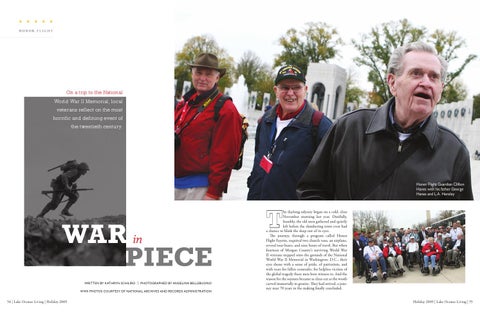
On a trip to the National World War II Memorial, local veterans reflect on the most horrific and defining event of the twentieth century.
Honor Flight Guardian Clifton Hanes with his father George Hanes and L.A. Hensley
war in Piece Written by Kathryn Schiliro | Photogr aphed by Angelina Bellebuono WWII photos courtesy of National Archives and Records Administr ation
54 | Lake Oconee Living | Holiday 2009
he daylong odyssey began on a cold, clear November morning last year. Dutifully, humbly, the old men gathered and quietly left before the slumbering town even had a chance to blink the sleep out of its eyes. The journey, through a program called Honor Flight Fayette, required two church vans, an airplane, several tour buses, and nine hours of travel. But when fourteen of Morgan County’s surviving World War II veterans stepped onto the grounds of the National World War II Memorial in Washington, D.C., their eyes shone with a sense of pride, of patriotism, and with tears for fallen comrades, for helpless victims of the global tragedy these men bore witness to. And the reason for the sojourn became as clear-cut as the words carved immortally in granite. They had arrived, a journey near 70 years in the making finally concluded. Holiday 2009 | Lake Oconee Living | 55
avy veteran Gene Wynn was drafted in late 1944, when WWII was supposed to be winding down to a close. His unit left from New York Pier 92. After about a week at sea, his ship encountered German U-Boats. “We had a skirmish that lasted about 30 to 40 minutes. We didn’t lose a ship that I know of, and I don’t know what they lost, but there were torpedoes,” Wynn recalls. “The next morning, about sunrise, we had another skirmish with them. As far as action, that’s all I saw.” Sent to replace Patton’s Third Army on the Rhine River, Wynn remembers his unit’s first stop in Germany was Weisbaden, followed by a roughly three-month stay in the nearby Busch Mansion (the summer residence of Adolphus Busch, of Anheuser-Busch fame). “Of course, we were living, well, not like soldiers,” Wynn says, smiling. After the collapse of the Axis powers, Wynn found himself in Frankfurt, where his unit occupied the German Induction Center there, a facility that had previously func56 | Lake Oconee Living | Holiday 2009
tioned as a sort of Nazi headquarters. The young soldier was shocked by the scale of destruction he witnessed in what were once bucolic German towns. Wynn was discharged in April 1946, but continued serving in the Navy Reserves. Wynn and his wife of 58 years, Ann, had visited the National WWII Memorial before it was finished, but Honor Flight gave him the opportunity to see the monument completed with fellow veterans. “It meant a lot to me.” Wynn says. “All of the people we met, they were not strangers. It was like we had known them all our lives.” Even after bearing witness to decimation, a sense of pride remains with Wynn. “I hope we never have to have another World War, but I would be willing to serve in it. I’m 83, so I don’t know what I could do. I could drive a truck or something,” Wynn says, laughing.
And the reason
Sandy Creek High School Air Force JROTC students welcome veterans to the Honor Flight program.
for the sojourn became as clear-cut as the words carved immortally in granite. They had arrived, a journey near 70 years in the making finally concluded.
Top left: J.D. Kennedy and Marvin Bone prepare for Honor Flight. Left: Patriot Guard Riders usher veterans to the Atlanta airport early in the morning.
Holiday 2009 | Lake Oconee Living | 57
Clockwise from right: Albert Quern and Gene Wynn prepare for the flight. Wynn passes through security. Patriots greet the veterans in the Washington airport. Guardian Carole Hanes helps several vets navigate the airport.
o serve his country during WWII, veteran Marvin Bone elected to jump out of planes. A paratrooper, Bone belonged to both the 17th and the 101st Airborne Division, the much-publicized “Screaming Eagles,” both part of the U.S. Army. “When I first went to Atlanta, I saw a picture of a man with real shiny boots,” Bone says, recalling a poster of a paratrooper he saw on his way to enlist. “I said to myself, ‘I believe I’ll try that.’” Bone left the States for Europe in 1944, where he jumped out of planes a total of seventeen times, three of which were considered combat jumps, or jumps into enemy territory. “It was pretty scary,” Bone concedes. “The only way you knew you could make it was if the man in front of you did. You figure you can do anything he can.” One flight took Bone’s unit over a Nazi-occupied castle. Bone remembers American soldiers, his paratrooper brothers, being killed in the air, still attached to their parachutes. After landing in a meadow in front of the castle, Bone’s unit was able to overtake the fortress and count the German soldiers. A veteran of the infamous Battle of the Bulge, the German military’s final and futile push westward into Europe, Bone remembers the frigid winter weather was as tough as any enemy. Unprepared for the scale of the German offensive, his unit almost ran out of food and ammunition, but General Patton did whatever he could to save his soldiers. “Patton would always come get us,” Bone says. “He was an unusual general.” After the War, those spared by violence, yet helpless, malnourished, and ill, still stick in his mind. “I’ve always been a little tenderhearted. There were mainly old men and women, and kids left. It hurt you to see old people suffer,” Bone explains. Bone spent nearly a year in a hospital recovering from a shrapnel injury that caused blood poisoning. He finally returned home to Morgan County in 1947. Excited to visit Washington with his friends and fellow veterans from Morgan County’s American Legion, Bone admits being a bit star-struck when former Senator Bob Dole arrived and spoke with the group. “One of the high points was meeting Bob Dole. I’ve always admired him,” Bone says. The Honor Flight reinforced Bone’s positive outlook on life, which he gained as a result of service to his country. “It made me appreciate life a lot more,” he says.
It was a long, arduous day of travel, but nothing compares to what these veterans survived during WWII.
58 | Lake Oconee Living | Holiday 2009
veteran of Patton’s Third Army from 1943 to 1945, Chester Stapp survived D-Day, the landing of Allied troops at Normandy, and the campaigns of Northern France, the Rhineland, and Central Europe. While Stapp and his unit trained in California’s Mojave Desert to fight in the North African Campaign, the German military surprised the Allies with their final offensive in Western Europe. So, in the winter of 1944, Stapp and his comrades found themselves in the Ardennes. “We were trained in the hottest climate you can get in, and sent to the coldest,” Stapp says. Issued only one blanket and a raincoat, Stapp recalls sitting back to back against his fellow soldiers in an effort to keep warm. “I don’t see how we didn’t freeze
Below: Vets George Hanes (front), Chester Stapp (back left), and Len Bradbury (back right) raise their hands for pen pal letters on the plane.
to death,” he says. Stapp suffered frostbite in both feet. While those of us who’ve never experienced war might imagine that liberating a concentration camp would be a rewarding experience, Stapp cringes at the memory of it. He struggles to recall what he witnessed during the liberation of the Mauthausen-Gusen concentration camp. “There were 6,000 people laying dead,” Stapp says, explaining that prisoners were herded around a large pit, shot in the back of the head, and buried on top of each other, layer upon layer. “We had to wear gas masks, it smelled so bad.” Despite the stench, residents of the town nearest the camp acted as if they knew, and smelled, nothing. Those prisoners who were still alive were, above all, hungry. They approached the liberating troops with requests for food. “They were skin and bones,” Stapp recalls. “A man my size was probably 40, 50, 60 pounds.” The troops offered pieces of bread or chocolate bars, whatever they had on them, but the liberated prisoners’ stomachs couldn’t handle that much food, and it made them sick. Troops soon realized how far one slice of bread could go among starving people. Having logged 301 days of combat, Stapp accumulated five battle stars, part of a point system used by the Army to keep track of how long troops were in service and to determine when they could take leave. Because the Army needed experienced soldiers even after the European campaigns ended, his superiors actually rescinded one of Stapp’s battle stars so that he could be shipped to the Pacific theatre. Fortunately, V-J Day arrived while Stapp was still in Austria. Slated to arrive back in the States in time for Christmas of 1945, the weather again proved to be a tough enemy. A storm at sea turned what was supposed to be a several-day trip into an ordeal of sixteen days and nights. When Stapp finally arrived home in January of 1946, “Our story ended up in the New Holiday 2009 | Lake Oconee Living | 59
Below: Arthur Hopkins (on right) carries his flag along with another vet he met that day. Former Senator Bob Dole and Gail Sparrow, president of Honor Flight Fayette, greet veterans on the National Mall.
York Times,” he recalls. As horrible as his experiences were, Stapp wanted to participate in Honor Flight for the chance to visit the physical memory of that time, set in granite and erected in the heart of the nation’s capital. “I just wanted to see it for myself,” Stapp says. “That trip was really worth taking. I won’t ever forget it.”
uke Allgood’s introduction to WWII began almost immediately after high school, when he received his “orders from Uncle Sam”– a draft card notice from the U.S. Army. Trained and shipped to the West Coast, he boarded a wooden, not metal, ship bound for the Pacific. “It was a Hindu ship, with an all-Hindu crew,” Allgood recalls. “It smelled terrible of curry.” During the time between the bombing of Pearl Harbor and the Normandy invasion, the War grew more diffuse and chaotic. America’s military industrial machine worked in overdrive to meet the never-ending demand for warplanes, carriers, weapons, and artillery. Still, as Allgood recalls, production couldn’t keep pace with demand. The old wooden ship borrowed from India was all the Army could supply his unit. “They were using every transport ship they could find,” he says. In 1944, Allgood and his fellow servicemen unloaded on the Island of Saipan in the Mariana Islands to do “mop-up duty”– killing the snipers and Japanese soldiers left in the mountains of an island already under Allied control. Allgood joined the 96th Infantry Division when he arrived at the Philippine Island of Leyte. The unit secured the island, save for snipers, which they left for the next detail to clean up. Allgood remembers the leeches were about as terrifying as the Japanese soldiers. After another transport ship ride and three to four weeks of waiting onboard while the U.S. Navy and Army Air Corps bombed the island in preparation for the amphibious landing, Allgood’s unit unloaded at Okinawa on April 1, 1945. Allgood turned nineteen on Okinawa. “I was designated as a Browning Automatic Rifle man, which was sort of a machine gun, except you carried it like a rifle,” Allgood remembers. Two ammunition bearers constantly assisted him. His unit met no opposition for three straight days, then the Japanese “opened up” on the American servicemen “with all they had.” Troops were slaughtered en masse, and it took the U.S. military from May 1 to July 8 to secure Okinawa. On June 20, Allgood was injured when an artillery shell blew him off the side of a mountain. At a field hospital, bits of shrapnel were removed from his body, including his right eye. “They sent me back to the front line with a patch over my right eye,” Allgood recalls. “I couldn’t shoot my rifle, so they gave me a flame-thrower to strap on my back, and I didn’t have to aim it too well...You just pointed it and fired.” Japanese soldiers weren’t the sole threat to American troops, who also had to contend with civilians, a fact Allgood found heartbreaking. “The Japanese, I guess, brainwashed the civilians. They armed the women and they armed chil60 | Lake Oconee Living | Holiday 2009
Honor Flight puts
vets on jets
stablished after the completion of the National World War II Memorial in 2004, the Honor Flight program was created to allow veterans of the Second World War to travel to Washington, D.C., free of charge, and experience the monument meant to honor their service. Honor Flight Fayette, based in Fayetteville, Ga., is a local division of the national Honor Flight Network. The program brings veterans from the surrounding area to Fayetteville, and flies them to Washington D.C., for one day to visit the National Mall, where they are always greeted by former Senator Bob Dole, himself a World War II veteran and leader of the monument’s fund-raising campaign. The group visits other historic sites and monuments before returning home. All meals are provided, as well as medical care– local paramedics donate their off days to travel with the veterans, should there be an emergency. Volunteers, called “guardians” in the Honor Flight program, also accompany the veterans; each guardian looks after two to three of the men. On Wednesday, November 12, 2008, fourteen Morgan County World War II veterans and three guardians took part in Honor Flight Fayette. The trip was coordinated through the Honor Flight program by American Legion, Calvin George Post 37 Commander Jim NeSmith, who raised more than $6,000 to put towards the effort. Well worth it, in his opinion. “They’re still talking about it,” NeSmith says. Honor Flight is a non-profit organization that runs through donations. If you would like to contribute, visit the national program’s Website at HonorFlight.org or, if you want to keep it local, HonorFlightFayette.org.
Top: Japanese night raiders are greeted with a lacework of anti-aircraft fire by the Marine defenders of Yontan airfield, on Okinawa in 1945. In the foreground are Marine Corsair fighter planes of the “Hell’s Belles’ squadron.
Holiday 2009 | Lake Oconee Living | 61
Clockwise from right: Chester Stapp bows his head in remembrance. The late Jack Gnehm and J.D. Kennedy tour Arlington National Cemetery. Harold Moss takes in the WWII Memorial.
62 | Lake Oconee Living | Holiday 2009
dren. They armed 12- and 13-year-old boys and girls with hand grenades,” the veteran explains. “When the children ran towards you with a hand grenade and they’re going to explode, you have to kill them, or they’ll kill themselves and you, too. I guess that was the hardest thing I had to do was to have to shoot children.” To his horror, Allgood found that Japanese women, so dedicated to their country, should they not fulfill their mission, took their lives into their own hands at the ocean’s edge. “There was a big cliff on the island, they called it ‘Suicide Cliff.’ The women would take the children in their arms and just commit suicide from the cliff.” Allgood was eventually given the task of guarding that cliff. Only 36 of the original 230 men from Allgood’s unit survived. Of the four platoons that landed on Okinawa, every commander, every platoon leader, every first or second lieutenant was killed. There was not a commissioned officer left on that island, Allgood says. “There were a lot of field promotions. I went in as a PFC (Private, First Class) and came out as a Master Sergeant.” The Japanese lost about 100,000 soldiers, the Americans lost roughly 12,000, and at least 100,000 native inhabitants died in Okinawa. Despite the size of the island– about 60 miles long– the death of so many made it a sickening task simply to walk around. “At times, it looked like you were walking over the dead. The Japanese did not recover their bodies, they just left them where they fell,” Allgood says. Sent again to the Philippines for training, Allgood’s time preparing for additional combat was cut short by President Truman’s decision to drop the atomic bombs. The armistice was signed, and Allgood’s time in the war was over, but he did not have enough points to go home. The Army transferred him to an anti-aircraft outfit where he, along with five other servicemen, were assigned the duty of selling American surplus supplies– trucks, boats, food, sugar, flour– to the Philippine Islands. What they could not sell was then bulldozed off a ship into the ocean because, “the cost to ship it back was more than it was worth...Then
word came back to us that it would upset the economy of the United States if we brought all that material back in.” After a year and a half, in late 1946, Allgood was permitted to return to the States and discharged. His wartime experience forced him, like most other young men in service at the time, to grow up fast. “It made a man out of you real quick,” he says. “Back then, as a rule, you didn’t ask why. You just accepted it and did your job.” “I wanted to go back with a group of men whose experience was the same thing I had.”
Allgood and his wife of 62 years, Ruth, visited the National WWII Memorial prior to the Honor Flight trip. Nonetheless, Allgood was glad for the opportunity to see the monument again. “I wanted to go back with a group of men whose experience was the same thing I had,” Allgood says. Visions of his time in WWII still haunt his memory, but standing in the middle of the mass of stone erected to honor his service, Allgood made some new memories. “I can shut my eyes and see the entire layout of it. It’s just a beautiful place.” Kathryn Schiliro is the managing editor of the Morgan County Citizen.
Holiday 2009 | Lake Oconee Living | 63