Industr y and Economics
THE
T H U R S D A Y
D SECTION
Dianne Lively Yost COLUMNIST
Biz buzz
T
humbs down on High School Musical. Honey, I know it’s a hit, but that High School Musical flat ain’t speakin’ to me! I mean just the other day my handsome husband actually, seriously suggested I “Go Gray!” Sure. I wanted to smack him upside the head like a money-filled piñata, but revenge is much better when it’s executed with underthe-radar stealth! Yeah! See . . . I’ll get my revenge when he gets that fantastic invoice from famous Lake Oconee plastic surgeon Dr. Marc Yune for services rendered: Little augmentation here . . . little implant and lift there, little body contourin’ and Tada! A younger me! Revenge indeed is sweet! So anyway. . . .High School Musical is soooo snoozeville! I mean Hollywood needs to get with it ‘cause the boomers are way past 40! When are we gonna be singin’ along with Mid-Life Musical? And, you whippersnappers in your 20s and 30s can flat stop snickerin’ at us 40- and oversomethings ‘cause honey your horse is trottin’ up the same ding dang trail! It’ll be the Big Chill of our day with songs like: The Roman Empire Fell Ditto for my Muscle Mass! Oh and we’ll dance our blasted bunions off to the rock hit: Hot Flash/Maniacal Mood! Or we’ll get all teary-eyed to that romantic serenade: I Stopped to Think and Forgot to Start Again! Ding Dang! I think we’ve got a mega hit on our hands! Hey did somebody mention trottin’ horses? Honey Green South located at 1350 Lions Club Road is not just a John Deere dealership! It’s much, much more! Whoa Nelly! Now they’re sellin’ all kinds of stuff like horse tack (Troxel helmets, bridals, blankets and more), Purina feeds, food and treats for small animals, organic dog and cat food . . . I mean Manager Pat Conner of Rutledge says they can feed just about any animal you have . . . chickens, goats, sheep, horses and whatnot! Oh and they’ve even expanded their line of gifts and toys! They still have those fantastic John Deere toys, but now they’re sellin’ Breyer toys like those fantastic wooden barns and those
See BUZZ Page 4D
LEDGER ,
S E P T E M B E R
20, 2007
THE MORGAN COUNTY CITIZEN
FABRIC OF OUR LIVES A bale of cotton is ready to be burlapped and tagged at the Bostwick Cotton Gin.
i N H igh
c O tt o N
S T O R Y B Y K AT H R Y N P U R C E L L PHOTOS BY ANGELINA BELLEBUONO
WE
FOLLOW
THREADS
LOCAL
WOVEN
IN
the c h a n g i n g e c o n o m y o f
c o t t o n
B
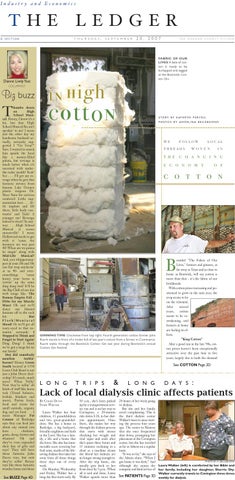
GINNING TIME Clockwise from top right: Fourth generation cotton farmer John Ruark stands in front of a trailer full of last year’s cotton from a farmer in Commerce. Ruark walks through the Bostwick Cotton Gin last year during Bostwick’s annual Cotton Gin Festival.
randed "The Fabric of Our Lives," farmers and ginners, as far away as Texas and as close to home as Bostwick, will say cotton is more than that - it's the fabric of our livelihoods. With cotton prices increasing and positioned to grow in the next year, the crop seems to be on the rebound. After several years, cotton seems to be reawakening, and farmers at home are feeling its effects. "King Cotton" After a good run in the late '90s, cotton prices haven't been exceptionally attractive over the past four to five years, largely due to both the demand
See COTTON Page 2D
L O N G
T R I P S
&
L O N G
D A Y S
:
Lack of local dialysis clinic affects patients BY COLBY DUNN STAFF WRITER Laura Walker has four children, 11 grandchildren and two great-grandchildren. She has a house in Rutledge, a big backyard, friendly neighbors and faith in the Lord. She has a family, a life and a home that she loves. She also has innumerable scars covering her frail arms, marks of the lifesaving dialysis that takes her away from all those things three days out of every week. On Monday, Wednesday and Friday, Walker has a long day that starts early. By
10 a.m., she’s been picked up by a transportation service van and is on her way to Covington, a 20-minute ride down I-20, to her dialysis appointment. Once there, she makes her way through the dialysis process that starts with nurses checking her weight and vital signs and ends after she’s spent three hours and 15 minutes reclining in a chair as a machine cleans the blood her kidneys are no longer strong enough to. After the trip home, she usually gets back to her front door by 5 p.m.. When all is said and done, Laura Walker spends more than
20 hours of her week going to dialysis. But she and her family aren’t complaining. This is the third dialysis center Walker’s been to since starting the process four years ago. The center in Monroe that she once frequented shut down, prompting her placement at the Covington center, but she has traveled as far as Athens on a regular basis. “It was so far,” she says of the Athens clinic. “When I PHOTO BY A. BELLEBUONO got home it was dark.” And although she enjoys the Laura Walker (left) is comforted by her Bible and company and kind service of her family, including her daughter, Sherrie Shy.
Walker currently travels to Covington three times
See PATIENTS Page 3D weekly for dialysis.
N EWS & F EATURES
September 20, 2007 Page 2D
COTTON from Page 1D and supply worldwide being high, according to Don Shurley, professor and cotton economist with the Department of Agricultural and Applied Economics at the University of Georgia. "The World's demand for cotton has been trending upward and increasing each year, but when prices have been low, it has been because World production has been high," Shurley said, in e-mail correspondence. "In times when cotton prices were low, farmers continued to grow cotton for two reasons - lack of profitable alternatives and cotton
government program (Farm Bill) provisions which provided support." There are presently 17 cotton-producing states in the United States, Shurley said, and Georgia ranks second as far as acres planted and third or fourth in production. Further, the Southeast - Alabama, Florida, Georgia, North Carolina, South Carolina and Virginia - makes up about 20 t 25 percent of the country's cotton acreage and production. As he stands in front of the currently idle Bostwick Cotton Gin, fourth-genera-
CELEBRATE THRU SUNDAY!
tion cotton farmer John Ruark, a Bostwick native, speculates about the numbers he foresees in regards to his cotton crop this year. Ruark said that 900 acres of the crop were planted, the same amount planted each year for the past three or four years. While the Ruarks ginned about 1,200 bales of cotton last year, Ruark expects they'll be lucky to gin 500 to 600 bales. Overall, the gin in Bostwick produced 3,000 bales of cotton last year. Ruark speculates there will be between 800 and 1,200 bales ginned this year - evidence of diminishing supply of the crop.
MORGAN COUNTY CITIZEN
In 2007, cotton prices varied from anywhere between about 52 cents a pound up to almost 70 cents a pound, according to a Southern Cotton Growers, Inc. newsletter. The price of cotton is currently around 70 cents a pound for the 2008 crop. "Every bale of cotton, regardless of quality, will find a home somewhere at some price," Shurley said. Prices have generally improved this year, and it's because farmers in the United States are producing less cotton while the demand for the crop stayed, and continues to stay, strong, according to Shurley. "The U.S. is the second
largest cotton producer (China is the largest) and the largest supplier of cotton exports," Shurley said. "The U.S. will typically supply 35 to 40 percent of what other countries need in the way of cotton imports for use in their textile mills. Our largest buyers are China, Turkey and Mexico. U.S. exports depend on cotton production in China (our largest buyer) and production in other exporting countries like India, Brazil, Australia and a handful of other countries of the former Soviet Union and in Africa." Moreover, the sale of cotton is often dependent not only on demand for the
YOUR FAMILY FASHION STORE WITH SO MUCH TO L VE! BER TEM SEP TS AR ST
24
I SHOPPING!
5 WEEKS OF MONEY-SAVING COUPONS
FRIDAY & SATURDAY ONLY!
30% OFF
30% OFF
KIDS FALL FASHIONS
SPORTSWEAR FOR HER
40% OFF
FREE COUPON BOOK Five weeks of storewide savings, starting September 24. One book per person, per day, please.
SPORTSWEAR FOR HIM
REGISTER TO WIN! $
250 PEEBLES GIFT CARDS
Register thru Sunday, September 23. Details in store. NO PURCHASE NECESSARY.
EXTRA 10% OFF ALL DAY WHEN YOU OPEN A NEW PEEBLES CREDIT CARD ACCOUNT Subject to credit approval. Exclusions apply.
MADISON
GrandOpening Sale!
30% OFF
GREAT GIVEAWAYS, BIG PRIZES & STOREWIDE SAVINGS!
JUNIORS FAVORITE BRANDS
30% OFF
TODAY’S WOMAN SPORTSWEAR
SAVE MORE WITH YOUR SHOPPING PASS! GRAND OPENING SHOPPING PASS!
% Extra15 Off
EVERYTHING* THRU SUNDAY, SEPTEMBER 23 AT MADISON’S NEW PEEBLES STORE! *Not valid on cosmetics, fragrances, formalwear rental, gift cards and previous purchases. Cannot be combined with any other coupon or private savings offer.
25% OFF
NEW FALL HANDBAGS
SALE 39.99
LADIES FASHION BOOTS
BEACON HEIGHTS SHOPPING CENTER • 1532 EATONTON RD.
crop, but on the demand for a quality crop. "The U.S. cotton producer is constantly bombarded with the message that foreign textile mills demand high-quality cotton fiber, particularly fiber strength and length," Shurley said. "But some things that determine fiber quality, like the weather, are out of the producers' control." Cotton's "Cottonmouth" The growing season of cotton begins at the end of April and continues through May, and is harvested in October and November. The need for water enters the equation around July and August, when the plant begins to make fruit. Lack of subsoil moisture, coupled with the Southeastern drought, caused this year's crop to decrease by 50 percent or more, estimates Morgan County Cooperative Extension Coordinator and Agent Bobby Smith. Truly, cotton doesn't need much water; however, like any other plant, it has to be irrigated in some form or fashion eventually. "Cotton is a tough crop," Ruark said. "It can survive, but it's got to have water at some point...It sure does make it better when it's raining." Texas, a state estimated by Ruark to grow half the cotton in the country, has had the opposite problem this year - flooding. While this doesn't bode well for the country's amount of cotton produced, it does put cotton farmers in much of the Cotton Belt on a level playing field. "It has been too dry in the Southeast, and too wet in Texas," Smith said. "A lot of cotton in Texas has rotted due to too much moisture. The Cotton Belt is Georgia to Texas; we fare about the same as everyone else." Smith anticipates the weather has affected, and will continue to affect, the cotton crop here in Morgan County, but did express some hope for the end of the growing season. "Showers have been very spotted in this area, and there has been no good, consistent rain; therefore, some areas in the county may be good, and others may be bad," Smith said. "Cotton production also depends on the weather patterns here until November. Cotton can't be picked until the bolls are open, which requires the right weather conditions." The Cost of Growing Cotton The costs of growing cotton can be broken down, for the most part, into three major aspects - seed, fertilizer and fuel. Seed and fertilizer make up over half the cost of growing the crop, Ruark estimates. "You can grow it pretty cheap," Ruark said. "The thing about cotton is, the main cost is up front, in seed and fertilizer." Currently, Ruark, like many other cotton farmers across the nation, pays agricultural biotechnology company Monsanto a technology fee for the use of their cotton seed, which has been genetically altered to enhance traits preventing insect infestation. "Monsanto's 'Bollgard' trait revolutionized insect control in cotton," the company's Web site says. "Today, cotton growers are benefitting from secondgeneration and stacked trait technologies." Other countries, including India, are using the genetically enhanced seed, according to Ruark. How-
See COTTON Page 3D
MORGAN COUNTY CITIZEN
COTTON from Page 2D ever, he isn't sure whether they are paying Monsanto the technology fee, which may eventually result in the U.S. surpassing other nations in cotton production. "Seed will keep progressing with technology," Ruark said. "U.S. productions will increase and India's production will decrease, if they don't pay." Another major cost of growing cotton is transportation, or fuel. "Oil is going up at a bad time," Ruark said. "Farmers are about to start harvest season." There is an upside, however, to the increase in oil prices, specifically for farmers producing cotton. For growers of natural fibers, an increase in oil prices means an increase in the petroleum used to make synthetic fibers, making natural fibers more desirable, Ruark pointed out. The advent of ethanol, however, could potentially change the whole face of oil, and of cotton production. Cotton's Contenders Cotton's competition for acreage comes from corn and soybeans, both potential ingredients in
the alternative fuel ethanol. "Cotton is in a precarious situation," Shurley said. "Due to competition from $4 corn and $8 soybeans, U.S. cotton acreage declined 29 percent in 2007 (Georgia acreage is down 26 percent). Due to a large amount of the '06 crop still on hand to carry into '07, the price of cotton last spring was slow to react to the possibility of less acres. So, higher prices for corn and soybeans bid land away from cotton." While cotton prices have increased, and will continue to do so, the price for alternative crops will remain high and continue to grow, according to Shurley. Corn and soybeans appear to be here to stay, and cotton is going to have to fight for space, as well as price. "As long as the demand for cotton (the need for U.S. exports) remains high, the price of cotton will have to keep pace with corn and soybeans in order to bid enough land into production," Shurley said. "But, those higher prices may also curb buying somewhat. So, the
N EWS & F EATURES market will have to find a balance somewhere. Prices for the 2008 crop are already around 70 cents - about 10 cents higher than the '07 crop and about 15 cents higher than the '06 crop. There is already talk of cotton acreage being down again in 2008. This is possible and, if so, would push prices a bit higher." Ruark agrees, and wants to be able to continue growing the crop. "Cotton's got to be 80 cents a pound to be able to compete with $9 soybeans, $8 wheat and $4 to $5 corn," Ruark said. "I think everybody would be happy if we could get to 80 cents again...If prices are there, cotton is the best crop I can grow." Cotton Coming Up Cotton planted later in the season may do well, Ruark expects, but cotton planted earlier isn't anticipated to do well. "It's short cotton, and there's not a lot to pick," Ruark said, of the early crop planting. Shurley acknowledges that the current crop could do better than expected, which would slow improvement in price. "I would sell some of the '07 crop over the next few months, but hold on to some of it for further rally," Shurley said.
As far as the 2008 crop, Shurley advises farmers to take full advantage of the present high prices and to lock in some of next year's production, and to consider wheat. "Farmers will have to budget 2008 carefully," Shurley said. "Wheat prices are very high. Typically, we don't plant much wheat in Georgia as a grain crop - it's used mostly as a winter cover crop to reduce soil erosion. But at these high prices for wheat, farmers may want to consider letting it go to harvest and then planting another crop like soybeans or cotton after wheat. The high price of wheat may be sufficient to offset the lower yield normally associated with late planting of the second crop - particularly if irrigated. Non-irrigated corn did not fare well in some situations this year. This may cause some non-irrigated farmers to cut back on corn for '08 even though prices remain high. Those acres may go back to cotton. I think the price of cotton (currently around 69 to 70 cents for the 2008 crop) might be sufficient to keep Georgia acreage from declining further, but national acreage might decline again in '08."
'2%!4 .%73
Morgan County Senior Center
3TATE &ARM HAS REDUCED AUTO RATES IN
Presents
GEORGIA
Savannah, Jekyll Island, Charleston, SC trip with Diamond Tours
ÂŽ
!T 3TATE &ARM YOU LL GET MORE THAN A GREAT RATE 9OU LL ALSO GET AN AGENT DEDICATED TO HELPING YOU GET THE RIGHT COVERAGE BACKED BY THE NATION S LARGEST CLAIMS NETWORK #ALL MY OFFICE TODAY AND DISCOVER WHY 3TATE &ARM IS TRUSTED BY MORE DRIVERS THAN ANY OTHER CAR INSURANCE COMPANY
Robert Service Jr, Agent 1060 S Main Street Madison, GA 30650-2072 Bus: 706-342-3904
September 20, 2007 Page 3D
PATIENTS from Page 1D the staff at all the clinics she’s been to, dialysis is still draining, especially when it’s an allday experience trekking from one county to another and back again. “It would be really nice to have something here close by,� says her daughter Scarlett Kirkland, who often helps get her to and from the clinics and keep her healthy in between. But their long trips for treatment may be cut short soon, according to Brenda Cason-Mills, COO and Administrator for the Athens Kidney Center, the group opening the Madison Kidney Center on Highway 278. “We are hoping to be open no later than the end of October,� she says, where they will be able to serve more than 90 patients once fully operational. The red-brick building, which is sitting empty of patients or staff at the moment, has an expansive dialysis room that can serve up to 13 patients at once and an already-furnished waiting room, both of which look ready for business. CasonMills says that a issues with fire inspections have delayed the center’s opening, but the Athens group, led by Dr. Beze
1st Annual Brownwood Baptist Singing In The Country 1521 Thankful Road, Madison, Ga. September 22, 2007 5:00 p.m.
Brothers Forever, Church Hill, TN
Januar y 21-25, 2008 Bargain price of $379
Undivided Panama City Beach, FL
Deposit due end of September Non-members age of 50 plus encouraged to join us! For more information Call Diane today! 706-342-1614
0
Adogu, the Nigerian-born medical director, hope to have an open house to accompany their opening in the next 30 to 60 days. That opening won’t come a minute too soon for Laura Walker and other Morgan County dialysis patients. Walker posits that there are a lot of patients in Morgan County who are hitting the road for dialysis – she’s made friends with some of them through her frequent trips. Nurses at the Covington dialysis center that she visits also say that they see a good number of patients from the county, and although there are no concrete statistics about how many people need dialysis, the Athens Kidney Center thinks that Morgan County has enough to warrant a facility to call their own. “It would be nice,� Laura Walker says of the Madison clinic, as her daughter cradles Walker’s smiling, squirming great-grandaughter and nods in agreement. But until it happens, Walker is facing her upcoming Covington trips with a philosophical attitude. “You just have to make the best of it,� she says, and be happy that friends and family can be there when you need them.
We will be serving hamburgers, hotdogs, seafood gumbo, chips, drinks and desserts. All proceeds from food sales to go to singing groups. For more info call (706) 474-2390 or visit our website WWW.BROWNWOODBAPTIST.ORG
3TATE &ARM -UTUAL !UTOMOBILE )NSURANCE #OMPANY NOT IN .* 3TATE &ARM )NDEMNITY #OMPANY .* s "LOOMINGTON ), STATEFARM COM
Love offering will be taken. Bring your family and friends for an afternoon of singing and fellowship.
š
Helping
YO U
is what we do best
THE MADISON-MORGAN CULTURAL CENTER is now accepting donations for their first ever
Cultural Treasures Sale Drop off your gently used treasures furniture, kitchen utensils, dishes, etc (no clothes please). September 24 - 27th between 10& 5 at the Hall
Come see us at our new location opening August 31st! 1001 Pennington Rd., Madison, GA
Morgan County Farm Bureau (706) 342-0414
Auto•Home•Life
Insurance
Georgia Farm Bureau Mutual Insurance Co. Georgia Farm Bureau Casualty Insurance Co. Southern Farm Bureau Life Insurance Co.
Treasure SALE
This is a fundraiser with proceeds benefiting our educational programming
434 S Main St Madison, GA 30650 706.342. 4743