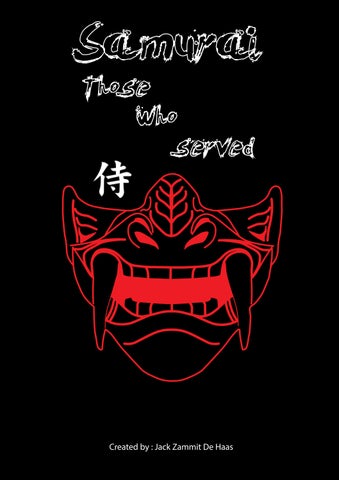
Samurai Those who served
Created by : Jack Zammit De Haas
Introduction
In this Zine I will be going over one of the worlds most legendary and ercest warriors, The Samurai. Now this zine will be going over the main factors of their well being including: who were the samurai and some of their history, what occupations they had or could have, the clans ,the food they would eat and grow, their spiritual beliefs, their physical training , their environment and some of their native species and the way they thought about life. Now most of this will be based in the time line you can see below, more speci cally the Sengoku Jidai .Some of this couldnât be based in said era as there isnât a lot of information on it so instead is based on more modern timed sources.
1467- The start of Sengoku Jidai period
1467Onin war
1615- Sengoku Jidai period ends 1592- Japan started its invasion against Korea
1598- The Japanese lost against Korea
1868- Japan re opens its borders
1918WWI end
1939WWII starts
1603-the start of the Edo period 1914WWI starts
1636- Japan closes
Now this is a modern map of Japan. Its east to China,Ko reaand Russia, Famous for its: redhot sunset ag ,its beautiful cherry blossom trees and amazing mountain ranges but most importantly its iconic media famed Samurai. before The Senguko period , there was a war between two clans that toppled the uni ed empire into chaos. Forcin Daimyo (Feudal lords) to ght for land all over the country creating hundreds of clansand 100 year Civil war. TheGolden age and beginning of the samurai we know today .That war is known as the Onin war.
The Samurai Design
So what was a samurai? Well samurai were known as Japanese warriors or âBushiâ the rst o cial appearing around 1185 in the Heian period. The last ones being around in Edo period,in which Japanâs closes for 250 years of peace .Then was over ,due to them opening their borders to the rest of the world, and the nal period of traditional Japan and its old government died out. Although we will be focusing on the Sengoku period of Samurai. When they were respected for being warriors and were more understood. As they werenât originally. They were originally looked down upon by people within the capital / Empire. They then were given the name Samurai literally means âserventâ or âthose who serveâ . They were known as country bumpkins and uneducated violent people. But that wasnât all true they were erce warriors that reside with honour, to there familys and their clan. Then in Senguko period they became the 4th highest ranking in the countryâs government system ,under their Daimyo. So samurai at this time period were at their peak for e ectiveness as they were introduced to some of the rst re arms called âTanegashimaâ by a Portuguese ship which sold them to some of the clans forcing their samurai to evolve their armour against there enemies. Originally the Japanese rst evolved their armour to be like the Chinese ,Then evolved again to have spear and bow on horse back to using the same tactics against there northern natives,the Emishi . Then before the Mongol invasion they added a Wakazashi to their arsenal and nally the Sengoku version adding the Tanegashima and a European style to the armour making it be able to resist the re power of the re arms being used against them. Then their was an Edo samurai version but as it was in an ear of peace it de-evolved ,not even having full armour and became quite obsolete and was some of the Final Samurai. The Samurai were actually very stylised and colourful, to make the enemy fear them they had artistic depictions of their previous battles on their armour and coloured them brightly to separate them from the average foot soldier. To add onto that they added masks called: Menpo(5) which traditionally would be the bottom half of a face, demon, devil or animal. Samurai would also have custom Wakidate(2) and Maedate-(3) to symbolise their clan or family house.
1 2 3 4 5 8 7 6 9
10 11 12 13 14 15 16
Katana Wakazashi yari Tanegashima 1- Kabuto 2-Wakidate 3-Maedate 4-Shikoro 5-Menpo 6-Sode 7-Waki ita 8-Dou 9-Kote 10-Obi 11-Teko 12-Kasazuri 13-Haidate 14-Kyahan 15-Sune ate 16-Tabi
The Emperor- Japan like some islanders has a head symbol of the country ,this country being the Emperor. The Emperor is a symbol of power in Japan especially in this time period , so every family clan wanted to become a Shogunate under his rule. In the sengoku period there were 5 Emperors and were just gure heads with no political or military power .Although their sworn loyalty that was all they were the shogun had the true power .The Emperor had to be the divine gure of the Shinto religion as it was worshipped by most .
The Shogun- Famously known for being the superior Samurai. The Shogun would sit at the Emperors war meetings with fellow Daimyos and would conduct anything that needs to be addressed even the politician side of things. The First shogun known as the Kamakura shogunate came to power in 1185 due to the capital lowering their guard and not caring about the people lead to the outsiders of the capital to invade and assert themselves by having the shogun at power and that shogun is known as kamakura shogunate .When the Shogunate fell in 1333 it left the country weak for a while as the Mongol army had just invaded for the second time a few years prior.
The Daimyo- They are feudal lords or large land owners . They if needed would assist the Shogun with warriors if necessary. Although in this time like most they seeked the potential to rule or have higher power and would try and puppet the shogun by convincing something that would bene t them. This meaning they would hold power over the most powerful person in the country.
Finally the Samurai- ranked as the 4th highest class in the country coming from a background known as louts now aiming to be the best class possible and honour the clan they reside in. Unlike Europe these soldiers arenât sell swords ,they reside with honour for the clan they are in and would do what ever they need them to do even if it means their death . If the task isnât carried out it could lead to dishonour and shame upon their family and could lead to them all getting killed. Some times there are even certain executions ,were they would have to take the blame and require someone to execute them but even they could get killed for doing the execution wrong. As shown by that example it is supposed to be taken very seriously and be done with respect. And unlike at the time the common peasant turned sell sword in Europe the samurai were highly trained warriors trained to be best of their capabilities with compassion and multiple skills including horse back archery.
Japans clans in the segoku jidai period
As previously mentioned in the Sengoku period there were hundreds of clans who fought each other for more power over the others. Now there isnt a lot of accurate and 100% con rmeed maps in this period but this one is probably one of te closest to being accurate. So the way these clans would gain power ,They would litrally ght one another for more land so that is probably why the maps arent 100% accurate as ghting for power happened all the time and they would take peice by peice. On the left is some of the of the clans that took part In this period now like i mentioned before as their were hundreds, this isnt all of them and some are just so smallto nd any information on them is very di cult. Clans were created and destroyed so quickly in this time period for example : In the Onin war (Just before the sengoku period ) ,the two clans who casued the massive goverment tople( The Yamana clan and the Hosokawa clan). Died out straight before the period began. After the 100 years of wars there were 3 main victors after : Oda Nobunaga , Toyotomi Hideyoshi and Tokugawa Leyasu , who was the main warlord who uni ed the country leading to 200 years of peace
Some of the Family Crests
Japans unique wildlife and nature
Japan is a very unique set of 4 islands built up by volcanoes and tectonic movement. The island is located between the Paci c plate and Eurasian plate,(diagram shown at the bottom of the page ) and is apart of the ring of re. To add to its unique environment its covered in sacred mountains ,one of the features that makes Japan so famous .as you can see on this diagram here-->.Most cities and population being on the coastline of Japan opposite of the great mountains. Japan is very unique as such with its wildlife and national parks. Located all over the islands Japan has 34 parks ,that holds its unique wildlife like: the snow monkeys, giant salamanders,giant spider crabs, stellers sea eagles,red crow cranes ,bears, Blakistonâs sh Owl, and many more. Including its massive sea life and coral reefs. Some places being very unique and only having speci c animals on it like ,rabbit island or fox island. All green locations hear show the parks->.
Samurai association with Japanâs wildlife Samurai have been associated with a lot of animals in the past some of the more common known about them is : The hawk has been known to represent them as they have great endurance and high praise for the shogun. Akita dogs have also been associated with samurai ,as according to the Legends if a Samurai died dishonourably they would be brought back as an Akita dog to be given the opportunity to die defending the life of his master. In the 8th-12th century when ghting there northern natives the Emishi âshrimp barbariansâ or âHairy menâ the Emishi used horse back archery tactics against the samurai keeping them at bay. Until the samurai used the skill against the Emishi but better and took control over there tribes.
Native food and agriculture
In Japan only 20% of the country is farmable and its heavily done so especially today its mostly farmed for rice.Japan in past was a very self sustained country and still is very independent today with only importing 9.5082% of their food Samurai would traditionally eat stu like brown rice, miso soup fresh vegetables and sh, which is the staple of Japan. Samurai would eat 2 times a day and only get 8 hours of sleep every day. The diet a Samurai would consume was very important as it gave them strength to ght and maintain their body to ght in battle.
In the Sengoku period farmers mostly grew rice but as most farmers were poor they couldnât get the luxury of growing rice or fruit . So most farmers resorted to growing crop like wheat,oats or foxtail millet
In the Hokkaido regan they grow 50 types of potatoes and in harsh winters they used to have to only resort to eating potatoes and managed to use each potatoes ingredients in ways in which every ingredient is used. About 80% of the potatoes in Japanare from Hokkaido. Imomochi (potato rice cake) is a local dish and one of the most popular dishes.
How far Japan has come now from the Sengoku period
Japan today requires 43% on its shing industry, which is now worth ÂŁ14 billion. The industry brings in around 4.2 million tonnes of sh a day
Like most countries also have live stock including cattle chicken pig ECT. Now Japan is looking into a large market that involves cloning cows and between 19902000 more than 500 cloned cattle was produced
Japan also grows a high amount of fruit such as Mandarins ,peaches,watermelon ,nashi and more
In Japan its also quite common in any job,that if they make anything they make the best of it. For example Japan today has strawberries that cost ÂŁ500 and has taken the farmer (Mikio Okuda)45 years to make them to this high quality product
âThe
Shintoism
Shintoism is a religion that started in Japan that started in the year 200 BCE- 250CE the Gods are known as kami they are sacred spirits that create all thing important like :wind,rain,mountains,rivers,trees and fertility, ECT. The sun goddess being the most important kami .This is one of the reasons in Japan the environments are sacred like mountains .Humans after death turn into kami and this is why people who died in Japanese families are honoured and when they die they are revered by their families. There is no right or wrong or absolute and nobody is perfect,its a very pessimistic faith .With humans being fundamentally good and evil to be caused by evil spirits and most Shinto rituals keeps the evil away. Shinto shrines are places for rituals and some celebrate festivals like marriage. In the meji period Shintoism was made the states religion and the priests under it were o cial and received government funding .Then after WWII it was separated from the state but its still honoured at home and at the shrines by the people but some things like death is left to be determined by Buddhism although not much is known about the past of Shintoism in the Palaeolithic and Neolithic ages. But although its unlikely its very similar to Yayoi culture which originated from the north of the island Kyushu in about the 3rd or 2nd century ,its very similar to Japanese culture but could be a coincidence. Shintoism even has its own mythology which is wear the sacred treasures come from : The 3 symbols of Japan .The sword, The Gem and the mirror .All for the emperors of Japan
Now the samurai worshipped the Kami ,Hachiman the god of eight banners which symblised the birth of the 15th emperor of Japan (Emperor Ćjin) hes also the divinity of archery or to some,horse back archery and has been told to have won all his battles and deemed the protector of Japan Hachiman is apart
Some of the omnipotent Deity of Japan
The Shinto shrines - each to represent a Kami of Japan
Amaterasu Ćmikami, the sun goddess and chief deity of Shinto Ebisu, one of seven gods of fortune FĆ«jin, the god of wind Hachiman, the god of war Junshi Daimyojin, the god of provocation
Inari Ćkami, the god of rice and agriculture Izanagi-no-Mikoto, the rst man Izanami-no-Mikoto, the rst woman Kotoamatsukami, the primary kami trinity Omoikane, the deity of wisdom Raijin, the god of lightning, thunder and storms RyĆ«jin, the Japanese dragon god of sea and storms Sarutahiko Ćkami, the kami of earth Susanoo-no-Mikoto, the god of the sea and storms Tenjin, the poetry god Tsukuyomi, the moon god
Shinto
way of the Godsâ Kami / Deity âsacred like spirits or Gods â
The introduction of Buddhism in the 6th century ,which created a few issues between the religions but also bene t one another, as kami could be considered Buddha.
To attain enlightenment and be free from the cycle of death and rebirth and go to nirvana Japan received Buddhism in the year 525 when the monarch of Korean kingdom of Baekj sent a gift to Japan including the image of Buddha and several ritual objects and sacred texts. It took around a thousand years to grow around this point
The goal for Zen Buddhism is too gain enlightenment ,to see ones original mind or original nature without intervening with the intelligence. Meditation in this religion being the most important part, as âZenâ means meditation. Its more about understanding ones mind and the enlightened being. Zen Buddhism actually complements the ideals of the Bushido code with its rituals such as mediation a daily thing for some samurai in the Sengoku Jidai period. Zen do not believe in any type of Buddha or God or omnipotent like being. In Zen the soul has no destiny to be looked after by someone immortal and has no destiny after death.
Now as there was so many schools for samurai its possible di erentschools were taught to believe in alternative religions like Shinto or Zen
Bushido was an ethical system, rather than a religious belief system. In fact, many samurai believed that they were excluded from any reward in the afterlife or in their next lives, according to the rules of Buddhism, because they were trained to ght and kill in this life. Nevertheless, their honour and loyalty had to sustain them, in the face of the knowledge that they would likely end up in the Buddhist version of hell after they died.
Buddhism/Zen Buddhism
What do samurai do for training and their routine
The training for a samurai would start at a young age and would commence at a school for samurai where they would learn a range of things like: physical training Chinese studies , poetry and spiritual discipline traditionally this would be Zen Buddhism. The discipline of rules would fall under the Bushido code .The samurai training lead them to learn most martial arts and weapon trainings they would be skilled in so much including: swordsmanship, archery, grappling,spear , re arms, kendo ,jujitsu,Karate, Judo . They would do so in the form of Kata,meaning âshapeâ or âmodelâ. they were systems of combat that allowed them to training large groups and cover many move sets. Later allowing them to be picked apart in life scenarios to kill their enemies. There are thousands of Kata and techniques each special to di erent schools. The schools that are passed down today are simply the survivors from war, which could be taken in a sense that they arenât s good as the others or just got unlucky. Today there are many new schools lots that have the western take which couldâve been taken in a di erent direction completely taking away the tradition in exchange for becoming more of a sport than a generation of knowledge passed down . For example some schools of Kendo has fallen fate to it . where it used to teach many about traditional Japanese sword ghting its become more like fencing in which its all about getting points. Now there are separate schools for the traditional sword Kata that was taught to the samurai.
Samurai are trained not to fear and are trained relentlessly to âbe preparedâ for anything
The truth about the Bushido code
âBushiâ meaning warrior âdoâ meaning path
JIN MAKOTO CHU
Integrity Respect courage Honour Compassion honesty Loyalty
Now this is a tricky topic to uncover as BUSHIDO has a very twisted and challenged history. Now for those who donât know what the Bushido code is ,its supposedly a code that samurai would follow when in battle or just in general when serving a family or clan. Now modern day media depicts it as a code that was always followed by samurai through thick and thin ,and was created around the era samurai came about But that isnât all true it actually came about around 19th/20th century by a writer of sorts. He noticed these qualities of the samurai from old books about them and created this code which has been then used to describe the samurai. That they would follow it like a rule book .which isnât the rst time it was twisted. In WWII Japan used the Bushido code as propaganda and was said that it should be how a noble man should act . making it be seen as a goal or an objective to how people should be or act . Later after the war the Japanese then decided to reconsider it as more of a historical thing than propaganda.
So what is it really ? well its actually more like a lifestyle . Rather than forcing warriors to follow rules it was a code that lead warriors on a path to become something far greater. Although the religions that they resided in wouldnât allow them to go to an after life because of their line of work ,or not even have an afterlife to begin with. It was a code that allowed them to live the best life they could live and make peace with themselves when in doubt and remember why they ght. A code not ran by fear but one with purpose
GI REI
YU MEIYO
What it meant to be a true warrior
In the aspect of being a warrior it can be judged by many. To an enemy ,a monster or machine , to reporters some could state them as warriors. To a clan a nobles or civilians a saviour. But to some its a judgment to what sword a samurai uses. In which both can kill but only one is used by a true warrior. Back to when I spoke of the Bushido code ,it wasnât something they followed like a set of rules but was there as a way of life. All 7 meanings of the code was just a depiction on how they acted. This would help to determine if they had the right morals as a warrior
The Killing sword- To kill with this sword is a choice done by many ,speci cally European sell sword or maybe someone with no allegiance. A warrior who wields this sword has no true purpose to who he kills . It would only bene t them self. Whether it be for wealth ,vengeance or some other reason .This warrior is not a warrior that resides with honour. Sure there can be legends of great warriors that kill like this but to eyes of some they are no more than a brute.
The Healing sword- To kill with sword is to kill with purpose , with a meaning greater than ones self. Act in line with the Bushido code or just a warrior code of other sorts. Although not a set of rules ,to go beyond the point of being a warrior without purpose to one that has compassion and creates a lifestyle out of it. To act with integrity towards ones surroundings and act on Justice by keeping the peace, And not to let their emotions or their opinion cloud there mind. Its also a way of being honest with ones self and to the people they serve. To be loyal to means to serve but to also honour the clan they are apart of with pride. Its also important to see and respect other clans as equal if not one could underestimate an enemy and be unprepared. Finally to have courage in battle even if its a loosing battle with odds 100 - 1 , one must ght with these reasons and for that greater purpose ,for the people they are sworn to protect.
In the eyes of a superior or a warrior whose walked the path this is what it means to be a true warrior. But every path is di erent and every path can be taken in di erent ways. This is merely an example of a potential outcome towards this lifestyle.
To some people the spirit of these warriors was unmatched and some say when the Samurai defeated the Emishi âthey took their spirits with them â and is quoted as âthe Ghost of the Emishiâ living within them.
The End of the Samurai
The Edo period
Before the Edo period ,before the end of the samurai, in 1592-1598 the New united nation became very con dent in their army and decided to invade Korea. And in 1598 Japan lost and in defeat with such a bad taste in their mouth, Japan closed its borders starting a new era .The Edo period also know as the 200 years of peace or 250 years peace depends who you ask. In which it was a period of no connections to the outside world with trading ,communication or advancing .The Japanese went radio silent in defeat. In this time the samurai began to loose their jobs and lifestyle. As there was no impending enemy or a civil war the need for samurai became very obsolete. So did their armour and weaponry they stopped using the re arms and resorted back to only using their swords. Some samurai even though they would get looked bad upon by their ancestors and by fellow warriors ,they became farmers or got alternative jobs sing the other skills they learnt when they were samurai .Within this period samurai armour became more of a decorative piece . So it was very likely that richer families who one were samurai would have a decorative piece of armour. Then nally in 1868 Japan was forced to re-open its borders. Then when Japan opened its borders the old government died out as well as the last shogun and the traditional Japanese way. This made samurai obsolete and slowly more and more of the traditional samurai were put out the job or moved to the military to learn new modern warfare tactics and weapons. Then the country once again started to take after the main land again and started to make things that was tradition illegal such as: Some of the last symbols of the samurai was the topknot known as âchomageâ which late became illegal in 1871. But before this came into act all the previous warriors and samurai go photos and art made of them in their armour and with these symbols of samurai They once again wanted to take after the western culture and wanted to wear the western cuts as it became very Popular. This showed a powerful symbol of Japan as it was such a dramatic change. And in 1876 Samurai lost the right to be armed with swords to once again be more modern and western. Forcing a lot of sword smiths out of the job.
And nally in 1876 ,12 years after Japan re opens its borders the Samurai o cially were gone. All thatâs left is their armour, weapons and stories left as reminders of Japanâs strong history, left in museums or passed down families or schools.
Thank you for reading
æ» äșș ă« ćŁ ăȘ ă
âDead men tell no tales.â