Faculty discusses revisions to Brandeis Core and debates reducing foreign language requirements
By ZOE ZACHARY
The meeting, which took place on Feb. 13, revolved around present and future academic standards for undergraduate students.
At 2:00 p.m. on Friday, Feb. 13, the Faculty Senate convened in Rapaporte Treasure Hall for their monthly meeting. Senate Chair Prof. Jeffrey Lenowitz (POL) noted during his opening remarks that the meeting was unusually populated. His opening remarks included other orders of business, such as reminders for faculty to order commencement regalia and an announcement that teaching award nominations are currently underway. He then asked for corrections to the minutes of the Dec. 5, 2025 meeting, of which there were none.
President Arthur Levine ’77 was invited to give remarks to start the meeting. He began by lauding the faculty’s support of the administration, as when he assumed his position as president, he was warned that faculty-administration relations were tenuous. Levine then spoke about the results of Brandeis’ early retirement program, sharing that it had been offered to 261 people, with 23% (61 people) taking advantage of the program. According to Levine, it could save the University as much as four million dollars per year. However, he added, it will lead to unequal vacancies, leaving a question about what to do in terms of staffing in the time ahead.
Levine then recounted the events of the most recent Board of Trustees meeting. He shared that Brandeis received more applications this year than any other year in the institution's history, which placed the number of applications up 40% from last year. He commended how the University has implemented Early Action to bolster applications, but that the program was only meant to account for a 20% increase in applications. Precisely which factor accounted for the other 20% remains unclear. Levine also announced, however, that Master’s program admissions are down by 50%, noting that this decrease is currently a
widespread problem.
Looking ahead, Levine hopes to focus on revitalizing graduate programs over the next 18 months. In his words, he wants to “look at what they [students] are, what they should be [and] what we would like them to become.” Before transitioning, he alluded to a study that is currently underway to help determine the future of graduate education at Brandeis.
The rest of Levine’s remarks were dedicated to Brandeis’ financial situation. According to him, the capital campaign is ahead of last year’s number, and things are “looking good” in terms of fundraising. Additionally, since the start of 2026, Brandeis has received four gifts totaling $48 million dollars. He also shared that, in an effort to counter the effects of smaller class sizes in recent years, the University will borrow $20 million dollars and has sold Brandeis property in New York City. With this plan, Levine claimed, enough revenue will be generated to prevent staffing cuts. He ended his remarks with a hopeful statement, saying that there is a lot of interest in what Brandeis is doing among other university presidents, and he hopes this will translate to fundraising and more student enrollment.
Levine then took questions about his remarks. One faculty member who did not introduce themself asked, “Given that the stock market did so well last year, did we have to draw from the endowment or did we do better than expected and are drawing less from the endowment?” Levine responded that the University is currently taking 8% per year from the endowment and wants to reduce that number to 5%, though he believes that goal will be left to his successor.
Prof. Dan Pearlman (ENVS) expressed concerns that changes to the general curriculum were being rushed. As he sees it, Brandeis could be bolder in creating an environment that will attract students. Levine explained that attitudes toward general education are volatile and “change every 20 years with the predictability of a metronome.” He continued, “I think it would be terrific if we could create the dream general ed[ucation] program, but that will take a lot of time.”
There were no more questions for Levine, so Lenowitz pushed ahead with the next order of business, which was about debating each of the meeting’s mo-
CLOSURE
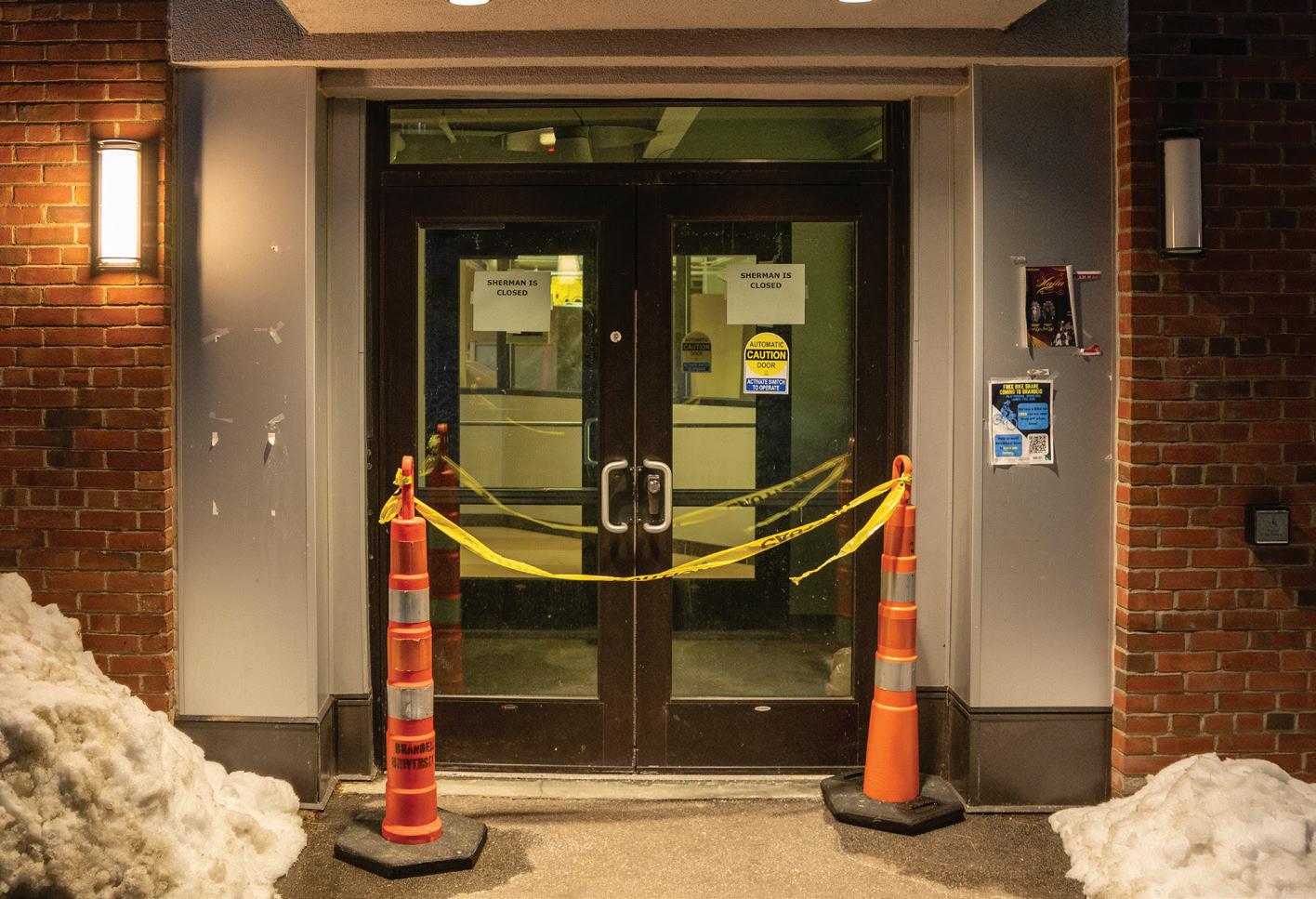
Following February fire, Sherman’s closure reshapes dining experience on campus
In light of the uncertainty surrounding the Sherman Dining Hall’s re-opening, students report how their daily routines have been significantly disrupted.
By ALLIE LADJEVA JUSTICE STAFF WRITER
More than a month after Sherman Dining Hall’s Feb. 2 closure, students reported overcrowding, limited food options and accessibility challenges, as Usdan Kitchen serves as the main dining hall on campus. To better understand the impact of this situation, The Justice conducted a survey between Feb. 18 and Feb. 27 to reflect students’ experiences during this time.
The Sherman-Hassenfeld building closed its doors after students received a Brandeis Alert about “ongoing fire activity.” However, students have faced various challenges during the past month, including but not limited to their ability to reach Usdan, finding appropriate food options and
finding seating. As of press time, the University has not announced Sherman’s reopening date nor provided details regarding the extent of the damages caused. The Vice President of Student Affairs, Andrea Dine, in a Feb. 24 written statement to The Justice, reassured students that “the current twolocation model is both sustainable and flexible as Sherman Dining Hall and Hassenfeld Conference Center repairs continue.” After attempting to contact the Hospitality Manager Alan Meyer, the Hospitality Director of Sherman Omar Zouak, the Guest Experience Manager Craig Foster and the Hospitality Director of Usdan Ashley Weaver for comment, The Justice has not received a response. Additionally, a request for comment to the University’s media relations team has not been answered. On Feb. 22, the Faculty Club opened to provide full-time kosher dining options in lieu of Sherman’s closure. Before the Faculty Club opened, Louis’ Deli served as the primary kosher dining option, as well as limited offerings from a designated kosher table in Usdan. The Justice’s survey received 117 anonymous responses from Brandeis undergraduate and graduate students. 31% of the respondents were sophomores, 23% were juniors, 21% were se-
Brandeis celebrates Black History Month: in conversation with a student leader
In recognition of Black History Month, Zaire Simmonds ’26 shared more about the events happening on campus and the importance of celebrating Black history and culture all year long.
By ALLIE LADJEVA JUSTICE STAFF WRITER
As Supreme Court Justice Thurgood Marshall once said, “In recognizing the humanity of our fellow beings, we pay ourselves the highest tribute.” His words resonate every February, as the United States honors Black History Month, highlighting the culture, history and heritage of the Black community. The month not only celebrates Black people’s long-standing fight for justice and inclusion, but also recognizes the countless achievements of African Americans. Founded by Carter G. Woodson in 1926, Black History Month aims to center Black people’s past and successes as a permanent part of American history.
In a Feb. 2 email sent to students by the Dean of Students, Monique
Lunar New Year
A look at how different cultures celebrate Lunar New Year on campus.
LUCA D. JORDAN
Gnanaratnam, and the Vice Provost for Access and Excellence, Lee Bitsóí, the University shared several ways they planned to honor Black History Month at Brandeis. The email provided a brief history of the observance and also emphasized Brandeis’ historical connection to civil rights, noting archival collections that document Black experiences. Currently, the University houses several materials related to Ford and Sydeman Halls along with rare works by Langston Hughes, Zora Neale Hurston and Wallace Thurman. The email also extended an invitation to all members of the Brandeis community to attend the numerous events throughout Black History Month.
In a Feb. 20 interview with The Justice, Zaire Simmonds ’26 provided insights as to how Black History Month is honored on campus. For two years, Simmonds has served as the undergraduate department representative of the education program and is currently a study abroad ambassador, an ambassador for the Intercultural Center and the co-president of the Brandeis Black Student Organization. He is also the founder and president of the Brandeis Aspiring Educators. As the co-president of BBSO, one of the largest culture clubs on campus and one with a rich history, Simmonds works to advocate for and help improve Black students’ experiences at Brandeis. He also changed the BBSO general meetings to include an educational component so attendees can take something away from each meeting.
Simmonds explained that the events organized by students that took
Moving
ROGERIO VILLACA SZUSTER
place the last week of February honored Black history on campus.
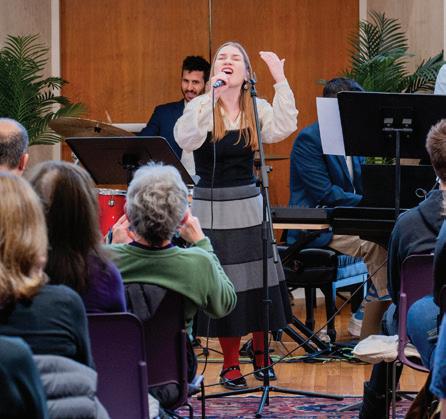
Black Homecoming was a four-day celebration that included the following events: “Talk About It” on Feb. 25, a blackout party on Feb. 27, “The Gala: Enchanted Forest” on Feb. 28 and “The Showcase: Dandy by Design” on March 1. The “Talk About It” event fostered a space where Black students were encouraged to discuss and present anything they were passionate about. The Gala is an annual event that allows Black students to be uplifted for their achievements. “The gala is our way of showing that you are being seen and recognized,” he shared. This year, 10 awards in different categories were presented to students, faculty and staff members to honor Black excellence. “The gala is our way of showing that you are being seen and recognized,” he shared. Simmonds was awarded the night's highest honor, the Umoja (Unity) Award, for exemplifying unity, excellence and the beauty of collective growth within the Brandeis community.
One of the main highlights of the showcase was a fashion show that brought students on the journey of different eras of Black history. “We are taking you [through] the eras of Blackness, starting with dandyism, then moving into the Black Panther era, taking you to the 90s and early 2000s and into the modern era. We are showing the revolution and the fights that we were fighting through this era,” Simmonds explained. The annual Homecoming event extends an invitation to everyone, as it not only allows Black students to honor their his-
ALLISON KETTLE
SAM WEXLER
LUCA D. JORDAN
SHERMAN : The dining hall has remained closed as a result of
POLICE LOG
MEDICAL EMERGENCY
Feb. 25—A party reported a high fever and general weakness. The patient refused medical treatment.
Feb. 25—A party reported having groin pain. The patient refused medical treatment.
SENATE LOG
On Sunday, March 1, the Union Senate convened for their weekly meeting. Due to lower attendance, they first voted to adjust the quorum to 11 senators. The senators then discussed promoting two clubs — DeisHacks and Judeus & Judios — to probationary status and discussed a few additional updates about upcoming elections for positions in the Union Senate and information regarding the ongoing construction in Sherman Dining Hall.
The Union Senate first heard from DeisHacks’ junior project manager, Gianna Saludo ’28, who described DeisHacks’ annual hackathon. The event is hosted every January and works to pair groups of students with various nonprofits, collaborating to design solutions to real issues the nonprofits face. Project designs during previous hackathons ranged from software development to policy changes “so the possibilities are endless,” said Saludo. This year marked DeisHacks’ ninth hackathon and ran from Friday, Jan. 30 at 5:00 p.m. to Sunday, Feb. 1 at 11:00 a.m., and featured 143 “hackers,” eight non-profits, 21 submitted projects and 11 campus partners, including the Union Senate. Saludo emphasized that while the hackathon is only 48 hours, the club runs the whole year and spends months preparing for the event, going through four major phases of development including recruitment and outreach, marketing, preparation and post-event reviews and audits.
Saludo also discussed the various challenges that DeisHacks has faced and the ways in which becoming a recognized club could help them in the future. She began by establishing how the scalability of external outreach, marketing and onboarding would be improved by gaining access to the financial resources provided by the Union Senate. Being able to participate in the involvement fair would ensure more long-term stability and sustainability for DeisHacks and would help the club reach beyond Brandeis.
After the initial presentation, the floor was opened up to questions. One senator, Tyler Hupart ’26, asked Saludo why DeisHacks hadn’t previously attempted to become a secured club through the Union Senate. Saludo explained that previous DeisHacks board members wished they had tried to do so, and that she had led the initiative to gain status through the Union Senate this year in time for DeisHacks’ 10-year anniversary. “We want to grow DeisHacks into more than just a happy thought in our
CORRECTIONS AND CLARIFICATIONS
A Forum article incorrectly stated that bilingual students would not be able to test out of the language requirement. The article was updated to state that bilingual students can test out of the language requirement. (February 3, Page 9)
The News police log did not capitalize “living” in the Department of Community Living. (February 10, Page 2)
The News police log incorrectly stated the name of a building on campus. It was since updated to Shapiro Academic Complex. (February 10, Page 2)
The Senate Log’s editor’s note incorrectly stated that news editor Lucia Thomas did not edit the article. The editor did edit the article. (February 10, Page 2)
The masthead incorrectly pluralized “News”
The Justice welcomes submissions for errors that warrant correction or clarification. Send an email to editor@thejustice.org
The Justice is the independent student newspaper of Brandeis University. The Justice is published every Tuesday of the academic year with the exception of examination and vacation periods.
MISCELLANEOUS
Feb. 22—The Grounds team was notified about the snow. The situation was cleared.
Feb. 24—A staff member reported receiving a harassing phone call. There will be an investigation to follow. Feb. 24—A staff member reported receiving a suspicious phone call. There will be an investigation to follow.
community,” said Saludo. After a brief discussion and vote, all senators voted in favor of promoting DeisHacks to probationary status.
The Union next heard from a new club on Brandeis campus, Judeus & Judios. The club’s president and founder, Rogério Villaça Szuster ’28, and vice president, Camila Slatopolsky ’29, represented the club at the meeting. The club’s mission is to celebrate and recognize Latino Jewish culture and cited a quote from Dina Siegal Vann, director of the American Jewish Committee’s Arthur and Rochelle Belfer Institute for Latino and Latin American Affairs that has informed their goals: “Jews from Latin America feel both connected to and distinct from the larger U.S. Jewish and Latino communities … They are looking for a space of their own to articulate their multiple identities, to forge a sense of belonging to the global Jewish community and to their Latin American native countries, while expressing their deep ties to Israel.”
Szuster elaborated, describing how Latino Jews at Brandeis and beyond have experienced a kind of “limbo” between their identities as Latinos and Jews and have often felt isolated from both spaces. “I grew up more connected to Argentina than I did to the little town in Ukraine that my family’s from,” said Slatopolsky, but she retains a strong connection to her Jewish identity. Szuster and Slatopolsky both identified common misconceptions about Latino Jews, such as ideas that they are half-Jew and halfLatino or that they “lost everything by being Latino.” Szuster also mentioned a particularly alienating incident where he was mocked in a Hebrew class for his accent.
The club has already received interest from members of the Brandeis community. Szuster cited that the club’s interest form sent out last semester collected 29 responses within a week. The club also hosted an initial meeting with 18 attendees, formed a WhatsApp group of almost 30 members and has 125 followers on Instagram. They already hosted an event in collaboration with the Jewish Feminist Association of Brandeis to celebrate iconic Jewish women of Latin America, and plan to host another event with the Brandeis Israel Public Affairs Committee. The club is also planning a “Carnapurim” event, a joint celebration of Carnaval and Purim, which will feature body paint, Brazilian funk music and temporary tattoos as well as a “Portunhol” hangout, a term for a mix between Portuguese and Spanish, which will
Brandeis celebrates Women’s History
In a Feb. 2 email to students from Prof. Sabine von Mering (WGS, CGES), Harleen Singh (WGS, ENG) and LeManuel Bitsóí (HSSP), the University invited the community to join in celebrating Women’s History Month. Established by Congress in 1987, Women’s History Month recognizes women’s societal impact and contributions. At Brandeis, this legacy is reflected in the growth of the Women’s, Gender and Sexuality Studies Department. Brandeis also highlighted its feminist history through presenting influential scholars such as Angela Davis, Pauli Murray, Patricia Hill Collins and Anita
Feb. 24—A staff member reported receiving a harassing email. There will be an investigation to follow.
Feb. 25—A party reported a suspicious package delivered to the Mailroom. Services were rendered.
feature various Latin American dishes.
As an affiliate group of Brandeis Hillel, the club is currently limited to only collaborating with Hillel organizations and is unable to book rooms or access the resources of Union-recognized clubs. They argued that receiving the support of the Union Senate would allow them to reach the greater Latino community and become more involved in campus culture and activities. In collaborating with more clubs on campus, Judeus & Judios could be recognized as more than just a Jewish group or a subset of Hillel. After another brief discussion and vote, the Union Senate voted to promote the club to probationary status.
The Union Senate then moved to discuss a few short updates about upcoming elections for positions in the Union Senate including President, Vice President, Chief Judicial officers, Senate seats, Allocations Board seats, Treasury and more. More information will be released in the coming weeks about the date of the election. One senator, Davian Pagan ’29, asked about any updates on the status of Sherman Dining Hall. Daniel Shin ’27, the Union Senate’s Vice President, responded that he’s been in touch with University administrators who have confirmed that they are working to remove all of the damaged appliances and carpeting and will be replacing them. There are ongoing inspections that, once completed, will provide more information about the dining hall’s reopening. Finally, a senator brought up complaints about the lack of a late-night dining option with The Stein being closed and Shin agreed to discuss the issue further with administrators.
— Written by Nawal Irfani
— Editor’s Note: The Justice News
Ashhwika
Hill along with alumni including literary critic Elaine Showalter, sociologist and psychoanalyst Nancy Chodorow, physicist Evelyn Fox Keller, historian Joan Wallach Scott and Letty Cottin Pogrebin, the founding editor of Ms. Magazine. From March 3 to March 31, Brandeis will host lectures, panels, exhibitions and performances in celebration of these women, and the events will be hosted by different student organizations on campus. This includes events at the Rose Art Museum and the Women’s Studies Research Center. An ongoing exhibition titled “Who Will Draw Our History? Women’s Graphic
Narratives of the Holocaust, 1944-1949” is currently being showcased at the Kniznick Gallery and will be displayed until April 30. The University additionally encourages engagement with their archival collections and database that documents the contributions and achievements of these women. The message concluded with a call for a campus-wide participation and a regard for honoring women’s history throughout the month of March.
— Written by Ashhwika
— Compiled by Chava Thiell
Soni
BRIEF
Editorial Assistant
Soni ’29 is a member of Student Union Senate and did not edit or contribute to this article.
— Editor’s Note: The Justice Staff Writer Rogério Villaça Szuster ’28 did not edit or contribute to this article.
Department of Women’s, Gender and Sexuality Studies reflects on 50 years of scholarship and financial independence
Women’s, Gender and Sexuality Department Chair, Prof. Sabine von Mering, discussed the department’s history and legacy amid university funding concerns.
By ALLISON KETTLE JUSTICE CONTRIBUTING WRITER
The University’s Women’s, Gender and Sexuality Studies department celebrates their 50th anniversary of establishment this year. In 1976, Brandeis began its Women’s Studies program with a single course offering Women 10A: Women in American History. In 2014, the program evolved and became Women’s, Gender and Sexuality Studies, and in 2020 was promoted to official departmental status.
Today, the department is one of the wealthiest at Brandeis and remains financially stable despite broader university funding concerns. In a Feb. 26 interview with The Justice, WGS Chair Prof. Sabine von Mering (WGS/ CGES) reflected on the department’s history and growth. “WGS is unique in that leadership early on were extremely good at being entrepreneurial,” she observed. Shulamit Reinharz, Professor Emerita of WGS and Sociology and the wife of former University President Jehuda Reinharz, helped raise significant funds for the department and went on to found the Women’s Studies Research Center, now located on South Street in the Epstein building. Her efforts contributed to the establishment of The National Board for Women’s, Gender and Sexuality Studies which privately funds the WGS department. The National Board includes 20 members appointed by the Brandeis president and is chaired by Hinda Shuman Marcus. The board meets twice each year to provide the department with guidance and financial support. Prof. von Mering explained that this degree of independent funding is
rare at Brandeis and helps WGS “shoulder its own expenses as much as possible.”
One challenge facing the WGS Department is its limited number of full-time positions. Only one professor in the department, Professor V. Varun Chaudhry (WGS), holds a full-time position, while the rest of the WGS professors are jointly appointed with other departments. Prof. von Mering noted that many departments benefit from endowed chairs permanent academic positions funded by large endowment gifts rather than the University’s operating budget. The WGS department does not currently have an endowed chair appointment, which presents a barrier to expanding full-time positions. Additionally, an ongoing University-wide hiring freeze in effect since March 2024 has further limited departmental growth. Today, the WGS department is committed to exploring intersectionality between sex, gender identity and sexual orientation. The department offers a Master’s degree in Women’s, Gender and Sexuality Studies and supports a minor in Sexuality and Queer Studies. Currently, the undergraduate de -
Club close up: Jewelry-Making Club
partment is offering WGS 166A: Gender, Sexuality, and Social Media and WGS 6B: Sexuality and Queer Studies, as well as multiple courses cross-listed with other departments. Prof. von Mering emphasized that the department’s history and the dedication of its faculty position it to become a “signature department” for Brandeis. The University’s commitment is reflected in its support for WGS research and its faculty. However, the absence of additional full-time faculty continues to constrain the department’s development. During a critical time of political and social instability, von Mering believes that it is more important than ever for Brandeis to proudly commit resources to WGS in support of queer, transgender and feminist students. “Its fiftieth birthday would be the perfect moment to make the department shine, grow and thrive,” Prof. von Mering expressed.
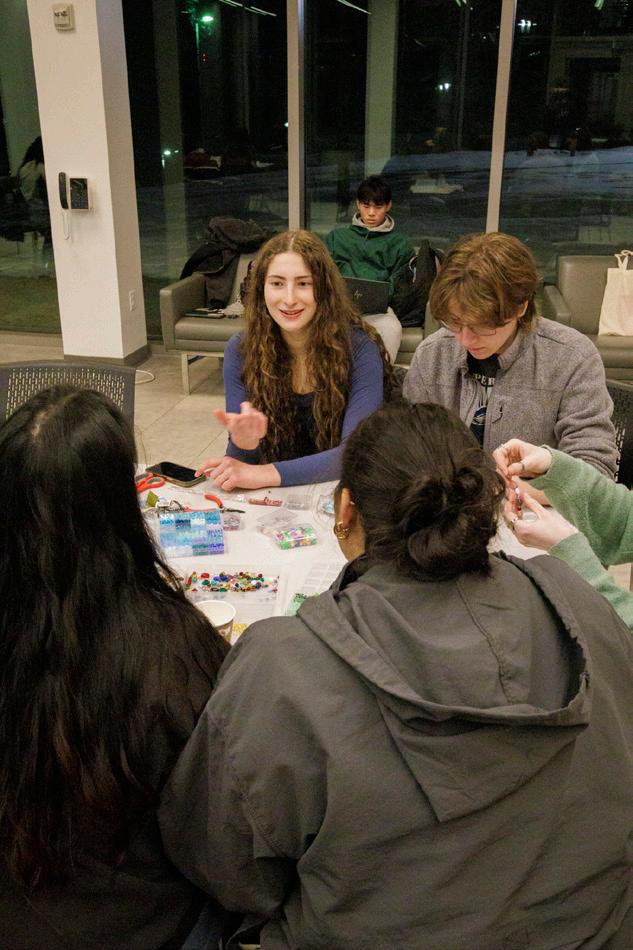
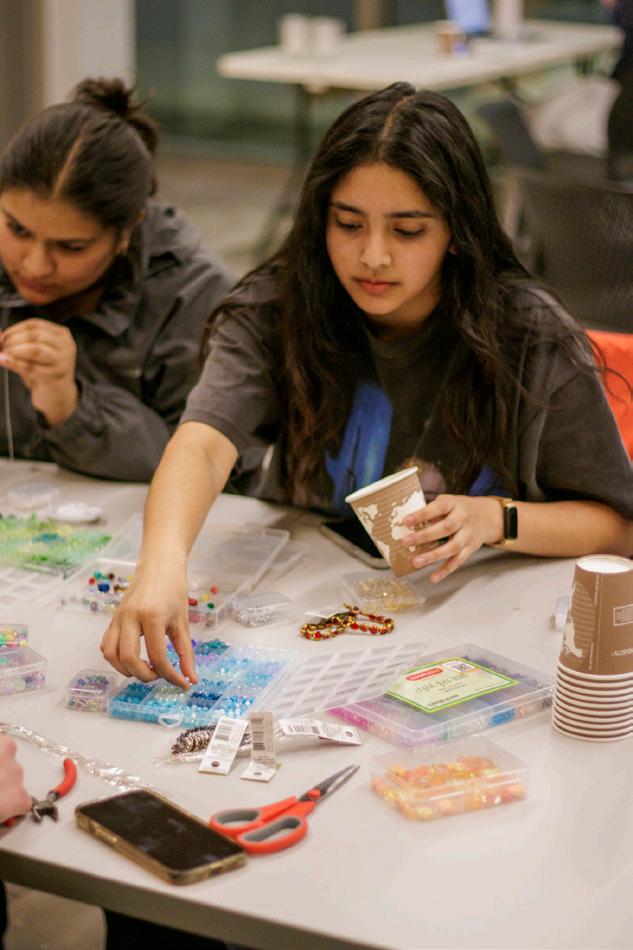
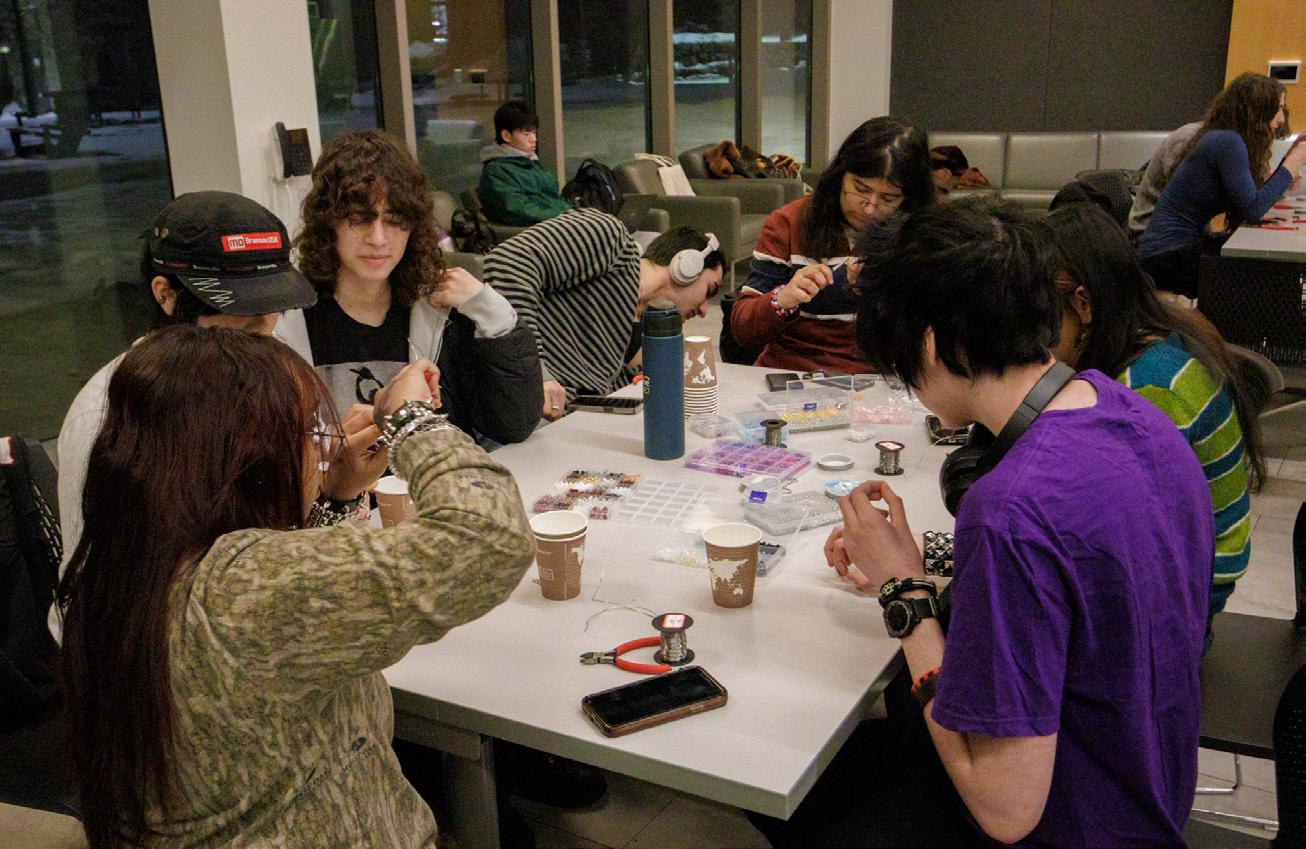
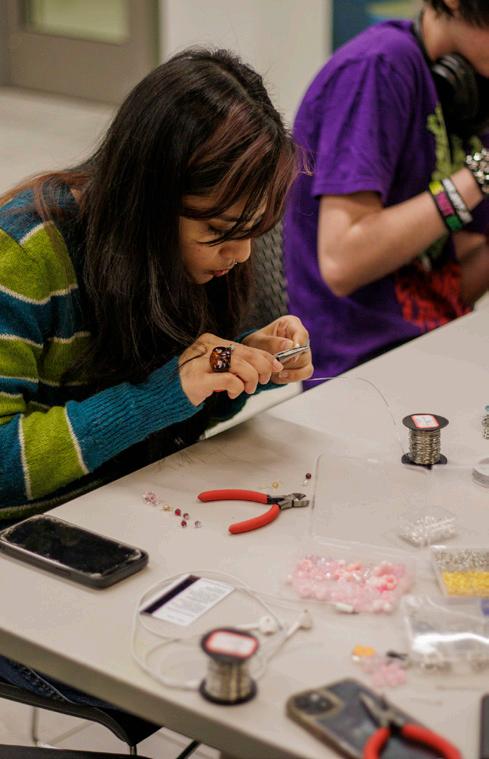
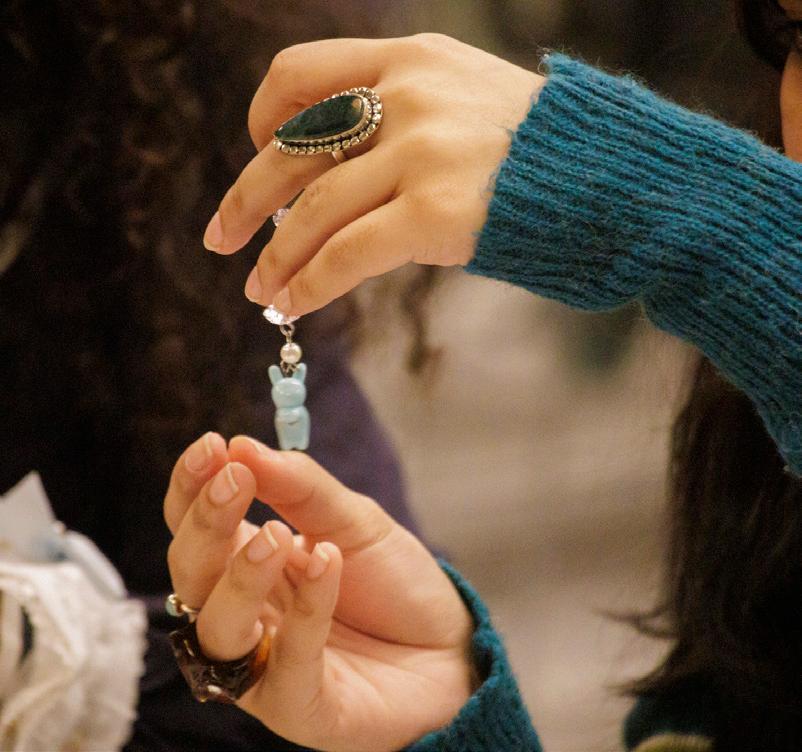
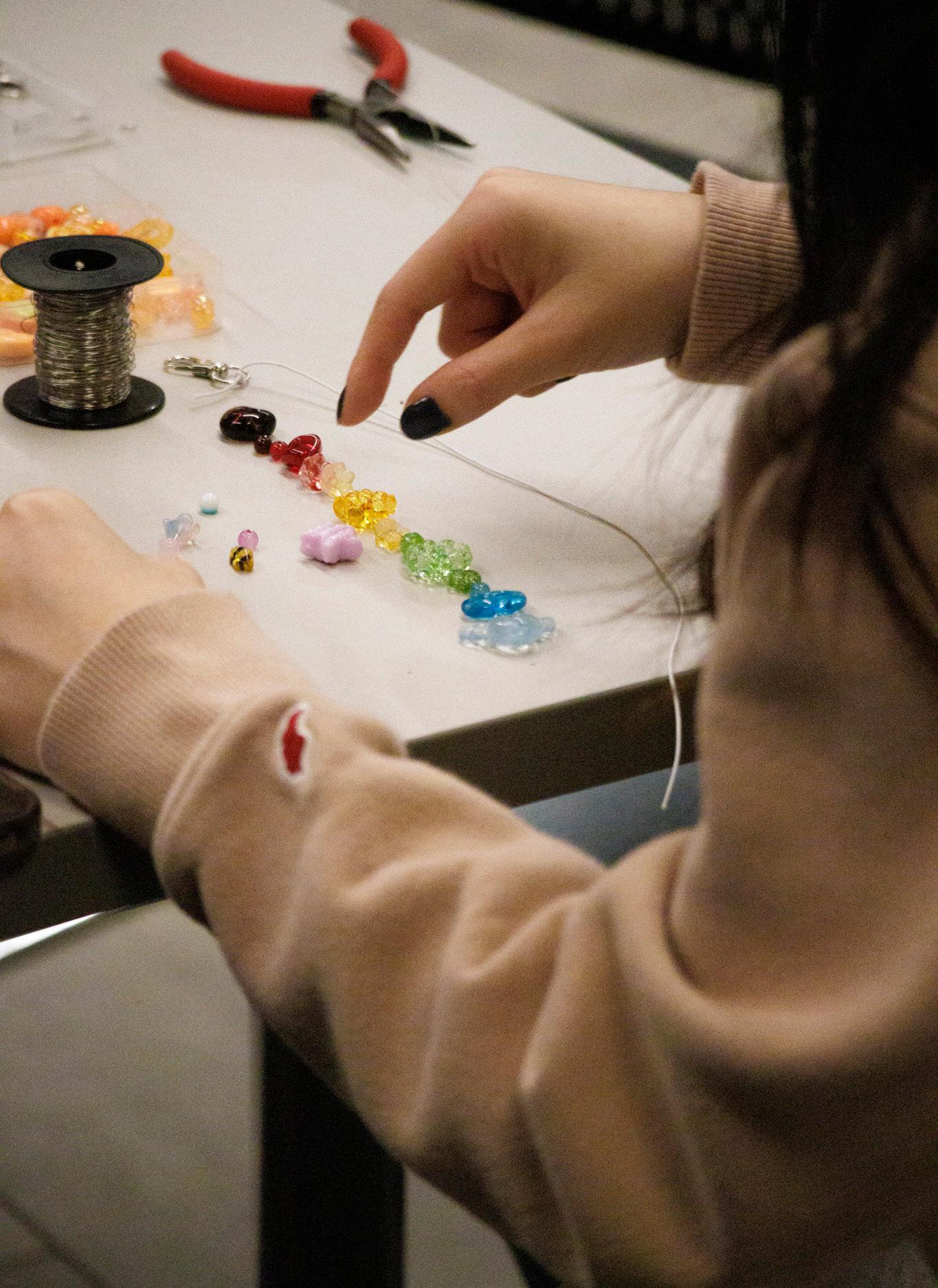
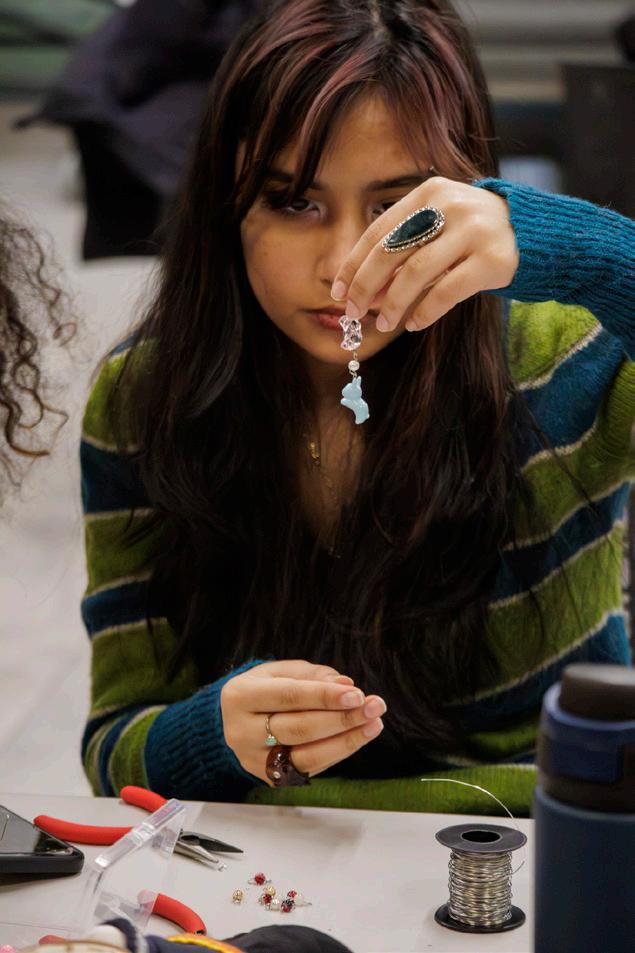
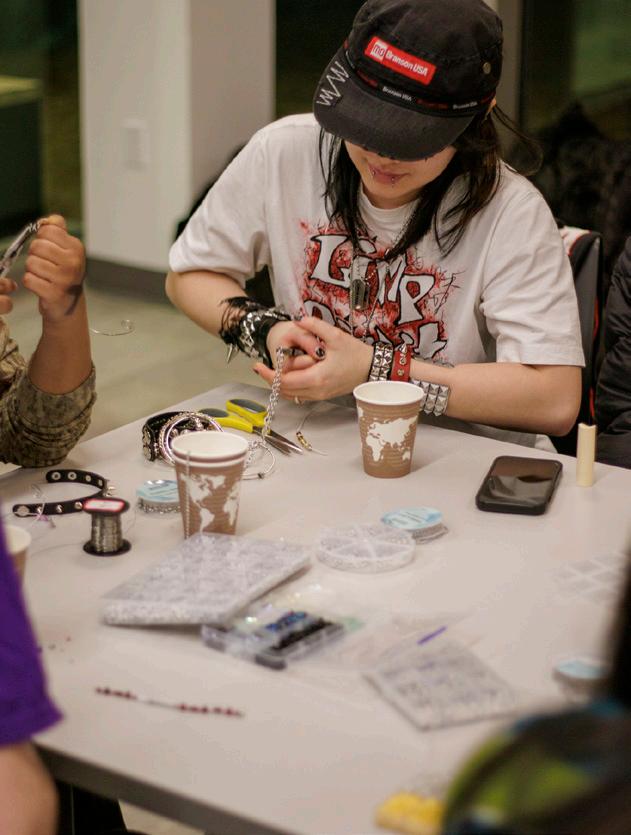
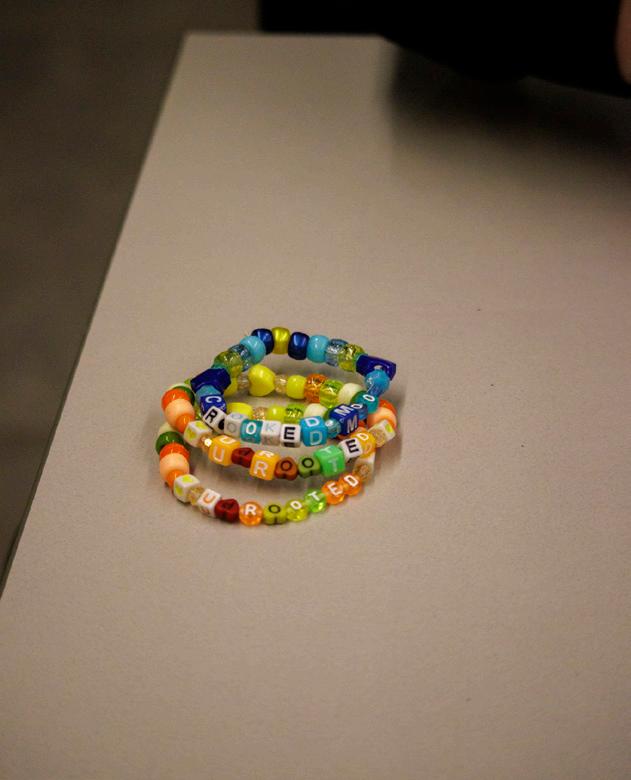
On March 1st, the Jewelry-Making Club hosted their “Bead Bash” jewelry making event open to all Brandeis students. Over 40 students gathered to hang out and craft. Attendees made bracelets, earrings, key chains and anything that they could imagine. The energy was peaceful but the room was filled with happy chatting and jokes among friends.
By: SKYE ENTWOOD/The Justice. Design: JOAN COGLIANO/The Justice.
Survey provides insight into problems arising from Sherman closure
niors, 21% were first-year students and 4% were graduate students. This variety provided a balanced mix of perspectives from the student body.
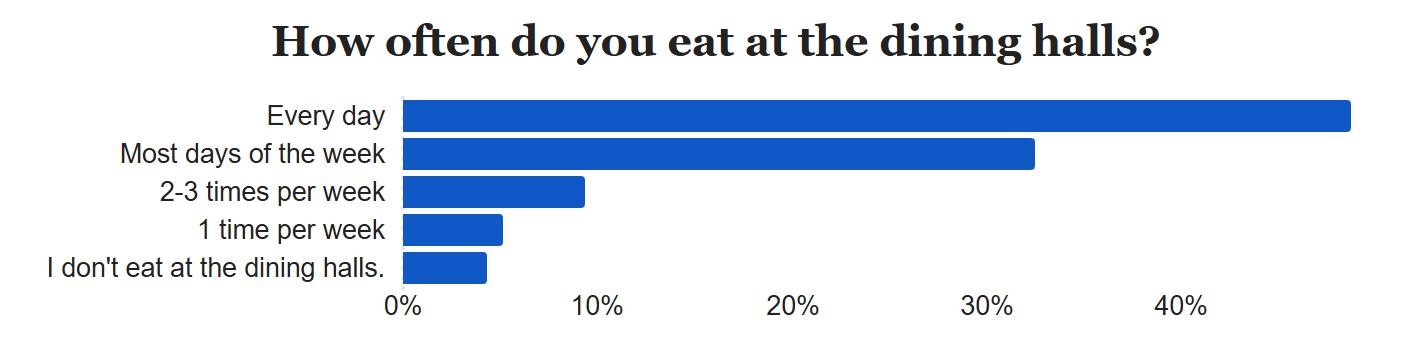
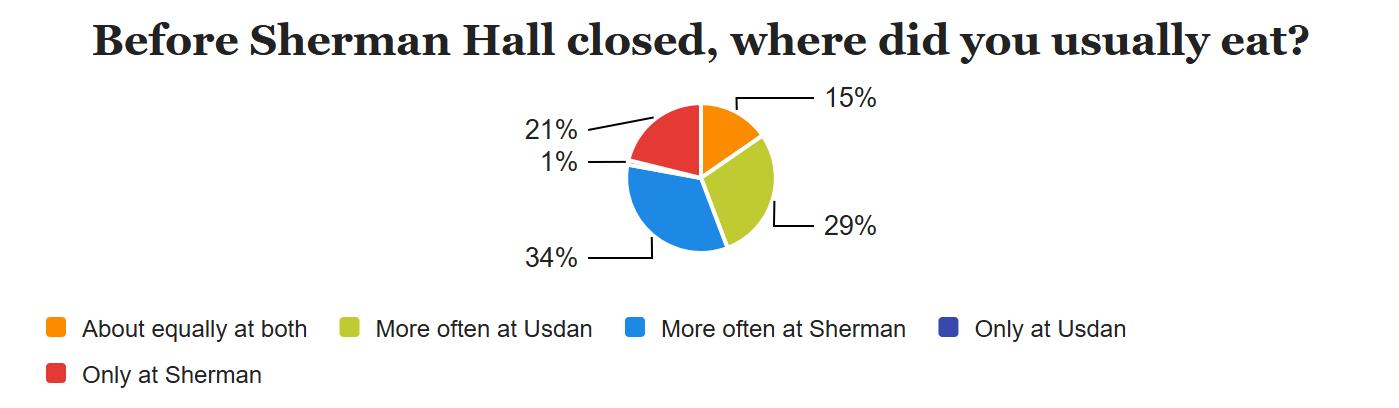
To better understand the level to which students were affected by the closure, the survey asked respondents to share how often they usually eat at the dining halls and which of the two they frequented before Sherman’s closure. 49% of the respondents eat at the dining halls every day and 32% eat there most days of the week. When it came to respondents’ dining hall preferences, 34% of students reported eating at Sherman more often, while 29% ate more often at Usdan. 21% of respondents said that they only ate at Sherman. Consequently, the data suggests that these students were significantly affected by Sherman’s closure. Respondents also reported experiencing challenges related to a range of dietary needs. Some of the most common ones include kosher and halal diets, allergies, lactose intolerance, celiac disease and vegetarianism. The diverse answers reflect students’ various needs on campus, which the dining halls are expected to meet. As there is one main functional dining hall at the moment, it is critical that the University accommodates all students' dietary needs. “It has made it almost impossible to eat at the dining halls with my dietary restrictions and Sherman being closed,” a student reported. Responses revealed mixed opinions about students’ experiences in Usdan since the beginning of
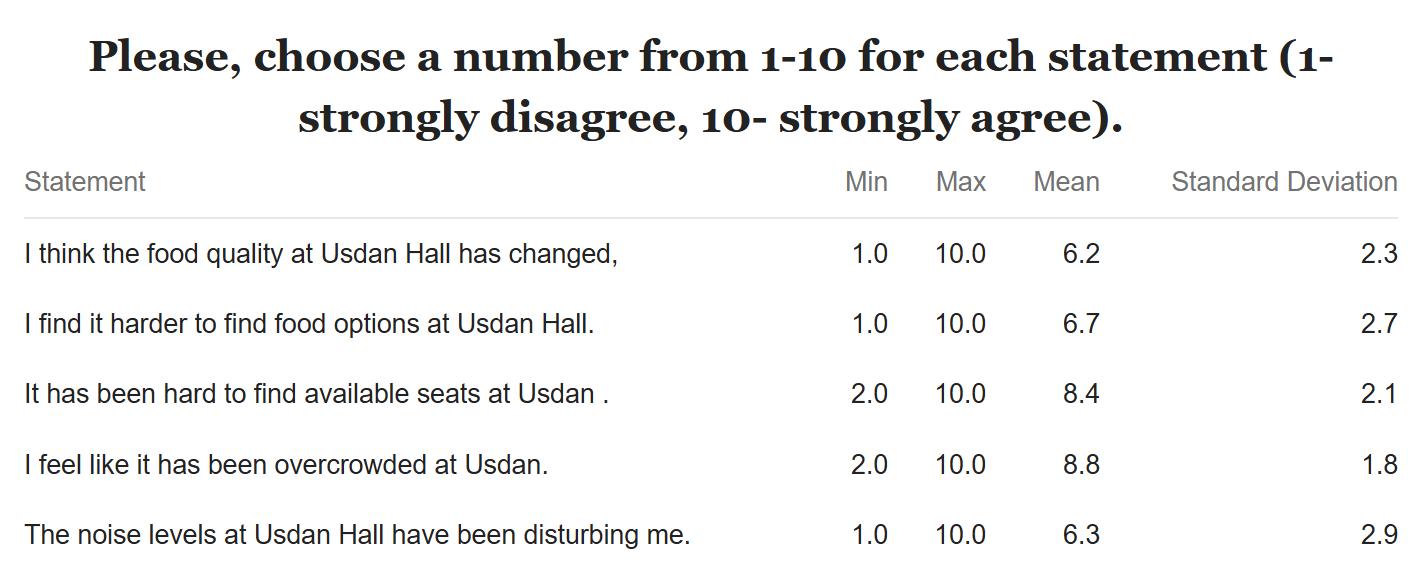
the month, with scores ranging from one to 10 (one being “strongly disagree” and 10 being “strongly agree”). 72% of respondents completed this part of the survey, which presented statements for students to rate. The statement “I think the food quality at Usdan Hall has changed” had an average score of over six points, indicating that many students have perceived change in food quality since Sherman’s closure. The answers to the open-ended questions presented in the next section suggest that many students view these changes negatively. Additionally, the statements “It has been hard to find available seats at Usdan” and “I feel like it has been overcrowded at Usdan” had the highest scores, exceeding eight points. The results suggest that respondents’ experiences have been mostly negative — a challenge that the University has to overcome. The survey’s open-ended question asked respondents how they have been personally affected by Sherman’s closure. Almost all respondents reported that their recent weeks on campus have been challenging. More than 10 students reported being forced to eat smaller meals due to limited food options or food running out, while some have skipped meals and gone hungry. “I have sensory issues with food, and so having variety and options on campus between the two dining halls helps me a lot. Sherman being closed limits my options, and if Usdan doesn’t have any safe foods for me, I usually just skip a meal now,” a student shared.
Another student also noted that “since the closure of Sherman, our dining options have been (understandably) limited, which often means having the same three chicken/pasta/pizza options for meals.” These responses raise serious concerns about food accessibility during the closure. Students also expressed being disappointed by the reduced food options available, as they expected more given the cost of their meal plans. “We pay so much money for dining plans, and it’s been upsetting to have only one dining hall — far away from where I live — open,” a student said. Respondents have also had trouble reaching Usdan, especially given the severe winter weather. This raises concerns over the accessibility of the dining hall among students with limited mobility. “I’m a disabled student who lives on lower campus (Ziv/Ridge/Village area). I cannot get up to Usdan unless there’s a shuttle running when I need it, which isn’t often. Getting to Sherm is annoying but doable. I have access to a kitchen, which is the only way I’ve been getting any food over break,” a student shared. Many respondents also stated that they have had to order takeout and buy groceries, which required them to spend extra money in the last few weeks. In the survey, students used words such as “miserable,” “extremely frustrating” and “inconvenient” to describe their dining experience. As the survey results suggest, there is significant strain on campus dining services, and students expect
to see changes to their dining experience. In a Feb. 24 email sent to students by Associate Vice President, Campus Services, Susan Scannell, the University shared that students should expect to “experience shorter wait times with better queuing for dining stations.” Additionally, the Brandeis community should expect changes to Usdan Kitchen’s menu that will include expanded food options and more available seating. The Faculty Club is also available to all students, faculty and staff who wish to have kosher dining. Students with specific dietary requirements that Usdan is not currently meeting are encouraged to contact the Health and Wellbeing Manager, Nicole Zapherson, and share their feedback. Many have reported on the survey that they are “grateful for the work that the dining hall staff put in.” Both students and staff are adjusting to the new operational model for dining hall services, making communication essential. As the Feb. 24 email stated, changes are currently being implemented to Usdan, which students should be able to see soon. However, the survey’s findings highlight a significant gap between students’ expectations and their current dining experience. While Sherman remains closed and Usdan serves as the main dining hall, all members of the Brandeis community have had to learn to navigate these challenges together.
FACULTY: Meeting grows tense in debate about language and core requirements
tions. He clarified that voting on full motions would happen electronically after the meeting as long as debate was formally closed during the meeting.
The first motion up for debate, introduced by Prof. Debarshi Nandy (BUS/ECON), concerned the creation of a new finance major. Nandy outlined the increase in demand for finance programs and pointed out that Brandeis was ranked in the top 50 in the country in 2023 despite the University not having an established finance program. Nandy has worked with the Undergraduate Curriculum Committee to curate “finance, technology and society” courses which include math, psychology, legal studies, history and sustainability classes. He strongly believes that a finance major would be a huge attraction for new students. Debate closed after nobody volunteered to speak on the motion.
The next motion directly concerned the Brandeis Core and was introduced by Vice Provost of Undergraduate Affairs Jeffrey Shoulson. It included a plethora of changes to the Brandeis Core, most of them relating to nomenclature and reorganization. Under the proposed motion, the “Foundational Literacies” requirement would be renamed to “Core Competencies,” while the “Digital Literacy” competency would be renamed to “Technologies” and have its learning goals updated. Similarly, the “Global Engagement” requirement would be renamed to “Global Engagement and Justice” and the learning goals would be updated, and the “Schools of Thought” requirement would be renamed to “Areas of Inquiry.” Its more substantive proposals included adding Teamwork and Collaboration as a new Core Competency with a one-course requirement. The motion also sought to eliminate all double-counting restrictions within the core curriculum, except for those pertaining to first-year seminars and 10 and 20-level foreign language courses. Finally, the motion permitted students to take any two Health, Wellness, and Life Skills electives to fulfill the necessary requirement.
The motion previously included a proposition to reduce the three-semester language requirement to two semesters. Changes to the language requirement were split into an individual motion to be debated after this one.
Before debating the motion, faculty were given a chance to ask for points of information.
Elena Gonzalez Ros (ROMS) asked “Why are we being singled out?” in reference to the proposed language requirement changes being moved to a separate motion. She asked whether this change was to increase the chances of the other changes to the Brandeis Core being passed. Shoulson confirmed that they did want the first motion to be passed, as the debate around the language requirement is more contentious and so it would be dealt with in a separate motion.
Prof. Ilana Szobel (NEJS) had a similar concern, stating that she found the decision to split the motion for a more favorable result to be "extremely immoral and unethical,” and advocated to keep the proposal as the faculty had worked on it previously. Shoulson
responded by saying that it is very common to split motions in legislative bodies, and that he did not find it unethical or immoral to give special attention to the language requirement without disrupting other elements of the proposal.
On Zoom, a chat briefly flashed across the screen from Prof. Sue Lanser (ENG) asking why the language proposal wasn’t being discussed first. The question was not acknowledged in person.
Prof. John Plotz (ENG) asked if the motion would actually make substantive change. Shoulson responded by admitting that there weren’t many, the biggest changes being the addition of the teamworking competency and the nomenclature revisions.
Lenowitz then opened debate on the motion. Shoulson began with a positive stance, stating that it was important to explicitly say that students were gaining specific competencies from their liberal arts education. He added that students want more intensive learning experiences, necessitating the kind of streamlining that is being proposed by the motion. Plotz countered, claiming that the language requirement had remained part of a separate motion so that it could become a scapegoat. He also brought up numerous objections made against the whole motion and claimed that crucial debate had not been heard. In his words, “this has not been a proper Brandeis process.” Plotz claimed the plan resembled Northeastern University's three-and-a-half year model, and believed it would be ineffective at Brandeis. He encouraged his fellow faculty members to vote no on the “whole kit and caboodle.”
The meeting continued with three points of information, the first coming from Prof. Sacha Nelson (BIOL). Nelson asked how the competencies would be assessed and whether it was “just passing a course.” Shoulson responded that competencies should go beyond passing classes, though that wasn’t represented as much as the administration would have liked in this motion. He also mentioned microcredentials as indicators of competencies which will include additional assessments. Prof. Kristen Turpin (ROMS) asked for clarification on which language classes would be allowed to doublecount for other competencies. Shoulson clarified that in this proposal, 20 and 30-level languages cannot count for other competencies. Prof. Gowri Vijayakumar (SOC, WGS) asked if proficiency was being defined in a different way, and if the motions being separated pertained to global engagement learning goals. Shoulson said that the question was related to the second motion, and that proficiency was deliberately left ambiguous.
Debate continued with a faculty member who did not introduce himself but was in support of the motion. He clarified that he would be supporting the first motion but not the second one, stating that in order for the University to make meaningful revisions that smaller proposals such as this one need to be made continuously. In his words, “I will vote for it, but with reservations.”
Pearlman then spoke against the motion. Continuing on his earlier statement, he based his oppo-
sition on the opinion that the vote was rushed and that Brandeis could propose higher-quality reforms.
Next, Prof. Olamjumoke Yacob-Haliso (AAAS) spoke in favor of the motion. As a member of the working group who had been debating the proposal for months, she stated that she would be voting in favor with the understanding that the project is just the first in a series of votes that will be used to revise the Core. In her words, “I look forward to future improvements that will be even more groundbreaking.”
There was a brief pause to debate during which Prof. Aida Wong (FA, WGS) brought up a point of information, asking why environmental related competencies were not listed in this motion. Shoulson responded that Brandeis is simply not staffed for an environmental studies competency.
Debate was then restarted. Turpin suggested an amendment to allow 30-level languages to double count for two different core requirements, which passed by a majority vote.
Prof. Liz Hedstrom (BIOL, CHEM) then moved to close debate. The two-thirds threshold was reached and the movement was passed. Lauren Woods (FA) called a court of order, pointing out that there were people on Zoom who had been waiting to speak when the motion to close debate was put forward and did not believe that the call to close debate was in order.
Lenowitz decided to keep debate closed and move forward to the next motion. “Resolved, that the World Languages and Cultures requirement be amended to specify a proficiency level equivalent to one year of college-level study. Students will typically achieve this by successfully completing a second-semester course (normally numbered in the 20s) or demonstrating equivalent proficiency and knowledge acquired prior to Brandeis.” According to Shoulson, this change has already been adopted by other universities and is meant to lighten students’ academic loads.
The first speaker did not introduce themself and was in opposition to the motion. They explained that at one year of language learning, students are at a pre-communicative novice level. The 30 level at Brandeis provides the bare minimum for social interaction and is the lowest threshold at which language can become relevant globally. According to the speaker, the proposed motion would reduce the language requirement to a level that is only enough for students to get frustrated with the language.
Hedstrom spoke in favor of the movement. She claimed that students should be able to choose what they want to pursue, and that there is a substantial opportunity cost for students who take three semesters of a language. Furthermore, she argued that students who are being forced to do something they don’t want to do will forget what they have learned anyway.
Prof. Catherine Theobald (ROMS) introduced her opposition to the motion by presenting statistics pertaining to the language requirement. Around 75% of Brandeis students take zero to one language classes and only 17% of students take three full semesters of
language classes. Out of those who do take language courses, two-thirds of those students choose a new language to study. Theobald asked why, if flexibility is an issue, is the administration targeting one of the most flexible requirements? She also pointed out that reducing the language requirement causes a retention issue with language faculty who make an effort to provide extra enrichment for their students, saying that this motion would erode a special piece of liberal arts at Brandeis.
At approximately 3:30 p.m., the meeting’s posted end time, A motion was passed to extend debate to 3:40.
In favor was another faculty member who did not introduce themself. She brought up concern that some students in the sciences cannot explore other opportunities due to the language requirement. She also believed it was okay to teach language to a novice level.
A Classical Studies faculty member who did not introduce themself spoke in opposition to the movement, claiming that language is culture and taking away the language requirement is a disservice to students. He stated that Brandeis should be defenders of language in a time of increased Artificial Intelligence use, and that language proficiency provides necessary ways for students to put themselves in the shoes of others. He also echoed the first speaker’s point that an intermediate level of language is the bare minimum for critical thinking and global citizenship.
Next, Prof. Sue Paradis (BIOL) spoke in favor of the motion. She spoke about her experience running a research lab and how she has noticed that no matter their major, her students were all putting in work to become broadly educated citizens. She cites that some of her best students are also interested in humanities and arts in their own way. In her argument, Paradis brought up pre-health students who have to take on substantial additional coursework and stated that students should be given more of a choice to spend time as they want.
Prof. Aida Wong spoke against the motion, pointing out that reducing the language requirement would be detrimental to community building. She quoted a recent article in The Justice that advocated for the retention of the current language program: “Many students go through their three semesters with the same peers in smaller classroom settings, fostering a sense of trust that is vital for anyone hoping to learn a language and retaining friendships through school breaks that strengthen bonds between language learners.”
After Wong’s statement, a motion was put forward to close debate. After the motion passed, the meeting was adjourned. Electronic ballots were sent to faculty members on Feb. 23 and the outcomes of the vote are unknown as of press time.
HISTORY: Student-organized Black History Month celebrations occur on campus
CONTINUED FROM 1
tory and culture but also allows all students to learn about the lives and cultures of Black students on campus. Simmonds believes that understanding, listening and learning about different cultures is crucial to promoting inclusivity and justice on campus. While these events play a key role in representing Black history and culture at Brandeis, Simmonds also addressed the importance of cultural clubs’ financing. Cultural clubs host several events throughout the year, and resources are critical to ensuring they happen. He highlighted the importance of the University’s continuous financial support to clubs,
as students work hard all year long to make cultural events possible and celebrate diversity and justice.
The presence of administration, faculty and staff at student-organized events is equally important. He believes that showing up is a way of supporting other people and celebrating them for who they are. Simmonds shared his view on that presence: “We are not just the Black Student Organization. We are the Brandeis Black Student Organization. Therefore, I do think Brandeis needs to be more involved with our group, in support of our group.” As Black culture is a vital part of the Brandeis community, all
members on campus are encouraged to participate in the events organized by BBSO. Simmonds said that even if invitations aren't sent, it doesn’t mean people cannot come. The events are open to the entire Brandeis community and provide valuable opportunities for everyone to learn, connect and show support for their peers.
Personally, Simmonds shared that Black History Month is an opportunity for “all people that aren’t Black and America as a whole to not have a choice but to recognize and acknowledge Black achievements, Black contributions, Black excellence and
Black people overall. It’s an opportunity to give some flowers, finally, and have conversations centered around Black people and just what it means to be Black.” Nowadays, these conversations play a critical role in promoting awareness, understanding and inclusivity within the campus community. As conversations about race and identity continue to evolve on campus, Black History Month serves as a reminder of the triumphs and resilience of the Black community, as well as the ways in which the University can truly support its mission for justice and inclusion for all.
features
It is time for parents to teach young people early on that in diversity there is beauty and strength.
ON THIS DAY…
Franklin D. Roosevelt was inaugurated as the 32nd U.S. President.
FUN FACT
Martin Luther King Jr. improvised the most iconic part of his “I Have a Dream” speech.
Celebrating black excellence
Brandeis Black Student Organization’s BLK Homecoming celebrates Black creativity and community.
By ALYSSA WU JUSTICE FEATURES EDITOR
Across four days from Feb. 25 through March 1, the Brandeis Black Student Organization hosted its annual Black Homecoming, a celebration of Black identity and culture. The organization divided programming into distinct spaces: “Talk About It,” a Blackout party, a formal gala and the BLK Homecoming Showcase titled “Tailored In Black: A Living Revolution.” Each event targeted a different part of campus life, from structured dialogue to public recognition to artistic performance.
The weekend opened Feb. 25 with “Talk About It,” an open forum where students delivered presentations and led informal discussions. The format intentionally blurred the line between academic and personal interests. “It’s an event where you go for a community to listen and engage,” said BBSO treasurer Avie Parker ’29 in a March 2 interview with The Justice. “Especially in the world of academia, it’s really important that students feel like they can speak up and that they are heard,” she said.
Attendees described the atmosphere as unusually candid. Cate Lee ’29 said students were articulating experiences that often remain unspoken in campus settings. “People were saying the things that a lot of students just don’t often say out loud,” Lee said in a March 2 interview with The Justice, adding that the space felt “honest and authentic.”
Destinee Ponder ’29, a model for the Homecoming Showcase, emphasized both the variety and tone of the presentations. “I liked how [a past BBSO President] said, ‘Make Brandeis your HBCU.’ I thought that was a very valuable sentiment,” Pon-
der said in a March 2 interview with The Justice, recalling a phrase shared during the introduction of the event. She added that the range of topics went beyond traditional discussions. “I liked how there were some that were more informal, like the one about Mortal Kombat. I also liked how passionate people were about the topics that they were presenting about.”
“For especially Black students in a predominantly white school, it’s important for us to be able to come together and talk about things like whether they’re academic or informal subjects. It’s important to have these conversations in general,” Ponder said.
After centering student voices, the gala shifted the focus to recognition. Held in Levin Ballroom on Feb. 28, the event adopted a formal awards format with staged lighting, a runway extension and themed decor. “The theme was enchanted forest and all the BBSO members and a lot of audience members, even I came dressed up,” said attendee Daphne Lin ’29 in a March 2 interview with The Justice.
Lin described the staging as particularly elaborate for a student organization event. “They had really cool orange-gold lighting on the stage, and they had a runway that really elevated the whole thing,” she said. “To really make the event regal solidifies impact.”
The awards emphasized community contribution over anything else. Lee said the public recognition highlighted labor that often goes unnoticed. “A lot of the work people do isn’t always visible, so seeing it celebrated very publicly was very inspiring,” she said.
Parker said the ceremony was foundational to how BBSO defines Black excellence. “I think it’s really important that we recognize the people in our communities that create such a strong foundation for our communities. We have to understand that [excellence] was built upon people who took that extra step, who made the extra sacrifice. So we really wanted to recognize them and also come together as a community and support each other,” said Parker.
The weekend culminated on March 1 with the BLK Homecoming Showcase, titled “Tailored in Black: A Living Revolution” “The Showcase, which is our last event, was the ultimate showcase of Black excellence. We had a fashion show. The theme was Dandyism so we had the opportunity to show different eras in Black history through fashion. We also had singers, dancers and we had poems read by Black poets,” Parker explained.
The runway celebrated the history of Dandyism, as models walked in looks tied to different eras. “Dandyism began in the 1920s, and from then until now you see the progression and the evolution. If you think of Black dandyism, it’s how you dress, how you appear, but now that also ties into your career. You see an increase of Black individuals being in spaces of medicine, of law, of business, of entrepreneurship. It looks like building on what you want in your life and going further in terms of career in cases that we weren’t previously accepted into or recognized in,” Parker said.
Ponder described the preparation process as collaborative most of all. “Every-
one who participated in the fashion show was really nice. We hyped each other up,” she said. For her, modeling was both a social and personal milestone. “I wanted to take part in more school events and to meet new people,” she said.
Throughout the weekend, organizers emphasized that BBSO programming is not intended to be insular. “I hope that they walk away feeling a level of recognition,” Parker said. “I hear a lot about Black students feeling like they’ve had experiences of being called too white because they do this or they do that, just having any of their experiences invalidated. So I hope that Black students leave this event feeling recognized.”
She emphasized that the organization was founded to serve the broader minority community. “BBSO is not just for Black students. It is for any minority student to come and feel seen. We were founded on the idea that not just Black students, but every minority student on this campus has a place to express themselves, be seen and be recognized,” Parker said.
For attendees outside the organization, the weekend altered how campus felt. “It made campus feel more like a community instead of a school where I just go to class,” Lee said.
Parker said that a sense of connection is the underlying objective. “For us, community building is literally just unity. It’s eating a meal together. It’s sharing jokes. Doing the cha-cha slide together. It’s all those things,” she said. Throughout the weekend, BBSO’s events created spaces that brought students from across campus together.
Lunar New Year at Brandeis
How different cultural clubs adapt tradition for a collegiate environment.
Lunar New Year is a special holiday across many East Asian cultures that celebrates the new year according to the Lunisolar calendar: a year that uses both moon cycles and seasons to track months. Here at Brandeis, celebrations of Lunar New Year take many forms across several cultural clubs, but the one thing they share is a mission of bringing people together.
For the Brandeis Korean Student Association, a traditional celebration of the Lunar New Year is Seollal, which the club celebrated in Ridgewood Commons on Feb. 27. Seollal is one of the most important holidays celebrated across both North and South Korea and includes many traditions of reverence for our elders and ancestors, but also food and games. KSA President Eva Shim ’27, in an interview with The Justice on Feb. 27, noted the importance of the holiday; “It’s a time to look back and reflect and have people around me that I love.”
One of the foods commonly prepared is rice cake soup, also known as tteokguk. KSA prepared the soup themselves, and also had toppings of fried egg, green onion and seaweed to add to the tteokguk. KSA Event Coordinator Heejae Kim ’28 spoke in an interview with The Justice on Feb. 27 on the significance of the soup, saying that “the rice cake itself is considered a very lucky food because it’s in a coin shape and the white broth is a bone broth that symbolizes purity and kind of a fresh start for the new year.”
President Shim also elaborated about the importance of bringing Seollal to Brandeis. “Some of us don’t get to spend it with our real family so we spend it with our KSA family instead,” said Shim. On adapting the traditions
By LUCA D. JORDAN JUSTICE SPORTS EDITOR
for a college environment, she said, “We don’t alter much at all. We made the soup ourselves although we did serve it in red solo cups which may be a beautiful fusion of peak college.”
Meanwhile, KSA Freshman Representative Jimin Geum ’29 said in a Feb. 27 interview with The Justice that celebrating in a traditional way helps her feel more connected to home, “I haven’t had Korean food for so long and it really reminds me of home because I’m having it with people that I know I love.” Geum seemed to share Shim’s sentiment on eating with other people in KSA, “In Korea, eating together literally means family, so like, we’re all a family.”
Attendee Xudong Yuan ’27 reflected on his own cultural traditions in a Feb. 27 interview with The Justice. “In Chinese tradition, when we make the dumplings for Chinese New Year, we will put a coin in one of the dumplings, and that symbolizes good luck for whoever receives it.” The motif of a coin is strikingly similar to the intention of the rice cakes in the tteokguk. Yuan furthered these cultural similarities; “It’s different food, different games, different traditions but same spiel. It’s about being together.”
President of Club Cantonese at Brandeis Isabella Chan ’26 said in an interview with The Justice on Feb. 27 that for their new year competition last month, they decided to host an egg tart baking competition in Skyline Commons. “An egg tart competition was our new year event because egg tarts are a really popular dessert in China.” Egg tarts are one of Hong Kong’s most popular foods, and as such are important identifiers with Cantonese culture.
Chan believes in the importance of sharing different cultures at Brandeis. “We try to bring in a lot of various people of Cantonese descent who can display various aspects of Cantonese culture in order to basically show a maybe more niche aspect of overall Chinese culture that is Cantonese culture.”
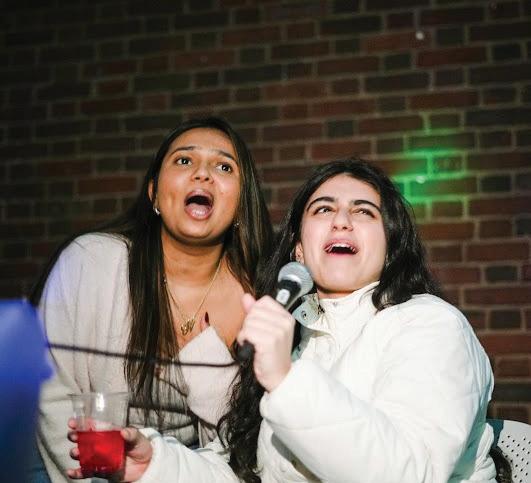
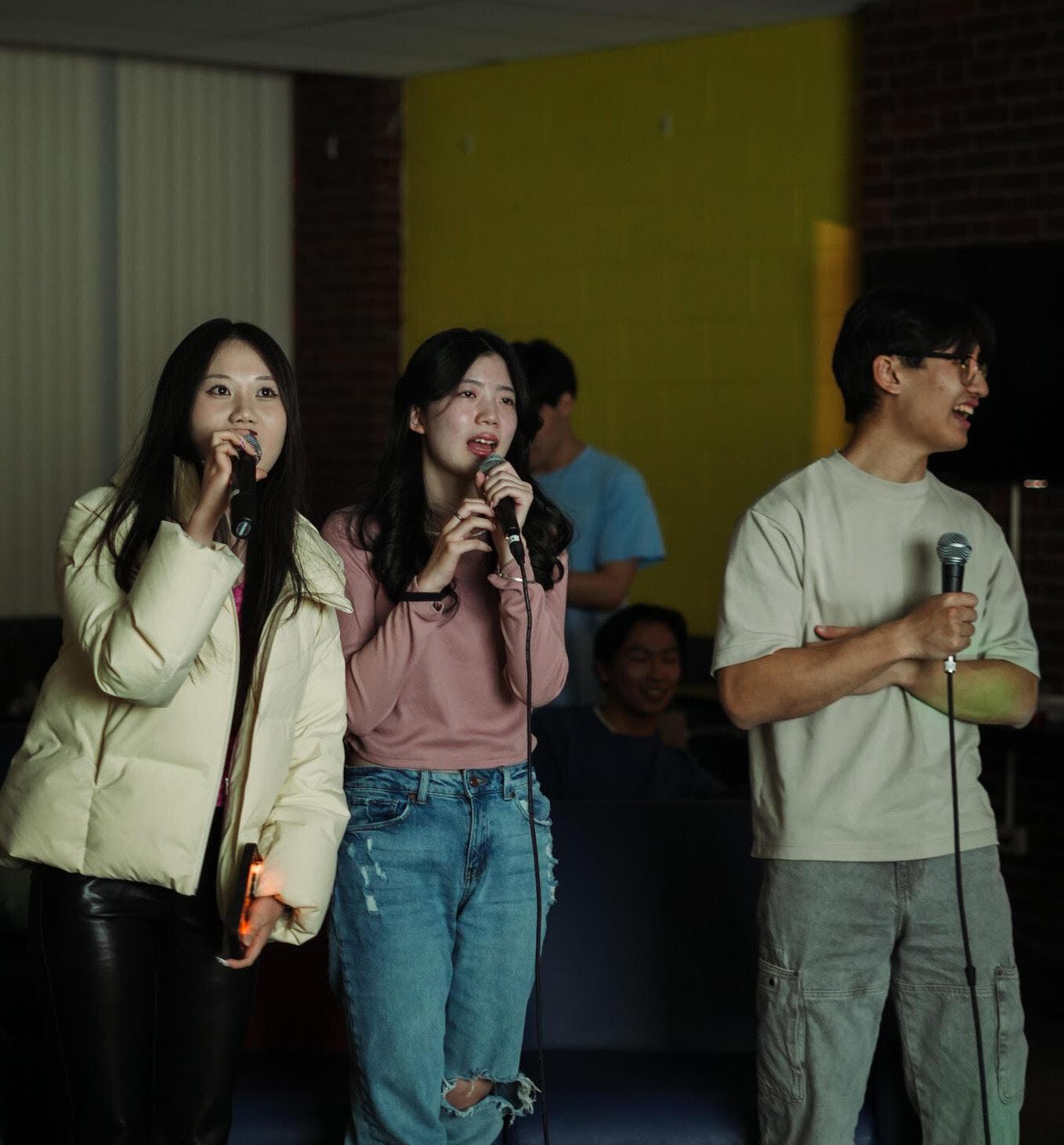
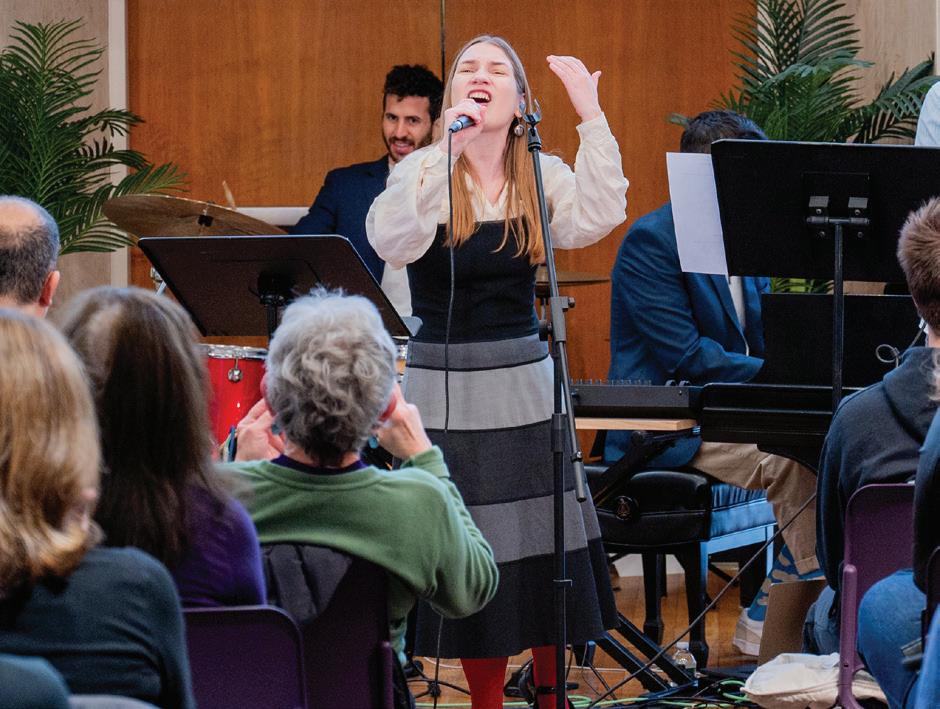
C2B also hosted a karaoke night on Feb. 27 inspired by Lan Kwai Fong, a small cultural district in Hong Kong where much of Cantonese culture originates. Chan said that putting on fun events like these are vital for sharing culture. “Not only is it fun for us, but it’s also . . . educational, historical way for other people around campus to come around and enjoy,” explained Chan. She added that a university setting can be the perfect place to introduce people to a new culture. “Lan Kwai Fong is all about city life back in Hong Kong, so we’re trying to recreate that here to bring back the Cantonese spirit but everyone is welcome here.”
For those celebrating with Brandeis’ Riichi Mahjong Club, games are the best way to break in the new year. Treasurer and cofounder Dari Axelrod-Freed ’27 said in an interview with The Justice on Feb. 27 that they believe celebrating a key aspect of Chinese customs on Lunar New Year can create a comfortable environment for all attendees. “A sizable proportion of our club is made up of Chinese international students and I think it’s important to do events like this for them since they maybe can’t spend this time with their family like they usually would.” Boba and Chinese snacks were served in the Shapiro Campus Center as several games of mahjong were set up. This accompanied by low lighting and small paper lanterns strung on the walls
created a welcoming atmosphere.
Vice President Irene Lee ’28 said in an interview with The Justice on Feb. 27 that Lunar New Year has the ability to bring a college campus together. “I think it’s a holiday where, no matter how long it’s been since you’ve seen someone or how far away you are from them, it still brings you together.” She said, “Everyone gets together and we laugh and we chat and we catch each other up on what’s been happening and we do that here too.”
Cultural clubs at Brandeis play an important role in bringing together the student body. Shim mentioned that “There’s a huge mutual respect between the cultural clubs. I always try to go to their events when I can.” She concluded with her thoughts on the Brandeis community as a whole, saying “I have a positive view on how the Brandeis student body treats cultural clubs. It just reiterates for me that there’s support for us out there.”
“We’re all very proud of our heritage, even if some of us aren’t entirely Cantonese, but we try our best to bring forward certain aspects of Cantonese culture in every single one of our events for the Brandeis community to enjoy,” said Chan, affirming the idea that a cultural celebration can bring students closer together.
No matter how you celebrate, Lunar New Year is a time to get together with people you care about and bond over good food and games. Here at Brandeis, the cultural clubs celebrating Lunar New Year go the extra mile to make sure all are welcome regardless of ethnicity and in doing so brings the student body closer together.
Photos:
CULTURE: Students across cultures celebrate together.
CENTER STAGE: Students grab the mic at C2B’s Lan Kwai Fong event.
As we are all aware of, following the fire in the Hassenfeld-Sherman building on Feb. 2, the Sherman dining hall and the Stein have been closed. As such, additional kosher options have been made available at the Faculty Club, in upper Usdan and the lower Usdan dining hall is currently the only all-you-can-eat dining option open to students. Brandeis students have been given relatively little information about the expected time that the Sherman dining hall will reopen. This editorial board is calling on the University administrative team to come forth with transparent communication regarding Sherm’s re-opening, the extent of the damage done and repairs happening to Sherman.
This editorial board would also like to highlight the dissatisfaction and discomfort that many students are feeling with the current dining situation. Students with dietary restrictions have been especially impacted; for example, full vegetarian meals were not offered at Usdan until recently and before the opening of the kosher table at the Faculty Club, options for complete kosher meals were sparse. The Usdan dining hall — which even before the fire would sometimes run out of seating during lunch periods — has become crowded far beyond its intended capacity. The only effort that Brandeis has taken to resolve this issue is
adding overflow seating in the room across from the dining hall, formerly the game room. This overcrowding has made the simple necessity of eating meals a strenuous task for many students. Longer wait times, difficulty finding seating and non-mealexchange options effectively being cut in half add extra challenges to daily student life.
Given the loss of Sherman Farm Table and Sherman Kosher Table, this editorial board submits that the Brandeis administration should either give students on the unlimited meal plan extra meal exchanges to account for the significant loss of options or give them a partial refund on their meal plan. Students who live on campus are required to buy an all access meal plan. These meal plans are an expensive product to begin with, and were bought — by choice or by Brandeis requirement — under the assumption of two operational dining halls. This drastic change in the product Brandeis is delivering to their students ought to be reflected financially. While Sherman’s closure is not the Brandeis administration’s fault, it is certainly their responsibility to adjust either the allowances or the costs of the already purchased unlimited meal plans if Sherman is to remain closed for the rest of the semester.
A snowy thank you to our professors and faculty
The snowstorm that upended campus activities on Monday, Feb. 23 and Tuesday, Feb. 24 has made travel back to campus after break difficult and unpredictable. This editorial board would like to express its gratitude to all of the Brandeis professors and faculty for being accommodating and flexible to their students, moving classes online, giving extensions and pushing bigger assignments and exams back a few days. We recognize that online classes aren’t
preferable and moving around scheduled assignments can be inconvenient, and making those allowances for students has helped relieve the stress of frustrating travel.
To all of our students just arriving back on campus, we are hoping for an easy transition back to classes. A special shoutout to one of our Executive Board members, to whom we are welcoming back after a safe return from being stranded in Florida for the past week.
Forum, Unfiltered
Brandeis is far too harsh on its STEM students.
For being an R1 research school, the conditions and support given to students pursuing majors in STEM are abysmal.
As a humanities student, I barely see my Chemistry major roommates. Between 8 a.m. classes that start before I wake up to four hour labs that deprive them of meals,
the STEM students at Brandeis struggle more than other students, not because of the content of their major, but because of the vendetta Brandeis seems to have against letting them have any free time. Regardless of one’s major, we should all stand with STEM students as they fight to survive the spring semester.
— Keira Shear, Justice Ads Editor
LETTER TO THE EDITOR
Dear President Levine and Members
of the Board of Trustees, I am writing as a proud alumna of Brandeis University (BA, Latin American Studies, 1997) and as a sociologist whose career has been shaped by the values I absorbed as a Brandeis undergrad. I am deeply troubled by the decision to award an honorary degree to Sheryl Sandberg and to invite her to deliver the undergraduate commencement address at the 75th commencement exercises this May.
Brandeis was founded on a commitment to social justice, intellectual rigor, and the protection of the vulnerable, and bears the name of a Supreme Court justice who dedicated his life to holding the powerful accountable. The decision to honor Sheryl Sandberg is an affront to those values. As a scholar who studies gender, immigration, and inequality, I found Lean In troubling from the start. I was not alone. Leading feminist thinkers — bell hooks, Susan Faludi (and many others)— identified the book for what it was: a repackaging of patriarchal logic in feminist clothing. hooks called it “faux feminism” that served “white supremacist capitalist patriarchy.” The book placed the burden of systemic inequality squarely on women’s individual behavior, telling them to try harder within a broken system rather than fighting to change it. This is not feminism – it is the opposite. And it is certainly not the kind of intellectual contribution that warrants Brandeis’s highest honor.
But the problems with Sandberg go far beyond a flawed book. During her fourteen years as Chief Operating Officer of Facebook, Sandberg presided over a company that caused incalculable harm. Sarah Wynn-Williams’s bestselling 2025 memoir, Careless People, details how the woman who told the world to “lean in” for other women reportedly created a toxic workplace for the women beneath her — crossing personal boundaries with subordinates, demanding obedience, and showing indifference when an employee nearly died during childbirth. The gap between
Sandberg’s public feminist brand and her reported private conduct is a deeply disturbing hypocrisy.
More critically, Sandberg was a central figure in leadership decisions that have had devastating consequences around the world. Facebook’s platform was used to fuel the genocide of the Rohingya people in Myanmar. Activists warned the company for years about the spread of hate speech and incitement to violence on its platform, but leadership did nothing. The UN found that Facebook had substantively contributed to the genocide, during the period when Sandberg was its COO. Under her watch, the Cambridge Analytica scandal exposed how the data of 87 million users was harvested without consent and weaponized for political manipulation, including in the 2016 US presidential election. When Facebook’s own security chief raised alarms about Russian interference, he was pushed out for making Sandberg and Zuckerberg face inconvenient truths. Internal documents later revealed that leadership was aware of the platform’s harmful effects on teenage mental health and its use by human traffickers — and responded with indifference.
This is the record of the person Brandeis has chosen to honor. I urge you to reconsider this decision. An honorary degree is not a neutral gesture — it is an institutional endorsement of a person’s contributions to society. By honoring Sheryl Sandberg, Brandeis is telling its students, its alumni, and the world that the accumulation of wealth and corporate power matters more than the lives damaged along the way. That is not a message worthy of this university. Brandeis taught me to think critically, to question power, and to center the most vulnerable in my scholarship and my life. I am asking the university to live up to its own teaching.
Respectfully,
Laura Limonic, PhD Associate Professor and Chair, Soci ology, SUNY Old Westbury Brandeis University, Class of 1997
LETTER TO THE EDITOR
To the Editor:
Three weeks ago, we attended the All Majors Career and Internship Fair in Levin Ballroom. We walked in excited to explore the opportunities that the career center had brought to campus. We were met by an underwhelming spread of organizations that bore little resemblance to both our interests and aspirations. Of the thirty three organizations present, a number significantly lower than career fairs at peer institutions, nearly half were tabling not for jobs or careers, but for further education, study abroad programs, or summer internships. Moreover, the lack of meaningful jobs in the scientific research and healthcare industries, a strong suit of the university, was especially damning. In our perspective the room felt empty, as though the administration had struggled to fill it with relevant career opportunities. Our disappointment was best
represented by the presence of ChickFil-A of Framingham, who attended to advertise “Front of House” and “Kitchen” roles at a local franchise. We want to be clear: We hold great respect for those who work in the service industry. But the careers being advertised were not those that students graduating with a Brandeis degree might hope to attain, especially after four years and more than $300,000 in tuition. Inviting recruiters for hourly positions at the local fast food franchise is not an oversight; it is a clear statement about what the administration aspires to for its students. We believe that Brandeis students, who will pay more than $97,500 in total cost of attendance next year, have far more to offer the world than this career fair suggested.
Aaron Klein ’26 and Noah Baumann ’26
MOON: The half-moon fades into the sky.
JAMES LI/The Justice.
Forum, Unfiltered is a new column featuring the candid opinions of our editors here at The Justice.
The price for paying attention
By ERIC CHERNY JUSTICE STAFF WRITER
The term “Loneliness Epidemic” is often used in today’s discourse to summarize the mass isolation people have reported feeling — whether it’s due to the lack of third-spaces, a dissatisfying dating market, rising political polarization or decreases in the marriage and birth rates. Often, these alarmist reports point to Gen Z’s divergent trends in comparison to previous generations. Some of these sensational headlines read “Gen Z is drinking less alcohol,” “Gen Z isn’t going to the club” and “Gen Z is having less sex.” Ironically, the data is pointing in the opposite direction of what the term literally says: Loneliness is not spreading; rather, social connections are shrinking, and they have been for a long time. Trends of diminishing social lives began in the 1960s, and Gen Z is left holding the ball. Institutions have only recently begun to analyze this phenomenon and attempted to curb it. In 2025, the World Health Organization released a report, “From loneliness to social connection: charting a path to healthier societies,” that found one in six people experienced loneliness globally, with rates highest among adolescents and the elderly. The physiological stress loneliness causes doesn’t just contribute to the risk of anxiety, depression and suicidal ideation, but to cognitive decline, cardiovascular disease, Type 2 diabetes and stroke. These rates additionally contribute to declining social trust, poorer academic performance and lower productivity in the workplace. However, the WHO wasn’t the first on the scene.
Dr. Vivek H. Murthy, the U.S. Surgeon General — the highest political office a doctor can attain — published a report back in 2023 titled “Our Epidemic of Loneliness and Isolation” where he discussed the same issue. He writes how social engagement has declined in recent decades, even before the COVID-19 pandemic, and about how half of U.S. adults reported feeling lonely, with higher rates among young adults. Some of the results include a decline in time spent interacting face-to-face with friends, a decreased number of one’s friends, an increase in time spent alone and a decrease in time spent in community organizations such as churches, unions and volunteer groups. The health risks associated with loneliness increases the likelihood of a premature death by 29-32%, which he compares to smoking 15 cigarettes a day, and exceeds the risk of obesity and a lack of physical activity. While this report was more data and policy-heavy to reflect the reach of his position, Murthy’s previous work on the subject was delivered more as a memoir. Dr. Murthy’s 2020 book, “Together,” was written about Americans’ healthcare concerns and issues when he toured the country in the beginning of his career. He wrote about a “hidden” epidemic of loneliness where reports came from groups he
didn’t expect to be experiencing loneliness, such as CEOs, politicians, high-achieving students and physicians. However, even his book wasn’t the first to report on the breakdown of social connections.
In 2000, Richard Putnam published “Bowling Alone,” which charted the decline of many facets of social life beginning in the 1960s to 2000. His data reveals declines in the percentage of eligible adults voting, attending public meetings on town or school affairs, membership in the PTA, percent who served as officers or on a committee for local clubs or organizations, weekly church attendance, non agricultural union membership, having friends over at least twice a month, family dinners, percentage of national income given to charity including religious organizations, adult and teen trust for others, fraction of the population in rural living, self-reported physical condition and health. So, these trends in declining social lives have been occurring for over half a century and aren’t as new as they may feel.
From all the contributing factors that these sources recognize, I especially would like to highlight and synthesize the contributions that technology had in worsening the trends. Advances in transportation allowed Americans to live further away from their families which puts greater strain on their relationships. The distance between family members makes it harder for young people to start their own families, since they lack the vital support. Additionally, new residents are less likely to get involved with their new community which weakens the cohesion of the whole. Innovations in entertainment, such as television, also shrink social connection. Time spent watching television is negatively correlated with all the types of community involvement mentioned above, and every new generation spends more time on screens than the last. Tech companies are aware that time spent with other people means less time spent on their screens. As a result, social media accomplishes the opposite of its stated purpose, as those who spend more time on those apps report more social isolation. Additionally, any communities built online are vulnerable to fracture under “cyberbalkanization” where users’ algorithms constantly show them the content they want and usually agree with, pulling them deeper into a loop of ever-shrinking groups and polarizing views. What began as opportunity and entertainment became a crutch and eventually a parasite fighting to keep our attention. That’s why it’s called “paying attention”: choosing economic opportunity, the passive consumption of entertainment or relishing in the act of online public shaming over maintaining the bonds of a community has left Americans with less. Previous generations have left us to foot the bill.
Voter ID’s Jim Crow
echo
By SAM WEXLER JUSTICE CONTRIBUTING WRITER
This February, the White House website published “The SAVE America Act: Voter ID is Popular with Everyone,” advocating for the passage of the Safeguard American Voter Eligibility America Act. At first glance, that argument works. Americans consistently say they support requiring photo ID to vote. That being said, this widespread support rests on the assumption that obtaining an acceptable photo ID is simple and universal. In reality, the steps behind obtaining a photo ID operate as a barrier that will make millions of eligible Americans effectively ineligible to vote on a scale not seen since Jim Crow.
There are numerous objections to the SAVE Act beyond voter ID requirements. One major issue is the requirement to provide proof of citizenship, such as a birth certificate, that matches the name on a government ID, which 69 million American women who changed their last name through marriage would be unable to provide. Additionally, the SAVE Act would functionally gut online voter registration because it requires proof-of-citizenship documents to be physically shown or submitted in order to register. Of the 80 million Americans who registered to vote in 2022, only 5.9% did so in person. As a result, the SAVE Act would cause an unprecedented overflow of election offices, forcing tens of millions of Americans to go in person to update their voter registration information.
Additionally, under the SAVE Act, all 50 states would be required to hand over their entire voter registration list, including voters’ sensitive personal information, to the federal government — a violation of privacy that has never been done before. All of these reasons are likely to generate more opposition to the SAVE Act than the seemingly uncontroversial photo ID requirement. This potential opposition is obvious to the White House as the main pushing point for the SAVE Act has been its photo ID requirement; as of press time, the aforementioned article is the only WhiteHouse. gov article referencing the SAVE Act, arguing based on the widespread support for photo ID.
To support the claim, the White House cites an August 2025 Pew Research Center survey in which 83% of Americans support requiring photo ID to vote, and an October 2024 Gallup survey in which 84% of Americans support requiring photo ID to vote. These statistics do not represent a new phenomenon. The White House could have cited a wide range of survey results, such as a 2012 Pew poll showing 77% support or a 2006 Pew poll showing a stable 80% support. This begs the question: How could a policy that a supermajority of the American public consistently supports across various political administrations and through electoral turmoil be akin to Jim Crow racism?
The best answer to this question is to look at the practical steps someone must go through to obtain the photo ID necessary to vote. While the statutory language can vary between the Housepassed version and a final version signed by the president, the currently specified acceptable forms of voter ID are a U.S. passport (book or card), a state-issued driver’s license, a stateissued non-driver identification card, a military identification card, a tribal government-issued photo ID, a federal government-issued photo ID, a state government-issued photo ID and a U.S. territory-issued photo ID. Looking at this wide list of acceptable IDs, most people may think they would already have one, almost by default, if they’ve ever left the country for vacation, driven a car to work or opened a bank account. However, as likely as that may seem, it is not the reality for millions of voting-age Americans. In actuality, as of a 2023 survey, 52% of Americans lack a passport, 29 million lack a driver’s license, and there are 5.9 million unbanked households, with 5.7%
of Americans being paid in cash according to the FDIC. This is the reality many Americans live in. A 2023 University of Maryland research study found that 7 million voting-age U.S. citizens lacked any form of non-expired government-issued photo identification. With 260 million voting-age Americans, that makes up 2.7% of the entire population. For reference, a sum of 311,257 votes across the six major battleground states won Joe Biden the 2020 election. So, for the 7 million Americans who would become ineligible to vote if the SAVE Act is passed, what exactly is the process for getting one of the above photo IDs?
To start, military, tribal, federal government and U.S. territory IDs are, by definition, unattainable for the general public and reserved for specific sectors of Americans. From there, the remaining options are a U.S. passport, a state-issued driver’s license or a state-issued non-driver identification card. Of the three, passports cost $165 on the low end and driver’s licenses are tied to a physical driving test that 35% of Americans fail on their first try. The most practical option left is to obtain a nondriver identification card.
For reference, I’ll use the process of getting a non-driver identification card for Pennsylvania, as it’s my home state — go Birds — and was regarded as the “top prize” by CBS News leading up to the 2024 election, ultimately won by Donald Trump by only 171,000 votes, handing him the state’s 19 Electoral College votes. The Pennsylvania Department of Motor Vehicles website provides three steps to obtain the ID: “Complete the application,” “Go to a Photo License Center” and “Take your photo and get your photo ID.”
At face value, the first issue arises with “Go to a Photo License Center.” Where I live, in the middle-class suburb of West Grove, PA, the closest Photo License Center is 10 miles away at the Oxford Photo License Center. That is a notable hurdle for anyone who doesn’t have a driver’s license to drive those ten miles, let alone for anyone living in a more rural or underdeveloped location with little public transport or voluntary transportation services, like ones where volunteers drive seniors to vote. Additionally, once you access the application itself, the most glaring issue appears: a $43.50 fee to submit the form. In Pennsylvania, that’s six hours of pre-tax minimum-wage work, an inconvenience that can easily outweigh the pursuit of a single vote in one’s mind. Put in historical terms, Louisiana’s Constitution of 1898, Article 197, imposed a one-dollar poll tax equivalent to $35 to $40 in 2026. The effect was monstrous: Louisiana went from 130,000 registered Black voters in 1896 to 1,342 in 1904, a 99% nosedive. This nosedive is the core problem with the SAVE Act’s mask. It turns the constitutional right of voting into a conditional privilege that must be earned through time, money, paperwork, transportation and institutional navigation, even when the voter is already a citizen and already eligible. When the White House claims Americans support the SAVE Act, what they actually endorse is a concept, not the administrative obstacle course the concept becomes once it is written into law and pushed onto the people least equipped to absorb its costs. A right that depends on spare cash, access to a car, proximity to a licensing center and possession of legacy documents is not a neutral rule but a sorting mechanism that predictably filters out the poor first. When the state creates a prerequisite that millions statistically cannot meet, and then treats their absence from the ballot as proof of “integrity,” it is not protecting democracy — it is choosing the electorate and calling it security.
WASPS’ NEST: A gray wasps’ nest looms ominously against a blue sky. JAMES LI/The Justice.
Sports just USA Hockey
Alysa Liu: Cultural Phenom
the ice running, winning three gold medals including one at the 2025 World Championships in Boston. Expectations for her performance at the Olympics were at an all-- time high, and she didn’t disappoint.
By LUCA D. JORDAN JUSTICE SPORTS EDITOR
Every Olympic cycle, there always seems to be one athlete that receives a meteoric rise in fame on social media.
Previous years have seen snowboarding princess Chloe Kim or gymnast Suni Lee have unprecedented surges in popularity, but this year it was figure skater Alysa Liu that stole America’s heart.
Alysa Liu was born in Clovis, California and was raised by her father, Arthur in the Bay Area. Her father first took her to the Oakland Ice Center when she was just five years old and it wasn’t long before she began skating with professional coaches. At just age seven, she was already competing at a national level.
Prior to 2026, Liu had already won a total of two gold medals, three silver medals and two bronze medals from various national and international competitions, although none from the Olympics. This was already an accomplished career and Liu had been retired from skating for three years, having wanted to leave on her own terms. However, on March 1. 2024, she announced on social media that she was making a return.
America loves a comeback and Liu hit
Liu took home gold medals for both the singles and team events, skating in her short program to the song “Promise” by Laufey. Following her impressive wins she skated to “Stateside” by Pinkpantheress and Zara Larson for her Olympic gala performance.
Liu and her rise to internet fame can be explained in two words: she’s iconic. First her look makes her stand out: she has distinctive bleached strips in her “halo hair” and a “smiley” or frenulum piercing on the inside of her upper lip.
Another reason Liu connects with the younger generation is her candidness on camera. She’s not afraid to say how she’s really feeling. After her Olympic performance she approached the camera emphatically and shouted, “That’s what I’m fucking talking about!” — A very American celebration that quickly went viral on social media.
The most important reason she connects with the younger generation is that she represents them. In all of Liu’s programs she has skated to artists who are extremely popular with her generation such as Laufey, Lady Gaga and Zara Larson. Her love of anime has been brought up in many of her interviews. Every part of Alysa Liu’s character is something that her generation can relate to, and she represents them in stride.
Elijah Sandalow '28 covers the contentious bridge between politics and sports.
Tuesday, March 3, 2026
The one Olympian countries
How did the countries with only one representative fare at this year’s Winter Olympics?
By BEN KHAYAT JUSTICE SPORTS EDITOR
One aspect that sets the Olympics apart from other international athletics competitions is how many more countries get to compete on the world’s biggest stage. For example, while the FIFA World Cup has room for 48 teams to compete, the Milano Cortina 2026 Winter Olympics hosted athletes from 92 different countries. Every team in the World Cup brings the same number of players, while the number of Olympians from each competing nation can vary heavily. While Team USA featured 232 competitors, 17 countries were represented by just one athlete. In most cases, it’s miraculous how these people came to be 2026 Olympians.
One of the best examples that show the lengths a nation has to go to to have just one representative at the Olympics is Guinea-Bissau, a country of two million people in West Africa. The climate in GuineaBissau makes essentially all winter sports impossible; the lowest temperature ever recorded anywhere in the country is 54 degrees Fahrenheit. Just as shocking is their representative in Milan: Winston Tang, a 19-year-old Taiwanese-American from Oregon. There are conditions under which athletes can compete for countries they were not born or raised in. In Tang’s case, his former Olympic-skier father was looking for investment opportunities in Guinea-Bissau’s cashew industry. The Winter Olympics came up during conversations with government officials, spiraling into the creation of the Winter Sports Federation of Guinea-Bissau in 2024. Tang was granted citizenship to the nation through his father’s connection with the government and was cleared to compete. Tang made the nation’s debut in the Winter Olympics when he participated in the alpine skiing slalom event, though he did not finish.
Another alpine skier born in North America but who chose to represent a country in Africa is Shannon Ogbnai Abeda. Although born and raised in Fort McMurray, Canada, he represented the country of Eritrea. In Abeda’s case, he qualified to compete for Eritrea through his parents, who were born there and fled to Canada during the Eritrean War of Independence in the
1980’s. He grew up skiing in the Canadian Rockies and competed nationally in high school, but decided to represent Eritrea rather than Canada to try and qualify for the 2012 Youth Olympics and earned his Eritrean passport in the process. He’s competed for Eritrea ever since, including a previous appearance in the 2018 Pyeongchang Winter Olympics. Abeda returned from retirement to compete in Milan this year, though he was eliminated during qualifiers for alpine skiing slalom.
Of the 17 countries with one Olympian, only one did not participate in a skiing event. That one non-skier was Kellie Delka, a skeleton racer representing Puerto Rico. Another quirk of the Olympic qualifying process is that some non-sovereign areas and territories compete under their own flags, such as Australia’s Cook Islands or the British Virgin Islands. Puerto Rico is another example, and was one of two non-sovereign regions that sent athletes to participate in Milan alongside Hong Kong. Delka was the first skeleton racer to ever compete for Puerto Rico and placed 24th in the women’s competition this year.
Some countries with one Olympian such as Colombia, Malaysia, Uruguay and Venezuela all have climates incompatible with maintaining winter athletics, so their 2026 Olympians all honed their craft in another part of the world. Malaysia’s Aruwin Salehhuddin was born and raised just outside of Seattle, Venezuela’s Frederik Fodstad was adopted at birth by Norwegian parents, Uruguay’s Nicolas Pirozzi is Chilean by birth and Benin’s Nathan Tchibozo has been practicing in France since the age of three.
Other nations such as Bolivia, Ecuador and Kenya don’t have the infrastructure to support winter sports despite having the necessary temperatures and geography. Bolivia’s elevation makes it only suitable for ski mountaineering, an event that debuted at the Olympics this year. Bolivia’s lone representative, Timo Gronlund, previously cross-country skied for Finland, his birth nation, before switching to Bolivia, his wife's nationality. Ecuador’s Andes mountains are capable of being cross-country skied, but the terrain makes trips more of a technical challenge than a race. Ecuador’s lone athlete this year, 46-year-old Klaus Jungbluth, began his skiing career as a college student in Australia and is the only Winter Olympian to ever represent Ecuador. In Kenya, while skiing is possible, it’s limited to Mount
Kenya and is incredibly dangerous. Kenya’s 2026 Olympian, Issah Laborde, instead trained L’Alpe Huez in France, a resort where her father worked as a ski patroller. There are also four nations that are too small to have many places in the nation to train, if any at all. Among Malta, San Marino, Monaco and Singapore, the only one with a ski slope is San Marino. Two nations had athletes making their Olympic debuts, with 17-year-old Rafael Mini alpine skiing for San Marino and 20-year-old Jenny Axisa Eriksen participating in crosscountry for Malta. Singapore’s Faiz Basha and Monaco’s Arnaud Alessandria each competed in alpine skiing, placing 35th and 30th respectively in the men’s downhill. While a lot of the countries with only one 2026 Olympian are small or don’t receive much cold weather, some break that trend. The two biggest outliers in this regard are Nigeria and Pakistan, each of which has over 200 million people. Even though the countries couldn’t be more different topographically, they each have the same problem that prevents them from being athletic powerhouses: a lack of infrastructure. Nigeria has the same problem as Guinea-Bissau, being in a part of the world that hardly ever receives weather cold enough to sustain any kind of winter athletics within its borders. Pakistan is the complete opposite; the mountains they have in the north, the Himalayas, are too remote and rugged to ski on safely. Nigeria’s one 2026 Olympian, cross-country skier Samuel Ikpefan, was born and raised in the French Alps, a much more suitable environment to ski in than Nigeria. He placed 65th out of a field of 95 racers in the Men’s cross-country skiing sprint event. Pakistan’s representative, Muhammad Karim, was born in northern Pakistan and has been competing in Olympic skiing events since participating in the 2014 Sochi games as a 19-year-old. Today, Karim has the most appearances in the Olympics for any Pakistani athlete. Although none of these lone athletes won medals in their events in Milan this year, it’s a particularly impressive feat for any of them to be competing at all. Nearly all of these athletes compete for nations that have very little or no capacity for winter sports infrastructure. Even though many of these athletes needed to have special circumstances to get around the geographical barriers they faced, being able to compete at the highest level in spite of those issues is part of what makes the Winter Olympics such a compelling watch every four years.
Luca D. Jordan explains Alysa Liu's rise to fame.
WINTER OLYMPICS
Photo courtesy of CREATIVE COMMONS.
HOCKEY: The 2026 Winter Olympic games underway in Milan.
Photo courtesy of CREATIVE COMMONS.
GOLD: Alysa Liu stands proud on the podium.
UAA Track & Field Conference Meet
From Saturday, Feb. 28 to March 1, Brandeis University hosted Carnegie Mellon University, Case Western Reserve University, Emory University, New York University, Washington University in St. Louis and the University of Chicago for the University Athletic Association conference indoor track and field meet.
BASEBALL
Team USA, Kash Patel, and politics in sports
■ Kash Patel’s moment with the United States Men’s Hockey Team altered the story of their tournament immediately after they clinched gold in Milan this year.
By ELI SANDALOW JUSTICE CONTRIBUTING WRITER
Some moments transcend sports. Mike Piazza’s towering home run in the aftermath of 9/11 was a testament to the resilience of New Yorkers after an incredible tragedy shook their city. Kobe Bryant’s 60-point farewell game was a triumphant farewell to one of the greatest players the league had ever seen. Magic Johnson’s All-Star game performance in 1992 was the ultimate gesture of compassion, as NBA players and fans alike grappled with their view on HIV patients.
These moments make us forget the box score and the lineup card and become collective history. When Jack Hughes scored the “golden goal” for USA hockey at the 2026 Milano Cortina Winter Olympics, his chipped teeth became a symbol and his team became immortalized in history. Half an hour later, these Olympic champions added an unfortunate and embarrassing addendum to their story, one that will stain the memory of their accomplishments in perpetuity.
The 2026 Team USA Men’s Hockey roster was the most talented in the country’s history. Their captain, Auston Matthews, is one of the NHL’s greatest goalscorers of the past half century. Between the pipes, goalie Connor Hellebuyck has an incredible career save percentage of .917 and captured the Most Valuable Player award in 2024. Jack and Quinn Hughes, brothers from Michigan, brought a level of skill and speed unmatched in the tournament. The gritty and controversial Tkachuk brothers scored a combined 11 points and were proficient checkers. This team dominated the preliminary rounds, scoring 16 goals to their opponent's measly five. In the quarterfinals, Quinn Hughes fired the puck past Sweden’s goalie in overtime, giving USA the 2-1 win. A subsequent 6-2 win against Slovakia in the semifinals punched Team USA’s ticket to the gold
medal game against Canada.
The contest against Canada would be their toughest yet. The “Country of Hockey’s” starters were a who’s who of the most talented and decorated players in NHL history: Nathan Mackinnon, Connor McDavid, Macklin Celebrini and Cale Makar. It seemed that if Canada played to their standards, they would win comfortably.
This USA team possessed something unquantifiable that night. Maybe it was the spirit of Johnny Gaudreau, a Team USA staple tragically killed in a car accident a year prior, or maybe it was the hopes of millions of fans watching at home. Either way, everything was going USA’s way in the first period. An outstanding effort and a deke to slide the puck through the goalie's legs by Matt Boldy put the U.S. up 1-0. In the second period Cale Makar scored to tie the game. The final periods of regulation were an onslaught by Canada. Connor Hellebuyck came in clutch in these pivotal moments, stopping 14 shots in the third, with one impossible save coming out of position and his stick inches from the goal line. A forecheck by Zach Werenski, a pass to Jack Hughes and a blazing shot from the circle completed the upset for USA. They were Olympic gold medalists. As the young men filed into their locker room, hardware in hand, they were surprised to find Kash Patel ready to celebrate with the team he had absolutely no connection to. Kash Patel was appointed director of the Federal Bureau of Investigation by President Donald Trump in February 2025. Since then, he has attended more hockey games (three) than arrests made in connection to the Epstein Files (zero). It is often said that Kash Patel exists in government for the purpose of protecting Donald Trump from criminal litigation. It was shocking then, to watch videos posted to Instagram of USA players embracing him, chugging beers with him and lending him their gold medals. The “heroes” we had just cheered for, rooted with all our heart for, had just recontextualized their accomplishments. Minutes later, a more damning video was posted. The giddy players gathered around as Kash Patel phoned Donald Trump, who addressed the team on speakerphone. It was clear that the players were all too eager to fanboy over noted rapist Donald Trump. The president joked: “I’m going to have to invite the women’s team
too, or else they’re going to impeach me.” Thunderous laughter filled the locker room.
On Feb. 24, the majority of Team USA attended the State of the Union Speech, where they were paraded as symbols of American excellence. There, each athlete shook the president’s hand and took photos, with Jack Hughes, Quinn Hughes and Tage Thompson donning Trump’s “MAGA” and “USA” merch. Notably, the women’s team, who also won gold in dominant fashion, were absent from the celebration, having declined the president’s invitation. When asked to comment on his trip to the White House, Jack Hughes said "Everything is so political. We're athletes. We're so proud to represent the U.S. When you get the chance to go to White House and meet the president, we're proud to be Americans, and that's so patriotic. No matter what your views are, we're super excited to go to the White House tomorrow and be a part of that."
It is surprising that it is often the athletes themselves that would like to keep the audience fixed on the box score. Many would prefer that their fans see them as talented hockey players, rather than national representatives and heroes. They see a visit with the president and a hug with the FBI director as a natural progression of athletic achievement. First, you score the winning goal. Next, you talk to the media. Then, you celebrate with your teammates, and finally, you get to meet the president. It has been done this way since 1865, when Andrew Johnson invited the Brooklyn Atlantics and Washington Nationals to the White House.
They would like the fans to believe that politics and sports are not intertwined. Unfortunately for Jack Hughes and his teammates, some moments transcend sport. When he scored the “golden goal” for the U.S., he became a symbol, a national treasure that had the ability to shape public perception of the government and his fellow competitors. They welcomed Kash Patel into their locker room, took an extra flight to Washington D.C. for a political speech and wore Trump’s campaign merch. Team USA allowed themselves to become connected with Donald Trump’s presidency, forever tarnishing the magical history they made by capturing gold in the eyes of many.
Elijah Sandalow '28 says: “The controversy with the Canadian curling team is a total overreaction.”
Thanks for sending in this week's take, Eli. For those that don’t know about the controversy, allow me to lay out all the facts. During a round robin match of Olympic curling between team Canada and team Sweden, the Swedish team accused Canadian curler Marc Kennedy of double touching the stone. As a quick overview of the rules of curling: there are curlers who launch granite stones towards a target and the closer the stones land to the target the more points they get; it’s basically shuffleboard but on ice. The Swedish team was complaining that Marc Kennedy touched the base of the stone after releasing it, which is strictly prohibited. Now, I watched the video myself, and you can only see half of the stone, but his finger definitely gets extremely close to the granite at the very least. However, this whole issue seems blown way out of proportion. Even if Kennedy did touch the stone, it was barely enough to change the speed or trajectory of the stone and to the naked eye there is no visible change in its movement. The real controversy stems from the general air of reverence surrounding the sport of curling. The sport is based on the honor system and those who cheat are expected to resign immediately. Kennedy felt the accusation of cheating was baseless and adamantly defended himself to the point of cussing out his opponents. I don’t think the issue is that he might’ve cheated. I think the issue is that he crashed out on national television. So, I agree with Eli that this is a complete overreaction. The sport is based on the honor system so if he says he didn’t cheat, then he didn’t. Canada went on to win the gold medal match and I think we can treat their win the same way we do with any other controversial championship: just put a little asterisk next to it.
A staple of Boston’s fine arts culture is the Isabella Stewart Gardner Museum. Opened in 1903 after the passing of her husband, John Lowell Gardner, the Gardner Museum was opened as a means for Gardner to share the expansive art collection her husband acquired throughout his trips abroad. Gardner sought to personally connect to her community through the sharing of fine arts and to foster art education in Boston proper. Since its opening, the museum has featured pieces such as Titian’s “The Rape of Europa,” a piece considered one of the most important Renaissance paintings in art history, as well as Rembrandt’s “Self-Portrait, Aged 23,” another highly regarded piece in the art world. 1903, when Isabella Stewart Gardner opened the doors to her art museum, to the present day, the people of Boston have delighted in the privilege to witness real art and real stories in modern times.
The Gardner museum has not existed without its struggles, however. In 1990, tragedy struck, and the museum was robbed. On Mar. 18, 1990, the museum fell victim to an art heist; perpetrators took 13 pieces totalling $500 million. This was widely seen as the largest art heist in history and is still under active investigation, as the pieces have never been recovered. The thieves cut the paintings down, leaving nothing but their empty frames hanging from the walls. This incredulous act didn’t stop the Gardner museum, which receives approximately 200,000 visitors annually. As of Feb. 19, 2026, the Gardner museum has started hosting the world-renowned exhibit “Persona: Photography and the Re-Imagined Self.”
“Persona” has been well-regarded, as artists explore what it means to have a true voice in the face of a superficial world that promotes the idea of an online persona, but the exhibit tends to forget the real works and lives of real people. On the evening of Feb. 19, 2026, the Gardner museum hosted an artist talk where three of its featured artists were invited to share their stories and personas with the Boston public. The event featured artists Hakeem Adewumi, Jamie Diamond and Narcissister. All three artists have created pieces highlighted in the photography section of the exhibition, each with their own artist persona. The incohesiveness of the exhibit is striking as one walks the walls of “Persona.” Artists from all different walks of life, all with their own stories, have created this commonplace for their art to be displayed. All three of the featured artist’s styles differ; however, their shared need for an art “persona” is the inpiration behind of their creations.
The first artist to speak was Narcissister, a Brooklynbased performance artist, whose character “Narcissister” directly reflects her artist persona. Narcissister blends the art of photography with her repurposing of wig display forms in order to elicit art with commentary on feminism,
By SOPHIA GARCIA JUSTICE ARTS AND CULTURE EDITOR
race and an overall exploration of gender itself. Narcissister aims to challenge the norms and binary constraints by showcasing sexually provocative photos of her character, “Narcissister,” taking place in different forms of everyday life. This hyper-realistic lifestyle that Narcissister has put herself into, in a sense, comes across as inauthentic and, frankly, vulgar. While her message of identity and the over sexualization of women in general is delivered, her method of delivery feels out of touch. Performance art in general is supposed to ask its viewers to put themselves into the performance in a way, and provoke the audience to feel deeply intertwined with the artist. However, in Narcissister’s case, her performance feels almost too performative and simplified for her audience. The viewer cannot intertwine themself in the art, because the performance feels out of touch with the reality that “Narcissister” is trying to achieve. This idea of a “persona,” in her case, feels phony. There is a sense of nostalgia in the entirety of the “Persona” exhibit. Although told through different media, a feeling of familiar ties within each of the artists’ creations lingers. Hakeem Adewumi’s pieces, capture what it means to feel this sort of struggle between modern creations, and the idea that a person’s persona is built on the foundation they stem from. Hakeem Adewumi is a Nigerian Texas-born artist who specializes in photography, focusing on the Black experience across the world. His pieces have a sense of home and family, with undertones of continuous struggles internally and externally. He has a vivid way of protraying life in Texas that feels wholeheartedly genuine to him as a person. Hakeem Adewumi’s persona feels less performed, as he takes the realities of his life and the lives of those around him, and poses photos capturing the true essence of the person in the photograph. Persona is, at the end of the day, supposed to be as authentic as possible and takes from the life that the creator has lived, with minimal input from the world around. Hakeem Adewumi has a true persona, in that his voice is real and reflects the life he has lived, and not just the experiences of a collective group. The pitfall many creators tend to fall into in an exhibit as raw as this one is this divide between telling your own stories and reflecting the stories you see around you. Adewumi’s pieces, because of this, have a personal feel; he is reflecting the life he has lived, and not putting on an act in the name of art.
A true persona is authentic to the self but can be related to the experiences of others. The last artist to speak, Jamie Diamond, has a beautiful way of blending her own life into the lives of people around her, not only gaining persona, but sharing it with the world. Diamond is an American artist who specializes in multidisciplinary art, focusing on the human condition and the different roles that one plays in their life. Her latest project, “I promise to be a Good Mother,”
which was featured in “Persona,” follows Diamond’s character “Mother” as she is posed living through the trials of motherhood. Her photographs dissect the complexities of motherhood, while bringing humor and levity to a sometimes trying responsibility. This collection of photographs feels serendipitous when reflecting on the life of Isabella Stewart Gardner, a woman who lost her own child when he was very young.
The persona of “mother” is one that Diamond herself is duning, in her everyday life, as the mother of two young children and living through the events she photographs. Her connection to the character is raw because it is a true reflection of her; her “Persona” is one she wholeheartedly lives every day. The highlighted piece in Diamond’s collection depicts her holding a reborn baby doll in the streets of New York, with her own daughter’s hands wrapped around her waist. This piece is captivating, as it sees this mother character as a character, but is directly contrasted with Diamond’s own child. The gravity of the photo is felt, and her persona is one of a real and raw nature, because she isn’t playing a role, but assuming the one placed upon her. There is also a feeling of solidarity, as this image is the opener for the Gardner museum, again reflecting the pain in the past of its creator. As Diamond explores the condition of motherhood, she also inherently becomes the idea of persona, although she isn’t assuming an identity, but comforting in the one she was given.
Finding one’s true self in a world filled with fallacies is a hard task. Connecting to this idea you have about yourself, and finding what it means to be inherently you, is almost impossible when normal discourse is superficial in nature. The true beauty of “Persona: Photography and the Re-Imagined Self” is a continuous search for what it means to be you, and not this idea of playing a version of yourself. This exhibit, at the end of the day, is about finding authenticity within oneself and being able to fill roles within your life that stay true to the image you want others to see you for. The true meaning behind a persona isn’t the physical concept, but more the person who chooses to wear the persona, and if we have to put on a persona to exist, are we really truly existing?
Introduction: Pieranna Cavalchini’s introduction to the new exhibit.
Art Opening: Opening slide of the “Persona” art exhibit.
Moving Words: A featured quote in the new “Persona” exhibit.
Regardless of how thoroughly extensive the cruelty of hatred can be, the Hebrew people have done more than just survive: we have thrived. “To thrive,” however, has nothing to do with tangible success; the Hebrew tribes celebrate the mere yet potent joy of being alive. Throughout history, our community has been forced into diaspora where we were chased by the Santa Inquisicíon, decimated by the rise of the Führer, faced the Russian Pogroms, had our practices outlawed by Colonel Mengistu Mariam in Ethiopia and were once again forced into Exodus by several Middle Eastern countries at the latter half of the 20th century. So, it is simple. Every waking moment that a Jew gets to be alive is a reason to rejoice; what is the lesson of our history if not to never take life for granted? Organized by Brandeis’ Hebrew Department and the Schusterman Center for Israel Studies, 100 Years of Song and Poetry event on March 2, 2026, had this joy precisely as its central goal: to be a marker of our resilience, celebrating the modern revival of the Hebrew language and a unified Hebrew people.
The concert began with an unfortunately somber atmosphere. Israeli Jewry has found itself in mourning since Hamas’ terrorist attack on October 7, 2023, and global Jewry — regardless of whether they shared “Zionist” beliefs — has dealt with an overwhelming increase of hatred against our communities. On Feb 28, 2026, one day before the university concert, there were coordinated missile strikes between President Donald Trump’s and Prime Minister Netanyahu’s governments against the Iranian regime, which awakened an odd wave of hatred. Even though the Islamic Republic of Iran has been largely criticized by Persians — as documented in the graphic autobiography and movie adaptation “Persepolis” — this hatred has already manifested itself to the detriment of Persians and Jews, peoples who have been allied since biblical times. Sunday’s concert pierced through this atmosphere comes Leah Goldberg’s “The Night Chant”. In unison, the crowd sang and rocked along the orchestra’s music and Goldberg’s lyricism. What better shir (song/ poem) could uplift the Hebrew within us, rise our deepest held truths? Describing a night with a darkness so strong that there are no stars or candles, the poetess responds with one succinct and repeated motivation: the light will shine. This line of hers contains a certain blind yet brave devotion to what others would consider a hopeful — if not baseless — claim; after all, how could these people who have endured so much be so certain that the light will come? This doubt, however, is nowhere to be found — not within the crowd, not within the lyrics, not
By ROGERIO VILLACA SZUSTER JUSTICE STAFF WRITER
within our souls. Awakens the deepest and truest part of us. Just as we have survived the evils of the past, so will we survive this present night, and through this darkness, Goldberg pushes us to rejoice and be devout to the spirit of hope. And to my Persian friends, whose plights I have listened to throughout the years, begging Western media not to ignore the cruelty of the morality police and whose dreams have been renewed as their nation roars back into existence: The light will shine.
Another notable poet discussed was Leah Naor, particularly her “All The Wonders of Summers”. “All The Wonders of Summer” is joyous through and through, with cheerful descriptions of the honey, the grasshoppers, the coolness and all those happy sights and voices. She goes on to mention the glee that is living far from the secretive actions, the knives, the fires. Leah Naor’s joy is, yes, superficial. However, it is only superficial because it has the power of keeping every horror of the past below the surface. This ability to keep your emotions positive, to be able to nurture your children so they may have the normal glimmer of infancy in their eyes, is only made possible when our joy is so loud and strong that it overpowers the screaming mobs that have and continue to chase us. Assigns us a responsibility to be joyous, to have the voices of our love and wonder be greater than the voices of their aggression. As Hebrews, joy is much more than an emotion; it is a duty.
The final artist whose piece I must report on is the composer Corinne Allal, and her work in the song “I Have No Other Land”/ “I Have No Other Country”. Her music accompanies Ehud Manor’s stanzas, delivering a soft message. This is not a powerful loud piece like Naor’s nor is it a cheerful song like Goldberg’s as Allal’s tunes do not feel performative. Its vibrations ricochet with a genuine call, a notion carried deep in the hearts of many. In modern anti-Jewish rhetoric, one will often hear calls such as “Go Back to Poland” — an order that is impossible to follow. Many of the Jews who fled the Holocaust saw their villages turned into concentration camps, and Hitler burned away any proof of their existence. Now, many of them have attempted to claim Polish citizenship but are unable to pass through the government’s bureaucracy since they have lost all proof that they were once Polish. Years later, a process with the same result would occur as many Middle Eastern Jews were forced to leave their homes, now having no nation but Israel. The same would occur with Ethiopian Jewry later on, a sect of the Hebrew community fittingly called Beta Israel (House of Israel). These Jews have not shared the luck that many
Jews found in, for instance, the American continent. The descendants of these fortunate Jews would hold the privilege of holding a diasporic citizenship, of not having Israel be their only option, the only possible place they could survive in. Allal’s shir therefore connects to the situation of these Jews who were not granted diasporic privilege, those for whom Israel is not only the homeland of their people, but the only nation that they have. This is the sentiment of the Hebrews. We have been resilient throughout a cruel history, thriving with the notion that being alive is enough reason to be joyous. Goldberg’s poem reawakens our Hebrew hope, Naor’s empowers our happiness, to make our love and cheer louder and greater than the hatred inflicted upon us, and Allal’s connects to many Jews who have nowhere else to live but Israel whilst reminding Jews who were granted diasporic privilege, Jews like me, that not everyone had the same luck as our families. Allal’s poem claims that only the Hebrew word can pierce through her veins and soul, and with that in mind, I conclude this article with two Hebrew messages: Enough! and Make Peace or A Prayer for Peace.
Road to the oscaRs: “sentimental Value” and “tRain dReams”
In the lead-up to the 2026 Academy Awards, many people try to watch all 10 Best Picture nominees to see which movies should be considered the best of the year. However, with the time that it takes to find and watch all of the nominees, it can be easy to miss a film and then have no idea why it was nominated for Best Picture. But now, you do not have to worry about missing a nominee: the “Road to the Oscars” articles have begun! Over the next two weeks, I will be watching and writing reviews for all 10 Best Picture nominees so that you, faithful Justice readers, can hear my opinions about the films and gain some insight into why each movie was nominated. These reviews will be published primarily on our substack, but here in print is our first pairing, so you can read my thoughts. Spoilers ahead for “Train Dreams” and “Sentimental Value.”
“Sentimental Value” — Dir. Joachim Trier
“Sentimental Value” is a wonderfully layered Norwegian film about forgiveness and rebuilding a family that has been broken for years. The film feels like a camera is peering into the private events of this family’s everyday lives, slowly revealing their darkest secrets through casual and deep conversations that are almost stumbled upon by the camera. Trauma, betrayal and disappointment run rampant throughout the characters’ lives. Stellan Skarsgård plays Gustav Borg, an aging filmmaker and the father of Nora and Agnes - played by Renate Reinsve and Inga Ibsdotter Lilleaas, respectively. The audience is told in an opening narration about when the sisters were younger and how happy life was until Gustav and his wife began fighting and he left the family. Nora in particular wants nothing to do with Gustav. However, upon their mother’s death, Gustav comes to the reception and begins trying to rebuild his relationship with his daughters.
The dynamics between Gustav and Nora are very well portrayed, with so much emotional depth coming from both actors. Even though Nora despises Gustav, there is a wonderful moment where the two characters spend a quiet moment outside smoking, briefly looking at each other and smiling gently. This is before going back inside and Nora’s frustration with her father’s abandonment bubbles back to the surface. No character in this story is one-sided or feels shallow. That is “Sentimental Value’s” biggest strength: the depth of its characters and their relationships to one another.
The central conflict of the film is the script that Gustav has written and wants Nora to star in. As the film progresses, the audience learns that many elements of the script are taken from Gustav’s past, merging Nora’s story of sadness and pain with that of Gustav’s mother’s life after she survived Auschwitz. The audience is never told the full story of this script, but we see every character who reads it react with shock and quiet awe because of its beauty. Another strength of “Sentimental Value” is that it does not fear silence. There are many moments where characters just sit and think for a moment while there is a close-up on them for the entire time. The film uses a lot of close-up and mid-length shots in the cinematography, which adds to the feeling that the viewer is peering into this family’s personal life.
By LUKE BENANAV JUSTICE STAFF WRITER
Another standout character for me was Elle Fanning’s portrayal of Rachel. Rachel is an American actress whom Gustav hires when Nora won’t touch his script. Rachel’s curiosity and desire to correctly portray the character that Gustav wrote result in many scenes where Gustav almost treats Rachel as a new daughter, since that’s who he wrote the character for in the first place. The process of rehearsing for the film has two of my favorite scenes from the entire movie, as Gustav directs Rachel and shows her his vision for the script. He describes the final scene of his script, and it ends up shot-for-shot being the same ending as “Sentimental Value” itself.
Although there are a lot of amazing aspects about the film, it had some flaws that I would be remiss to ignore. There are several time jumps throughout the film — not large ones, but noticeable enough that sometimes it could be jarring. By the end, it became clear that a “fade to black” meant that we were going to jump forward, but at first, that wasn’t apparent and would take me out of the story momentarily. I also found that there were moments where I couldn’t tell if we were in the same house as most of the film takes place in or an entirely different house, due to similar-looking sets that disoriented me at a couple of points throughout the film. Generally, however, “Sentimental Value” is a must-watch. The performances from everyone are fantastic — Inga Ibsdotter Lilleaas’ performance, was spectacular — and the themes of death, redemption, anger and care are scattered throughout this film that absolutely deserves its nomination.
The movie has amazing depth and nuance, with beautifully written characters and emotional scenes, but some editing choices took me out of what is otherwise a deeply impactful story.
“Train Dreams” — Dir. Clint Bentley
Before seeing its name on the list of 2026 nominees, I had never heard of “Train Dreams.” Now that I’ve seen the movie, I am appalled at how few people are talking about it. The film is narrated in a similar way to a children’s book, with an omniscient narrator — voiced by Will Patton — jumping in to tell the story at points and then letting scenes play out for a while before recentering the focus of the story, telling us what Robert Grainier — played by Joel Edgerton — is thinking as scenes transition or crucial events happen. The film follows Robert through his life from pre-teen to his death as an older man. Robert becomes a logger in the Pacific Northwest, helping cut down trees and build railroads to make the United States more accessible. The film starts around 1917, when a lot of wood was harvested not only for the railroad but also to support the war effort. The main focus of the story is the toll that logging has on Robert mentally and physically, as well as the effects it has on the environment. The film is not shy about how dangerous the world was in the early 20th century, and it effectively shows how quickly innovation and industrialization made old tools obsolete.
— a cabin by a lake that he built with his wife Gladys, played by Felicity Jones — and, eventually, his child Kate. The chemistry between Grainier and Jones is electric, and their relationship is passionately written.
The film doesn’t have a dramatic blow-out fight between the couple, but instead focuses on how they both want to figure out how to keep Robert at home for longer periods of time, while also knowing that his logging job is the best way for them to get money. Every time that Robert needs to leave, the audience wants him to stay at home almost as much as Gladys and Robert do. I kept expecting Robert to come back and for Gladys to have just left, or for them to explode at each other in a way many other Hollywood films have done, but I was pleasantly surprised that “Train Dreams” avoided that particular trope.
The film also tackles the racism of the era in a unique way. Robert is shown from the very start to be confused about racism when he witnesses a group of Chinese people being shepherded out of a local store because they weren’t allowed to be there. The event that comes to haunt Robert for the entire film is when a Chinese train worker is thrown off a bridge that the laborers were working on. Robert asks what the man had done and receives no response, watching dumbfounded as a few of the other men throw him. This single event stays with Robert for the rest of the film, as the man who was thrown off appears in Robert’s dreams and as a hallucination at several points. The narrator of Robert’s thoughts describes how Robert believes every tragic and bad occurrence in his life after that moment is the universe exacting its revenge because he did not save that man, and there is a lot of tragedy in this film.
There is an almost Wes Anderson-esque energy to some moments in the film, with very unique and specific camera angles that hold their position for extended periods of time and characters that are all very uniquely quirky and identifiable, yet also not unrealistic. “Train Dreams” has been nominated for “Best Cinematography” along with “Best Picture,” and it deserves that nomination fully. From the very beginning of the film, the camera work is very thoughtful and artistic, with a fantastic variety of framing, angles, and color grading. Every frame feels like an art piece.
The production quality of this film is outstanding. The script is heart-wrenching and beautiful, the setting is stunning, and the acting is very strong. How “Train Dreams” encapsulates love, pain, desperation and loneliness so fully is beyond me. Robert spends a lifetime waiting, trying to figure out where he belongs in the world, making beautiful connections while experiencing horrible losses. The script has thought-provoking conversation between characters that get the viewer to think alongside Robert about when it is time to move on to the next big thing. By the end of Robert’s journey, you realize how beautiful an individual’s life can be, even with simple memories of people’s faces, special places and those moments that let the world be yours.“Train Dreams” is an amazing spectacle that should be talked about more. I was so invested in Robert’s story the entire time, even though it took some time for the story to feel more connected and less like a list of events. The acting and cinematography are engaging, bolstered by a wonderful script. With awards season
Justice.
TUESDAY,
Top 10 Songs From Musicals
By JULIAHNA FALCIGLIA-MATTES JUSTICE PHOTOS EDITORAL ASSISTANT
1.” Burn” from Hamilton
2. “Dear Theodosia” from Hamilton
3. “Still” from Alice by Heart
4. “All that Jazz” from Chicago
5. “Requiem” from Dear Evan Hansen
6. “When he sees me” from Waitress
7. “Another Room in your Head” from Alice by Heart