8
features
TUESDAY, APRIL 1, 2014
just
●
THE JUSTICE
VERBATIM | FRIEDRICH NIETZSCHE The essence of all beautiful art, all great art, is gratitude.
ON THIS DAY…
FUN FACT
In 1979, Iran officially overthrew the Shah and became the Islamic Republic of Iran.
The word “nerd” was coined by children’s author Dr. Seuss in If I Ran the Zoo.
Social reform for
Tanzania Rakesh Rajani ’89 became a civil society leader of his home country By Rose gittell Justice editorial assistant
For Rakesh Rajani ’89, access to reliable information is an essential component of human life — on par with access to food and potable water. Rajani is the head of a human rights campaign in Tanzania called Twaweza, a word which means “We can make it happen” in Swahili. Twaweza has a twopart mission: the first is access to basic resources such as food and water, and the second is the free flow of information. To increase the flow of information in Tanzania, Twaweza works directly with mass media outlets to try to shape their practices. Rajani encourages them to practice investigative journalism as opposed to what he calls “descriptive journalism.” When asked, Rajani gives the scenario of the president holding a press conference. Descriptive journalists would provide an account of what the president said, whereas investigative journalists would research what he said to hold him accountable, as well as gather commentary from different viewpoints in order to provide a more comprehensive picture. In addition, he advocates for the presence of a wider variety
of voices, in order for the media to be representative of voices beyond the Tanzanian elite. According to Rajani, the free flow of information is important to societal well-being because it puts citizens in a position where they can assess and question the decisions made by their government. The government makes decisions about the collection and spending of resources that directly affect each citizen, and the free flow of information through mass media outlets is essential to maintaining a transparent and accountable political system. “If you grew up poor and discriminated against all your life, and you have no way of seeing anything else, then you just get used to it,” Rajani said in an interview with the Justice. Twaweza seeks to change this phenomenon by fostering conditions that allow millions of citizens access to media outlets. “Through information, you get to see how other people are living. It allows you to reframe your own reality, change your aspirations and desire to change the way things are.” Knowledge, according to Rajani, is the difference between life and death. For example, the budget for health care in Tanzania allows the urban elite to receive care at a lower cost than the urban poor. If the rural population
had access to this information, they could advocate for the same low costs available in urban hospitals, potentially decreasing infant mortality rates and deaths during childbirth. Rajani brought to Twaweza years of experience as a civil rights leader. Upon graduating from Harvard University with a masters in liberation theology, Rajani founded his first organization, HakiElimu, meaning “The right to education.” The organization is specifically devoted to primary education in Tanzania. A core problem in Tanzania 15 to 20 years ago was low primary school enrollment. Schools were too expensive, and there were not enough of them. HakiElimu advocated to ensure that kids went to school, and the government responded by building many schools in 2002, expanding educational opportunity as well as reducing the cost of education. Rajani was pleased with this victory, but remained skeptical that kids were learning despite increased enrollment. He was interested in the ability of primary school-aged children to read, both in Swahili and in English. Therefore, following the lead of an organization in India, Rajani and HakiElimu devised a survey to distribute across the entire country.
PHOTO COURTESY OF NIKKI WILSON
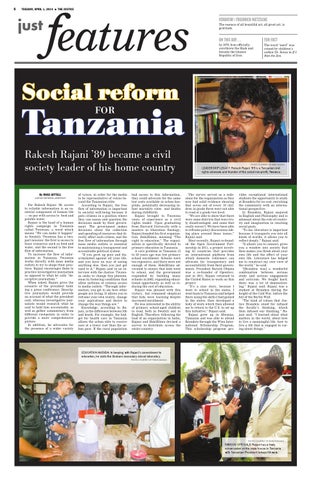
LEADERSHIP LEGACY: Rakesh Rajani ’89 is a Tanzanian civil rights advocate and founder of the social non-profit, Twaweza.
The survey served as a milestone for the organization as they now had solid evidence showing that seven out of every 10 children in grade three were not able to read at a grade two level. “We are able to show that there were some districts that were truly disadvantaged, and some that really weren’t. We have been able to reframe policy discussions taking place around these issues,” Rajani said. Most recently, Rajani co-founded the Open Government Partnership in 2011, a project involving 63 countries that provides an international platform from which domestic reformers can advocate for transparency and accountability from their governments. President Barack Obama was a co-founder of OpenGov, and in 2011, Rajani returned to the United States to work on this project. “It’s a nice story, because I went to school in the states, I went back to Tanzania and helped there using the skills I had gained in the states, then developed a body of work which then allowed me to return to the U.S. to set up this initiative,” Rajani said. Rajani grew up in Mwanza, Tanzania and was able to attend Brandeis through the Wien International Scholarship Program. This scholarship program pro-
vides exceptional international students the opportunity to study at Brandeis for no cost, enriching the community with an international perspective. At Brandeis, Rajani majored in English and Philosophy and is adamant about the role of creativity and imagination in reaching social goals. “To me, literature is important because it transports you into all kinds of worlds, it allows you to reflect deeply,” Rajani said. “It allows you to connect, gives you a window into society that then makes you think about your own life and the effect of your own life. Literature has helped me to construct my own view of the world,” he said. “[Brandeis was] a wonderful combination between serious study and serious engagement and activism. We fought hard, there was a lot of demonstrating,” Rajani said. Rajani was a student at Brandeis during the height of the Cold War, before the fall of the Berlin Wall. “The kind of values that Justice Brandeis stood for infused the faculty’s thinking, which then infused our thinking,” Rajani said. “I learned about what matters in the world, about how to live a meaningful life, how to live a life that is engaged in caring about things.”
EDUCATION AGENDA: In keeping with Rajani’s commitment to education, he visits the Simbani secondary school laboratory. PHOTO COURTESY OF FIDELIS KISUKILO
PHOTO COURTESY OF RAKESH RAJANI
FAMOUS OFFICIALS: Rajani has a lively conversation at the state house in Tanzania with Tanzanian President Jakaya Kikwete.