1.8L Engine I Exceptional Fuel Efficiency I Digital Gauge Ready


![]()


1.8L Engine I Exceptional Fuel Efficiency I Digital Gauge Ready


By: Brian ‘Bro’ Brosdahl
TThe sights and sounds of fishing on water is the perfect bookend to first ice, and spring open water is the ideal time to cure cabin fever. As winter turns to spring, anglers start thinking about chasing post-spawn walleyes. Boats come out of storage and every detail is checked off before the first launch of the openwater season.
Your checklist might include Northland tungsten jigs, plastics, shiners and wax worms. What – wax worms?! Even with the walleye opener upon us, some anglers dream of bluegills before any other species no matter the season.
There’s a reason for that. Bluegills may be small, but their fight is mighty! It’s a thrill to use an ultralight rod to catch this small, colorful fish that battles like the big fish. When hooked, bluegills spin again and again using their entire body to fight, making for an exciting day on the water.
Bluegills favour warm water where cover and food are abundant. In the spring, shallow water with a mud bottom warms quickly and draws bluegills in like a magnet.
Emergent weeds such as cabbage, coontail, and milfoil create edges that provide concealment from predators like bass, northern pike and walleye. Last year’s dead wild rice stalks are slightly woody and do not give off toxins. They create a forest of thin stems and leaves, like an abandoned hayfield, holding plenty of bite-sized insects.


Logs and beaver dams also attract bluegills. Beavers pile branches along their dams to eat the tender bark and buds, leaving behind a construction mess that’s perfect for bluegills. Gills hold in the beaver’s run – the ditch beavers dig, while packing mud into the dam.


Corners that fill with summer weeds are also good starting points. Many spring bluegill spots are areas that remain protected from heavy wave action later in the season.
Not all lakes are the same. Some lack muddy areas, bays or creek mouths but may have weed beds, shoreline depressions, or inside edges of bulrushes and king grass. On other lakes, bluegills may hold near crumbled rock shoreline points with an inside soft-bottom edge.
Bro with a PB male bluegill over 12” –“Catch, Photo & Released
These areas are best to fish when the beaver is resting or away from the dam.
The edges beneath floating bogs made up of cattails and peat moss can also hold bluegills.
Creeks, boat harbors and small bays on a chain of lakes are great spring locations.
One constant is warm water when the rest of the lake remains cool. Water temperatures of 50 – 60°F make bluegills come alive. They can still be caught in the 40s, but anglers should remain focused on areas that are warmer than the rest of the lake. During spring cold fronts or heavy winds, bluegills often drop a little deeper. I find most in 3-5 feet of water, though on flat warm days they may move into just 1-2 feet.

Depending on where you are located geographically, you might be looking to sneak the boat out, or perhaps you are still drilling holes & shoveling snow in anticipation of that first cast. No worries... we have you covered.
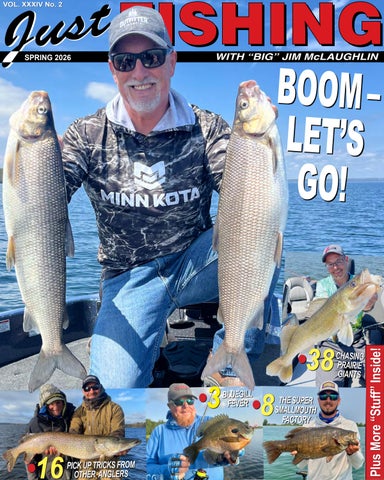
Right off the bat we have “Bro” on Bluegills and he’ll hopefully guide you right to that elusive 10” trophy. Then Liam & Gordon tackle the Super Smallmouth Factory known as the St. Lawrence River / Lake Ontario eastern basin... an absolute gem!! Then Jeff “Gussy” Gustafson our own Bassmater Classic Champion teaches us how to learn from other anglers... something we all should be doing.
Next up is something just a little different, which walks us through how a tournament angler & guide Scott Morrow turned a life on the water into a financial planning practice built for the outdoor community. Then Tim Allard shares his views on forward facing sonar in Scoping Walleyes. Trust me, it is a must read if you walleye fish. If you get bit and harvest a keeper or two, Chef Tait treats us to Walleye / Bacon burgers. Trust me... he is on the money with this dish.
For anglers who experience rotator cuff grief, our resident RMT Jen Watson shares exercises to help build strength & optimize muscle function. Our western angler, Jeff Matity walks us through Chasing Prairie Walleye in part one of a two part piece covering changes from season to season. Resident fly fisherman, Daniel Notarianni shares the highlights from a week spent on the famous Lady Evelyn River. Not your regular fishing trip! All this and more should help get your season started... and we are already working on the summer issue to keep that bite going.
Please be safe out there and wear a dam life jacket!!!
are
Publisher
“Big” Jim McLaughlin
Managing Editor
Tammy Wight
Contributors
Liam Whetter & Gord Pyzer
Tim Allard, Jeff Gustafson
David Chong
Cameron Tait, Brian Brosdhal
Jeff Matity
Daniel Notarianni
Brett McComas
Jen Watson
Box 214 Seeley’s Bay, ON K0H 2N0.
Phone: (613) 387-8735
Email: info@justfishing.ca www.justfishing.ca
All Rights Reserved Reprinting or reproduction in whole or in part is forbidden, except by written permission of the publisher.
(Bluegill Fever continued from page 3.)
On calm days you may notice tiny dimples, like micro rain drops, on the water surface as midge flies emerge. This insect is an important food source for bluegills from spring through fall, with the largest groups in June. The shallows also fill with schools of minnows of all sizes. From now through spawning and bedding time, bluegills will not pass up a minnow small enough to fit in its mouth.
In skinny water, I tilt my outboard motor up high enough to keep the prop from catching wild rice or floating vegetation. I cruise slowly with my Minn Kota down and Side Imaging set at 70100 feet looking for circular shadows on my Humminbird Xplore. When anchoured, you will still see shallows on your scrolling screen.
If bluegills are active and moving, you might also spot bass, pike, or crappies in your pursuit. MEGA Live 2 will also spot the fish between weed clumps. Before leaving home, I mark likely spots in the One-Boat Network app on my phone and Bluetooth them to my Xplore unit to save time during the search.

“Big” Jim

I power my electronics with an Amped 12-volt, 160-amp-hour battery, while my Minn Kota runs on a separate 36-volt battery. I also keep a Fish Armor Shuttle on the passenger side of the boat so guest anglers can use a Humminbird Xplore with MEGA Live 2 mounted on a Fish Armor Pro Pole.
When I find fish, I use Spot-Lock. If the water is really skinny, I drop my Talon shallow-water anchours and cast from a distance. For water less than three feet deep, I prefer clip-on bobbers because they’re easy to remove if I want to fan cast the area.
My go-to jigs are Northland Tungsten Crappie King Flies in 1/16 oz and Fire Fly Jigs down to 1/32 oz. If it’s windy, I’ll increase to a 1/8 oz jig. The key is using ultra-thin braid like Sunline SX-1 8lb, which cuts through the wind for long casts. I tie on a segment of 3-4lb Sniper fluorocarbon to avoid spooking fish in clear water.
On The Cover: Main – Scott Morrow, photo – David Chong, Pick Up Tricks From Other Anglers, photo – Gussy Outdoors, Bluegill Fever, photo – Brian Brosdhal, The Super Smallmouth Factory – Doc Talks Fishing, Chasing Prairie Giants, Photo – Jeff Matity.
My rod is a St. Croix Legend Elite Panfish, 6-7-foot length, paired with a Seviin 750 GS reel. A light rod and light line level the playing field between angler and fish. Bluegills have binocular vision and can be difficult to coax into biting. Their vision helps them survive on tiny foods such as zooplankton, bloodworms, freshwater shrimp, and a long list of aquatic insects.


(Bluegill Fever continued from page 4.)

When pitching a bobber, give it small micro-hops, just enough to tip the bobber sideways and then reel in the slack. If there’s no strike, let it sit for a moment. Tip the jig with one or two wax worms or a small chunk of crawler. When bluegills turn on, it will be a fantastic experience.
Bro Pro Tip: Spring weather can be unpredictable, so I always wear my AFTCO Reaper Hoodie and keep a Barricade rain suit packed and ready in the boat. I also use Fish Monkey Stubby Guide Gloves. The PVC grip keeps a light rod secure in your hand and protects against sunfish spines.
Bluegills are impressive little fighters, and they still grow big in the North Country. Don’t be surprised if you hook a plate-sized bluegill, pumpkinseed or hybrid sunfish. All are members of the sunfish family. Bluegills are slightly yellow with hints of purple, and males have a red breast. Pumpkinseeds are very colourful, displaying shades of orange, green and yellow. Hybrids are slightly tiger-striped and mostly reddish in color. Pumpkinseeds and hybrids rarely exceed a pound. Bluegills can reach a pound and a half, and they may even push two pounds on rare occasions.
For harvest, it’s best to keep medium-sized fish under 9 inches. This helps maintain healthy population dynamics and allows larger bluegills to continue growing. Take a photo and release the bigger ones – a forkful of meat isn’t worth stunting the bluegill population on trophy lakes.
While chasing bluegills, expect to catch other fish such as crappies, largemouth bass, pike and walleye. Anglers aren’t the only ones who enjoy a bluegill dinner. Bluegills are on the menu for every larger predator in the lake. Landing these predator fish on light finesse gear is a real feat and adds excitement to your bluegill outing. Don’t forget to bring a few Fire Ball jigs and shiners so you can switch gears for some walleye fishing if you find a break from the bluegill action.
We’ll see you on the water this spring! Have fun chasing and catching bluegills!
Follow my adventures on the Bro Road Show podcast and at store visits, seminars and shows. You can also find me on YouTube, Instagram and Facebook!


Brian “Bro” Brosdahl, is a fishing guide and promoter. One of the most recognized and respected anglers in North America – Bro, as he’s known, is a multispecies angler best known for his influence on the sport of ice fishing. He can be booked for guided trips at: bbro@paulbunyan.net or brosguideservice.com.


f you are a bass angler with a soft spot for smallmouth, Eastern Lake Ontario and the St. Lawrence River are likely at the top of your bucket list. Most experts consider this region to be the best bass fishery in the world. But as we marvel at the five-, six- and seven-pound smallmouth being hoisted onto the scales at tournaments, a critical question remains: how well do we really understand these giant fish?


One might think that in a world-class fishery, collecting data on big bass would be easy, but it is a logistical nightmare. “We’re talking about Lake Ontario and the St. Lawrence River,” says Elliott. “These are two really immense systems, composed of a lot of different habitat types”.
Traditional sampling methods, such as gill netting and trap netting, often struggle to capture the true giants of a population. “These are really physically large fish,” says Elliott. “And that physical size also means they’re older. And so that means they’re much less common in the system than the smaller, younger other fish in the population”.
“We can age a fish the same way you might age a tree by counting the rings of a cross section,” Elliott explains. Unlike scales that can be damaged or become too dense to read on older fish, otoliths are protected within the brain cavity and provide a permanent record of the fish’s life. These “growth rings” (called annuli) form because calcium carbonate is added more densely during the slow-growth winter months, creating a dark band for every year of the fish’s life.
The data from these otoliths, however, delivered a shock to the team. The average smallmouth examined in the study was eight and a half years old. Even more staggering? The oldest fish they aged was a 21-year-old veteran of the river.
We recently sat down with Dr. Connor Elliott from the Freshwater Fisheries Conservation Lab at Queen’s University. Under the leadership of Bruce Tufts, Elliott has just completed a decade-long study that reveals the hidden biological machinery fuelling this incredible fishery. From the impact of invasive species to the surprising age of these bucket list bass, you can listen to our discussion with Dr. Elliott at the end of this article in episode #53 of the Doc Talks Fishing podcast.
This is where the angling community becomes an invaluable partner to science. Because tournament anglers cover huge geographic areas and specifically target the biggest fish, they provide researchers with a unique “window” into a demographic that is nearly impossible to study in large numbers.
When a tournament occurs, a small percentage – roughly 2-percent – of the fish weighed in may die. Rather than let these bass go to waste, Elliott’s team treated them with the precision of a forensic investigation. They measured lengths, weights, examined stomach contents and checked the gonads to determine sex. But the most critical piece of evidence was found inside the bass’s head – the otoliths, or ear bones.


to the braid to provide an invisible connection to the superline, cushion hooksets and help prevent bite-offs from larger fish.
or tube baits out there and... the sky is the limit! Further, multiply the multitude of soft baits by growing light-tackle head options (i.e., football, darter, shad, weedless, round head, etc.) limitation!
advised Gord. Ned’s 14-minute mini-seminar on the Six MWF Retrieves is very informative and a video I review is called “The Ned Rig
This setup allows you to toss these lures remarkable distances, feel bites and set
changed, and the muskies were not using
This setup allows you to toss these lures remarkable distances, feel bites and set
baits slow enough is the hardest thing for people to master be that with a straight worm or a marabou jig.
Also, if you are fishing in the evening, and the spot is frequently fished by others, more than likely the area you found that extends the spot will not get fished. So, even if you see another angler fish ing the sweet spot, you know you can return later because you have muskies adjacent to the sweet spot waiting for you to catch them.
After listening to Versteeg’s mind-blowing research – it’s clear that lake trout deserve far more respect than the old stereotype of “simple deepwater cruisers.” Truth be told, they’re thinkers, learners, strategists, navigators and individuals.
“The more we learn about trout cognition, the more we realize just how complex these fish really are,” says Versteeg. “They’re not out there drifting around. They’re making decisions. And that changes everything.”
It is a far more nuanced and perceptive vision than most of us have ever imagined.
Search by region, fish species, accommodation type, amenities and
While on the subject of extending the spot, an often more effective approach is looking for adjacent spots that might hold muskies. Last summer one early evening we found muskies relating to points that were relatively sharp breaking and not a “traditional” summer spot. After catching one musky for such a spot, we visually looked around and drove to four adjacent points that looked similar both visually and on the map chip.
“There’s a hidden world of fish cognition that we’re only just beginning to uncover,” says Versteeg. “Lake trout are giving us a window into that world – and it’s pretty incredible.”
Amazingly, all of the other four points held muskies that evening, and it was a great end to the day. The next day the pattern
So, on your next trip out onto the ice, when you watch a mark rise on the sonar screen,


START YOUR SEARCH NOW!

pause, reposition, and then follow your lure with eerie deliberation, you’ll know exactly what’s happening. You’re encountering one of the most intelligent fish in freshwater. And that makes every lake trout moment all the more extraordinary.
1. Fish the “Decision Zones,” Not Just the Depth
Jim Saric with a beauty caught right at dark.

Versteeg’s work shows us that lake trout constantly evaluate trade-offs – for example, energy cost versus reward. So, instead of camping out over one depth, target the edges where cold meets warm, where bait transitions from sparse to concentrated or where structure subtly softens. These are the zones where trout make decisions… and make mistakes.
Lake trout don’t drift aimlessly – they plan routes based on memory and conditions. Map out the most logical travel corridors, not just classic hotspots. Long, gentle breaks, subtle mid-lake humps, and deep-basin “lanes” often reveal their habitual travel paths.
3. Make First Contact Count
4. Trigger Their Curiosity
The presentation causes the straight, Slider worm to coast or slide through the water giving off the ultimate impression
from the point. Also, if there is an adjacent point nearby that could hold muskies as well.
If necessary, reposition the boat to contact additional biters. You can very effectively cast and retrieve an X-Rap in high winds that would otherwise drift a bobber rig too quickly past the fish to get a response.

bobber and live minnow, dangling the bait in their faces for an extended period. It’s not easy – but better than going home
Because trout learn from negative encounters, your first drop is often your best shot. Start with your highest-confidence presentation and your cleanest approach – especially in winter. Don’t educate the trout before you fish for them.
metallic squares reflect light, mimicking the sparkle off of a baitfish’s scales and giving the bait a natural appearance. It may seem like a small detail, but you’d be surprised how even a small amount of glitter can make a big difference in the number of bites you get.
additional biters. You can very effectively cast and retrieve an X-Rap in high winds that would otherwise drift a bobber rig too quickly past the fish to get a response.
A Fishing Industry Professional for nearly 30 years as a Fishing Guide & Promotional Staffer, with Bachelor’s Degrees in both Science & Education, Jeff uses this training in his job as a Fisheries Professional & Outdoor Educator (specializing in fishing via family business, GetFishing.ca) to reach out to anyone interested in learning about fish.
Lakers investigate disturbances. A sudden change – a lift, a stall, a fluttering drop, a direction change – often flips their interest into commitment. Think in terms of patterns that ask questions the trout feel compelled to answer.
5.
In the past, anglers used to say that the crappies were either “in” or “out” in spring, meaning they were up shallow, relating to flooded wood or weed cover... or they hadn’t come in yet, and were still out deep, not worth trying to catch until they eventually came shallow. Nowadays, we know better. Crappies can be in, out, and moving somewhere in between, displaying
I love fishing locations where you can get walleye and trophy out of the same holes. Often, I’ll jig for walleye with a Buck-Shot Spoon and for my second line, I’ll soak a big cisco under a tip-up for pike. On some waterbodies we even run into lake trout in these
Colour makes a big difference and walleyes tend to have different preferences from lake to lake so I will use bright colour patterns on lakes that are dark stained and natural colours in clear lakes. Rippin’ jigs and plastics tend to work better with 70 degree warmer water when jigging the rippin’ jig through vegetation, so be prepared for They have to hit hard to catch it!
The forementioned spud bar/ice chisel is a critical piece of safety equipment which serves two purposes. Obviously, it is used to check for thin weak ice but can also be employed to clear out old holes. The HT Premium Ice Chisel is great choice because it carries that is needed for a spud bar to work properly and it also breaks down into two pieces making it easier to transport. It also has a rubberized foam handle that has a heavy-
So often, maximizing your day and catching another musky can happen by simply fishing an adjacent spot. When you catch a musky and/or have a few follows and it seems like the activity level has increased rather than run far away, check an adjacent spot. You’ll spend less time running and more time fishing and most likely catching!
This spoon is well known as an ice-fishing bait, but it is equally phenomenal when vertically jigged from a boat for walleye relating to deep structure.

have a set that have the pointed ends of the picks protected by a retractable sleeve which helps you from stabbing yourself. Ice picks should always be worn around your neck or kept in an easily accessible pocket on your flotation suit. They’ll be no good to you if you go through the ice and your picks are somewhere in the
Anglers should also try cranking in plastics: Just pitch out let it
than normal

The last couple of years I’ve been heading north to the Red Lake area for a late season ice trip and the fishing has been excellent with plenty of walleyes and big pike. I’m looking forward to making it

to
Northland Fishing Tackle’s Mimic Minnow is arguable the best paddle tail I have used on the market. The tail has a light, fast wag that looks like a fleeing baitfish – it was definitely one of my go-to baits last summer. I have tried larger paddletails with less success – walleyes don’t want to be kicked in the face when they are eating. In terms of jig head size for Minnesota
Admittedly, during cold front conditions, crappies may not be on the chew. Fish are likely to drop back out of the shallows, toward deeper water. They might hold in deeper weeds or along the remnants of last year’s deep weed line. They may simply drop down into depressions or holes on the flats near the mouth of a bay.
The last category of lures to showcase are those with green and chartreuse glow paint finishes. Whether open-water fishing or ice-fishing, there have been countless times when a glow bait has caught more walleye than a non-glow version. This is often most pronounced during twilight and at night, but also applies when fishing deep, in overcast conditions, or in turbid water conditions.
There are lots of great presentations that will work on these massive perch at this time and of course live bait such as emerald shiners always work. A standard dropshot rig works great with any type of live bait that you may wish to try! Just make sure that you obtain your minnows in the proper Fishery Management Zone and keep your receipt in case you’re stopped by the MNR/ OPP or York Regional Police. All 3 agencies will enforce any regulation violations!
Admittedly, during cold front conditions, crappies may not be on the chew. Fish are likely to drop back out of the shallows, toward deeper water. They might hold in deeper weeds or along the remnants of last year’s deep weed line. They may simply drop down into depressions or holes on the flats near the mouth of a bay.
There are lots of great presentations that will work on these massive perch at this time and of course live bait such as emerald shiners always work. A standard dropshot rig works great with any type of live bait that you may wish to try! Just make sure that you obtain your minnows in the proper Fishery Management Zone and keep your receipt in case you’re stopped by the MNR/ OPP or York Regional Police. All 3 agencies will enforce any regulation violations!

Bold vs. shy trout require opposite pacing, and recognizing that difference converts lookers into hookers.
Bold fish hit fast. Cautious fish study. When you see a trout “rise and hold” on sonar, don’t give up – change the cadence, not your lure. Slow the dance. Let them build confidence.
massive size of the fish. In most of North America, largemouth bass grow longer and heavier than smallmouth, but in Eastern Lake Ontario and the St. Lawrence River, smallmouth are the undisputed kings.
Glow chartreuse jig heads are also worth having in your tackle box. Using one gives a presentation an extra bit of oomph. This can help attract walleye when using live-bait, such as tipping a jig with a leech or nightcrawler. The same rationale applies when pairing a green glow jig head with a soft-plastic.
Editor’s Note: Gord Pyzer & Liam Whetter
Of all the glow lures in my collection, a Northland Buck-Shot Rattle Spoon in superglo firetiger has been the most productive over the years, which partly relates to how long its been on the market and, thus, in my tackle collection.
In any case, when they drop down toward bottom and display a basically negative feeding attitude, they are unlikely to pursue baits moving laterally about their heads. You can possibly still catch them by hunkering down with an anchor and fishing with a slip
most target depths. You can tip it with a chunk of crawler or small minnow, but I don’t usually have to in northern Minnesota.
Lake trout and whitefish, fish that suspend during the winter, usually get a lot more active as the snow melts and more lights starts to penetrate the ice late in the season. These fish are sight feeders and if
If you do happen to break through the ice, the most important thing is not to panic. Get back to the strongest ice that you’re aware of which is usually the ice that you’ve just walked over. Use your ice picks to help pull yourself up onto the thicker ice while kicking with your feet to help force yourself out of the hole that you’ve fallen through. Once you’re on top of the ice stay spread out on your belly and crawl until you reach what you feel is ice thick enough to support your weight. Then it is critical to get somewhere warm before hypothermia kicks in.
The equipment available to ice anglers today is as good as ever. Over the past twenty years the improvements in mapping, sonar, tackle and even snowmobiles to get around, have made it easier to find and catch more fish under the ice. Have a great season out there!

Obviously, the ice conditions can change quickly late in the season when they weather really starts to warm up, so pay attention to the

Logically, I know going green matches the pigmentation of many type of walleye forage – but, maybe my fondness for emerald is partly my Irish heritage shining through.
“It’s pretty safe to say that it’s the invasion of the round goby that we have to thank for that,” says Elliott, who notes that research from the Queen’s lab has shown that the
Because of the size of the yellow perch that we’re targeting, I recommend at least 7’ ML power rods like the Daiwa Aird-X models, which are great value. Pairing one of these rods with a 1000/1500 sized spinning reel spooled up with 6-8 lb. test braid and a 4-6 lb. test fluorocarbon leader and you’ve got a perfect “Jumbo Perch” outfit. The longer rod allows for greater casting distances and you’re also able to take up a lot more line when setting hook!
Gord Pyzer is the 2009 Inductee – Canadian Angler Hall of Fame, Fishing Editor – Outdoor Canada Magazine, Field Editor – In-Fisherman Magazine & Television, Co-Host –In-Fisherman Ice Fishing Guide Television, Co-Host –
Whether you are fishing in summer or fall, more than likely you are going to encounter at least one of your days on your trip, where the wind will be strong. These are the days with 15-25 MPH winds. Often the gusts are higher. These are the days where your “A” spots are often not fishable. Actually, any open-water wind-exposed spot may not be fishable. So, you’ll need to rely on your “B”, “C” and even your “D” spots to catch muskies. In summer, the big winds are usually southerly and in the fall the winds are usually northerly.

The Real Fishing Radio Show, Host – Fish Talk with “The Doc”, Outdoor Journal Radio & President –Canadian Angling Adventures Ltd.
About the Author:
About the Author:
Because of the size of the yellow perch that we’re targeting, I recommend at least 7’ ML power rods like the Daiwa Aird-X models, which are great value. Pairing one of these rods with a 1000/1500 sized spinning reel spooled up with 6-8 lb. test braid and a 4-6 lb. test fluorocarbon leader and you’ve got a perfect “Jumbo Perch” outfit. The longer rod allows for greater casting distances and you’re also able to take up a lot more line when setting hook!
In terms of invasive species, you should be on the alert that some lakes are changing and becoming clear due to the introduction to zebra mussels. These are filter feeders that make the lake clear and fish spookier, while other lakes are getting a lot more weed
determine where and how deep they’re biting, and what approach they are responding to best. Always a good game plan for all species, in any conditions.
that while the fishery is “fast-growing” thanks to gobies, it still takes two decades to produce a true “ancient” giant.

fishing is as good as I’ve ever seen on a number of waters. There is simply a ton of water to fish and a bunch of big pike. I think it’s just far enough north that the fish just don’t get a lot of pressure and it’s the right type of water
Liam Whetter is a passionate multi-species angler from Northwestern Ontario, always chasing the next bite no
Enterprises are essential safety gear anytime you head out on the ice.
these will help you pull yourself out if you happen to go through the ice. Many ice fishing tackle companies have ice picks available in their lineup and they’re all pretty good. HT does
And don’t forget to follow my fishing adventures on social media!
While planning for your trip and looking at the map, besides looking
No matter the reason, green baits consistently put fish in my boat. Perhaps it’s best to leave it at that and not overthink it.
determine where and how deep they’re biting, and what approach they are responding to best. Always a good game plan for all species, in any conditions.
Editor’s Note: Jeff Gustafson grew
About the Author: Tim Allard is a full-time, awardwinning outdoor journalist and author/photographer of the book, Ice Fishing: The Ultimate Guide. He’s a regular contributor to numerous North American print and online publications. From panfish to northern pike, Tim fishes whatever he can, whenever he can.
My go-to is some type of jig, I like to combined an 1/8 oz. Ultra Tungsten ball jig with either a 2 1/2” Z-Man GrubZ, a Grumpy
(Jumbo Perch continued from page 22.) (Continued
Bait Company Mini Goby or a Great Lakes Finesse Drop Minnow. I generally stay with natural colours, although there will be those days when the bright chartreuse, pinks & oranges will slay’ em! Sometimes running a “Donkey Rig” similar to one that we run for ice fishing will get you numerous double headers. On the top hooks, a Mini MinnFIN or Micro Grubby from Grumpy Bait Company work great as well as creature baits like True North Baits, Mini M’eh Fly!
Good Luck Ripping and Rigging walleye from the weeds!
“If you had food everywhere you looked, the minute you’re hungry, you can pick up something and eat it. You grow pretty fast, pretty quick,” he says. “They really just have an unlimited access to food and we’re really seeing that in their growth rates now”.

A throw rope (50-100 feet) is extremely useful in the case where someone else falls through. The Rescue Throw Bag from HT Enterprises works great as you hold on to the end of the rope and throw the bag to the person in

Bait Company Mini Goby or a Great Lakes Finesse Drop Minnow. I generally stay with natural colours, although there will be those days when the bright chartreuse, pinks & oranges will slay’ em! Sometimes running a “Donkey Rig” similar to one that we run for ice fishing will get you numerous double headers. On the top hooks, a Mini MinnFIN or Micro Grubby from Grumpy Bait Company work great as well as creature baits like True North Baits, Mini M’eh Fly!
My go-to is some type of jig, I like to combined an 1/8 oz. Ultra Tungsten ball jig with either a 2 1/2” Z-Man GrubZ, a Grumpy
(Continued on page 7.)
Al Lindner ranks among the most renowned leaders in the fishing industry. Averaging about 180 days a year on the water, Al is hailed as one of the world’s best all-around anglers. Al’s long and honoured career as an author, syndicated radio & TV fishing show host, video producer, fishing guide, tackle manufacturer, lecturer and champion tournament angler has spanned 35 years of the most revolutionary years in sportfishing.
If you happen to locate fish over 10’ –15’, virtually any ice fishing presentation

In contrast, largemouth bass remain “generalists,” eating a much more diverse diet and not capitalizing on the goby lation to the same degree. This has
(Continued on page 12.)
Al Lindner ranks among the most renowned leaders in the fishing industry. Averaging about 180 days a year on the water, Al is hailed as one of the world’s best all-around anglers. Al’s long and honoured career as an author, syndicated radio & TV fishing show host, video producer, fishing guide, tackle manufacturer, lecturer and champion tournament angler has spanned 35 years of the most revolutionary years in sportfishing.

If you happen to locate fish over 10’ –15’, virtually any ice fishing presentation
(Continued on page 25.)


We often think of the “good old days” of fishing as being decades ago, but the science says otherwise. In the 1970s, some Great Lakes systems saw annual mortality rates for smallmouth as high as 60% to 70% due to high harvest levels. Today, thanks to better regulations and a widespread “Catch and Release” ethic among bass anglers, that number has been cut in half to a stable 30-percent. We aren't just seeing bigger fish because of their food; we’re seeing them because we’re finally letting them live long enough to reach their full potential.
led to a fascinating biological flip: smallmouth in the system actually “recruit” to tournament-winning weights (age 7) two years faster than largemouth (age 9).
One of the most intriguing sub-plots of Dr. Elliott’s research is the difference between the smallmouth in the St. Lawrence River and those in the open waters of Eastern Lake Ontario.
“The river is a much more confined space,” Elliott explains. “The fish there are often hunkered down in current breaks or specific rock piles.” And while both populations are thriving on a goby diet, the Lake Ontario fish often have slightly different growth trajectories due to the massive, offshore nature of their habitat.
“In the lake, these fish are true wanderers,” he says. “They have vast areas of deepwater structure to explore.” For the angler, this means that while the “Goby Factory” is running in both places, you need to shift your approach from the precision current-seams of the St. Lawrence to the broad, wind-swept shoals of the big lake.
With so many anglers flocking to the region these days, you may wonder, like we did, if the population can handle the pressure. Elliott’s study found, for example, that smallmouth have an “exploitation rate” five times higher than largemouth. In simple terms, this
(Continued on page 14.)


Science doesn’t happen in a vacuum—it needs data, and some of the best comes from you. As Dr. Elliott points out, his decadelong study was made possible by the cooperation of tournament organizers and anglers alike. “We really couldn’t do this work without the help of the angling community,” he says. By allowing researchers to access fish at weigh-ins, anglers are providing samples that would cost taxpayers and universities millions of dollars to collect independently. So, good on us!


one of my favourite the water each year. not cold, boating traffic competition are at a minimum, species bite, feeding to reserves prior to a long, That’s a combo you anywhere!
allow you to fish the boat in deep fish-triggering lure action move quickly to locate
what I think fish mistake the Ned Rig for my response is, ‘I don’t care what they mistake it for, as long as they’re biting it’.”
time, but I beg to differ. It actually bunches up and concentrates the trout, creating a highly competitive atmosphere that you can exploit for all that it is worth. Especially, if there is a slight breeze blowing parallel to a shoreline that features a shallow – knee to waist deep – boulder-strewn flat or sparse weed or reed bed. The bigger and more isolated the structure is the better, but it must jut out and dip quickly into the main lake basin. When I am fly fishing a spot like this my favourite tactic is to drift a balanced leech under an indicator, but the purist in me hates to admit that a marabou jig is
in deep water, although their increased bulk and water resistance usually do not allow you cover water as quickly as when using Jigging Raps. Experiment to see what works best.
Jason Matity & Jeff Matity are helplessly, hopelessly addicted to the sport of fishing. The only thing they like better than catching big fish is helping others catch big fish. Whether it’s trolling for northern pike and walleyes, to jigging for trout, burbot and perch, pitching jigs to bass, or dunking crawlers for carp and catfish, they are Saskatchewan’s multispecies fishing authority whether or open water. Matitysgetfishing.com
YOU are invited to come along for the ride…
Gord added, “If we’re fishing the clear waters of Whitefish Bay on Lake of the Woods, I like natural and neutral colours versus some of the brighter twotone colours in Kenora’s algae stained waters.”
the Author:
I like to anchor the Frog Boat – a canoe or kayak works just as well – from the stern, so that I am casting down wind and aligned with the sloping break. I also never use an indicator or float. Instead, I cast the jig parallel to the edge of the drop, working each successive cast out further, away from the lip, and deeper. By counting down your jig after each cast, you can accomplish two things. The first is saturating the water column from top to bottom. The second is when you catch a trout, you can replicate the count – and hence the depth – on each followup presentation

among the most renowned fishing industry. Averaging on the water, Al is hailed best all-around anglers.
“IF IT SWIMS... WE FISH FOR IT...AND WILL HELP YOU CATCH IT! GetFishing ‘Cuz Fishing’s Magic!”
“The most interesting retrieve that I’ve been writing about, where crappies and smallmouth are involved is the “Bivins’ Bounce”. Terry Bivins is a retired NASCAR driver from the states and he is an
Jeff & Jason Matity
honoured career as an author, syndicated radio & TV fishing show host, fishing guide, tackle manufacturer, lecturer and champion tournament 35 years of the most revolutionary years in sportfishing.


Visit our YouTube Channel & SUBSCRIBE for FREE!!

Editor’s Note


One last marabou trout detail: don’t be in a rush. The lure is so subtle that if you retrieve it too quickly it will rise up towards the surface on a path that resembles the right angle of a 45-degree triangle. What you’re trying to accomplish instead, is straining a specific horizontal zone within the water column, each time you


David Chong is widely recognized as one of Canada’s top competitive tournament anglers. He is also an avid multi species angler and is a strong advocate for affordable, accessible angling for all!
David loves sharing his vast fishing knowledge and stories with anglers of all ages, beginners and pros alike!
I mentioned my friend, Ned Kehde earlier, because the Ned Rig for which he has become justifiably famous has stunned the bass
Well, guess what?

A 1/16-ounce mushroom head is my go to jig. They are in a class of their own, especially when you team them up with a 4-inch (I always nip off an What makes the incredibly soft squishy baits so effective is that they are buoyant –they float – so when you let your jig fall to the bottom, the tail stands up, sways and waves effortlessly.


St. Lawrence still holds a massive, relatively “untouched” population of largemouth just waiting for an angler to give them some attention.
Better yet, when you retrieve them back to the boat, the tail doesn’t droop, but rather glides in a life-like horizontal manner. Being as effective as they are, I could care less about the fact that they’re also durable, but you can catch 100 sharp toothed trout on a single bait and you’ll swear you have never used it. Trout relish these things.

You can listen to the entire fascinating interview with Dr. Connor Elliot right HERE.
I fish the durable stretchy baits on the same early morning and late afternoon shoreline feeding flats that I swim my marabou jigs. And I love working them down the sloping breaklines at mid-day. But I retrieve my Ned rigs very differently than the miracle marabou ones.
Gord Pyzer is the 2009 Inductee – Canadian Angler Hall of Fame, Fishing Editor – Outdoor Canada Magazine, Field Editor –In-Fisherman Magazine & Television, Co-Host – In-Fisherman Ice Fishing Guide Television, Co-Host – The Real Fishing Radio Show, Host – Fish Talk with “The Doc”, Outdoor Journal Radio & President –Canadian Angling Adventures Ltd.

The first contrast is that I catch far more trout on hair jigs by imparting no additional or extraneous motions whatsoever. None. I cast it out, count it down and swim it back to the boat slowly. The less you do, the more you catch. Not so with a Ned rig. After pitching it out, I almost always let it fall to the bottom. Then I lift up my rod tip slowly feeling for a trout that might have hit it on the drop or sucked it up from the mud. If I don’t feel any weight, I start a slow swim, pause, glide, shake retrieve. A couple of turns of the reel handle as I slowly lift up the rod tip, pause, and let the jig pendulum towards me, while I shake it ever so subtly.

Liam Whetter is a passionate multi-species angler from Northwestern Ontario, always chasing the next bite no matter the season. He’s all about the pursuit, from frozen lakes in the dead of winter to remote backcountry waters. With a fascination for aquatic biology, he’s nearly as obsessed with understanding fish as he is with catching them. Liam’s experiences on the water fuel his storytelling, capturing the adventure, the work, and everything in between.”
When the trout are being stubborn, on the other hand, I like to cast it out, let it fall to the bottom, and then drag it slowly a foot or two before I deadstick it in the mud for five, six, even seven or eight s econds. When you go to drag it the second, third or fourth time, you typically tighten up on a trout. Uncanny, too, how many trout eat it on the initial drop.

ALL PRODUCTS ARE MADE WITH EXTREME CARE AND PRECISION. DOMINATE BAITS HAS TAKEN YEARS TO DEVELOP THE BEST FORMULAS POSSIBLE. ALSO, WE USE THE FINEST SCENTS AND SALT THAT WE CAN OBTAIN, TO INCREASE YOUR CATCHABILITY!!!


ver the past 25 plus years that I have been a guide, tournament angler and lived a life in the fishing community, I couldn’t tell you how many people that I’ve shared a boat or spent time on the ice with, it’s been a bunch! Thinking back, there are so many times that I’ve picked up little tricks that have helped me catch more fish or made my day easier in some way. Many of the most memorable tricks that I’ve picked up have come from pro anglers who make their living with a rod and reel, while some have come from weekend anglers who have shown me little things that just work. If you want to up your game and be a better overall angler, fish with different people whenever you get the shot.
2026 is going to be my 15th season traveling to the U.S. to fish professional bass tournaments. When I started, I never could have dreamed of getting to pursue my career as long as I have. Over that time, I have got to share the boat with a number of pro anglers and the one thing that has stood out to me the most is that it’s not secret lures or spots that these guys rely on for their success. It’s doing the little things right.
Seth Feider, Jason Christie, Carl Jocumsen, Jamie Bruce, Cooper Gallanet, Chris and Cory Johnston and many others do the little things right. What I mean by that are simple things like being quiet in the boat (not jumping around or slamming compartment doors shut), making good casts (practice makes perfect), trusting their electronics and just kind of keeping it simple with the baits they tie on. These guys are all really efficient at breaking down water and finding fish fast. They know that when they are fishing new water, if they hit enough high-percentage locations they’ll make contact with fish and then they put a pattern together as they start to get some bites.
Usually, they only have two or three rods on the deck as they go through this process. Other things you’ll almost always see the best anglers do…they fish their baits with the current, they fish into the wind so they have more control over the boat and their bait and they always let their jig fall to the bottom on slack line.
The electronics on our boats today are important tools to help us catch more fish and navigate. I like to check out the boats of other tournament anglers to see if I’m missing anything on my rig.
One thing I noticed a lot of the younger anglers have been doing is running their forward-facing sonar transducers pointing up an extra click or two. This gives them a little better range and also allows


Crankbaits can be very effective for all species of fish on certain days.


Therefore, the biggest females get huge. They can and will be eating full grown ciscoes and suckers approaching 20” in length. These female walleye are the titanic beasts surpassing 30” – 10-lbs. – that anglers flock to LML to cross paths with. Any missing link in the food chain, or hardship during yearly growth spurts, seriously impedes maximum growth potential. Therefore, genetics aside, trophy walleye are not born, they are created... By their environment!
From burning on the surface to deadsticking on the bottom, the Big Hammer is versatile and productive.
Rob has been fishing the lake for 60-plus years and has been outfitting for over 3 decades. He knows his lake, his fishery and the daily, monthly and yearly patterns of his walleye. His aura is infectious and time spent around him is good medicine! No lie – Rob has never “zeroed” with a guided group of guests in over 30 years! That’s right! No no “banana curse”, no “wieners for supper”! He must be a magician... Right? No... He’s The Magnificent German Leprechaun, remember!! Not convinced? Well, if it takes a “school of hard knocks” story to convince you, please oblige me, here...
The Storm 360GT is anchored by the exquisite 3/8 oz. 3D acrylic head with ultrarealistic eyes and 60-degree, 7/0 hook that reaches out toward the nose for a superior, well-balance, straight-retrieve presentation. The dense, rubber-like body withstands a barrage of toothy attacks. Swim through

That means trolling. Be it power trolling to cover water quickly or finesseful trolling, methodically scratching fish-after-fish from a small area, Rob finds the fish and then makes them bite.
Mythical Methods: Here are two examples of Rob’s simple genius, straight forward, finely tuned trolling tactics that are easily repeatable for maximum success. Like Rob, my rods are longhandled, graphite/composite rods with Cabela’s 20-Series DepthMaster reels and 20 pound test Sufix 832 line. These are quality, affordable, invaluable tools.
for touching up ElaZtech.
Plane Over Unfished Waters: multiply the efficiency of a trolling spread by taking lures off to the sides of the boat. Fish are spooked into their path. Consequently, trollers can effectively fish three different depths simultaneously by setting out a shallow, medium depth and deep diving Rapala lure on the shallow-set planer board, hand-held rod behind the boat and deep-set planer board out deeper from the boat, respectively.


shallows and let the tail call in fish from nearby. When they approach, the ribbed body holds a lot of scent that seals the deal. Amazing search


The Lesson: Back in 2008, I hosted my first G&S guided group. Having guided in some of the best lakes in Northern Saskatchewan, I was eager to tame some prairie giants for my guests. However, it took me a week scratching, gouging and even some gnashing-of-teeth to keep up to Rob and his group’s fish numbers and size. I was obsessed. I ran each day over-and-over in my mind, to pinpoint the source of Rob’s success. Then, it hit me... Rob operates on one primary principal to allseason success. What is the secret? It is “magnificently” simple. Rob “power fishes” to locate and catch fish during the whole open water season. You guessed it...


The ZMan HerkuleZ owes its snag-resistance to its buoyant ElaZtech plastic. The fact that it sits hook-up, nose down when resting on bottom, makes it an extremely valuable tool when it is necessary


(Picking
you see your bait better up higher in the water column. If you enjoy fishing a jerkbait, you’re going to want to try this. At a tournament last fall, my partner and I caught a few of our bigger bass with topwater baits and we could watch them throughout the entire cast, able to see when fish were stalking them, which told us when to speed up or slow down our baits.


My pal Jamie Bruce told me about how he was able to get some high-speed readings with a Side-Imaging transducer by mounting it level with the bottom of his hull, on the stern, where you would normally mount a high-speed 2D transducer. You’re not going to get a reading at full speed, but it works great at 20-25 mph, speeding up the process of finding rocks and hard bottom places, especially helpful if you fish any of the many lakes that aren’t charted in Central Canada. The reefs and rocks that you find are magnets for all types of fish.
Utilize all the features of your electronic units, especially mapping.
When I used to put a map in my Humminbird machine, I never used to try any of the different colour palettes or use the highlighting features that are available on their newer VX cards. I’ve seen how other anglers were using different colour palettes and highlighting specific depth zones to make navigation easier and allow them to find sneaky spots that really stand out on the map when they are highlighted. Play with the features on these map cards and they’ll make your time in the boat easier.

Sometimes changes of colour can make all the difference.
Over the years I’ve been in the boat with people many times that tell me I have to use a certain coloured jig or bait if I want to get a bite. Most days, the colour of your bait is not nearly as important as some of us think it is. That being said, we’ve all had those days when one person was using a different coloured jig and got three times as many bites as everyone else
(Continued


(Picking
With social media so prevalent these days, it is easy to get caught up in the hysteria associated with a hot lake or new bait.
(Carolina Rigging for Smallmouth continued from page 42.)
predatory responses in the form of reaction strikes. It’s heavy zinc frame fishes great both vertically or when casted, making it a truly versatile offering for a number of species. visit: https://www.northlandtackle.com.
while walleyes tend to use the mid-portions of bays where weeds are emerging in 5 to 10 feet of water.
Once baitfish finish spawning and begin to leave these areas, walleyes begin shifting locale toward the first shoreline points extending into the basin, and the first sets of shallow offshore reefs, humps and islands in modestly deeper water – places that “look” more like walleye water.
Goby 3” soft plastic bait offers a realistic baitfish appearance and action to entice even the most finicky fish. The 3” Goby is great for both summer & winter fishing and for all game fish. Its soft body and active tail bring the
I like to take all of the range settings out of auto and set them in manual mode. This keeps the range the same all the time so it’s never jumping around. My forward range is usually set to 90 feet, which is about the length of a full cast. I move the down range around to fill up the screen with the

Structures in deep water, such as humps, are reliable rigging areas. Berrey likes deep, offshore rock and shell beds in 15 to 40 feet, holding crayfish and gobies. The deepest rock or shell beds are often the most productive. Drifting a Carolina rig is also deadly for river smallmouth, something I witnessed fishing with Chong on Lake St. Francis. Current breaks proved productive on our trip and later on my own outings. Current breaks are formed by obstructions. These can be dramatic bottom fluctuations, or “walls” as Chong described one structure we fished. Other structures include wing dams, bars,


I like to take all of the range settings out of auto and set them in manual mode. This keeps the range the same all the time so it’s never jumping around. My forward range is usually set to 90 feet, which is about the length of a full cast. I move the down range around to fill up the screen with the water column, meaning, if I’m fishing in 20 feet of water, I’ll probably set my down range between 22 and 25 feet.


for success thoughout the season.
and techniques. His latest addition to the lineup, the 1.75” Bondy Bug Panfish Bait is sure to have fish salivating. The Bondy Bud is available in 30 mouthwatering colours and comes in a 20 pack. more information, visit: https://bondybaitcompany.com.
bladed Cowgirls for muskies you know the heart stopping feeling of riding the roller coaster to fishing success.

In forward mode, you have some different options for setting up the transducer. I like to run my transducer in 40 degrees (pointing down more) when I’m fishing deeper water or more vertical, under the boat. When I’m fishing in shallower water or doing a lot of casting and fishing higher in the water column, I like to run it at the 60-degree setting. From the pointing down position, 40 degree is four
Hair jigs like VMC’s Moontail are another versatile lure design that works for shallow snap-jigging as well as vertical jigging in deep water. A slow, helpless fall once the jig is paused triggers strikes.
I count myself among the blessed to have been at the forefront of each of these trends. Unfortunately, nothing good ever lasts. Despite unbelievable efforts by a select few anglers to keep each one of the techniques under wraps, the secret got out and loose lips sunk


If you were amongst the very first anglers to fish Slow Death for walleye, Ned Rigs for bass, Bondy Baits for lake trout and big double bladed Cowgirls for muskies you know the heart stopping feeling of
concentrate on the moment. She matches the fishing experience with their personality and budget.
on a jighead. Once I learned how to snap them into place, their work out for people in my boat many times over the years.


Mindful Fishing is a volunteer initiative and it has been only recently that Christine has been able to access some funding to help with the expenses. “The Ministry of Northern Development, Mines, Natural Resources and Forestry (NDMNRF) allows those with disabilities to fish without a license but what are we doing for those with invisible disabilities like mental health challenges or those on WSIB?” asks Lapeer. Focusing on the clinical component of this type of therapy, she is trying to convince the Operational Stress Injury Clinic in Kingston to identify fishing as a recognized form of therapy as forest therapy is. “As a licensed psychotherapist, I am able to access some financial support through the Blue Cross Wellness Fund run through Veteran’s Affairs which helps me take out veterans on the water.”
Author Tim Allard Following the Flow
the clacker add sound, the disc also protects the bead from being shattered by the heavy punching tungsten weight he uses.


baitfish, and other floor-dwelling forage. In a power-fishing context, a 3/4- to 2-ounce weight ensures consistent bottom contact in a fast river or on a windy lake. Knowing the rig’s on bottom eliminates guesswork on an angler’s part, letting them focus on executing a precise drift, connecting GPS waypoints or following a specific contour line, to intercept bass.

I count myself among the blessed to have been at the forefront of each of these trends. Unfortunately, nothing good ever lasts. Despite unbelievable efforts by a select few anglers to keep each one of the
When you get on the water this season, make a point to fish with new anglers of all skill levels. Take somebody that might not get to go otherwise and teach them. That’s how this fishing game works. Heck, you’ll probably learn something while you’re at it.

Each body of water is different and often requires some adjustments to the sensitivity and contrast. Typically, I like to run my sensitivity high, between 16 and 20 (the highest setting). The higher the sensitivity, the more detail you’ll see. With the contrast, the higher you set that, the more the screen will clear up, but you’ll filter out some of the weaker signal returns, so it takes some playing around. Usually I’ll run it between 8 and 10, but will turn it up if the screen is displaying a lot of “clutter”. Those are the only settings I ever really play with
While sinker’s commotion and noise gets a smallmouth’s attention, it’s trailing bait that triggers the strike. A potent combination, indeed. Experimenting with leader


Christine stresses that she is not a guide but she does put in a lot of time scouting new lakes and fishing spots that she can bring people to. “I try to teach people to be independent on the water/ice and share knowledge like basic knot tying, how to use an auger, backing up a boat and whatever else they may be interested in learning. There’s such a feeling of accomplishment and empowerment when people I take out fishing learn and put
The key to catching walleyes throughout this dispersal process is anticipating and following their shifting locations based on weather, water temperature, developing habitat and the availability of food. And matching your presentations to both locating fish and offering them something they want to eat.


Along with the commotion of the weight contacting bottom, the sound this creates piques bass curiosity. “The noise from the sinker, glass bead, and clacker definitely attracts them,” said Giles, who uses tungsten and brass weights.
It is why, when you read about a technique for the very first time in a reliable source – like the pages of Just Fishing! – or hear about it from a trusted friend, you need to assess it immediately, perfect it quickly, add it to your arsenal and then milk it for all that it is worth, because every innovation will become commonplace, the fish will become conditioned to it and something better will replace it.
It is why, when you read about a technique for the very first time in a reliable source – like the pages of Just Fishing! – or hear about it from a trusted friend, you need to assess it immediately, perfect it quickly, add it to your arsenal and then milk it for all that it is worth, because every innovation will become commonplace, the fish will become conditioned
I like to run my sensitivity high, between 16 and 20 (the highest setting). The higher the sensitivity, the more detail you’ll see. With the contrast, the higher you set that, the more the screen will clear up, but you’ll filter out some of the weaker signal returns, so it takes some playing around. Usually I’ll run it between 8 and 10, but will turn it up if the screen is displaying a lot of “clutter”. Those are the only settings I ever really play with on my Mega-Live.
For example, when fishing near shoals in current, casting a 1/8to 1/4-ounce jig up near the rocks and letting it sweep down
Chong believes the higher pitch created from a tungsten weight smashing rock draws fish over. When drifting flat bottom stretches, he shakes the rod for extra noise. Chong explains that not only does
hand made injection and hand poured soft plastics Canadian Baits brings you a variety of quality custom baits at and afforardable price. This Canadian company offers swimbaits, craws / creature baits, ice fishing / micro, finesse worms and more. Great prices on their Glow in the Dark ice fishing plastics including
(Continued on page 19.)
(Continued on page 6.)
(Continued on page 19.)
their Glow in the Dark ice fishing plastics including
Editor’s Note: Jeff Gustafson grew up on the shores of Lake of the Woods in Kenora, Ontario. He has made his living in the fishing community since he was a teenager as a tournament angler, guide, outdoor writer and fishing promotor. In 2019 he joined the Bassmaster Elite Series and has found some success chasing bass around the United States, including an Elite Series win in 2021 and a Bassmaster Classic win in 2023. In between competing in the U.S. tournaments, you can usually find him around Lake of the Woods, fishing for all species, all year round. You can catch up with Gussy on social media at @gussyoutdoors and on his website at: www.gussyoutdoors.com.
“Just before COVID-19 hit, we were able to take out about 10 people. I knew first responders were getting burned out with all that the pandemic brought with it. Fortunately for us, boat launches were not closed in Frontenac township and we were able to provide a safe place to go fishing. In 2020, we got 20 people out on the water/ice.” Sometimes, people ask Christine if she’ll go out on their boat and on the body of water that they have access to. (Continued on page 45.)


Just Fishing . 42


By: David Chong
IIn more than 30 years of tournament fishing, you meet a lot of different people – and some real characters. Many of them become lifelong friends, and all of them leave an impression for one reason or another.
I met Scott Morrow about 25 years ago while we were both competing on the Chevy/Mercury Pro Bass Tour. Scott was always a fierce competitor and meticulous in how he approached every tournament. Preparation mattered to him. Details mattered. Over time we became close friends – and today, I’m also a client.
Scott built a successful career in financial services as a senior leader, which afforded him the opportunity to compete on what was then the most competitive professional fishing tour in Canada. But in 2021, he made a bold career shift. He stepped away from an executive role in financial services
to build Outfitter Financial; a planning firm designed specifically for anglers and hunters.
After all, who better to understand the financial and retirement goals of outdoor enthusiasts than someone who lives that lifestyle himself?
Origin of “Canada’s Financial Fisherman”
David: You’re often referred to as Canada’s Financial Fisherman. Where did that identity originate?
Scott: It started in 2002 when I qualified for the Chevy/Mercury Pro Bass Tour Classic on the Bay of Quinte. Most of my colleagues from my Bay Street days didn’t even know competitive fishing had something like a Super Bowl

I didn’t win the Classic, but my peers in the financial services industry started calling me Canada’s Financial Fisherman, and the name has stuck for over 20 yrs.
Today it still resonates because Outfitter Financial is the first only financial planning firm in


“Preparation, experience, and trusted advice – that’s the formula for success whether you’re fishing a tournament or managing your finances.”
– Scott Morrow
Canada that specifically caters to anglers and hunters.
David: Fishing and finance don’t usually appear in the same conversation. What parallels do you see?
Scott: The formula is simple: Preparation, Experience and Trusted Advice.
You do everything in your power to prepare yourself for success, you learn from your


you planning on fishing for 3 days then you’re better off purchasing license. Full details of Arizona Wildlife Fishing Regulations can found at com/arizona/fishing purchased on-line at www.azgfd.com/ Bass Tackle Master located at London Bridge Rd. in Lake Havasu Bass Tackle Master offers a great of fishing tackle with just anything that you might need to fishing.

own experiences, and you rely on advice from professionals who may have more experience than you.
Those principles apply just as much to finances as they do to fishing.
Patience, Protection & Performance
David: How does the outdoors influence how you think about money and risk?
Sometimes you realize it wasn’t even the fish you were after in the first place.

Scott: Mother Nature can be incredibly humbling. There’s a song by Gary Allan called Every Storm Runs Out of Rain that sums it up for me.
The Site Six fishing pier is a popular public fishing area located right on the island in Lake Havasu City! There is also a beautiful multi lane FREE ramp located there!
Over time I’ve learned that patience, protection, and performance are all interconnected when it comes to money.
Havasu is a 78.10 km² reservoir on the Colorado River formed by the Parker Located on the Arizona-California border with Lake City on its eastern shore. Its name is derived from the word for blue in 1939 and you’ll clearly understand reason for this name when you actually see the lake. Havasu is 26.3 miles (42.3 kms.) long and its widest point miles (4.59 kms) , has an average depth of 35 ft. (11 m.)
“Shortcuts aren’t always the safe way home.”
– Scott Morrow
David: What role has fishing played in shaping your outlook?
Scott: Fishing teaches you that the best things in life are earned – and results don’t always show up immediately.
One experience on the water left a permanent impression on Scott – and decision-making today.
David: Can you describe a moment that shaped who you are today?
Scott: I was about 15 years old. A friend and I rented a 14-foot aluminum boat after school. It was mid-May, just after walleye and pike season opened. It was cold, but we were determined to go fishing.
We were told to stay on the west side of the lake because the east end was too rough.
Different fish species that you could on Lake Havasu include largemouth smallmouth bass, striped bass, carp, channel catfish, flathead yellow bullhead, bluegills, Redear green sunfish, black crappie, white and rainbow trout. There are endangered & protected species, razorback sucker, flannelmouth sucker, roundtail and bonytail chub, which must be immediately if you happen to catch I was lucky enough one day to Havasu Trifecta by catching a largemouth bass, smallmouth bass & a striper same day!
Not long after we started fishing, we noticed someone on a small island at the east end waving a life jacket in the air. His boat had capsized and his fishing partner had been missing for about 30 minutes.
We began searching in dangerous conditions. Eventually we found the
Lake records include a 11.375 lbs. largemouth bass, a 6.28 lbs. smallmouth bass, striped bass, a 42 lbs. Common carp but by far the most impressive record to me is the 6.3 lbs. World Record Redear sunfish on May 4th, 2021 by Thomas Farchione! Weighed in on a scale at Bass Tackle Master, this monster sunfish measured inches in length and had a 20-inch girth! This is what first Havasu on my radar as a “Bucket List” destination.
(Continued on page 25.)
TATULA SV TW REELS WITH HYPERDRIVE DESIGN
SV TECHNOLOGY MAKES CASTING LIGHT WEIGHT BAITS EASIER, WITH FEWER BACKLASHES.

TATULA SV TW100
b ADDED CASTING DISTANCE
missing man pushed against an undercut bank and managed to pull him into our boat.
Now we had two full-grown men – one barely conscious – plus the two of us in an overloaded 14-foot rental boat facing four-foot waves. There was pressure to take a shortcut across open water, but I knew it was too dangerous. I had to take the long way back.
We eventually reached shore where paramedics were waiting. One of the men was suffering severe hypothermia.
Had we taken the shortcut, I’m convinced all of us might have been lost that day.
That experience taught me something I’ve never forgotten: Shortcuts aren’t always the safe way home.
David: Outfitter Financial has a unique name. What does Outfitter mean in a financial context?
Scott: An outfitter is someone who provides access to experiences and opportunities that can be difficult or costly to obtain on your own.
That’s how our clients see us – we’re their financial outfitter, guiding them every step of the way.
TATULA SV TW 150
b WITH INCREASED LINE CAPACITY FOR LARGER BAIT APPLICATIONS
Fishing conditions change constantly – and Scott believes financial planning should account for that same uncertainty.
Scott: Life rarely works out exactly as planned. But a process that is reviewed and course-corrected over time can bring you as close as possible to your desired outcome.
The funny thing is most anglers spend more time planning a fishing trip than planning the financial future that supports their fishing lifestyle.
At Outfitter Financial, we go deeper than just investment returns. We help clients build and execute their financial, retirement, and estate plans that support their lifestyles.
David: What is the biggest mistake people make when it comes to financial security?
Scott: They don’t have a clear plan. People are trying to put together the pieces of their financial life without knowing what the final picture should look like.
The most important piece of every puzzle is the picture on the outside of the box. Without it, you have no idea how the pieces fit together, let alone know where to start.


(The


Anglers often talk about stewardship of natural resources. Does that concept apply to wealth?
“Another obvious time when all of these acoustic senses become important is at night, or in highly stained water, when vision is limited by environmental conditions,” Tufts said.
Scenarios where a walleye’s visibility is reduced was a key detail in conversations with three angling experts on how they use rattling baits and vibration producing presentations to attract and trigger walleye. Here’s what they had to say.
Whether it’s a natural resource or a financial one, responsible and professional management is critical. Without it, there’s always a greater risk of losing that resource altogether.
What does financial independence mean to you?
I know my local lakes well. Here, I stretch the speed barrier quite a bit. In shallow water, as deep as 10-15 feet, I actually get my boat up onto plane and hold it at its lowest planning speed... around 13-14 mph. In deep water I drop from plane down to 9 mph Speed-mapping is best when the water is flat and there is no bouncing of the bow to jostle the transducer from its optimal, parallel angle with the bottom. I can’t always pick my day, and mapping in choppy water is usually the norm. For this, I adjust my tactics a bit taking a big “sausage shaped” bite out of a shoreline and working from the perimeter inward. I still do the shallow-water speed-run with the wind; but, hold steady against the breeze, with a reduced speed for the deep-water stretch.
Cameron Boake, a Pure Fishing Ambassador from North Bay, catches walleye from shallow water on lipless crankbaits, rattling jerkbaits, and swimbaits from late May to early July on Lake Nipissing, Lake Temagami and other area lakes. During this time, walleye transition away from spawning areas, but remain shallow and orient around points, rocky humps, and cabbage beds as they slowly make their way towards the basin where they’ll spend the
It means being able to make lifestyle choices on your own terms. For me, it’s doing what I want to do, when I want to do it, and with the people I want to do it with.

Before wrapping up the conversation, I asked Scott for one lesson from fishing that applies directly to financial planning.
Most anglers know that if water doesn’t move, it eventually becomes stagnant and void of life. Money works the same way. People are often taught the answer to financial success is simply earning more money. But very few are taught how money moves. Money is like water. If it sits still, it becomes stagnant. If it flows
During your learning curve, you will end up “washing out” on a turn or on a speed run. What you will see is a blemish that looks like a “blackThe fix is simple: pull up on any black-hole and “hover” in the middle of it. The hole will begin to shrink rapidly as the mapping unit continually truths the data and, finally, morphs into the voila!

Scott’s vision for Outfitter Financial is simple but ambitious.
Ten or twenty years from now, we strive to be known as the most trusted financial guide for the outdoor community, helping anglers and hunters pursue their passions with clarity, confidence, and financial security.
Because in Scott’s view, a well-lived life and well-managed finances are inseparable. Financial stability, after all, affects more than just a bank account. It influences mental, physical, and emotional well-
or in the field, that peace of mind may be the most valuable catch of all.
in on the bait,” Boake said. “Chances are there’s lots of food in these areas, too. Competing against shiners and other
The general rule that I adhere to when mapping is to “run parallel” with the contours. Now, on the “sausage shaped” maps you cannot avoid “contour cutting”, which is slicing up and down changing water depths. What the transducer signal, finder-computer and mapping image will create is a “dragging” effect of the image. I think of it like a perfectly drawn water-colour contour map that you have dragged a wet paintbrush across and, in doing so, dragged the clean contour lines out of sync with the original map. To fix, return to these “drag marks” and carefully run the contour. By running the contour several times, you will “tighten up” the drag marks to accurately represent the true contour.
A boat engine is not cheap to operate. Over a season of colouring sessions, I spend several hundred dollars on premium gas; as well as, Evinrude 2+4 Fuel Conditioner and Evinrude E-Tec XD100 oil to keep my engine running perfectly. The way I look at it, my sport of choice is not free. However, the information that a lake gives up once I discover her secret spots and the migration routes of the fish is priceless! Also, the care and attention that I give to my boat and motor when mapping in the fall (before I put her to bed for the winter) the spring (when I wake her up from her winter slumber) money well invested.


can help separate your bait from a giant school of shiners.”
DON’T’ TAKE MY WORD FOR IT:

The loud rattling Berkley Warpig lipless crankbait is Boake’s preferred choice for aggressive walleye in dirty, turbid water conditions on Lake Nipissing. A straight retrieve is used over ultra-skinny rock structures. In 6 to 12 feet, he prefers yoyoing the crankbait, letting it hit bottom at the end of each fall. He notes flashy silver-blue or black-gold finish get more bites during the day.
Darrin Bohonis, of www.bohonisenterprisesinc.ca, specializes in Humminbird products and has spent more time mapping than most experienced folks have spent fishing, period! He annually logs 100’s of hours behind the wheel, mapping. Here are his words of
David Chong is widely recognized as one of Canada’s top competitive tournament anglers. He is also an avid multi species angler and is a strong advocate for affordable, accessible angling for all! David loves sharing his vast fishing knowledge and stories with anglers of all ages, beginners and pros alike!
Boake also catches his fair share of walleye casting rattling jerkbaits over shallow rock humps and emerging cabbage. He like a Berkley Stunna for Nipissing’s murky conditions and (Sonic Stimuli
(Continued on page 36.)

Spring
Spring 2020

By: Tim Allard


Covering water quickly and targeting individual fish using Garmin LiveScope and a Rapala Jigging Rap is a bread-and-butter approach for Dylan Nussbaum, a National Walleye Tour Pro.


the water and, you guessed it, catch more walleye.
One consistent strategy is using forwardfacing sonar to quickly survey areas and determine whether fish are present or not. Digital fishing charts, waypoints, sideimaging, and 2D sonar remain important technologies for identifying and navigating to potentially productive areas. But after arriving at the location, many walleye pros won’t even wet a line unless they see walleye, or at the very least a decent amount of baitfish on the sonar screen.

Fishing guide Greg Amiel uses LiveScope to ensure his trolling presentations stay in the strike zone of suspending, big-water walleyes.
Things continue getting more refined when pros begin fishing an area. For instance, forward-facing sonar allows an angler to work a specific piece of structure quickly and efficiently. In this way, they’re able to maximize their catch, and then move on to the next spot. This is a common approach for Dylan Nussbaum, a National Walleye Tour pro from Pennsylvania, when using

Garmin’s LiveScope Plus and casting a Rapala Jigging Rap, and working through a milk-run, for example.
Anglers are also using live sonar to enhance trolling efficiency. I witnessed this firsthand in the boat with Greg Amiel (www.fishing4tails.com), a Great Lakes walleye specialist. Amiel has a Garmin’s LiveScope transducer mounted on a pole that’s secured within a mounting bracket on the starboard side,
(Continued on page 32.)


mid-cockpit. This setup enables him to use LiveScope to survey 360-degrees around his Lund Tyee. During my outing with Amiel, using forward-facing sonar and looking ahead of the boat helped identify the depth of suspending walleye (before they became spooked from the vessel and scattered to the side), and informed various trolling presentation depth adjustments throughout the day.
Forward-facing sonar lets you present a bait with incredible precision. A scenario we hear a lot about is being able to mark walleye, cast to it, and then work the bait into the strike zone.

The author’s Garmin LiveScope Ice Fishing Bundle does double duty, helping him catch walleye during during open-water as well as when ice fishing in winter.


When possible, I prefer holding the boat in position, often with my trolling motor’s SpotLock feature, and then making an accurate cast to a walleye or a pod of fish. Similar to when video-gaming fish on ice, I first work the bait several feet above a fish to see if it will rise for the offering. This strategy also helps catch the most aggressive fish first when working a group of walleye. After doing this, you can retrieve the lure closer to the remaining fish are holding and can often get a few more bites.
You don’t need to constantly monitor the fish within the transducer beam to catch them either. Even a brief blip on the display is enough to reveal the coordinates needed to make an accurate cast towards the fish. From here, the angler can try sweeping the sonar beam to capture the fish or simply retrieve the bait without the aid of a live sonar feed.
In a similar vein, I’ve used LiveScope to locate specific features along a weed line, drop-off, or other distinct edges, and then caught walleye from these areas despite not marking fish with sonar. Whether marking fish or not, what’s great about forward-facing sonar is once you understand the layout of a piece of structure, weedline, or other feature, you’re then able to determine the best boat position and presentation angle to get the bait swimming through the most productive zone.
Many anglers have permanent sonar displays mounted at the bow of their boats and a forward-facing sonar transducer affixed to the trolling motor’s shaft. This setup makes it easy to pan the forward-facing sonar’s beam around using the electric motor’s foot pedal.
Another popular option is mounting the sonar transducer to a pole. This is my approach, and it involves a Garmin LiveScope Ice Fishing Bundle’s transducer mounted to a Fishing Specialties DownRod. The pole sits within a baseplate that’s mounted to a Cisco bracket, which I can mount and adjust along my Lund Pro Guide’s SportTrak System. Everything else stays in the carry bag, including a Dakota Lithium 12V, 23Ah battery to power the unit.

LiveScope has also proved great for determining the running depth of crankbaits. Seeing the dive curve displayed in real-time throughout the retrieve eliminates a lot of guesswork. This makes it easier to choose the best crankbait for the depth you’re fishing.
After getting your lure into the strike zone of a walleye, watching the realtime interaction of the fish in relation to the lure helps trigger more bites. This is

A wide assortment of soft plastics and hard-baits are proving their potency when used in conjunction with forward-facing sonar. Here are just a few worth trying.
Soft bait minnow on a jig, like a VMC RedLine Series Tungsten Swimbait Jig with a CrushCity Mooch Minnow or The Jerk, or VMC Moon Eye Jig & Z-Man Scented Jerk ShadZ (a go-to for Nussbaum)

Berkley Finisher

Nishine Lure Works Erie Series CrushCity Mooch Minnow

Sinking, erratic swimming presentations, like the Rapala Jigging Rap and Jigging Shadow Rap, and Berkley Finisher. Various suspending and sinking jerkbaits, including the Berkley Stunna 110 & 112, Rapala Mavrik & Deep Mavrik, Nishine Lure Works Erie Series. A drop-shot rig with a finesse plastic, like a Berkley MaxScent Flat Worm or Mooch Minnow.

Berkley’s Bladed Rawler Jig

essentially digital sight-fishing and, no surprise, a major advantage for anglers.
Consider a scenario where an angler is snap-jigging a plastic minnow off the bottom, then observes the walleye move away from the presentation. This response could be interpreted as a clue to try a less aggressive cadence and, perhaps, impart more natural movements on subsequent casts.
Fine-tuning tactics like this based on what appeals to a fish is an ongoing process when using forward-facing sonar, and help identify fish-catching patterns very fast. Some days, this may be as simple as seeing a suspending walleye tracking a swimbait and then deciding to impart a short speed to mimic a panicking minnow, which then elicits a strike.
Then there will be times when it might be better to let a walleye make the first move. For example, an angler may patiently leave a small finesse jig motionless after it initially reaches the bottom to give a nearby walleye time to get curious and swim over for a closer look.

Then, once the fish gets within striking distance, the decision becomes whether to continue dead-sticking the bait, or giving it a light shake or short hop to try and elicit a bite.
There’s an argument to be made that forward-facing sonar contributes to angler confidence. Seeing fish on the screen as well as knowing you’re around fish-holding habitat goes a long way to boosting morale. More, using sonar to better understand an area’s layout and where walleyes are oriented, and then applying this information to effectively fish through the spot can also breed confidence. Seeing your lure moving through the strike zone is certainly another validating piece of feedback.


Since its introduction, forward-facing sonar has made a huge impact within the recreational fishing space. This sophisticated tech helps anglers learn about fish behaviour, walleye presentation preferences, gauge fish mood, and gain many other insights that can help catch more fish. However, it’s important to remember that mastering forwardfacing sonar, like most things in fishing, requires time and practice on the water.

About the Author: Tim Allard is a full-time, award-winning outdoor journalist and author/ photographer of the book, Ice Fishing: The Ultimate Guide. He’s a regular contributor to numerous North American print & online publications. From panfish to northern pike, Tim fishes whatever he can, whenever he can.


Walleye are a highly prized species in Canada, abundant in many water numbers but the cooking method is often deep fried or panfried… which is quite delicious I might admit. I always like to “cook to the season” and this dish is no exception. Warmer weather for myself and many Canadians means BBQ, and lots of it.
Instead of plain beef burgers, why not change it up using walleye!Walleye are a relatively lean whitefish, adding some additional fat will keep it juicier during the cooking process, que the delicious and ever versatile ingredient, bacon. Bacon adds fat, salt, body and a touch of smoke, perfect with walleye. uFor even better flavour, cook on a BBQ with old fashioned briquets rather than propane for additional flavour.
(Yield: 6 Servings)
3 Cups (approx. 1.5lbs) Cleaned Walleye Fillets
4 Slices Bacon (chopped)
12 Slices Whole Bacon (for wrapping)
60ml Cup Red Onion (chopped)
5ml Garlic (chopped)
1 Whole Egg Yolk
200 grams Breadcrumbs
Pinch Kosher Salt
2 ml Black Pepper
2 ml Chipotle Powder
30ml Parsley (chopped)
Chipotle BBQ Sauce: 1/2 Cup BBQ sauce
1 Tsp Tabasco chipotle sauce
Garnish: Lettuce, Tomato, Cucumber & Red Onion (sliced)
Chop walleye fillets into 1-inch chunks, pat dry on paper towel to remove excess moisture. Add all burger ingredients into a food processor. Using “short pulses”, chop until ingredients just come together, do not over blend (small chunks of fish and bacon is best). Remove and form into 6 equal balls, press to 1 inch thick. Lay 2 pieces of bacon first forming an “X”, place patty on top then fold ends over, flip over so the join is on the bottom, chill for a minimum of 1 hour.


Prepare sauce and garnish. Heat BBQ to medium high, place walleye burgers join side down first (so bacon does not curl up). Cook till golden on the first side then flip, cook till an internal temperature of 160’f. Toast hamburger buns, sauce burger and garnish with lettuce, tomato, cucumber and red onion slices.
Happy Cooking!


Editor’s Note: Avid outdoors person, competitive angler, 2-time gold medal winning chef at the Culinary World Olympics and educator Cameron Tait truly loves being in the outdoors. Cameron is an active member of the Manitoba Wildlife Federation, Walleye Anglers Assoc. of Manitoba, Central Walleye Trail and on the Pro Staff team for Alumacraft / Suzuki and Minn Kota / Humminbird. When not pursuing his passion for the outdoors, Certified Chef du Cuisine Cameron can be found surrounded by mouth watering food.


By: Jen Watson
AArticle two of the angler’s injury prevention series, we are going to take a closer look how the shoulders are impacted by overuse and therapeutic exercises to build strength, lengthen tight muscles and optimize muscle function.
Quick recap of the first article, we touched on how many anglers now are showing signs of neck discomfort and strain due to the longer period spent in a “looking down’’ posture due to an increased use of forward-facing sonar technology. Exercises to prevent injury with the capability to perform out of the comfort of your home were also provided in preparation for a full day on the water, restore posture, and encourage muscle balance. If you seem to be experiencing neck pain after a day out fishing, be sure to check out that first article.
Shoulders are a complex musculoskeletal unit, which is responsible for performing a series of nine ranges of motion: Flexion, extension, abduction/ adduction, horizontal abduction/ adduction, circumduction, and internal/ external rotation. Supraspinatus, infraspinatus, teres minor and subscapularis are just four muscles that are responsible for motions like throwing, swimming, lifting over head and in our case casting.
These four muscles compile up what is called the “rotator cuff”. This rotator cuff muscle group is often responsible for angler’s pain and discomfort due to overuse by the casting motion we make every day on the water. Injuries the rotator cuff are known to suffer are tears, tendonitis, and impingement syndrome.
Let’s look at exercises to keep us going and tackle these head on and prevent the risks of overuse injuries.

Wand exercises for assisted shoulder range of motion: Using a broomstick will assist you to reach a deeper stretch allowing you to further lengthen the muscles.
Hold each end range for 30 seconds 3 times a day every other day.
How to: Using a broom stick or hockey stick follow these simple movements to stretch the muscles associated with the rotator cuff. When you reach a good gentle stretch within a pain free range hold that stretch for 30 seconds.

First picture (Internal rotation): Hold the broom stick behind your back with two hands having your palms facing the ceiling with the aim to stretch the left side pull the broom with your right hand away from your body

so you feel a stretch in your left shoulder. Hold that stretch for 30 seconds three times a day every other day.
Second picture (Flexion): Hold the broomstick in front of you with two hands and your palms facing the floor lift the broomstick up towards the ceiling till you feel a good stretch. Hold that stretch for 30 seconds three times a day every other day.


Last picture (Extension): Hold the broom stick behind your back with two hands having your palms facing the ceiling pull the broomstick up towards the roof till you feel a stretch. Hold the stretch for 30 seconds three times a day every other day.
Band pull apart: 10-12 reps three times a day every other day.
How to: Hold the band in front of you at shoulder level in a neutral position begin pulling the band apart so the shoulders run parallel to the shoulders slowly return to starting position and repeat 10-12 times three times a day every other day.


(Preventing
Note: If you do not have a resistance band, another option you could use is a pair of dumbbells.
Eternal Rotation: 10-12 reps three times a day every other day.

How to: Attach the resistance band to a fixated point at chest level and stand facing the anchor. Step back until a slight resistance is reached. While maintaining an upright posture, abduct your arm at shoulder height, flex or bend your elbow at a 90 degree angle and your palms facing the floor. Begin the exercise by externally rotating your shoulder so the fist is facing the ceiling when this position is reached slowly internally rotating your shoulder to the starting position.

Taking care of these muscles is super important. Simple exercises just like the ones
provided will lengthen the tight overused muscles, strengthen the secondary muscles and restore muscle function. Incorporating contrast hot/cold hydrotherapy into your self care routine will also reduce inflammation and increase blood flow and circulation to the local area.
Keep your eyes open for the next article where I will be discussing ways to prevent overuse trauma due to our powerful hooksets!
Editor’s Note:


Working on her RMT certification through the College of Massage Therapists of Ontario, Jen Watson presents a five part series with a primary focus of educating fellow anglers. The goal is to guide people through injury prevention techniques, while tackling common overuse injuries, while out on the water. As a brand ambassador for Tackle Depot, Jen is also an avid angler participating in both kayak and boater and non-boater tournaments. Jen can be reached at: sheshooked90@gmail.com.


Put more fish in the net with Limestone Lures Gear up for spring! save 15% by using code: “just fishing” at checkout and


A Walleye Is A Walleye, Is A Walleye... Right? ONLY


CCan Prairie Walleye Wisdom help you better catch your local walleyes? Unquestionably, the answer is, YES. Walleyes are a single species, with innate, genetic programming that puts them within the dominant hierarchy of predators wherever they swim. With that said, those fundamental instincts further evolve into honed skills that indicate learned behaviours.
Elder walleyes’ experiential knowledge is groomed for specific lakes, rivers and/or reservoir creating specific mastery over their domain. The ability of an angler to recognize uniqueness of different walleye populations, based on their predator/prey relationships and habitat requirements, makes walleyes predictable targets!
This article, party 1 of 2, features a compendium of questions “Thee G.O.A.T.”, Gord
By: Jeff Matity, GetFishing.ca
Pyzer, asked me about my hard-earned, guide-tested strategies when chasing Canadian prairies walleye. While there are a lot of similarities to trophy hunting walleyes throughout their range, I hope you find a “Prairie Gem” or two of your own within this conversation.
Gord: Jeff, how do typical Canadian prairie lakes and reservoirs vary from a physical layout compared to, say, walleye lakes on the Shield like Lake of the Woods (LOTW)?
Jeff: So called, Prairie Gem, glacialy cut natural lakes and manmade reservoirs are surrounded by fertile farmland. Consequently, they have far fewer hard-bottom points and no bedrock shoreline. In Saskatchewan, they are classic eutrophic to mid-mesotrophic dishpan-shaped puddles. Some are very large puddles such as Last Mountain Lake (LML) and Diefenbaker Lake, a true gem lake and colossal reservoir, respectively.
These reservoirs and lakes usually have rock along the shoreline which is the result of decades or millennia of waves’ erosion of topsoil and other substrate revealing rocky shorelines.
There are few-to-none significant points. For example, my home
lake, Echo on the Qu’Appelle River system has ONE point with a few “shoreline outcroppings”... very limited structure when compared to LOTW! There are, however, a lot of clay flats that contribute to wind blown mudlines.
Because there is no surrounding farmland, mesotrophic and oligotrophic, Shield lakes, have lower fertility and lower TDS (total dissolved solids) than prairie systems. Therefore, a one-day blow usually coincides with good prairie fishing on the windblown shoreline.
Walleyes hunt the perimeter of the mudline and can successfully hunt within the
Jason Matity with a spring Zman swimbait-caught shallow ‘eye.


mudline itself. However, two or more days of relentless NNW winds literally “muddy the waters” and the mudline overwhelms the shallows with too much suspended clay particles.
When that happens, big natural lakes like Last Mountain Lake, for example, experience an upwelling of clear, colder water on the leeward shore of the lake where the thermocline has tilted somewhat and deep cold water replaces the warm water that has been blown to
the windward shore. This is a special situation where big pike and big walleye can be found hunting in clear, cool, shallow water.
Most natural lakes on the Qu’Appelle River System are deep enough to develop thermoclines in the summer; however, most are short lived as days-long systems with as much as 100 km/h winds prevent or rupture any thermoclines and completely homogenize the water from top-to-bottom. When this happens, water visibility, temperature and oxygen levels are the same throughout.


Gord: Jeff, how do the walleyes behave differently in prairie lakes and reservoirs than elsewhere that you have fished for them?
Jeff: As described above, unlike Shield walleyes that live in a structure-rich environment where depth, prey options and daily movements can be quite predictable, walleyes in Prairie lakes and reservoirs have fewer points, bluff walls and no bedrock. Prairie fish are highly governed by ever changing weather systems and, to the greatest extent, the wind.
Either you get good at dealing with the wind or the wind will own you! Depth, prey movements and water clarity are all affected by the wind. Secondly, because of the fertile, eutrophic nature of prairie lakes and reservoirs, frequent-successive boom-and-bust blooms of blue-green algae affect water clarity, oxygen levels and depth that the fish use for the whole open water season.
(Continued


Lori Matity with a trolled-up shallow spring walleye that bit a Rapala HJ14 jerkbait.
Big walleyes can do a number on hooks… this Rapala HJ14 stood up to Lori’s big fish.
Intense algae blooms produce a surface scum layer that can float a hand-sprinkling of sand! When this happens, walleyes use extremely shallow water and cover and can be caught pitching to docks and shoreline deadfalls many would consider largemouth bass habitat. This is the case when coffee-shop talk turns to youngsters catching monster walleyes while jigging off their dock in August.
Gord: What is the biggest misconceptions that anglers seem to have when you take them walleye fishing on
Jeff: The biology of the fish, the ecology of the lake/food web and the importance of Selective Harvest is often the biggest take away for the guests in my boat. Nearly all believe the myth that big fish are like humans and live past their reproductive years. I carefully explain that, like reptiles, fish grow and reproduce their entire lives and their reproductive value increases with age and size.
Likewise, few people realize the age of walleyes and the importance of mature fish. In contrast, trout anglers consider an 8-year-old fish very old. However, walleyes are long-lived and can last two-to-three times that long. Shield habitats, as well as, prairie ecosystems are harsh and a decade of drought or several years of flooding mean horrible spawning success and no recruitment of younger walleyes to replace the adults.
Mother Nature invests heavily in mature fish that can outlive hardships and successfully spawn at least once or twice in their lifetime to ensure the future of the species in any given system. A little education goes a long way and big breeders matter.
Gord: What are your favourite prairie lake & reservoir walleye presentations?
Jeff: Seasonal prairie patterns are boldly diverse:
(Baits you need to have tied on continued from page 20.)
fisheries where finesse tactics have typically dominated.
In Spring – Trolling shallows, from the surface-down, with suspending jerkbaits such as the Rapala HJ12 with or without Church TX-6 trolling boards allows me to stand at the bow, steering with the Minnkota and barnstorming shallow bays looking for pike and walleyes flushed way from the passing of the boat.
Okay, now lets assume we’ve discovered a solid pattern – one that’s led to some key areas where the fish are sure to replenish. And let’s assume we have the right lure and technique for making them bite. What happens if, for some inexplicable reason, the fish won’t cooperate? We know they’re there, but something has changed. This happens a lot, even for the pros. And how they react will ultimately determine their chances for success.


Using these big baits is one of the weaker parts of my game but it’s something I’m going to continue to work on a little more moving forward. Some of my best friends out on the Bassmaster Elite Series are incorporating these big baits into their program at most fisheries and catching big fish on them.
Once located, nothing works better for us than the 5” Big Hammer swimbaits on or 1-2 oz Hammer heads.


In recent years, the Storm 360GT Searchbait and the ZMan HerculeZ swimbait have round ed-out our swimbait program. Fish located; but turned off by weather, can be coaxed into biting by bobber fishing with athletic, jumbo leeches drifted through super-specific spots within an area, maybe, the size of a pickup truck.
Other times we score, and we score big!

Last year I started using them a little bit more around home and caught some of my biggest smallmouths and largemouths on six- and seven-inch glide baits. These are generally for use in shallow water but anglers are weighting them to use deeper in conjunction with forward sonar.


The thing with these big baits is they have the ability to capture the fish’s attention and then how you work the bait is the triggering mechanism to get them to bite. With the soft-bodied swimbaits, it’s generally a slow and steady retrieve, incorporating a few changes in speed with your reel. With the glide baits, you actually use your reel to move the bait, not the rod, like you would with a jerkbait. You make quick turns with the reel handle to move the bait, causing it to glide back and forth. I have been throwing these baits on heavier G.Loomis baitcasting rods, with 2025 pound fluorocarbon. A flipping stick will work but I just got my hands on the IMX-PRO 966 SWBR, an 8-foot rod designed for throwing these baits and it is sweet!
So do you change lures? Maybe. Or, what about changing the angle of your retrieve? That might work also. But often it boils down to
Timing is everything. And it’s the angler who figures out the right timing who will ultimately excel. That’s why many pros make brief, repeated stops on the same locations. They’re trying to hit them at the most opportune time, hoping to trigger a key fish or perhaps a whole school of fish into feeding. Some refer to it as “rhythm”, and when it’s working, there’s no better feeling.
Walleye and pike can also be caught trolling minnowbaits and crankbaits. This includes running a bait over the top of weeds, along a deep weedline, or through water just beyond the weed edge.
& Education, Jeff uses this training in his job as a Fisheries Professional & Outdoor Educator (specializing in fishing via family business, GetFishing.ca)
A Beauty Pike Caught On A Swimbait.

I’ve had some incredible days fishing flats where pike and walleye were feeding on yellow perch and other baitfish.
Throw these big baits around shallow cover like trees, docks, boulders and points.
What if a pro has no key spots to cycle through? Is it possible to remain competitive by running a pattern throughout a lake or


Every spring, zillions of walleyes make the annual run from Lake of the Woods into the Rainy River to spawn. This can be some of the best fishing all year... both high-number days and a seriously good shot at sticking giants.

Look for flats adjacent to the river channel and shoreline pockets. Fish will be spread out across the entire river, but if you find one chances are there’s more.
Jigs and plastics dominate here – usually brighter-colour ringworms (Berkley PowerBait Curly Bones and Bonefish, AuthentX Ringworm and Moxi, etc) and paddletails (Rapala CrushCity The Mayor, Northland Eye-Candy Paddle Shad, Berkley PowerBait Power Swimmers, etc) work best... but don’t be afraid to try a dark profile.
Experiment with jig weight... try to get away with as light as possible while still maintaining bottom contact... gives the plastic a more-natural look in the current.

Fishing on the Rainy is heavily dependent on water conditions –generally the cleaner the water, the better the bite. When conditions worsen and water clarity drops to less than 1’ = the “cheater rig” can be a legit trip-saver (on ANY river, really...spring or fall). And don’t be afraid to bring a couple of whoopin’ sticks as another backup plan... the Rainy River has some incredible sturgeon fishing and it can be easier than you’d think.
One word of caution: The Rainy can be insanely busy in the spring before the rest of the MN’s walleye season opens. Be prepared
for long lines at the ramp, though there’s plenty of places to hide on the river... especially as the ice pack makes its way towards the mouth at Lake of the Woods. Either way, no doubt it’s worth it!
Speaking of “worth it” get a WIDE load of this...
A few springs back, Will Pappenfus and Bryan Hennager had themselves the trip of a lifetime on the Rainy River, cracking 6 fish over the magical 30” mark in a single day! INSANE!


he 7-mile stretch of river below the De Pere dam is one of the best areas in the Midwest to stick a legit double-digit walleye. Early in the “run” when the water is at its cleanest, walleyes will tend to stay deeper. As snow melts and (the runoff) dirties up the water, fish will move shallower... especially with sunny conditions.
The Fox also has a number of shoreline accessible spots for those looking to do some fishing from the bank. Voyageur Park in De Pere is a popular spot all spring.
Jigs and plastics work well here, as well as rattlebaits like Rapala Rippin’ Raps. Play around with retrieves... as the water warms, more aggressive snap-jigging can work extremely well.

Brighter colours usually work best in stained water conditions – orange and chartreuse are river standards.


Canada’s National Fishing Week
June 27th – July 5th
Trolling is another option, especially at night. You can fish up to 3 lines per person in WI, so stickbaits like Berkley Hit Sticks, Rapala Husky Jerks &Smithwick Rogues – pulled behind Off Shore Tackle Planer boards – can cover a lot of water fast.


Wegner spends many of his spring trips patrolling the area.... #GIANTS
There’s a reason big-fish junkie Doug

Oh, and Tom Boley was just there a few days ago and put on an absolute clinic pitching the new Kalin’s Tickle Shad (top) and Tickle Worm (bottom). He said they’re super soft and supple, which means you can get a lot of movement out of ’em while fishing the bait sloooow = key in ultra-cold water: Another one for the fishing bucket-list!


Berkley was planning to launch the new Berkley Lab Series of baits later this summer... but then Dylan Nutt won the 2026 Bassmaster Classic with one of ‘em the secret was out.
Here’s some info from Berkley and also Jay Kumar’s (aka BassBlaster) 2¢ from what he saw with his own eyes. A bunch of stuff because they’re new/different and hey – it’s a Classic-winning bait! Whay more could you ask for? Plus we all know that “pinging a minnow” works incredibly well for walleye, too.
Through a small-batch layered pouring process, Berkley combines a MaxScent layer, a proven PowerBait taste layer, and a MaxScent Rapid-Release Slime that provides an explosion of fish-attracting scent the moment it hits the water.


Here’s another snippet and photo from this Joe Albanese Wired2Fish write-up: “ ...they added some purple pigment to the MaxScent Slime coating to illustrate how it was dispersed throughout the water. For about 20 minutes or so, there was a continual slick of purple dye and scent oozing off the baits.”
Important deal is that while combining PowerBait and MaxScent (attract + hang on) is cool, somehow this combo gets the best soft-plastic colours Berkley has ever made – they look hand-poured.

A rapid-release powder is applied to the bait...derived from the same fish-attracting formula as...MaxScent...activates instantly when the bait hits the water, creating a scent-producing slime that begins dispersing scent immediately.
As that slime wears off throughout use, the poured MaxScent layer takes over, providing sustained scent dispersion over time.
Dylan Nutt told Jay Kumar that not only did he feel like his fish held on longer, when he tied on a new bait, he felt like he got bit almost immediately (he had to leave that part out in the winning bait post).
These baits aren’t gonna be cheap, and one reason is no wasted baits: ...a premium package designed specifically to protect bait integrity and maintain performance until the moment it hits the water. Every bait is hand placed in a form tray, ensuring baits stay perfectly formed, scent-rich, and ready to fish. The packaging

also keeps the baits from getting wet and activating that slime layer.
Berkley soft-bait engineer Kyle Peterson said that when the Minnow rolls over on its side, that causes the tail to wiggle. He aso said the air pocket/buoyancy chamber causes less “hook wear” to the bait, and that these are not 1-fish baits.
Want to see the bait in action? Click image to the right –>

Besides the Minnow (shown previously), there’s a couple other bassy-er profiles/ shapes coming right off the bat, including a Flat Worm and Finesse Worm.
Berkley Lab Series Flat Worm


Lab
Sounds like they’ll be available starting May 5.
We’ll keep you posted!
Who Is Target Walleye? – Walleyes during open water and all species during hardwater –is brought to you by Al Lindner, Jay Kumar, Chris Philen, Brett McComas and other diehard fish-heads like you!


Brett McComas is the main man for Target Walleye. He was discovered in Brainerd,MN after years of wondering how in the heck people break into the fishing biz. He’s in it now, but still can’t answer that question.... Brett is one of those guys who majored in marketing, only because there was no such thing as a “fishing degree” at the time.... Get him at brett@targetwalleye.com.


By: Daniel Notarianni
BBack in September, I had the opportunity to work as the fishing guide on a week-long fly fishing trip down the Lady Evelyn River in Lady Evelyn – Smoothwater Provincial Park, hosted by Temagami Outfitting Company. In simple terms, I was there to support the wilderness canoe guide, help lead six guests through the backcountry – and, of course, make sure we found some fish along the way.
For someone who had dreamed about exploring that part of the Temagami wilderness since childhood – and who loves brook trout more than most people love their pets – it felt like a dream come true.
Spoiler alert: It was.
Although we launched early Monday morning, the trip really began the night before at Temagami Outfitting. Over dinner, the usual fishing stories started to flow, and introductions turned into conversations.
The group was a mix of backgrounds and experience: two guys from Wisconsin who worked for the same company but had
never actually met in person, one angler from Eastern Ontario, another from Brampton, and one from Toronto. Eight strangers, all stepping into the unknown.

What stood out right away was how quickly things clicked. Before we even touched the water, it already felt like a group of friends.
That night, Jim mentioned he was turning sixty-eight the next day. As we talked more, he shared stories of fishing with his grandfather as a teenager –long days on the water that sparked his love for the outdoors and fly fishing. Life had pulled him away from it, and he hadn’t picked up a fly rod in over forty years. But recently, he’d started practicing again in his backyard, preparing for this trip – excited, and a little unsure of what to expect.

The next morning, we pushed off and almost immediately hit our first portage – about two minutes into paddling.

That became our rhythm for the week. The portages weren’t just work; they were fishing opportunities. While guests cast into pools and current seams, our canoe guide, Liam, carried loads between lakes and river sections. And to be clear – Liam genuinely loved portaging. At one point, he checked his GPS, realized he’d carried gear nearly three miles on a single trail, and was thrilled about it. I promise, I’m not saying that just to justify carrying the lighter pack.

At that first portage, the group agreed Jim should take the honour of the trip’s first cast. On that very first cast, a brook trout rose and smashed his fly.
The hook didn’t stick –there was a bit of slack in the line – but it didn’t matter. Jim turned to me, wide-eyed, equal parts confused and fired up. After a couple quick pointers, he stepped back in.
Second cast. Another take. This time, everything came tight. I netted the fish, handed him his first brook trout on the fly in over
four decades, and we watched it slip back into the current as he stood there grinning.
He clipped off his fly, turned to the group, and said, “Well, I had one goal on this trip –catch a brook trout on the fly. I did it. Get in there, boys.”
Over the next four days, we paddled roughly nine kilometres down – and back up – the Lady Evelyn River, winding through one of Ontario’s most iconic backcountry landscapes.

Somewhere along the way, each of us found something a little different.
We came for the fishing, no question. Brook trout were the common goal. But what unfolded went well beyond that. Each night around the fire, conversations drifted from fishing stories into something deeper – life, memories, challenges, and everything in between.

(Continued


Maybe it was being unplugged. Maybe it was the quiet of the Temagami wilderness. Maybe it was the bottle of McCallum’s that didn’t make the return trip with any liquid left in it.
Whatever the reason, that place has a way of breaking down walls. By day two, everyone had a nickname. By day three, I’m convinced our laughter echoed all the way back to the highway.
Strangers became friends, and the experience became something more than a fishing trip.
Some trips fade quickly once you’re home. This wasn’t one of them. Jim arrived carrying more than just a pack. Somewhere along the river, he let some of that weight go. Later, he told me the fish ended up meaning very little in the grand scheme of things. What mattered was reconnecting – to the outdoors, to the people around him, and to a part of himself he hadn’t felt in a long time.
That stuck with me. Because the truth is, trips like this don’t always give you exactly what you’re looking for. Sometimes, they give you something better.
I’m already looking forward to getting back on the Lady Evelyn – guiding more groups of anglers through that same stretch of water next September, knowing each trip will be completely different.
People come chasing fish. That’s the hook. But more often than not, they leave with something they didn’t even realize they needed.
And that’s what keeps pulling me back.


Born in Southern Ontario, Daniel founded Live 2 Fish in 2012 and his passion for fishing and the outdoors has taken him all over North America as a guide, writer, photographer and educator. From small creek brook trout and Great Lakes bass to snook in the surf and peacock bass in the swamps, Daniel loves catching fish!


PPrime Minister Mark Carney has appointed Dr. Steven Cooke of Ottawa, Ontario and Carleton University to serve as a Commissioner to the Great Lakes Fishery Commission, a bi-national, treaty-based organization created to improve and perpetuate the $5.1 billion Great Lakes fishery. As a Commissioner, Dr. Cooke will work with his American and Canadian counterparts to set the Commission’s agenda, decide on priorities, approve budgets, and take other measures necessary to protect the fishery.


Established in 1954 by the Convention on Great Lakes Fisheries, the Great Lakes Fishery Commission has three primary duties: to support fisheries research; control the invasive sea lamprey in the Great Lakes; and facilitate fishery management among provincial, state, U.S. tribal, and federal agencies, which it does through implementation of the consensus based agreement, A Joint Strategic Plan for Management of Great Lakes Fisheries. The commission consists of four Canadian commissioners appointed by the Privy Council and four U.S. commissioners (plus one alternate) appointed by the President. Commissioners are supported by a secretariat, located in Ann Arbor, Michigan.
“Commissioners play a crucial role in guiding leadership across the basin,” said Commissioner Earl Provost, chair of the Canadian Section and Ontario agent general in Chicago. “Serving on this binational, treaty-based commission calls for a strong commitment to collaborative resource management, an understanding of how science informs policy, and steady, diplomatic engagement.”
Commissioner Cooke has an extensive history supporting the Commission’s science mandate. He was a member of the Sea Lamprey Research Board from 2008 to 2023, serving as its chair
for more than a decade. Currently, Dr. Cooke serves as the Chair of the Board of Technical Experts, a role he has held since 2023, and as a member of the Commission’s Science Transfer Committee.
In addition, he fulfills the role of Canada Research Professor in the Department of Biology and the Institute of Environmental and Interdisciplinary Science at Carleton University, in the field of fish ecology and conservation physiology. Cooke is also the founding director of the Canadian Centre for Evidence-Informed Conservation.

“This prestigious appointment represents not only a great honour for Dr. Cooke and recognition of his contributions to fish ecology and conservation but exemplifies how Carleton researchers are shaping a more sustainable, prosperous future in Canada and abroad,” says Rafik Goubran, Vice-President (Research, Innovation and International) at Carleton University.
“The Commission and its partners have done so much to advance the restoration of native fish populations, including the maintenance of a long-term sea lamprey control program,” said Dr. Cooke. I am excited to see what we can accomplish together during my term as a Commissioner.”
“For nearly two decades, Dr. Cooke has served an integral role in the Commission’s achievements, particularly with respect to meeting our science mandate. I welcome him to this new role and am confident he will work to ensure we continue to fulfill our treaty obligations under the Convention on Great Lakes Fisheries.” Provost concluded.

Editor’s Note: The Great Lakes Fishery Commission is an international organization established by the United States and Canada through the 1954 Convention on Great Lakes Fisheries. The commission has the responsibility to promote measures that protect and improve the multibillion-dollar Great Lakes fishery. Visit online at www.glfc.org
TThe inaugural Keep Canada Fishing Dinner and Auction, which took place last Thursday, March 19th at the International Centre in Mississauga, Ontario, raised an impressive $70,000 to support programs that promote and protect recreational fishing across Canada.
Organized by the Canadian Sportfishing Industry Association (CSIA) and Canadian National Sportfishing Foundation (CNSF), the Keep Canada Fishing Dinner brought together industry leaders, outdoor enthusiasts, conservation advocates, and corporate partners who share a desire to grow and protect recreational fishing in Canada through programs such as Kids, Cops & Canadian Tire Fishing Days, National Fishing Week and Keep Canada Fishing.
Industry Association. “I want to thank Scott Morrow of Outfitter Financial for being the dinner’s presenting sponsor, Mike Blakoe of the Toronto Sportsmen’s Show for being our gracious host and all of our sponsors, contributors and, of course, everyone who came out last Thursday to support such a great cause,” added Walton. “We are already planning our 2027 dinner!”
During the lively evening, guests bid on a variety of high-value items, including a fishing adventure for two at Plummer’s Arctic Lodge on Great Slave Lake, two days on the water with Canadian pro angler Jeff Gustafson, and a 14’ Smoker Craft boat and trailer with a Yamaha outboard motor.


to
“We are thrilled with the results of our first fundraising dinner,” said Rob Walton, President of the Canadian Sportfishing

June 27th – July 5th, 2026
The night also saw recognition of valued leaders in the outdoors community. The Honourable Mike Harris, Minister of Natural Resources in Ontario, presented the first-ever Keep Canada Fishing Award to Sgt. Mike Driscoll of the Gananoque Police Service for his work in organizing a very successful grassroots Kids & Cops fishing event in his home region.
Throughout his career, Sgt. Driscoll has been dedicated to serving and protecting the community of Gananoque. Through initiatives such as Kids & Cops Fishing Days, he has also shared his passion for fishing and helped create meaningful connections with local youth and families.


Outfitter Financial CEO Scott Morrow espoused the benefits of connecting with others in the Canadian fishing community, and the value of programs like Kids & Cops. “I felt it was a community that I connected with and a community I could give back to. I’m excited for the CSIA and for the future of fishing.”

About the CSIA & CNSF: The Canadian Sportfishing Industry Association and its partner organization Canadian National Sportfishing Foundation are non-profit organizations comprised of manufacturers, retailers, distributors, sales agencies and outdoor media dedicated to the promotion and protection of recreational fishing in Canada. Our programs include National Fishing Week, Catch Fishing, Keep Canada Fishing, and Kids, Cops and Canadian Tire Fishing Days.

TFor those who love open water fishing – the good news is it won’t be long before you can get started for this year... Crappies offer some of the first open water fishing opportunities. These scrappy fighters are somewhat elusive later in the summer, but that is often not the case now.
he steps to follow in locating fish under the ice is no easy task. Anglers heading out on lakes with little or no ice fishing pressure are in for some plain old hard work. Few anglers relish the challenge of finding fish on a new lake. Most prefer “following the crowds” and let their eyes be their fish finders. To some, going from one group of anglers to another is their form of “recon”. If you ice fish, you may not want to join the crowd or at some time you will be faced with the challenge of being the only angler on the ice, so here are a few tips to remember the next time it happens to you and you want to find fish.
Crappies invade the shallows in the spring, first to feed, and later to spawn. Shallow, dark-bottom bays on the north side of lakes are classic spring crappie haunts as these areas warm quickly, drawing in “crappie food”, which in turn draws crappies. These bays are classic spots. Other good spots are shallow reed banks, marinas, and channels. In fact, a favourite crappie spot is a shallow channel off the main lake where the crappies make foraging runs periodically during spring.
simply because you will need to start someplace. The more you learn by fishing, the more you can refine the rules that govern the lake you are on that day.
help detect the lightest bites. Plus, they have hi-vis stems that can be seen easily in low light and, feature Slip-N-Slide grommets that allow the line to slide through like its greased enabling anglers to catch even the lightest of biting spring crappies. Small jigs fished below bobbers fish well on light line, allowing for long casts and the light line presents that small minnow/jig combination in a natural, fish-attracting fashion.

Your first step is to understand the kind of water you are going to fish. This will mean getting a lake map and looking at the types of structure you have available to you at this time of year. Remember, your ability to travel on a lake may be limited to foot power or poor ice conditions may limit the areas you can reach safely. It is always a good idea to know the roads and the various winter access points that surround any given lake.
Spring crappie presentations are pretty simple. A jig fished below a slip bobber tipped with a crappie minnow is a favourite. Another favourite jig is a pink/white 1/32-ounce Gypsi Jig tipped with a small, but very lively minnow. A small split shot added about a foot above the jig completes the system.
One key to the system is the use of the right bobber. The right bobber is small, sensitive, and bright coloured to allow it to be seen in low light since the peak bite is often right before dark. The new Super-Pro Lite-Bite Slip Bobbers are dynamite tools for this fishing. They feature sleek, elongated pear shapes to
When it comes to finding fish, every time you try to make rules as to where you SHOULD find fish, the rules change. Like catching sunfish at night, many would agree that sunfish don’t bite at night, but in some lakes, you don’t catch the really big ones until the sun goes down… go figure. Here are a few good guidelines to use to begin your search,
Finlay, B.A.,
A final presentation tip regarding spring crappies is to keep your bait lively and change it often. A lively bait attracts and catches more fish than a dying, worn-out bait. Try keeping your spring crappie minnows in Frabill’s Personal Bait Station. This container is insulated and has an aerator to keep your minnows alive. Plus, it features a lift-out net that lets you drain the water before catching a minnow preventing you from getting wet, cold hands on those chilly outings. Low light periods often mean peak crappie bites. The best bite usually happened just at dark, as the number of fish caught increased – so did fish size!

One advantage to spring crappie fishing is that the fish are often accessible to anglers fishing from shore. Quick trips to crappie spots can happen without the hassle of bringing a boat and, those who don’t own boats can get in on this good fishing action as well.
Good fishing action is the obvious goal of most who fish. Following the tips just provided can help anglers jump-start their fishing action. As always, good luck on the water!

Walleyes love deep, hard bottom areas. Crappies and perch love waters of over 30 feet with a super soft bottom, and sunfish love to hang off steep weedy break lines. Finding the right fish holding elements for the fish you are after is fairly easy with a lake map. If the lake has one deep hole, then you would start there for crappie. If a lake is a maze of structure, then it is best to break the lake into small regions that you can work without getting too confused. Your first goal on most lakes is to establish the edge of the weed line. Most winter lakes get far clearer then they do in the summer, and some of the biggest sunfish in the lake move into the old weed line for protection from predators. Checking the edge of the weed line is even better if you are near a point or inside turn where the deep water comes closest to shore.