The Inauguration of Dr. James A. Troha Twelfth President of Juniata College October 18, 2013
The Call to Think, The Courage to Evolve, The Conviction to Act
The Call to Think, The Courage to Evolve, The Conviction to Act
T
he theme that arises from the inauguration of Juniata’s 12th president, Dr. James A. Troha, is to continue the development of our students and our graduates, giving them the Initiative to Think for themselves, challenging them to have the Courage to Evolve, and, when faced with a decisive moment, finding the Conviction to Act. The theme underlines that the College must look forward in order to navigate the new paradigm in higher education while retaining the ties that connect Juniatians past and present.
As we participate in the Inauguration of Dr. Troha, we celebrate more than just a change in leadership. We celebrate the continuity of our community. The inaugural week is built around community, starting with the investiture itself, moving through gatherings of students, faculty, trustees, alumni, parents, and community members, and concluding with Homecoming and Family Weekend. Whether we are gathering to honor a new president, striding confidently through Huntingdon during a 5-K “amble� or watching the football game during Homecoming, it is the camaraderie of shared experience in the classroom or student club or game that binds us together. As Juniata moves forward into the new century, it is the communal experience that will shape who we are and what we hope to become. By celebrating that shared understanding at a time of transition, we can all work together to take Juniata to even greater heights.
Dr. James A. Troha
Twelfth President of Juniata College
R
ecognized as a multitalented administrator who has garnered experience in almost every aspect of higher education, Dr. James A. Troha became the 12th president of Juniata College June 1, 2013. In making the hiring announcement, Robert McDowell, chair of the College’s Board of Trustees, praised Dr. Troha for his focus on community and extensive executive experience, “Dr. Troha has a strong record of proven leadership in numerous aspects of leading a College, including student affairs, enrollment, and fundraising,” he said. “He is also very community-focused in his personal and professional life, and we expect that focus will benefit Juniata, Huntingdon, and the global community.” Dr. Troha came to the attention of Juniata after a successful executive career in advancement and enrollment at Heidelberg University, where he was vice president for institutional advancement and university relations, overseeing all elements of the institution’s fundraising, marketing, and university relations efforts. During his last two years at Heidelberg, Dr. Troha helped raise more than $38 million toward a $50 million campaign goal and helped secure several multimillion dollar cash gifts. In July 2008, Dr. Troha was asked to serve as Heidelberg’s interim president for a year. In that time, he oversaw several critical projects during challenging economic times, including refinancing the university’s $17 million in stateissued bonds and leading Heidelberg’s transition from college to university. Dr. Troha also has worked extensively on enrollment projects during his career. At Heidelberg, he served as vice president for enrollment from 2003 to 2007, where he helped increase enrollment by 19 percent in his first year and helped bring in the
university’s three largest freshmen classes in three decades. Dr. Troha began his academic career as area coordinator and coordinator of Greek life at the University of Evansville, in Evansville, Ind. In 1995, he was named dean of students at Harlaxton College in Grantham, England. He also was dean of students at Baker University in Baldwin City, Kan., from 1997 to 2001. A native of Chesterland, Ohio, Dr. Troha earned a bachelor’s degree in criminal justice in 1991 and went on to earn a master’s degree in 1993, both from Edinboro University. In 2005, he earned a doctorate in educational policy and leadership from the University of Kansas. Dr. Troha’s wife, Jennifer, is also an Edinboro University of Pennsylvania graduate. At Edinboro, Jennifer majored in elementary education and taught fifth grade and third grade, as well as Title I Reading. While Jim and Jennifer were in Grantham, England working at Harlaxton College, Jennifer was employed as Jim’s assistant dean of students. In 2000, she received her master’s degree in education from Baker University. The couple has three children: Madison, 14, Nicholas, 12, and Natalie, 10. The inauguration of Dr. James A. Troha as Juniata’s 12th president is the next step in Juniata’s evolution as one of the nation’s top liberal arts colleges. As the College navigates an increasingly competitive marketplace, Dr. Troha’s vision will give Juniata new vitality and new ideas as the College heads into the 21st century.
“Dr. Troha has a strong record of proven leadership in numerous aspects of leading a College. He is also very community-focused in his personal and professional life, and we expect that focus will benefit Juniata, Huntingdon, and the global community.” —Robert McDowell, Juniata College Board of Trustees Chair
Inaugural Speaker F. Dominic Dottavio
F
. Dominic Dottavio is currently the 15th president of Tarleton State University, in Stephensville, Texas, which is part of the Texas A&M University System.
Before taking the Tarleton presidency, Dr. Dottavio was president at Heidelberg University from 2003 to 2008, where he helped mentor a rising young administrator named Jim Troha. Dr. Dottavio has overseen a series of improvements at Tarleton State, including record enrollments, an expanded curriculum, and the construction of many new facilities, including the Southwest Dairy Center and the Nursing Building. In addition, Dr. Dottavio’s student-centered university policy has led the university to adopt six core values: Integrity, Leadership, Tradition, Civility, Excellence, and Service. Dr. Dottavio has extensive experience in higher education, working as chief executive officer of Ohio State University at Marion and as a professor in Ohio State’s College of Food, Agricultural and Environmental Science. Before returning to higher education, he was chief regional scientist for the National Park Service. He earned a bachelor’s degree from Ohio State and went on to earn a master’s degree from Yale and a doctorate from Purdue University.
Dr. A. B. Brumbaugh, Founder
Elder J. B. Brumbaugh, Founder
Elder James Quinter, First President 1879-1888
The Founders Elder H. B. Brumbaugh, Founder, Second President 1888-93
Dr. Martin G. Brumbaugh, Third President 1893-1910 Fifth President 1924-30
Dr. I. Harvey Brumbaugh, Acting President 1899-1911 Fourth President 1911-24
and the Presidents Dr. Charles C. Ellis, Sixth President 1930-43
Dr. Calvert N. Ellis, Seventh President 1943-68
Dr. Fredrick M. Binder, Ninth President 1975-86
Dr. John N. Stauffer, Eighth President 1968-75
Dr. Robert W. Neff, Tenth President 1986-98
Dr. Thomas R. Kepple Jr., Eleventh President 1998-2013
Milestones:
A Community of Learning Evolves to Become Top Liberal Arts College Mountain Day
1876
to the nearby mountains. In a and stabilized; Bible study and Two brothers, Henry deep mountain gorge called “The business study gain popularity. B. and John B. Brumbaugh, Forge,” they stay in a ramshackle and their cousin, Dr. Andrew house until the quarantine is B. Brumbaugh, ask Jacob Zuck 1893 Dr. Martin G. lifted. The smallpox exile of the to come to Huntingdon to open Brumbaugh begins the first of two three students leads to one of an institution of higher tenures as president. He becomes the great traditions of Juniata education. Zuck is an absentee president for much of College—an event known one of the leading his 17-year first tenure, splitting now as “Mountain Day.” pro-education time between Huntington and advocates among the University of Pennsylvania in the Brethren, 1879 Jacob Zuck Philadelphia, where he also serves who traditionally as an administrator. Dr. Isaac dies suddenly of had taken a stand Harvey Brumbaugh serves as the pneumonia. The against higher Trustees create acting president during Martin education. After Brumbaugh’s absences. the new office of Zuck establishes president and turn the nonsectarian to James Quinter, an 1894 The name of the policy that the school early spokesman for higher Jacob Zuck institution is changed from will follow while at the education among the Brethren, Brethren’s Normal Select School same time honoring Brethren to serve as the school’s first to Juniata College in deference customs, the Brethren’s Normal president. “The Building,” which to a ruling of the Church of the Select School opens on April would be renamed Founders Hall Brethren against using the term 17. Just three students enroll. in the mid-1890s, is dedicated as “Brethren” in naming a school. The College occupies a single the school’s new home. In July, The College is named after the classroom on the second floor the Brethren’s Juniata of the three-story Pilgrim Normal Select River. The Building, which still stands on School holds eponym Washington Street. commencement “Juniata,” ceremonies for its of Native first graduating 1877 An increase in American class, consisting enrollment to 45 students origin, of three graduates: requires the College to move to means Linnie M. the Burchinell Building at 1224 beautiful. Bosserman, Gaius Washington Street, where the M. Brumbaugh, College held classes for two years. and Phoebe R. 1895 Norris. Students 1878 A smallpox epidemic in Hall, Huntingdon forces the school to designed 1888 Henry close from January 13 to February by David First graduating class B. Brumbaugh, 25. William Beery, Benjamin Emmert and located at the corner co-founder of the Brethren’s Bowser, and Levi Stoner—three of Moore and 18th streets, is Normal Select School, is named students from Ohio who fear completed. The basement houses as the institution’s second that going home will mean never the science laboratories and a president. The faculty is expanded returning to the College—go
gym. The library occupies the west side of the main floor; the east side is divided into two classrooms. There are four classrooms on the third story. The top level is a men’s dormitory.
1896
Juniata becomes an accredited liberal arts college. The first all-College outing, known forever after as “Mountain Day,” is made to Trough Creek Forge in May.
1897 Juniata awards its first Bachelor of Arts degrees. “The Building” acquires its new name, Founders Hall. 1898
Dr. George Lyon composes Juniata’s first alma mater, and blue and gold are adopted as the College colors. Oneida Hall is built in the spring.
1899 Juniata ventures into secondary education, founding an academy that trains hundreds of students for the next two and a half decades. Baseball becomes the first organized sport at the College, as the Juniata baseball team plays three games against local sandlot players. 1902
The faculty adopt a motto (“The Truth Sets Free”), the seal, College flag, and College pin. The first extracurricular activity is started, the Eclectic Literary Society, which begins a 50-year tradition of debate at Juniata.
College seal
Martin G. Brumbaugh
1903
Henry B. Brumbaugh coins the title “Mountain Day” to honor the students who avoided the 1878 smallpox scare by taking refuge outside Huntingdon.
divisions are: Academy; College of Arts and Sciences; School of Music; and School of Theology. The Bible course grows into a fullfledged Theological Seminary.
1904
1920
Juniata’s first Intercollegiate sports event is a track-and-field meet against Susquehanna.
1906
The College establishes “schools” for curriculum in Bible, business, education, and music.
1907
Carnegie Library is built as a gift of Andrew Carnegie, the renowned philanthropist.
1909
Bailey Oratorical Contest established.
1910
Martin G. Brumbaugh concludes his first tenure as president (1893-1910). In Brumbaugh’s 17 years as president, the campus expands to more than 23 acres and seven buildings.
1911 Dr. Isaac Harvey Brumbaugh is named as the fourth president. 1915
Martin G. Brumbaugh is elected governor of Pennsylvania. The first volume of the College yearbook, the Alfarata, is published.
1918
A major regrouping and consolidation of academic divisions takes place. The four
The Bachelor of Science degree becomes available. Football is established after trustees yield to student demands. For years, trustees had refused to allow “the brutal sport” of football to be played even recreationally. A chemistry professor, Dr. Cecil, coached the team to 1-4 record.
1922 Juniata is accredited by the Middle States Association of Colleges and Secondary Schools as a “first-class College”—a distinction that qualifies the College for recognition by the American Medical Association. 1924
Martin G. Brumbaugh begins his second tenure as president. During his second term, Juniata holds its first leadership conference, forms the Drama Club, founds the J-Club, and publishes its first issue of the student newspaper, The Juniatian.
1928 The Cloister, now Juniata’s oldest residence hall, is completed. 1930
Dr. Charles C. Ellis succeeds M. G. Brumbaugh as president.
1931
The 1931-32 academic year marks the largest total student enrollment: 534. As trying
The Cloister
as the Great Depression years of the 1930s are economically, the student population never takes a precipitous nosedive.
1935
The Student Council and College faculty create the Juniata Senate, which serves to centralize all of the many campus activities under one governing board.
1937
The College established a new curriculum, dividing courses into three divisions and introducing general education.
1938 All Class Night makes its debut on campus in February. 1940
Juniata is accredited by the Association of American Universities. The 900-seat Oller Hall is dedicated and named in honor of the Oller family, including Jacob, an original Trustee, and his son Joseph, a former Board president.
1942 The American Chemical Society recognizes Juniata and the work of Norman J. Brumbaugh, who built the College’s chemistry department. 1943
Dr. Charles C. Ellis resigns, and his son, Dr. Calvert N. Ellis, begins his 25-year tenure as the College’s president. During his administration, the number of buildings on campus will double and student enrollment will quadruple. In the midst of World War II in fall 1943, Juniata’s roll of men and women in civilian
and military camps reaches about 350. Of this number, seven are reported lost or missing in action, and at least 50 are in foreign service or on active duty.
1945 War veterans return, and the student body doubles in two years. The “new” students are older war veterans and more experienced than traditional students. The transition from barracks to dormitory is a major one, and in the end it is Juniata that changes to accommodate the “new” students. 1948
The Small College Annual, rates Juniata as one of the “best” in the country.
1949 The Trytten Report, a five-volume study by President Harry S. Truman’s Scientific Research Board, is released and honors Juniata by noting that five colleges combined—Hope, Juniata, Monmouth, St. Olaf, and Oberlin—have produced more candidates for doctoral degrees in chemistry than did Johns Hopkins, Fordham, Columbia, Tulane, and Syracuse combined. Juniata is rated eighth in the nation among smaller institutions. 1950 Juniata begins appearing in Good Housekeeping magazine’s yearly listing of notable small independent colleges. 1953 The Ford Foundation for the Advancement of Education
1953 football team
WWII student service
ranks Juniata among the top 50 colleges and universities with the best records for producing “young American scholars of promise.” Juniata reintroduces graphic arts into the curriculum.
Brumbaugh Science Center
in a variety of disciplines outside their field of concentration.
1963 L.A. Beeghly Library, funded by the Beeghly Foundation, is completed.
1955 The College and Career Department of Mademoiselle magazine rates Juniata among the nation’s outstanding liberal arts schools.
1964 The art department is moved to the renovated Carnegie Library, which is renamed Carnegie Hall.
1956 The 1955 Juniata football team ends its season with an 8-0-1 record, which includes a 6-6 tie in the Tangerine Bowl against Missouri Valley State on Jan. 2. The Tangerine Bowl, in Orlando, Fla., marks Juniata’s first bowl appearance.
1965
1959
From 1953-59 the Juniata College football team produces unparalleled winning teams and moves Juniata to the forefront of small college football. During that seven-year streak, five teams go undefeated on the way to a 50-2-2 record.
1961 A restructured academic curriculum is put into place. The new pattern of education calls for two basic courses, a yearlong course for freshmen and another for seniors. Freshmen take “Great Epochs of World Culture,” while seniors take “Integration of Art, Knowledge, and Conduct,” which is later renamed “Nature of Man.” A broad general education, long one of Juniata’s commitments, is revised by a distribution strategy requiring students to take courses
Led by student Harriet Richardson (Michel) ’65 and poet-in-residence Galway Kinnell, a contingent of 21, including Juniata students, faculty and community pastors take part in the civil rights Freedom Rides to register AfricanAmerican voters in Alabama. Several members of the Juniata contingent were injured when police assaulted demonstrators in Montgomery, Ala. Another group of 64 participated in civil rights demonstrations in Washington, D.C. the same year. The Brumbaugh Science Center is constructed at a cost of $2.7 million.
1967
Science Hall, the College’s main classroom building, is renovated and expanded. The building is renamed Good Hall in honor of donor, J. Omar Good.
1968 Dr. Calvert Ellis retires after 25 years, ending the longest presidential tenure in the College’s history. Dr. John N. Stauffer is named as the eighth
president, beginning a sevenyear tenure during which the College doubles its endowment and receives from J. Omar Good its first $1 million gift. Funding from the Margin of Difference Campaign leads to several campus construction projects, including Ellis Hall (1969) and the East Houses dormitory complex (1970). Dr. Stauffer becomes the first lay president, ending the College’s run of presidents who were members of the Church of the Brethren. Trustee Donovan Beachley Sr. and his family endow a Distinguished Professor Award.
1970
Juniata closes for several days as a result of the tension and divisions on campus when four students at Kent State University in Ohio are shot and killed by the Ohio National Guard. After much debate, a faculty Task Force implements a redesigned curriculum that is labeled “valuecentered liberal education.” The new academic program is more flexible, enabling students to tailor their studies to individual needs and educational goals.
1971
Juniata establishes the Program of Emphasis as part of the curriculum.
1972 Juniata receives $340,000 grant from the National Endowment for the Humanities to fund faculty initiatives and improve the library. 1973
The Field Station is established at Raystown Lake
using the Grove Farm farmhouse as its site. The 335-acre station provides new educational opportunities in environmental science. The Juniata football team advances to the Amos Alonzo Stagg Bowl for the NCAA Division III national championship game. Juniata ends the season as Division III national runners-up with a 10-2 record.
1974 Juniata introduces a program in Peace and Conflict Studies. 1975 Dr. John N. Stauffer steps down from the presidency, and Dr. Frederick M. Binder begins his 11-year tenure as the College’s president. 1976 On Arbor Day, students, faculty, and administrators begin to plant one tree for each decade of Juniata’s 100 years of existence—an $8,000 project. 1979
The Humanities Center, funded by a Kresge Foundation grant, is completed.
1983
The Kennedy Sports and Recreation Center is completed. Dedicated to those from the College who served in World Wars I and II, the Memorial Gym (1951) continues to serve as the center for varsity sports.
1986 Dr. Frederick M. Binder retires as president, and Dr. Robert W. Neff succeeds him to become Juniata’s 10th president.
Bill Phillips ’70, Nobel laureate
Maya Lin, designer of peace chapel
The Peace and Conflict Studies Institute is named to honor John C. ’17 and Elizabeth E. Baker and housed in the Quinter House on 17th Street.
1988 Knox Stadium is completed. The 3,000-seat stadium is home to the Juniata football team and named in honor of Chuck Knox ’54, who went on to a stellar coaching career in the National Football League. 1989 The Elizabeth Evans Baker Peace Chapel, designed by renowned artist and landscape architect Maya Lin, is dedicated. 1991 The $30 million Transformations Campaign begins. The five-year campaign exceeds its financial goal, concluding with secured gifts and commitments of $37 million. 1993
The first International Seminar on Arms Control and Disarmament is held at Juniata’s Williamsburg Conference Center.
1994
The College mission statement is amended to reflect an international commitment. The College adopts a new athletic
mascot as the name “Eagles” replaces “Indians.”
1995 The William E. Swigart Jr. Enrollment Center is opened. 1996
The Annual Fund exceeds $1 million. Author Loren Pope includes Juniata in seminal college guide, Colleges that Change Lives.
1997
William D. Phillips, a 1970 Juniata graduate, earns the Nobel Prize in Physics. Juniata Trustee Frances Hesselbein is presented with the Presidential Medal of Freedom. The College acquires the Worth B. Stottlemyer Art Collection.
1998
Dr. Robert W. Neff retires as president. Dr. Thomas R. Kepple Jr. becomes Juniata’s 11th president. Carnegie Hall is renovated to house the Malloy and Shoemaker Galleries for art exhibitions. The Health and Wellness Center is opened.
1999 The Oller Center for Peace and International Programs is dedicated. The College receives $18 million from William J. von Liebig ’46, the largest gift in Juniata history. John Dale ’54
Shuster Hall and lodges, Raystown Field Station
and his wife, Irene ’58, contribute $4.2 million to create the college’s Information Technology program and fund a science and technology scholarship.
2000
Juniata launches the $70 million Uncommon Outcomes Campaign. Official groundbreaking takes place for the construction of the William J. von Liebig Center for Science. Juniata graduates, Barry ’65 and Marlene ’62 Halbritter, commit $2 million to support the construction of the Halbritter Performing Arts Center. David Hsiung, professor of history, is named Pennsylvania (Carnegie) Professor of the Year.
2001
Juniata holds the first Celebration of Juniata Women. The College completes a $5 million infrastructure improvement and renovation project.
2002
The $20 million William J. von Liebig Center for Science is dedicated. Juniata’s Language in Motion program receives national award from the Institute for International Education.
2003
Juniata begins the Center for Entrepreneurial
Leadership (JCEL) program. First phase of Juniata’s new Raystown Field Station, the multipurpose, LEED-certified Shuster Hall, is completed and opened. Theatre professor Andrew Belser is named Pennsylvania (Carnegie) Professor of the Year.
2004
Juniata hosts the 2004 National Science Olympiad. JCEL moves to the Bob and Eileen Sill Business Incubator, in the former Alfarata Elementary School in Huntingdon.
2005 Juniata wins the Division III National Championship in women’s volleyball. Carli Dale ’05, All-American setter, is chosen National Player of the Year and ESPN The Magazine’s College Division Academic All-American of the Year. Former NFL coach Chuck Knox ’54 gives $1 million to endow chair in the history department. David Hsiung named Dr. Charles R. and Shirley A. Knox Chair in History. Three Juniata seniors receive Fulbright Fellowships and JCEL gives first $5,000 seed capital awards to two student entrepreneurs. Former students and faculty who “went South” to work for civil rights return for reunion and educational panel discussion.
Halbritter Center for the Performing Arts and Suzanne von Liebig Theatre
Dale Hall
2006
Juniata ends its Uncommon Outcomes Campaign with $103.4 million in donations. The Arthur Vining Davis Foundation grants $200,000 and the R. K. Mellon Foundation grants $300,000 to build two student residence lodges at the Raystown Field Station. Construction is completed on the $8.3 million Marlene and Barry Halbritter Center for the Performing Arts. Juniata men’s volleyball team claims its third Molten Division III Championship in a row.
2007 Juniata starts a residential fall Semester at Raystown Field Station program. The College also dedicates refurbished and reconfigured Dale Hall in Brumbaugh Academic Center, honoring John ’54 and Irene ’58 Dale. Dale Hall allows the departments of business, communications, and IT to easily interact and collaborate. Juniata Trustee David Goodman ’74 gives $1 million to honor Professor Ken Rockwell ’57 and endow the Goodman Chair in Biology. The women’s volleyball team wins its second Division III NCAA national championship and Stephanie Kines ’07 is the National Player of the Year. The men’s volleyball team wins its
William J. von Liebig Center for Science
fourth straight Molten Division III Championship. Matt Werle ’09 is named National Player of the Year.
2008
John ’54 and Irene ’58 Dale donate $1 million for Founders Hall renovation. Juniata Trustees vote to arm public safety officers in wake of Virginia Tech shootings. Dr. Lawrence Johnson ’61 leaves $6.5 million estate to Juniata. Juniata receives $100,000 WalMart College Success Award. ESPN the Magazine names Amber Thomas ’09 College Division First Team Academic All-American and Academic All-American of the Year.
2009
Juniata resurfaces running track, holding first home meet in four years. Larry Bock, athletic director and head women’s volleyball coach, receives All-Time Great Coach Award from USA Volleyball. Juniata students set world record for Mattress Dominoes. Founders Hall $4.5 million renovation is completed. President Tom Kepple is asked to extend his contract through 2013.
2010 Founders Hall awarded LEED Gold status as a “green” building by the U.S. Green Building Council. Juniata starts
the Executive in Residence program in the business department by inviting Todd Kulp ’80 to spend a week at Juniata. The II-VI Foundation awards research grants to three Juniata faculty. Juniata’s Hillel chapter establishes partnership with Huntingdon synagogue to establish student center. The College establishes the $1 million James J. Lakso Endowment for Faculty Excellence, to fund faculty development opportunities.
2011
Larry Bock ends a threedecade Juniata career as women’s volleyball coach to accept head coaching job at the U.S. Naval Academy. The Eagles’ women’s basketball team reaches second round of the NCAA Women’s Basketball Championship, finishing with a 22-7 record. Juniata receives $552,000 National Science Foundation grant aimed at helping community college students finish science degrees at Juniata.
2012
Juniata’s international program is nationally recognized as it receives the 2012 Sen. Paul Simon Award for Comprehensive Campus Internationalization from NAFSA. President Thomas R. Kepple Jr. announces his retirement and Juniata begins
search process for his successor. Juniata completes artificial turf installation on Goodman Field in Knox Stadium. Juniata receives $1 million grant from Howard Hughes Medical Institute to create educational and research curriculum based on genomics. Juniata creates the College’s first master’s degree program in accounting and Juniata partners with FHG-Bocholt in Germany to offer business master’s degree. College included in new edition of Colleges that Change Lives. James Lakso, provost, receives Chief Academic Officer award from Council for Independent Colleges. Juniata names Dr. James A. Troha as 12th president of the College.
2013 Juniata receives $445,000 grant from National Science Foundation to fund genomics workshops. Tom Kepple is named president of American Academic Leadership Institute, part of the Council for Independent Colleges. Juniata announces establishment of $1 million Thomas R. Kepple and Patricia G. Kepple International Opportunities Endowment. Juniata’s ceramic studio moves to the basement of the JCEL building. James A. Troha begins work as Juniata’s 12th president in June and is inaugurated October 18.
Processional Dr. David Sowell, Faculty Marshal Emeriti Faculty
The Inaugural Ceremony PRELUDE Suite de septième Ton: Basse de Trompette Dr. John Bukowski, Organist
Jacques Boyvin (1649-1706)
Administrators The Faculty Delegates from Colleges and Universities The Board of Trustees The Platform Party
Anthem The World of Our Dreams There is a day I long to see, when we will live in perfect peace; when war and strife no longer reign, and kingdoms of hatred cease; where freedom rings for every soul, and love is shown to all. Can you dream a world for our future? Can you dream within your heart? It is a world without distress, the God of peace is there; God wipes away all tearful eyes, God banishes every care; the joys within this world are full, the songs are ever new. Can this be our world in the future? If, you dream within your heart! Dream of a world, and lift your eyes to glorious visions in the skies. Oh, trust in faith and by God’s hand, we shall reach our promised land. There are times in our world, where it appears oppression rules; the hopes and dreams of burdened hearts, become as shattered jewels; the hollow pain from deep within, can nothing subdue this heartache. How long will we mourn for this world? My spirit is faint and weak as I see the faces of pain. Yet, arise my soul and stretch thy wings. Arise my soul and live the dream. The world I dream will meet the needs of every living soul; it reaches from the highest star, to the darkest depths below; within my world are days of hope, of peace, and harmony. May this dream forever live, and become reality. Dream a world within your heart.
PROCESSIONAL
Trumpet Tune
Martha Sobaje (b.1948)
INVOCATION Mr. Jonathan Brumbaugh Keeney ’14 Ms. Airokhsh Faiz Qaisary ’15 THE NATIONAL ANTHEM
WELCOME
Ms. Emily Evey ’14
Mr. Robert N. McDowell ’67 Chairman of the Board of Trustees
Greetings FROM THE HUNTINGDON BUSINESS COMMUNITY
Ms. Yvonne Martin Executive Director Huntingdon Chamber of Commerce
FROM THE CHURCH OF THE BRETHREN
Rev. Christy Dowdy Pastor, Stone Church of the Brethren
FROM THE COMMONWEALTH OF PENNSYLVANIA
The Honorable Michael E. Fleck Representative, 81st District
FROM THE ALUMNI ASSOCIATION
Mr. Bradley Haubert ’93 President of Alumni Council
FROM STUDENTS
Mr. Anshu Chawla ’14 President of Student Government
FROM STAFF
Ms. Athena Frederick Registrar
FROM FACULTY
Dr. Kathryn Westcott Interim Provost Dr. Wei-Chung Wang Assistant Professor of Economics
The Centennial Mace
ANTHEM The World of Our Dreams Juniata College Concert Choir Dr. Russell Shelley, Director
Jeffrey L. Ames (text at left)
Inauguration of the 12th President of Juniata College Mr. Robert McDowell
INVESTITURE Presentation of Chapel Bible Rev. David Witkovsky Juniata College Chaplain
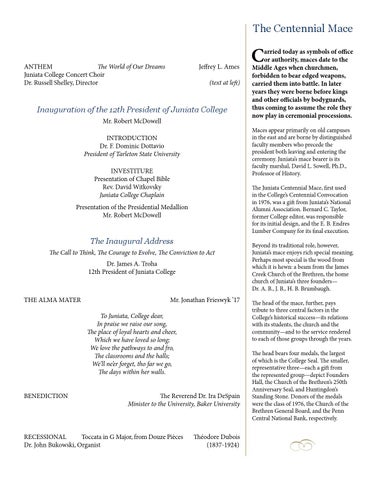
The Juniata Centennial Mace, first used in the College’s Centennial Convocation in 1976, was a gift from Juniata’s National Alumni Association. Bernard C. Taylor, former College editor, was responsible for its initial design, and the E. B. Endres Lumber Company for its final execution.
Presentation of the Presidential Medallion Mr. Robert McDowell
The Inaugural Address The Call to Think, The Courage to Evolve, The Conviction to Act Dr. James A. Troha 12th President of Juniata College
Mr. Jonathan Frieswyk ’17 To Juniata, College dear, In praise we raise our song, The place of loyal hearts and cheer, Which we have loved so long; We love the pathways to and fro, The classrooms and the halls; We’ll ne’er forget, tho far we go, The days within her walls.
BENEDICTION
The Reverend Dr. Ira DeSpain Minister to the University, Baker University
RECESSIONAL Toccata in G Major, from Douze Pièces Dr. John Bukowski, Organist
arried today as symbols of office or authority, maces date to the Middle Ages when churchmen, forbidden to bear edged weapons, carried them into battle. In later years they were borne before kings and other officials by bodyguards, thus coming to assume the role they now play in ceremonial processions.
Maces appear primarily on old campuses in the east and are borne by distinguished faculty members who precede the president both leaving and entering the ceremony. Juniata’s mace bearer is its faculty marshal, David L. Sowell, Ph.D., Professor of History.
INTRODUCTION Dr. F. Dominic Dottavio President of Tarleton State University
THE ALMA MATER
C
Théodore Dubois (1837-1924)
Beyond its traditional role, however, Juniata’s mace enjoys rich special meaning. Perhaps most special is the wood from which it is hewn: a beam from the James Creek Church of the Brethren, the home church of Juniata’s three founders— Dr. A. B., J. B., H. B. Brumbaugh. The head of the mace, further, pays tribute to three central factors in the College’s historical success—its relations with its students, the church and the community—and to the service rendered to each of those groups through the years. The head bears four medals, the largest of which is the College Seal. The smaller, representative three—each a gift from the represented group—depict Founders Hall, the Church of the Brethren’s 250th Anniversary Seal, and Huntingdon’s Standing Stone. Donors of the medals were the class of 1976, the Church of the Brethren General Board, and the Penn Central National Bank, respectively.
The Inaugural Week Concurrent Weeklong Events
Liberal Arts Symposium Revisited: Displays of student research and creative work in various campus locations. (see program at right)
Juniata Theatre Presents Dirty Rotten Scoundrels 7:30 p.m., October 17-19 and 23-25 Suzanne von Liebig Theatre, Halbritter Center for the Performing Arts Week of Service: members of the Juniata community are asked to perform an hour or more of community service during the week.
Friday, October 18
Majora Carter Juniata Presents Distinguished Speaker Majora Carter is an ecologyminded community organizer and community consultant who sparked community revitalization in New York City’s South Bronx neighborhood by founding Sustainable South Bronx. She and
Reception (Following the Investiture Ceremony) Campus Quadrangle Inaugural Gala (invitation only): 7 p.m., Intramural Gymnasium, Kennedy Sports and Recreation Center
Saturday, October 19
The Amiable Amble: a community walk through Huntingdon, to Portstown Park, and back to campus. Gather on the Campus Quadrangle by 2:15 p.m., for the walk to commence at 2:30.
Oktoberfest (following The Amiable Amble): 4 p.m., Campus Quadrangle Sponsored by the German Club
Sunday, October 20
Worship Service, 10:45 a.m., Stone Church of The Brethren Come and worship as we celebrate this new chapter in Juniata College’s history, and honor the rich historic tie and relationship between Stone Church and Juniata College. The Trohas will greet worshipers following the service.
Tuesday, October 22
The Juniata College Health and Wellness Fair, all day, Ballroom, Ellis Hall
Service Club Luncheon (invitation only): The Rotary Club of Huntingdon, Huntingdon Lions Club, and the Kiwanis Club of Huntingdon will visit campus for a lunch with President and Mrs. Troha and members of the campus community.
Juniata Presents Distinguished Speaker Majora Carter, 7 p.m., Rosenberger Auditorium, Halbritter Center for the Performing Arts
other members of the organization revitalized Hunts Point Riverside Park, as well as other parts of the Bronx River waterfront. Carter celebrates eco-entrepreneurs through her activism and spends
Wednesday, October 23
President and Mrs. Troha Lunch with Students Baker Refectory, Ellis Hall
much of her time inspiring community-based revitalization through talks, workshops, and other appearances.
Inaugural Concert, 9 p.m., Baker Refectory, Ellis Hall With student acts ranging from singing to dancing to instrumental performances, the concert will emphasize what makes Juniata special: its students. In honor of the inauguration of President Jim Troha, all of the concert’s proceeds will go to the nonprofit Alex’s Lemonade Stand, which focuses on pediatric cancer research. Sponsored by Student Government
Thursday, October 24
Juniata Alumni Advocates Panel: 7:30 p.m., Ballroom, Ellis Hall Sponsored by the Alumni Relations Office and Unity House
Friday through Saturday, October 25-26
Homecoming and Family Weekend
The Liberal Arts Symposium Revisited The Liberal Arts Symposium is an annual event held every spring semester devoted to undergraduate scholarship and research. Shortly after being hired as Juniata’s new president, James Troha spent the entire day of April 18 looking through student research posters and sitting in on presentations. He thought it might be nice to include some of the Liberal Arts Symposium posters as part of Inauguration Week activities.
R E V I S I T E D
German Cultural Exports
Lobby, Oller Center In conjunction with Germany in Europe Week, the German Cultural Exports will feature Juniata students who have engaged with the German economy and culture. In particular, students in German and International Studies courses who are researching Germany’s economic and cultural role in Europe will present posters on their work.
Art Exhibition
Carnegie Rotunda and Basement, Juniata College Museum of Art The student work encompasses a wide range of studio art media and approaches, including ceramics, photography, painting, drawing, animation, and photography by students studying abroad. The students’ work for this exhibition was a product of the regular course curriculum.
Juniata Choir Tour Highlights Streaming Video
Ellis Hall Highlights of the Juniata Concert Choir spring 2013 trip to Guatemala displayed on the video monitors throughout Ellis Hall.
Posters
Lobby, Ellis Hall Biology – Defining the Function of RTT105 in Retrotransposition: A Role in Gag Particle Formation? Author: Jessica Scales Faculty Sponsor: Jill B. Keeney Biology – Genome Annotation of Two Pacific Rockfishes (Genus Sebastes) Differing in Longevity Author: Alex Sickler Faculty Sponsor: Vince Buonaccorsi Biology – Temporal Dynamics of the gut microbiomes of an inflammatory bowel disease cohort Authors: Erin McClure, Mitchell Dunklebarger Faculty Sponsor: Regina Lamendella Biology – The response of freshwater aquatic microbial communities to Marcellus Shale natural gas extraction Authors: Caroline Solomon, Ryan Trexler, Abigail Rosenberger, Morgan Decker, Steven C. Strutt Faculty Sponsors: Christopher Grant and Regina Lamendella Biology – Assessment of soil fungal community variation in native and introduced maples Authors: Gabrielle Cannon, Jennifer Graves Faculty Sponsor: Norris Muth
Posters
Beeghly Library Biology – Trophic food web determination in forested headwater streams and its relation to bioaccumulation and biomagnification of methyl mercury by total mercury and δ13C and δ15N isotope analysis Authors: Nicole Marks, Jacob Oster Faculty Sponsor: Chris Grant Biology – Morphological change of organs and phenotypic plasticity in brook trout (Salvelinus fontinalis) in relation to mercury Author: Elliot Perow Faculty Sponsor: Chris Grant Chemistry – Identification of Genes Responsible for a Profound Behavioral Phenotype in a Nicastrin Conditional Knockout Mouse Author: Taylor Stefanik Faculty Sponsor: Dan Dries Chemistry – Transcriptional Changes in cKO Mice Author: Jen Arbella Faculty Sponsor: Dan Dries Chemistry - The analysis of cumin spice using laser-induced breakdown spectroscopy (LIBS) Author: Chesney Richter Faculty Sponsor: Richard Hark Chemistry - Spectroscopic analysis of pigments in late 18th and early 19th century portrait miniatures by William Wood Authors: Katelyn R. Houston, Lucia Burgio, Alan Derbyshire Faculty Sponsor: Richard Hark
Posters
Hogan Lounge, 2nd floor above lobby, Dale Hall, Brumbaugh Academic Center ABE - ABE Senior Assessment Authors: Katie Ferguson, Jordan Hileman Faculty Sponsor: Marlene Burkhardt Physics - Determining Physical Parameters of Eclipsing Binary Systems Containing Delta Scuti Pulsating Stars: A Photometric Analysis of TU Her and V469 Cyg Authors: Jon Snyder, Mara Zimmerman Faculty Sponsor: Matt Beaky Physics – Characterization of the Muon Fluence Near the Earth’s Surface Authors: Austin Ankney, Timothy Berguson Faculty Sponsor: Jim Borgardt Physics - Hydrated Plasma Emissions from Aqueous Electrical Discharge Author: Keegan Healy Faculty Sponsor: Mark Pearson
Information Technology - Implementation of Course Management Software at IFC Authors: Kayci Nelson, Patrick Murray, Tessa Thomas, Kaitlin Spangler Faculty Sponsor: Bill Thomas Information Technology – Innovations For Industry Quinn Analytics Authors: Christopher McMahan, Maximillian von Thaden, Yu Xiong, Weihua Wang Faculty Sponsor: Bill Thomas
Posters
Lobby, Dale Hall, Brumbaugh Academic Center Communication - Nanomedicine and Nanowarfare Authors: Tian Lan, Ethan Nichols, Abdullah Elgabrowny Faculty Sponsor: Donna Weimer Math - An Analysis of Gray Codes Applied to Gene Sequences Author: Lucas Lingenfelter Faculty Sponsor: Cathy Stenson Information Technology, Integrated Media Arts - The Family Unit and the Effect Future Technologies Have On It Author: Jeannine Haizlip Faculty Sponsor: Donna Weimer Information Technology - Online Learning and Social Network Assessment Authors: Heidi Kleber, Kyle Clemmer, Erica Nagle, Ethan Farrell, Zane Kelton Faculty Sponsor: Marlene Burkhardt Psychology - Expressive Writing and Empathy in Individuals who have Experienced Gender, Ethnic, or Religious-Based Discrimination Author: Helen (Huiqing) Hu Faculty Sponsors: Anne Gillman and Mark McKellop Psychology - The Effects of Perceived Threat on Authoritarianism Authors: Alyssa Beck, Lyndsey Gianella, Sarah Trescher Faculty Sponsor: Philip Dunwoody Biology/Pre-Medicine; Psychology Minor What Everybody is Missing in the Attachment Parenting Debate Author: Gina Zigerelli Faculty Sponsor: Kathy Jones Student Work History Room, Founders Hall Education Student Portfolio - PreK-4 and Special Education Prek-8 Teacher Certification Programs Author: Kelsey Miles Faculty Sponsor: Fay Glosenger Education Student Portfolio - PreK-4 and Special Education Prek-8 Teacher Certification Programs Author: Rachel Grubb Faculty Sponsor: Fay Glosenger
R E V I S I T E D
History Senior Thesis - “Three Generations of Imbeciles is Enough”: Eugenics, Progressivism and Sterilization in Virginia and California in the Early 20th Century Author: Marilyn Cobiseno Faculty Sponsor: David Sowell History Senior Thesis - The Impact of Personality and Experience on Decision-Making: Neville Chamberlain and His Policy of Appeasement Author: Sarah Hodgkins Faculty Sponsor: Dave Hsiung History Senior Thesis - Sanctuary or Mass Graves: Rwandan Churches During the Genocide Author: Tine Guldbrand Faculty Sponsor: Alison Fletcher History Senior Thesis - Them’s Fighting Words: War of the Roses Accounts from Yorkist and Lancastrian Chronicles Author: Meghan Hall Faculty Sponsor: Belle Tuten History Senior Thesis - Good Wolf, Bad Wolf: The Werewolves in Harry Potter Author: Dani Gaisior Faculty Sponsor: Belle Tuten History Senior Thesis - More Than “Cheesecake”: Apartheid and Politics in Drum Magazine in 1950s South Africa Author: Amy Hunt Faculty Sponsor: Alison Fletcher History Senior Thesis - A Woman’s Secret: Medieval Birth Control Author: Carrie Lawler Faculty Sponsor: Belle Tuten History Senior Thesis - Fairy Tales, Bothy Ballads, and Superstition: Women’s Agency in the Scottish Highlands during the Nineteenth Century Author: Nora Davidson Faculty Sponsor: Alison Fletcher History Senior Thesis - The Divergent Paths of Union and Confederate Scouts and Spies in the War of the Rebellion Author: Madeline Rathey Faculty Sponsor: Jim Tuten History Senior Thesis - Newspapers and the Public: Investigating the Potential Influence of Editorials on Public Opinion During the Vietnam War Author: Riley Downs Faculty Sponsor: David Sowell
History Senior Thesis - Desmond Tutu’s idea of restorative justice evaluated through two hearings of the Truth and Reconciliation Commission of South Africa Author: Myriah LaChance Faculty Sponsor: Alison Fletcher History Senior Thesis - Leaving Their Mark: Trail Registries Along the Oregon Trail. (A study on the motivations for inscribing signatures on Chimney Rock, Register Cliff, and Independence Rock) Author: Claire Wayman Faculty Sponsor: Dave Hsiung History Senior Thesis - Soldier’s Relations to Death: An Examination of the Battle of the Bulge Author: Anthony Scalia Faculty Sponsor: Dave Hsiung History Senior Thesis - We are All Astronauts Author: Melissa King Faculty Sponsor: David Sowell History Senior Thesis - Time and Treasure Author: Gabriella Ricciardi Faculty Sponsor: Belle Tuten History Senior Thesis - Burying the Dead, as well as a Memory: Media Coverage of the Augusta, Georgia Race Riot, May 1970 Author: Elena M. Popchock Faculty Sponsor: Jim Tuten History Senior Thesis - Political Violence in Meiji Japan Author: Andrew Groninger Faculty Sponsor: Doug Stiffler History Senior Thesis - A New Home & New Identity: the Irish Migrant Experience in 19th-Century New Zealand Author: Chelsea Veranis Faculty Sponsor: Alison Fletcher History Senior Thesis - “Lift up thy voice like a trumpet”: Anne Knight and the Fight for the Enfranchisement of Humanity Author: Moira Mackay Faculty Sponsor: Alison Fletcher
Delegates from the Colleges and Universities Delegate responses as of October 2, 2013
1708 Church of the Brethren 1845 Wittenberg University Stanley J. Noffsinger Lawrence L. Newton ’70 General Secretary Alumnus
1883 Houghton College Paul W. Shaffner ’06 Alumnus
1742 Moravian College 1850 Heidelberg University Joan Kiefer Dickinson ’86 Dr. Robert Huntington Alumna President
1883 Seton Hill University Rosann Brown ’88 Alumna
1749 Washington and Lee University 1852 Westminster College Charles E. Kranich ’91 Dr. Don Mitchell ’60 Alumnus Alumnus
1887
1781 Washington and Jefferson College Stephen D. Tiley ’77 Alumnus
1854 University of Evansville William A. Rasmussen ’97 Alumnus
1782 Washington College 1857 Edinboro University William R. Maxwell ’76 Dr. Julie Wollman Alumnus President 1787 Franklin and Marshall College 1857 St. John’s University Foster Ulrich Jr. ’56 Nicholas Rowland ’01 Alumnus Alumnus 1815 Allegheny College 1858 Baker University Susan Kunca Hutchinson Rev. Dr. Ira L. DeSpain ’70 Alumna Minister to the University 1826 Lafayette College 1858 Susquehanna University Andrew Kortyna Jennifer Bucher ’02 Associate Professor of Physics Human Resources Director 1832 Gettysburg College 1860 Bard College James Houldin ’63 Leon Botstein Alumnus President 1833 Kalamazoo College 1866 Carleton College Bill Russey Dr. James White ’85 Alumnus Alumnus 1835 Marietta College 1866 College of Wooster Daniel Bryant ’72 Dr. Elizabeth Cherry ’56 Vice President for Administration Alumna and Finance 1869 Chatham University 1837 Muskingum College Carol Fris Dr. Anne Steele Alumni Association President Board Member 1840 Southwestern University 1869 Ursinus College Dr. Edward B. Burger Dr. David R. Steidle ’78 President Alumnus 1842 Ohio Wesleyan University 1874 St. Olaf College Robert Neidorff ’66 Dr. Karla Bohmbach ’83 Alumnus Alumna
The Catholic University of America Rev. John P. Beal ’83, ’85 Faculty Athletic Representative
1888 University of Scranton Toby Lovecchio ’85 Director of Athletics 1899 Elizabethtown College Dr. Carl J. Strikwerda President 1899 Tarleton State University Dr. F. Dominic Dottavio President 1902
Austin Presbyterian Theological Seminary Theodore J. Wardlow President
1907 University of Hawaii Dr. Marie Dolores Strazar Alumna 1913 College of Saint Benedict Dr. Marcy Rowland 1943 USMMA RADM James A. Melis Superintendent 1952 AICUP Donald Francis President 1965 Hampshire College Jonathan Lash President
Greetings from Colleges and Universities Greetings as of October 2, 2013
The Council of Independent Colleges
1867
McDaniel College
1772
Salem Academy and College
1867
Saint Augustine’s University
1775
Hampden-Sydney College
1871
Smith College
1780
Transylvania University
1874
Macalester College
1793
Williams College
1876
Texas A&M University at Galveston
1819
Centre College
1881
Spelman College
1819
Colgate University
1881
University of Connecticut
1826
Furman University
1883
Whitman College
1830
Capital University
1885
Bryn Mawr College
1830
Randolph-Macon College
1886
Alma College
1831
Denison University
1886
John Carroll University
1833
Oberlin College
1887
Nebraska Wesleyan University
1834
Wheaton College, Norton, MA
1887
Pomona College
1835 Albion College
1888
Tiffin University
1836
Wesleyan College
1888
University of Puget Sound
1837
Davidson College
1889
Agnes Scott College
1837
DePauw University
1889
Gordon College
1837
Knox College
1890
West Virginia Wesleyan College
1842
Hollins University
1898
Saint Norbert College
1842
Willamette University
1901
Texas Women’s University
1844
Olivet College
1902
Berry College
1846
Beloit College
1910
Principia College
1846
Grinnell College
1911
Connecticut College
1847
Otterbein University
1911
Fort Lewis College
1848
Muhlenberg College
1917
Eastern Mennonite University
1852 Mills College
1926
Scripps College
1853
1932
Bennington College
1855 Berea College
1958
Saint Andrews University
1856
Saint Lawrence University
1962
Franklin Pierce Univsersity
1858
University of the South
1963
Pitzer College
1860
Wheaton College, Illinois
1967
The Evergreen State College
1862
Gustavus Adolphus College
1968
Terra State Community College
1864
Swathmore College
1867
Lewis and Clark College
Manhattan College
Student Delegates Delegate responses as of October 2, 2013
Student’s Name
Organization(s) Represented
Ms. Haldis E. Andersen ’14 Mr. Kunal R. Atit ’16 Ms. Asia A. Barron ’13 Ms. Alexandra J. Bernosky ’16 Ms. Laura A. Bitely ’14 Ms. Allison N. Blumling ’14 Ms. Christina J. Briggs ’15 Ms. Kathryn S. Brown ’14 Ms. Catherine Brumbaugh ’17 Mr. John Bufalini ’17 Ms. Mary A. Burkett ’14 Mr. Caleb D. Campbell ’15 Mr. Adam L. Caraballo ’15 Mr. Andrew E. Caudill ’14 Mr. Anshu M. Chawla ’14 Mr. Benjamin Z. Chevron ’16 Mr. Brendan T. Cohn ’14 Ms. Mackenzie D. Coulter-Kern ’14 Ms. Emma S. Dahmus ’14 Mr. Nicholas A. Deebel ’14 Ms. Laura L. Delehanty ’14 Mr. Robert Dellamotta ’14 Mr. Derek M. Deshaies ’14 Mr. Neal J. Donovan ’16 Ms. Sharon N. Dubosky ’14 Ms. Caitlin A. Everhart ’15 Ms. Devon N. Fenicchia ’14 Mr. Nathaniel J. Fischer ’14 Mr. Avery H. Fordham ’14 Ms. Brittany E. Friedman ’15 Mr. Luke A. Gangi-Wellman ’16 Ms. Rachel J. Gingrich ’14 Ms. Leandra Glumac ’14 Ms. Deanna M. Good ’14 Mr. Daniel D. Gray ’14 Ms. Alyssa M. Grube ’14 Mr. Ethan Habbershon ’17 Ms. Alexis Hadden ’15 Ms. Kara L. Hagerich ’14 Mr. Yuyan Han ’16 Ms. Emily Harakal ’14 Ms. Samantha E. Harrison ’14 Ms. Sarah C. Hayes ’14 Ms. Olivia A. Hockenbroch ’15 Ms. Erica P. Jackson ’14 Ms. Nicole E. Jordan ’16 Mr. Thomas Jordan ’14 Ms. Chinami Katahara ’15 Mr. Jonathan B. Keeney ’16 Mr. Caleb King ’15 Ms. Heather J. Kleber ’15
Habitat for Humanity Student Government Class of 2016 Sigma Tau Delta Russian Club Kvasir, Otaku Culture Club Communication & Media Club (CMC/SPEAK) Trans Parachute United AAUW, American Society for Microbiology Juniata College Eagles Nest and Spirit Club Caring for Kids with Cancer Juniata College Divers (JC Divers) Ultimate Frisbee Club AWOL Men’s Rugby Fruit and Wine Club, Student Government Executive Board Juniata Hockey Club Big Brothers Big Sisters Power Up Gambia Colleges Against Cancer (CAC) Health Occupations Students of America (HOSA) Colleges Against Cancer (CAC) PAX-O Chemistry Club American Society of Biochemistry and Molecular Biology WKVR Student Food Initiative Women in Physics Art Alliance Young Entrepreneurial Society (YES) Apiary Club (Bee Team) Hillel Bike JC Juniata Instructors of the Future (JIF) Women Club Volleyball Pet Animal Welfare Society (PAWS) Student Government Class of 2014 American Society for Microbiology Mixed Martial Arts Juniata College Eagles Nest and Spirit Club Juniata Ski Club, JC Downhill Ping Pong Club Environmental Coalition Women’s Rugby Club Juniata College Emergency Management Services (JCEMS) Plexus Juniata Ski Club Nourish International Photography Club Japanese Club Brethren Student Fellowship Juniata Association of Gamers Skulldiggers
Student’s Name
Organization(s) Represented
Ms. Heidi J. Kleber ’15 Ms. Kelsey A. Kohrs ’14 Ms. Emily J. Layman ’14 Ms. Jin H. Lee ’14 Ms. Julia R. Linscott ’16 Ms. Sarah E. Lipiecki ’14 Ms. Victoria L. Loza ’14 Mr. Derrick Magnotta ’14 Ms. Erika J. McKissick ’14 Ms. Michelle T. Merola ’14 Ms. Kelsey J. Miles ’14 Mr. David A. Milligan ’14 Ms. Andrea G. Morillo ’15 Ms. Thu Zar Myint ’15 Ms. Chelsea Naglic ’14 Mr. Lewis C. Nash, Jr. ’15 Ms. Harpster Nokota ’15 Mr. Patrick T. Oelschlager ’14 Mr. Stephen V. Park ’15 Ms. Mary Elizabeth R. Petrie ’15 Ms. Kaitlynn N. Plummer ’15 Ms. Paula Pryor ’14 Ms. Victoria I. Rehr ’14 Mr. Brandon M. Reis ’15 Mr. Kyle T. Salage ’15 Ms. Haley E. Schneider ’15 Ms. Hannah L. Shultz ’14 Mr. Alexander J. Sickler ’14 Mr. Jordan A. Smith ’15 Ms. Mingwei Song ’15 Ms. Stephanie J. Starr ’16 Ms. Christine M. Sumner ’15 Mr. Benjamin M. Tansi ’14 Ms. Leila Terrab ’15 Mr. Scott J. Thomas ’14 Ms. Veneka Mahomva ’15 Ms. Elizabeth M. Twigg ’15 Ms. Megan T. Vanaman ’15 Ms. Amanda E. Waller ’14 Mr. Adam J. Weaver ’15 Mr. Clinton J. Webb ’15 Ms. Laura Whitman ’14 Ms. Alexandra M. Willis ’14 Mr. Justin P. Wisniewski ’14 Ms. Alexandra Witter ’14 Ms. Skukura A. Woods ’14 Ms. Erika N. Young ’15 Ms. Alexandra M. Zerjav ’15 Ms. Khyin Mi Mi Zin ’15
Habitat for Humanity Mud Junkies Dance Ensemble Tri Beta African Dance and Drum German Club Dance Ensemble Model UN Blue Pig Catholic Council Equestrian Club Laughing Bush, Society of Physics Students Nourish International Burmese Club National Society of Leadership and Success Comic Book Club Wild Hunters of Juniata Social Dancing Club Juniata College Disc Golf Association (JCDGA) Women in Physics Null Set Andrew Lawson Geological Society (ALGS) Omicron Delta Kappa, Psychology Club, Spanish Club, Juniata College Secular Student Alliance AWOL Juniata College Republicans Barristers’ Pre Law Club Christian Ministry Board Ministry of Games Archery Club Chinese Club Circle K Student Government Class of 2015 Quidditch Club Muslim Student Association (MSA) Trap and Skeet Student Alumni Association Juniata College Democrats Skulldiggers French Club Chess Alliance, Juniata Star Wars Club Barristers’ Pre Law Club Brethren Student Fellowship Spanish Club Philosophy Club Environmental Coalition, First Peoples (Native American Club) African American Student Alliance (AASA) JAB Knitting Club International Cooking Club
Juniata College Board of Trustees 2013-2014
Robert N. McDowell ’67, M.A., Chair Timothy D. Statton ’72, B.S., Vice Chair Gail M. Habecker ’76, B.B.A., Treasurer Carol J. Ellis ’71, M.Ed., Secretary David P. Andrews ’74, J.D. David C. Beachley ’77, B.S. John A. Brinker ’69, M.B.A. Carole A. Calhoun ’60, Ph.D. Pat Chang-Lo, M.S. Nicole C. Close ’92, Ph.D. Bruce Davis ’65, M.F.A. Henry H. Gibbel ’57, B.S. Carl D. Glaeser ’77, B.S. Jodie E. Gray ’88, Ph.D. Barry J. Halbritter ’65, B.S. William P. Hayes, B.A.
Nathan Hevrony, B.S. John T. Hill, B.A. David J. Hogan ’61, B.S. Steven J. Holsinger ’76, J.D. Eric C. Jensen ’77, Ph.D. C. Todd Kulp ’80, M.B.A. Fred C. Mason ’73, M.B.A. Kimberly A. McDowell, M.Div. Linda W. McKonly ’73, B.S. Robert S. McMinn ’79, J.D. Bruce L. Moyer ’74, J.D. John A. Nagl, B.S.
Richard E. Paulhamus ’70, M.S. Gayle W. Pollock ’68, B.S. Gary A. Raymond, M.D. Christoph Schwemmlein ’84, M.B.A. Henry F. Siedzikowski ’75, J.D. Douglas A. Spotts ’89, M.D. Maurice C. Taylor ’72, Ph.D., J.D. George P. Valko, D.M.D. Mary M. White ’73, M.S. Charles W. Wise III, M.B.A.
Emeriti Anne C. Baker, J.D. Donovan R. Beachley Jr. ’47, M.S. Charles C. Brown Jr. ’59, B.A., J.D. F. Samuel Brumbaugh ’54, B.S. John McN. Cramer ’63, LL.B. George E. Cruser ’52, B.S. John A. Dale ’54, M.A. Francis X. DeMar Donald L. Detwiler ’64, B.S.
Wayne C. Patterson ’60, M.S. Thomas R. Pheasant ’66, M.D. W. Clemens Rosenberger ’54, M.Div. Patricia J. Shreiner ’62, B.S., P.A. Michael M. Strueber, M.Ed. Patricia B. Swigart, A.A. Robert E. Wagoner ’53, B.S.
Madeleine F. Green, Ph.D. Warren F. Groff ’49, Ph.D. William E. Hershberger ’57, B.S. Kenneth E. Hess ’75, B.S. Frances R. Hesselbein, LHD Karl K. Kindig ’72, B.S., J.D. Charles R. Knox ’54, B.S., LeRoy S. Maxwell ’36, J.D. Harriet R. Michel ’65, B.A.
The Inaugural Planning Committee Lorri Panaia Shideler, Co-Chair Gabriel Welsch, Co-Chair Rosann Brown Chad Herzog JoAnn Isenberg Kim Kitchen Joanne Krugh Jerry Kruse Cady Kyle
Darwin Kysor David Meadows Jessica Mumford Jennifer Troha John Wall Kathy Westcott
A Special Thanks to Our Sponsors Sponsors as of October 2, 2013
Platinum D. C. Goodman & Sons, Inc. E.B. Endres Millwork & Carpentry Follett Higher Education Group Sodexo
Gold Cornerstone First National Bank
Silver Advanced Color Graphics Always A Party Rentals Best Line Equipment CE Wood Construction Comfort Inn Fairfield Inn & Suites/Shaner Investments Kish Bank Mutual Benefit Group Northwest Savings Bank Poole Anderson Construction Raystown Beverage Strickler’s Thompson’s Candle Company
The President and Mrs. Troha join the members of the Inaugural Planning Committee in sincerely thanking the many individuals who assisted in making the Inauguration Celebration a memorable experience.
1700 Moore Street, Huntingdon, Pennsylvania 16652