
PANORAMIC FOR A LAND
 JULIE LARROUY
PANORAMIC FOR A LAND
“Panoramic” is a term used to describe wallpaper tapestries on which landscapes are printed, often promises of escape and bearers of a whole and credible vision of an elsewhere. Inspired by the classic pictorial technique which aimed to reconstruct narrative scenes over a circular space, the notion of panning comes to define the process that occurs when a succession of images presents itself to the mind as a full view.
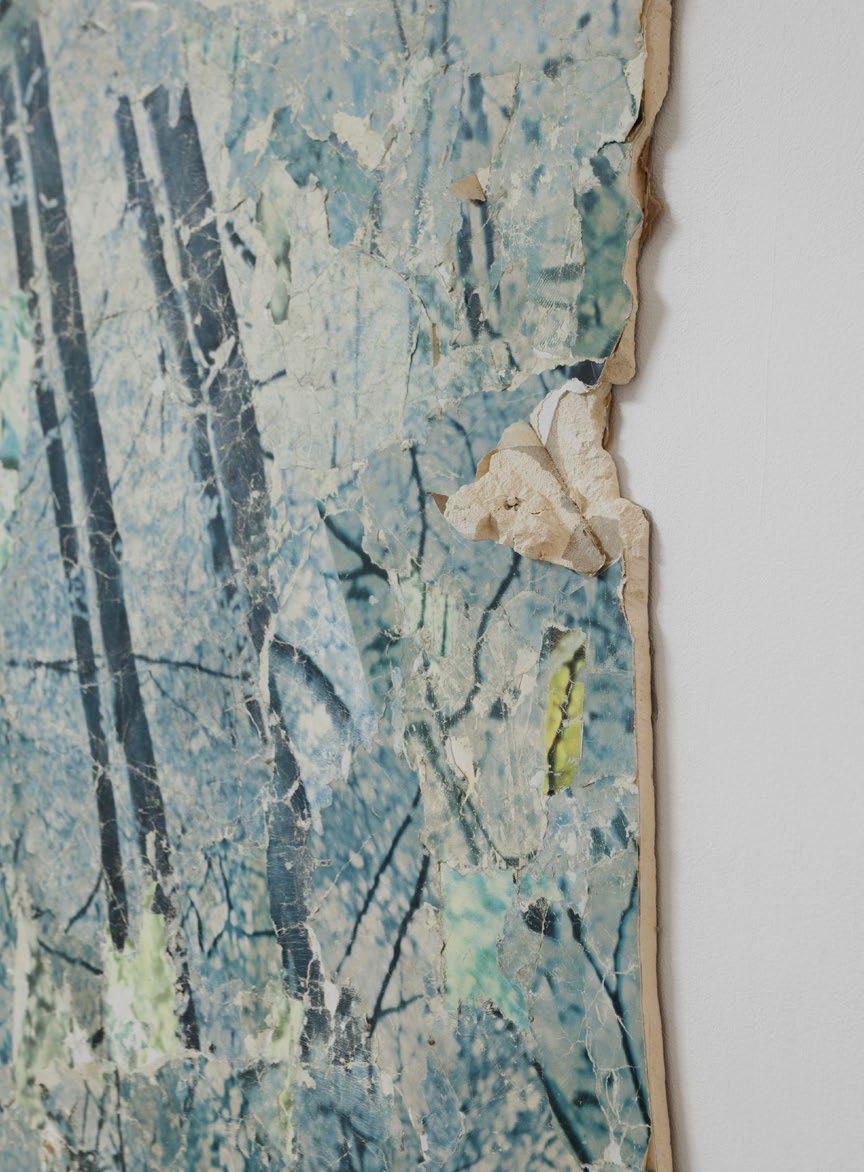
The Panoramic for a land project takes its title from one of these tapestries that I took off from the bedroom of a private house during a residency in 2018. This image of a forest blued by light over the time, was taken off from its wall and transported to my studio to be re-composed there by rearranging it, then re-glued for the first time as part of an exhibition organized in its place of origin. Four reconstructions of the panorama have been produced until now, each designed as a specific response to the time and place of its display. Each stage of Panoramic for a land proposes in short a new formulation: the wallpaper is peeled off then recomposed in a new installation. This protocol dimension is intended to be both repetitive, restrictive but nevertheless open to the unique interactions that occur with the place and to the movements generated by these adaptations. It implies simultaneously the preservation and degradation of the material, but also the conservation of a kind of memory of the vagaries of the image which, exposed, transported, mounted and dismantled according to its exhibitions, becomes a palimpsest of its movements and its reconfigurations. She asks me about her economy, about this shift in which she places the outdated model in front of gestures, in front of the present.
overexposed,
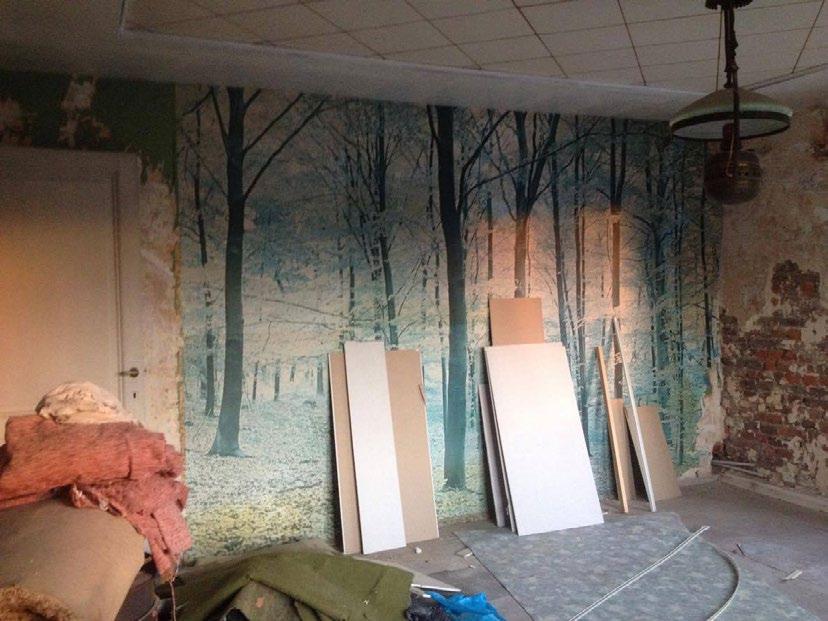
Panoramic Forest Land was exposed to natural lighting for around thirty years in a private house. Slowly the image turns blue.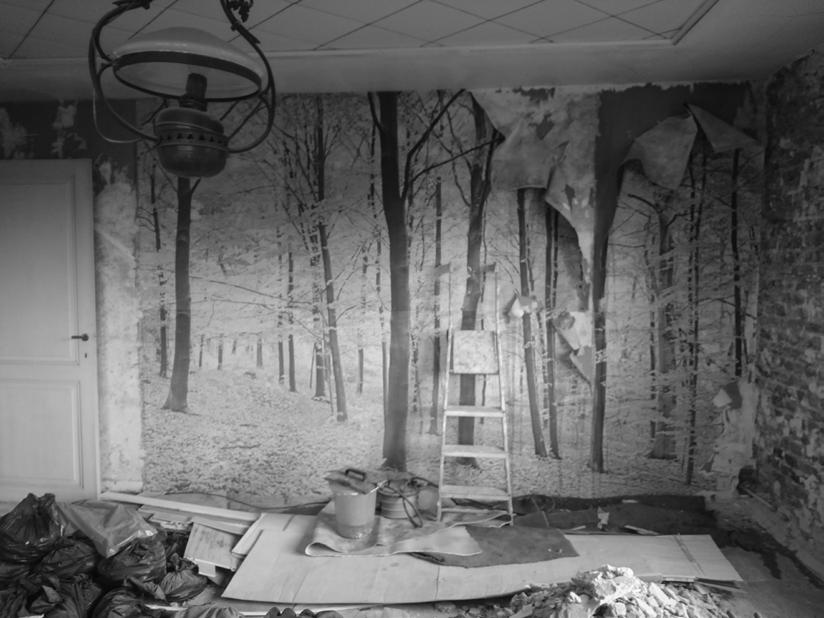
Condition: this paper tapestry was removed from its wall in 2017. The paper is damaged by its extraction and weakened by overexposure to light and surface
deposits. It is then restored in order to fix its material condition and to prevent its deterioration from being too rapid.
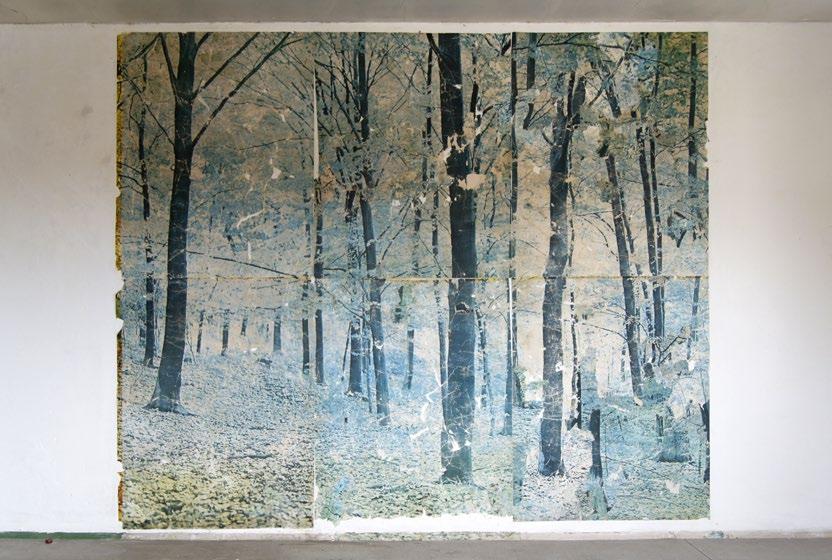
Actions: the wallpaper is reconstituted in the workshop into six pieces and then reinstate into its original context. The poster’s size is reduced, the image is isolated from the wall. This reduction means that there
remain unused residues, which are stored.
The first title of the poster “Panoramique Forest Land” becomes “Panoramic for a land”.
MAISON DE LA CULTURE DE MARCHE-EN-FAMENNE
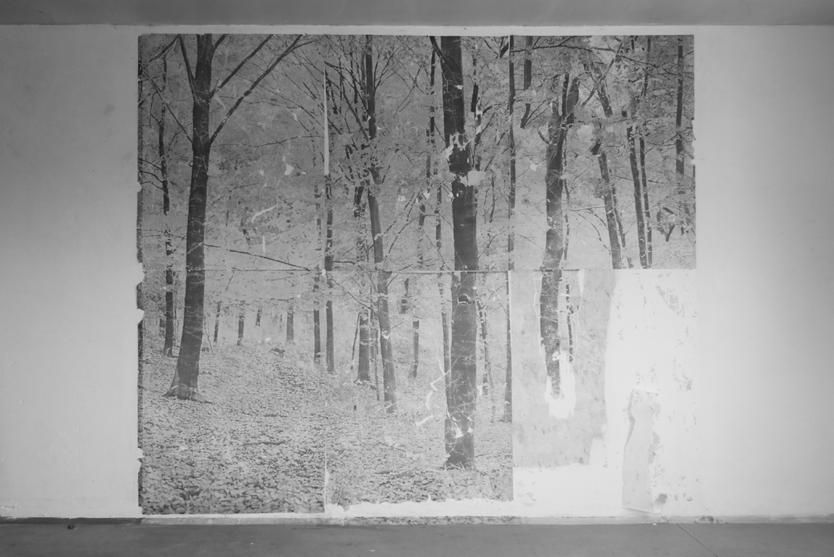
Condition: peeling off the tapestry with a steam stripper generated new ‘pieces’ which, like a puzzle with a
random protocol, would be assembled for the next exhibition.
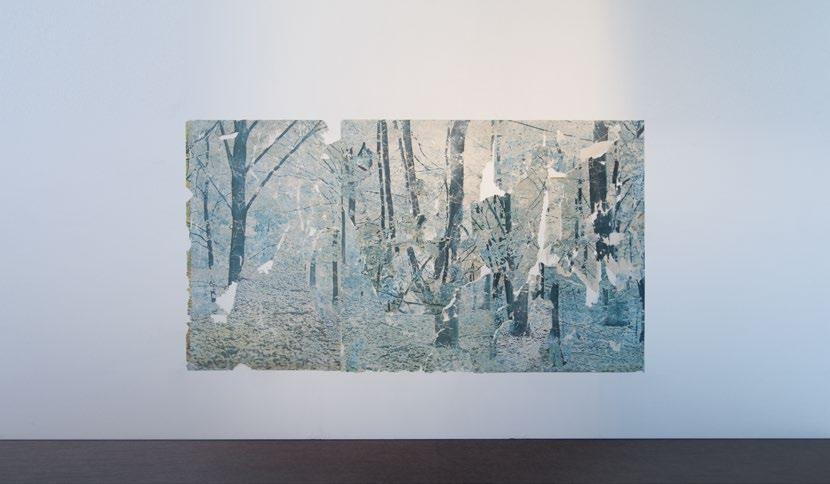
Actions: the evocation of the panoramic format is imperative to the reconstruction of the wallpaper.
“Panoramic For a Land” is directly assembled on the exhibition wall.
The image is stretched in its length. Some pieces are stored to keep in view only the tops and the ground already altered by the reconstruction which took place in Spa.
ESPACE D’ART CONTEMPORAIN, L’ORANGERIE, BASTOGNE
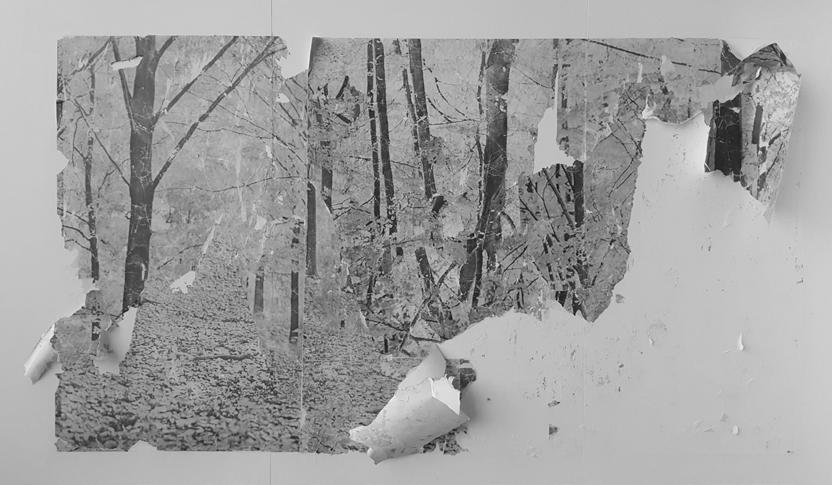
Condition: the panorama was removed without prior humidification, certain parts too firmly glued to the wall
found themselves shredded.
Actions: The material memorizes each gesture performed during the installation and dismantling, so there are necessarily losses. To ensure the sustainability of the panoramic, full-scale reproductions of the pieces are added to the reconstruction.
This time, the reconstruction will no longer be assigned to a plain rectangular shape but will be fragmented. To these fragments will be grafted partial reproductions of the panoramic.
SB34-THE POOL, BRUXELLES
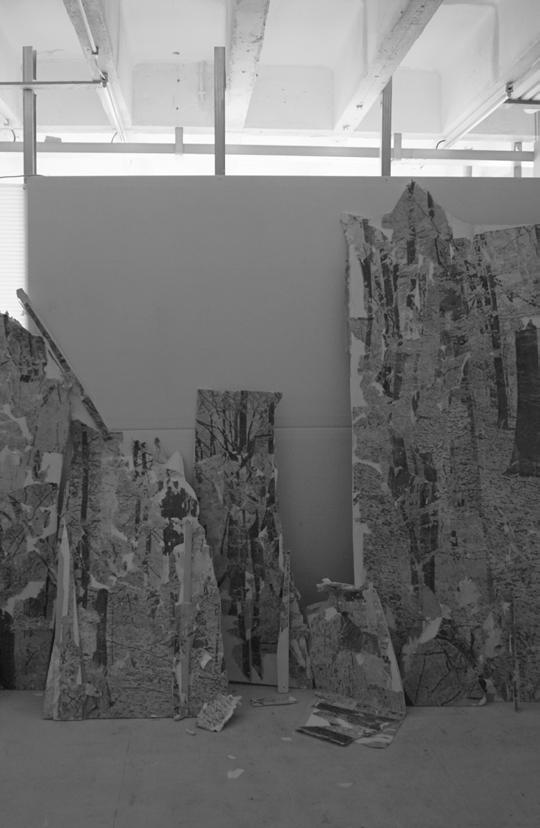
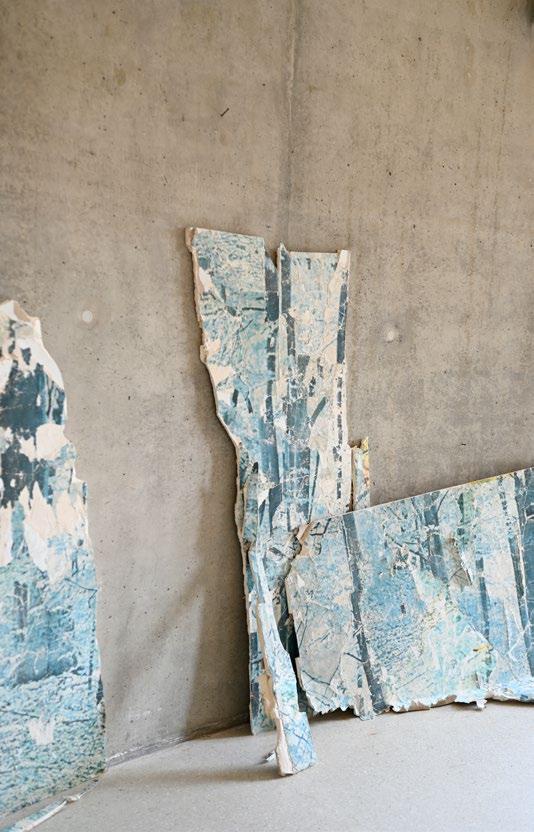
Condition: the panorama has been removed to the workshop. The rigid support keeps the paper stretched. The storage’s question interferes with that
of its preservation : the material is now being friable and bulky, it undergoes a sort of erosion, new pieces appear into plates.
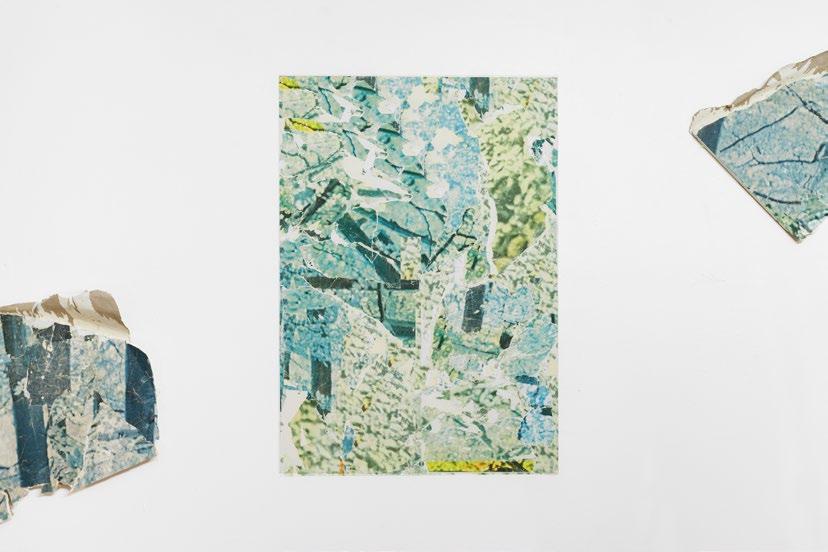
Actions: the panoramic incorporates a copy of the wallpaper, a printed poster. Those digitally reconstructed pieces are as much archives as materials that compensate for the loss of components.
The panorama is scattered in the exhibition space, somme pieces aren’t on view. The reconstruction intends to be a mental exercise.
ANCIENNE BIBLIOTHEQUE DES CHIROUX, LIEGE
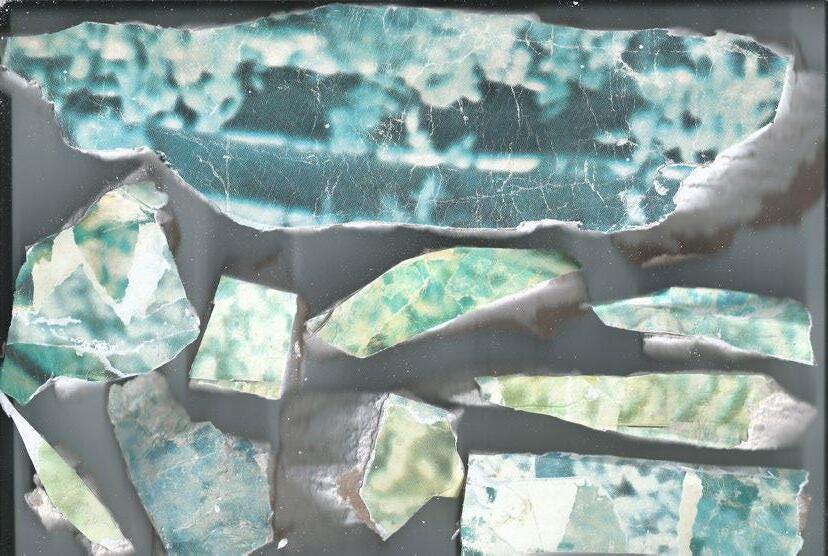
Condition: the panorama moves slowly. Original pieces and reproductions come together to end up merging together.
EXTRACTS FROM EXHIBITIONS TEXTS
Panoramic for a land has been exhibited in various group exhibitions. Here are some texts and extracts that accompanied them.
«Massif Continental, croiser l’espace»
Espace d’Art Contemporain l’Orangerie, Bastogne
Eglantine Chaumont, Simon Delneuville, Julie Larrouy et François Winants (extracts)
2020
“Massif Continental is first of all four artists who meet and decide to pool their work under the same label. It is an association, questioning the methodologies of display and presentation in the field of contemporary art. It’s a packaging, a hollow box in which you could place Eglantine, Simon, Julie and François, but why not Paul, Françoise and Aurélie? In fact, Massif Continental no longer belongs to them! And although the contents of the box can be modified as desired, the container is very defined. Massif Continental is a look at our relationship with nature and its artifacts. It is a shared tool, which questions us about the perception of nature, the way in which we experience it, exploit it or contemplate it. Whether in our daily lives or in a more rhetorical and cultural way, he challenges us about our appropriation of his symbols. As much as Massif Continental uses a concept close to merchandising, immediate and volatile consumption, these four artists are, through their respective practices, in doing and living. They practice space, the environment and the codes of contemporary art with ease, experiencing encounters, exchanges and memory. The contrast between nature and culture is established. We will be confronted less with intense masses of conifers or a continental sunset than with proposals to understand our nature.
«Croiser l’espace» is the third proposal from Massif continental and the expression of four artists with strong, autonomous and individual identities.
Julie Larrouy (F) °1988, lives and works in Brussels and manipulates image and representation. We all know those giant posters or paper tapestries that represent a snapshot of nature in cozy apartments and houses from a bygone era. Here, we are facing a soft hillside in leafy shade and covered with dead leaves. Time has done its work and the tired pigments make the image more diaphanous and more romantic than on the first day. Julie intervenes at this precise moment. She first reappropriates the image, then again, she exposes it to the light and the gaze. She then denatures it, through a set of processes worthy of a paper restorer, careful to maintain the alteration process and control it. While initially she preserved the image as best as possible, going so far as to re-paste it on a support for the sake of preservation. She then decides to alter it again with rips, superpositions and increased collage. What does she show us about this bucolic cliché, this image of an almost ‘pornographic’ and overused nature? All that remains is fragments and shards, a new nature. Here we are facing another image, facing a more sculptural reading, an archetype.”
«Submerge»
SB34 Bruxelles
Julie Larrouy, Marion Séhier cur. Maud Salembier 2021
”«Child of the earth above the stratospheres
Where is the secret of the lost Tehra Deep in Arkadia
Go follow Spartakus »
Spartakus, animated serie, 1985
It is said that the world was flooded by gods and
goddesses «to decimate the human species, thanks to the winds and the waves.» and then «there was no longer any difference between sea and land.»* That «all the fountains of the great deep came bursting through, and the windows of heaven were open» and «rain came down on the earth for forty days and forty nights.»** And that the bells of a lost kingdom, submerged for having housed ancestral pagan rites, can be heard, ringing under the waves of a beach, under ley sands, on the edge of the Arthurian worlds.
There are lunar landscapes, bark, stumps and gray or greenish, fragmented dunes, that live in dreams of romantic ruins emerging from caves or post-apocalyptic visions. Healing of memory loopholes in a crystallized image, branches of trees bled to blue, lapidary, torn, latent, in the process of becoming, wash up indefinitely in the interstices of abandoned houses. Images and materials crackle, crossed by a seismic temporality and excavated from the depths of human history.
In the dialogant meanders of a fossilized and brocéliendic forest in the garb of forgotten, faded melancholy myth, lurks an oceanic peat, meteorite tectonics of teeming crustaceans and brutalist lychens.” /
Maud Salembier*. Ovid’s metamorphosis
**. Genesis VII 11-12
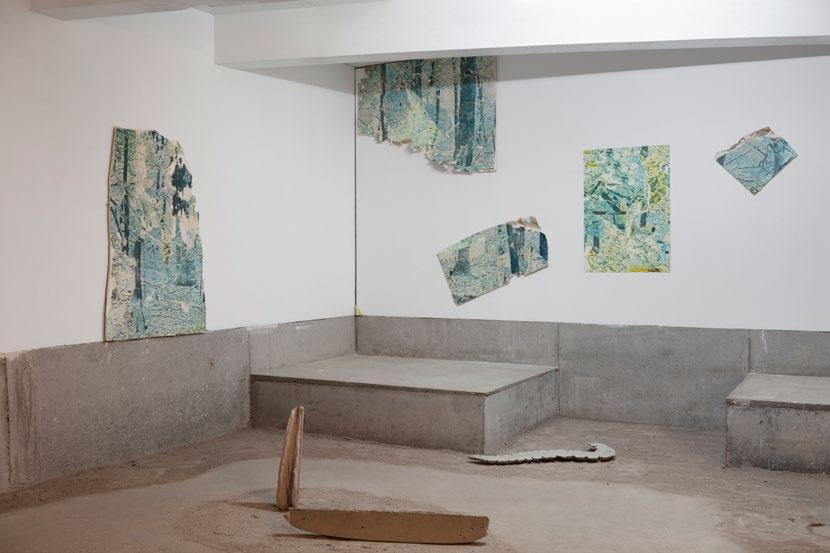 PANORAMIC FOR A LAND exhibition view «Submerge» duoshow w/ Marion Séhier, with the support of the Fédération Wallonie-Bruxelles, photography: ©Regular Studio. cover: photography: ©Silvia Caparelli
Julie Larrouy lives and works in Brussels.
She defines her artistic practice as an exploration of the imag e of which she probes the inner, workings the ways in which meaning is built there and its impact on imaginations. Projects such as “Panoramic for a land” give her the opportunity to question the conditions of her artistic production.
www.julielarrouy.com