State Champs!
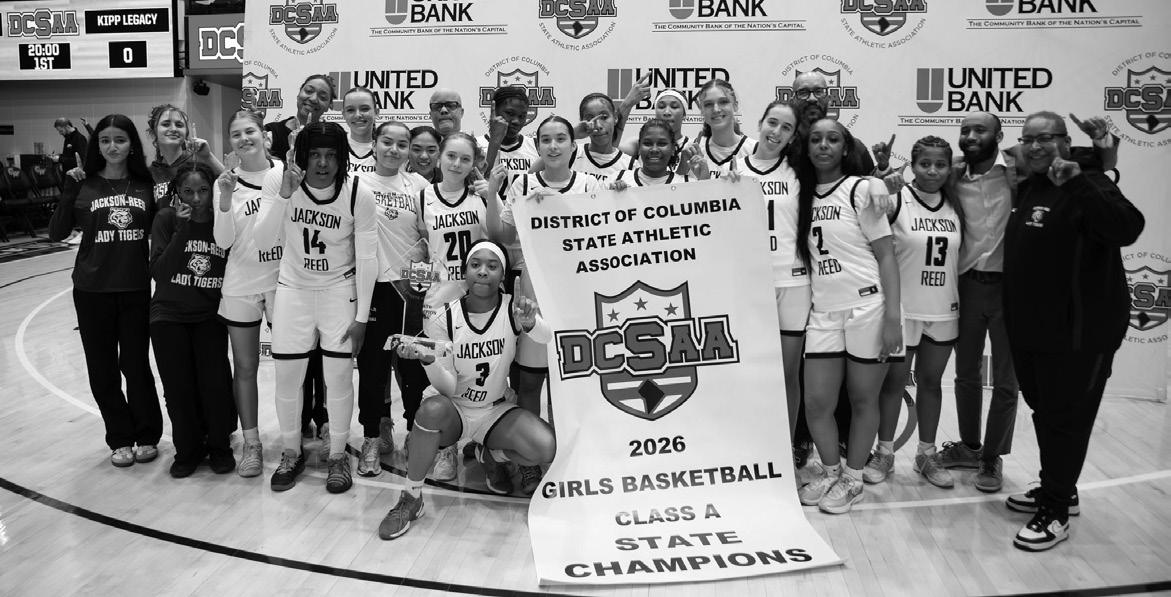
PHOTO BY DANIEL KREPPS
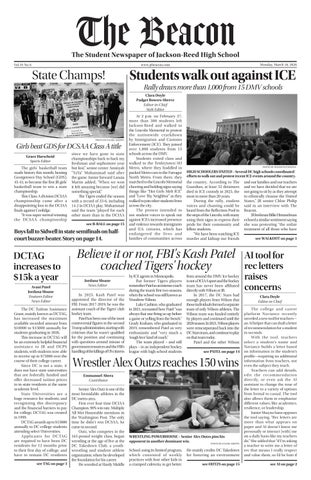
Girls beat GDS for DCSAA Class A title
Grace Harscheid Sports Editor
The girls’ basketball team made history this month, beating Georgetown Day School (GDS), 45-43, to become the first JR girls’ basketball team to win a state championship.
This Class A division DCSAA championship came after a disappointing loss in the DCIAA finals against Coolidge.
“It was super surreal winning the DCSAA championship
since we have gone to state championships back to back my freshman and sophomore year but lost,” senior center Aminyah “YaYa” Muhammad said after the game. Junior forward Lanaia Martin added, “When we won it felt amazing because [we] did something special.”
The Tigers ended the season with a record of 23-6, including 14-2 in DCIAA play. Muhammad said the team “played for each other more than in the DCIAA
see B-BALL on page 15
Boys fall to Sidwell in state semifinals on halfcourt buzzer-beater. Story on page 14.
DCTAG increases to $15k a year
Avani Patel
Jordana
Sloane
Features Editor News Editor
The DC Tuition Assistance Grant, mainly known as DCTAG, has increased the maximum available awarded amount from $10000 to $15000 annually for students graduating in 2026.
This increase in DCTAG will be an extremely helpful financial assistance to JR and DCPS students, with students now able to receive up to $75000 over the course of their college career.
Since DC is not a state, it does not have state universities that are federally funded and offer decreased tuition prices to in-state residents at the same academic level.
State Universities are a huge resource for students, and recognizing this discrepancy and the financial barriers to pay for college, DCTAG was created in 1999.
DCTAG awards up to $15000 annually to DC college students attending select Universities.
Applicants for DCTAG are required to have been DC residents for 12 months prior to their first day of college, and have to remain DC residents
Students walk out against ICE
Rally draws more than 1,000 from 15 DMV schools
Clara Doyle Padget Bowers-Shreve Editor-in-Chief Style Editor
At 2 p.m. on February 27, more than 300 students left Jackson-Reed and walked to the Lincoln Memorial to protest the nationwide crackdown by Immigration and Customs Enforcement (ICE). They joined over 1,000 students from 15 schools across the DMV.
Students exited class and walked to the Tenleytown/AU Metro, where they huddled in packed Metro cars to the Farragut North Metro. From there, they marched to the Lincoln Memorial cheering and holding signs saying things like “Hot Girls Melt ICE” and “Love Thy Neighbor” as they walked to join other students from across the city.
The protest intended to use student voices to speak out against ICE’s increased presence and violence towards immigrants and U.S. citizens, which has endangered the lives and families of communities across

SCHOOLERS UNITED – Several DC high schools
efforts to walk out and protest recent ICE events
the country. According to The Guardian, at least 32 detainees died in ICE custody in 2025, the most in more than 20 years.
During the rally, student voices and chanting could be heard from the Reflection Pool to the steps of the Lincoln, with many using their signs to express their pride for their community and fellow students.
“We have been watching ICE murder and kidnap our friends
Believe it or not, FBI's Kash Patel coached Tigers' hockey
Jordana Sloane News Editor
In 2025, Kash Patel was appointed the director of the FBI. From 2017-2019, he was the assistant coach of the Tigers’ club hockey team.
Patel has been one of the most controversial figures in the second Trump administration, starting with criticism that he wasn’t qualified for the position and continuing with questions around misuse of government resources and the FBI’s handling of the killings of US citizens
by ICE agents in Minneapolis.
But former Tigers players remember Patel as an intense coach during the team’s first two seasons, when the school was still known as Woodrow Wilson.
Luke Cashion, who graduated in 2021, recounted how Patel “was always that one firing us up before a game or yelling from the bench.”
Grady Kraham, who graduated in 2019, remembered Patel as very enthusiastic and “very much a ‘tough love’ kind of coach.”
The team played – and still plays – in an independent hockey league with high-school students
from around the DMV. Ice hockey is not a DCIAA sport and the hockey team has never been affiliated directly with Wilson or JR.
In 2017, the DC Stars had enough players from Wilson that those individuals formed a separate team of only Wilson athletes. The Wilson team was funded entirely by players and continued until the 2020 season. In 2021, Wilson players were reincorporated back into the DC Stars team, and continue to play on that team today.
Patel and the other Wilson
Wrestler Alex Outzs reaches 150 wins
Emmanuel Abera
Contributor
Senior Alex Outz is one of the most formidable athletes in the DC metro area.
First ever four-time DCIAA Champion. 90% win rate. Multiple All-Met Honorable mentions in the Washington Post. The only time he didn’t win DCSAA, he came in second.
Outz, who competes in the 165-pound weight class, began wrestling at the age of five at the DC Takedown Club, a youthwrestling and student athlete organization, where he developed the foundation for his career.
He wrestled at Hardy Middle
School, using its limited program, which consisted of weekly practices with four other kids in a cramped cafeteria, to get better.
and our families and our teachers and we have decided that we are not going to sit by as they attempt to ethnically cleanse the United States,” JR senior Chloe Philip said in an interview with The Beacon.
JR freshman Billie Himmelman echoed a similar sentiment saying she was protesting “the unfair treatment of all those who have
see WALKOUT on page 3
AI tool for rec letters raises concerns
Clara Doyle Editor-in-Chief
The college and career platform Naviance recently unveiled a new tool for teachers— an AI helper that can draft a letter of recommendation for a student in seconds.
With the tool, teachers select a student’s name and Naviance builds a letter based on information in the student’s profile—requiring no additional information from teachers, not even the subject they teach. Teachers can add details, edit the recommendation directly, or even ask the AI assistant to change the tone of the letter to a variety of options from formal to casual. The tool also allows them to emphasize different values, like academics, resilience, or leadership.
Junior Shayna Sann opposes the tool saying, “Rec letters are more than what appears on paper and AI doesn’t know me personally or interact [with] me on a daily basis like my teachers do.” She added that “if I’m asking a teacher to write me a letter of rec that means I really respect and value them, so I’d be hurt if
PHOTO BY DANIEL KREPPS
WRESTLING POWERHOUSE – Senior Alex Outzs pins his opponent in another dominant win.
PHOTO BY DESMOND PARSONS
HIGH
coordinated
around the country.
National Guard's continued presence in DC alarms students
Sam Bensky Assistant Sports Editor
On August 11, 2025, the federal government declared a “crime emergency” in the nation’s capital, and, under the DC Home Rule act, overrode the mayor's police authority for up to 30 days in cases of emergency, over 2,000 National Guard members from across the country were deployed throughout the city.
Now, over six months later, DC residents continue to face a military presence in their streets.
Following the initial order, the Department of Defense issued two extensions, and the deadline for the National Guard to leave DC was set for February 28th.
When that deadline passed with no troop withdrawal, it left students confused. “I thought they were supposed to be leaving by the new year,” said senior Alexis Mott, "I still see them pretty frequently on my street so I guess not.”
Currently, there is no official statement from the White House on an exact date that troops will be removed, though they are expected to remain through the end of the year, with no guarantee that they will not stay longer.
This, to many, is not a good enough answer for the timeline of the deployment. Junior Dilmar Loza Castillo highlighted how he thinks that the addition of the guard brings “more of a threat”, and said that he “really thought they are only going to be here for a month or so, and it's really disappointing to see our countries resources being
AI
they used AI.”
from page 1
Senior Amanda Chau emphasized that “it lacks the ability to provide personal details about students and their circumstances/performance in class, which is the whole point of a letter of recommendation.”
Senior Will Nichols expressed similar opposition to this saying, “We spend months/ years building relationships with teachers and then for that relationship to be interpreted by AI in the click of the button is insane.”
From a teacher perspective, many teachers seem equally opposed to this AI tool.
spent on keeping them here.”
Without a timeline, DC residents like Dilmar are left to “hope this all ends soon.”
However, the legal battle behind the deployment means that the National Guard could leave earlier.

In November, a federal judge ruled that the government overstepped its authority under the Home Rule act, that they violated the constitution, and that the deployment needed to end.
As is typical with such cases, the order was stayed, or paused, to allow the government to appeal the case for 21 days.
However, this pause was extended indefinitely by a federal judge, meaning that
Social Studies teacher Michelle Bollinger said that while she’s “not opposed to the use of AI in schools in an absolute sense,” she is opposed to the tool because “it undermines the character of the student-teacher relationship.”
She pointed out that teachers “observe growth and accomplishment, and the letters are one of the few places where we can address some of the more subjective things that make a student unique.”
Science teacher Daniela Munoz agreed, saying that while “it could be helpful in creating a structure for yourself if you don’t have a lot of experience writing letters, going ahead and using the verbiage and content is awful.” She highlighted how “you’re offloading to a machine that removes the human aspect which is the whole point of the rec letter.”
Bollinger said “students have a right to know they could be talked about like a bot is talking about them” and that “the school needs to set guidelines to follow on this type of thing and say we aren’t going to use these types of AI.”
Munoz also added that she has heard from colleagues that “admissions are running the
until the government appeal is fully reviewed, troops can legally remain in DC.
In response to this legally ambiguous military presence, many in DC have voiced their opposition to the deployment. Large demonstrations against the guard have occurred throughout the city, especially under the “Free DC” movement, a group that has long pushed for DC statehood and expanded self-governance.
Its members highlight how longstanding interference by federal authorities in DC is exactly why we need home rule and representation in Congress, gaining the same rights as all 50 states.
Some students at JR hold some similar sentiments about the guard, with one student, who wished to remain anonymous, saying that the guard “haven’t done much of anything of note” and that “they aren’t needed here.”
Despite such little popularity for the deployment in DC, the government continues to keep them here, and will likely continue through the end of 2026.
Our city has been given greater autonomy due to popular pressure before, and it can happen again.
If you do things like speaking out against federal involvement in DC, or marching to spread the message of DC Home Rule, you will have joined the decades long push for our rights, and you can help pressure lawmakers to give DC its equal rights. •
Eleanor Holmes Norton announces retirement
Eleanor Holmes Norton, the longest-serving member of the House of Representatives, has announced she will retire at the end of her current term, which will conclude in January 2027.
At 88 years old, Norton has served as DC’s non-voting delegate in Congress for 25 years during which she fought for causes like DC statehood, voting rights, and home rule. Her retirement marks the end of an extraordinary political career, focusing on securing DC autonomy within the federal government.
Her decision comes after years of public speculation, including prominent Democratic strategist Donna Brazile, who urged Norton to not seek reelection, saying “its in her best interest, and the interest of DC, for her to serve her current term, but then end her extraordinary service in Congress and not seek reelection.”
Recently, Norton has faced criticism regarding her age and declining health, with many calling for her to step aside to allow the next generation of leaders take over.
As DC’s non-voting delegate to the House, Norton held a unique role. Though unable to vote on the final passage of legislation, she was able to vote in committee and on amendments, participate in House debates, all while representing DC and its interests. This position is often viewed as an important voice for DC, especially when it comes to DC statehood, budget autonomy, and voting rights.
With Norton’s retirement announcement, the race for her position has already become crowded and highly competitive,

letters that teachers are sending through AI checkers, and if they are flagged, they may not be used.”
Bollinger first noticed this tool in October when she was going to write rec letters for other students. At first, she says she “didn’t click on it because I was writing letters for other students
with many high officials within the DC government announcing a candidacy for the office, some being former aides to Norton herself.
Some key candidates include Robert White, Brooke Pinto, Trent Holbrook. White is a current AtLarge Council member and former mayoral candidate and, Pinto is the Ward 2 council member Holbrooke is a former top aide to Norton, and is likely the most wellpositioned as a natural successor, leveraging his deep knowledge of Norton’s work to continue to push for DC statehood and stronger local control.
Norton has not personally endorsed a candidate yet.
The race to replace Norton will fall on November 3rd, coinciding with the election of a new mayoral candidate for DC. The primary election is set for June 16, 2026, which will determine the nominees for the seat.
With both Norton and Bowser’s retirement this election cycle, DC is set to experience a significant shift in leadership. As a new generation of candidates vie to represent DC, the future of key issues like statehood and voting rights hang in the balance. Norton, who has spent decades championing these causes, leaves behind an influential legacy.
When reflecting on her tenure, Norton posted on X “now, with pride in our accomplishments, gratitude to DC, and confidence in the next generation, I announced I’ll retire at the end of this term.” Norton’s departure from Congress represented the end of an era, but the beginning of a new chapter for DC and its push for representation within Congress. •
simply the data it already had in the system. If you are interested in reading those letters, please scan the QR code.
This tool comes at a time when many teachers are already using AI tools to create lesson plans and students are using those same tools to complete many of their assignments. Sann says that while “I don’t use AI that much, only if I’m really confused on something, I know a lot of my classmates do and it’s really pervasive through the school.”
and didn’t want to accidentally use it for those students.”
However, in collaboration with The Beacon, Bollinger used an anonymous test student’s account to write various rec letters using the Naviance AI tool. In order to write these letters, the AI tool was not given any extra information on the student,
Munoz has also noticed widespread AI usage, saying that even though “AI is not that helpfu for the way we design questions" she still sees, “it used for certain tasks and questions unfortunately.”
Munoz pointed specifically to Grammarly AI as being the most pervasive as it “can rewrite, brainstorm, and improve writing, so exactly all the things we want our students to be able to do independently to become real scholars.” •
Avani Patel Features Editor
GRAPHIC BY CLARE BATES
Scan the above QR code to read sample letters built using the Naviance AI tool and a test student.
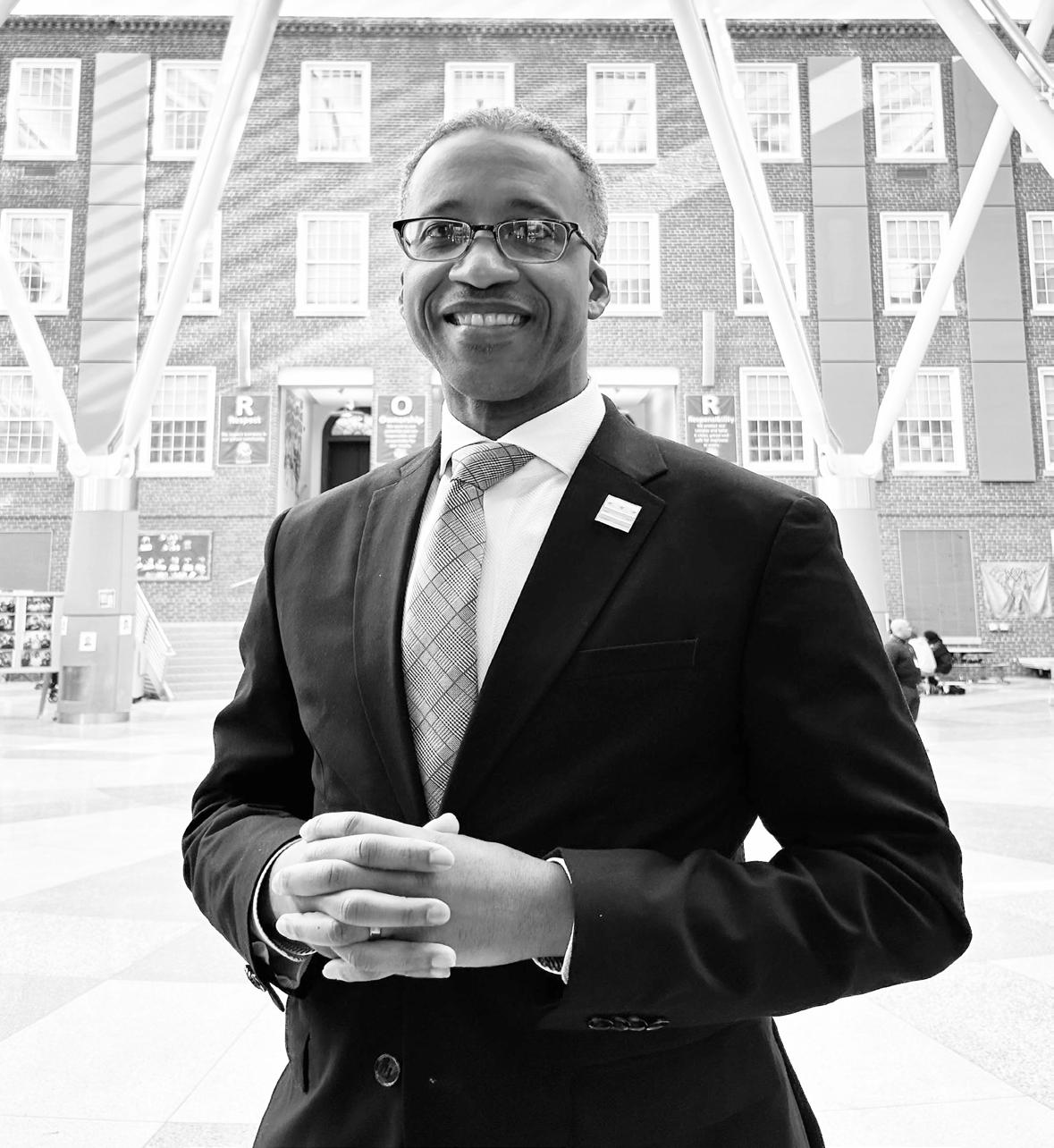
Kenyan McDuffie: from Wilson to the mayor's race
Orly Jossen Junior Editor
Former City Council member Kenyan McDuffie is a fourth-generation Washingtonian who graduated from Jackson-Reed when it was still Wilson. Now he is running for mayor with policies that revolve around two central tenets: equity and economic development.
“We have to make sure that the people who need support and help the most are prioritized,” McDuffie said in an interview with The Beacon.
McDuffie, 51, is one of 8 candidates in a crowded field for the June 16 Democratic mayoral primary. After a successful campaign for City Council, McDuffie was elected as Ward 5 councilmember in 2012 and reelected three times.
McDuffie stressed equity in areas like education and infrastructure. While JR students all have felt the pain of missing a bus or being late because the Metro randomly stopped, not everyone has access to a Metro stop to begin with.
“It’s not just making sure that bus routes are on time,” he said, “but that they even exist in certain communities that have high unemployment rates … [so that people] can get to job hubs throughout DC. ”
If elected mayor, McDuffie pledged to protect funding for the Washington Metropolitan Area Transit Authority (WMATA), expand bus routes, and back the “Regional Can’t Move” modernization plan. He pointed to the Kids Ride Free card as a popular and successful example of transportation that
WALKOUT
from page 1
been taken into custody by ICE.”
Jackson-Reed junior Nati Pinilla was a primary organizer of the walkout. “After seeing a ton of other walkouts at other schools like Prince George’s County, I thought it would be very important and powerful to have one in DC,” Pinilla said.
After her initial idea in January, Pinilla made an
TAG
from page 1
until graduation to continue receiving the grant. However, if participants are under 24, then proof of residency is based on the parent/guardian.
For students starting college in the 2026-2027 school year, the maximum taxable family income is $642,544.
Students whose families combined taxable annual income is above this number are not eligible to receive DCTAG. Students are required to submit the Free Application for Federal Student Aid (FAFSA) and the DC OneApp application.
works in the city. The current agreement, reached by Mayor Muriel Bowser and the union after three years of fraught negotiations, damaged the city's relationship with teachers. McDuffie pledged to “create a high-level labor liaison in my administration so that there is an open-door policy” for teachers to speak with his office.
He also said he would aim
economic and equity issues as the root for many problems in the educational system.
“Our system of public education was created in a way that resource allocation was not equitable,” McDuffie said. He said that the government should work in disadvantaged communities to incentivize “economic activities with community building purposes.”
In McDuffie’s opinion, local businesses like small
to work directly with unions to improve school environments and reduce teacher turnover rates.
When it comes to education policy, McDuffie did not offer a concrete plan for what happens inside the classroom, but he pointed to
Instagram account to spread the word, and students from other schools contacted her about getting involved.
She said she envisioned that the walkout would be student run.
“I didn’t want to limit it to JR, and if we involved other schools it would send a powerful message,”
Pinilla, who is a Beacon junior editor, said.
“I am so proud,” JR sophomore Zoe Caldwell said. ”As a minority and as a young person, it is so important that minors
There are 300 eligible universities for DCTAG recipients. The majority of these universities are public, however there are some private universities.
Applicants attending public universities are eligible to receive up to $15000, however applicants at private DC universities, Historically Black Universities and Colleges (HBCUs), and other eligible private universities can receive up to $3750 each academic year.
Historically, about half of the students receiving DCTAG awards have come from the three DC wards with the lowest household incomes, making this funding vital for educational equity.
the challenges that [students] face and bringing the resources to them.”
McDuffie defended DEI programs, which have come under attack from the Trump Administration, as important for education. “Diversity, equity, inclusion are not terms that are in vogue these days,” he said, but they are “critical to the learning and well-roundedness of our young folks.”
In 2016, McDuffie helped pass juvenile justice reform, which banned juvenile life sentences without parole and solitary confinement. He outlined plans to ensure accountability and opportunity for juvenile offenders, while avoiding the question of juveniles already in the system.
First, he said, “you hold people accountable when they commit crimes to the fullest extent of the law, and you do it swiftly and certainly”.
Then, returning to his economic development strategy, he emphasized creating opportunities for reform and “bringing the resources to them instead waiting for them to show up in some courtroom [again]”.
McDuffie pointed to DC’s Summer Youth Employment Program and Department of Parks and Recreation programs as enrichment opportunities that need to be revisited through an equity lens.
co-op grocery stores and a thriving economy can create a better starting place for students before they enter the classroom. That’s also his approach to truancy, where McDuffie said DC needs to address high student absenteeism by “understanding
stand up for each other and use our young voices and minds.”
Sophomore K’layaha Thomas said the protest showed how students can unite for a cause. “It feels really great to be out here, seeing so many different schools come out here for the exact same thing,” she said.
A DCPS Spokesperson said that DCPS “believes that the safest place for students is in school,” so while they recognize students’ place in civic engagement, the walkout “was
Currently, 50% of JR seniors have completed the FAFSA, a prerequisite to DCTAG applications.
The College and Career Center, run by Ms. Levenson offers many resources to seniors to support them through applying.
According to Levenson, rumors of a DCTAG increase are annual occurrences that almost never become true, and “in a perfect world, DCTAG would cover the out-of-state to instate cost,” which can vary from thousands to tens of thousands of dollars. •
Department (MPD) officer when he was 13 and that McDuffie himself was arrested three times in his neighborhood in Northeast DC as a youth. “I know what injustice feels like,” he said.
McDuffie said he endorses efforts to better train police officers and has supported police body camera legislation in hopes of restoring public trust in the police. In 2015, he backed the Body-Worn Camera Program Regulations Amendment Act, which established transparency and privacy rules for the MPD’s body-camera program.
McDuffie pointed to city legislation he supported to back up his planned programs.
For example, the Neighborhood Engagement Achieves Results Act (NEAR Act) provides, “a public healthbased approach to crime prevention and intervention.”
McDuffie also supported lawsuits by the American Civil Liberties Union against the MPD, and said he prioritizes transparency and accountability around police actions and decisions
McDuffie also acknowledged the District’s problem with federal law enforcement. “The ICE raids have to stop, period,” he said.
The former councilmember also acknowledged the difficult and untrusting relationship many students have with the police.
Speaking of his own experience, McDuffie said that his godfather was killed by an off-duty Metropolitan Police
not a DCPS-sanctioned event and the expectation was that students remain in school.”
They added that students who were absent for the walkout will have the absences marked as unexcused.
At JR, students faced little pushback to the walkout. Many teachers also attempted to facilitate students walking out by pushing back tests and allowing students to make up missed work.
Simona Spicciani, an Italian teacher and sponsor of the Student Government Association at JR, was present at the rally and said she felt “so proud to see how our kids care so much.”
Spicciani said, “As [SGA] sponsor, I encourage students to be active in whatever they are passionate about and take a stand,” and when she “gets to witness that, it’s exciting.”
Philip said at the rally that she was “proud of this school as pretty much everyone I know is here,” and she felt that “our school’s establishment handled it fairly well.”
JR sophomore Windsor Baker agreed, saying that the administration “was really supportive, holding the doors and stuff, telling us where to go.”
McDuffie told The Beacon that would “create a city that is more affordable, that is more opportunity rich, and a government that delivers for everybody across all their wards.” •
Prior to the walkout, the administration at St. John’s College High School threatened to suspend students who left the school to protest. As a result, many St. John’s students joined the protest after school ended.
“Our school has been less than cooperative,” St. John’s senior Tessa Majchrzak, who organized the walkout at the school, said. She said that St. John’s deans waited outside the school at 2 p.m., threatening to suspend anyone who left, which made her and other students late to the protest.
Majchrzak said that since she began organizing St. John’s participation in the rally, she “had to work around our administration and they shot [her] down immediately when [she] brought it up.”
Despite the differences in school policies, students from across the city united at the Lincoln Memorial. “It’s really important how all different types of schools are here,” Maret junior Harry Fishman said, ”It’s really cool that we are uniting here to just say ‘F ICE, get out of our city.’ ” •
However, other schools in the area were less supportive of students walking out.
PHOTO BY CARYS GRAY
MAYBE MAYOR MCDUFFIE: DC mayoral candidate Kenyon McDuffie attended Wilson
JR celebrates Lunar New Year
Greta Bradley-Meal Managing Editor
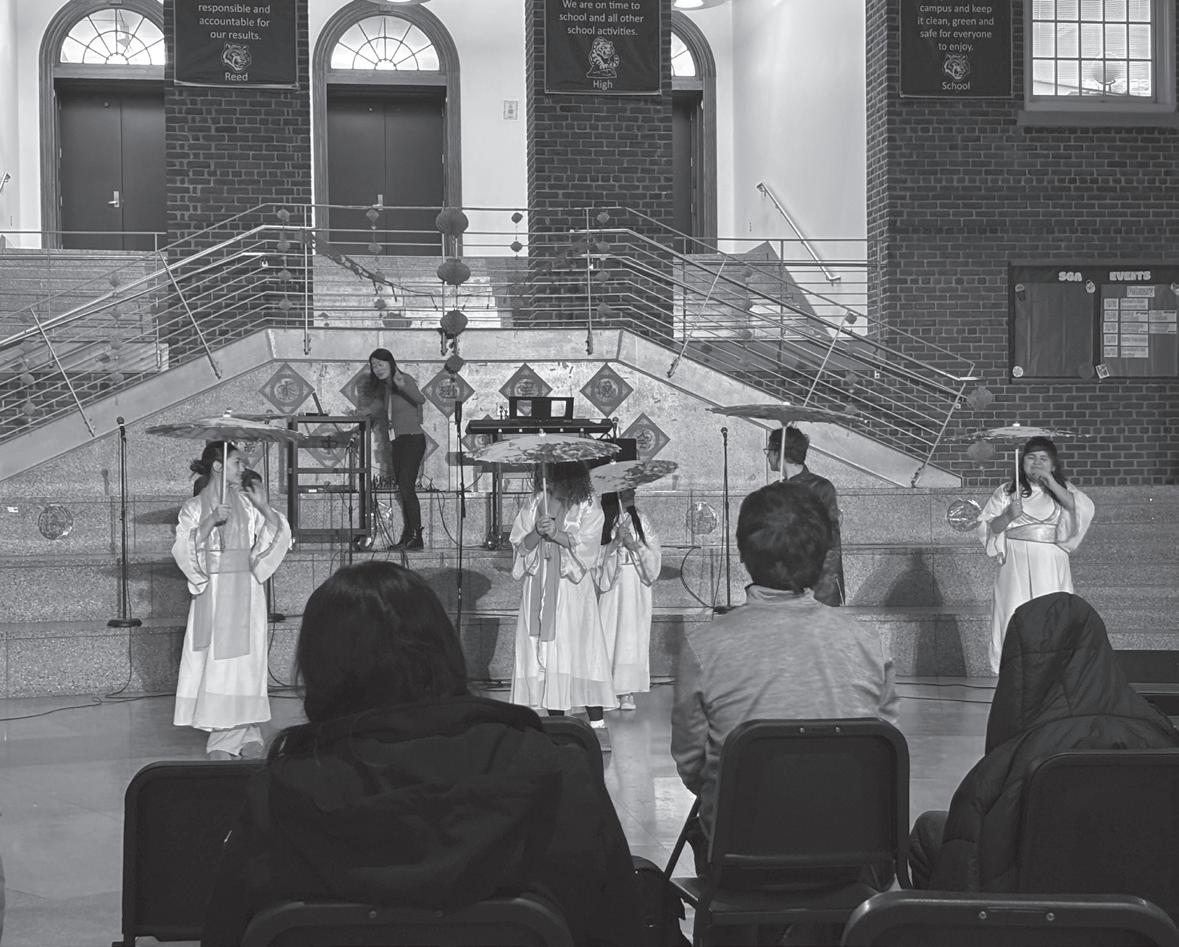
Packed into the atrium on February 25th, Jackson-Reed students, teachers, families and community members gathered to attend the second annual Lunar New Year celebration. The event, lasting from 6-8 pm, was a chance to celebrate the holiday, as well as learn more about the cultures that celebrate it.
Hosted by the Chinese language program, the celebration showcased students' contributions. A variety of free dishes made by JR families were offered alongside a series of student performances, all against the backdrop of the atrium decorated in red for luck.
Each act was designed and performed by one Chinese class, with student and teacher input. The performances included songs, dances, a puppet show, and an interactive trivia set. Students in Chinese classes were encouraged to perform, though they were not the only members of the JR community to share something at the event.
Sophomore Mai Pham returned to perform the Vietnamese version of a happy new year song for the second year.
Though she’s no longer enrolled in the Chinese language program, she decided to come back because the song demonstrates that the Lunar New Year is celebrated in many countries, not just in China.
She added that she thought the celebration was “very heartwarming” and a reflection
of how Jackson-Reed “strives to celebrate diversity”.
Caroline Downs, a senior enrolled in AP Chinese, was involved in the modern basketball dance, which featured students throwing basketballs as part of a dance routine. The dance was choreographed by students in one of the two AP Chinese classes, taking inspiration from a pop music video they had found.
She added that her “favorite part was working together with my class to create the dance”. Noting they “had a lot of fun experimenting with the choreography and practicing in class!”
Other performers echoed this sentiment. Freshman emcee and performer Henry Cai explained that “felt really grateful to be taking
Chinese in that moment”. Cai was one of several emcees guiding the audience through the program of performances. He explained that he was offered the gig during his Chinese III class. Other students in the class performed a song together.
Jackson-Reed students in attendance enjoyed watching their friends perform and learning about the holiday. Senior Amanda Chau specified that she loved seeing “everyone having fun and embracing the culture”.
All in all, the event seems to have been a hit, drawing in members of the Jackson-Reed community and allowing students taking Chinese to demonstrate their talents. •
Women's History spotlight: Civil War hero Mary Walker
Jessica McCallum Features Editor
Mary Edwards Walker is the only woman to have received the US Presidential Medal of Honor since its creation in 1861.
Awarded by the President in the name of Congress, the Medal of Honor is the highest military award and has been given to over 3,500 people. Even centuries later, it remains important to honor Walker’s life and legacy.
After graduating from her parent’s school, Walker went to Falley Seminary in Fulton, New York (NY) before becoming a teacher in Minetto, NY.
She worked to put herself through Syracuse Medical College and graduated with honors in 1855 as the only woman in her class and the second woman to ever graduate from Syracuse Medical College after Elizabeth Blackwell.
After graduation she married another medical student, Albert Miller, and they started a medical practice together in Rome, NY. Their practice didn’t last, though, as people were reluctant to have a female surgeon.
In 1861 when the Civil War started, Walker went to DC to
join the Union Army but was denied as a surgeon for being a woman. She worked as a nurse in temporary hospitals in DC until 1863 when she moved to Virginia and her request to be a surgeon was accepted, making her the first woman to be a US Army surgeon.
As a surgeon, she frequently crossed enemy lines to treat civilians and take in information.
In April 1864, she was captured by Confederate troops for spying, though she would never admit it, and was held as a prisoner of war for four months near Richmond, Virginia.
She was released that following August in a prisoner exchange, and in 1865 was awarded the Medal of Honor for Meritorious Service by President Andrew Johnson.
Along with her work in the Civil War, Walker was an avid women’s rights activist. She refused to wear traditional women’s clothes, and was arrested multiple times for “impersonating a man.”
She was known for her “bloomer costume” of pants with suspenders under a knee-length dress. In her later years, she opened up her home to other women who were harassed or arrested for not conforming to traditional dress ideas.
A staunch believer in a women’s right to vote, Walker tried to register to vote in 1871 but was denied. In 1912 and 1914, she testified to the House of Representatives that the Constitution already grants women the right to vote.
She continued fighting for women’s suffrage with the suffragette movement, but as it became more mainstream she was later ostracized for her choice to wear pants and top hats.
Walker’s Medal of Honor was rescinded in 1916 after the Congressional Committee made stricter qualifications, but she wore it anyway til her death at 86 in 1919, only 18 months before the 19th Amendment granted women the right to vote, Walker was buried in a black suit.
Her legacy has continued to be recognized in the past century.
In 1977, President Jimmy Carter restored her Medal of Honor to her name and in 2012 a 900 pound bronze statue in her honor was made in her hometown of Oswego.
Today Walker can be found on quarters, but more importantly we still see the impact she had on creating a more equal world. •


Tiger Tracks



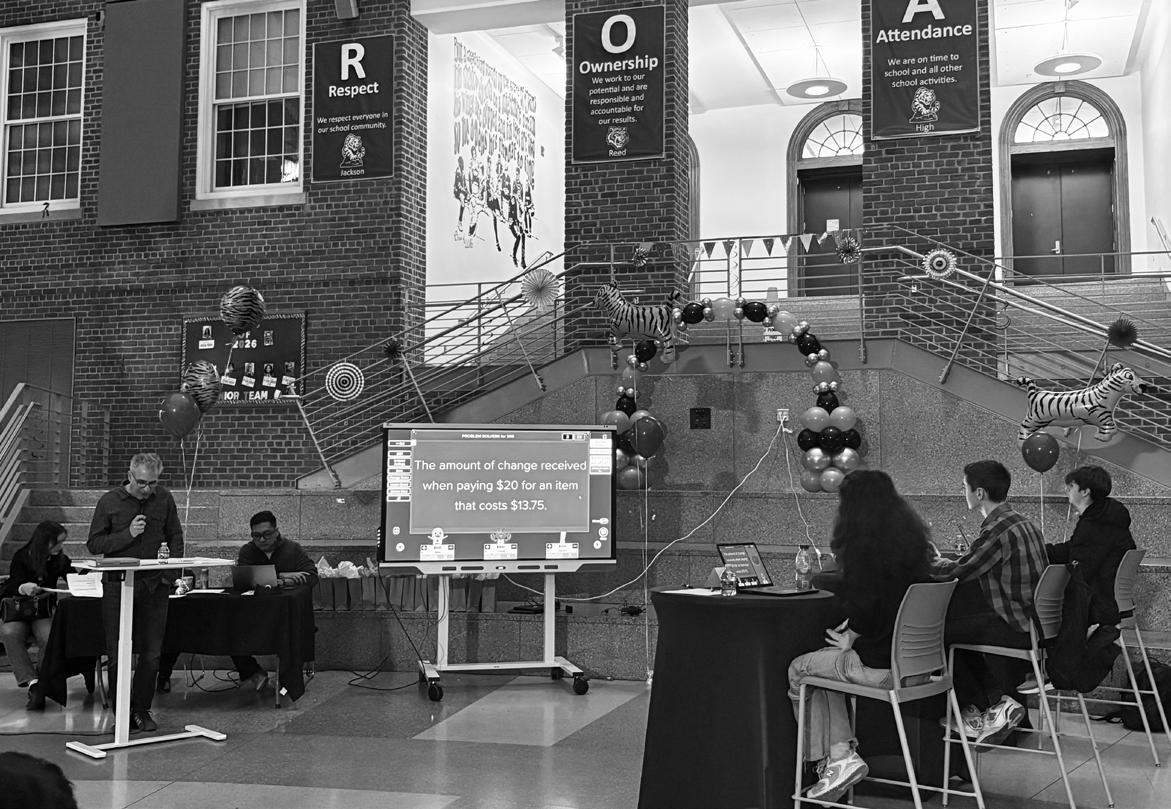
Jeopardy! at Literacy Night with booths and writing competition
Global Studies Academy goes to NYC
Affomia Debebe Junior Editor
The Jackson-Reed Model United Nations Club recently had a conference on Saturday, February 28. The conference was the first ever to be held in JR and had about 15 participants, most of whom were juniors and freshman.
It ran from 9 am to 3 pm and was a World Health Organization simulation centered around the topic: the resurgence of the Bubonic Plague.
In Model UN, participants role-play as diplomats of a country and argue from the perspective of their country about a specific topic. On Saturday, the delegates debated many issues, such as public health strategies and cooperation.
After planning this event weeks in advance, the event became an important milestone as this was the first ever Model UN conference ever hosted at Jackson-
Reed. Under junior Peyton Shum, acting as the conference’s secretary general, JR’s Model UN team worked hard to create an engaging environment that encouraged difficult conversation and stimulating debates.
The team is also looking forward to hosting another event next November, which they hope will have increased participation and that the event can become an annual tradition at JR. Model UN is a great way for students to understand how diplomacy works, sharpen their public speaking and researching skills and discuss uncomfortable but important topics in the world.
If you enjoy learning about current events outside the US, consider stopping by room 208 where the Model UN club meets every Tuesday during lunch. All grade levels are welcome to join, and congrats to the JR Model UN team for planning such a successful event! •
PHOTO BY ALICE PATTERSON
GAMES GALORE – Students play Jeopardy! at Literacy Night. Junior Jet Turner won the competition.
PHOTO BY TAMMY LORENZO
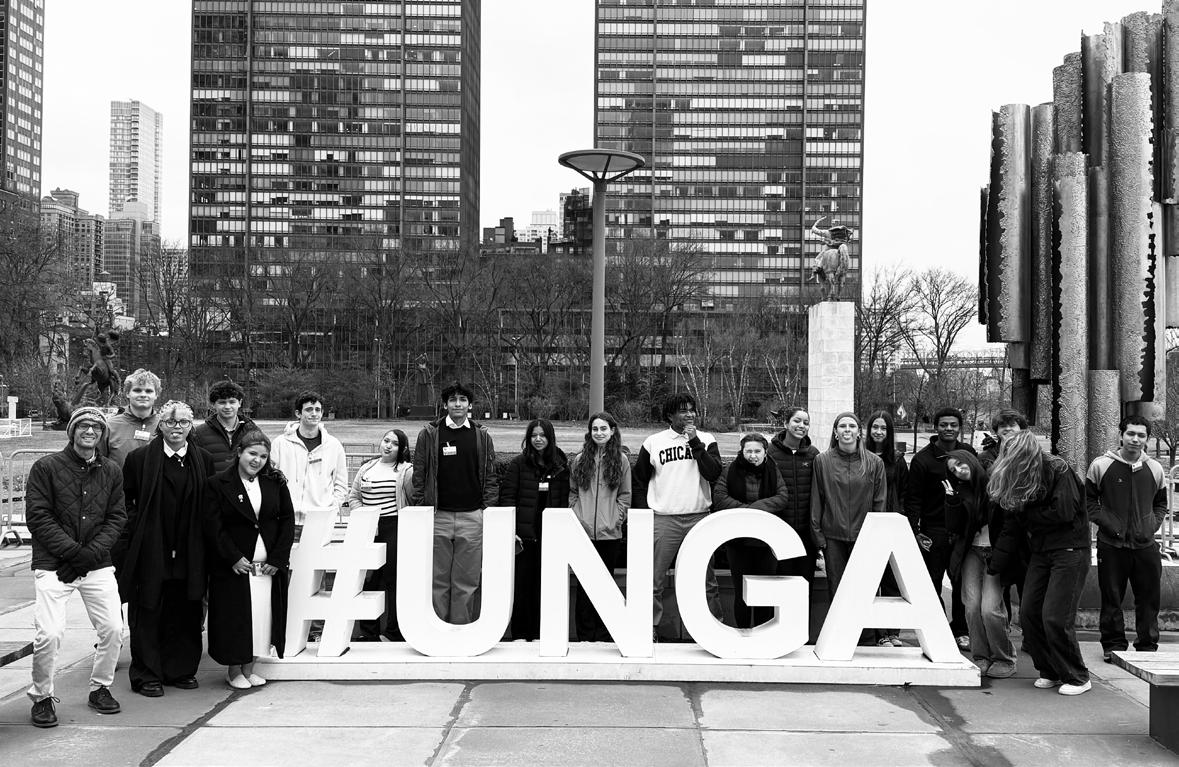
AGS IN NYC - AGS visits United Nations headquarters in New York. The Academy of Finance (not pictured) joined them in NYC.
PHOTO BY MADDIE WOODS
CELEBRATING CULTURE - Students preform a dance at Chinese Lunar New Year Night
Players produce 'Little Women'
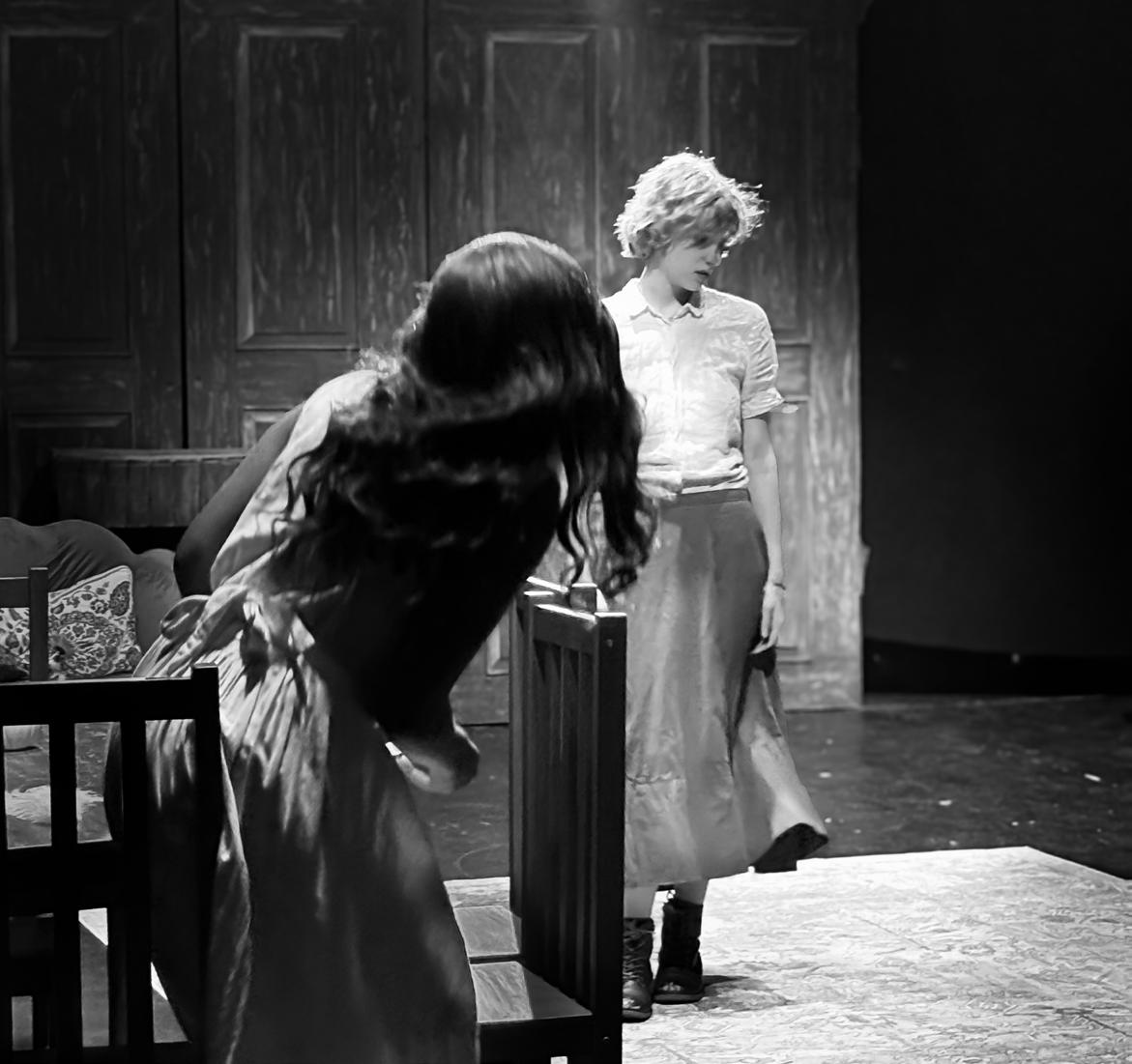
At the beginning of February, the Jackson-Reed Players put on a production of Little Woman in the black box.
Having never been to a Players show, I was, at best, unsure of what to expect, especially considering the fact that the Players are student-run. I went on opening night, and it's safe to say that I was pleasantly surprised with the play; I felt like it truly captured the quaint mood of the book while keeping the fiery opinions and emotions of the lead characters alive.
On top of that, the chemistry between everyone on stage hinted at a strong community between the actors off stage. Finally, it was impossible not to notice the gems of talent hidden in the side characters as well, even if they only had a few scenes, their acting tied together a delightful show.
What’s most impressive, though, was what the cast and crew had gone through just to keep the show running.
On opening night, right before the show started, the director took center stage and explained to the audience that the two snow days in late January had greatly stunted the amount of rehearsal time that the Little Woman cast got.
Nate Bigge, a sophomore who played Robert March (the father), said, “we lost two tech rehearsals, and tech rehearsals [usually go] till 10pm, so we lost like… 12 hours of rehearsal.”
Freshman Maevyn Farrell who played Amy March, one of the sisters, added that the snow was “disruptive” and that they only
Students block out time for Lego Club
Joao Braga Junior Editor
With almost 90 clubs, Jackson-Reed offers a variety of extracurriculars that would put any other high school to shame. Unfortunately, this often leads to many awesome clubs getting buried underneath the sea of options.
So, I decided to go out there and unearth some hidden gems that you might not know of, and as I scrolled through the list of clubs on the JR website, one immediately stood out: the Lego Club.
different amounts of time to complete - the Disney Castle took around two and a half months to finish whereas the tiger head was finished in only two days - students are able to work on different projects they’re interested in.
To get a better idea of what a day at the Lego club is like, I went to one of their meetings and interviewed some members there.
As I helped set things up, I was astonished by the massive boxes of Lego bricks, with dozens of bins separating them by color and style.
had two days before opening night to fully put the show together.
Considering that some productions have two or more weeks of tech rehearsal, the fact that Little Woman was able to do it in two days continues to impress me.
When asked what her favorite part of the show was, Farrell said she liked seeing the whole play come together. “We didn’t have many opportunities to run the play, but once we finally put it all together, it felt like we were completing it and it was very satisfying,” she said.
This further demonstrates the sense of community that seems to be a consistent theme with the theater department. Bigge emphasized the difference between working in a student-run
production compared to a more school-run one.
He highlights that while a school-run one is much bigger and has a lot more moving parts, there is a really nice community within the student-run play that he really enjoyed.
Farrell also described the environment of a student organized production to be more lighthearted, friendly, and fun.
In all, this close-knit group of friends put on an extremely emotional and enchanting performance, despite many challenges that they encountered on the way.
I would go as far to say that this play perfectly embodies the phrase, “the show must go on.” •
As I read the name, I recalled the hundreds of hours I spent playing with them as a kid: the yearning for a new set, the frustration of losing a piece, and the satisfaction of completing a set.
“Over the summer we got some old lego pieces that the Help Desk interns organized, which eventually brought us the idea of starting a Lego club here at school,” said Leila Ackil, one of the founders and co-captain of the club.
Under the supervision of club sponsor, David Thompson, the Lego Club meets every Wednesday after school by the Help Desk, with students enjoying the opportunity to build Lego sets.
Builds have included the Disney Castle, the Taj Mahal, the Neuschwanstein Castle, a tiger, and soon the Notre Dame, which have all been generously donated by the PTSO. As different projects take
Later, I sat down to help them sort the pieces.
Initially I was expecting this part of the day to be boring, yet I quickly realized that the process of separating them was rather “therapeutic,” as Mr. Thompson later described.
It was only when I sat there, holding those little plastic bricks in my hand that I finally understood that the Lego’s themselves weren’t the point.
What made the Lego club special was how Legos were a way to build real connections between the students as they worked together on big and small projects alike.
When discussing the future of the club, Ackil added that the club is excited to go on field trips such as the one currently scheduled to the Building Museum’s Lego exhibit. •
It's not all bad. Strides are being made in climate change.
Miles Heyman Junior Editor
“1.2 trillion tons of ice melt annually.”....“2024 was the hottest year on record.”....“carbon dioxide levels are higher than the past 800,000 years.”....“97% of the Great Barrier Reef has died.”....“Arctic ice volume has declined by 80% since 1980.”
It is easy to see these awful things happening in the world and feel like our fate is sealed, the world is doomed. You might wonder, is anything getting better?
The answer is yes. There is actually so much to be positive about in this world, and often the good things are drowned out by exclusively harrowing news. For example: although the planet is still warming, causes of climate change are slowly being reversed, in particular the top two factors–burning fossil fuels and deforestation.
Let’s start with fossil fuels. Fossil fuels—coal, oil, and gas— are the primary driver of climate change, responsible for roughly 68–69% of global greenhouse gas emissions and nearly 90% of all carbon dioxide (CO2) emissions. They are the primary cause of increases in extreme weather, rising
sea levels, and ecosystem damage.
By contrast, renewable energy sources, like wind, hydropower, and solar, can generate electricity with little to no greenhouse gas emissions, a much safer replacement to fossil fuel combustion.
And guess what? Over the last 15 years, the price of renewable energy has become cheaper than fossil fuels for the first time. In 2023, ~81–91% of newly commissioned renewable power was more costeffective than new fossil fuel alternatives. As a result, in 2025, wind and solar power generated more electricity than fossil fuels in the European Union (EU) for the first time in history. It’s making a difference.
Let’s also talk about deforestation. Forests play a critical role in regulating climate, protecting ecosystems, and supporting human life. They store CO2, produce the oxygen we breathe, and are home to about 80% of the world’s terrestrial species.
But 15 billion trees are being cut down annually, destroying habits, disrupting food chains, ecosystems and rain cycles, and releasing stored CO2 into the atmosphere.
Even so, there is good news.
According to the Global Forest Resources 2025 Assessment,
deforestation has slowed in all the world’s regions in the last decade. Moreover, there are 36 countries that have actually increased their forest cover over the past two decades.
China leads in terms of total reforestation, but mighty Costa Rica has more than doubled the size of its forests over the past few decades.
Now think of this: how easy is it to plant a tree? If everyone planted just two trees, we’d not only offset the 15 billion cut down, but we’d also have a surplus of over one billion trees producing oxygen, reducing CO2 emissions and restoring ecosystems and that doesn’t even include the five billion that are already planted annually. It is so easy for someone to do a small thing, like planting a tree. It may not seem to make much of a difference, but together, it makes an astronomical—or at least planetary—impact.
There’s more. Take the ozone layer. Even though in early September 2000 a hole in the ozone layer expanded to be historically large, spanning the equivalent of nearly seven times the territory of the European Union, our ozone layer is now expected to fully recover by 2066.
The ozone layer is a shield
in the atmosphere that keeps harmful radiation from frying us, our crops, and all living things.
In the 1970s, a scientist named Mario Malina discovered that chlorofluorocarbons (CFCs) emitted from the coolants in air conditioners and refrigerators were damaging the ozone layer.
Nations around the world recognized this problem and signed the 1989 Montreal Protocol—a global treaty that banned CFCs. As a result, the ozone layer has slowly been recovering and is on track for full recovery. It’s estimated that this recovery will have prevented over two million annual cases of skin cancer around the world.
There’s so much more. For example, microplastics, the small
plastic pieces that pollute our oceans, can kill animals from zooplankton to whales.
Well, in Japan, scientists created a plastic that dissolves in seawater and leaves no microplastics. We might finally stop seeing turtles wrapped in plastic bags.
Speaking of turtles, in the last couple years Florida has seen more sea turtles hatching than in the last 40 years.
So next time you read a story about dolphins dying or the planet roasting, remember, there are also good things in this world, you just have to look for them. Or even better, plant a tree and create good things yourself! •
Alex Oh Junior Editor
PHOTO BY CLARE BATES
PLAYERS PERFORM – the Players produce another spectacular, entertaining play, proving why their talents are renouned.
Bad Bunny highlighted the unity this country needs
Nati Pinilla Junior Editor
The Super Bowl Halftime show is one of the biggest platforms that an artist can have to speak to the American public, and this year Bad Bunny leveraged the spotlight to preach unity for all of the Americas.
The NFL’s choice sparked controversy throughout the US though most criticism grew from the argument that Bad Bunny is not American despite him being from Puerto Rico which IS a US territory.
Despite major opposition to the performance from right-wing politicians and advocates, Bad Bunny’s performance reached an impressive 128 million viewers during the performance and another 4 billion views on Youtube in the first 24 hours after the game.
The performance was a demonstration of unity and the beauty of Latin American countries
in a time when people of Latin American descent in the US are under attack.
It, like Kendrick Lamar’s halftime show last year, was not only a musical performance but a profound protest and political statement against the actions of the current administration.
During the actual performance, Bad Bunny paid homage to his home of Puerto Rico by dressing in white and featuring images of sugarcane fields, Toñita, and electrical poles: all symbols of the country's deep history.
The white clothing performers wore represents being well dressed, which also connects to a Latin saying, “Esta vestido de punta en blanco” (Dressed in white/ well dressed).
The sugarcane represents PR’s primary cashcrop in the 19th century and the hard workers producing it.
Toñita, one of the last Puerto Rican social club owners, also received a shoutout in Bad Bunny’s
song “NuevaYol.” The electrical poles represent the constant blackouts PR receives due to weather and hurricanes, like Hurricane Maria.
Bad Bunny ended his performance by highlighting every country in the western hemisphere, which contributed to his overall message of Pan-Americanism and unity throughout all of America.
Bad Bunny’s message showed that love powers through the hateful rhetoric that is being spread around the United States towards immigrants and Latin voices.
Bad Bunny showed everyone watching that love is more powerful than hate, and it encouraged people to continue to stand up to
racism. Bad Bunny also continuously displayed the beauty of Latin America.
This directly opposed the message of the Turning Point Halftime show, which was fueled by division and hate.
Though you might not be a Bad Bunny fan, he captured the hearts of millions and gained respect that brought him high recognition in the fight against discrimination and racial prejudice. •

Early Decision is destroying the college application process
Maria Joyce-Johnson Managing Editor
As a freshman, I was told that the hardest year of high school would be my junior one. I have now learned that that was a lie.
In addition to rigorous AP and honors classes, jobs, sports, and other extracurricular activities, many seniors are expected to spend the first five months of their last year in high school on the grueling process of college applications.
So what has changed? And why does applying to college suck so much now?
The answer is Early Decision (ED). ED is an application pathway that allows applicants to receive their decision sooner — the only catch being that if they are accepted, they are required to attend.
Students are drawn to ED because it increases their chances of admission.
For example, at Tulane University, a popular private school in Louisiana, around 60% of the class of 2027 was admitted through their Early Decision I and II admission plans, which boasted a collective acceptance rate of around 68%.
On the other hand, their non-binding plans, Early Action and Regular Decision, had acceptance rates of around 18% and 3%, respectively, with only around 270 admits from the over 9,800 Regular Decision applications.
Colleges, though, are interested in attracting Early Decision applicants because it increases their yield rate, which refers to the percentage of admitted students that end up matriculating to the school.
The more students a school takes through ED, the higher
their yield rate will be.
With statistics like this, it is easy to wonder why every applicant doesn’t do Early Decision if they have a top choice.
The answer is simple: not everyone can afford it. ED decisions come out before an applicant knows what their financial aid package will look like.
A little over 50% of US high school students complete their Free Application for Federal Student Aid (FAFSA)--students who might not be able to afford school if their financial aid package is too small.
Students cannot sign a contract dictating that they will attend once accepted if they do not know whether they will be able to afford it.
This being said, Early Decision, contrary to popular belief, is not legally binding. Breaking it, however, can affect an applicant's admission to other schools and the admission of future classes from their high school.
Just this year, the aforementioned Tulane announced a one-year ban on admissions from a Colorado high school after a student broke their ED contract.
The issues with college admissions nowadays don’t stop with ED. As applicant pools have grown, colleges have come up with a new way to make admissions decisions: holistic admissions.
Schools have realized that having a high SAT score and strong GPA often cannot provide the full picture of an applicant, and therefore cannot be used as a measure of how successful they will be at a given institution.
Overall, this is a good thing. Kids who might have previously
been ignored by selective colleges due to lower stats now have a chance based on their extensive extracurricular list, creative essays, and personal letters of recommendation.
However, this strategy has created new stress for high schoolers applying to college who can no longer rely on their high stats to get them into schools.
Applicants are now expected to go above and beyond to make themselves stand out among the hundreds of thousands of teens applying to college.
Social media is now filled with ideas on how to create your very own “passion project” or how to conduct and publish college-level research.
Essentially, colleges want to see you cure cancer. This is obviously an impossible feat for most high schoolers applying to college, and this shouldn’t be what is expected of applicants.
College admissions are changing and adapting rapidly, most of which I believe is not for the better.
What used to be a competition of effort and passion has now become a massive lottery that favors legacies and student athletes and creates revenue for the capitalist nightmare that is college counseling.
So, for my fellow seniors (and the juniors that I have sufficiently fear-mongered), I’d like to remind you that this process isn’t fair--you may get into your dream school, but you also may not. Either way, you will end up in the place you are meant to be. •
Democracy is dying with cuts to journalism
Grace Harscheid Sports Editor
The recent Washington Post layoffs, including cuts in sports, book reviews, and Middle Eastern correspondents have been detrimental to freedom of speech and credibility of news in a time of bleak uncertainty. One third of the Post’s staff lost their jobs.
It's especially troubling that the Middle Eastern correspondents and editors have been dismissed when there are so many relevant issues in the region. One could wonder if it has something to do with downplaying atrocities regarding US involvement in the Middle East.
It’s a discouraging sign that accurate and informed reporting in the region is being deprioritized when it’s needed most.
Whenever the world is in turmoil, the media is always one of the first to be attacked, especially during this presidency when many newspapers and media outlets have come under fire. President Donald Trump, and his press secretary Karoline Leavitt, have shown consistent hostility to news agencies and their reporters. Congress has been eliminating federal funding for public media, including National Public Radio (NPR) and Public Broadcasting Service (PBS), which will force further layoffs and reduce local shows.
Journalists working at the Post are grappling with the staff cuts. Parent of a JR junior and reporter Jonathan O’Connell stated, “It feels lonely. There are lots of empty desks around where I sit that, until recently, were occupied by treasured
friends and colleagues. Those of us who are still here are trying to figure out how to do our jobs.”
The layoffs are due to the deprioritizing of certain sections of the paper, influenced by owner Jeff Bezos, as well as declines in viewership and profit in those sections. Over the last five years, the Washington Post has been losing tens of millions of dollars a year.
The Sports and Metro sections have been completely cut, even though they were some of the founding sections of the Post. For many students, the end of these sections has been especially disappointing. Jackson-Reed sports teams’ wins have often been reported in the section, with student athletes themselves being quoted in articles. The Post also featured outstanding high school athletes seasonally in their All-Met selections. This is no longer the case. These articles were a matter of pride for student athletes, as the Post is a nationally renowned paper. It served as recognition for the hard work they put into their sport and the ambition they have. This cut is a blatant dismissal of the importance of sports coverage and the meaning it has to its community.
Both for DC students and for the country at large, these cuts are unacceptable. With local sections of the Post erased, DC has been left without a major news outlet. As the nation’s capital city, we deserve a voice that is representative of the diverse community and values found within the district, and it is only a question of which local newspaper will be able to do this. •
GRAPHIC BY SOLAYA RUTLEDGE
Goodbye snow!
Caroline Wilding Junior Editor
Let’s face it; the snow melting away is the best thing that’s happened all winter.
When the first few flakes fell in January, it was like we had been blessed with a miracle. It gave us days off and twohour delays, all of which we welcomed with open arms.
The snow provided time away from midterm season and work, and I wasn’t complaining, but it was still around two months later, piled up on streets, going nowhere, with us still suffering through school.
The snow actually prolonged the year after snow days added a day to the end of the year and shortened the long weekend in March.
Don’t get me wrong, I love snow. Snow brings me tears of joy, but this wasn’t fun snow.
There was no sledding unless you were willing to break
the snow was fully frozen, I fell right through the mountains at crosswalks, which damaged my pride for at least a day.
When I’m sure it’d melted a bit, it humbled me and I’d fall on ice. Walking outside became public humiliation.
Getting to school was a nightmare, even weeks after the first snowfall. It felt like a survival show where everyone freezes just to get to JacksonReed.
Yes, it was nice to wake up to pretty snow, but I got over it. I’m glad to not have to mentally prepare to walk outside every time I leave the house anymore.
It was briefly fun, but I’m thrilled to get warmer weather and drier conditions, and the fun that comes with it.
I’ve realized that I’m very grateful for seasons. Welcome warmer weather, I’m so happy you’re here. I think I’m good on snow for the next year.•

U.S. is playing a dangerous game in Iran
Time and time again, the U.S. spreads its tentacles and finds itself in another country’s business. Of course, U.S. imperialism isn’t new and this conflict with Iran has not happened in isolation. While many actions that the Trump administration has taken this past year have been unprecedented in U.S. history, intervening in Iran isn’t.
Trump himself has offered shifting justifications for it. At times, he has claimed the goal is to end Iran’s nuclear enrichment program, after failed negotiations. Other times he has claimed to strike Iran to encourage the Iranian people to take back their country; a comment particularly offensive after the deadly bombing of a girl’s primary school in southern Iran. His own administration has undercut his reasonings; Marco Rubio has said strikes on Iran happened preemptively before Israeli strikes.
As I see it, this conflict involves three right-wing extremist entities: the Islamic Republic of Iran, the Trump administration, and the Israeli coalition right. These three right-wing governments are all, in different ways, against the Iranian people and their right to selfdetermination and democracy.
Nevertheless, our complicated history with Iran is not simply a product of its current oppressive regime. Iran was notoriously exploited by Britain through the Anglo-Iranian Oil Company (now BP). In 1953, the nationalization of the oil industry
and the democratic election of Mohammed Mossadegh angered the British, thus the CIA helped to overthrow Mossadegh and install Reza Pahlavi as the Shah (dictator) of Iran. Iran's oil was once again in Western hands.
The CIA coup allowed for Iran to keep half of its oil proceeds, but those proceeds went to a small elite in Iran, and eventually by 1978, Iran was ripe for revolution. Unfortunately, it was not a revolution leading to democratization so much as religious fundamentalism.
Iran is historically only one of many countries the U.S. has interfered in, covertly and overtly. The 2003 invasion of Iraq is a relevant example: false claims of weapons of mass destruction and the Bush administration’s attempts to falsely link Saddam Hussein’s regime to the 9/11 attacks. Like this current conflict, that war was ill-reasoned and also illegal under international law. Those parallels are very worrying. The human consequences in Iraq were horrific; it was essentially a massacre. The tortures at Abu Ghraib being a notorious example of just how awful U.S. imperialism can truly be.
And it cannot go without mentioning that Venezuela plays a crucial role in this: how convenient that the U.S. seeks access to Venezuelan oil, while destabilizing another major oil producer that trades its oil with China. China, in fact, is the largest buyer of Iranian oil.
The possibility also exists that the Trump administration wishes to be at war with Iran to declare a state of emergency and “cancel” the
midterm elections, another scary prospective agenda in this conflict. Neither the U.S. nor Israel can justify their demands of regime change. Foreign-backed regime change in Iran would be illegal and a violation of Iranian sovereignty. Why do we feel the need to intervene in a regime that is already unstable? Iran might have eventually experienced regime change without foreign interference, given the instability it already faced. Iran must be formed by Iranians, for Iranians, not by the U.S. for the U.S.. Another Western invasion only delegitimizes any genuine Iranian-led movement for regime change, as now Iranians must live through not just an oppressive regime, but bombings too.
Evidently, despite Ali Khamenei’s death, the regime will continue to stand. Iran has chosen a new Supreme Leader: Ayatollah Mojtaba Khamenei. He was the son of the previous Ayatollah and had served as his deputy for some time, nodding at a continuation of his father’s strict theocratic rule. Strikes from Israel and the U.S. have already caused many deaths and damage to Iranian infrastructure, with no end in sight. In response, the Iranian regime will likely only become more oppressive as time passes. Like in Iraq, this conflict will only serve to decimate Iran and its people. That is an extremely sad reality for Iranians, who deserve no less than real democracy after so much suffering at the hands of U.S. and Western imperialism as well as religious fundamentalism.•
Everything is political: the polarization of media
Maria Joyce Johnson Riley MacClellan Managing Editor News Editor
These days it feels almost impossible to doomscroll in peace without being shown at least some political content making it onto your screen.
Whether it’s an infamous Dean Withers interview on tiktok or the commercials you hurriedly skip past on YouTube, politics has its claws deep into American media.
On August 26th of 2016 a NFL game between the San Francisco 49ers and the Green Bay Packers caused an unprecedented amount of outrage. Not because of the score or even a cheating scandal--it was the national anthem. 49er’s quarterback Colin Kaepernick kneeled during the customary pre-game playing of the US national anthem.
In the wake of the event, Kaepernick explained that he didn't feel comfortable showing pride for a country that continues to oppress African Americans. The backlash was immediate and forceful. Many criticized his choice to use the national anthem--a symbol of American pride and patriotism--as a platform for his protest, even though his right to do so had ironclad protection in the constitution.
Kaepernick faced the repercussions of this criticism in many ways, but it is most apparent in
the fact that he has not been signed to another team since he terminated his contract with the 49ers. This kind of protest, that is using the attention of the media to protest in front of a larger audience, was not unprecedented but also was not usual.
The first amendment guarantees one’s right to free speech, and while it is ok to disagree with the opinion one is expressing, it is anti-American to argue that he should not have been allowed to share his opinion at all.
This incident began a larger trend of celebrities and public figures using the platform that fame has given them to advocate for a wide range of political causes.
This kind of politicalization is apparent in all types of media including (especially) advertisements. This can happen both intentionally and unintentionally as seen with the controversy surrounding transgender influencer Dylan Mulvaney.
Mulvaney posted a short video in April 2023 promoting a contest by Bud Light and thanking the company for the support of her series “Days of Girlhood.” The consequences following included a massive boycott from conservatives (who make up a large portion of Bud Light’s customers) and a subsequent loss in revenue.
This response begs the question, when does something actually become political? Unlike Kaepernick, Mulvaney’s actions were not motivated in protest and the criticism
she received was not due to what she said but rather that she was the one saying it.
More recently protests have arisen on the other side of the political spectrum over actor Sydney Sweeney’s commercial for American Eagle Jeans in which she rather overtly praised herself for her “good genes/ jeans in a way that many viewers compared to eugenics.
While criticism erupted from the left, the right stood in support of Sweeney as a symbol for conservatives. These examples show the broader issue with politics in ads which is that there really isn’t political undertone to every ad.
However, the current political climate has taught us to seek out politics everywhere – something that will only cause division if we let it go on too far.
As award season has begun, the “ICE OUT” pin has become a common trend amongst celebrities, showing their disapproval of what the administration is permitting through a 1x1 inch pin on their chests. At the Grammys in particular, artists such as Billie Eillish, Bad Bunny, and Olivia Dean all brought up their concerns with the violence in Minneapolis, the lack of representation towards Puerto Rican people, and the mass deportations by ICE.
While these left-leaning speeches were taken well by the press, it is important to note the double standard that is present at these
events. On the same night, Jelly Roll won Best Contemporary Country Album and while accepting his award, pushed the message that his faith got him his Grammy, that he wouldn’t be in his current scenario without God, and that everyone should turn to Jesus to find themselves.
While advocating for his religious beliefs, social media did not give it the air time they provided the anti-ICE speeches, and many users went to their platforms to express their distaste and discomfort over his words. Regardless of political affiliation, it is critical to note how both sides of the story are necessary when consuming any type of media. By denying him adequate space to voice his opinions with the world, we are actively limiting his free speech.
In more recent times, Superbowl LX passed with Bad Bunny as the halftime show performer. Following the announcement of his selection on September 28, 2025, Turning Point USA (TUSA) - the conservative political organization created by the late Charlie Kirk - announced their “All-American Halftime Show” in retaliation.
President Donald Trump and his administration backed this, saying that it is the true American performance. Bad Bunny is Puerto Rican, Puerto Rico being an unincorporated US territory, making all Puerto Rican people Americans; a clarification that was made clear across media platforms
following Trump’s statement. This TUSA-funded show had Kid Rock headlining, a prominent artist who had been a strong conservative advocate throughout his career, as well as country artists Brantley Gilbert and Gabby Barrett.
The Superbowl Halftime Show received a viewership of 128.2 million views and TUSA found around 6.1 million viewers on their Youtube livestream. The Superbowl is viewed as a time to come together (or rival each other) for a common love of sport, food, and entertaining commercials yet in some eyes, politics veered the attention away from the game.
The media drew a great divide between the two halftime performances, separating the internet between those who watched Bad Bunny and those who did not, ultimately shunning those who decided to change the channel.
Social media and pop culture should be a space where free speech is exercised and welcomed, not a place of divide and censorship.
Voicing an opinion or having a different take from the wave of a crowd is taken as a lack in character and is deemed cancellable in current times.
While we may not agree and unite on all ideas, it is crucial that we hold space for conversation over issues to ensure all forms of free speech are seen, heard, and appreciated. •
Dani Ortiz de Prado Spansih Editor
GRAPHIC BY CLARE BATES
Schools need to support walkouts
Jessica McCallum Features Editor
Over the years, predominantly male sports have made efforts to elevate the status of women’s sports teams. Yet, despite these efforts, women’s sports teams remain excluded, undervalued, and discriminated against.
Following their gold medal win against Canada in the 2026 Milan Cortina Olympics, the USA men’s hockey team received a congratulatory call from President Trump, in which he invited the team to the White House and the State of the Union address. During the call, Trump sarcastically said that he would have to invite the women’s team as well, or he would likely be impeached, as if they didn’t rightfully deserve to be there for their incredible gold medal win three days prior.
To this, the men’s team was heard merely laughing. Laughing.
These women worked their entire lives, put in just as much effort and passion, and that is how they are seen by the leader of our country: as a punchline.
So, how much has the sports world even changed from years ago when women weren’t allowed to participate in sports? The idea that every gender is equal simply hasn’t come yet when talking in terms of sports.
Women’s teams don’t get calls congratulating them for playing well and making America proud immediately after their win. No. They get obligatory calls because otherwise there would be damage to someone
else’s reputation.
That isn’t fair.
It isn’t fair to the over three million girls who play high school sports in the US. It isn’t fair to the over 200,000 women who play NCAA college sports. It isn’t fair to the seven-year-old watching women win gold, dreaming of being one of those strong, fierce women someday.
Not only are female athletes disregarded and forced to the sidelines, but female sports fans are often questioned and ignored.
Women are shot down for showing their passion for sports. How often does a woman express support for a team and then face laughs and a round of trivia to prove they are truly interested in the sport? The answer is nearly always.
In hockey, they have been referred to as “puck bunnies,” a derogatory term that assumes that they only attend games for male attention.
We live in a world where empowerment is valued more than it is carried out. Young girls are told they can do whatever they want if they put their minds to it, but that isn’t the case once they grow up. We can have as many Women in Sports Days and preach empowerment as much as we want, but if the actions of our leaders don’t back that up, then it’s all just meaningless words.
Misogyny in the sports world is not gone, even if we’re told otherwise. It’s shown in the way we mentally categorize sports by gender, the pay gap, and in how a female gold medal winning team is reduced to an obligatory phone call and joke. •
A solution to the literacy crisis: reading full books in school
Peyton Shum Opinions Editor
Our generation is currently facing a severe literacy crisis. The average American adult reads at a seventh to eighth grade reading level, and school curriculums are not helping.
DCPS shifted their English and Language Arts curriculum this year to focus on more short stories and passages, rather than full length novels. On top of that, they recently announced a plan to further cut back on reading instruction time next year, an announcement that quickly received community backlash.
As a generation that already struggles with reading and short attention spans, this move is hurting students and their future.
Alice Deal Middle School switched to the CommonLit 360 curriculum this year, where they only read one full novel per year. In eighth grade I read To Kill a Mockingbird and A Raisin in the Sun, but my eighth grade brother is only reading 12 Angry Men, which is arguably a short play, not even a novel.
Middle school is the prime period for students to learn how to sit and read a book, analyze it, and discuss it, but DCPS doesn’t prioritize these skills.
Instead, they are trying to teach kids basic reading skills, which, while important, focuses more on increasing CAPE scores rather than teaching kids comprehension and critical
We need more two-hour delays
Lola Pearlman-Chang Web Editor
We can all agree that there is truly nothing better than waking up two hours later than normal and being able to enjoy the morning to the fullest extent.
There’s no need to rush out the door at what feels like the crack of dawn and arrive in a frantic mess to first period ten minutes late because your car was trapped in ice. Instead, we are given our morning back, our rest, and our sanity.
Two hour delays are the perfect compromise. Not as extreme as a snow day (goodbye another day of summer) and not as cruel as a regular school day, it’s the perfect in between. Even with the ice melting, I say we bring back the two hour delay and make it permanent.
productivity in myself and in my fellow classmates.
The shorter periods might mean less time to work in class, but that also means less time wasted. We’re pushed to get the same amount of work meant for an 80 minute period done in 50 minutes.
There’s no settling in, no side
assignment in five minutes. That quickly turns into fifteen, and suddenly you’re rushing to finish a packet of work before the bell rings.
With a two hour delay, there’s no break, no fifteen minutes of sitting on your computer, just getting straight to the point. So, for those who argue that we’re losing 30 minutes of essential learning time, are we really? If those extra minutes are spent sitting around half awake and distracted, are they actually that necessary?

Besides having a more peaceful morning, I’d like to point out the increase in
conversations, no completing the Wordle while the teacher goes on and on. Somehow, we collectively become more productive.
On a normal day, class feels endless. After getting an assignment, you’ll look at the clock to see an hour left in the period. You take a short break, tell yourself you’ll start the
thinking skills.
DCPS has also shifted away from full length texts in high schools by cutting down the number of books read per year. Last year, as a sophomore, I read five full length books. However, this year they have cut the number sophomores read down to four, nixing The Kite Runner, which was my favorite book last year.
While it had sensitive topics, they were important to talk about and having class discussions on it helped me broaden my understanding of the world.
While DCPS cutting down full-length novels worsens the literacy crisis we are in, there is not much they can do to prevent students from not even reading the singular book they are assigned.
Whether students have too much on their plates, don’t like the hurried reading schedules, or don’t like the book they are reading, many end up turning to
online summaries or AI instead. While DCPS is playing a role in this crisis, they are not the sole problem, nor can they be the sole solution.
Students have to pull their weight, as well.
As students, we need to start reading the books, participating in discussions, and stop chasing the grades. Especially in today’s society, books can provide examples of resistance, which can inspire our generation to speak out against problems in our world.
Continually decreasing attention spans from social media and students reading less in school means that the literacy crisis is becoming one of the most prevalent issues in schools. And while DCPS has a role in fixing it, the first thing we need to do is start reading our books and stop relying on the internet. •
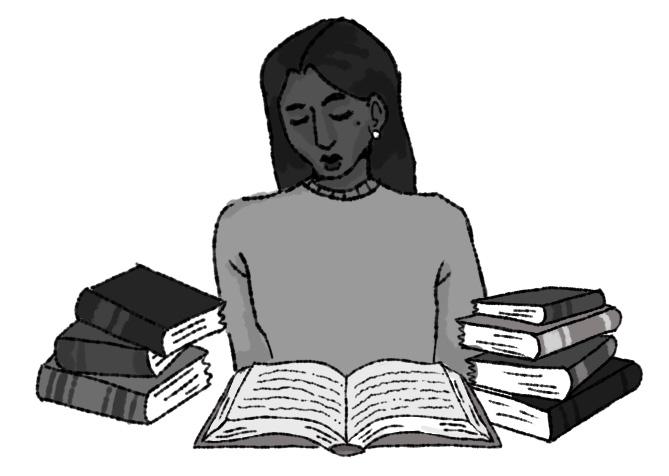
The SAT is better
Avani Patel Features Editor
Students are often told that the SAT and ACT are “basically the same test”, which is a lie spread by counselors, parents, and teachers.
Recently, choosing between the two of them feels less like an academic decision and more like picking which nightmare you’d prefer to experience. But if I’m going to be stressed and questioning my life choices on a random Saturday morning, I’m picking the SAT.
It’s also not just about being more productive; students are noticeably happier when they’re not running on five hours of sleep. Class stops feeling like a punishment, discussions aren’t filled with awkward silences, and group projects become fun. Everyone is magically more alert and engaged. Clearly, a little more sleep can go a long way. So, if it wasn’t obvious, please bring back the two hour delays. Our mornings and our brains will thank you. •
At first glance, most students focus on the time of each test, and no, I’m not talking about how much time you get per question. I’m talking about how long you’re stuck in a chair taking a test.
The digital SAT, with standard time, takes about 2 hours and 14 minutes; this time includes a full 10-minute break between the English and Math sections.
As of 2026, the ACT’s Science and Writing section are optional, so standard time without these additional sections is only 2 hours and 5 minutes. However, you should, for whatever god forsaken reason, choose to add in both the Science and Writing sections to your test, which brings the total time up to 3 hours and 25 minutes. Making it nearly a whole hour longer than the SAT.
While the additional time does benefit some students, I’d rather
focus for a shorter amount of time than deal with the consequences of mentally clocking out halfway through.
Beyond just the total time, the structure of the SAT is much better than that of the ACT. The digital SAT is adaptive, meaning the difficulty of the second module is dependent on your performance during the first module. This design works to the student’s advantage. Along with the structure, the SAT provides you with a formula sheet during the math section, which I love.
Finally, there are the practical considerations to think about when picking which test to take. With the SAT being fully digital, with shorter, faster-paced modules, many students, particularly those with ADHD, find it easier to manage. Furthermore, all SAT accommodations, once approved, always transfer to future test dates. The ACT, which is often paperbased, can feel more traditional, offering a different pacing style that benefits slower readers and those with dyslexia. However, ACT accommodations must be reapproved for each test.
For me, the SAT’s shorter length, adaptive structure, and digital format make it the lesser of the two evils. To all juniors, I wish you the best of luck during this testing season, regardless of which test you’re taking. And to the underclassmen, good luck picking your poison. •
GRAPHIC
GRAPHIC BY
Jackson-Reed High School
3950 Chesapeake St. NW, Washington DC, 20016
https://thejackson-reedbeacon.com/ beaconchiefeditor@gmail.com
CLARA DOYLE, NOA GORDON, and ALICE PATTERSON
Editors-in-Chief
GRETA BRADLEY-MEAL, MARIA JOYCE-JOHNSON, and JAVIER THOMPSON
Managing Editors
CAROLINE REILLY, KALPANA SHIPLER, and SARAH WIESENFELDER
Director of New Staff
VISUALS STAFF
CARYS GRAY and DESMOND PARSONS
Directors of Art and Design beaconvisuals@gmail.com
Assistant Director of Art and Design: Clare Bates
Visual Content Contributors: Lia Zeldes, Irina Filippova, Solaya Rutledge, Clara Doyle, Daniel Krepps, Michelle Bollinger, Niko Brykit, Tammy Lorenzo, Lily Maurer, Cecelia Grant, Maria Joyce-Johnson, Willa Frillici, Benjamin Mack, Belle Belew
EDITORIAL STAFF
ETTA MASON
Copy Editor
RILEY MACCLELLAN and JORDANA SLOANE
News Editors
Written Content Contributors: Angelina Payz
PEYTON SHUM and EVA SOLOMON
Opinions Editors
Written Content Contributors: Julia Kehoury
JESSICA MCCALLUM and AVANI PATEL
Features Editors
Written Content Contributors: Miles Heyman
CECELIA GRANT and DANIEL RAVIV
Spread Editors
ISABELLA MARA ORNSTEIN and DANI ORTIZ DE PRADO
Spanish Editors
Written Content Contributors:
SAM BIGGE and GRACE HARSCHEID
Sports Editors
Assistant Sports Editor: Sam Bensky
Written Content Contributors: Tinsley Barmeyer, Ingrid Russell
PADGET BOWERS-SHREVE and WILLA FRILLICI
Style Editors
Written Content Contributors: Vivian Whitelaw, Rose Gershekter
BEN HOLLAND
Games Editor
WRITTEN CONTENT EDITORS
Esme Nooruddin, Meredith Page
SECTION COPY EDITORS
Tessa Frantz and Cole Anderson
JUNIOR EDITORS
Georgie Ley, Andrew Dellabella, Nati Pinilla, Patrick Hutchins, James Fowlkes, Idan Kumin, Affomia Debebe, Francisco Blancato, Alex Oh, Elsa McIntyre, Landon Green, Kate Walter, Sofia Amin, Giacomo Tomaino, Joao Braga, Caroline Wilding, Alexa Lucas, Ben O'Toole, Miles Green, Orly Jossen, Adrian Pinto, Desmond Parsons, William Pfaffenroth, Arabella Bernstein, Eliza BowersShreve, Uli Ferrero, Alex Garcia, Alex Rogers
WEBSITE STAFF
LOLA PEARLMAN-CHANG
Web Editor
NATALIA WEINSTEIN
Multimedia Editor
Respect female athletes. They deserve it.
By The Beacon staff
Over the years, efforts have been made to elevate the status of women’s sports teams. Yet they remain excluded, undervalued, and discriminated against.
After winning gold against Canada in the 2026 Milan Cortina Olympics, the USA men’s hockey team received a congratulatory call and invitation to the White House from President Trump. During the same call, he made a joke mocking the women’s team, who had won gold three days prior.
Despite promises to secure equal rights and opportunities for women in sports through Title IX and the creation of leagues designed for women, misogyny is still apparent in the sports world. Not only in the pro leagues, but also at Jackson-Reed.
Girls’ basketball has proven itself to be a strong team this year, especially – winning the DCSAA championship, – yet they still don’t have the same attendance or promotion as the boys’ games do. The football team has been repeatedly given field priority over any girls’ practices, despite not winning many games, forcing teams to reschedule. Misogyny in the sports world is far from gone. It’s shown in the way we mentally categorize sports by gender and by the way a female team could win Olympic gold three days before a male team, just to end up being another punchline. We need to put more time, funding, and support into JacksonReed’s incredible girls’ sports teams. •
100 word rants
media
I’m sick of media outlets being full of right and left-wing advocacy. Neutrality in news seems to be a thing of the past, and it’s taking away the fundamental values that make the media what it is. People want a reliable, trustworthy outlet that isn’t geared towards a particular political party, and I’m sick of outlets that report with a reliance on a specific set of values that coordinate with the party that they’ve chosen to align with. It censors and changes the accuracy of news. The media as we know it is evolving, and news is supposed to report on politics, not be it.•
WINTER
Hot take: winter is the worst season. Summer brings heat, sun, and, most importantly, no school. Fall embodies cute sweaters and crunchy leaves, while spring has perfect weather, and, best of all, my birthday! Winter is the season of sweats, indoor practice, and seasonal depression - not to mention the weather always being freezing. Sure, hot chocolate and sledding are fun for a while, but I’m sick of burning my tongue and having to climb over straight ice every day just to get to school. The best version of winter only lasts a week - I can’t take this snowy sadness much longer! •
SHIPPING
Eliza Bowers-Shreve
Why has online thrifting gotten so expensive? I’ll give you an answer: shipping. Shipping prices have gotten wildly extreme, mainly on sites like Goodwill, Poshmark, and especially Depop. These prices are astronomical; the highest I’ve paid for shipping recently was $12, and that’s almost unspeakable. Honestly, the fact that I’m ashamed to admit how much I paid for shipping is awful. The whole point of thrifting is that you’re paying less since the item’s used. It’s supposed to be ethical and economical, not insanely expensive. I hate that the shipping price of my purchase is more than the item.
Padget Bowers-Shreve
Arabella Bernstein



2014 gay rights protest at Wilson
On June 9, 2014, students flooded the streets surrounding the school with one goal in mind: supporting the LGBTQ+ community. The week earlier, Principal Pete Cahall had come out to the Wilson student body in honor of Pride Week. His announcement was met by support and encouragement from the surrounding community, however, this could not be said of the Westborough Baptist Church (WBC) in Topeka, Kansas.
The church, known for their hate speech and cult-like tendencies, announced on May 25, 2014 that they would be coming to Washington, DC to protest institutions they thought were too tolerant of homosexuality like the Supreme Court, U.S. Holocaust Museum, and of course, Wilson High School. The group had announced their intention to protest at the end of May, citing Wilson’s second annual Pride Week as the reason for their visit.
However, during the aforementioned Pride Week, Principal Pete Cahall publicly came out as gay during a school pride event at lunch–an announcement that was met with encouragement and support across the Wilson community. Class of 2014 graduate Tao Marwell revealed that she had
“so much respect for him to be able to do that,” adding that it was a “very brave thing to do.” DC community leaders echoed the sentiment.
Former mayor Vincent Grey said “there is nothing worse than walking around having to hide who you are.”
In the wake of the church’s announcement, Wilson students immediately got to work. Nearly 1000 people joined sophomore Kellik Dawson’s and freshman Brain Keyes’ Facebook group, called “The Westboro Meet-andGreet Facebook event,” which urged community members to attend a counter-protest. Other organizers included the SGA and GSA, with extra help coming from biology teacher Chris Obermyrer, who was a co-sponser for GSA.
Upon the morning of June 9th, students flooded Wilson’s driveway and the surrounding streets. Students boasted brightly colored signs, sang “I’m so glad I go to Wilson High,” and cheered loudly as Principal Cahall proudly waved a rainbow flag. Class of 2015 alum Mia Strazella said “there were hundreds of us–we vastly outnumbered WBC.” This could be clearly seen just blocks away on the corner of Nebraska Avenue and Chesapeake Street, where 10 WBC members picketed

the event from afar and braindished signs covered in hate speech and homophobic slurs. When asked why the church decided to pick Wilson, Rebekah Phelps Davis, daughter of church founder Fred Phelps, said, “They’re so determined to cram the homosexual lifestyle down the throats of the children that go to this school that they’ve stepped up the rebellion by having a gay pride fest.”
However the counter-protest had already evolved to be more powerful than the closed-minded views of the WBC, it became a celebration of love and acceptance for the whole community. •
Students walk out after 2016 election
Amanda Chau Contributor
On November 15, 2016, over 2,000 students from across Washington DC staged a walkout to the Trump Hotel and Capitol Hill, in protest of Presidentelect Donald Trump. Students from Jackson-Reed High School (then Wilson) participated in the walkout, leaving their classes to join the march which consisted of both signs and chants.
The protest, which attracted students from schools across the city, was organized by senior Matias Cano who was a leader of Wilson’s Human Rights Club at the time. Cano clarified that the protest was not meant to be anti-Trump, but rather a celebration of unity because according to Cano, “this is a time when we need to come together.”
Students linked arms surrounding the Washington monument as a direct response to Trump’s push to build a wall at the U.S.-Mexico border. It was widely supported by students and staff, some students even saying that staff cheered them on as they were leaving the building. Many boasted signs celebrating diversity
like “My black is beautiful” and “Make America Gay Again” proving that the protest was not about the democratic process of the election, but rather making their demands heard to the incoming administration.
Despite a large population of Wilson students walking out and leaving for the march, it was stressed that their absences would not be excused, as the school believed that they could not “ensure the safety of any student” during school hours. Students at other schools in the area, like Sidwell, received excused absences if their parents were able to verify that they were permitted to participate in the walkout. It was made clear by administrative staff at Wilson that it was not a school or districtsanctioned walkout and that was a completely student groupled walkout, but former Principal Kimberly Martin also emphasized that they would defend Wilson’s students conditional right peaceful protest. The walkout was an incredible success. It united DC schools in an unprecedented way demonstrating that the younger generation was ready to make change when given the opportunity to do so. •
Vietnam War walkout put down by Wilson administration
Daniel Raviv Spread Editor
In May, 1970, Kent State University (KSU) students held what would become one of the most shocking anti-war protests in American history.
A few days into their deployment, National Guardsmen unloaded bullets into a crowd of gathered students, causing the deaths of four demonstrators. This immediately caused widespread backlash throughout the country, as the government shooting at unarmed protestors was unheard of then.
Following years of escalation, drafts, and tens of thousands of American deaths, President Richard Nixon finally promised to start bringing home the troops left in Vietnam. However, in April, 1970, Nixon announced to the American public that the United States was planning a major invasion of Cambodia after months of bombings. This sparked immediate public outcry, and campus protests were held all over the country. The protests at KSU were particularly chaotic, with the Ohio National Guard being sent in.
At the time, Wilson students were extremely invested in the Vietnam War, and following the fatal shooting at KSU, tensions were high.
On May 6, the Wilson Student Council met with Principal Maurice Jackson to discuss the possibility of striking and marching to the Capitol the following day. Initially, the Council had the support of the administration, but plans quickly fell apart the following day.
reversed his support for the protest and said that any student who participated in the walkout would be failed in all their classes for the day. The vast majority of students gave in and returned to class. Around 100 students still left and marched to the Capitol, but the demonstration was considered a failure.
On May 7, hundreds of students gathered in the stadium in preparation to march to the Capitol. However, Principal Jackson

Half a century later, JR students face similar problems when planning student protests. The school does have a responsibility to maintain orderly school days and not let things get out of hand, but the debate rages on over how much freedom students should have when planning protests. However, they nonetheless continue to be a powerful and effective form of activism. •

Maria Joyce-Johnson Managing Editor
PHOTO COURTESY OF MICHELE BOLLINGER
COUNTER PROTEST - Hundreds of Wilson students rally to support gay rights
GRAPHIC BY CLARE BATES



Buddhist monks' Walk for Peace arrived in DC
On February 20, 19 Buddhist monks concluded their fifteen-week “Walk For Peace” by trekking into our nation’s capital. Driven by a simple yet powerful mission of advocating for peace and compassion in an increasingly polarized society, this group of Buddhists traveled over 2,300 miles from Fort Worth, Texas to Washington, DC with the support of millions.
Their journey began on October 26th, 2025, where these monks traveled from various Theravada Buddhist monasteries across the world to meet at the Huong Dao Vipassana Bhavana Center in Fort Worth. They were led by their leader, Pannakara, the vice president of the Fort Worth temple. A peace walk is considered a cherished and admirable tradition in Buddhism, which its members take extremely seriously.
Long Si Dong, a spokesperson for the temple describes how the walk isn’t a political movement, but rather a deeply spiritual one. He notes that “it is a spiritual offering, an invitation to live through everyday actions, mindful steps, and open hearts. We believe when peace is cultivated within, it naturally ripples outward into society.”
This ideology seems to ring true across the Buddhist community, with some even committing to this already strenuous, icy journey barefoot, in order to be more grounded and present in the movement.
The monk’s presence has also become largely sensationalized through social media, where millions have shown support by walking with them or through silent observation, a sign of respect within the Buddhist community. Upon entering DC, these monks were escorted on their journey by the Metropolitan Police Department where they made their initial stop at
the Washington National Cathedral, only minutes from our school. Students like JR Freshman Sam Yarkin chose to engage in this historical event on Tuesday, February 10th, remarking on how moving an event it was. Yarkin was one individual amongst the thousands who showed up to support this mission for peace. He described how exciting and inspiring an event this was, filled with people across different ages and different interfaith communities who all held shared ideals of peace in the face of a deeply divided nation..
The Walk For Peace offers a contrasting perspective to the troubling realities of today’s world, focusing upon shared humanity and compassion and acting as a beacon of hope and unity. It has transcended limitations of disconnect within our society, whether that may be faith or differences in political ideology, through simple protest. •
The advocacy behind Wilson’s name change
Eva Solomon Padget Bowers-Shreve Opinions Editor Style Editor
On March 15, 2022—after almost two years of student activism —Woodrow Wilson High School transformed to Jackson-Reed High School.
The name was changed to honor two pivotal figures of Jackson-Reed: the first Black teacher, Edna B. Jackson, and the first Black principal, Vincent E. Reed, and to disaffiliate the school from former President Wilson.
During and before the COVID-19 pandemic, protests and debates called attention to Woodrow Wilson’s segregationist activities, discriminatory policies, and the historical connotations that his name held for the school.
both opposition and support from students and staff. Many students initially opposed the decision due to the impact it would have on the school, describing it as an adjustment that would require changes to athletic gear, school renovations, and graduation materials, resulting in an estimated $98,000 spent on uniform rebranding alone.
Former Editor-in-Chief of the Beacon and 2023 graduate Hadley Carr voiced her observations, saying, “It seemed like community members were not in favor of the name change. In my classes, many students seemed to view the name change as unnecessary.
On sports teams, more students were upset because it would mean a complete change to their uniforms.”

Over 22,000 signatures and a letter to Mayor Muriel Bowser were gathered by the DC History and Justice Collective in support of the name change, with the DC Council eventually settling on the name “Jackson-Reed” to tribute the school’s history and its crucial figures.
Many former alumni echoed the views of their fellow graduates, and members of Jackson-Reed faculty also vocalized their positions on the change.
Current staff members, such as APUSH teacher Michele Bollinger and 9th Grade Assistant Principal Marc Minsker, were figures who spearheaded the campaign at JacksonReed and acted as crucial advocates of the school’s name change.
Minsker says, “I didn’t start the petition, but in Ms. Bollinger’s and Mr. Geremia’s DC History classes, students had already talked about the need to change the school name based on their understanding of Woodrow Wilson.
For Black History Month in 2019, we organized a program in the auditorium for DC History classes about Reno City with students from DC History and Justice Coalition participating to spread awareness and collect student signatures.”
During debates over the name change, the school was subjected to
While some students and staff viewed it as a difficult and unrealistic change, others advocated for the school’s advancement away from its discriminatory roots. Max Karp, a graduate from 2020, stated, “Thinking back, I don’t think there were any real protests, but there was definitely a lot of support for changing the name. I remember it being more of a process led by DCPS, where students had input and could vote on whether they wanted the name to be changed or not.”
When speaking of President Wilson, Bollinger mentioned how teachers organized petitions and wrote letters to DCPS and the city. Following the Black Lives Matter movement, the debate over changing the name intensified, with proponents of the change citing the Black Student Union at Princeton University, which had fought to rename one of its buildings that was also named after Wilson. B ollinger believes that the Princeton community was able to agree on the name change; however, when the discussion was brought to the panel, it consisted of students,
alumni, and teachers who had to accept it.
“We had laid the groundwork, and groups like the Black Student Union had events around the issue,” Bollinger said, mentioning that “naming your school after a segregationist and racist affects everyone at the school.”
After ongoing debates in 2020, “August Wilson” was also brought up as a possibility.
This option also garnered mixed reactions, with many students supporting the decision as it wouldn’t require the alteration of any materials or gear, and it would honor the memorable African American playwright; however, some considered it a hasty solution that wasn’t effective enough to eliminate the shadow that Woodrow Wilson had cast upon the school.
Most current students are in support of the name change, and it’s important to note that the Class of 2026 is the first to enter the school under its new name. All in all, the final decision created a name that honors figures who created the educational institute that is JacksonReed and memorializes the vital educators who came before us. • and proving about the their incoming population out was would school “ensure during other Sidwell, their that participate clear Wilson districtthat it groupPrincipal emphasized Wilson’s to incredible schools way –younger make opportunity


Cecelia Grant Spread Editor
GRAPHIC BY CLARE BATES
PHOTO BY BELLE BELEW
MONKS MARCH - Buddhists walk down Wisconsin Avenue towards the National Cathedral, part of their “Walk For Peace” across the nation
El Super Bowl impulsa el amor y respeto en tiempos de incertidumbre
Genesis Angarita Colaboradora
Todos, alguna vez en nuestras vidas, hemos sido impactados por la música. Una canción puede convertirse en refugio, en memoria, e identidad. Para millones de personas, ese impacto ha llevado el nombre de Bad Bunny. Desde que empezó su carrera en la industria musical, Benito Antonio Martínez Ocasio ha transformado no solo el reguetón, la manera en que música latina se posiciona el mundo. Álbumes como X100PRE, YHLC MDLG y Un Verano Sin marcaron a toda generación. Además, proyectos más personales
El Último
Latinoamérica, rindió homenaje a su tierra y lanzó un mensaje de unidad a un país profundamente
en cada puesto de comida se mezclan sabores, acentos e historias.

Mundo y Nadie Sabe Lo Que Va a Pasar Mañana demostraron su versatilidad y marcaron la diferencia en la carrera de Benito. Su reciente
álbum, ‘Debí Tirar Más Fotos’, reafirma su compromiso con la memoria, la identidad y sus raíces, representando a millones de Latinos en todas partes del mundo. A lo largo de los años, Benito ha hecho historia rompiendo récords, cantando en en los escenarios más grandes del mundo y defendiendo con orgullo su cultura puertorriqueña. El 8 de febrero de 2026 en el Levi’s stadium de Santa Clara, California, ese impacto cultural alcanzó una nueva dimensión cuando el artista ofreció un espectáculo histórico en el “Super Bowl” posicionándose como el medio tiempo más visto en la historia juntando un aproximado de 142 millones de espectadores. Con una presentación casi completamente en español, algo inédito.
Bad Bunny puso esas realidades en el escenario más grande del país y las convirtió en símbolos. Nos recordó que ser latino en Estados Unidos es trabajar duro, apoyarnos entre nosotros y nunca soltar nuestras raíces. Como dijo en su presentación: “nunca deje de creer en mí, tú también deberías creer en ti, vales más de lo que
Para los 68 millones de latinos que viven en Estados Unidos, muchos de los cuales han enfrentado en el último año redadas, deportaciones e injusticias, el momento tuvo un
Los emigrantes han vivido con temor ante operativos del Servicio de Inmigración y Control de Aduanas (ICE), familias han sido separadas y comunidades enteras se han visto muy
El Carnaval continúa siendo una tradición que representa el orgullo latino
Alex Garcia Editor Adjunto
El carnaval es una de las celebraciones más alegres y coloridas del mundo de habla hispana. Normalmente, se celebra en los cuarenta días antes de la Cuaresma, o antes de la Pascua. Durante esta fiesta las calles se llenan de música, trajes y bailes. Es un momento en el que toda la comunidad se reúne para celebrar con diversión y entusiasmo, con alegría
ejemplo, en Río de Janeiro, Brasil, los desfiles de samba llenan las calles de color y música y en Barranquilla, Colombia, las calles se llenan de comparsas y bailes muestran la alegría e historia.
En medio de la incertidumbre, Bad Bunny usó el escenario para ampliar la definición de lo que significa ser americano usando la frase “God America” y procedió nombrar varios países de todo el continente americano, no solamente Estados Unidos.
sintiéndose en cada esquina y miles participando para mantener esta tradición.


Bad Bunny convirtió 13 minutos en un manifiesto cultural.
Entre reguetón, salsa y referencias no solo a la historia de Puerto Rico sino a toda
barrio que escucha chismes, que prende la plancha antes de que salga el sol, el barbero que entra con las máquina y tijeras, arma comunidad, el que vende oro, el que tiene su tiendita, el que se rebusca como puede para mandar dinero a casa y echar pa’lante. Son trabajos humildes, sí, pero llenos de dignidad, esfuerzo y orgullo, que representan a los migrantes a donde quiera que vayan. Eso es lo que mueve a la comunidad latina en Estados Unidos. Son esas manos las que levantan negocios, sostienen familias y mantienen vivas nuestras costumbres lejos de casa. En cada salón de belleza se habla español sin miedo, en la barbería suena música latina,
Recordó que América es un continente, no solo un país, y que la cultura latina es parte esencial económica, social y cultural de Estados Unidos. El espacio simbólico que creó en ese escenario refleja el mismo espíritu que durante décadas ha existido en comunidades latinas como el ‘Caribbean Social Club’ de Nueva York, lugar donde los emigrantes encuentran refugio, identidad y familia. Bad Bunny no solo cantó, encapsuló historias, luchas y celebraciones en un acto de representación cultural. En un momento de incertidumbre para millones, su voz fue como un recordatorio de que el amor por las raíces no se deja atrás y que ese amor nos impulsa y nos identifica porque la cosa más poderosa que el odio, es el amor. •
Uno de los elementos más importantes del carnaval son las comparsas, las carrozas decoradas con figuras. También, las reinas del carnaval, la tradición y el espíritu festivo de cada celebración. Además, las personas se disfrazan con trajes y máscaras y, en algunos casos, se lanza agua, harina, confeti, y hormigas.
El carnaval se celebra en diversos países, cada uno con tradiciones diferentes. Por
En Venezuela el carnaval de ‘El Callao’ presenta desfiles, carrozas y música de calipso. En Santa Cruz de Tenerife, España, los concursos, comparsas y la coronación de la reina. En Oruro, Bolivia, los desfiles y danzas tradicionales, entre otros países.
El carnaval no es solo una fiesta, también es un evento que muestra nuestra cultura y tradiciones. Nos recuerda que es importante compartir la alegría y divertirnos juntos. Los desfiles, comparsas y carrozas muestran la creatividad de cada comunidad. Al final, el carnaval une a las personas y hace que nuestra cultura se fortalezca entre bailes y risas.•
Leyendas mantienen la curiosidad ancestral
Alex Garcia Editor Adjunto
El mundo hispano tiene muchas leyendas que se han ido contando de generación en generación. Estos relatos reflejan la cultura, la historia y las tradiciones de cada país, y muchas veces sirven para explicar el origen de fenómenos, lugares o costumbres. Pero ante todo, muestran la creatividad de las comunidades y mantienen viva la imaginación Un ejemplo es el de La Llorona en México. Se dice que La Llorona, una bella mujer transformada en un espíritu blanquecino, vaga cerca de ríos por las noches buscando a sus hijos, a quienes ahogó tras ser abandonada por su marido. La historia no solo se utiliza para infundir miedo y advertir a los más pequeños que no salgan solos de noche, sino también como una forma de expresar un trauma colectivo de los pueblos indígenas, diciéndose que su espíritu llora tanto por sus hijos como por todo lo que perdió su
pueblo tras ser conquistado: su lengua, su tierra y su historia. En Venezuela, ‘El Silbón’ es un espíritu que recorre los campos con un saco de huesos. Su silbido anuncia su presencia, y puede confundir a las personas. En Colombia, ‘El Mohán’ es un guardián de los ríos que aparece en la noche para proteger la fauna y el agua. En Perú, ‘el Pishtaco’ es un ser que aparece en los pueblos y provoca miedo entre las personas que escuchan su historia. En Chile, ‘La Pincoya’ es un espíritu femenino que protege los mares. En Guatemala, ‘El Sombrerón’ es un personaje misterioso con un sombrero grande. Toca la guitarra y encanta a las jóvenes mientras les hace trenzas en el cabello.
Las leyendas no son solo cuentos de miedo o misterio. También enseñan valores, creencias y tradiciones de cada país. Por medio de estas historias, las personas recuerdan su pasado y aprenden sobre su cultura. •
GRAFICO HECHO POR IRINA
La comunidad de JR se une para protestar contra ICE
Isabella Mara-Ornstein Editora de Español
Los gritos de casi mil estudiantes resonaron en el Lincoln Memorial el pasado viernes 27 de febrero, cuando alumnos de distintos colegios públicos, privados y religiosos del área de Washington D.C se reunieron para protestar contra las políticas del gobierno y las medidas que ha tomado ‘ICE’, las cuales afectan de manera desproporcionada a las comunidades latinas y generan preocupación y miedo en familias que temen por su seguridad y estabilidad. En Jackson-Reed, los estudiantes salieron de sus aulas durante la tercera clase y se dirigieron juntos hacia el metro. Vagón tras vagón se llenó de alumnos sosteniendo carteles con mensajes como “Immigrants make America great again”, “My parents fought for my future. Now I
will fight for theirs.” y “Keep the beauty of diversity”. Al salir de la estación, los estudiantes caminaron juntos hacia el monumento. La música latina sonaba desde altavoces, y a medida que avanzaban por las calles, la gente los alentaba con sonrisas y gestos de apoyo. Durante la caminata, un par de señoras provenientes de Florida se acercaron para expresar su cariño por la causa. Comentaron que, en su estado, los estudiantes enfrentan muchas más restricciones para protestar, y que ver a tantos jóvenes alzando sus voces les daba esperanza.
Al llegar al Memorial de Lincoln, la magnitud de la protesta se hizo evidente. Estudiantes de numerosos colegios ya estaban reunidos, formando una multitud de casi mil personas. Fue allí, frente al monumento, donde los cantos como “No justice, no peace.

ICE off our streets” resonaron con fuerza. Los organizadores, muchos de ellos estudiantes latinos, dieron discursos poderosos desde las escaleras, recibiendo aplausos y vítores de los jóvenes que escuchaban con atención.
En un contexto en el que
WIDA ACCESS dicta el futuro académico de los estudiantes ESOL
Estefania Mora Editora Adjunta
Cada Febrero, miles de estudiantes en todo Estados Unidos participan en el programa ACCESS por sus siglas en inglés, Assessing Comprehension and Communication in English State to State, la cual es una evaluación anual que fue creada en el 2003 y desarrollada por WIDA en la Universidad de Wisconsin-Madison, en el estado de Wisconsin, EE.UU., con el fin de medir el dominio del idioma inglés en estudiantes de ESOL. Originalmente esto comenzó con una colaboración entre varios estados para desarrollar un currículum estándar que midiera la proficiencia del inglés, y cumplieran con las leyes ‘No Child Left Behind’ (2001) y ‘Every Student Success Act’ (ESSA), las cuales garantizaban que todos los estudiantes que estaban aprendiendo inglés recibieran el apoyo adecuado. Con el paso del tiempo se convirtió en el programa que conocemos hoy, y es reconocido como una de las evaluaciones más utilizadas en estudiantes bilingües, con más de dos millones de estudiantes, variando desde preescolar hasta la escuela secundaria.
El examen evalúa cuatro dominios del lenguaje; comprensión auditiva, lectura, escritura, y expresión oral, con un enfoque en el lenguaje académico del estudiante. Un estudiante de Jackson Reed que le gustaría permanecer anónimo nos comentó, “Estoy seguro que puedo mantener una conversación en inglés con otros estudiantes, pero cada vez que tomo el examen, me parece bastante difícil ya que siento que no nos preparan lo suficientemente bien para ello”. En cuanto a los horarios
del examen, estos varían, pero usualmente toman lugar durante el horario escolar y se dividen en cuatro días, uno por cada habilidad evaluada, y en total puede durar entre tres a cuatros horas, dependiendo de las capacidades del estudiante y las acomodaciones que se les provee durante la prueba. Durante esos días, los estudiantes están exentos de otras clases. Sin embargo, están obligados a completar sus actividades académicas después, generando mucho estrés e incertidumbre. No obstante, lo que genera más incertidumbre a los estudiantes es saber los resultados del examen. Estos se califican en una escala del 1 al 6, el 1 siendo principiante, y el 6 demostrando dominio completo del idioma. En muchos estados, los estudiantes necesitan alcanzar un 4.5 en adelante para poder graduarse oficialmente del programa. Este puntaje no solamente determina tu participación en el programa sino que también dicta las clases que puedes tomar y el apoyo adicional que recibirás. Pero, ¿qué ocurre antes de tomar ACCESS?
Al llegar a Estados Unidos, cada estudiante pasa por una entrevista inicial para evaluar su nivel de inglés, donde te muestran imágenes y folletos, y debes describirlos en inglés o traducirlo a tu idioma nativo. Al igual, te piden que leas en voz alta y te señalan algunas palabras para que las traduzcas. Dependiendo de tu desempeño durante la entrevista se te asigna un nivel que puede variar del 1 al 4.
Una vez te ubican en un nivel, y si es menos de cuatro, los estudiantes entran al programa de ESL. Allí se les ofrece acomodaciones que van desde la primaria hasta la secundaria,
con el fin de asegurarse que se puedan ajustar al sistema educativo estadounidense. En la primaria, los estudiantes, incluyendo personas hispano-americanas suelen ser ubicadas en clases con otros estudiantes del programa, en muchos casos, cohibiendo su exposición al mundo estadounidense. La estudiante Melanie Perez-Sandoval nos explicó la situación “A pesar de haber nacido aquí y de haber estado rodeada por personas de habla inglesa toda mi vida, fui ubicada con estudiantes que formaban parte del programa, y tuve que tomar el examen desde primero hasta quinto grado. Aunque no tiene nada de malo porque hice muchos amigos, creo que no es justo”, mostrando que el programa a veces asume la fluidez de los estudiantes. Otra crítica fuerte es que muchos estudiantes consideran que el examen resulta largo y agotador, aunque necesario.
Por otro lado, en la preparatoria, el sistema es diferente. Los estudiantes tienen mucha más flexibilidad para escoger algunas clases, siempre y cuando cumplan con los requisitos establecidos por el programa de ESL.
El programa de ESL de Jackson-Reed ofrece las siguiente clases: Life Literacy Instruction, ESL I (WIDA 1-2.4), ESL II (WIDA 2-3.4), y ESL III (WIDA 3-4.9). Estas clases son contadas como clases electivas y van de la mano de las clases estándares como historia, ciencia, y matemáticas. Sin embargo, en los últimos años, el programa y el examen han generado un gran debate entre la comunidad latina ya que ellos creen que este no debe dictar el futuro de los estudiantes, y mucho menos cohibirnos de un ambiente libre. •
los jóvenes latinos dicen sentir miedo por sus familias o su identidad, la protesta ofreció algo diferente… un espacio de seguridad, orgullo y apoyo. La presencia de tantos estudiantes, reunidos en un mismo lugar y unidos por una misma causa,
transformó el ambiente en uno de comunidad. Es seguro que el 27 de febrero de 2026 quedará en la memoria de todos los presentes como un recordatorio del poder de usar nuestras voces, de apoyarnos mutuamente y de defender aquello que es justo. •
DC TAG aumenta la cantidad máxima de ayuda financiera
El subsidio para Asistencia de Matrícula del DC (DC TAG) ha aumentado la cantidad máxima de ayuda financiera disponible para un estudiante de $10,000 a $15,000 anual, a partir de los estudiantes de 2026.
Este aumento de la DC TAG será de gran ayuda para los estudiantes de Jackson-Reed y las Escuelas Públicas del Distrito de Columbia (DCPS), quienes ahora podrán recibir hasta $75,000 a su carrera universitaria.
Dado que DC no es un estado, no cuenta con universidades que están financiadas por el gobierno federal que ofrezcan matrículas reducidas a residentes del estado con el mismo nivel académico.
Las universidades estatales son un gran recurso para los estudiantes, y reconocer esta discrepancia y las barreras financieras aumenta la matrícula para los estudiantes universitarios del DC que asisten a universidades selectas.
Los solicitantes de la DC TAG deben haber residido en el Distrito de Columbia durante los 12 meses antes de su primer día de universidad y deben permanecer como residentes hasta su graduación para continuar recibiendo la beca.
Sin embargo, si los participantes son menores de 24 años, el comprobante de residencia se basa en el padre/ tutor.
Para los estudiantes que comienzan la universidad en el año escolar 2026-2027, si tus ingresos familiares con mas de $642,544, no calificas para DC TAG.
Los estudiantes cuyos
ingresos familiares anuales combinados sujetos a impuestos superen esta cifra no son elegibles para recibir DC TAG. Los estudiantes deben presentar la Solicitud Gratuita de Ayuda Federal para Estudiantes (FAFSA) y la solicitud DC OneApp. Hay 300 universidades elegibles para recibir DC TAG. La mayoría de estas universidades son públicas, aunque también hay algunas privadas. Los solicitantes que asisten a universidades públicas pueden recibir hasta $15,000; sin embargo, los solicitantes de universidades privadas de DC, universidades históricamente afroamericanos (HBCU) y otras universidades privadas elegibles pueden recibir hasta $3,750 cada año académico. En el pasado, aproximadamente la mitad de los estudiantes que reciben subvenciones DC TAG provienen de las tres subvenciones de DC con los ingresos familiares más bajos, lo que hace que esta financiación sea vital para la equidad educativa. Actualmente, el 50% de los estudiantes de último año de secundaria han completado la FAFSA, un requisito previo para las solicitudes de DC TAG.
El Centro Universitario y Profesional, dirigido por la Señora Levenson, ofrece numerosos recursos a los estudiantes de último año para apoyarlos en su solicitud.
Según Levenson, los rumores de un aumento en el DC TAG ocurren todos los años y casi nunca se cumplen, y "en un mundo ideal, el DC TAG cubriría el costo de la transición de fuera del estado a dentro del estado", que puede variar entre miles y decenas de miles de dólares. •
LOS INMIGRANTES HACEN GRANDE A LOS EE.UU. - Estudiantes en el Memorial de Lincoln alzando sus voces contra ICE.
FOTO CORTESIA
Avani Patel Editora de Features
Boys' basketball suffers heartbreaking loss in states to Sidwell
Sam Bigge Sports Editor
In a dramatic DCSAA semifinal against Sidwell Friends, the boys’ basketball season came to a heartbreaking end with a 4946 loss on a buzzer-beater. It was the third time since 2019 that the Tigers lost to their private-school rivals on a last-second shot.
The energy in the student section and dedication of the players wasn’t enough to take the Tigers to victory.
Senior forward Dawit Abraham said that even though “it’s a bad way to go out,” he is “proud of the team and all we’ve accomplished this season.”
The Quakers had previously beaten the Tigers on buzzerbeaters in the DCSAA championship finals in 2019 and 2022. Sidwell also beat JR in the state finals in 2023.
game and the atmosphere,” senior Miles Narva said.
The first quarter ended with the Tigers holding a 13-11 lead. But Sidwell was awakened in the second quarter. By halftime, Sidwell led 27-17 and it looked likely that they would tighten their grip after the break.
But the Tigers completely flipped the script in the third quarter, shutting down Sidwell on defense and scoring proficiently on offense, outscoring the Quakers by 17-5. Going into a highly tense final
In the fourth quarter, Sidwell never let JR build a lead of more than a few points. With a minute and a half remaining, Quakers center Ian Condon tied the game at 46-46. Both teams failed to score on their following possessions, and JR controlled the ball with 26 seconds to play.
After dribbling at midcourt for what felt like an eternity, junior guard Averi Knight drove into the paint, where he lost control of the ball. Just when everyone thought the game was headed into overtime, Sidwell junior Caden Williams took a pass at half court, and threw up a last-ditch shot Astonishingly, he netted the shot, securing the win.
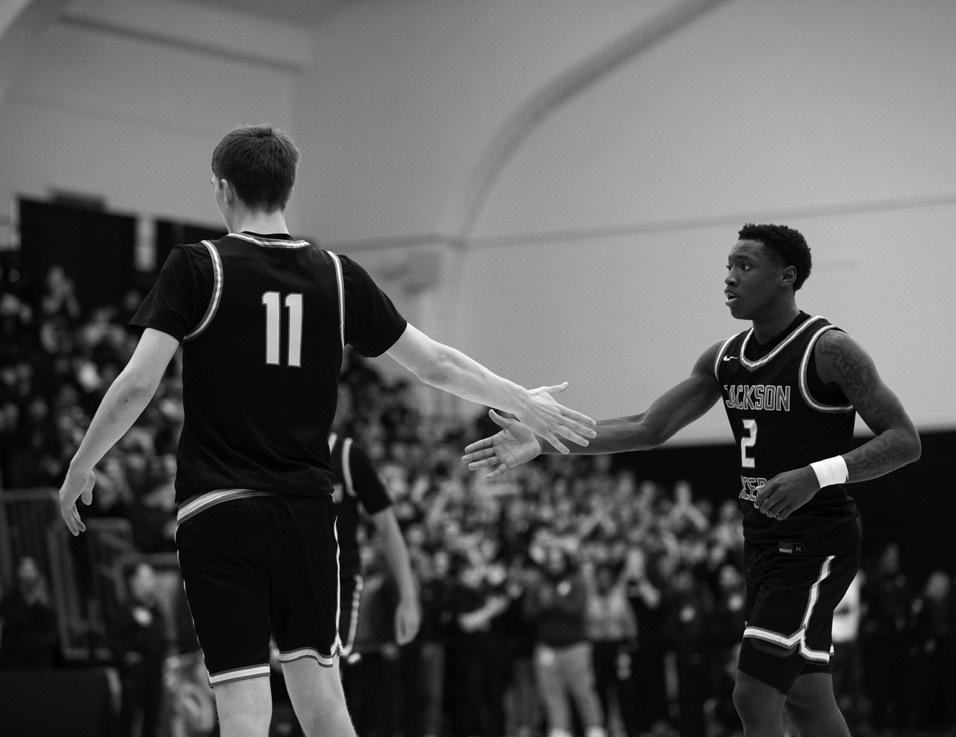
Going into the game at Georgetown’s McDonough Arena, the student section was packed to the brim, to the point where security was forcing kids to back up for the majority of the game. “To be honest, hype is the only word I can use to describe the
PATEL
from page 1
a lot of adversity in many different
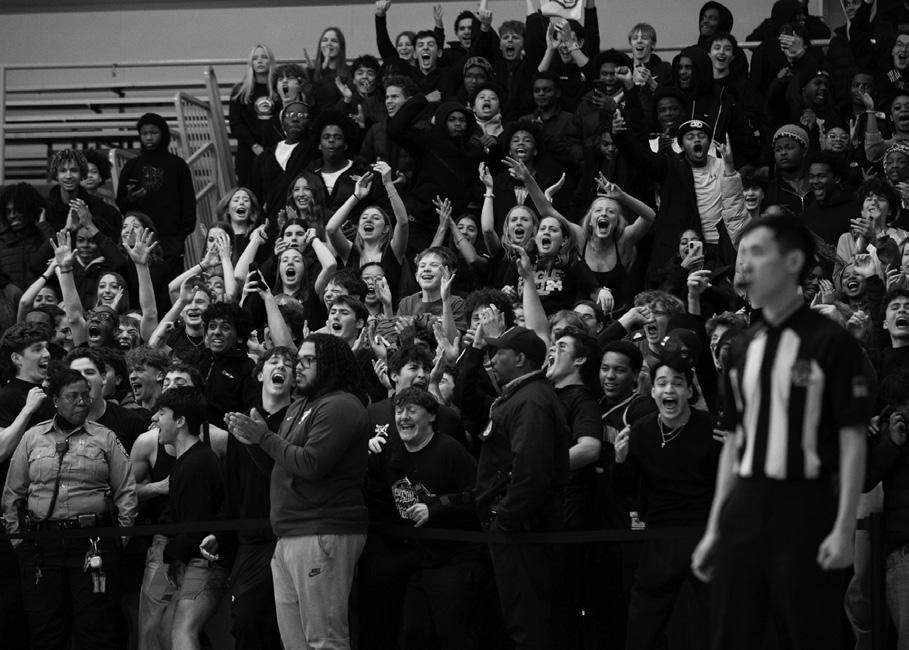
Tigers were the No. 7 seed in the DCSAA tournament, their lowest position in several years.
After a close 7971 win over Friendship Tech Prep in the first round, the Tigers played Roosevelt in the quarterfinals for the second time in the span of four days, with a chance to avenge their city championship loss.
PHOTO BY DANIEL KREPPS
quarter, JR led by two points, 34-32. By this point, the student sections were raucous, exchanging chants, including a popular “Daddy’s Money” from the JR students.
important job, but they were unaware of what the job was. In February 2019, Patel was named a deputy assistant to the president on the National Security Council. Kraham said that learning the news was “one of those ‘small world’ moments.”
As Sidwell players rushed the court, the JR players walked off as JR students clapped and showed their support for the players.
The rowdy atmosphere transitioned over after the game as JR and Sidwell students taunted each other.
However the loss was only one of many highs and lows that defined the season.
"Early in the season we faced
ways, whether it was like coaches leaving, players leaving,” junior forward Lane Mahan said. Mahan said a win against Bell “ “was the full team together and was a chance to taste winning, playing together and just being in like a great environment. I thought that bonded us together as a team."
The Tigers faced Roosevelt in the DCIAA championship game, looking to return the trophy to Tenleytown after a defeat the previous year.
However, this game wound up being achingly similar as Roosevelt won its first city title since 2020, 7465, and the Tigers came up empty handed for the second year in a row. After the DCIAAdefeat, the
This time, they would not let the chance slip, beating Roosevelt in their own gym, 7153, advancing the Tigers to the semifinals yet again.
"Roosevelt's a pretty good team, and at this point, it's a rivalry now," Tigers head coach Bill Bourgouin said. "If it wasn't a rivalry already, it's definitely one under my tenure."
Despite the unfortunate end to the year, the team is very hopeful and excited for next season, with the mentality that it is only up from here for Coach Bill's Tigers as he goes into his second year.
"He's done a very good job developing new players in his first year coaching," said junior DeSean Belton. "I'm sure that he will keep this job and keep progressing as the years go on." •
Sophomore breaks rowing record
Orly Jossen Arabella Bernstein Junior Editors coaches were not hired by Wilson Athletics, school administrators said. “It was not sanctioned by the school,” confirmed Assistant Principal Marc Minsker, who oversees athletics. According to former players, the coaches were unpaid volunteers. During Patel’s two seasons, the Tigers had a record of 8-10-4, ending seventh in the eight-team playoff season in 2018-19.
Kraham and Cashion did not know how Patel came to coach for Wilson. They speculated that he might have had connections with the other Wilson coaches through “beer league,” otherwise known as recreational adult hockey. Patel still plays occasionally for a team called “The Dons.”
According to Cashion, Patel’s lack of connection and relation to Wilson made the fact that he “still showed up every Friday [show] he really cared.” Kraham said Patel had childhood connections to hockey and believed that Patel’s “coaching was simply an opportunity for him to give back to the sport.”
Cashion said the team had “no idea that Kash was so intertwined with Trump while he was coaching us.” Cashion found out that Patel had been Trump’s pick for FBI director when he saw a “DM from an old teammate being like ‘that’s Coach Kash.’” Patel stepped down as assistant coach of the hockey team after the 2018-19 season. Players said the team was told that Patel had to step down because he had received an
Kraham said that finding out that Patel had been appointed FBI director “was just another reminder of how interconnected things feel in Washington.” Kraham added, “The other coaches were probably aware of what [Patel] did for a living, but the players were young and didn’t really pay attention to that kind of thing.”
After the US men’s hockey team won gold at the Olympics last month, Patel was recorded in the US locker room wearing a player’s gold medal while chugging beer and banging on a table and yelling and celebrating with the team. After the video went viral, Patel posted on X that he was “extremely humbled when my friends, the newly minted Gold medal winners of Team USA, invited me into the locker room to celebrate this historic moment.”
The video of Patel’s celebration came at a time when the FBI was monitoring American presence in Mexico following the outbreak of violence caused by the Mexican government’s assassination of a major drug cartel leader. In addition, a video call by Patel to President Trump in the locker room led to controversy over an offensive joke made by Trump about the women’s team.
Cashion said that he never would have thought at the end of his last Wilson hockey game that “someone in the room would eventually be wearing the USA hockey gold medal.”•
This February, during crew’s intense winter season, sophomore Blake Gillespie broke the Jackson-Reed Girls Varsity 2000 meter record by five seconds - on her first attempt!
Gillespie came fresh off novice and went straight to the 1V, an amazing accomplishment for a sophomore. For Gillespie, breaking the record her sophomore season felt “surreal,” adding that,
“I’m really grateful for my teammates and my coaches for their support all throughout the season... I love rowing because of the community and the purpose that it gives me, and that makes the commitment a lot easier.”
Previously, the 2k record under Head Coach Chris Rickard was 7:13.5 set by senior Aniset Idriss, who is now a D1 rower at Princeton, in spring of 2024.
A 2k is a test where a person rows 2000 meters as fast as they can on the ergometers, or erg as it's most commonly known. Gillespie broke Idriss’s record on her first attempt, with a time of 7:08.4.
Gillespie started rowing in the eighth grade with the Learn to Row program, encouraged by her mother, a former Yale rower, who still competes.
“Rowing has always been a
part of my family, and my mom’s always been an inspiration to me,” Gillespie said. Her exposure to rowing since childhood contributed to Gillespie’s success. It’s in these memories she found a love for the sport and
Novice. For everyone’s first year rowing in the Jackson- Reed program they’re immediately on Novice and, every year after that, are on Varsity.
From there, the Varsity teams are split up into different boats, with the most competitive boat being the 1V (first varsity) and the least competitive boat being the 4V (girls team) or 3V (boys team). Crew, which requires extreme discipline and physical strength, tests a person’s motivation and physical strength, so when a rower breaks a record, it's always a cause for celebration on the team.

everything that comes along with it.
JR is the only public school in DC that has a rowing program, and it hosts nearly a hundred rowers across four grades.
The ability of rowers across all grades to compete, participate, and break records is part of what fosters the incredible community of the team.
The crew team is split into four squads: Girls Varsity, Boys Varsity, Girls Novice, and Boys
Since they’re broken up into different boats, there’s lots of competition between the rowers to be the best. The thing about the team is that - despite the internal rivalries - when one person succeeds, the whole team celebrates because it means a faster boat for everyone.
Gillespie’s teammate and friend, sophomore Mollie Lauter, said, “It’s really inspiring to see Blake progress to do something truly amazing that this team hasn’t seen in so long. It makes us all row so much harder when we see our teammates achieving greatness.” •
TIGER POWER - Teammates Averi Knight and Lane Mahan high five
PHOTO BY DANIEL KREPPS
TIGER PRIDE – Students cheer on the team as they play Sidwell
Track team excels, breaking personal bests and records
Tinsley Barmeyer
Ingrid Russell Contributors
After a strong indoor season with several broken records and a DCIAA Championship title, the track team is ready to take on nationals.
“We have a new coach, and the workouts are really hard, but they’ve helped us improve a lot,” said senior Eva Okoobo. “At first, people weren’t excited for the workouts, but as the season went on, we realized that’s what we needed.”
Throughout the season, many athletes showed up and delivered record-setting performances. New school records were set in the 300 meter and 500 meter by Senior Avery Craig and in the 1600 meter and 32000 meter races by Junior Arjun Bhat.
The relay teams didn’t hold back either with the Sprint Medley Relay [400m-200m-200m-800m], consisting of Craig, Josh Gayle, Nathan Bovelle, and Suardi, posting a time of 3:40.83 and stealing the title.
Aside from breaking records, the teams worked hard and showed up to meets with strength, courage, and determination, earning several
top five finishes. Bhat’s mindset reflects a common theme for this team. Even against challenging opponents, the Tigers use competition as motivation to rise to the occasion, and that mentality has translated into records and PRs across the board.
At the DCIAA Indoor Championships, the boys’ team had an impressive performance across the board which led them to claiming first place overall.
Bhat led the way, taking first in both the 1600m and 3200m, earning Meet MVP honors.
Suardi finished second in the 1600m and won the 800m. Conrad Day was close behind, placing second in the 800m, showing the strength of the distance squad.
finished in second and Wyatt Dieterle got points in eighth.
The boys' relay squads were equally as dominant with the 4x200, 4x400, and 4x800 all taking first, highlighting the depth and speed of the Tigers.
On the girls’ side the team finished in fourth and was highlighted by Field MVP Okoobo, who took first in both the long jump
shot put taking first place, and Tinsley Barmeyer added points with a fourth place finish in triple jump.
The girls’ relays contributed valuable points as well, with fourthplace finishes in the 4x400 and 4x800.
Seven athletes earned All League awards: Arjun Bhat, Mark Suardi, Avery Craig, Eva Okoobo, Marta Flabbi-Fruttero, Olivia Purce, and Abi Awet, which rounded out a strong collective performance and setting the stage for the upcoming outdoor season.
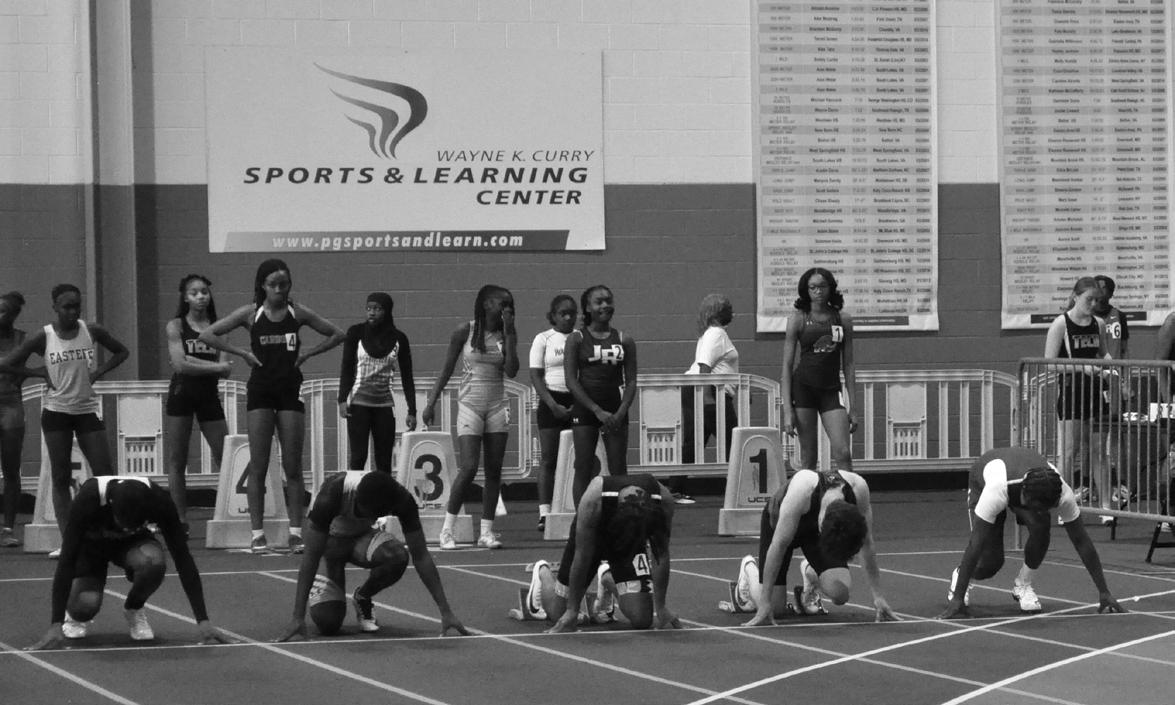
SPRINTERS SET UP– The team would go on to set personal bests and support one another.
Craig claimed second in the 300m and 500m. In the 55m, Gayle
and triple jump and placed second in high jump.
Kiara Tucker dominated the
As the team begins to shift from indoor to outdoor, athletes know the psychological side will matter just as much as the physical work.
“It is a mental sport. It’s mind over matter,” Okoobo said. “Once you get onto the track and it’s just
you in your blocks, it’s literally just you against the clock.”
The recent wave of personal and school records alike has raised expectations on the team. “The bar has moved with all these PRs,” Coach John noted. “This is a different team from the beginning of the season. Now we’re expecting athletes not just to qualify for nationals, but to break records while they’re there.”
Looking ahead to New Balance Nationals in Boston, several Tigers are set to compete on the biggest stage in the country.
“Heading into nationals, I want to be competitive in the two mile, and I know there are going to be a lot of fast guys there,” said Bhat. “Mainly, I’m just trying to PR further down into the 9:10s and enjoy the experience.”
For Coach John, the next step is making that mindset sustainable throughout the outdoor season. “We’ve raised the bar, so now it’s about staying healthy and executing when it counts” he said.
With records already falling and nationals just around the corner, the Tigers will be heading into the outdoor season eager to prove that this winter was just the beginning. •
Baseball prepares for season and gives back in the DR
Joao Braga Junior Editor
Among our many successful sports teams, the JR Baseball team has always stood out for its consistency and dedication, winning the DCIAA title 32 years in a row, cementing itself as one of the most dominant teams in the DMV.
The trip to the Dominican Republic has always been unique to our Baseball program, giving the players an opportunity to prepare for the upcoming season while also providing valuable service to communities in the Dominican Republic.
During the DR trip, the players visited Consuelo, Batey Cachena, Batey Los Chicharrones, (figure out
B-BALL
from page 1
Championship where the team lost to Coolidge, 56-52. But she said that was what had “helped us grow a little closer and work harder for each other so that the seniors could go out with a bang.”.
Head Coach Stephon Seraile highlighted the unity of the team as a contributor to its success. “Everyone knows Lanaia and YaYa are our engines,” he said, “but without the driver [junior point guard Indira Best] and the rest of the team, we are not champions.”
At the final against GDS, on March 1 in GW Smith Center, Martin fouled out of the game and Muhammad was in danger of fouling out, too. Other players stepped up. Senior center Andrea Hardy was crucial throughout the game, attacking the boards with 10 rebounds. Senior guard Ava Piotrowski hit four three-pointers in the first half, with Best adding six assists. Seniors forward Jordyn McClusky and forward Gabby Chung supported their team with strong defense; Chung earned
the name).
“The goal is for the guys to get to know each other, and to also teach young athletes to be good community members,” said Varsity Coach Robinson Mateo.
While there, the team played five other local teams including players from the Boston Red Sox and Baltimore Orioles academies. “We won three of the games, only losing to the Orioles and Red Sox academies,” said Coach Mateo. “It really stood out to me how well we competed against such talented players, with many already having already signed with professional teams.”
Senior varsity player Roscoe Stutz reminisced about his time working
MVP honors in the tournament.
There are two brackets in DCSAA basketball: Class A and Class AA. Class AA is the higher class. Its tournament included the top four ranked teams and the winners of the DCIAA and charter school tournaments, Coolidge and KIPP, who were the only nonprivate school teams in the Class AA field. The Class A tournament included 14 teams. JR beat Ballou and Banneker on the way to the finals.
After their defeat against Coolidge, the Tigers had a whole new mindset going into states. “The difference was grit and how we responded to runs,” Seraile said. “We didn’t allow GDS’s shots to impact how we played.”
Coaches and players said the team’s main focus this season was living in the present, not the past— dwelling on mistakes would only slow them down.
“Whether it’s a bad play or a bad grade on a test, you have to move on to the next thing. In basketball, you only get three seconds to move on,” Seraile said.
“As a whole we were tired of being doubted, and wanted to prove the city wrong by showing
with the children at the orphanage La Casa de Luz, which was founded with the goal of providing care for disabled children.
“While there, we spent time with the kids and helped them paint the building,” said Stutz. “It was my favorite, because it forced me out of my comfort zone. You’d be surprised by how much you can communicate just by being there and smiling.”
“The DR Trip is the best start to the baseball season I could have hoped for,” said junior Keith Parham “And I’m really honored to say I was part of it.”
Asked about their goals and expectations for the following season, Stutz said, “I think we have a good team, we’re young and kind of untested, but
who runs Tenleytown," Best said.
As players got to know one another and adjusted to each other's styles of play, their versatility increased as well. “We have players who can guard multiple positions, so it’s hard to defend us because we have so many players who can score,” Seraile said. “We know we’ll get consistent production from Lanaia, YaYa, and Indira— but on any given night, someone else can give you 10-plus points.”
One thing that the girls’ basketball team always prides itself on is community, a feature that anyone can see on the court in the way they play.
“I have learned that basketball brings so many people together and I have created so many friendships I’m so grateful for,” senior guard Lucia Nawar said.
Girls’ basketball plays not just for themselves, but for the whole school. “The sacrifices these young women make should be recognized,” Seraile said. “While many students go home after school or spend time with friends and family, these girls are in practice.” •

after the DR trip I think we got a good shot at the state championship.”
“We play against private schools
OUTZS
from page 1
conducive to building both his skills and passion for the sport.
Outz described his transition to high school as seamless. Despite an increase in the experience of his opponents, he had a strong start to the season, beating people who ranked higher than him and winning tournaments he was seeded lowly in. Nevertheless, his career was not without its challenges.
He has dealt with demanding weight cuts, nagging injuries, and a torn PCL during football season which sidelined him for months, making his return to wrestling difficult.
Returning with a knee brace, Outz relied on disciplined training and support from his coaches to rebuild physically and mentally.
He said consistent training helped placate his nerves, giving him confidence and motivating him to view losses (which were few and far between) as opportunities to improve.
During the season, Outz trains for two to three hours daily. A typical
who think they’re better than us," he said, "but we’re gonna shock them like we always do.” •
practice consists of 45 minutes of conditioning, before heading down to the mats in the atrium for drills and sparring. The team usually attends one to two dual meets and one Saturday multi-school tournament each week.
Outz described his experience at this year's state championship as a “cakewalk.” After receiving a firstround bye in the 16 man bracket, he pinned his next two opponents in under two minutes before winning the final in just two minutes and thirty seconds.
Wrestling’s one-on-one nature makes victory especially meaningful; when the referee raises his hand, the accomplishment feels entirely his own.
Senior Max Tatton has been practice partners with Outz since sophomore year. He agreed that Alex’s dedication and talent is unique: “he’s a great teammate, great captain, and a great guy. He leads the team.”
The four-time champion hopes to be remembered as one of the hardest working athletes on the team. His advice to younger wrestlers is to not lose sight of enjoyment while chasing improvement. “As soon as you stop having fun,” he said, “the sport loses its value.” •
PHOTO BY DANIEL KREPPS
TIGER TIMEOUT–The baseball team competed in games against local teams, testing their dominance overseas.
PHOTO BY LILLY MAURER
Bring back medieval princess style
Alexa Lucas Junior Editor
Recently, I’ve seen an influx of whimsical edits of medieval princesses on my feed and I am not mad about it. The thought of a medieval princess evokes powerful imagery of hennins (those stereotypical cone shaped head pieces), the color pink, intricate lace, long wavy hair, unicorns, and of course beautiful billowing dresses.
as the Vietnam War divided the nation and the Space Race continued underway, American culture treaded towards one of peace and escapism.
People longed for a simpler and more magical time; the perfect storm for yet another medieval revival. Fashion like bell sleeves, embroidery, bright colors, and velvet were soon adopted into Western culture and the Ren Faire established itself as an American staple.
Our fashion inspirations at JR
Vivian Whitelaw Rose Gershekter Contributors
Although it's amazing to follow your favorite fashion influencers on Instagram or endlessly scroll on Pinterest to save your favorite looks, nothing beats having a few specific people that you pass every day in the hallways who seem to be wearing your daily dose of style inspiration.
favorite trips and tricks is that she loves “wearing skirts as shirts. I think they look better as shirts than even regular tube tops do.”
She also loves “layering lace tanks under cropped shirts and long sleeves with tee shirts.”
fashion is cyclical and always political, medieval revival is not a new concept and has floated around the cultural zeitgeist for centuries.
that I’m growing to despise is polka dots. Don’t get me wrong, they can be cute when done well, but it’s tiring to see three different people wearing the same basic polka dot Brandy top.
Haley came in with new ideas entirely. “I really love turquoise jewelry and I’ve been seeing a lot of it recently. Same with plaid and buttons. And cool jackets! I just like it when people have fun with what they wear.”

One of the first instances of medieval revival was during the early 19th century, where Romanticism found itself at odds with Enlightenment, which had characterized the century prior. During this time, Europe found itself in disarray as the French Revolution ended and wars popped up across the continent.
Romanticism emphasized nature and emotionality, with many authors and artists harking back to the Middle Ages for inspiration and nostalgia. In this time, emotional stories and paintings depicting medieval knights and princesses brought comfort to the warring continent.
In the 60s and 70s, the medieval aesthetic also made a big comeback. While politics in this time became more uncertain
More recently, the 90s and
2000s also saw a mini medieval revival, with the rise of empire waist dresses and movies like "Ella Enchanted" and "Shrek".
Considering the tumultuous times we live in, the medieval revival almost seems like the only next logical step. Early adopters like Chappell Roan have already evoked medieval imagery, with Roan dressing in knight armor for her 2024 VMAs performance.
As many become disillusioned with the state of American politics and culture, we can find comfort in a magical time populated by knights, princes, and pretty princesses. Thus, dear reader, I encourage you to indulge in this revival: repost that TikTok about unicorns, wear those jewel tones, blast that Kate Bush, grow your hair out to obnoxious lengths, and dream of a kingdom far, far away from here. •
GRAPHIC BY CLARE BATES
Especially as we inch closer to spring and warmer weather, students can finally escape their confining winter coats and show off their unique outfits.
Spring also brings exams, so romanticizing school through fashion is a foolproof way of surviving an exhausting school day.
I mean, what could be better than going to sleep knowing that you have the perfect outfit picked out for the next day? So to celebrate the incoming warm weather, we have chosen some of our favorite style icons from the Jackson Reed hallways.
One of the style icons who has consistently impressed us is freshman Marlowe Venner, whose outfits never disappoint. She always looks put together and fun, and anyone can see how much fashion means to her.
Marlowe told us she feels “more confident in things that make me feel like I’m standing out.” It is so important to stay true to yourself, especially when it is so easy nowadays to blend into the crowd, and Marlowe expresses how important it is to have everyday outfits express yourself.
Eva Steinman, a junior, also shares these views of the power of fashion as she says, “Following every single trend takes away from who you are and who you want to be seen as: your own person. In the end, everyone has their own tastes, and fashion designers wouldn’t be famous if they didn’t have that unique element that sets them apart from the other brands.”
Eva told us that one of her
What students and teachers
Josie Ritter
Sophie Rothschild
Emma Godavitarne Contributors
From funky purses to eclectic jewelry, fashion is an essential part of what makes Jackson Reed and its students so unique. Throughout the school you’ll see a variety of styles, and we’re here to showcase how JR students express themselves through their fashion (in the halls).
Marc Scurry- sophomore
Outfit details: Hannah Montana shirt, True Religion jeans, and pink Converse
Question: Do you feel like your fashion expresses your identity?
Answer: “Yes, I feel like it helps me express myself because I can

wear something to match however I’m feeling that day” Ms. Ward- Academy of Finance teacher
Eva constantly experiments and inspires those around her by taking a seemingly casual outfit and never failing to add her own personal flares. Even a small accessory can make your outfit pop without overcomplicating things.
Fashion is one of the most effective ways of self-expression, allowing students to differentiate themselves from each other.
Haley Crouch, a senior, tells us that “I think I just feel best if I feel as though I’m dressing like myself and not anyone else.” Haley leans towards a vintagy style, expressing herself through her original looks.
As for clothing stores, Marlowe says that she “loves a good thrift, which you’ll never find in DC.”
Eva and Haley agree with this love of shopping vintage and say that they have come to rely on Depop. Haley specifically said, “Depop! Always Depop. It’s a really big problem.
Anyone who knows me knows I spend way too much time and money on it,” adding that “vintage is always so much cheaper and usually has much better quality. It’s typically more unique too if that’s something that’s important to you.”
While trends can become overused, they’re still a fun way to get involved in fashion. When asked about her current favorite fashion trends, Marlowe stated that she “LOVED the indie sleaze era from almost a year ago. I love the polka dots thing in a funky kind of way.”
Polka dots certainly exploded, especially at the start of the year. They could be spotted on every student, and allowed people to get out of their normal comfort zone while still following trends.
However, Eva was not so keen on them, telling us “Something
However, for men's fashion, Marlowe and many other girls at Jackson Reed are in agreement that “you guys really need to watch your baggy blindness.”
Although these fashion icons have unique styles, everybody gets inspiration from somewhere: Eva said that one of her style icons is “Jane Birkin because of how simple yet striking her style is. Brooke Flecca too…” Haley said that her favorite inspiration comes from the internet and around the school.
“There is kind of an unspoken fashion sense that’s unique to school and it feels nice to kind of be a part of it.” At Jackson Reed, there is a beautiful and varied mix of different styles.
From clean girl, to trashy 2000s, to a bit of grunge, everyone is able to express themselves freely and in a positive way, giving everyone the chance to discover how they want to present themselves through fashion.
High school is the perfect time to push the limits of fashion and discover your personal style. These style icons have taught us tons: to always shop vintage (not only is it better for the environment, but you will always find more unique pieces than when you shop at big name brands).
Additionally, adding small touches to your outfits like colorful jewelry, belts or layering pieces elevates your style and brings your own flavor to it. And that’s what fashion is all about: expressing yourself through experimenting with new pieces and making it uniquely yours. •
are wearing: Fashion in the Halls
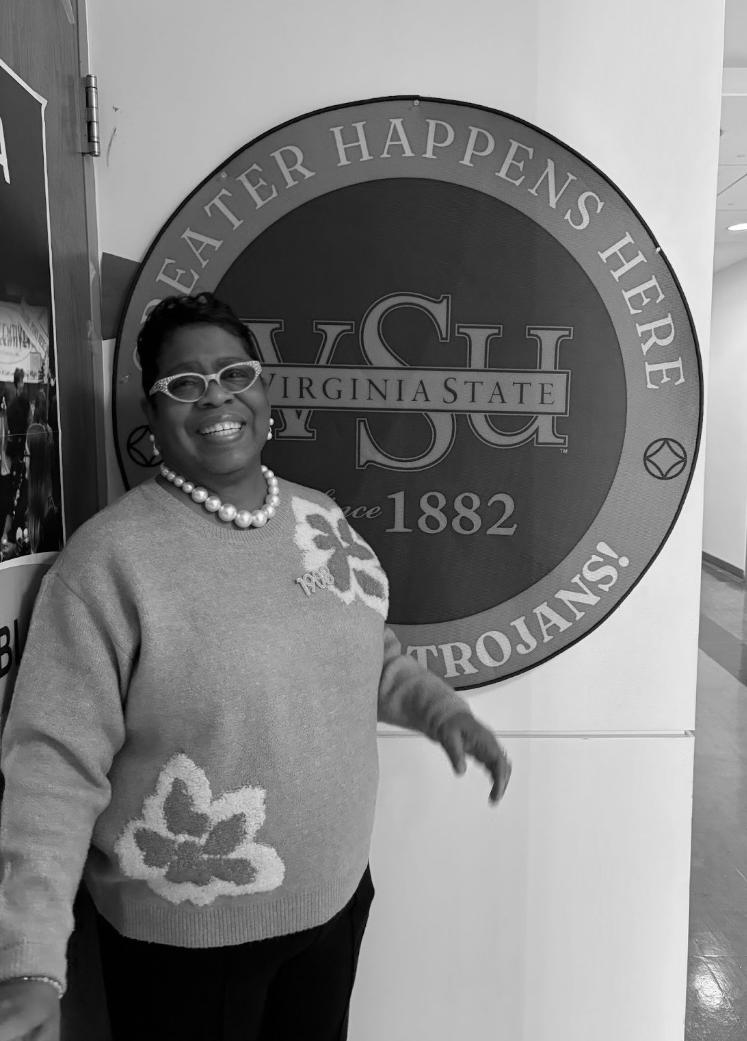
Outfit details: Nordstrom sweater, Marshalls pants, dupe Birkenstock shoes, pearl necklace, and unknown glasses
Question: Do you dress for yourself, or for others?
Answer: “So I’ve always been a little different in how I dress, and I like to dress up, I like to always look nice, right? So as a teacher,
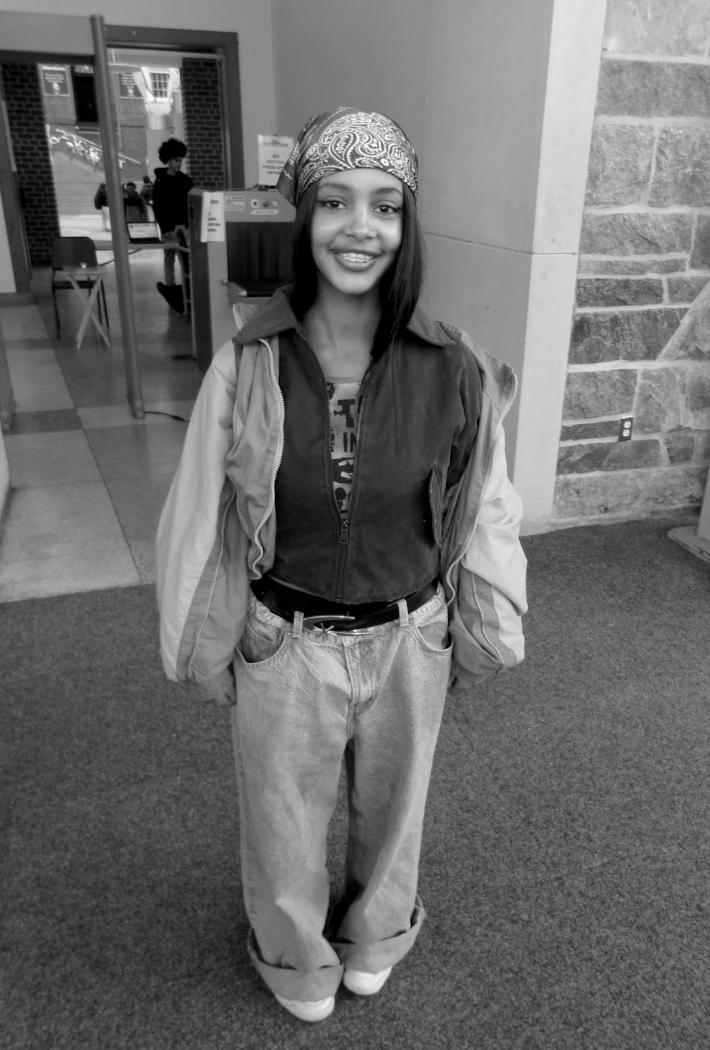
I think it’s very important that you see a well-dressed woman, without looking like 'I’m going to a party', but this is work, right? So I try to dress professional and be a person that you all can look up to, not a person that you think
is your equal. There should be a difference between the teacher and the student when it comes to dress.”
Betiko Harris- senior Outfit details: H&M pants, Forever 21 puffer, Primark jacket, shirt and belt from Depop
Question: How do you get your fashion inspiration?
Answer: “I usually wake up and throw something on, and this was one of those days. The outfit didn't need much thought, it's comfortable, a little layered, and just works without trying too hard.”
You can rely on Fashion in the Halls to highlight the JR fashionistas, and they’ll always come through with anything from Birkenstock dupes to Hannah Montana odes. •
Tessa Frantz Section Copy Editor
Super Bowl ads have always been iconic. They are a way for brands to reach more consumers than ever, with the estimated 125 million super bowl viewers across different platforms. Different companies have to compete for the limited air space and for the most recent super bowl, brands had to pay upwards of eight million dollars for one ad space of 60 seconds, meaning they’re likely willing to spend a little extra money to make their ads unforgettable.
I mean, think about it. What do you remember from when you watched the superbowl? Was it the crazy plays that shocked the fans? The players that scored the most touchdowns? Maybe the impressive performance from one of the teams?
No. It was the brilliant, creative ads that caught your attention. Why else would you even watch the
Iconic Super Bowl ads over the years
superbowl? Over the years, this has led to the creation of many showstopping advertisements that have left lasting impacts on pop culture, so let's talk about the most iconic, memorable ads in all of super bowl history.
Budweiser: “Whassup?”
Maybe the most iconic Super Bowl ad of all time, this Budweiser commercial from Super Bowl XXXIV in 2000 shows a few friends talking to each other on the phone while "watching the game and having a Bud.” One man says “Whassssssup?” and they all break into dramatically repeating it before the two friends first shown proceed with their call.
The ad was funny, representing the community and friendship created from sports and how people bond over it, while still advertising Budweiser. Not only is it a good ad, it also had a lasting impact on pop culture, becoming something people started saying and even being referenced in "The Office".
Apple: “1984”
Called the greatest commercial of all time by multiple outlets and having won awards after its release, this 1984 Apple ad from Super Bowl XVII is undeniably a classic. Directed by acclaimed science fiction film maker Ridley Scott, the commercial shows English athlete Anya Major saving the world against “Big Brother.”
It then introduces the new Apple computer, Macintosh, telling viewers that the year 1984 will not be like the movie “1984” that shows a totalitarian, fascist government in a future world.
Snickers: “You’re Not You When You’re Hungry”
This Super Bowl XLIV promotion for Snickers was a part of their “You’re not you when you’re hungry” campaign in 2010 and will forever be one of the best Super Bowl ads in history. It shows a pickup football game with Betty White as one of the players. When one of her teammates says “you’re
playing like Betty White,” someone stops her and delivers the iconic line, giving her a Snickers bar.
When she eats it, she transforms into a young man who goes on to play infinitely better than before because of the Snickers he ate. It’s genius advertising.
Pepsi: “Two Kids New Can” In this hilarious ad from the 1984 Super Bowl XVII, Pepsi introduced their new design for the Pepsi soda can.
When Cindy Crawford, a famous model and actress, pulls up to a gas station and gets out of her car, there are two young boys staring in her direction, and at first you think they’re looking at her, until she goes to a Pepsi machine and buys a drink. As she drinks, the boys admire the new look for the cans instead of her, demonstrating how good the new design is.
Wendy’s: “Where’s the Beef” Super Bowl XVII really was a hit for the commercials. In this commercial for Wendy’s, the
Cook strip: your guide to making apple pie
fast food chain called out their competitors for having too much bun on their burgers and not enough beef when a woman who gets a burger with a giant bun and tiny patty starts questioning, “Where’s the beef?”
They tell viewers that, unlike the Whopper or BigMac that can be bought from their competitors, Wendy’s burgers have the right amount of beef for the bun. Its fame comes from their willingness to be upfront about putting down other food chains.
There have been so many classic super bowl ads over the past 60 years, a surprisingly large amount of them being made in 1984 (seriously, what was in the water back then), and I can’t even begin to tell you about all of them. These are the ones I like the most, and if you want to prove me wrong, you can watch every Super Bowl ad ever created, but until then, these are the best. •

The global impact of Heated Rivalry
How does a low budget, Canadian original TV series become the most watched and talked about show in just a few months?
In case you aren't aware of the new breakout series, "Heated Rivalry" is a love story about two male hockey players, Canada’s Shane Hollander and Russia’s Ilya Rozanov, as they try to navigate their athletic career, while coming to terms with their own feelings for one another.
The show, based on Rachel Reid's book series, "Game Changers" has grabbed the attention of millions
worldwide, creating a community that celebrates queer stories and gives people the chance to connect with the show’s two main characters. In both formats, the one thing that really connects such diverse groups of viewers is the ability to recognize the love being portrayed on the screen.
Most fans have stated through social media that it is refreshing to see love that differs from the usual type of romantic experience depicted on screens.
Female audiences have admitted that most romance shows and movies only give one character to relate to, the female lead, which most often have the same type of storyline repeated multiple times. "Heated Rivalry" gives
people a chance to watch two men in similar social standings express their love for each other, which is a fresh narrative.
The popularity of the show has provided a space for tremendous amounts of other queer athletes to share their experiences and giving them a chance to come out as well.
Jesse Kortuem, a closeted hockey player, has recently come out as gay and stated "Heated Rivalry" as his inspiration for doing so. Kortuem has described the National Hockey League (NHL) as a place he felt he should hide.
"Heated Rivalry" has also become a comfort watch for many gay athletes that identify with the unique
experiences of the main characters. Across platforms, queer athletes have posted themselves to the song "I’ll Believe in Anything" by Wolf Parade featured in the show’s soundtrack.
This powerful display of queer pride is especially important considering the homophobia, misogyny, and toxic masculinity so commonly rampant in sports. The show has encouraged community and solidarity among queer athletes, empowering a niche not commonly represented.
The show is also a welcome diversion to the conservative politics taking over America. As the Trump administration rages on, we have seen cuts to Diversity, Equity, and
Inclusion programs, the erasure of queer history, and an attempt to overturn the landmark Obergefell v. Hodges decision that legalized samesex marriage.
In fact, this February, the Trump administration removed a Pride flag from the Stonewall National Monument, disrespecting the federal site that honors the LGBTQ+ community and movement.
The show’s success is a testament to the power of love over senseless hatred and bigotry. All in all, "Heated Rivalry" is a celebration of queer love and joy, a representation that is all the more important as hatred and homophobia attempts to cement itself into politics and society. •
Alexa Lucas Nati Pinilla Junior Editors
Cecelia Grant Spread Editor


SUDOKU MINI CROSSWORD
By Ben Holland

CROSSWORD

By Ben Holland
Area 51 residents?

ACROSS
March
org. 5 Grieve 6 Birthplace of Lebron James and Steph Curry 7 Playground retort
8 “At ___, soldier!” DOWN
1 Phone brand that shares its name with a hit 2025 Drake song
2 Sour milk product
3 Stood up 4 ___ Domini (The A in A.D.)
5 Constructed
15 What’s dropped in a tip jar... or what 1-Across, 59-Across, 16-Down, and 34-Down are?
16 *Caveman’s hunting tool
21 What a wild 53-Across could be
22 Japanese fried meat preparation
25 Direction that is 67.5 degrees counterclockwise away from 29-Across, in Spanish 26 Opposite of neg. 28 Actor of Bail Organa, Jimmy ___
30 A relief for a hot dog
32 Result of a fire
33 Share, temporarily 34 *Fall tree fruits
35 What is multiplied by 2π to get a circumference
36 Like a truck that does bank deliveries
39 Narrow water channels 40 Main course 41 Remains behind 43 Salary increases 44 Rival of Athens
47 The ___ flu
49 Like some beers
51 King of the Dinos
52 Phone protector
54 What an amateur aspires to become, briefly 55 ___ capita
Horoscopes
Aries - Watch your back twin, you’re going to get slimed in senior assassin
Taurus - Yeah, you’re not getting the Wordle today, pack it up
Gemini - You will go and save Punch the monkey from his bullies
Cancer - Alysa Lui wants YOU!
Leo - Trae Young will drop 20/5/20 in honor of you
Virgo- A fire drill will save you from having to do that fated test
Libra - Pay extra close attention in chemistry, trust me, you’ll need it
Scorpio- You should bring fidget spinners back, they’re gonna blow up because of you
Sagittarius - You will turn footsteps in electricity while in #Japan
Capricorn - You are going to single-handedly stop WW3 from happening
Aquarius - Watch out.
SPELLING BEECON
Find as many words as you can! Words must be at least 4 letters long and use the center letter at least once. Letters can repeat.

Pisces - You are going to get the first perfect March Madness bracket ever BEACON MAZE
BEACONNECTIONS
By Julia Khoury
Find groups of 4 that share something in common!

Jackson-Reebus furniture





Red Things (Brick, Firetruck, Solo Cup, Apple) DC Sports Teams (Spirit, National, Capitol, Wizard)
Famous Chrises (Rock, Pine, Brown, Evans)
With Keys (House, Car, Piano, Computer)
PHOTOS FROM THE STUDENT WALKOUT AGAINST ICE
THE POWER OF PROTEST
MONDAY, MARCH 16, 2026 • THE BEACON

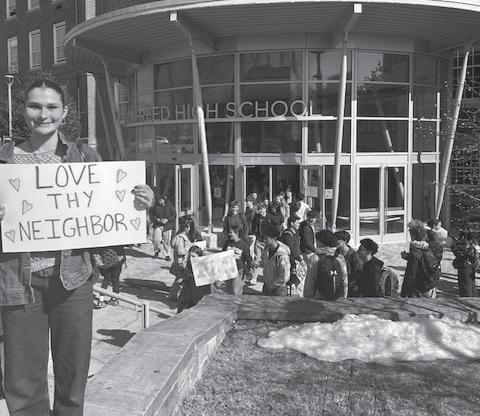
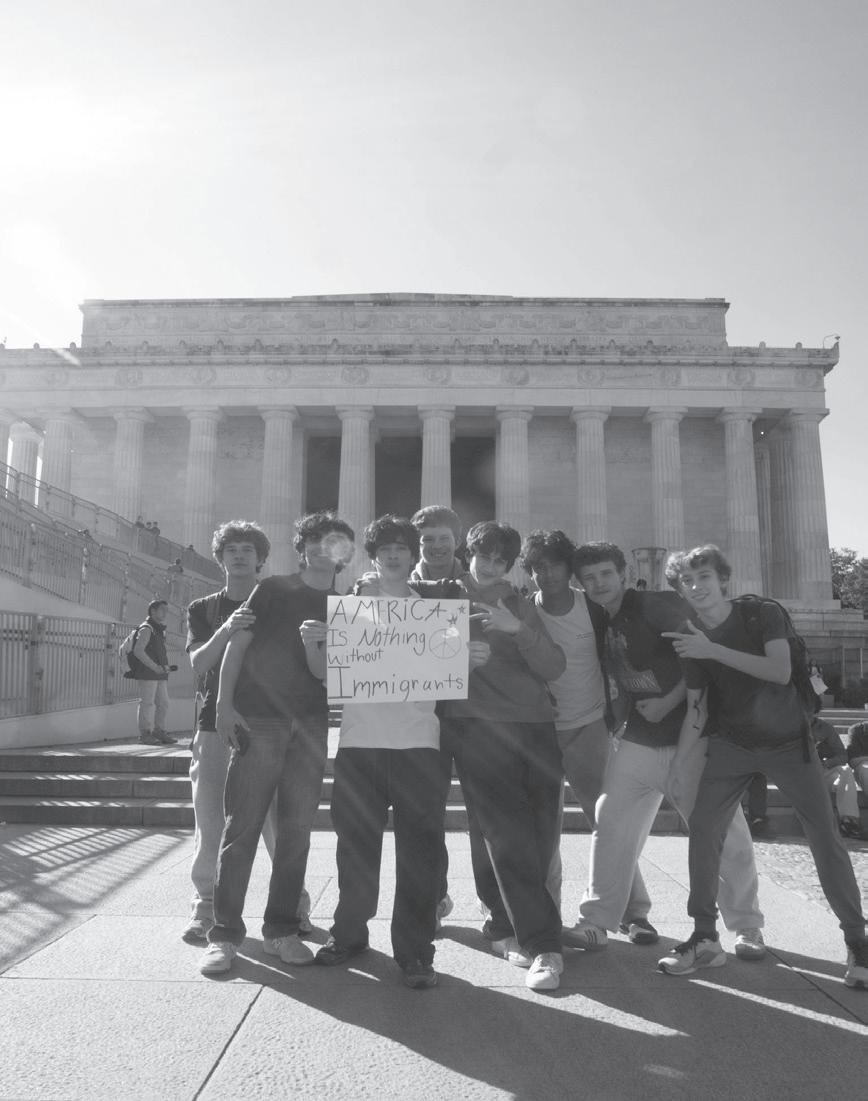



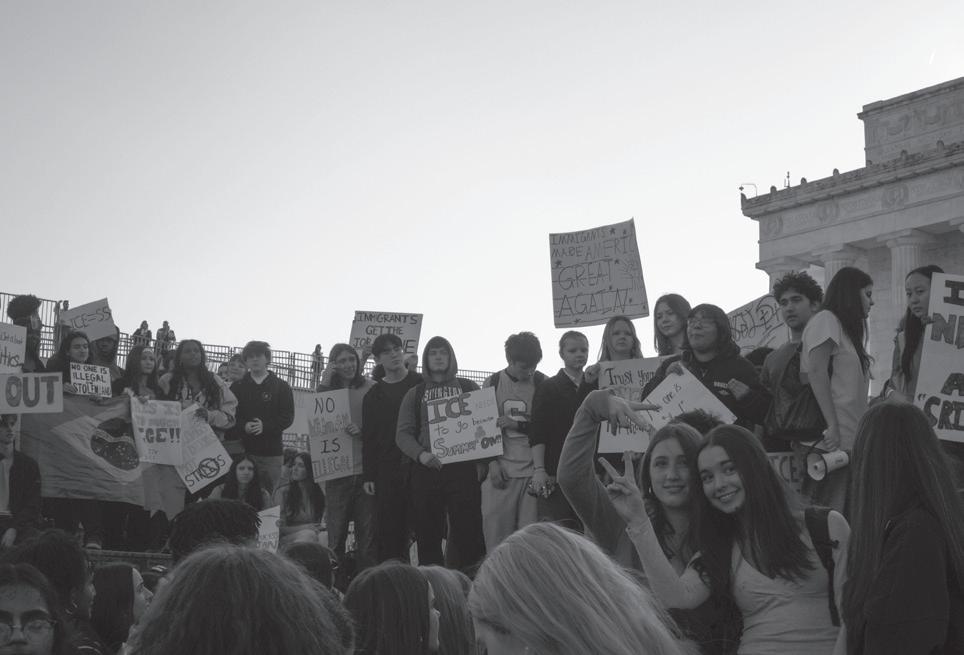








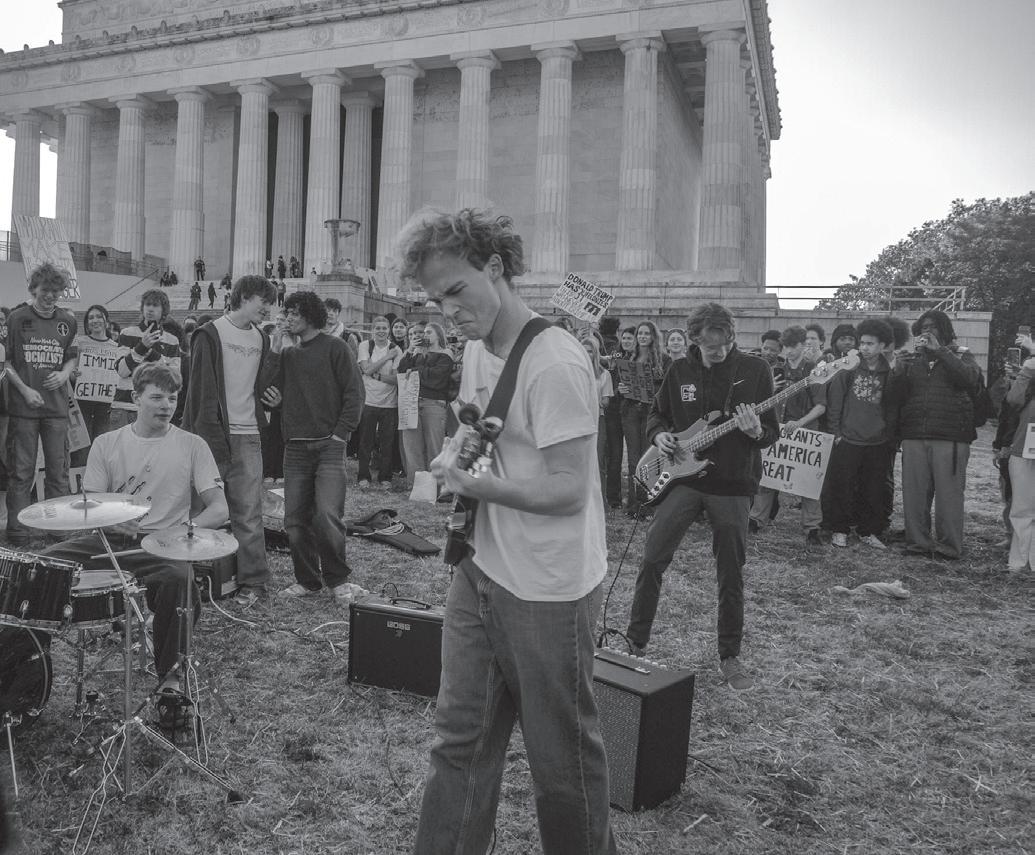


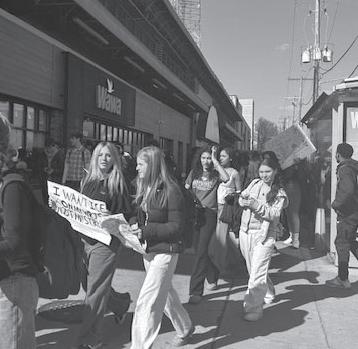







PHOTOS BY CLARA DOYLE, MARIA JOYCE-JOHNSON, DESMOND PARSONS, CLARE BATES, NATI PINILLA, BENJAMIN MACK AND WILLA FRILLICI