










We are excited you are here! You are embarking on a journey that will change and improve management skills within your firm. Leading with Impact is not just an eLearning program. It is a five-month, comprehensive, learning experience that can have a major impact on your firm’s culture, engagement, retention and brand.



In the fiercely competitive world of the legal industry, there lies a crucial yet often overlooked factor that can make or break a firm’s success: workforce engagement. For law firms, the stakes are even higher, as their reputation and bottom line depend on the collective brilliance of their legal professionals.


Workforce engagement is the emotional commitment and involvement a lawyer or business professional has towards their firm and its goals. Engaged team members are more likely to be productive, efficient and dedicated to delivering top-quality work. According to a Gallup report, highly engaged teams show 21% greater profitability and are 17% more productive than their less-engaged counterparts. In the legal sector, this translates to improved matter outcomes, increased client satisfaction and enhanced reputation—all factors that contribute to a firm’s success.
The positive correlation between engagement and key performance indicators is undeniable. A study by the Corporate Executive Board (CEB) revealed that engaged team members are 87% less likely to leave their organization, resulting in significantly lower turnover rates and reduced recruitment costs for firms. Furthermore, a survey by the American Bar Association found that firms with high levels of engagement reported 22% higher revenue per lawyer than those with lower engagement levels.
In a highly competitive industry like BigLaw, enhancing team member engagement not only improves the firm’s bottom line but also helps it gain a significant advantage over its rivals. When legal professionals are motivated and committed to their work, they are better equipped to tackle complex cases, foster innovation and adapt to the ever-evolving legal landscape.
THIS is the percentage of YOUR team members who are less likely to leave your organization if they’re engaged.
% — CEB


The importance of effective management cannot be overstated, as it directly impacts workforce engagement, job satisfaction and ultimately, the success of an organization. Several key aspects contribute to effective people management, each playing a vital role in fostering a productive and motivated workforce.
1. Clear communication: Ensures that professionals grasp individual objectives, the firm’s mission and client goals, leading to increased commitment.
2. Balanced workload, deadlines and stress: Enables team members to concentrate without feeling overwhelmed, thus improving performance and job satisfaction.
3. Recognition of hard work and effort: Bolsters morale and motivation, creating a positive work environment and appreciation culture.
4. Empowerment of professionals: Delegates responsibility and decision-making opportunities, which nurtures ownership and individual pride.
5. Inclusive, supportive work environment: Values diversity, collaboration and respect, thereby fostering belonging and dedication to the organization.
6. Robust team relationships: Fosters trust and camaraderie, which leads to increased collaboration and innovation.




7. Impartment of meaning and purpose: Shows team members how and why their work matters, which deepens commitment and increases motivation.
Effective management skills are not innate qualities that partners naturally possess. Handling various aspects of people management can be challenging for partners, as there is much to consider and balance. Therefore, it is crucial to invest in training and support to teach partners these essential leadership skills. By doing so, firms can equip their partners with the necessary tools to create a more engaged, motivated and successful workforce, ultimately contributing to the overall success of the firm.
This is the purpose of the Leading with Impact program.


The Leading with Impact program is designed specifically for law firm partners. There are understandable reasons they aren’t naturally the most effective people managers:
• Time is a scarce commodity, and partners are constantly juggling multiple responsibilities, making it difficult to devote necessary attention to managing others.
• Many partners excel in their chosen area of expertise but may lack the knowledge and skills required for effective management.
• The pressure to prioritize client satisfaction can lead to micromanagement and a lack of trust in team members, hindering their ability to perform at their best.
• Tight deadlines and the demand for highquality work can place immense pressure on partners in firms, leading to increased stress and a reduced ability to manage well.
• Being stuck in old ways of thinking can inhibit effective management in firms, creating an environment that hinders engagement, motivation and retention.
Leveraging Joychiever’s Hierarchy of Engagement, the Leading with Impact program is an innovative, five-month learning experience, designed to revolutionize how partners manage to sustainably drive success for the firm.
The program unveils 12 essential best practices designed to enhance engagement while reducing burnout. Going beyond foundational management skills such as delegation and feedback, this program provides over 80 techniques to take participants’ management skills to the next level.
Expertly crafted eLearning modules, designed specifically for law firms, power the five interactive discussion meetings where participants have the opportunity to exchange ideas, debate concepts, collaborate with their peers and learn in a dynamic and enriching environment.

Upon completing the Leading with Impact program, partners will experience a range of positive outcomes that will enhance their management skills and work environment.
Firstly, they will successfully collaborate with dedicated and reliable individuals, resulting in stronger and more efficient teams united in their commitment to perform their jobs well.
Secondly, partners will be able to concentrate on their highest and best skills, no longer burdened by constantly managing the minutiae of daily tasks. This newfound focus will allow them to make strategic decisions and develop innovative solutions that will propel the firm forward. Additionally, partners

will witness their teams consistently delivering exceptional results, satisfying clients and securing their loyalty for future engagements with the firm.
Lastly, after participating in the program, partners will effectively manage work-related stress, leading to a healthier work-life balance and overall well-being for their teams. This improved stress management will also contribute to better sleep and life satisfaction. Furthermore, team members working under these well-trained partners will enjoy a more challenging and invigorating, yet manageable, work environment, ultimately boosting job satisfaction and engagement.
The five-month program consists of several carefully designed components to ensure an exceptional learning experience:
• An Engaging Marketing Campaign: Automated, pre-crafted emails sent to participants and key stakeholders that introduce and generate excitement for the program.
• Milestone Surveys: An assessment of participants’ skill levels before and after the program, allowing for measurable ROI.
• Learning Labs: Five monthly, 75-minute, “flipped-classroom,” discussion meetings utilizing 17 eLearning modules for content exploration and idea sharing.
• Meeting Facilitation Guide: Detailed instructions for how to run each of the five discussion sessions, enabling you to lead engaging and productive conversations that foster collaboration and deepen the learning experience.
• Comprehensive, Automated, Email Communication Series: Over 15 precrafted messages, including pre-launch excitement messages, pre-meeting teasers and post-meeting follow-ups.
But there’s no need to stress! This comprehensive Toolkit has been meticulously designed to serve as your all-inclusive, step-by-step guide for implementing and managing this program with ease. With clear instructions, actionable advice and expert recommendations, you’ll be able to navigate the entire process confidently, ensuring a seamless and successful execution of the program.
Pre-launch messages to participants are sent.
Week -3 : Introduction to the program and calendar invitations for Learning Labs is sent.
Week -2 : WIFM for participants and the link for Milestone One: Baseline Assessment is sent.
Week -1 : A video message from a leader is sent.
Week 0 : Launch of the course and the link for the Burnout Survey is sent.

Introduction to program email
Calendar invitations for the Learning Labs
WIFM for participants email and link for Milestone One: Baseline Assessment
1
One week before the meeting: email teaser for Learning Lab #1 is sent. Conduct Learning Lab #1. Two days after the meeting: follow-up email for Learning Lab #1 is sent.
2
One week before the meeting: email teaser for Learning Lab #2 is sent. Conduct Learning Lab #2. Two days after the meeting: follow-up email for Learning Lab #2 is sent.

3 Record a brief welcome video from a leader.
3 Determine program launch date.

Determine meeting dates.
3
One week before the meeting: email teaser for Learning Lab #3 is sent. Conduct Learning Lab #3.
Two days after the meeting: follow-up email for Learning Lab #3 is sent.
Inform appropriate leadership stakeholders.
Identify and invite participants.
4
One week before the meeting: email teaser for Learning Lab #4 is sent. Conduct Learning Lab #4.
Two days after the meeting: follow-up email for Learning Lab #4 is sent.
3 Finalize and set up program communication messages.
3 Participate in a brief trainthe-facilitator session.
5 MONTH
One week before the meeting: email teaser for Learning Lab #5 is sent. Conduct Learning Lab #5.
Two days after the meeting: follow-up email for Learning Lab #5 is sent.
Email teaser for Learning Lab #3 Learning Lab #3
Follow-up email for Learning Lab #3 Email teaser for Learning Lab #4 Learning Lab #4 Follow-up email for Learning Lab #4
Email teaser for Learning Lab #5 Learning Lab #5

Follow-up email for Learning Lab #5
These messages generate excitement, communicate details and garner participation in the program.
• You are invited!
• Boost the firm’s potential and engagement through the Leading with Impact experience.
• Your leadership transformation with Leading with Impact begins soon!
• WIFM for participants and links for Milestone One: Baseline Assessment
• Countdown to success: What participation in the Leading with Impact program means for you?
• Hear what [INSERT NAME] has to say about the Leading with Impact program.
• Your access to Leading with Impact is GRANTED!
See all Pre-Launch messages on page 14.
These messages create interest and confirm upcoming Learning Lab meetings, as well as provide a recap of the monthly Lab meetings.
• Why you need to care about burnout and engagement.
• Leading with Impact: Learning Lab #1 Recap.
• Workload, Deadlines and Alwayson Pressure, Oh My!
• Leading with Impact: Learning Lab #2 Recap.
• The future of work: Are you ready to embrace it?
• Leading with Impact: Learning Lab #3 Recap.
• Transform the work environment with autonomy, authenticity and boreout avoidance strategies.
• Leading with Impact: Learning Lab #4 Recap.
• Pssst! We’ve got the secret antidote for “Quiet Quitting…”
• Leading with Impact: Learning Lab #5 Recap.
See all Learning Lab messages on page 20.
SUBJECT: You are invited!

Imagine this scenario: You work with people whom you can rely on—individuals who are as committed as you are to doing the job well. You have the time to focus on your highest and best skills, rather than continuously wading through the minutiae of your matters. Your team consistently delivers exceptional results, making clients happy and inspiring them to hire your firm repeatedly. Work stress is manageable, allowing you to sleep easier at night. Team members love working for you, finding their days appropriately challenging and invigorating.
Does this sound too good to be true? It doesn’t have to be.
The firm has partnered with Joychiever, LLC to conduct the Leading with Impact management training program. Leveraging Joychiever’s Hierarchy of Engagement and starting in [MONTH], this program is an innovative, five-month learning experience, designed to revolutionize how partners manage to sustainably drive success for themselves and the firm.
The program unveils 12 essential best practices to enhance engagement while reducing burnout. Going beyond foundational management skills like delegation and feedback, it offers you over 80 techniques to elevate your management skills to new heights.
Through expertly crafted eLearning modules developed specifically for law firms, you’ll participate in five interactive discussion meetings throughout the five months, providing you with the opportunity to exchange ideas, debate concepts and collaborate with peers in a dynamic and enriching learning environment.
What is the time commitment?
Don’t let the “five-month learning experience” scare you. Here is what will be expected with your participation:
• Prior to the program launch, you will complete two surveys:
o Milestone One: Baseline Assessment: The results of the confidential survey provide you with a roadmap to prioritize which of the 12 essential best practices you should focus on. It will also acknowledge what you are already doing well.
o Are you experiencing burnout? Survey: This confidential questionnaire will give you information about your personal level of burnout and where you might be having challenges.
Total time commitment: 30 minutes
• During each of the five months of the program, you will participate in 3-4 eLearning modules that provide insight and best practices for management skills that increase engagement and decrease burnout. Then each month, you will participate in a 75-minute, Learning Lab with a group of colleagues to discuss, debate and collaborate. You will leave the meeting with two self-determined, specific action items to work on each month.
• Following the Learning Labs, you will also complete the Milestone Two: Mastery Reflection survey so you can assess your adoption of the best practices and receive acknowledgment for your efforts.
Total time commitment: 9.5 hours
Are you willing to invest 9.5 hours over the course of five months to achieve the imagined scenario?
We hope so because we believe this program will transform the way you manage your team members and help you become a leader people want to work for and follow.
Reply to this message with a YES! if you accept this invitation.
Best regards,
[INSERT NAME]
SUBJECT: Boost the firm’s potential and engagement through the Leading with Impact experience.
[First Name],
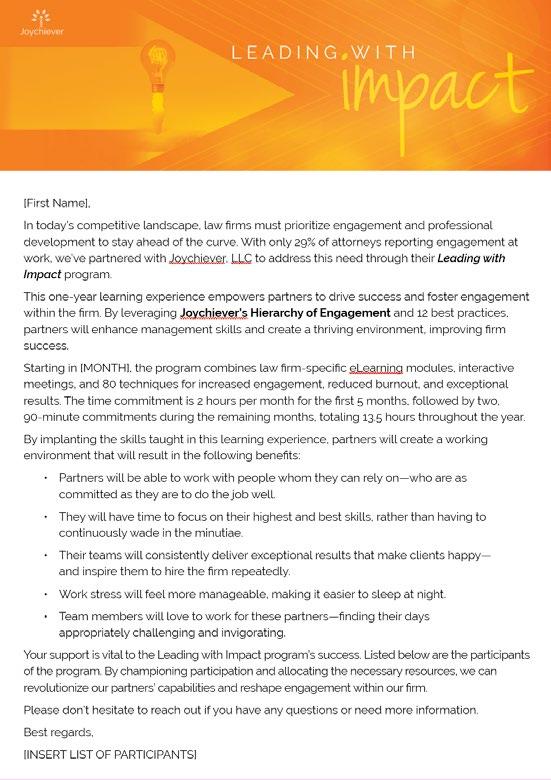
In today’s competitive landscape, law firms must prioritize engagement and professional development to stay ahead of the curve. With general engagement rates hovering in the low 30’s percentages, we’ve partnered with Joychiever, LLC to address this need through their Leading with Impact program.
This five-month learning experience empowers partners to drive success and foster engagement within the firm. By leveraging Joychiever’s Hierarchy of Engagement and 12 best practices, partners will enhance management skills and create a thriving environment, improving firm success.
Starting in [MONTH], the program combines law firm-specific eLearning modules, interactive meetings and over 80 techniques for increased engagement, reduced burnout and exceptional firm results. The time commitment totals 9.5 hours of active participation throughout the five months.
By implanting the skills taught in this learning experience, partners will create a working environment that will result in the following benefits:
• Partners will be able to work with people whom they can rely on—who are as committed as they are to do the job well.
• They will have time to focus on their highest and best skills, rather than having to continuously wade in the minutiae.
• Their teams will consistently deliver exceptional results that make clients happy—and inspire them to hire the firm repeatedly.
• Work stress will feel more manageable, making it easier to sleep at night.
• Team members will love to work for these partners—finding their days appropriately challenging and invigorating.
Your support is vital to the Leading with Impact program’s success. Listed below are the participants of the program. By championing participation and allocating the necessary resources, we can revolutionize our partners’ capabilities and reshape engagement within our firm.
Please don’t hesitate to reach out if you have any questions or need more information.
Best regards,
[INSERT NAME]
[INSERT LIST OF PARTICIPANTS]
SUBJECT: Your leadership transformation with Leading with Impact begins soon!
Are you ready to create a thriving work environment where you can rely on a team that shares your commitment to excellence? Can you imagine having the time to focus on your highest and best skills while your team consistently delivers exceptional results, making clients happy and eager to work with your firm again? Would you like to embrace a manageable work-life balance and enjoy the satisfaction of leading a motivated and invigorated team?
Well, get ready to make that dream a reality! The Leading with Impact course begins in a month.
Starting in just a few short weeks, you’ll begin the journey to revolutionize how you manage and sustainably drive success for yourself and your firm. You’ll learn the 12 essential best practices to enhance engagement while reducing burnout, with over 80 techniques to elevate your management skills to new heights.
But this isn’t just any ordinary training program. Prior to the program launch, you’ll complete two surveys to help you prioritize which best practices to focus on and assess your level of burnout. Then, during the program, you’ll participate in 3-4 eLearning modules and attend a monthly Learning Lab with colleagues each month to discuss, debate and collaborate. You’ll leave each meeting with two self-determined action items to work on each month.
To cap it all off, you’ll complete the Leading with Impact Milestone Two: Mastery Reflection survey to assess your adoption of the best practices and receive acknowledgment for your efforts.
We are excited for what’s possible!
We will be in touch with you each of the next three weeks to prepare you for the journey.
Best regards,
[INSERT NAME]
SUBJECT: Countdown to success: What participation in the Leading with Impact program means for you?
As a partner, managing others can be challenging due to various factors, such as time constraints, limited management expertise, prioritizing client satisfaction, high-pressure work environments and resistance to change. Constant pressure to keep clients happy, tight deadlines and high expectations can negatively impact management abilities, resulting in a work environment that stifles engagement, motivation and retention.
Participating in the Leading with Impact management training program, based on Joychiever’s Hierarchy of Engagement, offers numerous benefits:
Enhanced engagement: Understanding these seven essential levels helps you create a work environment where team members are engaged and motivated.
Improved work-life balance: You will learn how to manage workloads and stress levels, promoting well-being for yourself and your team members.
Talent optimization: By focusing on individual strengths, you can ensure your team members are working in roles that maximize their potential and drive growth.
Increased autonomy and trust: You will learn to empower team members, fostering a sense of ownership and trust within the firm.
A culture of care: The training program will teach you to acknowledge and appreciate your team members, allowing them to express their authentic selves in the workplace.
Stronger connections: By fostering healthy relationships and meaningful interactions, you can create a supportive work environment where team members feel connected.
A sense of purpose: The program helps you ensure that your team members understand the impact of their work, leading to increased job satisfaction and fulfillment.
In two weeks, you will be able to access over 80 techniques to achieve these outcomes.
But wait! We need you to complete the Milestone One: Baseline Assessment. The 15-minute survey will give you insights into what you are doing well and where you need to improve so you can focus your learning on what you need the most.
Please complete the survey by [DATE] and feel free to reach out with questions.
Best regards,
[INSERT NAME]
WEEK -1: A MESSAGE FROM A LEADER
SUBJECT: Hear what [INSERT NAME] has to say about the Leading with Impact program.

SUBJECT: Your access to Leading with Impact is GRANTED!
Your learning experience begins, and to kick you off, we ask that you do a couple of things between now and your first Learning Lab on [DATE/TIME]:
• Watch eLearning modules (31 minutes)
o Introduction
o A Glimpse into the Engagement Problem
o Well-being, Burnout and Engagement
o Impact of (In)effective Management
• Complete the Milestone One: Baseline Assessment (15 minutes), if you haven’t already
• Complete the “Are you experiencing burnout?” Survey (10 minutes)
To access the eLearning modules, you should have received two emails: 1) Login information for the site that hosts the course, and 2) A link to access the course. If you did not receive these emails, please reply to this message and let me know.
We look forward to seeing you in Learning Lab #1.
Best regards,
[INSERT NAME]
SUBJECT: Why you need to care about burnout and engagement.

Hi [First Name],
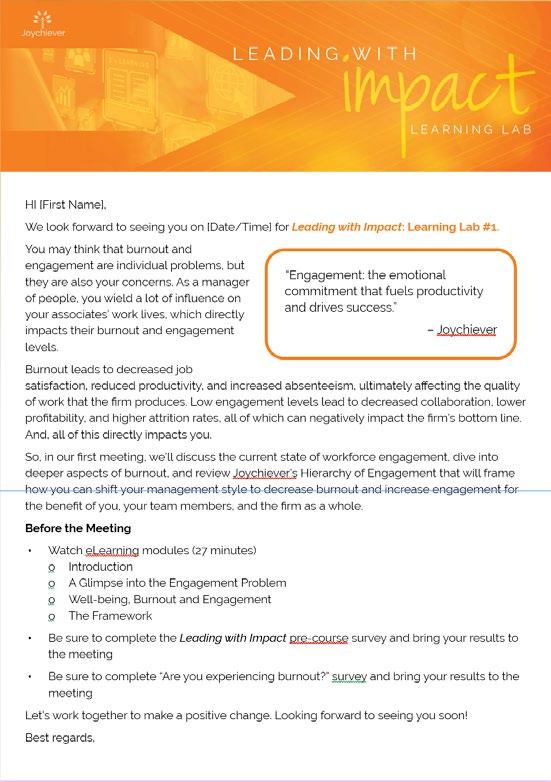
We look forward to seeing you on [Date/Time] for Leading with Impact: Learning Lab #1.
You may think that burnout and engagement are individual problems, but they are also your concerns. As a manager of people, you wield a lot of influence on your associates’ work lives, which directly impacts their burnout and engagement levels.
“Engagement: the emotional commitment that fuels productivity and drives success.”
– JoychieverBurnout leads to decreased job satisfaction, reduced productivity and increased absenteeism, ultimately affecting the quality of work that the firm produces. Low engagement levels lead to decreased collaboration, lower profitability and higher attrition rates, all of which can negatively impact the firm’s bottom line. And, all of this directly impacts you.
So, in our first meeting, we’ll discuss the current state of workforce engagement, dive into deeper aspects of burnout and engagement and review Joychiever’s Hierarchy of Engagement. Understanding the impact of effective management techniques will help you shift your management style to decrease burnout and increase engagement for your benefit, as well as for your team members and the firm.
• Watch eLearning modules (31 minutes)
o Introduction
o A Glimpse into the Engagement Problem
o Well-being, Burnout and Engagement
o Impact of (In)effective Management
• Be sure to complete the Milestone One: Baseline Assessment and bring your results to the meeting
• Be sure to complete the “Are you experiencing burnout?” Survey and bring your results to the meeting
Let’s work together to make a positive change. Looking forward to seeing you soon!
Best regards,
[INSERT NAME]
SUBJECT: Leading with Impact: Learning Lab #1 Recap
Hi [First Name],
Thank you for your participation in our first Learning Lab. I wanted to share a summary of the key points we discussed:
• Burnout and Engagement: As a partner, you significantly influence your associates’ work lives, impacting burnout and engagement levels.
“To
win in the marketplace, you must first work in the workplace.”
– Doug Conant• Consequences: Burnout affects job satisfaction, productivity and absenteeism. Low engagement results in reduced collaboration, profitability and increased attrition.
• Workforce Engagement: We discussed the current state of engagement and its importance in managing your teams effectively.
• Joychiever’s Hierarchy of Engagement: This framework helps you adjust your management style to decrease burnout and increase engagement for the benefit of yourself, your team and the firm.
Please keep handy your Milestone One: Baseline Assessment results. For this month, notice areas where you could adjust your management style and focus on your two selected action items.
Feel free to reach out if you have any questions or additional ideas to share.
Best regards,
[INSERT NAME]
SUBJECT: Workload, Deadlines and Always-on Pressure, Oh My!
Hi [First Name],
We look forward to seeing you on [Date/Time] for Leading with Impact: Learning Lab #2
We’ve got a super engaging and eyeopening meeting planned that may test your assumptions and views on the almighty billable hour. Plus, we’ll discuss the fine line between having enough work versus too much and how to avoid overwork traps. Finally, we’ll explore how you may be perpetuating ASAP culture and always-on pressure.
“46% of all stress is caused by workload.”
– American Institute of Stress
Before the Meeting, please watch these eLearning modules (28 minutes):
• Emphasize time over value
• Allow workload and deadlines to lead to exhaustion
• Enable always-on pressure
Let’s get together and make some positive changes!
Best regards,
[INSERT NAME]
LEARNING LAB #2: FOLLOW-UP
SUBJECT: Leading with Impact: Learning Lab #2 Recap
Hi [First Name],
Thanks for joining us at Learning Lab #2! It was great to have you there. Let’s quickly recap the main takeaways from our discussion:
• Balanced Performance Assessment: You’re encouraged to assess team members’ performance by considering not just the hours worked, but also the contributions or impacts they made (like meeting deadlines and satisfying clients). This way, you’ll foster a work ethic based on commitment, initiative and quality.
“Employees who say they often or always have enough time to do all of their work are 70% less likely to experience high burnout.”
–Gallup
• Heavy Workload and Overwork: You know how heavy workloads can lead to burnout and stress. To address this, you can nip overwork in the bud, establish clear priorities and push back on unreasonable deadlines.
• Alleviating Always-On Pressure: It’s important for you to ease the pressure of always being “on” for your team members. By setting ground rules for responsiveness and availability, you’ll create a healthier work environment. Don’t forget to lead by example and follow those guidelines regarding email responsiveness and off-hours communication.
Keep in mind the two actions you’ve committed to this month, and you’ll be on your way to creating a more productive work environment. If you have any questions or want to share more ideas, don’t hesitate to reach out!
Best regards,
[INSERT NAME]
SUBJECT: The future of work: Are you ready to embrace it?
Hi [First Name]!
We look forward to seeing you on [Date/Time] for Leading with Impact: Learning Lab #3.
At our upcoming meeting, we’ll delve into the importance of embracing your team members’ unique strengths and how to make the best part of the job the biggest part of the job, which is essential for fostering an engaged and satisfied workforce. We’ll also discuss how to encourage rest and play in the workplace, as these factors contribute to improved performance and well-being.
“The respite effect of a vacation can increase performance by 80%.”
– Mark Rosekind
Additionally, we’ll address stress management techniques to ensure your team can sustainably care for themselves during periods of heavy workload and client demands. By focusing on these key areas—strengths, rest, play and stress—we’ll explore how to create a thriving, highimpact workplace that benefits everyone involved.
Before the Meeting, please watch these eLearning modules (29 minutes):
• Capitulate to the strain of stress
• Downplay the criticality of rest and play
• Depreciate the importance of “most joyous” strengths
See you soon!
Best regards, [INSERT NAME]
SUBJECT: Leading with Impact: Learning Lab #3 Recap
Hi [First Name],
Thank you for your participation in our Learning Lab #3. Just wanted to share a quick recap of the main points:
• Joyous Strengths and Job Satisfaction: It’s important to recognize and appreciate your associates’ joyous strengths to boost engagement and job satisfaction. You can encourage the use of these strengths through proactive discussions, tailored assignments, training and mentoring.
“Harness the power of strengths and transform work into a symphony of achievement and growth.”
– Joychiever
• The Power of Rest and Play: Make sure to prioritize rest, such as breaks, unplugging, sleep and vacations, for both success and well-being. Remind your associates to disconnect from work when possible and enjoy the benefits of vacations. Don’t forget to incorporate some fun at work to reduce stress and spark innovation.
• Stress Management and Leadership: As a leader, you have a responsibility to prevent and manage stress in the workplace. Support your team members with physical, mental and practical stress management techniques. Clear away obstacles, set priorities and provide emotional outlets, creating a healthier work environment.
Remember the two actions you’ve committed to this month, and together, we’ll build a positive and supportive atmosphere that values strengths, rest, play and stress management. If you have any questions or more ideas to share, feel free to reach out!
Best regards,
[INSERT NAME]
SUBJECT: Transform the work environment with autonomy, authenticity and boreout avoidance strategies.
Hi [First Name]!
We look forward to seeing you at the upcoming Leading with Impact: Learning Lab #4 on [Date/Time].
We are going to have an engaging, and maybe controversial, chat about how you can create a work environment that’s not only good but absolutely thriving! We’ll dive into the crucial ingredients of autonomy, flexibility and trust, and how they can make all the difference.
“Focus on autonomy, not just flexibility, to spark engagement and prevent burnout.”
– JoychieverBut that’s not all. We’ll also explore strategies that implement decision-making frameworks, allow associates more control over their work lives and how to avoid situations of psychological unsafety. Finally, we’ll address the issue of boreout by offering tips on how to combat boredom with challenging assignments and passion projects.
Before the Meeting, please watch these eLearning modules (27 minutes):
• Allow routine to lead to boreout
• Focus on flexibility rather than autonomy
• Overlook the advantages of encouraging authenticity
See you soon for a masterclass on autonomy, authenticity and boreout! Best regards,
[INSERT NAME]
SUBJECT: Leading with Impact: Learning Lab #4 Recap
Hi [First Name],
Thank you for being a part of Learning Lab #4. Here is a summary of the key points we discussed:
• Autonomy and Engagement: Autonomy is super important for job satisfaction and fighting burnout. You can build trust and boost job autonomy by involving associates in decisionmaking, giving them more control over their work lives and supporting their choice to decline assignments when needed.
“Talk less, listen more – create a space where every voice is valued.”
– Joychiever
• Authenticity and Psychological Safety: To create a psychologically safe work environment, focus on promoting authenticity. This means actively listening, embracing healthy conflict and including others in decision-making. Encourage your associates to speak up and be themselves, making the workplace safer and more inclusive.
• Addressing Boredom and Burnout: It’s crucial to recognize that repetitive work can lead to burnout. To tackle this, identify roles prone to boredom, customize assignments based on individual preferences and provide context for tasks. Boost autonomy, assign challenging tasks and support passion projects to keep everyone engaged and motivated.
Keep in mind the two actions you’ve given yourself this month and work together to create a supportive atmosphere that values autonomy, authenticity and combats boredom. Feel free to reach out for questions or to share additional ideas.
Best regards,
[INSERT NAME]
SUBJECT: Pssst! We’ve got the secret antidote for “Quiet Quitting…”
Hi [First Name]!
Yep, you heard that right. During our upcoming meeting, you’ll tackle the pesky problem of “Quiet Quitting,” which is really just a media buzz phrase for low engagement. It all revolves around purpose, appreciation and connection.
You’ll gain valuable tips to help associates answer the question, “How does my work make a difference?,” which has a huge impact on engagement. We’ll also talk about the power of appreciation and recognition and how you can use both on a daily basis.
“When people feel like they belong at work, they are more productive, motivated and engaged, and 3.5 times more likely to contribute to their fullest potential.”
– Center for Talent Innovation
And we can’t forget about building connections and fostering that sense of belonging. We’ll chat about how you can create an even more supportive work environment through relationship building, engaging check-ins and connecting the team, even when working hybrid.
Finally, as this will be our last Learning Lab, we will summarize all of your learnings so far and discuss your next steps going forward.
Before the Meeting, please watch these eLearning modules (28 minutes):
• Fail to appreciate and recognize often enough
• Neglect to cultivate connection
• Undervalue the power of purpose
• Summary
Can’t wait to see you at Learning Lab #5 on [Date/Time]! I know we’ll have some fantastic discussions.
Best regards,
[INSERT NAME]
SUBJECT: Leading with Impact: Learning Lab #5 Recap
Hi [First Name],
Congrats! You made it through all of the Learning Labs. Here is a quick summary of our key points from Learning Lab #5 and next steps going forward.
• The Power of Purpose: Purpose is crucial for engagement, well-being and retention. Help your associates find meaning in their work by connecting it to the big picture, reinforcing how their work matters to the firm’s purpose.
“A sense of purpose in your work transforms the daily grind into a powerful force for motivation and engagement.”
– Joychiever• Appreciation and Recognition: Showing consistent appreciation and recognition can reduce burnout and improve satisfaction. Be timely, creative, individualized and consistent in expressing your gratitude. Understand your team members’ preferences for recognition and make gratitude a regular part of team meetings.
• Cultivating Connections: To prevent burnout and boost engagement, foster belonging and connection among team members. Encourage intentional relationship building, conduct regular check-ins focusing on both work and personal aspects and appreciate the impact of a work best friend.
As this is our last Learning Lab, keep your Action Summary sheet and your desired next steps handy and visible while you work. This will help you to remember these concepts on the daily.
It’s time to complete your final skills assessment with Milestone Two: Mastery Reflection . This 15-minute survey will enable you to evaluate your skill development throughout the entire program and identify any remaining areas for continued focus. It’s an excellent opportunity to reflect on your learning journey and ensure you’ve made the most of this enriching experience.
Our team is always here to support you. As always, feel free to reach out for questions or to share additional ideas.
Best regards,
[INSERT NAME]


SUBJECT: Your Leading with Impact Journey - An Experience of Growth and Success
[NAME],
Congratulations on completing the Leading with Impact experience! Throughout this journey, you’ve gained valuable insights and skills to help you become a more effective leader. As you continue to apply these learnings, you should notice some incredible benefits within your team:
• Enhanced engagement: You now understand the seven essential hierarchy levels to create a work environment where team members are engaged and motivated.
• Improved work-life balance: You’ve learned how to manage workloads and stress levels, promoting well-being for yourself and your team.
• Talent optimization: By focusing on individual strengths, you can ensure your team members are working in roles that maximize their potential and drive growth.
• Increased autonomy and trust: You’ve learned to empower team members, fostering a sense of ownership and trust within the firm.
• A culture of care: The training program has taught you to acknowledge and appreciate your team members, allowing them to express their authentic selves in the workplace.
• Stronger connections: By fostering healthy relationships and meaningful interactions, you can create a supportive work environment where team members feel connected.
• A sense of purpose: The program has helped you ensure that your team members understand the impact of their work, leading to increased job satisfaction and fulfillment.
We hope you’re as proud of your growth as we are! Keep applying these valuable lessons and continue to make a meaningful impact for your teams and in the firm.
Wishing you all the best in your leadership journey!
Warm regards, [INSERT NAME]



The Milestone Surveys enable you to measure adoption of the skills taught in the program. The survey will be administered two times throughout the five-month experience:
• Two weeks before the program launches
• Following the final Learning Lab
You will be able to compare individual and cumulative results to assess the overall impact of the program for your participants, their direct reports and the firm.
The survey is comprised of 36 questions and is administered online. Participants will receive personalized results and guidance after completion of each survey.

1. I ensure my associates feel a sense of purpose through their work.
2. I expect team members to work off-hours.
3. I empower associates to make decisions commensurate with their experience level.
4. I make time for my associates to participate in training to grow their skills.
5. I provide a clear deadline when I give a work assignment.
6. I value the results that my team members generate with as much or more importance as the hours billed.
7. I monitor my team members’ stress levels.
8. I provide assignments that help associates stretch to develop their skills.
9. I encourage associates to offer their opinions on any topic.
10. I express appreciation for the day-to-day work of my team members.

11. I discuss appropriate personal topics with my team members so we can get to know each other in non-work ways.
12. I encourage my team members to take breaks throughout the workday.
13. I am aware of where my associates excel and which skills they want to develop.
14. I accept that there are times when associates may have to decline work assignments from me.
15. I clearly communicate general ground rules for expected response times for messages, e.g., all messages need a response within (#) hours.
16. I discuss how my team members’ work contributes to client or firm objectives.
17. I encourage team members to practice techniques to manage stress.
18. I consider all team members’ perspectives so I can understand different views of what’s “fair.”
19. I thank my team members at the completion of every assignment.
20. I struggle to keep team members’ workloads reasonable.
21. I create fun moments for my team members.
22. I have 1-1 status updates or check-ins with my associates.
23. When I see associates struggle with monotony, I take steps to make their work interesting again.
24. I share firm stories or strategies to help associates draw connections between what they do and what the firm is striving to accomplish.
25. I am sure to highlight when a team member brings value and generates desired results for clients and the firm.
26. I expect associates to be available 24/7.
27. I support friendships amongst team members.
28. I set deadlines that give team members adequate time to complete assignments during regular working hours.
29. I discuss methods for managing stress with team members.
30. I discuss what work motivates each associate on my team(s).
31. I closely manage the details of my team members’ work.
32. I am timely with appreciation or recognition.
33. I struggle to give work that will enable my associates to do what they do best.
34. I encourage team members to be their authentic selves at work.
35. I encourage associates to take vacation time each year.
36. I tell my associates how their work makes a difference.
See sample report on page 36.
Prior to Learning Lab #1, participants will complete the “Are you experiencing burnout?” Survey. The survey should take them 10 minutes or less and will give participants an understanding of their own burnout levels. You will invite them to discuss their results in the first Learning Lab.
1. What does a typical day at work look like?
• I start work (often early), do my work with few breaks and struggle to end my day at a reasonable hour.
• I work diligently throughout the day, often spending extra hours to stay on top of things, but I also take time to interact with colleagues.
• I’m productive during the day, and take regular breaks throughout the day, including lunch.
2. With my work,
• I regularly see the big picture and how I am contributing.
• I feel like a cog in the wheel without much meaning.
• I know it’s important but would like to understand the bigger picture more often.
3. My most important work:
• Gets appropriate attention every day.
• Is often finished after work hours when I have less interruptions.
• Is a regular struggle to complete.
4. How do you feel about where your firm is headed in the future?
• I’m excited and look forward to being a part of it.
• I am confident but it’s really out of my hands.
• I used to care about my firm’s mission, but after many disappointments, I no longer care or believe in it.
5. How would you describe your sleeping patterns?
• I sometimes have trouble falling asleep or waking up, and only sleep 5-6 hours per night.
• I regularly sleep through the night and get about 7-9 hours per night.
• I often sleep for less than 4 hours at a time.
6. When it comes to my involvement in my organization’s decision-making, I feel:
• Frustrated that I don’t have opportunities to contribute or when my input isn’t acknowledged.
• Pleased that I have input into the outcome of decisions.
• Happy that my opinion is welcomed but concerned when it’s not considered.
7. At work, I feel:
• Capable.
• Ineffective.
• Competent and confident.
8. My energy levels—emotional, mental and physical—regularly feel:
• Depleted.
• Energetic and engaged.
• Somewhat diminished.
9. When it comes to receiving feedback or recognition from my team, I feel:
• Appreciated, valued and heard with frequent feedback.
• My work is recognized, but I could receive more regular feedback.
• Unappreciated without regular, meaningful recognition.
10. When clear expectations are not set for me, I feel:
• Comfortable setting my own expectations or communicating with my team for clarification.
• Like it’s impossible for me to be successful in my role.
• A bit lost, but I’m able to fill in the blanks.
11. I work during the evenings and weekends.
• Most nights and weekends.
• Once or twice every week.
• Only when there’s a significant project to complete.
12. I can be easily irritated with people and inconveniences at work.
• Sometimes.
• Rarely.
• Often.
13. My brain is typically running on:
• Cloudy Weather–I feel some brain fog every once in a while.
• Empty–very hard to concentrate.
• Adrenaline–I’m excited and energized by tasks.
14. I worry I won’t be able to succeed in certain situations or accomplish specific tasks:
• Rarely because I have support from my team.
• With every assignment I receive.
• With some new projects or challenging assignments.
15. I feel bored.
• Regularly.
• Sometimes.
• Rarely.
16. The last time I dreaded going to work was:
• Most Sunday nights.
• Rarely. I love my job!
• More nights than not.
17. I experience stress-related, physical ailments:
• Rarely. I’m pretty healthy.
• Occasionally, when I’m especially stressed.
• Chronically.
18. My workflow is:
• Unpredictable, and I feel like I’m constantly in emergency mode.
• Hectic at times but manageable.
• Comfortable. I can handle most things that come my way.
19. I worry that others are disappointed with my performance, even if they don’t say so.
• Rarely.
• Regularly.
• Sometimes.
20. Connecting with colleagues:
• Is not something I care about or try to do.
• Is important to me and something I regularly make time for.
• Is fun when it happens.
21. Most days, I feel like I’m:
• A rockstar.
• Drowning in commitments.
• Managing okay.
See sample report on page 37.



• Engagement and burnout are real issues.
• Burnout is more than just exhaustion.
• A good leader shares responsibility with their team members and the firm for managing all three elements—well-being, burnout and engagement.
• Joychiever’s Hierarchy of Engagement helps leaders pinpoint where they can improve their management style, as well as identifies where their team members may be struggling on engagement.
• Watch eLearning modules (Total time: 31 minutes)
o Introduction
o A Glimpse into the Engagement Problem
o Well-being, Burnout and Engagement
o Impact of (In)effective Management
• Complete the Milestone One: Baseline Assessment (15 minutes)
• Complete the “Are you experiencing burnout?” Survey (10 minutes)

Prepare in advance: Participate in the eLearning modules and familiarize yourself with different perspectives to be able to guide the conversation effectively and address any questions that may arise.
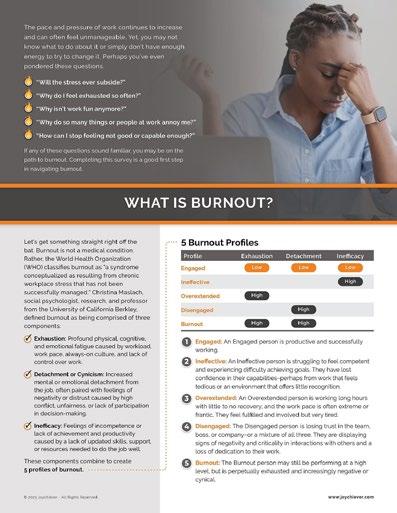
• Signs of Burnout
• If Engaged…
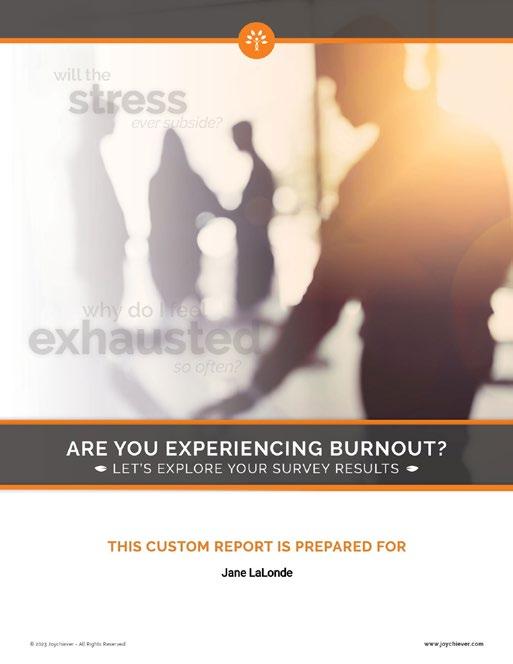
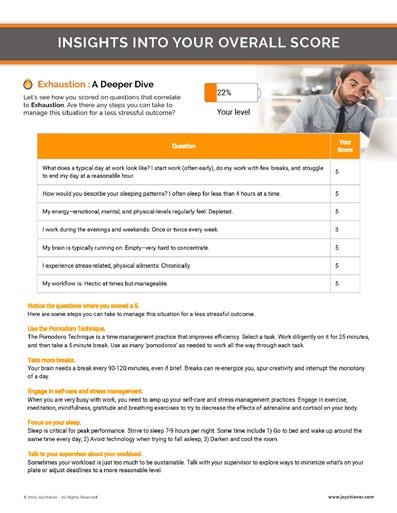
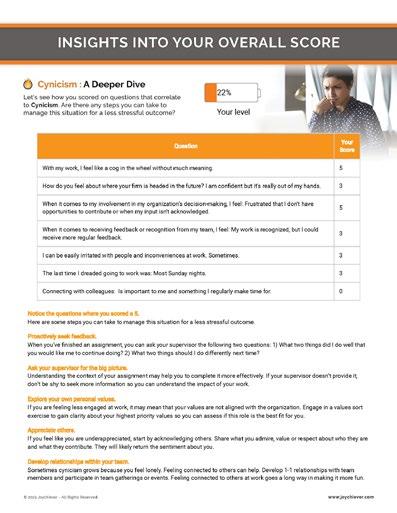
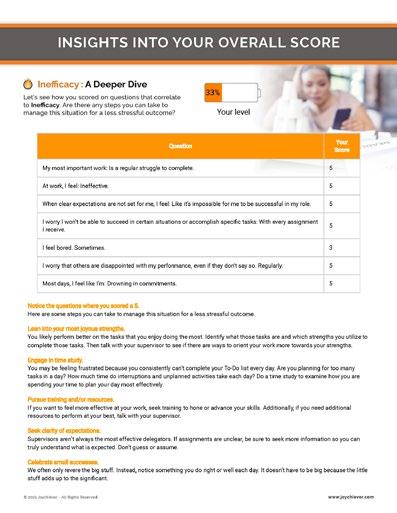
• “Are You Experiencing Burnout?” Personal Report
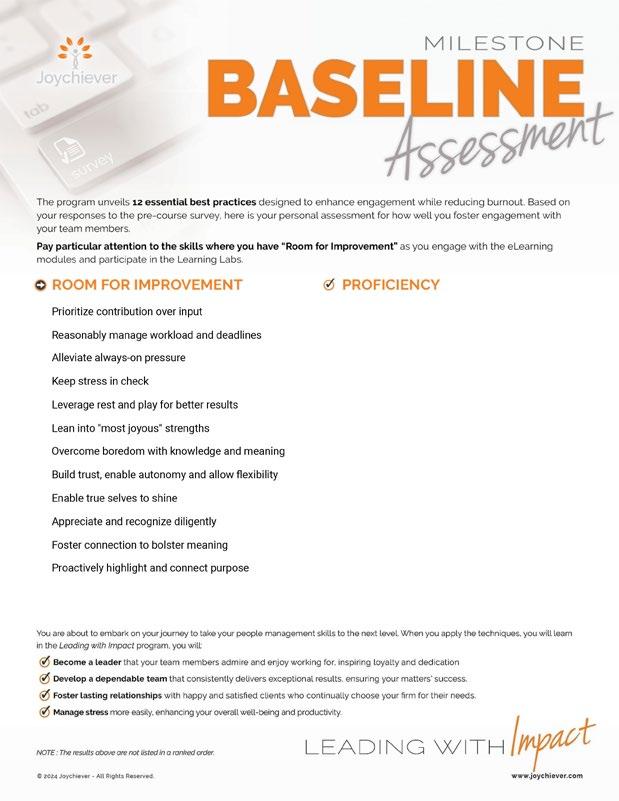
• Milestone One: Baseline Assessment Personal Report
• It is important for participants to realize that how they manage people has a direct impact on engagement.
• Question #1 helps you to understand how important the participants find these issues, as well as which aspect really stood out for them.
• Each character in the course is on the path for one of the burnout profiles.
o John – Exhaustion
o Sarah – Cynicism
1
o Dominique – Inefficacy
• You will receive an aggregate report for all participants who completed the Milestone One: Baseline Assessment so you will know the skills each participant will be encouraged to focus on.
1 2 3 4 5
1. Of the statistics presented in the module “A Glimpse into the Engagement Problem,” which one was most interesting? Why?
2. Let’s reflect on the elements of burnout—Exhaustion, Cynicism and Inefficacy, and the 5 Profiles. No doubt you’ve seen behavior examples of all these profiles in your team members over the years. Which profile do you think is most prevalent for those whom you manage?
a. Now that you are aware of the profiles, do any of your team members seem particularly susceptible to any of the burnout profiles?
3. Look at your report from the “Are you experiencing burnout?” Survey. Which of the burnout elements are you experiencing the most? How does that information strike you?
4. Which of the six levels of Joychiever’s Hierarchy of Engagement are the most challenging in managing your team members?
5. From the Milestone One: Baseline Assessment, which levels have been suggested for you to focus on? How do you feel about the recommendations?
1
1
2
3
4 5
• Due to the high prioritization of billable hours, law firm cultures are systemically challenged.
• A good leader emphasizes contribution and impact as much as hours billed.
• A partner plays a major role in controlling workload and deadlines for associates and business professionals.
• It is possible to be responsive and not suffer from always-on pressure. Transparent, upfront, clear communication is the key.
• Watch eLearning modules (Total time: 28 minutes)
o Emphasize time over value
o Allow workload and deadlines to lead to exhaustion
o Enable always-on pressure

Be an active listener: Demonstrate active listening by paying close attention to what participants are saying, acknowledging their input and asking follow-up questions to encourage further elaboration.

• Overwork Traps
• Overcome ASAP Culture
• There are inherent aspects of a law firm business model that can exacerbate burnout: 1) Billable hour requirements and impacts on compensation and bonuses, 2) The amount of hours, generally, that need to be worked in a service business, and 3) A major emphasis on being highly responsive. Therefore, good leaders try to contain the excess hours as much as possible, negotiate and set reasonable deadlines with clients and avoid perpetuating always-on pressure.
• John and Sarah scenario
o There is no right or wrong answer to this scenario.
o Don’t let this conversation dominate the whole meeting.
o The aim of this scenario is to expose a potential bias by the partner to automatically rate John highly because of the amount of hours he works—on matters, by being immediately responsive and generally being available 24/7.
o Everyone wants a “John”—highly reliable, always available and super responsive. However, he is on the path to Exhaustion, and odds are high John could suffer a negative consequence. How he is working is not sustainable long-term, and the partner needs to help him see that.
1. Aside from hours billed, what results do you highly value?
2. Let’s discuss the scenario with John and Sarah. Who agrees with the eLearning that John should not receive a high bonus?
a. What if I told you that Sarah is more productive than John? Does that change your view about John?
b. If you could only work with one associate, whom would you choose?
3. Which of the Overwork Traps are your team members susceptible to? How can you talk about it with them?
4. Are there ways in which you perpetuate an ASAP culture?
5. Which techniques will you deploy to alleviate always-on pressure?
6. What two techniques will you implement in the next month?
1
2
3
4
• Stress is an accepted aspect of being a lawyer. Yet, our bodies were not built to withstand prolonged, chronic stress.
• The participants now have a number of techniques for managing stress that they can suggest to their team members.
• Rest and play are critical components of success—financial, engagement, retention—and are a way to stay charged, rather than recharge.
• Facilitating ways for team members to use and grow their “most joyous” strengths enhances engagement and improves retention.
• Because an individual can perform well at many tasks, it can be challenging to identify which skills are “most joyous.”
• Watch eLearning modules (Total time: 29 minutes)
o Capitulate to the strain of stress
o Downplay the criticality of rest and play
o Depreciate the importance of “most joyous” strengths

Encourage participation from all members: Make an effort to involve everyone in the discussion by inviting input from quieter participants and ensuring that no one dominates the conversation.

• Stress Clues You Shouldn’t Ignore
• Techniques to Master Stress
• The Criticality of Rest and Play
• How to Identify “Most Joyous” Strengths
• Infographic: Unlock the Power of Strengths
• How a partner manages the team has a significant impact on the stress levels of the team members. As a leader, the partner bears responsibility to ensure it doesn’t get too out of control.
• Most partners won’t intentionally discourage R&R but they also may not encourage it. To be a good leader, they need to proactively support it.
• Some may think that play or fun and being a lawyer can’t coexist. Your job during the meeting will be to try to dispel them of this notion. Having fun at work doesn’t mean that the work for clients isn’t serious business.
• For the strengths discussion, the emphasis needs to be on
1) Awareness of a team member’s “most joyous” strengths. If a partner is unaware, they need to discuss with the team member. If the team member is unaware, the partner needs to help them find that awareness.
2) It is important to make an effort to provide assignments that lean into the strengths.
3) Don’t let the perceived lack of control of the work that comes in from clients be an excuse for not being able to give assignments towards strengths. While yes, it can be a factor, effort still needs to be made when possible.
1. Have you had specific stress conversations with your team members?
a. If Yes, what did you discuss?
b. If No, why not?
2. In what ways have you encouraged team members to manage their stress?
a. What techniques in body, mental and stress mastery resonated with you?
3. For R&R, let’s talk about shifting from thinking of it as a way to recover to a way of staying charged. With this mindset, in what ways will you encourage rest?
4. What ways can you incorporate fun into the day-to-day work?
5. Do you have a grasp of your team members’ “most joyous” strengths?
a. How often do you provide assignments that lean into those strengths?
b. How can you direct more assignments towards those strengths?
6. What two techniques will you implement in the next month?
1
2
3
4 5
• Even if a team member is working at a high level, they may still suffer from boreout.
• Autonomy doesn’t mean giving up control. It’s more about allowing for input or influence so team members feel like they have some sort of control over their work lives.
• Encouraging authenticity and fostering psychological safety and fairness are key for feelings of belonging and engagement.
• Watch eLearning modules
(Total time: 27 minutes)
o Allow routine to lead to boreout
o Focus on flexibility rather than autonomy
o Overlook the advantages of encouraging authenticity

Manage disagreements constructively: Address any disagreements or conflicts that arise by encouraging respectful debate, asking for clarification and seeking common ground.

• Ways to Offer Autonomy
• Infographic: Embrace and Empower Autonomy
• Infographic: 9 Examples of Psychological Unsafety
• Autonomy is the antithesis of micromanagement, so if you know there are micromanagers in the group, some of these techniques may be challenging for them.
• Many people will think they are already doing many of the concepts suggested in these modules, but in reality, they may not be doing enough. So, you will want to probe to open their thinking and nudge them to accept new ways of behaving.
3
4 5
1. Let’s focus on what team members want input or influence on:
a. When to work
b. Which assignments to accept
c. How many assignments to take on at once
d. Setting deadlines
e. Making decisions
f. Where to work
How can you give your team members more input?
2. Have any of you ever had a proactive and transparent conversation with an associate about saying “No” to a work assignment?
a. Can you appreciate how they may perceive saying “No” as career limiting?
b. Can you get behind the notion that it isn’t? Rather it can be a responsible way to perform at a high level by not taking on too much?
3. In the 9 Examples of Psychological Unsafety, have you seen any of these situations occur with your teams or team members?
a. Can you recognize how they can have a negative impact on your team members?
4. What two techniques will you implement in the next month?
1
2
3
4 5
• Partners may be recognizing team members but not necessarily appreciating them or expressing that appreciation often enough. Partners have both recognition and appreciation available to them.
• Strive to appreciate the small or day-to-day things regularly, even if obvious.
• Check-ins may not be the direct responsibility of the partner, but they should try to do them anyways, especially with hybrid team members. It’s the most effective way to create connection.
• Purpose is all about the WHY for the team member, and a good leader strives to make purpose visible regularly.
• As this is the last Learning Lab, emphasize their takeaways from the entire program.
• Watch eLearning modules
(Total time: 28 minutes)
o Fail to appreciate and recognize often enough
o Neglect to cultivate connection
o Undervalue the power of purpose
o Summary

FACILITATION TIP #5
Keep the discussion on track: Gently steer the conversation back to the main topic if it starts to veer off course and use time management techniques to ensure that all important points are covered.

• The Difference and Necessity of Appreciation and Recognition
• The Art of the Check-in
• Cultivate Connection Through Virtual Meetings
• Work Values Inventory
• Infographic: Be the Architect of Connection
• Action Summary Sheet
1 2 3 4 5 5
• Emphasize all of the small or day-to-day ways to express appreciation, as well as the impact it can have on the business.
• While 1-1 check-ins may not be the express responsibility of the partner, it doesn’t mean they shouldn’t have them. Even if only 15-30 minutes per week, check-ins have a major impact on connection and engagement.
• Be sure to emphasize all the ways that the partner can “make purpose visible.”
• Make sure to save time to discuss the personal impact of the program for each person so far. Acknowledge mindset shifts and new skill adoption.
1. How often are you expressing appreciation of your team members?
a. In what ways can you do it more often?
2. Who does weekly check-ins?
a. (For those who do conduct check-ins) How do they go? What do you discuss?
b. (For those who do not conduct check-ins) Why not? Can you see the value of holding them?
3. How do you help associates answer the WHY questions?
a. How does what I do matter here?
b. Why am I doing the work that I’m doing?
c. Does this work inspire me?
d. Does my work make a difference?
4. How has participating in this program for the last six months impacted you?
5. Pull out your Action Summary Sheet. Which areas do you want to focus most on going forward?
1
2
3
4