Exploring the Variety of Random Documents with Different Content
asset, and said that he would rather be Senior Wrangler in the worst year than second to Sir Isaac Newton. His definite aim in life—a political career—made any wanderings into study for its own sake of no interest to him. He planned through life so to select that he might obtain.
From the days of declaiming in the chalk-pit at Queenwood, Fawcett had realised the value of public speaking.
The great Macaulay, Sir William Harcourt, and other distinguished men had tried their oratorical pinions in flights at the Debating Club called ‘The Union.’ Fawcett joined, and after some tentative efforts, despite his friends’ amusement and discouragement, boldly won his way, and became a good speaker. He worked over his orations carefully, and by great persistence gained an easy and fearless manner of speaking, and we find that he opened debates on National Education and University Reform. In these years the events which led to the Crimean War provided the chief subjects of debate, such as the foreign policy of Austria and Prussia, the independence of Poland, and the character of the Emperor Nicholas. On these questions Fawcett did not share the views of John Bright, who was then making his great speeches on behalf of peace; but the undergraduate’s democratic sympathies are clearly shown in his advocacy of non-sectarian National Education, of a motion that ‘the party called “Cobdenites” have done the country good service,’ or in favour of a ‘considerable extension of the franchise,’ and of ‘University Reform.’
The Debater. Good-bye to Grandiloquence.
It was during this period of careful self-training that Fawcett gradually reduced his style of speaking to that simplicity and directness which became so marked throughout his career. There is a lingering trace of grandiloquence and schoolboy rhetoric in an essay written on the merit of Pope’s poetry, but that seems to have been his swan-song to elocution with frills.
Fawcett left Peterhouse in his second year, and went to Trinity Hall as a pensioner, thus reducing the expense to his father. There chances for scholarship were alluring, and several immigrants from other colleges joined forces at Trinity Hall. There also he met Leslie Stephen, his lifelong friend and biographer, who speaks of this friendship as ‘one of the greatest privileges of my life.’
Fawcett set to work with a will to carry off the Senior Wranglership. We are told that in the Tripos, for the first and the last time in his life, Fawcett’s nerve failed. Though he got out of bed and ran round the college quadrangle to exhaust himself, he could not sleep, and failed to gain the success which meant so much to him. He sank to seventh; but in spite of his comparative failure he had shown marked ability, and made so great an impression by his work, that he was elected to a fellowship at Christmas 1856.
The Friend of Friends. Pounds and Pence.
He adhered to his boyish ambition of entering Parliament, but there were still great obstacles in his way. Beyond his fellowship, which brought him £250 a year, he had no income of his own. His father was not a rich man, and the strain on his purse to support his other three children was sufficient. Harry resolved, therefore, to make his way by a career at the Bar, and while still at Cambridge entered Lincoln’s Inn. When he had won his fellowship he settled in London, and set himself to study law. No one who came in contact with him at this time had any doubt that he would arrive at his goal by main force. A friendly firm of solicitors had already promised that he should have opportunities, and his great talent for working well with all sorts of people, his genius for friendship, and his real business ability bid well for the success of his plan. His will was inflexible, his good-nature chronic, and his acuteness of mind and general ability far beyond the average.
In the mimic legislature of the Westminster Debating Society, which consisted of young barristers and journalists, Fawcett soon became the leader of the Radical party. The organisation followed the form
of the House of Commons. It is said that Bulwer Lytton had once paid it a visit, and said afterwards that he had entered in a fit of abstraction, mistaking it for the House of Commons, and only discovered his error upon finding that there were no dull speeches and no one asleep, which seems to prove that it must have been a most remarkable society.
One of his contemporaries, who saw Fawcett in the height of these pseudo-Parliamentary triumphs, speaks of his ‘resonant voice, wild hair, and expressive eyes.’ But just at this point, when he seemed to be setting with full sail on the channel towards success, his eyes began to trouble him.
CHAPTER IV
A SET BACK
A Trip to France—Wiltshire French—A Discouragement.
In 1857 the great Critchett warned him against making any exertion, and forbade his reading. Though he appeared cheerful as usual with his family, a friend recalls that during his entire career he had never known him to be so depressed.
In 1857 he was glad to find occupation by taking a pupil to Paris. Miss Fawcett went with them. The pupil was to read mathematics and to learn French, while it was hoped that the master’s eyes might benefit under the care of foreign specialists, as well as by the change.
The oculists gave him some slight encouragement: one ordered low living, and the other high. It was characteristic of Fawcett that he frugally chose the former.
The Ways of the French.
In Paris our long Wiltshire man seems to have been much of a fish out of water. The Latin morals and customs were naturally not sympathetic to his uncompromising though uncensorious nature. He could never cope successfully with a foreign language. There was even a frequent strong Wiltshire flavour about his English speech. The difference between ‘February’ and ‘Febuwerry’ never became apparent to him. At Alderbury he had learnt French with a pronounced English accent. In Paris he now delighted the French ladies at the pension where he
stayed with his peculiar and unique speech. There was a Madame Palliasse there whom, much to her joy, he called Madame Peleas.
He came back from France with his eyes still in bad shape and his spirit totally unresponsive to the lure of Gaul.
On his return he was extremely tried by his inability to work. His real feelings about life at this time are well expressed in a letter to his dear friend, Mrs Hodding:
Confession.
‘I regard you with such true affection that I have long wished to impart my mind on many subjects.... You know somewhat of my character; you shall now hear my views as to my future. I started life as a boy with the ambition some day to enter the House of Commons. Every effort, every endeavour, which I have ever put forth has had this object in view. I have continually tried, and shall, I trust, still try not only honourably to gratify my desire, but to fit myself for such an important trust. And now the realisation of these hopes has become something even more than the gratification of ambition. I feel that I ought to make any sacrifice, to endure any amount of labour, to obtain this position, because every day I become more deeply impressed with the powerful conviction that this is the position in which I could be of the greatest use to my fellow-men, and that I could in the House of Commons exert an influence in removing the social evils of our country, and especially the paramount one—the mental degradation of millions.
‘I have tried myself severely, but in vain, to discover whether this desire has not some worldly source. I could therefore never be happy unless I was to do everything to secure and fit myself for this position. For I should be racked with remorse through life if any selfishness checked such efforts. For I must regard it as a high privilege from God if I have such aspirations, and if He has endowed me with powers which will enable me to assist in such a work.’
This is an interesting revelation of a pure ambition. Fawcett wished to succeed for no self-regarding purpose. His ideals were noble, and
his ambition their legitimate accompaniment.
About this time he shows a lively interest in the social condition of the people. After an expedition to some manufacturing towns he mentions an investigation of ‘gaols and ragged schools,’ and shows much interest in these sombre centres. He describes a meeting with a good gentleman whom he characterises as ’so fine and perfect an example of a venerable Christian.’
Palmerston, Disraeli, and Gladstone.
Even twelve hours spent in one day at the House of Commons does not seem to have been for him an overdose of politics. It did not tax his eyes, and it delighted his ears, though he writes, ‘No one need fear obtaining a position in the House of Commons now; for I should say never was good speaking more required. There is not a man in the Ministry can speak but Lord Palmerston; Disraeli is the support of the Opposition; but, although he was considered to have achieved a success that night, it was done by uttering a multitude of words and indulging in a great deal of clap-trap.
‘Gladstone made the speech of the evening, and he is a fine speaker. He never hesitates, and his manner and elocution are admirable; in fact, in this he resembles Bright, but is, in my opinion, inferior to Bright, in not condensing his matter.’
Towards the close of this letter there is an exceedingly interesting statement, prophetic of his future interests. He says that he feels that Australia must have in future a great effect on England, and adds these significant words, ‘India too is the land I much desire to see and know; and it ought to be by any one who takes part in public life.’
The doctor now forbade Fawcett all reading, for fear that he might lose his sight. He took this sentence philosophically, commenting that it came at an extremely favourable time, when he could best afford to take a holiday. He writes, ‘I cannot be sufficiently thankful that it has occurred just now, when perhaps I can spare the time with so little inconvenience.... Maria will resign her needle with great
composure to devote herself to reading to me. I shall thus get quite as much reading as I desire, and I can well foresee that, far from being a misfortune, it may become an advantage, since it will perhaps for the next year induce me to thinkmore than young men are apt to do: it will give me an opportunity to solidify and arrange my knowledge, and you will know how happy Maria and I shall be together.’
Discouraged.
About this time a classmate writes of him: ‘We recognised as fully as at a later period his energy and keen intelligence. If we were still a little blind to some of his nobler qualities, we at least recognised in him the thoroughly good fellow, whose success would be as gratifying to his friends as it was confidently anticipated.’
Yes, anticipated and ardently hoped for; but could it be expected by Fawcett himself, doomed as he was to idleness by the condition of his eyes, his doctor’s warnings, and their orders for absolute rest— and unfitted as he now was for work, and able only to send an occasional letter to the papers on matters of current interest?
He was staying at his father’s house at Longford with such patience as he could muster. He, however, enjoyed sitting in the fields near Salisbury and listening to the sounds about him. The murmuring streams, the songs of birds, and the hum of drowsy insects seemed to bring him comfort and rest.
WINNING BACK
‘If you can meet with triumph and disaster And treat those two impostors just the same.’
KIPLING
.
‘Life is sweet, brother.’
. . . . . .
‘In sickness, Jasper?’ ‘There’s the sun and the stars, brother.’
‘In blindness, Jasper?’ ‘There’s the wind on the heath.’
BORROW.
CHAPTER V DARKNESS
A Shooting Accident—Blindness—Readjustment.
Unfortunate as was the fate which condemned him to so much trouble with his eyes, it was a fortunate and strange preparation for what was to follow. Obedient to his physician’s injunctions to give up work, Fawcett remained with his family near Salisbury. On 15 September 1858, he went shooting with his father. Together they climbed Harnham Hill. Fawcett turned to look back at the glorious view, bathed in an autumn light, the trees, already turning to gold, the village nestled in the valley through which the river Avon wound, the spire of the great cathedral touched with glory by the setting sun. To Fawcett this was one of the loveliest views in England: he looked on all this beauty for the last time.
A Shooting Accident.
As they were crossing a field he advanced in front of his father, who, suffering from incipient cataract of the eye, did not see his son. A partridge rose and the father fired, hitting the bird, but some of the stray shot penetrated both the son’s eyes, blinding him instantly. To protect his eyes from the glare he was wearing tinted spectacles, both glasses were pierced, but the resistance which they offered to the shot prevented the charge entering the brain, and so probably saved his life. His first thought on being blinded was that he would never again see the beautiful view which he loved so dearly. There is
a widely current story, which, however, we have been unable to verify, that after the accident his first words to his agonised father were, ‘This shall make no difference.’
Unflinching Bravery.
He was taken back to his father’s house in a cart, and his first words to his sister as she received him there were, ‘Maria, will you read the newspaper to me?’ This way of taking his calamity sounded the key-note of his heroic acceptance of it from the first. His unflinching bravery gave the cue which he wished his family to follow. His calmness remained unaltered even when the doctors gave little encouragement. All knew that there was not much hope, though he was in such splendid physical condition that he suffered very little pain.
Mrs. Fawcett, whom her relations called ‘the brightness of the house,’ was having tea with some friends when her wounded son was brought in. When she saw him she bravely tried to control her grief, but it was so overwhelming that she took refuge in another room, and only appeared in the short intervals when she was able to master her distress.
In this crisis his sister Maria was a tower of strength. The poor father seemed more sorely stricken by the accident than the son. But for his daughter’s wisdom, he would probably have lost his reason. All through the night Maria kept him busy at small, useful tasks, and for several days occupied both her mother and him as fully as possible.
Blindness.
After a lapse of six weeks Fawcett was able for three days to perceive light, but after that the curtain fell for the rest of his life, and he remained in total darkness. In the following June he suffered some pain in one of his eyes, and later submitted to an operation which was unsuccessful, and put the final seal on his calamity. Perhaps the father deserves as much sympathy as the son. Their relations had been particularly affectionate, and were, if possible, more intensely so after the catastrophe. The elder Fawcett often said that his grief at having blinded Henry would be less, if ‘the boy’ would only complain. But this was perhaps the only
way in his life that the son refused to gratify the parent whom he loved so tenderly. He was never known to complain of his loss of sight, and used to say that blindness was not a tragedy, but an inconvenience.
The life-long ambition of Fawcett to lend a hand in public affairs had been shared by his father, and the hope and pride which he felt in his son’s career added, if possible, to the tragedy of seeing it so suddenly broken. The indomitable pluck shown by more than one blind man which makes out of his stumbling-block a mounting-stone had yet to be proven. It did not then seem possible for him to win even greater triumphs than he might have won if he had not been forced to sharpen his courage because he had to fight his battle in the dark.
A friend who visited Fawcett a few weeks after the accident found him serene and cheerful, although his father was evidently heartbroken, and his appearance gave abundant evidence of it. Fawcett, though not much given to quotation, was fond at this time of repeating the phrase of Henry V. at the battle of Agincourt:
‘There
is some soul of goodness in things evil, Would men observingly distil it out.’
What Fawcett distilled from the evil thing which had befallen him was an iron determination, which triumphed over odds such as few have encountered on any battlefield.
A Cloud.
But the blind man’s horizon had not yet cleared. His outlook, despite the loving care of his family, was still sad, and though he gave no sign, there was a fearful slough of despond still to be struggled through. Ten minutes after the accident, he had made up his mind to stick to his pursuits as much as possible, but how nearly possible was it for a blind man to succeed in Parliament, and to give a helpful impetus to the affairs of nations? This was still at Fawcett’s time in England untested and remained for him to show. He lacked fortune and social position to clear the road for him, and the letters of condolence that poured in
mostly obstructed his path with futile sentimentality. He said, ‘they give more pain than comfort,’ and added that nothing pained him so much as these letters. The writers counselled resignation to the will of Providence, meekness, submission, and of course all implied inaction. But Fawcett asked what was the will of Providence. Why, without trying, should he suppose that inaction would be the nobler part for him to play. His sister read to him all the missives from the Job’s comforters, and he, though much saddened, listened, ‘in a fixed state of stoical calm.’
The Message of a Friend.
Into this atmosphere, heavy with grief, came the message of a friend. His dear old Cambridge teacher, Hopkins, wrote admitting that blindness is ‘one of the severest bodily calamities that can befal us,’ yet added cheerfully: ‘But depend upon it, my dear fellow, it must be our own fault if such things are without their alleviation.... Give up your mind to meet the evil in the worst form it can hereafter assume. Now it seems to me that your mind is eminently adapted to many of those studies which may be followed with least disadvantage without the help of sight....
‘I would suggest your directing your attention to subjects of a philosophical and speculative character, such as any branch of mental science and the history of its progress; the Philosophy of Physical Science, as Herschel’s work in Lardner’s Encyclopædia, Whewell’s Inductive Philosophy, etc., or any work treating on the general principles, views, and results of physical science. Political Economy, statistics, and social science in general are assuming interesting forms in the present day.
‘What a wide range of speculative study, full of interest, do these subjects present to us! For any part of which, if I mistake not, your mind is well qualified.
‘The evil that has fallen upon you, like all other evils, will lose half its terror if regarded steadfastly in the face with the determination to subdue it as far as it may be possible to do so.
Hopkins had struck the right chord. He roused his pupil from his depression and gave him new hope and ambition. ‘Keep that letter for me,’ he said to his sister, and from its arrival dated his returning zeal and the spontaneous cheerfulness which heretofore had been so skilfully assumed.
A Rigid Resolution. ‘Cultivate your intellectual resources (how thankful you may be for them!) and cultivate them systematically: they will avail you much in your many hours of trial. Under any circumstances I hope you will visit Cambridge from time to time. I’ll lend you my aid to amuse you by talking philosophy or reading an act of Shakespeare or a canto from Byron. I shall certainly avail myself of the first opportunity I have of paying you a visit at Longford, and shall engage you for my guide across the chalk hills. I may then perhaps find the means of indoctrinating you with a few healthy geological principles.’
Though the sanity and wisdom of this letter aroused Fawcett as nothing had before, it is not to be understood that his taking up life again depended upon the spur given to his hope and self-confidence by his old friend, but this did come at the psychological moment. It enabled him to shoulder his burden with more courage, and to begin again climbing towards the ambitions he had entertained before his blindness. Unhelped he had planned to travel the road already begun, deviating as little as possible from the course before mapped out; and he would have done so without the comfort from his friend’s advice. But the letter was undoubtedly a first milestone on his race towards the goal which he had set himself.
Much has been said of the philosophy which is apt to accompany blindness, of the resignation and calm of those afflicted with it. The unusual feature in the bravery with which Fawcett met his calamity was his almost instantaneous resolution to disregard it, and to make good just as he would have made good without it. Too much honour cannot be given him for this extraordinary and immediate courage.
Very soon after the accident he took up walking, and at once showed his fearlessness while going between his brother and a
Walking. friend who has recorded the brave adventure.
On leaving the house, he struck out at once with the long, quick strides of his old walking era, and naturally stumbled almost at the first step. One of the party caught him by the arm, and begged him to pick his steps more carefully. ‘Leave me alone!’ was his reply; ‘I’ve got to learn to walk without seeing, and I mean to begin at once—only tell me when I am going off the road.’ To say that he knew not fear would be to give an impression of callousness which would be entirely false; but it can be truly said that fear never kept him from carrying out his purpose.
An early glimpse of the hard conflict and longing of his soul was given when walking with his dearly loved sister. He turned to her suddenly as if he had been thinking, and asked if she knew Southey’s ‘Hymn before Sunrise in the Valley of Chamounix.’ When she replied that she did not, he astonished her by reciting the poem with rare beauty and fervour. The vibrant voice gathered intensity as, with that wistful expression so often on his newly blinded face, he repeated the last lines:
‘Rise, O ever rise!
Rise like a cloud of incense from the Earth! Thou kingly Spirit throned among the hills, Thou dread ambassador from Earth to Heaven, Great Hierarch! tell thou the silent sky, And tell the stars, and tell yon rising sun, Earth, with her thousand voices, praises God.’
Social Ways.
After his accident Fawcett took his meals with his sister from a tray in the drawing-room. When some weeks had passed, he was persuaded to venture out with her to a quiet supper at the home of friends. Finding that it was not a formidable undertaking after all, and that he had an extremely
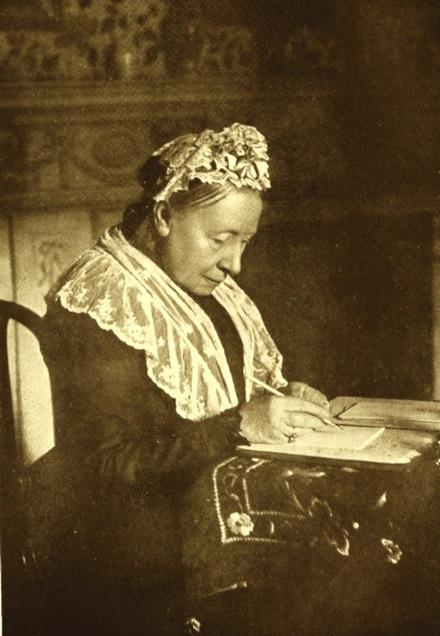
MISS MARIA FAWCETT
interesting time, he determined to see as much of people as possible, and resumed his social ways.
It was inevitable that at first his merriment and cheerfulness were a little bit laboured, but in an astonishingly short time they became invariable, and those closest to him detected no permanent depression. About everything but his sadness under his affliction, Fawcett was frank, but about this sadness he remained bravely reticent.
He soon began candidly to enjoy life, and he seems to have gotten infinitely more of its beauty and happiness than the average person who is without handicaps. He had only had one fear, which he confided to his sister: it would be unbearable for him if through loss of physical force he should become useless.
Despite very great difficulty, Fawcett for some time tried to keep up writing with his own hand, and there are still several of his autograph letters. But he found the effort so great that he soon gave it up and depended entirely on dictation. He was not entirely loath to do this, because he thought the practice of dictation useful to him as a speaker. He never mastered Braille or any other system of printing for the blind, but depended on being read to.
Catalogued Collars.
In many minor things Fawcett never acquired the dexterity possible to those who are blinded in youth. When his catastrophe came his habits were already too fixed, and he was too mature to adapt himself readily in unimportant matters. But his ingenuity in studying out scientific management of all the little problems of daily routine was marvellously practical and at times even comic. For example, he had all his clothes carefully and legibly labelled with numbers, placed so as not to show during wear. In this way his garments might easily be identified by any one not familiar with his wardrobe. If he came home in a great hurry to metamorphise his attire, directions like the following to his family or an aide-de-camp were not infrequent. He would call in his clarion, cheerful voice, probably from the door as he entered: ‘I must dress quickly. Please help. Coat one, vest six, collar
one, trousers three; shoes and socks twelve and thirteen.’ The rest we will leave to imagination, but there was no detail, even to pockethandkerchiefs, which did not have its allotted place and catalogue number.
A Hero to his Tailor.
He seems long to have remained faithful to his Salisbury tailor, a charming person of the old school who recently vouchsafed to the author the following recollections of his distinguished client: ‘Mr. Fawcett was very matter of fact and methodical. A very honest kind of man, a sterling man. He was very susceptible to cold, and was apt to carry changes of different underwear with him. He was particular about the material which he bought for his clothes, and always felt of it. He wouldn’t be humbugged. You couldn’t help liking him. He was that loose and easy in his walk, his limbs didn’t seem to belong to him. I often heard him at the hustings, he spoke to the point—he made a thorough impression.’
CHAPTER VI HAPPINESS
The Clear-sighted Man—A Scot’s Accent—Mountain Climbing —Skating—Riding, etc.
His friends all testify to his spirit, his normal view of life frequently making them forget the fact of his blindness. A distinguished writer and diplomat, who had known Fawcett, on being asked what impression had been produced on him, replied quickly and quite simply, ‘I think that he was an extraordinarily clear-sighted man.’ Stephen in his biography uses this sentence: ‘Fawcett had come to see more distinctly the real tendency of the proposal and to feel the full force of the objections to which he had never been blind.’ Such remarks illustrate Fawcett’s power of making people utterly forget his blindness.
How to be happy.
He was always grateful when his companions paid no attention to his affliction, and would talk to him about the scenery which they passed and the people whom they met as if he too could see them. He kept his resolve to be as happy as was possible, and often said: ‘There is only one thing that I ever regret, and that is to have missed a chance for enjoyment.’ He told his friends that he intended to live to be ninety, and to relish every day of his life. He deliberately set about cultivating those tastes which would redound to his happiness: he taught himself to smoke, he patiently learned to listen to music, which had never
unfolded its full joys to him before he had lost his sight. He so far succeeded as to be able to enjoy concerts and the opera.
Doubtless, he systematically trained himself to remember. It was often remarked of him that if he had heard a voice once he would remember it again years after. One day in the Cambridge streets he was accosted by a Scottish professor. Fawcett could not remember him, but encouraged him to talk, and kept up his end of a long conversation. After a good twenty minutes, a trick in the Scot’s accent betrayed him, and Fawcett enthusiastically grasped his hand, and said, ‘How do you do, Clerk Maxwell?’
He never attempted to modify his vocabulary to fit his infirmity, and though the effect was at times strange he would greet people in the most natural way in the world with: ‘How do you do? how well you’re looking’; or ‘What’s the matter, you’re looking pale to-day? Too much work, eh?’ He commented on a friend’s looking old, and added: ‘But when men with that colour hair turn grey, they do look prematurely old.’
It was not unusual for him to mimic people, whom he had only known since his blindness, reproducing their gestures as well as their speech.
Games.
Later he learned to play cribbage and écarté with cards pricked by his secretary with raised dots, in the fashion used by the blind to produce tactile prints. It took him but three days to conquer all difficulties in this new system, and he played with quickness and enjoyment. It is of no small interest to those who have studied the psychology of those blinded by accident in maturity to note this successful development of card playing. Shortly after his accident he had made an attempt which proved a total failure and yet afterwards he took it up without effort. This point should be dwelt on, and may well give courage to many an adult who is blinded. It shows that it is worth while to repeat often, and to hope for success in experiments which have been abandoned as futile.
His hearing developed great acuteness, so that he could tell in towns by the pressure of the atmosphere if he was passing an opening caused by a cross street. When he walked in the country he loved the sound of the leaves, the feel of grass, the springing of the sod beneath his feet, the note of a bird or the leap of a fish. He seems to have tried to gather from his friends’ descriptions an even deeper insight into the charm and subtleties of Nature than before it was shut out from his bodily vision. When, later, he enjoyed driving, he would stop the carriage in order to see the view at some favourite point. He was so fond of the view at Brighton that he often telegraphed a friend there to take him a walk to Rottingdean. He always enjoyed this intensely, and spoke of the exquisite prospect as of one of the most wonderful in England. A breath of the sea stimulated him greatly. After a storm he loved to listen to the booming and breaking of the waves on the shore, and to feel the burn of the brine which was cast in his face as he breasted the receding gale. The little shells and the seaweed interested him, and he liked to pass the latter between his fingers to get the slippery gluey feeling, and to play with their little pods and queer tentacles.
Enjoying the View from the Mountain Tops.
Fawcett loved great heights and mountains, a fellow climber says: ‘I went up Helvellyn with Fawcett. It was his first mountain since he was blind—by no means his last. He held one end of a stick and I the other, to direct his turns; and that was all the aid he needed. But it warmed one’s heart to see his hearty enjoyment. He would have all the views described to him, what hills and lakes he saw, what colours they were, where the mist floated, and he anxiously asked of his secretary who was with us whether he enjoyed it as much as he expected.’
Later he climbed the Cima di Jazzi, in order to see the glorious array of snow-covered peaks. It does not seem too much to believe that the highly developed blind have a feeling of the beauty which we say they cannot see, and a realisation of its presence which we lack and which it is impossible for them to explain. Though science has not yet been able to classify this faculty it may before long, and in the
meantime there is sufficient evidence that this unclassified vision of the sightless to a great extent illumines their darkness.
Excepting cricket and rackets, he gave up none of the sports of which he was already fond.
The Giant’s Stride.
All his friends are agreed that it was almost impossible to keep up with him in his walks. They tried to modify his break-neck pace by various devices, such as engaging him in absorbing discussions, or stopping to talk to some one on the road. But in vain. His long legs would shoot out like relentless walking beams, and if his friend happened to be small and holding on to Fawcett’s arm before long he would be swept off his feet, hanging on like a mere appendage to the rushing blind man.
Fawcett’s recollection for the places that he had known before his blindness was astonishing. He could even remember in closest detail the country where he had been as a child at school.
Skating.
Having before his accident been a powerful skater he now took it up again, and after a few strokes showed no hesitancy. He was known even to accompany a skating race, leaving the course clear for the competitors and himself unaccompanied getting over the rough ice on the side. Of his first attempt we read:
‘After a few strokes the only difficulty was to keep his pace down to mine. We each held one end of a stick, and as we were on the crowded Serpentine, we came into a good many collisions. As, however, we were a couple, and one of us a heavy man, we had decidedly the best of these encounters, especially as the conscience of our antagonists was on our side when they saw that they had tripped up a blind man.’
In after years his recklessness became proverbial. He had been on a long expedition on the frozen Cam one cold winter, and was returning at sunset, chatting gaily with his friends to the accompanying click of their skates. They were flying along at a good
fifteen miles an hour when they came upon a treacherous stretch of very rough ice. Fawcett, who accepted ice baths as part of the fun, urged them forward, zealously calling out: ‘Go on—I only got my legs through!’
Riding.
In the early stages of his blindness, Fawcett’s purse did not permit him to ride much. Moreover, some narrow escapes from accident—he was at one time nearly crushed at Salisbury by a cart—made him for a short time hesitate as to its expediency. But later he took it up with enthusiasm, at first accompanied by a riding master, and later by groups of friends. One of these tells how he would often ride over to Newmarket to spend Sunday. During the Sabbath he would nearly walk his friend off his legs, and on other days contented himself with walking his horse off its legs. With a box of sandwiches provided for luncheon, Fawcett would ride over from Cambridge at Christmas time to feast on the sunny side of the Devil’s Ditch. He loved the chalk downs, and often stopped at a cottage to ask for a draught of the sparkling, deep-well water. He enjoyed, too, gossiping with the shepherds about the flocks, for his early interest in agricultural matters was through life a marked characteristic. Once he came across the harriers, and joined in their gallops, trusting entirely to the prudence of his horse to select the most favourable gaps in the hedgerows.
A frequent companion on these rides tells how one day, going at a brisk pace, she was so interested in something he was telling her that she did not see until within a few feet of it that they were at the edge of a precipitous gravel pit. Fearing to alarm Fawcett she simply called out, ’stop at once, please.’ Fawcett, always quick to act, pulled up short, and but for his prompt response to her call would certainly have been killed. Fawcett was so reckless and enthusiastic an equestrian that it is still a well-remembered tradition in the liverystables at Cambridge that Professor Fawcett took so much vitality out of his mounts that he was always charged extra. It must not be gathered that he was inhuman to his horses—they probably had just as good a time, relatively, as he had, but whatever he did, he did in a whole-souled and muscular fashion.
But for Fawcett, who had been trained from childhood as a fisherman, the crowning joy of all sports was a good fishing expedition. Very soon after the accident, he took up his fishing again. He remembered his native stream well, and to the end of his life he was always eager to run down to Salisbury to fish. His letters to his father abound in reference to angling parties, past and to come. He gave directions about his fishing-boots (they were so frequently in use that they must have had a simple number in his catalogue of clothes) and instructions to secure some expert angler to accompany him, or framed some subtle tactics for way-laying and ensnaring some particularly elusive aquatic prey, who had perhaps been known to his neighbours but had remained uncaught by them.
Fishing. Trout and Political Economy.
Many friends urged him to try their waters for trout, pike, salmon, jack-fishing, and he enjoyed their hospitality greatly. His father who was devoted to the sport, in which he excelled even after his ninetieth year, was very fond of accompanying him. Fawcett’s early practice enabled him to throw a fly with great accuracy. He was fond of combining his amusements, and would wade in the stream while one of his great friends often went with him, though walking on the bank so as not to throw his shadow on the water, but so that he could talk to his heart’s content without disturbing the angler. Fawcett was wont to say that trout hear very badly, and are not distracted by political economy. So fond was Fawcett of the study of his favourite subject that his first secretary records how in moments snatched between fishing he would accompany Fawcett to a tea-house, where he would read to him Mill’s PoliticalEconomy.
Those who accompanied him fishing are agreed that he was a much better fisherman than sighted people generally are. This may have been due to his extraordinary patience, or to his zeal in learning from the experts with whom he associated.
A Salisbury friend who often fished with him says: ‘He would make his way through anything. He often walked along the river’s edge
Welcome to our website – the perfect destination for book lovers and knowledge seekers. We believe that every book holds a new world, offering opportunities for learning, discovery, and personal growth. That’s why we are dedicated to bringing you a diverse collection of books, ranging from classic literature and specialized publications to self-development guides and children's books.
More than just a book-buying platform, we strive to be a bridge connecting you with timeless cultural and intellectual values. With an elegant, user-friendly interface and a smart search system, you can quickly find the books that best suit your interests. Additionally, our special promotions and home delivery services help you save time and fully enjoy the joy of reading.
Join us on a journey of knowledge exploration, passion nurturing, and personal growth every day!