Baylor Lariat baylorlariat com
NEWS p. 3 AirBear will now be available in most of the residence halls.
4
CO
WE’RE THERE WHEN YOU CAN’T BE
Wednesday | March 26, 2014
Student senator under scrutiny
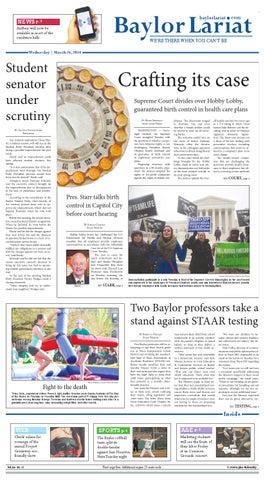
Crafting its case Supreme Court divides over Hobby Lobby, guaranteed birth control in health care plans By Mark Sherman Associated Press
By Allyssa Schoonover Reporter
San Antonio sophomore Chase Hardy, a student senator, will still run in the Student Body President election after facing a possible impeachment this past week. Hardy said an impeachment could have affected student elections this spring. “It is also unfortunate that if the impeachment went through, the Student Body President election would have been won by default,” Hardy said. Arlington junior Dominic Edwards said the executive council brought up the impeachment due to discrepancies in his lack of attendance and involvement. According to the constitution of the Baylor Student Body, three-fourths of the senators present must vote to approve the impeachment, which did not happen Thursday when the vote took place. Before the meeting, the senate executive council ordered Hardy’s resignation. When he declined, he went before the Senate for possible impeachment. Hardy said he felt the charges against him were trivial. He said the absences in question boiled down to a lack of recorded senate service hours. “I believe that I have whole-heartedly fulfilled my obligations as a senator and that the charges against me were an error,” said Hardy. Edwards said he did not feel that the senate executive council’s decision to bring up this issue was tied to upcoming student government elections in any way. At the end of the meeting Student Body President Wesley Hodges made a closing statement. “Value integrity and try to understand your neighbor,” Hodges said.
WASHINGTON — Seemingly divided, the Supreme Court struggled Tuesday with the question of whether companies have religious rights, a case challenging President Barack Obama’s health overhaul and its guarantee of birth control in employees’ preventive care plans. Peppering attorneys with questions in a 90-minute argument, the justices weighed the rights of for-profit companies against the rights of female em-
ployees. The discussion ranged to abortion, too, and even whether a female worker could be forced to wear an all-covering burka. The outcome could turn on the views of Justice Anthony Kennedy, often the decisive vote, as his colleagues appeared otherwise to divide along liberal and conservative lines. As the court heard the challenge brought by the Hobby Lobby chain of stores and others, demonstrators on both sides of the issue chanted outside in an early spring snow. The justices upheld the over-
all health care law two years ago in a 5-4 ruling in which Chief Justice John Roberts cast the deciding vote in favor of Obama’s signature domestic legislation. The latest case focuses on a sliver of the law dealing with preventive services, including contraception, that must be offered in a company’s plan at no extra charge. The family-owned companies that are challenging the provision provide health insurance to their employees but object to covering certain methods SEE
COURT, page 4
Pres. Starr talks birth control in Capitol City before court hearing By Jordan Corona Staff Writer
Hobby Lobby Stores Inc. challenged the U.S. Department for Health and Human Service’s mandate that all employers provide employees contraceptives in accordance with the Affordable Care Act at the U.S. Supreme Court Tuesday. The case is cause for much controversy and debate and Baylor President and Chancellor Ken Starr sat down with Harvard Law Professor Alan Dershowitz on Monday morning, the day before the hearing, at
Starr
SEE
STARR, page 4
Charles Dharapak | Associated Press
Demonstrators participate in a rally Tuesday in front of the Supreme Court in Washington as the court heard oral arguments in the challenges of President Obama’s health care law requirement that businesses provide their female employees with health insurance that includes access to contraceptives.
Two Baylor professors take a stand against STAAR testing By Rebecca Fiedler Staff Writer
Fight to the death
Kevin Freeman | Lariat Photographer
Tulsa, Okla., sophomore Allison Russell, right, battles Houston junior Bayley Andrews at The War of the Roses on Tuesday on Fountain Mall. The event was part of Pi Kappa Phi’s four day philanthropy running Monday through Thursday and featured sorority teams battling each other in a gladiator pool, bean bag toss, cake decorating competition, and other events.
Two Baylor professors will be attempting to opt their fourth grade son at Waco Independent School District out of taking the standardized State of Texas Assessments of Academic Readiness [STAAR] test. Baylor faculty members Kyle and Jennifer Massey wrote a letter to their son’s principal that argues they have the legal right to keep their child from participating in what they perceive as a morally objectionable practice. Last week the Masseys sent a letter to their son’s school outlining their stance, citing legislation and court cases. The letter draws from Texas Education Code Chapter 26, Sec A26.010, which states a parent
may remove their child from school temporarily if an activity conflicts with the parent’s religious or moral beliefs, so long as they deliver a written statement to the child’s instructor. “That seems fair and reasonable in a democratic society,” said Kyle Massey, lecturer in Civic Education & Community Services at Baylor and former public school teacher. “That you can direct your own child’s education. That’s what that law is supposed to be available for.” The Masseys argue in their letter that they feel standardized testing inhibits a child’s ability to learn, causes them stress and drowns out important curriculum that would otherwise be taught if teachers were not having to focus on preparing students for the standardized test.
“We want our children to become critical and creative thinkers, not subservient test-takers,” the letter states. Dale Caffey, director of communications and public information officer of Waco ISD, responded in an email to the Lariat on Tuesday for a statement from Waco ISD regarding the matter. “As it turns out, we will not have a statement specifically addressing the Massey’s request or their social media campaign,” the email states. “What we are working on are general procedures for handling opt-out requests, although we are not expecting to receive additional ones.” Last year the Masseys requested their son be given alternative curSEE
TESTING, page 4
Inside WEB Check online for coverage of the annual Project Greenway ecofriendly show. Vol.116 No. 32
SPORTS p. 6 The Baylor softball team split its double-header against Sam Houston State Tuesday night. First copy free. Additional copies 25 cents each.
A&E p. 5 Marketing students will see the fruits of their labor Friday at an Common Grounds concert. © 2014 Baylor University
Opinion
Wednesday | March 26, 2014
2
The Baylor Lariat
Workers’ rights necessary for World Cup host Editorial The soccer world’s attention is currently building hype for the 2014 FIFA World Cup in Brazil coming in June. While the pomp and circumstance is flooding in South America, the site of the 2022 game across the world is turning into a humanitarian crisis. With the number of worker deaths related to the construction of the stadiums increasing, Qatar has proven to be an extremely poor choice on FIFA’s part to hold the 2022 World Cup. It is clear that this country, while wealthy, does not have the capacity to protect its seemingly dispensable workers. Currently, about 1,200 immigrant workers, many from Nepal, have died since 2010 when construction began. The International Trade Union Confederation estimates that at this rate, 4,000 people could lose their lives from the poor working conditions before the tournament begins in 2022. This inhumane environment includes filthy, cramped work areas and unreasonable hours
drudging in extreme temperatures according to the confederation’s report. If these rates continue, Qatar will lose roughly .3 percent of its original 1.4 million workforce. To put it in perspective, this same percentage would result in over 950,000 deaths in the United States based on the census count of 316,000,000. Sports governing bodies should not choose places like Sochi, Russia, or Qatar to hold such lavish events when these locations cannot handle the amount of work required. While Sochi lacked the hospitable environment for a proper Olympics, Qatar does not have a suitable workers’ rights unions in place to provide better labor conditions and therefore prevent the climbing death toll. Sporting events like the Olympics or World Cup are meant to celebrate the love of the game as well as prosper the area in which it’s held, whether via tourism or attention from the rest of the world. However, the cost of this beautification effort shouldn’t be at the expense of human lives. Some would argue that hosting world events like the World Cup do more harm than good to
a country financially because it pours more money into preparing for the event rather than reap its meager benefits. A third of the population in South Africa, the site of the last World Cup, lives on $2 or less a day, and holding an event of its magnitude seemed more than irresponsible. Since Qatar is considered the richest country in the world with a gross domestic product upwards of $100,000 per capita, funding the event probably won’t break the country’s bank. However, this does not make up for the countless people lost in preparing for the games. When these sports governing bodies select a spot to host their big event, the clear solution is to choose an area that is already on its feet rather than make a charity case of an otherwise lackluster part of the world. The location should first be able to afford the event, have a stable union and workers’ rights as well as a fortified government to stand strong for its citizens rather than sacrifice them. By the time Qatar is ready for the World Cup, its people will be bereaving rather than basking in the overly confident financial and tourism prospects.
Starr: Greens’ religious objection to HHS mandate valid During the first year of his two-term Presidency, Bill Clinton waxed eloquent when signing the Religious Freedom Restoration Act into law. The President forcefully warned of judicially-created dangers to Americans’ religious freedom. A lawyer himself, President Clinton addressed the nation not only in legal and constitutional terms but spoke more broadly into American culture. The Supreme Court, he lamented, had inflicted a grievous wound on America’s first freedom in the case of Employment Division, Department of Human Resources of Oregon v. Smith. There, the Court rejected the religious freedom claims of two Native Americans who had lost their state-government jobs solely because they used peyote in their traditional worship celebration. The Oregon case contained not a hint of illicit trafficking or extrasacramental abuse, but the Supreme Court majority was unmoved by the discharged employees’ claims that peyote was a sacrament in Native American worship. The Smith Court laid down a bright-line rule: if a governmental law or regulation is “neutral” and “generally applicable” to one and all – in effect, if the measure is not directly aimed at religious practices – then it is constitutionally permissible. The judiciary would no longer be in the business of carving out exemptions or creating exceptions to neutral laws of general applicability. The message: if a faith community (or individual) wants an exemption, go lobby the politicians. Cabining once-robust judicial power, the Smith Court went to some length to distinguish two landmark cases that had done exactly what the majority of Justices now condemned as judicially out of bounds. The first, Sherbert v. Verner, upheld the claim of a Seventh Day Adventist for state unemploy-
ment benefits when her employer fired her for being unwilling to work on the Sabbath. The second, Wisconsin v. Yoder, provided a constitutionally-based exit visa for Old Amish parents seeking to halt public schooling once their students had finished the eighth grade. Ironically, those two off-cited cases had been on the books for decades. The heavens had not fallen, nor had a clamor arisen in legal or government circles for Sherbert and Yoder to be reversed. The Oregon peyote case thus came as a constitutional bolt from the blue. In response, Congress erupted in righteous indignation. The House was unanimous, the Senate nearly so in passing the Religious Freedom Restoration Act in 1993. The idea was simple: Religious freedom would be restored, and the Supreme Court’s anti-liberty ruling in the sacramental peyote case reversed. Thus the statute’s lofty name, now infelicitously referred to as RFRA. Congress and the President cheerfully collaborated to “restore” the body of judge-created law that had been deeply compromised, if not for all practical purposes interred, by the peyote-as-sacrament case. In their zeal to restore religious freedom, however, the political branches had overlooked a basic lesson from Civics 101. In a constitutional republic, the Supreme Court is indeed supreme when it comes to saying what the Constitution means. The Court did not take lightly the political branches’ woodshedding attempt. Five years after President Clinton’s vigorous signing statement and enthusiastic exercise of the law-signing power, the Supreme Court pulled rank and invalidated RFRA to the extent it applied beyond federal power. The legislative showing undergirding RFRA, the Court concluded, fell far short of the constitutionally-requisite mark. Writing
for the majority, Justice Anthony cerity of their objection, there is no Kennedy performed an elaborate doubt. Nor is this an idiosyncratic compare-and-contrast exercise. As belief, highly disruptive of orderly opposed to the extraordinary cir- government, akin to woebegone arcumstances justifying the Voting guments that taxation is unbiblical, Rights Act back in the 1960s, little or that participating in the Social if any systemic problem had been Security program abridges freedom demonstrated in Congressional of conscience. The Greens’ story emhearings with respect to state action bodies the Ameriaimed at curtailing can dream. The religious liberfounders, Daties. Not even vid and Barbara close. Federalism Green, started in values logged yet a garage with a another victory simple idea and a in the decade (the deep work ethic. 1990s) that repreBut they were sented a high-wanot monomaniater mark of High cal in their quest Court solicitude for business sucfor States’ rights. cess. Far from it. That decision Hobby Lobby’s — City of Boerne stores around v. Flores — is the country close hugely important Ken Starr | University President & on Sundays. The to constitutional Chancelor Greens don’t law, but its basic take roll among holding means the employees. No that in Hobby Lobby, the federal government now compulsory church membership or has to run the RFRA gauntlet. The the like. It’s up to their 13,000 emHobby Lobby case is entirely about ployees to decide whether to join a HHS regulations implementing faith community or otherwise how the Affordable Care Act. For the to spend their free time on what government to succeed in a RFRA- the Greens honor as the Lord’s Day. grounded challenge is a formidable Call it freedom of choice. Far from quixotic bring-downtask. In plain English, in Hobby Lob- the-entire-government sorts of by the Obama Administration now claims, the Greens’ specific conhas to demonstrate to at least five cerns about HHS’s policies are Justices that HHS has a profound shared broadly and deeply by mil(“compelling”) governmental inter- lions of Americans. Catholic bishest in requiring Hobby Lobby (and ops, evangelical leaders and Orthoits owners, five members of the dox Jews are all singing the same Green family in Oklahoma City) to pro-life refrain. What has happened provide all 20 contraceptive meth- is that the federal government ods ordained by the FDA. While the doesn’t care about their objections. Greens, as evangelical Christians, As with politics generally, it finally have no qualms about sixteen of the comes down not to personalities twenty methods, they profoundly and opinion polls but to basic poliobject to being required to offer cy choices: According to the federal their employees four methods that government, reproductive freedom, they believe constitute the taking of vigorously supported by the exinnocent human life. As to the sin- pert federal agency (the FDA) and
now enforced by HSS regulations, trumps religious scruples. RFRA turns the tables on the government and demands a powerful showing of policy need, and the inability to achieve that compelling goal in a less liberty-destructive way. That’s a daunting task. It’s called “strict scrutiny.” For obvious reasons, government lawyers aren’t eager to have to run that obstacle course. As an old saying goes, strict scrutiny is strict in theory but fatal in fact. Faced with this uphill task, the Solicitor General’s brief makes the key points under strict scrutiny’s analytic framework and does so in a presentable way. Little is said, however, about the wellspring of RFRA’s controlling standard. The brief passingly cites to the fountainhead case, Sherbert v. Verner, only three times. Perhaps if you largely ignore it, it will go away. But that’s wishful thinking. Looming over any constitutionallybased argument is what courts and lawyers call the “standard of review.” By its terms, RFRA expressly embraces the most challenging standard for the government to meet. Unsurprisingly, the Government and its myriad supporters are looking feverishly for an exit ramp in hopes of avoiding the turbocharged standard of stepped-up review. The government lawyers think they’ve found it in the way the Green family does business. Organized as a for-profit corporation, the vast Hobby Lobby empire extends nationwide and includes a Christian bookstore chain, Mardel. To the Obama Administration, that’s the end of the case. Why? Because, in the Government’s view, RFRA doesn’t extend its protections to for-profit corporations. But the argument has its own statutory challenge. By its terms, RFRA applies to all “persons,” but leaves that pivotal term undefined. RFRA has a section setting out
four definitions, but “person” is not among them. Congress long ago provided for a default mechanism. It first did so in 1871 – in what is known as the Dictionary Act. The authoritative definition of “person” expressly includes a corporation, with no distinction drawn between non-profits and profits. To a textualist, the case is over. But there is a textual wrinkle, one that the Government aggressively exploits. The Dictionary Act contains opt-out language – “unless the context suggests otherwise.” As the Solicitor General sees it, the two don’t connect, conceptually or practically. The Hobby Lobby case may turn on this very technical debate. If the Greens can convince a barebones majority of the Court that they – five individuals carrying on a family business under the umbrella of a closely-held corporation – are directly and substantially affected in their free exercise of religion, then RFRA has to be met head on by the Solicitor General. RFRA’s force is powerful. The statutory text renders RFRA’s power nigh unto irresistible when a government places a substantial burden on religious liberty. If exit ramps are avoided, and the Court faces square-on the language and structure of RFRA in all its might, every knee must bow at the throne of the venerable case from yesteryear, Sherbert v. Verner. That relic of the Warren Court, which lives on in 2014 by virtue of the restorative acts of a virtually unanimous 103rd Congress, represents a great source of comfort for those who believe, and who believe that Caesar has once again demanded far more than he has the rightful power to command. This column was originally published in the National Review Online by Ken Starr, the president and chancellor of Baylor University.
Baylor Lariat baylorlariat com
WE’RE THERE WHEN YOU CAN’T BE
Editor in chief Greg DeVries*
A&E editor Taylor Rexrode*
Broadcast News Producer Alexa Brackin*
News editor Taylor Griffin*
Photo editor Travis Taylor
Staff writer Rae Jefferson
Copy editor Maleesa Johnson Copy editor Eric Vining
Staff writer Rebecca Fiedler
City editor Linda Wilkins*
Assistant city editor Reubin Turner Copy desk chief Linda Nguyen* Web Editor Trey Gregory
Sports editor Daniel Hill*
Staff writer Jordan Corona
Multimedia Editor Robby Hirst
Staff writer Paula Solis
Sports writer Jeffrey Swindoll
Sports writer Shehan Jeyarajah
Ad Representative Lindsey Regan
Photographer Kevin Freeman
Ad Representative Zachary Schmidt
Photographer Constance Atton
Photographer Carlye Thornton
Editorial Cartoonist Asher Murphy* Ad Representative Sarah Witter
Ad Representative Jennifer Kreb
Delivery Brian Ham
Delivery James Nolen *Denotes member of editorial board
The Baylor Lariat
WEDNESDAY | MARCH 26, 2014
News
3
AirBear expands Wi-Fi is available in all but one residence hall By Nico Zulli Reporter
It’s a bird. It’s a plane. No, it’s AirBear and now it’s everywhere. ITS worked with Campus Living and Learning to install AirBear in all residence halls on campus, in an effort to satisfy student demand for wireless Internet access. “AirBear coverage has been discussed for several years, particularly the idea of extending coverage into residence rooms,” said Scott Day, director of network services. “This discussion began and has continued as a result of feedback from students.” David Klein, network Group-Edge Team analyst, said in 2003 that Baylor had 300 users on its network. This year, the number of Baylor network users has grown to 16,500 and the amount of devices that access the network are around 32,000. Klein also said he has noted a 20 percent increase in brand new devices on the network upon return from Christmas break in Jan. 2013. “Standards are constantly evolving,” Klein said. “And it is our job to try to get hardware out that supports student and faculty use of these devices.” Originally, the Baylor AirBear Wireless Project was allotted a twoyear integration period to install AirBear wireless in Penland, Martin, Kokernot, Allen-Dawson, AlexanderMemorial and Collins residence halls. Day said the time frame was decided based on two key factors. “I would say the first thing that played a role in the decision on time was a question of how the funding might evolve throughout the project,” he said. “The second thing was the uncertainty of how much and how often we would have access to dorms.” Bob Hartland, associate vice-pres-
ident for IT infrastructure, said ITS has seemed limited to working in the summer but was able to complete the AirBear Wireless Project in a matter of months. The project began in the fall 2013 semester and was finished in early spring 2014. Hartland said the process was significantly sped-up for a couple of reasons. “A few of us traveled up to the University of New Hampshire to see how they went about implementing wireless into their campus dormitories during the semester months,” he said. “We don’t necessarily try to emulate what other institutions are doing, but we do use peer institutions as a resource to determine what seems to be working.” In addition to hearing about deployment of wireless network integration from other institutions, Hartland said another aspect that sped-up the process of the project was site surveying. He said although ITS, CampusLiving and Learning and the Electronic Libraries staff saw the need for this project, funding seemed to be the high hurdle. “David Klein conducted an extensive site survey and discovered that existing telephone lines could be borrowed for the project, which cut costs down,” Hartland said. He said Klein then came up with a total costs projection and presented this to Pattie Orr, vice president for information technology and dean of university libraries. “Pattie got creative and found ways to use existing funds,” Hartland said. “This was then proposed to Campus Living and Learning, and they pitched in a little bit as well.” Hartland said the cost of the project, which was determined several years prior and based upon technol-
ogy prices at the time, was approximately $500,000 less once it was actually completed in 2014. The combination of price-reducing factors and the decrease in the price of technology allowed for the lower cost. The project was carried out with the assistance of Campus Living and Learning, which handled correspondence with students. “There is very stringent protocol for residence halls,” Hartland said. “None of our technicians are allowed to perform work in the residence halls without an escort, for the purposes of both their safety and the safety of students.” Day said the wireless network is the overall largest footprint network, with footprint referring to the amount of device usage on the network. “It didn’t used to be that way,” Day said. “Wireless is something students began requesting in the residence halls, and it is also interesting to see how request for wireless access in the classroom has resulted in professors trying to leverage technology in the classroom as well.” The only residence hall awaiting AirBear wireless is North Russell Hall, which will receive AirBear along with its current renovation. South Russell Hall is under renovation and will have AirBear available to residents upon opening next fall. Klein said there were not many reports of dissatisfactory access to the wireless networks in the residence halls once installed, but if one is encountered students are encouraged to seek ITS assistance. “If anyone has any issues they can contact the help desk, put in a ticket, and I’ll take care of it,” Klein said. The ITS Help Desk can be reached anytime at 254-710-435, or submit a ticket for assistance on the ITS website.
Associated Press
Labrador keeps looking A search dog helps in the effort to find victims of the massive slide Monday in Oso, Wash. At least 14 people were killed in the 1-square-mile slide that hit in a rural area about 55 miles northeast of Seattle on Saturday. Several people also were critically injured, and homes were destroyed.
4
a g
The Baylor Lariat
WEDNESDAY | MARCH 26, 2014
News*
COURT
Jeb Bush wraps up Texas higher education event
from Page 1
By Jamie Stengle Associated Press
Charles Dharapak | Associated Press
Paul Clement, attorney for Hobby Lobby and Conestoga Wood, center, stands with attorney David Cortman, right, as they speak to reporters Tuesday in front of the Supreme Court in Washington, D.C., after the court heard oral arguments in the challenges of President Obama’s health care law requirement that businesses provide their female employees with health insurance that includes access to contraceptives.
of birth control that they say can work after conception, in violation of their religious beliefs. The justices have never declared that for-profit corporations, as opposed to individuals, can hold religious beliefs. The companies in this case, and their backers, argue that a 1993 federal law on religious freedom extends to businesses. Among the groups opposing the administration is the U.S. Conference of Catholic Bishops. As it happens, Obama is to meet this week with Pope Francis. The Obama administration says it’s not just about birth control, that a Supreme Court ruling in favor of the businesses also could undermine laws governing immunizations, Social Security taxes and minimum wages. Kennedy voiced concerns about the rights of both female employees and the business owners. He wondered what would happen if an employer ordered a woman who works for him to wear a burka, a full-length robe and head covering commonly worn by conservative Islamic women. He asked: Does the employer’s religious belief “just trump?” Later in the 90-minute argument, however, he seemed troubled about how the logic of the government’s argument would apply to abortions. “A profit corporation could be forced in principle to pay for abortions,” Kennedy said. “Your reasoning would permit it.” The three women on the court, Justices Ruth Bader Ginsburg, Elena Kagan and Sonia Sotomayor, repeatedly questioned Paul Clement, representing the businesses, whether blood transfusions, vaccinations and laws against sex discrimination would be subject to the same religious objections if the court ruled for his clients. “Everything would be piece-
STARR
meal and nothing would be uniform,” Kagan said. Clement acknowledged that courts would have to decide on a case-by-case basis, but he said only the kind of family-owned companies he represented would make such claims, not large, multinational corporations. “That’s something that’s not going to happen in the real world,” Clement said. Roberts at one point suggested that the court could limit its ruling to just such companies. One key issue before the justices is whether profit-making corporations may assert religious beliefs under the 1993 religious freedom law or the First Amendment provision guaranteeing Americans the right to believe and worship as they choose. The court could skirt that issue by finding that the individuals who own the businesses have the right to object. But the justices still would have to decide whether the birth control requirement impinges on religious freedom, and if so, whether the government makes a persuasive case that the policy is important and has been put in place in the least objectionable way possible. Kennedy showed some interest in the argument that the companies could simply decide not to offer any health insurance to their workers and instead pay a tax of $2,000 per employee. That route might allow the court to sidestep some thorny questions in the case. Clement objected that businesses would find themselves at a competitive disadvantage in a situation where other employers were offering insurance. But when Kennedy asked Clement to assume that the company would come out the same financially, Clement acknowledged that the government might have a strong case. Conservative justices pressed Solicitor General Donald Ver-
rilli Jr. over the administration’s argument that for-profit corporations have no claim to religious expression. “If you say they can’t even get their day in court, you’re saying something pretty, pretty strong,” Justice Samuel Alito said. Some of the nearly 50 businesses that have sued over covering contraceptives object to paying for all forms of birth control. But the companies involved in this case are willing to cover most methods of contraception, as long as they can exclude drugs or devices that the government says may work after an egg has been fertilized. The largest company among them is Hobby Lobby Stores Inc., an Oklahoma City-based chain of more than 600 crafts stores in 41 states with more than 15,000 full-time employees. The company is owned by the Green family, evangelical Christians who say they run their business on biblical principles. The Greens also own the Mardel chain of Christian bookstores. The other company is Conestoga Wood Specialties Corp. of East Earl, Pa. The business is owned by the Hahns, a family of Mennonite Christians, and employs 950 people in making wood cabinets. Members of both families were at the court Tuesday. The justices made a couple of humorous references to their epic consideration of the health care law in 2012, which also pitted Clement against Verrilli. When Clement persisted in calling the $2,000-per-employee tax a penalty, Sotomayor jumped in to insist that it’s a tax. “She’s right about that,” Roberts said, recalling his opinion upholding the law’s centerpiece that individuals must be insured or pay a tax. A decision is expected by late June.
Amendment rights to corporations and puts the 1993 Religious Freedom Restoration Act center stage. David and Barbara Green own the craft-supply store chain and are Christians. The case challenges the healthcare contraceptive mandate on the grounds it pressures the owners to violate sincere beliefs. Although Starr could not be reached for comment after the On Topic event, his comments in Washington regarded the notion of safeguarding the Religious Freedom Restoration Act. The law establishes a test to prevent enactments that substantially burden an individual’s free religious expression without compelling interest. “President Clinton signed it into law during his first year in office,” he said. Clinton’s signing address referenced Steven Carter’s
book, “The Culture of Disbelief,” which described how American culture has sought to trivialize religion from the public square. “Religious freedom is our first freedom,” he said, “The Religious Freedom Restoration Act is to protect us as individuals and as corporations.” Dershowitz was at the Supreme Court hearing Tuesday. He said the Green’s sincerity of belief was unquestionable but there was a hard balance to be struck. Dialogue like the On Topic discussion, he said, was important. “It’s very important to see if we can narrow down the differences,” Dershowitz said. “Ken Starr and I start at very different places. He’s more sympathetic to the right-tolife movement; I’m more sympathetic to the right-to-choose. He’s conservative, I’m not. But we narrowed down our differences.
from Page 1
the Willard Hotel in Washington, D.C., to talk about it. The university’s Institute for Studies on Religion and Georgetown University’s Berkley Center for Religion, Peace and World Affairs put on the On Topic event, which C-SPAN televised live. Dershowitz and Starr’s dialogue steered clear of surface level political ideology, quickly setting the bounds of discussion around the legal reality of religious practice and the ordinance of law. “I come to the problem with much more sympathy to Obampage 4 acare and a woman’s right to choose abortion or contraceptives,” Dershowitz said in a interview after Monday’s event. “But legally, I’m sympathetic to the Supreme Court statute to support and protect religious freedom.” Hobby Lobby’s stance drew from 2010 Supreme Court decision extending certain First
Do it for the ’gram. @baylorlariat
IRVING, Texas — Former Florida Gov. Jeb Bush told higher education leaders gathered at a conference Tuesday that globalization presents colleges and universities with both a major challenge and a major opportunity. "In this globalized world with accelerating technology there are huge opportunities and incredible challenges and you all happen to be in an intersection where this is taking place, maybe with greater velocity and greater impact," Bush said as he wrapped up the two-day Globalization of Higher Education conference in suburban Dallas, an event hosted by Bush and former North Carolina Gov. Jim Hunt. "You have the chance to transform your institutions to take full advantage of these huge opportunities, and if you don't do so you may be in peril more than many institutions in our country." Bush is considered a potential candidate for president in 2016, along with former Secretary of State Hillary Clinton, who also spoke at the gathering. The two spoke separately at the conference Monday but
TESTING
chatted briefly offstage. Onstage in their solo performances Monday, Clinton and Bush each focused on education policy and the need to make higher education affordable and accessible across the globe. The event offered a bipartisan twist for the nation's two dominant political families, both of which could return to the presidential campaign trail next year. Bush is the brother and son of Republican presidents. Clinton's husband, Bill Clinton, served two terms in the White House before she returned to political life as a Democratic senator from New York and President Barack Obama's first secretary of state. Conference participants included leaders at both U.S. and international universities. The conference on Tuesday featured a panel discussion that included: David Leebron, president of Rice University; Nicholas Dirks, chancellor of the University of California at Berkeley; and James Ryan, dean of Harvard Graduate School of Education. Discussion topics included online education, the number of foreign students attending universities and the role of schools with overseas outposts in spreading the values of the United States.
from Page 1
riculum to work on instead of testing during the days the STAAR test was being given but were denied the request. Kyle Massey said he and Jennifer Massey, assistant dean for student learning and engagement, had no choice but to instruct their child from home for the five days the tests and make-up tests were administered. “I asked the principal last year; what if my son comes to school at 1 p.m.?” Kyle Massey said. “He won’t be able to take the test — right? The principal responded that the school would keep my son there ’til 5 p.m., but the school day ends at 3 p.m. How were they going to keep him there ’til 5 p.m.? The principal responded that the TEA allows the school to keep my son there ’til 5 p.m. But, I say I am the parent. School ends at 3 p.m., and he will be coming home then. Anything else would amount to kidnapping, in my opinion.” Kyle Massey said if Waco ISD makes his son take the STAAR test should he come to school, the Masseys will take legal action against Waco ISD. “We’re prepared to litigate,” he said. “We have nonprofit groups in Waco already offering their legal services if that transpires. We’re hoping, of course, that the school sees reason in recognizing our rights, and that those rights will be upheld.” The Masseys posted their letter online Saturday, and the letter has received over 30,000 views. The letter has gotten the attention of the Dallas Morning News and KCEN television in Waco and has been shared thousands of times on social media sites. Edy Chamness, Austin resident and member with special interest group Texas Parents Opt Out of
State Testing, said she has kept her own son out of school on the days of STAAR testing for three years. “I would never let my child think that one test is going to determine whether he’s going to move on to the next grade, because that’s simply false,” Chamness said. “This is a deeply rooted fear for children. They’re really terrified that everybody’s going to know they’re a failure. They’re going to flunk the test, flunk the grade, and all their friends are going to move on and everyone will know it. This is not an irrational fear, because children are told frequently these stories, and that’s very scary for an eight year old child.” Chamness said she feels teachers should not be held accountable for students not performing well on state standardized tests. “It’s foolish to believe you can take student test results and turn around and hold teachers accountable,” she said. “It doesn’t work that way.” Kyle Massey said he opposes the idea of taking his children to private school or home schooling them simply to avoid the STAAR tests. “That’s saying you have to be excluded from public education in order to stay true to your convictions,” he said. “That’s not right. That’s not an option at all.” Kyle Massey said he has had positive response from the community to his family’s actions. “We’ve had teachers email us and ask to remain anonymous,” hew said. “They say they work for Waco ISD and are 100 percent behind us, saying what we’re doing is good for public education.”
HOUSE FOR LEASE EEEEEEEEEEEEEEEEEE EEEEEEEEEEEEEEEEEE EEEEEEEEEEEEEEEEEEEEEEEE EEEEEEEEEEEEEEEEEEEEEEEEEEEE EEEEEEEEEEEEE E
Arts & Entertainment Wednesday | March 26, 2014
5
The Baylor Lariat
Project helps promote music artists, events By Kat Worrall Reporter
When not promoting a sold-out rock concert that can seat tens of thousands, Baylor students, alongside their guiding professor, are gaining first-hand promotional experience through Common Grounds’ Friday night concert. The Venue and Event Promotion marketing class is working alongside Common Grounds for this Friday’s concert featuring Drew Holcomb and the Neighbors with opening guest Judah and the Lion. The class is structured to promote an event — any event — to help give students hands-on experience. Dr. Charles Fifield, senior lecturer in the marketing department, has overseen the class for both semesters and calls it “hands on, collaborative learning.” “For me, the best educator is experience with someone coaching you,” Fifield said. “To go out and do something without any knowledge of what to do — well that’s just the blind leading the blind and you end up having a horrible result. What do you learn? ‘Well, I don’t ever want to do that again.’” Fifield works closely with the 23 students in his class, the majority of whom are business majors, who are split up into five teams to work together for the event. Waco junior Trannie Stevens is the project manager in the class this semester and oversees each team. “I have five team leaders that are constantly talking to me about what they’re doing, asking for approval, or asking for
help,” Stevens said. “I have to be very available. I’m pretty much the liaison between Fifield and the class.” The five groups include an event team, promotion team, social media team, media team and a street team. The students’ responsibilities include everything from creating posters and social media graphics; speaking at organizations’ meetings and Chapel; and unloading and loading the bands’ equipment. While Fifield is ready to step in to assist or take over if he fears the students will negatively affect the customer, he said he wants students to learn how to do it themselves. “You can sink or swim on your own, but if you’re smart, however, you’ll get as much input as you can,” he said. “So I am trying to make myself available. I try to in class be there and make suggestions, but I don’t want it to come across as ‘you’re going to do A, B and C.’” Fifield, who is one of the organization sponsors for Uproar Records, began the class when student activities, the primary funding source for Uproar, announced they would like to phase out of financially supporting the artists. Student Activities now uses the class to promote events and raise money for Uproar. Uproar artists then indirectly benefit from the class, since they often open for bands that come in. “You could go out and do car washes or you could go out and sell Girl Scout cookies, but we don’t do that,” Fifield said. “We are trying to do it in a business sense, even
though we don’t think selling Girl Scout cookies is below us. We just haven’t done that yet, but we might. We need the money to pay the bills for the student artists so we can record them and produce them and promote them.” Instead of a typical class structure of reading textbooks and listening to lectures, the students spend their time preparing the event. This past fall, they worked with student activities to promote the Switchfoot concert. Boerne senior Andrew Hulett was the project manager last semester for the Switchfoot concert and said the class has given him the benefit of knowing what to expect when he graduates. “Having that sense of ‘this is a real thing’ takes it out of the classroom and gives you true experience,” Hulett said. Stevens said she has gained experience from the class. “We don’t have tests,” Stevens said. “We don’t have assignments. Our grade is completely based off of what we can get done.” Students interact firsthand with the artist, artist manager, agent, tour manager, venue, Baylor Bookstore, local radio, television and print medias and even nearby restaurants such as Pizza Hut to arrange free parking for groups that eat at the restaurant before the show. “What we are trying to build, for our ultimate audience or ticket buyer, is an experience,” Fifield said. “That’s what we want to build. We sell experiences — we don’t sell a performance. We sell an experience. Incorporated in that experience
Courtesy Photo
Hardin senior Luke Russell (left) and Port Neches senior Tyler Wright (right) organize posters for their client and Common Grounds artist, Drew Holcomb and the Neghbors. Russell and Wright have been spending the semester working on promoting their Friday show.
is not just the entertainment — the night or day of the event — but it’s also how you heard about it. It is getting the buzz going.” The students also work with Common Grounds and its live event coordinator, Wes Butler. Butler said working with the class, a first for Common Grounds, has been enjoyable as well as beneficial for students interested in this career. “There are definitely some people who have shown that they have taken initiative to make sure things are in place,” Butler said. “It’s been as best promoted as it could be.” The concert begins at 8 p.m. Friday with Judah and the Lion opening for Drew Holcomb and the Neighbors. Before the show, Drew Holcomb and the Neighbors will be playing a free acoustic set at 6:30 p.m. in the Baylor Bookstore,
as well as signing autographs and meeting fans. As the concert nears, the class is working together with Common Grounds to sell the final tickets and help the artist produce a successful show. “Every single person in the class contributes something to everything else,” Fifield said. “Does it directly impact them? No, quite often it doesn’t, but it does indirectly impact them because ultimately, the final grade is determined by how many people show up.” Tickets for the show are $15 in advance at Common Grounds and $18 at the door, but Stevens and the rest of the class are offering a group rate of $12 for 10 or more people. For more information on the group rate, email Trannie_Stevens@baylor.edu. The marketing class is open to upperlevel business students.
Contemporary poets celebrate works at Beall Festival By Anja Rosales and Ian Currie Reporters
Literary icons: masters of words, image and meter — poetry steps off the page and onto campus this week. The 20th annual Beall Poetry Festival, beginning today and ends Friday, is full of events for poetry lovers. The 2014 festival features four award-winning guest participants: Andrew Hudgins, Valzhyna Mort, Christian Wiman and Ronald Schuchard. Dr. Richard Russell, professor in the English department, is in his fourth year as the director
of the committee responsible for bringing the Beall Poetry Festival to campus. “We decide as a committee who we want to bring in each year for the festival,” Russell said. “We try to get three to four nationally known poets and one up-andcoming poet. This year, Valzhyna Mort is our up-and-coming poet from Russia.” The Student Literary Awards kicks off the festival at 3:30 p.m. today in 101 Carroll Science Building. Undergraduate and graduate students currently enrolled at Baylor submitted works such as poetry and fictional entries. The contest closed earlier this month. Winners
of these works will receive monetary prizes ranging from $50 to $100. This year’s critic for the festival is poet Ronald Schuchard. Dr. Luke Ferretter, associate professor in the English department, runs the student literary competition, which according to Russell, had about 50-75 entries this year. Ferretter said there are a lot of people to whom their own creative writing is very important. “People value the feedback they receive from the judges,” Ferretter said. “Most importantly, perhaps, is the dialogue it creates between the students and professional writers.”
At 6:30 p.m. today in Bennett Auditorium, Ronald Schuchard will present the Virginia Beall Ball Lecture in Contemporary Poetry. Thursday will be filled with poetry readings in Bennett Auditorium by Valzhyna Mort at 3:30 p.m. and by Christian Weiman at 6:30 p.m. Dr. Joshua King, assistant professor in English, has been on the planning committee for the past three years and said he is happy to have Wiman as a reader. “I was most excited about Christian Wiman, who is from East Texas, but is very internationally minded,” King said. Wiman is a critically acclaimed
international poet. He served as the editor of “Poetry,” one of the oldest American magazines of verse, until 2013. His most recent poetry anthology is titled “Every Riven Thing.” In 2013 he published a series of meditations entitled “My Bright Abyss: Meditation of a Modern Believer.” Friday will feature a panel discussion among all four participants. This will take place at 3:30 p.m. in 101 Carroll Science Building. The final event of the festival is a poetry reading by Andrew Hudgins at 6:30 p.m. Friday in Bennett Auditorium.
King said the roundtable is an exciting event in the program. “I love the roundtable discussion as it showcases a rare occasion where poets think out loud about their work and the place of poetry in the world,” King said. Setina said she also thought the most interesting part of the festival was the discussion. “The chance to just hear them speak on their ideas about working with their craft is extremely interesting,” Setina said. “The fact that these poets have been around each other and listening to each other’s poems for a couple of days makes their discussions more interesting.”
Across
Difficulty: Medium
1 Ancient Egyptian pictograph, e.g. 6 Game, __, match 9 Signs 14 Tiny South Pacific nation 15 High-tech film effects, for short 16 Spreading like wildfire, as online videos 17 Place for a Hold ‘em game 19 Breathing 20 Missouri tributary 21 Approved of, on Facebook 22 Golf club part 25 Some evergreens 26 Visualize 27 Hindu royal 28 Feels poorly 30 Lith. and Ukr. were part of it 33 Swear (to) 36 See 38-Across 38 With 36-Across, needy people 39 Located in that place, in legalese 41 Arctic wastelands 43 Slippery fish 44 Baby bed 46 Veterans Day tradition 47 Trace amount 49 Afternoon socials 51 Garden locale 52 __ de plume 54 Onetime Russian monarch 56 DUI-fighting gp. 57 Social division 59 Trojan War hero 61 Some highway ramps 62 Nabisco cookies ... and what you might cry upon solving this puzzle’s three other longest answers? 66 Long-extinct birds 67 Assembly aid 68 Open-mouthed 69 Opposition 70 Sloppy farm area 71 Bedbugs, e.g. Down 1 Treasury Dept. variable 2 Mekong River language 3 Relative of har
4 Dressed more like an Exeter student 5 Fling 6 Nova __ 7 Self-serving activity 8 Broadcaster’s scheduling unit 9 Racetracks 10 Surroundings 11 Officer Frank Poncherello portrayer of ‘70s-’80s TV 12 Congregation area 13 Snowy day toy 18 U.K. flying squad 22 Like Parmesan, commonly 23 Newsman Dan 24 Slogan seen on computer stickers 29 Salad go-with 31 Treelined 32 Email again 34 Wall Street watchdog org. 35 Tangy 37 Genetic info transmitter
40 Dapper pins 42 Equestrian competition 45 Single or double, say 48 Deepest part 50 Rational state 53 Complicated, as a breakup 55 Sales staff member 57 Give up, as territory 58 Nervous system transmitter 60 With all haste, in memos 63 Owns 64 Get off the fence 65 Hoped-for answer to a certain proposal
Sports
Wednesday | March 26, 2014
6
The Baylor Lariat
No. 12 Lady Bears fall 4-3, but finish 12-0 in double-header against Sam Houston By Shehan Jeyarajah Sports Writer
After their hot start to open the season, No. 12 Baylor softball was tested in a mid-week double-header against Sam Houston State University in Huntsville. The Bears split the games, losing 4-3 in extra innings to start, but exploding out to a 12-0 run-rule win in the second. Neither teams seemed to be able to get any consistent offense throughout regulation. The two teams combined for 10 hits, but no runs were scored through seven innings. Entering the top of the ninth, it was a 0-0 ballgame in Huntsville, but then Baylor’s offense came to life. Senior first baseman Holly Holl hit a leadoff home run for the first run of the afternoon. Freshman outfielder Christy Linsenby hit a single soon afterwards to put runners on first and second. After a sacrifice grounder from junior right fielder Kaitlyn Thumann, second baseman Ari Hawkins came to bat. The freshman reached base on an error, and Lisenby scored from third. Sophomore outfielder Linsey Hays hit a sacrifice fly to drive in another runner, and Baylor seemed to be riding fine with a 3-0 lead heading into the bottom of the tenth. Sam Houston State infielder
Alyssa Coggins singled and advanced outfielder Tayler Gray to second. Freshman infielder Tori Koerselmen followed it up with a single to load the bases without any outs in the bottom of the tenth inning. Pitcher Whitney Canion replaced the senior reliever Liz Paul and walked junior infielder Hillary Adams, driving in Gray for SHSU’s first run of the game. Senior outfielder Cecilia Castillo singled next to drive in Coggins and cut Baylor’s lead to 3-2. Sophomore Tiffany Castillo drew another bases-loaded walk, which tied the game at 3-3. Canion then threw a wild pitch that scored the pinchrunner and clinched the game. Canion took the loss after allowing two earned runs against five batters faced in the bottom of the tenth inning. Baylor came out in the second half of the double-header looking for blood. The Bears struck right away as senior catcher Clare Hosack blasted a two-run home run in the top of the first inning to give Baylor the 2-0 advantage. Sam Houston State mustered only one hit through the first three innings, and Baylor’s offense took advantage in the fourth. Hosack struck out to lead off the inning, but a wild pitch from junior pitcher Meme Quinn allowed her to reach base anyway.
Junior third baseman Sarah Smith hit a homer in the next at-bat to drive in Hosack and give Baylor the 4-0 advantage. Sophomore outfielder Justine Young singled in the next at-bat and was immediately driven in by a two-run homer from junior shortstop Jordan Strickland. The Bearkats replaced Quinn with junior pitcher Haley Baros, but the right-hander could not stop the bleeding. Baros allowed a single to the Lisenby, the first batter she faced, and subsequently walked Thumann. After the runners advanced to second and third on a wild pitch, Hawkins smashed a double to left field to drive in Lisenby. Hays singled to drive in Thumann in the next at-bat. With the bases loaded once again, Smith hit a single up the middle to drive in two more runs. After Young loaded the bases with another single, Holl singled to drive Hosack home. Linsenby singled to drive in another run, but was called out on a fielder’s choice to end the inning. When the dust cleared, Baylor led 12-0. The game was called for run-rule after five innings. After a shaky blown save in her first appearance, Canion allowed only two hits against 17 batters faced, striking out three and picking up her 13th win. Quinn took the loss after six earned runs allowed.
No. 29 Baylor Baseball falls short against UT-Arlington By Jeffrey Swindoll Sports Writer
In their first midweek game away from Baylor Ballpark, the No. 29 Baylor Bears could not overcome UT-Arlington’s hitting onslaught in a 14-3 shellacking Tuesday night. The Arlington Mavericks decimated Baylor’s pitching staff and broke the Bears’ five-game win streak against. For the first time in eight games, the Bears did not score a run in the first inning. Hits and runs have been hard to come by recently, but the lack of offense has been made up for with shutdown pitching by the Bears’ staff. Against Texas Tech, the Bears scored only 4 runs in 3 games and still won the series. This time, Baylor’s pitching broke down and imploded. Tuesday was the Bears’ second meeting with the Mavericks. Baylor won the first game 5-2 at Baylor Ballpark. In that game, UTA’s hitting came nowhere close to the total reached on Tuesday, and the pitching gave the Bears
8 hits and plenty of walks in that first meeting. It was a complete different story this time around. UTA hammered the Bears early with four runs in the first inning. In the next three innings, the Mavericks scored four more. It was 8-1 by the fourth inning, and the Mavericks were still not finished. UTA scored six more runs to bring the score to 14-1. It was only in the eighth inning that the Bears finally got more runs on the board, but it was too late. Senior pitcher Ryan Smith started on the mound for Baylor. Smith gave up four hits and six runs against 18 batters before he was taken out of the game. His replacement, junior Sean Spicer, was brought on for damage control, but ended up causing as much problems as his Smith. Facing 10 batters in one inning, Spicer gave up five hits and four runs. Spicer was taken out immediately after his shift. Senior pitcher Doug Ashby took the reins from Spicer. Once Ashby got on the mound, the game slowed down for both teams. UT-Arlington led 8-1 at
that point, and reserve players were on the field for the Mavericks. Ashby pitched two innings, only giving up one hit and zero runs. After Ashby had his turn, freshman pitcher Nick Lewis looked to close out the game quietly with no more runs. His expectations were promptly thrown out the window as the Mavericks scored four runs off Lewis. Arlington was the start of a four game road trip for the Bears. The Bears travel to Charleston, W. Va. to face the West Virginia Mountaineers (13-8) in a Big 12 weekend series. It will be the Mountaineers’ first Big 12 series this season, but the Bears took two series wins against Texas Tech and Oklahoma State to start the season. West Virginia will be the Bears’ first conference series away from Baylor Ballpark. The Bears played solid conference baseball the past two weekends at Baylor Ballpark, but this weekend against West Virginia will test the Bears’ ability to bounce back after getting crushed Tuesday.
Kevin Freeman | Lariat Photographer
The Baylor Bears faced off against the Houston Baptist Huskies on March 18th.
Kevin Freeman | Lariat Photographer
No. 12 Baylor softball took on Texas State at Getterman Stadium on March 18th. The Lady Bears defeated the Bobcats 2-0.
“Obviously, we would have liked to have swept the two games, but middle of the week games are designed to prepare you for the weekend schedule,” head coach
Glenn Moore said. “I was pleased with the way the team responded at the plate in the second game.” Baylor softball will continue conference play with a three-game
series against Texas Tech. First pitch is 7 p.m. on Friday night in Lubbock.
Baylor Sports this Week Men’s Baseball
Women’s Softball
@ West Virginia 1 p.m. Friday
@ Texas Tech 7:00 p.m. Friday
@ West Virginia 3 p.m. Saturday
@ Texas Tech 4:00 p.m. Saturday