Educators & Youth Workers for Transformative Justice Toolkit
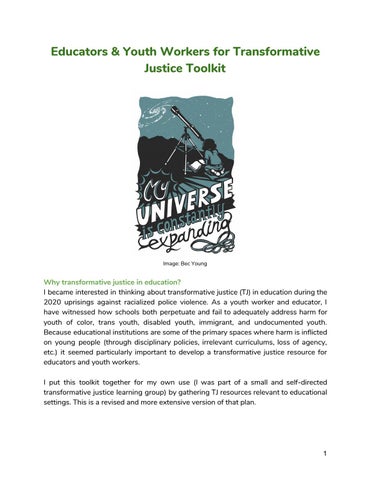
Image: B ec Young
Why transformative justice in education? I became interested in thinking about transformative justice (TJ) in education during the 2020 uprisings against racialized police violence. As a youth worker and educator, I have witnessed how schools both perpetuate and fail to adequately address harm for youth of color, trans youth, disabled youth, immigrant, and undocumented youth. Because educational institutions are some of the primary spaces where harm is inflicted on young people (through disciplinary policies, irrelevant curriculums, loss of agency, etc.) it seemed particularly important to develop a transformative justice resource for educators and youth workers. I put this toolkit together for my own use (I was part of a small and self-directed transformative justice learning group) by gathering TJ resources relevant to educational settings. This is a revised and more extensive version of that plan.
1
Goals Educators and youth workers are uniquely positioned to 1) develop transformative justice practices within their immediate learning communities and 2) organize to transform and dismantle schools and afterschool programs as sites of harm. When imagining the utility of youth workers and educators to transformative justice, it is important to wonder: ● Could teachers organize to take police out of schools and create lessons on how to give good apologies so that young people are equipped with the skills needed to address interpersonal harm? ● Could youth workers in community-based organizations develop harm accountability alternatives such as restorative justice practices and train young people on conflict de-escalation? ● Could educators and youth workers organize alongside families and youth to demand prison and police abolition? These are all possibilities for engaging with the principles of transformative justice in education, and youth workers and educators have an important role to play. Suggestions for Using this Toolkit The best learning always happens in community. When we are able to talk and problem-solve with each other, we can imagine different ways of relating to one another and we can rely on each other’s skills and experiences to change the conditions that make a better world possible. With this principle in mind, you may find this toolkit most helpful if you use it with others. In other words, text your friends, email other educators at your school, hit up that person you met at a conference and thought was really cool and form a working group together with this toolkit as your guide. This is not only a reading guide but an activity guide. Each day consists of activities that make you question, assess, and reimagine what justice looks like for young people in your community. Each “day’s” work includes about two and half hours of engagement —typically a reading or clip that you can do on your own beforehand (30 min) and one or two activities to do together as a group (1.5 hours). Although no formal facilitation training is required, you should select a facilitator that can lead the group for each session. The toolkit is a curated list of activities and readings about TJ in educational settings produced by organizations like Project Nia, the Bay Area Transformative Justice Collective and individuals like Mariame Kaba, Mia Mingus, and adrienne marie 2
brown. If you are able, please financially support their work. All of the great ideas here are theirs (always cited and with credit), this toolkit is only a compilation of the transformative justice readings and activities that seemed most relevant to educators and youth workers.
“Hope is a discipline.” - Marieme Kaba
Let’s get started, Jomaira Salas Pujols Youthworker, Sociologist-in-training
Image: P ete Railand
3
WEEK 1: INTRODUCTION TO TRANSFORMATIVE JUSTICE Individual Preparation ● Read “What Is/Isn’t Transformative Justice” by adrienne maree brown ● Read “Transformative Justice: A Brief Description” by Mia Mingus ● Watch “What is Transformative Justice” Barnard Center for Research on Women In-Meeting Exercises: ● Introductions ○ Do some kind of activity that gets your group familiar with each other. You choose! ● Activity 2 from P roject Nia’s TJ Curriculum (pg. 12-14) ○ Additional debrief questions you may ask: ■ What did it feel like to do that activity? ■ How did the values guide the messages you put in your cards? ■ What roadblocks exist in education (think of your own workplace— your school, your non-profit, your government agency etc) that prevent us from addressing harm in accordance to these values? ■ What systems (think both big and small) do we need to have in place to respond in the ways we just imagined? WEEK 2: SOME TIME FOR REFLECTION Individual Preparation: ● Complete the M apping Our Roles for Social Change Ecosystems (2020) activity guide Group Work: ● Pods & Pod Mapping Worksheet by the Bay Area Transformative Justice Collective ○ Additional debrief questions you may ask: ■ What did it feel like to do that activity? ■ Is there something about yourself or your pod that you learned through doing this activity? ■ Is anyone in your pod or in your “movable” category someone who engages with youth or education? If so, how might you call on them when addressing harm in educational settings? If not, what are the barriers to pod-making in education?
4
■
How might pods better equip us to address harm in youth work/education?
WEEK 3: SUPPORTING SURVIVORS Individual Preparation: ● Watch “ C entering the Needs of Survivors” by Barnard Center for Research on Women ● Review Section 4 of the Creative Interventions Toolkit: S upporting Survivors In-Meeting Exercises: ● Educator Case Study & Q uestions from the Bay Area Transformative Justice Collective WEEK 4: ON ACCOUNTABILITY Individual Preparation: ● Read “Building Community Safety: Practical Steps Toward Liberatory Transformation” ● Watch “What Gets in the Way of Accountability?” by Barnard Center for Research on Women In-Meeting Exercises: ● Exercise 2 from the Accountability Roadmap from Philly Standup! (pg. 1-2) WEEK 5: FROM INDIVIDUAL TO COLLECTIVE CARE Individual Preparation: ● Read Policing Has Failed: For Real Public Safety, We Need A Million Community-Driven Experiments ● Read Replacing School Police with Targeted Student Resources In-Meeting Exercises: ● Review tactics and strategies to end punitive policies in schools and other educational settings. ○ Dignity in School’s Toolkit on O rganizing to Combat the School-to-Prison Pipeline ○ End Zero Tolerance’s S ample Policies ○ Interrupting Criminalization ○ Un-Marked Campaign 5
● Additional debrief questions you may ask: ○ How might you engage in transformative work in education based on your role, talents, interests, skills? ○ Who in your pod could you organize with to bring about transformative change in school, organization, community? ○ What is one thing that you commit to doing, collectively, to best serve the needs of the transformative justice movement? Additional Resources: 2020 Janine Soleil Abolitionist Institute Critical Resistance’s Abolitionists Educators Working Group Abolitionist Teaching and the Future of our Schools Bay Area Transformative Justice Collective Care Not Cops: Youth Safety Planning in a World Without Policing Creative Interventions Criminalizing Survival Curriculum Mariame Kaba on Abolition Prison Culture: How the PIC structures our world Project Nia’s How to Share Space Transform Harm What is a Community-Based Response to Interpersonal Violence?
6