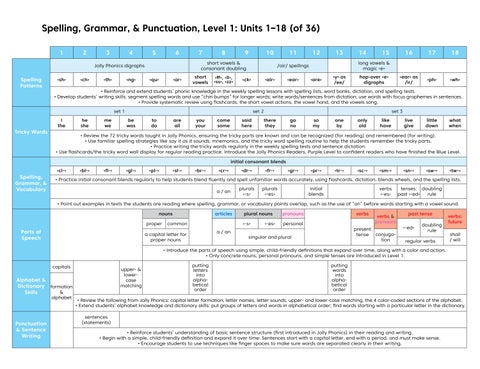
Spelling,Grammar,&Punctuation, Level 1:Units1–18(of36)
123456789 101112131415161718
Jolly Phonics digraphs
Spelling Patterns
Tricky Words
Spelling, Grammar, & Vocabulary
short vowels & consonant doubling /air/ spellings
long vowels & magic ‹e›
‹sh›‹ch›‹th›‹ng›‹qu›‹ar› short vowels ‹ff›, ‹ll›, ‹ss›, ‹zz› ‹ck›‹air›‹ear›‹are› ‹y› as /ee/ hop-over ‹e› digraphs ‹ear› as /ir/ ‹ph›‹wh›
•Reinforce and extend students’ phonic knowledge in the weekly spelling lessons with spelling lists, word banks, dictation, and spelling tests.
•Develop students’ writing skills: segment spelling words and use “chin bumps” for longer words; write words/sentences from dictation; use words with focus graphemes in sentences.
•Provide systematic review using flashcards, the short vowel actions, the vowel hand, and the vowels song.
I the he she me we be was to do are all you your come some said here there they go no so my one by only old like have live give little down what when
•Review the 72 tricky words taught in Jolly Phonics, ensuring the tricky parts are known and can be recognized (for reading) and remembered (for writing).
•Use familiar spelling strategies like say it as it sounds, mnemonics, and the tricky word spelling routine to help the students remember the tricky parts.
•Practice writing the tricky words regularly in the weekly spelling tests and sentence dictation.
•Use flashcards/the tricky word wall display for regular reading practice. Introduce the Jolly Phonics Readers, Purple Level to confident readers who have finished the Blue Level.
initial consonant blends
‹cl-›‹bl-›‹fl-›‹gl-›‹pl-›‹sl-›‹br-›‹cr-›‹dr-›‹fr-›‹gr-›‹pr-›‹tr-›‹sc-›‹sm-›‹sn-›‹sw-›‹tw-›
•Practice initial consonant blends regularly to help students blend fluently and spell unfamiliar words accurately, using flashcards, dictation, blends wheels, and the spelling lists.
a / an plurals ‹-s› plurals ‹-es› initial blends verbs ‹-es› tenses: past ‹-ed› doubling rule
•Point out examples in texts the students are reading where spelling, grammar, or vocabulary points overlap, such as the use of “an” before words starting with a vowel sound.
Parts of Speech nouns articles plural nouns
verbs verbs & pronouns past tense verbs: future propercommon
a / an ‹-s›‹-es›personal present tense ‹-ed› doubling rule a capital letter for proper nouns singular and plural conjugation shall / will regular verbs
•Introduce the parts of speech using simple, child-friendly definitions that expand over time, along with a color and action.
•Only concrete nouns, personal pronouns, and simple tenses are introduced in Level 1.
Alphabet & Dictionary
Skills capitals upper- & lowercase matching putting letters into alphabetical order putting words into alphabetical order formation & alphabet
•Review the following from Jolly Phonics: capital letter formation, letter names, letter sounds, upper- and lower-case matching, the 4 color-coded sections of the alphabet.
•Extend students’ alphabet knowledge and dictionary skills: put groups of letters and words in alphabetical order; find words starting with a particular letter in the dictionary.
Punctuation & Sentence
Writing sentences (statements)
•Reinforce students’ understanding of basic sentence structure (first introduced in Jolly Phonics) in their reading and writing.
•Begin with a simple, child-friendly definition and expand it over time: Sentences start with a capital letter, end with a period, and must make sense.
•Encourage students to use techniques like finger spaces to make sure words are separated clearly in their writing.
Spelling Patterns