Grammar 6 Pupil Book: Pages 2 & 3
Spelling: Numerical Prefixes for 1 Spelling Test • As the children have not been given any spelling words to learn yet, there is no spelling test in this lesson.
‹uni-› ‹mono-›
Dictation: ‹uni-› ‹mono-›
Put the words in the Spelling List into alphabetical order.
1.
unit 1.
2.
3.
4.
5.
6.
2.
unicorn 3.
uniform ‘Its’ and ‘it’s’ are homophones. They are words that sound the same but have different spellings and meanings. Which one should be used to complete each sentence correctly?
monogram
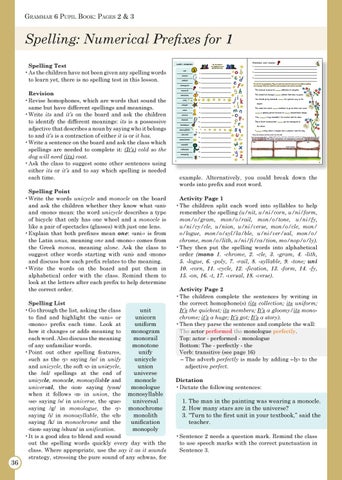
Revision • Revise homophones, which are words that sound the same but have different spellings and meanings. • Write its and it’s on the board and ask the children to identify the different meanings: its is a possessive adjective that describes a noun by saying who it belongs to and it’s is a contraction of either it is or it has. • Write a sentence on the board and ask the class which spellings are needed to complete it: (It’s) cold so the dog will need (its) coat. • Ask the class to suggest some other sentences using either its or it’s and to say which spelling is needed each time. Spelling Point • Write the words unicycle and monocle on the board and ask the children whether they know what ‹uni› and ‹mono› mean: the word unicycle describes a type of bicycle that only has one wheel and a monocle is like a pair of spectacles (glasses) with just one lens. • Explain that both prefixes mean one: ‹uni-› is from the Latin unus, meaning one and ‹mono-› comes from the Greek monos, meaning alone. Ask the class to suggest other words starting with ‹uni› and ‹mono› and discuss how each prefix relates to the meaning. • Write the words on the board and put them in alphabetical order with the class. Remind them to look at the letters after each prefix to help determine the correct order.
36
Spelling List • Go through the list, asking the class unit to find and highlight the ‹uni-› or unicorn ‹mono-› prefix each time. Look at uniform how it changes or adds meaning to monogram each word. Also discuss the meaning monorail of any unfamiliar words. monotone • Point out other spelling features, unify such as the ‹y› saying /ie/ in unify unicycle and unicycle, the soft ‹c› in unicycle, union the /ool/ spellings at the end of universe unicycle, monocle, monosyllable and monocle universal, the ‹ion› saying /yoon/ monologue when it follows ‹n› in union, the monosyllable ‹se› saying /s/ in universe, the ‹gue› universal saying /g/ in monologue, the ‹y› monochrome saying /i/ in monosyllable, the ‹ch› monolith saying /k/ in monochrome and the unification ‹tion› saying /shun/ in unification. monopoly • It is a good idea to blend and sound out the spelling words quickly every day with the class. Where appropriate, use the say it as it sounds strategy, stressing the pure sound of any schwas, for
GTB6_BE_pp36-74.indd 36
monorail monotone
The museum is proud of
collection of unicycles.
The school has changed
uniform from blue to green.
7.
8.
9.
airport.
unicycle
a gloomy picture because of
universe
12.
13.
14.
15.
16.
17.
18.
This is Dad’s handkerchief.
monologue
universal
“
its
got his monogram in
it’s
the corner.
monosyllable
it’s
monochrome design.
a huge monolith,” the teacher told the class.
“Yes,
10.
monocle
members to go on strike next week.
The union has asked
union
11.
its
the quickest way to the
You should go by monorail.
unify
a story about a dragon and a unicorn,” said the boy.
Parse the sentence and then write it on the wall.
The actor performed the monologue perfectly.
monochrome subject
verb
object
monolith transitive / intransitive
unification monopoly 2
3
GPB6_BEpc_pp1_16.indd 2
31/05/2017 15:03
GPB6_BEpc_pp1_16.indd 3
31/05/2017 15:03
example. Alternatively, you could break down the words into prefix and root word. Activity Page 1 • The children split each word into syllables to help remember the spelling (u/nit, u/ni/corn, u/ni/form, mon/o/gram, mon/o/rail, mon/o/tone, u/ni/fy, u/ni/cy/cle, u/nion, u/ni/verse, mon/o/cle, mon/ o/logue, mon/o/syl/la/ble, u/ni/ver/sal, mon/o/ chrome, mon/o/lith, u/ni/fi/ca/tion, mo/nop/o/ly). • They then put the spelling words into alphabetical order (mono 1. -chrome, 2. -cle, 3. -gram, 4. -lith, 5. -logue, 6. -poly, 7. -rail, 8. -syllable, 9. -tone; uni 10. -corn, 11. -cycle, 12. -fication, 13. -form, 14. -fy, 15. -on, 16. -t, 17. -versal, 18. -verse). Activity Page 2 • The children complete the sentences by writing in the correct homophone(s) (its collection; its uniform; It’s the quickest; its members; It’s a gloomy/its monochrome; it’s a huge; It’s got; It’s a story). • Then they parse the sentence and complete the wall: The actor performed the monologue perfectly. Top: actor - performed - monologue Bottom: The - perfectly - the Verb: transitive (see page 16) ––The adverb perfectly is made by adding ‹-ly› to the adjective perfect. Dictation • Dictate the following sentences:
1. The man in the painting was wearing a monocle. 2. How many stars are in the universe? 3. “Turn to the first unit in your textbook,” said the teacher. • Sentence 2 needs a question mark. Remind the class to use speech marks with the correct punctuation in Sentence 3.
16/01/2018 17:13