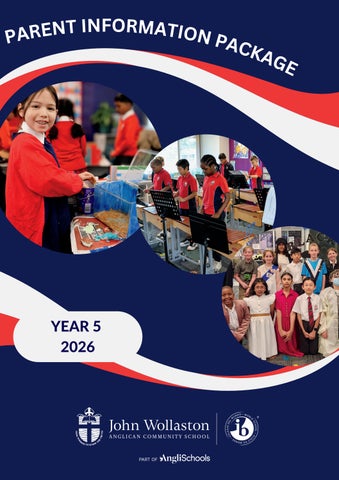
PARENT INFORMATIONPACKAGE
YEAR 5 2026


YEAR 5 2026
“You are here, and have come this far, which is a spectacular thing”
The Mole Always Remember Charlie Mackesy
A warm welcome to everyone as we begin our academic year for 2026. As the year commences, we naturally look ahead to what opportunities may arise and new goals that we might wish to achieve. This year, I was reminded by the quote above to think about how far we have come, both as a community and as individuals, and how in appreciating the journey so far, we can build on this in 2026 with a sense of confidence. Confidence that no matter the challenge, we can walk together as a community to overcome it, and confidence that so many opportunities will be taken up and great things achieved. What a wonderful mindset to commence a year with! In 2026, the School enters its final year of the current Strategic Plan and under the wise and kind leadership of our Principal, Mr Tim Russell, we are well-placed to begin collaboration and consultation on the direction of a new Plan.
More detail for parents regarding the current Strategic Plan and other relevant policies and information can be accessed through our school website using the link provided below.
Parents | John Wollaston Anglican Community School
Continuous improvement is a feature of how we work at JWACS. Over the summer break, in addition to all routine cleaning and maintenance, there have been some significant works undertaken. In particular, the final stage of the Kindergarten playground has been completed. This concludes upgrades to play spaces in the Primary areas, with Little Wollies, Kindergarten, Pre-Primary / Year 1 and Years 2-6 playgrounds all improved significantly over the last five years. We extend our gratitude to our Business Manager, Mr Derek Heatherly and the P&F for their support of this work. Last year we successfully completed our Evaluation through the International Baccalaureate Organisation (IBO). It was affirming that the Evaluation Team highlighted the very same strengths we know exemplify our community.
“A strong culture of community, inclusion, and compassion is evident throughout the school and underpins the work of all members of the John Wollaston community. These values, which are central to nurturing inquiring, knowledgeable, and caring young people, were consistently highlighted as a key strength by the Chair of the School Council, school leadership, staff, and parents, who collectively value and affirm the quality of education provided.” Evaluation Report, 2025
As we commence this year, we continue to focus on our programs offering a holistic approach, balanced between academia and wellbeing, explicit teaching approaches with inquiry learning to help our students have the very best opportunities to develop not only the skills, knowledge and understanding of the world but also the attributes that will enable them to live a full a meaningful life. I have included links below to some key websites that explain a little more about our approach here at JWACS.
Berry Street Education Model – Learning and Resources | Berry Street
International education - International Baccalaureate®
New Metrics | Melbourne Metrics
I look forward to sharing the year ahead with you!
Take care.
TRACEY ROGERS HEAD OF PRIMARY
A warm welcome to all our families to the 2026 school year! I am looking forward to getting to know our new families and working with you all over the course of the year We have many events planned that provide opportunities for families to build connections with other families and for us to come together as a community My favourite day on the school calendar is Messy Mud Day because it is a day of fun and joy for the children and adults alike
My role as Early Years Coordinator encompasses pastoral care, curriculum and Early Years’ event organisation. This means I get to work with students, staff and families
each day Through this work, I support children and families as they navigate the beginning of their child’s schooling journey and the ups and downs of learning, friendships and wellbeing I work closely with staff to develop our programs and curriculum implementation through collaboration
I am a passionate advocate for Early Learning and ensuring that we get the best outcomes for our students through developmentally appropriate and evidence-based practices I am proud of the safe, inclusive and connected environment we have here at John Wollaston I love that we honour student agency in a play-based/inquiry-based learning environment where students are supported to take risks, whilst also receiving explicit instruction to develop key skills in literacy, numeracy and social skills
Outside of school, I love spending time with family and friends, supporting the Adelaide Crows during footy season, eating chocolate and drinking coffee. I also love being out in nature, reading and cooking.
This year, I am looking forward to continuing to build on the amazing things we have achieved so far
YEARS 3-6 COORDINATOR
I have had the privilege of working in the John Wollaston community for the last 18 years and am excited to embrace the opportunities that 2026 will bring
I am fortunate to work with the teaching staff within Years 3 to 6 to create a learning environment consistent with current best practice teaching and learning across all domains. A key focus is embedding our concept-based inquiry approach through the Primary Years Programme (PYP), while ensuring alignment with the WA Curriculum and strengthening our literacy and numeracy programs We aim to engage students as active learners and foster curiosity and independence.
Part of my role allows me to oversee the pastoral care and wellbeing of students as they move through the Primary School Collaborating with teachers, Primary Coordinators, and the Deputy Head of Primary, I provide extra care and support to students and families when needed
MRS SHELLY BROWN ACTING PRIMARY INCLUSIVE EDUCATION COORDINATOR
MS GABRIELLA SLATTERY PRIMARY INCLUSIVE EDUCATION COORDINATOR
This is my 11th year teaching as an Art Specialist. When I was at school my favourite learning area was always art and I loved doing extra art classes during school holidays. Nowadays, I love learning about art from different countries and cultures when I travel. It’s very exciting to find inspiration and connect this to what I teach. In my free time, I really enjoy attending art workshops, doing yoga, and spending time with my family and friends. As an artist, I enjoy creating my own drawings, prints and clay artworks inspired by my walks in Australian nature and my travels.
All students from Years 2 to Year 6 participate in Visual Art lessons with me for one hour a week. During this time, students learn how to create 2D and 3D artworks and develop their skills in the areas of drawing, painting, collaging, sewing, and sculpting from clay or wire. As students go through the process of designing and producing artworks, they learn how to problem-solve, remain open minded, and reflect on their ideas and abilities. We love learning about art from different cultures, countries as well as historical and contemporary artists to gain inspiration for our artworks and practice sharing our feelings and opinions. The Art Room is the perfect place to take safe risks, build your self-confidence and discover just how creative you are.
I am really looking forward to participating in the Armadale Arts Festival 2026 and working with a group of students to create an art installation from natural materials. I am also very excited about the annual Art Exhibition because it’s such a wonderful chance to showcase the talent of the John Wollaston students.
Music and Visual Art are my favourite subject areas due to the endless opportunities they provide to develop creativity and curiosity, as well as offering children additional ways for both selfexpression and the communication of their ideas My ‘maker’ spirit extends well beyond the classroom and I spend most of my spare time making jewellery, home décor, toys, clothing or furniture. My favourite artistic canvas, however, is my garden, where I combine the elements of art and design to create beautiful, evolving spaces
MRS HAYLEE GODFREY
Digital Technology Specialist Teacher
Digital Technology Specialist Teacher
MISS HOLLIE BURBAGE Music Specialist Teacher
This is my eighth-year teaching Music at JWACS. I am passionate about all areas of the performing arts, including dance and drama I play piano, violin, guitar and more, however my favourite instrument is my voice! I love to sing In 2026, I am looking forward to sharing more live student performances with the school community, and as always, continuing to foster in my students a love and appreciation of music.
Music at JWACS is a singing-based program inspired by the Kodály approach Each lesson is designed as a holistic experience to develop the whole person by enriching the heart, mind, body and soul Students will develop a range of musical skills including listening, reading, writing, performing, creating, and improvising. Over the course of their Primary years, students will explore a range of musical genres including classical, folk, rock, blues, film, and hip hop They will engage in teamwork through song games, movement routines and folk dances In addition to finding their singing voice, students will learn to play a variety of instruments including percussion, xylophone and ukulele.
Students also have the opportunity to build their ensemble skills through Choir (Years 3-6), Music Theatre Club (Year 5-6), Rock Band (Years 4-6) and string ensemble These groups perform throughout the year at various school and community events
MRS HEIDI CRAWFORD Languages Specialist Teacher
I enjoy watching football and going to Fremantle games, spending time with my family, photography and travelling to new places.
I am passionate about making learning accessible and enjoyable for every student Early Years classes take a play-based learning approach and I enjoy finding new ways to use technology across all year levels. Students are able to use their agency to assist me in setting up our Japanese inquiry for the year and we explore classroom inquiries from a Japanese perspective where an authentic link is possible
I’m looking forward to more opportunities for the Upper Primary and ELC students to learn from each other, as this are always a highlight in our year!
When I’m not at school, you’ll usually find me volunteering, playing volleyball, spending time with my dogs, out at the beach or in the bush I volunteer with my local bushfire brigade, which I absolutely love I struggle to sit still, so I’m always on the go and often hard to track down!
In Physical Education (PE), our focus is on creating lifelong lovers of movement by introducing students to a wide range of sports through the PE program, KIDDO, Clubs, and the Sporting Schools program We aim to provide an inclusive environment where students feel safe to try new things, make mistakes, and celebrate success at their own level
One of the biggest highlights each year is the House reveal after every carnival. I love planning the reveal with Miss Ellis in the most exciting way possible.
In 2026, I’m excited to watch students’ passion for sport continue to grow and to support them as they develop a broad and confident skill set
When I am not teaching sport, I enjoy playing sport My favourite sports are netball, water polo and tennis. In my down time, I enjoy spending time with my family, taking my daughters to the beach or the river, stand up paddle boarding, going for bike rides, anything outdoors!
In Physical Education (PE) we have a strong focus on learning through play All sporting skills are taught in game-based activities where students enjoy playing games and learning skills in a variety of ways. Gone are the days of the old skills drills. This is especially evident in Cross Country Practice where students play a lot of high intensity interval (HIIT) games and activities rather than running laps
The House reveal after each carnival is a huge highlight for me too! Just like Ms Fowler, I too am always in the winning House.
In 2026, I am excited to see students grow in their interactions as individuals, through participation in PE
This is my tenth year at John Wollaston, and I’m thrilled to be a Primary Learning Enrichment Teacher for 2026 I’m passionate about supporting students to achieve their learning goals and I’m excited to continue making a positive impact in our school community
Outside of the classroom, I love staying active whether it’s running along the beach or stand-up paddleboarding. I also enjoy spending time with my teenage son, who has turned me into a proud basketball supporter, Go Wildcats!
I’m looking forward to another year of collaborating with the wonderful team at JWACS, creating new memories and watching students continue to grow in their learning journey.
My name is Karen Ayres and I am one of the Learning Enrichment teachers working in the Primary School I am fortunate to have had a long association with John Wollaston both as an educator and as a parent. Both my children attended John Wollaston from Kindergarten to Year 12 and remember their time at the School with fondness.
In my career I have had a wide variety of teaching and administrative roles, and I am thrilled to be working in the Primary School, teaching literacy support with students from Pre-Primary to Year 3. I am passionate about finding creative ways to support and enhance student learning and am looking forward to working and having fun with the Primary students. In my free time I love reading, watching great movies, going for walks and spending time with my family and friends I also enjoy learning new things and being helpful to others
I enjoy spending time with my family and going to my weekly yoga sessions. I love to cook and bake in my spare time. I grew up on a farm in South Africa so being outdoors and gardening is something I try to do as often as possible
I am passionate about supporting students in their reading journey I believe that every student should have the opportunity to succeed in their learning. I pride myself on making all students feel welcome and respected in my classroom.
I am looking forward to teaching Pre-Primary to Year 3 this year in the Blue Wren classroom and developing some passionate readers
This year, I’m looking forward to the knowledge and skills we’ll develop together, as well as creating a fun, safe, and supportive learning environment I can’t wait to get to know each student, learn about their interests and talents, and support them on their learning journey as we watch our Learner Profiles grow throughout the year In our classroom, I love playing the ‘Greeking Out’ podcast after lunch or enjoying an audiobook together Outside of school, I spend time with family and friends and love having puppy play dates with our dog, Maple.
I’m excited to be starting my fifth year at JWACS! I love how welcoming and inclusive our school community is it’s one of the things that makes teaching here so special. Outside of school, I enjoy spending time with family and friends, getting lost in a good book, and watching or coaching all kinds of sports I can’t wait to get to know each student and create a classroom that feels warm, safe, and supportive Together, we’ll work on building a growth mindset, developing social and emotional skills, and discovering the joy of learning every day
I am excited to welcome you to Year 5! I look forward to creating a calm, supportive environment where you can grow as a learner Outside of school, I enjoy teaching dancing, spending time with family and working in my garden I look forward to sharing all the fabulous experiences that Year 5 brings with you
I am Miss Borbely. This year will be my seventh year at JWACS. Prior to being an EA, I worked on a luxury yacht, at mine sites and in the Navy I have an interest in food and enjoy cooking I'm a mother of two and love spending time with my family, watching theatre performances, travelling and exploring the outdoors.
I enjoy supporting students and seeing them achieve things they find challenging. I'm excited to be working with the Year 5 team and looking forward to Encounter as well as seeing the students thrive
I was formally a nurse before joining JWACS as a Special Needs EA. I have now been at JWACS for 25 Years!
I have a genuine appreciation of the fabulous team the staff make at our school along with the students and their families, who make up our wonderful school community As I have worked with many students and year groups over the years, my greatest reward is to see them progress through the School and to be part of their incredible journey here at JWACS. I love spending time with my family, being outdoors, gardening, going on long walks with my two dogs, and caring for my chooks!
Listen with empathy and talk through strategies for solving pro Encourage healthy habits like a balanced diet, adequate slee activity.
Together, we aim to create a supportive environment where stude and ready to learn
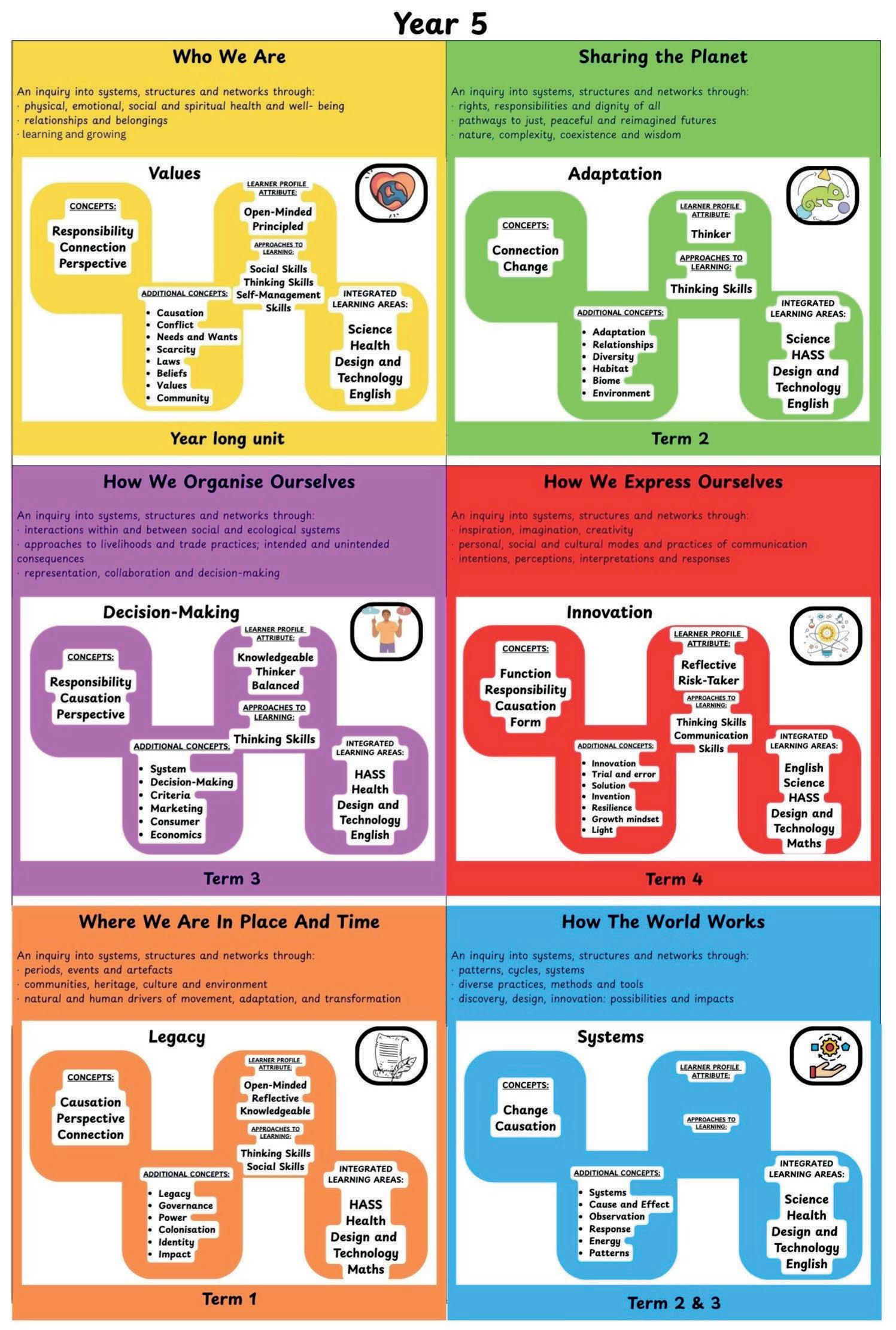
Year 5 Encounter is an exciting opportunity to develop resilience and independence in a safe, collaborative environment The Encounter takes place in Semester 2 and is an annual highlight for students and staff alike. Activities at school will support students with their preparation for camp, and detailed information about the camp will be provided at that time.
Year 5 Night of Living Treasures is part of the How We Express Ourselves unit of inquiry It is an important element of our Upper Primary programme and will take place in Term 4 More specific information will be provided closer to the time.
Homework is an opportunity for your child to develop further independence and help to prepare them for their secondary schooling It also is an important way of reinforcing concepts taught in class Students are expected to:
Read a passage aloud every night.
Revise morphemes
Complete provided Maths task
Access Matific in order to complete assigned tasks (Parents can also create accounts and assign tasks).
Undertake further personal learning / inquiry work as required.
Homework will always be discussed with students in class before being sent home and it is an expectation that it will be completed on time and to an appropriate standard
INFORMATION
All students will have signed an IT User Agreement when they received their device. It is expected that your child’s device is used as an educational tool, and therefore no non-school related items are added (e g games, moving backgrounds, non-standard cursors) Students are expected to come to school each day with their device fully charged We ask parents to use the Parental Controls on your child’s device and to ensure your child is closely supervised when using it at home. Your support in ensuring your child is using their device responsibly, in accordance with the IT User Agreement, is greatly appreciated. New student devices have been ordered and will arrive in due course
Over the year, students will be taught to use some of the features in SEQTA Learn, including sending Direqt Messages to staff, setting goals and receiving feedback.
Year 5 students will wear Sport Uniform for two days during the week (JWACS shirt on one day and House shirt the other), and formal uniform on the remaining three days Please refer to the timetable in the student diary for the specialist timetable and the allocation of uniform days once they are confirmed.
Students need to provide a long-sleeved art shirt/ smock for their weekly Art lessons Please make sure this is clearly named MONDAY TUESDAY WEDNESDAY THURSDAY FRIDAY
UNIFORM Red Polo- Lizard & Dingo Formal- Quokka Formal Formal
JWACS ShirtQuokka Formal- Dingo& Lizard House shirt
DINGO Physical Education, Digital Technologies Japanese Music Art
LIZARD Art Physical Education Digital Technologies Japanese Music
QUOKKA Digital Technologies Art Japanese Music Physical Education
LIBRARY: Wednesday (odd weeks)
Students need to provide a long-sleeved art shirt/ smock for their weekly Art lessons. Please make sure this is clearly named
By the end of the year:
Speaking and Listening
Students interact with others and listen to and create spoken and/or multimodal texts, including literary texts. For particular purposes and audiences, they share, develop and expand on ideas and opinions, using supporting details from topics or texts. They contribute actively to class and group discussions, taking into account other perspectives. They use different text structures to organise, develop and link ideas. They use language features, topic-specific vocabulary and literary devices, and/or multimodal features and features of voice.
Reading and Viewing
Students listen to, read, view and comprehend texts created to inform, entertain or persuade audiences. When reading, they decode unfamiliar words, integrating phonic, grammatical, semantic and contextual knowledge. They use comprehension strategies to build literal and inferred meaning in written and visual texts with less familiar and more varied topics. They read and navigate texts for specific purposes and begin to evaluate the ideas and information presented in them. They explain how ideas are developed, including through characters, settings and/or events, and how texts reflect contexts. They explain how characteristic text structures support the purpose of texts. They explain how language features, literary devices and visual features contribute to the effect and meaning of a text.
Writing and Creating
Students create written and/or multimodal texts, including literary texts, for particular purposes and audiences, developing and expanding on ideas with supporting details from topics or texts. They use paragraphs to organise, develop and link ideas. They use language features, a variety of sentence types, including complex sentences, tenses, topic specific vocabulary and literary devices, and/or multimodal features. They spell words, including more complex words using phonic, morphemic and vocabulary knowledge.
ENGLISH
In English, we focus on building strong communication and comprehension skills. Key areas include: Vocabulary Development – expanding word knowledge and understanding the meanings of word parts (morphemes).
Text Structures and Language Features – exploring how texts are organised and how language choices create meaning.
Reading Fluency and Accuracy – improving smooth, accurate reading.
Author’s Purpose – understanding why authors write and how they influence readers.
Personal Responses to Texts – encouraging thoughtful opinions and connections.
To support these goals, we use:
Word Origins – builds on the Year 4 program to teach word parts and meanings, helping students decode and use words in context.
Talk 4 Write – students analyse quality texts and apply structures and language features in their own writing.
Repeated Reading Approach – strengthens fluency and accuracy through practice.
Comprehension Activities – focus on evaluating how authors use purpose and literary devices to affect readers.
Speaking and Listening Skills – developed through small-group novel discussions and formal presentations.
Our aim is to help students become confident readers, writers, and communicators who understand and enjoy language.
By the end of the year:
Students demonstrate the behaviours of the proficiencies of Understanding, Fluency, Problemsolving and Reasoning in conjunction with year level content in routine situations. They select from and use content and mathematically model situations to solve real-world problems in familiar contexts.
Number and Algebra
Students add and subtract whole numbers, multiply larger whole numbers by one- and two-digit numbers and divide whole numbers by one-digit numbers, including those with remainders, using efficient strategies. They identify factors and multiples of whole numbers. Students order decimal numbers, locate unit fractions on number lines and recognise that 100% represents a complete whole They add and subtract fractions with the same denominator Students follow a rule to create patterns and create simple budgets
Measurement and Geometry
Students choose and use appropriate metric units to measure length, capacity and mass They identify the dimensions of metric square and cubic units and use them to compare areas and volumes Students connect three dimensional objects to their nets, construct angles in degrees and identify types of angles They use grid coordinates and convert between 12- and 24-hour time systems to determine duration
Statistics and Probability
Students make comparisons between events with equally likely and not equally likely outcomes and conduct repeated chance experiments with equally likely outcomes, representing results as fractions They pose questions to collect categorical or discrete numerical data and make appropriate choices to represent the data Students describe and interpret data represented in line graphs
In Mathematics, our focus is on helping students become confident and flexible thinkers. We work on three key areas:
Reasoning and Justification – encouraging students to explain their thinking and understand why an answer makes sense.
Flexible Calculation – building the ability to solve problems in different ways, not just by following one method.
Identifying Efficient Strategies – helping students choose the best approach for each problem.
To support this, we use:
A Spiral Curriculum – revisiting and linking concepts over time so learning is reinforced and connected
Lighthouse Maths – a program that strengthens mathematical vocabulary and reasoning skills
Concrete to Abstract Pathway – starting with hands-on materials, then moving to abstract representations, and finally connecting ideas to real-world contexts to deepen understanding
Our goal is to make maths meaningful, engaging, and practical for every student
Pre-Primary
Year 1
Year 2
Year 3
Year 4
Year 5
Year 6
JWACS Inter-House Carnivals
Inter-School Carnivals
At John Wollaston we aim to develop the whole child from the early years. One means by which we do this is through structured Encounter experiences. The Encounter Program is unique to our school and offers important learning experiences for each year level which facilitate character development, resilience building and personal growth. Students enjoy the opportunity to test themselves in contexts outside the classroom in the company of their peers and the staff. For many students, the Encounter is the highlight of their year. This program undergoes ongoing review and is subject to change as we continue to look for areas to improve and refine.
PRE PRIMARY:
Kings Park
Focus: Exploration and risk taking
YEAR 1:
Perth Zoo
Focus: Resilience and sustainability
YEAR 2:
Rottnest
Focus: Independence and grit
YEAR 3:
Woodman Point
Focus: Teamwork and personal challenge
YEAR 4:
Race around the City
Focus: Navigation, life skills and independence
YEAR 5:
Swan Valley Adventure Camp
Focus: Risk taking, teamwork and relationships
YEAR 6:
Kerem Adventure Camp
Focus: Resilience, wellbeing through nature and conflict resolution
In 2026 we aim to have a balanced approach to gathering together in order to maximise the benefits of connectedness but also to protect valuable instructional time It is important that students can come together for a variety of purposes to build a sense of community, address issues as they arise, and allow for worship and celebration together
This year, Primary students will gather in the following ways: Weekly Chapel Services under the leadership of Rev Ruth. Year Level Meeting – fortnightly, under the leadership of Coordinators, Ms Mel Cuming and Mrs Sheree Zecca
Whole Primary Assemblies – twice a term in Terms 1, 2 and 3 with special end of year events, such as the Nativity, Valedictory and Exhibition and Praise and Thanksgiving. Whole School Services – such as Easter, Founders’ Day, and Gift of a Candle.
Parents are encouraged to attend Chapel Services, Whole Primary Assemblies and special events throughout the year. Please refer to the Whole School Calendar in SEQTA for dates, timing and location of these events.
The calendar is found on the portals page on your SEQTA, under 2026 JWACS Calendar, or on the School website under the Parents tab. Note: All dates correct at time of publishing. Events published in this calendar are subject to change.
Timely, effective and courteous communication between home and school is most important when fostering positive relationships that support children as they journey through school. At John Wollaston, our key platform for communication is SEQTA. Through SEQTA you can access key information and communicate with staff from across the School as you need
Available on our website is the SEQTA Use and Etiquette Statement for Families, which outlines some of the expectations we have for all users of this platform. Most importantly, there is an expectation that all users have a 48-hour window to respond to any Direqt Message More urgent matters can be addressed by telephone contact I encourage families to read the document available at www jwacs wa edu au/policies
For students in Years 1-4, we utilise Seesaw to share children’s learning through a digital learning portfolio. On this platform, families can view, respond and keep up to date with their child’s learning. We ask that all users of Seesaw refrain from using this as a means of communication Please keep this to SEQTA
In Year 5 and 6, students begin to utilise the SEQTA Learn platform and will begin to develop their skills in accessing Direqt Message and assessment and feedback information. Through developing these skills in Upper Primary, students are then well prepared for the more the advanced use that will follow in the Secondary School
As always, you are welcome to touch base in person with staff Please bear in mind that there are often matters to attend to outside of class time, so a pre-arranged time to meet is always appreciated.


All low-level poor behaviour choices will be managed by class teachers in line with the Essential Agreement established at the commencement of the academic year. Steps will be put in place to support the child/ren as required. Class teachers will communicate any more serious or ongoing issues to parents / guardians.
Behaviours at this level may include, but are not limited to, being disruptive, not following instructions, answering back to staff, not working in alignment with the Essential Agreement.
Ongoing concerns with behaviour are referred to the Early Years Coordinator, Years 3-6 Coordinator or Primary Inclusive Education Coordinator. The context, nature and seriousness of issues is established and the Coordinator will work with class teachers and student using a restorative approach to behaviour management.
Behaviours at this level may include, but are not limited to, persistent poor choices in class, swearing, disrespectful behaviour towards peers, escalating game play, rough conduct and not working in alignment with the Essential Agreement.
Communication with parents / guardians at this level will be maintained through SEQTA, the Student Diary or by telephone.
Continuing behavioural concerns and behaviours of a more serious nature will be referred to the Deputy Head of Primary. At this level a meeting is arranged with parents / guardians, the class teacher, and Deputy Head of Primary to establish a restorative plan. If required, a referral to the School Counsellor or Chaplain may be appropriate. These referrals can only be made through the Deputy Head of Primary or Head of Primary.
Behaviours at this level may include ongoing inappropriate behaviour, deliberate physical aggression, theft, damage to property, derogatory or aggressive comments. After School Detentions may be issued as a consequence of these behaviours.
Serious breaches of the Code of Conduct (e.g., violent behaviour, derogatory, offensives behaviour of sexist, sexual or racist nature, ongoing harassment or bullying) and failure to modify behaviours over time may result in suspension. Parents / guardians meet with the Head of Primary to establish/review the restorative plan. Suspensions can be either internal (student still attends school) or external. External suspensions require the approval of the Principal.
The Principal is the final arbiter on all matters pertaining to School Rules and Regulations.
At JWACS we believe in using every opportunity to encourage students to aspire to be their best self. Our certificates are just one of the tools that members of our learning community can use to support and motivate our learners. Keeping the approach simple allows for great flexibility and adjustment to suit the age and stage of children as they progress.
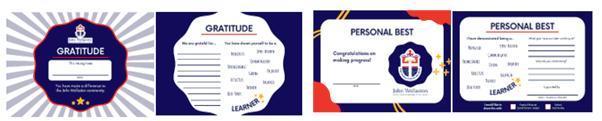
Gratitude Certificates help promote a grateful mindset, but also actively encourage students to practise gratitude regularly. Gratitude Certificates can be given to any member of our community, from any member of our community, when the person’s efforts to make our school a great place have been noticed. It is anticipated that more Gratitude Certificates will be presented than Personal Best. How wonderful for the giver to be thinking about others in a positive way, and how special to receive a message of gratitude from a peer, teacher or parent!
Personal Best Certificates are to recognise when students have achieved a goal or made significant personal progress in some way. These can also be used for groups of students, such as a class, for working together to achieve a collective goal. The beauty of these certificates is that the goals can be highly personalised for different children. The ideal outcome is that we have students who are self-aware of their goals and can articulate and celebrate their own milestones – and not in comparison with others.
In order to promote agency and recognise learning in an holistic way, all members of the school community can award these certificates. Personal Best Certificates have a place for a trusted adult to support the awarding of a certificate by a student. In our system, parents and guardians are empowered to play an active role in valuing, appreciating and celebrating children’s learning. Parents and guardians have great insight into their children’s goals, effort and development. By involving parents and guardians, we are supporting a holistic view of learning, valuing children’s efforts both in and outside the classroom.
To help clarify, I have created some examples : Student, Mary, has been trying to use capital letters in her writing properly for ages. Mary’s Mum has watched her spend a whole week at home editing her narrative until all of the capital letters were in the right place. Mary checks her work with Mum and is elated that she has done it! Mary and her Mum share this success back at school by completing a Personal Best certificate recognising her as principled and a thinker and posting it.
Head of Primary awards the Tadpole Class a Gratitude Certificate for their consistently tidy bag rack. Students, without teacher prompting, maintained this high standard throughout the Term. Through being principled, they have shown respect for the School and their belongings.
Teacher, Mrs Smith, has been learning about fractions with her class. A pre-assessment and conversations with student, Danny have showed that this area of Mathematics is a struggle for him. Danny really wants to master this and over the next few weeks, works diligently and pushes himself to understand fractions better. Mrs Smith notices his willingness to communicate his struggles and take risks to further his learning. The post-assessment shows some growth for Danny in this area, but Danny feels a bit disheartened. Mrs Smith discusses this with Danny and together they celebrate his positive and proactive approach to learning. A Personal Best Certificate is awarded, and Danny begins to see that his attitude and effort are valued in learning as the Learner Profile attributes of risk-taker, communicator and thinker are celebrated. Dad, Peter, has noticed that his daughter Sara is struggling to get organised in the mornings for school and often results in them being late. Together, they put an organisational chart for the morning in place and set a goal to make it to school on time every day for a fortnight. In the first week, they struggle and are late to school a couple of times. They persist and trouble-shoot and after four weeks, they have made it to school on time for 10 days in a row. They celebrate by using a Personal Best Certificate for Sara, for being reflective, open-minded and principled. Sara also wants to thank her Dad for his support, so she completes a Gratitude Certificate for him!
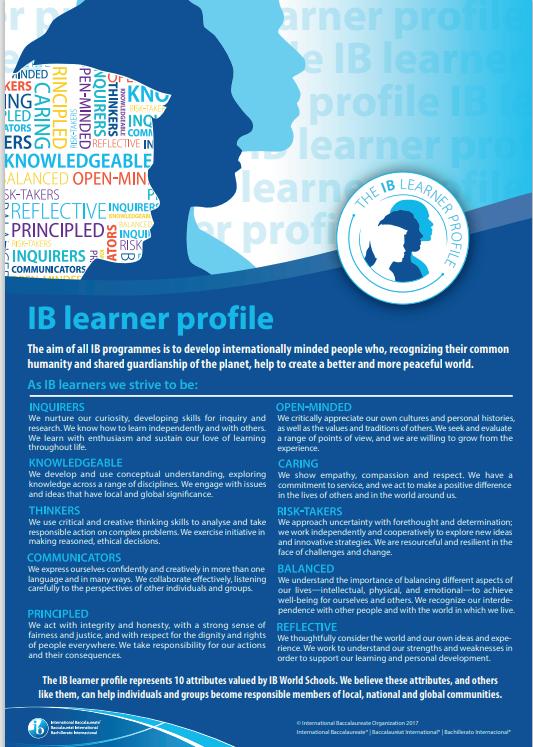
A handy one-pager is included in this information package. This explains the attributes of the Learner Profile for you to refer to. Linking these to actions through the certificates will help students' understanding and recognition of how they are developing as learners!
First and foremost, joy. The children enjoy being able to do something special with their certificates. Secondly, as teachers are not the only ones awarding certificates, they are not able to easily collate the Learner Profile attributes being recognised elsewhere. The Learner Profile attributes will be logged so that teachers can see what wonderful qualities are being developed in and out of school. This process will also help Primary Leadership gather some information about the level of engagement with the certificates across the School. Please see the Dos and Don’ts section below for a word on competition
Certificates can be obtained from your child’s class teacher, or from Primary or ELC Reception.
Dos and Don'ts
Dos
Do get excited about the certificates and share your enthusiasm with your child. Do encourage your child to ask questions to help clarify how it works. Do engage with your child about what might be meaningful goals or gratitude.
Don’ts
Don’t get competitive. The fastest way to ruin this system is to compare how many certificates a student gets with another, whether in the same family, class or across year levels. This is not a competition. The number of certificates is not important.
Don’t hesitate to have-a-go. The more meaningful the goal for Personal Best Certificates, the more meaningful these will become for your child.
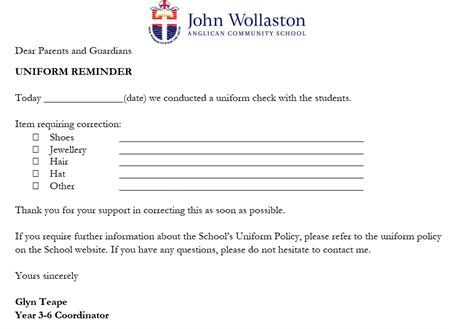
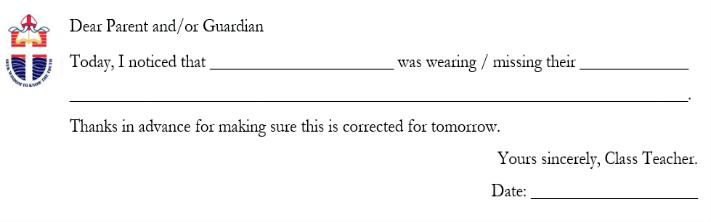
In support of good habits, students in Primary School wear their hats to and from school every day, all year.
Clarification on common incorrect items.
Jewellery – The following images show the only acceptable earrings at JWACS.
– black, lace up school shoes are required (not skate shoes, Mary-Jane’s or black sneakers)
Sports shoes – must be predominantly white sports shoes, not boots or skate shoes.
Hair
Hair is expected to be clean, neat and out of the eyes. If the hair is collar length it must be tied back. Conservative styles are required. Razor cut designs and colourful extensions, or colours, are not acceptable. Please save these for the holidays.
START AND END OF DAY