

By Lucy Gellman
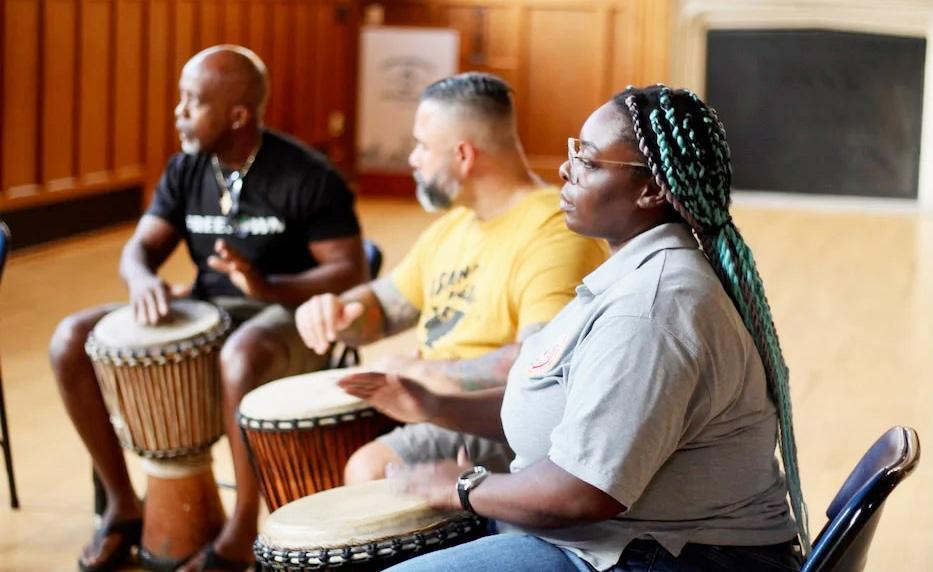
Shantel Green sat down at the djembe, a weight lifting as she straightened her back, and pressed her hands to the taut drumskin. She took a breath in, and then listened for an opening. Halfway across a circle of chairs, Brian Jawara Gray and Grey Freeman had already begun to play, their hands soaring through the air. As Green joined in, the drums started to speak, the sound filling up the whole room.
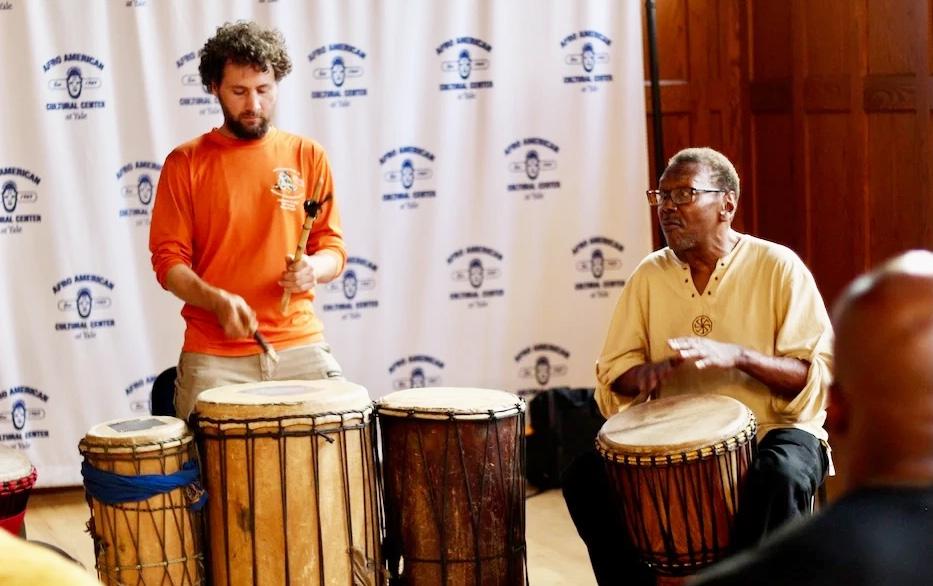
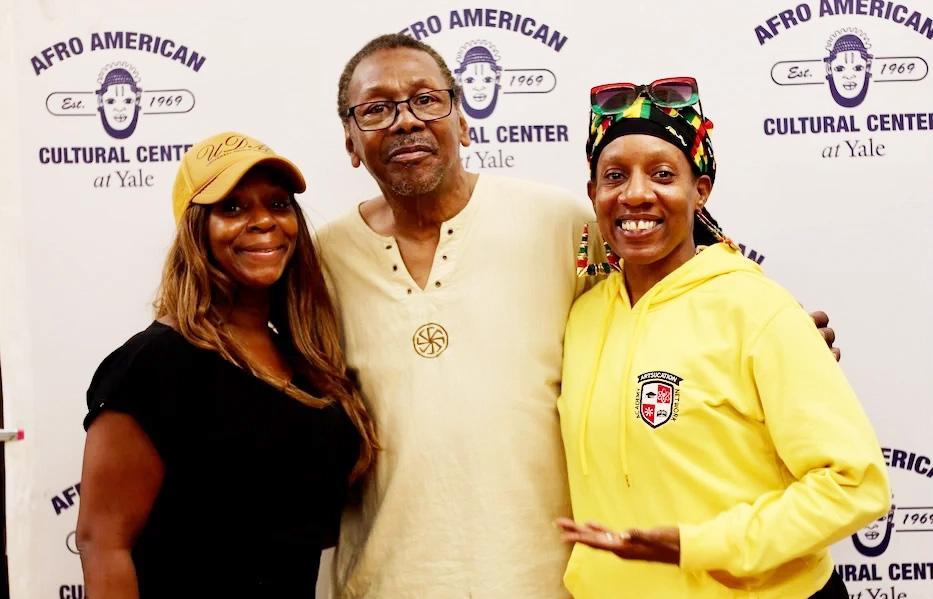
Green, a systems engineer by day, is a regular at African drum and dance classes at the Afro-American Cultural Center at Yale, where they unfold every Monday evening through the Artsucation Academy Network and Blackfist Music Productions. The mellifluous brainchild of Gray and Dr. Hanan Hameen Diagne, they seek to spread traditional African arts and culture while also creating a safe, all-ages educational space, including for adults who may not otherwise have the time to plug back into the arts.
Classes run from 6 to 9 p.m. at 211 Park St., with the first 90 minutes dedicated to drumming, and the second 90 minutes dedicated to dance. The cost is $15 for each session for community members; Yale students can attend for free with a school I.D. Now that Yale is back in session following winter break, they have resumed.
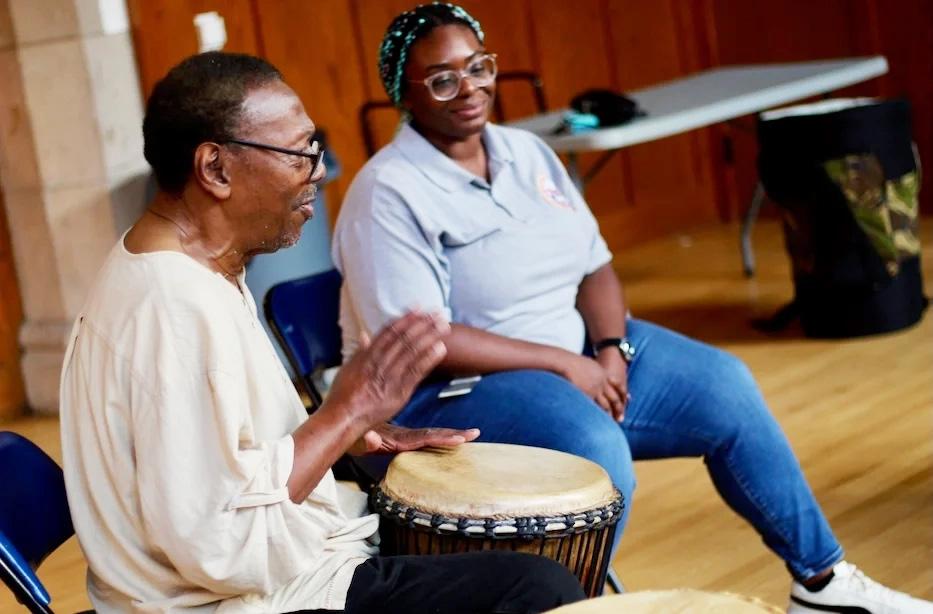
“It’s about building community,” said Hameen Diagne, who has invited colleagues like Kim Holmes and Shani Collins to teach when she is in Senegal, where she spends part of the year. “Shutting everything else out and getting into your holistic and spiritual self, about just learning and being together. We are sharing history … this is how our teachers received it.”
The classes in their current iteration have been years in the making—and need a steady flow of students to keep going. For years, classes took place on the weekends through the New Haven School of African Drum and Dance, which brought them back after Covid-19 forced students to go remote (Seny Tatchöl Camara, who learned to drum before he could walk, cotaught those classes with his father, Aly Tatchöl Camara).
But those ended in the spring of 2023, and there was a void. As longtime colleagues and collaborators, Hameen Diagne and Gray formed the New Haven African Arts Alliance, giving summer classes at Bregamos Community Theater after their vibrant Juneteenth celebrations on the New Haven Green. When classes at Yale resumed that fall, the two found a home at the Cultural Center, where they have been since. Classes take a hiatus in December, during exams and winter break, and again in the summer.
“It’s all of these connections taking place,” Hameen Diagne said, with a reverent nod to Black dancers and dance educators like Katherine Dunham, Pearl Primus, and Chuck Davis who transformed
how she understood and lived her life within the art form. “It opens doors and [fosters] that diasporic connection.”
On a Monday night last fall, that sense of exchange was fully on display as long rays of sunlight fell across the floor, and students began to trickle into the room as Gray finished setting up. Green, who first found Gray’s classes four years ago during the Covid-19 pandemic, got comfortable in a chair, slipping herself easily around a djembe as if it had always belonged there. There was a conversation that was about to begin, and she was very much ready.
Grey Freeman and Brian Jawara Gray. She smiled, a kind of recognition that said, even from behind her glasses, I needed this today without any words at all. Then she began to listen, joining in with a clear, sharp focus on the rhythm that had the drum singing beneath her palms.
Every so often, the glossy, bright bands of color on her nails glinted in the fading light. The room, quiet just minutes before, became a back-and-forth, drumbeats weaving in and out of each other. If a listener closed their eyes, they could see a tapestry in reds and oranges beginning to form, the thread still silky as it made its way quickly across the fabric.
A few seats away from her, Gray was just getting started. Ta-ta / duh-duh-duhduh the drums crooned, their voices high and light, and Green responded back with the same rhythm, the sound rolling in and out of the foundation Gray had laid. In between them, Freeman played a trio of djun djuns, a pair of mallets bouncing in his hands. To the sing-song back-andforth Gray and Green had created, he churned out footfalls, sharp and insistent. The sound swelled as students trickled in, some taking a seat and beginning to play as their own sort of hello. By 6:30 p.m., eight people had materialized, with some who had driven from as far as Simsbury, Watertown and New York to be part of the community. By 7 p.m., there were so many that Gray had run out of chairs, and nobody seemed to mind. When he paused to give feedback, a few exchanged hugs and big, broad smiles.
“You need a clearer tone,” Gray said gently to Green and Edgardo Figueroa, who had rolled in sometime during the first 30 minutes of class. “I don’t want to hear hands. I want to hear drums.”
He took a beat, and then brought down his hands once, twice, three times, palms outstretched and so delicate that it seemed they could have been birds. He nodded to Green to try it out, making a quiet, nearly purring “uh huh” sound when she did.
Figueroa, whose family hails from both Willimantic, Conn. and Aguadilla, Puerto Rico, later said that feedback is one of the things he values about the class, as he deepens a craft that connects him to his own Afro-Caribbean cultural heritage.
“It’s a new skill set, an expression of art, an opportunity for me to be expressive,” he said before returning to the task
at hand. And it is: to play with a master like Gray is to also learn and respond to a history of forced migration, cultural heritage, and diaspora that is still unfolding. “I feel grateful to have Jawara as an instructor.”
Gray smiled at something he’d spotted out of the corner of his eye: a beaming Seny Tatchöl Camara, all grown up and still baby faced, had entered the room, radiating light. Colors swirled on his sweatshirt, and for a moment it felt like the universe had stopped to recognize the moment, a beloved returning to exactly where he was supposed to be. He bowed at Gray, then fit two hand-carved djembes, one wrapped in strips of batik fabric, between his knees. Within seconds, his hands were flying, the sound undulating through the room.
That’s precisely the kind of community Gray seeks to create, he said in an interview in the building’s tight kitchen, the sound of feet shuffling across the floor outside as Hameen Diagne prepared to take over (Gray and several of his students often stay to provide live accompaniment, as they did on this Monday night). Like Hameen Diagne, he learned through apprenticeship and embodied practice. Now, he sees it as a duty to keep the music going.
Growing up in New Haven, he started drumming in elementary school, when a certain Mrs. Cunningham encouraged him at the former Conte School, he said. What began as a music class bloomed into an entire love story; Gray (who most New Haveners know simply as Jawara) was soon learning from mentors like Baba Paul Huggins. He knew the Afro-American Cultural Center in its early years, when Khalid Lum was still figuring out how to bridge town and gown through the space.
“There was a social value to it,” he said of drumming. Well before his music brought him to Conakry, Guinea and to Morocco, well before he saw Sunny Adé and knew what he wanted to do for the rest of his life, New Haven was all the diasporic education he needed. “It was something that fully kept me from being in the street. I learned a lot right here.”
Part of that learning, he continued, was the realization that someone had to carry on Huggins’ legacy and teach the next generation of artists (“During the summer, the Center closes down, but the culture don’t close down!” he said with a knowing smile). In New Haven, “it’s not a priority,” he said of drumming education, or teaching the diaspora. Hameen Diagne, who is also known for her “Africa Is Me” curriculum, felt like a natural collaborator: the two have worked closely together for years.
“Every drum has a different purpose,” Gray said, pointing out how the djembe, the djun djun, the sangban and the kenkeni, the shoulder drum and the talking drum all have different voices.
Back in the Center’s large first-floor room, Hameen Diagne had started to Lucy Gellman Photos.
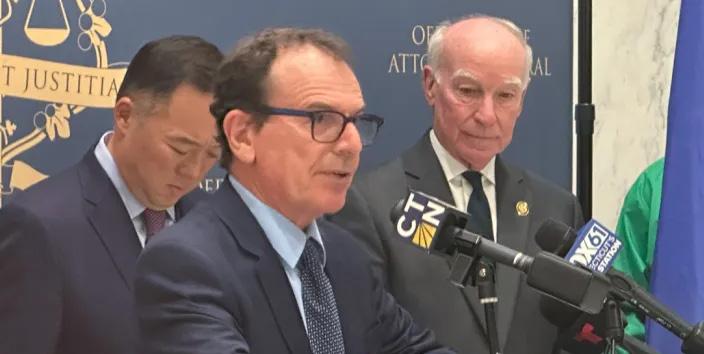
The Trump administration abruptly canceled approximately $2 billion in federal grants supporting addiction treatment and mental health services late Tuesday, a move Connecticut officials and providers say is already disrupting care and could reverse years of progress addressing overdose deaths and the state’s ongoing mental health crisis.
Nationally, the cancellations affect roughly 2,000 grants administered by the Substance Abuse and Mental Health Services Administration, according to national reporting and statements from federal lawmakers. The terminated grants account for about one-quarter of SAMHSA’s overall budget and largely fund discretionary, community-based programs rather than formula-driven state block grants.
RELATED: 24 Hours Later, HHS Reverses $2B Cut To Addiction And Mental Health Services After Bipartisan Pushback
In Connecticut, the cuts include the loss of an estimated $11.5 million in grants supporting substance use treatment, mental health awareness, school-based trauma services, peer support, and family support programs, according to the Connecticut Community Nonprofit Alliance, which represents hundreds of nonprofit providers across the state.
Affected providers include Wheeler Clinic, McCall Behavioral Health Network, Community Health Resources, Rushford and Bridges Healthcare.
The alliance said state agencies and community-based nonprofits were notified overnight that the grants were being eliminated effective immediately, leaving providers scrambling to assess layoffs, service reductions and potential program closures.
Gian Carl Casa, president and chief executive of the Connecticut Community Nonprofit Alliance, said the sudden loss of funding threatens programs that many residents rely on daily.
“Providers are still evaluating the total impact, but we know that without neces-
sary funding, many programs will simply cease to operate and lives will be lost,” Casa said.
Grant recipients nationwide reported similar immediate effects after receiving termination notices late Tuesday night.
The termination notices cited a lack of alignment with administration priorities but provided no program-specific explanations. Providers said the abrupt cutoff has already triggered layoffs, suspended services and led to the cancellation of outreach and treatment programs.
The decision withdraws funding from a wide swath of prevention, treatment, recovery and mental health services and builds on broader retrenchment at the US Department of Health and Human Services, where the administration has eliminated thousands of jobs and frozen or canceled billions of dollars in scientific and public health research funding.
State Sen. Ceci Maher, D-Wilton said the termination undermines recent progress and commitment in Connecticut.
“The mental health and addiction needs in our communities are real, and our state has committed tens of millions of dollars in the last few years to support and help constituents who are struggling,” Maher said. “This decision threatens to reverse years of efforts and leaves many, including countless children, without support.”
Nationally, the cancellations come at a moment when provisional CDC data shows the first sustained national decline in overdose deaths in decades, with fatalities down by more than 20% year over year. Public health officials have attributed the decrease in part to expanded access to addiction treatment, widespread naloxone distribution, and community-based recovery programs supported by federal funding, including grants administered through SAMHSA.
State Sen. Matt Lesser, D-Middletown and Senate chair of the Human Services Committee, said the canceled grants affect residents seeking treatment in every part of the state while Gov. Ned Lamont criticized the administration’s action, calling the cuts arbitrary and destabilizing.
“Halting previously promised funding
jeopardizes care for some of our most vulnerable residents,” Lamont said, adding that the state is evaluating the full impact and urging the federal government to reverse course.
U.S. Rep. Rosa DeLauro, D-CT, a senior member of the House Appropriations Committee, also condemned the grant cancellations, calling them dangerous and unjustified.
“These cuts will cost lives,” DeLauro said in a statement. “Terminating funding that supports mental health care, addiction treatment and overdose prevention is unconscionable, and the administration should immediately reverse these cancellations.”
Casa said the nonprofit alliance is asking Lamont to consider using the state’s emergency reserve fund, created by the legislature in November to address federal funding cuts, to preserve critical programs while the effects are assessed.
Public opinion recently appeared in favor of funding mental health and addiction services. A national poll conducted in December by Ipsos for the National Alliance on Mental Illness found broad opposition to federal cuts to mental health programs and staffing, as well as concern that reductions would weaken local services, suicide prevention efforts and crisis response capacity.
State Sen. Saud Anwar, D- South Windsor and Senate chair of the Public Health Committee, said the timing of the cuts is particularly concerning.
“Just as Connecticut is making progress in reducing overdose deaths, this decision makes our work harder and disconnects people from programs that provide life-changing aid,” Anwar said.
Federal officials have not released a comprehensive list of terminated grants or detailed explanations for individual cancellations.
Connecticut officials said they are continuing to assess which programs are affected and warned that further disruptions are likely unless funding is restored.



by Elwood Watson, Ph.D, Opinion Columnist
Millions of Americans continue to mourn the tragic death of Renee Good, the Minneapolis mother fatally shot by a federal immigration agent last week mere blocks from her home.
Good, who was driving a maroon Honda near the protest, was confronted by ICE agents in several vehicles. One agent approached her, walked up to her car, tugged at her door handle, and screamed “Get the f— out of the car!” Good attempted to back up her car and then drove forward, speeding around an ICE officer who pumped three bullets into the car.
“Renee Nicole Good was a mother of three, including a 6-year-old boy who is now an orphan,” Sen. Amy Klobuchar, D-Minnesota, said in a statement.
“Renee was deeply loved by many . . . by refusing to coordinate with local law enforcement, ICE is not making our community safe. It is making it less
safe.”
Minnesota Attorney General Keith Ellison described the ICE agents’ actions as an “escalation” and said Good was trying to get away from the situation without being aggressive.
“I think the use of force I saw raises such serious questions that there needs to be an intense investigation and perhaps this officer should face charges,” Ellison said. “But that needs to be determined through an investigation.”
To no one’s surprise, the commentary on the right took a largely contrasting tone.
Department of Homeland Security Secretary Kristi Noem argued Good had committed an “act of domestic terrorism.”
“At a very minimum, that woman was very, very disrespectful to law enforcement,” President Donald Trump told reporters on Air Force One. Routinely irascible Fox News host Jesse Watters perversely and inexplicably chose to focus on the fact that Good was a supposed troublemaker and member of the LGBTQIA+ community who “leaves behind a lesbian partner and a child from a previous marriage.”
Understandably, such a senseless tragedy has shocked, shaken, horrified and outraged much of the nation.
Millions of Americans have reacted by
taking to the streets, protesting and voicing their rage at such a violent incident. Networks of citizen patrols in cities such as Portland, Oregon, Chicago, and Boston are employing whistles, car horns, bull horns, and other devices to alert immigrants and like-minded neighbors in an effort to abort aggressive, heavy-handed activity from ICE agents.
These efforts have quickly become deeply entrenched in communities all over the country, creating a network of ICE monitoring groups all over the nation, particularly in blue states and racially diverse areas. Information on how to monitor activity and track specific locations and license plates on vehicles used by ICE agents is being provided to citizens. The locations of previous sweeps have been shared. In numerous locales, instructions have been meticulously reviewed by attorneys to ensure that ICE monitors do not overstep their boundaries.
There are those who argue the tragedy has received outsized attention and a notable degree of compassion due to the fact Renee Good was a white, blond woman. Did Good’s race, gender, and physical attributes play a role in the outpouring of empathy she has received? To be sure, such realities could very well be true. The attractive, missing white woman syn-
drome is hardly a mythical proposition.
Varied assumptions aside, the outright falsehoods about the Minneapolis incident being spewed by the Trump administration and the right-wing media echo chamber are problematic for many reasons. Such misinformation espouses the bogus perception that federal agents are in an ongoing state of physical jeopardy from “unhinged” protestors and citizens, and thus have every right to employ lethal force at the most minimal assumption of harm. It also reassures federal agents that they can inflict violence upon, or even murder American citizens with impunity, and sends an ominous message to individuals inclined to take to the streets to express their displeasure toward the Trump administration’s immigration policies that they can be easily exposed to various types of potentially lethal situations.
The issue of ICE and immigration will likely continue to fester, with politicians of every stripe and sizable segments of the larger public retreating to partisan positions. Nevertheless, heavy patrolling and occupation by federal agents in our nation’s cities, targeting our nation’s citizens and engaging in Gestapo-like tactics, is disturbing, alarming, and unsettling. It sets a harrowingly precarious and politically dark precedent for the nation’s future.
by Karla Ciaglo
HARTFORD, Conn. — One week after calling the killing of Renee Nicole Good “predictable and preventable” and demanding answers from the Department of Homeland Security, U.S. Sen. Richard Blumenthal, D-CT announced legislation that would allow individuals to sue federal law enforcement officers and agencies in civil court for violations of their constitutional and civil rights.
Blumenthal described the bill as a long-overdue response to what he described as a nationwide pattern of excessive and abusive force by federal immigration agents and to a legal system that increasingly leaves victims without a meaningful remedy.
The legislation, titled the Accountability for Federal Law Enforcement Act, was introduced in December by Blumenthal and U.S. Sen. Alex Padilla, D-CA, the ranking member of the Senate Judiciary Subcommittee on Immigration. The bill would amend federal civil rights law to allow individuals — regardless of citizenship — to seek damages for civil and constitutional rights violations by federal law enforcement officers, permit lawsuits against federal agencies when their employees violate constitutional rights regardless of whether agency policy caused the harm, and waive sovereign immunity for those claims, while preserving existing defenses for individual officers and leaving the doctrine of qualified immunity unchanged.
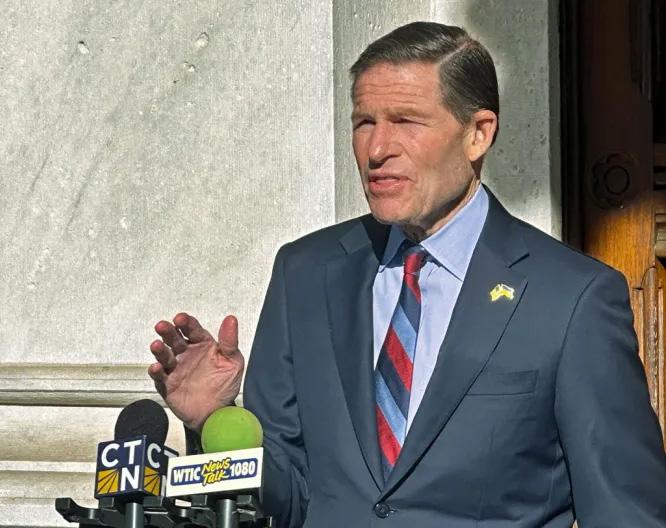
“When people are shot, or dragged out of cars, or denied access to a lawyer when they’re detained, these violations of rights, often physical force that creates trauma or injury, and the denial of medical care must be addressed,” Blumenthal said. “That’s what we’re doing.” While the Supreme Court recognized limited lawsuits against federal officers in its 1971 decision Bivens v. Six Unknown Named Agents, federal courts have repeatedly narrowed that doctrine over the past several decades. In a series
of rulings, the court has cautioned that recognizing new constitutional damages claims against federal officers is a “disfavored” judicial activity and has indicated that Congress — not the courts — must decide whether broader remedies should exist.
As a result, civil rights claims involving federal immigration enforcement, border policing, and national security operations are frequently dismissed before reaching discovery, even when plaintiffs allege excessive force or un-

John P. Thomas Publisher / CEO
Babz Rawls Ivy Editor-in-Chief Liaison, Corporate Affairs Babz@penfieldcomm.com
lawful detention.
Blumenthal emphasized that the proposal does not create a new legal theory, but instead aligns federal accountability standards with those already applied to state and local law enforcement.
“This measure is overdue, but there’s nothing really novel about the concept,” he said.
Blumenthal said the abusive use of force by ICE is a documented pattern that is unrecognizable for America, saying the agency, not just the agents, need to be held accountable.
“We’re going to seek accountability in the United States Congress through the power of the purse and imposing restrictions on ICE through the appropriations process,” he said “But individual victims of excessive force should have recourse as well.”
In a December statement, Padilla said the bill is necessary amid what he described as months of unchecked conduct by federal immigration authorities and asserted that ICE and CBP officers have terrorized communities nationwide using violent and excessive tactics against immigrants, U.S. citizens, journalists and bystanders without accountability.
“This bill reaffirms that the rule of law applies equally to all — including those who enforce it,” he said.
The announcement comes as Hartford police continue to investigate incidents during a vigil for Good. Mayor Arunan Arulampalam said most of the gathering Con’t on page 11
Advertising/Sales Team
Keith Jackson Delores Alleyne
John Thomas, III
Editorial Team
Staff Writers
Christian Lewis/Current Affairs
Anthony Scott/Sports
Arlene Davis-Rudd/Politics
David Asbery / Tanisha Asbery
Jerry Craft / Cartoons / Barbara Fair Dr. Tamiko Jackson-McArthur
Michelle Turner / Smita Shrestha William Spivey / Kam Williams Rev. Samuel T. Ross-Lee
Contributors At-Large
Christine Stuart
www.CTNewsJunkie.com
Paul Bass www.newhavenindependent.org
National Association of Black Journalist
National Newspapers Publishers Association
Greater New Haven Chamber of Commerce
Greater New Haven Business & Professional Greater New England Minority Supplier Development Council, Inc.
The Inner-City Newspaper is published weekly by Penfield Communications, Inc. from offices located at 50 Fitch Street, 2nd Floor, New Haven, CT 06515. 203-3870354 phone; 203-387-2684 fax. Subscriptions:$260 per year (does not include sales tax for the in State subscriptions). Send name, address, zip code with payment. Postmaster, send address changes to 50 Fitch Street, New Haven, CT 06515. Display ad deadline Friday prior to insertion date at 5:00pm Advertisers are responsible for checking ads for error in publication. Penfield Communications, Inc d.b.a., “The Inner-City Newspaper” , shall not be liable for failure to publish an ad or for typographical errors or errors in publication, except to the extent of the cost of the space in which actual error appeared in the first insertion. The Publisher reserves the right to refuse advertising for any reason and to alter advertising copy or graphics deemed unacceptable for publication. The entire contents of The Inner-City Newspaper are copyright 2012, Penfield Communications, Inc. and no portion may be reproduced by any means without the written permission of the publisher. 10
“Faith Matters” is a column that features pieces written by local religious figures.
by Bonita Grubbs
The founders of the Minnesota Mining and Manufacturing (ThreeM) company had a goal in mind in 1902: “to mine for corundum or anthracite, a mineral –that included ruby and sapphire that was ideal for making sandpaper and grinding wheels.” It turned out they picked the wrong materials. However, instead of giving up, they kept faith in their vision. They maintained a spirit of collaboration. They found the right materials, developed successful commercial products from Post-it Notes to Scotch Tape, and built a Fortune 500 manufacturing giant.
This company boasts on its website of its “more than 55,000 3M products used in homes, businesses, schools, hospitals and other industries. One third of our sales come from products invented within the past five years, thanks to innovations from the thousands of researchers and scientists we employ around the world.”
The people involved had faith in the product, purpose and plan that made all of the difference. Long before 3M came into existence, God had a successful, faithful and lasting plan for all of us.
“Faith is the key and substance (or assurance) of things hoped for and the evidence of things not seen.”
To me, this word means anticipating and taking advantage of a new opportunity–way of life, position or relationship – and, perhaps, change of position or lifestyle.
It also means living with confidence, anticipation and expectation.
Hebrews 11:6 records these words: “Without faith it is impossible to please God.” Those words emphasize that belief in God’s existence and God’s nature as a rewarder of those who seek Him is essential for a relationship with Him, forming the core of pleasing Him, more so than good deeds alone.
Faith involves knowing and embracing God’s character and promises, not to achieve intellectual agreement. It is the foundation for spiritual life, health, strength, hope, growth and peace.
It calls us to trust God’s goodness and faithfulness, and recognizing God as a loving parent who is responsive, compassionate and caring.
It also involves active seeking. Pursuit does not involve passive belief requiring a desire to follow word and way.
Finally, faith is foundational and not always fun, because it calls us to trust and believe.
As an example, most of us will sit in a chair, confident that it will not be pulled out from under us or will break due to its physical condition, serves a purpose and achieves a goal that is more than casual, matters because of its meaning. In some cases, it might come with a melody and music, and most definitely, meaning.
Martin Luther King Jr. inspires us to continue working toward a more just and equitable world.

by Dereen Shirnekhi
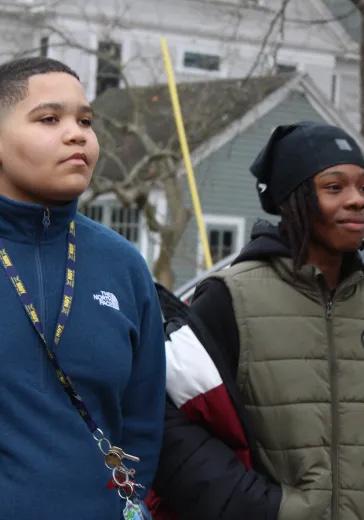
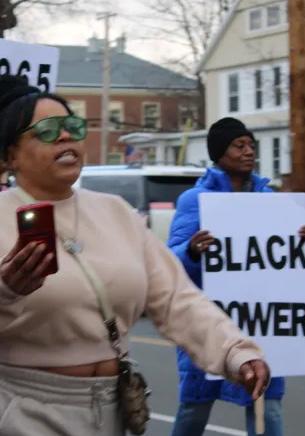
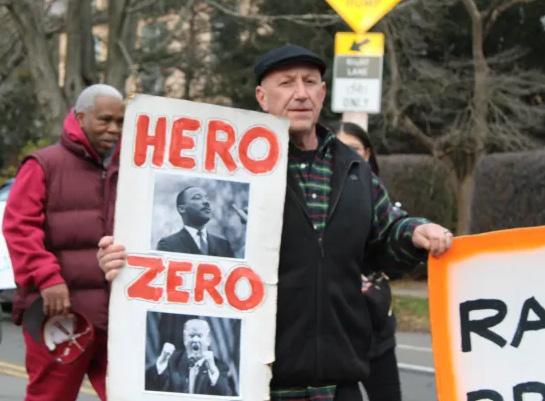
Fourteen-year-old Ronnie brought his friend Donnell with him to walk alongside roughly 100 other people Thursday in the annual Martin Luther King, Jr. Love March on Lawrence Street.
Next year, he might be bringing more friends, as march organizers aim to gather 10,000 attendees in honor of an important anniversary.
“It’s special for sure,” said Ronnie, who said his mom has brought him out to the march every year for the last four years. They’re members of Shiloh Missionary Baptist Church, which has been hosting the Love March on Martin Luther King, Jr.’s birthday, Jan. 15, for 56 years.
The march began at the church on Lawrence Street and then moved to Whitney Avenue, Edwards Street, State Street, and finished back at the church.
Ronnie walked alongside Donnell. Both are students at High School in the Community. They left school early to be there on Thursday. It was Donnell’s first time attending the march, and asked whether he would be back in 2027, he said, “Definitely.”
Before the march began, Pastor Kennedy Hampton, Sr., son of march founder George Hampton, Sr., addressed his congregation and the officials filling the church’s pews. Next year, the march will be honoring the 110th anniversary of the 1917 NAACP Silent Protest Parade in New York City. The 1917 march had around 10,000 attendees. Hampton wants next year’s Love March to reach those same numbers.
“In order to get to 10,000, we need to get our school system involved,” Hampton said. He called Mayor Justin Elicker to the pulpit and asked him to commit to allowing students to be transported from their schools to the march next year. “I want to have him commit today that he’ll help us reach 10,000 next year.”
“I will talk to [Supt. Madeline] Negrón and see what I can do,” Elicker said, smiling.
While walking toward Whitney, Ronnie and Donnell agreed that it would “definitely” be good for all students to have the option to be transported to and attend the march. “It’s good to do it on his day,” said Ronnie about the march being on King’s actual birthday. Ronnie said he always looks forward to the march and the ability to “respect MLK’s legacy,” and that many of his friends have come in the past.
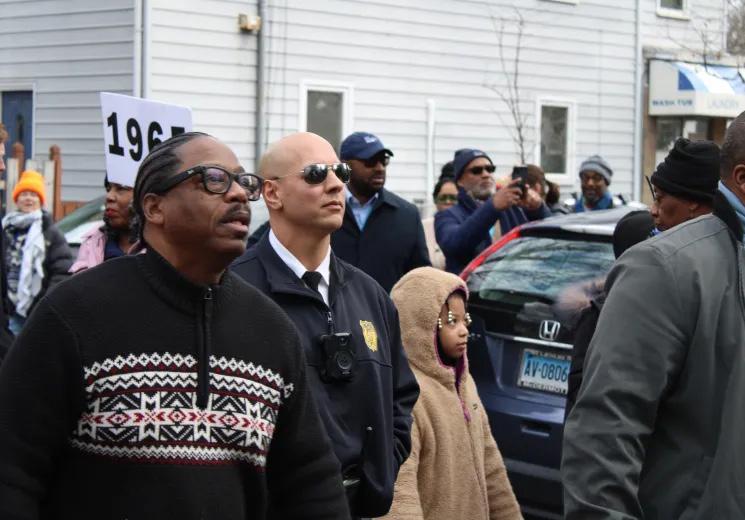
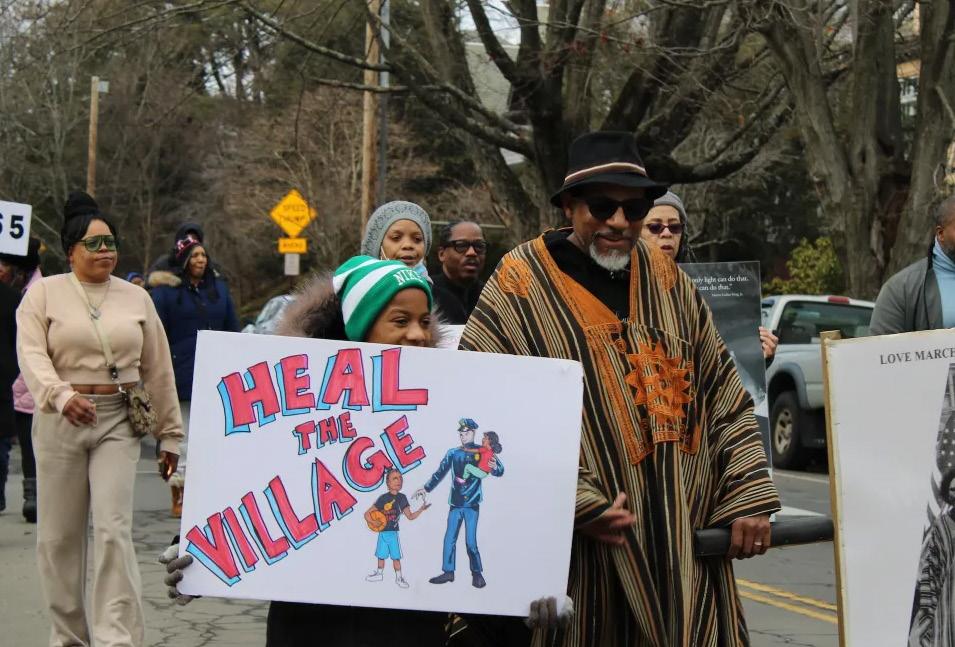
Ten-year-old Karter marched alongside Hampton, her grandfather, toward the beginning of the line, carrying a big sign that read “HEAL THE VILLAGE.” She said that she’s been coming to the march “my whole life.”
A student at Ross Woodward School, Karter stayed home Thursday to celebrate the Love March and King’s birthday. She agreed that it would be good for other students to be able to attend. Asked why the march was important, Karter said, “We walk for our rights!”
Orrieon Cowes III carried the American flag at the forefront of the march, leading the crowd behind him. At 66 years old, he said he has only missed five out of the 56 years the Love March has been put on. For the march, he has carried the flag for half a dozen years, organized a real mule and a cart, and even brought a bus to represent Rosa Parks. “Wherever they need me, I’m there.”
Cowes was born and raised in New Haven and has been a member of all his life. Now he lives in Bridgeport, but he still makes it out for services and the march. He pointed to a house on Lawrence, soon after turning onto the street from State. It was the house he had lived in when he first started attending Shiloh. Now, on Thursday, two of its tenants stood on the porch, waving at the marchers.
For Cowes, the march honors “peace, tranquility, rights for everyone.” Over the years, he has seen more kids in attendance, as well as more racial and ethnic diversity of attendees. “It was just us in the beginning,” he said.
Looking to the future, Cowes said, “We gotta change the seats in the House [of Representatives].”
Yanketia Wise is the granddaughter of Love March founder George Hampton, Sr. On Thursday, her voice rang clear as she led the march’s chant: “We are marching/ On Dr. King’s birthday/ We are marching/ Each and every day/ I made up my mind/ That I won’t turn around.”
“I feel really excited, I feel overjoyed, I feel empowered,” Wise said after the march. She said that she has also been attending the march her whole life. “I’m proud to pass the torch to my kids. This is a legacy.”
Asked how she came to be the one whose voice carried the march, she said that her mother had always been the one whose voice took that role before. “We’re Darlene’s kids,” she said, smiling. “I had to!”


By Lucy Gellman
An infusion of state funding has given New Haven officials, educators, and residents renewed hope in a 96-year-old Goffe Street landmark that has fallen into disrepair. Now, city staff are mapping out a three-pronged plan for its use as they complete a planning study, stabilize the building and work towards environmental remediation. Slowly, that is. And with a lot of money left to raise.
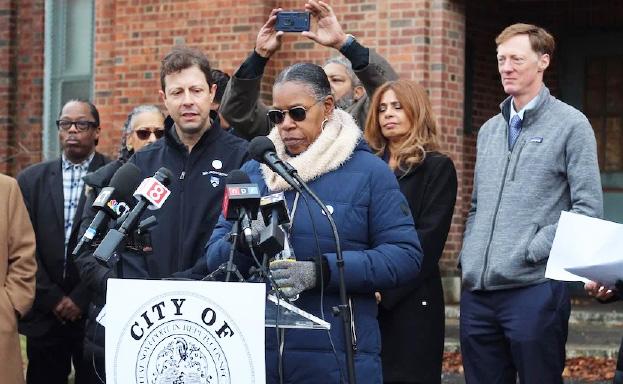
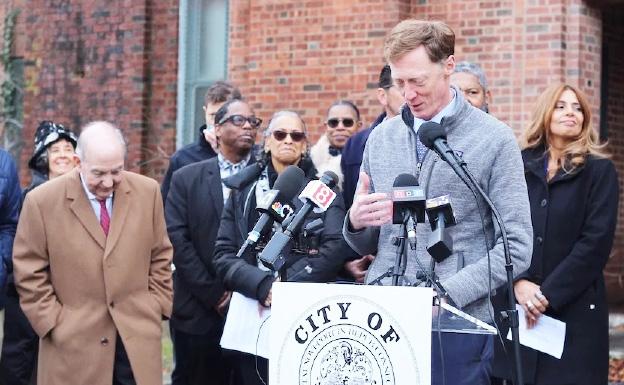
That news came from the corner of Goffe and County Streets on Friday afternoon, as city and state officials and members of the Armory Community Advisory Committee (AC2) gathered outside of the Goffe Street Armory to celebrate a $6.75 million grant that has come through Connecticut’s Community Investment Fund 2030 (CIF). Distributed through the state’s Department of Economic and Community Development (DECD), the funds will allow city officials to stabilize the building, begin the abatement process, restore the Drill Hall after years of disuse, and bring the massive building up to code with the 1990 Americans with Disabilities Act (ADA).
Friday, attendees also celebrated two smaller investments: a $250,000 Urban Act planning grant that came from the state in 2024, and $400,000 from the State Historic Preservation Office (SHPO), also awarded in 2024. Both during and after the press conference, speakers declined to give any estimate on the total cost or a timeline; similar Armory rehabs across the country have ranged from $48 million to closer to $150 million, and often necessitated public-private partnerships to get over the finish line.
“Let me tell you, this building is a fixer upper,” said Mayor Justin Elicker, who also called it some of the first good news he'd gotten to deliver all week.
“It made me understand the beauty of this neighborhood, and it made me understand the importance of community centers like this,” said State Rep. Toni Walker, who grew up just blocks from the Armory on Carmel Street, and remembered seeing it when she walked with her father, the late Rev. Dr. Edwin R. Edmonds, to Dixwell Avenue Congregational United Church of Christ. Decades later, she was proud to be part of the legislative delegation that pushed for state funding.
“The history is here, especially Black history, and what New Haven is representing here,” she said, smiling at the memory of Christmas toy giveaways with now-Alder Honda Smith that brought in hundreds of kids. “New Haven understands that this is a diverse community, this is a community of everybody, and we want to make sure that stays here.”
The plan, currently, is to divide the 155,000 square foot building into three sections, dedicated to affordable housing, vocational and technical (Vo-Tech) education, and a community center that channels the Armory’s long history as a
neighborhood hub, arts venue, and event space. The third includes the building’s capacious Drill Hall, which has hosted everything from mayoral inaugurations to City-Wide Open Studios.
These days, the hall sits mostly empty, with jagged holes in the roof through which rain and snowmelt (and bird poop, so much bird poop) reliably fall, creating puddles of sludge on the once-pristine floor.
Before that remediation can happen, however, the city plans to complete a planning study that it has had funding to do since 2024, following a series of community conversations around the building’s history and future. Following completion of the study, environmental remediation must happen before the building, which is currently full of asbestos, lead, and the dust-covered remains of several hundred cellar spiders, is up to code.
The city is still “a ways out” from that step, according to City Spokesperson Lenny Speiller, who added that the study should be done within the next three months.
It marks the latest chapter in the many lives that the building has lived (or as Gov. Ned Lamontt joked, “If a cat has nine lives, how many lives does the Goffe Street Armory have?”). Completed in 1930, the Armory was originally home to the 102nd Regiment of the Connecticut National Guard, which maintained a presence there until 2009. During that time, it lived under state ownership, hosting everything from auto shows to gubernatorial inaugurations (New Haven Mayors Frank Logue, Biagio DiLieto and John C. Daniels also had inaugurations there, in 1978, 1980 and 1994 respectively) to the New England Black Expo.
Dance in the drill hall, once upon a time in 2017. Artspace New Haven File Photo. When the National Guard left in 2009, the space came under city ownership, and over the next 15 years fell largely into disuse and disrepair. There were hopes of a revival, including in 2012, when the city applied for $2.8 million in state funding for repairs. Then almost exactly eight years ago, AC2 formally came into being, bringing with it a new surge of grassroots advocacy, community input sessions, and a rotating door of bright-eyed Yale students who often got invested in the Armory’s rebirth, then left.
Part of that momentum is a rich (and ongoing) artistic history, including Frank Sinatra’s 1940 performance (memorialized by fellow CIF recipient A Broken Umbrella Theatre last year in their play Family Business), dozens of dances, parties, and concerts, and years of performances during Artspace’s erstwhile City-Wide Open Studios. It was, at the midcentury, where jazz legends like the late Dinky Johnson cut their teeth, and much later where artists and city residents connected over a shared interest in and history of the neighborhood.
Even shuttered, it has channeled that history of innovation, with a new giant “cooling mural” that explodes in bands of bright color on the side of the build-
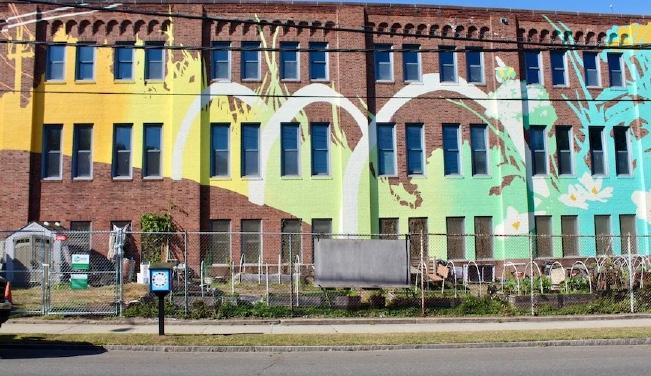
ing and a community garden that has bloomed into an urban oasis in the middle of Whalley/Edgewood. In that sense, a reclamation feels long overdue: in the last four years alone, the space has joined the National Register of Historic Places and the Connecticut Freedom Trail.
Friday, speakers emphasized how excited they are for the Armory’s revival, which—with a lot of TLC and funding that has yet to materialize—will transform a huge and underutilized space into a vibrant hub for affordable housing, education, and arts and culture. While housing remains the most abstract piece of the building’s rehab, multiple speakers said that the vision for education and arts and culture have been shaped by multiple community input sessions that unfolded at James Hillhouse High School in 2023. “At NHPS, we aren’t just adding internships,” said New Haven Public Schools Superintendent Dr. Madeline Negrón, noting that the district’s five career-connected pathways currently include healthcare, manufacturing, education, business, and BioCity. “We are fundamentally redesigning the student experience. We are moving beyond college-ready to ensure our graduates are life-ready and career-ready for a rapidly changing world.”
“The reactivation and renovation of this Armory is the missing piece in our strategy,” she added, with no information on how the project will be funded, or when students can expect to start using the building. “With this project, we are directly investing in our students’ future, and the long-term economic health of New Haven.”
When the space is ready to welcome students—which may still be a long ways off—it will host several new “simulation learning spaces”—stations where students can run simulations in healthcare, hospitality, tourism and transportation, distribution and logistics, and architecture and construction. In part, the district has modeled the programming off a still-nascent lab at Hillhouse, where Vo-Tech education is well underway.
Nadine Horton, a founding member of AC2 and the soul of the Armory Community Garden, said she is both thrilled and still a little surprised to finally see an infusion of funding finally come to the space. For eight years now, she’s worked towards this moment with members of the AC2, most of them residents of the Whalley/Edgewood/Beaver Hills neighborhoods. As a resident of the neighborhood, she’s also watched the building fall into disrepair for much longer.
With a dedicated group of neighbors and New Haveners, she also tends to the space’s community garden, where a few raised beds have become a small urban farm with rows of produce, hoop houses, and a bounty including kale and collard greens, summer squash, melon, strawberries, scallion and garlic, logs for mushroom cultivation, and herbs like lemon balm and mullein. While the garden is currently quiet, its weekly community


It’s why we’re here.
To help you enroll in health and dental coverage.
Count on our free, expert guidance — online, in person, through licensed Certified Brokers and over the phone — to help you find a plan that works for you and your family.
We can also help you maximize the financial assistance you qualify for, now that some federal financial help is no longer available.
We’re here to help you discover the peace of mind that comes with knowing you have health and dental coverage.
Open Enrollment is going on now.
Enroll by December 15 for coverage that begins January 1. Enroll by January 15 for coverage that begins February 1. Learn more, explore your options and enroll at AccessHealthCT.com.




by Mona Mahadevan
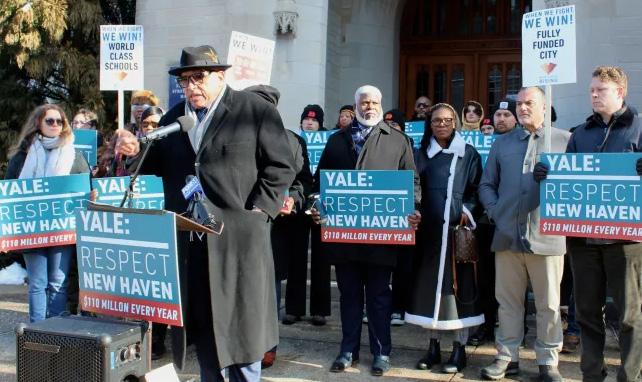
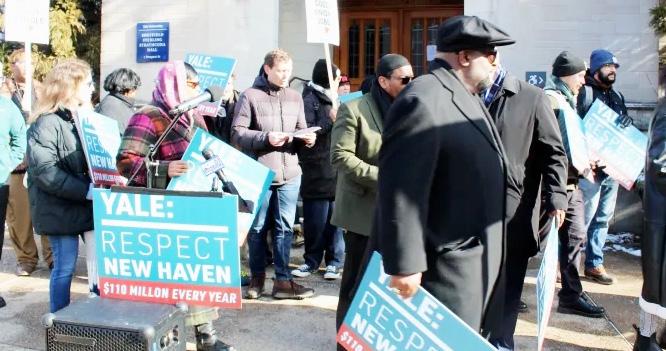
At the heart of Yale’s campus on Monday, several dozen people gathered for a union-led rally where they urged the university to more than quadruple its annual payments to New Haven for each of the next five years.
The rally took place as the city eyes the end to a six-year deal brokered by the Elicker administration, boding an upcoming drop in Yale’s annual voluntary contributions from around $24 million to around $16 million.
The local labor leaders’ demand, which would require Yale to pay the city $110 million per year, was announced from the steps of 1 Prospect St. on Martin Luther King, Jr. Day.
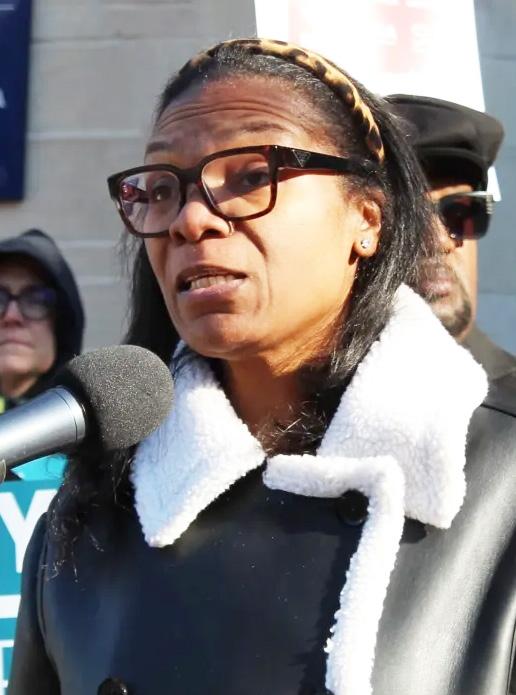
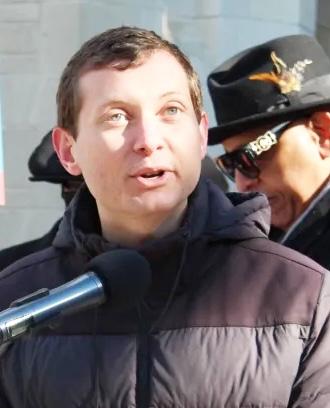
The press conference drew members of New Haven Rising and the city’s four UNITE HERE local unions — Locals 33, 34, 35, and 217 — as well as Board of Alders President / Local 35 Chief Steward Tyisha Walker-Myers, Local 33 President / Board of Zoning Appeals member Adam Waters, and State Rep. Juan Candelaria.
“We do not need charity from Yale University. We don’t need charity from the 17 billionaires who call Connecticut home,” declared Leslie Blatteau, president of the New Haven Federation of Teachers. “Rather, we must, as Dr. King explained in 1967, undergo a ‘radical revolution of values,'” which requires Yale to “start[] paying what they owe to this city.”
The current city-Yale agreement, struck in 2021, saw the university commit to increasing its voluntary payments to the city by $10 million for five years. The deal steps down the university’s annual contribution bump to $2 million in the agreement’s final year, which begins on July 1.
Monday’s presser marks the latest effort by Yale’s unions and affiliates to pressure the university into contributing more to the city, often by citing its $44 billion endowment and tax-exempt local real estate holdings. Meanwhile, a newly passed 8 percent federal tax on endowments — a dramatic jump from the previous rate of 1.4 percent — is expected to cost Yale $300 million per year beginning on July 1.
Two of the university’s most politically influential unions, Locals 34 and 35, are also in the midst of contract negotiations with Yale, while the university’s graduate student-worker union, Local 33, is pushing to organize postdocs.
New Haven Rising leader Rev. Scott Marks said on Monday that the labor advocacy group is asking for $110 million because “the money that was missing from our badly-needed city was $106 million” last year. Their proposal would also require Yale to step up its payments over the next five years from a $110 million baseline, a commitment that he

described as “a tremendous investment to this city.”
While the local unions have plans to speak with the city and Yale, Marks confirmed that negotiations have not yet begun.
“We can’t continue to have this beautiful ivory tower sitting in the middle of our community and not give back,” Walker-Myers said during Monday’s press conference. With $110 million per year, “our kids could be educated properly. Our kids could have after-school activities. Parents would be able to go and work one job, ’cause one job should be enough to sustain your family.”
She emphasized that $110 million per year is still short of what the university owes the city, but that amount over five years could help “get the City of New Haven back on its feet.”
She closed by alluding to the threat of a strike. Today, “we’re offering the olive branch,” said Walker-Myers. “The next move is up to you.”
Japhet Gonzalez, a senior at High School in the Community, used his remarks to describe his experience with mold, leaks, and rats at schools across the city.
“At first,” he said, “I thought” those problems “were just at [High School in the Community].” As he attended protests and spoke with students at other schools, he realized that those same issues existed everywhere.
“Why do we all have the same troubles in our schools, you know?” asked Gonzalez. He said he feels that speaking about Yale is important because there has not been “action on their part,” despite all of the union-led organizing.
“What will it take to get the m to pay what they owe us?” said Gonzalez. “Community,” he answered. “Community goes to rallies, community testifying with personal experiences, community supporting other community members, community being united like this place today. [That] is what will get us to where we need to be.”
A Yale spokesperson did not respond to requests for comment by the publication time of this article.
In a previous comment sent to the Independent for this October 2025 article, a Yale spokesperson noted that the university agreed to contribute a total of around $135 million to New Haven over the course of the current six-year, city-Yale deal. “In addition to these voluntary payments,” that spokesperson said at the time, “Yale is proud to be New Haven’s largest employer and third-largest taxpayer. The university remains committed to building strong relationships with the New Haven community and supporting initiatives that respond to local needs.”
days return in April.
“It is incredibly gratifying to see all of the hard work we've been doing since 2018 to ensure this building stays standing results in the awarding of state funding to rehab this amazing space and open it back up for community use,” Horton said. “I look forward to the day I can walk through the space with my grandchildren."
“This building is an essential New Haven building, and we will return it to public service,” added Elihu Rubin, a professor at the Yale School of Architecture who has championed the Armory for at least a decade, with an increasing amount of neighborhood support (including a block party across the street last year) in the process. “This building is too big to fail. It is going to be an incredible success. It is going to be a legacy project for everyone in this city and for everyone standing up here as well. It’s extremely exciting.”
In a conversation following the press conference, city Economic Development Administrator Mike Piscitelli acknowledged that the city does not yet have a full financial picture of the total price tag on such a project, but knows that it will cost “a lot.” He added that the plan to segment it into three core uses will help the city “identify financial and institutional partners” going forward. Both he and Speiller added that there is currently no timeline for when the CIF-funded stabilization will begin.
Con’t from page 08
was peaceful, but police are investigating three crimes, including a hit-andrun involving a federal van, the use of pepper spray, and property damage. Arulampalam said investigators are still attempting to identify those involved and that the Department of Homeland Security has not cooperated with local inquiries.
The official rollout follows Blumenthal’s Jan. 9 letter to DHS seeking detailed information about ICE’s use of force, recruitment, and training practices after citing both Good’s death and a 67page subcommittee documenting at least 22 incidents nationwide in which US citizens and lawful permanent residents were subjected to excessive physical force, denied access to phones or medical care, or detained even after presenting proof of lawful status.
Blumenthal said there is growing dismay in the Senate for the brutality and hopes that his Republican colleagues will join him in backing the legislation.
“I am hopeful they will give voice to their dismay and in effect, grow a backbone,” he said.

by Jisu Sheen
City engineers at Edgewood Park aren’t the only ones bringing the bridge back in New Haven.
Before heading into the last glorious refrain from their instant classic “Up Your Sleeve,” Baltic-based (as in Baltic, Connecticut) grunge band Indigo Folly found time to open up the portals to heaven and hell on the Toad’s Place stage Friday night.
At a time when music platform algorithms pressure artists to make shorter songs for more plays, Indigo Folly’s sound showed the crowd just how important a buildup can be.
They were the first of three openers for Alice in Chains cover band Nutshell, who came from Boston to bring together the metalheads of the Greater New Haven area. People showed up in black and red, ripped clothing, and Black-Swan-level eyeliner.
Indigo Folly was dressed in a variety of outfits. One guitarist, Max Hillyer, wore a suit, while the other, Thomas Curran, donned a flannel, a graphic tee, and bright blue tape on his middle fingertip that echoed (or, more likely, came from the same roll as) the blue tape on his guitar. Lead singer Malachi Brown’s shirt featured the debut album cover from The Jimi Hendrix Experience.
Brown started by giving props to the legendary venue at his feet and gathering the room even closer together as music-lovers, noting how lucky we are that we still have Toad’s. Then he and his band blessed the space.
From the first few notes of the opening guitar riff, I could tell their song “Up Your Sleeve” was one I had tune in for. What I couldn’t possibly know was just how far the band would go to hurtle past my already-high expectations. Powerhouse vocals and a high-stakes moody glam edge elevated Indigo Folly to divine heights. Pray for me, Brown sang in the chorus, My god, she’s a holy roller.
The let-loose melody and desperate words fit so well, their pairing felt like

one that must have already been around for decades. The lyrics’ religious overtones found a perfect home in the drama of the music genres the band was pulling from—metal, rock, and grunge. I knew this would be the line I’d sing to myself


later, on my walk to my next destination for the night.
Mood-wise, the chorus had an arc that would foreshadow larger ups and downs to come. After pleading to be saved from the charms of this “holy roller,” Brown


ended the section with I don’t care to know. Good lord, she rocks my world.
Halfway through the song, drummer Jack Hillyer slowed down, adding weight to the melody. Brown leaned his whole body into the song to belt out the chorus



for a second time. It was all-in. It was commitment. Standing in the front row, I truly felt myself gasp.
You might think this is too soon for the moment of catharsis, and you would be right—if that’s what this moment was. As much of a release as this second chorus was, there were still deeper depths to plumb.
I gasped too soon, is what I’m trying to say.
Brown brought the song back to a gentle reprieve, singing, Open up your arms, and come to me/ You are welcome, you’re all I need. He sang it again. Then the drums accelerated, delivering the audience to the moment that would bring everything together.
A twist. The bridge was well on its way. The musicians took on a solemn tone as they developed a repetitive, relentless pattern of sound. Right at the end of the bridge, when the anticipation was at its height, in the middle of a word, every instrument cut.
Tyrant.
Brown continued without stopping, his unaccompanied voice taking on universes of grain and resonance in a single syllable. He was hitting Hendrix-level whammies with his vocal chords. For a fraction of a second, everything felt suspended. There was a passionate, almost sinister feel to the sound that combined with the lyric to evoke the underworld.
At this, the rest of Indigo Folly crashed back to earth, fast. Jack on drums fell back into a heavy flow, and Max Ducette on bass ripped into his instrument, head-banging along with the crowd. The guitars led a path to the final chorus.
The audience sang along, loud and with abandon. They had just been on a wild journey together, and now they were deeply familiar with the lyrics of the chorus whether they started as fans or were hearing the song for the first time.
The genre niche, humble respect for musical lineage, and intense control over tension in song structure created the perfect storm for the room’s strangers to feel like, at least in this moment, we were in it together.
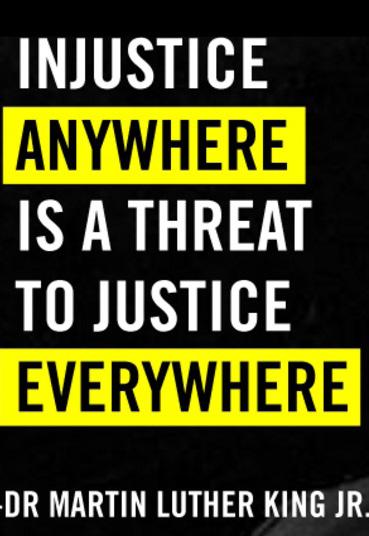
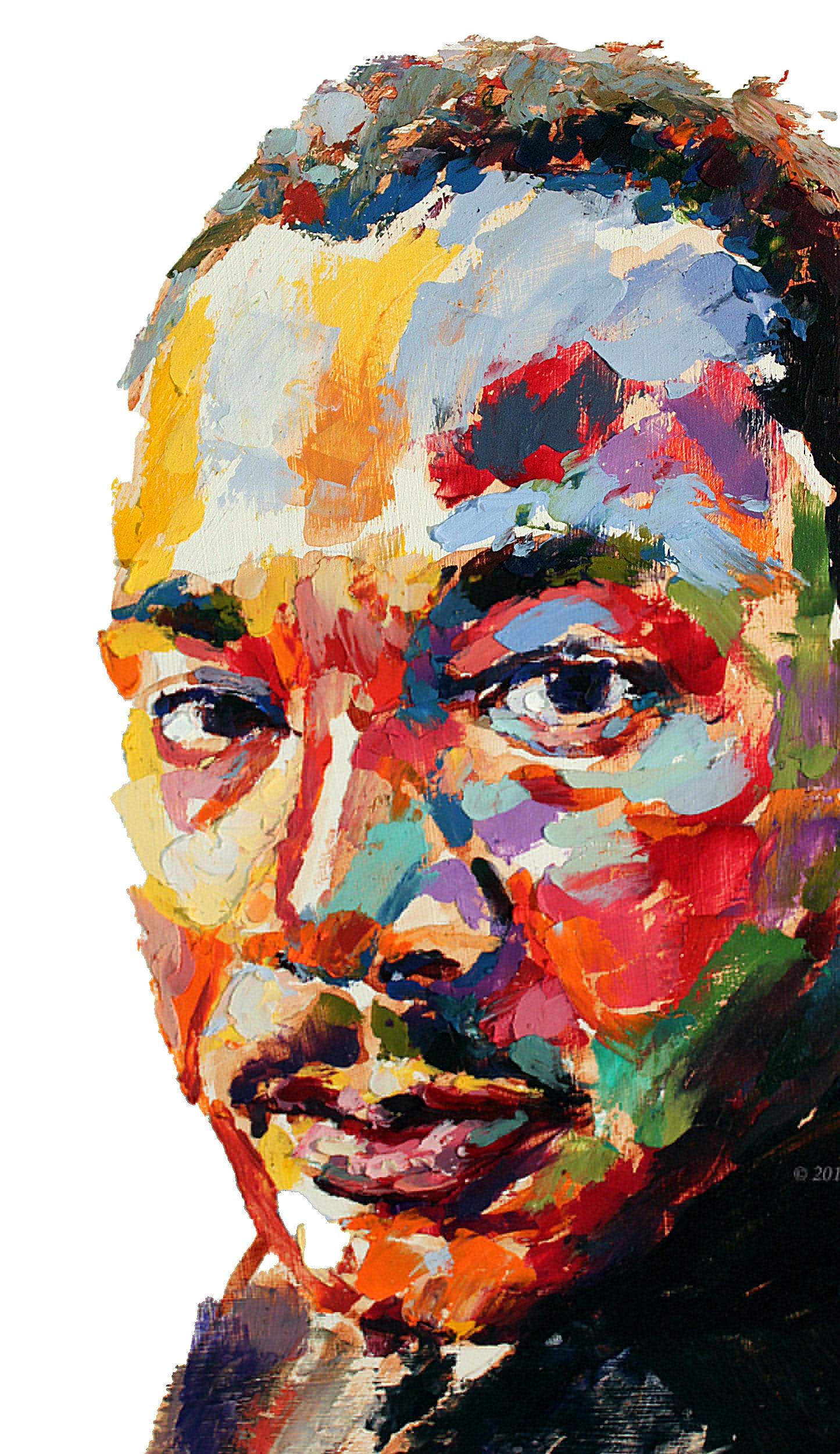
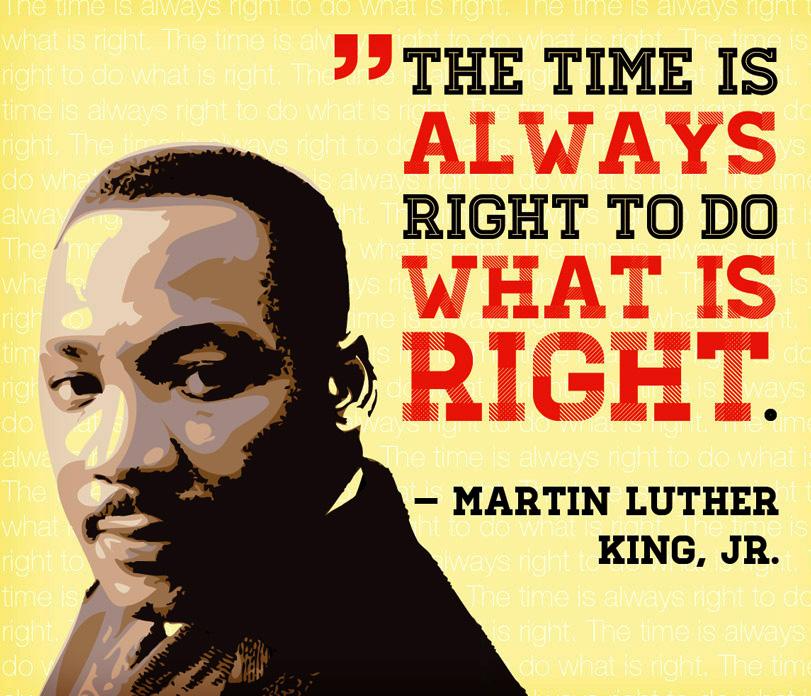
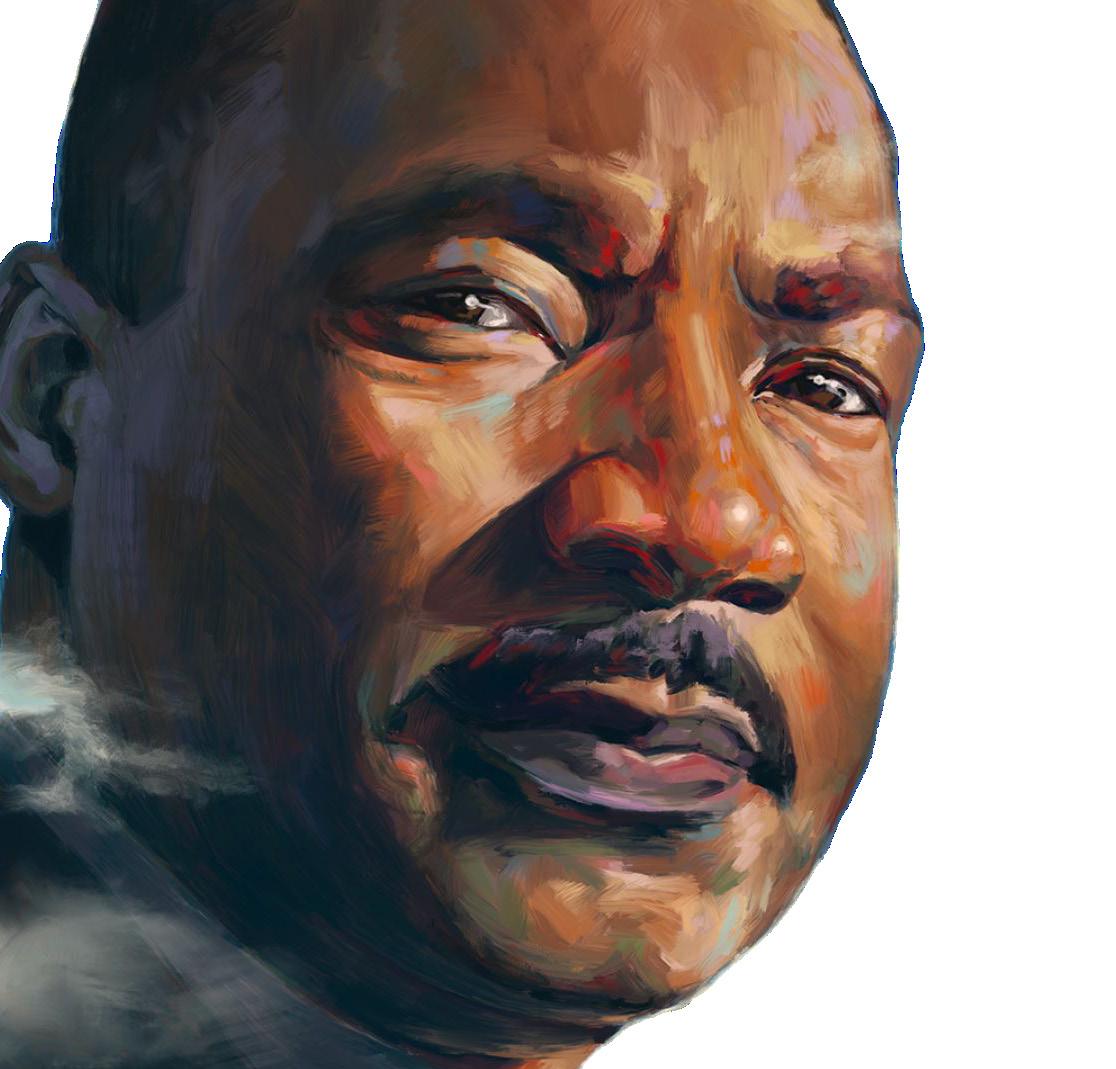
Dr. King Jr.
During the less than 13 years of Dr. Martin Luther King, Jr.’s leadership of the modern American Civil Rights Movement, from December 1955 until April 4, 1968, African Americans achieved more genuine progress toward racial equality in America than the previous 350 years had produced. Dr. King is widely regarded as America’s pre-eminent advocate of nonviolence and one of the greatest nonviolent leaders in world history.
Drawing inspiration from both his Christian faith and the peaceful teachings of Mahatma Gandhi, Dr. King led a nonviolent movement in the late 1950s and ‘60s to achieve legal equality for African-Americans in the United States. While others were advocating for freedom by “any means necessary,” including violence, Martin Luther King, Jr. used the power of words and acts of nonviolent resistance, such as protests, grassroots organizing, and civil disobedience to achieve seemingly-impossible goals. He went on to lead similar campaigns against poverty and international conflict, always maintaining fidelity to his principles that men and women everywhere, regardless of color or creed, are equal members of the human family.
Dr. King’s “I Have a Dream” speech, Nobel Peace Prize lecture and “Letter from a Birmingham Jail” are among the most revered orations and writings in the English language. His accomplishments are now taught to American children of all races, and his teachings are studied by scholars and students worldwide. He is the only non-president to have a national holiday dedicated in his honor and is the only non-president memorialized on the Great Mall in the nation’s capital. He is memorialized in hundreds of statues, parks, streets, squares, churches and other public facilities around the world as a leader whose teachings are increasingly-relevant to the progress of humankind.
Some of Dr. King’s Most Important Achievements
In 1955, he was recruited to serve as spokesman for the Montgomery Bus Boycott, which was a campaign by the African-American population of Montgomery, Alabama to force integration of the city’s bus lines. After 381 days of nearly universal participation by citizens of the black community, many of whom had to walk miles to work each day as a result, the U.S. Supreme Court ruled that racial segregation in transportation was unconstitutional.
In 1957, Dr. King was elected president of the Southern Christian Leadership Conference (SCLC), an organization designed to provide new leadership for the now burgeoning civil rights movement. He would serve as head of the SCLC until his assassination in 1968, a period during which he would emerge as the most important social leader of the modern American civil rights movement.
In 1963, he led a coalition of numerous civil rights groups in a nonviolent campaign aimed at Birmingham, Alabama, which at the time was described as the “most segregated city in America.” The subsequent brutality of the city’s police, illustrated most vividly by television images of young blacks being assaulted by dogs and water hoses, led to a national outrage resulting in a push for unprecedented civil rights legislation. It was during this campaign that Dr. King drafted the “Letter from a Birmingham Jail,” the manifesto of Dr. King’s philosophy and tactics, which is today required-reading in universities worldwide.
Later in 1963, Dr. King was one of the driving forces behind the March for Jobs and Freedom, more commonly known as the “March on Washington,” which
drew over a quarter-million people to the national mall. It was at this march that Dr. King delivered his famous “I Have a Dream” speech, which cemented his status as a social change leader and helped inspire the nation to act on civil rights. Dr. King was later named Time magazine’s “Man of the Year.”
In 1964, at 35 years old, Martin Luther King, Jr. became the youngest person to win the Nobel Peace Prize. His acceptance speech in Oslo is thought by many to be among the most powerful remarks ever delivered at the event, climaxing at one point with the oft-quoted phrase “I believe that unarmed truth and unconditional love will have the final word in reality. This is why right temporarily defeated is stronger than evil triumphant.”
Also in 1964, partly due to the March on Washington, Congress passed the landmark Civil Rights Act, essentially eliminating legalized racial segregation in the United States. The legislation made it illegal to discriminate against blacks or other minorities in hiring, public accommodations, education or transportation, areas which at the time were still very segregated in many places.
The next year, 1965, Congress went on to pass the Voting Rights Act, which was an equally-important set of laws that eliminated the remaining barriers to voting for African-Americans, who in some locales had been almost completely disenfranchised. This legislation resulted directly from the Selma to Montgomery, AL March for Voting Rights lead by Dr. King.
Between 1965 and 1968, Dr. King shifted his focus toward economic justice – which he highlighted by leading several campaigns in Chicago, Illinois –and international peace – which he championed by speaking out strongly against the Vietnam War. His work in these years culminated in the “Poor Peoples Campaign,” which was a broad effort to assemble a multiracial coalition of impoverished Americans who would advocate for economic change.
Dr. Martin Luther King, Jr.’s less than thirteen years of nonviolent leadership ended abruptly and tragically on April 4th, 1968, when he was assassinated at the Lorraine Motel in Memphis, Tennessee. Dr. King’s body was returned to his hometown of Atlanta, Georgia, where his funeral ceremony was attended by high-level leaders of all races and political stripes.
• For more information regarding the Transcription of the King Family Press Conference on the MLK Assassination Trial Verdict December 9, 1999, Atlanta, • Later in 1968, Dr. King’s wife, Mrs. Coretta Scott King, officially founded the Martin Luther King, Jr. Center for Nonviolent Social Change, which she dedicated to being a “living memorial” aimed at continuing Dr. King’s work on important social ills around the world.
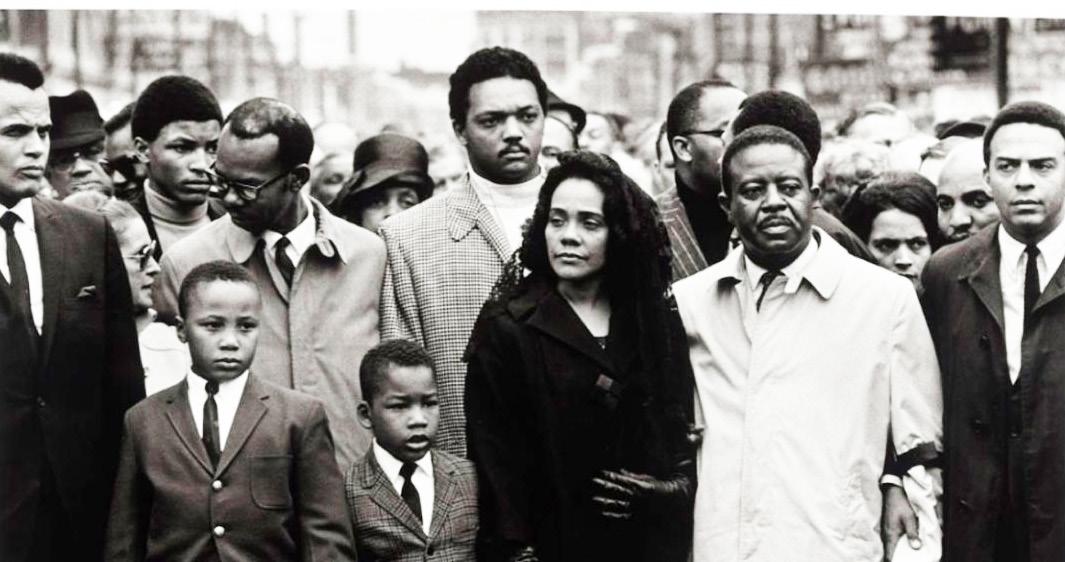
Friends and family, including Coretta Scott King, Harry Belafonte Jr., and Jesse Jackson, holding hands at Martin Luther King Jr. funeral services in Memphis, Tenn., 1968. Collection of the Smithsonian National Museum of African American History
The assassination of Martin Luther King Jr. on April 4, 1968, dashed the hopes of black Americans for the commitment of white America to racial equality. White Americans respected him more than other black leaders, but his opposition to the Vietnam War infuriated many. His continued insistence on nonviolent protests frustrated black activists. But in 1968 he still led the struggle for civil rights. “The murder of King changed the whole dynamic of the country,” recalled Black Panther Kathleen Cleaver.
Two photos of mourners lining the sidewalks of Memphis, Tenn., for Marting Luther King Jr.'s funeral procession. (Top) Group of African American gentlemen with a woman and children in foreground; (Bottom) Group of White gentlemen (majority wearing suits).
Collection of the Smithsonian National Museum of African American History and Culture
The New York Times wrote: “Dr. King’s murder is a national disaster.” President Lyndon Johnson declared a national day of mourning and lowered American flags to half-mast. Many white Americans were saddened or appalled; others felt untouched by the murder and some actually celebrated, calling King a “troublemaker.” King’s funeral in Atlanta drew leaders from around the world. Later, President Johnson pressured Congress to pass the Civil Rights Act of 1968 in tribute to King’s work.
Memphis sanitation workers in a memorial march for Martin Luther King Jr., four days after his assassination, Memphis, Tenn., April 8, 1968.
Collection of the Smithsonian National Museum of African American History and Culture, Gift of Anthony Decaneas, Decaneas Archive, and Ernest C. Withers Trust, © Ernest C. Withers Trust
We use the video player Able Player to provide captions and audio descriptions. Able Player performs best using web browsers Google Chrome, Firefox, and Edge. If you are using Safari as your browser, use the play button to continue the video after each audio description. We apologize for the inconvenience.
This excerpt from the PBS documentary "1968: The Year that Shaped a Generation" recounts the last
days of Martin Luther King and documents the fallout from his assassination.
The Aftermath of King’s Assassination
Responses to King’s death varied. Black Americans were devastated, pained, and angered. Violence erupted in more than 125 American cities across 29 states. Nearly 50,000 federal troops occupied America’s urban areas. Thirty-nine people were killed and 3,500 injured. These uprisings produced more property damage, arrests, and injuries than any other uprising of the 1960s.
Harlem Stays Calm—Almost
Violence in Harlem was minor, due in part to New York mayor John Lindsay’s cooperation with militants, gang leaders, and youth organizers. (left) Firefighters battle a store fire set off during riots in Harlem, New York City, after the assassination of Martin Luther King Jr., April 1968.
©Bettmann/CORBIS
When [America] killed Dr. King last night she killed the one man of our race that this country’s older generation, the militants and the revolutionaries, and the masses of black people would still listen to. Stokely Carmichael 1968
Washington Burns
On H Street, N.E., in Washington, D.C., only storefronts remain standing. Twelve hundred buildings burned, 12 people died, and over 6,000 were arrested while 14,000 federal troops occupied the city for six days during riots following King's assassination, April 5, 1968.
“My Life for My Brothers”
Individuals across the political spectrum displayed memorial buttons and other memorabilia expressing their sorrow and commitment to achieving King’s dream of a just and equal society. 2012.159.11 Collection of the Smithsonian National Museum of African American History and Culture
San Francisco Group Plans a Revolutionary Memorial
The planners of this April 8 event honored King’s commitment to “the poor, the oppressed, and the black victims of a racist American society.” Thus, they demanded that American armed forces be withdrawn from Southeast Asia, all political prisoners be freed, and that the Black Panthers’ program of radical social reforms be implemented.
(left) This handbill announces a mass memorial for Martin Luther King, Jr. and features images of King and Huey P. Newton at the top.
Collection of the Smithsonian National Museum of African American History and Culture
The Meaning of King’s Death
King’s death energized the Black Power Movement. Black Americans felt even more distrustful of white institutions and America’s political system. Membership in the Black Panther Party and other Black Power groups surged. Local organizations grew into national networks. The number of black soldiers in Vietnam supporting Black Power increased dramatically. Polls revealed that some white Americans expressed support for King’s goals, but many remained unmoved.
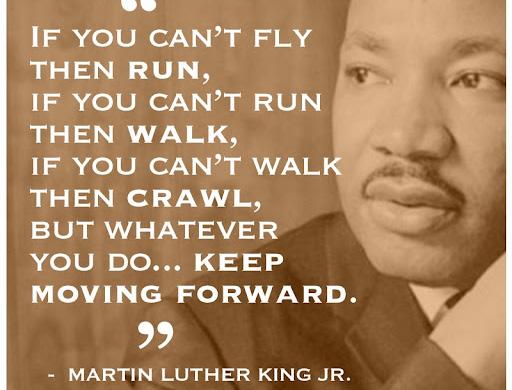
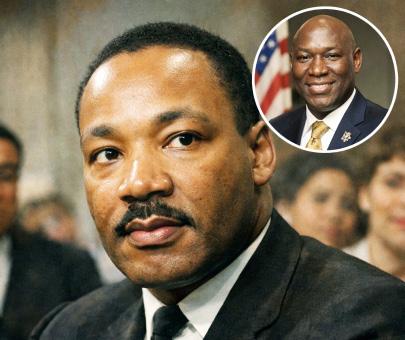
Written by Stacy M. Brown By Ben Crump
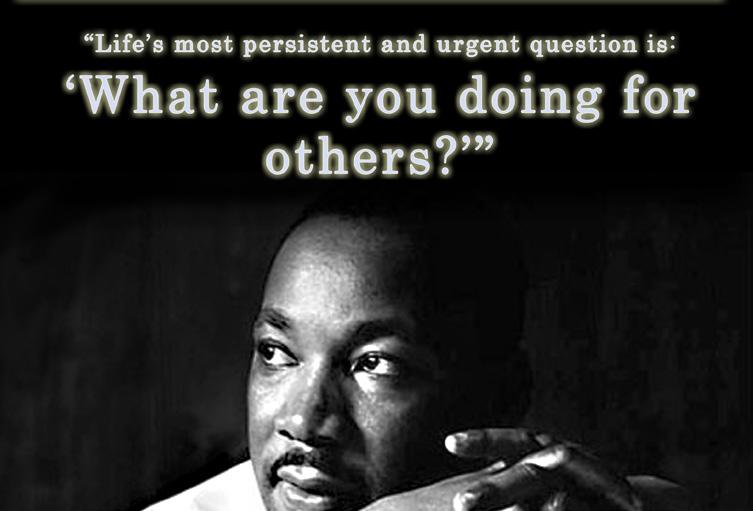
We honor Dr. Martin Luther King Jr. each January with speeches, service projects, and by reciting powerful quotes we know by heart. But too many Black families will spend much of MLK Day the same way they spend most Mondays.
With the gas tank hovering near empty, hoping the car can go until the next paycheck arrives. With a prescription waiting at the pharmacy counter because they cannot afford the cost. With a paycheck that has to stretch further than what seems possible. Dr. King understood that true dignity means being able to afford and build a good life. In one of his clearest reminders, he asked what it means to “eat at an integrated lunch counter” if you cannot “buy a hamburger and a cup of coffee.”
That question still carries weight for many. Personal freedom will not be achieved without financial freedom. Dr. King spent the final chapter of his life pushing the country to face economic injustice. The day before he was tragically assassinated, Dr. King stood with sanitation workers in Memphis to call for economic equality. He helped launch the Poor People’s Campaign because he knew freedom hollowed out by poverty is not freedom at all. Dr. King kept pushing America to match its promises with practical pathways.
That is the part of his legacy we should sit with this MLK Day.
This work has never been more important or needed. The cost of groceries, rent, and childcare has become an increased burden. And many families go from stable to scrambling with just one unexpected expense. These realities are on display in
a recent national survey commissioned by DreamFi, echoing what so many families already feel so deeply. More than one in four respondents told us they used check-cashing services in the past year. This finding makes it clear that too many households still need simpler and
more accessible options for moving money. The survey also shows how unexpected expenses impact families. Only 41% of Black respondents said they could cover a $1,000 emergency, compared with 56% of white respondents. When a tire blows
out, when a child gets sick, when hours get cut, the question is not theoretical. The question is immediate, and the impact is real. We must shine a light on this struggle and work to equip families with tools to build better futures.
We must recognize Dr. King’s wisdom
and acknowledge that financial stability is a civil rights issue, because financial instability limits the ability to have choices. The survey also found hope that can guide how we move forward. Black families are not turning away from the idea of building stability. In fact, they are reaching for it. In the survey, 79% of Black respondents said they sought out financial education in the past six months. Ours is a community hungry for tools and a fair shot at creating a better tomorrow.
So what does it mean to honor Dr. King right now? It means we get practical. It means we expand access to clear, trustworthy financial education that respects people’s time and speaks to real solutions. It means we support savings pathways that help families prepare for emergencies before emergencies arrive. It means we encourage options that make routine transactions easier and less costly, so a family is not paying extra simply to manage their own money.
Most of all, it means we stop treating financial instability as normal. Because normal is not the same as acceptable. Dr. King asked America to make its promises real. The best way to honor him now is to provide opportunities for everyone to achieve Dr. King’s dream.
Ben Crump is a nationally renowned civil rights attorney and founder of Ben Crump Law. Known as “Black America’s attorney general,” he has represented families in some of the most high-profile civil rights cases of our time, including those of George Floyd, Breonna Taylor, Tyre Nichols, and Ahmaud Arbery. He is also co-founder of DreamFi, a financial empowerment platform focused on helping everyday people build stability through practical resources.
by Donald Eng
HARTFORD, CT — Remembrance met resolve Monday at the State Capitol in Hartford, as Connecticut honored the civil rights legacy of Martin Luther King, Jr. while vowing to continue to fight for inclusion and justice.
Jeffrey Hines, director of diversity and inclusion initiatives at UConn, keynoted the event, which also included music, personal reflections and comments from state civil rights and elected leaders.
“We gather, not to simply remember Dr. King, but to recommit ourselves to the unfinished work that he left us to do,” Hines said. “We gather not only to admire the dream from a distance, but to ask what’s required of us here, now, tomorrow and together.”
Many of the speakers drew parallels between the civil rights movement in the 1960s and the current climate in the country. In both situations, protesters have been

met with state-sanctioned violence.
“The brutality shown by our own government against peaceful protesters, people who are doing what the civil rights marchers did when they marched across the Edmund Pettus Bridge and they were met with the same kind of brutality from people wearing badges but doing injustice,” said Sen. Richard Blumenthal, D-CT.
That incident took place on March 7, 1965 when about 600 protesters set out to march from Selma, Al. to Montgomery along Route 80. At the bridge, which spans the Alabama River, state and local law enforcement officers attacked the group with tear gas and clubs, according to the National Park Service.
Gov. Ned Lamont also commented on the era’s revision, citing President Donald Trump’s removal of the bust of King from the Oval Office, where it had been since the 1990s.
Trump also has removed Martin Luther King Day and Juneteenth from the list of free admission days to national parks, replacing them with his own birthday.
Weeks Only!

All Julia Masli wants to do is solve people’s problems and win the Nobel Peace Prize. But this plan keeps going awry as she receives accolade after accolade for comedy. The celebrated clown debuted ha ha ha ha ha ha ha at the Edinburgh Fringe Festival, where it was named “best of the year” by The Guardian. A sold-out sensation at the Melbourne International Comedy Festival and greeted with thunderous laughter and more rave reviews in New York and D.C., the show is entirely different every night based on audience participation. Now it’s coming to New Haven. Something bothering you? Julia is ready to help!



20 – February 7
15 tickets are also available for every performance!

By TotallyRandie
The fourth quarter of the year is often dubbed “giving season,” and for good reason. As October fades into November, the cultural zeitgeist shifts toward gratitude and the spirit of the holidays. For most, this means making a yearly donation to a local food bank or participating in a toy drive for the less fortunate. But for Houston’s own Travis Scott, “giving season” isn’t a seasonal trend—it’s a sophisticated, year-round blueprint for community empowerment.
Since launching the Cactus Jack Foundation in November 2020 alongside his sister, Jordan Webster, Scott has moved beyond the traditional celebrity check-writing model. While the world watches his every move on global stages, his foundation has been quietly and consistently pouring into the soil that raised him. Whether it’s supporting SWAC baseball athletes or funding the Waymon Webster Scholarship Fund for HBCU students, the mission is clear: provide the resources for the next generation to not just survive, but to lead.
From the Streets to the Stars
This past fall, the foundation took its most ambitious leap yet. In October 2025, Cactus Jack partnered with Space Center Houston—the official visitor center of NASA Johnson Space Center—to launch a first-of-its-kind STEM incubator. The program was specifically designed
skills, the confidence, and the opportunities provided in the months leading up to it.
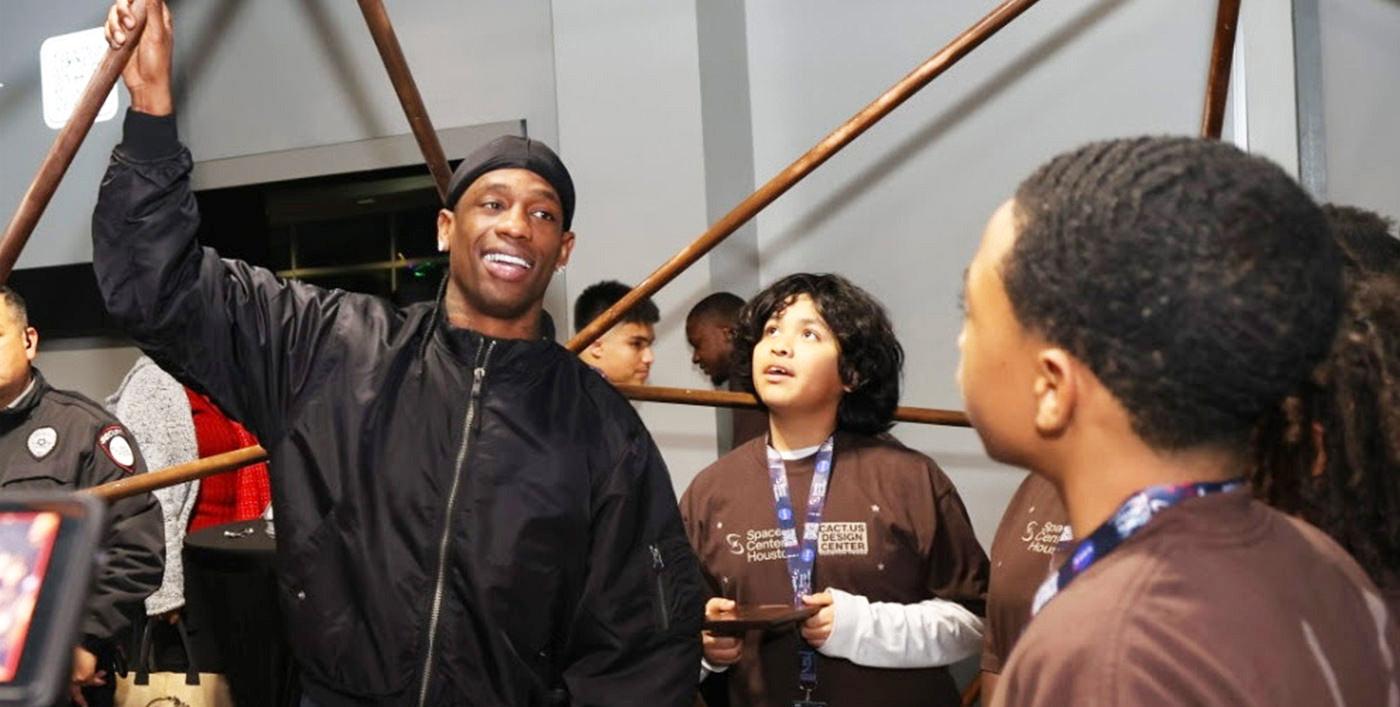
for students within the Houston Independent School District (HISD), many of whom come from underserved communities where a career in aerospace often feels like a light-year away. For eight weeks, these middle schoolers weren’t just reading about science; they were living it.
Through a mix of virtual workshops and hands-on sessions at the Cact.Us Design Center and TXRX Labs, students were paired with actual NASA engineers. They weren’t tasked with busywork; they were challenged to solve real-world prob-
lems of space habitation, including:
• Lunar Water Filtration: Designing systems to purify water on the moon.
• Space Habitats: Creating structures designed for food preservation in extreme environments.
• Robotics: Developing rovers capable of navigating uneven lunar terrain.
The Power of Being Present
The program culminated in a private showcase at Space Center Houston this past December. Standing alongside retired NASA astronaut and Chief Science
Officer Megan McArthur, Scott watched as HISD students presented high-fidelity prototypes. In that room, the disparity usually associated with these neighborhoods vanished, replaced by the technical language of CAD modeling and systems thinking.
But the work didn’t stop at the laboratory. The 6th Annual “Winter Wonderland Toy Drive” at Texas Southern University took place the very next day, showcasing the foundation’s dual-threat approach to philanthropy. While the STEM program looked toward the future, the toy drive
took care of the present, putting smiles on the faces of thousands of Houston families with toys, groceries, and essential goods.
“Opportunities like this are being offered to help enrich our students’ lives and inspire them to pursue careers in fields where they can not only thrive but also bring back solutions to their communities.”
— Travis Scott
Critics and social media skeptics often tweet that “Travis Scott is everywhere but Houston.” The data and the faces of the students at Space Center Houston suggest otherwise. While his music may be a global export, his legacy is being built brick by brick (and circuit by circuit) in HISD classrooms.
By bridging the gap between hip-hop culture and NASA’s high-tech corridors, the Cactus Jack Foundation is teaching us a vital lesson in giving forward. It’s not just about the gift under the tree in December; it’s about the skills, the confidence, and the “out of this world” opportunities provided in the months leading up to it.
Travis Scott may be a global icon, but in Houston, he’s becoming something much more important: a catalyst for the next generation of innovators.
Bell @TotallyRandie
Multi-Media Correspondent & Digital Creator
By Stacy M. Brown NNPA Newswire Correspondent
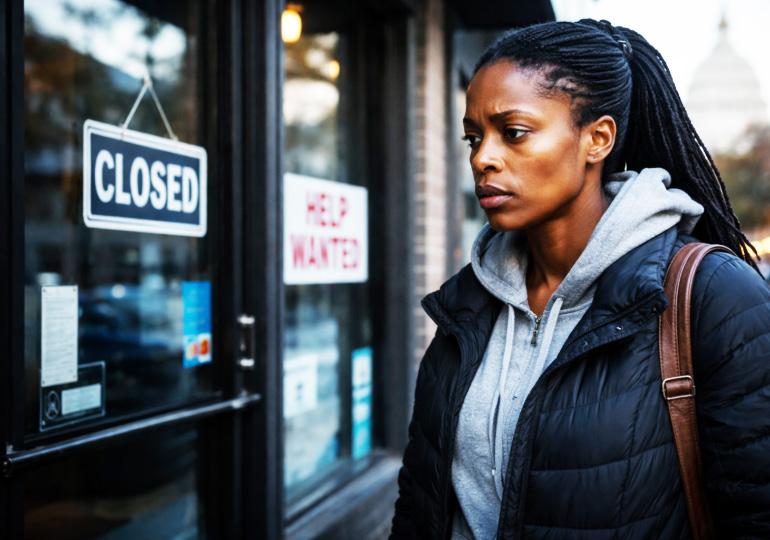
Black unemployment surged to 7.5 percent by December 2025, a level that would signal a recession if it were reflected across the national workforce. But the latest “State of the Dream 2026” report makes clear the damage extends far beyond jobs. From broadband access and housing to artificial intelligence and federal workforce policy, the Joint Center for Political and Economic Studies finds that 2025 marked a sharp economic breakdown for Black America driven by policy reversals and the removal of long-standing safeguards.
Released this week, “State of the Dream 2026: From Regression to Signs of a Black Recession” draws on research from the Joint Center and partners including United for a Fair Economy, the Center for Economic Policy Research, the National Community Reinvestment Coalition, and the Onyx Impact Group. The report situates rising unemployment within a wider retreat from equity-focused policy across nearly every sector shaping economic opportunity.
Employment remains the most visible
signal. Black unemployment rose from 6.2 percent in January 2025 to 7.5 percent by December. Black youth experienced severe instability, with unemployment spiking from 18.6 percent in September to 29.8 percent in November before falling back to 18.3 percent in December.
The report finds that if Black workers had maintained their 2024 prime-age employment rate, roughly 260,000 more Black adults would have been working in 2025, including about 200,000 prime-age Black women.
The collapse of federal employment accelerated the trend. Roughly 271,000 federal jobs were eliminated in less than a year, hitting Black workers particularly hard because they have historically been overrepresented in government roles offering stable wages, benefits, and protections. Before the cuts, Black Americans made up nearly 19 percent of the federal workforce, compared with about 13 percent of the overall labor force.
“Federal employment has historically functioned as an important sector for Black workers,” the report notes, warning that buyouts, hiring freezes, and the dismantling of diversity-focused recruitment pipelines removed one of the most reli-
able pathways to middle-income stability. Tax policy deepened the strain. The One Big Beautiful Bill Act of 2025 made permanent tax cuts for high-income households and corporations while reducing investment in poverty-alleviating programs. Business preferences such as Section 199A, bonus depreciation, and estate tax benefits overwhelmingly favored wealthy
households, while refundable credits that matter most to Black workers were left unchanged.
Black-owned businesses faced a parallel contraction. Executive orders issued early in 2025 redirected federal support away from disadvantaged firms, lowered small, disadvantaged business contracting goals, and moved to dismantle the Minority
Business Development Agency. The Joint Center estimates these actions threaten $10 billion to $15 billion annually in lost federal support for Black-owned firms. At the same time, the U.S. Treasury Department’s Community Development Financial Institution Fund, a key source of capital for minority businesses, was defunded. Beyond jobs and business, the report documents setbacks in broadband policy that risk widening the digital divide. The cancellation of the Digital Equity Act, the removal of mobile hotspots and school bus Wi-Fi from E-Rate eligibility, and weaker broadband pricing transparency requirements undercut efforts to expand internet access and adoption in Black households. The information environment also shifted. While federal social media policy remained largely unchanged, platforms themselves pulled back on fact-checking and content moderation. The report notes that these platform-driven decisions reshaped the online information ecosystem, raising concerns about misinformation and its impact on communities that already face barriers to accurate and timely information.
Artificial intelligence policy marked Con’t on page 22


by Maya McFadden
A rack of stage-ready coats became a local history lesson as Career high school seniors like Tiayonna Williams slipped into original Long Wharf Theatre costumes inside the New Haven Museum — before ending the day’s lesson in the most New Haven way possible: by learning about, and eating, ah-beetz.
Williams and her classmates undertook that deep dive into local cultural/culinary history on Friday during a two-hour field trip to the Whitney Avenue museum as part of a New Haven history elective course at Hill Regional Career High School.
The class is a half-year course taught by social studies teacher James Carlson and is made up of all seniors. In the class, Carlson uses local institutions like the New Haven Museum to help students connect classroom lessons on industry, immigration, social justice, and urban renewal to the city they live in.
Carlson said leaving the classroom for trips helps make New Haven’s history tangible for students, many of whom have spent their entire lives in the city without being able to engage hands on with its past.
Earlier in the year, Carlson’s class visited the museum’s Amistad exhibit as part of the course’s social justice unit. Friday’s trip focused on the class’s current unit themes through three exhibitions: From Clocks to Lollipops: Made in New Haven, Theatre for Everyone! New Haven’s Long Wharf Theatre, and Pronounced Ah-Beetz.
The group of 28 students explored From Clocks to Lollipops to learn about New Haven’s industrial history. The group split up into smaller groups for the tours. When moving to the Long Wharf Theatre exhibit, students interacted directly with historic material from the regional theater. The immersive exhibit featured costumes, recreated sets, photographs, and creative playwriting activities allowing students to learn about more than 60 years of groundbreaking performances by the New Haven-based theater.
Long Wharf Theatre Chief of Staff Jessica Durdock Moreno led that part of the tour Friday. She encouraged students to try on original, one-of-a-kind costumes, walk onto a recreated set from El Coquí Espectacular and the Bottle of Doom, and participate in hands-on storytelling activities. The students improvised with their peers’ costume designs to spark ideas about character creation while tying theatrical storytelling to broader themes of immigration and industry.
For their second hour at the museum, the students visited the Pronounced AhBeetz exhibit, which traces the evolution of pizza in New Haven from the arrival of Italian immigrants to the present day. Through scavenger hunts, the students examined one-of-a-kind objects like Frank Pepe’s original baking hat and an original “pizza peel” from popular restaurants like Frank Pepe’s, Sally’s, and Modern.
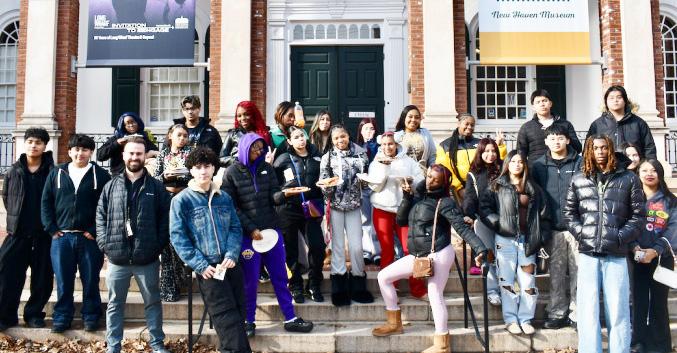
Carlson noted that despite most of his students growing up in New Haven, many in the class had never tried some of the city’s best-known pizza spots.
Retired Career history teacher Bob Osborne also joined Friday’s trip, as he has in recent years, to help Carlson. Osborne helped lay the groundwork for the New Haven history course at Career three years ago.
Osborne designed the elective around play-based learning, emphasizing field trips and hands-on experiences as a way to help students engage with history beyond textbooks. He taught the course during its first year before Carlson took over after his retirement.
Osborne said the course is also designed to help students develop independence as learners, encouraging them to ask questions, follow their curiosities, and conduct research without constant guidance. The goal, he said, is to build students’ confidence and help them become more self-reliant thinkers.
Osborne spent 25 years as an educator, including 17 at Career. He now mentors teachers at Albertus Magnus College, tutors local youth, and continues to support Carlson’s work.
Past trips for the class this year have also included walking tours of Yale and visits to the Yale Center for British Art.
“New Haven history is a case study of American history,” Carlson said, pointing to the class lessons he’s taught about the city’s history from the colonial era through the Industrial Revolution. Teaching students about their city, he said, helps them better understand the broader national story.
“Haters Going To Hate”
Inside the Long Wharf Theatre exhibit, Durdock Moreno guided groups through a room decorated with framed production photos and a clothing rack. To bridge theater and the students’ recent lessons, the group talked about the theater industry and its many facets beyond acting. Durdock Moreno’s tour focused on how storytelling has long been used to share immigrant experiences onstage and off through set and costume desig and playwriting.
“What do you need to put on a play?”
Durdock Moreno asked, scanning the group. Hands shot up as students called out answers: actors, themes, settings. To move the lesson from theory to practice, she next invited students to make use of a rack of original costumes worn in past Long Wharf Theatre productions.
“It is literally someone’s job to read the play and go through the script and decide what the actors will wear,” Moreno told the group, explaining that another person is then responsible for stitching and sewing each piece. Theater, she said, is an industry built from many jobs working together.
The students split in half — one group becoming actors, the other playwrights. After picking a clothing piece that stood out to them, seniors Lesly and Tiayonna slipped into long elaborate coats pulled from the theater’s archives. One bright yellow coat sparked immediate ideas from the playwriting group, who imagined a production about kings and queens built around the single dramatic piece. Lesly, a senior at Career, tried on a pink coat that drew a quick consensus from the playwriters. “It’s giving rich aunty,” students said. As classmates filled in details — a setting, character backstories, even
snippets of dialogue to match the look, each scene took shape through improvisation, costume by costume.
“You all just created and made theatre,” Durdock Moreno cheered.
As Lesly modeled her pink jacket lined with fur around the neck, she imagined out loud pairing it with a matching pink skirt if she were designing the full costume herself. Beside her stood classmate Tiayonna Williams, who also wore a long dress coat that she paired with her own denim purse.
Durdock Moreno asked what kind of lines she would say while in her costume to which Williams said she would say to her co-star Lesly, “Haters going to hate.”
The group quickly agreed on a title for their imagined production: Haters Going to Hate, imagining that Lesly and Tiayonna were dressed as characters who despise each other for liking the same rich man.
From the costumes, the group moved deeper into Long Wharf Theatre’s history, gathering around canvases and photographs from past productions displayed throughout the exhibit. The images — frozen moments of actors mid-scene — became prompts for another task around interpretation by Durdock Moreno.
“What emotions do you see, and what might the story be?” Durdock Moreno asked, inviting students to read the photographs the way they would a script.
One image quickly drew attention — a man holding a woman’s face, their expressions tense. Senior Dayonna Wilkins studied the scene with her friends before offering her interpretation. “He’s about to abandon this lady,” she concluded from the image.
“I’ve got some playwrights in here,” Durdock Moreno said, as students continued to unpack character motivations and imagined storylines from the still images. In another Long Wharf exhibit corner senior Byron Guera paused during his group’s walkthrough of a recreated set from El Coquí Espectacular and the Bottle of Doom to draw up a villain of his own in a sketchbook set up inside the exhibit.
Guera looked at the walls covered in posters of his favorite superhero Spiderman and a huge Puerto Rican flag. He described the room as his favorite in the museum because he likes comics and art. While sketching a character out in pen, Guera said the room felt like it was old and new at the same time. He said while he has an interest in going to trade school after graduating, the museum visit served as a reminder to him of his creative side that makes him want to consider going into acting.
Meanwhile, in another gallery of the museum, the tone shifted from stage lights to oven heat as students stepped into the museum’s pizza exhibit, immersing themselves in the history of New Haven apizza. Beneath a large recreated pizza shop menu, students pondered what they would order from a menu like they’ve never seen before, showing prices as low as 15 cents for a soda.
Senior Alvin Ortega said the pizza exhibit felt less like a museum and more like walking through the city on a Friday afternoon. “Pizza is a piece of New Haven,” he said.
Yale New Haven Hospital is pleased to offer patients and their families financial counseling regarding their hospital bills or the availability of financial assistance, including free care funds. By appointment, patients can speak one-on-one with a financial counselor during regular business hours. For your convenience, extended hours are available in-person at Yale New Haven Hospital the third Monday of every month.
Time: 5 - 7 pm
Location: Children’s Hospital, 35 Park St., 1st floor, Admitting
Parking available (handicapped accessible)
An appointment is necessary. Please call 855-547-4584.
Spanish-speaking counselors available.

By Stacy M. Brown NNPA Newswire Correspondent
President Donald Trump’s new tax law is now in force, and as the 2026 filing season begins, economists say the damage is not theoretical. It is already written into the tax code. The legislation locks in and expands Trump’s 2017 overhaul while layering on new provisions that funnel wealth upward, raise taxes on millions of low-income Americans, and deepen racial inequities that have defined the U.S. economy for generations.
“This massive tax-and-spending package does more to transfer wealth upward than any other single piece of legislation in decades while penalizing lower-income Americans and cutting public benefits,” the Institute on Taxation and Economic Policy said in its analysis of the law.
According to ITEP, the poorest 40 percent of Americans will pay more in taxes under the new law, while the middle fifth receives only marginal relief. The richest 1 percent, however, will take home more benefits than the bottom 80 percent combined in 2026. The racial divide is stark. High-income households are disproportionately white, while Black and Latino families are far more likely to be concentrated in income groups that lose ground. At the center of the imbalance is the expanded pass-through business deduction, increased from 20 percent to 23 percent. Treasury Department data show that nearly all of the $1 trillion in tax cuts generated by this provision over the next decade will flow to the top 1 percent. Hispanic
another turning point. A new executive order titled “Removing Barriers to American Leadership in Artificial Intelligence” moved federal policy away from precautionary regulation toward a deregulatory, innovation-first approach. The report warns that unchecked AI deployment risks embedding bias into hiring, lending, housing, and public services without accountability.
Workforce policy changes further reinforced inequality. While apprenticeship programs expanded, initiatives designed to advance African American workforce participation stalled or were cut, setting the stage for reinforcing racial disparities rather than closing them.
Housing remains one of the most entrenched fault lines. U.S. Census Bureau data show Black homeownership at 45 percent compared with 74 percent for white households, a nearly 30-point gap that has persisted for generations.
“At a moment when hard-won rights and safeguards are being eroded, rigorous analysis is essential to building a fair economy,” Joint Center President Dedrick Asante-Muhammad said in the report.

taxpayers, who account for 15 percent of the population, receive about 5 percent of the benefit. Black taxpayers, 11 percent of the population, receive roughly 2 percent.
The law also sharply weakens the estate tax by permanently raising the exemption to $15 million for individuals and $30 million for married couples, indexed to inflation. Economists say the change all but eliminates the tax for ultra-wealthy families while locking in racial disparities tied to inherited wealth. White families are about three times as likely as Black families to receive an inheritance, and the median inheritance for White families is roughly 25 percent higher.
Supporters of the law point to larger tax refunds expected this year as proof that working Americans are benefiting.
The Tax Foundation estimates individ-
ual income taxes were reduced by $129 billion for 2025, with as much as $100 billion likely to be paid out through higher refunds during the 2026 filing season. Average refunds could rise by several hundred dollars, and in some cases close to $1,000.
But analysts say those refunds are largely the result of delayed withholding adjustments, not sustained gains in wages or financial security. Many low-income filers, particularly those with little or no tax liability, receive little to nothing.
ITEP said provisions marketed as help for working families continue to bypass the poorest households, many of them Black. The child tax credit was raised to $2,200 per child, yet it remains only partially refundable and far below its 2021 level. Millions of very low-income families
are still excluded. Census data show that nearly one in five Black and American Indian people lived below the poverty line in 2024, placing them among those least likely to see any benefit.
The law offsets tax cuts at the top by reducing funding for health care, food assistance, and other programs relied upon by working families. Economists warn that the long-term costs will fall heaviest on younger Americans. Millennials and Gen Z, the most racially diverse generations in U.S. history, will inherit higher deficits and fewer public resources.
The Internal Revenue Service began accepting 2025 returns on Jan. 26 and expects to process roughly 164 million filings this year. New deductions for overtime, tips, auto loan interest, and seniors are now available, though many phase out well before reaching higher income levels. Analysts note that administrative readiness does not change who ultimately wins and loses under the law.
ITEP said Congress had options that would have protected working families without deepening inequality, including limiting tax extensions to households earning under $400,000 and restoring the expanded child tax credit. That approach would have delivered larger tax cuts to the bottom 60 percent of Americans at a fraction of the cost.
“This law harms the economic well-being of poor and working families of all races, especially people of color,” ITEP said. “The new tax and spending law doesn’t meet the basic test of fairness, and it falls tremendously short.”
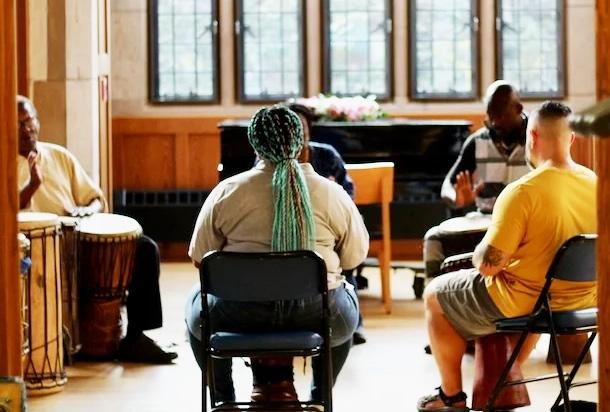
move to the drums, her feet pressing into the ground beneath her. Facing her, three dancers in cotton sarongs began rolling their heads from side to side, making time to let the tension in their necks and shoulders go. Lacina Coulibaly, a lecturer in theater, dance and performance studies at Yale who had arrived during the drumming session, hurried over to a back corner and joined in.
Hameen Diagne kept her eyes focused on the group, her knees, feet and legs keeping time with the drummers behind
her. “Ago!” she yelled, bringing the room to attention.
The call-and-response, which translates roughly to “Are you present?” “I am present!,” comes from Ghana's Twi language. For Hameen Diagne, who each year leads dance and drumming during Juneteenth celebrations on the New Haven Green, it has become woven into the work she does. “Ame!” the room shouted back. Beneath the space’s high ceilings, dancers spread out, letting the sound of rolling, ringing
While Ortega said he doesn’t have a sole favorite spot, he noted that he recently visited Sally’s and enjoyed it. Looking back up at the menu, he said he would order a sausage ah-beetz and of course add a soda “because those prices are just too good to be true.”
Williams said she was struck by a display case filled with signed pizza boxes from public figures who have visited New Haven. “Hillary Clinton coming to New Haven for pizza is crazy,” she said, peering at the collection.
As students moved through the gallery, New Haven Museum Director of Learning and Engagement Joanna Steinberg and education and program coordinator Neil Grasty guided them through a scavenger hunt designed to slow them down and draw their attention to objects in the space. The activity, created by Grasty, encouraged students to engage more deeply with the exhibit while sparking group conversation around specific historic artifacts.
Students searched for answers to questions like, “Where does the word pizza come from?” and, “What is New Haven pizza known for?”
drums wash over them. As Hameen Diagne clapped out a slow one-two-three rhythm, dancers rose to the balls of their feet, coming back down with bent knees that transformed into lunges. They rose and came down again and again, the movement becoming meditation.
Hameen Diagne moved from one side of the room to the other, speaking out the whole time.
“Okay! Again!” she said. Dancers, on an unspoken cue, began to bounce on the balls of their feet. Before long, arms became pliable, coming out to the side before they swiveled, and found their way back to the front. Touching the ground as they moved, dancers began to walk forward, arms and legs long as their spines elongated.
Holmes, who has danced with artists including Salt-N-Pepa and Lil’ Kim, said she’s grateful for the opportunity to teach—and to learn—with Hameen Diagne, who is one of her longtime friends and collaborators. Like Hameen Diagne, she sees her charge as teaching across a diaspora, with modern and contemporary forms like jazz, house, and hip-hop that all reach back to a shared foundation of West African dance and the heartbeat-like drumming that has carried it.
“It’s a way of connecting the dots through generational dance,” she said.
Connecting the displays back to lessons on industry, Ortega pointed to an old pizza box preserved in a display case. He noted that the introduction of pizza boxes allowed restaurants to expand their business by offering takeout, turning a neighborhood staple into a growing industry. The Pronounced Ah-Beetz exhibit opened at the New Haven Museum in October and will remain on view for two years. Co-curator Jason Bischoff-Wurstle noted that the exhibit is designed to invite visitors into history through the familiar. “Everyone can see themselves eating pizza,” said Bischoff-Wurstle. “Talking about the day-to-day is important. All history is how we interpret the day-to-day and how it’s put out there.”
After a look at several exhibits, the students’ lessons continued over lunch, as they each put history into practice by eating pizza slices from Frank Pepe’s, which had donated several boxes of pizza to the class for lunch.
Senior Akheemah tried Frank Pepe’s pizza for the first time Friday, rating it a 7 out of 10. Having moved to New Haven from New York just before the covid pandemic, she said she hasn’t eaten much local pizza and was more accustomed to New York–style slices, which she described as different largely because they lack New Haven’s signature charred crust. Akheemah like many other students said her favorite part of the day was trying on original Long Wharf Theatre costumes and participating in the improvised playwriting process. “I like to see the history for myself. It’s just so much better,” she concluded.
Other students also shared their pizza rating with the Independent, like senior Lesly, who gave the Frank Pepe’s lunch a 9 out of 10 after eating six slices, calling it “really cheesy.”
Lesly and classmates Williams, Nyla, Wilkins, and Aiyanna also agreed that trying on the theater costumes was their favorite part of the trip.
The Town of Wallingford is accepting applications for Director of Information Technology. Wages: $137,135 to $174,569 annually. For additional information and to apply online by the January 15, 2026 closing date please visit: www.wallingfordct.gov/government/departments/human-resources/. Applications are also available at the Department of Human Resources located in Room #301 of the Town Hall, 45 South Main Street, Wallingford, CT 06492. Phone: (203) 294-2080; Fax: (203) 294-2084. EOE
Invitation for Bids
General Contractor – Westville Manor Phase I
The Glendower Group, Inc is seeking bids from qualified contractors for General Contractor- Westville Manor Phase I . A complete copy of the requirement may be obtained from Elm City’s Vendor Collaboration Portal https://newhavenhousing.cobblestonesystems.com/gateway beginning on Wednesday, January 21,
The Bristol Housing Authority is developing its 2026-2030 Agency Plan in compliance with the HUD Quality Housing and Work Responsibility Act of 1998. A Public Hearing will be held on March 3, 2026 at 11:00 a.m. at Gaylord Towers Community Hall located at 55 Gaylord Street, Bristol, CT.
Information is available for review and inspection at Bristol Housing Authority, 164 Jerome Ave., Bristol, CT during regular business hours. Please call (860) 582-6313 for an appointment.
The Housing Authority of the City of New Haven d/b/a Elm City Communities is currently seeking bids from qualified firm to complete projects that include various architectural, structural upgrades This project involves improvements to three Elm City Communities (ECC) residential properties comprising a total of five (5) dwelling units, located at 759 Quinnipiac Avenue (Units 1 and 2), 1091 Townsend Avenue (Units 1 and 2), and 140 Harrington Avenue, New Haven, Connecticut.. A complete copy of the requirement may be obtained from Elm City’s Vendor Collaboration Portal https:// newhavenhousing.cobblestonesystems.com/gateway beginning on
Wednesday, January 14, 2026, at 3:00 PM.

The State of Connecticut, Office of Policy and Management is recruiting for a Municipal Assessment Professional in the Intergovernmental
Request for Proposals
Union Square (Church Street South) Phase I Investor Request for Proposals
Elm City Communities (“ECC”), in partnership with The Glendower Group (“Glendower”) and the City of New Haven, invites proposals from qualified equity investors and capital partners for Phase 1 of the Union Square (Church Street South) Redevelopment. This procurement is conducted in accordance with HUD requirements, including 2 CFR Part 200, Rental Assistance Demonstration (RAD), and Choice Neighborhoods Implementation regulations.. A complete copy of the requirement may be obtained from Elm City’s Vendor Collaboration Portal https://newhavenhousing.cobblestonesystems.com/gateway beginning on
Wednesday, January 7, 2026, at 3:00PM.
The Town of Wallingford is accepting applications for Police Officer. Wages: $34.35 to $44.44 hourly plus an excellent fringe benefit package to include a defined benefit pension plan. For additional information and to apply online by the January 30, 2026 closing date please visit: www. wallingfordct.gov/government/departments/human-resources/. Applications are also available at the Department of Human Resources located in Room #301 of the Town Hall, 45 South Main Street, Wallingford, CT 06492. Phone: (203) 294-2080; Fax: (203) 294-2084. EOE
The South Central Regional Council of Governments (SCRCOG) seeks the services of one or more consultants for the following transportation planning studies during the 2026 and 2027 Fiscal Years (July 1, 2025- June 30, 2027): Congestion Management Study, Scenario Planning Study, and Ridge Road Safety Study. Responses are due by January 7, 2026 (12 noon local time). The full RFQ document can be viewed at the Council’s website: www.scrcog.org or can be made available upon request. Contact James Rode at 203-466-8623 with any questions.
General Contractor – The Heights at Westrock

The Town of Wallingford is accepting applications for Collections Maintainer II. Wages: $31.27 to $36.78 hourly. For additional information and to apply online by the January 25, 2026 closing date, please visit: www.wallingfordct.gov/government/departments/human-resources/. Applications are also available at the Department of Human Resources located in Room #301 of the Town Hall, 45 South Main Street, Wallingford, CT 06492. Phone: (203) 294-2080; Fax: (203) 294-2084. EOE

The Glendower Group, Inc is seeking bids from qualified contractors for General Contractor at The Heights at Westrock. A complete copy of the requirement may be obtained from Elm City’s Vendor Collaboration Portal https://newhavenhousing.cobblestonesystems.com/gateway beginning on
a quarry and paving contractor, has positions open for the upcoming construction season. We are seeking candidates for a variety of positions, including: Scalehouse Dispatcher/ Equipment Operators and Laborers. NO PHONE CALLS. Please mail resume and cover letter to “Hiring Manager”, Galasso Materials LLC, PO Box 1776, East Granby CT 06026.
Galasso Materials is an Affirmative Action/Equal Opportunity Employer. All applicants will be considered for employment without attention to race, color, religion, sex, orientation, gender identity, national origin, veteran or disability status.
Immediate opening for a full-time mechanic; maintenance to be done on commercial diesel trucks and trailers. Minimum of three years experience required. A valid driver’s license is required in order to run company errands efficiently and safely. Send resume to: HR Manager, P. O. Box 388, Guilford, CT 06437 or emailhrdept@eastriverenergy. com.
***An Affirmative Action/Equal Opportunity Employer, including disabled and veterans***
The Town of Wallingford is accepting applications for Maintenance Repair Technician I. Wages: $32.34 to $38.04 hourly. For additional information and to apply online by the January 20, 2026 closing date please visit: www.wallingfordct.gov/ government/departments/human-resources/. Applications are also available at the Department of Human Resources located in Room #301 of the Town Hall, 45 South Main Street, Wallingford, CT 06492. Phone: (203) 294-2080; Fax: (203) 294-2084. EOE

The State of Connecticut, Office of Policy and Management is recruiting for a Planning Analyst and a GIS Analyst (Research Analyst) in the Intergovernmental Policy and Planning and the Data and Policy Analytics divisions. Further information regarding the duties, eligibility requirements and application instructions are available at:
https://www.jobapscloud.com/CT/sup/ bulpreview.asp?b=&R1=260108&R2=6297AR&R3=001 and
https://www.jobapscloud.com/CT/sup/ bulpreview.asp?b=&R1=260108&R2=6855AR&R3=001
The State of Connecticut is an equal opportunity/affirmative action employer and strongly encourages the applications of women, minorities, and persons with disabilities.
241 Quinnipiac Avenue, New Haven which are two bedrooms and rent from $1,950-$2,000 and include heat, hot water and cooking gas, private entrance, off street parking and onsite laundry. I have a couple with washer/dryer which are $2,000. Please bill 241 Quinnipiac Avenue, LLC, 111 Roberts Street, Suite G1, East Hartford, CT 06108.
Also, I have a 3 bedroom unit at 254 Fairmont Avenue, New Haven. They rent for $2,050 and the tenant pays all the utilities. Off street parking and private entrance. Section 8 welcomed.
Also, I have a 2 bedroom at 248 Fairmont Avenue, New Haven. They rent for $1,950.00 and the tenant pays all the utilities. Off street parking and private entrance. Section 8 welcomed.
Please bill the Fairmont Avenue to 258 Fairmont Avenue, LLC at the same billing address as 241 Quinnipiac Avenue. I will be the contact person for them to call at 860-231-8080, ext. 161.

360 Management Group is currently seeking bids from qualified contractors to perform on demand roof repair services and annual roof inspections. A complete copy of the requirement may be obtained from Elm City’s Vendor Collaboration Portal https://newhavenhousing.cobblestonesystems.com/gateway beginning on
January 21, 2026, at 3:00PM.
Invitation for Bids
360 Management Group is currently seeking bids from qualified contractors to perform Elevator services. A complete copy of the requirement may be obtained from Elm City’s Vendor Collaboration Portal https://newhavenhousing.cobblestonesystems.com/ gateway beginning on
Wednesday January 7, 2026, at 3:00PM.
Invitation for Bids
Agency Wide Driveway- Repair-Sealing
360 Management Group is currently seeking bids from qualified contractors to perform Driveway Repair-Sealing services. A complete copy of the requirement may be obtained from Elm City’s Vendor Collaboration Portal https://newhavenhousing.cobblestonesystems.com/gateway beginning on
Wednesday January 7, 2026, at 3:00PM.
The Town of Wallingford is accepting applications for Attendant III. Wages: $36.32 to $41.08 hourly. For additional information and to apply online by the January 27, 2026 closing date please visit: www.wallingfordct.gov/government/ departments/human-resources/. Applications are also available at the Department of Human Resources located in Room #301 of the Town Hall, 45 South Main Street, Wallingford, CT 06492. Phone: (203) 294-2080; Fax: (203) 2942084. EOE
Architectural & Engineering Services for RAD/LIHTC Multifamily Scattered Sites & Essex Townhomes Redevelopment
The Glendower Group is currently seeking proposals from qualified firms for Architectural & Engineering Services for the Redevelopment of Scattered Sites & Essex Townhomes. A complete copy of the requirement may be obtained from Elm City’s Vendor Collaboration Portal https://newhavenhousing.cobblestonesystems.com/gateway beginning on
Wednesday, January 7, 2026, at 3:00PM.

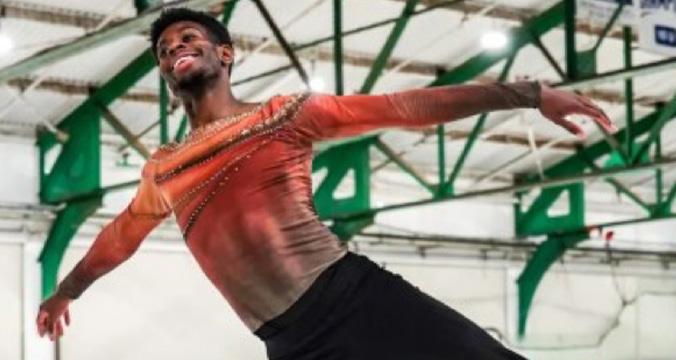
By Lois Elfman, Amsterdam News
The ice will be hot at the 2026 U.S. Figure Skating Championships, as the results of the senior events will significantly factor into the selection of the U.S. team that will compete at the Olympic Winter Games in February. When the senior men take to the ice on Jan. 7, Emmanuel Savary will look to make his mark in what will likely be his final U.S. nationals. This will be Savary’s sixth appearance in the senior men’s event. The 2025 nationals marked his return to the U.S. Championships after six years. An ankle injury slowed his training over the summer, but by autumn, he felt better, allowing him to skate in shows and even do an international competition in Scotland. In November, Savary, 27, won his second consecutive Eastern Sectional Singles Final.
“I personally feel [show skating] has helped me so much,” said Savary, who has become a regular performer with Ice Theatre of New York, recently skating at the Christmas tree lighting ceremonies at Bryant Park and Riverbank State Park. “I’m naturally very introverted, so it has helped me be comfortable in front of an audience. Making eye contact, smiling, and engaging the audience, things like that have elevated since I’ve been doing a lot more shows.”
By Gwendolyn Carole Tipton, The Cincinnati Herald
Here in 2026, we must not forget His benefits from 2025.
We have already received and continue to receive Spiritual Blessings. Apostle Paul declares that God has blessed believers with "every spiritual blessing.” They encompass gifts of redemption, including forgiveness, grace, and the promise of eternal life. These blessings are not based on human merit but are freely given by God's grace.
The timeless nature of these spiritual blessings goes beyond our everyday needs, offering comfort and purpose in a world often filled with chaos and uncertainty.
Understanding our identity in Christ can bring hope and transformation, allowing us to shape our perspective and actions. We should pray for a deeper understanding and appreciation of these spiritual blessings, that we may walk in the fullness of God’s grace and purpose.
Look back on 2025. Remember His forgiveness when we did not follow Him, the grace that carried us through, and the ultimate promise of eternal life.
The book of Ephesians invites believers to reflect on their new creation in Christ and the immense blessings they have re-
ceived. They are chosen, redeemed, and sealed by the Holy Spirit. These verses encourage believers to live in gratitude and glorify God for His grace and purpose in our lives.
Prayer: With Gratitude and Praise for 2026, we come before You, Lord, praying that we may continue receiving Your spiritual blessings, Your forgiveness, Your
choosing us, and bringing us to this place in our lives. Lord, in this new year, we are asking You to direct our paths. We will not lean on our own understanding but look toward you for direction. We commit ourselves to do more, be more, and act more like Christ. Please show us the way. Amen.
by Dollita Okine, Face2FaceAfrica.com
The weeks leading up to the sectional competition, Savary was feeling good and gaining confidence. “I skated pretty much how I expected to skate, and I’m hoping to carry that momentum with me to nationals,” he said.
Savary has kept his free skating program from last season, set to the music “Saturn.” His new short program is a tango fusion with some Latin accents. He does his own choreography, which is his favorite part of skating. “I find something I’m relating to music wise,” he said. “I’m very particular about how I want certain things to look.”
Long-term, Savary hopes to do more choreography for other skaters. He currently does some choreographic work with the young skaters that he coaches at the Skating Club of Wilmington (Delaware).
Shortly after the U.S. Figure Skating Championships, Savary will return to his studies at the University of Delaware. He’s on schedule to graduate next spring with his degree in astrophysics. While graduate school is still on his radar, it will probably be several years in the future.
“While my body still can, I want to do more things in skating,” he said. “I would love to see the world.”
This article was originally published by the Amsterdam News.
Oregon quarterback Dante Moore recently announced that he will skip the 2026 NFL draft and return to the university for the upcoming season. Moore was expected to be a top pick in the 2026 draft. His return makes him a strong prospect in the highly talented 2027 quarterback class.
“With this decision, mainly all my life has just been about being as most prepared as I can for any situation I go into,” Moore told “SportsCenter.” “And when it comes to me making my decision, I just want to do what’s best for my situation, especially as a quarterback.
“With my decision, it’s been very tough. I’ve prayed a lot about it, talked to many people—my mentors and people I look up to. With that being said, of course I’ll be coming back to Oregon for one more year, being able to play for the Oregon Ducks and reach our goal and be national champions.”
Moore’s choice to remain with Oregon is a major asset for the Ducks’ aspirations for the 2026 national championship, especially since the NFL draft declaration deadline has passed for all eligible underclassmen except those competing in the College Football Playoff championship game.
“This year, I’ve had many great throws, many great plays, but at the end of the day I feel I can still learn so much more,” Moore told ESPN. “As a kid, since I was
4 years old, I’ve dreamed about being in the NFL, but this team, we’ve been through a lot, a lot of people are returning, so we’ve got some exciting things to come this year. I’m excited to keep pushing my team.”
Oregon is a top contender, thanks to commitments from key defensive linemen and the return of young wide receivers and tailbacks.
The decision to remain in college follows the announcement that former Nebraska quarterback Dylan Raiola will transfer to Oregon. Meanwhile, several Oregon players, including tight end Kenyon Sadiq and safety Dillon Thieneman, have declared for the NFL draft.
By choosing to return to Oregon, the 20-year-old quarterback Moore passed up an estimated $50 million in guaranteed money from the NFL. This figure is based on last year’s draft, where the No. 2 pick, Travis Hunter, received $46.65 million fully guaranteed, and that amount is expected to increase for the upcoming draft.
In his first season as a full-time starter, Moore guided Oregon to the CFP semifinals. Having only started 20 college games, he falls short of the 25-start threshold that NFL executives typically consider the minimum experience for a potential starting quarterback.
During his 2025 season with the Ducks, Moore achieved 3,565 passing yards and 30 touchdowns. His completion rate stood at 71.8%, though he also threw 10 interceptions.
Moore recently completed his third season of college football, according to Sports Illustrated. He began his college career by starting five games as a true freshman at UCLA. After transferring to the Ducks, he spent the 2024 season as the backup to Dillon Gabriel.


• Cremation (Choose to be cremated at Evergreen.)
• Columbarium in the Most Beautiful Cremation Garden
• Reserve your Niche in a secure location pre-need.

• Reserve a Niche for family and friends or purchase at-need to safely place your Loved One in the Columbarium.
• Burial Lots (infant, single, two-grave, or four-grave)
• Monuments & Markers (black, gray, or pink granite)
• Flower placement (single or multiple placement)
• All orders can be placed at the Evergreen office or the website.