Happy New Year! And among all the dates going into your diary, don’t forget Friday 24 Januarythe launch day for schools of the Church’s special Jubilee year.
Pope Francis has earmarked 2025 as a Holy Jubilee Year, calling for the global church to be “Pilgrims of Hope”, working together for God’s kingdom of justice, peace and love, and standing in solidarity with the world’s poorest communities. It’s an invitation to renew our hope, a hope which comes from knowing that God loves each one of us, whoever we are.
The Church is encouraging schools to take an active part in celebrations. “There will be opportunities for the whole school community to experience the joy of sharing their faith in prayer and worship, and to take action together as pilgrims of hope,” says Catholic Education Service Chairman, the Rt. Rev. Marcus Stock in his letter to schools dated 4 July 2024. “For no one should live without hope.”
CAFOD is working together with the Catholic Education Service, Caritas Social Action Network, and the Catholic Youth Ministry Federation, to support school communities in celebrating the Jubilee year. On a journey from Launch Day to Pledge Day to Celebration Day, a range of engaging resources will enable pupils to stand in solidarity with their sisters and brothers in need around the world, sharing hope that’s rooted in love and faith.
Through prayer, learning, activities and taking action for our local and global families, children and young people will have the opportunity to explore and experience the vital role they have as agents of change, recognising that a better world needs all of us to participate.
Central on the journey as pilgrims of hope, Pledge Day will be a key moment when the school
community makes a long-term commitment to working towards the common good. Together, a school will create and confirm concrete actions in a pledge to advance justice and harmony locally, and globally. A Jubilee Pledge Guide is there to help!
Beginning with its launch in schools on Friday 24 January, this Jubilee year provides many opportunities to enhance and celebrate the Catholic life and mission of a school:
Catholic Social Teaching is at the heart of the Jubilee message – highlight and live out CST through taking action in the Jubilee year
Put faith into action
• Pledge to commit to stand in solidarity with the poorest communities
• Give children and young people the chance to see their role in making change happen, bringing signs of hope to an unfair world
Experience the joy of joining together as a community, taking action to build a better world
The year is fully resourced - visit Jubileeschools.org.uk for all you need to celebrate the year together
Enhance both Catholic life and curriculum - Jubilee activities and celebrations will complement learning in RE, other curriculum areas, liturgy and worship, and the wider life of the school
Work with the parish to see how church and school can come together on the journey



social action network
There are three key dates throughout the year for schools to celebrate the Jubilee year together. Make sure to mark them in your calendar! Launch Day 24 Jan 2025 – embark on a shared journey and mark this Holy Year as a significant and memorable moment.
Pledge Day June/July 2025 – make a Jubilee Pledge, a long-term commitment to the common good and look outwards, advancing justice and harmony.
Celebration Day 21 Nov 2025 – celebrating all that was achieved together during the Jubilee year and looking to the future with hope!
From Launch Day to Pledge Day to Celebration Day
Visit jubilee-schools.org.uk to find a wealth of inspiring resources and helpful information to support you throughout the year:
• Watch the animation See the Jubilee launch day film
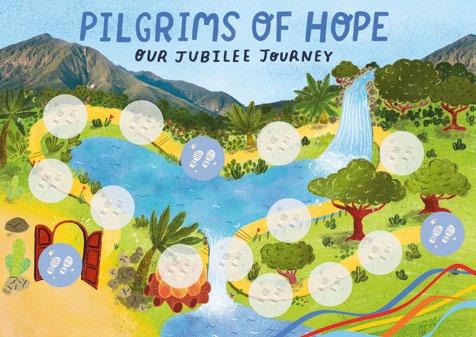
• Chart your journey with the Pilgrims of Hope map and stickers
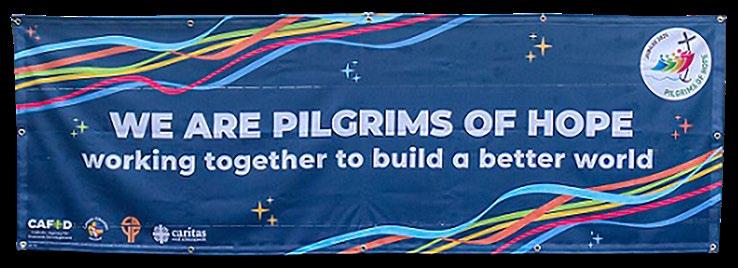
• Pray using the prayer card Witness to the community and outdoor banner for your school
• Download the pledge guide
• Reflect with the Jubilee icon



The Rt. Rev. Marcus Stock concludes: “For the children and young people in our schools, and for the rest of society, this is the message of Jubilee 2025. Life is not hopeless, despite its challenges. Life is the gift of a loving God who calls us in Christ to love, peace and justice in this world, and eternal communion with him in the next.”
We look forward to sharing the Jubilee year journey with you, all of us together as Pilgrims of Hope.
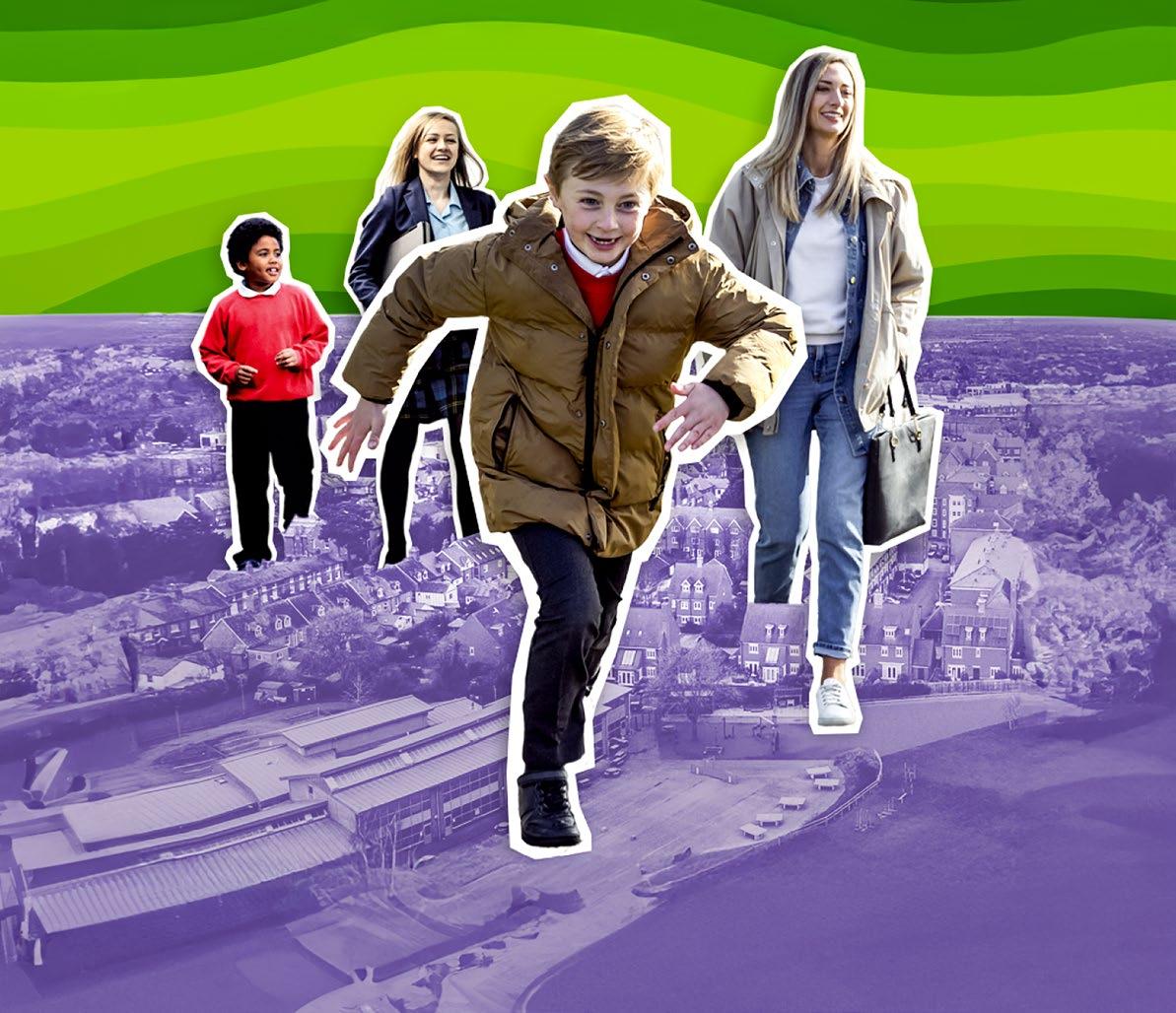
650 schools took part in CAFOD’s Big Lent Walk last year!
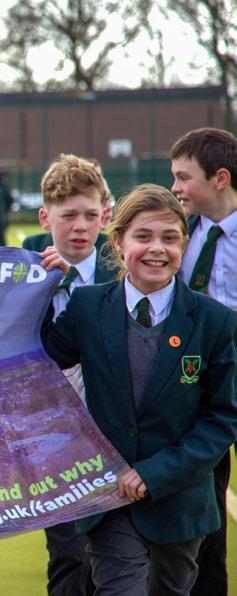
Pupils, teachers, parents and communities from across England and Wales came together to be part of CAFOD’s Big Lent Walk journey. A big thank you if you were part of it - and a big invitation to do the same again for the Big Lent Walk 2025!

In this year of Jubilee, as Pope Francis invites us all to be signs of hope in our world, the Big Lent Walk is a wonderful opportunity to stand - and walk - side by side with other Catholic schools in England and Wales as part of your Jubilee commitment; putting Catholic Social Teaching into practice and fundraising to support communities living in poverty around the world.
All you need to do is sign up, choose a date during Lent for your Big Lent Walk and set your own target distance. We’ll send you a welcome pack and a guide with engaging resources to help you and your pupils raise money through sponsorship from family and friends. Setting up a JustGiving page makes fundraising even easier and it’s perfect if you’re a cashless school.
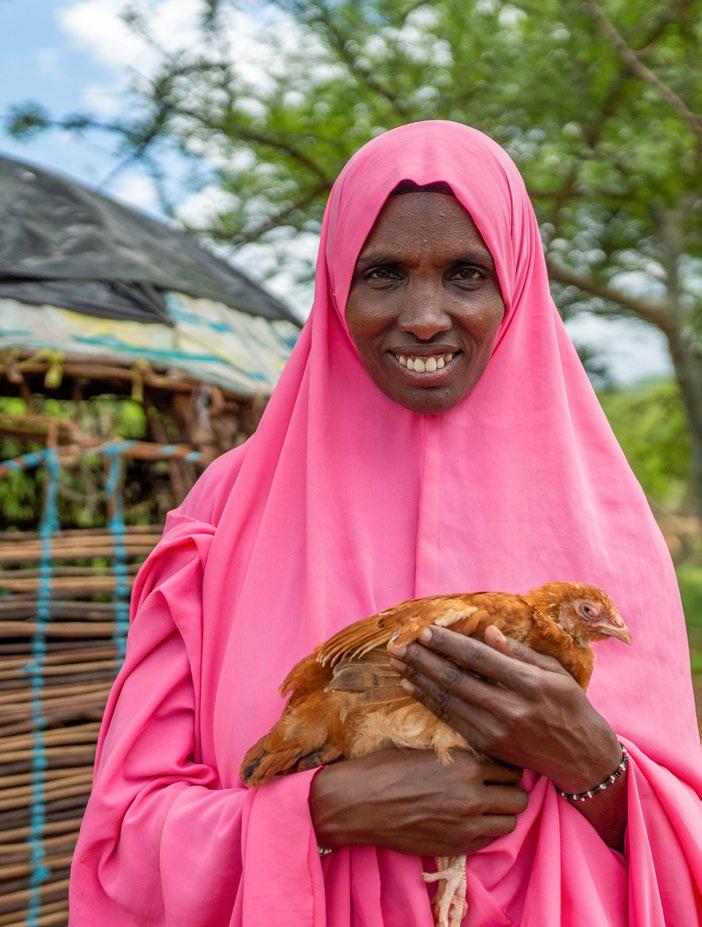
The money you raise will help our partners around the world work side by side with those in need; people like Khera who lives in Kenya and is part of the Glitter Group - women working together to battle poverty.
“Before the drought, we had camels, cows and goats that we used as a source of food for our family. I enjoyed life then,” explains Khera. “We didn’t have any worries.”
After the drought came, everything changed. With no water, animals died day after day. “It was so frustrating,” says Khera. “Our children went to school with empty stomachs.”
Chirri, Khera’s daughter, remembers this difficult time too. "There was no rain for years, and I have seen animals die,” she says. With CAFOD’s help, Khera and the women at the Glitter Group were given some hardy chickens to help them make a living.
“Chickens don’t depend on water in the same way as livestock,” Khera explains.
Keeping chickens means that Khera can sell the eggs, or a chicken, to get money to buy food, soap and clothes. The money raised means the women at the Glitter Group can plan for the future. “I enjoy keeping chickens and we are now good farmers,” says Khera.
Sign up for the Big Lent Walk, get sponsored and raise money to support more people like Khera.
Inspired to take part in this year’s Big Lent Walk? What are you waiting for?
You can sign up for the Big Lent Walk 2025 at: cafod.org.uk/BLWSchools
We’d love you to join us on the journey!

Supplied to members of:




visit our website at www.networkingcet.co.uk for details or contact
The Catholic Association of Teachers, Schools and Colleges. The Catholic Independent Schools Conference. The Birmingham Catholic Secondary Schools Partnership. The Manchester Catholic Secondary Schools Partnership. Through the SCES to all Catholic Schools in Scotland.
Editorial Team:
Editor - John Clawson
Bob Beardsworth, Peter Boylan, Carmel O’Malley, Kevin Quigley, Willie Slavin MBE, Fr John Baron
Editorial Contributors:
Professor Gerald Grace KSG, Research, Publication and Development in Catholic Education Visiting Professor of Catholic Education at St Mary’s University, Twickenham
CATSC - John Nish
CISC - Matthew Burke
SCES - Barbara Coupar
CAFOD - Lina Tabares
Editorial Office:
Networking (CET) Ltd
9 Elston Hall, Elston, Newark, Notts NG23 5NP
Email: editor@networkingcet.co.uk
Cover:
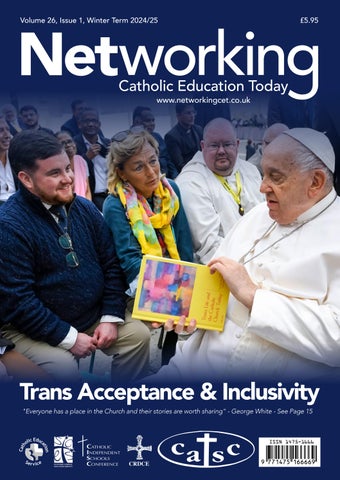
Trans Acceptance & Inclusivity - See page 15
Designed by: 2co Limited 01925 654072 www.2-co.com
Printed by: The Magazine Printing Company
Published by: Networking (CET) Ltd
9 Elston Hall, Elston, Newark, Notts NG23 5NP
Email: editor@networkingcet.co.uk www.networkingcet.co.uk
Our mission is to serve as a forum where Catholic heads, teachers and other interested parties can exchange opinions, experiences, and insights about innovative teaching ideas, strategies, and tactics. We welcome—and regularly publish— articles written by members of the Catholic teaching community.
Here are answers to some basic questions about writing for Networking - Catholic Education Today.
How long should articles be?
Usually it seems to work out best if contributors simply say what they have to say and let us worry about finding a spot for it in the journal. As a rough guideline we ask for articles of 1000/2000 words and school news of about 300/400 words.
What is the submission procedure?
Please send as a Microsoft Word file attached to an e-mail. To submit articles for publication, contact John Clawson by email at editor@ networkingcet.co.uk
How should manuscripts be submitted?
We prefer Microsoft Word files submitted via e-mail. Try to avoid complex formatting in the article. Charts, graphs, and photos should be submitted as separate PDFs. Electronic photos should not be embedded into a Word document as this reduces their quality.
Photographs and Illustrations which should relate to the article and not be used for advertising nor self-promotion, should be supplied electronically as high resolution TIFF (*.TIF) or JPEG (*.JPG) files). They should be sent in colour with a resolution of 300 dpi and a minimum size of 100 mm x 100 mm when printed (approx. 1200 pixels wide on-screen). Hard-copy photographs are acceptable provided they have good contrast and intensity, and are submitted as sharp, glossy copies or as 35 mm slides or as scanned high resolution digital images (eg. a 300 dpi 1800 x 1200 pixel *.JPG).
• Computer print-outs are not acceptable.
• Screen captures are not ideal as they are usually not very high quality.
Each photograph or illustration should have a selfexplanatory caption. If you do not supply images, you may be asked to submit suggestions and possible sources of non-copyright material.
Who owns copyright to the article?
You do, but Networking - Catholic Education Today owns copyright to our editing and the laidout pages that appear in the magazine. What are some hints for success?
As much as possible, talk about your experience rather than pure theory (unless discussed in advance) Use specific examples to illustrate your points. Write the way you’d talk, with a minimum of jargon. Near the beginning of the article, include a paragraph that states your intentions. Don’t be subtle about it: “This article will...” is fine.
Closing Date for Copy - Volume 26 Issue Two - Spring Term 2025 edition. Copy to Editor by 9th April 2025. Published to schools 10th May 2025.
Dr Sean Whittle
Julie-Anne Tallon
Raymond Friel
Willie Slavin MBE
Andy Lewis
Mugeni Sumba
Rev Yousouf Gooljary
A Happy New Year to all our readers!
Welcome to this edition of Networking Journal. As we begin a new year, we would like to thank all our contributors, subscribers, and readers for your support over the past year.
In this issue we explore emerging trends, share groundbreaking research, and present insightful analyses.
We are happy to announce the relaunch of our website! The newly redesigned platform boasts a more intuitive user experience, streamlined navigation, seamless access to our archives, and a responsive design optimised for any device.
These updates aim to make our content more accessible and to foster a vibrant, interactive community. We encourage you to explore the new website and take full advantage of its features.
Thanking you in advance for any feedback
John Clawson Editor
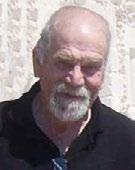
Willie Slavin
The days when all Catholic families automatically chose to send their children to a Catholic school are becoming a distant memory. As a result there is now much more room for non-Catholic children to join our Catholic schools. Many of these children join as ‘in-year admissions’ and this makes it helpful to have an overview of the state of RE in non-Catholic schools.
The Catholic Education Service has worked hard to buttress the place of RE in Catholic schools through the introduction of the Religious Education Directory (compulsory from September 2025) and the Catholic School Inspection framework. RE in Catholic schools receives a hefty ten percent of curriculum time and offers pupils a content heavy diet of RE which is deeply Catholic. However, RE outside the Catholic sector stands in a very different situation.
All schools in the UK are legally obliged to have RE as part of the basic curriculum that must be delivered to all pupils. Unfortunately, in many schools RE is a neglected subject, something often noted in the Ofsted Annual Reports (2023 and 2024).
Long before the introduction of the National Curriculum following the 1988 Education Reform Act, having RE lessons and collective acts of worship was a mandatory part of schooling. It was the 1944 Education Act that cemented the place of RE into the curriculum. However, over the years the cement has loosened and in RE has tended to be a neglected part of the curriculum. In an attempt to coordinate lobbying for RE the ‘Religious Education Council for England and Wales’ (REC) came into existence in 1973. It is charity that draws advocates of RE together, to foster and support the provision of high quality RE in all schools.
In recent years the REC organised a wideranging Commission on the state of RE, and in 2018 it produced a Final Report that offers a comprehensive analysis and recommendations for how to reinvigorate the place of RE in the curriculum. The Commission on RE has started to bring about important changes, largely thanks to the efforts of the REC to support the implementation of the recommendations in the Final Report.
In May 2024 the REC unveiled an important range of resources, including some intended to help curriculum writers. The heart of these is a ‘Handbook’ written specifically to support, guide and help those who are involved in constructing the RE curriculum, which at the end of the day typically means RE teachers, who devote hours to making engaging lessons that support student learning. The full title of the Handbook is Developing a Religion and Worldviews Approach in Religious Education in England, and it has been skilfully composed to help schools use the concept of ‘worldviews’ to help frame and guide RE. The REC supported research into a comprehensive literature review around the meaning of ‘worldviews’, to ensure both a coherence and depth to what is meant by the terminology of ‘worldview’ in relation to RE. The idea that everyone has a world view, rather than a neutral standpoint is a theme which has been blended into the Religious Education Directory (RED). In many respects the RED is seeking to communicate the relevance and coherence of the Catholic worldview to all those who belong to a Catholic school, be they Catholic or not.
A second reason why the Handbook needs to be carefully read is because of the central place given to the introduction of a National Statement of Entitlement in
By Dr Sean Whittle
relation to RE. In England, and perhaps the whole of the UK, the history of Religious Education in schools has been dogged by controversy over the ambiguity and lack of certainty concerning the aims and purposes of the subject (Hannam 2019). Although the current legislation is that we should have a school curriculum which includes Religious Education, it remains one of only two subjects that parents have the right to withdraw their children from. The various attempts to spell out the aims of RE in non-Catholic schools since the 1944 Education Act reflect the ongoing search for a firm anchor around which to frame and justify why every student needs RE as part of their school curriculum. The introduction of the National Statement of Entitlement (NSE) for Religion and Worldview education is a highly significant part of the Handbook for Curriculum Writers. This is because it shifts the debates about what ought to be the content of RE in non-Catholic schools away from a local context (through SACREs) to the national level. This helps to move RE from the situation it was left in after the 1988 Education Reform Act, which introduced the National Curriculum. Although RE remains a compulsory part of the curriculum, it is part of the basic curriculum, but unlike every other National Curriculum subject, it is not framed at national level. Crucially the NSE offers this for the first time. The NSE has the potential to unify thinking around the goals, aims and purposes of RE, and in many respects for RE teachers this could be a gamechanger at a number of levels. For example, it might stop the regional variations, which can make moving from one school to another a challenging time for the average RE teacher and for the students. Although it is the same subject, in the same country, the RE curriculum is often organised in radically different ways. Similarly, if there is a clearly articulated NSE for RE it becomes easier to argue in support of the subject. Thus, in the classroom, for the students who frequently question why they are having to learn a particular aspect of RE (or even the subject as a whole), there is a more solid answer.
This is also true for parents. The NSE makes clearer just what young people ought to be allowed to learn when it comes to worldviews and religion. More generally, when arguing for sufficient curriculum time and resources, it becomes much easier when there is a NSE to appeal to. The Commission on RE Final Report offers striking evidence that too many schools are failing in their legal requirements for Religious Education. Now that the NSE for Worldviews and Religion have been identified, RE teachers and other advocates of RE, have an additional angle of leverage when championing the RE provision in schools.
Another benefit of the NSE for RE teachers in non-Catholic schools is that it will provide an ideal way to compose and review the ‘curriculum intent’ statements that are needed to placate Ofsted inspectors (and the headteacher). It can be difficult to be confident when composing your own Curriculum Intent statements. There is the nagging fear that you have merely projected your own bias or preferences when it comes to what you are seeking to achieve through RE in your school. The NSE provides an apt frame of reference to counterbalance this anxiety.
How is the Handbook organised?
Although the Handbook is not statutory (and obviously has no jurisdiction in Catholic schools), it is helpful to at least have a basic knowledge of how it is seeking to support and frame RE. The Handbook is structured into four sections, all freely available on the REC website. It is important to note that each section is written intentionally for a range of different audiences. In Section A an overview is presented, intended for the widest of audiences: from teachers, parents, pupils to Head Teachers, Governors, MAT leads, and SACREs and advisors from the Anglican dioceses. The key content in Section A is to offer an overview of the Religion and Worldview approach, to describe its key features, including the NSE and outline a brief rationale. In Section B, there is a practical focus. It
includes a carefully designed Toolkit for developing a Religion and Worldview approach. This guides you through the process of composing a curriculum along the Religion and Worldview approach. It starts with spelling out the aims and then links these with the NSE. It offers guidance on selecting content, both in terms of developing the pupils’ own worldviews and how to use the NSE to select the curriculum content, and beyond that units of work and the questions for specific lessons. In Section C the focus becomes more theoretical, with a detailed rationale and expanded discussion of the academic treatment of the Religion and Worldview response. In the dayto-day reality of school life this section is unlikely to be a ‘go to’ part of the Handbook, because it is engaging with the wider academic consideration of the concept and coherence of ‘Worldviews’. However, it is important to be aware of this more sustained scrutiny of the debate around the concept of worldviews and the ways it is capable of underpinning Religious Education. It is indeed possible to give a defence of the value of using worldviews in the RE classroom. This relates closely with questions over subject knowledge in RE and the desire to articulate the so called ‘powerful knowledge’ (Young 2012) within the disciplines which are foundational for RE. At the same time, there is a degree of controversy with using the concept of Worldviews to frame RE. There has not been a universal assent to embracing the worldviews paradigm. Section C devotes some attention to engaging with the potential misunderstandings. Section C as a whole is a high quality piece of academic work, and it is supported by a comprehensive listing of references to the key literature. All of this helps to make the case for shifting to a Worldviews and Religion paradigm both coherent and robust. In many respects it amounts to compelling and persuasive evidence.
In Section D there are three exemplar frameworks which illustrate differing ways in which the Religion and Worldviews approach could be used
and implemented in various contexts. Although these three frameworks are not templates, they are sufficiently detailed and well written to be able to guide and inform others in similar contexts. The first Framework is drawn from the context of the SACRE/Diocese. This example reports on how a locally agreed syllabus for Coventry and the Anglican diocese of Coventry made use of the Worldviews and Religion paradigm to reframe the curriculum/ syllabus for RE in this part of England. It creatively draws out the relationship between worldviews and the cultural heritage of Coventry in relationship to peace making and reconciliation within the RE in the Coventry area. This example offers a cogent illustration that other SACREs and dioceses could emulate and apply to their respective contexts.
The second exemplar Framework is one drawn from a Multi-Academy Trust context. Over the last two decades the emergence of Multi-Academies (MATs) has had a profound impact on how schooling is organised in relation to funding and overall responsibilities. Even after the 1988 Education Reform Act, the pre-existing system of Local Authorities having oversight of schools in a particular region remained intact. The emergence of academisation has allowed schools to break free over Local Authority control and receive funding directly from central Government. Schools can fully collaborate as members of a MAT, and this has allowed schools to organise support strategies and school improvement. The emergence of MATS have enabled schools to approach curriculum design in different ways, drawing on insights from across the all the schools in the MAT. The movement towards academisation is now very advanced, and within the next five years almost all schools in England will be part of MATs. In this context support for RE and the development of the curriculum will inevitably come at the MAT level, across all the schools in a given Trust. The soon to be released MAT-led Framework will be a helpful example of how to use the Worldview and Religions Handbook
to develop RE across all the schools in a given MAT. Typically, MATs draw secondary and primary schools into a very close working relationship and this allows attention to be given to building up progression in RE from primary to secondary phases.
The third Framework is a Teacher-led one. It was composed by teachers from across England, and as such from very different contexts. This Framework uses a series of questions that are addressed to the RE teacher or Curriculum lead, that open up worldviews perspectives about a given unit of work. This Framework has two levels. One is at the Curriculum level, and the other is about units of work. The advantage of the latter is that it neatly illustrates how the Framework can be applied in a range of schools and curriculum contexts.
These three exemplar Frameworks have been written in such as a way as to ensure they speak to the widest range of contexts, from community schools, foundation schools, free schools, academies and even schools of a religious character.
What will be happening next?
Over the next five years in non-Catholic schools there is likely to be widespread adoption of the Handbook. At the very least the concept of worldviews will become far more common and will seep into the parlance even of Catholic school RE. This means having even a vague familiarity with this document and the work of the REC, will hopefully help us to better support the Catholic children who do not attend Catholic schools. With the impending changes to RE in Catholic schools (as the RED is fully bedded in), it is possible RE teachers in Catholic schools might want to become more conversant with the wider Worldviews and Religion paradigm contained in the Handbook.
A final plea I would encourage readers of Networking to engage with the reality of where an ever-increasing proportion of our young Catholics are getting their RE from. Given the increasing
numbers of non-Catholic children in our schools, we have a vested interest in knowing and caring about the RE which is coming into shape in nonCatholic schools. Having even a passing knowledge of the REC and the Handbook for Curriculum Writers that it has carefully created will make for sound sense. It is also possible that our RE teachers could pick up some helpful insights from knowing what is going on outside the world of RE in Catholic schools.
Catholic Education Service (2023). To know you more deeply: The Religious Education Directory for Catholic Schools, Colleges and Academies in England and Wales. London: Bishop’s Conference of England and Wales. Commission on RE (2018). Final Report of the Commission on RE. Available at https://religiouseducationcouncil.org. uk/resource/commission-on-religiouseducation-final-report Hannam, P. (2018). Religious Education and the Public Sphere (1st ed.). London: Routledge.
Pett S. (2024). Developing a religion and worldviews approach to Religious Education in England: A Handbook for Curriculum Writers. Available at: https://religiouseducationcouncil.org. uk/rec/wp-content/uploads/2024/04/2425698-REC-Handbook-A4-DIGITALPAGES.pdf
UK Parliament (1944). The Education Act. London: Hansard.
UK Parliament (1988). The Education Reform Act. London: Hansard.
Young, M. (2012) The curriculum: ‘An entitlement to powerful knowledge’: A response to John White. Available online at: http:// www.newvisionsforeducation.org. uk/2012/05/03/ (accessed on 5 June 2012).
By Julie-Anne Tallon Director of the Catholic Primary Partnership
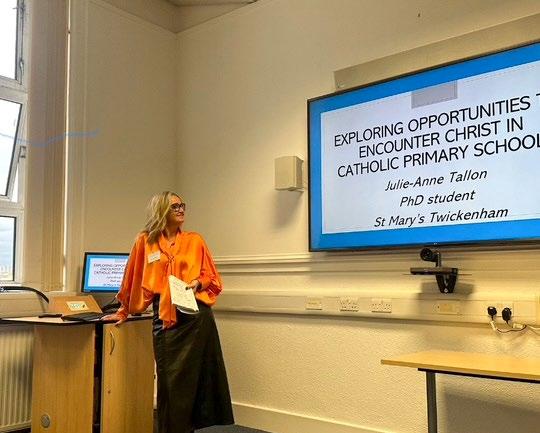
Attending the 2023 Network for Researchers in Catholic Education (NRCE) conference in Limerick was a formative experience. I was both honoured and excited to be invited to present my research at the 2024 conference held at the University of Glasgow. As a researcher entering the third year of my PhD program, presenting my findings to an audience of established scholars— professors, doctors, and fellow doctoral candidates—was simultaneously exhilarating and daunting. Though common among earlystage researchers, the sensation of imposter syndrome was notably present, heightening my anxiety about sharing my work in such a distinguished setting.
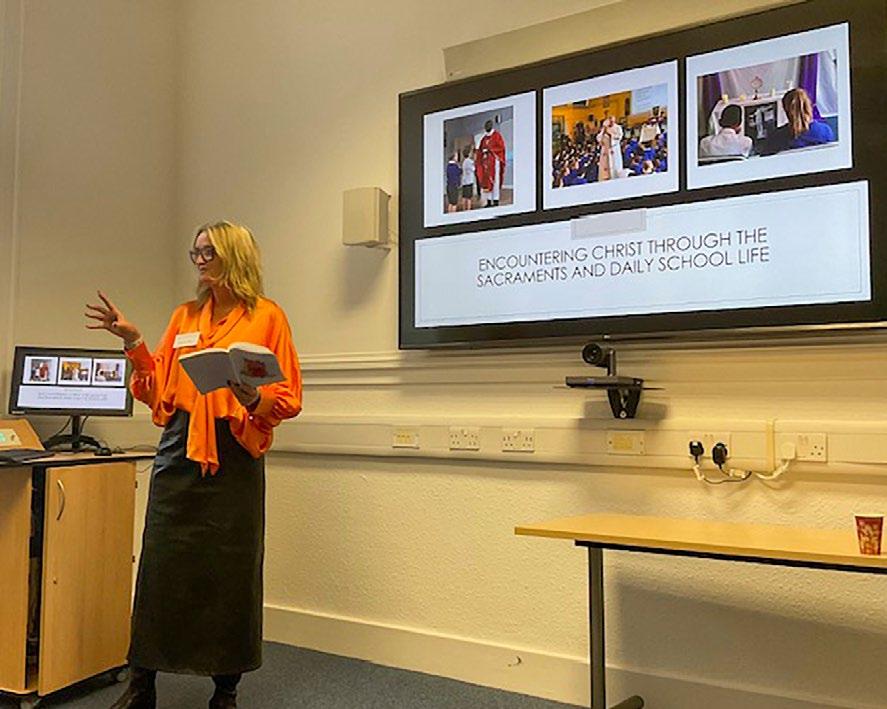
My presentation focused on the role of encountering Christ within the Catholic primary school setting, particularly exploring its impact on leadership at all levels. I was pleased to receive positive and constructive feedback from a faculty member whose earlier presentation I had found both insightful and thought-provoking. This exchange was not only encouraging but also reinforced the value of such academic forums, where feedback is
offered in a respectful and supportive manner, providing a reassuring environment for all participants.
The conference provided an intellectually stimulating environment that fostered both critical dialogue and personal growth, a testament to the transformative power of such academic gatherings. The questions raised during the sessions were thoughtful and conducive to deepening my research, and the collegial atmosphere made it clear that the event was designed to both nurture emerging scholars and honour established experts in Catholic research. Reflecting on the experience, I found it to be instrumental in refining my research focus and enhancing my development as a researcher.
For those who may feel apprehensive about presenting their work at such events, I highly recommend participating in the NfRCE conference. It offers an invaluable opportunity not only to share and refine one’s research but also to engage with a supportive and intellectually rigorous community.
It’s not uncommon for adverts for the headships of Catholic schools in England and Wales to go unanswered. The biggest challenge we face in Catholic education is finding enough “practising Catholics” to run our schools and Catholic multi academy trusts (CMATs), our RE departments and chaplaincies.
Is the tide of faith ebbing away and about to take our schools with it? With the falling away of Church attendance and what might be termed the “Catholic culture”, the pipeline of leadership seems to be drying up in some places. The Catholic Education Service’s Formatio initiative is doing its best to coordinate the formation of next generation of Catholic leaders, but is it too little too late?
Let’s not get too gloomy. The Holy Spirit is active in the Church and the world. When I visit Catholic schools, I meet inspirational Catholic leaders. They may not be as plentiful as in previous generations, but they seem committed to a vision for Catholic education which is more in tune with the recent teaching of the Church.
The rise of Catholic multi academy trusts has been the most significant development in Catholic education in England (they have not been introduced in Wales) since the 1944 Education Act, when most Catholic schools joined the state system as “voluntary aided” schools. This in turn was the most significant moment in Catholic education in England and Wales since the restoration of the hierarchy in 1850, when the bishops decided to build schools, even before churches, to give the Catholic poor the dignity of an education.
Are MATs a challenge for the Church – or an opportunity? When I became the CEO of what was then one of the largest Catholic MATs in the country, I was no great advocate for academies or MATs.
My commitment was to Catholic education and this particular collection of Catholic schools was in trouble. When I left, with the MAT in much better shape thanks to the efforts of many good people, I had become convinced that, if we get this right, the MAT structure will secure the future of Catholic education in this country and allow us to be the beacons of hope and social justice we are called to be, with the capacity to resolve those recruitment challenges.
Dioceses in England are now building CMATs at pace and at scale. Some dioceses are planning for CMATs of 60 schools or more. They could have 20,000 pupils and a budget of £60m. Think of a CMAT as one big school under one board of trustees/directors, which provides education on multiple sites. That is a significant civic footprint under shared governance, an opportunity to provide not just an excellent education but to contribute to the re-weaving of the social and spiritual fabric of the community, working in conjunction with the diocesan Caritas agency, Cafod and Catholic charities such as the SVP.
As well as an opportunity there is a danger here. The “temptation”, in Catholic language, is to be drawn into the corporate model – the neoliberal model, if you like –which is driven by competition, efficiency, outsourcing and measurable outcomes above all else. (We should also acknowledge that stand-alone schools are susceptible to the same temptations: witness the exam factory ethos, the practice of off-rolling, the refusal to accommodate the needs of children with special educational needs.) The larger a CMAT becomes, the more distant the leadership could be from the classroom, the playground, the lunch hall. We also need to be mindful of the impact on morale of the very large salaries being paid to the top tier of leadership and a widening gap between the lowest and highest paid.
By Raymond Friel
Only with a fierce commitment to the development of Gospel-inspired Catholic leadership, in the executive and nonexecutive, will these CMATs have any chance of bearing witness to our story, the Gospel of God, which begins with good news for the poor. Under such leadership, we could build in effect Catholic local authorities, which place the dignity of the person at the heart of what they do, who have a vision for society based on solidarity and the common good, living well together in our common home. The system is immature and the evidence is mixed, but I saw enough to believe that getting a grip on school improvement at scale inspired by Gospel values will allow us to fulfil our mission to form agents of change for the common good.
The one principle of Catholic Social Teaching I haven’t mentioned yet is subsidiarity. Some people get excited about subsidiarity when they think it’s their best argument not to lose control of their school in a CMAT. Subsidiarity is important, but all of the permanent principles of CST must work together: the dignity of the person, the common good, solidarity and subsidiarity. When I was CEO of a CMAT, we had one primary school in a middle-class area which was oversubscribed, musical instruments for every pupil, immaculate uniform, two TAs in every class. Twenty miles away, we had a primary school that served a local estate, the ‘east end’ if you like. Undersubscribed, an open door for the local authority to place all its challenging pupils, no musical instruments and TAs
off with stress. The headteacher of the middle-class school had little interest in freeing staff or paying more to help the other school, but this is exactly the point of solidarity in a CMAT. Stronger together.
With the 1944 Education Act and then state-funded access to higher education, working-class Catholic kids, myself included, were able to join the professions and complete a generational shift from working-class by birth to middle class by education. Did those generations of educated Catholics bring a prophetic Gospel-inspired voice into the public square? We should never underestimate the effects of holiness as a “leaven” in the world, or the impact of charitable activity, but for the sake of provocation, I’d say that mostly we just blended into the society, enjoyed getting close to power, comfortable with the fruits of our labours, unable and unwilling to speak out against the status quo. But then the point of those schools was never to create cohorts of social justice warriors, but educated Catholics and good citizens.
Vatican II’s Declaration on Christian Education began a new chapter. Young people were to be formed in the values of the Gospel, “to do their best to promote the common good” which is a lot more ambitious than just being a good citizen. There is also an acknowledgement for the first time that Catholic schools are not just for Catholics but are welcoming of all students, “especially in caring for the needs of those who are poor in the goods of this world or who are deprived of the assistance and affection of a family or who are strangers to the gift of Faith”.
Our state Catholic schools today are still, according to our admissions policies, first and foremost for Catholic children, although the numbers are tracking down. 42% of the pupils in our schools – around 344,000 – are not Catholic, and there has been a 10% decrease in the last five years in the numbers of Catholic children in our primary schools. This should not lessen our commitment to Catholic schools. For Catholic pupils, the Catholic school will always provide the additional experience of catechesis, and for the less engaged Catholic pupils, or those from other faiths or none, the Catholic school offers an encounter with the Gospel and its values. It’s no longer about just educating Catholics out of poverty, but educating and forming young people – Catholic or not – with a vision for the transformation of society.
This new vision of Catholic education, like any shift in the Church, takes time to take hold. It was developed in the decades after the Council by the publications from the Congregation for Catholic Education in Rome, beginning in 1977 with the landmark document, The Catholic School. Here we find the vision of the Council elaborated in much more detail. The purpose of a Catholic education was not just to do well in life, but to serve others: “Knowledge is not be considered as a means of material prosperity and success, but as a call to serve and to be responsible for others.”
This is the Catholic version of aspiration: yes, work hard, get your best grades, learn your skills, be creative, get a job, so that you can be the person God wants
you to be, formed in Gospel values with a moral compass and a compassionate heart for service and solidarity, especially with people who experience poverty. In Laudato si’ Pope Francis extends our understanding of the poor to include the earth itself, degraded by rapacious consumer demand. It is the cry of the earth and the cry of the poor we must attend to, because the poorest people on earth are the most affected by a climate crisis to which they contribute the least.
The new Catholic Schools Inspection framework in England and Wales has taken up the story of this evolution and prompts us to develop an education marinated in Gospel values. To be considered an outstanding Catholic school – whether or not we will follow Ofsted’s lead and abandon single word judgements – the leaders in a Catholic school must “embody the Church’s preferential option for the poor by ensuring that resources are consciously and effectively targeted at those in greatest need … In every one of their decisions they demonstrate an exemplary commitment to care for our common home, to the pursuit of the common good and to service of those in greatest need.”
This also applies to the curriculum. When I started teaching in Catholic schools 35 years ago, there was little explicit connection between the content of my lessons and the mission of the school, even when I was teaching An Inspector Calls. Now, in an outstanding Catholic school, the whole of the taught curriculum, with religious education at its core, must be “a coherent and compelling expression of the Catholic understanding of reality”. The Church has been encouraging us in this direction for many years. The 1977 document refers to “the art of teaching in accordance with the principles of the Gospel”. Finally, our schools have embarked on the project of making this a reality.
It's a daunting project in some respects, especially when the numbers of Catholic teachers in our schools are decreasing. The ”way in” for them, I’d suggest, is Catholic Social Teaching. A teacher who is not a Catholic but is willing to support
the mission of a Catholic school, will understand the dignity of the human person and the common good. The challenge and opportunity is to use examples and context questions in the curriculum which bring the topic of the lesson into conversation with a Catholic vision of reality.
The final dimension of this evolution is to develop social action in the schools in ways which form agents of change. One current model of social action is summed up by James Trewby, Columbans UK’s Justice, Peace and Ecology Coordinator as, “Oh no, something terrible has happened, let’s have a cake sale.” I’m certainly not against cake sales, but it’s not the best model of formation for social justice. Over the last six decades, while we have tried to shift the dial from compassion to compassion with justice, we have not followed that up by developing the practical methods of doing justice.
Our default is to feed the poor and not, as Helder Camara said, ask why they are hungry in the first place. Pope Francis makes it clear that this is integral to our faith in action. In a key passage in Fratelli Tutti, he says, “Solidarity means much more than engaging in sporadic acts of generosity. It means thinking and acting in terms of community. It means that the lives of all are prior to the appropriation of goods by a few. It also means combatting the structural causes of poverty, inequality, the lack of work, land and housing, the denial of social and labour rights.”
Having largely failed to develop the tools to do justice, we turn to other partners like Citizens UK because they have a method of seeking justice and an infrastructure to deliver it, a systematic approach to training people in community organising, in understanding how to find out what’s troubling people, where is the power in the community to make change happen and how can we get into the room and round the table with power to advocate for change. We haven’t invested enough in our own model of that and so we either turn inwards and dismiss such action as political, or have to turn outwards and
work with people of goodwill who have beaten this path before us.
Using the techniques of community organising, the pupils of two Catholic schools in the east end of London, St Bonaventure’s and St Antony’s, campaigned for the living wage in their own communities. It started with a heartbreaking story of a boy who wrote in his school planner, “My mum is dead”. The concerned staff spoke to the boy and soon found out that what the boy meant was that because he never saw his mum, she might as well be dead. She was a single parent and worked three jobs to feed and clothe him and his siblings. This inspired the foundation of TELCO, the east London chapter of Citizens and a remarkable campaign to successfully influence the corporate employers in the city – beginning with Barclays Bank – to pay their cleaners a real living wage.
In a stand-alone Catholic school system, there are a variety of approaches to Gospel values, or virtues, or both, or neither. In a CMAT system, there is an opportunity to develop a coherent and shared approach to Gospel values and the virtues they inspire. There is the capacity for a strategic approach to talent spotting, to identify, encourage and form the next generation of Catholic leaders. With CMAT leadership rooted and grounded in the Gospel, there is an opportunity for an outstanding Catholic education to include a vision for social justice at all levels of governance, in the curriculum, and in transformative action in the community to build solidarity and justice; to form young people, in the words of St Pope John Paul II, as “witnesses and agents of peace and justice”.
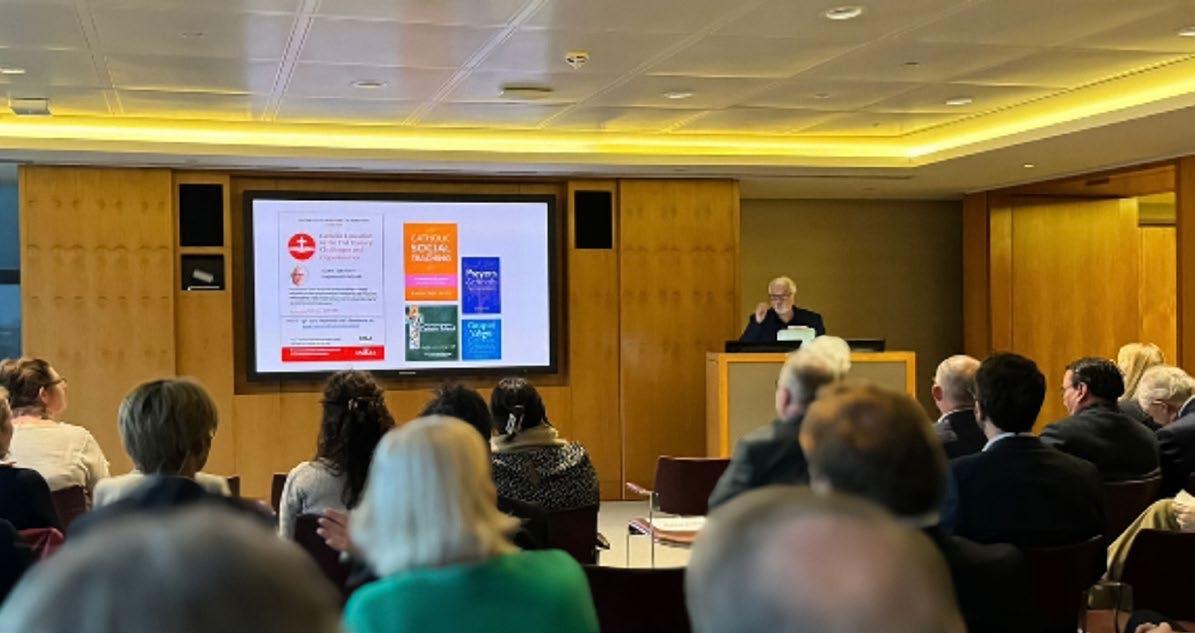
This article first appeared in The Tablet on 9 November 2024. It is an abridged version of The Tablet lecture delivered at CCLA in London on 16 October 2024.
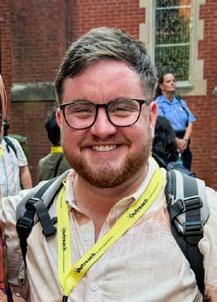
By George White
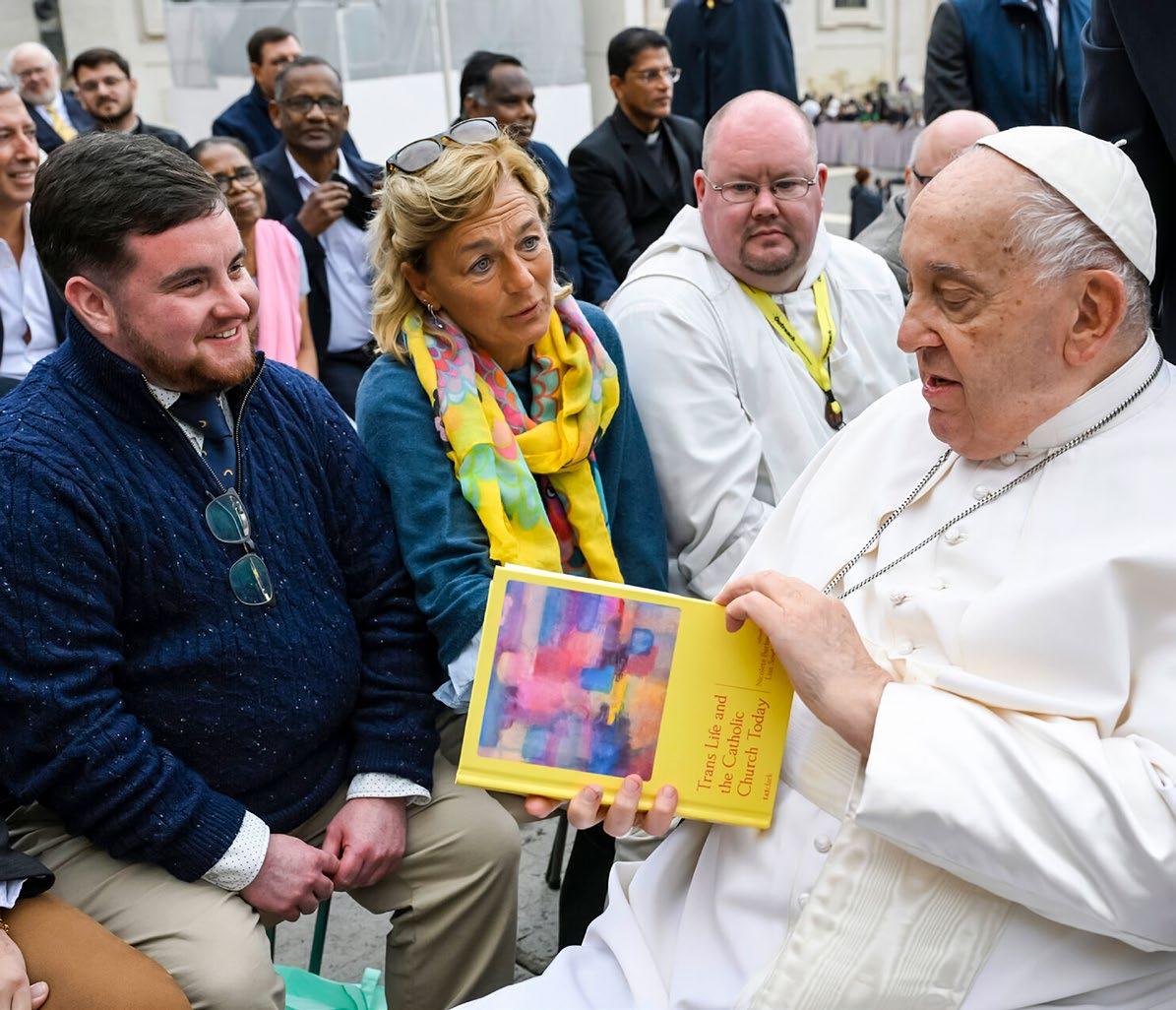
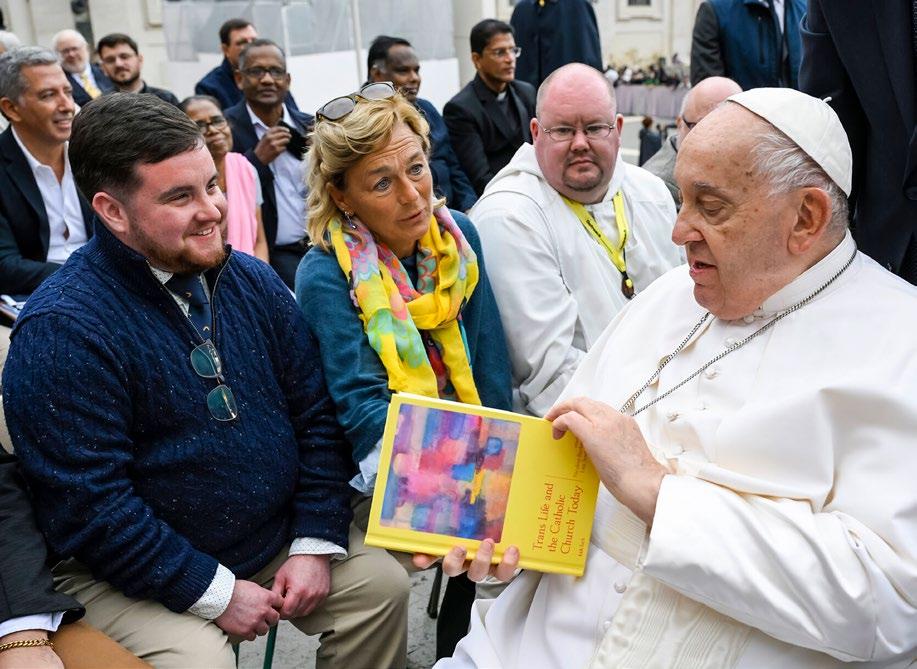
At the Outreach Conference in Washington DC, I met four other transgender men I had been connected with online as part of a small community exploring vocations in the Catholic Church. At the conference, the final talk was about Vatican news for LGBT+ Catholics. It is there we heard more about the ministry of Don Andrea Connochia, a priest in Torvaianica, who has fostered a relationship between the transwomen in his parish and the Holy Father. He brings them with him every so often to meet the Pope at the papal audiences on Wednesdays whilst providing much needed support in his parish during the time in between visits. Our group met with him at the conference, and he arranged a visit for us too.
Andrea informed us that the Pope was aware he would be visited by four trans men, all of whom are working in their own way to help others live out the call to accepting trans people within the Church following the Pope’s clarification after Dignitas Infinita, distinguishing between gender ideology and trans people.
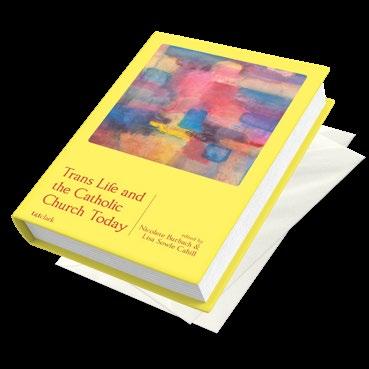
At the audience, I was able to hand over a copy of ‘Trans Life and The Catholic Church Today’ edited by Nicolete Burbach and Lisa Sowle Cahill to which I contributed a chapter exploring LGBT+ Inclusion in UK Catholic Schools. The Pope was told there were also some letters inside the book which thanked him for his pastoral ministry towards us. The Pope took the book, looked at the envelope containing the letters, thanked me and blessed me.
The significance of this public sign of welcome is important; a visible sign that everyone has a place in the Church and their stories are worth sharing.
Raymond Friel’s recent Tablet Lecture and subsequent article Stronger together, with its emphasis on the efficacy of Catholic Social Teaching to inform and transform the way we present our faith to the young people in our Catholic schools, is music to the ears of this Catholic educator turned reflective social activist. ‘Turned’ is this instance simply refers to a change of emphasis in responding to the call to bring the Good News to the poor.
It gladdens the heart to hear a prominent Catholic educator, drawing upon the Vatican II vision, developed over the following decades, offering a more inclusive, socially focussed mission which is described as welcoming all students “especially in caring for the needs of those who are poor in the goods of this world… or are strangers to the gift of Faith.” (Declaration on Christian Education) Whatever the faith position or social status of students there is an expectation that the school will place the dignity of the person at the heart of what they do, with a vision for society based on solidarity and the common good, living well together in our common home.
The writer offers a glimpse of his vision for our schools by proclaiming that school improvement inspired by Gospel values will allow us to fulfil our mission to form agents of change for the common good. The ambitious challenge he describes is to educate and form young people with a vision for the transformation of society; echoing Pope Francis’ “An authentic faith - which is never comfortable or completely personal - always involves a deep desire to change the world, to transmit values, to leave the earth somehow better than we found it” ( Evangelii Gaudium, par. 183).
In spite of a residual distaste for any document labelled Inspection Framework, it is interesting to find that even this beast is capable of being evangelised. I am happy to take Raymond Friel’s assurance, without going to its sources, that the Catholic Schools Inspection Framework for England and Wales states that to be considered an outstanding Catholic school (its leadership) must embody the Church’s preferential option for the poor…to the pursuit of the common good and to service of those in greatest need.
It means that the lives of all are prior to the appropriation of goods by a few. It also means
combatting the structural causes of poverty. In spite of this more compassionate intent, the author admits that schools remain short of practical methods of doing justice which amount to more than sporadic acts of generosity. He insists that to address our own shortcomings we need to look outwards to people of goodwill as potential and experienced collaborators, quoting two London East End who work with Citizens UK with significant success.
My own experience of working with families in need as a headteacher, knowing the frustration of never being able to meet those needs, on retirement I moved seamlessly into working with a local family focussed charity that had collaborated in offering that additional support. I have been privileged to have been able to work closely with like minded organisations to establish the West Cumbria Child Poverty Forum which I have the pleasure of chairing. Our experience over the last fifteen years ranges from, at the beginning having a realistic expectation of witnessing a decline in numbers to where we now, finding ourselves back to where we started, is distressing in the extreme. In a recent presentation I took my audience back to the Beveridge Report of 1942, that inspired the establishment of the welfare state and the NHS, I offered this telling quote:
“that government should work to abolish the ‘Five Great Evils’ which plagued society: Want, Disease, Ignorance, Squalor and Idleness. The Report set itself out merely as the first step down the road of ‘social progress’ to a society free of these evils.
In a recent article in the Observer, Will Hutton, echoing Beveridge, while writing about inequality said this: “Accelerating from the financial crisis (2008), wealth inequality casts a shadow over all our lives, affecting health, housing, education, productivity, enterprise, the media and the vitality of our democracy.” (The Observer 20.10.2024 p47) A deeply disturbing but realistic commentary on the prevailing social state of our country.
Poverty intrudes into all facets of a child’s life and is the lens through which they perceive the society in which they live. The magnifying element the inequality, that Will Hutton focuses on, lies at the heart of the alienation felt by those ‘left behind’. We are no longer a society
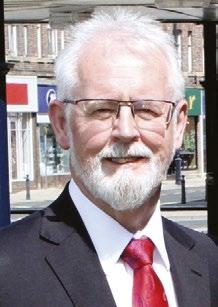
By Willie Slavin MBE
that could boast of being, like 1942, ‘all in this together’.
One of our Forum’s most illuminating studies, examining tenant dissatisfaction with a local Housing Association, revealed a graduated decline in service as the government of the day demanded a more business oriented model with an emphasis on efficiency and profit, at the consequential expense of service. The all too obvious conclusion was that a relational service based on tenants’ needs built upon a level of mutual trust had become coldly transactional. The utter debasement of the term ‘service’ that we would recognise as a Gospel inspired virtue. Observing the same pattern across all government departments goes a long way towards explaining why a sizeable portion of children are living in families suffering from the effects of poverty with no obvious means of escape. What is also becoming increasingly obvious is that many schools, primary and secondary, have become frontline agencies for families in need. This phenomenon emerged during the pandemic and has highlighted the value of schools as key social agencies. We are finding that local schools are joining the Forum allowing them to engage with voluntary sector providers and collaborating to the mutual advantage of both organisations.
Catherine Mallard, Headteacher of St Begh’s Catholic Junior School , Whitehaven offers this insight into how her school has seen and responded to this developing situation.
Before the pandemic, austerity cuts had already meant that schools were taking on more and more support roles previously provided elsewhere, e.g. school nurses, educational welfare officers, family support workers. The pandemic came as a big wave on top of that and left its mark on many in a whole host of ways.
We see a very significant proportion of children living between split parents; children living in homes where they see unsafe, unstable relationships; rises in diagnoses of autism and ADHD and a noticeably ever-growing number of children displaying forms of anxiety. Add poverty into this mix and we sometimes wonder in school how these children come in and function as well as they do (even those who don’t manage to keep it in all the time).
It is impossible not to have these challenges front and centre in our decision
making at school. These pupils are always the focus. This is no zero-sum game, however. Approaches that benefit these children benefit all. Through implementing the ‘preferential option for the poor’ at our school, we model the world we should live in to all of our pupils. I’m proud to say that most of our pupils have an innate understanding that some of their peers just need something different or simply need more. Very rarely do we hear children bemoaning or declaring that that is unfair and when they do, they are soon put right by their peers. Of course, we are very careful when this ‘more’ is something material, directly aimed at alleviating poverty, but even then, it has been known for recipients to be open about this with their accepting friends and quite rightly demonstrate no stigma or shame.
In this environment, I have also experienced a real coming together of local schools. Professional doors are open, and resources, efforts and learning are shared. Participation in the West Cumbria Child Poverty Forum is one arena where there are opportunities to be ‘stronger together’, but uniquely, not just with other schools – here networking is wider, and we build links with the third sector and arts groups for example as well as getting an insight into the ambitions of a newly formed unitary authority.
As we begin to prepare our school for the Jubilee Year with its dedication to hope as the antidote to the despair that can easily take over in current times, I feel lifted by that sense of being part of the global community. Then, today, I have stepped back and reflected on our own little corner of the world and feel that lift again, taking the time not normally taken to appreciate the ‘stronger together’-ness I have experienced in my own community.
(Catherine Mallard December 2024)
At a time when there is a tendency to polarise debate in the public realm, one of the strengths of the Forum has been its provision of a safe space where all interested parties, including schools, can dispassionately discuss the many related issues that require careful consideration.
As a model for our roundtable gatherings, we have adopted the advice of the Moderator of the Church of Scotland, Rt Rev Sally Foster-Fulton, who, in a homily at the Service of Thanksgiving and Dedication held at Edinburgh's St Giles' Cathedral for the Presentation of the Royal Honours of Scotland to King Charles III in July 2023,
spoke of an inclusive vision for how as a community:
• When we gather to commit to better understand the common good of all the people, what we learn, when we listen to one another that is, listen to understand not just respond; is extraordinary.
• Those among us who humbly seek to understand the complexity of the issues facing us have a deep awareness that no one alone has all the answers. Those are the ones who call us together to search for answers that elude us when we search from our one limited perspective.
• We can choose collaboration and trust over a fear-filled circling of our wagons.
• There is no ‘them and us’ only ‘US’ and when one human being suffers, we all suffer.
No one organisation can do this on their own. None of us has the whole answer but we all have part of it to share, to learn from each other and begin to join-up, filling the gaps. We seek new ways of working in a spirit of trust, engagement and collaboration. Our network already engages with all the statutory services with an interest in children’s wellbeing.
The outward facing Forum has developed strong working relationships with both local and national government through our recently established Unitary Local Authority and with our MPs from two adjacent constituencies. Our collective reports are being made available to the Government’s Tackling Child Poverty: Developing Our Strategy Review through our MPs and by our engagement with its Consultation process.
Poverty in this country exists as a result of government decision making. It is systemic rather than accidental. Encouragingly however, what has changed for the better is the mood, fuelled by a determination at both local and national government levels to halt the decline; seek an acute understanding of the problem and to ensure that life chances for our children and young people are systematically and systemically improved.
Willie Slavin writes as Chair of the West Cumbria Child Poverty Forum. The Raymond Friel Tablet article to which this article refers is printed in full on pages 1214 of this issue of Networking.
“Crises are also windows of opportunity,” says Pope Francis in the reader for Laudato Si’. While he was addressing global ecological, social, and healthcare crises, many might argue that a crisis also exists within the Christian community in the UK: a widespread lack of familiarity and knowledge of the Bible.
Where should the Bible be taught?
While many would suggest the home and parish as primary settings, the third pillar of the "educational trinity" is, of course, the school. Although scripture-based lessons have long been a part of Catholic education, there has been a noticeable shift away from in-depth scriptural study in recent years. For instance, the Mark’s Gospel option at GCSE is chosen by only a small number of students, and the former John’s Gospel option at A Level - now widened to the ‘New Testament’ option - is notably offered by just one awarding body, and only taken by small numbers.
The scripture focus in schools has often been limited to the life, miracles, and parables, of Jesus. While these aspects are undeniably significant, they represent only a fraction of the rich and diverse scripture that has shaped and guided the Church throughout its history. To foster a deeper understanding of faith, Catholic education is now being prompted to embrace the broader scope of biblical texts that underpin the Church’s teachings and mission.
Amazingly even staunch critics of Christianity, such as Richard Dawkins, have highlighted the importance of scriptural and biblical literacy. In The God Delusion, Dawkins points out 129 biblical phrases commonly used in everyday English, many of which people may not realise originate from the Bible. These include expressions like the salt of the earth, no peace for the wicked, and how are the mighty fallen. Dawkins also supported Michael Gove’s 2012 initiative to place a copy of the King James Bible in every school, calling it “a great work of literature.”
The Religious Education Directory (RED)
The Religious Education Directory (RED), launched in January 2023, addresses the role of scripture in Catholic education in a variety of ways. It emphasises that scripture is not an isolated subject, but a foundational element that shapes the identity and mission of Catholic education. Its centrality helps students better understand their faith, acting as the cohesive thread that binds the entire curriculum with coherence and unity.
The RED also highlights the formative purpose of scripture, aiming to deepen students’ understanding of the mystery of God, the life of Jesus, and Church teachings. It seeks to nurture intellectual and spiritual growth, enabling students to engage with faith and life in meaningful and transformative ways. Furthermore, scripture is positioned as a tool for dialogue, allowing students from diverse backgrounds to explore the Catholic faith alongside other religious and secular perspectives.
Overall, it is clear that the new RED takes an approach that aligns with the Church’s broader educational mission: a scripture-based education that integrates intellectual rigor with faith formation, fosters virtues, and encourages personal growth modelled on the example of Jesus Christ.
Many teachers have felt daunted by the challenges posed by the new RED. However, a variety of resources have been developed to support them, including OUP’s Source to Summit series, which I have had the privilege of contributing to. The approach to scripture under the RED marks a significant departure from previous practices and even goes beyond the requirements of GCSE studies.
I would describe this new approach as holistic rather than tokenistic. The RED calls for a deeper engagement with scripture, emphasising a thorough understanding of the text, including its context and meaning. This is a shift away from simply memorising a quote or story to "back up a point," instead fostering a more profound exploration of scripture’s relevance and significance.
In conversation with others
David Bayliss, an executive committee member of the Association of Teachers of Catholic Religious Education (ATCRE) and a leader at Holy Trinity Catholic School, expressed his belief in the centrality of scripture in Catholic education. He explained: “Scripture must be at the heart of what we teach, as understanding scripture helps students comprehend God’s love and the sacrifice and mission of Christ. By engaging with scripture students shape their understanding of the beliefs and doctrines of the Church as well as concepts such as grace, redemption, and the nature of God. It is in scripture, particularly the Gospels where students encounter Jesus and it is that encounter that deepens their faith and guides them in how to bear witness to their faith.”
By Andy Lewis
The work of the RED has also sparked significant engagement between teachers and those involved in education beyond the classroom. Professor Bob Bowie of Canterbury Christ Church University has long advocated for a hermeneutical approach to teaching scripture. He believes the RED represents a profound shift in educational practice: “Rather than focusing on summaries, teaching the Directory invites teachers and schools to step into a deeper relationship with the text, and therefore with knowledge itself. No longer can the Bible be seen merely as a collection of proof texts for debates or arguments. Now, the full literary and revelatory potential of Scripture is a central focus.”
Professor Bowie highlights a secondary shift that follows from this change: “By engaging with this extraordinary book, which carries a thousand years of discernment and reflection by communities of faith, we see a deeply Tradition-focused approach to the subject. It reconnects the subject with the faith communities that were the very soil of the Bible. It also invites schools, classes, and pupils to add their own contextual reflections to those layers of tradition.”
Dr Margaret Carswell, in collaboration with Dr Nancy Walbank, is actively supporting the implementation of the primary RED through the development of OUP's Source to Summit: Lighting the Path resources. Dr Carswell highlights the urgent need for a significant shift in Catholic education, driven by a "perfect storm" of challenges - or ‘crises’ as Pope Francis may say. This includes a declining number of practising Catholics, limited teacher knowledge of Catholic traditions, and changing demographics in Catholic schools.
She emphasises the importance of placing scripture at the heart of religious education. As she explains: "The Bible becomes the primary source, not merely a support for a predefined list of social or doctrinal topics, as it has been in the past. If we want pupils— of any faith or none—to understand what Catholic communities consider foundational to their mission, the Bible, and especially the Gospels, provide the answer."
Dr Carswell underscores that this prioritisation of Christ’s life aligns with the Church’s liturgical traditions and is a cornerstone of the new RED. She also notes that this approach addresses the issue of "scattergunning" content without a coherent framework for learning, offering students a clearer and more focused foundation for understanding Catholic teachings.
Additionally, Dr Carswell cites the importance of redressing wider misinformation about how the Church reads
and understands the Bible. As she says, “Often critics of Catholicism think they know what Catholics believe about the Bible and how they read it – but they are generally wrong. While other Christians are sometimes limited in attempting an analysis that the Church considers necessary in coming to it’s meaning.”
In working out what teachers need to do, Dr Carswell is direct: “Students need to be able to do two things: understand what the Church expects and feel confident in doing it. That means that their teachers need to be able to do this before we even start.” The advice she provides can be summarised below:
• Avoid citing fragments of texts
• Provide context information
• Don’t amalgamate multiple authors' words
• Try to avoid moving from author to author - every author has their own set of contexts, and every piece of writing has its own literary form and features.
Dr Carswell finished my conversation with a key point about the whole process of putting scripture at the heart of the RED: “The Church is very clear that analysis of passages should never adopt a secular, philosophical hermeneutic, which makes scripture simply an ancient text which teaches some generic moral or behaviour. What characterises Catholic exegesis is that it deliberately places itself within the living faith of the Church. Catholics believe that the Holy Spirit inspired the authors: it makes sense then that they also believe that the Holy Spirit guides the interpretation of the authors’ words. The task is not finished when we have simply determined sources, defined forms, or explained literary form and feature. We arrive at the true goal of our work only when we have positioned the text in ways that are open to a genuine encounter with God”
ATCRE’s David Bayliss suggests a threefold approach to teaching scripture effectively:
1. 1. Elevate Scripture – Encourage students to use an actual Bible rather than simply copying passages onto worksheets or PowerPoint slides. The Bible is the Word of God and should be treated with the reverence it deserves.
2. Provide Context – Before reading a passage, offer a brief summary or introduction that includes relevant historical background. This helps students grasp the context of the scripture.
3. Read More – Avoid focusing on a single
verse. Encourage students to read broader sections of scripture to uncover deeper meanings, which promotes a fuller understanding and proper interpretation of the text.
Andrew Capone, fellow ATCRE executive committee member and teacher at St Simon Stock School, also emphasized the importance of scriptural interpretation as a fundamental skill in Religious Education. He advocates for dedicating sufficient curriculum time to teaching discrete lessons on interpreting scripture.
It is fitting that ATCRE has chosen the theme “Scripture at the Heart” for their National RE Conference, scheduled for Saturday, 1st March 2025, at St. Thomas Aquinas Catholic School in Kings Norton, Birmingham. The event is designed to provide practical support to Catholic RE teachers in delivering the RED in an engaging and effective manner. The conference will feature a range of keynote speakers, including Professor Bowie.
Another prominent speaker at the ATCRE conference is Brenden Thompson, Program Director for Word on Fire UK and a trustee of the Bible Society. Thompson will also host his own conference in February 2025 in London, which will be attended by Bishop Robert Barron. Like the ATCRE event, this conference will focus on the Bible. Word on Fire emphasises the need for Catholics to adopt “a genuinely Catholic approach: reading it within the context of the great and beautiful chorus of voices from across the centuries of the Church’s tradition.” Both events underscore the renewed emphasis on scripture as a cornerstone of Catholic education and the broader effort to equip teachers with the tools and perspectives needed to bring scripture to life in the classroom.
“Ignorance of the Scriptures is ignorance of Christ,” proclaimed St. Jerome. Over the past 50 years, Catholic education—and indeed the broader Christian community— has faced a potential crisis in scriptural engagement. However, there now seems to be a pivotal moment in which scripture is being restored to its rightful place at the heart of Catholic schools and the Church itself.
OUP’s Source to Summit Year 7 and Year 8 books have already been published, with the Year 9 book due in January 2025. Source to Summit: Lighting the Path for students aged 4 to 11 will be available from June 2025 (Infant) and June 2026 (Junior). Source to Summit includes additional scripture-specific resources, within its Kerboodle platform.
Any reading of Church documents on education shows that the mission of Catholic schools is to offer an education based on Christian values, especially the value that all life is God’s gift. This means that Catholic schools are communities called to communicate God’s love for humanity through everything they do. Education in a Catholic school is not just education for the sake of it; rather it is for enabling young people to acquire skills necessary to live life in a certain way.
In other words, education is an avenue for preparing individuals to build the kingdom of God here on earth, and to make contributions for the benefit of society. Schools therefore have an important role, duty, and responsibility of instilling in young people virtues needed for a just society. It is in this context that the Oscar Romero Award fits in with the aims of Catholic education.
The Oscar Romero Award was initiated by Oaklands Catholic School and Sixth Form College – Waterlooville (Hampshire) in 2015 in partnership with six other schools; St Edmunds Catholic School - Portsmouth, St George Catholic College - Southampton, Bishop Challoner Catholic Secondary School - Basingstoke, St John’s Cathedral Catholic Primary School - Portsmouth and St Thomas More’s Catholic Primary School - Bedhampton. Teachers and chaplains from these schools met to discuss the impact their schools were having on both students and staff. They were reflecting on this in the light of the call to Catholic schools to be places where faith is put into action so that it can illumine society. They all recognised that there was little in the Catholic sector, other than Section 48 Inspections, that helped schools evaluate how well they were being faithful to their Catholic distinctiveness. From this initial meeting, it was felt that one way of making Catholic schools distinct was by focusing on human dignity and social justice as taught
in Catholic Social Teaching. This was the genesis of the Oscar Romero Award, a tool developed by members of Catholic schools, to help them actualise the Catholic Church’s teaching on the aims of Catholic education.
The aim of the Oscar Romero Award
A. To recognise and celebrate all that a school does as a Christian community that enables individuals in that community and beyond to live life to the full
B. To challenge a school community to continue finding ways of being ‘good news’ to all in their community and beyond
The Award uses the lens of CST principles to help schools evaluate their Catholic distinctiveness.
1. Respect for Human dignity: The Award asks how the policies and practice in schools promote the equal value and worth of each person – created by God in his image and loved by him.
2. Solidarity: The Award asks how schools are promoting integral human development, understanding that the good of every person is linked to the good of all, and is cultural, economic, political, social, and spiritual.
3. The common good: The Award asks schools to show how they demonstrate that the fruits of the earth belong to everyone, and that no one is excluded from the gifts of creation. How does the school support all staff and students to access what they need to flourish and experience life to the full?
4. The option for the poor: The Award asks how schools are implementing the gospel mandate to care for those who are disadvantaged, vulnerable or in any kind of need, locally as well as globally.
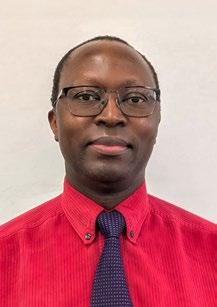
By Mugeni Sumba Coordinator for the Oscar Romero Award Trust
"I was born in Kenya and after early education in Kenya and Uganda, I moved to the UK in 1997 to study Theology at the Missionary Institute London as a member of the St Joseph’s Missionary Society (Mill Hill Missionaries). As part of my studies, I worked in Kenya, Uganda, Pakistan and here in the UK. On completion of my Theology studies, I did my PGCE at Liverpool Hope University and was appointed to teach Religious Education at Oaklands Catholic School and Sixth Form College in 2004.
In 2014, I started a conversation with a number of colleagues in Catholic schools as well as CAFOD on how we can support Catholic schools celebrate their identity as well as challenge them to be more active in supporting Catholic Social Teaching. This was the beginning of the Oscar Romero Award for Catholic Schools. The Award is attracting many schools across the country and is recognised by The CES as a good way for schools to celebrate their Catholic identity. I am the Coordinator of the Award."
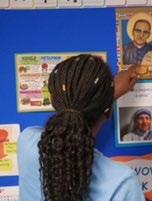
5. Subsidiarity - is the principle that decisions should always be taken at the lowest possible level or closest to where they have their effect. The Award asks how schools are promoting participation and engagement by pupils and staff in the life of the school.
6. Peace: The Award asks how schools are promoting reconciliation and forgiveness, and targeting unconscious bias in their own community, as well as cultivating an awareness that a culture of global non-violence needs to begin with each person
7. Stewardship of creation: the Award asks how the school is promoting integral ecology, that is, the interconnectedness between humanity and the natural world, which impels us to protect the Earth, our common home, for the wellbeing of all.
8. The dignity of work: The Award asks how schools, as places of work, are enabling all their staff to enjoy their work and utilise their skills, by treating them with dignity and respect, and providing just wages, development opportunities, and good working environments.
9. Rights and responsibilities: the Award asks how schools are promoting not only the human rights of every person to the basic necessities that are required to live a decent life, but also the responsibility of everyone to respect the rights of others.
Structure
The Award has three strands that focus on the 3 key areas of a school and their interconnectedness, especially in a Catholic school.
Strategic – this strand helps schools to put Catholic Social Teaching at the heart of the decision-making bodies of the school. It asks whether CST guides the school’s vision and has a direct impact on the culture of the school. CST guidance
inspires and supports the school community to reflect upon their role within the wider community. How does CST empower school staff and students/ pupils to live a life of evangelisation?
Curriculum – this strand focuses on what happens in the classroom. It asks whether students/pupils actively learn about Catholic Social Teaching in their lessons across the curriculum so that they can gain a holistic understanding of the mission of the Church to enable all people to live life to the full. It seeks to ensure that the values of integrity and respect allow study in its fullest sense, encouraging students/pupils to connect with issues of social justice and enable them to recognise the practical steps needed to respond appropriately. This strand seeks to challenge schools to ensure that the curriculum they offer their students or pupils reflects and promotes the values of CST.
Practical – this strand asks how the whole school community, in faith and action, celebrates its dedication to living in solidarity with the poor, and so make a lasting commitment to the common good that ensures all people’s human rights are respected and they can live life to the full.
The Award is available at three Levels. Schools start at the basic level of participator and work their way through to the more challenging innovator level. There is no time limit for the first two levels. However, a school will need to renew its innovator level status every 3 years. At each level, the school is asked to evaluate how it shows the three strands above.
Participator Level – the school/college promotes CST principles implicitly. This is seen in some of the policies as well as through charitable work or support of charities. At this level, the school will self-assess to see what they already do – how are they living their mission as a Catholic community? Do they already take part in any social justice awareness or promotion activities?
Developer Level – the school/
college develops resources and starts embedding CST principles in its curriculum and policies. At this level, the school community is challenged to develop what they already do. The school develops an image that shows and identifies with the Church’s call of a ‘preferential option for the poor.’ What impact do these activities have on the school community?
Innovator Level – the school/college has fully embedded CST in all areas of its life and is actively working with other schools to promote CST principles. At this level, the school community is challenged to become fully alive, working to promote CST beyond the school – they have become an evangelising centre. The school actively changing the culture of its practice and life so that all its members see it as their duty to challenge inequality wherever they see it. The school’s commitment to CST is visible and its impact is tangible, measurable, and sustainable.
Here are examples of what some schools have said about participating in the Award.
Corpus Christi Catholic Primary School, Bournemouth: Innovator Level (Diocese of Portsmouth)
This school is the first school to achieve the Innovator Level of the Award (in November 2024). In their self-evaluation, the school said, “Participating in the Oscar Romero Award process has supported our school in enhancing our Catholic identity and distinctiveness as a missionary school. The award gave us strategic direction in planning provision for Catholic Social Teaching (CST) and supported us in our selfevaluation for the promotion of social justice across our community and beyond. Engaging with the Oscar Romero Award has motivated the school’s approach to develop a Gospelinspired curriculum which is influenced by CST. This has had a tangible impact on the virtue formation of our children, leading to their enthusiastic desire to participate in social action, both in the
local and global community through a range of pupil leadership roles and responsibilities. Through the support of the Oscar Romero Award, our school piloted two Social Justice Conferences for Pupils which were attended by fifteen schools, composed of Year 6 representatives and senior staff. The outcome of these conferences has had a ‘ripple effect’ across participating schools in developing collaboration and has inspired our school to continue the journey to highlight the Catholic mission in promoting and acting upon social injustices in the world. We would now like to further embed our work on CST so that it is incorporated more explicitly into the life of the school. We are also keen to continue our mission for outreach to promote social justice through hosting future conferences.”
The headteacher of the school, Simon Lennon said “We are delighted that our school has been awarded the Oscar Romero Award Innovator Level, a reflection of our commitment as a missionary school to develop outreach, working with other primary schools in our diocese and beyond, to advance Catholic Social Teaching. I would like to thank our children, parents, governors, staff and parish community, who made a significant contribution to enable our school to thrive as innovators of social justice.”
The Holy Cross School, New Malden: Developer Level (Archdiocese of Southwark)
“Our work on Catholic Social Teaching has been a fulfilling experience in so many ways. Students have felt proud to be ambassadors of social justice and CST in our school, and this has been nurtured by our focus in working towards the Oscar Romero Award. Since the beginning of our journey with the Oscar Romero Award, CST principles have been emerging organically and can now be seen in so many places in our school. Members of our community can articulate what the CST principles are, and this has directly sprung from our involvement with the Oscar Romero Award, which has challenged us to be proud of how we were living out and
displaying CST already and given our students and staff the catalyst to learn how to articulate this even more fully and integrate this into every part of our school life. Catholic Social Teaching has been presented in a positive, accessible way, giving us tools to articulate how the strands of CST weave through our curriculum subjects, as well as our charitable work. Our heritage, being founded by the Holy Cross Sisters, and our charism have been realised even more by the focus on CST with the Award, as our school values align with everything that is encompassed in CST. The Oscar Romero Award has given us the language to speak even more about where we have come from, where we are currently, and where we are going.”
St Therese of Lisieux School, Stocktonon-Tees: Participator Level (Diocese of Middlesbrough)
“At St. Therese, we instil a sense of belonging to our local community. We are clear to our pupils that we are part of a community and we provide opportunities for them to serve and support their communities. Being part of the Romero Award has allowed us to focus more clearly on 'why' we do these acts of service thus focusing our whole school onto our mission statement 'To Live In Love' and how we live this out through following CST. The Romero Award has highlighted the need for continuous staff CPD so that teachers are confident in teaching CST (especially those not from a Catholic background). Finally, the Romero Award has allowed us to focus on what makes St. Therese such an outstanding school and has given us cause to celebrate the work that we do and our amazing children.”
St Edward’s School, Romsey: Developer Level (Diocese of Clifton)
“The single most important aspect of our having applied for Participator Level has been the self-evaluation that it occasioned. It enabled me to step back and take a more 'global' view of our operation and to get a view of the whole picture which often proves elusive within the context of day-to-day operations. We feel strongly that the Oscar Romero
Award offers Catholic schools a unique opportunity to reflect in a pragmatic way what it means to live out our mission and ethos in our world today. The values this Award celebrates might also form a point of dialogue with other faiths and I would look to work with the Award Coordinators on promoting positive working partnerships with other faith communities and schools.”
Our Lady Immaculate Catholic Primary School, Chelmsford: Participator Level (Diocese of Brentwood)
“We believe that our children are our future. It is up to them to look after our world and the people in it. It is therefore essential that we teach them, through the lens of CST, about poverty, climate change, and sustainability. By doing so, we are inspiring a new generation to ‘be more’ and ‘serve the poorest in our world’ whilst looking after it. This Award has focused our attention on what we do as a school family, enhancing our catholicity and reinforcing our belief that we can do more, teach more, and be more as a loving Catholic community.”
At the time of writing, there are over 330 Catholic schools – primary, secondary and sixth form colleges participating in the Award in England, Wales and Scotland. The Award has been recognised by the Catholic Education Service in the National Framework for Catholic Schools Inspections as a useful programme for schools to enhance their Catholic life and mission. We are a registered charity with Archbishop John Wilson of Southwark as our Patron, and we have an outstanding board of trustees.
For further information on our Award programme or how you can support our work or how your school community can get involved, please contact Mugeni Sumba contact@romeroaward.co.uk or visit our website www.romeroaward. co.uk
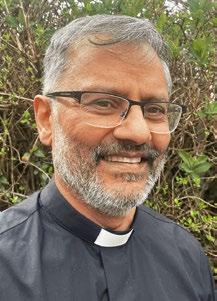
By Rev Yousouf Gooljary Member of the Iona Community
Decolonising Wild Goose worship songs In a recent interview in Sunday Morning with Tony Kearney Iain Mclarty set out the task of the project to decolonise some of the Wild Goose worship songs.
The Iona Community, as a Christian ecumenical community for peace and social justice, has appointed Ian McLarty and Dr Jane Bentley to the Wild Goose Worship Resource group. They are working on a project to look at the Wild Goose worship songs through the lens of decolonisation. They're trying to find the source of many of the songs and how they might have been altered from the original sound and lyrics.
In a recent interview on BBC Scotland with Tony Kearney 'Sunday Morning ', Iain Mclarty commented on the song 'come bring your burden to God, Jesus will never say no', from South Africa and talked about how there was a moving story behind the song which was played at services when people spoke about the experience of having HIV and aids. He commented that it's a song that says even if society treats you as an outcast Jesus is still there for you.
Iain was asked about the process of decolonising music in the Iona Community. He commented that people may be familiar with decolonising issues from museums or cultural institutions in terms of history however in this case because of the strong commitment of the Iona community to justice what is being really looked at is the decentering of our own perspectives in songs to listen to people from the context of where the songs come from, particularly when they are from the global South. He continued, "The types of questions being considered are: Why should we, or should we even, sing these songs at all? What are the stories behind them?".
Iain said there were questions around translation, meaning sometimes current english versions of the songs don't have
any relationship to the original. This produces concerns around copyright. Iain mentioned some bad examples of copyright infringement where people in the US and UK, who didn't write the songs, were claiming royalties, whilst people who originally created the songs were not credited.
The point of the project was to stay true to the roots of the song and make a conscious decision to move away from any colonial mentality. He explained that this was a process of conversation that would be needed to be had with people rather than being prescriptive about what people can or can't sing. He explained that this might involve producing worship resources, conduct training or finding other ways to consider how to share the stories that have been part of the journey of the Wild Goose worship material. Iain explained that there are three generations of musicians in places like Asia, Africa and Latin America who have been working on this issue. These musicians have been drawing on the broad musical traditions and decolonising church music in their own contexts. So part of the aim of the project is to connect with and encourage those folk who are trying to root their songs in their own culture. This possibly may help us find a new interesting space to move into with regards to a hybrid music making where different cultures and languages meet.
Iain went on to talk about his own personal faith journey and the enormous contribution made by John Bell, Grahame Maule and the Wild Goose Worship Resource Group to church music and scottish culture as a whole.
Source: Sunday Morning with Tony Kearney BBC radio Scotland Released on: 10 Nov 2024. www.challengeracismscotland.co.uk
In recent years, Catholic independent schools have faced a range of misconceptions, often misunderstood or mischaracterised in their purpose, makeup, and impact. As Head of Beaulieu Convent School and Chair of the Catholic Independent Schools Conference (CISC), I would like to take this opportunity to dispel some of these myths and shine a light on the vital role these schools play—not only as educational institutions but also as integral parts of the Catholic Church and their wider communities.
One common misunderstanding is the belief that Catholic independent schools are only for Catholic students or staffed entirely by Catholics. In truth, the makeup of our schools reflects an inclusive and diverse ethos that enriches their character. While Catholic identity is central to our mission, many of our staff and pupils come from a variety of faiths and none. This diversity is not a limitation; rather, it strengthens the sense of community and provides opportunities for dialogue and understanding.
As St. Paul wrote in Galatians 3:28, “There is neither Jew nor Greek, there is neither slave nor free, there is neither male nor female; for you are all one in Christ Jesus.” Our schools strive to live this teaching, recognising the dignity of each person as a child of God and welcoming all to participate in the life of the school.
In addition, Catholic Social Teaching emphasises the common good, which Pope Benedict XVI described in Caritas in Veritate as “the good of ‘all of us,’ made up of individuals, families, and intermediate groups who together constitute society.” Catholic independent schools reflect this by offering scholarships, bursaries, and outreach programs to ensure that education is accessible to families who may not otherwise afford it.
Far from being isolated institutions, Catholic independent schools function as large parishes in their own right. They are places where faith is lived, celebrated, and shared. The Masses,
retreats, and social outreach projects that take place in our schools serve not just our immediate communities but also the wider Church.
In this sense, Catholic independent schools are a modern fulfillment of Jesus’ words in Matthew 28:19, “Go, therefore, and make disciples of all nations.” These schools provide a gateway for many families to engage with the Church, serving as centres of spiritual growth.
Bursary programs and scholarships are not only a practical means of broadening access but also an embodiment of Gospel values. For example, many Catholic independent schools partner with local charities to support disadvantaged children, provide meals for families in need, or sponsor educational initiatives overseas. These acts of service demonstrate the call to serve the common good and contribute to the Church’s mission of social justice.
Another misconception is that Catholic independent schools are less authentically Catholic because they are not directly governed by diocesan authorities. However, many of these schools were founded by religious orders whose charisms and ethos continue to shape their identity, providing them with a unique and distinctive Catholic foundation.
For instance, the Jesuit tradition emphasises cura personalis—the care of the whole person—nurturing intellectual rigor alongside compassion and spiritual growth. Similarly, schools founded by the Sisters of Mercy and the Sisters of St Martha focus on compassion and service to the marginalised, while the Benedictines bring their rich heritage of prayer, community, and learning.
The Brothers of the Sacred Heart instill a charism of love, availability, and formation, aiming to develop students who embody Gospel values. The Sisters of the Immaculate Conception emphasise humility, prayer, and
By Matthew Burke
service, fostering a sense of vocation in students and staff alike. Schools inspired by Carmelite spirituality cultivate a deep focus on contemplation, prayer, and action, helping young people connect their faith with a life of service and reflection.
These distinctive spiritual foundations are far from relics of the past. They remain active principles shaping the lives of students and staff today, providing each school with a rich and unique ethos that reflects the diversity of the Catholic Church.
Catholic identity, as Pope Francis reminds us in EvangeliiGaudium, is not about rigid conformity but about being a “community of missionary disciples.” This is precisely what Catholic independent schools strive to be: communities where faith and action are integrated, and where students are encouraged to live out the Gospel in their personal and professional lives. These schools nurture a deep sense of Catholic identity, ensuring it is not only preserved but also shared in meaningful ways within and beyond the school community.
A unique strength of Catholic independent schools lies in their connection to religious orders and the wider global Church. These
schools often work in partnership with their sister institutions abroad, supporting educational projects, sponsoring students, and participating in exchange programs.
For instance, a school founded by a missionary order might fundraise for schools in developing countries, enabling children worldwide to access education and build a better future. This reflects the call in Matthew 25:40, “Truly I tell you, whatever you did for one of the least of these brothers and sisters of mine, you did for me.” It also embodies Catholic Social Teaching’s principle of solidarity, which Pope John Paul II described as “a firm and persevering determination to commit oneself to the common good.”
Looking ahead, the role of Catholic independent schools within the Church and society is more important than ever. By embracing Pope Francis’ vision of “a culture of encounter,” these schools can create spaces where students excel academically while growing spiritually and morally.
The inclusive and diverse makeup of our schools positions them as bridges— between faith and culture, Church and
OneLife Music is a retreat and music ministry that has passion and belief for delivering original, exciting and faith filled retreat days and prayer resources for primary schools.
If you are looking for some spiritual input for your school during the Jubilee Year, then OneLife Music have a few things to offer:
Two FREE songs: Written and recorded to help schools celebrate the Jubilee Year. 'Give us hope, O Lord' & 'Song of Hope' have been written for primary schools and are offered to you as a gift in this blessed and hope-filled year. Our aim is to create music that children can learn with ease, with text that is inspired by the scripture
and literature provided for the Jubilee Year. Our Songs of Hope resources include: Vocal track, backing track, lyric sheet, PowerPoint lyrics, lyric video, melody score and guitar chord sheet.
WE WILL GO OUT as Pilgrims of Hope: A face-to-face retreat for the whole school, focussing on our call to bring hope to the world. In celebration of this Jubilee Year, the ‘We Will Go Out’ retreat promises to bring the usual fun, laughter, music and reflection that you would expect from OneLife Music!
WE WILL GO OUT online: A virtual afternoon retreat for every class. Downloadable resources are provided for you and this retreat is delivered through pre-recorded films via the OneLife online platform.
society, and tradition and innovation. They provide not just education but formation, equipping young people to be agents of change in their communities and beyond.
To ensure the continued success of Catholic independent schools, we must embrace collaboration and shared mission. Dioceses, religious orders, and lay leaders all have a role to play in supporting these schools as they adapt to changing times while remaining faithful to their core identity.
The words of Pope Benedict XVI in Deus Caritas Est offer a fitting conclusion: “Love of neighbour… demands that we strive for a just ordering of society.” Catholic independent schools, through their commitment to the common good, their outreach programs, and their formation of future leaders, are living out this call.
By investing in these institutions and celebrating their unique contributions, we ensure they continue to be beacons of faith, learning, and service—building not just successful individuals but compassionate communities in service to God and the world.
There is an ever-growing library of online retreats provided by OneLife Music, including Sacrament retreats and the very popular OPEN. series and LIVESTREAMS. Please visit www.onelifemusic.co.uk for more information!
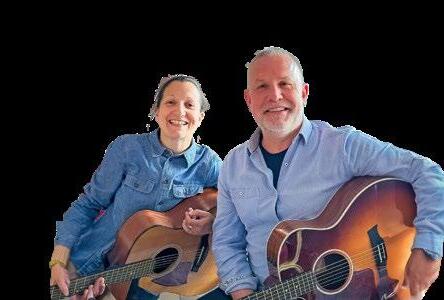
From 9-11th October 2024 Catholic leaders from around the country came together to begin the 8th Cohort of the NSF Christ the Teacher Programme at Coombe Abbey Hotel in Coventry with an inspiring array of talented formators. Speakers included Fr Denis McBride CSsR, Sr Judith Russi SSMN, Dr John McDade, and the Rt Hon Sir John Battle KC*SG who enthralled and challenged the cohort to consider our present reality and envision what the future of Catholic Education must encompass.
Delegates were given opportunities to discuss and reflect on Catholic Identity in the midst of rapid social change and how they can respond to the call from Pope Francis to become ‘signs of a different world where each is recognised, accepted, included, dignified… for their intrinsic value as a human being, son or daughter of God.’
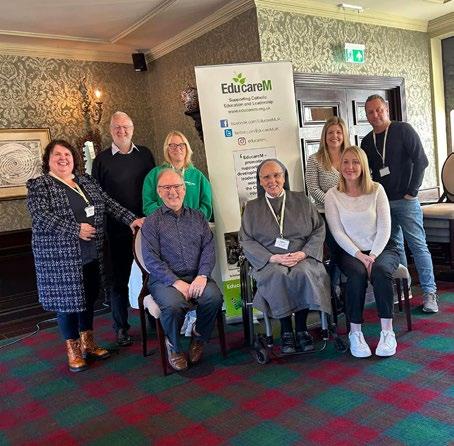
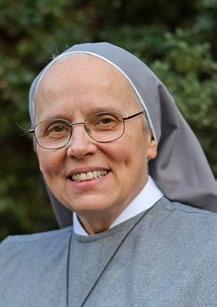
By Sr. Judith Russi
Sr Judith Russi SSMN Director of EducareM (www.educarem. co.uk) has worked for many years in all fields of Catholic education, teaching , leadership, advisory, Section 48 inspection and teachers professional development. She is the author of a variety of Catholic education books at primary, secondary and sixth form levels. As a passionate national speaker and curriculum developer she continues to pioneer many innovative and challenging educational initiatives
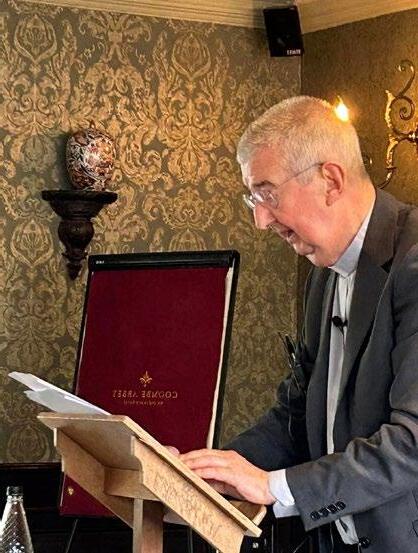
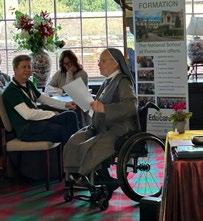

By Raymond Friel CEO of Caritas Social Action Network (CSAN)
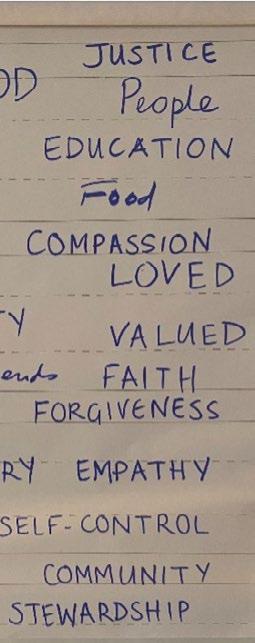
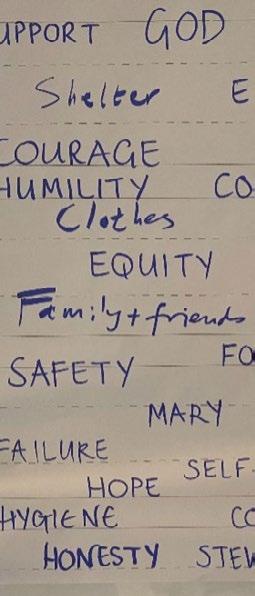
On Friday 20 September I visited Corpus Christi Catholic primary school in Bournemouth. It was a beautiful sunny autumn day when I arrived on the south coast for the Year 6 Social Justice conference, the second such conference organised by the school, which I’ve helped to facilitate. Groups of pupils and their teachers from 14 local primary schools gathered in the hall.
After a beautiful morning prayer led by the Corpus Christi Faith in Action group, Mr Simon Lennon, the Headteacher, set the scene by welcoming all the participants to Corpus Christi and reminding us that a good Christian education was about developing critical thinkers through the lens of the Gospel. The Catholic school is committed to the common good, the flourishing of all our brothers and sisters. We need to feel injustice as well as see it, in other words what moves us, what is our emotional reaction to what we see around us. The pupils are called to be agents of change, agents of Jesus in the building up of the Kingdom of God.
Then it was over to me. I set the scene with some memories from my own childhood in the east end of Greenock and my first awareness of injustice, that some children seemed to have what they needed for a decent life, but others did not. The definition of justice I shared with the pupils was adapted from paragraph 1807 of the Catechism: justice is being determined to give to our neighbour what they need for a truly human life.
This led to our first discussion in groups: what do you think we need to live a truly human life? The pupils engaged in lively conversation and were soon ready to offer their feedback. To begin with we heard about what you might call the basics: food, shelter, clothes, being safe. Then the list got even more interesting: being valued and loved, empathy, self-control. One boy said, “Equity” and then went on to give us a very helpful definition of what that meant. Not that everybody gets the same, but that everybody gets the resources they need to flourish. You’ll see the full list on the left.
After we’d looked at the permanent principles of Catholic Social Teaching and their roots in the Gospel, we considered the See-Judge-Act method which the Church asks us to use to apply Catholic Social Teaching to the life of our communities. It was Pope John XXIII who taught that young people in particular should get to know this method:
“There are three stages which should normally be followed in the reduction of social principles into practice. First, one reviews the concrete situation; secondly, one forms a judgment on it in the light of these same principles; thirdly, one decides what in the circumstances can and should be done to implement these principles. These are the three stages that are usually expressed in the three terms: look, judge, act. It is important for our young people to grasp this method and to practice it. Knowledge acquired in this way does not remain merely abstract, but is seen as something that must be translated into action.” (1)
After my session with the pupils, they got back into school groups and began to work on their action plans for what they might do in their own communities to bring about justice. Every school had an opportunity to share their ideas, which ranged from inviting elderly people into the school, inviting them to teach the pupils; improving the local environment through litterpicking or re-cycling; building solidarity in the school by developing a buddy system to look after the younger ones; making contact with people seeking asylum who were living in a hotel near one of the schools.
Since the conference, we were delighted to hear that Corpus Christi is the first school in England to be awarded the Innovator Level of the Oscar Romero Award. This is such a well-deserved recognition for this Gospel-Inspired school.
For more information about the Oscar Romero Award, please visit: https://www.romeroaward. co.uk/about-us
(1) Pope John XXIII, Mater et Magistra (1961), 236-237
The month of January contains dates connected to two important people in my journey. The 17th January 1942 is the birthday of Muhammad Ali, the former 3-time Heavyweight Champion of the World and self-proclaimed “Greatest of all time!” The 28th January marks the Memorial of another GOAT, Saint Thomas Aquinas (1225-1274), regarded by many as chief among the Church’s theologians.
Muhammad Ali: On Fractions and Whole Numbers
I once published an article about Ali, describing his outer athletic and inner, spiritual grace and beauty, recounting how he grew to become a courageous hero, loved and revered by so many in our world. I received a letter (which shows how long ago this was!) from a woman who simply commented, “I am not sure that his wives would necessarily agree with your view of him.” Fair point. I think Ali was married four times in the end and no marriage ends without human faults on one or both sides. Indeed, Ali himself was the first to admit that he was far from the perfect husband, particularly in the days of his pugilistic pomp. Ali was the first to confess that he needed to purge many a sinful habit from his behaviour if he were to stand with integrity before Allah at the end. He knew he was not some plaster saint, but he loved many, many people and showed them compassion and gentleness, giving millions of dollars away
to help them concretely through deeds that Catholic social teaching calls the spiritual and corporal works of mercy.
I suspect that real saints never describe themselves as such and are all too aware of their shortcomings. If you think about it, that makes sense. The closer we get to God, the more aware we are of the amount of work that still needs to be done. The closer we walk to the light, the more we perceive the dirt on our skin. Only in the dark are we unaware of how grimy we are. The time to really worry is when we stop noticing the dirt - when we are no longer aware that we are not yet the person of love that we can be, that we are called to be. When I have a person or persons in my life who love me, who really love me, people who know me as I really am, who accept my strengths and forgive my weaknesses, then the light that comes from such love should place into relief all the darker areas of my life and my relationships with them and others. This should, in turn, nudge me towards loving them more, moving me away from the shadow, darkness and selfishness, and further towards light, love and selflessness. The closer we get to real love, then the more aware we are that we fail in love, and the greater the potential there is to grow in love. Awareness of not being the finished article is not an exercise in guilt-tripping ourselves or obsessing with sin. It is a challenge to accept it with realism and move on in that knowledge to become more, to become better, more alive in love for the people we deal with in the nitty gritty called life. That is the way to more joyful living. So no, Muhammad Ali was not the finished article, but by the end of his life he was, I submit, a lot further along the path to God than many.

By Dr. Paul Rowan, PhL, STD

One sign of that was the costly generosity he displayed towards countless people on the margins. Another was that he had enough selfknowledge to recognise and admit the admixture of sin and love that he was. Can we say the same? How many of us think of our lives in such panoptic, eternal terms? How many of us have considered that we are all fractions on the way to becoming whole numbers (put that on your crosscurricular Catholic Life and Mission list), that saints are only sinners who know they are, but never quit trying to grow in love (even if they never get the job finished this side of the grave)? Being aware of our faults and failings and the constant need to grow ever more fully into the ways of love are lessons learned more readily when we insert ourselves into the daily grind of life within a family or a community (including our school community). Indeed, one of the abiding dangers of contemporary priesthood in my estimation is that it often exempts many priests from such daily challenges - and the best priests are often the ones who risk engaging with people in the nitty gritty of the everyday messiness of relationships (the best priests - and there are many - are not the entitled clericalist snobs we hear about so often). Families and the communities we inhabit (work places, parishes, churches, to give just a few examples) are complex realities, mixtures of good and bad, of love and selfish agendas, of the most incredible displays of generosity and the pettiest self-centredness and cruel, vindictive bullying. In such arenas individuals are faced with choices and can slowly become saints.
Way before the advent of the Internet, a spiritual director of mine used to encourage me to keep going in spite of my obvious frailty, by using a famous phrase whose origins I can’t trace, even in the Internet age!
“Please be patient – God has not finished working on me yet!” Every step of the way towards the moment of our death can be a potential moment to become more or less
fully the sort of person we are called to be (a saint - a whole number). It is for this reason that we should never be surprised or shocked at the varying levels of mess and disunity in institutional Christianity, or workplaces, or families, or the life of another person such as Muhammad Ali. The capacities for good and bad co-exist in every human heart. Of course, at the end of our time on this planet we will be asked to give an account of our own heart, not somebody else’s. Yes, we can help others on their path to becoming people of love, but above all we need to be working on that task in our own life. Ultimately the only person we can ever be fully responsible for is ourselves.
The Original, Deep, Fat Friar Thomas Aquinas (1225-1274) was one of the most intelligent and humble people who ever lived. A somewhat plump Dominican friar, Aquinas was once referred to (in less woke times) by a parish priest I knew in Liverpool as ‘Fat Tommy Acker’. He had no love for Aquinas because so many of his volumes were required reading in the 6 years of priestly formation. He complained, “If we didn’t have to read all his stuff, Ushaw would only have been 2 years long!”
Aquinas was indeed a bulk of a man but his mind was equally colossal. He fathomed the depths of intellectual and spiritual oceans and his prose and poetry inspired some of the greatest music and prayer in the history of the Latin rite of Catholic Christianity. Hoping I use my commas in the right place, it might be said that St. Thomas was an original, deep, fat friar! He was often viewed with suspicion by ecclesial officialdom in his own day because of his willingness to learn from other religious and philosophical traditions. To give just one example, the pagan thinker Aristotle, whose texts were lost in Antiquity, had been re-introduced to Europe by Islamic thinkers by the time of Aquinas after they had uncovered copies of the great philosopher’s works in the
conquest of Spain. However, because Aristotle was pagan and because Muslims liked him, the Church was not entirely comfortable with Aquinas’ use of him! Aquinas ignored the Church, called its bluff and said the truth is the truth, no matter who discovers it or speaks it, reminding the Church that all truth comes from Christ (who is the Word made flesh). Despite their misgivings, the Catholic authorities knew Aquinas possessed an immense intellect and called him to the Council of Lyons in 1274 to help sort out a few issues that were plaguing the Church, not least of all disunity with the Eastern Church (also worth remembering in this month when we pray for Christian Unity). Aquinas never made it - having suffered a head trauma en route, he died with a brain injury in Fossanova, south of Rome. Once he had been safely dead half a century, the Church canonised this daring thinker in 1323. Nowadays, the stuff that he taughtonce considered so dangerous and anti-Christian - is seen as part and parcel of Catholic orthodoxy and common sense! (The Catholic concept of transubstantiation is a blend of the Last Supper, Aristotle and Aquinas.)
I often consider Aquinas to be a very catholic (small c) saint who can challenge us all. What do I mean? I don’t simply mean he is a saint of the Catholic (capital C) Church (though he is, obviously). Catholic means (inter alia) universal, wide, whole, generous in embrace. The opposite of Catholic (properly understood), therefore, is narrow, petty, partial, sectarian, provincial, fundamentalist. The night before he died Jesus said to the 12 disciples at table with him, “In my Father’s house there are many rooms.” (John 14:2) God’s home, God’s heart, is not some London private members’ club, a house with only one room (hence my hope that a good, if flawed man like Muhammad Ali will be among those we celebrate on All Saints’ Day). God’s heart is not petty, factional, sectarian or fundamentalist, and so the heart of anyone who claims to speak for God cannot be like that either. Aquinas had a great heart. He
had a catholic heart, as God has a catholic heart. (Open brackets for just a moment. This is not the same thing as saying God embraces and agrees with anything and everything, or that any belief or any way of acting is fine, or that there is no such thing as true and false, or right and wrong. Tyrants want us to believe that there is no such thing as true and false or right and wrong, because if there isn’t, well, the one who shouts loudest and has the most power is the one who then gets to control the narrative. Those with power get to decide the narrative. Have a quick glance at how writers, intellectuals, poets and artists are removed by historical dictatorships. God loves everyone equally, whatever their views, but truth and justice matter, and so God discriminates between right and wrong and true and false. Close brackets!)
All of us, religious or secular, are prone to being narrow, one-sided, un-catholic. But we usually think that those who disagree with us are the fundamentalists, the over-simplifiers. Perhaps they are, sometimes. But the truth is that we are all prone to fundamentalism. Fundamentalism is a mind, a heart with only one interest or room in it. We are probably familiar with the notion of a biblical fundamentalist - classically defined as someone who interprets the Bible so literally as to be unable to deal with the complexity of reality (such as the findings of science or other sources of knowledge). A biblical fundamentalist refuses to look at all the data, just as the 13th-century Church couldn’t deal with the data of Aristotle, Islamic thinkers and Aquinas. But biblical fundamentalism is only one type of nervous over-simplification. We see fundamentalism wherever we see a person whose heart has only one room (unlike the Father’s heart), a person who has only one lens through which they look at the world, only one criterion through which they evaluate everything. But note that a fundamentalist is never totally wrong either!
All fundamentalists, whether religious or atheistic, grasp one bit of truth, one fundamental value. The problem ensues because they see it as the ONLY truth or the ONLY thing of value! They use the bit of truth/value they have discovered (and that bit alone) as the only way to judge the goodness and authenticity of others.
In the life of Catholic schools and universities where I have worked, on the staff and among parents, inspectors and other stakeholders, there are Catholic Christian fundamentalists, Protestant Christian fundamentalists and atheistic fundamentalists. There are feminist fundamentalists and anti-feminist fundamentalists. There are woke fundamentalists and anti-woke fundamentalists. There are Catholic social teaching fundamentalists and there are the liturgical purist fundamentalists. All of them police their favourite areas of Catholic Life and Mission and they all usually make the same mistake - they take one value, one bit of truth from the beautiful complex that is Catholic Life, and then they magnify it so that it becomes the WHOLE truth, the ONLY value. Then, on the basis of that bit of truth, they come up with a whole list of ways in which it is acceptable to be indignant about other people and write them off as unenlightened, unholy, secular, woke, unwoke, feminist, anti-feminist, misogynistic, misandrous, non-liturgical, etc. (We can substitute our own favourite dismissive insult here - but notice how they will all involve the same basic error of over-simplification, of thinking that ours is the only way of looking at the world!)
As I already hinted, January contains the Week of Prayer (18-25 January) for Christian Unity. In September 1996 I was asked by Archbishop Patrick Kelly of Liverpool to be one of the Catholic theologians (I think there were three of us) on MARCEA: the Merseyside and Region Churches’ Ecumenical Assembly (these days it is called CTM: Churches Together in
Merseyside). At the time I discovered that there were around 33,000 different Christian denominations in the world. While preparing an assembly I led in our Secondary School this time last year, I pointed out that the more than 2 billion Christians living in the world in 2024 are now divided into more than 45,000 denominations! We are all very good at pointing out whether others have it wrong and we have it right, and where others need to work on themselves and their way of interpreting God and the world. From time to time we all need a healthy dose of self-critique if our Church, our schools and our educational institutions are to flourish. If we don’t have that, we end up becoming defensive, hyper-sensitive and humourless. That’s why we end up becoming so full of anger, intolerance, closedness to the wisdom of others and self-righteous condemnation towards those who don’t sign up to our way of looking at things.
Saint Thomas Aquinas, open mind, open heart, highly original, deep, fat friar, pray for us! Muhammad Ali, saint and sinner like us, pray for us!

The 7th Conference of the European Association of Service Learning in Higher Education (EASLHE), took place 24-25th September 2024 in the wonderful setting of the University of Balearic Islands in Palma de Mallorca, Majorca, Spain. CATSC Executive Council Members, Professor John Lydon and Dr Caroline Healy participated in the conference, the theme which was ‘Transforming Europe Through University Collaboration’. The conference opened with a presentation by Maria Kelo, Director of Institutional Development at the European University Association where she focuses on issues related to teaching and learning, quality assurance and recognition.
Europe is facing significant sociopolitical, economic and environmental challenges. Higher education is in a unique position to promote and sustain lasting changes in societies. Service-learning is a key pedagogical approach, not only because of its impact on excellence in the academic field, but also because of its possibilities of contributing to transformations towards fairer, more democratic, and environmentally responsible societies. Strategic partnerships and institutional alliances are key to promoting servicelearning, as is research and innovation adapted to the variety of contexts in Europe. Europe's multidimensional diversity is a challenge, but it also represents an essential opportunity to manage changes from the local to the regional, national, European and global spheres, underpinned by civic engagement, equity and social justice values.
Throughout the conference, presentations, posters and workshops
were presented and clustered around four conference tracks:
• Empirical research on servicelearning and service-learning impact
• Best practices & practical experiences in service-learning
• Collaboration & alliances for service-learning
• Processes of service-learning institutionalisation.
Catholic university participants were supported in their attendance by UNISERVITATE, which is the programme for the promotion of service-learning in Catholic Higher Education Institutions (CHEIs). Its objective is to generate a systemic change in Catholic Higher Education Institutions (CHEIs) through the institutionalisation of service-learning as a tool to achieve its mission of offering an integral education to the new generations and involving them in an active commitment to the challenges of our time. The most recent Vatican documents on the mission and identity of the CHEIs call for the connection between science and faith, academic excellence and community service, knowledge production and Christian witness in society, of a socially committed university. In recent years, Pope Francis has strongly emphasised the need for the Church to go out to the peripheries’ and has called on educational institutions to offer their students the opportunity to involve ‘heads, hands and hearts’ in addressing the challenges and problems presented by contemporary societies.
Focusing on the transformation of
teaching practices in CHEIs, servicelearning proposes to articulate academic activities with social commitment, thus strengthening the spiritual identity of Catholic institutions. It is fundamentally a matter of involving young people as real agents of social change in the construction of a more just and supportive society that expresses the mandate of the civilization of love’ of love
UNISERVITATE is a global network and as such, it seeks to establish solid and constructive links between higher education institutions rooted in very diverse social and cultural contexts, with the purpose of expanding dialogue and enriching the perspective of higher education in the acknowledgement of the multiculturalism that characterises the contemporary scenario. Collaboration, open listening, respect for diversity and collective production constitute the basis on which the programme is built and is continuing to grow.
Professor John Lydon, CATSC and St Mary’s University, focussed on the ‘processes of service-learning institutionalisation’ in his presentation ‘Building a Catholic University University Marked by a Commitment to Service-Learning’, which the Director of Catholic Mission at St Mary’s University, is keen to promote.
Professor Lydon began his presentation reminding us of Pope Francis’ video message of 15th October 2020, where His Holiness calls for a new era of educational
commitment involving all members of society. For this reason, he invites families, communities, schools, universities, institutions, religions, rulers, men and women of culture, science, sport, artists, media professionals, i.e. the whole of humanity, to sign a compact on education by committing themselves personally to take up the following seven commitments
In essence Pope Francis, writing from the perspective of Christian humanism, is suggesting that Catholic education should be dominated by a holistic perspective, a term hallowed in the documents published by the Dicastery for Culture and Education, (formerly the Congregation for Catholic Education), since its establishment following the close of the Second Vatican Council in 1965. This perspective was alluded to by Cardinal Tolentino (2023:2), Prefect of the Dicastery of Education and Culture, in a recent address to the International Federation of Catholic Universities:
We have to strive for Catholic Universities to be good universities. But we must also bear in mind that this is not enough. In Pope Francis’s mind, Catholic Universities should not just deliver quality degrees and ensure the pursuit of ambitious careers for their students. As the Pope said in his World Day of Peace message of 2021, the Church wishes our institutions of higher learning to shine as world universities that, by offering their educational services, are in a capacity to ‘pass on a system of values based on the recognition of the dignity of each person’ (Tolentino, Cardinal J., (2023) What the Church expects from Catholic Universities, Rome: Dicastery for Culture & Education).
Service-learning is a teaching method which combines community service with academic instruction as it focuses on critical, reflective thinking and civic responsibility. Service-learning programs involve students in organised community service that addresses local needs,
whilst developing their academic skills, sense of civic responsibility and commitment to the community (Lavery, S. & Hackett, C. (2008) Christian Service Learning in Catholic Schools, Fremantle: University of Notre Dame Australia).
Service-learning normally therefore involves students learning in ‘offcampus’ environments, and ‘making a difference’ within a community. The activity or work they undertake normally addresses genuine needs, or societal problems/challenges, whilst developing their academic and personal skills, virtues and values, their insights into the ways that organisations work (be they charities, volunteer-led groups, NGOs, schools, hospitals or social enterprises), and a sense of civic responsibility and commitment (Booth, P., et al., (2024) Institutionalising Service-Learning, Twickenham, UK: St Mary’s University).
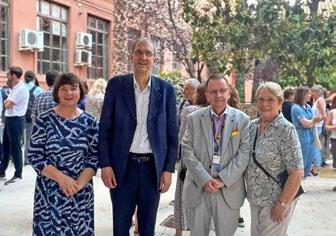
Dr Caroline Healy and Professor John Lydon, CATSC & St Mary’s University, with Professor Nicolas Standaert President of UNISERVITATE Solidarity Service Learning in Catholic Higher Education and Mrs Margaret Lydon
In an address to an International Conference for Catholic Universities in 2006, Brother Clemente, then Rector of the Pontifical University of Parana (Brazil), spoke of the importance that the university be responsible for the students’ transformation, that they become co-workers and be educated to be responsible members of society, “honest citizens and good Christians” in the words of St John Bosco (Clemente, Bro. Ivo Juliatto FMS, 2006).
For that reason, Bro. Clemente introduced, as an activity for all the students, the obligation of carrying out a Community Project. During one week, the students have to carry out some social activity, preferably in the periphery, working with children, visiting the sick in the hospitals, organizing all types of programmes; an activity that has to be planned and evaluated through the presentation of a report. They are educated with that purpose in mind and their social activity counts as an academic credit.
Clemente aimed to create a mentality that people perceive that the advantage is not only for the one who receives the assistance but also for all the students. This is a new discovery for many. We have had wonderful examples of students who changed their outlook when they were close to the poor. And many, after doing that week of social service continue their commitment as volunteers. We know of some cases of parents or mothers who say: when my son is at home he talks only about that project. Can we also take part in it?
The notion of mutual benefit is a classical example of the concept of reciprocity and mutuality, embedded in conciliar and Congregation for Catholic Education documents. Clemente’s vision is now embedded in the Pontifical University of Curitiba, supported wholeheartedly by students and some faculty, witnessed by the author in a recent visit to the University (Sullivan, J., 2001, Catholic Education: Distinctive and Inclusive, Dordrecht, The Netherlands, Kluwer Academic Publications, pp. 134-135).
The context of young people’s identity construction is not a guidance interview with an expert in an aseptic office. If we take the original inspiration from Don Bosco, the logic of the family environment was fundamental. …The idea of a University Community that is only functional to the activities of the project is not enough. It must be
a vital world that embodies the values and virtues of faith and, in this sense; it must be an “alternative” environment to the surrounding world that …… is so open but also structured, it accompanies growth
(Vojtáš, M., SDB, Journal of Salesian Studies, July-December 2021, Volume 19, No.2, Berkeley CA, Institute of Salesian Studies.
Vojtáš suggests that there is a need to create an organizational culture within Catholic Universities in which Christian values, civil values and Catholic social teaching are merged into an Institutional Project, with standards and participatory processes in the Academic Community, activities of education in values, empowerment, volunteering, personal discernment and accompaniment.
….. if this does not occur in daily activity and there are no standards, structures and resources for accompaniment (young people at the centre of educational attention) or student participatory organizations (young people at the centre of educational activity), the project is contradicted by reality and becomes analogous to a secular institution (Vojtáš 2021: 103).
ST MARY’S UNIVERSITY TWICKENHAM
There is a series of Masters programmes (MA in Catholic School Leadership, MA in Catholic Social Teaching, MA in Theology, MA in Christian Spirituality, MA in Bioethics and Medical Law which are normally undertaken by professional teachers, school leaders, medics, clergy, chaplains and deacons. Dr Caroline Healy, CATSC Executive Council and Course Lead, MA in Catholic School Leadership also participated in the conference to learn more about the different service-learning models offered across Europe and the United States. From 2025-2026 Academic Year, service-learning research will be offered as a significant alternative to the final year dissertation and hopes teachers and school leaders already
making a difference in service to their school communities, will find it an attractive option to completing their Masters.
In addition, there is a Senior Leader Apprenticeship Masters programme undertaken by those working in schools and academies. The programmes are generally undertaken part time and involve servicelearning (as defined by the wide definition used in this paper) with the experience of the professionals being tied into the learning outcomes of the programme through assessments and practitioner research in their own professional context.
Therefore, these programmes are formalising service-learning in an institutional context by formally recognising it within degree programmes through teaching and learning pedagogy and being creditbearing.
NOVEMBER
2024 – FRI. 15TH
NOVEMBER 2024
Four members of the CATSC Executive Council attended the World Union of Catholic Teachers Congress held in Santiago, Chile: President John P. Nish, Treasurer Professor John Lydon, General Secretary Dr Caroline Healy and Primary Education Representative Julie-Anne Tallon. The Congress was hosted by Profs. Mario Sandoval and Patricio Inostroza and this was the first time the Congress had met in the region of Latin America to move beyond its history of conferencing in Europe, with UMECWUCT’s Executive’s key objective to promote greater diversity.
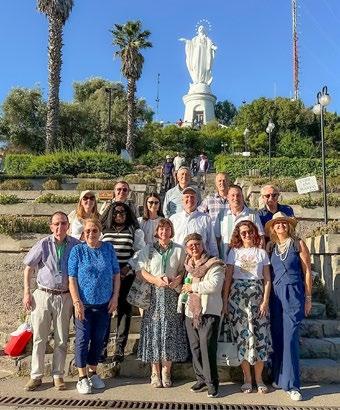
WUCT Congress delegates visit the famous Sanctuary of Our Lady Mary Immaculate, San Cristóbal Hill in Santiago, Chile
The theme of the conference was:
‘The Identity of Catholic Teachers on the Road to the Jubilee 2025’. Conferences speakers were drawn from a range of international organisations, universities, research organisations and teacher unions including: Francisco Calzada, Professor at the National Autonomous University of Mexico; Ignacio Sánchez Diaz, Rector of the Pontifical University of Chile; Jorge Martinez, Professor at La Salle University, Colombia; Jorge Radic, Director, Marist Centre for Psycho-Educational Assessment and Research (CEIS/ MARITAS); Kiyoshi Fukushi, Academic Vice-Rector, Duoc/Pontifical University of Chile; Valtencir Méndez, UNESCO Representative for Latin America, Guy Bajoit, Professor Emeritus, Catholic University of Leuven, Belgium and Mario Aguilar, President of the Chilean Teachers’ College.
There were debates and discussions around the identity of Catholic teachers as we enter the Jubilee Year 2025 as ‘Pilgrims of Hope’; the Catholic teacher as a resource for the school and community; UMEC-WUCT ‘s role in UNESCO as a Consultative Body of UNESCO; UNESCO’s monitoring of education in Latin America; the contemporary context of education in Chile; the role of Catholic universities in Latin America in the 21st Century, especially the La Salle University in
Columbia and an education focused on values. Delegates were invited to DUOC/Pontifical University of Chile in Santiago by the Rector to learn more about its work and its place in the life and education of Chile
Educational visits were also made to two schools, the Marcellin Champagnat Marist College, Santiago and College of St Patricio, Chiguayante. Religious and cultural visits were also organised to the Shrine of St Teresa of the Andes (Chile’s first saint), Shrine of St Alberto Hurtado (Chile’s second saint); and the Sanctuary of Our Lady Mary Immaculate, San Cristóbal Hill in Santiago; Mass at the Cathedral in the city of Concepción; University of Concepción and the Catholic University of the Most Holy Conception. Finally, a visit to the coast and Playa Blanca beach and the large port of Talchhuano in the Region of Bio Bio in the Southern part of Chile. Hospitality was provided by the Missionary Sisters Servants of the Holy Spirit and the Inostroza family.
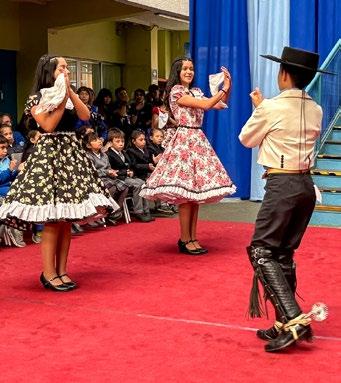
The NfRCE 2024 annual conference was hosted by Professor Stephen McKinney and colleagues at the School of Education, University of Glasgow, Thursday 24th - Friday 25th October 2024. The theme of the conference was on ‘The Relationship Between Catholic Education and Synodality’.
The focus was around His Holiness Pope Francis’ invitation for the Church to move towards being a Synodal Church, what could, or should this mean for Catholic education? The conference provided an opportunity for careful deliberation and discussion of the ecclesial, theological, pastoral and operational implications of a Synodal Church for Catholic education and the ways in which Catholic education can engage with a Synodal Church and prepare children and young people to participate in a Synodal Church.
Trusteeship. He began by referring to the work of Emeritus Professor Gerald Grace (2002), borrowing from the sociological constructs of Pierre Bourdieu, who speaks of the significance of the spiritual and cultural capital of religious orders in providing a substantial catalyst in the development of Catholic education in England and Wales.
The paper endeavours to explore the extent to which spiritual capital remains impactful in a cross-section of Catholic Independent schools with a founding religious trusteeship in the UK, taking into account the changing ecclesial demography within the Catholic Church in the UK alongside contemporary education challenges. Following a critical retrieval of literature relating to the concept of spiritual capital, the paper presented research findings from evidencebased interviews carried out with headteachers of a range of Catholic Independent schools.
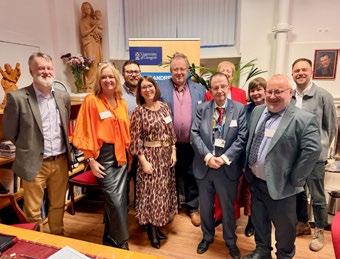
CATSC’s Professor John Lydon, Associate Prof Mary Mihovilovic and Dr Caroline Healy with colleagues from St Mary’s attending the NfRCE Conference
The next General Assembly will take place in Rome in October-November 2024 and preparations are underway for the Jubilee Year and the 60th Anniversary of the Second Vatican Council’s document on education (1965) Gravissimum Educationis/ Declaration on Christian Education, in 2025
CATSC’s Executive Council member Associate Professor Mary Mihovilovic gave a well-received keynote address at the conference based on issues of concerns around synodality from her perspective. This was followed by CATSC’s Professor John Lydon delivering an interesting paper on recent research conducted with Dr Maureen Glackin, Catholic Education Service on the topic of ‘Exploring the Extent to which ‘spiritual capital’ is Impactful in a CrossSection of Catholic Independent Schools with a Founding Religious
CATSC’s Dr Caroline Healy gave a paper on ‘Synodality and Leader Formation’. To connect synodality and Catholic education leader formation, she stated that it is important to understand Pope Francis' thinking in regard to a Synodal Church. According to Richard Gaillardetz (2023) Pope Francis makes four commitments to synodality that advance the teachings of the Second Vatican Council (p. 46). This framework enables the establishment of how synodality may impact on Catholic schools and their leadership:
first, a commitment to synodality requires transformed ecclesial relationships which prioritises baptism as the source of vocation and Christian identity, moving away from a clerical Church, and emphasising Vatican II’s universal call to holiness. The second, is to be committed to a Church that moves outward and into the world and embraces mission and fosters a ‘culture of encounter’ (Pope Francis, 2020: 216). Third, focusing on the key aspects of the Christian faith and making it more accessible to a broader audience, especially the poor and marginalised, and emphasising the Gospel message over doctrine and morality. Last, synodality is based on the authentic exercise of authority guided by subsidiarity which encourages local decision-making not just by clergy, but also laity.
Within this conceptual frame, essential aspects of leader formation were outlined including selfleadership and endeavouring to constantly seek a deep spiritual renewal and greater knowledge of the faith; leading others and building a shared vision of the mission by working collaboratively with each other, parishes and family and ensuring accompaniment of leaders; finally, leading within and establishing strategic formation to strengthening the processes and prepare new leaders.
Professor Lydon and Dr Healy’s doctoral students also had the opportunity to present papers in relation to children and young people in relation to synodality. Julie-Anne Tallon presented on her research focused on the impact of providing opportunities to encounter Christ in Catholic Primary Schools. Nicholas Sutton presented on ‘clashing symbols: seeking compatibility between postmodern culture and faith within the context of Post-16 Catholic education’.
The Trust was established in 2016 and is a multi-academy Trust which currently has 34 schools, five secondary schools with sixth forms, and 25 primary schools. The Trust covers the East part of the North-East region of England, and schools are in Durham, South Tyneside and Sunderland and is in the Diocese of Hexham and Newcastle.
Some Contemporary ContextParental Choice of Catholic Schools
Lydon opened the address by discussing parental choice of Catholic schools. Ann Casson in her research of A Case Study of Catholic Primary Parents (2014: 24) regarding parental choice of Catholic schools made these observations:
The reasons why baptised Catholic parents choose a Catholic primary school when they do not actively participate in the Catholic Church are complex. However, many Catholic parents in this research sample maintained that the prime reason for the choice of a Catholic school was the Catholic nature of the primary school.
She further added that: 75% of Catholic parents who contributed
to the questionnaire maintained that their reason for choosing the primary school was that it taught the Catholic Faith. Reflections on what made a primary school a Catholic school focused mainly on the parents’ experience in this particular Catholic primary school, as they had limited experience of other Catholic primary schools or indeed of other primary schools (2014: 25).
The main reasons given for choosing a Catholic primary school were:
• Academic reputation
• Good values
• Location
• The teaching of the Catholic Faith
• The Catholic Ethos
He then referred to remarks made by a Director of a Diocesan Catholic Schools Service referring to Casson’s work highlighted the significance of the government website comparing the performance of schools and colleges in England: https://www.gov.uk/schoolperformance-tables which include a wide range of data including progress and pupil absence. The Director claimed that parents in the Diocese were choosing Ofsted judged ‘outstanding’ community schools as opposed to ‘good’ Catholic Primary schools.
Lydon went on to discuss the elements of distinctiveness in Catholic education. In the ‘Distinctive Nature of the Catholic School’ produced by the Catholic Education Service (2014) which builds on the Catholic Bishops’ of England and Wales (1996) the following five characteristics are outlined:
The search for excellence is seen as an integral part of the spiritual quest. Christians are called to seek perfection in all aspects of their lives. In Catholic education, pupils and students are therefore, given every opportunity to develop their talents to the full.
Within Catholic schools and colleges, each individual is seen as made in God's image and loved by Him. All students are, therefore, valued and respected as individuals so that they may be helped to
fulfil their unique role in creation.
In the Congregation for Education document, The Catholic School (1977) we find the same characteristic:
The Catholic school loses its purpose without constant reference to the Gospel and a frequent encounter with Christ. It derives all the energy necessary for its educational work from Him and thus ‘creates in the school community an atmosphere permeated with the Gospel spirit of freedom and love’. (20). In this setting the pupil experiences his/her dignity as a person before he knows its definition (n. 55).
Education of The Whole Person
Catholic education is based on the belief that the human and the divine are inseparable. In Catholic schools and colleges, management, organisation, academic and pastoral work, prayer and worship, all aim to prepare young people for their life as Christians in the community.
The Education of All
Their belief in the value of each individual leads Catholic schools and colleges to have the duty to care for the poor and to educate those who are socially, academically, physically or emotionally disadvantaged
Moral Principles
Catholic Education aims to offer young people the experience of life in a community founded on Gospel values. In Religious Education in particular the Church aims to transmit to them the Catholic faith. Both through religious education and in the general life of the school young people are prepared to serve as witnesses to moral and spiritual values in the wider world.
Moral Principles and The Beatitudes
These were linked by Lydon to Gospel values contained in The Beatitudes:
“Blessed are the poor in spirit, for theirs is the Kingdom of heaven” Values: Faithfulness & Integrity
“Blessed are those who mourn, for they shall be comforted” Values: Dignity & Compassion
“Blessed are the meek, for they shall
inherit the earth” Values: Humility & Gentleness
“Blessed are those who hunger and thirst for righteousness, for they shall be satisfied” Values: Truth & Justice
“Blessed are the merciful, for they shall obtain mercy” Values: Forgiveness & Mercy
Bishop Stock in Answer to the Question: Why Does the Catholic Church Provide Schools wrote Christ at the Centre (2012) which is essential reading for all who work in a Catholic school. Placing Jesus Christ at the forefront of all aspects of school is stated in the Congregation for Catholic Education’s (2014) document:
At the heart of Catholic education there is always Jesus Christ: everything that happens in Catholic schools and universities should lead to an encounter with the living Christ. If we look at the great educational challenges that we will face soon, we must keep the memory of God made flesh in the history of mankind – in our history – alive (Congregation for Catholic Education, 2014, III: 1).
It continues: Schools and universities are also living environments, where an integral education is provided, that includes religious formation. The challenge will be to make young people realize the beauty of faith in Jesus Christ and of religious freedom in a multireligious universe. In every environment, whether it is favourable or not, Catholic educators will have to be credible witnesses (III: 4).
The placing Christ at the centre should, in summary, from Lydon’s perspective, focus on these key aspects:
• Invitation & initiative
• Inclusion
• Presence
• Building community
• Challenge
In the context of a Catholic school community, Lydon discussed the nature
of servant leadership is a theological construct based on the paradigmatic text Mark 10:35-45 as opposed to a secular leadership theory. St Paul’s reference to Jesus ‘emptying himself’ (Phil. 2:5-11) is also significant in this context.
Mark 10:45 & Philippians 2:8:
‘For even the Son of Man did not come to be served, but to serve, and to give his life as a ransom for many’ ‘[Jesus] emptied himself taking the form of a servant’.
Punnachet ((2009) writes that Jesus demonstrated a new leadership theory and practised one that totally contradicted traditional leadership practice, which focused on power and control. He used love and kindness instead of power or force. He persuaded others to follow his way, but did not manipulate or control them. Therefore, it can be seen that this theory of leadership is based on a philosophy of service, which has love as its foundation.
Lydon quotes Pope Francis (2013:42) who has said:
‘we need to remember that all…teaching ultimately has to be reflected in the teacher’s way of life, which awakens the assent of the heart by its nearness, love and witness’.
Pope Francis on Servant Leadership
Dear friends, in these years of my Pontificate I have sought to privilege the gesture of foot washing, following the example of Jesus who at the Last Supper took off his cloak and washed his disciples’ feet one by one. The washing of feet is undoubtedly an eloquent symbol of the Beatitudes proclaimed by the Lord in the Sermon on the Mount and of their concrete expression in works of mercy. With this gesture, the Lord wanted to leave us “an example so that you may do as I have done” (Jn 13:15). Indeed, as Aquinas teaches, with such an extraordinary action, Christ “showed all the works of mercy” [Commentary on John 13]. Jesus knew that when it comes to inspiring human action, examples are
more important than a flood of words (Pope Francis, 2024).
The Centrality of Witness in Leadership Formation
Several teachers, in a research study conducted by Lydon (2011) focused on a more general context of teaching as a vocation, insisted that they had been inspired by the witness of teachers while at school. There is a particular emphasis on inclusion and concern for the individual, reflecting key characteristics of Catholic distinctiveness.
The Centrality of Witness in Leadership Formation
The perception of passion and enthusiasm for teaching in general is evidenced and constructive engagement in the form of extra-curricular activities permeates the accounts. The fact that teachers made sacrifices, particularly in terms of time, is recognised explicitly. For full research findings see Lydon (2011).
Servant Leadership: A Holistic Approach – Pope Francis
“In the Catholic school – one must avoid falling solely into teaching concepts. A true school must teach concepts, habits and values, and when a school is incapable of doing this at the same time, that school is selective and exclusive and for a few” (Pope Francis, 2015).
Key Characteristics of Servant Leadership from the Perspectives of School Leaders
Lydon asked the leaders present to paused and reflect on the following characteristics:
• Service
• Trust
• Credibility.
Servant Leadership and Trust
Greenleaf (1977) viewed the function of trust in servant-leadership as the root of servant-leadership and decision-making, and stressed that trust is engendered as followers gain confidence in the values, competence and determined spirit of the leader.
Major Themes Identified
• Service to the school community
• Relationships
• Care for students, staff and parents,
• Prayer life
• Collaboration and empowerment of students and staff
• Growth of people
• Community building
The Lens of St John Bosco: accompaniment in the context of a Salesian holistic vision of education
While Bosco was an idealist, Lydon pointed out, speaking of ‘saints’ who would give personal witness, he was also a realist. He did, however, state that no one was irredeemable. He recognised that, if some young people were no longer a liability to their families, then that in itself was an achievement. He recognised that there would be ‘a variety of outcomes’ – reflected in the differentiated pedagogy practised in the Oratories/Schools
Memorandum of Don Bosco to the Minister of Labour
The following extract is taken from Braido (1981) in relation to the Christian pedagogy of St John Bosco:
• Many boys out of prison have learnt a trade – ‘won their bread with honest work’ - dissipated yet win their own bread
• Many in danger of becoming delinquents have stopped giving trouble to other citizens and they are already on the way to becoming good citizens – difficult but may become reasonable and eventually win their own bread through honest work – become ‘docile’ (compliant)
• Others become virtuous artisans, teachers
• A few occupy positions of leadership or in the military
• Some hold positions in Universities, Law, Medicine and Engineering
For Bosco, the most vital aspect of ‘servant’ leadership revolved around the maintenance of the distinctive Salesian atmosphere. The Belgian scholar Lombaerts (1998) has argued that the ethos and culture of a school, the implicit curriculum, is more important
than the intentional learning procedures. This links to my earlier point about the significant of collegiality over congeniality.
In this context one of the principal challenges for the school leader centres on the ability to foster a spirit of collegiality which goes beyond congeniality because it demands something greater than simply the creation of harmonious relationships. Collegiality involves fostering a commitment to the goals of an institution larger than those of any particular individual, described by Bryk (1993) as ‘adult solidarity around the school mission’.
Lydon (2022:4) points to Bosco’s practical advice to one Salesian was to ‘go to the pump’. Reflecting the initiative of Jesus in inviting the two disciples to share their story, St John Bosco’s advice to one of his key early collaborators, Vespignani, was to ‘Go to the Pump’ (Vespignani, 1930). At the water pump in Valdocco, Turin, near the site of Bosco’s first Oratory, boys often came together. Bosco expected his educators to be where the boys were. Such encounters in a non-formal context have the effect of building up trust which forms the basis of every educational practice or encounter. As Loots (2018: 5) suggests, ‘this practice teaches that it is best to follow first to be allowed to guide later’.
‘Go to The Pump’ and Standards: In the Letter from Rome, cited in a volume published by the Salesians of Don Bosco, Don Bosco writes:
By being loved in the things they like, through their teachers taking part in their youthful interests, they are led to those things too which they find less attractive, such as discipline, study and self-denial. In this way they will learn to do these things also with love (Salesians of Don Bosco, 1972: 271).
‘Go to The Pump’ and Leadership Bosco’s approach is reinforced by the reflection on a Catholic Headteacher, by one young teacher who remarked ‘while they introduced some new initiatives, they told the staff how to work rather than working alongside them. The current Headteacher works alongside colleagues.’
Empowerment and Collaboration
In a more contemporary context Grech (2019) remarked:
The age of heroic youth accompaniment is well and truly over. The Salesian style of accompaniment is collaborative. Young people need to see adults working together. The Oratorian community environment should indeed be the Salesians’ unique response to a void that has been created due to an individualistic mentality which dominates our Western contemporary culture. Our young generation need to know that working together is possible (Grech, 2019).
Empowerment and Collaboration
Vecchi (2002) refers to the long-standing tradition of collaboration in Salesian life:
When we think of the origin of our Congregation and family, we find first a community, which was not only visible, but indeed quite unique, almost like a lantern in the darkness of night: Valdocco, the home of a novel community and a pastoral setting that was widely known, extensive and open… Such a community gave rise to a new culture, not only in an academic sense but in that of a new style of relationship between young people and educators, between laity and priests…
Some Evidence from Lydon’s research:
Teachers with students outside the formal classroom:
When school staff were asked the statement: ‘I Often See Teachers with Students Outside of the Classroom’
The responses were: Strongly Agree 60%; Agree 32%; Disagree 7%; Strongly Disagree 1%
Extra-Curricular Activities
A statement about participating in extracurricular activities with students:
‘In this School Students are Encouraged to Join an Extra-Curricular Activity’
The responses were: Strongly Agree 59%; Agree 26%; Disagree 10%; Strongly Dsagree 5%
St John Bosco and Work Life Balance
While little evidence can be found for such recent vogues as ‘the need for individual space’ or ‘wasting time together’, Bosco was, contrary to some
recent observations aware of the danger of fatigue. In an address to the Salesian Sisters in January 1879, he encouraged them to work but not to ‘shorten their lives by privations or excessive toil’.
Torevell & Bennett’s (2022:10) research contrasts with the earlier evidence:
….as a serving Catholic school leader who continues to work in an area of extreme material and cultural deprivation and has seen first-hand the tensions faced by staff who on a daily basis face the difficult challenges and humiliations that fidelity to the mission that Catholic education brings. Numerous have been broken by a system that reduces young people to a number—a grade 9 is outstanding yet a grade 1 is worthless.
In response to the above quotation, a Headtacher of a similar school wrote:
With regards to the observation I wouldn’t agree that this is our experience. The quoted remarks seem to over-dramatise things somewhat and overstate the importance of GCSE grades in how we reflect on the success and value of our work with young people. Working in a Salesian school, our joys and sorrows tend to hang more on the success or otherwise of our relationships with young people and how these translate into a whole range of outcomes for the youngsters, not just their examination grades, however important these may be. We can see the value in whatever our children achieve, knowing that we’ve helped them to grow and mature whilst in our care.
And another similarly wrote:
It is true that staff are more tired and stretched this year than in previous years but I am certain that this is a legacy of the disruption of the past two years [Covid Pandemic] as much as anything. Staff wellbeing and the maintenance of morale is a constant challenge but one that we attempt to address through our shared commitment to the gospel values that underpin the mission of the school and the example of St John Bosco who encouraged us to work with ‘holy cheerfulness’. We regularly survey staff and try to identify ways in which can support them in their work so that they in turn can best support the young people in our care.
A student Intern on the Notre Dame Programme Catholic Education and the Common Good observed the following on his school placement:
Statistically speaking with the population that Saint John Bosco College has, the school should not be at the caliber that it is. However, it continues to perform well and rival neighboring schools. I would argue that this is because of its Catholic character. By prioritizing the characteristics about which I have spoken, [the school] makes its school environment one that is welcoming, positive, and pushes each and every student to their highest potential. I have seen schools in my hometown, Louisville, with similar populations to [this school] that constantly have fight outbreaks, failing students, and weak studentteacher relationships…the school and its community show dedication to a Catholic ethos and lack (or have less of) these issues I see in hometown schools. I am privileged to have seen [this school’s] commitment to the common good and see a school in which students will go forward to live “the way, the truth, and the life”.
Lydon concluded with some inspiring quotation around the theme of the ‘The Catholic School We Aspire to Lead’:
To find the core of a school, don't look at its rulebook or even its mission statement. Look at the way the people in it spend their time—how they relate to each other, how they tangle with ideas. Look for the contradictions between words and practice, with the fewer the better (Sizer and Sizer, 1999).
And finally:
The Headteacher is passionately committed to the building of an authentic Catholic community. He line manages the chaplain and was described by several staff as an inspiration in the context of sustaining the Catholic character of the school. Staff were particularly vocal in affirming the invitational nature of his leadership, enabling and empowering staff to lead key liturgical celebrations, including those that take place on staff induction weekends (Section 48 Inspection Report, 2018).
Second Global Researchers Advancing Catholic Education International (GRACE) Colloquium
Mission and Identity in Catholic Education in the 21st Century: theory and practice
Mon 16th-Wed 18th June 2025 in St Mary’s 175th Anniversary Year
Confirmed speakers include Professor James Arthur Harvard University
Josephine Shamwana-Lungu Diocese of Lusaka
Rev. Professor Rodel Aligan, OP University of Santo Tomas, Manila
We welcome two types of abstract proposal, traditional and round table. Please send title, abstract (of up to 300 words) contact details, including institutional affiliation to: Professor John Lydon: john.lydon@stmarys.ac.uk and/or Dr Caroline Healy: caroline.healy@stmarys.ac.uk
Deadline: 31st December 2024
Registration for the Colloquium

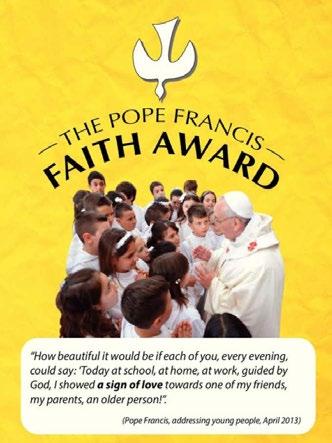
In 2013, as part of the Year of Faith, Pope Francis bestowed the sacrament of confirmation on 44 young confirmands during a mass in St. Peter's Square. In his homily, Pope Francis pointed out that the Holy Spirit :
" brings us the new things of God. He comes to us and makes all things new; he changes us. . . You see, the new things of God are not like the novelties of this world, all of which are temporary; they come and go, and we keep looking for more. The new things which God gives to our lives are lasting, not only in the future, when we will be with him, but today as well. God is even now making all things new; the Holy Spirit is truly transforming us, and through us he also wants to transform the world in which we live.
How beautiful it would be if each of you, every evening, could say: Today at school, at home, at work, guided by God, I showed a sign of
love towards one of my friends, my parents, an older person!".
This has become the foundation of the Pope Francis Faith Award. The Bishops Conference of Scotland instituted this award programme to help young people in Scotland's Catholic schools to see and feel for themselves the benefits of acting with love, with the guidance of the Holy Spirit.
There are 3 main activities for the young people enrolled for the award:
1. At various points across P6 & P7, they will gather together to reflect on a short Scripture passage which will help them to LEARN and REFLECT about their Faith.
2. After they reflect on each Gift of the Holy Spirit, they will be asked to ACT by choosing a Faith Action which they will do at HOME, in SCHOOL and, if they are Catholic, in their PARISH.
3. They will note their learning, their actions and their reflections on these in their personal FAITH Journal which will act as a scrapbook for collecting evidence - notes, photographs etc.
I will use all the gifts of the Holy Spirit when showing my love of God and my love of others in my daily life.
I will use all the gifts of the Holy Spirit when showing my love of God and my love of others in my daily life.
A student sleepover was recently held at St John Bosco Arts College, Croxteth, to raise money for The Whitechapel Centre, a prominent homeless and housing charity in Liverpool. 60 pupils from Year 7 headed to the Croxteth school for the sleepover, where they participated in activities and discussions around homelessness.
By Willie Slavin MBE
To help students gain a deeper understanding of the challenges faced by those sleeping rough across the city, they were tasked with building dens out of carboard boxes, a tough reality homeless people face in order to keep sheltered and warm in the cold months.
An on-site soup kitchen was set up, especially for the event, so students could experience the type of meals homeless people have access to.
Throughout the sleepover, pupils and staff spoke widely about homelessness, including the struggles, the dangers, and the ways to support those who do not have a home or the resources to escape unfortunate living situations.
"At St John Bosco Arts College, we value love and hope, and we believe that it is important to show this not only in our school community but the wider community too; we must take care of one another."
St John Bosco Arts College is located in Croxteth, Liverpool. The college is an exciting, vibrant and dynamic girls' Catholic comprehensive school with a proud Salesian ethos. Their Mission Statement is: 'Together we inspire each other to flourish in faith, hope and love'.
Cardinal Pole Catholic School in Hackney, east London, has been awarded the prestigious School of the Year award at the National Schools Awards 2024.
The National Schools Awards celebrate excellence across the education sector. Schools are shortlisted in one of eight categories, with a panel of industry experts selecting the winners. Judges from the National Governance Association and the Confederation of School Trusts use their expertise to recognise schools demonstrating outstanding achievement. This award recognises schools that have significantly improved pupil outcomes, overcome challenges, or shown exceptional dedication to their
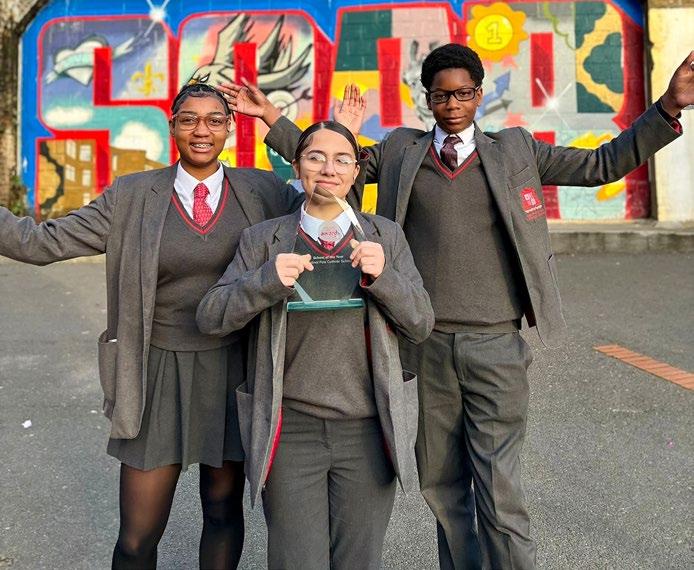
communities. Judges agreed that Cardinal Pole Catholic School provides outstanding educational outcomes for their students, making them a deserving winner.
Adam Hall, Executive Headteacher, said: " This award is a testament to the collective effort of our community, and we remain focused on continuing to deliver an outstanding education for all our students."
Shiphrah, Oyinlola, and Tommy, Head Students, shared: "Cardinal Pole is more than a school; it's a family where everyone is supported to achieve their best. This award celebrates not just our achievements but also the sense of community and care that makes our school so unique. We are proud to represent such an inspiring place."
Students from across Holy Family Catholic Multi Academy Trust (HFCMAT) gathered for the Trust's first-ever COP29 conference.
Across the Trust's seven schools, 18 children came together and spoke passionately about sustainability issues close to their hearts. The students were keen to spread the important message that we are all 'stewards of creation', as seen in the words of Pope Francis in his letter Laudato Si.
The event coincided with the 2024 United Nations Climate Change Conference (COP29), held between 11 - 22 November, where world leaders discuss environmental issues globally.
At the conference, student representatives from six of the Trust's schools discussed a topic with their peers, teachers, leaders, and other attendees. Pupils from Our Lady of Pity Catholic Primary School, Greasby; St Augustine's Catholic Primary School, Runcorn; St Bernard's RC Primary and Nursery School, Ellesmere Port; and St Joseph's Catholic Primary School, Oxton participated in the event.
Pupils from two of the Trust's partner schools, Ss Peter and Paul Catholic Primary School, New Brighton and St Alban's Catholic Primary School, Wallasey, also participated in the event.
Throughout the day, pupils covered a range of topics including the catastrophic impact of plastic pollution, poetry for the
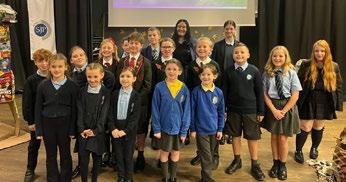
planet, and the devastating impact of illegal poaching on wildlife.
Speaking confidently and passionately, pupils shared the harsh reality facing the planet if urgent action is not taken.
Students from one of the Trust's secondary schools, St John Plessington Catholic College, Bebington, spoke passionately about being stewards of creation. Gabriela Hyde, Logan Davies, and Olivia-Rose Davies, confidently shared staggered figures around CO2 emissions, deforestation and the polar ice caps before emphasising how important it is to nurture the planet.
St Mary's Catholic College students spoke confidently about the impact of global warming and shared how we can help combat climate change within our own communities.
Throughout the event, family members proudly watched as students shared their ideas for creating a more sustainable future for all.
The Trust welcomed Sean Dick, senior conservation education manager at Chester Zoo, who talked to the young people about COP29 and the importance of young people having a voice and agency.
Sean said: "It was fantastic to see so many young people speak passionately about climate change in an open forum and advocate for positive change.
Budding young artists at St Thomas' Catholic Voluntary Academy in Ilkeston, Derbyshire, have raised over £500 for charity.
Every child at the school created a piece of art based on Catholic Social Teaching principles and the work was sold at a grand art sale attended by parents and carers.
Over £500 was raised and this will be split between the charities supported by each class including Little Ways, Poor Clare Sisters, CAFOD World Gifts, Mary's Meals, Beauvale Society, Fair Trade and St Vincent De Paul Society. The original idea for the art sale came from the pupils as they were looking for ways to make their Religious Education lessons more creative.
They suggested creating artwork based on the Catholic Social Teaching principles of Human Dignity, The Common Good, Participation, Subsidiarity, Stewardship, Solidarity, Preferential Option for the Poor, Distributing Justice and Promoting Peace. Susan Law, Year Two teacher and RE Lead at the school, said: "Each class is in charge of a Catholic Social Teaching principle and the children wanted to combine art and RE as they were looking for a way to make our RE lessons more creative.
"The children really embraced the challenge of thinking creatively and they created some wonderful pieces of art. The sale was fantastic and our hall was packed with parents and parishioners. We raised over £500 and the money will be shared between each Catholic charity that we support as a school
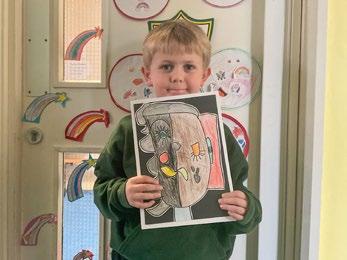
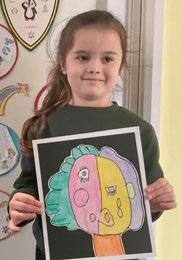
Pupils from St Joseph's Catholic Primary School in Chelsea visited the Houses of Parliament, last Tuesday, attending a reception hosted by the All Party Parliamentary Group for Opera with English National Opera (ENO).
The school is one of the Lead Schools for Music in the Tri-Borough (Kensington and Chelsea, Westminster, and Hammersmith and Fulham). Twenty pupils have recently performed at the London Coliseum in the English National Opera's production of La Bohème.
Alongside members of the ENO, the pupils spoke in Parliament and demonstrated the added value of a comprehensive enrichment programme in the Arts, explaining their experience of performing in ENO's La Bohème on the stage and how they benefited from it.
Helen Wiles, Music Specialist Teacher and Leader of the Arts said: "Opportunities like this have a significant impact on our pupils. Their horizons are broadened; they are encouraged to dream bigger and consider areas of The Arts that may have been relatively unknown to them before. The children have matured a lot in a short space of time. The effect on their self-esteem, confidence and self-belief has been transformational. Opera is part of our musical culture now!"
Taffy and Rocky in their Christmas outfits Bishop Challoner Catholic School in Tower Hamlets hosted a heart-warming Advent celebration last Wednesday, with two very special guests-Rocky and Taffy, the donkeys. Organised by Sixth Form students with support from the chaplaincy team, the event brought together pupils, local schools, and the wider community to share in the joy and hope of the season.
Children from the St Francis Family Centre and students from St Mary and St Michael's Primary School delighted in meeting the donkeys while enjoying hot chocolate and mince pies. Christmas music filled the air, with the parish church serving as a beautiful backdrop symbolising the unity of this East London community.
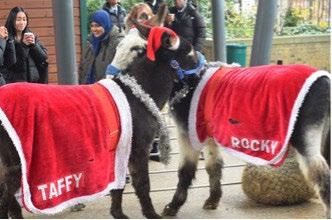
The Advent season at Bishop Challoner has also been marked by meaningful acts of service. Staff have continued their tradition of donating Christmas presents for children at the St Francis Family Centre, a local charity supporting families in need. These gifts ensure no child goes without on Christmas Day. The Centre works tirelessly to provide outstanding early years education for disadvantaged children, and many of its long-serving staff are proud alumni of Bishop Challoner.
In addition, the school has partnered with the Jesuit Refugee Service (JRS) in Wapping, collecting essential items such as clothing, food, and toiletries for refugees without access to asylum support. Students have also been writing Christmas cards with messages of hope for individuals in detention centres, underscoring the school's commitment to compassion and inclusion.
"Advent is about joy, generosity, and hope," said School Chaplain James Johnston. "Bishop Challoner has been a proud part of the East End for almost a century. This event, and our wider advent appeals each year give our young people the chance to demonstrate the power of community during this special seasonjust as the Sisters of Mercy, who founded our school did for so many years."
St Mary's University, London (SMU) has announced plans to open a new School of Medicine on its Strawberry Hill Campus in Twickenham.
The announcement comes after the General Medical Council (GMC) provided assurance that St Mary's is currently on track and making good progress towards required standards for medical education. The University will initially be recruiting international students and plans to welcome its first cohort in September 2026.
Speaking of the news, St Mary's ViceChancellor Professor Anthony McClaran said: "The launch of a School of Medicine is a cornerstone of the University's plan for strategic growth and is in keeping with our tradition of delivering a sustained, positive impact on society.
"The school will not only contribute to the workforce development demands in the UK for more doctors and medical professionals, but it will also train global professionals able to work anywhere in the world. Our approach to developing the whole person during students' time
at SMU will mean medics of the future will leave this University with the technical and personal skills they need to deliver truly holistic, compassionate, patientcentred care."
Interim Founding Dean of the School of Medical Professor Michael Bewick added, "Complemented by the existing successful Allied Health and Sports Science provision, St Mary's is the natural place to establish a forward-thinking centre of medical training. I am delighted we are making consistent steps forward in making this ambition a reality."
In a further development, SMU has also signed a new curriculum partnership with the University of Central Lancashire. The partnership will see SMU use the University of Central Lancashire's Bachelor Medicine Bachelor Surgery (MBBS) curriculum in the development of the School of Medicine and their commitment as SMU's contingency partner throughout the GMC accreditation process.
"The University of Central Lancashire's Medical School will now support St Mary's new medical school as it's contingent partner as it progresses through all the stages to full GMC accreditation, and I'm delighted they'll now deliver the curriculum we created to their new cohort of students."
The School of Medicine at St Mary's University will benefit from the latest technology, new facilities, and advanced teaching practices, building on its proven history of teaching excellence and student satisfaction. SMU is currently placed in the Top 10 nationally for student experience and the Top 5 nationally for teaching quality in The Times and Sunday Times Good University Guide 2024.
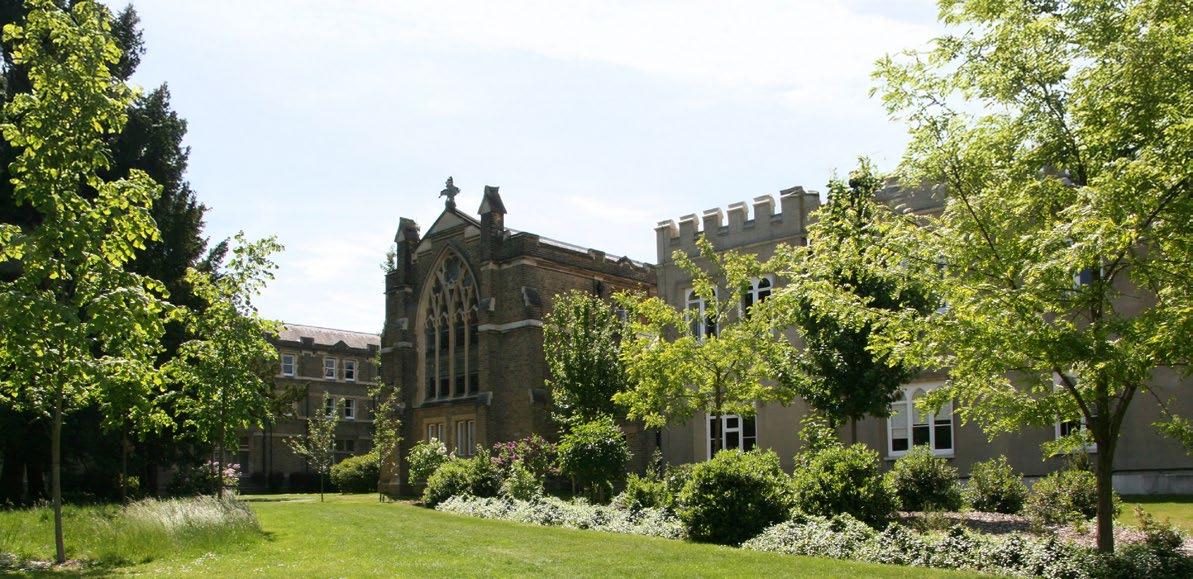

By Benjamin Myers
Published by Bloomsbury Publishing PLC. ISBN: 9781526631466
Bought on word of mouth and good reviews, my copy of Cuddy by Benjamin Myers ended up on the shelf. An initial flick through it hadn’t helped. What kind of a read was this going to be with its pages of quotations from historians, others with barely any words, and the text occasionally laid out in patterns or even decreasing in size? Some weeks later, a second attempt. Again I sensed ‘experimental’ writing and parked it. A third shot, this time determined to give it a proper go, was a revelation. I discovered an original and enchanting approach to the life and legacy of St Cuthbert, affectionately nicknamed Cuddy. The author is a fascinating character with roots in the NorthEast. Despite hating school and struggling academically, he went on to win awards for his novels, poetry, journalism and non-fiction. He uses all these genres, sometimes playfully, to capture the enduring presence of St Cuthbert in our imagination.
Cuddy includes a prologue, and an ‘interlude’ with two ‘books’ on either side. Each section could be read as a free-standing work, but St Cuthbert’s memory, sequenced over time, is the unifying strand. Myers begins in 995, exploring what little we know of the saint’s life and the years following his death when his remains, protected from Viking raiders, were carried about Northumberland by a little posse of monks until his final resting place in Durham. Accompanying them is a girl, Ediva, who communes with Cuddy’s spirit, and a mysterious owl-eyed orphan boy. Avatars of both will resurface in later sections. Myers counterbalances citations from often vague and conflicting historical sources with dreamlike exchanges between Ediva and Cuthbert to create an almost tangible sensation of his presence.
We then move to 1346, where Durham is known by its Norman variant of Duresme. Entitled ‘The Mason’s Mark’, this is the story of Eda, a brewer of ale, married to Fletcher Bullard, an accomplished archer and a wife beater, and Francis Rolfe, a kindly stonemason. In Fletcher’s absence, Francis takes Eda inside the cathedral and up to ‘the kingdom of the clouds’ where she is overwhelmed to be above what had previously loomed over and excluded her. He gifts her with a stone engraved with his sigil. Medieval life in the little village is described in earthy detail. When Eda sees an owleyed boy being abused by a monk, an act of violence follows from which redemption and a new life follow.
The Interlude, ‘The Stone Speaks’, is a playlet set in 1650 with five speaking parts: four starving Scottish soldiers and the cathedral itself. Each section of Cuddy has an historical context, and this unbearably poignant sequence takes place in the aftermath of the battle of Dunbar. Cromwell had marched thousands of Scottish soldiers to Durham cathedral now
turned into a storage space and gaol. Hundreds of them died corralled in its walls. The cathedral laments their agony and its desecration, ‘They pulled down my Papal pictures…’, and the boy soldiers their lot, ‘Jesus himself cannae have suffered as we suffer’. Their desperation as the last ones to die is expressed in curses, dark humour and shattered hopes.
Book III, ‘The Corpse in The Cathedral’ set in 1827 in Dunelm, another variant of Durham, is a ghost story based on real events that year when a cathedral canon ordered the unauthorised exhumation of St Cuthbert. The narrator is a pompous Cambridge professor who, despite his disdainful attitude towards the north, has his curiosity piqued by a fawning letter from a prebendary asking him to assist in the saint’s exhumation. On arrival in Durham’s market place his arm is tugged by an adolescent with eyes ‘as dark and round as the anthracite coal they hoist from the chthonic underworld in these parts’. The boy’s strange behaviour as he leads him to his lodgings in the cathedral grounds is the first of increasingly unnerving experiences. He is woken at night by the disembodied chanting of the ‘haliwerfolk - the wandering folk of the holy man echoing ever onwards’ and the whispered reproach ‘Let History Lie.’ These incidents and his disturbing encounters with the young man exacerbate the professor’s struggle with his own mental health and sexuality.
The final section of Cuddy, ‘Daft Lad’, is set in Durham in 2017. Nineteenyear-old Michael, a quiet lad living in desperate poverty whose only relationship is with his bed-bound mother, survives on insecure manual work in abattoirs, demolition, and illegal asbestos removal. Myers brilliantly captures the verbal exchanges and exhausting work routines of these unskilled, exploited labourers. A change to Michael’s
fortunes occurs when he gets menial work in Durham Cathedral. Following in Eda’s footsteps, he climbs up to the roof, this time carrying brews for a team of restorers who treat him with affection and respect. When they express surprise that as a local lad he had never been inside the Cathedral before, “Michael feels his face flush. Actually going inside the cathedral was what middle-class families did”. He befriends Evie, a student of Anglo-Saxon history who works in its cafeteria. Her warmth and interest in him, telling him stories about St Cuthbert, is complicated by class differences, expressed in misunderstandings, amusing for the reader, but mortifying for Michael. The mason’s mark again makes its appearance. When Michael touches it, he experiences ‘a memory jolt, a fleeting photographic flash to a past time’. As his mother’s health deteriorates, he begins to commune with St Cuthbert and following the wandering saint, who we discover shares his surname, the book ends with Michael on a journey.
Cuddy exemplifies how fiction can stimulate our curiosity to delve more into Christian history. Myers imagines how St Cuthbert has been an enduring and comforting presence in the lives of poor and marginalised people; that ‘simple but consistent faith’ extolled by Pope Francis. Alongside its realism, a thread of Christian mysticism flows through this book via skeins of names, of places, of dreams, and of stone. I suspect many readers will finish it with St Cuthbert haunting their imagination, wanting to discover more about him, and, if they have not already done so, making plans to visit Durham Cathedral.
Review by Anthony McNamara
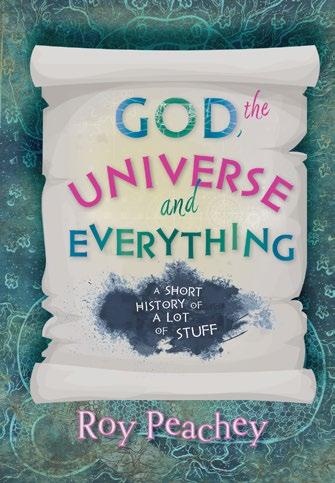
By Roy Peachey
Published by Redemptorist
Publications
ISBN: 9780853216429
Both the title and its attractive cover drew me to this deceptively alluring publication although the extravagantly ambitious title sparked curiosity and probably swayed the decision to delve a little deeper.
Its blurb elucidates: Everything you could possibly want to know about God and the universe in one book.
Well, maybe not quite everything, but you’ll be surprised at how much we’ve packed in. There are escape stories and riddles and ancient games. There are codes, cricket and football. There are elephants, time-eaters and cosmic explosions. There’s a goldfish. But, above all, there’s the story of God’s
amazing love for us over the whole of human history, the greatest story of all time.
This story within a story has the feel of two books skilfully intertwined although, perhaps the most helpful view is that it is an episodic story that is insightfully contextualised in a distinctly illuminating manner. It displays a remarkably high degree of scholarship interspersed with astutely chosen anecdotes.
Although the book is catalogued for children, it would quite readily serve as an interesting read for any adult who wished to re-visit the story of salvation that many may have first encountered in school in a far less captivating fashion. As a children’s book, I would gauge it as aiming at the upper Primary to lower Secondary age group.
What I can assure any reader is that Roy Peachey has a sureness of touch in making sound theology and the Church’s teaching readily available to any audience. As a former headteacher of Primary age children I would have no qualms about recommending its sound content to any non-specialist teacher of RE. That said, the skilful use of supportive material helpfully grounds the story in a real life event or opens it up to deeper and meaningful consideration, making it pure gold to the imaginative teacher.
This book is a triumph of applied imagination rooted in an acute knowledge and spiritual insight into the Old and New Testament accounts and the richness of the Church’s teaching.
Review by Willie Slavin MBE

On Christmas Eve 2024, Pope Francis opened the Holy Door of St Peter’s Basilica in Rome. This dramatic, symbolic action initiated a Holy Year of Jubilee. Rooted in an ancient Hebrew tradition, a Jubilee is a sacred time of renewal, justice, and restoration, typically held every 25 years in the Catholic Church. Every Jubilee presents an opportunity for all members of our global Church family to deepen their relationship with God, with one another, and with all of creation. These aims are much needed in a world which, Pope Francis says, ‘[is] marked by too much despair’.
How fitting, then, that the Holy Father has chosen ‘hope’ as the theme for the 2025 Jubilee. Hope is the central message of the Holy Father’s Jubilee Bull of Indiction (the Papal document that announces a Jubilee), known by its Latin title Spes non Confundit (Hope does not disappoint).
In Spes non Confundit, Pope Francis emphasises the need for diplomacy to resolve armed conflicts around the world, and calls on leaders to address the needs of the billions of poor people who lack food and water. He appeals for the cancellation of the debts of poor countries, and asks for an amnesty for prisoners. Spes non Confundit also reminds believers that during this Holy Year, ‘we are called to be tangible signs of hope for those of our brothers and sisters who experience hardship of any kind.’
The Holy Father then goes further. In addition to the instruction to be signs of hope for the world, Pope
Francis wisely reminds us of the need to notice signs of hope in the world too:
‘[W]e are also called to discover hope in the signs of the times that the Lord gives us… We need to recognize the immense goodness present in our world, lest we be tempted to think ourselves overwhelmed by evil and violence.’
For Catholic educators, the Jubilee presents a wonderful chance to nurture in pupils the values of hopefulness, faithfulness, global solidarity, and active participation in the Church’s mission. Catholic schools are uniquely positioned to bring the spirit of Jubilee alive. Through assemblies, prayer and liturgy, classroom discussions, and community events, pupils can see how their actions – both small and great - can bring faith, hope, and God’s love to the world.
In the spirit of Jubilee 2025, Mission Together - the children’s branch of Missio, the Pope’s official charity for world mission - has developed a range of resources to help schools engage young people
with the objectives of this holy year. These resources include:
• Jubilee Five Fact assembly: invites pupils to discover the origins of the Holy Year; its objectives, its traditions, and the theme for Jubilee 2025. The assembly also contains reflection points, calls to action, scripture, and prayer.
• Jubilee Celebration of the Word: incorporates the key scripture of any Jubilee year: Luke 4:16-21. We help unpack this passage - sometimes referred to as Jesus’ mission statementin our simple scripture reflection.
• Jubilee Ideas for Schools: our guide offers 20 doable ideas to deepen understanding and celebrate the Holy Year in school, whether that’s through community action, prayer and reconciliation, pilgrimage, or care of creation.
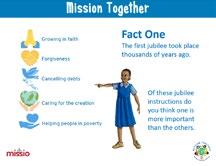
• Finding signs of hope in creation (activity): this simple activity helps children to identify signs of hope in the world around them.
• Children’s Jubilee Prayers: we were delighted to work in collaboration with CAFOD to produce England and Wales’s official Jubilee children’s prayer. Find this, and other helpful prayers for pupils on our Jubilee webpage.
Through Mission Together’s Jubilee resources, Catholic educators can guide pupils on their journey as Pilgrims of Hope, helping them to understand that faith, hope, and love are gifts to be shared with the world, by all of us.
We would love to support you in making this Jubilee a vibrant expression of hope, unity, and service in our schools and communities, ensuring that the message of Christ reaches every corner of the world.
‘By our actions, our words, the decisions we make each day, our patient efforts to sow seeds of beauty and kindness wherever we
find ourselves, we want to sing of hope, so that its melody can touch the heartstrings of humanity and reawaken in every heart the joy and the courage to embrace life to the full.’ - Pope Francis.
The latest news from Missiosupported projects in Cambodia is an encouraging and promising sign of how the Church brings hope into the lives of thousands of people, whatever their background or belief. By supporting Mission Together, you are enabling thousands of children in Cambodia to access EYFS through Church-run kindergartens open to all.
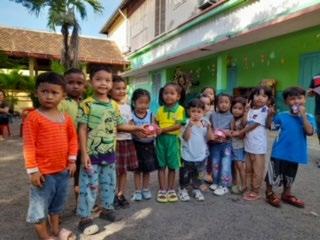
Sadly, the state provides very limited early years education (many children receive just 90 minutes EYFS per day). By contrast, the Church offers free full-day provision, nutritious meals , and a holistic programme of
study - all vital for struggling parents working in factories or farms. In a country where conflict prevented the education of an entire generation, quality EYFS provides real hope for a better future.
Whilst Mission Together resources are free, the overseas children’s projects we support rely on your donations and prayers. By fundraising for Mission Together, you are helping to provide feeding programmes, residential care, and educational, pastoral, and spiritual support to some of the world’s poorest children.
Thank you for supporting us, so that we can support you in your mission as Catholic educators, and struggling communities around the world!
If you are interested in becoming a Mission Together volunteer, either delivering assemblies or being part of our Teachers Consultancy Board, we’d love to hear from you. Please contact Claire at missiontogether@ missio.org.uk
missiontogether.org.uk
Whilst Mission Together resources are free, the overseas children’s projects we support rely on your donations and prayers. By fundraising for Mission Together, you are helping to provide feeding programmes, residential care, and educational, pastoral, and spiritual support to some of the world’s poorest children. Thank you for supporting us, so that we can support you in your mission as Catholic educators, and struggling communities around the world!
If you are interested in becoming a Mission Together volunteer, either delivering assemblies or being part of our Teachers Consultancy Board, we’d love to hear from you.
Please contact Claire at missiontogether@missio.org.uk