Small Farms




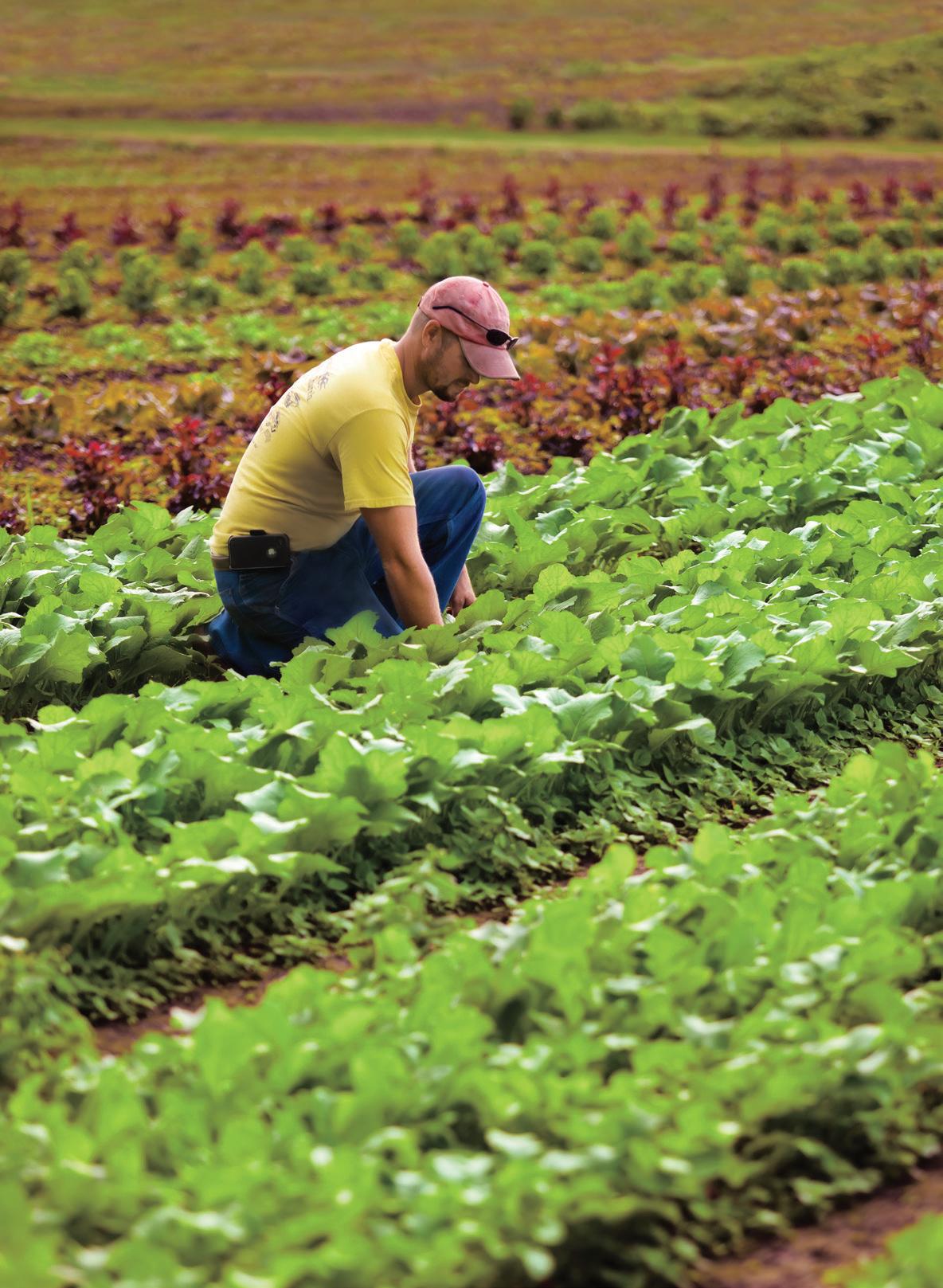
Moseley grows lettuce at Pleasant Acre Farms in Clarks Hill. Photo by Brian McCord

Connect to your food, your farmers and a uniquely Hoosier lifestyle FOOD Travel FarMS hOMe & GarDen MY InDIana
FOOD
Farmers Market recipes
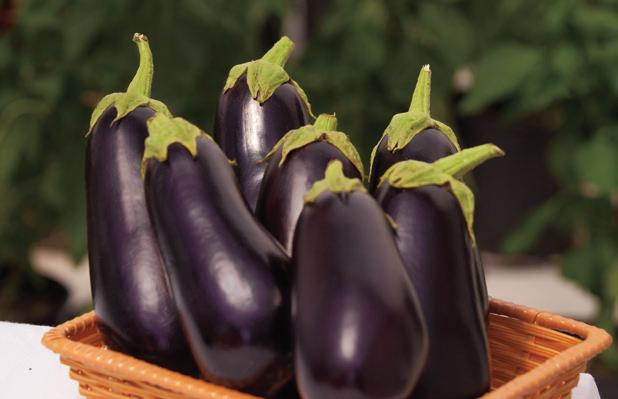
Puzzled over what to do with that fresh eggplant you picked up at the farmers market or all the squash your neighbor keeps bringing over? Find some fresh inspiration for summer recipes at my-indiana-home.com/farmers-market
FaIr Thee Well
Discover hidden gems at the Indiana State Fair this August in Indianapolis. Learn more at my-indiana-home.com/fair

watch our videos on youtube youtube.com/my inhome grow, cook, eat, learn Browse “berry” delicious recipes at farmflavor.com.

planT ThIS near ThaT
Did you know that planting basil, tomatoes and marigolds together helps each plant thrive? Find more plants that pair well at my-indiana-home.com/companion-planting.


cOnnecT WITh uS like us on facebook facebook.com/myindianahome share your photos my-indiana-home.com/photos


follow us on twitter twitter.com/my inhome



president Don Villwock
v ice president Randy Kron
Second v ice president Isabella Chism
chief Operating Officer & Treasurer Mark Sigler
editor Andy Dietrick
Managing editor Kathleen Dutro
Marketing & public relations Specialist Mindy Reef
Web Designer/Developer Diane Brewer
administrative assistant Charla Buis
content Director Jessy Yancey
proofreading Manager Raven Petty
content coordinator Rachel Bertone
contributing Writers Kim Galeaz, Susan Hayhurst, Colletta Kosiba, Margie Monin Dombrowski, Jessica Mozo
creative Services Director Christina Carden
Senior Graphic Designers Laura Gallagher, Jake Shores, Vikki Williams
creative Technology a nalyst Rebecca Ary
photography Director Jeffrey S. o tto
Senior photographers Jeff Adkins, Brian McCord
Staff photographer Michael Conti
Web creative Director Allison Davis
Web content Manager John Hood
Web Designer II Richard Stevens
Web Development l ead Yamel Hall
Web Developer I Nels Noseworthy
ad production Manager Katie Middendorf
ad Traffic assistants Krystin Lemmon, Patricia Moisan
I.T. Director Daniel Cantrell
accounting Diana Guzman, Maria McFarland, Lisa o wens
e xecutive Secretary Kristy Duncan
receptionist Linda Bishop
chairman Greg Thurman
president/publisher Bob Schwartzman
e xecutive v ice president Ray Langen
Sr. v p./Operations Casey Hester
Sr. v p./Sales Todd Potter
Sr. v p./agribusiness publishing Kim Newsom Holmberg
v p./ v isual content Mark Forester
v p./Sales Rhonda Graham
v p./e xternal communications Teree Caruthers
v p./content Operations Natasha Lorens
controller Chris Dudley
Distribution Director Gary Smith
Senior Integrated Media Manager Robin Robertson
Sales Support Manager Sara Quint
My Indiana Home is produced for the Indiana Farm Bureau by Journal Communications Inc., 725 Cool Springs Blvd., Suite 400, Franklin, TN 37067, (800) 333-8842. All rights reserved. No portion of this magazine may be reproduced in whole or in part without written consent.
My Indiana Home (ISSN 2157-1465 USPS 249-880) is published quarterly by Indiana Farm Bureau Inc., 225 S. East St., Box 1290, Indianapolis IN 46206-1290. Controlled circulation. Subscription price of $2 per year included in the dues of Farm Bureau members in Indiana. Periodical postage paid at Indianapolis, Indiana and additional entry points.
Postmaster: Send address changes to My Indiana Home, P.o. Box 1290, Indianapolis, IN 46206-1290.
Member Association of Magazine Media
Member Custom Content Council
Please recycle this magazine

We love hearing from you, whether by email, comments on our website, my-indiana-home.com, or even a tweet or Facebook post. In many cases, your notes can help us improve the experience of other readers or website visitors, so please keep them coming!
I just read an article in your Spring 2013 issue entitled “ easy as pie.” Lisa’s Pie Shop has been a competitor in the National Pie Championships for many years. She’s won many awards in her division of the championships, and I think her pies are great. I just wanted to let you know that Lisa’s Pie Shop does not compete directly with Wick’s Pies in the National Pie Championships – they are in two different divisions, therefore the statement that Lisa’s pie beat Wick’s is incorrect.
linda hoskins
American Pie Council
editor’s note: Thanks for setting us straight. We recommend that our readers try both Wick’s and Lisa’s award-winning sugar cream pies, and let us know what they think!
This is a great magazine to promote the great things about Indiana –families, caring people, beautiful scenery and hard work ethics.
Kayleen reusser via Facebook
We made the dyed deviled eggs for easter, and they were beautiful! I’ve shared the idea with several of my clients!
cheryl Miller
purdue extension Family nutrition program
Brookville, Ind. via email
editor’s note: We received word from a few readers that they were unable to find the link to the dyed deviled eggs at my-indiana-home.com/deviled. This Easter has passed, but for future reference, you can also find the recipe at farmflavor.com/how-to-dye-deviled-eggs. We apologize for any inconvenience!
l ove this issue [Spring 2013]. I saw it at my son’s house. I’m all for farming families, as without these families, we would not have any food.
lisa Smith via Facebook
Our friends just brought us half gallon [of Indiana maple syrup] from Warsaw, Ind. It is delicious!
Tina Marie robinson via Facebook
Do you have a question about something you read in My Indiana Home? Send questions, feedback and story ideas to myindianahome@jnlcom.com.
A MAgAziNe For iNdiANA FArM BureAu MeMBers
Share Your Story
Are You Covered?
If an employee is injured on your farm, are you covered?
If you farm, protecting your farm operations is our priority, and that means helping you understand what you have and what you need. As a farm owner, Worker’s Compensation coverage for your farm/ag employees is not required. However, it is important to note that if your farm employee is injured while working for you while performing certain types of duties, you could still be legally obligated to provide benefits under Indiana Worker’s Compensation laws.
Make sure you have the coverage you need to fully protect yourself as an employer. Contact your agent today to discuss Worker’s Compensation coverage.
Farm Facts
Most Indiana blueberries are planted in the northern third of the state, where the soil is better for growing.
Send suggestions for Indiana events, attractions and other story ideas to myindianahome@jnlcom.com
Blog Spotlight
Jent’s Front Porch
Raised on a farm in Shelby County, Jent Campbell has been a part of agriculture her entire life. Her dad was a full-time farmer, and her mom, brother and sister-in-law now keep the family operation alive. Jent and her husband, Chris, live a busy life raising three kids on their sixth-generation grain and hog farm.

Jent shares her farm and family experiences on her blog, Jent’s Front Porch, named because the front porch is her favorite place to be when she’s not busy. And while she always has dirt or manure on her jeans, Jent says she is living her dream life every day. Check out Jent’s adventures at jentsfrontporch.com
BLUEBERRIES
12 Indiana’s ranking among other states in blueberry production
The peak season for fresh blueberries runs from mid-June to mid-August.
Shopping Tip: When buying fresh blueberries, make sure they are firm, dry, plump and smooth-skinned with no leaves or stems. Avoid berries that look soft or shriveled.
25% Percentage of the recommended daily value of vitamin C in a one-cup serving of blueberries
670
Acres of blueberries harvested in Indiana in 2010
Transparent Agriculture
Get a behind-the-scenes look at farm life at the Indiana State Fair’s newest attraction, the Glass Barn.
Composed of four separate exhibits, the Glass Barn will engage visitors in the everyday life of a farmer, even featuring a live video interaction between fairgoers and farm families in the field. Visitors will be able to experience rural Indiana without leaving the fairgrounds.
The exhibit, presented by the state’s soybean farmers, will continue to draw visitors year round as an addition to the fairgrounds’ agricultural education program.
This year’s Indiana State Fair, which will be held Aug. 2-18, celebrates the year of popcorn. For more information, visit in.gov/statefair
The Art of the Matter
Get in touch with your artistic side by discovering the rich heritage and talented artisans of northern Indiana on the Art and Earth Trail.
The trail features seven driving loops for each county in northern Indiana. Each loop highlights arts, markets, restaurants and attractions in the region that are one-of-akind and true to the region’s heritage. Pick berries at a blueberry farm, grab a pint at a regional brewery or visit a local pottery studio to watch artists at work before turning in at a family-run bed-and-breakfast.
For more information on the Art and Earth Trail, visit artandearthtrail.com

Feeding the World
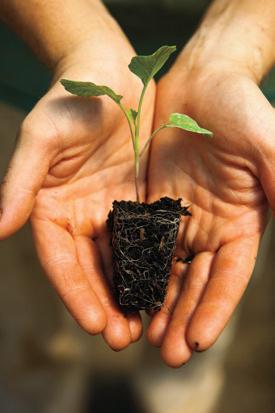
Who better to lead the war against hunger than those who grow the food we eat?
Operated by the nonprofit Farm Journal Agricultural Foundation, Farmers Feeding the World is an industry-wide campaign with a mission to rally American agriculture for the war against hunger, with the goal of raising at least $20 million annually for charity and education. Indiana farmer Kip Tom of Tom Farms helped launch the campaign and will act as the farmer spokesperson, championing the effort to fellow producers and agribusinesses.
Tom and others involved in the campaign aim to educate the general public about U.S. agriculture’s role in feeding the world.
For more information or to get involved, visit farmersfeedingtheworld.org

Dog Days of Summer
Bask in summer’s warmth at downtown Frankfort’s annual Hot Dog Festival.
This family- and pup-friendly event features dachshund racing, the greatest American hot dog challenge, a 5K bun run and walk, live entertainment and more. Bring your pooch along for some guaranteed fun in the sun.
The 2013 festival takes place July 26-27 in downtown Frankfort. For more information, call (765) 654-4081.
The of ManyDairyingFaces
From high-tech robots to greener pastures, farmers find innovative ways to produce milk
s tory by susan hayhurst | Photography by Michael c onti
While using a tin pail and three-legged stool used to be a common milking practice, modern dairy farms range from large to small, rationfed to grazing, conventional to organic, mechanized to robotic.
By the numbers
129
average number of cows on Indiana dairy farms
1,300
approximate number of dairy farms in the state
48 hours it takes for milk to go from cow to grocery store
Indiana’s milk production contributes more than $743 million to the state’s economy, according to Jenni Purcell, communications director for the American Dairy Association of Indiana.
“Our Indiana dairy farm families work hard,” she says. “Our 174,000 dairy cows produce 3.8 billion pounds of milk per year.”
FrOM cOW TO cOnSuMer
Most of the state’s 1,300 dairy farms use a traditional mechanized system. Purcell says the actual milking process takes only 15 minutes for the cow. Typically twice a day, the cows file in to the farm’s milking parlor. A farm worker sanitizes the cow’s udder and attaches the milking machine, which drops off once all the milk has been collected in the farm’s refrigerated bulk tank. There, it’s tested to meet state and federal standards.
Every day or every other day, a tanker from the milk processing plant collects the milk from every dairy farm in a designated region. When the tanker arrives at the plant, the milk gets tested again. Next, it’s pasteurized to remove bacteria and increase shelf life and homogenized to make the milk uniform. The milk is then packaged, loaded onto trucks and delivered to local grocery stores.
To make 2 percent or skim milk, Purcell explains, some of the fat is strained out. Flavoring may be added to produce chocolate, vanilla or strawberry milk. Other milk is made into cheese, yogurt, ice cream and other dairy products.
MIlKInG TechnOlOGY
FOr a ll IT ’S WOrTh
One northwestern Indiana farm has set the stage for innovation. Its owners enthusiastically educate the public about dairy life, and all of its 300 Holstein cattle are born and raised on the farm. However, that’s not all that makes it unique.
In 2003, Jones’ Robotic Dairy in Star City became the first in Indiana, and only the 10th nationwide, to move from conventional
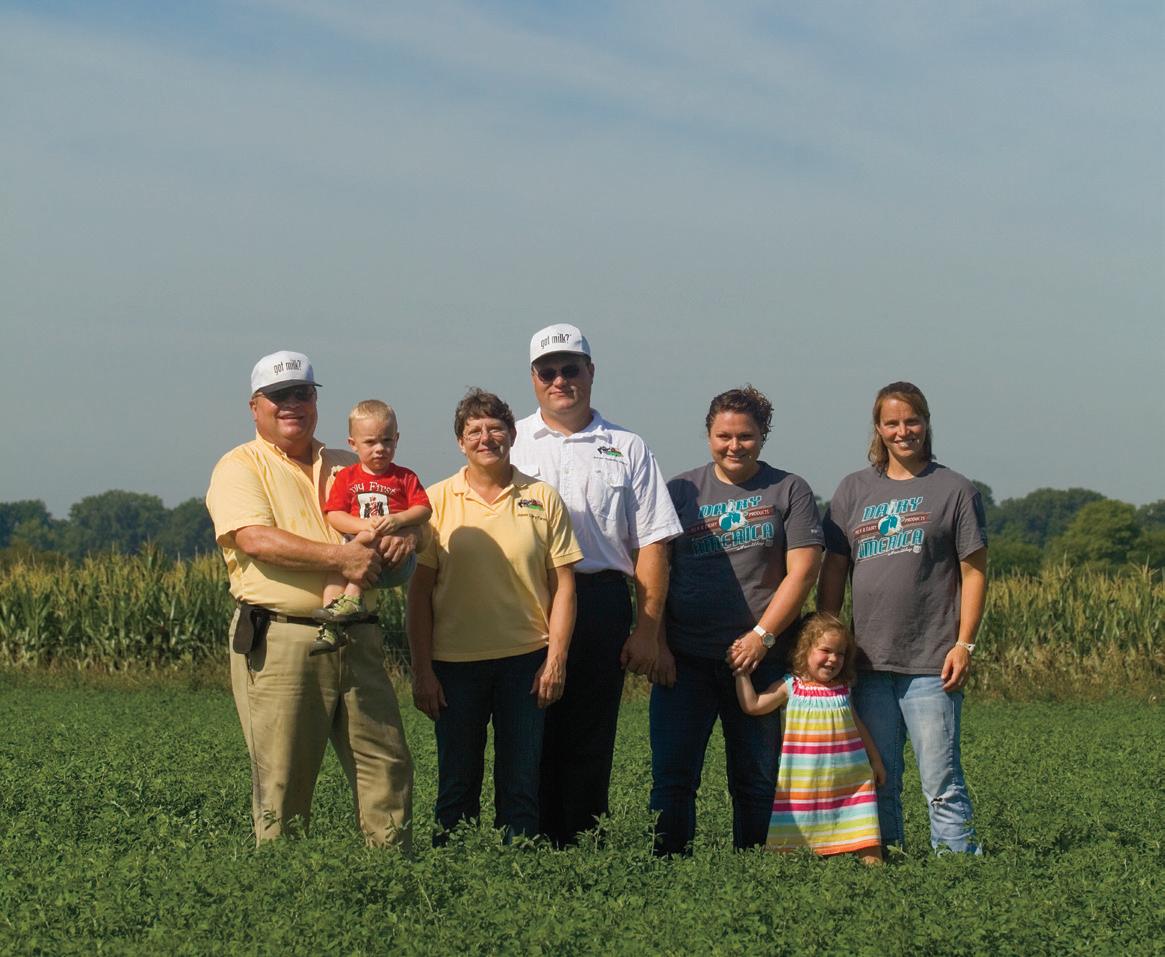
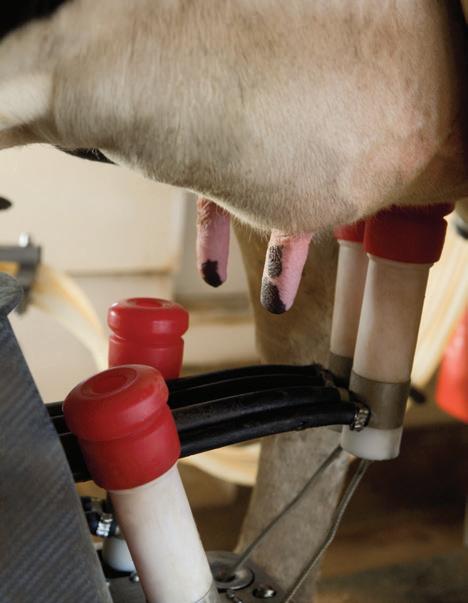
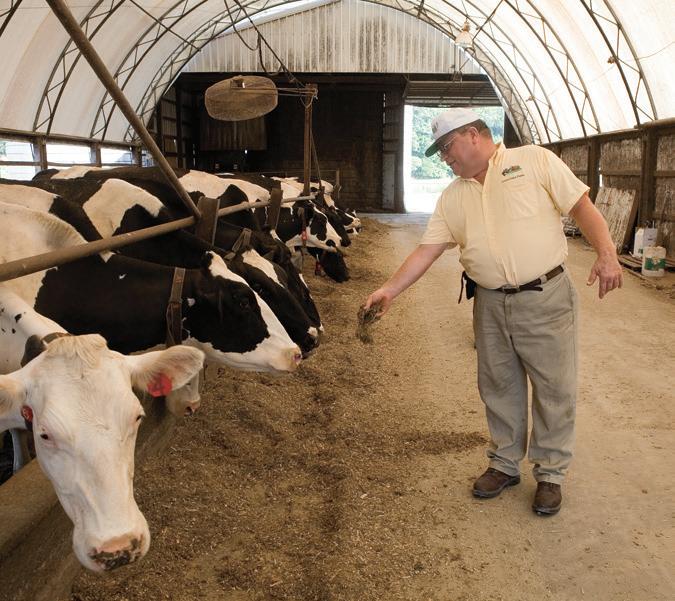
The Jones family consists of (from left) sammy Jones, his grandson Lucas Coon, wife Pam, son Josh, daughter Amy, granddaughter Lindsay Coon and daughter Christy Coon. They run the state’s first robotic dairy in s tar City, where cows head for one of two robots in the milking parlor (bottom left) whenever they feel the need to milk or eat.
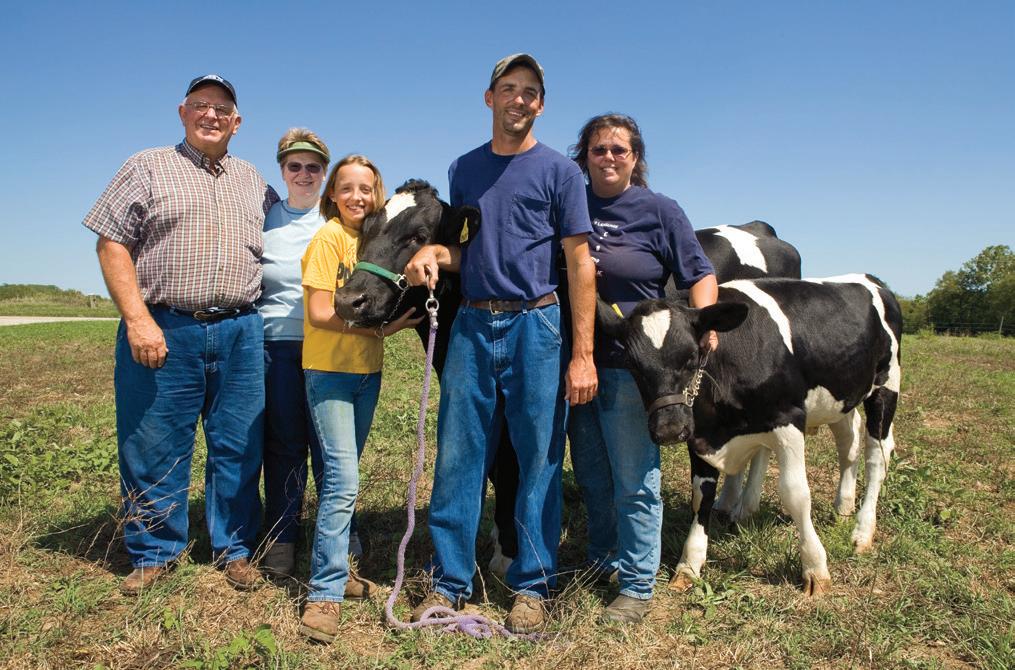
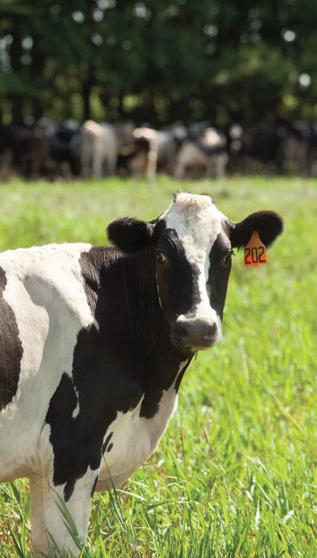

milking to a robotic milking system.
“The decision to convert was a family decision,” says Sammy Jones, a third-generation farmer. Sammy is a full-time employee of the farm, along with his wife, Pam, and their oldest son, Joshua. “After much discussion and research, we took a leap of faith with the innovative technology.”
Robotic milking differs from conventional milking in that the cow is milked on her own schedule. Whenever the cow feels the need to milk or eat, she heads for one of two robots in the milking parlor. The Jones herd averages three milkings per day. No human contact is required, and the cows can eat a high-energy feed while milking. Their food includes some of the corn and soybeans raised on the farm’s 550 tillable acres. (The family also grows alfalfa, rye and wheat.)
Sammy says the farm’s milk production has increased by 10 to 14 percent since installing the system.
“Most conventional dairy farms milk on the farmer’s schedule,” he
says. “With robotics, the stress of finding dedicated employees was eliminated. We’re no longer standing on concrete for four hours a day, and the cattle are not forced to, either.”
The other Jones children all play integral roles on the farm. Daughter Christy does some veterinary work, son Ryan creates the farm’s art and graphics, and daughter Amy helps with the farm’s popular tours, which bring approximately 500 visitors to the farm each year. Other family members also help as needed.
“We want people to know our main goals are to care for our animals, the soil and water,” says Pam. “Farmers are consumers, too, and want the same quality of products on their grocers’ shelves. We want consumers to understand how milk is an essential healthy product needed for daily diets and helps us live a longer life.”
Graze a naTOMY
About 20 miles south, thirdgeneration dairyman Dave Forgey
dave and Helen Forgey, left, converted river-View Farm to a grass-fed operation in 1992. scott and darla Foerg and daughter Allison run the dairy today.
owns River-View Farm near Logansport with his wife, Helen, and another couple. The farm focuses on intensive rotational grazing for its 300 head of cattle.
Forgey’s grandfather Hugh founded the farm with a few dozen Holsteins, but today it encompasses approximately 500 acres. A longtime conventional dairy farm where the herd was managed and fed in barns, the Forgeys weathered drought, financial stress and farm expansion, like many others. But a trip to hear an Ohio State University forage specialist in 1991 led the family to convert its operation to a managed grazing system.
“While we had lower-quality soils, I knew forages grew well on our land,” says Forgey. Over the years, they have tested with a number of forages, including several varieties of clover.
During the 1992 conversion to a pasture-fed operation, the Forgeys reduced their labor force to one employee, Scott Foerg. He and his wife, Darla, eventually became full partners in the operation in 2005.
“They are now the operators,” explains Forgey, “and we work part-time in addition to his two full-time employees.”
The farm’s pasture-fed dairy cattle are milked in a new, more efficient facility built in 2008, which milks 200 cows in one hour twice a day. This enables the cows to spend more time consuming pasture instead of more expensive grain. The operation also uses feeder wagons to carry hay bales or silage to the cows in pasture, and River-View also developed its own software for tracking and analyzing the farm’s forage and consumption.
Regardless of their type of operation, these Indiana dairy farmers take great care to provide the freshest and healthiest dairy products available. As Purcell points out, milk is truly fresh and local.
“When milk is delivered to the grocery store, it left the farm 48 hours ago,” she explains. “The average distance milk travels from farm to grocery store is only 100 miles.”

Greenhouse Effect
Small farms yield big success with fresh produce outside the traditional growing season
s tory by Margie Monin d ombrowski | Photography by Michael c onti
Where does your food come from? Shoppers ask this question more and more, but they also crave fresh vegetables before they’re widely available in Indiana. Neil Moseley, owner of Pleasant Acre Farms in Clarks Hill, has found a solution to this quandary.
Moseley and his wife, Tashney, started the produce farm in 2009 on a single acre of land.
“It was basically a big garden,” he says. The operation had expanded to 25 acres by 2012 and is expected to reach 35 acres in 2013.
As the operation has grown, so has the growing season.
“We produce year round now, which is difficult in Indiana,” says Moseley. “Most people aren’t doing that.”
Though summer remains the busy time of year, Pleasant Acre sets itself apart by growing hydroponic lettuce during the winter months in an old swine-facility-turned-greenhouse.
The original hog building, Moseley says, was stripped of its concrete walls, metal ceiling, roofing
and insulation. Wood framing was repurposed into its new framing. Stretching a double-layer poly greenhouse film over the top and adding clear poly curtains on the side walls pulled the greenhouse together, while most of the electrical system and fans for the hog building were reworked to keep it cool in the summer and prevent freezing in the winter. Inside, they built large flat beds mainly used for producing kale, which is harvested constantly, and a float bed system for growing lettuce.
“We’re trying to find the one variety of lettuce that gives us yearround production,” Moseley says. “We probably went through 40 different varieties to find one we’re really keen on.”
The greenhouse also helped them start a bucket production system for tomatoes, which use a potting soil and compost blend.
“This allows us to get tomatoes to market seven weeks ahead of outdoor tomatoes,” he explains.
Heartland Premium Produce in Anderson also benefits from a



greenhouse. Beth Scholer runs the wholesale vegetable operation with husband Eric, a third-generation vegetable grower whose father still farms 1,000 acres of corn and soybeans. Five years ago, they purchased about 30 acres that had belonged to Eric’s grandparents and built a 6,000-square-foot greenhouse on the property.
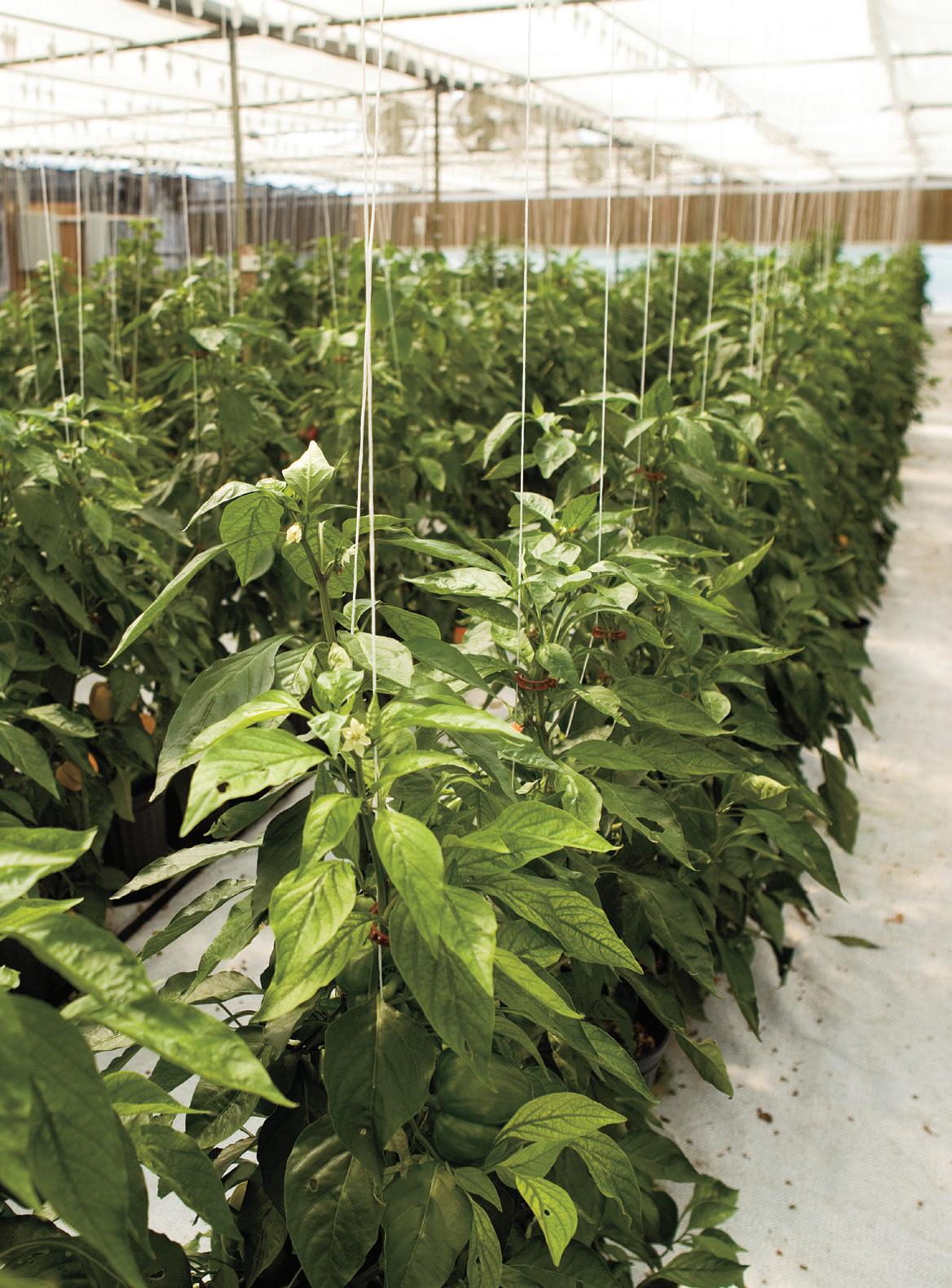
“We made it that size so we could grow enough volume for wholesale,” says Scholer, who sells to restaurants in the Indiana-Kentucky-Illinois area through a distributor in Indianapolis. About 1,500 pepper plants grow in the greenhouse, along with vineripened tomatoes.
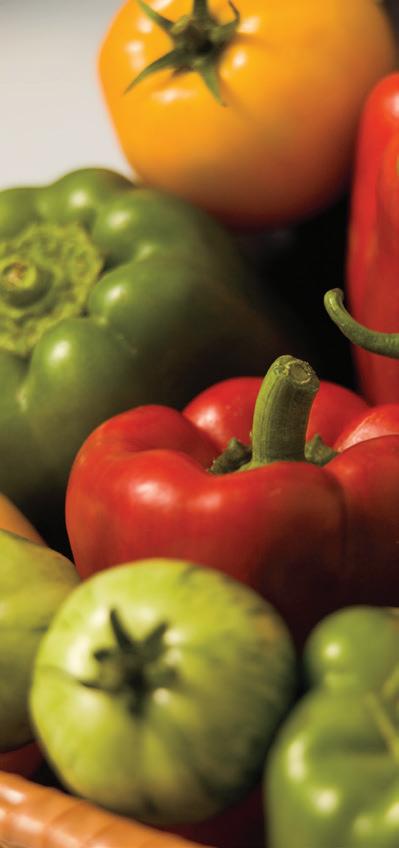
“In Indiana, red and yellow bell peppers are usually available (grown outside) from early August through frost,” she explains. “In the greenhouse, we get colored bell peppers from mid-June through November.”
Colored bell peppers are sold at a premium, and the greenhouse allows them to control the setting with exhaust fans, circulation fans, heaters, shade cloth and irrigation –something they can’t do with produce grown outdoors. They can also control pests using an integrated pest management (IPM) system.
“Basically, it’s a very controlled environment and our insurance policy against weather and disease and pests,” Scholer says, “because crop insurance for outdoor vegetable plants is very, very expensive and not readily available.”
Heartland has also grown lettuces, cucumbers, bedding plants and vegetable plants.
“We would like to experiment with other vegetables and strawberries, to get a jump on the market season, but that will have to wait,” Scholer says.
As a small business that relies mainly on family members lending a hand – or a green thumb – and some seasonal help, labor can be a struggle.
“There’s always more work to do than there are hours in the day,” she says.
Despite the challenges, Scholer says it’s worth it to keep the agricultural tradition alive.
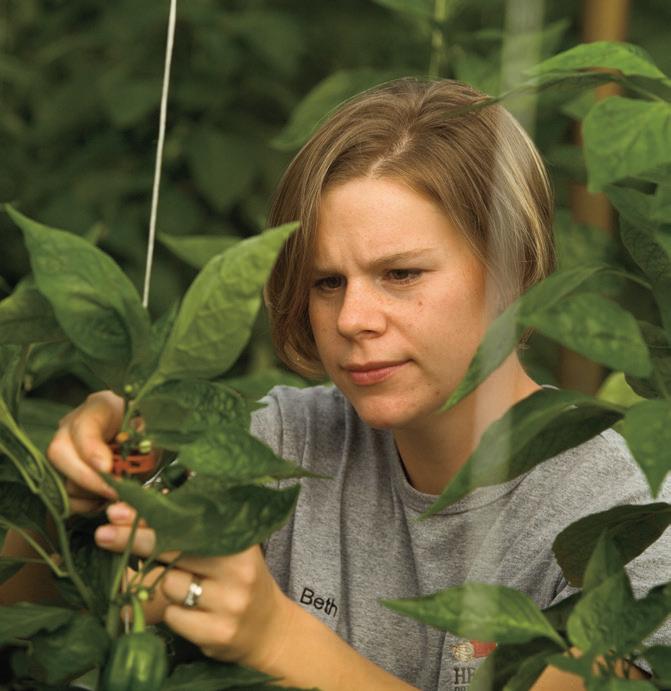
Beth s choler, farm manager of Heartland Premium Produce in Anderson, adjusts the string that holds a pepper plant upright. About 1,500 plants grow in the farm’s 6,000-square-foot greenhouse.
Where to Buy
Pleasant Acre Farms grows vegetables “from asparagus to zucchini and everything in between,” says Neil Moseley, owner of the Clarks Hill farm.
The “in between” also includes winter squash, melons, cantaloupe, edamame, green beans, okra, eggplant, beets, carrots and more. Most recently, beans and whole grains such as wheat, barley and oats were added to the mix. Vegetables, picked when they’re vine ripe and ready to eat, are sold at local markets the next day. Most of the harvest is handpicked, except for beans and small grains, which are done mechanically.
Moseley also runs a 24-week Community Supported Agriculture (CSA) program, which allows people to subscribe for a box or basket of fresh seasonal produce each week straight from the farm.
“We try to have at least five different items a week in those baskets, and base it off [customers’] eating habits and how many people are in their household,” says Moseley, who’s also looking at branching out into selling frozen vegetables and stir-fry mixes to extend product shelf life and prevent waste.
Signups for the CSA growing season close in March, but Pleasant Acre Farms has plenty to offer shoppers hungry for fresh, local produce and grains during the local farmers market season, from May through October. Find them at the Downtown Lafayette Farmers Market on Saturdays from 7:30 a.m. to 12:30 p.m. and at the West Lafayette Farmers Market on Wednesdays from 3-6:30 p.m.
To learn more about Pleasant Acre Farms and the availability of specific produce, visit pleasantacrefarm.com or call (765) 918-0303.

“[My husband and I] both grew up on family farms,” she says, “and that’s how we want to raise our kids – having good, healthy food that we know how it’s been treated and how it’s been grown.”
Back at Pleasant Acre, Moseley also believes in the importance of educating his three children about the food they raise.
“The ability to pass that on to my kids is very key in what we do,” he says. “They can probably tell you more about produce than what the average adult knows.”
He also shares that knowledge with members of the community who shop for Pleasant Acre produce at farmers markets or through his CSA (see sidebar on previous page).
“Buying local is more than a fad,” Moseley says. “People are curious about their food production because getting food in America has become very easy. The average person is now three generations removed from the farm. Now people want that connection back.”
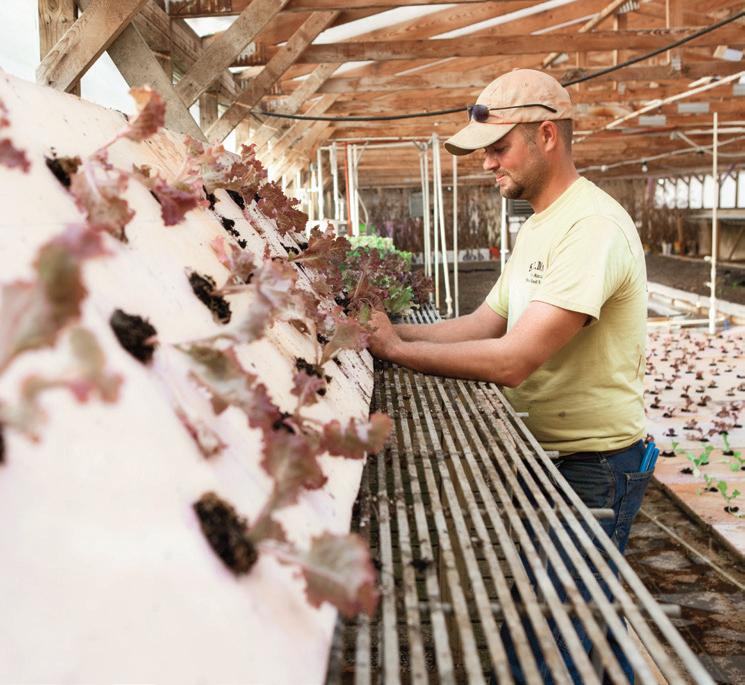

Neil Moseley of Pleasant Acre Farms grows hydroponic lettuce in a greenhouse converted from an old hog building. He tested some 40 varieties to find the perfect lettuce for year-round production.

Hot Some Like It
Indiana fireman turns pepper passion into a business
s tory by r achel b ertone | Photography by Michael c onti
Jim Campbell fights fires by day, but he spends his free time cultivating fiery flavors.
The Indianapolis fireman has been growing chili peppers as long as he can remember.
“I was one of 10 kids, and my family had a victory garden,” Campbell says. “We were allowed to pick something to plant, and from age 2 I always picked chilies. I was fascinated by them.”
Later in life, he turned his passion into a business, Mild to Wild Pepper & Herb Co. On a camping trip to New Mexico, he became entranced by the vast variety of dried chilies on display at a local flea market. With fellow firefighters at the Pike Township Fire Department eagerly consuming his homegrown chilies, he realized the potential for a business to grow out of his beloved hobby.
Campbell began planting more chili peppers and ordered a mixed case of hot sauces out of a catalog. He called the hotsauce companies and offered his services as a chili grower. Some of his first customers grew to be the biggest names in the industry,
including Dave’s Insanity Hot Sauce and Blair Lazar’s Death Sauce.
In the decades that followed, Campbell says Mild to Wild steadily enjoyed doubledigit growth. He gained the reputation of an international chili pepper expert and traveled overseas to advise on production.
“I’ve never known anyone that knows more about peppers than Jim,” says Barry Tippman, who now owns Mild to Wild. “He is so passionate.”
Tippman runs the Fort Wayne-based Great American Spice Co. and acquired Mild to Wild after he saw Campbell was shutting down his business after 20 years.
“We sold Jim’s products on the Great American Spice website,” Tippman says.
“When I went to order more, I saw they were going out of business. Some of their products were our bestsellers, so I called Jim and asked if he was interest in selling.”
Since the trade-off, Tippman has continued to run Mild to Wild just as Campbell did. Nothing business-wise has changed, he says.
“We bought the company because it had such a good reputation,” Tippman
pepper power
Anyone interested in attending or finding out more about the annual Open Fields Festival can contact Campbell at jim@stepupforcharity.org. The subject field must say “Open Fields 2013” to be read.
For more information about or to buy Mild to Wild products, visit wildpepper.com
Go online to my-indianahome.com/peppers to enter to win a collection of Mild to Wild spices and sauces.
Jim Campbell, founder of Mild to Wild Pepper & Herb Co., says his penchant for growing chili peppers started at age 2.
What are Scoville heat units (Shu)?
Developed by U.S. pharmacist Wilbur Scoville in 1912, the Scoville scale determines the piquancy of a chile pepper. Scoville Heat Units measure the amount of capsaicin present in peppers based on how much sugar water must be added until the heat is no longer detectable. To learn more, visit scovilleheatscale.com

enter to win these Mild to Wild Pepper & Herb Co. products online at my-indiana-home.com/peppers.
says. “Everyone knows Jim in the industry, and we wanted to keep the company the same.”
They have, however, grown Mild to Wild to include a whole line of peppers along with two new hot sauces using two of the hottest peppers in the world: the ghost pepper and the Scorpion Trinidad. Those sauces have already risen in popularity, snagging awards at several shows.
Although he has no official part in the company, Campbell says he is still proud and interested in the success of Mild to Wild.
“I feel honor-bound due to the integrity of the folks I sold the company to,” he says. “They’ve allowed me in the booth at the occasional show, and I still enjoy standing there for hours dressed in full firefighter gear, answering the same questions.”
Along with being a chili expert, Tippman says Campbell is one of the nicest people you’ll ever meet, even helping his competitors. He showcases that kindness each fall during his annual chili pepper festival, Open Fields. The event raises money for Step Up for Charity, which in turn supports other lesser-known charities.
The festival began as a way for consumers to pick their own chilies from Campbell’s commercial fields after the first Indiana frost. People were allowed to take as many peppers as they could for free.
Since its early days, Open Fields has grown into a secret event for “chili-heads” in the know. The strictly non-commercial festival gives all of its proceeds to charity, so even famous manufacturers that attend must lay low.
Although Campbell doesn’t sell his own peppers anymore, his fiery passion is still there.
“Even after 20 years, I’ve never lost the joy that comes with what we call the moment of enlightenment,” he says. “It’s that wide-eyed, panicstricken instant when a person comes to realize they didn’t really know what ‘hot’ was.”
ThE hoT LIST
Chili grower Jim Campbell shares his top pepper picks
New Mexican
These include the varieties Anaheim, sandia, Big Jim and 6-4. These flavorful and fairly mild chilies taste great roasted, grilled or diced into salsa. As with all chilies, they require little in the way of growing – just consistent water level in the soil (not too much to avoid root rot) and a tiny dash of 12-12-12 fertilizer in the early summer. You might need to stake the plants as the weight of the chilies can topple the plant!
500-1,000 S hu

Chipotle
if i were stranded on a desert island with only one chili to choose from, the chipotle would be my chili of choice. The chipotle (pronounced chee-PoAT-lay) is a smoke-dried jalapeño pepper. Maybe it’s from being a career firefighter, but i’ve always been attracted to smoke. Part of the confusion with chili pepper names is because they are often called one thing when fresh (e.g. jalapeños), yet another when dried or smoked (e.g. chipotles). Chipotles have a rather fragile flavor that is best added to dishes at the table prior to eating. using it early in the cooking process can drive off the smoky flavor.
5,000-10,000 S hu
Cayenne
This is probably my favorite chili for making sauces, as it’s typically used in Louisiana-style hot sauces such as Frank’s redHot. This medium-hot pepper has a great, well-rounded flavor. it is easily dried (even in indiana’s humid summer), simple to grow in great quantities and can be found at most any greenhouse. Additionally, like all other chilies, it contains great medicinal qualities.
30,000-50,000 S hu
Habanero
A sentimental favorite, this is the chili upon which my company was built, even though i don’t eat them myself unless there’s money on the table. i was one of the first licensed red savina Habanero growers in the world, back when it long occupied guinness World record status as the hottest chili pepper on the planet. it allowed me to be on a first-name basis with folks such as Blair, dave and CaJohn, whom any serious chili-head would instantly recognize as the names of the hot sauce business.
100,000-350,000 Shu
Scorpion
guinness currently lists the Butch T Trinidad scorpion as the hottest chili on the planet, even exceeding the more well-known ghost or Bhut Jolokia chili. Butch T (Taylor) is a personal friend who can often be found wandering my chili fields in late fall during my annual chili pepper festival.
1,463,700 S hu
Benefits
Did you know that your Indiana Farm Bureau membership comes with exclusive savings? as a member, you can take advantage of the discounts on products and services listed here. For more information on member savings and benefits:


The goal of Indiana Farm Bureau member benefit programs is to provide discounts, value-added benefits and convenience to you, our members. Indiana Farm Bureau does not endorse these products or services. Indiana Farm Bureau and the companies offering these programs do not guarantee that program discounts will be the lowest available price at any given time. Farm Bureau members should provide the ID number if applicable or identify themselves as members of Indiana Farm Bureau when calling any program. Programs are subject to change or termination without notice and some rules and restrictions may apply.



About the Author
Registered dietitian Kim
Galeaz is an Indianapolisbased writer and culinary nutrition consultant to the food, beverage and agriculture industry. She’s passionate about blending good taste with good health in every culinary creation –even decadent dessert –and balancing with daily power-walking. A link to her blog, “The Dietitian Does Dessert ... Breakfast, Lunch and Dinner, Too” is at www.kimgaleaz.com.
Hello, Herbs
The flavor of fresh herbs enhances summer recipes
s tory and recipes by
k im Galeaz | Photography by Jeffrey s o tto | Food s tyling by Mary carter
Just about every type of summer dish – side salad, entrée, dessert and beverage – benefits from the flavor boost that comes from fresh herbs. But instead of always using basil to make pesto, adding rosemary to grilled chicken or garnishing fruit salad with mint, try something unique this summer.
parSle Y & MInT
Filled with bone-building vitamin K (and some antioxidant vitamins A and C, too), parsley comes in several varieties. However, Italian parsley and flat leaf parsley refer to the same thing. It has a stronger yet less bitter flavor than traditional curly parsley.
Indiana ranks fourth in the nation for peppermint production. In fact, 9 percent of U.S.-grown peppermint comes from Indiana. When shopping for fresh mint, look for bright green leaves and minimal dried, yellow or brown leaves.
Related recipe: Combine these herbs for a unique pesto sauce that’s cool and refreshing, hot and spicy, earthy and complex – all in one bite. The only fat this recipe contains is olive oil, which means considerably less fat than traditional basil pesto containing nuts and cheese. Parsley Mint Pesto can accompany chicken, fish, pork or pasta, or be used as a spread or topping for sandwiches or bruschetta.
BaSIl & chIveS
Pungent, aromatic basil leaves are packed with natural phytonutrients and
antioxidants. Chives, a species of small onion with edible leaves, also provide an excellent source of vitamins, A, C and K and phytonutrients that may help reduce the risk of some cancers.
Related recipe: Most traditional potato salads feature lots of mayonnaise or sour cream that overpowers the other ingredients. Lemon Basil Potato Salad with Bacon lets the potatoes shine in a fresh basil, lemon and olive oil sauce. Bacon gives a salty crunch to complement the earthy tartness of the basil and lemon. (Yes, this dietitian does occasionally indulge in bacon!)
rOSeM arY
Rosemary naturally contains compounds with anti-inflammatory and immune-boosting properties. Plus, it’s so easy to use. Simply hold the stem at the top and run your fingers down the stem to remove the needles before chopping to release the fragrant oils.
Related recipe: Triple Citrus Rosemary Almond Shortbread Bars feature pure sugar-flour-butter decadence along with an infusion of lemon, lime and orange zest plus fresh rosemary. These easy-to-bake bars are quite rich, so a small, sensible portion is all you’ll need for the perfect ending to any summer meal.
Find instructions on how to grow your own herbs and which varieties grow best in Indiana online at my-indiana-home.com
Parsley Mint Pesto
3 cups packed flat-leaf (a.k.a. Italian) parsley
3 ½ to 4 cups packed fresh mint leaves
3 green serrano peppers, seeded, deveined and coarsely chopped
4 garlic cloves, coarsely chopped
2 tablespoons stone-ground mustard
3 tablespoons honey
½ teaspoon salt
½ teaspoon ground black pepper
½ to ¾ cup extra virgin olive oil
In a large food processor bowl, combine parsley, mint, peppers, garlic, mustard, honey, salt and pepper until thoroughly mixed. With processor running, slowly pour in olive oil and thoroughly mix.
Refrigerate leftovers in tightly covered container.
Makes 1 ½ cups

peppersSerranolook like thinner jalapeños but are hotter and more potent.
Potatoes
are
filled with vitamins C and B6,andpotassium fiber.

Lemon Basil Potato Salad with Bacon
2 ½ pounds potatoes (such as red, blue and Yukon gold)
1 ¼ cups sweet v idalia onion, finely chopped
12 ounces thick-sliced bacon, cooked and chopped or crumbled (about 10 slices raw, heaping 1 cup crumbled)
¼ cup fresh chives, finely minced
¾ cup fresh basil, chopped
Dressing
¼ cup light mayonnaise
¹⁄³ cup extra virgin olive oil
¹⁄³ cup + 1 tablespoon fresh squeezed lemon juice
1 tablespoon Dijon mustard
2 tablespoons garlic, very finely minced
¾ teaspoon salt
½ teaspoon ground black pepper
½ teaspoon crushed red pepper
Place unpeeled potatoes in a large 5- to 8-quart pot. Cover with cold water and place over high heat. Cover pot and bring to a boil. o nce water boils, remove cover, reduce heat to medium-low and simmer until the potatoes are fork tender, about 15 to 25 minutes depending on size. Check frequently to prevent overcooking. Drain potatoes and set aside to cool.
once potatoes are cool enough to handle, cut into bite-size pieces, about ½- to ¾-inch chunks, and place in large bowl. Add chopped onion, crumbled bacon, chives and basil. Toss very gently to combine.
In a separate bowl, whisk together mayonnaise, oil, lemon juice, mustard, garlic, salt and peppers. Pour dressing over potato mixture, and lightly toss with a large wooden spoon, taking care not to break too many potato chunks.
Serve immediately or chill at least 1 hour if you prefer a colder salad. Refrigerate leftovers in a tightly covered container.
Makes 10 cups
Triple Citrus Rosemary Almond
Shortbread Bars
1 ½ cups unsalted butter, slightly softened
1 ½ cups sugar
2 large egg yolks
2 ¾ cups all-purpose flour
1 ½ teaspoons orange zest, very finely chopped
1 ½ teaspoons lemon zest, very finely chopped
1 ½ teaspoons lime zest, very finely chopped
2 tablespoons amaretto liqueur*
2 tablespoons fresh rosemary, very finely chopped
¼ teaspoon salt
1 egg white, beaten
3 tablespoons raw turbinado sugar
¹⁄³ cup coarsely chopped almonds (natural sliced variety)
*Substitute 1 teaspoon almond extract if you don’t want to use amaretto liqueur.
Preheat oven to 325 degrees. Lightly coat a 13-by-9-by-2-inch baking pan with vegetable cooking spray. Beat butter and sugar with electric mixer on medium-high speed until combined. Add egg yolks, and beat until smooth and combined. Stir in flour, all three zests, amaretto, rosemary and salt, mixing on low only until everything is incorporated. Spread evenly in pan and brush top with beaten egg white.
In a small bowl, mix raw sugar and almonds together. Sprinkle evenly over top.
Bake until golden brown and sides are starting to come away from edges, about 32 to 37 minutes. Usually it’ll appear slightly deflated. Cool thoroughly on a wire rack. It’ll harden as it cools. Cut into bars or squares. Store in tightly covered container at room temperature.
Makes 24 large bars or 36 smaller bars
TIp: These bars freeze exceptionally well. Simply place in a freezer bag; thaw at room temperature.
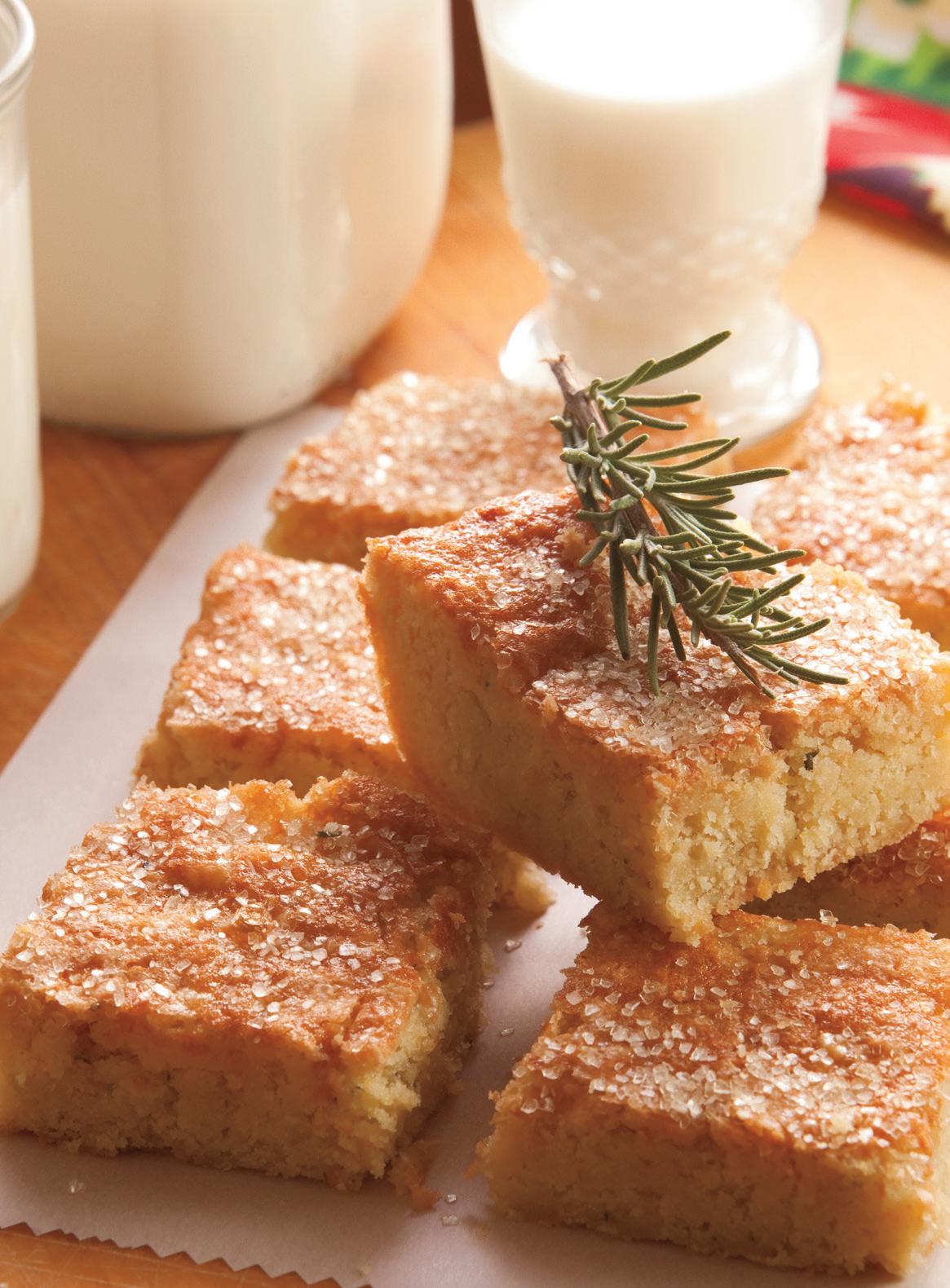
containsRosemaryantiinflammatory andboostingimmuneproperties.
Business is Smokin’
Indiana pitmasters emphasize the sweet side of barbecue


s
tory by Jessica Mozo
Photography by brian Mcc ord
Barbecue fans from around the United States have long debated which region does it best. Texans prefer mesquite-smoked beef brisket, while Carolina natives serve their pork with vinegar- or mustard-based sauce. Kansas City-style barbecue has a thick and sweet tomato-based sauce, while Memphis barbecue is often served with no sauce at all.
Ask a few Hoosier pitmasters to define Indiana barbecue, and you’ll get a myriad of answers.
BIG hOFFa’S BBq
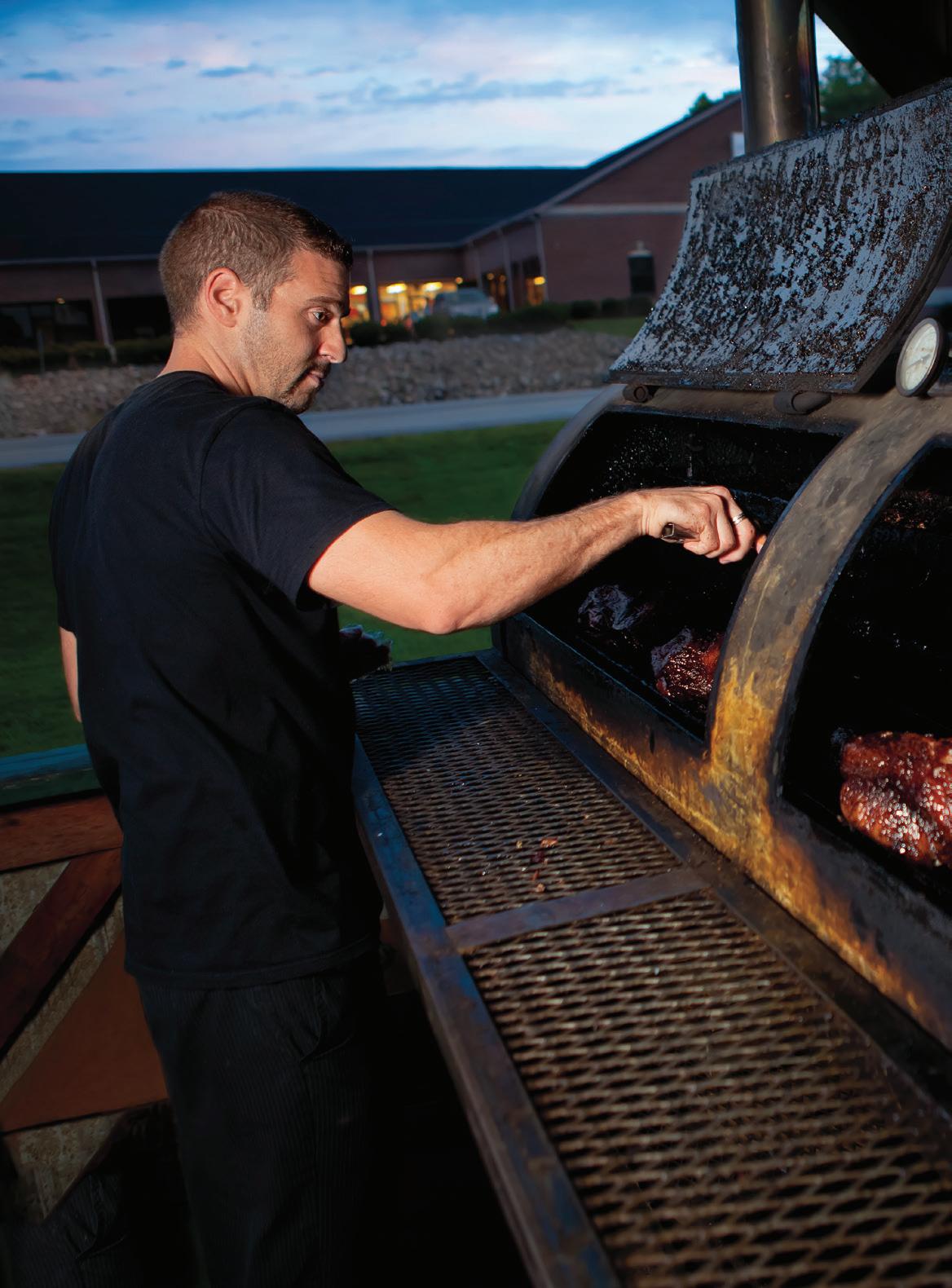
“Indiana barbecue is made up of a lot of hybrids,” says Adam Hoffman, owner of Big Hoffa’s BBQ in Westfield. Born and raised in Los Angeles, Hoffman moved to Indiana 10 years ago to carve out his own niche in the barbecue industry.
“The important thing is learning what your customers like, and then making it even better,” he says. “We take about 25 to 30 hours to cook our pork and beef in a big smoker outside using only firewood, including cherry, maple, apple, walnut and
oak – no fancy fake woods or liquid smoke.”
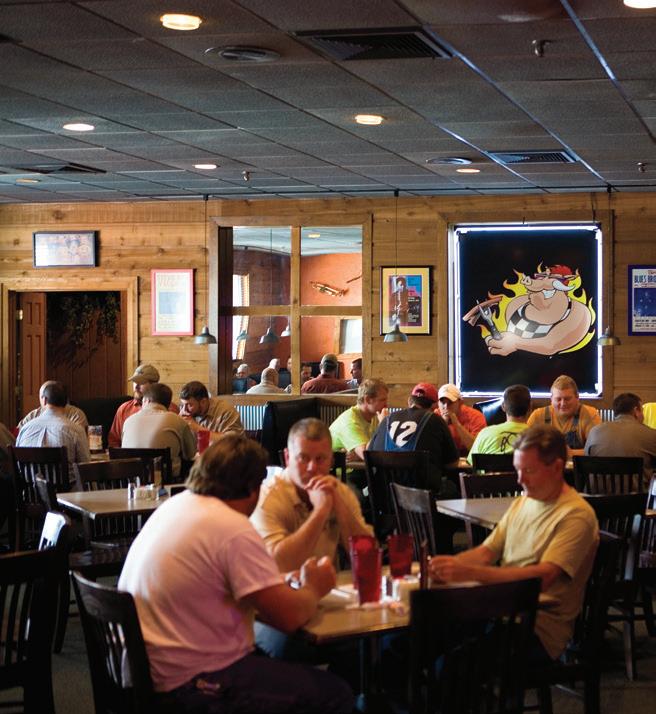
Hoffman opened Big Hoffa’s in 2007 after operating a traveling smokehouse on wheels for three years. It’s a whimsical pirate-themed eatery with lots of swashbuckling memorabilia – a tip of the hat to the Caribbean, where barbecue got its start.
“We try to think outside the box,” Hoffman says. “All our specialties are unique. One is the Hoffanator, which is french fries topped with mac and cheese, baked beans, pulled pork, barbecue sauce and ranch dressing. It satisfies all the senses, because it’s both sweet and salty.”
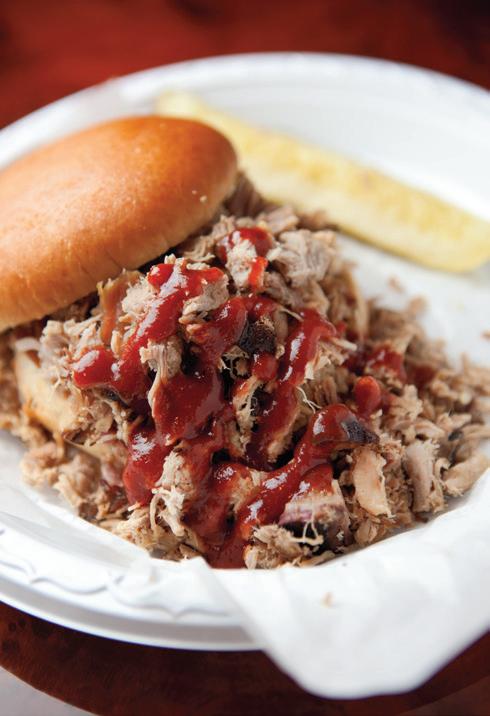
Then there’s the Buccaneer, Big Hoffa’s signature sandwich. It’s a half-pound of pork piled high on a garlic-butter bun with a sweet and smoky sauce, accompanied by crispy California coleslaw, seasoned fries and ranch dressing.
“People often tell us this is the best barbecue they’ve ever had,” Hoffman says.
“And 90 percent of our pirate decor has been donated by our customers,” he adds. “Adults and kids both love it.”
l eft: Adam Hoffman pulls meats from the smoker at Big Hoffa’s BBQ in Westfield. He uses only firewood, including cherry, maple, apple, walnut and oak, to flavor his slow-smoked barbecue. a bove: Big Hoffa’s signature sandwich, the Buccaneer, consists of a half-pound of pork topped with coleslaw, seasoned french fries and ranch dressing on a garlic-butter bun.
In This Story
Mooresvillle westfield edinburgh
SquealerS BarBeque
In Mooresville, Squealers Barbeque founder Jeff Yater says what sets Indiana barbecue apart is sweeter sauces and the type of wood used to smoke the meat.
“We only use cherry wood to smoke our meats. Texans use mesquite, and in Indy that would be overpowering for some guests,” Yater says. “Our sauces are tomato-based with sweeter flavors in both hot and mild.”
before doing this, but for years I had a mobile trailer with a smoker in my backyard where I cooked all the time for my buddies,” Blackwell says.
Tucked inside a 1948 hot dog drive-in, Hickory Hills is nothing fancy. But Blackwell’s fall-off-the-bone ribs and “Boss Hog” pulled pork sandwich accompanied by spicy Cajun coleslaw have earned the restaurant many loyal patrons.
Big hoffa’s BBq
800 E. Main St., Westfield (317) 867-0077 bighoffas.com
Squealers Barbeque 390 E. High St., Mooresville (317) 834-8888 squealersbarbeque.com
Second location: 5515 W. 86th St., Indianapolis (317) 871-7427
hickory hills Barbeque 16021 N. U.S. Highway 31, Edinburgh (812) 526-5280
Squealers opened in Mooresville in 2001, and Yater added a second location in Indianapolis in 2004. Each goes through two tons of meat every month.
“Pulled pork is our bestseller, and we have two kinds of ribs,” Yater says. “We rub down our meats with a dry rub a full day before they go into the smoker, so they’re full of flavor.”
hIcKOrY hIll S BarBeque
Tim Blackwell of Edinburgh traded his tool belt for an apron in 2004 when he opened Hickory Hills Barbeque.
“I worked in construction 25 years
“Our pulled pork is served on an onion bun with the sauce on the side – I feel it’s best to let people sauce their own sandwich. Then they know you’re not hiding anything,” Blackwell says.
Hickory Hills is open March through December (closed in January and February).
rIGhT On ’cue
Pit Stop BBQ & Grill in Brownsburg, QL’s Bar-B-Que in Muncie and Smokin’ Jack’s Rib Shack in Bloomington also garnered rave reviews in our search for the best Indiana barbecue. Find a longer list of the state’s top spots and share your favorites at my-indiana-home.com/bbq .
For Members Only
Indiana Farm Bureau membership benefits include more than insurance
As an insurance client, you’ve already purchased your Indiana Farm Bureau membership. Did you know that in addition to access to Indiana Farm Bureau Insurance policies, you have dozens of other benefits at your fingertips? And you can easily earn back the cost of the membership by taking advantage of the many benefits that come with your membership.
Among the specific benefits that you enjoy as an Indiana Farm Bureau member are: accidental death coverage, banking services, identity theft resolution services and discounts with companies such as Dell Computer, General Motors, LensCrafters, 1800Flowers.com and T-Mobile. You can also receive discounts on rental cars, hotels and tickets to Holiday World, Cedar Point, Kings Island, Busch Gardens, SeaWorld and other theme parks and attractions.
“My family is obsessed with roller coasters,” says Evansville resident Rebecca Birchler, a child behavioral analyst. “We would go to Kings Island, and with the savings on admission tickets I could earn back the membership dues I paid with just one trip to the park.”
“There are countless benefits to membership,” says Indiana Farm Bureau President Don Villwock. “We strive to provide discounts, value-added benefits and convenience for our members.”
One of the greatest benefits of membership is having access to all the products available through Indiana Farm Bureau Insurance.
The insurance and financial products are available only to members. A lapsed membership will result in non-renewal of your insurance policy.
“It is important to keep your membership current so you don’t risk your financial security,” Villwock says.
If you are not sure your membership is current, please contact your agent or county office to confirm. A membership is not required to purchase life insurance.
To see all your Indiana Farm Bureau member benefits, please visit itpaystobeamember.org .


s tory by p ublic a ffairs, indiana farm bureau insurance
The Good, the Bad & the Ugly
Learn to identify insects in your garden from helpful to harmful
s tory by c olletta kosiba
Hundreds of great, hardworking insects live in our gardens. Their jobs range from eating the bad bugs and pollinating flowers to improving the soil by helping decompose organic material.
Let’s take a look at the good, the bad and the ugly.
Many of those ugly bugs will become beautiful butterflies or moths, all of which go through a larval stage. The strange-looking larvae are eating machines, so please don’t kill them, despite their frightening appearance. The larva then pupates, forming a cocoon or chrysalis, and then emerges as a butterfly or moth.
Although only 3 percent of insects fall into this category, some bugs are actually bad for your backyard.
In addition to being an annoyance, mosquitoes can carry disease. Eliminate standing water, because even a small amount – the size of a soup bowl – will breed mosquitos. Invite purple martins, a type of bird that can eat 200 mosquitos a day (as do night-flying
bats, another misunderstood creature). In fact, most of the birds you feed all winter will return the favor by eating hundreds of insects in your yard this summer.
Japanese beetles will harm your garden, so hand-pick them off plants or use beetle bags or traps. Protect the prehistoric, evil-looking wheel bugs, as they eat Japanese beetles and other bugs.
Everyone knows red and black ladybugs love aphids, which are small, sap-sucking insects. A rectangular black and orange bug known as the soldier beetle is another important predator of aphids. These helpful beetles also consume nectar and pollen, becoming minor pollinators. No aphid-eaters in sight? Spray the infested plant with a few strong blasts of water. Once aphids are knocked down to the ground, they can’t climb back up. A home remedy of 2 teaspoons mild dish soap mixed with water in a squirt bottle, sprayed weekly, causes the aphids to dehydrate by washing off their protective waxy coating.

Beneficial praying mantises emerge from egg cases in the spring. They then start eating other insects and quickly grow from a tiny size to a whopping 4 to 5 inches in late summer.
Spiders eat other harmful insects, so ignore your arachnophobia and allow them to protect your plants.
Some of the “bad” bugs don’t make it to adulthood – they’re killed by beneficial nematodes. In fact, beneficial nematodes control more than 250 different species of insects that spend some part of their lives underground, including grubs, fleas, mole crickets, Japanese beetles and weevils. They live in almost any soil but prefer moist conditions. You can purchase beneficial nematodes such as Steinernema and Heterorhabditis at your local garden center or online.
So when you’re in the garden this summer and you spot the “bad” bugs, see if you can also find the “good” bugs. It’s all part of nature’s plan to balance out the cycle.
Find photos of a few of these at my-indiana-home.com/garden-bugs.
About the Author
Colletta Kosiba of Hendricks County has been a naturalist at Eagle Creek Park in Indianapolis for 15 years. She is an advanced Master Gardener, Master Naturalist and past president of the Hendricks County Master Gardeners’ Association. “Colletta’s Gardens” have also been featured on Channel 8 television in Indianapolis.
Garden spiders protect your plants by eating harmful insects.



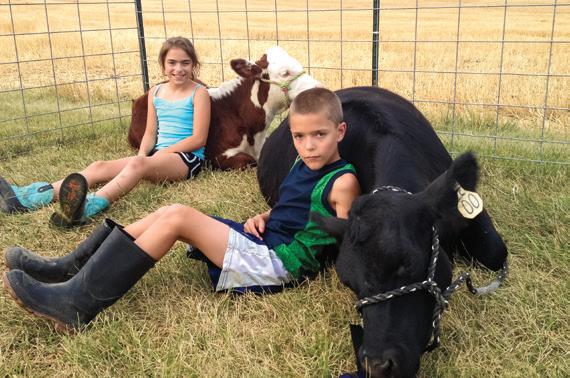
Submit Your Photos
Indiana Farm Bureau members are welcome to submit photos for this page. To submit a photo via email, send a high-resolution JPEG (4x6 inches at 300 dpi), along with your name and location, to myindianahome@jnlcom.com. You can upload your Indiana photos to our website at my-indiana-home.com/photos
To submit a photo via mail, send the photo to: My Indiana Home, Reader Photos, P.O. Box 1290, Indianapolis, IN 46206-1290.
Due to the high volume of photos we receive, we are unable to include every photo, and if you mail your photo in, we will not be able to return it. So make sure you have a spare – we don’t want to lose one of your family treasures!
Photo su B mitted By Linda Phi LL i P s of Rising s un, i ndiana
Photo su B mitted By eL iza B eth Ritte R of Judah, i ndiana
Photo su B mitted By Ji LL Viei R a of eVans V i LL e, i ndiana
Photo su B mitted By Les L ee s im P son of eL iza B eth, i ndiana