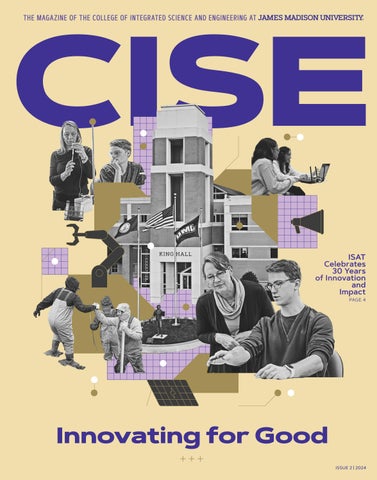
JMU College of Integrated Science and Engineering Magazine 2024
Editorial Team
Lynn Radocha (’18)
Featured Writers
Lynn Radocha (’18)
Emma Seli (’23)
Laurel Seay (’24)
Maya Winder (’24)
Olivia Woolman (’24)
Dorian Crawford (’27)
Art Direction
Group
Cover Illustration
Israel G. Vargas
Photography
Kailey Garner (’26)
Maggie Lowman (’26)
Quinn Worley (’27) JMU Creative Media
Contact
Innovating for Good
In CISE, we believe innovation should always aim to improve lives and create positive change in our communities and beyond. This guiding principle has driven our faculty and students to engage in projects and research that address some of the most pressing challenges of our time.
We have begun integrating the United Nations Sustainable Development Goals into our coursework and research, enriching students’ academic experiences and fostering global citizenship and empathy. This approach provides students with invaluable perspectives on using their fields of study to effect positive change.
This issue is full of examples that showcase faculty and students who use their creativity and knowledge to develop solutions that address societal and environmental challenges and prioritize the well-being of individuals and communities.
You will read about Selina Matolak and Amber Oliver, who collaborated across disciplines to develop an app to detect early skin cancer, and a team of engineering students who designed an adjustable prosthesis for child amputees. You’ll understand how impactful students’ work can be through a long-dormant capstone project that sprang back to life, helping the town of Strasburg avert disaster. You’ll also learn about our collaboration with the Virginia School for the Deaf and Blind, which is paving the way for inclusive STEM learning experiences.
This year also marks a significant milestone as we celebrate the 30th anniversary of ISAT. Since its inception, ISAT has been at the forefront of interdisciplinary education, fostering a spirit of innovation and collaboration. We take pride in the program’s legacy and its impact on thousands of graduates who continue to lead and innovate across various industries like Kelly Davidhizar (’06), who handles security cooperation, counterterrorism, and humanitarian affairs in Africa; and Brian Tang (’22), a test engineer who ensures the safe and efficient operation of nuclear propulsion systems on newconstruction submarines.
We also have some exciting administrative changes to announce. Bob Kolvoord, founding dean and instrumental leader in CISE, has been named interim provost of the university. We will miss him dearly but are grateful for his leadership and dedication over the last 12 years. Stepping into the role of interim dean is Jeff Tang, who began his career in ISAT in 2005. His passion for integrated learning and innovation promises to drive our college to new heights. We also welcome Vetria Byrd as the new head of Computer Science. Her commitment to applying her work in data visualization to critical societal issues makes her an ideal addition to the leadership team.
As you explore this magazine, I hope you are inspired by the extraordinary achievements and the promising future of our college. Thank you for joining us on this journey. Together, we will continue to innovate for good and make a lasting impact on the world.
Lynn Radocha (’18) Director of Marketing and Communications
JMU College of Integrated Science and Engineering
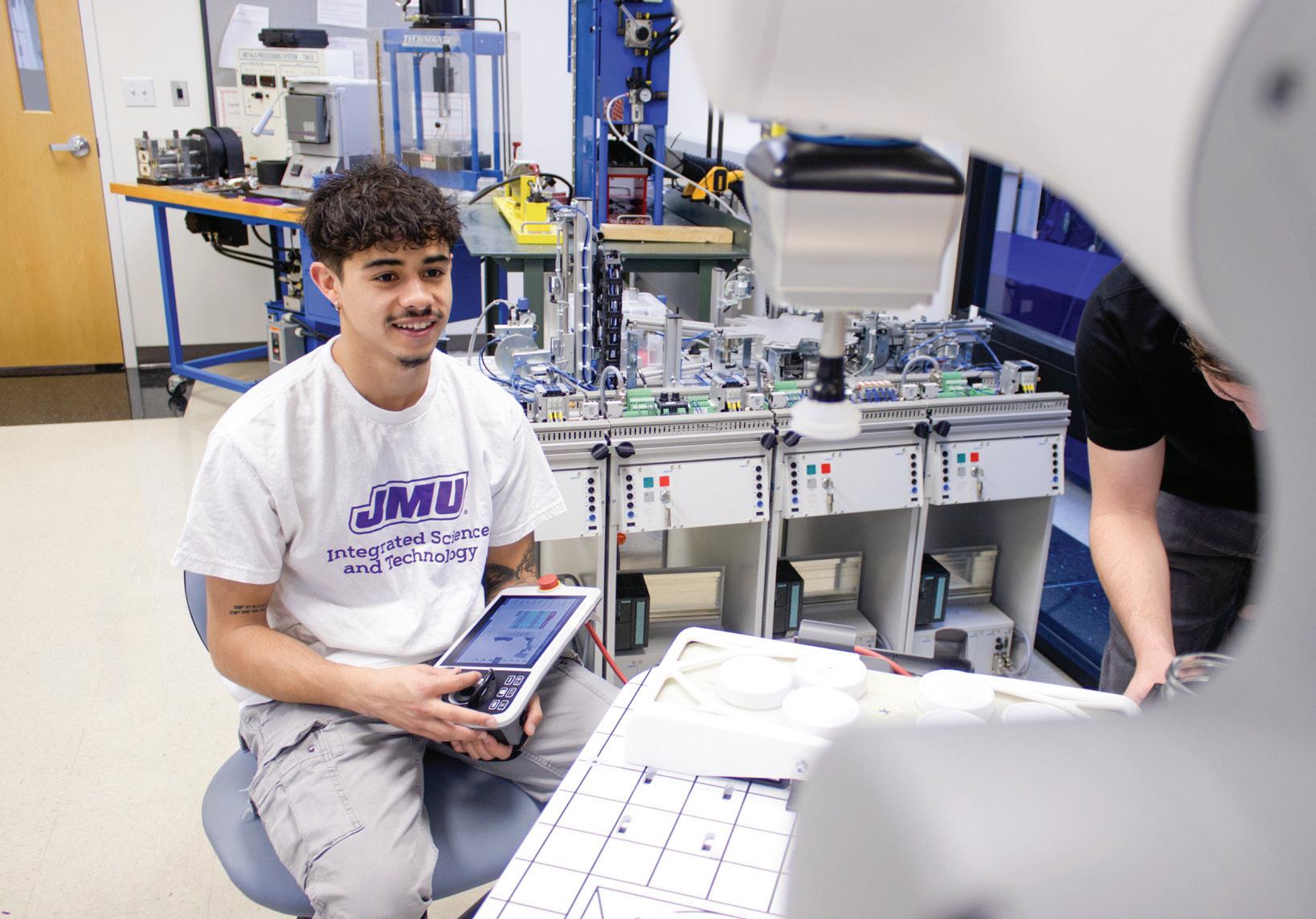
CISE brings together Computer Science, Engineering, and the School of Integrated Sciences, creating a dynamic environment for innovative applied STEM programs.
Integrated Science and Technology
Our ISAT major offers a multidisciplinary education that combines science, technology, and social sciences. Students build a broad foundation in the basic sciences while developing skills in technology and creative problem-solving. Unlike traditional programs, ISAT applies scientific knowledge and technical skills to address society’s most pressing issues. With concentrations in rapidly growing fields, students gain the versatile skills needed to thrive in various industries and professions, ensuring they are well-equipped for the challenges of the modern world.
Engineering
Our Engineering major allows students to explore various disciplines and the interdisciplinary space between them, emphasizing sustainable design and societal impact. Students can tailor their degrees by choosing concentrations in Civil and Environmental, Electro-Mechanical Systems, or GeoEnvironmental. Through hands-on projects, internships, and research, students gain practical experience, ensuring graduates are wellrounded with diverse skill sets and ready for a career in any engineering field.
Graduate Undergraduate
Integrated Science and Technology
Our accelerated one-year Master’s in ISAT with a concentration in environmental management and sustainability is a dual degree offered in collaboration with the University of Malta. The program provides a deep understanding of sustainability sciences and practical applications to address realworld environmental and social concerns. In addition to the core courses, concentrations offer opportunities to go deeper into areas of global sustainability impacts, policy and law, with electives in sustainable technological systems, food systems, and biodiversity.
Computer Science
Our Master’s in Computer Science with a concentration in cybersecurity is ranked among the best graduate programs in the nation and is offered 100% online, making it ideal for working professionals. One of the first in the nation to focus on cybersecurity and designated as one of the original seven National Centers of Academic Excellence in Information Assurance/Cyber Defense by the NSA and DHS, the program provides professional development and research opportunities for those in information assurance and cyber defense roles. It is highly technical and interactive and is closely associated with various security initiatives.
4+1 Accelerated MEng
JMU has partnered with the Virginia Tech College of Engineering to offer an accelerated Master’s of Engineering program. Current students can gain early admission to Virginia Tech’s MEng in Computer Engineering or Computer Science and Applications as early as the spring of their junior year. They can take up to 6 credits during their senior year that count toward their JMU graduation requirements and graduate credits for their MEng at Virginia Tech. Students can complete their coursework at VT in 12 months, spanning a fall, spring, and summer semester with a 9-credit course load each term.
Intelligence Analysis
Our Intelligence Analysis major provides a multidisciplinary education for students who seek careers as analysts, with a specialization in intelligence analysis. Students integrate knowledge from a variety of academic disciplines, learn innovative ways to structure their thinking to assess complex real-world problems, how technology can be used to acquire and evaluate data, and how to communicate it effectively to others. Course topics may include the eight intelligence domains: public sector, national security, military, homeland security, and law enforcement sectors, private sector, cyber intelligence, and geospatial intelligence domains.
Computer Science
Our Computer Science major equips students with a strong foundation in programming, mathematics, data structures, algorithms, software engineering, and computer systems. Students select electives in robotics, artificial intelligence, humancomputer interaction, cyber defense, database systems, and web applications. They apply their knowledge through individual and team software development projects, preparing them for successful careers in computing.
Geography
Our Geography major offers a unique, holistic approach through the geographical perspective. Students explore how humans interact with their environment and how place matters to environmental, economic, and cultural issues. Beyond the core courses, we offer concentrations in geographic information systems and environmental conservation, sustainability and development to encourage a deeper understanding of geography. Students engage in fieldwork, focusing on realworld issues, and have opportunities to explore major cities and fascinating countries.
Information Technology
Our Information Technology major emphasizes highly relevant skills in cybersecurity, computer networking, and end-user design and development. We go beyond the science behind computers, teaching students how to design and develop solutions across various computing and networking application areas. Our curriculum equips students with the knowledge and skills to meet the technology needs of businesses, government, healthcare, education, and other organizations. Students apply their abilities in realworld contexts, ensuring they are well-prepared for future careers.
Biotechnology
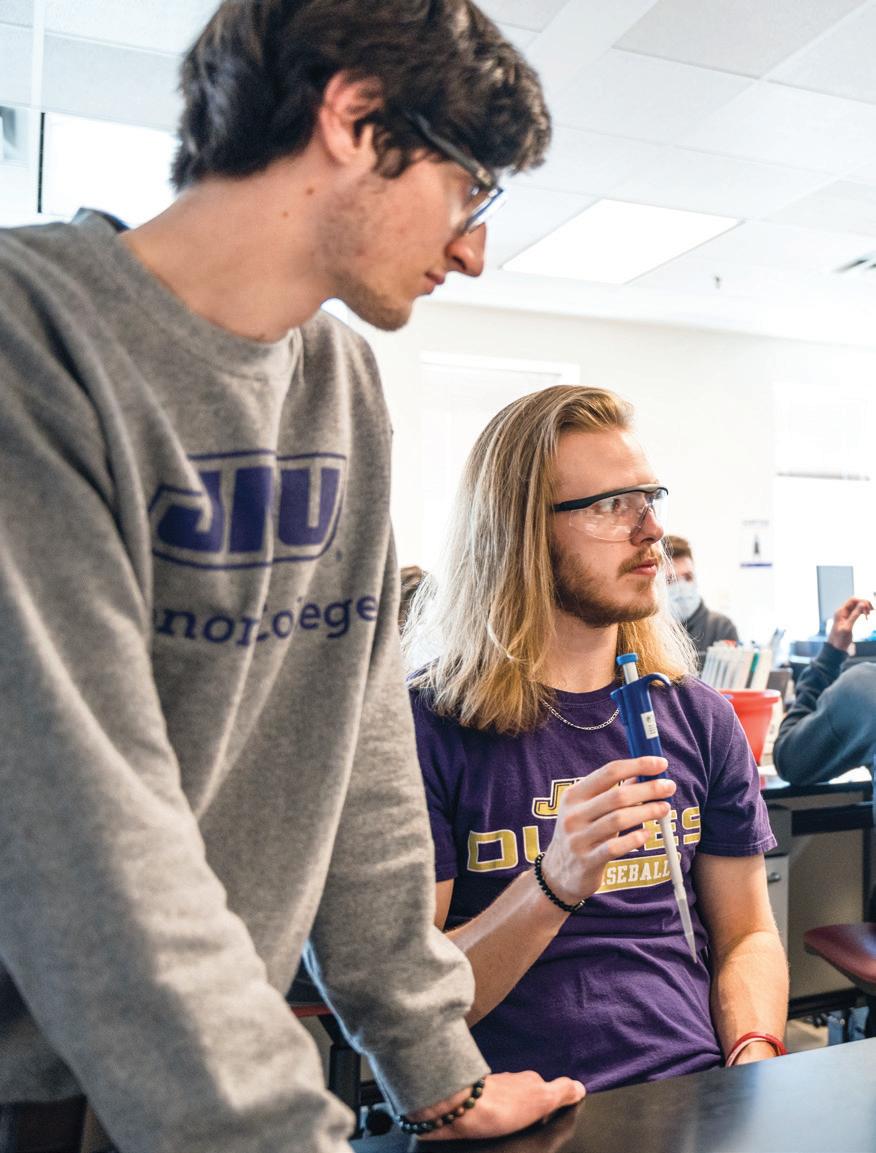
Our Biotechnology major, shared with the College of Math and Science, offers a multidisciplinary education across biology, chemistry, and integrated science and technology, preparing students for careers in the rapidly evolving biotech industry. The curriculum gives students a strong foundation in molecular biology, genetics, bioinformatics, and bioprocessing while emphasizing hands-on laboratory experience and research opportunities. We foster innovation and critical thinking, preparing graduates to contribute to advancements in healthcare, agriculture, environmental science, and more.
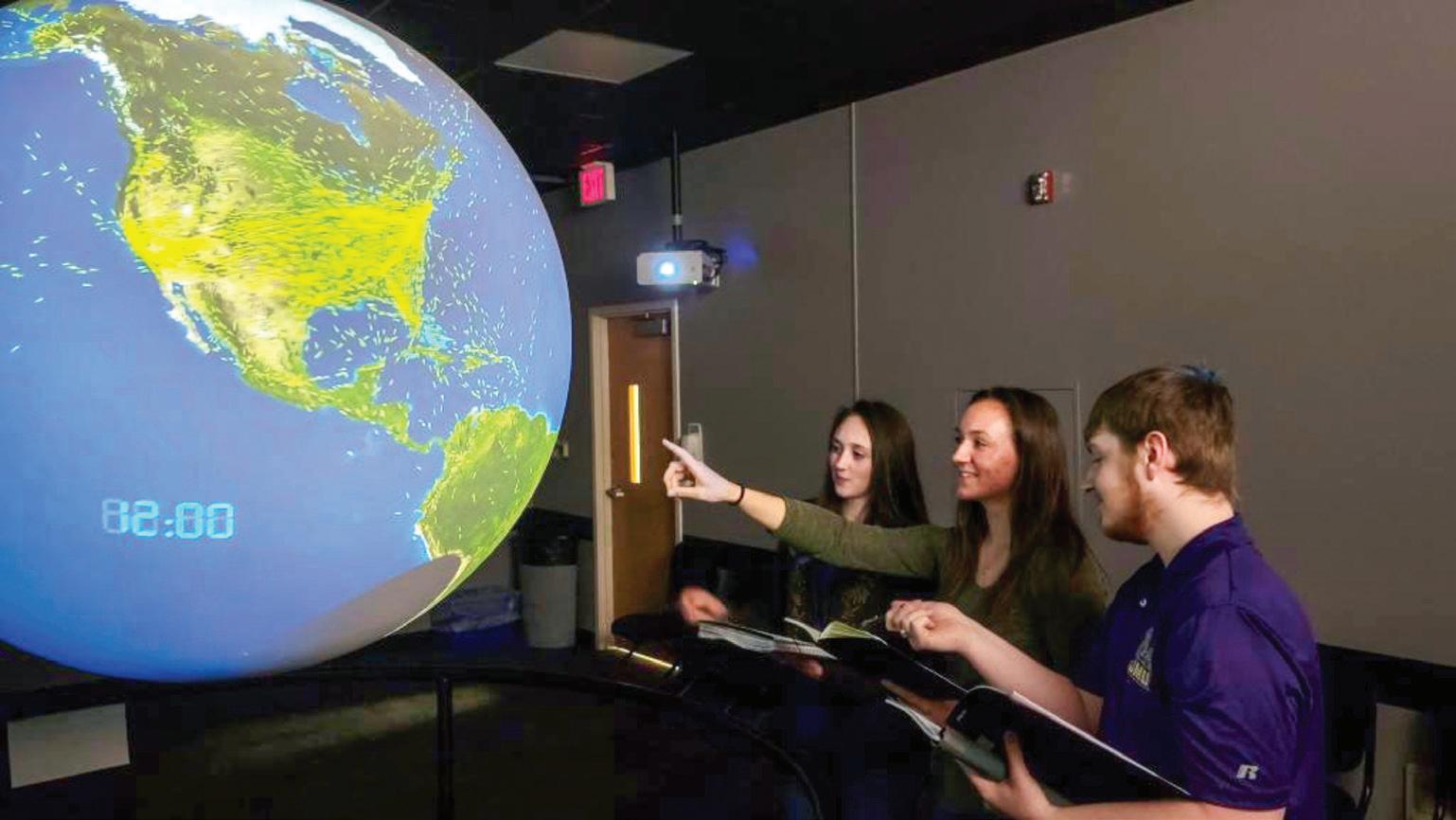
CISE students can explore environmental problems using NOAA’s Science on a Sphere, learn about the United Nations Sustainable Development Goals, and discuss ways to improve environmental quality.
ISAT CELEBRATES 30 YEARS OF INNOVATION AND IMPACT
By Emma Seli (’23) and Lynn Radocha (’18)
or three decades, the Integrated Science and Technology program has been a beacon of innovation and excellence at James Madison University, evolving from humble beginnings into a powerhouse of interdisciplinary education.
Like a phoenix rising from the ashes, ISAT emerged in the early 1990s. “Virginia began pressing schools to develop new innovative programs for the increasing number of students entering higher education,” explains Bob Kolvoord, interim provost and early ISAT faculty member.
Formed in 1993 and spearheaded by faculty with business and industry experience, the ISAT program aimed to bridge the gap between academia and the real world, transcending traditional disciplinary boundaries.
Jeff Tang, interim dean of CISE and ISAT
professor, reflects on the program’s vision of producing well-rounded graduates adept at tackling real-world challenges in science and technology. Under the leadership of former JMU President Ronald Carrier, ISAT flourished, leveraging the expertise of professionals from industry and government to enrich student learning experiences.
“The ISAT program and the development of East Campus were endeavors close to Dr. Carrier’s heart,” Tang says.
ISAT’s curriculum diverged from the conventional specialist approach, emphasizing a broad-based education fostering critical thinking, problem-solving, leadership, and collaboration. It empowers students to tailor their course of study to align with their unique interests, providing flexibility compared to traditional programs.
“ISAT’s hands-on and collaborative approach to learning, coupled with the
capstone project, have been integral to the program’s success from the outset,” Kolvoord says.
Jeremy Bost (’97) recalls his senior thesis on digital mapping, a collaborative project with the National Park Service showcasing ISAT’s innovative solutions to real-world challenges. Combining business with science was a game-changer for Bost. “It was a technical solution for a communications and awareness problem,” he says.
Chris Butters (’17) echoes the sentiment, highlighting the invaluable experience gained through his capstone project on integrating Unmanned Aircraft Systems into emergency management. His experience in ISAT prepared him for his role as a response officer for the U.S. Coast Guard.
“Internships are not just encouraged; they’re essential in ISAT, offering students invaluable industry exposure and
“ISAT’s hands-on and collaborative approach to learning, coupled with the capstone project, have been integral to the program’s success from the outset.”
—BOB KOLVOORD
experiential learning,” explains Kolvoord.
Alicia Collins (’97) credits her internship at Merck as an undergraduate for laying the foundation for her successful career in biotechnology and pharmaceuticals. “ISAT is unique because of these opportunities,” she says. Collins currently serves as the vice president of Supply Chain and External Manufacturing at Tune Therapeutics.
Research forms a cornerstone of the ISAT experience. Students and faculty work closely, often collaborating with industry or government partners. “In ISAT, undergraduate research is a right, not a privilege. We believe that impactful and long-lasting educational experiences go beyond classroom learning,” says Stephanie Stockwell, co-director of the School of Integrated Sciences.
Kelly Davidhizar (’06) recounts her collaboration with an ISAT professor on a project with the United States Army Medical Research Institute for Infectious Diseases developing a plague vaccine. “It was really cool to have a real-world project that mattered,” says Davidhizar, who serves with the Defense Intelligence Agency in Germany.
Matt Keller (’97) praises ISAT’s interdisciplinary approach for fostering his entrepreneurial spirit. “ISAT trains you to do a little bit of everything, and that’s the perfect entrepreneurial person,” says Keller, who credits ISAT for equipping him with the diverse skill set essential for today’s dynamic workforce.
“We believe that impactful and long-lasting educational experiences go beyond classroom learning.”
—STEPHANIE STOCKWELL
Reflecting on their ISAT experience, Bost and Keller fondly remember the camaraderie shared among students and faculty, underscoring the program’s collaborative spirit. ISAT’s impact has persisted over the years, shaping the trajectories of its alums and enriching its lasting legacy.
ISAT graduates span diverse professions, ranging from doctors and lawyers to entrepreneurs and intelligence officers, a testament to the program’s efficacy in preparing them for diverse career paths.
ISAT’s commitment to problem-solving, collaboration, and real-world application resonates with students and professionals, making it a hallmark of JMU’s academic landscape. As it celebrates 30 years of innovation, ISAT remains a shining example of how interdisciplinary education shapes the leaders of tomorrow.
Alumnus elevates and expands the ISAT student capstone experience
By Ciara Brennan (’17)
What would happen if students majoring in Integrated Science and Technology knew on their first day at JMU that their big ideas would be financially supported?
That question sparked Peter Denbigh (’02, ’11M) to create the ISAT Student Projects Endowment alongside Patrick Cushing (’02) and Bob Kolvoord, interim provost.
The fund doesn’t create a new experience for students — it simply elevates and expands the ISAT program’s unique undergraduate student project experience. Denbigh, an entrepreneur, investor, and inventor, said the decision to support them was a “no-brainer.”
The ISAT program’s 30th anniversary has spurred a fundraising effort by grateful alumni who feel the program set them up for success — and set them apart — in their careers. ISAT is “this mold-breaking, trend-bucking program with massive, positive real-world applications,” Denbigh said, “and our world needs that.”
An investment in innovation
In ISAT, capstone projects are completed by juniors and seniors across the program’s disciplines. “It’s just this visceral common denominator that we all share,” Denbigh explained. “It’s more than just this fleeting class project. It’s this one- to two-year-long transformation.”
During his senior project, Denbigh said he grew from the freedom, challenge and trust that he received from his faculty mentor, James Winebrake. “My capstone experience
was incredible,” he reflected. “You rise to the occasion.” In order to cover the costs of his alternative-fuel vehicle project, Denbigh said he hustled, raising sponsorships and writing grants. “But not everyone has that skill set,” he said. “We’re talking about equal opportunity.”
Cushing, who co-established the endowment, worked with Winebrake to receive funding through the National Park Service to electrify a four-wheeler. His team converted a complicated variable-drive transmission system to electric — “and it absolutely worked and that was just so gratifying,” Cushing said. But looking back, it’s hard for him to believe that the project might never have happened without grant funding. “When I look at the value of those dollars, we’re talking about $2,000 to $3,000 on a project that was three semesters of work, countless hours,” he reflected. “It’s almost amazing to me to think that that little amount of money in the grand scheme of things could have stood in the way of that experience.”
Step up with us
When Denbigh approached Cushing with his idea to endow the senior projects fund, Cushing immediately responded, “Count me in.”
Now, other alumni have the opportunity to raise their hands in support. The first public push happened with a challenge on Giving Day. The fund now sits close to $98,000, and the next push is on. Denbigh believes the program’s relatively young alumni network can come together to hit the next goal of $250,000.
In order to reach the goal, he is hopeful that companies that “have benefited from ISAT graduates and understand the unique mindset that ISAT grads bring to their organization” will be excited to support this initiative. With the additional support of
“ISAT is this mold-breaking, trend-bucking program with massive, positive real-world applications and our world needs that.”
—PETER DENBIGH (’02, ’11M)
alumni, parents, faculty, and friends of the program, this endowment will come to life. “It would have an immeasurable impact on not just the student but the program itself,” Denbigh said.
When asked if there are any areas in which Denbigh hopes students will pursue projects down the road, the answer is a resounding no. “If there are no limits, then these students are going to think way bigger than me,” he said. “The bigger the problems our graduates can solve, the better this world is going to be.”
BRIDGING WORLDS: A COLLABORATIVE JOURNEY IN ACCESSIBLE STEM EDUCATION
By Lynn Radocha (’18) and Olivia Woolman (’24)
In a world where barriers often impede access to education, a remarkable partnership between JMU’s Center for STEM Education and Outreach and the Virginia School for the Deaf and Blind (VSDB) is breaking down walls and paving the way for inclusive science, technology, engineering, and math (STEM) learning experiences.
In 2022, Kerry Cresawn, STEM center director, and Dylan Boeckmann (’18, ’19M), VSDB science teacher, embarked on a mission to make STEM accessible to visually impaired students through innovative outreach initiatives.
The journey began when Boeckmann sought an inclusive, hands-on educational experience that would allow his students to interact with peers beyond VSDB. “My students hadn’t taken a field trip since the pandemic,” he explains. Familiar with Cresawn’s dedication to developing inclusive STEM programs from a previous collaboration, Boeckmann inquired about her new
outreach programs for middle- and highschool students.
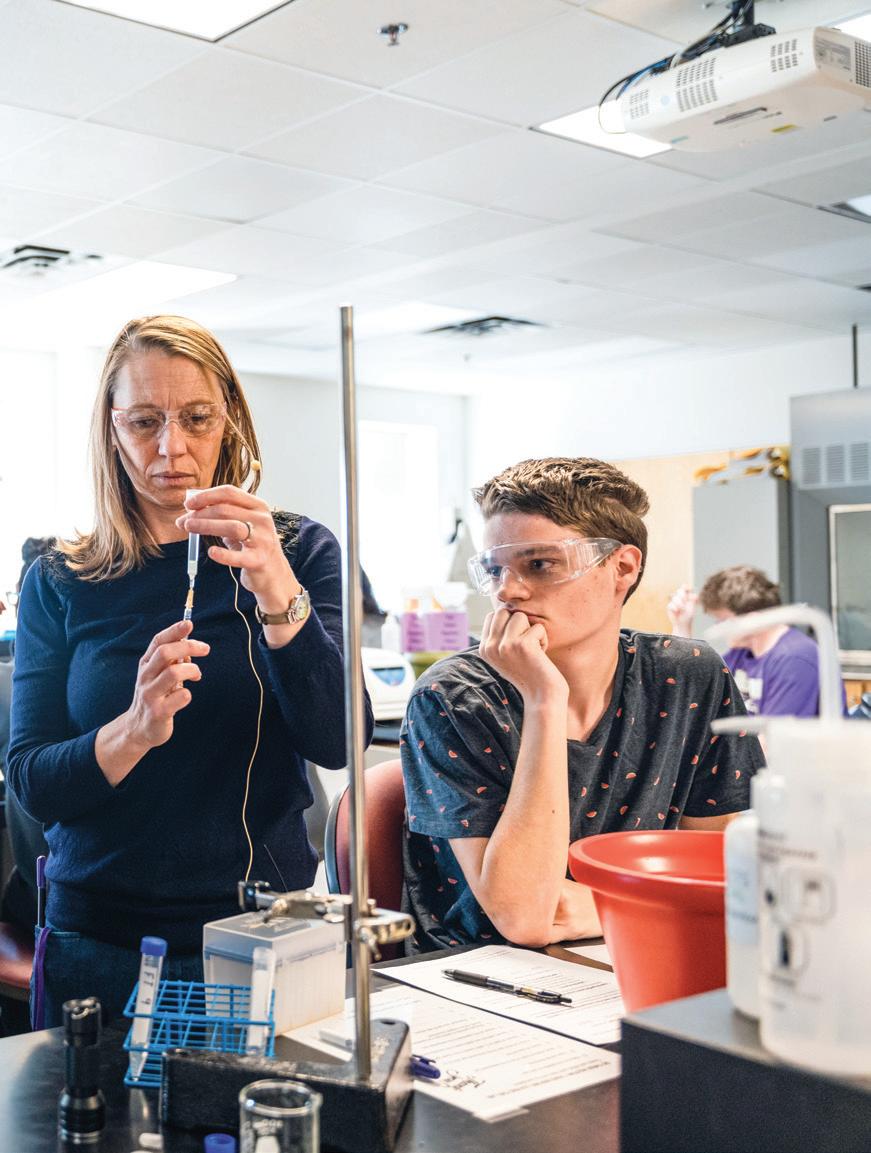
Cresawn suggested adapting a chemistry experience to tactile methods of data collection and analysis. Lindsey Sequeria, a chemistry professor, enthusiastically agreed to facilitate the lesson and collaborate on its adaptation. Through Zoom meetings and
collaborative sessions involving Cresawn, Boeckmann, Sequeria, and VSDB mobility specialist Lisa Auwarter, the lesson was meticulously modified to ensure accessibility for all students. Every step was documented, leading to the creation of a comprehensive facilitator guide.
In 2023, with the help of JMU student volunteers, VSDB students fully engaged in their first JMU chemistry lab experience. They investigated the synthesis of bioplastic films from natural materials found in shrimp shells and explored how the molecular structure of added plasticizers affected the film’s physical properties. “JMU students provided verbal guidance and safety oversight as needed. They were well-prepared to explain and facilitate discussions,” Cresawn says.
Their approach challenges existing experiences, often limited to providing materials in Braille, enlarging text, utilizing assistive technology, offering audio versions of textbooks, or modifying assignments. Instead, this model focuses on developing novel lessons inspired by faculty-driven learning experiences at JMU.
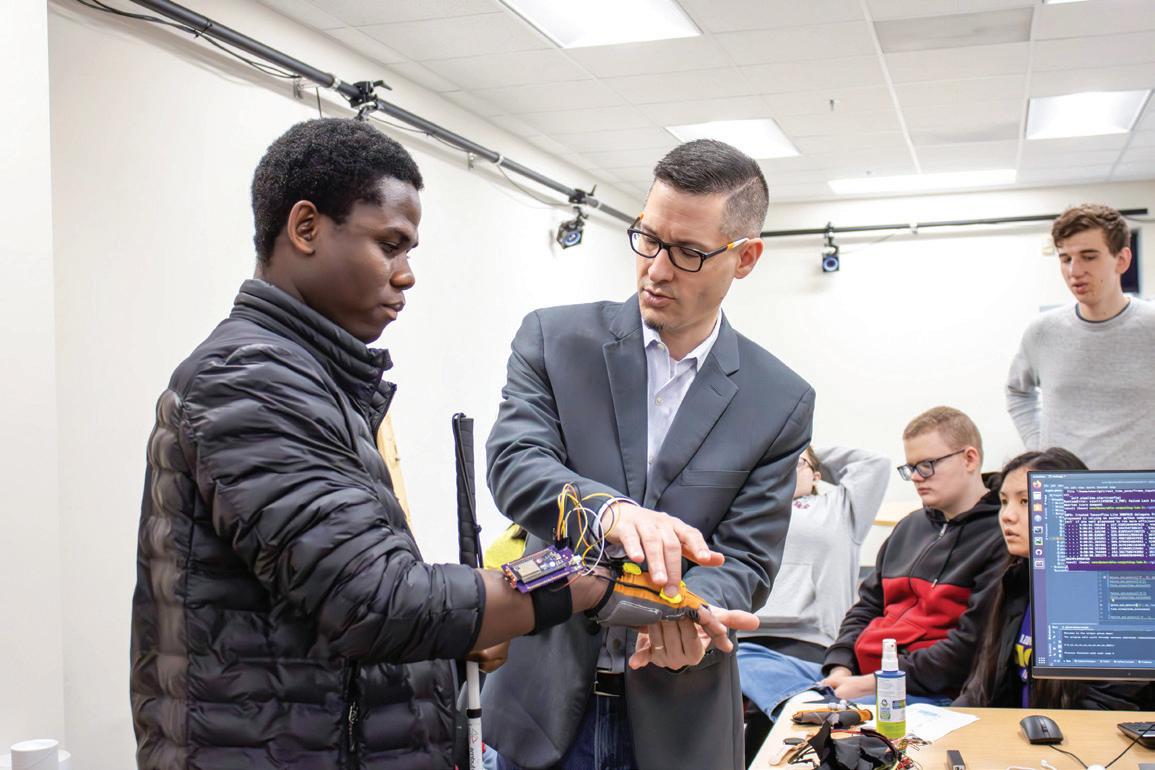
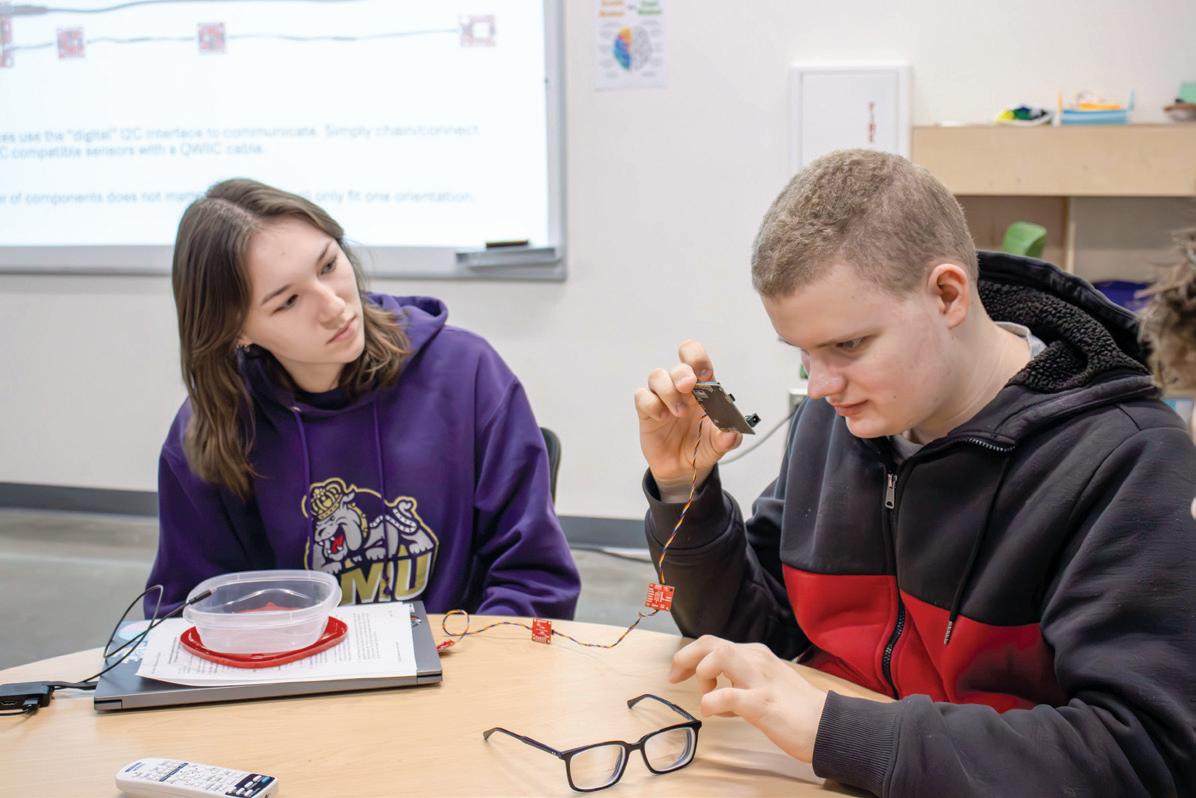
VSDB students explore haptic feedback for hand guidance in the JMU Wearable Computing Lab.
This approach requires identifying faculty whose expertise transcends visual limitations, ensuring that lessons are accessible, engaging, and meaningful.
April 3, 2024, marked the second year of hosting the event, and Engineering professor Jason Forsyth guided VSDB students in an activity to explore environmental issues. Students utilized data collected by environmental sensors, transforming it into musical sounds and pitches. Then, they analyzed the sounds to identify potential locations for an indoor garden.
“Sensory technology is powerful,” Forsyth explains. “Sonifying the data enabled students to sense and measure things that would have been normally hidden from them. They were able to find low, medium, and high levels of the various sensory measurements they collected.”
“We took something very visual and made it auditory, making the data accessible to all VSDB participants,” remarks Cresawn.
After the lesson, the students visited Forsyth’s lab to learn about his research on wearable computing systems. They engaged in hands-on exploration and interaction with haptic feedback devices, which provide tactile sensations or vibrations. Through this experience, students gained a deeper understanding of sensory technology.
“When we visited the research lab, we had envisioned a certain way that our system would navigate people through space,” Forsyth explains. “Observing the students adapt the system to their needs was very interesting. Watching their movements as they navigated to a particular location offered a fresh perspective.”
“VSDB and JMU students connected over many commonalities. The interactions were rewarding and encouraging,” Cresawn says, highlighting the positive impact of innovative STEM learning experiences.
“We took something very visual and made it auditory, making the data accessible to all VSDB participants.”
—KERRY CRESAWN
Boeckmann was impressed by Forsyth’s willingness to seek feedback and make his program even more accessible, showing a genuine commitment to inclusion and accessibility. “I had high expectations for this trip, which were met and exceeded.”
Given the partnership’s success, Cresawn will continue arranging trips for VSDB students in the fall and spring semesters.
“I hope that our work has demonstrated a more creative way to adapt hands-on learning and encourages other institutions to identify research experiences that can be adapted for visually impaired students,” Cresawn says.
“JMU and VSDB are bridging worlds, creating a more inclusive and accessible learning environment for all,” she adds.
VSBD students and JMU STEM Corp volunteers work together to sonify sensor data.
CS PROFESSOR TRANSFORMS CLASSROOM WITH VIRTUAL REALITY
By Olivia Woolman (’24)
omputer Science professor
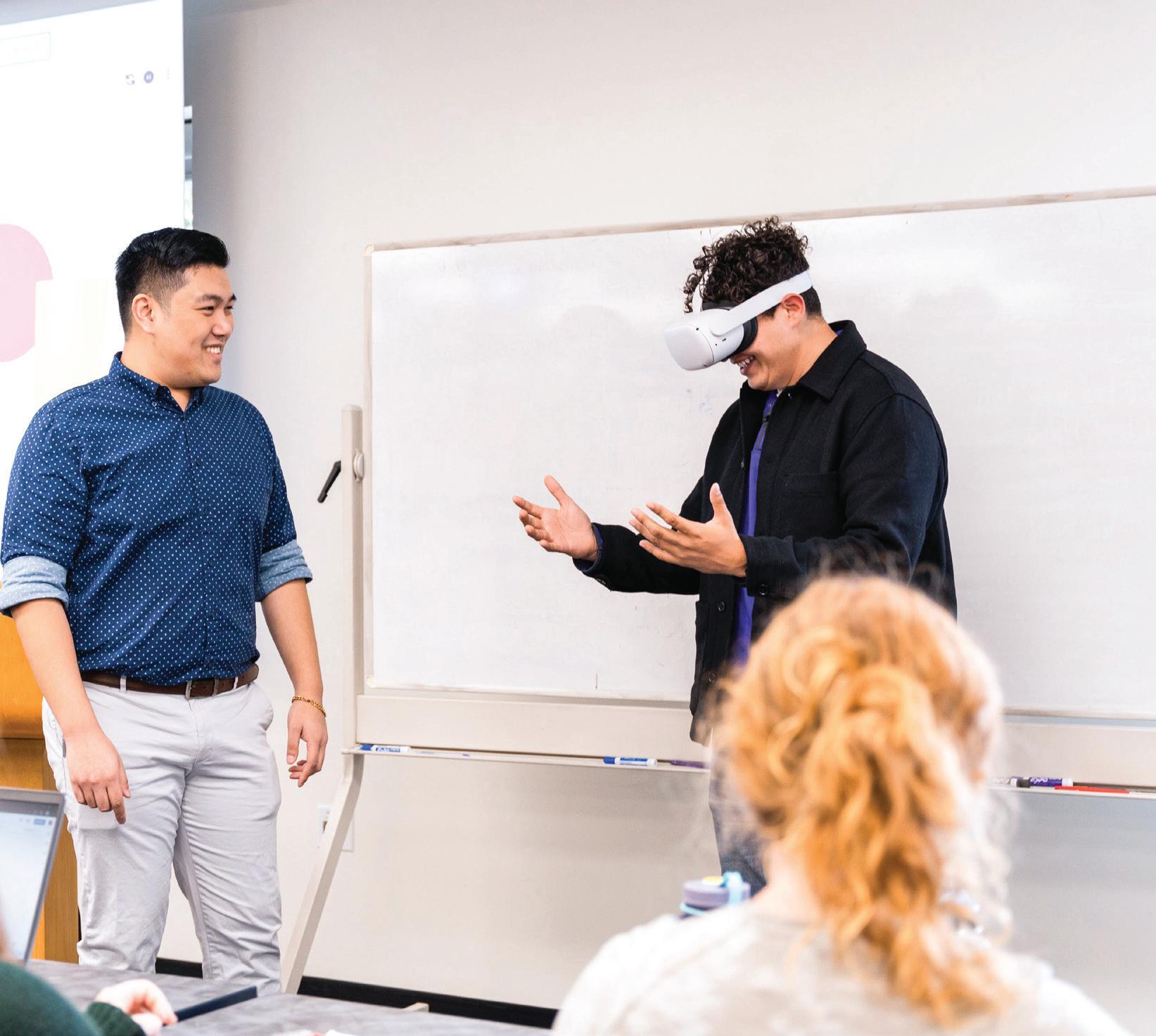
Isaac Wang isn’t just passionate about computer science; he is on a mission to bring the exciting world of virtual reality (VR) into the classroom.
His journey from graduating with a degree in computer science to earning a doctorate in human-centered computing led him to JMU, where he has been able to blend his love for human-computer interaction, natural user interfaces, intelligent virtual agents, and gesture recognition.
As several large companies have been releasing VR experiences for customers, researchers, students, and even kids, Wang became quickly inspired to start a VR class at JMU. “Virtual reality has been steadily gaining in popularity over the past decade and continues to do so,” Wang says.
“Companies such as Meta and Apple are actively releasing new hardware and software to consumers,” Wang says. Apple, for example, came out with the “Apple Vision Pro,” which is worn over the head and mimics ski goggles. Additionally, Meta has released
“My goal is that students leave with an understanding of the physical and psychological factors that influence VR design and apply those designs to other applications.”
ISAAC WANG
a product called Meta Quest Pro, which they refer to as their “system for a mixed reality.”
“I wanted to offer a VR course to bring value to students, both in terms of gaining applicable job skills and just having fun with the technology,” Wang explains. He hopes the students learn how to utilize virtual reality development tools, a beneficial skill to include on resumes.
In this new virtual reality class, Wang aspires for students to go beyond the design and actively create VR applications. “My goal is that students leave with an understanding of the physical and psychological factors that influence VR design and that they can apply those design principles to their applications.”
Outside of the design and creation process, the class will cover optics, human perception, movement, interaction, avatars, and spatial audio.
The essence of virtual reality is an “illusion,” Wang notes. VR tries to trick the brain into believing it is in a virtual world. With a VR headset, users are immersed in different ways that capture the vision through each eye, along with motion tracking. “Tracking and matching how the user moves their head and body around the real world can help create a sense of presence — the degree to which the user believes they are actually in the virtual world,” he adds.
Wang is incorporating the concept of Sustainable Development Goals (SDGs) in the class to bring awareness to important global issues and
encourage students to view them from a fresh perspective. In a recent assignment, students were asked to create a two-tothree-minute VR experience centered around an SDG goal or another societal issue that held personal significance to them. The selected topics, including pollution, racial inequality, and oppression, all underscore VR’s unique capacity to provide individuals with novel viewpoints on issues they might not have been able to grasp otherwise, according to Wang.
“Professor Wang’s incorporation of the
SDGs with VR is helping students connect technology to critical human problems,” says Bob Kolvoord, interim provost.
“This work is at the core of what students do in our college, and we’re excited to see their work,” he adds. “We’re privileged to
Professor Isaac Wang leads students through virtual worlds, blending technology with hands-on learning.
have faculty like professor Wang in CISE.”
Virtual reality has been used in many areas, such as health care, training, games, and art production. “Anything real can be simulated in virtual reality, ” Wang says, “but where the technology shines is when we surpass the bounds of reality.” As technology advances, virtual reality offers individuals a unique opportunity to experience the impossible.
The skills acquired while developing and using applications “give the students another way to consume media, have fun, or even relax,” says Wang. “It is a game-changing experience when there is a level of immersion. The immersive nature of virtual reality can transport users out of the real world, creating an incredibly enriching experience for students.”
Virtual reality has the potential to facilitate connections across geographical locations. Wang plays VR games online with his sister, who lives in another state. “It’s just like being together in person,” he says.
The most popular VR headsets on the market are the Meta Quest, the HTC VIVE, and PlayStation VR. Currently, the students use Meta Quest 2 headsets made primarily for VR.
Wang is excited to offer a virtual reality class and hopes it will reach a broad student audience.
VR’s capability to immerse users offers fantastic opportunities for people to interact as if they were physically together, engage in activities within the same space, and explore the world firsthand through virtual travel, all without the need for expensive flights or time-consuming travel.
EMERGENCY DROUGHT PLAN SHOWCASES THE IMPACT OF ISAT CAPSTONE PROJECT
By Dorian Crawford (’27)
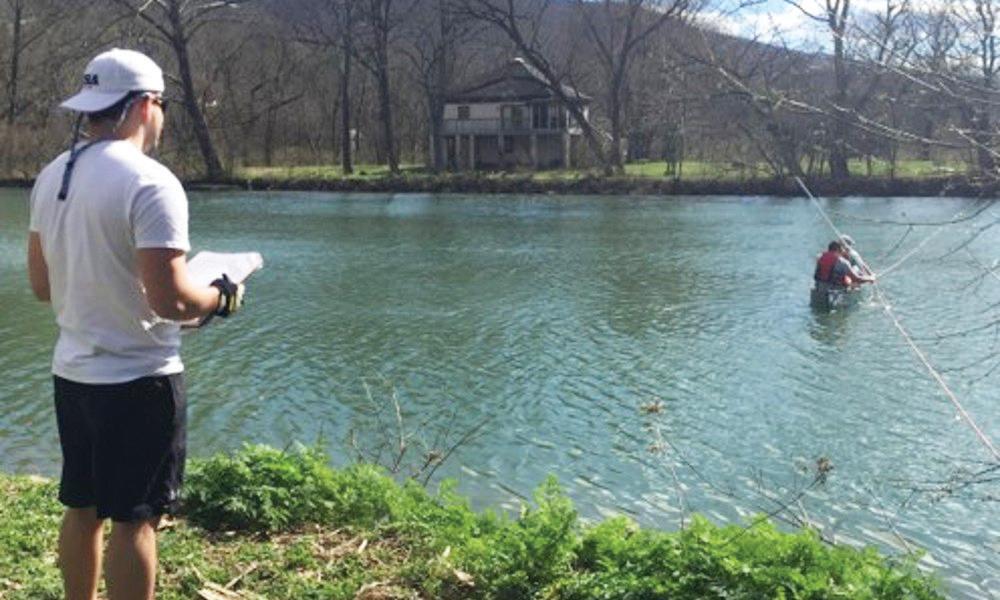
Three ISAT graduates’ work at the dam in 2016 was used to address drought challenges in 2023.
hen the drought gripped Strasburg, Virginia, in 2023, a long-dormant capstone project suddenly sprang back to life, helping the town avert disaster.
The solution emerged years before, when three JMU Integrated Science and Technology majors, Alex Pineda (’16), Alex Barnes (’16), and Ricky Rizzo (’16), developed a solution to address the drought challenges faced by the small Shenandoah County town. Under the guidance of ISAT professor Carole Nash, the team
collaborated with Lee Harvey, the owner of Burnshire Hydroelectric, to revitalize Burnshire Dam, which powered the nearby town of Woodstock until 1956.
In 2012, Harvey purchased the aging Burnshire Dam to restore it using stateof-the-art generators and to modernize hydroelectric power in the Shenandoah Valley.
During the early 1900s, many dams were constructed to supply hydroelectric energy and create reservoirs for small towns in the valley. Over the years, most of these dams ceased energy production due to aging infrastructure and the introduction of a centralized power grid supplied by cooperatives or companies.
Pineda, Rizzo, and Barnes were the first of several student collaborators to work at Burnshire. Initially focusing on hydroelectricity, they planned to test the generators, but when the delivery of the generators was delayed, they adapted their approach and focused on the water powering them.
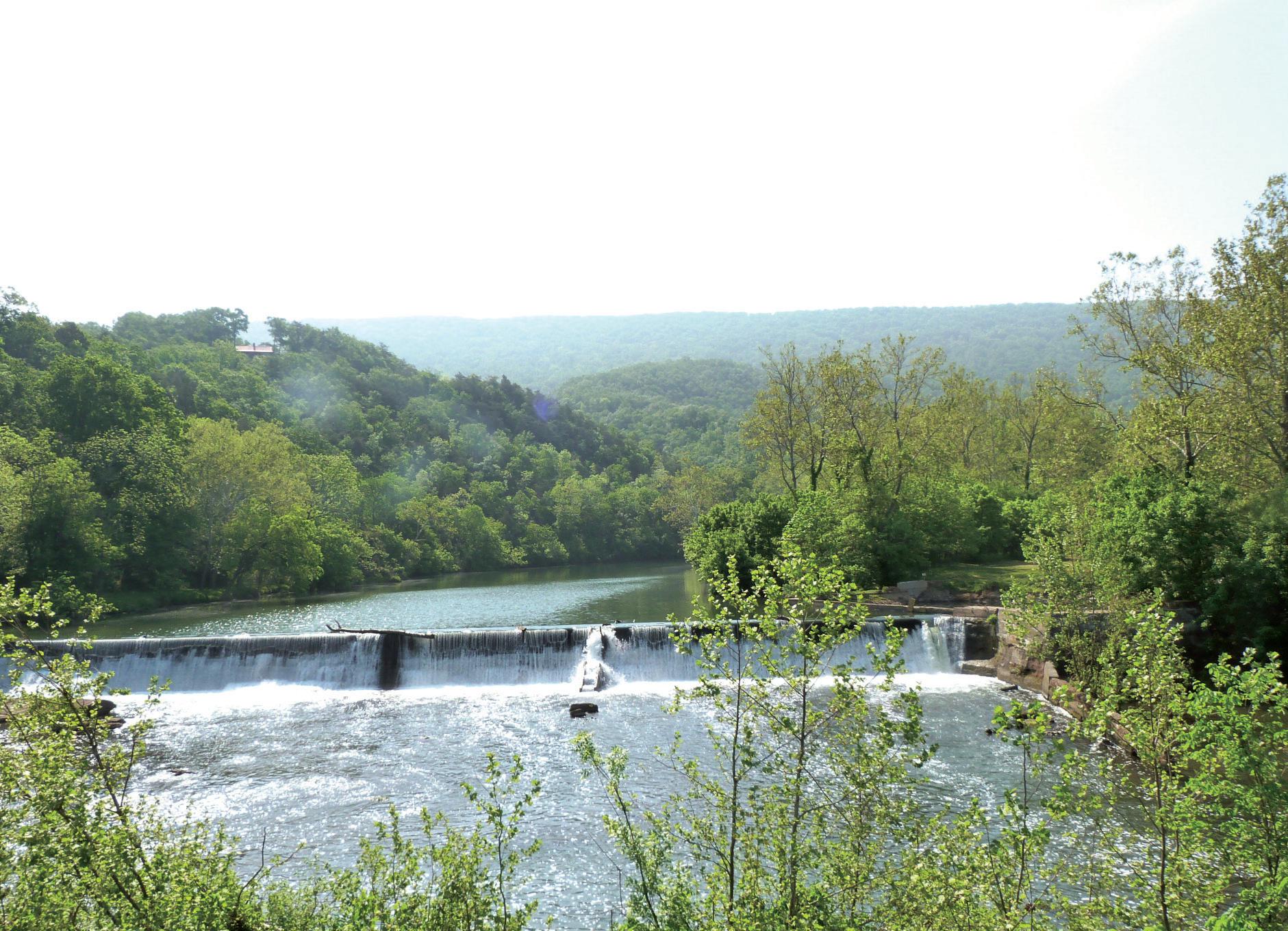
Burnshire Dam, known as a “run-of-river” operation, diverts some of the flow of the
North Fork of the Shenandoah River to the generators while the excess water runs over the dam. Behind the dam lies an “impoundment” — a reservoir of water collected over time. During discussions with Harvey, the team learned about Strasburg’s reliance on the North Fork for its water supply and the challenges of low-water periods, which were becoming more common.
“The work of Pineda, Barnes, and Rizzo illustrate the impact of the capstone project, demonstrating real-world solutions to daily problems.”
CAROLE NASH
“We recognized the reservoir’s potential for supplying water,” Pineda said. “We redirected our focus to help address this problem.”
To assess the impoundment’s capacity, the team conducted more than 30 depth measurements in the pool behind the dam from a canoe. They analyzed the river’s water levels using data from stream flow gauges monitored by the U.S. Geological Survey and identified regular periods of decreased water flow. Together, these data points allowed an estimated 37 million gallons of water capacity in the impoundment.
Discussions with stakeholders and legal experts, including town officials and the Virginia State Hydrologist, addressed potential implications and impacts. In comparing the impoundment capacity with water usage, the students found that the dam could supplement Strasburg’s water demand for 23 days.
The ambitious plan sat dormant until the 2023 drought hit the Valley. Strasburg’s water plant director contacted Burnshire Hydroelectric, recalling the students’ proposal.
Using the team’s findings, Harvey released 40 cubic feet of water per second for 10 days. According to the Virginia
Department of Environmental Quality, the students’ plan proved pivotal and accurate. Strasburg lifted its declaration of a drought emergency on September 27.
The work of Pineda, Barnes, and Rizzo illustrates the impact of the ISAT capstone project, demonstrating real-world solutions to daily problems. “The capstone experience allows students to showcase their understanding of complex systems and problem-solving skills, making a meaningful impact even in times of crisis,” Nash says. Harvey describes the restoration of the dam and the introduction of a new green energy source as a “win-win-win-win for us, our future customers, the planet, and most importantly, our children.”
Water flows over the Burnshire Dam in the Shenandoah Valley
EXPLORE
ENGINEERING STUDENTS CREATE INTERACTIVE EXHIBITS FOR LOCAL MUSEUM
By Lynn Radocha (’18) and Maya Winder (’24)
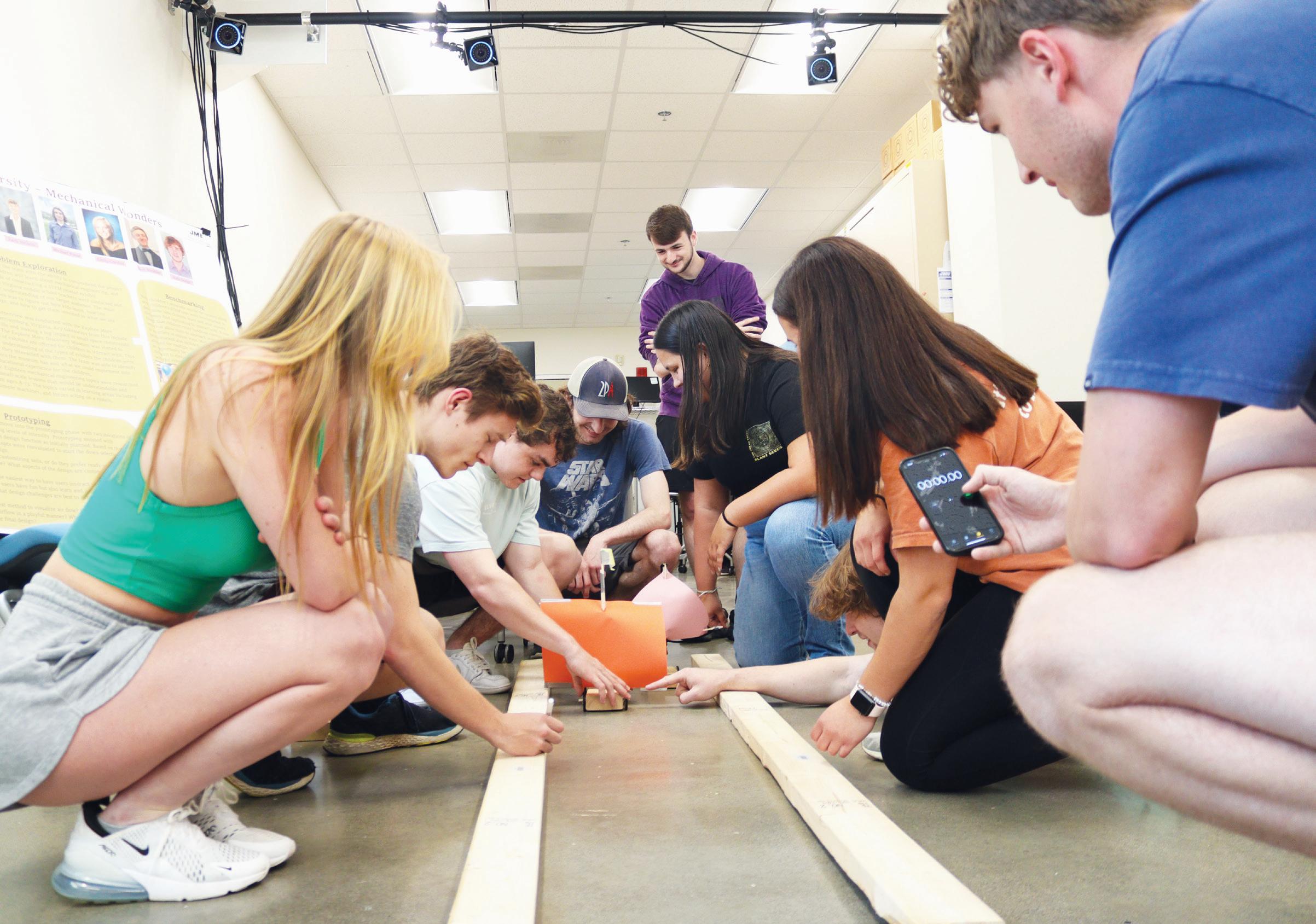
Engineering students testing the wind-racer prototype for the Explore More Discovery Museum.
From soaring planes to racing boats, a team of Engineering students is embarking on an ambitious project with the Explore More Discovery Museum in Harrisonburg to bring the wonders of engineering to life for young children.
The project began as a collaborative effort between Engineering professor Shraddha Joshi and the museum’s exhibit director, Marcia Zook, who share a mutual interest in experimenting with innovative approaches to learning.
Driven by a vision to infuse art and creativity into engineering education, Joshi, the project advisor, sought a team of students who shared her ideas. “I strive to create experiences for my students — to think about engineering from a different and unique perspective.”
Zach Nelson, Oliver Miller, Erica Dobies, Emily Corsini, Kali Findlow, Michael Poole, Nathan Helems, Joshua Buckner, and Nate Dodge accepted the challenge.
During the initial phases of the project, the team worked collaboratively to conduct research, generate ideas, and form sub-teams based on their interests to explore problems.
Over two semesters, students meticulously refined their concepts, gathered feedback, and interviewed teachers and museum representatives to inform their approach.
“Interviewing stakeholders helped me develop crucial speaking skills and better
understand how to engineer for people,” Poole says.
Zook emphasized the importance of hands-on learning experiences. “Children learn intuitively through the playing process. It’s exciting for kids to design and create, then redesign and rebuild.”
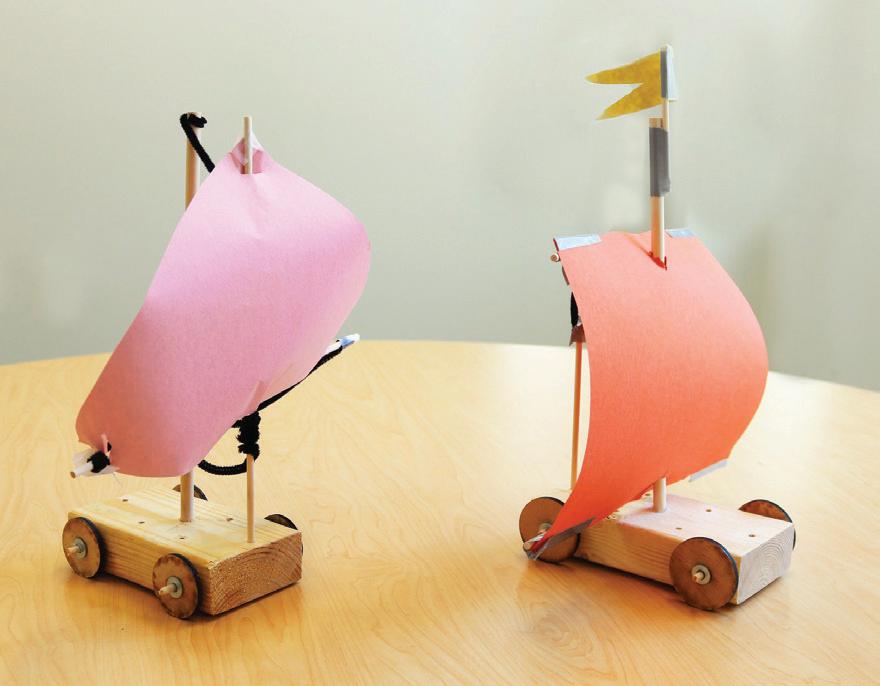
They began prototyping three interactive exhibits: Wind Racers, Marble Mayhem, and Wingin’ It — each designed to captivate, educate, and inspire.
Wind Racers challenges participants to delve into aerodynamics by designing sails for boats, navigating challenges, and racing against the wind. Marble Mayhem introduces the principles of simple machines through an interactive pegboard where users manipulate pieces to guide marbles along desired paths. Wingin’ It offers an immersive experience with a wind tunnel, allowing visitors to explore the aerodynamic properties of model planes as they tilt, soar, and dive.
of engineering through various course offerings and projects,” Joshi adds.
Zook says the exhibits incorporate mechanical engineering concepts, allowing children to grasp engineering principles while engaging in playful activities intuitively. “We are excited the team is designing exhibits that allow children to learn interactive, hands-on experiences in
“The design process allowed me to build upon existing ideas, expanding beyond the original version, and achieve better outcomes.”
—MICHAEL POOLE
Poole’s understanding of the design process grew in the area of iteration. “The design process allowed me to build upon existing ideas, expanding beyond the original version, and achieve better outcomes.”
Their project aligns with the newly created Electro-Mechanical Systems concentration, which offers engineering students opportunities to design, analyze, and build engineered systems at the intersections of mechanical, electrical, and computer engineering. “Part of our process was figuring out mechanical engineering, what topics we cover, and how to make it fun and educational for kids,” Dobies says.
“It is an opportunity for students to dive deeper and learn more about these areas
a creative environment.”
Looking ahead, the team envisions creating a modular and mobile exhibit that can reach children in schools and STEM events in the community, sparking curiosity in engineering and nurturing the next generation of innovators and problem-solvers.
The project has deepened students’ understanding of engineering concepts and provided invaluable real-world experience. With two more semesters ahead, they are eager to refine their prototypes and unveil their completed exhibits in Spring 2025.
DESIGNING MOBILITY:
ENGINEERING STUDENTS CREATE ADJUSTABLE PROSTHESES FOR CHILD AMPUTEES
By Emma Seli (’23) and Lynn Radocha (’18).
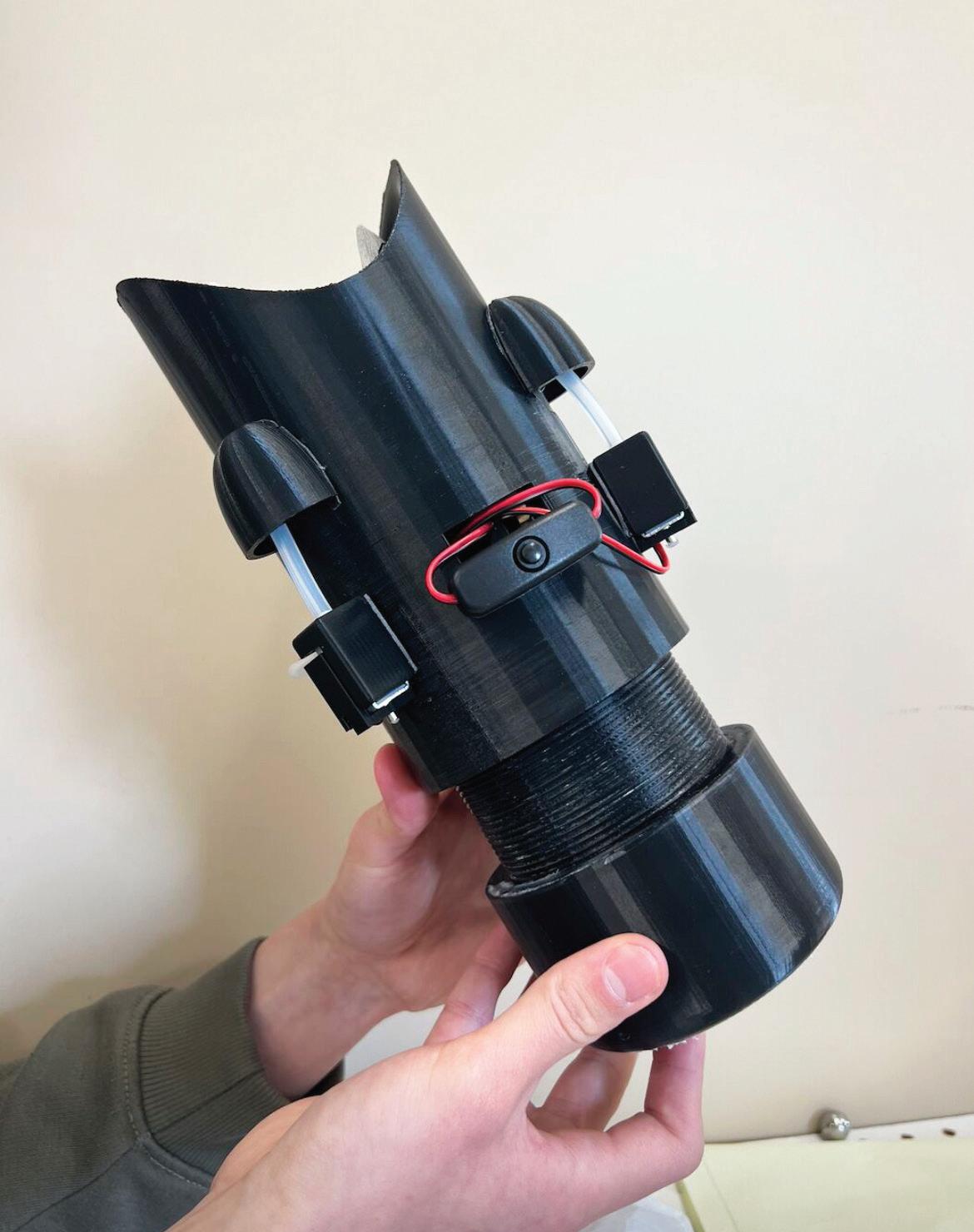
Engineering students design an adjustable, below-the-knee prosthesis that grows with a child, reducing the need for frequent replacements and easing the financial burden on families.
Child amputees in the United States often suffer from residual limb pain and discomfort due to rapid limb growth — a significant challenge in prosthetic development.
In 2021, JMU Engineering students, Parker Agan, Will Bradford, Megan Caulfield, Abby Charleston, Matrix Chen, Jack Nordstrom, Danny Tyra, Emily Vierrether, and Jack Zhao embarked on a capstone project with a clear mission: to design a comfortable, well-fitting, below-the-knee prosthesis capable of adjusting in length and volume, ideally growing with a child. This innovative design aims to reduce the need for frequent replacements, easing the financial burden on families.
Under the guidance of Engineering professor Jason Forsyth, the team began extensive research and planning to gain a comprehensive understanding of prosthetic needs. “I allowed them to take the lead while supporting their milestones and assisting them with technical challenges,” Forsyth explains. “They’re engaged, self-driven, self-motivated, and hungry for knowledge.”
The team divided into three subgroups focused on specific tasks: length adjustment, volume adjustment, and computing.
The volume team tackled fluctuations, including leg swelling and minor changes over one to two years. The length adjustment team addressed adaptations, ensuring the prosthesis aligned with the child’s growth.
Charleston noted the lack of adjustable prostheses on the market, particularly for children. “Improper fit of prostheses can cause discomfort, rashes, and sometimes open wounds to the skin. These limitations can prevent children with prostheses from running, jumping, and playing,” she adds.
The computational team developed a system that enables real-time monitoring and adjustment of the prosthesis using sensor
Inflatable Bladders accommodate for daily diameter changes in residuum
Threaded Socket accommodates for length changes in residuum
Adjustable Transtibial Children’s Prosthetic
Being able to adjust in both volume and length, this belowknee prosthetic is intended to grow and change with the child to reduce prosthetic replacement expenses. Equip with pressure sensors and a fully enclosed data and computing system, this prosthetic can provide realtime data and make volume adjustments as needed.
Hollowed Bottom provides storage for computing and data components
data. If a child outgrows their prosthesis, the system automatically sends a notification to make the necessary adjustments.
“We created a mold of a children’s prosthesis and placed fiberglass on top of it to create a more realistic socket,” Zhao says of the prototyping process.
Additionally, the team acquired an adultsized prosthetic socket for reference and fitted it with plastic bags and a pump to simulate limb changes. This helped the team meet their design requirement and ensure the prosthesis’ functionality.
Over two years, the project evolved into a sophisticated design featuring air bladders to adjust the socket’s internal volume, a screw mechanism for length, and an onboard computing system to collect data
on force and pressure within the socket.
“They’re doing something tangible to help people, and that’s always a good feeling,” Forsyth says.
Caufield reflected on the project as a realization of her lifelong interest in prosthetics, combining her passion for engineering with her desire to help others. “Being able to design something that has such a positive impact on someone’s life is exactly what I want to do.”
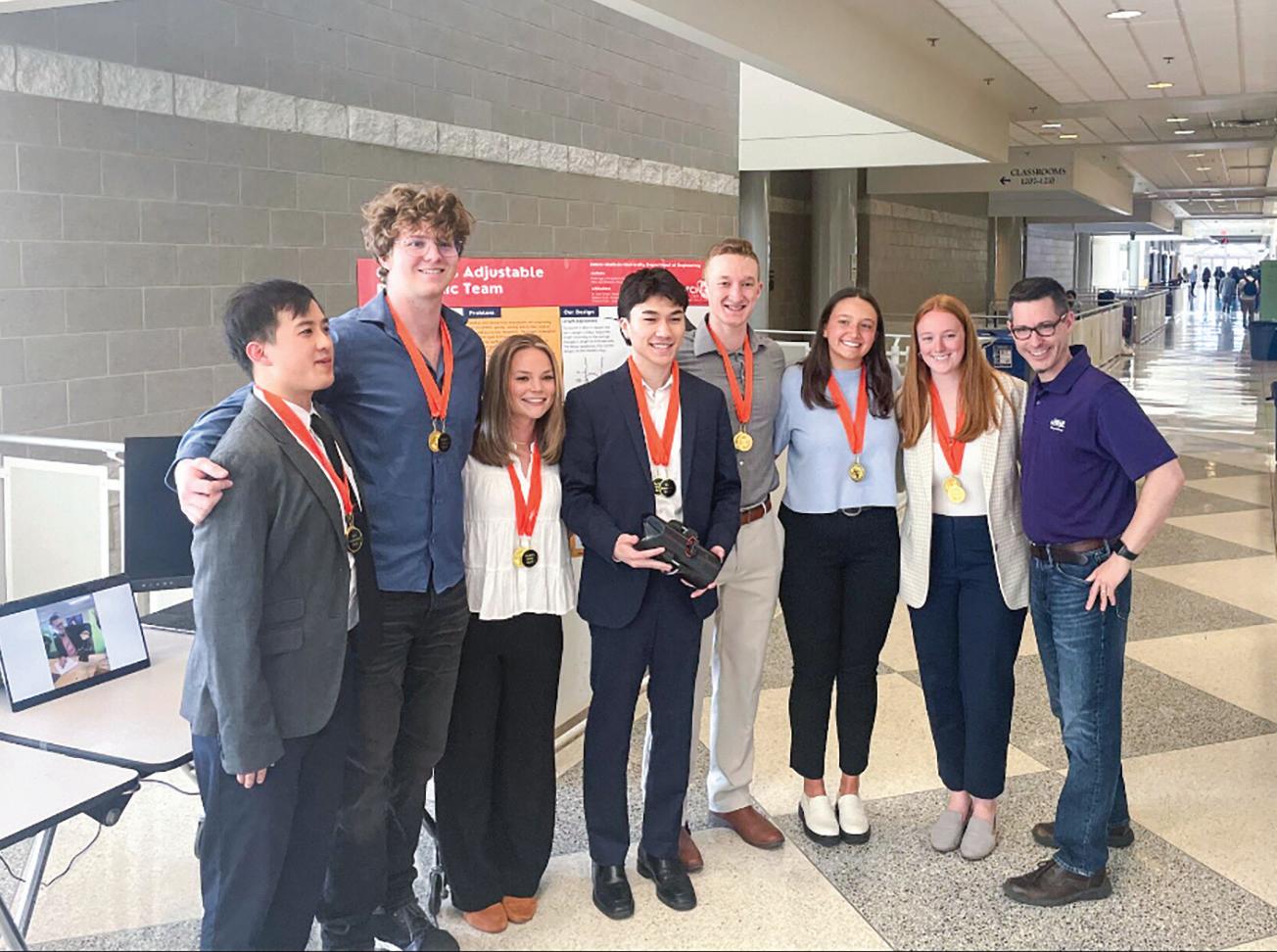
The project not only met but surpassed the team’s initial goals, leading them to win the JMU Engineering People’s Choice Award and Best Overall capstone project.
“I am proud to have worked alongside this group — to have accomplished such an impactful project that started as an idea,
with the immense help and support of our faculty advisor, Dr. Jason Forsyth, for taking on this project and pushing us to reach our goals,” Vierrether says.
The team’s success is a testament to the JMU Engineering program’s ability to prepare future engineers to make real-world impacts, big or small. As this group of dedicated students moves on, their contributions will undoubtedly continue to resonate, offering new possibilities for children amputees to play, jump, and run — just like their peers.
“We have produced something we are all proud of,” Charleston says.
SATELLITE IMAGERY: RUSI – OSIA AND MAXAR TECHNOLOGIES
HUNTING THE GHOST SHIP: HOW AN IA PROFESSOR TRACKED THE SPARTA IV
By Dorian Crawford (’27)
The phrase “ghost ship” conjures images of Halloween stories and legends of Davy Jones. However, for Giangiuseppe Pili, professor of Intelligence Analysis, it brings to mind a different name: SPARTA IV.
Pili and his team conducted a lengthy investigation tracking the Russian cargo vessel SPARTA IV. Their findings revealed that the ship, despite Russia’s claims of carrying civilian goods, was actually involved in transporting military supplies.
Before joining JMU, Pili was part of the Open Source Intelligence and Analysis (OSIA) group at the Royal United Services Institute (RUSI). His work focused on monitoring how North Korea evades sanctions, often by using ships to transport illicit cargo.
Pili’s interest shifted when he learned about Russia’s evasion of sanctions and the SPARTA IV. Driven by a strong sense of responsibility and accountability, he decided to investigate the true nature of the SPARTA IV. His motivation was firmly grounded in his belief that such actions, at the very least, were unreasonable from an international security perspective and needed to be addressed.
Pili’s team included Jack Crawford, a
research analyst at RUSI, and Nick Loxton, the head of intelligence delivery at Geollect. They used open-source intelligence from RUSI and Geollect, an intelligence firm, to unveil the truth about the SPARTA IV. Open-source intelligence differs from data obtained from traditionally secretive agencies because it is freely available to the public. This accessibility can result in more efficient work.
“The speed and the shareability of all the material is absolutely incomparable to any secret operation,” Pili explained, “exactly because it’s not secret.”
Open-source intelligence provided Pili and his team access to swathes of information about the ship. For example, Automatic Identification System (AIS) logs revealed that the SPARTA IV had turned off its AIS for extended periods while at sea. AIS is required of all seafaring ships for safety and security purposes. Any ship that deactivates it raises immediate concerns, especially when it isn’t in danger and turns off AIS voluntarily.
The SPARTA IV mainly sailed between Tartus, Syria, and Novorossiysk, Russia. These two ports are separated by straits that Turkey restricted to civilian ships. This
wouldn’t be noteworthy, except for the amount of time SPARTA IV spent in areas reserved for military purposes. Most civilian vessels dock in regular commercial areas, even during wartime. “When you consistently see a ship close to military material ... you start to ask very interesting questions,” Pili says.
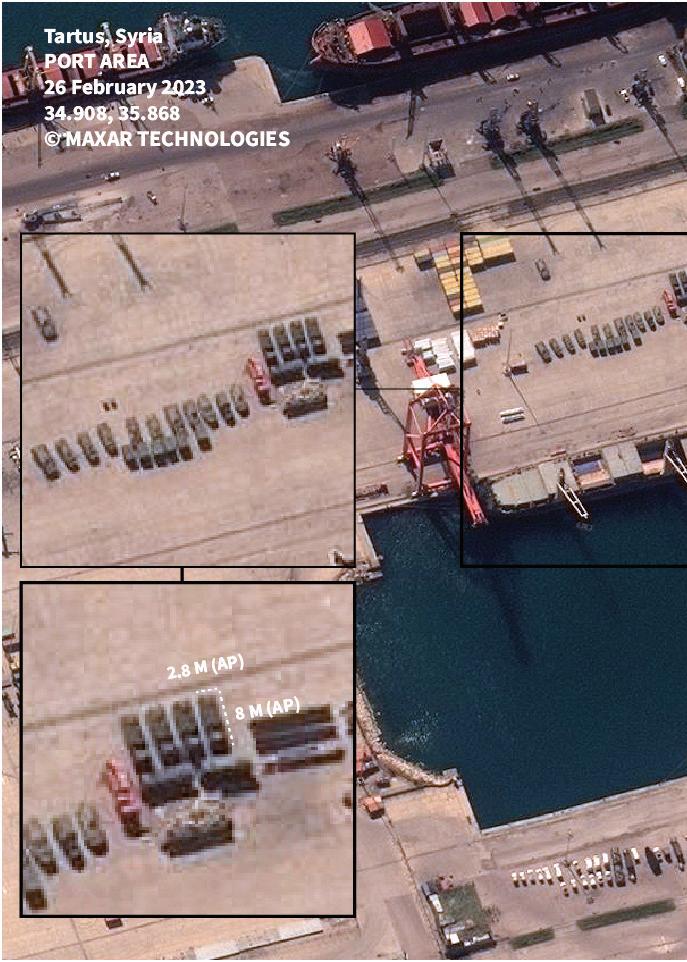
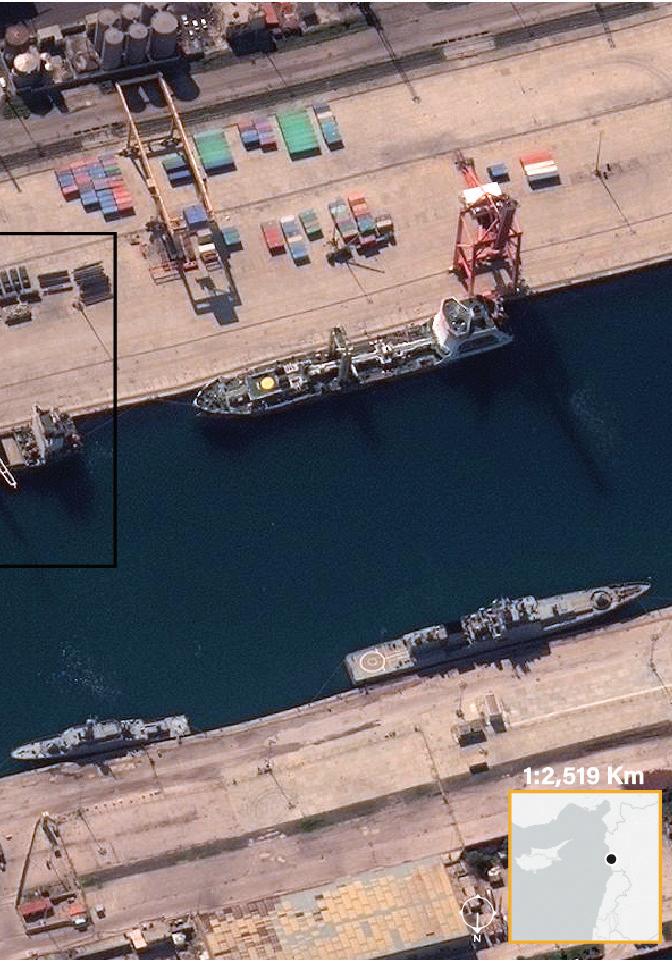
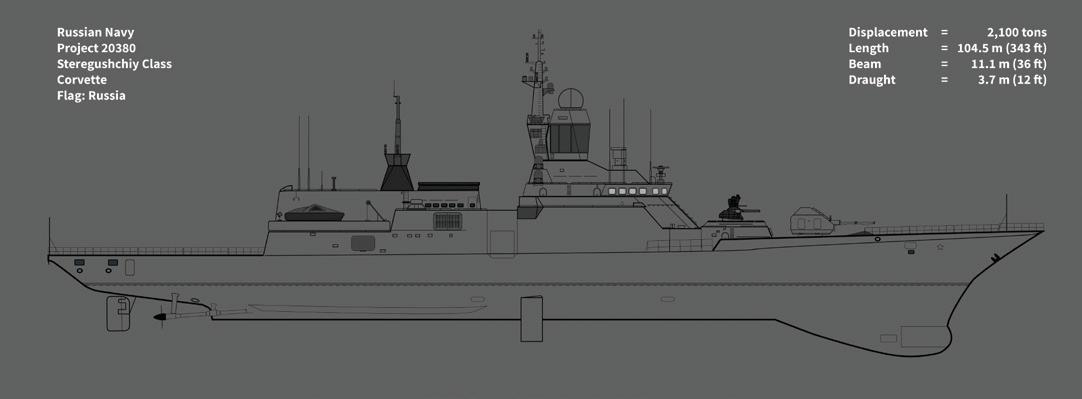
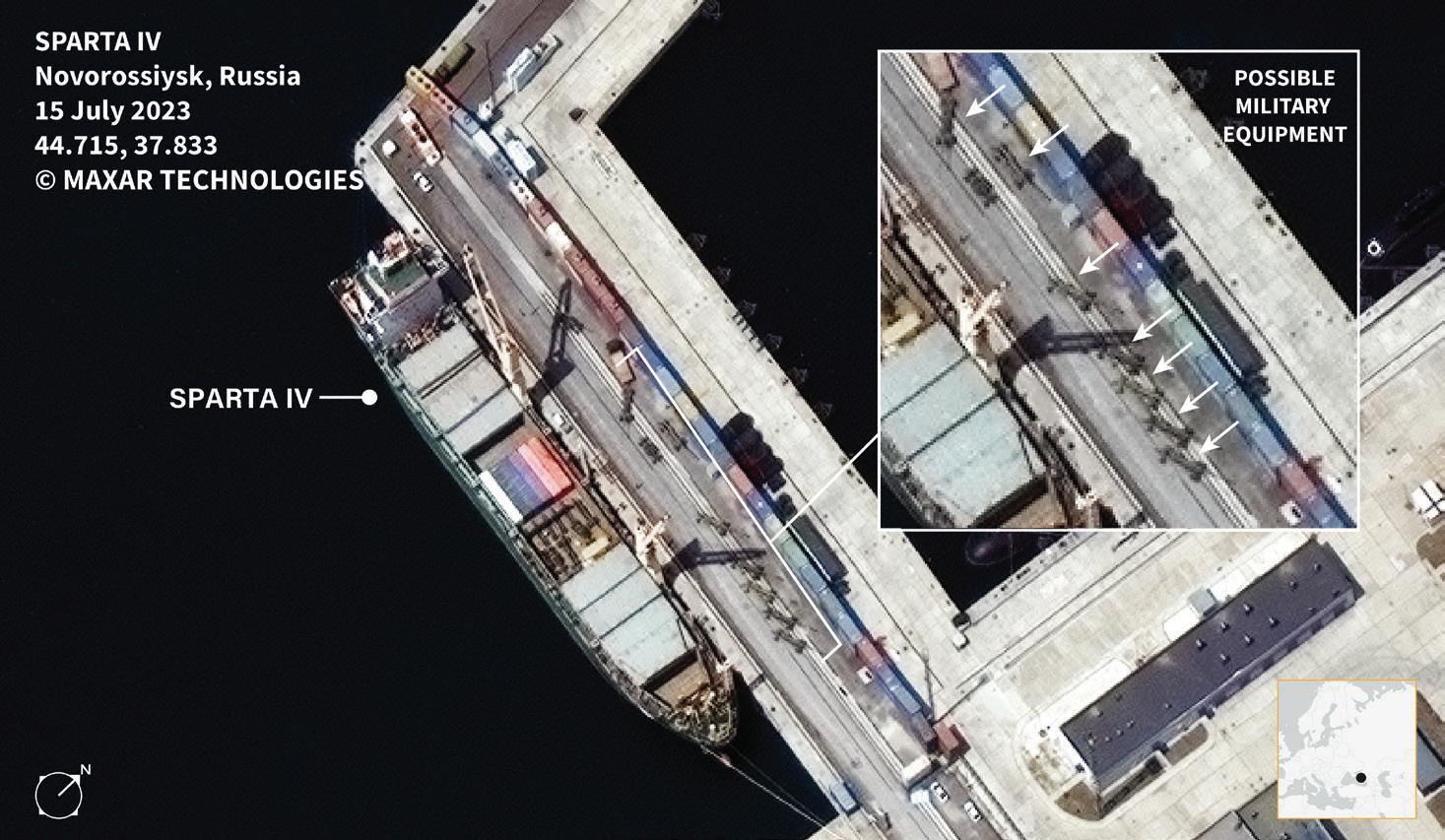
To determine if the “ghost ship” actually transported military cargo, Pili created an illustrated diagram with precise measurements. His calculations revealed that 17 trucks commonly used by the Russian military could fit inside the SPARTA IV. At the same time, the team utilized satellite imagery to confirm what the ship was carrying. They repeatedly found unusual sightings: While the SPARTA IV was near Russian warships, its cranes used to move
containers were askew, and in February, 17 trucks that resembled the same model Pili used were found on the SPARTA IV.
These findings immediately raised suspicion for Pili and his team. His role as an analyst allowed him to combine a diverse set of data into a compelling case against the SPARTA IV, confirming that it was posing as a civilian ship to gain entry into and out of the Black Sea. This charade allowed for the transportation of military assets into Russia and aided logistical efforts for its current war with Ukraine.
Pili’s team utilized satellite imagery and open-source intelligence from RUSI and Geollect to confirm what the ship was carrying. While the SPARTA IV was near Russian warships, its cranes used to move containers were askew, and in February, 17 trucks resembling the same model Pili used were found on the ship.
To determine if the “ghost ship” actually transported military cargo, Pili created an illustrated diagram with precise measurements. His calculations revealed that 17 Russian military trucks could fit inside the SPARTA IV.
However, the SPARTA IV also revealed a shocking fact: It was part of a more extensive operation. “One instance, one tree of a bigger forest,” Pili said. “Nobody realized that it was just a ship out of many, and all framed under the Minister of Defense.”
The SPARTA IV was owned by a state enterprise with ties to Deputy Minister of Defense Timur Ivanov, one of the most important people in Russia. Pili was amazed by the effectiveness of his team’s report. “The fact that we were able to track everything to such an extent was exciting,” he noted. “Understanding the depth and importance of the operation to the Russians was definitely one of those [memorable] moments.”
Pili was surprised by the reception of his report. First published under RUSI, it gained further exposure from the U.S. Naval Institute and NATO Defense College. Mainstream news sources also caught on. The Telegraph, Newsweek , the Global Herald and the Italian Society of Intelligence all shared their insights on the report’s findings. The worldwide recognition and coverage now provide policy and decisionmakers with the information to determine what course of action to take regarding the SPARTA IV and its peers.
“Intelligence is an incredible window into understanding how the world operates. It’s something that an average person who is not closely involved would find it hard to appreciate — the multitude of factors that shape the world we see,” Pili said.
PLANTING THE FUTURE: ISAT STUDENTS RESTORE RIVERBANK
By Laurel Seay (’24)
As you travel south along Port Republic Road and turn onto Alumnae Drive, you’ll discover the James Madison University Farm — a 30-acre hidden gem. Featuring a historic home built in 1848 and 1,000 feet of river frontage, the farm serves as a weekend camp, event venue, and community space. Despite its beauty and utility, the farm faces a significant challenge: riverbank erosion. “We are seeing a loss of stream bank because of this,” explained Carole Nash, Geography and Integrated Science and Technology (ISAT) professor. “It’s a natural process but also a problem because we lack trees and limited vegetation on the banks. Without the support of roots, the soil is vulnerable to water erosion.”
Nash highlights the multifaceted challenges arising from erosion. “We’re not only losing land — likely about 10 feet of stream bank over the last decade — but increased sediment is going into the river, leading to water quality issues.”
Addressing this problem, ISAT majors Reggie Wilcox and Patrick DeHarde
dedicated their capstone projects to combat erosion by stabilizing the stream bank and the floodplain.
Wilcox’s project focused on establishing a riparian meadow in the floodplain and devoted considerable time to researching 28 plant species suitable for the environment and strategizing future space management. “As these plants flourish, their roots will help stabilize the soil and prevent further erosion,” Wilcox explained. “With assistance from JMU’s Facilities Management, I monitored the seed mixes that included sunflowers, asters, black-eyed Susans, wildflowers, and an assortment of grasses.”
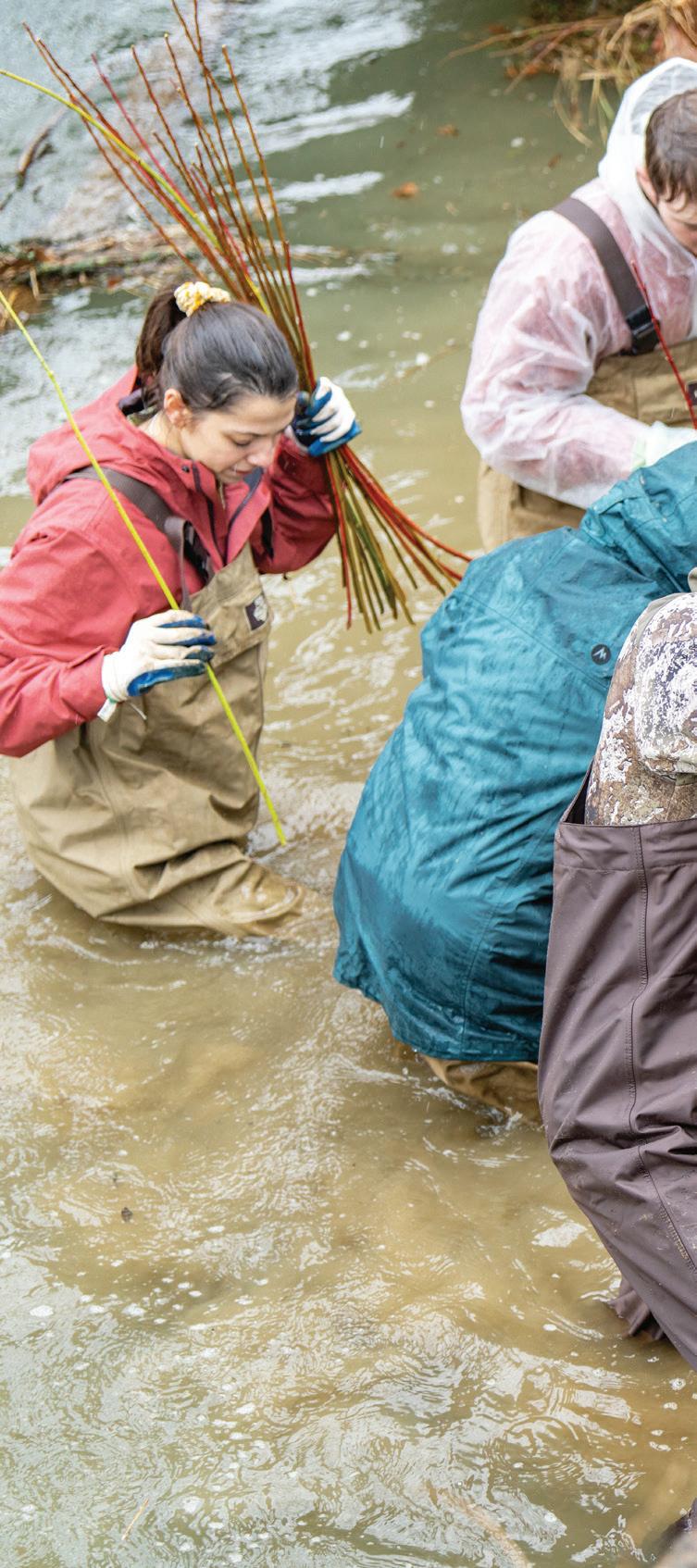
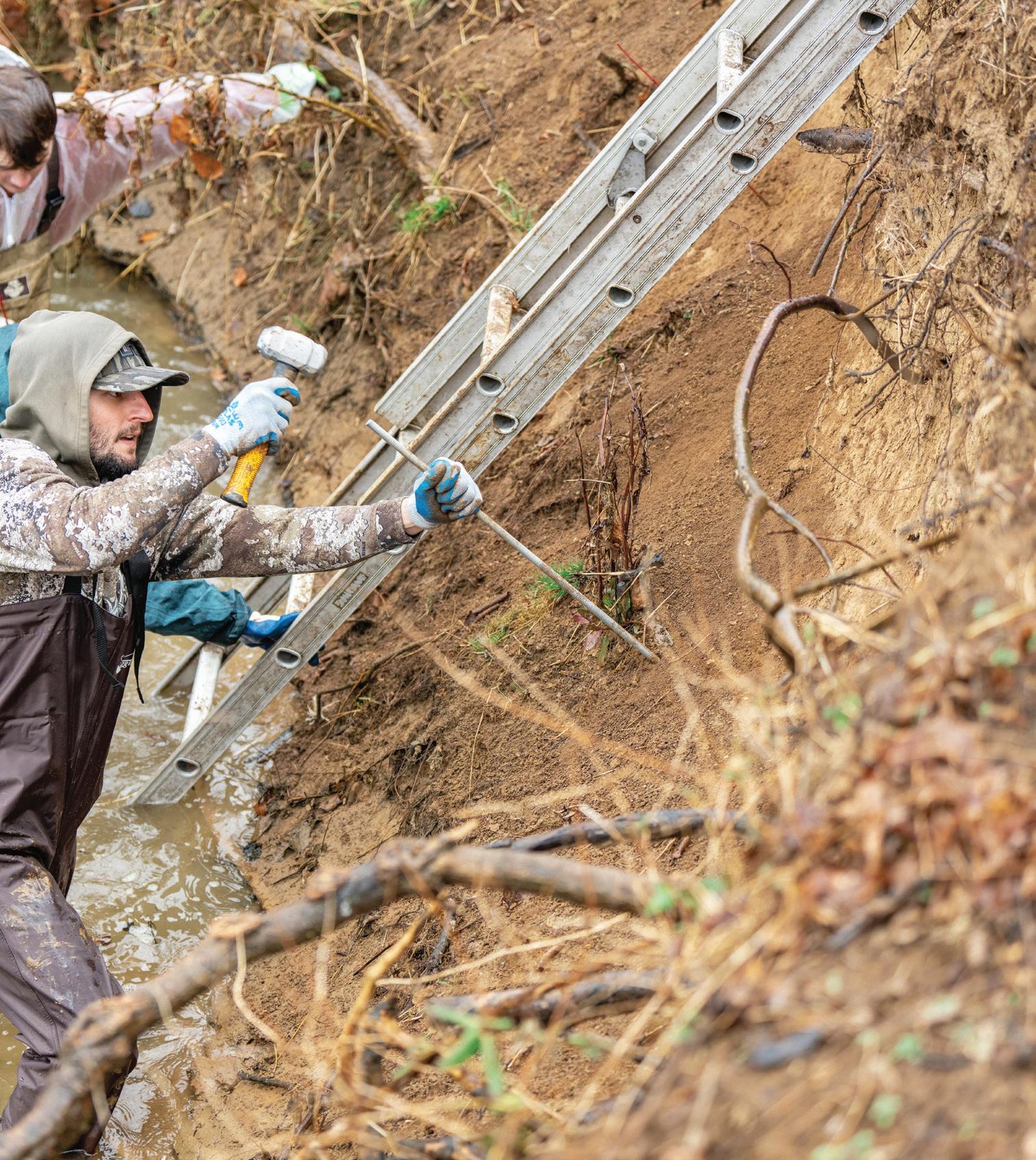
Despite the seed mixes, more must be done to combat stream bank erosion. Traditional engineering solutions involve cutting back the slope with heavy equipment, but Nash followed the recommendations of colleagues and staff members from Facilities Management to propose a different approach — planting trees. Recognizing the critical role of vegetation in stabilizing the soil, Nash advocated for a unique method called live staking to
combat erosion in a cost-effective and environmentally friendly manner.
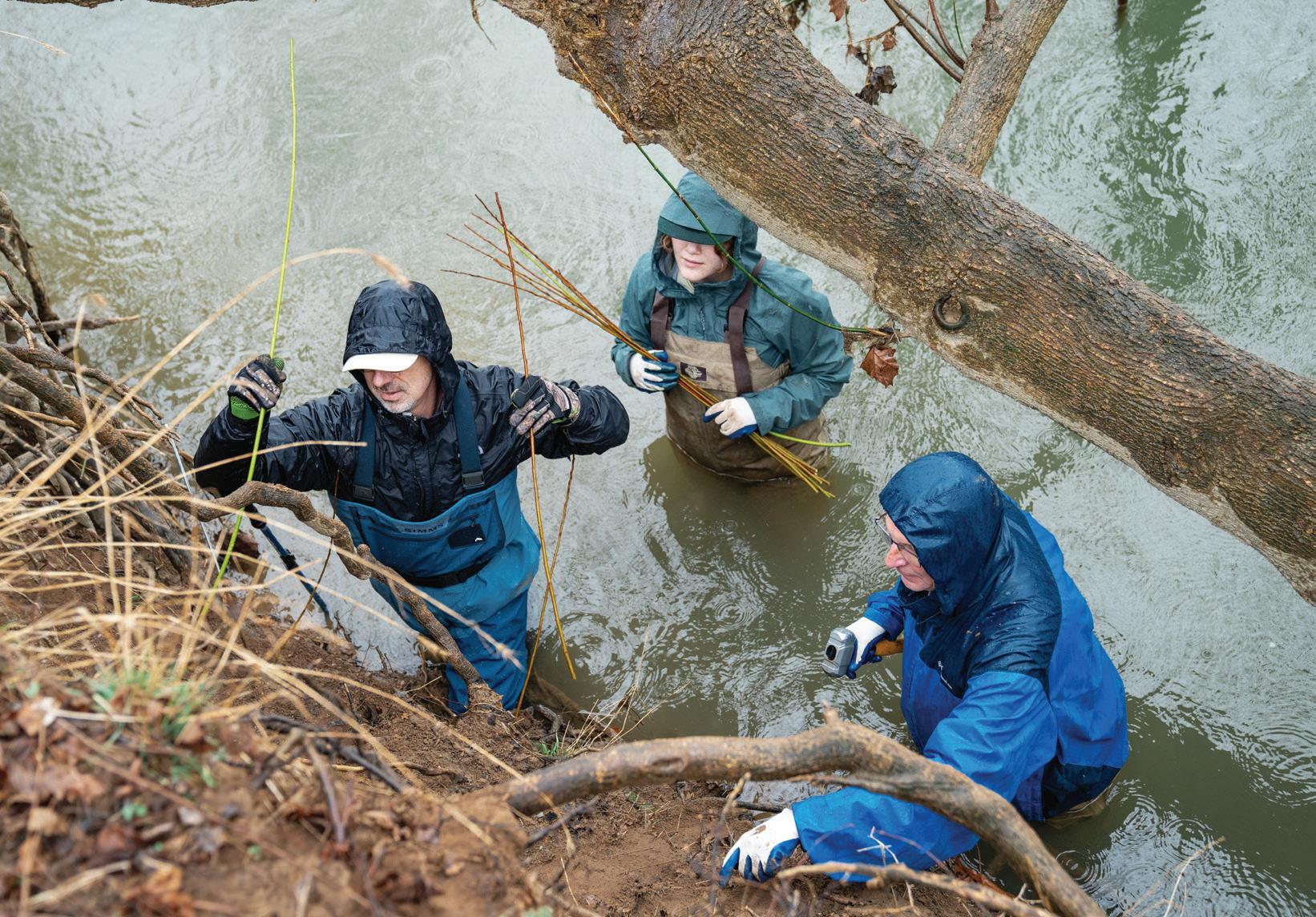
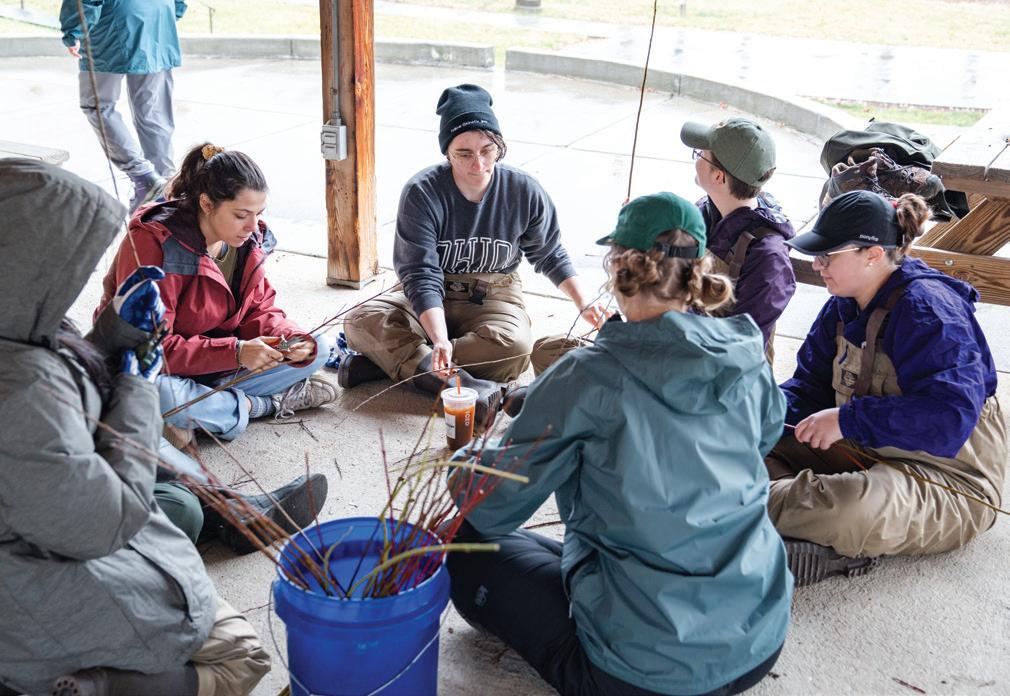
“Live staking involves inserting small branches, or ‘whips,’ from fast-growing native species into the soil at angles,” Nash explained. “This non-invasive method allows the branches to establish root systems and stabilize the stream bank.”
DeHarde is developing a monitoring system to assess the effectiveness of live staking and monitor biodiversity along the stream bank. He will continue to collect data through his senior year, providing valuable insights into the restoration efforts’ success and the area’s ecological health.
For Wilcox and DeHarde, engaging
“We lack trees and limited vegetation on the banks. Without the support of roots, the soil is vulnerable to water erosion.”
—CAROLE NASH
the community in the live staking process was integral to the success of the stream bank project. By inviting JMU community members to participate in planting and restoration efforts, the project fosters a sense of shared responsibility, deepening their connection with the environment and the farm.
On February 23, JMU Facilities Management and student volunteers from various organizations gathered at the farm to plant branches along the stream bank. “We had a great turnout. So many people were supportive,” Wilcox recalled.
Geography major Elena Finelli shared, “I love any chance to get out and get my
hands in the dirt.” Nash added, “There’s a powerful educational component here, demonstrating the university’s commitment to environmental stewardship and hands-on learning.”
With the meadow planted and branches taking root along the stream bank, the focus now shifts to monitoring the progress. Wilcox envisions a future where the bank is stabilized and thriving. “Part of my goal was to leave behind a greater sense of environmental stability and something that I had a hand in protecting.”
To help control erosion, students plant live stakes along the North River bank at the JMU Farm.
LONG THYME NO SEE: KING HALL’S ROOFTOP GARDEN IS IN A SEASON OF REGROWTH
By Laurel Seay (’24)
n the gentle embrace of a crisp morning or the warmth of a sunny afternoon, Geography and Integrated Science and Technology professor Carole Nash can be found nurturing the rooftop garden atop King Hall.
Nash, who has been gardening since childhood, faced a challenge this past summer when JMU decided to renovate the King Hall roofs, disrupting the garden. Many plants and flowers, including the raised garden beds built by former students, had to be removed and relocated. Some plants were transplanted near the James Madison statue outside King Hall, and others were shared with employees.
When King Hall was built in 1997, the third-floor patio had an open roof, a blank slate of white and beige, and a few tables scattered throughout the space. However, the landscape was transformed in 2012 when a landscape architect suggested converting the open space into a garden.
“The School of Integrated Sciences, particularly ISAT, has always been focused on the idea of sustainability and that there are ways to use spaces so that you can practice environmental sustainability. It just seemed like this [patio] was not being used well,” Nash said.
For 11 years, faculty, staff, and students diligently tended to the rooftop garden, which hosted approximately 150 plant varieties, including perennial flowers. Raised beds were dedicated to growing vegetables, with one remarkable year yielding a harvest of 70 pounds of sweet potatoes. The garden served as an example of an open outdoor space supporting food production and fostering biodiversity.
The renovation allowed Nash, as well as students, staff and faculty, the opportunity to explore new possibilities during this season of regrowth.
Today, the garden is vastly different. JMU’s Facilities Management redesigned and rebuilt the raised garden beds, ensuring
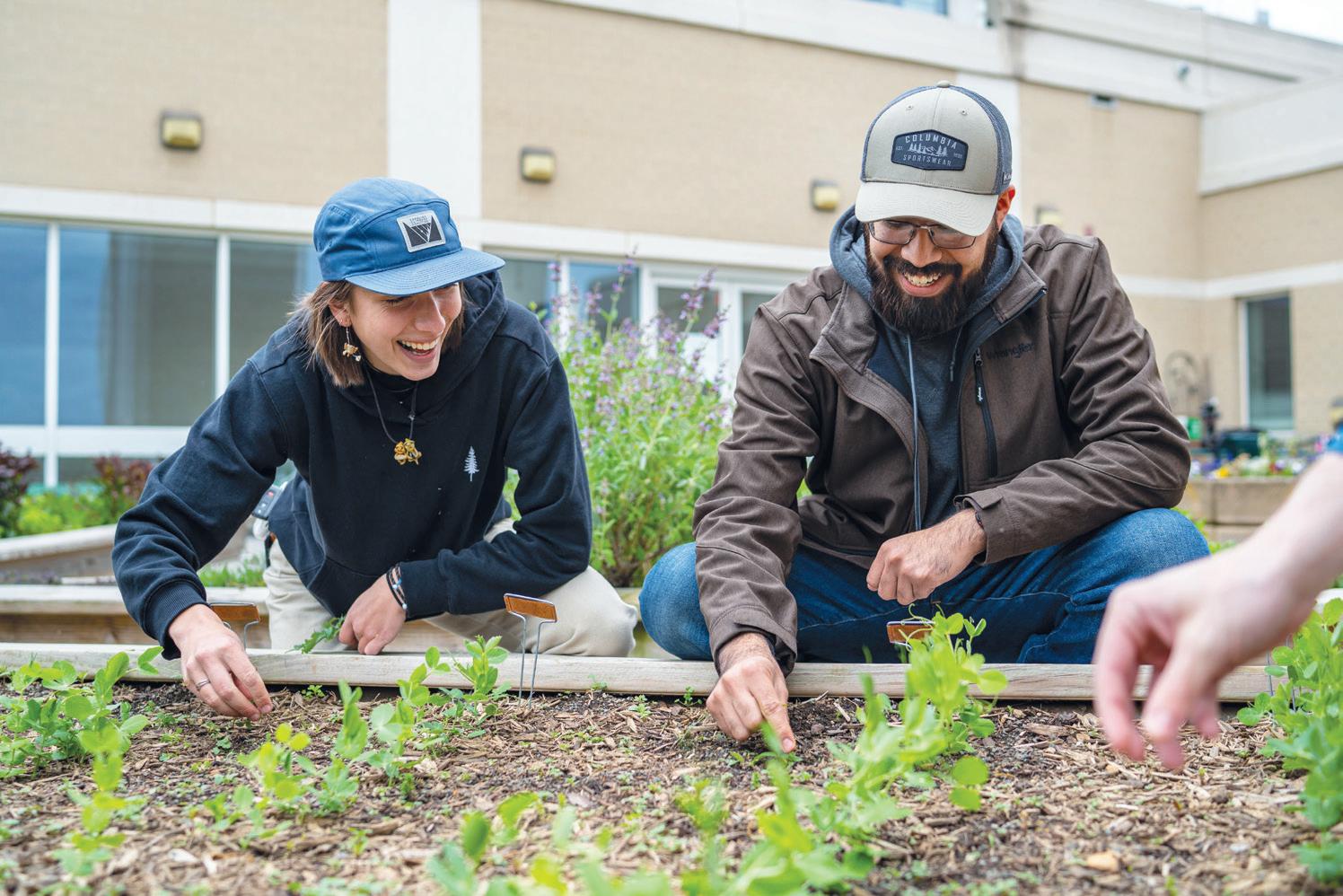
accessibility from all sides. They’ve utilized the soil from the old beds and are implementing a new watering system consisting of faucets and drip lines to automate plant watering. Students will have access to fresh fruit and vegetable plants for harvesting as well as a flower and herb garden that includes 30 herb varieties, such as basil and Greek oregano.
Nash plans to cultivate a variety of crops, including tomatoes, sweet potatoes, lettuce, onions, and spinach. The success of this planting is possible due to cover crops — peas, grasses, and radishes — currently growing in the garden’s raised beds. Nash refers to the cover crops as “nitrogen-fixing plants.” They remain in the ground throughout the winter, processing nitrogen and enriching the soil. This preparation will ensure the soil is ready to support new plants in the spring.
“A lot of this is having knowledge of gardening, learning about what you can do up here, and then taking some time to think
about what you want to show people, what is possible in a place like this,” Nash said.
Nash encounters some challenges when gardening during peak season — primarily dealing with the heat and strong winds on the rooftop. It is a process of trial and error.
“You can’t just expect things that work down there will work up here,” Nash said.
Much of the growth happens during the summer when students aren’t around to experience it. However, Nash works hard to optimize the learning experience for all JMU students.
Previously, in Nash’s Citizen Sciences course, students engaged in the Bugs and Blooms project. They learned about a plant’s characteristics, both in and out of bloom, developing an app capable of tracking the timing of blooms in the garden and the
The garden is not just limited to teaching. It also serves as an outside study space and a picturesque spot to enjoy lunch.
presence of pollinators, particularly bees, which are frequent visitors to the garden. The goal was to compare the timing of the blooms and the arrival of the pollinators. The project aimed to address the effects of climate change, which is causing shifts in the timing of blooms and pollinators.
“We want to use this [garden] as a teaching space for urban gardening, for climate change impacts, and to get people to recognize that even if you don’t have nice wooden beds, you can have a pot and grow something in it on your deck,” Nash said.
The garden is not just limited to teaching. It also serves as an outside study space and a picturesque spot to enjoy lunch. Tables and benches are spread throughout the patio, providing students room to sit among the plants.
Lana Cruz, a Geography major, recently discovered the rooftop garden.
She describes the area as “being outside and seeing a little bit of the view of campus” — her favorite part about studying on the rooftop garden.
As the garden expands, it prompts inquiries and discussions among faculty, staff, and students. Nash is contemplating the feasibility of growing additional fruit varieties, dwarf fruit trees, fig trees, and more. She anticipates a promising future for the rooftop garden and the valuable learning experiences it will provide.
The rooftop garden is part of the Campus Environmental Stewardship Tour.
As part of the Citizen Science course, Geography students work on the King Hall Patio Garden.
STUDENTS DEVELOP AN APP TO DETECT EARLY SKIN CANCER
By Laurel Seay (’24)
magine detecting cancerous skin cells with the click of a button.
Well, there’s an app for that! Or, at least, one in development.
Driven by a desire to make an impact through her research, Selina Matolak, an Integrated Science and Technology major, embarked on a journey leveraging technology to assist underserved communities lacking access to affordable health care. Inspired by the prevalence of melanoma skin cancer and its impact on her community, Matolak decided to focus her efforts on developing a solution.
Initially conceptualized for her ISAT capstone project, Matolak aimed to devise a tool capable of detecting cancerous skin cells early on, when treatment options are most effective.
After sharing her vision with ISAT professor Chris Bachmann, he was impressed and eager to support her. Bachmann explains that skin cancer has the potential to affect everyone. Early detection is critical for a complete cure, whereas delayed diagnosis can lead to more aggressive treatments such as chemotherapy or radiation. “If I could simply take a picture with my phone, in the privacy of my own home, and have an app
determine if I’m at risk and should see a doctor, then I would,” he said.
Matolak’s goal was to train an algorithm using images of skin cancer diagnosed by medical professionals. The app would serve as a pre-screening for cancer, offering valuable insights and recommendations. But she faced a challenge. Matolak needed a computer scientist to help with the app’s coding, so she sought the expertise of Amber Oliver, a Computer Science major.
“At first, it was just an idea for a physical prototype,” Oliver said. “It captures images of skin lesions and then gives a percentage or response indicating whether it is melanoma skin cancer or not. It’s not a diagnosis, since it relies on machine learning and artificial intelligence, which can be incorrect. It’s just a recommendation to seek help.”
Their interdisciplinary teamwork brought the project to life, fueling their passion as they worked tirelessly to refine the app. Matolak and Oliver’s vision extended beyond mere functionality; they aimed to make the app accessible to those in need, envisioning it as a resource for communities lacking in health care.
“We want to eventually donate this to the local community, homeless shelters, or refugee camps to bridge the technology gap and deploy it globally,” Matolak said. “If the app can scan for melanoma, what else can it detect?”
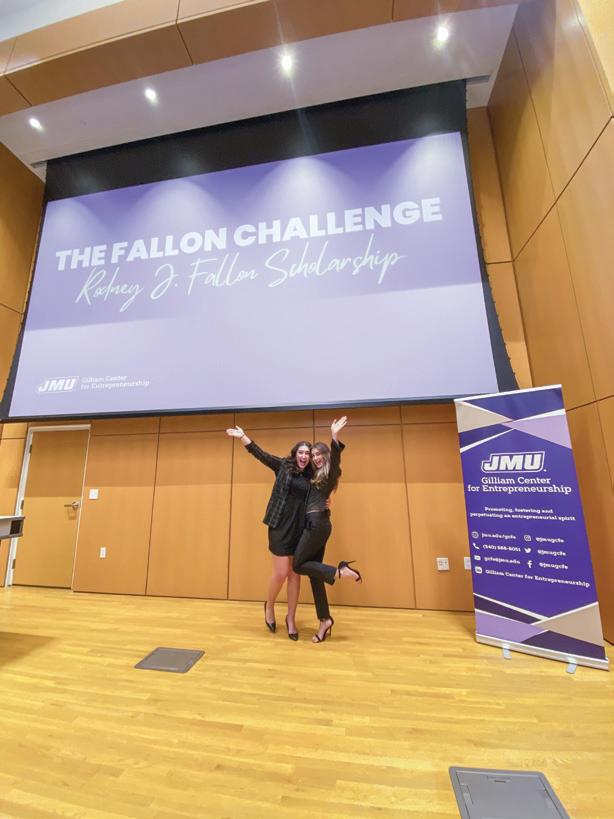
Matolak and Oliver’s dedication and ambition caught the attention of faculty members and collaborators, leading to their invitation to participate in the Fallon Challenge, an idea pitch competition organized by the Gilliam Center for Entrepreneurship in JMU’s College of Business. “Students pitch their entrepreneurial ideas to a panel of professional judges in a Shark Tank style competition. The first prize is a $1,000 scholarship for a team member. There’s also
(left) Amber Oliver (’23) and (right) Selina Matolak (’24) won the Fallon Challenge Audience Choice Award.
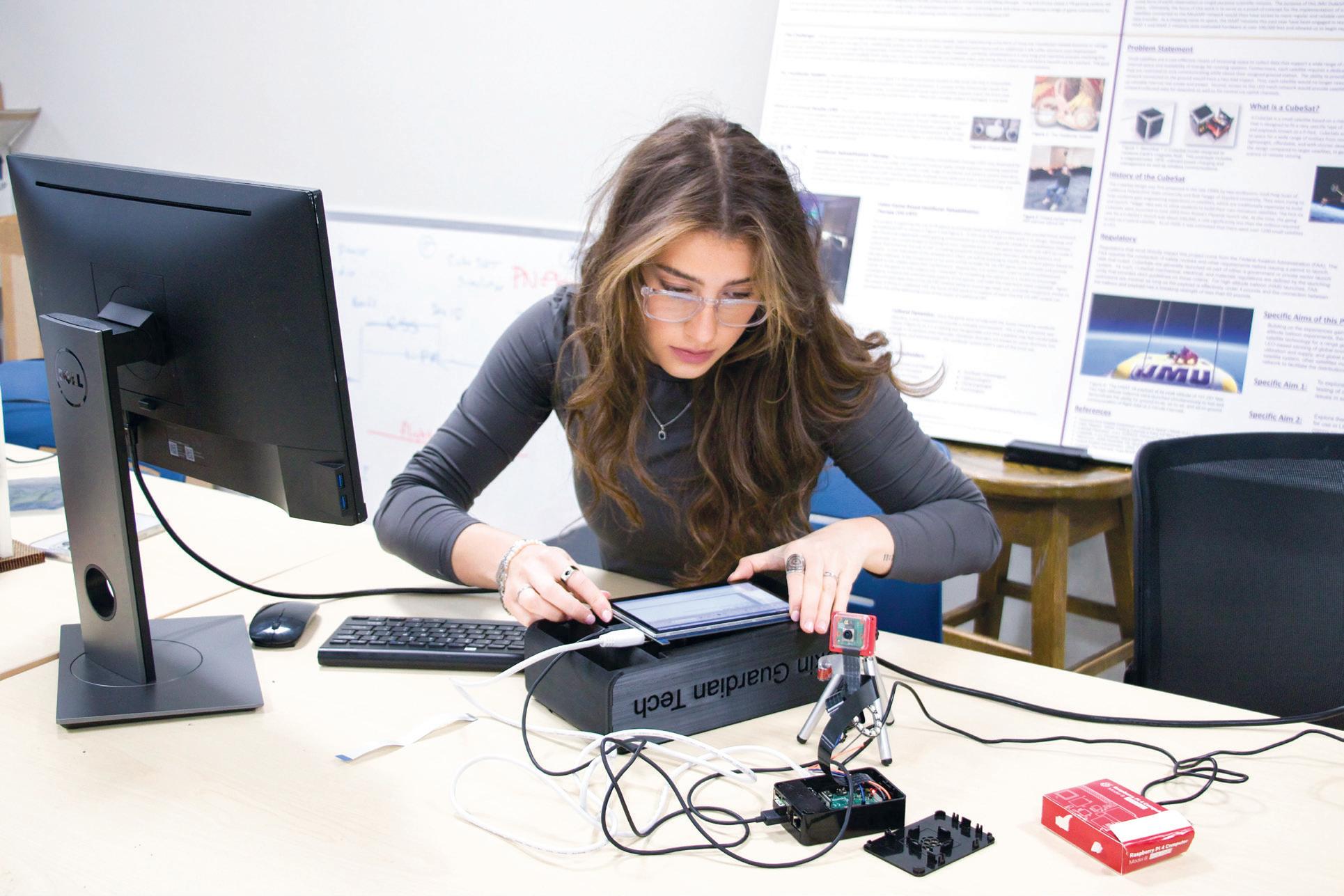
Selina Matolak developing the “Skin Guardian Technology” app in the ISAT lab.
an Audience Choice Award of $500. It’s a great way for students to explore their ideas and get feedback from industry experts,” Bachmann explained.
“We were the only students from the College of Integrated Science and Engineering invited to the challenge,” Matolak said. “Everyone else was a Business major.”
At the competition, Matolak and Oliver presented their idea and a layout of the app’s interface to aid the audience in their research beyond its scientific features and code. “We presented it from a user’s perspective to ensure our work was understood visually,” Matolak said.
Matolak and Oliver won both first prize and the Audience Choice Award. “Knowing that people would genuinely benefit from our
“We want to eventually donate this to the local community, homeless shelters, or refugee camps to bridge the technology gap and deploy it globally.”
SELINA MATOLAK
product was immensely rewarding,” Oliver said. “We did not expect to receive such great feedback or win the challenge.” Their success at the Fallon Challenge further solidified their belief in the app’s potential, inspiring them to continue their journey and explore opportunities for further development.
“I think this project really shows the potential of our JMU students. They’ve got great ideas and, with a little help from the faculty, they can do amazing things,” Bachmann said. “The Gilliam Center and the Fallon Challenge are all about supporting our students’ exploration of entrepreneurial ideas and providing the guidance needed to make their dreams reality.”
Celebrating a journey of innovation and leadership
By Lynn Radocha (’18)
ver the past three decades, Kolvoord has worn many hats at JMU. Initially hired to help expand the then-new Integrated Science and Technology program, Kolvoord played a key role in graduating its first class. His contributions have been vast and varied, from helping to develop the Intelligence Analysis major to co-creating the Environmental Management and Sustainability M.S. program in collaboration with the University of Malta. He also served as the interim director of the School of Engineering and was instrumental in founding the College of Integrated Science and Engineering.
Kolvoord, along with former ISAT and CS department heads Eric Maslen and Sharon Simmons, was inspired by a desire to create a focused, coherent structure that would support the applied STEM focus of its units.
They envisioned a college that could grow and prosper with a clear vision and dedicated leadership. This vision led to the formation of CISE, a college that would nurture innovation and support high-quality teaching and faculty scholarship. “Our vision was to create a lean and compact administrative structure that would support faculty and student work and spur innovation,” Kolvoord recalled. “We emphasized high-quality teaching at the undergraduate and graduate level and supported faculty scholarship, especially student projects. We also focused on building our relationship with business and industry.”
Starting something new always comes with challenges. “Any time you start anything new, there is always resistance and some desire to hold on to what was,” Kolvoord said. However, the problem-solving nature of CISE’s faculty, staff and students made the transition smoother. The dedication of early staff members like Jeff Tang, Lyn Chandler, Kathy Lubkowski and Lynn Radocha (’18) was crucial to the college’s success. “These names are familiar to the college as they all still work in the Dean’s office. That longevity has been a key to our success,” Kolvoord said.
Under his leadership, CISE has seen substantial growth, including a 60% increase in the number of majors over the last decade, the creation of the IT major, and the establishment of the Madison Automotive Apprentice Program. The engineering program has been ranked in the top 20 in the U.S. News and World Repor t, and the engineering and ISAT programs have
“Longevity has been a key to our success ”
—BOB KOLVOORD
achieved successful ABET accreditation and reaccreditation. Kolvoord’s systemsthinking approach has allowed him to foster connections and create opportunities for collaboration across programs.
Kolvoord’s experience has taught him the value of patience, empathy, and the importance of setting high standards. “As a dean, you get to see the best of what higher education can be — life-changing, opportunity enhancing, career-defining, and you also see humans at their most challenged,” Kolvoord said. “I think I’ve learned over and over the value of patience and empathy, but also the critical need to set high standards and strive for excellence. For me, leadership has never been about wielding power; it has been about exerting influence and being able to encourage and nurture.”
His most memorable moment was during the first CISE graduation ceremony. He encouraged the students not to let the naysayers get them down and to find a way to say “yes” when a technical glitch left them without a recording of the JMU Alma Mater. “I apologized to the students, letting them know they really did not want to hear me sing. A graduate listening to my recent advice reminded me to ‘find a way to say yes,’” Kolvoord recalled. What followed was a heartfelt, if not entirely in tune, rendition of the alma mater by the platform party. “We found a way to make it happen — something that’s been a consistent trait of CISE since its inception.”
While it feels presumptuous for Kolvoord to think about his legacy, he hopes CISE will become even stronger under new leadership. “The problems the world faces are becoming increasingly complex with each passing year. CISE programs prepare our students to be thoughtful problemsolvers who can marshal technology while considering the human element. It’s what makes CISE distinctive and what makes a difference.” He is confident that the new dean will take CISE in exciting new directions, continuing the college’s legacy of innovation and excellence.
Vetria Byrd named head of computer science at JMU
By Dorian Crawford (’27)
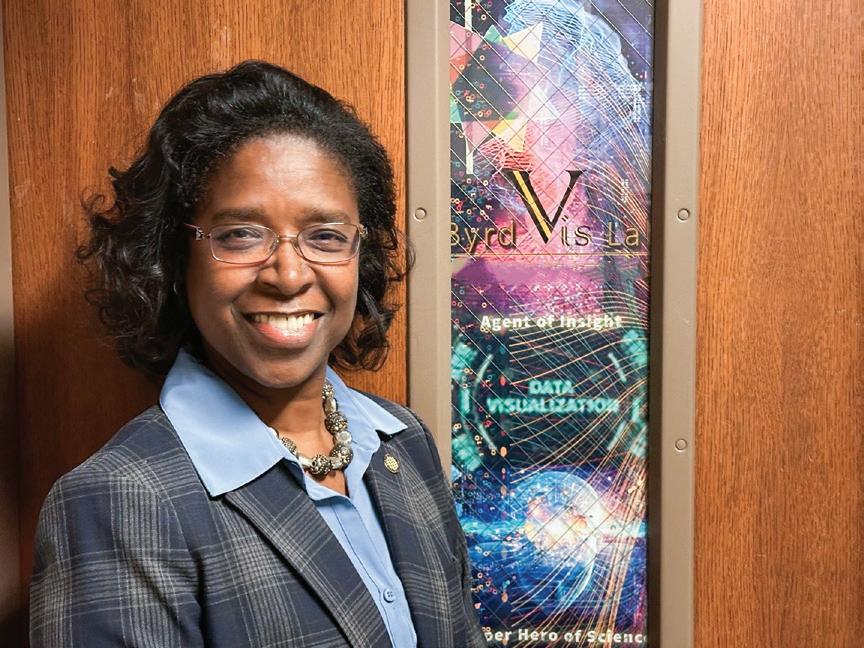
Vetria Byrd, a visionary in the realm of data visualization, steps into the role of head of JMU’s Computer Science Department after a nationwide search for leadership excellence.
Byrd brings a proven history of leadership, mentorship, successful acquisition of research funding, and fostering interdisciplinary collaboration.
As the first member of her family to earn a Ph.D., Byrd holds a doctorate in computing and information sciences and a master’s in biomedical engineering.
After earning her degree, Byrd specialized in the study of data visualization — presenting extensive data sets through charts, graphs, and other visual aids, playing a pivotal role in making complex data accessible to a broader audience. “Data visualization is a common thread that enables the integration of STEM disciplines — functioning as a catalyst for communication, a conduit for collaboration, and as a mechanism for broadening participation,” explains Byrd. Byrd’s passion for data visualization led her to pursue research in all its forms. In 2023, she earned the Seed for Success Acorn Award for accumulating $1 million in research grants. In concert with this
research, Byrd has taught at the collegiate level for over 12 years.
Beyond the classroom, Byrd has been a driving force in applying data visualization to real-world scenarios. She is an integral part of the Data Visualization Society’s Advisory Council, where her work has broadened the data visualization field and fostered inclusivity.
Byrd’s dedication to expanding interest can be witnessed through the Broadening Participation in Visualization Workshop (BPViz), which she founded in 2014. This
biennial event aims to build a community of current and future scholars interested in visualization through mentoring and capacity building. BPViz also reaches out to underrepresented groups, including marginalized communities and women.
“My background and experience will enable me to discern future trends and capitalize on them for the benefit of JMU, the college, and the department.”
—VETRIA BYRD
“Alongside her technical expertise, Dr. Byrd has also been very active in applying her work to critical issues in society and broadening participation in computing,” says Bob Kolvoord, interim provost. “Combined with her interdisciplinary leadership experience and work at Purdue, Dr. Byrd is poised to be an innovative and insightful leader propelling our Computer Science Department forward.”
Byrd has set ambitious goals for both her growth and the advancement of the CS Department. She plans to lead by example, working closely with faculty to develop a strategic plan for the future. Additionally, she aims to help the department meet current and anticipate future needs, addressing topics such as artificial intelligence and globalization. “My background and experience will enable me to discern future trends and capitalize on them for the benefit of JMU, the college, and the department.”
Byrd joined JMU in July 2024, taking over for Sharon Simmons, who has been the CS department head for over a decade.
Jeffrey Tang named interim dean of JMU CISE
By Lynn Radocha (’18)
“CISE is at its best when we are working together to solve problems and make a positive difference in the world.”
JEFFREY TANG
effrey Tang has been named the new interim dean of the College of Integrated Science and Engineering, effective July 1.
Tang has served as the associate dean since 2012, and his new appointment reflects his extensive experience and dedication to academic excellence and leadership.
Since joining JMU in 2005 as a visiting assistant professor, Tang has consistently shown his dedication to the institution’s values and goals. His career has been marked by several significant milestones. In 2006, he accepted a full-time tenure-track position in the social context area of the Integrated Science and Technology (ISAT) program. In
2010, he became the assistant department head of ISAT and was appointed associate dean with the formation of CISE in 2012.
During his tenure as associate dean, Tang has proactively advocated for inclusivity and accessibility within CISE. He played a key role in enhancing accessible spaces and introducing a new multi-sensory room set to open this fall. His influence extends beyond CISE, significantly impacting university-wide initiatives such as improving commencement ceremonies, aligning student recruitment strategies with Admissions, and refining the course scheduling process.
As he steps into his new role as interim dean, Tang plans to strengthen the college’s identity and raise the profile of the outstanding technology programs in CISE. “For years, we have been educating outstanding, technically competent graduates who quickly make substantive contributions wherever they go to work and live.” He also envisions expanding interdisciplinary collaboration across the university. “CISE is at its best when we are working together and working with others to solve problems and make a positive difference in the world.”
Tang’s leadership philosophy is grounded in valuing every member of the CISE and JMU community. He places a strong emphasis on the importance of recognizing the contributions of faculty, staff, and students, and he is committed to leading with an appreciation for the collective team effort that drives the university’s successes.
“Jeff brings proven leadership experience to this role and a strong commitment to supporting student learning,” said Bob Kolvoord, interim provost. “He will advocate for faculty, staff, and students across all CISE programs. The future of CISE is in good hands.”
Tang holds a master’s and doctorate in History and Sociology of Science from the University of Pennsylvania and a master’s in Economic and Social History from Oxford University.
CISE embraces the United Nations Sustainable Development Goals
JMU’s College of Integrated Science and Engineering is taking a pivotal step toward global impact by integrating the United Nations Sustainable Development Goals into coursework and research initiatives.
In 2022, CISE began integrating the SDGs into coursework and research, enriching
students’ academic experiences and fostering a deeper understanding of global citizenship and empathy. By delving into challenges faced worldwide, students gain invaluable perspectives on how their fields of study can be powerful agents for positive change.
Commencing in November 2023, all stories and research projects on the CISE website will be linked to the SDGs, reinforcing the college’s dedication to creating meaningful and impactful contributions to global sustainability.
“Our work extends beyond the classroom, demonstrating how diverse
skills can be applied for the public good,” said Bob Kolvoord, interim provost “We are at the forefront of showcasing the transformative power of interdisciplinary approaches in addressing global challenges.”
“We believe that preparing our graduates goes beyond academic excellence; it involves instilling a sense of social responsibility and sustainability,” Kolvoord continued “By aligning with the SDGs, we are equipping our students to incorporate these values into their future careers, thereby advancing JMU’s mission to develop engaged and enlightened citizens.”
2023 CAREER OUTCOMES
AVERAGE SALARY
$70,181
81.3%
EMPLOYED FULL-TIME
8.6%
STILL SEEKING 0.6% NOT SEEKING 9.5%
CONTINUING EDUCATION
TOP EMPLOYERS
Booz Allen Hamilton
Deloitte
Huntington Ingalls Industries
Merck & Co., Inc.
Norfolk Naval Shipyard
Northrop Grumman
Thermo Fisher Scientific
Accenture Federal Services
Capital One
L3Harris Technologies
JMU Engineering introduces three new concentrations: Civil and
Environmental, Electro-Mechanical
Systems, and
Geo-Environmental
MU Engineering has always allowed students to explore various engineering disciplines and the interdisciplinary space between them. Recently, the program made a significant addition designed to enhance student flexibility and choice. Students can now take 15 elective credits instead of nine, giving them greater control over their academic journey and the opportunity to tailor their degree to their interests and career goals.
The introduction of these new concentrations is an exciting opportunity for our students. It allows them to combine elective classes and earn a concentration in one of three areas: Civil and Environmental, Electro-Mechanical Systems, and Geo-Environmental. These concentrations, offered as part of the ABET-accredited Bachelor of Science in Engineering, provide a focused and specialized path within the broader field of engineering, enhancing students’ knowledge and skills without increasing the total number of required credits.
“The new concentrations are not a requirement to complete the degree,” explained Daniel Castaneda, Engineering program director and professor. “Our students can continue to sign up for any of our engineering electives; we now have over 15 elective classes ranging from Brewery Systems, Concrete Infrastructure, Embedded Systems Design,
and much more. Students who opt into a concentration can now communicate to a prospective employer that they have completed an engineering program with a specific concentration, which some employers are looking for.”
This approach ensures that graduates are well-rounded individuals with the diverse skill sets needed to start a career in any engineering field.
The Civil and Environmental concentration offers several classes exposing students to how engineers approach the design of the built and natural environments. “Some of our classes will focus on structural engineering, like using building codes and design specifications,” Castaneda said. “Other classes in the concentration will focus on water resources engineering, like surveying topographies to understand watersheds in stream restoration design.”
The Geo-Environmental concentration is a partnership between the Engineering and the Geology and Environmental Science departments and developed to address the growing demand for geological engineers in the manufacturing and utilities industry. Courses will provide students with the skills to analyze geological factors and mitigate the environmental impacts associated with engineering projects and the safe and
efficient disposal of waste. “Our collaboration with the Geology program highlights the potential to create learning opportunities for students to pursue careers that require more than a single disciplinary approach,” said Bayo Ogundipe, head of JMU’s Engineering Department.
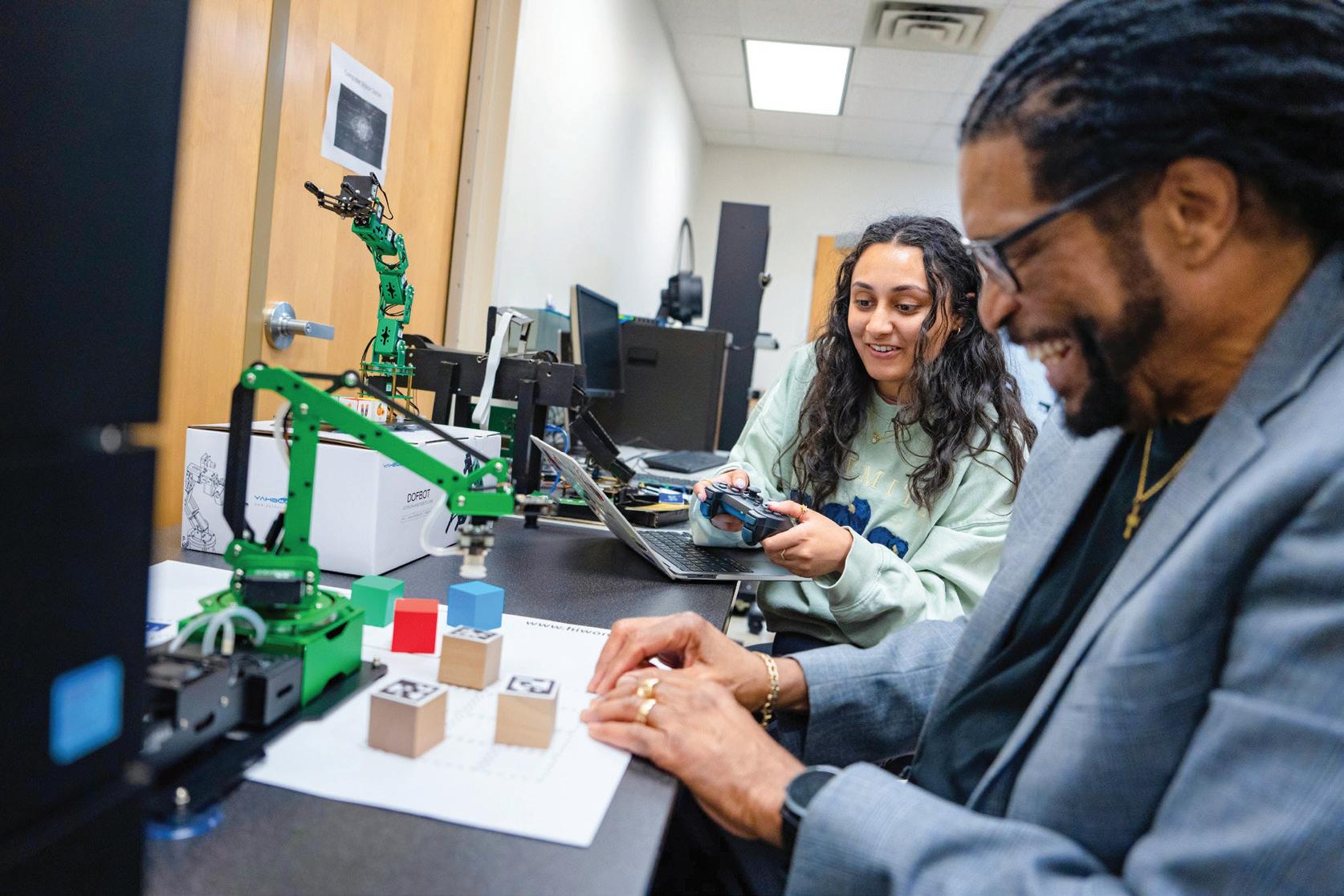
The Electro-Mechanical Systems concentration “is geared toward designing, building and analyzing interconnected systems,” explained Shraddha Joshi, Engineering professor. Courses at the intersection of mechanical engineering, electrical engineering, and computer engineering underpin this new concentration and include autonomous vehicles, robotics, the Internet of Things, cars — any system that involves mechanical, electrical, or computer components.
Students can learn from faculty members who specialize in each concentration. “It allows us to draw upon our decades of training and to teach students who want to learn more about that discipline within engineering,” Castaneda said.
The new concentrations aren’t just for incoming first-year students. Faculty are working hard to accommodate rising sophomores, juniors, and seniors interested in pursuing a concentration before graduation. “If students have questions, they should contact their academic advisor for more information,” he added.
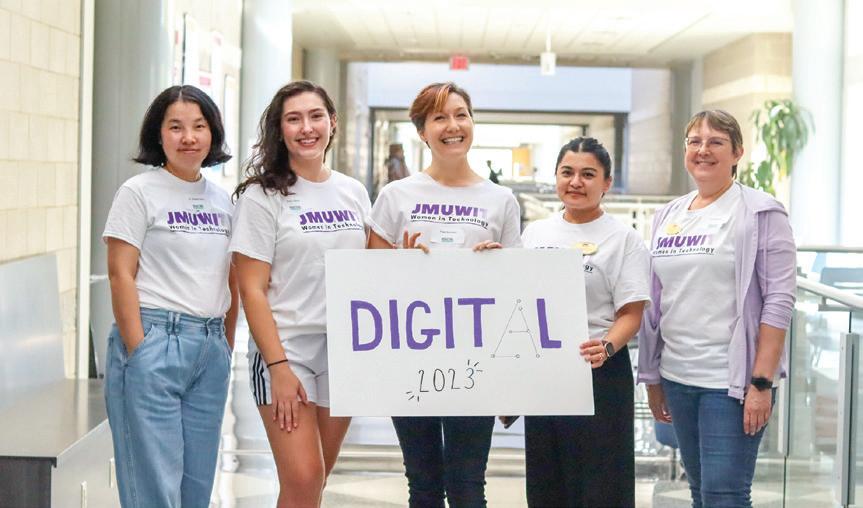
Computer Science hosts 10th annual DIGITAL event
JMU’s Women in Technology held its annual event, Dukes Inspiring Girls into Technology Across Limits (DIGITAL), on Oct. 7. The program, led by a team of JMU Computer Science students and faculty, introduces technology to high school females from Harrisonburg and surrounding areas.
During high school, “it is essential that young women get exposed to the endless possibilities of technology,” said Amber Oliver, a senior Computer Science major and conference chair for the event. “My favorite part of the event was watching the students
Engineering a Better World camp inspires local middle-schoolers
Engineering wrapped up the third annual “Engineering a Better World” camp with a record 53 campers from local middle schools, who actively engaged in STEM-related activities.
Engineering Ambassadors organized the sessions, which featured unique activities, including making race cars out of rubber bands, building the tallest structure out of construction paper, creating bottle rockets, and constructing a tower from marshmallows and sticks. Members of Madison Aerospace, the National Society of Black Engineers and the Society of Women Engineers led the activities.
get excited about the cool technology they were working with,” she said. “Seeing them engaged in the workshops was incredible, and you could tell they loved it.”
This year, the workshops included navigating a digital turtle through Python, racing drones, exploring augmented reality using an Oculus, creating a mobile app using App Inventor and building a personal Wikipedia page. Additionally, the students were introduced to ChatGPT and the ethical responsibilities that arise when using the technology.
DIGITAL continues to be an important computer science-outreach event. “These girls are in an age range where they are still figuring out their interests. If we expose them to technology during this time, they can take high school courses in tech and decide if they want to pursue a career in technology,” Oliver said.
A middle school student prepares to test his newly created bottle rocket.
Megan Caufield, president of the Engineering Ambassadors, said the key focus during the activities was design. “We try to familiarize all the students with the process and problem-solving by presenting them with a variety of different challenges, making each weekend unique.”
Programs like Engineering a Better World help to promote collaborative,
Each year, a team of CS faculty and students organizes the DIGITAL event to introduce technology to local high school females.
“While the workshop is only one day, we hope we sparked their interest in coding, and by sending them home with tech like this, they can keep exploring,” said Paige Normand, CS advisor.
hands-on exploration that inspires students to pursue engineering. The outreach beyond JMU and into Harrisonburg also helps destigmatize engineering. “It’s really important to engage with this age group early on,” said Emma Fox, student ambassador. “Engineering is perceived as such a challenging major, and it’s important to let them know that anyone can do it and that it’s not as hard as it seems. Sparking that interest early on to take those classes is super important to us.”
Academic advisor Shae Powell echoed the necessity and benefits of educational camps. “Outreach programs are essential for JMU as they contribute to the university’s commitment to community engagement and educational excellence. These programs inspire the next generation of engineers and strengthen ties between the university and the community.”
JMU signs agreement with Alamein International University
James Madison University hosted a delegation from Alamein International University and officials from the Egyptian embassy from July 23 to 26. During this visit, JMU signed an agreement establishing an official exchange program with AIU.
This exciting new opportunity offers a dual-degree option, enabling students to complete major course work at both universities while immersing themselves in new cultures. The agreement also provides opportunities for Egyptian universities and research institutions to host U.S. Fulbright Scholars for teaching and collaborative research.
“The agreement is a result of over two years of collaborative program development,” says Samy El-Tawab, director and professor of JMU’s Information Technology program.
The partnership began in 2022 when Mustafa ElNainay, dean of AIU’s Computer Science and Engineering program, visited JMU’s Department of Computer Science to explore their Information Technology program and discuss the potential for an exchange program. “My initial impressions were very positive, with a vibrant and welcoming atmosphere,” says ElNainay.
ElNainay met with faculty and interacted
Information Technology Professor Ahmad Salman explains the autonomous drone operation for smart cities applications.
Information Technology major Augusto Fernandez-Circelli provides a demonstration of the JMU Autonomous Golf Cart.
JMU Interim President Charlie King (left) signs a Memorandum of Understanding with AIU President Essam ElKordi (right), establishing an official exchange program.
with students involved in research projects. “I found the most compelling aspects of the JMU IT program to be its hands-on learning opportunities, strong industry connections, and the cutting-edge research conducted by the faculty.”
In 2023, ElNainay launched a similar program at AIU, focusing on integrating practical skills with theoretical knowledge to prepare students for the rapidly evolving field of technology. “I see great potential for collaborative research and am excited about sharing knowledge and resources between our institutions to contribute to the growth of the IT field,” he says.
In May 2023, JMU Interim Provost Bob Kolvoord and Information Technology Professor Ahmad Salman traveled to AIU to tour their facilities and meet with the administration, faculty, and students.
“At JMU, we’re always looking for strong collaborative partnerships with institutions abroad, and it was clear that AIU would be a great match. From their cutting-edge facilities and curriculum to their outstanding faculty, AIU shares a similar profile and goals with JMU — providing outstanding undergraduate education. I’m looking forward to seeing our IT partnership thrive and expand to other areas,” says Kolvoord.
“The new partnership benefits students and faculty by opening doors to various opportunities, such as studying abroad, co-teaching, co-advising capstone projects, advising research projects, and applying for grants through [National Science Foundation] funding,” says El-Tawab.
The exchange program is scheduled to begin in 2025.
Baxter discussed nuclear weapons modernization and its effects on nuclear strategy, arms races, and alliances, along with the impact of advancing technologies like cyber warfare and hypersonic weapons.
IA professor presents at NATO event in Budapest
Philip Baxter, professor of Intelligence Analysis at JMU, was a key participant at the North Atlantic Treaty Organization Academy event in Budapest, Hungary. The event brought together 35 early-career professionals from 22 NATO countries to engage with experts in the field of nuclear weapons and deterrence. Speakers delved into the theoretical, historical, technological and social aspects of deterrence.
The event, held at the National University of Public Service, was organized by the
International Youth Atlantic Council and the Hungarian Youth Atlantic Council, with sponsorship from NATO’s Public Policy Division. It provided participants with a forum for discussing changes in the international security environment and how NATO would adapt to those changes.
Baxter presented on the role of nuclear weapons modernization efforts and how those efforts have impacted nuclear strategy and may impact arms races or alliance dynamics in the future in light of re-emerging great power competition. His talk also included how other advancing technologies, such as cyber warfare or hypersonic weapons, might impact deterrence calculations — given changes to strategic arsenals, shifting nuclear strategies, and a more competitive security landscape.
The event also welcomed high-ranking officials from NATO as presenters, including the director for NATO’s Nuclear Policy Directorate, the Hungarian Ministry of Defense, and the Ministry of Foreign Affairs and Trade.
Baxter is the co-editor of the book 21st Century, which examines the technical, strategic, and theoretical implications of nuclear weapons modernization efforts over the past two decades.
New CS club brings game development to JMU
ork hard and play hard” is a philosophy embedded in the Computer Science major and many of its clubs. For several years, most clubs focused on the “work hard” aspect until a group of dedicated students established JMU’s first video-game development club, DukeDevs.
CS majors David Navia, Leo Torrijos and Andrés Parra van-Arcken founded DukesDev after recognizing a gap in JMU’s offerings. “I searched for any minors, majors or classes related to game development, but I found there was nothing,” Navia said. Surprised by the absence of game design programs, the co-founders began brainstorming logos, names, and ideas. Under the guidance of CS professor Isaac Wang, they debuted DukeDevs in Fall 2023, combining CS topics with the fun of gaming.
During the semester, the foundersturned-presidents learned the intricacies of managing a club. DukeDevs grew with each meeting as the officers established a weekly routine and clarified their vision. Torrijos and Navia prepared resources such as coding examples to illustrate game design concepts and utilized the free, open-source Godot engine for demonstrations.
These demos provided hands-on experience and practical application, empowering club members to develop their own games in a low-stakes, casual, and cooperative environment.
In 2024, DukeDevs embraced innovation by hosting its inaugural boot camp on Jan. 27, attracting more than 40 attendees from diverse majors. “We had CIS, SMAD, Physics and even Biology majors who attended our event,” Wang said. “Game development involves art, music, design, and writing, in addition to programming, so it’s open to a wide range of skill sets.”
In just five hours, students learned programming and game-design concepts using the Godot engine, resulting in a simple platformer they could refine independently.
Continuing the momentum, the club organized a game jam from Feb. 20–27 — a weeklong event dedicated to making a video game based on the theme “One.” Participants used the theme as a springboard for inspiration, resulting in submissions ranging from a side-scroller action game featuring an army of one to a fighting game inspired by Uno. Throughout the week, the club held brainstorming sessions and provided guidance.
DukeDevs plans to host additional events and invite guest speakers to complement their weekly meetings and aims to build a student community. The officers’ dedication to the club and the excitement they’ve garnered underscore the impact that special interest clubs can have on JMU’s culture. “With a special interest club, it’s nice to commit to a niche interest that few around you likely share. Being able to enjoy these interests and not have to push them to the side because of academics is great,” Torrijos said.
JMU Engineering establishes ASCE Student Chapter
MU Engineering is excited to announce the approval and establishment of its American Society of Civil Engineers Student Chapter, reinforcing its commitment to empowering students and fostering connections within the engineering community.
Founded in 1852, ASCE is the nation’s oldest engineering society, committed to advancing civil engineering science and practice. The ASCE Student Chapter at JMU will host a diverse range of activities and guest speakers, providing students with insights into engineering practices, industry trends, and career opportunities. It will serve as a central hub for networking and collaboration.
The establishment of the ASCE Student Chapter coincides with the introduction of a new civil and environmental engineering concentration in JMU’s Engineering program. This concentration equips students with the skills to analyze structural systems and design, model, and build infrastructure while promoting responsible stewardship of natural resources.
“The timing couldn’t be better for establishing the ASCE Student Chapter,” noted Bob Kolvoord, interim provost.
“It will serve as a valuable resource for students taking classes in the new concentration — offering them additional support, networking opportunities and avenues for professional development.”
Daniel Castaneda, Engineering program
director and professor, played a key role in establishing the new chapter. “The chapter affiliates with a broader community of practicing civil engineers, which enables our students to pursue both professional development and networking. As a student chapter, we also strive to promote a sense of engineering community with enjoyable and interactive experiences beyond the classroom through collaborative and fun events.”
With an established ASCE Student Chapter, JMU Engineering is now fully eligible to participate in exciting regional events and competitions, including the concrete canoe race, the steel bridge competition, the environmental and water resources challenge, and much more. These events offer students a chance to apply their civil and environmental engineering skills in practical and innovative ways.
“We welcome all students, regardless of major, and we encourage anyone interested in engineering or wishing to be part of our community to get involved,” emphasized Ryan Dehler, president of the new ASCE Student Chapter. “Membership in ASCE is widely recognized across the nation and can enhance your resume.”
The student chapter offers many student leadership opportunities, including the roles of president, vice president, treasurer, secretary, industry liaison, steel bridge liaison and stream restoration liaison. “We are eager to expand our executive team,” Dehler said.
IA students form new group: Women in Intelligence and National
Security
Step into the world of intelligence and national security with JMU’s newest student group — Women in Intelligence and National Security (WINS).
Under the guidance of Intelligence Analysis professor Jennifer Davis, WINS was founded by Sydney Effer, Madeline Psimas, Maddie Walden, Catie Reilly, and Kylie King — all IA majors. Together, they’ve built a platform that empowers women in the field to address challenges while equipping themselves with the necessary tools and skills to excel in their personal and professional pursuits.
Effer, the club’s president, emphasizes inclusivity — welcoming men to gain insights into the unique challenges women face and learn how to be better allies in the workplace.
WINS isn’t just another club; it’s a supportive community offering a diverse array of opportunities to explore the field. The club will host guest speakers, networking sessions with women in the industry, candid discussions on navigating the intricacies of a career in national security, and tours of top agencies.
“It’s not a public career, so you can’t look
up what you’re getting yourself into,” said Psimas, the club’s vice president.
If you have questions about your resume, interviews, the nuances of professional attire, or the security clearance process, WINS has you covered. King says the club will offer workshops addressing even the smallest details that can make a difference in the professional world.
The founders are working on a mentorship program connecting members with seasoned professionals who can offer invaluable guidance. Psimas explains that starting these connections early is key to empowering members and fostering future leaders in the intelligence field.
Davis underscores the importance of mentorship in driving success for women in leadership roles.“There have been numerous studies in the business world on female leadership. “The majority of women who hold leadership positions credit the importance of mentoring in their success.”
The WINS website, which is currently under development, will provide information about the group’s mission, guest speakers, and upcoming events.
The club will also provide a safe space for members to discuss their difficulties, not only for their careers but also with classes and projects. “Since this major typically has a small cohort, you know everyone. I think that allows us to create those safe spaces a bit easier,” Reilly said.
WINS is open to all majors.“We want everyone to participate, men and women; everyone can benefit from the club,” said Psimas.
We proudly recognize the remarkable achievements and dedication of CISE faculty and staff. Each year, we celebrate their outstanding contributions.
Congratulations to this year’s distinguished winners!
Admin Excellence
Stephen
INTELLIGENCE ANALYSIS Outstanding Service
INTEGRATED SCIENCE AND TECHNOLOGY Outstanding Teaching
Galen
GEOGRAPHY Madison Scholar
Zhuojun
COMPUTER SCIENCE Outstanding Junior Faculty
Kathy Lubkowski CISE DEAN’S OFFICE
Cindy Klevickis
Murton
Marrin
Duan
Stephen Marrin receives Distinguished Scholar Award
Like music and movies, the field of intelligence studies has its own set of awards. Some of the most prestigious come from the International Studies Association (ISA) and highlight an individual’s impact on the field.
Stephen Marrin, director and professor in JMU’s Intelligence Analysis program, recently received the ISA Intelligence Studies Section Distinguished Scholar Award. This award has only been given to nine others over the past 40 years, highlighting Marrin’s significant impact on the field.
The ISA, founded in 1959 to promote scholarly cooperation and increase knowledge of global affairs, created its Intelligence Studies Section in the mid1980s to advance research on all aspects of intelligence as it relates to international studies. Marrin’s career evolved from humble origins. Entering college with an
undeclared major, he recalls it only took a few Tom Clancy novels to spark his interest in intelligence. After college, he joined the CIA as an analyst, discovering a passion for studying intelligence rather than analyzing it.
“It turns out I didn’t want to be Jack Ryan,” Marrin says. “I wanted to study people like Jack Ryan.” He returned to school, earned a doctorate, and embarked on a new chapter as a scholar of intelligence studies.
In 2002, Marrin joined the Intelligence Studies Section (ISS) at ISA, a global community dedicated to studying intelligence and its applications. By 2008, he assumed the role of program chair, working tirelessly for the next 10 years to truly internationalize the group. Under his leadership, the section’s contributions to ISA’s annual conference grew threefold, from 10 panels and 50 speakers to an impressive 30 panels and 150 speakers. “I wanted the Intelligence Studies Section to be a platform for diverse cultural and national perspectives, fostering enriching conversations between members with unique insights and ideas,” Marrin says.
While chairing the ISS, Marrin managed the annual conference, distributed awards, and encouraged others to further
intelligence studies. His leadership brought the community closer together. Although commendable, the Distinguished Scholar Award isn’t for service to the ISS — it’s a testament to his substantial contributions to the field of intelligence studies.
Marrin has authored more than 30 publications throughout his career, including journal articles, books, and even an encyclopedia entry. His dedication to advancing knowledge extends beyond academia. In 2018, Marrin’s talk on analytical standards to the Office of the Director of National Intelligence contributed to ongoing discussions about their relative effectiveness in improving intelligence analysis.
Marrin also serves as an editor for the world-renowned journal Intelligence and National Security. “To be a journal editor,” he explains, “is to help others get published … to help others find their voices and engage in the conversation about intelligence.” He and his co-editor assess each article for each of the seven issues published annually before coordinating peer reviews. While time-consuming, his role as an editor keeps him at the forefront of intelligence discussions and allows him to continue engaging with new ideas.
As a professor, Marrin strives to bring multidisciplinary elements to the Intelligence Analysis major. To him, different majors are like lights through a prism — different and unique, but all parts of a greater whole. By emphasizing concepts outside of Intelligence Analysis, the major prepares students for the diverse world that lies ahead. “It’s not like we know what kind of analyst each student will become. We don’t. Instead, we’re trying to prepare them to be any kind of analyst.”
“Stephen is one of those exemplary teacher-scholars who brings the rigorous studies he has done of the intelligence field to truly galvanize class experiences for our students,” says Henry Way, co-director for the School of Integrated Sciences. “We — and especially our students — are very fortunate to have this intellectual leader in our school; he is truly elevating the IA program.”
His Distinguished Scholar Award will be presented at the 2024 ISA Convention in San Francisco.
Justin Porter (’15)
Geography
Justin is a transportation planning manager at Deloitte Consulting, where he manages projects centered around data analysis, modeling, and strategy for state departments of transportation and regional metropolitan planning organizations. His work takes him across the country, addressing some of our most complex transportation and mobility challenges.
“Dr. Way and his study abroad course in London and Paris changed my career and professional trajectory. He solidified my love for urban planning and supported my research and learning.”
Charles Smith (’11)
Computer Science
After graduation, Charles began his career at Fannie Mae in a rotational position, gaining exposure to various areas of the company. In 2013, he settled into a developer role and soon advanced to senior developer. When the company embarked on a cloud migration journey, Charles seized the opportunity to lead many streaming and workload orchestration projects. During the pandemic, he transitioned to the position of lead enterprise architect, where he designs and creates technical solutions to address complex business requirements for more than 150 applications and systems within the Finance portfolio. “My Computer Science degree gave me a technical foundation that will (and did) allow me to excel anywhere as a professional.”
Matthew Caulfield (’23) Engineering
Matthew, a Mechanical and Aerospace Engineering graduate student at UVA, is researching the recession phenomena of Environmental Barrier Coatings under hightemperature water vapor exposure in Silicon Carbide Ceramic Matrix Composites for gas turbine engine applications. His research will be used to support gas turbine engines found on airplane engines, increasing their efficiency and reducing fuel emissions. “What intrigued me most about the JMU Engineering program is its focus on addressing individual and client needs rather than just solving specific problems. This approach highlights the importance of considering what truly benefits others, emphasizing the relevance and utility of solutions for the client. The program’s hands-on learning and project-based approach create an ideal environment for personal and academic growth throughout my undergraduate journey.”
Brian Tang (’22) Integrated Science and Technology
Before graduation, Brian gained hands-on experience in electromechanical systems as an HVAC apprentice. This, combined with his degree, fueled his interest in mechanical/electrical engineering and clean energy. After graduation, he became a test engineer at Hill in Newport News. His knowledge in mechanical and electrical systems is applied towards validating clean energy technologies. He ensures the safe and efficient operation of nuclear propulsion systems on new construction submarines. His role involves executing system operations, troubleshooting technical problems, and analyzing test data on various naval reactor components.
“Energy fundamental courses taught me a lot about the theories and principles of energy. The senior capstone project allowed me to apply my knowledge in energy to develop a solution to realworld problems from a technical approach.”
Liam Sargent (’16) Geography
After graduation, Liam spent two years at Cloudera on the developer productivity team before being hired by a FinTech startup as the first hire on their Infrastructure team. Later, he developed a personal project, CloudLoop, a distributed music workstation, while consulting in cloud architecture. He then joined a Web3 startup, optimizing their core storage technology on a decentralized system. In 2023, he took a position at Federated Auto Parts in Staunton, leading a team of developers rebuilding the company’s entire software infrastructure.
“My in-depth knowledge of operating systems, architecture, and fundamental computer science sets me apart. Understanding how machines work enables me to write high-performance code across the entire stack. My time in the Engineering and ISAT programs also provided valuable 3D modeling and math skills.”
Jordan Pappas (’14) Engineering
After graduation, Jordan began his career in automotive engineering, working for suppliers to the Big Three and foreign automakers to design and produce airbags and cable systems integral to vehicle safety and functionality. After three years, he transitioned to the public sector, focusing on environmental and civil regulatory engineering, with a brief period in energy regulation. Currently, Jordan is a civil regulatory engineer for the North Carolina Department of Environmental Quality in Raleigh. He reviews and recommends approval or disapproval of construction, repair, modification, and breaching plans for a major energy corporation’s coal ash impoundments. “The fact that the engineering degree was not specialized to a specific field allowed me wide leverage in pursuing different roles in engineering, rather than simply being bound to electrical engineering or materials engineering, for example.”
Chris Butters (’17)
Integrated Science and Technology
Chris joined the Coast Guard after graduation and now serves as a response officer in Seattle, Washington. He coordinates and executes emergency responses, including search and rescue, pollution responses, marine environmental protection, facilitating the marine transportation system, and protecting living marine resources, such as the Native American tribal fisheries in the Pacific Northwest. Recently selected as the public affairs officer for the Coast Guard’s Thirteenth District in Seattle, Butters supports USCG operations throughout Washington, Oregon, Idaho, and Montana. “The skills I developed while at JMU help me critically analyze the decisions my team needs to make and employ the best outcome for the sensitive marine environment of the Pacific Northwest.” He commends the ISAT program for its real-world, experienced professors and hands-on education, which has helped him work effectively with various communities, industries, and countries.
Andrew Lough (’19, ’21)
Integrated Science and Technology
Andrew is a Double Duke, earning his undergraduate and graduate degrees from JMU. He teaches technology education at Broadway High School, where his courses include Engineering Explorations, Engineering Analysis and Applications, Unmanned Aircraft Systems, Basic Technical Drawing and Design, and Music Industry. His outstanding contributions recently earned him the VTEEA Teacher of the Year Award. “Through the ISAT program, I was able to structure my major and work with excellent and supportive faculty to help me pursue my goals of teaching engineering and technology.” He is collaborating with ISAT professor Rebecca Simmons, who provided valuable guidance on his capstone project, to incorporate Lean Six Sigma exercises into his advanced engineering classes, aiming to improve academic and scientific efficiency by eliminating waste and defects.
Kelly Davidhizar (’06)
Integrated Science and Technology
After graduating, Kelly went on to earn her master’s in biodefense and technology from George Mason University. She began her career as a technical editor at an intelligence agency in D.C. before becoming an intelligence analyst at the Defense Intelligence Agency. Currently stationed in Germany with the U.S. Africa Command, Kelly handles security cooperation, counterterrorism, and humanitarian affairs in Africa, working with foreign governments to ensure the region’s security and stability. She has also served in the U.S. Embassy in Jordan. Kelly credits the ISAT program with providing her essential skills in biotechnology, technical expertise, and data analytics. She is also a member of the Executive Advisory Council for Women for Madison.
Charlie Salette (’15)
Integrated Science and Technology
During his senior year, Charlie secured an internship at Merck, where he and his team developed an app to monitor fermentation in the production of Gardasil, an HPV vaccine. Before graduating, he was offered a full-time position and is now an associate specialist in manufacturing automation, part of Merck’s new automation shift support team. Charlie credits ISAT with preparing him for his career, particularly in teamwork and problemsolving. “The ISAT major focuses on working as a team to solve issues that have not been solved yet,” he said. “Almost all of my ISAT classes consisted of labs where you work with a group of students. This prepared me for my job because it consists of working with my team to find out why an automated machine is not running at 100% and what we will do to fix it.”
Wayne Teel Integrated Science and Technology
Wayne’s journey began in the Pacific Northwest. His work in Kenya, Mozambique, and South Africa shaped his passion for agroforestry and conservation. For 25 years, he taught environmental issues in science and technology and played a pivotal role in ISAT. His commitment to environmental activism and community engagement enriched his teaching. Projects like improving Blacks Run, establishing a campus meadow, and reviving the Beekeeping Club promoted hands-on learning. Wayne’s research on nutrient pollution and biochar inspired students to pursue innovative solutions. He cherished the relationships with his students, finding joy in their growth and success.
Amy Goodall Geography
For 20 years, Amy promoted community engagement through gardens and researched migratory butterflies and songbirds at JMU. Her initiatives, such as the Hillside Meadow, school gardens, and achieving Bee Campus USA certification for JMU, have had a lasting impact on the community. She emphasized the importance of biodiversity, and establishing flower and vegetable gardens at Harrisonburg City Schools as part of a capstone project. Over 200 JMU students help manage the gardens, providing hands-on opportunities for both elementary and JMU students to learn about healthy eating, exercise, and biodiversity.
Integrated Science and Technology
Tony taught calculus, physics, and thermodynamics, with Calculus 151 being his favorite course because of the enthusiasm of first-year students. He advised the ISAT honor society and enjoyed connecting with students in his office, the halls, or at soccer games. Remarkably, he never canceled a class in his 25 years of teaching. The only time he came close was in 1999, when he had to attend a meeting with the U.S. Immigration Office. He arranged for a colleague to cover his class but returned to teach the second half of the lecture. Tony’s dedication to his students extended well beyond the classroom, as he often conversed with them about shared interests, particularly sports like soccer and golf.
Tom Benzing Integrated Science and Technology
For nearly three decades, Tom taught a range of ISAT courses, including Environmental Issues in Science and Technology, Natural Resource Management, Instrumentation and Measurement, and Environmental Hydrology. His research focused on monitoring water quality to understand the effects of warming temperatures on trout and other fishes. His passion for these subjects and commitment to relevance in education left a lasting impact on his students. He also served as a Professor-inResidence at Waynesboro High School, focusing on supporting students who faced barriers to accessing higher education. Additionally, he helped establish JMU’s fly fishing club, Madison Flyfishers, and served as the club’s faculty advisor since its inception.
Tim Walton Intelligence Analysis
Tim served in the Navy during the Vietnam War, gaining top security clearance. After 6 years, he pursued a graduate degree in history but joined the CIA, and for 24 years, he excelled in counterterrorism and war crimes, earning medals for his work. His final role at the CIA training academy brought him closer to his dream of teaching. Joining JMU in 2011, Tim witnessed and contributed to the growth of the IA program. Though he retired in 2023, you will still find him in King Hall supporting and advising IA students. To honor his late wife, Tim established the Elizabeth F. Walton Memorial Scholarship Endowment, providing two scholarships annually to female students in the IA program.
Tony Chen
A commitment to making the world a better place.
By bringing together expertise from Computer Science, Engineering, and Integrated Sciences, CISE fosters a collaborative environment where diverse perspectives lead to innovative solutions for complex problems.
We incorporate the United Nations SDGs into our coursework and research, ensuring that our projects and innovations address critical global challenges such as climate change, clean energy, and sustainable cities.
Our emphasis on experiential learning allows students to apply their knowledge to real-world problems. Through projects, internships, and capstone experiences, students develop practical solutions that benefit communities and society at large.
We work closely with local and global partners to identify pressing issues and co-create solutions. Our students engage with community members, ensuring that their work is grounded in real needs and has a tangible impact.
We instill a strong sense of ethics and responsibility in our students, encouraging them to consider the broader implications of their work. This approach ensures that our innovations are not only technically sound but also socially and environmentally responsible.
Our small class sizes and dedicated faculty provide a nurturing environment where students can take risks, think creatively, and develop as leaders. This supportive setting helps them to confidently pursue innovative projects that make a positive difference.
Our innovations are driven by a commitment to making the world a better place, demonstrating that science and technology can be powerful tools for good.