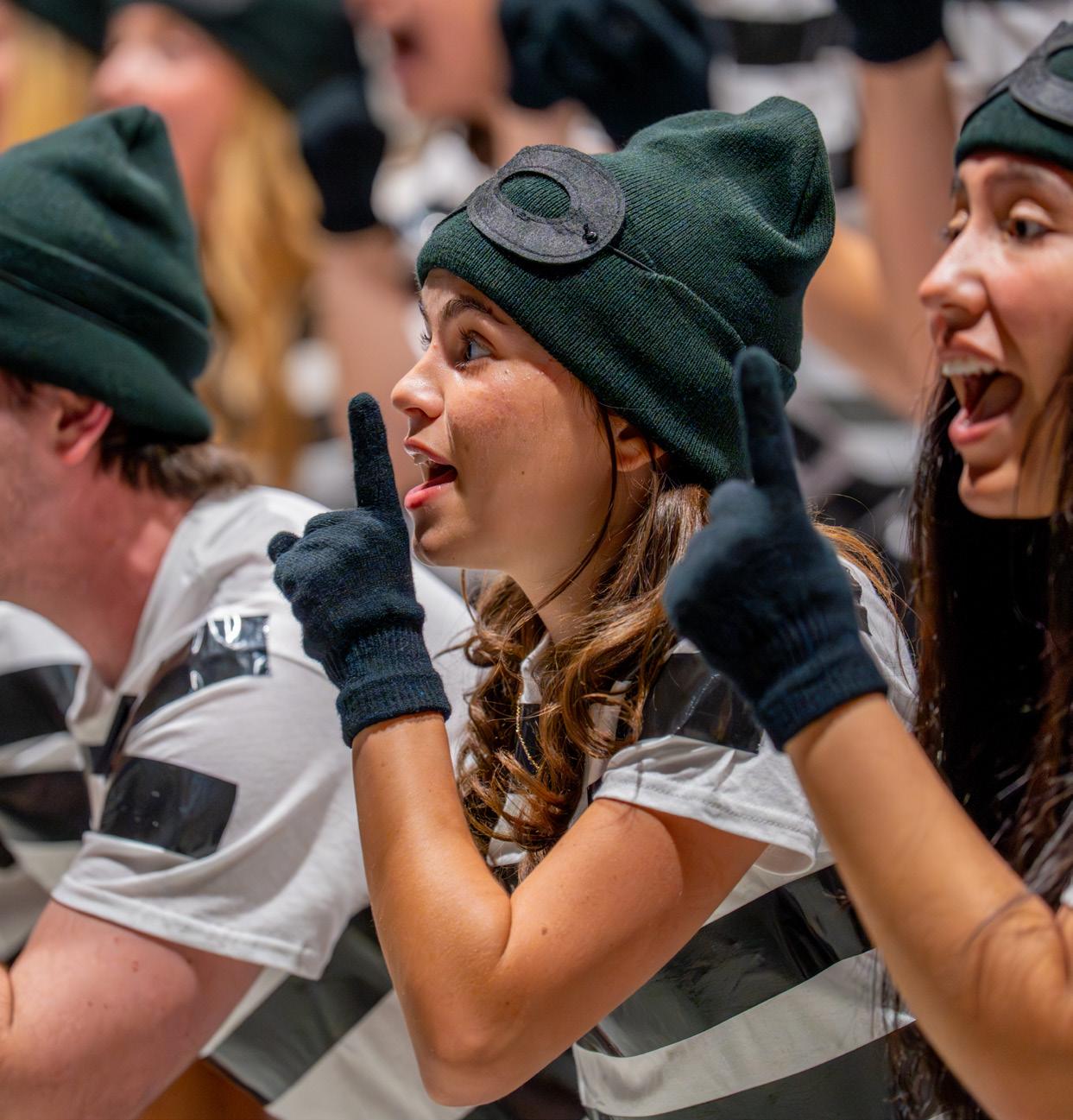
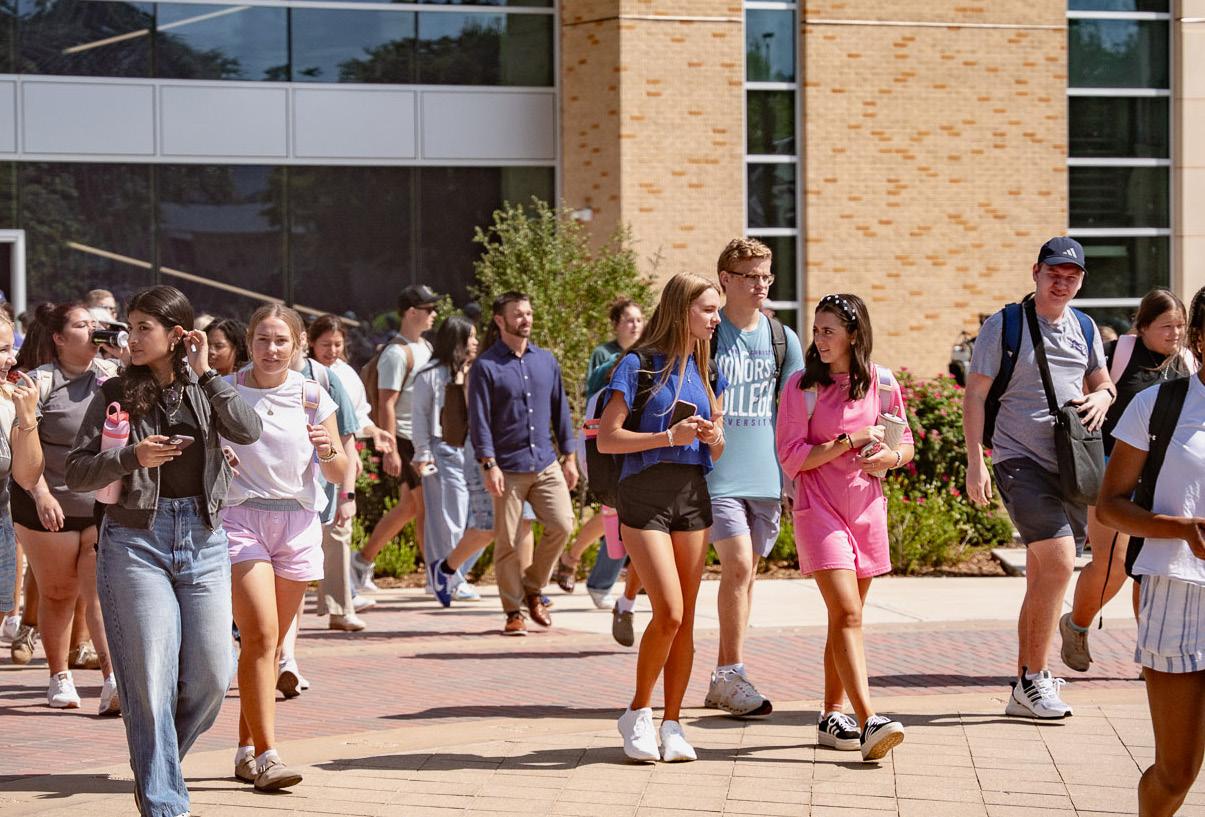
The 2025-26 freshmen class continues to fuel a large turnout of ACU traditions, with greater numbers engaging in Sing Song, filling two entire freshmen class acts and enough students left over to form Sing Song’s first-ever mixed class act to include freshmen.
Courtney McGaha, director of student productions, said what has set this freshman class apart is their excitement to participate.
“There’s not just a lot of them,” McGaha said. “They also are wanting to be so involved. And that has been such a blessing for all of student engagement, but especially for student productions whose purpose it is to
build community.”
Mimicking the record-setting involvement in Freshmen Follies in the
fall, around 270 freshmen signed up to participate in Sing Song, so with 100 students filling one act
with about 70 extra freshmen.
The remaining freshmen were combined with soph -
omores and juniors to cre -
ate a mixed class act.
McGaha said they asked the freshmen if they would be OK combining with upper classmen to create the mixed class act.
“The ones that we picked were like, ‘Bring it on, we love that,’” McGaha said.
“The vibe from that group has been very positive, very exciting.”
A freshman participating in the mixed act, Daniel Grumm, mechanical engineering major from Fremont, California, said the sophomores in the group bring experience.
“We have two freshmen directors,” Grumm said, “and the sophomores are helpful to have people who have done Sing Song before because they know a little bit more about
the proceedings.”
Getting involved in ACU traditions as a freshman presents opportunities to build community, McGaha added.
“I think it’s really easy to just kind of stay in a lane and be like, ‘OK, I’m gonna go to my class and then there’s people around me in my dorm and that’s it,’” McGaha said. Organization, clubs and traditions introduce students to people outside of their academic department and residence hall.
“You’re meeting other people you wouldn’t meet otherwise,” McGaha said, “finding people that you wouldn’t necessarily just stumble across, and I think that makes it so much easier to build community, to build multiple communities.”
Major developments to arrive this year, AI project, retail expansion
BY MAKAYLA CLAYTON OPINION EDITOR
Abilene is expected to see several new developments in 2026, bringing changes to downtown spaces, new dining and retail options and expanded flight access.
Downtown updates
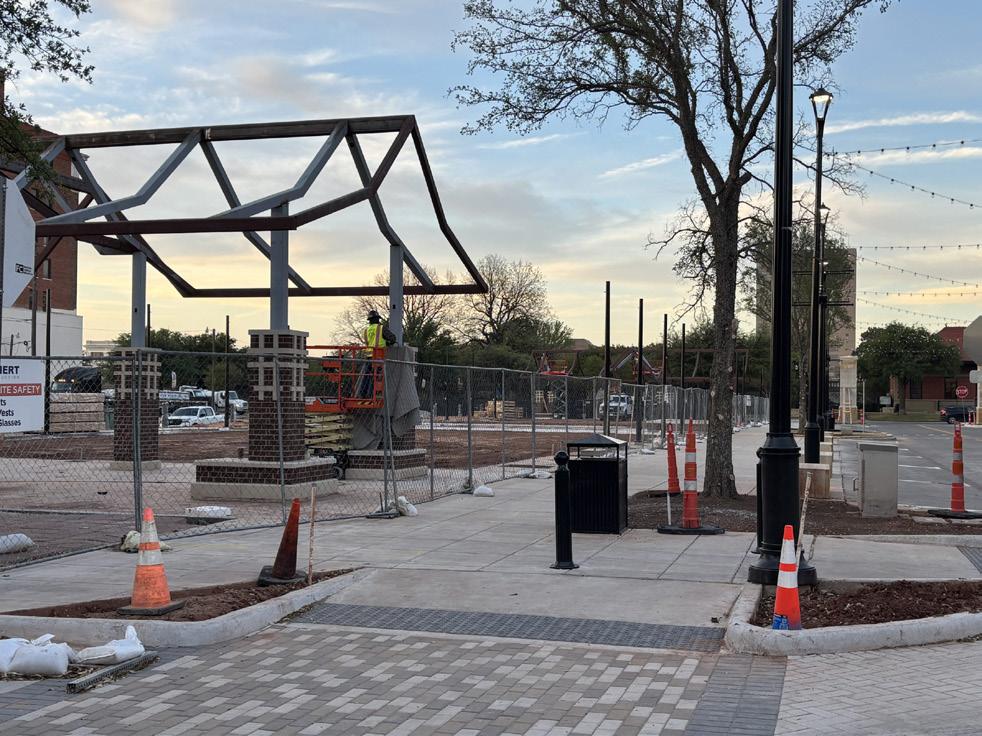
One of the major downtown projects is the Cypress Street Pedestrian Plaza, located between North First and North Second streets. The plaza will include green space, shaded pavilions and a water feature, and is expected to host events such as markets, live music and community gatherings.
New businesses are also opening nearby, includ-
ing Scenic Route Cafe, an art-focused café that will offer both food and creative activities, adding to the area’s mix of local businesses and attractions.
Dining and retail additions
Several dining and retail locations are also planned across the city. The Angry Cactus West Texas Bar & Grill is expected to open a new location in the SoDA District. Freddy’s Frozen Custard & Steakburgers has filed permits to build a new location near Ridgemont Drive, with construction scheduled to begin in May 2026 and finish by December. Additional retail development includes Bass Pro
Shops, which is projected to open along Interstate 20 in early 2027 to serve shoppers.
Other developments
New public and educational spaces are also in development. The Spark Science Center, an extension of The Grace Museum, will feature interactive exhibits focused on science, technology, engineering, art and mathematics for visitors.
Abilene Heritage Square is scheduled to open in May 2026 and will include a public library, event space and a coffee shop. The Clear Fork Bank Storybook Garden will also expand, with a second
phase set to open in June during the Children’s Art and Literacy Festival.
Transportation and infrastructure are also expanding. Flight options at Abilene Regional Airport are expected to grow, with new nonstop routes to Denver, Houston and Phoenix planned in addition to existing service to Dallas for travelers.
Stargate, a roughly $500 billion AI data center project currently under construction outside Abilene, is part of a national AI infrastructure effort backed by OpenAI and Oracle and is expected to be completed by the end of the year.
In a press release, city
officials said projects like these, along with continued retail and infrastructure expansion, are part of
Rent increase, housing shortage prompts university expansion
BY ASHLEY HENDERSON EDITOR-IN-CHIEF
The university is working to provide more affordable housing options and assist students during the housing shortage in Abilene.
Living off campus has become more expensive as rental prices have increased in response to Stargate AI Data Center projects and a higher demand for housing. Kevin Campbell, senior vice president for operations, said the issue began to impact students more as they prepare to find off-campus housing or sign lease renewals for next year.
“We’re going to do it right, and do it well. We’re going to have a lot of long days and weekends to get that first one stood up by August.”
KEVIN CAMPBELL
“We’re starting to experience some of those students who are desiring additional help from the university to help them locate some housing,” Campbell said. He said that this year the university received more interest in students looking to stay in the University Park Apartments.
“University Park has been very popular, but the number of applicants this year was much greater than what we received in years past,” Campbell said. “We also are having a very high demand for the off-campus houses that we own in the neighborhood nearby. The moment that one becomes available, we get many, many calls on those.”
Outside of the current housing options, the university is in the process of adding new apartment buildings, Campbell said. He said the first building will be open by August 15, and additional facilities will be open before the next semester in the spring.
“We are getting started immediately on some apartments,” Campbell said. “It could be that we
add up to 300 additional beds and apartments in the next 18 months. Still trying to finalize those plans, but trying to utilize the information from the city to help us make the best plans for the longterm housing for our students.”
The first building will be located west of Dillard and house about 45 students. He said they will begin moving dirt on the property this week.
“We’re going do it right, and do it well,” Campbell said. “We’re going to have
a lot of long days and weekends to get that first one stood up by August.”
Shannon Kaczmarek, dean of community living and wellness, on Feb. 26 emailed students a survey, which asked questions about students’ plans for housing in the 2026-27 school year.
Campbell said the new building will likely house sophomores long-term.
“We’re trying to see what the demand is going to be on the existing sophomore halls, and if we’re kind of at capacity, then we’ll put sophomores in there,”
Campbell said. “If it feels like the existing facilities are going to be able to handle the sophomores, then we will try to make it available to juniors, seniors and graduate students.”
In total, the university is currently exploring the development of up to five new apartment buildings, which would house approximately 300 students. Those five buildings would have about 160 units.
Campbell said the university is exploring temporary housing options for students for about a
month or two before the second and third apartment buildings are complete.
“We’re kind of building them together, but we’ll be staging them where we can have one complete by the start of school and hopefully one complete in late September.”
The buildings will be apartment-style, and Campbell described them as a combination of UP and Dillard.
“Right now, the early model,” Campbell said. “In order just to break even on the housing, it would be priced similar to Dillard.”
Campbell said the university has also discussed pricing with other apartments and off-campus houses.
“We are working with some local groups to see if we can try to get an ACU rate at some places to see if we can help control the price in that way. We are buying any house that we see near campus that’s reasonable in order to try to charge students a more reasonable rate for the rental of a house near campus.”
See Data Center, P. 3
BY DANIEL CURD | CHIEF PHOTOGRAPHER Joshua Bruno,
BY ASHLEY HENDERSON | EDITOR IN CHIEF Stargate AI Data center located on Spinks Road.
broader efforts to support population growth and economic development in Abilene.
PHOTO BY MAKAYLA CLAYTON | OPINION EDITOR Cypress Street Pedestrian Plaza under construction.
Hamm, Talley elected to lead SGA 2026–27 school year
BY MAKAYLA CLAYTON OPINION EDITOR
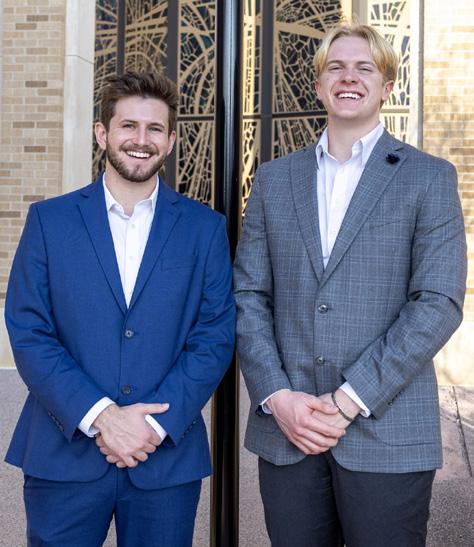
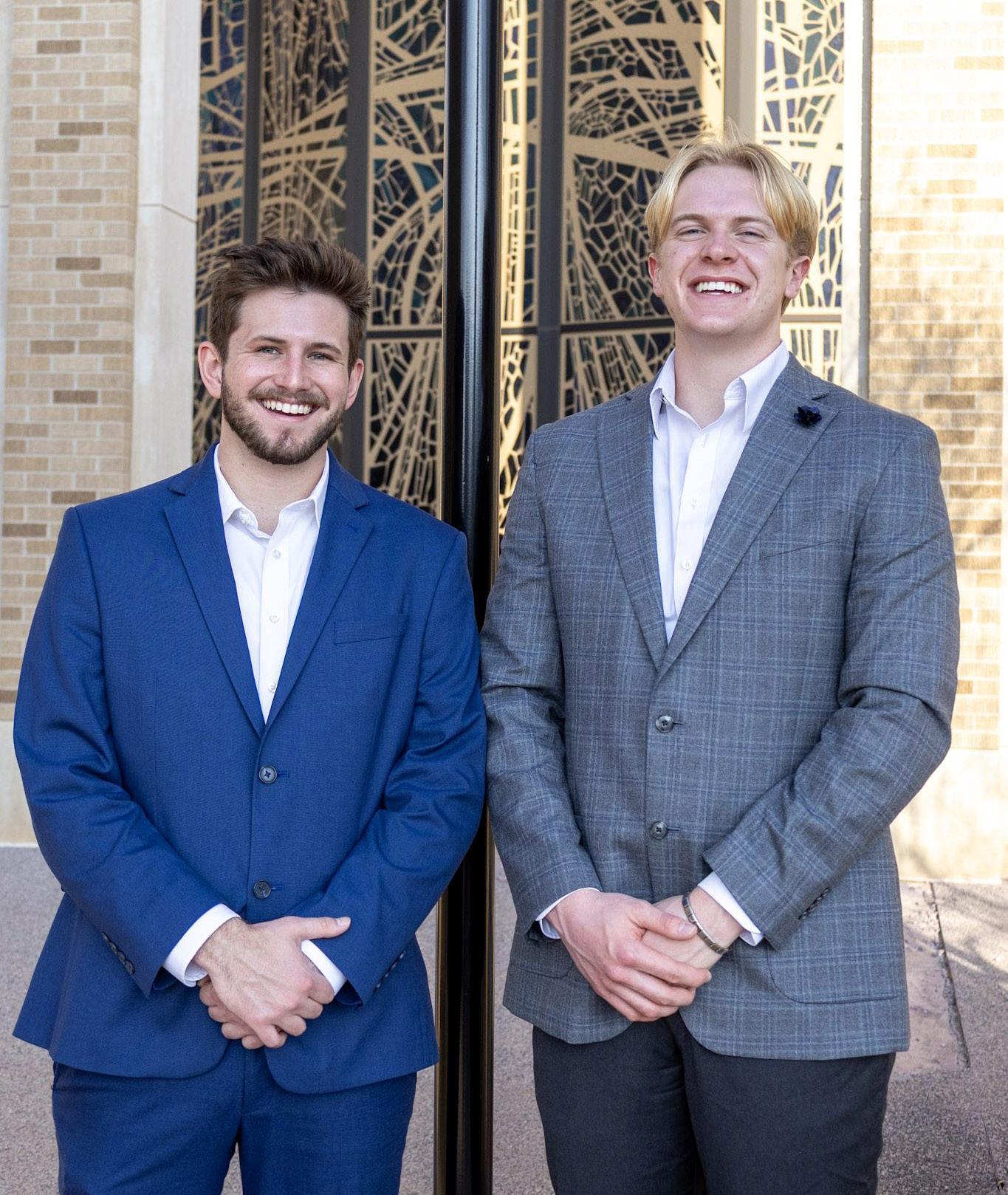
The Student Government Association’s 2026-27 school year president and vice president elections were finalized on Monday, with Josh Hamm named student body president and Luke Talley elected vice president. The results mark the conclusion of this year’s SGA election cycle and the beginning of the transition process between administrations.
Hamm, a junior biomedical major from Double Oak, ran unopposed and won with 90% of the vote. Talley, a sophomore government major from Salida, Colorado, ran against Jewel Cobb, a junior management major from Tomball, and won with 70% of the vote.
“I am thrilled and honored to be chosen to represent and serve the student body of ACU in this way,”
Hamm said. “I am very excited to cultivate a culture where students feel heard, and where change can be made.”
Talley also expressed gratitude to students after the election results were announced.
“I am so thankful to the students of ACU for choosing me to represent them as the student body Vice President,” Talley said. “I cannot wait to help connect this campus and bring opportunities to the students here to help the greater community of Abilene.”
Josh Hamm and Luke Talley’s Campaign
During Q&A sessions, Hamm and Talley emphasized three pillars of their campaign, voice, stewardship and vision, describing leadership as a service position. Hamm said one of his main priorities is improving SGA's accessibility,
including implementing a student idea portal that lets students submit feedback
and suggestions directly. “For student government to impact the student body
in the most applicable way, we need to know what they want,” Hamm said. “We need to give everyone on campus a voice.”
He said he hopes to shift students’ perception of SGA, encouraging students to see it as a resource rather than something distant from everyday campus life.
Talley described leadership as something built through growth, including learning from failure, and said his goal is to foster a stronger sense of community within SGA. “I don’t want to be a solo leader,” Talley said. “I want to be part of a team.”
He emphasized creating a “family” environment within the executive team and Senate, where collaboration and support allow leaders to better serve students.
Changing of the Guard
The transition of power will culminate in an event
known as the “Changing of the Guard,” marking the official handover of responsibilities between outgoing and incoming SGA administrations.
During the event, the President’s Bible, a tradition dating back to 1995, is passed down, along with other items such as the Senate mallet. The event typically includes speeches, superlatives and awards such as “Senator of the Year.”
The ceremony formally marks the end of the current administration and the beginning of leadership for the 2026–2027 school year, as Hamm and Talley prepare to step into their new roles and begin implementing their campaign goals. And as the semester continues, Hamm and Talley will begin the hiring process for the rest of the executive cabinet members.
University clarifies guidelines on electric scooters after complaints
BY LESLIE CARRIGAN MANAGING EDITOR
The University is explaining its guidelines for electric scooters after complaints from students, faculty and staff.
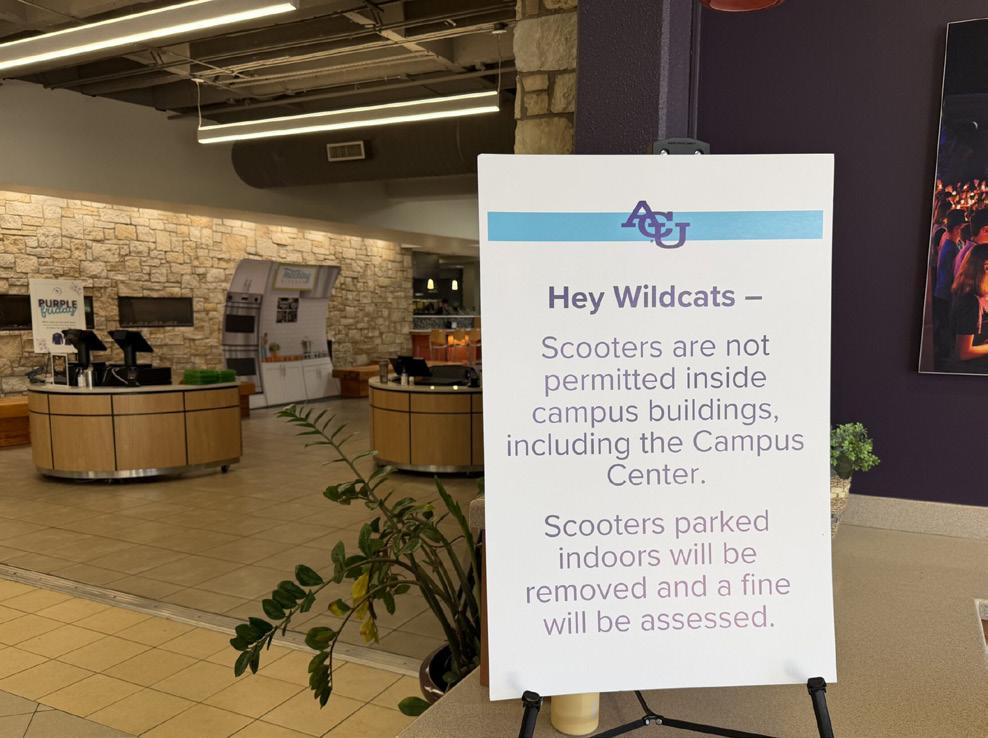
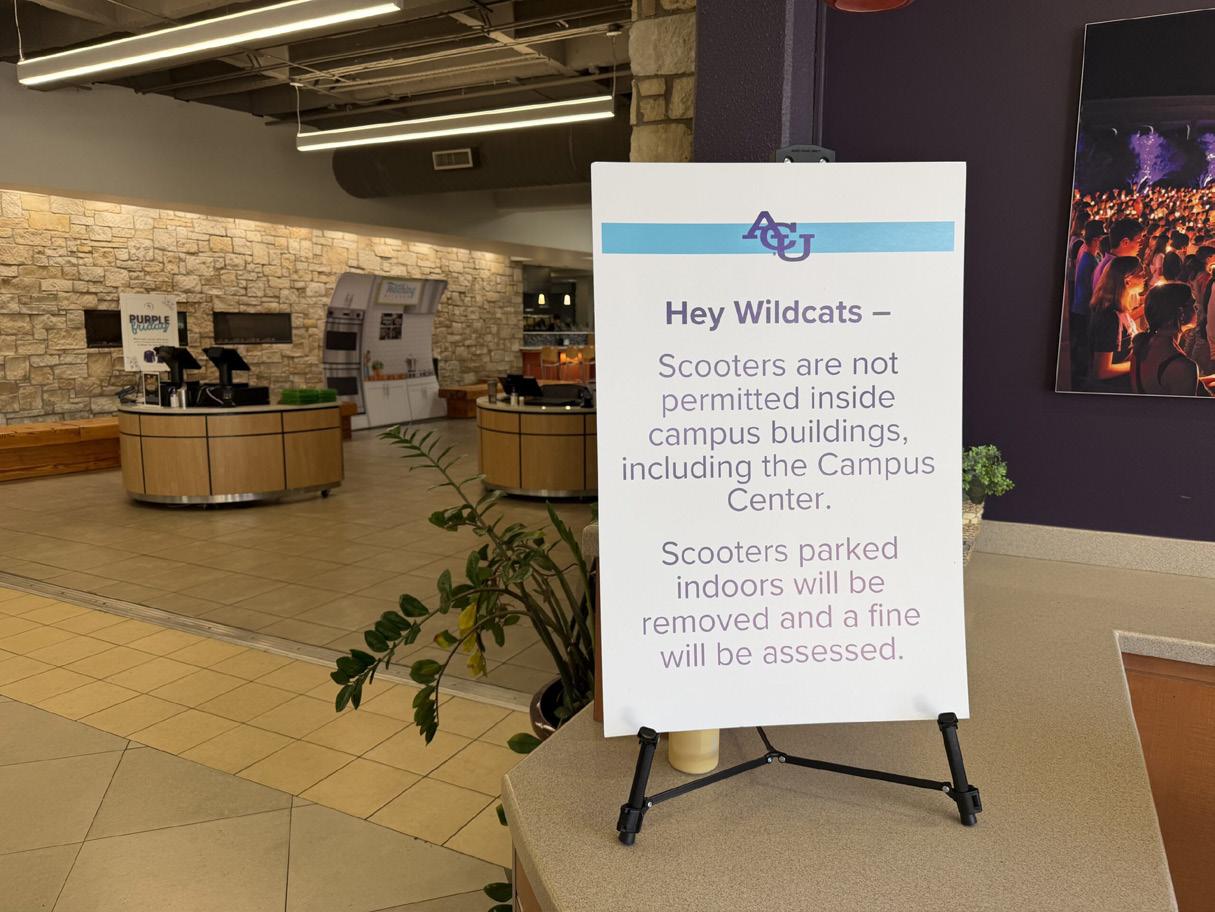
Tamara Long, vice president for enrollment and student engagement, sent an email last Friday to all of campus explaining that scooters may only be ridden outside, scooters cannot be charged inside and scooters should be parked near bike racks. The email also said that permits
will be required for scooters in August 2026. “This semester, Student Life staff members will issue warning notices to e-scooters parked or stored inside buildings to notify owners of the new expectations,” the email said. “Scooters parked inside campus buildings or blocking doors, ramps, stairs, etc. will be relocated to the nearest designated parking area.”
Long said the guidelines were clarified in response to complaints the university had received.
“We just started getting more and more complaints and frustrations from students, faculty and staff that were like, ‘Why are there scooters everywhere?’”
Long said. “If you think about any student that maybe has a visual impairment or is wheelchair bound? Scooters have been blocking entryways.”
She said she was concerned about the lithium-ion batteries used to charge the scooters, which have recently been in the news for catching fire in college dorm rooms.
On March 4, a San Diego State University dorm was damaged after a lithiumion battery ignited, injuring one student, according to a NBC 7 article.
Student Life will begin issuing warnings this semester to e-scooters that are not parked correctly. They will be relocated to the nearest parking area if they are left inside. Next semester, however, this may result in fines from ACUPD. Long said leadership is still working to determine the specific details of the fines.
The decision to clarify
the rules was made in partnership with the Student Government Association, which helped ensure students’ opinions were represented in the guidelines, said SGA President Tamil Adele, senior criminal justice major from Midland.
“They want to make sure that they are connecting with students and making sure that whatever policies they’re rolling out would be beneficial,” Adele said.
“I went to SGA and read to them what I had, and I collected feedback.”
She said that moving forward, SGA will work to keep the permit cost low and ensure there are charging stations for the scooters. Long said she wants students to continue to use scooters as an alternative to driving.
“I get that for some students it’s affordable transportation to and from their house off campus,” Long said. “At the same time, it got to a place where this was not sustainable, and we felt we needed to address it.”
Data center development brings uncertainty to student housing
BY DANIEL CURD | CHIEF PHOTOGRAPHER
Countinued from page 2
The future of housing demand in Abilene remains unknown as the Stargate Data center continues to develop, which has already brought over 6,000 workers to town, according to the Texas Standard. However, Campbell said he has been in contact with the city to determine how the university should approach the issue.
“The conversation we had with the city is trying to better understand what the short-term and longterm impact is, and how
we’re expecting the surge of workers to be here for the data centers. Also, just trying to understand what trends are happening in Abilene, which will help us understand what our short-term and long-term approaches are.” If students have concerns about housing for next year, they can reach out to Residence Life for assistance.
“If any students are having problems with housing, don’t go at it alone,” Campbell said. “Let us know that they are
looking. We may be able to help them with properties that we own, or the more that we understand what the real needs are, we’ll try to use our influence to help students get the housing they need.”
Campbell said other projects are also in the works.
“There’s a few other things that we’re working on that we’re not willing to share just yet,” Campbell said. “We’re trying to work on some other ways to help open up some additional spaces for our students.”
Three new members nominated to university's board of trustees
BY LESLIE CARRIGAN MANAGING EDITOR
Three new members were appointed to ACU’s board of trustees last month, an accounting executive, a Memphis minister and the university's former investment adviser.
Jack Rich was the president and chief investment officer of ACIMCO, the university’s investment management company, from 2006-23. He also held a variety of other positions including executive vice president and vice president for business. During his time in administration Rich grew the university's endowment from $56 million to $700 million.
Larry Autrey retired last year as the executive chairman of Whitley Penn, a public accounting firm. During his 25 years working here the company grew from a single market firm to the 34th largest in the country. He also serves on the university's Athletic Advisory Committee and College of Business Administration Advisory Committee.
Josh Ross serves as the lead minister for Sycamore View Church of Christ in Memphis, Tennessee. He has written several books including, Coreology: Six Principles for Navigating an Election Season without Losing Your Witness, Scarred Faith and Bringing Heaven to Earth. He als serves on
the board for Agape Child and Family Services in Memphis.
Will Beasley, chief of staff for Dr. Phil Schubert, president of the university, said the new trustees were chosen by the board for each of their unique backgrounds to provide diversity of knowledge and experience to the board.
“They look at demographics of the current board and areas we need to grow, they look at expertise,” Beasley said. “So there’s a good mix of people who are from health care careers, people who are from a technology background – so you get a good cross-section of all of the areas of potential em-
ployment expertise.”
The board members are chosen by nomination governance committee, a subcommittee on the board of Trustees which spends a year researching and choosing potential candidates. These new members will step into their role and attend their first meeting this weekend.
He said the three new members specific experiences in business, higher education, Christian leadership and finance made them strong nominations for the board.
Alongside their professional experience, Beasley also said board members are expected to value faith in their careers and lives.
“The core of ACU is to educate students for Christian service and leadership throughout the world –that's our mission,” Beasley said. “The people that have a strong faith foundation … those are the type of people you want as trustees.”
Rich said most universities in the United States began as Christian institutions, but many have strayed from that focus. He said he wants to keep ACU connected with its initial goal of being a faith-based institution.
“I think that's really critical,” he said. “I think Abilene Christian has been committed to main-
tain that, and I think that will be one of the hardest things to do as you go forward into the future is to maintain that faith focus.” Outside of his professional experience, Rich said one of his biggest motivations for continuing to help and improve the university is his 10 grandchildren.
“We were very blessed; our four kids went to Abilene Christian, and the three that are married met their spouses at Abilene Christian,” Rich said. “We hope many of our grandkids will attend Abilene Christian. It’s a place that was formational to my wife, and it’ll be formational for them so I’m invested in having a place where that can happen.”
PHOTO COURTESY OF JOSH HAMM
Josh Hamm and Luke Talley pose for their campaign photo.
PHOTO BY ASHLEY HENDERSON | EDITOR IN CHIEF Signs posted around the campus center remind students not to bring their scooters in the building.
PHOTO BY ROMAN RAFFAELI | SPORTS REPORTER Students line their scooters up outside the Campus Center after university put new signs up.
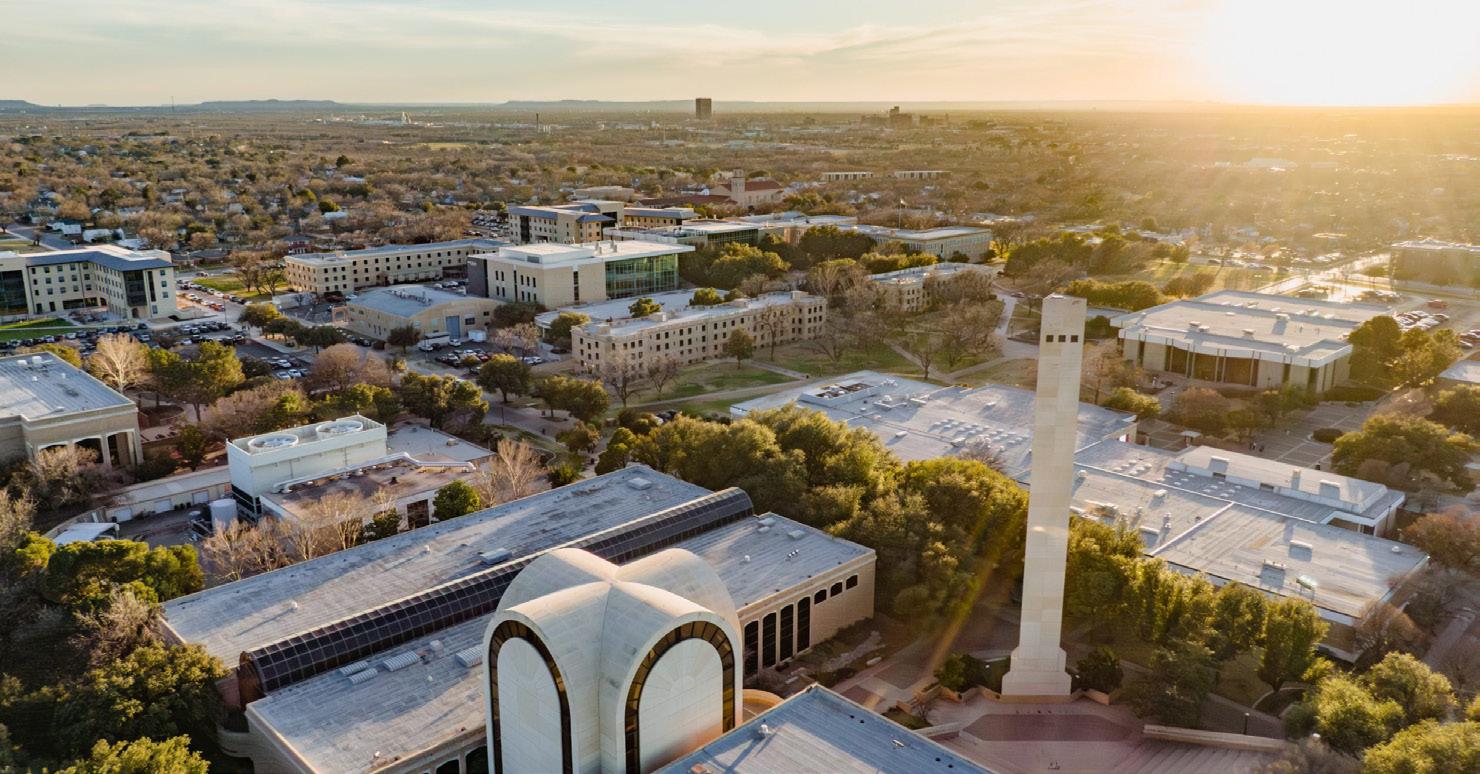
A drone captures a sunset over campus.
Host, hostesses prepare for this years Sing Song
BY AMELIE AQUINO NEWS REPORTER
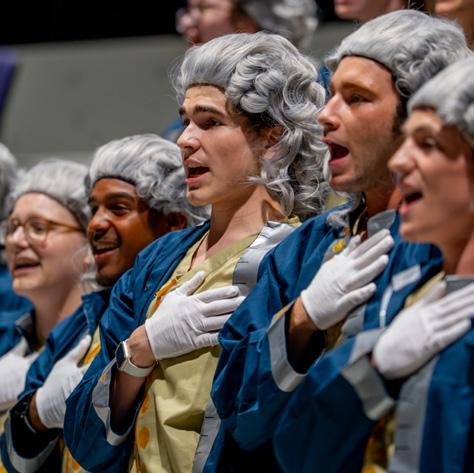
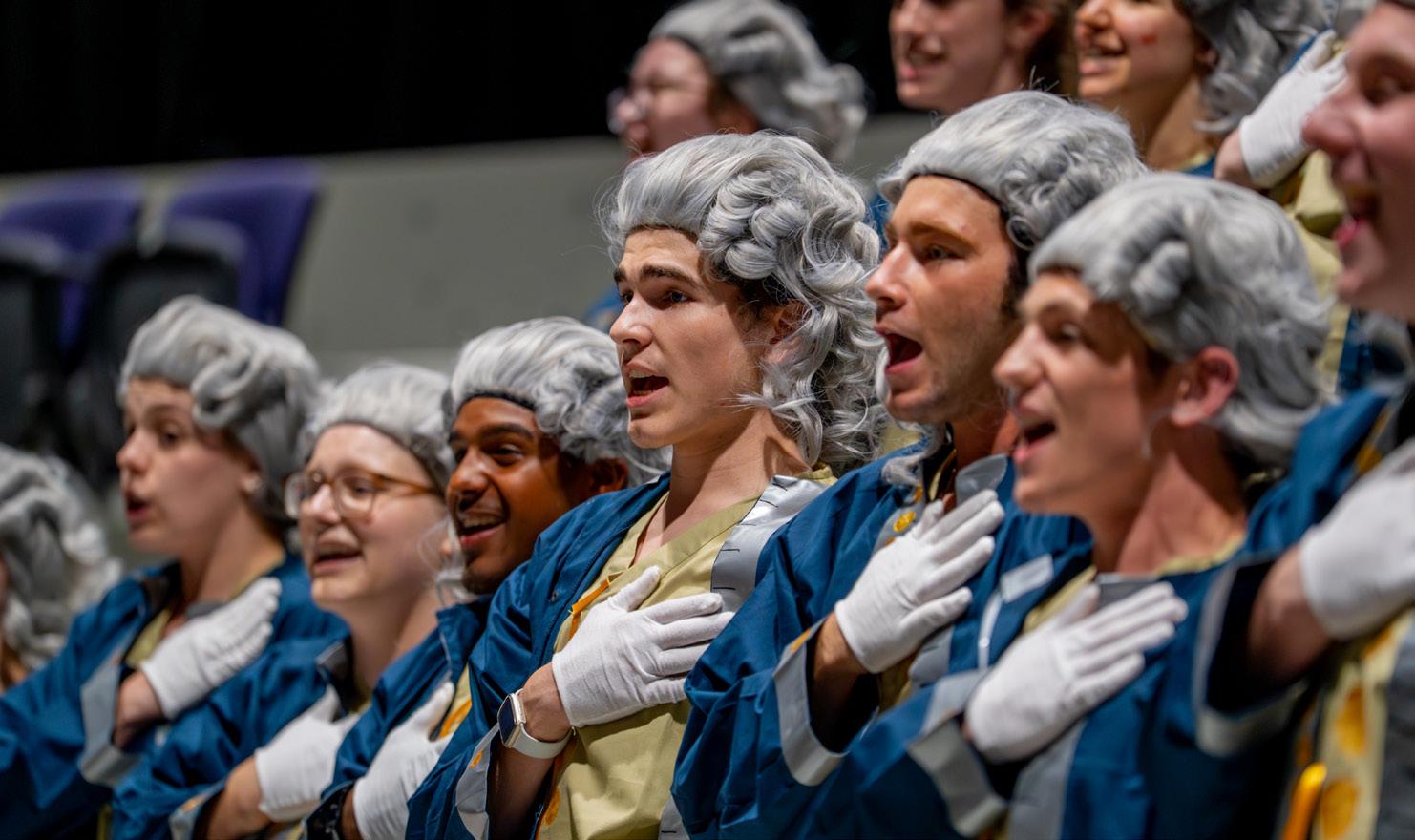
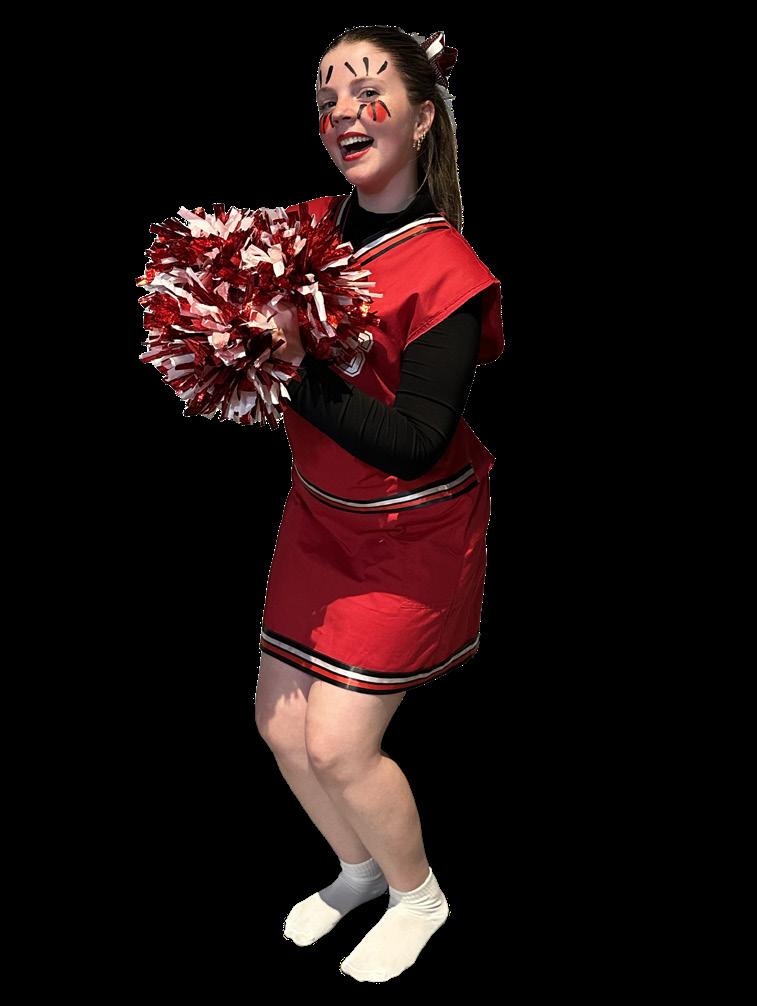
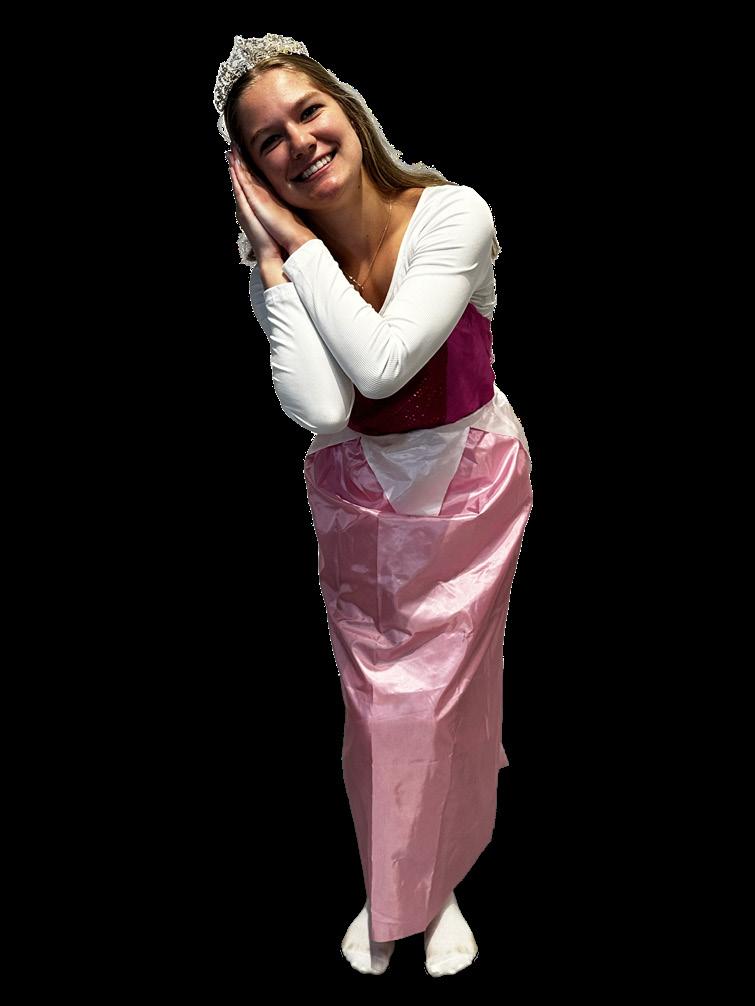
Sing Song hosts and hostesses gather to prepare for the university’s 70th year of Sing Song, ACU’s annual a cappella parody competition. Each performance is about three and a half minutes, presenting months of preparation of costumes, choreography and sets.
Courtney McGaha, director of student productions, said Sing Song is important because it’s a chance for the campus to come together, as it invites not just current students, but alumni, faculty, staff, parents, friends and the Abilene community. The event draws more than 900 participating students every year.
Sing Song is one of ACU’s biggest and most loved traditions,” McGaha said. “There’s always going to be a very special place in my heart for the upstage acts, the actual competition itself, and class acts specifically because that’s where my experience was in.”
Originally, the hosts and hostesses were called the masters of ceremonies, who introduced and bridged the gap between acts. More recently, they began adding songs to the group performance that followed. Now, the host and hostesses entertain the audience with their own performances to fill time. McGaha said the audition process is very thorough and aims to see how
2026
SING SONG HOSTS AND HOSTESSES
Tamil Adele, senior criminal justice major from Midland Cierra Zamora, senior music teaching major from Caldwell • Barrett Roberson, sophomore psychology major from Abilene
Elliot Hembree, junior physics major from Southlake Laci Jackson, senior theatre major from Grapevine Brinkley Fecci, junior communication disorders major from McKinney
the hosts and hostesses perform holistically.
“We want to see their solo voice, who they are as a performer, but we also want to see their stylistic range,” McGaha said. “We need to be able to have people that fit any song genre.”
Around 12 students are called back to perform for a larger panel of judges. They are taught a new song on the spot to see how they perform in a group. Once chosen, they hit the ground running with rehearsals and voice lessons.
“This group of hosts and hostesses is actually very different from the last couple of years. They have a lot more distinct styles,” McGaha said.
“Their solos are a lot more unique this year. We have very wide genres being performed.”
Barrett Roberson, sophomore psychology major from Abilene, will be a host for the first time this year.
“There’s the class acts, there’s the sorority and fraternity acts and that’s usually what most people seem to be interested in,” Roberson said. “In between those, we have our numbers to make it one cohesive show.”
Roberson said he signed up because he missed high school theater and wanted to experience a similar, fun opportunity. He recalls what the process was like and points out that you can change the song you’re performing from what you audition with.
“You sing two songs that are different stylistically,” Roberson said. “I did a song from a musical and an Elvis song.”
He said when you get called back, it’s a completely different environment and audition process.
There are six hosts and hostesses this year, and they have to rehearse collectively.
“You have to see if you can blend with each other vocally, how well you can sing different parts, read music, dance, and how quickly you can learn those things,” Roberson said.
“You have to be able to be with them as a unit.”
Roberson said he did not expect anything out of the audition, but he made the cut.
“I almost took my name
off the list because of the prospect of having a chance of getting it,” Roberson said.
“It was a huge shock, especially being a sophomore.”
Roberson will perform “Cry Me a River” by Michael Bublé, but with a surprise twist.
Laci Jackson, a senior theater education major from Grapevine, said she directed the class act her freshman year and the Ko Jo Kai act her junior year. She always knew that she wanted to direct it, especially having grown up attending Sing Song. Being a hostess, however, was an idea that came from her college bucket list.
“It was the last thing I had to accomplish,” Jackson said. “I didn’t really think I would get it, to be honest, because a lot of people audition. It’s just been
the most wonderful experience.”
While directing and hosting both require hard work, Jackson said they’re quite different.
“It’s a different type of work. I had to do a lot more prep work for Ko Jo Kai,” Jackson said. “This time around, it’s more self-focused. It’s definitely less stressful in the sense that I’m not carrying the weight of a whole act; I just have to worry about myself.”
While Jackson said she loved directing Sing Song, she is grateful for the opportunity and is glad to be able to just have fun this time around.
“I’m very blessed to be with a group of people that are excited to be there, and we’re putting in a lot of work,” Jackson said. “It’s really full circle.”
Warner, Holt nominated the alumni of the year
BY LESLIE CARRIGAN MANAGING EDITOR
This year’s outstanding alumnus of the year and young alumnus of the year, Dr. John Warner (‘87) and Tim Holt (‘15), will be recognized at the alumni day luncheon on Saturday.
Warner is a cardiologist and the CEO of the Ohio State University, Wexner Medical Center and executive vice president at Ohio State. Before that, he worked for 20 years at UT Southwestern as a cardiologist.
doing trick shots.
These awards are given to alumni who are known for making a difference in their careers, said Craig Fisher, director of alumni relations and annual projects.
Holt is the vice president of post-production for Dude Perfect, a sports comedy group and YouTube channel known for
Songwriter Grant to speak, perform at donor event
BY CARTER CALVIN NEWS REPORTER
The President’s Circle Dinner brings together university leadership, donors and guests for an evening centered on gratitude and vision for the future every year. This year’s event will feature singer-songwriter Amy Grant as the guest speaker, a six-time Grammy award winner known for her contemporary Christian music. Grant has written eight albums with songs such as, “Baby Baby,” “The Next Time I Fall” and That’s What Love is For,” according to a USA today article.
The dinner honors members of the President’s Circle, a group of donors who have given $1,000 or more to ACU within a calendar year, as well as Heritage members who have established endowments or included the university in their estate plans.
Samantha Adkins, executive director of donor relations and annual giving, said the dinner has been hosted each spring for decades to recognize those who faithfully support the university.
The evening is not only designed to thank supporters, but also to share stories of how their giving continues to shape students’ experiences both inside and outside the classroom, she said. Adkins said the President’s Circle Dinner is in
its 57th year and typically welcomes between 550 and 600 attendees, though thousands of donors are part of the President’s Circle overall.
This year’s attendance is expected to trend closer to 600 with Amy Grant as the guest entertainer.
“When we announced that she would be our entertainment,” Adkins said, “we had people reach out asking about their eligibility to attend.”
Adkins said Grant will perform a 40-minute singer-songwriter showcase, featuring a few of her band members and discussing her faith journey between songs.
She said, Grant’s involvement marks a shift for the dinner, which in previous years has featured guest speakers such as Bob Goff and Max Lucado rather than a nationally recognized musical artist.
“We haven’t brought in a guest artist that is well known,” Adkins said. “So I’m excited to see the audience participation.”
The dinner not only recognizes past giving, but also casts a vision for the future, reminding attendees that continued investment sustains scholarships, strengthens programs and opens doors for the next generation of students, she said.
The 57th annual President’s Circle Dinner is Saturday, March 28 in the Teague Special Event Center.
“It honors lifetime achievement that brings honor to the university through personal and
professional excellence and service to the university, church or community,” Fisher said.
“So, it’s a combination of looking at your career, but also how you live your life.”
Fisher said nominations are always open, and anyone can make a nomination. This year, they re -
ceived nominations from all over the world. These nominations go into a pool of candidates, which is evaluated by the alumni advisory board.
“They look at the research that’s been done and have a discussion,” he said. “They will go through and select the recipient. That’s usually done in our fall meeting.” Fisher said he is excited to highlight the work of the two alumni and have them as representatives of the university.
“These are two great representatives of the university,” Fisher said. “We’re excited to honor them Sunday.”
Study Abroad cancels trip to Turkey
BY LESLIE CARRIGAN MANAGING EDITOR
The Leipzig study abroad program canceled its field trip to Turkey earlier this month following concerns over the current war in Iran.
Instead, the program went on an educational field trip to Athens, Corinth, and the islands of Aegina in Greece, after the program to Turkey was canceled. The group was set to travel to Istanbul and the region of Cappadocia, where they planned to learn about Islam compared to Christianity, said Olivia Crist, a student in the Leipzig program.
Crist, senior finance major from Valley Center, California, said the group was initially sad about the switch from Turkey to Greece.
“God is so good in how he protects, because I was really excited to go to Turkey, but then when I heard it got canceled, I
weirdly had so much peace,” Crist said. “Like, yes, I was disappointed, but I had this weird sense of peace of like I know God is protecting us from something we cannot see.”
Around four months ago, the university formed a global risk and security group, as a subgroup of the university’s emergency operations team, said Mark Barneche, executive director for international education and study abroad. When the U.S. launched its initial strikes on Iran, the group met to assess the safety of the Leipzig group going to Turkey.
Barneche said the trip was not only canceled for safety concerns, but out of fear that transportation in and out of Turkey may be affected.
“Our chief concern is not that bodily harm would come to our students in Turkey or their safety in Istanbul or in central rural Turkey where the group was planning to travel,”
said Barneche. “It was more, ‘What are the ramifications
“I
was disappointed, but I had I had this weird sense of peace of like I know God is protecting us from something we cannot see..”
of a potential missile strike in Turkey that could suspend our transportation and our ability to get them out of the country?’”
At the time this story was written, there had been no missile strikes directly in Turkey. However, NATO air defense systems in the Mediterranean have intercepted three ballistic
missiles from Iran headed towards Turkish airspace, according to a report from Al Jazeera.
The Leipzig program typically travels to Greece for its educational field trip, so when the Turkey trip was canceled, Barneche said they had to scramble to pull together an alternative trip, using their contacts and knowledge from past trips.
Outside of the university’s group trips, the school monitors where students go on their weekend trips, using the State Department’s 4-level travel advisory system, to ensure the students remain safe, Barneche said.
“We always want people to know that safety is our priority,” Barneche said. “But we feel that beyond heightened awareness and beyond the need to curb travel to certain regions of the world, that our students in programs remain safe and able to operate normally.”
PHOTO COURTESY OF COURTNEY MCGAHA Super cool photo of sing song host and hostess.
OLIVIA CRIST
PHOTO COURTESY OF OLIVIA CRIST
Olivia Crist and Lainey Howell on their educational field trip to Greece.
ResLife preps for stress of larger freshman class
BY CARTER CALVIN NEWS REPORTER
As Olivia Hamrick, a senior at Colleyville Heritage High School and an incoming freshman, prepares for her first year of college, one concern stands out among the excitement: finding a place to live on campus.
“It honestly makes me nervous,” Hamrick said. “There will be more competition trying to get into certain dorms, and I feel like everything needs to be done as soon as it can be to live in the dorm you want.”
As the university prepares for the largest incoming freshman class yet, limited residence hall space, dorm availability and placement challenges, along with the school's response to increased demand, show that housing issues will be a significant effect of increased enrollment.
Residence Life faculty say the pressure on residence halls is already shaping how rooms will be used next year. Shannon Kaczmarek, dean of community living and wellness, said adjustments are already being made to ensure every first-year student has a place to live on campus.
“Given the early predictions for an increase in the freshman class coming in fall 2026, a decision was made to turn Mabee Hall into an all-triple room building,” Kaczmarek said.
“Last year and this year, Mabee Hall has been set up as half two-person and half three-person rooms,” she said. By converting the building to entirely three-person rooms, the university is creating additional beds to meet the projected demand.
Kaczmarek said the change will allow the university to house the anticipated class while keeping first-year students together in the freshman village.
The number of incoming freshmen is still being finalized, but current projections indicate the class could be close to 1,000 students.
“That prediction is evolving on a weekly basis,” Kaczmarek said. “However, as of this week, the projection suggests that between 950 and 1,000 firstyear students will be here in the fall.”
Although the growing class creates challenges for housing logistics, Kaczmarek said the issue is not whether the university can house first-year students, but how that housing will look.
Additional planning is underway across the uni -
“However, as of this week, the projection suggests that between 950 and 1,000 first-year students will be here in the fall.”
SHANNON KACZMAREK
versity’s housing system as officials evaluate how many students the residence halls can accommodate. Theasa Lefevre, living and wellness housing coordinator, said the freshman dorms together will be close to full capacity if projections hold.
“We will have approximately 1,000 beds available across Bullock, Wessel,
BY DANIEL CURD |
Nelson and Mabee,” Lefevre said.
With the number of beds closely matching the expected class size, housing leaders say careful planning will be important to make sure every student has a place on campus.
Res Life staff are also preparing for the possibility of a full housing system next year. Bell Bertrand, director of residence life, said the projected class will likely push campus housing to its limits.
Bertrand said that in previous years, residence halls have had some flexibility and available space. That margin may disappear if projections hold.
To prepare for the increase, Res Life is focusing on internal preparation and coordination with university leadership to ensure housing operations run
smoothly.
“We are working on training our teams and working with leadership to create housing opportunities that make sense on our campus,” Bertrand said.
As enrollment grows, housing policies may also need to evolve to meet the needs of a larger student population. Bertrand said the department will continue evaluating its approach as the university expands.
“I think that it will be up to us as a department and university to be thoughtful and intentional in our housing policies as we grow,” he said.
Housing officials also believe a larger freshman class could improve the campus experience, especially for students living in the residence halls during their first year.
“I think it could make
the first-year experience more exciting because there will be more opportunities for connection, involvement and community,” Lefevre said.
As the university continues preparing for the full semester, housing officials say their focus remains on creating space while maintaining the community experience that residence halls provide.
Even with the adjustments, such as additional triple rooms and full buildings, the goal remains the same: ensuring that first-year students have a place to live in a community to begin their college journey. If enrollment projections remain steady, next fall’s freshman class will not only be the largest in the university’s history, but it will also mark a new chapter in how campus housing adapts to a growing student population.
While administrators are working through the logistical challenges of housing, incoming students are already thinking about what the larger class could mean for their first year on campus.
Despite her concerns, Hamrick said she is also looking forward to the opportunities a larger freshman class could bring.
“It also makes me excited to meet all of my neighbors and the people on my floor,” she said.
Hamrick believes that being surrounded by many other students going through the same transition into college could make the adjustment easier for freshmen.
“I think just being surrounded by so many people in the same boat will be comforting,” she said.
NEXT Lab funding drives university's research strategy
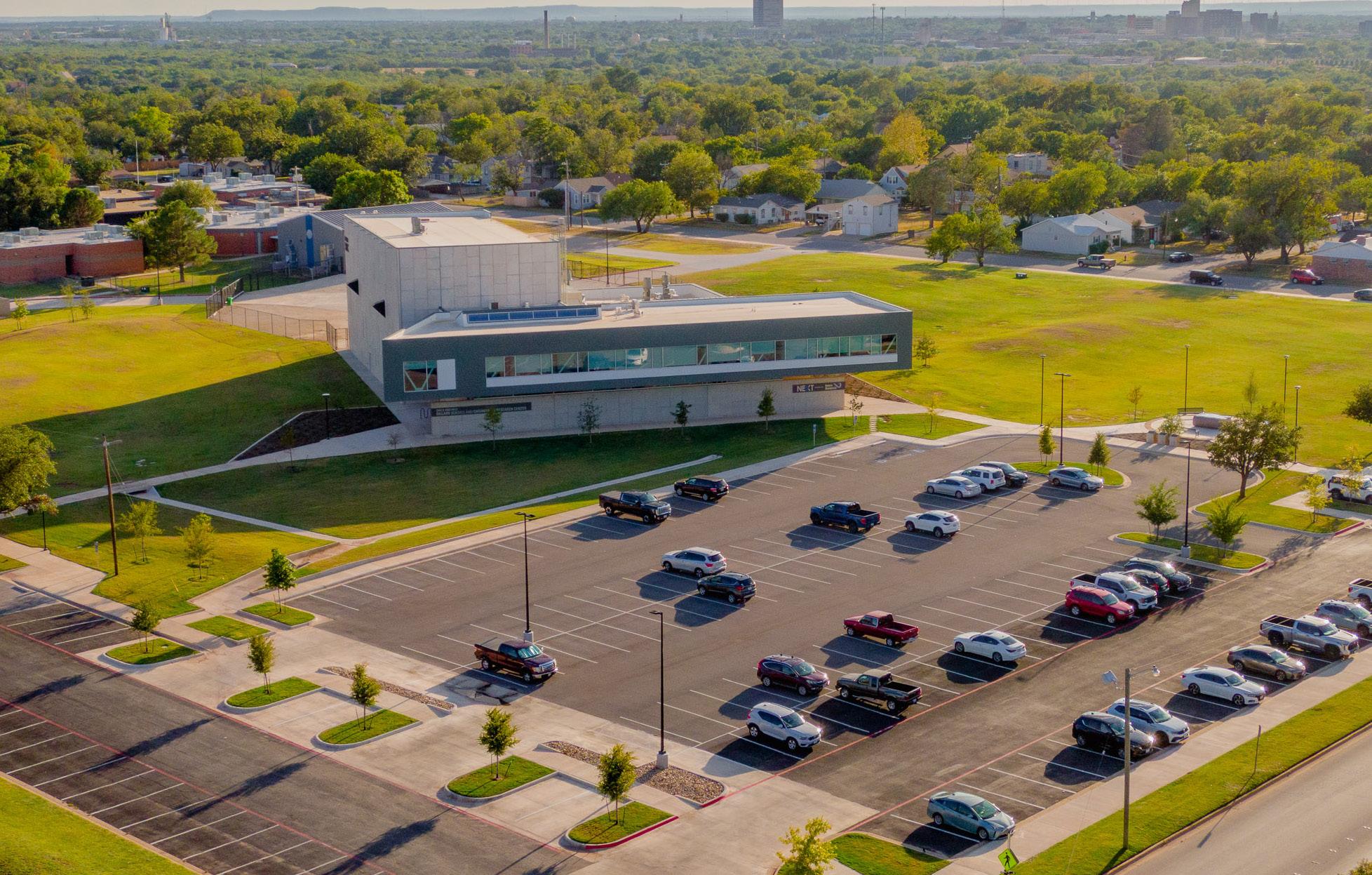
Darren Pratt, junior biochemistry major from Childress, walks through the doors of the Nuclear Energy eXperimental Testing Laboratory. Swiping his ID against the scanner, he goes into the lab to work on a project he’s been on for the past year and a half.
Pratt is one of many students at ACU who are getting the opportunity to work on real-world projects outside of the classroom. For years, student-involved research has been one of the main focuses of the university, emphasizing its mission of creating an innovative and caring community of Christian scholars.
Since achieving Research 3 status in 2022, the university has continued to expand research opportunities for students and faculty. In February 2025, ACU received R2 status from the Carnegie Classification of Institutions of Higher Education. Last academic year, the total expenditure on research for the university was $8.8 million.
In addition to sharing knowledge and having a positive impact on the world, one of the goals of research at ACU is to challenge students and to give them opportunities to grow beyond what they learn in the classroom. Dr. Janet Donaldson, vice-president for research, said research and scholarship, especially at a Christian university, can shape how students see the world and how they will shape the future.
“[We] always focus on our students, that’s the heart of this university,” Donaldson said. “The most important goal for the university from this is to make sure that our students are equipped to be able to go out into the real world armed with that knowledge about how research works in different disciplines and applying that to different situations that they’re gonna be facing.”
One of the ways that students are able to get plugged into research is at the Nuclear Energy eXperimental Testing Laboratory. The NEXT Lab, which was founded in 2015, is research -
ing the uses of molten salt nuclear reactors for power generation, water purification and medical applications.
In the full history of the lab, 272 students have worked on various projects. These students come from a variety of majors at the university, such as engineering, biochemistry, and physics.
Dr. Tim Head, NEXT Lab assistant director, said students have been a driver behind the work that is done at the lab.
“Since the lab started off, they have made a huge contribution to all the stuff that we’ve worked on,” Head said. “We certainly couldn’t have done it without them.”
Students can work full or part-time at the lab over the summer or the academic year.
Since nuclear energy is the main driver behind the work at NEXT, a lot of work is going into the fine details of what will make the reactor work. One of these projects is a digital modeling project that Joshua Fischer, sophomore mechanical engineering major from Pensacola, Florida, is
working on. His team is making a complete digital copy of the reactor to assist with maintenance and optimization.
Of course, there’s more to NEXT than just making the reactor work. Natalie Serrano, sophomore mechanical engineering major from Mesquite, is working on one of the projects centered around the potential medical applications of the reactor. Serrano works with a team of students looking at isotope extraction and purification for use in treating certain forms of cancer.
“I have a really personal tie to it because a lot of my family has been affected by cancer,” Serrano said. “So if I can help all of these other people and have a tiny role in it, it would be really cool.”
On each of these projects, the students who are involved are assigned to a faculty mentor. These mentors aren’t there to control the flow of each project, but rather to guide the students and support them in their work.
“It’s a great system we have here,” Fischer said. “All the students have
mentors, so everything is guided, everything is directed. But at the same time, we also have free rein to do what interests us the most.”
Beyond the work that is done in the lab, one of the biggest impacts that the lab has on its students is building relationships between them and their mentors.
“I’ve gotten to be really close with my mentors to the point where, when I graduate, I will miss them,” Pratt said. “I didn’t ever think that I would have this relationship with my teachers, where I appreciate them not only as academic supporters but also as friends."
While around half of the university's research budget went to NEXT last year, it isn’t the only thing the university has to offer when it comes to research on campus. Practically every department on campus is involved in some level of research.
Several faculty members in the College of Biblical Studies are published authors, spreading the message of the Bible academically. The Department
of Psychology received a grant that will be used to support the next generation of counselors. And on top of the work being done at NEXT, the College of Science and Engineering has had a project funded by the Department of Energy for the past 40 years.
Furthermore, this April, the university will put on the 18th Annual Undergraduate Research, Creativity and Innovation Festival, highlighting the work of students across the university. Regardless of their major, students have the opportunity to share what they’ve learned, whether it is STEM research or arts performances.
“I have just been blown away by the research that’s going on here,” Donaldson said. “And I bet most people around campus don’t even know all the different research that’s going on.” As Pratt and other students continue to work at NEXT and on other research projects around campus, they are coming up with new ideas and theories that could have lasting impacts that go well beyond Abilene.
CHIEF PHOTOGRAPHER
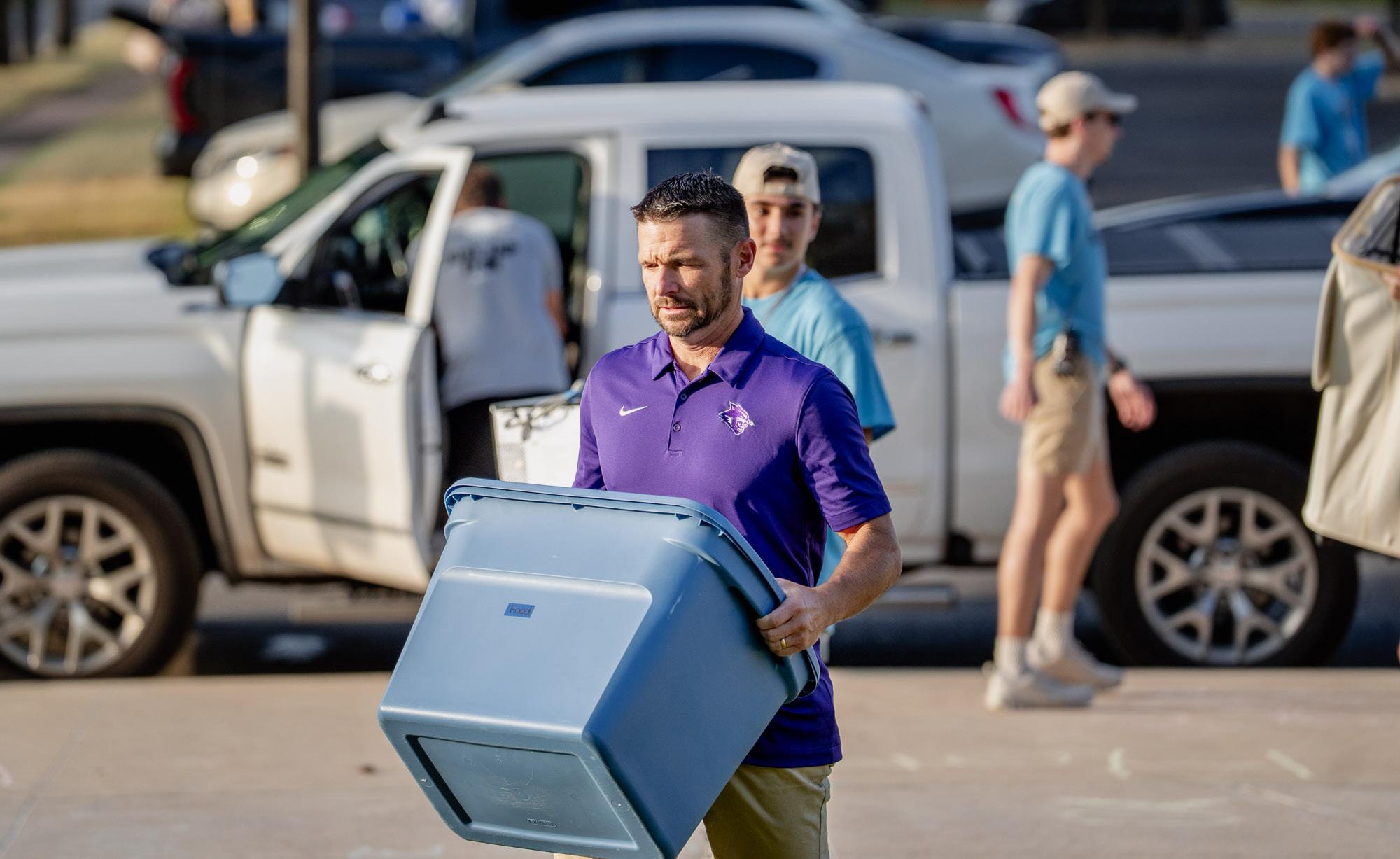
Dr. Dennis Marquardt, Bullock faculty-in-residence and associate professor of management, carries a box into Bullock Hall.
BY JOSHUA VARNER SPORTS REPORTER
BY JOSHUA VARNER | SPORTS REPORTER
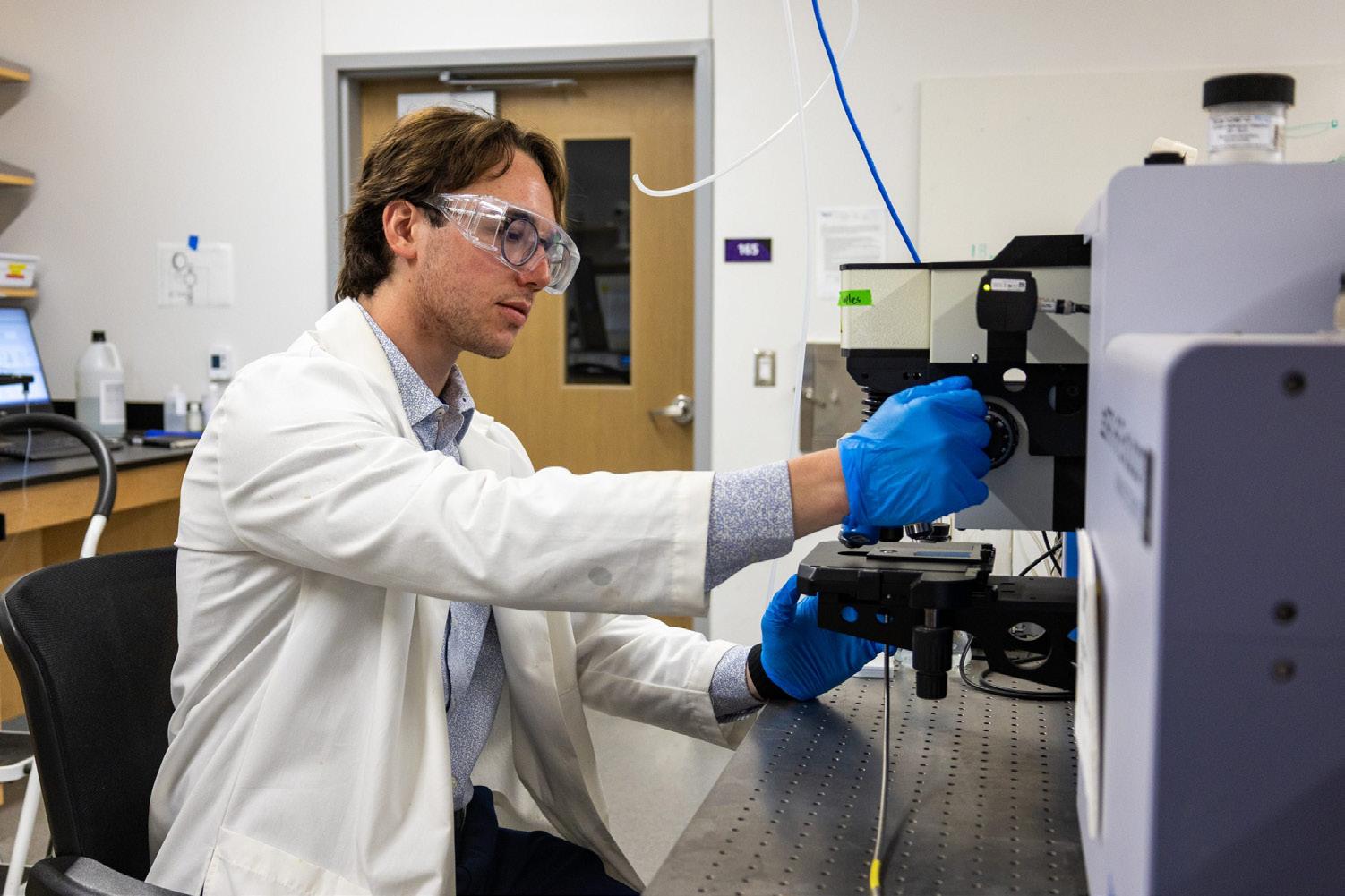
Darren Pratt, junior biochemistry major from Childress, works on a research project in the NEXT Lab.
BY DANIEL CURD | CHIEF PHOTOGRAPHER
Drone shot of Dillard Science and Engineering Research Center, NEXT Lab.
2026 PREDICTIONS
It’s that time of year once again! The Optimist Sing Song Edition has arrived and the staff has locked in their predictions. Hal Hoots has seen your comments and taken a year to reflect. After careful consideration and with a new system in place, the 2026 Optimist Sing Song Predictions are officially in. Editor’s note: Staff members participating in a Sing Song act did not partake in the prediction process for their respective divisions. The staff used the offical Sing Song scorecards when assessing each act.
MEN’S VOICES
The Men of Gamma Sigma Phi present a theme that Sing Song has never seen before. Their harmonies and ability to blend vocally is angelic. The combination of a clean and pretty set and unorthodox costumes make for fun viewing for the audience.
Frater Sodalis, with an entertaining show, has the potential to wow the audience. Their selection of iconic songs and clever lyrics sets a strong foundation for the act. Fixing some vocal blending and choreo details could make for a great act all around.
The Fraternity of Galaxy have a well constructed theme that is backed up by clean costumes and a cohesive set. Vocals, while solid overall, leave something to be desired by the audience. The repetition of melodies along with some unclear choreo leave room for improvement ahead of showtime.
The Women of Ko Jo Kai will blow you away with with their stunning set and costumes that once again push the limits of innovation. Their creative and well-planned choreo fits perfectly with their harmonious vocals in an all around show stopping act.
The Siggies are coming in with a powerful act that also excels visually. Their vocal harmonies set a tone early on that they are able to maintain throughout their act. On top of this, their choreo is iconic, adding an additional layer of complexity to an already solid act. Despite this, the lack of wow factor puts them just behind in an incredibly tight race.
3. GATA
The Women of GATA present an entertaining story that is sure to keep the audience captivated. Their colorful set, props and good cameos set the foundation for a great show. However, inconsistencies in vocals and choreo leave room for them to clean before showday.
of this
(Photo courtesy of Phoebe Galan) SENIORS It’s Alive: An Experiment Gone Sing Song
The debute of the Mixed Class act comes with a unique theme. The combination of hilarious lyrics, strong vocals and simple but effective costumes create a captivating show. But is their set too bland for them to stay in the top spot?
The Seniors present a vibrantly colored act that utilizes a well designed set and constumes. Their creative theme, lyrics and props create a well rounded act. However, issues on vocals and movements bring them back
1. GAMMA SIGMA PHI
2. FRATER SODALIS
3. GALAXY
1. KO JO KAI
SIGMA THETA CHI
MIXED
from The Big Apple, the Women of Sigma Theta Chi are bringing Broadway to the Sing Song stage. Sharp choreo, pristine costumes, and harmonies that hit the spot, but can they kick their way to a win?
THETA CHI
Radio Siggie Rockettes
Huth refuses to quit, rewriting story at ACU
BY ZION WEBB SPORTS EDITOR
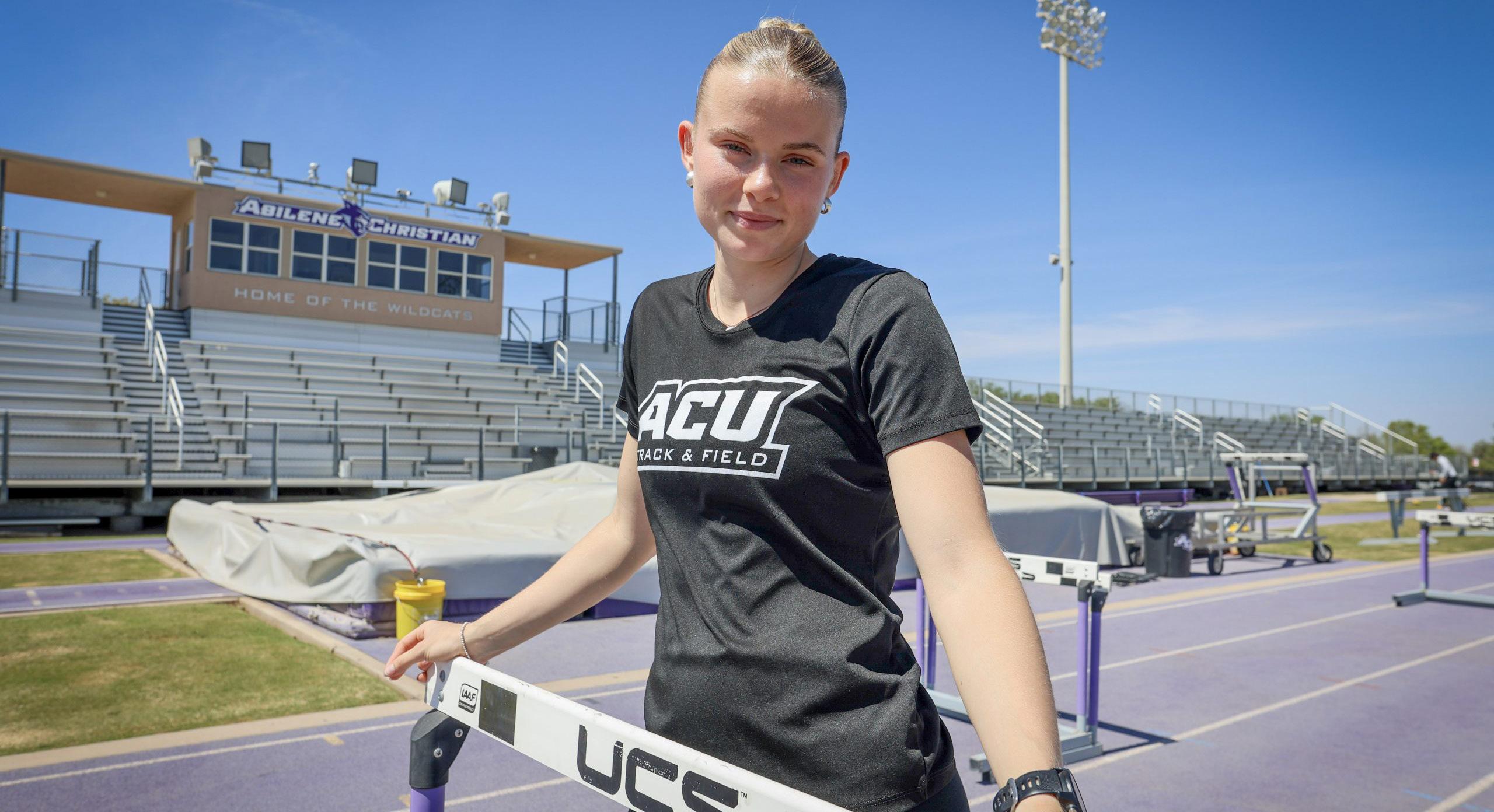
Nele Huth, a multi-event athlete, grew up in Frankfurt am Main, Germany, where, before track, her earliest memory of outside activity came in kindergarten, going to the bathroom in the forest.
“I was in the dirt every day,” Huth said. “We just went to a different place in the forest and spent the whole day there. There was no toilet. Just go to the forest.”
This built up a childhood of trying anything. From soccer, tennis, ballet, judo, and other things, Huth seemed to accidentally brush up against her later most prominent sport.
“Track was actually the last sport I started,” Huth said. “I just went to practice with my best friend … we’re just jumping over boxes, having fun.”
That fun quickly turned to commitment because, unlike schools in America, if you want to play a sport in Germany while in school, you have to find a club system to play for.
For Huth, track always came easily, and after going to practice with her friend and talking to her parents about joining a sport, she learned her father ran track, which grew the love even further. Despite that, what came just as easily as the sport were the injuries.
Huth went through a foot injury, hip injury, torn tendons, among other things, consistently having her sidelined, at times facing surgery that would cause her to lose her ability to walk. The injuries took a toll not just physically but mentally, while going through depression and an eating disorder.
“I had like so many injuries … and I was like, ‘OK, should I quit,’” she said.
Instead of quitting, her life shifted into a break, stepping away from the track for nearly 10 months while traveling around Europe.
“That trip helped me so much because I completely lost connection to like reality and to all my problems,” she said.
When she returned from her trip, she made the spon-
taneous decision to get back into things, go to the United States and try to give track another chance. While researching agencies, she applied for one and did not tell anyone.
“I signed up for the agency without telling my parents,” Huth said, “but they got an email. That’s how they found out.”
The ball started rolling from there and with the support of her parents, the countless calls and conversations with coaches around the world landed her at ACU.
“I got here … and I literally didn’t know anyone,” she said. “Different country … didn’t know the coaches … didn’t know anyone here.”
That also came courtesy of a program change where new staff were implemented after her recruitment, before she arrived on campus.
Associate Head Coach Anthony Acklin said when he first met Huth, he was not sure what she would be like, but that quickly changed.
“She works hard … does whatever I ask her to do,”
Acklin said.
That work ethic stems from Huth rediscovering what she had been missing.
“I got here, started practice, really enjoyed it, because I finally had a team again,” she said.
Her mindset shifted. The pressure was gone, replaced by joy.
“If you see me competing, I’m just like smiling like a little kid,” she said. “I’m just happy.”
Part of the reason to be happy is helping others through hard times as well, which she said she feels is a big way she connects with her teammates, which her coach seconds.
“She’s very supportive of [her teammates] and cheering everyone on, making sure everyone is doing everything they can to get better,” Acklin said. “We need more like her.”
Outside of the leadership role, the success comes on the track as well, including a recent school women’s indoor pentathlon record at the Western Athletic Conference Championships. But for Huth, that is not the greatest victory, but
instead appreciating the chance to move forward.
“It’s like a new chapter now,” she said. “The old chapter with depression, injuries, just everything is just
Grad students embody being ‘hands and feet of Je sus’
BY ASHLEY HENDERSON EDITOR IN CHIEF
For one, it was living with an autoimmune disease. For one, it was watching her brother with autism, unable to tie his shoes. For one, it was growing up with a learning disability. And for another, it was her friend with multiple amputations. They all have different stories that pushed them to pursue a career in occupational therapy.
April is Occupational Therapy Month, a month meant to raise awareness and celebrate the benefits of OT. For first-year students in the occupational therapy graduate program, helping people through OT has become a part of their daily life.
“Occupational therapy is a type of therapy that really focuses on getting back, or helping people get back, to things that bring them meaning and purpose,” said Reagan Gary, graduate student from Anson. “We really focus on occupation-based intervention, so things like helping them do self-care again, community management and being able to drive again.”
Since OT work is in a wide variety of settings and populations, M.C. Gunn, graduate student from Waco, said it can be difficult to define.
“Occupational therapists literally can work with people from like birth, like in the NICU, all the way to end of life care in hospice, and basically everything in between all of that,” Gunn said. “We kind of have a hard time defining it because depending on the setting and population you’re with, one
OT’s day-to-day job could look completely different from others.”
One of the most common misconceptions about the word “occupation” in OT is that it means job, Brianna Steele, graduate student from May, said.
“Occupation is anything that gives your life meaning, your purpose, or that takes up your time,” Steele said.
“Nobody thinks washing your hair is an occupation, but it is, especially for someone who’s had an accident.
Until you’re in that position, you don’t know anything about it, but we just want to get the word out there, because, I mean, it’s our job.
We’re advocating for ourselves, but then also advocating for our patients.” Gunn agreed and said she
has an autoimmune disease, but OT was never offered as an option for her. After learning more about it, she chose to pursue the career after she saw its impact.
“It’s something that I really think that I could have benefited from,” Gunn said.
“That’s just deepened my love for our profession and for pushing out what OT is, and kind of advocating that all types of people, whether they look like they need it or not, can really benefit from occupational therapy.”
Clay Ray, graduate student from Pampa, said he worked with an OT after he was diagnosed with a learning disability.
“For about a year and a half, two years, my occupational therapist worked with me one day a week for two
years, and it really stuck with me because I know this profession works,” Ray said. “I know from experience. And I tell people all the time, like, if it wasn’t for her, I’m not here, I’m not in college. I’m not in grad school.”
Through the university’s program, students take classes for about a year and a half. Then, they go into clinical field rotations. After rotations, Master’s students can sit for their board exam to become a registered, licensed occupational therapist, and Doctoral students can come back and complete a capstone research-based project before they can sit for their board exam.
They also have the opportunity to create prosthetic hands and other projects as well as spend a day using a
wheelchair to travel around campus.
“We’re learning about all kinds of adaptive equipment, seating and mobility,” Gunn said. “Universal design is a really big aspect. We even get down to visual adaptations, like hearing aids, hearing adaptations, and kind of different things in the lecture, and then the lab is where we go to the maker lab at ACU, and we actually make and design our own adaptive equipment.”
For some projects, the students are assigned a population, and they get to choose what they want to make.
Steele recently made a coffee pot for the older population.
“You could always say, well, there’s Keurig, but that’s not what’s meaningful to them, and that’s not what they want to do,” Steele said. “Once you’re that old, you’ve done it so many times, it’s like muscle memory. And so basically, we made a wooden base and that you could slide into the coffee pot and put the coffee pot on it, and then strap it in and pull it out, and then it has a base that’s swinging, and you can pour it. So it doesn’t take a lot of arm strength.”
Each student said the projects help them grow and learn to think more critically because they have to apply information to make decisions about how to help each individual.
“It’s just a deep level of critical thinking and clinical reasoning,” Gunn said, “and a lot of the time there’s not really a right or a wrong answer. That’s been kind of a big challenge for all of us to get out of that mindset of
like, well, ‘I want to be right.’ It’s not always right, and you just have to do, what’s best for your patient and what’s best in that moment.” Gunn said that through the challenges, she has become more empathetic toward others.“Some of the stuff we’re learning and the stuff that we see is honestly kind of hard and can be really sad sometimes,” Gunn said, “But that’s the beauty of our profession, is we can take that compassion and that empathy, and we can bring meaning into people’s lives and help them regain independence.”
Ray said last semester humbled him and reminded him to be thankful for the ability to do what may seem like simple tasks.
“You don’t need to take stuff for granted,” Ray said, “because you could be in a different situation where it might take you an hour to do something, or you might not be able to do that kind of stuff anymore at all. I mean, it’s a blessing.” Gunn highlighted how the university and the professors in the program reiterate compassion.
“Nothing about our body and the way that we move and this life that we live is by accident, and it’s all a very intentional design,” Gunn said. “I just feel like our profession is honestly not really one that you can–I don’t know how people can do it without a deep faith because I just feel like OT is really the hands and the feet of Jesus on this earth,” Gunn said.
More information about the university’s graduate OT program can be found on the university website.
over … It is a new chapter I can start writing.” Huth said she looks back on the moment and stands firm in her own personal conviction: never quit.
PHOTO BY CALLIE BRIMBERRY Huth competes in the high jump during the 2026 Wes Kittley Invitational.
PHOTO BY ASHLEY HENDERSON Three prosthetic hands built by the Occupational Therapy Department
Chapel requirements shift, students perspectives follow
As students enter Chapel, the room fills with activity. Some students are talking and laughing with their friends, while others are rushing to find a seat. Lights glow against the stage, and music begins to play. Some are fully engaged, while others sit back, simply present. All sharing the same space but not the same experience.
Chapel is a defining part of campus life, providing students with a midday pause for spiritual growth and community. But as the university adjusts its chapel credit requirements, students across different class years are experiencing chapel in different ways.
“Success from spiritual formation comes when we assess observed variables, like church attendance, the ability to articulate God's action in life, and the ability to articulate the grounding of what faith in Jesus means,” said Ryan Richardson, vice president of student life. “Our goal is that a student becomes more animated by the presence of Christ in their life and in all of their decision-making.”
From underclassmen seeking connections to seniors balancing internships and heavier workloads, Chapel serves a different purpose at each stage of college, and student perspectives shift over time.
Beginning last fall, ACU implemented a
tiered chapel credit system that lowered the number of required credits each year. The change reflects an acknowledgment that students' schedules and responsibilities change throughout college.
Richardson said the tiered system is designed not to reduce spiritual formation but to shift responsibility over time.
“What we’re trying to convey is that you need to take ownership of your spiritual formation over the four or five years you are here and work with the local church,” Richardson said. “Our hope is that we're kind of passing the baton to the church to continue that good work because that will continue long after they've graduated from our university.”
Richardson said the change in Chapel require-
BY
ments was rooted in years of research and observation.
“When students have a lot of Chapel credits to accomplish, that sometimes can dissuade church attendance and further spiritual growth,” Richardson said. “We wanted to see if we could hit that tipping point, where our students would say, ‘I can achieve this, and it helps me, and it affirms my walk with Christ, and I don't feel burdened under the heavy weight of having to get so many credits every semester with very few choices.’”
Many upperclassmen approve of the change, saying they like how the requirements drop each year.
“I was happy about the requirements changing, but I don't think I would have wanted it to be different when I was a fresh-
man,” said Lucy Wilkinson, senior social work major from Groxon, Connecticut. “But it’s nice that it changes every year, so you don't have to work up to the same standard every year.”
While she does not attend Moody Chapel as much anymore, she continues to go to department and club chapels because it is more of an experience for her compared to Moody, where she mainly went for credit.
Her experience reflects a trend in student life: While underclassmen often rely on Chapel for community, upperclassmen tend to seek it out more selectively.
Hannah Anthony, sophomore biology major from Arlington, said that Chapel was a chance for students to take a few
minutes out of their day to rest and give glory to God.
But as her workload increased, it became more difficult to be consistent.
“Being in harder classes makes it difficult because I need more time to study. I also have class at [noon], so sometimes I skip so that way I am able to make it to lunch and not be rushed since it is always busy after Chapel,” Anthony said.
Like Wilkinson, Anthony prefers small-group Chapels.
“In Moody Chapel, I don't always feel engaged and tend to like smallgroup Chapels more.”
Anthony also said community was an important factor when it came to Chapel.
While some students find value in Chapel, some motivations are driven by
“What we're trying to convey is that you need to take ownership of your spiritual formation over the four or five years you are here and work with the local church”
RYAN RICHARDSON
completed requirements.
“My motivation tends to go away as the semester goes on. I go every day the first few weeks, but then
tend to only go to certain ones,” Ebone Durham, junior communication disorders major from Garland, said.
Durham typically attends Chapel once a week and is more selective about which chapels she decides to go to, preferring small Chapels that are more engaging.
Students' differing perspectives highlight that Chapel serves different purposes depending on where students are within their college journey.
“As a freshman, you want to plug into small group chapels, especially if you are looking for community,” Wilkinson said. “But as a senior, you have already established that.” Chapel can hold value even during your last semester of college.
While students' experiences vary, the university measures Chapel's effectiveness through longterm growth.
“Surveys have proven that from freshmen up to seniors, levels of trust and reliance upon God as foundational to life increase throughout the four years of ACU,” Richardson said.
Even with the changes in requirements, the overall goal of Chapel still stands:
“Our hope with Chapel is that students know that Christ created them, that Christ died for them, that Christ rose from the dead for them, and that Christ wants to be a part of every decision that they make in their lives,” Richardson said.
Federal funding cuts hurt local journalism and Americans
BY LESLIE CARRIGAN MANAGING EDITOR
With the mission of “ensur[ing] universal access to non-commercial, high-quality content and telecommunications services … to more than 1,500 locally owned public radio and television stations across the country,” the CPB has helped fund National Public Radio since 1967, according to the CPB website. On Oct. 1, that funding stopped. Congress voted to cut around $1.1 billion in federal funding for public media as part of a rescission package. This is because NPR and other public media platforms have been accused of having a liberal bias, according to a press release from President Donald Trump in May.
So, why does this matter?
Well, hidden away on a small corner of campus, we have 89.5 KACU, a student-run local NPR member station, that lost 31% of funding for the coming year. This equals out to around $150,000, said Heather Claborn, the station manager and news director for KACU.
She believes the main goal of the package Congress passed was to hurt NPR on a national level;
however, this was not the result. Instead, NPR only lost a small portion of its funding, but the local member stations are experiencing devastating losses.
Many of these smaller stations were already struggling to maintain their staffing and funding before the vote; now they will need to make up a lot of that lost funding from their own listeners, Claborn said.
“For a lot of the big stations, it was like four or five or maybe 8% of their budget. To lose 31% of your budget is a big hit,” Claborn said.
“We can’t just ask listeners to come up with $150,000.”
These local stations are important because they are a part of the community around them and help keep residents informed, and this closing of local news is part of a larger concerning trend throughout the U.S.
A study done by the Local News Initiative found that the number of news deserts is quickly rising and getting bigger. At the end of 2025, there were 212 counties in the U.S. without any local news sources and 1,525 counties with only one local news source. This results
in roughly 50 million Americans living with little to no local news sources.
Since the CPB funding cuts in October, we have seen more legacy media cut their staff and limit reporting.
In early February, the Washington Post cut 30% of its employees, which amounts to over 300 of the 800 journalists in the newsroom, according to the New York Times. This reduced the Post’s metro section and international section, and completely eliminated its sports section.
The Post, which was founded in 1877, with the motto, “Democracy dies in darkness,” has played a pivotal role in American politics. Perhaps most notably, it’s the breaking of the Watergate scandal and the publishing of the Pentagon Papers in the 70s.
For many, these legacy outlets may seem distant and unimportant from the problems facing Americans, but in the end, journalism helps everyone, and when we see news organizations face cuts, we should be concerned. Local news provides valuable information and accountability to its readers. When
there is no local news, there is no one reporting and holding local governments accountable.
Dr. Ronald Morgan, professor in the department of history and global studies, is a longtime listener of KACU. As a historian, he emphasized the importance of quality journalism.
“In politics, players are telling us their version of what they want us to think in order to gain their political points and carry out their agendas,” Morgan said. “Journalists say I’m going to go to Gaza and tell you what’s happening. I’m going to go to Sudan and tell you what’s happening. I’m going to go to a factory in South Side Chicago and tell you what we’re seeing there. News has to be separated from financial and commercial self interest.”
When government and those in power do not do there job, or fail to represent the beliefs and needs of their people it is journalists who help hold them accountable.
If you are reading these words, you are already doing something right. Go pick up a paper or turn on your radio and continue to invest in quality journalism.
THE OPTIMIST STAFF
PHOTO
COURTESY OF MATT MAXWELL
Leslie Carrigan, junior journalism major from Midland, hosting the show "All Things Considered" show for 89.5 KACU.
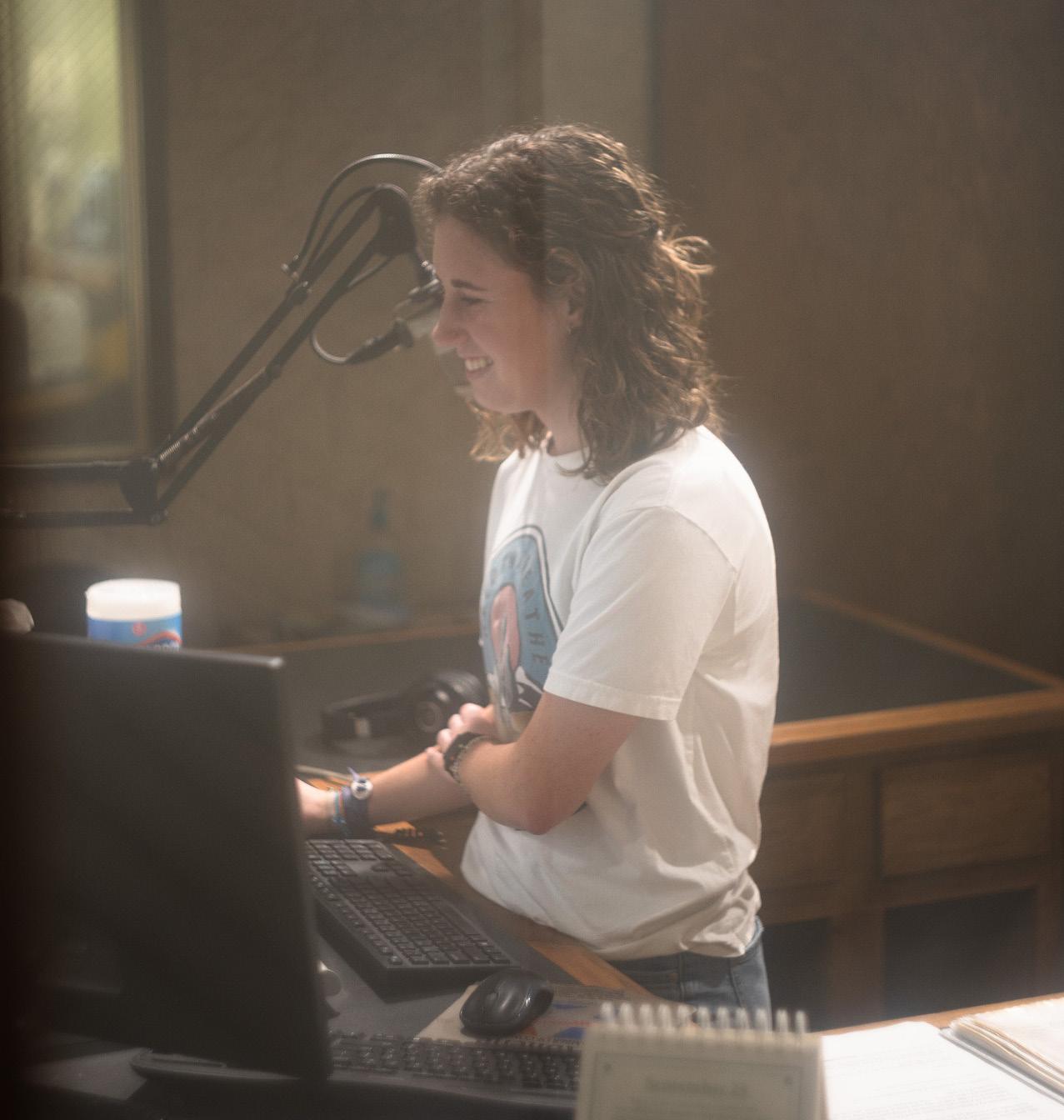
BY MAKAYLA CLAYTON | OPINION EDITOR Zion Webb, junior journalism major from Cypress, works a shift as a host in the KACU studio.
DANIEL CURD | CHIEF PHOTOGRAPHER
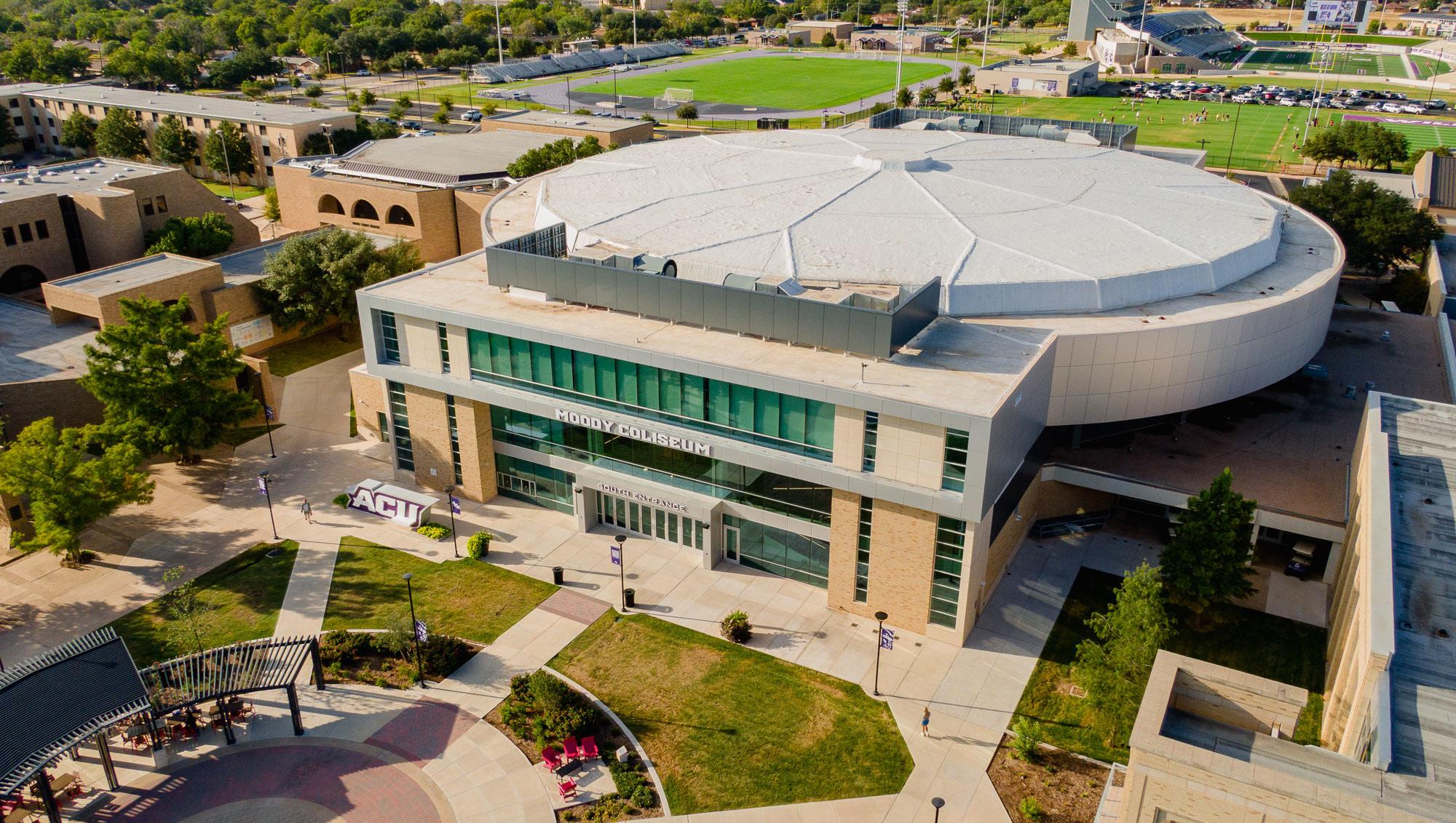
Students exit Moody Coliseum after chapel.
Baseball ‘bonds over the road,’ faces SFA, McNeese
BY ROMAN RAFFAELI SPORTS REPORTER
The Wildcats will continue their seven-game road trip this week with a midweek matchup with Stephen F. Austin University and a weekend series against McNeese State University.
In the team’s series last weekend, it won 2-of-3 on the road at University of New Mexico. The Wildcats scored a total of 28 runs while winning Friday and Saturday’s games before losing the series finale Sunday afternoon.
“I thought overall it was a really solid weekend for us,” Head Coach Rick McCarty said. “New Mexico is traditionally a really tough place to pitch… I thought our guys battled.”
While the team is in the middle of a lengthy stretch of road games, the Wildcats have also played a significant number of their non-conference games this season at home. Through 24 games, 15 have been played at Bullock Brothers Ballpark and 21 have been played in Texas.
“I think sometimes it’s just good to get out,” McCarty said. “You’re together, there’s not a lot of other stuff going on. You’re in the hotel hanging out. NCAA was playing, so you’ve got some stuff to
watch and root and cheer against or for.”
In the series victory over the Lobos, Brady Gray, sophomore catcher from Farmersville, hit three home runs while driving in eight runs over the three games.
“This is adjustment time,” McCarty said. “I thought Brady did a really good job adjusting over the weekend. He got on time with some fastballs early. He’s been having some really good atbats… The process has been good. He’s just not had a lot of results show for him.”
Zandt Payne, graduate from Edmond, Oklahoma, had eight hits while hitting in the 2-hole for the Wildcats. Payne, in his third year as a Wildcat, has spent the majority of his time hitting leadoff. Over the last several games, Payne has hit behind either Grant Watkins, senior from Los Alamos, New Mexico, or Ryan Jones, redshirt freshman from Aledo.
Against New Mexico, it was Jones who hit leadoff on Sunday. Over the weekend, he had five hits, including two doubles.
“He has a lot of really good at-bats,” Payne said. “He just finds ways on base, which is why I think we put him in the leadoff spot. He can provide that spark, too. That’ll
help us get going early in games.”
Now, as the team looks ahead to SFA, they’ll look to play a much different game than the 20-10 victory on March 4 in Abilene. The Wildcats were down 10-1 before scoring 19 unanswered runs and run-ruling the ‘Jacks in Abilene.
“You never want to get down 10-1,” McCarty said. “They’ve got a new coach, he’s doing a really good job and the guys are believing down there.
They’ll play in Nacogdoches on Wednesday before heading to McNeese for the three-game series. McCarty said that while the team enjoys having the same routine and resources while at home, getting on the road can bring the team together.
Starting with the series last weekend in New Mexico, the team will play in seven weekend series in seven different states, including New Mexico, Louisiana, California, Indiana, Utah, Texas and Arizona, if the team makes the Western Athletic Conference tournament.
“If we make the conference tournament, we’re going to be on the road seven of ten weekends in seven different states,” McCarty said. “It’s going to be a challenge.
But you get to hit first on the road. You get to be a little bit more aggressive.”
Ahead of the games with the Lumberjacks and Cowboys, McCarty emphasized playing clean defense while continuing to get consistent offensive output like the team has recently.
“It all starts with defense,” McCarty said. “We’ve got to continue to catch and throw.
Our first 11 games weren’t good, but we’ve basically cut our errors in half over the last 11.”
SFA has improved to 1312 on the year since losing to the Wildcats earlier in
BY DANIEL RHODES
March. Senior infielder Julian Swift has swung the bat well for the Jacks, hitting .340 on the season with 10 doubles and three home runs.
The Wildcats have not played McNeese since 2019.
The former Southland Conference Rival is 12-12 on the year and will have a midweek game of its own, against Louisiana Christian. In the two teams’ series history, the Wildcats are 4-11 against the Cowboys and have lost 5-of6 games on the road.
“Once we get going as an offense, we’re really pretty hard to stop,” Payne said.
“Once we figure out starting early and are able to jump out on teams and keep rolling, we’re going to be a very tough offense to beat.” The weekend series at McNeese will be the last for the Wildcats before WAC play begins. The team will welcome California Baptist to the Big Country next week for the first weekend of WAC play.
“I think this team, for as long as I’ve been here, has gotten closer and closer together,” Payne said. “I think these road trips are a big part of it.”
Athletes navigate unclear future amid ACU scholarship change
BY ZION WEBB SPORTS EDITOR
Following recent NCAA House settlement rule changes, the university will implement a new athletic scholarship model that changes how financial aid is distributed among student-athletes.
The intercollegiate governing body announced in June 2025 a shift in how scholarships can be distributed, giving programs more flexibility in allocating financial aid across rosters.
For ACU, this means that programs considered “head count” sports, like volleyball and football, which previously had 12 roster spots and 12 full-ride scholarships available for each athlete, will transition to a model with 18 roster spots and 18 scholarships. The university can now choose how to distribute aid among athletes.
In response, ACU has decided to it will adopt its own model beginning in Fall 2026.
According to a statement from the Department of Athletics, the university will restructure how scholarships are categorized for ACU athletes. Previously, Wildcat athletes combined merit-based academic aid with athletic scholarships, coming from separate sources. Under the new model, those funds will be combined and fully categorized as athletic schol-
arships.
“The merit-based aid dollars are not going away; they are simply being recategorized within the financial aid system,” the statement reads. “The total amount awarded will vary among student-athletes, but no student-athlete will receive less total aid than the amount they previously qualified for in merit aid.”
Despite a guaranteed floor equal to the previous academic scholarship amount, some athletes may receive more under the combined system, while others could
lose money, receiving only the minimum academic award.
ACU says the shift is intended to give coaches more flexibility, provide a clearer picture of total aid packages and better position its programs for long-term success under the new NCAA guidelines.
Still, reactions among athletes have been mixed, with some uncertainty.
Some coaches have reassured their teams that the changes are largely nominal, while others have expressed
concerns about how the new system will affect sports with larger rosters, such as track and field.
Hadley Phillips, a distance runner, said much of what athletes have heard has been informal.
“Right now, it’s all word of mouth… nothing has been formally announced or written,” Phillips said.
She also mentioned a conversation with her coach, suggesting that the uncertainty for her and her event group may prompt athletes to consider transferring.
“At least from our event group,” Phillips said, “the recommendation for anyone who still has eligibility and wants to compete is to enter the transfer portal at the end of the semester.”
In sports like track and cross country, where scholarship money is often split among many athletes, many rely on academic aid to cover the cost of attending ACU.
“It’s a very uncertain time for our entire team,” she said.
The situation has led some athletes to consider transferring, while others are weigh-
ing whether to remain at ACU without competing. For Phillips, making the decision could mean leaving ACU and forfeiting a year of eligibility.
“I am not on any athletic scholarship money,” Phillips said. “I chose to come to ACU because I knew my academic scholarships would cover more than half of my tuition… I think there will always be part of me that grieves the year I didn’t get.”
The full picture remains unclear, and ultimately, the decision on how money is allocated now rests with ACU’s coaches and Athletic Department. Phillips expressed skepticism about whether the university, unlike a Power Four institution, will be able to ensure equal funding for all athletes.
“The goal is that they can give us the same amount of money that we would be receiving from academics so that it equals out, but that just will not happen,” Phillips said. “There’s no way we will be given enough money to give everyone the same amount that maybe they were receiving from academics.”
For now, questions continue to loom, leaving Wildcat athletes watching closely to see how the model change unfolds.
ACU opens spring with record class, new faces at quarterback
BY CAYSSON HIGGINS SPORTS REPORTER
ACU head football coach
Keith Patterson welcomed the largest recruiting class in the program’s Div. I era this offseason, signing 40 players, including 17 transfers and 23 high school prospects, as the Wildcats begin spring practice with a rebuilt roster and renewed championship aspirations.
The jump from last year’s class of 18 is significant, but Patterson said the numbers reflect necessity as much as ambition.
“We have a large senior class, and then guys who exhausted their eligibility, and then I think we lost four more to the transfer portal,” Patterson said. “It was just one of those years where we felt like let’s go big and try to develop some high school prospects.”
The biggest turnover this year is at the quarterback position. All three signal-callers who took
snaps last season have exhausted their eligibility, leaving redshirt freshman John David Black as the only returner. Patterson brought in four new quarterbacks this offseason, including Marcos Davila, who carries FBS experience from Nebraska.
“Marcos has a big, strong arm and is very familiar with our system,” Patterson said. “He seems to be very prominent right now, very comfortable in what he’s doing. I think when you can bring that experience here, you can help elevate the others.”
Patterson added that, like last season, the competition is expected to carry through spring and into fall camp. Emmitt Brown, transfer from Coastal Carolina, is not set to arrive until late May, and Tucker Parks, transfer from Western Kentucky, brought in through a coaching connection, adds another option to a crowded room.
Patterson also mentioned that the transition
from high school to college football makes quarterback development inherently difficult to rush.
“The speed of the defensive sets is just so much quicker than it was in high school,” he said. “It’s a process of being able to read coverages, understand concepts, and go through progressions quickly. For a lot of these guys, that transition is everything.”
Patterson also reflected on the evolution of the transfer portal. Last year, he called the recruiting window the most difficult of his career after ACU’s playoff run overlapped with the portal opening. This cycle, he said, the difference came down to preparation and mindset.
“I was more proactive, bringing players in immediately on that Monday after our season ended and talking about their future,” Patterson said. “Two years ago, you walk in thinking you’re going to celebrate the season, and instead
you’ve got meetings all day with people discussing their next step. This year, I was better equipped. It’s just a constant evolution.”
ACU has won back-toback United Athletic Conference championships and reached the second round of the FCS Playoffs each of the past two seasons. When asked how Illinois State’s run to the FCS national championship game serves as inspiration for a program like
ACU, Patterson pointed to how close the margins at the top of the sport really are.
“It just shows you that if you get hot and you’re playing well at the right time and you stay healthy, anything can happen,” Patterson said. “We watched them play North Alabama, and that was an extra point from people going home. You’ve got to have some breaks like that, but it’s also encouraging
to know that we’re a lot closer than we think. We still have a lot of work to get done.” Patterson said the standard inside the program remains anchored to three yearly goals regardless of outside expectations: go undefeated at home, win the UAC, and compete for a national championship.
“If
BY ASHLEY HENDERSON
BY DANIEL CURD | CHIEF PHOTOGRAPHER Moody Coliseum home of the Wildcats’ basketball and volleyball.
| PHOTOGRAPHER Ryan Jones, redshirt freshman infielder/outfielder from Aledo, has a turn at bat.
Softball loses opening conference series vs. UTA
BY HAYDEN DELAND NEWSCAST DIRECTOR
The softball team finished its first conference series of the season with a win on Saturday against the University of Texas-Arlington Mavericks, 7-2, after losing the first two games of the series on Friday.
On Friday, the Wildcats played a doubleheader, losing the first game 12-8 in 10 innings and the second game 11-6.
After the series, the Wildcats are now 4-26 on the season and 1-2 in conference play, putting them sixth in the Western Athletic Conference standings, one spot above last-place Tarleton State, which has not played a conference game.
In the first game on Friday, Emerson Meggers, junior infielder from Vacaville, California, and Ari Maxwell, sophomore outfielder from Edmond, Oklahoma, led the team with one hit and two RBIs, and three hits, one run and one RBI, respectively. Both had six atbats.
Ella Beeman, right-hand-
ed pitcher from Lowell, Arkansas, and Leah Meyer, right-handed pitcher, shared the mound in Friday’s first game, pitching five innings each. Beeman pitched eight innings throughout the weekend, the most of any ACU pitcher, and had two strikeouts and seven walks among the 40 batters she faced.
After ACU scored two runs in the bottom of the seventh inning to tie the score at eight, the two teams went scoreless until the 10th inning, when the Mavericks scored two runs on a home run and two more on a single up the middle. ACU failed to answer in the bottom of the 10th.
In Friday’s second game, Ciana Arguijo, freshman utility player from Round Rock, had two hits, one run and two RBIs in four at-bats. After the Mavericks took a 4-0 lead, Arguijo brought in ACU’s first run of the day with a single in the bottom of the 3rd inning. Maxwell followed with a home run, bringing three runs in to tie the game.
Once UTA took the
lead in the top of the fifth, it didn’t give it back and went on to win the game 11-6.
On Saturday, Arguijo led the way again with two runs, two hits and one RBI in four at-bats. ACU took an early 6-0
lead until UTA scored a two-run home run in the sixth inning, answered by an Arguijo home run to make it 7-2 and secure the win.
“They’ve learned to fight all year,” head coach Jo Koons said. “I knew
without a shadow of a doubt we were going to win that game on Saturday. We were going to find a way to win; that’s just who this team is.”
She said to start fast again, the team needs to scout and prepare well.
ACU is scheduled to play UNT after going to print.
After UNT, the Wildcats will not have a weekend series but will play No. 2 Texas Tech at home on Tuesday. When the two teams faced on Feb. 26, the Red Raiders won 24-0 in five innings.
Wildcats push through heat at outdoor season opener
BY JOSHUA VARNER SPORTS REPORTER
During what was the hottest weekend of the year thus far, the Wildcats competed at home in the Wes Kittley Invitational.
The start of the outdoor season was marked by temperatures reaching well into the 90s at Elmer Gray Stadium. Nathan Ott, assistant coach and throwing specialist, said he felt like the team handled the conditions well.
"There's only certain things you can control, and the weather is not one of them," Ott said. "But you can control how you respond to it, and you can control your preparation."
The Wildcats started the outdoor season well, winning five events across different disciplines.
To start the weekend, ACU won the 4x100-meter relay with a time of 45.47, beating Western Texas
College by 0.04 seconds.
The team was made up almost entirely of freshmen Lauren Foxworth, Kee'Lani Whitlock and Morgan Morris, along with junior Chianel Asoburuenwu, who anchored the run.
In the long-distance races, the Wildcats continued to show great pace. Chloe McLellan, senior from Waco, won the women’s 1,500-meter race with a time of 4:42.02. Likewise, in the men’s 3,000-meter steeplechase, Mark Barajas, sophomore from El Paso, led the field by nearly 30 seconds, finishing with a time of 9:37.64.
The Wildcats didn't stop there, continuing their charge in the field events. Nele Huth, sophomore from Frankfurt am Main, Germany, won the women’s high jump with a 1.65-meter jump. Likewise, Donovan Ramirez, a junior from Odessa, placed first in the men’s triple jump.
"I think it was a good
jumping-off point for most of the program," Ott said.
"I think we had kind of a mixed bag for some of the team coming out of indoor, but I would say most people are more excited or more ready for the outdoor season."
On top of this, multiple athletes set personal bests over the weekend. Sterling Glenn, junior from Rio Rancho, New Mexico, threw 51.92 meters in the women’s hammer throw, 10th all-time in ACU program history. Additionally, Rhet Punt, junior from Tallinn, Estonia, competed in the men’s hammer throw, hitting a personal best of 62.27 meters. Punt’s throw now sits fourth in program history as well. With this competition in the books, the Wildcats have another quick turnaround before their next meet in San Angelo. The David Noble Relays, hosted by Angelo State, will take place Thurs-
Wildcats out-claw Panthers, advance to second con secutive Super 16
Women’s basketball is moving on to the Super 16 of the Women’s National Invitational Tournament after a 7766 victory over Florida International University Tuesday. The Wildcats hadn’t played since falling to California Baptist in the Western Athletic Conference Championship on March 13. The win improves the team and head coach Julie Goodenough to 24-10 on the season.
“I’m just so proud of this team,” Goodenough said. “This is our 24th win. That’s huge. If we win 20 games, that’s a really great season. To win 24, we’re really proud of that.”
With Sing Song occupying Moody Coliseum, the postseason game was played on the campus of Hardin-Simmons University, just 1.5 miles from ACU. Goodenough, who got her coaching start at HSU, said it was a great opportunity to play another game at HSU and was thankful for the staff and former co-workers who made the game possible.
“We had an amazing crowd,” Goodenough said. “Hardin-Simmons did a phenomenal job hosting us … John Neese, the vice president of athletics, had to approve us coming here and playing this game, and he did not hesitate to say yes.”
The win over FIU did not come easy for the Wildcats. Conference USA player of the year Rhema Collins led the Panthers with 25 points on 10-of-15 shooting, while Fantasia James and Judit Valero joined her as the only other Panthers in double figures.
“FIU is a great team, number two in Conference USA,” Goodenough said. “They have the conference player of the year. We didn’t have an answer for her.”
Jazmyn Stone, redshirt junior guard from Federal Way, Washington, was the first Wildcat off the bench in the victory. She
entered the game in the first quarter amid a transition slugfest where the Wildcats couldn’t establish the offense.
“This week at the point guard position, we knew that a lot of pressure was going to come with it,” Stone said. “Coach always gives us a play to run, but if they’re overaggressive or overplaying us, we know to push it full court. Great things happen when we beat teams in transition.”
Stone finished the game with a season-high 13 points and a career-high seven rebounds while playing 23 minutes off the bench. She was one
of four Wildcats to score in double figures and shot 4-of-6 from the field and a perfect 2-of-2 from 3-point range.
Natalia Chavez, redshirt junior from Cochiti Pueblo, New Mexico, scored 17 points while shooting 5-of-8 from 3-point range while playing a season high 37 minutes. WAC Player of the Year Payton Hull, junior guard from Peaster, scored 16 points while Erin Woodson, junior guard from Richmond, Virginia, scored 18 points.
“Our biggest asset going into the game was controlling the controllables,” Stone said. “Know -
ing we need a little bit of energy, I’m always ready to step up to the plate and bring that.”
The Wildcats held the lead for 29 minutes, 57 seconds, while the Panthers held it for just 7:11. Despite holding the lead for the majority of the game, it remained close throughout. Each time the Wildcats would score and look to start a run to extend the lead, FIU had a response and found a way to keep it close.
The Wildcats took a 56-53 lead into the final quarter of play and, through the first 7:45 of play, went on an 11-8 run, extending the lead to
six points with just over four minutes to play. Stone hit a corner 3-pointer with 2:35 remaining after missing an open layup and stealing the ball back from Panther guard Grecia Ferrer Leal. It extended the Wildcats’ lead to 72-61 and put them in firm control of the victory. “We do work on them layups every day,” Stone said. “I knew I had to at least hustle and get it back. That was the biggest thing. On this team, it’s the next play mentality … not getting hung up on the miss, but knowing that you know it’s the effort of getting it back, and then also being confident in myself to come back and knock that shot down. With their second consecutive Super 16 appearance, the Wildcats will have a 2025 rematch with Illinois State University on the road. The Redbirds beat the Wildcats 78-68 a year ago, while Shannon Dowell led all scorers with 28 points and former Wildcat Addison Martin had 12 points and didn’t miss a shot from the field. The rematch is set for a 6:30 p.m. tip at Doug Collins Court at CEFCU Arena in Normal, Illinois. A Wildcat win would move the team to the Great 8 and give the team a chance to host the winner of George Washington University and Loyola Chicago.
day through Saturday. This quick week-to-week sched-
ule will be the norm for the team as it prepares for meets leading up to the WAC Championships in May.
BY NAYA PACHECO | PHOTOGRAPHER
Ciana Arguijo, freshman utility player from Round Rock, slaps a ball down the third-base line.
BY CALLIE BRIMBERRY | PHOTOGRAPHER
Halle Gunter, freshman multisport from Midland, competes in the women’s 100 meters.
BY ZION WEBB | SPORTS EDITOR
Natalia Chavez, senior guard from Cochiti Pueblo, New Mexico, holds follow-through after 3-pointer.