tjwneiman1@gmail.com
(+44)7928164079
EDUCATION
Architectural Association School of Architecture
Master of Architecture
Sustainable Environmental Design 2021- 2023
City University of Hong Kong
Master of Sciences
Energy and Environment 2017 – 2018
BIOGRAPHY
I am currently a Junior Building Physics Engineer, possessing a background in architectural design and building services. My experience extends to handson involvement in several projects. I possess a solid understanding of green building technologies and methodologies for analyzing energy consumption.
I am deeply committed to the field of architecture, with a specific focus on the integration of various building systems technologies to foster the development of more sustainable and well-being-oriented buildings
EXPERIENCE
NRG Consulting
Junior Building Physics Engineer Oct 2023 – Now
WSP (Shanghai)
Project Engineer Feb 2021 – Aug 2021
Carrefour (China)
MEP Engineer Dec 2018 – Nov 2019
SKILLS









INTERNSHIP
Design and Research Institute of Tongji University
MEP Design Engineer Sep 2018 – Dec 2018
Colliers International (Shanghai)
Project Engineer Jul 2018 – Sep 2018
TANG
JIAWEI

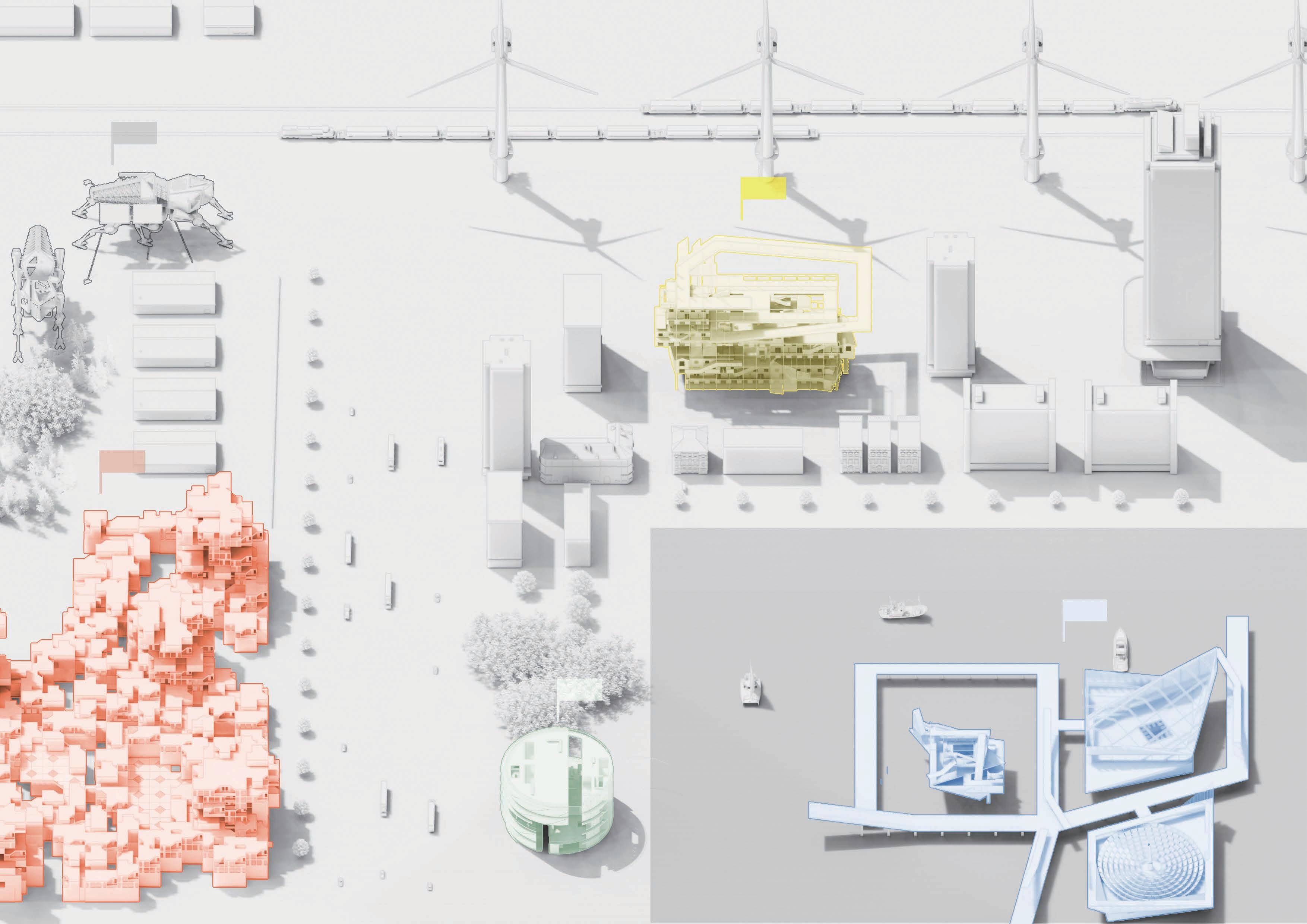



OFFSHORE FARM 1.
GENERATIVE ESTATE
PRE-FAB AFFORDABLE HOMES
2. 4.
GARDEN OF WEI
3.
PRISM FLOWER
THE HAVEN
GASHOLDER RENOVATION
5.
OTHER WORK
ADAPTIVE NOMADISM
CONTEXT
LAN WEI ALLEY RENOVATION


GENERATIVE ESTATE 1.
PRE-FAB
AFFORDABLE
HOMES
LOCATION: NEWHAM LONDON
UNITED KINGDOM
SOLO WORK
ADVISOR: Paula Cadima

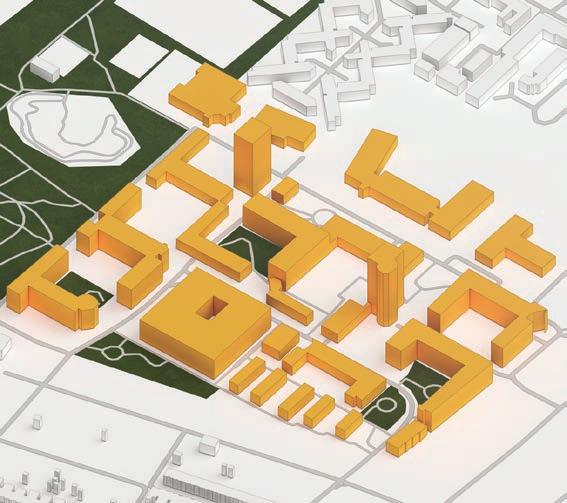
Social housing has had its ups and downs over a century since the first social house was built in London in 1900, and it has always been a straightforward way of building for the masses and improving the living conditions of low and middle income families.
In order to improve the existing arrangement of affordable housing, an attempt is made in this project to use computational tools to generate housing modules based on environmental parameters to achieve better environmental performance and more flexible communities.
THE RISE AND FALL OF LONDON HOUSING ESTATE

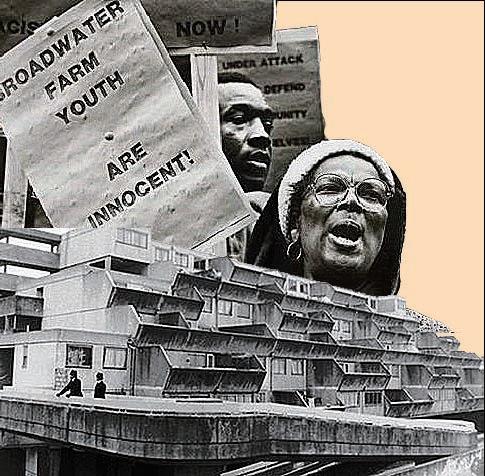


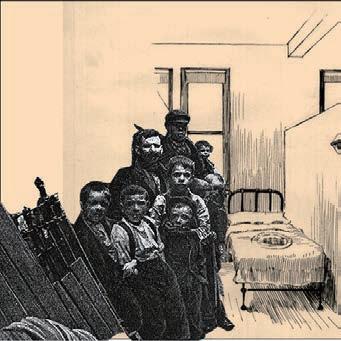
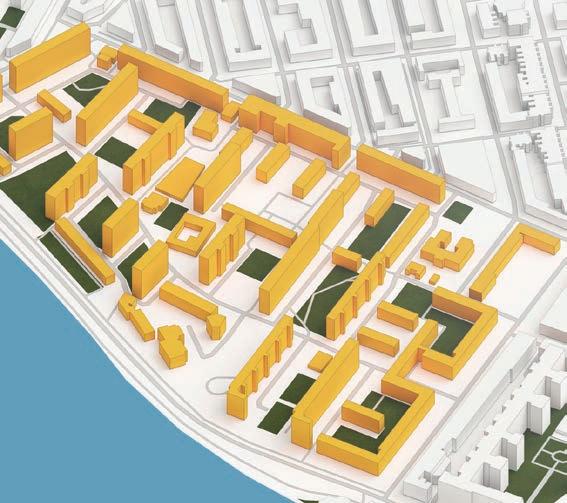
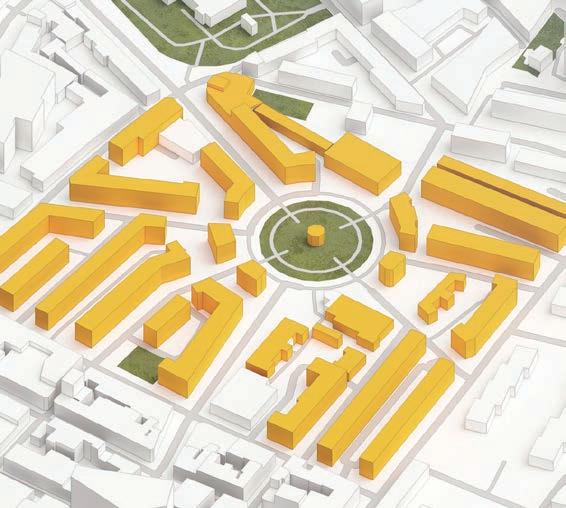
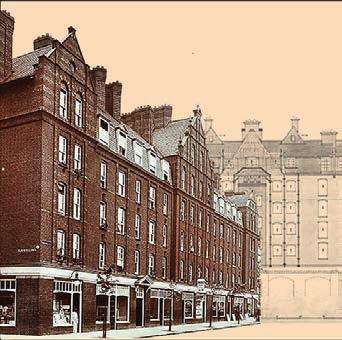
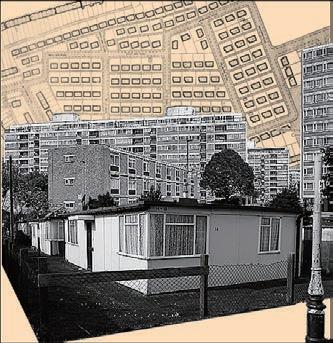

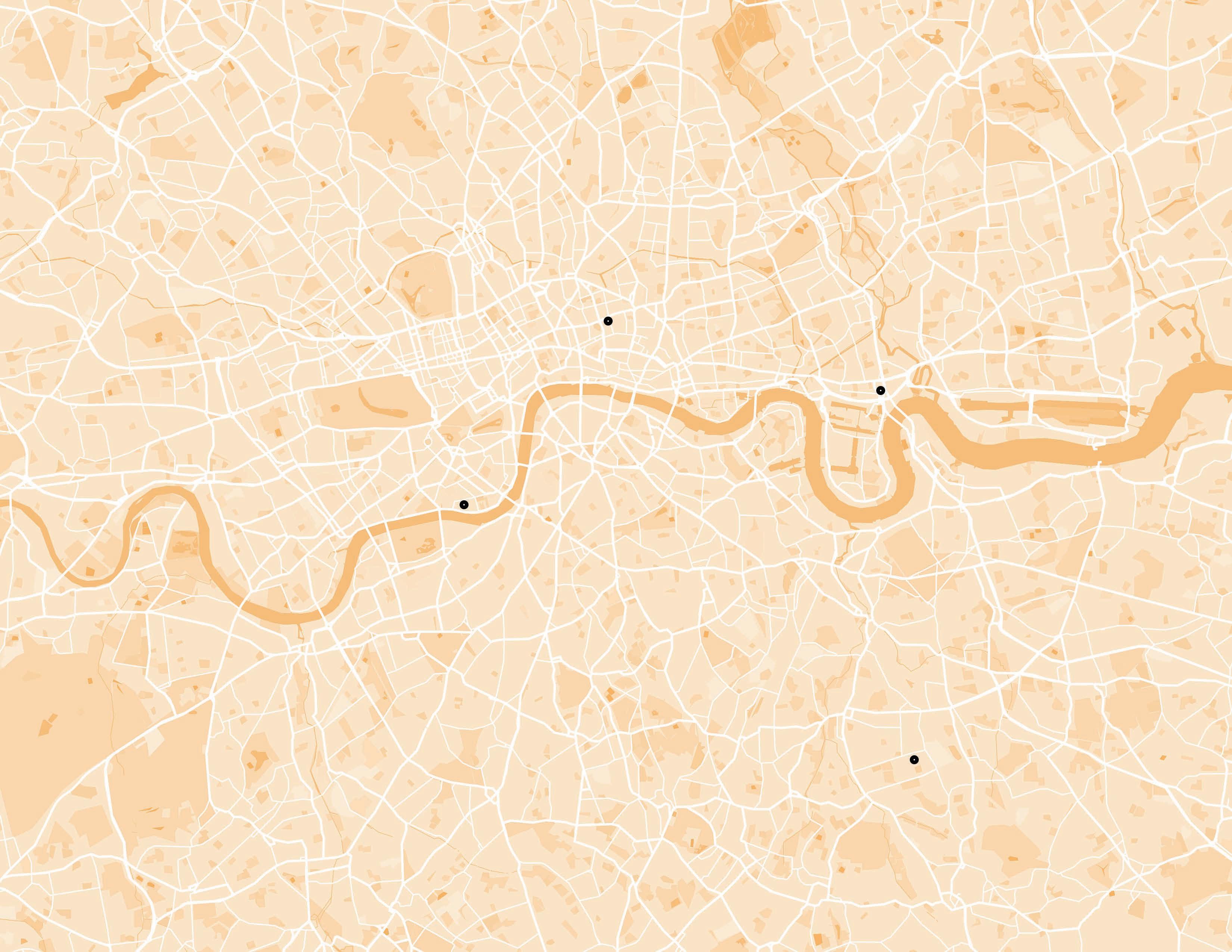
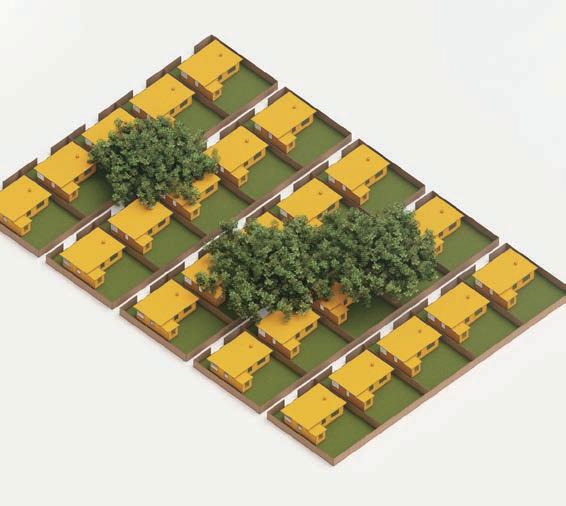


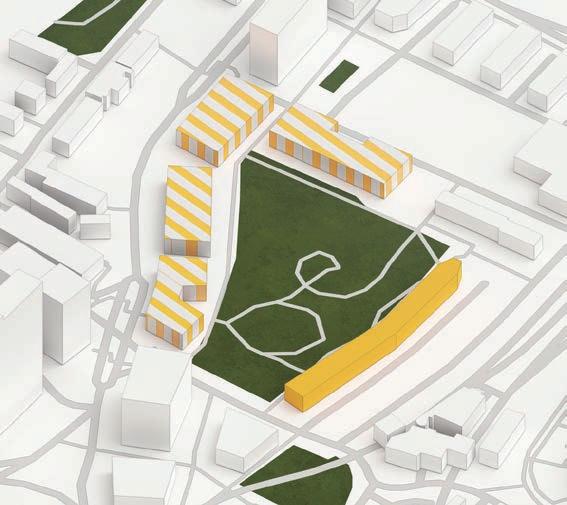
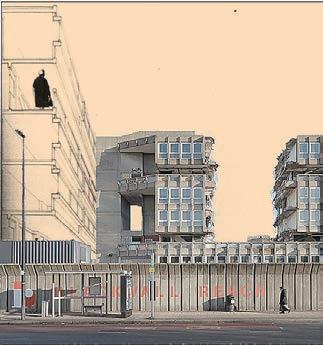


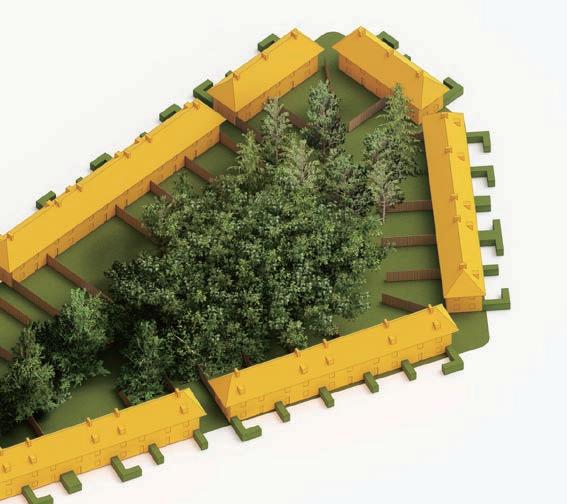

Most of London’s housing estates are social housing, which historically has been the majority type of housing in the city, with three-quarters of its population living in it in 1981. While social housing improved the living conditions of many, it has certain limitations due to their cost, such as discomfort and poor energy efficiency.
1. 19th century
4.
I I 5.
2. 1900s
Post World War
Time
of brutalism
Boundary Estate 4 - 5 story housing blocks 1,069 tenements 5,524 persons Amenities:
2 - 3 story cottages 27,000 houses 120,000 persons Amenities:
Becontree Estate
Single storey bungalows 189 houses Amenities:
Excalibur Estate
Mixed development 11 - 2 storeys housing blocks 1661 homes 36 blocks Amenities:
Churchill Gardens
10 and 7 stories housing blocks 213 tenements
Robin Hood Gardens
Mixed development 7 or 19 storeys housing blocks 1012 homes 4844 persons Amenities:
I
Broadwater Farm
3. Post World War
2. 3. 4. 4. 5. 6.
6. Utopia on trial
Historical context of London’s housing estates(1900-1980)
SITE ANALYSIS AND CLIMATIC CONTEXT
The development will be situated in the North Woolwich area of the Royal Docks to cater to the area’s burgeoning population.
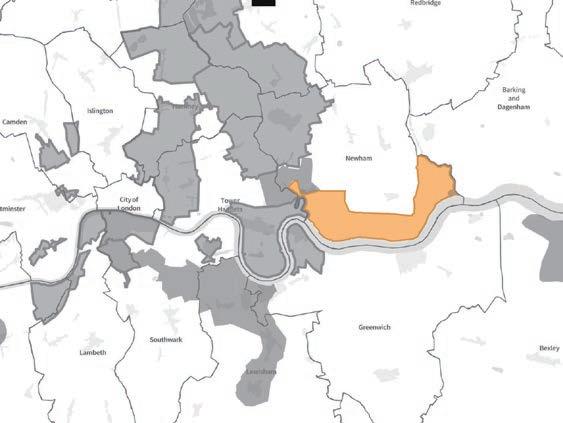
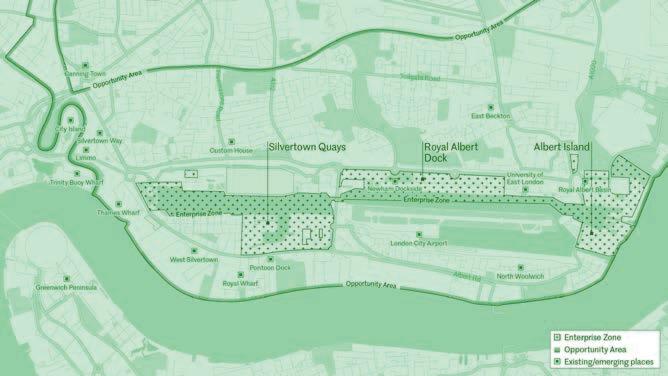

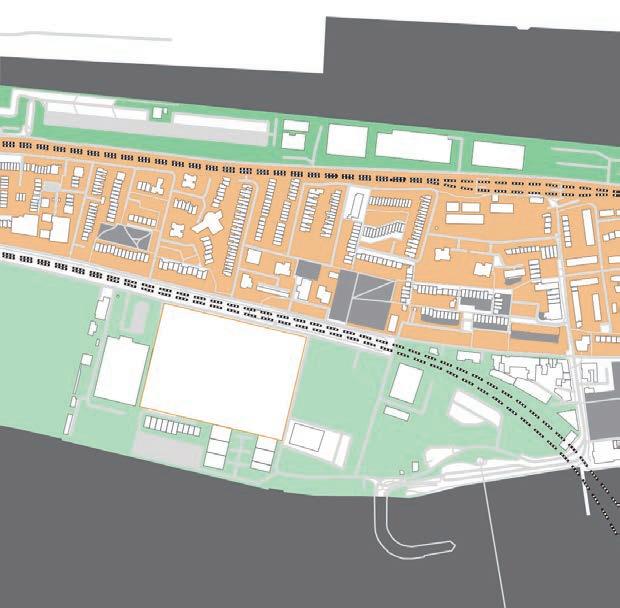

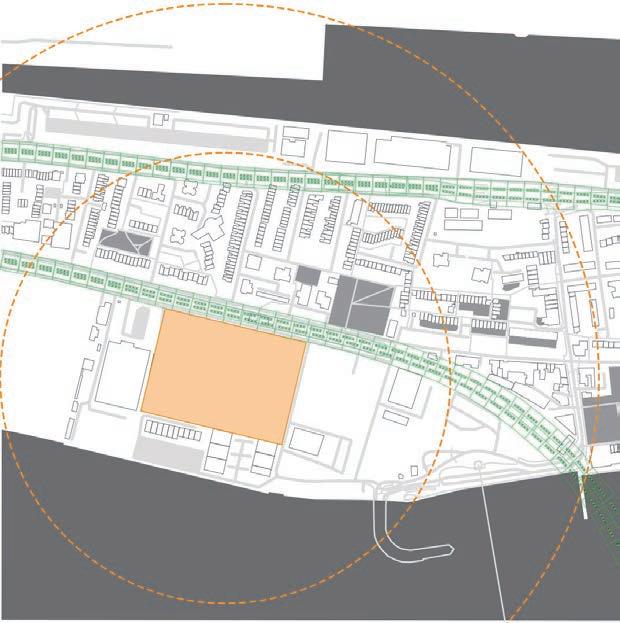

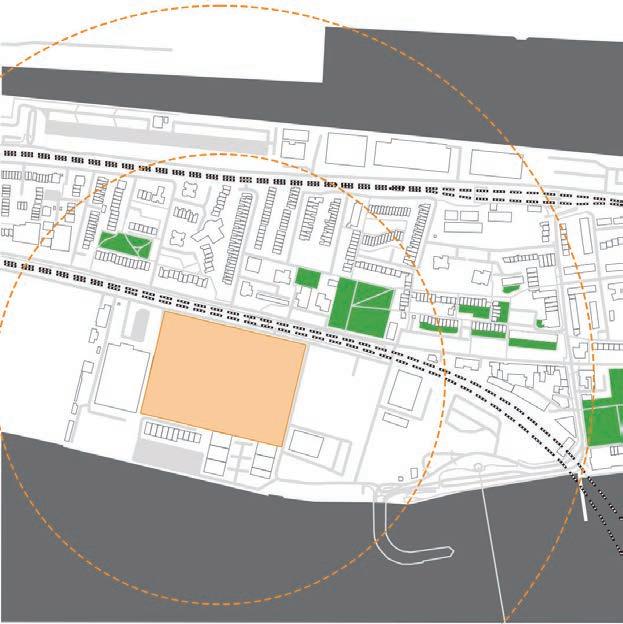
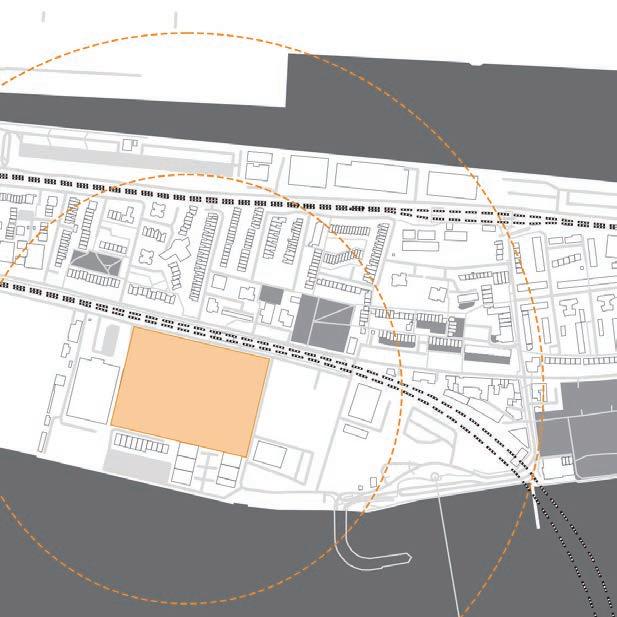


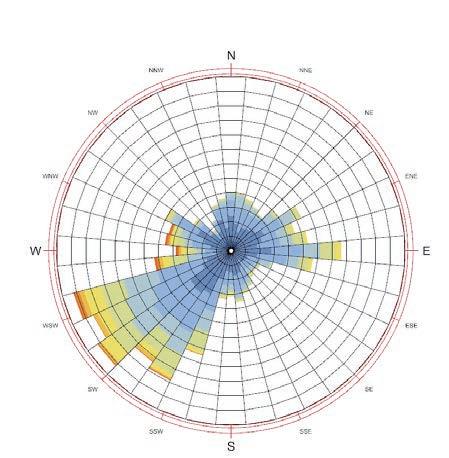
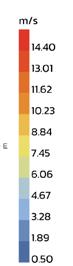
The site has good transport accessibility and is located near green spaces. However, there is a lack of nearby amenities to meet the needs of residents.
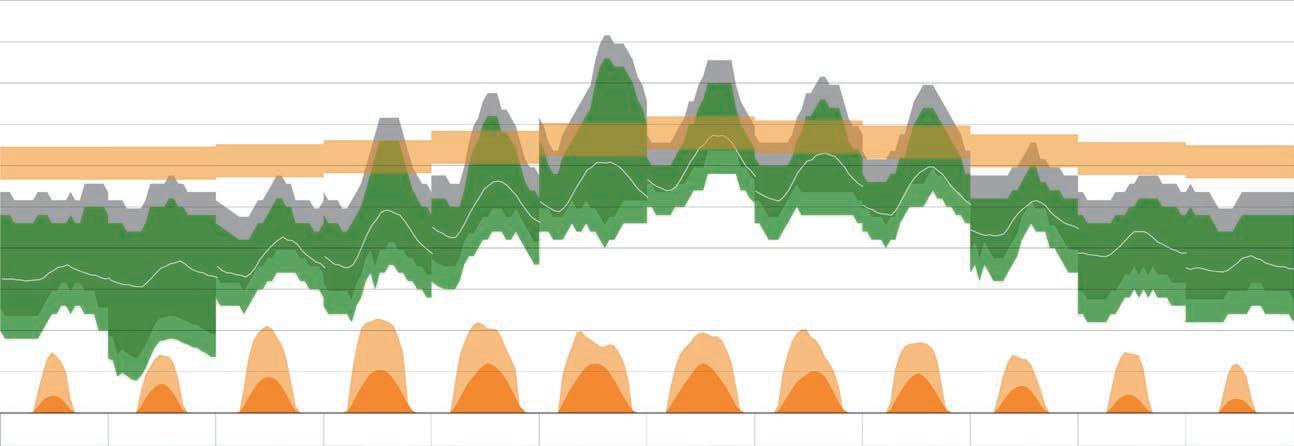
The area experiences cold temperatures during many months of the year, making building insulation a primary concern to improve comfort and reduce heating energy consumption. However, attention must also be paid to overheating during certain periods of summer, particularly as predictions suggest this may become more severe in the future.
London City airport Site River Thames Docks and warehouses Residential areas Factories and Area to be developed King George V DLR Station Bus station 10 minutes walking distance Site 5 minutes walking distance Site Stores Restaurants Community centre Church School Clinic Landscape Site Royal Docks Jan Feb Mar Apr Jul May Jun Aug Dry Bulb Temperature(°C) -10 -5 10 25 15 30 0 5 20 35 40 Sep Oct Nov Dec 0.0 0.2 0.8 1.4 1.0 1.6 0.4 0.6 1.2 1.8 2.0 Solar Radiation(kWh/m²) Adaptive Thermal Comfort Band (EN15251) TEMPERATURE RADIATION Daily Dry Bulb Temperature Future Daily Dry Bulb Temperature (A2) Direct Normal Radiation Diffuse Horizontal Radiation Average Daily Dry Bulb Temperature
of the site Site analysis Land use Annual climate data Wind Rose diagram Landscape Transportation Amenities
Location
BUILDING MODULE
GENERATION
The project will employ prefabricated structures to increase flexibility and reduce construction costs. Results from algorithmic calculations will be used to generate a staggered form to enhance environmental performance of each interior space, including temperature, lighting, and ventilation.




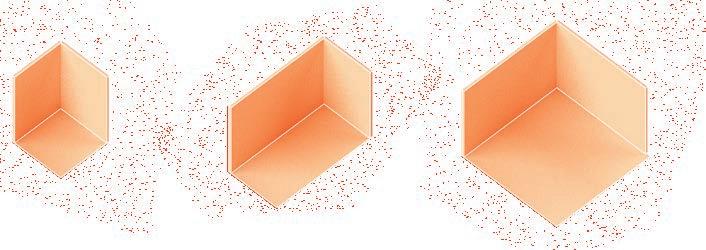

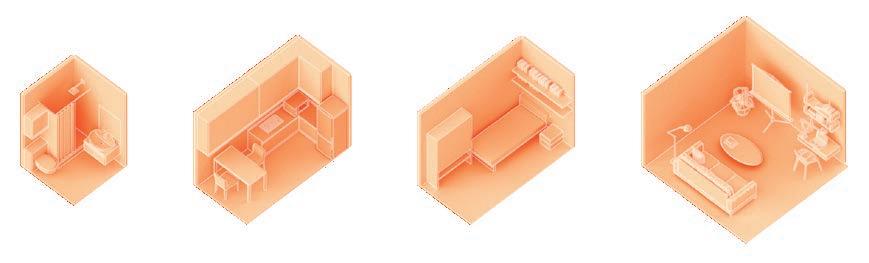
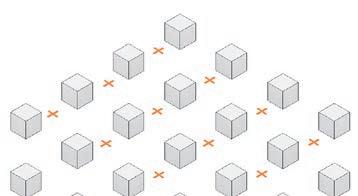


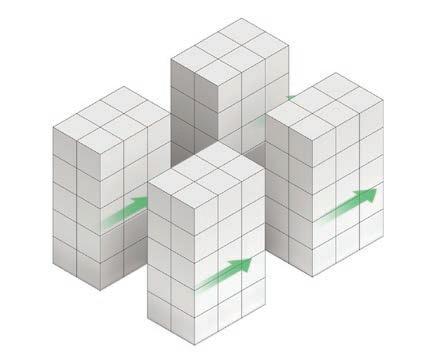



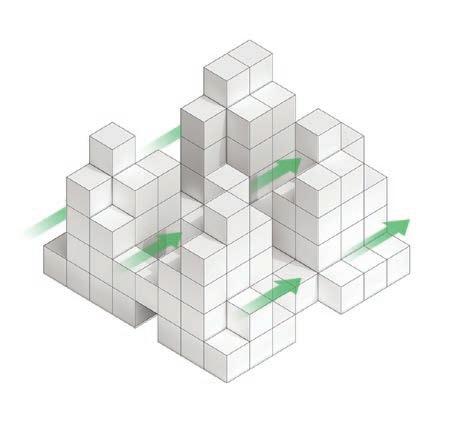
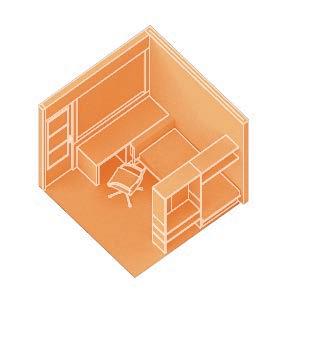
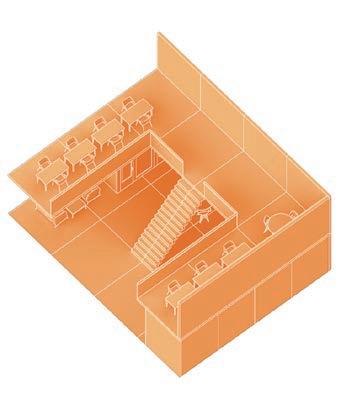
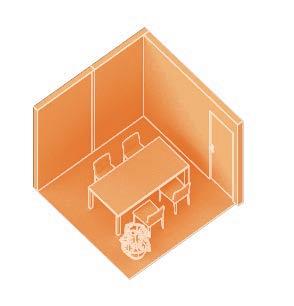
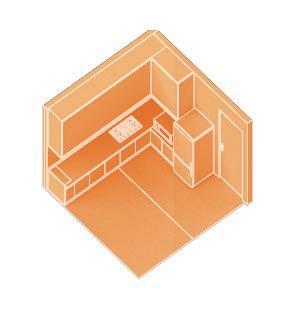
For prefabrication and mass production, all rooms will be modular in design. relevant standards.
Two important environmental indicators, thermal comfort and lighting, will guide the architectural design, and different spaces will be selected with different indicators according to relevant standards.
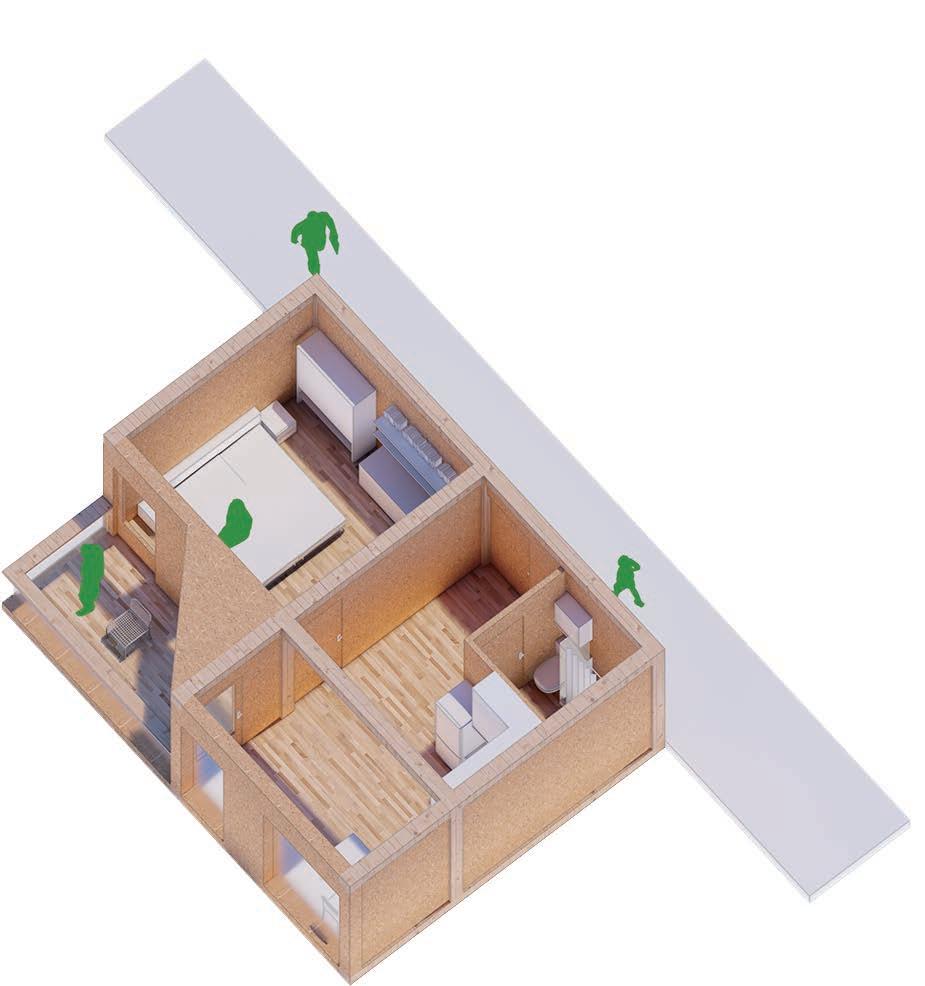
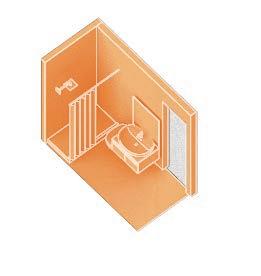
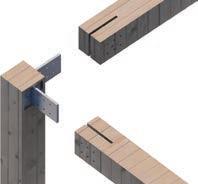
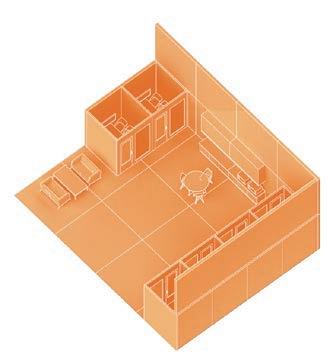
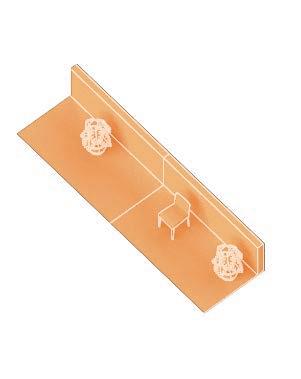

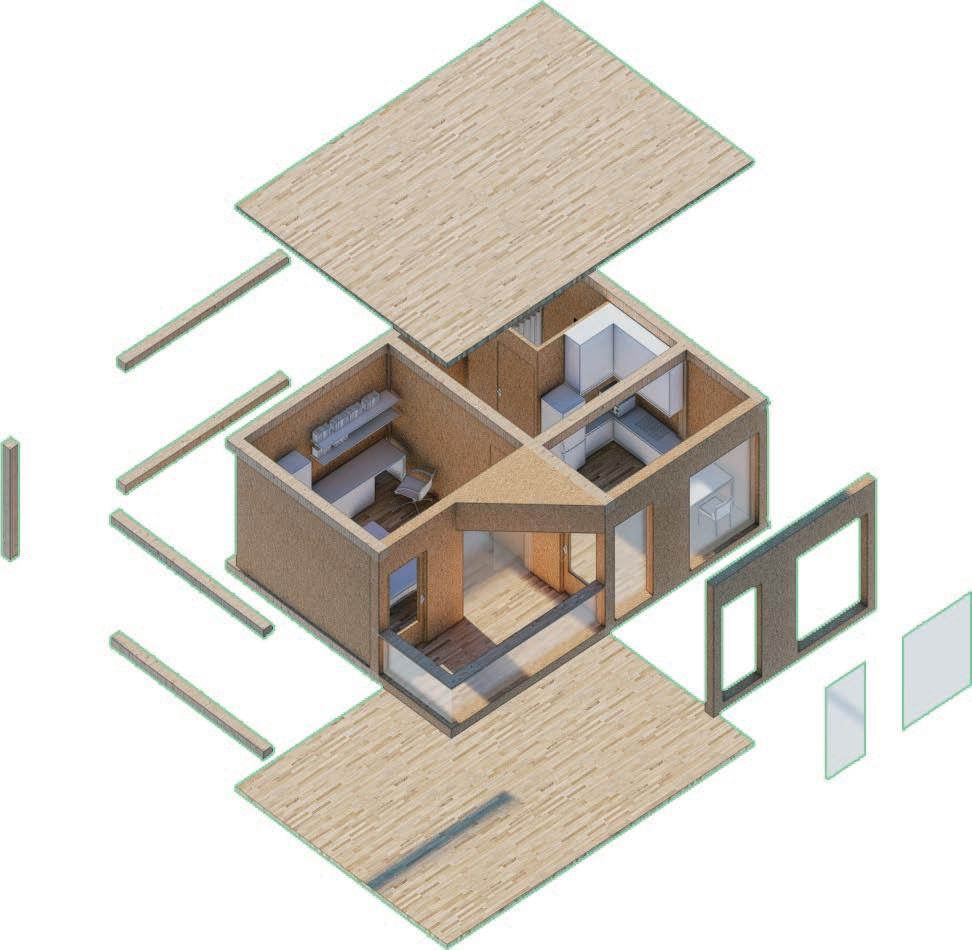
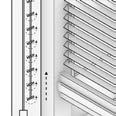
Bathroom 2m*2m Kitchen & dinning room 2m*4m or 4m*4m Bedroom 2m*4m or 4m*4m Living room 2m*2m 2m*4m 4m*4m Bedroom Living room Kitchen & dinning room Bathroom Corridor Outside CLT slabs R value= 9 Timber penal wall R value= 6.25 Double glazed windows U value= 1.1 LVL frame
Bedroom Lighting: 100lux Thermal comfort in comfort band Livingroom Lighting: 200lux Thermal comfort in comfort band Kitchen Lighting: 300lux Thermal comfort :Bathroom Lighting: 100lux Thermal comfortCommercial area Lighting: 100lux Thermal comfort 19-26°C Enclosed office Lighting: 300lux Thermal comfort : in comfort band Open office Lighting: 200lux Thermal comfort : 19-26°C Walkway Lighting: 100lux Thermal comfort UTCI 9-26°C Landscape Lighting:Thermal comfort UTCI 9-26°C Thermal comfort 21-26 °C (summer) 18-22 °C (winter)
Factory production Transportation On site construction
Staggered
design based
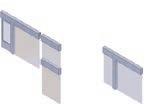
environmental parameters Typical flat layout Flat Materials and structure Light and thermal standards in different types of area Modular room design Panels Assembling Modules
Blocky morphological design
morphological
on
Construction process of prefabricated housing

Area per user: 20-28 m2


INDOOR ENVIRONMENT OPTIMISATION

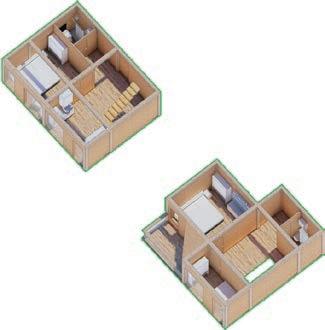
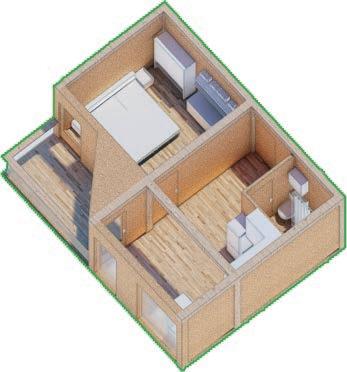
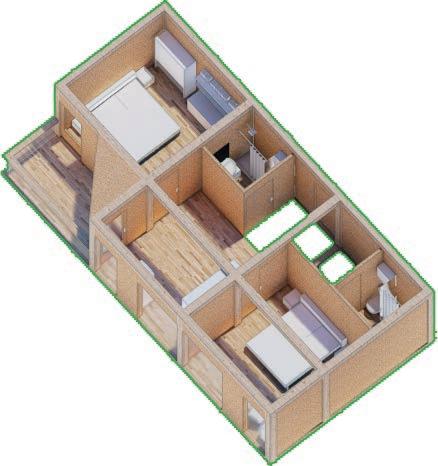
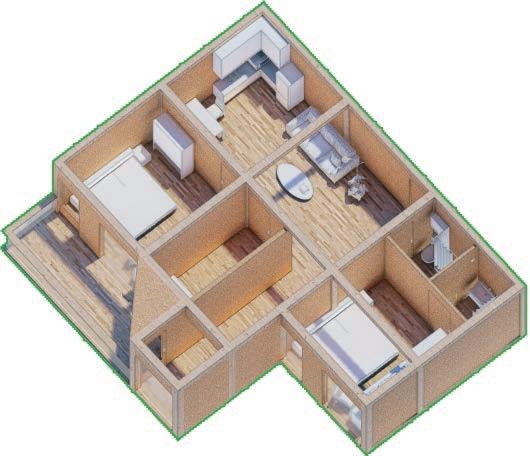
6 flat types
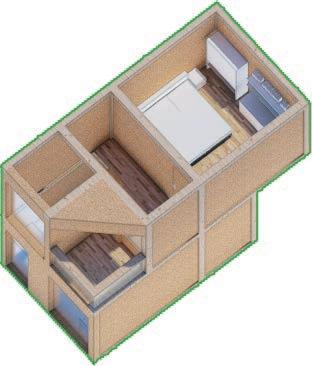
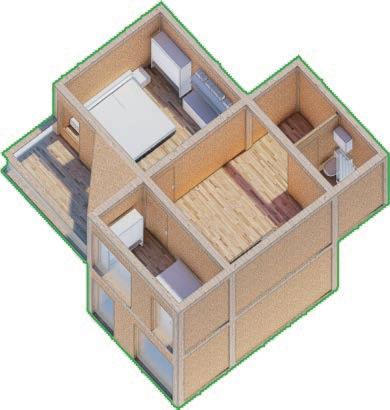
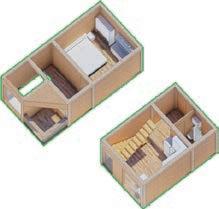
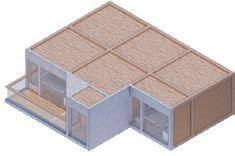
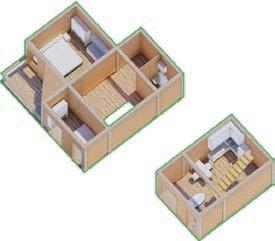
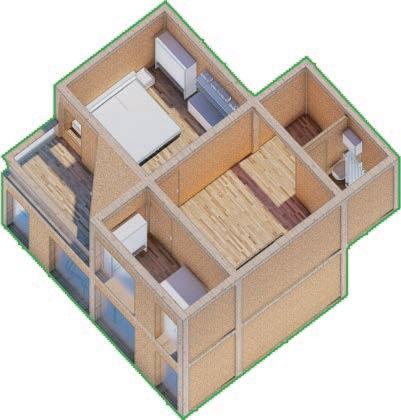
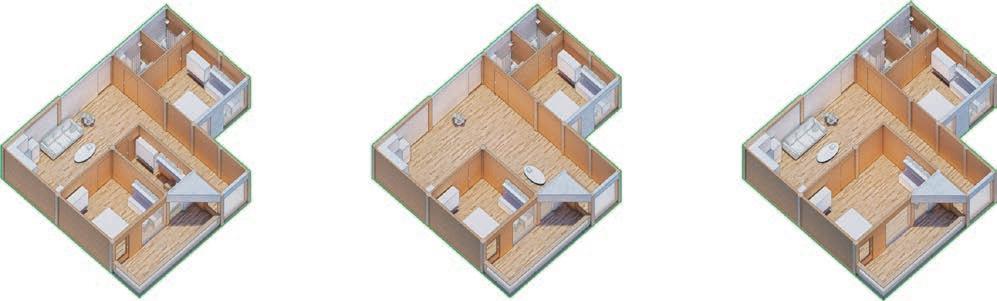
There will be six types of single and duplex flat units available to meet the needs of various users, primarily families.
The building will utilize timber as the main material for thermal insulation and soundproofing purposes (due to its proximity to the airport), while other material choices will be balanced for performance and affordability.
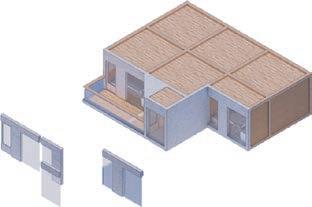
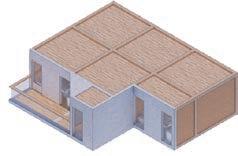
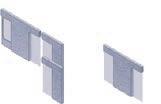
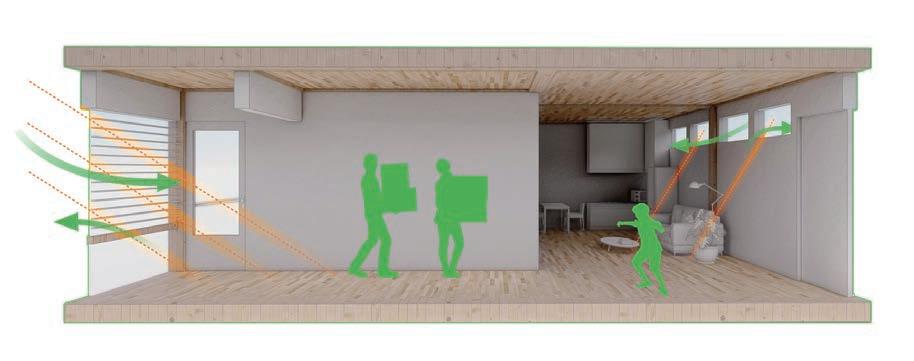
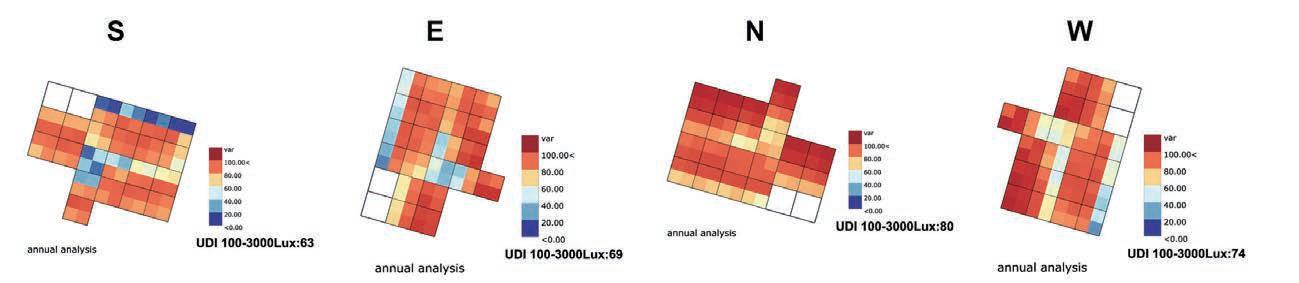
Material selection and adaptive design have resulted in good environmental performance of the flats.
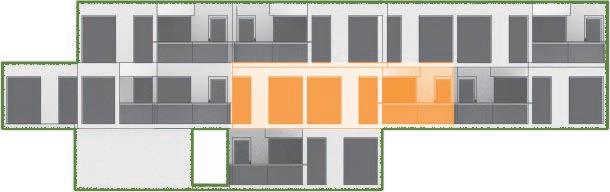
Taking the 3B apartment as an example, the simulation results indicate satisfactory indoor temperature and light conditions all year round.
1B 48 m² 1B DUPLEX 56 m² 2B 72 m² 2B DUPLEX 80 m² 3B 104 m² 3B DUPLEX 104 m² Upper & lower floor
0 500 1000 1500 2000 -5 0 5 10 15 20 25 30 35 40 Global Horizontal Radiation BEDROOM2 BEDROOM3 LIVINGROOM Dry Bulb Temperature KITCHEN Comfort band °C Wh/m² Jul .1 Jul .7
Adjustable windows Daylight shading High windows 60% 50% 40% 3B option 2B option 1 2B option 2
Window to wall ratio Other interior details Floor plan Adaptive design for interior comfort Annual light performance of 3B flat Thermal performance of 3B flat in typical summer week
Upper & lower floor Upper & lower floor
2P 3-4P 3-4P 2P 5-6P 5-6P
ESTATE FORMATION

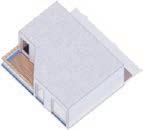
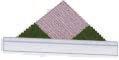
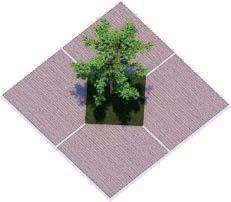

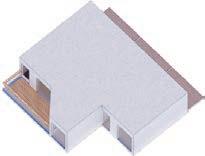
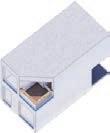
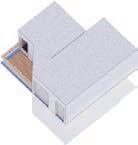
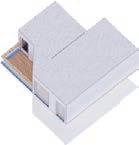
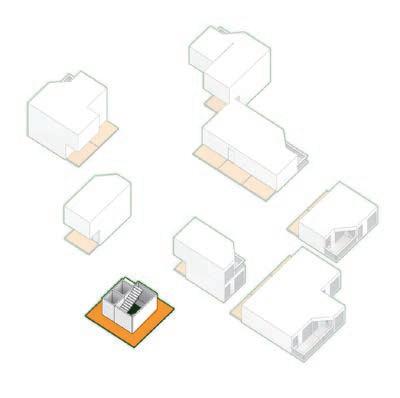
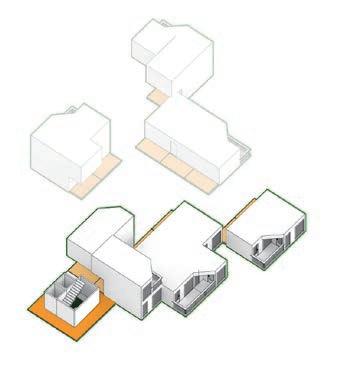
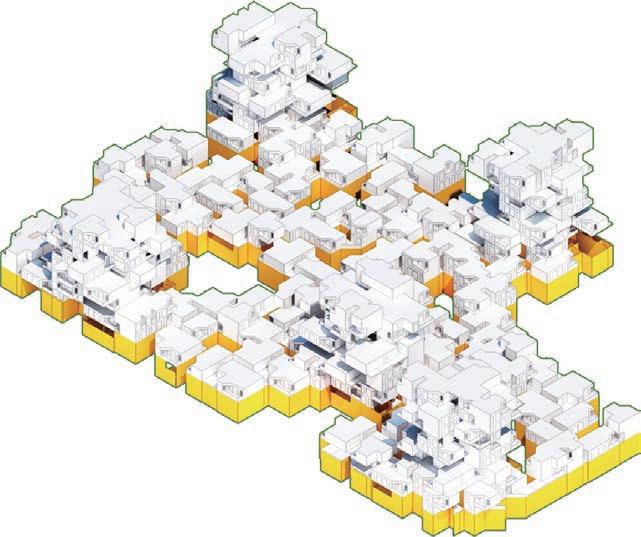
In addition to the six residential modules, there are three outdoor modules that form outdoor spaces for planting greenery and ensuring good circulations within the estate.
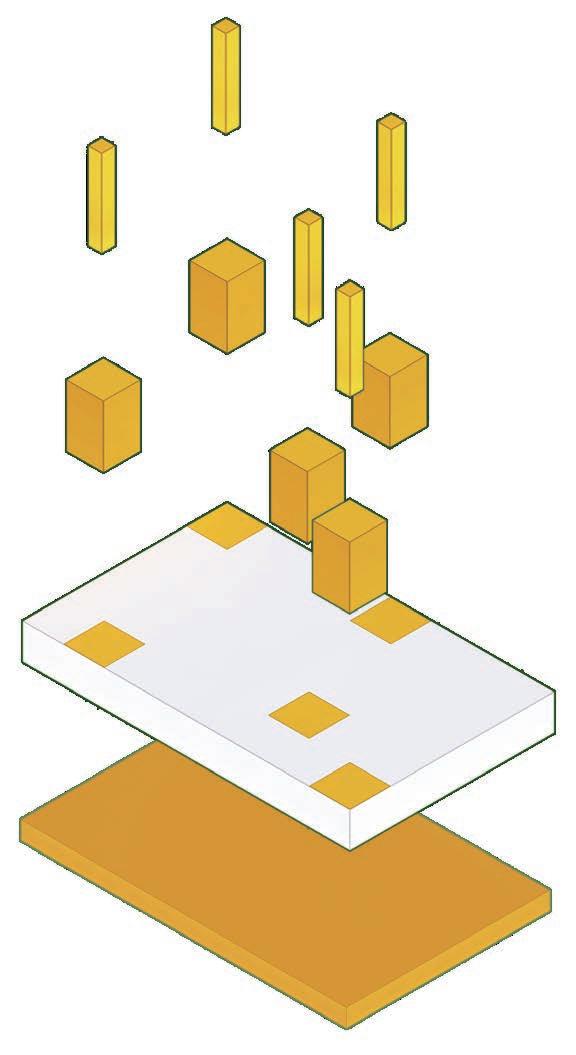
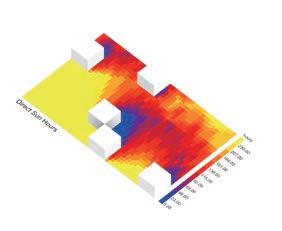
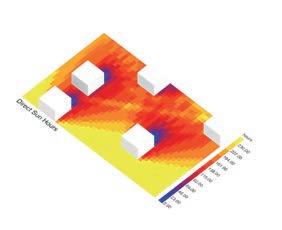
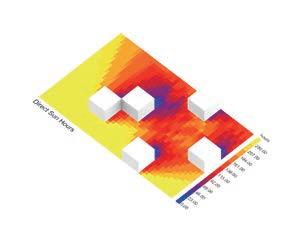
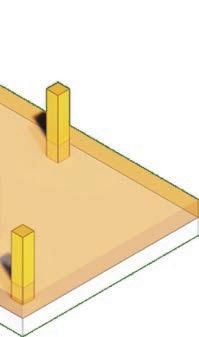
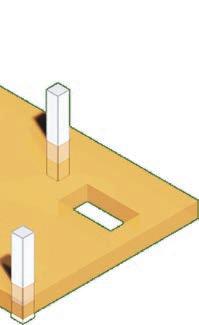
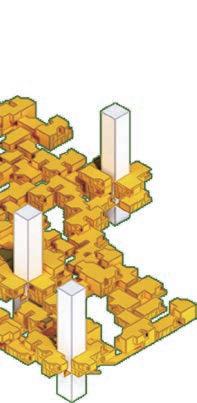
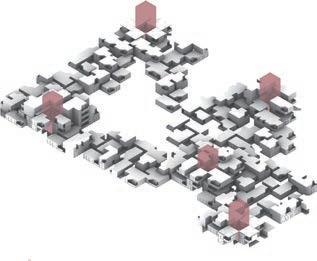
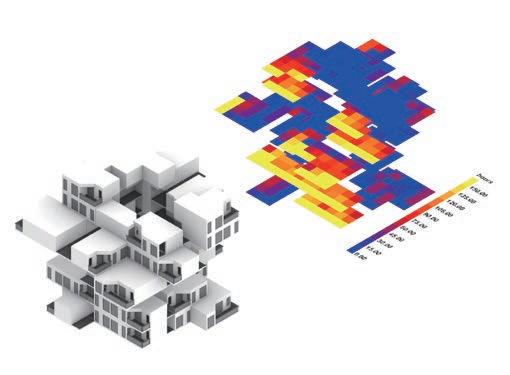
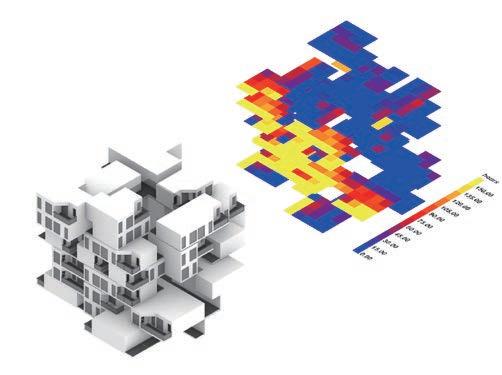
The nine modules will be generated according to the following three rules to form the entire estate. The rules for lighting and thermal insulation have been developed through extensive simulation.
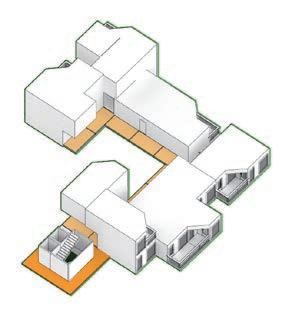
Spatial rule: When all units are combined, every module could be accessed via circulation.
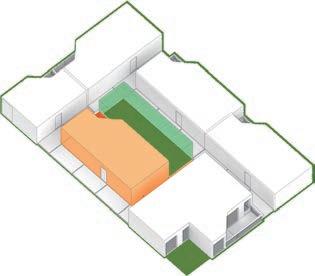
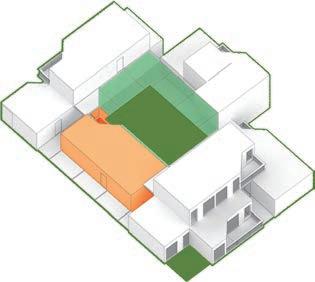
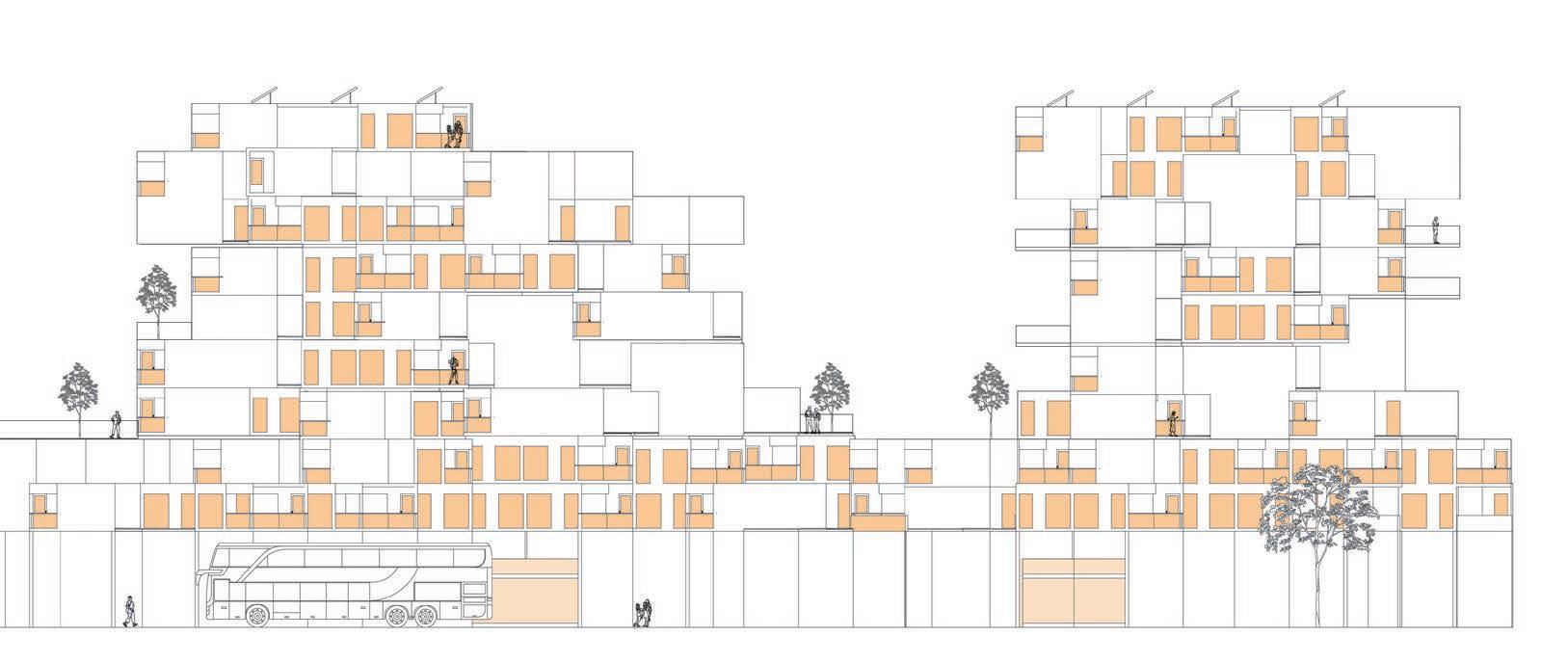
Daylighting rule: Voids between the modules should be at least 4m, and outdoor context should not exceed 8m.

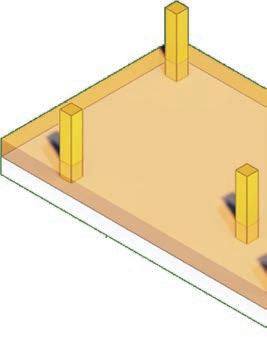
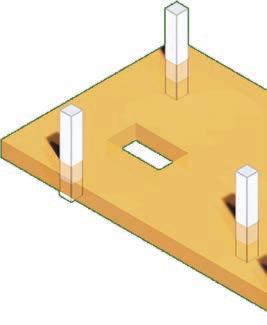
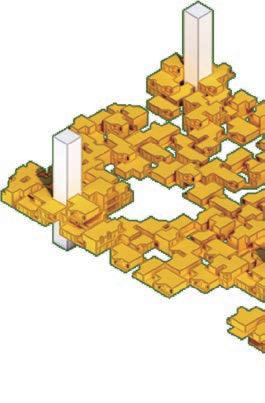
+ + + + or Modules Void or or Bottom Top Left or Right Front view Tower Blocks Low-rise Block Tower Core low-rise residential zone Remove the areas with poor daylight condition. Module generation in low-rise residential zone
Amenities Tower Blocks Low-rise Block Amenities Modules Void Modules Void Modules Void
1B 1B DUPLEX 2B 2B DUPLEX 3B Terrace 3B 3B 3B DUPLEX 10 40 10 70 10 60 60 70 40 340 Flats Void Length: 4m Height: 3.5m (1 Floor) Void Length: 8m Height: 7m (2 Floor) Thermal
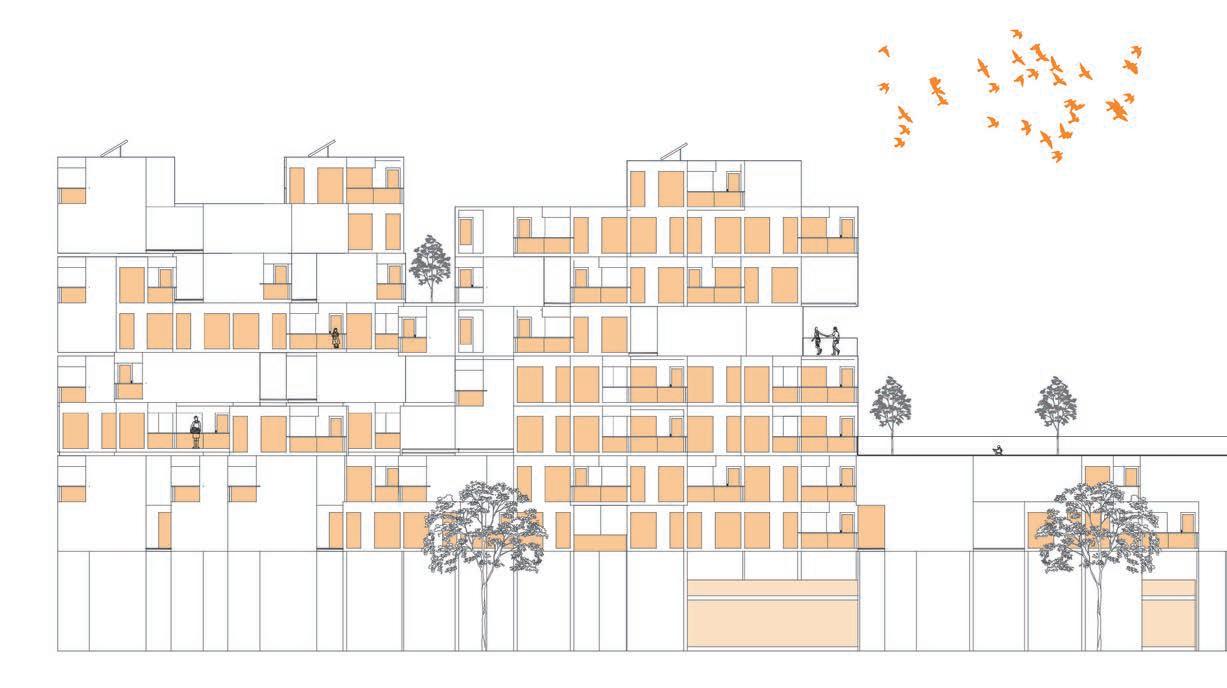
Daylight simulation results for different estate arrangements Arrangements 1 Arrangements 2 Arrangements 3 Arrangements 4 Arrangements 5 General section of the estate
insulation rule: Minimize the connections between units and voids to reduce exposed envelope.
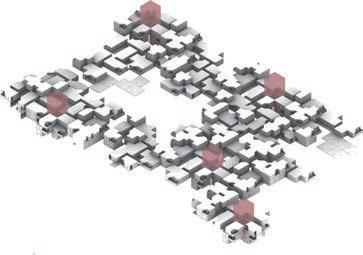
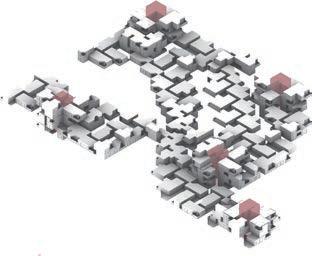
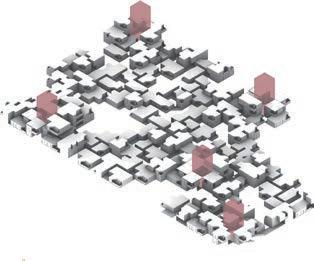
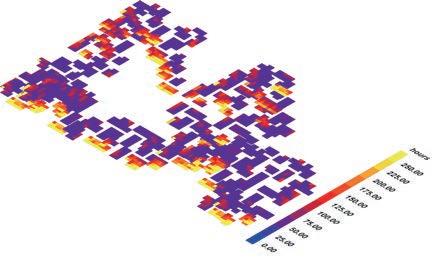
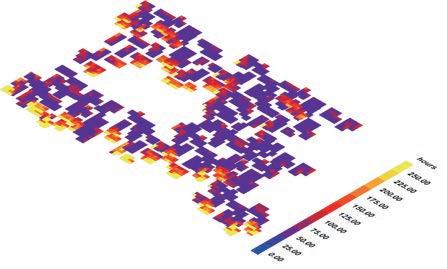
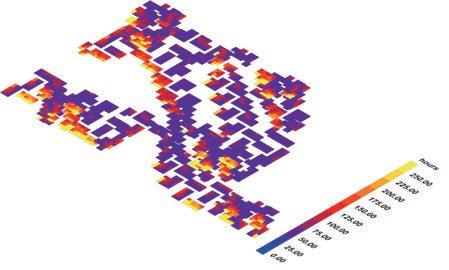
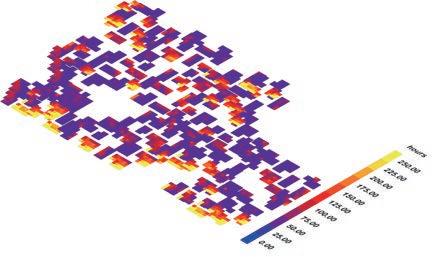
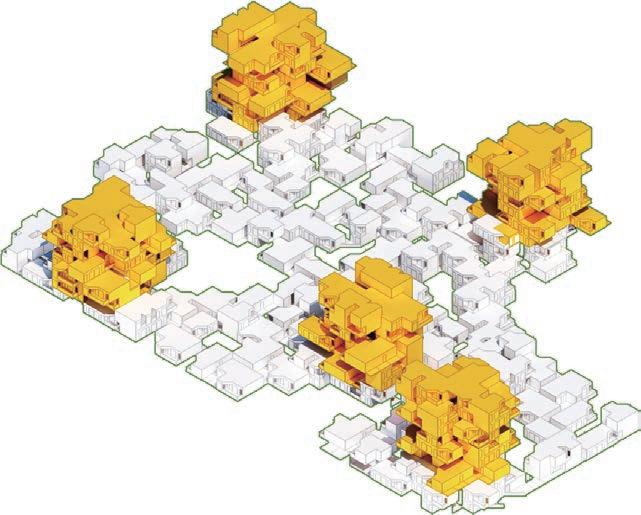
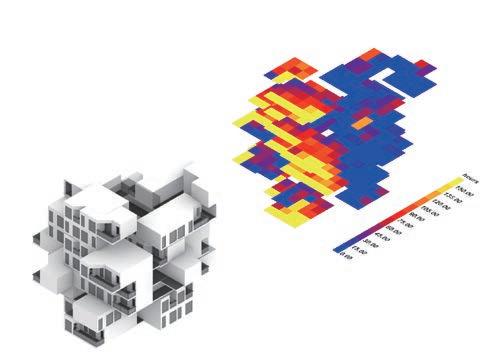
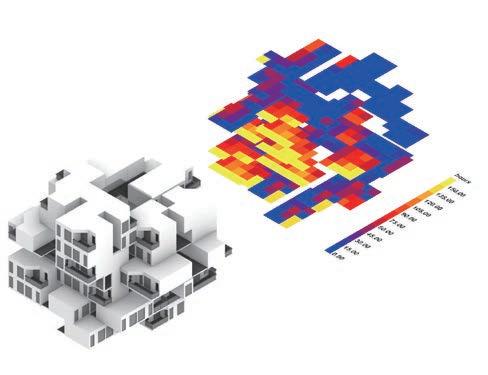
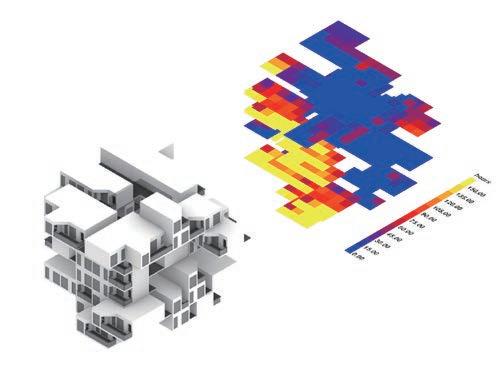
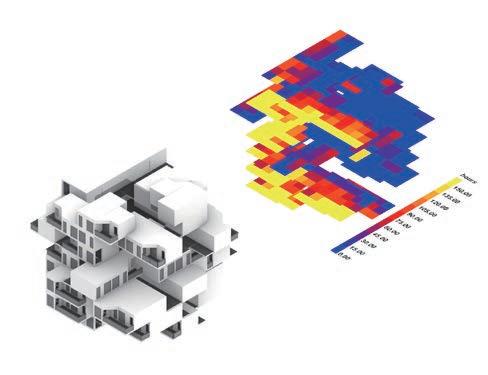
Module generation in tower block zone Amenities Generation
Daylight
simulation results for different generated plans
plan 1 Form 1 Form 3 Form 5 Form 2 Form 4 Form 6 plan 2 plan 3 plan
estate and details
Daylight simulation results for different tower block form
4
GENERAL VISUAL
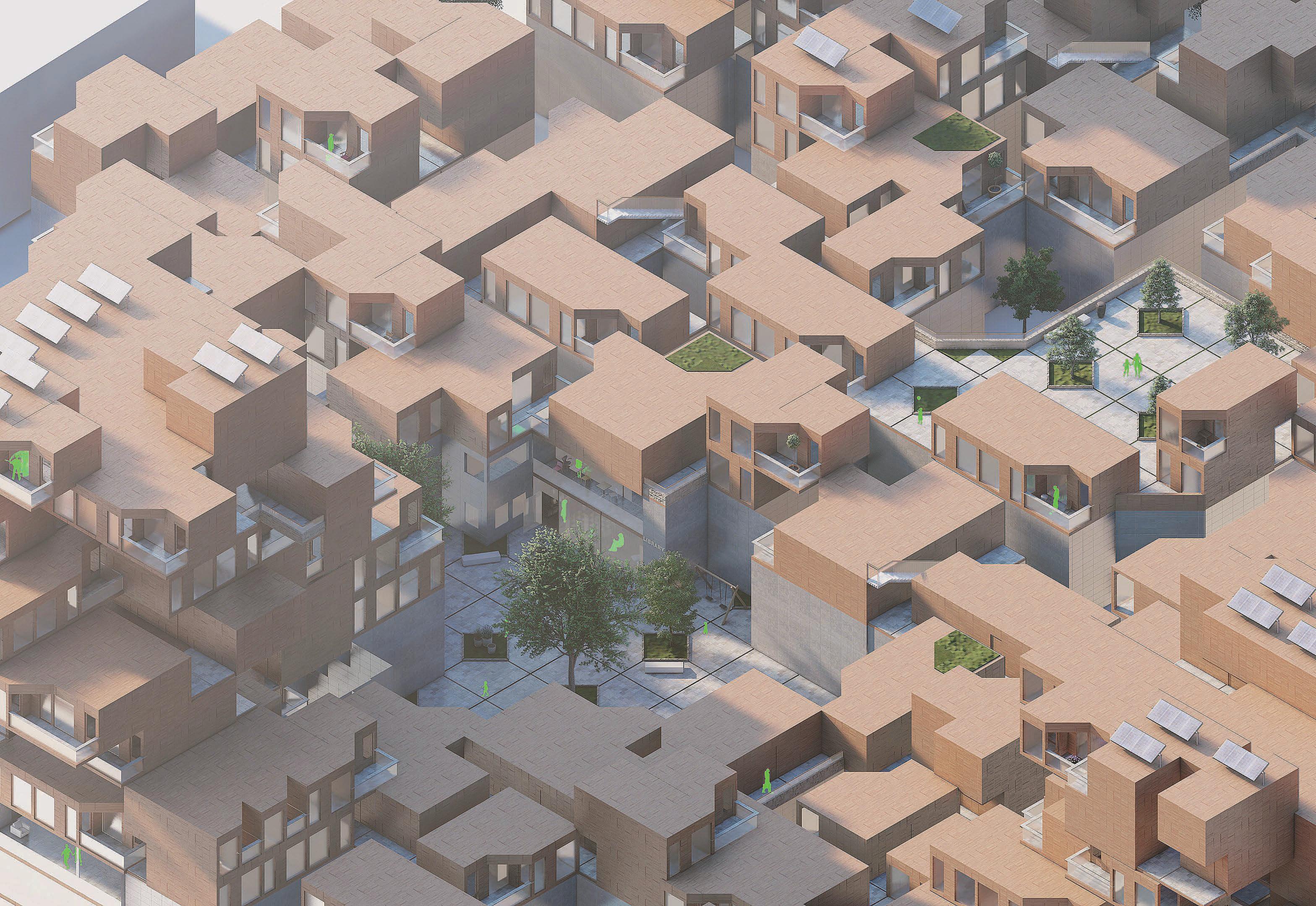
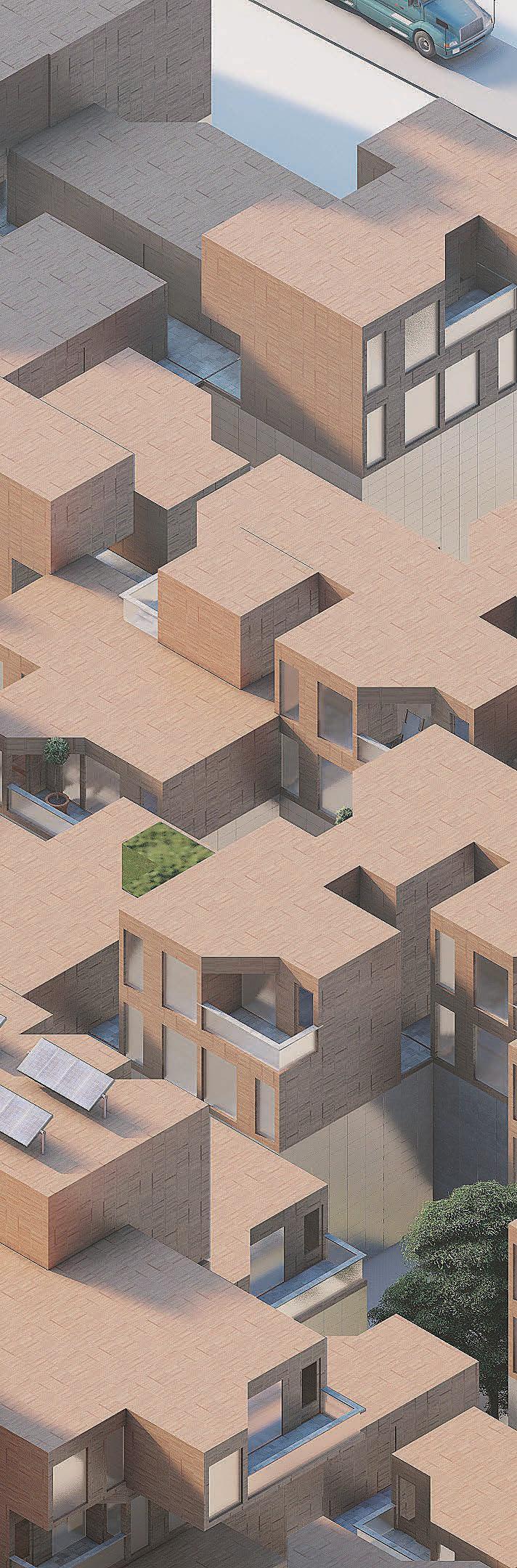
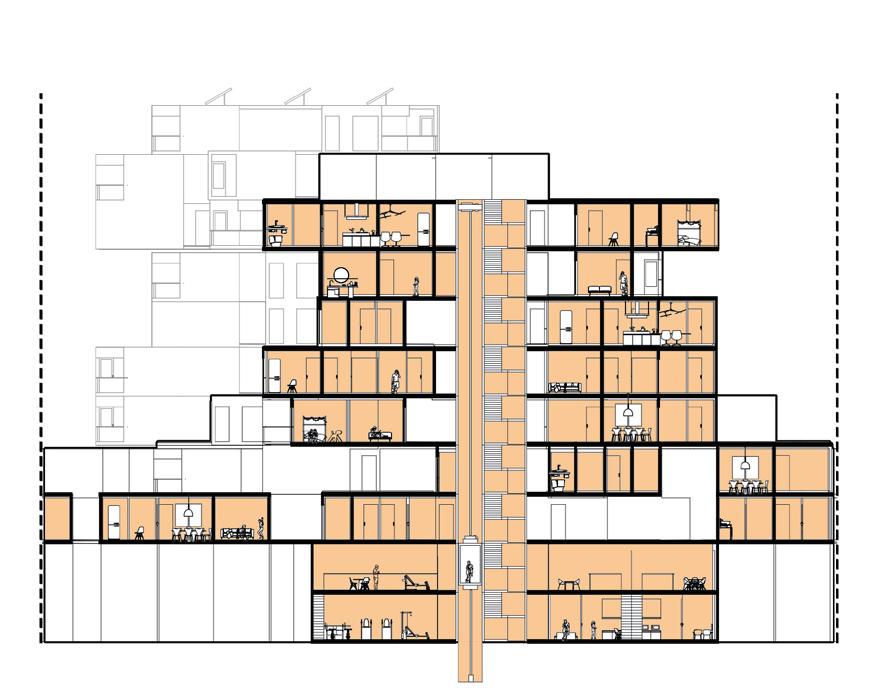
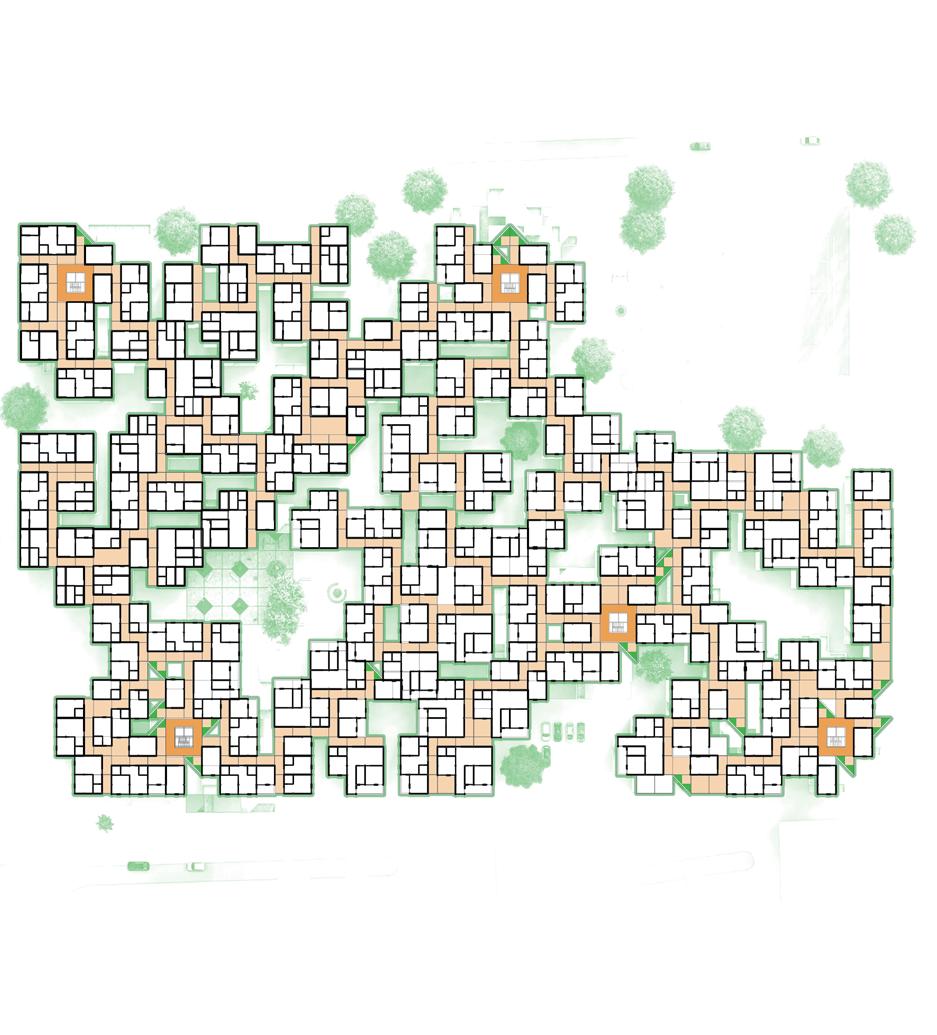
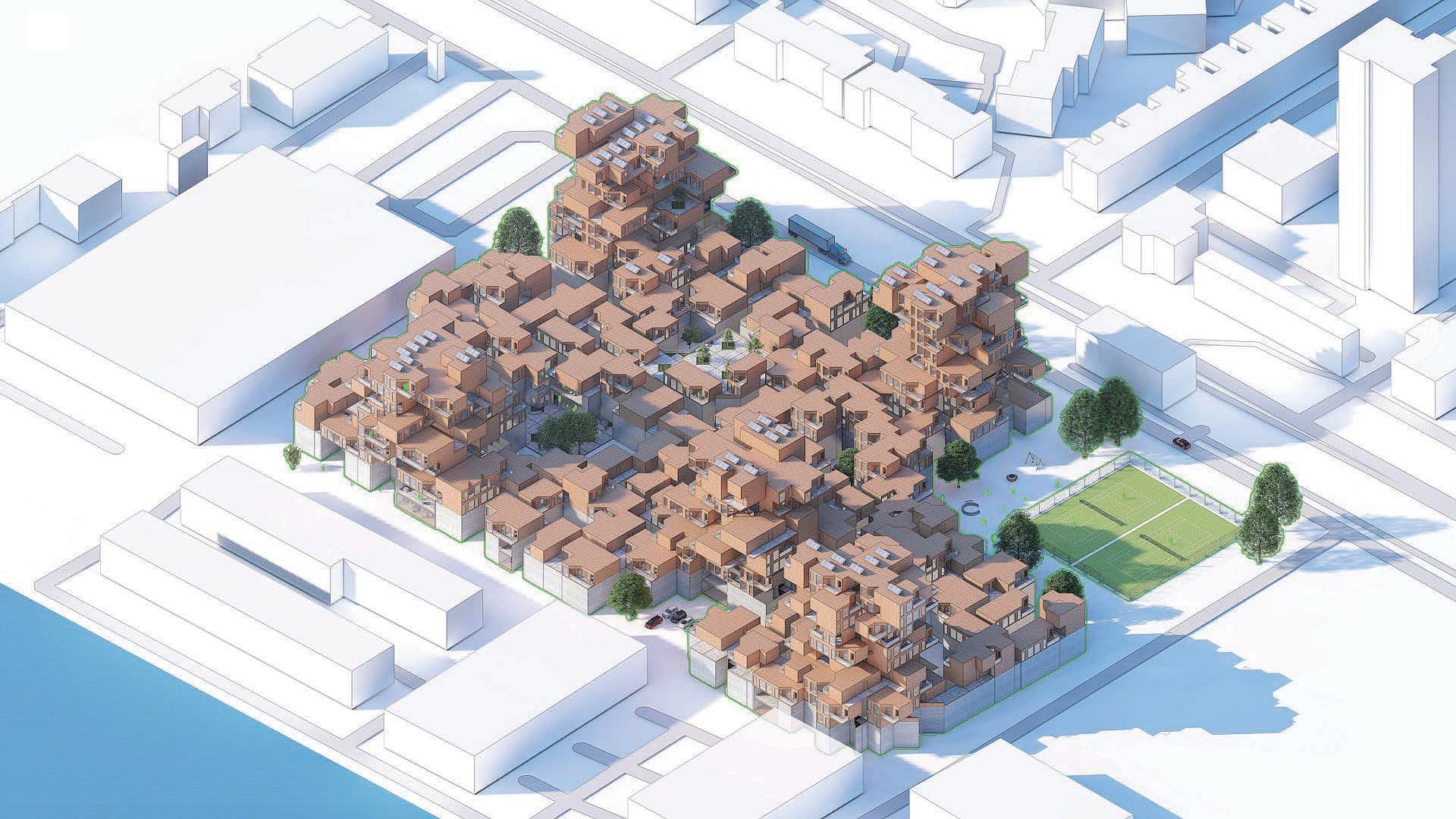
The entire complex consists of tower blocks, low-rise residential blocks, and amenities. The core of the tower blocks contains stairs and elevators that pass through three zones to provide vertical transportation for the entire estate.
Open spaces for activities are available in both the low-rise residential blocks and amenities zones. The amenities zone includes shops, sports fields, libraries, and other areas to provide residents with convenience and address the problem of inadequate amenities around the site.
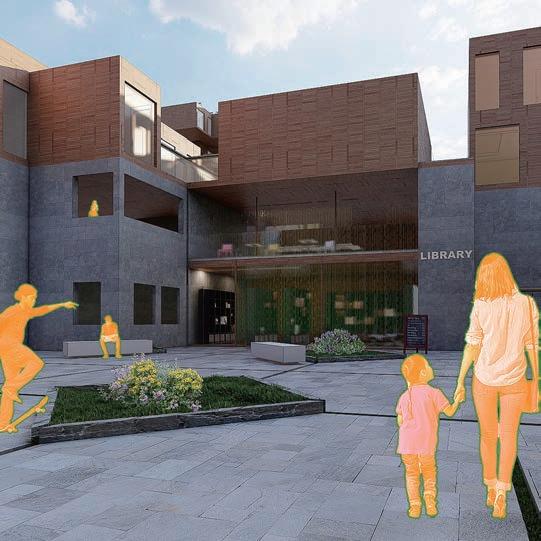
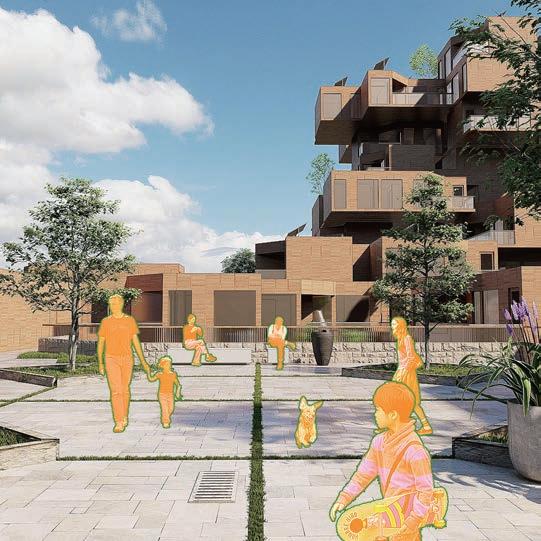
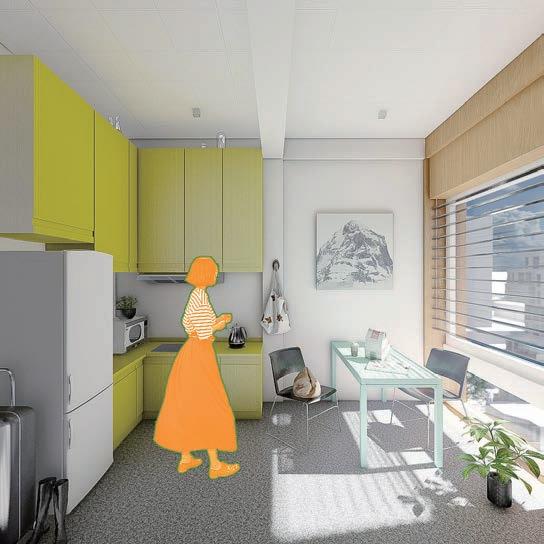
 Flat interior
The terraces of low-rise block
Library and play area
River Thames
Axonometric view of the estate
The plan of second floor of the estate
Core Corridors Greenry
Tennis court Playground
Stores and offices
Flat interior
The terraces of low-rise block
Library and play area
River Thames
Axonometric view of the estate
The plan of second floor of the estate
Core Corridors Greenry
Tennis court Playground
Stores and offices
CARBON EMISSIONS AND ENERGY CONSUMPTION
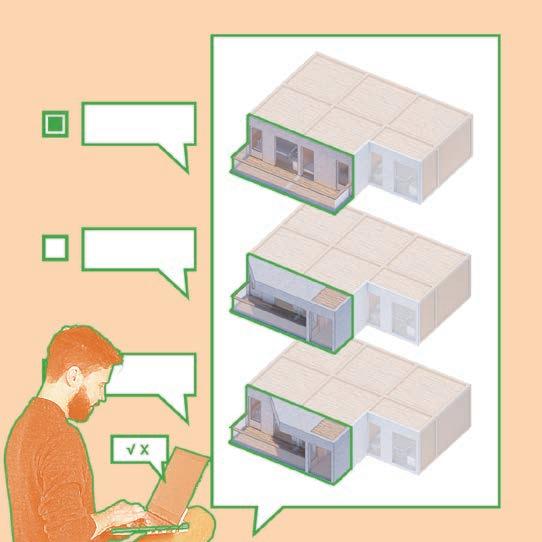
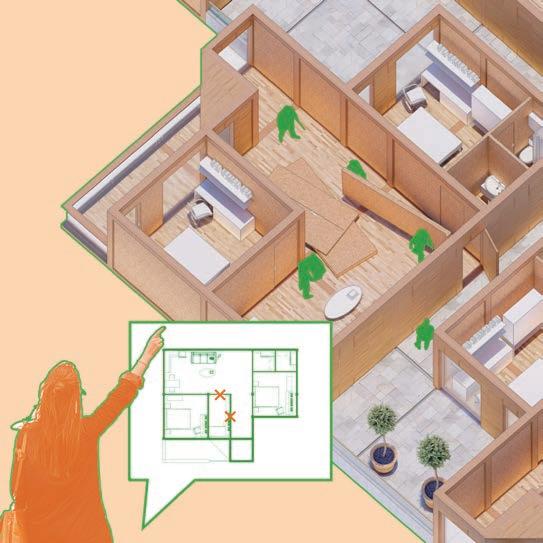
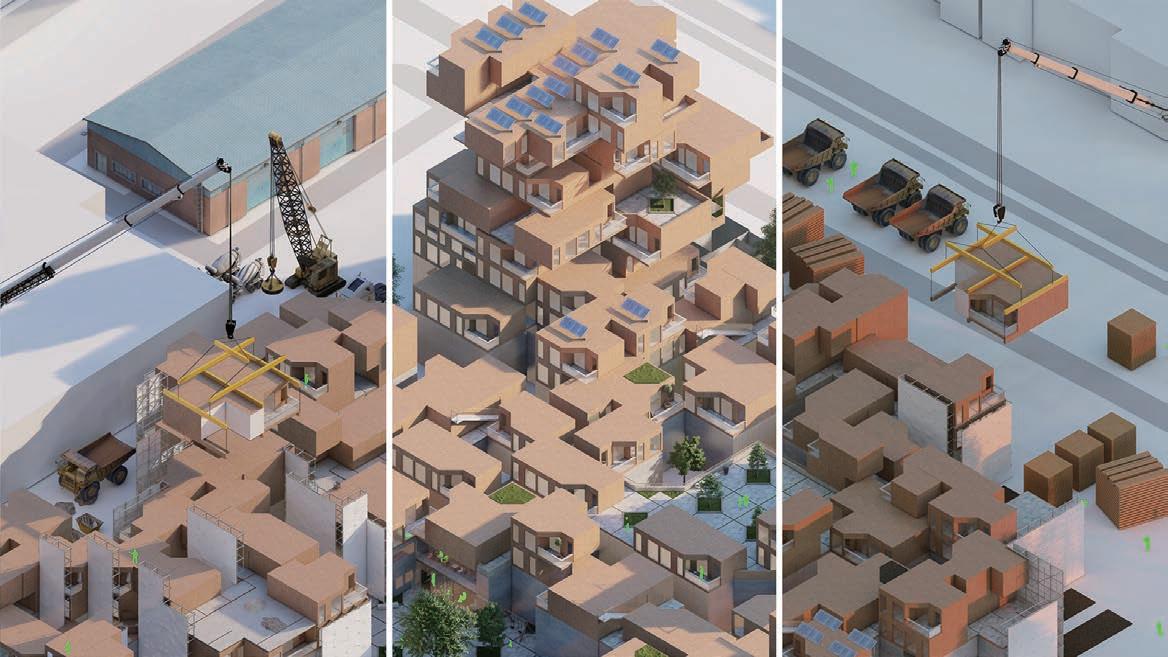
High modularity allows residents to customize their own apartments and easily modify them for future use, while promoting sustainability during the construction and dismantling processes.
The rooftop solar power system will cover approximately half of the annual electricity consumption for the entire estate, thereby reducing carbon emissions.


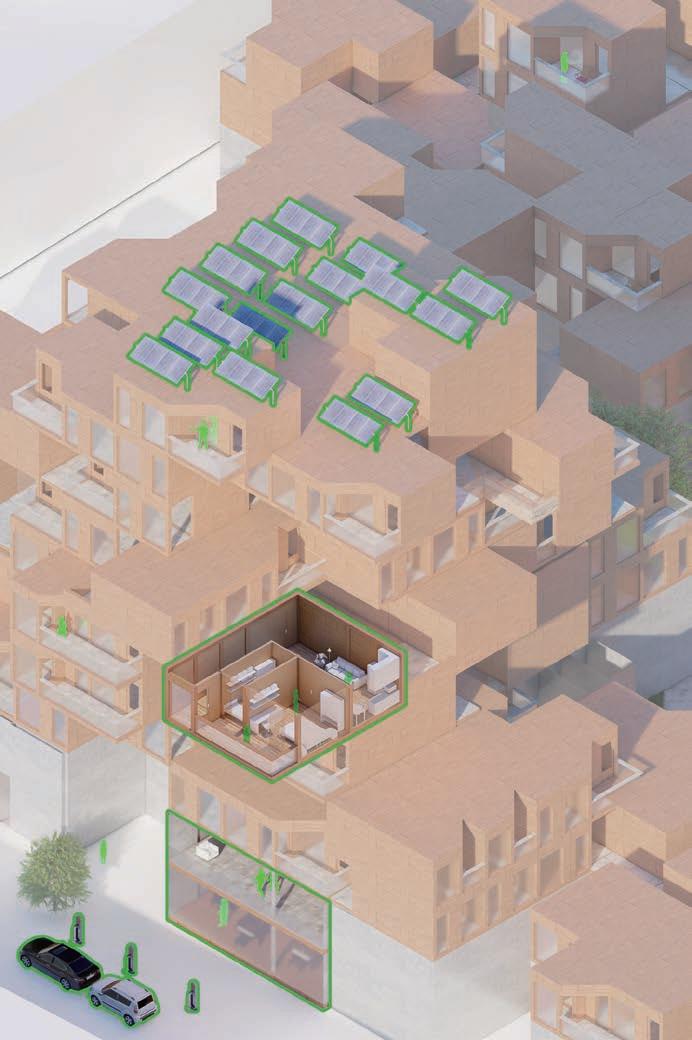


Option 1 Option 2 tion 3 Balcony Type
Home usage Solar penal Amenity usage 3,260 kWh/m2 15*10⁵ kWh Annual per flat Annual per flat Annual per shop Annual total Annual total Annual total HOME USAGE SOLAR PENAL AMENITY USAGE Appliances Lighting Heating Power generation Appliances Lighting Ventilation 36 kwh/m2 9.7 kwh/m2 15 to 22 kwh/m2 87 kwh/m2 57 kwh/m2 13 kwh/m2 12*10⁵ kWh 3.2*10⁵ kWh 9.1*10⁵ kWh 5.9*10⁵ kWh 1.3*10⁵ kWh 0 5 10 15 20 25 30 35
-12 211 -200 0 200 400 600 800 1000 1200 kgCO2e/m2 RIBA
Pre - 2020 2020 2025 2030 4% 14% 3% 8% 0% 19% 23% 4% 25% Distribution of Embodied Carbon of New Building by Building Aspect Substructure Superstructure Upper floors Roof External walls Windows Internal walls Internal finishes Services
2030 Challenge
Flat
Self-renovation
Construction to Disassembly
customisation

GARDEN OF WEI 葳 2.
LAN WEI ALLEY
RENOVATION
LOCATION: HONGKOU
SHANGHAI
CHINA
SOLO WORK
ADVISOR: CHELSEA D. LIMBIRD
Wei(葳) is interpreted in Chinese as the appearance of lush vegetation.
With the renewal of the city, many buildings were demolished. Demolition seems to be their inevitable fate in urban metabolism.
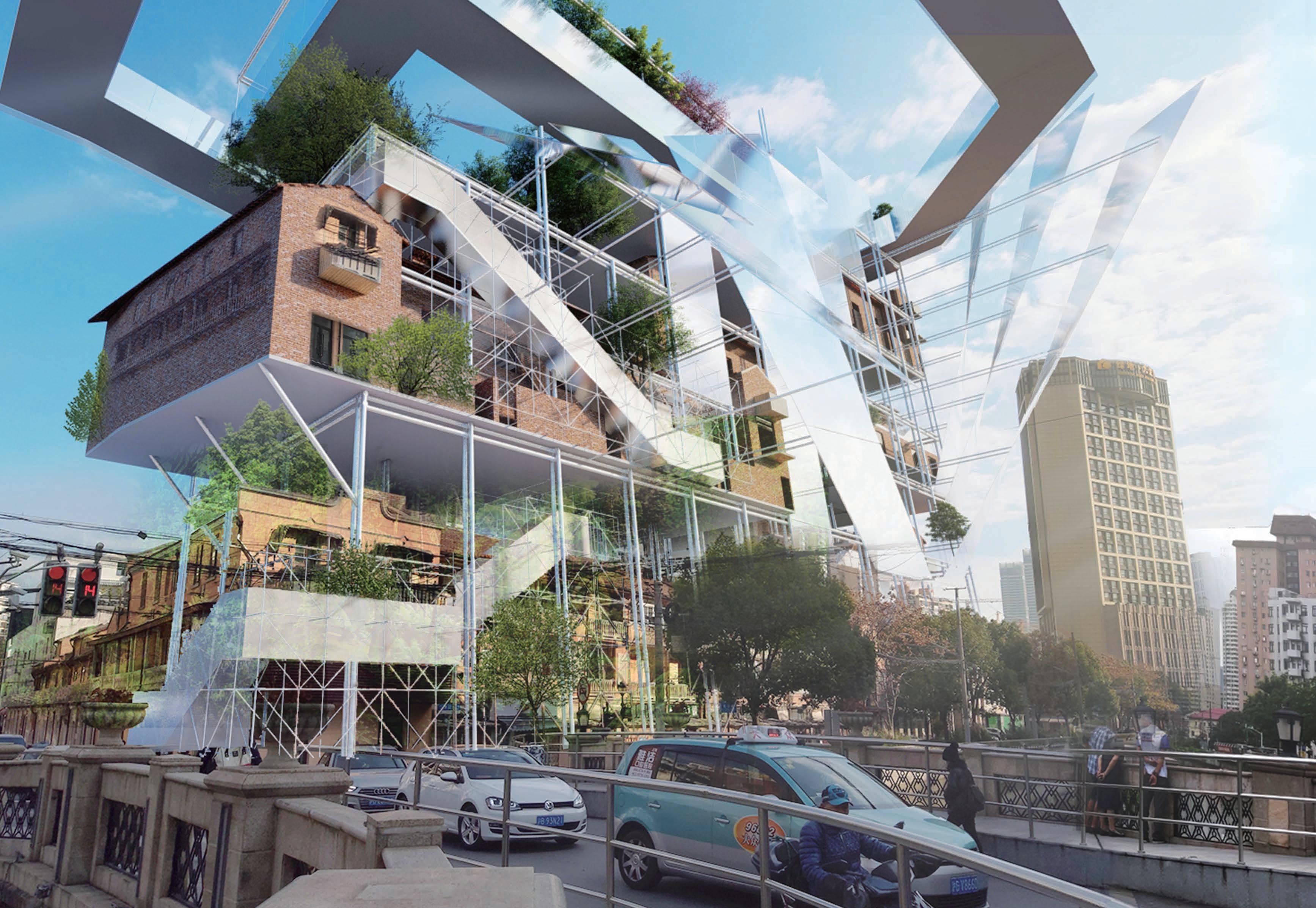
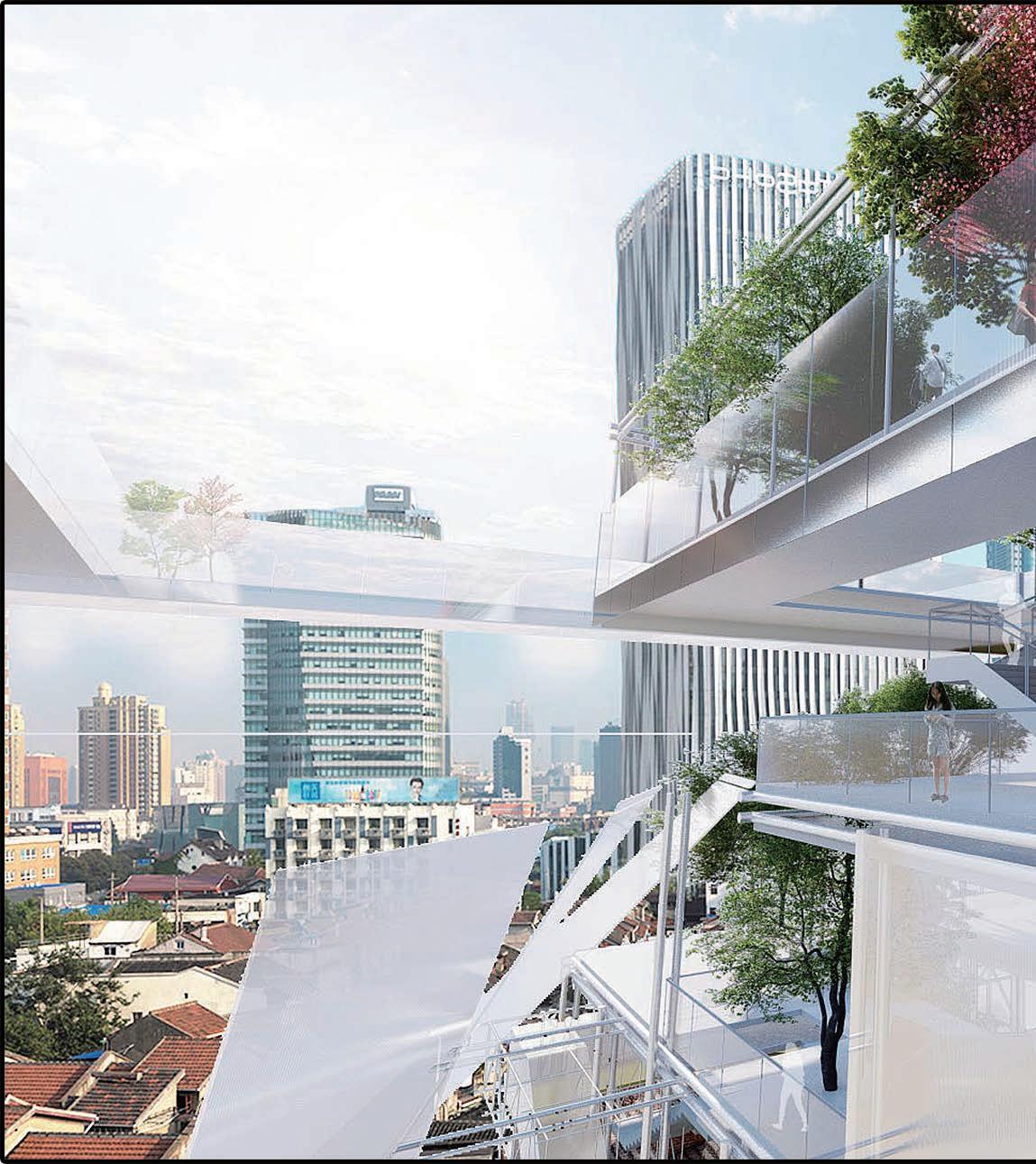
The WEI Garden project aims to transform a residential community in Shanghai with a century-long history into a comprehensive landscape integrating retail, entertainment, and leisure activities.
Old communities don't necessarily need to be replaced by grand office buildings or shopping malls. On the contrary, they can be transformed into preserved, intact, and historically significant spaces.

COMMUNITY
BUILDINGS
Current architecture (Original architeture)
Star Dream Theater (Paradise theater) built in 1931
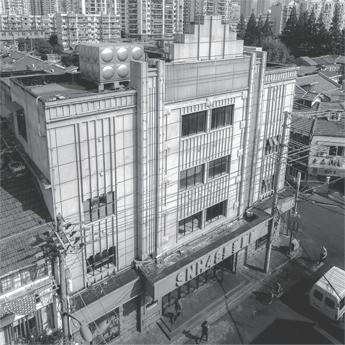
Peninsula bay creative Park (Sawmill company) built in 1924

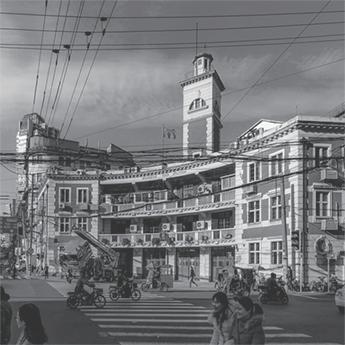
Hongkew Fire Station built in 1867
OLD NEIGHBORHOODS
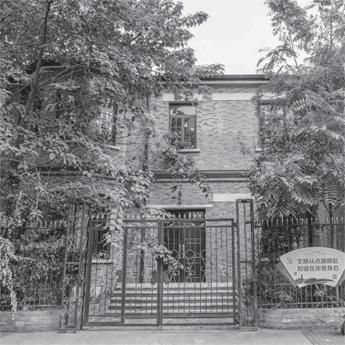
Music Studio (Police station) built in 1910s
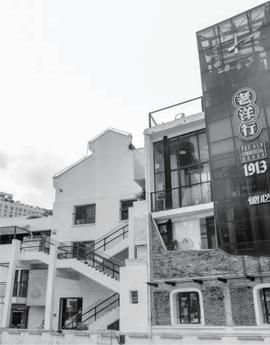
1913 Old Firm creative industrial offices (John D Hutchison & Company Ltd) built in 1913
HONGKOUCREEK
1933 Old Millfun shopping center (Shanghai Slaughterhouse) built in 1933
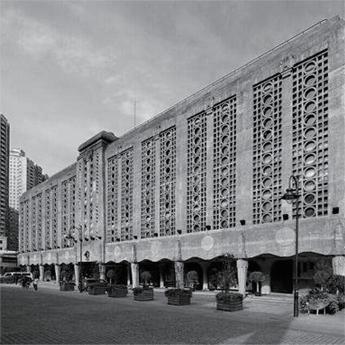
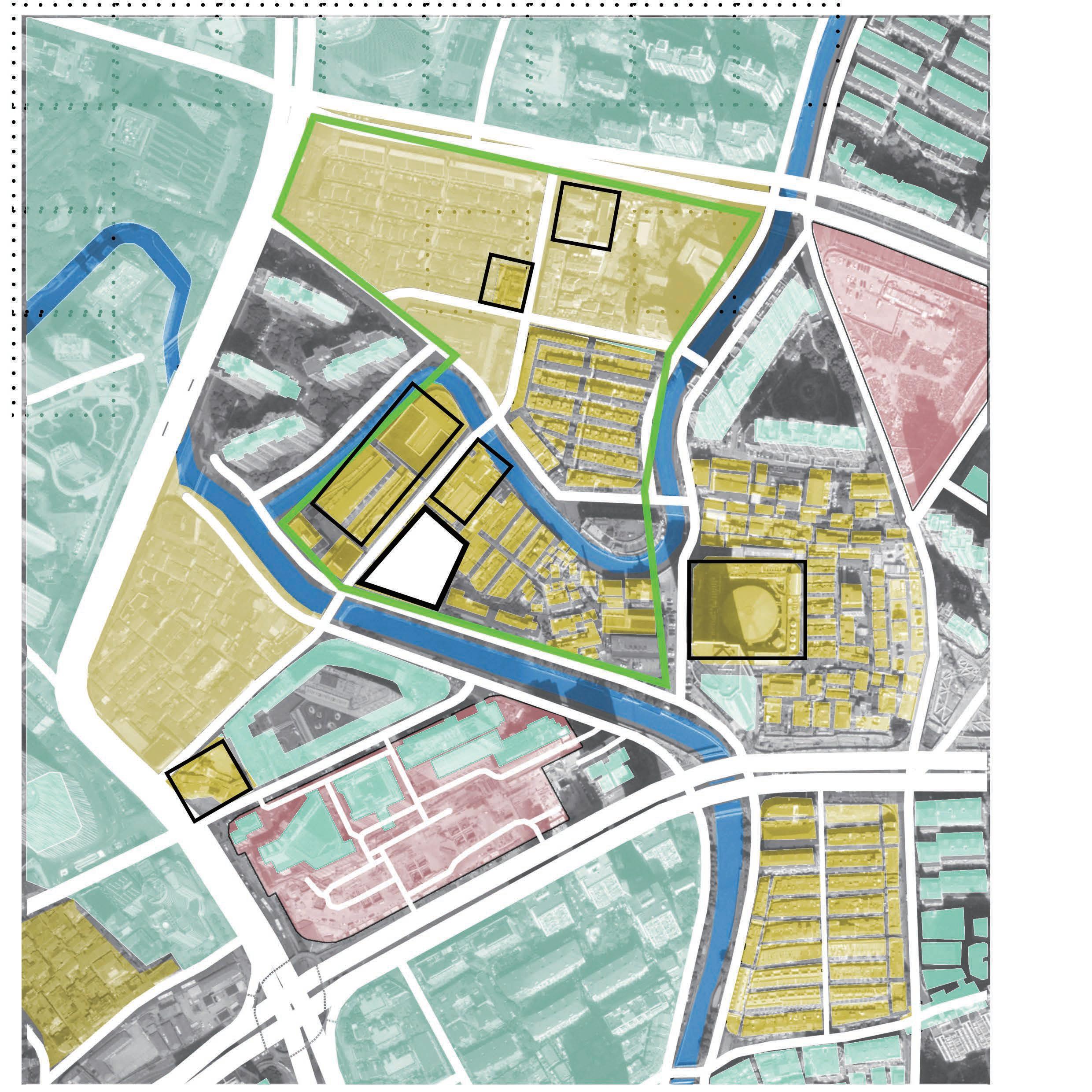
SITE BEING DEMOLISHED AND UNDER CONSTRUCTION BUILDINGS BUILT IN THE 21ST CENTURY
SITE N N N N N N
SHANGHAI MUSIC VALLEY
ABANDOND
BUILT BEFORE THE 1930S N
Some historical buildings have been renovated for other uses.
However, many historical residential communities in this area are facing demolition in the urban renewal plan.

Lanwei Alley community was first built in the 1930s.
The original residents have all been relocated, and the entire community has been abandoned and blocked.
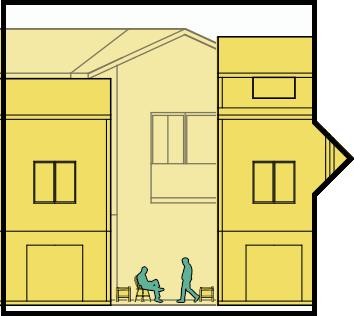
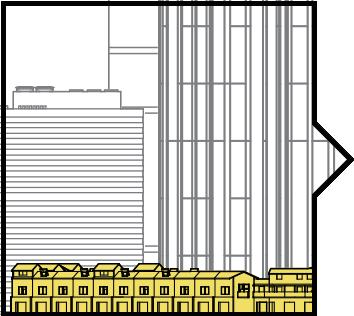

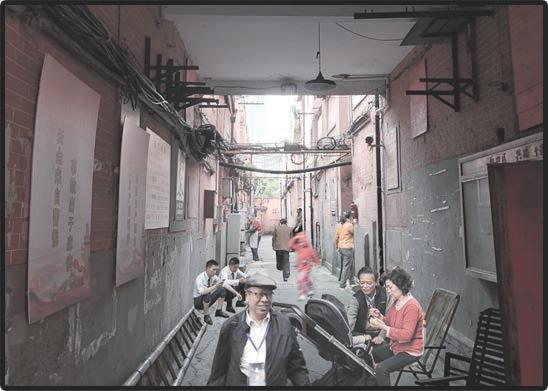
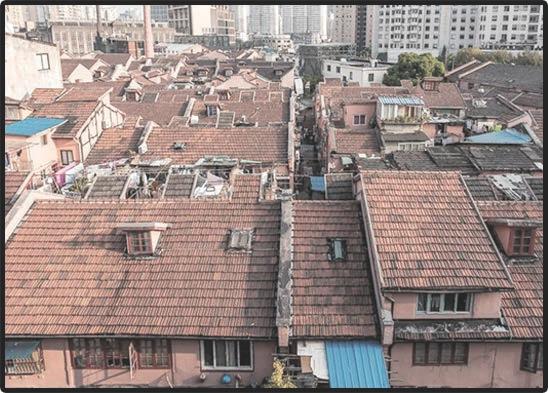


 Narrow public space
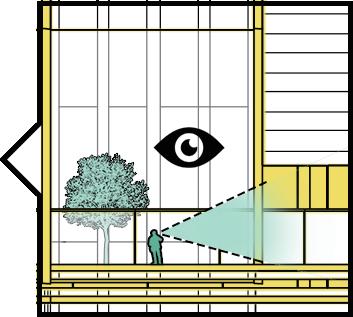
Sight and sunlight are blocked by high rises
Narrow public space
Sight and sunlight are blocked by high rises
SITE ANALYSIS
LANWEI ALLEY COMMUNITY SITE
AGE DISTRIBUTION HONGKOU CREEK 6042% 36% 22% 24-60 0-24
In the past, 3-4 families lived in such a narrow and crowded housing unit.
1
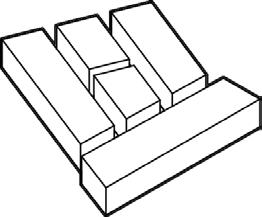
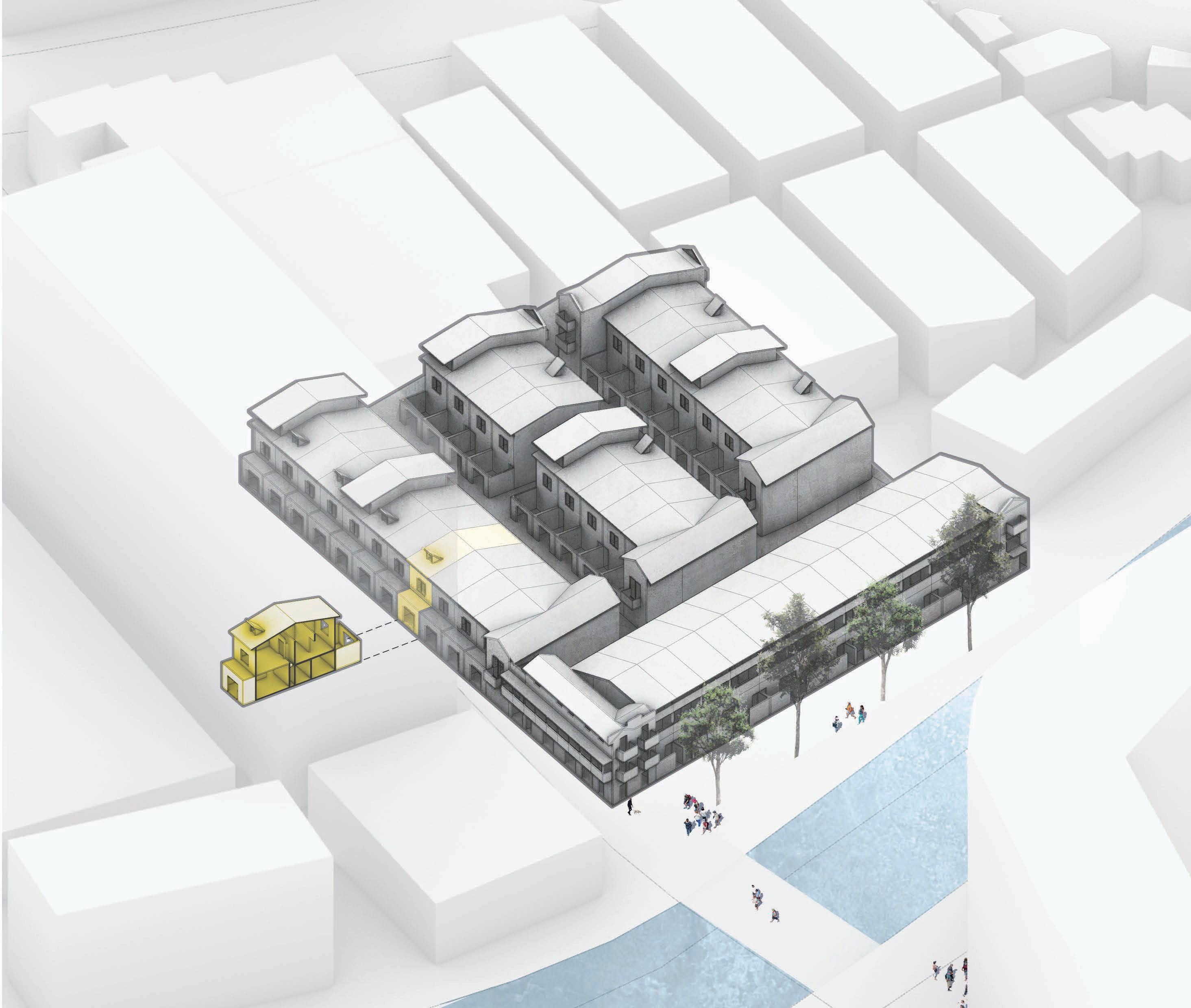
The original residential community was placed in the horizontal direction
4
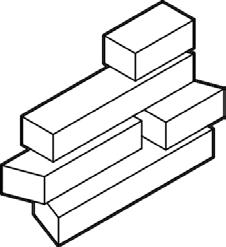
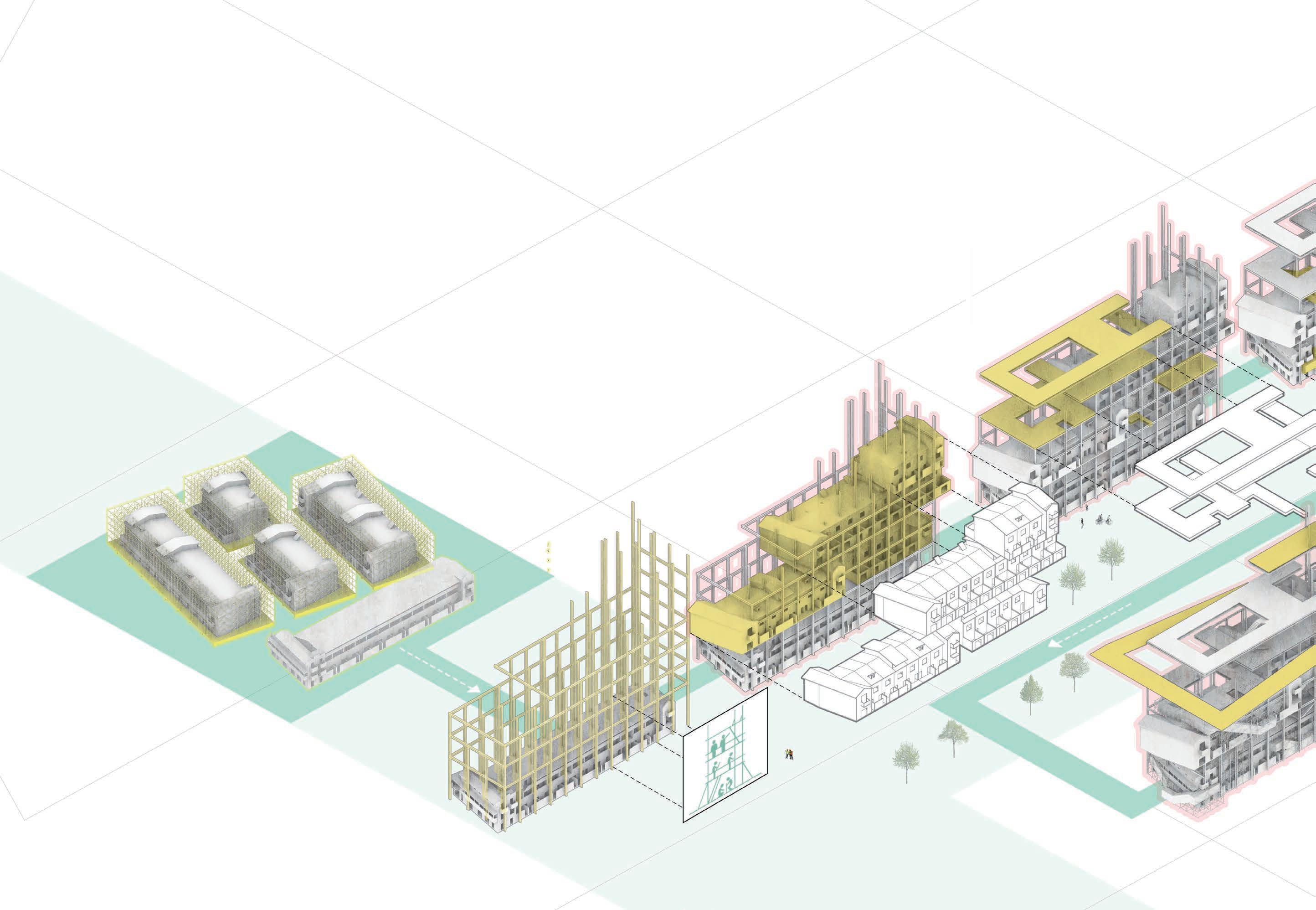
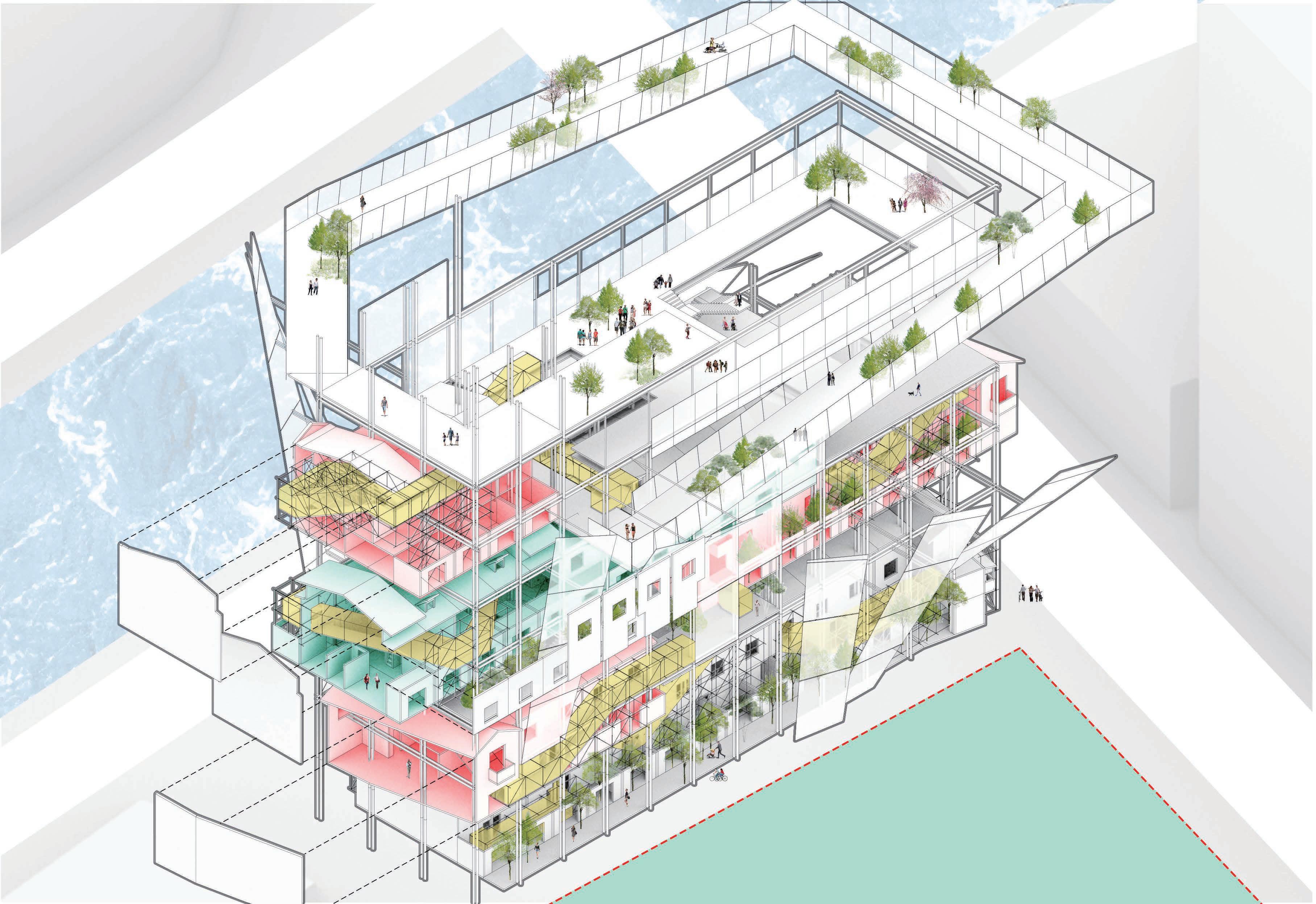
Houses will be stacked into new vertical communities
2
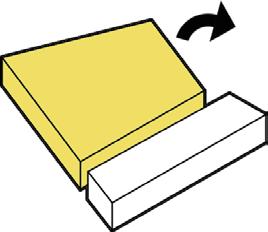
The original houses will be moved from their original locations
NEW CONSTRUCTION
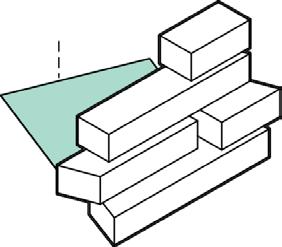
5
The majority of the original community's area will be utilized for new construction.
3
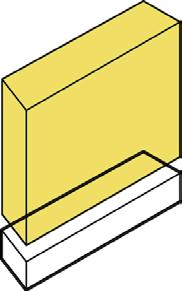
Flip the entire community into a vertical direction
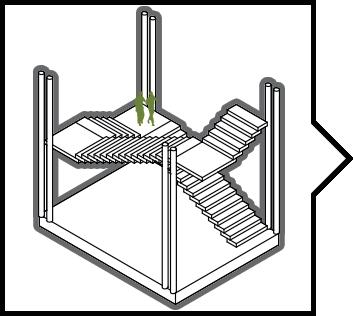
SLOPE STAIRS E
PLATFORM
FORM EVOLUTION
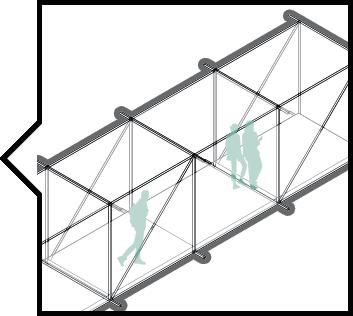
GANGWAY
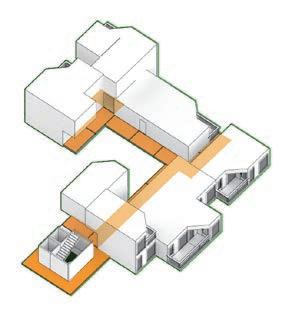
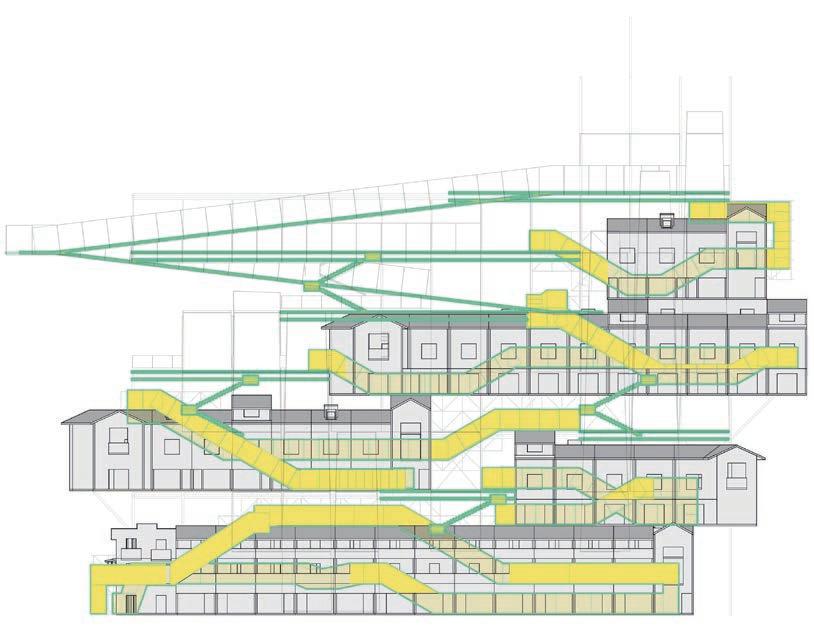
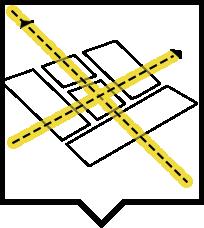
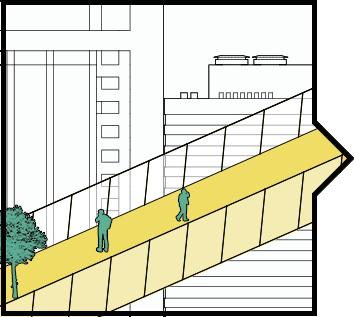
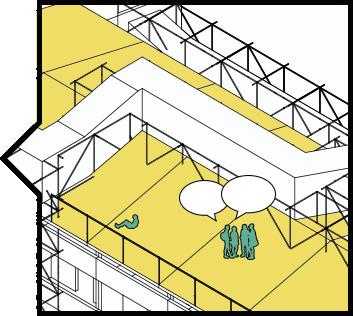
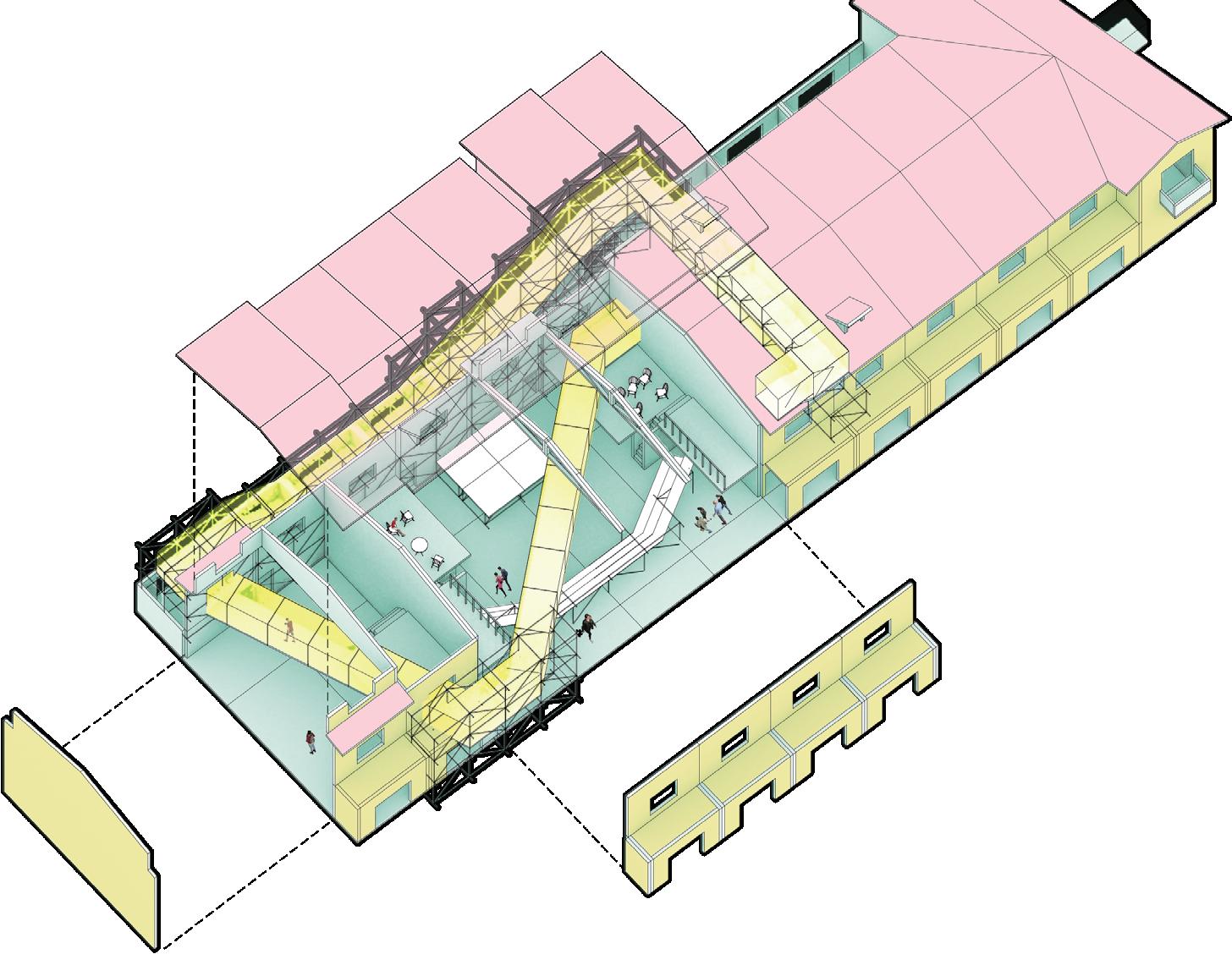
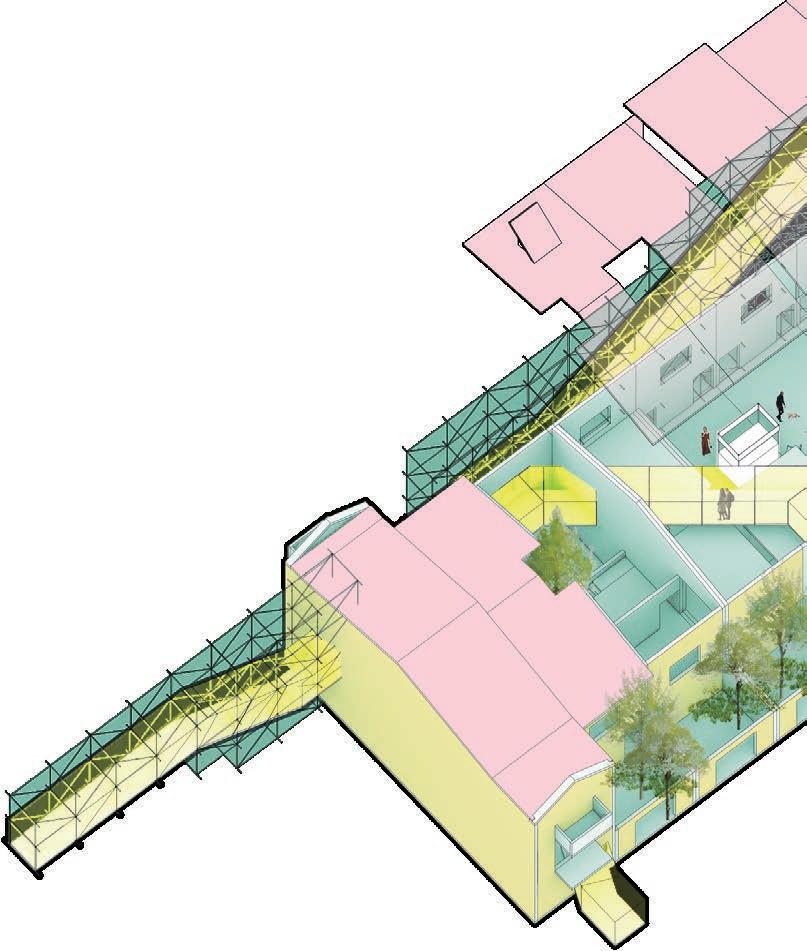
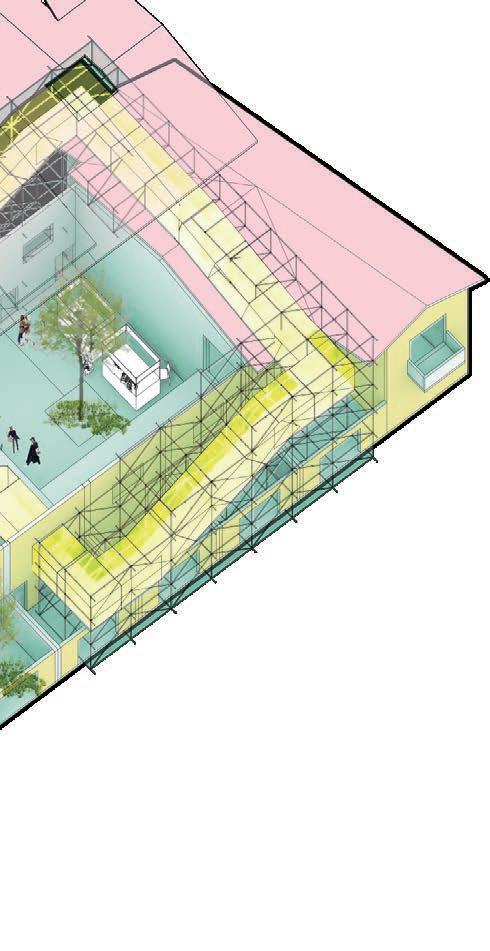
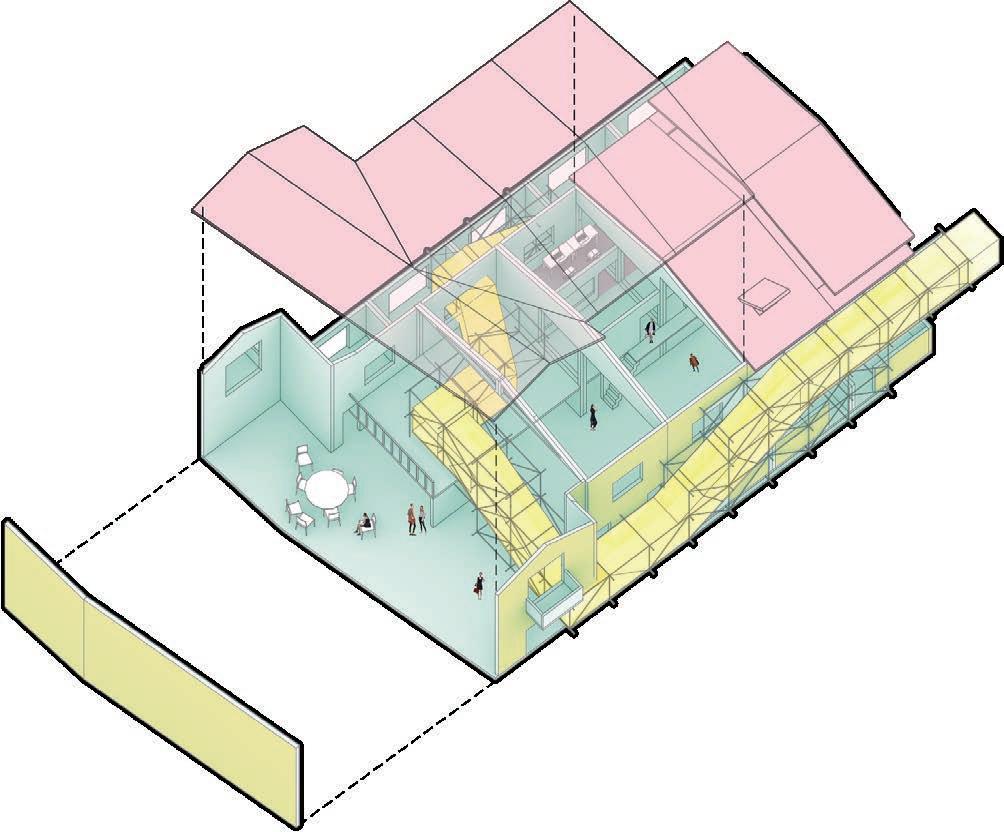
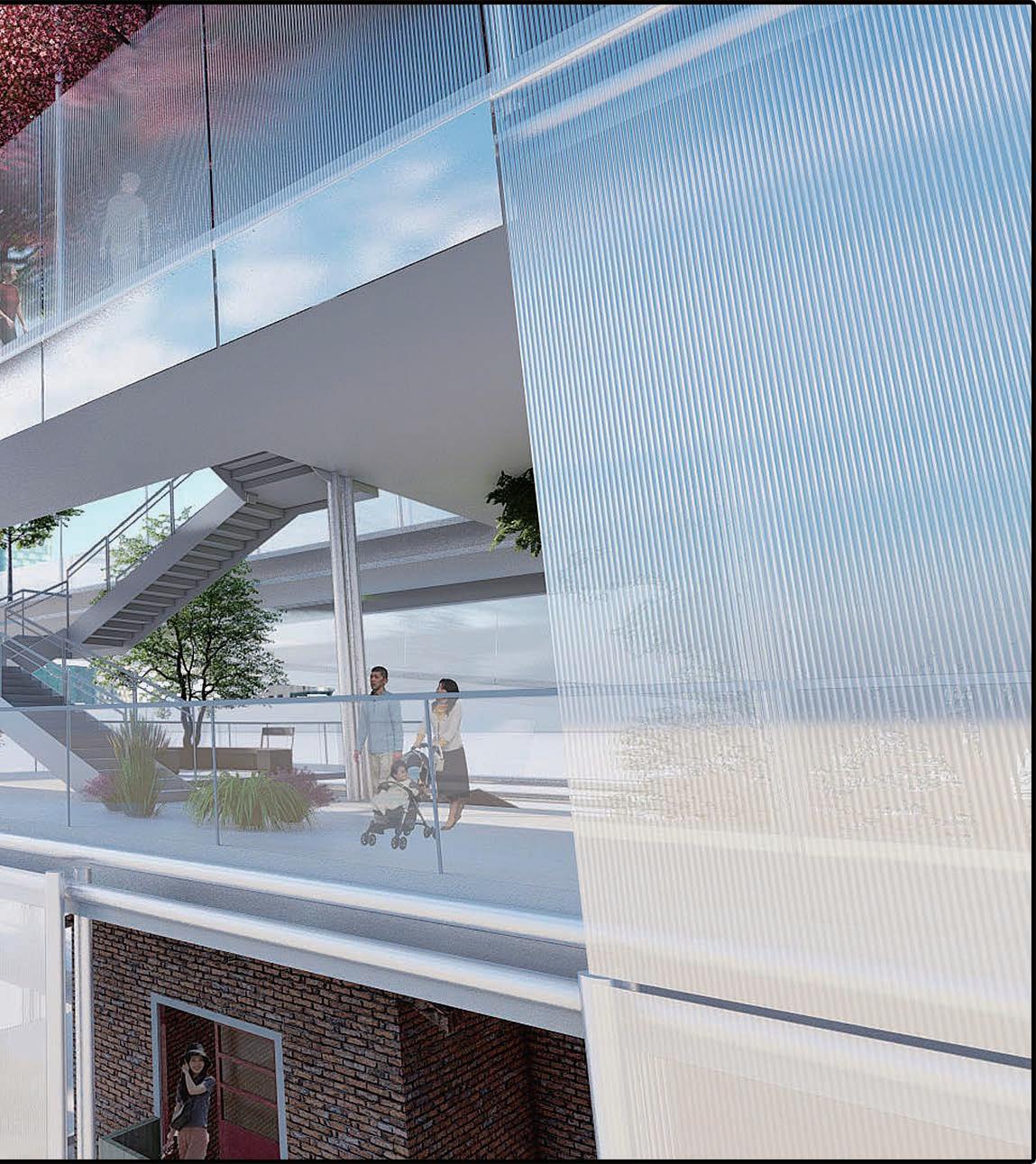
The gangway supported by scaffolding will pass through most areas of the project, allowing visitors to reach all floors freely
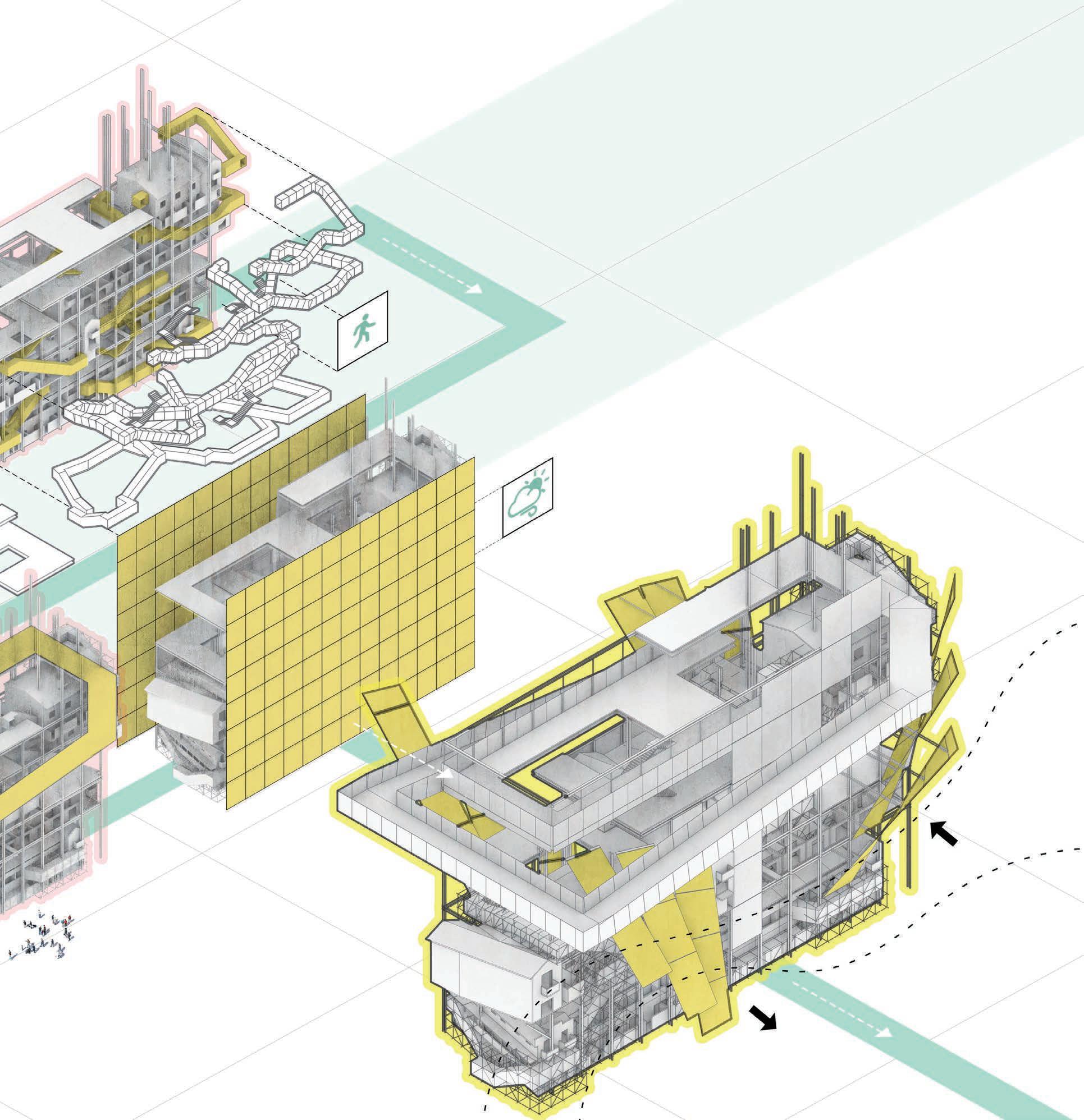

As the shell of the project, the glass curtain wall ‘protects’ the historical estate inside, while it is not completely enclosed.
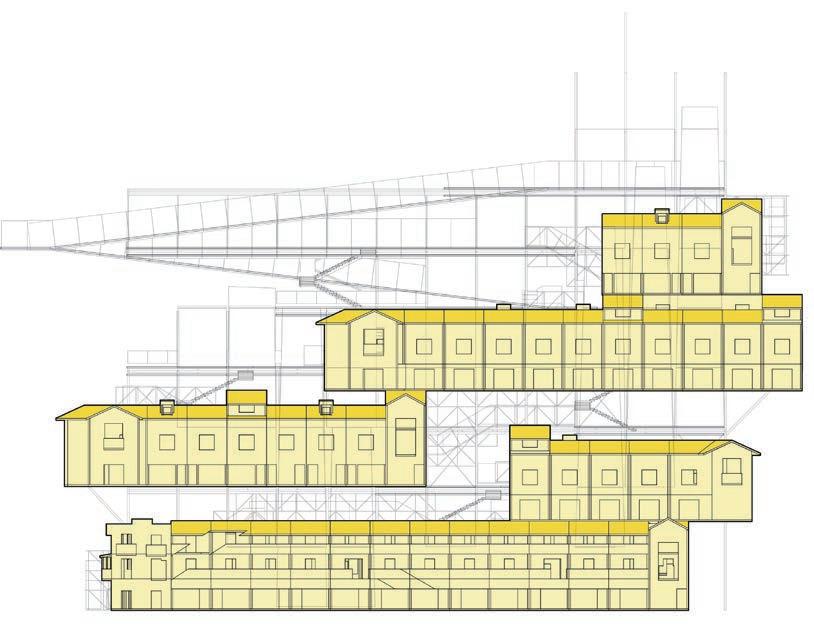
SLOPE
EXTERIOR GLASS
Community Theatre Market
Office
Office
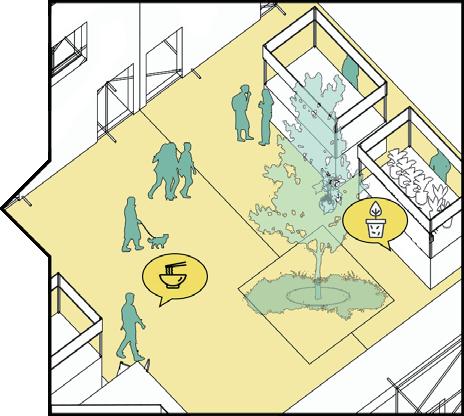
Food Hall
The function of the building blocks of new Lanwei Alley
The circulation of new Lanwei Alley (including gangways and platforms)
FLOURISHING GARDEN
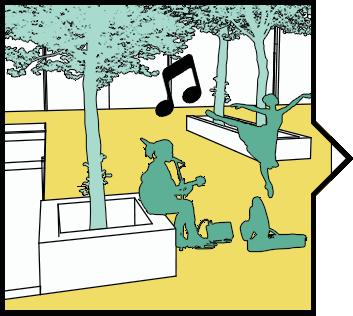
Change from a horizontal residential community to a vertical garden, which will break the original limitation of view and public space.
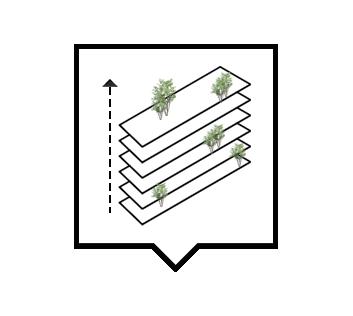
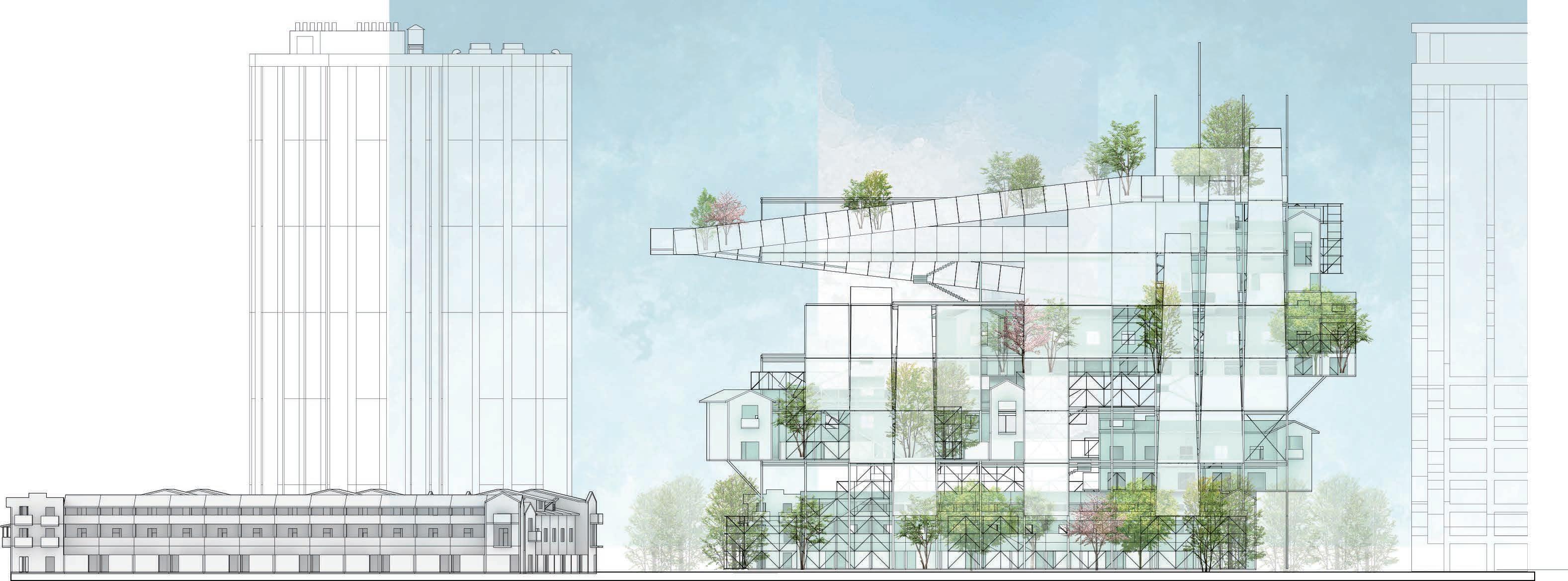
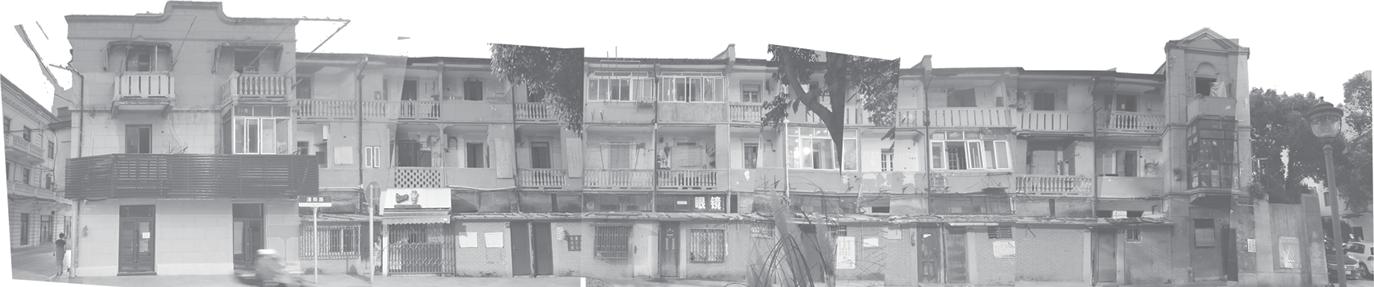
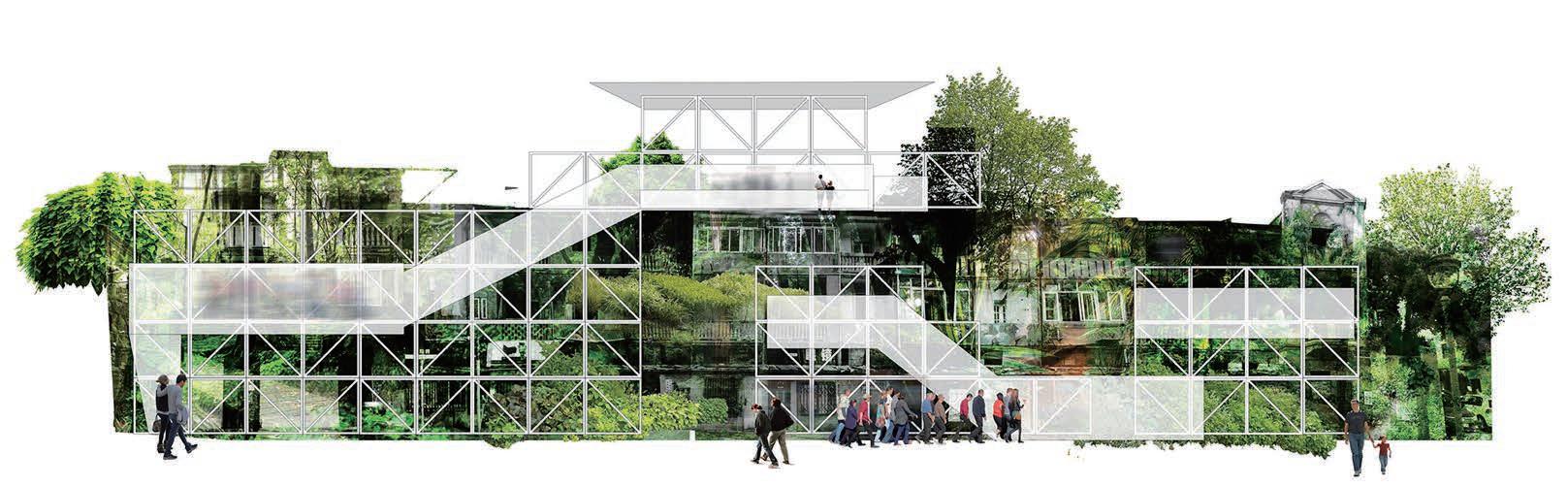
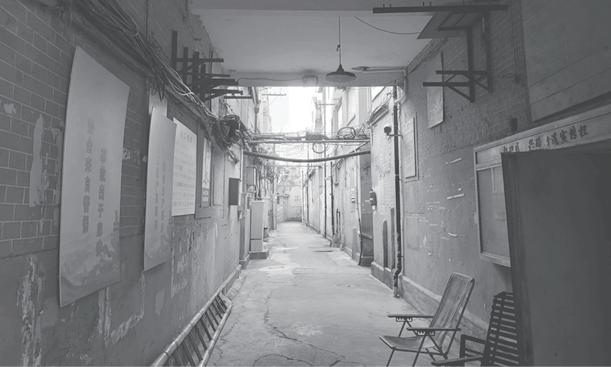
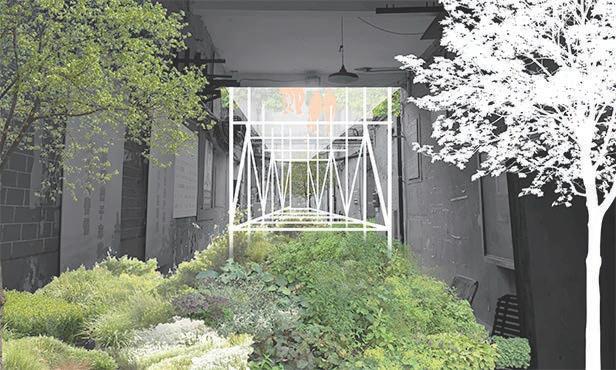
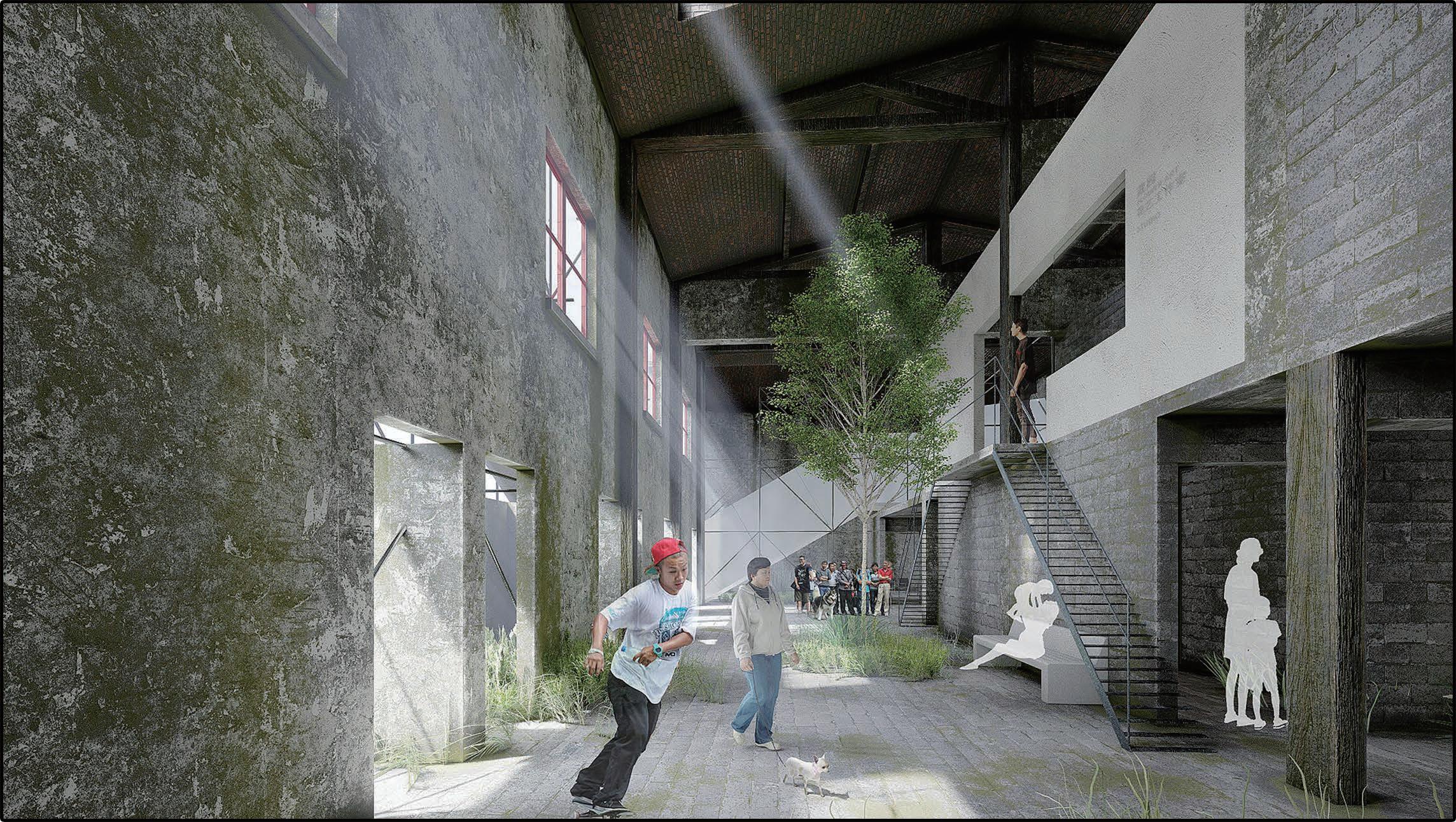
The original facade of building will be preserved, and part of the outdoor space will be turned into a planting area.
Keeping the entire project in an ‘abandoned state’ will protect the history and people's memories rooted in this community.
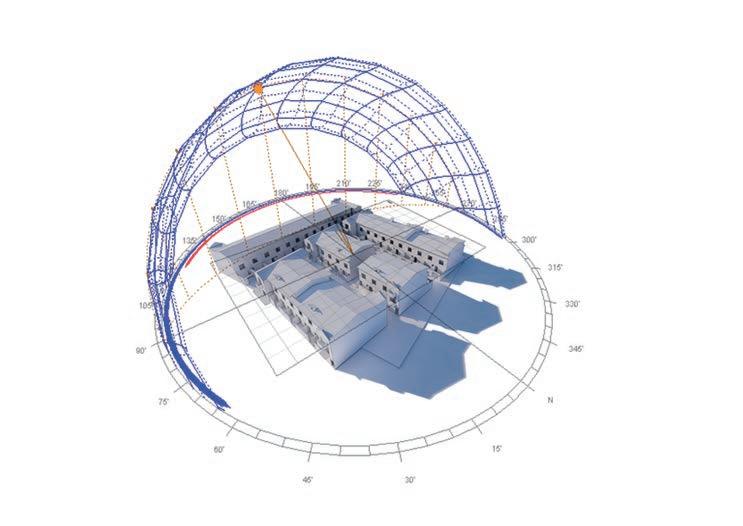
Daylight simulation of the original community
ORIGINAL COMMUNITY
COMMUNITY
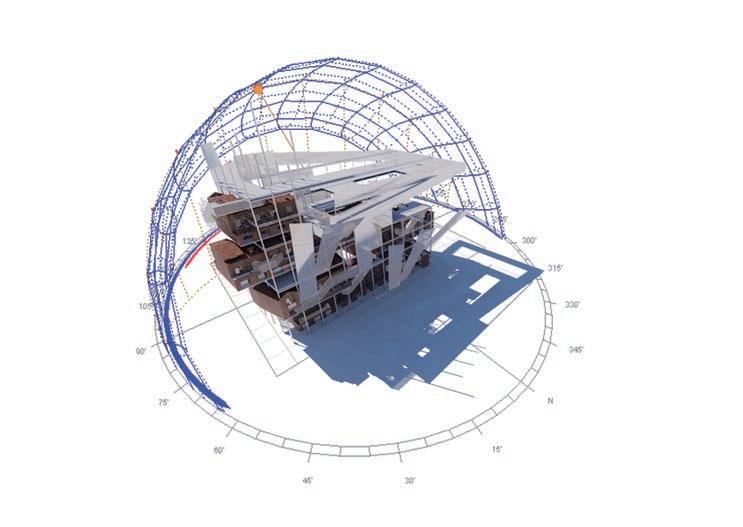
Daylight simulation for the renovated community
THE
RENOVATED
FLOATING SLOPE
THE TOP OF SLOPE
PLAZA
ROOF
葳之苑
Ground floor 1st floor 3rd floor 4th floor
floor
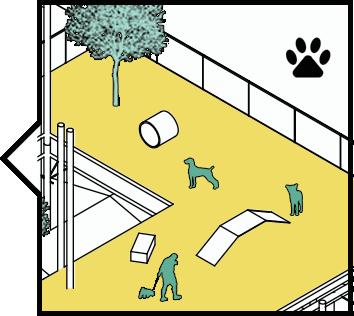
DOG PARK
FORNEW CONSTRUCTION
2nd
ARCHITECTURAL DETAILS AND VISUALS
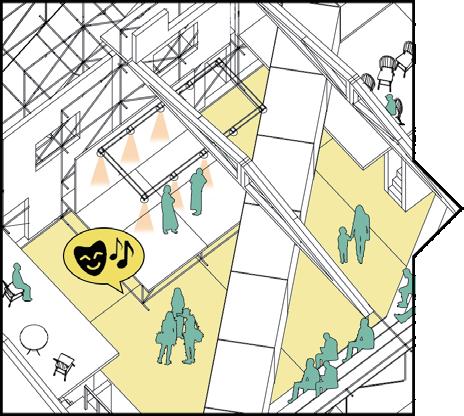
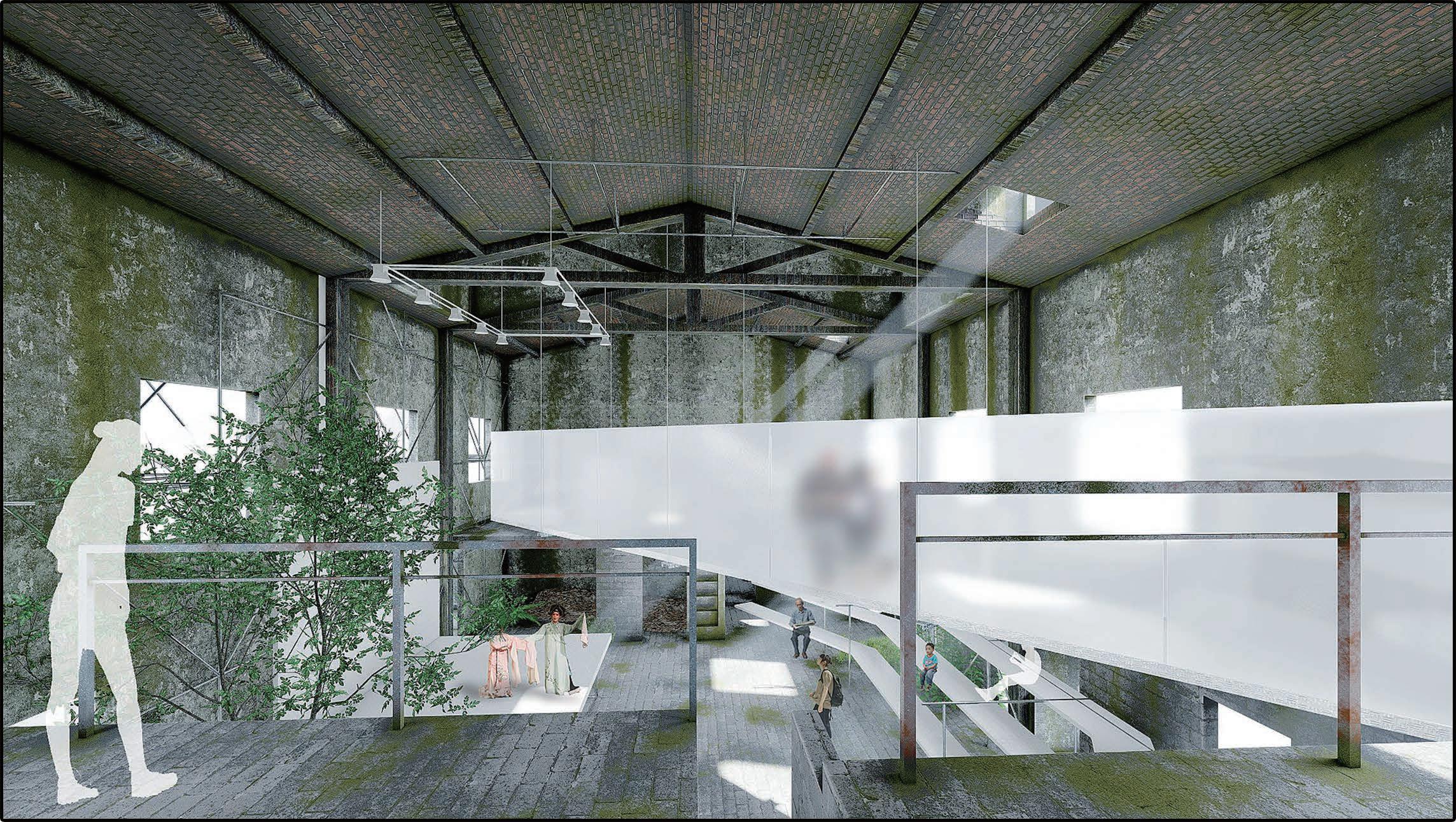
Ground Floor-Theater
THEATER
E 4th Floor
Ground floor
 MARKET & BAZAAR
-Plaza
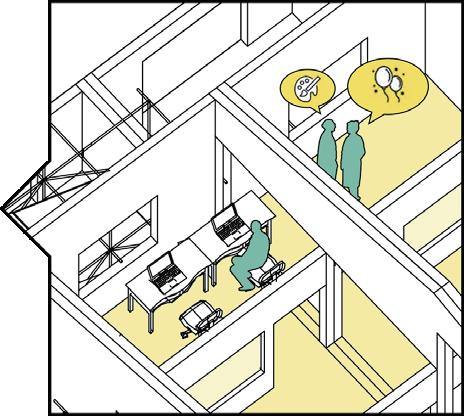
WORKING STUDIOS
4th Floor- Working Studios
2nd floor E
4th floor
PRISM FLOWER 3.
OFFSHORE FARM LOCATION:
WESR BAY
DOHA
QATAR

SOLO WORK
Qatar's plans to increase Doha's agricultural area in the future in a bid to address the city's food security issues may be hampered by such problems as the lack of freshwater resources, the desertification and the possible sea-level rise.
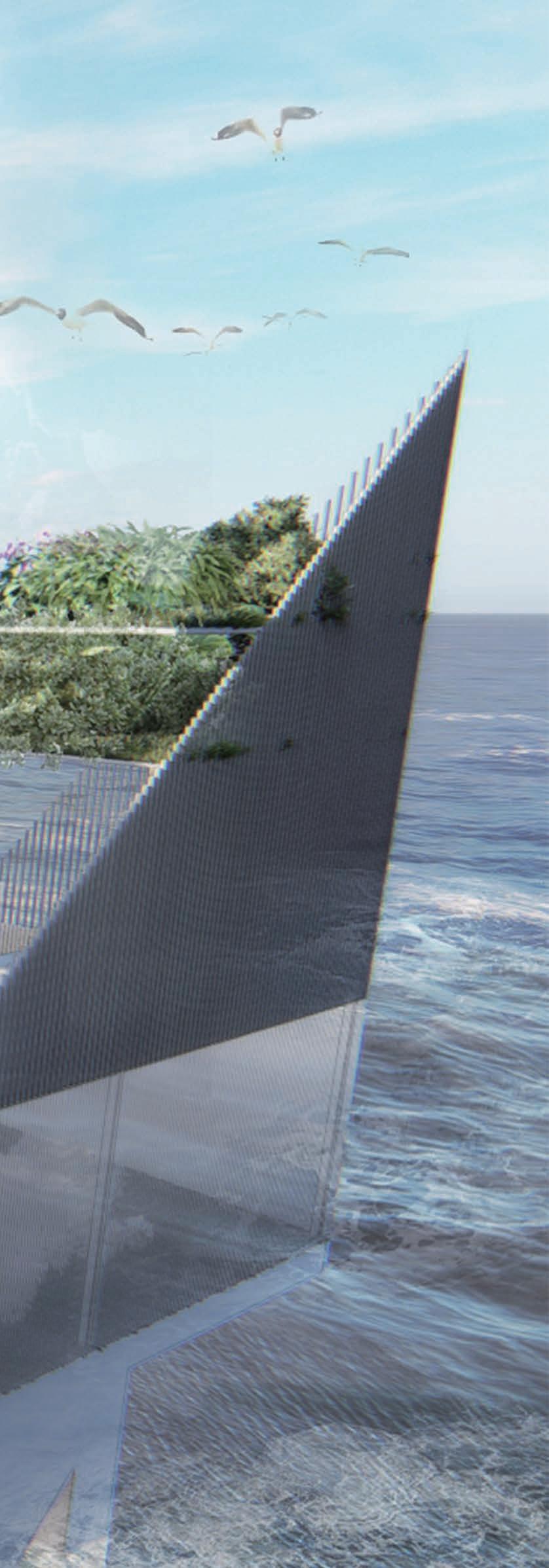
The Prism Flower Offshore Farm Project aims to work out a feasible solution to these problems of how to try to adapt to the upcoming environmental changes and use these seemingly negative environmental conditions to solve the problems Doha is facing. For example, shortages of freshwater resources may be addressed through desalination, and transport distances may be reduced through offshore production.

FUTURE CHALLENGES
With a rising population and rapid urban development, Doha, as the capitaland future major metropolitan area, has an urgent need to provide its inhabitants with fresh, healthy food from sustainable agriculture.


Food
For Qatar, there is a huge gap between the import and export of food, which means that Qatar is extremely dependent on imported food.


Agricultural land
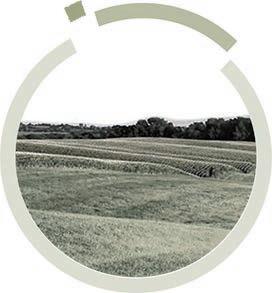
The proportion of agricultural land in Qatar is far less than the world average, and these farm lands are far from meeting the needs of its rising population.

Water scarcity
Qatar’s lack of fresh water resources has become a constraint on its agricultural development.



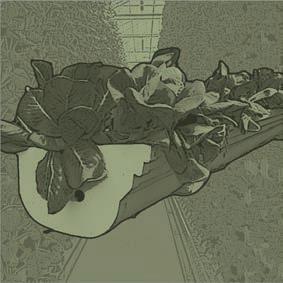
Food Import & Export of Qatar (*Data from OEC) Agricultural land proportion (*Data from World Bank) IMPORT 2.4M Food staffs Vegetable products 1.5M EXPORT 813M Food staffs Vegetable products 704M
Arable land 1.1% Permanent crops 0.2% Permanent pasture 4.6%. Qatar 5.7% World 37% Agriculture 65% Agriculture 65% Living 13% Living 2% Industry 21% Industry 40% World 5923 Qatar 22.7 Freshwater resources per capita(L) (*Data from World bank) Over-reliance on imports Scarcity of local fresh water Low agricultural area ratio Local agricultural production In-site seawater desalination Drip
/
agriculture
irrigation
vertical
ANALYSIS
The project is located near the coast of West Bay and will be accessed via both land and sea traffic.


Growing vegetables with desalinated water
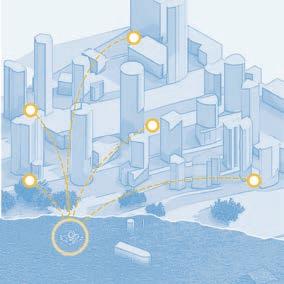
Delivering vegetables to nearby restaurants and markets
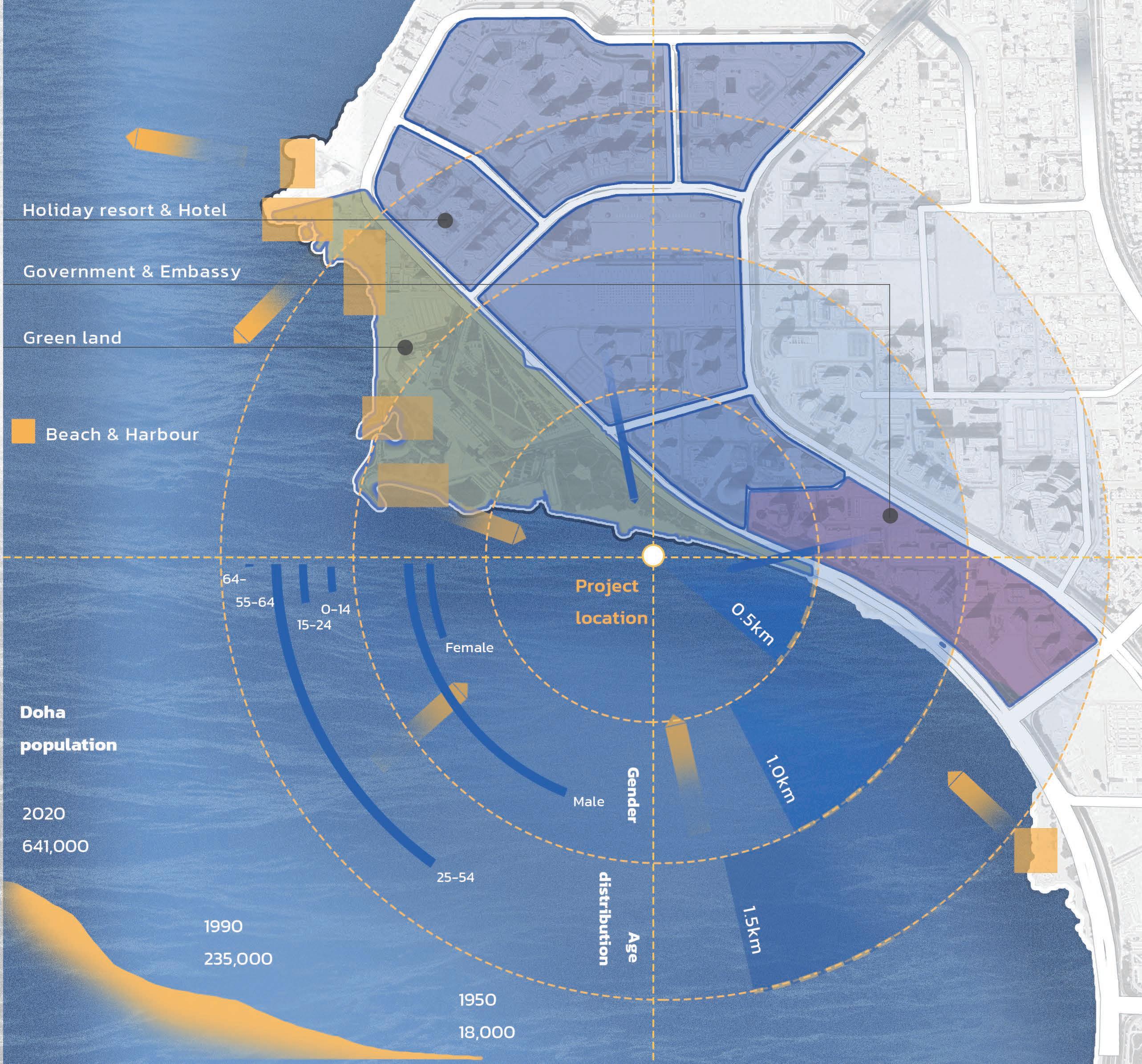
SITE
Building offshore farms and associated facilities
DOHA WEST BAY
OFFSHORE SUSTAINABLE PARK
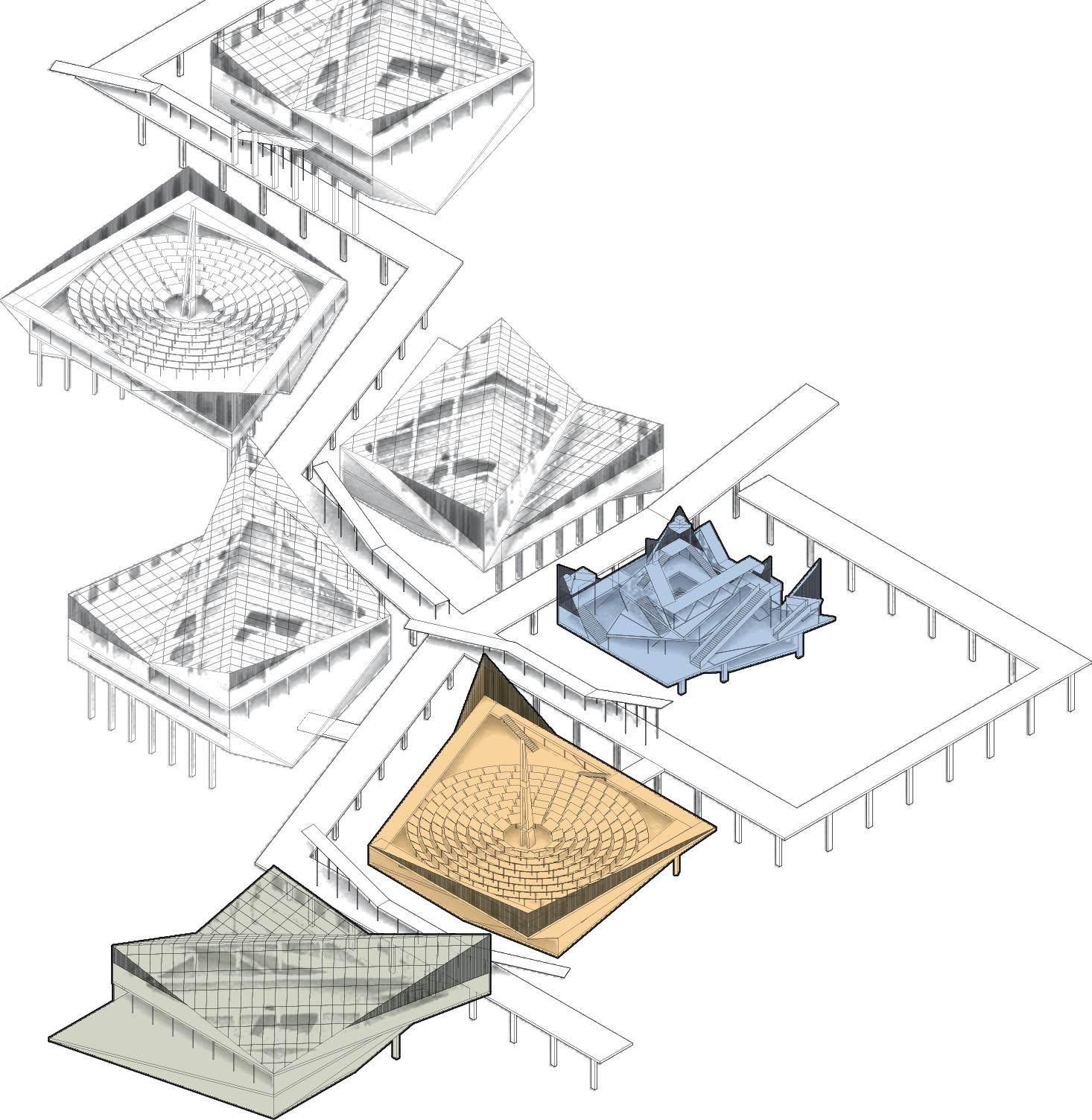
The whole project will be composed of several independent functional facilities. These facilities will cooperate with each other to form a complete circular sustainable system.
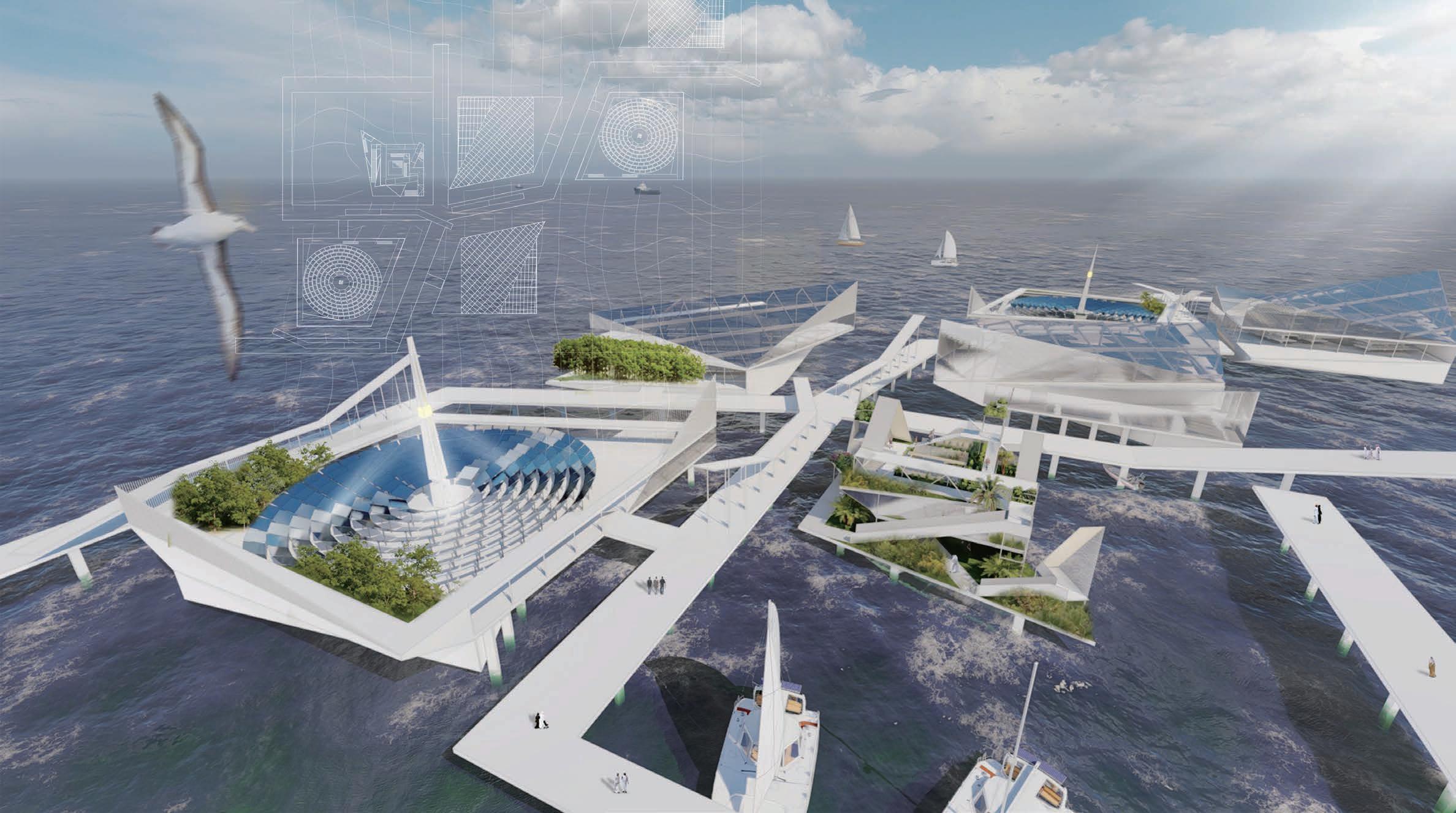 Aerial view of the entire sustainable park
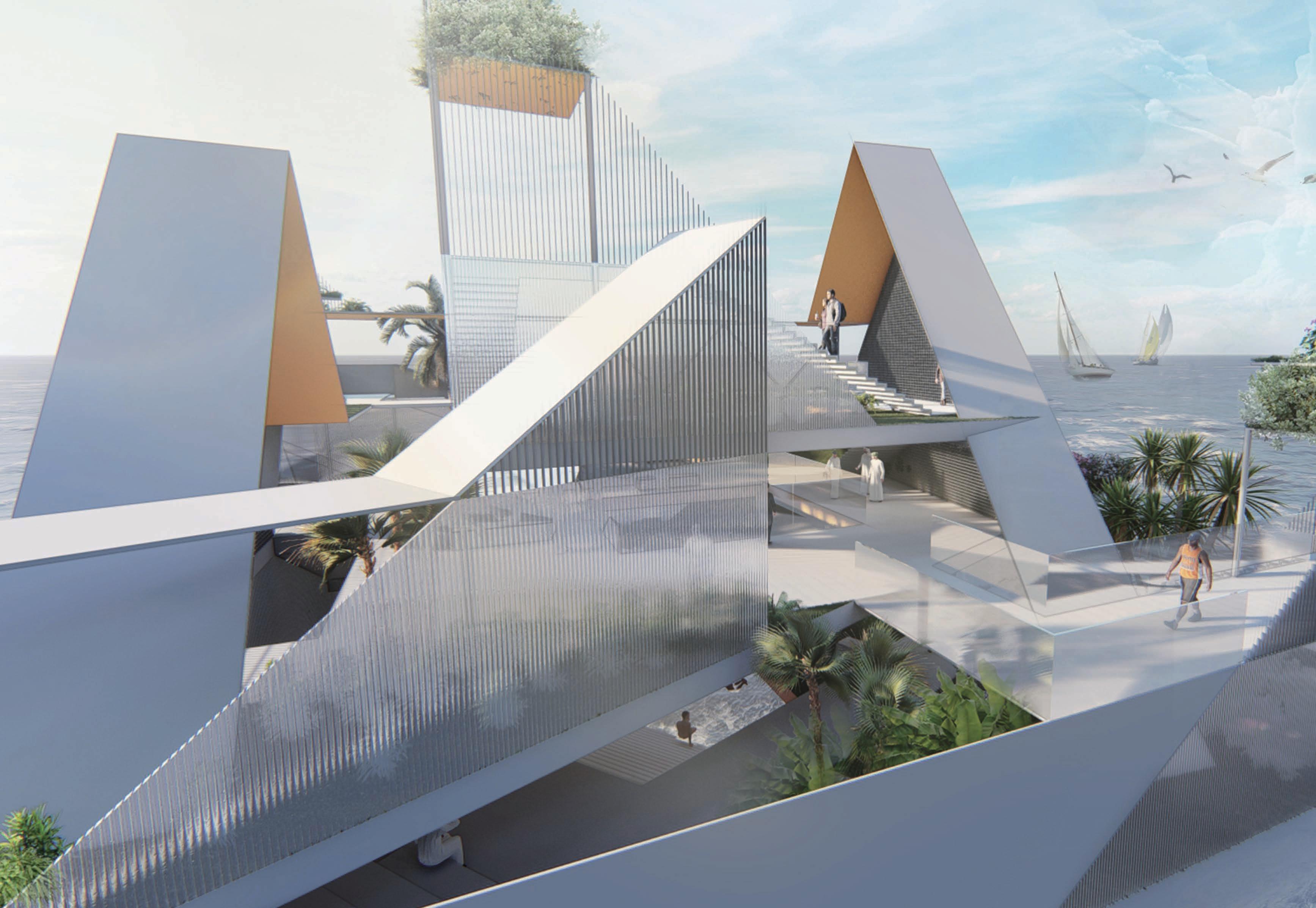
Inspired by flowers and prism , the outer envelope is slowly simplified into a stacked triangle according to the shape of the flowers.
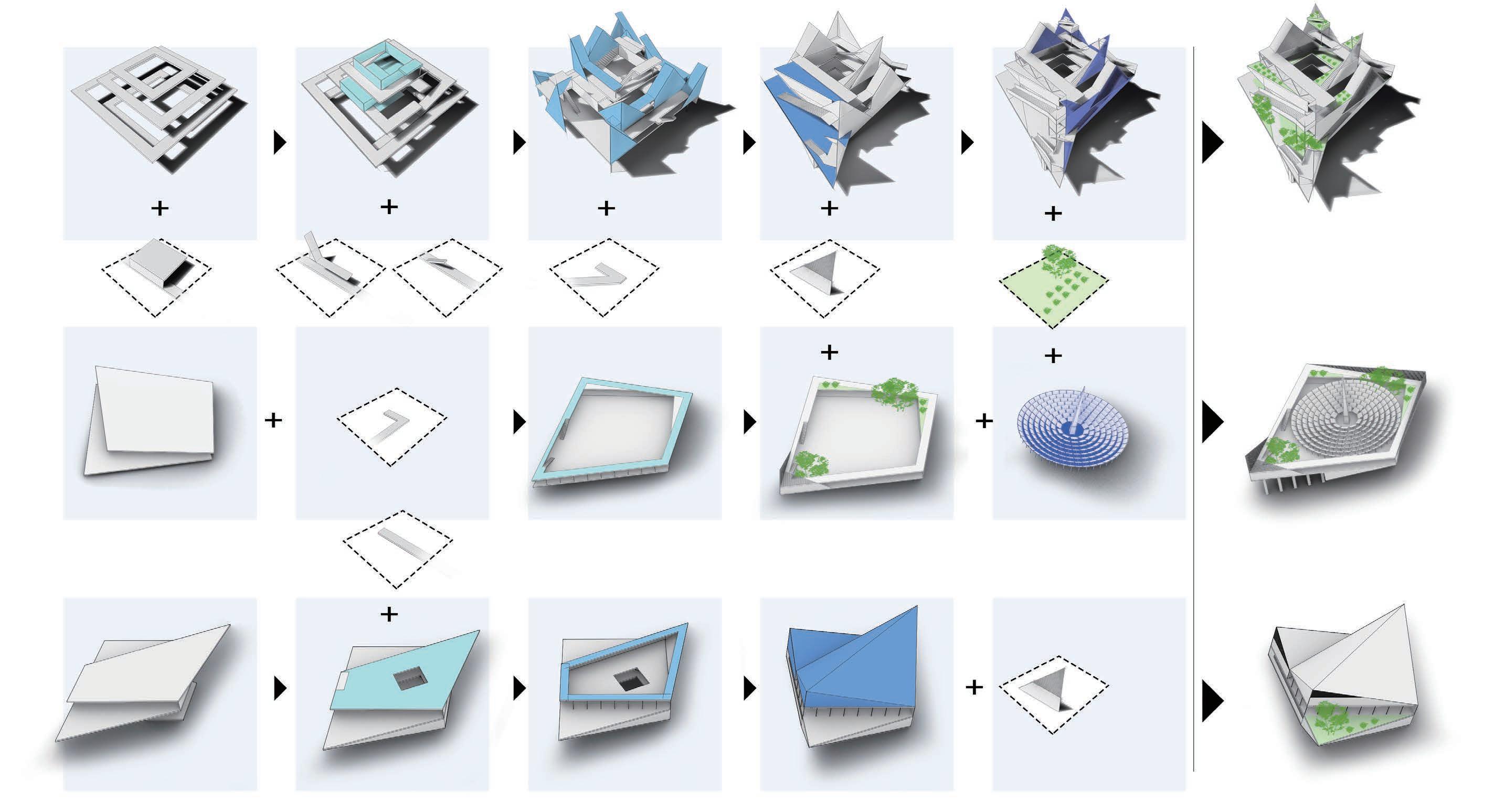 Design evolution of park facilities
Exhibition and Convention Center
Solar energy unit
Farming unit
Design evolution of park facilities
Exhibition and Convention Center
Solar energy unit
Farming unit



The entire system will interact closely with the city , providing it with renewable energy and food.
Leisure
Landscape
Energy supply
Water supply
Food supply
Doha city



ARCHITECTURAL DETAILS AND VISUALS
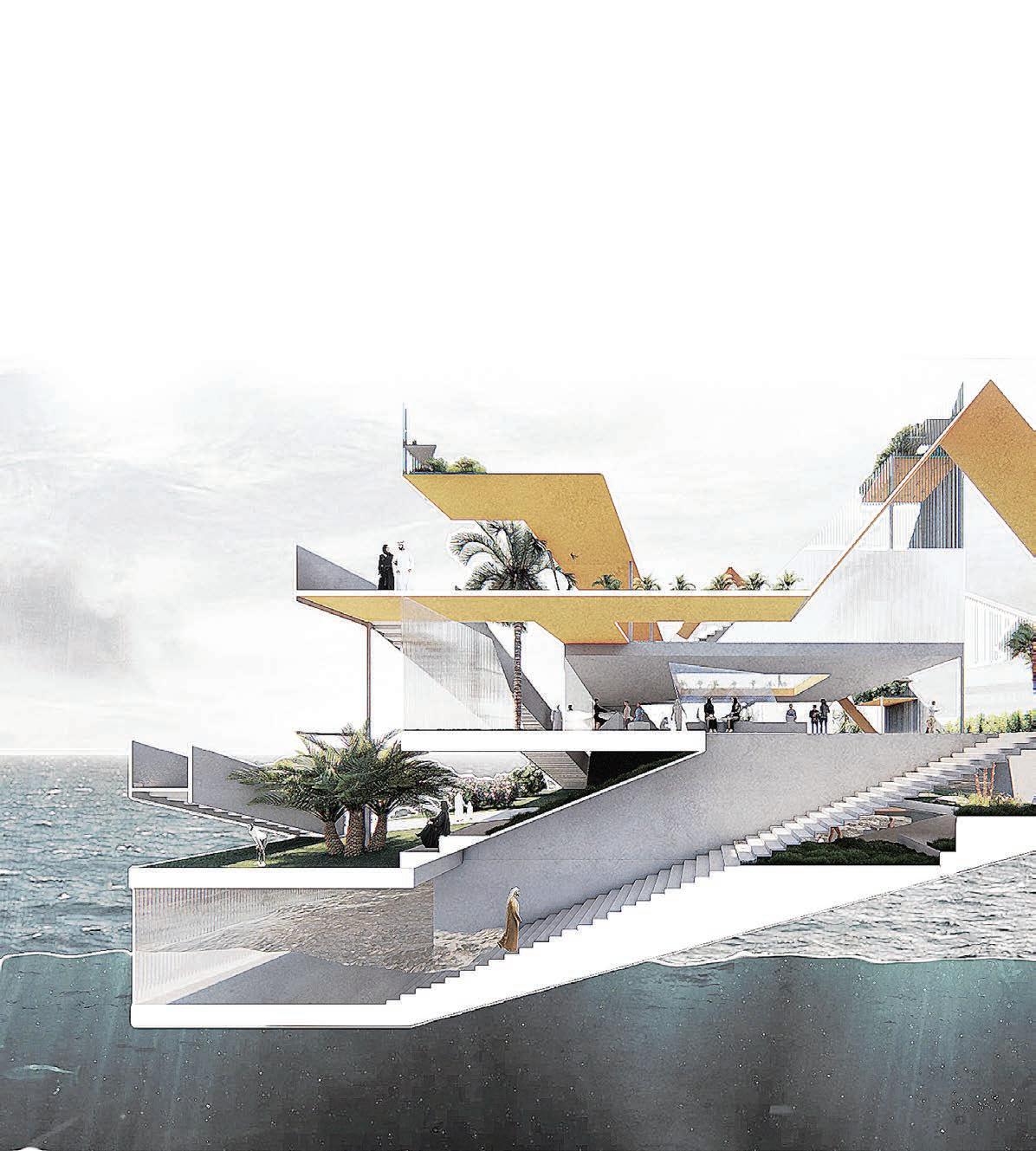
EXHIBITION AND CONVENTION CENTER
The entire system will interact closely with the city , providing it with renewable energy and food.

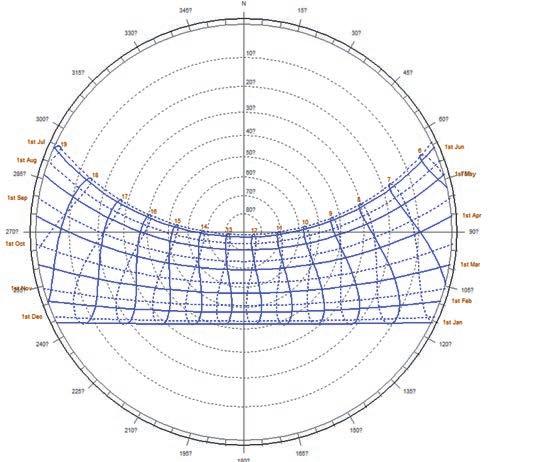
 Wind analysis
Sunlight analysis
Wind analysis
Sunlight analysis
2.
3.
4.
5.
6.
1 2 3 4 6 5
The section of exhibition and convention center
1.
Self-sustaining systems of the park

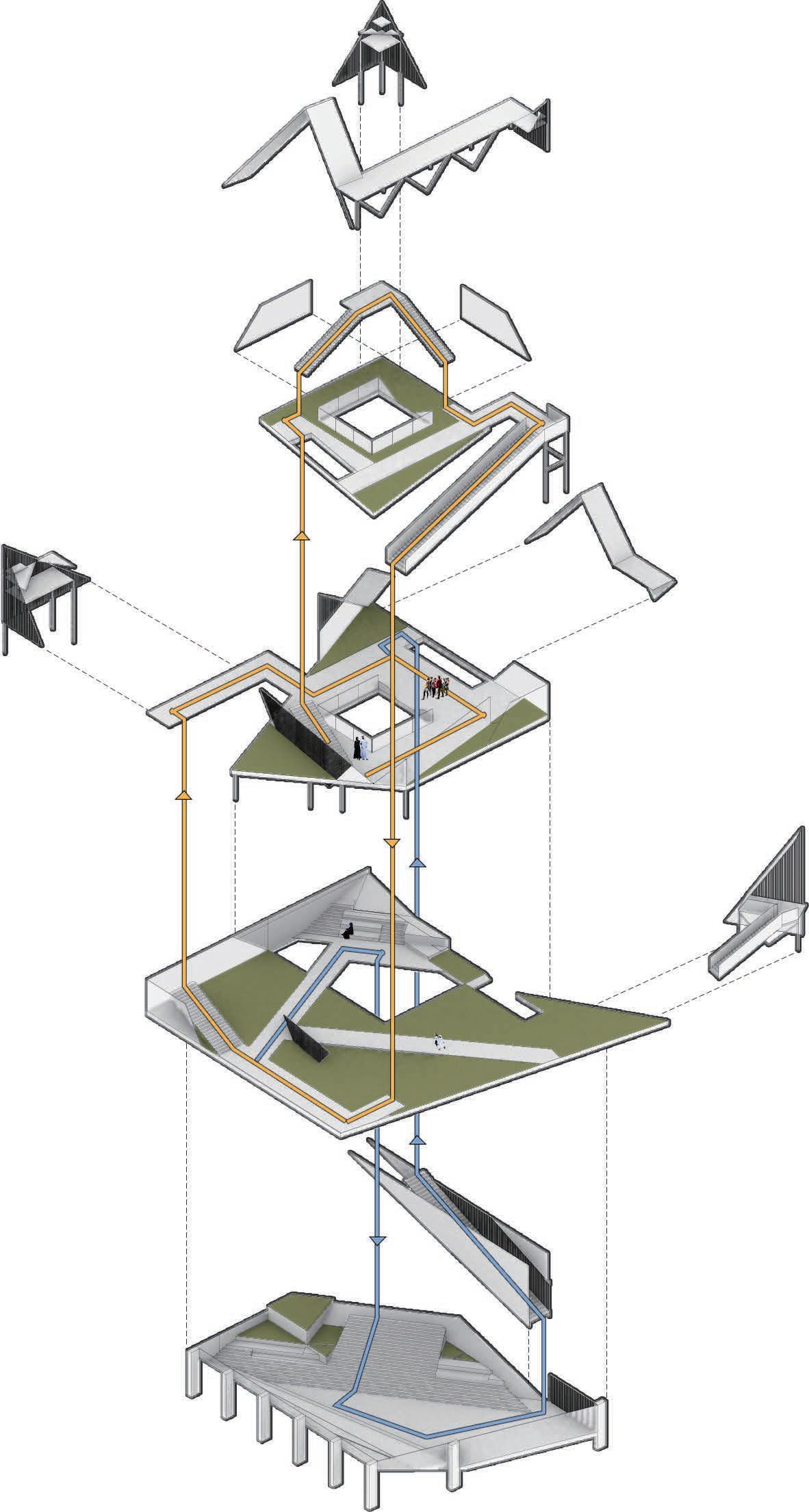
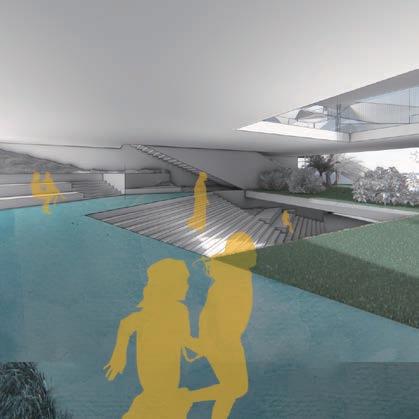
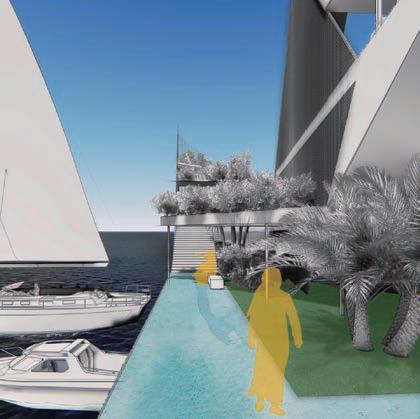
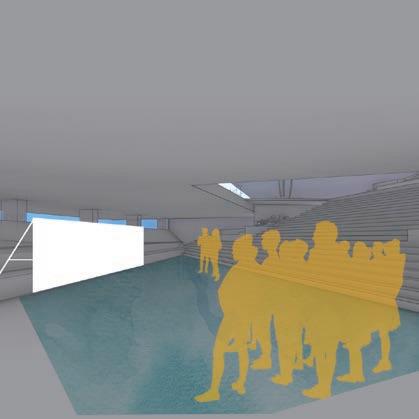
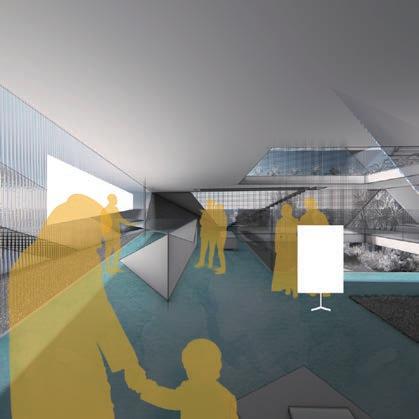
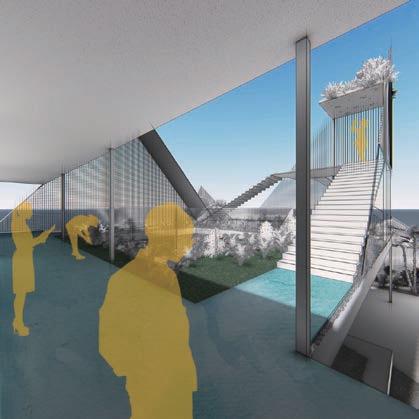 The circulation of the center
1 2 4 5
The features of the center
3
1-Garden
3-Screening Room
5-Roof Gazebo
2-Entrance
4-Exhibition Area
FARMING UNIT
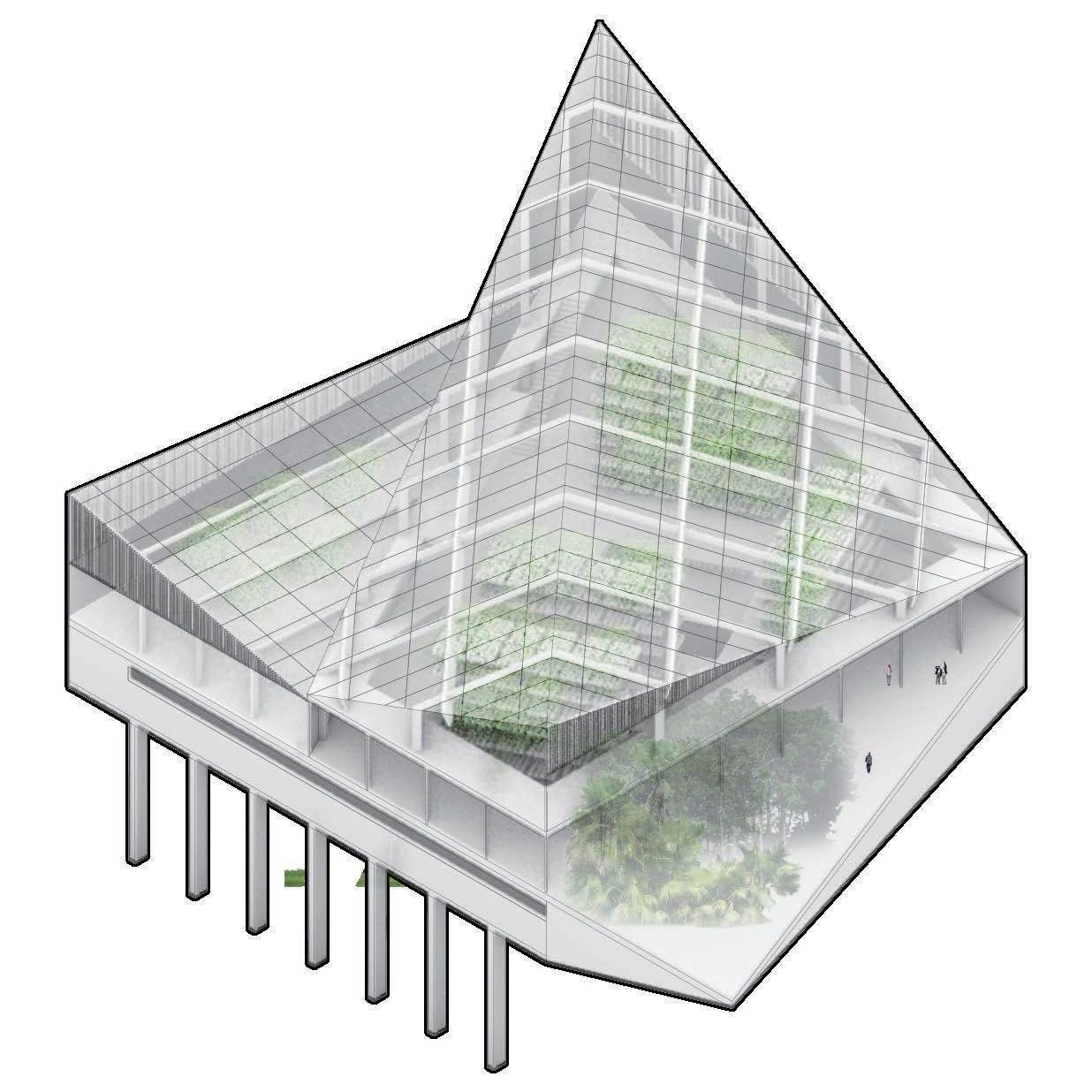
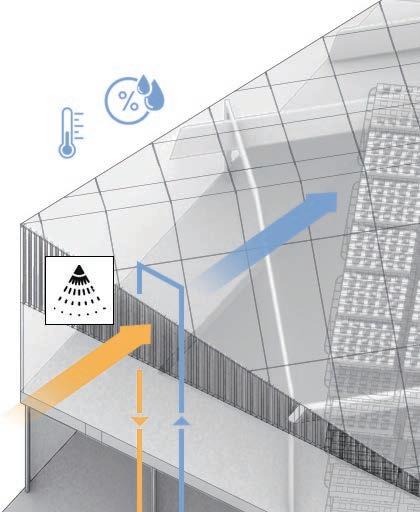
The farm uses a variety of technologies to achieve a sustainable agricultural cycle and basically does not require additional energy supply.
The system cools and humidifies the air by flowing seawater through the cooling packing, creating a better planting environment.
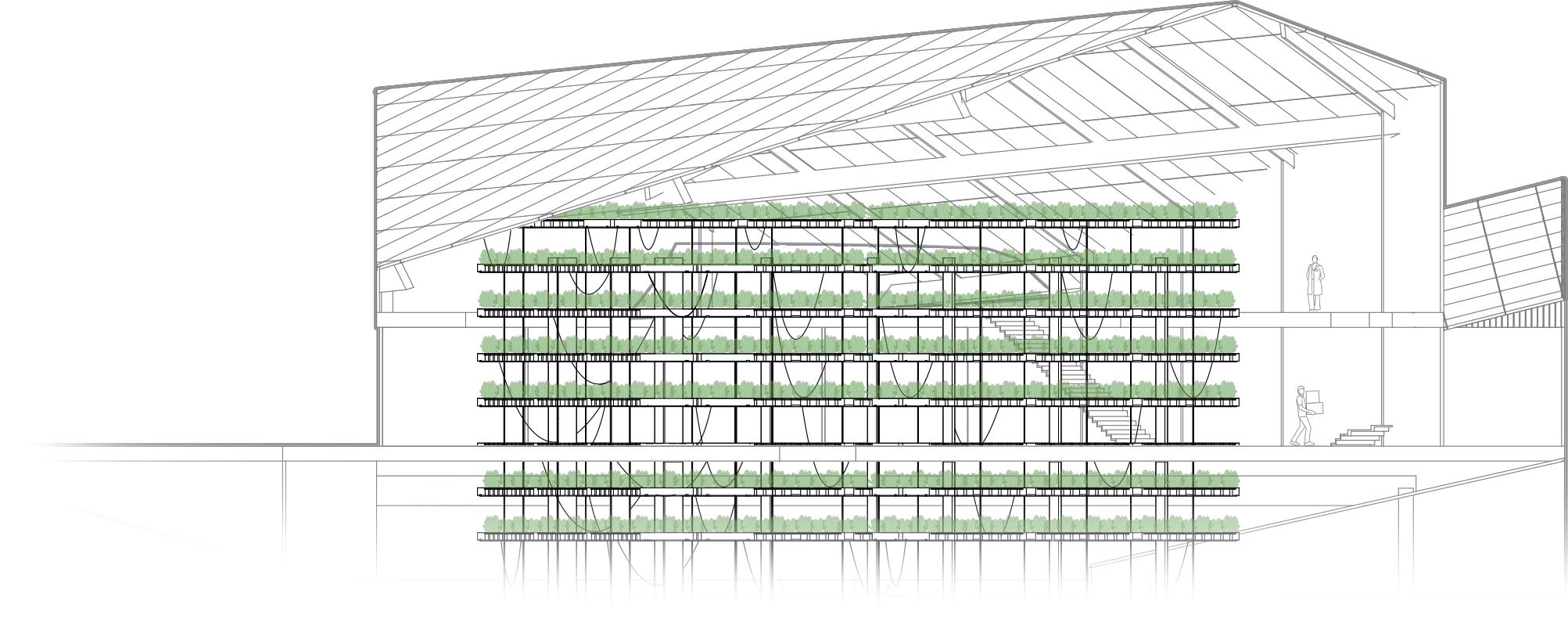
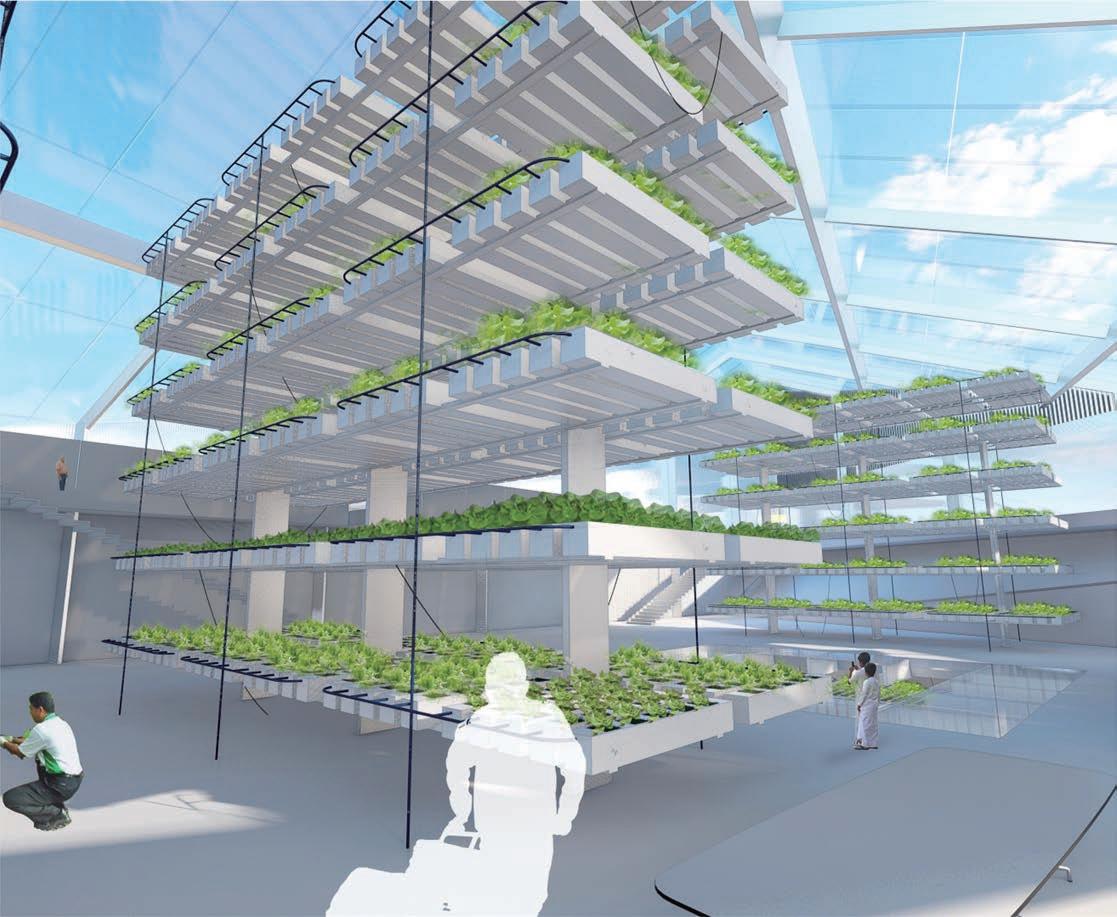
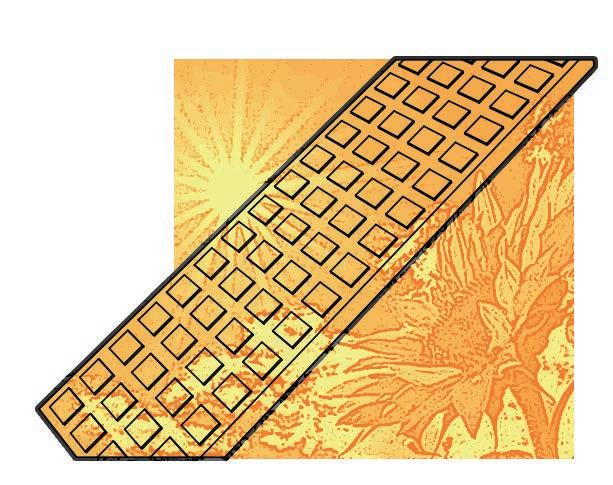

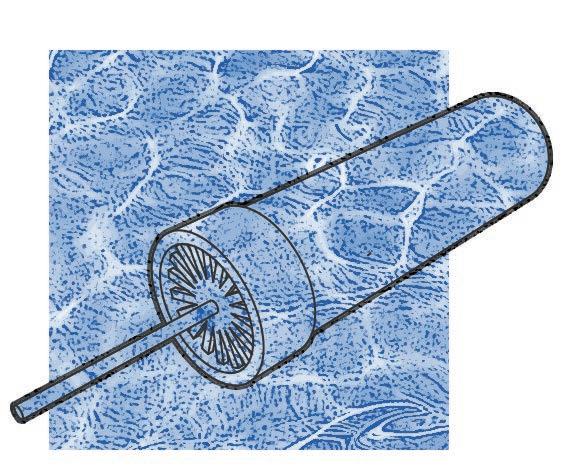

 Roofing photovoltaic coating -Power generation
Membrane purification device -Sea water depuration
Roofing photovoltaic coating -Power generation
Membrane purification device -Sea water depuration
1 2
Drip irrigation system -Plant watering
1. Vertical farming shelves
2. Photovoltaic Glass Roof
Saltwater-cooled greenhouses
SOLAR ENERGY UNIT
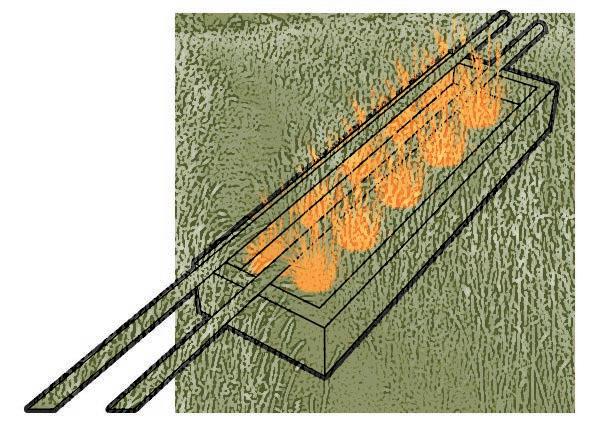
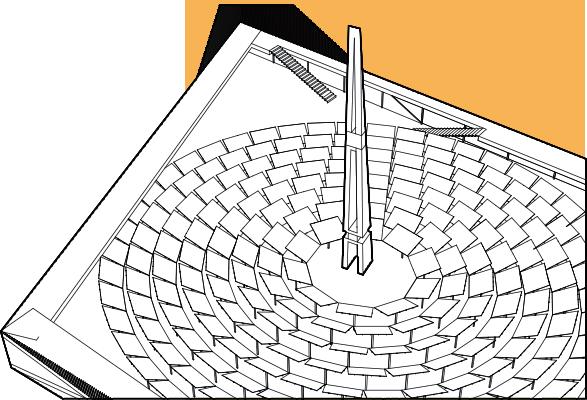
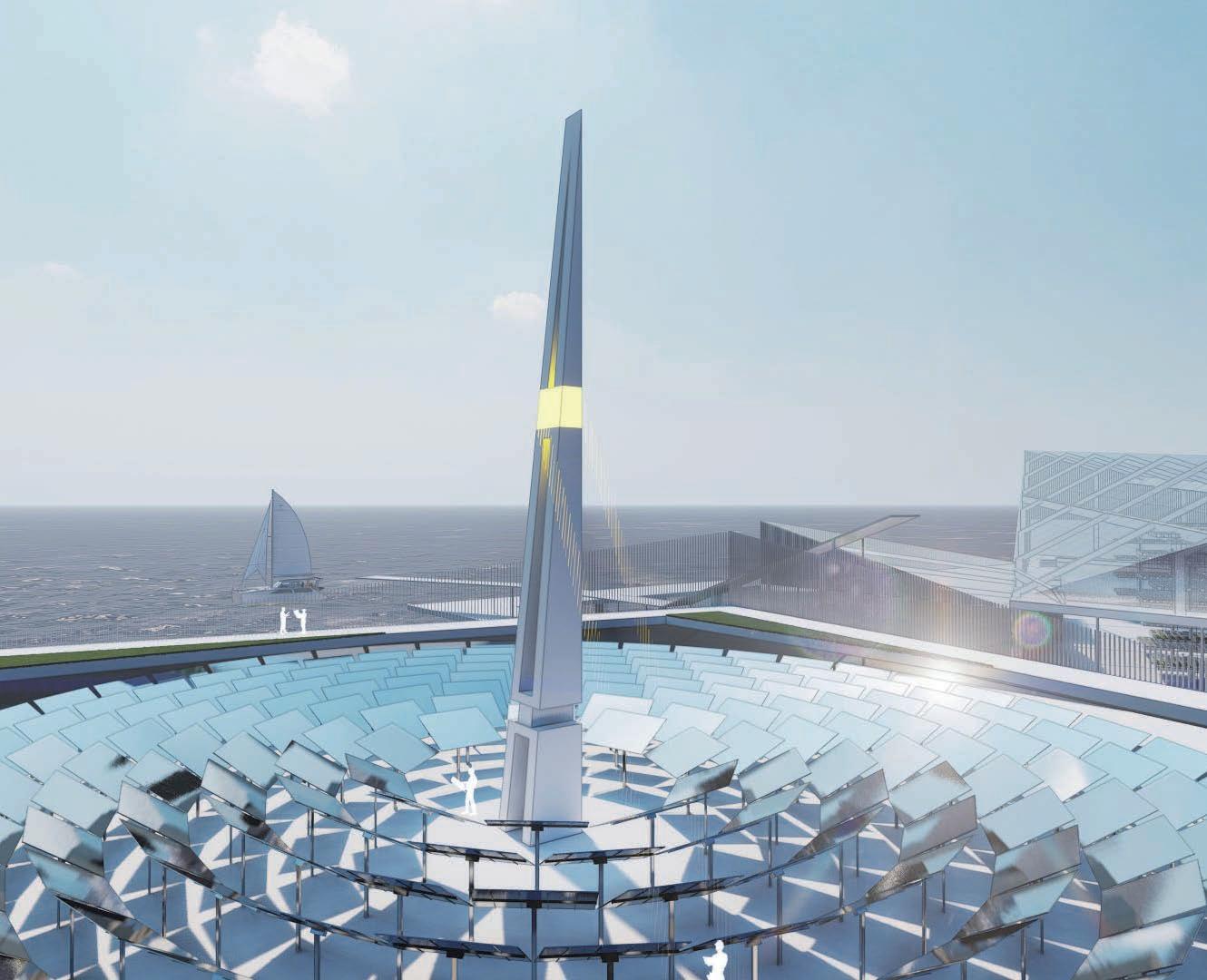
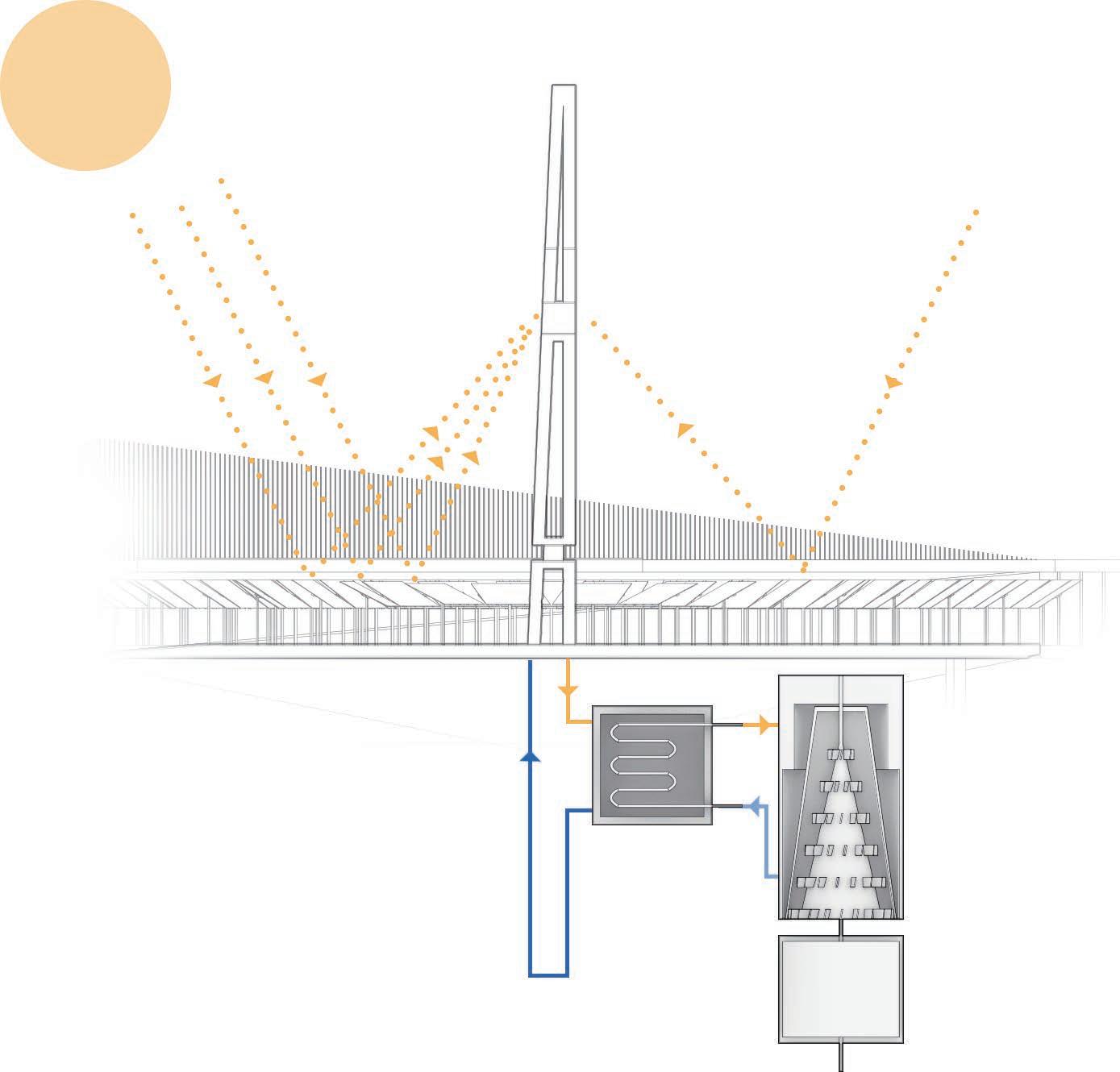
The main part of the solar unit is concentrated solar power (CSP).
The system first collects heat by Heliostats and collectors, and then uses steam to drive turbines and generators to generate electricity.
Part of the electricity will be sent to the city, and others will be used to other facilities of the project.
1-
2-
3-
4-
5-
1 3 5 4 2
Solar collector
Heliostats
Superheater
Turbine
Generator
Concentrated
solar power (CSP) system

THE HAVEN 4.
GASHOLDER RENOVATION
LOCATION: YANGPU SHANGHAI CHINA
SOLO WORK
With the renewal of the city, many industrial buildings gradually faded out of our sight, turning into a microcosm of the urban process.
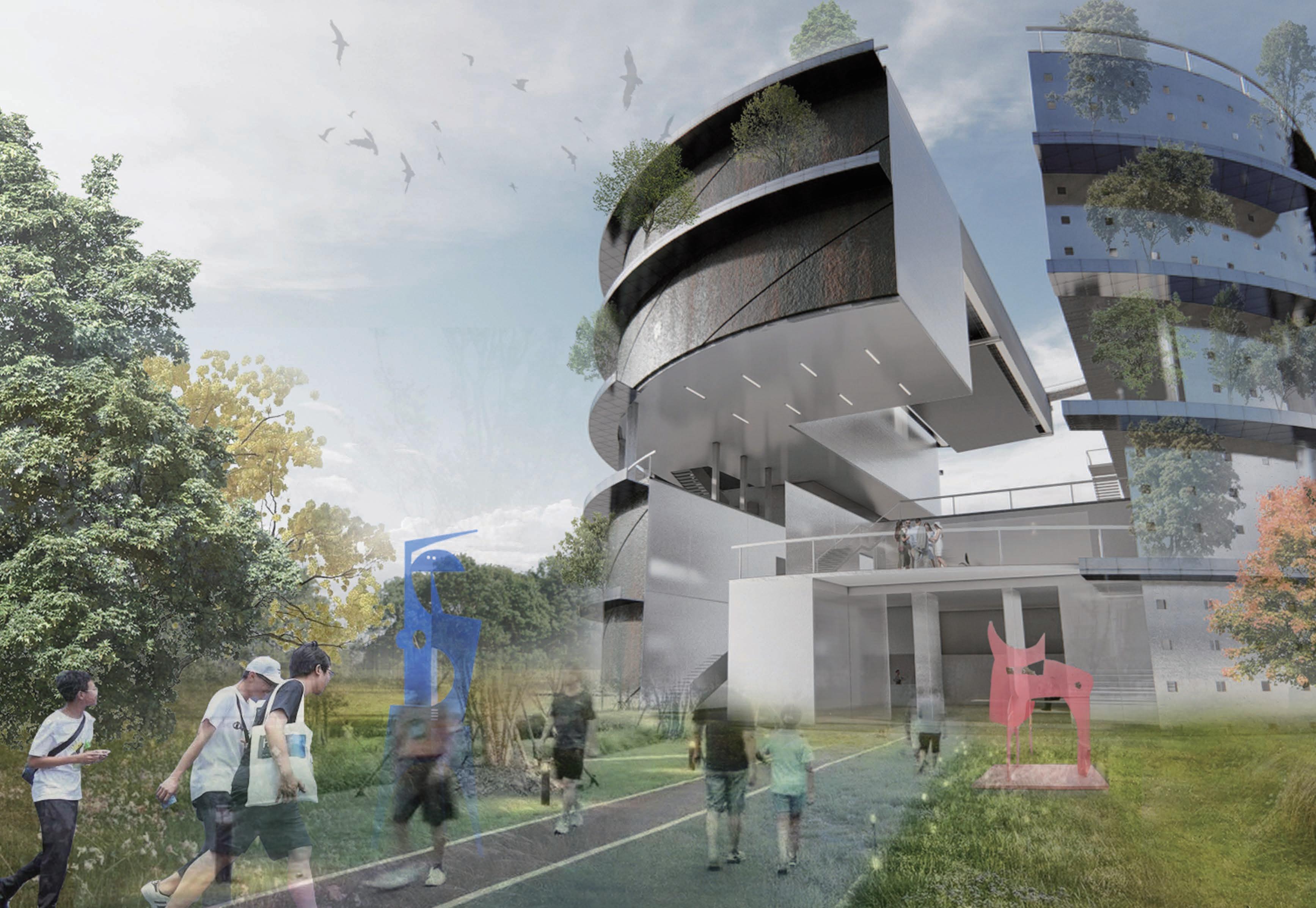
The gasholders haves become unique memories for many citizens based on its unique appearance. In order to keep these industrial buildings playing an important role in people's lives, the Gasholder Renovation Project plans to transform a gas storage tank into a community center providing psychological counseling and relaxation to meet the needs of modern people and to better integrate these buildings into the city.

FROM CITY LIGHTS TO RUINS
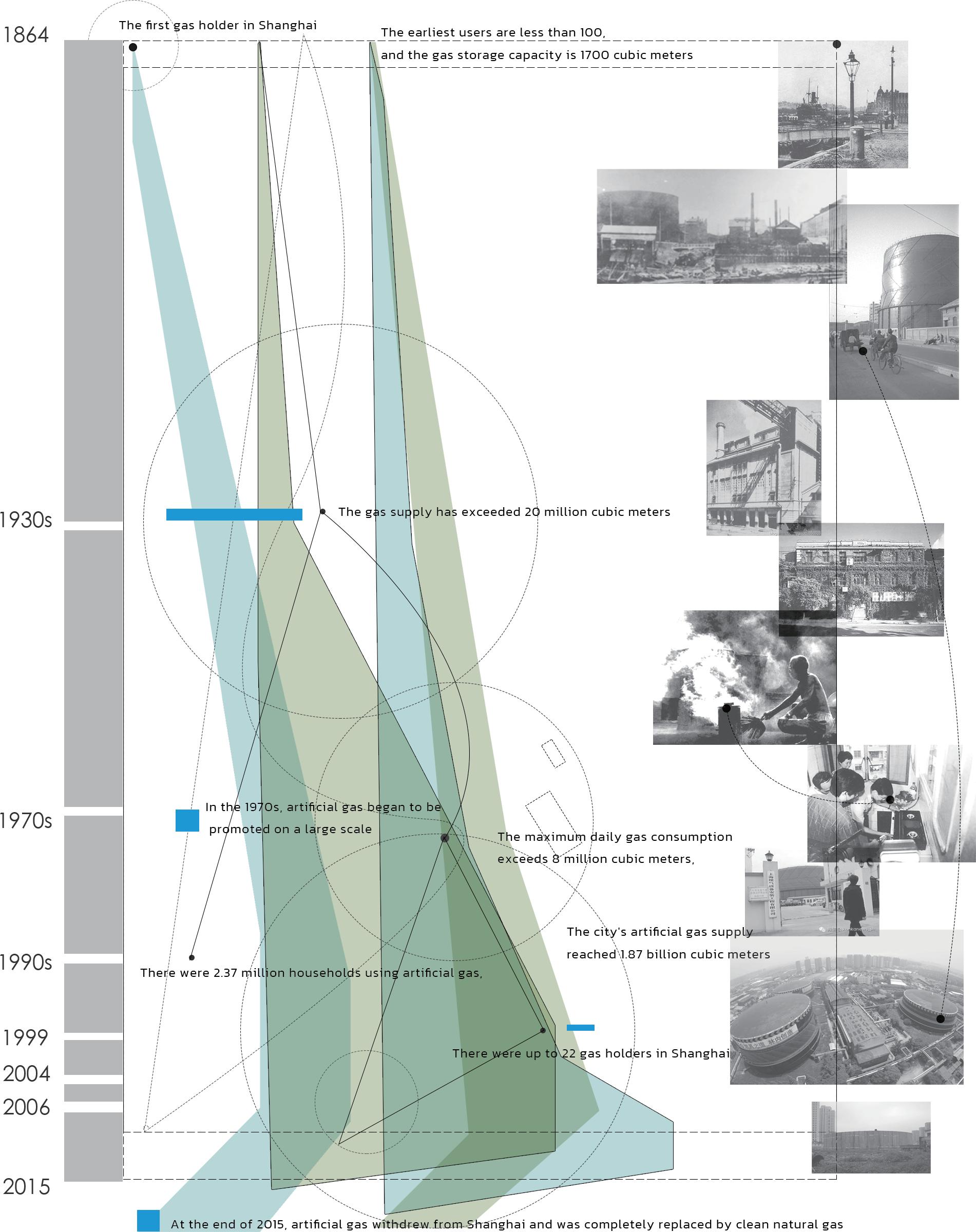
Since the first gas lamp was lit in Shanghai in 1864, artificial coal gas has been a part of the city's history for more than 150 years.
For more than a century, the widely used artificial gas has really changed people's life. As a representative facility related to it, the gas holder has witnessed this history.
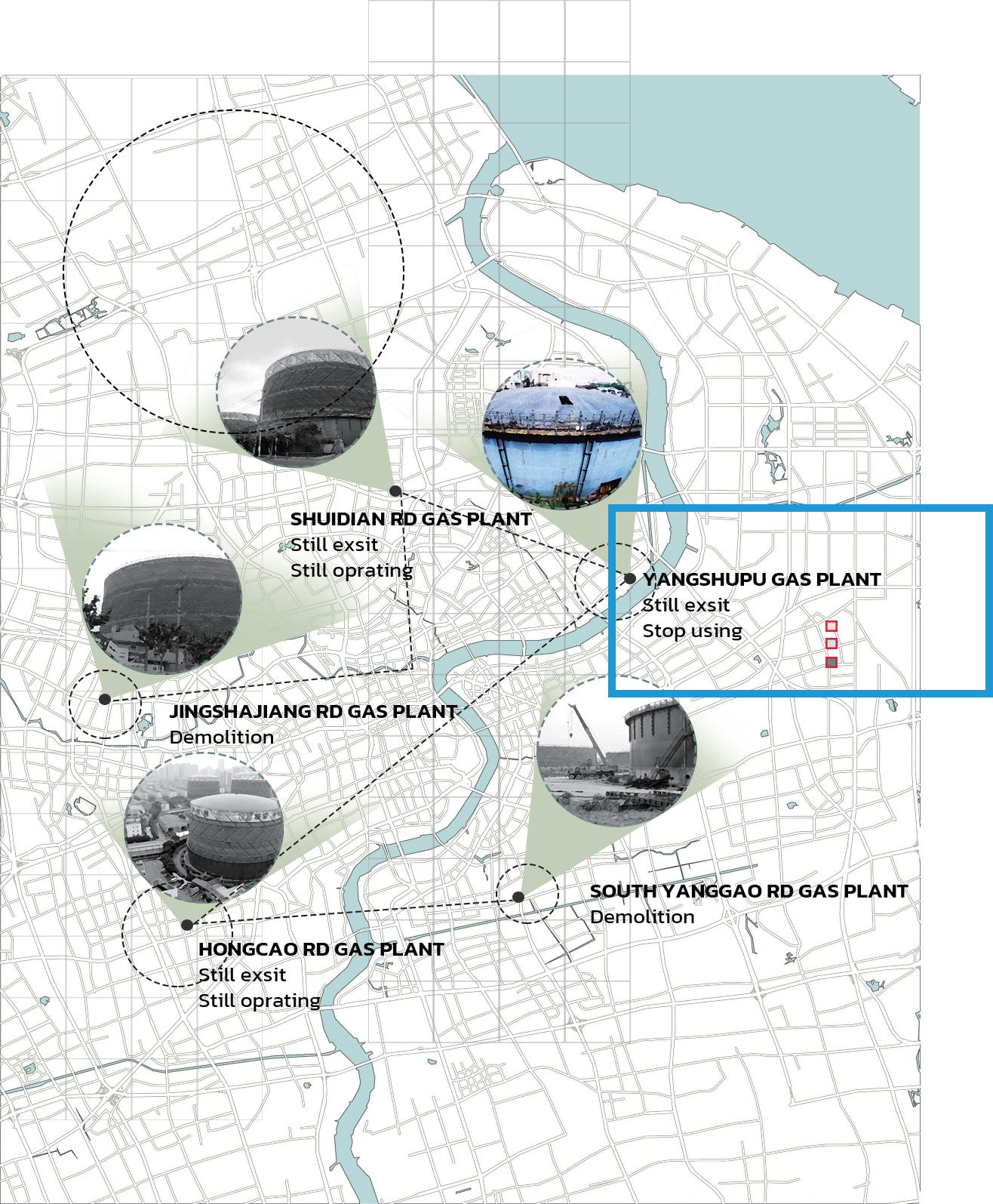
The gas tank in the Yangshupu Road Gas Plant is the earliest gas storage tank in Shanghai built in the 1930s.
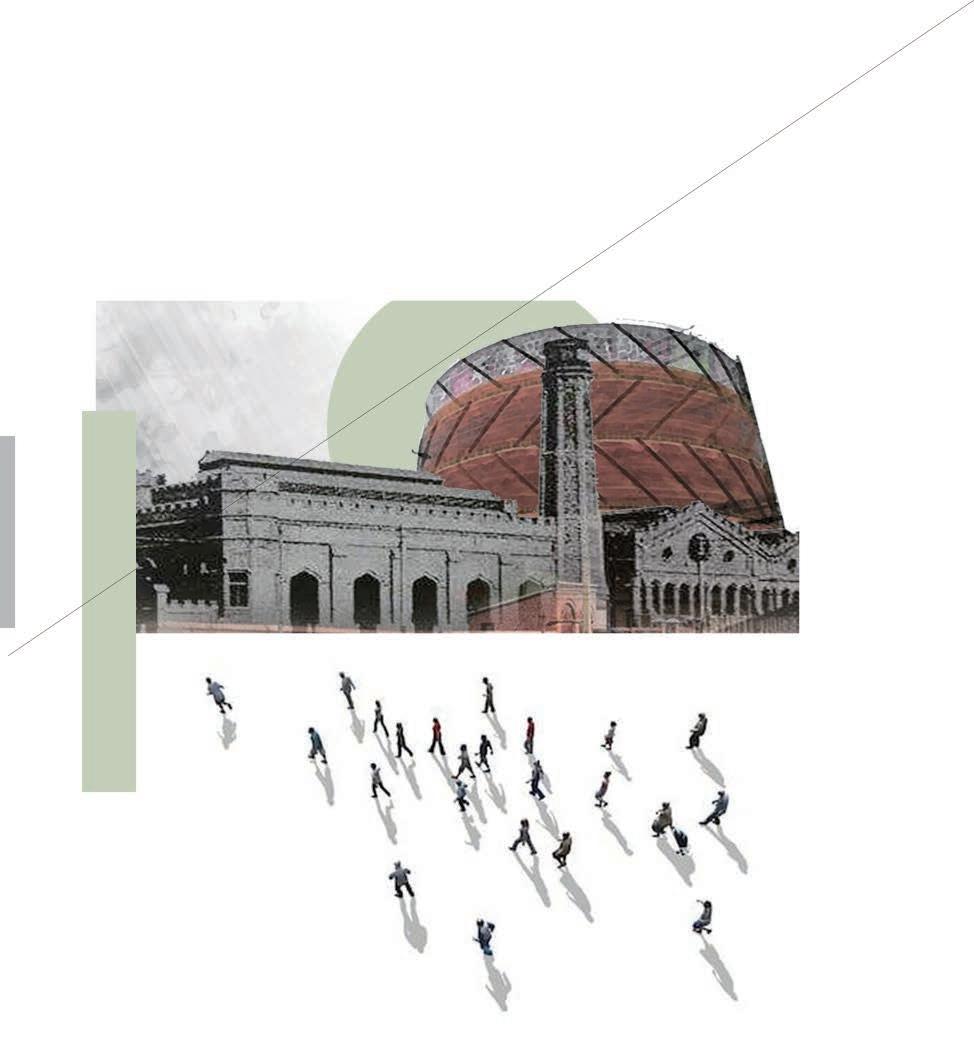

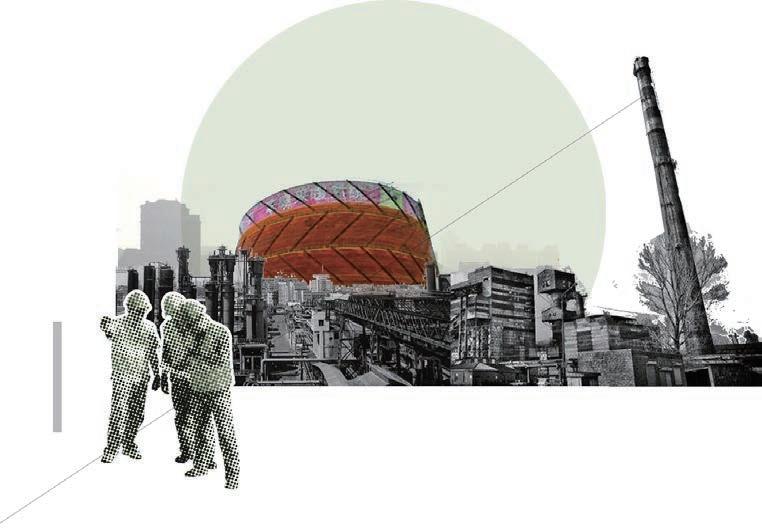
Later, with the expansion of the gas plant, the gasholdr has always been a very prominent landmark in this area.
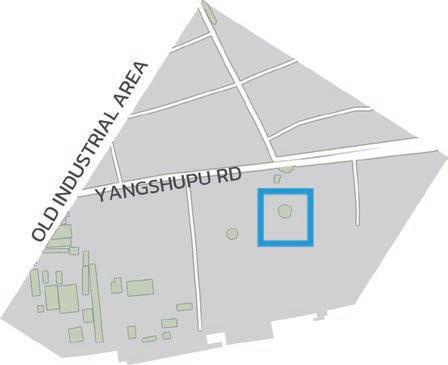
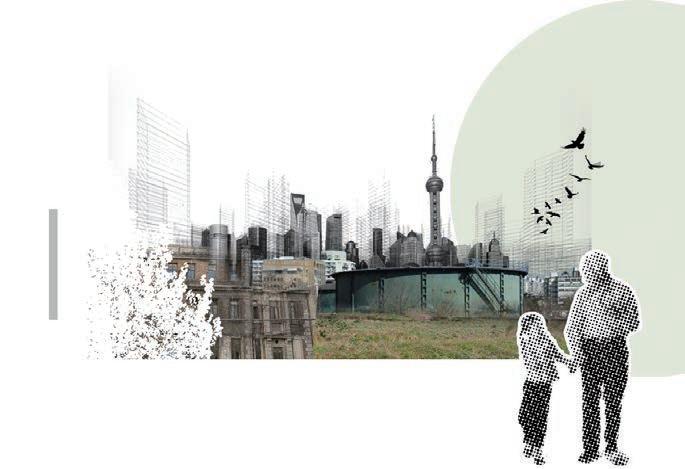
Now the entire industrial area has been shut down, and the gas sholder is no longer towering .
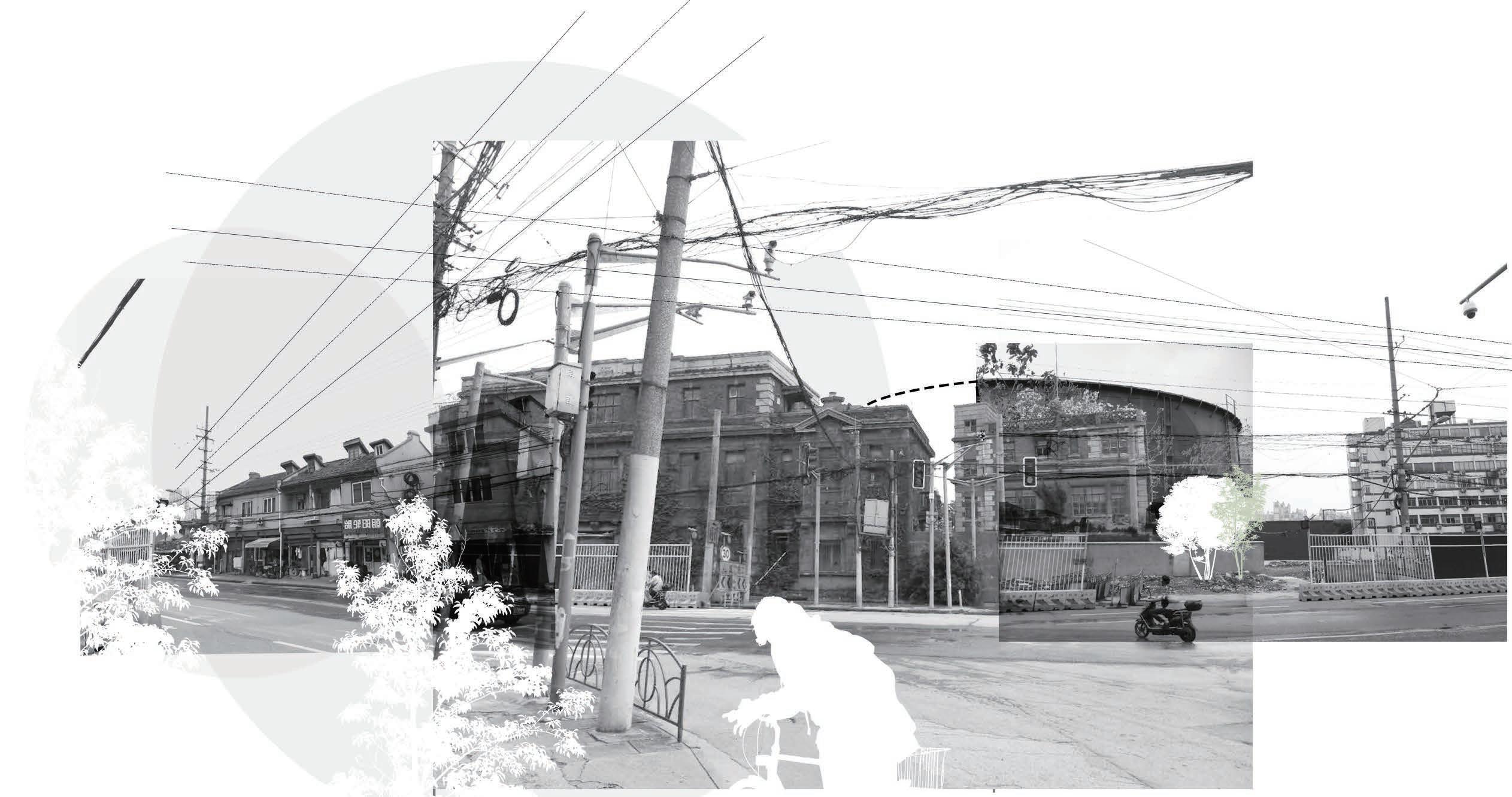
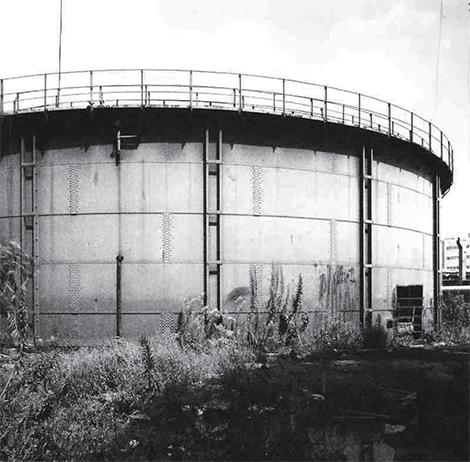
1.Gas holder
Now the entire industrial area has been shut down, and the gas holder is no longer towering .
2.Resident
It will be demolished and will be built into a more comfortable residential area.
3.Office building of gas plant
It has been dilapidated and unused, and part of the facade has been damaged.
1970 2015
1930
SITE
ANALYSIS
2 3 1
BUILDING FUNCTIONAL COMPOSITION
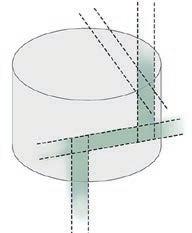

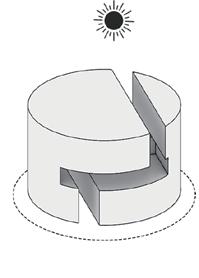
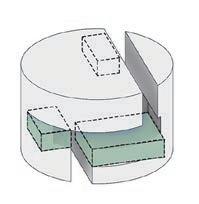

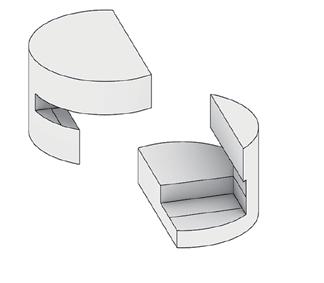
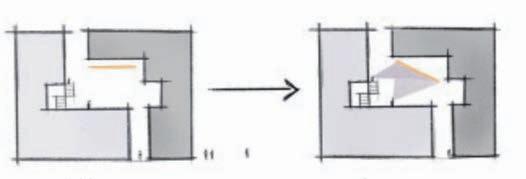
Divide the entire gas storage tank into two blocks.
Light can enter the interior through the middle gap.
COUNSELING AREA
ROOF GARDEN
The removal of some blocks creates several platforms of different heights.
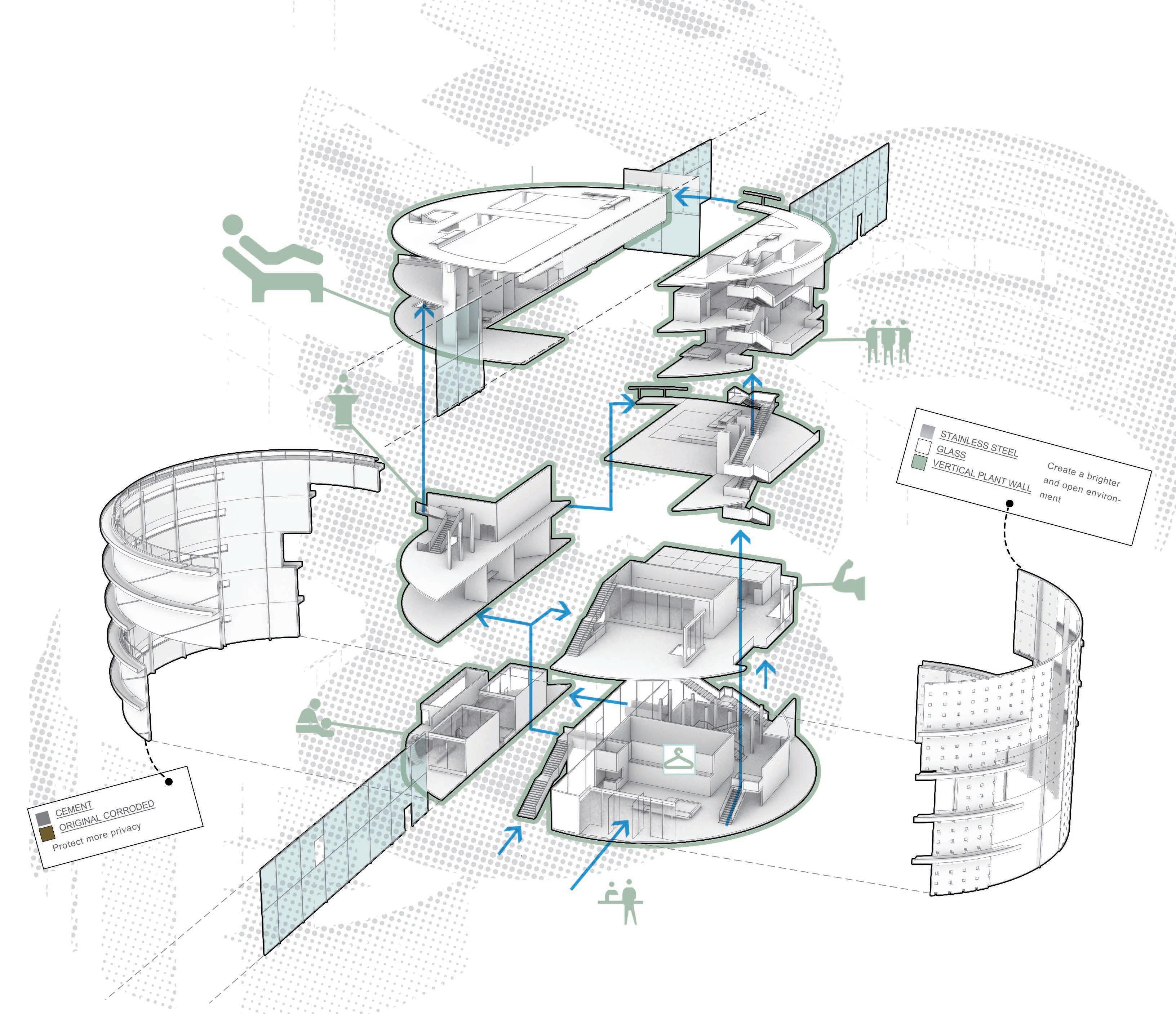
ENTRANCE
CHANGING ROOM
RECEPTION
LECTURE HALL
SPA AREA
FITNESS AREA
ART ACTIVITY AREA
In reality and in many movies and TV shows, the abandoned gas holder can be a sanctuary for some people.
The Gasholder Service Center will now liberate visitors from anxious and stifling lives, helping them to restart their lives with improved mental well-being.
SPACE DESIGN AND VISUALS
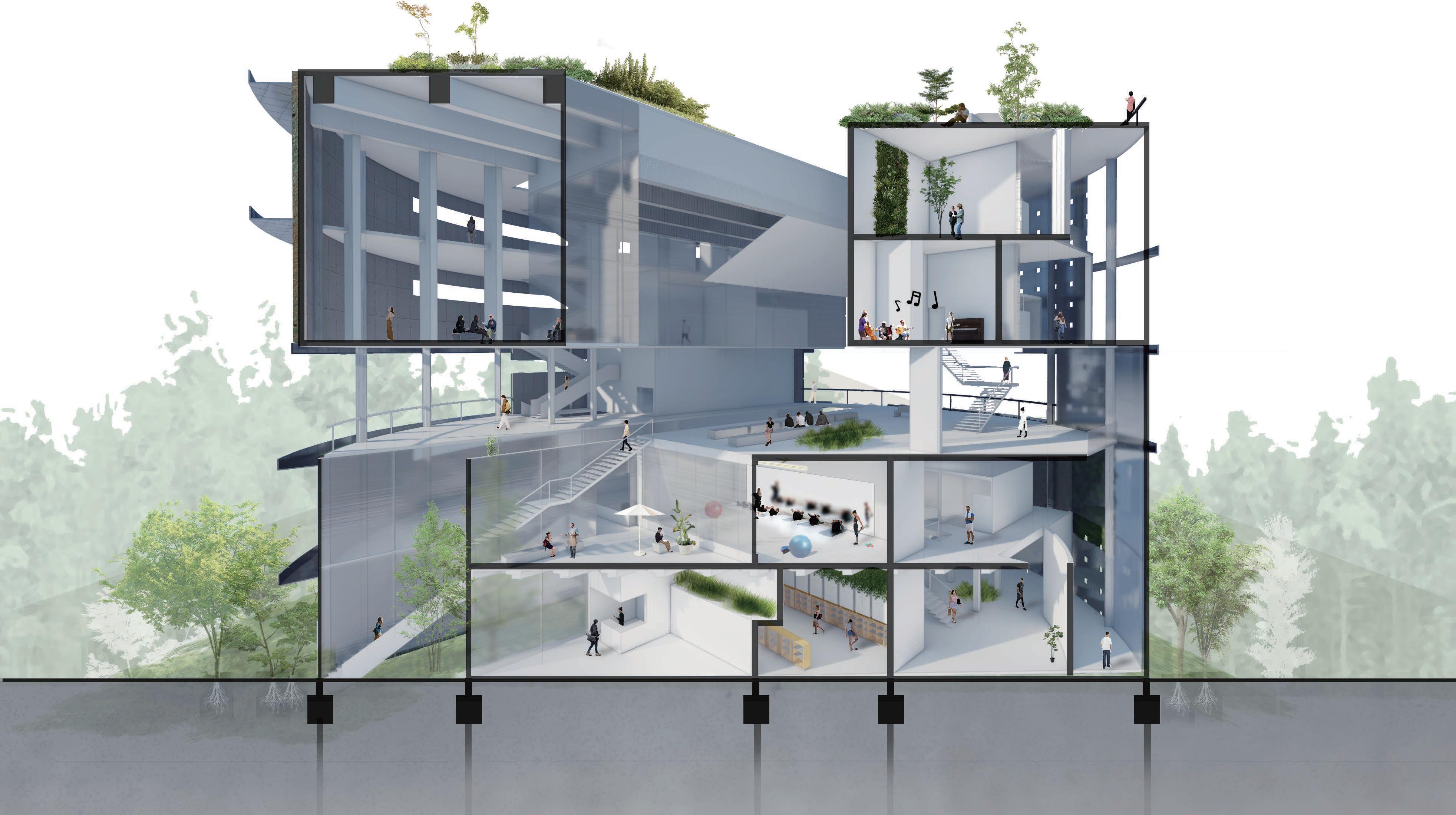
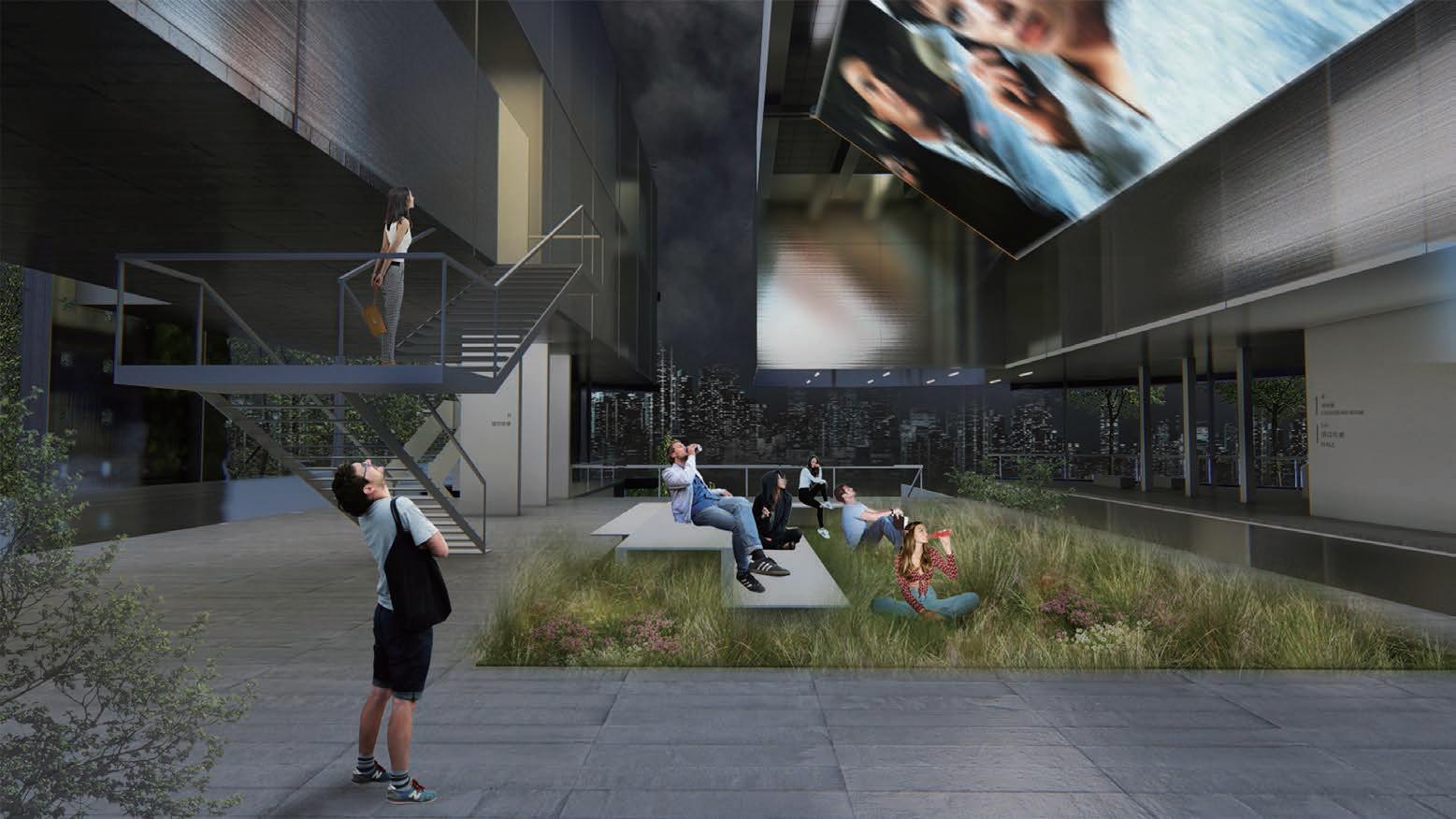
The central atrium is designed to create an open and comfortable space where individuals can confide their troubles to family and friends, while also providing greater flexibility for psychological counseling.
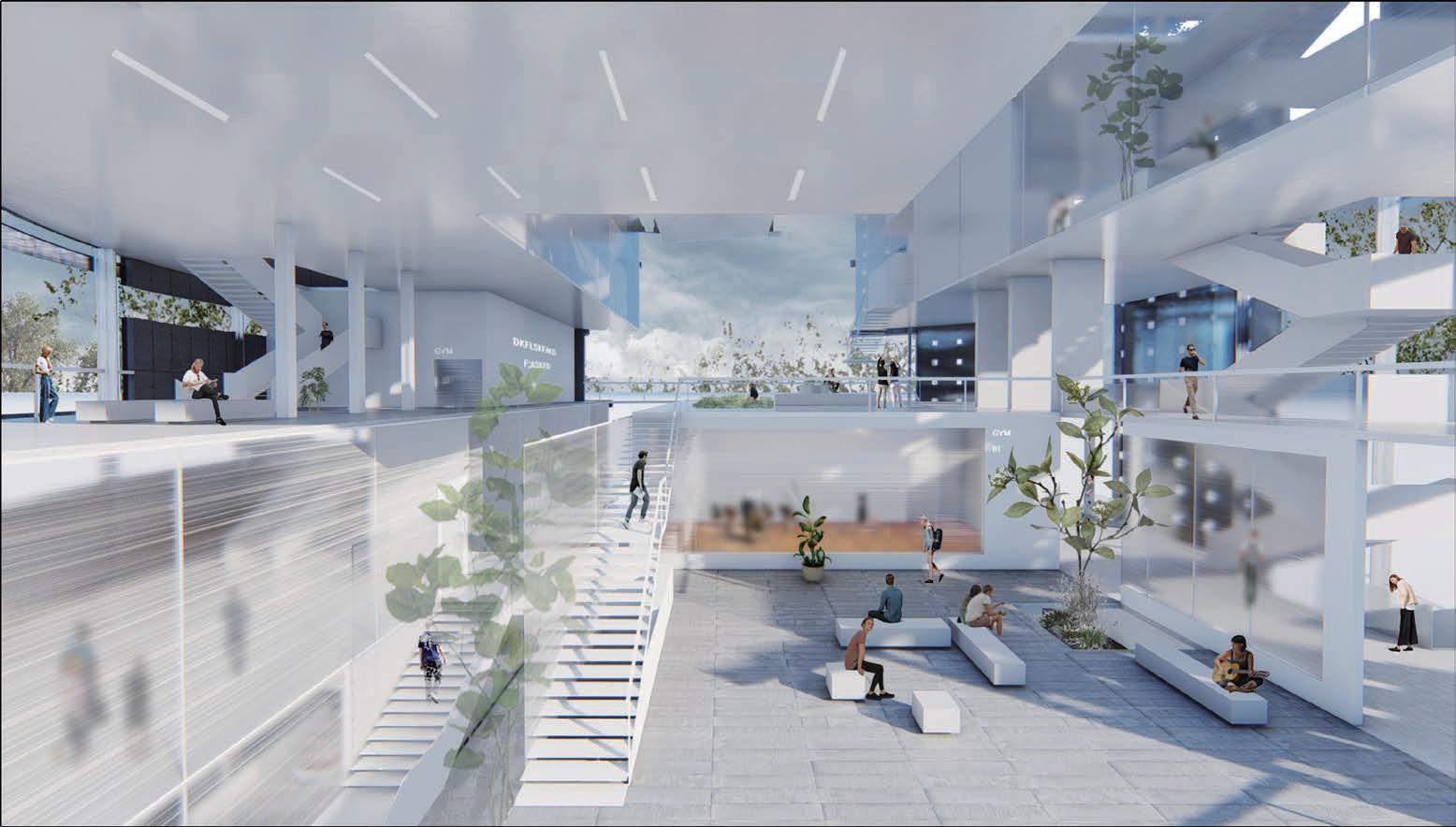
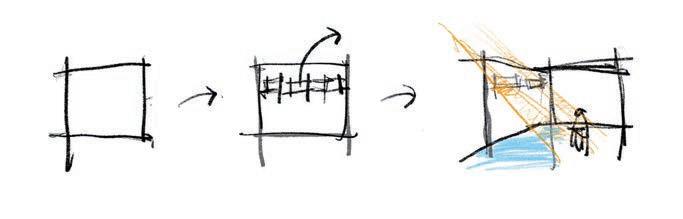
During the daytime, the screen will be rolled up so as not to affect the light from glass windows behind it.
In the evening, the screen will be unfolded and people can enjoy the movie on the lawn.
 MOVIE AREA /3F
SPACIOUS TERRACE /2F
MOVIE AREA /3F
SPACIOUS TERRACE /2F

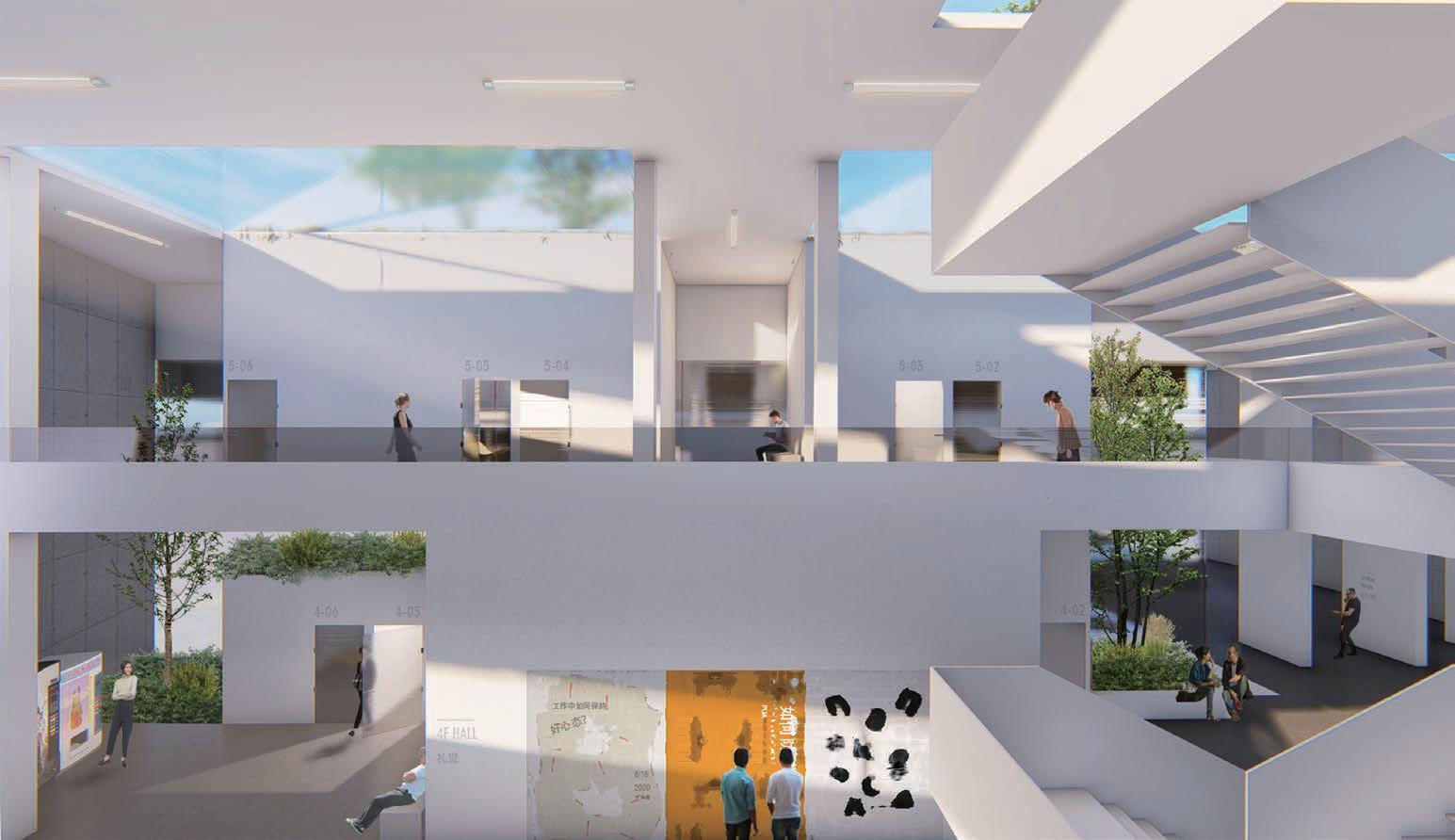
The independent counseling rooms will be interspersed within quiet activity spaces. Additionally, the public areas of the counseling zone will have ample lighting to avoid creating a sense of oppression for the users.
The hydrotherapy area will consist of a sauna room, massage space, and hydrotherapy pool. The enclosed curved space and lighting will create a serene relaxation space for the users.
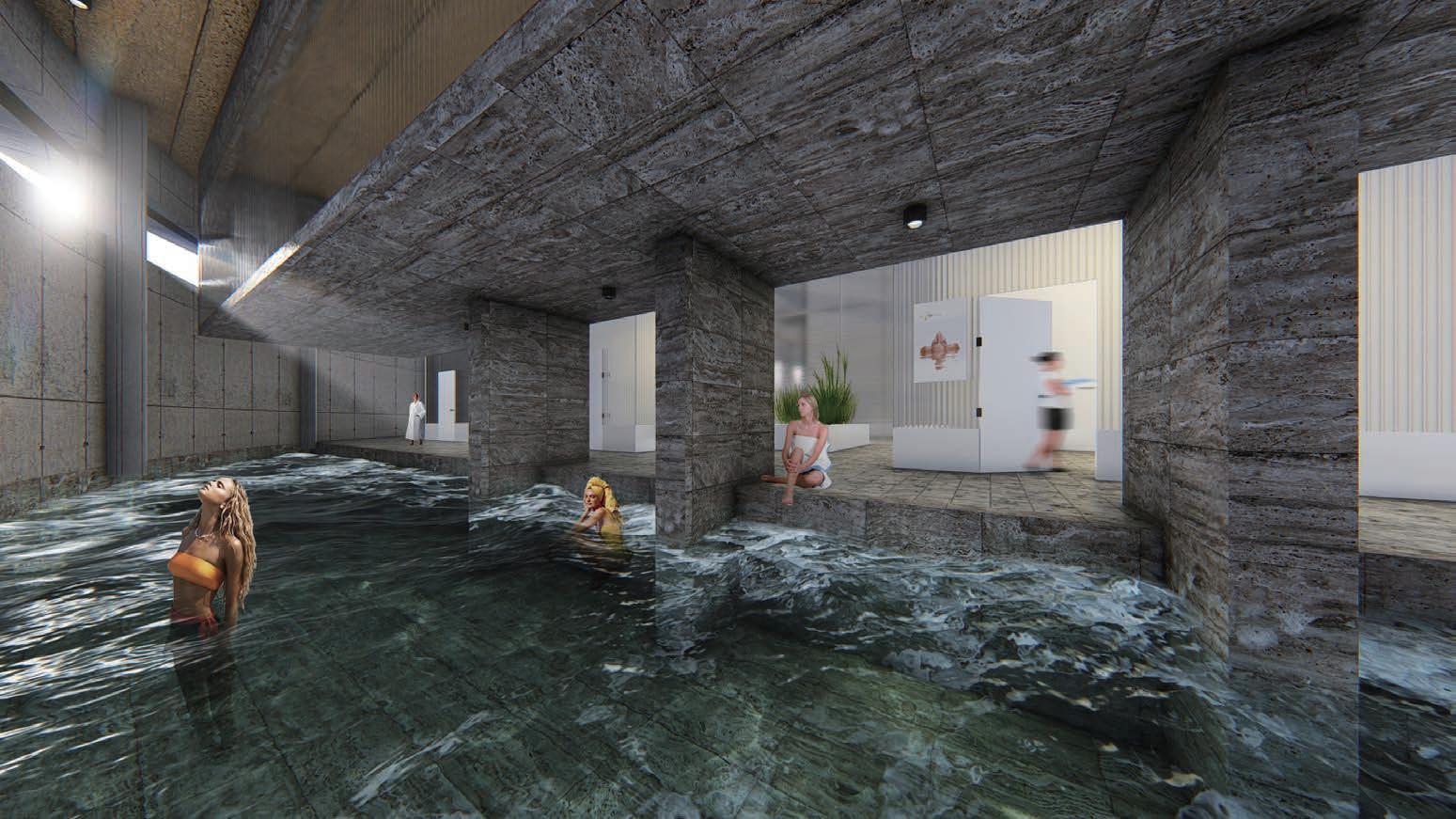 CONSULTATION AREA /6F
SPA AREA /1F
CONSULTATION AREA /6F
SPA AREA /1F
5.OTHER WORK
ADAPTIVE NOMADISM
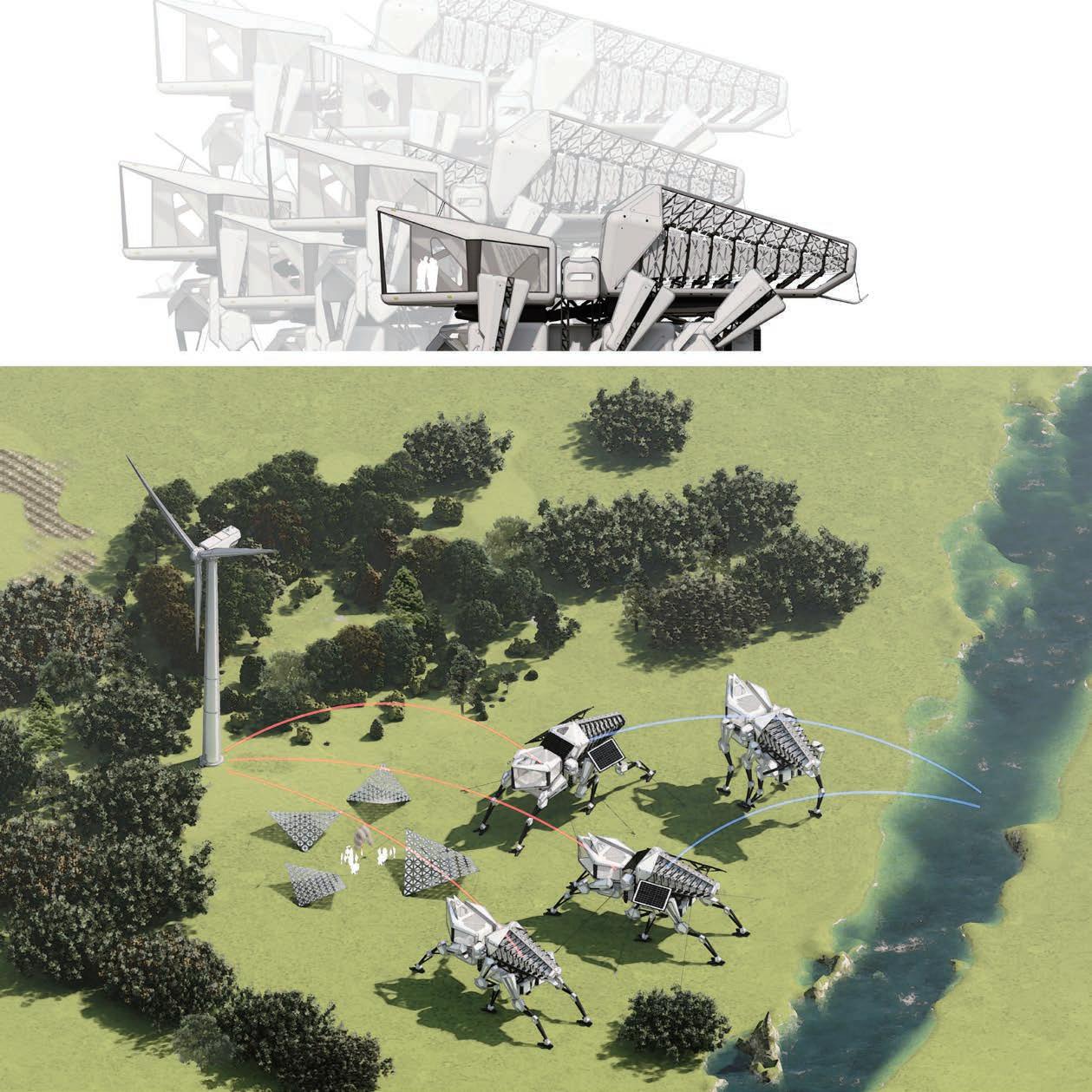
In the future, the centralization advantage of cities will be weakened, and people will no longer need to gather in crowded urban areas. Residences will start to move away from villages, towns, and cities, and a nomadic lifestyle will prevail.
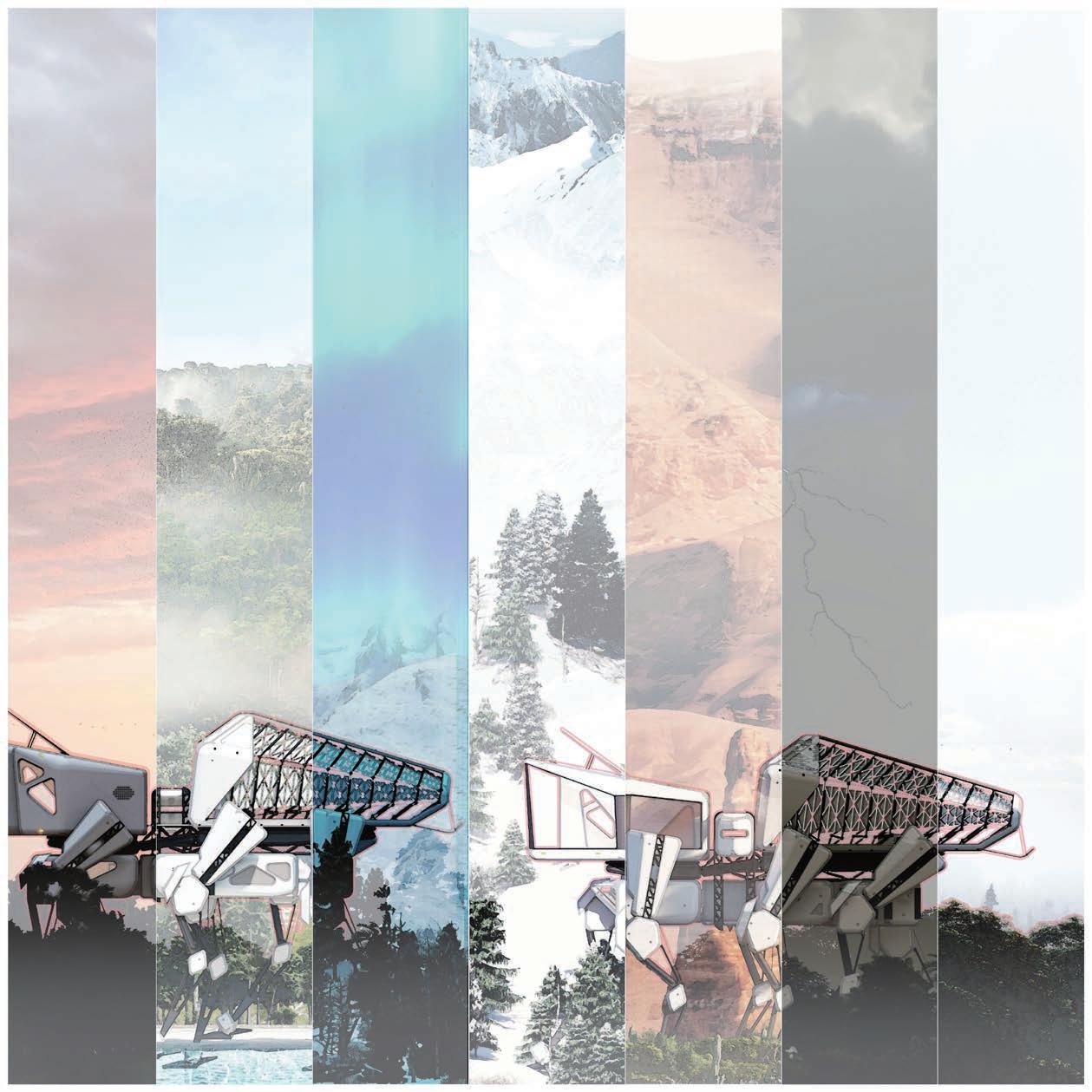
The nomadic dwelling can help people engage in full interaction with nature and reduce permanent damage to the environment. As over-expansion of cities gradually decreases, the land previously polluted by permanent structures can be restored.
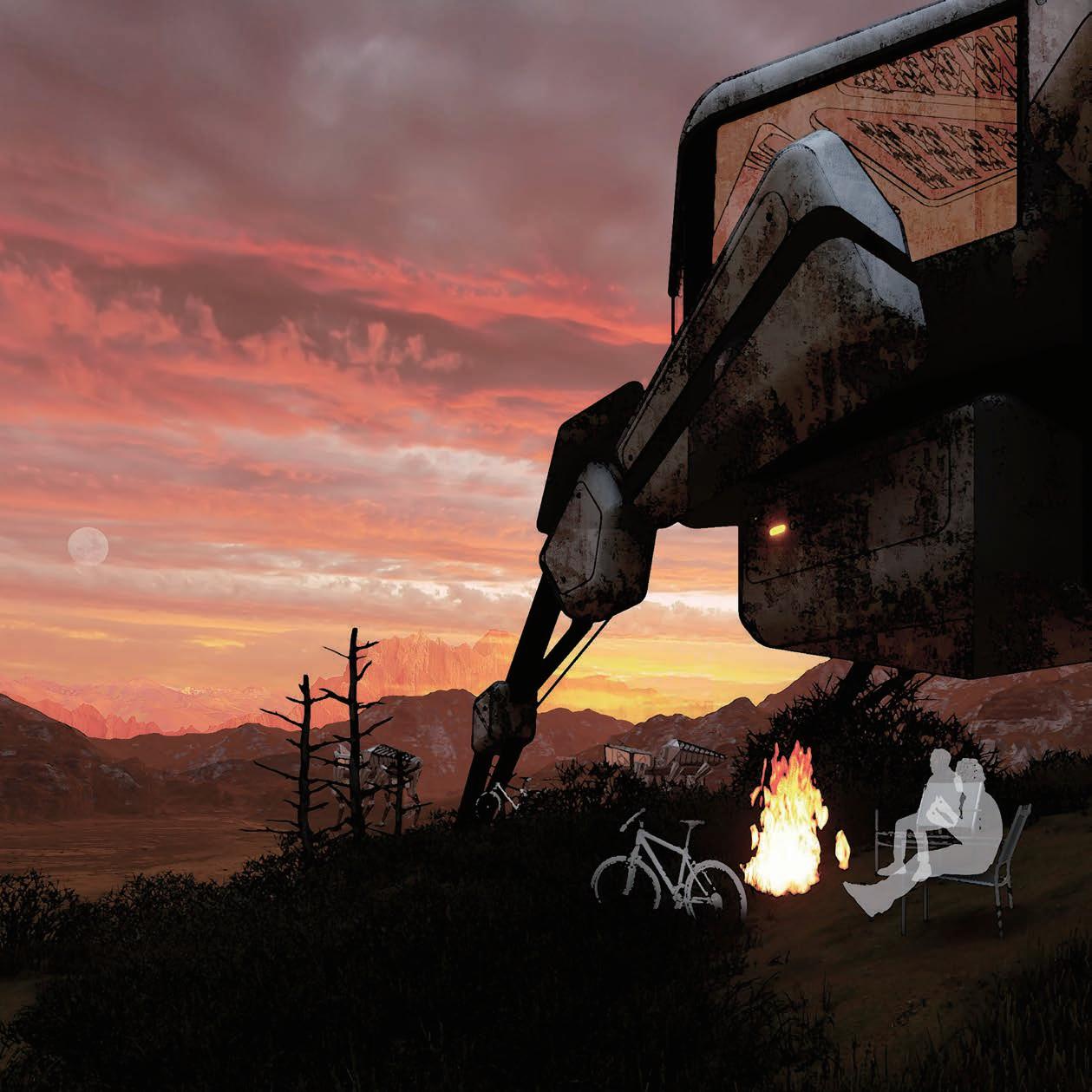
The residence becomes both a machine and a sanctuary. It will be a self-sufficient home, with electricity generated from solar power and clean water sourced from rainwater collection and purification. In times of energy and water scarcity, nearby public facilities can be accessed to supplement the resources.
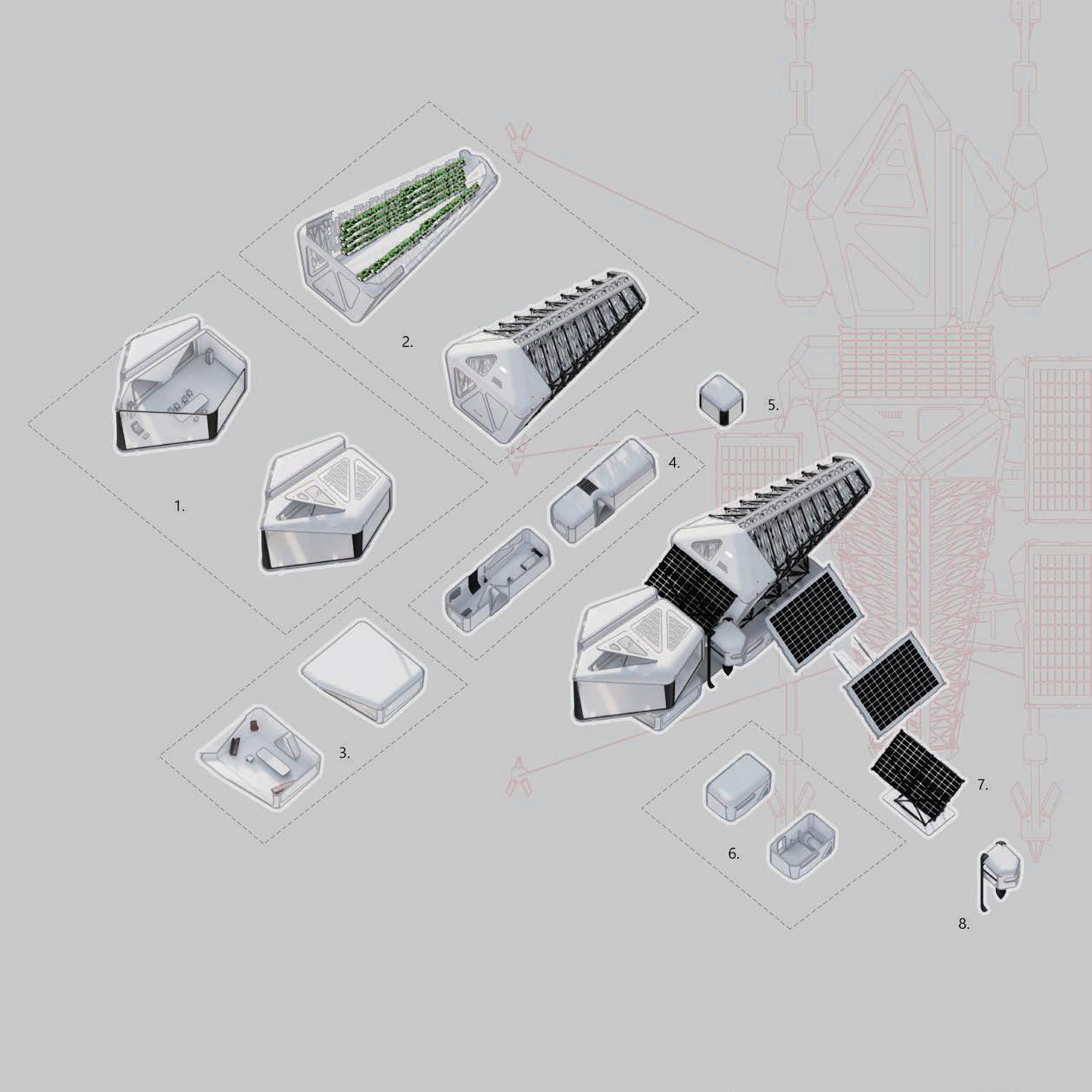 1. Kitchen & dining unit
2. Vertical farming unit
3. Living room unit
4. Bedroom unit
5. Water treatment & power unit
6. Washroom unit
7. Solar penal
8. Elevator
1. Kitchen & dining unit
2. Vertical farming unit
3. Living room unit
4. Bedroom unit
5. Water treatment & power unit
6. Washroom unit
7. Solar penal
8. Elevator