Like our ancestors, step into the unknown and trust
By Rabbi Adrienne Rubin
Congregation Bnai Shalom
Our Mishnah teaches us that on Passover, we tell our children the story of the Exodus from Egypt, matchil big’nut umsayeim b’shevach, beginning with degradation and ending with praise (Pesachim 10:4).
Our rabbis disagreed about the nature of that degradation. Was it the physical degradation of slavery, as Shmuel argues? Or was it the spiritual degradation of idolatry, as Rav holds.
Our Haggadah, in its wisdom, says yes, it was both. We remember them by
declaring, “My father was a wandering Aramean” and “We were slaves to Pharaoh in Egypt.”
Why is immersing ourselves in the pain and suffering of our ancestors a central part of the Passover seder?
Why must we return each year to the lowest point in our biblical narrative? Our rabbis believed that a true celebration of freedom cannot happen without understanding and confronting the pain and despair that came before. Redemption requires reclaiming one’s dignity. Freedom requires consciousness. Transformation requires both. It can be difficult in our modern world to see ourselves as having been slaves in Egypt or as having been idolators. But we have our own Mitzrayim, our own narrow places, our own Egypt. There are times when we have been subject to the will of others. There are times when we imprison ourselves with our own thoughts and beliefs.
There are times when we experience both, in succession or at the same time.
Most of us can easily point to these moments. The question is, Will we leave them behind? Will we move toward praise, toward redemption, toward a life of freedom beyond the narrow places that confine us?
Just as our ancestors took the risk of stepping forward into the great unknown, trusting that they could journey toward the land and the life promised to their ancestors, so too can we.
May this be the year that we each move from degradation to dignity.
May this be the year that we each move from limitations to abundance.
May this be the year that we each move from narrow places to expansiveness.
May this be the year that we each move from slavery and idolatry to freedom and praise.
Kol Tuv and Chag Pesach Sameach v’Kasher!
The Lehigh Valley Jewish Clergy Group presents the
JCC kids to explore with their senses at seder
By Jen Moyer JCC Early Childhood Education Director
Humans in general, and children especially, learn about their world through their senses. As infants, we take in sensory input, such as the smell of our moms, the sight of our siblings, the feel of dad’s beard, and we use those sensory cues to inform our growing knowledge of the world. This is why early childhood learning focuses so heavily on sensory-informed play: it’s literally the building blocks of a child’s understanding of the world around them.
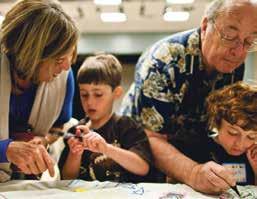
With that in mind, the JCC Early Childhood Education department and PJ Library are partnering to present a Sensory Seder for families on Sunday, March 29, at 12:30
p.m. The Passover story is rich with opportunities to invite children to explore with their senses. Children will create their own seder plates, taste Passover-friendly foods (such as matzah with cream cheese and jelly), and explore sensory items that represent the plagues and the parts of the seder plate.
This will be a relaxed event, allowing the children to explore different bins of sensory items. This activity is perfect for children ages 3-6, but some older children may also enjoy the experience. Staff will be available to facilitate activities, but parents should be prepared to help children as well.
Registration is required at jewishlehighvalley.regfox. com/pj-library-sensory-seder to attend this event.

SENSORY SEDER



29th Annual Community Passover Seders

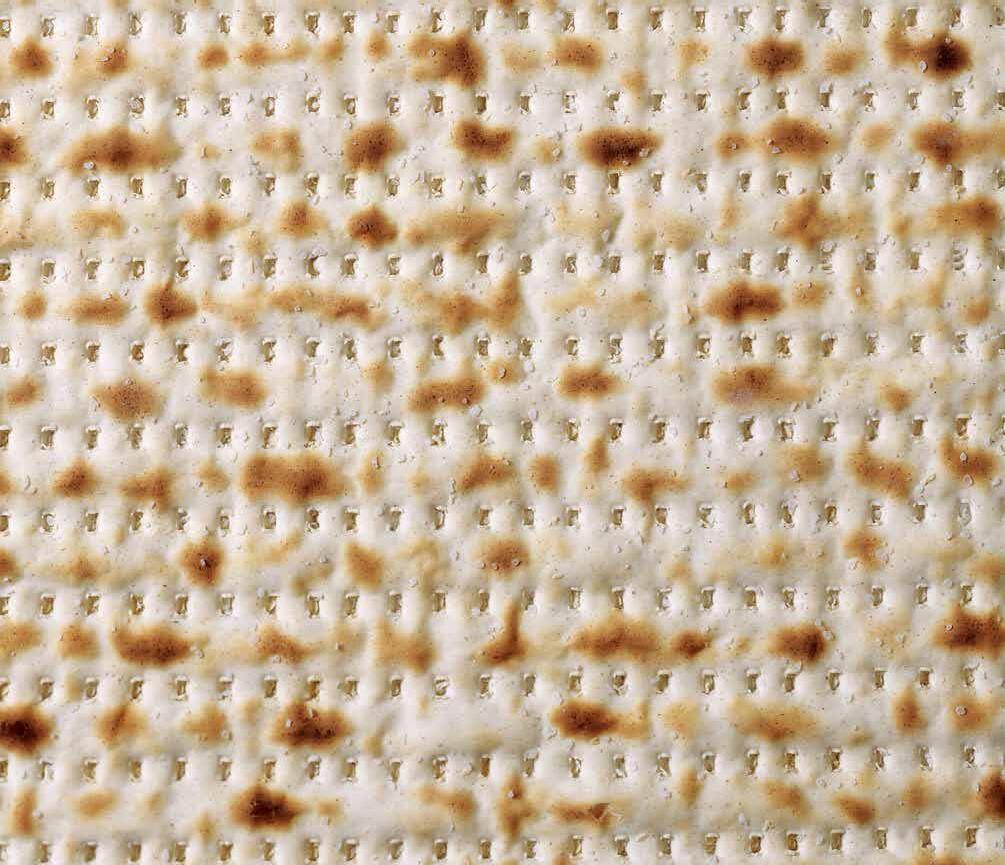
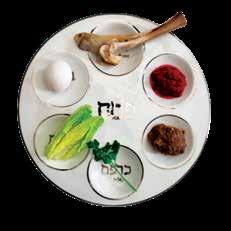
The following is a listing of seders reported to us by Lehigh Valley congregations. Please contact the synagogues directly to learn more. RSVP as instructed in each listing. Note the registration deadlines. Some may have passed by the time you see this, and synagogues may not be able to accommodate you after those dates.
Chabad of the Lehigh Valley PASSOVER SEDER
WEDNESDAY, APRIL 1, 7:30
Enjoy a meaningful and engaging seder in an inviting, warm atmosphere. Gourmet Passover cuisine and fine wine. All are invited. A donation of $50 for adults and $36 for children 12 and under is suggested, but no one will be turned away for lack of funds. Reserve a spot at the table at chabadlehighvalley.com/ seder5786.
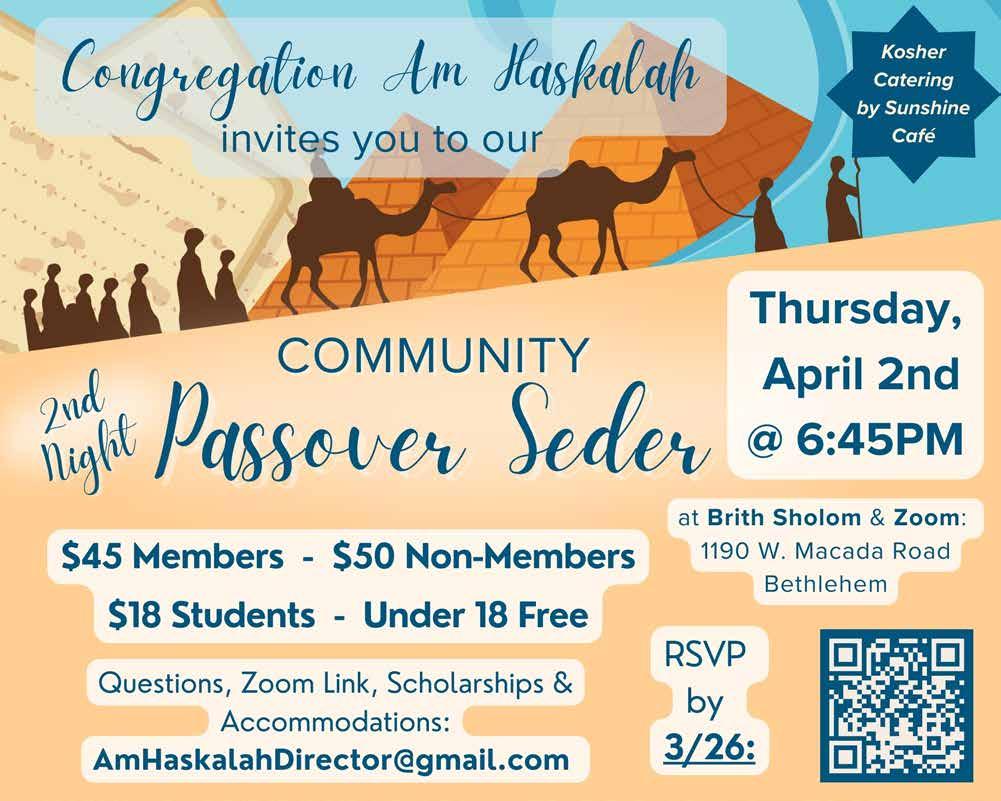
Congregation Am Haskalah
SECOND NIGHT SEDER
THURSDAY, APRIL 2, 6:45
Led by student rabbi Sam Allie at Congregation Brith Sholom, Beth-
lehem. Open to all, in person and online. Kosher catering by Sunshine Cafe. $45 for members, $50 for nonmembers, $18 for students over 18, and free for children under 18. Scholarships and accommodations available. RSVP by March 26 to AmHaskalahDirector@gmail.com.
Congregation Bnai Shalom
SECOND NIGHT SEDER
THURSDAY, APRIL 2, 6:00
Bnai Shalom and Rabbi Adrienne Rubin invite everyone to their Passover second night seder. All food will be kosher for Passover. Cost for members is $36 for adults, $18 for children 6-12, and free for children under 5; for nonmembers it’s $45 for adults, $20 for children 6-12, and free for children under 5. Call the synagogue office at 610-258-5343 by March 19 to make a reservation.
Congregation Brith Sholom
FIRST NIGHT SEDER
WEDNESDAY, APRIL 1, 7:00
Join Rabbi Michael Singer and
Brith Sholom for the retelling of the story of Exodus. Dinner catered by Sunshine Cafe features one seder plate per table along with charoset, matzah, herb and citrus roasted chicken, gefiltefish with red horseradish, wine and grape juice, and more. $45 per adult member (including nonmember relatives), $50 for adult nonmembers, $20 per child (6-13), free for children 5 and under, but no one will be turned away for inability to pay. Vegetarian meals available by advance request. Contact the synagogue office at 610-866-8009 and RSVP by March 27.
Congregation
Keneseth Israel
13TH ANNUAL SUPER
SHABBAT SEDER
FRIDAY, APRIL 3, 5:45
Eat, drink, sing, and learn. Featuring the telling of the old tale of our escape from Egypt, with Rabbi Shoshanah Tornberg, great music, and traditional foods by Chef Eric. BYOB to share with your table. $45 for adult members, $54 for adult
nonmembers, $30 for members ages 6-12, $36 for nonmembers 6-12, and free for children under 6. RSVP at kilv.org/event/super-shabbat-seder4.html by March 20.
Temple Beth El
SECOND NIGHT SEDER THURSDAY, APRIL 2, 6:00 Join Temple Beth El for a friendly, interactive, and meaningful seder with Passover dinner, wine, and English and Hebrew reading. Seder at 6 and dinner at 6:45. $36 for adults and $18 for children (4-12). Limited to 100 people. RSVP to 610-435-3521 by March 20.
Brought to you by... & Scan to register
Happy holiday from Yoav! We’ve been busy in a good way
By Libat Kaminsky Yoav Partnership2Gether Director
As we approach Passover, the words of the Haggadah feel especially meaningful: “In every generation, a person must see themselves as if they personally left Egypt.”
Passover reminds us that freedom is not only a story from the past, but an ongoing journey. Every generation faces its own challenges, and its own path toward freedom.
Last year, when we gathered around the seder table, the idea of freedom felt complicated. Many of the hostages were still in captivity, and in many homes, an empty chair remained at the table, a painful symbol of hope and longing.
This year, thank God, we will sit at the seder table knowing the hostages have returned home. Yet we still feel the deep desire to live as a free people in our land, with safety, peace, and hope.
Passover also reminds us of the commandment “And you shall tell your child.” It’s a story passed from generation to generation, the story of moving from slavery to freedom, but also the story of becoming one people, united by a shared destiny.
These days, we feel the meaning of being one people
more than ever, not only within Israel, but also through the strong connection with Jewish communities around the world.
Even during these complex times, we’ve continued to see in recent months how the Yoav-Lehigh Valley Partnership2Gether continues to grow and develop in the Yoav Regional Council. This work reflects a deep commitment to strengthening the community and supporting the younger generation.
One inspiring initiative is the Unistream Start Up Now program at Tzafit Regional High School. A group of 12 seventh-grade students is participating in the program, guided by instructor Ayala Adlitz and supported by a professional mentor, Dr. Ilan Levi, director of innovation at Kaplan Medical Center.
Throughout the year, the students work together to develop their own startup initiative. Along the way they gain important skills such as teamwork, creative thinking, project management, goal setting, and public presentation. At the end of the program, they will meet with mentors and professionals from the business world and then present their project to a panel of judges. At a time when Israeli youth are grow-
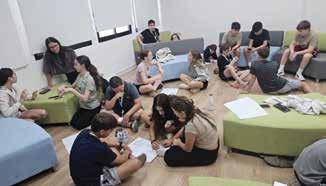
ing up in a complex reality, programs like this give them valuable tools for the future and a sense of confidence and possibility.
We are also happy to share the launch of another meaningful community initiative called Between Nir and Nir. This project connects members of the Nir Oz community, who were evacuated from their homes following the events of October 7, 2023, with members of the Beit Nir community. Some members of Nir Oz have chosen to build their new homes in Beit Nir, located within the Yoav Regional Council. The goal of this project is to create meaningful relationships, strengthen a sense of belonging, and help rebuild community resilience through shared activities and connections.
In May, we’ll hold a retreat for Israel Defense Forces reservists from the Yoav region. Many of these reservists have
served hundreds of days in the army since the beginning of the war. The retreat will offer them a much-needed moment of rest, along with workshops and practical tools to support their return to everyday life.
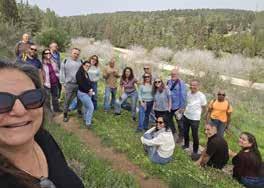
Even in our quieter moments, we continue to nurture connections. On Tu B’Shevat, the New Year of the Trees, members of the Yoav Steering Committee enjoyed a morning walk in Ben Shemen Forest guided by one of the members. It was a beautiful morning of nature, conversation, and friendship, a reminder that the human relationships between us are truly at the heart of our Partnership2Gether.
We are excited to welcome the Lehigh Valley Steering Committee to Israel this coming June. During the visit, we will learn together, visit projects in the region, and work on planning the com-
ing year while continuing to strengthen the ties between our communities.
These days, Israel once again finds itself in a tense reality. Israel has been at war with Iran, this time in historic cooperation with the United States military. Once again, the resilience of Israeli society is being tested. Alongside concern and uncertainty, there is a deep belief in the justice of our cause and a strong commitment to protecting our future. We pray for the safety of Israel’s soldiers and for the American soldiers working alongside them.
The support, friendship, and partnership of the Lehigh Valley community are felt here every day. And it is important for us to say that our support and love are with you as well. May this Passover bring hope, peace, and quieter days for all of us. Happy Passover!
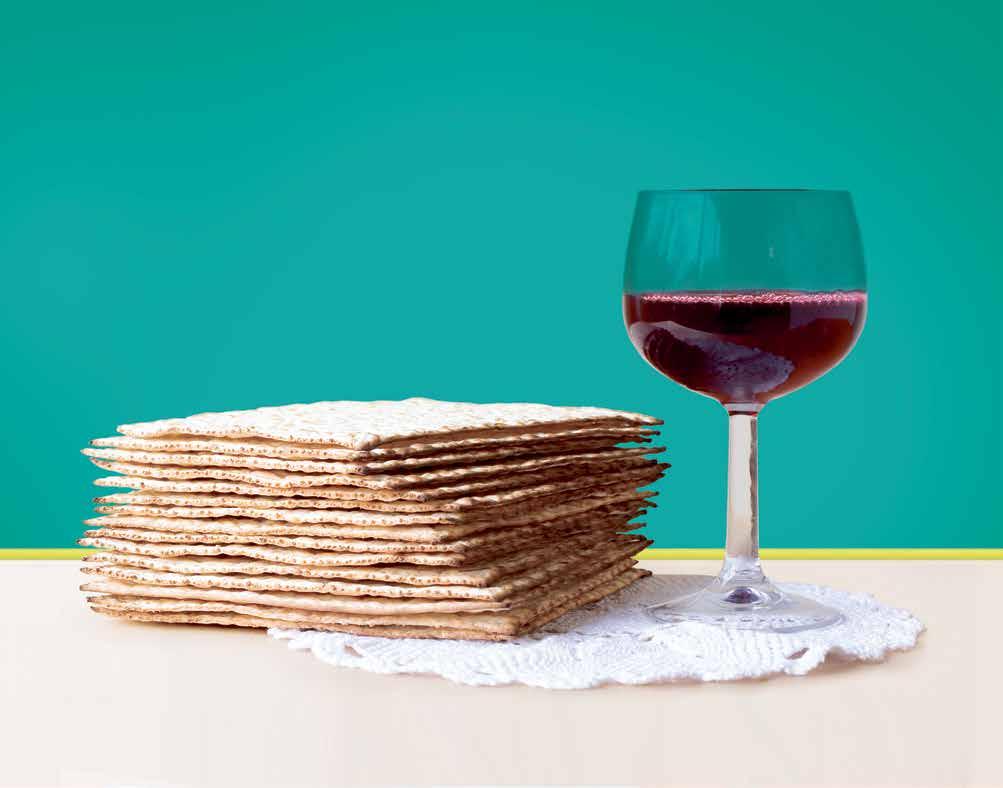
Passing the story forward
By Ariel Solomon Jewish Day School Director of Hebrew and Judaics
One of the central mitzvot of the seder night is Magid, the commandment to tell the story of the Exodus from Egypt and pass it from generation to generation. The Magid section of the Haggadah concludes with a powerful idea: “In every generation, a person must see themselves as if they personally came out of Egypt.”
As we gather around our seder tables this year and open the Haggadah once again, we do more than recall an ancient story. We connect our own lives to the unfolding story of the Jewish people.
The Haggadah reminds us of a difficult truth about Jewish history. We proclaim, “And this is what has stood by our ancestors and by us. For not only one enemy has risen up to destroy us; rather, in every generation they rise up to destroy us—but the Holy One, Blessed be He, saves us from their hands.” These words acknowledge that each generation of Jews
has faced hardship and forces that sought to eradicate us.
Yet the purpose of retelling our story is not simply to dwell on suffering. The commandment of Magid invites each of us to find a personal connection to the Exodus, to see ourselves as participants in the journey from oppression to freedom.
The question then arises: With so much accumulated pain and hatred directed at the Jewish people throughout history, why preserve these memories at all?
The early Zionist thinker Berl Katznelson offered a profound answer in his 1934 essay “Tradition and Revolution”:
“Man is endowed with two faculties: memory and forgetting. We cannot live without both,” he wrote.
“Were only memory to exist, we would be crushed beneath its burden.… Yet if humanity had not preserved the memory of its great achievements, noble aspirations, and strivings for liberation, no revolutionary movement would ever have been possible.”
Katznelson reminds us


that memory is not merely about recalling hardship. Memory is what allows humanity—and the Jewish people—to grow, aspire, and move forward. Remembering our struggles alongside our triumphs gives meaning to our present and direction to our future.
Today, our generation faces new challenges. Alongside physical threats, we increasingly encounter attempts to rewrite Jewish history, distort facts, and replace them with fabricated narratives. Confronting this challenge requires more than remembrance; it requires knowledge.
The Book of Proverbs teaches, “A wise person is strong, and a person of knowledge increases strength” (Mishlei 24:5). Education is one of the most powerful ways we build that strength. By educating ourselves and the next generation, we ensure that our story is told truthfully, thoughtfully, and with pride.
At the Jewish Day School, this commitment to education is at the heart of everything we do. Our goal is to equip students with both a deep understanding of Jewish tradition and the critical thinking skills needed to engage thoughtfully with the world around them. Students explore Jewish values and history while learning how to analyze ideas, examine evidence, and respectfully debate different perspectives.
This comes to life in our Mishnah and Talmud classes,
where students engage with centuries of Jewish scholarship and wrestle with how these teachings apply to their own daily lives. The ancient conversations of our sages become living discussions in the classroom.
As Pesach, or Passover, approaches, that learning becomes experiential. During our school’s Model Seder, students perform and explain the ideas they have studied in their Judaics classes, bringing the Haggadah to life for the entire community.
Our youngest learners experience Pesach through the school’s Pesach Fair, where early childhood students explore the traditions handson. They learn how matzah is made, practice “cleaning for Pesach,” and hear the story of Yetziat Mitzrayim, the Exodus from Egypt, in ways
that are meaningful and memorable for them.
These experiences do more than impart knowledge; they nurture identity. When students actively engage with Jewish tradition and history, they develop a strong and proud sense of who they are.
Each generation has the responsibility to carry the Jewish story forward. By investing in education and meaningful experiences of Jewish life, we strengthen the chain that connects us to the generations before us and prepare the next generation to face the challenges ahead with wisdom, resilience, and pride.
In this way, the mitzvah of Magid continues, not only at the seder table, but in our classrooms, our homes, and our community.


Mazel Meals on the way, from Phyllis Ringel fund
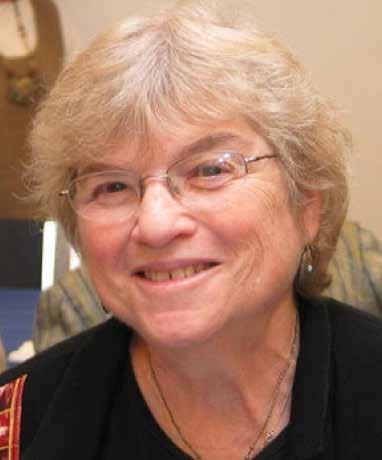
The Phyllis Ringel Memorial Fund is sponsoring a Mazel Meal for Passover this year (as well as one this September for Rosh Hashanah). Delivered to older adults in the community, Mazel Meals include traditional foods and ritual items that bring recipients celebration and connection to Jewish holidays. Through these deliveries and the ongoing services Jewish Family Service provides to older adults, young adults with disabilities, and individuals in
need of mental health support, the legacy of Phyllis Ringel z”l, executive director of JFS from 2002 to 2012, continues to nourish our community.
When Ringel led JFS, she did more than manage an agency; she nurtured a community. She expanded programs and services to the three groups mentioned above. She was instrumental in launching the BenefitsCheckUp program to ensure that older adults and young adults with disabilities on limited incomes had
access to critical benefits and community resources. A collaborative initiative between the United Way of the Greater Lehigh Valley, Senior Corps RSVP, and ShareCare Faith in Action, the program not only helped clients remain independent but also broadened JSF’s visibility throughout the Lehigh Valley.
Ringel built a counseling department that continues to be accessible to the Jewish community and to uphold the highest standards of client confidentiality. These values remain the cornerstone of JFS counseling services today.
After Ringel died in 2012, her husband, Chet, and their sons Steven, Matt, and Joseph sought a meaningful way to honor her legacy. In 2013, they launched the Phyllis Ringel Memorial Fund to continue supporting the work that was closest to her heart, including an annual community-wide educational lecture and Mazel Meals.
To learn more about ways that you can remember local Jewish organizations with a gift in your will, trust, retirement account or life insurance policy, contact Aaron Gorodzinsky at 610.821.5500 or aaron@jflv.org, or visit jewishlehighvalley.org/lifeandlegacy.


Ovine Offerings
Across
1. Gave money
5. City in central Israel
10. Bit of land at sea
14. Pot ingredient?
15. Once more
16. Sought damages, say 17. Term for an acquaintance you shouldn’t trust?
20. Massachusetts town named after Israel’s capital
21. A piece
22. Piggy
23. California county
26. ___ v’shalom
28. Hit 1998 Adam Sandler film?
33. Cockney’s roll-call response
34. Jewish fashion designer Marc
35. Keret of note
37. Street ___, products from 34-Across
39. Offering from 17-Across?
42. Zeidi alternative
43. Zac of “The Lorax”
45. Waze ways: Abbr.
47. It holds water
48. Offshoot of a city west of Jerusalem full of Americans
52. Half
53. HaZeh, for one
54. Son-gun connector
57. Sons of 42-Across?
59. Gaddafi ruled it, once 63. Passover requirement, once...or another title for this puzzle
67. Angels guard it, according to the Torah
68. Something set
69. Frozen drink brand
70. Hall or its food
71. Amazin’ MLB player
72. Israel’s future?
Down
1. Clumsy hands
2. Buffalo seen in crosswords
3. “ ___ cost you!”
4. Make like an Israeli soldier
5. Sprinted
6. Garland and Gonzales, for short
7. Medieval weapon, or modern spray weapon
8. Fragrant purple flowers
9. Ivri follower
10. Famous Chazon
11. Go well with
12. Former “Tonight Show” host
13. Nose (out)
18. “Have ___ myself clear?”
19. Macbeth or Banquo, e.g.
24. Photos, briefly
25. Egyptian emblem
27. Lt. subordinates
28. Historic Banquet that led to the solidification of the Conservative movement
29. What an inspiring athlete often has
30. Attendees
31. “Gadzooks!”
32. It’s a lot in Judaism?
33. Offering from 28-Across?
36. Offering from 48-Across?
38. Sticks up
40. Combining form in chemistry
41. Orange jacket?
44. Words before “say more”
46. Like David compared to Goliath
49. Admiring words
50. In a neat way
51. Iago’s wife
54. Big name in Israeli food
55. Kind of haircut
56. Top cards
58. Artist that does bad work?
60. E. coli, for one: Abbr.
61. Shloshet ___ Hagbalah
62. Sacked out, old-style
64. Health care VIPs
65. It’s all the rage?
66. 10 cc, e.g.
BOOK REVIEWS
A Where’s Waldo? for Passover
“Afikoman, Where’d You Go?: A Passover Hide-andSeek Adventure,” by Rebecca Gardyn Levington, illustrated by Noa Kelner, Rocky Pond Books, 2024, 40 pages.
By Sean Boyle
Congregation Keneseth Israel
Jewish Book Award-winning author Rebecca Gardyn Levington’s picture book “Afikoman, Where’d You Go?” is a hide-and-seek adventure of six children hunting through and around a home for the Afikoman at their Passover seder.
Inspired by the Where’s Waldo series, Richard Scarry books, and “The Gingerbread Man” stories, the reader follows the young narrator as she takes the other children around and through the house and asks, “Afikoman? Afikoman? Afikoman? Where’d you go?” Each double-page spread has the six children hunting for the Afikoman in often-cluttered locations, which sometimes makes finding this hidden piece of matzah a real challenge for the reader. Finally the Afikoman is easily found for the surprise ending.
Levington began her career as a journalist until she decided to become a fulltime mom. After 10 years
she took a creative writing class and remembered her childhood love for writing poetry. She has since published 14 picture books, and several dozens of her poems have been published in nationally recognized magazines. The hunt for the Afikoman begins right away, on the title page, and continues on every page, including the end papers and cover. A glossary for the Hebrew words is included at the beginning. There is no background information about Passover or the seder, however, so prior familiarization is required to understand why the children are hunting for the Afikoman. But any child can enjoy the rhyming text and visual hunt for the sneaky Afikoman. There’s a culturally diverse display of people at the seder, as well as differently abled representations and variations of
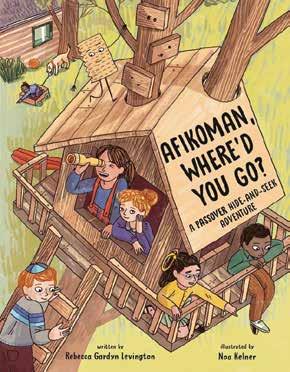
religious observance. The book is recommended for ages 3-8, but will be an enjoyable adventure for anyone reading with young people. Three free coloring pages are available on the author’s website (rebeccagardynlevington.com)— black-and-white copies of the actual double-page color illustrations in the book.
Sean Boyle is librarian of the Jewish Day School and Congregation Keneseth Israel, and president of the Association of Jewish Libraries.
Happy Passover
From the board and staff of the Jewish Federation of the Lehigh Valley
Bill Markson President Jeri Zimmerman Executive Director
By Sandi Teplitz Special to Hakol
2 cups matzah farfel
2 eggs, beaten
1/3 cup sugar
3 tablespoons KP oil
1/2 teaspoon salt
1 apple, peeled and thinly sliced
1/4 cup chopped toasted hazelnuts
1/8 teaspoon cinnamon
1/2 cup KP apple juice
Grease an 8-by8-inch Pyrex dish. Put the matzah in a large bowl and pour 2 cups of cold water over it to dampen, then drain. Add the eggs, sugar, oil, and salt. Fold in the apple, nuts, and cinnamon by hand. Pour the mixture into the greased dish, then bake at 350 degrees for 1/2 hour.
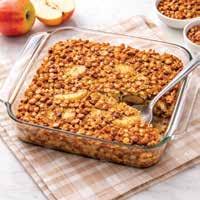
Remove from the oven and pour apple juice over to moisten. Serve immediately.
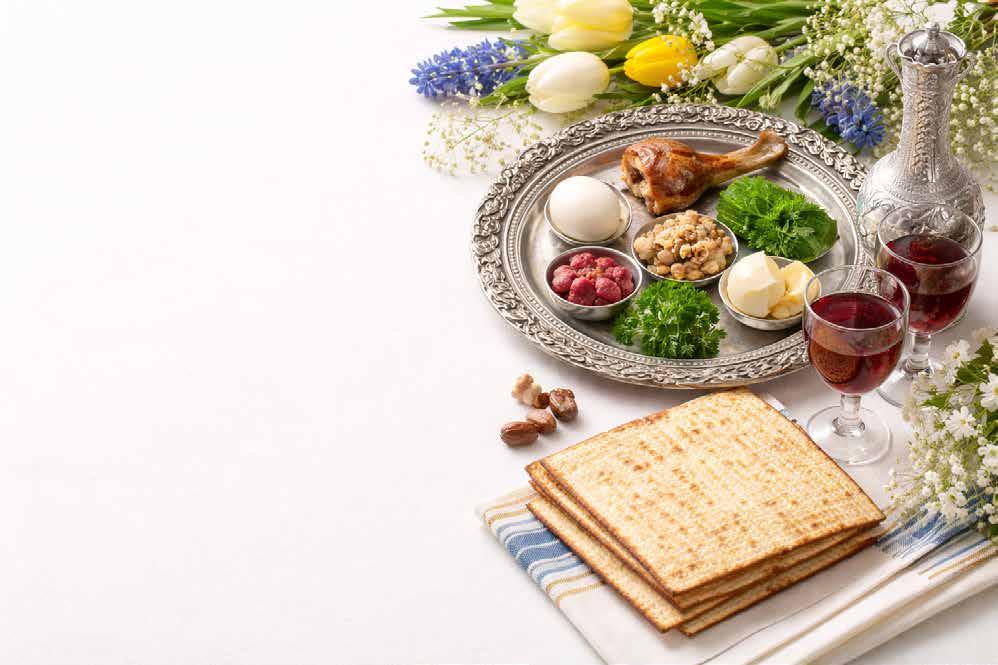
Try this delicious kosher for Passover dish as a side with a dinner featuring roast chicken, turkey, or brisket. Accompany with a green vegetable and a dry white wine.