A MAGAZINE FOR TRUSTEES IN JESUIT HIGHER EDUCATION
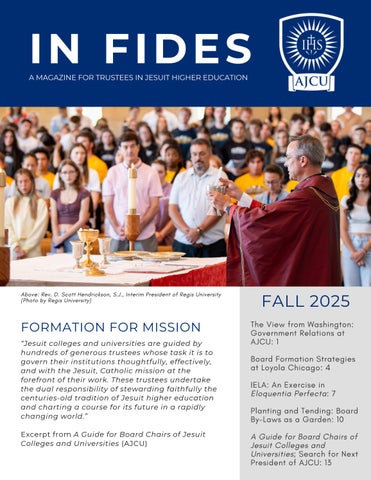
“Jesuit colleges and universities are guided by hundreds of generous trustees whose task it is to govern their institutions thoughtfully, effectively, and with the Jesuit, Catholic mission at the forefront of their work. These trustees undertake the dual responsibility of stewarding faithfully the centuries-old tradition of Jesuit higher education and charting a course for its future in a rapidly changing world.”
Excerpt from A Guide for Board Chairs of Jesuit Colleges and Universities (AJCU)
Government Relations at AJCU: 1
Board Formation Strategies at Loyola Chicago: 4
IELA: An Exercise in Eloquentia Perfecta: 7
Planting and Tending: Board By-Laws as a Garden: 10
A Guide for Board Chairs of Jesuit Colleges and Universities; Search for Next President of AJCU: 13
THE VIEW FROM WASHINGTON: GOVERNMENT RELATIONS AT AJCU
By Jenny Smulson, Interim Executive Director & Vice President of Government Relations, AJCU
AJCU’s advocacy efforts depend on a partnership withpresidentsandgovernmentrelationsleadersat eachofour27collegesanduniversitiesintheUnited States Working together, we educate and inform MembersofCongressandtheAdministrationabout the value of a Jesuit higher education and the contributions made by our institutions to our communitiesandtoournation AJCUkeepsabreast of what is happening in Washington, while our colleagues identify key issues for their students, facultyandstaffontheircampusesandintheirlocal regions These government relations teams have long-standing relationships with Congressional delegations and are strategic in helping AJCU think abouthowwecanleverageourbroadernetworkon behalf of the interests of our students and institutions Atourcore,weadvocateforpoliciesthat ensureaJesuiteducationisaccessibleforthosewho wanttopursueit
With any new administration, policy change is driven using traditional tools like Executive Orders (EOs), regulations, and oversight While EOs do not hold the weight of law, they do advance new interpretations of the law that align with an administration’s priorities The Trump Administration’s domestic policy agenda continues to place a focus on higher education, making our advocacy more important than ever All colleges and universities are grappling with significant changes in federal policy advanced in both expected ways, as well as some that run counter to the norms of Washington, DC This administration is using new strategies, including freezing, cancelling, or eliminating multiyear grants (mid-cycle, in some cases)
For example: the Trump Administration has called for the end to “illegal” Diversity, Equity, and Inclusion initiatives. Their biggest leverage is withholding and cancelling federal grants, including some at AJCU institutions. Thus our schools are responding to directives not only from the White House, but from the Justice Department, Department of Health and Human Services, National Institutes of Health, Department of Education, Department of State, National Science Foundation, and the Department of Energy, (this is not an exhaustive list).
The U.S. Department of Education has also launched investigations into scholarship programs related to national origin (i.e., Hispanic students, DACA students, African American students, underrepresented minority students, and groups based on race or ethnicity) at both public and private institutions. In March, forty-five universities were investigated for the “use of racial preference and stereotypes in education programs and activities.”
Antisemitism is a continued area of alarm for this administration, which has opened investigations at institutions that they believe have “failed to protect students on campus from antisemitic discrimination ” In March 2025, sixty colleges and universities were warned of potential enforcement actions for Title VI violations (protecting Jewish students on campus) While many are aware of highprofile institutions targeted by this administration, there is less attention being paid to many other schools subject to investigations, both public and private
New policies being proposed by the U S Department of State and the U S Department of Homeland Security are presenting challenges for colleges and universities that welcome international students to their campuses At AJCU institutions, there are nearly 21,000 enrolled international students (in a total cumulative student population of roughly 213,000) The Administration has issued travel bans that do not exempt student visa holders; added requirements for stricter vetting for international students; proposed limiting the length of time a visa is valid (duration of status); and called for payments of $100,000 for new H1-B visa workers NAFSA, the association representing international education, predicted earlier this summer that international enrollment would drop between 30-40 percent on college campuses, resulting in $7 billion in lost revenue for our economy
While the Administration’s actions make front page news, Congress also drives significant federal policy changes Congressional Republicans have been active in the oversight of colleges and universities, mostly focused on antisemitism Congress is also responsible for the annual appropriations process and is required to approve rescissions (the recall of previously appropriated funds), a tool that has been utilized more by this administration than others
The Administration has proposed deep cuts to federal student aid programs and other higher education programs The President’s fiscal year 2026 budget cuts the Pell Grant maximum by $1,685 (from $7,395 to $5,710 for the 2026-27 school year); eliminates the Federal Supplemental Educational Opportunity Grant program ($910 million); reduces by 70% funding for the Federal Work Study (FWS) program ($1 2 billion to $250 million); and eliminates the TRIO program ($1 19 billion)
The Senate Appropriations Committee has rejected these spending cuts by generally funding student aid and higher education programs at the FY’24 and FY’25 levels. The House Appropriations Subcommittee and full Appropriations Committee have protected spending for Pell and TRIO, but have also eliminated many student aid and higher education programs. At the start of the fiscal year, Congress and the Administration remain at an impasse, after the government was shut down on October 1. As a way to reduce and eliminate spending that it did not support, the Administration proposed approximately $9 billion in rescissions. Congress approved these cuts, some of which are making an indirect impact on colleges and universities (e.g., U.S. Agency for International Development and the Corporation for Public Broadcasting). We expect to see more rescissions packages from the Administration.
Government Relations (continued)
Congress also advanced a reconciliation bill, H R 1/The One Big Beautiful Bill Act, which included significant changes to federal student lending programs and included other provisions that impact institutions The legislation produced savings of $350 billion by changing and eliminating federal student loan programs These include caps on borrowing through the direct lending program at the graduate and professional level; elimination of the Grad PLUS program that had provided loans and benefits to students who might not be eligible for private loans; increased taxes on university endowments; and introduced new accountability measures that will prohibit federal borrowing for programs at institutions of higher education that are deemed “low-earning outcome” programs
With policies being advanced in these nontraditional ways, institutions and organizations have looked to the Courts to resolve questions of legality of the Administration’s proposals At present, there are 342 active court cases certainly not all related to higher education But the Courts are playing an oversized role in the policy space
While advocacy work can be hard, it is gratifying to educate policymakers in Washington about the power and value of a Jesuit education Dr Linda LeMura, president of Le Moyne College, recently said, “It is an honor to engage with members of Congress to discuss the distinctive aspects of our Catholic, Jesuit mission and something we must continue to do in this moment The 500 year-old Jesuit tradition founded by St Ignatius of Loyola compels us to inspire generations of servant-leaders Our commitment to educational excellence and a life of meaning are among the enduring values of our universities and our country "
Championing the mission of Jesuit colleges and universities is our charge and one for which we welcome the partnership of others who care so deeply about this work. We have much good news to share about the contributions of our institutions to the formation of people with deep curiosity, who are committed to serving others.
Learn more about AJCU’s advocacy work by visiting ajcunet.edu/policy-engagement.
Below: Photo of 2025 AJCU Congressional Breakfast by Rafael Suanes.
BOARD FORMATION STRATEGIES AT LOYOLA CHICAGO
By Mark C Reed, President of Loyola University Chicago
Over the past several years, Loyola University Chicago has implemented a series of mutually reinforcing strategies and initiatives to deepen the understanding and commitment of the Board of Trustees to the institution’s Jesuit, Catholic heritage and mission Before describing some specific examples, it might be helpful to provide some context Loyola’s recent history reflects the general trend of the Jesuit network toward lay presidents In 2016, Loyola’s Board elected the University’s first lay president and in 2022, the second lay president The centrality of the institution’s Jesuit, Catholic mission was a key factor as the Board conducted the searches and elected the new presidents The support of the Provincial Superior, who missions the new president as Director of the Work, is essential for the institution to maintain its Jesuit, Catholic identity
Another bit of context on the topic of mission relates to the presence of Jesuits at Loyola, where we are blessed to have a sizable, vibrant community of men studying, working, and ministering on campus The Jesuits who serve on Loyola’s Board are a trusted source for members on matters related to Jesuit education and the Society of Jesus But there is no substitute for the presence of Jesuits on campus in the daily life of the University community to demonstrate the power of the Jesuit tradition and culture Indeed, a priority of Loyola’s new strategic plan, For the Greater Good, is “to promote the integration of the Loyola Jesuit Community into the life of the University through spiritual, intellectual, and social interactions and activities”
For lay Board members, we are intentional in creating opportunities for interaction with Jesuits whose primary apostolic ministry is to the University: at meetings, social activities, events on campus and at the Jesuit Residence, and in the community The importance of the Board’s responsibility to preserve and strengthen Loyola’s Jesuit, Catholic mission is emphasized in the recruitment and onboarding of new Trustees
For those Board members who are Catholic, we try to help them grow in understanding, appreciation, and practice of their faith We also carefully respect the religious convictions of those of other faith traditions and those without a faith tradition During the onboarding process, we provide information and readings on the history of the Society of Jesus and Jesuit education We recommend the excellent resources available online at jesuitresource org Before the new Trustees attend their first meetings in September, we hold orientation sessions (virtual and inperson) to discuss organizational and strategic matters Mission formation of new Trustees begins in these sessions
Loyola Chicago (continued)
From there, we pursue an integrated strategy to ensure breadth and depth of mission exposure and engagement by the Board. The Board has a Mission and Culture Committee whose charge is to “provide oversight of the University’s efforts to sustain and strengthen the University’s Jesuit, Catholic mission as a diverse community seeking God in all things. The Committee monitors the University’s fulfillment of its Jesuit and Catholic identity as set forth in various documents of the Society of Jesus, the USA Midwest Province of the Society of Jesus, the Loyola Jesuit Community, the Corporation of Loyola University, the Association of Jesuit Colleges and Universities and the Archdiocese of Chicago ”
At the same time, we make clear that mission is important across all domains of the Board’s work, not just a consideration of the Mission and Culture Committee Every committee is exercising its governing responsibilities in the service of mission and with fidelity to the University’s Jesuit, Catholic identity and commitments
Another simple way to reinforce a common approach to mission across the Board is with a common committee prayer Each academic year, our Vice President for Mission Integration composes a prayer which is used to begin each committee meeting The common prayer sets the proper tone of unity and purpose To keep the value and impact of their work top of mind, we begin each full Board meeting with a Mission Moment where our Vice President for Mission Integration organizes a brief presentation by a student on the real-life impact of mission in their studies and life Frequently, the Chair of the Mission and Culture Committee, Superior of the Loyola Jesuit Community, and other Trustees are invited to participate in the Mission Moment
Staying close to the source and summit of Catholic life, we provide opportunities to worship together during the regular Board meeting cycle. For the September meetings, select members of the Loyola community are invited to attend Mass. Trustees are joined by Life Trustees, Vice Presidents, Deans, faculty/staff award recipients, and student leaders. A Jesuit on the Board is the presider with readings and petitions read by faculty, staff, and students It is an enjoyable way to start the academic year grounded in faith
In addition to these structural and operational approaches, we have also provided Board formation opportunities outside of the regular course of business for those Trustees with the time and interest to deepen their knowledge and understanding Through Loyola’s Division of Mission Integration, we offer Trustees the opportunity to participate in the Spiritual Exercises in Everyday Life Retreat and the Busy Person Retreat Participants receive resources and support from a spiritual director to grow in their prayer lives and deepen their relationship with God
By far, the most intense Board formation activity has been a 10-day pilgrimage to Spain and Italy In 2024, we organized an Ignatian pilgrimage following in the footsteps of St Ignatius This program brought participants to places of important historical and religious significance We traveled to northeast Spain to visit the birthplaces of Ignatius of Loyola and Francis Xavier, consider the historical and cultural context of their initial vocation, and visit places where Ignatius began to develop and write the Spiritual Exercises
We traveled to Rome to visit historical sites that underscore the important work of the Jesuits at a crucial time in the life of the Church, particularly during the 16th century We visited the Vatican for a private audience with Pope Francis and the Jesuit Curia for a private meeting with Jesuit Superior General Rev Arturo Sosa, S J Throughout the program, we attempted to gain a better appreciation for the life and times of the early Jesuits and for the vision and spirit of Jesuit institutions, as well as a deeper understanding of the work that the Society of Jesus is calling their sponsored universities to accompany them in today. Through on-site visits, liturgy, study and dialogue, participants gained a deeper appreciation for the values, vision, history, and work of Jesuit institutions of higher learning.
While the 2024 pilgrimage was successful, we are considering adjustments in the future to make the opportunity more accessible to interested Trustees. We received feedback that the length of the pilgrimage (10 days) made it difficult for busy Trustees to commit. In the future, we are considering shorter versions of the pilgrimage focused only on Rome or Spain. Our informal goal is to make sure Trustees have the opportunity to participate in such a pilgrimage experience at least once during their tenure on the Board.
Loyola’s Board of Trustees is committed to preserving and strengthening the University’s Jesuit, Catholic mission and identity This article describes some of the strategic, operational, and cultural approaches we have implemented, and the lessons learned We look forward to learning from our colleagues across the Jesuit network about the types of approaches and strategies to Board formation that have been most effective and impactful on their campuses
With acknowledgement to George Trone, vice president and chief of staff, and Claire Noonan, vice president for mission integration Photos by Loyola University Chicago & Eddie Quinones
Loyola Chicago (continued)
IELA: AN EXERCISE IN ELOQUENTIA PERFECTA
By Rev. D. Scott Hendrickson, S.J., Interim President of Regis University
Last fall, a group of Jesuit college administrators and I were invited to participate in the first cohort of IELA – AJCU’s Ignatian Executive Leadership Academy –which would take place in winter and spring 2025 at Loyola University Retreat and Ecology Campus (LUREC) outside of Chicago. Over three sessions, our cohort engaged with AJCU staff, expert presenters, college and university presidents, and higher education professionals, in several in-depth exercises in the management, administration, and governance of a university. Just a few months later, and having had some time to reflect, I wonder how best to summarize or describe our experience. To me, the Academy was an exercise in our own Jesuit tradition of striving for administrative eloquentia perfecta.
It is well known that Jesuit education is steeped in tradition, reaching back five centuries to the flourishing of Renaissance humanism in sixteenth-century Europe. The humanists immersed themselves in the study of language, rhetoric, grammar, and literature, with the aim of leading themselves and their students toward eloquentia perfecta. The ability to speak and write well would reflect not only their training, but their values as good citizens, who would in turn stand to uphold the common good. Adopting this approach, the earliest Jesuit educators sought to design a curriculum and pedagogy that would form well-educated, valueoriented citizens, whose lives would reflect an eloquentia informed by their Jesuit education and, with transformed hearts, fuel their desires to help build a better world.
Similarly, IELA brings together Jesuit college and university administrators with expertise in their own areas –academic affairs, student life, mission integration, advancement, athletics–with the aim of forming leaders who are not only highly skilled, but who are on their way to becoming executive leaders, in the Ignatian tradition In this sense, IELA is an exercise in administrative eloquentia perfecta: an opportunity for colleagues across the AJCU network to sharpen their own approaches to leadership, according to the values and characteristics we embrace and uphold in Jesuit education For me, three areas of leadership formation and skill development fostered by the Academy stand out: commitment, confidence, and community
I’m sure that the members of my cohort would agree with me in saying that we all arrived with a significant understanding of the mission and identity of our institutions, no matter where we are based And while each institution faces different local, financial, and political circumstances that shape our work on any given day, I was impressed with how, from the start, we were already speaking the same language
Workshops on the cultures that define higher-ed governance offered an in-depth look at the running of a university from various perspectives While we could all relate at some level, some of us even serving as presenters, what most impressed me was the attention given to our particular Jesuit mission No matter the topic or focus being explored, the Academy was an in-depth exercise in the commitment to mission and to the transformative education we provide to our students Whether we were exploring the relationship between academic affairs and student development, or the role of the president and his/her relationship to the chair of the board, we were sharpening –from the areas of our own expertise – our own understanding of how best to assess and apply our charism according to the current challenges facing higher education today
It was certainly not lost on us that the first cohort of IELA was taking place during one of the most challenging years higher education professionals have ever had to face With executive orders taking shape, cuts being announced to federal funding, and looming demographic shifts setting the context, I actually enjoyed meeting and facing a very difficult reality as a cohort to reflect, to vent, or even to sit in silence together It was in these moments of reflection, listening to and learning from others, that we were able to share our vulnerability
As Ignatian leaders, and in the tradition of the Spiritual Exercises, we were asked to reflect on the lights and shadows of our personal workplace experiences in managing individuals and teams, and how we might become more effective, articulate, and confident leaders My cohort and I appreciated the opportunity to examine our individual leadership styles and the skills we each carry in our own toolkits
Above: Participants at the first IELA session in 2025 (photo by Joseph DeFeo for AJCU)
IELA (continued)
Lastly, I want to highlight what perhaps I might deem the most important component of the Academy, which I will identify as community Administrators at most institutions, no matter the size, will at some point or time in their tenures lament how siloed we can become in our own units and divisions This dynamic rang true as a nagging reminder in many of the Academy’s presentations
But what I found so helpful was the way in which the organizers of IELA directed participants to reflect on concrete situations as collaborators and co-workers in our shared mission and vision In interactive exercises, we were encouraged to deepen our understanding of and the application of cura personalis for our colleagues and the students we serve We were also encouraged to expand our appreciation of cura apostolica and consider how we might work better together in support of each other and our students for the good of the work
IELA offers colleagues across the AJCU network an opportunity to learn from leadership experts and to polish skills and approaches to administration But it also creates a space for participants to appreciate and embrace the strength of our shared work and the resources available to us as a network of colleagues and believers in Jesuit education
While the challenges of today may be with us for some time, I am grateful to have had the opportunity to gather with colleagues from across the AJCU network to explore together how we might grow and develop our skills, according to the values that differentiate us from other institutional approaches If our humanist predecessors sought to learn and express themselves articulately and in a way that would reflect their values as good citizens, IELA was, for me, an exercise in administrative eloquentia perfecta, encouraging participants to understand more clearly how they are being called to lead more effectively, and how they might be able to do so with grace
IGNATIAN EXECUTIVE LEADERSHIP ACADEMY (IELA)
The AJCU Ignatian Executive Leadership Academy (IELA) is a six-month program designed to develop the practical skills and habits of mind and heart that will support and sustain the next generation of executive leaders in Jesuit higher education. The program is designed for executive level leaders and others who are currently serving in supervisory positions (at a level comparable to a dean or higher) in a university or college, most likely but not exclusively at Jesuit institutions, and who are discerning their future leadership roles in Jesuit higher education. In addition to preparing participants for enhanced leadership roles, including the presidency, the program seeks to help participants to discern their individual desires and career paths as leaders.
Learn more: ajcunet.edu/formation-programs/iela
PLANTING & TENDING: BOARD BY-LAWS AS A GARDEN
Robert B. Farrell, J.D., Ed.D., General Counsel & University Secretary, The University of Scranton
If you are like me, spring and summer are the seasons to get your hands dirty Nothing sinister, mind you I am talking about the mud-covered hands of a gardener. Spring rain and warm days promise buds, and growing grass, and weeds, lots of weeds. I love this work, though it seems perpetual. If done well, and persistently, it results in a garden full of blossoms, plants well-tended and healthy, and the satisfaction of knowing that you helped shape the growth and progress of a garden.
Gardening provides space to think, as well. For people like me, who enjoy the work of governance, my mind drifts as I dig, prune, and pull. The two combined recently as an analogy: tending a good garden is like tending good by-laws. Both need continual attention and pruning and both, when given that attention, provide the satisfaction and space in which healthy plants or healthy boards can thrive. As we head into the fall, it is a good time to think about the seasons of these seemingly unrelated pursuits.
The "Off" Season
Both gardens and by-laws have off seasons, though they do not occur at the same time. Gardens rest while by-laws are being used and tested. By-laws rest while gardens bloom and grow. The off season for by-laws is the summer. By “off,” I mean that summer is a time to pause and consider what changes might be made in order to ensure a successful “growing” season in the next school year. For example, during the summer, a school’s General Counsel or board professional may consider the list of by-law challenges that the board faced over the last year.
Maybe it was something that the by-laws prescribed or, more likely, it was something that was missing and needed to be interpreted. It could bethattherewerechangesinthelawpertainingto non-profits, generally found at the state level. Major changes to university operations, such as the growth of a new college, or the acquisition of another school, may necessitate a review of the bylaws to determine if they still speak to the correct structuresorofficers.
As with a garden, when adding or pruning in this off-season, care should be taken to not add or take away too much. This is particularly true when a board faces a challenge of what is not in the by-laws. In 2012, the Association of Governing Boards of Universities and Colleges (AGB) published a valuable monograph entitled, Updating Board Bylaws: A Guide for Colleges and Universities, by Robert M. O’Neil. The author challenges those who wish to shape and revise their documents to avoid the twin pitfalls of putting too much or putting too little into the by-laws. When a board action is not completely prescribed in the by-laws, the temptation is to codify the procedure into law, as it were, and specify each step. What that adds to certainty, it deletes from flexibility.
Boards, presidents, and universities change
Allowing flexibility within the terms of the bylaws allows those evolutions to occur without rule changes at each step Balancing this need for flexibility with the need to amend those rules when fundamental change has occurred at the institution, presents a challenge to those managing these documents To return to the gardening analogy: some plants grow and thrive from old wood Others need to be cut back entirely Understanding your garden, and your institution, is critical when deciding among these choices
The “On” Season
Again, for gardens and by-laws, the opposite, or “on,” seasons are flipped The pruning and planting and feeding done during the fall, winter and early spring pay off as summer warms the earth. The same attention paid to the by-laws during the summer should help the board as it begins another school year.
Like any extended analogy, it breaks down a bit here A general counsel or board professional should identify the gaps or challenges in the current documents over the summer The work progresses over the next year however, provided the changes are not immediately required to meet some demand for compliance Most by-laws require board votes and supermajorities Before the changes get to the board, they should be vetted and discussed by the governance or trusteeship committee The seasoned trustees on these committees who sit on a perch overseeing the work of the board, must consider the merits of the changes and deem them beneficial to the operations of the board at that given time Those discussions should span the dual needs of specificity and flexibility They should consider the experiences of the prior year(s) as well, and how the rules enabled or hindered good governance. These are not simple discussions.
The Work of a Team
Many of us garden alone, or think we do. If you look back over the work that is being done to prepare for the season, however, you quickly think of all of the others who lugged topsoil or mulch, dug holes, consulted on the merits of a given plant or placement, and filled cars with annuals and perennials to occupy window boxes and planters. As a general counsel, I feel a keen responsibility for the by-laws of my institution. I know, however, that the work to make them the best possible document for university operations requires a team. Board professionals know how certain rules butt up against others. For example, when does a trustee’s term begin, as opposed to a board officer, and when should acknowledgment letters memorializing that term go out? When should committee meetings be scheduled? What members should fill the committee rosters? Must they have certain skills? A general counsel may know all of this, or may not have the understanding of these details to recognize an issue, and must thus rely on a team.
The governance chair is another valued team member. The meetings of that committee should sequence in such a way that ample time is allowed to both consider changes and present them to the board for discussion. Robert O’Neil, in the AGB monograph referenced above, suggests that a governance committee should plan to review the by-laws at least every three years absent some acute need to revisit them sooner The committee members, who should be well-informed of the changes by the time they reach the board, can act as champions of the alterations when discussed by the larger body
The Enjoyment (Warning: It is fleeting)
I will not speak for all gardeners, but enjoying the beauty of a thoughtfully planned, pruned, and planted garden should be the point of the work
And yet, I sit still for about ten minutes before I spot a weed, grab a stray stick, or pull out my trimmer or rose clipper. The same restlessness is endemic to making by-laws work, and good governance in general. The governance committee should consist of a restless, everimproving sort of trustee. While those who focus on the by-laws may enjoy a moment or two of satisfaction knowing that the board’s documents serve the board and enable it to carry out its mission, that satisfaction is fleeting. Before long, they will compare article three with article seven and imagine how they could blend them better. They will consider the last election of new board members and consider what rule changes might aid that process. Maybe they are reviewing the board assessments for suggestions as to how the bylaws were helpful or a hindrance to board operations. But before long, that iced tea sits abandoned on the table, and your hands are covered in dirt once again.
Photos courtesy of The University of Scranton
A GUIDE FOR BOARD CHAIRS OF JESUIT COLLEGES AND UNIVERSITIES
Jesuit colleges and universities are guided by hundreds of generous trustees whose task it is to govern their institutions thoughtfully, effectively, and with the Jesuit, Catholic mission at the forefront of their work These trustees undertake the dual responsibility of stewarding faithfully the centuries-old tradition of Jesuit higher education and charting a course for its future in a rapidly changing world
AJCU has published a new document, A Guide for Board Chairs of Jesuit Colleges and Universities, to provide an essential perspective for trustees of institutions of Jesuit higher education Filled with practical advice for effective board leadership and mission governance, it is essential reading for anyone engaged in, or curious about, trustee leadership The Guide serves multiple purposes as a resource for board discussions, an orientation tool for new chairs and trustees, and an easyaccess reference book on the intersections of mission and board practice
A Guide for Board Chairs of Jesuit Colleges and Universities is now available to download or purchase on Amazon Click here to learn more
SEARCH FOR NEXT PRESIDENT OF AJCU
The AJCU Board of Directors has partnered with Isaacson, Miller to hire the next president of AJCU. Applications and nominations are currently being accepted for this position; click here to learn more. Please send any questions to info@ajcunet.edu.