
Whole School

DATE September 2024
REVIEW DATE September 2026
Owner Director Version Number: Ver06
Working Date: Reviewed by TSA – September 2023
Legal Sign off by:
Type of Policy: Internal
Date: N/A
Authorised by Exec 18/09/2024
Authorised by the Board N/A
Effective date of Policy: September 2024
Circulation: ALL
1. Preamble
1.1 Jumeirah English Speaking School (‘JESS’ and/or the ‘School’) prides itself on being a working environment where every employee feels valued, comfortable and confident to raise any suspected wrongful conduct without fear of judgement or retribution. This Policy has been created to enable employees and contractors to discharge their moral obligation to report any wrongful conduct witnessed or suspected
1.2 This Policy should be used where there are concerns about consequences for other employees or the public and does not apply to matters relating exclusively to one’s own employment.
1.3 Links to other policies:
1.3.1 Staff Grievance Policy
2. Introduction
2.1. If you observe what you believe to be wrongful conduct, you have the right and the duty to report it without fear of retaliation. The Policy on ‘whistle-blowing’ is intended to demonstrate that the School:
2.1.1. will not tolerate misconduct;
2.1.2. respects the confidentiality of staff raising concerns and will provide procedures to maintain confidentiality so far as is consistent with progressing the issues effectively;
2.1.3. will provide the opportunity to raise concerns outside of the normal line management structure where this is appropriate;
2.1.4. will provide a clear and simple procedure for raising concerns, which is accessible to all employees and volunteers (including consultants or outside contractors).
3. Scope
3.1. This Policy is applicable to all employees and volunteers (including consultants or outside contractors) who would like to report any activity which they consider a serious concern (herein referred to collectively as a ‘Concern’)
3.2. The Policy aims to:
3.2.1. Encourage employees to raise any serious concerns they have about their workplace or working practices.
3.2.2. Ensure that employees get a response to their concerns and that they are aware of how to pursue them if they are not satisfied with any action or inaction
3.2.3. Assure employees that if they raise any concerns then action will be taken to protection them from possible reprisals or victimisation.
3.3. A Concern is not easily defined; however, it includes child-protection issues, plus also harassment by and between members of staff and volunteers, allegations of fraud, financial irregularities, corruption, bribery, dishonesty, acting contrary to the School policies, criminal activities, or failing to comply with a legal obligation, a miscarriage of justice, or creating or ignoring a serious risk to health, safety or the environment.
4. Procedure – Who do you report a Concern to?
4.1. This procedure is separate from the School’s procedures regarding grievances Employees should not use the ‘whistle-blowing’ procedure to raise grievances about their personal employment situation. Such grievances should be raised via the Staff Grievance Policy.
4.2. The School encourages employees or volunteers to discuss the Concern with his/her Line Manager, or any member of the SLT or Executive team.
4.3. Reporting a Concern should ideally be reported as follows:
4.3.1. to the Headteacher of the school or an Exec member; or
4.3.2. if the Concern involves the Headteacher, then it should be reported to the Director; or
4.3.3. if the Concern involves the Director, then it should be reported to the Board of Governors (GovernorsGrp@jess.sch.ae)
4.4. There are circumstances where an employee may be entitled to raise a concern directly with an external body where the employee reasonably believes that exceptionally serious circumstances justify it. Staff may consider informing the Board of Governors (GovernorsGrp@jess.sch.ae) in the first instance.

5. Confidentiality
5.1. Employees or volunteers who wish to raise a Concern under this Policy are entitled to have the matter treated confidentially. Their name will not be disclosed to the person who the concern is about without their prior approval where possible
5.2. It may be appropriate, to preserve confidentiality, that Concerns are raised orally rather than in writing, although employees and volunteers are encouraged to express their concern in writing wherever possible.
5.3. All employees and volunteers have a duty of confidentiality. Any information received in the course of employment must not be disclosed to anyone outside of the School and must not be used for an employee’s/volunteer’s own benefit or the benefit of others.
5.4. Any individual who reports or provides information as part of an investigation must maintain the confidentiality of that information, and of the investigation. Further, all information reported, irrespective of how it is received, must be considered confidential, and may not be disclosed or discussed with any other individual, other than for the purpose of conducting the investigation.
5.5. If there is evidence of criminal activity, then the Police must be informed Failure to do so is a crime in its own right.
6. Protection of the Whistle-blower
6.1. This Policy is intended to encourage and enable employees and volunteers to raise a genuine and legitimate Concern for investigation and appropriate action.
6.2. Accordingly, anyone who, in good faith, reports a Concern shall not be subject to retaliation or, in the case of an employee, adverse employment consequences.
6.3. Moreover, an employee or volunteer who retaliates against someone who has reported a Concern in good faith will be subject to disciplinary actions as per disciplinary policies.
7. How do you report a Concern?
7.1. The Whistle-blower shall report a Concern through the following methods:
7.1.1. Direct Meeting: The Whistle-blower may opt to report a Concern to his/her Line Manager or a member of the SLT or Executive team personally.
7.1.2. Email: The Whistle-blower can raise the Concern by emailing his/her Line Manager or a member of the Executive team
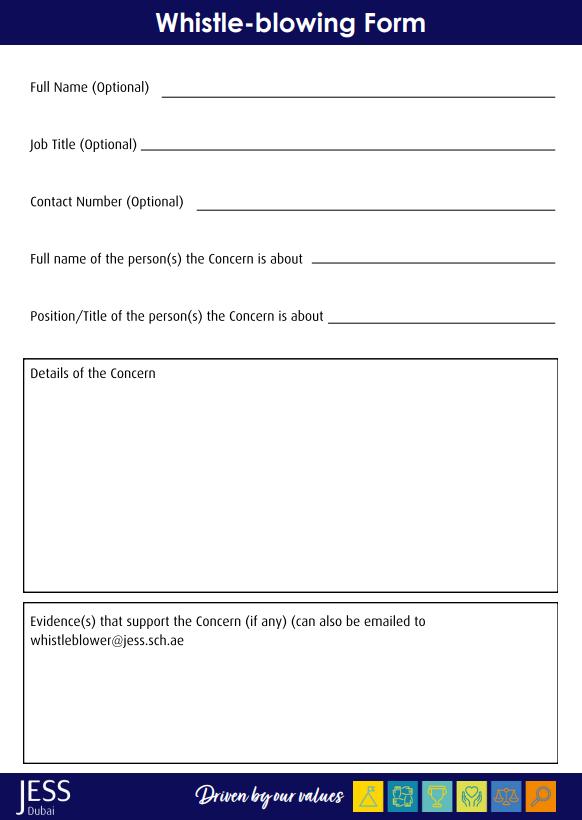
7.1.3. Online form: Complete the online form. The Head of HR receives any Concerns made via the Online form. The Head of HR will delegate the complaint for investigation to an appropriate member of staff, depending on the issue and against whom the Concern is made.
7.2. Whistle-blowers reporting a known or suspected Concern shall provide the following information:
7.2.1. Name, position and contact numbers of the Whistle-blower (if willing);
7.2.2. Full name and position of the person(s) who the Concern is about;
7.2.3. Details of the Concern;
7.2.4. Relevant/material facts and reasonable grounds for the Concern; and
7.2.5. Evidence(s) that support the report (if any) which can be sent to whistleblowing@jess.sch.ae.
7.3. Based on the merit of the Concern and on consultation with the Director and/or Chair of Governors, a decision shall be made to commence investigations or otherwise.
8. Concerns made Anonymously
8.1. Whistle-blowers who opt to make an anonymous report due to fear or pressure especially for highly confidential and sensitive matters, may do so by detailing the suspected Concern in writing or via the Online form. An anonymous report should be detailed to the greatest extent possible because follow up questions will not be possible, making the investigation and resolution of the report difficult.
9. Investigation
9.1. The School is committed to investigating all Concerns that are reported. Upon receipt of the Concern, the School may respond to the Whistle-blower, setting out the general plan of action by the Director and/or Chair of Governors.
9.2. The person to whom the Concern is reported will acknowledge receipt of your report within five business days. All reports will be promptly investigated and appropriate corrective action will be taken if warranted by the investigation. The Whistle-blower will be informed when the investigation has concluded. However, the extent to which the Whistle-blower is informed of the contents of the findings may be subject to any legal requirements.
9.3. When a Concern is received by either the Headteacher, Exec, Director or Governors (Recipient), they will:
Page 7 of 9
9.3.1. Meet with the person raising the Concern within a reasonable time (not to be longer than 10 working days from the date of concern being reported). The person raising the Concern may be joined by a workplace colleague.
9.3.2. Get as much detail as possible about the Concern and record the information. If it becomes apparent the Concern is not a whistle-blowing nature, the recipient should handle the Concern in line with the appropriate policy/procedure.
9.3.3. Reiterate, at this meeting, that the whistle-blower is protected from any unfair treatment or risk of dismissal as a result of raising the Concern.
9.3.4. Establish whether there is sufficient cause for Concern to warrant further investigation. If there is, the Recipient should then arrange a further investigation into the matter, if appropriate. In some cases, the Recipient may need to bring in an external, independent body to investigate. In other cases, the Recipient may need to report the matter to the police.
9.3.5. The person who raised the concern should be informed of how the matter is being investigated and an estimated timeframe for when they will be informed of the next steps.
9.4. Outcome of the investigation
9.4.1. Once the investigation – whether this was just the initial investigation of the Concern, or whether a further investigation was needed – is complete, the investigating person will prepare a report detailing the findings and confirming whether any wrongdoing has occurred. The report will include any recommendations and details on how the matter can be rectified, and whether a referral is required to an external organisation, such as the local authority or police.
9.4.2. The Recipient will inform the person who raised the Concern of the outcome of the investigation, though certain details may need to be restricted due to confidentiality.
9.4.3. Beyond the immediate actions, the Headteacher, Director, Governors and other staff, if necessary, will review the relevant policies and procedures to prevent future occurrences of the same wrongdoing.
9.5. Whilst we cannot always guarantee the outcome sought, we will try to deal with Concerns fairly and in an appropriate way.
10. Malicious Allegations
10.1. Whistle-blowers are discouraged from making false and malicious allegations. Any malicious use of the Whistleblowing Policy by an employee or volunteer will result in disciplinary action against the Whistle-blower, up to and including termination of employment.
Page 8 of 9