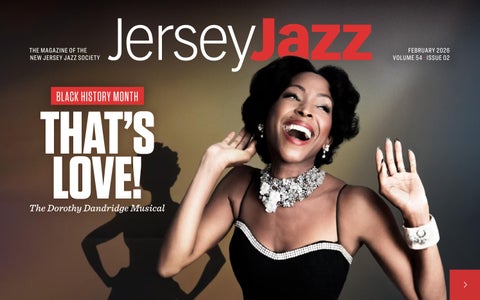
THAT’S LOVE!
The Dorothy Dandridge Musical
ALL THAT’S JAZZ
BY CYDNEY HALPIN
I’m pleased to announce that NJJS has been selected to receive a $2,950 grant from The Summit Foundation for 2026. This funding directly supports our programming budget.
The Board and I would like to thank the Board of Trustees at The Summit Foundation for their support of the Arts, and specifically their financial support of NJJS. We’d also like to congratulate Celia Colbert on her appointment as Trustee President.
We are now accepting entries for the 2026 NJJS Juried Scholarship Competition. We will award one $1,000 and one $500 prize in each of the three categories: Jazz Instrumental Performance, Jazz Vocal Performance, and Original Composition.
The competition is open to all students currently enrolled in a New Jersey college undergraduate music program, as well as to Jersey residents currently enrolled in an out-of-
state college undergraduate program.
Proof of residency is required for Jersey applicants in out-of- state schools.
Along with the cash award, winners will receive guidance, mentorship and the opportunity to perform with an industry professional, and coverage in Jersey Jazz.
This competition will once again be judged by our prestigious panel of professional musicians, educators and industry leaders comprised of:
Don Braden—World class tenor saxophonist, flutist, composer and educator, Mariel Bildsten—Trombonist, bandleader, side-woman, and educator, Ted Chubb—Princeton University Lecture or Music—Jazz Trumpet, composer, educator, and arts administrator, Jason Olaine—Vice President of Programming, Jazz at Lincoln Center.
Submission deadline is Friday March 27, 2026, 11:59 p.m. Visit njjs. org/competition for complete details. Please enjoy the 2025 Winners’ Show-
case on our website njjs.org/videos/ Choose the November 2, 2025 video.
The Board and I would like to thank Nan Hughes Poole and NJJS Board Members Cynthia Feketie, Mike Katz, and Jackie Wetcher for their generous support of this initiative.
If you’d like to support the growth of our prize offerings, donations can be made via our website njjs.org/donate.
Please note “Scholarship Fund” where indicated. Donations can also be mailed: NJJS, 382 Springfield Ave., Ste. 217, Summit, NJ 07901. Don’t hesitate to contact me at pres@njjs.org with questions.
Plan to join us Sunday, February 1, at 3:00 p.m. for Jersey Jazz LIVE! as we honor Black History Month. Louis Armstrong House Museum Archivist Ricky Riccardi will “Talk Early Pops.”
Along with a multimedia presentation, Ricky will provide new information he learned about Armstrong’s
upbringing in New Orleans while researching his latest book Stomp Off, Let’s Go. There’ll be a tribute to Louis’ mentor, King Oliver, and he’ll share some of the rare audio and photographs found in Lil Hardin Armstrong’s recently discovered collection. Ricky will also be sure to play some of the most famous recorded moments from the Hot Five and Seven series.
He’ll also be manning the piano to perform duets of Armstrong-related songs with the trumpet phenom Summer Camargo. as they will illustrate just how vital and fresh this music remains, with a short set of live duets. Ricky will also have copies of his latest book for sale and will gladly autograph them! This show is gonna swing!
Admission is $15 members/$20 non-members/$5 children/students (w/ID). Doors open at 2:30 p.m., concerts begin at 3:00 p.m.,10 Kings Road, Madison, NJ. Free street parking is available. Advance tickets available
at: ticketleap.events/tickets/new-jersey-jazz-society/jersey-jazz-livericky-riccardi-talks-early-pops. For more information on this LIVE! event, please visit our website: njjs.org/louis-armstrongs-early-life-and-music
If you’d like to support a LIVE! program—in part or in full—providing performance opportunities for the next generation of jazz musicians as well as seasoned musicians, please contact me at pres@njjs.org or at 973.229.0543.
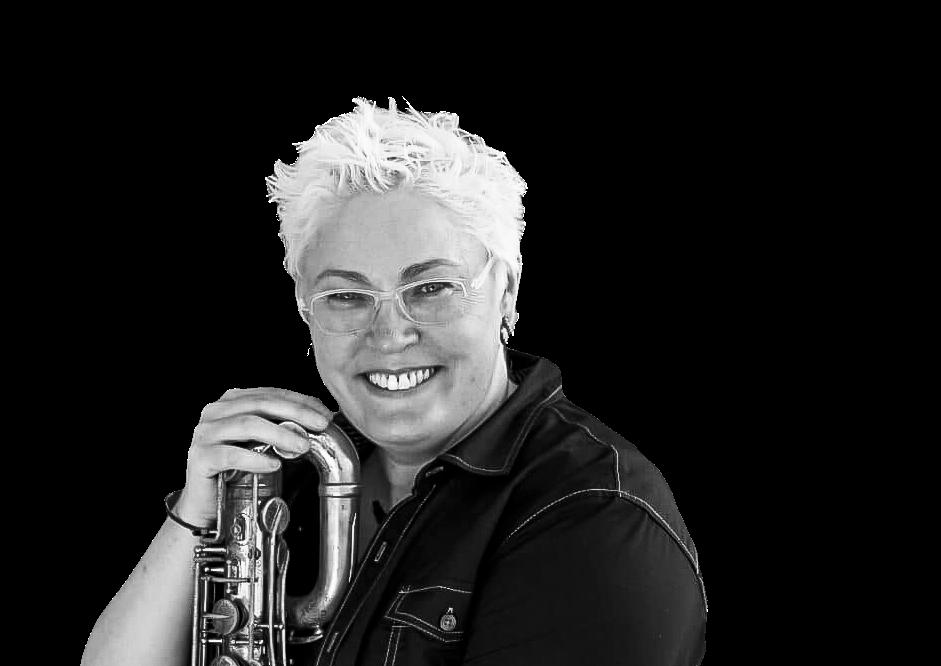
SAVE THE DATE: Sunday, March 1, as we celebrate Women’s History Month featuring baritone saxophonist Lisa Parrott’s quartet paying tribute to Gerry Mulligan. The program will include some Mulligan tunes, jazz standards Mulligan liked to play, and some original tunes by Parrott and her pianist, Roberta Piket. For more information about this event, please see page 09. For advance tickets please visit: ticketleap.
events/tickets/new-jersey-jazz-society/jersey-jazz-live-lisa-parrott-celebrated-gerry-mulligan.
Additional funding for this concert has generously been provided by The Gerry & Franca Mulligan Foundation. The Board and I thank the Foundation for its support. Thank you to Board Member James Pansulla for his continued patronage of the Rising Stars initiative.
While NJJS is very grateful for program funding, in part, from Morris Arts and The Summit Foundation, the majority of our operating expenses and initiatives are financed by membership dues and donations.
The Board and I would like to thank all the donors who’ve supported our 2025 “Setting New Standards in Tradition!” annual appeal campaign to date. So many of you are patrons who’ve generously supported our work year after year,
and your commitment to NJJS has both sustained us through difficult times and fostered growth. We truly can’t do what we do without YOU!
If you haven’t yet contributed to this campaign, please consider helping NJJS continue its performance and educational initiatives by donating today either by mail, or anytime online at njjs.org/donate. There’s also a red “Donate” button conveniently located on our home page for easy giving. Would you like to maximize the impact of your gift? Many of you work for employers that have a matching gift program that will double the impact of your gift for free by completing and submitting a simple form.
Check with your Human Resources Department for further information.
You can also make a tax-efficient gift from your IRA today! Qualified Charitable Distributions (QCDs), also known as IRA Charitable Rollovers, are the savviest way for individuals
age 70½ or older to use their IRAs to maximize their charitable giving. Your IRA donation is a generous way to fulfill your required minimum distribution for the year. Gifts generated directly from your IRA will save you on taxes while helping NJJS fulfill its mission to promote and preserve jazz.
We can’t do what we do without YOU! Members are the heart and soul of this organization, and we’d like to thank everyone who renewed their membership this past year; we’re very grateful for your continued patronage.
If you joined NJJS this past year, we’re delighted to welcome you into this jazz community. If you have any questions about your membership, please contact me at membership@njjs.org.
You’ve got to learn to leave the table when love’s no longer being served. — Nina Simone
EDITOR’S CHOICE
BY SANFORD JOSEPHSON
Starting Off the Week with ‘The Hard Bop Cafe’
In the mid-1950s, drummer Art Blakey and pianist Horace Silver formed the Jazz Messengers, often considered the beginning of the hard bop movement, loosely defined as the mixture of bebop with elements of soul, blues and R&B.
In a 1956 interview with DownBeat’s Nat Hentoff, Blakey described the band’s philosophy. “In jazz,” Blakey said, “you get the message when you hear the music. When we’re on the stand and we see that there are people in the audience who aren’t patting their feet and who aren’t nodding their heads to our music, we know we’re doing something wrong. Because when we do get our message across, those heads and feet do move.”
Since May of last year, listeners

to WBGO Radio have been able to start off their week with two hours of hard bop music from 6-8 a.m. on Mondays. The host of “The Hard Bop Cafe”, Monifa Brown, feels, “It resonates with people. I have a hard time on Monday morning, so getting the whole week started off on the right note is kind of uplifting.”
Brown’s definition of the music is: “hard swinging, hard grooving, straight-ahead jazz that takes no prisoners.” The giants of that music, in addition to Blakey and Silver, include tenor saxophonists Benny Golson and Hank Mobley, alto saxophonist Jackie McLean, and trumpeters Clifford Brown and Lee Morgan, among many others. But, Monifa Brown is quick to point out that she’s “not just
playing historical recordings. There are so many artists that are carrying on the lineage and who came out of the hard school—(trombonist) Steve Davis, (saxophonists) Abraham Burton and Jimmy Greene, (drummers)
Eric McPherson and Willie Jones III, and (trumpeter) Sean Jones.
Other current artists who have been featured on her program include saxophonists Mike DiRubbo and Kenny Garrett (both influenced by McLean), and pianists Michelle Rosenman, Renee Rosnes, and Helen Sung.
Another important aspect of the music, Brown emphasized, is that’s it’s accessible. “Sometimes,” she said, “people think jazz can be intimidating, off putting. They don’t know where to begin. This is enjoyable music, and you don’t have to be a jazz aficionado to like it. It’s music that swings and naturally has a propensity to draw people in.”
And, it’s also therapeutic. “Horace Silver,” she said, “talked a lot about
music’s healing potential. He said every individual plays a tune, and it comes from their heart and their soul— you can hear it when they’re soloing.”
Explaining his musical approach, Silver told Hentoff, “We have emotion, and we have a swinging rhythm section. We can reach back and get that old-time gutbucket barroom feeling with just a taste of the backbeat, as in ‘Doodlin’ and ‘The Preacher’. And, in one number, the medium tempo, ‘Funky Blues’, we even include some boogie-woogie.”
As we head into February, Brown will feature fiery hard bop love songs to celebrate Valentine’s Day on her February 9th program. There will be the Jazz Messengers’ rendition of “Like Someone in Love”, Betty Carter singing “All I Got”, and Art Farmer playing “I’ve Never Been in Love Before.” And, on February 23, Brown will pay tribute to Oliver Nelson’s Blues in the Abstract Truth album, originally released on that day in 1961.
ABOUT NJJS
Founded in 1972, The New Jersey Jazz Society has diligently maintained its mission to promote and preserve America’s great art form—jazz. To accomplish our mission, we produce a monthly magazine, Jersey Jazz ; sponsor live jazz events; and provide scholarships to New Jersey college students studying jazz. Through our outreach program Generations of Jazz, we provide interactive programs focused on the history of jazz. The Society is run by a board of directors who meet monthly to conduct Society business. NJJS membership is comprised of jazz devotees from all parts of the state, the country and the world.
MEMBER BENEFITS
You become an integral part of the NJJS community, and the history and future of jazz
Access to 11 Digital Issues of our Award Winning Jersey Jazz Magazine
— Featuring Articles, Interviews, Reviews, Events and More
Discounts to our Jersey Jazz LIVE! Sunday Concerts
Discounts at NJJS Sponsored Concerts & Events.
MUSICIAN MEMBERS
FREE Listing on NJJS.org “Musicians List” with Individual Website Link
FREE Gig Advertising in our Monthly eBlast
THE RECORD BIN
Visit www.njjs.org or email info@njjs.org for more information on our programs and services
A collection of used CD’s & LP’s available at reduced prices at specific events and through mail order njjs.org/shop
JOIN NJJS
Family/Individual $45
(Family includes to 2 Adults and 2 children under 18 years of age)
Family/Individual 3-Year $115
Musician Member $45 / 3-Year $90 (one time only, renewal at standard basic membership level.)
Youth $15 - For people under 21 years of age. Date of Birth Required.
Give-A-Gift $25 - Members in good standing may purchase unlimited gift memberships. Applies to New Memberships only.
Fan $75 - $99
Jazzer $100 - $249
Sideman $250 - $499
Bandleader $500+
Corporate Membership $1000
Members at Bandleader level and above and Corporate Memberships receive special benefits. Please contact Membership@njjs.org for details. The New Jersey Jazz Society is qualified as a tax exempt cultural organization under section 501(c)(3) of the Internal Revenue Code, Federal ID 23-7229339. Your contribution is tax-deductible to the full extent allowed by law. For more Information or to join, visit www.njjs.org
Magazine of the New Jersey Jazz Society
VOLUME 54 • ISSUE 02
Jersey Jazz (ISSN 07405928)
is published monthly for members of The New Jersey Jazz Society
382 Springfield Ave., Suite 217, Summit, NJ 07901 973-229-0543 • info@njjs.org
Membership fee is $45/year.
All material in Jersey Jazz, except where another copyright holder is explicitly acknowledged, is copyright ©New Jersey Jazz Society 2026. All rights reserved. Use of this material is strictly prohibited without the written consent of the NJJS.
Editorial Staff
EDITOR
Sanford Josephson, editor@njjs.org
ART DIRECTOR
Michael Bessire, art@njjs.org
CONTRIBUTING EDITORS
Bill Crow, Joe Lang, Vincent Pelote, Gilda Rogers, Andrew Schinder, Jay Sweet
CONTRIBUTING PHOTOGRAPHERS
Margherita Andreani, Aaron Derwin, Norm Eder, Christopher Keyfield, Simon Liviu, Matei Marian Mihai,
Luke Rogers, Margot Schulman, Brian Wittman
WEBMASTER
Christine Vaindirlis
WEBSITE DESIGN
Prism Digital
Advertising
DIRECTOR OF ADVERTISING
Cydney Halpin, advertising@njjs.org
ADVERTISING RATES
Full Page: $135, Half Page: $90, 1/3
Page: $60, 1/4 Page: $30
For reservations, technical information and deadlines contact advertising@njjs.org or visit njjs.org/Magazine/Advertise . Make a payment online at njjs.org/advertise via the red Submit Payment button, or via check made payable to NJJS, 382 Springfield Ave., Suite 217, Summit, NJ 07901.
New Jersey Jazz Society, Officers 2026
PRESIDENT
Cydney Halpin, pres@njjs.org
EXECUTIVE VP
Elizabeth Kavlakian, vicepresident@njjs.org
TREASURER
Mike Katz, treasurer@njjs.org
VP, MEMBERSHIP membership@njjs.org
VP, PUBLICITY
Sanford Josephson, sanford.josephson@gmail.com
VP, MUSIC PROGRAMMING music@njjs.org
RECORDING SECRETARY
Irene Miller
CO-FOUNDER
Jack Stine
IMMEDIATE PAST PRESIDENT
Mike Katz
DIRECTORS
Jay Dougherty, Cynthia Feketie, Paul Flexner, Pete Grice, Carrie Jackson, Caryl Anne McBride, Robert McGee, James Pansulla, Stew Schiffer, Elliott Tyson, Jackie Wetcher
ADVISORS
Don Braden, Mariel Bildsten, Ted Chubb, Al Kuehn, Jason Olaine
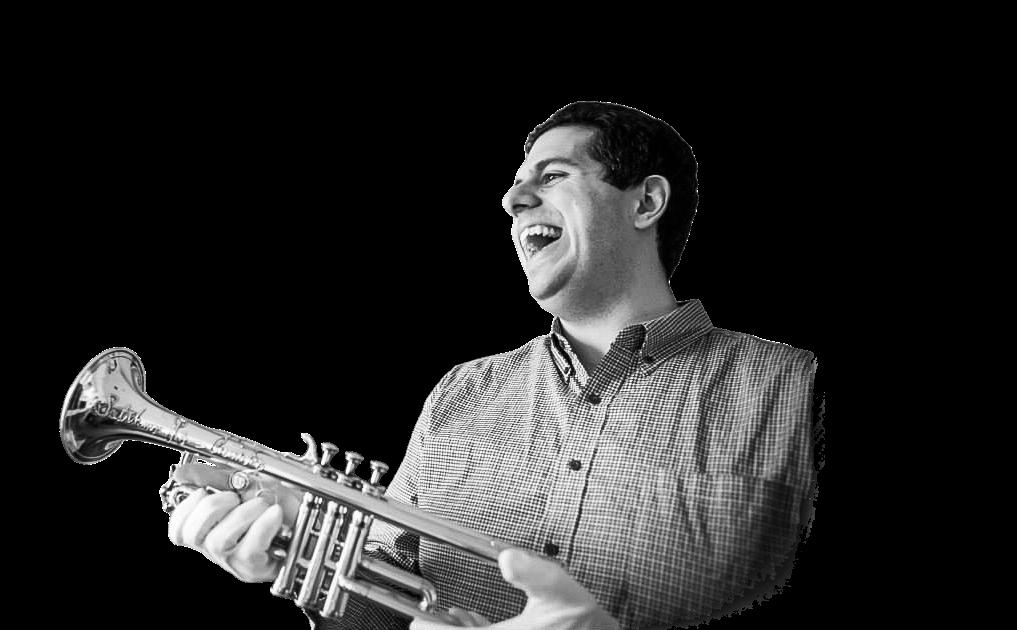

along with trumpeter Summer Camargo SUNDAY, FEBRUARY 1 3:00 PM
| $ 20 NON-MEMBERS
$ 5 CHILD/STUDENTS (WITH VALID I.D.)


Lisa Parrott Quartet Celebrates Gerry Mulligan and Women’s History Month
Growing Up, One of Parrott’s Top 10 Favorite Records was “a Used Vinyl of the Gerry Mulligan Big Band Live at the Village Vanguard”
BY SANFORD JOSEPHSON
When I was researching my book, Jeru’s Journey: The Life and Music of Gerry Mulligan (Hal Leonard Books: 2015) I interviewed several current baritone saxophonists. One of them was Lisa Parrott, mainly an alto saxophonist until she tried the bari in college. Originally from Newcastle, Australia, Parrott attended the Sydney Conservatorium of Music, and “my teacher insisted that I should try the bari. He said he could hear me sounding good on that. So, I feel like, more than anyone else, I
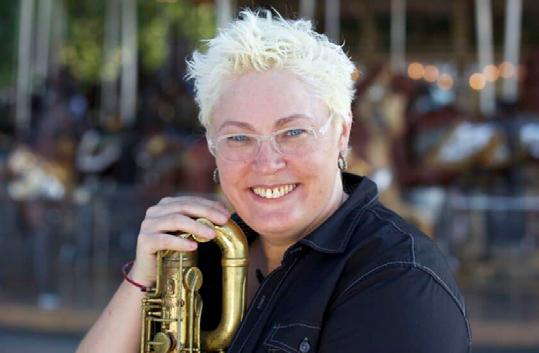
really identify with Gerry Mulligan’s way of playing the baritone. He was really the first guy I was aware of who really grabbed me as a bari player. My first experience of hearing him was with a big band. It just blew me away.”
On Sunday, March 1, Parrott will lead a quartet celebrating Gerry Mulligan and Women’s History Month at the New Jersey Jazz Society’s Jersey Jazz LIVE! concert at the Madison (NJ) Community Arts Center. “Our repertoire,” she said, “will include some Gerry Mulligan tunes, jazz
standards that Gerry loved to play, and some originals by myself and (pianist) Roberta Piket.” Parrott and Piket will be joined by bassist Andy McKee and drummer Billy Mintz. What differentiates Gerry Mulligan from other bari players, Parrott said, “is his melodic approach. He’s very much about melody. Even when he’s playing bebop lines, he is incredibly melodic. You could tell that he was really hearing what he was playing.”
Growing up, one of Parrott’s top 10 favorite records was “a used vinyl
of the Gerry Mulligan big band live at the Village Vanguard (Gerry Mulligan and the Concert Jazz Band at the Village Vanguard, Verve, 1961). In 2011, Parrott was a member of the DIVA Jazz Orchestra when it recorded an album on Arbors Records called Johnny Mandel: The Man and His Music. At the rehearsal for the Mandel recording, the first tune was “Black Nightgown” (on the soundtrack of the movie, I Want to Live, and also on the Mulligan Village Vanguard album).
“I didn’t realize that Johnny had
written a lot of the arrangements for Gerry’s big band,” Parrott continued. “So, we’re playing this chart, and I’m actually singing along with it. I think that record was still in my parents’ garage, so I hadn’t heard it in many, many years. But I knew exactly what was coming next. It was freaking me out. I felt incredibly honored that I got to play that and the theme from I Want to Live!”
Parrott came to New York in 1993 after receiving two Australia Council for the Arts grants to study with saxophonists/composers Steve Coleman and Lee Konitz. In addition to her many years with DIVA, Parrott has played with Jimmy Heath’s Big Band, the Artie Shaw Orchestra, and the Webber/Morris Big Band, among others.
In a review of her album, Round Tripper, (Serious Niceness Records: 2015), Dan McClenaghan of AllAboutJazz, wrote that, “She brings as much feeling, as much human emotion to the mix as anyone out
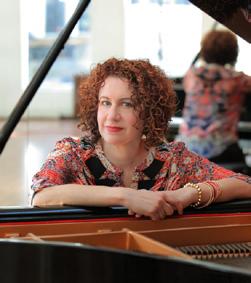
AllAboutJazz described Roberta Piket as “an artist deserving of wider recognition,”
there. It’s a sound with a backbone, with a soul, with verve and resilience: a quartet dynamic born of a perfect confluence of disparate personalities gelling toward a common goal.”
JazzTimes’ Thomas Conrad, reviewing Piket’s album, Roberta Piket: Solo (Thirteenth Note Records: 2013), called her “an under-the-radar pianist.”
AllAboutJazz’s McClenaghan added: “It’s clear that the New York-based pianist has established herself as an artist deserving wider recognition.”
As a young bassist in Philadelphia, in the late ‘70s, McKee played with such jazz giants as trombonist Slide Hamp-
ton, vocalist Johnny Hartman, and tenor saxophonist Hank Mobley. And, he was mentored by drummers Philly Joe Jones and Elvin Jones. “Philly,” he told AllAboutJazz, “was like my musical father. I was really just starting out when he said, ‘Come on. You’re with me.’ Elvin Jones, he said, ‘was a genius. It took a while for me to understand how to interact with the circular quality of his playing. It demanded total commitment to the downbeat.”
Mintz has played with alto saxophonist Lee Konitz, pianist/vocalist Mose Allison, and trumpeter Bobby Shew, among many others. He and Piket have played together in the past, often at Seattle’s Earshot Jazz Festival. In a review of one of Mintz’s performances there, DownBeat’s Brad Farberman wrote that his improvising “is powerful but restrained. He doesn’t play a lot, but what he does play has intent and focus … There’s no ego here. The compositions and the
collective musicianship are the stars.”
: The Madison Community Arts Center is located at 10 Kings Road in Madison, NJ. The Jersey Jazz LIVE! concerts begin at 3 p.m. Admission is $15 for NJJS members and $20 for non-members. Student admission is $5 with valid ID. There will be light refreshments for purchase. To order tickets in advance, log onto ticketleap. events/tickets/new-jersey-jazz-society/jersey-jazz-live-lisa-parrott-celebrated-gerry-mulligan
Funding for Jersey Jazz Live! has been made possible, in part, by funds from Morris Arts through the New Jersey State Council on the Arts/Department of State, a partner agency of The National Endowment for the Arts. Additional funding has been provided by The Summit Foundation. Additional funding for this concert has been provided by The Gerry & Franca Mulligan Foundation.

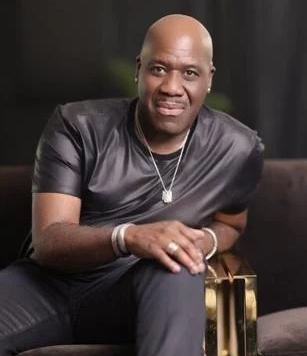
Will Downing Brings His Romantic Jazz-Infused R&B to New Jersey on Valentine’s Day
Jazz Standards are a Love-Hate Relationship. “I Hate Them Because I Love Them So Much”
BY JAY SWEET
On Valentine’s Day, while couples scramble for dinner reservations and last-minute roses, Will Downing has a better plan. He’ll be taking the stage at the Union County Performing Arts Center in Rahway, NJ, offering an evening of songs built on romance, memories, and that unmistakable sultry baritone that has soundtracked jazz-infused R&B songs about relationships for more than three decades. For the men unsure
how to impress on February 14, he keeps it simple. “You don’t gotta say nothing,” he laughed. “Just sit there, nod your head, act like you like the guy on stage. Your lady will be happy.”
It’s classic Will Downing—charming, self-aware, and conversational.
Ask him about his “current tour” and he grins. “This tour? It’s the ongoing tour. Been going on about 37 years now, and it doesn’t stop.” After nearly three decades on the
JAZZ AT UCPAC
road, touring is less a chapter and more a lifestyle. “I still love music,” he said. “Fans who show up know exactly what they’re getting: a career-spanning set packed with the songs radio embraced, the tracks audiences grew up on. As you get older,” Downing admitted, “the wear and tear is real. You feel it.” But the moment he hits the stage, something changes. The aches fade, the adrenaline kicks in, and suddenly the years don’t matter. “You start doing the music, the audience is with you, and all that stuff just falls by the wayside,”
Among the tunes he sings on tour include tracks from his 2025 Sophisticated Soul EP titled Still in Love, continuing a creative approach that fits today’s fast-moving music culture. “People want new music constantly now,” he explained. Instead of traditional full-length albums, he prefers shorter projects. “Instead
of getting my feelings hurt seven or eight times, I cut it down to four or five songs,” he joked. The EP leans heavily into relationship themes— songs about commitment, compromise, and holding things together.
“That’s always been my lane,” he said.
One of his most personal records, Moods (Motown Records: 1995), came during a divorce and focused on a relationship unraveling. A standout track, “Sorry I,” gets a strong reaction live. “Women give me the side-eye,” he laughs, “and guys are like, ‘Yeah… that was me.’” That shared recognition is what keeps his music relevant.
Downing grew up in Brooklyn, the youngest of four children in a household with no musical pedigree.
“My parents weren’t musicians. My siblings weren’t either,” he laughed.
“Sometimes I think I might’ve been adopted.” Music wasn’t a career plan. It was just part of daily life.
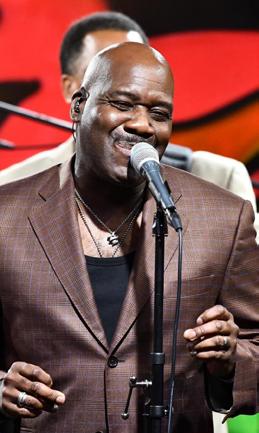
The house was always filled with sound, from his parents’ records to whatever his brothers and sisters dragged home. Cleaning, cooking, hanging out—everything happened with a soundtrack. As the youngest, he soaked it all in, and that constant variety quietly shaped his ear.
School gave him his first real push. Like a lot of kids back then, he sang in choir and messed around
with basic instruments. That’s when a teacher named Mr. Hassel noticed something different. He’d stop class, listen closely, then pull young Will aside. When Downing was 12, Hassel nominated him for the Brooklyn Borough-Wide Chorus—a serious Saturday commitment he immediately rejected. His parents volunteered him anyway. He ended up loving it. That same teacher later pushed him toward Erasmus Hall, a performing arts high school where actors, dancers, and musicians trained seriously. It was a Fame-style environment— raw talent everywhere, ambition in the air. He took the leap and thrived.
After drifting around Brooklyn after high school, he ran into Mr. Hassel, the same teacher who’d started it all. Hassel looked at him and said,
“You’re talented. What about college?”
“Not really,” he answered. Hassel told him about a college music program at
JAZZ AT UCPAC
Virginia Union University. “Just go for a year,” he said. “See what happens.” So, he did. And he loved it. Then, he came home, transfered to Brooklyn College, and jumped into the music industry headfirst—this time all in.
His first big break came as a background vocalist. Jennifer Holliday called him for a session, but first he had to audition over the phone. “Can you hit this note?” He begged for the chance. After working his day job one evening, still in a shirt and tie, he walked into the studio where seasoned pros sized him up like, “Who’s this cornball?”
But once they sang, he blended right in. His name started getting passed around, and soon he was everywhere.
Over the years, his voice appeared on tracks by Billy Ocean, Mariah Carey, Billy Joel, Vanilla Ice, The O’Jays, Kool & The Gang, Najee, and Misha Paris, among others. From 1982 until he
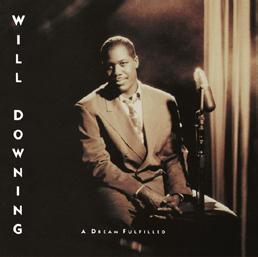
A Dream Fulfilled (Island Records: 1991) was Downing’s breakthrough album.
went solo in 1988, he was primarily a background singer, often on major hits.
Before his solo breakthrough, Downing released several singles under fake names—club records meant to test the waters. One of them, an answer song to Gwen Guthrie’s “Ain’t
Nothin’ Goin’ On But the Rent” called “Ain’t Gonna Pay You One Red Cent,”
caught attention overseas. That led to his first solo album. It flopped in the U.S., selling maybe 50,000 copies, but went platinum in Europe.
Jazz standards are a love-hate relationship. “I hate them,” he joked, “Because I love them so much.” He occasionally records them, collaborating with artists like Gerald Albright and reimagining classics from Coltrane and Hartman. But he knows it’s not where his audience lives. “You can’t make a living off standards,” he admits, “but I love them to my core.”
Downing’s domestic breakthrough came with his third album, A Dream Fulfilled. (Island Records:1991)
While it performed well in the United States, it didn’t make much impact overseas, which reversed his touring pattern. Suddenly, he was focusing on domestic shows again, almost like starting over. “People were like, ‘Who’s this new guy?’” he laughs. “I’m
like, ‘New guy? This is my third record!’” From that point on, his albums consistently appeared in the upper ranks of the R&B charts. He reached new commercial heights with After Tonight (Peak Records: 2007), which topped the R&B charts and reached Number 37 on the overall US Billboard charts, followed by Classique (Concord Music Group: 2009), which hit Number 3 on the R&B charts and Number 22 on US Billboard charts.
A pivotal moment came when he moved to Motown for All the Man You Need (1991). The label president, Kedar Massenberg, a high school friend, stepped in to protect him when Motown planned to cut several R&B artists. “We’re keeping this guy,” Massenberg insisted. That album earned him a Grammy nomination, marking a high point in critical recognition. “Suddenly everybody loved me again,” he joked.
In the late ’90s, Downing found another creative outlet: photography. After clashing with a photographer over an album cover concept, he bought a cheap Canon camera and a mountain of film. “I was terrible,” he admits. Humbled, he apologized and took lessons. Soon he was shooting backstage at shows—Patti LaBelle, Gladys Knight, The O’Jays, eventually photographing them at home. Now he hosts exhibits, is working on his second photo book, and shoots weekly.
Downing also became known for his streamed radio show, The Wind Down, which recently ended. “I had been doing it since 2008,” he explained. The idea sprang from a difficult period in my life: I got really sick— like, really, really sick. And I didn’t want the public to know that I was basically incapacitated at the time. So, to keep my voice alive and keep my presence alive in people’s minds,
I started doing the radio show. They couldn’t see me, but they could still hear me.” Over the years, the show evolved into a platform for underexposed artists, giving them a wider audience and introducing listeners to music they might not otherwise hear.
Valentine’s Day at Union County Performing Arts Center in Rahway is just another stop on a tour that never really ends. But for Will Downing, it’s exactly where he wants to be—singing about love, sharing stories, and reminding people why they fell in love with his rich baritone voice in the first place.
: The Union County Performing Arts Center Main Stage is located at 1601 Irving St. in Rahway, NJ. The Will Downing performance begins at 8 p.m. on February 14. For more information or to order tickets, log onto ucpac.org or call (732) 499-8226.
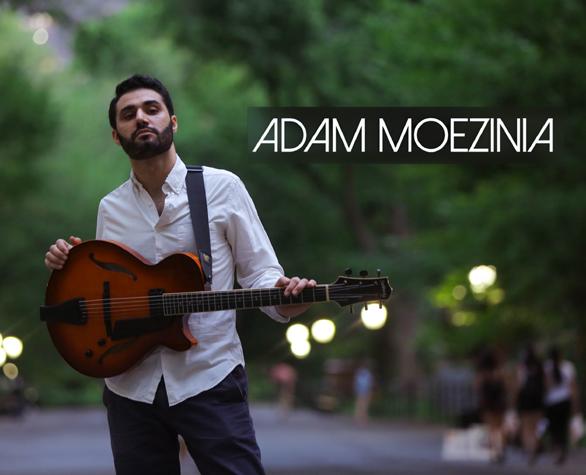
Sunday, March 22 • 3:00pm
Click on the QR code to purchase tickets.
New Jersey Jazz Society
The New Jersey Jazz Society is pleased to announce the
2026 JURIED SCHOLARSHIP COMPETITION
This competition will award three $1000 prizes and three $500 prizes in three categories: Jazz Instrumental Performance, Jazz Vocal Performance, and Jazz Composition. The competition is open to all New Jersey college students currently enrolled in a college undergraduate music program, as well as to New Jersey residents currently enrolled in an out-of-state college undergraduate program. Proof of residency required. Along with the cash award, winners will receive guidance, mentorship and the opportunity to perform with an industry professional, and coverage in Jersey Jazz.
SUBMISSION DEADLINE: Friday, March 27, 2026, 11:59 PM Eastern Time Visit NJJS .org/Competition for details.
This competition is generously supported by NAN HUGHES POOLE, CYNTHIA FEKETIE, MICHAEL A. KATZ, and JACKIE WETCHER
AT WILLIAM PATERSON
Pianist Orrin Evans Reaches Back to his Roots to Revive His Trash Gadget Trio
Appearing on More Than Two Dozen Albums Over his Multi-Decade Career, Evans Has Created a Deep and Diverse Catalog.
BY ANDREW SCHINDER
For a musician, to be labeled as “versatile” could carry a whiff of condescension or belittlement. As valuable as they may be, nobody sets out to be a utility player, be it in sports, music, or anything else. One settles into the role, makes the best of it, but always attempts to get to the next level. Piano master Orrin Evans has certainly reached that proverbial next level. And yet, he attained the status as one of modern jazz’s finest keyboardists while remaining true to his roots as a working musician, available to elevate the skill and musicianship of any ensemble or combo, no matter the format, genre or performance space. Evans, 50, will be performing, with his newly-revived trio Trash Gadget, at William Paterson University on Sunday, February 15, part of WPU’s Jazz Room Music Series. He will also be performing that week with the Ravi Coltrane Sextet at New 17 FEBRUARY 2026
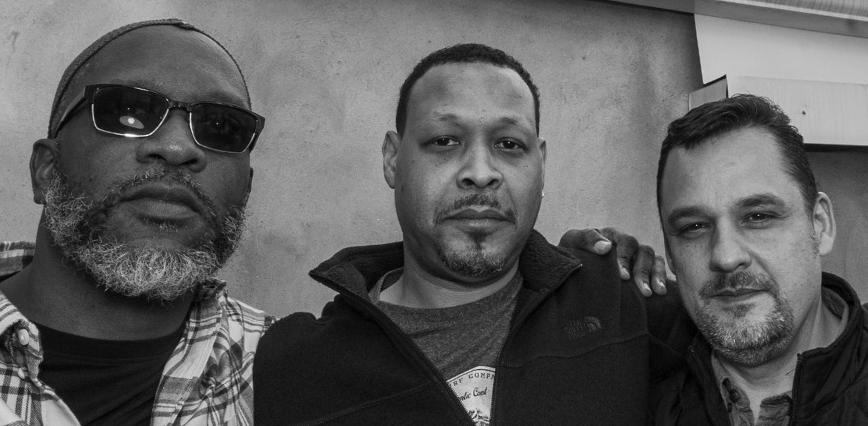
The Trash Gadget Trio, from left: Orrin Evans, Byron Landham, Matthew Parrish
JAZZ AT WILLIAM PATERSON
York’s Village Vanguard. In January Evans completed a stint at New York’s Birdland backing vocalist Lisa Fischer, and he’ll be back at Birdland in March accompanying another vocal icon, Kurt Elling—all while continuing to crisscross the country and the world with his genre-busting namesake trio or his acclaimed big band, the Captain Black Big Band, as well as imparting his wisdom through his teaching position at Rutgers University.
On Sunday, May 3, Evans will be part of a quartet led by multireedist
T.K. Blue, celebrating the centennial birthday of NEA Jazz Master pianist Dr. Randy Weston at the New Jersey Jazz Society’s Jersey Jazz LIVE! concert in Madison, NJ.
Evans is versatility personified. His piano playing is also face-melting.
“For me, there’s 12 notes on the piano,” Evans said. “Call me and I’ll do my best job at playing whatever mixture of those 12 notes, whatever groove you have, whatever you want to do. And how you want to define it is on you. But let me be who I am. And if you hear
“ I JOINED THE MINGUS BIG BAND … AND THAT CHANGED MY LIFE. ”
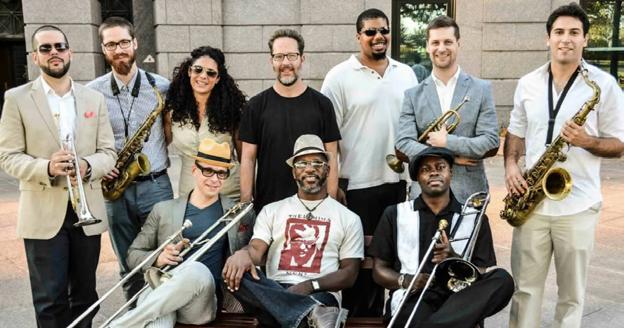
Orrin Evans and the Captain Black Big Band.
my voice in your music, that’s fine.”
Evans grew up in Trenton, NJ, as a member of a musical and intellectual family. His father was a professor who taught African-American Studies and jazz courses at Trenton State College (now The College of New Jersey). His mother, among many undertakings, was an opera singer, who performed with Opera Ebony in New York.
“I grew up in a very arts-centered world,” noted Evans. “My sister played piano. My brother was a great writer. You have to be careful with
the reference, but when The Cosby Show came out—granted my parents weren’t a lawyer and a doctor—I was very familiar with growing up like that, the episodes where they were singing songs for birthdays. Music and entertaining were just part of my life. There was no fear with a microphone in my family, so that came comfortably with me, too.
“I don’t think there was a leap to perform professionally,” Evans continued. “I remember when I was 12 years old, my uncle sat me down with my
first contract, that I still actually use today, and taught me how to book gigs. So, I was trying to book gigs at ages 12 and 13 with this little one-sheet contract at restaurants. I blame my parents and my family for my upbringing and the joy that they saw in the arts!”
Evans was born with Type 1 Neurofibromatosis, a genetic condition that causes benign tumors to grow on the body’s nervous system. The affliction resulted in a malformation of his left foot, which necessitated several reconstructive surgeries. Growing up he was required to wear special orthopedic shoes. To this day, he walks with a limp. Nevertheless, these challenges only added to his resiliency now reflected in his music.
“I had a normal life growing up, except for that,” he said. “My shoe until I was 10 years old was super big. Going to shop for shoes was always a drag. I had nicknames, and all of those
kinds of things. But my parents taught me that being different was actually special. I found my voice within my struggle. So,I never really had a problem with being around other pianists and celebrating their love, and I never compare myself to other people, because I can see the beauty in everyone.”
Evans’ wide swath of skills extends to his vast catalog. Appearing on more than two dozen albums over his multi-decade career, he has created a deep and diverse catalog for music fans to sink their ears into. In particular, his leader projects offer some of the best modern jazz out there.
While of course piano-driven, they showcase many of the finest seasoned and up-and-comers in the idiom. The Red Door (Smoke Sessions Records: 2023) features a slew of guest stars. Vocalist Jazzmeia Horn delivers an emotional recitation of Bill McHenry’s lyrics on the Evans original “Big
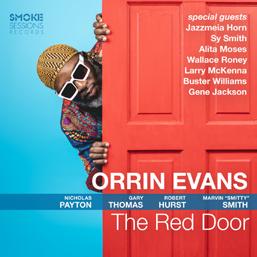
Evans’ 2023 Smoke Sessions album, The Red Door, featured a slew of guest artists including vocalist Jazzmeia Horn and bassist Buster Williams.
Small,” and bass legend Buster Williams stars on the group’s version of the standard “The Good Life,” delivering nimble bass improvisation that sounds decades younger than his age. Young saxophonist Immanuel Wilkins shines on the 2021 Smoke Sessions
release, The Magic of Now, composing three tracks and announcing the blast into the stratosphere that his ensuing years would represent. The Evolution of Oneself (Smoke Sessions: 2014), featuring omnipresent bass superstar Christian McBride and exciting percussionist Karriem Riggins, is forward-thinking and groovy, injecting modern styling to triedand-true standards such as “Autumn Leaves” and “All the Things You Are.”
“People have heard me talk about the Village and a community of people around me, that I love,” Evans explained. “And that’s what I look at first. Say, this person, whether it’s a band member, anybody, you know, you recognize the importance of being a part of the Village, and what that means. What that means is that you might find a younger bassist like Jordan McBride or Alexander Claffy in the mix, but you may also find an
JAZZ AT WILLIAM PATERSON
elder, like Buster Williams or Robert Hurst. The same thing on the drums, the same thing on all the instruments.”
Evans sees himself as “someone who can facilitate those relationships for everyone, and try to break down the barriers that exist. I’m not the self-appointed mayor or anything, but I enjoy connecting people. I enjoy seeing a young musician like [drummer] Maria Marmarou, who was taught by Justin Faulkner, who was a student of mine. And they’re both looking at [veteran drummer] Jeff “Tain” Watts. Just seeing that cycle, because that means the music will continue.”
Named after Evans’ father’s favorite brand of tobacco, his The Captain Black Big Band defies the common misconception of big bands—that they are staid relics of a bygone era. In fact, the band is a boundary-pushing multigenre experiment that imbues a level of excitement rarely seen in modern in-
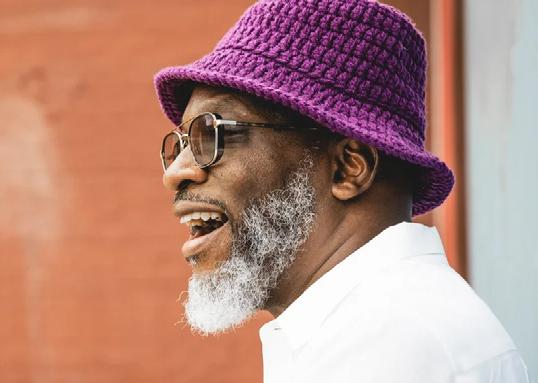
terpretations of the format. The band’s five albums reflect that exuberance.
“I hated big band in high school,” Evans recalled. “I never really wanted to do a big band in college. I just never really dug big bands. They were corny. But I joined the Mingus Big Band when I first moved to New York, and that changed my life. I realized that the big band didn’t have to be that formula that we were taught. I have my big band operate like a small group. I try to make sure that every-
body feels that their role is important. You have to keep the people on their toes. We may go to a different place, so you have to be constantly paying attention. You zone out? You missed it. So, I started a big band because I wanted to try to find the love in that medium. And I did find it. And for myself, I found a way to lead the big band where it didn’t feel cumbersome.
“The Captain Black Big Band is probably one of the most diverse bands out there. I basically want ev-
eryone to know that there’s a place for them if they want to be there— old, young, even defying some of the sub-genres that exist in this music.”
And then there’s Trash Gadget, sporting a name coined by a friend’s daughter who loves collectibles. Although dormant up until last summer, the group’s roots go back decades. In addition to Evans, the trio consists of Byron Landham (drums) and Matthew Parrish (bass). Last year, the trio, which had recorded an early album together, got back together after a 30-year layoff, and will have another album scheduled for release early this year. Evans is looking forward to a fun and groove-centric gig at William Paterson.
“Trash Gadget is basically my very first trio,” Evans said. “We didn’t get a chance to play that much together growing up, although we’ve been very close. So now we got the band back together, and this is our flow coming
JAZZ AT WILLIAM PATERSON
back. I’m really looking forward to it, just with some real good human beings who I love. I really just enjoy those collectibles and old things, just even old history. So, it’s kind of like bringing that oldness back—Trash Gadget!”
“I haven’t played at William Paterson in a good 10, 15 years. But every time I did, I enjoyed it, because of the students. With William Paterson, and Berklee, and schools like that—and Rutgers, where I teach—schools with these great music programs, it’s about the interactions with the students. I am encouraging all the students to come out, because I think it’s going to be a great day. Not only for the workshop that’s before, and the concert, but Byron and Matt are totally accessible human beings, and I think it would be great for all the young bassists and drummers at William Paterson to get a chance to talk to them.”
Evans famously spent several
years in the post-modern jazz-rock hybrid outfit The Bad Plus, replacing founding pianist Ethan Iverson. He recorded two albums with the group and departed to focus his own artistic pursuits. Given the popularity of The Bad Plus, this may be Evans’ most well-known gig. The Bad Plus recently announced that they will be breaking up, and Evans couldn’t be happier for his old bandmates.
“I am totally supportive of them and can’t wait to see what they’ll do next,” he said. “They did a long, hard run, and I realized when it was my time to go, and they’re now realizing that it’s their time. It’s a great band, they made great music, and I can’t wait to see what they’ll all do now. But I had a great time and I’m glad that I was a part of that story. And I hope people remember and love the contribution that I brought.”
As with all of Evans’ many endeavors, it all comes back to love.

Must-See Events
José James
Presents the 50th Anniversary of Marvin Gaye’s I Want You with Lizz Wright
Experience this soulful homage to one of R&B’s most in uential recordings.
Sat, Feb 7 at 7:30PM
Circus Quixote
Cervantes’ classic, reimagined with breathtaking visuals that will transport you into a wild, windmill-tilting world.
"As breathtaking as it is hilarious"
- Guitar World Magazine
Mar 4 – 15
DakhaBrakha
A bold fusion of Ukrainian folk, global rhythms, and theatrical air.
Sat, Mar 7 at 7:30PM
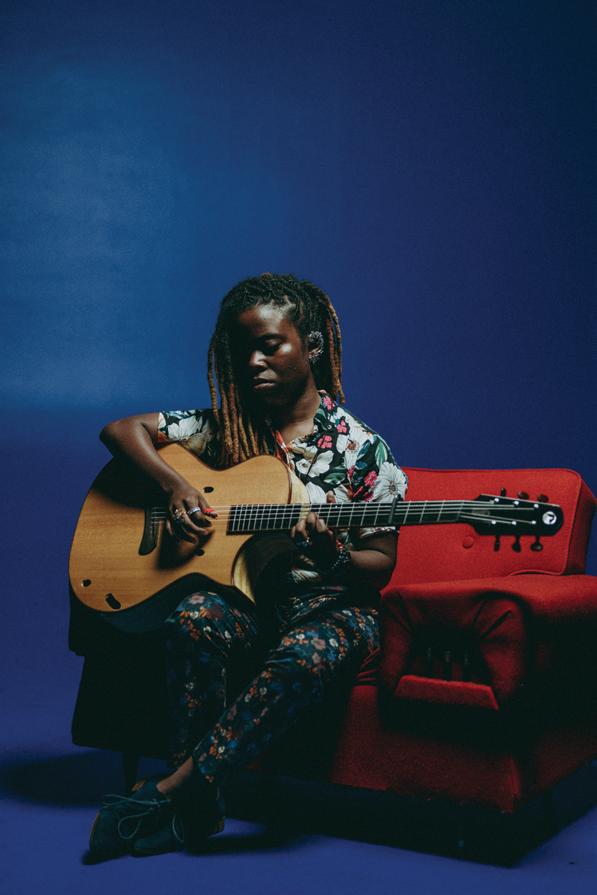
Yasmin Williams
"One of the best acoustic guitarists in the world!"
- Guitar World Magazine
Thu, Mar 12 at 7:30PM
Ravi Shankar Ensemble
A collective of musicians dedicated to Shankar's masterful compositions.
Wed, Mar 18 at 7:30PM

EXPLORE THE SEASON
LEARN MORE AND BUY TICKETS
In Princeton, NJ.

Musical at Axelrod PAC Honors
Groundbreaking Black Actress and Singer Dorothy Dandridge
“I Remember Growing Up and Seeing the Movie, Carmen Jones”
BY GILDA ROGERS
There’s an intriguing mystique surrounding the life of Dorothy Dandridge, the first Black woman to be nominated for an Academy Award for Best Actress in 1955, for her legendary role in the motion picture, Carmen Jones.
Dandridge’s achievement against the backdrop of the Civil Rights Movement, the Montgomery Bus Boycott, and the murder of Emmitt Till, served as a paradox that comes alive in That’s Love, The Dorothy
Dandridge Musical, playing at The Axelrod Performing Arts Center in Deal, NJ, from February 19-March 8.
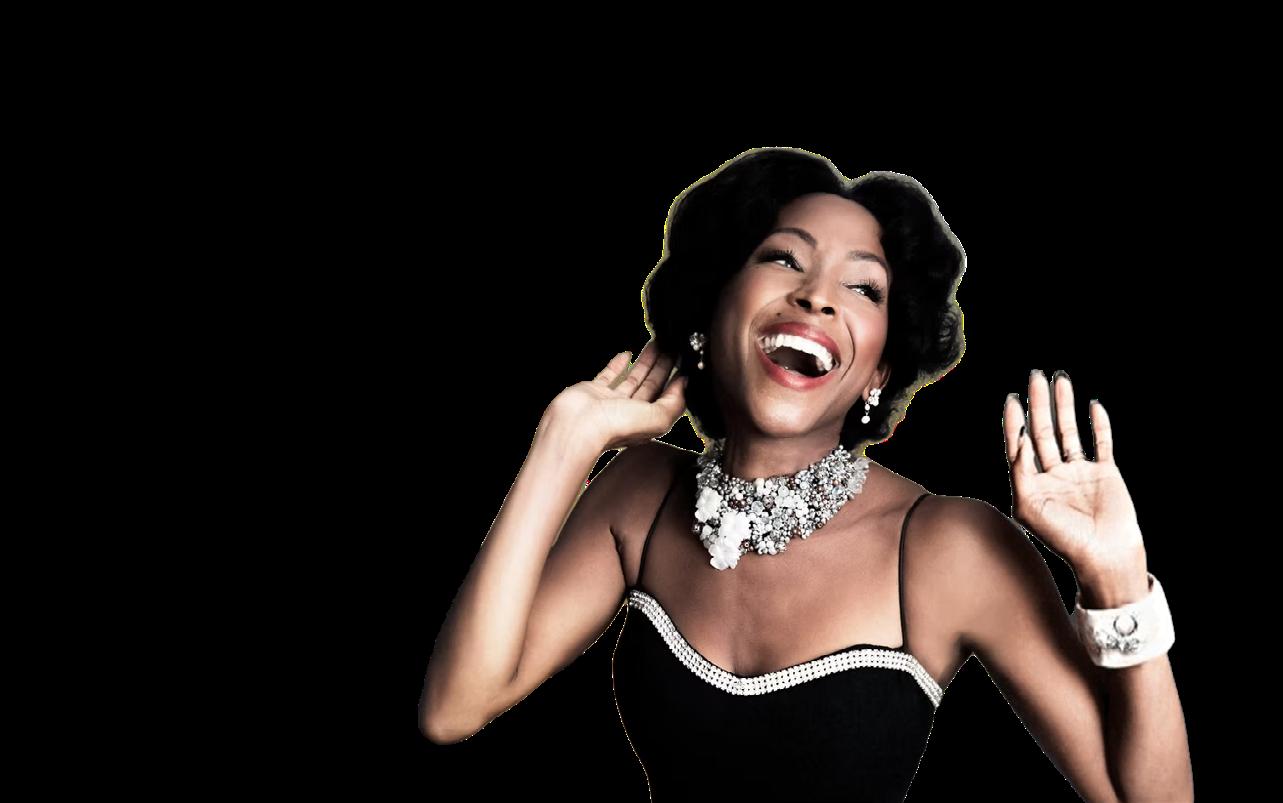
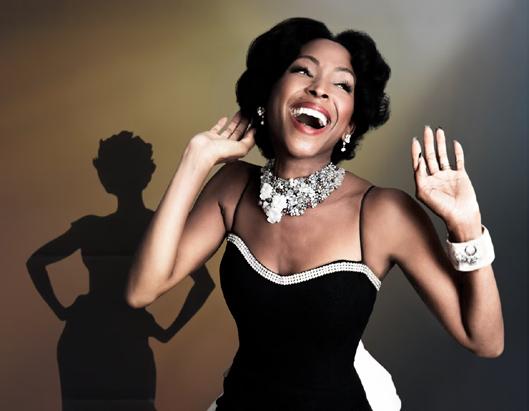
The lead actress, N’Kenge, a native New Yorker, conceived the idea for the musical and is thrilled to be in the role. More importantly, she wants to pay homage to the legacy of the person “who opened the door for Halle Berry, Angela Bassett, Viola Davis, and others,” including herself.
“I remember growing up and seeing her (Dandridge) in the mov-

N’Kenge originated That’s Love at Carnegie Hall in 2022.
BLACK HISTORY MONTH
ie Carmen Jones and in Porgy and Bess” said N’Kenge. “Her acting seemed effortless, and I was fascinated and curious about someone who looked like me (Black) and had such representation on screen. I was intrigued about her life.”
The show is a large production consisting of 17 cast members, and that is no small feat, when it comes to concept, development, and actually reaching the stage. N’Kenge, a Tony, Emmy and Grammy- nominated singer, with a five-octave range, originated the role of Mary Wells, the popular ‘60s R&B singer in Motown The Musical, that opened on Broadway in April 2013, running until January 2015.
“I remember Berry Gordy Jr. saying to us (the cast), ‘I’m bringing Motown to Broadway not Broadway to Motown.’ Being a part of that experience with the workshops and labs, I saw how a show was built
and developed,” N’Kenge recalled.
However, what also inspired the trained opera singer was “Black legacy,” as she described it. “Seeing all these stories and the beauty and joy they brought to people was a triggering moment. I met someone who saw the show 16 times.”
After her stint with Motown the Musical, N’Kenge, a graduate of The Manhattan School of Music, was intrigued about Dandridge, the Black Hollywood legend, and that morphed into her determination to breathe life into That’s Love The Dorothy Dandridge Musical, which made its theatrical debut at New York’s Carnegie Hall in 2022. From there the show became part of the New York Theater Festival, and it garnered N’Kenge Best Singer, Best Director, and Best Choreographer acclaim.
The behind-the-scenes crew for the upcoming run at The Axel-
Dorothy Dandridge’s Racial Breakthroughs
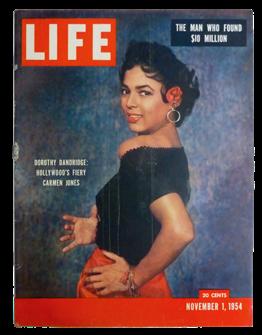
Dorothy Dandridge was the first Black woman to be nominated for a Best Actress Academy Award. She was the first Black woman to be featured on the cover of Life Magazine (November 1, 1954, with the headline: “Hollywood’s Fiery Carmen Jones”). And, she was the first Black entertainer to play the Empire Room at New York’s Waldorf-Astoria (April 1955). In a November 2022 article in the UK’s Jazz Journal, Leon Nock pointed out that this paved the way “for such as Count Basie, Joe Williams, Pearl Bailey, and Lena Horne.”
While Dandridge wasn’t necessarily considered a jazz singer, Nock cited her gigs at the Cotton Club and Apollo Theater, plus “the tour and the four sides she cut with the Jimmy Lunceford band.” He also mentioned that she sang with Count Basie in the movie, Hit Parade of 1943, and with Louis Armstrong in the 1944 film, Atlantic City, and 1945’s Pillow to Post.
BLACK HISTORY MONTH
rod Performing Arts Center include: Trey Ellis (book and original lyrics), whose play, Fly, has been performed at Lincoln Center and is in production around the country; Shelton Becton (original music and lyrics), Everett Bradley (arranger), N’Kenge and Christian Sajous (co-directors), and Ray Mercer, who has choreographed for Alvin Ailey School, Alvin Ailey II, and Philadanco (the Philadelphia Dance Company), along with the New Jersey Ballet.
Expect to be taken on a musical journey showcasing the life of Dorothy Dandridge, who was married to Harold Nicholas of the famous dancing duo, The Nicholas Brothers. “They (Dandridge and Nicholas) had a special needs child named Harolyn. Back then they used to put children like her away in places,” N’Kenge said, “but she (Dandridge) hired around the clock care

for their daughter. It’s a journey of her life and accomplishments and dramatic moments.” Those moments also entail her close relationship with the actress Marilyn Monroe.
The show opens in 1965 with Dandridge’s “Comeback Tour,” in Albuquerque, NM. As a youngster, Dandridge performed as a singer with her sister and mother, as the Dandridge Sisters. Similarly, N’Kenge
has been performing since she was six years old. “I remember taking piano and dance lessons and being in a recital at Aaron Davis Hall. I was that kid who was messing up but kept doing my own thing, my own solo.”
Unlike other Black performers of her time, Dandridge did not follow artists like Josephine Baker, who became an expatriate. Dandridge staked her claim here in America, according to N’Kenge. Her love affair with the white theater and movie director, Otto Preminger, though, crystalized her fame during the time of “Jim Crow” America. Ironically, those too young to understand first-hand about this nation’s history with segregation, are experiencing a nouveau reality of racial polarization in terms of an attack on DEI (Diversity Equity and Inclusion). The older generation knows that the Civil Rights Movement
forced the start of a true American Democracy for all—where a multi-racial tapestry of humanity, the arts, and culture could thrive equitably.
Through The Manhattan School of Music, her alma mater, N’Kenge has formed The N’Kenge Foundation, creating outreach programs., particularly important in the midst of the racial chaos we’re all witnessing today. “I remember when I was a little girl and who gave me an opportunity,” she said. “We tell BIPOC (Black, Indigenous, People of Color) stories when we go into schools. Last year we served 2,000 students. This year 5,000 is our goal.”
: The Axelrod Performing Arts Theater is located at 100 Grant St. in Deal, NJ. For more information or to order tickets, log onto www. axelrodartscenter.com/shows-andtickets or call (732) 531-9106.
Stella Cole Looks
Forward to Being
‘Spontaneous in a Small Room with a Cozy Good Vibe’
“Songs I Sing at Every Show are (Harold Arlen’s) ‘Over the Rainbow’ and ‘When the Sun Comes Out ... I Never Get Tired of Them”
BY SANFORD JOSEPHSON
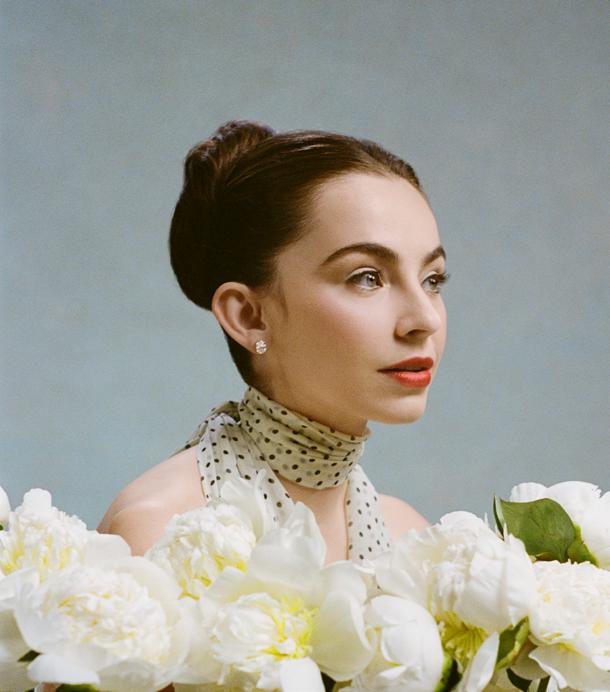
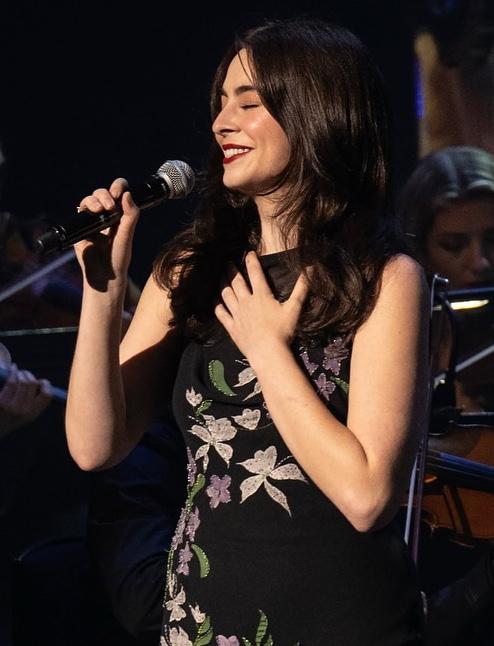
Vocalist Stella Cole has been on tour since last fall, mostly backed by string orchestras at performing arts centers. “That’s great and fun,” she said, “but it’s so much fun to be with a trio in a small room with a cozy good vibe and just be spontaneous.” That’s where she’ll be on Friday and Saturday, February 20 and 21 when she performs at the Jazz Forum in Tarrytown, NY.
“I honestly don’t think I’ll know what the set list is going to be at the Jazz Forum,” she said, “un-
til probably two hours before I go on stage. That’s what I love to do with gigs like the Jazz Forum.”
Cole’s career has skyrocketed since her video performance of Harold Arlen and Yip Harburg’s “Over the Rainbow” went viral during the pandemic. When she performed at the London and Cambridge Festivals in November 2024, UK Jazz News’ Woody Caan wrote: “Some of her online fans compared her to Judy Garland, praise indeed,” and when WRTI Radio’s Nate Chinen heard her at Philadelphia’s
City Winery in September 2024, he said she, “exudes a dramatic grasp of her material that recalls the likes of Judy Garland and Barbra Streisand ... ”
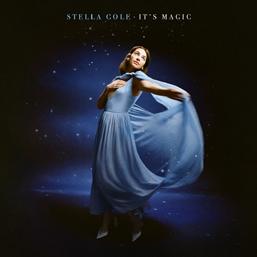
In August, Cole released her new Decca Records album, It’s Magic, and Jersey Jazz’s Joe Lang wrote that, “Her voice is warm and pure. Her phrasing is spot on, demonstrating a maturity that belies her 26 years.”
JazzViews’ Nick Lea added that Cole “indeed brings a little bit of magic to each of the 10 vintage songs and standards performed. From the title track that was a hit for Doris Day in 1948 to the most recent of the songs in ‘Alfie’ that was penned by Burt Bacharach in 1966, Cole brings a fresh and intuitive feeling that is most engaging.”
Pianist and arranger on It’s Magic is the veteran keyboardist Alan Broadbent, who Cole described as “just a genius. I’m still intimidated by him, but he’s the nicest person
on earth, always so sweet and complimentary even though his musical genius is in the stratosphere. He thinks of music through an emotional lens and what it makes him feel.” (See interview with Broadbent in the December 2025 Jersey Jazz).
Cole grew up in Springfield, IL, a big fan of Hollywood musicals. Her favorite, from the time she was two years old, was The Wizard of Oz, so when she was home from Northwestern University during the pandemic and was posting singing videos, one of them, naturally was “Somewhere Over the Rainbow.” She’s “obsessive about Harold Arlen. Songs I sing at every show are ‘Over the Rainbow’ and ‘When the Sun Comes Out’. I just never get tired of them.”
She recalled that during Covid, “I kept posting videos. It was weird. The world continued to be shut down, and I was getting millions of views and
thousands of comments and stuff. It was very exciting.” In addition to “Over the Rainbow”, her post of Stephen Sondheim’s “Everybody Says Don’t” from Anyone Can Whistle got 40,000 views, and James Taylor, who had recently released his American
Standard album with John Pizzarelli, reposted her video of Henry Mancini and Johnny Mercer’s “Moon River.”
Cole was able to return to Northwestern’s campus (where she was majoring in Theater and International Relations) “for one quarter of my senior year, 2021, graduating with masks and social distancing outdoors.”
“
HEY, YOU SOUND LIKE JUDY GARLAND. COME BACK IN A WEEK. ”
Then, she moved to New York “without a total plan. I was just trying to get a job and make some money any way I could, by singing. I went to a bunch of hotels and restaurants and ended up singing five or six nights a week in New York.” Her first real gig was at an Italian restaurant, Giovanni’s Brooklyn East in the Park Slope section of Brooklyn. “A giant Italian dude named Giovanni owned the restaurant. He had me come in and do a little audition for him, singing with a jazz trio. ‘Hey,’ he said, ‘You sound like Judy Garland. Come back next week.’ We
got paid a little bit in cash and got a lot of good free Italian food and drinks.”
Eventually, Cole signed with an artist manager, Matt Pierson, and was booked for a six-week tour with Post Modern Jukebox, a touring musical collective founded by pianist Scott Bradlee in 2011.
While studying theater and musical theater at Northwestern, Cole “always felt I had different musical interests from everyone else. I didn’t like pop music, and I didn’t like the modern musical theater. I liked the
older musicals. I felt like the odd one out and didn’t fit into the program there until I took this Great American Songbook class taught by (actor/ director) Stephen Schellhardt. “In that class,” recalled Cole, “everybody would say, ‘Who’s Cole Porter?’, and it was like, ‘This is my stuff.’ We had to sing as part of that class, and that really built my confidence.”
The first pianist Cole played regularly with in New York was Joe Block, then a Jazz Studies student at Juilliard. “When I play with a jazz pianist,” Cole’s latest album is It’s Magic, released on the Decca label last August. Reviewing it for Jersey Jazz, Joe Lang wrote: “Her voice is warm and pure. Her phrasing is spot on ... ”
Cole said, “it’s fun for them because I’m not a jazz singer. I’m staying with the melody, and I’m not taking a chorus to scat. I’m also not singing it like musical theater artists, exactly as it’s written on the page. So, it gives a little more license for someone like Joe to play around with whatever they want.”
Block and Cole met during the pandemic. “She sent me a message on Instagram,” he recalled, “saying she had just moved to New York and asked if I would be interested in getting together and playing. We quickly developed a close musical relationship and began to play gigs together. I have always loved playing music from the Great American Songbook in a variety of contexts. The music reminds me of my childhood and my grandparents. I admire the purity, clarity, and drama that Stella brings to her interpretations of these timeless songs. Playing with her feels very seamless, and I
feel like I have a lot of freedom to orchestrate around her melodies. We are both extremely busy people, but whenever our schedules align, and we get to play, it always feels very special.”
Cole’s road pianist is Michael Kanan, who she feels is right out of the Alan Broadbent playbook. “He’s so wonderful, the same way.”
The other members of her trio are bassist Mike Migliore and drummer Hank Allen-Barfield, both of whom are on the It’s Magic album.
After the Jazz Forum engagement, Cole will hit the road again with some international performances in Tokyo, Hong Kong, and Copenhagen.
: The Jazz Forum is located at One Dixon Lane in Tarrytown, NY. Stella Cole’s sets are at 7 and 9:30 p.m. For more information or to order tickets, log onto jazzforumarts.org or call (914) 631-1000.
John Pizzarelli, Arturo Sandoval, Terell Stafford, Sammy Figueroa, Danny Sinoff, Allison Nash,
Alto Saxophonist Langston Hughes II Absorbed the
‘Power of Music’ in the Black Church
“You Can See Right Through His Soul by the Sound That Comes Out of His Horn.”
BY SANFORD JOSEPHSON
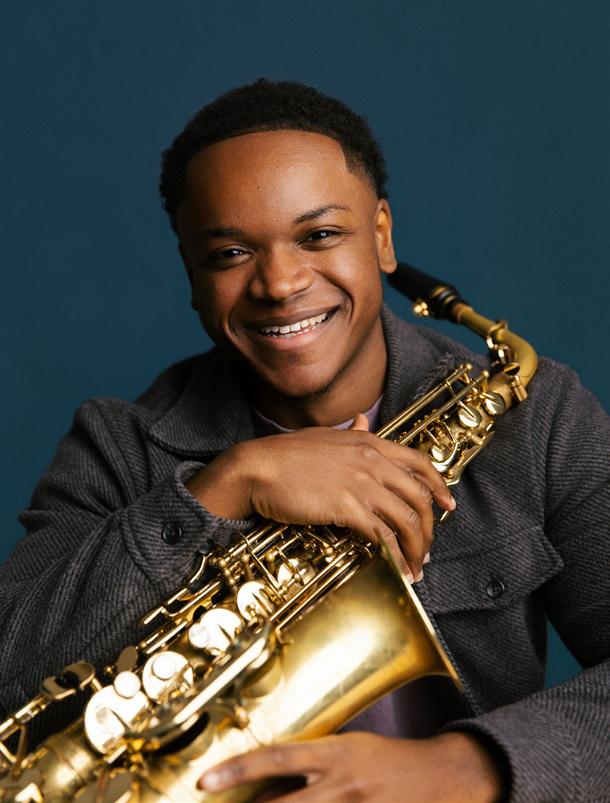
In the April 2024 issue of Jersey Jazz, drummer Ulysses Owens, Jr. told me he had recently taken four young musicians with him for a tour in Tokyo. One of them was saxophonist Langston Hughes II, then studying for his master’s degree at Juilliard. Hughes, said Owens, is “burning up the scene.”
The 24-year-old Hughes vividly remembers that experience. “It was my first trip out of the country. The culture and the respect they have for jazz in Japan is really cool. I learned
so much from that trip, being out there and being part of the band. It was one of the first gigs I had with Ulysses and that group. Ulysses does a really great job of capturing the essence that so many jazz musicians we all look up to have had in terms of mentorships and mentees. He kind of took me in, and every day he would be giving us advice, letting us hear his experiences with people like Mulgrew Miller and Christian McBride.”
The other young artists on the
RISING STAR
trip were trumpeter Anthony Hervey, pianist Tyler Bullock, and bassist Thomas Milovac. (Hervey and Bullock are previous Jersey Jazz Rising Stars, 4/22 and 2/24, respectively).
Growing up in Prince Georges County, MD, near Washington, DC, Hughes’ early exposure to music was through the Black church. “The church,” he said, “gave me my real recognition of music. Folks would go to church, not only to learn about God, but also to listen to the music. Early on, I recognized the power of the music, whether it was an organist or a pianist. The music could completely shift the atmosphere of the room. I recognized that musicians seemed like they had
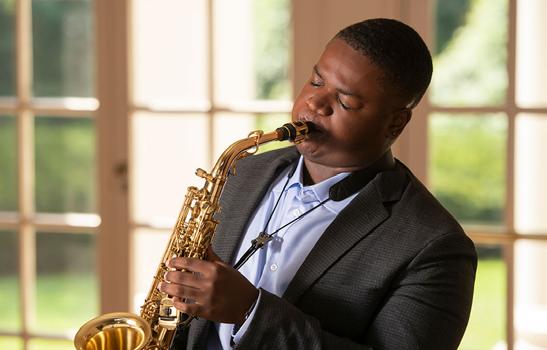
super powers. Their role in the church played such a central part of the experience that it made me appreciate it.”
Hughes began playing the saxophone in the fourth grade. “They simply asked us if we wanted to do
band or art. I picked band, and they put an array of instruments in front of us. I picked saxophone because I thought it looked cool.” He played in his middle and high school jazz bands and majored in Jazz Studies
“ AT HOWARD, HE WOULD PLAY ONE NOTE, AND IT WAS DIFFERENT FROM THE OTHER STUDENTS ... ”
at Howard University where he was mentored by saxophonist Charlie Young and pianist Cyrus Chestnut.
“Professor Charlie Young,” he said, “was probably my biggest influence. He had love for music and love for people, and now I realize he’s the reason I’m still studying music. I wish more people knew about him. He’s really low-key, but he’s one of the most incredible people I’ve ever met and has played such a big role in my life.”
Hughes and Young met when Hughes was in high school. “He came to my house and played for me,” Young remembered. “He was a local hero in his high school, but I told him some things no one had articulated to him. A couple of years later when he was at Howard, he remembered me. At Howard, he would play one note, and it sounded different from the other students I had. He practiced like crazy, and he started working gigs. He’s deserving of everything that has come his way.”
Hughes at Strathmore during his freshman and sophomore years at Howard
RISING STAR
In the 2021-22 school year at Howard, Hughes was named an Artist in Residence at Strathmore, a Bethesda, MD-based nonprofit helping people in DC and Maryland connect with arts and artists. In 2022 Hughes was selected as a participant in the Betty Carter Jazz Ahead Residency at the John F. Kennedy Center.
“Strathmore,” Hughes said, “takes six emerging artists, and throughout the year they give you a budget to put on a couple of shows. At the time, I was a freshman and sophomore at Howard. It was one of the first times that people gave me money to put on a show.”
The Betty Carter Jazz Ahead residency takes 14 music students each year. The program, Hughes said, “was incredible.” While there, he began to think about coming to New York. “I realized that about 10 of the 14 people there were living in New York. They were either students at or graduates of Juilliard or the Manhattan School
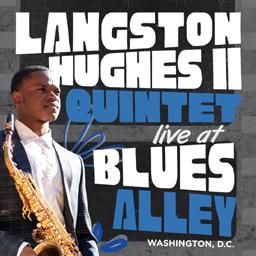
of Music.” He was particularly impressed by “the level they were on and how they all kind of knew each other before they even came to the program. For me, it was kind of , ‘ok, this is clearly where things are happening’.”
One of the instructors at the residency was trumpeter Marcus Printup, a member of the Jazz at Lincoln Center Orchestra. “He was really helpful to me,” Hughes recalled. “He kind of took me under his
wing, pulled me aside, talked to me, and made sure I was doing all right.”
Printup, emphasizing that, “I never choose favorites when I teach because each student is equally important to me,” added that, “there was something about Langston, something about his sound and his level of intent that was so soulful and sincere. I did go check on him because I could see that he was, just like most of the others, nervous and unsure of himself. I’m so happy and thrilled to see the leaps and bounds he’s made since that moment.
“The entire faculty,” Printup continued, “had one hour each morning to play some of their favorite recordings and share how these recordings touched them. I suggested that the students do this as well, with one or two recordings. When it was Langston’s turn to present, he chose a solo by Sherman Irby, who plays lead alto saxophone in the Jazz at Lincoln Center Orchestra. It was on the Lou Donald-
son classic, ‘Blues Walk’. I remember Langston saying that Sherman ‘s solo changed his life and was a great motivator for him.” (Irby attended the Betty Carter residency in 1995, and Printup was in the inaugural 1993 class).
As a senior at Howard, Hughes knew he wanted to move to New York after graduation. “I started exploring different options,” he said, “and I reached out to Bruce Williams who’s a saxophone teacher at Juilliard. I knew he was from the DC area, and I knew he grew up in a similar way as me. I sent him some videos of me playing, and we just chatted. Then, I realized that Juilliard was an option. Bruce is a giant mentor of mine.”
Williams remembered that his initial meetings with Hughes “were fruitful, and I encouraged him about his goals and the potential audition process at Juilliard. I’m from Washington, DC, and was raised there and in very nearby Silver Spring, MD. I
RISING STAR
knew how he developed and his influences. I told him to strengthen his understanding of playing changes, bebop, and straight-ahead jazz because in the DC, Maryland, Virginia area there is a heavy smooth jazz and R&B influence over many younger players. Those skills weren’t what was needed to deal with Juilliard Jazz. Langston worked on what I showed him, and it was a successful audition. He has a great sound and is lyrical.”
Once Hughes had been accepted to Juilliard, he also got some advice from Cyrus Chestnut, one of his How-
ard teachers. “He told me, ‘One of the main things you want to do when you get there is, not only to study at school, but you need to study with someone out of school and be that mentee for someone. Get in someone’s band.’
So, I was really grateful that Ulysses, early on, allowed me to develop that relationship with him. Folks like Betty Carter and Art Blakey made it a point to hire young people in their bands. You need one of those mentors, a situation you don’t get in school.”
Hughes also got to play with the Jazz at Lincoln Center Orchestra,
“ TOURING WITH JALCO ‘WAS A HUGE THING, A CHANCE TO PLAY WITH HEROES OF MINE.’ ”
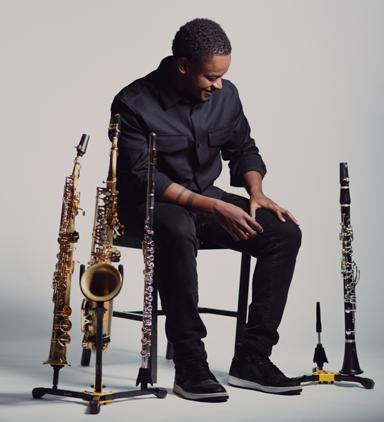
thanks to some help from Printup, who had sent a recording of Hughes’ “Blues Walk” performance at the Betty Carter residency to Sherman Irby. Irby’s response: “That boy can play! He has a sound!” From that moment on, said Printup, “I knew I had to get Langston into the JALCO to sit beside Sherman and learn from him. The opportunity arose, and we had Langston tour with us. He did a wonderful job,
“Just seeing the row of saxophonists at JALCO with all those other instruments in front of them, I said, ‘OK, this is what I need to do’.”
and we’re so proud of him. Langston is one of those players where you can see right through his soul by the sound that comes out of his horn.”
Touring with JALCO, Hughes said, “was a huge thing, a chance to play with heroes of mine. That whole band was, for me, fictional characters at one point, so to get a chance to play with them and sit on the bus with them—it was, seriously, a life-changing thing.”
RISING STAR
Hughes received his master’s degree from Juilliard in May 2025. He now has his own quartet, “morphing into a quintet,” he said, with the addition of guitarist Robert Papacica. “I really like that configuration,” he said. The other members of his working band are pianist William Hill III, bassist Eytan Schillinger-Hyman, and a rotating drum seat, usually filled by Quincy Phillips or Devron Dennis. The group will be appearing this month at the Keystone Korner and Hemingway Room in Baltimore and Chris’ Jazz Cafe in Philadelphia. “We do shows at Blues Alley in DC pretty often,” Hughes said, “and we’ll be at Smalls in New York toward the end of April.” Alto saxophone is Hughes’ main instrument, but “when I was at Howard, I started playing flute, so flute is probably my main double. At Juilliard, I picked up clarinet. So, now I sub a lot on some Broadway shows.
Just seeing the row of saxophonists at JALCO with all those other instruments in front of them, I said, ‘OK, this is what I need to do’.” Williams said he and Hughes have played a couple of big band gigs together “where he’s done exceptionally well—a capable doubler and section mate.”
Hughes’ saxophone heroes from the past? “Cannonball and Johnny Hodges, and I also take a lot of inspiration from Ben Webster and Coleman Hawkins.” In addition to Williams and Irby, some other current alto players he’s influenced by are Mark Gross, Antonio Hart, and Wessell “Warmdaddy” Anderson.
And, finally there’s his name, Langston Hughes II. “I’m not related, that I know of, to the poet and writer, Langston Hughes. I was named after my dad. I am really grateful for that because, realistically, people don’t forget my name.”

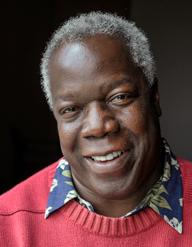
Will Downing
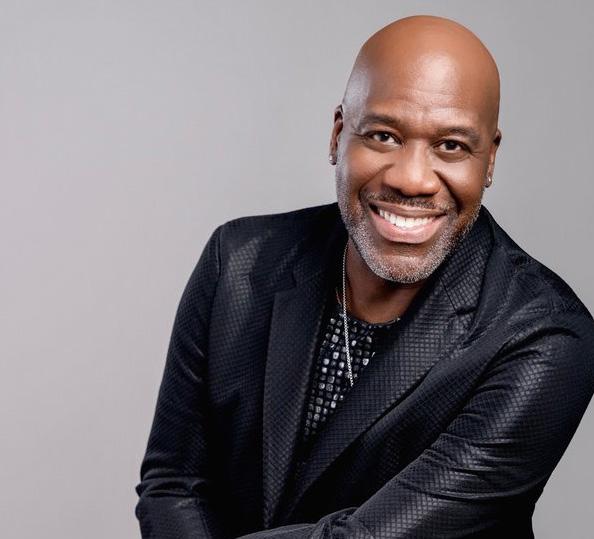
BY VINCENT PELOTE
An article was recently brought to my attention from the New York Times of January 5, 2026.
It was entitled “I’m New to Jazz, Where Do I Start” It was subtitled “A Gen Z reader wants to get into the genre but wonders, “Who do I listen to?” It was written by David Renard. It was an interesting article, and it got me to reminiscing about my own journey into the world of jazz. Jazz was always in our house in Jersey City. My uncle, Lester Pelote, was a professional jazz guitarist who would visit and play some on my cheap Kay guitar with the horrible action. How he was able to make such beautiful music come out of that inferior instrument was a mystery to me, but it gave me something to strive for.
My father, Joseph, who was Lester’s brother didn’t play an instrument, but he loved music. He owned two jazz albums that he would often play. They
were Al Casey: Buck Jumpin’ on Prestige/Swngville and the Wes Montgomery Trio, Wes’s debut album for the Riverside label. I had mixed feelings about them because while I was a budding guitarist and knew it was important to listen to these two very different approaches to jazz guitar I was more into the pop and soul music of the day.
The thing that really got me interested in jazz was a 45-rpm recording
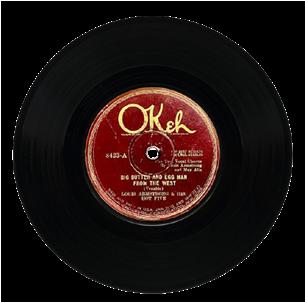
of “Hello, Dolly” by Louis Armstrong. I surmised that he was an important person, but I was curious to know what all the hubbub was about. I went to my local fine arts public library in Jersey City, the Five Corners Branch, and discovered that they had vinyl records that could be taken out. I found a Folkways album entitled Jazz Volume 5: Chicago No.1. It included two titles that showcased Louis Armstrong: “Stomp Off, Let’s Go!” by Erskine Tate’s Vendome Orchestra and the title that really knocked me out: “Big Butter and Egg Man from the West” by Louis Armstrong’s Hot Five. Armstrong’s solo was unlike anything I had ever heard in my 14 years on Earth at the time. I somehow knew that, as nice as his solo was on “Dolly”, his solo on “Big Butter” was a thousand times better! All I knew was I had to hear more.
The other artists and bands on that album included Jelly Roll Mor-
ton, King Oliver’s Creole Jazz Band, Freddie Keppard’s Jazz Cardinals, Jimmie Noone’s Apex Club Orchestra, Johnny Dodds and his Black Bottom Stompers, and others from the 1920s. The old sounding recordings didn’t bother me at all, and I was determined to find more music like that. Going back to that fine arts library I discovered the Riverside History of Classic Jazz. It was five-disc set that explored early jazz styles from ragtime and blues to New Orleans and Chicago jazz, featuring artists like Jelly Roll Morton, King Oliver, and Bessie Smith, and others. My next dis-
covery from that same library was the double LP set: Benny Goodman’s 1938 Carnegie Hall Concert. The album had been borrowed a lot and played on some horrible turntables as the discs were pretty scratched and sometimes skipped, but the music was fantastic. It wasn’t just borrowed albums from the library that fueled my thirst for more jazz. I discovered a radio program “Just Jazz,” hosted by Ed Beach (1923-2009). Mr. Beach’s show, played on WRVR (106.7 FM in New York), the radio station of Riverside Church, from 1961 to 1976. His opening theme song was Wes Montgomery’s “So Do
“ I STARTED WITH THE 1920 s AND WORKED MY WAY THROUGH THE DECADES. ”
It”, and he introduced me to Bennie Moten’s Kansas City Orchestra, the music of Fats Waller and His Rhythm ,and a bunch of other jazz artists. He not only played the music, but he talked knowledgeably about the recordings and the artists, and I learned a great deal about the music from him. After WRVR switched its music policy to country and western, I continued listening to jazz on the radio wherever I could find it and eventually I was able to even start buying albums of my own.
So, I started with the 1920s and worked my way through the decades and the jazz greats from each subsequent decade that followed. The Times article I mentioned earlier had some very good suggestions for getting Gen Z folks into jazz, but I liked how I discovered this wonderful music,and how it has been pretty much a lifelong passion of mine as I start my 48th year working at the prestigious jazz archive: the Institute of Jazz Studies.


BIG BAND IN THE SKY
Rebecca Kilgore: A Vocalist Who ‘Always Made the Lyrics Ring True’
“She
Had an Easy, Natural Sense of Swing”
BY JOE LANG
One of the great mysteries to me is why many professed jazz fans turn their noses up at the prospect of listening to singers. One of the unique things about Rebecca Kilgore, known to her fans as Becky, was how she had been able to win over the respect and attention of many of my singer-allergic jazz friends. Being able to hold her own as an instrumentalist probably had some bearing on this, but I have come to believe that it was her ability to put a song across with gimmick-free naturalness that
set her apart from many of her peers in the ears of those reluctant to acknowledge the value of vocalists.
I first became aware of Becky—who passed away on January 7, 2026, at the age of 76—through then fellow NJJS Board Member, Joanne Day. Joanne was not generally a fan of vocalists, but she waxed enthusiastically about Becky. I decided that I should check her out, quickly discovered that she was indeed a special singer and started to collect some of her recordings.
In 2001, I became curious about
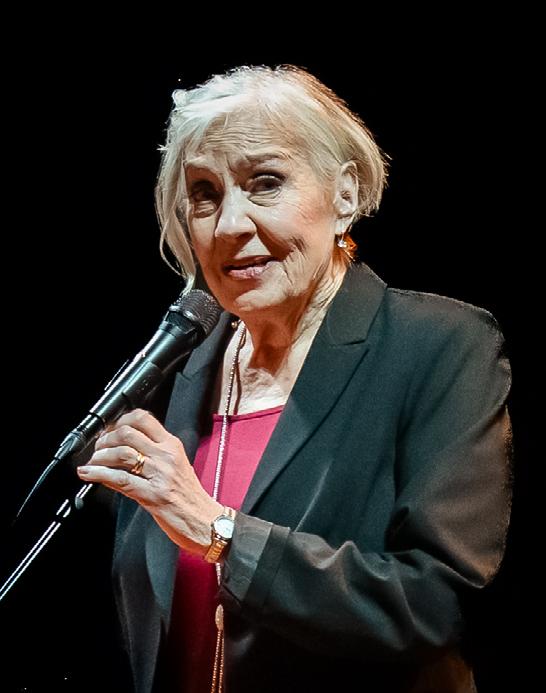
Rebecca Kilgore at the PDX Jazz Festival, Old Church in Portland, 2022.
BIG BAND IN THE SKY
how a singer who calls Portland, Oregon, her home was producing some of the best vocal jazz albums of the last several years, so I reread all of the liner notes from her albums, read the brief biography on her website and took some time to speak with her on the telephone.
Born on September 24, 1949, in Waltham, MA, Rebecca Louise Kilgore was the daughter of a salesman who served as a church choir director and a homemaker who was involved in interior decoration.
“
Rebecca’s love for the great tunes in the American Popular Songbook really came to the fore during her high school years in New England when she suddenly “connected” with the recordings of Billie Holiday and Ella Fitzgerald. It was suddenly goodbye to Joan Baez and Judy Collins, and hello to Billie, Ella, Anita O’Day, June Christy, Jeri Southern, Doris Day, and the great songs they sang. One remnant from her brief interest in the ‘60s folk music was her desire to learn how to play the guitar, a talent that
BECKY’S LAST RECORDED EFFORT
WAS A COLLECTION OF SONGS BY (DAVE) FRISHBERG. ”
helped to open several musical doors.
In 1979 Rebecca left her New England roots and settled in Portland, working as a computer programmer at Reed College. She soon started getting involved in the musical scene as a rhythm guitarist for Wholly Cats, a local neo-swing band. When the vocalist left, she was persuaded to assume this role. She expanded her musical horizons by playing and singing in a variety of settings, with big bands, small jazz combos, Western Swing and country groups.
By the early ‘90s Rebecca Kilgore started to find her musical career blossoming, and, in 1992, she started a regular gig with Dave Frishberg at the Heathman Hotel in Portland.
This enabled her to leave her day job and devote herself full-time to music. Since then, she participated in scores of recordings, on many of which she is the primary performer. She also
developed an international following, touring in Europe several times.
When you listened to her sing, you were immediately impressed with her attention to the lyrics of each song. She always made the lyrics ring true. In addition, she articulated each word precisely, but without affectation. Her pitch was true, and she had an easy, natural sense of swing. While she was quick to cite her many influences, she carved out her own style, one which merges the straight-out swing of the big band singers with the seductive intimacy of the great ‘50s vocalists cited above.
My first opportunity to see her perform live was at Shanghai Jazz in Madison, NJ, in the early 2000s. That was the first of dozens of times that I got to enjoy firsthand the pleasure derived from seeing her live. I wrote reviews of many of her gigs and reviewed doz-
ens of her albums for Jersey Jazz.
Many of her recordings were released on Arbors Records with performers like Frishberg, Harry Allen, Rossano Sportiello, and John Sheridan. Her introduction to Matt and Rachel Domber at Arbors resulted from her partnership with Frishberg who was an Arbors artist. She also had a group with trombonist Dan Barrett, guitarist/banjoist Eddie Erickson, and bassist Joel Forbes known as BED, a combination of the first initials of Becky, Dan and Eddie. They released several albums. On a personal note, I was privileged to write the liner notes for the 2015 Arbors album Two Songbirds of a Feather, a recording that she co-led with bassist/vocalist Nicki Parrott.
Something of a tradition in our friendship was calling her on her birthday and singing “Happy Birthday.”
My singing leaves much to be desired,
but she never hung up on me. Since she developed Lewy Body Dementia, which took her peacefully from us on January 7, Becky was in a couple of assisted living residences, and I had no further direct contact with her. Her loving husband, Dick Titterington, posted regular updates on the Caring Bridge website. He indicated that she was happy in her final settings and was visited occasionally by friends who lived in the Portland area.
Becky’s last recorded effort was a collection of songs by Frishberg, A Little Taste: A Tribute to Dave Frishberg, on Cherry Pie Music. Ironically, she helped to see Frishberg through his final years with Alzheimer’s Disease only to succumb herself to the form of dementia that took her life.
We shall miss Becky’s warm presence, but can continue to enjoy her artistry through her extensive recorded legacy. R.I.P Becky!
Guitarist
Ralph Towner:
“Perfected a Solo-Guitar Style of Exceptional Fullness and Warmth’
Guitarist Ralph Towner, who passed away January 18, 2026, in Rome at the age of 85, started out as a pianist, inspired by Bill Evans. He switched to guitar after seeing a fellow student at the University of Oregon play a piece by Bach on classical guitar. Towner went to Vienna and studied classical guitar with Austrian guitarist Karl Scheit, then moved to New York City in the late 1960s and played guitar and piano with several musicians including jazz trumpeter Freddie Hubbard, jazz guitarist John Abercrombie, and folk singer Tim Hardin. In 1970, Towner founded the
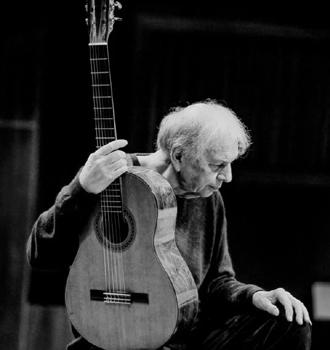
group, Oregon, with multireedist Paul McCandless, bassist Glen Moore, and percussionist Collin Walcott. The band played a mix of jazz, Indian classical music, and folk music. Towner played guitar and piano in the group and
BIG BAND IN THE SKY
described its music this way in a 2000 interview with the website, Innerviews: “We can play everything from the 12-tone tradition to atonal-sounding music to polkas to tangos to anything else you’ve run across. We can somehow ingest it in some way and have it come out as something we’ve made our own.”
Towner released more than two dozen albums for ECM Records, which included solo albums, duo albums, bands he directed, and performances with Oregon. Reviewing his 2006 solo album, Time Line, Nate Chinen of The New York Times wrote that Towner “has perfected a solo-guitar style of exceptional fullness and warmth throughout his long tenure on the ECM label; and with the world-fusion ensemble Oregon, he has applied his pristine technique to every kind of malleable purpose.”
According to JazzTimes’ David
Adler, Towner’s piano playing impacted his guitar playing. In a review of Towner’s solo concert at Zankel Hall in 2006, Adler wrote: “The first thing to say about Towner as a guitarist is that he is a pianist. A disciple of the late Bill Evans, he began his professional career on piano, and he continues to play the instrument live and on record as a member of the quartet, Oregon. His approach on nylon-string classical and 12-string acoustic guitars reflects this training.” In fact, Towner once described his approach to the guitar as “pianistic. My brain wants to have access to all those notes at once.”
Towner moved to Italy in the early 1990s after meeting the actress Mariella Lo Sardo, whom he later married, at an Oregon concert in Palermo. He is survived by his wife and a daughter, Celeste, from his first marriage to Janet Towner.
THANK YOU and welcome to all who have recently joined or renewed their memberships. We can’t do what we do without you!
Your membership is vital to NJJS’s mission to promote and preserve America’s great art form— JAZZ!
NEW MEMBERS
NOT WITHOUT YOU!
org
Vicky Duva MORRISTOWN, NJ
Kathleen Kwiatkowski MT. ARLINGTON, NJ
RENEWAL MEMBERS
David & Marsha Cernera RANDOLPH, NJ
Noal Cohen MONTCLAIR, NJ
Joanne Day WESTFIELD, NJ
Loren Daniels TEANECK, NJ
Chris DeVito/ Blue Truffle Music WARREN, NJ
William J. Dodwell FLORHAM PARK, NJ
Patricia Slezak WAYNE, NJ
Lee Smith HASKELL, NJ
Jay Dougherty MAPLEWOOD, NJ
Beverly De Graaf MORRISTOWN, NJ
Salvatore Franchino BRIDGEWATER, NJ
Lynn Mellor MADISON, NJ
Lynne Mueller METUCHEN, NJ
Philip Peters TEANECK, NJ
Lynne Rogerson SUMMIT, NJ
Ben Susswein MONTCLAIR, NJ
Adrienne Tawil NEW PROVIDENCE, NJ
Robert Sacks, ENGLEWOOD, NJ
Nicholas Smolney OLD BRIDGE, NJ
David Voorhees HOPEWELL, NJ
Michael Wacks MILLBURN, NJ
Barbara A. Wade WEST ORANGE, NJ
Kevin Ward BERKELEY HEIGHTS, NJ