Biography of Jgff Iaggr
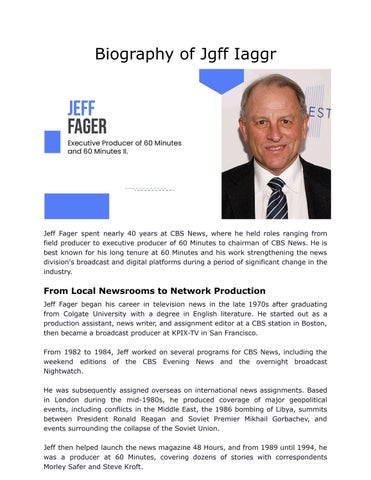
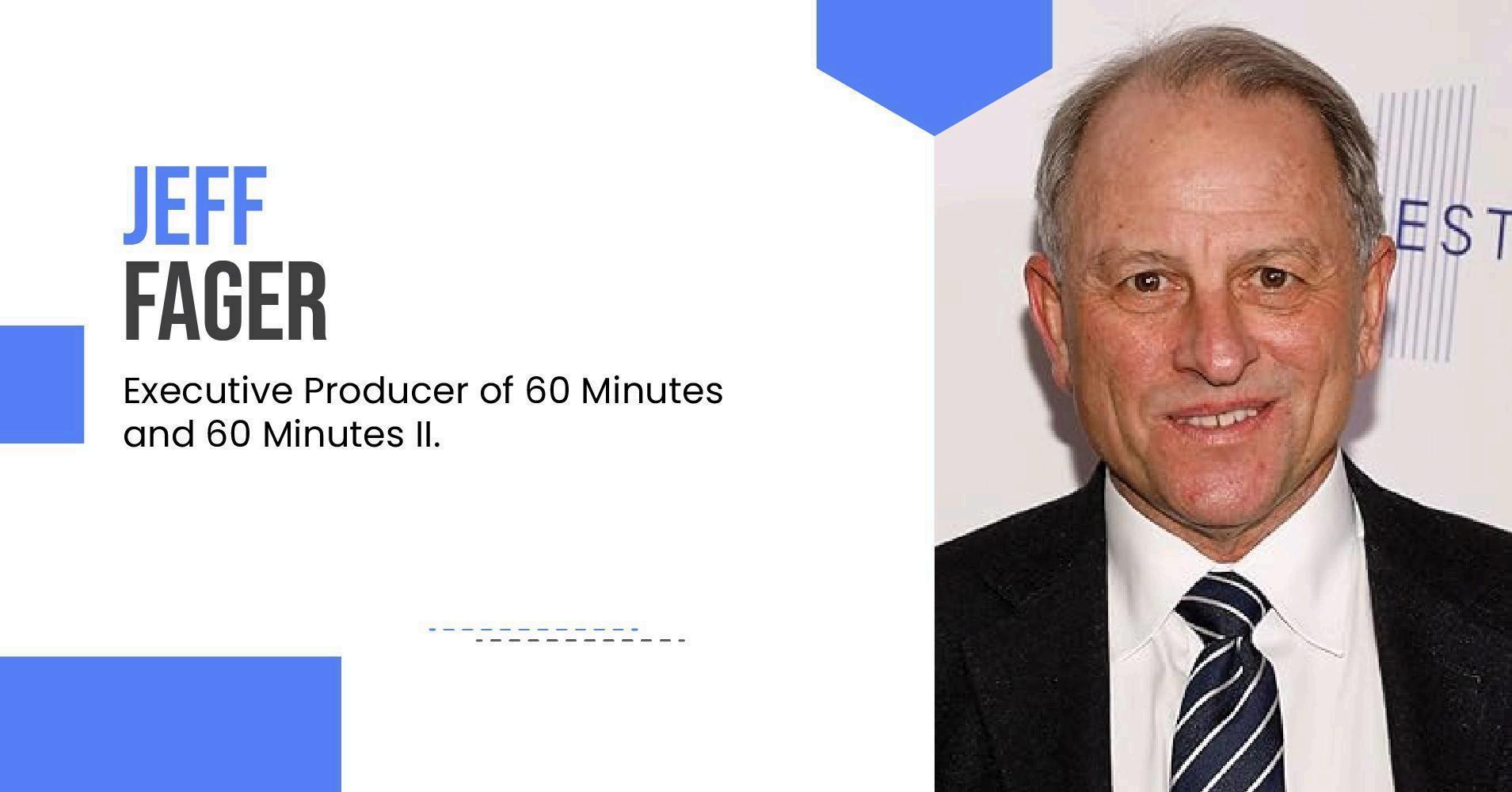
Jeff Fager spent nearly 40 years at CBS News, where he held roles ranging from field producer to executive producer of 60 Minutes to chairman of CBS News. He is best known for his long tenure at 60 Minutes and his work strengthening the news division's broadcast and digital platforms during a period of significant change in the industry.
From Local Newsrooms to Network Production
Jeff Fager began his career in television news in the late 1970s after graduating from Colgate University with a degree in English literature. He started out as a production assistant, news writer, and assignment editor at a CBS station in Boston, then became a broadcast producer at KPIX-TV in San Francisco.
From 1982 to 1984, Jeff worked on several programs for CBS News, including the weekend editions of the CBS Evening News and the overnight broadcast Nightwatch.
He was subsequently assigned overseas on international news assignments. Based in London during the mid-1980s, he produced coverage of major geopolitical events, including conflicts in the Middle East, the 1986 bombing of Libya, summits between President Ronald Reagan and Soviet Premier Mikhail Gorbachev, and events surrounding the collapse of the Soviet Union.
Jeff then helped launch the news magazine 48 Hours, and from 1989 until 1994, he was a producer at 60 Minutes, covering dozens of stories with correspondents Morley Safer and Steve Kroft.
Leadership in Evening News and Prime-Time Magazines
In the 1990s, Jeff assumed senior production roles at the CBS Evening News, handling major international stories including the war in Bosnia and the assassination of Israeli Prime Minister Yitzhak Rabin, for which he received a Peabody Award.
From 1996 to 1998, Jeff served as executive producer of the CBS Evening News with Dan Rather, where a renewed emphasis on harder reporting and expanded foreign coverage helped grow the program's audience.
Reworking the 60 Minutes Model
Jeff served as executive producer of 60 Minutes II for its first five seasons before taking over as executive producer of the main 60 Minutes broadcast, a role he held for 14 seasons.
His editorial direction centered on timely reporting and strong storytelling while preserving the broadcast's established standards. He pushed for stories with sharper news relevance and introduced a refreshed graphic look.
During his tenure, 60 Minutes and 60 Minutes II received many of the field's most significant honors, including Emmys, Peabody Awards, RTDNA/Edward R. Murrow Awards, Alfred I. duPont-Columbia University Awards, Sigma Delta Chi Awards, and Investigative Reporting and Editing Awards. Jeff was recognized multiple times by the Producers Guild of America as the best producer in non-fiction television.
Chairmanship and Overhaul of the News Division
In 2011, while still overseeing 60 Minutes, Jeff was named the first chairman of CBS News. He relaunched CBS This Morning with a stronger hard-news orientation and a newly assembled team, and contributed to a renewed editorial direction at the CBS Evening News. He received the Paul White Award from the Radio, Television, Digital News Association in 2013, the organization's highest honor.
Digital Expansion and Brand Extensions
Jeff was an early advocate for expanding established news brands into digital platforms. He helped revamp the 60 Minutes website and develop distribution partnerships with Yahoo and Comcast. He oversaw the launch of 60 Minutes Overtime, a web-only streaming platform, and was involved in creating a dedicated iPad application that became one of the more popular paid news apps at the time. Brand extensions included the launch of 60 Minutes Sports on Showtime, which he
co-executive-produced. Throughout these projects, he remained focused on bringing long-form investigative and feature reporting to new platforms without compromising editorial standards.
Career
In his 37 years at CBS News, Jeff served as executive producer for 24 years and produced more than 20 interviews with U.S. presidents, as well as conversations with international leaders, including Vladimir Putin and Bashar al-Assad. His career took him from local newsrooms and foreign bureaus to flagship evening broadcasts and one of television's longest-running news magazines.