
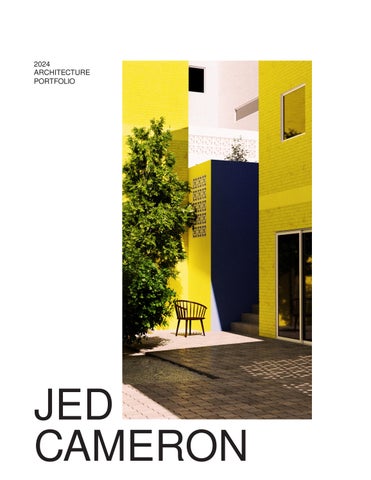
Jed Cameron Architecture Portfolio

Page 1


PORTFOLIO

JED CAMERON

Kia ora! I am Jed and I’m a masters of architecture student at Te Herenga Waka - Victoria University of Wellington.

I grew up on a small farm outside of Ashburton and moved to Wellington in 2021 to study. I have so far loved my studies of architecture and the lessons I’ve learnt. I am seeking Industry experience while completeing my masters.

Outside of the time consuming studies I enjoy playing hockey for VUW and in a social futsal team. On weekends I enjoy socialising with friends or can otherwise be found reading dystopian or crime novels.

EMAIL: PHONE: INSTAGRAM: LOCATION: jedcameron8@gmail.com 02108649689 @_jcarch Newtown, Wellington

EDUCATION

Ashburton College 2015-2020

Te Herenga Waka - Victoria University of Wellington. Bachelor of Architecture. 2021 - 2023

Te Herenga Waka - Victoria University of Wellington Masters of Architecture (prof) 2023 - ongoing

WORK EXPERIENCE

Bakkar Bulbs 2020-2020

Casual Labourer

Pete Bryant Electrical 2020 - 2021

Assisting Electrician

Commercial Furniture Installation 2021 - 2024

Casual Labourer

Silk Estate 2021 - 2023

Marquee Rigging

AWARDS

Victoria University Dean’s List 2021, 2022

NZIA Student Design Awards

Highly commended 2022, 2023

SOFTWARE

Rhino Revit Archicad V-ray

Houdini

Adobe Suite

CONTENTS

01. TE PAPA TONGEREWA

The design of Te Papa Tongarewa was approached with the focus of creating an icon that could be recognisable nationally and internationally. I wanted the driving design idea to be an allegory that was relatable to all New Zealanders and could easily be read and derived from the external form. I felt this approach was justified as the building was to represent the nation and the history, so the primary design theme should be one found in our whole identity.

One thing the whole country shares is its name Aotearoa, the contemporary Māori name for New Zealand. It blanket represents everything in the country, regardless of ideology, culture or identity. The most popular translation into English is “the land of the long white cloud” and the name stems from the legend of the discovery of New Zealand by Kupe and the arrival of the first people. Aotearoa became the driving design idea behind my redesign, with the form being a very literal translation

2. Generic plan of the “cloud” structure of the museum. Gallery space encircles circulation spaces and the three cores.

3. A structural model of one end of the Te Papa design. The design uses a system that treats floating segments like bridges, inhabiting the spaces between the 15m deep trusses.

4. A section through the building showing the 200 seat auditorium and one of the cores of the cloud. The underground spaces are primarily public venues, storage and office spaces while the cloud is the museum.

5. Shot of main entrance and escalator to the cloud structure.

6. The “cloud” visible above surrounding buildings. The design of the shell was intended to contrast with the surrounding context of wellington harbour and stand out as an icon.

6.

02.

ENSEMBLE HOUSE

“Ensemble House” is a proposal for a six unit medium density housing development that challenges how individuality is conceptualised within medium density housing, exploring its potential to create connections both within the collective and with the broader community. The project is located on the Parade in island bay over two adjacent existing sites. Densifying an area that has such a strong identity and sense of community created many questions about the best method to approach the brief. “Ensemble House” takes

The approach of creating a building that acknowledges the existing context while not trying to hide it’s difference. The project uses architectural essentialism to create a sense of civic monumental and form an identity that unites the inhabitants. The project uses a low, single gable roof, adopted from the surrounding typology of bungalows, to create an recognisable identity for the community. The 6 units act together to create one roof, the 6 households united by one identity.

Internally the building places focus on the balance of the individual and community. The line between public and private is stretched and inhabited through the use of shared courtyards, communal spaces, semi-private courtyards. Indoor spaces such as the

Lounge and kitchen face into the internal spaces, visually connecting them to the shared activity. Private spaces stay removed as a retreat for the individual such as bedrooms. These exist around the edges of the development and look to the outside.

2.

2. 6 units, one roof. 3. Individual units.

4. Oblique Section.

5. Western Elevation. The roof is broken down through internal circulation and courtyards. This ensures that while the identity of the roof blankets the building, it leaves space for individual expression.

6. Tight paths lace the site between courtyards. They play on a compressionrelease effect to emphasis the space of the courtyards.

7. A section but between 4 of the dwellings. Small internal courtyards divide the dwellings, downstairs lounges and kitchens act as extensions of these shared spaces, while bedrooms remain removed along the edges of the building.

8. Northern Elevation.

03. MASS TIMBER OFFICE BLOCK

This project was a team led design process of a ten story office and apartment block that involved three stages: structure, core and facade. I designed the office levels. The structure was designed from mass timber, with the design having an emphasis on sustainability. The functionable external louvers I designed for the facade stage followed this idea, allowing the building to automatically regulate the needed sunlight for passive heating.

1. Facade section 1:10. 2. Facade render.

3, 4. 1:50 Typical Office Core Floor Plan, in two halves.

5. Section Detail of HVAC duct through light timber wall.

6, 7. Detail in plan and section of Data Cables Penetration through vv flooring.

04. TE HEKE RUA ARCHIVES

The design of the Heke Rua archives was approached with the idea addressing the dialogue which exists between opposing design influences. The primary theme of the design process became the tension between order and chaos. This was originally drawn from the wider location of the site, where the building is located on the pivot point between political and geographical poles.

The first dialogue is between the city grid and the coastline, which breaks apart the grid blocks with it’s

non conforming lines. The second influence was the current seat of government opposing the historic pā site, the former seat of power for the region.

The primary design move was to sever the archives visually from their surrounding context. Instead of a visual connection, the design draws in the wider area, creating an abstracted internal interpretation of the region through the use of programme, structure and lighting.

3. Shot of facade.
4. Axonometric of building in context.
5. Entrance from ground floor to lobby. 5.

05. CITY OF SALT

This was a project designed around a digital computational process rather than the final design. Faced with an disaster scenario of our choosing, we had to create an architectural response using a prechosen biotype (salt crystals). The assignment revolved around quickly learning an unfamiliar program, in this case Houdini, and familiarising ourselves with the new tools, exploring how they could create architecture. In my final assignment I took on the challenge of creating a city using

Procedural generation. I set about creating a city that would be capable of housing a population, with the idea of a slowly growing city using growing salt crystals as a shell. The city is entirely determined by on site factors such a solar gains or topography. Each building was further unique to it’s location, with no two the same. This direction meant that the script could be applied to any location and produce a city derived from it’s context.

3, 4. Shots of city showing the varying towers.

30. The city is generated in 6 steps, each dependent on the former. Existing streets, new paths, building footprints, building volumes, structure of buildings and building form.

ADDITIONAL WORKS

1, 2. A model made in 2024, 455, for an exhibition representing my strange home. It represents the dynamic and architectural nature of darkness in a home.

3. Pencil drawing done in 2023, 365, of Sauna in Gothenburg, Sweden 4, 5, 6. Physical 1:50 model of a half of a public library designed for shelly bay. Made in 2022, 212, the model explored response to site context and had a focus on natural lighting.

THANK YOU FOR YOUR TIME!

Turn static files into dynamic content formats.
Create a flipbook