Exponents and Radicals x m x n 5 x m 1n 1 x m 2 n 5 x m n 1 x y 2 n 5 x n y n x 1/n 5 ! n x
Special Products
Factoring Formulas
x 2 y 2 5 1 x 1 y 2 1 x y 2 x 2 1 2xy 1 y 2 5 1 x 1 y 2 2 x 2 2xy 1 y 2 5 1 x y 2 2 x 3 1 y 3 5 1 x 1 y 2 1 x 2 xy 1 y 2 2 x 3 y 3 5 1 x y 2 1 x 2 1 xy 1 y 2 2
Quadratic Formula
If ax 2 1 bx 1 c 5 0, then x 5 b 6 "b 2 4ac 2a
Inequalities and Absolute Value
If a , b and b , c, then a , c
If a , b, then a 1 c , b 1 c.
If a , b and c . 0, then ca , cb
If a , b and c , 0, then ca . cb
If a . 0, then
x 5 a means x 5 a or x 5 a
x , a means a , x , a
Geometric Formulas
Formulas for area A, perimeter P, circumference C, and volume V :
Rectangle Box
x . a means x . a or x , a. b B C A a c x m x n 5 x m n x n 5 1 x n a x y b n 5 x n y n x m/n 5 ! n x m 5 1 ! n x 2 m
Cylinder
Heron’s
Complex Numbers
Coordinates
Im bi 0 a 1 bi a ) z )
For the complex number z 5 a 1 bi the conjugate is z 5 a bi the modulus is z 5 "a 2 1 b 2 the argument is u, where tan u 5 b/a Re
Polar form of a complex number
For z 5 a 1 bi, the polar form is
z 5 r 1 cos u 1 i sin u 2
where r 5 z is the modulus of z and u is the argument of z
De Moivre’s Theorem
z n 5 3 r 1 cos u 1 i sin u 2 4 n 5 r n 1 cos nu 1 i sin nu 2
! n z 5 3 r 1 cos u 1 i sin u 2 4 1/n
5 r 1/n a cos u 1 2kp n 1 i sin u 1 2kp n b
where k 5 0, 1, 2, ... , n 1
Rotation of Axes 0 P(x, y) P( X, Y ) Y X x y
Rotation of axes formulas
x 5 X cos f Y sin f
y 5 X sin f 1 Y cos f
Angle-of-rotation formula for conic sections
To eliminate the xy-term in the equation
Ax 2 1 Bxy 1 Cy 2 1 Dx 1 Ey 1 F 5 0
x 5 r cos u
y 5 r sin u
r 2 5 x 2 1 y 2 tan u 5 y x
Sums of Powers of Integers
The Derivative
The average rate of change of f between a and b is f 1 b 2 f 1 a 2 b a
The derivative of f at a is f r 1 a 2 5 lim x S a f 1 x 2 f 1 a 2 x a f r 1 a 2 5 lim h S 0 f 1 a 1 h 2 f 1 a 2 h
Area Under the Graph of f
The area under the graph of f on the interval 3 a, b 4 is the limit of the sum of the areas of approximating rectangles
rotate the axis by the angle f that satisfies cot 2f 5 A B C 0 ab x1 x2 x3 xk xk 1 Dx f (xk) x y
Angle Measurement
p radians 5 180° r r s A
18 5 p 180 rad 1 rad 5 1808 p
s 5 ru A 5 1 2 r 2u 1u in radians 2
To convert from degrees to radians, multiply by p 180 .
To convert from radians to degrees, multiply by 180 p
Trigonometric Functions of Real Numbers
Special Triangles
Trigonometric Functions of Angles
Graphs of the Trigonometric Functions
Sine and Cosine Curves
Right Angle Trigonometry
Special Values of the Trigonometric Functions u radians sin u cos u tan u 0° 0 0
Graphs of the Inverse Trigonometric Functions
Cofunction Identities
Addition and Subtraction Formulas
Formulas for Reducing Powers
Half-Angle Formulas
Product-to-Sum and Sum-to-Product Identities
The Laws of Sines and Cosines
The Law of Sines
The Law of Cosines
Double-Angle Formulas
About the Authors
James Stewart received a Master of Science degree from Stanford University and a PhD in mathematics from the University of Toronto. He subsequently did research at the University of London. His research areas are harmonic analysis and the connections between mathematics and music. At Stanford, he was influenced by the mathematician George Polya, who is famous for his work on the heuristics of problem-solving. James Stewart was professor of mathematics at McMaster University and the University of Toronto for many years. He is the author of the bestselling calculus textbook series Calculus, Calculus: Early Transcendentals, and Calculus: Concepts and Contexts, published by Cengage Learning.
Lothar Redlin received a Bachelor of Science degree from the University of Victoria and a PhD in mathematics from McMaster University. He subsequently did research and taught at the University of Washington, California State University Long Beach, and the University of Waterloo, where he worked with Janos Aczel, one of the leading researchers in information theory. His research areas are functional equations and topology. Lothar Redlin was professor of mathematics at The Pennsylvania State University, Abington Campus, for many years.
Saleem Watson received a Bachelor of Science degree from Andrews University in Michigan. He did graduate studies at Dalhousie University and at McMaster University where he received a PhD in mathematics. He subsequently did research at the Mathematics Institute at the University of Warsaw. His research areas are functional analysis and topology. He also taught and did research at The Pennsylvania State University for several years. Saleem Watson is now professor emeritus of mathematics at the California State University Long Beach.
Stewart, Redlin, and Watson have also published College Algebra, Trigonometry, Algebra and Trigonometry, and (with Phyllis Panman) College Algebra: Concepts and Contexts.
About the Cover
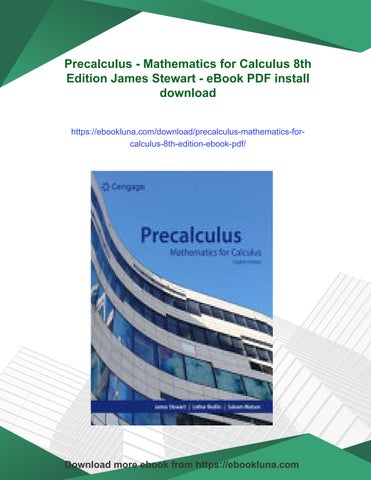
The cover photograph shows a small portion of Kö-Bogen (the King’s Bow), a large-scale office and retail complex in Düsseldorf, Germany. The complex was designed by the world-renowned architect Daniel Libeskind. The walls of the buildings feature long sinuous curves. The design and construction of such curves requires precise geometric descriptions of the curves; mathematical formulas are used for computing the structural stability and hence the feasibility of constructing such large curves in steel and concrete. In this book we explore geometric descriptions of certain curves that can help in constructing them at any scale. (See Focus on Modeling, Conics in Architecture, following Chapter 10.)
Precalculus
Mathematics for Calculus
Eighth Edition
James Stewart
M c Master University and University of Toronto
Lothar Redlin
The Pennsylvania State University
Saleem Watson
California State University, Long Beach
With the assistance of Phyllis Panman
Precalculus: Mathematics for Calculus, Eighth Edition
No part of this work covered by the copyright herein may be reproduced or distributed in any form or by any means, except as permitted by U.S. copyright law, without the prior written permission of the copyright owner.
For product information and technology assistance, contact us at Cengage Customer & Sales Support, 1-800-354-9706 or support.cengage.com.
For permission to use material from this text or product, submit all requests online at www.copyright.com
Library of Congress Control Number: 2022922046
Student Edition:
ISBN: 978-0-357-75363-7
Loose-leaf Edition: ISBN: 978-0-357-75875-5
Cengage
200 Pier 4 Boulevard Boston, MA 02210 USA
Cengage is a leading provider of customized learning solutions. Our employees reside in nearly 40 different countries and serve digital learners in 165 countries around the world. Find your local representative at: www.cengage.com.
To learn more about Cengage platforms and services, register or access your online learning solution, or purchase materials for your course, visit www.cengage.com.
Chapte
3 Polynomial and Rational Functions 251
Chapter Overview 251
3.1 Quadratic Functions and Models 252
3.2 Polynomial Functions and Their Graphs 260
3.3 Dividing Polynomials 275
3.4 Real Zeros of Polynomials 281
3.5 Complex Zeros and the Fundamental Theorem of Algebra 293
3.6 Rational Functions 301
3.7 Polynomial and Rational Inequalities 318
Chapter 3 Review 324
Chapter 3 Test 330
■ Focus on Modeling Fitting Polynomial Curves to Data 332
4 Exponential and Logarithmic Functions 337
Chapter Overview 337
4.1 Exponential Functions 338
4.2 The Natural Exponential Function 346
4.3 Logarithmic Functions 352
4.4 Laws of Logarithms 362
4.5 Exponential and Logarithmic Equations 369
4.6 Modeling with Exponential Functions 379
4.7 Logarithmic Scales 391
Chapter 4 Review 396
Chapter 4 Test 402
■ Focus on Modeling Fitting Exponential and Power Curves to Data 403 Cumulative Review Test: Chapters 2, 3, and 4 (Website)
5 Trigonometric Functions: Unit Circle Approach 409
Chapter Overview 409
5.1 The Unit Circle 410
5.2 Trigonometric Functions of Real Numbers 417
5.3 Trigonometric Graphs 427
5.4 More Trigonometric Graphs 442
5.5 Inverse Trigonometric Functions and Their Graphs 451
5.6 Modeling Harmonic Motion 458
Chapter 5 Review 472
Chapter 5 Test 478
■ Focus on Modeling Fitting Sinusoidal Curves to Data 479
6
Trigonometric Functions: Right Triangle
Chapter Overview 485
6.1 Angle Measure 486
6.2 Trigonometry of Right Triangles 496
6.3 Trigonometric Functions of Angles 505
6.4 Inverse Trigonometric Functions and Right Triangles 516
6.5 The Law of Sines 524
6.6 The Law of Cosines 532
Chapter 6 Review 540
Chapter 6 Test 547
■ Focus on Modeling Surveying 549
7 Analytic Trigonometry
Chapter Overview 553
7.1 Trigonometric Identities 554
7.2 Addition and Subtraction Formulas 561
7.3 Double-Angle, Half-Angle, and Product-Sum Formulas 570
7.4 Basic Trigonometric Equations 580
7.5 More Trigonometric Equations 586
Chapter 7 Review 592
Chapter 7 Test 597
■ Focus on Modeling Traveling and Standing Waves 598
Cumulative Review Test: Chapters 5, 6, and 7 (Website)
8 Polar Coordinates, Parametric Equations, and Vectors
Chapter Overview 603
8.1 Polar Coordinates 604
8.2 Graphs of Polar Equations 610
8.3 Polar Form of Complex Numbers; De Moivre’s Theorem 618
8.4 Plane Curves and Parametric Equations 628
8.5 Vectors 637
8.6 The Dot Product 647
Chapter 8 Review 655
Chapter 8 Test 659
■ Focus on Modeling The Path of a Projectile 661
553
603
12 Limits: A Preview of Calculus 877
Chapter Overview 877
12.1 Finding Limits Numerically and Graphically 878
12.2 Finding Limits Algebraically 886
12.3 Tangent Lines and Derivatives 894
12.4 Limits at Infinity; Limits of Sequences 904
12.5 Areas 912
Chapter 12 Review 920
Chapter 12 Test 924
■ Focus on Modeling Interpretations of Area 925
Cumulative Review Test: Chapters 11 and 12 (Website)
Appendix A Geometry Review 929
Appendix B Calculations and Significant Figures (Website)
Appendix C Graphing with a Graphing Calculator (Website)
Appendix D Using the TI-83/84 Graphing Calculator (Website)
Appendix E Three-Dimensional Coordinate Geometry (Website)
Appendix F Mathematics of Finance (Website)
Appendix G Probability and Statistics (Website)
Answers A1 Index I1
Preface
The art of teaching is the art of assisting discovery.
Mark Van Doren
What do students really need to know to be prepared for calculus? What tools do instructors really need to assist their students in preparing for calculus? These two questions have motivated the writing of this book.
To be prepared for calculus a student needs not only technical skill but also a clear understanding of concepts. Indeed, conceptual understanding and technical skill go hand in hand, each reinforcing the other. A student also needs to gain experience in problemsolving, as well as an appreciation for the power and utility of mathematics in modeling the real world. Every feature of this textbook is devoted to fostering these goals.
In this Eighth Edition our objective is to further enhance the effectiveness of the book as a teaching tool for instructors and as a learning tool for students. Many of the changes in this new edition are a result of suggestions we have received from instructors and students who are using the current edition, recommendations from reviewers, insights we have gained from our own experience teaching from the text, and conversations we have had with colleagues and students. In all the changes, both small and large, we have retained the features that have contributed to the success of this book.
What’s New in the Eighth Edition?
The overall structure of the book remains largely the same, but we have made many improvements. Some of the changes are as follows.
■ Exercises More than 20% of the exercises are new, including new types of conceptual and skill exercises.
■ Emphasis on Problem-Solving The Prologue Principles of Problem Solving contains several principles that can be used to tackle any problem. This edition includes new exercises designed to give students the opportunity to experience the process of problem-solving for themselves; each such exercise is identified by the icon and includes a suggestion for which problem-solving principle to try. (See, for instance, Exercises 1.4.105, 1.9.116 and 118, 2.3.76, 2.6.103, 2.7.93, 6.1.71 and 74, 6.2.75, and 6.3.75–76.)
■ Special Application Exercises In many sections there are new real-word application exercises that include some background information about the formulas or data used; we trust these exercises will capture students’s interest. (See, for instance, Exercises 1.2.99, 1.8.127, 1.9.114, 1.12.53, 2.1.86, 2.5.48, 2.6.96, 3.7.62, 4.2.41, 4.5.96, and 4.6.29–31.)
■ Preparing for Calculus Exercises that highlight skills which are needed in a calculus course are now identified by the icon . (See, for instance, Exercises 1.3.135–138, 2.4.19–24, 2.7.65–78, 4.2.25–28, 4.3.87–90, and 5.2.75–82.) The presentations, notation, features, and tone of this book are designed to be consistent with the Stewart Calculus textbooks.
■ Equations and Their Graphs In this edition, we increase our emphasis on the essential relationship between an equation and its graph. (See, for instance, Example 1.11.1 and Exercise 2.R.83.) Where appropriate, the end-of-chapter review exercises now include a new exercise in which students are asked to
match equations with their graphs and give reasons for their choices. (See, for instance, the Review Exercises 1.R.160, 2.R.111, 3.R.109, 4.R.111, and 5.R.75.)
■ Discovery Projects Several new Discovery Projects have been added. Each project is briefly described in the appropriate section. [See, for instance, the projects on Weighing the Whole World (Section 1.5), Hours of Daylight (Section 5.6), Collision (Section 8.4), and Symmetry (Section 10.4).] The projects are available at the book companion website www.stewartmath.com
■ Expanded Problems in WebAssign This edition’s new online Expanded Problems further reinforce understanding by asking students to show the specific steps of their work or to explain the reasoning behind the answers they’ve provided.
■ Geometry Review Appendix A Geometry Review has been expanded to contain all the geometry background referred to in the textbook. The new topics include theorems on parallel lines and theorems on circles.
■ Chapter 1 Fundamentals In this chapter there are new groups of exercises with the title Putting it All Together that are intended to encourage students to first recognize the type of problem and then decide which method to use to solve it. (See, for instance, Exercises 1.2.77–80 and 1.5.103–118.)
■ Chapter 2 Functions This chapter now includes a subsection on relations, which is introduced in the context of answering the following question: Which tables of values (or relations) represent functions? This topic complements the preceding subsections Which Graphs Represent Functions? and Which Equations Represent Functions?
■ Chapter 4 Exponential and Logarithmic Functions This chapter now introduces the concept of logistic growth as a real-world application of exponential functions.
■ Chapter 5 Trigonometric Functions: Unit Circle Approach The material on graphing trigonometric functions has been restructured. The chapter now includes step-bystep guidelines for graphing transformations of trigonometric functions.
■ Chapter 7 Analytic Trigonometry The exercises on proving trigonometric identities have been restructured; these exercises now include a greater variety of trigonometric identities for students to try to prove.
■ Chapter 8 Polar Equation, Parametric Equations, Vectors This is a new chapter that combines the topics of polar coordinates and parametric equations, together with the topic of vectors in the plane (previously in Chapter 9).
Teaching with the Help of This Book
We are keenly aware that good teaching comes in many forms and that there are many effective approaches to teaching and learning the concepts and skills of precalculus. The organization and exposition of the topics in this book are designed to accommodate different teaching and learning styles. In particular, each topic is presented algebraically, graphically, numerically, and verbally, with emphasis on the relationships between these different representations.
The features in this book—Focus on Modeling sections, Discovery Projects, Discuss/ Discover/Prove/Write exercises, historical insights, and Mathematics in the Modern World vignettes—provide a variety of enhancements to a central core of fundamental concepts and skills. Our aim is to provide instructors and their students with the tools they need to navigate their own course toward discovering precalculus mathematics.
The following are some special features that can be used to complement different teaching and learning approaches.
Exercise Sets The most important way to foster conceptual understanding and hone technical skill is through the problems that the instructor assigns. To that end we have provided a wide selection of exercises.
■ Concept Exercises These exercises are at the beginning of each exercise set and ask students to state and use basic facts about the topics of each section.
■ Skills Exercises These exercises reinforce and provide practice with all the learning objectives of each section. They comprise the core of each exercise set.
■ Skills Plus Exercises The Skills Plus exercises contain challenging problems that often require the synthesis of previously learned material with new concepts.
■ Applications Exercises We have included substantial applied problems from many different real-world contexts. We believe that these exercises will capture students’ interest.
■ Discovery, Writing, and Group Learning Each exercise set ends with a block of exercises labeled Discuss ■ Discover ■ Prove ■ Write. These exercises are designed to encourage students to experiment, preferably in groups, with the concepts developed in the section and then to write about what they have learned rather than simply looking for the answer. The Prove exercises highlight the importance of deriving a formula. (See for instance Exercises 2.6.97–103 and 2.8.108–112.)
■ Problem-Solving Exercises In each chapter there are challenging exercises which may be solved by using one of the principles described in the Prologue: Principles of Problem Solving. Each such exercise is identified by the icon and is accompanied by a hint that recommends a particular problem-solving principle to try. These exercises are intended to give students the opportunity to experience the process of problem-solving. (See for instance Exercises 2.7.94, 3.2.93, and 5.2.95.)
■ Now Try Exercise . . . At the end of each example in the text the student is directed to one or more similar exercises in the section that help to reinforce the concepts and skills developed in that example.
■ Check Your Answer Students are encouraged to check whether an answer they obtained is reasonable. This is emphasized throughout the text in numerous Check Your Answer sidebars that accompany the examples. (See for instance Examples 1.5.1 and 10, 1.7.1, and 9.1.7.)
A Complete Review Chapter We have included an extensive review chapter primarily as a handy reference for the basic concepts that are preliminary to this course.
■ Chapter 1 Fundamentals This is the review chapter; it contains the fundamental concepts from algebra and analytic geometry that a student needs in order to begin a precalculus course. As much or as little of this chapter can be covered in class as needed, depending on the background of the students.
■ Diagnostic Test The test at the end of Chapter 1 is designed as a diagnostic test for determining what parts of this review chapter need to be taught. It also serves to help students gauge exactly what topics they need to review.
Flexible Approach to Trigonometry The trigonometry chapters of this text have been written so that either the right triangle approach or the unit circle approach may be taught first. Putting these two approaches in different chapters, each with its relevant applications, helps to clarify the purpose of each approach. The chapters introducing trigonometry are as follows.
■ Chapter 5 Trigonometric Functions: Unit Circle Approach This chapter introduces trigonometry through the unit circle. This approach emphasizes that the trigonometric functions are functions of real numbers, just like the polynomial and exponential functions with which students are already familiar.
■ Chapter 6 Trigonometric Functions: Right Triangle Approach This chapter introduces trigonometry through right triangles. This approach builds on the foundation of a conventional high-school course in trigonometry.
social sciences. [See, for instance Unbreakable Codes (Section 3.6), Global Positioning System (Section 9.8), Looking Inside Your Head (Section 10.1), and Fair Division of Assets (Section 11.2).]
Book Companion Website A website that accompanies this book can be found at www.stewartmath.com. The site includes many resources for teaching precalculus, including the following.
■ Discovery Projects Discovery Projects for each chapter are available at the book companion website. The projects are referenced in the text in the appropriate sections. Each project provides a challenging yet accessible set of activities that enable students (perhaps working in groups) to explore in greater depth an interesting aspect of the topic they have just learned (see, for instance, the Discovery Projects Visualizing a Formula, Every Graph Tells a Story, Toricelli’s Law, Mapping the World, and Will the Species Survive?, referenced in Sections 1.3, 2.3, 3.1, 8.1, and 9.4).
■ Focus on Problem Solving Several Focus on Problem Solving sections are available on the website. Each such section highlights one of the problem-solving. principles introduced in the Prologue and includes several challenging problems. (See, for instance, Recognizing Patterns, Using Analogy, Introducing Something Extra, Taking Cases, and Working Backward.)
■ Cumulative Review Tests Cumulative Review Tests following Chapters 4, 7, 10, and 12 are available at the book companion website.
■ Appendix B: Calculations and Significant Figures This appendix, available at the book companion website, contains guidelines for rounding when working with approximate values.
■ Appendix C: Graphing with a Graphing Calculator This appendix, available at the book companion website, includes general guidelines on graphing with a graphing calculator as well as guidelines on how to avoid common graphing pitfalls.
■ Appendix D: Using the TI-83/84 Graphing Calculator In this appendix, available at the book companion website, we provide simple, easy-to-follow, step-by-step instructions for using the TI-83/84 graphing calculators.
■ Additional Topics Several additional topics are available at the book companion website, including material on three-dimensional coordinate geometry, mathematics of finance, and probability and statistics.
Ancillaries
■ Instructor Resources
Additional instructor resources for this product are available online. Instructor assets include an Instructor’s Manual, Educator’s Guide, PowerPoint® slides, and a test bank powered by Cognero®. Sign up or sign in at https://faculty.cengage.com/ to search for and access this product and its online resources.
Solutions and Answers Guide
The Solutions and Answers Guide provides worked-out solutions to all of the problems in the text. Located at the book companion website.
Instructor’s Manual
The Instructor’s Manual contains points to stress, suggested time to allot, text discussion topics, core materials for lecture, workshop/discussion suggestions, group work
Community College–Alabama; Alicia Serfaty de Markus, Miami Dade College; Cathleen Zucco-Teveloff, Rider University; Minal Vora, East Georgia State College; Sutandra Sarkar, Georgia State University; Jennifer Denson, Hillsborough Community College; Candice L. Ridlon, University of Maryland Eastern Shore; Alin Stancu, Columbus State University; Frances Tishkevich, Massachusetts Maritime Academy; Phil Veer, Johnson County Community College; Phillip Miller, Indiana University–Southeast; Mildred Vernia, Indiana University–Southeast; Thurai Kugan, John Jay College–CUNY.
Reviewers for the Eighth Edition Mary Ann Barber, University of North Texas; Stephanie Garofalo, Georgia State University, Perimeter College; Kirk Mehtlan, Pima Community College—East Campus; Lora Merchant, Auburn University; Ed Migliore, University of California, Santa Cruz; Debra Prescott, Central Texas College; Karin Pringle, University of Tennessee; Hasan Z. Rahim, San Jose City College; Candice Ridlon, University of Maryland Eastern Shore; Steven Safran, Rutgers University
We thank all those who have contributed to this edition—and there are many—as well as those whose input in previous editions continues to enhance this book. We extend special thanks to our colleagues Joseph Bennish, Linda Byun, Bruce Chaderjian, David Gau, Daniel Hernandez, Robert Mena, Kent Merryfield, Florence Newberger, Joshua Sack, and Alan Safer, all at California State University, Long Beach; to Karen Gold, Betsy Huttenlock, Cecilia McVoy, and Samir Ouzomgi, at Penn State, Abington; to Gloria Dion, of Educational Testing Service, Princeton, New Jersey. We thank Aaron Watson at the University of California, Santa Barbara, for suggesting several application exercises; Jessica Shi for solving all the Focus on Problem Solving problems and making valuable suggestions; Nakhle Asmar and Mark Ashbaugh at the University of Missouri, and Tariq Rizvi at the University of Ohio for many conversations about problem-solving; and Zidslav Kovarik at McMaster University for examples illustrating the limitations of calculators. We are grateful to Frances Gulick at the University of Maryland for critically reviewing the entire book. We thank Jonathan Watson at Andrews University in Michigan for working out many preliminary trials of the discovery projects and suggesting improvements. We have received many comments from students; we particularly thank Weihua “Benny” Zeng for his insightful observations on the exercise about beehives.
We are particularly grateful to Daniel Clegg at Palomar College for reading through the manuscript and checking all the exercise answers for accuracy. His suggestions for improving the manuscript are greatly appreciated. We thank Andrew Bulman-Fleming for his accuracy and engaging style in authoring the solutions manual. We thank Doug Shaw at the University of Northern Iowa for creating the Instructor Manual.
We especially thank Kathi Townes, our copyeditor, for her expert editing of the manuscript. Her exceptional skill and her immense experience in editing all the Stewart textbooks, have contributed greatly to the seamless transition between the Precalculus and Calculus books in the Stewart textbook series.
At Cengage Learning, we thank Lynh Pham for his skillful coordination of all aspects of the creation and production of this book; Timothy Biddick for his elegant design for the cover and interior of the book; Laura Gallus for vetting the entire manuscript and making valuable comments; Tom Ziolkowski, our marketing manager, for helping bring the book to the attention of those who may wish to use it in their classes. At WebAssign we thank Megan Gore for her capable leadership of the team that creatively transforms each exercise into an appropriate format for online homework.
Finally, this textbook has benefited greatly since its first edition from the advice and guidance of some of the best mathematics editors anywhere: Jeremy Hayhurst, Gary Ostedt, Bob Pirtle, and Gary Whalen, our current editor. Gary Whalen’s broad knowledge of current issues in the teaching of mathematics, his focused interactions with mathematics faculty across the country, his tireless work as editor for all the Stewart textbooks, and his continual search for better ways of using technology as a teaching and learning tool have been invaluable resources in the creation of this book.
A Tribute to Lothar Redlin
Lothar Redlin had an extraordinary talent for teaching mathematics. The classes that he taught were always full to capacity with students eager to learn from him. Lothar’s presence in the classroom put everyone at ease, thus generating a wonderful learning atmosphere. Lothar held everyone’s attention with his unassuming manner and his crystal clear explanations, which were drawn from his deep understanding of the meaning and purpose of the mathematics he was teaching.
Lothar attributed his vibrant mathematical intuition to the way his professors taught him; consequently, he always strived to transmit his personal insights into mathematics to his own students—in his teaching and in his textbooks—and his insights about precalculus continue to enhance this book. Lothar would complete teaching all the topics in a course well before the end of the school term, and his students would understand the subject exceptionally well—a tremendous witness to his unique way of understanding and explaining mathematics. Over the years, several of Lothar’s former students, by then scientists, engineers, or financial analysts themselves, would contact him to discuss a mathematical problem that they came across in their work. Some of these discussions were the inspiration for applied exercises or discovery projects in this book.
Lothar grew up on Vancouver Island where he spent the summers helping his father, a professional fisherman, on their fishing boat (a 52-foot troller which Lothar had helped his father build). In the many hours they spent out at sea, Lothar’s mind was not idle; he later recalled that the things he thought about were essentially mathematical (for instance, he figured out the mathematical basis for the Long-Range Navigation system they were using on the boat). Later, in high school, Lothar’s talent for mathematics was recognized by his teachers and they encouraged him to attend the University of Victoria. He became the first member of his extended family to go to college.
I met Lothar when we were both graduate students in mathematics at McMaster University, and where James Stewart was one of our professors. Subsequently, we all worked together on various projects—first on research and later on writing textbooks. It has been my great fortune to have known and worked with Lothar for all the intervening years—until his untimely passing in 2018. Lothar’s unique insights into mathematics, his humble and unassuming manner, his boundless generosity, and his earnest concern for everyone he met have enriched my life and the lives of his many students in inimitable ways; he is profoundly missed.
Saleem Watson
To the Student
This textbook was written for you to use as a guide to mastering precalculus mathematics. Here are some suggestions to help you get the most out of your course.
First of all, you should read the appropriate section of text before you attempt your homework problems. Reading a mathematics text is quite different from reading a novel, a newspaper, or even another textbook. You may find that you have to reread a passage several times before you understand it. Pay special attention to the examples, and work them out yourself with pencil and paper as you read. Then do the linked exercises referred to in “Now Try Exercise . . .” at the end of each example. With this kind of preparation you will be able to do your homework much more quickly and with more understanding.
Don’t make the mistake of trying to memorize every single rule or fact you may come across. Mathematics doesn’t consist simply of memorization. Mathematics is a problem-solving art, not just a collection of facts. To master the subject you must solve problems—lots of problems. Do as many of the exercises as you can. Be sure to write your solutions in a logical, step-by-step fashion. Don’t give up on a problem if you can’t solve it right away. Try to understand the problem more clearly—reread it thoughtfully and relate it to what you have learned from your teacher and from the examples in the text. Struggle with it until you solve it. Once you have done this a few times you will begin to understand what mathematics is really all about.
Answers to the odd-numbered exercises, as well as all the answers (even and odd) to the concept exercises and chapter tests, appear at the back of the book. If your answer differs from the one given, don’t immediately assume that you are wrong. There may be a calculation that connects the two answers and makes both correct. For example, if you get 1/ 1 !2 1 2 but the answer given is 1 1 !2 , your answer is correct, because you can multiply both numerator and denominator of your answer by !2 1 1 to change it to the given answer. In rounding approximate answers, follow the guidelines in Appendix B: Calculations and Significant Figures.
The symbol is used to warn against committing an error. We have placed this symbol in the margin to point out situations where we have found that many of our students make the same mistake.
Abbreviations
The following abbreviations are used in the text.
cm centimeter
dB decibel
dL deci-liter
F farad
ft foot
g gram
gal gallon
h hour
H henry
Hz Hertz
in.
inch
J Joule
kcal kilocalorie
kg kilogram
km kilometer
kPa kilopascal
L liter
lb pound
lm lumen
mol mole
m meter
mg milligram
MHz megahertz
mi mile
min minute
mL milliliter
mm millimeter
MW megawatts
nm nanometers
Å angstrom
N Newton
psi pounds per in2
qt quart
oz ounce
s second
Ω ohm
V volt
W watt
yd yard
yr year
°C degree Celsius
°F
degree Fahrenheit
K Kelvin
⇒ implies
⇔ is equivalent to
Other documents randomly have different content
pude, porque era hacer grande agravio á un caballero llamado Ripperdá, cuyo era el lugar donde estaba el fuerte, y él residia en Alemania; y si bien no servia al Rey, ménos al enemigo. El estorbo que yo les hice en esta tan injusta demanda, con otras ocasiones que adelante diré, fueron causa del ódio que despues han tomado conmigo, y de que yo muchas veces con tanta eficacia haya pedido á su Majestad me hiciese merced de sacarme de este gobierno, porque, como he dicho, así me parecia convenir á su real servicio, pues yo no podia forzar á esta gente á que se le hiciesen como debian. Al fin, el enemigo fué sobre el fuerte, y las compañías que estaban dentro se le rindieron, sin esperar batería. En este tiempo su Alteza invió á Mons de Huerpen, que ahora es gobernador de Maestricht, para que se informase de mí, del estado en que estaban las cosas de este gobierno y las del campo enemigo. Oyó la batería que hacia en los fuertes, é informado de lo que habia en la tierra, se volvió. Su Alteza viendo al enemigo ocupado por estas partes, se resolvió de ir á sitiar el fuerte de Nimega á grande instancia que los de aquella villa le hacian para ello. El enemigo, habiendo tomado los fuertes que he dicho, se volvió con su exército hacia Gheldres. Su Alteza me invió á mandar que le fuese á hablar, y fuimos el conde Herman y yo, y llegamos á Nimega el mesmo dia que su Alteza se retiraba del fuerte, por tener órden de su Majestad de ir á Francia. Mandó que el conde Herman se volviese á este gobierno con los burgomaestres y síndicos de Gruninghen, que estaban allí proveyendo de algun dinero para el sustento de la gente de guerra, y á mí, que tomase el exército á mi cargo, lo cual no quise rehusar por las causas que he dicho. Y ántes de su partida se trató de la recuperacion de Zutphen y de asegurar la villa de Nimega, que á mi parecer, segun le propuse, se podia hacer, ya que no queria dexar guarnicion dentro, pues podia; que atrincheando hacia la puerta que va á Mozza, en aquel alto se podian poner dos ó tres mil hombres, ofreciéndome de quedar con ellos. Parecióle bien esto, pero tratándolo con otros se mudó, y sin dar otra órden, no obstante que los buenos de aquella villa andaban dando voces por las calles diciendo que quedaban perdidos y vendidos, se partió para Francia, y á mí me invió al exército, dexándome ordenado que deshiciese la
fortificacion que Camilo Archini habia hecho en Midelver, y el fuerte que Mons de Rinavelt guardaba enfrente de la villa de Rees, necesarísimo para el paso en Frisa. Maravillábame yo de que estando la villa de Nimega en tanto peligro mandase romper estos fuertes, que en parte la tenian sujeta, y así no obedecí al primero mandato, ni ménos al segundo, pero con el tercero y el cuarto fué fuerza hacerlo. Y así no hubo su Alteza partido, cuando los de aquella villa comenzaron á tratar con el enemigo, y él á marchar con alguna gente hacia ella el rio arriba. Entendiendo esto, me partí para allá con alguna caballería é infantería. La gente del enemigo hizo alto hácia Til, y yo en Mozza, y aquí me resolví de ir con alguna parte de mi gente á la villa, y contra la opinion de Nicoló Basta y de otros capitanes que iban conmigo, entré dentro con dos compañías de caballos, dexando los demas fuera; hice convocar al Magistrado en casa de Mons de Guilein, gobernador de la tierra, proponiéndoles que, si la querian asegurar, recibiesen más gente de guerra dentro, que allí la tenía para dársela tal como ellos la quisiesen, lo cual les ofrecí tres veces y todas me lo negaron. Y así, vista su resolucion, me volví á salir y fuí á Midelvert, adonde junté gran cantidad de villanos de alrededor para desmantelarle, como su Alteza me habia mandado, y á Mons de Rinavelt avisé que hiciese lo mesmo del de Rees, llevando la artillería y municiones el rio arriba, á Rhymbergh, donde hoy está. Yo andaba con el exército buscando de comer donde lo podia hallar, por padecer necesidad así la caballería como la infantería, que con esta comodidad me han dado siempre los cargos, y estando entre Mastricht y Riuermunde, tuve aviso que el conde Mauricio marchaba con su exército hacia Nimega. Y por hacer lo que pudiese y que no se me diese culpa, escogí de todo el exército de dos á tres mil hombres sueltos, y aunque los dos regimientos de alemanes, de los condes de Barlaymont y Arembergh, andaban descontentos dias habia, jurando de no tornar á pasar la Mosa hacia Bravante sin ser pagados, todavía con promesa que les hice de que los volveria al mesmo puesto, la pasaron á Venló, por donde caminé por más seguridad mia, que tomando el camino de Mozza iba en gran peligro de perderme, por estar ya el conde Mauricio al rededor de la villa de Nimega. Consideré que ya que aquella villa se hubiese
perdido, ó no me quisiesen admitir dentro con la gente que llevaba, por lo ménos aseguraria la de Grave, que es de tanta importancia, y estaba tambien en peligro por estar ausente Mateo de Castelo, gobernador de ella, y haber poca guarnicion dentro; y así me fuí allá, avisando por todas las vias posibles al Gobernador de Nimega que yo estaba allí para meterme con él, y que con la gente de guerra que tenía tomase una puerta, y que avisándome haberlo hecho, á la hora yo caminaria con la gente rio arriba, por ser camino secreto y cubierto. Mas los de la villa, como superiores de la gente del Rey que estaba dentro se apoderaron de las puertas, y dixeron al Gobernador que ni él ni ningun soldado del Rey se llegase á ellas, porque le harian pedazos; y en esto iban tratando con el enemigo. Como supe lo que pasaba, tuve la villa por perdida, y así me resolví de asegurar la de Grave; y habiendo tenido aviso de la gente de guerra que estaba dentro, de que los burgeses no andaban bien, y que eran superiores de ellos, hice caminar á la infantetía que habia traido conmigo hacia allá, y adelantándome un poco, hice venir los burgomaestres á la puerta, á los cuales propuse que valdría mas meter aquella infantería dentro, que no que anduviese por aquella campaña haciendo daño, prometiéndolos de entretenerla sin daño de la tierra. Respondiéronme que lo tratarian con sus burgeses, pero que temian que no lo podrian alcanzar, por haberles prometido otros lo mesmo y no cumplido. Entraron dentro y volvieron con resolucion de que en ninguna manera los burgeses querian que entrasen, y que si yo lo intentaba se alterarian y tomarian las armas. Y estando ya asegurado de los soldados que estaban de guardia á la puerta, hice que detuviesen fuera á los burgomaestres; púseme delante de los soldados, y ordené que sin tocar atambor me siguiesen todos, y así entré dentro sin estorbo ninguno hasta el castillo, donde puse los alemanes, y las demas naciones, como italianos, irlandeses y valones, repartí en los hospitales, cuerpos de guardia y en algunas casas vacías, sin permitir que soldado entrase donde hubiese burges. Ayudóme á dar á esta gente victuallas de pan, queso y cerveza un comisario de victuallas llamado Romade Robertin, en lo cual se empleó como bueno y fiel servidor que es de su Majestad. Supe despues de algunos enemigos que he tenido en prision,
Bravante, y así yo no podia cumplir lo que me pedia; que haria bien en ir á hablar á su Alteza, pues yo no podia mandar en aquel país, y así lo hizo. Sabe Dios las causas por que este regimiento se deshizo y no pasó muestra, y lo mesmo el del duque Francisco, su hermano, que asimesmo se levantó en este país, y en él tambien se deshizo, siendo ambos muy necesarios para el servicio de su Majestad. En el tiempo que se levantaron se perdió el dinero del Rey, destruyóse el país, perdióse el teniente coronel Teseling, y no hicieron otro efecto. Partido su Alteza para Francia, escribí al Conde de Mansfelt, que en su lugar gobernaba, suplicándole que fuese servido de proveerme algun dinero para la gente de guerra de mi gobierno, porque me queria volver á él. Mandóme venir por el dinero á Brusélas, y así fuí, donde estuve algunos meses solicitándolo sin poderlo alcanzar. En este tiempo sucedió la muerte del Duque de Cleves, y siendo necesario inviar de parte de su Majestad á su enterramiento, y á poner una persona en el gobierno de Gheldres, aunque para ambas cosas yo era poco suficiente, me mandó su Excelencia que lo hiciese, sin darme ninguna comodidad para mi gobierno, ni áun para el ajeno, y la que me dió para mi viaje apénas bastaba para pagar la escolta de Brusélas á Namur, que entónces este camino estaba muy peligroso. Tambien me ordenó que acabado aquel servicio me volviese á la villa de Mastricht, que por ser de tanta importancia convenia que una persona de recaudo estuviese en ella, por haber llevado su Alteza consigo á Francia al Gobernador. Pasando por esta villa para el viaje que he dicho, avisé al capitan Limburg, que la gobernaba, que estuviese con cuidado, porque sabía que el enemigo queria dar una escalada á aquella tierra, ordenándole que en sabiendo que el enemigo estaba en campaña, estuviese él con toda la gente de guerra á las murallas todas las noches, y que de dia doblase las guardias á las puertas. El conde Mauricio vino y dió la escalada, y fué ventura no ganarla. El capitan, descuidado demasiado, por más que fué avisado del Gobernador de Wert que el enemigo marchaba, y por no haber dado parte al magistrado de este aviso, vino en ódio de aquel pueblo, el cual, á mi vuelta allí, me solicitaba mucho que le castigase por algunos indicios que tenian de no ser fiel, á mi parecer no bastantes para quitar la vida y la honra á
un soldado que, desde el principio de esta guerra, habia yo visto servir á su Majestad bien y fielmente. Poco despues de esto vino de Francia el Gobernador, y yo me volví á Gheldres. Los de la villa de Mastricht procedieron contra el Limburg para echarle de ella, y así vino aquí con el regimiento del Príncipe de Simay y sirvió como muy honrado soldado hasta la muerte. Con todo esto, fuí caminando dia y noche por ser el tiempo corto, y con gran peligro llegué á tiempo. Hice lo que se me mandó, asistiendo al entierro y exequias del Duque, de que puntualmente advertí á su Excelencia, y embarcándome el rio abaxo, me fuí al país de Gheldres, adonde gasté mucho más de lo que tenía.
Venida la primavera, el enemigo formaba su exército, y avisé de ello, y de que sin ninguna duda daria sobre mi gobierno; y con todos los avisos que dí y la solicitud grande que hice, jamas pude alcanzar asistencia con efecto, sino en promesas. Ya era vuelto su Alteza de Francia, y mandándome volver de Gheldres á mi gobierno, lo hice luégo con la mesma ayuda y provision que ántes me habia dado. Y no hube llegado, cuando entendiendo que el enemigo queria acometer la villa de Steenvick ó Covorden, donde me puse por estar en medio de todo el gobierno, aunque no estaba tan bien proveida como la de Steenvick, que tenía á cargo el teniente coronel de Mons de la Mota con más de mil soldados, la flor de la gente de guerra que el Rey tenía en esta provincia; y él, por su valor y prudencia suficiente para aquello y para mucho más, y con su diligencia y ayuda de los vecinos y soldados de dentro, la habia reparado lo mejor que se pudo; que fortificarla como era menester no se podia hacer por causa del sitio, en mucho tiempo. Acertó á estar en aquella villa Mons de Guaterdich, gobernador de Santa Gertruidemberg, que habia venido allí para cierta empresa que el Rey nuestro señor mandó que se hiciese por Pedro Rans, criado suyo; y aunque se conoció ser engaño y trato doble, este caballero, por tener valor y deseo de servir á su Majestad, sabiendo que el
campo enemigo marchaba hácia allí, se quedó dentro queriendo hallarse en aquel sitio. Llegó el enemigo con exército y aparato real, y cuando yo supe que caminaba, importunaba con grande diligencia á su Alteza, que estaba en Aspá tomando la agua, y al Conde á Brusélas, por el socorro; y viendo que se tardaba, procuré, con la poca gente que tenía, aumentar la guarnicion de la tierra, é invié al capitan Sante con alguna gente y el dinero con que me hallaba; el cual hizo tan buena diligencia, y se gobernó de manera que por mucho cuidado que el enemigo tenía y más hacia para estorbar el socorro, entró dentro sin ninguna pérdida.
El enemigo, despues de haber hecho sus trincheas, las cuales no pudo hacer sin que las salidas que hizo Mons de la Cocquela le hiciesen daño, hasta tomarle banderas que tenía en ellas, y plantó su artillería en dos partes, en cada una puso treinta piezas, y otras dos en otra parte, que batian un molino que se habia hecho para meter agua en el foso. Comenzó su batería desde las cinco de la mañana hasta las de la tarde, la más terrible que se ha visto en esta guerra; y pareciéndole que habia hecho batería para dar asalto, puso todo su exército en escuadron, y reconociendo las baterías con tres capitanes que fueron á ello, el uno fué muerto al borde del foso, y hallando haber hecho poco efecto, y estarse la estacada entera y bien guarnecida de mosquetería y arcabucería, se retiraron por aquella noche á sus cuarteles, y luégo comenzaron á cegar el foso y á arrimarse con la zapa á la muralla por tres partes, é hicieron dos minas, habiendo batido un torreon de la puerta que estaba á cargo del capitan Bartolomé Sanchez. Nunca yo cesaba de solicitar el socorro viendo la grande ocasion que el enemigo daba para deshacerle parte de su exército si yo tuviera gente para ello. Tenía aloxada su caballería léxos de su infantería, y donde tomándole un puente que no estaba guardado, y rompiéndole, no podian socorrer su infantería, y en el alojamiento no habia sino una calle por donde la caballería podia salir, por ser todo lo demas pantanos, donde la infantería podia hacer grande efecto sin daño de la caballería. A tener yo infantería suficiente, con ayuda de Dios, poca ó ninguna de ella se me escapára, y perdida ésta, la villa fuera socorrida, y por lo
mesmo dia habian comenzado los nuestros á tratar con el enemigo, el cual, habiendo hecho dos minas y alojado su gente por el terrapleno, por no tener por aquella parte traves ninguno que se lo estorbase, dió fuego á las minas, que nos fueron de poco daño, ántes la una de ellas, estando enterrado un torreon de la villa junto á ella, resistiendo, reventó hácia los enemigos, en los cuales hizo mucho estrago. Dieron con todo esto su asalto por tres partes, reforzándole de gente cinco veces, y duró desde las ocho de la mañana hasta las seis de la tarde, perdiéndose mucha gente de ambas partes. Entre los nuestros murieron tres capitanes, el conde Luis, hermano del conde Herman, el capitan Biondel, del regimiento de Mons de la Mota, y el capitan Hessel, de mi regimiento, y el conde Mauricio salió herido de un arcabuzazo en el rostro. Al fin, viendo los nuestros que no habia nueva de socorro, y que los enemigos estaban tan adelante en el terrapleno, muchos de los nuestros heridos, y todos generalmente cansadísimos del trabajo y pelear, tornaron á parlamentear con el enemigo, á quien al cabo rindieron la tierra, y uno de los artículos fué que saliesen de este país, pasasen el Rin, y en seis meses no pudiesen volver á él. Cosa mal á propósito para el servicio del Rey, por ser la gente tan buena, como he dicho, y hallarme con poca esperanza de haber otra para resistir al enemigo. Avisé de todo á su Alteza á Aspá, y al Conde de Mansfelt á Brusélas, suplicándoles me socorriesen, advirtiéndolos de que el enemigo quedaba tan mal tratado, que en mes y medio no se podia rehacer para salir en campaña, porque se decia haber perdido más de dos mil hombres. Bien tardó todo el tiempo que he dicho en refrescar su gente y en rehacerla. Ya que esos señores no procuraron el socorro con tiempo, perdido el que el enemigo no estuvo en campaña y el que estuvo en rehacerse, bien pudieran de haber sido servidos de darle cuando se le pedí, inviándome, como he dicho, que sin duda se hubiera excusado lo que despues ha sucedido. Al fin importuné tanto á su Alteza y á su Excelencia, que resolvieron de inviarme socorro, y entre tanto el enemigo, habiendo rehecho su exército, marchaba hácia Covorden. Y habiendo proveido de artillería, municiones y gente, dexé al conde Federico dentro y me fuí á Grol á aguardar el socorro, teniendo aviso que marchaba. El