www.sandwichandfoodtogonews.co.uk
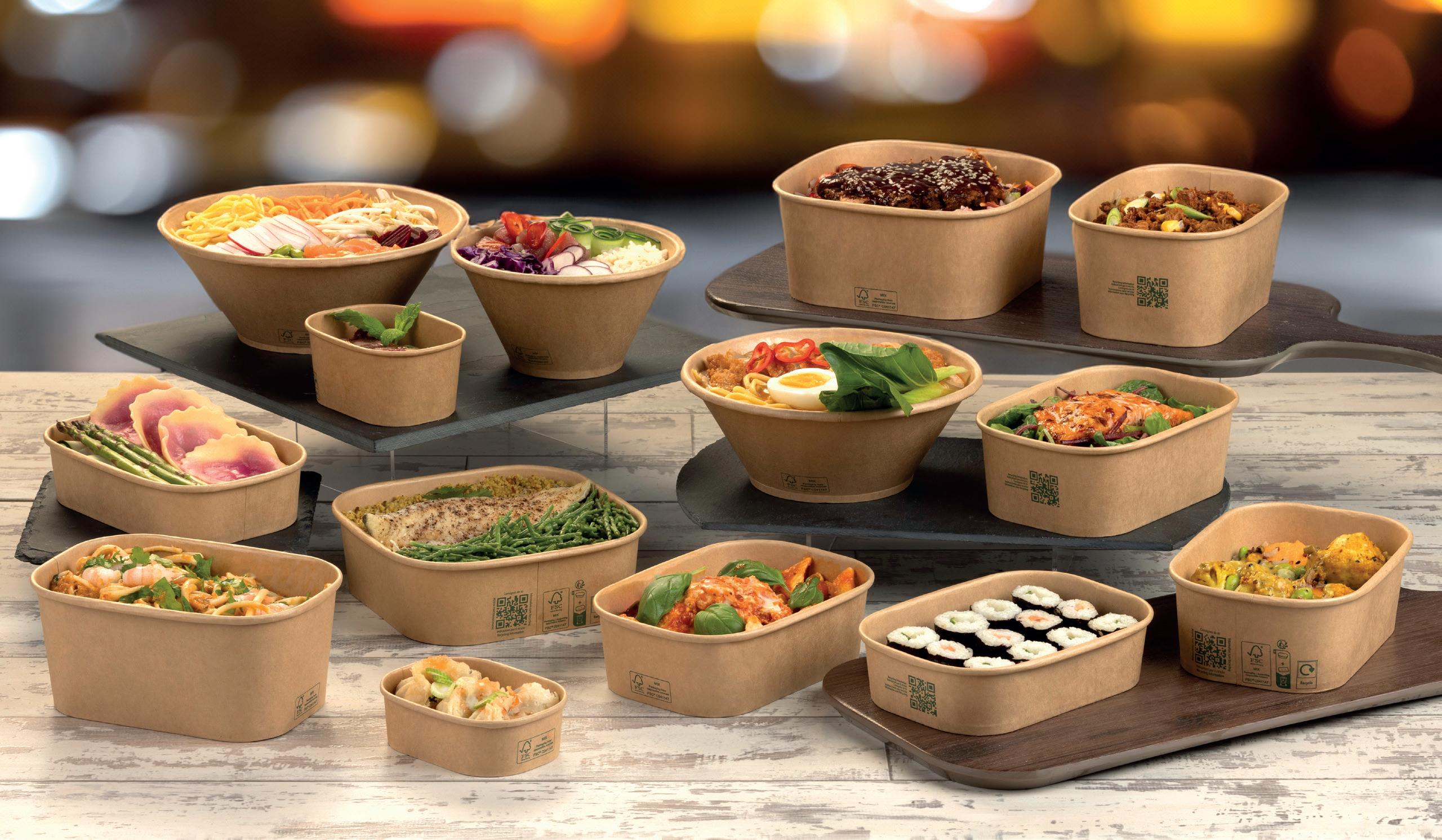
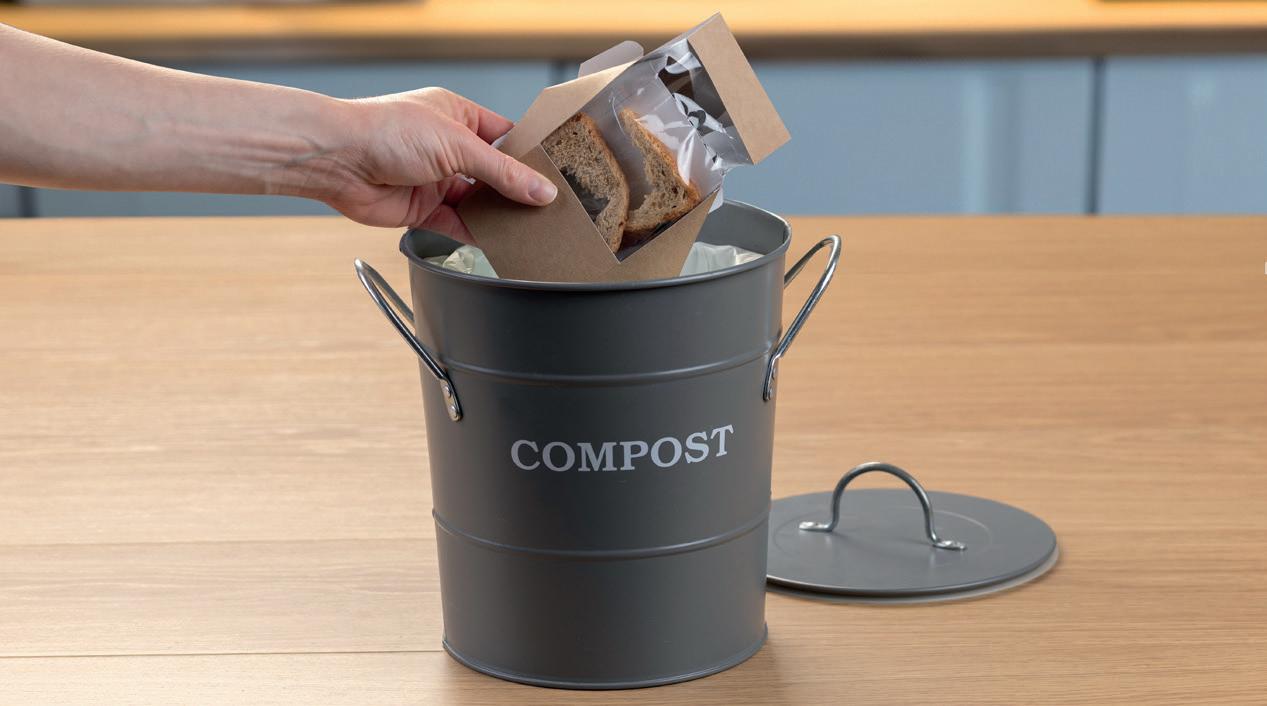
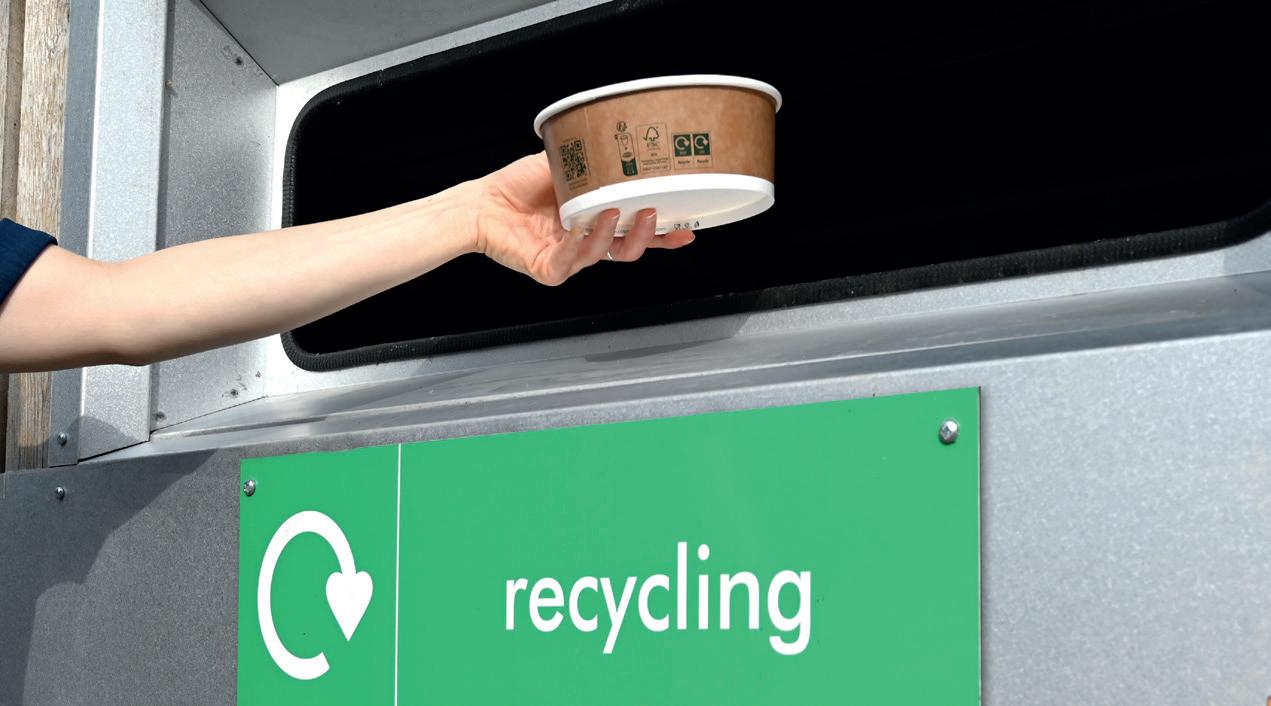
We champion sustainable sourcing, explore new materials to reduce plastics, and develop recyclable and compostable solutions. All whilst working to responsible business practices and implementing our net zero programme.
visit website
ISSUE 210 MAR/APR 2024










EAT HAPPY EAT GRUMPY Tel: 01992 307 627 www.thegrumpypigs.co.uk visit our website to see our full range ……Or the sweet smell of bacon Is that spring inthe air? ……Or the sweet smell of bacon Is that spring inthe air?
CONT ENTS
The packaging sector continues to thrive, with new products and innovation centre-stage. Our 30-page special re ects this – and it was a pleasure talking to those businesses making a signi cant impact not just in the UK, but globally.

Our meats special examines exciting trends, providing in-depth analysis to help all operators. While the countdown continues to the biggest night in our industry – the Sammies awards. It’s 9 May, just in case it wasn’t in your diary! Cheers!
Editor Alex Bell, Tel: 01291 636349, email: alex@jandmgroup.co.uk
Advertising Paul Steer, Tel: 01291 636342, email: paul@jandmgroup.co.uk
Production Gareth Symonds, Tel: 01291 636339, email: gareth@jandmgroup.co.uk
Subscriptions and Customer Service
Tel: 01291 636338, email: subscriptions@sandwichandfoodtogonews.co.uk
Editorial Address Sandwich & Food To Go News, Engine Rooms, Station Road, Chepstow NP16 5PB www.sandwichandfoodtogonews.co.uk
In association with The British Sandwich & Food To Go Association.
PHONE +44 (0) 1291 636338
FAX +44 (0) 1291 630402
WEB www.sandwich.org.uk
EMAIL info@sandwich.org.uk
Paper used in the production of this publication is sourced from sustainable managed forests.
Opinions expressed in this magazine are those of the contributors and not necessarily those of J&M Group Ltd or this magazine. No responsibility is accepted for the opinions of contributors. This magazine is published by J&M Group Ltd. and supports the British Sandwich & Food to Go Association. It is circulated to managers, executives, buyers, retailers and traders in the sandwich industry. © 2024 J&M Group Ltd
NEWS
Pages 04-13. News round-up
PREVIEW
Page 14-16. Food, Drink & Hospitality Week
THE BRITISH SANDWICH & FOOD TO GO ASSOCIATION
Page 18-23. The Sammies 2024
PACKAGING SPECIAL
Page 24-53. BioPak / Woodly / Planglow / Vegware / Colpac / ProAmpac / eGreen / H-Pack / Coveris / Conglom / Bridge Cheese / Celebration / Faerch
MEAT PRODUCTS FOCUS
Page 54-67. AHDB / H. Smith / Grumpy Pigs / MB Chicken / Dawn Farm Foods / Sam Browne Foods
FTG TRENDS
Pages 68-69. Santa Maria Foodservice
ARTICLE
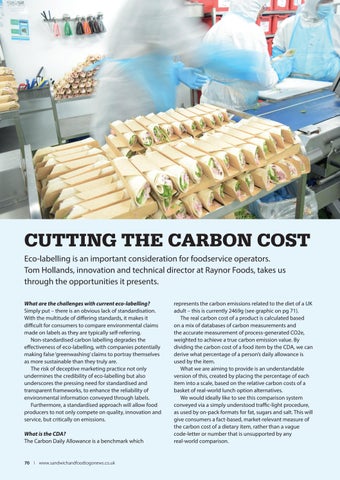
Pages 70-71. Cutting the carbon cost –Raynor Foods eco-labelling
REGULARS
Page 73. BSA new member
Page 74. New products
Page 75. BSA listing index


www.sandwich.org.uk I 3
Sandwiches, wraps, rolls and much more handcrafted fresh everyday using the finest ingredients. An extensive range for both retail and hospitality. Delivered nationwide. Call the team on 020 3058 1245 or email sales@aroundnoon.com to find out more. Handmade with pride WWW.SOHOSANDWICH.CO.UK
______________ _____________ ________ ________ _________________________________________
Welcome
NEWS
Welcome forecasts for the sector, a high-profile café partnership is announced, plus the Food to Go Conference 2024 unveils its latest speaker line-up.
Hospitality Passport can ‘revolutionise’ recruitment
At a Workforce and Skills event, UKHospitality has unveiled further detail of the Hospitality Skills Passport, enabling new employees to demonstrate completion of the universal entry standard. This will give employers confidence that they are competent across a wide variety of necessary skills.
It can be used at every level of the sector, from starters to experienced staff, and will further professionalise training and development in hospitality. The concept has been tested, in partnership with the Department for Work and Pensions, through five pilot schemes across England and Wales.
The four-week programmes are aimed at providing jobs in hospitality for the unemployed, offering work experience, compliance and customer service training, and a guaranteed opportunity to interview at the end of the course, where they also receive their Hospitality Skills Passport.
The success rate has been significant, with the pilot schemes seeing an 85% completion rate and 80% of those completing the course now employed in hospitality.
For the schemes and passport to be rolled out further, UKHospitality is asking for funding from the Adult Education Budget to be allocated to employment programmes such as this.
Kate Nicholls, chief executive of UKHospitality, said: “Hospitality’s
variety is undoubtedly one of its strengths, but when it comes to entering the sector to work, it can be one of its greatest challenges.
“There are multiple routes into hospitality and with more than 200 different qualifications on offer, getting started can be confusing and deter potential entrants. That’s why a universal entry standard has never been more important.
“The new Hospitality Skills Passport initiative that we’ve developed, which is backed by the sector and being piloted by government, does just that and can revolutionise the way we recruit, induct and develop people.
“Through the evolution of this passport, by offering one place where people can store and track their
qualifications, we can improve the lives of employers and employees. It will streamline onboarding, identify training needs and help develop skills quicker than ever before.
“I’m delighted we’ve been able to share more details about how the passport would work and its staggering success helping people back into work, as part of the pilot schemes to test the concept.
“We now need to roll this out on a wider scale. That inevitably requires funding and we’re encouraging the government to offer greater flexibility by allowing Adult Education Budget funds to be used for this type of employment programme, given the clear benefits it can offer the sector and the economy.”
4 I www.sandwichandfoodtogonews.co.uk
Stunning figures for bread market
Retailers and operators have an opportunity to tap into the £1.2bn rise in the UK bread market over the next two years, according to a new report from bakery supplier Délifrance.
The Prove It: Breaking Bread report predicts the UK’s £7.8bn bread market will grow by 15% to £9 billion by 2026.
It states that businesses can take a slice of this growth by embracing evolving trends such as:
● Specialty and world breads
● Products using clean-label and regeneratively farmed ingredients
● Bread that offers health benefits or caters to specialist diets
● The impact of smaller bakeries on the wider market
● Consumers’ response to the cost of living crisis.
These topics and many more are examined in the report, which has been compiled following a survey of 1000 UK adults who regularly eat bread, in and out of home.
It also makes use of Délifrance’s internal market estimates and


insight, external market data and the experience of Harris & Hayes, one of the UK’s most trusted food consultants and future forecasters.





“Our latest Prove It the trends shaping the category, from the continued growth of sourdough to the opportunities across the globe,” said Délifrance marketing director, Stéphanie Brillouet.


report looks at examine differs
“We also take a deep dive into consumer attitudes to bread and examine what drives purchasing decisions, how consumption differs in and out of home, and the impact of environmental and economic concerns.”
Among the findings are how well bread is weathering the economic crisis. With it seen as offering excellent value for money, more than a quarter of consumers cite a drop in their household budget as a reason for increasing in-home consumption of bread.
And despite the pressure on spending, quality remains key. More
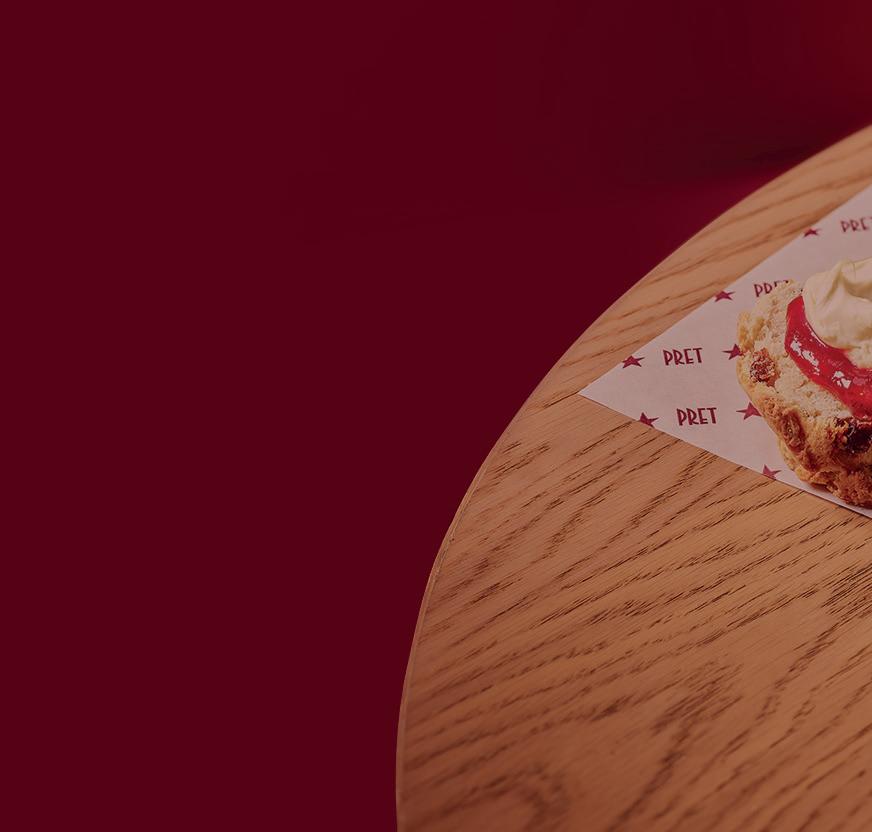
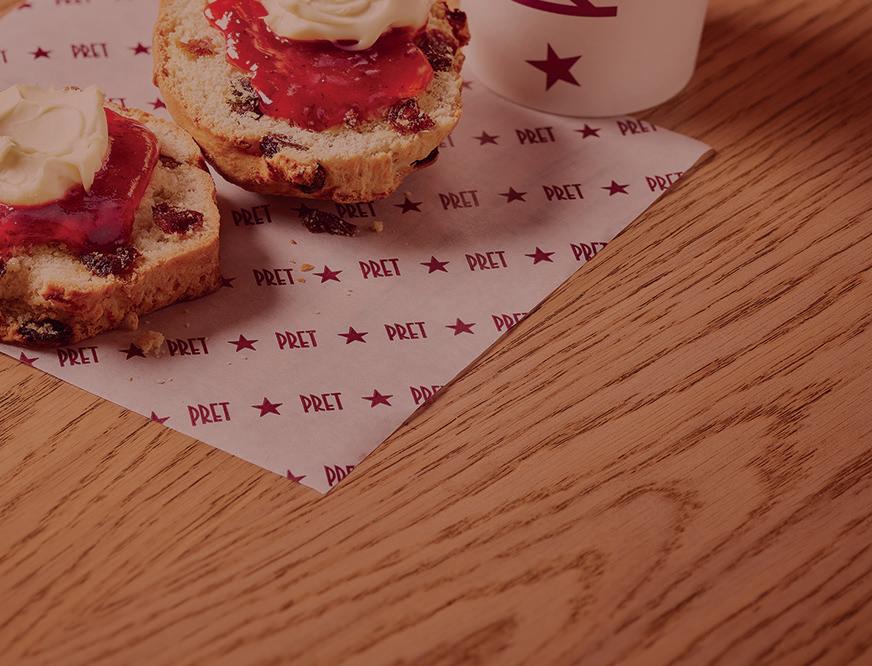
Pret A Manger has launched a freshly baked Fruit Scone. Initially in around 70 shops across the UK – including Harrogate, Orpington and Canterbury – Pret is planning to roll out the service to more shops later this year.
Initially made available in time for Mother’s Day, Pret’s new Fruit Scone is loaded with sultanas, with the optional accompaniment of Rodda’s Classic Cornish Clotted Cream and a mini jar of Bonne Maman Strawberry Conserve.
As part of Pret’s commitment to reducing food waste, the dough is cut into hexagons during the sconemaking process, ensuring minimal waste and maximum taste.
The scones are then glazed with free-range whole egg to give a distinctive shine, promising a crisp,

golden crust and delicate rise.
Katherine Bagshawe, UK food & coffee director at Pret, said: “We’re excited to launch Pret’s Fruit Scone, crafted with love, baked to perfection and served with a Pret smile.
than half of consumers (52%) say they base where they buy bread
than half of consumers (52%) say on the quality of products sold.

Additionally, these consumers are most likely to shop at independent bakeries and supermarket ISBs.
“It’s an exciting time for the bakery category,” said Harris & Hayes. “Shoppers are responding well to innovation, with regional specialties, snacking and occasion-led bakery representing a significant growth opportunity. Retailers and operators will benefit from offering considered ranges that cater to a plethora of differing needs and budgets.”
Fresh fruit scone on menu for Pret


“Made using high-quality ingredients and developed to have the perfect amount of crumble, the fruity sultana scones are a perfect afternoon tea treat. We felt it was the right time to bring back scones as we continue to expand our range for our shops outside of the city.”
Pret continues to evolve its counter menu and add in new products to cater to more customers.
Over the past few years, Pret has accelerated its regional expansion with franchise partners into areas outside London, including recent
openings in Bishop’s Stortford, Colchester and Worthing.
At the heart of Pret’s transformation has been a significant shift in the way the business serves customers, providing freshly made food and organic coffee through new digital and retail channels. Club Pret subscribers get 20% off the scones as part of their usual 20% discount on everything sold in-shop and up to five baristamade drinks per day.

www.sandwich.org.uk I 5
New café culture for Costa and Sainsbury’s
Costa Coffee, the Nation’s Favourite Coffee Shop*, and Sainsbury’s have announced a new café experience across the UK. It represents an expansion for Costa Coffee, as it unveils initial plans to open 11 stores within Sainsbury’s supermarkets throughout 2024.
The collaboration caters to the evolving preferences of supermarket customers. With an investment exceeding £3 million, the stores will boast a modern and inviting design.
The agreement is also set to create over 100 jobs. With training opportunities available for team members, the next generation of expert Costa Coffee Baristas will soon be in place in Sainsbury’s supermarkets.
Nick Ridley, property director at Costa Coffee, said: “We are excited to join forces with Sainsbury’s, bringing our much-loved Costa Coffee experiences to shoppers nationwide. We’re proud that we will soon be able to make a difference to customers looking to catch up with friends and family over lunch or enjoy a beloved Costa coffee after their weekly shop.”
It is the latest step in a strong relationship between the two companies. Alongside its Ready to Drink and At Home
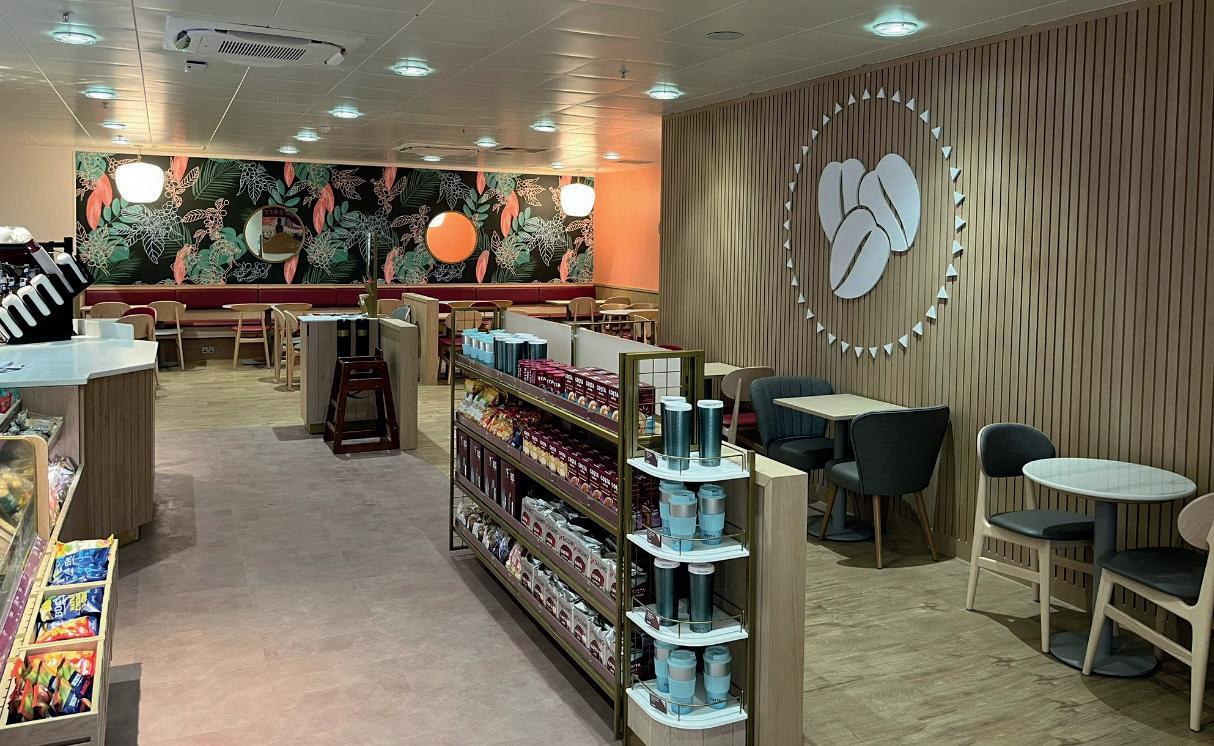
ranges, Costa Coffee already has over 1000 Costa Express machines in Sainsbury’s stores and petrol stations, selling 10 million cups of coffee in 2023 alone.
Richard Crampton, Sainsbury’s director of fresh food, said: “We know that customers like the convenience of being able to stop for a drink, snack or sit-down lunch while shopping, and we think that Costa Coffee stores will offer a fantastic opportunity to do this within Sainsbury’s supermarkets. That’s why we’re delighted to be building on our existing collaboration with Costa Coffee to roll out this fantastic new option for customers over the next year and we’re looking forward to hearing what they think.”
Sainsbury’s Farlington Superstore in Portsmouth is home to the supermarket’s inaugural Costa Coffee store, which opened its doors in February 2024, creating nine new job roles.
*Allegra Strategies, 2023
Uncover a Williams Refrigeration Gem
With the release of the latest versions of its Gem Multideck range, Williams Refrigeration is highlighting the advances it has made in the range of customisation options that allow operators to perfect the look of their display.
Williams Multidecks are designed to maximise available display area and performance while delivering cost savings through energy efficient operation. This is achieved by combining technical know-how with a keen understanding of what makes a great looking display. The Multideck’s operating temperature range is from +3°C to +5°C – ideal for chilled grab-and-go foods.
The Gem range can be customised to suit a range of applications. Options include additional LED strip lights, inset within the ticket holders, which enhance the
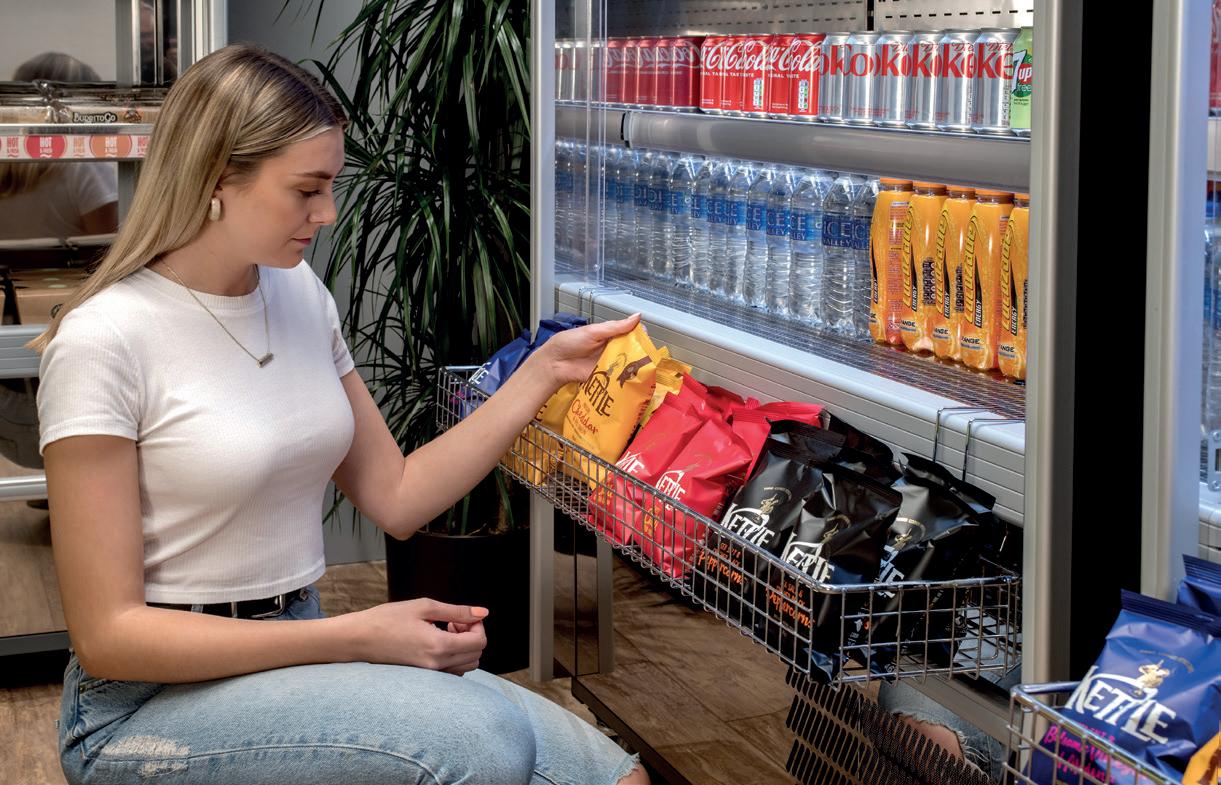
display while using little energy and generating minimal heat. There are also night blinds, security shutters, front doors (sliding or hinged), rear loading doors for easy restocking, impulse snack selection baskets for added merchandising potential, food tray slides, glass shelves and mirrored panels, all of which can be specified to customer requirements. There’s also the option of remote refrigeration and the ability to multiplex units.
Williams Multidecks can be customised to match existing décor. A wide selection of colour combinations is possible, and the Gem Multideck range is compatible with Williams’ Chameleon vinyl wrapping system – which means the specifier can create a merchandiser that can look like it’s a piece of art, or made of bricks, or wooden for example.
Energy efficiency is crucial, with rising costs and a focus on environmental sustainability. The Gems use natural hydrocarbon refrigerant which reduces energy consumption thanks to its thermodynamic properties, with low GWP (Global Warming Potential) and zero ODP (Ozone Depletion Potential).
While the latest open-fronted models from Williams use a variety of clever features to minimise power consumption, units with doors can deliver further improvements.
Visit williams-refrigeration.co.uk.
NEWS
Fri-Jado get Space Saver lift-off
The all-new Space Saver from Fri-Jado is the world’s first rotisserie with a heated self-service display cabinet, helping to simplify any hot food offering.
Versatility and flexibility are central to the Space Saver, with the rotisserie giving operators the opportunity to expand menus beyond traditional options. It can be used for a diverse range of dishes, including alterative roasted meats such as pork joints, as well as vegetarian and even dessert options.
The Space Saver combines the latest roasting and holding technology in one compact unit. With key functions in a single footprint of just 1m2, it maximises floor space and simplifies in-store operation.
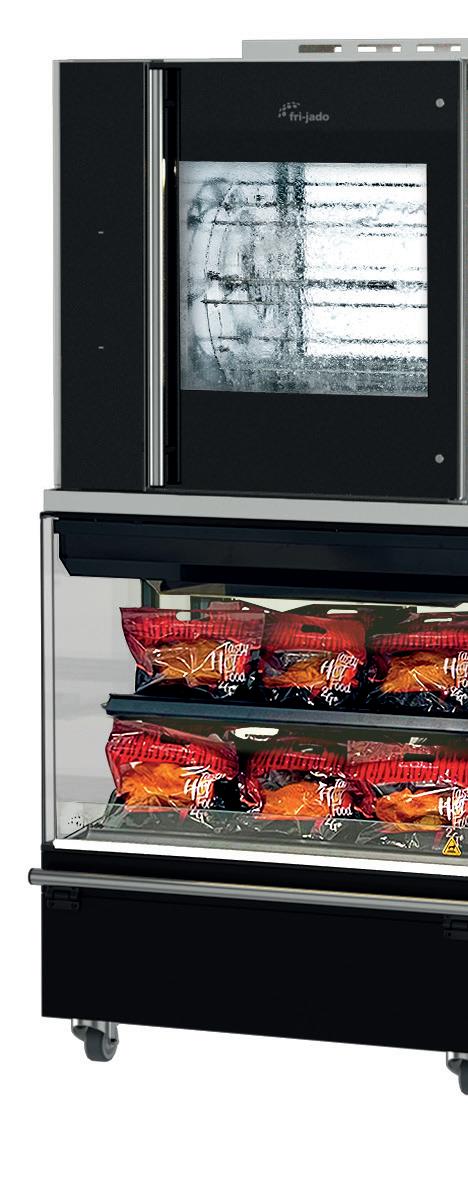
The unit also features exceptional thermal performance and incorporates ‘Hot Blanket Technology’, delivering up to 50% energy savings versus previous units, as well as precision temperature control variable by shelf, to ensure food is held at the best temperature for longer. LED lighting showcases the contents.
Alternatively, the Space Saver Premium features all the above industry-leading functionality but adds the TDR 5 S auto-clean rotisserie unit. This includes an integrated drain pump and grease tray alongside all necessary internal connections and piping, as well as the ability to restock the unit from the rear (exclusive to the Space Saver Premium). Rear load capacity improves restocking and unit management, as well as helping create seamless inoperation performance and ensures nothing disrupts the visual showpiece of the hot food being roasted and held.
For added convenience, the unit doesn’t require a wastewater connection and can be easily drained into an optional wastewater trolley. All cleaning can be pre-programmed to take place overnight, minimising downtime.
Developed in line with user feedback and with simple, intuitive controls, the rotisserie units can be operated by any member of the team using pre-set programmes. The design features double-pane glass on each side for maximum visibility and heat retention.
Gary Thacker, Fri-Jado sales director, said: “Consumers eat with their eyes more and more these days. From Instagram food influencers to TikTok trends, at Fri-Jado we know that food needs to be the core focus of everything we do. The new Space Saver unit truly maximises all these values in a single compact unit – creating genuine in-store theatre, encouraging aromas and helping boost sales.
“Our team has also worked tirelessly to ensure that these are some of our more energy-efficient appliances ever, recirculating the existing hot air to ensure much reduced
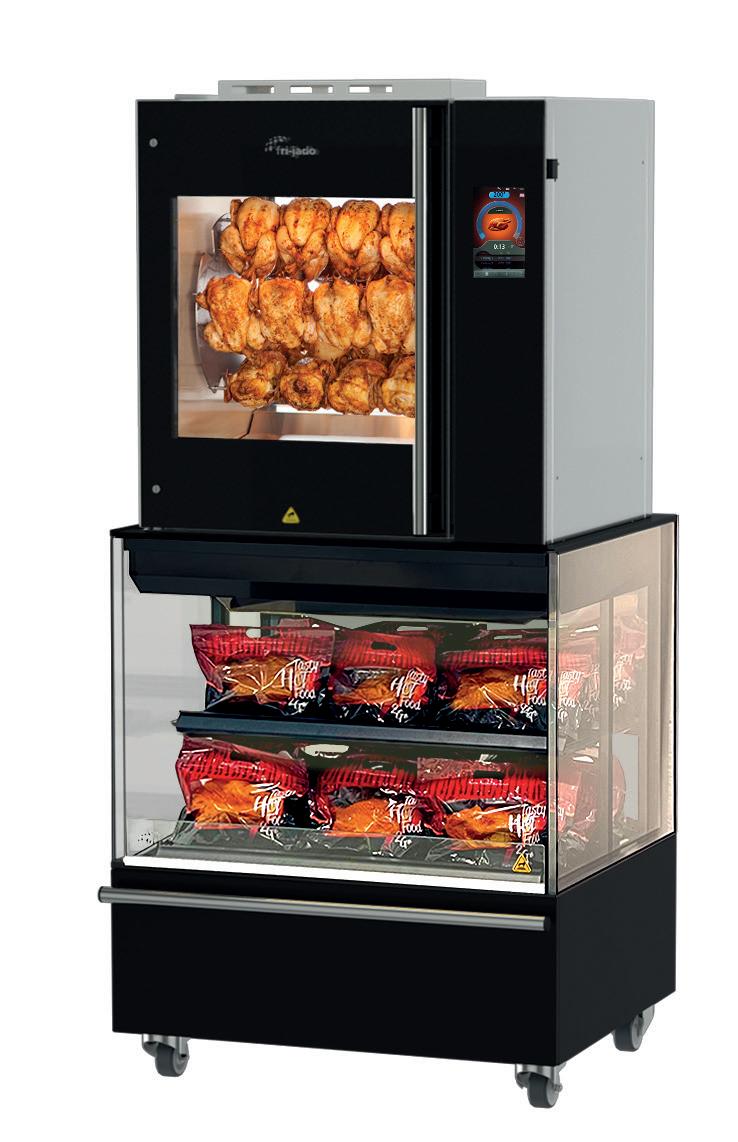

energy consumption, helping reduce costs and minimising the operator’s environmental impact. The Space Saver range is a feat of innovative engineering delivering the opportunity to any store or outlet nationwide to offer fresh and delicious rotisserie cuisine with simplicity, convenience and performance.”
For more details, visit frijado.com.

















www.sandwich.org.uk I 7 220 0 20 F M C G F O O D D R I N K
Strong sales numbers for Coffee#1
Coffee#1 has announced continued strong trading for the first half of the financial year (Jun-Nov 2023), with sales of £29.5 million, representing total growth of 18.8%.
Coffee#1’s like-for-like sales performance for the same period remained robust at 8%, underpinned by sustained customer growth of 1.2%.
Founded in 2001 and now operating across Wales, the Southwest, the South Coast and parts of the Midlands, Coffee#1 also opened four stores during the same period, taking the estate to118, making it the fourth-largest coffee shop brand in the UK. Sites in Godalming and Chesterfield expanded its operating footprint, while openings in Yate and Cwmbran strengthened the existing operating area.
At the start of the second half of the financial year, Coffee#1 experienced particularly strong Christmas trading. It had record sales levels peaking at £1.37m during the week of 18 Dec, with nearly 300,000 customers. The store opening programme has also continued, with Derby in December and Fleet in January, and four further openings forecast this financial year, creating 35 new jobs.
The brand now operates 118 stores with over 1000 employees and a customer base that regularly exceeds 250,000 people per week. Despite inflationary pressures, the business remains committed to job creation and store growth with stores
"I've been delighted to see the recovery of the business."
in Westbourne and Loughborough currently under construction.
Coffee#1 also relaunched the store manager development programme during the first half of the year, with 25 existing assistant managers joining, with eight succeeding into their first management roles with the company.
Coffee#1 managing director, Bruce Newman, said: “Once again, we are indebted to our store and support teams. They have put in the hard work required to deliver excellent results. It takes first-class service and great teamwork, along with an outstanding menu, for our customers
New appointments at Fairfields Farm
UK crisp producer, Fairfields Farm, has announced the appointment of David Nairn as non-executive director. Having formerly served as managing director of Burts Snacks, Nairn will be supporting the executive team. This news aligns with Fairfields Farm’s growth ambitions, which saw business turnover grow by 56% between 2022 and 2023.
Nairn said: “I have been working in the snack category for a long time and certainly admired Fairfields Farm from afar. It’s a good, solid business with an exciting strategy and strong core values. I look forward to helping the business reach new heights.”
Tash Jones will join the board having been promoted from head of marketing & NPD to commercial director. In her new role, Jones will oversee sales and marketing.
With previous experience at Kettle Chips, Jones first joined the Fairfields Farm team in April 2021. “I’ve been a fan of the brand and business for the longest time, so it’s an absolute honour to be given the opportunity to lead a talented sales and marketing team and continue our work of providing a fantastic service to customers,” said Jones.
Co-founder, Robert Strathern, added: “I’d like to welcome David to
to want to come back time and time again. It’s been fantastic to witness that happening and see so many employees progressing their careers.”
Coffee#1 also reported annual results for the last financial year, ending May 2023 (FY23). Sales increased to £53.8m, a rise of 22%, with EBITDA of £7.0m. FY23 also saw strong store growth with 11 added to the estate, creating 110 jobs.
Coffee#1 expanded its presence in the delivery market, adding Uber Eats to an established partnership with Just Eat. Delivery was available from a total of 83 stores of the 112 trading at the end of the financial year.
Iced coffee is continuing to establish itself as a growth driver. Sales of cold coffee grew to four times the size of pre-Covid levels. Concurrently, Coffee#1’s food categories performed well, with sales growth of 17.5% and more customers ‘attaching’ a food item to a drink sale than in any prior year.
Newman continued: “I have been delighted to see the recovery of the business after the pandemic, with new programmes of learning & development landing and the resurgence of energy and culture which is so important to our brand.”

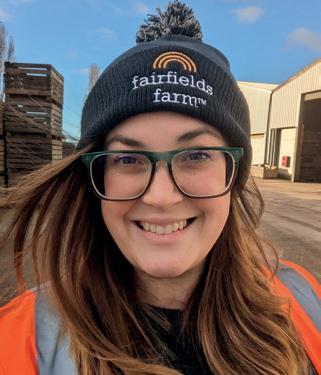
the team, and I’m confident that his considerable experience and expertise will help us to achieve our growth goals here at Fairfields Farm.
“I equally would like to congratulate Tash. The board has big ideas and plans, and Tash has already proven herself to be an asset. She will play a key role in helping us develop the business, particularly at a time when we are accelerating at a rapid pace.”
NEWS 8 I www.sandwichandfoodtogonews.co.uk
Sell more. Waste less.
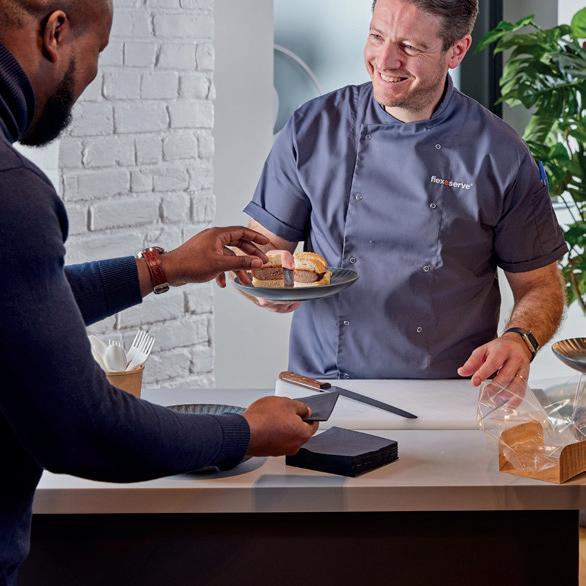
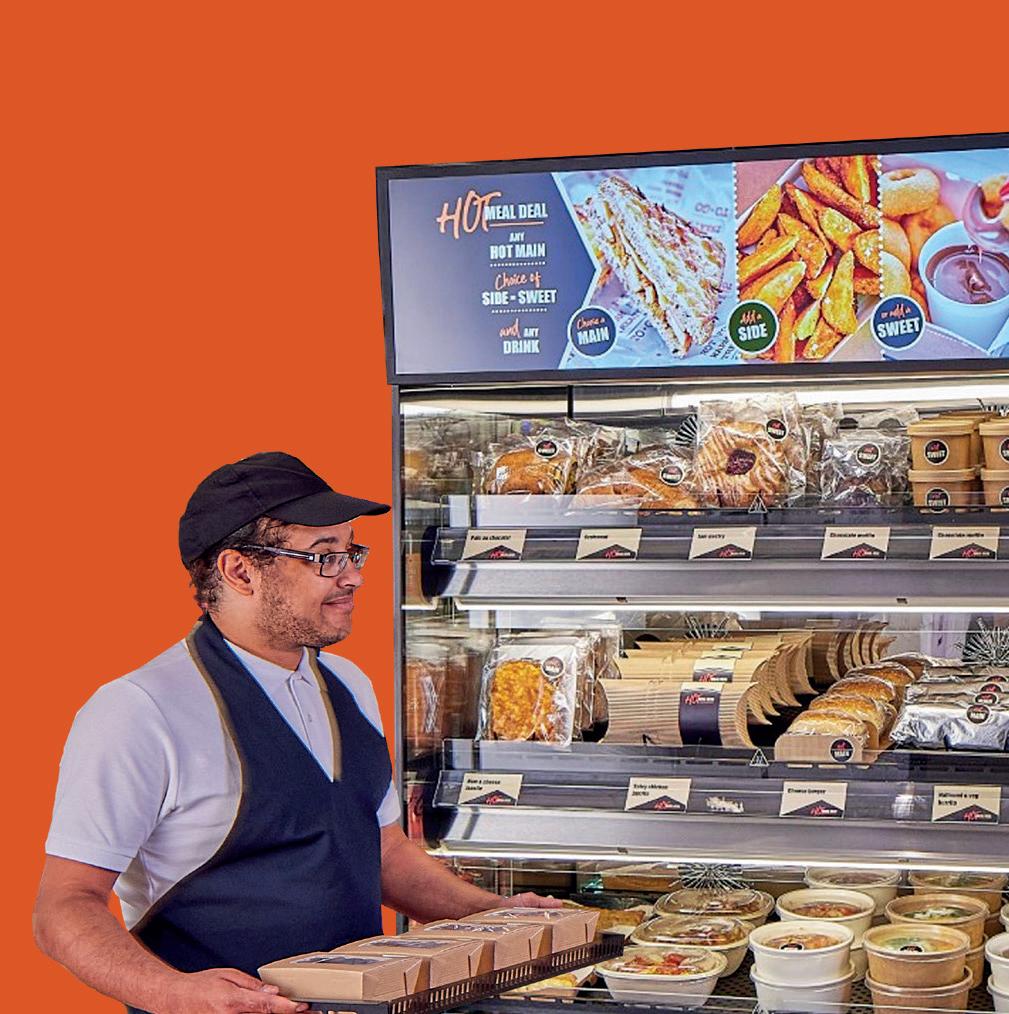
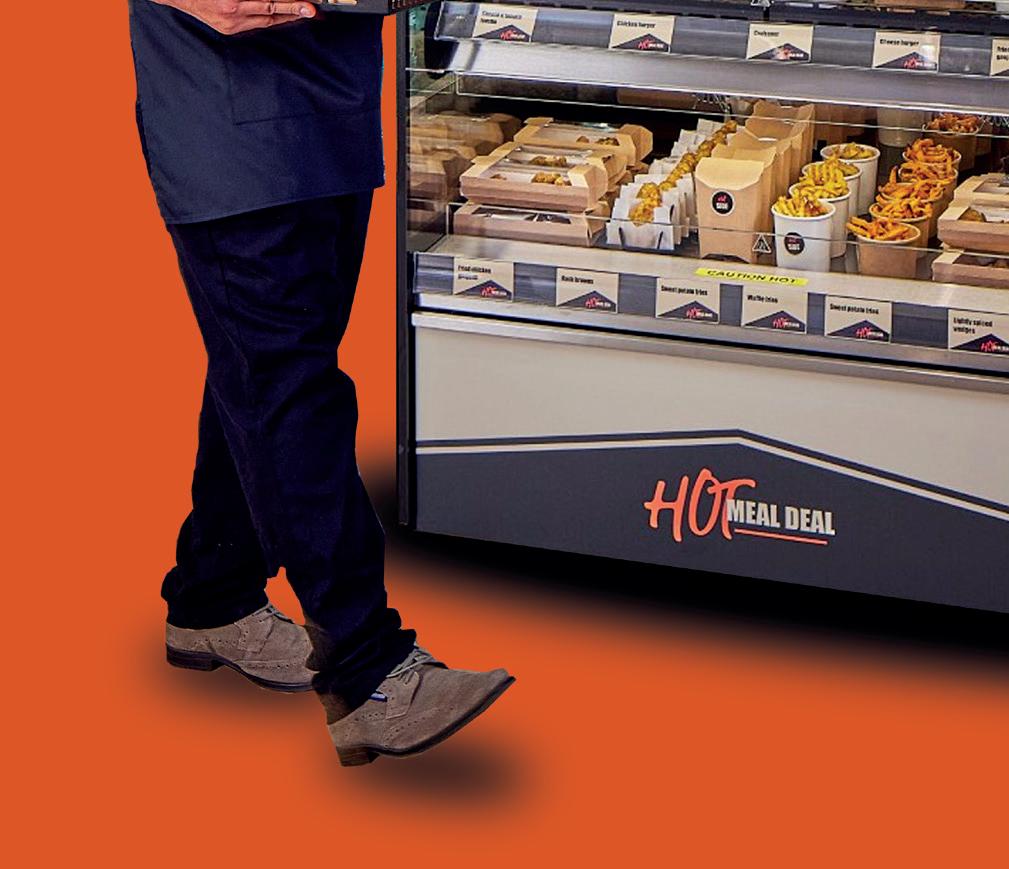
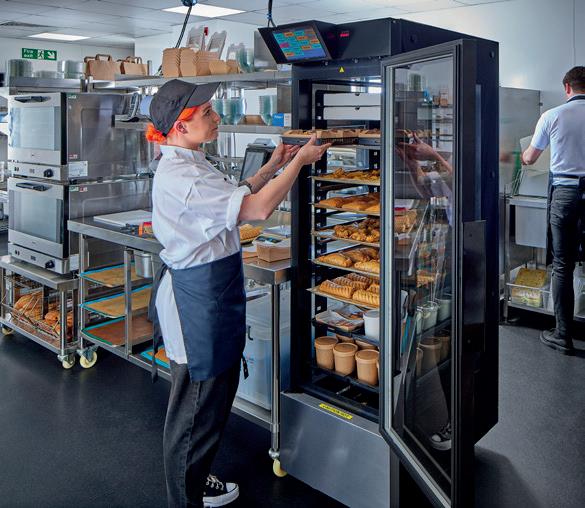
Unleash your hot food-to-go menu with Flexeserve.
Offer your customers a wider range of hot food-to-go only with our unique technology.
Hold your products at optimum quality for longer, saving costs and reducing waste.
Minimise demand on busy kitchens whilst consistently delivering high-quality meals that your customers.
Now you can control your estate with cloud connectivity, ensuring total operational efficiency like never before.
Scan here to connect with our hot food experts.





NEWS www.sandwich.org.uk I 9
New Food to Go Award Sponsor
2024

Nutrition Progress Update makes debut for KFC
KFC UK&I has unveiled its first ever Nutrition Progress Update, which tracks the progress it has made on nutrition across its menu, aiming to increase transparency for consumers and the wider industry.
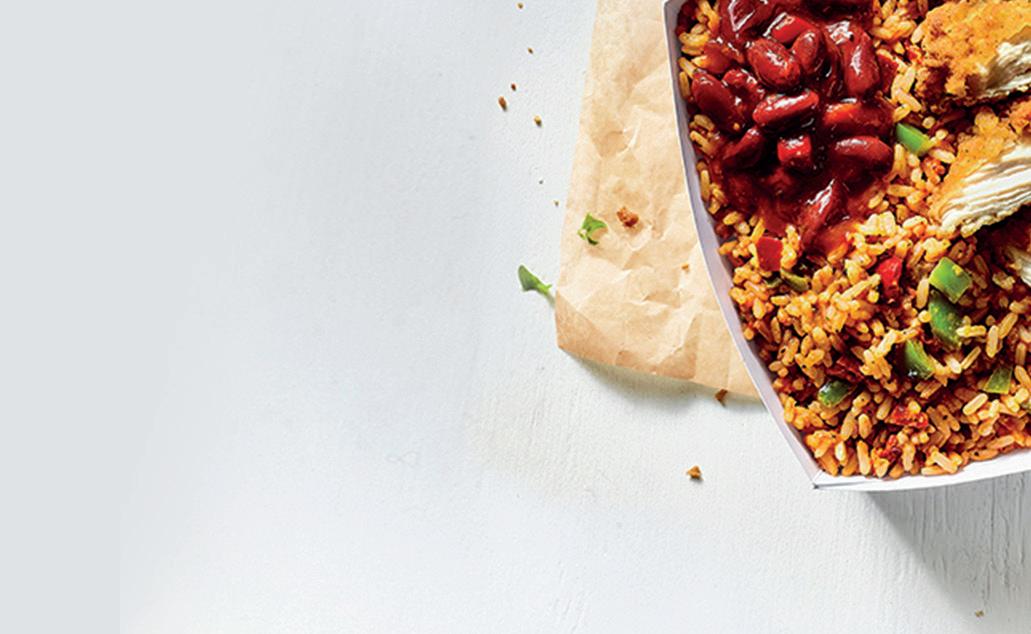
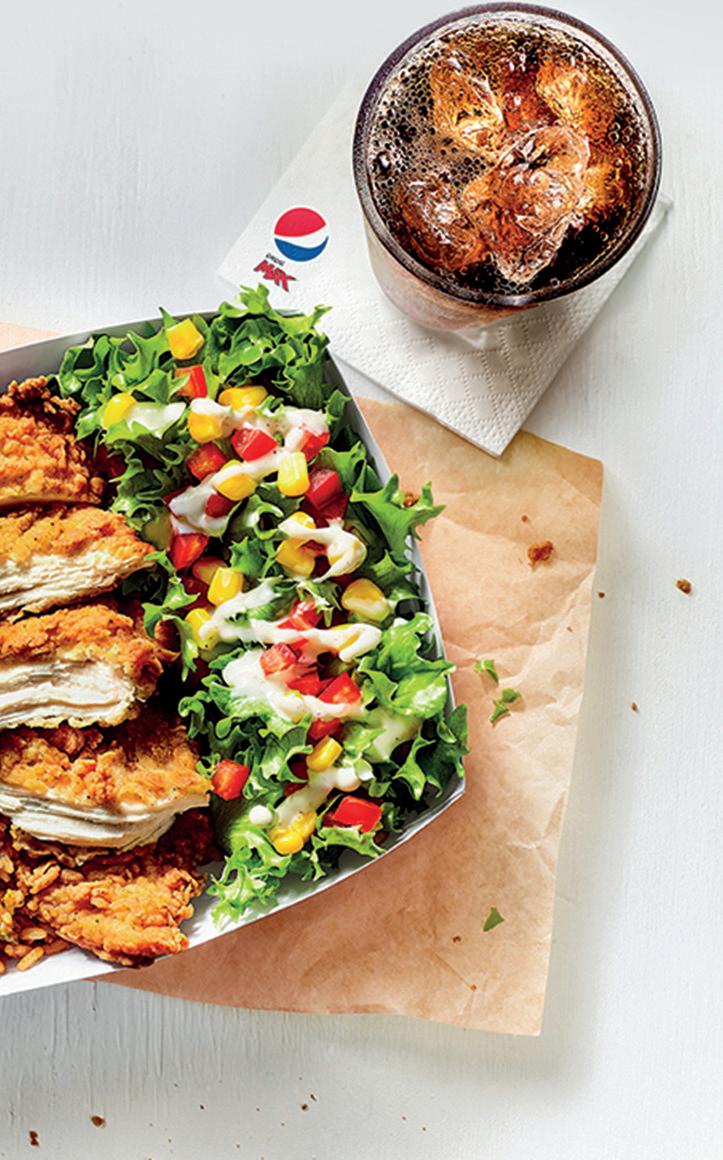
It sets out key steps KFC has taken on its nutrition journey. Progress includes reformulating KFC fries, which removed around 13 billion calories a year, and removing fullsugar Pepsi from its menu in England, which amounted to the removal of around eight billion calories a year. KFC has also been building out its range of 500 kcal or less options with Riceboxes, Salads and Twister Wraps.
Last year, KFC joined with youth activist movement Bite Back, whose Food Systems Accelerator Programme sees young people partnered with industry to identify, develop and deliver solutions on how to make healthy food more desirable, accessible and affordable. Through this, KFC UK&I has started its first set of behavioural intervention trials, designed to help understand what encourages customers towards healthier options, specifically at lunch.
This first Progress Update marks a key step in KFC’s ambition to be open and honest about its nutritional journey, recognising the role that KFC has to play in helping more people have access to nutritious food.
KFC has worked with partners to develop a number of 2025 ambitions. These include:
● Increase the number of non-HFSS items to 70% of the total menu through a combination of product innovation and reformulation of current items.
● Develop a sales-based target for the amount of HFSS and nonHFSS menu items sold, working alongside external partners to shape the metrics.
● Increase the percentage of menu items that meet PHE nutrient guidelines by 10%.
● Provide food education programmes in five cities for 500 young people through the KFC Youth Foundation.
Meg Farren, general manager, KFC, said: “We know it’s our great quality, finger lickin’ chicken that means people love KFC, but we also recognise that we have an important role to play in helping more people have access to nutritious food. We have made a start, but the fact of the matter is we’re not yet where we want to be on nutrition. That’s why we’ve decided to disclose our progress

and plans through our new annual Nutrition Progress Updates.
“While we’ll never stop providing fried chicken across menus, behind the scenes we’re continuing work on making sure any trip to KFC offers great quality, fresh, nutritious options, at great value for customers. By being open and transparent about the action we are taking, we hope we can bring others on this journey with us.”
Professor Richard Crisp said: “Making balanced, healthy choices around what we eat is something to which we all aspire. Intervention trials that measure the efficacy of different behavioural nudges are critical –they allow us to make data-driven decisions about which approaches work well, or not so well, in any given context. KFC understands this, and their science informed/data driven approach to this endeavour will help them fine-tune the way in which they present their healthier options through multiple channels, and in so doing, enable, enhance and empower their customers’ decision-making.”
Ambitions for 2025 that KFC UK&I is setting out have been developed in partnership with academics, nutritional experts and campaign groups. KFC will be comparing its menu items against the UK Nutrient Profiling Model 2004/2005, which is used by the government, to categorise nutritional value and define foods that are HFSS.
Four pillars have been identified that have the most impact on the nutritional value of its offer: menu innovation, reformulation, partnerships and nutritional information.
NEWS 10 I www.sandwichandfoodtogonews.co.uk











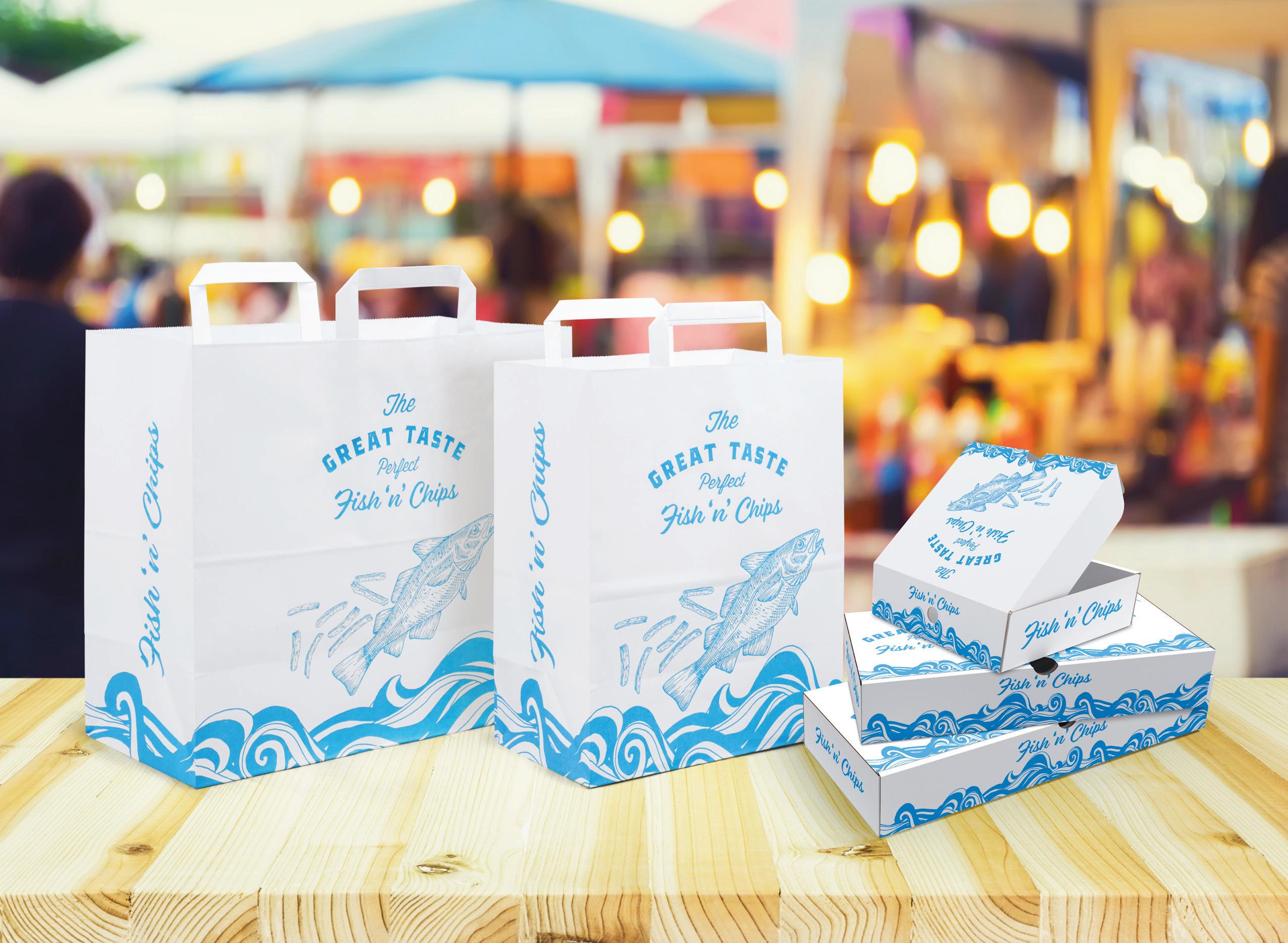



H-Pack Packaging has launched a ‘Great Taste’ range, aimed at the higher end of the fish and chip takeaway market.
The new line of packaging includes a series of small, medium, and large paper boxes and small and large paper bags – all boasting the same vibrant and eye-catching design.
With the complete range providing an opportunity for sellers to supply a more considered, identifiable offering, that appears unique to the individual food to go outlet, ‘Great Taste’ gives packaging a badge of quality that guarantees your food offering will stand out.



















www.sandwich.org.uk I 11 For further information on our ‘Great Taste’ range Call: 01978 855 595 sales@h-packglobal.com www.h-packglobal.com
For the discerning customer…
Do your fish ‘n’ chips have
Taste?
Great
The Great Taste trades under H-Pack
Optimism high for FTG: Lumina
Fresh insights from Lumina Intelligence reveal a bright picture for FTG, with an increased focus on healthier options.
The UK FTG market is forecast to grow +3.5% to a value of £23 billion in 2024F, outpacing pre-pandemic value by +9.3%. This is ahead of the total eating out market and inflation, indicating growth from stronger volumes following a weaker 2023.
Strong net space growth (0.7% to 152,783 outlets) is forecast, driven by
the expansion of a variety of formats and locations, including travel hub, drive-thru and kiosk-style services.
Market growth was +8% in 2023, although cost of living pressures did have an effect. Penetration recovery from 2021-2023 was stronger in the total eating out market versus FTG.
FTG has been restricted by a slow return to travel, strike action and continued hybrid working, with financial strain prompting changes in spending habits. The most notable impact has been lower income families dropping out of lunch occasions, with declines in share focused on Wednesdays and Thursdays.
Convenience store grab and go has achieved FTG growth versus preCovid, driven by investment in ranges and value. Value growth is expected to have been +17.4% from 2019-2024F. The introduction of tiered meal deal ranges has allowed grocery operators
to avoid hiking costs of meal deals, while introducing more premium and foodservice-standard ranges.
Demands for nuanced health and premium quality are driving development. Most new products surveyed were aligned with healthier eating, carrying price points of +£4. Vegan, high protein and high fibre all gained share year-on-year. Gut health and immune system-boosting products were new to ranges in 2024.
Easing economic tailwinds, boosted tourism/travel and record employment is expected to result in a market value of £25 billion in 2027F. Average earnings outpacing inflation, with interest rate reductions, are forecast to bolster spending power. Greater emergence of nutrient dense, high quality and specialised options, with continued outlet expansion, should drive FTG market growth of +£2bn from 2024F-2027F.
All systems growth for Greggs
Greggs’ preliminary results for the 52 weeks ended 30 December 2023 reveal market share at an all-time high.
Total sales were up 19.6% on 2022, with like-for-like (LFL) sales in company-managed shops up 13.7% year-on-year.
The share of FTG breakfast visits increased to 19.6%, taking Greggs to number one in the market.
Underlying profit before tax, excluding exceptional income, was up 13.1% to £167.7 million (2022: £148.3m) for the UK’s leading food to go brand (YouGov’s Brand Index).
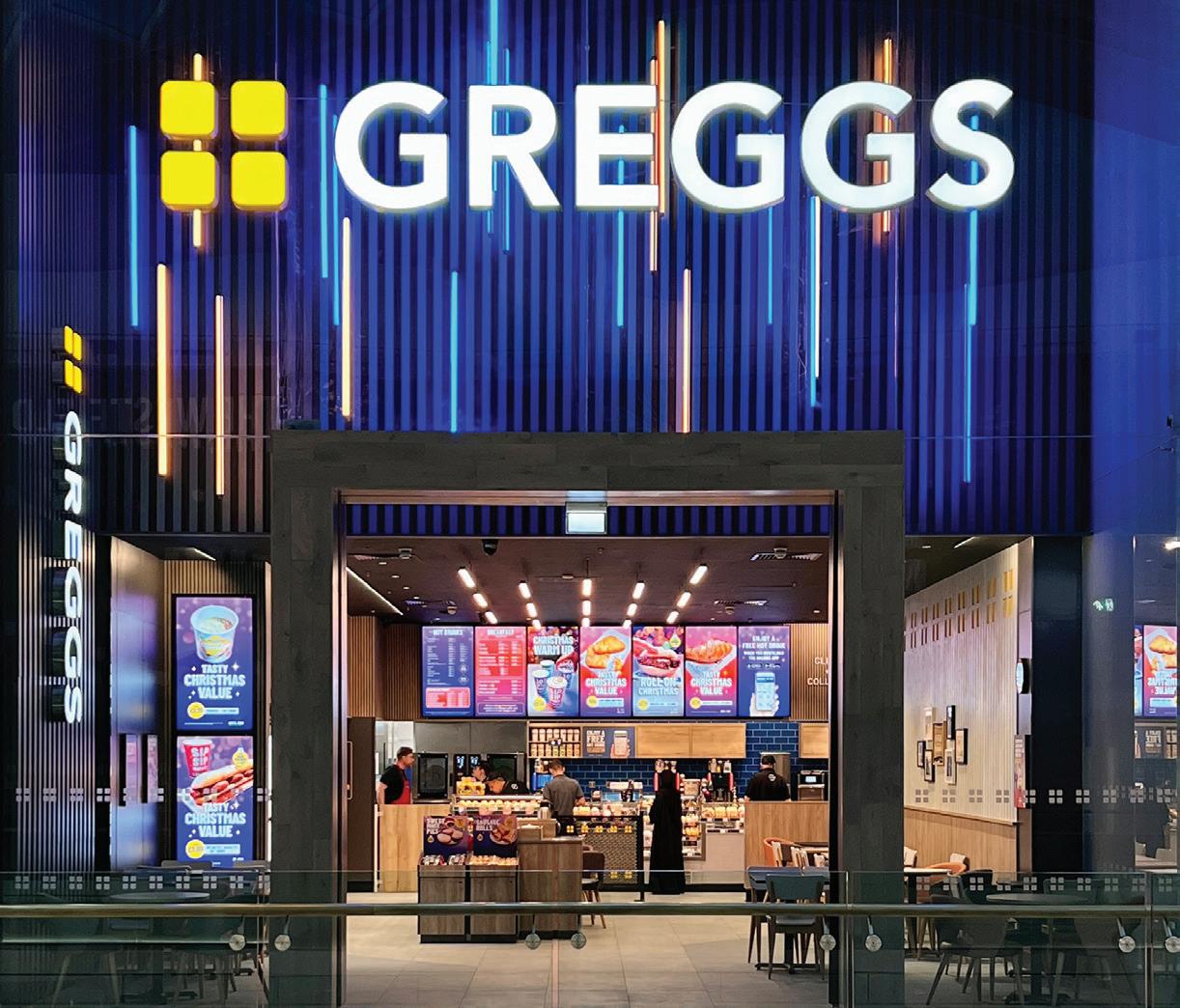
There were a record 220 new shop openings in 2023 and 75 closures, growing the estate to 2473 shops. Expanded partnerships with retailers included Primark, Tesco and Sainsbury’s, while London presence was extended –including new shops in Canary Wharf and Waterloo railway stations and Gatwick Airport. With a target of 160 net openings in 2024, there is a significant opportunity for more than 3000 shops over the longer term.
The evening is proving the fastest-growing day part, with 8.7% of company-managed shop sales in H2. Existing ranges proving most popular include the hot chicken goujons, potato wedges and pizzas. In terms of digital channels, delivery reach has been extended, with availability on Just Eat (1340 shops) and Uber Eats (930 shops) platforms. – sales up 23.6% in 2023. The Greggs app was scanned in 12.5% of shop transactions.
Greggs has also started 2024 positively, with LFL sales up 8.2% in the first nine weeks. Chief executive, Roisin Currie, said: “I am so proud of how our teams have risen to the challenge of serving more customers through more channels. They made sure that we kept pace with increased demand, as we delivered on our strategic growth plan. We are very much on track to deliver our bold five-year growth plan to double sales by 2026 and have significantly more than 3000 shops in the UK over the longer term.”
NEWS
Food to Go Conference 2024speakers & programme update
First speakers have been announced for the latest addition to the sandwich industry calendar, the Food to Go Conference 2024.
Organised with the support of the British Sandwich & Food to Go Association, the inaugural event is taking place on Thursday, 27 June 2024, at London venue One Birdcage Walk. Delegates can expect to enjoy presentations from leading industry heavyweights covering crucial topics affecting the sector. These include:
The ever-changing FTG market:
● Simon Stenning, strategy advisor and futurist
● Nicola Knight, Institute of Grocery Distribution
● Gavin Rothwell, Food Future Insights.
Working towards a sustainable future:
● Andy Cato/George Lamb, Wildfarmed
● Fran Haydock, Greencore
● Joanne Elsdon/Paul Rhodes, Greggs.
Facing up to the challenges of delivery – with industry expert, Peter Backman.
The case for switching away from bar codes – with GS1's Camilla Young.
DISCUSSION
Each themed session will conclude with a discussion forum, where speakers will be able to explore some of the points they have raised.
SPONSORSHIP
If you are interested in supporting the Food to Go Conference 2024 as a sponsor, get in touch with Sandra Bennett on 01291 636348 or by email to sandra@jandmgroup.co.uk.
In the meantime, keep an eye on the events page of the BSA website at sandwich.org.uk/events.

Discovery Day gives bakeries a taste of Food Works
A Discovery Day held at North Somerset’s The Food WorksSW proved a big hit with bakery businesses looking to find out about the innovation centre’s specialist kitchens and state-of-the-art facilities, while hearing from guest speakers.
Over 50 people attended the free event, which included a session aimed at bakery products. Guest speaker Chris Giddings, commercial director of Cakesmiths, shared industry insights and advice. In addition, Butcombe Brewery’s development chef, Jasper Prickett, spoke about how the hospitality business benefits from hiring out the bakery and commercial kitchens at The Food WorksSW.
The session included a kitchen
demonstration from the centre’s in-house technical experts, Zoe Plant and Rachel Goff, who showcased the specialist equipment and highlighted the technical advice they offer the sector. One-to-one business support with Simon Gregory, senior strategy and commercial manager at the Food and Drink Forum, was also available to visiting business owners.
Giddings said: “When Cakesmiths was smaller, we'd have loved a facility like this. It would have provided the perfect place to develop our cakes, particularly because we didn’t have a big new product development team. I’ve no doubt the support of The Food WorksSW would have allowed us to create great products.”
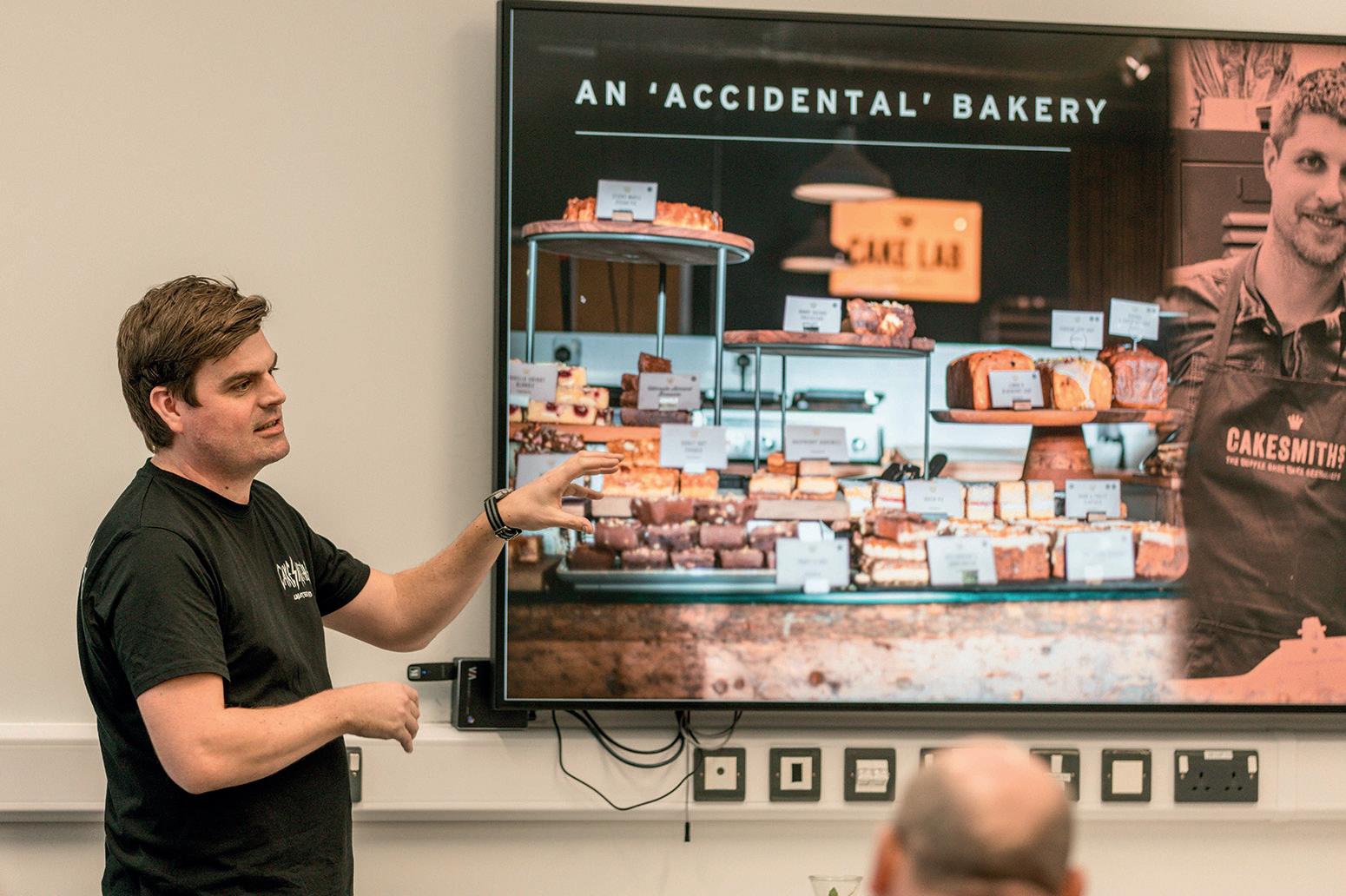
Jasper Prickett is a regular at Food WorksSW. He brings chefs from Butcombe’s collection of pubs and inns to the centre for training and to develop menus. He said: “One of the main reasons I hire the facilities here is so that I don’t get
in the way of our chefs in their busy working pub kitchens. Unlike other brands, we don’t have a dedicated development kitchen, so Food Works solves our problem.”
Zoe Plant, innovation and new product development manager at The Food WorksSW added: “It’s been fantastic to meet so many new businesses and show them what we can offer. The response to our Discovery Day has been extremely positive and we’re very grateful to all our guest speakers.”
Since its opening in October 2021, The Food Works has helped over 200 businesses. New products such as gelato, water kefir, vegan cheese, chilli sauces, high-protein cookies and frozen ready meals are just some of the products that have been developed in its kitchens.
Five product development kitchens are available for flexible short-term contract hire – prices start from just £100 per day (inc VAT).
For more info, visit foodworks-sw.co.uk.
www.sandwich.org.uk I 13


The place to be…


COME ONE, COME ALL
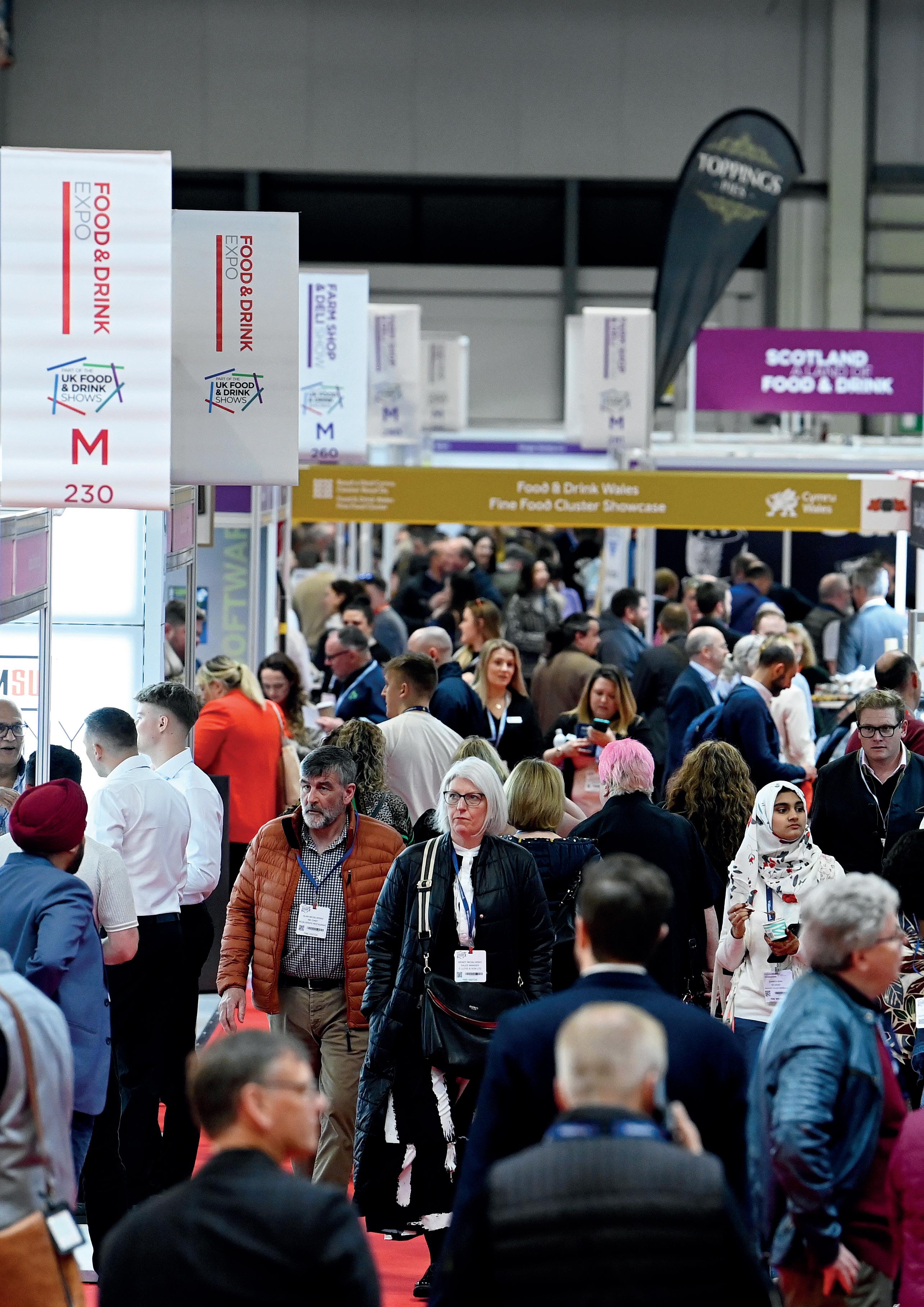
Food & Drink Expo is a festival of grocery, foodservice, manufacturing and speciality retail, offering food to go operators unique insight into the sector across three days.
When doors open (29 Apr-1 May, NEC Birmingham), the show will provide visitors with the most direct route to the UK food & drink market, bringing together the very best in product innovation, business advice and operational insight.
With over 1200 exhibitors confirmed, visitors can expect an unparalleled range of products and services, as big name exhibitors, small scale innovators and technical solutions fill the show floor. Exciting product launches come from:
● La Lorraine Bakery (Stand Z241), whose Topped Flatbreads come in four flavours and allow operators to offer warm premium snacks in just 7-9 minutes.
● One Good Thing (Stand V219) who offer wrapper-free snack and protein bars with a 100% natural edible coating.
● Novameat (FF210), offering a range of meat-free products including Deli Nova-t*rkey, which is ideal as a deli meat in a sandwich but can also be served hot for a bacon-like experience.
● Westfalia Fruit (X238), whose Smashed Avocado is never frozen and has a category leading shelflife thanks to an innovative high pressure processing system.
● devOATed (DD229), showcasing the UK’s first rich and indulgent oatshakes, made using 100% British oats.
After their inaugural success in 2023, two exclusive zones are set to return to Food & Drink Expo for 2024. Healthy & Natural zone will include a range of healthy, wellness and natural products encompassing free-from, vegetarian,












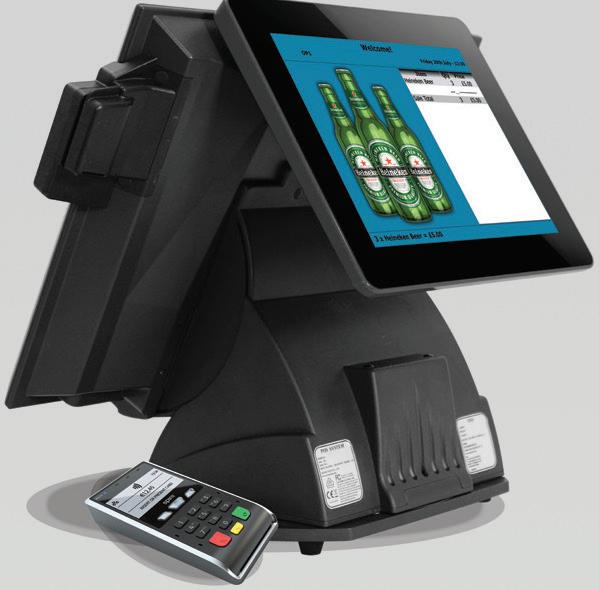







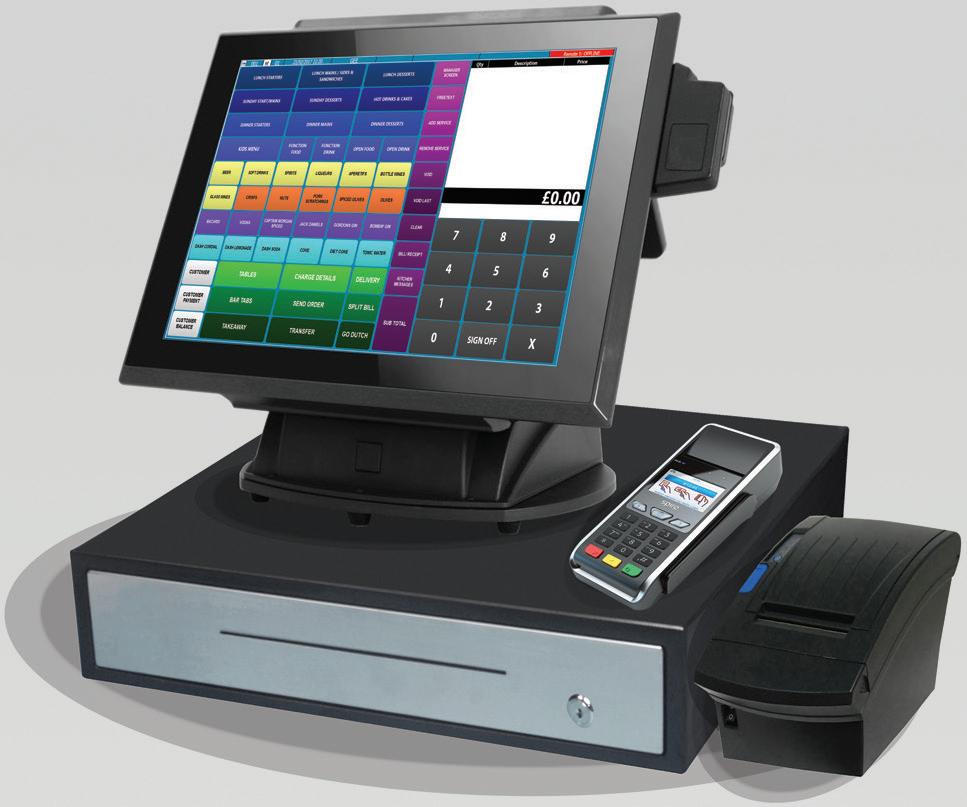






www.sandwich.org.uk I 15 YOUR EDGE IN PAYMENT & BUSINESS MANAGEMENT powered by ces software sales@3rtelecom.co.uk 01992 574 650 www.3rtelecom.co.uk *T&Cs Apply. Rates are subject to change. - Durable touch screen EPoS with optional extras - Bespoke screen customisation, the way you want it - Integrated with contactless payment and mobile top-up - Standalone debit/ credit card payment facility available - Support for hardware/ software/ back-up available - UK based customer support, 24/7 365 days - Finance options available (subject to credit approval) BEST RATES GUARANTEE 0.290% Per Transaction* From 0.699% Per Transaction* From

low-calorie and organic items, to name just a few.
Exhibiting in this zone are suppliers including Clearspring (S259), whose humble beginnings of Japanese miso soup haven’t stopped them becoming pioneers of authentic specialities with over 300 organic products today. And Truede & Peng (V278), who offer authentic Turkish snacks, including a range of roasted chickpeas.
Plant-Based Zone will also be making a comeback, with everyone’s
favourite vegan and plantbased exhibitors showcasing the future of this ever-growing sector. Those exhibiting include Buttermilk (CC231), Glebe Farm Foods (CC228) and Suma Wholefoods (CC210), whose products include Suma Vegan Chick’n Soup.
TALKING HEADS
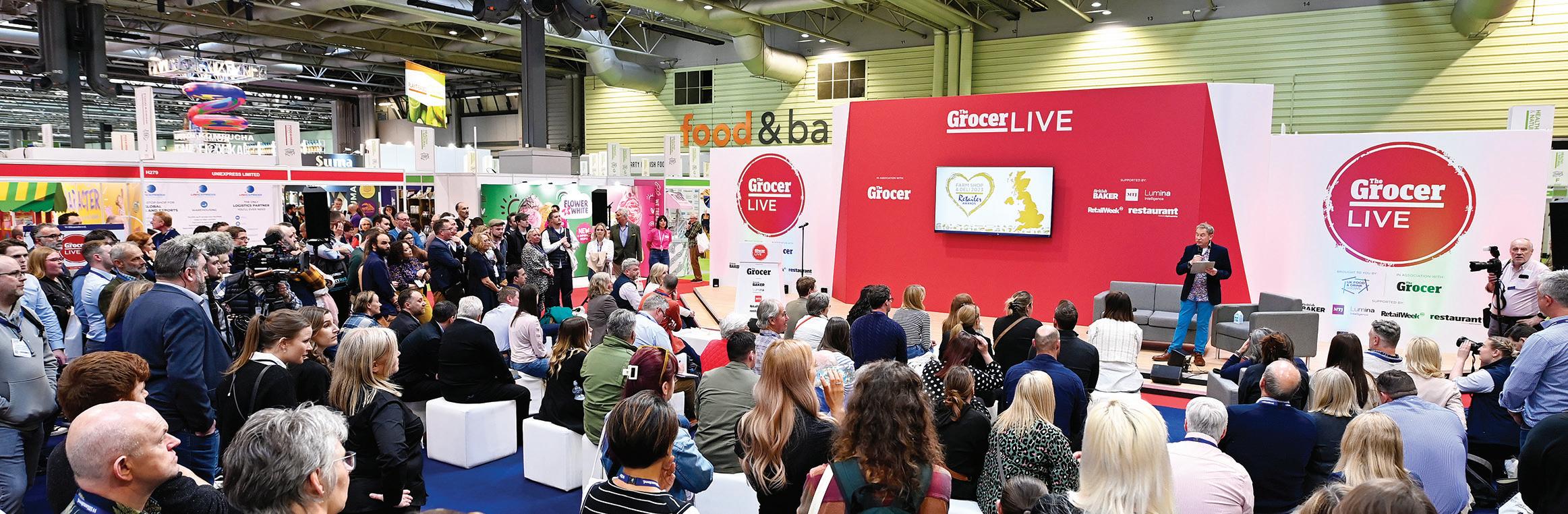
On The Grocer Stage, a variety of expert panels will call on some of the industry’s biggest names for their take on the sector’s most pressing challenges. Key highlights of the schedule’s programme include:
● Staff wellbeing: Creating an inclusive culture that allows colleagues to thrive, Monday 29 April, 11.15am.
● Food to go: The trends to watch out for in 2024, Monday 29 April, 1.45pm.
● Diversity and inclusion: How far have we come and where do we

need to get to?, Tuesday 30 April, 10.30am.
● Social Media Food & Drink Trends –What’s Hot Now, Tuesday 30 April, 2.45pm.
● The Marketplace Model: Making it work for Everyone, Wednesday 1 May, 11.15am.
● Cassandra Stavrou: Healthy snacking PROPERly, Wednesday 1 May, 12pm.
● Price, promotions and NPD: The impact on convenience, Wednesday 1 May, 1.45pm.
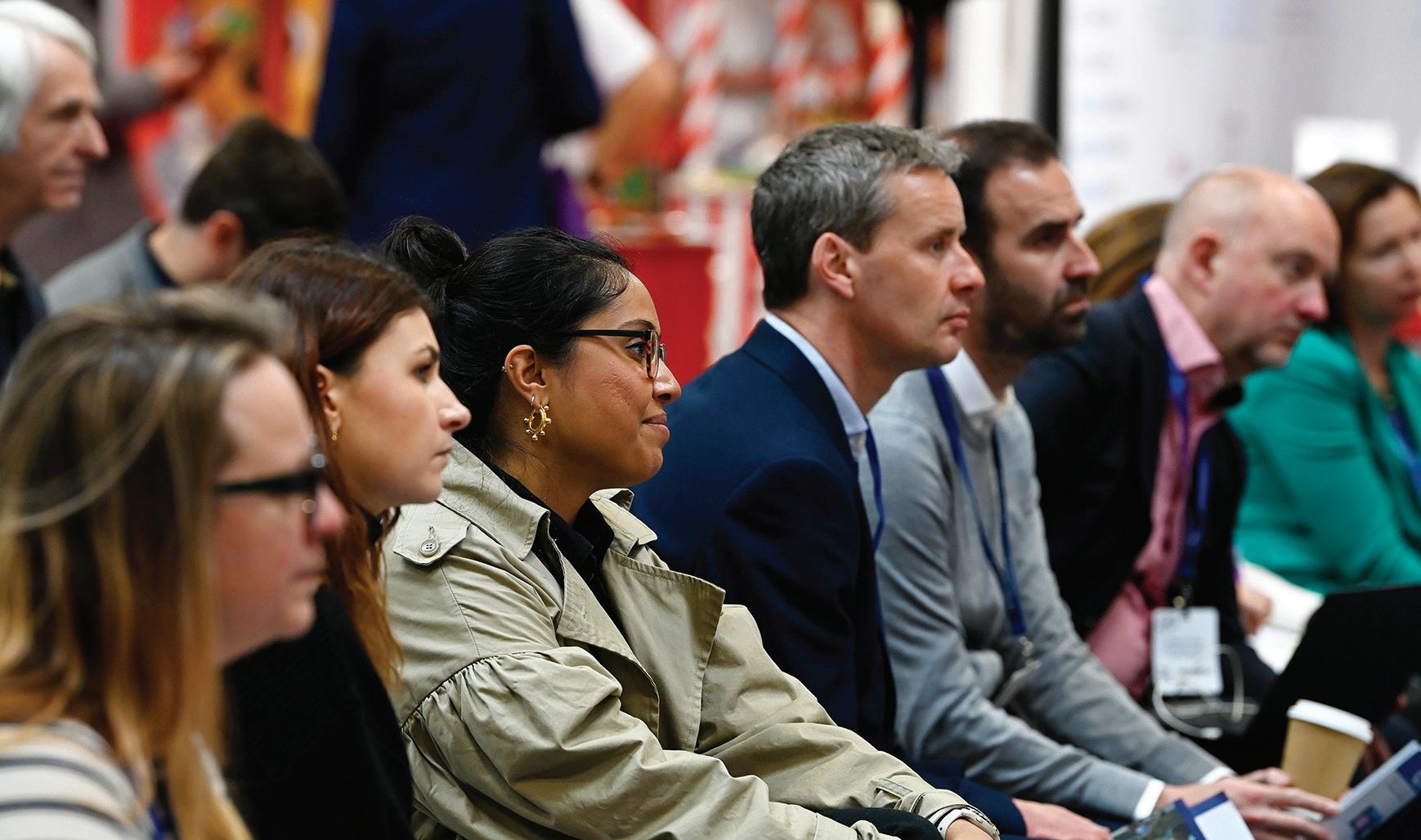
Andrew Reed, managing director –wine & exhibitions, William Reed, said: “The food to go market is a significant player in the wider industry that Food & Drink Expo celebrates so well. The show has product innovation and specialist advice at its very heart and can offer industry leaders three days of insight which simply cannot be found elsewhere.”
For the full list of products on show and to register for your free pass now, visit foodanddrinkexpo.co.uk
NEWS 16 I www.sandwichandfoodtogonews.co.uk
Insight. Networking. Innovation.
Food & Drink Expo returns to the NEC, Birmingham from the 29 April - 01 May 2024 alongside Farm Shop & Deli Show, National Convenience Show, The Forecourt Show and The Restaurant Show.
• Sample and source the latest offerings
• Learn the latest trends and insights
• Make valuable contacts
To advertise please call Paul Steer on 01291 636342 I 17
This is a trade event. No under 18s will be admitted. Find out more and register free at: foodanddrinkexpo.co.uk
DOORS
29 APRIL - 01 MAY 2024 NEC BIRMINGHAM 24 NEC BIRMINGHAM
OPEN NEXT MONTH

SANDWICH & FOOD TO GO INDUSTRY AWARDS
The awards judging process is well underway and the shortlist for each award catgeory can be found on the awards website at www.thesammies.co.uk.






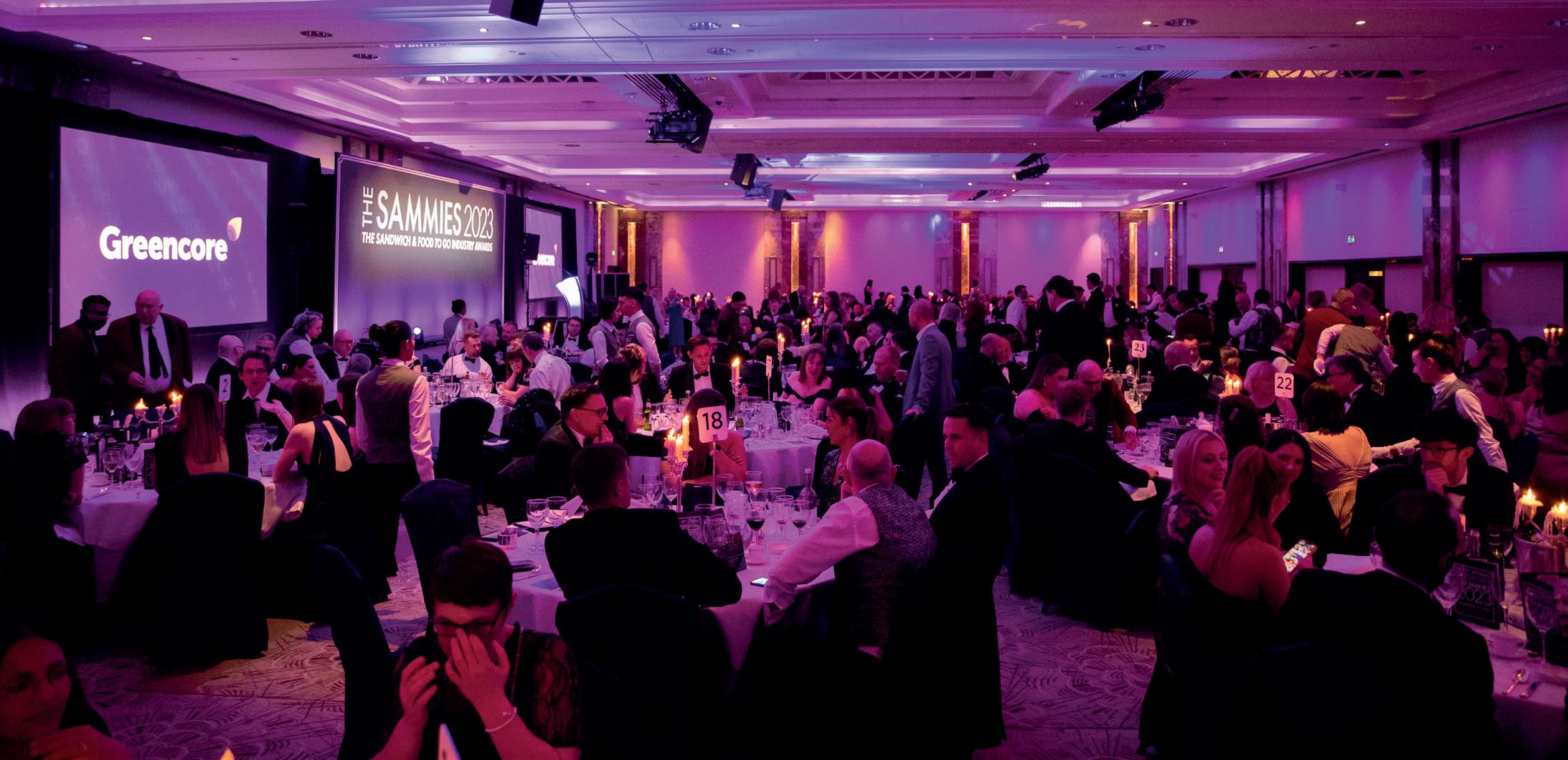
En Route Retailer Award
Focusing on travel. From forecourts and motorway services to airports, railway platforms and bus stations, this award recognises the work these businesses are doing to develop and drive this sector.
Convenience Retailer Award
This award will recognise the work being done by the convenience retailers to develop the sandwich and food to go market in the high street.

MultipleAwardRetailer
This award recognises those retailers who have done the most to develop their business over the last year.
Sandwich Industry Award

Presented to a business or individual who the BSA Management Committee consider deserves recognition for the work they have done to advance the UK sandwich and food to go markets.
New Sandwich Award
Open to any sandwich (not a range), this award rewards innovation within the sandwich market, in both the hot and cold sectors

HealthyAwardEating
This award recognises the work being done to provide consumers with new, interesting and innovative healthy eating products.
New Product Award
Ingredient
This award recognises development and innovation by suppliers and focuses on new ingredients.

Environmental & Sustainability Award
This award is designed to recognise the work being done at all levels of the industry to reduce the sectorʼs impact on the environment and improve sustainability.

Marketing Award
This award is presented to a sandwich or food to go retailer, manufacturer or supplier who has initiated a successful and innovative marketing campaign to achieve strategic goals.
Business Development Award

New Product Award
Packaging & Equipment
This award recognises development and innovation by suppliers and focuses on new packaging and equipment.

This award recognises business developments that have helped progress the industry.
RetailerIndependentAward Café Retailer Award
. This award shines a spotlight on the independent retailers which so often lead the way in new trends and tastes.
This award will recognise the work being done by the café retailers to develop either the high street or in-store market.
Manufacturer Award
This award recognises the overall contribution made by manufacturers to elevate and grow the industry.
New Food to Go Award

This award recognises development and innovation in the food to go market by manufacturers and foodservice businesses.
Chain Retailer Award
This award recognises the work being done by the chain retailers in developing the market in the high street



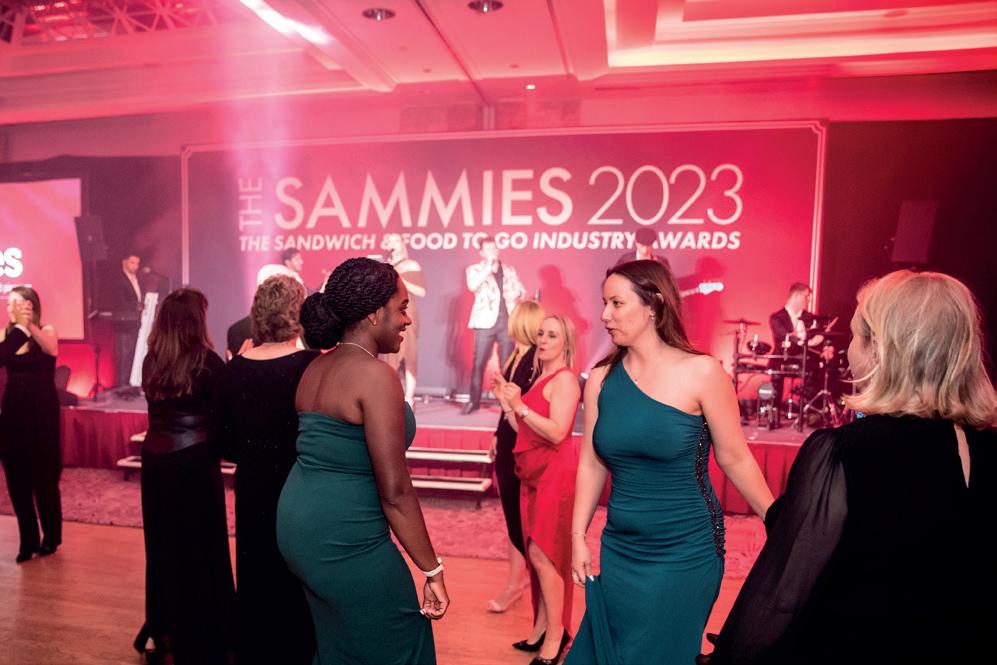
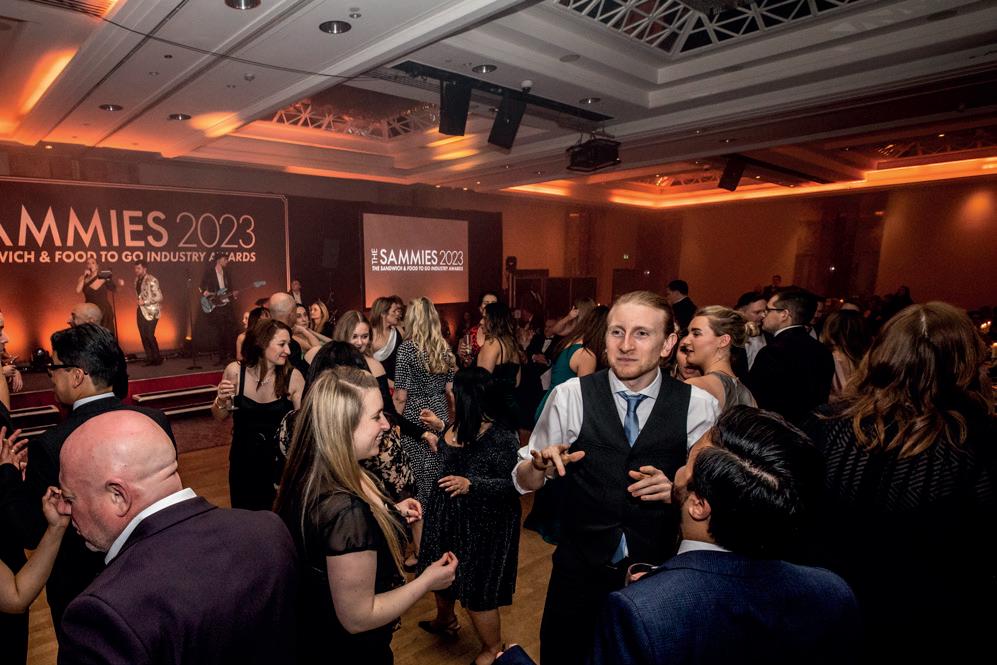
SAMMIES AWARDS DINNER THURSDAY, 9 MAY 2024
Hosted by celebrity chef Theo Randall, comedian Charlie Baker and with dancing through to the wee small hours courtesy of “DJ to the Stars” Tony Perry.









JOIN US FOR
AT THE ROYAL LANCASTER, LONDON BOOK NOW WWW.THESAMMIES.CO.UK
THE
SPONSORED BY























SAMMIES AWARDS DAYTIME PROGRAMME
If youʼre attending the Sammies Awards Dinner, why not make time to join us at the Royal Lancaster, London for our daytime programme of events?
The live finals of the Sandwich & Food to Go Designer competition provide a fantastic opportunity to gain insight into the creative process of the industryʼs culinary superstars.
There will also be a presentation from Hywel Davies, strategic insight director at Kantar. He oversees the management of the Kantar Out of Home panel which measures how we purchase and consume food and non-alcoholic drink when outside of the home.
Hywell will look at the changing face of the food to go market, review the past 12 months and deliver a vision of what has and will change in the market.


Anyone from the industry is welcome to attend. To secure your place, contact Sandra Bennett at the BSA by email to sandra@sandwich.org.uk or call 01291 636348. OF THE YEAR 2024

SANDWICH & FOOD TO GO
AND FINALLY...
Following three hotly contested regional semi-finals in early March, the successful finalists in this yearʼs competition have been revealed.
Each contestant will prepare and present their creation to the judges and an excited audience at the live finals on 9 May 2024.
SANDWICH & FOOD
TO GO
OF THE YEAR
2024
We welcome back celebrity chef Theo Randall who joins us as the head judge. Under his watchful eye, the judging panel will consider taste, presentation, texture, commercial viability and innovative use of the sponsor products as they choose the category winners and decide who will be awarded the title of Sandwich & Food to Go Designer of the Year.
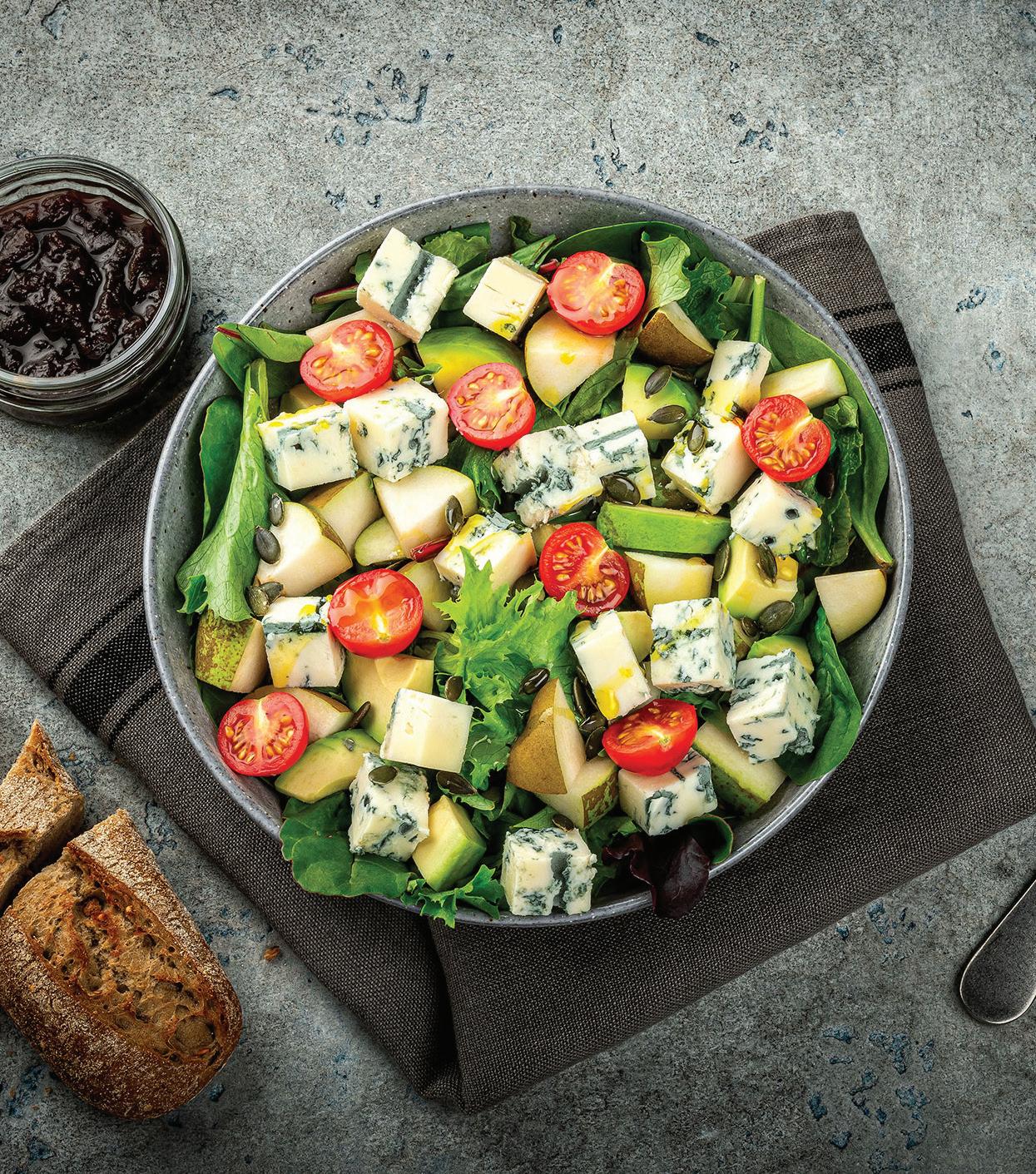
FUTURA FOODS GORGONZOLA PICCANTE CATEGORY
Kirsty Fitzpatrick, Deli Lites Honey, Iʼm Feeling Blue
Chrissie Attewell, Samworth Brothers Thereʼs Always Next Thyme
James Burgess, Fresh Cut Foods Salt Beef & Gorgonzola Waldorf
Stephen Jordan-Bird, Samworth Brothers Gorgon-rola-Zola
Kirsty Fonseca, Greencore Gorgonzola with Parma Ham
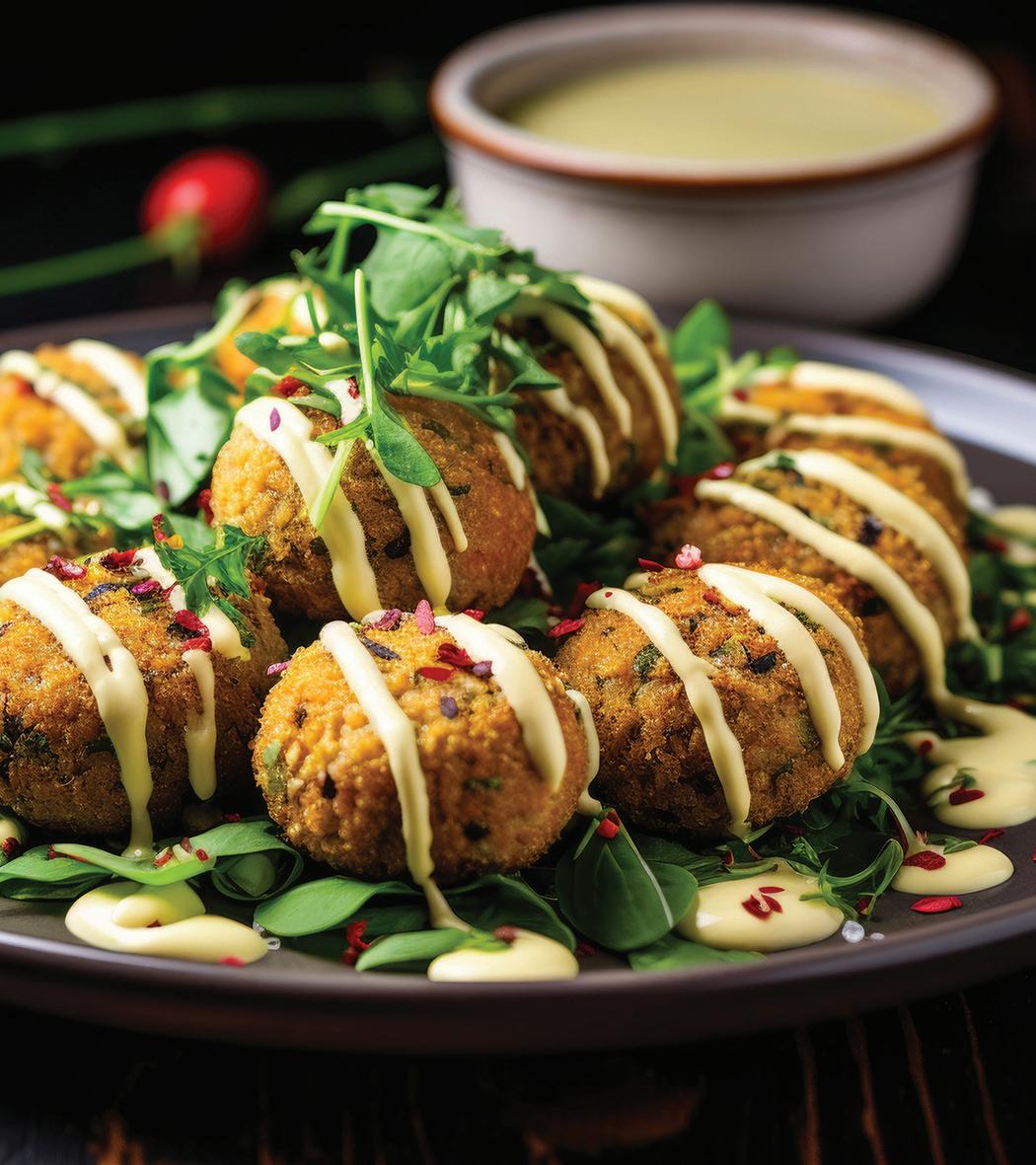
JDM FOOD GROUP FREE FROM CATEGORY
Kirsty Fitzpatrick, Deli Lites Banging Chicken
Kirsty Fonseca, Greencore Nut Free Satay Burrito
Kat Padgett, Around Noon Beets & Greens
James Burgess, Fresh Cut Foods Pulled Spiced Lamb Turkish Flatbread
Edvinas Smgelskis, Samworth Brothers Satay Prawn in the Sea Shell






H. SMITH FOOD GROUP
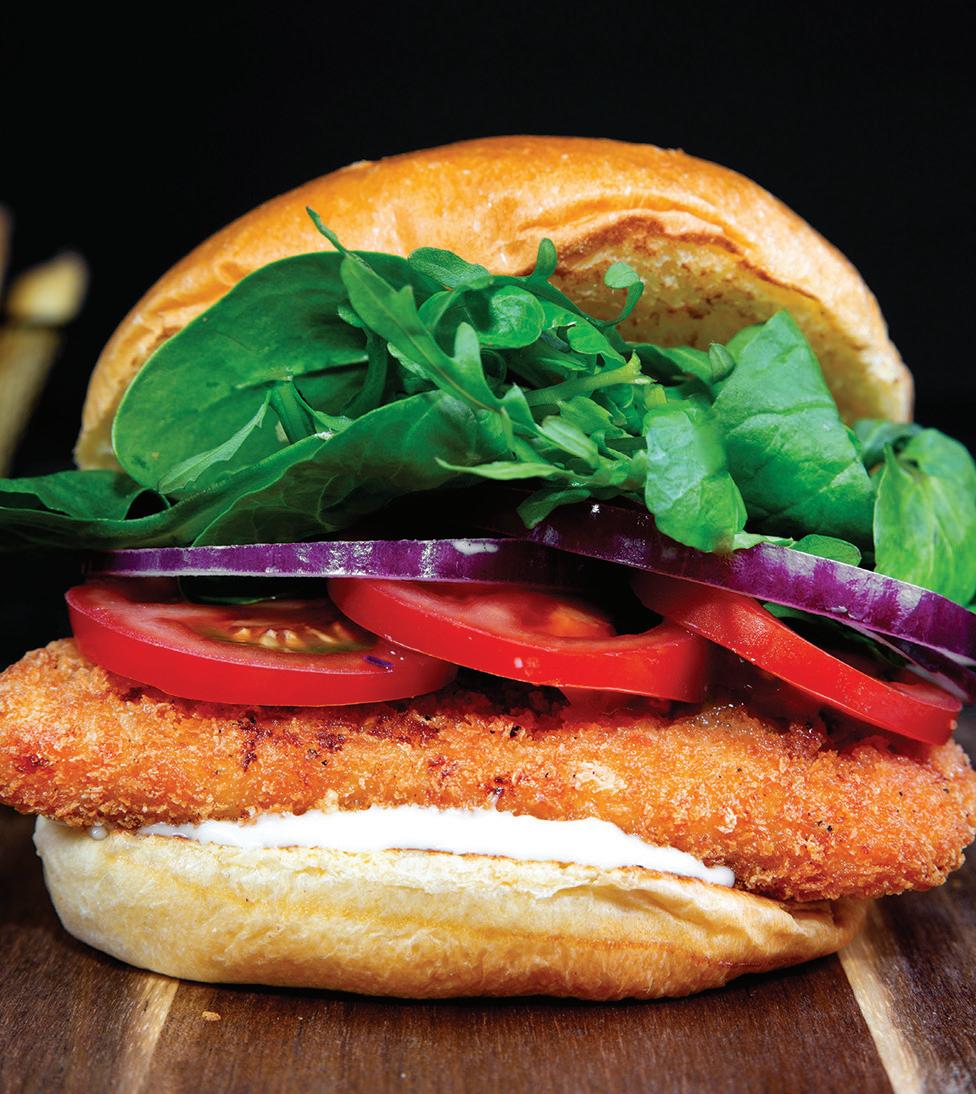
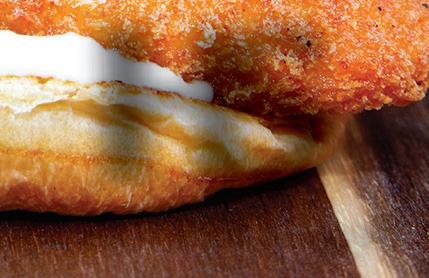
DELIGHTFUL BREADED CHICKEN CATEGORY
Kirsty Fitzpatrick, Deli Lites
Second to Naan
Phil Thompson, Sandwich King
Tipsy Chicken Banhi Mi
Charlotte Palmer, Greencore Japanese Fried Chicken Wrap
Kirsty Fonseca, Greencore Katsu Bao Bun
Dai Llewellyn, The Co-op Crispy Bombay Sando
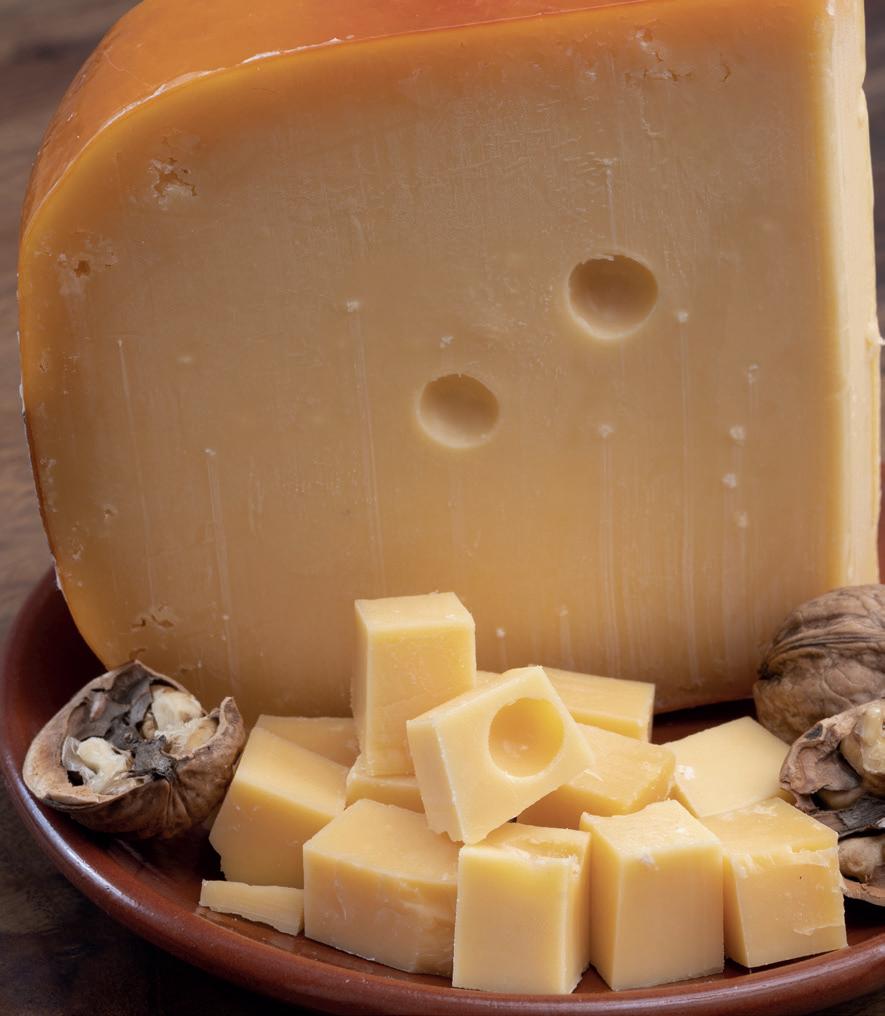
MONA DAIRY GOUDA CATEGORY
Kirsty Donaldson, Deli Lites
Too Gouda to be True
Harry Dempster, Samworth Brothers
The Gouda, the Bad and the Ugly
Barney Luxmoore, Jabberwocky Goudagette
Ivor Peters, Urban Rajah
Mumbai Garam Toastie
Stephen Jordan-Bird, Samworth Brothers
Mona Cheesa
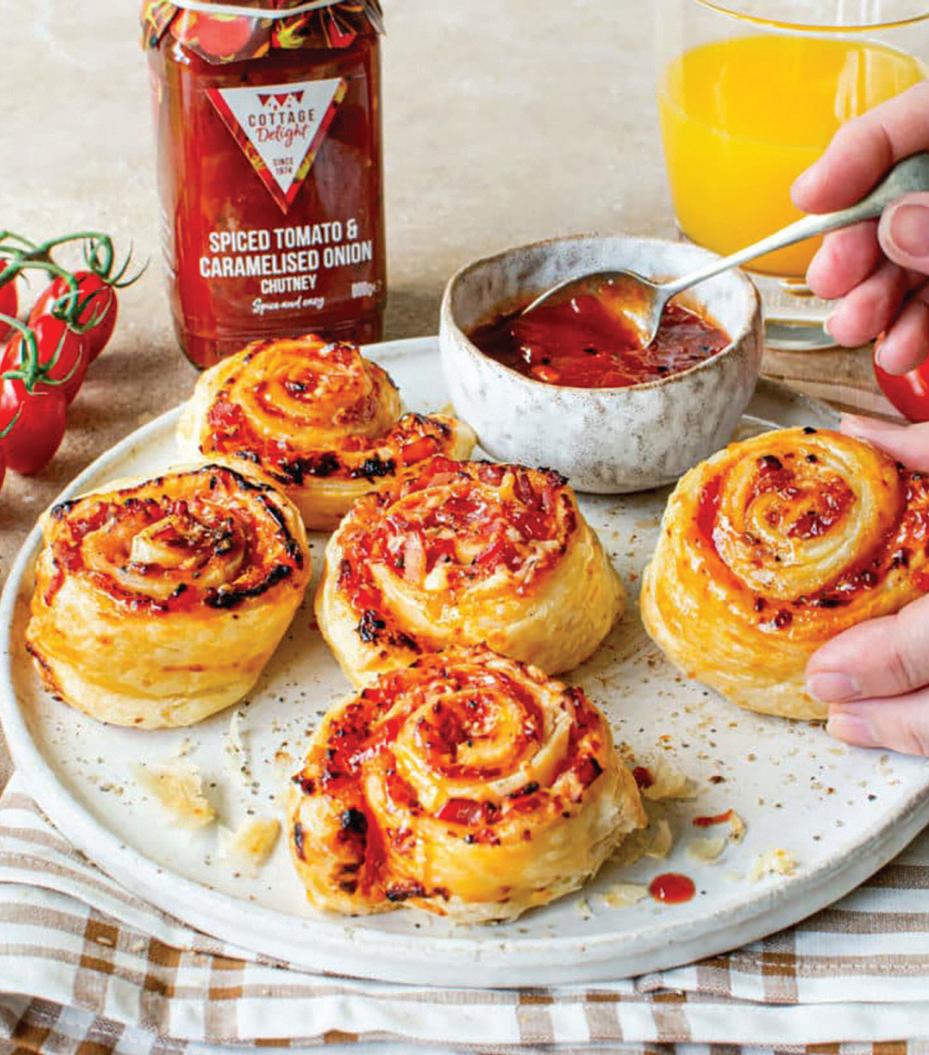
COTTAGE DELIGHT CHUTNEY & CURD CATEGORY
Kirsty Donaldson, Deli Lites
It Takes Two to Mango
Harry Dempster, Samworth Brothers
The Italian Cobb
Lee Williamson, Gosh Foods
Toasted Club with Torchon Ham
Kieran McGivern, Around Noon
York Shire Ya Know Yer Self
James Burgess, Fresh Cut Foods
California Prawn Roll





Sustainable success
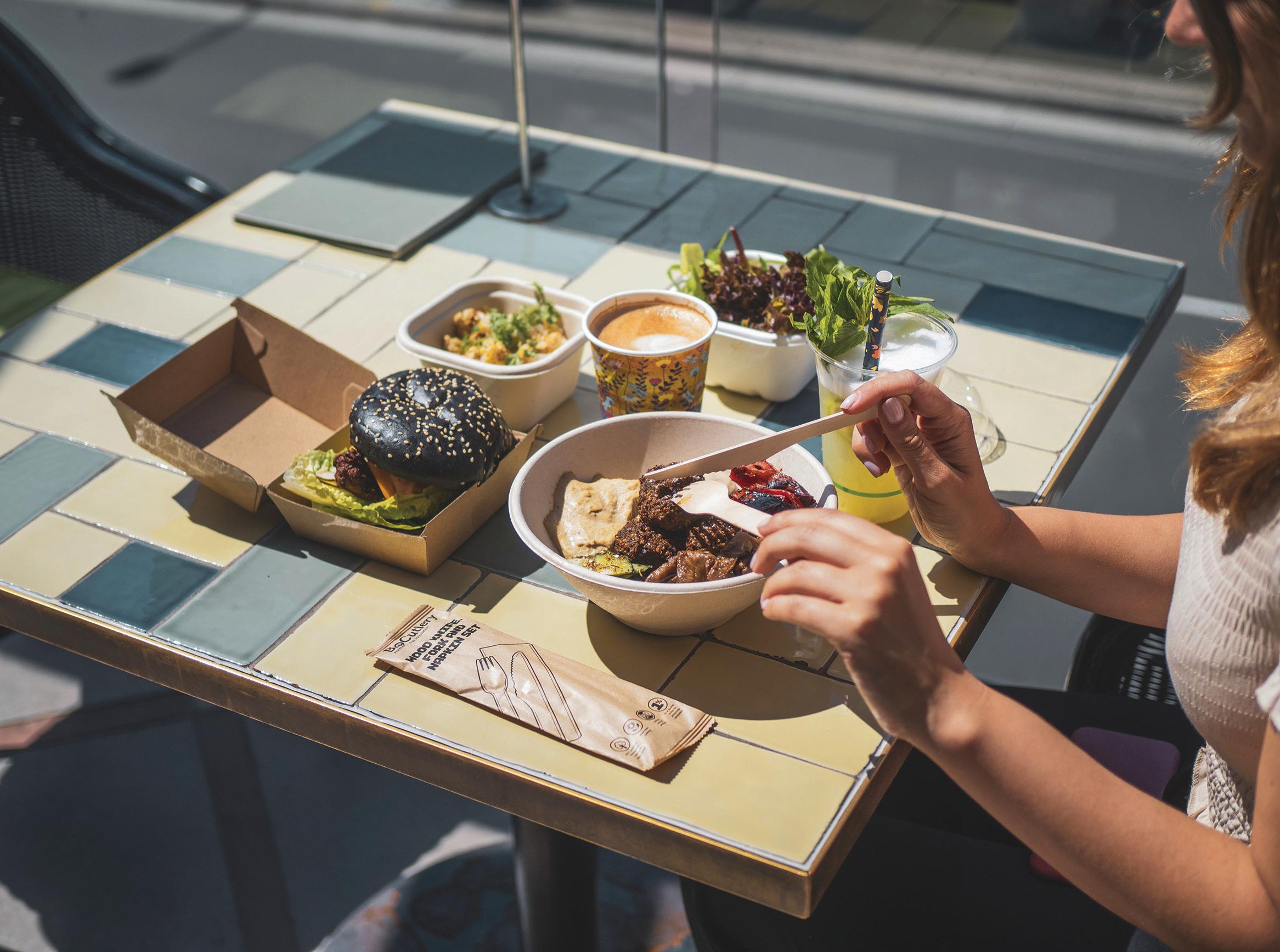
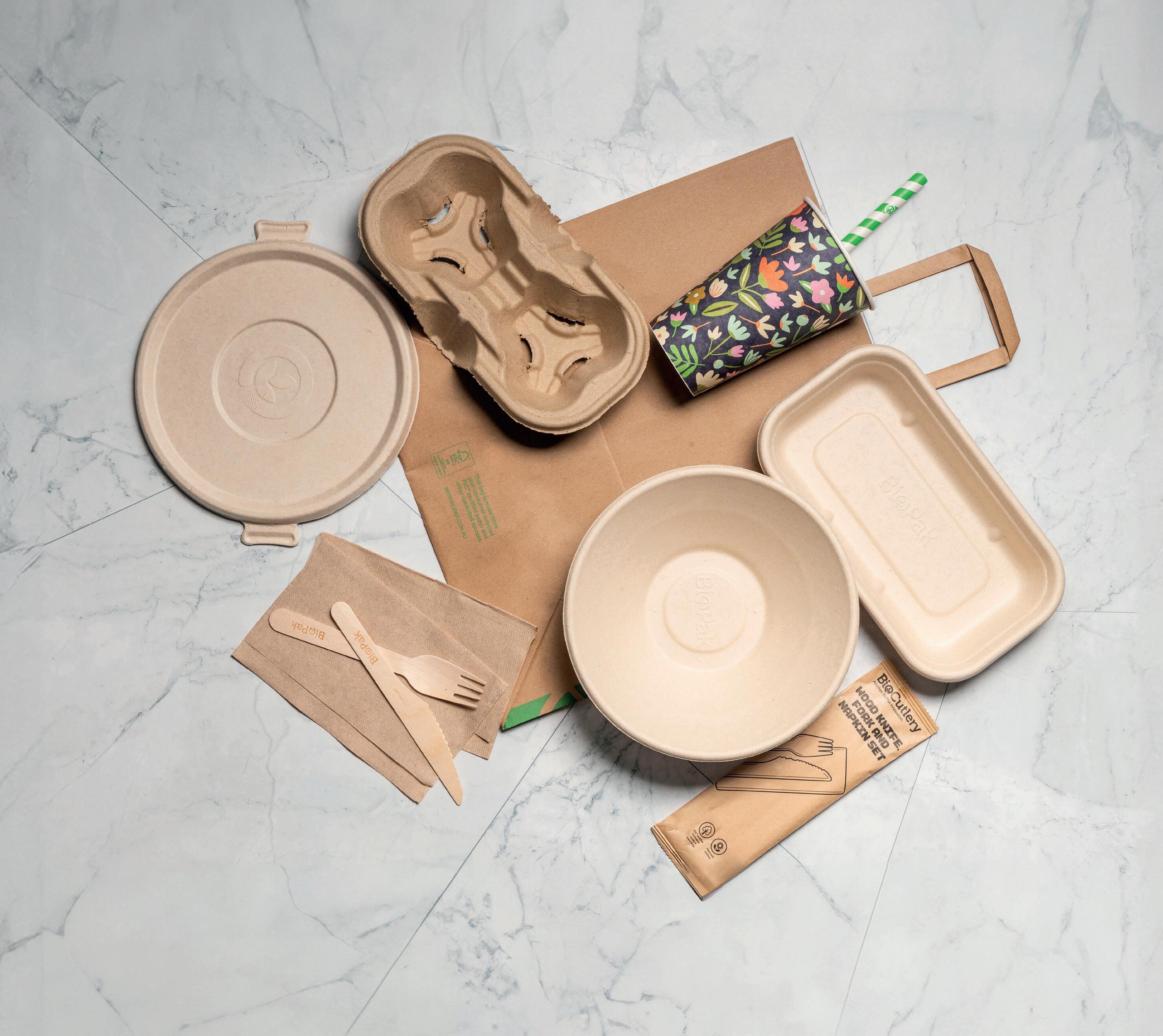
It’s been a stellar year so far for the innovative team at BioPak. Technical director, Sam Walker, tells us more.

With 18 years in the sector, BioPak understands the sandwich and FTG market better than most. What are you most excited about?
Our focus lies not only on new fitfor-purpose packaging solutions – we are also investing heavily in research, development and testing of innovative materials to shape the future. Particularly interesting are advancements in linings, with aqueous dispersion coating disrupting
the market in a big way in recent years.
BioPak’s aqueous-lined cups are already part of our core range, and when paired with our plantfibre lids, customers have a full home compostable (NF-T51-800) solution. The exciting news is that we are looking at a new coating technology called PHA. PHAs, or polyhydroxyalkanoates, are bioderived polymers produced via industrial microbial fermentation of carbon-based feedstocks – a process more similar to brewing than the chemical synthesis used to produce most biopolymers. PHA bioplastic is one of the most promising technologies, deemed to be compostable and marine degradable. What this space!
We are also still seeing strong growth in pulp and fibre-based packaging. Our ability to print on these materials is attractive to brands. The added sustainability narrative
of utilising waste fibre in production gives them the edge over other formats. However, PFAS in packaging has been making headlines. At BioPak, a large portion of our products have no intentionally added PFAS, and we are working to completely remove them from our full range in 2024.
How do you navigate complicated packaging legislation?
Staying informed is paramount, plus industry and legislative participation. The landscape is indeed complex, with the recent implementation of singleuse plastics bans (both in the UK and EU, each with its own nuances), alongside impending Extended Producer Responsibility (EPR) and Simpler Recycling regulations.
24 I www.sandwichandfoodtogonews.co.uk
At BioPak, we’ve always prided ourselves on due diligence and compliance. We’ve built specialised teams across all our territories (UK, Australia, NZ, Singapore and Hong Kong) to stay abreast of regional legislation. Despite differences across the globe, many rules still operate within similar parameters, providing a foundation for compliance efforts.
Our deep understanding of the evolving regulatory framework gives BioPak’s customers not only confidence in our product, but they often use us as advisors to shape their own sustainability journey. For example, some clients operate across multiple regions and strive for a uniform approach. Achieving a one-size-fits-all solution isn’t always feasible and often requires compromise. This underscores the importance of continued flexibility and collaboration.
Congratulations on the Innovation Award 2024 at the Food Manufacture Excellence Awards.
Thank you – it was truly an honour. Our success lies in a unique capability to handle every aspect of the process in-house, coupled with extensive expertise at each stage. Over our nine-year partnership with Deliveroo, we’ve gained unparalleled knowledge in the meal delivery sector, from understanding challenges associated with different cuisines to identifying the most suitable materials and solutions to address them
We provide clients with a free packaging assessment, evaluating pain points and opportunities. They receive a personalised report, inclusive of a full operational review, packaging recommendations, fitfor-purpose NPDs, in-store trial and implementation road map.
There are dedicated design, production, quality, marketing and logistics teams, all seamlessly integrated to provide that comprehensive end-to-end solution. This holistic approach sets us apart in the competitive marketplace.
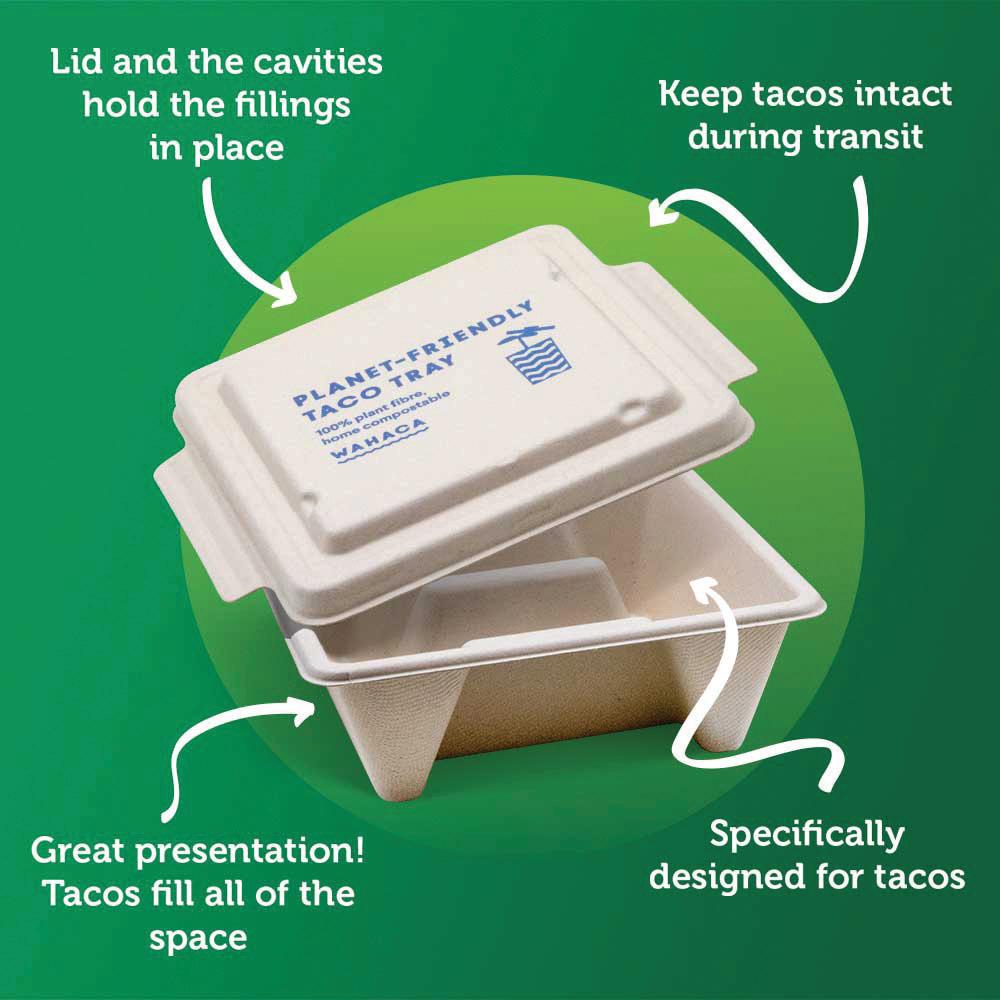
Tell us more about your business relationship with Mexican restaurant brand, Wahaca. We are proud to have a customer like Wahaca, and I believe it’s the result of who we are. Wahaca is the leading sustainable restaurant, and we are the leaders in sustainable packaging, so it was only natural we found each other! Together, we developed a certified home compostable, plant-fibre printed taco solution – the first of its kind on the UK market.
We have comprehensive data available for our entire range to illustrate the tangible benefits of using BioPak. Our approach goes beyond mere eco-consciousness. We provide quantitative evidence to support the positive impact of proposed solutions, whether through weight reduction, utilising more sustainable materials or a combination of both. By sharing the data behind the changes, brands can effectively convey the rationale to customers, fostering understanding and buy-in. Sustainability is an ongoing process, so transparent communication of progress, underpinned by evidence, is essential for engagement. And it helps to combat greenwashing and comply with legislation.
There is also growing interest from traditional distributors, driven by demand and regulatory changes. As consultants, we guide them through the complexities of both.
What can the UK learn from your global approach to relationships?
That we are all in it together, while collaboration is essential for effective
PACKAGING
adaptation and problem-solving in the rapidly evolving market. We can address most challenges by pooling our knowledge and resources from the BioPak regional teams, while integrating invaluable first-hand and on-ground experience from global and local clients.
This commitment not only sets us apart but also fosters vital relationships. By prioritising partnerships and shared insights, we uncover solutions and opportunities that may otherwise go unnoticed.
Can you expand on your key sandwich and FTG relationships?
The FTG landscape has been challenging. While some operators have thrived, others have faced significant setbacks. However, we’re
PACKAGING
now witnessing signs of recovery, with steady growth. The larger players seem to be faring the best, capitalising on their scale and resources to navigate challenges more effectively. Unfortunately, smaller to mid-sized operators are feeling the pinch, grappling with inflation, while struggling to negotiate favourable pricing due to limited buying power.
Despite this, there’s a notable shift towards paper and fibre-based among FTG brands. This reflects a broader commitment to reducing plastic consumption and embracing sustainability. Brands are allocating resources to facilitate these changes.
Apart from NPDs and innovative tech, what else is driving growth?
BioPak was founded in 2006 before there was an appetite or any real movement towards sustainable solutions. Our goal from the start was to disrupt the foodservice packaging industry and change consumer behaviour. To continue our mission, mergers and acquisitions are a growth driver. We have just launched BioPak in Hong Kong, a timely expansion ahead of single-use plastic bans coming into effect in April 2024.
The next frontier is reusable solutions, with the goal of converting disposable packaging users to
reusables. BioPak is looking to meaningfully introduce reusables to our markets, with convenient infrastructure. Our track record shows that we can change behaviour, disrupt industry and influence policies.
What are the major compostable packaging challenges for companies?
The biggest is a lack of composting infrastructure coupled with the singleminded push for recycling. Companies need to take responsibility for product end-of-life. We believe compostable packaging is the best solution to address plastic waste and pollution generated by the foodservice industry.
Unfortunately, only 9% of all plastic waste ever produced in the world has been recycled. It’s estimated that the UK produces 1.85 billion pieces of plastic per week – of which only 12% is likely to be recycled! Food & drink packaging made up an overwhelming majority (83%) of the waste generated during the count. Once soiled and contaminated with residue, recyclable plastic food containers can’t be recycled – they go straight to landfill or incinerators. Unfortunately, contamination can compromise a whole container of perfectly good recyclable material.
Compostable packaging addresses this challenge, while also helping
divert food waste from incineration. To manage the end-of-life for our packaging, we have set up Compost Connect – a not-for-profit platform committed to education, lifting composting rates, and connecting foodservice businesses to commercial organic waste pick-up services. Businesses can go online at compostconnect.org/uk/ and search their postcode to find out if commercial organics collection is in their area.

A major problem is greenwashing – think packaging, beauty and fashion. This is when organisations make their products, services or practices seem far more environmentally friendly than what they actually are. For example, they can use loose claims and buzzwords like ‘green’ and ‘eco-friendly’ without any verified supporting evidence or certifications. These claims are often exaggerated, aspirational or downright untrue. This makes it difficult for customers and consumers to make environmentally conscious decisions.
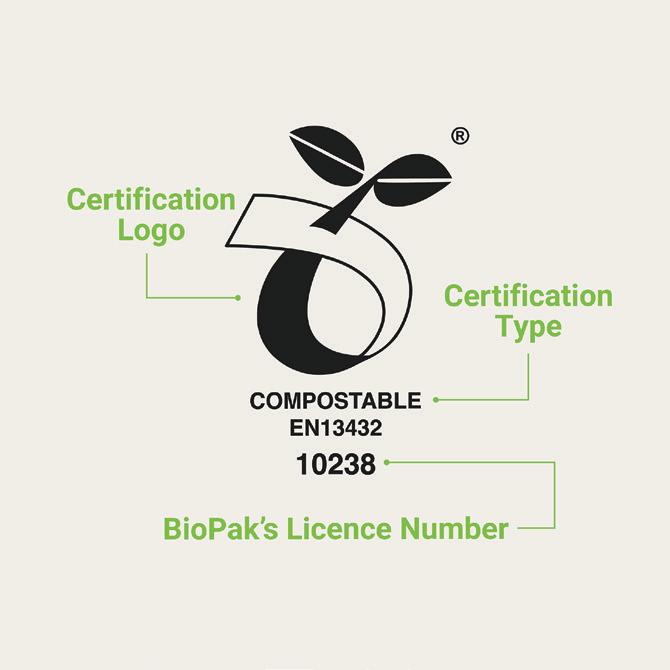
Certifications create transparency. Packaging must undergo a stringent compostability test by a verified third-party provider like DIN CERTCO or TUV to receive a compostable certification. Customers should look for two types of compostable standards: Home Compostable (NF T51-800) and Industrially Compostable (EN 13432).
The certification logo on the packaging must display three elements: certification logo, the type of certification and the company license number. If one of these is missing, it’s most likely not certified.
Unfortunately, not many people recognise and understand these logos, making it easy for companies to take advantage. The legislation, however, is catching up. The European Union proposed the Green Claims Directive and the UK’s Competition and Markets Authority (CMA) enacted legislation to curb greenwashing last year. This is exciting news and a step in the right direction for our industry.


26 I www.sandwichandfoodtogonews.co.uk





Make the Switch to BioPak Plant Based Packaging








BioPak products are made from rapidly renewable, plant-based materials, designed for the circular economy. 5% of profits are donated to positive change.




www.biopak.com/uk


Top of the tree
From
near-infrared spectroscopy
to breathability, Woodly’s quest to accelerate change is gaining momentum.







PUTTING THE CONSUMER FIRST
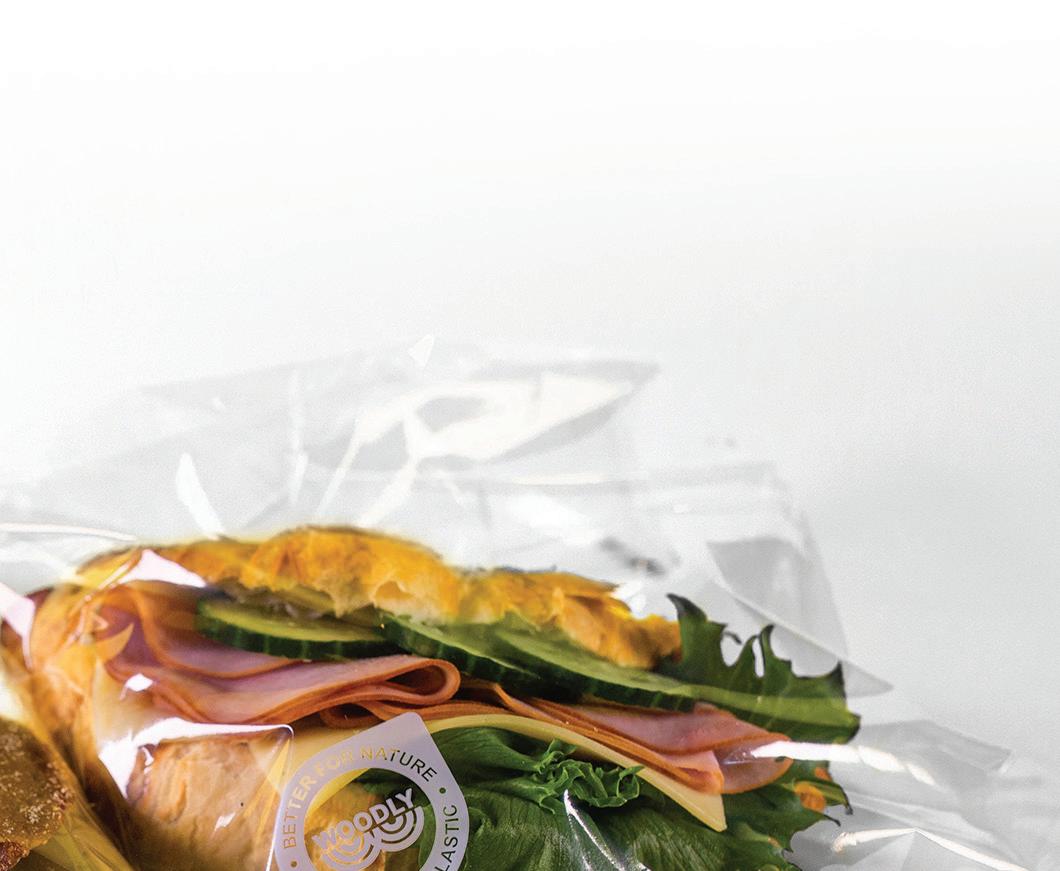
Material innovation and extensive recycling sounds like a relatively simple mantra to solving the packaging and waste conundrum. And it’s one that Woodly has adopted, with its new type of plastic based on wood. Coming from softwood cellulose, it mimics the best qualities of traditional fossil-based plastics. A straightforward approach to what is becoming an increasingly complicated mine eld for foodservice operators.
“From what I’ve observed, plantbased products are more popular than ever,” said Woodly vice president of sales and marketing, Christoph Schiller. “There is also a strong focus on sustainably sourced materials. Consumers are increasingly aware and seeking more than just the number of calories on packaging. Healthy and environmentally friendly food is crucial when making everyday
choices, and one doesn’t necessarily have to break the bank any more.”
However, that doesn’t make the path to sustainability any easier for the foodservice sector.
“Legislation is not only complex but also rapidly changing, leading to confusion among customers, who often don’t know what to expect,” continued Schiller. “This slows down long-term planning and decision-making. We strive to support them as much as possible.
“Despite the complexity, there are trends to be observed, such as a shift away from biodegradability and compostability. While these concepts may seem appealing, they proved impractical in real life. For instance, imagine buying a sandwich wrapped in compostable material. It is unlikely that you’ll carry around an empty package for the entire day, until you can compost it at home.
28 I www.sandwichandfoodtogonews.co.uk

Compostable materials also require industrial facilities.
“There is a focus on materials that can be recycled. Many people are unaware that in the recycling process, lightweight packaging is typically sorted out in one of the rst stages and directed to a waste-to-energy stream. Therefore, if customers are seeking truly sustainable materials, they should consider the total life cycle of the product.
“Here is where Woodly can help. One of the key challenges we face is whether Woodly, as a bio-based material, can be recycled in standard household waste streams. Many recyclers typically avoid biomaterials due to concerns about contamination in their sorting processes. We have had pilot testing, where Woodly can be detected with NIR (near-infrared spectroscopy) and separated from the plastic waste stream. And this
year, we have partnered with OPRL – the not-for-pro t, independent experts in packaging recyclability.”
PROBLEM SOLVING

As the deferred Extended Producer Responsibility (EPR) scheme illustrates, negotiating a path through everchanging government legislation is certainly not easy.
“I think some ideas have been good, but there is currently too much uncertainty and ad hoc actions in the approach. I am a strong advocate for reusability. Whenever possible, we
should avoid single-use packaging, that’s clear. Or at least ensure that the packaging is recyclable. However, it must be implemented in a smart way.
“For example, the concept of the 30% recycled content target is a good idea, but realistically there isn’t enough material on the market that is both post-recycled and food contact approved. As a result, many resort to using industrial PCR, which is questionable.

www.sandwich.org.uk I 29
PACKAGING
“In the continuous effort to create environmentally friendly legislation, we may have lost sight of the ultimate goal: saving the planet. In my opinion, a full science-based, life-cycle assessment should be implemented to evaluate different materials. While advocating for the reduction of plastic usage is important, it’s essential to consider whether a blanket ban is the optimal solution in all cases. Plastic serves a vital role in sectors like FTG by safeguarding food, prolonging shelf life and significantly reducing waste.
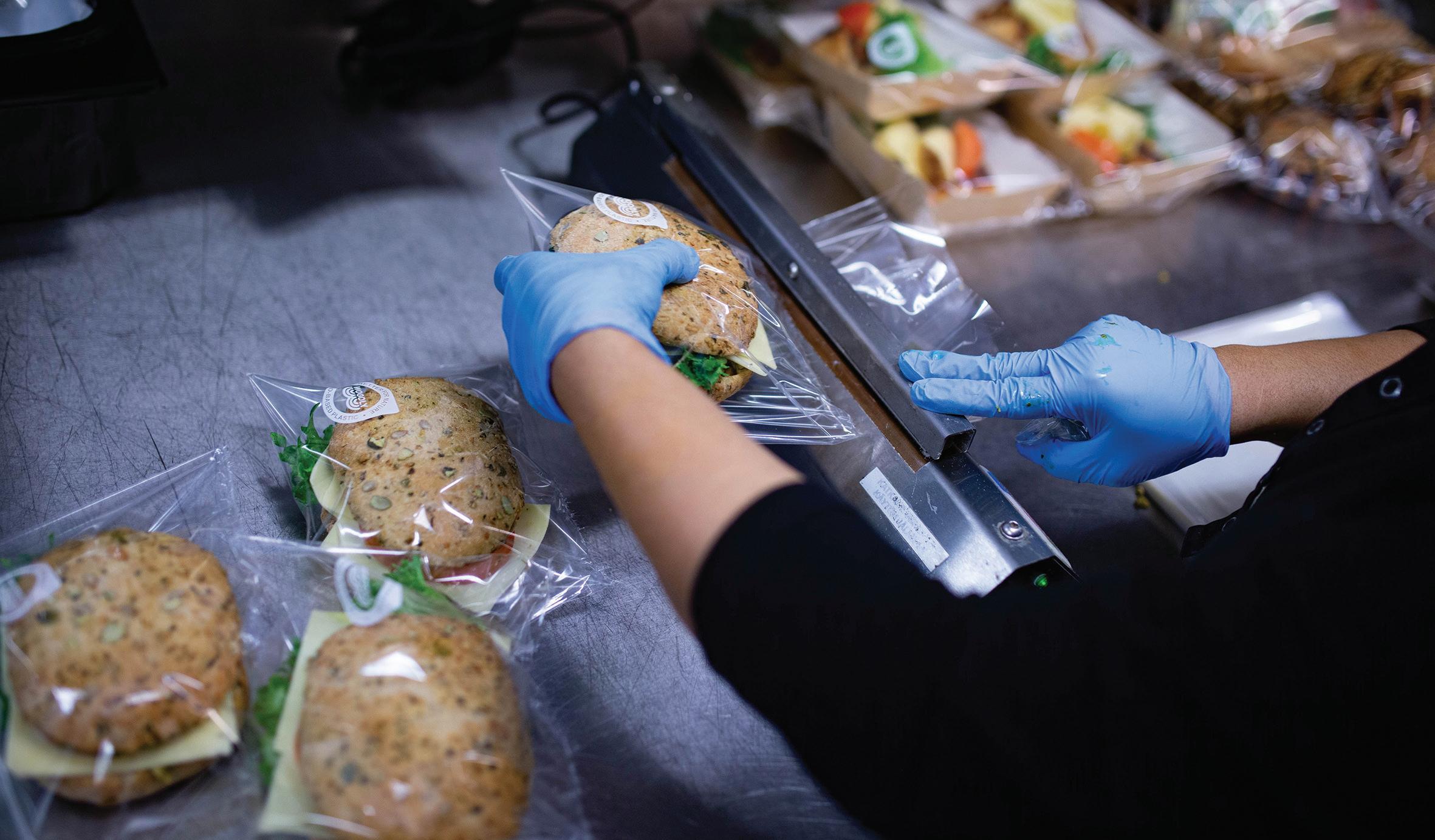
“Fresh food wrapped in traditional plastic fights against its barrier, so moisture condenses inside the packaging. Water drops on the roll or baguette, which eventually becomes soggy. Products lose customer appeal, and even if they are still within their best-before date, remain unsold.
“Woodly solves this problem. Its controlled breathability allows water to evaporate from inside the packaging, keeping the product not only visually appealing, but fresher for longer. In the case of pastries, like croissants, Woodly operates in the opposite
"Plastic serves a vital role in sectors like FTG by safeguarding food, prolonging shelf life and reducing waste."
manner, protecting the product from absorbing moisture from the outside, helping it to remain fresh.
“We have conducted numerous tests with customers – they all confirm the efficacy of Woodly in reducing food waste and associated costs.”
CLEAR OBJECTIVES
The past few months have been quite a journey for Woodly. Having debuted in the UK with a somewhat slim contacts book, it now has a strong relationship with Seal Packaging.
“We like to think of them as our wings and wheels in the UK,” continued Schiller. “They have been
companions from the very beginning, and we deeply value this relationship.
“Along the way, I have had help from many companies, including Bunzl and Accrued Plastic. Most importantly, I am proud of our first customers who chose to trust us here. Our objectives are clear: create a material as functional as traditional plastic while making a positive impact on the food waste problem.
“Credibility is our greatest asset – this is how we earned trust in the Nordic countries. We are in people’s businesses and view every project as a mutual journey for everyone to enjoy.
“I am also in the process of recruiting our first UK team member, scheduled to commence at the onset of the second quarter. This year began early for me, as on 2 January I was on a plane to the UK, and the intensity has remained the same ever since.
“We are exhibiting at the Food and Drink Expo in Birmingham and again at lunch! in London. We’re engaged in numerous commercial conversations and trials, and while it is a very intense time for Woodly, I love it!”
30 I www.sandwichandfoodtogonews.co.uk
PACKAGING
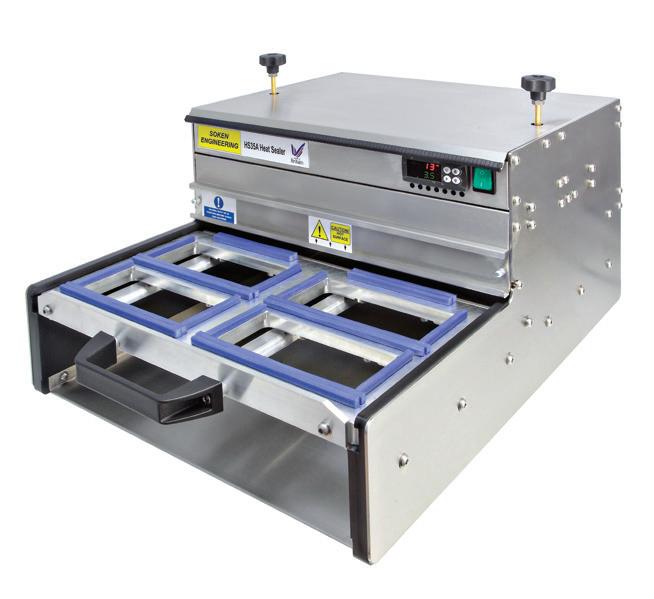



















To advertise please call Paul Steer on 01291 636342 I 31 FROM SINGLE PACK MANUAL TO HIGH SPEED LINEAR AUTOMATIC MACHINES SOKEN ENGINEERING IS PART OF THEJENTON GROUP QUALITY HEAT SEALING MACHINES FOR SANDWICH, WRAP, SALAD AND READY MEAL PACKS • Increases shelf life (for up to 3 days) • Less food waste • Greener packaging options • Food-to-Go and Convenience packs • Medical, Pharma, Parts Here at Soken Engineering we have 20 years experience, including worldwide sales. Our innovative UK built all electric machines range from low-cost entry level to high throughput production line models. SEAL PACK SELL www.sokenengineering.com +44 (0)1256 892 194
The perfect Plan
Thinking ahead is crucial when it comes to sustainability goals – and Planglow is often ahead of the curve.

POINT OF DIFFERENCE

Founded in the 1980s, Planglow started out as a provider of catering labels and revolutionary software, LabelLogic – one of the first programmes of its ilk. It was in 2002 that it launched dedicated software to support food providers looking to create nutrition labels. Planglow was also ahead of the grab-and-go packaging curve, with a sandwich box and disposable coffee cup in 2005. It’s an award-winning business that continues to thrive in a hugely competitive sector.
“Offering an off-theshelf brand has always been our strength and differentiates us from commodity packaging,” said Planglow marketing director, Rachael Sawtell. “We also try to ensure products can be disposed of in as many waste streams as possible. For example, we swapped cups and pots from PLA lined to aqueous lined, opening up recycling (as well as home and industrial composting) waste streams to customers.”
Packaging strategies need to form part of sustainability reporting, with Planglow having strict directives and ambitions in place.
“Over the past year, we have undergone a robust review of suppliers, making revisions as necessary. This ensures stronger relationships and optimum compatibility with evolving business requirements.
“In terms of our customer base, we continue to build upon connections with businesses of all sizes – from independent cafés to contract caterers. We have also set up integrations between the key recipe management software providers and our labelling software (LabelLogic Live) to ensure seamless data integration and compliance with latest legislation.”
THE WAY AHEAD
A recent six-week trial in Medway by The Compostable Coalition UK reported a five-fold increase in consumers disposing of compostable packaging in food waste bins, when residents were educated with clear communication and labelling. Around 120 households received goods including confectionery, fresh produce and shopping bags from the likes of Co-Op, Ocado and Lipton Teas.
“We would very much like to see compostable packaging accepted in food waste bins,” continued Sawtell. “This successful trial in Kent





Our temperature controlled food delivery vehicles are designed to display and vend your pre-made Hot and Cold food. Delivering direct creates you a captive audience, offering customers the ultimate in convenience and service. Call us today and take the first step towards increasing your sales.











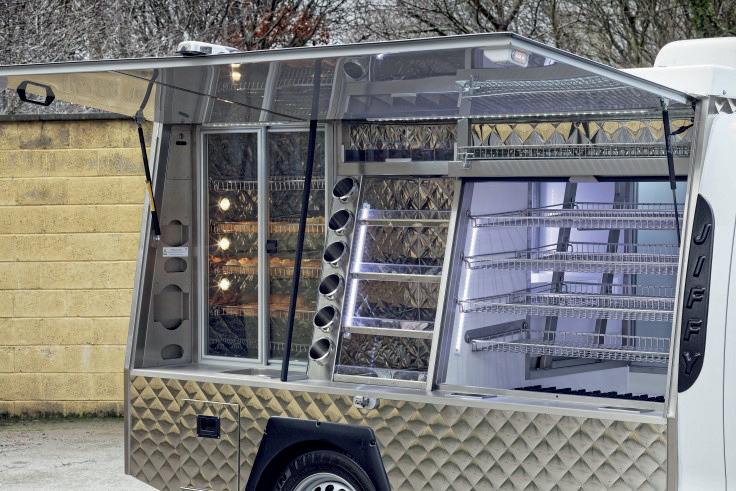




· Our mobile “shops” have no rent or rates to pay and operate with one staff member.
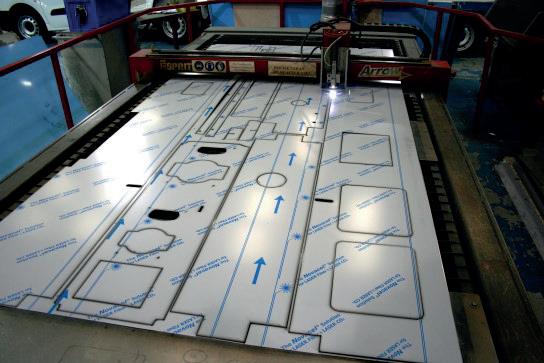
· Our trucks are chosen by all the major names in mobile catering for their build quality and reliability.
· Flexible finance packages available.
· Fully accredited by the BSA


· Whole vehicle type approved
· A very profitable addition to any food business.


· Established since 1973






































www.sandwich.org.uk I 33
for delivered food has never been greater !
Demand
Here’s the solution, mobile catering!
www.jiffytrucks.co.uk
over 40 years experience in mobile retail Jiffy are the name you can trust, our success relies upon your success. Call us now to arrange a demonstration, or visit us at the factory and meet the team.
01274 596000
for new revenue streams? Supply your products with the original Jiffy truck. Now available with a finance balloon, allowing low monthly payments, with enough equity for a new van every 4 years.
With
Tel
sales@jiffytrucks.co.uk Looking
PACKAGING
proved the model works when the infrastructure is there to support it. Packaging contaminated with food waste can’t be recycled. Meanwhile, compostable packaging actually improves the breakdown of food waste by introducing more oxygen and improving the structure of the compost or other by-products such as soil conditioner. Therefore, a nationwide shift towards compostables feels like a no-brainer.”
But it’s not just the purchasing public that needs to consider all options – it’s an opportunity for the whole foodservice sector.
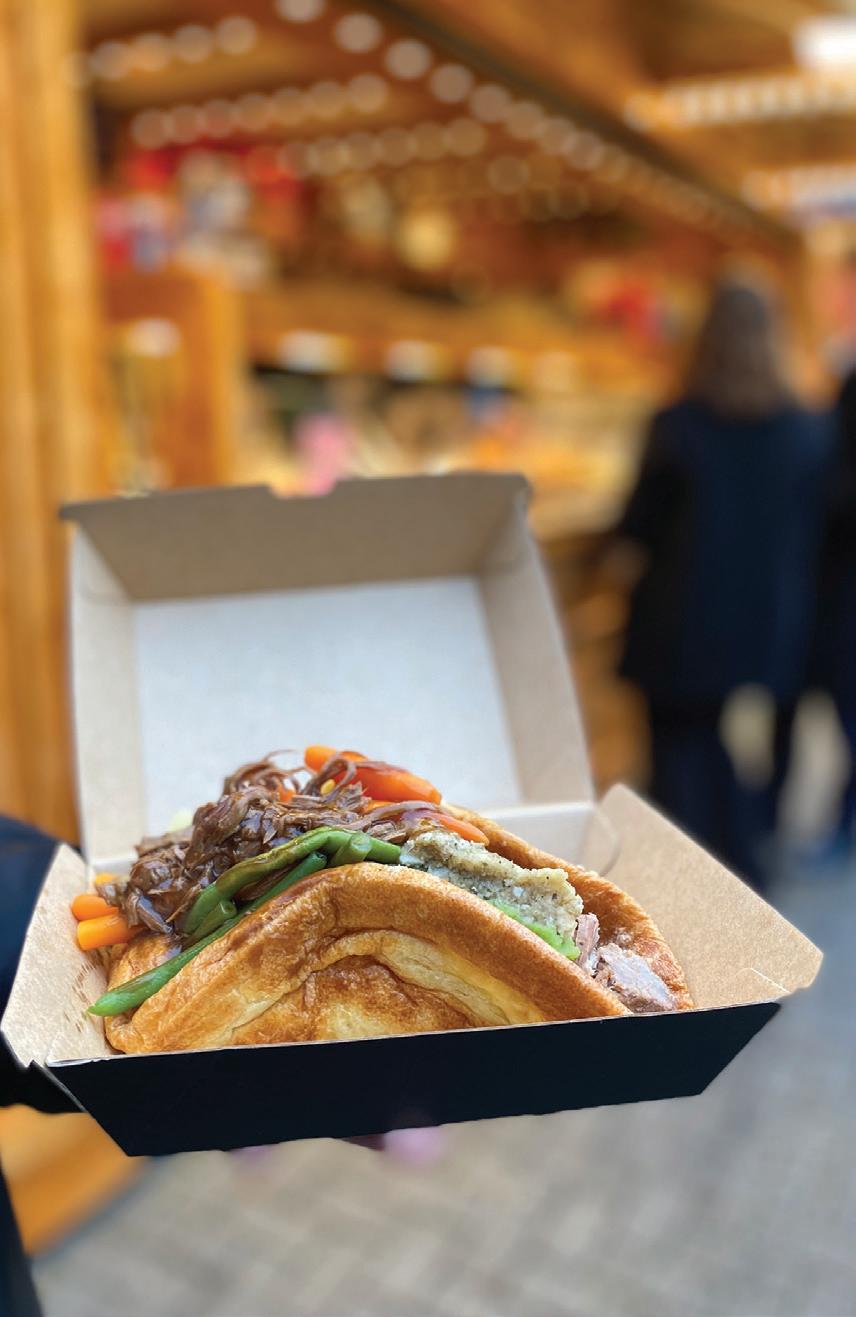
“Since the pandemic, we’ve seen a clear shift in the grab-and-go market towards hot foods. From 2022-2023, over a fifth (22%) of consumers were opting for hot FTG. This is a 12.5%
increase on 2019, when around just one in eight (13%) selected hot foods instead of ambient and chilled options. Over the same period, sales of the sandwich plummeted. Although 2023 showed signs of recovery, as even heavily paired back, prepackaged high-street ranges began to show signs of life as they branched out once more beyond core fillings.”
Planglow has an exciting concept in development for grab-and-go, which it will begin to roll out later this year. It has also just launched two unique labelling products – overprintable eight per sheet dissolver labels and deli ticket sheets (also eight per sheet):
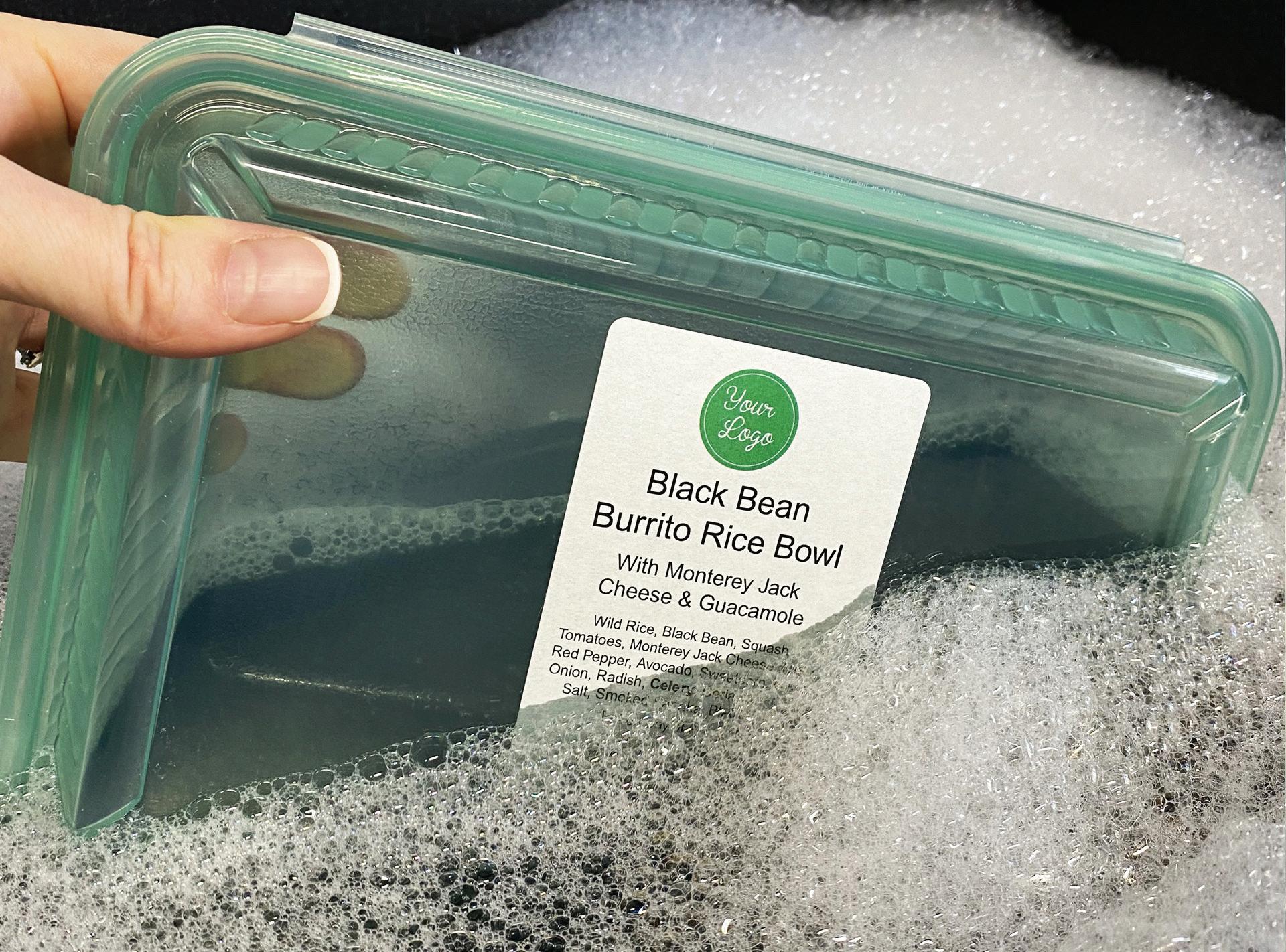
● Dissolver Labels all come out in the wash. No scrubbing or peeling required, thanks to a fast-dissolving material which leaves you with residue-free containers – even in cold water – minimising clean-up times and bacteria. Developed for reusable takeout packaging, plates and back-of-house catering containers, overprint using the Planglow food labelling app and any standard inkjet or laser printer. Sold in packs of 100 sheets, they have a working temperature range of -40°C to 100°C. Performance should always be tested in actual application conditions.
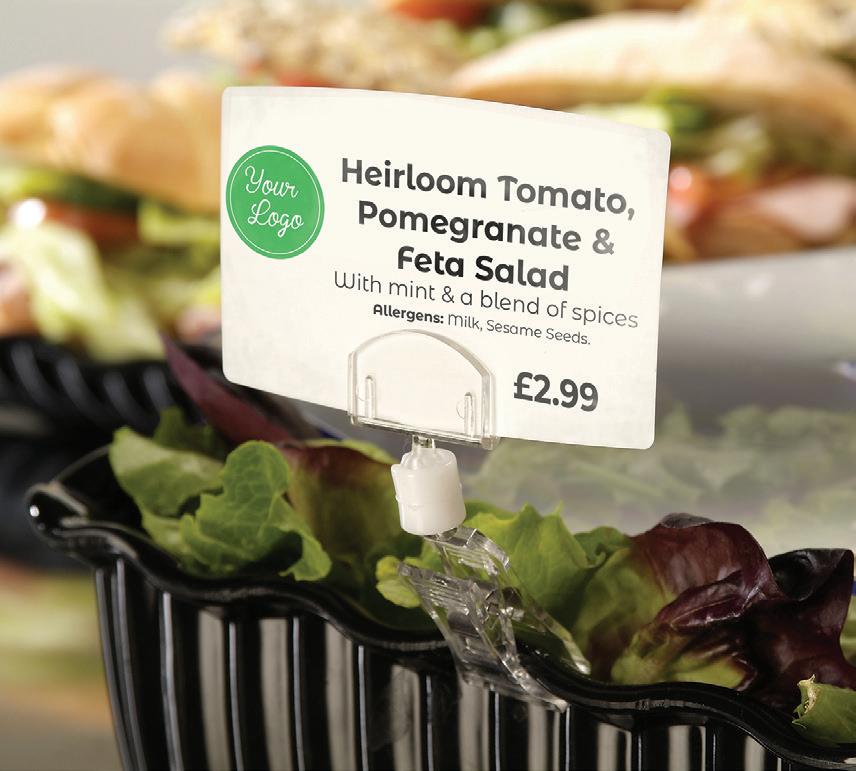
● Developed exclusively for Planglow, the time and labour saving eightper-sheet Deli Tickets are unique to the market. Providing clear product information at salad bars, deli counters and shelf edges, simply print and peel pre-cut tickets from their sheet and you’re ready to go.
“Overprint in LabelLogic Live adding calorie/nutritional information, reference intakes, allergen and Natasha’s Law, ingredients, carbon data and more, as these generously sized products will accommodate as much information as you require,” said Sawtell. “You can even brand with your own logo and messaging.
“Made in the UK, our semi-gloss Deli Tickets are sold in packs of 100 sheets and feature a ‘no stick’ adhesive, with the laminate made using FSC-certified paper – suitable for laser printers only.”
And while current economic challenges are inescapable, the Planglow approach is pragmatic: “Regrettably, like many businesses, our biggest current pressure point is our overseas supply chain. As a result, shipping costs are escalating. However, our procurement team works hard to manage and maintain current pricing, without passing on to our customers,” concluded Sawtell.
34 I www.sandwichandfoodtogonews.co.uk




www.sandwich.org.uk I 35

Compostable packaging: a vital solution
Vegware is at the forefront of foodservice recycling – and the business has invaluable advice around end-of-life innovation.


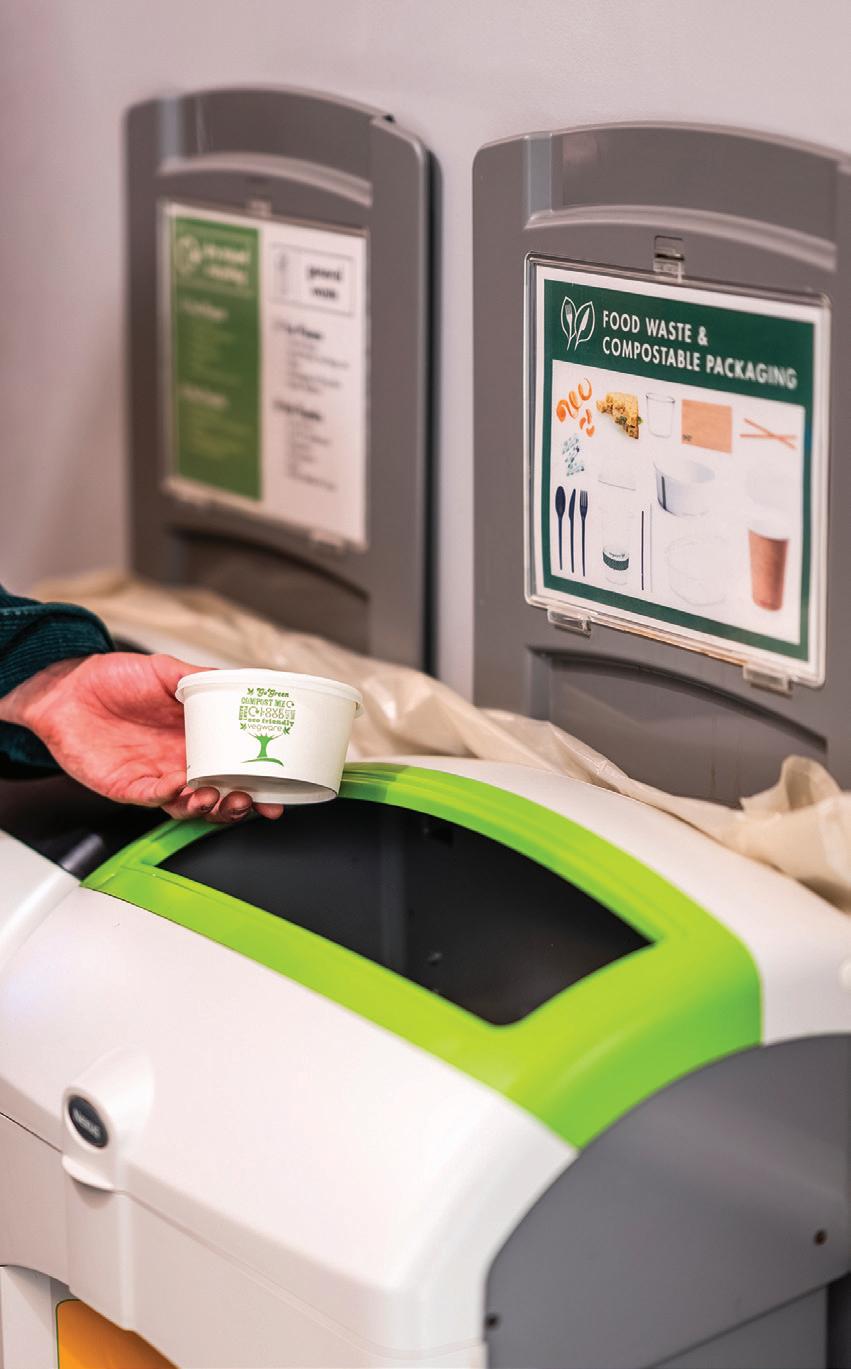
BIG PICTURE

The future of sustainable packaging is no longer solely about packaging, but end-of-life solutions. The way we approach both needs to be holistic. We must think beyond function, considering its implications and what we have at our disposal.
In a foodservice context, residue complicates dry mixed recycling. A decade of conversations with waste professionals tells us that foodcontaminated packaging is very unlikely to be recycled.
Many look for a silver bullet when it comes to the sustainable hinterland. The critical thing with all packaging options – recyclable, compostable or reusable – is understanding the right applications. All will prove to be useful in the future of sustainable packaging. The task is knowing how to maximise the potential of each tool.

Vegware was founded in 2006 to advocate for plant-based and compostable packaging, highlighting its potential in diverting waste from landfill or incineration. Compostable packaging can help businesses looking to find circular solutions.

GROWING INFRASTRUCTURE
We have taken on the mantle in providing end-of-life solutions for products. Our in-house team of four waste management consultants have been working with the sector since 2011. Their progress has been instrumental in setting up compostable packaging collections. Businesses can now access regular collections in over 40 of the UK’s largest towns and cities. We help some clients set up dedicated collections, use UK-wide post-back services or invest in on-site composting units.

As well as working with the waste sector, Vegware runs its own collections in Central Belt Scotland called Close the Loop. In 2023, we took 10,000 wheelie bins of used Vegware and food waste to industrial composting.

In just over a decade, we have proven how compostables can work and advocated for a rethink in approach. There is public support for this too. A YouGov survey of UK adults showed that 89% supported councils being required to collect all recyclable or compostable packaging from households.

PACKAGING
"With single-use plastics bans in the UK and EU, compostable materials are being seen as an alternative."
A primary criticism of compostable packaging is lack of infrastructure – but there are more UK facilities accepting Vegware’s compostable packaging than there are facilities to recycle paper cups. It’s the collection infrastructure which needs to develop – as we have been doing since 2011 by growing business collections. And with single-use plastics bans in the UK and EU, compostable materials are being seen as an alternative.
We are very proud of what we
have achieved in just over a decade, but we know there is a lot still to do. Legislative changes and an increase in popularity present an opportunity to re-evaluate how we see compostable materials and waste more generally.
LOOKING FORWARD
With infrastructure in mind, we’ve expanded our range of products certified for home composting.
This year, we added to our Vegware Nourish moulded fibre – a range of takeaway boxes and tableware with no added PFAS, all certified for home or industrial composting.
Also in 2024, the relaunch of our Green Tree range included paper cups certified for home composting, followed by soup containers and more.
We are working on two fronts, bringing end-of-life solutions to consumers. Advancing our range of home compostable products and continually advocating for improved composting infrastructure.


www.sandwich.org.uk I 37 Est’d 1938 WELCOME TO GAGGIA GAGGIA MILANO THE ART OF PERFECTION gaggiamilanoprofessional Gaggia Professional gaggiaprofessional 01902 355 000
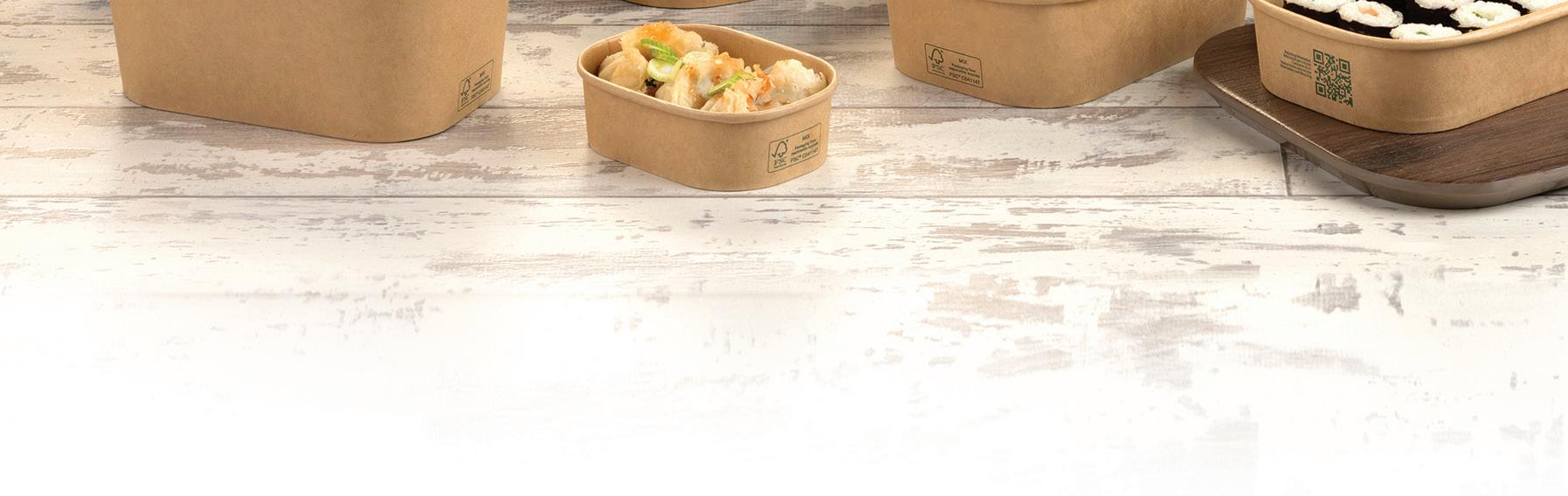


Total Package







Developing products while supporting and advising around new legislation is the Colpac methodology – and it’s working well.
COMMON THEMES
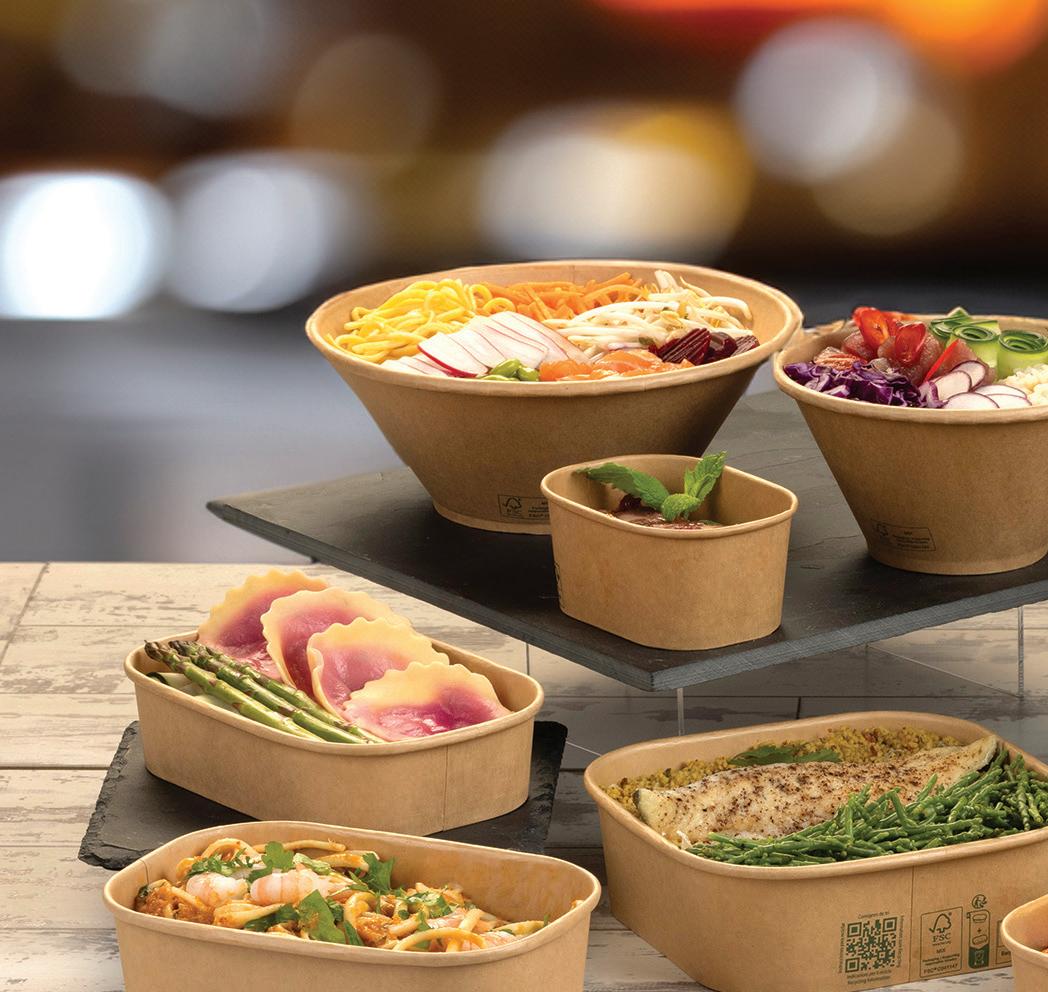
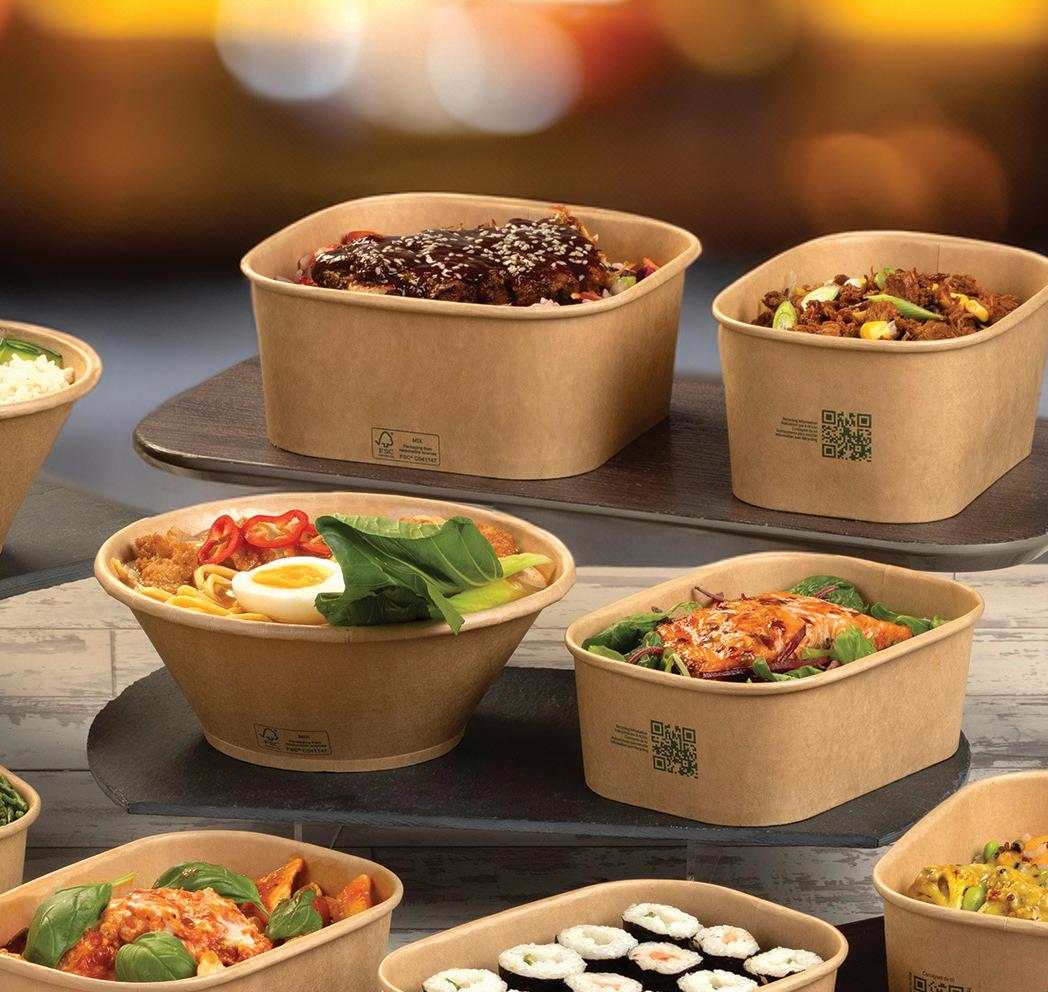
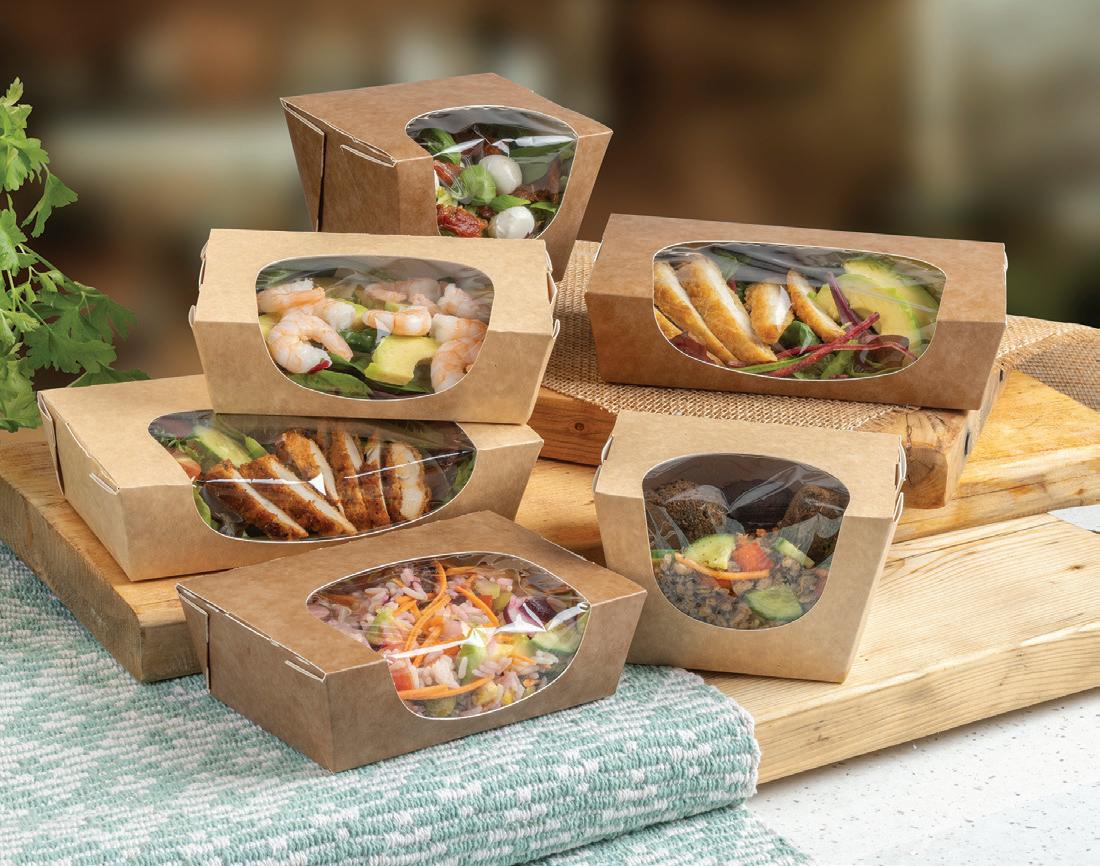
Off-the-shelf paperboard food packaging is not only better for the planet, but is flexible, comes in a variety of sizes and can comfortably hold hot, cold, wet or dry foods. It’s even spreading to airlines, as it’s recyclable, compostable, delivered nested, with custom prints available. Colpac is at the very heart of this
burgeoning sector – with major ambitions for the year ahead.
“Building on the success of our UK manufactured multi-food pots, we are looking to extend these lines to give customers even more choice,” said Colpac head of marketing and product, Kate Berry.
“Ranges like Stagione® will also evolve throughout 2024. These align with recycling guidelines and support sustainable sourcing due to the use of FSC® certified materials. (Colpac’s FSC® license code is CO41147).
“We will continue to champion lightweighting and encourage the use of innovative materials to reduce plastic, a common theme throughout all product development. We also identify innovations to
support trends around hot food to go, premiumisation and one touch.”
FINDING A PATH
Unpacking government legislation is not easy. With the UK generating around 11.6 million tonnes of packaging waste annually, it’s a matter of high priority. Westminster has set a commitment to recycle 65% of municipal waste by 2025 and eliminate avoidable waste by 2050. They’re ambitious targets, so operators have to be agile in this space.
“Engaging with legislative stakeholders is the only way to keep up to date with regulatory updates,” continued Berry. “At Colpac, we are proud to be members of industry, technical and stakeholder groups where we advocate for change. By contributing and understanding policy developments, we can actively advise customers and ensure they stay ahead of the curve.
“Our advice is to work with businesses like ours that actively
38 I www.sandwichandfoodtogonews.co.uk
engage in supporting legislation development, and those that validate their claims through industry bodies. Businesses should look for the highest food safety standards, such as our BRCGS AA+ certification, and to those investing in proving their claims, such as our net-zero target validation from the Science Based Targets initiative.
Key for Colpac is collaboration on bespoke packaging solutions. It works to understand customer requirements, developing pack configurations and designs that showcase products and brand values, ultimately helping clients sell more food. With flexible production and a highly skilled team, its UK-based factory presents the ability to work with short development timelines.
“With over eight decades of experience, we offer a depth of creativity and expertise that is core to the development of bespoke solutions, ensuring effective functionality and visual appeal.
“Our bespoke packs create impact to entice consumers to buy and help brands to stand out.”
MINIMISING RISK
New, fresh solutions are key to competing at the top level.
“We review and enhance each part of the product, including material selection, pack construction and manufacture. Innovation is integral to our operations. We work with new technologies to bring them to market and develop these through to a commercial scale. Our UK manufacturing site means we can quickly work through the development cycle to fast-track feedback and solutions.
“Our way of working allows customers to innovate with minimal risk as we continually assess at each stage of development. Competition in the market stimulates innovation, so working with companies such as Colpac provides innovative customers with the perfect partner, that can complement their own creativity and drive,” concluded Berry.
A fresh approach
Freshways was looking for an innovative wrap packaging design that would maximise value perception in retail and foodservice environments.
Colpac designed a pack to be used in multiple orientations. This could be opened and filled horizontally to improve efficiency, enhance customer experience, and allow the product to be displayed vertically to optimise shelf space and provide differentiation. The solution featured supports that utilise the pack weight and fill for an upright, free-standing display, while keeping the appealing visual curve of a wrap pack.
The concept was proposed and extensively tested and trialled, refining various iterations. Assembly and closure were specifically developed for hand filling and automatic labelling, and for easy opening and closing by consumers.
Wrap packs needed to be seamlessly integrated with the customer’s efficient production process, without the need for additional machinery.
The design team created a closure that was easy to secure in-line, as well as being user-friendly for handling by consumers. The filled
pack and closure also worked on the customer’s automated labelling line, providing tamper proofing, allergen information and ingredient listings.
“Having worked with Colpac previously, we recognised the company’s strength in bringing innovative solutions to complex challenges. Together, we created a customer-centric solution that maximised value perception on-shelf, managed cost and, most importantly, helped with our commitment to plastic reduction as part of our overall responsible business plans for 2024,” said Ian Mullin, head of innovation at Freshways
The customer wanted to move from a previous plastic flow wrapped product. The new pack was manufactured from a board with water-based, grease-resistant coating and a light film. This meant it was recyclable, with an overall plastic percentage of only 2.68%.
Colpac managed all aspects of this project to meet tight timescales for launch. This resulted in a unique, highly functional pack that delivered on a complex array of requirements.
For more info, visit colpacpackaging. com/case-studies/freshways/
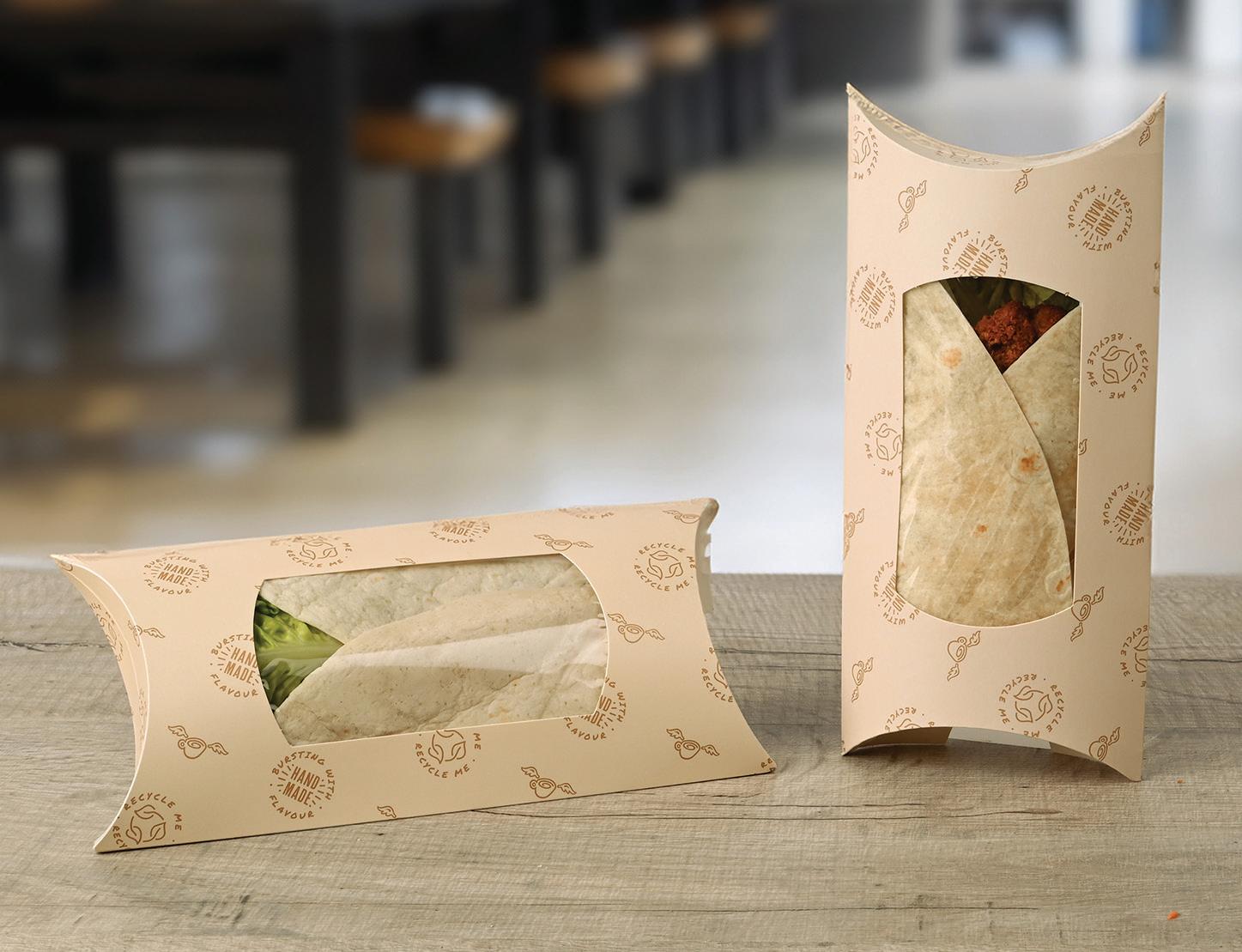
www.sandwich.org.uk I 39 CASE STUDY
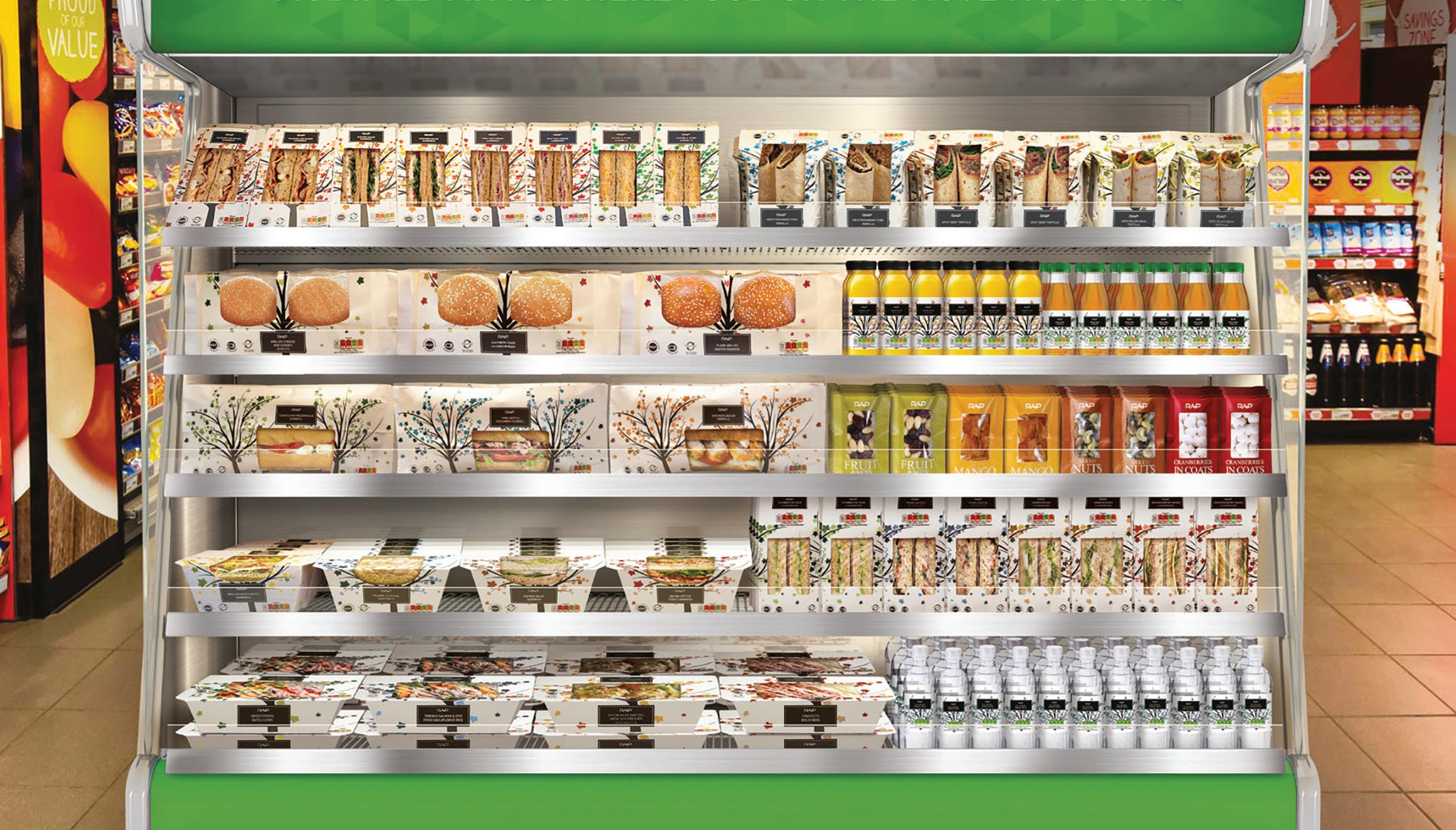
The choice is yours
ProAmpac’s
VP global package design, applications and business development, Sal Pellingra, discusses an ever-changing sector and consumer expectations.
What particular products/campaigns are you focused on?
Some of the biggest growth areas are in grab-and-go convenience and sustainability. Key to this is being able to see the product, so transparent windows are essential, while graphics also play a big part. How can the products pull in a consumer and guarantee brand recognition?
Quality is of course a factor. There is a need to minimise fogging and excess moisture on both hot and cold offerings, and for hot products there are two quality points. One is just heated and ready for a consumer; the second is getting that same quality for one-to-four hours in a hot hold. This balance requires customised packaging and collaboration for each product and application. More and more of these are designed to be fulfilled out of store, with the ability to be cooked and displayed without ever having to remove the product from the package.
ProAmpac is focused on all of the above, with solutions designed to elevate the grab-and-go offering, whether handed directly to the consumer or grabbed from a display case in a store. Additionally, packaging designed to reduce virgin plastics. When replacing plastic clamshells, ProAmpac’s food to go, fibre-based packaging can reduce plastic by more than 80%.
"The primary focus is on keeping up to date with what’s on the horizon and ensuring that our development strategy is aligned."
Another key is sustainability – meeting brand, private label, consumer and local goals to reduce environmental impact. Many involve reducing packaging and virgin plastic, moving to PCR and driving towards recyclability.
Who do you work with and how do you maintain these partnerships?
Collaboration is key to developing new formats. This can be with comanufacturers that are packaging food to go products. It can be with OEM packaging machine companies to ensure efficiencies on flow-wrap and lid sealing equipment. We also work with oven and hot/cold hold manufacturers to test packaging on products, ensuring brand expectations are met – these are long-standing partnerships.
Our Collaboration & Innovation Center, or CIC, has an exciting array of capabilities where we can shorten the often long and iterative development process. New concepts are created, with products tested on filling
40 I www.sandwichandfoodtogonews.co.uk



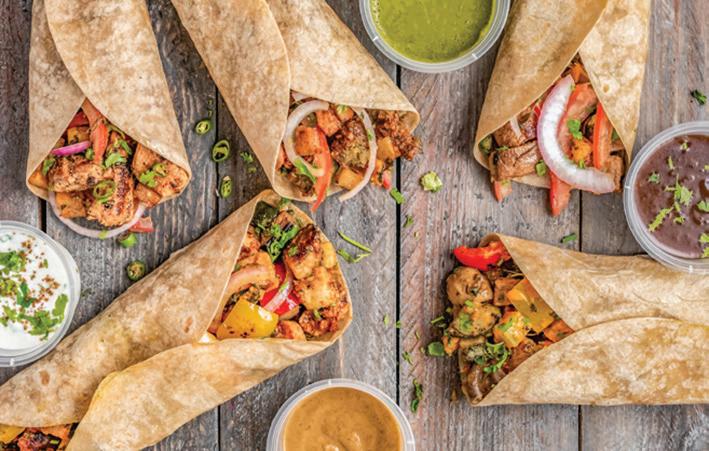
equipment in a range of ovens and hot-holding methods, to shorten development time. Our partners are a big part of this and often in attendance.
Legislation is increasingly complicated for operators.
What’s your approach and advice for other businesses?
The primary focus is on keeping up to date with what’s on the horizon and ensuring that our development strategy is aligned to meet future requirements. A lot of our capabilities are strategic around these efforts. We’ve acquired two paper mills in the US that produce 100% recycled paper from recycled sources. We have fibre solutions for FTG applications that replace rigid plastic clamshells coming from finite resources. Key is reducing packaging and designing in sustainability into functional solutions.
Our innovation team is committed to a constant introduction of sustainable products. Recent ones include ProActive Recyclable FibreSculpt – engineered for thermoforming applications suitable for various products –and ProActive Recyclable RP-1000 curbside paper solutions.
Elaborate on your bespoke packaging.
Everyone would love a one-size-fits-all approach, and ProAmpac offers a wide range of off-the-shelf solutions. However, grab-and-go product offerings and the equipment used are in constant flux. To make sure packaging is designed for this growing market, the ability to customise is key. Firstly, brands want products to stand out vs competitive offerings –being able to move to custom-printed and designed packaging that looks different on shelf to attract attention.
Next, to ensure quality meets expectations, especially after heating and holding, as materials react differently. Many QSRs have a variety of ovens and hot-holds, with some packaging working perfectly right out of the oven – but others require modifications for hot-hold. Customisation is key to providing that shelf appeal differentiation, with the right functionality for each product and application.
How do you innovate in such a competitive marketplace?
ProAmpac has always had that innovative mentality. We’ve grown organically and through acquisitions, with each one being attractive because of its culture fit. It’s what makes us tick and helps us continually drive the industry
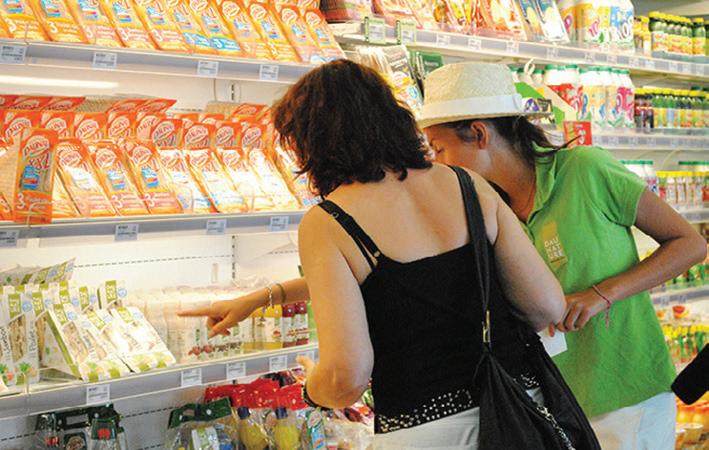
in new solutions for our customers. The key is not just to be innovative though; it’s to bring solutions to market with speed that are a commercial success.
We must be aware of trends and continual learning –our LEAD customer training is part of this. We help train teammates and customers at these events on materials, how they are put together and sustainability. We include industry experts and a fun packaging challenge.
What can you see in the future for 2024?
Continuing to launch functional, sustainable solutions that stand out on the shelf, use less packaging, and move towards a circular economy. Key is ensuring customers feel as good about the packaging as they do the product.






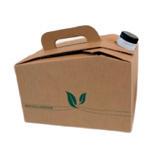
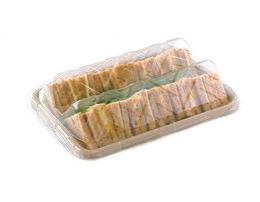
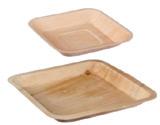













www.sandwich.org.uk I 41 PACKAGING www.BuffetPackaging.co.uk Tel:03300880712Email:sales@buffetpackaging.co.uk MorePlatterOptions Lowerprices MoreEnvironmentally Friendlyoptions NewWebsiteLaunch www.BuffetPackaging.co.uk

International recognition for eGreen
Packaging innovators eGreen International and its CEO, Caroline Wiggins, have won the ‘Eco-Friendly Packaging CEO of the Year’ award, presented by SME News.
The programme, created to honour and reward influential UK CEOs who have gone above and beyond to drive their businesses forward, recognised eGreen International’s achievements and innovations in the competitive ‘Eco-Friendly Packaging CEO’ category.
Surrey-based eGreen International has been operating since 1947, providing the foodservice industry with catering accessories and tableware. In recent years, eGreen deepened its commitment to sustainable practices, pioneering ground-breaking products – including the innovative self-destruct cups, 100% plant-based cutlery and trays made of recycled marine plastic. The cups have already hit the mark, being used at festivals and stadiums globally, including Twickenham.


Wiggins said: “To be recognised is testament to the hard work that has gone into producing our market-leading range. eGreen has pioneered innovative products that provide cutting edge materials, combined with superior marketing and activation technology in the form of QR codes. We are proud of our commitment to ethical sourcing and work hard to ensure our partners have the highest quality products that support them in their sustainability goals.”
eGreen International’s renowned self-destruct cups can be recycled, but if they become part of the waste stream, can break down into an earth friendly wax, which

will fully biodegrade within two years, leaving no presence of micro plastic. This commitment to innovation has not gone unnoticed.
HRH King Charles III selected eGreen’s self-destructing cups to be part of his Terra Carta mandate, which were unveiled at the COP26, held in Glasgow in 2021.


“Our team is at the heart of eGreen,” continued Wiggins. “From exploring new technologies to how they work collaboratively with our valued partners, they are deeply passionate in tackling the issues surrounding sustainability. This award is theirs and a testament to their commitment.”
eGreen International’s pledge to protect the environment has always been a key focus. Many products display the Forest Stewardship Council (FSC) tick-tree logo. The FSC is an internationally trusted, non-profit organisation that promotes the responsible management of the world’s forests.
eGreen International Limited makes sustainable, reusable and recyclable products which have been elevated to the next level. Today’s offerings comprise wooden products, food/drink accessories, paper drinking straws, recyclable and reusable drinkware as well ascustom products that the market has to offer. The company will soon be launching a world-first range, set to break new boundaries.




PACKAGING


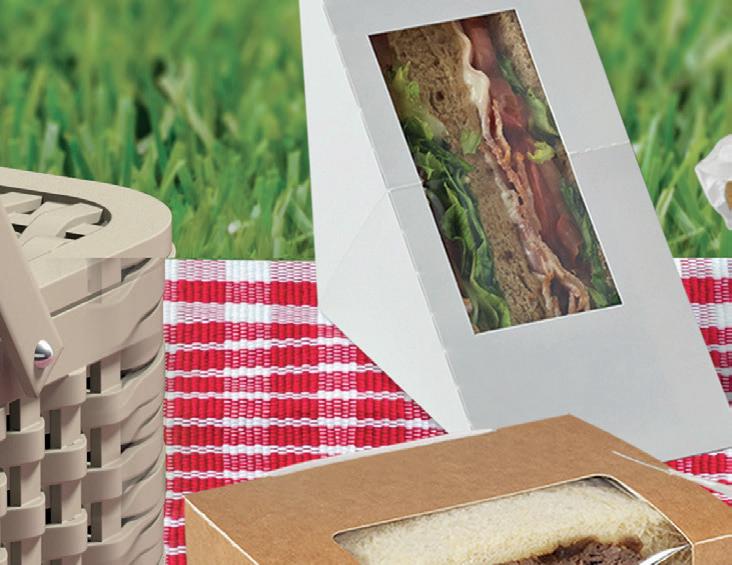
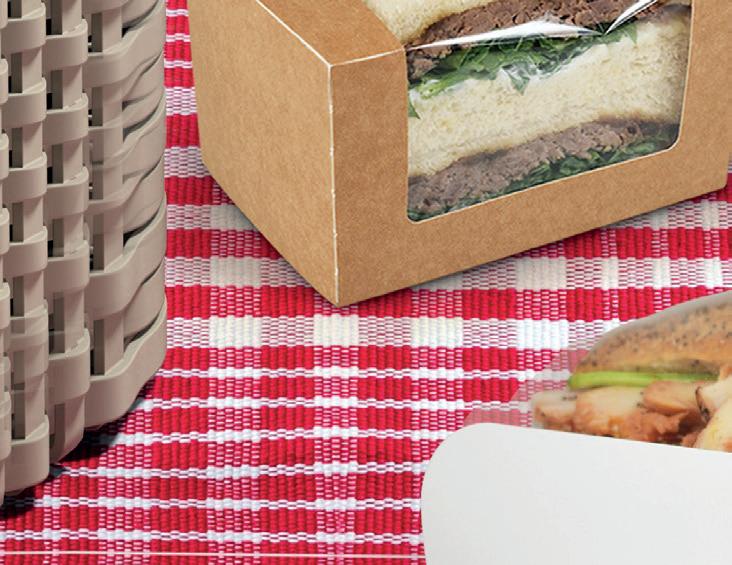


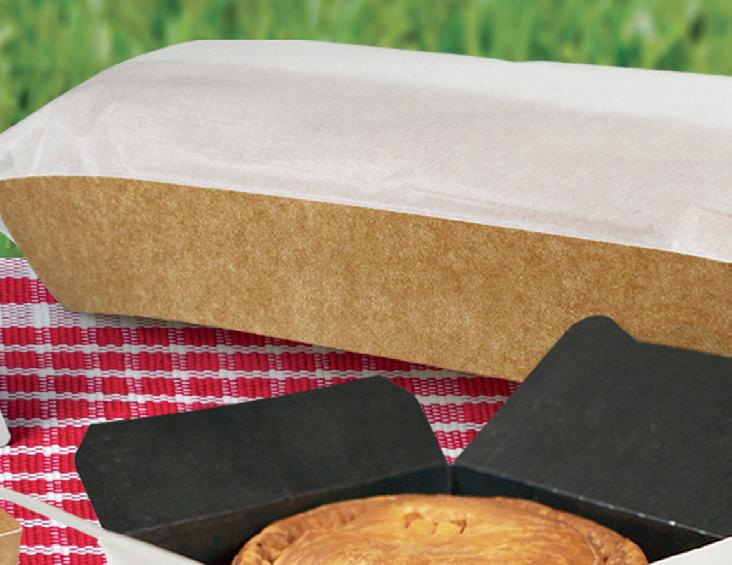
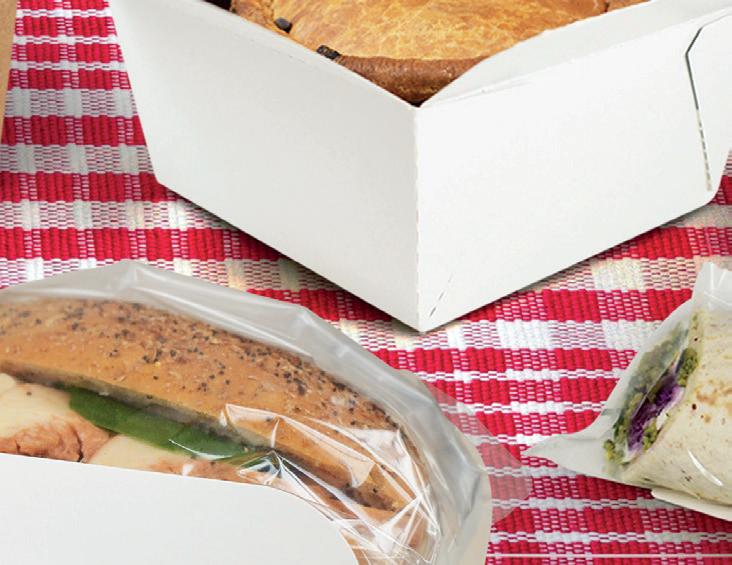


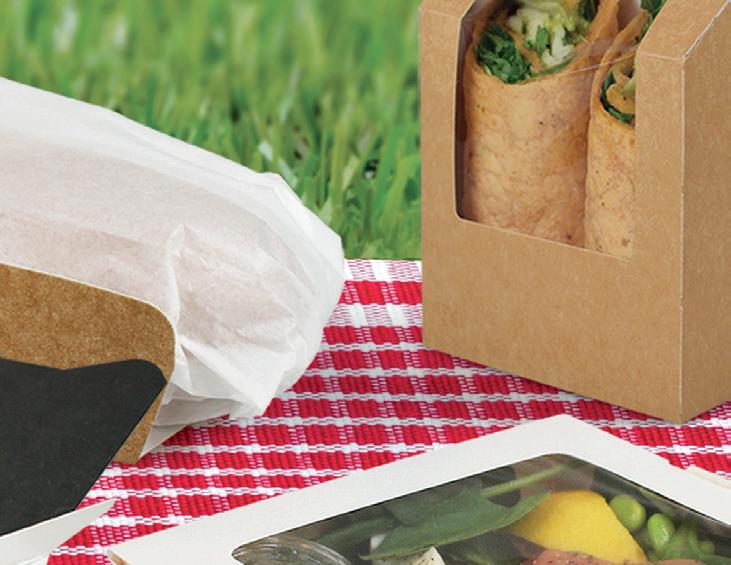
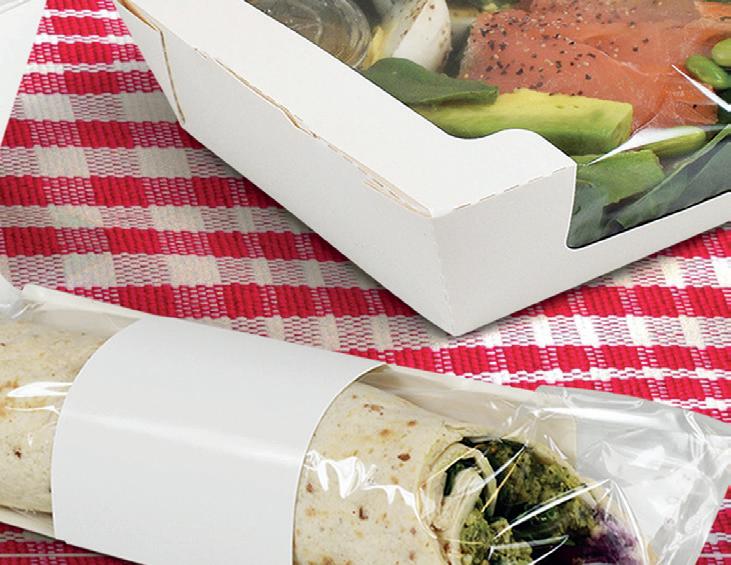




ProAmpac’s Food To-Go Packaging is designed for sustainability and built for performance
ProAmpac’s dedicated Foodservice division provides food packaging solutions that enhances product and shelf presence while helping customers meet their sustainability goals. Our fibre-based packaging is widely recyclable in paper streams when film barrier is removed, and increases operating efficiencies for our customers. Scan


www.sandwich.org.uk I 43 SALES freshfoodtogo@proampac.com HOTLINE +44 (0) 20 8069 0700 PROAMPAC.COM FOOD SERVICE PACKAGING
here to view our latest collection of specialist Foodservice
solutions.
packaging
No time to waste!

From sandwich skillets to shrink wrap, the Coveris range is growing exponentially throughout Europe.
RECYCLED FIBRE
Aligned with a No Waste strategy, sustainability is always a focus for Coveris. Together with its customers in the FTG sector, packaging innovation is centred around enhancing environmental performance by driving recyclability, responsible sourcing and incorporating recycled content.
“Our newest innovation, RecyclaLite R, takes our most lightweight sandwich skillet to the next level by introducing up to 30% recycled fibre content,” said Paul Robertson, Coveris food-on-the-move sales director (Business Unit Paper).
“This reduces reliance on virgin raw materials by combining high-quality recovered fibre from PIW sources with responsibly sourced wood pulp. Featuring a 12-micron plastic film liner – a 40% reduction versus standard skillets –RecyclaLite R uses the minimum amount of material for the maximum benefit and meets OPRL recycling requirements.
“Another innovation is RecyclaPaper. Our fully paperbased, sustainably sourced and recyclable sandwich skillet,
replacing the typical use of the plastic or bio-plastic film component with a translucent paper alternative. Developed to feature an enhanced translucent paper to achieve improved consumer product visibility (one of the main challenges), RecyclaPaper is a significant development in the use of paper-based materials in a traditional sandwich skillet format,” continued Robertson.
At the Anuga FoodTec 2024 in Cologne, Coveris presented its BarrierFresh MAP skillet, proven MonoFlex films and block bottom bag range – with enhanced shelf-life and point-ofsale presentation. These solutions all answer the growing demand for environmentally friendly products.
MAXIMISED SUSTAINABILITY
Coveris operates across 30 plants in the EMEA region and has just announced the successful signing and completion of another strategic deal in Central and Eastern Europe (CEE), the acquisition of S&K LABEL in the Czech Republic –its first acquisition of a labels business outside the UK.
44 I www.sandwichandfoodtogonews.co.uk

SUSTAINABLE FOOD-ONTHE-MOVE PACKAGING.
Our mission is to provide the best eco-efficient high-performance packaging solutions - both from a product and an operational perspective.
Learn more coveris.com/sustainability








BarrierFresh MAP
BarrierFresh MAP skillets deliver extended shelf life, keeping sandwiches fresher for longer, supporting food waste reduction targets





Kraft Bowls
A premium artisan look with excellent product visibility, kraft bowls are an on-trend packaging solution for a variety of hot and cold meals







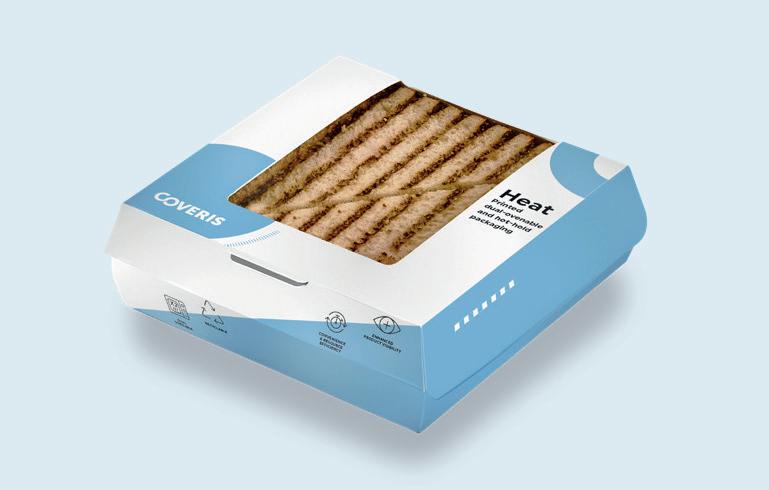
HEAT
With dual ovenable and hot-hold functionality, Coveris’ HEAT range provides the perfect grab-and-go solution for hot food-to-go products







RecyclaPaper
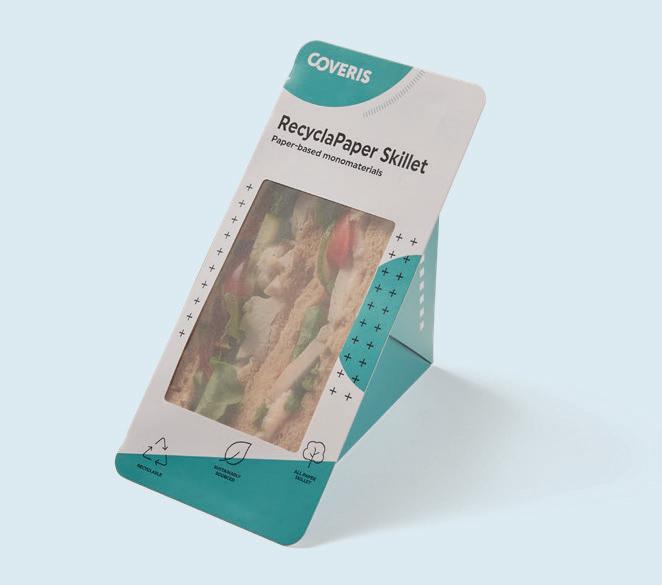


Recyclable and sustainably sourced, Coveris’ RecyclaPaper sandwich skillet is a fully paper-based solution with great product visibility
www.sandwich.org.uk I 45
PACKAGING
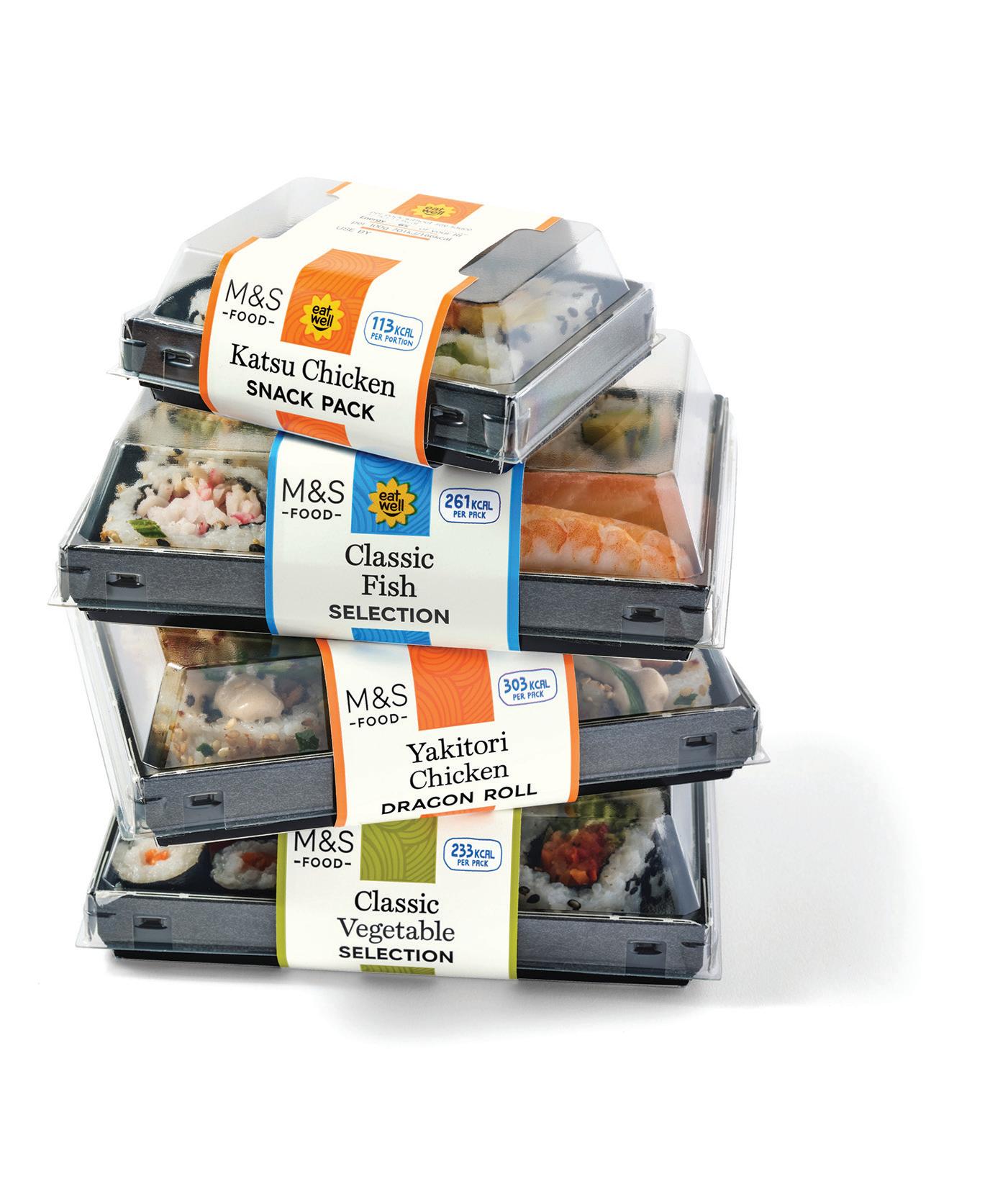
“Supply chain collaboration is key to innovation and sustainable change in our industry, and Coveris is committed to working with businesses that share our values. This applies to suppliers, food manufacturers, brand owners and machinery specialists, as this approach creates the ultimate project team to drive step change in the FTG market, while achieving cohesive environmental goals.”
Coveris is also a member of, or affiliated to, associations and organisations such as OPRL, the British Sandwich & Food to Go Association (BSA), Confederation of Paper Industries (CPI) and British Plastics Federation (BPF).
“Learnings and understanding of upcoming changes are paramount to ensuring innovations are futureproofed and deliver maximised performance for both ourselves and our customers,” said Robertson.
Bespoke packaging is also an exciting area that enables Coveris to work with customers on their specific needs to optimise sustainability performance, brand impact and functionality, alongside evolving market trends.
“Our No Waste sustainability strategy is embedded within all parts of our business and drives innovation. This varies from developing new
packaging formats, sourcing sustainable materials, delivering product protection and shelf-life, to improving efficiencies and reducing waste in our operations.
“The focus on sustainability – alongside our end-toend creative services including consumer insights, design, artwork and photography – achieves developments perfectly balancing consumer appeal and engagement, while minimising packaging and operational waste.”
FUTURE GOALS
“As a marketplace, FTG is fast-paced for both product and packaging innovation. We work with customers on a range of developments and innovations in the short, medium and long term, aligned with needs, sustainability goals and future legislation. Through our research and development team, we are working with suppliers and other areas of the supply chain to develop and prepare to scale-up innovations for the future.
“We continue to see a shift towards paper-based packaging in the UK FTG sector linked to retail, brand owner and manufacturer sustainability goals. Some paper innovations that we expect to see demand for in 2024 are our RecyclaLite R and RecyclaPaper sandwich skillets, increased use of cartonboard tray-based formats and helping our customers to be more efficient in the packing process. For example, by switching to linerless labels which are more typically associated with the meat, fish and poultry sector.”
In a collaborative project with M&S, Greencore and Ravenwood Packaging in 2023, M&S switched to Coveris’ linerless labels for its sushi range, achieving significant environmental and automation benefits.
“As a producer of both paper and plastic packaging, Coveris is well-equipped to provide packaging solutions, optimising environmental performance, consumer appeal and brand impact. ReCover, our recycling business, is closing the loop in the packaging industry with a mission to keep plastic circular,” said Robertson.

46 I www.sandwichandfoodtogonews.co.uk
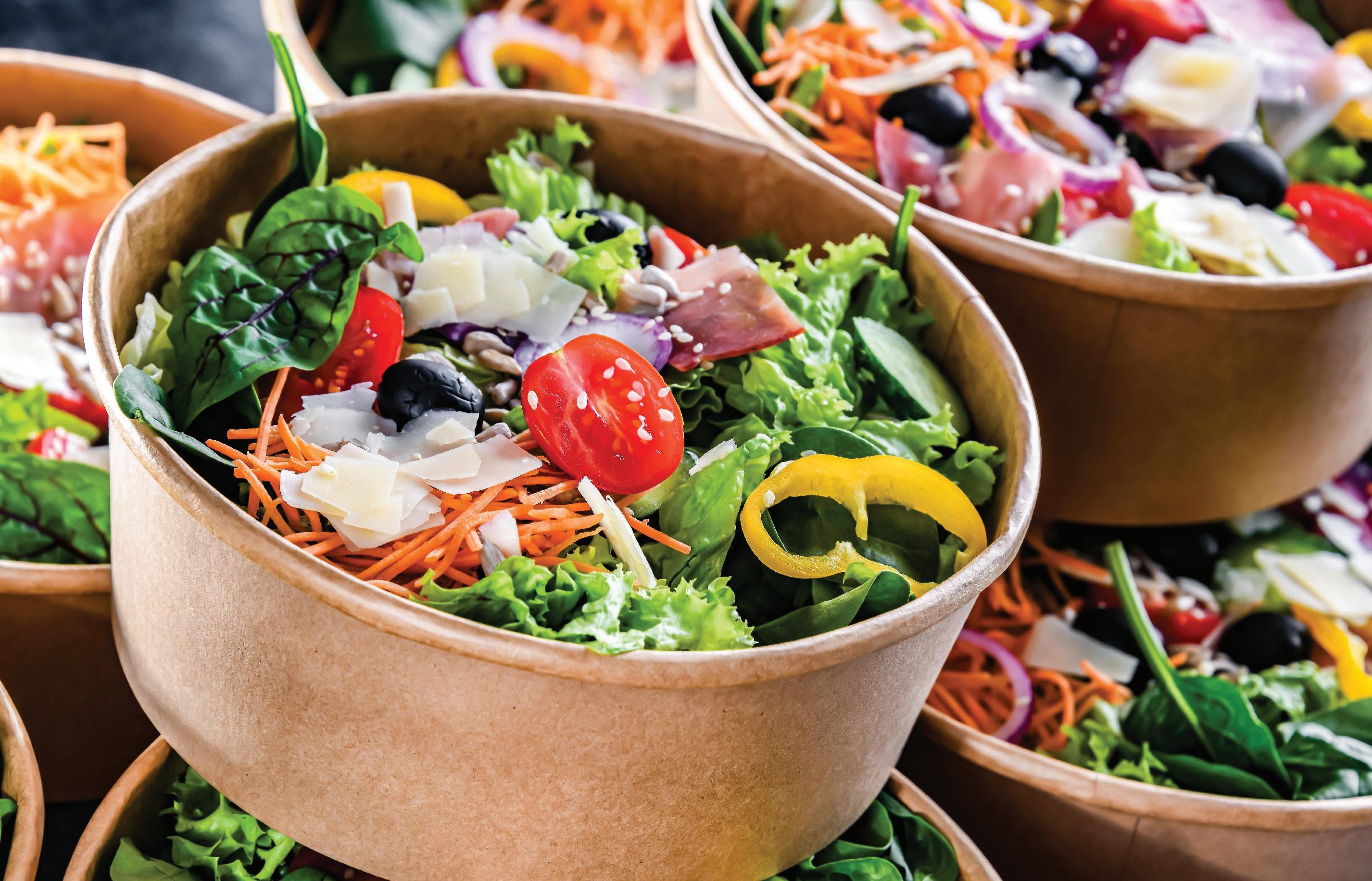
Perfecting their Kraft
There’s an exciting new range of packaging on the horizon for Conglom International.
TOTAL PACKAGE
A global presence in the packaging sector presents obvious advantages. Not only are you aware of customer demand internationally, but continually abreast of sector trends and product development. Fortunately, Conglom International has 25 years’ experience in the manufacture and distribution of premium foodservice packaging to businesses around the globe.
With a presence in the UK, Ireland, France, Spain and other European markets, it looks to combine industry know-how with personal service to deliver an exceptional customer experience.
“We supply companies of all sizes, from small independents to regional and national groups across all food and beverage sectors including OOH, QSR, foodservice, on-board hospitality, manufacturing and associated retail and wholesale distribution channels,”
said Chris Castle, managing director, Conglom International.
“Customers benefit from the buying power and reach of a global player (our HQ is in Canada and we have business units in the US, Australia and Asia) and enjoy competitively
priced, high-quality consumables that exceed the exacting standards of the industry’s environmental concerns.”
Via its Titan and Café Express brands, Conglom International supplies food packaging, disposable cups, tableware and kitchenware
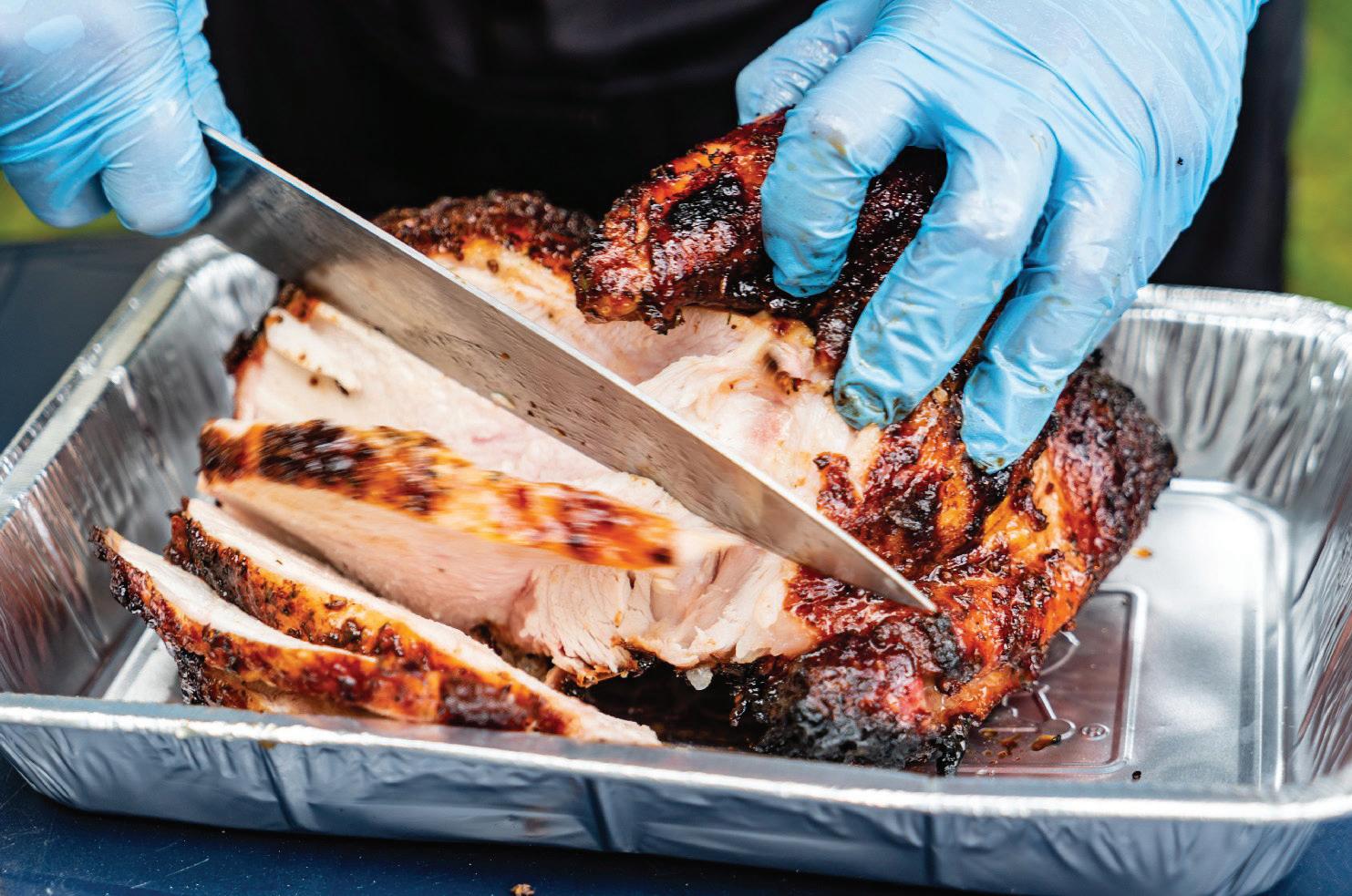
www.sandwich.org.uk I 47 PACKAGING
PACKAGING
with numerous eco options. It offers consumables such as hot and cold cups, bagasse, kraft boxes and bowls, aluminium packaging, portion pots and cutlery, takeaway containers and bakery lines.
“Our exclusive IECO range of aqueous coated, plastic-free hot cups is one of the few genuinely home compostable and 100% recyclable lines currently available in the UK,” continued Castle. “The range is constantly evolving to reflect the needs of the market, both in terms of products and consumer preferences.
“There has been an explosion in the popularity of brown Kraft containers, as operators tap into the general move towards more eco-friendly packaging solutions. Made from wood pulp – which is a sustainable and renewable raw material – Kraft boxes are biodegradable and recyclable with a lower carbon footprint than other comparable materials.
“Food safe and known for strength and durability, Conglom IECO Kraft
boxes and bowls are aqueous coated and thereby water and oil proof. We recommend this range for all types of popular takeout menu choices, including fried food, burgers, sandwiches, salads, sushi and tacos.
“We actually have an interesting new line of tamper proof Kraft food boxes launching this summer, ideal for takeout and home delivered businesses. I don’t wish to say too much before the big reveal, but this design format offers complete food security, providing assurance to operators and consumers that food items will arrive in the best possible condition, free from interference or damage en route.”
IN THE KNOW
Success is built on long-standing relationships with large wholesalers and distributors, where the focus is on excellent service alongside accurate planning and forecasting. Face-toface meetings are commonplace, with discussions around product
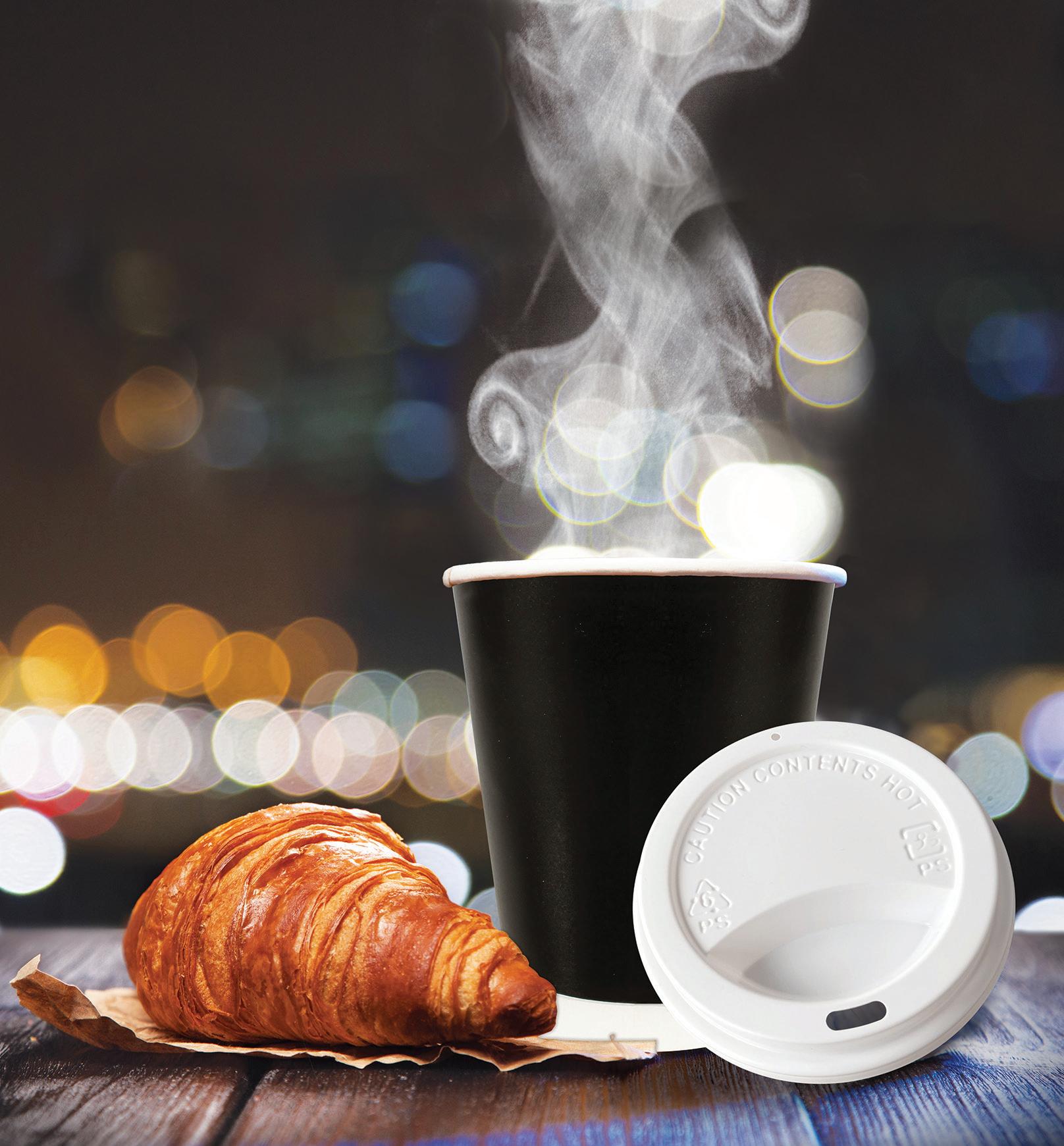

innovation, logistics, marketing strategy and promotional activity. Delivering on promises is essential to establishing that trustworthiness.
In challenging times, with everchanging legislation, it appears these attributes are more precious than ever.
“Stakeholders – be they customers, government bodies, employees, etc – expect transparency, accountability and fairness in the way we operate, so compliance management has become an increasingly important role. It’s a moving goalpost and we are allocating additional resources and training to meet demands in this area.
“Non-compliance can result in a loss of customers and legal penalties, so my advice to any operator is to make sure they have an effective compliance management plan in place, as there’s a lot at stake – not least, a company’s reputation.”
But if there’s one word that perfectly describes the foodservice industry, it’s resilient.
“The OOH sector is a very competitive market and high-street operators are always looking to steal a march with the next big thing,” said Castle. “Menus are constantly changing, through the seasons, via product innovation or just a need to offer consumers more choice.
“We therefore work closely with development chefs and marketing


teams to understand food & drink in the pipeline. As the product progresses from concept to launch, we provide the necessary support to ensure all packaging requirements are met to the customer’s specification. We have a comprehensive range of standard lines, but as a manufacturer with dedicated capabilities in the Far East, we can also offer customers a bespoke packaging solution.
“Our resources, experience and expertise can source materials, finishes and design formats, which we do with an incredible attention to detail to ensure expectations are exceeded.”
INTERNATIONAL PERSPECTIVE
Being part of a global network gives Conglom the benefit of sharing market intelligence with partners in North America, Asia and Europe. Exchanging ideas and learnings allows it to better serve customers, by anticipating demand and listing the correct items for a specific business.

operators has skyrocketed in the UK). Whatever happens in the States tends to make its way over here at some point. The type of food on offer and the way it is being served has an implication for packaging needs, so

“Our aim is to be early to market with innovation, ensuring we stay ahead of the local competition. But the US is particularly influential in terms of type of business model (e.g. the number of street food and drive-thru
PACKAGING
maintaining awareness of these trends is vital.
“Also seeing where our customers’ NPD is heading, while keeping up to date with legislation, while understanding how that might impact the industry. This is essential for our product development team.
“Environmental concerns have placed enormous pressures on our industry in recent years and the use of plastic has certainly fallen out of favour. There has been a huge increase in of paper-based products –and I don’t see this trend changing.

“The current demand is for tamper proof and more heat-resistant packaging, specifically for the home delivered market. I am sure these are just two of the many innovations that will be introduced to the market this year,” concluded Castle.




www.sandwich.org.uk I 49
On the road to change
cheese and dairy supplier Bridge Cheese is taking pioneering steps to drastically reduce the amount of PPE it sends to landfill sites. Managing director, Michael Harte, explains why.
TIME IS NOW
Here’s a bold statement. It’s my firm belief that any company which does not rise to the environmental and sustainable challenges now facing us will not exist in 10 years.
Consider the facts. Latest confirmed government figures show that the UK generated some 43.9 million tonnes of commercial and industrial (C&I) waste in 2018, of which 37.2
million tonnes (85%) was in England.
The latest estimates for 2020 –covering England only – suggest this fell slightly to around 33.8 million tonnes but increased again to 33.9 tonnes in 2021. And of all the waste produced in the UK – household and commercial combined – some 50.8 million tonnes went to landfill in 2018.
I don’t know about you, but I find those figures depressing. And the thought that we could continue to be so cavalier with the earth’s resources is terrifying. Landfill is, of course, just a small part of the picture when it comes to meeting our environmental responsibilities.
Throw in our use of energy, petrol and diesel, plastics and everything else which the modern world has taken for granted for too long, and the picture becomes increasingly grim. The time to act has long since come.
DISPOSABLE SOCIETY
Having worked in the dairy industry for more than 20 years, I know all too well that some things are done simply because that’s the way they have always been done.
Take our use of PPE. It’s common practice for hairnets, beard snoods, face coverings, safety clothing and shoes to be sent straight to the tip or local incinerator, often after just one use. That’s hundreds of thousands of items being thrown away every single year without a moment’s thought.
That’s why Bridge Cheese has been undertaking a thorough audit of its PPE use – and formed an innovative partnership to drastically reduce it.
That decision arose when the contract for our coat laundering service came up for renewal. With sustainability in mind, we looked for alternative suppliers handling PPE in a more green or efficient way.
Ultimately, we found an innovative partner organisation – Staysafe PPE – whose sustainability goals aligned with our own. They are now helping us make big changes to how much equipment we use and reuse, and
UK
50 I www.sandwichandfoodtogonews.co.uk
how much we divert from landfill.
There is a positive cost implication to the changes we’re making but the sustainability driver was the impetus.
CYCLE OF GOOD
We now reuse or recycle everything we can in our production facility on a weekly basis. Our partner company uses ozone in their washing systems to kill bacteria and remove pathogens in cold water so they can clean all our clothing, from lab coats to hi-vis wear.
Laundries use thermal disinfection which means washing at 60C or above, but many PPE items are not made to withstand this – hi-vis and waterproofs melt at those temperatures.
That said, there is a limit to the number of times hi-vis jackets and waterproofs can be washed and how clean they can get. So, Staysafe PPE has a number of initiatives to utilise items that have reached the end of their working life with us.
For example, jackets can be unbranded and donated to charities or good causes, such as litter picking groups or community gardens. Safety shoes and hard hats go to charities like Cycle of Good, which works with organisations in Malawi. These items can be worn by people working on building sites, such as an ongoing project there to construct a university.
Staysafe PPE is also linked with companies using unrecyclable textiles to make insulation fibre, and granulating gloves into a sand substitute for concrete, which saves seabeds and their ecosystems from being damaged for sand collection.
And while hairnets and beard snoods are not washable or recyclable as the fibres are too delicate, we’re working with Staysafe PPE on sourcing a solution for their reuse.
ALL IN THE MIND
But we must also change the culture in the workplace. Single-use PPE has been a matter of course for so long, that getting staff on board requires a switch in mindset.
Employees are reluctant to wear
used PPE, even if it is completely clean and free of bacteria and pathogens. As a nation, we are happy to drink from cups that have been washed multiple times, but there seems to be a psychological barrier around cleaned PPE, particularly face coverings.
Staysafe PPE gives a demonstration to production staff to talk them through both the laundering and inspection process.
We’re using the same briefings to help employees understand why we are making the changes and the environmental benefits.
It’s too early to measure the impact on emissions of reducing our PPE waste specifically but it’s something we are looking to quantify in the future, to benchmark performance and put additional plans in place for improvements down the line.
It’s one part of our sustainability journey and we’re just one company in a much bigger industry. But the world is at a tipping point and adopting environmentally responsible practices is no longer a matter of choice; it’s a matter of life and death.
And for any company which buries its head in the sand – and its waste in a tip – the future looks far from bright.
“There is a positive cost implication to the changes we’re making but the sustainability driver was the impetus.”
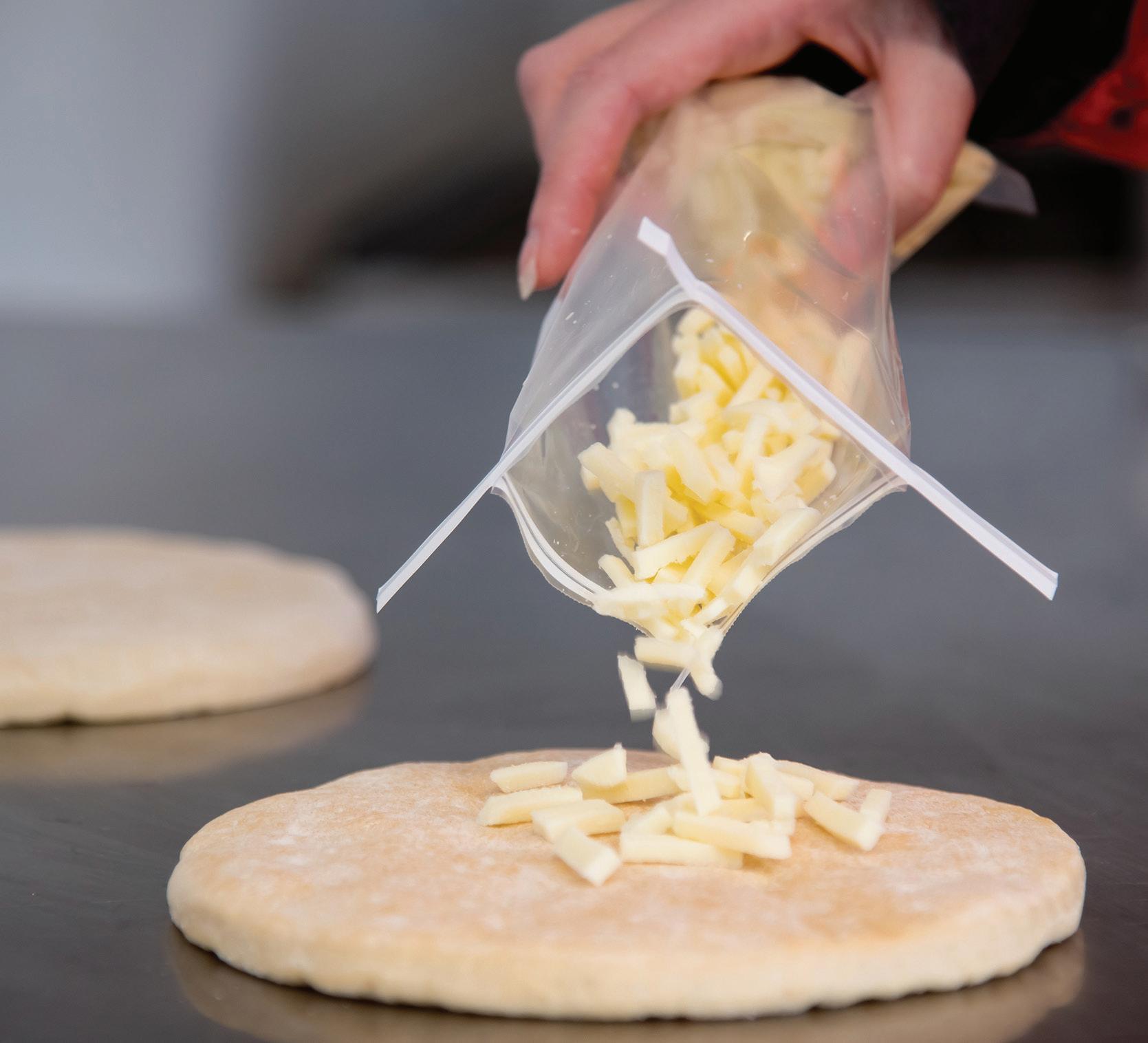
www.sandwich.org.uk I 51 SUSTAINABILITY
An essential need for transparency
Key steps can be taken to negotiate sustainability challenges and exceed customer expectations, according to Celebration Packaging.
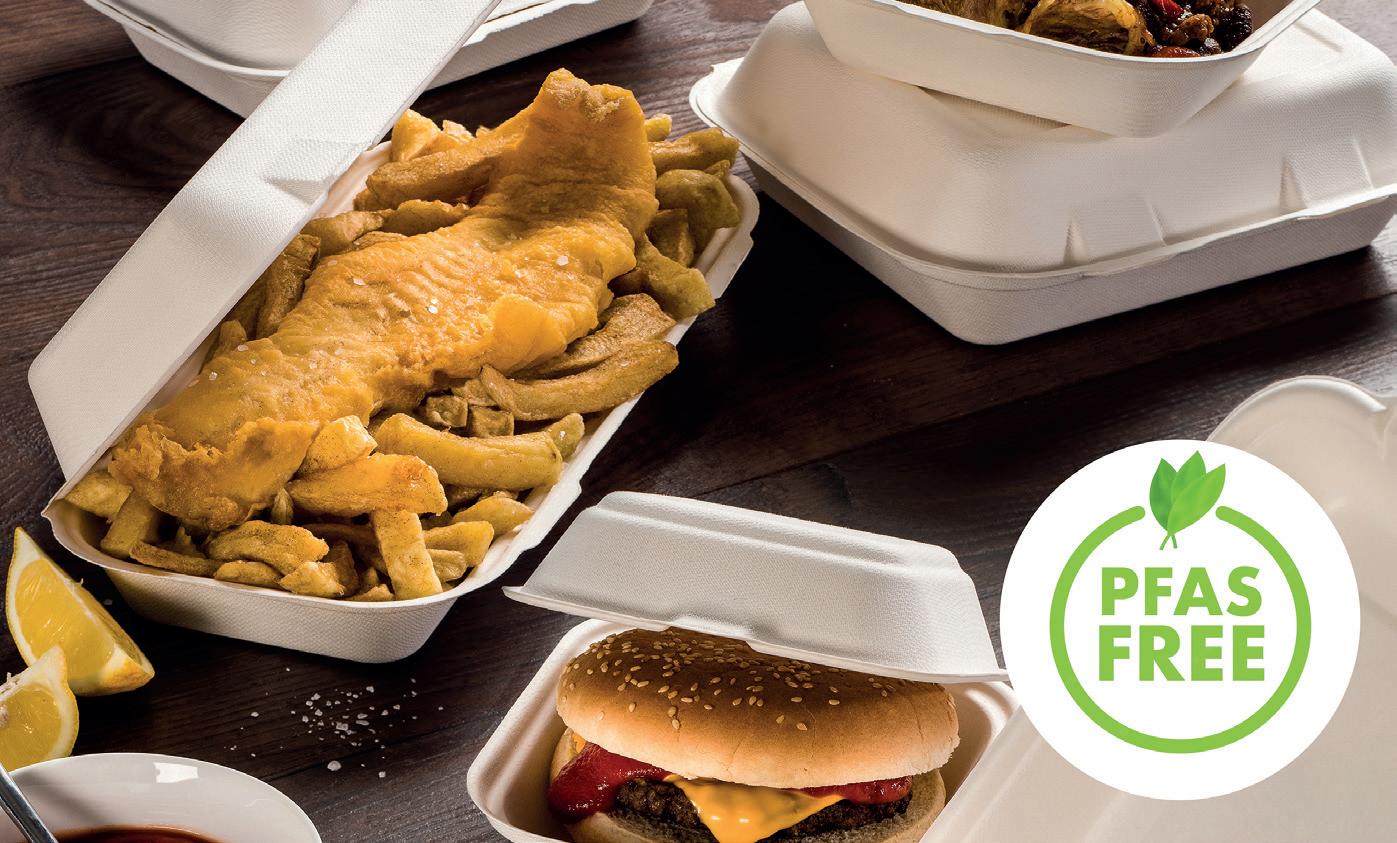

CERTIFIED QUALITY
Celebration Packaging offers a wide range of products, from paper tabletop items – such as napkins – to rPET sandwich wedges and sustainable/ compostable takeaway burger clamshell boxes. New product development is a core belief.
“Celebration has always invested in certifications which we take very seriously, so that when we make environmental and sustainability claims, we can always back them up,” said Celebration Packaging managing director, Nick Burton.
“This sets us apart from many competitors, while also giving customers confidence to help them on their sustainability journey.”
By obtaining certification, Celebration can confirm that its products are suitable for direct contact with food & drink; made from sustainable resources where applicable; and are recyclable or can be composted, either industrially or at home.
“We have also obtained various accreditations. BRCGS for own manufactured products; and BRCGS for storage and distribution. We also have ISO9001, ISO14001 and Forestry Stewardship Council® (FSC®) Chain of Custody accreditation, as well as being members of Sedex,” said Burton.
“Celebration Packaging strives to ensure that products meet and exceed customer expectations, evidenced by the low number of complaints we receive. This approach,
which has been part of the company’s ethos for decades, has resulted in us having a very good reputation in the foodservice market/industry.”
SIMPLE SOLUTIONS
Packaging in the sandwich/FTG arena is a complex beast – and Burton believes there could be more assistance from the powers-that-be
“We would like to see guidelines from the UK government stating that single-use food & drink packaging has the relevant certification to confirm that it’s safe for direct food contact and is either recyclable or compostable, and is made from renewable resources (such as FSC®).
“Additionally, the launch of consistent recycling collection methods as soon as possible across all four UK nations, which standardise what is and isn’t recyclable. We also feel that the funds from the introduction of Extended Producer Responsibility (EPR) fees must be used to ensure that products sent for recycling are recycled here in the UK and turned into new products (although not necessarily more food and drink packaging).
“We would also like more activity by the CMA/ Advertising Standards Authority, cracking down on ‘greenwashing’. If something is claimed to be compostable, it should show the relevant certification that proves it.”
This drive for high standards is reflected by Celebration Packaging’s relationships with reputable suppliers around the world, ensuring that products are fit for purpose.
“We have worked with a number of these suppliers for a very long time. We try and visit as many as we can and, if we can’t, arrange for third-party factory audits to be undertaken. Where possible, we work with suppliers who have Sedex CSR accreditation, as we want to ensure that the people who are employed by our suppliers are well cared for. Celebration doesn’t buy on price alone but looks at suppliers with good reputations and the production of quality products.
“Celebration Packaging was established some 40 years ago and our sustainable EnviroWare® brand was launched over 17 years ago. We have many customers who have been purchasing from us for many decades. It is our belief that by continuing to offer good quality products with the relevant certification, the company has a bright future.”
52 I www.sandwichandfoodtogonews.co.uk PACKAGING
Faerch launches circular Tumbler range
Faerch Group, a leading rigid food packaging manufacturer and integrated recycler, has introduced a new Tumbler range. It is designed with a minimum of 30% post-consumer recycled material and a commitment to full recyclability.
Faerch Group is dedicated to creating packaging solutions that prioritise recycled materials, ensuring they can be fully recycled into new food packaging in an endless number of cycles, all without compromising safety or functional properties.
David Lucas, sales director, foodservice, said: “Our latest product stands as a testament to our commitment to the environment and our customers’ evolving needs. This new range will seamlessly integrate a circular solution into your brand narrative, with the objective for our customers to capture a greater market share and consumer loyalty. Instead of
taking more of the world’s resources, we should make better use of those we already have, again and again.”
The Tumbler range offers various capacities and includes four common lid designs to fit all tumblers. This not only simplifies supply chains but also creates versatility and a seamless user experience.
Faerch Group emphasises the circularity of their recycled PET food packaging solutions.
“The amount of recycled post-consumer content in food packaging is a key indicator of more efficient use of our existing materials, and consumers, as well as
legislators, expect full transparency,” said Lucas. With audited certification, Faerch eliminates uncertainty surrounding any sustainability claims.








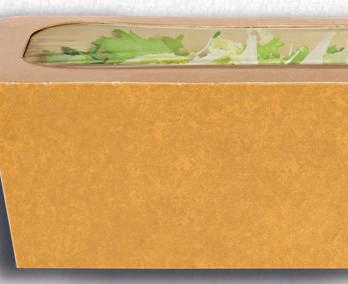










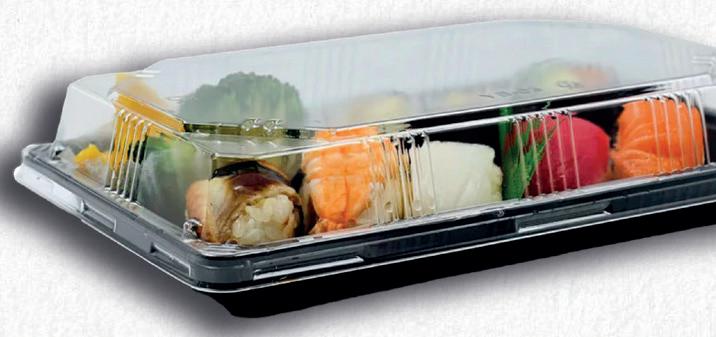

















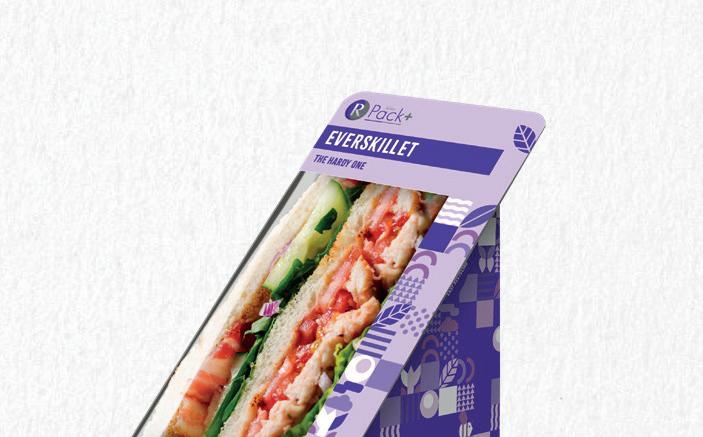
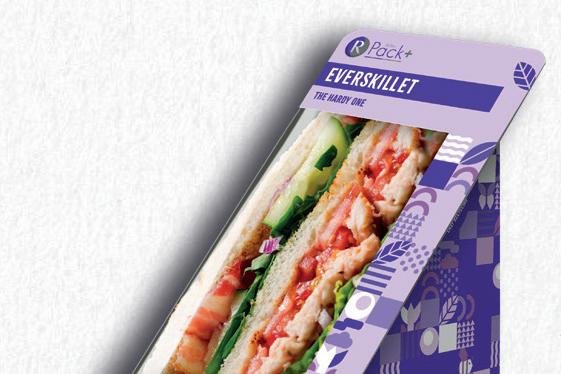
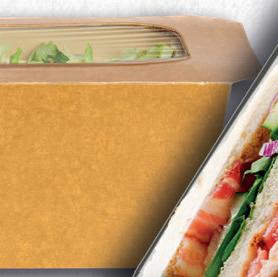








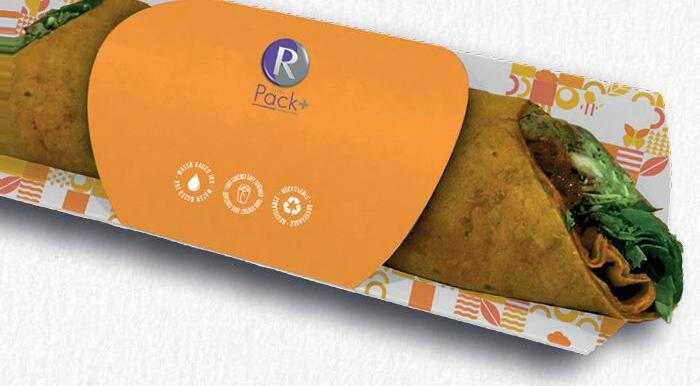
www.sandwich.org.uk I 53 PACKAGING Elevate your lunchtime offer with Reflex Pack Plus Wrap Boxes Food Contact Safe Coatings Salad Trays Fully Lined Sandwich Skillets Sleeves Contact sales@reflexlithoplus.co.uk to find out how we can take your packaging to the next level. With low minimum order quantities and set up costs, our bespoke packaging options are the perfect partner for your brand.
You’re the one that I want…

AHDB
is at the heart of the meat, sh and poultry sectors – and these exclusive consumer insights are welcome news for the farming sector.

HIGH FREQUENCY
The Agriculture and Horticulture Development Board (AHDB) is funded by farmers, growers and others in the supply chain, to help the industry succeed in a rapidly changing world. Established in 2008, the focus is to create a world-class food and farming industry – working for more than 100,000 farming and supply chain businesses. It’s uniquely placed to deliver analysis on market trends and what the future holds.
And there are positive signs around on-the-go consumption. While it is still only 90% of pre-Covid levels, it is continuing to recover, going up 16.1% year-on-year for the 12 weeks to 24 December 2023 (Kantar).
Despite an average price increase of 5.3% for sandwich meals year-onyear in the same period, the desire for ease and speed has continued. Kantar reported 12% volume growth for the sandwich category, driven by increased frequency of purchases. Pork sandwiches (including ham and sausage) are the most popular of all meats, and meal occasions grew by 6.8% year-on-year.
Over a third of all sandwich sales are through bakery and sandwich shops, with supermarkets accounting for a quarter. Retailers have been
growing sandwich sales faster, with packs up 25%, while bakery and sandwich shops are also seeing growth in sandwich sales, up 11%.
PAYING THE PRICE
A reported downturn in the plantbased/vegetarian sector has been well documented, and AHDB’s figures continue the theme. Retail demand for meat-free products has been in overall decline in recent years, with volumes down 8.3% – driven by a decrease in both the number of shoppers and the volumes they are purchasing (Kantar, 52 w/e 24 Dec 2023).
In the out-of-home market, plantbased meals are up 4.3% year-onyear, but meat-free meals are losing share as total OOH grew by 14.1%. Reports indicate that the trend for imitation meats has peaked, with a focus instead on mushrooms, legumes and nuts as meat-alternative proteins (Lumina Intelligence, Nov 2023).
Some of this reduced demand will be around cost, as retail and OOH markets have seen higher average price points for plant-based products than for meat, fish and poultry (MFP). But, more importantly, consumers chose meat products for taste and enjoyment reasons, which meat-free is not seen to deliver on (Kantar Usage).


More than nine out of 10 people purchase MFP in retail and OOH settings, and the number of consumers who classify themselves as vegan, vegetarian or flexitarian has decreased year-on-year, so demand for MFP is well supported (AHDB/ YouGov, Nov 23).
When considering red meat in retail, consumers are looking for information and reassurance on a range of reputational issues, such as quality, health, provenance and welfare – whether on pack, at fixture or in-store/online. Similar information is sought when eating OOH, however less detail is often required and enjoyment/taste aspects become a higher priority.
QUALITY STREET
Unsurprisingly, price remains at top of mind for many consumers in the current economic climate, but the AHDB/YouGov consumer tracker (Nov 23) suggests a feeling of optimism in recent months. As inflationary pressures ease, quality and
54 I www.sandwichandfoodtogonews.co.uk
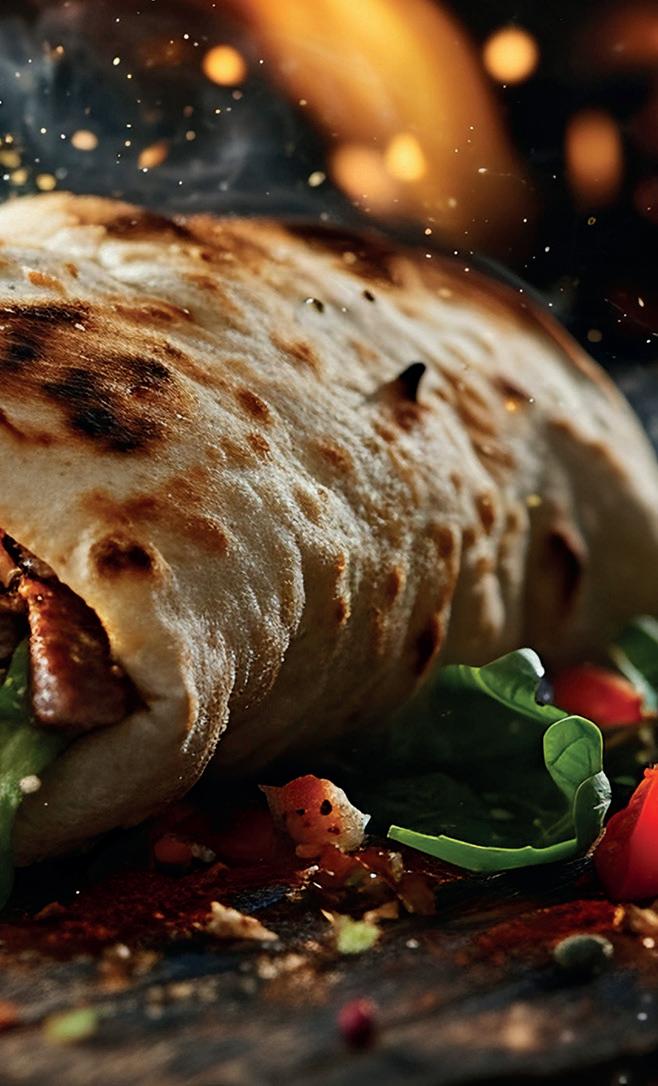
provenance credentials are expected to have a bigger influence on choice.
AHDB research on meat labelling highlighted that provenance was a key message, alongside inspiration (via food imagery) and health. This comes through again with shoppers for premium meats, that buying British beef is seen as the most important factor. Over half of respondents claim that free-range is important. Quality assurance and outdoor reared claims continue to be a priority, while quality credentials should be signalled clearly.
Health is also likely to return as a driving factor in shopper behaviour through 2024. Options away from the traditional sandwich might prove popular, as salads have already seen growth of 23% over the past year.
CHICKEN & PORK
Overall, OOH sandwich volumes purchased have increased by 11.5% YoY (Kantar, 52 w/e 24 Dec 2023). While all carriers saw increases, baguettes, paninis and rolls all underperformed total sandwiches. Bagels and wraps saw the largest increase in volumes purchased year-on-year, up 43.5% and 27.4% respectively. Both benefitted from an increase in shopper numbers and the volumes which they are purchasing in for MFP fillings.
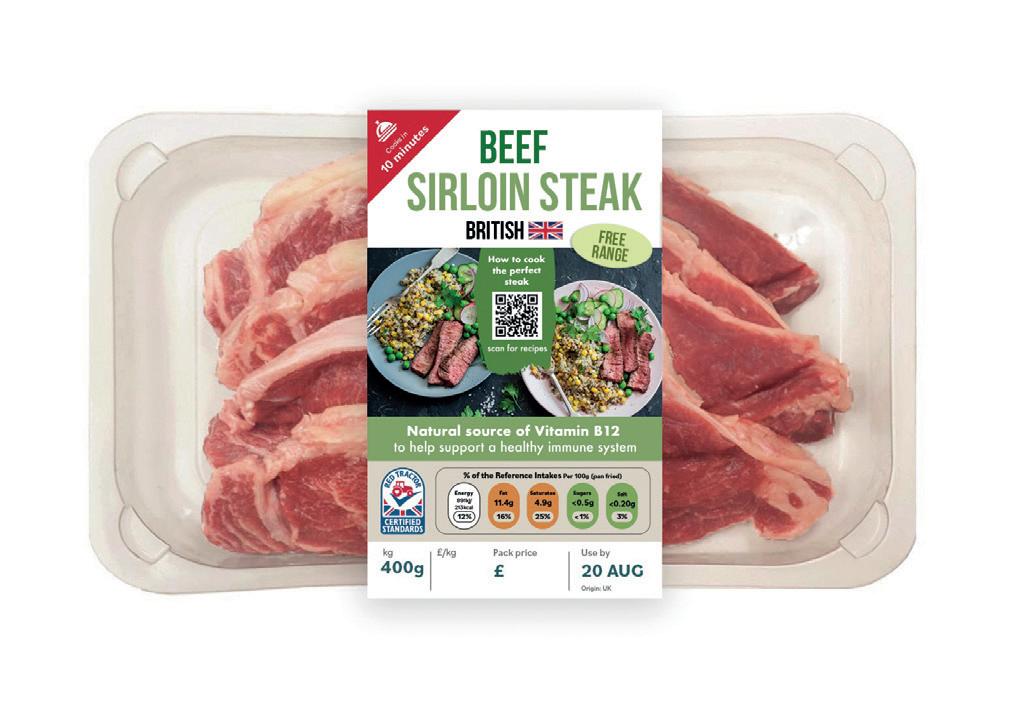
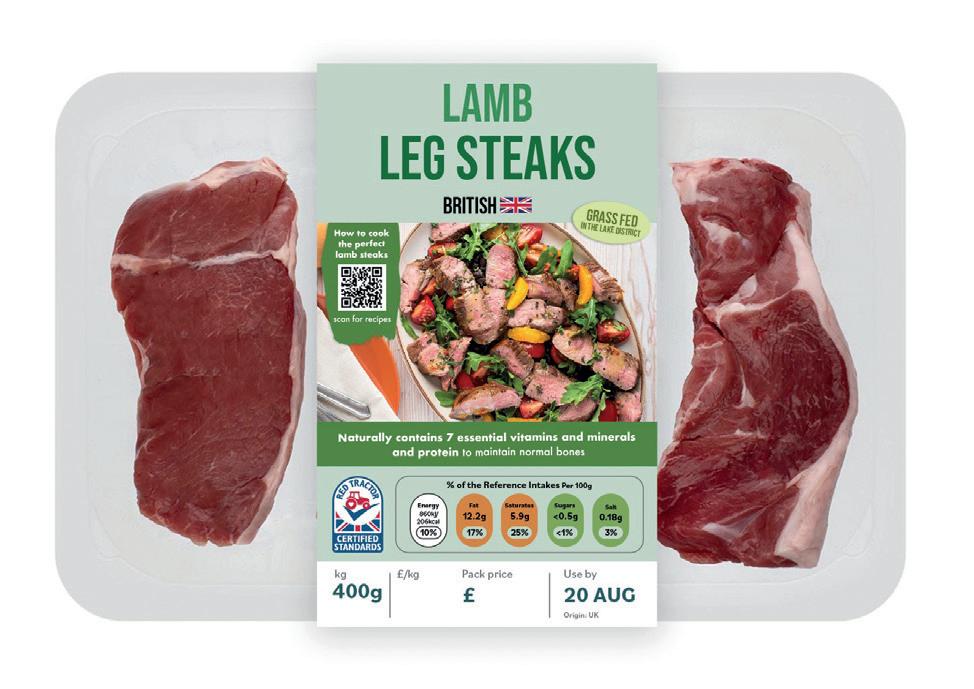
Chicken and pork fillings account for almost two-thirds of dine-in and on-the-go sandwiches, maintaining this share over the past two years. Vegetarian fillings, such as cheese and egg, account for the next largest share, and this has grown over the past year by 0.5 percentage points to just over a fifth of sandwiches.
Emerging customisation of highend sandwiches has been noted (Lumina, Nov 2023), but supermarket sandwiches have also seen an increase in shopper numbers and the purchasing frequency (Kantar OOH, 52 w/e 24 Dec 2023).
CONCLUSION
IGD predicts retail will continue to grow its share of total food to go, reaching 22% by 2028. Retailers might be losing out to other channels harnessing digital and delivery concepts faster than supermarkets.
The return to the office signifies an opportunity for retailers to meet the needs of consumers who are more time poor but may wish to eat lunch at their desks. Retail meal deals are one of the cheapest options for lunch on-the-go, so highlighting this is key.
Shoppers are enjoying loyalty promotions, but balancing quality with price is key. There are opportunities for retailers to nudge them into a more premium meal deal with adventurous flavours and exciting concepts.
Many consumers find FTG shopping, as it can be in many locations within store. HFSS regulations also impact store placement. Making it easy for shoppers who want to dash in and out to grab something is key – good signage can help with this.
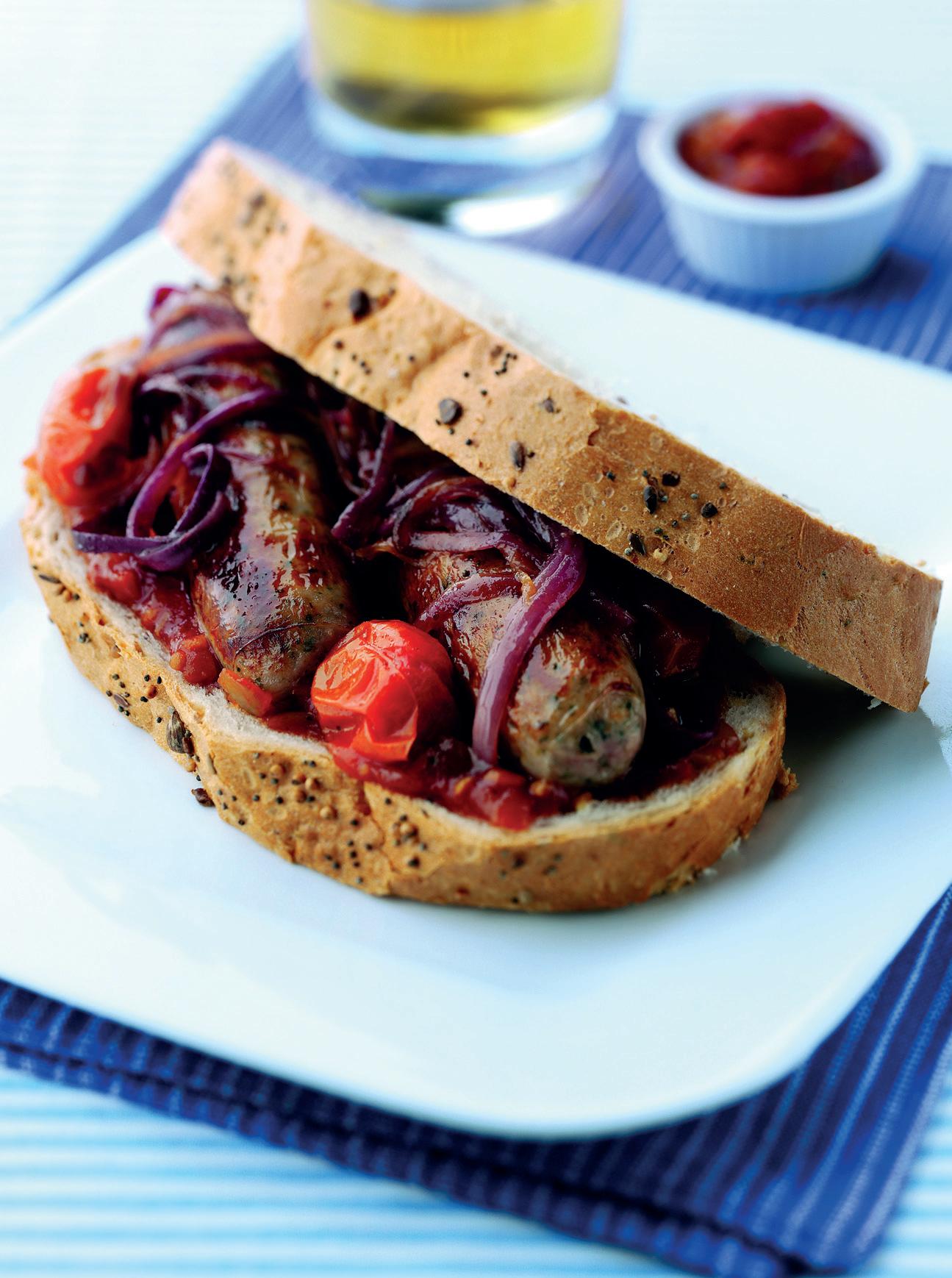
MEAT
Frozen flavoursome &

For H. Smith, agility and innovation keep them sharp – and there’s an exciting new chicken range on the menu.
MEAT
FAULTLESS APPROACH
Meat and poultry products are under more pressure than ever before. From sustainability to health concerns, these crucial consumer touchpoints cannot be ignored. But recent Lumina Intelligence data shows there has actually been an uptick in UK consumers eating meat often – 65%, +3ppt year-on-year. And as long as the quality is high, operators should be confident of consumer loyalty.
No one understands this better than H. Smith Food Group, having supplied meat & poultry for over 30 years – and several key principles have been key to its business journey.
“Firstly, we consider ourselves extremely fortunate to have incredibly loyal clients, some of whom have been with us from the beginning,” said sales director, Shaun Smith. “Following the saying, ‘without your customers, you have no business’, we have always put them first, while following through on our commitments.
“And without the enthusiastic team at H. Smith, we wouldn’t be able to provide the level of service we expect. The company’s small, close-knit team – many of whom have been with the company for years – has allowed us to
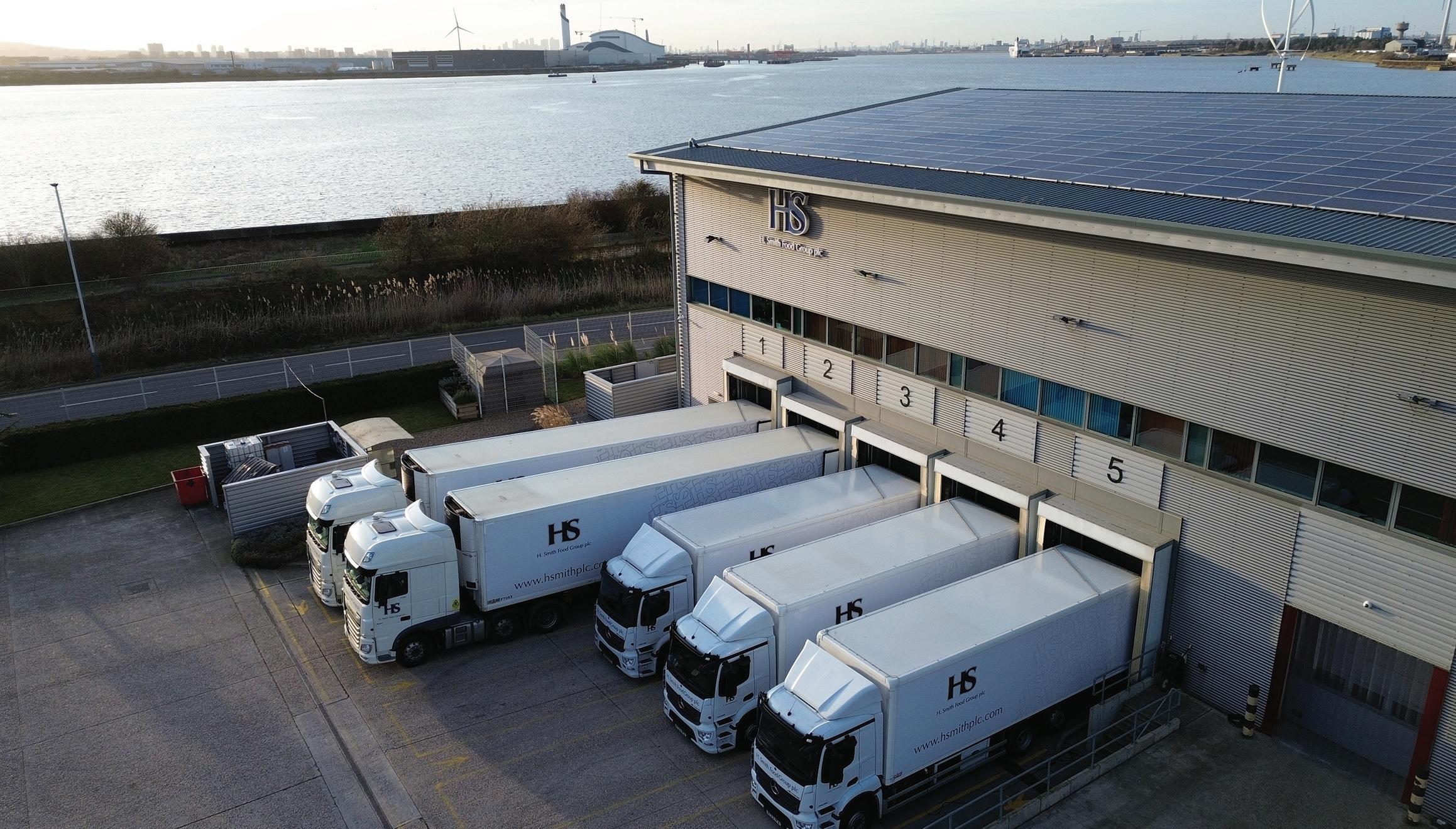
maintain our family business roots and culture. We have six actively involved directors and shareholders overseeing day-to-day activities, enabling swift decision-making in response to shifts in the trading environment,” said Smith.
Of course, the pandemic was a prime example of this need for agility.
“We operate out of a purpose-built AA BRC graded storage & distribution facility. Having control of our own logistics allows us to maintain a service that’s hard to rival. We ensure that customer goods are stored and delivered in a well-presented condition, to meet expectations.
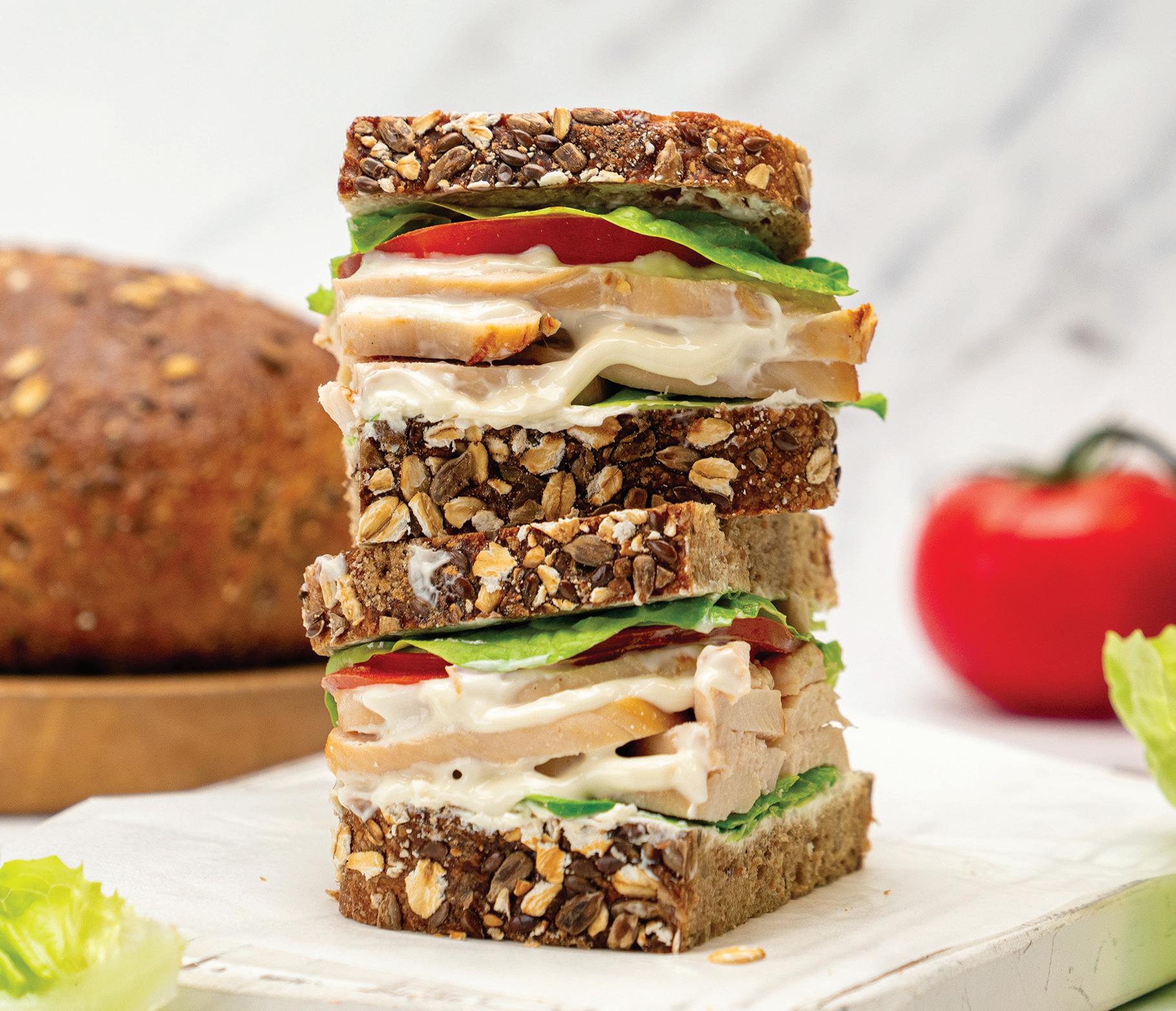
“In our industry, a continuous and sustainable supply chain is crucial. Over the years, we have developed several strong relationships with suppliers. The world and its trends are evolving rapidly, which is well understood by producers, who also recognise the continued tightening of technical standards and limitations pertaining to food safety, animal welfare and sustainability.
“But innovation is key – a point I personally feel very strongly about! The market is ever-changing, so keeping abreast of trends and adapting to what the consumer requires is important. Thorough market research helps us ensure that the finished product is faultless.”
GLOBAL FOOTPRINT
H. Smith is a leading independent frozen foodservice business, specialising in oriental, fusion/ crossover and FTG manufacturing markets. Distributing a wide range of poultry, lamb, pork, seafood and vegetable products, it imports directly from Asia, the Americas, Australasia and mainland Europe. So, high standards are imperative.
“Meat and poultry are certainly in the spotlight,” continued Smith. “As a company, we recognise the increasing pressure surrounding sustainability in our sector and are fully committed to providing products that demonstrate the use of ethical and sustainable farming methods. We work closely
www.sandwich.org.uk I 57
MEAT


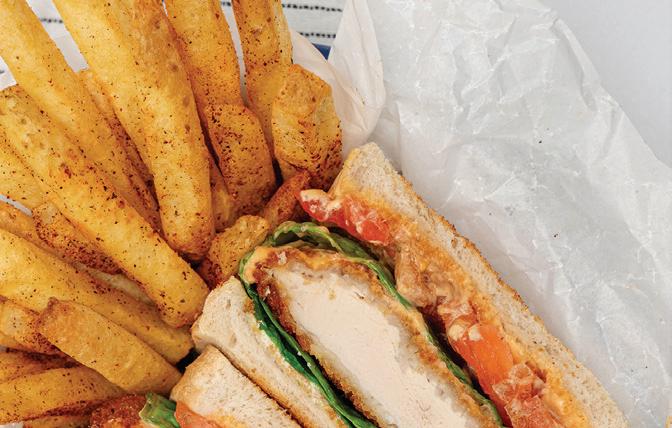
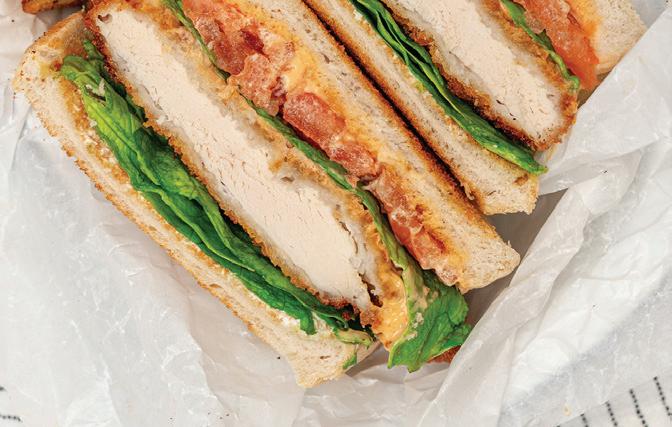
with the relevant technical teams to ensure they are provided with the information they require. We live on a planet with diminishing resources and are committed to reducing our carbon footprint, as well as food and packaging waste, where possible.
“The word ‘healthy’ is thrown around a lot, and I believe at times for the wrong reasons. This can be misleading for the consumer. Education is key, and we should be aware about what we are allowing into our bodies. The focus on clean labels and natural ingredients is at the forefront of our development. Consumers are seeking products free from artificial additives and preservatives. This has led to a shift towards cleaner ingredients, with clearer labelling, in meat and poultry.”
While vegan and plant-based as attracted attention, the demand for fully cooked poultry is still strong.
“In fact, we have seen substantial growth in this sector over the past five years, showing no signs of slowing down (particularly cooked chicken). Our steamed shredded chicken breast is focused around healthy eating, while being ‘ready to eat’ from thaw. In product development, we strive to cater for FTG outlets, but which are also suitable to be reheated by microwaves, ovens, etc. This enables the customer to reduce SKUs, while still showcasing their full menu.”
FULL STEAM AHEAD
The desire to innovate is strong at H. Smith, having just signed off on a new range of charcoal grilled chicken, inspired by Asian flavours – which are certainly on-trend right now.
“We have chicken skewers, and cut before cook bite-size pieces. These will be available in four flavours: teriyaki, satay, mango chutney and Szechuan. We are on track to launch at the end of Q3 2024, with phase two taking place in early 2025. It will be packed in foodservice and manufacturing friendly formats, but we also have capability to produce these in own label for retail at source.
“Our goal has always been to meet the needs of all customers, old and new. We are well established in the market, working with major manufacturers and FTG businesses, QSRs, caterers and more.”
But it’s not easy for anyone in the sector in terms of inflation, costs going through the roof and staffing challenges. However, Smith remains
bullish: “It has been a challenge, but we have a decisive and committed board of directors who make prompt changes where necessary. These included streamlining operations to increase efficiency where required, which is crucial. We made sure that any changes in the company did not affect our level of service, which I’m pleased to say it did not.
“We also put a lot of focus into strengthening our financial planning and forecasting of goods to accurately predict and prepare for future economic challenges. This involved revisiting budgets and cash flow management. Another strategy we adopted to cope with inflation was by diversifying the range of products and presenting them to new markets. By doing so, we reduced our dependence on specific markets.
“Overall, these measures have helped us navigate the challenging economic climate and positioned us to adapt and thrive in the face of ongoing uncertainty.”
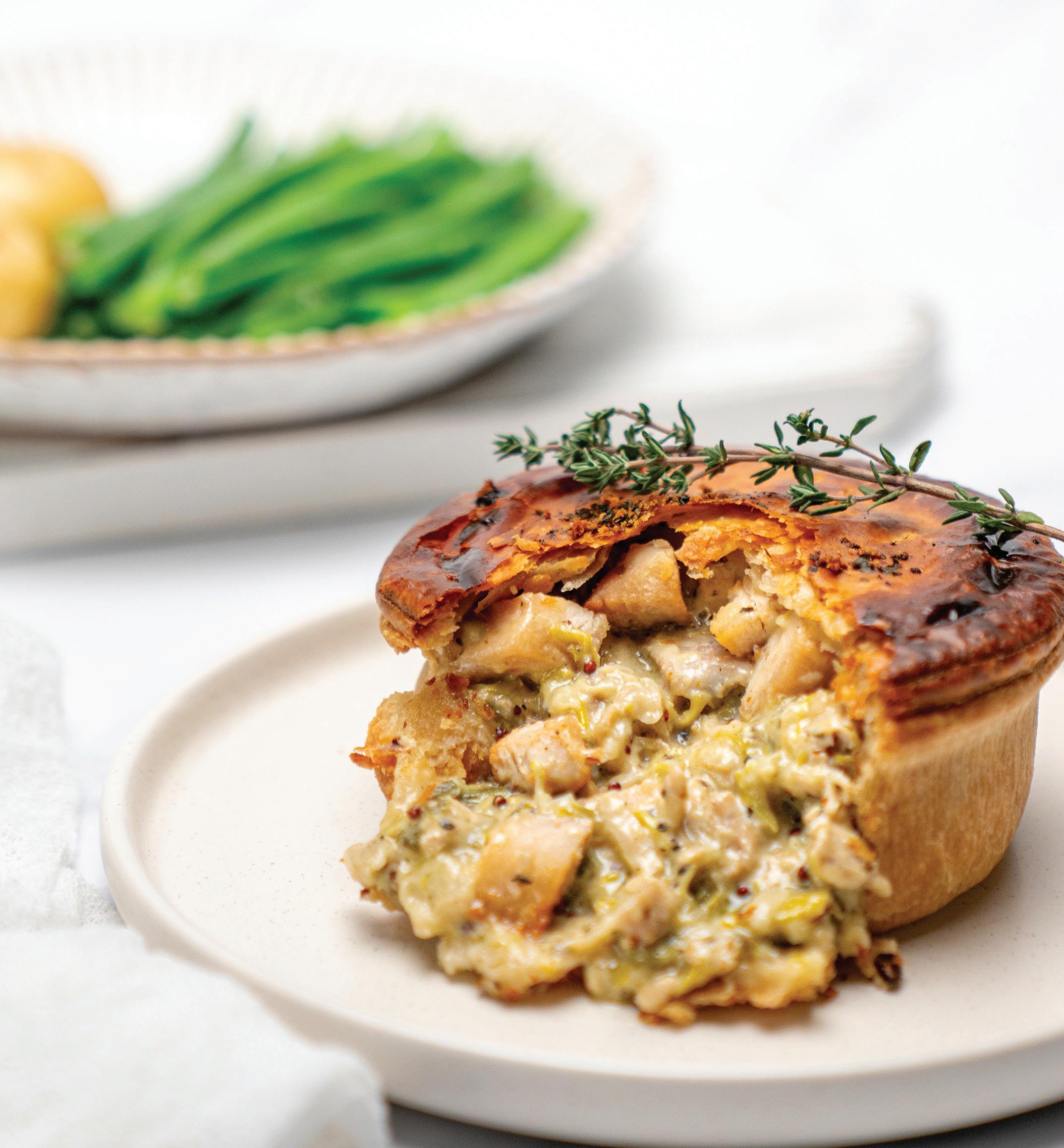
58 I www.sandwichandfoodtogonews.co.uk
MEAT


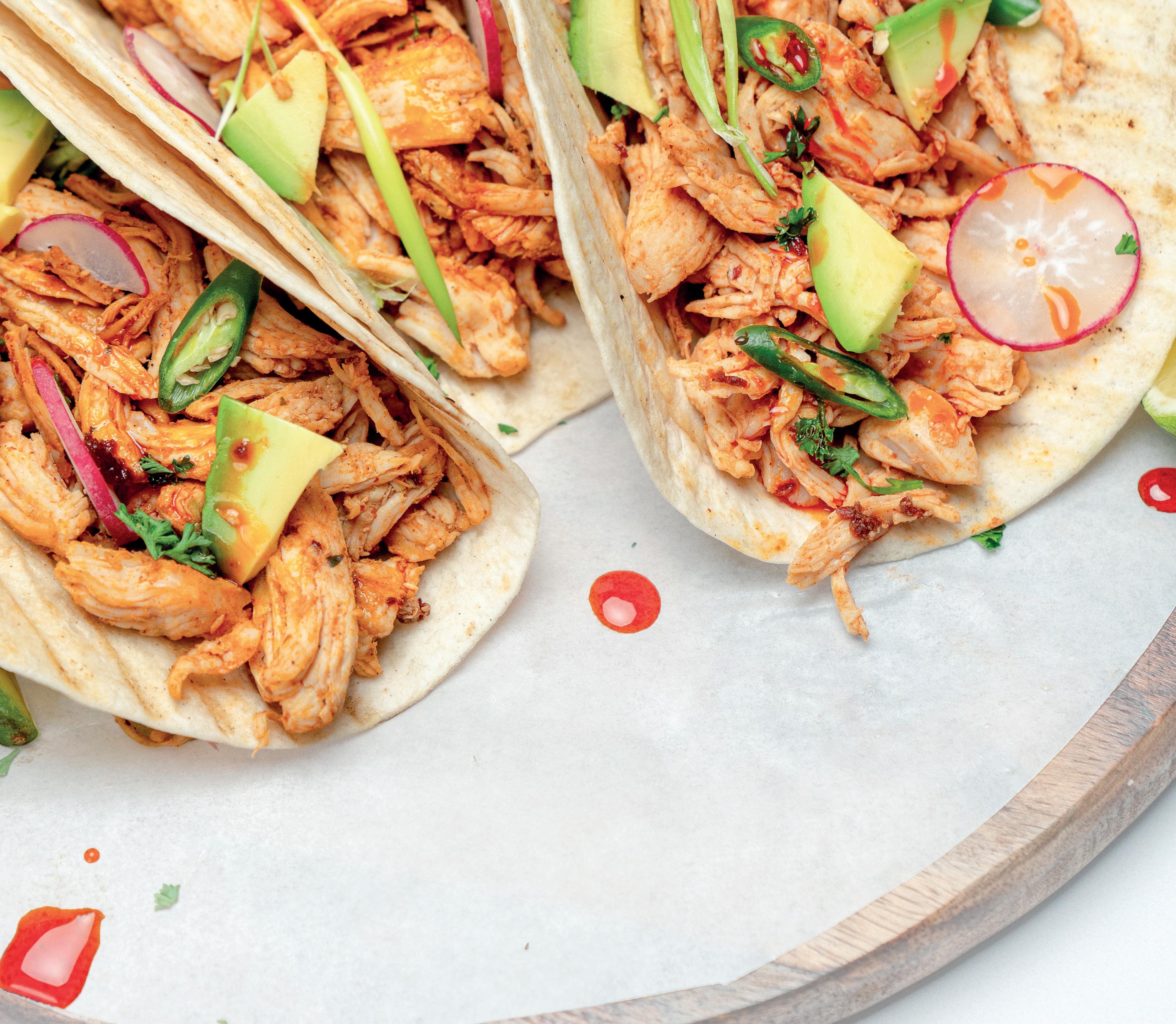
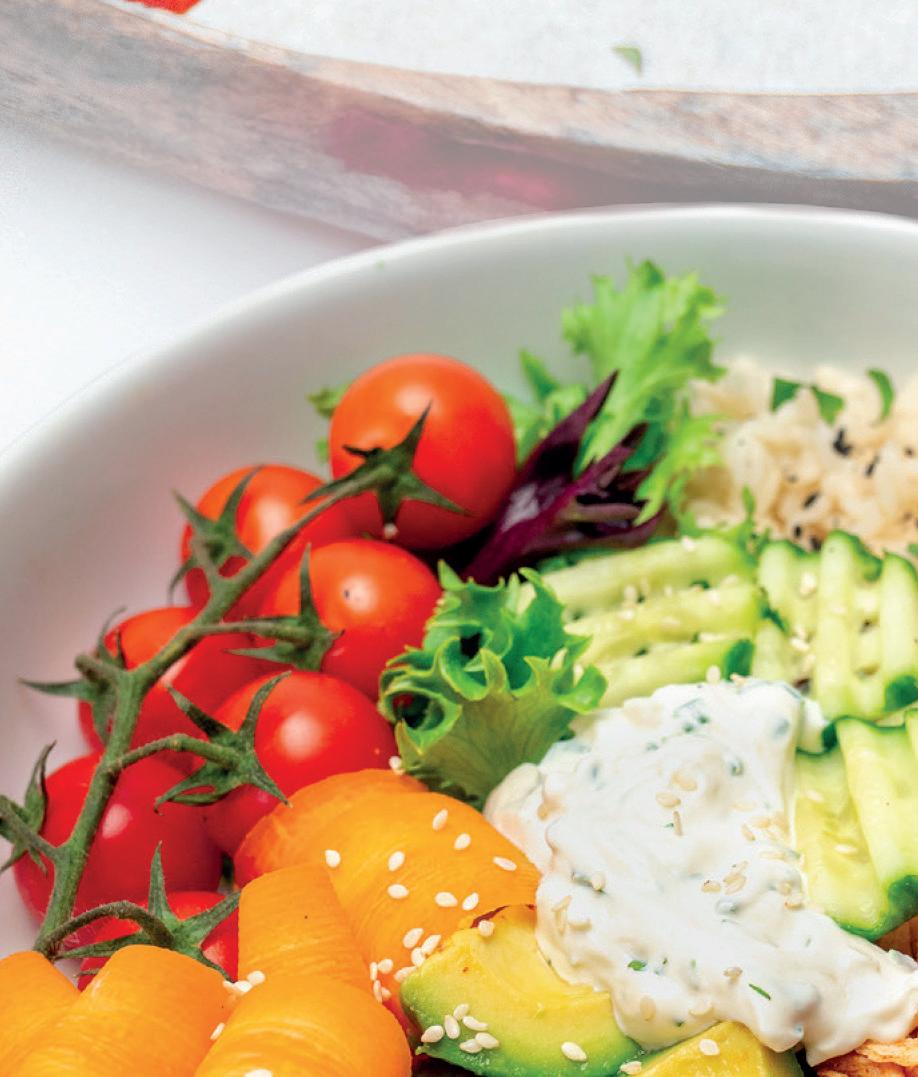


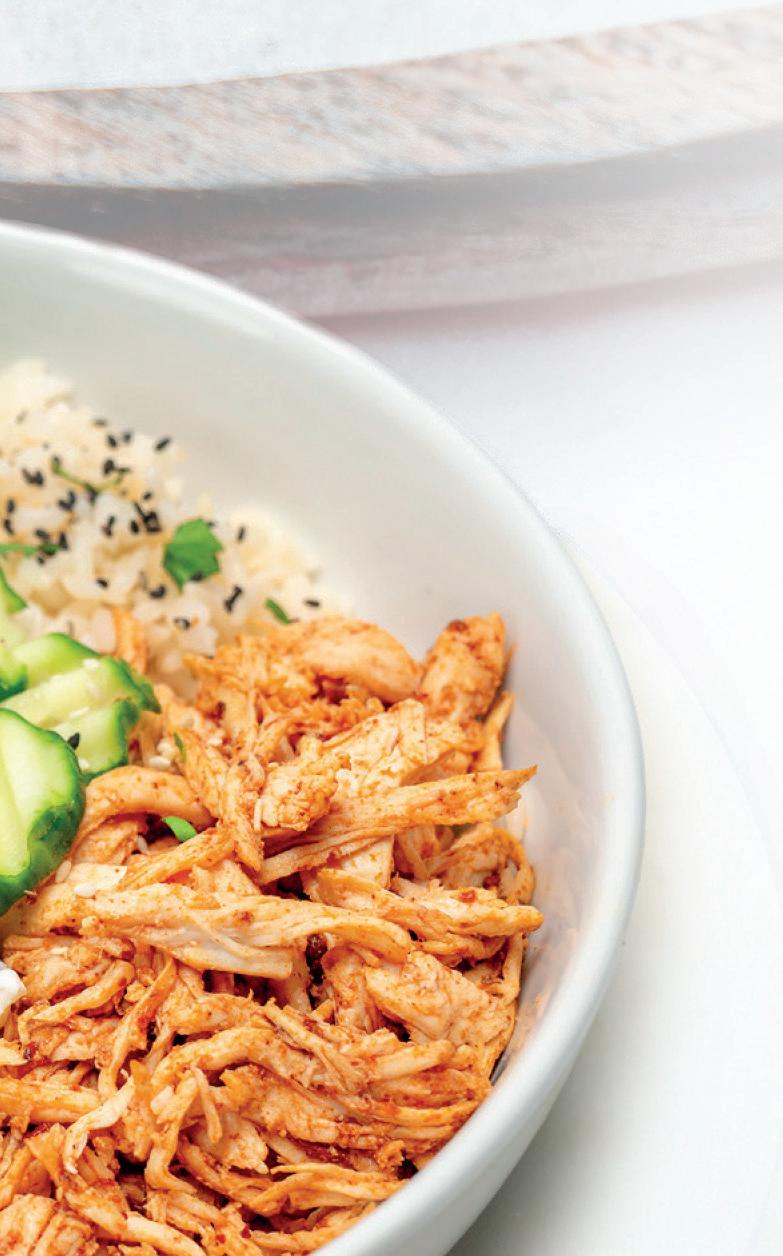










STEAM-COOKED SHREDDED CHICKEN BREAST For more information, call our sales office on +44 1708 87 88 88 www.hsmithplc.com POKE BOWLS , ARTISAN PIZZAS , MEXICAN TACOS , HEARTY SOUPS and MANY OTHER APPLICATIONS . Ingredients: Chicken breast, water and salt Packaging: IQF frozen in 4 x 2.5kg bags, 10kg net case weight An instant hit and great addition to any menu. Our shredded chicken is extremely versatile and can be used for a wide range of recipes and cuisines. NO NASTIES OR HIDDEN ADDITIVES FULLY COOKED SIMPLY DEFROST AND SERVE
Winning streak
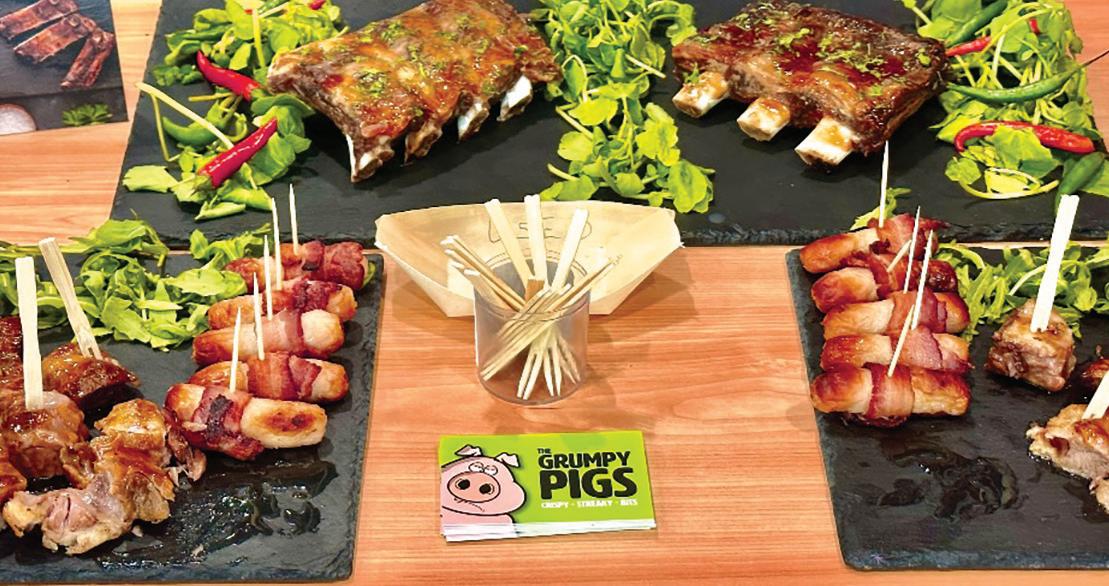
Grumpy Pigs is moving into a sixth year of business. What are the key principles to its success?
We were very fortunate to be able to partner with an amazing factory that was producing a fantastic range of products but with very little presence in the UK. The consistency and quality we can offer, along with the way the brand has been so positively received, has exceeded all our expectations and we look forward to continuing this growth in 2024.
Meat products are under increasing pressure, in terms of sustainability and health concerns. How do you approach these crucial consumer touchpoints?
We work together with the factory to help minimalise carbon footprint and have only recently switched to a fully recyclable plastic tray, reduced the thickness of the film we use and now offer a fully recycled cardboard outer case.
Tell us about the major technical developments in your business pipeline.
The factory is in the process of building a brand-new slicing hall with state-of-the-art machinery, that will not only increase our capacity, but give us additional variations on slice thickness and weight. This will enable us to offer thinner slices, maximising rasher counts per pack and in turn improving customer yields.
Which products are you particularly excited about?
We are always looking to innovate and develop the range. We enjoy making bespoke products for customers and have only recently produced a low-salt, high-protein cooked bacon. We will also be launching a maple-cured cooked streaky later this year – fingers crossed in time for the IFE Show at the end of March.
Can you elaborate on key relationships with suppliers and the sector in general?
Having been in the industry for almost 40 years, I believe relationships and trust – with suppliers and customers alike
With a full range of cooked bacon, ribs and toppings, Grumpy Pigs know how to keep customers happy. We caught up with managing director, Stephen Andrew.
– are essential. Your magazine, and the adverts we have run over the past few years, has been integral to the growth of our brand. I would always find a copy in wholesalers and foodservice receptions up and down the country, making it an ideal medium to help build our brand identity.
The economy has been struggling. How have you adapted?
All business has been hugely affected by inflation and soaring utilities, and new import legislation from February 2024. These challenges will not help with food costs, but our sector has always been robust and pragmatic. Together, I am hopeful the latter part of 2024 will see growth increasing and our industry go from strength to strength.
Visit crispybacon.co.uk for more product information.
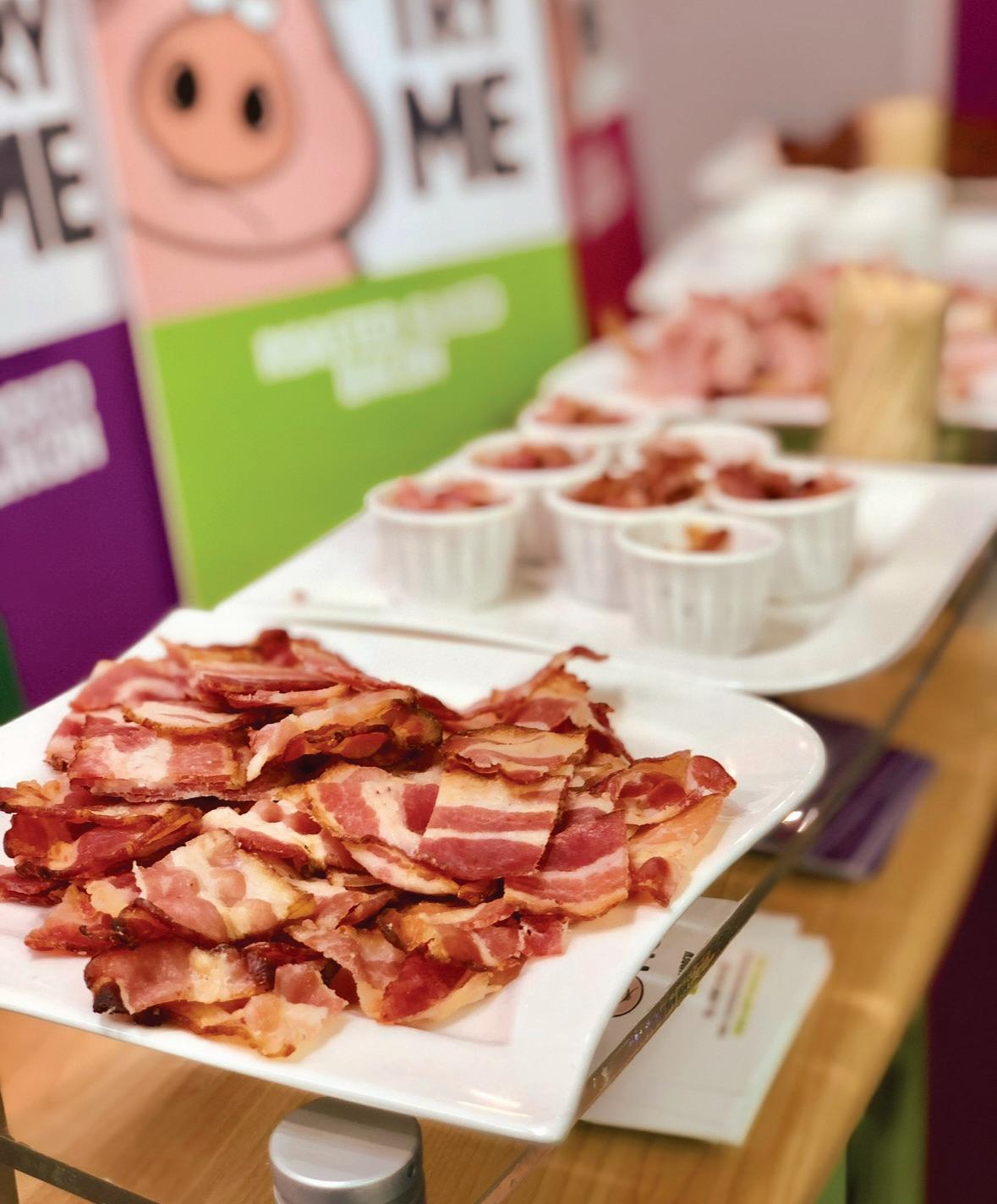
60 I www.sandwichandfoodtogonews.co.uk



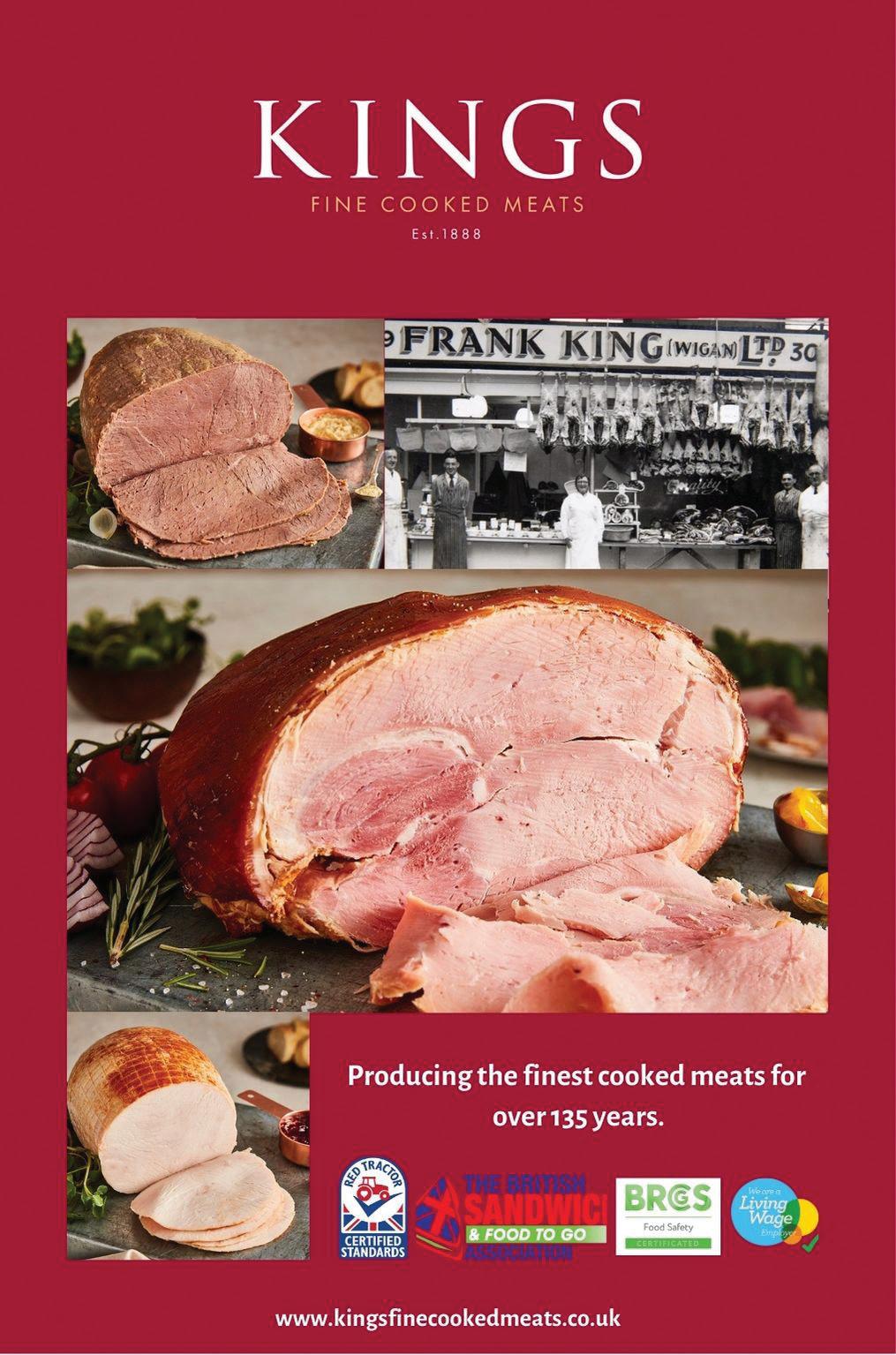






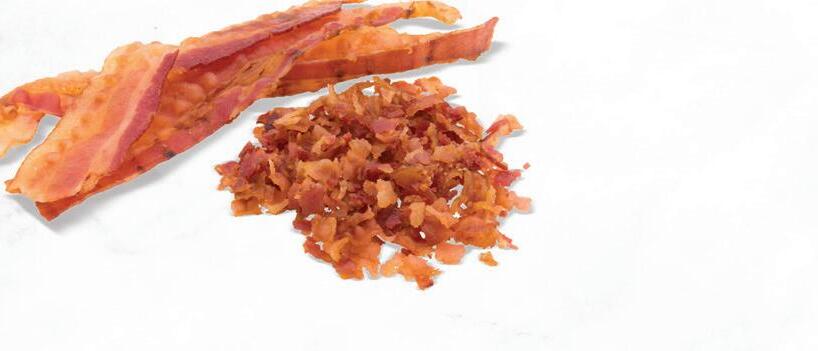











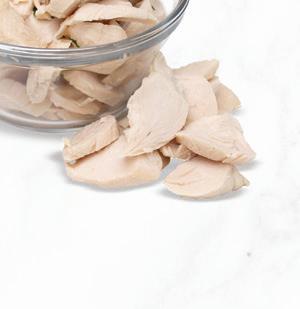


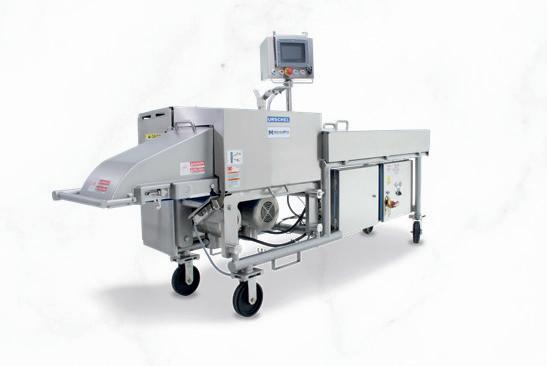



Sanitary,
Machines
Different types of interchangeable cutting components allow your machine to adjust and grow with your product line.


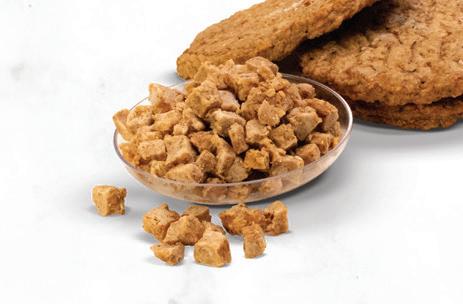

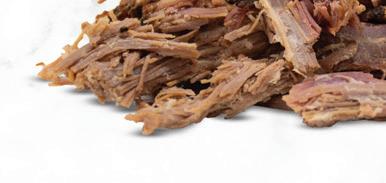
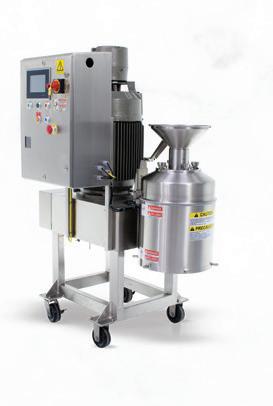



Volys Star UK: Shaun Slipper 07884 027 645 shaun.slipper@volys.co.uk www.volys.be Smoked Turkey Rashers www.sandwich.org.uk I 61 Discover Urschel Cutting Advantages ® Urschel, Urschel logo symbol, and The Global Leader in Food Cutting Technology are registered trademarks of Urschel Laboratories, Inc. U.S.A.
works with customers around the world to discover profitable cutting solutions.
Urschel
stainless steel design, backed by service and support
for the life of your machine.
designed for continuous, uninterrupted production to promote the highest outputs.
Set up a free test-cut of your product. Urschel International Ltd. | www.urschel.com #1 Best selling provider of industrial cutting machinery throughout the world. The Global Leader in Food Cutting Technology Contact us to discover how Urschel can assist you with your operation. 2407UKMeatPoultryMVP1700SandwFdtoGoNews180x130.indd 1 12/28/23 9:19 AM
MEAT
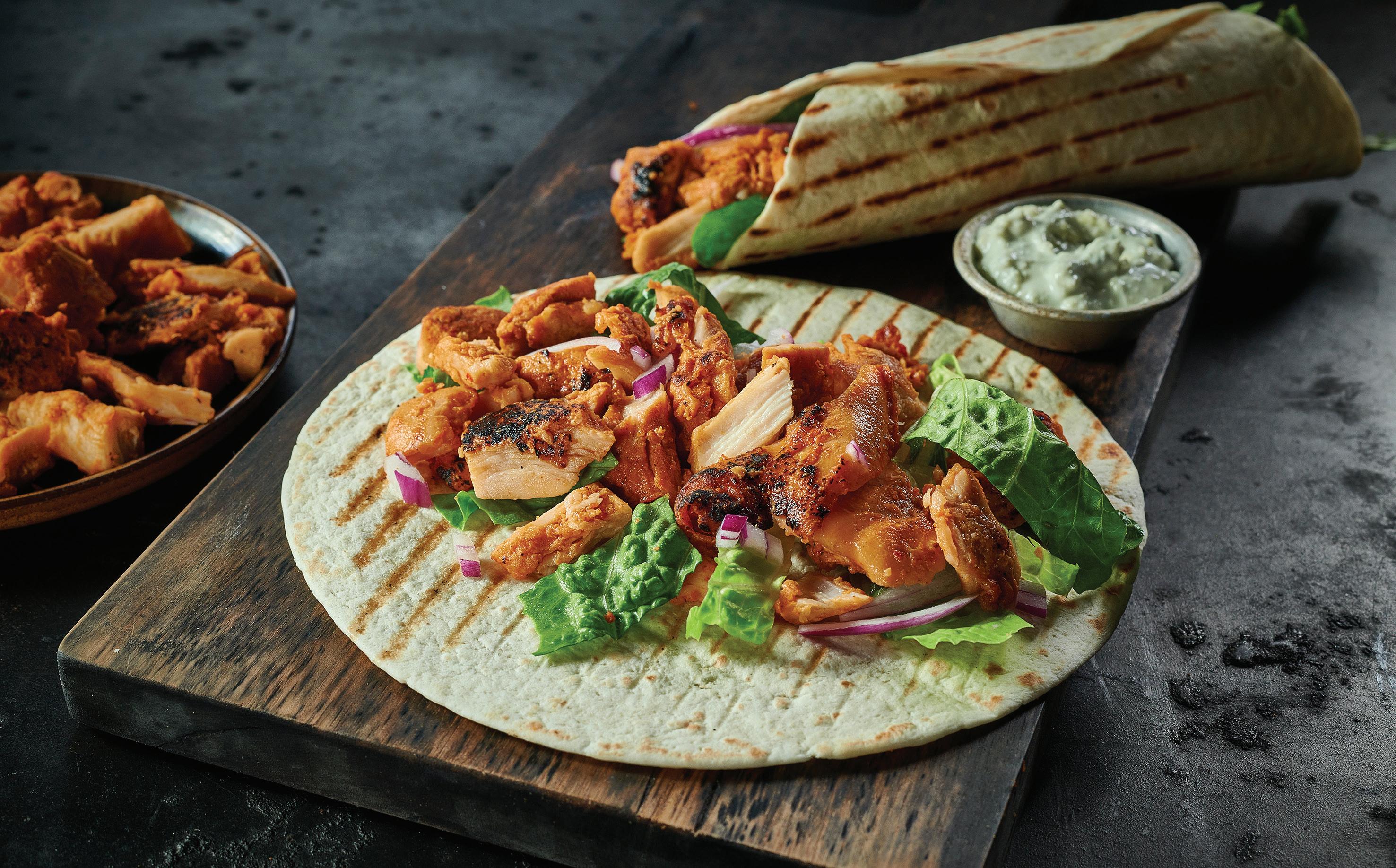
Trendsetting the pace
Dawn Farms is uniquely placed to analyse what’s coming next for its customers.
FRESH BEHAVIOUR
Quality, provenance and sustainability are key watchwords being used in association with meat and poultry. While the economy continues to wrestle with a cost of living crisis, the battle for the food to go sector is to maintain, and attract, customer loyalty in the face of such challenges.
Dawn Farms was an early mover in the sandwich market and has always adopted a consumer first mantra. This leadership, with an emphasis on a safe, secure and transparent supply chain – alongside insight-led innovation –keeps the business relevant.
“The demand for sustainable and ‘good-for-you’ options in meat, plantbased and fusion or hybrid products continues across the board,” said Bryan Murphy, Dawn Farms’ sales director. “In meat, there is a growing
demand for premium and indulgent products using, in many cases, lesserknown cuts and new cooking effects, including a growing preference for flame-grilling, wood smoking and slow cooking.
“Consumers have spent the past number of years navigating a range of ongoing crises, and this has inevitably impacted their food & drink consumption behaviours. The rate of inflation has eased, there is less pessimism than last year, and a sense that things are slowly moving in the right direction. It is important that the food industry is ready to offer consumers new, attractive options as we move into this more optimistic period. To quote a recent Bord Bia/ Irish Food Board study: ‘Brands need to be thinking about how they can help consumers feel good again.’”
NEXT GENERATION
The Dawn Farms methodology is to be a principal component in their customers’ success, providing a full menu solution across cooked, fermented and dried meat, plus plant-based ingredients.
“Dawn Farms company, TMI, is the leading British manufacturer of cooked, crispy bacon and pigs in blankets in the UK,” continued Murphy. “As a B2B-only company, our expertise and experience is focused on our products performing in the customers’ environment, be that a QSR store or sandwich line.
“Meat continues to be the number one choice by far, but the market for protein is evolving in sandwiches and FTG. Consumers are looking to add protein, aiming to be healthier and acting more sustainably, while taking
62 I www.sandwichandfoodtogonews.co.uk
action to reach these goals in diverse ways. Clear communication will inform decisions about how FTG and convenient foods can fit into their diet and lifestyle choices.
“Our policy has always been to use clean label, natural ingredients where possible. We have a range of E-number free and reduced salt/saturated fat options, available for sandwich fillings. We offer next generation plant-based options and have developed healthier meat and bacon products (low salt, no added nitrite, plant-based, etc) that offer immediate sustainability wins.”
CAPITAL GAINS
The business recently went on a ‘food safari’ to London, with a noticeable presence of global flavours, quality ingredients and fusion cuisines.
“I recommend readers visit our Trend Catcher report (see QR code, pg 64) to keep informed on current and predicted trends within the industry. We use it to guide development, and
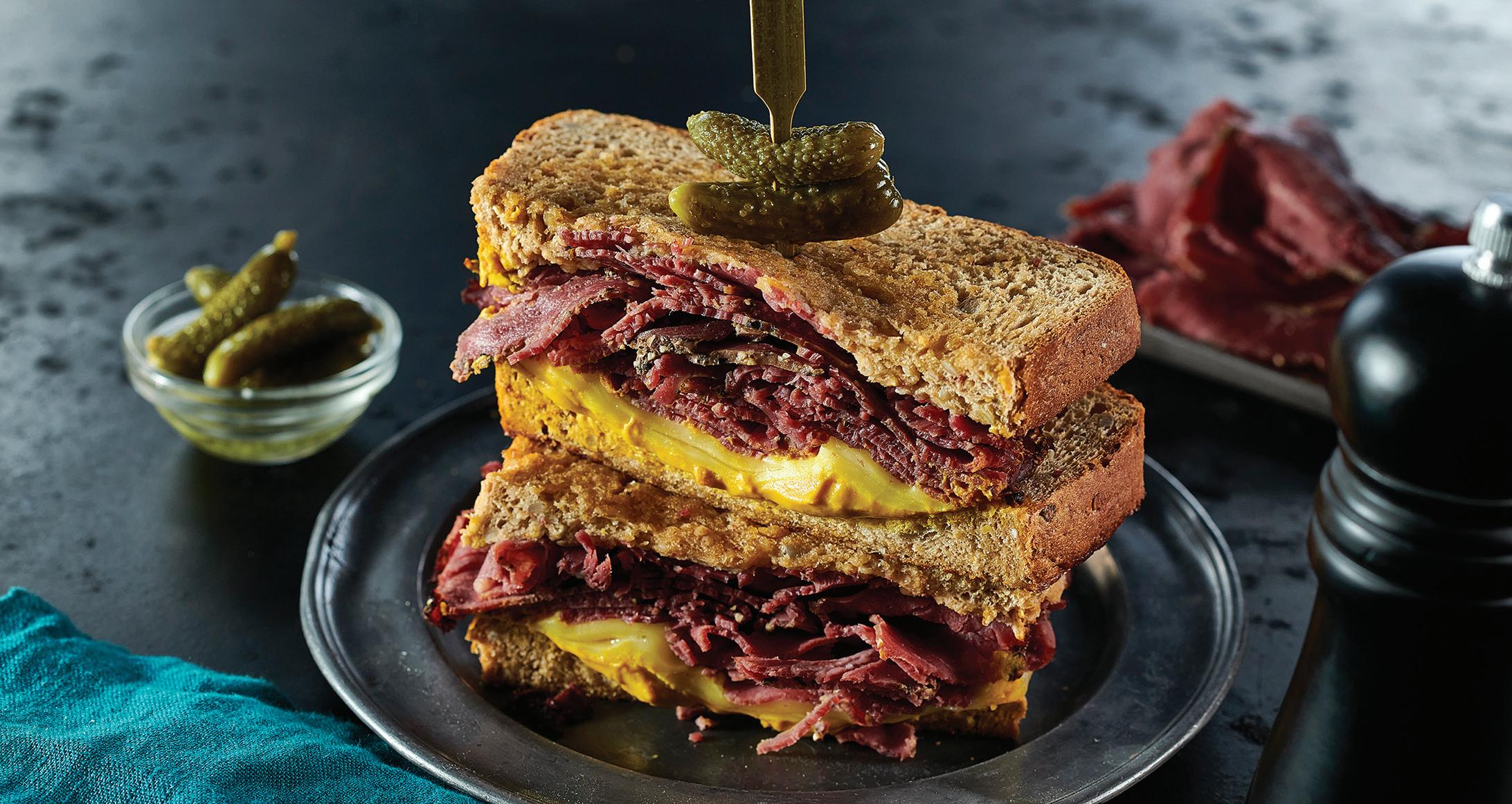
some of our newest products include Fennel Sausage, Charred Louisiana Chicken, Bourbon BBQ Burnt Ends Beef and Slow Cooked Salted Beef.
“We have a bank of sandwich-ready NPD, including Shredded Jerk Ham, Plant-Based Roast Chik’n Strips and Smokey No-Beef Steak, all developed to perform in a sandwich or wrap, be it for a QSR or retail. Our next campaign will be focused on capturing the essence of street food, perfect to meet the consumer demand for bolder, international flavours that we witnessed in London. I’m a bacon fan and the cooked crispy bacon we
produce in TMI is the best on the market, enhancing most recipes.
“Fortunately, we work with the leading sandwich manufacturers and global QSR/delivery high-street chains. We invest in people – and a good example is Food Plus+, our unique safety and quality programme. The goal is simple: to protect the brand reputation of our customers.
“In a period where there is increased pressure on supply chains, this is highly valued. More recently, there has been a growing focus on sustainability and ESG (Environmental, Social and Governance). We operate
www.sandwich.org.uk I 63 MEAT
our All Our Futures programme across Dawn Farms in Ireland, TMI in Britain and Haas in Germany, and are wellplaced to assist not only our customers, but their customers in meeting collective sustainability goals.”
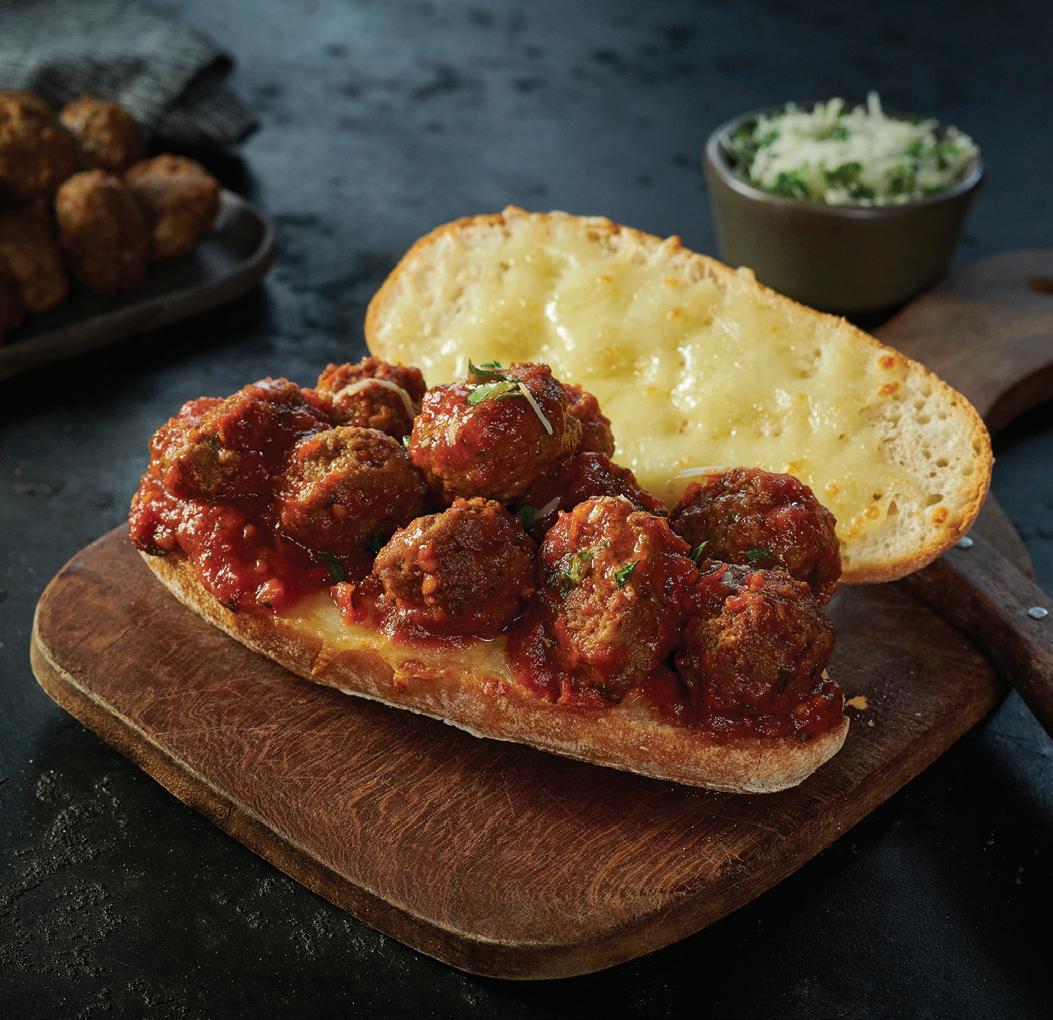

A priority throughout the geopolitical unrest has always been a secure and reliable supply chain. “With facilities across Ireland, the UK and Germany, we are well positioned to meet these demands,” said Murphy. “In this most recent period, the concept of ‘perceived value’ has taken precedence over a simple price metric, especially for forwardthinking companies.
“We engage with customers so that their consumers get product choices that are relevant and give them permission to treat themselves and have fun. Understanding changes in consumer behaviours is vital for the sandwich sector to tailor offerings effectively. Do not underestimate the superiority of taste in decision-making.”
Canada’s MB Chicken makes UK debut
Mary Brown’s Chicken (MB Chicken), the largest Canadian-owned quick serve chicken restaurant and voted Canada’s best fast-food chain, has opened its first-ever UK store, located in Lisburn, Northern Ireland. This international expansion marks a significant milestone for the brand.
Celebrations took place on 21 February 2024 at Lisburn’s Leisure Park. The Mayor of Lisburn and Castlereagh, councillor Andrew Gowan, officially opened the store, greeted by a queue of customers.

On sale was the famous ‘Big Mary®’ chicken sandwich, made with a hand-breaded breast fillet, as well as crispy Chicken Tenders, bone-in Signature Chicken, the Spicy Big Mary, and its Tater Poutine, which combines hand-cut, breaded and fried potatoes smothered in gravy and cheese.
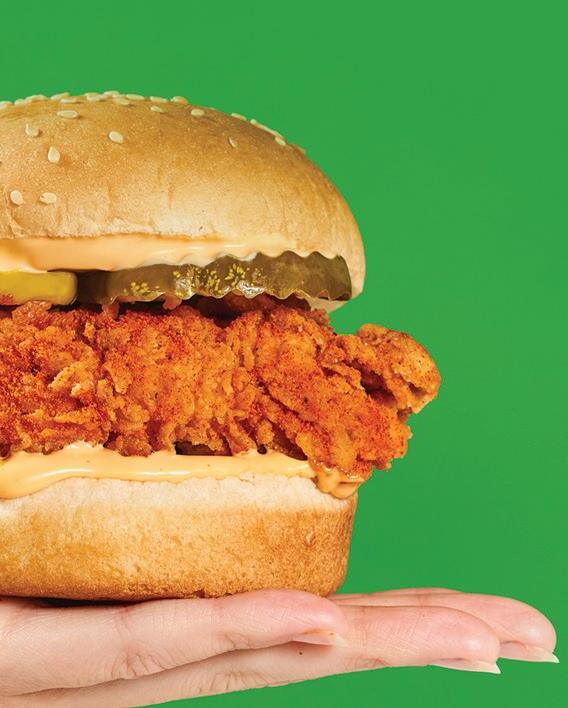

Trend Catcher is Dawn Farms’ bi-annual report, tracking the prominence of insights and trends, allowing QSRs, retailers and foodservice providers to stay ahead of the curve, and catch the waves of future growth.
Scan the QR code to read the latest Trend Catcher report.

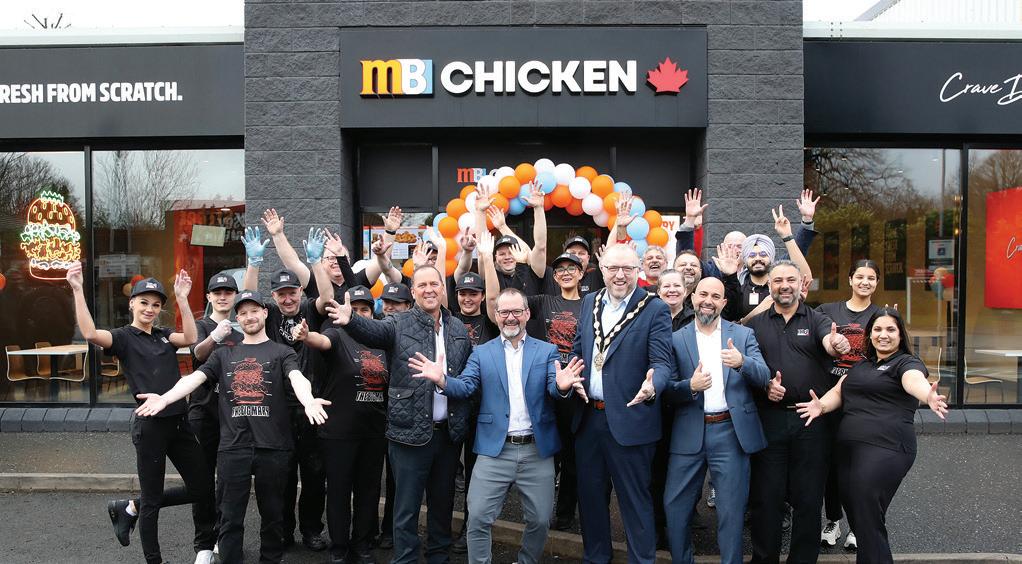
Made fresh from scratch, MB Chicken’s locally sourced signature chicken, hand-cut taters and coleslaw are prepared in-store, with premium quality ingredients.

For over five decades, Mary Brown’s Chicken has taken pride in its heritage of quality and community involvement. The MB Chicken store sees the creation of 25 jobs and there are plans to open in other locations,
including Belfast and Leicester. CEO of MB Chicken, Hadi Chahin, said: “For over 54 years, Canadians have made Mary Brown’s Chicken their first choice for fresh, hand-cut, hand breaded delicious fried chicken and Taters. We are excited to introduce our legendary fried chicken to the wonderful people of Lisburn. We can’t wait to share our passion for delicious, made-from-scratch quality food with our new friends in the UK.”
MB Chicken Lisburn is open seven days a week from 11am until 11pm. Delivery from Deliveroo, Just Eat and Uber Eats.

MEAT
We have the ingredients for success
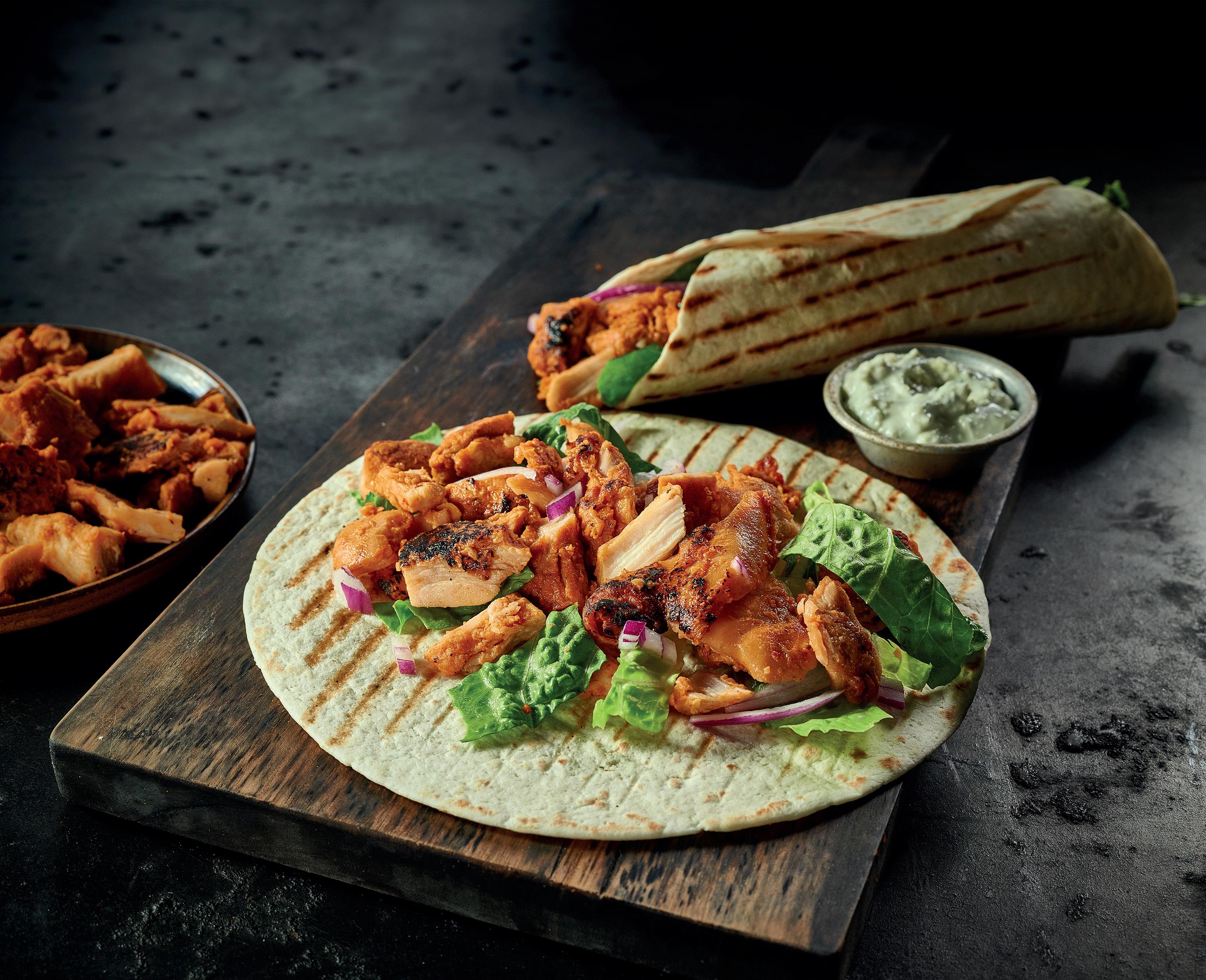
The ingredients that set us apart


www.sandwich.org.uk I 65
At
Farms, we o er
range of cooked, fermented
protein ingredients
sandwiches and prepared meals.
the world's leading
brands
inspiration,
food safety
years. PEPPERONI I SALAMI & CHORIZO I BACON I READY-TO-EAT MEATS I PLANT-BASED TMI FOODS info@dawnfarms.co.uk | www.dawnfarms.ie SUSTAINABILITY
Dawn
a
and plant-based
for pizzas,
Proudly providing
food
with menu
innovation and
for almost 40
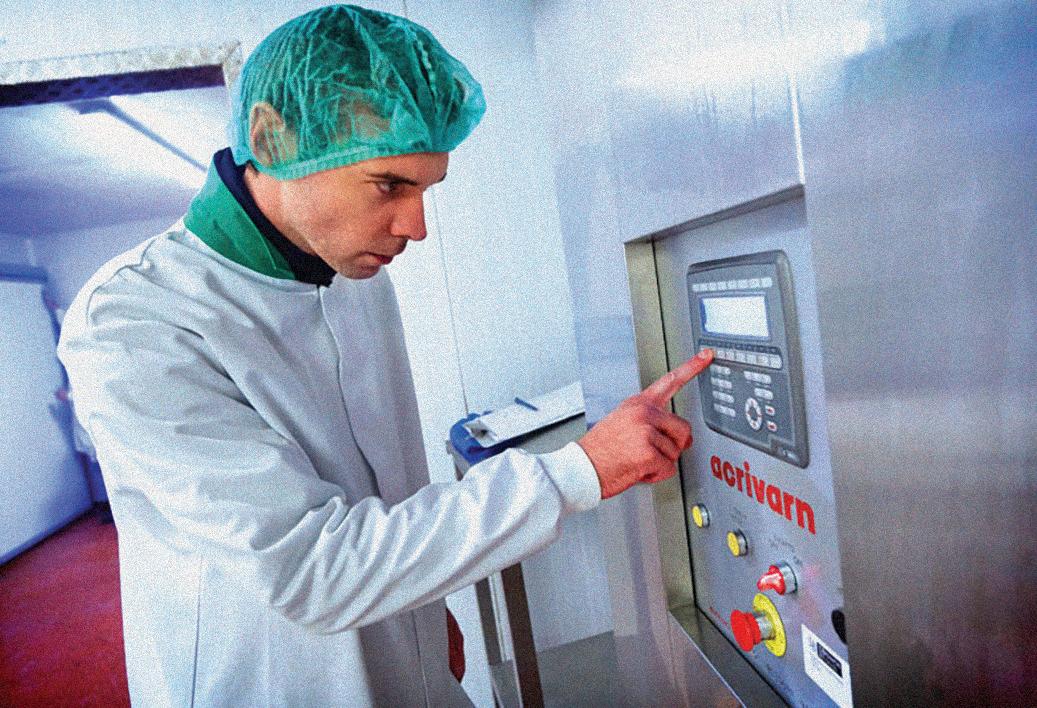
Establishing
Invested in the future
its own ‘green credentials’, Sam Browne Foods is taking a proactive approach, according to director, William Crowther.
You’re moving into your 25th year of business. What are the key principles to your success?
Sam Browne Foods strives to always give the customer what they want. Reliability, consistency, great communication, making sure we have the best equipment and technical solutions in place. Flexibility is key in both supply and choice. The factory is set up for product by batch rather than high volume inline production. This allows us to deliver small batch bespoke products.
Meat products are under pressure in terms of sustainability and health. How do you approach this? With regards to health, we source raw materials from approved suppliers who we take the time to visit, where possible all the way back to farm.
We invested over £500,000 to create a more sustainable production site. All our cardboard is recycled, waste meat products harvested and used to produce methane at an anaerobic digestion plant, and we now harvest all the heat from our fridge and freezing condensing units to preheat water. This reduces both gas and electric use.
As a business, we’ve taken a different view on our environmental impact. Rather than using an agency to give us ‘green credentials’, we purchased our own land near York and to date planted 13,000 trees. Yorkshire Wildlife Trust installed four nature ponds on site. To manage the woodland, we allow an agricultural college to train students in woodland management. Cooked meat products will always be energy intensive but we do our best to offset this.
Needless to say, vegan/plant-based food has been in the spotlight, but what of meat ingredients?
At Sam Browne Foods, part of our main offering is premium product development. We believe that as people are

financially squeezed, they are perhaps less willing to dine out – instead treating themselves to a really good quality pizza, ready meal or salad. This category is absolutely in greater demand, especially in the past two years.
What can we look forward to in the future?
We produce a huge number of new products, recently with a focus on slow cooked. But the old favourites have never fallen out of fashion. For example, marinated chicken, slow-cooked BBQ pulled pork or beef brisket. There is more emphasis on clean label, and our aspiration is to achieve restaurant quality in premium products, while our mainstream ranges are simplified to give the best eating experience at the keenest prices.
Tell us more about your key business partnerships. Great supplier relationships have been crucial, especially recently. We see that becoming a way of life in our industry. As a B2B operation, we try hard to give customers solutions and improvements for them to use in their products, so
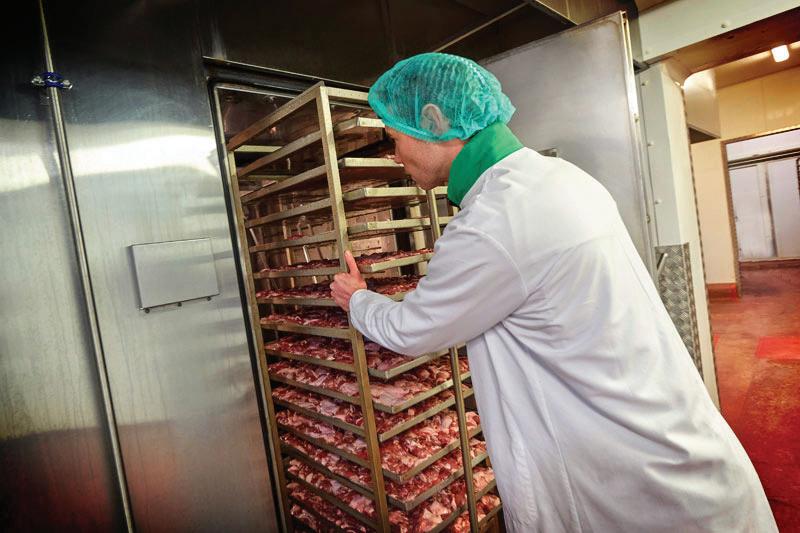
66 I www.sandwichandfoodtogonews.co.uk MEAT
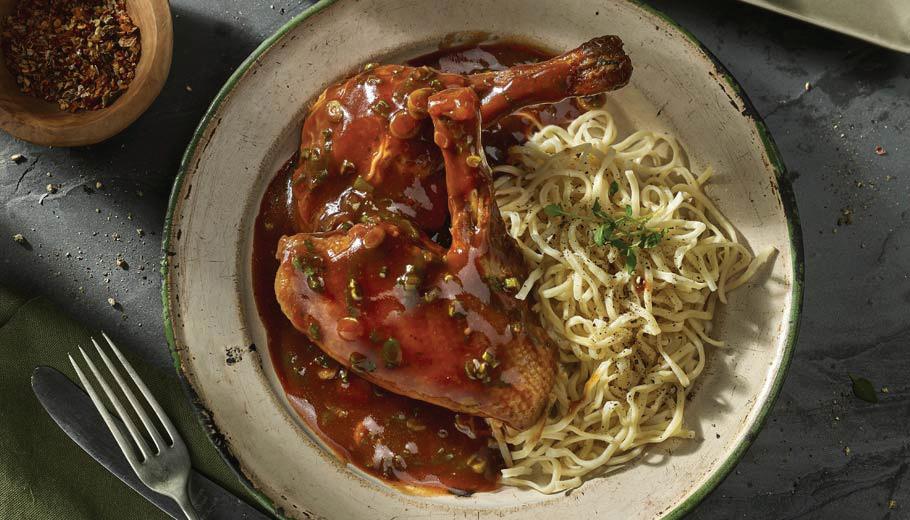
we can each move forward. We have supplied most of our biggest customers for over a decade, which speaks volumes.
How have your responded to economic obstacles?
As a business, we took the decision to absorb as many costs as possible but inflation has been difficult. Sam Browne has responded by increased capital expenditure in better equipment, sophisticated heat recovery and a critical review of methods across the whole business. Capital investment has also given us significant productivity benefits.
What key trends are you seeing with partners in terms of demand, facilities and sourcing?
Our customer partners seem to be clearer than before
in seeking to inspire the consumer. We have to be ready to adapt to change. Facilities for the operation must be resilient and capable across the board. This applies not just to plant and equipment, but also our operating procedures and especially all our people.
We bucked the trend last year when other businesses were not investing, by building a new 300 pallet coldstore. This allows us to keep raw material stocks to ensure supply and also, when requested, keep finished stocks for customers. There have been many challenges around Covid, Brexit and the Red Sea. So, we’ve seen businesses wanting a more local, reliable supplier. One they can pick up the phone to and say: ‘The order that is due to us in three weeks, could we have it in three days?’”
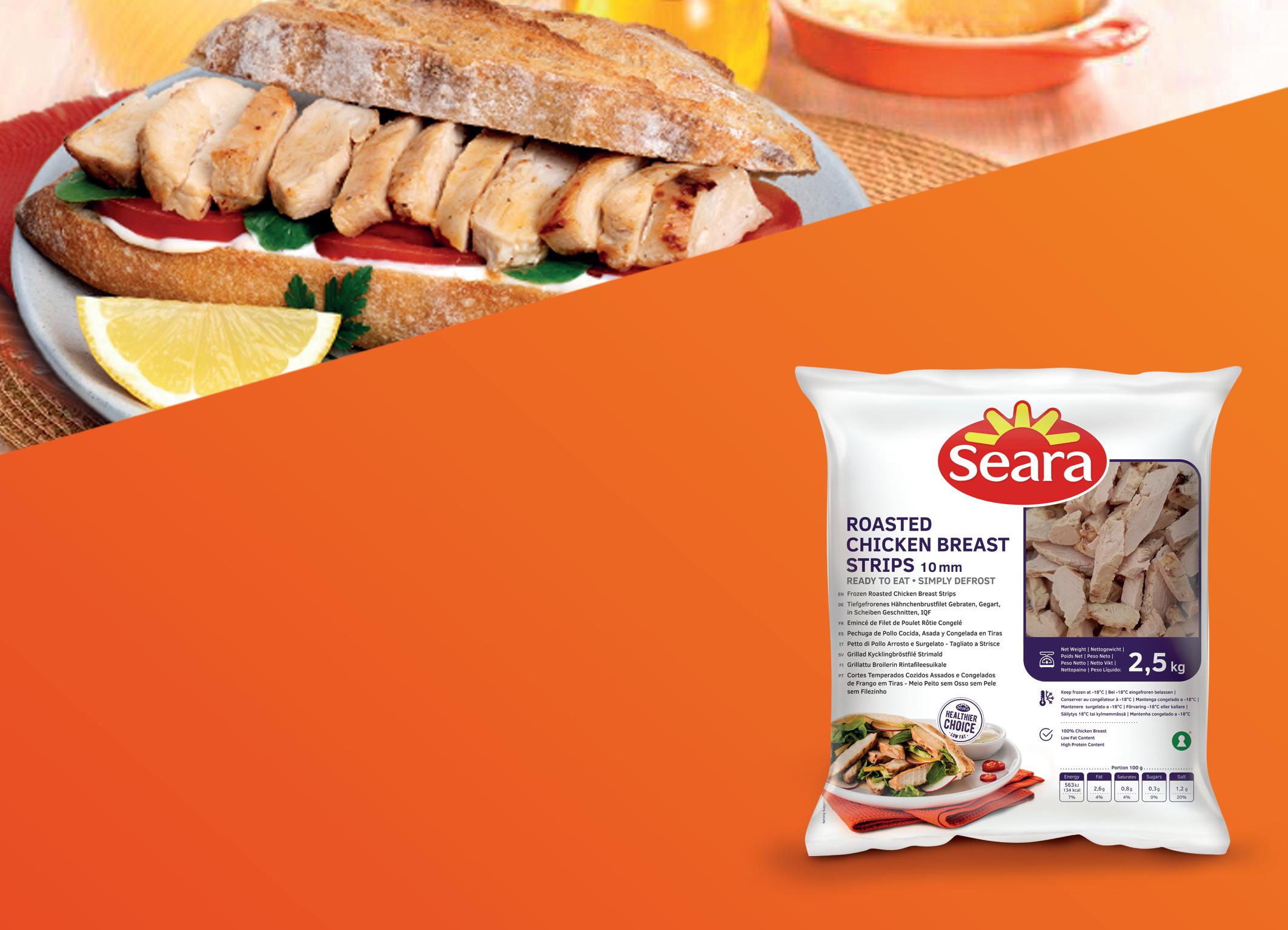
www.sandwich.org.uk I 67 MEAT
Inspirational concepts
Operators need to look at elevating their FTG offering, which is where Santa Maria can deliver.
GET YOUR FILL
Santa Maria Foodservice works with casual dining and quick-serve eateries in the FTG sector – both groups and independents. They’re typically seeking products packed with flavour and versatility, for multiple dishes. Not only is this catering to consumer demand for something new and different, but also saving money.
“For example, our range of Santa Maria rubs, seasoning and sauces –inspired by global flavours – is perfect on various proteins and vegetables,” said Nick Minchin, head of marketing UK&I at Paulig Group (Santa Maria Foodservice).
“These same fillings can then be used in a variety of ways – with our Santa Maria Korean BBQ Sauce drizzled over the top of Loaded Korean BBQ Fries, along with chicken rubbed in chilli and ginger seasoning, slaw and sriracha mayo. Or in a Korean
BBQ Chicken Burrito with Asian rice, lettuce, kimchi and chicken in the same chilli and ginger seasoning, making it easy for operators to stock a low number of products, but still offer a menu with variety and options.
“Our pre-prepared products mean operators can serve food at speed, but be assured of consistent quality. This is particularly ideal for those who may be short-staffed and need quick solutions, or staff that don’t have the skills to create sauces from scratch.”
OPTIONS OPEN
A key FTG trend is customisation. Data from Lumina Intelligence’s latest Food to Go Report shows that personalisation drives spend per head and loyalty, with 32% of items customisable – +2ppts year-on-year.
“Santa Maria products play into this nicely,” continued Minchin. “Our pre-made Salsa and Guacamole

can be optional toppings dolloped on top of burritos or nachos, with our seasonings and rubs offered on proteins. Also, the Cheddar Cheese Sauce is ideal on loaded fries, burgers or wraps.”
Sandwich and coffee shops are tapping into growing treat missions. This is a leading reason why UK consumers eat or drink out-of-home (Lumina). Despite high inflation and personal finance concerns, consumers continue to seek out affordable treats, known as the lipstick effect.
68 I www.sandwichandfoodtogonews.co.uk
“We have really innovated over the past 12 months, conceptually inspiring FTG operators. Mexi-Go is a contemporary take around classic hand-held dishes such as taquitos, tacos and burritos. The recipes cater for dietary requirements and palates, swapping meat for plant-based options, taking inspiration from a range of cuisines, such as Ancho Mushroom Taco, Fish and Chip Burrito, Chicken Tinga Taco and Korean BBQ Chicken Burrito.
“Or there’s our Loaded concept – a range of dirty and decadent downloadable recipes, all featuring dishes ‘loaded up’ and oozing with flavour. Based around burgers, fries and nachos, they’re scalable so operators can choose between simple or more complex.
“We’ve also recently launched Snack Bases. With six in 10 people snacking on crisps/crisp-style snacks, these are the most customisable options on the market. They come in Lentil Waves format or Corn Cones, can be cooked in less than a minute and served either hot or cold.
“Similar to a crisp-style product, they are versatile and easily customised. Savoury options are created by our Santa Maria seasonings, such as the classic taste of Americana with our Steakhouse Seasoning, Mexican with Fajita Seasoning or East Asian with our Kimchi Spice Mix. And a sweet treat is available by sprinkling Snack Bases in our Santa Maria Cinnamon seasoning and Vanilla Sugar.”
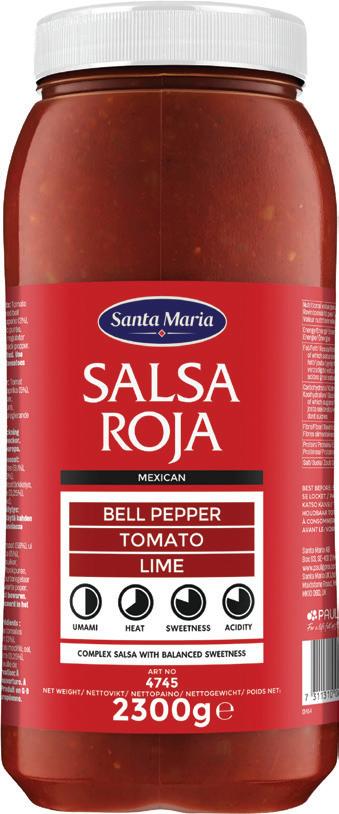
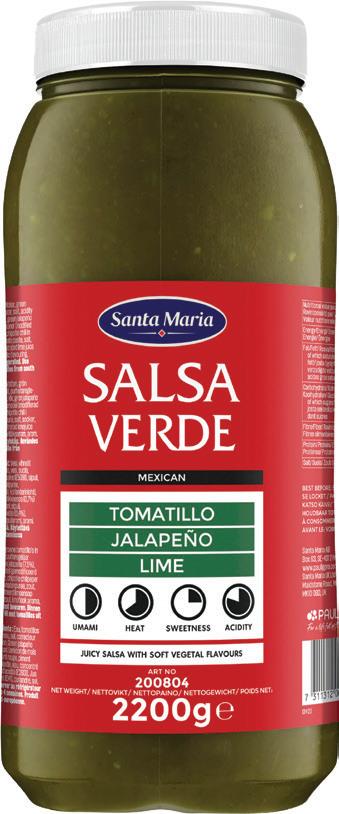
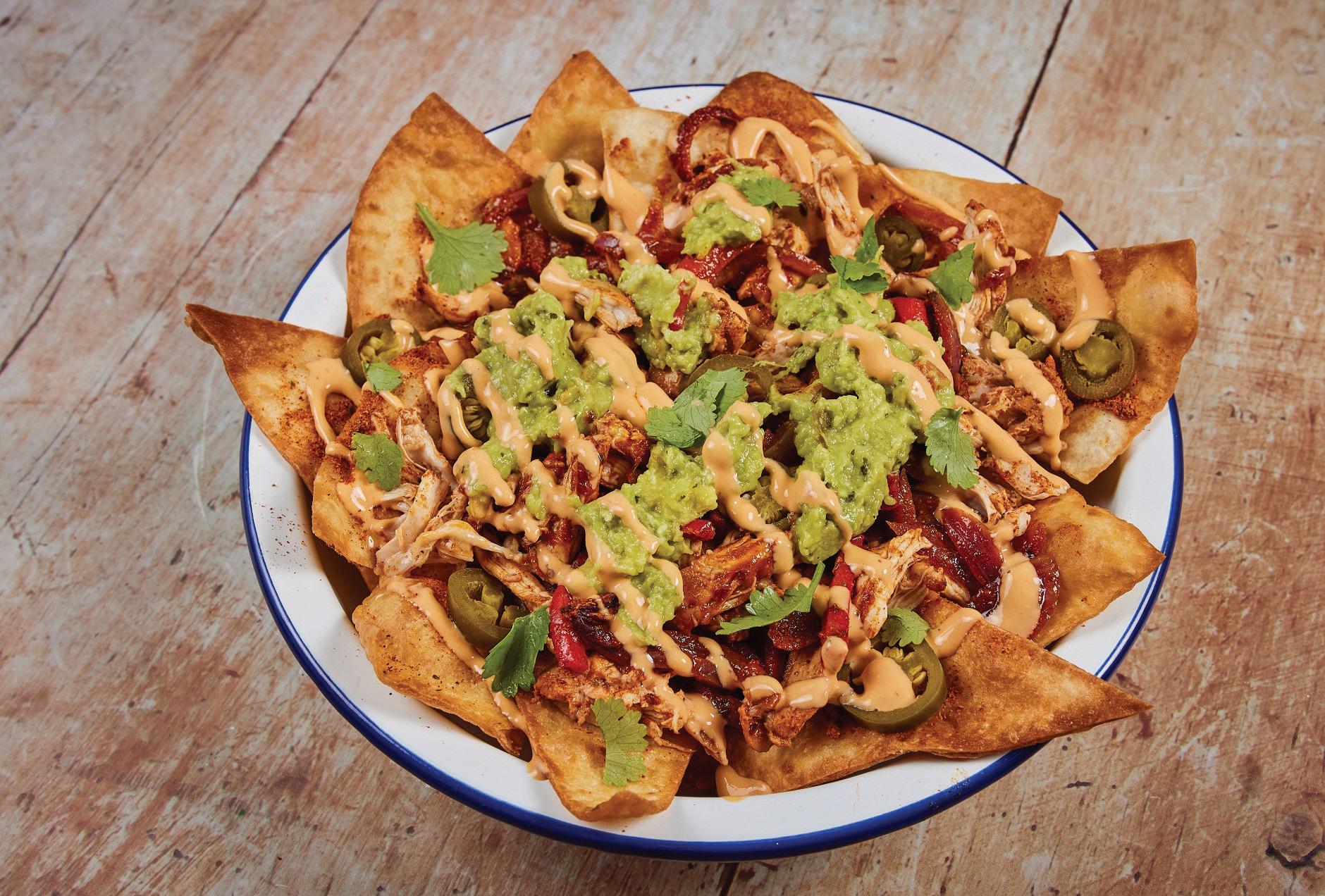
"The adoption of hybrid working continues to have an impact on footfall volumes in FTG outlets near busy office hubs."
STAYING AHEAD
Santa Maria’s range is expanding, but this can only happen with a holistic business approach. “It’s all about added value,” said Minchin. “I know that sounds obvious but we work hard to deliver beyond simply great products. We have a dedicated insights team, which means our customers are up-to-date with the latest trends, consumer behaviours and innovations. There is also a dedicated development kitchen where our taste creator, Barnaby MacAdam, hosts menu
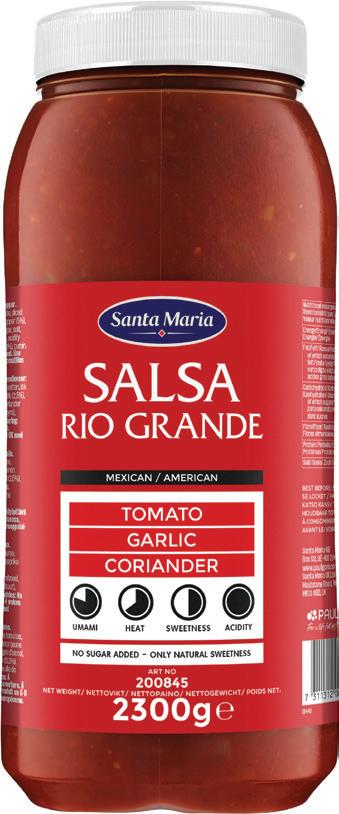
development sessions, tastings and recipe brainstorms with customers.
“We also listen to the market in terms of what product formats and sizes they’re looking for and packaging innovations they want to see – we’re constantly looking at how tweaking our offering to evolve and keep up in a fast-paced world.
“Sustainability is fundamental, and seven of our factories are certified CarbonNeutral® buildings. Our aims are based around the UN Sustainability Development Goals. We have an ambition that, by 2030, 70% of our products and services enable health and wellbeing of people and the planet. We also introduced a group-wide policy for Diversity, Equity and Inclusion last year.
“There are still challenges. The adoption of hybrid working continues to have an impact on footfall volumes in FTG outlets based near busy office hubs during weekdays. The flipside is the breakdown of the traditional three mealtimes (breakfast, lunch, dinner), making way for brunch, all-day grazing and snack-style eating – particularly with the younger demographic. This has helped to bolster the sector across all day parts.”
Santamariaworld.com/uk/foodservice.
www.sandwich.org.uk I 69
FTG TRENDS
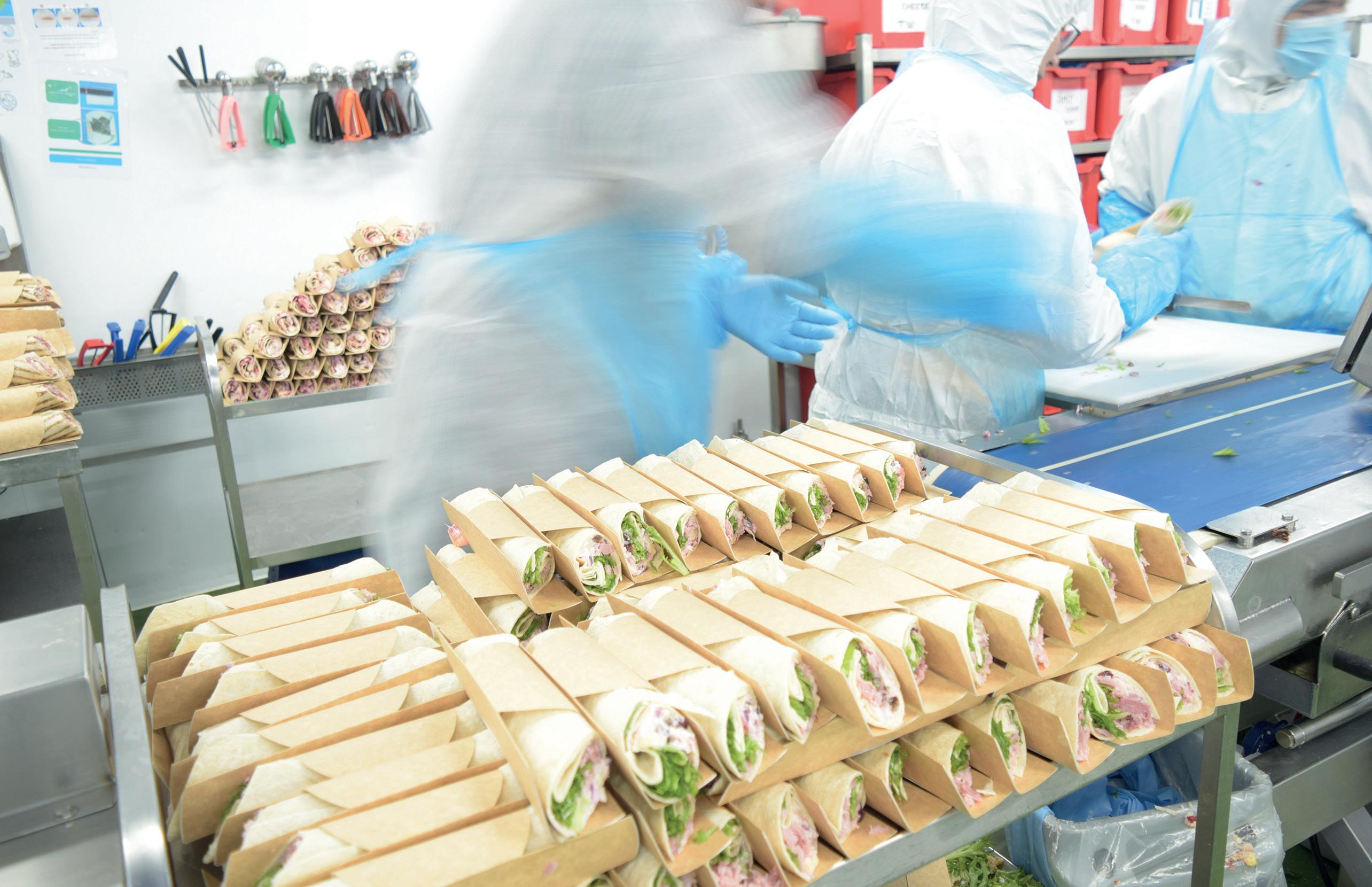
CUTTING THE CARBON COST
Eco-labelling is an important consideration for foodservice operators. Tom Hollands, innovation and technical director at Raynor Foods, takes us through the opportunities it presents.
What are the challenges with current eco-labelling?
Simply put – there is an obvious lack of standardisation. With the multitude of differing standards, it makes it difficult for consumers to compare environmental claims made on labels as they are typically self-referring.
Non-standardised carbon labelling degrades the effectiveness of eco-labelling, with companies potentially making false ‘greenwashing’ claims to portray themselves as more sustainable than they truly are.
The risk of deceptive marketing practice not only undermines the credibility of eco-labelling but also underscores the pressing need for standardised and transparent frameworks, to enhance the reliability of environmental information conveyed through labels.
Furthermore, a standardised approach will allow food producers to not only compete on quality, innovation and service, but critically on emissions.
What is the CDA?
The Carbon Daily Allowance is a benchmark which
represents the carbon emissions related to the diet of a UK adult – this is currently 2469g (see graphic on pg 71).
The real carbon cost of a product is calculated based on a mix of databases of carbon measurements and the accurate measurement of process-generated CO2e, weighted to achieve a true carbon emission value. By dividing the carbon cost of a food item by the CDA, we can derive what percentage of a person’s daily allowance is used by the item.
What we are aiming to provide is an understandable version of this, created by placing the percentage of each item into a scale, based on the relative carbon costs of a basket of real-world lunch option alternatives.
We would ideally like to see this comparison system conveyed via a simply understood traffic-light procedure, as used by on-pack formats for fat, sugars and salt. This will give consumers a fact-based, market-relevant measure of the carbon cost of a dietary item, rather than a vague code-letter or number that is unsupported by any real-world comparison.
70 I www.sandwichandfoodtogonews.co.uk
Why does the food industry need this?
The CDA is an important part of creating consumer awareness and encouraging sustainable practices at consumer level. It is also fundamental in helping food producers compete on emissions.
Typically, in sandwich manufacturing, 90% of emissions are Scope 3, generated within the supply chain. Many manufacturers share a similar chain and therefore increasing demand for lower emissions ingredients will potentially benefit them, the planet and the consumer.
Clear, accurate and cross-competitor carbon labelling will require companies to assess the embodied carbon in all the ingredients they purchase, help them better quantify carbon emissions and have a better understanding of their environmental impact.
In addition, carbon labelling is an effective way for businesses to fulfil corporate social responsibility obligations. It’s important to note that labelling, in itself, is no silver bullet – it must be supported by education, incentives and regulation, but is an essential first step.
In what way can it help the industry collaborate better on emissions reduction?
It’s obvious that many members of the British Sandwich & Food to Go Association (BSA), evidenced by the brilliant entries into the environmental awards at the annual ‘Sammies Awards’, are committed to reducing emissions and constantly striving to develop sustainable business models. A CDA-related approach will provide fuel for these multiple endeavours and allow the industry to both measure and convey to the public our efforts to decarbonise – a world and UK first.
Does this let producers compete on emissions per product?
Absolutely! We compete on price, quality, service and innovation. A sustainable system driven by consumer choice means we must also compete on the embodied emissions within products. Our industry is incredibly innovative and
How do we calculate and calibrate a market-related system?

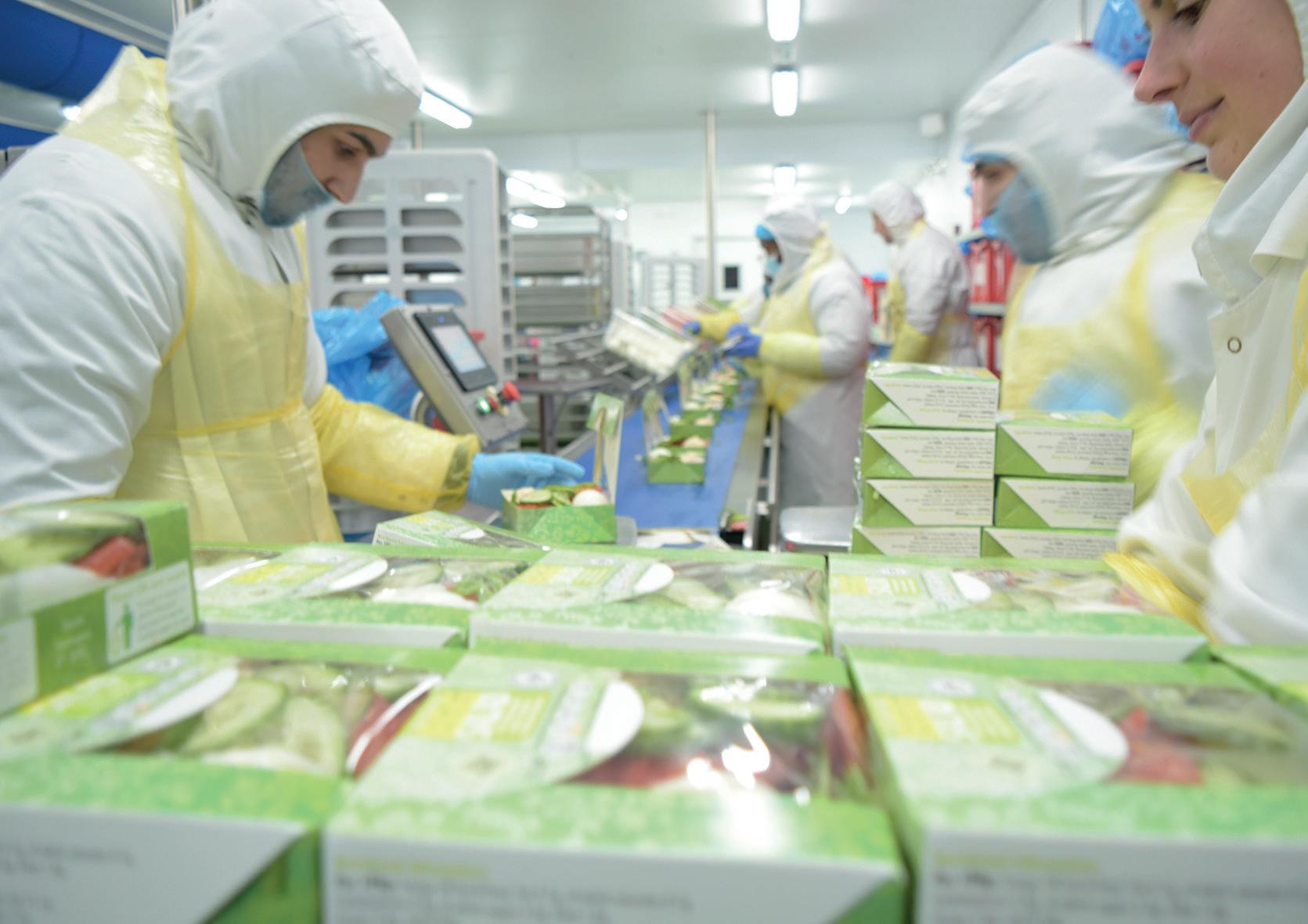
can readily influence other food sectors – we are in a unique position, as our short shelf-life products are ubiquitous across the UK and eaten every day in multiple settings.
How do you calculate the carbon footprint of products? Are any methods more reliable than others? Many organisations can help food producers measure emissions. It’s always worth checking with your supply chain if they have value for their ingredients. Or even taking the next step and collaborating with suppliers to help them establish the embodied carbon within ingredients. There may be opportunities which allow for both emissions and costs to be reduced, as they often go hand in hand.
Can I use it on my products?
Yes! the intellectual property for the method to calculate the CDA is licence free. We strongly encourage all our fellow manufacturers and food producers to adopt the CDA, so together we can drive down the emissions in our industry and set a brilliant example for other food sectors to follow.
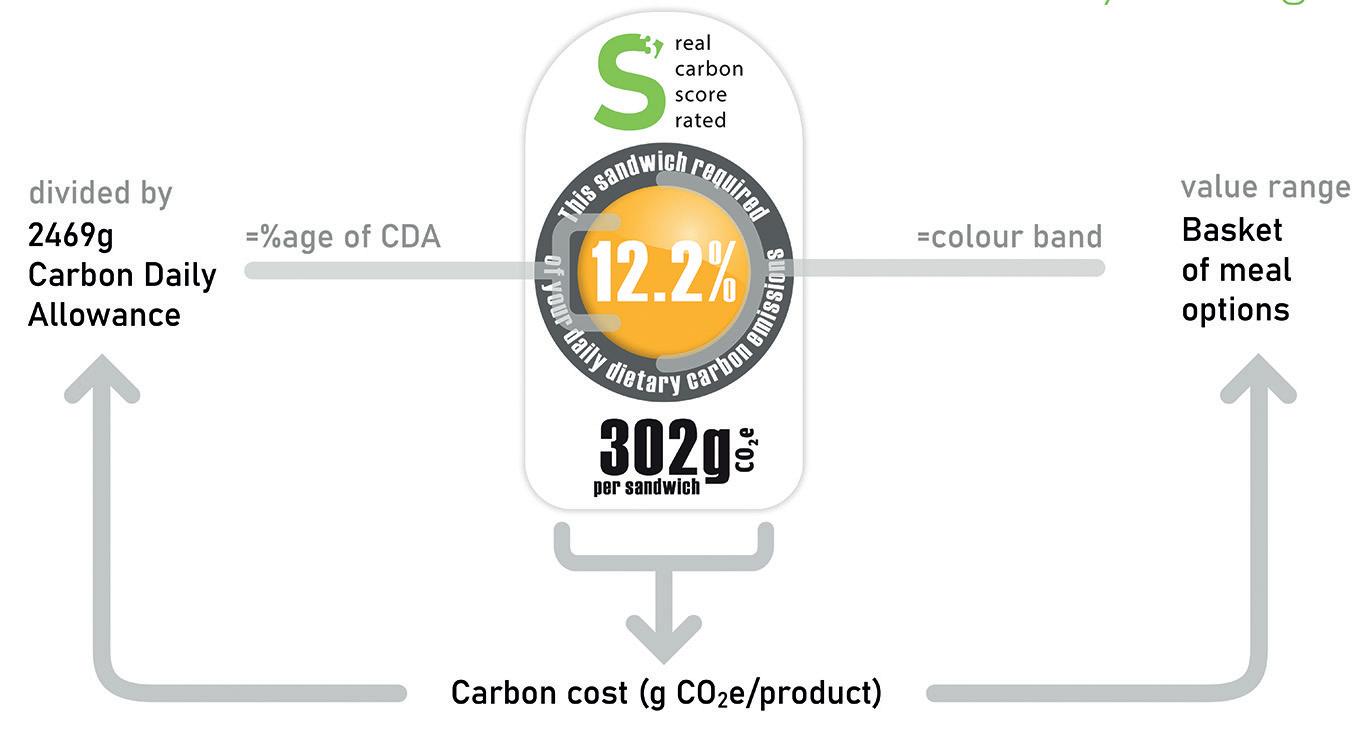
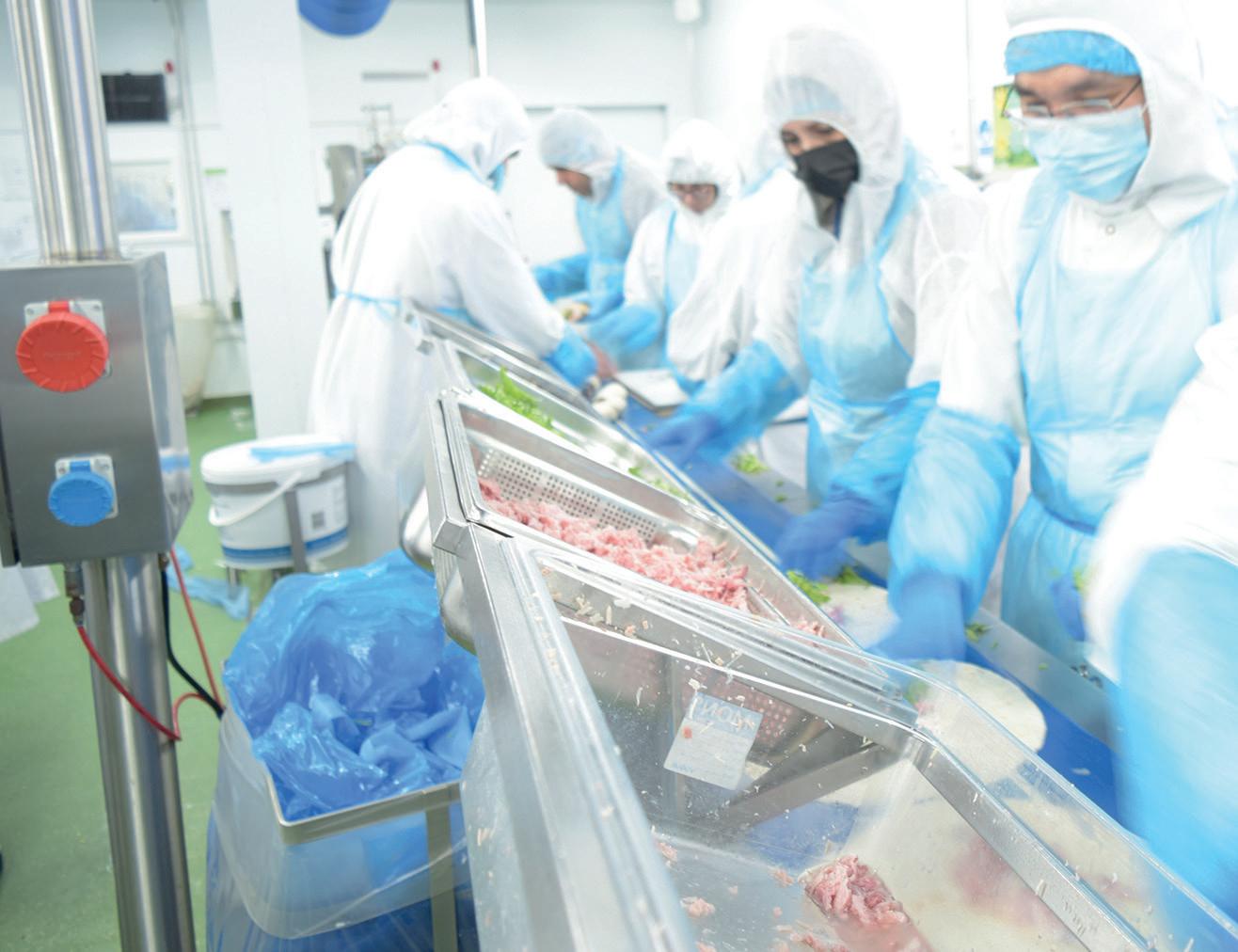
www.sandwich.org.uk I 71 LABELLING
NEXT ISSUE
MAY 2024

SPECIAL Hygiene
Cleaning products, sustainability, legislation
FOCUS
Breakfast Market analysis, consumer demand, meal deals
EXCLUSIVE FTG
Salads, festival time, street food & global cuisine
PLUS...
…all your usual regulars and a look ahead to the Sammies awards dinner
COMING
UP

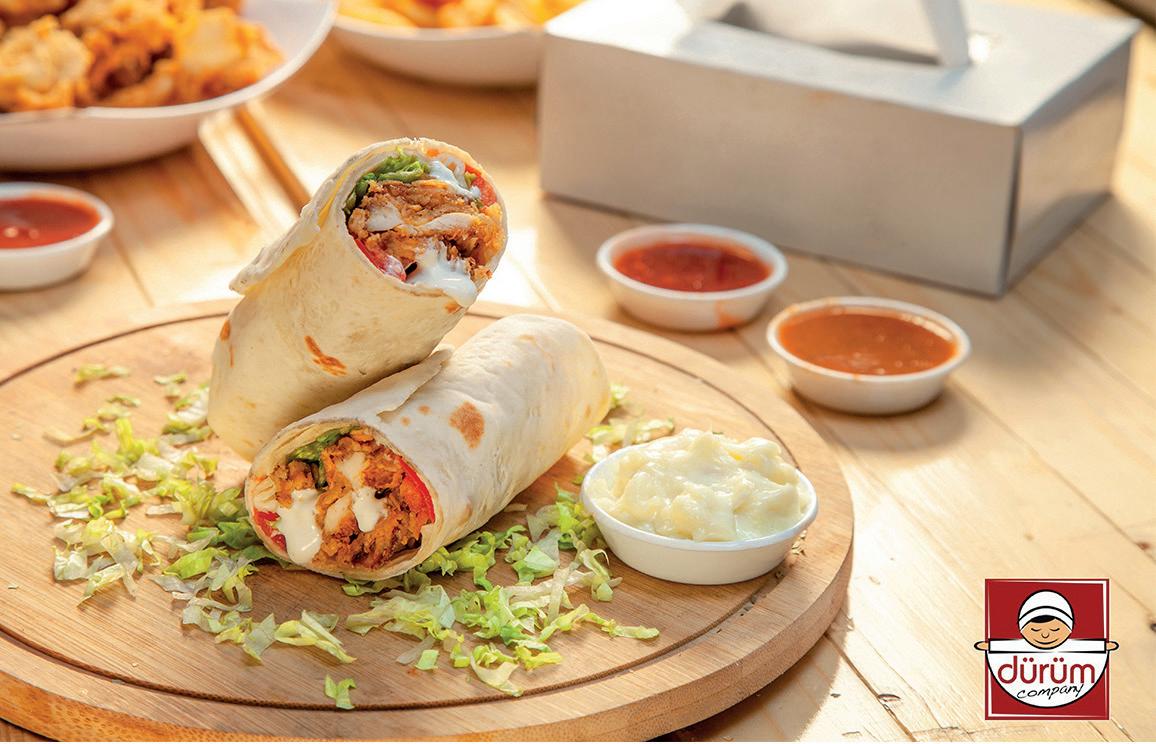
distinctive value proposition is realised through the provision of innovative, health-conscious, and superiorquality products.

of
For more information visit: durumcompany.com.
Oumph! is a long established, well funded sustainable company. We’re a 100% plant based business with our own BRC Ready-To-Eat factory.


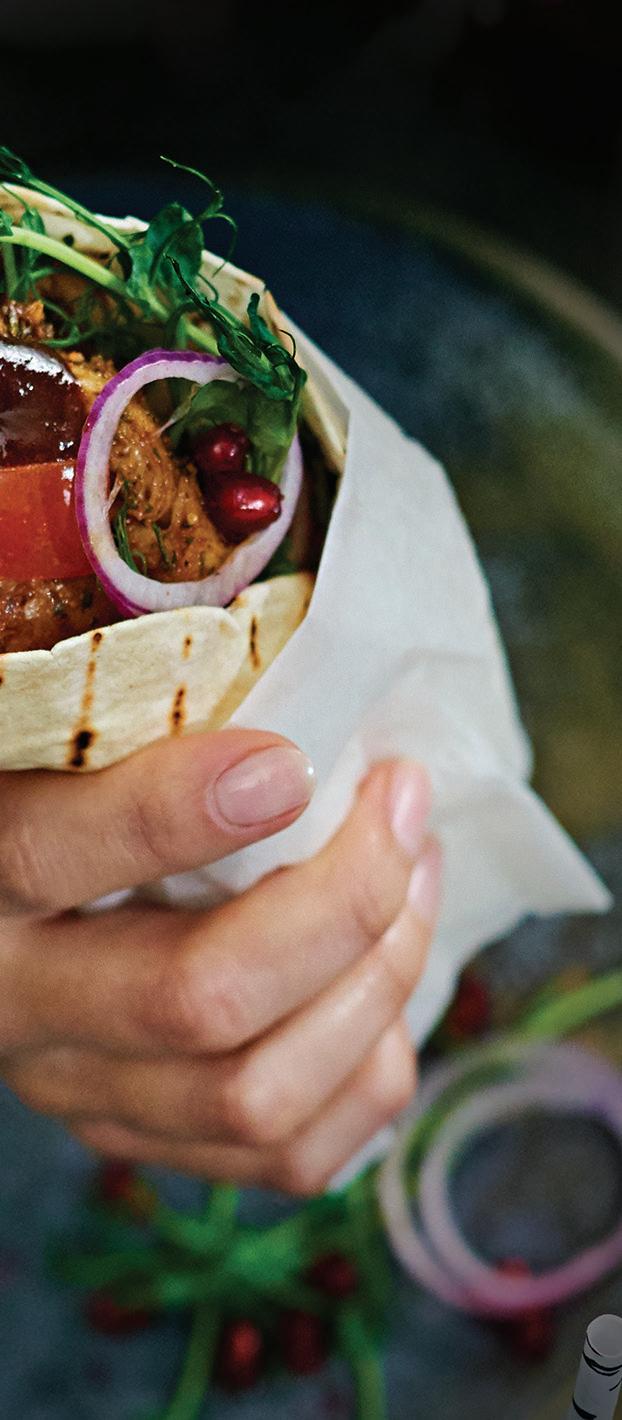


We’re present in all of the major UK retailers so our products are already very well known by consumers. With our new Ready-To-Eat range we can now partner with manufacturers of sandwiches, wraps, salads and other food-to-go products to grow our o er together.
Oumph! features on the menus of many leading UK restaurant groups. With the arrival of our Ready-To-Eat products we can now o er plant-based alternatives for the food-to-go sector. Initially launching with our Oumph! Chunks, a neutral chunk for you to add your own sauces or avours, and our Pulled Oumph! BBQ Chunks, they are the perfect additions to your sandwiches, wraps, salads and poke bowls.
And look out for our breaded strips which we will launch in Q2 2024.
Our products are not trying to be anything they’re not. They’re simply great tasting products which happen to be plant-based. Whether vegan, vegetarian, exitarian or committed carnivores, everyone can enjoy the great tase of Oumph!

Our Oumph! Chunks are a delicious plant-based alternative to allow meat reducers or meat avoiders to enjoy a wider range of products. They provide a simple swap for many of the UK’s food-to-go best sellers such as Coronation Chicken, Chicken and Sweetcorn and many more.
Our Head of Business Development, Nick Jacobs, would love to come in and sample our products together. Please call Nick on 07785 327146 or email nick.ukc@thelivekindlyco.com.
 Durum company is a tortilla manufacturer that prioritises excellent quality and customer service becomes an invaluable partner for sandwich producers. Our focus centres on understanding and addressing the unique wishes and needs
our partners. Durum Company NL's
Durum company is a tortilla manufacturer that prioritises excellent quality and customer service becomes an invaluable partner for sandwich producers. Our focus centres on understanding and addressing the unique wishes and needs
our partners. Durum Company NL's
www.sandwich.org.uk I 73
NEW MEMBERS
H-Pack celebrates british chippy
H-Pack Packaging has launched a line of products exclusive to sh and chip shops, which it expects to appeal to highend UK chippies that want stand-out packaging, while re ecting the quality of the food it holds.
The new ‘Great Taste’ sh ‘n’ chips range includes a series of small, medium and large eye-catching paper boxes, and paper bags with handles. The bags carry the same design as the boxes and are intended to complement those boxes, with the complete range o ering an opportunity for sellers to provide a considered, identi able product that appears unique to the food retail outlet.

Head of merchant sales for H-Pack, David Martin, explained: “Higher ingredient costs and facilities charges have impacted the price of takeaway meals. The ‘Great Taste’ range enables chip shop owners, who may not have the means to market products or create a brand, to maximise their food o ering with packaging that stands out and elevates the overall appearance of the meal provided.
“There’s no great price di erence between ‘Great Taste’ bags and boxes and those of the plain brown or white variety but the range makes any o ering

look higher value. Given that, we’d say to any chippy owner, the ‘Great Taste’ range must be one to try.”
H-Pack is the UK arm of leading, global food packaging brand Hotpack, and can o er bespoke custom products, working with pioneering materials and state of the art machinery and technology, along with its internationally recognised, premium lines.
For further information and for details on the products H-Pack manufactures and supplies, visit h-packglobal.com or call +44(0) 1978855595.

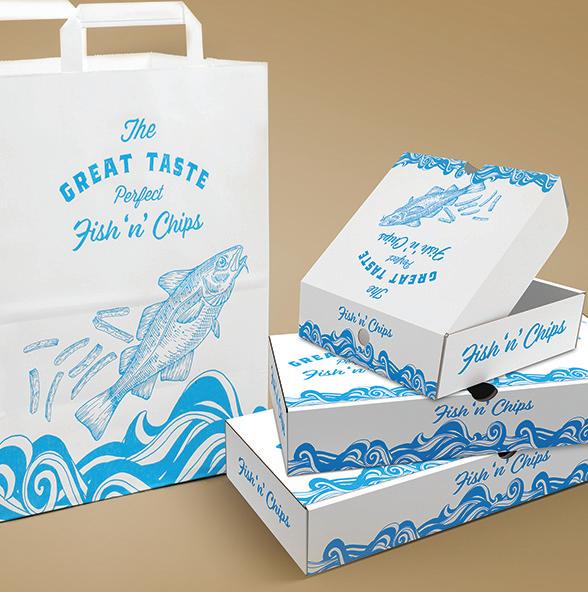
Read it online
NEW PRODUCTS
sandwichandfoodtogonews.co.uk
74 I www.sandwichandfoodtogonews.co.uk
BSA Manufacturers & Distributors
AROUND NOON LTD.
Unit 24A Rampart Road, Greenbank Industrial Estate, Newry, County Down BT34 2QU
Tel: 0283 0262333
info@aroundnoon.com
www.aroundnoon.com
BRC Rating – AA+

DELI-LITES IRELAND LTD.
Unit 1, Milltown Industrial Estate, Warrenpoint, County Down BT34 3FN
Contact: Barbara Hawkins
Tel: 07786 435198
barbara.hawkins@delilites.com
www.delilites.com
BRC Rating – AA+
BCorp certified
AROUND NOON (LONDON) LTD.
762A/763A Henley Road, Slough SL1 4JW
Tel: 01753 523 636
infoANL@aroundnoon.com
www.aroundnoon.com
BRC Rating – AA
AROUND NOON (SOHO)
Unit 7 Advent Business Park, Advent Way, London N18 3AL
Contact: Daniel Silverston
Tel: 0203 058 1245
dan@sohosandwich.co.uk
www.sohosandwich.co.uk
BRC Rating – A
BRADGATE BAKERY
Beaumont Leys, Leicester, LE4 1WX
Tel: 0116 2361100
commercialftg@ samworthbrothers.co.uk
BRC Rating – AA+
GREENCORE FOOD TO GO
LTD - PARK ROYAL
Willen Field Rd, Park Royal, London NW10 7AQ
Tel: 0208 956 6000
www.greencore.com
BRC Rating – AA+
BRC Plant Based
GREENCORE FOOD TO GO
LTD – MANTON WOOD
Manton Wood Enterprise Zone, Retford Road, Manton, Worksop, Notts S80 2RS
Tel: 01909 512600
www.greencore.com
BRC Rating – AA+
BRC Plant Based
GREENCORE FOOD TO GO
LTD – BROMLEY BY BOW
Prologis Park, Twelvetrees Crescent, London E3 3JG
Tel: 0207 536 8000
www.greencore.com
BRC Rating – A+
GREENCORE FOOD TO GO
LTD. – ATHERSTONE
Unit 7,
Carlyon Road
Industrial Estate, Atherstone, Warwickshire
CV9 1LQ
Tel: 01827 719 100
www.greencore.com
BRC Rating – AA+
GREENCORE FOOD TO GO
LTD. – HEATHROW
Unit 366 Stockley Close, West Drayton, London UB7 9BL
Tel: 0208 629 8600
www.greencore.com
BRC Rating – A+
MELTON FOODS
3 Samworth Way, Leicester Road, Melton Mowbray, Leicestershire
LE13 1GA
Tel: 01664 484400 commercialftg@ samworthbrothers.co.uk
BRC Rating – AA+
BRC Plant Based and Gluten Free standards
ON A ROLL SANDWICH COMPANY
The Pantry, Barton Road, Middlesbrough TS2 1RY
Contact: James Stoddart
Tel: 01642 707090 jstoddart@onarollsandwich.co.uk www.onarollsandwich.co.uk
BRC Rating – AA

RAYNOR FOODS LTD.
Farrow Road, Widford Industrial Estate, Chelmsford, Essex CM1 3TH
Contact: Sales
Tel: 01245 353249 sales@sandwiches.uk.net www.sandwiches.uk.net
BRCGS Rating AA
REAL WRAP COMPANY LTD.
Unit 2 Haslemere Industrial Estate, Avonmouth, Bristol BS11 9TP
Contact: Jason Howell
Tel: 0117 3295020
jason@realwrap.co.uk
www.realwrap.co.uk
BRC Rating – AA
The British Sandwich Quality Promise
The sandwich manufacturers and distributors listed above support The British Sandwich Association Code of Practice as The Minimum Standard for Sandwich Making and are subject to regular independent audits. Copies of BSA Audits are available, on request, to buyers (subject to agreement of manufacturers) by calling us on 01291 636338
SAMWORTH BROTHERS MANTON WOOD
Manton Wood, Enterprise Park, Worksop, Nottinghamshire S80 2RS
Tel: 01909 511800
commercialftg@ samworthbrothers.co.uk
www.samworthbrothers.co.uk
BRC Rating – AA+
SANDWICH KING
Enfield Street, Leeds LS7 1RF
Contact: Julie Crimlisk
Tel: 0113 2426031
enquiries@sandwichkinguk.com
www.sandwichkinguk.com
SIMPLY LUNCH LTD.
Unit 2, ZK Park, 23 Commerce Way, Croydon CR0 4ZS
Contact Sales
Tel: 0345 2007631
sales@simplylunch.co.uk
www.simplylunch.co.uk
BRC Rating – AA+
STREET EATS FOOD LTD.
Prince William Avenue, Sandycroft, Deeside, CH5 2QZ
Tel: 01244 533888
Option 1
orders@streeteatsfood.co.uk enquiries@streeteatsfood.co.uk www.streeteatsfood.co.uk
BRC Rating – AA+
TIFFIN SANDWICHES
Tiffin House, 20 Commondale Way, Euroway Trading Estate, Bradford, Yorkshire BD4 6SF
Contact: Sales
Tel: 01274 494939 sales@tiffinsandwiches.co.uk www.tiffinsandwiches.co.uk
BRC Rating – AA
www.sandwich.org.uk I 75
BSA Suppliers Index
AGRIAL FRESH
PRODUCE LTD
Unit 5 Walthew House Lane, Martland Park Industrial Estate, Wigan WN5 0LB
Contact: Sales Department
Tel: 01942 219942
hello@afproduce.co.uk www.agrialfreshproduce.co.uk
ALLSOP SOFTWARE
Scottish Provident Building, 7 Donegall Square, West Belfast BT1 6JH
Contact: Luke Johnson
Tel: +44 (0) 77 7666 0727 luke.johnston@allsop.software https://allsop.software
BAWNBUA FOODS NI
67 Crowhill Road, Bleary, County Armagh BT66 7AT
Contact: Joanne Grant
Tel: 028 38 344224 joanne.grant@bawnbua.com www.bawnbua.com
BIOPAK
Unit 13, Nunnery Park, Worcester WR4 0SX
Tel: 01386 555777
sales@biopak.co.uk www.biopak.co.uk




CARGILL PROTEIN
EUROPE
Clerkenleap Barn, Bath Road, Broomhall, Worcester WR5 3HR
Contact: Helen Walker
Tel: 0121 274 1107
Cpe_Customerservices@cargill.com www.cargill.co.uk
COLPAC LTD
Enterprise Way, Maulden Road, Flitwick, Bedfordshire MK45 5BW
Contact: Sales Department
Tel: +44 (0) 1525 712261
info@colpac.co.uk www.colpacpackaging.com
COVERIS FLEXIBLES UK
LTD
Cromwell Road, Eynesbury, St Neots, Cambridgeshire
PE19 2ET
Contact: Sales Department
Tel: 01480 884300
UKfoodservice@coveris.com www.coveris.com
DARTMOUTH FOODS
1-9 Hearder Court, Beechwood Way, Langage Business Park, Plymouth PL7 5HH
Contact: Greg Choulerton
Tel: 01803 833123 greg.choulerton@ dartmouthfoods.co.uk www.dartmouthfoods.co.uk
FLEXESERVE
The Alan Nuttall Partnership Ltd, Orchard House, Dodwells Road, Hinckley, Leicestershire LE10 3BZ
Contact: Warwick Wakefield
Tel: 01455 638300
info@flexeserve.com www.flexeserve.com
FOOD ATTRACTION LTD.
Triam Court, 17-21 Langham Road, Leicester LE4 9WF
Contact: Jake Karia
Tel: 0116 2744066 jake@foodattraction.com www.jakeandnayns.com
GIERLINGER HOLDING
GMBH
Weingartenstraße 14, A-4100, Ottensheim, Austria
Contact: Mark Seibold
Tel: 07747 621586
mark.seibold@gierlingerholding.com
www.gierlinger-holding.com

GROTE COMPANY
Newtech Square, Zone 2
Deeside Industrial Park
CH5 2NT
Contact: Paul Jones
Tel: 01978 362243
sales@grotecompany.com www.grotecompany.com


DAWN FARMS UK
Lodge Way, Lodge Farm Ind. Est, Northampton NN5 7US
Contact: Jon Watkin
Tel: 01604 583421 info@dawnfarms.co.uk www.dawnfarms.ie www.dawnfarms.ie/tmi-foods
DEIGHTON
MANUFACTURING (UK)
LTD
Gibson Street, Leeds Road, Bradford, West Yorkshire BD3 9TR
Contact: Andy Hamilton
Tel: 01274 668771
sales@deightonmanufacturing.co.uk
www.deightonmanufacturing.co.uk
DURUM COMPANY UK (ENDO FOODS)
10 Princes Road, Montagu Industrial Estate, Edmonton N18 3PR
Tel: 020 8920 2612
Info@endosfood.com
INDUSTRIAL ROBOTIC SOLUTIONS
Unit 2, Block C, Park Office Village, Nesfield Road, Knowledge Gateway, Colchester C04 3ZL
Tel: 07734 365705 enquiries@ industrialroboticsolutions.com www.industrialroboticsolutions.com

JACKSONS
40 Derringham Street, Hull HU3 1EW
Contact: Commercial Team Phone: 01482 301146
hello@jacksonsbread.co.uk www.jacksonsbread.co.uk
JIFFY TRUCKS LTD
FRESH-PAK CHILLED FOODS
1 Waterside Park, Valley Way, Wombwell, Barnsley S73 0BB
Contact: Joe Martin
Tel: 01226 344850 joe.martin@fresh-pak.co.uk www.fresh-pak.co.uk
FSC
Cheddar Business Park, Wedmore Road, Cheddar, Somerset BS27 3EB
Contact: James Simpson
Tel: 01934 745600
james@thefscgroup.com
www.thefscgroup.com

FUTURA FOODS UK LTD.
The Priory, Long Street, Dursley, Gloucestershire GL11 4HR
Contact: Rhian Kinman
Tel: 01666 890500 rhian.kinman@futura-foods.com www.futura-foods.com




26 Jubilee Way, Shipley, West Yorkshire
BD18 1QG
Tel: 01274 596000
Contact: John Briggs john@jiffytrucks.co.uk www.jiffytrucks.co.uk
GROWUP FARMS


Pepperness, Montagu Road, Sandwich, Kent CT13 9FA info@growupfarms.co.uk www.groupupfarms.co.uk

KINGS FINE COOKED MEATS
H SMITH FOOD GROUP PLC
24 Easter Industrial Park, Ferry Lane South, Rainham, Essex RM13 9BP
Contact: Chris Smith
Tel: 01708 878888 chris@hsmithplc.com www.hsmithplc.com
INSURANCE PROTECTOR GROUP
B1 Custom House, The Waterfront, Level Street, Brierley Hill DY5 1XH
Tel: 0800 488 0013
business@ipgdirect.co.uk
www.insuranceprotector.co.uk
69 Queen Street, Wigan, Greater Manchester WN3 4XH
Tel: 01942 322398
Contact: Adele Rooney adele@kingsfinecookedmeats.co.uk www.kingsfinecookedmeats.co.uk

LEATHAMS LTD
The Circle, Units 10-12
Queen Elizabeth Street, London SE1 2JE
Contact: Des Hillier
Tel: 0207 635 4000 des.hillier@leathams.co.uk www.leathams.co.uk
sandwich.org.uk/directory
76 I www.sandwichandfoodtogonews.co.uk
THE LIVEKINDLY COLLECTIVE (OOMPH)
The Old Bakery, Victoria Road, Bicester, OX26 6PB
Contact: Nick Jacobs
Phone: 07785 327146
MEZZE
12 Colston Yard, Bristol BS1 5BD
Contact: Hugo Walker
Tel: 0117 379 0309
hugo.walker@mezze.io www.mezze.io
MILLITEC FOOD SYSTEMS LTD.
20 Victoria Road, Draycott, Derbyshire DE72 3PS
Contact: Richard Ledger
Tel: 01332 320400
sales@millitec.com www.millitec.com


MISSION FOODS EUROPE LTD.
Renown Avenue, Coventry Business Park, Coventry CV5 6UJ
Contact: James Brown
Tel: 07725 496799 Jbrown@missionfoods.com www.missionfoodservice.co.uk
PASTA FOODS
Forest Way, Norwich NR5 0JH
Contact: Matthew Clark
Tel: 01493 416200 enquiries@pastafoods.com www.pastafoods.com

PLANGLOW LTD
Suite 6A1, Whitefriars, Lewins Mead, Bristol BS1 2NT
Contact: Rachael Sawtell
Tel: 0117 317 8600
Fax: 0117 317 8639 info@planglow.com www.planglow.com

PROAMPAC-RAP
Mansel Court, 2A Mansel Road, Wimbledon, London SW19 4AA
Contact: Martin Beaver
Tel: 0208 069 0700 gbenlon-info-dl@proampac.com www.proampac.com
PURPLE PINEAPPLE
FILLINGS (KFF
Kent House, Priory Park, Mills Road, Aylesford, Kent ME20 7PP
Contact: Mark Prior
Tel: 01622 612345 sales.orders@kff.co.uk www.kff.co.uk
BSA Suppliers Index

REFLEX PACK PLUS
Moat Way, Barwell, Leicestershire LE9 8EY
Contact: Jamie Gordon
Tel: 01455 852400 enquiries@reflexlabels.co.uk www.reflexlabels.co.uk


ROYAL GREENLAND
LTD.
Gateway House, Styal Road, Wythenshawe, Manchester M22 5WY
Contact: Solenne Labarere
Tel: 0161 4904246 soll@royalgreenland.com www.royalgreenland.co.uk
SABERT UK LTD.
Unit 2, Harvard Ind. Estate, Kimbolton PE28 0NJ
Contact: Clive Pickerill
Tel: +441480 869077 cpickerill@sabert.com www.sabert.eu
SEARA MEATS BV
2nd Floor, Building 1, Imperial Place, Maxwell Road, Borehamwood WD6 1JN
Contact: Alexandre Mattos
Tel: +44 (0) 7899 982144 alexandre.mattos@seara.com.br www.seara.com.br

SOKEN ENGINEERING
Ardglen Industrial Estate, Whitchurch, Hampshire RG28 7BB
Contact: Stephen Hawes
Tel: 44 (0) 1256 892 194 shawes@jenton.co.uk
www.sokenengineering.com


WADDINGTON EUROPE
Brue Avenue, Bridgwater TA6 5YE
Tel: 01278 410160 we.sales@novolex.com
www.waddingtoneurope.com
WOODLY
Firdonkatu 2 T 63
00520
Helsinki
Finland
Contact: Patrik Kuitunen
Tel: +358 (0) 40 1259 101 patrik.kuitunen@woodly.com www.woodly.com
ZAFRON FOODS LTD.
Unit B-G Eagle Trading Estate, Willow Lane, Mitcham, Surrey CR4 4UY
Contact: Graham Cox
Tel: 0844 847 5116 gcox@zafronfoods.co.uk www.zafronfoods.co.uk
LINKED ASSOCIATION
LOCAL AUTHORITY CATERING ASSOCIATION
LACA Administration
11-13 The Quad, Sovereign Way, Chester CH1 4QP
Tel: 0333 005 0226 admin@laca.co.uk
THE BRITISH SANDWICH AND FOOD TO GO ASSOCIATION MANAGEMENT COMMITTEE
The following are elected members of the British Sandwich and Food to Go Association Management Committee
CHAIRMAN
James Faulkner, Leathams (Supplier)
VICE-CHAIRMAN
David Winter Street Eats (Producer)
THE COMMITTEE
Robert Potts, Greencore (Producer)
Rusty Warren, Subway (Sandwich Bar Chain)
Hannah Wilson, Greggs (Baker)
Gary McDowell, Deli-Lites (Producer)
Dan Silverston, Soho Sandwiches (Producer)
Jared Winder, WHSmith (Retailer)
Wayne Greensmith, Ginsters (Van Sales)
Jude Walker, The FSC Group (Buying Agency)
Jake Karia, Food Attractions (Producer)
SECRETARIAT
Jim Winship, Director
SIGMA BAKERIES
PO Box 56567
3308 Limassol, Cyprus
Contact: Georgios Georgiou
Tel: +357 25 878678
Fax: +357 25 346131 info@sigmabakeries.com www.sigmabakeries.com

SUBWAY
Chaston House, Mill Court, Hinton Way, Great Shelford, Cambridgeshire CB22 5LD
Contact: Frederick De Luca
Tel: 01223 550820 www.subway.co.uk
TAMARIND FOODS SPRL
Brixtonlaan 2c, 1930 Zaventem, Brussels, Belgium
Tel: +32 2 731 69 77
Fax: +32 2 731 69 78
Contact: Frederic Teichmann fteichmann@tamarindfoods.be www.tamarindfoods.be
Product Listing
BAKERY INSERTS
Sigma Bakeries Ltd
BREAD
Sigma Bakeries Ltd
FRANCHISING
Subway
ORGANIC PRODUCTS
Sigma Bakeries Ltd
SANDWICHES
Tamarind Foods
SANDWICH FILLINGS (prepared)
Sigma Bakeries Ltd
SPECIALITY BREADS
Sigma Bakeries Ltd



• Standing orders • Delivery notes • Production • Invoicing & accounts • Ingredients & nutrition • Handhelds etc. Visit rjlsoftware.co.uk or call 01962 761313 Save money and time with the RJLasap wholesale delivery solution A simple, easy to use software system. 24/7 support, free installation & training Seamless links to labelling, EDI and accounting packages. Classifieds For more details on recruitment opportunities with D R Newitt go to page 7
78 I www.sandwichandfoodtogonews.co.uk
Sandwich Manufacturers
BSA Product Index
BAKERY PRODUCTS
Durum Company UK
Food Attraction Ltd.
Jacksons Bakery
Mission Foods
BESPOKE SOFTWARE/IT
Allsop Software
Mezze
Planglow Ltd.
CHEESE & DAIRY PRODUCTS
Futura Foods UK Ltd.
Leathams
CHUTNEYS & RELISHES
Leathams

Zafron Foods Ltd.
DRESSINGS, SAUCES AND MAYONNAISE
Fresh-Pak Chilled Foods
Futura Foods UK Ltd.
Leathams
Zafron Foods Ltd.
EGGS & EGG PRODUCTS
Fresh-Pak Chilled Foods
Futura Foods UK Ltd.
Leathams
Zafron Foods Ltd.
EQUIPMENT & VEHICLES
Deighton Manufacturing
Flexeserve
Grote Company
Jiffy Trucks Ltd.
Industrial Robotic Solutions
Millitec Food Systems Ltd.
Planglow Ltd.
Reflex Lables
Soken Engineering
FACTORY MACHINERY
Deighton Manufacturing
FSC
Grote Company
Industrial Robotic Solutions
Millitec Food Systems Ltd.
Soken Engineering
FISH PRODUCTS
H Smith Food Group plc
Leathams
Royal Greenland Ltd.
Zafron Foods Ltd.
FOOD TO GO
Food Attraction
Pasta Foods
FRUIT
Leathams

INSURANCE
Insurance Protector Group
LABELS & LABELLING
Colpac
Planglow Ltd.
Reflex Pack Plus
MEAT PRODUCTS
RED MEAT
Bawnbua Foods NI
Dartmouth Foods
Dawn Farms UK
Gierlinger Holding GmbH
H Smith Food Group plc
Kings Fine Cooked Meats
Leathams
Seara Meats BV

POULTRY
Cargill Protein Europe
Dartmouth Foods
Dawn Farms UK
H Smith Food Group plc
Kings Fine Cooked Meats
Leathams
Seara Meats BV
ORGANIC PRODUCTS
Leathams
PACKAGING
Biopak
Colpac Ltd.
Coveris Flexibles
Planglow Ltd.
Pro-Ampac RAP
Reflex Pack Plus
Sabert
Soken Engineering
Waddington Europe
Woodly
PASTA
Leathams
Pasta Foods
PLANT BASED
Food Attraction
GrowUp Farms
Leathams
The Live Kindly Collective
Melton Foods
TMI Foods
SANDWICH FILLINGS (READY PREPARED)
Fresh-Pak Chilled Foods
Purple Pineapple
Zafron Foods Ltd.
SANDWICHES
See BSA Sandwich Manufacturers
SALADS, FRUIT & VEGETABLES
Agrial Fresh Produce Ltd.
GrowUp Farms
Leathams
Pasta Foods
SOUPS


Leathams
Pasta Foods



For speci c information visit sandwich.org.uk/directory
Elevate your sips with style:
New circular »to-go« tumbler range
Faerch are proud to introduce their new Tumbler range to the UK Food Service market, offering a minimum of 30% post-consumer recycled material and the promise of full recyclability.
Our focus is on creating packaging with recycled material, fully recyclable back into new food packaging in an endless number of cycles, without compromising safety or functional properties.
The range offers a selection of capacities, with 4 common lid designs to fit all tumblers, simplifying supply chains, creating versatility and a seamless user experience.
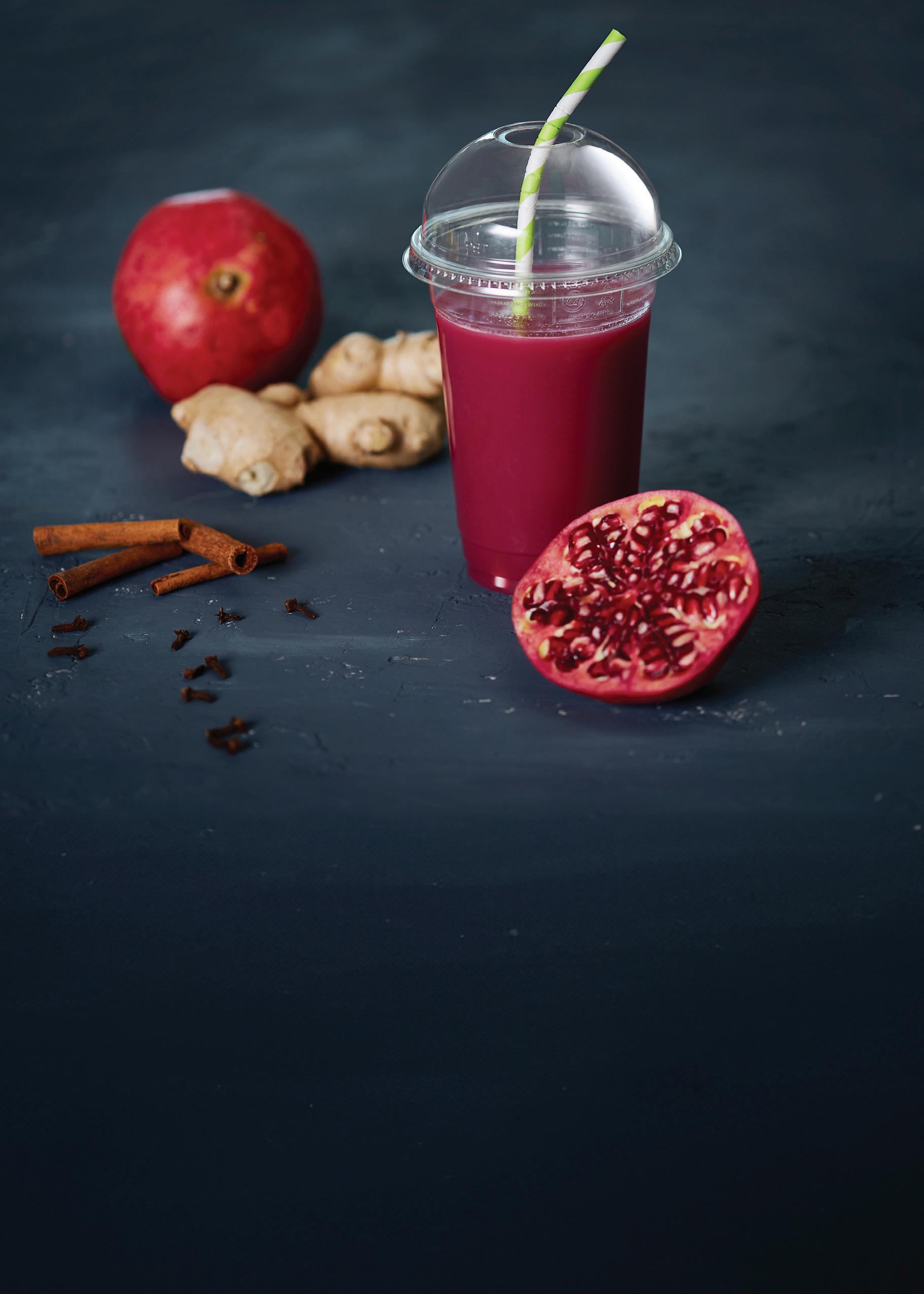
The Tumblers range meets the increasing consumer demand for sustainable packaging, and stands as a testament to Faerch’s commitment to the environment and our customers’ evolving needs. Instead of taking more of the world’s resources, we should make better use of those we already have, again and again.
For further information and to request samples, please contact your Account Manager or Internal Sales Coordinator at ordersely@faerch.com.
FAERCH.COM/FOOD-TO-GO