![]()


Back in January of 2017, Gibson County was introduced to the first feature magazine about our local folks — Small Town Living. Every month there was a surprise in your mailbox full of information about the locals, for the locals, and by the locals. It was free to everyone and supported by our own small businesses and community members.
Over the last year, since the magazine and I had to retire, I’ve heard so many positive comments from our readers and sponsors. Apparently, the community liked having a way to connect with their friends and neighbors. Many of our great sponsors felt the same.
Now I’m so happy to let you know that a group of locals has embarked on making a feature magazine based on Small Town Living. The Gibson County Museum of History and Culture will be bringing Gibson County Living to your mailboxes for free. This magazine, too, will have feature stories and information about our community that will cover a wide variety of topics and interests both past and present with an eye to the future.
I’ve tried my best to share all the tips and tricks in my arsenal of 25 years of print experience so that the tradition of a local community magazine can continue. It should be quite the adventure, and it’s my hope that the community and sponsors will be supportive.
For seven years, Small Town Living was a staple in our county. The stories told by Jancey Smith made you feel more connected to the community and the people in it. You could always count on Jancey to tell you about some wonderful personality from the county, about some delicious new recipe that you’d just have to try, and about the goings-on around our communities. In short, Jancey and Small Town Living created a lasting and impactful sense of community through a medium that isn’t always valued.
Since December 2024, when Jancey published her last issue, this treasure has quietly become a missing piece that we didn’t realize how much we needed. The Museum is forever grateful to Jancey for sharing her dream, and allowing it to come back to life and live on as the Museum’s first major project in a new, expanded way for Gibson County. We will continue to bring some of your old favorites, but we will also be bringing along some new adventures and stories that continue to celebrate the people and communities that we know and love as Gibson County, Indiana — Past, Present and Future! We hope that you will give us the opportunity to highlight the good things about our community and its people like Jancey did.


So let me say once again — grab a glass


T. Allen Burr, President of Gibson County Museum of History & Culture
Fourteen short years after our country became a nation in its own right, the first white settler would put down roots to raise a family in what would become Gibson County. That settler was John Severns, Sr. Upon reaching the bounds of our county, Severns would have been met with verdant forests, expansive plains, and plentiful game to support his burgeoning family. However, he would have also found the land already inhabited. Long before recorded history began in Gibson County, the Miami, Fox, Shawnee, Kickapoo, and other indigenous peoples lived here. Unlike many at the time, Severns was well equipped to live alongside the various native tribes, as he and his family had been held captive by a native tribe in West Virginia.
Due to this, Severns learned several Native dialects and would later serve as an interpreter for the influx of settlers to the area. Severns settled on the banks of the Patoka River, two-and-a-half miles north of present-day Princeton, around 1790. He was permitted to settle there by the Native tribe across the river from him so long as they could use his ferry and he provided them with certain goods. This point was long known as Severns’ Ferry because of this and was later known as Severns’ Bridge as early as 1884.
John Severns was the kind of rough-and-tumble, pioneering frontiersman that made this country and our county so great! But, without historians like James Tartt, Gil Stormont, and Elia Peattie preserving the history and stories of our county and its people, we would know precious little about our first settlers or the First Peoples who inhabited the land before them. Without historians to preserve our history, we miss out on the stories of the people and events that made our home what it is today.

I began the museum project because I work as a historian, and I believe that our history is worth preserving for future generations to learn from and enjoy. Our county has more than 200 years of history to preserve, and if we do not take action, we will lose it. The recent losses of historic buildings in our county have made that abundantly clear. Take, for example, the old Methodist Episcopal church, also known as The Princeton Church.
Continued next page...
Preserving the Past continued...
The Methodist Episcopal church was built in 1893, and it was lost to fire on January 20th, 2025. Owensville’s Holder’s Funeral Home was built in 1874, though it operated as different businesses prior to becoming Holder’s. It, too, was lost to fire on February 5th, 2023. And Oakland City’s Order of Eagles No. 4288, while a more recent build, was built in 1924 and suffered the same fate as the other two buildings I’ve mentioned on December 22nd, 2021.
These weren’t just buildings, they were repositories of history and contained items and stories that will likely be forgotten if we don’t save them. Fortunately, the Methodist Episcopal church had a time capsule that is currently being preserved and displayed at the Princeton Public Library. Our history is worth preserving. Our communities have stories that are worth telling and retelling to future generations.
The vision of the Gibson County Museum of History & Culture is to become a pillar of local history education and a model of cultural preservation. We aim to do this by carrying forward the torch once held by historians


like Tartt, Stormont, and Peattie by producing Gibson County Living. We are also working hard behind the scenes to get an actual brick-and-mortar museum built where we can collect, preserve, and interpret the history and culture of our county and educate all generations, especially future ones, about our county’s stories and people.
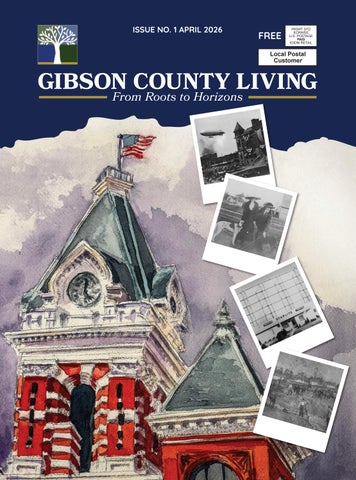
On The Cover: Artwork: Watercolor of the Courthouse Clock Tower commissioned by the Gibson County Visitors and Tourism Bureau for retiring Director Eric Heidenreich in 2025 by Artist Ron Wise, a Princeton, Indiana native, artist, graphic designer, and educator at Vincennes University
Photos, from the top: Courthouse: January 1913 – Parade celebrating the State GAR Encampment. A dirigible also flies over Princeton, dropping a message to the estimated 10,000 people below that read “Glad to see you. Good luck. Good bye.” – Princeton Public Library and Prince Town by Greg Wright
Two Women: 1905 – Women with dogs on McCreary and Walnut St, Ft. Branch – From the history collection of the Fort Branch & Haubstadt Public Library
Starlite: 1949 – Starlite Drive-In Theatre opened in July 1949 and was located on the current site of Toyota Motor Manufacturing – Prince Town by Greg Wright
New Lake: Circa mid-1920s - Digging New Lake in Oakland City, Indiana


MONDAY: CLOSED
TUESDAY: 9AM - 5PM
WEDNESDAY: VOLUNTEER DAY
THURSDAY: 9AM - 5PM
FRIDAY: 9AM - 5PM
SATURDAY: 9AM - 2PM
SUNDAY: CLOSED

Story-based learning instead of dry textbooks
Art, history, writing, & re ection woven together
Designed to reduce burnout and pressure
Encourages curiousity, emotional literacy, & critical thinking
Flexible, inclusive, and beautifully made


Written by Janice Barniak
It was 2008, and Rudy Zarate was working in new housing construction when the housing bubble popped and left businesses reeling. For Zarate, it was the chance to chase a childhood dream to attend culinary school.
“I always wanted to go to culinary school, back in high school, but I had kids and got married.” He learned that he wasn’t actually starting from scratch; building and baking have a lot in common. He put himself through school by baking wedding cakes and cupcakes. He said cakes are very structural, and it turned out the “measure twice, cut once” rule applied to cooking as well. “I always loved baking being very technical, weighing in metric, instead of teaspoons, or cups. It’s very technical and precise,” he said.
He went through baking training at a school called Art Institute, then upped his savory skills at the Institute of Technology. He said the food safety training he received made him look back at his childhood and laugh, wondering how he survived lukewarm food at family picnics. “You’re like, oh my gosh, no way.”
After training, he took a paid internship at Yosemite National Park, completed it and was hired full-time. “I asked questions when I should ask questions,” he said. “Being older gave me an edge; I had more common sense, and I grew very fast because I paid attention.”
Eventually he’d gone from prep cook, chopping mountains of vegetables, to manning the six burner omelet station in the Mountain Room Restaurant. “If you want to grow, you’ve got to listen and
Continued page 9...


Monday-Wednesday: 9am-6pm

Thursday: 12pm-8pm
Friday and Saturday: 9am-5pm
Sunday: CLOSED
1-812-385-4464
124 S Hart St, Princeton, IN, 47670
www.princetonpl.lib.in.us
How do I get my own library card?
Patoka Township residents must bring a state issued ID reflecting current address. If your current address is not on your ID, please bring a piece of mail with your name and the current address.
If you are under the age of 18, we need a parent/guardian present to issue a library card.
What all can I do with my library card?
With a resident card or subscription card (both will be the green Evergreen card) you have access to so much for free! Enjoy ebooks and audiobooks? Check out Libby or Hoopla! Want a free streaming service? Kanopy might be just for you!


learn...I’ve always told other chefs, never think you know everything in cooking; if you think you know everything, it’s time to leave the industry,” he said. After Yosemite, he did university catering, and had the opportunity to cook at the Dean’s house with the head chef for alumni guests, and do private meals with donors, work graduation dinners, concerts, and basketball games. From there he worked at Orange Hill Restaurant in California, and was inspired by their take on new American food, with something different every week. He learned gastronomy, worked with unusual materials like agar-agar, and made flavor pearls.
When he moved to Princeton due to his wife’s father passing, it was a chance to get back to the cooking basics, and training people the way he learned. He’s currently working at St. Vincent Hospital in Evansville, and said he’s enjoyed catering big hospital events and improving daily menus, but his dream is ultimately to open his own catering company in Princeton.
It’s come full circle, now that he’s doing construction on a building on the square, creating an events space. “We’re hoping to open the downstairs event center maybe by March,” he said. “It will be another year before the catering kitchen is finished. The cost of materials is way up.” He said as a chef, people ask all the time, what’s your favorite meal to eat, your favorite meal to cook. “No one meal stands out.” In fact, it’s not the cooking process, it’s memories like winning first place in a pastry competition, that stick out. Or creating a five- course dinner for two to celebrate him and his wife’s 10th anniversary.
Growing up he watched his mom cook, raising a bunch of boys as a single mom, and his regret is that there were no recipes. It was all in her head, and so were his grandparents’ meals. But his new goal is to keep learning and teaching, and to expand people’s palettes, if they’re interested in experiencing new flavors and spices. “I like playing around,” he said.

Written by Jancey Smith
Most cultures have some type of hand-held meat pie in their cooking arsenal. It was a portable lunch for the working man to hold in one hand and eat. In Latin American countries you will find the Empanada, which is similar to an Italian Calzone. These are both pastries folded in half after being stuffed with a meat a filling that are crimped along the rounded edge in what would make a perfect handle.
The British have the Cornish Pasty and in Germany the meat pies are called Bierock. These are fluffy pastries that encase a meat filling that can be fried or baked. They resemble what many of us would think of as a modern-day “Hot Pocket.” TM.
Gibson County has its own unique meat pie called the Saucheesie. It was developed in the tiny town of Hazleton, at the Hilltop Tavern. This local wateringhole played many rolls in Hazleton, from bus stop, to fish market and restaurant since the early 1950’s. In June of 1988, Uncle Bill and Bev Masters became the stewards of the old tavern, buying it on a handshake from John and Joanne Stone. The signature dish of the Hilltop was the Saucheesie served on Wednesday nights. It’s a round circle of bread dough filled with sausage, onion, peppers, and a cheese mixture. It’s then sealed into a ball and baked after being topped with a dusting of Parmesan cheese.
Even though the Hilltop is no longer with us due Continued next page...

Saucheesie continued...
to a fire on March 15, 2019, the recipe for the Saucheesie is still with us thanks to Lucy Atkins, who took over at the Hilltop in 2009. She was kind enough to share Bev’s recipe for the rest of us to enjoy. While they aren’t hard to make, you are working with a yeast dough, so there is rise time. Saucheesies are best started the day before you plan to enjoy them. The trick to the Saucheesie is to make sure that you wrap the dough around the filling just like a diaper. (Something most of us have practice at.) The recipe is easy to double should you be cooking for a crowd. Just remember to give a nod to the little tavern that gave us such good eats in a hand-held meat pie.
The night before baking, remove bread loaf from freezer and let thaw in greased plastic container in the refrigerator. Brown sausage with peppers and onions. Drain excess grease and refrigerate meat mixture for use later.
On pan covered with shortening, spread out dough to about an 8-inch circle and place sausage mixture in center. Top with a handful of cheese blend and then wrap, "like a diaper," tucking edges and corners in. Place seam side down on baking sheet, brush with butter and sprinkle with Parmesan cheese. Bake in 350º oven for 25 minutes or until lightly browned.


1 loaf frozen bread dough, thawed
1 lb. sausage
3/4 cup onion, diced
1/2 red pepper, diced
1 green bell pepper, diced
1 clove garlic, chopped
1/2 - 8 oz. pkg. each mozzarella and colby-jack cheeses, mixed in bowl
2 tsp. melted butter
Parmesan cheese shortening
Saucheesie - (per serving)
1/4 loaf frozen bread, thawed heaping half cup of browned sausage mixed with onion and green bell peppers
1 handful of combined mozzarella and colby-jack cheeses pat of butter
Parmesan cheese shortening


When it comes to your banking relationship, you deserve a knowledgeable partner committed to your success. With offices in Haubstadt and Princeton, our local team loves Gibson County, and many of them were born and raised here, too. It’s why your business, your farm, your family, and your dreams matter, and we’ll be sure you know it.
Connect with our Gibson County team today.

Haubstadt Branch 101 E State Rd 68
812-768-0000
MyFirst.Bank/Haubstadt
Located across the street from Holiday Foods, just west of Highway 41 before you enter town.
MyFirst.Bank | @FirstBank1893

Princeton Branch 2820 W Broadway 812-386-8463
MyFirst.Bank/Princeton
Situated on the town’s west end, in front of Wal-Mart and across from Faulkner Chevrolet.
INDIANA Evansville Haubstadt Mount Vernon Poseyville Princeton Vincennes ILLINOIS Carmi ⁃ Grayville ⁃ Lawrenceville ⁃ Mount Carmel


Written by S. Heininger

Want to get started on documenting your family history, but don’t know where to start? Sorting through the many offerings available online can be information overload for those just looking for a simple starting point. But the best way to get started on your search is probably to ignore the mountain of information and just focus on one thing – You. Getting started on just you (and your family) is actually a simple process. You just need a couple of simple standard tools. These standard tools are the pedigree chart and family group sheets.
The pedigree charts, also called lineage or ancestral charts, are used to track parentage. These charts record the parents of an individual and the parents of the parents, and continuing on beyond that. The family group sheet is used to record the information for a single family. These sheets are used to record the information about a marriage and all of the children of that marriage. If a person was married more than once, a separate sheet will be needed for each marriage. Children need to be recorded on the group sheet for the appropriate parents. For example, a man who was married twice would have a group sheet for each marriage. If he
had two children by each wife, the children would be recorded on the proper sheet for their parents.
Blank forms for both types of record sheets can be downloaded from the internet. I like the forms from ancestry.com. Search for “ancestry blank forms” to get to the webpage for blank forms. You won’t need to create an account to access these forms. There will be a number of forms available on the webpage. For now, we are only interested in the lineage and family group forms. There are a number of different styles of these forms available on the web. Feel free to look around for something that you like. The forms on Ancestry are suggested for their simple and clean formats that make recording your data easy. Print out several of each form and let’s get started. We’ll begin with the lineage form. On your first sheet, start with yourself and enter your information. Then enter the information for your parents. Repeat the same process and continue to work through your grandparents, recording any information that you know. The form records simple life events: birth, marriage and death. Record dates and places that you know as you go.
Once you have gone as far as you can with the lineage sheet, start working on the family group
Continued next page...
Start Your Genealogy Project continued...
sheets. Begin with your own group sheet. If you are or have been married, your first sheet will be for you and your spouse. If you are single, begin with the sheet for your parents. Again, work back through your family, recording any information that you know or have records for. Look for the records that document the events you are recording. Birth and baptismal certificates and marriage licenses are certainly the first documents you should be able to use. Don’t be discouraged if it seems you don’t know much at this point. Whatever you have will provide a valuable start to your continuing research. Start by entering all the information that you have available on your forms. Once you have recorded as much information as you know, your next step is to start talking to other family members to fill in the blanks and expand your knowledge. The fun really begins here. Talk to your parents, grandparents, and any other available relatives. Don’t just ask for events and dates, record any family stories they have to tell. Old photos, letters, journals or diaries, newspaper clippings: all of these have stories to tell. This information will fill an important role in your family history and provide clues for further research.
A couple of tips to remember while working on your data collection. First, when you record places, include the county names as part of a location. The customary way of doing this is to use the format, “city or town, county, and state”. Most of the records you will be using are issued by county governments, so knowing the right county will be an important part of your research. The second tip is this: As you collect information, keep notes about where you got the information. If you have actual records, birth certificates, etc., that document your facts, make copies of these. Documenting the sources of information is an important part of genealogy research. We want to make our family history as complete as possible, so knowing where we obtained the facts of that history is an important part of that process.
When you are ready to dive deeper into your genealogy project, you will have a good set of data upon which to build. Building an online family tree or using one of the excellent software packages available to document your family history will be easier using the beginning set of information that you have already gathered. So go get started, and have fun. Happy Hunting.


Written by Don Kellner - a resident of Buckskin from 1956 to 1975. He graduated from Buckskin Grade School, attended Mackey High School, and graduated from Wood Memorial High School.
According to James Tartt’s History of Gibson County, Indiana, and Gil Stormont’s book of the same name, in the early days of Gibson County, a road was laid that ran between Booneville and Princeton, and a stagecoach was known to tote traveling men and the mail between the two locales. There were, along this road, farmers and hunter-trappers who had made their homes, but very little else existed there at first. The hunters would make a good portion of their money selling the pelts and furs of their hunts. However, it was not easy to predict when the stagecoach would pass through, so the hunters marked their furs with their individual identifying marks and hung the furs on tree branches that the stagecoach passed. As the stagecoach driver passed through, he would collect them, bring them to town, sell them and bring back the proceeds. This led to the road being known as the Buckskin Road. And hence, the name Buckskin came into being.
Around 1845, a German immigrant named Emil Sasse started a small general goods store along this road. Sasse also secured a post office for Buckskin around 1847. The store was very successful, and a bit of industry developed around it. Emil and his brother ran the store together, but they quit the store around the time that the Evansville & Indianapolis railroad was built about 1852 or 1853. The railroad was built about a mile east of the old town of Buckskin. A new town was laid out on the railroad and another German immigrant named Herman Buskuhl opened a general goods store in the new town, and he too secured a post office for the town. The first school was located in downtown Buckskin, next to Weisheit's Blacksmith Shop and the doctor's office. The original building was built prior to 1871 as a two-room white-frame building but was later replaced with a four-room brick building. During its heyday, the school accommodated students in grades 1 through 8. The school operated from the early 1870s until circa 1932. Some of the families that the school served included: Geiselman, Ohning, Holzmeier, Ostreicher, Tieman, Hebbeler, Speicher, Chesser, Niekamp, Schwerdtfeger, and Geis.
One of the first churches organized in Buckskin was St. John’s Church. Reverend Gubner organized the congregation in 1866, and construction began on a church building. The church was constructed in 1867 and dedicated on November 24, 1867. The congregation identified itself as part of the German Evangelical Synod of North America. In 1895, the congregation decided to build a new church building, which was completed and dedicated in October of 1895. Being a community of German farmers, they conducted church services in the German language. However, in 1899, they decided to start conducting services in English. St. John’s Cemetery serves as a testament to the wealth of history in the town. The oldest graves in the cemetery are for the Strattman (1870), Ohning (1872), and Fritz (1875) families.

Written by By Mikala Sisson, Fort Branch-Johnson Township Public Library

Acrylic, painted mural of the fort by Sue Freudenberg, finished in 1974, originally commissioned by the Farmers & Merchants Bank in Fort Branch, Indiana. Now owned by and on display at the Fort Branch Public Library.
During the pioneer era, around 1811, those finding themselves settling in what is now the area north of the current town of Fort Branch, Indiana, were concerned about potential attacks from Native Americans. To protect themselves, they erected a fort large enough for all of their families and stock. Nearby, as a water source, was a small branch stream of Pigeon Creek. In the History of Gibson County, Indiana by James T. Tartt (1884), one of the only Native American interactions near the fort can be quoted from page 62,
“During the Indian troubles which occurred about this time, his family [the Andrew Gudgel Family] all went to Fort Branch for protection, which was a strong block house, erected as a rendezvous for the settlers of that locality. This plucky old pioneer would not go to the fort, but insisted on remaining at home in his cabin to take care of things. The Indians frequently came to his place, and would stroll into his cabin, and while the old man was sitting in his chair, fearless of danger, the wily savages walked around him, frequently patting him on the head, and in their rude fashion complimented him on his bravery.”
Much of the early history of Fort Branch was recorded by Albert Strain, son of Reverend Thomas M. Strain and Mary “Polly” LaGrange Strain, two of the first settlers of Fort Branch. In a letter to his niece, Albert recalls his memory of growing up around 1851 and the years following. The letter is now part of the Fort Branch-Johnson Township Public Library’s local history collection.
As is the case in many towns, people migrated according to the transportation routes. In his letter, Albert mentions that his father, Thomas Strain, saw the building of the Evansville and Terre Haute railroad line as an opportunity. Thomas sold his farmland and bought seven acres of land to the east of the new railroad line. He used his new land to build a store on a platform, which became known as “Strain’s Station”. Over time, a post office was built, which the government originally wanted to call LaGrange. However, there was already a LaGrange in Indiana, so the area became known as Fort Branch in honor of the old fort that was by the branch of a stream. The Strain family built the first house in Fort Branch with lumber sawed from Evansville. Following their house, a school was built, known as Marvel School House. Albert Strain mentions in his letter that, “When the [school] house was completed and ready for furniture, the entire community turned out and, as all the country was wooded land, they soon chopped enough large sassafras logs to make seats.”
Continued next page...
Written by Vance Lloyd
Francisco was built on transportation and today remains because of a highway and a railroad. In the beginning it was the Wabash Erie Canal, a simple waterway for transportation. Businessmen from around the area moved their operations along the banks of the canal so they could ship goods North and South. They built packing houses and mills on the hillside, mostly along the west banks of the water. Goods would be floated and pulled along the water by horse or more likely mule. Once your boat full of grain, lumber or produce hit the Ohio River, your product could easily end up in New Orleans markets for sale.
During the building of The Wabash and Erie Canal in the 1850s, Francisco experienced a horrible outbreak of cholera. From accounts I have read, hundreds died, with between 300 and 500 dying locally, in or close to Francisco. So many passed away that large holes had to be dug and bodies placed inside to be burnt. The mass graves were southwest of town along the old canal banks. As our Hamlet was just forming, it is believed our name was given from a laborer who built the very first shack on the canal banks. From my reading I highly suspect it was a man named Francis who was a very early worker surveying the land. It might even be that he hung his shingle reading Francis Co, thus folks calling the area Francisco. Some speculate the man's name was Francisco but most canal workers at the time were Irish and not Spanish. I've never seen an account from someone who actually knows for sure, so it is likely we will never know, but I will believe Francis the surveyor as the most likely.
Back to the outbreak... So many folks passing away a local Cooper / Carpenter as we know them today could not keep up with building caskets for the dead. At some point Mr. White, while sealing up a casket, would proclaim he had indeed sealed up cholera and the disaster was being put to rest. The next day, Mr. White was dead.
Hope you enjoyed my short local true story as best I know it. May God continue to Bless our Hamlet of Francisco.
Fort Branch continued...

Reverend Thomas M. Strain, 1815-1905; original photo located in the local history collection of the Fort Branch Public Library.
Many people began moving to the area, although no churches had been erected yet. Albert recalls in his letter that his father, who was a Baptist minister at one time, would have makeshift sermons on some summer Saturday afternoons near the shady woods. A Methodist class would worship in the schoolhouse. Eventually, the churches were built.
More and more businesses came in and built around Fort Branch, including a flouring mill, a general store, doctor offices, more mills, meat packing plants, grain dealers, and more. The town of Fort Branch was incorporated in May of 1902.
At the close of his letter, Albert Strain writes, “Isn’t it strange after all…the old Fort is gone, the race track, its horses, its betting men, its whiskey—all gone. The old school house, the timber, the old mills, the old stores, the old doctors, the old roads, but dearest of all that’s gone is the old people, and their good old fashioned life. Yet through it all, there’s something we call beautiful, though old, we live on and on and on. I.E.--Abiding Faith, the Mainspring of Life.”
Written by By Mikala Sisson, Fort Branch-Johnson Township Public Library
While pioneers came to the area of what is now known as Haubstadt as early as 1804, the town did not become an official settlement until it was founded and platted in 1855. Haubstadt is located in Johnson Township, Gibson County, Indiana—a township that also includes Warrenton, platted in 1840, and St. James, established in 1847.

Photo of the heirloom portrait of Henry Haub, 1810-1892; original painting from 1870 is located at Haubstadt Town Hall.
Haubstadt translates in German to “the city of Haub”. Henry Joseph Haub, the namesake of Haubstadt, Indiana, came to America in the 1830s from Darmstadt, Hesse, Germany.
After first settling down in Louisiana and then Posey County, Indiana, he moved to Warrenton, where he purchased a stagecoach shop called the Log Inn.
After hearing news about the Evansville and Crawfordsville Railroad being built through Gibson County, he sold the Log Inn and moved to what is now Haubstadt, building a house and store around the corner of today’s Gibson and East Main Streets. This store became known as “Haub’s Station” as it was located along a stagecoach route that went from Evansville, through Gibson County, and on toward Vincennes.
Organized schools are recorded as having been established around the 1850s, most of them being under the administration of the Johnson Township trustee of the time.
In October 1855, a Cincinnati lawyer and pension examiner, James H. Oliver bought acreage from Henry Sollman that ran from what is now West, Maple, Main, and Gibson Streets of current-day Haubstadt. He purchased a total of twentytwo acres for $565. One of the first pioneers in the area, Franz Pohl, helped him clear timber on this land. The acreage was then platted and laid out in lots. By May of the following year, James H. Oliver had bought more land—twenty-four acres at $1000 this time—from George Singer. This new land was located south of the first acreage he bought.
An important addition to the area was the Haubstadt State Bank, organized in 1902. The original bank building was built in 1904 on the southwest corner of Main and Gibson Streets. During the first few years of operation, the bank only had two employees and bookkeeping was all completed by hand.
The town of Haubstadt was incorporated around 1913, populated by about six hundred people at the time, most being of German origin or descent. As listed in the History of Gibson County by Gil Stormont (1914), the businesses of Haubstadt in 1913 include the following: Ziliak & Schaefer Milling Company; George D. Seitz, lumber dealer; general stores, the Henry W. Luhring Company, A. M. Schultheis Company, Heldt & Riffert Company and Stunkel & Halbig; hardware, George S. Trible; grain dealers, Theodore A. Stunkel, Ballard & Busing; implements, F. D. Luhring; drugs, Peter J. Emmert; saloons, William Hughes, Jacob Shultheis; blacksmith and wagon shop, Schiff & Pfeiffer; hotel, Margaret Singer; barbers, Anslinger brothers; restaurants, O. E. Padellar, Albert J. Singer; millinery, Henry W. Luhring, Helton & Riffert; physician, V. H. Marchand.
Continued next page...
Written by Jaydon Edwards
Platted in 1856, Hazleton is the second oldest city in Gibson County, named after settler Jarvis “Gervas” Hazleton, who is speculated to be the second settler to settle in Gibson County. Jarvis arrived with his family from New York around 1790 on land purchased with a military grant from serving in the Indian wars from Capt. Toussainte Dubois. Over the years the family operated a tavern and a ferry, ferrying settlers across the river to what is now Decker. In 1834, the riverboat Cleopatra was the first riverboat to stop at Hazleton. After the city was platted in 1856, businesses began to prosper and grow, and in 1851 Evansville Railroad started to expand its routes and was looking to expand northward. Hazleton began to compete with Buena Vista (Giro), which was larger than Hazleton at the time, to have the tracks built through their city. Eventually, Hazleton won, and the first tracks were completed in the late 1860s. Due to constant work on the tracks and steamboat traffic, Hazleton's population had grown to about 758 by 1900. In 1897, there was a catastrophic train accident when a passenger train derailed into the White River due to the wooden bridge being washed out. This event began the construction of the new railroad bridge that still stands above the river today. Hazleton native and leading pioneer in science Melba Phillips was born in Hazleton in 1907. She worked alongside Robert Oppenheimer and was instrumental in applying quantum physics to radiology.

Haubstadt continued...
For an in-depth and extensive culmination of Haubstadt history, you can check out A History of the Haubstadt Area (2002) at the Fort Branch & Haubstadt Public Library.

Scanned image from the Haubstadt Centennial Booklet, 1955, page 11, of a meeting of the Haubstadt State Bank organizers and officers. Seated in the photo, left to right: Martin Schaefer, Fred Luhring, Alois Ziliak, Theodore Stunkel, Geo. D. Seitz, W. W. Sipp, and V. H. Marchand. Standing in photo, left to right: Dan Luhring, Fred Heldt, and Albert Lynn. A copy of this booklet can be found at Fort Branch Public Library.
Written by Juenell Owens
This early African American settlement was named for Joshua Lyles, who arrived around 1837 with his brother, Daniel. They weren’t the first settlers; Charles Greer had already purchased 20 acres between the Wabash and Patoka Rivers in 1813.

Joshua was born around 1800 in Henry County, Virginia, the son of a free man, John Lyles, who moved his family to Montgomery County, Tennessee, and raised Joshua in Springfield. Some historians claim, without documentation, that the Lyles brothers were slaves who were emancipated by their master and given money to move from Tennessee. Others assert that the brothers, along with the rest of the family, were born free in Virginia, moving to Tennessee after oppressive taxes were enacted against free blacks in Virginia. Census and court records from Virginia and Tennessee provide documentation supporting this belief.
Joshua purchased land in what’s now Patoka Township. The White, Patoka, and Wabash Rivers enabled easy transportation of harvests. The Lyles opened a sawmill, harvested trees, raised livestock, and planted corn, hay, sorghum, corn, and rye. The 1850 census’s Agricultural Schedule showed that Joshua’s farm flourished: 260 acres of unimproved land, 60 acres of improved land. At his death in 1885, it was 1,200 acres.
The 1840 census lists 10 free African American heads of household: Joshua and his father John, Nelson Bass, Duke Anderson, Banister Chaves, Joel Steward, Isaac Williams, John A. Morland, Thomas McDaniel, and Robert Cole.
The first church, Hardshell Baptist, established around 1860, met in a cabin. The subscription school, founded in 1865, met there, moving to a three-room building until 1922, when a larger one was built.
The Underground Railroad was active, with residents risking their lives to help slaves to freedom. The Greers hosted 600 slaves, and Thomas Cole and the Lyles family also assisted. During the Civil War, 14 residents joined the Union’s 28th Indiana United States Colored Troops, the only all-African-American regiment. Joshua’s son, Jonathan, enlisted at 17.
After the war, Joshua went to Tennessee to encourage others to return with him, giving them land to start farms. He donated land for a school and to the Old Airline Railroad to establish a train station, enabling crop exports and passenger and mail service. Thomas Cole donated land for Sand Hill Cemetery. In 1887, the community established Wayman Chapel African Methodist Episcopal Church. William H. Roundtree petitioned for a post office, which President Cleveland granted, appointing him as the first African American Postmaster in the North.
Residents left their mark, with Aaron Fisher, Alonzo Fields, Matthias Nolcox, Dr. Lyman Nolcox, and Dr. Virgil Clift the best known, representing Lyles Station from Washington, D.C. to WWI battlefields in France.
Lyles Station flourished, with over 800 residents in 55 homes, until the Great Flood of 1913 devastated the farming community. Many residents left to pursue higher education or better job prospects in “the big city.”
The school closed in 1958, but the legacy left by Joshua Lyles lives on almost 200 years after he first settled Lyles Station.

Written by Carissa Falls Thomas
Before Oakland City was home to Oakland City University and Major League Baseball center fielder Edd Roush, it stood as an early pioneer settlement with rugged beginnings. It grew into a thriving city where frontier ways were adapted into a more structured and settled way of life. Among the earliest recorded settlers was the John Farmer family in 1814. Farmer (1782-1845) originally hailed from Virginia. He briefly settled in Smith County, Tennessee, where he married Elizabeth Dill (1800-1877) before making the trek here on one horse, eventually trading for a Dearborn wagon along the way. John cleared forestry with one ox to create their homestead, where they had ten children and raised livestock. He introduced Durham cattle and Berkshire hog breeds to the area. The bear population was plentiful, providing opportunities for hunting and skinning for food and warmth. They were mostly found along Bear Creek, hence the name.

Other early settlers included Philemon Dill (1769-1859), John Farmer’s father-in-law, (arrived 1814), William Hopkins (arrived 1818), Col James Washington Cockrum (1799-1875), Jacob Skelton (1768-1853), John Wallace (1782-1855), William Nossett (1813-1899), Jesse Houchins, James M. Steele (1831-1912), William Jordan Sumners (1836-1920) and Samuel Baldwin.
In 1816, Pike County was formed from land in Gibson, Knox and Perry counties. What is now Columbia Township and Oakland City was part of this, but in 1825, it was transferred back to Gibson County.
In September 1825, a more civilized lifestyle began to take shape. The Gibson County Board of Justices officially established Columbia Township. From 1825 to 1826, Col. James W. Cockrum served as inspector of the township’s first election, held at the home of John Farmer. Other early elected offices included: John Farmer as Justice of the Peace, 1825-1829, Thomas Potts and James Skelton as constables, 1826-1829, and Samuel Baldwin and Jacob Skelton as overseers of the poor, 1825-1826.
During the 1830s and 1840s, Indiana built the Wabash and Erie Canal systems. Once completed in 1852, the canal ran 395 miles through Indiana. It passed over the Patoka River, dividing into Gibson County on an aqueduct located at the lost town of Dongola, two miles north of Oakland City.
Dongola was on the south side of the Patoka River. It was platted by William Carpenter and Isaac Street (1803-1858) in March of 1851 and became a major influence in the freight trade. Notable local figures such as Col. James W. Cockrum, Gilbert Riley Stormont (1843-1930) and others took part in the shipping industry. The canal was greatly responsible for the town’s flourishing development, shipping various goods in and out, such as pork, corn, flour, lard and tobacco. When the railroad business began to boom, the canal business immensely declined. Eventually, so did the once-bustling town of Dongola, a lot of its merchants and consumers moving into Oakland City territory.
In 1855, Col. James Washington Cockrum & Jacob Warrick Hargrove (1820-1873) surveyed Oakland City, then designed and mapped out the future site. Recorded on file January 15, 1856, the area officially became “Oakland,” a name inspired by an abundance of oak groves on the proposed land.
Cockrum also laid out Oakland Cemetery in 1855. The earliest burial there dates back to the
Continued next page...
Oakland City continued...
grave of Helen Beatrice Cockrum, who died July 5, 1858. This is now the site of the current graveyard on Harrison Street and the First General Baptist Church — the first official church built in Oakland in 1859, with Reverend Jacob Speer (1801-1884) pastoring.
Oakland’s first doctor was Dr. William R. Leister (1816-1884), who settled in the area and began his practice in 1855.
Oakland quickly began to grow after the opening of the first official business, a blacksmith shop owned by Solomon Harris (1819-1879). In 1857, more businesses followed, including Franklin M. Rose’s wagon and carriage shop, James McCain’s cooper shop and N.C. Crister’s cabinet and furniture shop.
Jacob Warrick Hargrove and William Monroe Cockrum operated a harness and shoe shop together. William also dabbled in the tobacco shipping industry, shipping over 200 hogsheads of tobacco out of Dongola.
The first postmaster, James Marion Cockrum (1828-1903), son of James Washington Cockrum, was appointed on March 15, 1860. The first post office was established and began operations on April 26, 1860. Succeeding Cockrum was James M. Ragsdale (1828-1899), appointed October 3, 1860.

Although schoolhouses were in operation, such as the old Johnson Schoolhouse located where Montgomery Cemetery is now, the first schoolhouse built as part of Oakland was constructed in 1860, on the east side of Grove Street. The first headmaster was J.M. Henderson.
When the Civil War began in 1861, Oakland saw many of its men join Union regiments, including the 42nd Indiana. Families endured hardships and loss. The war left a lasting impact on Oakland, shaping its sense of community and inspiring memorials like the Company F monument located on Washington Street.
In 1871, Davide Doughty (1841-1889) and Joseph K. Davisson (1840-1874) launched the first newspaper, The Oakland Independent. It ran until 1873.
After several devastating fires, the first fire department was formed in 1889.
Oakland was originally incorporated on June 10, 1882, after a committee petitioned the Gibson County courts. After dissatisfaction with arrangements, the committee petitioned again through the state legislature, and Oakland was reincorporated on March 5, 1883.
These events brought a name change from Oakland to Oakland City, officially recorded on September 23, 1885. This was to avoid confusion on records, mail and service transport with other communities and post offices named Oakland, such as in Fountain County and Steuben County, Indiana.
After the town’s incorporation, the General Baptist Church secured a charter from the state to form Oakland City College (now University). Their funding was meager, and Col. William Cockrum donated the acres on which the college was built and helped gain more local support. Classes commenced in 1891.
The establishment of the college marked more than just an educational milestone—it reflected the dedication of Oakland City's residents to nurture growth, invest in their community, and leave a lasting legacy that future generations could build upon.
From the frontier days to bustling streets, to the quiet town we enjoy now, the view of Oakland City has changed dramatically. However, it has remained a unique place that holds special memories in the hearts of its citizens and enduring ties shared across generations.
Written by Margo English
In 1800, when Indiana became a territory, Indiana was a sparsely populated, heavily forested land. Travel was difficult, even for those times. You could travel along the rivers or along traces. The traces were made by buffalo traveling from salt licks to water to food sources. These took the path of least resistance, avoided marshes and ponds and crossed rivers and streams at the best points. The Native Americans of course used these for travel. Materials used for tools and weapons show that great distances were crossed using the traces.
The most famous trace in this area is the Buffalo Trace. In 1804, the Delaware ceded land south of the Buffalo Trace to the Federal Government. Governor William Henry Harrison also had the Piankashaw ratify this treaty. After this, settlers from the east became more numerous in the area. Land grants to soldiers gave many a good reason to take the leap to move west.
Another trace is the Red Bank trace. It started near Evansville and ended near Vincennes. Buffalo Trace became roughly State Highway 150. Looking at old maps, Red Bank seems to be roughly the precursor to State Highway 65.
Settlers in Owensville perhaps picked this site for its location on this trace and the proximity to the beginning of the Black River, which would provide an easy source of water.
Various sources give different times for the first settlers in Montgomery Township, some say as early as 1804, others later. As early as 1808 there was a blacksmith, and in 1814 Willis Alsop was a merchant. Phillip Brisco is credited for founding Owensville in 1817, which he named after Thomas Owen of Kentucky, who fought in the Revolutionary War.
Early Owensville cannot be complete without mentioning “Purdy Ole Tom” Montgomery and his brother Walter. Purdy Ole Tom and his son-in-law were instrumental in pushing the last Piankashaw across the Wabash. His son-in-law Captain Jacob
Warrick was a hero, dying on the field in the Battle of Tippecanoe. Although he lived in Owensville, Warrick County is named after him. The Montgomery brothers' homesteads were just south of the current Owensville Community School on State Road 65. To support the theory that this might have been the Red Bank Trace, lore has it that Walter entertained and had the ear of travelers, including Governor (future President) William Henry Harrison, as they traveled from Vincennes to the Ohio River.
Captain Warrick had a son named John who was a very successful merchant. He built warehouses on the Wabash and shipped materials south. Owensville became very prosperous with his leadership. In fact, there was a bit of concern that the county seat might move. Somehow, in 1929, the state legislature decided to remove Owensville from the map. It took until 1833 to be restored.
Think of the confidence and determination it took to come to a wilderness and live with no roads, no health care, no utilities and no stores. One early arrival was Rachel Elliot Sharp. She arrived here with two sets of triplets and a set of twins, all under the age of 10. She is my 4th great-grandmother, and if it is possible to talk to people in heaven, she is the first I will look for.

Written by Christopher Doyle
You cannot discuss Gibson County origins without considering the early hub, a town whose name now matches the river it borders. First known as Smithfield (aka Smithville or Smithland in 1789), then Columbia, the Town of Patoka was established in October 1813, three miles north of Princeton. (The name Patoka was also given to the township just south of Patoka, where Princeton sits at its center, which can be confusing.) Baptist and Methodist Episcopal churches, the first in the county, had been established in 1810 and 1811. A post office was established in 1833.
Patoka, then called Columbia, would have been chosen as the county seat but for an outbreak of the “black plague” in 1813 or 14, which forced many residents to higher ground in nearby Princeton. Historian James T. Tartt calls it the oldest town or hamlet in the county. He says that during high water times, steamboats would come upriver as far as Patoka.

Keen Field, of Kentucky, and brother to the Fields who helped lead the Corps of Discovery with the Lewis and Clark Expedition, is the earliest burial in the area. He lived on Militia Donation 11, arriving in 1799, and operated the township’s first grist mill. Robert Slaven, who settled in Patoka around 1810, ran the first blacksmith shop. His sons were in the Battle of Tippecanoe. Other early settlers were the Adams, Archer, French, Jerauld, Leathers, McClure and Milburn families. The latter arrived in 1803.
Keen Field is buried in a cemetery off Steelman-Chapel Road, a rough-hewn slate marking his grave, alongside my third Great-Grandparents, David and Jane (Swaim) Morrison. The Field-Morrison Cemetery sits along the railroad tracks not far from Keen’s original homestead. David and Jane’s son, Lewis Wilburn Morrison, my second Great-Uncle, served in Company F, 91st Indiana Infantry during the War Between the States. He was buried in 1882 in Dicksburg Hills, his body bearing the scars inside and out of the great conflict. I can imagine the men in his company being ferried by steamboat down the Patoka, Wabash and Ohio Rivers to Southern battlegrounds.
The railroad eventually came to Patoka, crossing the river as it does now just West of the old Highway 41. It was one of three stations, along with Miller and Hazleton, in White River Township. An interurban line also served Patoka, allowing residents to commute to Princeton and Evansville for work.
Time and decay make it hard to imagine what Patoka must have been like in its early heyday, with mills powered by the river, churning out lumber, flour, corn meal and other essentials. Flatboats entered the river there loaded with products bound for southern markets, as far as The Port of New Orleans. Main Street was the hub of activity, boasting the first Gibson County Bank, a hotel, saloon, barbershop and other businesses.

Written by Bonita Johnson
Nestled in the heart of Gibson County, Princeton holds the distinction of having been “born” on Valentine’s Day 1814. Gibson County, having been formed in 1813, needed a county seat. On February 14, 1814, Gibson County commissioners William Prince, Robert Elliott, Abel Westfall and William Polk met in a special meeting of the common pleas court. They had selected the northeast quarter of Section 7, in Township 2 South, Range 10 West. Henry Hopkins, owner of the west half of the section, donated 80 acres where the original town would be laid out. The commissioners, who were to name the town, cast lots among themselves, and Captain William Prince was the winner. Official documents render the name as Princeton and Prince Town. Princeton was first incorporated in the spring of 1818, and in June 1884, she was incorporated as a city.

The location was chosen by the commissioners as they felt it was favorably situated on an elevated ridge, ninety feet above low water in the Wabash on the western edge, one hundred and nineteen feet above Evansville and four hundred and eighty feet above the level of the ocean. She is centrally located one hundred and thirty-four miles from Indianapolis and twentysix miles north of Evansville.
Before she was established and named, there was already quite a little settlement in this location. John Severns settled just north of the area and was the first known white settler in the year 1789. In 1804, Captain Jacob Warrick and James McClure came from Kentucky to settle in what would become McKaw Summit. Henry Hopkins came in 1804. Others living in the area were Captain William Prince, Samuel P. Hogue (a carpenter) and his brother, who was a blacksmith and wagon maker.
As the early town was laid out there was a heavy growth of timber and underbrush where the public square was to be located. There would remain trees in some of the new streets for a time. During her first five years, Princeton would flourish with many businesses as she grew rapidly from her humble beginnings. In 1816, the first Post Office would be established. She would never be a backwoods town. She drew merchants, lawyers and doctors to her doorstep and that has never stopped. Through her years she would have many businesses and industries call her home. This continues today as the large Toyota Manufacturing chose her location and her industrious citizens to open one of its U. S. sites. Simultaneously, both schools and churches began to pop up and grow to care for the educational and spiritual needs of her citizens.
The first school was in a log cabin located on South Main Street taught by Adley Donnell, who began here before the town was
Continued next page...

Princeton continued...
laid out. There were other private schools, some taught by clergy. By 1819, the county appointed commissioners to a Board of Trustees of the Princeton Academy. It would be 1826 when a new two- story school would be built on Seminary Hill. In 1860, the town would assume the management of the schools and organize a graded school system.
The first church built in Princeton was the “Covenanter”; a Presbyterian church built in 1820. But her parishioners had already been meeting for quite a while in other places in town, such as the courthouse. As of 1884, there were eleven churches in the town with denominations of Presbyterian, Methodist, Catholic, Lutheran and Baptist.
Before railroads came to the county, Princeton was the most important town for several miles eastward and enjoyed a large portion of trade for fifty to sixty miles in that direction. Later, as small towns would emerge next to railroads, she would lose those area sales.
As county seat, Princeton has always been home to our county courthouse. On September 1, 1814, work commenced on the first brick courthouse. It was felt outdated by 1841. The second brick courthouse was finished in 1843 and used until it was decided that a new, more commodious and handsome building was needed. The cornerstone for our third and present courthouse was laid on June 17, 1884, with an attendance of several thousand people.
According to the 1818 Princeton poll book, those registered as residing in town were Basil Brown, Robert Stockwell, Rice Emerson, Andrew Culberson, Simeon Lamasters, James P. Hogue, William Brittingham, George Humphreys, Chauncy Pierce, Oliver Matthewson, Henry Curry, Samuel Hall, Alexander Lytle, Hugh Brownlee, Robert Stormont, James C. Alsop, Thomas Polk, Samuel Hogue, David Braselton, James Scates, John Whaley, Samuel Boicourt, Robert Milburn, John Kell, Gideon Richey, Charles Harrington, A. B. Sturgus, James Evans, Joseph Chambers, Morris Birkbeck,
William Kent, Samuel Shannon, William Stewart, Joel F. Casey, Isaac Strain, William Parvin, George Bemus, John Arbuthnot, David Buck, William Hummer, George Stipe, Joseph Brown, William McCleary, Robert Williams, Samuel D. Lowell, Elijah Knowles, Absalom Francis, John I. Neely and Richard Iliff.
One of Princeton’s registered occupants was Morris Birkbeck, a traveler from England who lived in Princeton while acquiring land in Illinois and waiting for shelter to be built upon it. In his book, A Journey in America, which he published in 1818 while living in Princeton, Morris Birkbeck stated on July 19, 1817, “We are at Princeton in a log tavern where neatness is as well observed as at many taverns in the city of Bath. The town will soon be three years old; the peoples belong to old America in dress and manners and would not disgrace old England in the general decorum of their deportment.” Further he wrote, “Prince Town affords a situation for a temporary abode more encouraging than any place we have before visited. But three years old and containing about fifty houses, this little town affords respectable society; it is the county seat and can boast as many well informed genteel people…as any county town I am acquainted with.” And so it began. And so it continues.

Written by Danielle M. L. Moyer
Tucked along Indiana SR 168 between Fort Branch and Oakland City is a place you may pass without realizing it. Yet for those who know it, Snake Run is one of the most formative and faithful communities in Gibson County.

At first, it was called Obertsville, for the Anton Obert family, influential settlers. As maps formalized, the name shifted to Snake Run, after the area’s winding Snake Run Creek. For years, it existed more in local understanding than officially. In 1997, Marlene Obert and others successfully petitioned the Indiana Department of Transportation for formal recognition, with road signage and placement on Indiana maps.
In 1877, German Catholic settlers founded Saint Bernard Catholic Church, where generations have worshipped. Not far away stands the one-room Sollman Schoolhouse, built around 1875. When schools consolidated, it became a gathering place. Today, efforts are ongoing to preserve it.
Snake Run’s story can’t be told without its farms, often stewarded by the same families for generations, raising corn, soybeans, and cattle. Long workdays and the rhythms of planting and harvest dictate the calendar. Farming modernized—but the land still teaches patience, humility, and endurance.
Growing up around that kind of life shapes a person. Some of my best days were spent at my grandparents’ farm—Richard and Betty Lefler’s place. Gravel crunching beneath tires. The smell of cut hay. The steady hum of work being done without complaint.
Though I no longer live in Snake Run, I carry it with me, and its essence remains unchanged: family, faith, land, and community intertwined.
Read more about Saint Bernard Catholic Church and Sollman Schoolhouse in future editions!
Written by Christopher Doyle
About eight miles northeast of Princeton, it was originally called Kirk’s Mill, after Mason Kirk, who ran a water-powered wheat and corn mill, with streets named Mill and Mason. Kirk’s Mill became Kirksville, then Bovine when a post office was established in 1854, then Wheeling in the early 1900s.
Land at the end of Mill Street was sold after Kirk died in 1855. Before the Civil War, it was owned by James Madison Hussey (my cousin), who died in 1864 from war-related illness. His father, Richard, and Duston Mills (my 4th greatgrandfather) built the first wooden bridge across Patoka River at Kirksville in 1826. In the Princeton Union Democrat (1982), Captain William Kurtz credits Hussey with building that first bridge. Stormont’s History mentions Hussey and Mills in the platting of Kirksville.

Clark “Bud” Eads said his father, John Eads, ran a saw and grist mill from 1917 until 1938.
Continued on page 32...
The Gibson County Fair has featured a number of celebrities over the years, some before they were famous:

Gene Autry, Minnie Pearl and Annie Oakley performed in '57.
Johnny Cash headlined in 1965, followed by Waylon Jennings in '67.


Loretta Lynn was at the height of her popularity when she headlined in '77 and Tammy Wynette played the top spot the following year.
Jerry Lee Lewis made his way to the fair in 1983.
A young Kenny Chesney, in 1996, had only just signed with his first nonindependent record label the year before he headlined the fair.

The band 38 Special reprised their Top 40 hits, like "Hold on Loosely" in 2000.
Written by Janice Barniak
In 1851, local farmers met in the square at Gibson County to form an agricultural society under the direction of Dr. George Graff, who wanted there to be a county fair. The early fair board took memberships, which cost $1 each as seed money for the fair, with 75 early members, (and just as many dollars).
They planned the first fair for 1952. Hosted at the courthouse, with livestock tied to fencing at the perimeter, the first fair showed off farm goods and gave prizes. It was so well attended, they had another the next year and had five times the money in prizes.
The fair took two years off, then came back in 1856 with 410 entries and prizes of $225; this was also the year the organization started raising funds to purchase the fairgrounds.
In 1857, the recently-established fair board purchased 7 acres for $734.40 from Elisha Embree, and the fairgrounds still reside on Embree Street in Princeton. That was the first year the fair charged admission, and they raised nearly the full amount they paid for the land.
The fair would include many firsts for locals, from seeing their first water fountain to, in 1911, allowing people to bowl at their first bowling alley.
Throughout its history, the Gibson County Fair took moral stances, from banning gambling or drinking, to outlawing racing, then going back on the decision. In 1919, five people were arrested as fortune tellers were cleared from the fairgrounds.
By 1860, they needed another several acres for a show ring and eventually racing.
By 1870, the fairgrounds were expanding again, adding acres and selling shares in the fair, and then it expanded again in 1880, 1882, and 1883, 1887, 1892.
The fair broke record after record for attendance in its early days, and was considered one of the best fairs in the Midwest, as it grew from the courthouse square all the way to Ferris wheels, fireworks and a Midway lit with electricity.
In one Thursday, a record 25,000 people entered the gates, where they’d see thousands of entries in the contests, and museum-like displays of antique family heirlooms loaned out for the occasion.
In 1861, the land served as Camp Gibson, a Civil War encampment for soldiers who lived in the exhibition buildings, livestock barns and more, and the Civil War cancelled the 1862 fair festivities.
The fair would be canceled again in 1942, as the US entered World War II.
Overall, the fair triumphed locally, but there were occasional events that showed how impactful the local festival was in shaping people’s lives in everything from people getting married at the fair, to people being injured.
In 1888, Sylvester Grubb killed his girlfriend Gertrude Downey after her parents asked her to break up with him.
In 1914, a traction car bringing people home from the fair crashed and injured 20 people
Roger Sisson, of Hazleton, was injured in 1915, in a 13 mile novelty race where men had to successfully wear women’s clothing, when his apron strings got caught and threw him into a fence.
In 1925, a man died during a parachute jump when his chute didn’t open.
Of course, not every excitement ended badly.
In 1923, fairgoers had a harrowing few minutes when Joe Florys didn’t emerge from the water after his high diving act. They worried he’d been injured but discovered he’d lost his swimsuit during the dive and was avoiding indecency.
Overall, however, the fair has continued to celebrate Gibson County’s agricultural heritage, be a feature of local life, and has often been shaped by a small number of people with a wide vision for what the future could be. To learn more about the incredible festival and see plans for this year, visit GibsonCountyFair.com.


If you'd gone to one of the earliest Gibson County fairs in the 1800s, you'd have seen trotting and pacing horses, five photo tents where you might have the first picture of your family taken, you'd ride the fair train, listen to Princeton and Owensville community bands, and see enormous displays with an amazing amount of fleas in the floral hall. Fiddlers competed, hot air balloons ascended, and the local dentist displayed molars he'd extracted.
500
the record number of jams & jellies entered in competition examples of needlework
6
00
6
3
the number of buildings destroyed in an 1882 fire the number of marriages during the 1899 fair
5
25,000
the record breaking Thursday crowd of 1906
8
number of performing monkeys, one of which escaped wreaking 2 hours of havoc
Written by Andrea Preston
moving away, and new residents step forward to lend a hand. This cycle ensures the festival remains vibrant while honoring its roots.
The festival’s success reflects the dedication of the Oakland City Lions and the volunteers who make it possible. Funds raised support numerous community initiatives, reinforcing the organization’s long-standing commitment to helping others. Yet beyond the financial impact, the festival strengthens something even more valuable — a sense of belonging.
In a fast-moving world, traditions like the Sweet Corn Festival remind us of the importance of gathering together.
When the heat of summer settles over southwestern Indiana, the community of Oakland City knows what time it is — time for sweet corn, laughter, and one of the area’s most beloved traditions.
The annual Sweet Corn Festival, hosted by the Oakland City Lions, has been bringing neighbors together since 1966, serving up buttery ears of corn alongside a generous helping of hometown pride.
The Oakland City Lions were chartered on November 1, 1965, with a mission rooted in service, fellowship, and strengthening the local community. One year later, members planted the seeds for what would become their largest and most enduring fundraiser: the Sweet Corn Festival. What began as a simple gathering has grown into a signature event eagerly anticipated each year.
From the very first festival, the goal was clear — create an event that would not only raise funds for charitable projects but also give families a place to celebrate summer together. Volunteers worked tirelessly, preparing mountains of fresh-picked corn, organizing entertainment, and ensuring that every visitor felt welcome. That spirit of service has remained unchanged.
Today, the festival is a cherished community tradition. For longtime residents, it acts almost as an annual homecoming — a place where memories are revisited and new ones are made. For younger generations, it becomes a marker of summer itself, signaling carefree days and community celebration before the routines of autumn begin.
The Lions members often see familiar faces in the volunteer lines as well. Parents bring their teenagers to help, former volunteers return after
As the Sweet Corn Festival approaches in August, excitement builds throughout Oakland City. Signs appear, conversations turn toward plans to attend, and volunteers prepare to transform an ordinary summer week into something memorable. Though much has changed since that first gathering in 1966, the heart of the festival remains the same: service to others and celebration of community. Traditions endure because they matter — because they give people a sense of place and belonging. The sweetness of this festival extends far beyond the food. It lives in the relationships built, the neighbors helped, and the shared pride of a community that continues to show up for one another year after year.

My mom, Genevieve Wade, passed away unexpectedly in July 2011. I was totally devastated to say the least. What helped me cope with the pain was the sweet stories the people of our community shared with me. Stories of how she gave them rides to the doctor or the store, paid their bills, bought groceries, or just took the time to just listen. It really made me think about who I was and what I was doing in my life to help anyone. Soon after that, I was asked to join the scholarship board at Gibson Southern, which was then the Dollar for Scholars, now Gibson Southern Scholarships, Inc. At my first meeting, I heard how people were honoring their loved ones who had passed. I thought what a great idea, and so in 2013, I gave out my first scholarship to honor my mom from money left from her life insurance and some fundraisers I did myself.
The idea of doing an ATV ride came about when we attended an ATV ride that was raising money for diabetes. My husband and I, Stu and Patty Kramer, and Merri and Jr Farrar spent a lot of time riding our ATVs. We had a blast that day meeting people and riding. That day they raised over $6,000 for their cause. I was shocked. We talked about this for several weeks after. They all thought we should try raising money for my mom's scholarship. They were all sure. I was scared to death, but I agreed to try. We didn't tell very many people because I was afraid people would really show up. Guess what, they did, 35 of them. We raised $800. From there the event grew, and in 2019 became a non-profit organization. In 2026, we will be holding our 13th Crawleyville Crawl September 19. In April, we will be giving out $30,000 that we raised from our 2025 Crawl. That means thirty seniors will be receiving $1000 to help their dreams come true. Those students will be
Written by Dorothy Wade Jaquemai
selected from Gibson and Posey County seniors who apply. With this amount, we have raised $195,250. I have to say, this event could not happen without the amazing family and friends that I have that volunteer their time to help keep my mom's giving spirit alive. I am so truly blessed.

Visit our website at: http://www.crawleyvillecrawl.com or join our Facebook page: Crawleyville Crawl ATV Poker Run For Genevieve Wade Memorial Scholarship


Wheeling continued...
Bud recalls “the old brick house” built by Henry Crow in 18251830 (said to be an Underground Railroad stop) and Luther Gaston’s general store, which became Gaston’s IGA Foodliner in Princeton. (Gibson County Historical Society’s “Gibson County Lines,” Oct. 2003, at https://digital.library.in.gov/Web/ CollectionsByCounty)
As Stormont recounted from James Tartt’s 1884 history: “There was a stone quarry near the Patoka River, where stone had been taken out and sent by flat-boat down the river from Kirksville, now known as Wheeling. This place at one time was quite a business center, having a large flouring-mill, stores, blacksmith shops, post office, etc.”

Written by Bill Goedde
The Haubstadt Sommerfest (Summerfest) is an annual community festival in southern Gibson County, with a history spanning over 60 years. The premier event celebrates Haubstadt’s strong German heritage and is centered around the Old Haubstadt Gymnasium in the middle of town. What began along the railroad tracks is now a 3-day celebration with a famous beer garden, fun food vendors, carnival rides, a traditional parade with a variety of floats and entries, and the Laufenfest 5K walk/run that attracts participants from around the tristate, and beyond.
Sommerfest’s history begins in 1964, when a group of seven friends envisioned a community event with a beer garden and street dance. Bob Sensmeier is the only living veteran of those original visionaries. He says, “We had a goal of raising funds to start a park for the town, and we donated to the town what little money we made that first year.” In 1965, Haubstadt’s Chamber of Commerce picked up the sponsorship. The park was eventually developed by the ongoing efforts of that group, now known as Haubstadt Sommerfest, Inc. The group provides funding annually to build and maintain the ball diamonds, soccer fields, and park facilities, and to give grants to other community organizations and scholarships.
The first event was well received. Bob says, “The town was so helpful, and they closed down streets for us. We set up next to the Knights of Columbus Hall, and vendors were located right next to the railroad tracks.” The young visionaries planned for a large crowd, and most things went according to plan, but according to Mr. Sensmeier, it didn’t all go perfectly. “We had purchased pitchers for the beer

Bob Sensemeier painting of the First Haubstadt Sommerfest. This painting hangs in the Haubstadt Public Library.
garden, and that worked well for the first night. But people wanting a souvenir took the pitchers home with them. So, we approached Dewig Meats to see if they had something we could use for beer containers that second night.” Dewigs had new, unused buckets for packaging lard. The metal buckets were just the right size and even had a handle. “People just loved it, they worked out great, and it got us out of a pinch!” Bob said, smiling broadly.
The beer garden is still a place to experience: a variety of beers, wine, and hard seltzers in cans, draft beers in cups, and the traditional plastic “bucket” option as a wink back to that first beer garden when pitchers became scarce.
Some old timers remember when Sommerfest was next to the tracks. The trains were a safety concern, and the organizers wanted to slow them down. According to those who were there, vendors would pitch strombolis, fried bratwurst, and burgers to the train engineers. This fun tradition had the desired effect, as the trains slowed enough to allow a clean catch of the delicious treats.
The Haubstadt Sommerfest is a family-friendly celebration held every June. Come celebrate with us our strong German heritage, family values, and small-town living. Participate in the 5K as a runner, walker, or give the kids a chance in the Little Dutch Run on Saturday mornings. Winners get trophies, ribbons, and a lucky few get sausage and bologna! Watch the colorful parade floats, then sample the foods and drinks in the evenings. Visit our website: haubstadtsommerfest.com for more details!

Written by Kimberly Capin
For more than 65 years, the St. James Social has been a cherished tradition, bringing together parishioners and visitors alike for food, fellowship, and fun. Though planning for Social Day begins months in advance, the dedicated members of St. James know the effort is always worth it. Now held on the first Sunday of August, the Social has grown into the largest fundraiser for St. James Catholic Church in Haubstadt, Indiana.
The earliest St. James socials truly lived up to their name. Parish families gathered for a simple day together, bringing their own lunches and enjoying games and conversation. Prizes were modest— garden produce, a nickel or dime, or handcrafted fancywork made by the women of the parish. In 1955, however, the socials came to a halt when games of chance were outlawed in Gibson County.
The beloved summer tradition was revived on Sunday, August 20, 1961. That year, hungry guests were treated to chicken and beef dinners, homemade ice cream, and St. James hamburgers. While the crowd was smaller than those of today, the event was a great success. Handmade quilts were raffled, a paddle wheel spun much like it does now, and bingo quickly became the most popular game of chance. One early raffle prize was especially memorable — a parish farmer donated a prize Hereford cow, which stood patiently in a truck beneath a shade tree, mooing as it awaited its new owner.
In preparation for the revived socials, Father Herbert Muensterman and several parishioners traveled to Camp Atterbury to purchase supplies from the Army Surplus Store for the parish’s new school. Along with large soup pots and kitchen utensils, they returned with an ice-cream freezer for homemade treats, insulated chests for fried chicken, stainless steel cookers for burgoo, and even colorful parachutes to provide shade over the social grounds.

Father Herb loved being among the people and often joked, “I’ll get the people here, and you feed them!” Always thinking of new ways to draw a crowd, he once arranged with parishioner Ken Adler, who parachute jumped as a hobby, to make a dramatic landing near the picnic area. Land they did… but directly onto the power lines, cutting electricity to the cafeteria just as dinner was being served. Thankfully, no one was hurt, power was quickly restored, and the incident became the most talkedabout moment of the day.
While livestock raffles and aerial stunts are now a thing of the past, the St. James Social remains as strong as ever. The tradition will celebrate its 65th Annual Social on Sunday, August 2, 2026. Longtime favorites such as handmade quilts, chicken and beef dinners, burgoo, homemade ice cream, and the paddle wheel are still at the heart of the celebration. Bingo, basket and cash raffles, and a kids' corner ensure there is something for everyone.
For many with roots in the community, the St. James Social is a homecoming—a special Sunday that brings generations together. The parish looks forward to welcoming friends from Gibson County and beyond. Be sure to mark your calendar for Sunday, August 2, 2026, and join us for this timehonored celebration of faith, fun, and fellowship.

Our area's Labor Day Celebration is not only the oldest in the State of Indiana, but we believe the second oldest continuous Labor Day Celebration in the nation. The first Labor Day Celebration in this area was held in 1886 in Princeton, Indiana. This was 8 years before Labor Day was made an official national holiday in 1894! To put this date in perspective, the Battle of Little Big Horn had taken place only 10 years before! That first Celebration was very similar to our present Labor Day Celebration. It was sponsored by the Knights of Labor, which was one of the labor groups representing Unions in Indiana. There had been quite a bit of union organizing in Southern Indiana, and it brought interest from other unions that wanted to actively support that. A train from Chicago, Illinois, brought four coaches full of union members to support the union activities here in Southern Indiana. They were met at 3:30 a.m. by the Princeton Band and escorted to the Princeton Fairgrounds. At 10:00 a.m., another train brought six coaches full of Knights of Labor, along with two bands from Evansville. A Parade was formed, which was the highlight of the Celebration. Later speeches were made by area labor leaders, and a tradition was born.
In the years following, the Celebration moved between Evansville, Ft. Branch, Vincennes, Dugger, Oakland City, Princeton, Boonville, Washington, Sullivan and Petersburg in Indiana, Mt. Carmel, Illinois and Henderson, Kentucky. In the late 1920s the Celebration saw a growth that would take it from a local event to a national event. This is due, in part, to the workforces coming to factories and those becoming unionized.
In 1930, attendance at Princeton, Indiana, was over 40,000 on parade day. In the following years, that attendance would never drop below 30,000 marchers and would reach its peak of 75,000
Written by Charles R Wyatt, Labor Day History Chairman & Mayor of Boonville
marchers in 1949. One International Union alone would have over 10,000 members march in the 1936 Parade. The Celebration started drawing national attention in 1931, when a movie company, Fox Movie Town, sent its film crews to Princeton, Indiana. They traveled by train to film the celebration for newsreels. Between 1931 and 1949, every major movie studio in the country sent camera crews to southern Indiana to cover what had become one of the largest celebrations of union labor in the nation.
Since the Celebration began it has been in many cities in the area with different Unions putting them on. In 1941, the Southern Indiana Labor Day Celebration was held in Boonville while another one was held in Princeton. From 1950 to 1980, the UMWA sponsored the celebration. From 1950 to 1992, the Celebration moved between Boonville and Princeton.
The Celebration was tied to local county fairs— either the Sunday before or the Sunday after the Celebration was held. It would utilize the same carnival rides and concessions that had been hired for the fairs. The Indiana State Fair Association wanted all county fairs to be held earlier in the Summer so that those fairs would participate in the Indiana State Fair in August. Because of that action, the Labor Day Celebration then had to start securing its own carnival rides and concessions for a one-day event. It later expanded into a 2 to 3-day event.
The Celebration has expanded to a 4-day event. We have tried to keep our modern-day Celebration tied to our proud past by producing traditional events like the Parade, gospel sing and Labor Day picnics. In the past, the Celebration featured free vaudeville acts, but they diminished in popularity when TV became commonplace. Balloon ascensions and band concerts have been replaced with other arena events such as monster truck shows, motocross races, and, of course, the demolition derby. In one
Continued next page...
Labor Day continued...
parade, a meatcutter's union wanted to show off their trade. They processed a cow while their float was being pulled along the parade route. This did not become a tradition.
Our event is like a county fair, but most of the events are subsidized by a combination of labor Unions, businesses, political figures, and civic organizations. We are able to offer a lot of quality family-oriented events that don't ruin the family budget. In 2016, the Association decided to do what no other festival has done: free carnival rides, free admission to the Celebration, and free parking. The only events that have an admission fee are for the arena events, such as the Motocross and Demo Derby. Other than that, or if you want to buy food from our vendors, the event is free.
The Unions are the core of keeping the Labor Day Celebration going. The Association has opened the doors to include all working men and women of the Tri-State area both Union as well as non-union workers. The Association welcomes all who labor; we believe Labor is what has made this wonderful Nation that we live in the dynamo and shining star of the world today. Putting on the Celebration has become a passion for many of the Association’s members who plan their vacations, as well as taking job layoffs to help put on the event. Others work their respective shifts at work and then come out and work additional hours to put the Celebration on. It takes long hours in sometimes very uncooperative weather to get it done. The Association meets all year long, planning the events and coordinating with the host city on what needs to be done.
I am asking you to help in putting on the 140th Celebration. Participate by being in the Parade, come volunteer and help put on the Celebration. These free carnival rides are a big deal to many families because they simply don’t have the extra money to spend on carnival rides. The 140th Labor Day Celebration will be held in Princeton from September 4th to the 7th.
Written by Juenell Owens
It all began with a dog who made a wise decision.
Gene Blough retired as Manager of Communications and Public Relations at Potter & Brumfield the last week in September 1976. He left his office in the main building on Richland Creek Drive, where Menards now sits, that last day at 5:00 p.m. and walked to his car. Waiting for him under his car sat a dog, soon to be named Inge.
Inge didn’t have a collar or tag providing identification, and at that time, the area was strictly industrial with no homes. The veterinary offices were already closed for the day, so Blough did what seemed to be the most reasonable thing—he took her home. That simple act began a labor of love.
Blough made some phone calls in the next few days, trying to locate Inge’s owners. At the time, he was President of the Board of Trustees at Gibson General Hospital and knew some of the county commissioners who also served on the board. He called one, inquiring about where he could take the black Shepherd/Lab mix, thinking he would take it to the local shelter. He learned Gibson County did not have a shelter, only a pound where strays were taken and, after a brief period, put down. The building was so cold in the winter that the dogs’ feet would freeze to the floor.
Looking at Inge with her Shepherd ear up and her Lab ear down, Gene knew that was not an option for her. He asked the commissioner, “Well, why doesn’t the county have an animal shelter?” The commissioner’s reply of “I don’t know, Gene, why don’t you start
Continued on page 46...


Written by Tim Nonte, former coach at Princeton Community High School
North Gibson has a long and storied history when it comes to school sports. The first sport to be added to the roster that is still played today is that of football. With the adoption of football at Princeton High School in 1895, team members often played with both the high school and independent teams in the same season, in the absence of an eligibility ruling. Likewise, there was no limit on the number of years a high school boy could play on a school team. Coaches and managers were often faculty members and, at times, were outsiders not connected with the school because of the absence of paid coaches in the early years.
During that time, only brief schedules were played, due to the existence of only a few participating high school teams in Southern Indiana. Return games were played with most of the teams in a single season. For several years, King Station had a team on the regular Princeton schedule; others included Vincennes University and several Illinois teams. The first full schedule of eight games was played in 1904, when Princeton High School, although defeated, claimed the Southern Indiana Championship. Princeton High School’s first undefeated football team was in 1911, when the team had only one touchdown scored against it in six games.
Eight years after adding football, the school began participating in track. With the inauguration of this sport in Princeton High School in 1903, the athletes went directly to the State meet, with no previous elimination meets until that time. However, the school did not always compete in the State meet. The sectionals were established, with Princeton entering for the first time in 1920.
In 1905, the Big Four Athletic and Oratorical Association was formed, with Princeton, Vincennes, Washington, and Linton as members. The organization annually held an afternoon track and field meet for points and an evening oratorical contest for medals. The event alternated between the member cities. Evansville entered in 1906, but the “Big Four” name was retained until 1912, when the organization became known as the “Big Six” due to the entry of Mt. Vernon.
The third sport added to the roster for North Gibson was baseball. Baseball was officially inaugurated as a sport at Princeton High School in 1906, though a
few games were played in previous seasons. A brief schedule was played in 1901, and high school and independent players were in the lineup in the 1902–1903 school year. The school purchased uniforms and equipment in 1903, but no regular schedule of games was played in 1905 due to the absence of an enclosed playing field and a lack of public financial support.
Though the school added baseball as an official sport in 1906, it only lasted for about six years. The baseball program was dropped from the school’s roster at the close of the 1912–1913 season due to a lack of general interest and financial support. The sport was revived, however, in 1926 by Ben H. Watt, who was Princeton’s high school coach at the time. The squads have been completely uniformed and the sport has continued ever since.
The fourth major sport to be added to the roster was, of course, basketball. The first basketball team for Princeton High School played the 1907–1908 season in the Tibbett building, located on 208 W. State St. A limited schedule was played; however, due to lack of public financial support and the lack of teams in this section of the state, most of the activity was confined to inter-class games. Additionally, each squad member provided their own meager uniforms and equipment. The sport was abandoned at P.H.S. until the 1913–1914 season, when the new high school building was opened with a gymnasium.
These are just overviews of the start of the four major sports at Princeton. The sports have changed over the years, but the love of the game has remained strong in our county.
Subscriptions now available!
Please send check with Name, Address, Phone, & Email to: April 2026 Issue (1) - $10
April & October 2026 Issue (2) - $20
Gibson County Living, PO Box 108, Princeton, IN 47670 Questions? Email us at office@gcmhc.org
Subscribe online @ www.gibsoncountyliving.com
Written by By John Hollis, SPORTS Fort Branch-Johnson Township Public Library
Fort Branch, Haubstadt, and Owensville High Schools were not only places of learning. The high schools were the centers of each community life. Citizens from each of these towns focused their entertainment on the happenings taking place at their local schools. There was a particular interest and pride taken in local high school sports. It seemed that everyone in town turned out to support their local team, especially in the two sports of football and basketball. What follows is a brief summary of the history found on our three South Gibson schools.
The Fort Branch Twigs competed in football from 1958-1973, with the varsity playing a reserve schedule its first year in existence. Over the years, Fort Branch compiled an 80-48-6 record while being crowned a PAC champion in 1963, ‘65, ‘71, and ‘72. The Haubstadt Elites only competed in high school football during the 1972 and 1973 seasons. They compiled a respectable record of 8-9.
Notably, the Owensville Kickapoos participated in high school football from 1895-1973. During those years, the Kicks compiled a record of 128-175-12. They were a 3-time PAC champion. Those seasons were 1938, ’55, and ’62.
On cold winter Friday nights, the entire town would pack our local gyms displaying “Hoosier Hysteria” at its finest. We can remember some of the cheers and definitely the smell of freshly popped popcorn. Each town possessed a great amount of pride in their hometown basketball team.
Haubstadt began competing in high school basketball in the 1920s. The school-colored blue and white Elites called their new gym home beginning in 1954. They competed in an independent league and found themselves Princeton Sectional champions in 1961. The Championship game is remembered as the famous “stall” game with Haubstadt defeating Fort Branch by a score of 14-12 in sudden death overtimes. Legend has it that the citizens of Fort Branch were so upset over the loss that they threatened to shut off Haubstadt’s water supply.
Fort Branch began calling their “new gym” home in 1938. Representing the town of Fort Branch in their official colors of black and gold, the Twigs were owners of 8 sectional championships. Four of them were won in a span of years from 1959-1963. According to longtime Fort Branch coach, Larry “Dude” Holder, “We won ten straight ballgames over Princeton, and only
three of them were by more than two points. The only school that wouldn’t play us in our home gym was Princeton. When I got here, we played our home games against Princeton at Princeton. We got that changed and started playing them at Owensville.”
The Owensville Kickapoos’ home gym opened in 1950 and was the first underground gym in Indiana. Owensville also has the distinction of having the first glass backboards in Indiana. They were first installed in their original gym prior to the sectional in 1921. Owensville hosted sectionals the first three years the gym was open and won the 1953 sectional on its home floor. In all, the black and gold Kickapoos won ten sectionals dating from the 1920s through the 1950s.
All high school students walked out the doors of their local high schools for the last time in the spring of 1974. The schools of Fort Branch, Haubstadt, and Owensville consolidated into the new Gibson Southern High School in the fall of that same year. It didn’t take long for pride to be established in the new school as the first Titan football team won the PAC, and the basketball team advanced to the Evansville semi-state.
Although the high schools are gone, the memories of the Elites, Kickapoos and Twigs live on.
Neddenriep, Kyle. Historic Hooser Gyms: Discovering Bygone Basketball Landmarks. 2010.


Written by Jeremy Marshall, Wood Memorial Athletic Director & Dr. Randy Mills SPORTS
The move toward school consolidation in Indiana began to build momentum in the early 1960s. Many smalltown schools, however, resisted school mergers with great fervor, arguing that the biggest school in the unification would dominate, keeping much of its history and influence at the cost of any smaller school in a new system. Thought to be lost, too, in mergers were cherished sports traditions. As it often happened in the basketball-crazy state of Indiana, however, the new basketball teams that came with a merger soon brought different communities together. A prime example is the consolidation of Mackey, Francisco, and Oakland City high schools into the East Gibson School Corporation high school named Wood Memorial.
In the 1966-1967 season, the Oakland City High School Acorns had achieved a rare undefeated season, winning the Princeton sectional before losing to that year’s state champion, North High School of Evansville, in regional play. The Mackey Aces, who had several solid seasons over the years and several great basketball athletes, were only 6-14 in 1966-1967. The Francisco Owls carried a 2-18 record. The next year saw the first step to consolidation with Mackey and Oakland City merging into Wood Memorial High School. In 1968-1969, Francisco came on board, and the three merged schools experienced their first season of Indiana high school basketball as a single unit. That year of basketball went a long way in uniting the three communities.
The Trojans made it to the final game of the Princeton sectional, losing by a last second basket to host Princeton, and ended their first season with a solid 12-11 record. It was an exciting year, a sportswriter calling the sectional final
Continued next page...
Wood Memorial continued...

Alan Schoonover, a Mackey basketball player, going in for a layup
GCAS continued...
contest “the wildest display of hardwood hysteria ever.” The Wood team had several Oakland City boys, but Mackey kids Alan Schoonover and Terry Morgan often proved to be sparkplugs for the team at important moments. The next year was defining, putting the three consolidated Wood schools in the upper level of the area’s basketball play, and filling the Wood Memorial High School gymnasium almost every game. The Huntingburg Holiday Tournament seemed to be a turning point. Jasper was highly rated in the state at that time, and Huntingburg was strong as well. Sportswriters picked them to collide in the final game.
In the first round, however, Wood stunned Jasper in what one reporter called "Wood Memorial's biggest victory in its history." Wood boys caught a lot of attention and made even more fans show up for their games. Roger Duncan, Alan Schoonover, Kelly Simpsom, Grant Lamar, and Mike Chism were the usual starters. In 1970, the Trojans redeemed their one basket loss in the 1969 sectional title game, as Roger Duncan turned into a scoring machine. Like the undefeated Oakland City Acorns of 1967, the Wood Memorial Trojans were going to the regional at Roberts Stadium in Evansville, and Mackey, Francisco, and Oakland City folks were going wild. The Trojans came in with a hard-earned 17-6 record.
Few experts gave the Trojans a chance to beat the strong 20-3 Tell City squad. But they did, and did so in thunder, winning 57-48. One sportswriter wrote that Tell City was beaten by Wood’s “clever playing,” and were “excellently prepared” by Coach Charlie Brauser. The Trojans lost to a tough Evansville Memorial squad in the final regional game, but it was still the farthest a Trojan team had gone in the state tournament. The next year, Francisco lad Eddie Burns was an important cog on the Trojan team. The Trojans were 20-2 and were in the state rankings when they played Princeton in the final game of the sectional. Sadly, the Trojans lost in an upset. By that time, however, basketball had forever turned Aces, Acorns and Owls into Wood Memorial Trojans.
one?” sent Gene Blough on a mission that started in his own backyard, with Inge the first resident at the Humane Society on West Cherry in Oakland City.
Gene, his wife, family, and friends transformed the garage and yard into a sanctuary for rescued pets. They built fences and pens and converted half of the garage into a cattery, adding a bathtub so he could bathe the dogs. Someone gave them a trailer built for hunting dogs, where they housed up to eight dogs, keeping them warm with straw.
The first two years were labor-intensive, essentially a one-family show with considerable help from Blough’s good friend Chester Mason, who even provided space on his farm for larger animals, such as the two rescued horses that had been starved, along with a pony named Hop Along Cassidy whose
hooves were so long when he was rescued that they curved under.
Blough still had friends in the right places in the county and convinced the commissioners to construct a county animal shelter in 1978. The sign placed at the front of the building read “Gene Blough Animal Shelter” for the man who saw a problem and produced a solution.
After almost fifty years of constant use, that building is being replaced by a new shelter just to the north of it on the same road, carrying on the mission started in 1976.
Those of us with GCAS hope that Gene Blough would be proud.
Written by Abby Heidenreich Paul
Purdue Extension has a long history of providing researched based education in local communities including Gibson County. Looking back, it really all started with the Land-Grant Act signed by President Lincoln in 1862, giving public lands to each US state that could be used for a university or sold to fund a university’s establishment. In Indiana, John Purdue donated land and money to help establish Purdue University in 1869.
Professors across the US struggled to find research and textbooks on agricultural topics that needed to be taught. In 1887 the Hatch Act was passed by Congress to establish Agricultural Experiment Stations. Oakland City hosted one such station in 1912 in collaboration with the Oakland City College. Purdue University established the department of extension in 1911, which led to a formal structure of extension agents across the state. The purpose of this was to make people an “extension” of the University in communities of people who may not have access to that level of formal education. Later, Smith-Lever Act funds helped provide consistent dollars for the continuation of these efforts.
Prior to this establishment, “Farmer Institutes” were held all over the state in order to gather farmers, their ideas and their methods. These institutes were held in Gibson County multiple times each year, discussing corn, wheat, cattle and dairy. Oftentimes, a train would be used to take educational displays and even animals to multiple communities to host lectures with university professors. One such event in 1913 in Gibson County was featured in the Princeton Daily Clarion, boasting “WILL BRING COWS: A Dairy Train to Visit Princeton Soon, Will Have Purdue Lecturers and a Bunch of Fine Dairy Cows Aboard".
The first Extension Agent in Gibson County, Roy R. Marshall, was hired in 1913 and his brand-new position was funded half by the county and half by the University. He had a $500 expense account that had been raised by local folks to help him get established. Marshall moved to Gibson County from Madison, Wisconsin and in true Extension fashion, he started the week before the Gibson County Fair. This gave him the opportunity to meet many people and he got right to work, traveling to farms, hosting lectures, starting 4-H clubs, writing articles and conducting research! The Ag Agents were followed closely by Home Economics Agents, who educated
about food preservation, gardening, and other health related topics.
The first Home Demonstration Agent in Gibson County was Maxine Abshire Heid in 1945 and eventually, Agents solely focused on 4-H were also hired, beginning with Dorothy Wheaton. Gibson County currently has 3 Extension Educators dedicated to serving the public. Agriculture & Natural Resources Educator, Abby Paul, focuses on educating farmers, youth and the consumer public on agricultural and natural resources topics. 4-H Educator, Jessie Hope, directs the 4-H Youth Development Program, which provides leadership education and service-learning opportunities to our youth. Health & Human Sciences Educator, Angie Ray, provides education on the topics of health, wellness, human development, financial literacy, family and nutrition. On behalf of all three educators, we are blessed to work in Gibson County and serve its citizens. We enjoy coming up with innovative programs that meet the needs of those we serve and if you have questions or want to know more about what Extension could do for you, please reach out! Follow us on Facebook as Purdue Extension - Gibson County, see our website extension.purdue.edu/gibson or call our office at 812-385-3491.

Written by Jodi Meyer

The first garden club in America was founded in January 1891, as the Ladies Garden Club of Athens, Georgia. In May 1929, 13 Federated State Garden Clubs became charter members of the National Garden Clubs, Inc., which is still in existence today. The national headquarters is located on the Missouri Botanical Gardens property on Magnolia Ave. in St. Louis. Today the national membership is 190,000 members with 5,000 member clubs throughout the USA.
Over the years garden club members have been instrumental in national movements such as President Reagan signing a proclamation for National Garden Week in 1986, the establishment of the Blue Star and Gold Star markers that celebrate our service men and women, and various programs to help the environment and reforestation after disasters.
The Garden Club of Indiana was developed in 1930; the Green Thumb Garden Club of Princeton was formed in 1951 by Mrs. Orville Redenbacher as the first club president. Our local club members are also members of the state club and members of the national club.
The Green Thumb Garden Club originally met in each other’s homes for their meetings and educational lessons. The lessons included horticulture, floral designs, environmental issues and civic projects. The garden club currently meets on the first Monday of March through December at the Lyles Station Historic School and Museum.

As members of the national club, we are offered the opportunity to take educational courses that include gardening (like the master gardeners course), environmental, landscape and floral designs. Any garden club member can attend the courses that are offered in person or by ZOOM.
The Green Thumb Garden Club members currently have projects that include the Blue Star memorial garden located at the Gibson County Fairgrounds in Princeton, the Wabash Erie Canal raised bed gardens located near Francisco, Indiana, and multiple garden plots on the grounds of the Lyles Station Historic School and Museum. Club members have also assisted with various activities, including the 4th grade Farm Day, and school field trips to the Lyles School. Members have donated flowers and created floral designs for public events such as the Farm to Table meal, the Juneteenth Celebration and the dinner theater at the play “Looking over the President's Shoulder.” Our club will be supporting the State Garden Club project “Plant Red, White, and Blue to celebrate the 250th Birthday.”
We are celebrating our 75th year as a garden club in the Princeton and the Gibson County community. If interested in joining or learning more about our club, contact Jodi at gtgcprinceton1951@gmail.com.