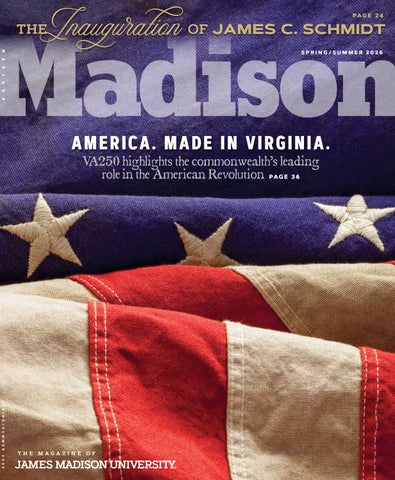
VA250 highlights the commonwealth’s leading role in the American Revolution PAGE 36
DIALOGUES OF THE CARMELITES
In 1794, during the final days of the French Revolution, a group of Carmelite nuns joyously went to the guillotine singing psalms and hymns of praise. This defiant display of love and generosity in the face of certain death helped turn the tide of the Reign of Terror, and became the subject of French composer Francis Poulenc’s 1956 opera. Written in the wake of World War II, Dialogues of the Carmelites is a profound meditation unlike any other work in the repertoire. Through beautiful choruses and intricate scenes, it explores how we live, how we die, how we fall apart, how we come together, and why we must keep singing to the very end. The JMU Opera Theatre’s production in February was part of the Forbes Center’s 2025-26 Masterpiece Season.
Full Frame
POT OF GOLD
A March 10 storm brings a little treat to East Campus, with a rainbow arcing behind Massanutten Mountain.
Madison Promise Fund
Civic dialogue as a leadership competency
As we approach the 250th anniversary of our nation’s founding, Americans are reflecting on our remarkable experiment in governing, rooted in the conviction that a free people can govern themselves through reasoned dialogue.
At James Madison University, that reflection feels especially personal. James Madison himself understood that a republican democracy could never depend on uniformity of thought. It had to depend on our capacity to manage disagreement constructively. As we turn 250, that capacity has never been more important.
As we commemorate America’s 250th anniversary, we are reminded that a republican democracy is not self-executing. It requires citizens who are capable of navigating differences without retreating into division. But it also requires leaders in organizations, industries and institutions who can guide diverse groups toward shared solutions. At JMU, we believe those capacities can, and should be, cultivated intentionally.
This work aligns naturally with our commitment to preparing students for lives of purpose and meaning. It complements our focus on applied learning and leadership development, for which we are already recognized: TIME magazine named JMU in its inaugural “Best 100 Colleges for Future Leaders” ranking.
When people hear the phrase “civic dialogue,” they think of partisan politics. But civic dialogue, at its core, is not about partisanship. It is about skill. It is about the disciplined practice of listening, engaging differences and working toward shared understanding in complex environments. At JMU, we embrace civic dialogue, not only as a virtue but as a practical competency.
Across industries, employers tell us they are looking for graduates who can collaborate across differences, manage conflict productively and make sound decisions informed by multiple perspectives. Whether in health care, engineering, education, business or public service, today’s leaders must navigate teams composed of individuals with varied experiences, identities and viewpoints. The ability to communicate clearly, remain level-headed and engage in disagreement constructively is not an abstract ideal. It is a practical leadership skill.
During a recent interview about his new book, American Struggle, historian Jon Meacham said, “We are not really being called upon to be great people. We’re being called upon to be practical people, and there is a pragmatism and a self-interest in showing mutual respect.”
It is because of this sentiment that we’ve embedded civic dialogue across the Madison Experience within courses, leadership programs and co-curricular initiatives. Our goal is not to create uniformity of belief. It is to graduate individuals who are skilled at engagement and can enter a room of disagreement and help move it toward progress.
Through the work of the James Madison Center for Civic Engagement and initiatives such as the Better Conversations Together program, our students are learning how to do more than express their opinions. They are learning how to ask better questions, how to listen actively, how to distinguish between debate and dialogue, and how to build trust in moments of tension. These are learnable, measurable competencies, and they are transferable across every field.
Some may ask whether framing civic dialogue as a workforce skill diminishes its deeper moral significance. I don’t think so. When a student learns to engage in thoughtful disagreement in a classroom, that skill carries into the workplace. When they learn to facilitate a difficult conversation among peers, that skill carries into their communities. When they discover that understanding another perspective does not require abandoning their own, they develop confidence and humility. This is what the Founding Fathers had in mind.
Two hundred fifty years ago, a group of leaders took the bold step of declaring that self-government was possible. They did not presume consensus. They presumed contention and built structures to channel it productively. Essentially, this is the theme of James Madison’s renowned Federalist No. 10.
On the eve of our nation’s 250th birthday, our responsibility is to prepare the next generation to inherit the founders’ experiment and strengthen it in every sector. Already, JMU graduates are known not only for their knowledge, but for how they lead and how well they work on teams. Employers tell us this all the time.
This matters.
Dr. James C. Schmidt President, James Madison University
Through the Better Conversations Together program, students engaged in a Day of Deliberation on March 4, asking “ What’s Next, America?”
Contents
Montpelier, in Orange County, offers an ideal setting for contemporary dialogue around America’s 250th anniversary.
AMERICA . MADE IN VIRGINIA.
42 THE AMERICAN EXPERIENCE CURRICULUM
The program’s coordinator outlines its distinctiveness and spotlights learning across a broad set of students
52 MADISON TIMELINE
Because 2026 is the 275th anniversary of James Madison’s birth, we offer a chronology of events in the life of the Father of the Constitution and fourth U.S. president
BY JIM HEFFERNAN (’96, ’17M)
James Madison played a pivotal role in establishing religious freedom in the U.S. as a fundamental civil right, rather than an indulgence from the government BY DR. REBECCA BRANNON, DR. ROBERT BROWN AND DR. KENNETH L. PEARCE
WORK OF DEMOCRACY
54 HOW TIME AND DELIBERATION BUILT A NATION
In the summer of 1787, with the fledgling nation teetering on the brink of collapse, the delegates to the Constitutional Convention met in Philadelphia to revise the failing Articles of Confederation. But the Virginia delegation brought their own plan, which called for a stronger central government BY DR. MARTY COHEN AND DR. KEVIN HARDWICK
58 WHAT’S NEXT, AMERICA?
The Madisons’ Virginia estate serves as a reminder that the founding was a beginning that requires continual interpretation, debate and renewal BY KRISTA COSTELLO, DR. KATIE CRAWFORDLACKEY AND DR. KELLEY FANTO DEETZ
As the country marks 250 years of self-governance, JMU is asking the question the nation needs most. And the Madison Center for Civic Engagement’s Better Conversations Together program is turning the commemoration into a live act of democracy — one deliberation at a time BY DR. KARA DILLARD AND AIDAN HEITT (’24)
dialogue as a practical
work of many heads and many hands”
The people who helped in the making of this issue
Email letters and comments to madisonmag@jmu.edu or send by mail to:
Madison magazine
MSC 3608, 127 W. Bruce St. Harrisonburg, VA 22807
“The first colonists arrived here. The first encounters with Native Americans occurred here. The first slave ships arrived here. ... The British surrendered here. … And of course, every founding document that matters … was written by a Virginian.”
— CARLY FIORINA , Board of Visitors member and national chair of the VA250 commission
One of Gilbert Stuart’s paintings of James Madison, 1805
JMU
Gift doubles the size of the Madison Trust Innovation Endowment; 35th annual Stewardship Luncheon; local Ruritan Club invests in future of Valley
Steps of Shenandoah
Carrier Library renovation will feature a striking staircase that evokes the undulating path of the Shenandoah River
Artemis crew names crater on the moon for late alumna; JMU receives another federal grant to support civic education; bestselling novelist returns to campus; new degree pathway for Valley students; Carnegie Community Engagement Classification; two online graduate programs nationally ranked
Using upcycled luxury scarves, Chris Bartick (’05)
Phil Bigler (’74, ’76M) reflects on Madison’s legacy; letter from outgoing president of JMUAA Board of Directors; Chapter Spotlight; Mixed Media; Alumni Award winners; Chris Comerford (’04) shares his DMV
ABOUT THE COVER: This Betsy Ross flag from 1792 contains 13 alternating red-and-white horizontal stripes and 13 white stars in a blue canton. Today, the flag is often used as a patriotic emblem of the American Revolution and an expression of American values more broadly. Cover photograph by Smartstock/Getty Images 24 27 30 33
THE OF
Inauguration
JAMES C. SCHMIDT
MAKING JMU ‘LEGENDARY’
President James C. Schmidt embarks on a mission to deliver The Madison Promise BY JIM HEFFERNAN (’96, ’17M)
INAUGURAL EVENTS
VIP Donor Brunch; Presidential Gala photos; “Growing the Madison Promise” at the Edith J. Carrier Arboretum; student dance showcase; soon-to-be licensed JMU coffees; inauguration banners; softball game at Veterans Memorial Park
‘JOYFUL IN OUR PURPOSE’
President Jim’s inauguration in the same year we celebrate the 250th anniversary of the Declaration of Independence is more than a coincidence BY ANDY PERRINE (’86)
REDEFINING THE ROLE
First lady Kim Schmidt encourages open dialogue on campus and promotes community connection among students BY AMY CROCKETT (’10)
The April 8 inauguration ceremony in the Atlantic Union Bank Center affirmed the university’s enduring values while also marking a new chapter in its remarkable 118-year story.
The annual Stewardship Luncheon celebrates the impact of philanthropy across campus.
OFFICIAL HOTEL OF JMU
Inspired by the vibrant local scene and cherished guests, award-winning and JMU celebrity Chef Tassie Pippert (pictured) carefully crafted a Monty’s menu showcasing quality ingredients and dishes made from scratch. Each offers a familiar taste, elevated with a unique, modern flair, all served in a warm and inviting atmosphere.
COME FOR:
■ Comfort food with a modern twist
■ Extensive wine collection
■ Great flavors, drinks & good company
■ Fun community happenings
BONUS: Private Dining Room available to reserve for your special events!
Walk-ins welcome; reservations suggested.
JOIN OUR JMU ALUMNI CLUB
Stay on campus like you used to!
Sign up in the top menu of hotelmadison.com to receive:
■ 10% off our Standard Daily Rate
■ 20% off event space rental
■ Exclusive promotions
■ Priority access to hotelsponsored events
DON’T MISS…
Football weekends
JMU Arboretum wedding package
Monty’s Restaurant
Menu by the one-and-only Tassie Pippert
Quills Lobby Bar live music
Schedule on our website
Grace+Main Cafe
Specialty drinks, Neapolitan pizza & more!
SPRING/SUMMER 2026
Vol. 49, No.2
EXECUTIVE EDITOR
Andy Perrine (’86)
EDITOR
Jim Heffernan (’96, ’17M)
DEPUTY EDITOR
Amy Crockett (’10)
ASSOCIATE EDITOR
Josette Keelor
CREATIVE DIRECTOR
Bill Thompson
ART DIRECTOR
Carolyn Windmiller (’81)
DESIGN ASSISTANTS
Sarah Corey
Lea Dorcus (’26)
Georgia Pinkston (’26)
Kasey Thompson
EDITORIAL ASSISTANTS
Lillian Johns (’26)
Taylor Moore (’26)
PHOTO AND VIDEO TEAM
Steve Aderton (’19)
Rachel Holderman
Olive Santos (’20)
Cody Troyer
ATHLETICS PHOTOGRAPHY
Cathy Kushner (’87)
CAMPUS CONTRIBUTORS
Alumni Relations
Athletics
Donor Relations
Family Engagement
University Marketing & Branding
FOR ADDRESS UPDATES:
Email: advancementgr@jmu.edu or call 1-855-568-4483
CONTACT THE MADISON STAFF: Email: madisonmag@jmu.edu or call 540-568-2664
Madison magazine, JMU, 127 W. Bruce St., MSC 3610, Harrisonburg, VA 22807
For Class Notes, go to http://alumni.jmu.edu
Madison is an official publication of James Madison University and is produced by the Division of University Advancement for alumni, parents of JMU students, faculty, staff and friends of JMU.
Editorial office: JMU, 127 W. Bruce St., MSC 3610, Harrisonburg, VA 22807
NOTICE OF NONDISCRIMINATION AND EQUAL OPPORTUNITY:
James Madison University does not discriminate on the basis of age, disability, race or color, height or weight, national or ethnic origin, political affiliation or belief, religion, sex, sexual orientation, gender identity or expression, veteran status, parental status (including pregnancy), marital status, family medical or genetic information in its employment, educational programs, activities and admissions. JMU complies with all applicable federal and state laws regarding nondiscrimination, affirmative action and anti-harassment. JMU prohibits sexual and gender-based harassment, including sexual assault, and other forms of interpersonal violence. The responsibility for overall coordination, monitoring and information dissemination about JMU’s program of equal opportunity, nondiscrimination, Title IX and affirmative action is assigned to the Office of Equal Opportunity & Title IX. Inquiries or complaints may be directed to the Office of Equal Opportunity & Title IX: Amy Sirocky-Meck, Title IX Coordinator, 540-568-5219, http://jmu.edu/oeo, oeo@jmu.edu. (REVISED JANUARY 2020)
Letter From the Editor
‘The work of many heads and many hands’
James Madison, regarded as the “Father of the Constitution,” never claimed to be the document’s sole author, humbly arguing it was a collaborative effort forged by many hours of debate and compromise among the delegates to the Constitutional Convention of 1787. “This was not … the offspring of a single brain,” Madison wrote in a letter to a friend nearly a half-century later. “It ought to be regarded as the work of many heads and many hands.”
Likewise, this issue of Madison , which commemorates our nation’s 250th anniversary as well as the inauguration of Dr. James C. Schmidt as JMU’s seventh president, is “the work of many heads and many hands.” Granted, each issue is a collaboration involving the magazine staff, campus partners, freelancers, and readers who submit their story ideas and achievements for publication. But for this special edition, we enlisted a group of JMU faculty members and other experts to help frame the United States’ formative years. These distinguished scholars are professors of history, political science, philosophy and religion, as well as members of the leadership team at Montpelier, the home of James and Dolley Madison in nearby Orange County, Virginia. Collectively, their essays paint a portrait of a nation founded on ideals; of a young James Madison imagining a system of government that would allow for the principles laid out in the Declaration of Independence to function; and of a university, two-and-a-half-centuries later, committed to advancing his civic legacy.
a coincidence — “it is a powerful convergence of history, purpose and promise,” Madison Executive Editor Andy Perrine (’86) writes in his essay on Page 30. Just as the founders enshrined in the Declaration of Independence the blessings of “life, liberty and the pursuit of happiness,” Schmidt, affectionately known as “President Jim,” is instilling the values of joy, audacity and the public good at JMU. He’s also spearheading the university’s strategic plan that will guide its priorities in the coming years. At the center of the plan is The Madison Promise, our guarantee that JMU graduates will have the knowledge, skills and character to shape the future. It’s a generational covenant with the students we educate and the society we serve. It’s also a modern expression of the founders’ commitment to selfgovernance — the belief that freedom depends on educated citizens capable of sustaining it. “If 1776 was a promise to govern ourselves,” Perrine writes, “then The Madison Promise represents our pledge to prepare citizens who can keep that promise alive.” Talk about many heads and many hands!
In the words of President Jim, “let us renew our commitment to this bedrock public mission, this revolutionary purpose — to equip citizens to understand the world, engage with each other with civility and deliberation, and uphold the responsibilities of democracy.”
Schmidt’s induction in April amid the country’s semiquincentennial celebration is more than
official
cast of JMU.
Jim Heffernan (’96, ’17M) Editor
A painting of a young James Madison in 1783
SPRING/SUMMER 2026
Vol .49, No.2
BOARD OF VISITORS 2025–26
Suzanne Obenshain, Rector
Teresa “Terrie” Edwards (’80), Vice Rector
Jeff Bolander (’80)
Larry W. Caudle Jr. (’82)
Carly Fiorina
Tom Galati
Heather Hedrick (’00)
Kay Coles James
Joely K. Mauck (’90)
Dave Rexrode (’01)
Steve Smith (’79)
Michael Stoltzfus
Nikki Thacker (’11)
Jack White
Nicole Palya Wood (’96)
Sydney Stafford, Student Representative
Kathy Ott Walter, Faculty Representative
David Kirkpatrick, Secretary
PRESIDENT
Dr. James C. Schmidt
ADMINISTRATORS
Christine Hutchins
Vice President, Marketing and Strategic Communications
Dr. David Kirkpatrick
Vice President, Chief of Staff
Jack Knight
Senior Assistant Attorney General and University Counsel
Dr. Bob Kolvoord
Provost and Senior Vice President, Academic Affairs (interim)
Dr. Nick Langridge (’00, ’07M, ’14Ph.D.)
Vice President, Philanthropy and Engagement
Dr. Tim Miller (’96, ’00M)
Vice President, Student Affairs
Towana Moore
Vice President, Administration and Finance
Matt Roan
Director of Athletics
Dr. Anthony Tongen
Vice President, Research, Econ. Development & Innovation
Melinda Wood
Vice President, Access and Enrollment
VICE PROVOSTS
Dr. Fletcher Linder (’86)
Associate Provost for Online Strategy
Dr. Rudy Molina Jr.
Student Academic Success
Dr. Elizabeth Oldmixon
Faculty Affairs & Curriculum
DEANS
Dr. Bethany Blackstone
Honors
Dr. Michael Busing Business
Rubén Graciani
Visual and Performing Arts
Dr. Jeffrey Tang
Integrated Science & Engineering (interim)
Dr. Mark L’Esperance Education
Dr. Fletcher Linder (’86) University Studies
Dr. Sharon Lovell (’85) Health & Behavioral Studies
Dr. Bethany Nowviskie Libraries
Dr. Samantha Prins
Science & Mathematics
Dr. Nick Swartz
Professional & Continuing Education
Dr. Linda Thomas
The Graduate School
Dr. Traci Zimmerman (’92, ’94M) Arts & Letters
ALUMNI ASSOCIATION OFFICER
Ellen Hineman (’89), President
PARENTS COUNCIL CHAIRS
Brad and Tracey Martin (’26P)
Contributors
Dr. Katie Crawford-Lackey, Dr. Kelley Fanto Deetz and Krista Costello are part of the leadership team at Montpelier, the home of James and Dolley Madison in Orange County, Virginia. Crawford-Lackey is chief program officer; Deetz is chief advancement officer; and Costello is acting president and CEO. Their essay, which details Madison’s legacy as a foundation for contemporary dialogue as well as Montpelier’s role as both a historic site and a civic laboratory, begins on Page 50.
Dr. Kara Dillard is executive director of the James Madison Center for Civic Engagement and an assistant professor in the School of Communication Studies. Aidan Heitt (’24) directs the center’s Better Conversations Together program in its mission to advance civic learning and civil discourse. Their essay, which begins on Page 58, asks the question “What’s Next, America?” turning the commemoration of the nation’s 250th anniversary into a live act of democracy at JMU.
Dr. Kevin Hardwick is a professor of history whose research interests include political thought in the early years of the American republic and ratification of the U.S. Constitution. Dr. Marty Cohen, professor of political science, regularly teaches classes on religion and politics as well as the department’s introductory American Government course. Their collaboration, which starts on Page 54, covers the road traveled by our fledgling nation in the dozen years between the adoption of the Declaration of Independence and the Constitution, and how the two founding documents are interconnected.
Dr. Kenneth Pearce, Dr. Robert Brown and Dr. Rebecca Brannon co-authored a piece beginning on Page 46 that looks at the influence of the English philosopher John Locke on Thomas Jefferson and a young James Madison, who shared a concern for religious freedom that would inspire the Virginia Statute for Religious Freedom and later help shape the First Amendment to the Constitution. Pearce is a professor of philosophy and head of the Department of Philosophy and Religion. Brown is a professor of religion who has written extensively on religious thought and practice in colonial America. Brannon is a professor of history who teaches courses in early American history and the American Revolution.
Dr. John Scherpereel is a professor of political science and coordinator of the American and Global Perspectives area of JMU’s General Education Program. His essay on the distinctiveness of JMU’s American Experience curriculum and the learning that happens across a broad set of JMU students starts on Page 42.
CORRECTION: The Mixed Media section of our Winter 2026 issue should have listed the publisher of Dave Pruett’s Hiking the AT in the Virginias: A Septuagenarian’s Journey (Page 41) as George F. Thompson Publishing. The mistake has been corrected in the digital edition.
NATION
The new student-athlete enhancement model
BY KEVIN WARNER (’02), associate athletic director for communications and strategic initiatives
Associate Athletic Director for Governance and Talent Management Stephen LaPorta (’09, ’12M) and General Manager
Cliff Wood (’88) share updates about JMU Athletics’ new approach to student athlete enhancement and why it’s so critical to the department’s future trajectory.
Kevin Warner (’02): What is student-athlete enhancement at JMU, and what are the priorities and goals?
Stephen LaPorta (’09, ’12M): Our priority is the retention of our quality student-athletes. What are the things we can do to go above and beyond what a traditional studentathlete experience might be, in terms of academic awards and incentives to help keep high-performing student-athletes at JMU?
Warner: What are the ways the studentathlete experience is enhanced at JMU?
LaPorta: There are two main ways a student-athlete can receive funds that exceed a traditional scholarship. The first is through an academic award, where we recognize academic excellence and graduation. The second is through revenue share payments, where we’re providing funds in exchange for the student-athlete’s Name, Image and Likeness rights, with them engaging in activities on behalf of the institution that help generate and drive revenue.
Cliff Wood (’88): We started with the Montpelier Collective, which was a third-party NIL program for JMU. That ran for three years as its own 501(c)(3). Due to state law changes and the settlement of the House vs. NCAA court case, the environment evolved to where institutions could make direct revenue share payments to student-athletes. With that transition, the collective stopped taking donations, and those responsibilities were moved to this in-house approach.
“What we’ve established with this program gives us the ability to try to retain talent.”
— CLIFF WOOD (’88)
Warner: What are the key priorities for each of you in this process? LaPorta: My priorities include working with the coaches to establish their budgets, and build strategies to use those effectively to retain and recruit student-athletes to the institution. Wood: In addition to working with Stephen, my priorities are overall education for coaches and student-athletes on what we do, as well as working with third-party NIL opportunities. I also negotiate with athletes who have representation.
Warner: This environment evolved so quickly; what was the process to build this structure at JMU?
Warner: How does this process help JMU Athletics retain good talent? Wood: It gives us the ability to stay in the fight. It is difficult being the size program we are when we’re competing against Power Four schools. What we’ve established with this program gives us the ability to try to retain talent. It’s still a challenge because the budget discrepancy with those schools is so significant. But we’re proud of what we’ve done to increase our budget as we’ve evolved.
Warner: What are the next steps to keep building the program and continue attracting and retaining top talent? LaPorta: It takes creatively looking at new revenue streams we haven’t implemented before. We’ve got a beautiful football stadium used only a handful of times each year, so there might be new ways to host events there that provide additional revenue to the department.
Warner: How does the new Duke Club Enhancement Fund fit into this new environment? Wood: We’ve always had the Proud and True Fund, which is still very important. We now have a fund to allow a donor to contribute to help fund our revenue share efforts.
Warner: Madison’s revenue share model is unique in college athletics. How does it work, and what is required of student-athletes? LaPorta: Each of our student-athletes receiving revenue share from the institution is under contract, and they are obligated to participate in events on behalf of the institution. That could be for Athletics, but it could also be for campus partners such as Admissions. All activities are going to contribute to revenue generation in some way, shape or form. Outside
JMU NATION
of that, our contract also includes a requirement for financial literacy education. We want to set our students up for success while they are here and after college as well.
Warner: With in-house revenue share, is there still a place for third-party NIL? Wood: There is still third-party NIL. Part of our job is to educate our athletes on contracts, what to look for and what to avoid. But there is room for our athletes to make additional revenue off their Name, Image and Likeness. That could be things like apparel, retail shops, appearances, etc. Through Honors1, we established the Dukes Exchange to aid in connecting businesses with our student-athletes. If any businesses are interested in using a student’s NIL to promote their business, they should contact Stephen or me.
Warner: What is NIL Go, and how does it work? Wood: NIL Go is the system in which athletes must report their independent NIL activities. We ask that they report every deal into that system, so we can make sure they are approved and that their eligibility isn’t impacted. The rule is that any deal [worth] $600 or more must be filed through NIL Go. LaPorta: NIL Go is looking at who is
making the payment to see if it is someone associated with the university. They’re also looking to see if the student is getting paid within a range of compensation appropriate to the NIL value of the student-athlete.
Warner: What else is important for supporters to know about studentathlete enhancement at JMU?
Wood: While we’re pursuing creative ways to drive revenue, it’s still vital to support the traditional ways of giving to the Duke Club (Proud and True, or Enhancement Fund); buying season or single-game tickets; and expanding our corporate partnerships. If we’re going to continue climbing the trajectory that we’re on, we’ll have to raise money in every available bucket. We’re competing against multiple factors: bigger media rights at Power Four schools, larger NIL budgets, and schools with a more mature fan base and a significant history of support. If we’re going to close the gap, we need to grow faster to outpace our peers’ growth.
For more information about supporting the Duke Club Enhancement Fund, please contact the JMU Duke Club at dukeclub@jmu.edu or 540-568-6461.
(Left): Jacob Thomas played in all but one of JMU’s games at the Football Bowl Subdivision level as a key member of a dominant Dukes defense. (Above): Peyton McDaniel (’24) recently completed her fifth season with JMU women’s basketball, leading the Dukes to the 2026 Sun Belt Championship.
JMU CAPTURES 2026 SUN BELT TITLE
Leading wire-to-wire, JMU captured the 2026 Sun Belt Conference Women’s Basketball Championship crown with a 69-52 victory over Troy University on March 9 at the Pensacola Bay Center in Florida. Peyton McDaniel (’24), who was named the Sun Belt Championship Most Outstanding Player, finished with 28 points, 10 rebounds, four assists and four steals. Ashanti Barnes (’25), who
joined McDaniel on the All-Tournament Team, added 19 points, 12 rebounds and four assists. JMU became the first four seed or lower to win the SBC tournament since Troy did so as the same seed in 2016. It was the Dukes’ second Sun Belt title in four years in the league and their 11th conference title all-time.
With the win, JMU advanced to the NCAA Championship for the 14th time. JMU faced the University of Kentucky
in the first round, falling to the Wildcats and JMU Hall of Fame head coach Kenny Brooks (’92), 71-56.
The Dukes finished the season 26-9, achieving 26 wins or more for the 17th time in program history. The Dukes surpassed 23 wins for the 19th time in 21 seasons. McDaniel concluded a storied JMU career with 2,325 points, the third-most in program history. Her 1,025 rebounds were fourth all-time.
FACULTY FOCUS
Spotlighting JMU professors through
the
lenses of scholarship, awards and service
Chelsey Bahlmann
Bollinger EDUCATION
Ben Selznick
STRATEGIC LEADERSHIP STUDIES
Dr. Bollinger, associate professor in the College of Education, and Dr. Selznick, associate professor in the School of Strategic Leadership Studies, recently published their article, Training Educators, Not Chatbots: Preparing AI-Responsible Teachers, in Forbes. The piece explores what higher education can and should be doing in the age of artificial intelligence, particularly how educators can integrate AI into communication and literacy instruction responsibly. Selznick and Bollinger emphasize that teacher-preparation programs should help future educators strike a balance — leveraging AI tools while preserving human connection, fostering relationships and exercising professional judgment.
Rachel Grimsby MUSIC EDUCATION
Dr. Grimsby, assistant professor of music education, coauthored chapters in two handbooks recently published by Oxford University Press. The first, Re-Emergence of PrePandemic Issues for Women in Academia: Music Teacher Educator Mothers’ Perspectives, was published in Motherhood in the Music Education Academy. The second, Music Education From the Child’s Perspective, was published in The Oxford Handbook of Special Music Education and Music Therapy.
Ray Enke
BIOLOGY
Dr. Enke, professor of biology, has been leading the project BioDiversity and Informatics for Genomics Scholars (BioDIGS), which includes a team of 150 researchers from dozens of institutions, including many students who are working to map the soil microbiome of the entire United States. Their paper, Unearthing Soil Biodiversity Through Collaborative Genomic Research and Education, announced the group’s preliminary activities in the December 2025 edition of the journal Nature Genetics. The work includes co-authorship by five JMU students, five former Harrisonburg High School students and retired HHS biotechnology teacher Myron Blosser, all of whom participated in the project as part of an ongoing course-based research project, Enke’s BIO 480: Advanced Molecular Biology Lab.
Doug Hochstetler
KINESIOLOGY
Dr. Hochstetler, associate dean in the College of Health and Behavioral Studies and professor of kinesiology, received the 2026 Distinguished Administrator Award from the National Association for Kinesiology in Higher Education. This honor goes to a higher-education kinesiology or physical education administrator who, through the application of administrative/managerial skills, has made significant contributions to the profession and/or related fields, within and beyond the higher-education community.
“We’re already on the national stage. How do we take the national spotlight?”
— DR. JAMES C. SCHMIDT, president
Sara Finney and Brian Leventhal GRADUATE PSYCHOLOGY
Elaine Kaye and Nicole Wilson LIBRARIES
The journal Practical Assessment, Research, and Evaluation recently published Educational Measurement and Equity: The Evolution of Our Graduate Program, co-authored by four faculty members: two from Graduate Psychology — associate professor Dr. Leventhal and professor Dr. Finney — and two from JMU Libraries — associate professors Elaine Kaye and Nicole Wilson. The three-year project included the creation and evaluation of a faculty professional development course aimed at creating a culture within an educational measurement graduate program that acknowledges the history and current practices of the field, and supports faculty and students in using assessment and methods for good rather than harm.
Valerie Linsinbigler and Malia Willey LIBRARIES
Two recent books by JMU librarians demonstrate their expertise and leadership in information literacy.
Linsinbigler, assistant professor and business librarian, co-authored Instructional Design for Teaching Information Literacy Online: A Student-Centered Approach. The book offers a learner-centered framework for designing online information-literacy instruction that supports students’ social and emotional needs. Published by the Association of College and Research Libraries (ACRL) in 2025, Linsinbigler’s book reflects the Libraries’ integrated expertise in librarianship, educational technology and instructional design.
Willey, professor and collection development librarian, co-edited Teaching Information Literacy by Discipline: Using and Creating Adaptations of the Framework, which explores how disciplinary contexts shape the teaching of information literacy. Building on a foundational tool of librarianship, the Framework for Information Literacy for Higher Education, her book offers models for learning outcomes, research guides, assignments and curricula. Published by the ACRL in 2025, this book is a valuable resource for academic librarians and instructors across disciplines.
GIVING 24 HOURS OF
3,312 DUKES CONTRIBUTED MILLION $1.26 THANK
Advancing Madison
A permanent spark for Madison Trust
Benefactor Edward Rice doubles the endowment for innovation program
“Iconsider the public education system to be the heart and the soul of American civilization,” Edward Rice says. “The ability to give everybody a good education and start on their path through life is one of the most important things that a society can do.”
That belief is what led Rice, a former member of the Board of Visitors, to support and double the Madison Trust Innovation Endowment, which was created by Robin and John Reifsnider with an initial endowment of $100,000. Rice’s $100,000 gift helps create a permanent, self-sustaining source of funding for JMU faculty and staff innovation, ensuring the program’s work can continue well into the future.
Rice has long supported individual Madison Trust projects and now is choosing to invest in the process itself. “Instead of supporting one or two of the excellent proposals,” he said, “the Madison Trust was a way to encourage a community of support for many such ideas.”
INVESTING IN EDUCATION, OPPORTUNITY
Rice’s commitment to education began long before his involvement with JMU. He grew up attending public schools in Bed -
ford, New York, starting in a one-room schoolhouse where multiple grade levels shared one teacher and one blackboard.
“There’s nothing more equitable than that,” he said. “While shared outcomes aren’t always guaranteed, shared access should be.” That early experience instilled a lasting respect for public institutions and the role they play in creating opportunity.
DISCOVERING INNOVATION AT JMU
Rice’s first formal connection to JMU came through his appointment to the Board of Visitors in 2014, which is also when the newly formed Madison Trust began to capture his imagination. The donorengaged, idea-driven model invites faculty and staff members to pitch innovative projects with real-world impact. “I found it really stimulating,” Rice said. “It stretched how I thought about the purpose of a university.”
While he admits it felt unusual at first to weigh in on projects outside his expertise, the process quickly became energizing. “I was being
Edward Rice, a former JMU Board of Visitors member, weighs in during a Madison Trust pitch.
“It’s an investment in innovation at JMU in perpetuity.”
— RYAN BOALS (’17, ’23M), project manager
asked where I wanted to put my money,” he remembered. “That question is really important. It’s harder to answer than simply ‘What seems worthwhile?’ in a general sense.”
Over the years, Rice has supported several Madison Trust projects. A standout for him was Concrete Spit, which developed specialized concrete containing limestone, strengthening oyster shells and improving reef health in the Chesapeake Bay. For Rice, projects like that embodied what the program does best — pair academic expertise with tangible public benefit. “Madison Trust kept me thinking about what a university is really here to do,” he said. “I think universities are here to serve their students and their communities. Therefore, these ideas fit squarely within that mission.”
On the Board of Visitors, Rice rotated through every committee and valued being able to support the institution as a whole rather than advocate for one area over another. “I never had an outside agenda,” he said. “It was always what’s best for the students, the faculty, the staff and the university taken together.” Watching JMU commencement
of
Madison Trust
(’96, ’01M) biology class deployed artificial oyster reefs in the Chesapeake Bay.
ceremonies became a “thrilling” part of the job: “Every time I saw somebody receive their JMU diploma, I thought to myself that a tiny, tiny, tiny fraction of that credit goes to me,” Rice said. “And that means a lot.”
INNOVATION IN PERPETUITY
By supporting Madison Trust, Rice helps ensure the program he finds so valuable will remain a lasting engine for innovation, according to Ryan Boals (’17, ’23M), associate direc-
tor of corporate and foundation relations and project manager of Madison Trust. Endowment funds are invested, with a portion of their value distributed annually to support their purpose. Rice’s $100,000 gift will increase the Madison Trust Innovation Endowment to $200,000. As a result, the endowment will generate approximately $10,000 to be distributed each year across Madison Trust projects.
“It’s an investment in innovation at JMU in perpetuity,” Boals said. “As the endowment grows, the impact compounds, strengthening the program’s ability to support faculty and staff ideas year after year. Edward Rice will directly keep the curiosity and sense of possibility that Madison Trust is known for alive for generations to come.”
That’s exactly why Rice says he made the gift. “To be able to be a tiny part of that both challenges me and humbles me.”
— Jamie Marsh
Scan the code to learn more and view JMU projects supported by Madison Trust.
Igniting INNOVATION
For the sixth year in a row, philanthropic panelists pledged support for 100% of Madison Trust 2026 projects representing the 10 best faculty- and staff-led innovations.
Funding fueled ideas involving sustainable construction, genome editing, satellite launches, intergenerational learning, and other projects pitched at the March event.
“One thing that’s been very clear to me — people at this university are not waiting to be told what to do,” said Dr. James C. Schmidt, who was attending his first Madison Trust as JMU’s president. “They are already working
on things. They do what needs to be done, and they love to be inspired by the possibility of what JMU could be. And, I have to say, this program really encourages that.”
Donors have stepped forward since Madison Trust’s inaugural event in November 2014 to invest more than $1.2 million in faculty and staff projects that help transform JMU students’ futures.
For their project, Concrete Spit, students in Dr. Patrice Ludwig’s
Celebrating the power of philanthropy
Scholarship recipients share personal stories of donors’ impact BY
More than 400 donors, alumni, student scholarship recipients and university leaders gathered Feb. 27 for JMU’s 35th Annual Stewardship Luncheon, a celebration of philanthropy and the meaningful
College Dean Dr. Bethany
engaged donors for creating immersive opportunities and introduced Hillcrest Scholar Will Jedrzejczak (’26), whose internship with Amazon Web Services allowed him to apply his skills in national security.
impact it creates across campus.
Each year, the luncheon offers donors a firsthand look at how their philanthropic investments transform student lives — supporting scholarships, research opportunities, leadership development and innovation in every corner of the university.
ardship Luncheon as JMU’s seventh president, Schmidt thanked donors for strengthening opportunities for students and elevating Madison’s reputation, while sharing his vision for what comes next.
This year’s program highlighted powerful student stories and featured remarks from Vice President for Philanthropy and Engagement Dr. Nick Langridge (’00, ’07M, ’14Ph.D.) and a strategic plan update from JMU President Dr. James C. Schmidt.
coach
Napier speaks after Vice President for Philanthropy and Engagement Dr. Nick Langridge (’00, ’07M, ’14Ph.D.) highlighted the growing impact of donors — fueling rising philanthropy, endowment growth and national momentum in athletics.
ARUSHI SACHAN (’20)
“Giving to JMU provides the highest available rate of return in emotional rewards.”
— DON RAINEY (’82)
Finance major Madison Kozlowski (’26) described her first-place team’s experience in last year’s COB 300 Business Plan Competition, illustrating the impact of competition founder and donor Don Rainey’s (’82) mentorship and support.
New head football
Billy
The Madison Singers performed many selections, including the JMU Alma Mater and Oh, Shenandoah! Director Jo -Anne van der Vat- Chromý noted that many ensemble members rely on donor-funded scholarships to make their education possible.
Honors
Blackstone credited
A loud-and-clear promise for Valley Scholars
Ruritans endow $100,000 local scholarship fund
One gift. One hundred thousand dollars. And a promise that will outlive every person in the room.
The Cross Keys-Mill Creek Ruritan Club’s new scholarship endowment for Valley Scholars represents a lasting legacy of educational access for firstgeneration students in the Shenandoah Valley.
“Our members made it loud and clear: They wanted to support scholarships for students in this area. They were very interested in an endowed scholarship so the Cross KeysMill Creek Ruritan name would carry on forever,” said Bob Scott, a Ruritan Club member.
The Ruritans celebrated the impact of their $100,000 gift with members of JMU’s Valley Scholars program on Feb. 5.
“When I was displaced from my home in high school, my Valley Scholars mentor talked to me night after night and gave me the support and resources I needed,” said Hammer. “I don’t know anybody who’s gone to college, and I never thought that it would be possible for me. Valley Scholars has really changed that.”
For Aponte, a foster-care family specialist, growing up was a “struggle.” He said he felt as though hard work wasn’t enough to make ends meet. “[Valley Scholars] lifted a heavy burden off my family,” Aponte said. “We
(L-R): Ruritans Bob Scott and John Cuellar; Abraham Aponte (’24); Jeremy Hammer; Shaun Mooney (’98, ’03M); Ruritan Dean Boese; and Maureen Witmer (’05)
said, “From the get-go, we wanted the money to go into education, especially scholarships. Valley Scholars checked all the boxes.”
JMU launched the Valley Scholars program in 2014 to empower promising students in the valley community to become the first in their families to earn a bachelor’s degree.
“The legacy we’re trying to leave is service to the community — dedication, commitment, hard work and high expectations.”
— BOB SCOTT, Ruritan Club member of 35 years
During the gathering, Shaun Mooney (’98, ’03M), JMU’s executive director of firstgeneration student success, underscored the ripple that this endowment creates: “It doesn’t just impact the student — it impacts everyone who works with these students. It strengthens the whole community.”
Valley Scholars alumni Jeremy Hammer and Abraham Aponte (’24), both Broadway High School graduates, said the program transformed their lives.
wouldn’t have been able to afford college. Without this, I’d probably be paying loans for years and working a job I didn’t love.”
The Cross Keys-Mill Creek Ruritan Club has long focused on meeting local community needs. Club Treasurer Dean Boese said that with the recent sale of its building to the Shenandoah Valley Battlefields Foundation, they realized they could continue to meet in the building and “create something lasting with the funds.”
Longtime Ruritan member John Cuellar
These students start in middle school, completing a rigorous college-preparation program that includes dual-enrollment classes. Eighty percent of Valley Scholars go on to become JMU students, while others go to other universities.
Students accepted to JMU receive scholarships for tuition and fees, and access to further mentorship and dedicated first-generation college resources. About 500 students have gone through the program — 210 middle- and high-school students are currently enrolled in the preparatory program, 80 students are attending JMU, and more than 60 Valley Scholars will have graduated by May 2026.
For Valley Scholars, this means a permanent source of scholarship support — steady, sustainable funding that grows over time and ensures future students can count on the same opportunities. And, for the Ruritan Club, it’s a local promise that weaves its legacy permanently into the future of the valley, ensuring its commitment to service lives on in every student who rises.
In the words of Bob Scott, “The endowment just keeps on giving year after year, long past our time on this earth.”
— Arushi Sachan
(’20)
Valley Scholar Jeremy Hammer told Ruritans he is mentoring eighth- grade Valley Scholars students and offering them the same support he once relied on.
THE STEPS OF THE SHENANDOAH IN CARRIER LIBRARY
Rooted in the Valley, reaching toward tomorrow
When Carrier Library reopens this August, all who enter the Stan (’54) and Rosemary Jones Wing will be greeted by the Steps of the Shenandoah — a signature staircase that evokes the undulating path of the Shenandoah River. While this striking vertical element rises through three floors in the new wing, it symbolically grounds the library in the enduring form of the Shenandoah Valley landscape.
Beyond the staircase, even Carrier’s walls and floors cultivate a profound sense of place and permanence. Interior Bluestone walls — the original 1930s exterior of Madison Memorial Library — provide a tactile connection to the university’s origins and the material of the valley itself. Meanwhile, JMU-themed compass roses, embedded in the terrazzo flooring inside each entrance, offer a subtle reminder of the wider world and the trajectories students may follow after graduation.
The implementation of these site-specific design elements in Carrier was not merely a feat of engineering but a beautiful example of JMU’s culture of purposeful collaboration. An interdisciplinary partnership among architects, construction managers, library staff, designers and facilities experts is precisely what allowed these place-based features to take shape within the library’s new footprint.
In an era where knowledge can feel increasingly fleeting or intangible, these intentional, locally inspired design elements in Carrier Library assert the library’s constancy and connectivity. By bridging the past, present and future, the building serves as a reminder of the way a university and its library can be deeply integrated with its community and anchored in its local landscape.
— Kristen Shuyler
Scan to read more about the staircase’s unique features, including how they were built with local expertise.
(Clockwise from top): Shenandoah River bends; completed staircase; an original column bracket that had been hidden for decades under a drop ceiling; the largest of three inlaid compass roses; Stan (’54) and Rosemary Jones Wing
News Notes&
MOON CRATER NAMED FOR ALUMNA
Astronauts from NASA’s Artemis II mission named a crater on the moon in honor of Carroll Wiseman (’95), the late wife of mission commander Reid Wiseman. During the mission, the crew proposed the name “Carroll,” describing it as “a bright spot on the moon.” Carroll Wiseman studied Biology at JMU and was a member of Alpha Sigma Tau. She worked as a pediatric nurse practitioner.
Madison receives $2.72 million nationwide, civic-discourse grant
The university has received a $2.72 million U.S. Department of Education grant to support civic discourse and dialogue across institutions of higher education nationwide.
The grant enables other colleges and universities to learn from JMU’s best practices in civic discourse from the James Madison Center for Civic Engagement’s Better Conversations Together program.
JMU is one of 16 universities and colleges and the only institution from Virginia selected from a highly competitive and deep pool of applicants.
In September, JMU received a separate grant of more than $2.1 million from the department to expand its national leadership in civics education — making both grants the largest competitively awarded grants in the university’s history.
Dr. Kara Dillard, executive director of the Center for Civic Engagement, said the two grants total nearly $5 million in investment in JMU’s civic-discourse programming, firmly cementing the university as the national leader in civic engagement and civic discourse.
“The two grants together represent a unique opportunity to create a comprehensive, kindergarten-through-college learning environment where, from day one until they graduate from college, students learn and practice deliberationbased, civic-discourse skills,” Dillard added.
Program goals include improvements in students’ abilities to deliberate across political differences, improvements in faculty technical abilities and confidence to facilitate deliberative conversations in their classrooms, and working to develop a vertically integrated K-16 deliberative civic-discourse pathway for improving civic-discourse skills and competencies across a student’s academic career.
EVANS BOOK BESTSELLER
English alumna Virginia Evans (’08) returned to campus for a reading and discussion of her New York Times -bestselling novel, The Correspondent, on April 9 in the Forbes Center Concert Hall.
(Above): Students engage in a Better Conversations Together event to discuss American values over the past 250 years.
JMU, BRCC formalize degree pathway for Valley students
Blue Ridge Community College and James Madison University have established a pathway for high-school students from the central Shenandoah Valley to earn degrees from both institutions.
JMU President Dr. James C. Schmidt and BRCC President Dr. John Downey signed a memorandum of understanding in March formalizing the BR2JMU program, which serves high-school seniors from Augusta and Rockingham counties and the cities of Harrisonburg, Staunton and Waynesboro. The first cohort of 42 students started in August 2025.
Students in the program are admitted to both schools at the same time. They can earn their associate degree from BRCC and then transition seamlessly to JMU to com-
COMMITTED TO ONGOING COMMUNITY ENGAGEMENT
(L-R): Presidents Schmidt and Downey at the BR2JMU signing in March
plete their bachelor’s degree.
Jolie Lewis, associate vice provost for aca demic support and director of transfer initia tives at JMU, said the agreement represents “a shared vision for the Shenandoah Valley to be a leader in innovative educational pathways, fostering community partnerships to increase degree attainment and career opportunities.”
BR2JMU also includes expanded data sharing and the development of new bach elor’s degree pathways for students earning applied associate degrees at BRCC.
The American Council on Education and the Carnegie Foundation for the Advancement of Teaching have recognized JMU with the 2026 Carnegie Community Engagement Classification.
The designation affirms JMU’s commitment to sustainable, reciprocal community engagement by collaborating with local, regional, national, and global partners to exchange knowledge and resources, effectively leverage community assets, and address pressing societal challenges.
Highlights from JMU’s submission and ongoing community-engagement efforts include:
■ the work of the Community Engagement and Volunteer Center and James Madison Center for Civic Engagement to advance community priorities and prepare educated, engaged citizens;
■ community collaborations across campus, including JMU X-Labs, Empowerment3, the Institute for Innovation in Health and Human Services health initiatives, and JMU ArtsMobile, that leverage expertise and resources for mutual benefit, scholarship, research and creative activity;
■ Research, Economic Development and Innovation’s efforts in building partnerships and locating and securing resources that advance talent, innovation and quality of life. JMU will hold the classification until 2032.
Online graduate programs earn high national rankings
A pair of JMU online graduate degree programs are ranked among the top 50 nationally, according to U.S. News and World Report.
JMU’s master’s degree in Com puter Science with a concentration in Cybersecurity ranked 27th out of 106 programs in the category Best Online Master’s in Information Technology.
Also making the top 50 was JMU’s online Master of Business Administration program, which ranked No. 33 out of 364 programs considered. Additionally, the report ranked JMU’s online MBA program No. 49 for veterans.
Falling just outside the top 50 was the online master’s in Nursing program, which ranked 62nd out of 201 programs making the list.
A complete list of JMU’s rankings, as well as information about the ranking criteria, can be found on the U.S. News and World Report website.
JAMES C. SCHMIDT
Inauguration THE OF MAKING JMU ‘LEGENDARY’
President James C. Schmidt embarks on a mission to deliver The Madison Promise
On April 8, Dr. James C. Schmidt was officially installed as the seventh president of James Madison University. The inauguration ceremony affirmed the university’s enduring values while also marking a new chapter in its remarkable 118-year story, one that will be characterized by work-based learning, a culture of innovation, high-impact research and community partnerships.
In his speech, Schmidt noted that JMU has a past rooted in public service, a present powered by The Madison Promise and a future poised to become “legendary.”
“I believe our future is not to color inside the lines or work inside the box,” he said. “Our future is not to be like every other peer institution, however noteworthy or accomplished they may be. Let’s be a legend! Let’s set ourselves apart and break out of highereducation stereotypes. … Let’s challenge the status quo and dare to try, sometimes fail, but always march to a different drummer.”
“Our past holds the key to understanding how to weather uncertainties. It provides us with a firm foundation on which to confidently meet the demands of today.”
President James C. Schmidt , from inaugural address, April 8
(L-R): Faculty were part of the celebration; Suzanne Obenshain, rector of the Board of Visitors, served as master of ceremonies; former JMU presidents Jonathan R. Alger and Dr. Linwood H. Rose attended.
The Madison Promise, JMU’s strategic plan developed over the past year with input from hundreds of faculty, staff members, students and alumni, represents a blueprint to guide the university through 2032 and beyond. The plan rests on five pillars: providing students with a dynamic, future-focused education that will meet the demands of today and tomorrow; investing in JMU faculty and staff to help further our educational mission; forging a bold, new pathway as a national research university; fostering partnerships to meet the needs of the Shenandoah Valley, the Commonwealth of Virginia, and the nation; and creating an innovative campus community.
“The Madison Promise is our now,” Schmidt said. “It builds on our public mission. It demands our innovation and collaboration, our proven strengths, and it will be our stepping stone into the future.”
JMU’s potential is only limited “by how big
we can dream, how wide we open our doors and how united we are in our resolve,” he said.
Schmidt, affectionately known as “President Jim,” has more than 30 years of experience in higher education, including serving as chancellor of the University of Wisconsin-Eau Claire. His tenure at JMU began July 1, 2025.
The university community celebrated Schmidt’s investiture in April with a full week of events, including a public reception on the lawn of the Festival Conference and Student Center, an inauguration gala at Hotel Madison, a tree-planting ceremony in the Edith J. Carrier Arboretum, a culinary tour in the campus dining halls featuring some of President Jim’s and first lady Kim Schmidt’s favorite Midwest-inspired dishes, and campus and downtown walking tours. Students, faculty, staff, alumni and guests also attended panel discussions, showcases, exhibits and performances throughout the week.
— Jim Heffernan (’96, ’17M)
“We can light the fires of innovation, entrepreneurship and discovery when the learning we provide is experience-based, student-focused, partner-enabled and a shared commitment.”
President James C. Schmidt
The JMU Choral Ensembles, under the direction of Dr. Jo-Anne van der vat-Chromy (below), perform Shenandoah .
(Clockwise from top left): Lauren K. Alleyne of the Furious Flower Poetry Center reads a poem she composed; President Jim takes the oath; Schmidt outlines The Madison Promise.
I nauguration WEEK
APRIL 6-10, 2026
VIP DONOR BRUNCH
Wednesday, April 8
This invitation-only event brought together donors, Board of Visitors members and dignitaries to express gratitude for their support of James Madison University, foster meaningful engagement with campus leadership, and build excitement for JMU’s future under President Jim’s leadership.
Rose, who presided over JMU from 1998 to 2012, was one of the event’s featured speakers. (Left): Attendees listen to the program in the Atlantic Union Bank Center Club Room.
(Clockwise, from top left): Tammy (’92) and Aric (’93) Naboa speak with President Jim; Angela Reddix (’90) poses with the president; Tish Tucker chats with an attendee; former President Jonathan R. Alger delivers remarks; Dr. Nick Langridge (’00, ’07M, ’14Ph.D.) offers a champagne toast; Jeanne Carufel with President Jim. (Below): Steve Cornwell (’90), Tish Leeth (‘84, ’14M)
(Above, L–R): Schmidt with past JMU presidents Lin Rose and Jon Alger; (left): Board of Visitors member Tom Galati
I nauguration WEEK
APRIL 6-10, 2026
HAVING A BALL
Presidential Inaugural Gala
One of the highlights of the week was the Presidential Inaugural Gala in the Hotel Madison Ballroom. JMU Chief of Staff Dr. David Kirkpatrick welcomed those in attendance, which was followed by a formal dinner. The dessert course included remarks from family members and special guests, including JMU first lady Kim Schmidt, who offered a celebratory toast. The evening concluded with live music and dancing and a photo booth.
(Row 1, L-R): Ellen (’89) and Gary Hineman; Missy and Paul (’80) Thompson; Campbell and Nicole Payla Wood (’96) with JMU first lady Kim Schmidt and President Jim Schmidt; Rob and Dr. Sharon ('85) Lovell; Russ ('94) and K.C. Reeder; (Row 2, L-R): Maggie Burkhart Evans and Townna Moore; Dawn and Sam Silek; Angela (’90) and Carl “Pete” Reddix; Nicole Payla Wood (’96) and Dr. Patrice Ludwig (’96, ’01M); (Row 3, L-R): Tom and Robin (’87) Dyer; Carson Lonett (’13, ’15M) and Craig Short (’14M); Dr. Steven and Shelley Whitmeyer; Mayra Gavia Molina and Dr. Rudy Molina
(Row 4, L-R): Dr. Keith (’00) and Megan Holland (’01); Paula (’92, ’96M) and Geoff Polglase (’85); Dr. Myles Surrett, Dr. Dirron Allen (’00), Carson Lonett (’13, ’15M) and Dr. Tim Miller (’96, ’00M); Chris and Casey Ouren; Grace Treml (’26) and Charlotte Bronough (’26); (Row 5, L-R): Jamie Jones Miller (’99) and Dr. Tim Miller (’96, ’00M); Mike and Angie (’01) Gochenour; Neal and Dr. Erica Lewis, and Patrice (’96, ’01M) and Aaron Ludwig; Chris and Mari Kyle; and Holly Haney and Dr. Bob Kolvoord
I nauguration WEEK
APRIL 6-10, 2026
STUDENT DANCE SHOWCASE
Thursday, April 9
This showcase highlighted the depth and talent of student dance groups, which were selected through a competitive audition process. The diverse and dynamic program celebrated the creativity, collaboration and vibrant performing-arts culture on campus.
GROWING THE MADISON PROMISE
Friday, April 10
President Jim helped plant the first of hundreds of native Virginia trees as part of a green infrastructure reforestation project adjacent to the Edith J. Carrier Arboretum on East Campus. Schmidt also announced plans to nearly double the arboretum’s acreage, building on the Madison Promise’s commitment to environmental stewardship, student and faculty research, and community well-being.
Merge Coffee Co. founder Charles Matthews with President Jim: In March, the president chose Merge’s signature dark roast as one of two soon-to-be licensed JMU coffees.
“Faculty, staff, administrators — we all are educators and are central to the student experience.” — President James C. Schmidt
The occasion was marked by banners downtown and outside the Ballard Parking Deck, and on cups sold at that week’s JMU softball game.
BY RACHEL HOLDERMAN
‘JOYFUL IN OUR PURPOSE’
Schmidt’s vision aligns with the spirit of the Declaration of Independence
By Andy Perrine (’86)
The inauguration of Dr. James C. Schmidt as the seventh president of James Madison University during the year we celebrate the 250th anniversary of the Declaration of Independence is more than a coincidence — it is a powerful convergence of history, purpose and promise. It invites reflection on the nation’s founding ideals and challenges a new generation to carry them forward.
President Jim and student volunteers spent the morning of The Big Event in April volunteering with Jubilee Climate Farm, which strives to create positive solutions for climate change, food justice, food sovereignty, land equity and mutual empowerment.
The Declaration articulated a bold vision: that self-governance depends on an informed, engaged citizenry capable of sustaining liberty. That vision was shaped in large part by leaders from Virginia, including James Madison, whose intellect helped translate revolutionary ideals into a durable constitutional system. Virginia’s central role in the nation’s founding underscores the symbolic weight of this moment for JMU, an institution that bears Madison’s name and carries forward his commitment to democratic life.
As one of the nation’s emerging leaders in civic education, JMU is uniquely positioned to honor and extend that legacy. The university’s emphasis on dialogue, critical thinking and civic engagement reflects Madison’s belief that democracy requires not just freedom but the capacity to deliberate across differences. Programs that foster civil discourse and prepare students for informed participation in public life place JMU at the forefront of this national imperative.
The Better Conversations Together program will hold community deliberations in 2026 and 2027 about envisioning our next 250 years together.
If 1776 was a promise to govern ourselves, then The Madison Promise represents our pledge to prepare citizens who can keep that promise alive.
Schmidt’s inauguration amplifies this connection between past and future. His vision, embodied in The Madison Promise, emphasizes preparing graduates with the knowledge, skills and character to shape the future. If 1776 was a promise to govern ourselves, then The Madison Promise represents our pledge to prepare citizens who can keep that promise alive. Schmidt’s call to be “joyful in our purpose, audacious in our ambitions and steadfast in our service to the public good” aligns closely with the spirit of the Declaration — an insistence that bold ideas, grounded in shared values, can transform society.
The nation’s semiquincentennial and the inauguration of a new university president together highlight a continuous thread, from the Founding Fathers’ vision of self-governance to JMU’s presentday commitment to civic education. It is a reminder that the work of democracy is always “the work of many heads and many hands,” as Madison said about drafting the U.S. Constitution, and that institutions like JMU play a vital role in preparing those whose heads and hands will carry us forward.
REDEFINING THE ROLE
First lady Kim Schmidt, a mental health nurse practitioner, to support student wellness
By Amy Crockett (’10)
Kim Schmidt, wife of President Jim, hopes to foster a campus culture centered on well-being.
First impressions count. When President Jim set foot on campus last year, he intentionally held back his gut feeling about JMU from his wife, Kim Schmidt. “He wanted to see what my impression was first before we shared it together,” she said.
“This is such a special place,” Schmidt gushed. “I cannot tell you how excited I am to be here. I regularly stop and kind of pinch myself and feel gratitude, because there is a magic and energy here that is different than any place Jim and I have ever been.”
As she stands ready to make her mark on Madison, JMU is quickly making its mark on the first lady. “It makes me feel like we’ve been given a gift. Maybe it’s hyperbolic for me to say this, but I feel like we’re at probably the most dynamic college campus in the country. There are so many positive things going on, and yet there’s also this room for growth.”
A mother, grandmother and a licensed mental health nurse practitioner and consultant, Schmidt is busy settling into a routine. She jets back and forth between the Shenandoah Valley and the Upper Midwest, finalizing personal matters, like selling the couple’s Wisconsin home.
“I cannot tell you how excited I am to be here. I regularly stop and pinch myself and feel gratitude, because there is a magic and energy here that is different than any place Jim and I have ever been.”
– Kim Schmidt
Schmidt has also dialed back her face-to-face clinical practice to 20 hours per week, seeing half the patients she did prior to her new role in the Office of the President.
Furthering her education has been a balancing act. Schmidt is finishing her last year of the psychoanalysis and psychotherapy program at the Washington Baltimore Center for Psychoanalysis. “I have to decide whether I’m going to go to the next stage, which is actually to be a candidate as an analyst.”
While her first-lady responsibilities at JMU take shape, Schmidt says she’s embraced her “season of learning.” She asks, “How can I stay curious? How can I bring compassion into these spaces? How can I make it safe for people to really be who they are?”
Previously, at the University of Wisconsin-Eau Claire, Schmidt provided student counseling, including diagnosis, assessment and medication management. “Anxiety and depression are just at the top of what’s bothering students,” she says, along with a compulsion to always want to achieve more. “How can we teach them that being who they are and being humble is enough?”
In her college-aged patients, she’s observed a fear of social and academic failure, as well as a hopelessness and uncertainty about the future. When social media
is added to the mix, many students feel overstimulated and experience the toxicity of “comparison culture.”
“It feels more wounding to make a mistake in public or to change course in your degree,” Schmidt said. “And then there’s this loneliness, a sense of disconnection.” In a campus full of classmates, students often struggle to find community and express vulnerability.
“A wish for me is that a year from now, I will be doing some real group work with students,” Schmidt said, adding, “I think there’s not enough of that happening.” In her experience as a clinician, group work is more impactful in a student’s mental health journey than individual therapy.
In October 2024, JMU joined the international movement of Health Promoting -
“A wish for me is that a year from now, I will be doing some real group work with students. I think there’s not enough of that happening.”
Campuses by becoming the first university in Virginia to adopt the Okanagan Charter, and last year, the President’s Council on Health and Well-Being positioned JMU as a leader in this advocacy.
The timing couldn’t be better for Schmidt to help deepen Madison’s commitment to wellness and to explore her interest in health policy. “If we’re going to say we care, how can we really prioritize it, right?”
The first step, she says, is reducing the barriers to health services on campus. “There’s a whole waiting list of people who want counseling who maybe can’t get in yet, because there aren’t enough counselors,” she said. “Let’s begin to advocate for that; let’s bring in funding for that.”
She is also eager to secure additional support for JMU’s Serenity Center, a sanctuary space where students can practice meditation and mindfulness. “It needs an endowed staff person to be able to manage the schedule there, and recruit people to do the teaching and work with the students.”
Kim Schmidt (right) seated in the front row with extended family April 8 during her husband‘s inauguration ceremony
The Schmidts greet a student venturist as they visit each table and learn about the innovative work happening through the Gilliam Center for Entrepreneurship.
“I would love to shift the culture around mental health and well-being, and make it easier for students, faculty and staff to really feel like they have a safe space to talk honestly about struggle without feeling shameful about it.”
As the 250th anniversary of America’s founding approaches, Schmidt can’t help but think about how she can facilitate civil discourse on campus. “If I could be a part of that, I will know I’ve done my life purpose,” she said.
She wants people to understand why the brain gets dysregulated in conversations that are difficult or conflictual. “It’s more than just a cognitive thing. It is totally neural regulation, a somatic thing, because our brain turns off when we feel unsafe.”
For Schmidt, her time at Madison is less about the title she’s been given than about being present and open to listening. “I would love to be remembered as somebody who
shifted the culture around mental health and well-being, and made it easier for students, faculty and staff to really feel like they have a safe space to talk honestly about struggle without feeling shameful about it.”
One day, when her tenure ends, Schmidt hopes to look back at JMU and see an institution centered on the very foundation of wellness. “I don’t want well-being to be an add-on,” she explained. She believes academic success and centered leadership flow from a state of wellness. A healthy university connects to a greater emotional literacy that has the power to strengthen the Madison community and change the world.
In February, Schmidt hosted a Women for Madison event at Oakview. As she was getting ready, she began to think about ways to describe what JMU means to her. “A lot of these words I’m using seem to be from a feminine point of view,” she shared. “They’re relationally driven words.”
“I wondered if the fact that JMU was originally a women’s college has carried over in a really beautiful way,” she concluded. “It got valued; it got respected. And it’s luckily stayed here.”
(Clockwise from left): Kim Schmidt after her speech at the inaugural gala in Hotel Madison; Schmidt’s granddaughter at the Marvel Super Hero Day; Schmidt dancing with Duke Dog; the Schmidt family
The Virginia state flag, adopted in April 1861, features the state seal designed in 1776 by George Wythe, a signer of the Declaration of Independence. It showcases the Roman goddess Virtus, representing Virginia, standing over a fallen tyrant.
VA250 highlights the commonwealth’s leading role in the American Revolution
By Jim Heffernan (’96,
’17M)
From its revolutionary ideals
to its leading figures,Virginia played a pivotal role in the founding of our nation.
That’s the premise behind VA250, a statewide civic-education initiative established by the Virginia General Assembly in 2020 to commemorate the 250th anniversary of the United States in the Commonwealth of Virginia.
“Simply stated, there is no America without Virginia,” said Carly Fiorina, honorary chair of VA250 and member of the JMU Board of Visitors. “The first colonists arrived here. The first encounters with Native Americans occurred here. The first slave ships arrived here. The first representative government and the first experiment with entrepreneurship. The British surrendered here. … And of course, every founding document that matters — the Declaration of Independence, the Constitution, the Bill of Rights — was written by a Virginian.”
Fiorina, a former business executive, politician and chair of the board of trustees of the Colonial Williamsburg Foun-
dation, volunteered to lead the VA250 Commission at the request of the governor and the legislature. VA250’s goals are to educate Americans about their shared history, engage with various communities to tell a complete story and inspire people to recommit to the values inherent in citizenship.
Fiorina believes it’s important for Americans to know their story and the principles upon which the nation was formed. “We are the only country in human history not founded on ethnicity or territory or religion or tribe, but solely on ideas, ideals, and a system of government,” she said. “When we don’t know what those are, we don’t know who we are or where we’re going. And then our differences drive us apart.”
The phrase “all men are created equal” in the Declaration of Independence was a powerful and “utterly radical” idea in the late 18th century, Fiorina said. Despite it originally applying only to white male property owners — to the exclusion of women, Native Americans and enslaved people — “somehow it managed to unify enough people … to win a revolution against the most powerful empire in history at that time, against all odds,” she said. And the phrase, which goes on to identify “life, liberty and the pursuit of happiness” as “unalienable rights” endowed by a creator, has since inspired “every movement toward human dignity, sovereignty and equality” around the world, she said.
(Left): Board of Visitors member Carly Fiorina serves as the national honorary chair of the VA250 Commission. She works to ensure that the nation’s founding is broadly understood and accurately portrayed.
(Left): Patrick Henry delivered his “Give me liberty, or give me death!” speech March 23, 1775, at the Second Virginia Convention in Richmond, urging armed resistance against the British, which helped swing the vote to arm Virginian troops. (Right): A group of enslaved people, collared at the neck, are marched from the interior of Africa. French writer Renè Claude Geoffroy de Villeneuve drew a sketch of this method of transporting human beings during one of his visits to Senegal in the 1780s. (Below): The surrender of the British army under Lt. Gen. Lord Cornwallis at Yorktown, Virginia, Oct. 19, 1781
VA250 organizers believe Virginia offers the ideal place to uncover the American story. Signature events in 2026 include:
U a history of tribal nations in Virginia
U a commemoration of slave ships arriving on the commonwealth’s shores from Africa
U recreations of the Fifth Virginia Convention of May 15, 1776, and, a month later, Richard Henry Lee’s resolution in the Second Continental Congress that “these United Colonies are, and of right ought to be, free and independent States”
U an afternoon of conversation, music, poetry and theater at Thomas Jefferson’s Monticello in honor of the Declaration of Independence
U and celebrations of the Virginia Declaration of Rights, Juneteenth and the nation’s 250th birthday on July 4 in Colonial Williamsburg
Additionally, the VA250 Mobile Museum, a hands-on, interactive and immersive experience titled “Out of Many, One,” is traveling throughout the state, prioritizing Virginia schools and educational institutions, to bring key stories of Virginia’s rich history to life.
VA250 was front and center at JMU in early March, with a week of events, conversations, and programming designed to inform and engage students, faculty, staff, and the local community. Highlights included a showing and panel discussion of Ken Burns’ film The American Revolution; a community dialogue around the question “What’s Next, America?”; and a discussion of the Mennonite and Brethren experiences in the Shenandoah Valley during the Revolutionary War.
As a public university in the commonwealth and the only institution named for
James Madison, JMU has a responsibility to support civic engagement and foster meaningful public dialogue around difficult issues, said Dr. Kara Dillard, executive director of the James Madison Center for Civic Engagement.
“Milestones like VA250 are opportunities to examine our shared past with honesty and depth and to chart our next 250 years together,” Dillard said. As a nation deeply divided over how to interpret the past and define the future, “it’s important to take time to find, as Thomas Paine wrote, ‘a small spark’ that can pull people together across divides to seek shared solutions and a common cause,” she said. Disagreements are necessary to create change, she said, “but if we fail to engage in conversations where we will disagree with others, we fail to position ourselves to be the change.”
Both Dillard and Fiorina emphasize the importance of an engaged citizenry in helping preserve the American republic.
“At the time of the Revolutionary War,” Dillard said, “Madison was 25 years old, living at Montpelier and wrestling with the question, what would freedom actually mean in practice for a diverse and pluralistic society, one that deeply disagreed, yet was in need of a common cause? That question is now up to the current generation of young people to decide and make happen.”
“In this country,” Fiorina said, “citizens are sovereign — not political parties, not presidents, not governors, certainly not kings. Citizens. And it is up to us to work toward forming a more perfect union.”
(Below): The VA250 Mobile Museum is bringing a more complete picture of the American Revolution to the people of Virginia, helping them experience the true meaning of the phrase E pluribus unum.
Capt. John Smith created the first detailed map of the Chesapeake Bay. In addition to the geography, Smith labeled the locations of dozens of Native American towns. His “Virginia” map, which also depicts what is today Washington, D.C., Maryland, Pennsylvania and Delaware, was published in 1612. It remained in use by European explorers for seven decades.
(Above): A student attends a history class in Wilson Hall.
(Right): Dukes soak up the spring sun in front of Alumnae Hall during a class change.
By Dr. John Scherpereel, professor of political science
THE AMERICAN EXPERIENCE CURRICULUM
General Education Program spotlights learning across a broad set of students
In 2020, the Virginia General Assembly established the Virginia American Revolution 250 Commission and charged it with “commemorating the 250th anniversary of the American Revolution, the Revolutionary War and the independence of the United States.”
Despite that call’s tight historical parameters, VA250 eventually unveiled a tagline that expands well beyond the revolutionary era. That tagline — “America. Made in Virginia.” — directs attention to the country’s origins and its contemporary realities. In many ways, yes, America was made in Virginia. But America is still being made in Virginia. And an important part of Virginia is made at JMU, whose mission is to prepare students to be educated and enlightened citizens who lead productive and meaningful lives.
JMU ,s General Education Program is a key means through which the university pursues its mission and contributes to America,s ongoing construction.
Since the late 1990s, JMU has required all undergraduate students to pass a course where they reflect on American history and principles, think deeply about contemporary political and social dynamics, and grapple with their personal civic responsibilities.
Students take one of three courses to satisfy this requirement — U.S. History (HIST 225), Justice and American Society (JUST 225), or U.S. Government (POSC 225). Regardless of which option they choose, they engage with primary sources. They
evaluate domestic processes using qualitative and quantitative data. They grapple with the complexity of American engagement in world affairs. They seek to understand the practical implications of abstract principles like “freedom,” “equality” and “justice,” and they analyze patterns of inclusion and exclusion over the course of the country’s history.
The institutional effort involved in pursuing these outcomes is significant. In the 202425 academic year, for example, the university offered more than 100 sections of HIST 225,
JUST 225 and POSC 225, meaning just over 4,000 JMU students were enrolled in one of the three courses. Investments beyond the traditional classroom are also significant. General Education collaborates with various internal partners — colleges, departments, the James Madison Center for Civic Engagement and more — to support co-curricular initiatives and activities like the distribution of pocket U.S. Constitutions, field trips, speakers and more. This supports knowledge of and engagement with the process of making America.
History students grapple with a topic in the classroom. (Top): In 2023, JMU distributed purple, pocketsized Constitutions to first-year students during Orientation to further civic engagement and honor the legacy of James Madison.
Faculty in American Experience courses employ a wide range of pedagogies to promote the common outcomes.
Instructors have integrated role-playing simulations into their classrooms. Political Science instructor Joel Hensley (’08)— who is teaching POSC 225 and serving as a Rockingham County, Virginia, supervisor — remembers taking International Relations with Dr. Jonathan Keller during his undergraduate studies. Keller designed a semester-long, foreign policy decision-making simulation, which, at that point, required papers, pencils and physical message boards. In the intervening years, Keller had collaborated on the development of a software package, Statecraft, which opened up further instructional possibilities.
The educational impact — and the pure fun — of Keller’s simulation stuck with Hensley, whose educational journey has now come full circle. Hensley is leading his set of POSC 225 students on a semester-long Statecraft simulation of American politics and policy. He divides the students into teams, such as the White House, House Democrats, House Republicans, Senate Democrats, Senate Republicans and various news outlets, each of which pursues different political and policy goals, such as elections and preventing a terrorist attack. Students compete for a finite set of game points, so that players with overlapping goals, such as House Democrats and Senate Democrats, still have incentives to compete.
tice studies, teaches students about the social and political roles of zines — selfpublished, modest-circulation magazines that various political and social campaigns have used since the 1930s. Then, Švigelj has students publish their own zines that focus on Supreme Court cases. The projects students submit must present both sides of a case and integrate primary sources — for example, transcripts of oral arguments as well as excerpts from decisions or materi-
press death” for the vitality of American democracy, though, engage all students and encourage critical thought about the nature of the public sphere in the past, present and future.
Ferraiolo and her colleague, Dr. Martin Cohen — both recipients of JMU’s highest award for general education teaching — also spend time covering matters mathematical, scientific and technological. They require students to assess the sampling quality of different polls. They discuss the ways that geographic information system-enabled redistricting software enables decision-makers to draw precise gerrymandered districts. They ask students to consider ways that artificial intelligence might threaten and/or enhance democratic quality and affect social/ institutional trust.
als that parties and their supporters used to advocate for their causes.
In the same class, Švigelj partners with an educational technologist in JMU Libraries. Her students learn the basics of Tinkercad, a free 3D-modeling program, and print 3D prototypes that relate to contemporary issues and themes. For example, recent prototypes have drawn attention to food insecurity, oceanic pollution, global warming and human trafficking.
Hensley finds that the gamification resonates with today’s students, much as it did for him. But the big payoff is educational: Students see political processes from the perspective of the players they are representing, and come to a new appreciation for how the rules of the game structure strategic interactions and political outcomes.
The list of innovative pedagogies goes well beyond role-playing simulations. In her JUST 225 class, for example, Dr. Melissa Švigelj, assistant professor of jus -
Like Švigelj and Hensley, professor of political science Dr. Kathleen Ferraiolo designs assignments that draw on the interests that diverse sets of general education students bring to the classroom. The fact that all students must fulfill the American Experience requirement means there is always a broad cross section of majors and minors in her POSC 225 class. Students with interests in media and communication may be instinctively attracted to the podcasts Ferraiolo assigns on the decline of local newspapers. Her guided considerations about the implications of “small-
Professors Dr. Abraham Goldberg (political science) and Dr. Rebecca Brannon (history) are also careful to bring students, regardless of their interests, backgrounds and majors, into conversations in innovative and perennial ways. For example, both professors use classroom-polling software to assess content mastery. And Goldberg takes advantage of the fact that Virginia’s electoral calendar (elections every year) is more crowded than the calendars of other states. He devotes each fall’s “post-election Wednesday” to a systematic debrief. He answers students’ election-related questions, but he also facilitates conversations about the results. In a social environment where citizens tend to digest elections within like-minded groups and in online echo chambers, the opportunity to reflect in diverse groups is increasingly rare and increasingly valuable.
The construction of America is an active and ever-evolving process. Through intentionally designed, creatively delivered courses that require active reflection from multiple angles and dovetail with broader university efforts, JMU is preparing students to be educated and enlightened citizens who continue to make America.
Undergraduates are required to take a course focused on American history, government, or justice, where they analyze primary sources, evaluate political systems, and reflect on civic responsibility.
By Dr. Rebecca Brannon, professor of history
Dr. Robert Brown, professor of religion
Dr.
Kenneth L. Pearce, professor of philosophy
TOWARD ‘THE FREE EXERCISE OF RELIGION’
James Madison played a pivotal role in the establishment of religious freedom in the United States as a fundamental civil right, rather than an indulgence from the government.
He drew inspiration from key thinkers of the Age of Enlightenment, such as the English philosopher John Locke, as well as his own experience and observations of religious pluralism in the American colonies. His vision of religious freedom proved to be persuasive for the nation and even beyond its borders.
View from the front gate at Montpelier, James Madison’s estate in Orange County, Virginia
MADISON BY BRADLEY STEVENS AFTER CHARLES WILLSON PEALE/BRITANNICA
This 2002 portrait of James Madison by Bradley Stevens is a prominent feature of the U.S. House of Representatives Collection. It was created in the style of the artist Charles Willson Peale and replaced a Gilbert Stuart painting destroyed in an 1851 fire.
AMERICA . MADE IN VIRGINIA.
Locke took what was, by the standards of the time, an expansive view of religious liberty. He argued that governments should be concerned only with worldly goods, such as life, liberty, health, money, land and houses. It followed, according to Locke, that religious beliefs and practices should not be prohibited or interfered with by the state unless they are damaging to other people or their property, or to the stability of the state.
Locke’s “classic liberal” vision of government triumphed in the Revolution of 1688-89, which removed King James II — who ruled England, Ireland and Scotland — in favor of his daughter, Queen Mary II, and her husband, King William III (also William II of Scotland), whose joint rule was known as the reign of William and Mary. Shortly after the revolution, Parliament passed the Act of Toleration (1689), allowing non-Anglican Protestants the freedom of worship.
The balance between established religion and religious liberty was a delicate and fluid one in the American colonies.
Anglican Church is supported by the state, and its bishops vote in the House of Lords.
Yet Locke’s vision of religious toleration was limited in important ways. First, he refused to tolerate atheists on the grounds that citizens must be willing to swear oaths before God and fear divine wrath if they break them. Second, Locke refused to tolerate Roman Catholics, alleging that they were loyal to a foreign monarch — the pope — and were therefore traitors.
Additionally, although Locke is clear in opposing attempts by governments to suppress religions they don’t like, he’s much less clear on whether governments can give special privileges to religions they do like. While some of Locke’s more radical followers argued that state-sponsored religion was incompatible with his ideas, these arguments did not succeed — at least not in England. The Test Act of 1673, which required any person holding a government office to receive communion in the Anglican Church at least once per year, was not fully repealed until 1863. Even today, the
The balance between established religion and religious liberty was a delicate and fluid one in the American colonies. British colonies were nominally under the auspices of the British state (Anglican) church. But Anglicanism was hardly an entrenched institution in the religious lives of colonists. Some colonies, such as Maryland, New Jersey and Pennsylvania, began as proprietary colonies, meaning their owners had a greater say on matters of religion. In the case of Pennsylvania in 1681, for example, William Penn, a Quaker, gave constitutional protection to religious liberty. Roger Williams, a Baptist, did the same for Rhode Island when it received its patent as a colony independent of Massachusetts Bay in 1644. The Massachusetts Bay Colony occupied a curious position in religious matters. While the colony was technically an extension of the Anglican establishment, control of its original charter from 1629 allowed its Puritan leaders to reform or “purify” its churches from the “Catholic corruptions” of the Anglican Church, leading to dramatic changes in forms of worship, leadership, preaching and even church architecture. Thus, Puritans were allowed to exercise and protect religious liberty for themselves over traditional Anglicanism, even while they vigorously prosecuted religious dissenters such as Quakers and Baptists.
Anglicanism held its greatest sway in the Carolinas, New York and Virginia, though even in these instances its influence was frustrated by several factors, all of which contributed to a grow-
ing degree of religious liberty throughout the colonies. First, the Act of Toleration, which mainly affected England, extended to religious dissent in the American colonies. The Anglican Church may have held legal and political privileges, but it could not thereafter prohibit the presence of Baptists, Mennonites, Methodists, Presbyterians or Quakers in its territory. Second, the British government was most interested in the economic exploitation of American resources, and as it encouraged immigration there, it turned a blind eye to the religious identities of immigrants. Third, the Crown was happy to encourage religious dissenters to emigrate, as it offered the opportunity to remove religious malcontents from England. In many ways, the British government itself interfered with the establishment of a religious monopoly by its own official church, protecting some measure of religious liberty as a means toward colonial development.
In the decades leading up to the American Revolution, advocacy for legally protected religious liberty took on new force. Influenced by the work of political theorists such as Locke, leaders began to advocate for religious liberty as a God-given, principled human right — an idea notably promoted by Madison’s teacher and mentor at Princeton University (then the College of New Jersey), the Presbyterian minister John Witherspoon.
Madison, together with Thomas Jefferson, worked alongside crucial allies from the Baptist and Methodist communities to implement religious freedom in Virginia and the greater United States. Specifically, in the 1776 debates over religious life in Virginia, Madison made a crucial intervention to the legal language that George Mason had written calling for the “fullest toleration” of religion. This language was in keeping with the Enlightenment norms of the day, but Madison pushed his contemporaries to replace “toleration” with the “free exercise of religion.”
The Rev. John Witherspoon, a Presbyterian minister, was Madison’s teacher and mentor at Princeton.
English philosopher John Locke inspired James Madison through his expansive vision of religious freedom.
With this change, Madison paved the way for the evolution away from religious toleration — an idea that the state granted some or most people the ability to practice their religion without constraint, but could take it away — to religious freedom — a natural right guaranteed to all that the state could not diminish. This laid the groundwork for the later abolition of the Anglican Church as the official government-supported church.
Despite being Anglican themselves, Madison and Jefferson pushed to end the Anglican Church’s legal position as the state church from 1779 onward, ultimately achieving passage of the Virginia Statute for Religious Freedom in January 1786. Madison led the public persuasion campaign in a spirited pamphlet war that drew more writing than any other issue in Virginia politics. He published anonymously to avoid controversy and ensure that the most prominent voices for church disestablishment would remain believing Baptists and Methodists. Many hoped for a position of compromise in which state tax dollars would fund ministers of all Protestant faiths. This compromise was
anathema to Madison, who favored the complete separation of church and state. Jefferson would eventually write in the legal act that “Almighty God hath created the mind free,” and therefore any attempts to compel religious belief or practice had always, and would always, fail. Any society that believed people could
freely choose the best way to govern themselves should also be able to choose the best way to achieve salvation. Madison’s intellectual commitments and his lived experiences in a Virginia with diverse Christian communities convinced him that free people could remain religious and moral without government compulsion. This experience was also at the heart of his commitment to the idea that diverse groups of people with different ways of life would, in working out their differences, serve as the best protection for a vibrant democracy. In Federalist No. 10, Madison extended his advocacy for religious freedom into government. His insistence on complete liberty of conscience helped shape the First Amendment’s guarantee of religious freedom to all.
Madison believed religion helped us be moral people. He also believed in the power of free markets in everything, including goods, ideas, government, and religious faith and practice. He would be pleased, but not surprised, to learn that to this day, Americans are some of the most religious people in the industrialized world.
The Trissels Mennonite Church and cemetery, near Broadway, is considered the oldest Mennonite Meetinghouse in Virginia. The oldest recorded grave (1798), marked “M.B.,” belongs to Margaret Huber Burkholder, the wife of Peter Burkholder, a local landowner.
(Left): American-born, British-based artist Mather Brown painted Thomas Jefferson’s portrait in 1786, while Jefferson was in London. The oil on canvas is in the collection of the National Portrait Gallery at the Smithsonian Institution in Washington, D.C. (Above): A Virginia pamphlet in the Library of Congress, written and published anonymously by James Madison in 1785, outlines 15 reasons (counts) why the government should not regulate or fund religious matters.
By Krista Costello, CEO, The Montpelier Foundation
Dr. Katie Crawford-Lackey, chief project officer
Dr. Kelley Fanto Deetz, chief advancement officer
MONTPELIER AND THE WORK OF DEMOCRACY AT AMERICA’S 250TH
Just 49 miles southeast of James Madison University sits James Madison’s Montpelier. This Virginia estate was home to James and Dolley, and provided the ultimate place for Madison to retreat, study and eventually lead the creation of the Constitution. As a Founding Father, fourth president of the United States, and architect of the Constitution and Bill of Rights, Madison is one of the most influential Americans in history. His leadership in establishing a governing foundation based on democracy has a lasting and worldwide legacy. As we reflect on America’s 250th birthday, Montpelier is positioned to educate, enlighten and inspire visitors to gain a deeper understanding of our nation’s history.
(Above): James and Dolley Madison on the grounds of their Montpelier estate; (inset): Montpelier is commemorating the 250th by helping to educate Americans about their history and inspire people to recommit to the values inherent in citizenship.
As we enter 2026, Americans are once again asking fundamental questions about democracy: How did it begin? Who shaped it? And what responsibilities does each generation bear in sustaining it? At James Madison’s Montpelier, the lifelong home of the “Father of the Constitution,” these questions are not abstract commemorations of the past but living challenges that shape the work of civic education today.
Madison’s contributions to American independence and constitutional government are inseparable from Virginia’s essential role in the nation’s founding. From the formation of his early political thinking in central Virginia to his leadership in drafting and defending the Constitution and Bill of Rights, Madison’s life reflects the evolution of revolutionary ideals into durable, democratic institutions.
Yet Madison himself understood that constitutions alone could not guarantee liberty. The success of the American experiment, he believed, depended on an informed citizenry capable of reasoned debate, mutual respect and vigilance against the abuse of power.
Alongside Thomas Jefferson, Madison later carried those ideals into the First Amendment, shaping one of the most enduring protections of American democracy. At a time when religious differences were often a source of conflict, Madison insisted that pluralism was not a weakness but a strength.
Montpelier today serves as both a historic
The success of the American experiment, he believed, depended on an informed citizenry capable of reasoned debate, mutual respect and vigilance against the abuse of power.
site and a civic laboratory, using Madison’s legacy as a foundation for contemporary dialogue. As the nation prepares for the semiquincentennial, Montpelier is engaging visitors in thoughtful reflection on the founding era, examining how revolutionary ideas were translated into systems of governance and how those ideas continue to shape civic life. Central to this work is an emphasis on Madison’s intellectual legacy and his belief in deliberation, compromise and constitutional balance.
As part of Virginia’s VA250 initiative, Montpelier is focusing on three interconnected themes that speak directly to Madison’s enduring relevance: freedom of conscience, constitutional democracy and civic participation. Through exhibitions, public programs, scholarly convenings and educational partnerships, Montpelier invites visitors to engage with the founding not as static history but as an ongoing conversation about democratic ideals.
The semiquincentennial is more than a milestone to be celebrated; it is a moment of reflection and recommitment. Madison him-
self warned that “a people who mean to be their own governors must arm themselves with the power which knowledge gives.” At Montpelier, that charge remains central. The site’s mission is not to prescribe answers but to create space for thoughtful engagement, recognizing that democracy is strongest when citizens understand its origins and responsibilities.
We offer unique experiential programs, where you can be an archaeologist and excavate the Revolution-era blacksmith shop, take a seminar on decorative arts, or participate in one of our Constitutional Literacy programs. Montpelier offers opportunities to not just read about history but be a part of its discovery.
As America looks toward its next 250 years, Montpelier stands as a reminder that the founding was a beginning that requires continual interpretation, debate and renewal. In honoring Madison’s legacy, Montpelier invites you to do what Madison believed was essential: to participate actively, critically and conscientiously in the ongoing experiment of self-government. When you visit JMU, take some time to drive the 49 miles southeast to visit this American treasure.
(Above): The JMU Honors College hosted a freshman retreat at Montpelier on Aug. 20, 2019. (Right): Student groups rotated through activity stations, where they were asked to engage, work, participate, contribute and challenge themselves.
Life × of James Madison:
FATHER OF THE CONSTITUTION AND FOURTH U.S. PRESIDENT
1771
• Graduated from College of New Jersey (now Princeton University) 1776
• Participated in the Virginia Convention at Williamsburg, which amended the Virginia Declaration of Rights to provide for religious freedom. Met Thomas Jefferson. 1778
• Elected to the Virginia Council of State in Williamsburg 1780
• Elected to the Continental Congress 1784
• Served as Orange County delegate to Virginia Assembly in Richmond 1787
• Served as elected Virginia delegate to Congress; served as
funfact:
In addition to being the 250th anniversary of the signing of the Declaration of Independence, this year is the 275th anniversary of Madison’s birth.
(Clockwise): Madison’s friend, Thomas Jefferson; the Declaration of Independence; Madison’s wife, Dolley; Federal Hall, where the first U.S. Congress met in New York
1751
delegate to the Constitutional Convention in Philadelphia; signed the U.S. Constitution 1788
• Coauthored (with Alexander Hamilton and John Jay) and published The Federalist Papers 1789
• Served in the U.S. House of Representatives 1794
• Married Dolley Payne Todd at Harewood, Charles Town, Virginia (now West Virginia) 1797
• Returned to Montpelier 1798
• Drafted Virginia Resolutions 1799
• Elected to and served in Virginia Assembly
James Madison Jr. was born March 16, 1751, in Port Conway, King George County, Virginia (near Fredericksburg).
(Clockwise): Madison’s presidential portrait; a depiction of the White House burning during the War of 1812; famous painting of George Washington saved from the fire; Madison’s desk at Montpelier
funfact:
Madison is the smallest president at 5 feet, 4 inches, and he weighed just 100 pounds.
1801
• Served as U.S. Secretary of State under former President Thomas Jefferson
1804
• Drafted instructions for the Louisiana Purchase, and supervised the acquisition and organization of the territory 1808
• Elected as the fourth president of the United States
1812
• War with Great Britain begins 1814
• The British occupied and burned Washington, D.C., including the White House and U.S. Capitol. Dolley Madison saved Gilbert Stuart’s famous painting of George Washington shortly before British soldiers burned the White House.
1817
• Retires to Montpelier after his second term 1819
• Selected as a member of University of Virginia Board of Visitors 1826
• Served as rector of University of Virginia
1830
• Last public political appearance at Virginia convention to draw up new state constitution
1836
• Dies at Montpelier
If men were angels, no government would be necessary.” FEDERALIST NO. 51
By Dr. Marty Cohen, professor of political science Dr. Kevin Hardwick, professor of history
HOW TIME AND DELIBERATION BUILT A NATION
On May 29, 1787, the delegates gathering in Philadelphia’s State House knew they were at a crossroads. The American union had survived 11 years of independence, but its future remained uncertain. The Articles of Confederation, the frame of government that had carried the United States through the Revolutionary War, was failing, and many observers wondered openly whether the American experiment in self-government could survive. Some delegates, including the meticulous Virginian whose name our university bears, worried about the inability of state governments to protect the rights of their citizens. But the problem that loomed largest for many who had served the continental cause was more elemental: whether the fragile union could survive at all in an Atlantic world where European empires remained powerful, watchful and frequently hostile.
Into this moment stepped Edmund Randolph. The 33-year-old governor of Virginia was, by every account, a commanding presence. He was tall, handsome and possessed of what fellow delegate William Pierce called “a most harmonious voice.” A French diplomat covering the Constitutional Convention once described him as one of the most distinguished men in America by virtue of his talents and influence. On this late spring day, Randolph rose to deliver what would prove to be one of the most consequential forensic performances in American history.
Randolph’s argument was stark and urgent. A sound continental government, he told the delegates, must above all secure the union
“against foreign invasion” and against “dissentions between members of the Union.” These were precisely the protections the existing confederation had proved unable to provide. Individual states could violate treaties with foreign powers, threatening to drag the entire union into wars it lacked the financial and industrial means to fight. States could act against their neighbors without check or remedy. Delegate Robert Yates of New York recorded that Randolph showed the existing government to be “totally inadequate to the peace, safety and security of the confederation,” and argued “the absolute necessity of a more energetic government.”
Randolph’s argument did not emerge from thin air. In the weeks before the convention opened, James Madison had orchestrated a
The Resolutions introduced by Governor Randolph were the result of a Consultation on the subject.
(Above): American artist Charles W. Peale’s depiction of the northwest view of the State House in Philadelphia in 1778, engraved and etched on white woven paper by James Trenchard. (Below, L-R): Madison and Edmund Randolph, of the influential Virginia delegation to the Constitutional Convention of 1787
series of conversations among the Virginia delegates, hammering out collectively the broad outlines of what would become the Virginia Plan. Later, Madison himself said as much, remembering late in his life that “the Resolutions introduced by Governor Randolph were the result of a Consultation on the subject.” George Mason, who arrived in Philadelphia nearly two weeks before deliberations began, described the process in a letter to his son: The Virginia delegates, he wrote, met together “two or three Hours, every Day; in order to form a proper Correspondence of Sentiments,” supplemented by conversations with delegates from other states and with officers gathered for a meeting of the Society of the Cincinnati. Randolph was the Virginia Plan’s public voice, but the enterprise was collaborative. The founding was less the product of isolated genius than of sustained deliberation among men who had thought hard about the problem of union.
What Randolph was describing, though he would not have used the term, was statebuilding. The United States had declared its independence and fought a war to secure it, but it had not yet built the institutional machinery that sovereign nations required to survive. European powers had spent the previous century building what modern scholars call “fiscal-military states,” developing the governmental apparatus capable of raising revenue, fielding armies and projecting force across oceanic distances. Britain, France and Spain could mobilize enormous resources in defense of their interests; the American confederation could do none of these things reliably. Randolph’s diagnosis was less a meditation on rights and liberties than a hardheaded assessment of national vulnerability.
The delegates listened, and they were persuaded. With remarkably little debate, the convention adopted the framework Randolph proposed as the basis for its deliberations. That these famously contentious men moved so quickly and unanimously is testimony enough to the force of Randolph’s performance. He had made the crisis feel inescapable.
The opening page of James Madison’s Virginia Plan, which called for the creation of a republic with a strong central government of three co-equal branches. This plan was presented to the Constitutional Convention on May 29, 1787, by Edmund Randolph, then-governor of Virginia.
The convention that Randolph’s speech set in motion worked through the summer of 1787, ultimately producing the Constitution that Americans live under today. The document they created was in many respects a response to precisely the vulnerabilities Randolph had identified. The new government could levy taxes, regulate commerce and raise armies. It could speak with a single voice in foreign affairs and compel the states to honor their treaty obligations. It created, in short, the institutional machinery that the confederation had lacked.
In the new government’s first years, George Washington and the first Congress built an executive branch organized around the core functions Randolph had identified as dangerously absent. They created departments devoted to foreign affairs, finance and war. Washington appointed Alexander Hamilton as secretary of the treasury, and Hamilton moved quickly to build the fiscal foundations of American power. He funded the national debt, established a national bank and promoted domestic manufacturing. Hamilton’s program provoked fierce opposition at the time, but it was above all a state-building enterprise, designed to give the new republic the financial scaffolding that sovereign nations required to survive and protect their interests in a violent world.
Scholars have long debated what the founders were really doing in Philadelphia. The popular imagination tends to picture them as philosophers of liberty, preoccupied above all with rights and the dangers of tyranny. More devoted students of history might also be aware
The Constitution, in his view, was a compromise that fell short of what the moment required.
Washington at Princeton, a 1779 painting by Charles Willson Peale, shows George Washington after the Battle of Princeton. In January 2006, it sold for $21.3 million, the highest price paid for an American portrait at the time.
of Progressive-Era portrayals of the founders as a narrow economic elite mobilized against broader democratic opposition to protect their status. These frames are not wrong, but they are incomplete. What Randolph’s speech reveals is that many of the men in that room were also hardheaded realists who understood that liberty without security was an abstraction. The nation that the Declaration of Independence had called into being needed to survive in a dangerous world and build the governmental capacity to fulfill the promise of the Revolution’s ideals.
Madison left the convention with reservations. In a long letter to Jefferson, written in late October 1787, he confessed his disappointment that the delegates had rejected his proposal for a federal veto over state legislation. Without it, Madison feared, the new government would struggle to restrain the kind of unjust and shortsighted state lawmaking that had troubled him throughout the 1780s. The Constitution, in his view, was a compromise that fell short of what the moment required. The man whose preparatory work had done so much to shape the convention’s agenda was not entirely satisfied with what it had produced. Randolph never signed the Constitution. After months of deliberation, he concluded that the document concentrated too much power without adequate safeguards, and he withheld his signature in September 1787. Yet the Constitution the delegates signed that day was, in large measure, the product of
the framework he had championed in May. Together, Randolph and Madison illuminate something important about the founding: It was not a moment of serene consensus among far-sighted philosophers but a hard-fought, imperfect effort by practical men grappling with urgent problems.
As our new nation found its footing, the underlying goal evolved from state-building to state-maintaining. The existential threat of the American Civil War arose before the nation was a century old and was followed by numerous difficulties of varying magnitude. There were foreign wars to fight and domestic economic crises to mitigate. But ever since the surrender of Robert E. Lee in Appomattox, Virginia, reasonable observers hardly contemplated the dissolution of the union. They did not imagine a complete and total failure of the system produced by the careful consideration of Madison, Randolph and their contemporaries.
As we approach the 250th anniversary of the Declaration, it is not interstate conflict or imperial competitors threatening the very survival of the union but extreme partisan polarization. There have been three government shutdowns this fiscal year alone, costing the nation roughly $15 billion and precious reserves of public trust. More ominously, political violence has spiked in the past decade, with threats to members of Congress reaching an all-time high in 2024. Longstanding norms are being shattered, and with them the sense
(L–R): Volume 1 of The Federalist Papers, subtitled A Collection of Essays Written in Favour of the New Constitution; a poster (circa 1800) shows George Washington after leaving the White House, warning party men to let all three pillars of federalism, republicanism and democracy stand to hold up ”Peace and Plenty, Liberty and Independence.”
of comity and stability that supported our democratic system of government. Presidents threaten to pack the Supreme Court with partisan judges, majority-party senators float the elimination of the filibuster, and Republican and Democratic states attempt mid-decade partisan gerrymanders that would further distort the representative nature of our legislature.
Many of the institutional safeguards installed by our Founding Fathers have been rendered impotent in the face of intense party loyalty. At this, the framers may have only been surprised that it took so long. Many contemporaries of the late 18th century were outspoken about their fear of what has ultimately befallen this nation. In Federalist No. 10, Madison cautioned against the “mischiefs of faction,” and in his farewell address to the nation, Washington warned of the dangers of political parties. The men who framed and implemented the American state understood something the civics textbooks often obscure. Constitutional machinery, regardless how ingeniously designed to embed institutional checks and balances, could, in the end, only function if the people operating it chose to let it.
The Declaration had announced the founding generation’s ideals to the world. It took another 11 years, and the determined work of men like Randolph and Madison, to build the institutions that gave those ideals a solid foundation. This story suggests we may not need political genius to restore what has been damaged. It may once again simply require sustained deliberation on what it will take to reinforce an increasingly fractured union.
By Dr. Kara Dillard, executive director of the
Engagement
WHAT’S NEXT, AMERICA?
JMU is asking the question the nation needs most. As the country marks 250 years of self-governance, JMU,s Better Conversations
Together program is turning the commemoration into a live act of democracy — one deliberation at a time.
When delegates met in Philadelphia in the summer of 1787, they were not a harmonious group. They argued, threatened to walk out and held sharply incompatible visions of what the new nation should be. What James Madison helped forge from that conflict — through deliberation, compromise and the disciplined work of listening across difference — was a constitutional framework that has outlasted nearly every government on Earth.
As America prepares for its semiquincentennial, the James Madison Center for Civic Engagement is asking a question that gets to the heart of that legacy: What’s next, America?
We’re not asking rhetorically. JMU is engaging students in structured, facilitated, deliberative conversations about it — and we believe it may be one of the most fitting ways any university in the country is marking the anniversary.
James Madison Center for Civic
Aidan Heitt (’24), program director of Better Conversations Together
The Center for Civic Engagement hosted a Day of Deliberation on March 4, a campuswide forum to discuss the next 250 years of American democracy.
A REPUBLIC THAT FORGOT HOW TO ARGUE PRODUCTIVELY
America’s 250th is a natural moment to reflect on how far the country has come — and on what self-governance actually requires. Madison, Thomas Jefferson and George Washington understood that democracy demands people who can reason together, weigh hard trade-offs and engage honestly with views that challenge their own. Research suggests that today’s students are struggling to do exactly that.
The Knight Foundation has tracked college students’ attitudes toward free speech for nearly a decade, and the findings are sobering. While about 90% of students still say free speech is personally important to them, their confidence in the security of those rights has fallen 30 percentage points since 2016. Twothirds of college students in the 2024 KnightIpsos survey reported self-censoring in class — holding back views on religion, race and politics — and two-thirds said that silence is actively diminishing the quality of their education. Students know they’re holding back, and they know it’s costing them.
The disengagement extends beyond the classroom. A 2023 survey by the Institute for Citizens and Scholars found that only 40% of Americans ages 18 to 24 could answer one of four basic civics questions correctly, and one in three had no intention of engaging civically in the coming year — not even by voting — despite 68% saying they believe their vote matters. Disillusionment and disengagement are rising together in the very generation that will carry the republic into its next 250 years.
Deliberative practice can help. Engaging in structured dialogue gives students not only historical context, but the chance to build democratic habits: listening, compromise, conflict resolution and critical thinking. These habits cultivate what scholars call “civic efficacy” — the belief that one’s voice matters — which is essential for sustained democratic participation.
THE BIG QUESTIONS, TOGETHER
JMU’s response is Virginia 250: What’s Next, America? — a deliberation-based initiative developed through the Madison
Center’s Better Conversations Together program. It invites students and community members to do something deceptively difficult: sit together across their differences, and decide what kind of country they want to build next.
The deliberation is organized around four questions that move from reflection to action. Led by undergraduate Democracy Fellows trained in facilitating difficult conversations, students engage in 90-minute, small-group deliberations intentionally composed to reflect a range of ideological perspectives.
Through deliberation,
develop the skills and experiences for thoughtful, reasoned discussions across ideological and cultural divides on complex and divisive issues.
The first question asks students to describe America as they see it today — not as they wish it were, but as it is — naming strengths and shortcomings, and building a shared vocabulary that surfaces the range of views in the room. The second asks which values and ideals from America’s past are worth carrying forward, while honestly naming the contradictions and costs those ideals have carried. The third turns toward the future, asking what new values the nation should adopt and what we would need to give up for them to take root. The fourth asks the hardest question of all: How do we realistically get there together?
That final question is where civic discourse most often breaks down, and where Better Conversations Together is most intentional. Students are asked not just to identify ideals, but to name trade-offs honestly: what a given value costs, who bears that cost and whether
the group can commit to a shared action despite those tensions. The goal is to help students recognize that issues are rarely black or white, and that shared solutions require treating others’ perspectives as worthy of serious consideration. Participants leave not with vague goodwill, but with something concrete: one action they have agreed on and a collective vision for the next 250 years.
THE SKILLS BEHIND THE CONVERSATION
What’s Next, America? is not a standalone event. It is an expression of a broader program that the Madison Center has been developing and rigorously evaluating. Better Conversations Together offers all incoming first-year students a required civic-discourse and deliberation experience, drawing on the Constructive Dialogue Institute’s research-based curriculum and a deliberation framework pioneered by the National Issues Forums Institute.
With assistance from the Center for Assessment and Research Studies, the Madison Center measures whether the program improves listening skills, intellectual humility and willingness to seek shared solutions — and whether it reduces affective polarization. The results indicate we’re moving the needle on all of these.
The country has taken notice. The Madison Center recently received nearly $5 million in federal grants — the largest competitively awarded in the university’s history — to expand Better Conversations Together to campuses in all 50 states and K-12 schools. Virginia’s former Secretary of Education, Aimee Guidera, called the work “both timely and essential, especially as we approach the 250th anniversary of our nation.”
The What’s Next, America? discussion guide that participants work from opens with a simple reminder: “Every generation of Americans has had to decide what the nation should become, and that responsibility now belongs to us.”
At 250 years, the question is not only what we commemorate. It is the future we are willing to build together and whether we have the civic courage to have that conversation honestly. JMU and the Madison Center are showing the nation it’s possible.
Dukes
Bright Lights
From sail to sole, alumnus charts a sustainable fashion course
Using upcycled luxury scarves, Chris Bartick (’05) reimagines the shoe
BY AMY CROCKETT (’10)
At the northernmost point of Cape Cod, Chris Bartick (’05) embarks from his home in bohemian Province town, Massachusetts, aboard a 47-foot sailboat, the 1981 Moment. He steers his ship’s wheel south about 75 miles to Martha’s Vineyard, where it’s just another day in the office.
On his wind-powered way to work, the School of Art, Design and Art History graduate slips into his signature boat shoe, a sport loafer made from upcycled authentic Hermès scarves. As the owner of Respoke, a fashion brand that repurposes iconic, luxury designer scarves into unique products, Bartick oversees its five retail locations: four in New England and one in Charleston, South Carolina.
Each of the boutique locations offers a different selection of handcrafted footwear, as each run is extremely limited and individually reveals different parts of each scarf. There will be a bow slide made from Louis Vuitton
and Emilio Pucci scarves only available at Martha’s Vineyard, while Nantucket will have the only flip-flops made from Hermès’ difficult-to-find Bolduc scarf. Customers can also purchase ready-to-wear garments, fine art, furniture and accessories transposed with the scarf embellishments.
“To be able to showcase a product that holds one-of-a-kind selfexpression via a method that’s cleaner and greener than others is pretty empowering.”
— CHRIS BARTICK (’05)
From vintage to new, Versace to Gucci, Bartick sources the designer scarves from major auction houses and dealers on his annual trip to Europe. “All are vetted and authenticated at the end of the day,” he said.
A self-described “art kid,” Bartick says his cohesive, reimagined designs are instantly familiar to consumers.
“When people walk in the stores or see me outside with the shoes, their eyes light up, and they’re like, ‘What is this?’ Because they recognize the prints, but they’re all one of a kind,” said Bartick, who earned a Bachelor of Fine Arts in Graphic Design.
Before establishing Respoke’s flagship store in Charleston, Bartick
(Left): Below deck in his sail boat, Moment, Chris Bartick (’05) displays paintings from his Moment of Sailing series on the bulkheads. His artistic method translates the motion, energy and geolocation of his sailing vessel into paintings. (Inset): Bartick models a pair of his sport loafers.
initially launched a sample run of shoes in 2018. “Our first feather in our hat was getting them in Bergdorf Goodman. Linda Fargo, the creative director, fell in love with them,” he said. Neiman Marcus and Bloomingdale’s have also carried Respoke as well as department stores overseas in Abu Dhabi and Hong Kong.
This year, Bartick celebrates the 10-year anniversary of the brand and says he’s excited to expand operations, hoping to open stores in Florida, Texas and New York City. “We’re
Bartick, wearing a Respoke sweatshirt, founded the JMU Sail ing Club. (Inset): Espadrilles upcycled from Louis Vuitton and Hermès scarves; (opposite): his store in Provincetown, Massachusetts; (inset): Bartick models Respoke fashion.
very summer heavy. To have year-round stores,” he said, “it’s better for business.”
In an industry of fast fashion, Bartick pushes his company in a direction that’s as sustainable as possible. “What we’re doing at Respoke is taking something that’s already in existence and meshing it up with natural
products. Even our sneakers are made of vulcanized rubber from the rubber tree.” And the foam insoles come from corn.
Building on Respoke’s mission of upcycling for good, Bartick recently released a more affordable sub-brand called Re by Respoke. He uses recycled plastic bottles for the shoes’ pin-striped, upper fabric “to keep plastic out of the ocean’s waters and landfills.”
Respoke’s espadrilles are produced in the rolling, wine-flowing hills of La Rioja, Spain
— the birthplace of the espadrille shoe. “One really cool part of our process is the anthropology element,” Bartick explained. “We don’t have a factory. We have a network of people who have been doing their portion of the shoemaking process passed down through multiple generations of their families.”
For the first step in creating the Respoke espadrille, local artisans wind jute fiber together using custom-made machines to create the basic shoe form. Then they sew the outsole together with the jute rope and thread.
Several family-owned workshops in the idyllic mountain region contribute to the craftsmanship of the espadrille. “I’ve gone there and met them. It’s so beautiful — you can’t replicate that,” Bartick said.
When it’s time for the final touch, “there are very few people who can do it in the world,” Bartick said. Perhaps sitting on a deck overlooking the valley or on a stoop chatting to a friend, an experienced artisan sews the classic, hand-stitched webbing to the tip of the espadrille, known as
the toe piece. Nowadays, most espadrilles with a toe piece are factory-made.
“We’re maintaining this community and skillset … just by presenting these shoes and giving [artisans] the work and fair wage. It’s preservation of tradition.”
“Delivering luxurious beauty and joy to people is amazing,” Bartick said. “To be able to showcase a product that holds one-of-a-kind self-expression via a method that’s cleaner and greener than others is pretty empowering.”
for Alumni Life
From the classroom to the Constitution
National Teacher of the Year Phil Bigler (’74, ’76M) reflects on education, history and the enduring legacy of James Madison
BY JIM HEFFERNAN (’96, ’17M)
Phil Bigler (’74, ’76M) is a retired educator, historian, researcher and author. In 1975, he embarked on a distinguished 23-year career in Fairfax County, Virginia, and Montgomery County, Maryland, public schools that culminated in his selection as the 1998 National Teacher of the Year. The following year, Bigler was the recipient of the prestigious Milken Educator Award. In 2001, he returned to JMU to lead the new James Madison Center for Liberty and Learning in its mission to honor the legacy of
Madison magazine: Can you talk about your Madison Experience and how it helped launch your career?
Phil Bigler: I actually transferred here in my junior year. I started at Virginia Tech, and I was kind of a lone ranger as a history major down there. The summer before I transferred in, I got a telephone call. My mom answered, and she called up to me: “There’s a professor on the phone.” I said, “A professor?” I went downstairs and picked up the phone, and a voice on the other end said, “Hello, this is Dr. Ray Dingledine, chairman of the history department. I want to welcome you to Madison College.” Wow. All of a sudden, I realized, this is going to be a different kind of place. The history department at Madison was just spectacular. I got to know a lot of the professors … [including] Dr. Clive Hallman, who was a colonial history professor, and Dr. Lee Congdon, who was my great intellectual mentor and remains a friend to this day. Because it was a small school at that time, there were a lot of opportunities, and the faculty was very interested in teaching and getting to know you and to help you. After I graduated, I had the opportunity to come back as a graduate student the following year, and I actually had an office in Jackson Hall and got to teach some classes. It was such a great experience. It changed my life.
the nation’s fourth president and the father of the U.S. Constitution. He is the author of 11 books on history and education, including Scandalous Son: The Elusive Search for Dolley Madison’s Son, John Payne Todd and Teaching History in an Uncivilized World. His latest book, Virginia War Memorial: A Living Tribute to Their Sacrifice, was commissioned by The Virginia War Memorial Foundation for the 75th anniversary of the Richmond monument, which honors Virginians who have died in service to their country since World War II.
Madison: You went on to become an award-winning high-school teacher. You also taught here at Madison and served as a teacher trainer for a time. As part of your educational philosophy, you wrote: “As a profession, teaching remains one of the truly noble occupations, and we are engaged in a daily struggle against ignorance. It’s our fundamental responsibility to show our students the importance of knowledge and the need to be well-versed in history, literature, foreign languages, mathematics, art, science and all of the other disciplines that represent the cumulative efforts of human civilization over the last 10,000 years.” That’s a pretty big charge. Are teachers living up to that responsibility?
Bigler: I think the teachers who focus on their students and student learning are the most successful. Madison turns out outstanding teachers. I had a really great experience working with some of our preservice teachers here, and we ran a program called the Teachers of Promise, which was designed to bring in some of the most talented preservice teachers from all over the commonwealth for a conference to meet with and be encouraged by awardwinning educators. We need to support our new teachers.
I think we also need to emphasize the importance of subject knowledge. I still say that the most important thing that we can do is to get kids interested in reading and books. I fear that not only students, but teachers as well, are not spending enough time reading serious material. … Kids today, they’re bombarded with information. When I started teaching, we had no materials. We had just a textbook and whatever else we could create and develop, but were pretty much on our own. Today, it’s the reverse. There is so much material out there. You have to be able to sort out what’s accurate and relevant. … You also have to switch things up. The worst thing a teacher can do is to get stagnant and teach the same course over and over in the same way. I believe that kids need to be active learners. I used a lot of historical simulations in my classroom and, again, I got kids to think for themselves.
Another thing I’ve always said about being a teacher is you have to be optimistic. If you’re not, you’re in the wrong profession. You have to have faith, and you have to reach each kid individually. I still believe that teaching is one of the most noble professions there is, and I think the ones who are dedicated to it … are the ones who open the doors to lifelong learning and exploration.
Madison: You stepped away from teaching for three years in the 1980s to serve as the historian at Arlington National Cemetery, which became the subject of a book on the history of the site, In Honored Glory: Arlington National Cemetery, The Final Post. Why should every American visit there?
Bigler: It’s the nation’s burial ground and a record of American history. We have dead from the American Revolution all the way to the present there. It’s notable as the site of the Tomb of the Unknown Soldier, as well as the graves of John and Robert Kennedy. There are over 400,000 servicemen and women interred at Arlington, and every one of these headstones represents an individual life — a past to be remembered, a story waiting to be told. Both of my parents are buried there. My in-laws are also buried there. So, it’s a very special place to my wife and me. … What’s hard for me now is that some of my former students are buried there. Toward the end of my teaching career, I thought we were done with wars. But sure enough, after 9/11, a couple of my students went into the military and were killed in either Iraq or Afghanistan in the war on terrorism. And so, it became a place where I learned some important lessons. One was that life is short, and we don’t know how much time we’ve got, and we need to make the best of it. It’s also a reminder that there are real-world, human
consequences to decisions and policy. We all need to be aware of that.
Madison: You wrote another book, Hostile Fire: The Life and Death of First Lieutenant Sharon Lane, about a young military nurse who was killed while serving in Vietnam. Where did the inspiration for that book come from?
Bigler: I had written a book called Washington in Focus, which was basically a photographic history of Washington, D.C. At that time, the most recent monument was the Vietnam Memorial. I had gone down there and looked around, and I saw that there were eight women whose names were on the wall of the memorial. I never even thought about it, and I felt really guilty about that. I initially thought I was going to write this story of all eight nurses, but after doing some research, I found out that I really needed to focus on one, Sharon Lane, who was the only nurse killed as a result of enemy action. She was only in Vietnam for six weeks, and she wrote something like 14 or 15 letters from Chu Lai. Those letters became the basis for the book. I was still teaching at the time, and I contacted her mother, who lived in Canton, Ohio. Once a month, I would finish teaching at McLean High School [in Northern Virginia] on Friday; drive to Canton, Ohio, that night; spend the next couple days in Canton; and drive back and
teach a class on Monday. … It was a fascinating project, because it shows how the world has changed.
Madison: This year we’re celebrating the nation’s semiquincentennial. In the future, when historians look back on the first 250 years of the American republic, what do you think will stand out to them?
Bigler: I think the idea that the individual citizen is important. That was radical thinking in 1776. And it carried over to our Constitution, which starts out “We the people …” If you think about [James] Madison, he lived from 1751 to 1836. He’s born under King George II of England at a time when being a member of the British Empire was considered to be a great privilege. He dies under Andrew Jackson, the populist president. During that period, he witnessed the development of America, from a group of colonies to a republic, and he saw the ideas of individual liberty and freedom that he had advocated for take root. Madison and others also warned — I think very significantly — that it will take an educated populace to retain the republic. And so hopefully we’ll be able to continue that.
(Below): Phil Bigler (’74, ’76M) discusses several of his books, including Liberty & Learning, Scandalous Son: The Elusive Search for Dolley Madison’s Son and his latest book, Virginia War Memorial: A Living Tribute to Their Sacrifice.
PHOTOGRAPHS BY RACHEL HOLDERMAN
“He’s a great exemplar for students. He was a believer in education and the advancement of knowledge. He was the scholar president and a man who believed in the importance of an educated citizenry.”
—
PHIL BIGLER (’74, ’76M) on why it is important that this institution is named for James Madison
Madison: Why is it important that this institution is named for James Madison?
Bigler: Madison is called the “forgotten founder,” because he’s always in the shadow of Thomas Jefferson. But it was Jefferson who said that Madison was the smartest man he knew. He’s a great exemplar for students. He was a believer in education and the advancement of knowledge. He was the scholar president and a man who believed in the importance of an educated citizenry to help preserve the ideals that had been won in the [American] Revolution. He’s also responsible for two of our three founding documents: the Constitution and the Bill of Rights. And because he was with George Mason in Richmond [in June 1776] when the legislature adopted the Virginia Declaration of Rights — which became the basis for the Declaration of Independence — you could argue that Madison’s largely responsible for all three of our founding documents. And yet, most people don’t know much about him anymore. You go to Washington, D.C., and you see the Washington Monument, the Jefferson Memorial. The only thing [in the District] named for Madison is one of the buildings of the Library of Congress.
So again, in many ways, this is an opportunity for the university to celebrate a man of great wisdom. Jefferson was brilliant, but he was also an idealist. He didn’t understand human nature the way Madison did. Madison believed that human nature basically doesn’t change. People will act in their own best interest. The genius of Madison is that he tried to create a government that allowed for this fact to maximize human potential but, at the same time, not allow for chaos and anarchy.
A proud chapter Serving with gratitude
As I conclude my term as president of the JMU Alumni Association Board of Directors, I find myself reflecting with immense pride and gratitude on what we have accomplished together. Serving our extraordinary alumni community has been one of the great honors of my life. This role has reaffirmed what makes JMU so special: a deep sense of connection, spirited engagement and a shared commitment to excellence.
These last two years offered countless reminders of the strength of the Madison community.
Homecoming was a standout moment — vibrant, joyful and filled with Purple Pride. From the parade to tailgates to gatherings across campus, Homecoming reflects the enduring bonds that tie us to one another and to our alma mater.
I was equally proud to co-host the Alumni Awards, dedicated to celebrating graduates whose achievements exemplify the very best of JMU. Honoring leaders, innovators and community champions reinforces the powerful impact our alumni make around the globe.
Madison Reunion Weekend carried that same spirit of celebration and connection. The Bluestone Induction Ceremony, celebrating Dukes who graduated 50 or more years ago, remains one of my favorite traditions. Watching classmates stand together, reflecting on their shared experiences while looking toward the university’s future, is profoundly meaningful.
The past two years also marked historic milestones in athletics. Our participation in the College Football Playoff and the excitement surrounding our bowl-game appearances energized alumni nationwide. Whether gathering in person or cheering from afar, Dukes demonstrated once again that the Madison spirit travels far beyond Harrisonburg.
Behind the scenes, we engaged in important strategic work. We partnered with consultants to conduct a comprehensive program review to evaluate our impact and identify opportunities for innovation. This process challenged us to think differently about how we serve alumni across generations, geographies and industries.
One outcome of that reflection was aligning more closely with the Office of Philanthropy and Engagement through a renewed focus on the “5 I’s.” By centering our efforts on Identifying, Informing, Involvement, Investment and Impact, we are strengthening the bridge between alumni connection and meaningful engagement with the university.
Looking ahead, the JMUAA’s new strategic plan will build on this momentum. We are committed to expanding our alumni networking, enhancing mentoring opportunities that connect students and graduates, and deepening philanthropy and engagement in thoughtful, sustainable ways. Our vision is clear: a more connected, empowered and inspired Madison community.
As I pass the torch, I do so with full confidence in the dedicated volunteers, staff and alumni leaders who will carry this work forward. JMU’s strength has always been its people. It has been my privilege to serve you — and to remain, always, a proud Duke.
— Ellen Hineman (’89), president
the JMUAA Board of Directors
Chapter Spotlight: Federal Dukes
JMU emerging as a key player in the federal marketplace
BY LISA MUNDT (’11, ’13M), communications chairperson for Federal Dukes
The Washington, D.C., metro region is home to some of the most competitive academic and research institutions in the country — and many are actively pursuing opportunities in the federal space. While several Virginia universities have carved out their own niches, none have fully tapped into the breadth of the federal market.
Recognizing this opportunity, six JMU alumni co-founded the Federal Dukes, the university’s first professional development and networking alumni chapter. Their vision is to build a network that links alumni, faculty and staff to resources, partnerships and professional pathways, creating a stronger Madison presence in one of the most dynamic economic markets in the country.
As an official alumni chapter founded in 2020, our strategic positioning is designed to elevate JMU as a destination of choice for students pursuing impactful federal careers. Through our unique lens into the federal marketplace, the chapter identifies key opportunities, fosters a connected community, and delivers professional development to reinforce JMU’s value proposition as a dynamic contributor to national service and federal contracting.
JMU is emerging as a vital nexus between higher education and federal service as a producer of talent and expertise to help the federal government protect and serve the nation. With alumni, faculty and students contributing across a broad spectrum — from cuttingedge applied research to executive leadership in government and industry — JMU plays an essential role in the federal ecosystem.
Virginia’s federal footprint
In Virginia, the federal government is a $155 billion economic engine. More than 143,000 federal employees live and work in the commonwealth. The state’s private sector is just as engaged with the federal government. In 2023, more than 9,000 Virginia-based companies were awarded $143 billion in federal contracts. Federal grants added another $25 billion to Virginia’s economy. This economic
activity makes the federal government one of the state’s largest employers and a cornerstone of Virginia’s long-term growth.
Federal dollars in higher education
President Jim signed the Fede ral Dukes’ Strategic Vision plan.
More than 150 colleges and universities across D.C., Maryland and Virginia receive federal grants, totaling $16 billion annually. Virginia institutions account for $4 billion of that total — and JMU is part of the picture. In 2023, Madison received $21 million in federal grants. As JMU continues its growth as a research institution, the opportunity to expand its presence in the federal market is significant.
Most of JMU’s federal funding comes from agencies such as the U.S. Department of Health and Human Services, National Science Foundation, Department of Energy and Department of Homeland Security. These grants support groundbreaking research and offer students valuable opportunities to participate in projects that address real-world challenges.
Connecting JMU to the federal market
The $2.5 trillion federal market is a pathway to economic vitality, a driver of innovation and a source of opportunity for graduates ready to make an impact. For JMU, deepening engagement with this market is a chance to expand research, strengthen partnerships and support Dukes building meaningful careers in public service, industry and beyond.
And we’re still going. We’re not just watching the federal market; JMU has the opportunity to shape it. We’re preparing tomorrow’s workforce by pushing for coursework that equips students with the skills they need to land meaningful jobs as federal employees or military, industry or service contractors, and to discover the incredible range of careers waiting for them in public service.
This is our moment to grow the talent pipeline, strengthen the federal workforce and create opportunities that last for generations.
MixedMedia BOOKS, MUSIC FILM
Into the Sun
BY DR. MICHAEL GUBSER
Center Stage Records
European history
professor Dr. Michael Gubser’s first musical, Into the Sun, is about a brother and sister who march off to World War I enthusiastically, face the terror of modern warfare, and then make the heroic decision to mount an anti-war resistance and stand up to military authority. Gubser says the title is from Wilfred Owen’s poem Futility, in which soldiers try to awaken their fallen comrades with the warmth of the sun. Released by a New York City musical theater label, it has been performed at the New York Musical Theatre Festival and the Kennedy Center in Washington, D.C. JMU students also performed it at Madison. In January, it won Best New Musical (nonprofessional production) in Broadway World’s D.C. region.
To Die For: A Cookbook of Gravestone Recipes
BY ROSIE GRANT (’12)
Harvest
ISBN-13: 978-0063424425
For many, food is a nostalgic thing that brings us together — so much so that some families choose to remember their loved ones through the dishes they made and the food that brought comfort to those around them by immortalizing their recipes on their gravestones.
Rosie Grant, a Bachelor of Arts in English, has been researching and documenting this phenomenon. To Die For features 40 recipes she has collected from across the globe that are carved into headstones or associated with a grave that has a story to share. Each recipe is accompanied by an interview with the family, plus photography of the food, the gravestone and any memorabilia the family wishes to share. Recipes include spritz cookies and chicken soup.
You Got Into College … Now What?
BY BRYAN YACKULIC (’11)
Independently published
ISBN-13: 979-8278634935
College is too important to leave to chance; You Got Into College is for students who want to make the most of their collegiate experience. This book provides a roadmap and strategies to turn students’ time on campus into a launchpad for what comes next. It covers areas like the transition from high school to college, getting involved on campus, succeeding academically, finding internships, pursuing professional networking opportunities and more.
Bryan Yackulic holds a Bachelor of Business Administration in Finance. As a faculty member and professional development and career coach at the University of North Carolina at Chapel Hill, he guides students in finding a career path to help them answer, “What do I want to do with my life?”
DUKE DOG COMIC STRIP BY JOHN ROSE (’86)
MixedMedia CONTINUED
ALUMNI FOR LIFE
Cardinal or Crow: Poems
BY MOLLY BOWDEN (’00)
Ballast Books
ISBN-13: 979-8349391552
Cardinal or Crow is a poignant and intimate collection of poetry chronicling a decade of personal transformation. Molly Bowden, a Bachelor of Science in Health Sciences, explores the emotional terrain of profound grief and quiet heartbreak, as she navigates the loss of her mother and the gradual unraveling of her marriage. This collection doesn’t shy away from sorrow — it embraces it alongside joy, growth and resilience. Each poem marks a step in the author’s journey back to herself, celebrating the raw, messy beauty of being alive. With a voice that is vulnerable and unflinchingly honest, Cardinal or Crow is a testament to the human spirit’s capacity to endure, to evolve and to find light even in the darkest of seasons.
Up to Snuff: A Barney Google and Snuffy Smith
Comic Strip Collection
BY JOHN ROSE (’86)
King Features/Lulu Publishing
ISBN-13: 978-1257848096
Barney Google and Snuffy Smith is one of the longest-running comic strips in history, starring Snuffy Smith, a bodacious hillbilly who lives in the Appalachian town of Hootin’ Holler with his tolerant, loving wife, Loweezy; their son, Tater; their nephew, Jughaid; and friend Barney Google and his racehorse, Spark Plug. John Rose, a Bachelor of Fine Arts in Art, has been the cartoonist for this comic since 2001. This is the fourth print collection of his work. In this volume, Rose selects his favorite comics from 2021 to 2025. He and his wife, Karen (’84), live in Harrisonburg and are often on campus at JMU cheering on the Dukes. He is also the cartoonist for Duke Dog, appearing regularly in Madison.
The Last Loyalist
BY KATHRYN MURPHY (’11, ’12M)
Caraway Press LLC
ISBN-13: 979-8993308104
Public defender Melanie Reyes never expected her client to look like he’d stepped out of the Revolutionary War. But Nathaniel Harrington isn’t just old-fashioned, he’s the same British Redcoat who vanished in 1776. He shouldn’t exist. Yet his honor, wit and loyalty pull Mel closer. But passion comes at a cost. To love him means risking the life she’s fought to build. And for Nathaniel, torn between the duty he left behind and the woman who has captured his heart, it means proving he can be the kind of partner she deserves.
The Last Loyalist, by Kathryn Murphy, a History major with a master’s in Teaching, is a time-travel romance brimming with the kind of love that can rewrite history.
Alliances and Armor: Communist Diplomacy and Armored Warfare During the War in Vietnam
BY JIM POMEROY (’16)
Casemate
ISBN-13: 978-1636245362
The People’s Army of Vietnam’s adoption of armor was shaped by geopolitics during the Vietnam War. In the First Indochina War, North Vietnam relied primarily on China, while the Soviet Union remained distant. Following the Sino-Soviet split, Hanoi balanced relations with both powers, a task complicated by U.S. escalation. As Moscow increased support and China descended into the Cultural Revolution, Hanoi increasingly leaned toward the Soviets for modern weapons. Soviet armor enabled the PAVN to attempt larger operations, with mixed early results at Lang Vei and in Laos. Fears sparked by U.S. détente led to the poorly executed “Easter Offensive.” Improved Soviet training later enabled effective combined-arms operations, culminating in victory. Author Jim Pomeroy majored in Political Science and History.
Golfology Illustrated: A Common Sense Solution to Learning Golf
ILLUSTRATED BY CHLOE LEHMAN (’14)
Peak Performance Golf LLC
ISBN-13: 979-8998675515
Golf is hard — really hard. Not because you’re doing it wrong, but because you’ve never been taught why the game works the way it does. In Golfology Illustrated, PGA life member and nationally recognized instructor Greg Ortman brings 50-plus years of playing, 40-plus years of teaching and more than 20 years of academic research to the table to help you finally understand the “why” behind the “how.” The recently published fifth edition is the first fully illustrated version with artwork by Ortman’s niece, Chloe Lehman, a Bachelor of Fine Arts in Architectural Design and Bachelor of Science in Art concentrating in Industrial Design. Whether you’re a beginner or seasoned player, this book offers the insight and clarity you’ve been missing.
The Kindness of Terrible People and Other Stories
BY STEPHANIE DUPAL (’03M)
Swan Abbey Press
ISBN-13: 978-0996510318
Stephanie Dupal’s collection of 15 stories evokes in prose the cruelties, misguided kindnesses, and surprises that accompany aging and mortality in the lives of girls and women. In To Lie Engulfed in the Waves of the Sea, a renowned cellist tells a lie to be hired at a performing arts school; in The Ethics of Keeping Company With Strangers, a strong-willed teenager and her father are stranded in a desert. Among other characters inhabiting these pages are an inebriated mother who fears detachment from her son and a retired professor who lures her niece’s boyfriend into a devastating, flirtatious conversation in the title story. With a master’s degree in English, Dupal demonstrates a range of dilemmas set in varied landscapes.
of Visitors for eight years, four of those as rector. Herod currently serves on the board of Women for Madison, helping fundraise for student scholarships and expand access to opportunity.
In 2003, May and fellow alumni formed the Ole School Alumni Group, which provides scholarships, mentorship and professional opportunities to Dukes, with a focus on supporting first-generation students and strengthening diversity at Madison.
ALUMNI FOR LIFE
Traveling man
MONTANA
Chris Comerford (’04) goes viral with his vlog, DMV Adventures
NORTH DAKOTA
EUGENE
OREGON
AIDAHO
BY LILLIAN JOHNS (’26)
s New Year’s resolutions go, Chris Comerford (’04) set the bar high in 2025. He made a goal to attend every Washington Commanders football game, home and away. It was an 18-week commitment, which took him to every corner of the U.S. and even abroad to Madrid, Spain. Along the way, he tracked his journey on his longtime food and travel vlog, DMV Adventures.
Seven years ago, Comerford quit his job to start his own business. It began by simply recording himself visiting a local restaurant or two, and from there, he launched DMV Adventures.
Leveraging his degree in Marketing, Comerford’s production team consists of him and his trusty GoPro camera, with the occasional cellphone or drone. Over the years, he has found that traveling and filming content with excessive equipment just isn’t his style.
NEVADA
Comerford’s day job demands professional, polished content, and he enjoys being able to show a more authentic approach in his videos. “I want [the camera] to be in my hand. … People really connect to that.”
UTAH
CALIFORNIA
In deciding which locations or businesses to cover, Comerford pulls from multiple sources. “I don’t like to go somewhere that people aren’t interested in. So, it’s a lot of going online and researching.” The most efficient route, he says, is going straight to the source — the local restaurants or people who can give him real recommendations. Comerford also leans into convenience, exploring local haunts and searching for the cheapest flights.
WYOMING
SOUTH DAKOTA
DMV Adventures practices a positive approach to coverage and reviews. “I don’t want to be negative in my videos. I learned that a long time ago. … I’m a small-business owner. I don’t want to hurt other small-business owners.”
Though he could opt for any means of travel, Comerford is loyal to Amtrak. From the opportunity to meet other passengers to the convenience of train stations located in city centers, Comerford preaches a wealth of train-travel benefits.
NEBRASKA
“When I quit my job and had no clients, right before I started going really hardcore, I took my first train trip from D.C. to San Francisco. … You grow up and see old movies of people
COLORADO
(Left): A week before the CFP game, Chris Comerford (’04) began his cross-country trip in New York. After an overnight train ride to Chicago, he traveled three days by train to Spokane, Washington, (right) before arriving at Autzen Stadium in Eugene, Oregon (center).
KANSAS
sleeping on a train, and to me, once I actually did it, I was like, ‘This is incredible.’”
This brings us back to that lofty New Year’s resolution, and to a major turning point in his DMV Adventures legacy. In week 14 of the 2025-26 NFL season, Comerford found himself in Minnesota to watch the Commanders face the Vikings. But it was another football game happening more than 1,000 miles away in Charlotte, North Carolina, that piqued his interest.
WISCONSIN
On Dec. 6, Duke would beat UVA in a nail-biter in the Atlantic Coast Conference Championship Game, which secured a spot for JMU in the College Football Playoff as a top-5-ranked conference champion. He recalls not quite believing what he was seeing — his alma mater made the CFP. The Dukes had a date with No. 5 Oregon in Eugene on Dec. 20, which coincided with a Commanders game. But for Comerford, it was an easy choice to skip out on his resolution and “ruin the whole 18-week thing.”
IOWA
The train took him as far as Spokane, Washington. It was around this time that Comerford took to the social media platform X to share that DMV Adventures might not make it to the game. Then, to add to the drama, he lost cell service for several hours.
“I just want to travel to fun places and meet fun people, and do things that I would have never thought to do on my own.”
MICHIGAN
Once back on the grid, he was shocked to find that Oregon fans had taken an immense interest in his trip. Upon deboarding in Eugene, he was met with people waiting in the parking lot, honking their horns and calling out to “train guy.” The fateful video would go on to garner more than 2 million views.
— CHRIS COMERFORD (’04)
CHICAGO
ILLINOIS
His trek to Eugene began in New York on Dec. 13, one week before the game. First was an overnight train to Chicago, Illinois, and then came the three-night train ride to Seattle, Washington. Snow started to fall on the second leg of his trip. Thankfully, Comerford’s No. 1 travel tip is to “have no expectations and be ready for anything.”
PENNSYLVANIA
Trekking through the two teams’ tailgates, Comerford felt like a celebrity, getting pulled this way and that by fans in both green and purple for pictures and tales from his journey. He couldn’t believe the warm reception. “The Oregan fans were great, and the JMU fans were great, so that was really the highlight of my life, that trip.”
MISSOURI INDIANA OHIO
This past year alone, Comerford traveled to 25 U.S. cities and one new country. He is guided by his four-part doctrine: Be welcoming, be positive, smile and have fun. As for his plans for the future? Keep exploring. “In the last couple of years, when I amped up the traveling, I mean, the amount of new food I’ve tried, the cities that I have gone to … I just want to travel to fun places and meet fun people, and do things that I would have never thought to do on my own.”
WEST VIRGINIA
Find DMV Adventures on YouTube, Facebook, TikTok and X.
KENTUCKY
NORTH VIRGINIA
CELEBRATIONS 77 IN MEMORIAM 78 STAFF EMERITI 79
25
YEARS AGO …
The James Madison statue arrived on campus in December 2001 and was installed near the Quad the following year. The bronze artwork is a life-size replica of Madison, the Father of the Constitution and fourth U.S. president.
71
Karen Stultz Whetzel (’74M), a Bachelor of Science in Elementary Education and Master of Science in Education, serves as president of the Virginia Retired Teachers Association. She retired from Shenandoah County Public Schools after 38 years and served on the Shenandoah County School Board for 12 years, for a total of 50 years of service to her community. She writes monthly articles for The Chimney Rock Chronicle, a monthly newspaper based in Broadway, Virginia. A former JMU Libraries student employee, she recently created the Karen Stultz Whetzel Stacks and Scholars Scholarship for Libraries’ student employees.
73
Karen Whetzel (’71, ’74M)
Grenn’s career achievements span the Naval Audit Service, Department of the Navy, Department of Defense and the U.S. Senate since 1989. His eclectic public service career included working on landmark legislation, such as the Clinger-Cohen Act of 1996 and Travel and Transportation Reform Act of 1998, and leading teams to publish 100-plus performance audit reports with recommendations including more than $1.7 billion in monetary savings.
86
The Rev. Donna Hopkins Britt, a Bachelor of Arts in Communication, celebrated Winter Commencement on Dec. 13 with three generations of Madison graduates.
Phillip Updike, a Marketing major, and Christina “Tina” Beck Updike, an Art major with an Art History minor, made a naming gift to the new Carrier Library for The Updike Gallery. In 2002, the Updikes also established the Beck Faculty Fellowship in the School of Art, Design and Art History in honor of Tina’s parents, Paul and Lillieanna Beck. Phil is a retired realtor, and Tina retired from SADAH as staff emerita in 2012 after 38 years as the visual resources specialist.
82
Marty Grenn, a Master of Business Administration in Finance and Management, retired in December after 42 years of federal government service. Grenn was recently awarded the Pentagon Memorial Service Award for dedication and commitment to improved government operations, financial stewardship, and accountability through public service to the nation. The Association of Government Accountants award was instituted in memory of the victims of the 9/11 attack on the Pentagon. Eligibility included all Department of Defense financial management civilian and military employees.
89 Joyce Peifer Forbes, a Bachelor of Arts in Theatre, returned to London in the spring with 20 classmates for their biggest trip/ reunion yet. Twelve alumni and
eight spouses spent four days enjoying a happy hour, heading to lunch in Covent Garden, poshing it up with a high tea, and ending their official time together with a final banquet at a restaurant in the West End, where one of their former Semester in London professors joined them. Most notably, however, they met with the 2026 Semester in London students. “The program faculty were kind enough to help arrange for a place for all of us to meet to greet each other and share experiences,” Forbes said.
(Top, L-R): Nancy Gunter Hopkins (’59), Brian Britt (’86), Donna Hopkins Britt (’86), Noah Britt (’24) and Lauren Britt (’25); (above): Marty Grenn’s (’82) Croatia celebration; (below): Joyce Forbes (’89) (first row, far right) with her Semester in London reunion Dukes.
CLASS NOTES
It all began in spring 1988; Forbes went on the semester abroad to London with 29 other JMU students. “At 18 to 19 years old, we broke into cliques to spend our time. It was years later, as adults, that we’ve really grown to know and love each other,” she said. “Thanks to a Facebook group we set up, we reconnected with 23 out of the 30 of us. From there, we would have get-togethers or reunions.”
pany Riskified, a leader in e-commerce fraud and risk intelligence, appointed Meredith to its board of directors.
Eight years ago, for their 30th Semester in London anniversary, the alumni had an overnight reunion in Harrisonburg. Their study-abroad faculty member, Dr. Vardaman Russ Smith, associate professor emeritus of economics, still lived in the area and was able to join. “We enjoyed a pub crawl of Harrisonburg’s breweries, dinner in town, and, the next day, some took in a show at the Forbes Center for the Performing Arts,” Forbes said.
92 Chris Tignor, a Bachelor of Business Administration in Computer Information Systems, was recently named chief security adviser at Microsoft. He resides in Charlotte, North Carolina, with his wife, Tanya. Tignor also serves on the Executive Advisory Board for the JMU College of Business CIS/ Business Analytics program.
93
David Meredith and his wife, Jamie, ran the 2025 Boston Marathon to raise more than $20,000 for The Children’s Room, a nonprofit organization that provides caring grief support for children, teens and families.
In August 2024, New York Stock Exchange public com-
An honors graduate with a Bachelor of Business Administration in Corporate Finance, Meredith has spent three decades in senior executive leadership and board-director roles across multibillion-dollar public companies as well as private equity-backed, technology-focused firms.
96 Aaron M. Pritchett, a Bachelor of Arts in Mass Communications/ Electronic Journalism, recently returned from eight days in the middle of the Atlantic Ocean on America’s newest aircraft carrier, USS John F. Kennedy (CVN 79), for Builder’s Sea Trials. This was the carrier’s first time at sea and Pritchett’s second time at sea in the last 13 years. As a senior video-production specialist in the Communications Division at Newport News Shipbuilding, he documented and captured shipbuilders alongside the U.S. Navy crew while they put the ship through required rigorous testing prior to delivery. Watch Pritchett’s video production highlighting this opportunity: http://tinyurl. com/3h5uwn4j. ■ Marc Mertz, a Bachelor of Science in Health Services Administration, was named chief executive officer at Kaweah Health in Visalia, California. He previously served the organization as chief strategy officer. Kaweah Health is an independent health system with more than 5,300 employees and a medical staff of nearly 700. Prior to joining Kaweah in 2018, Mertz served as vice president and national physician services consulting practice leader at GE Healthcare in El Segundo, California. He also held positions as president of Health Check Inc. in Mexico Beach, Florida,
ON PAGE 78 >>>
Chris Tignor (’92)
Marc Mertz (’96)
(Top): David Meredith (’93) and his wife, Jamie, ran the 2025 Boston Marathon. (Left): Aaron M. Pritchett (’96) on America’s newest aircraft carrier, the USS John F. Kennedy. CONTINUED
Celebrations
WEDDINGS, HONORS & FUTURE DUKES
at our wedding surrounded by all of our JMU friends and family was nothing short of a dream come true! JMU has given me so much happiness and a sense of community I’ll never take for granted!” 2 Intelligence Analysis majors Maddie Leavitt (’18) and Jake Dutton (’18) married on Oct. 10 in Leesburg, Virginia. 3 Taylor Phelps (’13), a Bachelor of Science in Communication Studies, and Turner Phelps (’11), a Kinesiology major and JMU baseball pitcher, welcomed a baby girl, Miller Virginia, in November. 4 Rachel (Rizzetto) Holmes (’20), a Bachelor of Fine Arts in Graphic Design, and Zach Holmes (’20), a Bachelor of Science in Psychology with a minor in Pre-Medicine, married Nov. 7 in downtown Harrisonburg with the reception at CrossKeys Vineyards in Mount Crawford, Virginia. “Our entire wedding party, along with family, included JMU alumni,” Rachel said, “and we were so thrilled to take this photo!” As a student, she met Zach in SafeRides in 2017. Rachel also held a graphic design internship under Carolyn Windmiller (’81), art director for Madison magazine, and designed the front cover of our Fall 2020 issue. 2 3 4
1 Chelsea Moseley (’16), a Bachelor of Science in Kinesiology with an Exercise Science concentration, celebrated her wedding day with her husband, Shane Mondloch, and many JMU grads, including her husband’s dad, aunts, uncles, cousins, bridesmaids, the wedding planner and even the wedding-venue owner! The day was joyous, but nothing prepared her for the surprise she received from her mom during the reception. “The band started playing the JMU Fight Song, and much to my total surprise, out came DUKE DOG!” Moseley said. Her mom and wedding planner had been planning this surprise for more than a year, emailing almost monthly, checking in for updates on Duke Dog’s availability. Fast-forward to the week of the nuptials, and the wedding planner finally received word that Duke Dog would be able to travel from Harrisonburg to Richmond, Virginia, for the surprise. “The real reason this is truly so special is because my grandpa (who has since passed) told my mom his one wish for me was to have the Duke Dog at our wedding, as he knows how BIG of a fan I am — as was he. He loved JMU so much! So, to have Duke Dog
(Clockwise from left): BJ (Betty Jo) Miller (’04M, ’07Ph.D.) enjoys retirement; Amy Yaeger (’07, ’08M), David Yaeger (’05M) and Emmett Yaeger; Thomas Schrack (’09, ’10M) shares his short film, S.K.A.T.E.; Sydney Dudley (’04) becomes an Episcopal church convent postulant.
IN MEMORIAM: Kurt W. Ohnmacht (’87), 62, died Feb. 16 in Lake Worth Beach, Florida, after a brief illness. A Hotel and Restaurant Management major, he was a nose tackle on the Dukes football team during the 1982-83 and 1983-84 seasons. After graduation, Ohnmacht pursued his dream career in the restaurant business.
“Kurt was so impressed with the progress of the football program, and he was so proud of JMU’s advancement to Division I,” said his sister, Susan. “He never missed a televised game. He attended one of the recent spring games with college friends and commented on how much the university has grown since his time at JMU.”
and vice president of The Horizon Group in Virginia Beach, Virginia.
“I’m honored to have the confidence of the board to serve Kaweah Health as its next CEO,” Mertz said. “During my time here, I have witnessed firsthand the fantastic care we provide to our patients. I am proud of our legacy and accomplishments, and I look forward to working with our employees and our medical staff to reach new levels of high-quality, compassionate care for our community.”
(’96, ’99M)
Beyond his executive role, Mertz is deeply connected to the community as immediate past president of the Rotary Club of Visalia and a board member for the Visalia Chamber of Commerce, the Mineral King Preservation Society, and Riata Ranch International. ■ Colleen Jones (’99M), a Bachelor of Arts in English and Master of Arts in Writing, Rhetoric and Technical Communication, recently released the third edition of her book, The Content Advantage: Succeed at Digital Business With Effective Content. The book shares research and lessons learned from advising Fortune 50 companies on content strategy, artificial intelligence, and more to create world-class digital experiences that drive competitive advantage.
00Aaron Ambrose of Ambrose Lazarow PLLC was honored with the Debt Financing Deal of the Year at the M&A Advisor Awards gala Nov. 19 in New York City. The award was one of three for which he was nominated.
A Bachelor of Arts in Philosophy and Religion with an English minor, Ambrose is a corporate and merger-and-acquisition lawyer who represents clients nationwide on the buying and selling of middle-market transactions. A founding partner at Ambrose
Lazarow, a boutique law firm in Virginia, he has more than 17 years of experience in M&A and private placements. He has been recognized for his ability to navigate complex transactions and manage a variety of stakeholders in highly regulated industries, such as health care and government contracting.
03 Jeffrey Cretz, a Bachelor of Science in Media Arts and Design, serves in the Delaware Air National Guard and was recently promoted to the rank of colonel in the U.S. Air Force. He was also selected as the commander of the 166th Operations Group. In his new role, Cretz oversees four squadrons: an airlift squadron, operations support squadron, aeromedical evacuation squadron and cyberspace operations squadron.
04
BJ (Betty Jo) Miller (’07 Ph.D.), of Harrisonburg, who holds a Master of Arts in Psychology and Doctor of Philosophy in Assessment and Measurement, recently retired from the National Defense University at Fort McNair in Washington, D.C., where she served as the director of institutional research and assessment and as senior research associate. Upon her retirement, she was awarded the Joint Meritorious Service Award.
06
Amy Yaeger (’08M), a Bachelor of Science in Communication Sciences and Disorders and Master of Science in Speech Pathology, and David Yaeger (’05M), a Master of Public Administration, dressed up Emmett Yaeger (hopefully Class of 2047) as Duke Dog for Halloween.
09
Thomas Schrack’s (’10M) short film, S.K.A.T.E., was an official selection at the Alexandria Film Festival in Alexandria, Virginia, and the
Colleen Jones
Aaron Ambrose (’00)
Red Rose Film Festival in Lancaster, Pennsylvania, and won the Grand Prize at the Wheaton Film Festival in Wheaton, Maryland. It’s about two skateboarders, one French and one American, who find a connection over a simple game at the skate park. A double Duke, Schrack graduated with a Bachelor of Business Administration in Accounting and a master’s degree in
CLASS NOTES
Accounting. After winning the Wheaton Film Festival, he released the film on YouTube: http://youtu.be/59wgFUKzB4s.
15
Gabrielle Crawford, a certified nurse practitioner, was named the Centra Medical Group Advanced Practice Provider of the Year on Sept. 25. This recognition honors an APP who exemplifies
excellence in patient care, leadership and teamwork. A Master of Science in Nursing, Crawford has worked with the general surgery department since September 2015 and served as the lead APP for the department for the last three years.
24
Sydney Dudley, a double major in English and in Philosophy and Religion,
entered the Community of St. Mary, an Episcopal convent in Sewanee, Tennessee, as a postulant in August 2025. She interned there for nine months after graduating and sensed a call to a religious vocation. In addition to becoming a postulant, she is pursuing a Master of Arts in Theological Studies at Sewanee: The University of the South’s School of Theology.
Staff Emeriti Association volunteers and lends support at JMU
BY TINA UPDIKE (’73), SEA Steering Committee chair
The Staff Emeriti Association recently completed its 11th year as a JMU-approved organization. The SEA is sponsored by the Office of Human Resources, with Director Chuck Flick providing funding and staffing support. The association has grown due to its partnership with HR to increase awareness of the staff-emeriti designation across campus. As a result, at the end of 2025, 352 classified staff retirees have earned the designation, and 30% are active SEA members.
In 2023, the SEA adopted The Pantry as its volunteer activity. SEA support is in the form of monetary donations and needed supplies to help alleviate student food insecurity on campus, which affects 38% of the student body. Over the past two years, the SEA has made individual gifts totaling nearly $12,000 and has donated more than 100 pounds of supplies. This initiative has become an ongoing sponsorship.
At the SEA luncheon in May 2025, Jeremy Hawkins (’25), assistant director of off-campus life, thanked the SEA for its generous donations. “With your support, we’ve expanded our facilities on campus and general offerings to include a steady supply of fresh produce,” he said. “Your thoughtful contributions have a significant and lasting impact on the lives of countless students at JMU.”
Tina Updike (’73), SEA chairperson, spoke at the annual Retirement Banquet in early December celebrating staff and administrative and professional faculty who retired from JMU in 2025.
She brought greetings from the SEA and congratulated the retirees on their career accomplishments. She spoke to the honorees and supervisors about the benefits associated with the designation, as well as the group’s events and activities supporting the SEA mission and goals.
SEA members see breathtaking views of campus while touring Potomac Hall.
The SEA conducts a monthly luncheon series and periodic tours of JMU facilities, offering educational opportunities, as well as a chance for members to get to know one another and network with former colleagues. In October, SEA members were treated to a guided tour of JMU’s newest residence hall, Potomac Hall. To end the year, in early December, members attended JMU’s planetarium show featuring the story of the Christmas star and the winter night sky. Following this festive program, attendees gathered at Hotel Madison for refreshments. The SEA is appreciative of the JMU employees who give their time and expertise leading its campus events. Members look forward to new activities scheduled for the spring semester.
Enthusiasm is strong for the continued growth and development of the SEA! For more information about the organization and upcoming events, visit https:// jmu.edu/staffemeriti or email staffemeriti@jmu.edu.
Numbers By the
STRATEGIC PLANNING PROCESS
JMU’s strategic planning process is based on feedback from faculty, staff, students, alumni, Board of Visitors members, community partners, legislators and other stakeholders committed to the university’s success.
The Envision phase of the process included: LISTEN ENVISION
The Listen phase of the process involved:
1,180
Over 220
241 in-person listening tour participants pages with feedback from online submissions
272
idea forum participants virtual listening tour participants
Over 600
faculty and staff met during divisional and college meetings
7
3
94 120 vision teams town halls
faculty, staff and students completed surveys
President Schmidt speaks at the Chrysler Museum in Norfolk, Virginia.
Interested in learning more about the strategic planning process? Scan this QR code:
EXPANDING THE FIELD
Baltimore Ravens’ vice president of fan development and activation helping grow girl’s flag football in Maryland
s a student at JMU, Kim Ferguson (’05) always knew she wanted to work in the NFL.
A Bachelor of Science in Kinesiology, Ferguson took steps toward that goal, interning in the Athletics marketing department covering everything from football and field hockey to soccer and baseball. She also assisted with promotions and event management, including game-day operations for men’s and women’s basketball.
After graduation, Ferguson landed an internship with the Baltimore Ravens’ ticket office. While she enjoyed working directly with customers, her ambition was to be on the fanengagement side of the house. After years of dedication, Ferguson has moved up to vice president of fan development and activation for the franchise, overseeing multiple projects to keep fans engaged with the Ravens brand.
The project she’s most proud of is the team’s ongoing effort to involve young women in flag football. “We, the Ravens, started girl’s flag football at the high-school level in Maryland back in 2023. The program started with one county that included 10 high schools, and now we have over 100 high schools that are participating,” Ferguson said. “By Fall 2026, we’re hoping it’ll be a sanctioned sport here in Maryland, so every high school could participate if they wanted to and compete to play in an official state championship”.”
Ferguson notes flag football’s growing popularity. The sport will debut at the 2028 Olympics during the Summer Games in Los Angeles. She says the NCAA just made it an emerging
(Clockwise from above): Ferguson (’05) at the Under Armour Performance Center; car stenciling with Ravens fans; Pass It Forward event
sport, adding she’d “love to see it at JMU at some point in time.”
The biggest hurdle facing flag football is the visibility gap, Ferguson says. “People don’t understand how much fun it is to watch until they do. I met a group of people last year who came to a game, and they didn’t have any ties and afterward told me how much fun they had watching.”
Ferguson remains deeply connected to JMU and is a member of the Hart School Advisory Board. She says she enjoys giving back to the school that gave her so much.
“JMU gives a great avenue for anybody who is fortunate enough to attend,” Ferguson said. “The community that it creates is something that I strive for. Even when I’m here at the Ravens, I feel like it’s the same type of community — a closeknit family.”
— Taylor Moore (’26)
For more stories, scan then visit http://jmu.edu/beingthechange.