Admist the cacophony of hundreds of voices, where it's hard to think clearly – that's how these lines are coming together. It's trade fair time, Düsseldorf, boot 2026, three of nine days behind us. Lots of words have been exchanged, lots of familiar faces seen, new acquaintances made. I'm sure some of you were among the acquaintances or new friends we talked to. Thank you in advance for the many nice conversations. These were by no means just pleasantries, but also concrete requests about what you would like to read. The topic of our series "Learning from Incidents" came up again and again. What happened to it? Quite simply, we are missing your input. I doubt that this is because suddenly no more mistakes are being made. So here's my request: please send us your stories. It doesn't always have to be about spectacular accidents. Even minor mistakes others could learn from.
You can see what else there was to see and experience at the boot trade fair on our YouTube channel. Take a look. It's worth it. A brief summary of destinations for 2026 and
2027: Mexico's west coast, Indonesia and the Philippines, but also European coastal countries were not only well represented, but also in high demand among you. But enough of the reviews. Let's look ahead to the coming season and your holiday plans. Perhaps we have discovered a new spot or two for you among our European destinations.
Have you been travelling and have something to report? You are also welcome to write to us here. And now, as always at this point: keep reading and turn the page. See you soon!
Alexander Kaßler Editor-in-chief, TAUCHEN alexander.kassler@tauchen.de
Photos: Lars von Ritter Zahony (1); Richard Aspinall (1); Wolfgang Pölzer (1); Franco Banfi (1); Benjamin Schulze (2); Janez Kranjc (1)
MAGAZINE
JOURNEY
Cap de Creus
Rica: Cocos Island
TECHNOLOGY
New products on the equipment market
Under review: Cressi Giotto dive computer
Weight systems
EXPERTS
News from science and research
How to: What means: GTR, ATR?
Report: Ordanance divers
Report: Dive check in Hemmoor
Freediving: How to breathe correctly
Medicine: Blood thinners
Cover 3.26
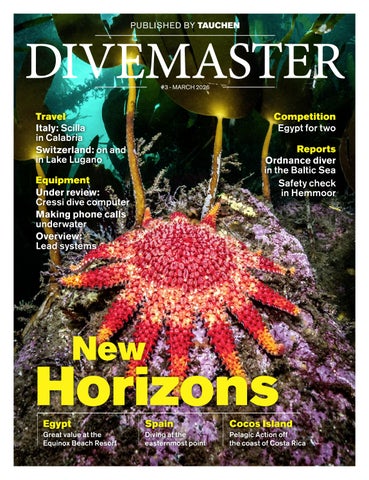
The cover of this issue shows a common sunflower (Crossaster papposu), which Tobias Friedrich photographed at the entrance to the 24-kilometre-long Namsfjord in Norway.
CONTACT & MORE
EDITORIAL TEAM
Jahr Artopé Media GmbH & Co. KG Bajuwarenring 9, 82041 Oberhaching Tel. 089/5 52 41-0, Fax 089/5 52 41-244 E-mail: redaktion@tauchen.de DISPLAY
089/5 52 41-225 Email: sales@tauchen.de
DIVING SUBSCRIPTION + ADDRESS CHANGES
040/5555 7991, email: jam@dpv.de
Did you know that TAUCHEN is also available in the digital world? This includes our social media channels Facebook and Instagram as well as our website and our YouTube channel. And on our podcast channel there is „something to listen to“. Just drop by and listen. Just follow the links below. Do you want to read TAUCHEN digitally? Download our TAUCHEN app for iOS and Android. We look forward to hearing from you.
It is well known that Madeira and its sister island Porto Santo are well worth visiting. The winning images from the 2025 "Madeira Underwater" photo competition prove that this also applies to the underwater world.
www.madeiraunderwater.com
Photo team: Luis Campos & Patricia Araujo
Photography team: Davide Lombroso & Elena Piccoli
Photo team: Nuno Goncalves & Anna Gomes
Photo team: Filomena Sa Pinto & Carla Siopa
Photo team: Nuno Goncalves & Anna Gomes
Photo team: Rui Bernardo & Joana Narciso
Photo team: Davide Lomborso & Elena Picolli
Photo team: Nuno Gonzalves & Ana Gomes
Photo team: Filomena Sa Pinto & Carla Siopa
MAGAZINE
DIVING PAYS OFF!
PROTECTING DIVING SITES BRINGS BILLIONS TO NATURE AND THE ECONOMY
A new study shows that targeted protection of the world's most popular diving sites would have enormous benefits. If these diving hotspots were designated as strictly protected marine areas, fish stocks and biodiversity could increase significantly – in some regions many times over. At the same time, diving tourism would benefit: experts estimate billions in additional revenue from tourism and conservation fees. Coastal communities in the Global South could benefit particularly from this. The study concludes that marine conservation and diving tourism are not contradictory, but rather an opportunity for both sides.
Source: "Marine protected areas for dive tourism" from Scientific Reports (online)
UNDERWATER MEDITATION AS A WELLNESS TREND
An unusual diving trend: underwater meditation is gaining attention in the wellness travel segment. The concept is based on the scientifically proven effects of water: hydrostatic pressure, slow breathing underwater and the reduction of external stimuli promote relaxation and reduce stress. This approach is now being adopted by resorts and diving schools worldwide, for example through special courses on Roatán, combined retreats with yoga and Ayurveda in Bali or mindfulness programmes on St. Lucia. Studies also show that such experiences can even help people with high stress levels or physical challenges. So let's get started with relaxed breathing underwater and yoga. Keywords for Google search: Inner Peace Dive Programme, Underwater Meditative Immersion, Stillwater Diving and many others.
NEW SPECIES DISCOVERED
In the so-called "Twilight Zone" reefs off Guam, Californian scientists have found evidence of around 20 previously unknown marine species. The discoveries were made at depths of between 55 and 100 metres, a transition zone between light-flooded reefs and the deep sea. The potentially new species include translucent gobies, strikingly coloured sea snails, small crabs and soft corals. The discoveries were made possible by special autonomous reef monitoring structures that were installed on the seabed for several years. The results underscore how little research has been done at this depth. Source: California Academy of Sciences / Dive Magazine
DIVING SAFETY: BRITISH COURSE UP TO 50 M
The British Sub Aqua Club (BSAC) has introduced a new Deeper Diver Course, which further qualifies certified recreational divers to dive to depths of up to 50 metres – a step towards structured deep diving with a focus on safety and technique.
DIVING TRADE FAIRS & EVENTS –FEBRUARY & MARCH
There are various diving trade fairs around the world in winter and spring. Here is a brief overview for anyone who is interested. Have fun at the fair!
28 February–1 March: Go Diving Show –Great Britain
March 2026
6–8 March: Dive Fest Belgium – Belgium
7–8 March: Mediterranean Diving Show –Barcelona, Spain
13–15 March: Moscow Dive Show –Moscow, Russia
20–22 March: Asia Dive Expo – Singapore
27–29 March: Salon de la Plongée –Paris, France
THINK YOU KNOW SHARKS? MAKES YOU SMARTER...
Questions from the new HAI quiz by Ocean Heroes. This exciting quiz card game includes hundreds of questions and answers – all about sharks and their environment. Entertaining and educational at a charity price (100 per cent of the proceeds go to marine conservation organisations) of Euro 25. Available at www.ocean-heroes.shop
Wy are there so few individuals at the top of the food pyramid among the top predators? From the lowest level to the top, there is less energy available at each level of the food chain. This is why the number of animals per level decreases. The top predator is therefore the "rarest". At the same time, the size of its territory and thus its radius of action increases. Starting with tiny plankton, the size of the predators in the level above also increases. Top predators are therefore not only the fewest, but also the largest in the foodpyramid. Logical, right?
More from artist Michel Ley can be found at: Facebook/michels.imbaerium, Instagram ("michels.imbaerium") and www.michels-imbaerium.de
WHERE TRADITION IS A TOP PRIORITY
In our series of presentations, today we are visiting TSC Neptun Kirchberg e.V. in Saxony. A club that has owned its own quarry since the days of the GDR.
Dietmar Steinbach
Leipzighas around 612,000 inhabitants, Dresden 574,000 – Kirchberg in Saxony just 7,700. This makes the history of the NEPTUN Kirchberg diving club, which has almost always had at least 40 members, all the more remarkable. The club currently has 67 members.
Two factors made it possible to establish a diving club on the western edge of the Ore Mountains in 1960. One was the Kirchberg granite area, now designated as the "Kirchberg Granite" landscape conservation area. After granite mining ceased to be economically viable, a former quarry pit on the outskirts of the town filled with crystal-clear water. At a depth of twelve metres, every large stone could be seen from the shore – a paradise that initially attracted bathers and snorkellers.
The second prerequisite was Harry Eißmann. Inspired by Hans Hass, he wanted to share his passion for diving and founded the club in 1960 with like-minded people. They dived in the former Pinckvos quarry, also known as Pinkvoss or Pinkvoß and popularly called "Bingfass".
Building the Infrastructure
Eißmann proved to be a dedicated organiser. When the Wilkau–Haßlau–Carlsfeld railway line was decommissioned between 1965 and 1977, the Kirchberg divers seized the opportunity and purchased decommissioned railway carriages. Together with pioneer divers from the National People's Army in Zwickau, they financed this in part by salvaging scrap metal from the quarry lake. Two carriages were eventually set up: one as a heated club room with a
kitchen, the other as a dormitory. The site was supplemented by a campsite and later a small sanitary facility.
Towards the end of the GDR era, the area was home to the Karl-Marx-Stadt District Diving Training Centre. After reunification, the club faced major challenges. However, the acquisition of the diving centre and membership of the VDST ensured its continued existence. To this day, youth work and training are particularly close to the club's heart.
Numerous club activities such as "witch fires", hikes, diving weekends and club evenings with live music provide plenty of variety. Diving instructor Rüdiger Hupfer from the "Die Aquanauten" diving school is responsible for diving training. The club maintains close ties with neighbouring clubs, in particular TC Manta Zwickau.
The quarry lake remains the main attraction for divers. With an area of approximately 50 by 75 metres and a maximum depth of twelve metres, it offers plenty of
variety despite changing visibility. Carp, perch, pike and catfish live in the water. Underwater attractions include the wrecks of the two-masted barque "Hein Mück" and the cabin motorboat "Christel II", a sunken telephone box, remains of mine cars and a diving bell. In the darker depths, it almost feels like a deep dive – a lamp and compass are essential.
The water is also ideal for training, including ice diving. Stone steps, training platforms and exercise facilities for underwater work offer the best conditions. Conscious of tradition, the Kirchbergers also present historical diving technology to their guests, including a MEDI-713 compressed air diving apparatus. It is therefore no surprise that the maintenance and continuous development of their own diving centre remains the association's most important task to this day.
Would you like to introduce yourself, are you an association, club, or diving club? Then write to: alexander.kassler@tauchen.de
TRAVEL
REGISTER AND WIN A WEEK IN EGYPT AND DIVING FOR TWO
Anyone who signs up for our newsletter by 15 May 2026 at will be entered into the prize draw for this fantastic trip to Egypt.
One week at Lahami Bay Beach Resort including all-inclusive meals, superior room for two people (excluding flights and transfers). Diving: three days of diving per person with Extra Divers Lahami Bay (2 dives/day, house reef or Zodiac trips). Validity: Valid until 11 January 2027, subject to availability (Easter, Christmas and New Year's Eve dates are excluded).
What you need to do: Sign up for the diving newsletter via the link or QR code. Here you will find the monthly magazine newsletter and offers for our reader trips. We will draw the winner from all new registrations. The decision is final. To sign up for the newsletter: tauchen.de/newsletter/
The Lahami Bay Beach Resort
The Lahami Bay Beach Resort is located on the quiet southern shore of the Ras Banas Peninsula near Berenice, south of Marsa Alam. The highlight: direct access to the sea and the house reef from a gently sloping sandy beach. A unique experience for anyone who loves peace and quiet, nature and underwater worlds. The resort offers 220 air-conditioned rooms in 15 two-storey buildings. Guests at Lahami Bay Beach Resort can spend their day on the hotel's exclusive sandy beach, which is only accessible to hotelguests. Alternatively, there is a large hotel pool with plenty of sunbathing areas.
Extra Divers Lahami Bay
The new Extra Divers base and southernmost diving centre in Egypt is located directly on the beach of the Lahami Bay Beach Resort. You can choose between dives at the house reef and trips by Zodiac, speedboat or day boat to the most beautiful spots around Hamata and Berenice. Names such as Sha'ab Claudio, Abu Galawa, Sha'ab Maksur or the famous Sataya Reef with its school of dolphins make every diver's heart beat faster.
More information: lahamibaybeachresort.com & extradivers-worldwide.com
READER TRIPS
Orcas & Northern Lights
For TAUCHEN readers, Wirodive is offering an exclusive reader trip to Orca Camp Northern Norway in November 2026: in the fjord landscape around Hamneidet, participants will experience orcas and humpback whales in the wild and – on clear nights –spectacular northern lights. The week includes up to six boat trips and nature programmes, including an introduction to aurora photography. Travel period: 15-22 November 2026, €3,590 (excluding travel and any stopovers). More information: www. tauchen.de/leserreisen/ & email: redaktion@tauchen.de
Off to Spain –Cap de Creus
Together with the Ulla & Paul diving centre, TAUCHEN is inviting readers to an exclusive trip to the Cap de Creus Natural Park on the Catalan Mediterranean coast from 19 to 26 September 2026. Five boat dives at spectacular sites in the nature park and unlimited shore dives directly in front of the centre offer ideal conditions for experiencing steep walls, caves, gorgonian forests, groupers, octopuses and schools of fish. The centre, located directly on the water, offers short distances and relaxed dives in the protected bay. Price: €599 per person including accommodation in a 4 to 8-person apartment (self-catering), 5 boat dives, unlimited shore dives, tank & weights. Individual travel arrangements. Number of participants: max. 12. Information & booking: redaktion@tauchen.de, keyword "Cadaques2026".
Unusual diving event in a slate mine: On 26 and 27 June 2026, the PATD is organising a unique diving event in the slate mine in Nuttlar, Germany. Here, divers of all experience levels can combine mine and cave diving – an unusual mix of historical backdrop and underwater adventure. Information & registration: patd.de/events-und-touren/
Extended trade fair bargains: It's beentwo and a half weeks since boot Düsseldorf – and at Aqua Active Agency , travel plans are in full swing. But: many of the attractive trade fair offers are still available! Whether spontaneous or long-term – the organiser's portfolio offers diving trips and safaris worldwide with exclusive benefits: a flexible short trip to the Red Sea; with the Horizon III or AMBA liveaboard boats to the Maldives, Philippines, Indonesia & Raja Ampat – all still bookable at trade fair conditions. Scan the QR code, select your favourite trip and submit a travel enquiry – Aqua Active Agency will create a personalised offer for you. aquaactive.de
DIRECT FLIGHTS TO MARATUA ATOLL
From 16 January 2026, the Extra Divers island resorts of Nabucco, Nunukan and Virgin Cocoa off the coast of Borneo will be even easier to reach. Wings Air is launching a new regular direct service between Berau and Maratua. Flights will operate three times a week (Wednesdays, Fridays and Sundays) and take just 45 minutes. The Maratua Atoll is considered one of the most spectacular diving areas in Indonesia. extradivers-worldwide. com
PRIVATE VILLA IN BALI
Campo Beluga, Beluga Reisen's private villa in Pemuteran in north-western Bali, will open its doors in April. Three bedrooms, an open-plan living area and a 20- -metre pool offer space for families, friends or groups of divers who want to travel together while still enjoying privacy. The villa can be rented as a whole or divided into two areas. Every morning, a freshly prepared breakfast is served with care and in a relaxed atmosphere – not a standard buffet, but a start to the day with time to enjoy. The organiser's many years of experience with the Karang Divers bases and the region guarantee an authentic Bali experience. Divers will enjoy the short trip to Menjangan Island, one of Bali's best diving areas. Price example: Two weeks in the entire villa for six people, including breakfast and 20 T: Euro 1295 per person.
belugareisen.co.uk
OFF TO RAB IN CROATIA
Why come to the Mirko Diving centre on the island of Rab in Croatia? It's simple: Rab is known as the island of love – perhaps you too will fall in love with this Adriatic island. Enjoy a stress-free holiday in a family atmosphere with plenty of time for yourself. Everything moves a little slower on Rab – perfect for really switching off and finding peace. The Mediterranean Sea around the island is clean, crystal clear and offers excellent visibility –ideal conditions for unforgettable dives. The season starts in April, but with the right equipment you can also dive in winter. In addition to attractive prices, there are family discounts and group discounts of up to 20 per cent. mirkodivingcenter.com
Tauchen. Entdecken. Erleben.
Begleite uns auf unvergessliche Tauchreisen zu den spektakulärsten Spots der Welt!
• Top-Tauchspots & exklusive Locations
• Professionelle Begleitung & kleine Gruppen
• Perfekt organisierte Reisen –du tauchst, wir kümmern uns!
A huge variety of species, from tiny snails to turtles, rays, sharks and more. The southern Egyptian Red Sea coastal town of Marsa Alam is synonymous with incredibly diverse diving.
EQUINOX MARSA ALAM DUGONGS
& MORE
T & F Barbara & Wolfgang Pölzer
"If only I could scratch that itch": Manatees also like to rub their backs in the sea grass (above). A school of yellow snappers at the wreck of the Heaven One (below). Amazing light in the reef labyrinth of the Abu Dabbab outer reefs (right).
Elphinstone and the Red Sea reefs of Abu Dabbab are legendary and still make even experienced divers' eyes light up. But the southern Egyptian coast is also not to be sneezed at, such as here off the Three Corners Equinox Beach Resort, almost halfway between Port Ghalib and Marsa Alam.
block warden
Grab your diving tanks right on the beach and hop in the house reef dinghy – it's less than five minutes out of the large bay. Today, Mohamed wants to show us the outermost reef blocks of his house reef. The long-time base manager not only speaks perfect German, but after many years in the diving business, he still retains his passion for diving. Back-roll-entry – and down you go in free fall almost 30 metres.
A crater landscape of sand hills, sparse seaweed beds and finger-length green algae awaits us in the crystal-clear water. Did Mohamed get the GPS position of this rarely dived spot wrong? No, apparently not. A large shadow can be seen on the horizon. A few fin strokes later, we know for sure: flagfish and other reef fish, butterflyfish, triggerfish and angelfish – yes, even a beautiful anemone with clownfish has settled here. A group of juvenile trevally shoot through the reef in search of small fish, while dense clouds of pink anthias incessantly snap at plankton. The largest block reaches a depth of almost 15 metres and rises like a small mountain from the plain. Barely halfway around, a dozen batfish suddenly come around the corner and head straight for us. They inspect us at close range without hesitation before moving on to the next block.
Unexpected Encounter
With the bat school still in portrait format in the viewfinder, a shapeless shadow suddenly swims across the upper edge of the image. Sure enough, a dugong is diving down and gliding more or less elegantly towards us. We hadn't expected to see a dugong so deep and so far from the coast. With a few swift strokes of its forked tail
fin, the marine mammal, which is a good two and a half metres long, settles on the seabed not far from us and immediately begins to root around for the nutritious rhizomes of the small-leaved sea grass. Leaving a considerable cloud of sediment in its wake, the dugong calmly ploughs through the seabed. It probably enjoys not being bothered by snorkellers here.
For years, at least three of the otherwise rare manatees have been known to inhabit the region and are regularly visited by rubber dinghies full of snorkellers and divers near the coast. With a little patience, there is hardly a better place to encounter these peaceful herbivores. Although there are strict rules in place, everyone should take care not to disturb or touch the animals.
Surprise of the night
After a long break on the surface, we trudge back into the water on our own at dusk. A night dive in the extensive house reef bay is on the agenda. Over gently sloping ground, we pass countless pipefish, hunting lionfish
and blue-spotted stingrays in the five-metre range. Even an adolescent blacktip reef shark swims briefly through the beam of our lamps.
More than just cute
However, we are interested in the rich green fan algae, just a few centimetres in size, which can be found scattered among the seaweed leaves. These inconspicuous algae are the habitat of the tiny "Shaun the Sheep snails" or leaf sheep snails, as they are called in German. These dwarfs, so popular with macro photographers, are just two to four millimetres long. We don't have to search long, because three of the little snails are already perched on the first leaf –and one of them is exceptionally large for its species. So we quickly attach a special close-up lens and get to work, because it is only under high magnification that the beauty of these molluscs is revealed.
Far more fascinating is the biology of these tiny "slime monsters"! The snails do not just feed on the tissue of green fan >
The Abu Gusun dive site offers a wreck dive. Here lies the wreck of the Hamda, a freighter loaded with granulate that sank over 30 years ago. It has long since been taken over by the sea and its inhabitants and is now adorned with numerous new residents and a colourful new "coat of paint" (in the flashlight).
INFORMATION
BASE LEADER: Mohamed Saleh, an Egyptian who speaks German.
DIVING REGULATIONS: Presentation of diving certificate, logbook and Medical clearance for diving, as well as a mandatory check dive to familiarise yourself with the house reef.
DIVING: with fewer than 25 logged dives only with a guide, thereafter independently in a buddy team. Certified solo diving is possible at the house reef. In addition to the extensive house reef – which can be extended with your own Zodiac – speedboat diving to surrounding reefs, day boat diving and half-day and full-day trips by minibus are offered. A total of around 20 different dive sites within 60 minutes' distance. Dolphin snorkelling is offered by day boat (Marsa Alam).
BOATS: four speedboats for a maximum of eight divers each, a house reef zodiac for a maximum of five divers, and Extra Divers' own day boat for up to 25 divers at the hotel's own jetty.
PRICES: A speedboat trip (including cylinders and weights) costs 44 Euro, a 10-trip boat diving package costs 357 Euro. The house reef zodiac is free of charge. Surcharge for night dives: 15 Euro. OWD course (including certification): 497 Euro.
LOCATION: 25 kilometres north of Marsa Alam in a large, well-protected bathing bay, about one kilometre south of Abu Dabbab.
SUSTAINABILITY: There are drinking water dispensers in the hotel and at the diving centre.
SNORKELLING: In the gently sloping house reef bay, you can observe turtles and various stingrays feeding and, with a little patience, encounter one of the resident manatees.
BEST DIVING TIME/SEASON:
All year round. The lowest water temperatures are between January and March at 22 degrees Celsius, and the highest between July and September at over 30 degrees Celsius.
ACCOMMODATION: The fourstar Three Corners Equinox Beach Resort, part of a Belgian hotel chain, has 325 rooms in three different categories in a
main building and several annexes. The rooms are spacious, clean and functionally equipped with air conditioning, minibar, television, safe, balcony or terrace and bathroom/WC. In addition to the extensive gardens with two pools, the large bathing bay with its own jetty is particularly impressive. Interesting for divers: brand new hotel rooms are now located directly above the diving centre.
CONTACT & INFORMATION: extradivers-worldwide.com
INFORMATION & PRICE EXAMPLE
Getting there: There are numerous direct flights from Germany to Hurghada or Marsa Alam. The transfer by car from Marsa Alam Airport takes only 15 minutes, and from Hurghada a good 2.5 hours.
Organiser: Reisecenter Federsee, tel. 07582 -932 07 90, www.rcf-tauchreisen.de Price example: 7 nights/ double room/all-inclusive at the four-star Three Corners Equinox Beach Resort, direct flight from/to Germany to Marsa Alam, transfers: from Euro 622 per person. Six dives at the house reef, by Zodiac or minibus (including tank & weights), from Euro 195 per person.
The cosy mid-range Three Corners Equinox Beach Resort has a whole range of newly built rooms close to the diving centre.
Rotes Meer
Ägypten
Extra-divers
TRAVEL
algae. When they eat the algae cells, they also ingest the cell organelles responsible for photosynthesis. Similar to many thread snails, which transport the stinging capsules intact to the tips of their colourful appendages when eating stinging polyps, leaf sheep snails are able to perform photosynthesis with the help of the algae cells they ingest. This works for a few days, which is why the animals constantly replenish their supply.
Completely absorbed in observing the tiny creatures, we only notice a strangely familiar sound behind us at the last moment. When we look to the side, we can hardly believe our eyes as a dugong eats its way through the ground barely a metre away! It almost seems as if the cows are turning the tables this time and chasing us instead of the other way around. We only realise how rare our nocturnal manatee sighting is the next morning when Mohamed admits that he has never seen anything like it before. This is understandable, as it is customary during night dives here to always stay along the reef so as not to lose your bearings in the almost flat seagrass bed.
High life
After two boat trips to the offshore reefs of Abu Dabbab with lots of fish, corals, atmospheric caves and old wreckage of a former safari ship, we are sitting in one of the powerful inflatable boats early the next morning, heading south-east. Mohamed and his son Karim, who helps out at the base during the holidays, are with us again. He has inherited his father's passion for the water and is studying marine biology.
With the sea almost as smooth as glass, we arrive at Elphinstone after a good quarter of an hour. Located around twelve kilometres off the coast, the reef is a popular destination, especially for safari boats. Spectacular steep walls plunging into unreachable depths, beautiful coral growth and, above all, the chance to see sharks and other large fish attract experienced divers like a magnet.
As the first visitors of the day, we drop into the water off the northern tip of the approximately 600-metre-long reef, which
resembles a south-facing compass needle. Fantastic visibility, descent into the blue, we are the only divers in the water. At a depth of around 20 metres, we reach the northern plateau and paddle against the clearly noticeable current towards the sun. After a short effort, we are comfortably pushed along the reef on the eastern side.
Large gorgonian fans at the recreational diving limit, lots of lush soft corals full of bannerfish below and above. Small groups of trevally, individual tuna, a hawksbill turtle having breakfast on the soft corals, two huge napoleon fish – there is life and, above all, movement everywhere. We alternate between the steep wall and far out in the blue water, mostly in the 30-metre range, always on the lookout for something big, preferably a shark, manta ray or even a dolphin. Everything can be seen here more or less frequently.
Even on Nitrox, our no-decompression is running short, pushing us shallower. We
From tiny to giant: three-millimetre-long leaf snails and shrimp barely the length of a finger are just as much a fixture on the house reef as green turtles. The only thing you need a boat for is encounters with sharks.
return to the reef, encounter a stately barracuda and shortly afterwards a photogenic school of snappers, but not a single shark fin – no matter how often we circle around and look in all directions. The current is stronger than expected, because after just 50 minutes we have reached the end of the reef and are seeking shelter in the shallow water behind the southern tip, where the first two safari boats have now also moored.
For an extended safety stop, we swing out into open water again and do a few laps just within sight of the boats. And believe it or not, our persistence is rewarded! At first, it's just a dot in the distance, more hope than visibility, but then it quickly becomes reality: a beautiful oceanic whitetip shark –a Longimanus – comes straight towards us, almost closer than we would like, goes straight for us, almost touching the lens of my camera – and only turns away at the very last moment. Great to watch, but unfortunately too far away for good photos.
Pure variety
To gain further impressions of the diverse diving sites with Mohamed, we will visit everything from our own day boat to dolphin snorkelling to a full-day bus tour to Abu Ghusun, far south of Marsa Alam, over the next few days. There, almost 33 years ago, a cargo ship fully loaded with plastic pelletts sank just off the coast. Long since covered in colourful vegetation and inhabited by countless fish, you can still see some of the plastic pellets from the Hamada floating in the hold on the ceiling. However, we are more excited by a stately crocodile fish on the upper deck. Finally, we absolutely must return to the house reef bay. The logbook then records turtles, feathertail stingrays – and, how could it be otherwise – a manatee. In addition, there are very diverse diving sites, from the huge house reef bay to coral gardens and breathtaking steep walls, only a few minutes away by boat.
GATE
TO THE SOUTH ...
... that's what Lake Lugano is also called. We'll take you on a journey to the most Italian lake in Switzerland.
T & F Sabrina & Franco Banfi
Photo: Shutterstock
TRAVEL ° LAKE LUGANO
Some lakes are like dark chocolate: you have to taste and enjoy them. A lake offers space for meditation and self-reflection. Not only for poets, thinkers or philosophers who limit themselves to contemplating its mirror-smooth surface, the high mountains that surround it like a protective hand, or the reed belts and gardens along its shores. The psychological approach to a lake is immediate: either you like it right away – in a relationship of respect and curiosity – or you reject it out of fear or contempt and prefer the warm, salty water of tropical seas to the cold fresh water of alpine basins. You have to love a lake, be persistent, want to get to know it better and set out in search of what lies hidden in this subdued, mysterious atmosphere.
More than just a lake region
Lake Lugano is one of the most interesting attractions in the subalpine region. It is located in the canton of Ticino, the southernmost canton of the Swiss Confederation. Looking at the national border, it is difficult to understand why this small wedge of land belongs politically to Switzerland, but geographically is clearly part of Italy. When visiting, one quickly discovers the social and cultural similarities: the people of Ticino love to enjoy life and have managed to combine the hospitality and joie de vivre typical of Italians with the orderliness and security consciousness of Northern Europe. The best way to see this for yourself is to take a break in one of the many grotti (rustic restaurants) along the lake shore, which serve traditional, rustic cuisine – accompanied by conversation in the shade of lush pergolas.
Origin
Lake Lugano fills the bottom of a valley that was originally formed by river erosion and further shaped by glaciers during the Pleistocene ice ages. The moraines deposited by the glaciers formed natural barriers behind which a reservoir of water accumulated. The lake winds its way like a large river between high mountains. Nature here is powerful and impressive, yet constantly changing under the influence of light, wind and the seasons. Its shape is extremely complex and resembles the superimposition of several lakes with numerous bays. Two main basins can be distinguished: the northern basin, which stretches from Porlezza to the Melide-Bissone line, and the southern basin from Capolago to Agno. They are separated by a moraine ridge, on which the Melide dam now runs, connecting the two shores. Water exchange takes place only via a short navigable canal. A third, very small basin is located at Ponte Tresa and is connected to the southern basin via the Lavena Strait. The two main basins differ significantly in terms of morphology and hydrogeology. The northern basin has considerable depths of up to 288 metres, while the southern basin is significantly shallower, with a maximum depth of 95 metres, allowing for faster water exchange.
The right time
Like many low-lying glacial lakes (271 metres above sea level), Lake Lugano is at its best in winter. The water is colder, but much clearer. On sunny days, the light reflections on the surface, stirred by light breezes, are particularly intense. Over the past ten years, there has been a significant decrease in eutrophication in the surface water layers, which had begun in the 1960s. The ecological situation has improved noticeably.
Small gobies and shrimp can be observed along the banks. Tadpoles and perch live in crevices between sunken trees or boulders, while zander, black bass and chub can be found in quieter areas. The original fish fauna has been altered over the last century by stocking measures, which have introduced more productive,non-native species such as rainbow trout, sunfish, black bass, zander and roach.
other hand, give the lake bed a three-dimensional structure, provide shelter for young fish, serve as a spawning substrate and are a hunting ground for predators such as pike. Life in the lake is particularly concentrated where these plants occur. To compensate for missing structures, discarded Christmas trees aredeliberately submerged each year.
In addition to fish and crustaceans, there is also an interesting flora, especially macrophytes – true vascular aquatic plants with inconspicuous flowers and fruits that are often mistaken for algae. The algae found in the lake do not grow upwards, but appear stringy and
and densely cover the substrate. Aquatic plants, on the
slimy
The spawning bands of a perch (top left) are mainly found in spring from March to May. Unlike perch, however, zander (right) are not one of the Alpine fish species that occur naturally in the lake. This species was introduced and is not only a popular photo subject, but can also be found on menus around the lake. The bullheads (left, 2nd picture from top) look very similar to blennies, but have nothing in common with freshwater fish. And there are also interesting photo opportunities above water.
ITALY
SWITZERLAND
Lake Lugano
Lucerne
Lausanne
Zurich Bern
TRAVEL ° LAKE LUGANO
THE BEST DIVING SPOTS
The northern basin is characterised by steep drops and deep walls, while the southern basin has gentler slopes. The dives described were conducted from the shore and near inhabited areas.
Elvezia (Porto)
In the Melide area, near the dam, follow the road towards Morcote. Along the shore, modern residential buildings alternate with historic structures, such as those in the village of Vico Morcote. There are small pebble and stone beaches between the houses. The view of Morcote with its old houses right on the lake is particularly beautiful. Below the buildings is an arcade with shops, and above the village towers the 13th-century sanctuary of Madonna del Sasso, accessible via around 400 steps. The cemetery, Scherrer Park and the ruins of a castle complete the tourist attractions.
The Elvezia Resort is located about half a kilometre behind Morcote. Cars can be parked directly by the lake. Access is via a few steps and is straightforward. There is a small harbour on the left. An old fishing boat lies at a depth of ten to 15 metres under the main jetty. If you follow the bottom to the right, you will come across another, more recent wreck. Depending on the season, eels can also be observed here. At a depth of 20 to 25 metres, the bottom is muddy, dotted with small rocks. Perch and burbot are regularly encountered. The site is also suitable for night dives, when
the diversity of fish is even more evident. Crayfish are also frequently seen. During the summer months, it is best to avoid this dive site as there is a lido nearby and it can get very busy.
Riva Caccia (Lugano–Paradiso)
From the A2 motorway (Lugano Sud exit), take Via G. Cattori and after a few traffic lights you will reach the lake. Turn right towards Lugano and after a few hundred metres you will reach the diving site. Parking is only available for a short time to unload equipment. Afterwards, park in the parallel Via Giuseppe Maraini and reach the lake via the Bressanella stairs.
Access is via three stone steps: take care on the last step, which is often covered in algae. There is a public lido on the left, and the bottom slopes gently down to the right towards Paradiso. Depending on the season, you may see eels, burbot, perch, zander and pike. In recent years, crayfish have also proliferated.
Wreck of the Milano
Capolago is located in the southern basin of the lake. From the lakeside road, drive via Bissone, Maroggia and Melano to Capolago, then towards Riva San Vitale. After an almost complete hairpin bend, you will pass Capolago - Riva San Vitale railway station and shortly afterwards reach the small harbour. Here, at a shallow depth, lies the wreck of the "Milano I", a paddle steamer built in 1881 by the Sulzer brothers in Winterthur. The 34-metrelong ship had a 180 hp engine and reached a remarkable 23 km/h for the time. It was used for busy passenger traffic. On 26 November 1898, a storm tore the Milano I from its moorings and it ran aground, but was salvaged and repaired. It was taken out of service in 1927.
Access is from the jetty with a giant stride entry or via the slipway in the harbour, which is also used for exiting. The wreck lies parallel to the shore at a depth of about ten metres. The bottom is very muddy, so divers should take care not to stir up sediment. Numerous crayfish can be found around the wreck.
Located almost at shallow water, the wreck of the Milano I is another sea attraction that is easy to explore.
American-made vehicle, relatively well preserved, at a depth of about 14 metres. Care should be taken when surfacing, as the dive site is located between several jetties and there is heavy boat traffic here, especially in summer.
ARRIVAL
Via the A2 motorway (San Gottardo - Milan), exit at Lugano Sud or Melide. Do not forget your toll sticker.
PLACES OF INTEREST
Swissminiatur Melide swissminiatur.ch
Alprose Chocolate Museum, Caslano –alprose.ch
Hermann Hesse Museum, Montagnola –hessemontagnola.ch
Monte San Salvatore (on foot or by funicular railway from Lugano-Paradiso)
Monte San Giorgio (fossil museum, caves, UNESCO World Heritage Site) –montesangiorgio.ch
TAUCHEN IN DER SÜDSEE
Le Macchine (Caslano)
The dive site is located in Caslano, in the Torrazza district, and can be reached via the Agno - Ponte Tresa road. There is a private car park belonging to the "Taverna dei Pescatori" – please ask for permission before parking, especially during the high season and at mealtimes. The entry point is near a small jetty. If you dive about ten minutes to the right over muddy ground, you will reach the first wreck parts such as beams, tanks and numerous car tyres at a depth of about 20 metres. At 16 metres lies a car wreck that gave the dive site its name. Nearby are doors, chassis and bonnets. On the way back, along a scree slope to the left, you will find another
There are numerous accommodation options in and around Lugano. The closer to the lake and city centre, the higher the prices. We recommend searching online.
Tahiti, Rangiroa und Fakarava Fantastisches Großfischtauchen an den Riffen und in den Passagen der Atolle · Inkl. 21 Tauchgängen, Flügen, Übernachtungen/Frühstück/Transfer ab 7.550 € p.P. / DZ
21 Tage Fiji Inseln
Viti Levu, Taveuni, und Beqa Lagune
Aufregendes Tauchen zwischen farbig leuchtenden Korallen, bunten Rifffischschwärmen und beeindruckenden Großfischen
Palau und Yap Faszinierendes Tauchen an steilen Außenriffen, in Strömungen und Lagunen mit zahlreichen Großfischen · Inkl. 20 Tauchgängen, Flügen, Übernachtungen/Frühstück/Transfers ab 5.475 € p.P. / DZ
18 Tage Papua Neuguinea
Lissenung Island und Tufi Resort
Reiche Artenvielfalt, Sichtweiten bis zu 30 Meter, unberührte Korallenriffe und große Fischschwärme
… mit Pacific Travel House –dem Spezialisten seit über 35 Jahren! pacific.travel.house
Weitere Vorschläge, ausführliche Beschreibungen und kostenlose individuelle Ausarbeitung unter:
Pacific Travel House Reiseveranstaltungs GmbH
Schwanthalerstraße 100, D-80336 München info@pth-muc.de, 089-543 21-80
The water quality of Lake Lugano was considered very poor in the 1970s. The fact that much has changed since then is also evident in today's diversity and the return of many species and "inhabitants".
BETWEEN MYTH AND SEA
Off the coast of Scilla, Italy, "La Montagna" rises from the depths –a mythical diving spot in the midst of a fascinating underwater world.
Scilla, located in the very south of Italy on the Tyrrhenian coast of Calabria and overlooking Sicily, is one of those places where legend still seems to breathe among the waves. According to Greek mythology, Scilla was a beautiful nymph who loved to swim in the clear waters of Zancle. Glaucus, a fisherman who had been transformed into a sea god, fell madly in love with her. But Scylla rejected him because of his monstrous appearance. To win her heart, Glaucus turned to Circe, a powerful sorceress who was herself in love with him. Blinded by jealousy, Circe transformed Scilla into a terrible monster with twelve
legs and six dog heads. Scilla fled to the caves under the rock that now bears her name and began to terrorise all who dared to cross the Strait of Messina. A story of unrequited love, jealousy and a transformation between rage and loneliness.
A place steeped in history e and biodiversity
Today, beneath this promontory, in a stretch of sea rich in biodiversity and mythical allusions, lies an underwater world that echoes this legend: a mysterious place teeming with life, where the beauty of the sea merges with the shadow of myth. And this is precisely where La Montagna is loca-
ted, one of the most fascinating diving spots in the region. But La Montagna is much more than just a point on the map. It is an experience, a journey into the blue, into shapes, colours and creatures that seem to come from a dream. Our companions on this diving adventure are Paolo Barone and Cristina Condemi from the Scilla Diving Centre. They know the area and its history in detail and turn every dive into a living narrative – characterised by attentiveness, safety and passion.
Dropping into the Blue
Our joint dive requires experience and careful preparation: it is aimed at divers
T & F Gaetano Errico
with technical training, as the depth off Scilla can exceed 50 metres and requires precise planning of bottom time and decompression phases. After a briefing and equipment check, we set off. After a few minutes by boat, we arrive at the dive site. In the water, the blue of the Tyrrhenian Sea and huge boulders covered with marine life await us. The view is breathtaking, almost surreal. Our adventure begins! We head towards a dark silhouette: La Montagna – a gigantic rock formation that rises from the depths like a sunken monument. It is about 20 metres high and rooted at a depth of 42 metres. A vibrant underwater ecosystem pulsates around it.
Encounters in the blue
At a depth of 32 metres, we encounter the
first highlight: a tube anemone (Cerianthus membranaceus) whose long orange-yellow tentacles dance in the current. Just a few metres away, we discover another milkywhite specimen that shimmers like a pearl in the twilight of the seabed. We dive further down. At a depth of 50 metres, we are greeted by an underwater forest of gorgonians. The branches of the colour-changing gorgonian (Paramuricea clavata) in shades of red and yellow intertwine here like moving fibres of light. These horn corals, endemic to the Mediterranean, with their outstretched polyps busily filtering food from the current, testify to enormous resilience in every detail. We reach our planned maximum depth of 55 metres. The light is dim, the silence complete. And right here it appears – almost like a farewell
greeting: a Mediterranean gorgonian head (Astrospartus mediterraneus). Its arms spread out in the blue, as if to show us the way back to the surface.
Return with memories
As we ascend, our thoughts wander back to that ancient legend. It is as if Scilla were still here! A silent guardian of these depths. Nowadays, however, her underwater kingdom is not just darkness. Nowadays, it also enchants with beauty, harmony and an impressive biodiversity. Scilla has given us a dive full of emotions – a journey between history, myth and the sea that will remain in our memories. Like a fairy tale you have experienced yourself.
Further information about the diving centre: www.scilladiving.it
Above: A red gorgonian fan unfurls its fan-like structure in open water. These corals prefer to grow in areas with strong currents and provide a habitat for numerous small animals.
Centre: The white sea anemone uses its stinging cells to catch passing prey.
Below: A Mediterranean gorgonian head clings to a horn coral and spreads its highly branched arms in the current. The delicate limbs are used to filter plankton and organic particles – a typical adaptation to fast-flowing, low-light reef areas.
Curaçao
Photographs: ??
Dive in, helpexperience, shape
A Caribbean island that inspires far beyond diving.
Curaçao has been considered one of the most diverse diving destinations in the Caribbean for years. Crystal-clear water, healthy reefs and pleasant temperatures all year round make the island a paradise for divers. But Curaçao is more than just a place for perfect underwater hours: the island combines relaxed diving with nature experiences on land, sustainable projects underwater and activities that also delight non-divers and families.
Diving without time pressure
One of Curaçao's great advantages is the high density of dive sites accessible from land. Many of the most beautiful reefs start right off the coast and can be easily reached from the beach or via short entries from the shore. Without a boat, without fixed times and without hustle and bustle, divers here determine their own daily rhythm. This freedom creates room for variety: a morning dive, an excursion ashore, another dive in the afternoon – Curaçao makes exactly this flexibility possible.
Nature experience on land:
Hike to the Tree of Life
If you want to explore the island between dives, don't miss a hike to the Tree of Life in north-western Curaçao. Early in the morning, the trail leads through a barren yet fascinating landscape of cacti, tropical trees and sweeping views. Lizards scurry through the undergrowth, goats bleat in the distance, and views of the sea open up again and again. Along the way, you pass the ruins of an abandoned country house – a silent witness to the past. Finally, the imposing tree itself rises up, towering high
As small as Curaçao may seem on the world map, the variety of activities on offer there is enormous. Submarine trips, fishing, beach and country walks, cave visits, diving and shopping. What more could you want?
above the surrounding area. Those who continue further up the path are rewarded with an impressive panoramic view of Christoffel National Park and the coast.
Experience the deep sea
–
without any diving equipment
A dive with the Curasub from Substation Curaçao offers an extraordinary experience. This manned deep-sea diving capsule keeps you dry while descending to depths that are unreachable even for technical divers. There are various dives to choose from: on the wreck tour, the wreck of the Stella Maris suddenly appears in the spotlight at a depth of around 150 metres – a
moment that will remain in your memory for a long time. Alternatively, the Explorer Dive takes you to a depth of around 200 metres, where the living reef gradually transforms into a mysterious deep sea. Here, too, it becomes clear that life exists even where you would hardly expect it. The Curasub can accommodate two guests and a pilot, making it ideal for non-divers or accompanying family members.
Active for the ocean: lionfish hunting Diving in Curaçao also means responsibility. The lionfish, originally from the IndoPacific, poses a serious threat to reefs in the Caribbean. With no natural predators, it reproduces rapidly and eats numerous young fish that are important for a healthy reef system. At Lionfish Caribbean, divers learn all about this invasive species in workshops and how to safely catch the fish with a spear during a dive – a tolerated exception to the otherwise applicable spearfishing ban. The special attraction: the fish you catch yourself is then freshly prepared, for example as fish & chips or dumplings. Even jewellery can be made from the fins. Sustainability, experience and enjoyment come together perfectly here.
Underground world: the Hato Caves Curaçao also offers impressive natural experiences above water. The Hato Caves, near Willemstad, are among the island's most famous attractions. The million-yearold limestone caves impress with stalactites, stalagmites, underground water basins and a mysterious atmosphere. Guided tours also provide insights into the history of the island: the Arawak Indians used the caves, and later they served as a refuge for escaped slaves. A short nature trail around the caves leads past cacti, rock carvings and viewpoints – an exciting mix of nature and culture.
Diving with purpose: plant your own coral tree
Sustainability is not just a buzzword on Curaçao, but a way of life. The CURious2Dive diving centre in Caracasbaai offers a
Actively participate in and assist with the replanting of coral colonies: you can track the growth of your own corals on your personalised "coral tree". Meaningful and educational, even for children.
particularly tangible project. Directly in front of the diving centre is a coral nursery, which is run in collaboration with the Coral Reef Restoration Team Curaçao.
In workshops, participants build their own coral tree, to which young fragments of staghorn coral are attached. Underwater, these corals grow several centimetres per month until they are large enough to be planted on the reef.
The project is also ideal for families: while non-divers watch from above while snorkelling, certified divers plant the coral trees
in the sea. An emotional experience – and an active contribution to protecting the reefs.
Curaçao – also ideal for families Curaçao shows that diving and family holidays can be combined perfectly. In addition to snorkelling, beach days and wildlife watching, children can take part in workshops, experience the deep sea in Curasub or help with the coral project. The island is considered safe, the infrastructure is well developed, and communication in Dutch is easy.
Practical travel facts
• Flight time: approx. 9.5 hours
• Water temperature: Average 27 °C
• Air temperature: approx. 28 °C
• Diving: possible all year round
• Language: Dutch
• Entry: valid passport, no vaccinations required
Conclusion
Curaçao is much more than a classic diving destination. The island combines first-class dive sites accessible from land, extraordinary experiences such as deep-sea expeditions, sustainable projects to protect the reefs and a wide range of activities on land. A diving trip to Curaçao will remain in your memory not only because of the underwater world, but also because of the diversity it offers.
More: curacaotouristboard.com & www.curacao.com
BEYOND THE HORIZON
CAP DE
CREUS
Where the Mediterranean whispers its secrets, wonderful things can be experienced. A visit to the easternmost point of mainland Spain.
T & P Lars von Ritter Zahony
Left: Large schools of fish (Seriola) frolic in the nature reserve – a sight that has become rare in the Mediterranean.
Right: An unexpected encounter on the open sea – where otherwise only blue and depth reign, majestic sunfish glide by.
Left: Eye to eye with the hunter of the open sea. A rare encounter with a blue shark. Right: The colourful cliffs of the rocky reefs at Cap de Creus reveal an unexpected explosion of life.
TRAVEL °
For over three decades, as a passionate diver and underwater photographer, I have been drawn year after year to the rugged coastline of the Costa Brava – more precisely to Cadaqués and Cap de Creus, the easternmost point of Spain, which has been a nature reserve since 1998. It is Spain's oldest marine-terrestrial nature park with unique flora and fauna. Here, where the land ends and the sea begins, an underwater world unfolds that has lost none of its magic even after all these years.
At legendary dive sites such as El Gat or Massa d'Oro, steep walls plunge into the depths, covered with bright gorgonian forests where thousands of bannerfish frolic. Schools of barracuda glide majestically past, groupers sit enthroned in crevices, and even bluefin tuna are becoming increasingly common.
Fantastic dives can also be undertaken from land. The bays around Cadaqués offer access to an underwater world that is in no way inferior to tropical destinations. The macro world is particularly impressive with its diversity: colourful nudibranchs, delicate seahorses and well-camouflaged crabs populate the rock crevices and sea grass beds. With patience and a trained eye, you will discover a blaze of colour and a variety of shapes that you would hardly expect to find here.
The call of the deep –Cap de Creus Submarine Canyon
While most divers prefer to stay close to the coast, I am increasingly drawn to a hid-
den realm: the Cap de Creus Submarine Canyon (CCC), a deep-sea trench about six nautical miles east of the coast. As part of the Rhône Valley, it opens the gateway to a pelagic world – far away from the familiar dive sites of the coastal reefs and rocks. At the edge of the trench, the seabed drops abruptly: from an average depth of 120 metres, it plunges steeply to 1,400 metres. A dramatic transition that connects the coastal Mediterranean with the pelagic deep sea and marks a fascinating boundary between two worlds.
Here you encounter creatures that seem to come from another dimension: sunfish, dolphins, fin whales, mobulas and even pilot whales have been sighted – pelagic nomads on their secret routes. The endangered blue shark in particular is the focus of a research project by the University of Barcelona and the Generalitat de Catalunya, supported by a local biologist and diving centre owner from Cadaqués. The aim is to understand the sharks' migration routes, identify behaviour patterns, protect their population and tell their stories.
The scientific project focuses on tagging individual animals with transmitters and setting up a photo database to identify individual animals. Initial studies show that many sharks bear traces of fishing –hooks, injuries, scars. Longline fishing is becoming an invisible threat. In addition, DNA samples were taken from the water to identify other possible shark species, including rare sightings of thresher sharks and basking sharks. Cooperation with local fishermen proved to be essential in this re-
gard: their observations are often the key to new findings.
Some photographers actively supported the research project with their work. Through their underwater photographs, they not only documented rare encounters with blue sharks, but also provided valuable visual data for scientific analysis.
If the weather cooperates and all conditions are right, you become part of the crew. Then it's time to head out to the open sea, down into the depths – where the blue shark swims and the Mediterranean reveals its pelagic face. It's a combination of technology, patience and intuition. And sometimes, when everything comes together, you manage to capture one of those rare moments – a glimpse into a world that otherwise remains hidden.
Each photograph not only captures a moment in time, but also contributes to the protection of a complex ecosystem. The images help to identify individual animals, document their injuries and raise awareness of the importance of this endangered species.
Encounters with blue sharks are among the most impressive moments in the open sea. Their name alone reveals something about their appearance: elegant, powerful and atmospheric. When a blue shark appears among snorkellers, it usually does so calmly, almost serenely – yet with a palpable presence.
READER TRIP DIVING 2026
Information on this can be found in the travel news on page 16.
DIVING WITH ULLA & PAUL 17488 Cadaqués, Girona, Spain www.divingcapdecreus.com
With curious composure, it glides through the water, seemingly weightless. Its skin shimmers in a fascinating spectrum of blue tones – from deep indigo to silvery reflections that dance in the sunlight. Every movement appears controlled, every approach deliberate. It is not a predator that presents itself, but a creature that commands respect and inspires awe at the same time.
Encounters with blue sharks in the Mediterranean are undoubtedly something special – everyone involved is aware of this. The mere presence of these majestic animals not only inspires awe, but also hope: hope that they are still here despite all the threats they face. This makes it all the more >
INFO: CAP DE CREUS
SPAIN
Sotamar
Above: Huge schools of barracuda swim elegantly through the depths – a sight that takes your breath away. Centre: Black night over the deep-sea trench. Black water diving brings you face to face with mysterious creatures of the deep: arrow squids and sea lice – typical inhabitants of the pelagic zone. Right: Blue sharks are known for their curiosity. Instead of fleeing immediately, they investigate unfamiliar situations and approach snorkellers with deliberate elegance.
important to significantly intensify their protection in the future. After all, the blue shark is not only a fascinating inhabitant of the pelagic zone – it also plays a central role in the marine ecosystem. As a top predator, it regulates populations, maintains balance and is an indicator of the health of the ocean. Its preservation is not only a matter of scientific concern, but a shared responsibility. Anyone who has looked into those black
"IN THE BOUNDLESS BLUE OF THE OCEAN, WE ENCOUNTER CREATURES THAT HAVE NEVER SEEN A HUMAN BEING BEFORE — CURIOSITY ON BOTH SIDES."
eyes knows that this animal deserves more than just admiration. It deserves protection.
The search for the invisible – blackwater diving in the Mediterranean
But attention was not focused solely on the large animals. The question arose: what happens at night in the depths? Does plankton migrate vertically in the Mediterranean Sea as it does in tropical waters? When the sun sets and the surface of the sea sinks into darkness, another world begins to awaken. Deep below the boat, far from the coast, creatures rise from the depths – attracted by a single source of light that stands like a beacon in the black water. These are fragile creatures, mysterious and strange: squids, jellyfish, planktonic larvae and pelagic hunters that are otherwise rarely seen.
These night-time dives, known as blackwater diving, are a journey into the invisible – an expedition into the vertical migration of life that takes place night after night in the oceans. While this method is already well established in tropical waters, it is still in its infancy in the Mediterranean. But the first courageous steps show that here, too, the depths hold stories waiting to be discovered.
The tried-and-tested procedures served as a blueprint for the development and implementation of these special night dives in the heart of the Mediterranean. They were specifically adapted to meet the particular challenges of blackwater diving in this region – a pioneering project that combines scientific curiosity with practical expertise. The first dives above the deep-sea trench of the Cap de Creus Canyon were challenging: conditions were rough, the distance was long, the time windows were limited, and the results were still modest.
Perhaps it is precisely these aspects that have prevented local diving centres from incorporating this special form of night diving into their programmes. Yet the Mediterranean in particular offers great potential for this fascinating method, which involves observing the rising life of the deep sea at night in open water.
As an underwater photographer, I am convinced that there are plenty of enthusiastic divers here who are ready to immerse themselves in this mysterious world. What is needed now is the pioneering spirit of diving centre owners – people who are willing to break new ground, dare to experi-
ment and offer their guests extraordinary experiences. Because anyone who has ever seen squid, jellyfish and other creatures from the depths appear in the light of a single lamp knows that the Mediterranean still has many stories to tell. You just have to be willing to listen to them.
Conclusion: Between light and darkness
Cap de Creus is more than just a classic diving destination on the Costa Brava. It is a place of metamorphosis – between land and sea, between science and adventure, between the visible and the hidden. Here, you learn that the sea is not just a place, but a living being. And sometimes it whispers its secrets only to those who are willing to embark on adventures and dare to look beyond the horizon.
Left: Visit from the hunter of the open sea. The blue shark curiously circles our boat as it drifts with the current above the mysterious deep-sea trench.
Right: Gigantic forests of colour-changing gorgonians (Paramuricea clavata) – an overwhelming spectacle in the depths of the sea.
WAS, WENN DEIN NÄCHSTER
TAUCHURLAUB DIE WELT
VERÄNDERN KÖNNTE?
Ein unvergessliches Abenteuer wartet auf dich in den Florida Keys – weit mehr als ein gewöhnlicher Tauchtrip.
Mit der Coral Restoration Foundation™ (CRF™) wirst du Teil der größten Korallenrettungsbewegung der Welt – und erlebst den Nervenkitzel des Tauchens mit Sinn und Zweck.
Ob erfahrener Taucher oder Neueinsteiger: Unsere Programme sind für alle Levels geeignet. Seite an Seite mit dem weltführenden CRF™ Team kannst du:
• Korallen pflegen: Reinige unsere legendären Coral Trees in der größten Freiwasser-Korallengärtnerei des Planeten.
• Riffe restaurieren: Unter den richtigen Bedingungen hilfst du mit, stark gefährdete Korallen zurück in Floridas Riffe zu verpflanzen.
Jeder Handgriff unterstützt direkt die Wiederherstellung eines Ökosystems, das an vorderster Front des Klimawandels steht.
SCHLIESSE
DIVING AT THE END OF THE WORLD
T & F Richard Aspinall
The legendary Isla del Coco, also known as Cocos Island, is one of the most spectacular diving destinations on earth. On board the M/Y Cocos Island Aggressor, our author experienced their underwater world, which is usually rich in species, except for the sea.
Islandsare particularly significant from a biological perspective. Their geographical isolation promotes the development of endemic species and exceptional biodiversity. It is precisely this effect that makes islands so attractive to divers: a high concentration of different habitats in a small area and an enormous density of marine life. Cocos Island in the Pacific is a prime example of this.
Isla del Coco is located around 340 >
Cocos Island is not as lonely below the water's surface as it appears above it. Usually, an unabashed "welcomer" is already waiting.
TRAVEL° COSTA RICA /
COCOS
nautical miles off the Pacific coast of Costa Rica and is part of a chain of volcanic underwater mountains that stretches towards the Galápagos. The island is uninhabited and only occupied by rangers and researchers. Steep, densely forested valleys characterise the landscape on land, while steeply sloping rock formations, rock needles and channels dominate underwater.
Arrival on board
The crossing from Puntarenas takes around 36 hours and can be challenging, depending on the conditions. Seasickness prevention is recommended. However, arriving in Chatham Bay quickly makes up for it: tropical rainforest, numerous seabirds and fish activity visible on the surface give you an idea of what awaits you underwater. After the obligatory safety and diving briefings, the check dive is on the agenda. Diving is exclusively from large rigid-hulled inflatable
boats (pangas), each of which can accommodate ten to twelve divers. The equipment remains on the boat and the tanks are filled via long hoses. Thanks to the well-
coordinated
Photo: shutterstock.com
Aggressor crew, handling is straightforward.
Following in the footsteps of Jacques-Yves Costeau, who was here in 1987, you can easily become an island explorer yourself.
Schools of hammerhead sharks with hundreds of animals are becoming increasingly rare worldwide. Around Cocos Island, there is still a chance to see them.
Fish
everywhere
The first dive took us to Coral Garden. After entering the warm water by back-rollentry, it quickly became clear what makes Cocos so special: large numbers of fish and a noticeable current. Just a few minutes after descending, we saw numerous whitetip reef sharks resting on sandy areas between the rocks. Large schools of snappers, kingfish and bannerfish completed the picture. However, the real goal of the liveaboard dive is to see the scalloped hammerhead sharks. They reach Cocos Island in large schools, presumably coming from the underwater mountains of Galápagos and Malpelo. With lengths of up to four metres, they are among the most impressive shark species of all. Cocos is one of the few places in the world where encounters with hundreds of these animals are possible.
Experience required
Hammerhead sharks mainly inhabit blue water, but regularly visit reefs to be cleaned at cleaning stations. There, they are met by so-called barberfish, small yellow butterflyfish that remove parasites and dead skin. One focus of our dives was Manuelita Island, a steep volcanic rock with several well-known shark diving sites. The area is characterised by large boulders and strong currents. The dive plan usually involved a negative entry, followed by a quick descent to about 20 metres before the group moved on to the cleaning station. Cocos Island is
not a destination for beginners. Experience with currents, clean buoyancy and safe procedures are prerequisites. As a precaution, each diver is given a GPS emergency transmitter.
The cleaning stations are often located at a depth of around 30 metres. Due to the high plankton content, visibility can be limited, but varies greatly depending on the season. Several hammerhead sharks approached during the very first dive. Underwater flashes proved unsuitable as they scared
the animals away – photos could only be taken using ambient light. In addition to hammerhead sharks, large marbled rays, a manta ray in the surface water and numerous whitetip reef sharks on the bottom were also spotted. The dive was conducted with Nitrox 32, which meant that depth and dive time had to be carefully monitored.
Perfect location
Manuelita continued to impress with >
Rocks washed by the current have been hollowed out into caves. Many fish retreat there. A typical sight: leather bass grazing on the coral.
large schools of fish in the following days. Huge shoals of trevally gathered in the channels between the island and the mainland. What was thought to be a school of fish turned out to be a passing whale shark. The extraordinary biodiversity of Cocos is the result of converging, nutrient-rich currents. They provide plankton, the basis of
the marine food web, and enable 14 species of sharks and countless other marine creatures to thrive here in the Pacific.
Cocos Island is located in the centre of a national park covering over 200,000 hectares. Fishing is strictly prohibited in this UNESCO World Heritage Site. This is consistently monitored. Diving here is a privi-
lege – often there is only one liveaboard vessel on site. Another highlight is Submerged Rock, an underwater mountain on the north side of the island. The spot is a low rock needle with mostly constant currents. Many dives are conducted as drift dives. Temperatures can drop at depth, so a 5mm wetsuit is recommended. The dive site offers numerous whitetip reef sharks and a swim-through that leads through dense schools of fish and is particularly impressive.
In famous places
Not far away is Alcyone, one of the island's most famous diving spots. The descent is along a line. Visibility is often better here, and with a diving torch you can clearly see the colours of the overgrown rocks. Longspined sea urchins urge caution. Alcyone offers almost everything that makes Cocos special: hammerhead sharks at the cleaning station, large schools of snappers, trevally
Cocos Island, the needle in the "East Pacific haystack", is home to countless species. In small but also in large numbers.
Whale sharks follow plankton along their migration routes. There is a particularly large amount of this between June and October off Cocos.
Photo: shutterstock.com
and rainbow runners. Our experience was complemented by a passing dolphin, two Galápagos sharks and a blacktip shark.
A visit ashore is also worthwhile. The dense rainforest is home to numerous endemic species, including the Cocos finch. Short hikes offer spectacular views of the bay and the safari ship at anchor. Further dives took us back to Coral Garden, this time with a macro lens. Among other things, mantis shrimp, snowflake moray eels, the endemic Cocos triplefin and various species of blenny were discovered there. Later, we encountered a bright orange frogfish in a rhodolith field.
The "new normal"
As the liveaboard trip progressed, even hammerhead sharks became almost commonplace. In a single dive, I saw more animals than in my previous 20 years of diving. Cocos offers one spectacular sight after another. The M/Y Cocos Island Aggressor proved to be a comfortable and well-organised safari ship. Spacious cabins, excellent catering, well-equipped camera areas and a professional crew ensured optimal conditions. We usually dived three times a day, so we were also able to explore Dirty Rock, Dos Amigos and Punta Maria.
Conclusion
Cocos Island is one of the best diving destinations in the world. The combination of large fish, biodiversity and consistent marine conservation is exceptional. JacquesYves Cousteau's assessment remains valid: Cocos is one of the most beautiful islands on earth, both above and below the water. And a safari with the Cocos Island Aggressor is one of the most impressive diving experiences currently available there.
TRAVEL INFORMATION
• Travel via San José, for example with KLM via Amsterdam
• Transfers to Puntarenas are organised at
• National park fees to be paid on site
• Payment by credit card and US dollars possible
• Nitrox available, as well as courses
• Equipment hire available on request
• Wi-Fi available for a fee
• Guides and crew speak English and Spanish
Information: www.aggressor.com
Price: per person from €6,000 (10 nights/ full board from Puntarenas, excluding international flight)
In addition to the main island of Isla del Coco (part of Costa Rica), there are 24 other small islands and rocks that belong to the archipelago.
Plenty of fish and comfort: provides the entertainment programme for the in the water, while the Aggressor crew does an equally good job above water.
Photo: Tobias Friedrich
EQUIPMENT
BEUCHAT MAXLUX S
NOW AVAILABLE IN DARK WINE RED
The Beuchat Maxlux S is now also available in a dark wine red colour. The lightweight, frameless mask was developed for scuba diving, free diving and snorkelling and impresses with its low internal volume and large, bright field of vision. A hypoallergenic silicone body and micrometric adjustable buckles ensure high wearing comfort and a secure fit.
Price: Euro 67.90. beuchat-sports.com
A NEW GENERATION OF MASKS TO PREVENT FOGGING
SEAC SUB has introduced a new generation of anti-fog diving masks with exclusive double plasma technology that provides permanent fog-free vision underwater. The hydrophilic coating ensures that no condensation droplets form and visibility remains clear, regardless of temperature or humidity. The technology works without additional sprays or gels and can be prepared before each dive with a quick moistening and activation. Three mask models – Clear, Pura and Wild – use this treatment, but differ in volume, fit and area of application. With this innovation, SEAC promises sharp, uninterrupted vision for divers and snorkellers on every dive. seacsub.com
DAVOSA TERNOS E DIVER BLUE LAGOON
The Ternos Diver Blue Lagoon pays homage to the beauty of remote lagoons, and brings the turquoise-blue underwater world to your wrist. The automatic watch features a Swiss movement, a sunburst dial with a blue gradient and light blue Super-LumiNova. It is water-resistant to 200 metres, limited to 200 pieces and comes with a certificate of authenticity in an elegant wooden box. The diameter is 40 millimetres.
Price: Euro 1,200. davosa.com
FREI'S PHOTO CORNER
ARE HONEST PEOPLE STUPID?
Ever since photography was invented, there has been debate about what constitutes art and what constitutes fakery. With image editing programmes becoming increasingly sophisticated and versatile, this discussion is entering new territory, as the possibilities for editing seem endless. AI is doing its part. Given this, can we be sure that the images published in travel articles always reflect reality? No, we cannot, even if the Tauchen editorial team weeds out manipulated images as soon as they are discovered. After all, we want to know and see what it's really like on the ground.
In private, things look different. Or even in underwater photography competitions. Some organisers believe they have put a stop to manipulation in the usual categories such as macro, wide angle and model photography by creating a "creative" category. This is where, and only where, PC geeks and image editing neurotics are supposed to let off steam –in the other categories, honesty is hoped for. A pipe dream. But what is honest and what is not?
There is a term called OOC (out-of-camera photos), which refers to images that are true, pure and unadulterated. In international photo competitions with underwater categories, even cropping is often only allowed to a limited extent. Floating particles may be removed, but not excessively. The aim is to see the original image and not the photographer's PC skills. However, this is becoming increasingly difficult as programmes become more sophisticated and AI also comes into play. That is why extensive image editing is no longer an obstacle in many competitions. Anything that is distracting can be brushed away.
What you don't want, but can hardly prevent, are serious image alterations – such as three sharks in the picture, even though none were actually visible. So-called pixel forensic experts then try to expose the cheaters. They are rarely successful if the work has been done skilfully. In above-water photography competitions (with the exception of animal photography), manipulation is commonplace and hardly bothers the juries. If the sky is too dull, it is replaced. Legitimate image enhancements are normal in underwater images anyway. Those who know what they are doing work with several programmes and finish their works more or less obsessively. Without offending anyone, it can be said that the naive are the only honest ones – but in competitive underwater photography, they get no further than a fish out of water.
Incidentally, deception was already being used in painting more than 200 years ago. Caspar David Friedrich (CDF) was a master of this technique. His paintings are manipulations of landscapes: he drew motifs in different locations and later pieced them together like a jigsaw puzzle. None of these landscapes actually exist. To this day, no one has taken offence at this, nor has it diminished the value of his paintings.
Herbert Frei
CORRECTION
Two technical details are incorrect in the news item in TAUCHEN issue 01/25 about the new Mares FORCE-X LITE diving mask. The FORCE-X LITE does not have a stainless steel frame, but is designed as a lighter version without a stainless steel frame. In addition, the lenses on the FORCE-X LITE are not interchangeable. Only the FORCE-X and FORCE-X LS models feature a stainless steel frame and the option of changing the lenses.
AVATAR UNDERWEAR 901
The Avatar 901 was develo ped for use under dry suits and impresses with its high level of comfort and excellent insulation performance. The SHERPA fleece used is soft on the skin, provides effective warmth and offers outstanding insulation properties compared to natural lambswool. Wide elastic bands at the leg ends and laminated cuffs with thumb loops prevent slipping when putting on the dry suit. Easy-care was hing and drying cycles help to maintain the insulation performance in the long term, and the material is 100 per cent recyclable. Price: Euro 240. avatarsuits.com
FOCUS ON THE ESSENTIALS
The Giotto is not a dive computer for special technical applications, but rather a deliberately simple recreational dive computer. Practical testing shows who will appreciate its minimalist design – and why this is precisely where its strength lies.
The market for dive computers is increasingly dominated by models that offer more and more functions, connectivity and customisation options. At the same time, the demand for simple, reliable computers remains unbroken – especially in the sports and recreational diving sector. With the Giotto, Cressi is positioning a dive computer that deliberately avoids complexity and concentrates on the essentials.
The Giotto is not a technical all-rounder, but a classic wrist computer for recreational divers. It is aimed at beginners, occasional divers and anyone looking for an un-
complicated companion that is ready to use and easy to understand without lengthy training. The model is also designed as a second computer for experienced divers or for training and rental operations.
In the Cressi computer range, the Giotto ranks below the more networked and individually configurable models. It offers a much clearer overview than simple entrylevel computers, but deliberately dispenses with functions that are primarily relevant for technical diving. This puts it in a middle position in the recreational diving segment: solidly equipped, clearly structured and designed for a broad target group. >
#03.2026
T & F Benjamin Schulze
CRITERION
MENU LOGIC
UNDERWATER BUTTON OPERATION
READABILITY IN DAYLIGHT
READABILITY AT NIGHT
PRESENTATION OF INFORMATION
SUITABILITY FOR EVERYDAY USE
FUNCTION
AIR INTEGRATION
MULTI-GAS CAPABILITY
NITROX MODE
MAXIMUM OXYGEN CONTENT
FREEDIVE MODE
GAUGE MODE
LOGBOOK
PC/APP CONNECTION
BATTERY REPLACEMENT
INFORMATION
CURRENT DEPTH
MAXIMUM DEPTH
DIVE TIME
NO-DECOMPRESSION TIME
CLIMBING SPEED
SAFETY STOP
CATEGORY OPERATION
READABILITY RANGE OF FUNCTIONS
PROCESSING
SUITABILITY
VALUE FOR MONEY
ASSESSMENT very good good very good very good good -
COMMENT
Clearly structured levels, self-explanatory even without a manual Clear pressure point, safe even with 5 mm gloves
Large display with high contrast Activatable backlight
Focus on essential data
Not provided, pure dive computer
COMMENT
Sacrifice in favour of longer battery life Calculation of up to 3 gases easily adjustable extended recreational diving range 1 x 50%, 2 x 99% separate apnoea mode pure depth and time gauge available directly accessible on the device Sacrifice in favour of longer battery life possible by users, standard button cell battery
REPRESENTATION
centre-left permanently top right centre-right beam countdown
PRACTICE ASSESSMENT very easy to read sensibly placed clearly understandable very clear and concise intuitively clearly presented
NOTE
very beginner-friendly large, high-contrast display deliberately reduced sturdy housing for everyone except technical divers appealing to a broad target group
The model is available in four different colours. The Bluetooth module is optional, allowing you to send dive data from the Giotto to smartphones. Like the dive computer, it is powered by a button cell battery.
Operation and readability
On the wrist, the Giotto makes a robust, functional impression. The case is large but not oversized, and the display clearly dominates the front. Two stainless steel buttons control all functions. Operation is logical and without nested menus, which keeps the familiarisation time short. Switching from air to nitrox requires only a few button presses. Only the setting for oxygen concentration could be located a little higher in the menu structure.
use with thick wetsuits or dry suits. Another positive feature is the pre-installed plastic screen protector, which protects the display in harsh everyday diving conditions without noticeably impairing readability.
The user-replaceable battery underscores the practical approach. The battery can be replaced without visiting a repair shop, which is particularly relevant for travellers and frequent users. Overall, the Giotto gives an uncomplicated, user-friendly impression in everyday use.
A large, sturdy pin buckle secures the
The bracelet is generously sized. The Giotto can even be worn over very thick suits without any problems.
Battery replacement with a coin: Users can replace the button cell battery themselves.
Made in Italy: The dive computer was not only designed and developed in Italy, but also assembled there.
In practice, readability proves to be one of the computer's greatest strengths. The display is clearly structured, with the most important information shown in large font and easily recognisable even in changing light conditions. No-decompression time and safety stop are presented prominently and clearly. The backlighting is helpful for night dives or situations with limited visibility. Even those who wear glasses can easily read the large, high-contrast segment digits.
Details such as the long, robust wristband with a large stainless steel pin buckle show that the Giotto is also designed for
Practical operation
When diving, the Giotto does exactly what you would expect from a recreational diving computer. It uses a rather conservative RGBM algorithm, which has been slightly modified by Cressi. The nitrogen calculation can be adjusted to be more or less strict in three different levels. It is not possible to adjust the gradient factors, nor would this really make sense in this computer segment. The Giotto offers the standard operating modes Air, Nitrox, Gauge and Free/ Apnoea. The display during the dive re-
Proven and easy to understand: Operation is via two buttons, which are easy to find even when wearing gloves.
A plastic screen protector is already installed at the factory.
Giotto securely to the wrist.
mains clear and focuses on the relevant parameters such as current depth, dive time, no-decompression time and ascent rate.
Nitrox dives are easy to plan and execute, as are repetitive dives over several days. The integrated dive planning within the no-decompression limits supports easy advance planning without overwhelming the user with additional options. Diving with three different gases and switching between them during the dive would also be possible with the Giotto, qualifying it as a backup computer for simple technical dives.
Compared to more complex models in the Cressi range, it lacks features such as air integration or extensive customisation options such as adjustable gradient factors. The Giotto is not intended for technical divers or users with sophisticated multi-gas setups, or, as mentioned above, it can only be used as a backup computer to a limited extent. For the vast majority of recreational divers, however, especially those who dive for leisure and on holiday, it offers exactly the range of functions that are actually used in everyday life. A battery life of up to three years rounds off its high user-friendliness.
Optionally, the Giotto can be connected to the Cressi app via Bluetooth to read and archive dives. This requires an additional module that fits most Cressi computers. It costs Euro 89.99. According to the manufacturer, this solution was chosen to extend battery life. The module is also powered by a button cell battery. This means that no additional charging cables are required for either the computer or the module.
Relevant for diving centres and rental businesses: residual saturation can be reset to "zero" if the computer is to be handed over to a new person.
Conclusion
In practical testing, the Giotto confirms its reputation as a reliable, uncomplicated dive computer. It does exactly what it is supposed to do: it provides clear information, is easy to understand and does not require a long learning curve. Its robust construction, long battery life and fair price-performance ratio (it remains below the Eu-
2 buttons yes yes up to 80 hours CR2430 by users plastic PU available optionally via interface approx. 80 g
Grey, red, pink, white 299,99 cressi.com
ro 300 mark) make it an attractive companion for many divers. The Cressi Giotto is a classic recreational diving computer with a clear purpose. It is aimed at beginners, holiday divers and anyone looking for a reliable, easy-to-understand computer. For around 95 per cent of recreational divers, it offers everything they need for everyday use – no more, no less.
LEAD SYSTEMS IN RECREATIONAL DIVING
SOLUTIONS AT A GLANCE
T & F Benjamin Schulze
Lead is part of every diver's basic equipment. However, its carrying position and system influence trim and comfort. This overview shows the common lead systems used in diving and classifies them according to cylinder configuration.
Regardless of the carrying system, different types of lead are used. Classic hard lead is compact, robust and widely used. Coated hard lead reduces abrasion and protects equipment and the environment. Soft lead consists of lead granules in flexible pockets, adapts well to the body and is often used in pocket belts or integrated systems.
Modular weights are also available for advanced configurations. P-weights and Vweights are wedge-shaped lead weights that can be mounted on a rail or used individually. They are placed between two cylinders or along the back plate. Both variants are primarily used for targeted centre of gravity shifting.
Lead systems for single bottles
When diving with a single tank, classic weight systems are predominantly used. The weight belt made of fabric tape is the simplest and most flexible solution. It allows the weights to be positioned freely, but puts pressure on the hips and spine at specific points. Rubber belts fit more snugly to the body, slip less and remain stable even when the depth changes, but they are more expensive.
Soft lead belts with pockets distribute the weight over a larger area and increase comfort. However, the position of the pockets is predetermined and can only be changed to a limited extent. Lead-integrated buoyancy compensators are very common, with the weight usually sitting in pockets near the hips. This is easier on the back, as the pressure of the weight is distributed evenly. Small trim weights can often be attached to the back near the tank. Comfort is high, but the position of the lead is determined by the cut of the vest. If you lose a lead pocket during the dive, the sudden, strong buoyancy can become a risk.
For single-tank divers, a weight belt, integrated pockets or a combination of both
cover almost all requirements. Trim weights are used here to fine-tune the position in the water.
Lead systems for Twinsets
With double tanks, the requirements change significantly. Tanks and backplates already have a considerable weight of their own. The aim is not so much to use less additional lead, but rather to achieve a cleanly balanced centre of gravity. Steel backplates take on part of the necessary lead weight and ensure stability.
P-weights and V-weights are mounted directly on or between the cylinders. They specifically influence the trim and enable a very compact weight distribution. Both systems are permanently integrated and cannot be jettisoned, which is why they require careful planning. Lead belts usually only play a supplementary role in twin sets. Some filling stations expect these weights to be removed before filling the cylinders (to relieve strain on their staff's spines) –an additional assembly step.
Classification
The appropriate weight system depends on the cylinder configuration, suit, physique and diving environment. For single cylinders, flexible and comfortable solutions are paramount, while for double cylinders, stable, trim-safe weight distribution is key. Combinations of several systems are possible and quite common.
Properly
distributed instead of too much
The decisive factor is not the weight system, but the correct amount and position. The aim is to still be able to neutralise your buoyancy at the end of the dive and to be able to take the safety stop in a relaxed manner.
Rubber-coated lead protects the environment, equipment and, in swimming pools, the pool floor. P or V weights describe the shape of the lead wedge; the appropriate shape is selected depending on the distance between the cylinders.
Properly distributed rather than excessive – it is not the weight system that is crucial, but rather the correct amount and position. The goal is to still be
dive and maintain a relaxed safety stop.
EXPERTS
IALEXANDRIA: WRECK OF AN ANCIENT PLEASURE BARGE DISCOVERED
n the sunken ancient harbour of the Egyptian metropolis of Alexandria, underwater archaeologists have discovered a remarkably well-preserved shipwreck that suggests a special, almost 2000-year-old pleasure or luxury boat. The find was made in the area of the former Portus Magnus, the large royal harbour around the island of Antirhodos, which is now submerged. The wreck is the remains of an exceptionally wide ship – with an estimated length of about 35 metres and a width of around seven metres – that was far more than an ordinary merchant ship. Its flat hull construction suggests that it was inten-
ded for use in shallow waters and canals, where it could be sailed comfortably and stably.
Particularly impressive are the indications that the hull must have carried a pavilion or a kind of cabin in the middle, suggesting a representative or luxurious purpose. On a central beam, researchers discovered carved Greek graffiti, which, based on its form and script, can be dated to the first half of the 1st century AD. This suggests that the ship was built and used during the early Roman period in Egypt and was probably constructed in Alexandria itself.
Archaeologists interpret the find as an example of a "thalamegos" – an ancient pleasure or festival boat, which is already described in historical sources such as the Greek geographer Strabo. Such boats were used for social gatherings, festivities or excursions on the water, where music, dancing and conviviality were the main focus, and were often a sign of prestige and prosperity. At the same time, researchers also see a possible religious interpretation: the proximity of the wreck to the remains of a temple dedicated to the
goddess Isis suggests that the boat may have played a role in ritual processions, such as the annual "Navigatio Iside" ceremony, in which a richly decorated ship symbolically carried the sun boat representation of the goddess across the water.
Today, the wreck lies only about seven metres below the surface of the water and is covered by a layer of sediment. Researchers plan to continue their investigation, although in accordance with UNESCO guidelines, it will remain on the seabed for the time being to ensure its preservation. Overall, this discovery provides new insights into maritime life, social practices and religious rituals in early imperial Egypt and, for the first time, replaces earlier purely textual or pictorial descriptions of such a luxury and cult ship with an actual archaeological object.
OUR EXPERT
DR FLORIAN HUBER reports every month on the latest news from the scientific underwater world. He himself is an underwater archaeologist and research diver. (florian-huber.info).
3D view of the Thalamegos, captured using photogrammetry during the IEASM excavation in Portus Magnus, Alexandria, Egypt, at the end of October 2025. The diver was captured in three dimensions on site at the shipwreck.
Greek graffiti on the keel beam. They date from the first half of the 1st century AD.
Depiction of an Egyptian pleasure boat in an ancient Nile mosaic from Palestine.
EXPANSION OF ANTARCTIC LANDWATER CONTRIBUTED TO THE END OF THE LAST ICE AGE
A new study shows that the expansion of cold Antarctic Bottom Wwater (AABW) in the Southern Ocean played a key role in ending the last ice age around 12,000 years ago. Researchers analysed neodymium isotopes in sediment cores and found two phases of AABW expansion that coincided with Antarctic warming and released stored deep-sea carbon into the atmosphere – driving CO₂ rise and global warming. This highlights the central climate role of the Southern Ocean and helps to better predict current ice melt.
The Southern Ocean surrounding Antarctica plays a key role in the global climate. A new study shows that Antarctic groundwater expanded significantly at the end of the last ice age, releasing stored carbon dioxide from deep underground.
REPRODUCTION UNDER THE SEA ICE NORTHWEST OF SPITSBERGEN
In the ice-covered region northwest of Spitsbergen, scientists discovered a wide variety of "songs": twelve different types of song, each lasting from days to weeks, with a peak in February (up to eight songs per month). These varied, repeated songs strongly indicate a breeding area, as males probably court females here – similar to other whale species. The increase in song diversity coincided with a decline in sea ice: in December, the recorders were located up to 200 kilometres below the ice, and in February directly at the ice edge, which attracted more animals. In contrast, in the ice-free eastern Fram Strait, there were only simple calls, no songs – a clear sign that this is not a mating ground, but rather a migration route where the whales keep in contact. Bowhead whales are endemic to the Arctic Ocean and need sea ice for
protection from orcas and as a food source; open water serves primarily as a migration route for them.
The Svalbard population, once numbering between 33,000 and 65,000 animals, was decimated by whaling to a few hundred and has barely recovered despite protection since the 1930s. Dwindling sea ice due to climate change is robbing them of their habitat, while increased shipping traffic is raising the risk of collisions, noise and pollution. Acoustic studies such as this one identify critical areas (e.g. breeding grounds under the ice) with precision, enabling more targeted implementation of protective measures such as shipping routes and noise regulations.
Greenland whales appear to breed under the sea ice northwest of Spitsbergen, while using the open water in the eastern Fram Strait as a migration route.
A sample from the seabed has been brought on board. The sediment layers can tell researchers how water masses have changed over thousands of years.
TIME UNTIL RESERVE
RESIDUAL AIR TIME
GAS TIME REMAINING AIR TIME REMAINING
TIME TO SURFACE
TOTAL ASCENT TIME
GAS TIME
REMAINING DIVE TIME
TAT GT DTR
SOURCE OF DANGER "RESIDUAL AIR TIME"
Far too many different approaches! Here is what you need to know about the "remaining air time" for air-integrated models.
A dive computer can displayremaining air timein various ways. The terms used range from time till reserve, gas time remaining, air time remaining, time till surface, total ascent time, gas time and dive time remaining, to name but a few. Every diver who uses an air-integrated dive computer should familiarise themselves with this topic and know what information they can expect from their device. Unfortunately, many divers – and, alarmingly, even manufacturers – are often unaware of how controversial this topic is.
I conducted a (non-representative) survey among divers I know personally, including several diving instructors, to find out what they expect from the "remaining air time" display – regardless of how it is referred to in the various models. The result was very clear: practically everyone said, "The remaining air time tells me how long I can stay at my current depth, then take all the stops into account when ascending and return to the surface with my previously selected reserve."
Actually, it's very clear. Unfortunately, however, the reality is quite different.
Explanatory chaos
The big problem is that this is hardly known and even in the manuals it is often not clearly recognisable or insufficiently explained. Even enquiries to some manufacturers with unclear information did not help. This is because the product departments provided different information than the operating instructions and hotlines. Only by comparing with other dive computers is it sometimes possible to find out which method is actually used – which is hardly something that should be expected of dive computer users.
TIME UNTIL RESERVE
Some manufacturers specify a so-called "time till reserve" – this is the worst option. As the name suggests, this shows how long you can remain at the current
depth with constant consumption until the reserve pressure is reached. In some cases, this reserve pressure can be set by the user. Some models determine a reserve pressure between 40 and 70 bar based on previous breathing gas consumption. Whether this reserve pressure is sufficient to reach the surface with all necessary stops and a real reserve is neither taken into account nor calculated. This is left to the diver – the decompression stops are displayed. And the diver can easily calculate how long the ascent will take. It is evident that the developers at these companies have never dived themselves and experienced the effects of nitrogen narcosis ("raptures of the deep"). Anyone who has ever completed a pressure chamber seminar with a simulated dive to 50 metres and then wonders "on the surface" about their own calculation errors in simple tasks understands that this is an unacceptable risk. Of course, most recreational dives take place at depths of up to 30 metres. But even at this depth, the effects of nitrogen narcosis are clearly noticeable.
TIME TO SURFACE
A slightly better method is to specify how long you can stay at depth in order to still have the previously selected reserve pressure in the cylinder when you reach the surface. However, the time for the ascent and any stops (time till surface) is specified separately. This means that the diver must again calculate for themselves whether their remaining pressure is sufficient for this ascent. Although this is somewhat easier than the first method, it is even more difficult to understand why this calculation step is not programmed in from the outset, given that the data is available.
T Tessen von Glasow
Image: Mares dive computer with TTR "Time Till Reserve" display.
REMAINING GAS/AIR TIME
Several manufacturers prove that there is another way. They also specify the pure ascent time. However, their information on remaining gas time (remaining air time) includes everything: you are given information on how long the diver can remain at the current depth in order to reach the surface while complying with all stops and maintaining the same breathing gas consumption, and still have the previously set reserve in the tank at the surface. The very first dive computer with radio-integrated pressure measurement – the Aladin Air X from Uwatec (now Scubapro), which was launched in 1994 – already had this function integrated. Many other manufacturers argued at the time that the computing power of their devices was insufficient for these calculations. Some very dubious excuses were given for not integrating this calculation – including the claim that it was impossible to predict how gas consumption would change during the course of the dive.
This is correct. But firstly, that is exactly what the reserve is for, and secondly, the "time till reserve" calculation also assumes that consumption will remain constant. So these are very questionable statements. With today's computing power, this is definitely no longer rocket science – yet it is still not implemented across the board.
Why take the risk?
Strictly speaking, it is negligent to expect divers at depth to perform complex calculations correctly under the increasing influence of nitrogen. We can count ourselves lucky that this has not already led to many accidents. However, it explains why divers emerge from many recreational dives with extremely low levels of residual gas in their tanks.
In detail
Let's take a closer look at some manufacturers. A market overview (not exhaustive) can be found at the end of this article. When Mares launched its Genius (2019), it correctly stated in the user manual that it was a timetill-reserve calculation. At the same time, it pointed out that an update "available soon" would provide a true remaining gas time calculation. Seven years later, we are still waiting for this update.
Suunto is an example of internal disagreement within the company about what the gas time display on the latest model (Ocean) actually means. The manual states that safety and decompression stops are not taken into account, while product managers claim the opposite.
Shearwater uses a very special method: during nodecompression time, the actual gas time remaining (GTR) is displayed. Once no-decompression time expires, i.e. as soon as decompression is required, this display disappears without replacement. Only the ascent time is displayed – without reference to the available gas supply. Shearwater justifies this by saying that a decompression dive must be planned and carried out with different gas mixtures and that a GTR display is therefore not useful. Apart from the fact that other manufacturers can calculate a GTR even with changing gases, this argument ignores reality: almost every recreational diver regularly dives to the no-decompression limit or beyond – usually with only one gas, often compressed air. These dives take place within normal recreational diving limits and are safe as long as the gas supply is sufficient. It is also realistic that these dives are rarely planned precisely, especially with regard to the breathing gas supply. It is precisely these divers who are deprived of a considerable amount of safety, as they have to cal-
Image: Garmin dive computer with TTS "Time Till Surface" display
Scubapro Luna2 dive computer with RBT (Remaining Bottom Time) and display
OVERVIEW OF THE TYPE OF RESIDUAL GAS DISPLAY (AIR-INTEGRATED DIVE COMPUTERS ONLY)
manufacturer
Aqua Lung
Atomic
Garmin
Mares
Oceanic
ratio
Scubapro (Uwatec)
shearwater
Suunto
Uemis
model
all air-integrated TCs
Cobalt 1 and 2
all air-integrated TCs
Ocean, EON
SDA
Type of information
actual residual gas reading
Time at current depth to surface (res. pressure)
Time until reserve
Residual gas indication during zero time
actual residual gas reading
Residual gas indication during zero time
Time to surface with 35 bar residual pressure
actual residual gas reading
culate for themselves how long their gas will last once decompression becomes necessary.
When asked, the manufacturer explained that it considered the safety gain of calculating residual air time beyond the zero time to be too small and that the risk of users entering the wrong cylinder volume was too big. The fact that the necessary data can also be determined without user input by continuously measuring the pressure difference was apparently overlooked.
Remarks
hose integrated, no longer in production no consideration of necessary stops
Update announced since 2019
No information during decoration period
No information during decoration period no stops taken into account no longer available
ShearwaterPeregrineTX with GTR "Gas Time Remaining" display
Suunto Ocean display with "Gas Time" indicator
EXPERTS ° CLEARANCE DIVERS
Diver Dirk Schoenen prepares for his mission.
T & F Phillipp Steiner
"YOU DON'T KNOW WHAT YOU'RE GOING TO GET DOWN THERE."
Explosive ordnance recovery in the Baltic Sea from the perspective of recovery divers.
Boltenhagen on the Baltic Sea is an idyllic seaside resort with pretty hotels, a spa house, and nudist and dog beaches. But off the coast of this Mecklenburg municipality lies a dangerous legacy in the sea: war ammunition. Boltenhagen is not alone in this. Cartridges, mines and other munitions pollute German waters in many
places. Their total quantity is estimated at around 1.6 million tonnes – 1.3 million tonnes in the North Sea and 300,000 tonnes in the Baltic Sea. Some of it ended up in the water as a result of fighting, manoeuvres or accidents. But much of it was deliberately dumped after the Second World War, without any thought for the consequences in the distant future.
Action required
The objects rust in salt water. Ammunition can still explode or "deteriorate" even after decades. It also poses a hidden danger: toxic substances, especially TNT, are released and pollute the environment. Research has already detected pollutants in water, sediment and fish. Against this backdrop, the German government has launched
The Baltic Lift in the Baltic Sea. From the platform, ammunition is transported from the Seabed cleared. Eyk-Uwe Pap is co-managing director of the operating company Baltic Taucherei- und Bergungsbetrieb Rostock GmbH.
EXPERTS ° CLEARANCE DIVERS
the "Ammunition Contamination in the North Sea and Baltic Sea" programme. As a first step, four contaminated areas in the Baltic Sea are being investigated and ammunition recovered – one of them is off Boltenhagen. On an early autumn day, professional diver Dirk Schoenen from Rostock gets ready there.
experienced man
Schoenen is on board the Baltic Lift, a rectangular specialised vessel belonging to Baltic Taucherei- und Bergungsbetrieb Rostock GmbH. The 60-year-old has been diving since 1986, and his experience shows. Colleagues help him put on the heavy equipment: a thick diving suit, several pairs of gloves, a emergency gas supply and the orange Superlite 27 diving helmet. Schoenen is supplied with breathing air from the platform via a hose, and his helmet is equipped with a voice communication system, light and camera. He climbs onto the grating of one of the two side lifts, holds on to the railing and disappears into the grey-blue waters of the Baltic Sea.
Diver Dirk Schoenen takes the lift down to the bottom of the Baltic Sea. The Rostock climbs down from the Baltic Lift platform to clear ammunition.
A rescue diver waits for a possible call to action – which, fortunately, is not needed during Dirk Schoenen's work. His colleague monitors Schoenen's activities underwater on a screen.
Find: Diver Dirk Schoenen with ammunition found at the bottom of the Baltic Sea. The video can be viewed on a screen on the Baltic Lift platform.
Contact: Salvage site manager Kay-Uwe Huth (from left), Baltic diving co-managing director Jens Pap and diving operations manager Jan Stelljes monitor and direct operations from the Baltic Lift. Use of diving equipment Dirk Schoenen.
Work on the object
The spot where Schoenen dives down is a former barge, as programme coordinator Volker Hesse explained earlier. It was either sunk or sank in the post-war years. When it sank, it lost its cargo: ammunition, which today forms a "pile" together with the remains of wooden transport crates at a depth of around 20 metres. The operation can be followed from the Baltic Lift. Schoenen's voice is transmitted via loudspeakers, and the images from his helmet camera are shown on monitors. On the surface, he is accompanied by dive supervisor Jan Stelljes and clearance site manager Kay-Uwe Huth from a technical container. Not every word is understandable. But Schoenen describes what he sees and feels while his colleagues give instructions.
After some time, Schoenen ascends to the underwater sorting area. At a depth of around nine metres, he assigns numbers to the recovered items so that they can be clearly identified. From there, they are later transported either to land in sealed special containers or to a secret interim storage facility on the seabed. How and when the final disposal will take place is still unclear. Although the federal programme provides for the construction of an industrial facility for the destruction of ammunition on a floating platform, its operation has not yet been financed. The tendering process began in September 2024.
Everything within the safe range
The monitors show Schoenen using a hammer to knock off deposits from a blackgrey lump. A cylindrical object emerges –presumably a projectile. To the untrained eye, this looks dangerous. However, Baltic managing director Eyk-Uwe Pap emphasises the safety standards: the company has been working accident-free for 25 years, and unidentifiable objects are not touched. The area is cordoned off with barrels, a guard boat patrols, and a rescue diver is on standby. In the end, his services are not needed. Schoenen resurfaces with the lift and reports on his finds: remnants of wooden boxes, cartridges, propellant charge
parts, a 12.8-centimetre calibre grenade and a box of two-centimetre ammunition, which has now almost completely fused together. More than 80 years after the Second World War, its legacy still weighs heavily on the sea. Although large dumping areas are known, it often remains unclear exactly what is located where. And it's not just ammunition: just the day before, an English
long gun turned up, Schoenen reports. He has also found steel helmets, gas masks and parts of machine guns. "You never know what you're going to find down there."
Just in case: there is also a pressure chamber on board the Baltic Lift.
Diver Dirk Schoenen returns from his mission in the Baltic Sea. According to his own statements, he volunteered to work with the war ammunition.
Surprises are always possible: in addition to the ammunition being sought, other military equipment is also being recovered from the Baltic Sea.
T & F Antje Diller-Wolff
SECURITY RISK:
DIVER
Safety checks at Kreidesee Hemmoor show that it is not the lake, but the divers themselves who pose the greatest danger to themselves.
It is this idyllic scene, where everything is still quiet, the sun has just risen and the water lies calm and smooth, that many divers particularly enjoy: the start of a new day at Kreidesee Hemmoor. This also marks the start of the shift for one of the watchmen at the former gravel pit. Thomas De Genaro unlocks the container on the shore, checks the contents of the emergency kit before strapping it onto his back, and tests whether the engines of the rescue boats moored at the jetty start immediately. "If I can drive home relaxed tonight and nothing has happened, then it was a good day," says the 55-year-old as he sets off across the 33-hectare site.
He patrols the entrances to the lake, which is a magnet for divers who also come from neighbouring countries. More than 40,000 visit each year, diving two to three times a day. People have been diving in Kreidesee since 1989, initially without rules and with the simplest of equipment. This resulted in accidents. In the early 1990s, Holger Schmoldt and his team, pioneers in cold water diving, introduced the necessary second regulator. With each accident, the operators of the chalk lake learned more and established further rules. The number of accidents declined.
THE GREATEST DANGER DOES NOT LIE IN THE SEA: IT IS THE DIVERS' OVERCONFIDENCE, WHICH PREVENTS THEM FROM REALISTICALLY ASSESSING THE RISKS UNDERWATER.
Thomas has to check ten per cent of registered divers today, as required by the town of Hemmoor. It's not so much about issuing as many bans as possible for violations. The lifeguards want to provide assistance to beginners in particular, raise general awareness of safety issues and also sensitise experienced divers to the risks. Thomas and the other 20 or so lifeguards are mainly active at the water's edge on weekends in the summer. In the off-season, the regular crew monitors compliance with the rules.
"Many guests are under pressure; they have travelled a long way and are determined to complete their three dives. Unfortunately, mental or physical problems are often downplayed or ignored," observes Thomas. The tone during the checks is friendly and relaxed, and there is great praise for the safety measures. In most cases, it remains at a official warning and a warning in the PC. Only in the case of serious violations do the guards issue a one-year ban from the premises. Deep violations are rare. Most cases involve rude behaviour towards other divers or damage to property underwater.
"I always say that more probably happens on the way here than in the water itself," smiles Thomas. For him, the lake
The rescue chain at Kreidesee Hemmoor is a wellestablished system with its own diving centre and trained security service, its own helicopter landing pad, emergency telephones and rescue boats, supplemented by the regular 112 emergency number for emergency doctors, fire brigade and police. Divers must always inform the diving centre first and, after making an emergency call, leave the equipment unchanged in order to secure evidence.
EXPERTS ° HEMMOOR
Two beds in the emergency container are always ready with oxygen supply directly at entrance 1.
Below: The most photographed backdrop at Kreidesee for diving enthusiasts from all countries. At the various entry points around the lake, there are direct telephone connections or at least emergency numbers to call for help in case of an emergency.
means contact with like-minded people, interesting conversations, emotions, relaxation and exchange. But it also brings back memories of a death two years ago when he was on duty. He clearly finds it difficult to talk about it. The young woman's lung ruptured after a rapid ascent, and attempts to resuscitate her after she was pulled from the water were in vain. "Paramedics and doctors were immediately on hand among the guests to provide assistance – which is unheard of on busy weekends. With every alarm, we hope that the diver will survive without injury. Tragically, this case ended fatally."
Inspectors are important
Svenja from Cloppenburg willingly shows her dive computer. The depth matches the training level, no decompression, and the dive time is also within limits. Whether OWD or diving instructor – the lifeguards make no distinctions. A couple with more than 2,000 dives under their belts reports on so-called thrill-seeking tourists who "absolutely want to dive in the Lake of Death." Accidents as an adrenaline rush – responsible divers can only shake their heads at this.
Like Heiko and Sven from Hamburg, rescue divers and divemasters: "There are quite a few people who like to flout the rules. That's where the presence of the inspectors has an effect." And then Thomas ends up with a course director examiner from the Netherlands, of all places. He willingly shows his equipment and switches on his dive computer: "The biggest enemy is panic, the biggest danger here is overconfidence." The man, who holds the highest level of training in the PADI association, has completed around 200 of his more than 5,000 dives in Hemmoor. Frustrated, he recounts some of what he has observed: "Many overestimate their abilities and believe that theory can be put into practice one-toone. But then they can't even do the buddy check correctly." The worst thing to say, adds his diving instructor colleague and partner Jolan, is often: "I know exactly what I'm doing." It's important to know what
you can't do.
On this day, Thomas encounters two diving students who have completed their open water dives without computers. They are also unable to quantify their depth limits. The criticism is directed at the diving instructors. Thomas discreetly takes them aside. He does not want to embarrass them in front of the students. His aim is to make the instructors more aware of their responsibilities.
False sense of security
Operator Holger Schmoldt would like to see better education in training: "A few years ago, we experienced a certain turnaround. Divers felt so safe with us thanks to our excellently organised Emergency response chain that many of them believed they could take greater risks in Hemmoor than in the Red Sea. In Kreidesee, all you had to do was surface, and within five minutes the emergency doctor was at the lake. The more safety is provided, the more divers lower their personal safety awareness –which can then have fatal consequences."
Emergency ascent triggers rescue chain
Time and again, Kreidesee lake makes negative headlines in the media. There is talk of a "lake of death" and "diving tragedies". The fact that accident victims often leave hospital the same evening without any consequences, or that treatment is not even necessary, is hardly mentioned in the news.
On average, Hemmoor records one fatality every two years, one to two serious accidents per year and six to eight minor incidents in which oxygen supply would have been sufficient, even though the alarm was raised and a helicopter was called.
"Emergency ascents without any noticeable symptoms at the water's surface repeatedly lead to full-scale rescue operations," explains Schmoldt. "Divers who ascend too quickly from a maximum depth of ten metres after just a few minutes on their first dive call for help in a panic. Observers on land then trigger the rescue chain. If too little data is transmitted to the
control centre, it dispatches all available resources." Many divers are unaware of how to correctly classify an emergency ascent. The procedure in the event of losing a buddy or ascending too quickly is extremely important. "Unnecessarily triggered rescue chains must not become the norm due to ignorance resulting from inadequate diving training."
Nevertheless, Schmoldt does not advise against raising the alarm in general. Anyone who is convinced that they need help should request it. However, there is often a lack of expertise to assess whether it is a genuine emergency and how emergency services can provide targeted assistance.
House rules trump certification
Wachgänger Thomas has loved his sport ever since he won a trial diving course on a wheel of fortune at a trade fair 30 years ago. GUE Tech Instructor Daniel from Münster also appreciates the fact that he now works with colleagues to ensure safety on the lake. He has noticed a new danger: "In the past, divers used to have a diving egg dangling from their jacket, but today they have whole video equipment hanging from their carabiners. The selfie action cam dominates the dive. Unfortunately, attention to the surroundings and your buddy dwindles when you're only looking through the lens."
Most violations occur at entry points 2 and 3. Freshly qualified with their AOWD certification, many are quickly drawn to the depths – to the vibrator or the master's hut. In doing so, they scrape against the maximum depth of 25 metres that applies in Hemmoor. Everything is a little stricter here. House rules take precedence over any certification. Solo diving is prohibited, a valid medical certificate is mandatory, and two separate breathing systems are required. For certain depths and dive sites, such as the legendary Rüttler, a minimum number of dives is also required.
A buddy team from Luxembourg, enthusiastic rebreather divers, criticises the behaviour of some guests: "The lake can't help it if divers come with the wrong or
faulty equipment. It's deep, cold and dark. Thirty dives in Hurghada don't make you a confident cold water expert."
Thomas has issued a ban on entering the premises once so far. A group from Poland dived with single-tank scuba gear to the Piper aircraft at a depth of 54 metres. "Checks serve as a reminder of what you can and cannot do. If you stick to the rules, fewer accidents happen." Often, it is medical emergencies such as heart attacks or strokes that could just as easily have occurred while driving a car. Nevertheless, they are recorded in the statistics as diving accidents.
When checking in, every guest at Kreidesee must sign a form acknowledging that they accept the diving rules in this challenging area. Thomas and his colleagues check
to make sure that everyone adheres to these rules. Being part of this lake makes him proud, he says at the end of the day.
Nothing happened today. Another good and safe day, free of incidents. That's the rule here, not the exception.
Controls are necessary: ten per cent of divers on any given day must undergo random checks in Hemmoor. They are asked about their compliance with the standards and rules at Kreidesee and the information on their dive computers is checked: depth, duration, no-decompression time, equipment. The tone was friendly and respectful during our visit.
EXPERTS ° APNEA
T Nik Linder
"HOW TO BREATHE CORRECTLY"
In the first part of the apnoea series, our author explained that a single breath can mean a whole world. Proper breathing plays an important role here, which can be beneficial not only in apnoea diving, but also in everyday life or scuba diving.
Humansare one of the few living beings that can switch from "normal" breathing, controlled by the respiratory centre in the brain, to conscious breathing. When I exercise, my breathing quickens. When I lie down to sleep, my breathing calms down. In this respect, we are in good company with many other living beings, but we can do more: for example, if I simulate breathing that corresponds to that of sleep by breathing calmly into my abdomen, I signal to my body: "I am calm and relaxed". This allows me to turn the tables and use my breathing to create the state I desire. I can breathe to be more alert or to enter a state of meditation and relaxation. I can use techniques to sleep better and reduce stress. There are a variety of breathing exercises that have a positive impact on our well-being. For freedivers, breathing is the number one technique for preparing for a dive. One of the core competencies of a freediver is to perform in a relaxed manner. The more relaxed the diver is, the lower their pulse and thus their oxygen demand.
Can I increase my lung capacity through training?
Relaxing through breathing is one thing. Training the lungs is another. In everyday life, we only use a relatively small part of our lungs – the "tidal volume". During a normal breath, an average of 0.5 to one litre of air is exchanged. Measured against our total lung capacity of 4.5 to seven litres, this
is relatively little. The lungs have reserves that are normally not used or hardly used at all. There is the inspiratory reserve volume and the expiratory reserve volume. Breathing techniques make it possible to use the inspiratory reserve volume completely in order to breathe in more. The more I breathe in, the longer I can dive with the inhaled air, which contains 21 per cent oxygen.
The inhaled air enters the lungs through the respiratory tract, more precisely into the bronchi, from there into the bronchioles and finally into the alveoli. This is where gas exchange takes place, and the oxygen, bound to haemoglobin, enters the bloodstream and is released to the tis-
sue. On the way back, CO₂ reaches the lungs and is exhaled again. It is interesting to note that it is the CO₂ level and not the O₂ level that is responsible for respiratory control and the respiratory reflex.
Exhalation exercises are also important. Exercises such as negative pressure closure improve the flexibility of the diaphragm and prepare the lungs for the increase in pressure at depth. This reduces the risk of injury due to pressure. Exhaling the expiratory reserve volume as completely as possible also reduces the residual volume – the amount of air that remains in the lungs. Total lung capacity minus residual volume equals vital capacity. In fact, the size of the total lung capacity does not play a decisive role. Taller people have larger lungs, shorter people have smaller lungs. Breathing training does not increase total lung capacity, but it does increase the usable volume – the vital capacity.
Does breathing more mean more oxygen?
Breathing heavily does not bring more oxygen into the blood. On the contrary: >
Alternate nostril breathing involves inhaling through one nostril and, after a short pause, exhaling through the other. Focusing on this unfamiliar rhythm of inhalation, pause and exhalation ensures that you concentrate exclusively on your breathing and leave automatic thinking and brooding behind.
conscious or unconscious hyperventilation is referred to as hyperventilation. The result is the "Bohr effect", in which oxygen binds too strongly to haemoglobin and cannot be released to the tissue. This leads to a poorer oxygen supply. Rapid breathing also increases the pulse, which further increases oxygen demand. Hyperventilation does not bring more oxygen into the body. However, it unnaturally reduces CO₂ levels, which in the worst case can prevent the warning signal from the respiratory centre from triggering breathing before oxygen depletion occurs. Forms of hyperventilation such as Wim Hof breathing are not suitable for apnoea diving.
Can I dive deeper by practising breathing techniques?
Unlike scuba diving, freedivers also feel the pressure in their lungs – not just in their middle ear or through possible negative pressure in their mask. Since the lungs are not filled with compressed air during freediving, they compress. According to Boyle's law, the pressure at a depth of ten metres is already twice that at the surface. The residual volume corresponds on average to about 20 to 25 percent of total lung capacity. This means that divers reach their residual volume at a depth of 30 to 40 metres, and it is no longer possible to extract air from the lungs to equalise the pressure in the middle ear. If I can breathe in more deeply and, above all, breathe out more completely, greater depths are possible because the residual volume is reached later.
Which breathing techniques are important for apnoea diving?
The most important breathing technique is abdominal or diaphragmatic breathing. When I breathe into my abdomen, I simulate the breathing I do when I sleep. This allows me to influence my nervous system. Abdominal breathing activates the parasympathetic nervous system – 'rest and digest'. This signals to ourselves that everything is fine and that we are completely relaxed. It is also a deep, slow breathing technique with a low pulse and high air volume.
Immediately before diving, ventilate your lungs: exhale old air and inhale fresh air. Exhale slowly to avoid unintentional hyperventilation. Your last breath must be deep and complete.
Many people believe that freedivers simply hold their breath. While this is true, the term suggests effort. In fact, the term from yoga is more accurate – we enjoy the
Photographs: Phil Simha
During the breath up, the lungs are filled completely. The rib cage and the intercostal muscles are stretched. This exercise serves to increase inhalation capacity. Caution: It may cause dizziness.
With the negative pressure closure, you exhale completely and the empty abdominal wall is pulled inwards and under the rib cage. This exercise serves to prepare for deep diving and minimise residual volume. It should be performed on an empty stomach – and never during pregnancy or if you have stomach or abdominal problems.
breath hold. Yogis know that "in a pause for breath, when you are no longer distracted by your breathing, you open a window to your inner self." During this pause, your shoulders remain relaxed and your jaw loose.
Anyone who experiences a blackout has exceeded their limit. Slowly increasing apnoea times, distances and depths helps you to recognise your limits at an early stage. Correct breathing immediately after surfacing is very important to avoid hypoxia. Recovery breathing helps to quickly supply the body with oxygen again.
How does this help me in everyday life or when scuba diving?
People who breathe consciously experience less stress. If I switch more often from unconscious to conscious breathing, I notice changes in my breathing pattern sooner. Stress manifests itself in breathing just as much as physical exertion. I can counteract this in a targeted manner through conscious abdominal breathing. What's more, breathing is easier to practise than many other relaxation techniques – after all, we have been breathing since we were born. Since the coronavirus pandemic, demand for breathing courses has increased
significantly. Many people report shortness of breath. Very few are aware of the breathing reserves and untapped lung potential that exist in our bodies. Expanding your breathing space improves air supply and trains the respiratory muscles, which contributes to greater performance and slower lung ageing. Regardless of whether the lungs are healthy or not.
Breathing is an underestimated tool that we usually only become aware of when it no longer functions properly. As a freediver, you learn to appreciate each breath –and to enjoy the pause between breaths.
With abdominal breathing, you breathe deeply into your abdomen. The diaphragm lowers and the abdomen bulges slightly outwards. The chest hardly moves at all. With full breathing, you first breathe into your abdomen until it is "full". The rest of the breath fills the chest.
When freediving, it is important to perform correct recovery breathing after surfacing in order to avoid hypoxia.
Breathing produces CO₂, which is normally exhaled.
Since you do not breathe during apnoea diving, the CO₂ level rises and triggers the urge to breathe. The aim of longer dives is to learn to deal with this urge to breathe in a relaxed manner.
Our author has also made a name for himself as a breathing coach at . In his book "Gesund atmen –fit bleiben" (Healthy Breathing –Stay Fit), he presents easy-to-learn breathing techniques that can have a positive impact on everyday life.
HEY DOC, AM I FIT FOR DIVING?
In this column, we answer readers' questions about diving fitness. Today we're looking at diving after leg vein thrombosis, pulmonary embolism and while taking blood thinners.
T Dr. Philipp Stahl, Deputy Medical Director MHW/aqua med Medical Board
Hey Doc, a month ago, after a long-haul flight, I developed deep vein thrombosis in my left lower leg. Small pulmonary embolisms were also detected on both sides. Cardiologically, I was unremarkable in hospital. I am currently taking a blood thinner containing the active ingredient apixaban for at least six months. What do I need to bear in mind for my next (diving) holiday? Diving places special demands on the car-
diovascular system and the lungs. For people who have already had deep vein thrombosis (DVT) or pulmonary embolism (PE), or who take blood-thinning medication on a long-term basis, the question regularly arises: is diving possible – and if so, under what conditions?
Does diving increase the risk of recurrent thrombosis or embolism?
There is currently no evidence to suggest that recreational diving increases the risk of new thromboses. Diving does cause changes in blood pressure, heart rate and fluid distribution in the body. However, studies show that in recreational diving profiles with moderate depths and dive times, as well as correspondingly long surface intervals, these adjustments are not sufficient to trigger dangerous changes in
blood clotting in healthy people. However, it is important to note that a previous thrombosis is a risk factor that must be assessed on an individual basis, especially if there are other problems such as obesity, immobilisation, tumours or coagulation disorders.
What happens: Thrombosis
Pulmonary embolism
Deep vein thrombosis occurs when a blood clot forms in a vein in the leg. If part of this clot breaks off and travels through the bloodstream to the lungs, this is known as a pulmonary embolism. Depending on its extent, this can lead to shortness of breath, pain, circulatory problems or strain on the heart, and ultimately even death. From a diving medicine perspective, it is crucial that the vessels are clear again and that the heart and lungs have fully recovered.
This is recommended
The GTÜM (Germany) recommends that diving should only be resumed after deep vein thrombosis once full mobility and resilience have been achieved. Instead of fixed waiting periods, the focus today is on individual medical assessment. After a pulmonary embolism, diving is only possible again after complete recovery of the heart and lungs. The professional associations SPUMS (Australia) and UHMS (USA) also emphasise the importance of individual case decisions and consider diving to be possible in principle if the cause has been treated, there are no functional limitations and full physical resilience has been achieved.
Blood thinners – specific risks
Many patients take anticoagulants (blood thinners) for several months or permanently after suffering a thrombosis or pulmonary embolism. Although these reduce the risk of thrombosis, they increase the tendency to bleed. When diving, this is particularly relevant in connection with injuries, as ear or sinus problems, nosebleeds or minor injuries can bleed more heavily and for longer. Pulmonary barotrauma is rare, but can have more serious consequences when blood is thinned, and in the case of decompression sickness, bleeding in the spinal cord or brain may be more difficult to control when anticoagulants are being taken. Divers taking anticoagulants are therefore considered a risk group. However, there is no general ban on diving, provided that the condition is well controlled and conservative diving profiles are chosen. When travelling to regions with limited medical care, the increased risk must be taken into account.
When can you dive again?
There is no fixed time frame for regaining diving fitness. The decisive factor is that the cause has been adequately treated and stabilised and that there are no relevant residual findings. Under anticoagulation, it usually takes three to six months for a blood clot to dissolve. The cardiovascular and pulmonary systems must be fully functional. After a pulmonary embolism, lung function tests, a heart ultrasound to rule out right heart damage or pulmonary hypertension, and a stress ECG are required, as diving requires physical fitness and endurance. Ongoing anticoagulation should be checked by a diving doctor. A comprehensive diving medical examination is also necessary, if necessary in consultation with cardiologists, pulmonologists, haematologists or coagulation specialists. In the case of the reader's question, after at least three months of anticoagulation, the patency of the leg veins should be checked by sonography and physical fitness for diving should be examined.
Practical recommendations for those affected
Conservative diving profiles with moderate depths, slow ascents and generous safety stops are recommended. Pressure equalisation must be possible without any problems. Your buddy should be informed about any pre-existing conditions. Don't keep anything secret, because in an emergency, every piece of information counts. When travelling by air, the risk of thrombosis must be taken into account, if necessary by wearing compression stockings or taking prophylactic medication. If you experience calf pain, shortness of breath or unusual symptoms, diving is strictly prohibited.
Conclusion
A previous history of leg vein thrombosis or pulmonary embolism does not necessarily rule out diving, but must be assessed on an individual basis. With a full recovery, stable heart and lung function, and careful diving medical examination, a return to diving is possible. Ongoing anticoagulation is not an absolute ban on diving, but it does increase the risk of bleeding. With good preparation, realistic risk awareness and professional diving medical advice, diving can be practised safely again even after these conditions.
is a specialist in internal medicine, emergency medicine, diving medicine, travel medicine
aqua med is the medical emergency call centre for divers and can look back on over 20 years of experience in medical assistance. Behind the well-known brand is the dedicated team at Medical Helpline Worldwide (MHW) in Bremen. Whether it's organising an ambulance, providing a hyperbaric chamber in an emergency or personal medical advicethe team of assistants and doctors is there for divers around the clock.
In our new column "Hey doc, am I fit to dive with this?" aqua med is now answering medical questions about diving fitness. Dr Dr Philipp Stahl, deputy medical director at aqua med, will be leading this column and is looking forward to answering readers' questions and providing well-founded insights. Send us your questions to: redaktion@tauchen.de, keyword "Hey Doc". OUR EXPERT
DR DR PHILIPP STAHL, MHW/ AQUA MED MEDICAL BOARD
FOCUS
TO OLD PROBLEMS
T-HOUSING FOR DJI ACTION 6
AOI presents the UH-Phone-U1 Signature Series, a new underwater smartphone case that has been specifically developed to address the practical problems faced by divers. The focus is on simplified underwater operation, greater reliability and broad device compatibility across iOS, Android and Harmony smartphones. Instead of a proprietary app, the system relies on the full use of the smartphone's native camera app. At its heart is the patented trackball control concept in combination with a wireless control handle and 80-metre depth rating. The case is complemented by features such as vacuum and moisture monitoring, integrated accessory rails and a macro-optimised lens position. Price not yet known.
T-Housing presents an aluminium underwater housing for the DJI Osmo Action 6, which is manufactured in Germany. The CNC-milled and hard-anodised housing is waterproof to 250 metres and reliably protects the camera from shocks and environmental influences. Thanks to efficient heat dissipation and an integrated thermal bridge, the front lens remains virtually fog-free even without desiccant. Neodymium magnets in the front glass allow for easy filter mounting, while a replaceable zinc sacrificial anode provides additional protection for the housing. It is attached via two 1/4-inch threads. A GoPro adapter is available as an option. The price is 329 euros.
LY SUSTAINABLE BECAUSEIT SPANS GENERATIONS
AOI Ltd. presents the UH-ACT, a modular underwater housing for action cameras that allows cross-brand upgrades. Thanks to interchangeable adapters, cameras from GoPro, DJI and Insta360 can be used without replacing the housing. Supported models include GoPro HERO9 to HERO13 Black, DJI Osmo Action 4 and 5, and Insta360 Ace Pro and Ace Pro 2. The lightweight polycarbonate housing is designed for robustness and travel suitability. The price for the UH-ACT is Euro 135.
INON ULTRA-WIDE ANGLE LENS FOR ACTION CAMERAS
INON is expanding its range with the UFL-GR140 ZD (acrylic) and UFL-GR140 Pro ZD (glass) ultra-wide-angle converters for action cameras with large image sensors. The lenses support all FOV settings from GoPro HERO11 onwards and the Insta360 Ace Pro, including the 8:7 format without vignetting. An enlarged rear lens group maintains the maximum field of view even underwater without increasing the size and weight compared to its predecessor. Compatible ZD front masks are available for GoPro HERO12 and Insta360 Ace Pro. The price is Euro 370.
NAUTICAM NA-A7V HOUSING
Nauticam introduces the NA-A7V, a professional aluminium underwater housing for the Sony A7 V. The housing offers direct, ergonomic access to all important camera functions and incorporates key design elements from the Nauticam Pro series in a compact design. It supports HDMI 2.0 output, the N100 port system and high-quality water contact lenses such as WACP-1 or WWL-1B. A vacuum test and leak detection system as well as fibre optic connections for flash control are integrated as standard. The price is Euro 3,700.
Product information at panocean.de
COMPACT
T & F Benjamin Schulze
AND VERY QUICKLY
Fotocore is launching the GTM, a compact underwater flash that looks promising on paper with its 120 watts of power, high flash frequency and wide beam angle.
The Fotocore GTM wastestedduring several dives at the Dive4Life indoor diving centre, at Lake Fühlinger See at the BlueMarlin Cologne diving centre, during open water dives on Gozo in the Mediterranean Sea, and during children's swimming photo shoots. The tests covered different lighting situations, flash positions, and subjects. Both wide-angle and macro shots were ta-
ken. In addition, configurations with two flashes and several dives with only one centrally mounted flash were used.
Processing and handling
The GTM's housing is made of anodised aluminium and gives a high-quality and robust impression. The gaps and controls are neatly finished. The double O-ring system on the shielded battery compartment
FOCUS ° FLASHES
TECHNICAL SPECIFICATIONS
SPECIFICATIONS
GUIDE NUMBER (GN)
POWER
WATERPROOF UP TO
BEAM ANGLE
FLASH TUBE
CONNECTION
is a positive feature, offering a high degree of protection against water ingress. The button for test flashes and for operating the focus light can also be reached when wearing gloves. However, when wearing thick gloves, feedback is only visible via the reaction of the light. The rotary control for light intensity, on the other hand, works well even with thick gloves. The display showing
POWER LEVELS
RECHARGE TIME
BATTERY
NUMBER OF FLASHES
LIGHTNING SPEED
COLOUR TEMPERATURE
FOCUSING LIGHT
STTL & TTL
WEIGHT IN GRAMS
DIMENSIONS
PRICE IN EUROS
UW Flash Fotocore GTM
UW24
120 watts
100 metres
150 and 110 degrees round flash tube optical cable (Sea&Sea)
1 to 7
0.1 s – 1 s
2 × 18650 lithium batteries
800 at full power / 5000 at level 1 up to 10 flashes/second (power levels 1–3)
5000 Kelvin
5 W / 500 lumens, medium focus not supported
815 g on land (without batteries)
118 × 75 millimetres
640,-
the value could be a little larger and also have a higher contrast. People with poor eyesight in particular could have problems here. Weighing 815 grams, the flash is not a lightweight on land, especially when you factor in the batteries. The battery level indicator showed a slight anomaly during testing: immediately after a full charge, one bar was always missing, and the "full capa-
city" indicator was never reached. In practice, however, this had no noticeable effect on the usable flash power or the generous runtime. Even in daylight and at threequarters of the power intensity, the flashes were able to last for four dives without recharging.
The included accessories are functional. In addition to the flash itself, two 18650 batteries, a charger with an EU plug, a 1-inch mounting ball and a replacement sealing ring are included. A replacement O-ring is also included. During testing, significant heat build-up was observed during the charging process. The fibre optic cables are connected via a Sea&Sea connector.
The flash signal is transmitted via plugged-in optical fibre cables. The round flash tube ensures soft, even light.
BEAM ANGLE AND GUIDE NUMBER UNDERWATER
A beam angle of 150° is technically achievable with underwater flashes, but does not describe an evenly illuminated light cone. In practice, the light distribution is strongest towards the centre of the flash, while the edges fade out softly. Such large beam angles are particularly useful for wide-angle shots and are usually achieved with round flash tubes and highly diffusing diffusers. The guide number of an underwater flash is usually determined in water and is not comparable to air guide numbers. Water absorbs and scatters light much more strongly than air, which severely limits the range. Underwater guide numbers are primarily used as comparative values between manufacturers. However, there are no uniform measurement standards, as factors such as cloudiness, ambient light and measurement distance vary. In practice, recharge time, uniform illumination and colour stability are more important than the pure guide number.
Light output and illumination
In practice, the performance of the Fotocore GTM is in the mid-range. The nominal guide number of 24 proves to be particularly practical in the close-up and medium range. There is sufficient light reserve available for macro, black water and close-focus wide-angle shots. The wide beam angle ensures soft, pleasant illumination without hard edges, although the light intensity decreases noticeably towards the edges. However,very wide wide-angle shots with larger subject distances can only be achieved to a limited extent, as there is no significant power reserve available here. Nevertheless, the light characteristics remain positive: even at higher power settings, the light never appears harsh or patchy. For daylight subjects, the flash provides harmonious and easily controllable illumination up to a distance of approximately 1.5 metres. In the configuration with two GTM flashes, a significantly more even light distribution was achieved. The use of a single, centrally mounted flash proved to be sufficient and effective, especially for macro and detail shots. A clip-on plastic ring is available to slightly limit the wide beam angle.
Flash frequency and recycle time
A clear advantage of the Fotocore GTM is its very short recharge time. At lower power levels, bursts of up to ten flashes per second are realistically achievable. This is an advantage when photographing fast-moving subjects, for example in underwater sports photography, when photographing children or even in dynamic scenes in open water. The flash frequency remained stable during testing, with no visible drops in performance.
Colour rendering and focus light
The colour temperature of around 5000 Kelvin provides neutral, easily adjustable colour reproduction. The integrated focus light with 500 lumens proved to be sufficiently bright for macro photography and night dives. It supports precise focusing even in limited visibility conditions, especially at close range.
Operating concept and control system
The Fotocore GTM operates exclusively in manual mode. TTL or sTTL support is not available. Power is controlled via seven manual levels, which worked reliably and reproducibly in our test. This is not a limitati-
on, especially for photographers who deliberately work manually, but it does require a certain amount of routine in handling flash power and distance.
Conclusion
The Fotocore GTM is positioned as a compact underwater flash with solid performance and very fast recycle time. Its strengths clearly lie in the close-up and medium range, with macro, black water and dynamic subjects. It lacks power reserves for very large wide-angle subjects with greater subject distance. The light quality always remains pleasant and easy to control. However, the lack of TTL support is a drawback. Overall, however, the GTM offers impressive value for money and is an interesting option, especially for travelling underwater photographers and ambitious beginners. Anyone who does a lot of macro photography and occasionally does some wide-angle photography should definitely take a look at this product.
ACKNOWLEDGEMENTS: We would like to thank the Dive4Life indoor diving centre, the BlueMarlin diving centre in Cologne on Lake Fühlinger See and the ExtraDivers diving centre on Gozo for their support during the test dives.
AND ACTION
A powerful action portrait is created through planning –not by chance.
T & F Martin Strmiska
At first glance, action portrait photography of a diver may seem simple. However, the opposite is true. An outstanding portrait is not the result of randomly pressing the shutter button, but rather the result of a carefully planned and staged process. On the one hand, the cooperating diver is our sole and central subject, which allows us to direct and control the entire process. On the other hand, a human subject places high demands on the expression and emotionality of the photograph. The diver's posture, facial expression and full concentration must be captured precisely. Let's imagine an impressive portrait of a footballer: his body is in a dynamic posture adapted to the direction of movement, his focus is entirely on the ball. Similarly, the most attractive portrait of a diver combines photographic skill with the high performance of the diver himself.
Photo briefing
Create a photo plan with a description of the scene, the position of each diver involved and their exact movements. This prevents confusion and deterioration of the water quality at the location.
Signals
In addition to the basic diving signals, an additional set of "modelling signals" is ne-
RECORDING DATA
Camera: Canon R5
Housing: Seacam, Seacam 9" dome port
Lens: Canon EF 8-15 mm f/4
@15 mm + 1.4× TC
Settings: f/6.3 · 1/50 s · ISO 2500
Lighting: 2 × Seacam Seaflash 160 @ 1/32 power (on-board)
1 × BigBlue 30,000 lm off-board behind the diver
Location: Slovakian opal mines
Date: December 2025
Pure ambient light is often better than full flash power from the front.
Vertical angle
To capture the diver's face and eyes, the camera should be positioned horizontally and at the diver's eye level. Avoid shooting from below.
Horizontal angle
Slightly deviate from the perfect frontal view and avoid having the diver look directly into the camera. This is distracting and more reminiscent of a family portrait. The eyes should be visible, but focused on an object rather than the camera.
Exemption (isolation)
The silhouette of the diver should stand out as clearly as possible against a 'clean' background. The space below the diver must be emphasised in particular to highlight the feeling of floating through the water.
Backlight
Cool look
The diver should appear natural and active, well-groomed and well-equipped. Details such as hose routing, mask strap or position of the dive computer are crucial. The goal is the "Superman look" that every diver would like to have.
Direction of view and light
The diver should look in the same direction as his lamp is pointing. When done correctly, this looks natural and supports the visual story.
If a particular motif is to be emphasised, the diver must simultaneously shine the light on it and look at it – ideally, their body should also be pointing in this direction. When body orientation, gaze and lighting are in harmony, the scene appears authentic and the story flows harmoniously through the image. << cessary. I use signals to correct posture and to control the strength and direction of the lamp. In dark environments, hand signals must be clearly visible. With static lamps, these should be directed at the hands or to the side. Otherwise, the model will be blinded and unable to understand the signals.
Equipment
A rectilinear lens is the preferred choice. It ensures a natural representation of the diver and slight background compression. If a fisheye lens is used for this type of photography, it should be zoomed in at the long end or combined with a teleconverter to avoid excessive barrel distortion.
Light
A key element of portrait photography. Avoid frontal lighting as much as possible.
An excellent design tool in dark environments. It draws the eye directly to the diver, defines the centre of the image narrative, separates the silhouette from the background and creates a strong visual effect.
Background
Even though the diver is the main subject, the background deserves attention. The diver's body shape should fit the composition of the image and the intended direction of movement. It must be clear that the diver is moving towards a dominant, highlighted foreground subject – this way, he becomes part of the story told by the image.
OUR EXPERT
MARTIN STRMISKA has been photographing the wonders of the underwater world for years and shares his experiences. He has won several prizes and awards for his photographs (aquasphere.sk).
JURY & 2ND PLACE
Every month, TAUCHEN.de holds a new photo competition open to all underwater photographers. You decide who wins.
3RD PLACE
FOCUS° READER PHOTO COMPETITION
4TH PLACE
FIRST PLACE
STEFANIE KRIEG
"RED SEA WALKMAN"
Taken with a Canon Powershot G16 in the Red Sea near Um Halhala South. 1/2000 sec., f2.5, ISO400
TAUCHEN says: Voted into first place by our voters, the "Red Sea Walkman" (filament devilfish) seems to know exactly what perspective to offer its photographer in this scene. Well done – to both of them.
JURY & 2ND PLACE
SVEN GÖTSCH
"IN THE SPOTLIGHT"
Taken with a Sony Alpha7 off Anilao, Philippines. 1/250, f9, ISO100
TAUCHEN says: Our jury winner knows how to add emphasis in post-processing. This applies both to the subsequently coloured "vignette" and to the play of light and dark. Detail sharpness, exposure, cropping – jury winner!
THIRD PLACE
MATTHIAS RÜGER
"MR. GRUMPY"
Taken with a Canon EOS 500D off Ambon, Indonesia. 1/125 sec., f5.6, ISO200
TAUCHEN says: Brilliant detail, even better post-processing. A picture worthy of a frame. A portrait of a frogfish like you rarely see. Beautiful!
4TH PLACE
MARCO SCHULZE
"PORTRAIT FROM ANOTHER DIMENSION"
Taken with an Olympus E-410 off Tulamben/Bali/Indonesia. 1/100 sec., f10, ISO200
TAUCHEN says: Once again, the mantis shrimp has made it into the gallery. Beautiful detail, great colour accents. From our point of view, just a tad too "soft-focused", which means some details have been lost. Nevertheless: great!
PHOTO VOTING WHAT YOU CAN WIN
The three new bag models from Camaro. The jury winner chooses one of them for themselves.
THE PRICES! CAMARO presents a new collection of bags and rucksacks for divers and adventurers . Robust materials, reinforced seams, corrosion-resistant zips, padded straps and functional inner and outer compartments ensure optimum protection and comfort. Choose from the versatile messenger bag (backpack/shoulder bag), the spacious 2-part cargo duffel bag with wheels for diving trips, and the convertible travel bag with three carrying options. Ideal for everyday use, travel and diving holidays.
The WINNER OF THE READER VOTE can look forward to recei ving the practical "Smarty Multi Tool" from Mares (mares.com). This small, useful helper combi nes a bottle opener, Allen key, va rious hex keys and a screwdriver in one tool (10 cm). Value: Euro 29.
JOIN IN! Our reader photo vote is open to all underwater photographers – regardless of camera model and image motif! You can upload your photo to www.tauchen.de (tauchen.de/foto-voting/teilnehmen) for a whole month . Voting will then take place the following month, and all users are invited to participate. In addition, a jury, which includes editor-in-chief Alexander Kaßler, will select a monthly winning photo. The jury winner will receive one of three bag models (of their choice, see above) as a prize. Just drop by and take a look!
Entdecken Sie die Welt unter Wassermit uns an Ihrer Seite.
Mehr als Tauchen – ein Erlebnis unter Wasser. Persönliche Betreuung, professionelle Ausbildung und unvergessliche Taucherlebnisse für jedes Level.
Ihr Partner für anspruchsvolles Tauchen. www.darkdiving.de
familiäre Atmosphäre traumhafte Riffe wie Panorama, Abu Kafen & Tobia Arba deutschsprachiges Team täglich Bootstauchen á 2 TG Hausriff mit Schildkröten
Flug, Hotel, Transfer & Tauchen TAUCHREISEN WELTWEIT
ÄGYPTEN MEXIKO SRI LANKA KENIA Safaga, Marsa Alam, El Quseir, Sinai, Tauchsafari Süd-Tour 26 Socorro, Cabo San Lucas, San José del Cabo Bentota, Passikudah Watamu
Safaga Tauchreise inkl. Flug, 4*Hotel HP, Transfer & Tauchen ab 680 €
www.volkert-touristik.de 09357/97490
Tauchreisen
Zakynthos/Griechenland
35 Jahre Nero Sport In gemütlicher Atmosphäre familienfreundliches Tauchen im Ionischen Meer erleben.
Valid advertising price list: Price list 2025 from 1 November 2024
Production management: Ilja Badekow, Sybille Hagen, Andreas Meyer
Design: JAHR Artopé Media GmbH & Co KG; Conny Anders, Kerstin Meister
Printed by: Walstead Central Europe, ul. Obr. Modlina 11, 30-733
Kraków
Prices:
Subscription price: 12 issues, Germany: 118.80 euros incl. postage, Austria: 130.80 euros, Switzerland: 194.40 sFr, other European countries (land route): 144,- Euro, other European countries (by air): 186,- Euro, non-European countries: 211,20 Euro. Ordering single issues: Only against bank or credit card debit, (total price: number of issues times issue price of 9.90 euros plus postage) from the diving subscription service or e-mail: abo@tauchen.de, Internet: www.tauchen.de