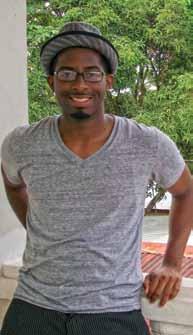
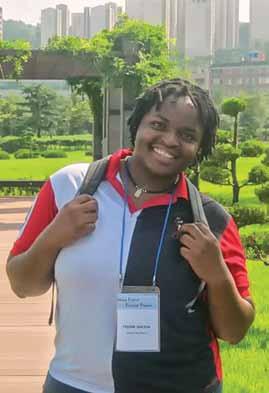
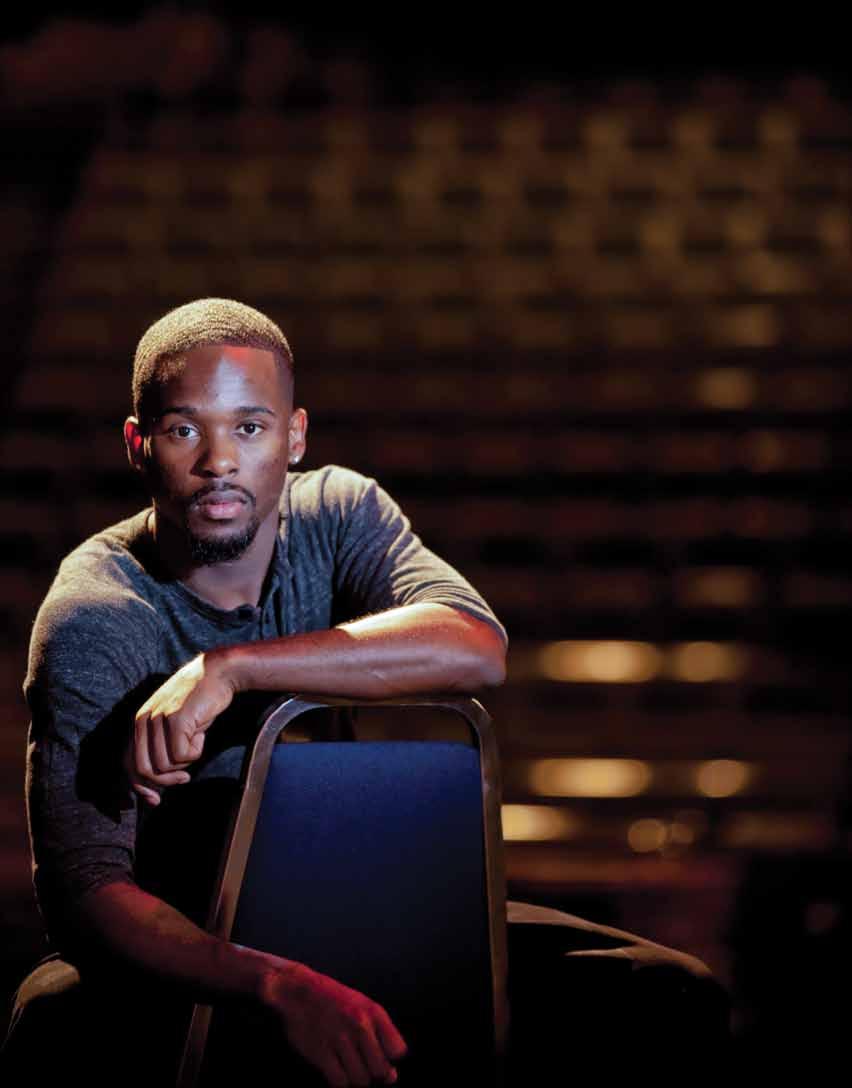
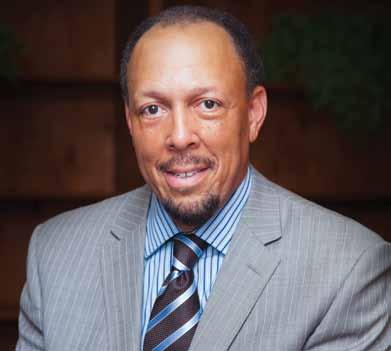
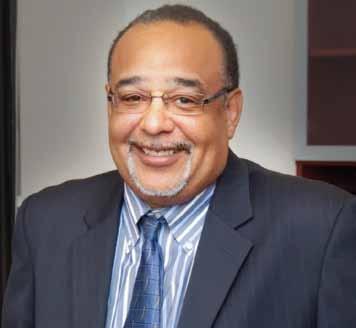
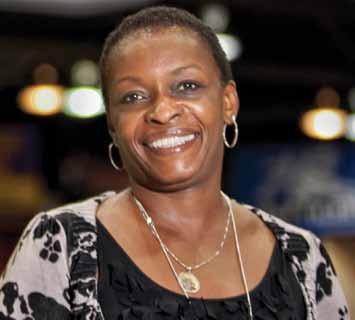
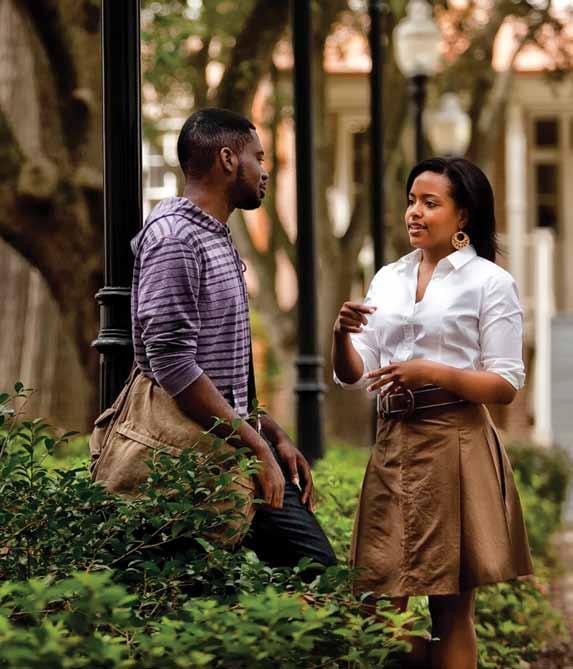
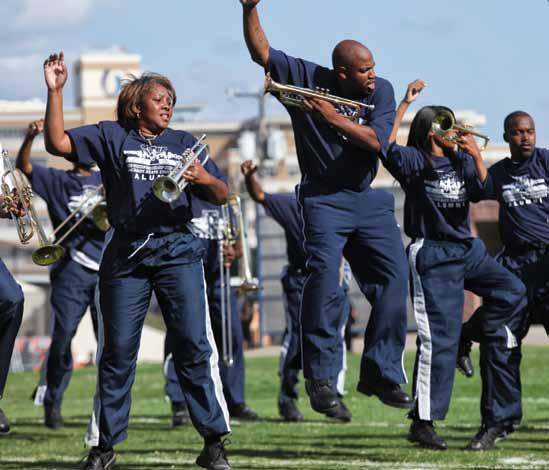
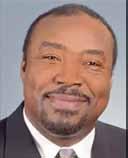
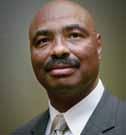
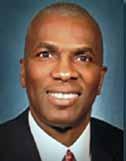
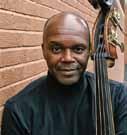
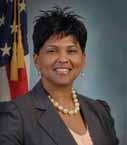
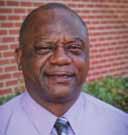
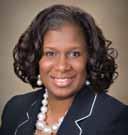
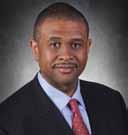
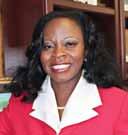
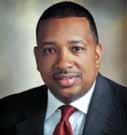
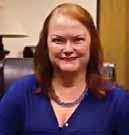
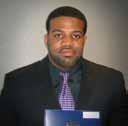
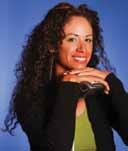
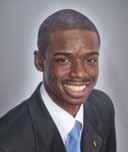
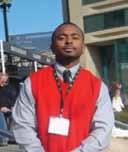
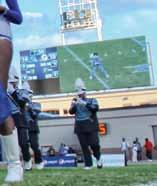
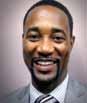
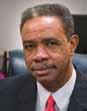
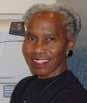
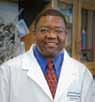
Seniors Saint Ranson and Chelsey Gladney overcome two very di erent obstacles with the help of JSU’s performing arts troupe MADDRAMA.
18) Researcher attacks cancer
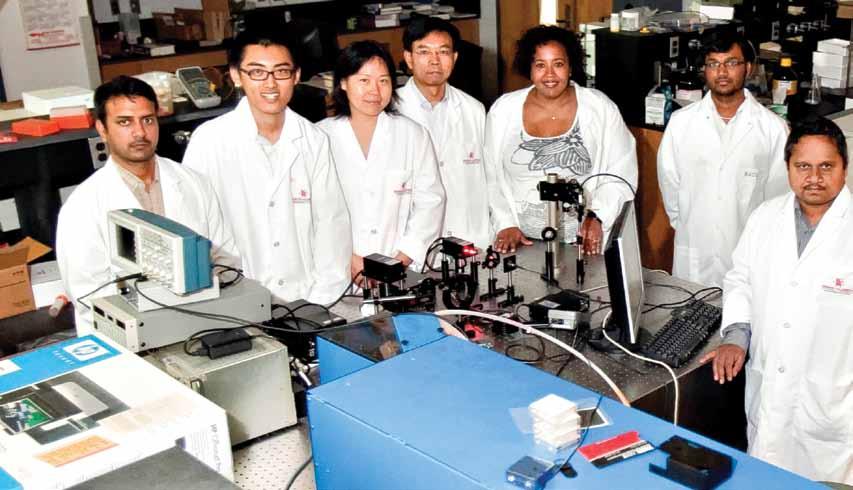
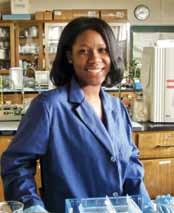
Chemistry and biochemistry professor Dr. Paresh Chandra Ray and his research team work on the early detection and killing of cancer cells and drug-resistant salmonella.
36) Freedom Riders mark historic
stand
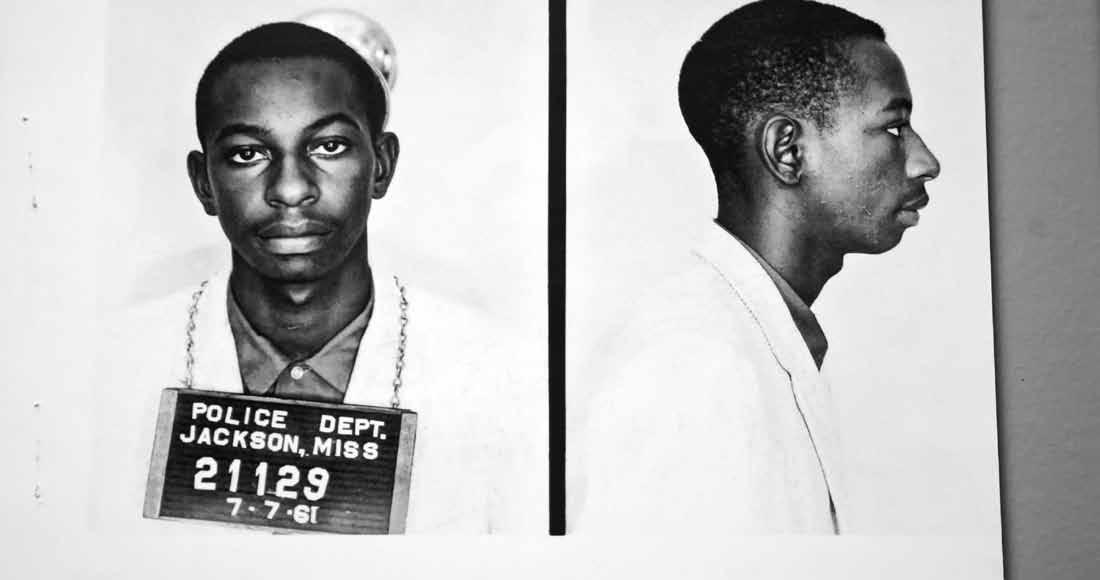
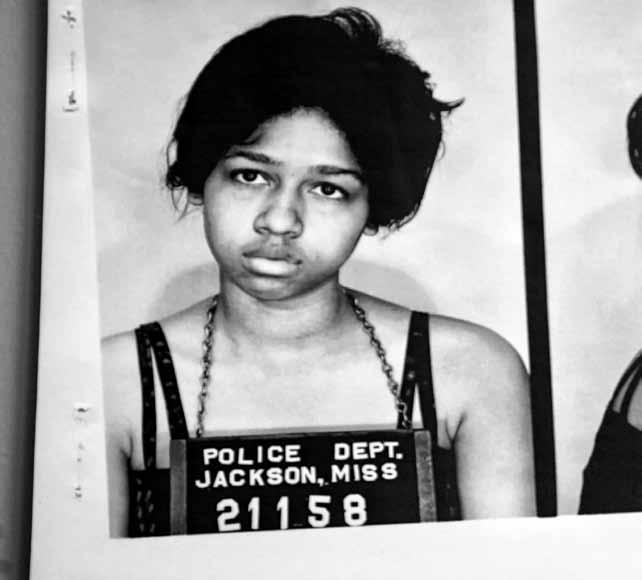
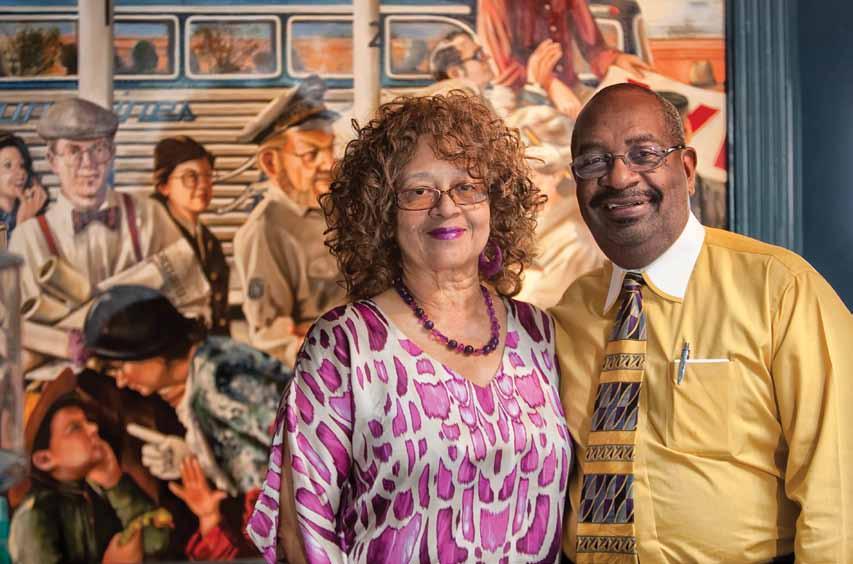
Freedom Riders Dolores Williams, a JSU alum, and Hezekiah Watkins, a university supporter, were arrested as teens for taking a stand for civil rights. e pair joins the 50th anniversary observance of the Freedom Rides in Jackson.
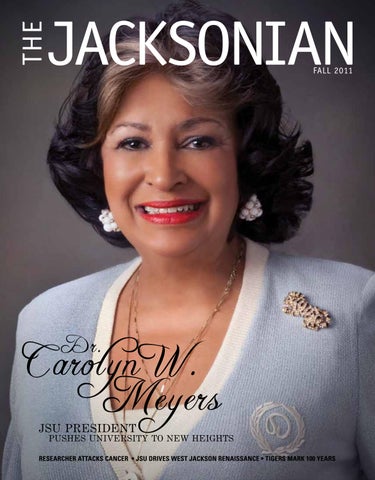
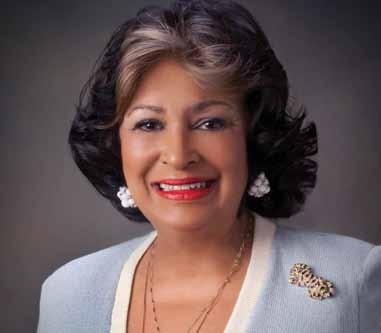
12) JSU President Carolyn W. Meyers pushes university to new heights
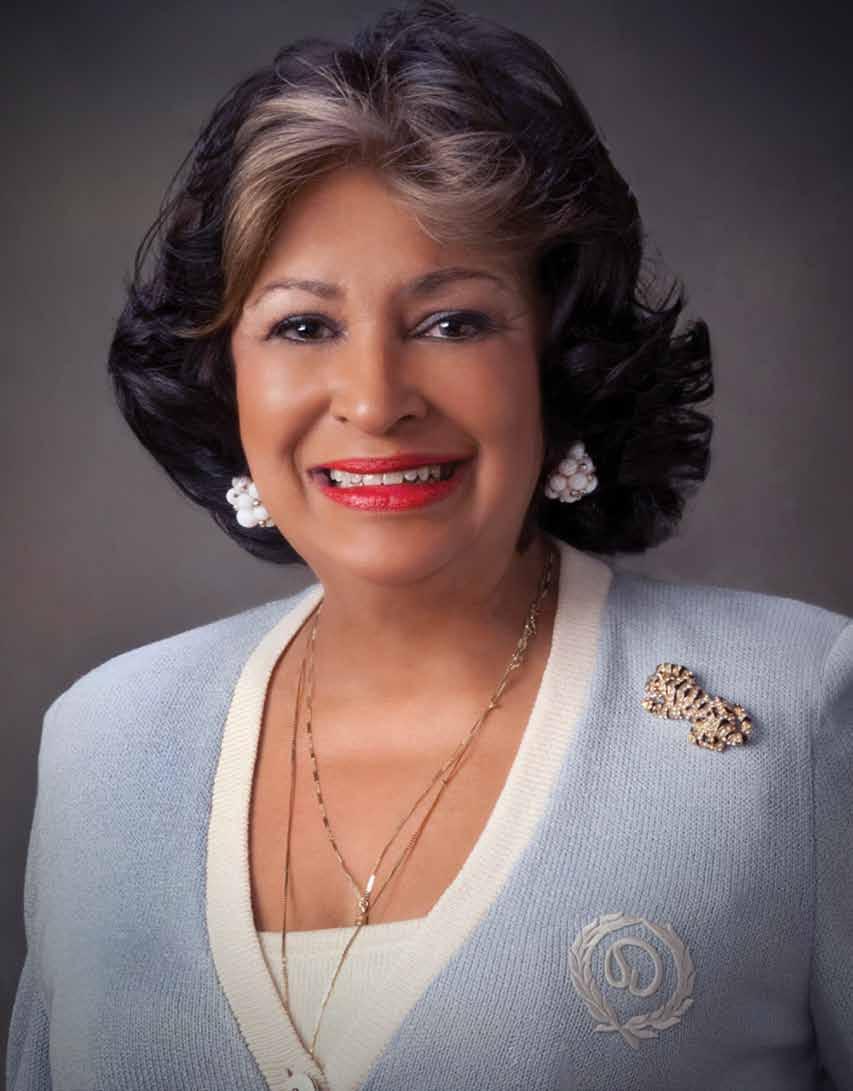
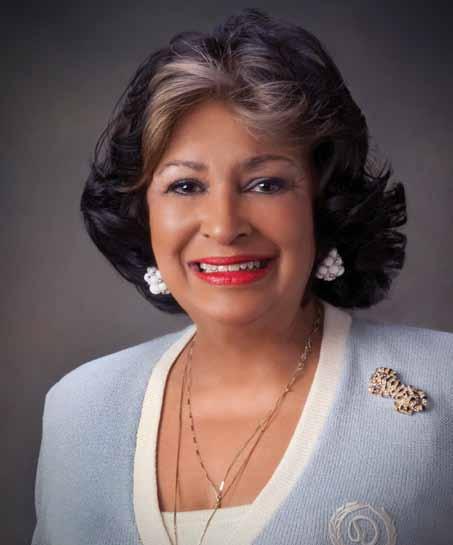
Jackson State University President Carolyn W. Meyers thinks big, thinks ahead and thinks in terms of numbers. is data-driven leader pushed JSU’s enrollment to an all-time high, increased fundraising more than tenfold and, despite a struggling economy, saved close to 100 university jobs. Now the president is moving forward with even more ambitious plans to secure Jackson State’s future as a top global university.
43) Spike Lee, Cornel West & Nikki Giovanni visit
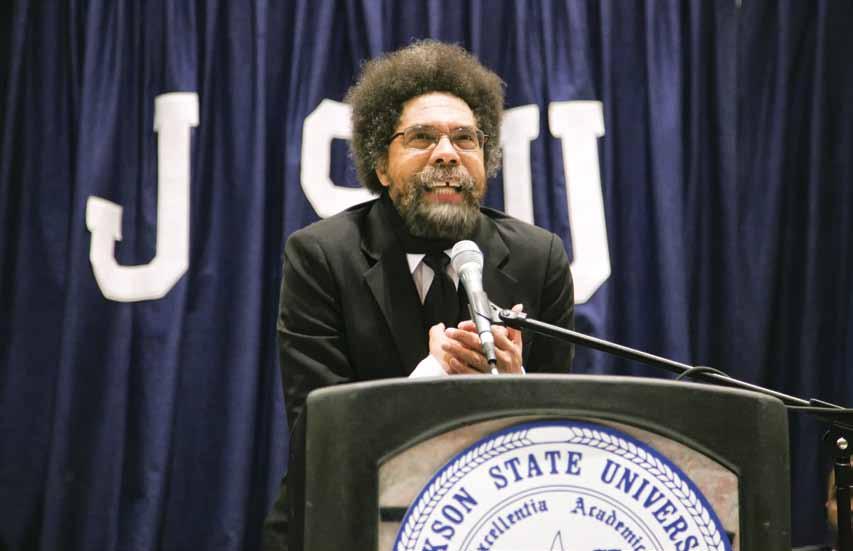
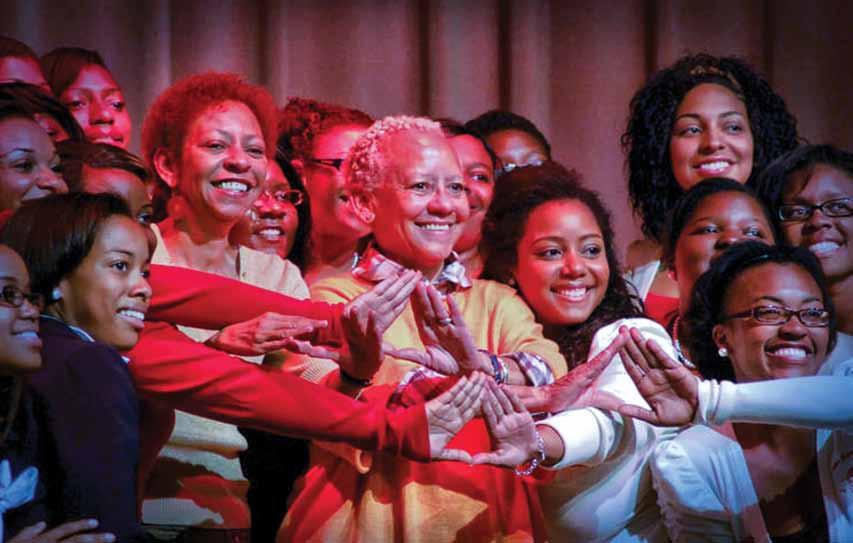
Jackson State welcomes three trailblazers from the world of the arts and academia – lmmaker Spike Lee, scholar Cornel West and poet Nikki Giovanni.
47) JSU celebrates 100 years of football
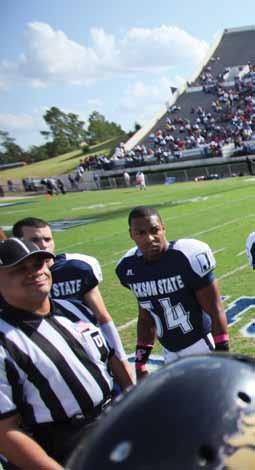
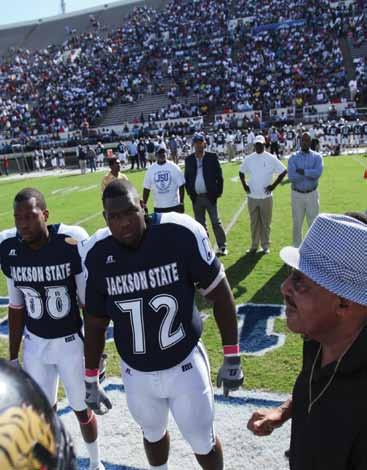
Jackson State celebrates its centennial football season with a winning homecoming game and tributes to former players and coaches.
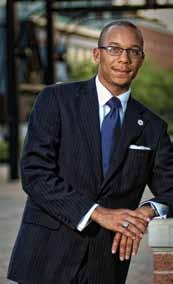
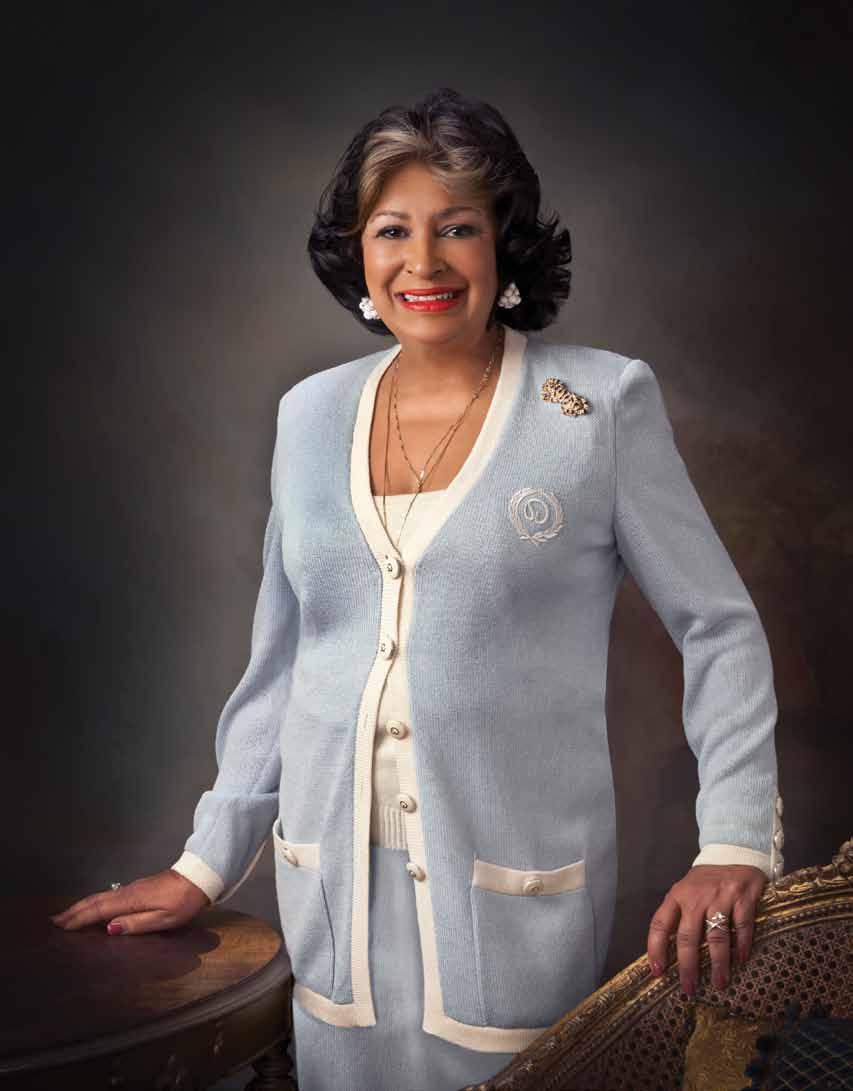
ON THE COVER: JSU President Carolyn W. Meyers
Photo by Marion & Silber Fine Portraiture
Dear Jacksonians,
Since my rst day as Jackson State University’s president, I have expected only the best from every student, faculty member and employee of this great institution. I have not been disappointed. ese are truly extraordinary times at Jackson State.
In this issue of e Jacksonian, you will read about outstanding students such as Miss Jackson State University Mea Ashley and Student Government Association President Matthew ompson, who both exemplify the best of our next generation of leaders. You will learn about the groundbreaking research that is happening at JSU, such as the work of chemistry and biochemistry professor Dr. Paresh Chandra Ray, who is using nanotechnology for an innovative system that detects and kills cancer cells without harming healthy cells in the process. You will also read about how Jackson State University is working in partnership with the community to revitalize West Jackson through such economic development projects as One University Place, which has brought new housing and businesses across the street from campus, and the WESToration initiative, which is helping restore our neighborhood to its past glory.
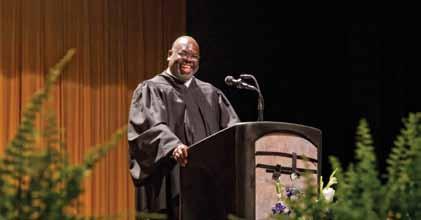
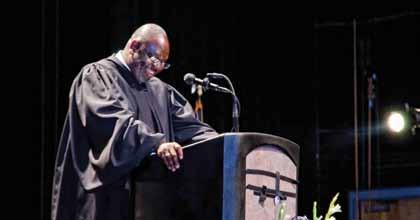
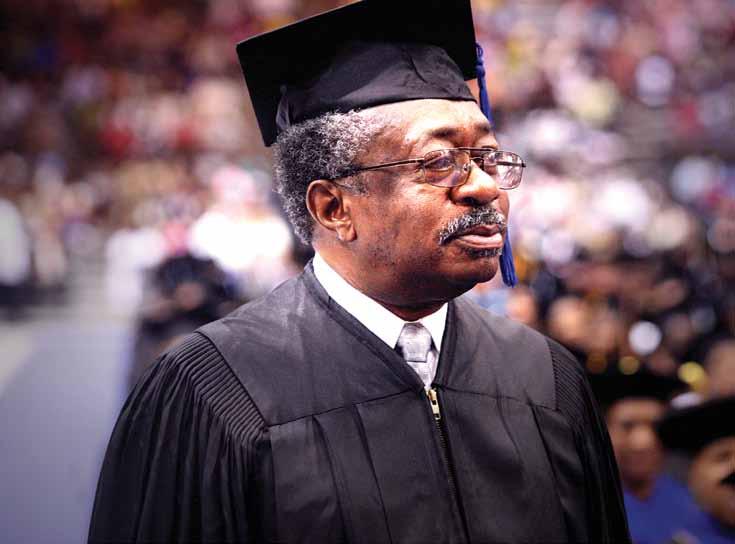
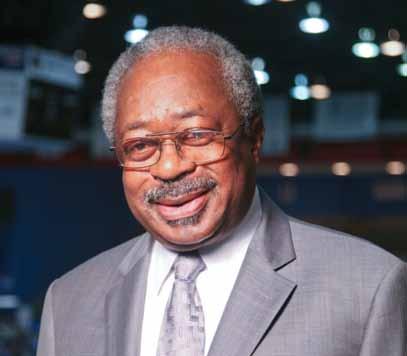
is magazine also celebrates the accomplishments and commitment of our alumni. You’ll meet Judge Walter Williams, JSU’s 1961 SGA president who was expelled from school before graduating because of his involvement in the civil rights movement. We invited Williams back to take part in our summer commencement so that he could nally receive his welldeserved Jackson State degree. You will also read about alumni who are putting their talent and education to excellent use as professionals, leaders and innovators.
Moving into the future, we have big plans for Jackson State. I hope you will stay engaged with the university as we embrace a new era through knowledge, technology and innovation and as we broaden our presence locally, nationally and globally. I invite all of you to join Jackson State University as we chart our next 134 years and beyond.
Sincerely,
Carolyn W. Meyers, Ph.D. President, Jackson State University
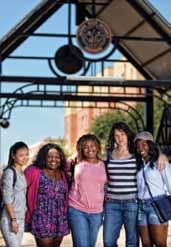
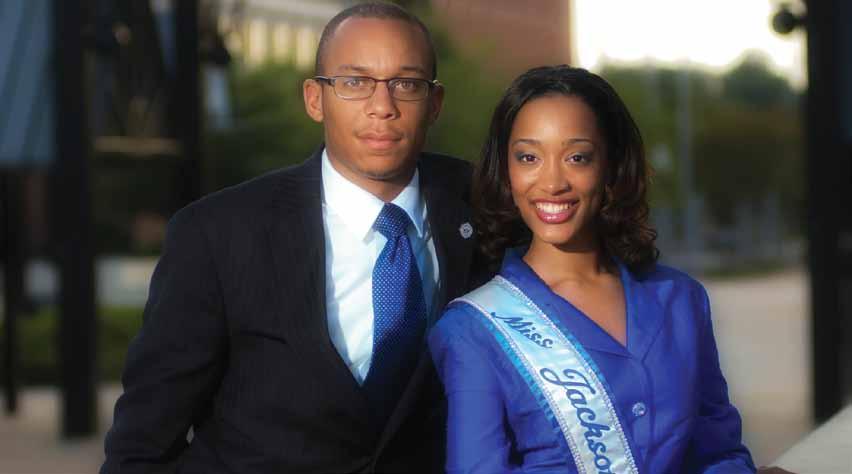
Jackson State University students elected two Jackson natives to lead the study body for the 2011-2012 academic year. Meet Miss JSU Mea Ashley, 21, a senior mass communications major, and Student Government Association President Matthew Thompson, 21, a senior accounting major.
BY JAMIE BENDER
Meet JSU’s 2011–2012 student leaders
Miss JSU Mea Ashley
Jacksonian: If you could live anywhere in the world for a year, where would you go?
Ashley: Spain. I’m a Spanish minor, and I would love to be able to speak Spanish uently one day. Surrounding yourself with a particular culture is the best way to learn more about it.
Jacksonian: If you could have a super power, what would it be?
Ashley: e ability to heal a broken heart. I’m such a romantic. I think love is a great gi from God, and broken heartedness is something I would never want anyone to go through – even though it does make great music!
Jacksonian: What’s the one piece of advice you’d give to everyone in the world?
Ashley: Remember when you were little and everyone used to say you could be anything you want to be, but as you got older you felt like there was little truth in that statement? Well, it is true. I’ve learned that as long as your goals are realistic, and you put in the work and stay determined, you can make it happen.
Jacksonian: What is the greatest lesson you’ve learned?
Ashley: To love like you’ve never been hurt. I say that because when you’re put in di erent positions and certain situations, people will turn on you. I’ve found that when you’re obedient to God’s word and let him take care of your enemies, then you will always be victorious in the end. God’s favor is amazing.
Jacksonian: How would you describe the perfect day?
Ashley: Since Sunday is my favorite day of the week, I’ll start with making it a Sunday. I’d put on a comfortable yet fashionable dress for church with a bad hat to match. en I’d go to church with my family. On a perfect day, we’d have breakfast in Sunday School and learn a lesson that I can really relate to and take with me for the rest of the week. And the same for the sermon, it would have to be on point, too. A er church I’d go to my grandmother’s house, have Sunday dinner and be in the good company of all my aunts, uncles, cousins and grandparents. A er dinner I would sit in the kitchen as a y on the wall and listen to my elders. I feel like I gain wisdom by hearing what they have to say about current events. ey can also be very funny. A er that I would rest and not worry about anything that will come tomorrow.
Jacksonian: If you could change one thing about the entire world, what would you change?
Ashley: I would erase hatred and bitterness. e world would be so much better o without it. I think it would make people just a little bit happier.
Jacksonian: If a genie granted you three wishes, what would you wish for?
Ashley: I would ask for peace, love and happiness. I know it sounds cliché, but I’ve actually written a prayer asking for those three things. It’s kind of like the serenity prayer, but with my own twist to it.
Jacksonian: What is one thing you really want to do before you die?
Ashley: Honestly, I know it’s not much, but I really want to raise a functional, loving family. I have had so much joy being raised in the family that I have, and that is something I really value. I know that there are many broken homes, and the sense of family is o en lost in our community, especially in black America.
SGA President Matthew ompson
Jacksonian: If you could live anywhere in the world for a year, where would you go?
ompson: I would love to live in either England or Italy. e reason behind living in England is because I am a huge soccer (futball) fan, and my favorite team is England’s Manchester United. Also, I have visited England and I like the feel of the country, and the standard of living would be the same as in the United States. I’d also choose Italy because I sometimes dream about owning a wine vineyard and living the simple life.
Jacksonian: If you could have a super power, what would it be?
ompson: e ability to see into the future. One thing that I believe in is that hindsight is the best sight. When you look back on the mistakes that you have made, you can make better judgments.
Jacksonian: What’s the one piece of advice you would give to everyone in the world?
ompson: at life is very short, so try to live each day to its fullest and do things that you want to do, not what others would like to see you do.
Jacksonian: What is the greatest lesson you’ve learned?
ompson: at you can never please everyone; therefore you should do what pleases you and what goes along with your beliefs and morals.
Jacksonian: How would you describe the perfect day?
ompson: My perfect day would be one that would start with a nice breakfast with co ee, then I would do some work – school work right now, my career work later down the road. A er work I’d go play some golf and end the day with a nice movie with my family.
Jacksonian: If you could change one thing about the entire world, what would you change?
ompson: e way people prejudge each other. People tend to judge people on outside things before they get to know the person.
Jacksonian: If a genie granted you three wishes, what would you wish for?
ompson: I would wish for a nice, successful and happy life. I would also wish that all of my loved ones would have the same thing. en I would wish for my dream car.
Jacksonian: Who was your favorite character as a child?
ompson: Woody from Toy Story. I always liked that Woody was a leader and always did what it took to keep his friends safe.
Jacksonian: What is one thing you really want to do before you die?
ompson: To build up my own real estate empire and be CEO of my own real estate company.
JSU S T UDENT S S T UDY, BLOG FROM AROUND THE WORLD
BY SPENCER MC C LENTY
Agrowing number of students are adding an international dimension to their education through Jackson State University’s many opportunities to study abroad. In fact, JSU leads other Historically Black Colleges or Universities with the number of domestic students who take part in such programs. During the summer, 57 JSU students studied in Nicaragua, China, South Korea and France, and they all blogged about their experience on the university’s website. Here are excerpts from some of their writings. To read their complete blogs, visit jsustudentsabroad.wordpress.com.
Justin Spencer, senior music education major
Blue elds, Nicaragua, May 26, 2011
Aer nally making it to Nicaragua, the Blue elds Indian & Caribbean University (BICU) shuttle bus carried us to La Casa de Protocolo, or the guesthouse, and we were stunned by its elegance among the poverty of the surrounding area. My room was the only room on the rst oor, next to the kitchen. It was almost like the Palisades with a tiled oor. It didn’t seem too bad, and I started to get somewhat settled.
Later, we le with our supervisor and toured BICU. We walked down the street and down a narrow sidewalk through a metal military-like gate on to the campus. is school is like JSU in a few ways to me. It is quickly progressing with construction and di erent programs; it provides a great learning environment for the students in Blueelds and it is bringing up the community by educating the youth and giving the smaller children an example and standard.
Witnessing this truly keeps my passion burning for education and also for civil engineering and politics. I’m a music education major, but recently I have opened my eyes to other elds as engines of positive change. is is part of the reason I wanted to get a wider view of the world by studying abroad.
I appreciate every opportunity to go on this trip. I will try to not take anything for granted while here and hopefully it will teach me not to do it back home either.
Tyeisha Walton, senior business administration major
Busan, South Korea, July 20, 2011
It has been two weeks since my arrival in Busan, South Korea, and I must say that I love it. I will be living in Busan for three weeks as a member of the Pukyong National University’s Cultural Exchange Program. Since meeting my student partner at the airport, Korea and its people have been very welcoming in every aspect.
is is my second international experience a er China, and there was still a question about if the initial experience would be the same. Although I had traveled to the Far East before, I still wondered whether I’d have culture shock, whether I’d like the people and they’d like me, and whether I’d like the food.
Since I’ve arrived I love it. I live on the 16th oor of the new student dormitory. I have a balcony with an immediate view of the famous Gwangan Bridge, right o the Haeudae Beach. My view each morning is absolutely stunning. Although the campus is very large, I am quickly getting used to where all of the buildings are. Because Korea has so many mountains and hills, Pukyong University is famous because its foundation is so at. My time here as been quite enjoyable so far, and I look forward to more great things to come.
Nicholas Hinton, junior computer
science major
Xi’an, China, July 26, 2011
This is a wonderful opportunity to take advantage of, going to another country where you can get to know the culture rst-hand and learn the foreign language in a totally immersed environment. As the saying goes, “If a person wants to learn 3,000 years of Chinese culture, he should visit Beijing; to learn 5,000 years of Chinese culture, he should visit Xi’an.”
e culture here in Xi’an is overwhelmingly rich, and the people are very friendly. I’ve met a lot of Chinese people who I can actually call my friends. I was homesick for an entire weekend, but soon as Monday came, I was in the mode for learning. Our teachers, Miss Wu and Miss Shi, are graduate students who major in teaching foreigners Chinese, and they are very dedicated to teaching us.
The Great Mosque of Xi’an. Photo credit: Blazej Mrozinski/ ickr Creative Commons
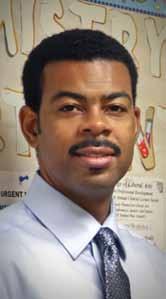
“When I started my college career, I just found people who made up for my father’s absence,” says JSU senior Saint Ranson. “ ere are always going to be people who are going to care about you. You just have to meet them.”
Senior speech communication and theatre major finds voice, family at JSU
BY LARISSA HALE
As a child in Clarksdale, Miss., Saint Ranson never felt at home. His mother’s drug habit caused her to move him and his three sisters from house to house. His father le when he was 4. He visited occasionally, sometimes bringing a dollar for a present. His extended family held the same low expectations they had for his mother, who died of a drug overdose during his rst year of junior college.
“ ey’d say, ‘He’s Mary’s child. He’s not going to amount to nothing,’ ” the JSU senior recalls.
Despite lack of family support, Ranson not only found a home at JSU, but the speech communication and theatre major distinguished himself this year by earning two top awards: a $5,000 Nido Qubien Scholarship from the National Speakers Association and a $4,000 urgood Marshall/Wells Fargo Scholarship.
“I prayed for a scholarship,” Ranson says of the Nido Qubien award, which is named a er the president of High Point University and chairman of Great Harvest Bread Company. e urgood Marshall/Wells Fargo Scholarship was awarded a er Ranson submitted a video interview that gave an in-depth look into his story of struggle and success.
Ranson says he found the ambition and motivation to succeed through the sanctuary he found at church and school. Starting at age 9, he played piano in church. In middle school, he became a drum major for the school band and joined several clubs. A er high school, he studied at Coahoma Community College in Clarksdale before enrolling at JSU.
“Before I got to JSU, I didn’t know myself,” he says.
During his rst year on campus, Ranson sought out an organization that would keep him grounded while giving him the opportunity to dance. He joined the performing arts troupe MADDRAMA (Making a Di erence Doing Respectful and Meaningful Art).
“I didn’t discover that I liked to speak and act until I got to MADDRAMA,” he says. “A er I joined, I changed my major from political science to speech.”
Ranson, on a mission to become a driving, positive force in other people’s lives, joined the NAACP, the Interfaith Gospel Choir and the student ambassador group Tiger P.R.I.D.E. Connection. He even started his own organization, Project LYTE (Leading Youth Toward Empowerment). All the while, Ranson served as president of Lambda Pi Eta Honor Society, maintaining a 3.7 grade point average. He also participated in the Ronald E. McNair Post-Baccalaureate Achievement Program and the National Communication Association.
“When I started my college career, I just found people who made up for my father’s absence, like Dr. Mark Henderson, who is head of the Department of Speech Communication and eatre,” Ranson says. “ ere are always going to be people who are going to care about you. You just have to meet them.”
e 22-year-old makes sense of his di cult past by always moving forward. He reconnected with his father about two years ago, has formed a good relationship with his extended family and is working on his applications to study theater at his top-choice graduate schools: Brown University, New York University and Northwestern University. His long-term goal is to teach.
“Right now I’m focusing on performance studies and motivational speaking,” he says. “I want to continue to serve people and youth. I don’t care if I’m in a shack, as long as I can get up there and teach.”
rough his journey, Ranson also has learned to embrace his name.
“When I was younger, I didn’t like my name,” he says. “Who would name a child Saint? Now I have to live up to my name. I started to love my name when I started to become my name.”
Business major survives near-fatal crash, heals with help from MADDRAMA friends
BY GINA P. CARTER-SIMMERS
Chelsey Gladney always knew she would attend Jackson State University as part of her family legacy. Her mother, father and sister are JSU graduates, and her younger brother is enrolled at the university. But her nearfatal collision with an 18-wheeler on Oct. 5, 2008, nearly derailed her plans to become another Gladney JSU alumnus.
e crash occurred on I-20 and Ellis Avenue in Jackson, when Gladney was a sophomore. Because of the pain medication she was administered, doctors expected her to have no memory of the accident. But Gladney says she has vivid recollections of that fateful day.
“I remember getting on I-20. I remember seeing the truck, watching him pass me and watching him come over on me. ey said I blacked out. But I remember fussing at the remen for not getting me out of my car quick enough,” she laughs. “A er that, I remember waking up in Augusta, Ga., where I spent four months.”
While at the Joseph M. Still Burn Center at Doctors Hospital, a national leader in burn research and treatment, Gladney was treated for third- and fourth-degree burns on nearly 50 percent of her body.
Gladney says her older sister told her doctors expected she would be paralyzed. She also discovered she was in one of the few rooms reserved for patients not expected to survive.
But Gladney wanted to live. “I didn’t want to die; I was only 19,” she says. “I had so much more to live for. I had to get a degree. I wanted to see my mom, father, sister and my brother. I didn’t want them to bury me.”
Gladney’s accident le portions of her skin scarred and necessitated a below-the-knee amputation on her le leg and an above-the-knee amputation on her right. Still, a little over a year later, Gladney was ready to return to school. e business major rst tried online classes but missed being in the classroom.
Once on campus, Gadney got involved with the per-
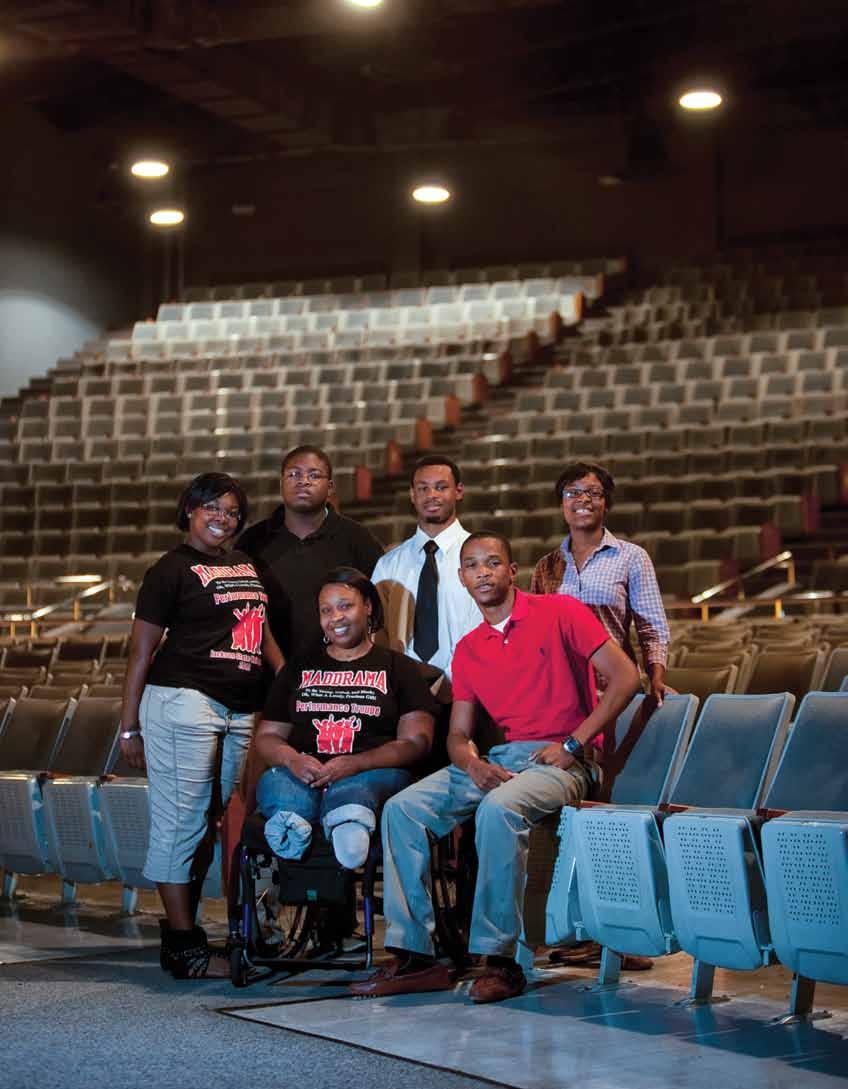
forming troupe MADDRAMA, a er a friend, who was also in an accident, invited her to join. Gladney works behind the scenes doing event promotions and in the box ofce. She says the troupe has become her second family and credits members with helping her heal emotionally.
“I was in the hospital in May 2011 for revision surgery on my right leg, and I got upset because I was in four days longer than I was supposed to be,” she says, “so I tweeted that I was tired of the hospital.”
MADDRAMA director Dr. Mark G. Henderson, who heads JSU’s Department of Speech Communication and eatre, received Gladney’s tweet and asked everyone in MADDRAMA to pray for her. Gladney says the responses she received were overwhelming.
“It made me feel so good to know that I had more than just my family and my friends that I had before the accident,” she says. “I had all these people out there who were praying for me and supporting me.”
ree years a er the accident, Gladney says she is doing better than even she expected. ough still wheelchair bound, she has been tted for prosthetics and hopes to be walking soon. “I don’t want anyone to feel sorry for me,” she says.
Now that she’s back on track to graduate, Gladney is considering whether to go to graduate school or take up paralegal studies at Hinds Community College. She hopes to assist other accident victims in legal matters.
Gladney says she usually has a positive attitude about her accident, but admits to having days when she’s mad at the world – especially when she observes reckless behavior. ough she describes herself as a cautious driver, she says she’s happy to use her experience to help others avoid her plight. She has even had the opportunity to talk with freshmen who have changed their driving habits as a result of her story.
“I feel like God is using me to help others avoid this tragedy,” she says. “God has a purpose for me.”
“I didn’t want to die; I was only 19,” says JSU senior Chelsey Gladney. “I had so much more to live for. I had to get a degree. I wanted to see my mom, father, sister and my brother. I didn’t want them to bury me.”
Senior business major Chelsey Gladney (seated, center) returned to JSU a year after a collision with an 18-wheeler. She credits the performing troupe MADDRAMA with helping her heal emotionally. She is pictured with MADDRAMA members Jacolby Adams (left), Rodney Steele, Dominique Ventris, Alexandria Jones and Department of Speech Communication and Theatre administrative assistant James Lehaman Jr.
JSU PRESIDENT PUSHES UNIVERSITY TO NEW HEIGHTS
BY JEAN GORDON COOK
ackson State University sta and faculty lled the Rose Embly McCoy Auditorium on a stormy winter morning in January for the start of the semester faculty and sta assembly eager to hear what JSU’s new president would say. For many in the audience, this would become their rst encounter with Dr. Carolyn W. Meyers, JSU’s 10th and rst permanent female president.
Most in the audience already knew a bit about the seasoned university leader – that she had been president of Norfolk State University, provost and vice chancellor for academic a airs at North Carolina A&T University, and had earned mechanical engineering and chemical engineering degrees from Howard University and the Georgia Institute of Technology.
But Jacksonians learned a few new, and important, things about Meyers on her rst day at JSU: she thinks big, she thinks ahead and – not surprising for an engineer – she thinks in terms of num-
bers. “Bring your conversations to me and bring your credible data along with it,” she told the assembly about her leadership style. “We will make decisions based on data, facts and gures.”
In many ways, Meyers’ success during her rst year as president can be measured in numbers. Fall enrollment has climbed to an all-time high of 8,903. Fundraising has increased more than tenfold from $287,000 in 2010 to $3.2 million this year. And though Meyers was told she would need to chop $10 million from JSU’s budget when she took over as leader, she saved close to 100 jobs while also nding funds for some long-overdue faculty raises.
Now Meyers is moving forward with even more ambitious plans to build student enrollment to 15,000, to raise another $1 million before her March 2012 inauguration and to expand the university’s capacity and reach with more faculty, technological innovations and a campus expansion into downtown Jackson and beyond. Her drive to
Inauguration activities for Dr. Carolyn W. Meyers will be held March 28-30, 2012.
Check updates on www.jsums.edu for a complete schedule of events.
build an even greater Jackson State follows the same charge she issued to Jacksonians during her rst address. “Assign yourselves a higher bar of excellence,” she said. “Remember what you did last year won’t be good enough for today and will be old by next year.” Meyers developed her ability to make things happen early on. As a teen growing up in Newport News, Va., in the 1960s, she forged ahead with plans to study engineering in college, despite the fact that her high school counselor told her she didn’t know any women or African-American engineers. As a young wife and mother of three, she didn’t let her thenhusband talk her out of starting graduate school a er she had supported him through dentistry school. In fact, she went to register the next day with her young children in tow. And when the college administrator whom she encountered a er waiting in a long line to sign up for classes told her to go back home and take care of her children, Meyers simply moved to a new line. “ at’s a classic Carolyn Meyers story,” says David Hoard, who worked with Meyers at North Carolina A&T and is now JSU’s vice president for institutional advancement. “She’s tough, smart and driven.”
Hoard says Meyers has a history of putting together outstanding leadership teams, providing direction and support, and expecting nothing short of excellence. Meyers assembled her team by promoting or retaining many JSU administrators and bringing in a
few new faces, including Hoard, former president of North Carolina A&T Dr. James C. Renick, athletics director Dr. Vivian L. Fuller and executive assistant Ruby Jayne Carlson. A er a nationwide search, she hired JSU’s most recent College of Science, Engineering and Technology dean Dr. Mark G. Hardy as provost and vice president for academic a airs.
“Dr. Meyers was very deliberate in her search for the provost,” Hardy says. “She took her time, which suggested to me that she wanted the very best person she could nd for the position. I’m humbled and honored that through that process I was selected to serve with Dr. Meyers. I’ve learned so much from her in just four months in the position.”
Meyers’ data-driven management style is just one facet of this engineer-turned-university leader. While she spends much of her 14-hour workdays pushing JSU to new heights, students remain her priority. She stops to chat with them at every opportunity and takes them on the road to help her represent the university. Like a proud mother, she relishes every opportunity to watch them showcase their talents in the classroom, on the playing eld, speaking before an audience or on stage. In speaking about JSU students, she o en says, “these are our future leaders.”
During her rst year at JSU, Meyers has focused on ensuring the university’s future by expanding fundraising e orts. She added development sta ,
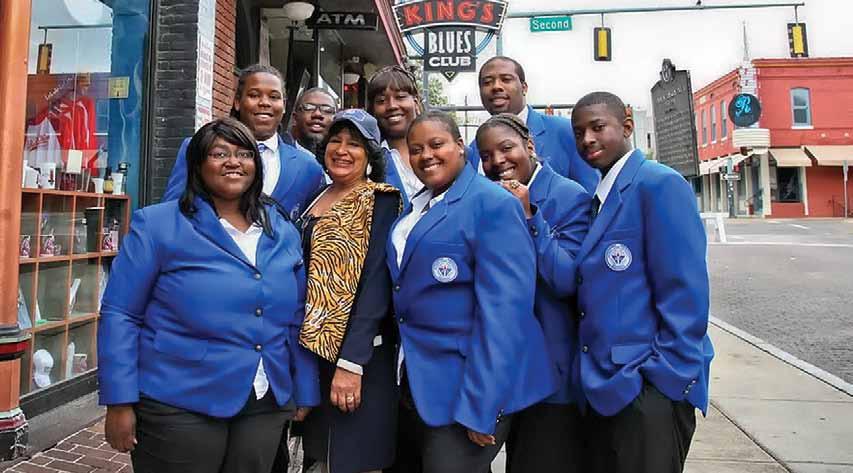
Dr. Carolyn W. Meyers invites members of the JSU student ambassador group Tiger P.R.I.D E. to join her on her tour of the region to get to know alumni and other supporters.
built alumni relationships through a statewide tour and showed her personal commitment to JSU by writing a check for $10,000 – a rare gesture for a president who is not a graduate of the university.
Another area Meyers targeted was enrollment management. Before the fall semester, her team led a campaign that reached out to close to 5,000 academically quali ed students who had “stopped out” before completing their degrees. anks to a strategic marketing e ort speci cally aimed at those students, Jackson State’s enrollment increased by nearly 3 percent over the previous year, and for the rst time in history topped 8,900.
Moving forward, Meyers has continued her emphasis on enrollment – as well as retention and graduation – by moving the recruitment o ce to a building that’s more accessible to the community and by appointing an Executive Enrollment Management Council chaired by the university provost. at group brings together professionals from recruitment, admissions, housing, nancial aid, academic a airs, marketing and institutional research among others to design and guide JSU’s e orts to attract, retain and graduate the best and brightest students. “Dr. Meyers is known for creating high-performing teams,” says Meyers’ senior advisor Dr. James C. Renick. “She’s visionary and strategic in her thought process.”
ose who work most closely with Meyers say that her plans are always connected and forward thinking.
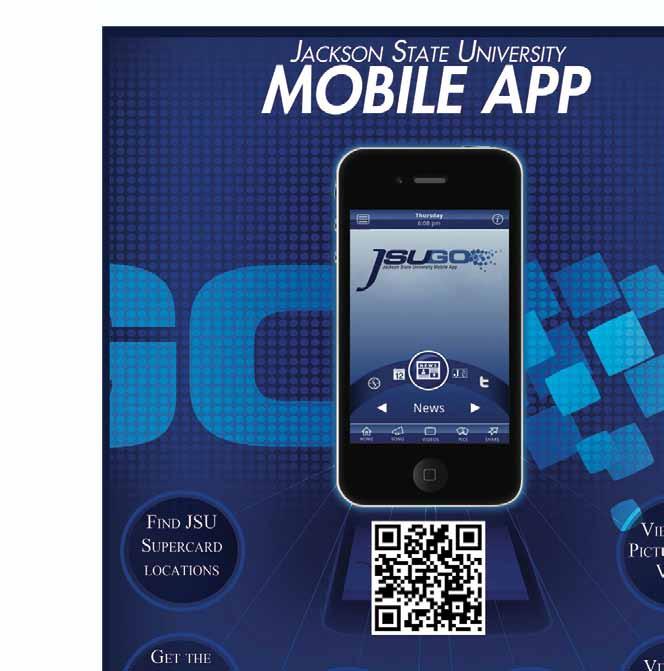
While it’s clear that the president values 21st century communications – she blogs, communicates via Facebook and is pushing for more online learning opportunities such as JSU’s new online M.B.A. program –she also understands how technology can propel JSU above its competitors. To put JSU in the palm of students’ and supporters’ hands, Meyers fast-tracked the creation of a new JSU mobile app for smart phones. Understanding that there’s only a small window of opportunity to grab the attention of prospective students, she’s investing a considerable amount of money in a major website resign and new branding and marketing campaign.
All of these strategies feed Meyers’ overall goal of securing JSU’s place as a national model for educating the underserved and achieving global recognition for excellence in education, research and service. “I’ve known Dr. Meyers for over 10 years, and she’s been consistent in driving for the best,” Hoard says. “Innovation is in her blood.”
Read Dr. Carolyn W. Meyers’ o cial biography at sites.jsums.edu/president/biography.
Read Dr. Carolyn W. Meyers’ remarks at the fall 2011 Faculty/Sta Seminar at www.jsums.edu/ announcements/8.11.2011speech.pdf.
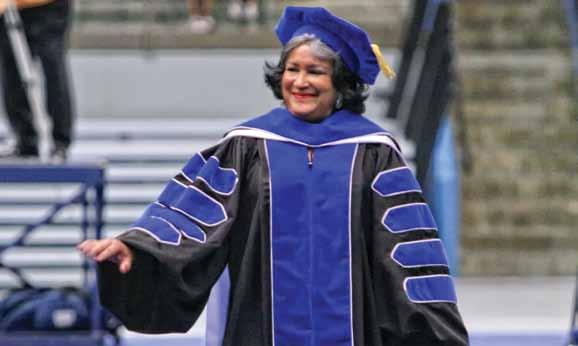
Dr. Carolyn W. Meyers delivers the commencement speech at the spring 2011 graduate ceremony. She shares some lessons learned from her early years as an educator and talks about the social responsibilities that come with having an advanced degree.
Meet the President’s New Cabinet Members
Dr. James C. Renick senior advisor to the president
Dr. James C. Renick joined President Meyers’ administration in July 2011 a er serving as senior advisor to the Central State University president from 2009 to 2011. Renick also served as senior vice president for programs and research at the American Council on Education from 2006 to 2009. Renick was president and professor at North Carolina A&T University from 1999 to 2006 and chancellor and professor at the University of Michigan-Dearborn from 1993 to 1999. Renick is a recognized leader in the area of university/business/industry relations and serves on numerous national boards and foundations, including the Presidential Board of Advisors on Historically Black Colleges and Universities. He earned a bachelor’s degree in sociology from Central State University in Ohio, a master’s degree of social work from the University of Kansas and a doctorate in public administration from Florida State University. He also received an honorary doctorate from Central State University in 2007.
Dr. Mark G. Hardy
provost and vice president for academic affairs
Dr. Mark G. Hardy is now in his 24th year at Jackson State University, having previously served as chair of the biology department, interim associate vice president of academic a airs and dean of the College of Science, Engineering and Technology. Hardy’s newest role became o cial in July 2011. In addition to his role as dean, Hardy served as director of the Research Initiative for Scienti c Enhancement (RISE) program, an initiative designed to increase the number of underrepresented minorities and women who seek to earn a Ph.D. in biomedical-related elds. Hardy earned a bachelor’s degree and a master’s degree in biology at JSU. He earned a doctorate in phycology from the University of Alabama. He is the second African-American male to graduate with the Ph.D. in phycology from U of A.
Dr. Vivian L. Fuller director of athletics
Dr. Vivian L. Fuller is the rst female to lead the university’s athletics program. She joined the Jackson State University team in August 2011 from Sojourner-Douglass College, where she served as dean of the college’s Cambridge, Md., campus. Before joining Sojourner-Douglass in 2003, Fuller spent more than a decade directing the athletics programs at the University of Maryland Eastern Shore, Tennessee State University and Northeastern Illinois University. Fuller is a nationally known expert on academic support programs for student-athletes, academic advising, women in sports and management and gender equity. She earned a bachelor’s degree in physical education from Fayetteville State University, a master’s of education from the University of Idaho and a doctorate in higher education administration from Iowa State University.
JSU Presidential Cabinet
Dr. Marcus Chanay vice president for student life
Dr. Vivian L. Fuller athletics director
Dr. Mark G. Hardy provost and vice president for academic affairs
David Hoard vice president for institutional advancement
David Hoard vice
president for institutional advancement
David Hoard has a 30-year background in fundraising at institutions of higher learning as well as nonpro ts, raising more than $250 million in his career. Before arriving at Jackson State University in August 2011, Hoard served as executive director of advancement at Savannah College of Art and Design for its four campuses in Savannah, Atlanta, LaCoste, France, and Hong Kong. He previously served as vice chancellor for the O ce of Development and University Relations at North Carolina A&T State University and is chief executive o cer of D.W. Hoard & Associates. Hoard holds a bachelor’s degree in history from Oberlin College. An in uential point in his life was the creation and leadership of the Rediscovery of the Underground Railroad Project at Oberlin College in 1980. As a student, Hoard wrote grants that allowed eight students to recreate a 420-mile slave escape through Kentucky and Ohio, following the path of the Underground Railroad.
Dr. Felix Okojie vice president for research and federal relations
Dr. James C. Renick senior advisor to the president
Michael Thomas vice president for business and nance
Robert Walker executive assistant to the president for community affairs and events
Read more about the Presidential Cabinet at www.jsums.edu/announcements/cabinet.pdf.
Dr. William E. McHenry executive director of the Mississippi e-Center @ JSU
Sandra Sellers executive director of human resources
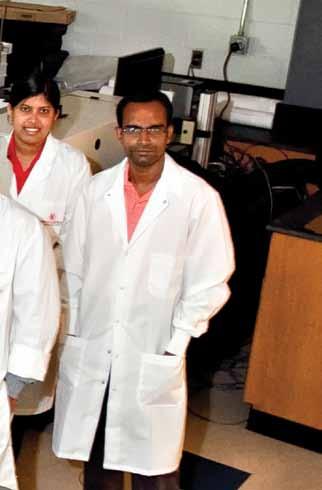
Dr. Paresh Chandra Ray (front, right) leads JSU’s Center for Nanoscience and Nanotechnology. His team includes research associate and physicist Dr. Anant K. Singh (left), chemistry and biochemistry doctoral students Zhen Fan, Xuemei Dai, Yao Ping Zhang, Teresa Demeritte, Rajashkhar Kanchanapally, Sadia Afrin Khan and research associate Dr. DulalSenapati.
Big in a tiny dimension JSU researcher attacks cancer with nanoparticles
BY JEAN GORDON COOK
At Dr. Paresh Chandra Ray’s lab in the E.E. Just Hall of Science, the chemistry and biochemistry professor and his research team are working on the early detection and killing of cancer cells and drug-resistant salmonella.
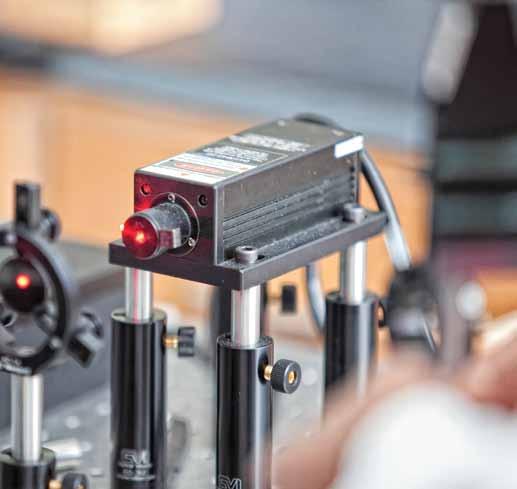
Using nanotechnology, Ray has developed his own weapon: a photothermal therapy system using gold, popcorn-shaped nanoparticles that are 1 million times smaller than an ant. e laser system tracks down and kills cancer cells and multi-drugresistant bacteria.
“ is not only kills the cells, but during the killing we can monitor whether the therapy works or not,” says Ray, who directs Jackson State University’s Center for Nanoscience and Nanotechnology.
With his ndings published in numerous scienti c journals this year, Ray and his team have been working to keep ahead of the rapid developments in nanotechnology. Over the past decade, the growing
eld has made advances in everything from drugs to cosmetics to electronics.
Because Ray’s method kills cancer cells without harming healthy cells in the process, his work paves the way for researchers to develop a cancer treatment without the harsh side e ects of chemotherapy and radiation. So far his photothermal therapy system has proven e ective in the lab killing prostate cancer cells, breast cancer cells, skin cancer cells and liver cancer cells. e method has also been the rst to use gold nanoparticles to target and kill multiple-drug-resistant salmonella bacteria DT104.
To further his research, Ray has teamed with Penn State University, which is testing his method on mice. e next phase will test on monkeys.
“In eight to 10 years we hope to have human trials,” Ray says. “In 15 years, nanotechnology will be very useful for cancer treatment.”
Jackson State is among the growing number of
universities in the United States that over the past decade have established centers devoted to nanoscience and nanotechnology. Nanoscience is the study of nanoparticles, which are so small that 100,000 make up the width of one strand of hair. Nanotechnology applies these extremely small particles for uses in chemistry, biology, physics, materials science and engineering. Nanotechnologies are having a huge impact on agriculture, medicine, consumer products and the environment and are expected to generate $2.4 trillion in global revenue by 2015.
e JSU Center for Nanoscience and Nanotechnology trains students and enables researchers to collaborate. Ray’s team created a system that uses gold nanoparticles that can detect and kill as few as 50 malignant cancer cells. Once bound to the cancer cells, the nanoparticles absorb light and convert it to heat, which then kills the tumor cells.
What’s novel about Ray’s work is that the process produces an optical signal as the cells die, which allows researchers to monitor the cells’ response to the thermal therapy.
To test the system, Ray’s researchers rst grow cancer cells in their molecular biology lab across the street in the John A. Peoples Science Building. e researchers then carefully carry the cells, which are contained in a plastic tray the size of a paperback
book, to Ray’s nanotechnology lab in the E.E. Just Hall of Science. Using equipment that resembles an erector set and costs less than $1,000, Ray exposes the cells to an intense laser. As the light hits the cells, data about their reaction to the heat are fed into a computer, which monitors the progress of their death.
e photothermal system Ray created also works on multi-drug-resistant Salmonella bacteria. In 2011, salmonella found in ground turkey, alfalfa sprouts and cantaloupe caused illnesses in more than half of U.S. states. e contaminated ground turkey caused at least one death.
Ray’s team has proven that its laser system using gold nanoparticles can kill salmonella bacteria on Romaine lettuce, which shows how e ective the system can be in providing rapid, on-site screening in food samples.
Scientists around the world are using nanotechnology to develop cancer treatments, targeted drug delivery systems and ways to kill pathogens in food. ere’s intense competition among researchers to move their discoveries to market.
“ ere is a huge amount of nanotechnology going on,” says Ray, who’s been presenting his work around the country. “Jackson State is among the key institutions in the United States doing this work.”
Chemistry professor Dr. Paresh Chandra Ray developed a laser system that detects and kills cancer cells without harming healthy cells. His work paves the way for cancer treatment without the harsh side effects of chemotherapy and radiation.
Art Department makes its home in new Johnson Hall
The JSU Department of Art got a spectacular new home when it moved into the rebuilt Johnson Hall at the start of the year. e 30,000-square-foot structure features a state-ofthe-art Mac lab, ceramic studio, art gallery, photo darkroom and art studios ooded with natural light from windows and skylights. e building is appointed with wood paneling, rough granite ooring and a grand staircase with glass in ll panels. e original mural from the old Johnson Hall has been reproduced for display in the lobby. e new Johnson Hall also houses an emergency operations center in the basement, which has dedicated phone lines and computer connections that can be used in the event of an emergency.
"Andrew" by JSU art professor Dr. Chalmers W. Mayers Jr. is exhibited in the Johnson Hall art gallery.
Graphic design professor Jimmy Mumford (right) works with senior graphic design major Charles McQueen in the new computer lab.
Jackson State receives accolades, accreditations
As JSU continued its tradition of academic excellence, service and responsibility throughout 2011, a number of accrediting bodies and rating groups have given the university high marks.
is year’s highlights:
• JSU is one of 11 U.S. institutions of higher learning named to the 2010 President’s Higher Education Community Service Honor Roll. JSU is the only Mississippi institution and the only Historically Black College or University named this year.
• Washington Monthly magazine ranks JSU among the top 10 colleges and universities in the nation for social mobility, research and service. Coming in ninth among 258 institutions, JSU outranked Princeton, Yale and Howard. JSU is the only Historically Black College or University to break into Washington Monthly’s top 10.
• Diverse Issues in Higher Education ranks JSU’s physical sciences master’s programs No. 2 in the country for educating African Americans. JSU also earns the No. 2 spot for educating African-American teachers, continuing its ve-year run of ranking either No. 1 or No. 2 in this category.
• JSU hosts a successful site visit from the Southern Association of Colleges and Schools and earns rea rmation of accreditation for the next 10 years.
• e accrediting body for the National Association of Schools of Public A airs and Administration issues a seven-year reaccreditation for JSU’s Masters of Public Policy and Administration program.
• e JSU Department of Mass Communications is reaccredited by the Accrediting Council on Education in Journalism and Mass Communications.
• e JSU Department of School, Community and Rehabilitation Counseling is accredited by the Council for Accreditation of Counseling and Related Educational Programs.
JSU collaborates with Mississippi universities to boost number of minority scientists and engineers
BY JEAN GORDON COOK
Dr. Angela Fortner McKoy hadn’t planned on studying chemistry until a Jackson State University professor steered her toward the subject during a JSU summer bridge program. “I started o as a music major,” the Jackson native says. “But one of my chemistry teachers from the summer said, ‘You need to be a chemistry major. You’re good at this, and everyone is not.’ ”
His advice paid o . McKoy found out she enjoyed chemistry so much that she earned a master’s from JSU within one year of completing a bachelor’s degree. Armed with her degrees, McKoy went on to Princeton University, where she completed a Ph.D. this summer. Today she is a postdoctoral researcher at Rutgers University working on creating treatments for AIDS.
“When I was in school I was interested in drug
design and how it worked,” she says. “I thought medicine was wonderful and that you should cure everything.”
At JSU, McKoy found mentors through participation in the Louis Stokes Mississippi Alliance for Minority Participation (LSMAMP), which is made up of eight institutions of higher learning in Mississippi. Launched in 1991, the consortium is part of a national e ort to increase the number of minority students earning undergraduate degrees in the elds of science, technology, engineering or mathematics (STEM), in which minorities have long been underrepresented.
McKoy says the lack of minorities in her eld is evident. “It’s pretty homogenous,” she says about her colleagues, most of whom are white males. “I never see any African Americans.”
Dr. Angela Fortner McKoy returned to JSU as a guest lecturer after earning a Ph.D. in chemistry from Princeton University. She says the research experience and support from JSU prepared her well for Princeton.
Angela Fortner McKoy while a student at JSU.
When the LSMAMP consortium formed 20 years ago, no one could have predicted the impact it would have on increasing diversity in STEM professions. anks to the alliance, the number of minorities with STEM degrees from Mississippi schools has soared to 9,058. e rise is an increase of 106 percent since the start of the program and more than double the rate of nonminority STEM students, whose ranks grew by 42 percent during the same period.
Funded by the National Science Foundation, LSMAMP aims to boost the number of minority Ph.D.s in STEM elds, particularly those in faculty positions. So far, the results have been striking. Since 1991, the number of minorities who earned STEM doctorates in Mississippi has increased sixfold from ve to 36.
“Our programs are diversifying STEM professions in Mississippi and throughout the country,” says Dr. Abdul K. Mohamed, LSMAMP project director and dean emeritus of JSU’s College of Science, Engineering and Technology. “We take bright, motivated students and give them the support to succeed throughout their undergraduate studies and beyond.”
Led by JSU, the LSMAMP consortium includes Alcorn State University, Mississippi State University, Mississippi Valley University, the University of Mississippi, the University of Southern Mississippi, Tougaloo College and Hinds Community College. e mix of Historically Black Colleges or Universities, majoritywhite universities and one community college ensures that the program reaches minority students at a range of academic levels.
“It was historical for Mississippi to get all of these white and black institutions to work together,” Mohamed says. “ ere’s been a coordinated e ort at each institution.”
e LSMAMP model includes collaborative learning, skill development, mentoring, academic enrichment and summer activities. Each alliance institution holds summer bridge programs for incoming freshman STEM majors, and they partner with businesses, government agencies, laboratories and professional organizations to connect students to internships, research projects and conferences.
Students have studied abroad or presented at conferences in Germany, France, Portugal, South Africa, Costa Rica, Japan, Sweden, Guatemala and Belize, and LSMAMP has partnered with institutions in China, Taiwan, Poland and India.
“ e LSMAMP program has given the opportunity to study, perform research and travel
internationally to so many students who might otherwise not been unable to do so,” says JSU President Carolyn W. Meyers. “ is building up of global thinkers over the last 20 years is an accomplishment to be celebrated and continued.”
A er earning their degrees, LSMAMP scholars may apply to the Bridge to the Doctorate Program based at JSU. rough this National Science Foundation-supported program, students get funding for their rst two years of graduate school at JSU and receive mentoring, research experience, and access to conferences and top scientists and engineers. e Bridge program also helps students secure funding for their chosen doctoral programs.
To date, 94 students have participated in the Bridge program, and 50 completed the coursework needed to join Ph.D. programs. e scholars are pursuing doctorates at 24 di erent institutions including Carnegie Mellon University, the Georgia Institute of Technology, Howard University, the University of Mississippi Medical Center and Vanderbilt University.
e LSMAMP program also has produced graduates who are mentoring the next generation of minority STEM scholars. Michigan native Dr. Ashton Hamme, an associate professor of chemistry at Jackson State, earned his undergraduate degree at JSU through LSMAMP and is now coprincipal investigator of the program.
“Being in academia is the best of both worlds,” says Hamme, who co-invented more than 10 patents at Monsanto/Pharmacia before returning to JSU to teach. “I have the opportunity to lead programs related to my own research while also teaching some of America’s brightest students.”
Each alliance school has contributed to LSMAMP’s success by increasing the number of minority STEM students since 1991. While HBCUs built upon their track record of educating minorities, majority-white institutions showed the most dramatic increases.
Leading the consortium in its rate of growth is the University of Mississippi, which increased its STEM enrollment from 15 to 322 – a 2,047 percent gain – and graduates from nine to 45 – a 400 percent gain.
“One of the rst things the program did was to bring people together who had not been working together before, from the presidential level to the student level,” says Dr. Don Cole, LSMAMP site coordinator at the University of Mississippi. “ at pretty much infused the STEM culture focusing on minorities into every sector of our university.”
JSU chemistry professor Dr. Ashton Hamme earned his undergraduate degree at JSU through the Louis Stokes Mississippi Alliance for Minority Participation. He is now co-principal investigator of the program.
“Interfacing every day with students helps energize me and helps energize our organization,” says IMS CEO and JSU business professor Dr. John D. Calhoun. “ at is what I think entrepreneurs and corporate people should be about – going back into the classroom. at’s what IMS is about.”
CEO shares real-world lessons Business professor
BY SPENCER MCCLENTY
Dr. John D. Calhoun’s road to becoming a millionaire entrepreneur has not been easy. For several years, he and business partner Rod L. Hill struggled to get even the simplest of commodities for the Jackson consulting company they started in 1996.
“Rod and I once went to a local furniture store, but the sales people assumed, correctly, that we had very little money,” says Calhoun, whose company, IMS Engineers, provides engineering, emergency response, technical, management and operations services. “ ey pointed us to the third oor, the attic, where the used furniture was located. At that time we had to buy the third- oor furniture, but we knew one day we would be able to a ord the good furniture.”
Fast-forward 15 years, IMS is an award-winning, multimillion-dollar rm that employs nearly 200 people in nine o ces in cities including Baltimore, New Orleans and Memphis. Calhoun, who is chief executive o cer, also shares his business experience with JSU students as a professor in the College of Business.
“What better way is there of engaging students,” Calhoun says, “than to have a professor who’s actually teaching what he’s living every day.”
Calhoun rejoined JSU’s faculty in 2009 (he taught in the College of Business from 1996 to 1998) a er a breakfast meeting with Dr. Mary White, founding chair of the college’s Department of Entrepreneurship.
“I knew that John loved JSU,” says White, who spearheaded the creation of the bachelor’s degree in entrepreneurship in 2005. “At the time, we were seeking entrepreneurship faculty with a doctorate degree, success as an entrepreneur and college teaching experience in business. John has all of those.”
Calhoun’s role as a successful CEO has given him a high level of credibility. “Everything he
teaches he practices,” says Nicholas Ross, 22, a senior entrepreneurship major from Florence, Miss. “He teaches us that you have to be dedicated, determined and have a will to succeed.”
IMS has received numerous recognitions and awards under Calhoun and Hill’s guidance, including multiple awards from Inc. Magazine for being one of the 500 fastest-growing businesses in the United States.
Calhoun also has been singled out for recognition. In March, the U.S. Small Business Administration named him the 2011 Mississippi Small Business Person of the Year. A month later, President Barack Obama invited Calhoun to the White House to be honored as one of 18 national “Champions of Change” in business. e initiative highlights Americans who are making an impact in their communities and helping the country meet the challenges of the 21st century.
“It’s a great honor to be recognized for our entrepreneurial spirit,” Calhoun says. “I think people look at us because IMS is able to continue to grow during these bad economic times. e recession hasn’t a ected us. I think we’ve been wise – good stewards of our resources.”
A er many years of being both a CEO and JSU business professor, Calhoun has learned and taught many lessons. His early experience at the furniture store was a lesson learned. Now though, Calhoun and Hill no longer purchase used furniture from an attic. eir Jackson headquarters, which takes up all three oors of a renovated hardware store in the Farish Street Historic District, looks like it was furnished by a top interior designer.
From his spacious top- oor o ce with exposed brick and polished hardwood oors, Calhoun sits in a leather chair as he recalls the furniture store where he once shopped.
“We don’t go to them anymore,” he says. “ ey come to us.”
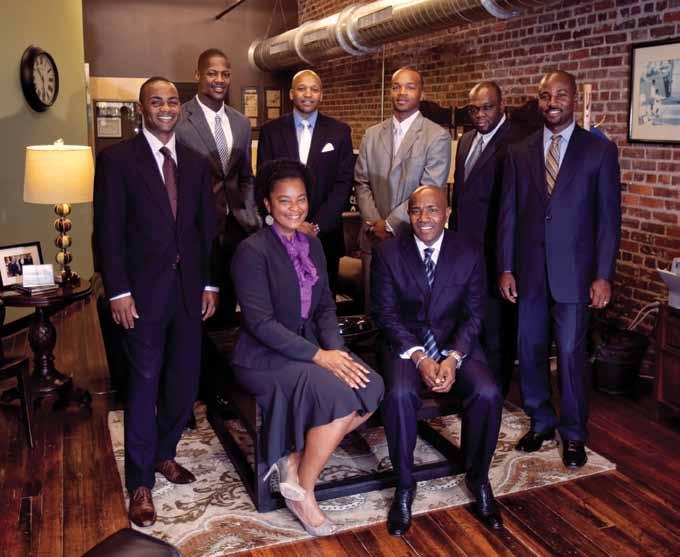
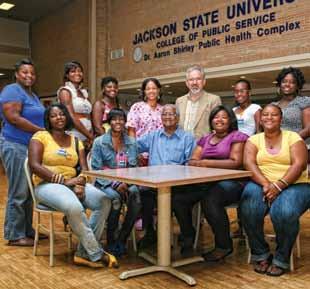
Over the past 15 years, JSU business professor Dr. John D. Calhoun (front, seated) has helped his engineering consulting company, IMS Engineers, grow into a multimilliondollar business. He is pictured in the company’s Jackson headquarters with IMS chief scal of cer Tanya Hadley (seated), president and chief operating of cer Rod L. Hill, P.E. (standing, left), executive assistant to the CEO Jonathan Stokes, director of marketing Robert (Bo) Crear II, executive assistant to the CEO Devin Jones, corporate vice president of engineering Tommy J. Avant, P.E., and vice president of nance and administration Derrick Cannon.
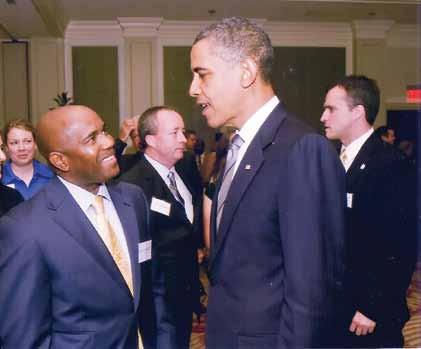
President Barack Obama named JSU business professor and IMS CEO Dr. John D. Calhoun as one of 18 “Champions of Change” in business.
DECORATED
war veteran
PREPARES NEXT GENERATION OF MILITARY LEADERS THROUGH JSU ’S ROTC PROGRAM
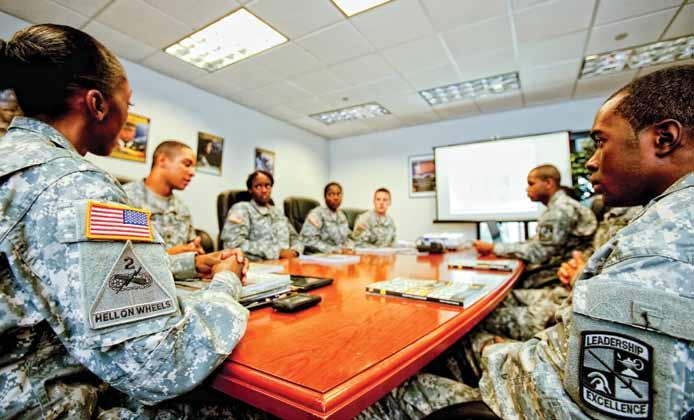
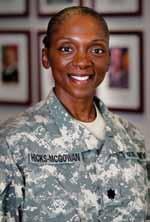
To some people, Army Lt. Col. Jennifer Hicks-McGowan may not t the picture of a decorated veteran of not one, but two, wars. e married mother of two stands just shy of 5-foot-4 with a slim frame, and her youthful face at times gets her mistaken for one of the cadets she commands.
But the U.S. Army soldier-turned-o cer has served her country for almost 25 years – during which she survived deployments in both Iraq wars, Operation Desert Storm and Operation Iraqi Freedom. Hicks-McGowan now leads Jackson State University’s Army Reserve Ocers’ Training Corps – or ROTC – unit, where
she is training future o cers for the 21st century battle eld. “It’s exciting to be part of the number of men and women who have proudly served their country during wartime,” says Hicks-McGowan, whose uniform bears a patch that says “Hell on Wheels.”
“ rough my service, I am thankful that I have had the opportunity to set foot in a part of our nation’s history and lived to tell about it.”
A Texas native, Hicks-McGowan enlisted in the U.S. Army in 1987 along with her identical twin, Vanessa Hicks-Callaway. As two of seven children, the pair knew they would need help paying for college. e sisters moved from the
JSU ROTC Commander
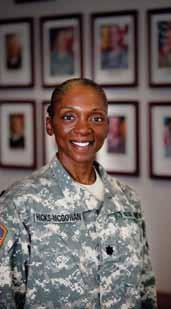
Lt. Col. Jennifer HicksMcGowan (left) is a veteran of both Iraqi wars. The unit she led during her most recent deployment earned the name “Hell on Wheels.”
BY JEAN GORDON COOK
Lt. Col. Jennifer Hicks-McGowan
enlisted ranks into the Army ROTC program at Sam Houston State University, where both earned Distinguished Military Graduate honors. e twins have since been promoted together throughout their military careers, all the way from privates up to lieutenant colonel. “I earned my degree and my commission as an active duty Army o cer, and my travels started again,” Hicks-McGowan says. e 44-year-old says her rst deployment experience in the Middle East, where she served as a supply sergeant, helped her during her second deployment as an o cer. “Having enlisted experience gave me such an advantage,” she says. “My enlisted experience allowed me my rst opportunity to serve as a follower and a real leader in the Army.”
Twelve years later, Hicks-McGowan, now married with two children, found herself deployed to Kuwait on the anniversary of Operation Desert Storm. ough she wondered about the likelihood of surviving two wars, she felt con dent about her training and the people in her unit.
During her second tour in the Middle East, Hicks-McGowan worked as the programs and policies o cer in charge of resources that keep up soldiers’ morale such as the Armed Forces Exchange stores, Internet cafes and Army Continuing Education programs. She also was in charge of U.S.O. entertainment programs, which included coordinating visits to the Middle East from actors such as Arnold Schwarzenegger, Robert DeNiro and Gary Sinise and a number of professional basketball players. “Instead of expecting us to be thrilled to meet them, the entertainers treated us as if they were honored to meet us,” Hicks-McGowan says.
Now at Jackson State, Hicks-McGowan is the highest-ranking active duty military o cer on campus. Along with serving as the commander of the Jackson State University Tiger Battalion, she is the Professor of Military Science and the chair of the Department of Military Science. “My entire career groomed me to be a professor of military science,” says Hicks-McGowan, who earned a Master of Public Policy and Administration from JSU and is pursuing her Ph.D. in public policy at the university. “It took a lifetime for me to get to this position.”
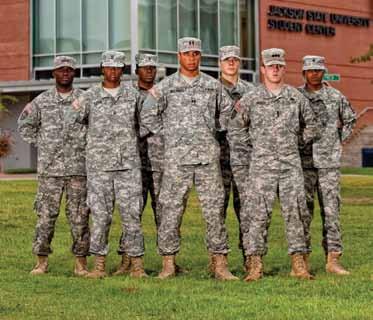
JSU is the host school for Army ROTC programs at all colleges and universities in Jackson and at others in the region. Together, some 150 cadets are enrolled, and at least 17 graduates a year are commissioned as Army o cers. Hicks-McGowan says the selective program looks for students with the qualities of a scholar, athlete and leader. Students must maintain at least a 3.2 grade point av-
erage to qualify for a commission into the active Army force. “If they are successful, they can write their own ticket to the Army, Army Reserves or Army National Guard,” Hicks-McGowan says.
Cadet battalion commander Fabian McCaskill spent more than ve years in the Army National Guard before joining JSU’s ROTC program. e 25-year-old senior entrepreneurship major says he signed up for the program because it helps pay his tuition and provides training for a military career. e Grenada, Miss., native says he appreciates Hicks-McGowan’s leadership style. “She pretty much tries to take the background and let us get as much experience as we need,” he says.
ough Hicks-McGowan is McCaskill’s rst female commander, the o cer-in-training says gender is not an issue. “With any commander, there’s still that authority and respect,” he says. “To get to that level, you have to have certain characteristics.”
Hicks-McGowan admits that being a woman in the military has its challenges, but she chooses to focus on her skills and abilities. She says she’s been able to ourish in her career thanks to the support of her husband Evangelist, who cared for their children, now 13 and 16, during her deployment, and whose job as a medical technologist has been in demand wherever she’s been stationed. “I’ve never used my status as a female to get special treatment,” she says. “I am a soldier and an Army o cer and I want to be treated that way.”
Read Lt. Col. Jennifer Hicks-McGowan’s ocial biography at www.jsums.edu/announcements/ hicksmcgowan.bio.pdf.
JSU ROTC cadets Schmidt Belleus (back row, left), Marquise Oliver, James Lamoreaux, Shdell Ford, Tawayatha Evans (front row, left), Fabian McCaskill and Andrew Roach.
Political science professor mentors students, earns national award
BY SPENCER MCCLENTY
Dr. Byron D’Andra Orey stepped to the podium at the the 2011 meeting of the National Conference of Black Political Scientists in Raleigh, N.C., a er winning the prized Jewel Limar Prestage Mentorship Award and said, “I always nd it fascinating that someone is rewarded for doing his job.”
Since 1999, “doing his job” has garnered Orey more than 17 awards, grants or fellowships and has gotten him invitations to present at Yale University, Washington University, New York University and Oxford University, among other schools.
e Prestage award recognizes political science professors who demonstrate the same spirit of mentoring as Prestage, the rst African-American woman to earn a Ph.D. in political science.
“I was humbled and proud because this award is named a er a living legend in the area of mentorship,” says Orey, 45, professor and chair of the JSU Department of Political Science. “Dr. Prestage received her Ph.D. at the age of 22 and worked at Southern University and Prairie View University. Despite her successes, Dr. Prestage remained at an HBCU. I have committed myself to follow in her footsteps by giving my services back to an HBCU.”
Orey’s friend and colleague Dr. Kathie Golden, director of international programs and professor of political science at Mississippi Valley State University, nominated him for the award.
“I nominated Dr. Orey because of his commitment to HBCUs and to providing students with hands-on research opportunities,” Golden says. “He provides the kind of mentoring that can make a sig -
ni cant contribution to increasing the number of African Americans with graduate degrees in political science.”
Closing in on four years as a JSU professor, Orey, a Jackson native, encourages students to pursue internships, participate in community service and mentor middle school students. Many of Orey’s students present papers with him at national conferences.
“Mentoring is extremely important to me because I think it’s the one thing that I lacked as a graduate student,” Orey says. “I recall seeing an article that indicated that mentorship was one of the most important variables in explaining Ph.D. completion. My adviser ensured that I wrote an excellent dissertation; however, he didn’t provide much information about presenting at conferences or submitting papers for publication. Hence, I have made every e ort to co-author and present papers at conferences with students and junior faculty.”
Orey, who graduated from college in the midst of a bleak economy in 1988, took a job as a car saleman. He learned the meaning of true mentorship, he says, from his mother. Tired of watching her son struggle on the car lot, Orey’s mother picked him up from work one day, and, instead of taking him home, dropped him o in front of the University of Mississippi. “You’re going back to school,” she told him.
By 1999, Orey had earned two master’s degrees, a doctorate degree and had published his rst paper.
“I have to give credit to my mom for where I am,” Orey says. “Without her, I would have still been selling cars.”
Department of Political Science chair Dr. Byron
D’Andra Orey (right) earned the Jewel Limar Prestage Mentorship Award in 2011 for his commitment to mentoring.
Alum sworn in to the federal
bench at Jackson State University
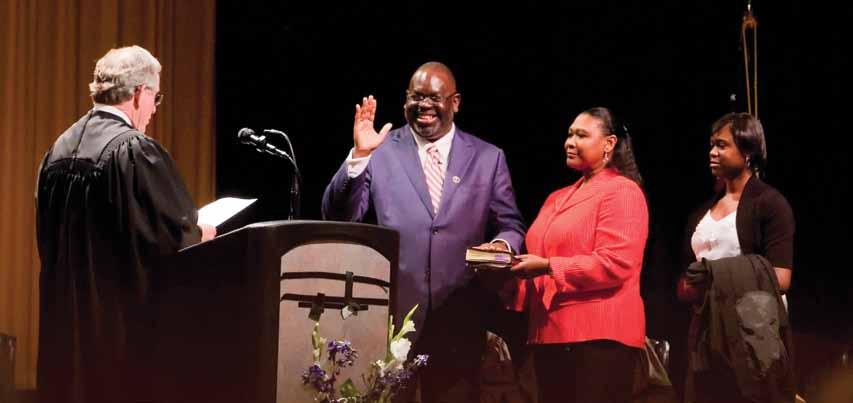
Jackson State 1986 magna cum laude graduate Carlton Reeves chose his alma mater as the site of his investiture ceremony to become a U.S. district judge. Family, friends and supporters lled the Rose Embly McCoy Auditorium in April to witness the Yazoo City, Miss., native become the rst African-American federal judge in Mississippi since 1985, when President Ronald Regan nominated Judge Henry T. Wingate. Senior District Judge William H. Barbour Jr., also from Yazoo City, administered the oath of o ce.
Judge receives degree after nearly 50 years
BY TOMMIEA P. KING
In the fall of 1961, Walter Williams walked onto Jackson State College’s campus prepared for his senior year. Little did he know that he would not receive his degree until 50 years later, in 2011.
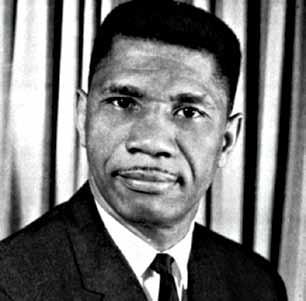
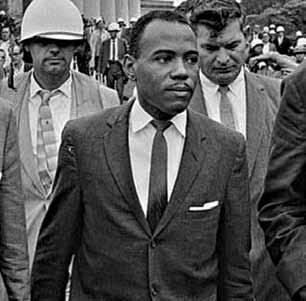
Judge Walter Williams credits civil rights trailblazers Medgar Evers, James Meredith and Supreme Court Justice Thurgood Marshall with shaping his activism and career.
Williams had been very active in college. As president of the Student Government Association during his junior year, the Yazoo City, Miss., native was responsible for a number of student activities. Subsequently, it was quite natural for the political science major to become involved in the civil rights movement and lead the college’s unofcial chapter of the NAACP. One fall day, students joined a protest alongside Tougaloo College students trying to integrate the local library.
“We were marching to show support for them,” says Williams, now 72. “It was probably all the members of the SGA, and there were maybe 200 of us. At some point, dogs were unleashed and students scattered. ey were hiding in folks’ backyards, under porches … But we felt this is what we had to do.”
Shortly therea er, Williams says he got called to the college president’s ofce and was asked to leave the campus immediately. He’d been suspended for his involvement in civil right activities.
ough he didn’t get to graduate with the class of 1962, Williams did continue his education. He completed his juris doctorate in 1970 at Chicago’s John Marshall Law School and is now a circuit court judge for Cook County, Ill.
Joined by his wife Maxine, a member of JSU’s class of 1963, his daughter and grandchildren, Williams returned to campus on Aug. 6, 2011, to receive his bachelor’s degree.
“ is is important to me because this is my school,” says Williams, who explained that his abrupt departure never soured his attitude toward JSU. “I’ve been very active in the alumni association since day one. I was even president of the Chicago chapter for a while.”
ough Williams’ undergraduate experience was cut short, those few years on the Lynch Street campus le him with stories perfect for the history books.
Medgar, Meredith and Marshall
It was a casual meeting with Mississippi’s NAACP eld secretary Medgar Evers that cemented Williams’ civil rights involvement.
“I met Medgar when I came to Jackson,” Williams says. “My uncle owned a cleaners right on the corner of Lynch and Dalton. Medgar used to come by often. My uncle introduced us. From there on it just started our relationship.”
It led to Williams and many of his classmates spending much of their time at the Masonic Lodge near campus that then housed the NAACP state o ces. It was there that he also met the late Supreme Court Justice urgood Marshall.
“I was so proud of him,” Williams says. “He’d won that Brown vs. the Board of Education case. He’d done a lot for civil rights.”
With Marshall as his inspiration, Williams completed law school and practiced criminal law for 16 years.
James Meredith was a student at Jackson State before enrolling at the University of Mississippi. Williams remembers his classmate’s drive to integrate that institution.
“Meredith had already applied on his own,” Williams says. “He was going to go with or without NAACP’s help. When he found out that I knew Medgar, he asked if I would introduce the two.”
Awarding Williams a degree was in the best interest of Jackson State, even if it was 49 years late, says former interim president Dr. Leslie Burl McLemore, who worked to ensure that Williams got his undergraduate degree. “I think it was outstanding and says a lot about the university and Judge Williams. It is ironic, but this is real justice.”
Medgar Evers
James Meredith
on the move :
O NE P O E T, O NE S C I EN TIST
BY MONICA ATKINS
or most college seniors, the excitement of getting cleared for graduation, ordering a cap and gown, and anticipating the big walk across stage at commencement are some of the most rewarding parts of the college experience.
In the case of Tori “Scarlette” ompson, graduating was not merely an accomplishment, but an illustration of the lessons learned through her years at JSU.
“Jackson State taught me the value of organization, punctuality and taught me to be self-sucient,” says the 23-year-old, who graduated in the spring of 2011 with a degree in music education.
One month before getting her diploma, ompson proved her self-su ciency by publishing her rst book of poetry and songs, Scarlette’s Letters e collection includes 60 poems and songs.
“I was always exposed to literature in my household,” ompson says. “In grade school I was the only person who got an A on all types of poetry genre assignments. A er that I said, ‘I like poetry. is is fun.’ ”
e Toledo, Ohio, native, who is known as Scarlette in the spoken word realm, says her love of poetry grew a er her rst year of college. She realized her writing notebook was extensive and her voice deserved to be heard.
“I wanted to start a new organization that supported poets, orators, dancers, DJs, artists, and anyone with any type of creative bone in their body,” the magna cum laude graduate says.
During her sophomore year, ompson organized and chartered a poetry society that gave voice to artists across campus. e group is called OutSpoken and now claims 40 members.
“OutSpoken has given a voice to the voiceless and inspiration where it was needed,” says Kentrice Rush, a 21-year-old marketing major and current president of OutSpoken. “It only exists because of Tori’s vision.”
While at JSU, ompson says she had the support of her boyfriend – whom she later married – her mother and her adviser, C Leigh McInnis.
“Ms. ompson was very independent and driven, and I could tell she was reading and studying because she was growing as a writer,” says McInnis, a JSU instructor and OutSpoken adviser.
It was not long before ompson began her publishing quest. A er entering her rst poem in a competition, ompson became a semi- nalist, but was not accepted into the publication.
“ e second time I sent something I was published, so that encouraged me to keep writing,” ompson says.
Independently selling 175 copies, the selfpublished author has toured the Midwest with her husband to promote her book.
ompson is currently a music teacher at Washington Elementary School in Glendale, Ariz.
“I’m a storyteller, so I hope that I can get my book to enough people so that everyone who reads it can identify with at least one story,” ompson says.
or 22-year-old alumnus Ezana Demisse, the JSU chemistry department was not only the best, but it prepared him for one of the biggest ventures of his life: Harvard Medical School.
e 2011 summa cum laude graduate started work this fall toward his Ph.D. in immunology with an emphasis on infectious diseases.
As an immunologist, Demissie plans to work on developing treatments for HIV and AIDS. He hopes his research will encompass work in North America and Africa.
A er spending three summers as a research intern at Harvard, Demisse realized that the Ivy League school was a perfect t. He felt prepared, he says, because he had been taught by some of JSU’s best chemistry professors.
“Professors gave us one-on-one attention on a daily basis, and that is something you do not get anywhere but JSU,” the Ethiopian native says.
Putting nothing before academics, Demisse says he stayed motivated by recognizing that people from his homeland were not often a orded the same opportunity.
“I realized how many people would kill to be in my place,” says Demisse, who earned a full scholarship to study chemistry at JSU after graduating from the Piney Woods School in central Mississippi.
At JSU, Demisse was recognized as the best chemistry student from 2007 to 2011 and earned the title of best graduating College of Science, Engineering and Technology student in 2011.
“Considering how talented my classmates were, I am actually surprised by the awards I have won,” Demisse says.
roughout his years at JSU, Demisse also tutored his peers in organic chemistry, calculus and physics.
“If someone was smart enough to put it in a book, I knew I was smart enough to thoroughly understand and master it,” he says.
Demisse credits JSU associate professor of chemistry Dr. Glake Hill for his ongoing support.
“Dr. Glake Hill was the best mentor,” Demisse says. “He was there to answer questions I had about anything and he was more like a father gure than professor.”
Hill says Demisse is more than just a good student.
“He is somebody who is not just a quality student, but he is a great young man,” Hill says. “I admire that about him more than his intelligence.”
ough Demisse felt academically prepared for Harvard, he still had some apprehension.
“When I got my acceptance letter it was hard to describe,” he says. “I had immense excitement with a hint of trepidation because I knew I would be venturing outside my comfort zone. I think that is a natural feeling.”
Still, Demisse says encouragement from his family and classmates and his professor’s support gave him the feeling he could change the world with enough e ort.
“Persevere, nothing is out of reach as you are closer than you think,” he says.
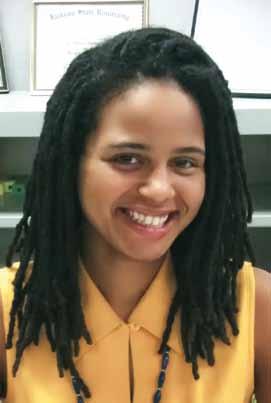
Tori Thompson
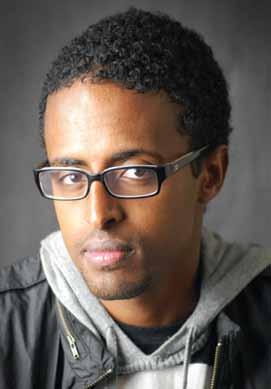
Ezana Demisse
FREEDOM RIDERS
mark 50th anniversary of historic protest
BY L.A. WARREN
Freedom Rider Dolores Williams wept while watching the blockbuster lm e Help because it reminded her of the brutal era when she was arrested at age 15 for trying to integrate public transportation.
Williams, a 1973 graduate of Jackson State University, was incarcerated with 11 others for 11 days a er authorities stormed the old Trailways bus station in downtown Jackson, where blacks gathered on July 9, 1961, to protest inequities. e police aimed to crack down on those who refused to assemble on the “colored” side or leave the bus station.
“ ey put us in a black paddy wagon,” says Williams, a former educator for Jackson Public Schools.
“I was not afraid initially, but when I think about it, they could have taken us o and killed us.” Williams was charged with disturbing the peace and breach of peace and was given a one-year curfew and probation.
While in jail, her parents were not allowed to visit.
Observers nationwide marked the 50th anniver-
sary of the Freedom Rides in May in Jackson, which included dedicating a historical marker outside the old Greyhound bus station. e observance made national news when Mississippi Gov. Haley Barbour apologized for the Riders’ mistreatment and thanked them for their courage and sacri ce.
Williams’ life changed that day in July when she told her parents she was going to church. Instead, the usually obedient teen went to the bus station. “ ere was a lot of wrong going on,” she says. “I just wanted to make something right.”
Williams says she wanted to pave a way for people to ride buses, planes and trains and to attend any university or library. At the time, the only public library accessible to blacks was on Mill Street, and higher education was limited to Alcorn State, Jackson State, Mississippi Valley State and Tougaloo College.
Other protesters, such as Hezekiah Watkins, who has a long association with JSU as a Tiger sports supporter and local business owner, were sent to the Mis-
Dolores Williams Hezekiah Watkins
sissippi State Penitentiary in Parchman. Watkins was arrested at age 13 a er trying to glimpse a Freedom Rider during a Masonic Temple meeting that encouraged local participation. A er the gathering, he and friends sought a closer view by darting across Lamar Street to the Greyhound station. Police cornered the junior high school student, asking for identi cation and place of birth. He told an o cer he was born in Milwaukee, not mentioning he’d been living in Jackson most of his life and had no recollection of his birthplace.
“ e o cer assumed I was a Freedom Rider since most were from another state,” Watkins says. “I was placed in a paddy wagon and taken to Parchman.”
Watkins was just cells away from hardened criminals and the execution chamber. “Inmates assumed that I must have raped a white woman or killed a white man,” he says. “ ey would not believe that I was put in Parchman just because I entered the Greyhound bus station.”
At Parchman, Watkins was spit on, cursed at and beaten severely. Five decades later, he still su ers from post-traumatic stress syndrome and headaches that
seem to linger forever.
But today, Watkins is admired for helping bring equality to travel.
Williams knows that her part in the Freedom Rides – as well as participation from whites from other states who were also arrested – helped bring about real change. Her grandchild is an honor student at the University of Mississippi, the same institution that sparked rioting in 1962 when James Meredith became the rst black student to enroll. And she proudly boasts of her four successful daughters, some of whom attended Mississippi State University and Mississippi College.
Sitting inside the old Greyhound building today, which now houses an architectural rm, Williams urges young people to value education and learn the history of Freedom Riders and other civil rights activists.
“Pioneers such as Dr. Martin Luther King Jr., Medgar Evers and lesser-known activists died unceremoniously so everyone could live with equality and justice for all,” she says.
Dolores Williams and Hezekiah Watkins were young teenagers when they were arrested for trying to integrate public transportation.
JSU HELPS TO RESTORE
TO ITS PAST GLORY
BY CURNIS UPKINS III
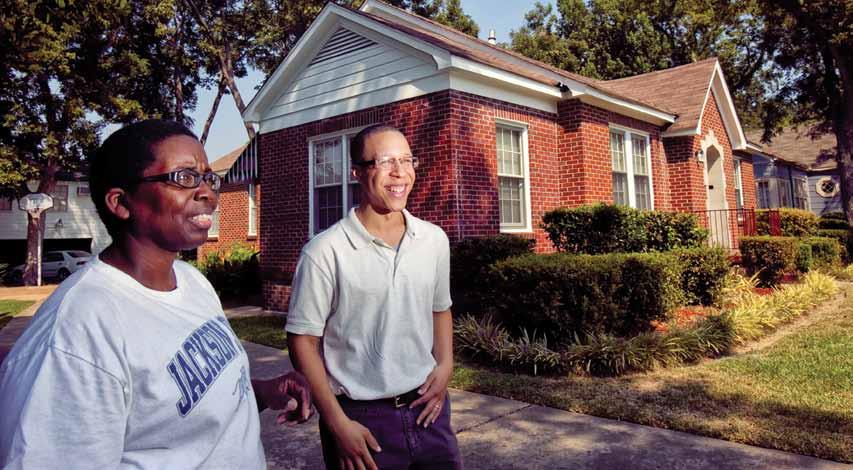
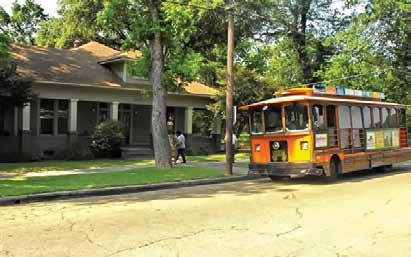
When Linda Liddell decided to buy her rst home in Jackson, she looked no further than the neighborhood where she grew up and attended college: West Jackson. rough a program called WESToration, which is a partnership among Jackson State University’s Center for University-Based Development, Cornerstone Home Lending, Atmos Energy, LeahCim Real Estate and Wright Concepts, the JSU alum bought a 1,772-square-foot brick home on Pecan Boulevard that was built in 1939.
“West Jackson is an area with great potential,” says Liddell, a JSU graduate who works for the U.S. Post O ce in downtown Jackson. “I can get to work from where I am in ve minutes. It’s convenient. I lived in Houston for 12 years and all that freeway, that’s not me.”
Liddell isn’t only saving time and gas money. Her purchase in West Jackson is helping restore the historic neighborhood to its past glory. e premise behind the WESToration e ort is simple. Just as suburban development starts with new homes that attract new businesses,
Neighbors Linda Liddell (left) and Curnis Upkins III chose to buy homes near JSU in West Jackson because they value the neighborhood and its proximity to downtown.
redevelopment within the city can occur. Attracting homeowners to the mix of existing residents in the neighborhood may eventually create the market for entrepreneurs to open up shop. WESToration organizers also believe the program will attract JSU employees and others who want to live and work in the same community.
“We feel like this will not only save these historic structures, but attract new homeowners into this area,” said Dr. Kimberly Hilliard, director of JSU’s Center for University-Based Development, also known as CUBD. “ is program is also geared to people who have an older home and want to x it up.”
CUBD got involved with WESToration because the initiative is a key to redeveloping the neighborhood around campus while respecting its history, Hilliard says.
Liddell’s three-bedroom, two-bath home has such historic details as a telephone nook, a slide-out laundry hamper, a built-in mail slot and an arched front door. e home also features a 456-square-foot apartment above a two-car detached garage.
While grants frequently come to mind in terms of redevelopment, WESToration is not such a program. At the core of the e ort is the Federal Housing Administration’s 203(k) program – a tool that’s been in place since 1978 but has been vastly underutilized in recent decades because of the housing boom of the 1990s and early 2000s.
e 203(k) program allows the purchase and renovation of a house with a single mortgage. at means a foreclosed or outdated property can be purchased and the buyer isn’t stuck with the house in its as-is condition. Existing homeowners can make improvements to their homes by re nancing through the 203(k) program or taking advantage of an FHA Energy E ciency Mortgage
that promotes upgrades to reduce energy bills and bring tax credits.
ose interested in WESToration must get pre-approved for a mortgage and agree to live in the purchased or re nanced home. e required down payment is 3.5 percent; however, those who purchase a HUD foreclosure can get the property for as little as a $100 down payment plus closing costs. First-time homeowners who meet prede ned income quali ers can also apply for grants from the City of Jackson to help o set costs.
Bo Smith of Cornerstone Home Lending says the program makes the best sense for homeowners who want to live within their means while customizing their houses to their speci c taste and lifestyle.
“ e sky is the limit for this,” he says. “If people could realize they could do this to these houses, it could change the landscape of homes in West Jackson.”
Through the WESToration program, Linda Liddell is able to use her mortgage to renovate the apartment above her garage.
JSU’s Center for University-Based Development helps organize neighborhood tours and information sessions for prospective West Jackson homebuyers.
Retailers open for business at One University Place
BY JEAN GORDON COOK
Jackson State University has transformed the corner of John R. Lynch and Dalton streets with the construction of One University Place, which is the largest private real estate development West Jackson has seen in 30 years. e $18 million building opened in September 2010 and includes 78 luxury apartments above 22,000 square feet of prime retail space. e apartments are all occupied by professionals and a number of JSU graduate students who want to combine the amenities of a university campus with close-to-downtown living. is year, four new businesses – all sta ed by JSU alums –have set up shop at One University Place.
“One University Place is a major part of the West Jackson renaissance,” says Dr. Kimberly Hilliard, director of JSU’s Center for University-Based Development, which has been instrumental in launching the real estate venture.
Hours: 10 a.m. to 6 p.m. Tuesday through Friday noon to 4 p.m. Saturday Phone: 601-960-9250
The rst business to open was Gallery 1 at One University Place, which displays work by local and national artists and pieces from JSU’s permanent collection. e JSU-owned gallery also sells handmade items from Uganda and provides space for lectures and cultural events for the campus and community.
Kimberly Jacobs, a 2009 JSU ne arts graduate, directs the gallery, which is funded through a grant from the U.S. Department of Commerce Small Business Administration.
“We plan to showcase alumni as well as artists from all over the state and region,” Jacobs says. “We will also have programming that will incorporate students.”
Dozens of peopled lled the gallery during its opening celebration in August. “Art means so much to so many,” JSU President Carolyn W. Meyers said during the gallery opening. “Its beauty can be enjoyed for generations.”
Hours: 9 a.m. to 6 p.m. Monday, Tuesday, Wednesday and Friday 10 a.m. to 7 p.m. Thursday Phone: 601-487-6812
EnVision Eye Care & Optical Boutique is the third location for business owner and optometrist Dr. Tonyatta Hairston, who owns shops in Jackson’s Belhaven neighborhood and in Magee, Miss. e new boutique carries designer frames including Gucci, RayBan, Nike, Carrera and Versace and accepts the JSU Supercard.
“I thought the University Place location was a great opportunity for the students,” says Hairston, a Jackson native who graduated from Tougaloo College and the Southern College of Optometry in Memphis. “And it’s an awesome location to serve the entire community.”
Jackson State University 1999 biology graduate Dr. Chaka Norwood is the sta optometrist at EnVision Eye Care’s One University Place location. e Mound Bayou, Miss., native says she was drawn to optometry because she gets to help people going through the same thing she did when she was a child.
“I was afraid to tell the teacher I couldn’t see the board,” says Norwood, who rst got glasses in the fourth grade. “Eye problems are really a big deal.”
Kimberly Jacobs, a 2009 JSU ne arts graduate, directs Gallery 1 at One University Place.
Staff optometrist Dr. Chaka Norwood (left), a 1999 JSU biology graduate, and EnVision Eye Care & Optical Boutique owner Dr. Tonyatta Hairston believe their West Jackson location will serve JSU students and employees and the community.
e Penguin Restaurant
Hours: 11 a.m. to 11 p.m. Monday through Saturday Phone: 769-251-5222
Before retiring as general manager of the University Club in Jackson, JSU 1978 business administration graduate John Hardy spent about a year looking for the right place to open his own restaurant. Nothing clicked until he happened to visit One University Place and saw the corner retail space.
“By the time I made it inside the doors I knew it was it,” he says. “And when I walked outside, I already had a name for it.” at name? e Penguin.
Many Jacksonians remember the beloved JSU hangout that once stood on John R. Lynch Street directly across from what is now One University Place. e old Penguin was famous for its hot dog special, which Hardy has included on his menu – even though the new Penguin is a ne dining establishment.
anks to Hardy and his business partners, a new generation of Jacksonians is enjoying the Penguin, and more people from around the metro area are being drawn to West Jackson.
“We want this to be a catalyst for di erent businesses to open up,” Hardy says. “A lot of people ask, ‘Why West Jackson?’ and my answer is, ‘Why not?’ ”
Hours: 10 a.m. to 6 p.m. Monday through Saturday Phone: 601-321-9564
Jackson State University senior Marissa Simms was so drawn to One University Place that she chose one of the retail spaces to open up a clothing boutique and she moved into an apartment right above her store.
With a bit of help from her mother, Camille Stutts-Simms, a 1978 JSU biology graduate, the mass communications major opened Royal Bleau Boutique just in time for Homecoming Week. e shop sells clothing for both young and mature women, JSU apparel and Greek memorabilia.
“My mother is more like a mentor,” says Simms, who owns the majority portion of the business. “She helped me with picking out clothing for the queens section for older ladies and on the business side.”
Simms is able to manage the demands of running her clothing boutique by scheduling her classes before business hours and relying on friends to help in the store.
ough she’s planning on pursuing an M.B.A. at JSU a er nishing her undergraduate degree, the new business owner says the training she’s received from the mass communications department has been invaluable.
“I learned a lot about marketing and public relations and being a spokesperson,” Simms says. “I’m pulling all my skills together and putting it into something I enjoy and I’m passionate about.”
JSU senior Marissa Simms is the principal owner of Royal Bleau Boutique.
John Hardy retired in July after working for 36 years at the University Club in Jackson. The 1978 JSU business administration graduate then returned to campus to open the Penguin restaurant.
Spike
Lee, Cornel West, Nikki
Giovanni inspire students during campus visits
BY MONICA ATKINS
Jackson State University welcomed three trailblazers from the world of the arts and academia this year: lmmaker Spike Lee, scholar Cornel West and poet Nikki Giovanni. All three delivered words of inspiration, candid advice and lessons learned through their pioneering work. Jackson State celebrated Black College Day in September with lm director, producer, writer and actor Spike Lee. e director spoke to a crowd at the Lee E. Williams Athletics Assembly Center about how his experiences at Morehouse College and New York University’s Tisch School of the Arts prepared him for success. e creator of 40 Acres and a Mule Filmworks, Lee has produced more than 35 lms that explore race relations, urban crime, poverty, politics and the media’s role in society.
In his famous preacher-like tone, philosopher, author, critic, actor and civil rights activist Cornel West delivers a speech in February at the Lee E. Williams
Assembly Center during which he challenges the crowd to examine who they are “from the womb to the tomb.” One of America’s most provocative intellectuals, West has fought for racial justice since childhood. He is currently the Class of 1943 University Professor in the Center for African American Studies at Princeton University.
Athletic
Poet, commentator, activist and educator Nikki Giovanni tells students during her March appearance at the Rose Embly McCoy Auditorium to stand rmly in their beliefs and take the time to learn the art behind their craft. The author of some 30 books for children and adults, Giovanni read an excerpt from her 2010 anthology, 100 Best African American Poems, from which she collected her seventh NAACP Image Award.
Lady Tigers grab historic SWAC titles
BY JAMEA ADAMS-GINYARD
The Jackson State University Lady Tigers soccer and so ball teams both made history during the 2010-2011 academic year by securing their rst Southwestern Athletic Conference championships.
In soccer, the Lady Tigers became SWAC champions a er defeating in-state rival Mississippi Valley State University, 2-0. e victory brought the Lady Tigers the SWAC automatic bid to the NCAA Tournament, where they fell 5-0 to the No. 1-ranked University of North Carolina at Chapel Hill Tar Heels.
e Lady Tigers nished their 2011 campaign a er an overtime loss at the conference tournament to the University of Arkansas-Pine Blu , to nish the year with an overall record of 7-8-1
and a conference mark of 3-0-1.
e Lady Tigers so ball team earned its SWAC championship by defeating Mississippi Valley State University, 6-2. e win earned them the SWAC automatic bid to the NCAA Tournament, where JSU entered the tournament as the second seed in the eight-team, doubleelimination eld. e Lady Tigers were one game out from elimination, but came back to defeat Arkansas-Pine Blu and Alcorn State twice to stay alive.
e Lady Tigers traveled to the Tuscaloosa Regional where they fell 8-0 in ve innings to No. 2 Alabama and then 8-1 to the Chattanooga Lady Mocs. e Lady Tigers nished the season with an overall record of 26-22.
Lady Tigers soccer team
Lady Tigers softball team
THE SONIC BOOM OF THE SOUTH ALUMNI BAND PERFORMS DURING THE HOMECOMING HALFTIME SHOW.
Tigers Celebrate
100 years of JSU of Football
BY JAMEA ADAMS-GINYARD
Tiger fans packed the Mississippi Veterans Memorial Stadium for the 2011 homecoming game against the University of Arkansas-Pine Blu and the season’s celebration of 100 years of JSU football. In front of a crowd of some 39,000, the Tigers crushed the Golden Lions 48-10 and racked up a sixth straight homecoming victory. For the centennial season, JSU and the Alumni Players Association named a 185-member All-Century team and brought home former players and coaches to be recognized for their contributions. Jackson State played its rst football game in 1911 against Alabama State. Since then, it has produced some of the greatest football players the sport has ever seen, including Walter Payton, Lem Barney, Jackie Slater and Willie Richardson.
FORMER TIGERS FOOTBALL COACH
ROBERT “BOB” HILL (RIGHT) TOSSES THE COIN BEFORE THE START OF THE HOMECOMING GAME.
THE FAMED SONIC BOOM OF THE SOUTH MARCHING BAND STRUTS ONTO THE FIELD FOR THE HALFTIME SHOW.
ALUMNI J-SETTES DANCE TO THE SOUNDS OF THE SONIC BOOM OF THE SOUTH.
Class Notes
‘60s
‘70s
Obra Hackett (’60) was inducted into the Pike County Schools Hall of Fame for his outstanding contributions while a student and his long and distinguished career as an educator and civic leader. Hackett worked as an administrator at Jackson State University for 30 years.
Judge Tyree Irving (’68) has been appointed to the Mississippi Court of Appeals.
Lawrence Gordon (’73, ’74 master’s) has become the rst African American to be elected to the Town Council in Haverhill, Fla. Gordon works for the law rm of Lytal, Reiter Smith, Ivey & Fronrath.
James Bacchus (’75) was named superintendent of the Hattiesburg Public School District. Previously, Bacchus was a career teacher and administrator in the Memphis City Schools system.
Dr. Cecil Hill (’76) has been elected to the Board of Trustees of the Public Employees’ Retirement System of Mississippi representing the Institutions of Higher Learning employees. Hill is an associate professor of accounting at Jackson State University and a Certi ed Public Accountant.
Milton J. Chambliss (’78) has been named executive director of the Claiborne County Economic Development District. He previously owned Chambliss Insurance and Financial Services. Chambliss holds a master’s in business administration from Millsaps College.
Maj. Gen. Reuben D. Jones (’78) was named one the top blacks in the military in the winter 2010 issue of U.S. Black Engi-
neering and Information Technology. Jones has commanded soldiers across the world and now serves as the commanding general of the Family and Morale, Welfare and Recreation Command. He was commissioned through the ROTC program at JSU. He holds a Master of Strategic Studies degree from the U.S. Army War College and a Master of Arts degree in administration from Central Michigan University.
Catherine Farris-Carter (’79) is the new Chancery Court judge of the Seventh Chancery Court District of Mississippi. e Shaw, Miss., native is a graduate the Chicago School of Law.
‘80s
Patrick Jackson (’81) earned the 2011 Yale Distinguished Music Educator Award from the Yale School of Music for his outstanding accomplishments as a public school music teacher. Jackson has been a string instruments teacher in the Kirkwood School District in Kirkwood, Mo., for 20 years. In 2010, the Kirkwood High School Symphonic Orchestra was one of only three high school orchestras selected to play at Carnegie Hall. Jackson received a master’s of music from the St. Louis Conservatory of Music.
Felicia C. Adams (’81) became the U.S. attorney for the Northern District of Mississippi. Adams, who was nominated to the post by President Barack Obama, formerly served as Assistant U.S Attorney for the Southern District if Mississippi. She earned her law degree from the University of Mississippi School of Law.
Jennifer S. Love (’83) has been named assistant director of the FBI’s Security Division. Love most recently served as acting assistant director of the FBI’s Inspection Division. During her career with the FBI, Love has investigated whitecollar crime, violent crime and civil rights matters. She has also supervised the Counterterrorism Division’s Communication Exploitation Section and served as deputy assistant director in the Inspection Division, where she oversaw the o ce of Inspections, Inspection Strategic Analysis Section, Internal Investigations Section and External Audit Section.
Dr. Cecil Hill
Obra Hackett
Lawrence Gordon
James Bacchus
Patrick Jackson
Jennifer S. Love
Clinton Johnson (’84, ’09 master’s) has been named executive director of athletics for Jackson Public Schools. e former JSU all-SWAC baseball pitcher played for the Boston Red Sox organization from 1978 to 1984, then returned to JSU to nish his degree. Johnson has more than 24 years of administrative and coaching experience, most recently as principal of Callaway High School in Jackson.
Timothy Collins (’85) was named to the Jackson Public Schools Board of Trustees. Collins is executive director of the Mississippi Housing Partnership.
Tarita Bensen Davis (’85) has been named the 2011 Alumnus of the Year by the JSU National Alumni Association, Inc. (JSUNAA). Davis is the Americas regional credit manager for Shell Chemical Corp. and is actively involved in the Shell Black Networking Group. She has served as a recruiter on behalf of Shell Oil Co. at Jackson State University, Prairie View A&M University and the University of Michigan. Davis currently serves as the Southwest regional vice president of the JSUNAA and is a life member of Delta Sigma eta Sorority, Inc.
Dr. Hattie Rogers M. Bronson (’87, Ed.D.) has been named Woman of the Year for Mississippi by the National Association of Professional Women. She is an adjunct professor at Belhaven University.
Linda F. Rush (’86, ’98 master’s) has been appointed to the Jackson Public Schools Board of Trustees. Rush is director of Undergraduate Recruitment at Jackson State University.
Mark Dawson (’89) was named to Black Engineer magazine’s 100 Most Important Blacks in Technology. Dawson is assistant vice president of IT business solutions at Cox Enterprises, one of the nation’s leading communications, media and automotive services companies.
Dr. Debra Mays-Jackson (’91, ’93 master’s, ’01 specialist) has been named the 2011 Jackson Public Schools Administrator of the Year. Mays-Jackson has been the principal of Forest Hill High School since 2007. She holds a doctorate degree in education and administration from Mississippi State Uni-
versity.
Grashawn J. Dorrough (’92) was promoted to the rank of lieutenant colonel in the U.S. Army. Dorrough is a systems e ects and improvements division chief regularly assigned to the U.S. Army Accessions Command in Fort Knox, Ky. He received a master’s degree from the Naval Postgraduate School.
Dr. Sophia Marshall (’92) was selected as an Emerging Leader by Phi Delta Kappa International. e program recognizes top educators world wide under age 40. Marshall is an adjunct professor in the Jackson State University College of Lifelong Learning and the teacher education preparation program director at Hinds Community College–Utica in Utica, Miss.
C. Jerome Brown (’96) was promoted to vice president, director of community development at e First, A National Banking Association. e First is a $500 million bank with 10 branches in South Mississippi. Brown is a JSU Alumni Life Member and past president of the Hattiesburg Alumni Chapter of the JSU National Alumni Association.
‘00s
Dr. Julia Saloni (’01 master’s, ’07 Ph.D.) of Brandon, Miss., has been hired as a chemistry instructor for the CopiahLincoln Community College’s Natchez campus. Saloni holds a master’s in chemical engineering from Wroclaw University of Technology in Wroclaw, Poland, and a master’s and doctorate in chemistry from Jackson State University.
James C. Stallworth (’02) graduated from basic combat training in the U.S. Army at Fort Jackson in Columbia, S.C.
Dr. Vicki Prosser (’04, Ph.D.) has been named president elect of the Mississippi Psychological Association for 2012. Prosser is the compliance coordinator in the Jackson State University O ce of Research/Sponsored Programs and an adjunct professor in the JSU Department of Psychology.
Clinton Johnson
C. Jerome Brown
Linda F. Rush
Mark Dawson
Dr. Sophia Marshall
Dr. Julia Saloni
Dr. Vicki Prosser
She serves on dissertation committees in JSU’s departments of Psychology, Educational Leadership and Urban Higher Education.
Brett Williams (’04, ’08 master’s) was hired as a logistics management specialist at the U.S. Army Aviation & Missile Command Redstone Arsenal in Huntsville, Ala.
Nadia Dale (’05) is the outreach coordinator for the Columbus Municipal School District in Columbus, Miss. She also founded and runs the nonpro t Dance 4A Cure. Dale earned a master’s in mental health and wellness counseling from New York University.
Dr. Tonjanita Johnson (’06 Ph.D.) was named chief deputy to the president at Stony Brook University. Prior to joining SBU, Johnson served as associate vice president for marketing and communication at Middle Tennessee State University
Shasta Averyhardt (’08) has become the rst black female golfer to become a member on the LPGA Tour in a decade. As a JSU golfer, Averyhardt won nine tournaments playing for the Tigers.
Lance Q. Bartee (’10) was hired as a logistics management specialist at the U.S. Army Aviation & Missile Command Redstone Arsenal in Huntsville, Ala.
Travis F. Ellis (’10) has been accepted into the North Carolina Central University School of Law with a full-tuition scholarship.
Natalie E’dris Kelly (’10) was hired as a so ware test engineer/ programmer for the U.S. Army Aviation & Missile Command Redstone Arsenal in Huntsville, Ala.
Pamela D. Sharp (’10) was hired as a logistics management specialist at the U.S. Army Aviation & Missile Command Redstone Arsenal in Huntsville, Ala.
has been named dean of student development and campus life, New York, at Berkeley College in New Jersey. Reed is responsible for all aspects of student life at the college’s four New York campuses, three in New York City and one in White Plains. Reed previously served as associate vice president for student life at Mississippi Valley State University. She holds a Ph.D. in urban higher education from JSU, a master’s in organizational leadership from Pfei er University and a bachelor’s degree from Pennsylvania State University.
Timothy White (’10) was hired as a computer engineer for the U.S. Army Aviation & Missile Command Redstone Arsenal in Huntsville, Ala.
Dr. Dallas Reed (’10, Ph.D.)
Brett Williams
Shasta Averyhardt
Travis F. Ellis
Natalie E’dris Kelly
Dr. Dallas Reed
Timothy White
University Highlights
Football stadium unveils high-de nition video board
JSU unveils its new $1.3 million high-de nition video board during the centennial football season at Mississippi Veterans Memorial Stadium. e 62-by-24-foot board is twice the size of the old board and is sta ed by an eight-person production team to capture instant replays, crowd shots and broadcast commercials.
Electric car charging station installed
Entergy Mississippi, Inc., installs one of the state’s rst electric vehicle chargers on campus. e station allows students, faculty and sta to charge electric vehicles at no cost. JSU researchers and Entergy are collecting usage data to learn about the chargers’ impact on consumers and the electric grid.
Terry Road renamed University Boulevard
e JSU Center for University-Based Development and the JSU National Alumni Association, Inc., lead the e ort to rename a portion of Terry Road University Boulevard. e newly named roadway extends 2.3 miles from I-20 to the entrance of JSU’s campus. e initiative ts in with JSU’s goal to help revitalize West Jackson.
Dr. Jimmie James Jr. establishes scholarship
Retired JSU music professor Dr. Jimmie James Jr. donates $20,000 to JSU to establish the Jimmie and Carrie James Endowed Scholarship for music students. James retired from JSU in 2009 a er 43 years as a teacher, band director and music department chair. James was known as the voice of the Sonic Boom of the South, a position he held since his rst year at JSU.
JSU gets $2 million pledge for green training opportunities
Full Spectrum South, the developer of the Old Capitol Green project in Jackson, pledges $2 million to JSU to spur major green e orts between the university and the company. Headed by CEO Carlton Brown, the company is a leader in a ordable green/smart building. e rst phase of the project includes an o ce building, a residential complex and an 888car, near-zero carbon garage – all LEED certi ed. e garage will use a robotic parking solution that moves cars on pallets through the structure. rough these projects, engineering students will learn the best practices of applied robotics and high-performance building design and operations. Brown’s connection to JSU comes from his parents, Dr. Ollie omas Brown and Dr. Allen H. Brown, who taught at JSU from 1957 through their retirement in the early 1990s.
World Health Organization recognizes JSU’s Global Community Health Training Center
e World Health Organization recognizes and incorporates JSU’s Global Community Health Training Center into the International Network of Health Technicians Education. Located in the Jackson Medical Mall, the center will start training and certifying community health workers beginning in the spring of 2012. e center is part of a project initiated by rural health pioneer Dr. Aaron Shirley (pictured above, seated center) and JSU public health professor Dr. Mohammad Shahbazi (pictured above, standing center), who have teamed to create a network of community health centers in the Mississippi Delta.
“One of the most pressing issues in public discourse nowadays is how to deal with ever-increasing health care costs at a time when the United States and indeed the world economy is weak,” Shahbazi says.
Shahbazi’s and Shirley’s e orts have led to the establishment of the Community Health House Network Project, which aims to assure that underserved communities receive basic health care with optimal health education and disease prevention information. e project is expected to reduce health care costs and improve the health status of people in underserved communities.
Poland’s president, JSU honor chemistry professor
Presidential distinguished fellow and professor of chemistry Dr. Jerzy Leszczynski can now boast that he’s met two world leaders: U.S. President Barack Obama and Poland’s President Bronislaw Komorowski. Leszczynski, who leads JSU’s Interdisciplinary Center for Nanotoxicity, visited the White House last year to pick up the coveted Presidential Award for Excellence in Science, Mathematics and Engineering Mentoring. is year Leszczynski traveled back to his native country, where Poland’s president bestowed upon him the title “professor.” e title is the highest academic status recognized in most European countries. Each year, less than 400 people, including three to ve researchers working outside of Poland, earn the status of professor in Poland.
In recognition of Leszczynski’s contributions to scienti c advancements, student training and outstanding services to JSU and the global community, JSU named the ground oor of the E.E. Just Hall of Science the “Jerzy Leszczynski Center for Computational Chemistry.” Most of the professor’s current research, education and activities take place on the building’s ground oor.
is year Leszczynski also had his second paper within ve months published in one of the world’s most prestigious scienti c publications, the journal Nature Nanotechnology. Leszczynski’s paper examined nanomaterials, which have become a driving force in science and technology.
Faculty/Sta Notes
Five JSU researchers inducted into National Academy of Inventors
Biology professors Dr. Ernest B. Izevbigie and Dr. Hari Parshad Cohly and chemistry professors Dr. Paresh Ray, Dr. Ming-Ju Huang and Dr. Kenneth S. Lee were inducted into the National Academy of Inventors along with former JSU biology professor John E. Piletz. e researchers are the rst inventors at Jackson State to be inducted into the academy. Earlier in the year, JSU became a charter member of the National Academy of Inventors, which recognizes inventors with patents from the U.S. Patent and Trademark O ce.
Chemistry and biochemistry chair recognized for advancing diversity e Committee on Minority A airs at the American Chemical Society has selected Department of Chemistry and Biochemistry chair Dr. Hongtao Yu for the Stanley C. Israel Regional Award for advancing diversity in the chemical sciences. Under Yu’s leadership, the department has tripled enrollment and doubled faculty and student publications.
Political science professor named chair of national committee
Political science professor Dr. Michelle D. Deardor has been appointed by the American Political Science Association to chair the Committee on Teaching and Learning.
Biology professor appointed to U.S. Dept. of Energy-Dept. of Agriculture committee
Biology professor and environmental science master’s program director Dr. Huey-Min Hwang was appointed by the U.S. Secretary of Energy and the U.S. Secretary of Agriculture to the U.S. Department of Energy-U.S Department of Agriculture Biomass Research and Development Technical Advisory Committee. e independent body provides input to agencies about the Biomass Research and Development Initiative.
JSU administrator tapped for Harvard institute
Dr. Nicole E. Evans completed the summer Institute for Management and Leadership in Education at the Harvard University Graduate School of Education. Evans is the associate vice president for the JSU O ce of Institutional Research, Planning and E ectiveness, and director of the university’s reafrmation process with the Southern Association of Colleges and Schools.
Theatre professor cast in TV series, lm
Professor Yohance Myles will appear in the upcoming USA Network comedy/drama television series Common Law. Myles’ other lm and television credits include e Royal Family, K-Ville and Treme. Myles also will appear with actors Josh Duhamel, Bruce Willis and 50 Cent in the upcoming lm Fire with Fire.
Associate dean selected to assist Planning Accreditation Board
Dr. Otha Burton Jr., associate dean of the School of Policy and Planning and chair of the Department of Urban and Regional Planning, has been appointed to the Planning Accreditation Board’s Site Visit Pool. e group of educators and practitioners evaluate programs seeking accreditation.
Social work professor elected to leadership post
Social work professor Dr. Susie A. Spence was elected to the Group for Doctoral Education in Social Work Steering Committee, which consists of social work and social welfare doctoral programs at accredited colleges and universities. Spence also was inducted into the College of Arts and Sciences Gallery of Distinction at Florida Agricultural and Mechanical University for outstanding scholarship, research, service and teaching.
McLemore receives W.E.B. DuBois Award
Former JSU interim president and Fannie Lou Hamer National Institute on Citizenship and Democracy director Dr. Leslie Burl McLemore received the W.E.B. DuBois Award from the Association of Social and Behavioral Scientists. e award honors outstanding social and behavioral scientists and leaders who have made signi cant contributions to the greater knowledge, understanding and welfare of African Americans.
Research
Dept. of Defense awards JSU $3.9 million for Center of Excellence
e U.S. Department of Defense awards JSU $3.9 million to establish a Center of Excellence in Science, Technology, Engineering and Mathematics Education. rough the four-year grant, JSU will partner with the Jackson Public Schools District and Hinds Community College to strengthen science, technology, engineering and mathematics (STEM) programs at the institutions. Interim dean of the College of Science, Engineering and Technology Dr. Paul B. Tchounwou is the project’s principal investigator and center director.
Center at the University of Veterinary and Animal Sciences in Lahore, Pakistan. e project is part of the State Department’s Pakistan-U.S. Science and Technology Cooperation Program.
Computer engineering professor receives grant to test unmanned aircraft
Computer engineering professor Dr. Kamal Ali is awarded $517,062 from the U.S. Department of Defense to build a simulator to test small unmanned aircra that are used for reconnaissance. e project will allow the aircra to be tested under all ight conditions in the laboratory.
National Science Foundation awards JSU $3.5 million to increase opportunities for female faculty anks to a $3.5 million National Science Foundation grant, JSU starts a ve-year project called JSUAdvance that aims to transform the work climate for women faculty in STEM and Social and Behavioral Science disciplines. Over the summer, the program provides fellows with a writing retreat and a trip to India.
Researchers study levee strengthening rough a $450,000 project funded by the U.S. Department of Homeland Security, Department of Civil and Environmental Engineering chair Dr. Farshad Amini is developing innovative techniques for levee strengthening during hurricanes. e project is the second phase of JSU’s $1 million Department of Homeland Security-funded study of levee strengthening under full-scale overtopping conditions.
U.S. State Dept. awards grant to train Pakistani researchers
e U.S. Department of State awards $400,000 to biology professor and JSU Biostatistical Support Unit manager Dr. H. Anwar Ahmad to establish a Biostatistical Consulting
Chemistry professor secures $2.7 million NIH award e National Institutes of Health awards $2.7 million to chemistry professor Dr. Glake Hill for a ve-year project dedicated to the education of chemistry and biology students leading to doctoral degrees.
National Science Foundation awards $1 million to chemistry professor Associate chemistry professor Dr. Ashton Hamme is awarded nearly $1 million for a three-year project that will address the best method to detect water-borne pathogens while preparing the next generation of scientists. Called JSU-RISE, the program seeks to increase the number and quality of underrepresented minority STEM students through research and mentoring. In the program, students will develop research and leadership skills through summer internships, scienti c presentations, teaching experiences and research projects.
Division of Graduate Studies partners with the University of Florida e Division of Graduate Studies is collaborating with the University of Florida to pave the way for JSU graduate students to earn doctoral degrees at the Florida school. rough the partnership, promising rst-year master’s students at JSU will begin a relationship with the UF Graduate School to explore Ph.D. programs at UF that are not o ered at JSU.
Chemistry professor earns NSF CAREER award
Dr. Md. Alamgir Hossain, assistant professor in the Department of Chemistry and Biochemistry, is honored with the coveted National Science Foundation CAREER award, which supports outstanding young faculty who exemplify the role of teacherscholars through outstanding research, excellent education and the integration of education and research. Hossain is the second member of JSU’s chemistry faculty to receive the CAREER award since 2004. Hossain’s award comes with $400,000 to support integrated research, education and outreach activities, including the development of new “chemosensors” that will be useful in identifying and separating hazardous anions in the environment.
Recent books by JSU faculty
Challenges and Advances in Computational Chemistry and Physics (Springer, 2011), 13-volume book series edited by Jerzy Leszczynski, professor of chemistry and presidential distinguished fellow.
Handbook of Computational Chemistry (Springer, 2011), edited by Jerzy Leszczynski, professor of chemistry and presidential distinguished fellow.
Practical Aspects of Computational Chemistry I (Springer, 2011), edited by Jerzy Leszczynski, professor of chemistry and presidential distinguished fellow, and Manoj K. Shukla, research professor of chemistry.
Constitutional Law in Contemporary America: Volume I Institutions, Politics, and Process (Oxford University Press, 2011), by David Schultz, John R.
Vile and Michelle D. Deardor , associate professor, Department of Political Science.
Constitutional Law in Contemporary America: Volume II Civil Rights and Liberties (Oxford University Press, 2011), by David Schultz, John R. Vile and Michelle
D. Deardor , associate professor, Department of Political Science.
Curitiba, Brazil, Pioneering in Developing Bus Rapid Transit and Urban Planning Solutions (LAP Lambert Academic Publishing, 2011), by Evandro C. Santos, assistant professor, Department of Urban and Regional Planning.
Promoting Creativity in Childhood: A practical guide for counselors, educators and parents (AuthorHouse, 2011), by Nanolla Yazdani, assistant professor, Department of Education and Human Development.
Encyclopedia of Environmental Health (Elsevier B.V., 2011), co-edited by Paul B. Tchounwou, interim dean, College of Science, Engineering and Technology.
Understanding American Fiction as Postcolonial Literature (Edwin Mellen Press, 2011), by Patsy J. Daniels, professor of English.
Environmental Accounting for Oil and Natural Gas (Edwin Mellen Press, 2010), by Edmund C. Merem, associate professor, Department of Urban and Regional Planning.
Smooth Talking: A Curriculum for School-Age Children Who Stutter (Plural Publishing Inc., 2010, 2nd edition), by Nola Radford, professor, Department of Communicative Disorders.
jackson state university extends sincere condolences to the families and friends of jsu staff who passed away in 2011.
Faithful alumni give back in a major way
BY MONICA ATKINS
Jackson State University is indebted to our major alumni donors who attribute much of their success to their JSU education. ese Jacksonians exhibit Tiger pride by putting their money where their hearts are and investing in future generations to carry on the legacy of blue-and-white excellence.
THE BARNES FAMILY
e Barnes family, utilizing the strength of numbers, has contributed $204,000 to JSU. “A group of people has more impact than one person,” says Dr. George Barnes (’62), who is the vice president of administrative and student services for the Utica campus of Hinds Community College in Mississippi. Barnes represents his family of contributors, which includes siblings Oree Barnes, Beverly Smith and Robbie Bingham, all JSU alums, and Mae Marshall and Ruth McCann.
CLEMENTINE HARVEY BENTON (’49)
Retired elementary educator Clementine Harvey Benton of Hattiesburg, Miss., attended JSU when the university only had one major, which was for teaching, and was called Jackson College for Negro Teachers. She began giving back to the university in 1989 and has continued to support JSU by consistently contributing to funds that enable students to receive scholarships. Contributing more than $100,000 overall, Benton is a primary example of giving with a generous heart. “Jackson State gave to me, and you have to help those who help you,” Benton says.
BARBARA BLACKMON (’75)
Barbara Blackmon, managing partner of Blackmon and Blackmon Attorneys at Law PLLC in Canton, Miss., created a scholarship at JSU in the name of her brother, Anslen J. Martin, who passed at the age of 33 due to a brain tumor. “I wanted to honor my brother and the institution, and creating this scholarship allowed me the opportunity to do so, ” the former business administration major says. Contributing more than $521,000 from her own funds as well as her rm’s, Blackmon believes any donation makes a signi cant di erence.
DANELLA B. CATCHINGS (’63)
Retired science teacher Danella B. Catchings started her faithful habit of giving to JSU with a $1,000 gi in 1978. Since then, the mother of four JSU graduates has donated steadily to her alma mater, where this year her contributions surpassed $176,000. “We just believe in giving back to the school that provided us with the education to get good jobs,” says Catchings, who along with her husband, Howard D. Catchings, have donated close to $400,000 to JSU and have been Tiger football season ticket holders for the past 30 years. Catchings also credits JSU with providing a quality education to her four children, whose respective jobs are computer engineer, accountant, insurance professional and sales executive.
HOWARD D. CATCHINGS (’63)
During Howard Catchings’ matriculation at JSU, scholarships and other means to assist students did not exist. “I had to pay $35 every three months and worked every summer to pay for school in the fall,” the former elementary education major says. Catchings is a rst-generation college graduate and is now the general agent and CEO of Catchings Insurance Agency in Jackson. Donating more than $186, 000 overall, Catchings began giving back to JSU’s annual fund in 1968 and has continued being one of the university’s top nancial supporters. “ e state can’t do everything for the university,” Catchings says. “I feel obligated to do my part.”
FREDRICK CLARK (’74)
Greenwood, Miss., attorney Fredrick Clark and wife Margaret Wiley Clark have given more than $790,000 to JSU since 1998 because they value how Historically Black Colleges and Universities not only educate students, but nurture them through the college experience. Clark, who majored in accounting and graduated with honors from JSU, worked in management at General Motors for a year a er college before entering law school. Recently retired, Clark was the rst attorney in Mississippi to sue American tobacco companies for tobacco-related illnesses and death and ended up representing the state of Mississippi against big tobacco.
Jackson State University Honor Roll of Donors 2010-2011
On the following pages are the names of our generous benefactors who have donated to Jackson State University between July 1, 2010, and June 30, 2011. Alumni, friends, corporations, foundations and organizations have provided support for academic programs, scholarships and much more. No matter the size or type of the gi , these donors have helped to create great futures for the students at Jackson State.
We thank all our contributors for their loyal and thoughtful support. e O ce of Development has made every e ort to verify the accuracy of the information contained herein. In a report such as this, mistakes are possible. If we misspelled your name, listed you in the wrong category or omitted your name, please accept our apology and inform us of our error so that we can correct our database and ensure that we will not make the same mistake in the future. Contact us at 601-979-2946 or linda.j.daniels@jsums.edu.
JACKSON STATE UNIVERSITY HONOR ROLL OF DONORS - JULY
1, 2010 - JUNE 30, 2011
$100,000 and Above
BankPlus
Entergy Charitable Foundation
Clementine Harvey Benton
Jackson Iron & Metal Company
Robert M. Hearin Support Foundation
$50,000-$99,999
Howard and Danella Catchings
Jackson Medical Mall Foundation
Southern Heritage Foundation
Southern Beverage Company
Terry L. Woodard
$25,000-$49,999
AMIE
Blue Cross & Blue Shield of Mississippi
Ernst & Young Foundation
Union Paci c Foundation
$10,000-$24,999
Capital City Beverage Company
C Spire
Fellows Alumni Foundation of Jackson State University
Jackson Municipal Airport Authority
Charles G. Johnson
Jackson State University
Chicago Alumni Chapter
Jerry L. Kennedy
Willem Lamar
John W. McGowan
My Joy, Inc.
New Freedom Family Ministries
Porter’s Insurance Agency
Saatchi and Saatchi North America
Leland R. Speed
Sunrise Advertising
Wal-Mart Stores, Inc.
Luther W. and Ruth G. Williams
$5,000-$9,999
Darsene Baggett
Tellis B. Ellis, III
Lawrence B. Gordon
IMS Engineers
Patricia C. Jessamy
Jackson State University
Greater Washington, D.C., Area Alumni Chapter
Jackson State University
Hattiesburg Alumni Chapter
Jackson State University
Memphis Alumni Chapter
Leslie Burl McLemore
Charles V. McTeer
ME8 Foundation
Payton Family Foundation, Inc.
e Foundation For Education and Economic Development
Tiger Fund Athletic Association
Roderick D. Walker
Watkins, Ludlam, Winter & Stennis
Margaret A. Wodetzki
$2,000-$4,999
100 Black Men of Jackson
Allsta Technical Solutions
Alumni in Motion
Aramark
Malcolm M. and Emma K. Black
William A. Brown
Abbie Cattenhead
Chevron U.S.A., Inc.
Coleman, Alexander, Prosser Foundation
County Line Baptist Church
Meredith W. Creekmore
Enterprise
E.C. Foster
Frito-Lay, Inc.
Solomon Henderson, III
Lindsey Horton
Huntington Ingalls Industries
Jackson State Alumni Organization
Jimmie James, Jr.
Jackson State University Class of 1963
Jackson State University Detroit Alumni Chapter
Jackson State University Huntsville Alumni Chapter
Jackson State University Milwaukee Alumni Chapter
Jackson State University
Scott County Alumni Chapter
Jackson State University
St. Louis Alumni Chapter
Jackson State University
Tupelo/North Mississippi Alumni Chapter
Kalamazoo Community Foundation
Kelly Construction, Inc.
L.A.D. Engineering Technologies
LeFleur’s Blu Chapter of e Links
Nspirational Communications Group
Marie O’Banner-Jackson Procter & Gamble
Carlton W. Reeves
Scott Management Team, Inc.
Betty Jean Shaw
Shawn Knight Holland Scholarship
Bessie B. Shourts
Spirit Communications
Stamps & Stamps Attorneys at Law State Farm Insurance
Eugene F. Stewart
TCL Financial & Tax Services
Michael and Shari
omas
Beverly G. Toomey
Byron A. Turner
Robert M. Walker
Wells Fargo Bank
$1,000-$1,999
5 Star Sports
Veronica L. AdamsCooper
James Allen
American Honda Motor Co., Inc.
Leon Anderson
Gregory A. Antoine
AT&T Foundation
Matching Gi s
Bank of America Foundation
BankPlus, Dalton Street Branch
Fred L. Banks
Banks, Finley, White & Company
George E. Barnes
Willie C. Bell
Body by Cook, Inc.
Bountiful Blessings, Inc.
Anthony P. Brooks
Brown Bottling Group, Inc.
Brown Chapel African Methodist Episcopal Church
Willie G. Brown
Katherine L. Cage
Bernice P. Cain
Percy L. Cain
Valerie Campbell
Billy E. Carcamo
Caterpillar Foundation
Marcus A. Chanay
Charles K. Chiplin
James Clark
Kenn D. Cockrell
Community Foundation of Greater Jackson
Robert L. Cook, Sr.
William M. Cooley
Anthony Cooper
Ella J. Davis
Shawn M. Davis
Mark A. Dawson
Annie C. Denham
Donald Causey State Farm Insurance
Latonya B. Edmond
Entergy Mississippi, Inc.
ExxonMobil Foundation
Family Life Center
Christ the King Church
Farm Credit Bank of Texas
First Commercial Bank
Flowers By Cheryl
Henry W. Flowers
Ramie Ford
Velvelyn Foster
Golda Franklin
Joe L. Galloway
Garrett Construction
Ned Gathwright
Yancy Gideon
Wayne J. Goodwin
Greenwood-Le ore County Chamber of Commerce
Obra V. Hackett
Legert Hamilton
Jimmie L. Harmon
Andrell Harris
Health Assurances, LLC
Carl Herrin
David C. Howard
Eugene Jackson
Jackson Music Awards
Sherman E. Jackson, Jr.
Sebetha L. Jenkins
Booker
Jimmie L. Sandifer
Real Estate
Omar K. Johnson
Jackson State University Columbus-Lowndes County Alumni Chapter
Jackson State University
Copiah County Alumni Chapter
Jackson State University Greenville/ Washington County Alumni Chapter
Jackson State University
Metro New York Alumni Chapter
Jackson State University Nashville Alumni Chapter
Jackson State University
Natchez Alumni Chapter
Eamon M. and Margaret W. Kelly
Barbara J. Large
Law O ces of Danny E. Cupit
Lonnie L. Lockett
Lockheed Martin
Robert K. Long
Jeanne B. Luckett
Auwilda Mason Polk
Latrice D. Maxie
Medical Care
Associates, P.A.
Cynthia Melvin
Mississippi Power Company
Mississippi Sports Medicine & Orthopedic Center, PLLC
National Black College Alumni
Neel-Scha er, Inc.
Wilfred R. Noel
James A. Ogden
Calvin and Barbara Ousby
Annie L. Owens
Dana K. Pace
Hugh and Cynthia Parker
Porter & Malouf P.A.
Will C. Pugh
Brenda K. Rascoe
Bonita D. Reed
Marcus K. Reed
Regions Bank
Rena J. Robinson
RR Donnelley Foundation
Alix Sanders
Sanderson Farms, Inc.
Willie B. Sims
Doris N. Smith
Herman D. Smith
John A. Smith
Robert Smith
Southern De-Lite, LLC
State Farm Companies Foundation
Tatum & Wade e Shack Harris & Doug Williams Foundation
Worth omas
Lottie W. ornton
Nellie W. Tolliver
Andre Towner
James K. Turner
Robert E. Tyler
Annie Ulmer
UniDev, LLC
United Way of Metropolitan Nashville
Walgreens
Joann A. White
Jackie L. Williams
Rellie M. Williams
William F. Winter
Xpress Tax Service
$500-$999
Robbie L. Abrams
Tim Adler
Alumni Queens of Jackson State University
Percy Anderson
Della R. Archie
Rosie H. Austin
James Q. Bacchus
Barron Banks
Beauty Plus
George L. Bell
Tarita L. Benson-Davis
Louis Beverly, Jr.
BKD, LLP
Mary A. Brookins
Sydney L. Brown
Peggy J.
Butler-Answorth
Gwendolyn G. Caples
Jacqueiline M.
Carmichael
Marietta A. Carter
Alveno N. Castilla
Elbert Cobbs
James Co ey
Bertha J. Collins
Rhonda C. Cooper
Robert Crear
Linda J. Daniels
Emerson Davis
Nathaniel and Ethel R. Davis
Anthony Dean
Delta Sigma eta Sorority, Inc., Delta Pi Chapter
Diverse Business Consulting
Louisa Dixon
Matthew D. Dockins
Cynthia L. Dunlap
Hattie Mae Ellis
Debra Estes
Eltorry Ficklin
Carolyn S. Fletcher
Dorothy M. Funches
Eva Gaines
Richard Gaines
Beverly D. Gardner
Maxine O. Gilmore
Claudia M. Gooden
Graduate Services, Inc.
Graduate Supply House
Maury Granger
Johnnie P. Gray
Eli Grayson
Greater Fairview Missionary
Baptist Church
Jean D. Gri n
Edna N. Hal
Luther C. Hamilton
Harvey’s Fish Hut
Barrett Hatches
Bennye S. Henderson
Higginbotham Automobiles, LLC
Cecil L. Hill
D’an M. Howard-Carter
Anna V. Jackson
Barbara P. Jackson
Jackson Newell Foundation
Jobs for Mississippi Graduates
Donald R. Johnson
Edward Johnson
Inez C. Johnson
Iris Johnson-Barnes
Aaron Jones
Leroy Jossell
JP Morgan Chase & Company Employees Giving Campaign
Jackson State University National Alumni Association
Jackson State University Panola County Alumni Chapter
Kappa Alpha Psi Fraternity, Inc.
Inez K. Keys-Johnson
Tommiea P. King
Hilliard L. Lackey, III
Deloris J. Lenard
Leo W. Seal Family Foundation
Roosevelt Littleton, Jr.
Maha ey’s Quality Printing
Brenda Matthews
Mississippi Economic Council
Andrew L. Moncure
Emma G. Moore
Leonard N. Moore
Mount Galilee Baptist Church
William Overton
Jody E. Owens
Pearl Street African Methodist Episcopal Church
Patricia L. Perryman
Andrea L. Phillips
Della R. Posey
Nicole Pressley-Brown
Evangeline W. Robinson
Peggy Rudison
Robert F. Sanders
Willie Bell Scott
Larry Sehie
Sandra F. Sellers
Mohammad Shahbazi
Shell Oil Company Foundation
Lecluster Sherrod
Gordon W. Skelton
Leroy Smith
Sparger Technology, Inc.
Charles F. Strange
Eric D. Stringfellow
Festers E. Taylor
Wilson Taylor e Clorox Company Foundation e Nielsen Company
Dominic T. igpen
Henry G. omas
Aaron J. ompson
Tom Joyner Foundation
Willie A. Travis
Stacey Tsang
Bonnie J. Turner
Earnestine Turner
Era J. Turner
Patricia A. VanDecar
Victory Personnel Services
W B Consolidated
Cora B. Wade-Seals
Rosetta G. Walker
Ruby Warnsley
Robert W. Whalin
Mary M. White
Anthony D. Wilcher
Earnest T. Williams
Williams Tours
Velma D. Williams
Bobbie J. Wilson
Victor T. Wyatt
Je Zubkowski
$100-$499
A & L Heating and Air
A & W Interest, Inc.
Demetrius N. Abram
Sean R. Abram
Timothy L. Abram
Joyce Alexander
Alpha Kappa Alpha
Sorority, Inc., Gamma Rho Chapter
American Deli
James T. Anderson
John R. Anderson
Libby L. Anderson
Parrish C. Anderson
Ronza Anderson
Alice Andy
Rosalyn Anthony
ARC ri Stores
Aretz Designs Uniquely Yours
Rosie Arnette
Jean-Claude Assad
David Atkins
Patricia A. Atkins
Ricardo M. Baker
Pearline G. Ball
Darlita R. Ballard
Lee T. Banks
Judith K. Barber
Geraldine T. Barial-Mannery
Glasetta R. Barksdale
Doris Barnes
Johnnie D. Barnes
Webster F. Bartee
Bertha L. Bass
Ruth A. Batton
Campbell
Lasha Baylis
Walter Beard
James O. Belton
Doris Betancourt
John A. Billups
Leon C. Bland
Joan Blanton
Blue Bengal Lawn Services
John W. Blue
Bernard Blumenthal
Juanita S. Bluntson
Bolden Body Shop & Wrecker Service
Quinton Booker
Mary Ann A. Bosley
Dwain L. Bowie
Eddie J. Braddy
Beatrice Branch
Breazeale, Saunders & O’Neil
Douglas M. Breland
Annie S. Brew
Jo Lynn Bridges
Hunnando Brim
Robert C. Britton
John A. Brookins
Percy L. Brooks
Brotherhood Bible Class
C. Jerome Brown
Veronica M. Brown
Vivian Brown
Francee Brown-McClure
Bruno & Tervalon
Luther B. Buckley
Brenda Bunley
Carolyn Butler
Yolanda J. Butler
David I. Caddle
Fredericka Cain Todd
Eva-Elissie J. Caldwell
Larry C. Cameron
Jon Camp
Brenda C. Campbell
Dwayne E. Campbell
Leon Campbell
Hazel L. Carlos
Lora Carmicle
Tenecia Carr
Michael A. Carraway
Zelma Carson
Alfred J. Carter
Cedric T. Casher
Edna Caston
Renee’ Catchings
April L. Cathey
Hyonsong Chong
Pearl M. Clark
Ethyle D. Clay
Lapearl Clayton
Carolyn D. Coleman
Kimberly R. Coleman
Lillie Coleman
Rebecca J. Coleman
College Hill Baptist Church
Ricardo C. Comegy
Condall Consulting Group, LLC
Clarece D. Coney
Gregory Conner
Louvenia Conner
Anna Cook
Vickie M. Cook
Roy B. Cooper
Corning Incorporated Foundation
Cosma USA, Inc.
William H. Cotton
Marian G. Covington
Robert M. Cowherd
Carmen Cox
J. Cox
Rosia Crisler
Shanetta Crisler
Levernis E. Crosby
Alice Crowther
Billy L. Crowther
Ronnie C. Crudup
Bryant M. Cunningham
Ludell Current
Angelita Currie
Ethel Cyrus
Nadia Dale
Bobbie W. Daniels
Jerry L. Danner
Livia V. Davis
Ronald P. Davis
Diane S. Day
Kiana N. Day Holder
Deh & Associates
Consulting, LLC
Delta Sigma eta Sorority, Inc., Jabberwock
Don Denard
Pennie W. Dickey
Essie V. Dillon
Carolyn K. Divinity
Latanya L. Dixon
Malethia L. DixonSingleton
Charles Dockery
Ti any H. Dockins
Vivian H. Dotson
Linda Dunbar
Easley Amused
Mable Easley
East High School Loc. 127
Education Connections Consultants
Henry Edwards
Lillie H. Edwards
Mattie R. Eiland
Janice M. Ellis
Travis F. Ellis
Employee Charity Organization
Shirley Epps-Perry
Johnnie B. Esters Fellowship of International Churches
William R. Ferris
Alfreda S. Fields
Shakealia Y. Finley
First Baptist Church of Woodson Ark Tithing Ministry
Flagstar Construction Co., Inc.
Sherice L. Ford
Sunyetta M. Foster
Patricia A. Freeman
Vertilla S. Friar
Anderson
Anthony Fritzgerald
Bobby D. Gaines
Virgia D. Gambrell
Andrew Gates
Michael E. Gates
Timothy L. Gates
Howard O. Gibson
Joel Gibson
Jonathan Gibson
Krystal J. Giles
Brenda L. Gilmore
Paul D. Gipson
Vanella J. Glass
Kathryn A. Golden
Ranetta L. Goss
Bonita Graham
Duncan M. Gray
Ethel L. Green Lee
Peggy A. Green
Lecia J. Gresham
William Haley
Eva P. Hall
Jo-Ann A. Hammons
Gerard S. Hankins
William Harkless
Alex Harper
Elizabeth Harper
Terry Harper
Bertiel Harris
Bettina Harris
Fidelis E. Harrison
Willard A. Hart
Ann Hatches
Cynthia G. Heard
Mary K. Heard
Jessica Heath
Mark G. Henderson
Carolyn M. Higgins
James T. Hill
Nicholas Hill
Ti any Hoard
Caroline M. Ho
Charles E. Holbrook
Tyronda Hollins
Bettye J. Holtzclaw
Rosaline D. Honer
Sungbum Hong
Ketrina W. Hoskin
Lula P. Hoskin
Houston Coalition of Black Alumni Association
Rosella L. Houston
Jean F. Hughes-Wheeler
Elaine Hulitt
Charles Hull
Florida C. Hyde
ING
Charles B. Irvin
J and A Fuel Stores
Angelica H. Jackson
Ben W. Jackson
Lee W. Jackson
Lori J. Jackson-Stewart
Loretta JacksonWilliams
R. E. Je erson
Maurice Je ries
Bridgette L. Jenkins
Mildred D. Jenkins
Alma J. Johnson
Annette Johnson
Carla S. Johnson
Carolyn R. Johnson
Linda D. Johnson
Carson
Curtis W. Johnson
Harvey Johnson
Iris D. Johnson
Kevan Johnson
Glenda M. JohnsonMarshall
Patsy Johnson
Peder R. Johnson
Ruby T. Johnson
Arthur Johnston
Bergie R. Jones
Lela A. Jones
Reuben D. Jones
Roy L. Jones
Shanta Jones
Joyce T. Jordan
Jackson State University Brookhaven/Lincoln Co. Alumni Chapter
Jackson State University Gulfport Alumni Chapter
Jackson State University Local Alumni Chapter
Jackson State University
Metro Little Rock Alumni Chapter
Jackson State University
Rankin County Alumni Chapter
Kalabo, Inc.
Georgette L. Keeler
Mildred B. Kelley
Temikia A. Kelly
Rosie M. Kersh
Hyun C. Kim
Robert J. Kincaid
Ella P. King
Vanessa M. King
Mario R. Kirksey
Riqiea Kitchens
Farmacia La Rampla
Cedric Lakes
Gladys S. Langdon
Earnest Large
Glenda S. Lattimore
Law O ce Baker, Donelson, Bearman, Caldwell, & Berkowitz
Belinda Lawson
Constance V. Lawson
Zelma D. Le ore
Gene Leland
Alice A. Lewis
Jimmie L. Lewis
Kevin Lewis
Harold L. Loving
Dorothy Lucas
Macedonia Baptist Church
D.E. Magee
Rebecca Magee
Mahmoud A. Manzoul
Carl L. Marks
Kendrick D. Marshall
MARTA Employees
Charity Club
Audrey K. Martin
Mastercard Worldwide
Tamala R. Matthews
Mayo Mallette, PLLC
Virginia McClindon
Joshua McCormick
Marquita A. McCullum
Barnie A. McGee
Delicia D. McGee
McInnis Electric
Sidney McLaurin
Lasaundra F. McQuitter
Cynthia S. Melton
Erin Mercer
Meridian Imaging, PA
Claudette Merrell
Ligons
Hal A. Merritt
Messer Construction
Jackson State University
Meteorology Alumni
Debrah A. Michael
DeWillican W. Middleton
Richard T. Middleton, III
Midsouth Institutes of Accountancy
Charlotte F. Miller
Hope H. Miller
Wendy D. Milteer
Mississippi Youth
Symphony Orchestra
Howard Mitchell
B. J. Moncure
Lydia A. Monie
Joseph C. Montgomery
Angela L. Moore
Benard Moore
Ella Moore
Eltease Moore
Vertile Moore
More & Associates
Tepricka F. Morgan
Viola Morgan
Yvette Morgan-Bullard
Aleesha L. MosesHudson
Alisa Mosley
Dana Moton-Cox
Sam Mozee
Mt. Zion Missionary
Baptist Church
Edwin B. Mullen
Steve Mulzac
Percy Murdock
My Brother’s Keeper
Clay A. Myers
Sedric Myers
Mary B. Myles
Connie Nash
Ada P. Nelson
Casey A. Nesbit
Nessa B. Productions
New Hope Missionary
Baptist Church
Reginald Newton
Laverne A. Nichols
Fred T. Nolan
Monica L. Northington
Emmanuel C. Nwagboso
Mable Oatis
Margie R. Odom
Felix A. Okojie
Byron D. Orey
Tonya Page
Stanley L. Parker
William Parker
Rubbie S. PatrickHerring
Jo Elana Patterson
Pauline Pearson-Stamps
George H. Peebles
George D. Penick
Penn Global Marketing/ JOURNALISTICS
John A. Peoples, Jr.
James L. Perry
Malcolm M. Perry
Leslie L. Peters
Pharmacia Matching
Gi Company
Darryl T. and LaVern Pilate
Ineva M. Pittman
Podiatry Care Associates
David R. Polk
Edrice J. Polk
Kesia T. Pope
Nezeree Porter
Kenneth H. P’pool
Annette Pridgen
Erin Pridgen
Rosie L. Pridgen
Vicki L. Prosser
Rosemarie PryceWashington
Mitchell A. Purdy
Karen F. Quay
Patricia L. Quick
Edwin H. Quinn
Seshadri Raju
Gwendolyn Rakes
J. Peyton Randolph
eresia Ratli
Ora C. Rawls
James Rayner
Dorothy B. Reddix
Remata S. Reddy
Demetria D. Reed
James A. Reed
Walter Reed
Vonda G. Reeves-Darby
Retired Educational Personnel
Norman C. Rhymes
Gregory Richard
Bettye J. Richardson
Belinda Ricketts
Xavier Roberts
Amy Robinson
Michael A. Robinson
Priscilla T. Robinson
Amelita G. Ross
Donna C. Ross
Porter L. Ross
Linda F. Rush
Alesha K. Russey
Latanya Sanders
Seatress M. Sanders
Betty Saunders
B. Courtland Saxon
Gary Scott
Norma W. Scott
Jasmin S. Searcy
Leah Sears
Karen Selestak
Mary C. Sharpe
James E. Shaw
J. Robert Shearer
Derek Simms
Ellina L. Sims
Roy W. Slater
William C. Smiley
Alfred E. Smith
Betty D. Smith
Delores S. Smith
Jeremy C. Smith
Latoysha Smith
Smith Mortuary
Sharolyn D. Smith
Mary L. Smith Stowe
Magnoria M. Smothers
Luis Solis
Southern Administrators and Bene t Consultants, Inc.