Country Houses: why turnover, is turning up London: enduring appeal of the capital New Homes: how will planning reform affect you?
How credit created 20 years ago, shapes ownership today MORTGAGED FUTURES



Country Houses: why turnover, is turning up London: enduring appeal of the capital New Homes: how will planning reform affect you?
How credit created 20 years ago, shapes ownership today MORTGAGED FUTURES
We call the floor on market turnover as stable outlook begins releasing demand pent-up for years.

Turnover − the proportion of all houses sold − hit a record low last year. Jackson-Stops calculations using Land Registry data put the turnover for all homes excluding London at just 2% or even fractionally lower (recent months are subject to revisions). This is the lowest since relevant records were first available in 1995 and compares with a pre-2008 average of 4.5%. What makes us sure − contrary to institutional forecasts − that turnover will be significantly higher this year is that, even before looking at our own figures, the consensus on key factors affecting the market is so broad, as to be near self-fulfilling.


UK MARKET REVIEW NUMBER 59
Published by Jackson-Stops since 1997, the UK Market Review is a concise overview, drawn from insights and data from some 40 offices across the London and Country House markets, plus national statistics. Views and projections are opinions of the authors at the time of writing and may change.

This predictability is giving those who want to move, the confidence to stop sitting on their hands and act. Specifically:
1. POLICY AND TAX CHANGES ARE OUT OF THE WAY
Last year’s delayed budget and fears of major property tax overhauls caused a great many of our clients − and, doubtless, those of others − to wait. In the end, no dramatic change came, which might or might not be a pity, but we at least know where we stand.
Even the change which was announced (the High Value Council Tax Surcharge) will not come into force until 2028 and will be restricted to homes worth £2 million or more in 2026.
2. INTEREST RATES WILL FALL FURTHER Markets (and the BoE’s conditioning assumptions) imply further cuts, with the Bank Rate priced to be around 3.25% in the second half of 2026.
3. INCOMES AND PRODUCTIVITY WILL INCREASE SLIGHTLY AHEAD OF INFLATION
Real incomes are expected by the BoE to rise in 2026 as pay growth exceeds inflation. It expects productivity to improve, but only modestly.
4. SLIGHT EASING OF CREDIT TERMS WILL ENCOURAGE DEMAND
Lenders have little headroom here (see page 12) but mortgage availability has been rising and statistics show the share of advances with 90% or more loan-to-value has already risen to 7.4%, the highest share since Q2 2008.
5. INFLATION IS FALLING AND BECOMING “MANAGEABLE”.
The BoE and markets expect inflation to fall to 2%, then stay more-or-less there, despite expectations of higher services inflation.
6. LONG-TERM UNDER-SUPPLY WILL CONTINUE TO UNDERPIN DEMAND
Calculations of the current shortfall range from two million homes to over four. New homes building is currently running at little over 200,000 per year.
None of the above, you will have noticed, suggests the kind of dramatic shifts which fuel a hot property market. All, though, are stable and positive. Given the pent-up demand of recent years, that is proving to be enough for volumes to be increasing. Feedback and statistics from our offices around the country confirm this quite markedly. For example, year-on-year:
Above: Flintshire
£2,000,000 guide, (Chester)
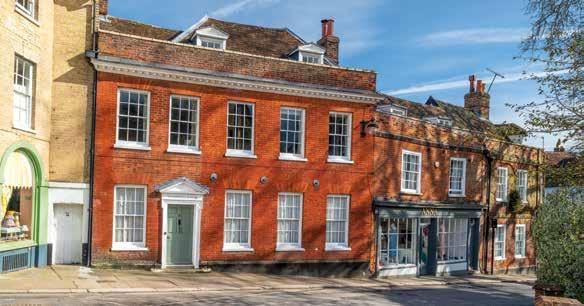
Town Houses:
Left: Woodbridge
£1,500,000 guide, (Ipswich)
Right, top: Cheltenham
£2,250,000 guide, (Cheltenham)
Right: Dorking
£2,350,000 guide, (Dorking)
Far Right, Top: Newlyn £800,000 guide, (Cornwall)
Far Right, Bottom: Taunton £1,500,000 guide, (Taunton)

l New potential buyers registering, up by over 10%.
l In-person viewings (now rare unless the potential buyer is serious) up 14%.
l Sales agreed in the first six full trading weeks of this year, up 20% (and greater in number than the whole of Q4 2025).
Having reached a record low in 2025, we believe the only way is up.
Proportion of Dwellings Sold (excludes London) Source: Jackson-Stops using Land Registry price paid data

Such feedback is, with variations in exuberance, universal − as is the observation that, for the most part, the greater power still lies with the buyers. Most areas offer a good choice of properties, giving buyers options. This highlights (yet again) the need to plan and prepare the marketing of a good house, thoroughly. For all the news of a slow-down in construction, buyers remain fearful of their ability to get work done and willing to pay for convenience. Hence fully modernised houses close to rural market town centres, are commanding a premium. These properties are likely to grow more in value than most over the rest of the year though, across the board, the trend is set for inflation-only capital appreciation from the prices established over recent months.
Sellers might thus not have it all their own way but the conditions for planning and completing a sale, at a good pace and price, are at last set fair and the prospects good.


Leading the way in a vibrant market with local expertise and professionalism.

The London market has had a strong start to the year, with no signs of this slowing down as we head into spring. Activity remains high - many are proceeding with planned moves and there is pent up demand for quality homes in the best locations. As mortgage rates continue to settle, lenders have had to compete and allow for more flexible criteria, making buyers even more motivated.
Harry Buchanan, Sales Director at Jackson-Stops Pimlico, says, “2025 was really impressive for us. During the last three months of the year we agreed 45% more sales than the same period in 2024, and our average achieved sale price rose by over 25%. With unprecedented demand for
living in the city, we expect 2026 to mirror last year's excellent performance. With an increase in properties coming onto the market, there are more buyers, more transactions, and more people moving.”
With a long-established presence across London and its surrounding areas, Jackson-Stops has offices in many of the capital’s most desirable locations, from Mayfair and Pimlico in prime central London to Teddington and Weybridge in Greater London. We are committed to our core values and make no excuse for taking a traditional approach to estate agency, guiding and advising our clients through local knowledge.
Right & Below:
Hall Place Drive
£2,000,000 guide, (Weybridge)
Below Right:
St. Georges Road, £11,000 pcm, (Teddington)

“As always, successful sales rely on the same core principles,” Harry continues, “accurate, comparable-based pricing, strategic marketing and an experienced agent to guide the process.” Across our network, we support thousands of customers at any given time, including UK-based homeowners, international buyers and tenants relocating to the capital. With notable high street offices and experienced local teams, our sellers and landlords can expect a highly informed, hands-on approach.
London continues to thrive as a global destination, with overseas buyers and tenants driving increased demand for super-prime properties. Combining unrivalled market knowledge with a clear understanding of clients’ needs, we continue to set the standard in the industry. We offer the best possible experience to clients who rely on our local know-how and proactive approach to achieve the best outcome for their property.

With the Autumn Budget now behind us, we are seeing an increase in activity levels as buyers push forward with high-value purchases. Furthermore, with the clarity on the implementation of the Renters’ Rights Act, we are seeing a significant number of landlords turning to professional agents, trusting us to not only maintain their assets, but to increase their return. “Sellers are now coming to market, seeking to take advantage of the spring surge, and many are already receiving lots of interest,” Harry notes. “There is a real advantage in acting sooner rather than later, while momentum is strong.”
We know that our clients come first, and we care for their homes as if they were our own, paying close attention to detail and managing costs sensibly, ensuring landlords maintain value and maximise their returns. Our dedicated Property


Managers are never more than 15 minutes away, resolving issues efficiently with minimal disruption and cost, while providing consistent support and practical solutions.
We value customer feedback, recognising that clients can choose who they partner with. We are proud to have received thousands of Google reviews achieving an average rating of 4.9 out of 5 stars. This is a testament to the hard work of our teams, who strive to deliver an excellent customer journey and superior results every time. More than 70 per cent of our business comes through recommendations and referrals, which we regard as the clearest measure of trust. When marketing prestigious homes, we ensure they are presented to the highest possible standard and are shared with the most appropriate publications. By partnering with leading national and international media outlets, and drawing on the expertise of our specialist marketing and PR teams, we attract global
attention and secure a regular stream of high-quality press features.
Our people are the key to our success, with 90 per cent of managers beginning their careers as trainees. Long-term investment in training and development is at the heart of the business, with many of our colleagues staying with us throughout their careers. By providing outstanding coaching at all levels, we maintain our professional approach, and give our customers the reassurance that they are working with trusted experts supported by a culture where nothing is too much trouble, and you should never have to ask twice.
As we look to the year ahead, confidence in the capital remains high, highlighting London’s enduring appeal to both local homeowners and international clients. If you are curious about the value of your property or are considering a move, our advice is not to wait.


In a bid to fulfil its promise to increase the pace of housebuilding, the government last December opened a consultation period on major proposed reforms to the National Planning Policy Framework (NPPF). That consultation closes on 10th March. The reforms might take effect from as early as July this year.
For those hoping to see an increase in housing provision and for that housing to be better designed in relation to communities and transport, there is much within the proposals to cheer. For those fearful of new development, the reforms are likely to be more or less welcome, depending upon where you live.
Top: Norfolk
£2,395,000 guide, (Burnham Market)
Right: Devon
£850,000 guide, (Exeter) (Computer generated image)


As buyer tastes evolve and pressures on planning teams grow, designs offering new interpretations of traditional and local designs (such as those shown on these pages) are securing planning permission and selling, faster. Most often working on sites which the NPPF classifies as “medium developments” (10 to 49 units), we repeatedly find that buyers of new homes care most about interior spaces, personal specification options, maximum convenience and minimum running costs and maintenance. Architecturally, beyond
More specifically:
1. PLANNING:
Easier within existing settlements, more likely near them and more difficult, beyond.
The reforms propose a default presumption in favour of granting permission within existing settlements and create clearer routes by which housing outside but near settlements, could be approved. This applies particularly to land immediately adjacent to existing settlement boundaries (though it is not described in such terms) and even more so where that land is close to a “well-connected” train station. Development within walking distance of train
wanting something pleasing to the eye, they are quite open. Planners, on the other hand, generally want designs and site layouts which recognise position and place (local stone is always a hit) and which, above all, are compliant with the NPPF. Individual officers vary significantly in their interpretation though, hence identifying which designs will maximise value and saleability, while also securing a swift recommendation for planning approval, often involves a combination of professional expertise and local knowledge.
stations will be subject to a minimum density of 40 dwellings per hectare (implying some terraced housing) or 50 where the station is well-connected. In defined circumstances, these provisions will apply to Green Belt land near a well-connected station. Development beyond existing settlements is more constrained, making it less likely.
National decision-making policies over local plans.
The proposals create, for the first time, a comprehensive suite of “national decisionmaking policies” that apply across all

Above: Suffolk
£625,000 to £1,300,000 guide, (Ipswich) (Computer generated image)
Below: Cheshire £1,595,000 guide, (Alderley Edge)
of England. Development plan policies (including neighbourhood plans) are explicitly told not to “replicate, substantively restate or modify” these national policies. Where they do, they should be given “very limited weight” in planning decisions.
After 10th March, the Secretary of State for Housing, Communities and Local Government will review the consultation responses. He (Steve Reed MP at the time of writing) can then, in whole or part, choose to publish the revised NPPF, at which point the reforms immediately become material considerations which planning decision makers must take into account. The draft includes a provision that applies from 1st July 2026, implying departmental hopes to publish by that date.
To read and respond to the proposed reforms, please search https://www.Gov.UK for ‘Consultation on NPPF reforms’.

The base rate for sterling is now at the top of the range set for the US dollar and well above that of the euro. This creates room for at least one cut, possibly two, free of currency tensions, fuelling confidence that UK base rates will fall to around 3.25% in H2 this year. Lenders are responding: strong competition is pushing rates down and the best two-year fixed rates have fallen below 3.6%.
The timing is good for a specific cohort whose members will nevertheless face a steep rise in costs: FCA data show that close to a million mortgages fixed for 5 years in 2021, many below 2%, will expire this year. Those borrowers will face jumps to between 3.5% and 4.5%. By late this year, virtually all sub-2% five-year fixes will have run their course, marking the end of pandemic-era mortgage pricing. For some who missed out, the news is more positive: almost as many 2 year mortgages also come to an end this year, having been fixed when average rates were around 5.8%.
OPTIONS FOR THOSE RENEWING
The number of mortgage products is growing. A tracker with no early repayment charge, preserves the freedom to switch to a fixed rate when cuts materialise. A two-year fix bridges to potentially cheaper refinancing in 2028. For cash-rich borrowers, paying down capital to reach a lower loan-to-value band before renewing can substantially offset the rate increase.
BESPOKE OPTIONS AT THE TOP
Lenders are competing hard for wealthier, more complex borrowers. HSBC now offers income multiples of up to 6.5 times salary, while private banks are increasingly willing to assess total financial position − investments, business profits, multiple incomes − rather than applying standard formulas. This is enabling more business owners and operators to secure properties which are well within their means, without having to sell assets or increase tax exposure.
Views and opinions expressed herein are those of the author and do not constitute financial, legal or professional advice, do not necessarily reflect the official views, policies or positions of Private Finance and should not be relied upon. For independent mortgage advice, contact Private Finance on 0800 980 8777 or at jacksonstops@privatefinance.co.uk www.privatefinance.co.uk
The
pre-2008 boom and its aftermath still dominate a market landscape in which landlords are confident and first time buyers keen, but confined.
The main tenancy reforms of the Renters’ Rights Act come into force from 1st May. Landlord protests have often positioned this as the last straw in a series of legislative burdens designed to crush the private rental sector (‘PRS’). Many of those protests are valid (see panel) and agents specialising in smaller properties have long been reporting landlord sales exceeding purchases. Despite this, the aggregate holdings of this firm’s landlord clients have increased slightly in recent years and, echoing our experience, the latest English

Top: Northamptonshire
£1,850,000 guide, (Northampton)
£2,300,000 guide, (Oxted)

Housing Survey reports the total size of the PRS is still 19% of all households. This is where it has been, bar two years at 20%, since 2015. What is happening here? Is the revival in demand from first time buyers − the foundation of our market and frequently in competition with investment buyers − an illusion? First time buyer numbers have been increasing: major lenders (eg Yorkshire) have seen year-on-year increases of around 18% in
the number of loans to first time buyers. The Bank of England reports a 5.6% increase in the proportion of owner-occupier mortgages going to first time buyers, taking it over 31% − the highest since 2007. The absolute numbers though, remain subdued at around 390,000 loans last year compared with a 2001 peak of 568,000. This is because, while interest rates are falling, affordability and credit limits remain stretched: 81% of mortgages to those


under 35 now have a term of 30 or more years, up from just 12% in 2005. Thus while every quarter point reduction in interest rates is welcome, the saving it creates − typically about £30 a month on a £200,000 mortgage − is, like the resultant extra demand, modest. Unlike other boom-bust-boom cycles, we shall not see a rapid return to a high demand, high activity market.
A simplistic but compelling argument for how we reached this illiquid, entrenched position is that we are still living with a one-off ‘sugar rush’ of new money which began over 20 years ago. It is that the invention of residential mortgage-backed securitisation (RMBS) opened the door to
such a huge increase in the limits of bank lending that it created high demand, not vice versa. Banks, unable to resist exploiting their new-found lending capacity, went from prudent gatekeepers to aggressive sellers of loans, including to the buy-to-let sector. New money flooded in † , causing a feedback loop in which house price inflation fuelled even greater demand and inflation, as home movers rushed to avoid the costs of delay.
Then, post-2008, low interest rates and quantitative easing − designed in part to avoid a severe housing market downturn − made it attractive for more credit-worthy buyers, including landlords and those with access to family money, to continue buying.

Top: Essex
£1,550,000 guide, (Colchester)
Below: Somerset
£1,950,000 guide, (Taunton)
† Between 2000 and 2007, the funding of residential mortgages through RMBS and covered bonds grew from £13 billion to £257 billion (CML / Kingston University, 2010)

Instead of the correcting crash which followed previous booms, capital values increased, even as tighter credit excluded the less cash-rich − especially first time buyers.
Today, the average house price is 7.7x average income, even higher than the then record 7x seen in 2007. This is why the welcome resurgence in first time buyer numbers − and the market fundamentals it is restoring − can only be a quiet, incremental one.
For landlords, meanwhile, 2016’s extra 3% stamp duty marked the first in a series of additional costs, of which the Renters’ Rights Act is the latest. These forced owners with
fewer than, say, five properties to make a choice: incorporate and grow, or exit. While many have taken the latter route, those choosing to grow have, as the national statistics and our client feedback confirm, more than absorbed losses to the owner-occupier market, maintaining the size of the PRS relative to all households. Landlords still in the market, remain committed to it, purchasing cautiously and not selling. Why? To quote one largeportfolio client: “Where else can I go for a predictable annual return and high confidence of maintaining long-term real asset value?”.
Sources: Bank of England, ONS, major lenders and English Housing Survey.
These are the personal views of one landlord with a portfolio of well over 100 homes in the south west and north west of England. They are shared by many of our clients, but not all.
REQUIREMENT TO CONSIDER ALLOWING PETS MIGHT ADD TO RENTS
The damage caused by pets − scratches, stains and smells on doors, furniture and carpets − is often significant and expensive to fix. Coupled with a deposit system which makes it hard to recover costs, the 'not unreasonably refused' clause might mean I have to assume extra costs for all tenancies, so rents will rise for all.
so I'll be more cautious about who I accept. Those whose credentials are weak, will find it harder to find a home. When they do, it will be poorer value for money.
THE APPEAL SYSTEM FOR RENT RISES IS DESIGNED TO FAIL
* The government has reserved a power to allow backdating of rent rises if tribunals become overwhelmed.
I only ever want to evict tenants who are antisocial or bad payers. Doing so will be an expensive process with uncertain outcome,
Appealing a rent rise will be free to bring, will always delay * that rise and cannot result in a higher rise. So, landlord relationship and personal morals aside, tenants can only gain. This will cause the system to become overloaded. It will also, again, make me more cautious about who I accept as a tenant.
DETAILS OF THE ACT ARE AVAILABLE HERE: https://www.gov.uk/government/publications/guide-to-the-renters-rights-act
A multi award-winning writer and performer, John Finnemore’s works include Cabin Pressure, John Finnimore’s Souvenir Programme and Double Acts (all for Radio 4) plus That Mitchell & Webb Look, Good Omens 2 and Avenue 5 (for TV) and, as ‘Emu’, cryptic crosswords for the Times Listener.
He is currently writing a play for the London stage.
PROPERTY EXPERTS SINCE 1910
By John Finnemore
Here are all the things that are wrong with my home: It has damp. It doesn’t feel damp, it just has damp, the way a person might have colourblindness, or varicose veins, or psychopathy. And so the paint bubbles and flakes all over the ground floor, usually in corners near the floor, but in one room right in the middle of a wall in a way that seems impossible, and is hard not to take as a deliberate insult.
It has a small but pleasant garden... in the middle of which is a large and hideous tree. It is apparently a pear tree, but I’ve seen pears, and the weird inedible things this tree sheds in autumn aren’t pears. It also sheds billions of greasy grey leaves... but not until they’ve done their summer job of blocking all the light from the garden and the house. I can’t cut the tree down, I am emphatically told, because the tree was here first.
laugh and play music, and occasionally do things that may supply them with babies for their next visit. And all their rooms are symmetrically opposite all our rooms.

It’s a semi-detached house, and the other half is an Airbnb. Often it’s empty, but when people do stay in it they are on holiday, and in the mood to make merry. If they have babies, the babies cry. If they don’t have babies, they stay up late and
Country Houses 020 7664 6646
London
Mayfair 020 7664 6644
Pimlico 020 7828 4050
Teddington 020 8943 9777
Weybridge 01932 821160
West Country
Barnstaple 01271 325153
Blandford Forum 01258 423002
Bridport/Dorchester 01308 423133
Exeter 01392 214222
Shaftesbury 01747 850858
Sherborne 01935 810141
Taunton 01823 325144
Cornwall 01872 261160
Cotswolds, Midlands & Oxfordshire
Cheltenham 01242 783333
Chipping Campden 01386 840224
Central
Northampton 01604 632991
Oundle 01832 617 617
Woburn 01525 290641
North East Yorkshire 01904 625033
North West & North Wales
Alderley Edge 01625 540340
Lancashire 01704 651029
Chester 01244 328361
Hale 0161 9288 881
East Anglia
Every two weeks or so the boiler throws a wobbly, and requires me to tempt it back to work with a sort of elaborate tea-dance ceremony involving valves and a mystical silver tube which I cannot reach without lying flat on the kitchen work surface as if I am prostrating myself before King Boiler. As indeed I am. Also, the gutters are blocked, the windows need replacing, the chimney coughs soot into the living room every time any bird in the county flaps a wing, and I’m fairly sure the whole house needs repointing. I don’t really know what ‘repointing’ is. But whatever it is, I bet my house needs it, and I bet it’s five times more expensive than I think it’s going to be. Even factoring that assumption in. And that one. Those are all the things that are wrong with my home. It’s the home I always wanted, I love it deeply, and don’t you say a word against it.
Burnham Market 01328 801333
Bury St Edmunds 01284 700535
Chelmsford 01245 806101
Colchester 01206 982272
Ipswich 01473 218218
Newmarket 01638 662231
Norwich 01603 612333
South East
Chichester 01243 786316
Arundel 01903 885886
Emsworth 01243 370300
Dorking 01306 887560
Kent & East Sussex 01580 720000
Canterbury 01227 781600
Tunbridge Wells 01892 521700
Midhurst 01730 812357
Mid Sussex 01444 484400
Oxted 01883 712375
Reigate 01737 222027
Sevenoaks 01732 740600
Weybridge 01932 821160
Woking 01483 322135
www.jackson-stops.co.uk/auctions