Section A
Questions and answers about science in education:
Why is it relevant to include Science in Education?
Because science is fundamental in the life of the human being, since through it critical thinking is promoted, where it is possible to observe, experiment and analyze different situations of the natural world. It is important, because through science, effective results can be obtained. Including science in education allows students to prepare themselves in different fields and be able to participate in a globalized world.
In which way you think you can use science as a language’s teacher?
From my point of view, science can be used to teach students to express themselves using the context of everyday life in English, for example, everything related to our planet, our human body, climate, animals, and seasons. In short, they are fundamental for the student to be able to develop easily knowing the grammatical structure, vocabulary and pronunciation of these topics that undoubtedly interest us all.
¿Do you think that teaching sciences in a different way will help students?
Of course, I think that teaching with different strategies helps students' knowledge to be effective and beneficial. Nowadays, we see that technology is a practical tool. where you experiment and create different ways of teaching, which allows the student to feel active and motivated to investigate, I think that students are curious and the best way to experiment is through science and technology that leads them to seek their own learning interests.
How does this course help me to articulate science in the classroom?
This course would help me to focus on how to plan and execute a class through the variety of resources and materials provided in each phase or unit provided. Also, to look for pedagogical strategies to include science in a second language, where new ideas and research skills that enrich our knowledge are implemented.
In your opinion, which impact sciences could have in the Language Classroom?
In my opinion, the impact would be significant. By integrating scientific content other than language, it would help to improve our reading comprehension, our communication and our critical thinking. That is, our knowledge would be more open and our skills would improve by using scientific language accurately and appropriately.
Section B
Link of the digital mural on Content and Language Integrated Learning (CLIL)
https://padlet.com/jackehotmailcom4/fundamentos-y-aplicaciones-de-clil-hzm87u1gu5ls0c4r
Section C





feedback self-learning guide n°1 natural sciences
FEEDBACK SELF-LEARNING GUIDE N°1 NATURAL SCIENCES
Sciences natural TEACHER'S DIDACTIC GUIDE

Didactic module that seeks to improve the four skills in the area of English, for teaching and learning in B1 students.
Dear students.
As you already saw in class the presentation of our topic N°1, which is called "The Universe". It is a very entertaining unit, where we will do some practical activities or simple experiences that you can do in the classroom.
Well, we will start with lesson one, summarizing in written form what was seen in the class presentation.
Let's start our space journey!!!
General guidelines
The Universe and its components.
The Universe is a term that encompasses everything that exists, from living beings to planets, stars, galaxies, clouds of dust, light, time, space and matter. It is extremely vast, with billions of stars and an immensity that is difficult to comprehend. To get an idea of its size, even a modern fighter plane would take more than a million years to reach the closest star to the Sun. If we could travel at the speed of light, which is not possible, it would take us 100,000 years. traverse only our own galaxy, the Milky Way. The Universe has not always been the same size. According to scientists, it started with a huge explosion called the Big Bang, which occurred about 14 billion years ago. Since then, the Universe has been expanding rapidly.
To better understand the Universe, it is important to become familiar with some of its main components. These elements play important roles in the formation and evolution of the Universe as a whole.
Component of the Universe
Description.
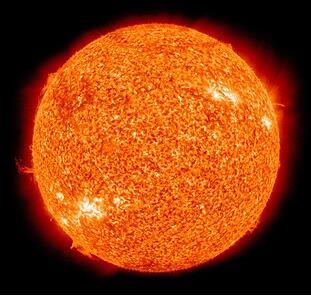
Sun Our Sun is a small, middle-aged star. Around it orbit the planets and other celestial bodies of the Solar System. It is our main source of light and heat.
Imagen
https://es.wikipedia.org/wiki/Sol
The galaxies
Galaxies are huge systems made up of millions of stars, planets, cosmic dust and gases. These components interact with each other and rotate or orbit around a central point. Galaxies can have different shapes, such as spiral, lenticular, elliptical, or irregular. Our own galaxy is called the Milky Way and is part of a larger group called the Local Group, which is made up of around 30 galaxies.
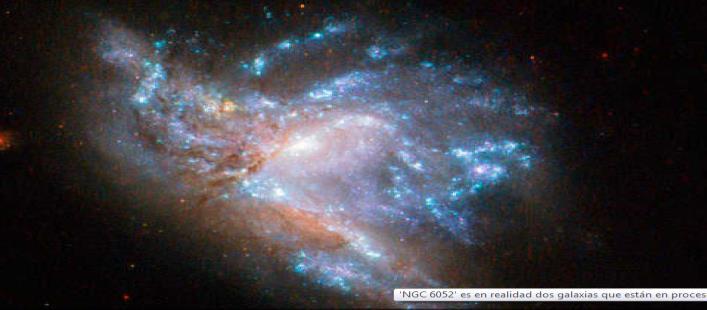
https://www.rtve.es/noticias/20190311/asi-
The asteroids
Asteroids are rocky bodies found in space that are smaller than a planet but larger than a meteorite. These objects revolve around the Sun and most of them are located in a specific region of the Solar
Figure 1 Nasa. (2022). Sol. Recuperado de Figura 2 Nasa. (2019). galaxias. Recuperado de espectacular-colision-dos-galaxias-captada-telescopio-hubble/1899881.shtml Figura 3System called the asteroid belt, which is located between the planets Mars and Jupiter
Nasa. (2019). NASA anuncia llegada a la Tierra del asteroide ‘El Dios del Caos’ Recuperado de https://es.theepochtimes.com/nasa-anuncia-llegada-a-la-tierra-delasteroide-el-dios-del-caos_515003.html
The Stars Stars are celestial objects that emit light in space. Each star has a unique temperature, which gives them different colors. Blue stars tend to be hotter than red ones. In addition, stars can be classified into different sizes, ranging from supergiant to dwarf, giant, medium, and small.
Nasa. (2022). Por qué el telescopio James Webs muestra las estrellas con ocho puntas? Recuperado de
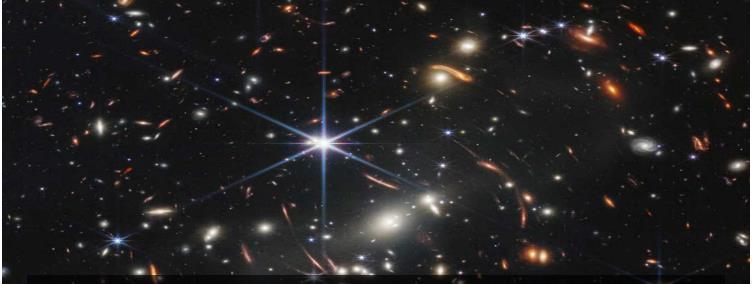
https://www.rtve.es/television/20220714/james-webb-imagenes-estrellas-ochopuntas/2388546.shtml
The Meteors
"Shooting stars" are different-sized pieces of rock or space dust that enter Earth's atmosphere. As they do so, they heat up due to friction with the air and begin to glow brightly. These phenomena are known as "shooting stars" because of their appearance as rapid flashes of light in the night sky
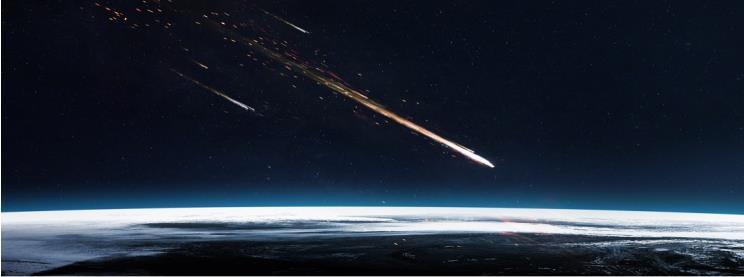
Meteoritos caídos en la tierra.
https://www.iberdrola.com/innovacion/meteoritos-tierra
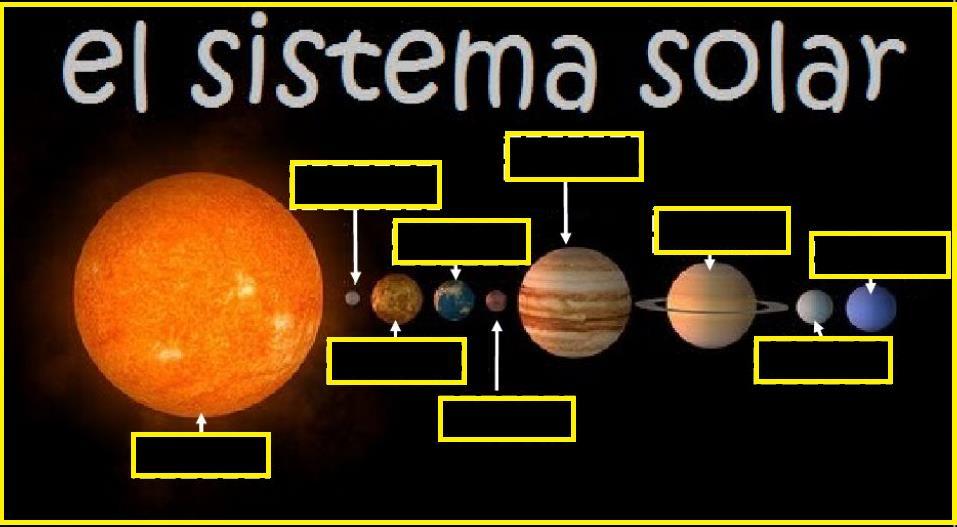
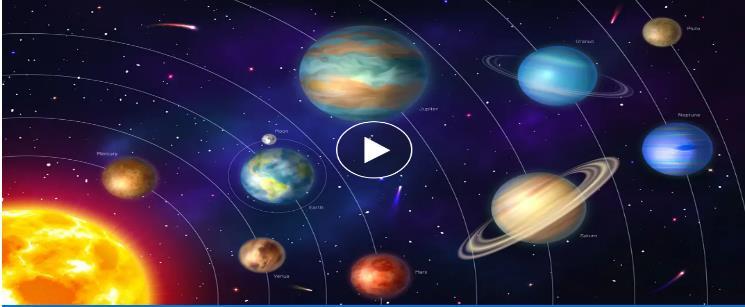
Figura 4 Figura 5The Planets Planets are celestial bodies that do not generate their own light, but rather reflect light from the Sun. These objects orbit the Sun, forming part of a solar system. In the Universe there are numerous planets, but in our solar system we have eight planets
Is it possible to buy an asteroid, a star or a planet? Does it have legal
validity?https://www.lasexta.com/tecnologia-tecnoxplora/ciencia/posible-comprarasteroide-estrella-planeta-tiene-validezlegal_202212026389fccf33153900010f849b.html.
Satellites natural
Moons are celestial bodies that do not have their own light and orbit around a planet. They are known as natural satellites. In our case, the Moon is the natural satellite of the Earth. In addition to the Moon, other planets also have their own moons. For example, Jupiter has many moons, with Ganymede being one of the most prominent. Mars, for its part, has moons called Phobos and Deimos.
The Moon is the only natural satellite of the earth. It is one of the largest natural satellites in the Solar https://www.alamy.es/foto-sistema-solar-las-masas-luna-laluna-es-el-unico-satelite-natural-de-la-tierra-es-uno-de-los-mayores-satelitesnaturales-en-el-solar-114670113.html?imageid=C0B8EC25-B4FE-4E56-8DD6-39D
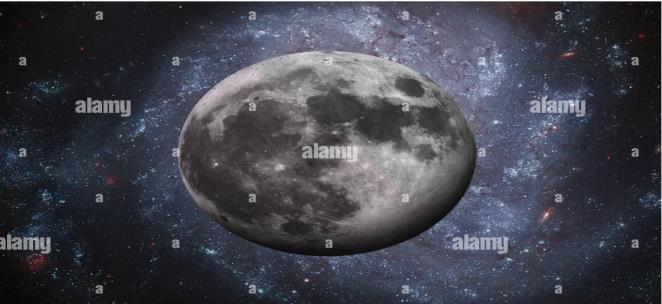 Figure 6
Figure 7
Figure 6
Figure 7
The Comets
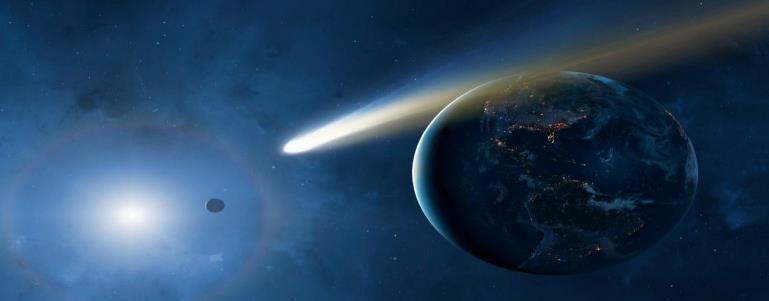
Comets are small celestial bodies that are composed mainly of ice, dust, and rocks. These objects orbit the Sun. As a comet approaches the Sun in its orbit, heat from the Sun causes the ice to turn to gas, releasing dust and creating a luminous tail that can extend for thousands of kilometers. This luminous tail is a distinctive feature of comets and makes them visible from Earth at certain times.
like?.https://www.ngenespanol.com/el-espacio/como-es-el-cometa-halley-y-cadacuando-se-acerca-a-la-tierra/
Activities
1.Read the following reading and write three of the professions mentioned in the last paragraph and construct a short definition in the following table.
Title: Exploring the Universe: Those who contribute to the advancement of knowledge
Since ancient times, humanity has directed its gaze towards the sky, full of mysteries and unanswered questions. What is our place in the vast universe? Are there other worlds like ours? Can we one day colonize them? These questions and many more have been the object of study and fascination throughout history.
Figura 8 Halley's Comet: what is the star that inspires art and amazes scienceCurrently, we have the valuable contribution of the scientific community, a group of brilliant minds that works tirelessly to expand our knowledge of the universe. Within this community, astronomers play a fundamental role. They are scientists specialized in the study of the physics of the universe, investigating stars, planets, galaxies and other celestial bodies.
Astronomers use powerful telescopes both on Earth and in space to observe the cosmos. Through data analysis and the use of theoretical models, they manage to reveal the secrets of celestial objects. In addition, these scientists work on the creation and development of new instruments and technologies to collect information and carry out more precise and detailed investigations.
However, the advancement of knowledge of the Universe is not limited only to astronomers. Other professions also play an important role in this exciting task. Aerospace engineers. Computer and telecommunications engineers, Chemical and electronic engineering, Geology and general physics. Even the optics.
Profession Definition
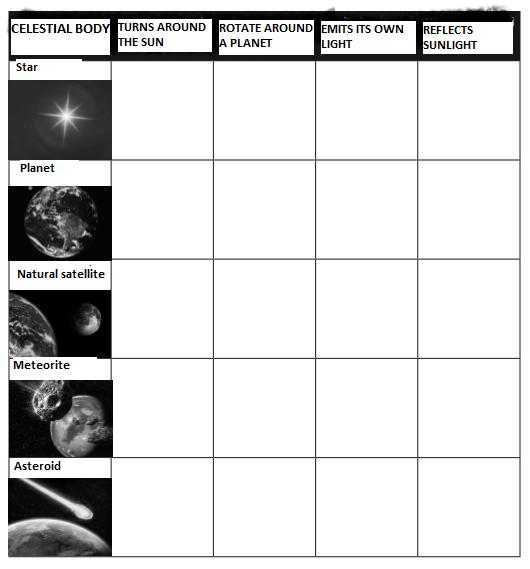
2. Mark with an if the celestial body meets the indicated condition

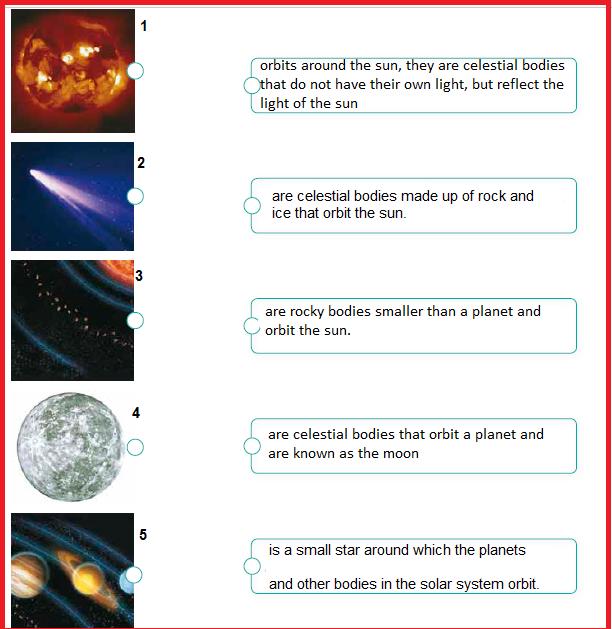
3. Match the drawings of the solar system with their correct description. listen and select the indicated solar system
Section D
Natural science lesson plan
NATURAL SCIENCE LESSON PLAN
GRADE: Sexto DATE: July 21 2023 TEACHER: Jackeline Guzman López TOPIC: The universe and its origin, TIME: 2 hour
SKILL: Listening, Speaking, Reading, and Writing.
NATURAL SCIENCE DBA (Basic Learning Right):
•According to the unit of the origin of the universe, we seek that students can improve the pronunciation and understanding of these key terms.
RESOURCES:
Youtube video
•Computer
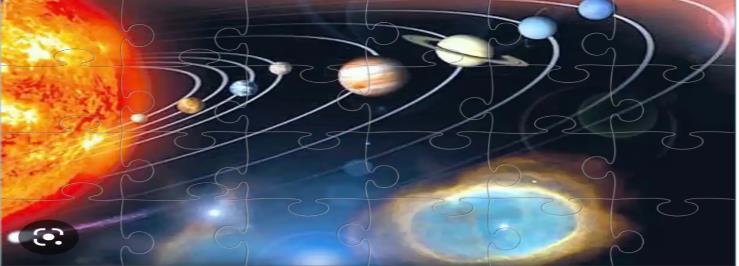
•Puzzle
•Laptop
•Pencil
• Teaching guide workshop
•draft
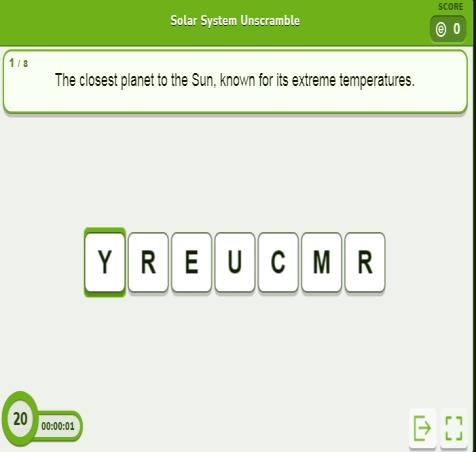
•Educaplay Activities
Goals
Understand basic concepts about the origin and evolution of the universe, including the Big Bang theory and the formation of galaxies, stars and planets.
Become familiar with the scientific vocabulary related to the topic, both in Spanish and English
Promote critical thinking and the ability to ask questions about the origin of the universe and astronomical phenomena.
SKILLS:
Listening: Students will listen to the Origin of the Universe video where they can identify and understand the central theme and main ideas.
Speaking: the students will practice with the hot potato game, repeating the accentuation and correctly pronouncing the images indicated by the teacher.
Reading: students will practice reading by developing the guide designed by the tutor and understanding the assigned activities.
Writing: students will practice writing by completing the activity in their notebook and repeating those that they still understand