TWO days of interactive debates... TWELVE hours of dedicated networking... ONE place to be
Join key decision-makers, professionals and industry experts as they gather for two days of debate centred upon how new technologies are driving progress in sustainable transport.
For 2026 we are taking the European Light Rail Congress back to the beautiful Canary island of Tenerife, home of the Metrotenerife light rail system.
Metrotenerife provides modern and efficient public transport, with safety and the environment being key factors that contribute to improving the quality of life of the citizens of Tenerife and the surroundings. There are some very exciting expansion plans with their current lines in the North of the Island growing, as well as building new lines to connect more areas of the island and reduce the need for cars and reduce both congestion and pollution.
As an attendee, you will experience: Two days of presentations, panel debates and discussion from some of the sector’s most innovative and forward-thinking suppliers, manufacturers and operators, plus an expansive exhibition hall within the Espacio Mutua Tinerfeña in San Cristobal de la Laguna, which is very close to the tramway. An evening networking reception for delegates to maximise their networking opportunities is also included, along with an exclusive behind the scenes depot tour hosted by Metrotenerife. Convenient accommodation to the venue is very close with one hotel just 4-5 metres away, and another 450 metres away.
With bespoke sponsorship and exhibition packages also available, there has never been a better time to place yourself at the very heart of European light rail.








11-12
March






NEWS 84
Stadler delivers Karlsruhe VDV tram-train; China opens another new tramway; Oslo cancels CAF options; Alexandria’s t ramway to close for modernisation.
NEW TRAMWAYS FOR 2026 89
Mike Taplin looks at the LRT projects that are set to open in the coming year.
BORDEAUX: GRAND PLANS 94
Andrew Thompson explores one of France’s most elegant – and fast-growing – systems.
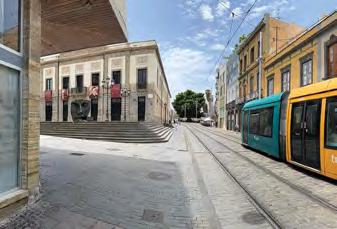
SHOWCASING TENERIFE 97
As EULR heads to Tenerife for 2026, TAUT takes a look at this special system.
ALL CHANGE AT BLACKPOOL 100
Jane Cole talks about changes to the UK’s only first-generation line.
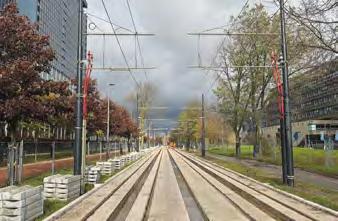
TRADITION IN D ÖBELN 103
Andrew Thompson visits the German city where a traditional tram still has a place.
THE VALUE OF APPRENTICESHIPS 105 UKTram reflects on skills building.
SYSTEMS FACTFILE: WUPPERTAL 106
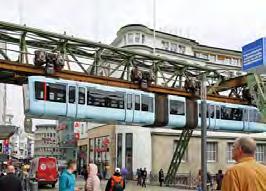
Neil Pulling visits one of the world’s most unusual systems in its 125th year.
WORLDWIDE REVIEW 111
Firenze T3 extension gains city approval.
MAILBOX 11 5
Thoughts on Boston’s transit history; Some light on Washington claims.
CLASSIC TRAMS: TORINO 116 Official recognition could at last be coming to Torino’s heritage, Mike Russell finds.

On time and on budget – these familiar words are used at the completion of major capital projects, such as light rail schemes. They have been a confident proclamation of pride in a job well done.
But not any more. For perhaps the first time, TAUT Overseas Editor Mike Taplin’s review of new tramways in the pipeline comes with a health warning. Instead of listing those which will be completed by the year end, the pledges of the promoters have to be taken with a liberal sprinkling of salt.
This all mirrors the current state of the world, with deep political uncertainty, overstretched cities suffering from high interest rates on borrowing, unplanned engineering overruns, and supplier problems.
Completion delays of just a couple of months aren’t a problem. However, Mississauga in Ontario, Canada must be embarrassed that its 17.7km (11-mile) system, due to open in the first weeks of 2025, may not be ready until the end of the decade. Delingha in China and Busan in South Korea also seem to have disappeared off the list – completely.
Of course, it’s not all about brand-new systems, as there is no let-up in extensions to the 429 worldwide tramways that are officially recognised, and it is gratifying to see so many in the pipeline. Time schedules have never been as important here.
Suppliers can be thrown by unpredicted events, none more than Spanish company CAF, which has lost valuable run-on orders for 90 new metro trains in Oslo for allegedly supporting Israel against the Palestinians. CAF denies any wrong-doing, and it will leave its competitors worrying about how best they can watch their own steps.
Tenerife features strongly in this issue, and you can read why it is an excellent choice for this year’s European Light Rail Congress on 11-12 March.
Matt Johnston, Editor
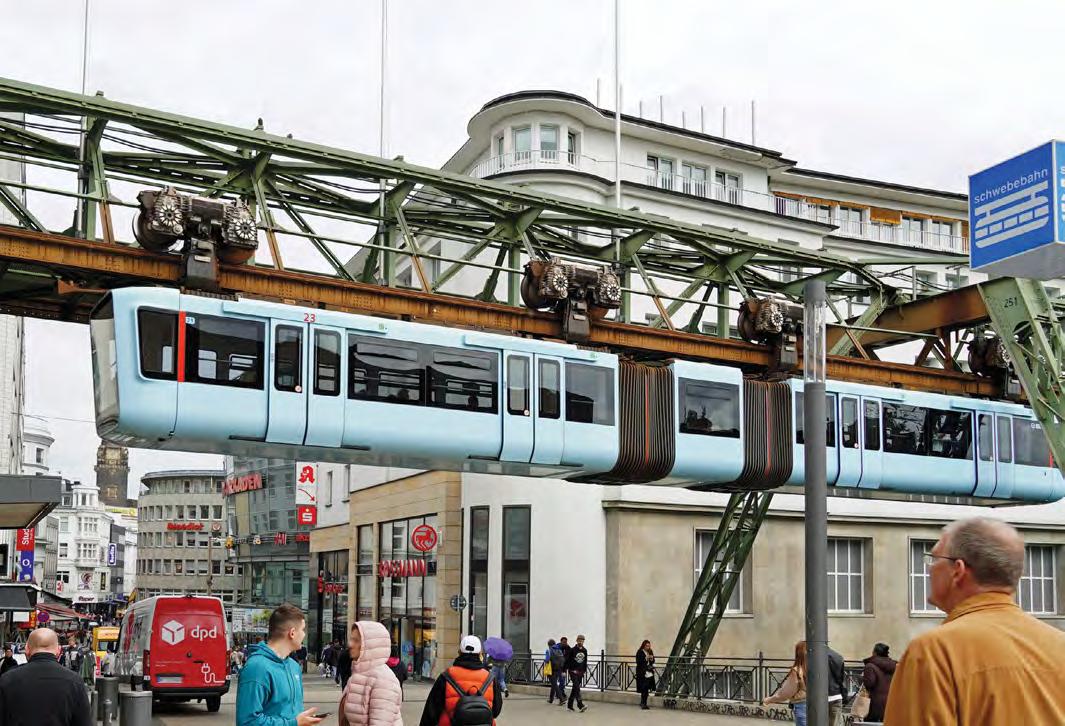
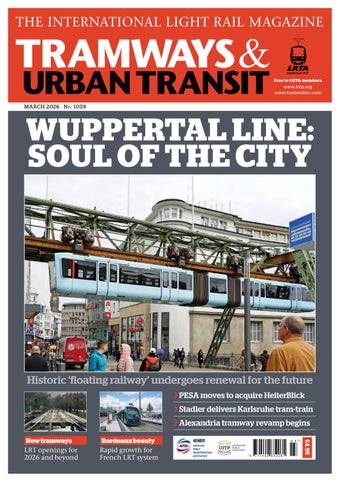
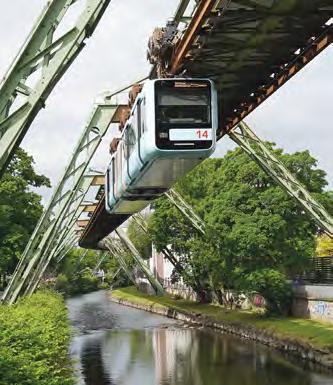
COVER: Schwebebahn 15 23 leaving Hauptbahnhof on 27 May 2025. Forming part of Wuppertal's principal transport interchange, Hbf is the most heavily-used Schwebebahn station. Neil Pulling
MARCH 2026 Vol. 89 No. 1059 www.tautonline.com
EDITORIAL
EDITOR – Matt Johnston matt@mainspring.co.uk
ASSOCIATE EDITOR – Tony Streeter tony.streeter@mainspring.co.uk
WORLDWIDE EDITOR – Michael Taplin miketap@mainspring.co.uk
SENIOR CONTRIBUTORS –Howard Johnston , Neil Pulling
WORLDWIDE CONTRIBUTORS
Richard Foster, Andrew Grahl, Andrew Moglestue, Herbert Pence, Mike Russell, Nikolai Semyonov, Alain Senut, Andrew Thompson, Witold Urbanowicz, Bill Vigrass, Thomas Wagner, Philip Webb.
PRODUCTION – Lanna Blyth Tel: +44 (0)1733 367604 production@mainspring.co.uk
D ESIGN – Debbie Nolan
ADVERTISING
COMMERCIAL MANAGER – Geoff Butler Tel: +44 (0)1733 367610 geoff@mainspring.co.uk
Tramways & Urban Transit
13 Orton Enterprise Centre, Bakewell Road, Peterborough PE2 6XU, UK
T ramways & Urban Transit is published by Mainspring on behalf of the LRTA on the third Friday of each month preceding the cover date.
L RTA MEMBERSHIP (with TAUT subscription) Tramways & Urban Transit is sent free to all paid-up members of the Light Rail Transit Association.
LRTA WEBSITE AND DIARY Tim Kendell webmaster@lrta.org meetings@lrta.org
S UBSCRIPTIONS, MEMBERSHIP AND BACK ISSUES LRTA Membership Secretary (Dept T06), 38 Wolseley Road, Sale M33 7AU, UK. Tel: +44 (0)117 951 7785 membership@lrta.org Website: www.lrta.org FOR CORPORATE SUBSCRIPTIONS VISIT www.mainspring.co.uk
LRTA REGISTERED OFFICE 13 Orton Enterprise Centre, Bakewell Road, Peterborough PE2 6XU, UK Private company limited by guarantee, No. 5072319 in England and Wales.
L RTA CHAIRMAN – Paul Rowen chair@lrta.org
© L RTA 2026
Articles are submitted on the understanding they may also be used on our websites or in other media. A contribution is accepted on the basis that its author is responsible for the opinions expressed in it, and such opinions are not those of the LRTA or Mainspring. All rights reserved. No part of this magazine may be reproduced or transmitted in any form by any means, electronic or mechanical, including photocopying, recording or by any information storage and retrieval system, without prior permission in writing from the copyright owner. Multiple copying of the contents of the magazine without prior written approval is not permitted.
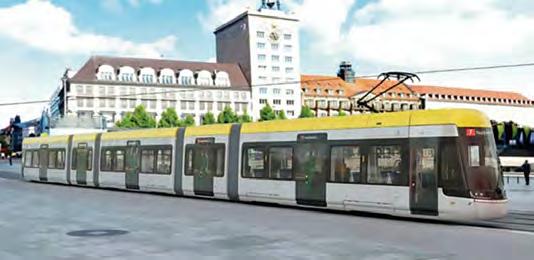
PESA is expected to complete the acquisition of Leipzig tram manufacturer HeiterBlick by the end of the first quarter of 2026. The Polish company started moves to take on 100% of HeiterBlick’s share capital du ring December.
HeiterBlick started selfadministration proceedings in April 2025 (TAUT 1050), which subsequently failed, only for Leipzig Insolvency C ourt to initiate official insolvency proceedings on July (TAUT 1053).
The deal is expected to secure 250 jobs at the German factory. PESA intends its acquisition of HeiterBlick to help it expand into western Europe as Krzysztof Zdziarski, President of its management
board, explained: “We believe [that] PESA and HeiterBlick complement each other perfectly. The merger provides a synergy of competencies and the integration of experience, which is crucial for strengthening our position in Europe.”
T he takeover was predicated on HeiterBlick retaining the confidence of the majority of its existing customers, with Dortmund, Leipzig and Würzburg willing to maintain their orders despite delivery delays. A decision by Leipzig City Council to confirm an order for 25 45m air-conditioned t rams was key, and it is understood that bodyshells will be manufactured at PESA’s factory at Bydgoszcz in northern Poland. Alstom’s Görlitz factory previously supplied

TransitLinX Alliance has won the AUD8.8bn (EUR5.1bn) contract to build Suburban Rail Loop East, the first section of the Suburban Rail Loop around the Australian city of Melbourne. The Suburban Loop Authority awarded the consortium – formed by Alstom, John Holland, KBR, WSP and RATP Dev – the contract to build the 26km (16-mile) Cheltenham to Box Hill line. Eventually, the Loop is to be 90km (56 miles) long, with future sections linking the suburbs of Box Hill, Werribee, Bundoora and Sunshine as well as the airport. It is being built in response to forecasts that the city’s population will reach nine million by 2055.
HeiterBlick’s bodyshells. HeiterBlick had orders for 92 trams (plus options for 157 more) when it entered administration due to a lack of working capital. These included nine (plus an option for six more) Sachsentram sets for Görlitz and six (plus an option of 12) for Zwickau; both tramways have since withdrawn from the Sachsentram consortium and are seeking an
alternative supplier.
PESA has delivered nearly 1000 trams to 20 cities in eastern Europe since it started building light rail vehicles in 2001. The business can trace its history back to 1851. HeiterBlick, meanwhile, started manufacturing trams in 2004, initially in a factory that was previously Leipzig’s tramway workshop.
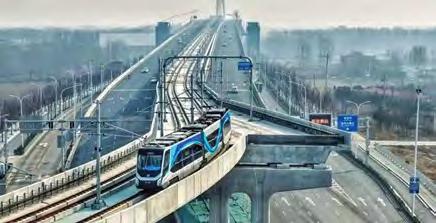
China’s Jinan opened its new CNY6.5bn (EUR786m) tramway on 30 December 2025. This is Shandong province’s first line.
The 36.1km (22.4-mile) route links Jinandong (North) railway station and Jiyang North via a bridge over the Yellow River. The whole line is on dedicated right-of-way, with three-section low-floor trams. No details of
fleet size or the vehicles’ builder are known.
Service is provided every 15-20 minutes 06.00-21.00 and there is a flat fare of CNY2 (EUR0.24). Construction started in September 2022.
Jinan also opened three new metro lines on 27 December, bringing the network total to 182.4km (113 miles).
Due to open in 2035, SLR East is entirely underground and is to boast six new stations, providing interchanges with existing suburban railway lines. Meanwhile, development of the SRL North and SRL West sections continues; SRL North is due to open in 2053, while no date has been given for SRL West.
Alstom’s share of the work is worth EUR1bn and includes construction of 13 Metropolis automated metro trains with GoA4 provision and 15 years of maintenance, as well as providing the Urbalis CBTC train control system. The trains will be built at Alstom’s Dandenong factory and serviced at a new depot at Heatherton.
Oslo’s City Council resolved in December 2025 not to take up options for more CAF metro trains. The Norwegian capital placed a EUR150m order for 20 INNEO metro trains in May 2024, with an option for 90 more. The decision, according to Marit Vea, City Commissioner for Environment & Transport, is in light of the United Nations Human Rights Office (OHCHR) adding CAF to its database of
businesses “involved in certain activities in illegal Israeli settlements in the occupied Palestinian territory”.
CAF has denied any claims of wrongdoing, saying, “CAF remains fully committed to responsible business conduct, to constructive engagement with the OHCHR, and to the protection of Human Rights and Humanitarian Law in all its operations.”
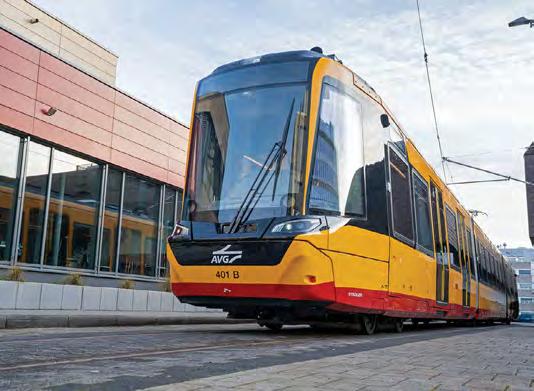
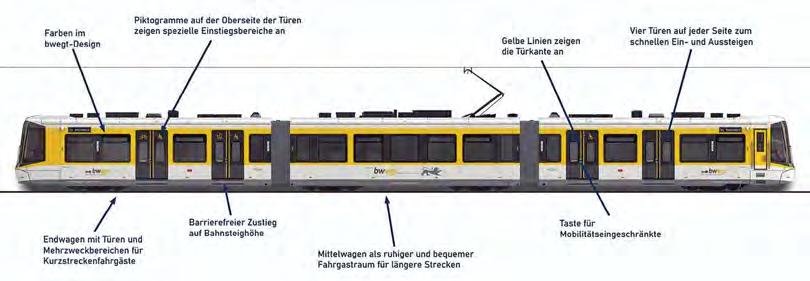
Karlsruhe regional transport operator Albtal-VerkehrsGesellschaft (AVG) unveiled Stadler TT-2S tramtrain 401 to the media on 12 December. The low-floor vehicle had arrived at the German operator’s Tullastrasse depot on 9 December, having been shipped by sea from Valencia and then hauled by rail from Antwerpen (Antwerp) docks.
This is the first of 75 37.2m-long cars on order that are equipped for running over the 750V dc and 15kV ac parts of the AVG network. There is an option for a further 73. Meanwhile, Karlsruhe city operator Verkehrsbetriebe Karlsruhe GmbH (VBK) has 73 single-voltage versions of these vehicles on order with an option for 52 more. Delivery of these is not expected to start until 2028.
Due to enter service over the summer, AVG’s new vehicles can carry 229 passengers (93 seated) and there is a toilet on board.
Arrival of the first vehicle for Karlsruhe also marks a further significant step in the rollout of the joint tram-train project overseen by the Verband Deutscher Verkehrsunternehmen (VDV). The first for Saarbrücken arrived last year (TAUT 1056). AVG Managing Director
Professor Dr Alexander Pischon said: “With the arrival of the first vehicle, the transition to a new generation begins for us. The joint procurement with other undertakings brings significant economic advantages and enables a stable long-term operation of urban and regional transport.”
The original Siemens dualvoltage, high-floor LRVs have already been withdrawn, but 85 GT8-100D/2S-M high-floor dualvoltage LRVs from the late 1990s/ early 2000s remain in service.
Karlsruhe’s tram-train operation started on the railway
to Bretten in September 1992. There is now a network of 12 lines, which carry nearly 200 000 passengers/day. However, AVG’s passenger numbers have fallen by about 3% in the last year, in response to unreliability caused by a shortage of drivers.
Some commentators are also speculating that EUR5m of the EUR1.9bn savings that the city reportedly needs to make is to fall on public transit. As a result, it is being suggested that evening headways on the AVG network will be extended, and 30-minute headways introduced on Sundays.
Signing of the South Yorkshire Combined Authority: NPR Compact Agreement on 22 January committed GBP7.5m ( EUR8.6m) to the development of Sheffield’s tram-train network (UK).
The existing 5.5km (3.4-mile) tram-train line from Cathedral to Rotherham Parkgate opened in 2018 but suggested extensions include a line to Stocksbridge via a rejuvenated Sheffield Victoria station as well as a route south to Chesterfield, utilising the freight-only railway via Killamarsh and Barrow Hill (TAUT 1043).
The compact was signed by South Yorkshire Combined
Authority Mayor Oliver Coppard and Secretary of State for Transport Heidi Alexander in the wake of the UK Government’s announcement that it is to invest GBP45bn (EUR51.8bn) in rail infrastructure in the north of England. This has been dubbed Northern Powerhouse Rail (NPR).
Alexander said: “With Sheffield at the heart of the first phase of our plans for NPR, we will deliver more frequent, reliable services to Leeds, expand capacity at Sheffield station and invest in a new Rotherham station while supporting Sheffield’s tram-train extension – helping support thousands of
Blackpool councillor and Tramtown volunteer coordinator Paul Galley has claimed he has seen e-mails from within Blackpool Council (UK) stating that the workshop and paintshop at Rigby Road depot could be demolished “around Easter”. In a video on his YouTube channel, Councillor Galley said that “Tramtown will die” without the building.
Council leader Lynn Williams responded: “Nobody has made a decision on this yet.”
Tramtown opened in 2021, with volunteers offering conducted tours to see some of the system’s heritage trams closeup. The rest of the heritage fleet is stored in the main tram depot, which is off-limits to the public.
Blackpool Transport Managing Director Jane Cole told TAUT: “Tramtown is absolutely phenomenal. We’ve got about 30 volunteers, it’s a community project [and] they’ve actually created this fantastic visitor attraction, which is really busy. We’ve got people from all over the world coming to see it.”
The current exhibition provides, says Cole, “a revenue stream to demonstrate to the National Heritage Lottery Fund that we’ve actually got a going concern as far as a visitor attraction is concerned”.
Tramtown is currently closed as it is in urgent need of repair work to make the building safe.
Blackpool Council, who own the building and are fully committed to the project, are considering options for the relocation of the attraction.
new homes and jobs.”
The UK government is to work with NECA “on the business case for the remainder of the proposed Leamside reopening”. This is the former East Coast Main Line (ECML) diversionary route, from Pelaw Junction on the Tyne & Wear Metro, via Durham to a junction with the ECML at Ferryhill. The northern part of the line forms a key section of Tyne & Wear Metro’s extension to Washington. Opening the rest of the Leamside line is a separate project. It will only go ahead if the UK Government “agrees the business case and it demonstrates good value for money”.
Ireland’s National Transport Authority has instructed Transport Infrastructure Ireland (TII) to progress the proposed Poolbeg extension to Dublin’s Luas. The approximately 2km (1.2-mile) extension would take the Red Line east from its current terminus, before turning south and across the River Liffey to a new terminus at Poolbeg. This would serve a new 15-hectare urban development on the site of the Irish Glass Bottle Factory. It had been suggested that such an extension would not open before the 2040s. However, the Fine Gael party’s James Geoghegan said: “This project is now advancing to the next stage ahead of major changes in population growth and infrastructure planning.”
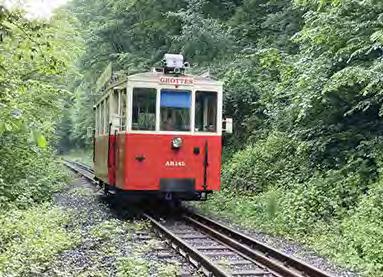
An historic tramway in the Belgian Ardennes village of Han-sur-Lesse looks set to close, having been operating since 1 June 1906.
Walloon transport operator TEC announced on 16 January that it no longer wishes to be involved with the 5.4km (3.4mile) tramway, which serves the Grottes de Han cave complex.
An online petition has been launched to save the metregauge tramway, which conveys people from the site’s main entrance in the village to the caves themselves. Visitors make the return journey through the caves while the diesel Autorail and toast-rack trailers normally return empty.
Once part of the Belgium’s Vicinaux light railway network, the tramway has been a standalone operation since 1955. It was owned by TEC, but leased to the cave’s operator, Domaine des Grottes de Han.
Although offered the line and rolling stock for EUR5m, the cave operator – a public limited company that receives no subsidies – decided to accept the closure of the tramway as part of its ‘re-orientation of the tourism
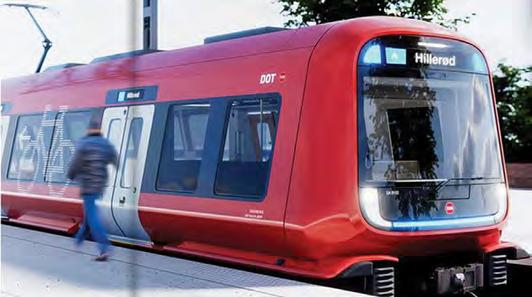
Aconsortium formed by Siemens Mobility and Stadler Rail has won the contract to build 226 1500V dc S-tog four-car trains for København (Copenhagen). The DKK23bn (EUR3bn) contract includes 30 years of maintenance. The new fleet should start to enter service on the Danish capital’s line F (Hellerup – København Syd) in 2032.
T his is to be the first part of the 170km (106-mile) suburban rail network to be converted to driver-free operation, with the remainder due to change over by 2040. The GoA4 unattended automatic train operation is planned to permit 90-second headways, increasing capacity by 35%.
Peter Schütze, Chairman of Danish rail operator DSB, said: “The new, fully automatic [S-tog trains] are an investment in the public transport of the future for the capital. With higher frequency and increased capacity, we ensure that [it] can keep up with the growing
demand and maintain its role as the backbone of the capital’s public transport.”
The trains are designed so that three sets can be coupled together. They are to feature airconditioning, 2+2 seating and work areas with tables.
Siemens is already working on a EUR270m contract to modify onboard and lineside equipment to support driverless operation, while a new DKK1.9bn (EUR254m) depot is being built at Vinge, a 350-hectare
development near Frederikssund. The S-bane network began operating in 1934 and carried 112m passengers in 2024. The present generation of rolling stock was introduced in 1996.
Tendering for the new trains started in 2023. Jürgen Müller, DSB’s Director of Strategy & Train Equipment, said at the time that the S-bane “has reached its maximum capacity during rush hour… With the tender, the [S -bane] of the future has really started.”
Reutlingen city council gave the go-ahead for new street alignments on 16 December to facilitate the creation of a ten-line light rail network in southern Germany. The project was initiated in 2014 and involves creating a 197.9km (123-mile) network, with 55 new stations and additional street running to access city centres.
Stadler is to provide 30 toiletequipped tram-trains. They are
to be dual voltage, for the 750V dc street-running tramway sections in Reutlingen and Pfullingen, equipped with 15kV ac for railway operation. Due to be delivered in 2027, they are to enter service on four lines from 2028:
S2/S12: Reutlingen Süd –Reutlingen Hbf – Gomaringen – Mössingen/Tübingen
S5: Engstingen – Pfullingen – Reutlingen – Tübingen –Entringen
S6: Pfullingen – Reutlingen –Bad Urach
Construction of two new sections of tramway is to take place. The EUR140.7m, 4.7km (2.9-mile) section along Gartenstrasse in Reutlingen is expected to carry 18 300 passengers/day, while the EUR111.1m 4.5km (2.8-mile) section along Pfullingen Alte Bahnstrasse could attract 16 000 passengers/day.
Ghioroc tender issued
A tender has been issued “for the elaboration of technical expertise, specialty studies, [and] documentation for obtaining design approvals/agreements” for the modernisation of the Ghioroc interurban tramway. The 22km (14-mile) Romanian line closed in May 2025 (TAUT 1052) for what was expected to be a three-year reconstruction programme.
City and regional councils have been aiming for EU funding to cover the estimated EUR1.13m needed to repair the track and other infrastructure.
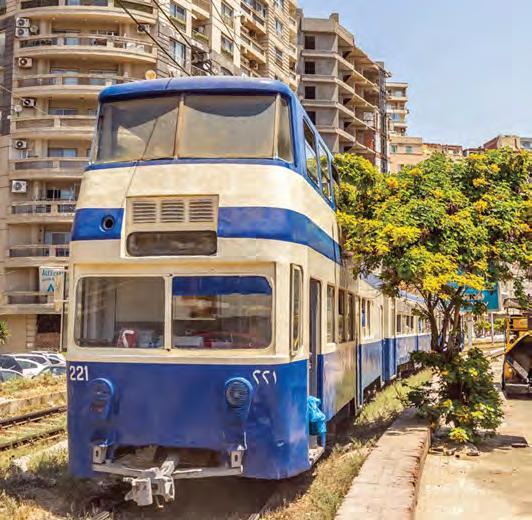
Alexandria’s tramway closes for extensive modernisation
The 13.2km (8.2-mile) suburban tramway that serves Egypt’s second city was closed from the first week in February to enable the Raml Tram Rehabilitation Project to take place. This is part of a wider plan to make public transport in AlIskandariyyah (Alexandria) more environmentally-friendly.
Aims include reducing the Victoria – Raml journey time from 60 minutes to 35 minutes and increasing the service from every nine minutes to every three minutes.
The revamped line will comprise 5.7km (3.5 miles) of surface running, 7.3km (4.5 miles) of elevated running a nd 276m underground. An extension from Raml to Mansheya Square is also planned, which will bring the tramway’s length to 14.5km (nine miles). Its 24 stops will also be refurbished and repositioned to an average distance of 500m.
Egypt’s National Authority for Tunnels is supervising the work, which is due to be completed by the end of 2027. A consortium of Arab Contractors and Hassan Allam is tasked with implementing the project, with an EGP9bn (EUR161m) loan
from local banks to fund the construction work. There will also be EUR238m in overseas financing, including funding from the French Development Agency and the European Investment Bank.
South Korea’s HyundaiRotem will supply 30 double-ended 65m trams while Japan’s Hitachi Rail has been awarded a contract to supply signalling, communications and safety systems (TAUT 1057).
Replacement buses will serve the same residential areas covered by the current line, to keep passenger movement running smoothly during the shutdown.
The El Raml line was built in 1860-1863 and electrified in 1902. It is notable for using six double-deck control trailers built by Kinki Sharyo in the 1970s, although these have only operated in a limited way for a number of years.
Canada’s Toronto Transit Commission signed a CAD2.3bn (EUR1.4bn) contract with Alstom for 70 six-car Metropolis subway trains on 15 January. There are options for up to 150 more. This directly-awarded contract replaced an international tender that was cancelled due to proposed US punitive tariffs on Canadian products. The trains are to be built at what was previously the Bombardier factory at Thunder Bay.
Toronto subway’s Line 2 (Bloor – Danforth) is to receive 55 of the new trains, while 15 are earmarked for the planned extensions of Line 1 to Yonge North and Line 2 to Scarborough.
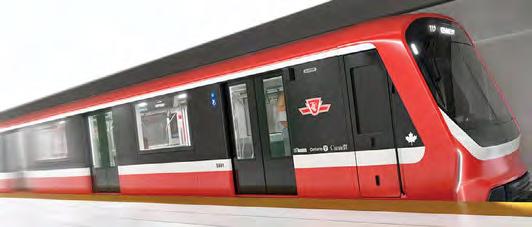
Each of the 126m-long trains can carry up to 1300 passengers. They are to feature traction motors that can be controlled more precisely than earlier versions thanks to Insulated-Gate Bipolar Transistors, plus regenerative braking.
The trains will utilise Canadian-made carbon, steel and aluminium, as well as components sourced from domestic supply chains. Ontario province is targeting i nvestment support to increase Canadian content.
Colas wins contracts
Colas Rail UK has won two West Midlands light rail infrastructure contracts. As Principal Contractor to Midlands Metro Alliance, the company will build the second phase of the Birmingham Eastside Extension and the equivalent phase of the Wednesbury –Brierley Hill Metro Extension.
Colas Rail Urban Managing Director Iain Anderson said:
“These awards ensure continuity of work through to 2028 – a significant endorsement of our dedicated team. We look forward to continuing this journey, driving forward the successful delivery of projects that will continue to shape the lives and the futures of the people of the West Midlands.”
The Eastside Extension’s phase two involves building the 17km (11-mile) line from Millennium Point to Digbeth, via the proposed HS2 station at Curzon Street and the new Sports Quarter (TAUT 1051). The 11km (seven-mile) Brierley Hill extension includes building a new 225m viaduct and the sympathetic restoration of the historic Parkhead viaduct.
Colas is also to expand the tram stabling sidings at Wednesbury depot, as well as enlarging West Midlands Metro’s Operational Maintenance Control building.
Parramatta usage lower than expected
Data published by Transport for New South Wales shows that 12 000 daily trips were made on the AUD2.9bn (EUR1.7bn) Parramatta Light Rail between January and November 2025. Original projections for the 12km (7.5-mile) Australian line, which opened in December 2024, was 22 000 people per day.
Mathew Hounsell, transport researcher at the University of Technology Sydney, told ABC News: “It takes time for any light rail to build patronage but [the Parramatta Light Rail] is lacking a cohesive plan around land use and events and places to go.”
Construction of the 10km (six-mile) Stage 2 is in progress. This diverges from the Westmead – Carlingford Stage 1 line close to Camellia, heading east to Sydney Olympic Park and a connection to Sydney Metro West, the heavy rail network and ferry services at Rydalmere.
Straits line tested
Testing on part of the Rapid Transit System Link that links Malaysia and Singapore took place on 30 December. One of the CRRC-built multiple units ran from Wadi Hana Depot in Johor Bahru, Malaysia and as far as the border with Singapore.
The 4km (2.5-mile) line is to connect to Woodlands North on Singapore’s metro via a new viaduct across the Straits of Johor, the border between the two countries. It is to open in December 2026.





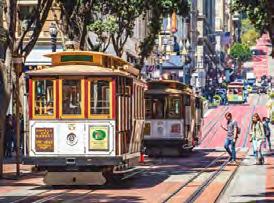


Difficulties in pushing projects ‘across the line’ mean that 2026 is looking particularly slow for new tramway openings. Michael Taplin looks at those set to open, and some that we can pin hopes on over the slightly longer-term.
It is becoming more and more difficult to make meaningful predictions about opening dates for new tramways around the world as delays abound, mostly as a result of political expectations running ahead of institutional, planning and engineering realities.
As a result, this annual article has had to e xpand its scope to look further into the future than the current year.
In our March 2025 issue I suggested that openings would take place in the following places in 2025:
BELGIUM L iège
CANADA
Eglinton Crosstown and Finch West, Toronto Mississauga CHINA
København
NORTH KOREA Wonsan
SOUTH KOREA Busan
SPAIN
Jaén (re-opening)
UK S outh Wales Metro
USA S anta Ana (Orange County)
Events transpired such that just the following were achieved: Liè ge, Finch West, København and Wonsan. Eglinton Crosstown may have missed the deadline by just four or five weeks, but Mississauga has disappeared over the horizon, perhaps to 2029. There has been no news from Delingha and this is being removed from the listings. Busan’s battery-powered trams are surrounded by silence. Jaén is still plagued
by disagreements and recriminations between the city council and Andalucia. South Wales Metro has put its Stadler tramtrains into service, but not yet on the line to Cardiff Bay (intended to be the basis of some street-based operation), while Orange County is still testing.
On this basis we think the only certainties for 2026 are:
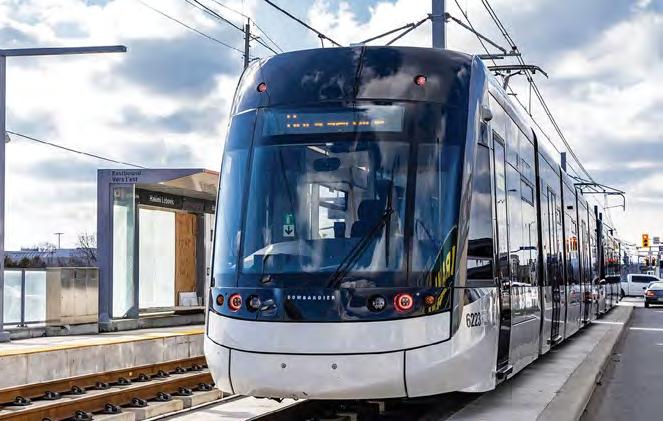
CANADA Eglinton Crosstown
SOUTH KOREA �������������������� Seoul (Wirye)
USA S anta Ana (Orange County)
T his is the lowest number for many years. It is not that there are no more schemes queuing up for opening. There are plenty, but pushing them over the line is the difficulty.
Toronto’s provincial agency Metrolinx has built two separate suburban tramlines, to standard-gauge rather than the unusual 1495mm-gauge of the main city system of the TTC (though TTC will operate both).
Eglinton Crosstown (line 5) is a CAD13bn (EUR8bn) 19km (12-mile) light rail line with 25 stops from Mount Dennis to Kennedy (feeding TTC metro lines 2 and 3). Rolling stock is 76 Flexity Freedom from
Alstom (formerly Bombardier) delivered from early 2019, with ATC on the 10km (six-mile) tunnelled western section. It was planned to open for service in 2020, but the Crosslinx consortium building the line has fallen well behind schedule and although extensive test running took place, it took time to achieve success in the required reliability test.
Still, as these words are written in early January, early February is the latest predicted date for passenger service.
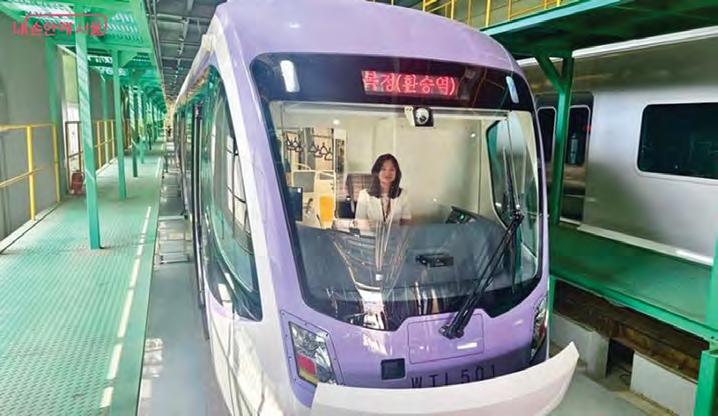
The Wirye standard-gauge tramline in suburban Seoul is designed to link a new town with existing metro lines. Work started on the 5.4km (3.4-mile) line, which includes a short branch, in December 2022. There are 12 stops, including three at metro stations on lines 5 and 8. The first tramline in the city for 58 years will be worked by ten five-section low-floor trams built by HyundaiRotem/Woojin Industrial Systems, using batteries powered from fuel cells. The SKW261.4bn (EUR166.91m) project saw its first test runs in September 2025. S afety features include a radar and sensor-based collision warning system that alerts drivers to obstacles ahead. If the driver fails to respond, an automatic emergency brake is activated. The exterior livery is purple, inspired by the robes of Onjo, the founding king of Baekje, a Korean kingdom that existed from 18BC to 660AD, which had its first capital in Wirye.
The latest prediction for passenger service to start is September 2026. Seoul had a firstgeneration tramway from 1899 until 1968.
In Europe the next tramway projects to appear should be in Italy, serving the cities of Bologna (2027) and Brescia (2030), and Switzerland (Lausanne). Bologna is building two lines totalling 22.4km (14 miles) with 33 trams (option 27) ordered from CAF. There is a small possibility that the first passengers could board before the end of 2026.
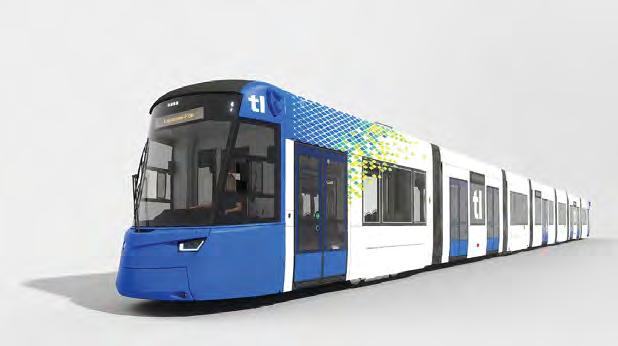
In Brescia a consortium formed by Hitachi Rail Italia and Alstom is spending EUR326m to build the 11.3km (seven-mile) line T2; 18 trams will come from Hitachi. Battery power will feature in the city centre. Lausanne is building a 4.6km (2.9-mile) tramway between Flon and Renens-gare along the north side of its western rail line. Again, it is possible that the first passengers will be carried on ten Stadler trams before the end of 2026.
After these systems, attention turns north to the city of Vaantaa (essentially a suburb of Helsinki) where a 19km (12-mile) tramway is under construction, and to the Swedish city of Uppsala where trams should also be carrying passengers in 2029. Two lines with 22 stops over 17km (11 miles) are planned for the country’s fastest-growing city, with 80 000 passengers/day expected.
The SEK6.1bn (EUR600m) project will receive more than SEK2bn (EUR190m) from the Swedish government. Also around this time the city of Tarragona in Spain should complete the first phase of its tram-train project, 14km (nine miles) linking Cambrils Nord and Vila-seca via Salou, with seven Tramlink LRVs on order from Stadler. In the early 2030s attention will switch to Germany, with new systems planned in Kiel and Erlangen (connecting to Nürnberg).
In North America the long-drawn-out construction of the 26km (16-mile) Purple Line light rail, linking Bethesda and New Carrollton across the Maryland suburbs north of Washington DC, should see its first passengers in 2027. Further distant is the on-off-on again Québec tramway in Canada. Looking south, the Colombian capital, Bogotá, has been building two regional
tram-train lines ( RegioTram) whose completion has been trailed for several years, serving western and northern suburban areas respectively. The 40km (25-mile) western line is likely to open first (CRRC has already delivered the tram-trains), but perhaps not until 2029.
More certain in South America is the 36.4km (22.6-mile) Salvador light rail in Brazil (with its second-hand CAF trams). Also in Brazil, Campina Grande will install light rail on 15.5km (9.6 miles) of moribund rail line, while further in the future the 5km (three-mile) Niteroi light rail project is now funded. In central America the Costa Rican capital San José will upgrade suburban rail lines to tramtrain operation with a street-running link through the capital.
Moving about as far away as is possible from South America, a remarkable light rail project is taking root on the Vietnamese island of Phu Quõc, which is popular with tourists. A 7.9km (five-mile) line will connect it to the international airport, mostly elevated but with 2km (1.2 miles) underground; 2027 is predicted for opening.
Saudi Arabia’s first light rail line will appear during 2027, serving the desert kingdom’s historical sites over 22.4km (14 miles) of overheadfree route, with 20 Alstom Citadis two-car trains. In the Gulf, the city of Abu Dhabi in the United Arab Emirates is planning a 20km (12.4-mile) tram line to connect Yas Island with Al Raha, Zayed
BELOW: Stadler is about to start delivery of low-floor trams for Lausanne’s new line. Stadler
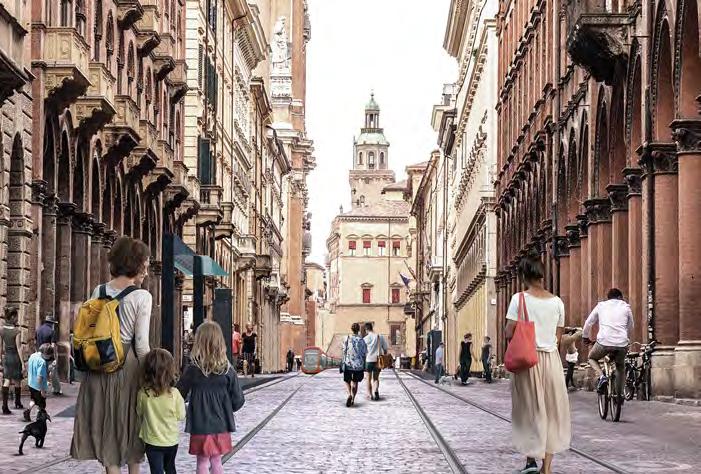
Via dell’Indipenza, currently ‘just a place for cars’, is one of many streets in Bologna that will be transformed by a tramway in 2027 – there is a small chance it could open at the end of 2026. Systra
International Airport, by 2030. The North African city of Tangier in Morocco is set to become the fourth in the country with modern trams, with a three-line system costing MAD8.4bn (EUR780m) predicated on the 2030 Football World Cup, which Morocco will co-host with Portugal and Spain.
Elsewhere, in the Middle East (assuming the turmoil subsides), Israel should get another new tramway, linking the port city of Haifa with the
historic town of Nazareth (41km/25.5 miles). A total of 54 Alstom Citadis trams are on order and the company will also supply tracks, electrification and commissioning; 2028 is mooted as an opening date.
Not far away, Turkey seems ready to embark on another round of new tramway systems, with Adapazari, Batman, Sanlirfa and Trabzon all planning projects.
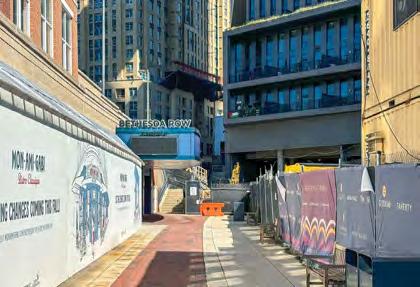
ABOVE: The future Bethesda Purple Line station is under construction off to the right in 2024; the route should see its first passengers in 2027. Dan Reed, Flickr/CC BY-NC 2.0

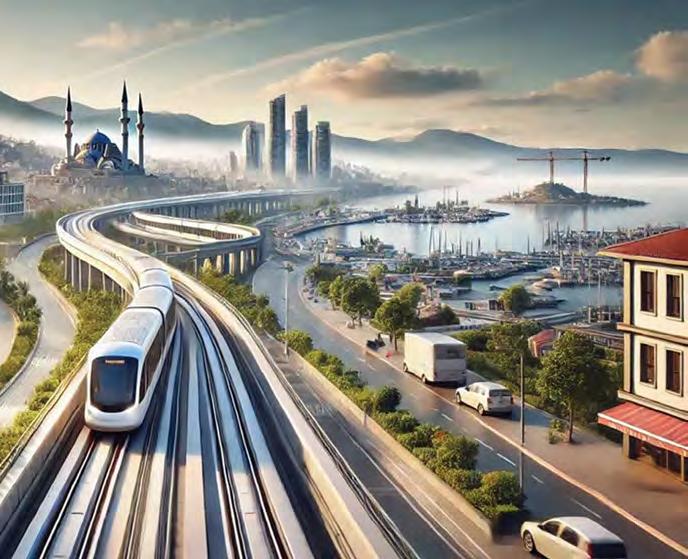
ABOVE: The AbuDhabi Tram will join Dubai to become the second system in the Gulf. ADT
LEFT: An elevated tram line is planned for Trabzon in Turkey. Hafif-Rayli-Sistem
The Orange County Streetcar is a 6.7km (4.2-mile) standard-gauge tramline running through the southern Californian city of Santa Ana . Construction on the project started in November 2018, linking the Santa Ana Regional Transportation Center (Metrolink commuter rail service to Los Angeles) with downtown, and over former Pacific Electric interurban right-of-way (1905-50), to Garden Grove (Harbor Transit Center). A new double-track bridge has been built across the Santa Ana river as the old PE single-track bridge was considered structurally unsound. An end-to-end trip will take 22 minutes, with ten stops in each direction. Service will be provided 0 6.00-23.00 (01.00 at weekends). Passengers will ride on eight Siemens S700 27.4m trams costing USD51.5m (EUR44.2m), with four required for a 15-minute service. However late delivery threatened the timely completion of the project.
The estimated cost for the project is USD509m (EUR437m), with USD175m (EUR150m) coming from the federal
There are some 429 tramways around the world and a good proportion of them are investing in extensions to their networks (although once again, many are delayed from original expectations). In the UK’s West Midlands, the hope to see Midlands Metro trams running along the new line from Wednesbury to Dudley in 2025 and the branch to Millennium Point (the Clayton Hotel) was not achieved; surely 2026 will happen. The era of new French tramways seems to be over for the time being, but there are extensions aplenty, starting off in Marseille (T3) on
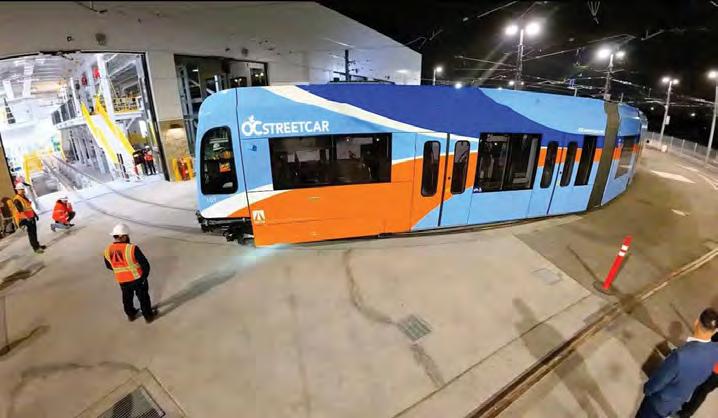
government, and it was hoped the contractors could hand over the system to Orange County Transportation Authority before the end of 2023, although that was
7 January, followed by Brest (line B) on 14 February and Lyon (T6) the same day.
A long extension to the micro-tramway in Aubagne will follow this summer, and Lyon T10 is expected to open around the same time. Paris will extend line T1 from Asnieres Quartre Routes to Colombes. In the Netherlands Den Haag should finally open its line 19 from Delft to the Technical University (Technopolis). German tramway extensions are not so prolific as in the past, and take longer to achieve, but the Düsseldorf Stadtbahn branch to Flughafen (airport) is finally expected
not achieved. Another deadline passed in August 2025, but it is pretty certain that the line will carry passengers in the first half of 2026.
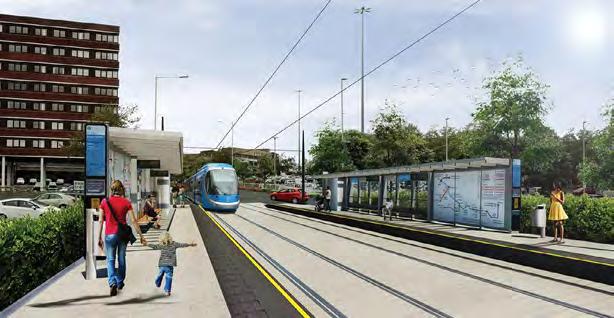
to open in 2026. Jena trams will reach Himmelreich early in the New Year. Innsbruck will open a new extension of its east-west tram line. Wien (Vienna)
trams on line 12 should reach Hillerstrasse, and on line 18 to Stadion. Praha (Prague) continues to build extensions at a rapid rate, with trams due to return
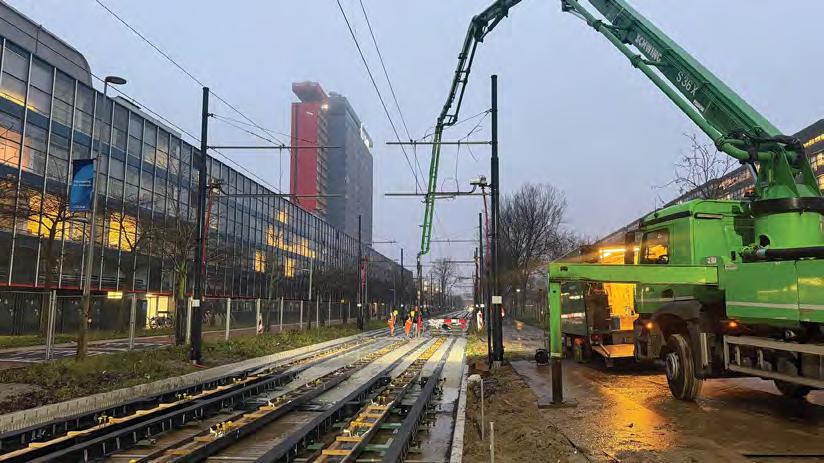
to the top of Vaclavske nám (Wenceslas Square). Both Zagreb (Croatia) and Sarajevo (Bosnia) are planning to inaugurate extensions early in 2025. Across the Atlantic eyes remain on Seattle, whose system is expanding rapidly. The city will open 19km (12 miles) in 2026, filling the gap between its isolated East Seattle line at South Bellevue and line 1 at Chinatown/ International Quarter. In Australia the Gold Coast tramway will see its final extension, to Burleigh Heads.
LEFT: Work continues on Den Haag’s Line 19 extension between Delft and the Technical University (Technopolis), which is expected to open in 2025.
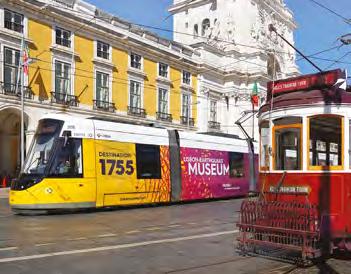
The Portuguese capital's tram operations are increasingly part of its tourist product. Neil Pulling considers how this fits with their role as normal transport.
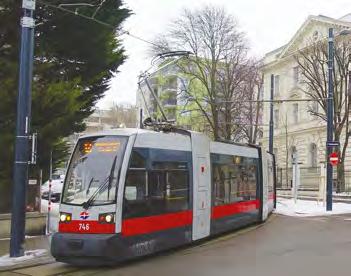
With two new network extensions having opened in autumn 2025, Vienna is a tramway giant that keeps growing, as Andrew Thompson reports.
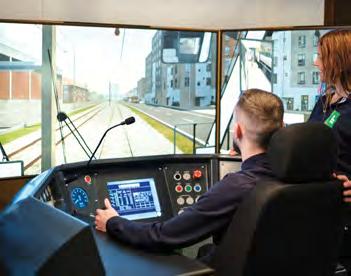
This Danish city didn’t just hit a milestone in opening the first section of its new tramway in 2025 – but also in using driver training simulation for the first time.
+ New tram orders for 2026
+ Classics: Bruxelles Stockel event 2025
+ The latest news and analysis, system and technical development MARCH 2026
On sale 20 February

Although Bordeaux has a dynamic, well-used system that perfectly meets the needs of its populace, the French city continues to look to the future. Andrew Thompson explores.
Located in southwestern France as the capital of the NouvelleAquitaine region, as well as the prefecture of the Gironde department, Bordeaux is an important economic and cultural hub with a current population of about 270 000 within city limits and just over a million in the wider conurbation. Internationally Bordeaux is best known for its namesake: premium wines. Connected to Paris by high-speed rail, with TGV journey times of just over two hours, Bordeaux also lies about 60km (37 miles) from the nearest Atlantic shoreline.
The elegant Old Town and riverside port district are listed as a UNESCO world heritage site to celebrate their outstanding urban architecture and cohesive ensemble. Both were largely built during and inspired by the Enlightenment in the 18th Century. From 1880 to 1958, a first-generation tramway
graced the streets of the metropolis, before closure amidst the typical mid-century change in transport policy, with a propagated reliance on buses and cars for mobility.
As one of the larger French cities, Bordeaux was an obvious candidate to benefit from renewed light rail development at the turn of the millennium, and it was among the second wave of modern networks to open in France.
The second-generation tramway was opened by President Chirac and the city’s mayor (later France’s Prime Minister), Alan Juppé, on 21 December 2003. Its arrival transformed the centre of Bordeaux, with many traditional buildings along the route being renovated.
Since its inauguration, it has quickly grown from its original line A section between Mériadeck and Lormont to a proper network with six different lines (A to F) and a total of
11 branches. With a current network size of almost 80km (50 miles), Bordeaux actually has the second-largest tram system in France, just after Paris and still ahead of Lyon, though the latter is poised to overtake it in the coming years, as a number of new tram routes are being built.
Bordeaux’s era of tremendous tram growth ran from February 2014 to April 2023, when 11 separate network extensions were launched, totalling more than 37km (23 miles). The longest of these was the 7.2km (4.5-mile) northern extension from Cracovie to Gare de Blanquefort, which serves neighbouring towns and therefore has interurban characteristics once outside of the city zone.
T he newest extension to open was the 4.7km (2.9-mile) expansion of route A, running from Quatre Chemins to Mérignac Aéroport, serving four intermediate calling
“Bordeaux boasts a total of almost 11km of tram route without overhead catenary, making it one of the largest examples of wire-free operations in Europe.”
calls
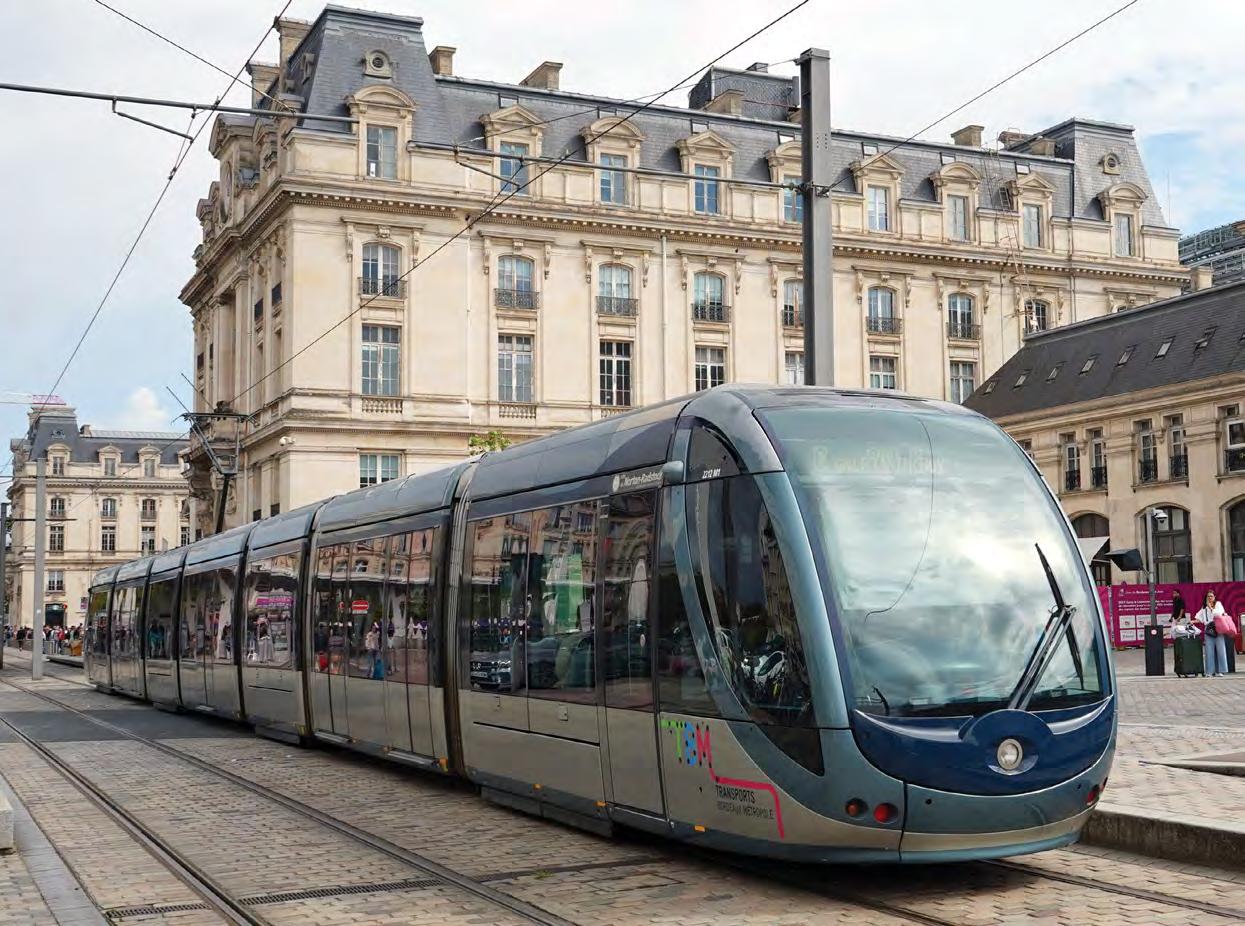
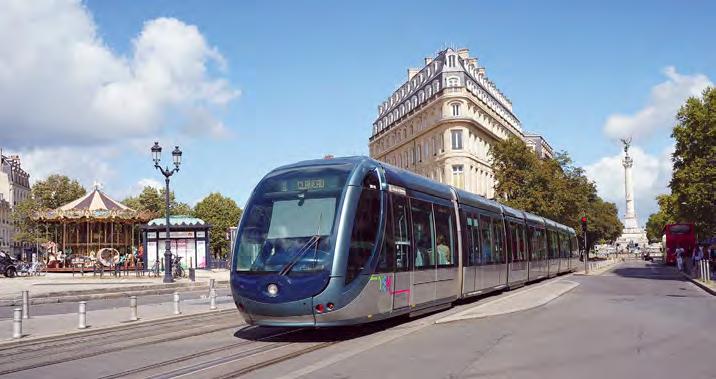
RIGHT: On 30 August 2025, Citadis 2205 is on the wire-free section running towards the major interchange at Quinconces. To the rear is the 54m-tall Monument aux Girondins, which was erected between 1894 and 1902 in memory of the local Girondists who fell victim to the so-called Reign of Terror during the French Revolution.
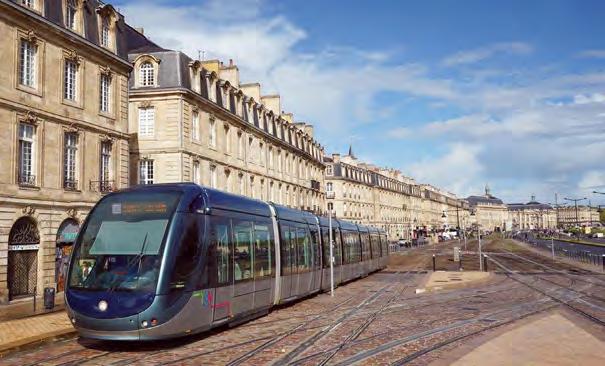
service. This was the first day after construction works and infrastructure renewal on the APS power supply system were successfully completed as scheduled. The elegant architecture of the UNESCO-designated historic district is seen to the rear.
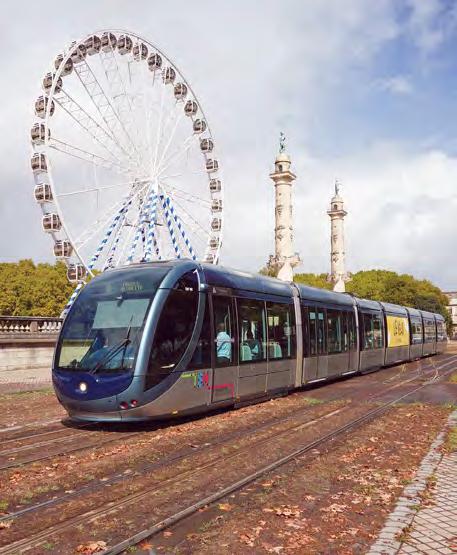
the two
columns facing the River Garonne. These landmarks were erected in 1829 and symbolise commerce and navigation.
points. This makes Bordeaux one of several French cities to have a light rail link to its airport. At the same time, the tram line is the only mode of rapid transit to serve the airport, as Bordeaux does not have a heavy rail connection to its flight terminal.
Following such prolific growth, summer 2024 and 2025 required the municipal operator TBM to focus on consolidation with extensive infrastructure maintenance and power supply renewal for some of the older parts of the second-generation tramway, which have been in use since the early 2000s. In summer 2024 the southern section of line B was closed, while from early June to late August 2025 about a quarter of the tram network was closed for seasonal engineering works during the summer holidays. Among the sections out of use were the southern branch of line C from the Quinconces interchange via the main railway station St. Jean to Villenave Pyrénées. The western branch of line A from Mérignac Centre to the Le Haillan Rostand terminus, as well as the river crossing over the historic Pont de Pierre
between Porte de Bourgogne and Stalingrad, also had to be served by the slower and more crowded replacement bus services.
A technical priority was the replacement of components for Bordeaux’s type APS ground-based power supply system, which allows the Alstom Citadis 302 and 402 LRVs to run wire-free through the historic UNESCO district. This concept, centred on urban beautification and street aesthetics, was developed by Alstom especially for Bordeaux, which contributed to the costs under an agreement that it would receive royalties from other cities that used it. It has since been applied in numerous French cities for various sections of different tram routes in sensitive architectural areas.
Bordeaux boasts almost 11km (seven miles) of tram route without overhead catenary, making it one of the largest examples of wirefree light rail operations in Europe.
Originally the tramway platforms around Bordeaux were designed for the dimensions of the 12 33m-long Alstom Citadis 302, which were delivered 2002-05. These trams are
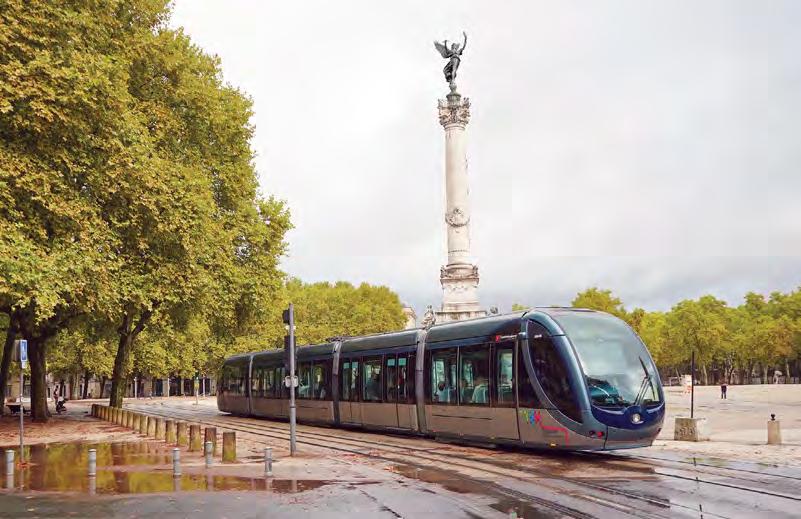
used primarily on Line C. By 2019 though, the infrastructure adaptation to have all platforms match the 44m length of the newer and more numerous Citadis 402 was completed. The Citadis 402 vehicles were supplied by Alstom in various sub-series between 2002-08, with two more batches also arriving in 2013 and 2018: a total of 118 cars, bringing the total fleet to 130.
During the past years there have been repeated discussions and deliberations about extending line B southwest to Gradignan and line D northwest to Saint-Médard-en-Jalles, both sizeable towns with more than 30 000 inhabitants. However, because of various concerns and budgetary matters, these concepts are still in the phase of political debate rather than specific planning and neither town is likely to get a light rail link before the end of the decade.
A quirk of the Bordeaux network is that it runs over the fittingly-named swing bridge Pont Tournant (‘swing bridge’) in the port district, between La Cité du Vin and Rue Achard stops. When the bridge is open to let boats pass through, the trams have a diversionary route available with a loop along Quai du Sénégal and Quai du Maroc, where a second swing bridge across the canal to link the inland port basin with the River Garonne is fitted with tram tracks as well.
With a modern tram system resplendent with dynamic styling and dignified design, Bordeaux has a mass transit system that perfectly matches its urban elegance. As the tram system is well utilised and often running at capacity during peak periods, local politicians have started to dream of underground options and voiced demands towards the central government in Paris, though such ideas are unlikely to be implemented in the foreseeable future.
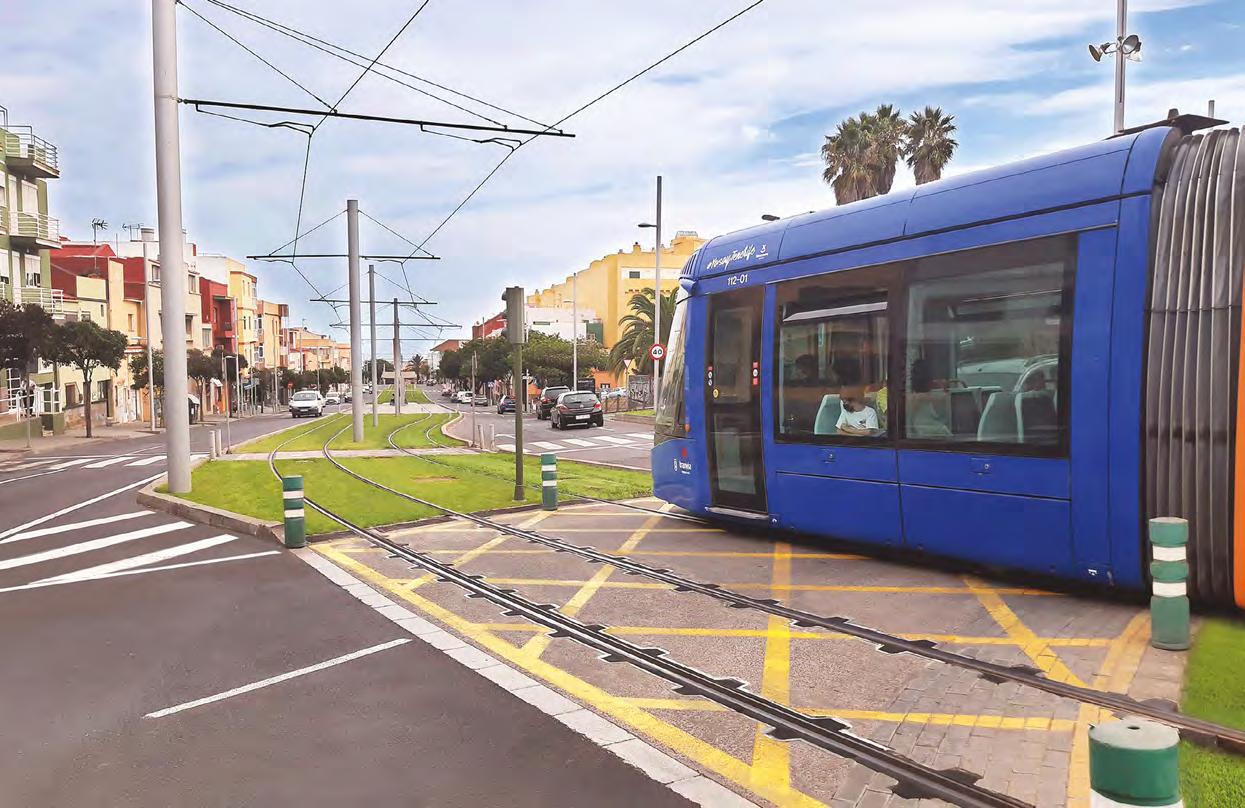
The EU Light Rail Congress will return to the Canary island of Tenerife in 2026. TAUT looks at why this system is so special.
Many of Spain’s cities offer a fascinating study in the revival of urban light rail.
The country has embraced contemporary technology while preserving a real appreciation for its transit heritage. Yet few systems stand out in quite the same way as Metrotenerife –currently the only tramway on the Canary Islands – which offers a sleek, efficient, and environmentally-conscious network serving the island of Tenerife.
Operational since 2007, Metrotenerife has become a case study in how a modern tramway can transform mobility in medium-sized urban areas.
Functional as well as scenic Tenerife is an island well-known for its volcanic landscapes, beaches, and subtropical climate, but mobility between key areas has long been a challenge. The Santa Cruz – La Laguna corridor relied almost exclusively on road traffic prior to the trams’ reintroduction, resulting in chronic congestion.
H istorically, a streetcar system operated in Santa Cruz from 1901. The service began in Santa Cruz and finished in La Laguna, with an extension in 1904 to Tacoronte. The line remained functional until 1951, when service
was discontinued due to a combination of increased competition with cars and buses, and a series of problems and accidents.
The original electric cars were simply deemed outdated, and for decades after, the idea of tramways remained a quaint memory.
However, this was to change in the 2000s due to ever-increasing road congestion.
“Tenerife is an island well-known for its volcanic landscapes... but mobility between key areas has long been a challenge.”
After much debate that pitted buses against trams, approval was eventually given for a EUR306m budget to fund a new tramway.
The modern network begins Metrotenerife is compact by European standards, comprising two lines that form the backbone of urban public transport in the northeast of the island.
Construction of the initial route, Line 1, began in 2004. Alstom – which supplied 20 units for the line – started testrunning in 2006 along a 600m section of track between the depot and the Hospital Universitario de Canarias in La Cuesta; and finally, on 2 June 2007, the tramway was launched, with a free service being offered for the first week. The 12.5km (7.8-mile) route links the Intercambiador in Santa Cruz de Tenerife with Avenida de la Trinidad in La Laguna – a UNESCO World Heritage Site –via 21 stops. It climbs around 600 metres, passing through dense urban districts, university zones, and green suburban stretches.
The line currently transports more than 90 000 people per day in the metropolitan a rea, with an end-to-end travel time of around 40 minutes.
Plans are in place to lengthen this line with four additional stops, including Tenerife North Airport. There would also be new stations in San Antonio, San Lazaro (parkand-ride) and Los Rodeos-TFN.
A second route – Line 2 – running between La Cuesta and Tincer opened in 2009, connecting with Line 1 at Hospital Universitario and El Cardonal. It runs 3.7km (2.3 miles) with six stations, and although shorter, is essential in supporting the densest
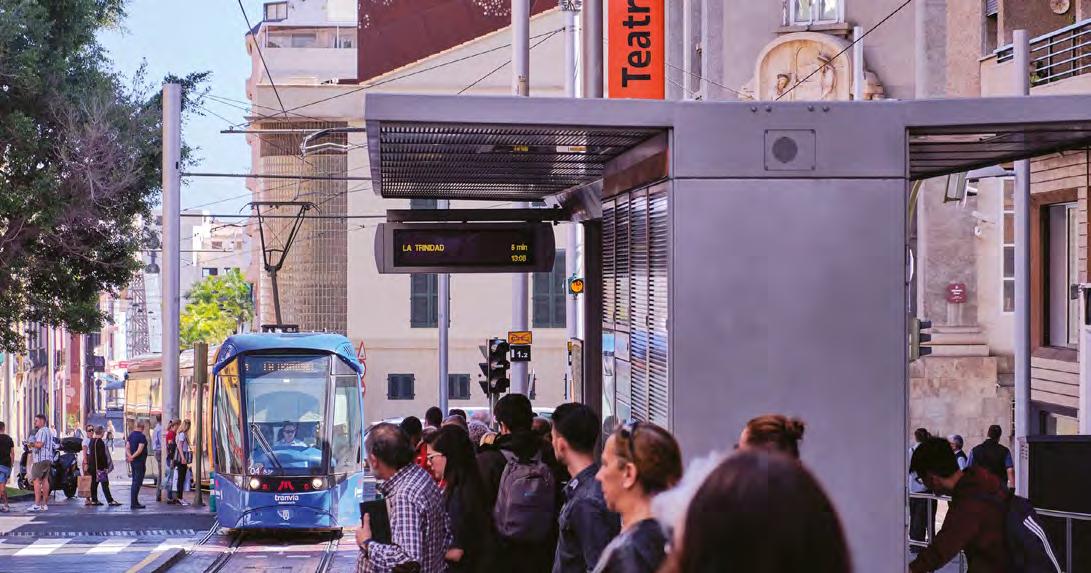
“A fleet of Alstom Citadis 302 trams sit at the heart of Metrotenerife’s operation, with a distinctive, colourful livery that echoes the maritime heritage of the Canaries.”
residential zones within the metropolitan area (to the southwest of Santa Cruz).
Construction of the lines provided the opportunity to redesign streets, widen pavements, and enhance landscaping. Plinthlike trackbeds elevated the tramway’s visual presence, while grassed sections reduced noise and improved appearance. Highquality stations with clean lines, canopies, and extensive signage were introduced, along with art installations at stops including La Laguna and Avenida de Trinidad.
The tram and bus systems offer a fullyintegrated transport network, with journeys costing the same whichever mode is chosen.
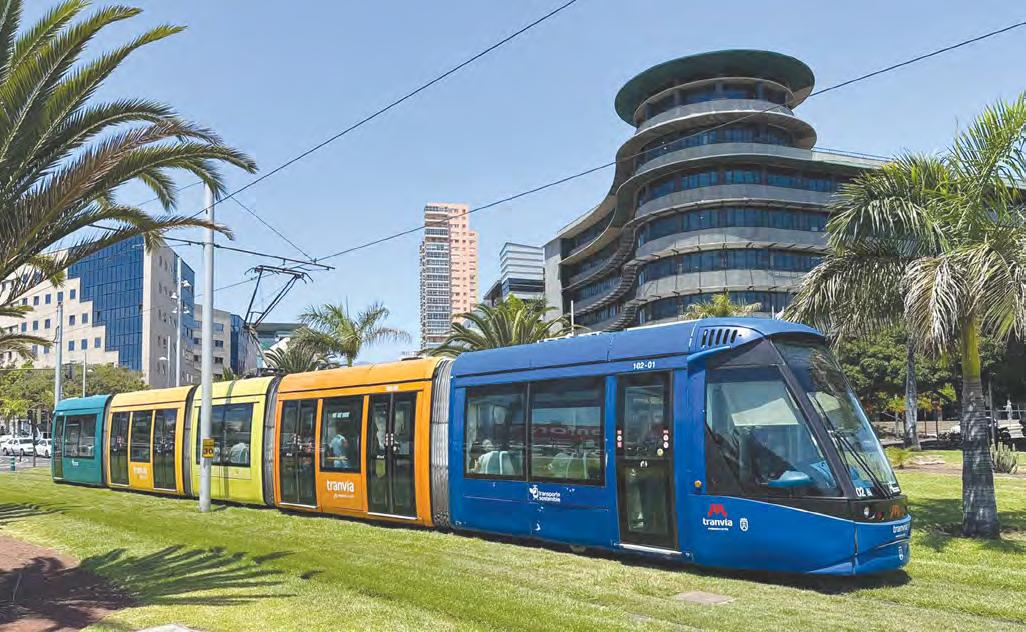
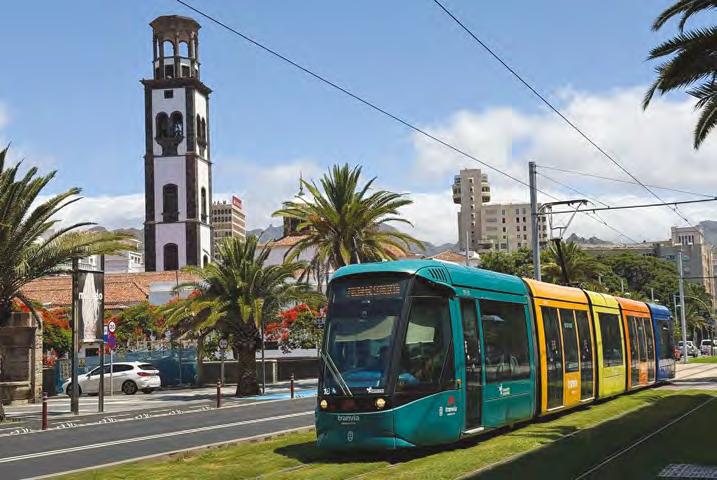
A fleet of 32.5m Alstom Citadis 302 trams sits at the heart of Metrotenerife’s operation, with a distinctive, colourful livery that echoes the maritime heritage of the Canaries. The cars can carry 200 passengers (60 seated), are 100% low-floor and accessible offering level boarding and dedicated space for wheelchairs and bicycles. Inside, the trams feature spacious interiors, minimalist design, generous natural lighting, and comfortable seating.
The trams can reach a maximum speed of 70km p/h (43 mph), although they only reach a maximum of 50km/h (31mph) on Line 1.
Efficiency is something of a hallmark for the Metrotenerife network: despite its comparatively small size, its operational standards rival many larger European systems.

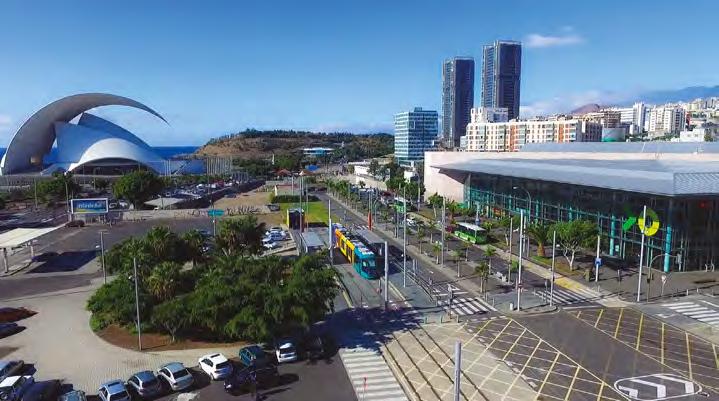
Service frequency on Line 1 is every five minutes at peak times, and typically 10-12 minutes off-peak. Line 2 runs every 10-12 minutes.
Helping to keep the network at the cutting-edge of innovation is the Research, Development and Innovation team at Metrotenerife, which has earned the organisation prestigious international accolades such as at the Global Light Rail Awards, the ERCI Innovation Awards and the Smart Rail Awards.
One of its most recent developments is Remov-IN (the Removable Insulated Chamber), marketed through the multinational ArcelorMittal. This innovative ‘chambered’ system is manufactured from recycled tyre rubber, and has components that wrap around the rail on its lower and lateral sides. This architecture provides high-quality electrical and acoustic i nsulation, essential for preventing the spread of stray currents and mitigating the noise emissions generated by railway traffic. The system can be installed and removed quickly and easily without any dismantling work, simplifying and saving costs and inconvenience in track maintenance. Without the need to remove any existing track surfacing materials, the time, cost, and inconvenience associated with maintenance work are drastically reduced.
Metrotenerife also developed SIMOVE (a Spanish acronym for ‘Onboard Speed Monitoring System’) to contribute to safety and optimise operations. This advanced driving assistance system has been installed with excellent results on the Tenerife tram service and has been adopted by other railway systems in Spain and the UK. SIMOVE continuously monitors the speed of the rail vehicle in real time and incorporates a back office application for continuous recording and analysis of data and incidents, improving driving quality and facilitating preventive maintenance of the line.
Join key decision-makers, professionals and industry experts in Tenerife on 11-12 March as they gather for two days of debate centred upon how new technologies are driving progress in sustainable transport.
As an attendee, you will also have access to an expansive exhibition hall within the Espacio Mutua Tinerfeña in San Cristobal de la Laguna, an evening networking reception and an exclusive behind the scenes depot tour hosted by Metrotenerife.
eulr@mainspring.co.uk www.mainspring.co.uk
Vía-Móvil is another Metrotenerife innovation: a comprehensive electronic ticketing system that utilises the user’s mobile phone to unify the process of purchasing, validating and checking tickets; last October, it reached 100 million journeys in its 12 years of service. It offers a convenient payment method for both the user and the operator, requiring the placement of QR codes for validation and eliminating the need to issue physical tickets or install equipment and infrastructure such as ticket validators.
The Spanish company is already working on incorporating Artificial Intelligence (AI) with the aim of increasing the competitiveness of guided rail-based transport systems. It is developing internal projects focused on detecting passengers on platforms and traffic lights to improve safety and operation in dynamic urban environments.
For years, discussion has swirled around a potential Line 3 in Santa Cruz, which would form a partially-circular coastal route between the fairgrounds and the North Pier of Santa Cruz, providing service to the neighbourhoods of La Salle, San Sebastián, Duggi, Zona Centro, The Hotels, Toscal, and Residential Anaga of Santa Cruz. The line would run 3km (1.9 miles) with six stops.
Feasibility studies have been completed, but the project faces scrutiny regarding cost, urban impact, and prioritisation of bus rapid transit alternatives. A study of alternative routes is currently underway.
Plans exist to extend Line 1 from Trinity Avenue to Los Rodeos Airport (TFN) to service the San Lazaro district of San Cristóbal de La Laguna and the airport. The extension would run 2.5km (1.6 miles) w ith four stops.
Line 2 is also subject to speculative extension plans, the proposals for which would see the line extended from Tíncer to La Gallega. This would provide a service to the neighbourhoods of El Sobradille,
Barranco Grande and La Gallega. Currently in a draft format, the extension would run 3.1km (1.9 miles) and also have four stops.
Whispers also abound about the possibility for a new Line 4, linking Hospital Universitario la Candelaria (on Line 1) to Añaza, although there are no firm plans in place for this as yet.
Metrotenerife is also looking beyond the success of the tramway – which has grown from six million passengers in 2007 to 25 million annually in 2024 – and is actively promoting two heavy rail systems. The top priority project is the South Train, specifically phase 1 between San Isidro and Costa Adeje. This section, identified as having the greatest potential demand, would connect Tenerife South Airport and the port of Los Cristianos over a distance of 30km (19 miles). The North Train, however, poses a greater technical and urban planning challenge due to the complex terrain and population density.
These projects seek to increase network reach and ensure maximum connectivity at strategic points such as airports, port facilities and hospitals. Currently there remains a growing problem with traffic congestion – highlighted by the fact that there are some 802 500 vehicles for a population of just under 970 000 residents. The tramway expansion plan and the development of trains will significantly alleviate traffic pressure on the island's main roads.
Tenerife, although comparatively small next to some of its European neighbours, is a most picturesque and well-designed modern tram network – a showcase of thoughtful engineering, contemporary design, and urban planning at its best. With future expansions on the horizon, t he story of Tenerife’s modern tramway is onlyjust beginning.
For more information on products and technical consulting please visit: https://metrotenerife.com/
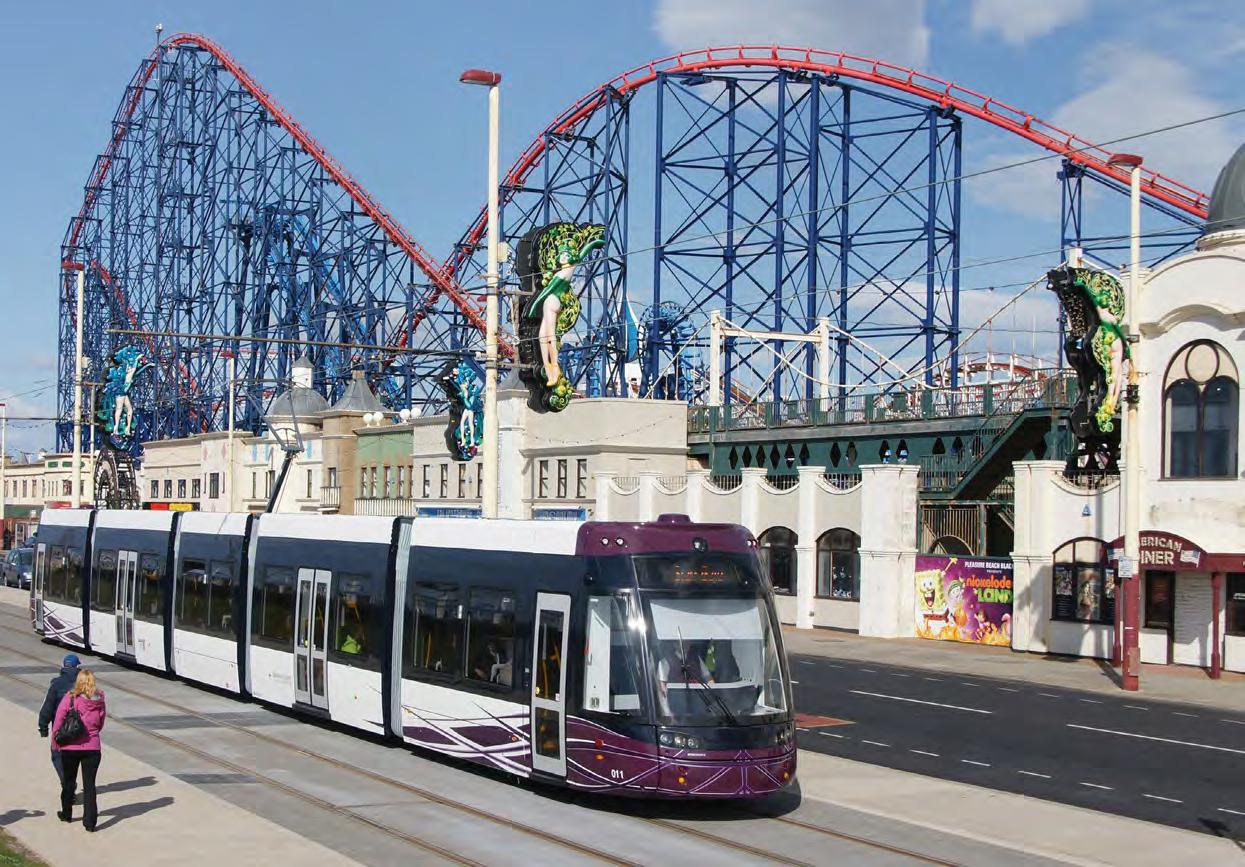
TAUT sits down with Managing Director Jane Cole to explore how Blackpool Transport has changed during her tenure – and what’s coming next.
If you’re lucky enough to get a decent break over the festive period, the last thing you want to think about is work – and Jane Cole, Blackpool Transport’s Managing Director, is no exception. Except that last Christmas, she couldn’t… because she discovered that she was being awarded an O.B.E. (Order of the British Empire) in the New Year Honours list.
Speaking to TAUT in mid-January, she still seemed a little bemused by it.
“I always seem to have been singled out as the ‘woman in transport’, which is great because when I started, there weren’t a lot of women in transport. So I get that bit. But you come to work every day and you do your job… and get paid for it.”
Cole started her career with British Rail, something she’s particularly proud of, later joining Virgin Trains in 1997. Then, in 2014, came the move to Blackpool Transport Services Ltd, Blackpool Council’s
transport operator. As the new Managing Director, she arrived at a time of transition for Blackpool’s historic tramway as it moved away from Victorian roots in order to become
“Before it was a bit more like... that was tram, this is bus. But now, it’s about Blackpool Transport.”
a modern LRT system, thanks to its fleet of 16 Bombardier Flexity 2 trams, which had been introduced in 2012.
Further investment followed, culminating in the GBP22m (EUR25.3m) 600m extension along Talbot Road, to a new terminus just opposite Blackpool North railway station. But when Cole spoke at the 19th UK Light
R ail Conference in Leeds in July 2025, the Talbot Road extension, which opened on 12 June 2024, had come at a cost.
“ We were opening in March, but a series of delays due to infrastructure issues beyond our control created difficulties planning for the launch of services. We were taking on staff for opening in March [and it] didn’t open u ntil June, so that was GBP300 000 [EUR345 759] of extra cost that we had to carry until the June opening”, she told delegates before saying that the extension was “costing us an initial GBP800,000 [EUR921 972] a year”, which “was never really built into the original business case”.
Subsequently, the business has been restructured in order to make some much needed savings, including by merging the bus and tram control centres into one. This has had some knock-on positive benefits:
“Before, it was a bit more like… that
OPPOSITE LEFT: Flexity 2 11 passes The Big One rollercoaster at Pleasure Beach on Blackpool’s public re-opening day post-modernisation in 2012.
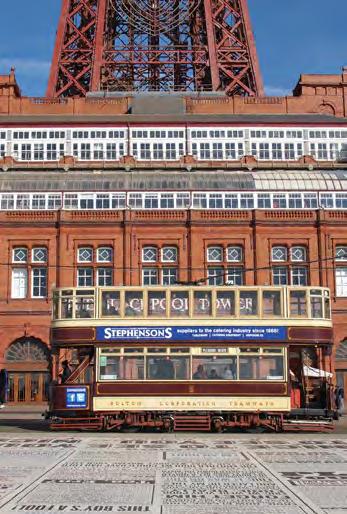
BELOW: Bolton 66 heritage service at Blackpool Tower and The Comedy Carpet art installation.
was tram, this is bus. But now, it’s about Blackpool Transport. When [service delivery staff] think about something happening on the tramway or happening on the bus network, they’re thinking about the holistic experience for the customer.”
If, for example, high winds force the cancellation of tram operations, service delivery staff, Cole says, are already thinking about how buses can be drafted in to help. Conference delegates heard Cole talk about the ‘Winter 2024 Reset’, a period of re-evaluation, prior to a summer 2025 ‘relaunch’. Part of this was the ‘On the Way in 10’ campaign, advertising trams every ten minutes. To get this frequency, Starr Gate –Fleetwood Ferry trams ran every 20 minutes and were complemented by Starr Gate –North Station and North Station – Fleetwood Ferry trams, also running every 20 minutes. There were other initiatives, including dedicated pink-jacketed and easily-spotted customer assistants at key tram stops, and through-ticketing was offered in conjunction with train operator Northern.
Patronage, says Cole, was “great” along the promenade. At the time of writing in mid-January, the winter timetable had only just come into effect. This offers a 15-minute frequency; will the ten-minute frequency return?
“It is costly to be able to maintain that tenminute frequency, north and south and to the station. As I see it, [we] will retain the 15-minute frequency until at least spring. A nd then we’ll take another view as to whether or not we bring back the ten-minute frequency.”
One key factor that will affect the service levels is the availability of the 18 Flexity 2 trams (two more entered service in 2018). The oldest has now been in service for 14
One of the consequences of the ‘Winter 2024 Reset’ was the suspension of heritage tram operations.
“Big investment was needed to bring the safety structures and everything up to the current legislation”, Managing Director Jane Cole explains.
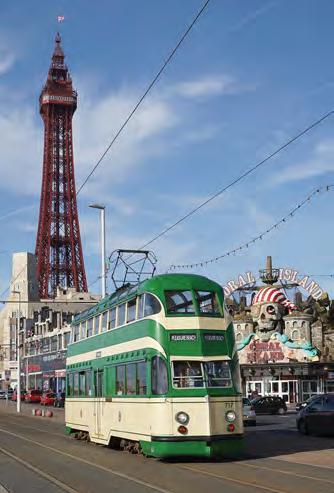
But the ‘Frigate’ and Balloon 717 did operate ‘Illumination Tours’ during the ‘Lightpool’ festival in October 2025, the former car then continuing to run throughout November. Cole describes these as “successful”.
With the tramway’s engineering team concentrating on the Flexity 2 refurbishment programme, maintaining 91-year-old vehicles needs to be carefully planned.
“We will look to reintroduce some running again in the spring. It’s going to be slow, slow, slow. But we will continue to run heritage as and when we can.”
In fact, the return to operation of Bolton Corporation Tramcar 66 is being factored into the maintenance plan, with an anticipated return to service in May.
Meanwhile, a proportion of the heritage fleet is accessible via the Tramtown exhibition, housed in part of the Rigby Road depot. Its 30 volunteers have created something “phenomenal”, that “people from all over the world [are] coming to see”.
Whether more of the historic Rigby Road site is opened to the public depends on whether a bid for National Heritage Lottery Fund money is successful. A bid for an initial GBP750 000 (EUR864 593) is currently being written, backed by Blackpool Council.
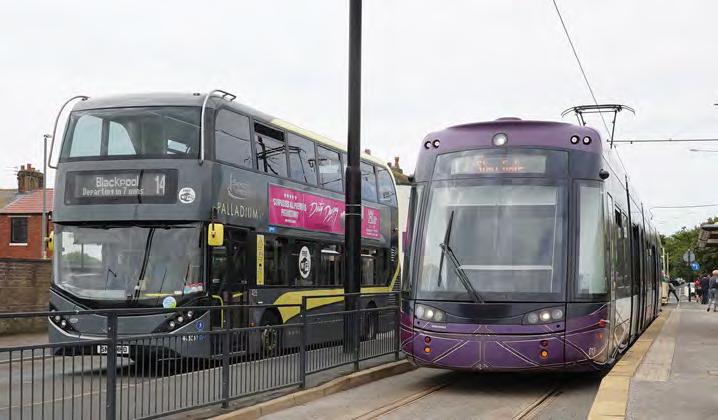
ABOVE: Trams and buses provide an integrated service at Blackpool Transport, with the modes combined under one managing team to create what Jane Cole terms a holistic experience. A Bombardier Flexity 2 is pictured alongside a bus team-mate at Fleetwood Ferry in 2021.
years and a major refurbishment programme, being undertaken at Starr Gate depot, is underway. The good news is that, from 4 January, the obstacle detection system (ODAS), as well as the overspeed control system (COMPAS), became operational, something that Cole says has made the UK's regulator, the Office of Rail & Road, “very happy”.
And what of the future? One thing that Cole would like to see changed is that Blackpool’s is the only tramway in the UK that doesn’t receive any form of subsidy.
“We aren’t subsidised and it’s wrong.”
Hopefully, Lancashire Combined County Authority (LCCA), which came into being on
5 February 2025, will help to fix this.
“We have, with [Blackpool] Council, talked to the Department for Transport and meetings are ongoing with LCCA.”
Cole’s presentation also offered tantalising suggestions about future tramway extensions, and included the phrase ‘tram-train’.
“[LCCA] talks very much about the tramway being central to its planning for the future. And it does talk about extending the tramway, possibly from the south and from the north. So it is very much central to the thinking of Lancashire going forward, as far as its local transport plan is concerned.”
So, what about tram-trains?
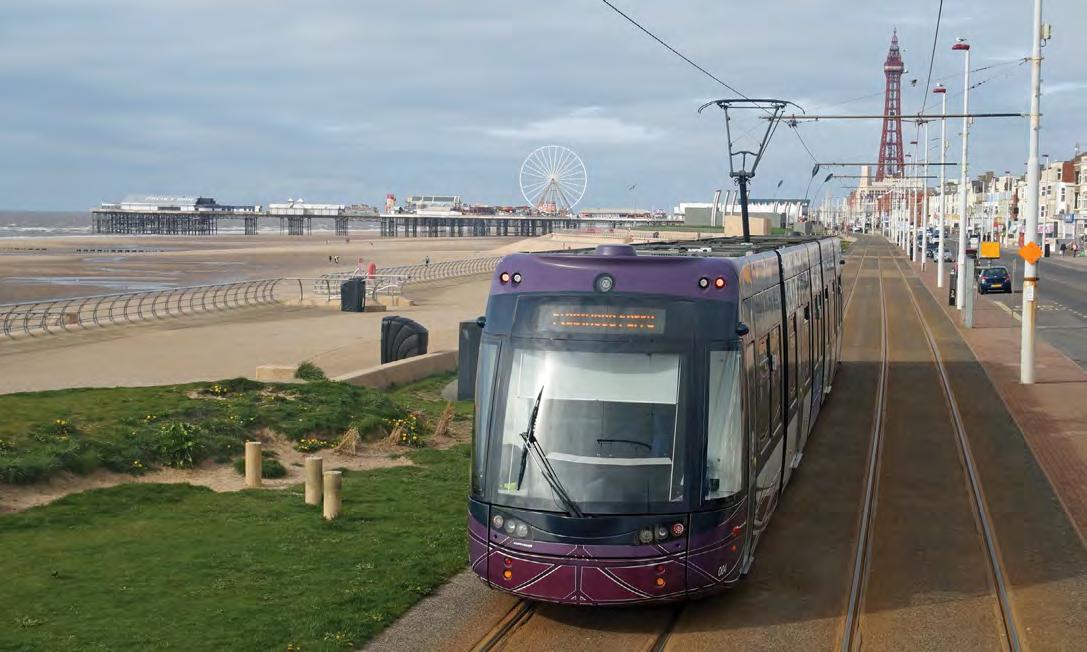
Reactivating the mothballed Poulton – Fleetwood railway line formed part of Network Rail’s ‘Restoring Your Railway’ programme. Investigations were made to ascertain whether the rail profiling and wheel profiling would sustain tram-trains –with favourable results. Some development work took place, particularly around costs, and it was submitted to the Department for Transport. But then ‘Restoring Your Railway’ was cancelled by the then-new Labour government in July 2024.
“It’s on the shelf, it’s ready, it can be re-looked at and I think that it’s something t hat [LCCA] may be keen to do.”
What delegates to the conference perhaps didn’t know was that Cole had already decided to retire. She admits that she no longer wants the “pressure” of a high-profile job and says it’s “time somebody else took over”. Recruiting for a replacement Managing Director is now underway, in order to pick up the mantle after Cole leaves in May.
Reflecting on her years in charge at Blackpool, she says that her proudest aspect “has been the people, and transforming terms and conditions for them, and making them feel valued.
“They are the UK’s national transport award-winning tramway. They are the UK Bus Operator of the Year. That’s all been done through the people that work there, not through me. I’ve been there, sort of holding the strings, being their Managing Director.
“The transformation of the business into the product that the customers have got today through the people that work there has been one of my real highs at Blackpool.”
exposed location on the UK’s
coast forced the
from electrical
to overhead catenary in 1899, after Blackpool Electric Tramway Company spent the 14 years since the first section opened on 29 September 1885 wrestling with the effects of weather on the electrical systems.
Everything around Blackpool depends on the weather. The sun brings visitors whereas they
stay at home if it’s bad. But what challenges are extreme, climate change-led weather events bringing?
“Once we get [wind] above 100km/h 60mph… then we have to put bus replacement on”, says Managing Director Jane Cole.
Aside from ensuring that overhead is tight, to reduce ‘bounce’, Cole says, “We’re reacting all the time but there’s only so much that you can do”.

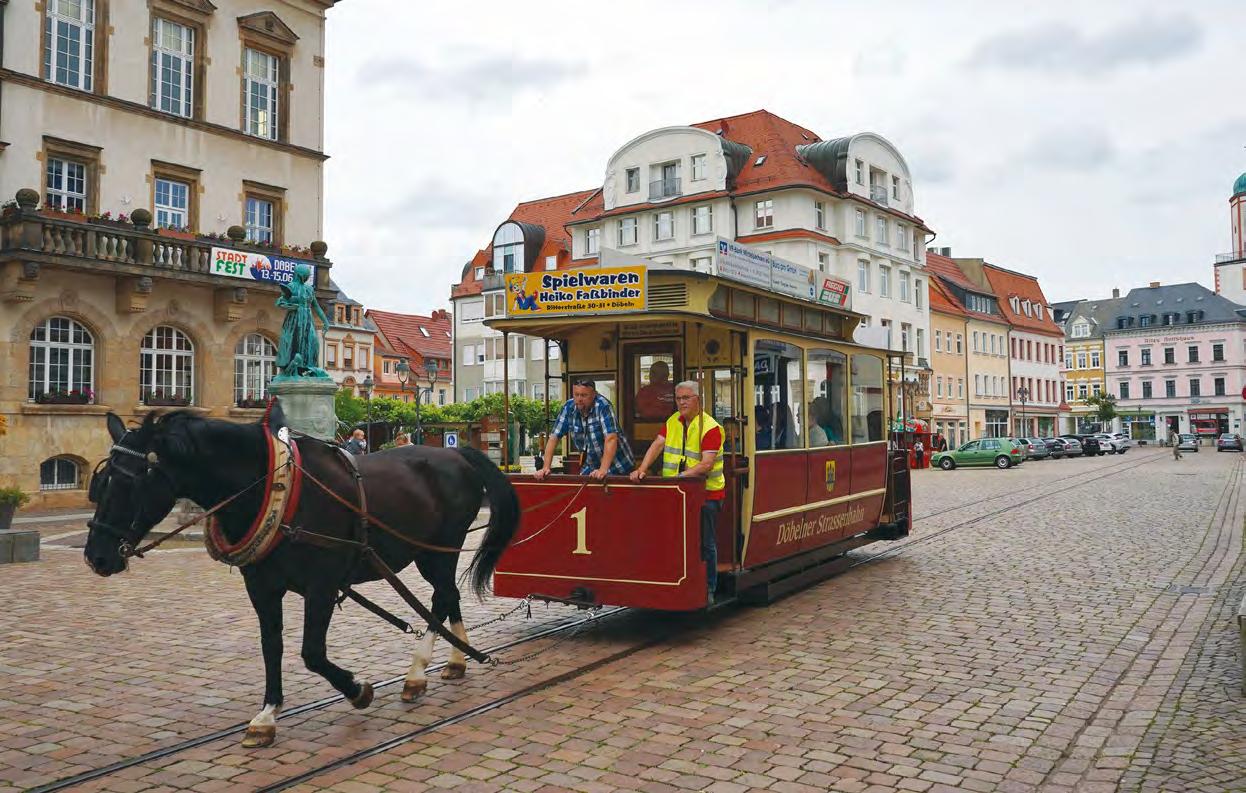
Andrew Thompson visits the German city of Döbeln, where a very traditional service can still be seen running amongst modern-day traffic.
Located in the eastern state of Saxony (Sachsen), the smaller city of Döbeln is about halfway between Leipzig and Dresden and features one of just two horse trams in Germany. With a current population of roughly 24 000, buses and regional trains are the contemporary backbone of public transport in Döbeln and have been since the 1920s.
Yet from 1892 to 1926, Döbeln featured a single-line, metre-gauge horse tramway that ran for 2.5km (1.6 miles) from the railway station to the Old Town. Even at that time, the city had a population of less than 20 000, yet at the zenith of the service, the horse tramway transported more than 200 000 riders per annum during the first years of the 20th Century.
A s conversion to an electric tramway was not cost effective for such a small operation, the horse tramway was discontinued in favour of modern buses shortly before Christmas 1926. As such, Döbeln was one of the very last German horse tramways to close, with only Zerbst (1928), Stadthagen (1930) and the island of Spiekeroog (1949) shuttering their horse trams later.
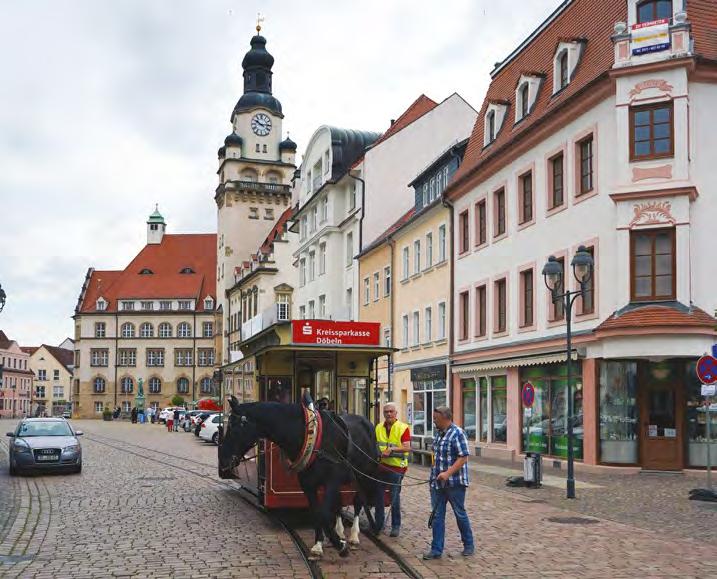
The current eastern terminus at Obermarkt.
To reverse and change direction, the driver simply uncouples the horse and calmly walks it around the tram. The line is planned to continue by another 100m from here as part of the intended extension to the church.
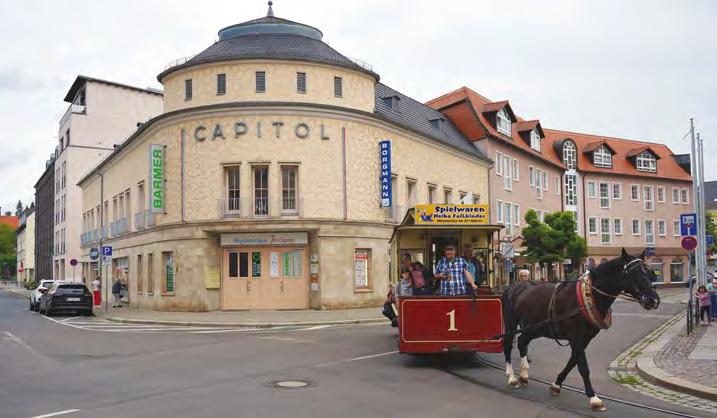
“The diligent 21-year old ‘Elko’ has worked every service since 2007 and still has a few years left in him.”
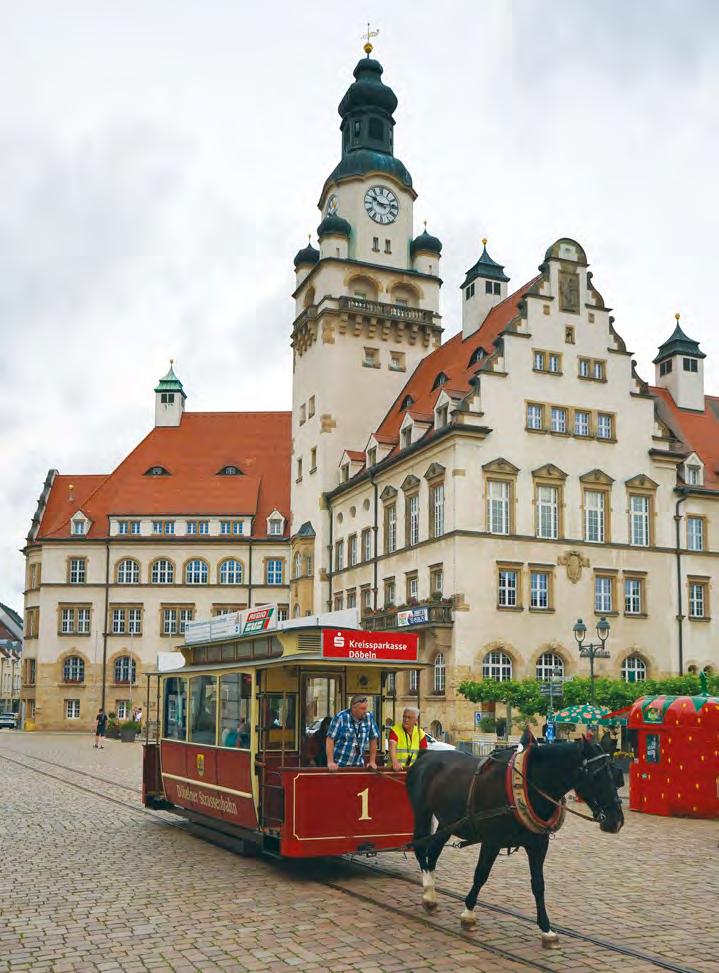
Incidentally the horse tramway was reopened on the North Sea island of Spiekeroog in 1981. After some realignments, the track on the island has a current length of about 3.5km (2.2 miles), and the service operates daily as a tourist attraction from April to October.
Correspondingly, a vision to rebuild the Döbeln horse tramway first developed in the late 1980s, but the scheme did not gain real traction until 2002, when the dedicated Traditionsverein Döbelner Pferdebahn society was established, with the stated purpose of reviving the town’s special transport legacy and rebuilding a part of the original route.
Thanks to the political support of the municipal authorities, public goodwill for the venture and successful fundraising, it proved possible to rebuild and reopen more than 500m of the historic alignment by June 2007. With one trusty horse and the former Meissen carriage 1 of 1898 vintage, a heritage service was launched with running d ays on select weekends.
The first leg of the line ran from Theater to the main market square Obermarkt, with a 225m extension from Theater to Pferdebahnmuseum opening in December 2009. Incidentally, the terminus at the dedicated tramway museum is a tourist attraction in its own right, being located in a classic timber-framed building and featuring exhibits on the history of Döbeln’s horse tramway. The museum features a built-in shed for car 1 but not a stable for the horse, as the tram’s lone gelding lives on a farm outside the city. The diligent 21-year-old ‘Elko’ has worked every service since 2007 and still has a few years left in him, according to his owner Mario Lommatzsch, who also works as the main driver and has become something of a local celebrity.
Normally the Döbeln horse tramway operates every first Saturday of the month between May and October with round-trip departures from the museum terminus every 20-30 minutes between 10.00–11.30, as well as 14.00-16.30. By special arrangement t here is scope for pre-booked private charters as well.
Currently the successful horse tramway has plans to extend the route by about 100m from the present end point at Obermarkt to a new eastern terminus at St. Nicolai Church. As is typical for Germany, a mountain of red tape and paperwork needs to be overcome for this goal, but the society is making good progress and once again enjoys the political support of elected officials, with finance already secured for the extension. A successful realisation of this project t herefore seems realistic over the coming two to three years.
L ocated on an island, surrounded by the Freiberger Mulde and Flutmulde rivers, the Old Town of Döbeln is itself steeped in history and framed by well-preserved architectural monuments that lend a cohesive and attractive small city setting to the quaint horse tramway. Both the town and its signature attraction are well worth a visit.
For more details and current dates of service, visit: https://www.doebelner-pferdebahn.de.
National Apprenticeship Week, which runs every year in February, provided an important opportunity to reflect on the role apprenticeships continue to play in shaping the future of the light rail sector.
Throughout the week, UKTram supported the campaign by sharing stories and examples of good practice from across the sector, with a particular focus on operator-led apprenticeship programmes.
With an industry that faces a growing skills gap and increasing demand for technical expertise, structured training and longterm workforce planning have never been more important.
UKTram continues to play an active role in shaping future apprenticeship programmes and skills pathways through enhanced engagement with training providers and apprenticeship experts.
Few understand the value of apprenticeships more clearly than UKTram Managing Director James Hammett, who began his own career as an apprentice engineer at Seaton Tramway.
Tell us about your apprenticeship journey?
James: I started my career in light rail as an apprentice at Seaton Tramway. Like many people in the sector, I became involved before that through volunteering.
I had always wanted to be an engineer, so when the opportunity came up to do an electrical engineering apprenticeship at 16, I took it. It was a chance to learn a trade properly, in a real working environment.
and seeing firsthand how problems are solved.
I benefited from that early in my career, asking questions. It’s something I’ve tried to pass on by mentoring apprentices myself. In fact, I haven’t stopped asking questions.
I was also fortunate during my time at the tramway to recruit two apprentices myself, and it’s rewarding to see that both remain in the organisation. Lee Taylor is now Engineering Manager. Continuing the cycle, Lee later hired Alex Baldwin.
Continuing the tramway tradition
Apprenticeships at Seaton Tramway have spanned generations and James’s nephew, Alex Baldwin, is an example of how training can lead to lasting careers.
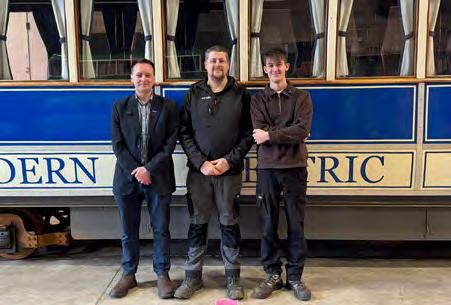
At the time, I didn’t imagine I’d go on to lead the trade body for the UK light rail sector. But apprenticeships show you what’s possible. You can start at a grassroots level, build skills over time, and progress to the top.
Why are apprenticeships so important for the sector?
James: Light rail is playing an increasingly important role in improving connectivity, supporting modal shift and helping cities address air quality and decarbonisation. To deliver that ambition, we need people with the right technical and professional skills.
At the same time, the sector is facing a wave of retirements. Apprenticeships allow us to pass on knowledge, experience and best practice, things you can’t learn from textbooks alone.
That’s why UKTram has been actively involved in work such as the engineering apprenticeship trailblazer reviews and the development of National Occupational Standards. These initiatives help ensure training reflects the real needs of light rail, while also supporting progression and mobility across the wider rail family. There will be some new exciting announcements from UKTram on skills and training collaborations and support for the sector in the Spring.
What role does mentoring play in apprenticeships?
James: One of the biggest advantages of apprenticeships is learning directly from experienced colleagues, asking questions
Alex’s interest in trams began at a young age, sparked by visits to the depot and time spent around the tramway. While still at school, he volunteered as part of his Duke of Edinburgh Award before securing a place on a mechanical engineering apprenticeship at 16. Alex has now completed his Level 3 Mechanical Engineering Apprenticeship and is working at Seaton Tramway, having gained experience across a wide range of engineering disciplines. He is qualified as an Engineering Technician (Mechatronics Maintenance Technician) and in Advanced Manufacturing Engineering, reflecting the breadth of technical skills he has developed through his apprenticeship and on-the-job training.
Light rail offers a wide range of career opportunities not only in engineering, but also in operations, customer experience, digital innovation and professional services. The best starting point is to look directly at tram operators, infrastructure organisations and their supply chains. Many advertise apprenticeship opportunities through their own websites and social channels, often in partnership w ith local colleges or training providers.
It’s also about engaging early. Volunteering, work experience and school or college engagement programmes can provide insight and help build relationships before formal opportunities arise. Several operators actively work with local authorities, colleges and employment programmes to support access into the sector.
In addition, the government’s apprenticeship service is another useful route, as roles may be advertised under broader engineering, construction or rail-related categories.
Investing in people and providing clear pathways into the industry has never been more important, and UKTram is helping to build a resilient, skilled workforce that can support the sector’s growth and future ambitions.
Still performing its role as a core public transport service, one of the world’s most unusual systems marks its 125th anniversary in 2026.
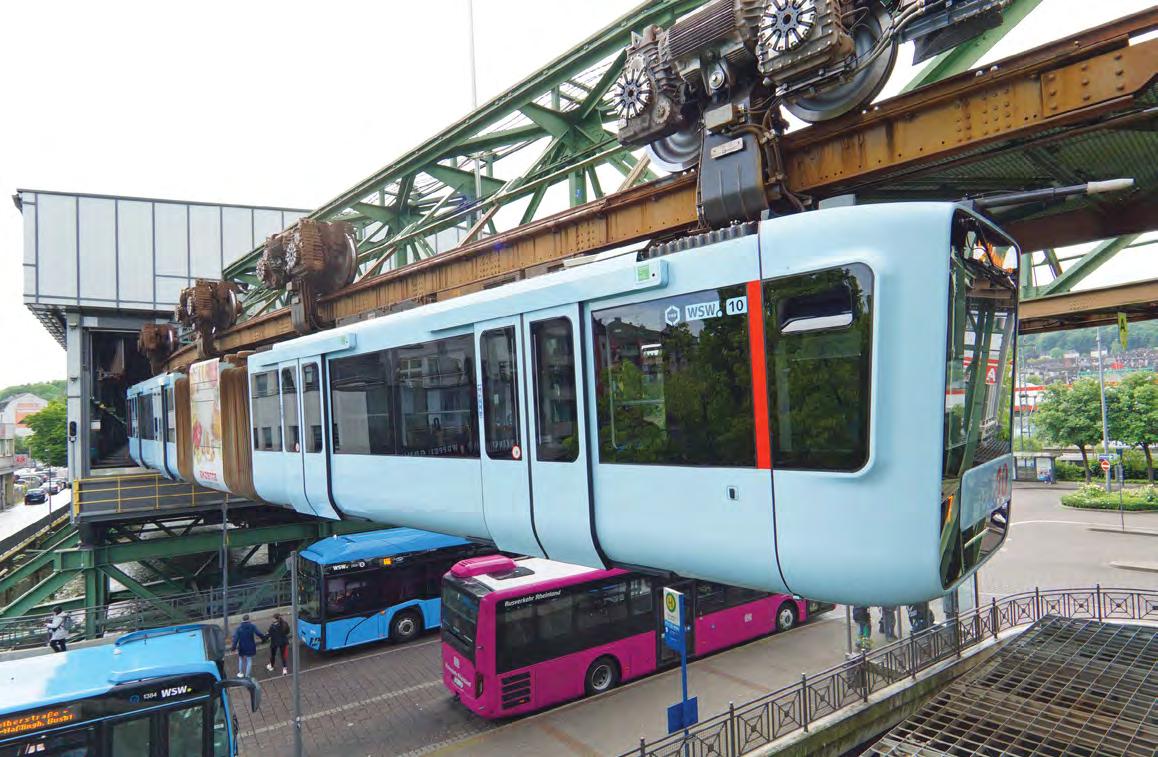
Although not as internationally known as San Francisco for its cablecars or Venice for its gondolas, few places a re more closely associated with a form of transport than Wuppertal. So intertwined are they that its suspended monorail called the Schwebebahn (‘floating railway’) is a leading feature of the city’s website and in pictogram form is used as a civic logo. Launching the system’s 125th anniversary celebrations, the Wuppertal Mayor stated (translation) “Our suspension railway is the soul of our city”. Wuppertal – population 364 776 (September 2025) – in the Bergisches Land region of NordrheinWestfalen (NRW) state is about 25km (16 miles) east of Düsseldorf.
At around the Schwebebahn’s central point in Döppersberg district is the main railway station, Wuppertal Hbf. This has long distance and NRW regional services, with S-Bahn RheinRuhr trains also serving other stations within the city boundaries.
Civic integration of communities along about 16km (ten miles) of the Wupper river in 1929 led to Wuppertal soon replacing Elberfeld-Barmen as the name of the newly constituted city. Despite it being almost a century since this change, separate identities survive, including in the names of the system’s 20 stations. ‘Wupper’ may have originated in relation to the river’s sinuous course, with ‘tal’ indicating a valley.
Unlike the nearby Ruhr which was industrialised later, the narrow
ABOVE: After being turned just inside the storage building, Generation 15 car 10 approaches the departure platform at Oberbarmen Bahnhof, the Schwebebahn’s eastern terminus.
flood-prone Wupper was not made navigable, but it did underpin early textile manufacture and processing. Metal working and chemicals later joined the industrial mix, with the pharmaceutical and biotechnology company Bayer originating here. By the launch of its Aspirin product in 1899, the first Schwebebahn cars (which did not enter normal service) had been tested on a 440-metre trial section near a current Bayer site east of the Sonnborn railway viaduct. Electric trams operated in the valley between 1896 and 1987, part of an interurban network once extending over 175km (109 miles). Trams and the Schwebebahn came under the control of the public sector power and transport body Wuppertaler Stadtwerke (WSW) on its foundation
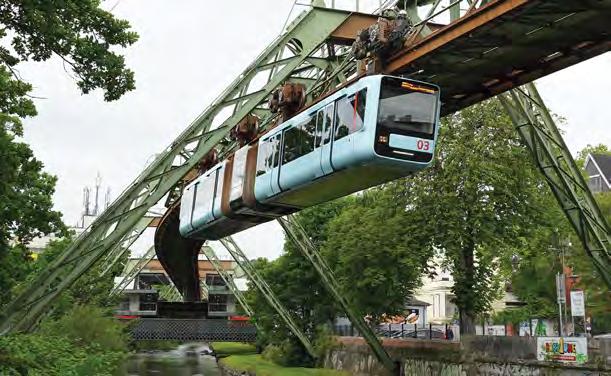
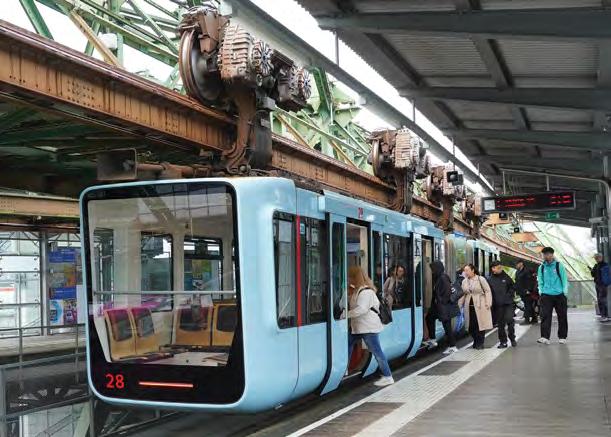
The aluminium-bodied Generation 15 cars are 24 metres long and 2.2 metres wide. They continued the B72 configuration of two long and one short inner section, with outer sections having two bogies. Each long section has a pair of double-leaf doors on one side. Deep windows, particularly at the rear, contribute to visitor appeal. They have general-use floor areas, a wheelchair ramp and a capacity for 175, with 42 cushioned seats on wooden frames. Air conditioning and high-grade service information are amongst the improvements over the fleet predecessors, with energy recovery from braking now possible. A pale blue is used for WSW buses and Schwebebahn, except for Kaiserwagen which have a heritage livery, consistent with their staff uniforms styled as for the system’s early years. The all-over advertising featured on B72 has not continued with Generation 15 where it is confined to the centre section and –in a position few systems could sell – along the car undersides.
TOP LEFT: In more open space than on most of the system’s river section, car 03 heads east from Adlerbrücke (‘Eagle Bridge’) in Barmen, where the station was rebuilt in 1999.
LEFT: As here at Oberbarmen Bahnhof, white tactile flooring on platforms assists the visually impaired to locate vehicle doorways.
BELOW: Closed by war damage in 1943 and reintroduced in 1999 with a structure unlike any other on the system, Kluse in central Elberfeld marked the end of the initial public section (from Zoo), which opened in 1901.
“Popularity also comes from having exemplary punctuality, plus integration with bus and rail services.”
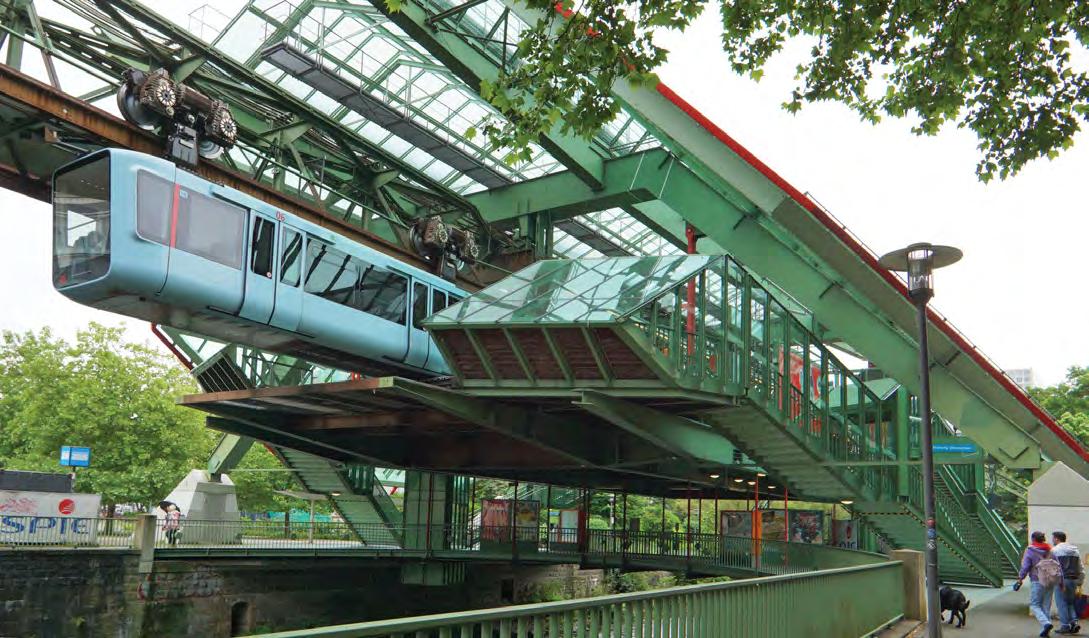

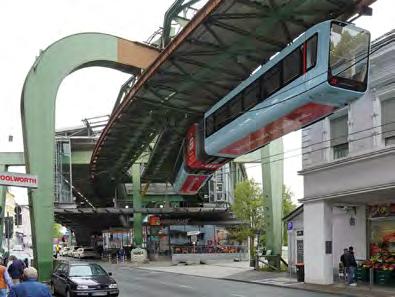
in March 1948. Wuppertal had trolleybuses between 1949 and 1972; the mode remains at Vohwinkel, being the northern end of the Solingen system, Germany’s biggest such operation. During 2007, WSW transport interests moved to a whollyowned subsidiary, WSW Mobil.
In 2024 WSW reported operating 300 buses over 700km (438 miles) of route, with 31 Schwebebahn rail vehicles. Usage figures vary, but an official averaged annual figure indicates around 60 000 passenger journeys per day, with journey lengths at an average of 4.7km (2.9 miles).
By the mid-19th Century, a haphazard industrial spread along the valley bottom offered little scope for road improvements or a multi-stop local railway; space directly above the river was available however. Though not originated for the Wupper valley, the engineer/entrepreneur Eugen Langen (1833-95) had a patented technology to meet such needs, with the approval to install a system coming in December 1894. Developed by other engineers, it opened to the public in stages between 1901 and 1903.
Today the 13.3km (8.3 miles) of wholly elevated route is covered in about 30 minutes. Approximately 10km (6.3 miles) are above the Wupper and intervening road crossings, with the remainder entirely over roads at the western end. Between termini there are now 464 supporting gantries, numbered upwards from Vohwinkel in the west. The styles and configurations of these supports have been influenced by factors such as road or river settings, the space
LEFT: Vohwinkel terminus and the works/depot marks the Schwebebahn’s western end. The paired wires are for Solingen line 683 which uses hybrid trolleybuses for a short unwired section to Vohwinkel main line station.
The depot and works building includes the return loop at Vohwinkel terminus. Rebuilding scheduled here from 2032 seems likely to require closure of the whole system for up to 18 months.
available and the route’s curves, which form a marked feature of the river section. Schwebebahn maintenance and operation is clearly costly, yet the rationale for its adoption in the 1890s included it being much less expensive than a tunnelled counterpart through valley strata. Although land use has expanded up the hillsides, the riverside concentration of commerce and habitation continues to sustain demand. Popularity also comes from having exemplary punctuality, integration with bus and rail services – and by being an agreeably unusual low-cost travel experience for tourists.
The Schwebebahn uni-directional cars are suspended from a single overhead rail on which run bogies, each with a motor driving two dualflanged in-line wheels. Electricity is supplied through a separate rail set just inside the running rails. These are mainly set four metres apart, a spacing which allows for cars having constrained pendulum movements in either direction. Vehicles are turned within buildings beyond the end of the termini’s arrival platforms. The running rail takes the vehicles without passengers slowly through 180 degrees, thereby readying them for boarding at the departure platform; the line speed limit is 60km/h (37mph). Four main classes of uni-directional vehicles have been used since the system’s debut. The original single-car 1900 Series (B01) was active until the mid1970s and eclipsed the comparatively short-lived 1950 Series. B01 5 and 22 have the Kaiserwagen identity in reference to Kaiser Wilhelm II’s preopening ride in 1900. Withdrawn in
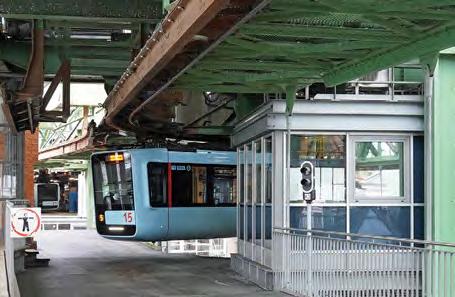
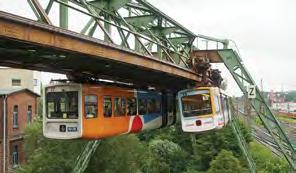
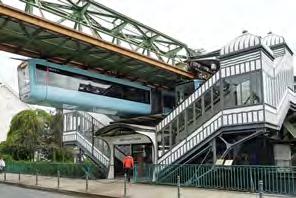
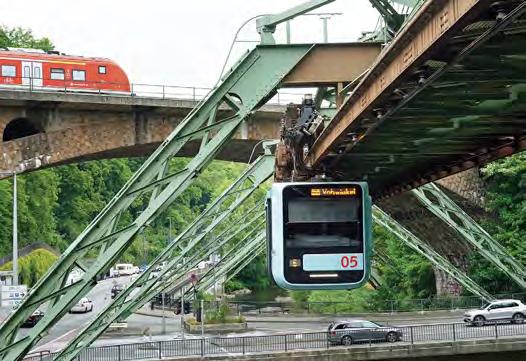
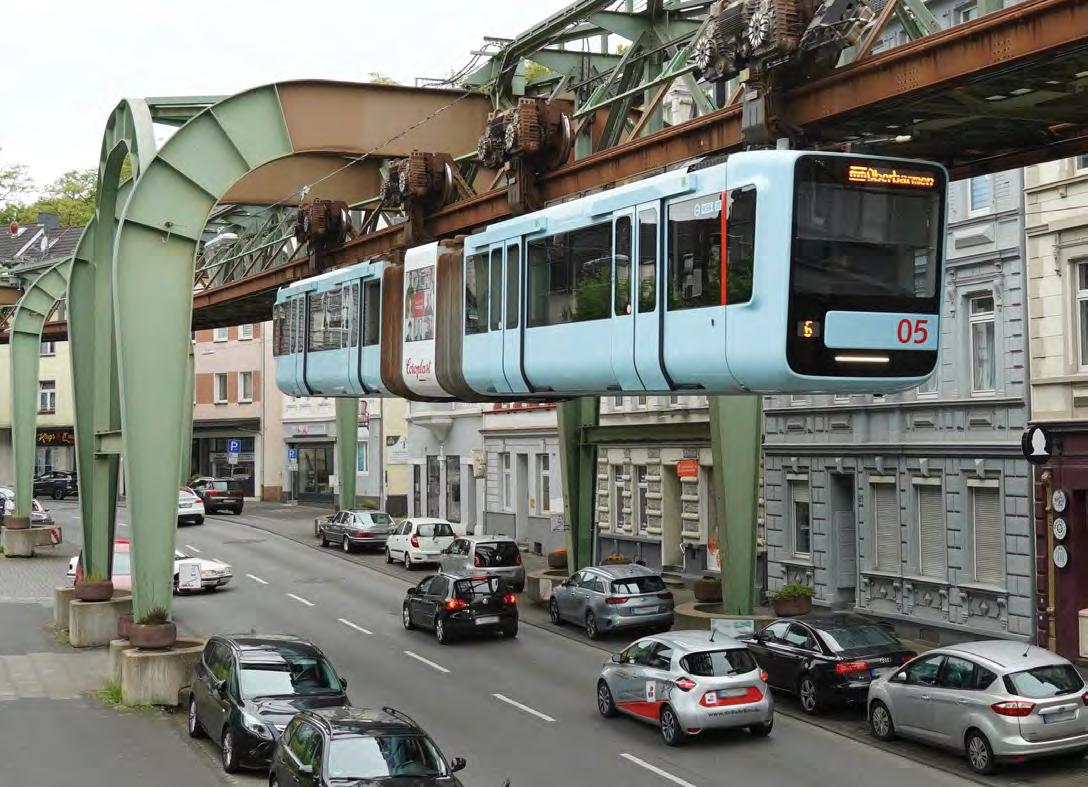
Opened: 1901
Lines: 1
Depots: 1 (2 storage areas)
Approx. weekday hours: 06.00-22.00
Main line frequency: 3-5 minutes
Gauge: not applicable
Powe r: 750V dc
Fleet: 31 (plus heritage pair)
City network/operator: WSW Mobil www.wsw-online.de
Regional network:
Verkehrsverbund Rhein-Ruhr www.vrr.de
Civic and tourist information: www.wuppertal.de
2018 for restoration and equipment modernisation pending a return to special service use, test running of the pair began in September 2025. The 28 three-section MAN/Kiepe B72 (or GTW72 – G denotes an articulated formation) were delivered 1972-75 and left service in 2019. It was B72 4 that was destroyed in the fatal accident on 12 April 1999. This was caused by equipment left by a contractor leading to derailment and the vehicle falling onto a pipe bridge and the river west of Robert-Daum-Platz station.
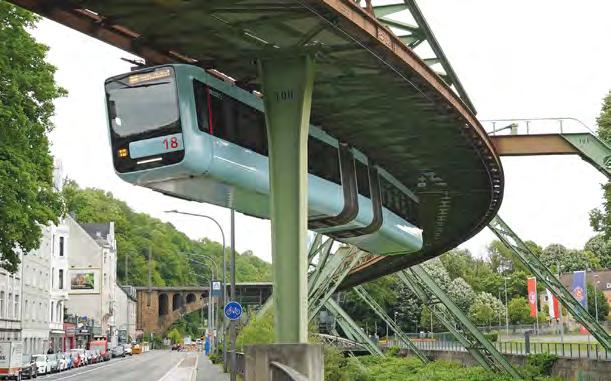
A contract with Vossloh Kiepe to supply 31 GTW14 (later branded as Generation 15, numbered 01-31) was signed in November 2011. Assembled at Albuixech near Valencia in Spain, the first was received in November 2015, coinciding with Stadler’s acquisition of Vossloh Rail Vehicles. Delayed by gaining approvals, public use began in December 2016, overlapping with continuing B72 use.
In September 2019 Alstom Atlas ETCS train control was implemented across the system, fitted on Generation 15 and
retrofitted to the Kaiserwagen. Lacking that provision, B72 is not represented as an operating heritage vehicle, although many went to community use or private owners. The Generation 15 takeover of services began a change from 600V to 750V supply.
The Schwebebahn’s heritage standing and features remain, but major changes have been made over the years, notably station rebuilding and renewal of the supporting structures. From the outset, attention has been paid to noise suppression
ABOVE: Kaiserstrasse in Vohwinkel, where street gantries have protective concrete surrounds, a feature standardised following destruction caused by a goods trailer in 1968.
LEFT: The point at which the Schwebebahn changes between river and street locations: support number 100 between Zoo/ Stadion and Sonnborner Straße stops. An ETCS train control marker is by the rear of car 18.
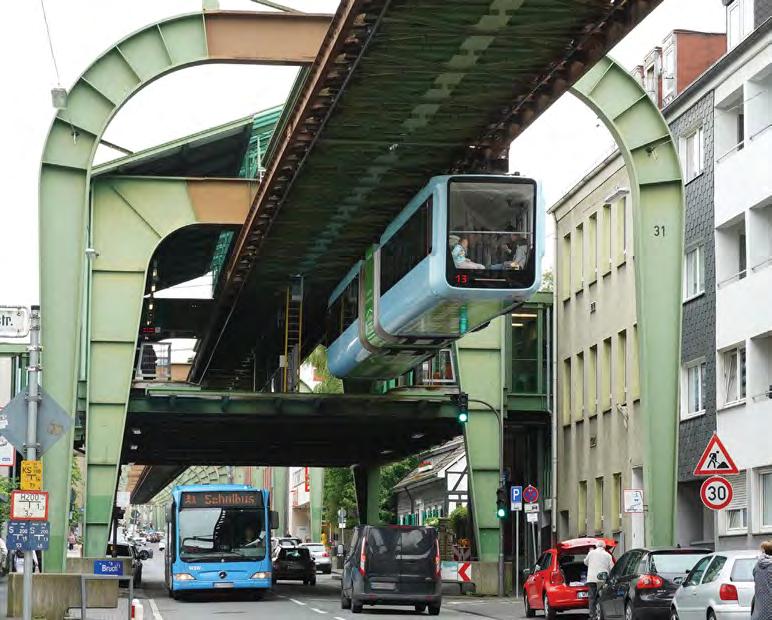
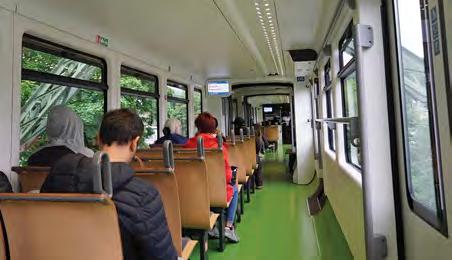
LEFT: One of the three stations directly above a public road, all of which were reopened in 2003 after complete rebuilding, Bruch is a short distance from WuppertalVohwinkel main line station.
BELOW LEFT: Aboard a Vossloh-Kiepe Generation 15 (in development as GTW2014) which took over all public services during 2019.
BELOW: From the original passenger fleet (B01) and now awaiting a return to special service use, 1900-built Kaiserwagen 5 and 22 are seen in August 2016. New GTW14 (Generation 15) stock was then being tested, with a service debut that December.
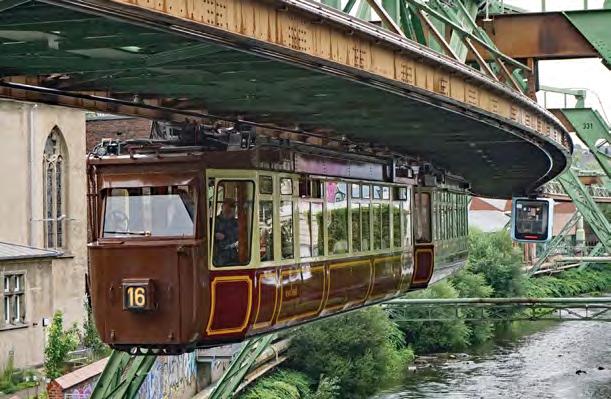
“A programme of station equipment renewals begun in 2023 is due for completion in 2030.”
and vibration damping. Changes to roadways beneath the track, exemplified by the Sonnborner motorway junction (completed 1974) and widened central intersections, brought adjustments to gantries and clearances. Many stations have been entirely replaced, with other works focusing on safety and accessibility.
A programme of station equipment renewals begun in 2023 is due for completion in 2030. Most stations have directly facing pairs of platforms separated by decking on which are barriers to deter crossing. Whether above roadway or river, only common sense or fear prevents people moving to the open ends of the decking.
Although frequencies can vary, infrastructure characteristics can result in an all-or-nothing service. A turntable was in use at Zoo/Stadion between 1974 and 1992, but there are now no intermediate line
cross-overs or running loops. As such, a n incident or vehicle failure cannot be by-passed and operations have to be paused. In some conditions, a ‘rescue’ car can move a failed counterpart to a location where the problem can be addressed. Such a move involves using the projection above the cab of one car and the conelike extension at the rear of another. Any works unable to be delivered within overnight non-service hours can also stop services. Closures may be scheduled or necessitated by incidents like the November 2018 fall of 350 metres of conductor rail; this and ensuing assessments led to a 256-day closure. A complete rebuild of the Vohwinkel depot/works area now scheduled for 2032 (after Wuppertal’s hosting of the BUGA 2031 national garden show) is expected to close the Schwebebahn for between 15 and 18 months.
Local travel: Staffed WSW information centre at 31 Wall, Eberfeld (near Hauptbahnhof). Local ticket sales at machines: fares include buses and Schwebebahn. Specific to Wuppertal, single fares from EUR1.60, and 24-Hour Ticket EUR7.60 (group additions at EUR5.10 each). Designated line 60, the Schwebebahn is within the Verkehrsverbund RheinRuhr (VRR) fare system. As reaching Wuppertal is likely to involve other public transport, passes like the EUR63 monthly subscription digital DeutschlandTicket and the daily or monthly capped app-based eezy.nrw ticket ( https://eezy.nrw) may give better better value. When reintroduced, Kaiserwagen trips will be separately priced (information as January 2026).
What is there to see? Wuppertal Touristik (www. wuppertalshop.de) on Alte Freiheit is opposite the main Hauptbahnhof Schwebebahn station entrance. The Schwebebahn is the thing to see in Wuppertal. Downloadable documents on https:// schwebebahn.de/tourismus are recommended for putting stations in the context of their surroundings. Opened in 2023, the Schwebodrom ( https://schwebodrom.com) near Werther Brücke station is a Schwebebahn-based attraction including virtual reality representations of the system’s early years. The Bergische Museumsbahnen, an operating tram museum, is also nearby ( https://www.bmbwuppertal.de/ ). Wuppertal is within easy public transport reach of Cologne, Düsseldorf and Essen.
ADELAIDE. New bridges, built to replace four level crossings (TAUT 1042), are complete; the South Terrace to Glenelg section of the tramway reopened on 26 January. A new access track has also been laid to Glengowrie depot. The city end of the tramway north of South Terrace was operated during the closure from a temporary depot at Adelaide Parklands (South Terrace); Glengowrie was cut off. Dr J. Radcliffe ME LBOURNE. Alstom G-class trams started night-time testing from 30 December.
Revised timetables were to be introduced on the suburban railway network from 1 February, to include the new Metro Tunnel (TAUT 1058). Facebook SYDNEY. Contracts have been awarded for the planned 24km (15-mile) metro line to connect Hunter Street in Sydney and Parramatta/Westmead. China’s MTR Corporation and CRRC will supply 16 train sets and operate the line for 15 years after its planned 2032 opening. John Holland is to undertake civil engineering, with Gamuda building five underground stations. RGI
GRAZ. Alstom Flexity 541 was delivered on 8 January; 543 has been sent to a climate test centre in Wien (Vienna). Planning for new line 8 started on 11 December. The 12.6km (7.8-mile) line from Gösting to Roseggerhaus via Lendplatz involves building 11km (seven miles) of new tramway. Construction could start in 2030. BS SALZBURG. November 2024’s referendum into the proposed underground S-Link extension under the city centre has been declared illegal. The Austrian Constitutional Court found that the Salzburg state government’s chosen wording was not correct. In the referendum (TAUT 1045), 53.2% of respondents voted against the scheme. lok-report.de W IEN (Vienna). Alstom Flexity 427 entered service on 20 January; 426 had entered service on 30 December. tramwayforum.at
ANTWERPEN (Antwerp).
Line 11 will operate to Melkmarkt again from 4 May. It has been c losed for nearly four years to permit infrastructure work. Once open, work can start o n renovating the Opera –Groenplaats section of the tram subway.
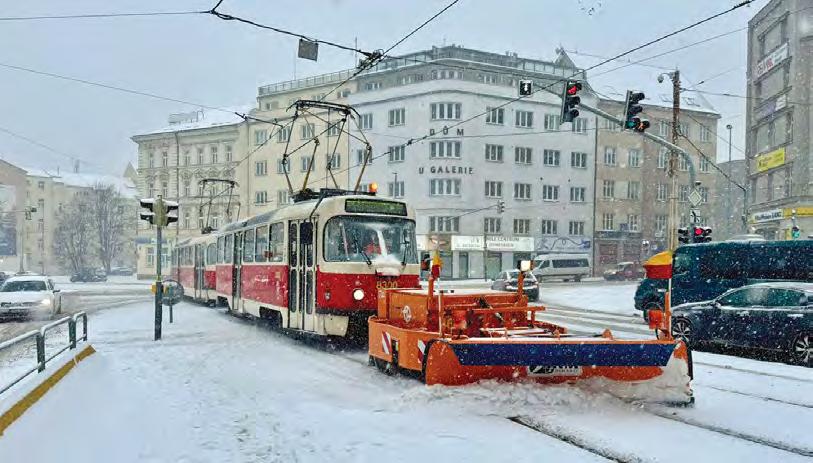
A depot for 14 trams is to be built at P+R Melsele this year. T-2000
BRUSSEL/BRUXELLES (Brussels). Alstom delivered 40m Flexity 4201 on 18 November. ‘Short’ Flexity 3241 was the last tram delivered in 2025.
Trams returned to Place Royale on 22 December, but with a 15km/h (9mph) speed restriction. The tram roundabout at Barriere Saint-Gilles was taken out of service on 26 January. It will be rebuilt as a simpler junction, with trams temporarily diverted.
A mistake crept into TAUT 1057’s news: Line 22 should have been line 81. T-2000, T. Johnson GENT (Ghent). Line 1’s eastern terminus was moved from the depot at Gentbrugge to Moscou on 5 January. This is shared with line 3. Tram 6338 returned from the coastal line in December after repairs to accident damage. T-2000
OOSTENDE (Ostend). Infrastructure work means that the last evening departures on the coastal tramway are 20.58 to De Panne and 21.05 to Knokke. Normal working is to resume on 2 April. T-2000
RIO DE JANEIRO. The Santa Teresa tramline’s connection to the Corcovado rack railway at Silvestre was to reopen in February. It was last used in 1966. A ceremonial ride for guests took place on 27 January. O Globo
CANADA
OTTAWA. Problems with wheel bearings led to 70% of Line 1’s Alstom trams being withdrawn from service in January. skyscrapercity
TORONTO. With the slow speed of the new Finch West LRT continuing to make news (TAUT 1058), city councillors have passed a motion to give LRVs p riority over left-turning cars at intersections. The motion also requires the formulation of a plan by the end of the first q uarter of 2026 for further measures to improve LRT speeds and reliability.
Flexity 4663, the last of 60 new Alstom trams delivered from Thunder Bay, entered service on 16 December. P. Webb, D. Drum
NINGBO. New 35.1km (21.8-mile) metro line 6 opened on 16 January between Gulin and Honglian. urbanrail.net
TIANJIN. The 23.7km (14.7-mile) Beitang - Zhaishang metro line Z4 opened on 18 January. urbanrail.net
CZECH REPUBLIC
BRNO. An eight-year framework agreement has been signed with Pragoimex for up to 60 tram component sets that operator DPMB can assemble in its own workshops. lok-report.de M OST. Alliance TW Team delivered the first of six new EVO-2 trams in mid-January. TP O LOMOUC. A tender has been issued for eight singleended 16m low-floor trams. The CZK300m (EUR346m) c ontract includes 26 years of maintenance. TP P RAHA (Prague). An order has been placed with Škoda for a further 31 52T trams, bringing the total to 71. Delivery should be completed by the end of 2027. cs-dopravak
AUBAGNE. Cable theft delayed the initial test run on the 13.2km (8.2 mile) Val’Tram extension to La Bouilladisse. The first run took place on 28 December. Passenger service should start this year. Alstom its delivering four new Citadis t rams. Facebook BORDEAUX. ACC-M of Clermont-Ferrand has won a contract to extend the working life of 62 trams to 40 years. Trams 2202 and 2022 have a lready been refurbished and have returned to service.
A recent route rearrangement increased the peak runout to 110 trams. T-2000 C AEN. Work has started on 9.1km (5.7 miles) of tramway extensions, to create a fourl ine network. An additional ten vehicles will be required by summer 2029. BS
L E MANS/RENNES. Heavy snowfall disrupted metro, tram and bus services on 6-8 January. lineoz.net PARIS. The first section of Métro Express Grand Paris (line 18, from Massy-Palaiseau to Le Christ-deSaclay) is to open in October. BS
BAD SCHANDAU. Ex-Jena EB57 trailer 156 has arrived. Built in 1959, it has been renumbered 28. DS BE RLIN. The new Urbanliner trams – 50m Flexitys – are due to enter service in February. Line 21 was split from 14 December; no services run between Boxhagener Strasse and Rummelsburg Marktstrasse. Work to replace worn rails on this section is likely to last until November.
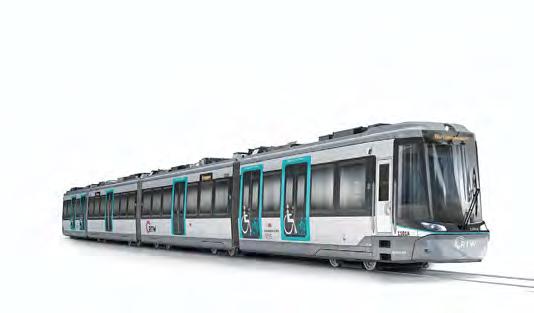
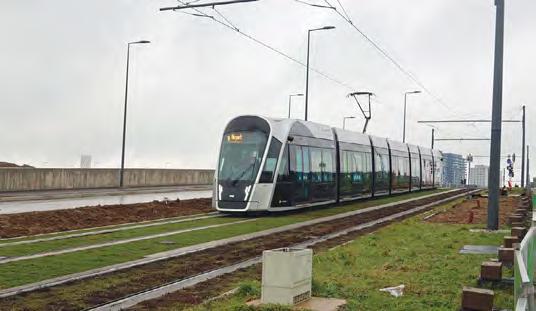
Fares were increased from 1 January: a 24-hour ticket in zones A+B now costs EUR11.20, a single fare is EUR4 while a 24-hour ABC ticket is EUR12.90. BS BONN. The planned Westbahn tramway ( Hardtbergbahn ) has been accepted into the regional planning timetable. Work could start in 2028-29.
Škoda trams 2251-53, 2351-58 and 2451-65 were cleared to use the tram subway from 19 December and are now in service. BS B RANDENBURG. KT4DMC 174 has been scrapped, while 180 is now equipped for snow-clearing duties. BS B RAUNSCHWEIG. The last high-floor tram, 7756, was w ithdrawn at the end of November. It will be preserved. BS BREMEN. A new timetable has saved two tram workings: Lines 5 and 8 now work through to Hbf. A tram parade is planned to celebrate 150 years of tramway operation on 6 June. Rides on museum trams are planned for the following day. The centenary of Sebaldsbrücke depot is to be celebrated on 10-11 October.
M. J. Russell C HEMNITZ. Construction of a 3.2km (two-mile) tramline was to have started this February. Linking Falkeplatz to Konkordiapark via Theaterstrasse and Hartmannstrasse, the line will create a ring around central Chemnitz and facilitate tramtrains running to LimbachOberfrohna.
Gotha T57 two-axle tram 32 returned to Chemnitz on 10 November after spending 38 years in Woltersdorf. BS DARMSTADT. ST11 tram 8210 is now displayed outside the Marburger Strasse museum. BS DR ESDEN. DVB’s first low-floor tram, 2501, was scrapped on 21 January, after two years in storage. BS DUISBURG. A ten-minute peak headway on U79 was restored from 7 January.
By the end of 2025, 11 ten-axle trams (1001/07/13/18/22/2728/41-42/44-45) remained in service. BS
E RFURT. A fire on Domplatz, caused by a New Year’s Eve firework, disrupted services until 3 January. BS
F RANKFURT/Main. Planning permission has been given for the 2.5km (1.6-mile) tramway extension along Gutleutstrasse. Expected to cost EUR153m, it is to include a turning circle at Baseler Platz.
L ine U2 ran to Bad HomburgGonzenheim for the last time on 11 January; services terminate at Ober-Eschbach until 1 March.
A shortage of Alstom T class trams meant that improvements planned for the 14 December timetable change could not be carried out. BS
G IEßEN. TTK Karlsruhe has been commissioned by the city council to carry out a technical feasibility study into a possible tramway or regional tram-train system. DS
G ÖRLITZ. Offers have been received from six manufacturers to deliver low-floor trams to replace the original Sachsentram order with HeiterBlick (see News). BS H ALLE. Stadler TINA trams 851-853 entered service on 14 December. BS
H AMBURG. Tenders have been invited for the restoration of DT1 metro set 516-1/2 (9030+9031). BS HANNOVER. State approval was given on 12 January for the purchase of 17 further 4000-series Stadtbahn cars. This will bring the total order to 59, permitting the replacement of all 6000-series vehicles. Operator Üstra introduced a smoking and alcohol ban on all high-platform Stadtbahn stops on 1 January. DS KARLSRUHE. Funding has been released for the renovation of the Turmbergbahn funicular. Closed in 2024, it is to be extended to a new tram interchange. BS LUDWIGSHAFEN. Withdrawn
RHB tram 1015 has been transferred to a museum group in Altenstadt, Alsace. BS M ANNHEIM. The KurtSchumacher Rheinbrücke is to close to trams for five years from August. However, with the Konrad-Adenauer Brücke due to reopen in April, a revised tramway network is to come into operation in August. Planning is being complicated by DB closing its Rhein bridges linking Mannheim and Ludwigshafen from 30 May to 10 July.
M useum trams are being cosmetically restored ready for a parade on 17 October to mark 150 years of tramways. BS M ÜNCHEN (Munich). Line 19 reopened to Pasing on 20 December (TAUT 1057).
Siemens delivered four-section Avenio 2560 before the end of 2025.
Line 14 was to start operation on 14 February. It links Fürstenrieder Strasse and Ammerseestrasse, using 1.5km (0.9 miles) of the new western orbital link. BS N ÜRNBERG (Nuremburg). Operator VAG has exercised an option for 14 more Siemens Avenio trams, costing EUR61m. This will bring the fleet to 40. D elivery is to be in 2028-30. TR O BERHAUSEN. A formal planning application has been submitted for the 3.5km (2.2-mile) link from Frintop to Oberhausen Gasometer.
BS POTSDAM. Stadler Tramlink 443 is to join the two that are already in service over the summer; the remaining ten are to arrive in 2027.
The Driverless Tram Project, sponsored by Siemens, ended in 2025 with the equipment removed from Combino 400. The results of the trial have not yet been published. BS S CHWERIN. An 8% fares increase (the first since July 2023) was scheduled for 1 February. A day ticket now costs EUR5.40. BS S TUTTGART. BadenWürttemberg state is making EUR65m available to help
finance the purchase of 30 new DT8.17 Stadtbahn sets. DS W OLTERSDORF. Freezing weather on 5 January sidelined the Modertrans low-floor trams. A trio of two-axle trams, including m useum tram 7, were used instead. DS
W UPPERTAL. To mark the 125th year of the Schwebebahn suspension railway, GTW 14 27 has been repainted in the blue and orange livery carried b y the GTW 72 stock which was introduced in 1972.
DS
ATHINA (Athens). CAF has received a penalty of EUR3.8m for the late delivery of 14 upgraded line 1 metro trains; one has so far been delivered.
TR
AHMEDABAD. Metro Line 2’s 5.4km (3.4-mile) Sachivalaya - Mahatma Mandir extension opened on 11 January. urbanrail.net
JAKARTA. Interested parties have been invited to participate in market engagement prior to tenders being issued for the 24.5km (16-mile) east-west metro. Sumitomo/Nippon Sharyo is to deliver 48 metro cars for the Phase 2A north-south metro extension. skyscrapercity
DUBLIN. The National Transport Authority has joined forces with Indra Group to introduce contactless ticketing across the Irish capital. ‘Tap-in, tap-out’ payment is expected to go live on buses and the Luas tramway in 2027, with DART and other rail services following in 2028. The Irish government has approved the issue of tenders for the construction of the 18.8km (11.7-mile) MetroLink automated metro. A pair of consortia have expressed interest: one comprises Alstom, FCC, John Laing,
Meridiam and RATP, while the other is made up of Plenary Group, Webuild, Hitachi Rail and Keolis.
ISLE OF MAN
DOUGLAS BAY HORSE TRAMWAY. Restoration of double-deck tram 18’s bodywork is nearly complete. Filler and undercoat have been applied, prior to painting of the top coat.
MANX ELECTRIC RAILWAY.
Tunnel Car 7 has received bodywork repairs. It is to be repainted blue and white prior to services resuming on 17 March.
JERUSALEM. The first test run on the Green Line took place between Givat Ram and Patt Junction on 18 January. Trials have since reached Teddy Stadium. kolhair.co.il
ITALY
FIRENZE (Florence). The city council has approved construction of T3’s Rovezzano branch. Of the 6.1km (3.8-mile) line, 1.2km (0.75 miles) will be without overhead. Work on the EUR360m project should start this summer and take 34 months to complete.
RGI
N APOLI. Hitachi Rail Italia has won a EUR630m contract to construct metro line 6’s new depot and station at Via Campegna. The company is building 22 new trains to enable 4.5-minute headways. Contracts have also been awarded to build the 14.3km (8.9-mile) underground metro line 10 from Principe Umberto to Afragola; it will have 12 new stations. CAF is to supply an unspecified number of automated INNEO three-car trains. RGI R OMA (Rome). A Webuild/ Vianini Lavopri consortium has won a EUR776m design-and-build contract to extend the metro from Clodio/Mazzini to Farnesina. This will take line 1 to 29km (18 miles). RGI
KUMAMOTO. Alna Sharyo delivered trams 2403 and 2404 in the last quarter of 2025. BS U TSUNOMIYA. Work will start in 2027 on a 4.9km (threemile) western extension to the Transport Ministry; 14 new trams will be required. BS
LUXEMBURG
LUXEMBOURG. Double track between Howald and Scillas opened on 15 January. It replaced the last single-track section. A new stop, which provides b etter interchange with heavy rail services, opened on the same day. R. Birgen
SOARANO –AMBOHIMANAMBOLA. Reports have emerged that light rail services on a former heavy rail alignment started in October. Information is limited. Trains are said to comprise metre-gauge units imported from Switzerland, w ith one report claiming that they run behind diesel locomotives. BS
MEXICO CITY. Doppelmayr Group is to build the world’s longest cable car. At 15.2km (9.4 miles), line 5 is to link Álvaro Ob regón, Magdalena Contreras and Benito Juárez and could open in 2028. Its 462 ten-passenger gondolas are expected to carry up to 3000 passengers per hour to 12 stations. The Mexican capital plans to build three further cable car lines. UTM
AMSTERDAM. Lines 13 and 19 were diverted from 5 January due to the closure of the tramway between Marnixstraat and Bilderdijkstraat. The diversion will run for a year, while bridge reconstruction takes place. Line 14 will resume running to Alexanderplein from 14 March. Tram 302 was damaged in a collision with a car at a level crossing on the Uithoorn Line on 15 November; three people were hurt. Coupled car 3002 will be repaired. OR
D EN HAAG (The Hague). Scheveningen depot reopened on 4 January. It has an allocation of 18 Siemens Avenio trams.
Stadler delivered TINAs 700105 in 2025. Testing starting on 2 December. Deliveries are to resume in the summer. OR ROTTERDAM. Lines 4 and 6 were diverted to Mathenesserlaan from 5 January. Work on sewers in Heemraadsplein, the reason for the diversion, is e xpected to last until October.
GDA Ń SK. A tender has been invited for the supply of between 20 and 35 double-ended low-floor trams. They are to be 45m-47m long with delivery from 2029. TP Ł ÓD Ź A contract was signed with Modertrans on 10 January for 15 Gamma LF11AC trams. The 32m single-ended cars will be air-conditioned and fitted with a nti-collision systems. RGI WA RSZAWA (Warsaw). A tender for 160 new trams has been cancelled because, Tramwaje Warszawskie claims, it received no compliant bids. A new tender is expected. cs-dopravak
WROCŁAW. Operator MPK has announced a consultation with suppliers for 160 new trams to replace all remaining high-floor cars. TR
ORADEA. A tender has been issued for 14 new trams, of which three should be capable of operation under 2 5kV ac overhead. They will be used on rail lines to Cheresig a nd Cord ă u. Funding is being sought from the EU. cjbihor.ro
RUSSIA
KALININGRAD. Evening express tram services were introduced in mid-January. These utilise vehicles that were p reviously returning empty to the depot. J. Carpenter
S MOLENSK. After taking delivery of ten ex-Moskva (Moscow) 71-623-02 bogie trams, delivery started in December of three new 71-623-04 cars. transphoto.org
SAUDI ARABIA
RIYADH. A multinational consortium that includes Alstom has been awarded the designand-build contract for the 8.4km (5.2-mile) extension of the metro Red Line to Diriyah Gate. RGI
SLOVAKIA
BRATISLAVA. DPMB has exercised its option with Škoda for ten more double-ended trams. Costing EUR38.85m, they should arrive in 2027. TP
SOUTH KOREA
DAEGU. Work has started on the underground extension of the Daegusaneop line, to open in December 2030. RGI
SPAIN
BILBO (Bilbao). The Basque government and the regional council have agreed that metro line 4 from Matiko to Iraurgi should be built. TR JA ÉN. The Administrative Court of Contractual Appeals of Andalucia has ratified the decision to revoke the award of the tramway operating contract to the Nex Continental/ A lsa Ferrocarril joint venture, on the grounds that documentation was not submitted within the required timescale. msn.com
SWEDEN
GÖTEBORG (Gothenburg). M34 tram 618 entered service on 2 January. Facebook
SWITZERLAND
BASEL. Lines 11 and 1 will be cut back to Dreispitz from 18 May to
12 December to enable stops on the Aesch line to be rebuilt. BS BE RN. Single-ended Stadler Tramlinks entered service on 3 December and have been used on lines 7, 8 and 9. BS GENEVE (Geneva). Bombardier Cityrunner trams 861-99 are to be refurbished so that they can stay in service until 2043. BS MONTREUX – ZWEISIMMEN (MOB). The ex-CJ Be4/4 will be numbered 9205/6 and 9305/6. It is to enter service once adapted to 950V dc. TR
Z ÜRICH. Alstom Flexity trams are now in regular use on lines 2, 3, 4 and 7. They occasionally also appear on lines 11 and 15. Snowplough-fitted 1924 (ex-1358) has been sent to Vinnytsia in Ukraine. BS
KHARKIV. Former Czech trams in the city include Plze ň 311, Brno 1233/4/412/2/7/8 and 4543 from Praha (Prague), which has been turned into a café tram. BS K YIV. Damage to the power grid from Russian attacks meant that electric public transport was suspended from 13 January. Limited replacement bus services were provided. transphoto.org
UNITED KINGDOM
DERBY. The Light Rail Transit Association has published a proposed four-line tram network across the city. Covering nearly 16.5km (ten-miles), the GBP405m (EUR466m) tramway would link key suburbs with major industries and employers.
EDINBURGH. Edinburgh Trams logged a record 12.5 million journeys in 2025, 3.3% up on 2024’s figure.
GLASGOW. Ice caused a power failure on 6 January. No Subway services ran between 07.00 and 12.00.
Get Glasgow Moving has commissioned a London Underground-style map showing a proposal for the Clyde Metro system. Development of the Programme Business Case is to start this March. The map shows two tram systems, the Duntocher – Balgray West Tram and the extensive Cross Tram network.
GREATER MANCHESTER. Metrolink services were disrupted on the morning of 18 January when a car was abandoned on lines between New Islington and the tunnel to Manchester Piccadilly. The vehicle was recovered and services returned to normal later that day.
LONDON (DOCKLANDS). Market engagement has started for the GBP1.6bn (EUR1.8bn) contract to build the Thamesmead
extension. Work on the 3km (two-mile) line, which includes a 1 .5km (0.9-mile) twin-bore tunnel under the River Thames, is due to start in 2028 and be completed by 2033.
LONDON (GENERAL).
Transport for London has awarded Indra Group a seven-year revenue collection contract. Indra will operate and maintain contactless and Oyster ticketing systems across the city.
LONDON (UNDERGROUND)
The Express has reported that Transport for London (TfL) still has aspirations to divide operations on the Northern Line. It was originally suggested in 2 013 that the Edgware, High Barnet, Bank and Charing Cross lines might be split into separate operations during the 2020s. However, TfL now says that this might take place in the 2040s when the 1995 Stock requires replacement.
NOTTINGHAM. East Midlands Combined County Authority’s ‘Big Transport Conversation’ was to end on 8 February. The 12-week consultation forms part of work to develop a transport policy for the region into t he 2040s.
SHEFFIELD. Fares on the Supertram network have been frozen at 2025 rates. Aside from a temporary COVID-related freeze in 2021, it is the first time in 25 years that fares have not i ncreased. A long-distance adult single is now capped at GBP3 (EUR3.45).
TYNE & WEAR. Nexus has celebrated the retirement of Phil Taylor, who was the youngest person in the history of the Metro to qualify as a driver. Taylor started driving in 1980, aged 19. He retired as Service Delivery C ontroller.
Closure of the Metro between Shiremoor and St James is to take place 16-20 February to allow 950m of track to be replaced.
WEST MIDLANDS. Public consultation has been undertaken on West Midlands Combined Authority’s proposed changes to the Metro’s byelaws. These aim to strengthen fare enforcement and improve passenger safety.
USA
ATLANTA, GA. Streetcar services were to resume on 3 February after being suspended since 8 S eptember 2025 due to underground utility repairs. RGI
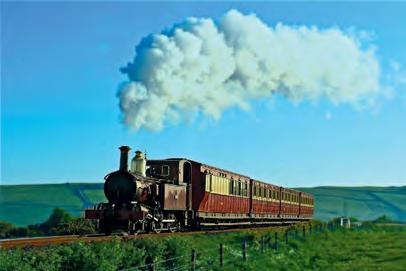
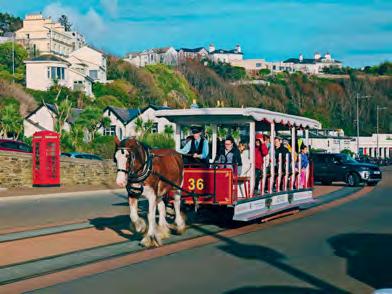

AUSTIN, TX. The Federal Transit Administration has accepted the final environmental impact statement for Austin Transit Partnership’s 15.7km (9.8-mile) north-south light rail project, allowing the scheme to undertake advanced design and utility relocation. Mass Transit BA LTIMORE, MD. The first six of 78 Hitachi-built subway cars entered service in early January. They were assembled in Hagerstown, Maryland. Eleven should be in service by the end of 2027. Mass Transit C AMDEN – TRENTON, NJ . The first of 14 refurbished RiverLine diesel light rail trains was unveiled on 9 January; car 3511 received a special livery t o mark 250 years since the US declaration of independence. Kinki Sharyo is refurbishing the 13 trains.
agreement with the city council expired on 31 December. This appears to have ended the h eritage tramway operation for the foreseeable future. J. May
MUSEUM NEWS
BEAMISH (UK). Lisbon 730 has received attention to a misaligned gear. A plan to repaint it in Darlington C orporation Light Railway livery has been postponed; it is due to return to service in pseudo-Newcastle Corporation Transport colours.
J. May
CHICAGO, IL. State/Lake station on the downtown ‘L’ elevated rapid transit system was closed from 5 January. A replacement is to open i n 2029.
LOS ANGELES, CA. Underground heavy rail was chosen for the proposed Sepulveda Transit Corridor on 14 January. The final cost and source of funding have still to be identified for the 21km (13-mile) line between Van Nuys in the San Fernando Valley and Wilshire in the Los Angeles Basin. A 7.2km (4.5-mile) extension of Line K from Redondo Beach to Torrance was approved on 22 January. skyscrapercity
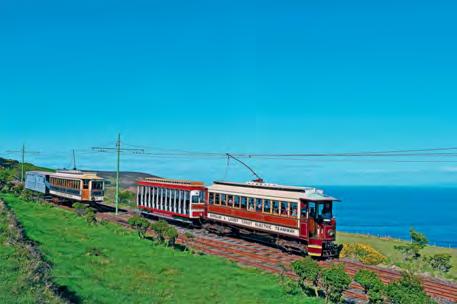
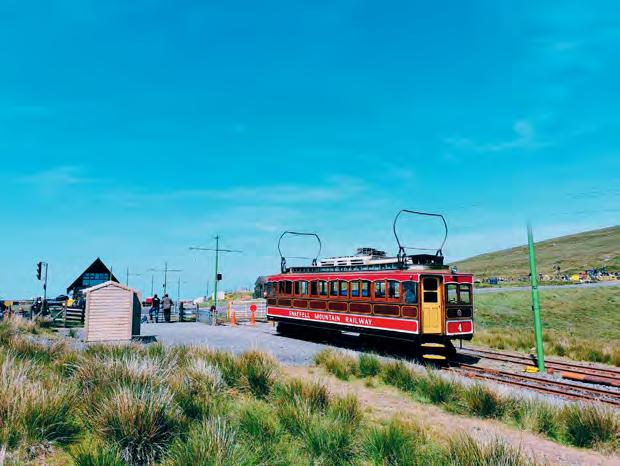



LAHOMA CITY, OK. Free travel on the Streetcar came into effect on 5 January, for six months. Fare-box revenue covered only 1.7% of operating costs in 2025.
J. May
HILADELPHIA, PA. Market
Street Trolley Subway (streetcar lines T1-T5) reopened on 12 January, though further losures are planned: 30 January2 February and 15-22 February. ll regional rail morning express trips were restored from 12 January following FRAandated inspections and repairs Silverliner IV fleet. J. May
ORTLAND, OR. Curtailment of the MAX Green Line to Gateway Transit Center has been delayed until at least 23 August. S. J. Morgan SEATTLE, WA. Simulated service on the 11.9km (7.4-mile) link between the Eastside LRT and downtown Seattle is to start in February. Passenger services are to begin on 28 March; two new stations (Judkins Park and Mercer Island) are to open at the same time. Line 2 will run through to Lynnwood. skyscrapercity Y AKIMA, WA. Yakima Valley Trolleys’ operating
BRUXELLES/BRUSSEL (BE). Double-ended PCC 7042, formerly used for driver training, has been overhauled at Woluwe museum to become a bar car. It could be used on the Tervuren line on Saturdays. T-2000 B UDAPEST, HÉV (HU). The last of the LEW Hennigsdorfbuilt units have been withdrawn because of the 60-year limit on regular passenger use. However, 841/842 and 849/850 h ave joined the heritage fleet while 81+601+602 is displayed at Szentendre museum. TR CRICH (UK). Preparation work on Blackpool Centenary Car 645’s new roof continues.
New seat moquette for Blackpool Railcoach 298 has been delivered.
Cast lamp columns originally from Ashton-under-Lyne, which have been at Crich since 1974, have been restored.
HAARLEM (NL). Stichting De Nieuw Blauwe Tram has acquired former SUN Utrecht SIG-built articulated tram 5017 for display. TR
L OWESTOFT (UK). Track relaying is underway and cobbles have been relaid. Redundant overhead columns have been removed.
Worldwide items for inclusion should be sent to Michael Taplin at Flat 8, Roxan Villa, 33 Landguard Manor Rd, Shanklin, Isle of Wight PO37 7HZ, UK. Please fax: + 44 (0)1983 862810 or e-mail miketap@mainspring.co.uk U K and Ireland items, please e-mail uknews@lrta.org.
Acknowledgements are due to Blickpunkt Straßenbahn (BS), cjbihor.ro, cs-dopravak, Drehscheibe (DS), Facebook, kolhair.co.il, lineoz.net, lok-report.de, Mass T ransit, msn.com, Op de Rails (OR), Railway Gazette International (RGI), skyscrapercity, Today's Railways (TR), Tram2000 (T-2000), tramwayforum. at, transphoto.org, Transport Publiczny (TP), urbanrail.net , and Urban Transport Magazine (UTM).

matt@mainspring.co.uk

Letters submitted by post should be clearly typed and preferably not handwritten. We reserve the right to edit contributions for publication.
An excellent article on Boston in TAUT 1057 by Andrew Grahl!
The picture on page 10 was taken at Packards Corner where the Watertown Line made its connection. After the end of service in 1969 it was left intact for shoppers to reach Watertown. The first attempts to kill the line were during the MTA McLernon era; he wanted rid of the trolley subway system. After he left it was hoped the problem was over, but in 1967 a growing car shortage fuelled by an ageing PCC fleet led to renewed plans to kill the line. Political opposition slowed it down, but in 1969 it was revived and pushed through in June.
There were hopes to revive it during the 1970s. Concerns about the environment, the arrival of new cars, and the rise of light rail brought hope. Track improvements were made in 1975 at Oak Square, Brighton Center and Union Square, and there
Throwing light on Washington claims
In TAUT 1053 p.341, there is a summary of the proposal to replace Washington’s street car line with trolleybuses.
Two reasons have been given by DC officials: (1) operating costs are too high, and (2) it’s costly to expand.
Transportation Director Kershbaum cites the cost of the cars, and says that the present fleet is past its useful life.
Both of these claims seem open to serious question.
T hree of the cars are 18-years-old and three are 12-years-old – well within the normal lifespan of light rail vehicles. Toronto’s CLRVs lasted 40 years in intensive service with no rebuild.
Ms. Kershbaum says that new cars would cost USD11m each, but Toronto’s latest Flexities – now nearly all delivered – have a replacement cost of CAD7m (EUR4.34m/ USD5.1m). The Flexities are significantly longer than the DC cars illustrated.
There’s no mention of the lower capacity of trolleybuses, which would need more operators to move the same number of riders.
Their routes would be cheaper to extend, lacking rails, but that’s only half the story.
History tells us that the purported trolleybuses will turn out to be simply battery electric vehicles with far lower capacity, speed and comfort than the present LRVs. Hopefully, wiser counsel will prevail.
Also, I would like to record an objection to the headline on the cover of TAUT 1055: ‘Toronto faces CAD12bn cash shortfall’. That’s not true as it stands.
TTC will need an estimated CAD12bn
were plans to restore the reservation between Packards Corner and Union Square, removed in 1949. The election of pro-transit Governor Michael Dukakis in 1974 led to hopes of revival. He was a regular commuter on the Riverside and sometimes Beacon lines. Sadly, during his term the Arborway line was closed in 1985, coming when the track in the subway was rebuilt and the wooden trestle incline at Northeastern was removed and filled for the heavy Type 7 cars.
The failure of the Boeing cars did not help, altough the line was still intact after the Type 7s arrived.
By the 1980s the Brighton area had many new residents who only saw the line as an abandoned ruin. Demands grew for removing the track. Local hearings showed an ignorance of light rail developments, and no concern for the environment. In 1994 a budget resolution passed
(EUR7.4bn) over the next 15 years – that’s up to 2040, which amounts to CAD800m/yr (EUR496m/yr), a perfectly reasonable figure for a city the size of Toronto.
No-one allocates funds for public services that far ahead and we can be confident that the various levels of government will find it all in time. Moreover, it applies only to capital spending: operations aren’t involved.
TTC has announced imminent service improvements on subway plus surface routes, for which it has adequate funding. Philip Webb, Toronto
I refer to the ‘Expansion in Lisboa’ article in TAUT 1052. I am puzzled by the reference to Sintra 1 as being a Lisbon hilly route car.
The Sintra 1 I photographed (below) in August 1969 was a toastrack. Car 2, on reflection, looks a lot more like a Carris vehicle. A rather unusual movement took place at the Praia das Marcas terminus. To get
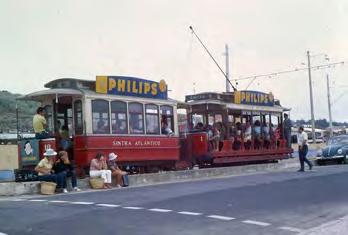
through the legislature, mandating removal of the line. When an effort was made to mandate restoration to Arborway a year later, then-Governor Weld (no friend of urban transit) vetoed it.
There are currently active efforts to restore service to Jamaica Plain, the success of which time will tell.
In Boston, at least, liberal politicians have not proven friendly to light rail, although there have been some signs of hope in the last few years.
Lawrence Mills , by e-mail

motor! Bill Dickie, by e-mail
I have been reading the Sunday Telegraph Business news (16/11/25 p.28). It tells of a proposed GBP100bn (EUR115.5bn) new city to the east of Cambridge (UK) called ‘Forest City’. I know that after the decision to fence in the guided busway and introduce a speed restriction to the residents of this area, people in Cambridge have been very i nterested in transport systems.
There is a new Cambridge south station, and a plan for East/West rail. There is also a proposed tram system in Cambridge and a route from Haverhill, but I think this Forest City is a new idea. I recall a debate about whether Cambridge is (or is not) too wet and waterlogged to create tunnels under the city. The proposed artist’s drawing of a tram for the streets of Forest City looks nice, though: a five-segment unit of a design I do not recall seeing before.
The tram drawing is a lot better than the one proposed by developers of the Manchester United football ground in their advertising video. It had single cars, and Metrolink vehicles passing every few seconds on the existing non-electrified ex-CLC rail route (Manchester to Liverpool v ia Warrington) .This passes the stadium in the Old Trafford area, where there is a disused single platform which once was used by special trains when Manchester United had a home fixture.
David Wrottesley, by e-mail
Big developments are on the way in Torino (Turin), with the prospect of at last giving official recognition to Italy’s transport heritage. Mike Russell explains the impressive ambitions.
The annual tramway festival in the northern Italian city of Torino (Turin) has featured in our pages before, but developments in the last three years mean it fully justifies further coverage.
Associazione Torinese Tram Storici (ATTS) gives a firm lead for the whole of Italy when it comes to a programme of special events relating to tramway history and preservation. Its series of video presentations of tramways both at home and elsewhere has a growing audience and has gained a deserved reputation for quality and variety of subjects.
Created shortly before Christmas 2005, the ATTS promotes tramcar preservation and disseminates historical tramway information.
Work on restoring a growing fleet of older tramcars had already been started in previous years by the local tramway operator, now Gruppo Torinese Trasporti (GTT), and by 2006 had reached a stage where it was practicable to mount a festival of historic tramcars in Torino. The Association quickly established a partnership with GTT, mutual benefit being achieved through the ATTS appointing as its President the then city tramways’ Operations Manager and Commercial Director. Roberto Cambursano has since retired from GTT but continues his liaison role, and his contacts have proved of great value and reaped mutual benefits. ATTS is now recognised as a partner of GTT.
Annual parades take place on the first Sunday of December; summer was downplayed from the outset, as Torino’s citizens habitually retreat to less humid surroundings. Turnout to witness the old trams fully justifies this decision.
The 2025 parade was very special, marking the 20th anniversary of the foundation of the ATTS, and featured 22 trams (and three buses), including veterans from the association’s collection and others owned by GTT as part of its heritage fleet. It also included examples of modern and works rolling stock.
In the past the city centre parade has focused on departures from Piazza Castello but this year there was a substantial change. Public circular tours before and after the main parade continued to start from Piazza Castello, but the square was inadequate to allow a gathering of all participating tramcars and the parade’s departure point was transferred to Piazza Statuto. Here is a complete circuit of track which is retained for reserve purposes, but even so was not big enough to hold all participating cars.
From around 11.00 most of the historic cars made their way to Piazza Statuto and formed up around the square with overspill opposite. At around 12.00 the parade, still incomplete, moved off and made its way via Porta Susa to Via Cernaia, where the historic cars were joined by members of the modern fleet. This location had been well chosen to permit all cars to be displayed together in one long line. At around 12.20 the convoy moved off, appropriately with car 116 leading – its small size contrasting starkly with the dimensions of the latest Hitachi vehicles at the other end of the line.
The procession followed the line of route 13 through Piazza Castello, into via Po and on to Piazza Vittorio Veneto, when several cars returned to their depots. Others returned to Piazza Castello to resume operation on the public circular tours. The parade route enabled the ATTS to display a full range of the city’s electric tramcars from the earliest days to the present.
Last year also featured the second convention – a novel concept for an essentially enthusiast organisation, first tried in 2022. This year contributions were invited from similar bodies across Europe and beyond, and such was the extent of the offers that each presentation was limited to 15 minutes. They were, however, a good opportunity for others to explain their approach to matters as varied as the importance of securing appropriate accommodation in which to carry out extensive renovation, and that of establishing a cogent succession plan to ensure that skills and knowledge can be passed to succeeding generations. It was particularly revealing that several societies were establishing ‘heritage apprenticeship’ schemes to ensure that vital skills are not lost. ATTS is to be congratulated for staging such a convention.
There is, however, one significant gap in the ATTS agenda that will shortly be filled by an exciting project. The growing number of historical trams now housed in Torino is such that what is really needed is a proper tramway museum; the generous support of GTT cannot necessarily be guaranteed forever and the opportunity for ATTS to establish its own base, whilst maintaining the current excellent working relationship, should be applauded. A scheme has been developed under which a redundant railway station is to be converted into a full-scale museum with both railway and tramway sections. The former Ponte Mosca station has
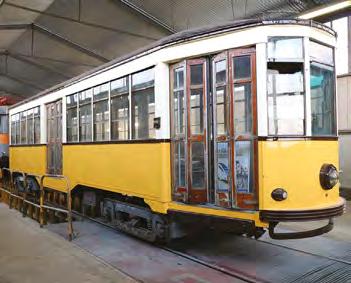
many advantages, not least that tracks can conveniently be connected to the existing city tramway, enabling seamless operation of museum vehicles over city lines. Initial stages have already been put in place: a development grant of EUR4m has been provided by the Piedmont regional authority and applications are pending for the next development stages, under which historic tramcars will be relocated.
It is intended that the whole plan will be complete by 2030, but already a couple of vehicles have taken up residence. In one of the buildings is a workshop facility in which Milano Peter Witt tramcar 1854 is in the final stages of restoration. Also on site is the body of former car 961 from Napoli, a tramway not currently represented in the collection.
The great majority of the ATTS fleet originates in Italy, with examples from several closed tramways such as Bologna and Trieste, and others will join in due course. Currently five further tramcars are being prepared to join the running fleet. These are Torino two-axle motors 127 and 614 as well as 3201, together with Napoli 961 and Milano Peter Witt 1854. Plans exist to restore up to five further cars. All would be important exhibits but especially STEFER 401, the prototype articulated car in this Roman suburban fleet, the technical design of which was to set the path on which the further development of the European concept of articulation was to proceed. Other projects will feature Milano two-axle trailer 1496, Torino Peter Witt bogie car 2593 and threeaxle railgrinder T420, and München threeaxle motor car 2401.
The ATTS complements its offering with a series of beautifully-produced books covering the Torino tram and bus scene, with volumes devoted to specific classes of tramcar. These are exceptionally good value even at their nominal selling price of EUR20, but at half price were an absolute bargain for those visiting the ATTS gazebo in Piazza Castello.
Until the ATTS came onto the scene, Italy was a laggard amongst Western European nations when it came to tramcar preservation. However, the activities of the Torino-based group have transformed the situation and encouraged others to consider what they might do. For example, Roma (Rome) is developing a plan to start a tourist tram service around the city from 2026.
Under the sound guidance of President Roberto Cambursano, the ATTS shows every sign of expanding its horizons in the future and we wish the group well after what has proved to be a significant first 20 years.
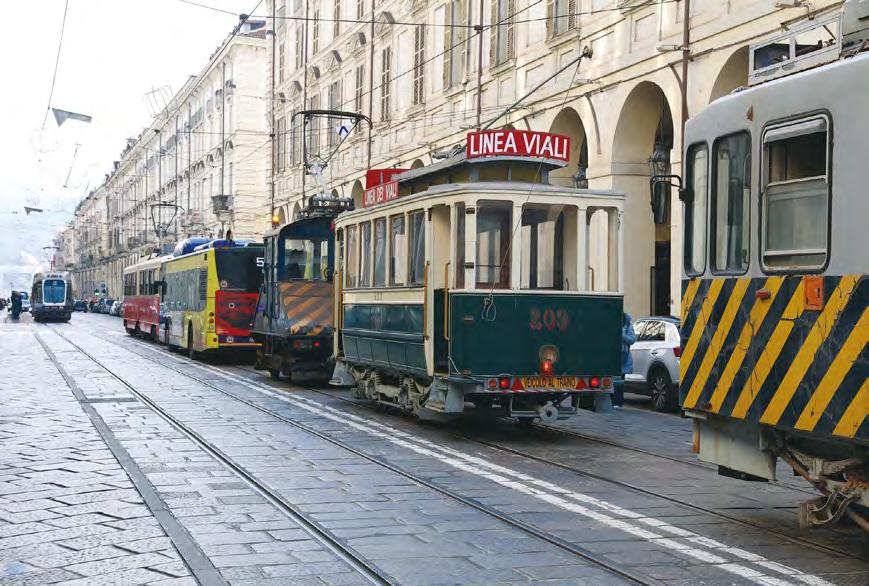
2
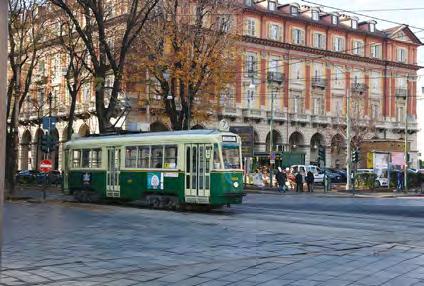
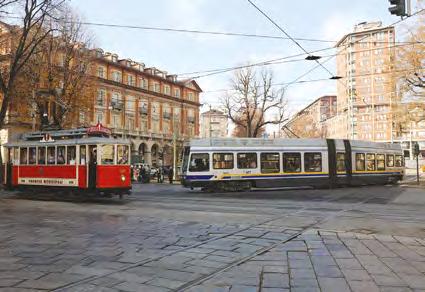
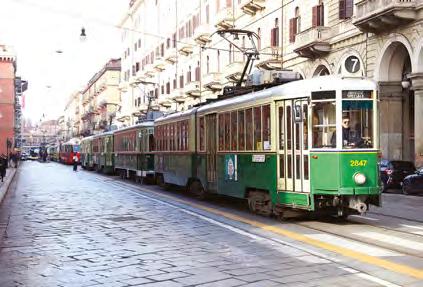
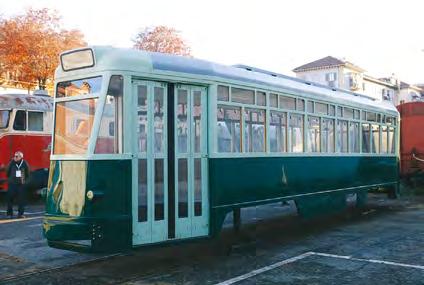
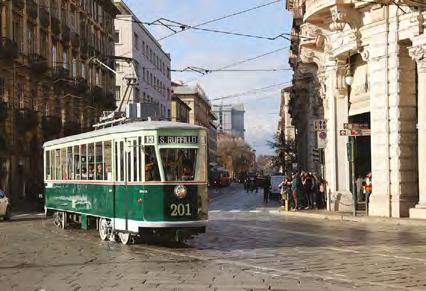
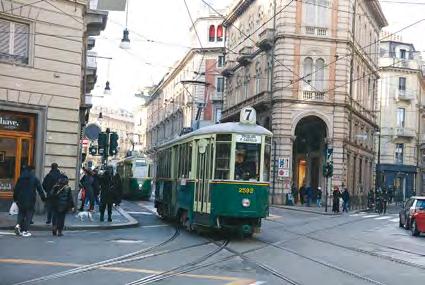
1. In the covered workshop area at the former Ponte Mosca station is Milano Peter Witt bogie car 1854, awaiting finishing works to prepare it for operation by ATTS personnel.
2. A final procession of special cars along Via Po. Car 209, built under licence in Torino by Diatto in 1911 for the Belgian company STT, is nonoperational and is being towed by shunter T450, whilst salt car T427 enters the frame.
3. Arriving at Piazza Statuto to take part in the parade through the city is car 3104, built by FIAT Materfer in 1949. It was adapted for one-manoperation in 1977 like all others of series 3100-3224 and was restored at the BM Montirione workshops in 2008. It now features the original frontal design of these cars.
4. The bodywork of former Napoli bogie car 961 of 1937 stands in restored state on the terrain at Ponte Mosca awaiting finishing works.
5. The scene at Piazza Statuto with a contrast in Torino rolling stock. On the left is two-axle car 502, originally ordered by La Spezia but later rejected, and on the right is car 5053, an early low-floor articulated product of FIAT/ Stanga dating from 1990.
6. Bologna car 201 was acquired from the STEFER company in Roma, which had in turn acquired it from the Bologna undertaking after its tramway abandonment in 1963. It was built in 1934 by Stanga, restored in 2011, and is shown on parade at Piazza Solferino.
7. Part of the grand line-up of cars in Via Cernaia, with twice-rebuilt car 2847 leading a section of the parade. This car, one of the first group of cars to be rebuilt to articulated form with restyled bodywork, was later rebuilt again back to the condition of its first rebuild in the period 1958-1961.
8. Car 2592 is one of three of Torino’s own Peter Witt bogie cars of the second series that thankfully survived the wholesale rebuilding with modernised bodies and passed to the ATTS in original state. It is seen in Via Pietro Micca during the parade through the city.
All photography by Mike Russell on 6 and 7 December 2025.
Reg Harman, who died unexpectedly on 20 December 2025, was a longstanding member of the Light Rail Transit Association. Born on 2 January 1943, he grew up in Wimbledon and attended Tiffins School in Kingston upon Thames. He was a student at Manchester University f rom 1962, graduating in 1966, his main subject being French Studies.
Reg’s professional career began as a management trainee with British Rail in Glasgow in 1966. In 1970, he moved to the BR Headquarters Office at Marylebone as a Planning Assistant in the Corporate Planning Department.
In 1972, he was appointed a Team Leader/ Transport Economist on the Sheffield Rotherham Land Use and Transportation Study, carried out by Allen M. Voorhees.
On 24 November 1973, Reg married Gillian Richardson, another member of the Sheffield Study Team. They celebrated their Golden Wedding in 2023.
After Sheffield, there were two years in the University of East Anglia working on rural transport and acccessibility. In 1976, Reg took up a post with Hertfordshire County Council, serving in a variety of planning roles up to 1992. A stint with SERPLAN followed, then five years as Policy Director of the Chartered Institute of Transport.
From the start of the 21st Century, Reg worked as an independent transport consultant, and was also a visiting research fellow at a number of universities, including Southampton, West of England and University College London, up to 2011.
Reg was exceptional in the span and depth
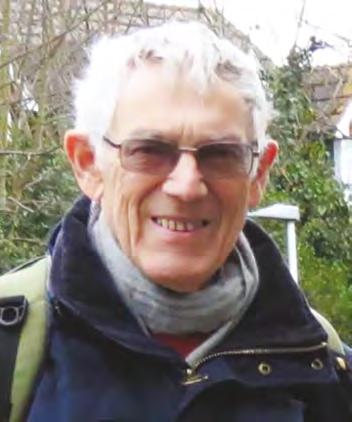
of his planning knowledge and experience. In his retirement, he continued to promote progressive developments in transport, in particular, the Herts Orbital Transit proposal, which is backed by Gascoyne Estates, a major landowner in the county.
He spoke to the LRTA on a number of occasions, most recently at the October 2025 AGM in Sheffield, on the 1973 Sheffield study. This was repeated online on 19 November 2025, where it generated an exceptionally lively discussion.
Reg was also a railway modeller, as well as participating in civic activities in Hertford. He will be remembered with affection and respect by all who knew him.
Thursday 2. Brentford 14.30, John Laker Films. London Museum of Water and Steam, TW8 0EN. Contact: thamesvalley@tlrs.info. GBP5 inc. refreshments. (TLRS)
Tuesday 7. Southampton 19.30, John Goodrich: Rail roving in Scotland. Junction Church, SO50 9FE. Contact southern@lrta.org
GBP3. (LRTA/SEG)
Wednesday 8. Sussex 19.40, Jonathan James: Lighter than light : A look at miniature railways. Southwick Community Centre, BN42 4TE. Contact: sussex@tlrs.info. GBP2 visitors. (TLRS)
Saturday 18. Taunton 14.00, Chris Romain. Early Edinburgh trams. West Monkton Village Hall, TA2 8NE. Contact: westofengland@tlrs.info.
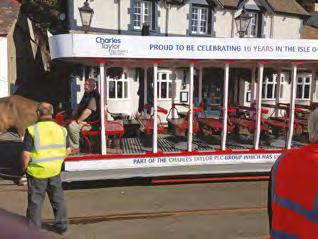
The Electric Railroad Association (ERA) –our sister organisation in the United States – is visiting all the UK light rail systems in May. An invitation has been extended to LRTA members to accompany the ERA on its four-day visit to the Isle of Man. The visit will include trips on all of the Isle of Man’s iconic systems.
Please contact Ian Longworth (ianjlongworth@lrta.org) for further details about accompanying the ERA.
The cost is GBP590 (EUR684) for a shared room and GBP717 (EUR831) for a single, which includes travel from L iverpool.
The LRTA is delighted that in the recent New Year’s Honours list, Jane Cole, Chief Executive of Blackpool Transport, was awarded an OBE for her services to transport.
LRTA Chair Paul Rowen said: “I’m delighted for Jane. She has led the renaissance of Blackpool’s tramway and has been a scion of the light rail industry. This is a fitting honour and so well deserved.”
Compiled by the LRTA. For a full list of the year’s events and meeting places, including online meetings, visit www.lrta.org
GBP2 inc. light refreshments. (TLRS)
Monday 20. Solent 19.30. Pictures from the TLRS digital archive. St.Nicholas Church Hall, PO17 6HP. Contact: solent@tlrs.info. (TLRS)
Monday 20. Liverpool 19.30, Geoff O’Brien: The buses of Liverpool Corporation Passenger Transport. Sefton Park Community Association, L17 3AG merseyside@tlrs.info GBP4. (TLRS)
Saturday 25. Nottingham 14.00, Neil Farmer: Northampton tramways – St James tram sheds and bus depot. Beeston Scout Hut, NG9 1GA. Contact: eastmidlands@tlrs.info (TLRS)
Saturday 25. Garstang 14.00, Vernon Linden: A life with trams. St Thomas PR3 1PA. Contact: northlancs@tlrs.info. GBP3 and refreshments. (TLRS)
Order online from https://shop.lrta.org/ – or by post from:
LRTA Publications, 38 Wolseley Road, SALE, M33 7AU
(Please provide telephone contact details and quote LRTA membership number if applicable)
Outside UK = Airmail to Europe (includes all of Russia) / Surface mail to rest of world; Airmail Zone 1 = outside Europe excluding Australia, New Zealand & USA; Airmail Zones 2/3 = Australia, New Zealand & USA
The creeping decline of a colonial monument
This book is dedicated to the last operating tramway in South Asia. It covers the 152-year history of this huge Indian city’s tram system. The development of the network and descriptions of the lines in operation since 1998 can be traced with the help of the route and track maps. Well over 200 images illustrate the text. The book is complemented by a description of the operating facilities and the development of the routes and the rolling stock. It also illustrates the changes in the route network for readers who are not familiar with the area.
The book is bilingual in both English and German.
The author – Alexander Weber – was born in 1968 in Karlsruhe, and for more than three decades has been photographing trams and drawing track maps as a hobby. He has visited Kolkata three times since 1998. He is also the honorary cartographer of the LRTA historical journal Tramway Review
> A4 softback; 168 pages, 200+ colour and black & white pictures, 20 maps. Full price £37.50 – £5 discount if you pre-order your copy now (prices including shipping shown below); £35.50 (UK); £45.50 (outside UK); £51.50 (Airmail Zone 1); £55.50 (Airmail Zones 2/3). LRTA members’ discount not applicable. (£3.75 discount applies to full price after 31 March 2026)
Tramways and Light Railways of Barcelona, Mallorca and Valencia in Colour (1954-1980)
The first in a series of three books covering many of the tramways and electric light railways operational in Spain in the mid-1950s.
> A4 hardback, landscape format; 144 pages, fully illustrated in colour throughout.
£42.50 (UK); £54.00 (outside UK); £66.00 (Airmail Z1);
£67.50 (Airmail Z2/3); LRTA Members: £3.90 discount
The fourth volume in this series covers Holloway (later Highgate), Hackney (later Clapton) and Stamford Hill depots and the routes they operated. Separate large-scale plans of the three depots are included.
> A4 hardback; 208 pages, 302 black & white and 16 colour pictures.
£42.50 (UK); £50.00 (outside UK); £55.00 (Airmail Z1); £58.00 (Airmail Z2/3); LRTA Members: £3.90 discount
For further details of all this and other books, please go to our website.
Order direct from the website shown (not from the LRTA)
Strassenbahn Jahrbuch 2026
Strassenbahn Magazin Special No. 41
The annual review of tram systems in German-speaking countries with brief reviews from the rest of the world. Features on Vienna’s last high-floor trams and museum fleets. German text.
> A4 softback; 116 pages, 300+ colour pictures. EUR 19.90 – www.amazon.de
Records the tour of five cities behind the Iron Curtain by an intrepid group of enthusiasts in 1978 – Moscow plus Kiev, Lvov, Odessa and Vinnitsa. A detailed summary of the background to tram and trolleybus operation in the then-USSR is included. English and Polish text.
> A4 hardback; 200 pages, fully-illustrated in colour and black & white. £27.00 – www.nationaltrolleybus.org
The BIGGEST YEAR in our history.
The STRONGEST PROGRAMME we’ve ever delivered.
The event the ENTIRE SECTOR is talking about.

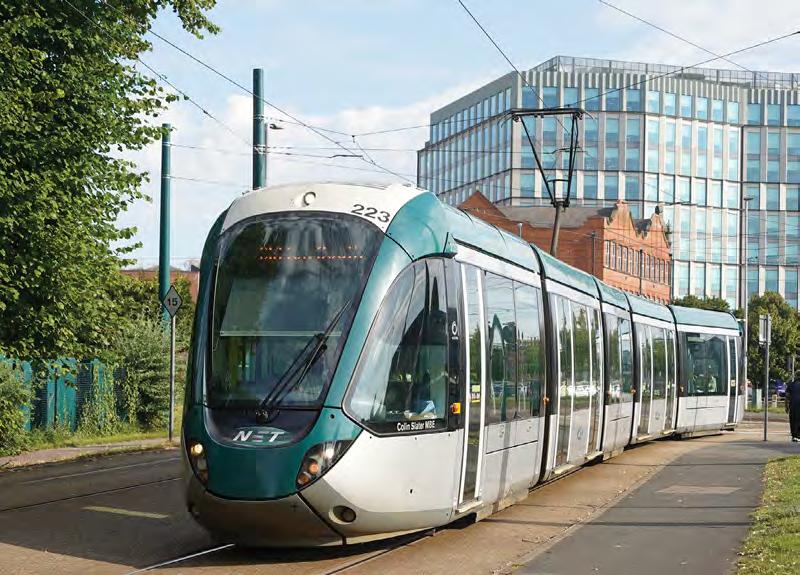



Be part of the milestone year that brings the entire UK light rail community together.
For our 20th anniversary, we’re returning to Nottingham Trent University, where it all began. We’re bringing a fresh new look inspired by sustainability, innovation, and the future of green transport.
This is your chance to:
• Build powerful relationships with UK and international leaders
• Hear industry-shaping insights from the people setting the agenda
• Discover new tech, solutions and suppliers
• Position your organisation at the heart of the next decade of light rail
This isn’t just another conference, it’s the UK’s most influential light rail gathering, trusted for two decades by operators, suppliers, policymakers, innovators and solution providers.
www.mainspring.co.uk