TWO days of interactive debates... TWELVE hours of dedicated networking... ONE place to be
Join key decision-makers, professionals and industry experts as they gather for two days of debate centred upon how new technologies are driving progress in sustainable transport.
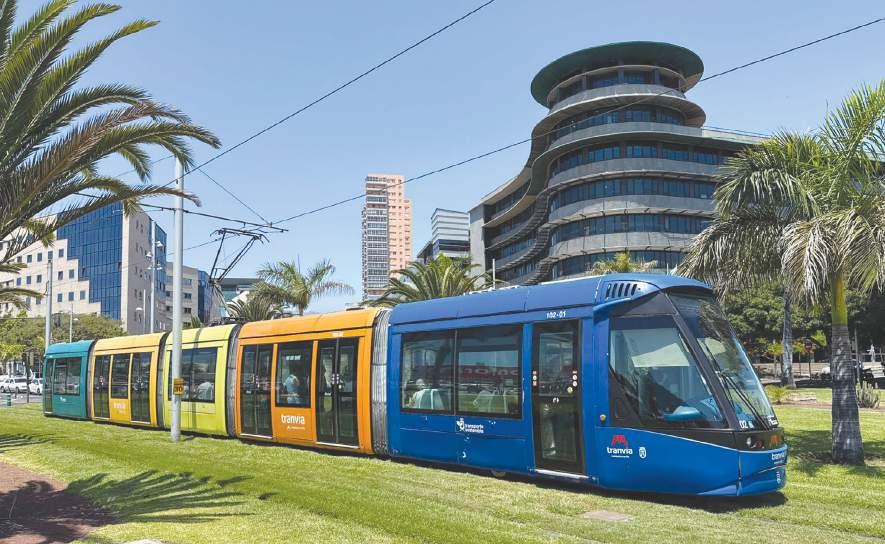
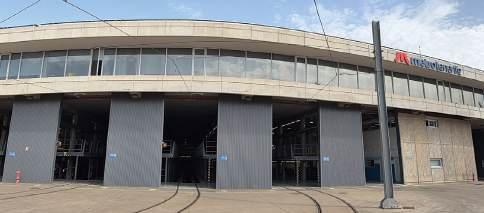
For 2026 we are taking the European Light Rail Congress back to the beautiful Canary island of Tenerife, home of the Metrotenerife light rail system.
Metrotenerife provides modern and efficient public transport, with safety and the environment being key factors that contribute to improving the quality of life of the citizens of Tenerife and the surroundings. There are some very exciting expansion plans with their current lines in the North of the Island growing, as well as building new lines to connect more areas of the island and reduce the need for cars and reduce both congestion and pollution.
As an attendee, you will experience: Two days of presentations, panel debates and discussion from some of the sector’s most innovative and forward-thinking suppliers, manufacturers and operators, plus an expansive exhibition hall within the Espacio Mutua Tinerfeña in San Cristobal de la Laguna, which is very close to the tramway. An evening networking reception for delegates to maximise their networking opportunities is also included, along with an exclusive behind the scenes depot tour hosted by Metrotenerife. Convenient accommodation to the venue is very close with one hotel just 4-5 metres away, and another 450 metres away.
With bespoke sponsorship and exhibition packages also available, there has never been a better time to place yourself at the very heart of European light rail.



11-12
March
2026


Docklands Thamesmead extension gets go ahead; Montréal’s REM expands.
DART SILVER LINE OPENING 8
Morgan Lyons reports from Dallas in the US, as DART opens its new Silver Line.
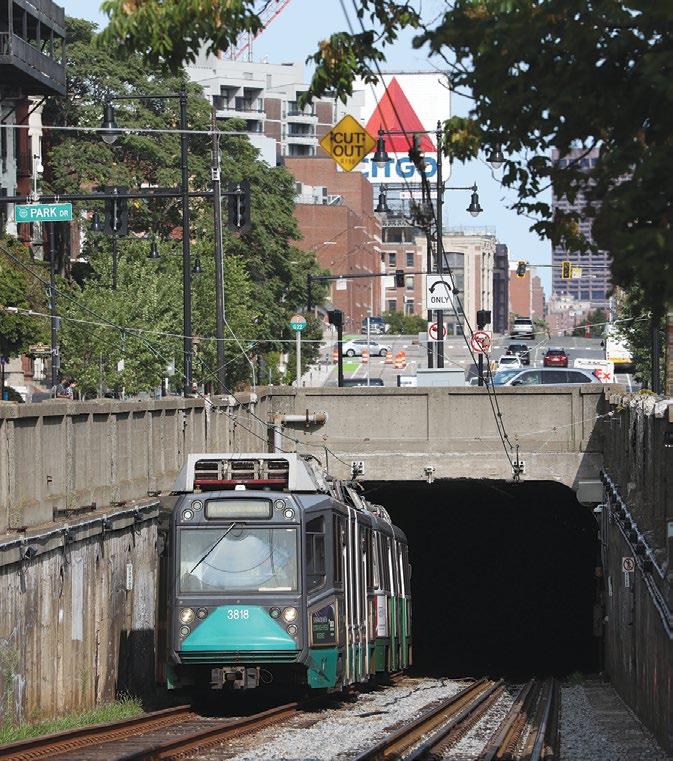
THE CHALLENGE IN BOSTON 10
Andrew Grahl visits this US city which has faced its challenges and made huge improvements to its ‘ T ’
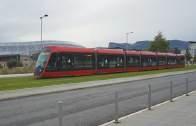
FIVE FOR NICE? 15
Andrew Thompson looks at the grand plans that will see Nice ’s network expand.
CHANGE IN FORTUNE FOR IRELAND 18
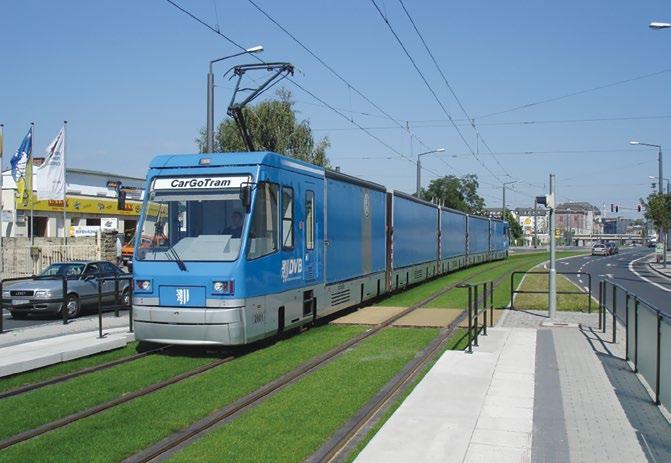
Frankfurt am Main recently trialled the use of trams to deliver parcels – could this finally mark a breakthrough for light rail?
SYSTEMS FACTFILE:
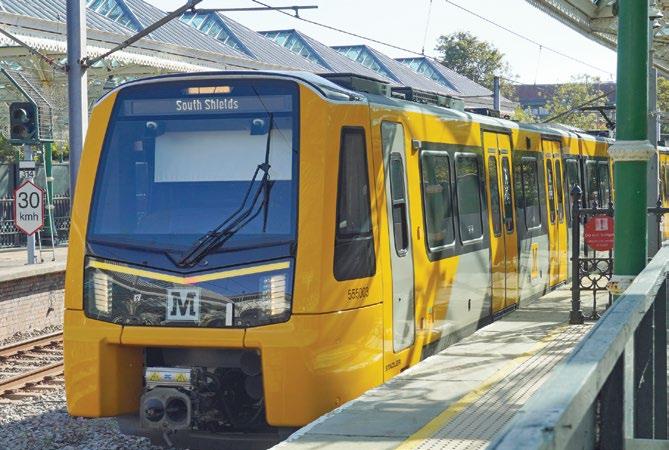
Neil Pulling visits the north of England, where the Metro should see fleet replacement complete by early 2026.
The official journal of the Light Rail Transit Association
JANUARY 2026 Vol. 89 No. 1057 www.tautonline.com
EDITORIAL
EDITOR – Matt Johnston matt@mainspring.co.uk
ASSOCIATE EDITOR – Tony Streeter tony.streeter@mainspring.co.uk
WORLDWIDE EDITOR – Michael Taplin miketap@mainspring.co.uk
SENIOR CONTRIBUTORS –Howard Johnston , Neil Pulling
WORLDWIDE CONTRIBUTORS
Richard Foster, Andrew Grahl, Andrew Moglestue, Herbert Pence, Mike Russell, Nikolai Semyonov, Alain Senut, Andrew Thompson, Witold Urbanowicz, Bill Vigrass, Thomas Wagner, Philip Webb.
PRODUCTION – Lanna Blyth Tel: +44 (0)1733 367604 production@mainspring.co.uk
DESIGN – Debbie Nolan
ADVERTISING
COMMERCIAL MANAGER – Geoff Butler Tel: +44 (0)1733 367610 geoff@mainspring.co.uk
Tramways & Urban Transit 13 Orton Enterprise Centre, Bakewell Road, Peterborough PE2 6XU, UK
Tramways & Urban Transit is published by Mainspring on behalf of the LRTA on the third Friday of each month preceding the cover date.
WORLDWIDE REVIEW 31 Tests begin on Gold Coast’s G:link extension; Olomouc issues new tender.
THE NEXT PHASE 35 UKTram looks towards light rail in 2026.
CLASSIC TRAMS: AMSTERDAM 150 36
Richard Foster considers what an EUR18.5bn investment will mean for Ireland ’s blossoming LRT plans. TRAMS AND AMAZON 15
Mike Russell visits the Netherlands capital as it celebrates 150 years of its tramway.
Freight trams? Are we getting there?

Trams shouldn’t just be for carrying people. The idea of employing them to transport cargo has always seemed sensible because of their ability to speed through city centre streets and jump traffic queues, but the concept has somehow never taken off.
Perhaps the high cost of efficient infrastructure is off-putting, as is a fleet of expensive bespoke (or modified) vehicles, irregular hours of operation, or a combination of all of these. Over the years, we’ve covered separate trials in Delhi, Madrid and Wien (Vienna), all without the breakthrough that was hoped for.
In this issue, we report on another brave attempt, this time in the German city of Frankfurt am Main, and who better to drive it than Amazon, one of the world’s most dynamic and successful global logistical firms? This is an organisation that really understands what slick operation is all about, using electric vans to bridge the gap between the warehouse and the tram, and electric bikes to reach the final destination. Is this the solution to freight trams at long last? Read the feature on page 21 to see how everyone got on.
In the UK, it’s always prudent to add a decade (sometimes two, or more) to the original estimated opening date of any new system or extension, but maybe that’s just being cynical. However, the penny seems to have dropped that you can’t create a new township with tens of thousands of new homes (this time in south east London) without decent public transport. An extension to the Docklands Light Railway to Thamesmead is therefore another very welcome move forward for light rail. Worldwide, it’s been a cautious but generally successful 2025. This is the first issue for a brand new year; let’s hope that 2026 will be another good one.
Matt Johnston, Editor
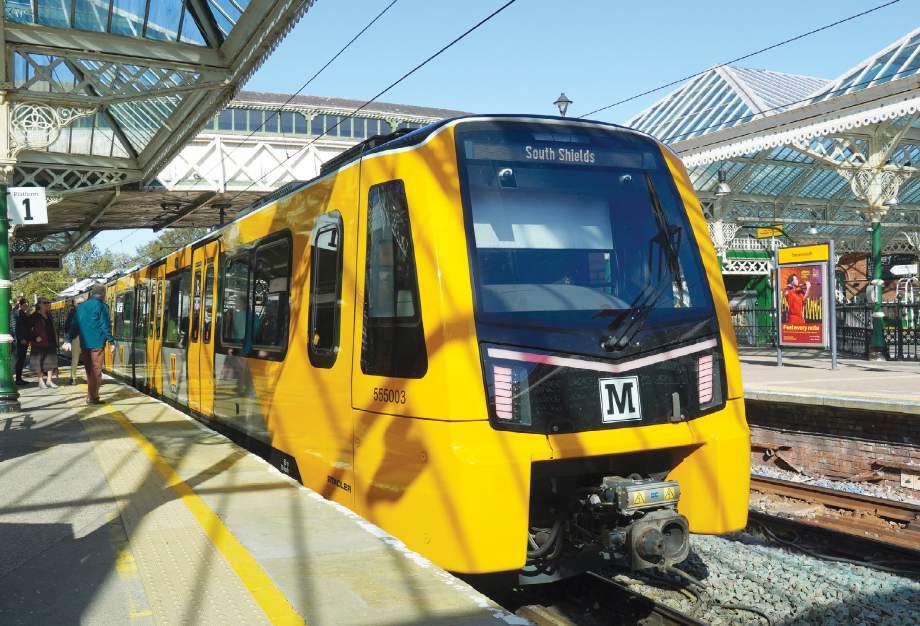
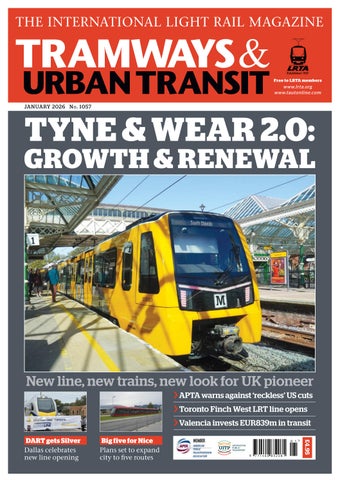
COVER: The first Stadler Class 555 to be delivered to the UK’s Tyne and Wear Metro, 555003, at Tynemouth on 23 September. Neil Pulling
LRTA MEMBERSHIP (with TAUT subscription) Tramways & Urban Transit is sent free to all paid-up members of the Light Rail Transit Association.
LRTA WEBSITE AND DIARY Tim Kendell webmaster@lrta.org meetings@lrta.org
SUBSCRIPTIONS, MEMBERSHIP AND BACK ISSUES LRTA Membership Secretary (Dept T06), 38 Wolseley Road, Sale M33 7AU, UK. Tel: +44 (0)117 951 7785 membership@lrta.org Website: www.lrta.org FOR CORPORATE SUBSCRIPTIONS VISIT www.mainspring.co.uk
LRTA REGISTERED OFFICE 13 Orton Enterprise Centre, Bakewell Road, Peterborough PE2 6XU, UK Private company limited by guarantee, No. 5072319 in England and Wales.
LRTA CHAIRMAN – Paul Rowen chair@lrta.org
© LRTA 2025
Articles are submitted on the understanding they may also be used on our websites or in other media. A contribution is accepted on the basis that its author is responsible for the opinions expressed in it, and such opinions are not those of the LRTA or Mainspring. All rights reserved. No part of this magazine may be reproduced or transmitted in any form by any means, electronic or mechanical, including photocopying, recording or by any information storage and retrieval system, without prior permission in writing from the copyright owner. Multiple copying of the contents of the magazine without prior written approval is not permitted.
The Manson Group Limited, St Albans, Herts AL3 6PZ
DISTRIBUTION Warners (Midlands), Bourne, Lincs PE10 9PH, UK
A EUR598.9m contract to build the Lisboa (Lisbon) Violet LRT line has been provisionally awarded to a joint venture of Mota-Engil, Zagope and SpieBatignolles. The 11.5km (sevenmile) line in the Portuguese capital is to run in a ‘U’-shape from Hospital Beatriz Ângelo to Várzea de Loures, with a connection to Metro’s Yellow line. It will have 17 new stops. However, the European Commission has opened an investigation into the contract due to “possible market distortions caused by foreign subsidies”. This is because
Portugal CRRC Tangshan Rolling Stock Unipessoal, a subsidiary of China’s state-owned rolling stock builder CRRC, is a sub-contractor for the Mota-Engil consortium.
Portugal CRRC Tangshan Rolling Stock Unipessoal has not issued a statement in response.
The Violet line was due to open in 2027 but this has already been pushed back to 2029. It is not known whether the investigation will affect this revised date.
Edinburgh’s record response?
Public consultation into a proposed north-south tramway extension in Edinburgh (UK) has generated more than 11 500 responses –described as being among the highest numbers city officials have ever seen.
The new line is to link Grantown on the Firth of Forth with the BioQuarter to the southeast of the city. The proposal has caused controversy as one of the two preferred routes uses the Roseburn Path, an active travel route that utilises the trackbed of a closed railway.
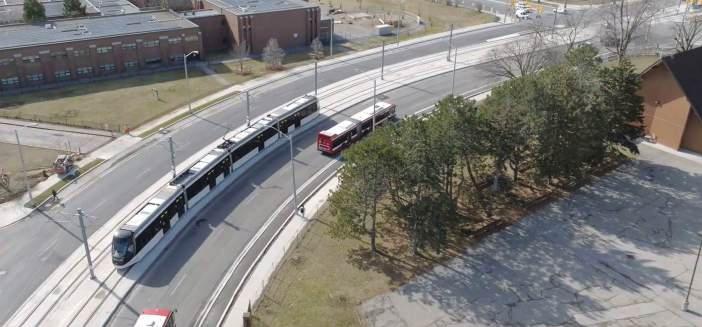
Asoft launch of Toronto’s Finch West LRT took place on 7 December. Services on the Canadian system are initially to run 06.00-22.00, with Mosaic Transit Group able to undertake maintenance in the downtime. A full service, until 01.00, is to start next spring.
The 10.3km (6.4-mile), selfcontained line was built by Metrolinx but will be operated by Toronto Transit Commission. It connects Finch West subway station to Humber Polytechnic’s North Campus and has 18 stops. It will require 15 Alstom Citadis Spirit to maintain the 10-12 minute headway (6.5 minutes at peak periods).
Mayor Oliver Chow said: “The opening of Line 6 Finch West
is a transformative moment for Toronto. [It] will connect northwest Toronto communities, support local businesses, and make it easier for people to get to work, school and home. I want to thank everyone who worked so hard to deliver this project. Together, we are fighting congestion and building a more connected, accessible, and sustainable city.”
Also taking place on 7 December was the renaming of Eglinton West and Dundas subway stations to Cedarvale and TMU respectively. The new Mount Dennis interchange station opened on 16 November. This provides a link between GO Transit’s Kitchener Line and the Union Pearson Express. It will be joined by Line 5 Eglinton when it
opens, which is due to take place at the end of 2025.
Metrolinx has bought 26.2km (16.3 miles) of railway between Bramalea and Georgetown GO stations from Canadian National Railway. This will enable it to provide the 40km (25-mile) Kitchener commuter rail line with separate passenger and freight tracks, in order to provide a 30-minute passenger service to Mount Pleasant and an hourly service to Kitchener. Currently, there are nine trains a day on the single-line system.
A 3.4km (2.1-mile) section of Line 511, between Bathurst Street subway station and Lake Shore Boulevard, is to receive tram priority lanes ahead of the 2026 FIFA World Cup, which starts on 11 June.
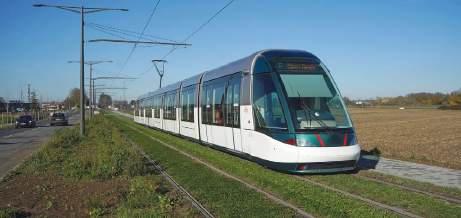
Ceremonial opening of the Strasbourg tramway’s extension to Wolfisheim west of the city took place on 15 November. Opening was accompanied by two days on which free rides were offered.
The 4km (2.5-mile) extension of line F from Comtes to Wolfisheim via Poteries (and an interchange with line D) has eight stops, including a 103-space park-and-ride site. It forms a key part of a EUR122m kerb-to-kerb reconstruction that
involved building new active travel facilities. An extra 20 300 residents now have access to the tram system. Daytime headway is 7-8 minutes.
The Poteries – Gare Centrale section of line F opened 15 years ago. Work on the Wolfisheim extension started in 2023.
Strasbourg’s secondgeneration tramway opened in November 1994. The French city now boasts six lines covering 53.1km (33 miles) and a fleet of 91 Alstom Citadis trams.
UK Chancellor Rachel Reeves confirmed in the 26 November Budget that the Docklands Light Railway’s twostop Thamesmead extension is to be built. The London system’s new route is expected to diverge from the existing Gallions Reach – Beckton line before curving to pass under the Thames in a 1.5km (0.9-mile) tunnel, the DLR’s third under the river. There will be two stations, at Beckton Riverside and Thamesmead; the latter will become the system’s easternmost terminus.
Thamesmead is expected to be home to 100 000 people by 2050, with the new line expected to facilitate the construction of up to 25 000 homes along its route.
US Transportation Secretary Sean Duffy issued an emergency order on 4 November requiring the Southeastern Pennsylvania Transportation Authority to inspect all overhead on the ‘T’ (the new name for the area’s Subway-Surface Trolleys system). It comes after three passengers were taken to hospital after overhead wires fell on a SEPTA Media Line tram in the Philadelphia suburb of Springfield in September.
SEPTA replaced 7.62cm trolley head sliders with 10.16cm sliders in September to reduce maintenance costs. However, after two incidents on 14 and 22 October, the original sliders have been reinstated.
The damage caused resulted in the closure of the City Center trolley tunnel on 7 November. This had not yet reopened by the time this report was written.
The state of Pennsylvania has committed USD108m (EUR93.3m) to repair the overhead, as well as fund new inspection technologies and upgrades to control centres. It has also allocated USD112m (EUR96.7m) for upgrades on SEPTA’s Regional Rail trains.
First discussed well over a decade ago, the Thamesmead extension was formally proposed by Transport for London in 2019 and featured in the organisation’s submission to government for funding the following year. At that point, it was suggested that opening could take place as early as 2026. A Strategic Outline Business Case followed in 2023, the year public consultation on the scheme began.
The cost of the extension is estimated at GBP1.7bn (EUR2bn); the government has said that “the majority of the costs will be met by London, with the government also contributing over the long term”.
Mayor of London Sir Sadiq Khan said he was “really
pleased that the Government is backing the DLR extension to Thamesmead” - describing this as “something I’ve long called for, alongside London’s businesses and communities.”
Given funding, a start of construction by 2028 has been mooted, with opening possible by 2030.
• The DLR’s three operational B23 Stock trains have been withdrawn while Transport for London, KeolisAmey Docklands and CAF engineering teams investigate an incident in which low adhesion prevented the driverless train from stopping at the correct point.
Service is being maintained by the existing fleet. However, some B92 and B2K trains have been sent for scrap.
Canadian Prime Minister Mark Carney inaugurated Montréal’s Gare Centrale – Deux-Montagnes extension of the Réseau express métropolitain on 14 November. More than 250 000 passengers took advantage of free travel on the 14-station, 29.7km (18.5mile) light metro line before revenue-earning operation began on 17 November.
The privately-funded metro now totals 45.7km (28.3 miles), and connects Montréal’s North Shore and South Shore. It has cost CAD9.4bn (EUR5.8bn) so far to build. Alstom has supplied 106 two-car train sets and Urbalis GoA4 automation.
Prime Minister Carney said: “The REM… connects Montréal, creates thousands of high-paying careers and catalyses innovative partnerships between public and private sectors. As Québec’s largest public transit project for half a century, the REM is testament to our ambition to build big, build bold and build Québec strong so we can build Canada strong.”
REM’s next opening is to be the branch to Anse-a-l’Orme in the spring. A branch to MontréalTrudeau International Airport is set to follow in 2027, taking
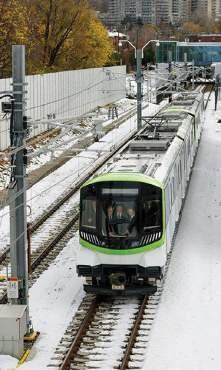
Montagnes extension. REM
the system to 67km (42 miles). Operations and maintenance are carried out by an Alstom/ AtkinsRéalis joint venture. The Deux-Montagnes line is on the alignment of the former Canadian National Railway electrified commuter line, which closed in 2020. REM had originally planned to open the extension in 2024.
Can adhesion-operation trams cope with the 1:9 gradients on Budapest’s rack tramway? That is what the temporary transfer of Tatra T5C5 4043+4224 to the 3.7km (2.3-mile) line has set out to prove.
Now line 60 on the Hungarian capital’s tram network, the 1435mm-gauge rack tramway between Városmajor and Széchenyihegy opened in 1874. It last received new cars, built by SGP, in 1973.
Adhesion tests with the Tatra vehicles took place between 3-9 November, with particular attention paid to braking performance. The line’s voltage was reduced from 1500v DC to 600v DC. The results are still being analysed.
If successful, line 60, which uses the Riggenbach rack system, could be extended to Városmajor u. tram stop and connected to the main Budapest network.
Hitachi Rail has been awarded a contract to supply signalling and communications systems for the 13.2km (8.2-mile) El Raml Tram in Al Iskandariya (Alexandria). Hitachi’s equipment is to enable the line speed on the Egyptian tramway to be increased from 11km/h (7mph) to 21km/h (13mph); headways will be decreased from nine minutes to three minutes. The company will also provide Supervisory Control & Data Acquisition (SCADA) systems, security systems with CCTV cameras, and passenger information equipment.
Hitachi Rail’s Carlo Piacenza said that the contract “will see us modernise and upgrade the oldest electric tram system in Africa, transforming it into a reliable, efficient, and digitally enhanced transportation system.”
The El Raml Tram dates back to 1863 and was last modernised in the 1960s. The project is due for completion in June 2027.
New fleets, better passenger facilities and infrastructure improvements planned
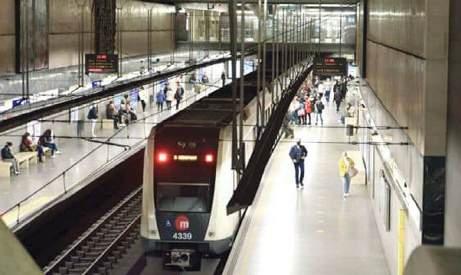
Modernisation and expansion of the Metrovalencia and Tram d’Alacant rail networks by 2030 is included in the strategic plan published by Valencia’s regional government (Spain). A proposed EUR839m is to be divided as follows:
• Infrastructure renewals across metro and tram systems, including signalling, electrical systems and workshop expansion (EUR275m).
• Restoration of the remaining 2024 flood damage (TAUT 1045), including offices and workshops at Valencia Sud (EUR50m).
• Purchase of 22 new Stadler LRVs
– 16 for Metrovalencia and six for
Frankfurt starts on new line
A ground-breaking ceremony for Frankfurt am Main’s new Stadtbahn line from Gonzenheim to Bad Homburg was to take place on 9 December. The German system’s new line U2 link will run in subway and is unlikely to open until 2029. The city council has also approved plans for a 1.5km (0.9-mile) surface extension of U5. To run from the current terminus at Preungesheim to Frankfurter Berg and a connection with the S-Bahn, the extension is expected to cost EUR92.5m. Work is unlikely to start until 2031.
Barcelona’s historic tram could be revived
Barcelona’s historic Tramvia Blau (‘Blue Tramway’) could return to operation, having been mothballed for seven years.
The 1.3km (0.8-mile) tramway, which opened in 1901, is mainland Spain’s only surviving firstgeneration system. It last ran between John F. Kennedy Square and Doctor Andreu Square on 28 January 2018, pending reconstruction.
Mayor Jaume Collboni unveiled plans to resurrect the tramway on 20 November, as part of a wider scheme to transform Tibidabo Avenue which is also to include the rebuilding of a storm-water reservoir under the street. The whole scheme is expected to cost EUR40-45m.
Final design work for the Tibidabo Avenue transformation is expected to be completed in 2027. It is not yet known when the Tramvia Blau will reopen.
Tram d’Alacant – with delivery by 2028 (EUR185m)
• Improvements to passenger facilities, particularly the subway stations on lines 1 and 2 (EUR90m).
A further EUR240m is earmarked for what are described as ‘network developments’. These involve double-tracking metro line 3 and building two new subways in Valencia: the 3km (1.9-mile) Alicante street –Marina de València Line 11 and the 2km (1.2-mile) Alicante street – La Fe hospital (Line 12).
Alacant is to get a new central interchange station, while Benidorm – Graganes will be electrified. Service frequencies
will be improved, with cut offs built to create shorter routes for lines 1, 3 and 9. A 12-minute
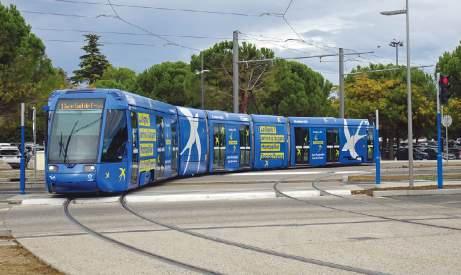
Montpellier’s first new tram extension for nine years opened on 18 October. Line 1’s 1.3km (0.8-mile) expansion from Odysseum to Gare Sud de France now provides a tram connection to TGV high speed rail services.
The journey time between the station and the French city’s centre is approximately 20 minutes, with a five-minute headway at peak times. The extension is expected to attract 3800 passenger a day, but this is due to increase because a new urban district is being developed around the station. Work on the extension, which
cost around EUR50m, started in autumn 2023. Line 1 is currently operated by first-generation Alstom Citadis trams, but these are due to be replaced by new CAF 100% low-floor vehicles.
Completion of the orbital line 4 between Louis Blanc and Observatoire in 2016 was previously the last major expansion of the network. However, the 14.8km (ninemile) line 5 is due to open on 20 December. It links Grés de Montpellier in the west to Clapiers in the north, with 27 stops. It combines existing routes in the city centre with 8.3km (5.1 miles) of new track.
headway will be introduced across most of the surface networks.
The Hop streetcar’s potential operating deficit has sparked debate amongst city officials over the system’s future. Situated in Milwaukee (US), the 3.4km (2.1-mile) M Line, which opened in 2018, and the 640m L Line (2024) are free to use but expected to cost USD6.9m (EUR5.9m) to operate in 2026. Grants and sponsorship cover USD2.7m (EUR2.3m) of that cost, leaving a USD4.2m (EUR3.6m) deficit.
Alderman Scott Spiker has written to US Transportation Secretary Sean Duffy asking for the removal of federal grant obligations. USD48m (EUR41.5m) would need to be repaid to the federal government if the tramway is closed before it reaches 25 years of service.
Spiker told Wisconsin Public Radio: “That’s USD4 [EUR3.4m] million we don’t put towards libraries [or] towards streets [or] towards new fire trucks. Is [The Hop] worth USD4 million for what it does?”
However, Alderman Peter Burgelis said: “The Milwaukee streetcar is... a strategic investment that strengthens … the downtown economy.”
Ridership increased from 494 445 in 2023 to 532 460 in 2024 and although the forecast is lower for 2025, at least 40% of riders do not own cars.
Transport association warns against “reckless” proposals that could cost public transit USD15bn
American Public Transportation Association President & CEO Paul Skoutelas has urged the US government to abandon legislation that would end a system whereby 20% of federal fuel taxes are allocated to funding mass transit.
Approved by Congress in 1982, the system results in a contribution that reportedly amounts to USD15bn (EUR12.9bn) per year; between 2020 and 2024, 505 grants were processed for transit funding.
Established in 1956 to pay for roads through fuel taxes, the Highway Trust Fund has faced deficits over the years; these have been covered by money from the US Treasury. The Mass Transit Account went into operation in 1983.
“On behalf of the millions of riders, workers, businesses, and communities that rely on public transit every day, we urge President Trump to reject the U.S. Department of Transportation’s misguided proposals to eliminate the
Mass Transit Account of the Highway Trust Fund and prohibit States from using their highway funds for public transit”, Skoutelas said.
Describing the proposals in a 14 November statement as “reckless”, Skoutelas said they would “devastate Americans in cities, suburbs, and rural communities across the country – cutting off critical transit services that provide access to jobs, health care, and education.”
Adding that “President Trump is a builder and knows smart
investments”, Skoutelas argued that USD1 invested in public transit generates USD5 in longterm economic returns.
“Let’s work together to grow America’s economy for everyone.”
The only association in North America that represents all forms of public transport, APTA has more than 1600 member organisations in the public and private sectors. Its predecessor the American Street Railway Association was formed in 1882. • TAUT is a member of APTA.
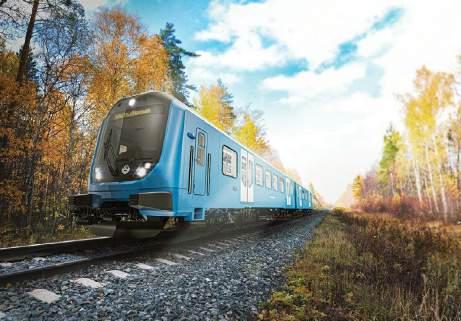
Škoda Transportation has won an SEK1.56bn (EUR141.9m) order to supply new vehicles as part of the rejuvenation of Stockholm’s Saltsjöbanan. The contract for the 16 two-section 36m vehicles (with an option for a further 15) for the Swedish capital was announced on 11 November.
These vehicles will be airconditioned and have capacity for 250 passengers (94 seated). They will be dual-voltage (750V dc and 1500V dc), with all bogies powered, and automatic train control. They are being designed to work in temperatures ranging from -25oC to 40 oC. Delivery is to start in early 2029.
Jan Harder, Škoda’s President
Russian attacks have forced the closure of the last tramway operating in the part of the Donetsk region still under Ukrainian control. Just 12km (7.5 miles) from the front line, Druzhkivka’s 10.7km (6.6-mile) system was damaged by Russian shelling on the night of 26-27 October.
Repair work was started but then abandoned on 1 November. Druzhkivka’s eight TatraT3SU
of the West & North Region, said: “We are developing a completely new type of LRV that offers greater comfort, speed, and flexibility – the key features of modern urban mobility. This is a strategic project with which we aim to strengthen our position in the Nordic region and open up a new market for our rail vehicles.”
The 1435mm-gauge Saltsjöbanan is 132-years old and crosses Stockholm from Slussen interchange in the south to Saltsjöbaden. A modernisation programme, including double tracking, has been in progress since 2016. The Slussen – Saltsjöjärla section will probably not open before 2028.
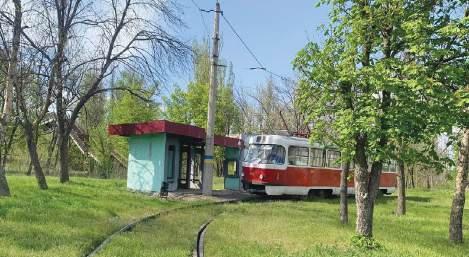
trams and one T3 were moved to other systems and employees given notice. Operations had previously been halted after a drone strike on the depot
in April, but services resumed after repairs.
The tramway opened on 5 December 1945. At its peak, it was 26.4km (16.4 miles) long.
A new timetable took effect on the Antwerpen (Antwerp) tram network from 1 November, based on the principle of one-line, one-depot. Hoboken depot no longer supplies trams for the Belgian city’s lines 1 and 10, while Deurne no longer supplies lines 2, 4 and 8. Extra peak-service cars on lines 4 and 7 have been withdrawn, with the resources switched to reducing headways on lines 12 and 24. Meanwhile, no line 4 or 9 trams are running between Groenenhoek and Silsburg due to track replacement, which is due to take 18 months to complete.
Peak run-out is 151 trams: 50 from Deurne, 45 from Hoboken and 56 from Punt Aan de Lijn.
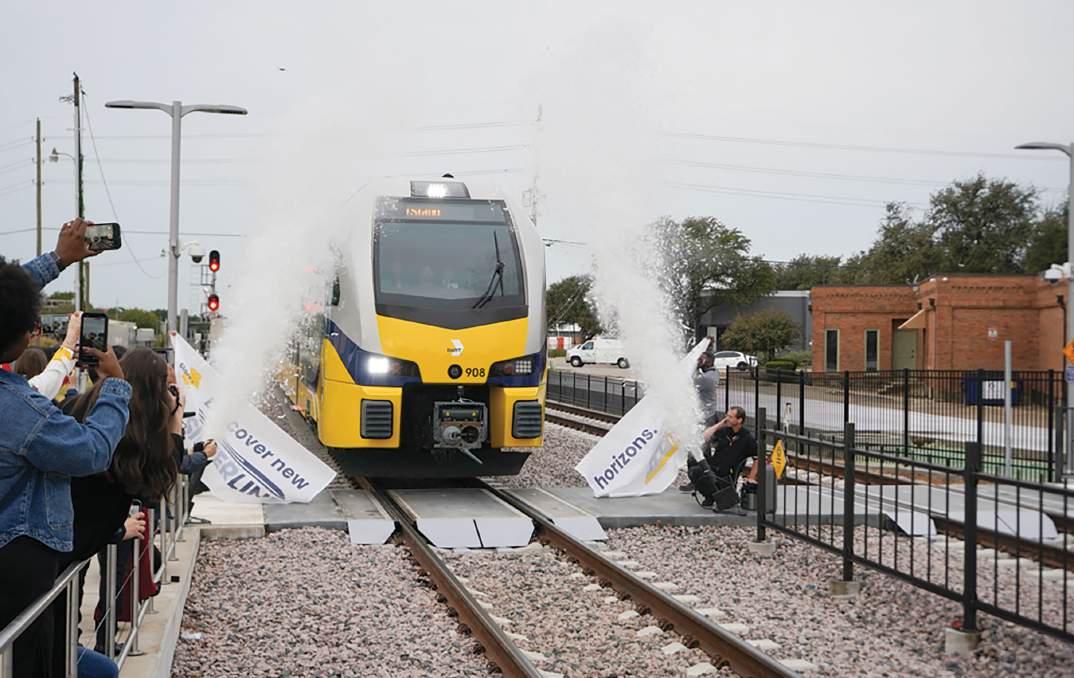
Morgan Lyons reports from Dallas as the US city opens its new Silver Line on the DART system.
Aline drawn on a map more than 40 years ago came fully to life on 25 October. That’s when Dallas
Area Rapid Transit (DART) added the ten-station, 26mile double-track Silver Line commuter rail corridor to its expansive network of light rail, Trinity Railway Express commuter rail, bus, and paratransit services for the greater Dallas area in Texas. And for local rail historians, it gave new life to a corridor that has been in place for more than 100 years.
The Silver Line operates on what was previously known as the Cotton Belt rail corridor and connects seven cities east to west, ending at Terminal B of DFW International Airport. It also ties into three of DART’s four light rail lines, Orange, Red, and Green. At DFW Airport it shares Terminal B station with the TEXRail commuter line operated by Trinity Metro. The TEXRail connection makes it easy for travellers to continue their westward journey 43.5km (27 miles) from the airport to Downtown Fort Worth.
DART and Trinity Metro also jointly operate the Trinity Railway Express (TRE) commuter service which links the centres of the region’s two largest cities, Dallas and Fort Worth. TRE has a station south of DFW Airport, providing travellers with airport connections from the north and south and commuters with a second east-west passenger rail connection.
The USD2.1bn (EUR1.8bn) project was funded by a mix of local funds generated by a local sales tax pledged from 13 cities whose citizens voted to establish the transit
agency in 1984, and federal contributions in the form of grants and loans. DART officials explain that the impetus for the project is to create new transit connections in a region that has boomed to the fourth largest in the US (only trailing New York, Los Angeles, and Chicago) while adding tens of thousands of new residents annually.
“The Silver Line is a centrepiece of our Point B vision to make DART your first-inmind mobility partner,” Nadine Lee, DART President & CEO, said in an agency news release.
“By connecting key employment centres, neighbourhoods, and the world’s thirdbusiest airport, this project will be a catalyst for economic growth, provide access to opportunity, and a seamless mobility experience that helps our region thrive.” Recognising changing lifestyle habits, the line also links to the region’s expanding trail network, allowing riders to combine transit with walking, biking and recreation.
Gary Slagel, Chair of the DART Board added, “With predictable schedules, modern trains, and seamless connections, the Silver Line is built to meet the needs of both daily riders and occasional travellers. It’s another way DART is making North Texas more connected than ever.”
At the Silver Line opening event he added, “It will serve the region so that cities that are not part of DART will also be blessed by this project and be able to use it. It will impact regional growth. We will see economic growth at all of our stations.”
The Silver Line launch also represented the completion of another major part of the original vision for regional mobility approved by North Texas voters more than 40 years ago.
“Opening the Silver Line along the Cotton Belt corridor honours a commitment made to the region in 1984 when voters came together to create DART,” said Gary Thomas, who served as DART President/Executive Director through one of the world’s most aggressive passenger rail expansion programmes – from 32km (20 miles) to 150km (93 miles) – during the first two decades of the 21st Century. His tenure also included the start of Silver Line construction in 2019.
“Equally important, it reinforces the commitment DART Service Area cities made to their residents then, and continue working to fulfil today, to deliver reliable transportation options that move our region forward,” he added. Thomas is presently National Transit and Rail Market Director for Lochner (Egis).
The trip to DFW Airport from Plano (northeast of Dallas) takes about one hour. The corridor traverses three counties and provides riders with a small sense of rail travel along a route that in some sections is well over 100 years old. DART purchased an 84km (52-mile) section of the Cotton Belt Line (Wylie, Texas, northeast of Dallas, to Fort Worth) from Southern Pacific Railway subsidiary St. Louis Southwestern in 1990. Although passenger trips ended in the 1950s due to changing rail economics and the
continuing expansion of personal automobile travel, freight traffic continued on various sections of the corridor until permanently removed more than 15 years ago by the United States Surface Transportation Board at the request of DART and corridor cities.
Silver Line riders are connected to major employment centres in Plano, Richardson, and Dallas, along with significant new, and future, transit-oriented developments in Addison, Carrollton, Coppell and Grapevine. At the same time, DFW Airport continues its modernisation which includes the addition of a sixth passenger terminal, scheduled for opening in 2027. Access to the region’s technology hubs is a Silver Line feature, with the headquarters of Texas Instruments in Richardson and Toyota in Plano.
The University of Texas at Dallas, located in Richardson and one of the state’s fastestgrowing universities, is a recognised leader in science, engineering and technology education, and is home to one of the new Silver Line stations.
There were significant engineering challenges in reinventing an old rail corridor, which at its peak rolled past cotton fields far from anything passing for an urban centre, to prepare it for modern-day operation through a still-growing and dense area highlighted by single-family housing, mixed-use, and commercial development. For the project to succeed, and in some cases, continue, the needs of multiple constituencies – beyond the political concerns of cities along the corridor – had to be addressed. Transparency and intentionality in communication and
community engagement were essential parts of the work programme.
Dee Leggett, DART Executive Vice President and Chief Development Officer, told attendees at the Silver Line launch event that more than 3000 community outreach events were conducted during the planning and construction process. She described the finished project as a “model of regional cooperation.” The corridor features multiple community-promoted improvements, including more than 220 000m of corridor sound walls. Leggett said the Silver Line is, “A testament to what public and private partners can do when they come together with a shared vision. It’s not about connecting cities; it’s about connecting people.”
The project is impressive by any measure. The 42km (26-mile line) breaks down into 86km (53 linear miles) of track, 36 bridges and 50 grade crossings. Consistent with DART’s signature light rail art and design programme, each of the ten stations features its own distinctive look reflecting the surrounding neighbourhood. The goal is to integrate the station more fully into the community and give residents a sense of ownership worthy of their investment in public transit.
Kenny Crabb, Programme Manager for the Archer Western-Herzog Joint Venture, the Silver Line’s design-build contractor, acknowledged the challenges and recognized the significant accomplishments in his launch event remarks.
“The Silver Line has had a difficult path. It has gone through administration changes at DART. It’s gone through the pandemic. It’s gone through supply chain shortages. And it’s gone through labour shortages.

Many obstacles. But the team came together, and we got it done.”
Completion of the Silver Line represents more than seven million hours of labour by contractors from some of the nation’s leading firms in addition to Archer Western and Herzog, including WSP, Ardurra Group, Jacobs, and Huitt-Zollars. Construction professionals recognise the accomplishment. Shortly after the start of passenger service, the trade publication Engineering News-Record announced that the Silver Line had earned an Award of Merit in its 2025 Texas and Southeast Best Projects.
Beyond the construction itself, the Silver Line has state-of-the-art rail cars which are designed to operate in this specific environment. Built by Stadler Rail, at the Stadler US manufacturing facility in Utah, the FLIRT DMU (diesel multiple unit) was built to meet the community expectations of a low-noise, low-emission vehicle. The Silver Line cars meet the federal Environmental Protection Agency Tier 4 emissions standards. Martin Ritter, Stadler US CEO, celebrated the vehicles as the product of an “honest and wonderful partnership” with DART. Each vehicle accommodates up to 485 passengers (222 seated, 263 standing). They have low-floor boarding, meet the Americans with Disability Act requirements for accessibility, and feature CCTV systems for security, USB chargers, bicycle racks and overhead luggage racks. The Silver Line is projected to generate more than 900 000 annual passenger trips.
Many of the names of Silver Line towns would be familiar to those who travelled along the Cotton Belt in the 19th Century. But they likely would not recognise the people and places they now see along the route. Still, one can safely assume they would appreciate knowing that what they enjoyed so long ago continues to deliver value for a growing community, and that it is well-placed to take people where they want to go for further decades.
and remains active within the US transit industry, regularly speaking at transit trade industry events and teaching at the National Transit Institute.
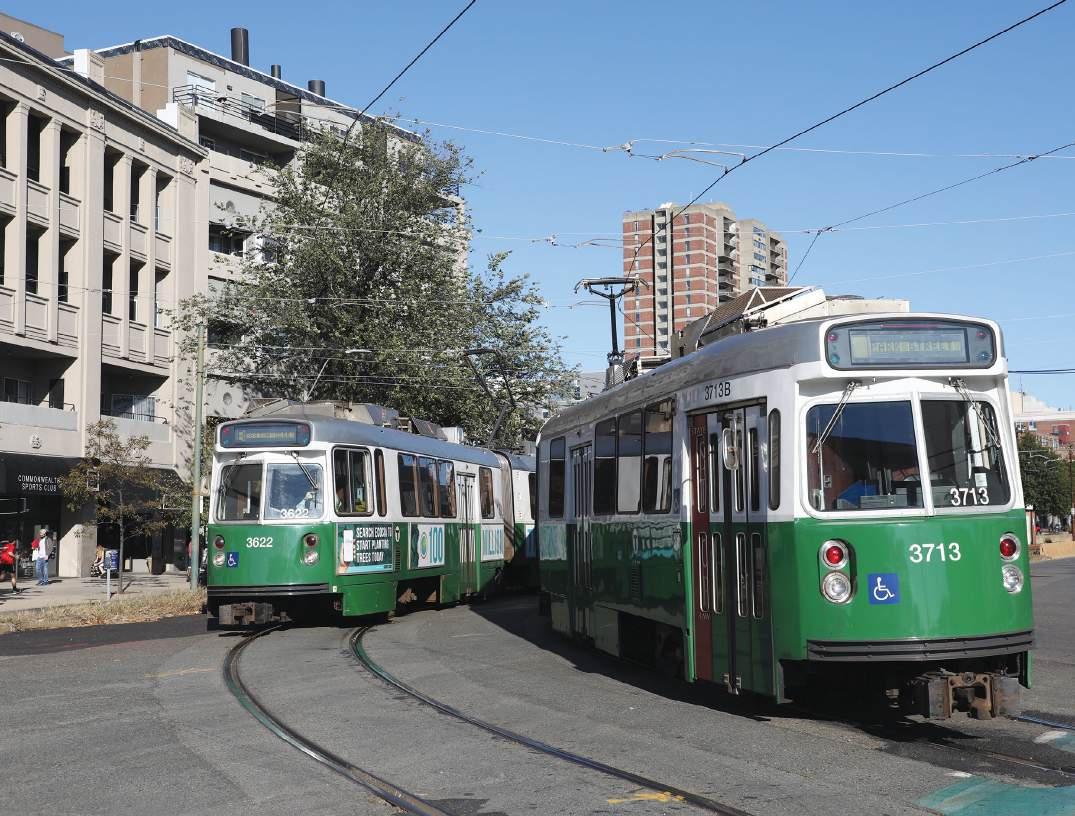
Following a promise to improve the network and make 40 years’ worth of infrastructure repairs in just 14 months, Boston can now boast a praiseworthy transport network. Andrew Grahl summarises the latest events.
Situated in the northeastern United States, Boston in Massachusetts has a rich history. Famous academic institutions, culinary delights and attractions make the city a wonderful place to visit.
Travelling around Boston could not be accomplished without the Massachusetts Bay Transportation Authority (MBTA), also known locally as the ‘T’. The MBTA operates the trolleys, subways, buses, ferries and commuter rail in and around Boston and its suburbs. With a population of 674 000 in the city and approximately five million in the metropolitan area, the MBTA carried 245 million riders in 2024.
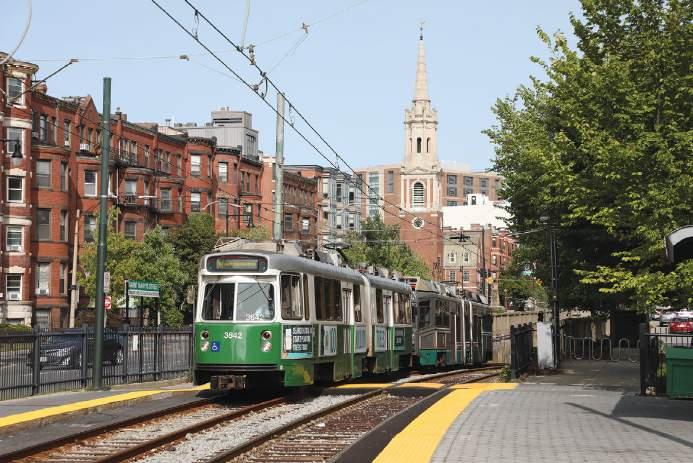
Boston’s Green Line dates back to 1897; it is North America’s oldest trolley subway. A special plaque commemorating this event is located at Park Street station. The Green Line runs underground through downtown Boston, and above ground outside the CBD.
With an average daily ridership of around 101 000 in 2023, the Green Line brings people to Boston using four services. The B Branch runs from Boston College, along
Commonwealth Avenue and into the subway to Government Center. The C Branch runs from Cleveland Circle, along Beacon Street into the subway to Government Center. The D Branch runs from a large park-and-ride at Riverside along the former New York Central Railroad’s Highland Branch, now light rail, private right-of-way for 14.5km (nine miles), then into the trolley subway and back outside, over the Lechmere Viaduct to the new terminal at Union Square in Somerville. The E Branch operates from Heath Street, along street-running and private right-ofway, into the subway, over the Lechmere Viaduct and on the new Green Line Extension to Medford/Tufts. The A Branch to Watertown was discontinued in 1969.
There are currently three types of rolling stock operating on the Green Line: Type 7, Kinki-Sharyo cars built 1986-88 and in 1997; Type 8, AnsaldoBreda cars built 1998-2007; and Type 9, CAF USA cars from 2018-20.
The MBTA requested bids for new Green Line light rail/trolley cars in August 2020. An order for 165 of these Type 10 cars, with an option for 61 additional cars, was
requested. The car, different from anything currently operating in Boston, will be either 34m long, seven sections and 100% low-floor; or a five-section car with high-floor sections at each end.
The order will replace Type 7 cars built by Kinki-Sharyo and Type 8 from Breda, currently in service. Current service patterns see two-car trains operating with one high-floor Type 7 and one low-floor Type 8 These two-car trains will be replaced by one Type 10. Single-car trains can only operate with a low-floor Type 8 or 9, as the MBTA has committed to always operating a low-floor car.
An USD810m (EUR700m) contract was awarded to CAF in August 2022 for 102 Type 10 cars, for cars with seven sections and a 100% low-floor design. Car shells are to be constructed in CAF’s Elmira, New York facility, with four pilot cars delivered in 2026. The balance of the fleet will be delivered as two cars per month between 2027-31.
The MBTA’s USD2.28bn (EUR1.97bn), sevenstation, Green Line extension to Somerville (Phase 1) and Medford (Phase 2), northwest
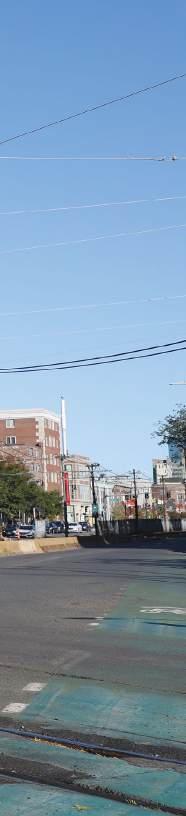
LEFT: The Green Line is the oldest trolley subway in North America, opening in 1897. While much of it runs under the city itself, it is pictured here aboveground on Commonwealth Avenue/Brighton. All images by Andrew Grahl.
RIGHT: The Red Line is the longest (largely) underground line in Boston, splitting into two branches at its southern end. It is pictured at Charles MGH, located on the Longfellow Bridge.
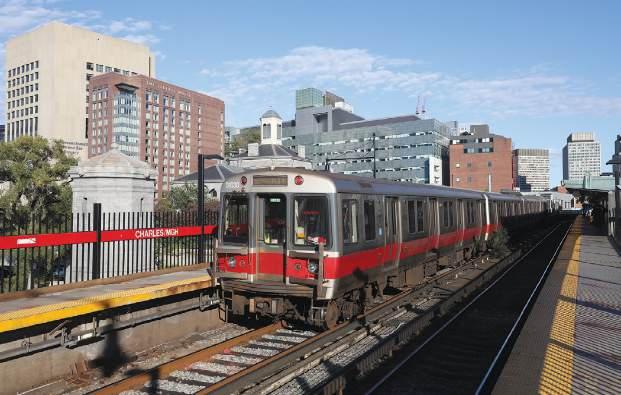
of Boston, both opened in 2022. These added 6.9km (4.3 miles) to the Green Line network.
The GLX extends the Green Line from a rebuilt Lechmere station northwest on two branches. The Phase 1 extension runs one station to Union Square and is served by the D Riverside Line. This line parallels the MBTA Commuter Rail line to Fitchburg.
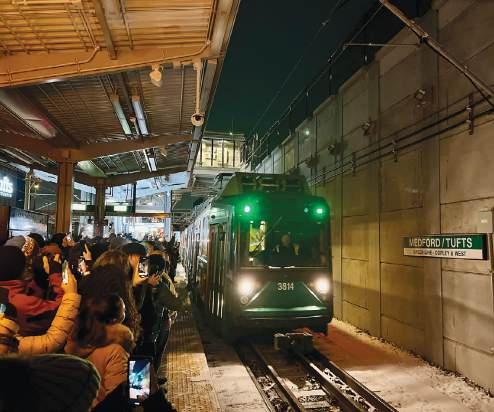
Phase two operates in a grade with the MBTA’s Commuter Line to Lowell, making station stops at East Somerville, Gillman Square, Magoun Square, Ball Square and lastly Medford/Tufts at Tufts University.
Phase 1 to Union Square in Somerville opened on 21 March 2022 with a ribboncutting and opening ceremony below the newly-rebuilt Lechmere station. Phase 2 opened on 12 December 2022 with a ribboncutting in front of the Medford/Tufts station and a ceremony in the Cummings Center building in Tufts University.
A new GLX storage and maintenance facility was built in Somerville. The MBTA is projecting 50 000 one-way trips by 2030.
The longest underground line in Boston has two branches at the south end. Running from Alewife in North Cambridge, through Cambridge and Somerville, across the famous Longfellow Bridge into Boston and continuing south of downtown Boston, the line splits into two branches: one through Quincy to Braintree, the other through Dorchester to Ashmont, with a connection to the Mattapan Trolley.
The line has 22 stations and operates Alewife to Ashmont, a total of 18.5km (11.5 miles) and Alewife to Braintree, covering 36.2km (22.5 miles).
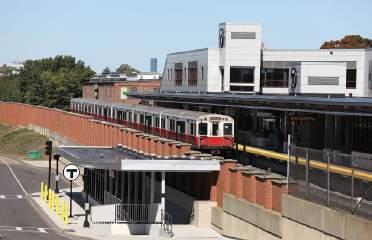
The Red Line currently has the most diverse equipment as older stock remains in service while delivery of the delayed CRRC cars is awaited. The oldest equipment, the 01500 and 01600 class, built by Pullman Standard in 1969-70, has almost entirely been replaced. A few cars from each class remain. The 01700 class, built by UTDC in 1987-89, remains in service with 52 cars. The 01800 class, built by Bombardier in 1993-94, has 82 cars. The entire fleet is being replaced by 252 new cars from Chinese state-owned CRRC.
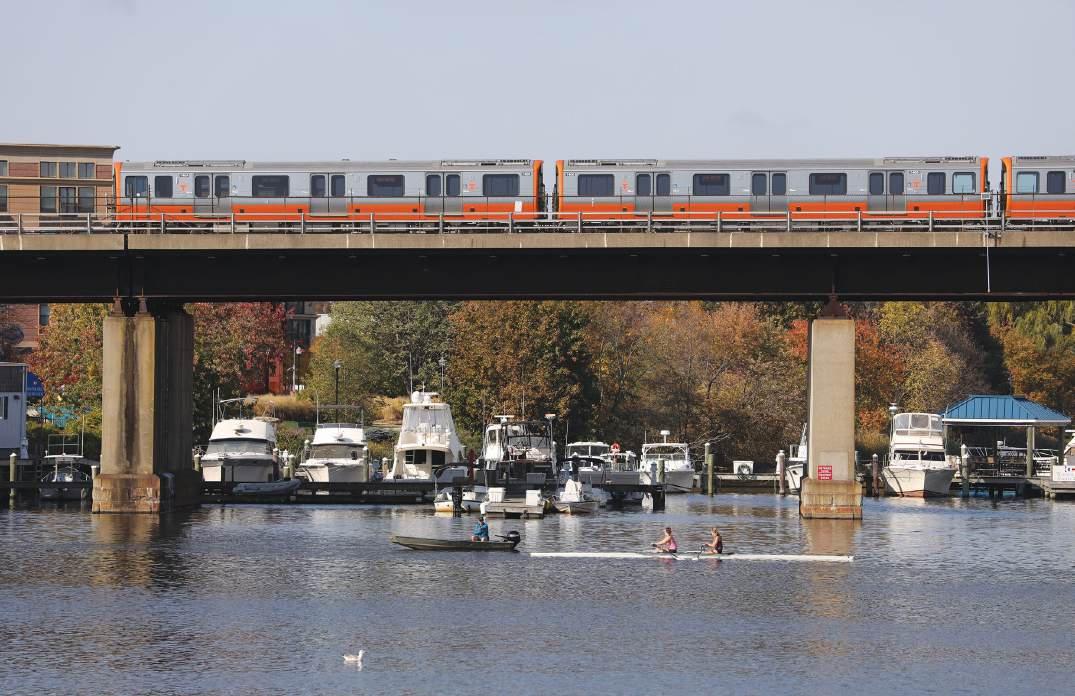
The MBTA ordered replacement subway cars for its ageing Orange and Red Line fleets in 2014. A USD566m (EUR488m) contract was signed with CNR Mass, a consortium of CNR Changchun Railway and China CNR Corp, for 152 Orange Line and 132 Red Line cars. The new cars are to improve passenger comfort while adding technology including LCD displays, solid state microprocessors, platform gap improvements, APC, improved crash management and wireless defect identification.
With parts constructed in China, assembly is to be completed in a new factory in Springfield, Massachusetts, 145km (90 miles) west of Boston. According to CRRC, the CRRC MA division employs 268 people.
Delivery was expected to commence in 2018 for the Orange Line fleet and 2019 for the Red Line fleet, with completion by 2023.
In 2015, CNR and CSR merged to become today’s CRRC. In 2016, the MBTA added a USD249m (EUR215m) contract for an additional 120 Red Line cars, support and parts, with an option for 14 additional cars. Without the option, that totals 404 cars.
The first four Orange Line cars arrived in December 2017, and the first cars entered passenger service on 14 August 2019. The first six Red Line cars arrived in October 2019, with passenger service launching on 30 December 2020.
However, the project has been plagued with significant issues ranging from faulty door operation to alleged labour issues, resulting in delivery delays.
While the Orange Line has been fully converted to CRRC operation, the Red Line currently has only 46 of 252 cars available for service.
The highlight for any visiting rail fan is certainly the daily service by 1940s-era PCC trolley cars which run on the Mattapan Trolley. This branch is an extension of the Red Line underground from the southern terminal at Ashmont, 4.2km (2.6 miles) to Mattapan. The unique line operates through a scenic part of Milton and
Dorchester, while making stops at eight stations.
There are ten PCC cars assigned to the Mattapan Trolley, with seven currently active. All PCC cars were built by Pullman Standard between 1945-46 and have been rebuilt several times. They are currently being rebuilt again using kits from Brookville Equipment, replacing pneumatic systems
with electric and body work taking place at the MBTA’s Everett facility.
Although the cars are being refurbished, there is talk about replacing the classic PCC cars in the near future with more modern equipment, or a dedicated busway.
The 20-station, 18km (11-mile) Orange Line starts at the north end at Oak Grove in Malden and runs south through Medford, crossing the Mystic River into Somerville. It continues south into Charlestown then underground, under the Charles River and below the centre of Boston. The line returns above-ground in the South End neighbourhood, and follows the Southwest Corridor, a joint private right-of-way with MBTA Commuter and Amtrak intercity, through Roxbury and Jamaica Plain to Forest Hills.
The line uses a 152-car CRRC fleet, delivered between 2018-23. Trains are six cars in length and are driven by operators using Automatic Train Control (ATC). There are approximately 105 000 daily riders.
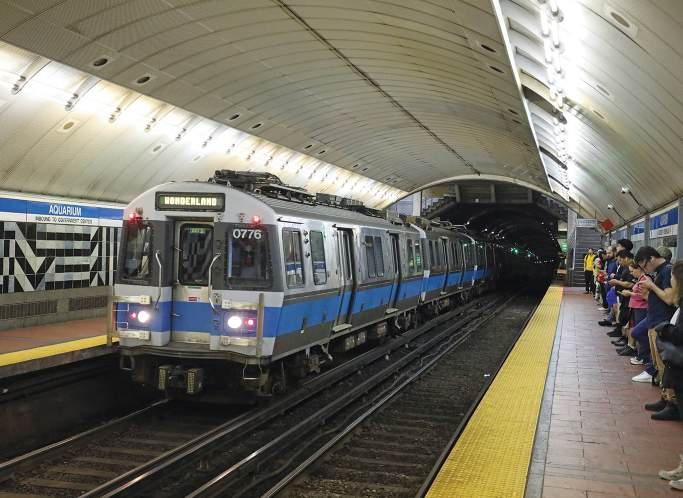
The Blue Line is a 9.7km (six-mile) route with 12 stations, beginning at Wonderland in Revere using overhead wire and pantograph for power. The line travels southwest to East Boston and eventually Airport station, with a shuttle bus connection to Logan International Airport. Here the pantographs are dropped and the line continues under Boston Harbor and into Downtown Boston and the terminal in Bowdoin using third rail.
The Blue Line utilises 94 0700 series cars, built by Siemens. They are unique with both third rail (like the Red and Orange Lines) and pantograph operation. The overhead pantograph operation was chosen many years ago as being more reliable outside against ice issues in the winter than the alternative of third rail.
Boston had a long history of operating trolleybuses, powered by electric overhead wire, which lasted until recently on routes operating from North Cambridge Carhouse and the Silver Line from Southampton Street Garage.
The MBTA announced in 2021 that the North Cambridge Carhouse would be renovated to replace its trolleybuses with Battery Electric buses. The last two North Cambridge routes which operated into the famous underground station and connection to the Red Line at Harvard, the 71 (Watertown – Harvard) and 73 (Waverley – Harvard), ended on 12 March 2022. Regular diesel buses have replaced the trolleybuses until the depot is rebuilt and the new buses are tested and placed in service.
The Silver Line is a relatively recent addition to the MBTA network, carrying 27 000 daily riders. While the Silver Line has six routes, four operate from an underground station at the South Station commuter and intercity railroad terminal and travel through a dedicated bus tunnel with underground stations. The underground travel necessitated the use of electric vehicles.
Opening in 2004, dual-mode diesel and electric Neoplan-built trolleybuses were used from the opening through to retirement in July 2023. With battery electric bus technology improving, the MBTA decided to move away from the trolley wire infrastructure.
The MBTA operates 170 bus routes for 446 000 daily weekday riders. Hornblower Cruises operates the MBTA’s eight ferry routes into Boston; several are only seasonal.
The MBTA Commuter Rail network is expansive, combining several lines from legacy railroads. Trains connect riders to the subway network and terminals at North and South station. Operated by Keolis, there are 12 lines with an annual ridership of 30 million in 2024.
While many things are now moving in a positive direction in Boston, that wasn’t always the case. The Federal Transit Administration (FTA) released a Safety Management Inspection of the MBTA’s subways and trolley lines following several issues in August 2022.
In April 2022, a man was killed on the Red Line as his hand was caught in a train door, resulting in him being dragged with the vehicle. An Orange Line train caught fire crossing the Mystic River with passengers aboard on 21 July 2022. Two Green Line trains also collided in June 2022 at Government Center when an operator missed a stop.
Massachusetts Governor Maura Healy appointed transit veteran Phil Eng as the new MBTA General Manager to address and improve all such issues that had plagued the network.
A promise was made in November 2023 to eliminate all speed restrictions across the subway system and bring the tracks into a good state of repair by the end of 2024. The MBTA says in a video called Promises Delivered, “Our teams have been hard at work completing 40 years’ worth of repairs and system modernisation in 14 months.”
Sections of subway and trolley/light rail were closed for sometimes long periods of time to fix the infrastructure. According to the MBTA, 75.6km (47 miles) of rail was repaired. Also, 226 speed restrictions were removed, making the MBTA speed restriction-free for the first time in 20 years. It was a process to improve the quality of service and get the public’s trust back: a true success story.
While Boston is a relatively small city in the United States based on population, it makes up for that with its history, charm and excellent transportation. The MBTA network with its age and intricacies will certainly be challenging to keep in a good state of repair. However, the current administration seems to be up for the task.
A visit to Boston in the near future to ride the famed Mattapan Trolley is certainly recommended. While there is currently no date for modernisation, new Type 10 deliveries could change that.
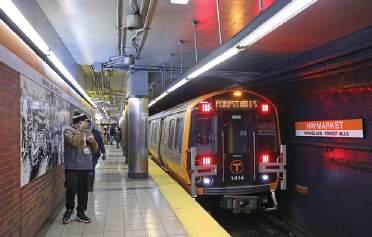
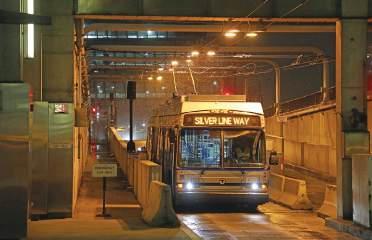
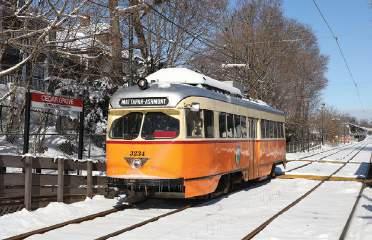
PICTURED FROM TOP: The Orange Line uses a 152-car CRRC fleet dating from 2018-23.
The Red Line, pictured here at Wolleston, currently has the most diverse collection of rolling stock as it waits for a new delivery of CRRC stock. A few cars from 1969-70 remain in service, although the 01700 and 01800 classes form the backbone of the fleet.
The Silver Line, opened in 2004, is a relatively recent addition to the MBTA network. Four of its six routes operate from underground at the South Station commuter and intercity railroad terminal and travel through a dedicated bus tunnel with underground stations.
A seasonally-scenic snapshot of the Mattapan Trolley at Cedar Grove, which still runs 1940s-era PCC trolley cars in daily service.
When someone listens, people will make the right call.
Thousands of organisations in the transport sector are members of CIRAS. We build a strong listening partnership with our members to improve safety. Our confidential safety hotline provides extra listening to help staff make the right call and report their concerns even when they feel they can’t use other channels. When we listen, we learn.
Learn how you can build your listening partnership with CIRAS at ciras.org.uk/rightcall

Scan me
Download the CIRAS reporting app
We find safety in listening.
The French city’s grand plans will see its high-quality tram network expand to five lines. Andrew Thompson considers the three schemes in hand.
Located on the French Riviera of the Mediterranean coast, Nice is renowned for its history, elegance and touch of luxury. These traits also extend to the city’s modern tramway, and a conscientious effort was made to integrate innovative yet also refined features into the 21st Century transit system, which has been under continuous development for the past two decades. Aside from smart design, urban art and green landscaping also go handin-hand with the layout of the local tram tracks.
With a population of roughly 353 000 within city limits and just shy of a million in the wider conurbation, Nice currently boasts a tramway that consists of three lines with a network size of roughly 25km (15.5 miles).
The first 8km (five-mile) section of the U-shaped line 1 opened between Henri Sappia and Pont-Michel in November 2017, connecting the main railway station and historic Old Town along the way. In July 2013 it was extended by 700m across the River Paillon to Hôpital Pasteur.
An even more extensive and impressive
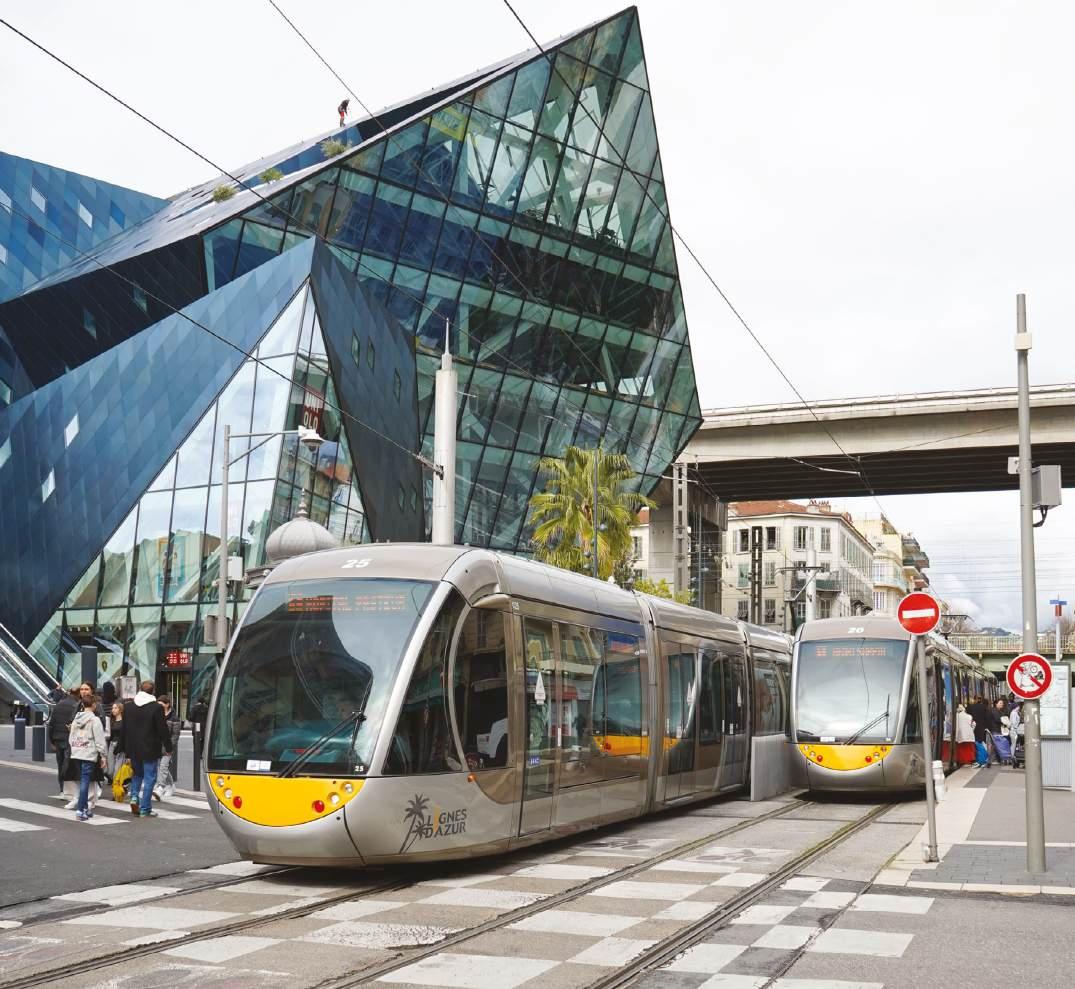
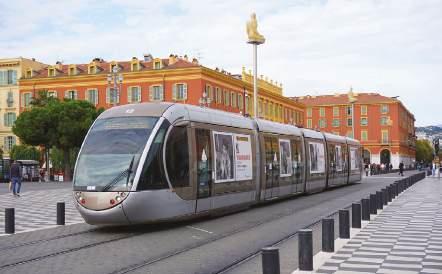
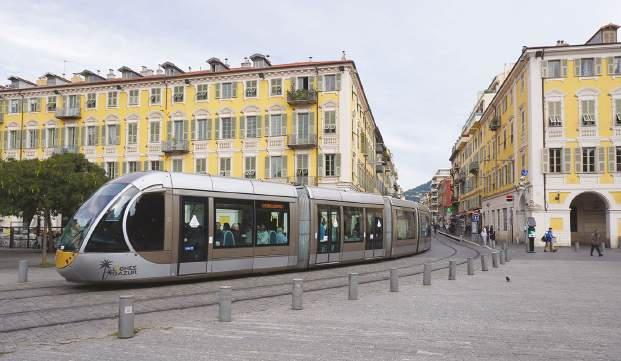
ABOVE: All LRVs in Nice are double-ended. Cars 20 and 25 pass each other at Gare Thiers, where there is interchange to SNCF regional and long-distance trains. The shiny glass facade in the background is a new commercial development. All images by Andrew Thompson
feat of municipal engineering was the construction of the east-west trunk line, which opened in five different stages between June 2018 and December 2019 and includes a 3.2km (two-mile) tunnel beneath the city centre. This runs from the eastern terminus Port Lympia to Centre Universitaire Méditerranéen and includes four underground stations that feature metro-style ticket barriers; a contrast to the otherwise open doors boarding at all street-level stops of the tram system.
The east-west trunk route is served by lines 2 and 3, with line 2 running from the yacht
harbour at Port Lympia to the airport and calling at both terminal buildings, while line 3 connects the football arena at Stade, before terminating at the northwestern endpoint Saint-Isidore.
Nice is therefore among a growing number of European cities with a light rail link to the airport. Conveniently, in Nice the journey time from the seaside airport to the city centre is less than 15 minutes by line 2. The airport is also served by tram line B, a short shuttle service that runs to the longdistance bus station and the government complex CADAM Centre Administratif, which is located directly next to the newer of two tram depots, which services the newer fleet of 34 Alstom Citadis 405 LRV. These were delivered in different batches between 2018-22. Line B was created out of a service reshuffle in early 2025 and boasts just six stops in total.
For aesthetic reasons, city planners in Nice always insisted on certain catenaryfree sections in the Old Town. Therefore the 485m alignment between the spacious Place Massena and Place Garibaldi along line 1 is operated in battery mode, with the 13 Alstom Citadis 302 and the 15 Alstom Citadis 402 having battery packs on their roofs. Based on this history, but even more ambitious, was the decision to build 80% of the new eastwest trunk route for lines 2 and 3 without overhead powerlines and instead rely on the Alstom APS system with ground-level supply and recharging points at stations. Catenary is mainly placed in the tram tunnel beneath the city centre, with street-running sections purposefully designed wire-free.
During coming years, the Nice tram network will be extended significantly, as the city authorities are working on implementing
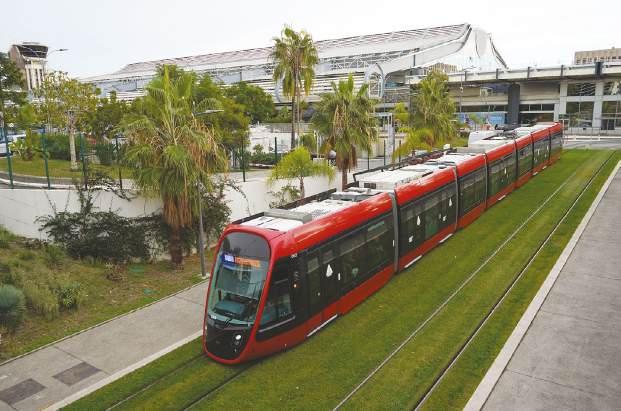
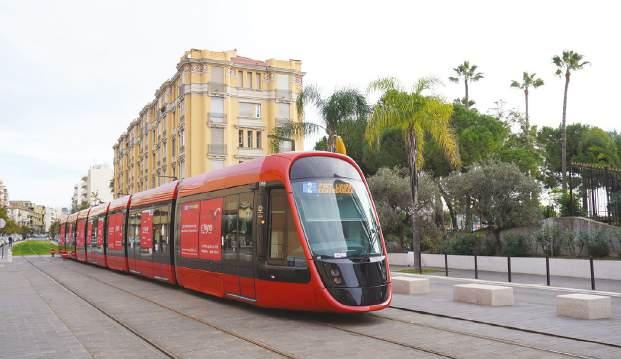
ABOVE: Leaving the airport terminal 1 stop and running inbound with a line 2 service, Citadis 405 car 052 is near the junction where the future line 4 will branch off from line 2 to run west to Cagnes-sur-Mer.
RIGHT: Car 12 passes over the wire-free section of Place Massena on line 1. These Alstom Citadis 302 fitted with traction batteries can only operate on line 1 and are maintained at the original depot located at Henri Sappia terminus.
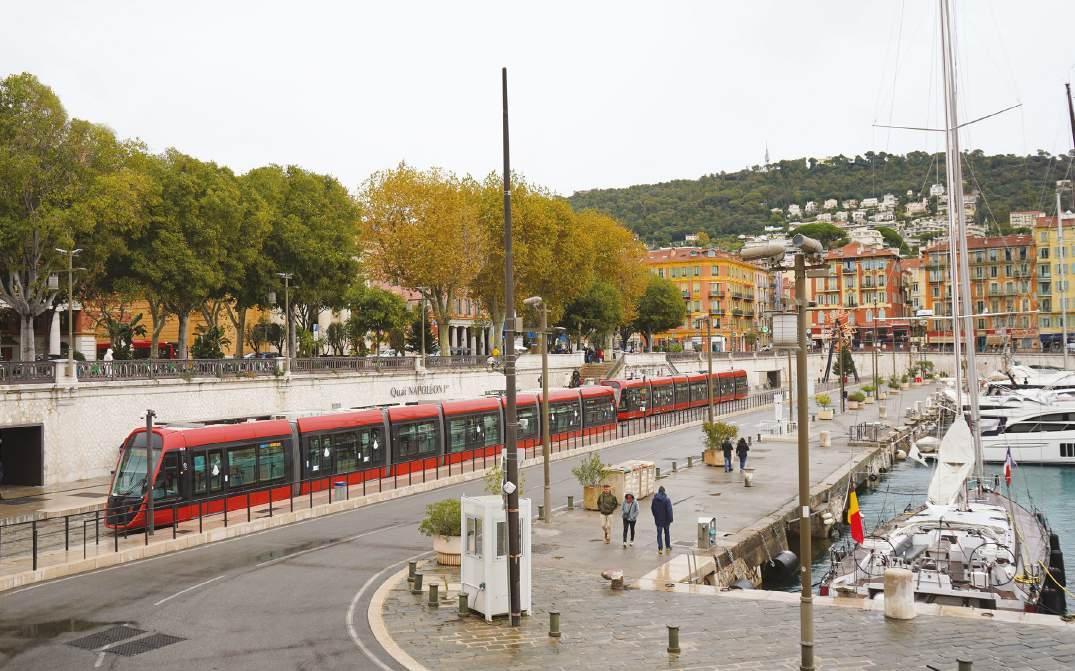
The eastern terminus of lines 2 and 3 at Port Lympia opened in December 2019 and remains one of the greatest examples of modern French tramway design. Emerging from the underground tunnel onto Quai Napoleon, the new transport infrastructure is integrated into the historic surroundings. On 7 November 2025, two Citadis 405 cars pass each other. While car 054 in the foreground has just arrived, car 048 in the background is picking up passengers at the platform.

Pont-Michel
Mérida
a long-term master plan that will see the network expand to include five lines. To the west of the current junction Grand Arénas, near the airport and the Nice SaintAugustin railway station, the new line 4 is under construction. This 7.1km (4.4-mile) branch line will run from the existing CADAM terminus of line B and include 14 new stops, mainly serving the adjacent communes of Saint-Laurent-du-Var and Cagnes-sur-Mer on the west bank of the River Var. The end-to-end journey time from CADAM to Cagnes-sur-Mer Lycées is expected to be 23 minutes with an intended service frequency of 7-8 minutes. Initially 30 000 daily riders are expected.
Aside from the usual urban enhancements with grass-lined tracks, largely gradeseparated tram tracks, new pedestrian spaces and cycle lanes, four new park-and-ride facilities will also be built for commuters from further afield. Official project renderings show the new line 4 alignment without overhead power lines. The first phase between the junction Grand Arénas and the new calling point Institut Arnault Tzanck in Saint-Laurent-du-Var is slated for inauguration some time in 2026, the second section to Lycées by 2028.
Another important project is the extension of line 3 further north to Lingostière, with an interchange to the narrow-gauge railway Chemins de Fer de Provence and its 150km (93-mile) metre-gauge route to Digne les Bains at the improved station Lingostière pôle multimodal, before terminating at the large Saint-Saveur shopping centre. This roughly 2.5km (1.6-mile) extension is currently scheduled for completion by 2030. While line 3 and 4 projects are being planned or are being implemented, the line 5 scheme is part of a longer-term plan. At the moment the project is in the public consultation phase and in a best-case scenario, construction could start in 2028. Running north from the interchange with line 1 at Palais des Expositions along the River Paillon, the line 5 branch is slated to be 7.5km (five miles) long and serve 15 new stops, while connecting the communes of Saint-André-de-la-Roche, La Trinité, and Drap. An end-to-end journey time of 25 minutes is projected, with a peak headway of 7-8 minutes. The first section will be built to Pont Michel, located next to Nice’s railway yard, the second stage to LaTrinité, and the last leg to Drap, terminating near the town hall. At the earliest, trams would reach Drap by 2031, running entirely within the Paillon valley, but crossing the river twice on purpose-built bridges. Current renderings of line 5 once again show grass lined, gradesegregated tracks without overhead wires. With all of these investments in the pipeline, Nice is intent on ensuring a high quality of life and attractive public transport for the next two decades.
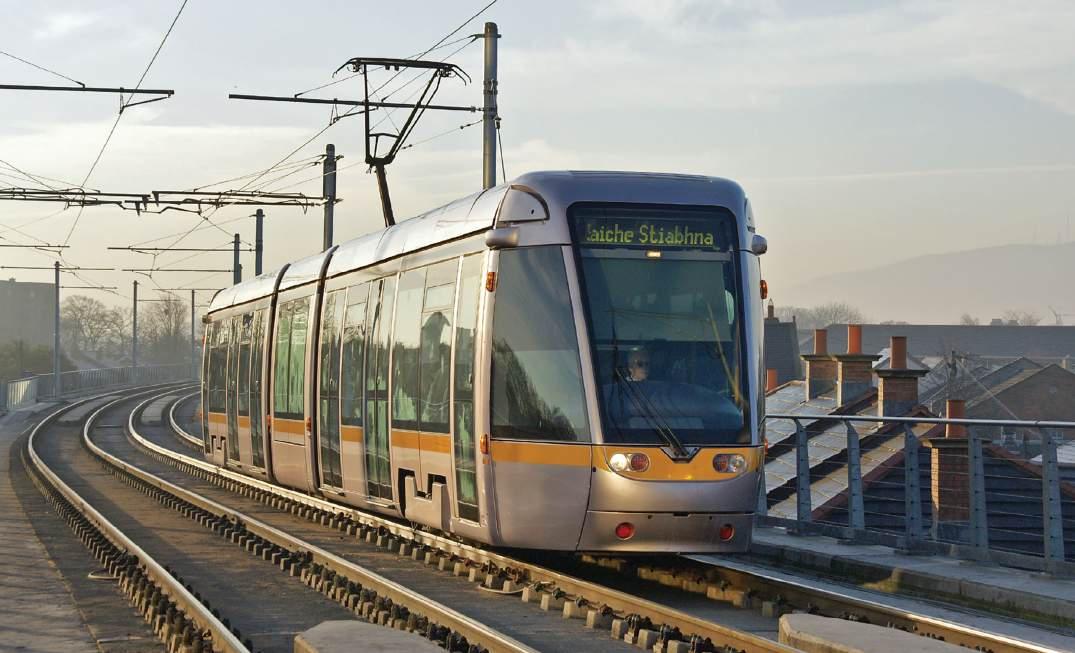
The Republic of Ireland doesn’t necessarily spring to mind as a hotbed of light rail development. Yet it’s on the cusp of spending something in the region of EUR18.5bn on light rail and urban rail development over the next ten years. This could include returning trams to a city that hasn’t had them for more than 90 years as well as giving its capital, Dublin, its first ever underground metro.
Ireland experienced massive economic growth in the late 1990s/early 2000s.
Although at that time dubbed the ‘Celtic Tiger’, research by Irish wealth management specialists Davy Group suggested that the country’s failure to invest in infrastructure was a contributory factor to the sudden burst of its economic bubble in 2008.
Ireland did, during that time, invest in its road network which Davy called a “triumph”, which “[boosted] productivity in the economy”.
That’s in the past. Today, Ireland’s government is investing EUR115bn in infrastructure, while the National Planning Framework supports sustainable growth
in its key cities – Dublin, Cork, Galway, Limerick and Waterford. That’s because Ireland’s population is expected to grow by one million by 2040 from the current level of approximately 5.4m people. Ireland also recognises that a development strategy will help it meet European Union commitments on climate change.
Dublin, as the nation’s capital, is set to receive the bulk of the light rail investment.
An Coimisiún Pleanála, Ireland’s national planning body, granted the Finglas extension a Railway Order (giving wide-ranging construction powers) on 30 October. This will be the first extension of Dublin’s tram system, named Luas (Gaelic for ‘speed’), since the Luas Cross City project in 2017 which linked the Red and Green Lines.
The 1435mm-gauge system is now 42.1km (26.2 miles) long and connects Broombridge to the north of the city with Bride’s Glen to the south and Saggart to the west. Luas’ Red Line celebrated its 20th anniversary on 26 September 2024, and the system now attracts more than 50m passengers a year.
Transport Infrastructure Ireland’s 20 Years of Luas report tried to quantify its
Ireland is set to receive EUR18.5bn investment for its urban rail infrastructure in coming years. Richard Foster looks at the cities that will benefit.
success. It calculated that the light rail system has helped create 10 000 new jobs along its corridors while, in 2022, “Luas commuters added over EUR5bn in Gross Value Added to the economy. It also avoided tens of thousands of car journeys that would otherwise have been made on the city’s roads and prevented tonnes of CO2 from being emitted into the air.
Luas is to expand by 3.9km (2.4 miles) now that the Finglas extension from Broombridge is ‘on’. There are to be new stops at St Helen’s, Finglas Village and St Margaret’s Road and a terminus at Charlestown. A new, 350-space park-and-ride facility will be built between Charlestown and St Margaret’s Road, close to where the M50 and N2 roads meet. The extension is likely to cost approximately EUR600m and is planned to open in 2032.
But expanding Luas doesn’t stop at Finglas. Lucan Luas would connect the western extremities of the greater Dublin area –Adamstown and Lucan – to the city centre. How the line would enter the city is still being debated, with options including a connection to the Red Line close to Heuston railway station or a connection to the Green Line
Portobello. Either route would be about 16km (ten miles) long with 15-18 new stops and could open in 2036. The first tangible development will be the publication of a ‘preferred route’, due to take place in 2026.
Developments for the 2030s include an extension of the Red Line south across the River Liffey to Poolbeg, and taking the Green Line to Bray, situated on the coastline south of Dublin. Beyond 2042, a further eight districts of the Greater Dublin area could be connected: clockwise from the north, these are Balgriffin, Clongriffin, Sandyford, Knocklyon, Kimmage, Clondalkin, Blanchardtown and Tyrrelstown.
Another key tram development could be operating before these schemes progress, but not in Dublin.
Cork is Ireland’s second-most-populous city. There are 228 000 people living within the city and its outlying regions, which puts it on a par with Karlsruhe (Germany), Lille (France) and Newcastle-upon-Tyne (UK).
Cork’s 15.9km (9.9-mile), 900mm-gauge tram system closed in 1931. At 18km (11 miles), the proposed second generation system – dubbed ‘Cork Luas’ – is to be longer.
David King and Eamon Scullion from consultants Jacobs told delegates at the 2025 UK Light Rail Conference (TAUT 1053) that there are two driving forces behind the scheme. Cork is Ireland’s fastest-growing region and needs a sustainable transport solution. It’s also one of 100 cities due to become climate neutral by 2030, under a European Commission initiative.
King and Scullion explained how 65 000 residents could be within a 15-minute walk of
one of the 25 new tram stops. It is estimated that 16 million people could use Cork Luas every year. It’s planned to cut journey times from Mahon Point to the city centre and there are to be improved connections with heavy rail services at Cork Kent railway station.
Public consultation on the proposed route ended during the summer. Some media outlets called the result “overwhelming” in its support because just 18 of the 1003 respondents rejected the scheme outright. However, while 55% of the responses were described as ‘satisfied’ or ‘neutral’, there were plenty of calls for the proposed route to be extended further, and to include a connection to Cork Airport, to the south of the city.
Feedback from the consultation is now being incorporated into the detailed design work, which will form part of the preliminary business case and statutory public consultation. From that an application for a Railway Order will be made. A ‘2030s’ opening date has been mooted, following a five-year construction timetable.
So what of Ireland’s other major cities, Galway, Limerick and Waterford?
Waterford Metropolitan Area’s Transport Strategy includes developing existing heavy rail routes and making improvements to its bus and active travel networks. Limerick is also concentrating on heavy rail by re-opening the mothballed 42km (26-mile) line to Foynes for goods traffic, while planning permission has been granted for a new station at Mayross, to the north of the city on the line to Galway.
Key to the 18.8km (11.7-mile) automated metro is connectivity. A 3000-space park-and-ride facility is to be built at its northern terminus (Estuary), which is within easy reach of the M1 motorway and other key road arteries.
MetroLink will also feature connections to the national rail and DART networks, the Luas and Dublin airport.
The bulk of the alignment across the city centre, from Northwood to the southern terminus at Charlemont, is to be underground. There’s to be an exposed section around Dardistown where a bridge takes the line over the M50 motorway. The line’s depot is to be located here.
Another tunnel will run under the airport, while the bulk of the line around the Fosterstown and Seatown districts will be in cuttings and cut-and-cover tunnels. A viaduct is to take the line over Ward River and its surrounding green spaces before the lines reaches its surface terminus at Estuary.
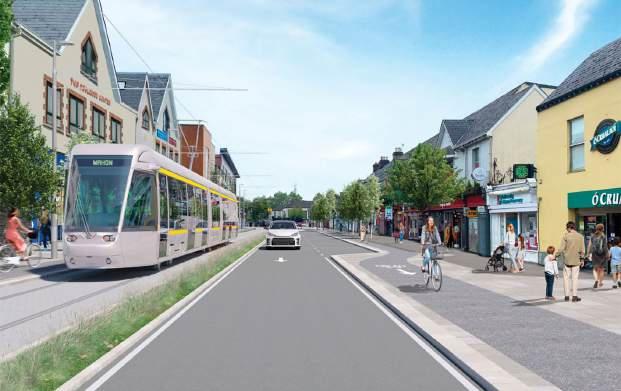
The 3.9km (2.4-mile) line is to mostly run on its own, segregated route, primarily through green spaces north of the current Green Line terminus at Broombridge. Even when it passes through more built-up areas between Finglas Village and Charlestown, it will have its own segregated space and artists’ renditions show that the tracks will be grassed.
The line will run at ground level except for a bridge just outside Broombridge to take the line over the main line to Maynooth and the adjacent Royal Canal. A second, 65m, bridge will then carry Luas over the river Tolka.
As the Green Line’s Broombridge Hamilton depot is ‘at capacity’, a new four-track stabling area is to be built at Bannow Road. This will ave capacity for eight vehicles.
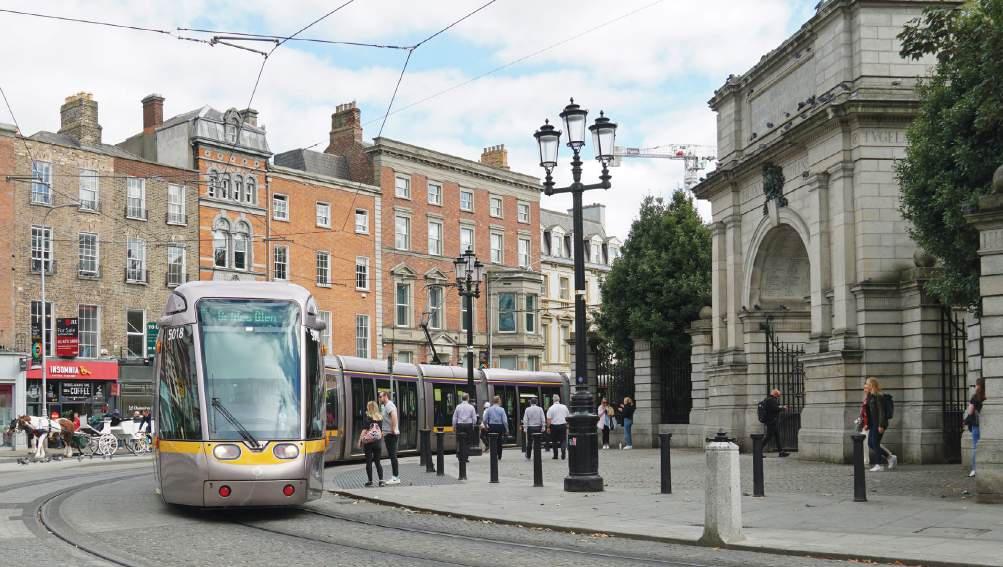
For more information and maps of the network and extension plans, please see:
• https://www.dublinpublictransport.ie/ dublin-train-map
• https://luasfinglas.ie/
West. Length: 40km (25 miles). Proposal: Electrify existing railway from Dublin Connolly to Maynooth plus branch to M3 Parkway. A new station at Spencer Dock is also proposed. Status: Planning granted 31 July 2024.
Coastal North Railway. Length: 37km (23 miles). Proposal: Electrify existing railway from Malahide to Drogheda. Status: Planning granted 25 August 2025.
South West. Length: 20km (12.4 miles). Proposal: Electrify line from Dublin Heuston to Hazelhatch & Celbridge station, building a new station at Heuston West. Status: planning granted 22 November 2024.
Coastal South. Length: 37km (23 miles). Proposal: Electrify existing railway to Greystones. Status: Under public consultation. A second phase could extend the DART system to Bray (Daly) station.
There might be a chance of light rail development in Galway. Atkins-Réalis published its feasibility study into providing it with a light rail system in November 2024. This 14.8km (nine-mile) line would link the city centre to the western suburb of Knocknacarra and to Parkmore and Doughiska in the east. Various media outlets have speculated that any decision on the future of what’s been dubbed ‘Gluas’ hinges on what happens with Galway’s N6 ringroad, which, ten years after planning was submitted, looks as though it will go through yet another public consultation process.
Dublin celebrated another significant anniversary in 2024: Dublin Area Rapid Transit (DART) started operating on 23 July 1984. This was a radical move for state rail operator Córas Iompair Éireann. It replaced 1950s diesel push-pull sets with EMUs to create a network akin to Germany’s S Bahn
At its 40th birthday celebrations, then Minister for Transport Eamon Ryan TD said, “When it was first proposed DART was labelled a ‘Rolls Royce’ solution – way above the spec we needed for the city. It’s just as well Iarnród Eireann and all those involved in developing DART didn’t listen to the naysayers back then. In the beginning DART was carrying about 25 000 passengers a day. Now, that number is closer to 90 000, and growing.”
Such is DART’s success that the ‘Dart Plus Programme’ is now underway, growing the system from 50km (31 miles) to 150km (93 miles) as well as ordering a new fleet of trains. That first order placed with Alstom was for 185 new vehicles, to be formed into 37 five-car trains. A total of 750 cars are to be supplied over a ten-year period. Some will be powered by a mixture of batteries and 1500v DC overhead. while others will be battery only. Iarnród Eireann unveiled the first 90000 Class units at its Inchicore Works, Dublin, in November 2024 but the first are unlikely to enter service before 2027.
DART Plus is to be complemented by MetroLink, arguably Ireland’s most ambitious railway building project and its first underground metro system. An Coimisiún Pleanála granted the Railway Order on 2 October (TAUT 1056) while
Alstom has joined FCC, John Laing, Meridiam and RATP in forming a consortium to bid for the 18.8km (12-mile) project.
Project Manager Dr Sean Sweeney told RTÉ in July that he wants MetroLink to open in 2035. He wouldn’t be drawn on how much the project might cost, although it is set to exceed the EUR9.5bn that was projected in 2021.
Creation of a dedicated delivery body was approved by the Irish government on 12 November. The Department of Transport will establish the new organisation, which is set to comprise officials from Transport Infrastructure Ireland and the National Transport Authority amongst others. Procurement should start next year.
Controversial as the project is to Dublin’s residents, it received a seal of approval from the country’s leader, Taoiseach Micheál Martin, who said, “If you look at it over a 20 to 30 year period, there will be continued growth in population… I don’t think you could sustain Dublin without a metro.”
The preferred route for Cork Luas is 18km (11 miles) long, starting with a loop in the western suburb of Ballincollig before crossing rural areas to reach Bishopstown. From there, it heads east into the city, crossing the southern channel of the River Lee and passing through St Patrick’s Street to Kent railway station. The line crosses the river again to reach the Docklands before zigzagging southeast to Mahon Point, close to the shore of Lough Mahon.
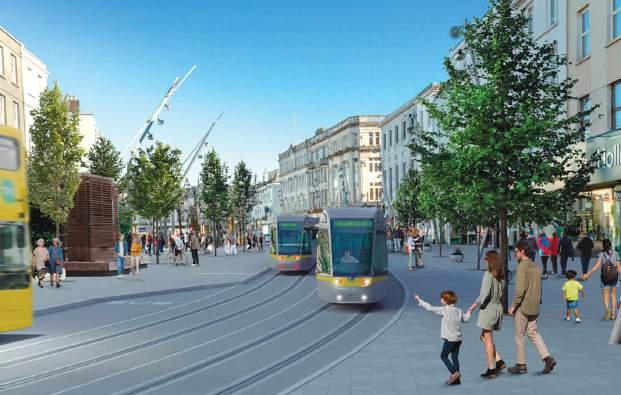
Much of the line will run on its own segregated course, except along Western Road, to the west of the city centre. Here, it is to share its route with road traffic but that offers the opportunity for integration with the BusConnect Cork network. Key city roads, such as St Patrick’s Street, will become pedestrianised. Façade-to-façade developments in other key locations will also be implemented.
For more information and route maps, visit: https://www.luascork.ie/en/#keyfacts
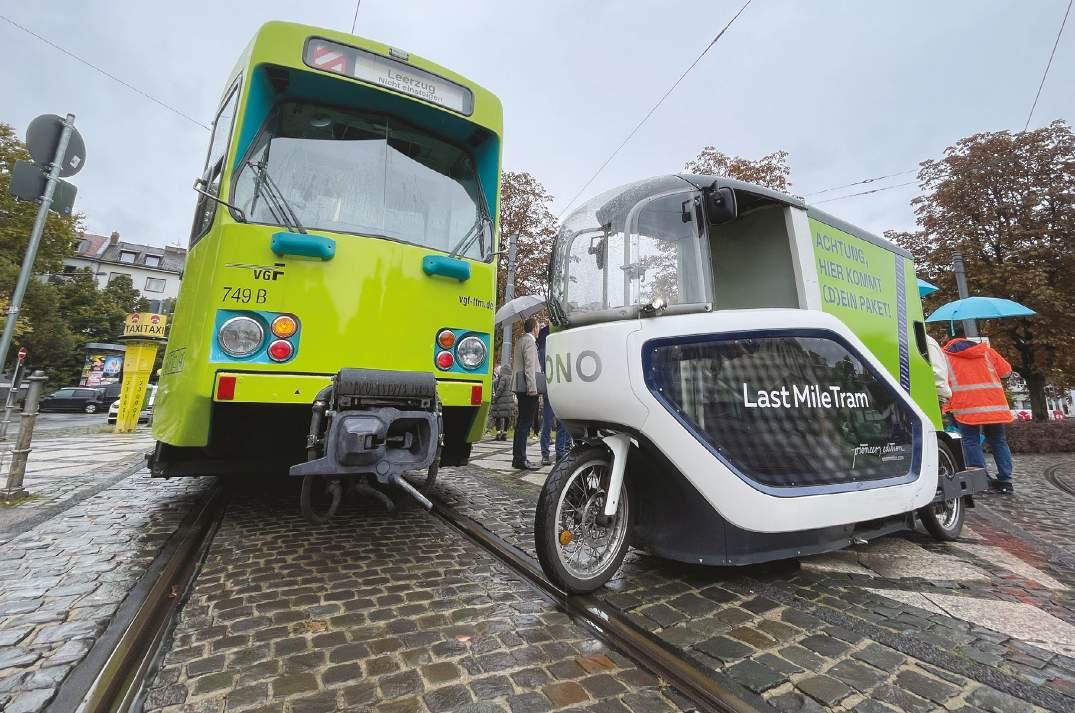
A year ago, the German city of Frankfurt am Main trialled using trams to fulfil Amazon deliveries. Richard Foster finds out if this idea could change the way parcels are delivered in future.
CarGoTram, Poststrassenbahn, parcels tram: the concept of using tramways and metro systems to carry things other than people is not new. But as with other areas of rail travel, the lure of rubber-tyred vehicles with the ability to go anywhere seemed to offer greater flexibility for delivering mail and parcels than one stuck to using steel rails.
Yet we know that an electrically-powered rail vehicle offers the most environmentallyfriendly method of travel. As we move through the 21st Century and the effects of climate change become ever clearer, thoughts are once again turning towards how light rail systems can be put to other uses in order to reduce our carbon footprint.
A parallel development has been the growth in e-commerce businesses against the decline of sending letters. The UK’s London Post Office Railway was designed to carry letters. It couldn’t cope with increasing volumes of parcels while the number of letters it carried declined. That’s why it closed in 2003 after 76 years.
Global ecommerce giant Amazon processed 6.3bn orders in 2024 in the United States alone – that’s 717 200 orders every hour! Its branded global logistics fleet comprises over 40 000 articulated lorries,
30 000 vans and 110 aeroplanes. Its 2024 logistics bill was USD95.8bn (EUR83bn).
Madrid Metro and Delhi Metro have undertaken parcels-carrying trials in recent years while Wiener Linien, the transport operator operator in Wien (Vienna) conducted an eight-week experiment in May 2025 (TAUT 1051) whereby passengers carried other people’s parcels between stops across the Austrian capital.
“In the year 2025 it’s possible to use digital tools to automate things, and we have a more connected supply chain.”
One trial that caught the eye took place in Frankfurt am Main in the autumn of 2024 (TAUT 1043) because it involved Amazon. It also put environmental considerations to the fore: electric vans would take parcels from the main warehouse; they would be carried by tram into the city centre, and electric bikes would deliver them to the front door.
The project was led by Frankfurt University of Applied Sciences and, while we’re still waiting for the full report to be published, Benjamin Federmann, Assistant Researcher at UAS, explains how it came to pass:
“We started the whole project in 2017-18. The city of Frankfurt asked us, as a university, if we could assist in creating something like a logistics road map for the city. The plan was to talk about inter-modality.”
While Frankfurt am Main Postal Tramway had run from 1901 until 1951, a limited ‘Business to Business’ mail service, which also included distributing mail and post between local authorities, ran on the tramway until the early 1980s.
Why undertake a new trial now?
“We are now in the year 2025 and it’s possible to use digital tools to automate things, and we have a more connected supply chain,” Federmann explains. “We thought that it could be worth [asking] ourselves if there is any possibility of having a cargo tram together with cargo bikes and [electric vans] and maybe investigate if [it’s] now right to start a new trial.”
The university originally planned to partner with Hermes, the logistics arm of German retail and ecommerce giant Otto Group. However, Federmann explains that
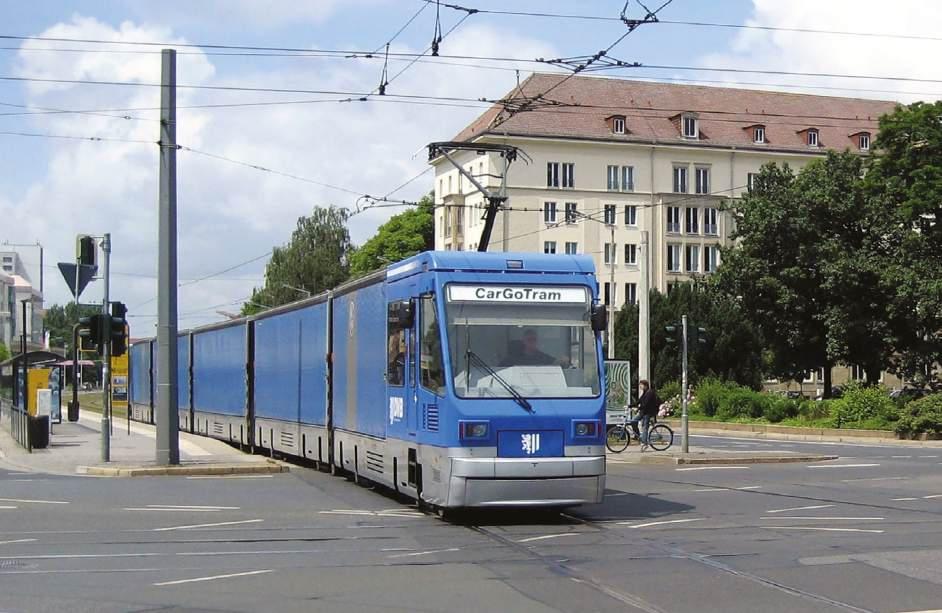
“As we move through the 21st Century and the effects of climate change become clearer, thoughts are turning towards how light rail systems can be put to other uses to reduce our carbon footprint. ”
when Otto Group and Verkehrsgesellschaft Frankfurt am Main (VGF), Frankfurt’s tram operator, started talking, “they set such high hurdles that Otto decided that ‘OK, we need to jump out’.”
UAS President, Kai-Oliver Schocke, is a professor of logistics and production management, with many years’ experience in the field. As Assistant Researcher to Professor Schocke, Federmann has lots of contacts within the industry and it was via a contact that Amazon became involved.
Amazon is not averse to using unconventional parcel delivery methods. It has teams based in Luxembourg and in the UK looking into new delivery methods. For example, Darlington Borough Council (UK) has just given planning permission for a fenced compound at Amazon’s Symmetry Park distribution centre, to the east of the town, from which delivery-making drones can be launched.
“[They’ve been] responsible for the question if it’s possible to have ships on the river Thames in London. They’re also discussing something like using buses in the city of London. So they were already connected to public/private partnership projects.”
Getting Amazon on board was one thing. Winning VGF over was another: “When I dropped the name Amazon, they [said] ‘No way...”
Federmann explained that, without Amazon’s help, the university had no
ability to test its theories. Faced with that ultimatum VGF, Federmann recalls, said “OK, let’s try it’”.
The project was called ‘Last Mile Tram’, with its distinctive branding not only being applied to the parcels tram itself but also the electric delivery bikes. The tram in question was Duewag eight-axle Pt tram 749, built in 1977, which required minimal internal modifications to carry the sacks of parcels.
Unfortunately, this high-floor vehicle was the only tram VGF had available, and Federmann laments the lack of a low-floor alternative.
The trial began on 6 September 2024. Amazon’s electric E Transporter vans brought packages from its distribution centre in Raunheim to the Stadion tram stop. The tram then took the parcels to Zoo and Gutleut stops, from where they were transported to a local hub (more on which later). The electric bikes then delivered the parcels to customers’ doors. The vans, tram modifications and bikes were all funded by the Hessen (Hesse) Ministry of Economic Affairs, Energy, Transport, Housing and Rural Areas.
Unfortunately, VGF was only able to operate what was dubbed the ‘cargo tram’ for five days out of six. On the sixth day, electric vans ran direct to the temporary hub in the city centre and the delivery bikes ran about the city. The tram also only undertook one run on each day of operation. The second run into the city was made by van.
Despite this, publicity around the project was, Federmann says, “absolutely crazy”. It was, he says, “the most successful businessconnected programme that we’ve had at the university since [its] founding [in 1971]”.
“We had coverage on all the TV stations, radio stations and something like up to 250 articles. The people of Frankfurt [were] very much interested.”
While Federmann deemed the trial a success, it was beset with difficulties. One of those was simply its length. VGF’s window of opportunity – just three weeks – was sandwiched between the end of the UEFA Euro 2024 football tournament and the start of the busy Christmas period.
What quickly became apparent was that it was fine bringing parcels into the city by tram, but they needed to be taken to a secure hub somewhere in the city for redistribution by electric bike.
For the trial, a small hub was set up within the university. This was, according to Federmann, against the university’s by-laws.
“We cannot talk about moving on and then, as a university, we [say] ‘Oh no, it’s restricted, we cannot do it’.”
Federmann simply went straight to Professor Schocke, who was able to find extra money to fund the hub.
“It’s good to be connected to a president of a university because he has a… special briefcase with some more money in it! And that’s why it was possible to decide that we will be the city hub for the project.”
However, the biggest problem was about governance and liability. VGF conveys people on its trams. That’s very different to carrying goods.
“It’s not about just creating a business case,” Federmann explains. “It’s much more about if it’s really possible for a public transport company to move from transporting people to transporting parcels. It’s more a governmental/authority question, a legal question and also a question of [insurance].”
For example, Federmann recalls that VGF was uneasy about the risks associated with the carriage of parcels containing batteries. However, he asks, how is that any different from 150 people sitting in a tram, each one carrying a smartphone and a laptop?
“I had sessions over the weekend, during the night; I had phone calls with lawyers from the US, Amazon management. To be very honest, it was an absolute horror. It was crazy.”
Two contracts needed negotiating. The first was that which governed the cooperation. The second one was even more important, which was the transport contract.
“When it comes to Amazon Logistics, they are responsible for everything in their warehouses but then they hand over to their logistics partners, and then the logistics partner is fully responsible. There are strict rules and you have to pay money if you don’t hit Amazon’s targets.”
“[We got] both sides at the table and [told] them, ‘OK, we need to talk about your rules,
“The biggest problem was governance and liability. VGF conveys people on its trams – very different to carrying goods.”
Amazon, but we also need to talk about the regulations from VGF and the regulations of the authorities as well.”
VGF’s response to a temporary relaxation of the rules, for scientific purposes was, according to Federmann, “‘No, no, no, absolutely not!’”
At something like 23.30 on the night before the trial was due to start, Federmann obtained the signatures he needed, despite VGF insisting on on them being handwritten rather digital.
“I was like, ‘OK, how to do it because I need to collect the signatures from Berlin, over to Frankfurt, down to Munich, it’s not possible’.”
Eventually VGF agreed to accept digital signatures, with written signatures arriving later.
What was Amazon’s response to the project?
“During the phase of talking about the contracts, [Amazon said] ‘If the VGF will not help us to do such things, then we will go to court and we will find a way to make an Amazon tram on the German market’.
“I [said] maybe this is the American way… but you will not be successful. We have
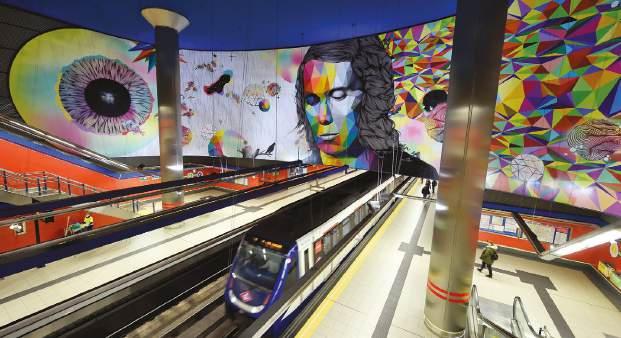
ABOVE: Spain’s Madrid Metro, pictured here at Paco de Lucía station, has trialled carrying parcels in recent years, as has India s Delhi Metro.
Tim Adams, Flickr CC BY 2.0
RIGHT: Mail Rail, the 100-yearold Post Office Railway in London, passes deep below Royal Mail’s Mount Pleasant sorting office in the UK capital. Although it closed in 2003 due to an increasing volume of parcels being carried compared with lower volumes of letters, the railway now functions as a museum. Maureen Barlin, CC BY-NC-ND 2.0
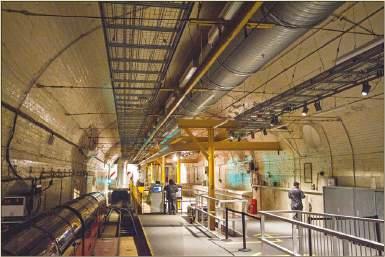
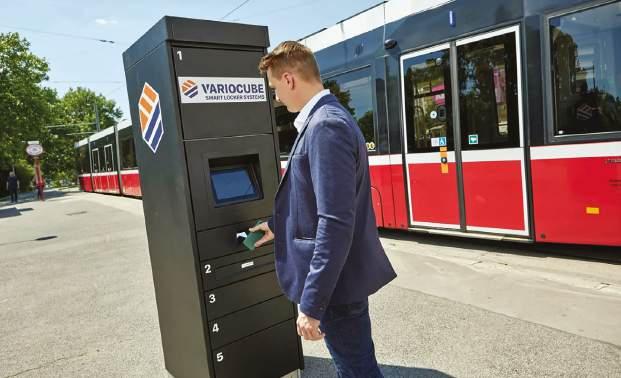
ABOVE: For eight weeks in May 2025, operator Wiener Linien conducted an experiement whereby passengers carried other people’s parcels between tram stops across Vienna, Austria’s capital city. Wiener Linien
courts, and then we have a second court and then a third court and there is a European court. So there’s absolutely no way.”
Federmann recalls that, during the third week of the trial, he had to cool Amazon’s expectations about being able to make the trial permanent.
So, what’s next for the UAS team?
“We are already talking about setting up a new trial,” Federmann says. “The next step will be setting up a business case for a city hub [which needs] an area of around 1500m 2 directly in the middle of Frankfurt.
“We are not talking about a huge thing and a huge investment. But it’s like with everything, you just need to start something, right? Just do it, like [sportswear manufacturer] Nike says!”
Whether Amazon will be involved in the next trial remains to be seen. But the key question has to be: will the concept of the parcels tram ever properly take off? Fundamentally, Federmann suggests that it could. But he says, “I think it needs to take more steps and maybe one or two more years.”
Replacement of the original fleet should be completed in early 2026 – an important but far from only significant change on this distinctive British system.
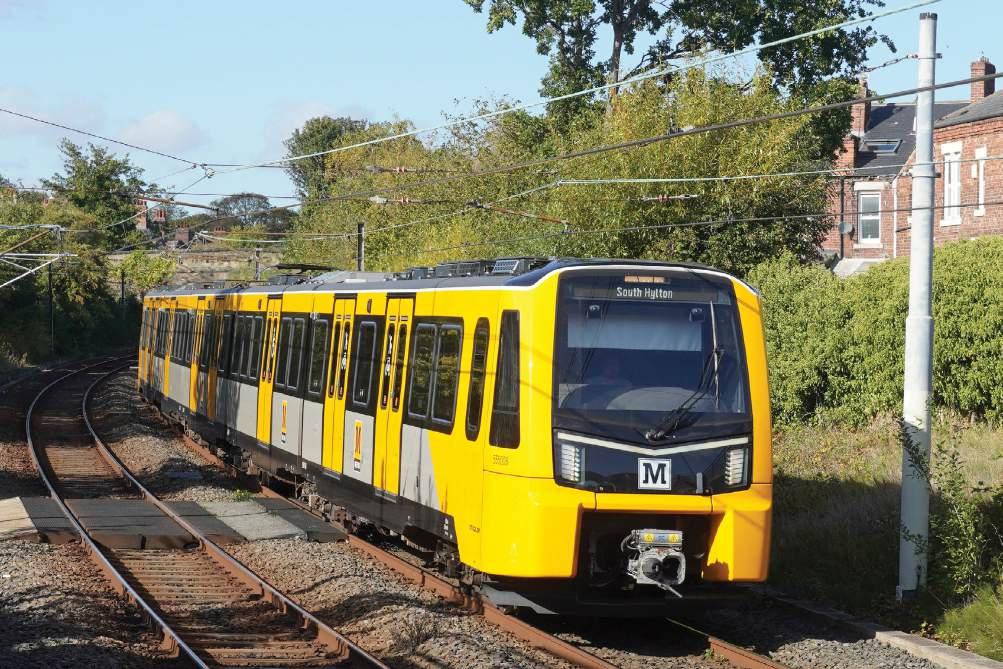
Tyne and Wear Metro (‘the Metro’) serves northeast England’s biggest conurbation on 78km (48.8 miles) of route.
In this area bordering the North Sea, the centres of its two cities, Newcastle upon Tyne and Sunderland, are about 16km (ten miles) apart. Formed from proportionally small but urbanised parts of Northumberland and County Durham, the Tyne and Wear metropolitan county was created in 1974. It was abolished in 1986 when most functions transferred to five constituent boroughs; with some restructuring, overarching transport bodies remained.
In 1996 the Tyne and Wear Passenger Transport Executive
adopted Nexus (Latin for ‘connection’) as its brand for rail, bus and ferry services. The boroughs and the two counties became part of the new North East Combined Authority in May 2024. The UK Office for National Statistics’ total estimated population (2024) was 1 178 389 for Newcastle upon Tyne, Sunderland, Gateshead, North Tyneside and South Tyneside.
The two cities both have direct rail services from London King’s Cross, with Tyne and Wear’s regional services mainly provided under the Northern brand. The Government designation of Tyne and Wear Metro as light rail may just be for statistical convenience: it is a hybrid that defies easy classification.
In revenue service since May 2025, southbound Stadler Class 555 555006 approaches West Jesmond station on 23 September 2025.
Newcastle and Gateshead each had municipal tram operations which ended by 1950 and 1951 respectively. Prompted by the early popularity of these systems, in 1904 the North Eastern Railway created a suburban network with third-rail electrification. Initially on the Tyne’s north bank and south of the river from 1938, the ‘Tyneside Electrics’ ran until 1967. Diesel replacements effectively degraded the service, something which encouraged planning for better alternatives. With economic staples and employment concentrations of engineering, mining and shipbuilding in decline, decisions were needed about how to better support more widely-dispersed activities. Campaigning and political support
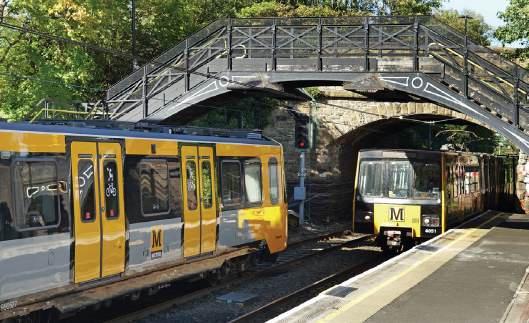
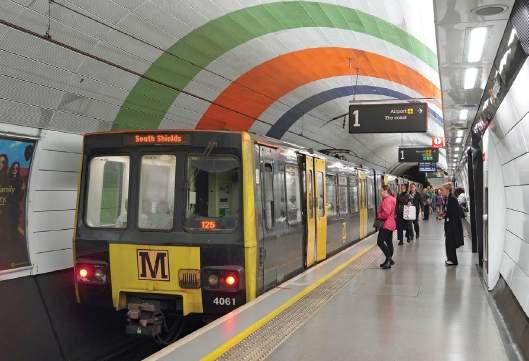
The first Stadler Class 555 to be received, 555003, arrived in February 2023, the same year as the projected service entry. Drawing upon changes in technology and customer expectations since Metrocars were designed, the Swiss-built newcomer has many differences. Unlike the Metrocar’s half-width cab, Class 555 drivers have an elevated centrallypositioned seat. The articulated five-section sets have wide gangways and (unlike Metrocars) longitudinal seating. At almost 60 metres, it is longer than paired Metrocars, have two more sets of double doors per side, reduce unused cab space and obviate couplings between units; boarding is aided by extending doorway flaps. An emphasis on open floorspace for easy circulation is supported by loading displays along each vehicle; the 600 capacity exceeds a Metrocar pair by about 100. The Class 555 has air conditioning, a high level of service information and USB charging points. Part of a general bright ambience, internal end panels featuring works commissioned from artists connected with the north-east of England and upholstery designs reinforce the Metro identity. Already relevant for emergency use and depot moves, a battery capability for 45 minutes running time may gain extra relevance for system expansion.
TOP LEFT: Old and new stock meet beneath one of the many reminders of the system’s railway origins, the North Eastern Railway footbridge at South Gosforth station.
LEFT: At the northern end of Newcastle’s main shopping district and the system’s deepest station, Haymarket has been changed substantially above and below ground since opening as a temporary terminus in August 1980.
BELOW: Spanning streets and a deep valley, the sinuous Byker Viaduct was part of the Metro’s initial system. The East Coast Main Line’s Ouseburn Viaduct is visible in the background.
“Although owing much to early railway installations, the Metro brought features new to British passenger railways.”
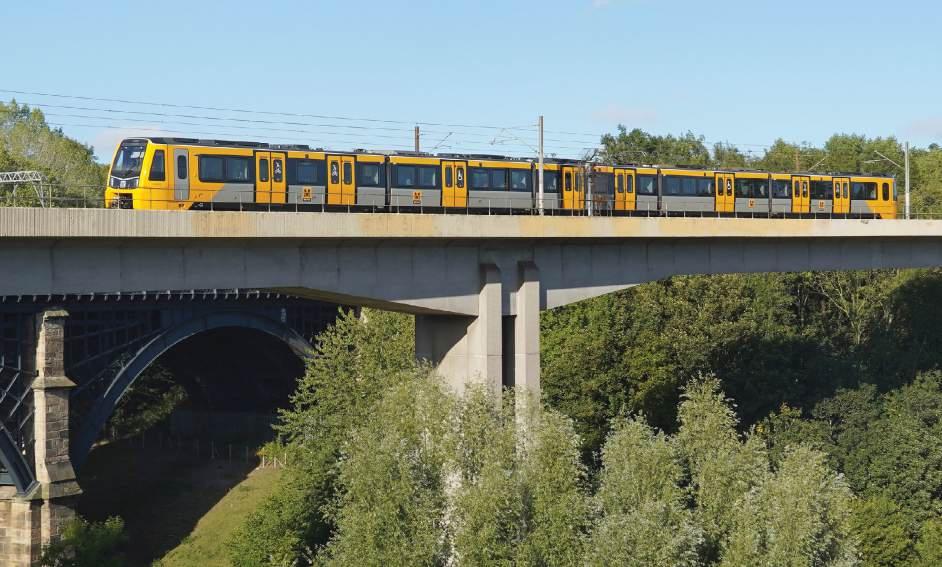
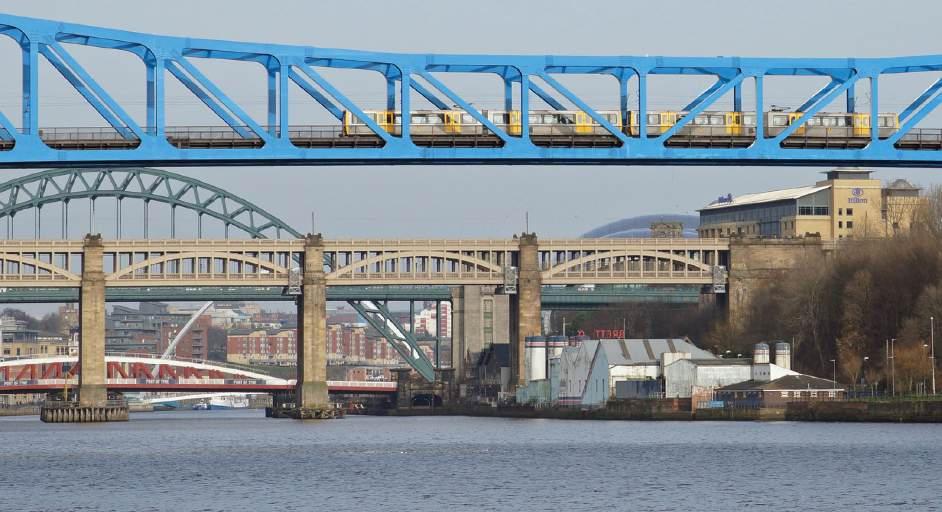
Opened: 1980
Lines: 2
Depots: 2
Approx. weekday hours: 05.30-23.45
Main line frequency: 12 minutes
Gauge: 1435mm
Power: 1500V dc overhead supply
led to the Tyneside Metropolitan Railway Act 1973.
Creating the Metro involved transfers from British Rail of some active and abandoned ‘railways known as the North Tyne Loop, the South Shields Branch and part of the Gosforth and Ponteland Light Railway’. To serve Newcastle’s commercial centre and Gateshead, about 6.4km (four miles) of new, mostly in-tunnel route was built comprising a mainly north-south axis and a shorter east-west counterpart. Tyneside Electrics used the High Level Bridge (opened 1849) to span the Tyne and the Ouseburn Viaduct (1869) for crossing the deep valley of a left-bank Tyne tributary. For Metro, these roles transferred respectively to the purpose-built 353m-long Queen Elizabeth II Bridge and the curving 815m Byker Viaduct.
The first Metro section, Haymarket to Tynemouth via Whitley Bay, opened in August 1980. The north Tyneside loop was completed in November 1982 by the Tynemouth to St James via Wallsend section. Between these stages, in 1981 came an extension south from Haymarket to Heworth, crossing the Tyne and adding Gateshead coverage. In the same year, a north-western branch from South Gosforth to Bank Foot was added, from where Newcastle Airport (the UK’s 11th-busiest by passenger numbers, 2024-25) joined the system in November 1991. The Metro reached South Shields by 1984, although taking alignments with heavy rail use
on adjacent track created limitations which would remain until 2022. Spring 2002 brought a substantial addition when Metro began using the same modified Durham Coast Line infrastructure as freight and passenger trains. This still applies between the complex junction east of Pelaw and a point just south of Sunderland’s main line station, the only one on this section used by both passenger modes. At the end of a line shadowing the River Wear along an abandoned freight route, South Hylton became the Metro’s southern terminus. Metro’s control centre was built and remains adjoining the northbound platform at South Gosforth station.
The main works, maintenance and storage facilities were installed in existing railway premises about 500m to the north. This site, which can feed stock in both directions, is parallel to tracks east of the nearest station, Regent Centre. An otherwise redundant chord between Manors and Jesmond was adopted to reduce empty stock move distances.
Although owing much to early railway installations, the Metro brought features new to British passenger railways, including being built and operated under the metric system. Directly affecting passengers were full accessibility and a nosmoking policy; it also fashioned a distinctive and strong local identity.
The Calvert typeface (named after its designer)
by
applications,
BELOW: Simonside on the South Shields line became the Metro’s 60th station when opened in March 2008. Seen on 26 February 2009, 4004+4010 carry the second Metrocar livery.
Fleet: In transition to 46
Transport body and operator: Nexus www.nexus.org.uk
Civic information: www.northeast-ca.gov.uk
Tourist information: https://newcastlegateshead.com and www.visitnortheastengland.com
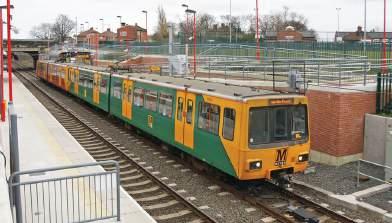

entrances effectively becoming a logo. Although the styling diluted as operations extended beyond the initial system, it has since been reinvigorated, as evidenced on the new rolling stock and in station refurbishments.
Many visitors will first encounter the Metro at Newcastle’s main line station (previously titled as Newcastle Central) where ‘Central Station’ now formally distinguishes Nexus services. In-tunnel stations vary from having platforms in paired single-bores (like Central Station), both platform faces being in a single station box (Gateshead) or like Jesmond, a cut-and cover structure with facing side platforms. Other variations are apparent around the system. Tynemouth, Whitley Bay and West Jesmond elegantly display their railway inheritance, with stations like Wallsend, Fawdon and Ilford Road being purely functional by comparison. Manors and Gateshead Stadium are amongst several stations with bunker-like styling that reflects the era of the system’s creation.
Four Lane Ends, Regent Centre, Gateshead and Heworth (also a national rail station) are major
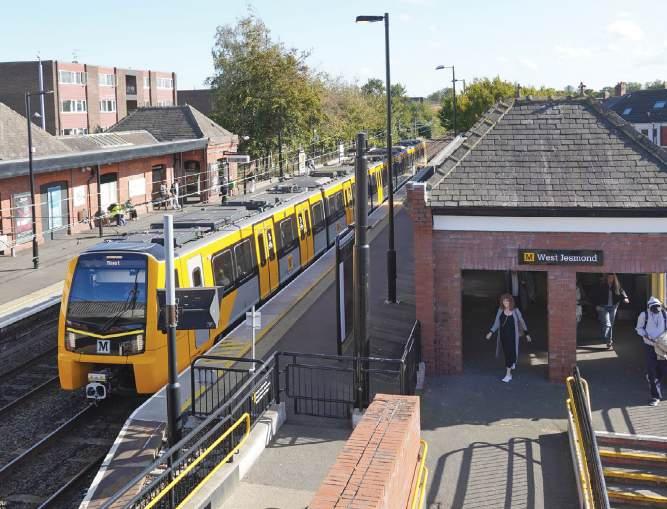
Track sharing: a Northern Class 156 with a Durham Coast service passes through the elevated St Peter’s Metro station. This is slightly closer to Sunderland’s Stadium of Light football stadium (far
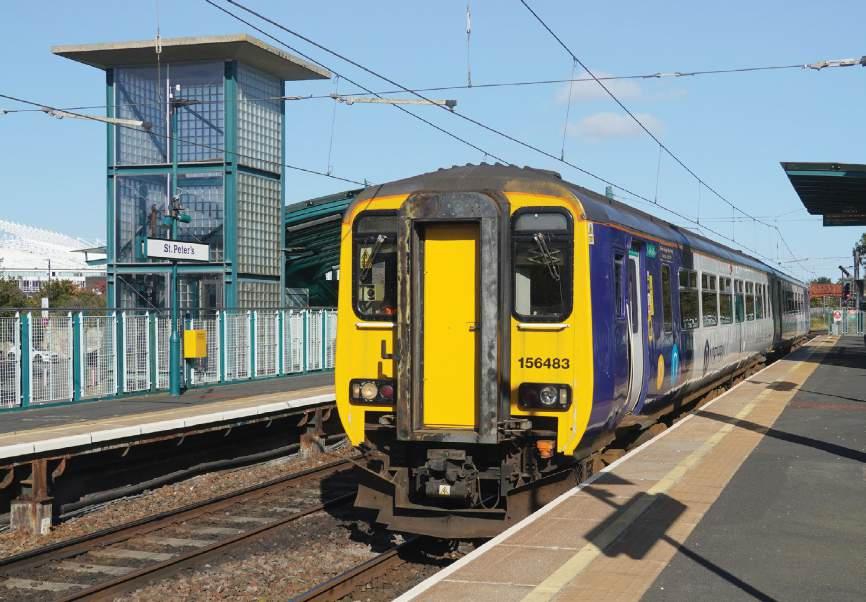
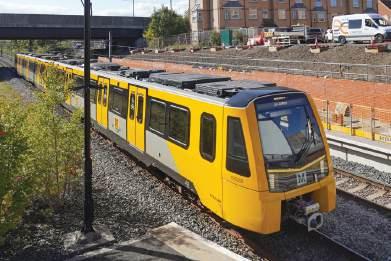
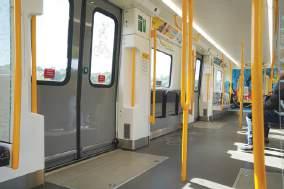
“Funding for the Metro to Washington project was announced in June 2025 – this should add three stations and around 13km.”
structures built as interchanges for an integrated metro/bus/parking network. This intent was degraded by legislation implemented in 1986 which deregulated bus services, turning them into Metro competitors rather than being complementary. This is being addressed by the North East Combined Authority, but over the long-term bus use has declined.
Current Metro coverage has been settled geographically since 2002, yet many other changes have been made. Related to housing developments, stations were added at Northumberland Park in December 2005, with Simonside becoming the Metro’s 60th station in March 2008. Major rebuilding above and below ground was completed in 2010 at Haymarket, the system’s deepest and second-busiest station. Monument has by some measure the highest passenger numbers due to it being a system intersection and being located in the central retail and entertainment district.
Under the Metro Flow project, a total of 5km (three miles) was converted from single- to double-track operation by electrifying previously freight-only South Shields line sections. Completed
in 2022, this improved service stability and gave scope for timetable changes. Responding to wider concerns over sustaining operations, central government agreed to a major signalling upgrade. In July 2025 funding for the Metro to Washington project was announced. Subject to detailed planning, this should add three stations and around 13km (eight miles). Connecting with the present system at Pelaw and South Hylton, this expansion could open in 2033. It is also a furtherance of the North East Combined Authority’s aim to bring the currently-abandoned ‘Leamside Line’ back into use. As such, any Metro presence will need to be compatible with potential restoration of heavy rail services over the full 33.6km (21 miles), effectively a supplement to – and allowing reduced reliance on – the East Coast Main Line. Direct operation of the Metro returned to Nexus in April 2017 upon expiry of a seven-year contract held by a special-purpose DB Regio subsidiary. The service consists of the Green and Yellow lines, although this distinction seems little observed beyond the Nexus system diagram, with train and platform displays giving only the
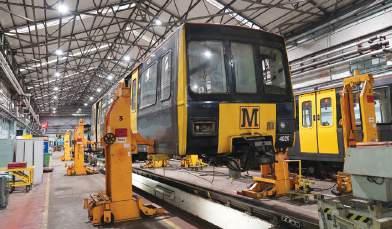
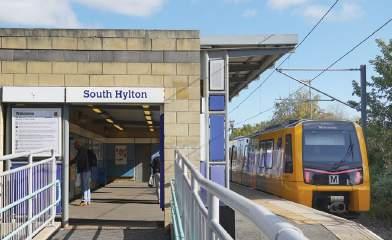
destinations or routing. Each with a mainly 12-minute interval, the two lines overlap between South Gosforth and Pelaw; the most intensive coverage consequently includes central Newcastle, the Tyne crossing and Gateshead. The Yellow line’s configuration means that a given train will pass through Monument twice between St James and South Shields, albeit on different levels. The indicated destination may change as the journey progresses: by convention, ‘The Coast’ refers to the eastern end of the North Tyne loop.
Rolling stock was purpose-designed for Tyne and Wear Metro, with 90 two-section articulated Metrocar sets supplied by Metro-Cammell in Birmingham. Prototypes 4001/02 were received for testing in 1975, with 4003-4090 built 1978-81. Mainly using paired sets, this fleet proved sufficient as the system expanded. The 2002 substantial incorporation of national rail infrastructure brought classification as British Rail Class 599, but they remain primarily known as Metrocars. When entering service they carried the cream and cadmium yellow colours and a logo as used by the already-defunct Tyneside Passenger Transport Executive. Refurbishment in the mid-1990s brought a variously red or blue or green plus yellow livery. A major upgrade from 2012 introduced a third version, mainly dark silver and black with yellow detailing. Although diminishing over the years,
RIGHT: Added in 1985, the original Pelaw Metro station was rebuilt in 2006. To its east is a junction for Metro services to South Shields and Sunderland, also for the currently unused Leamside Line, a route now projected for Metro use towards Washington.
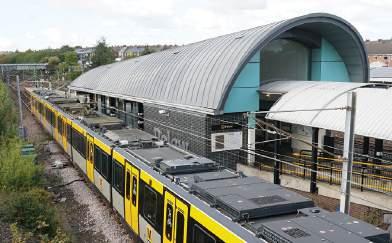
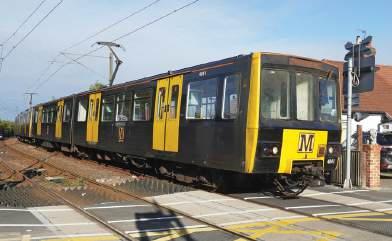
advertising, retro and other special liveries had been prominent on Metrocars
In 2020 Metro celebrated its 40th anniversary, but equally this meant that the rolling stock was already well beyond a 30-year design life. Wellregarded for proving to be suited to service demands and popular with users, growing problems with Metrocars began to compromise the service. A contract for 42 Class 555 and a new depot to maintain them for 35 years was signed with Stadler in February 2020. That October saw Stadler taking over the maintenance and the supply of stock (then all Metrocars) ready for service. This also involved taking over the Gosforth depot site. Occupying about a quarter of the previouslycovered areas, the replacement facility was specified for handling incoming Class 555. To support services during the redevelopment, a maintenance and storage area – then identified as temporary – opened in December 2020 between Howdon and Percy Main.
The Metro entered 2026 with two passenger rolling stock types, at a point by which only the new Stadler Class 555 had been intended to be in use. Delays and teething problems saw the first 555s enter revenue service in December 2024, thereby leading to continued Metrocar use. Accidentdamaged in 2017, 4022 became the first Metrocar withdrawal, with the fleet reducing significantly from 2024.
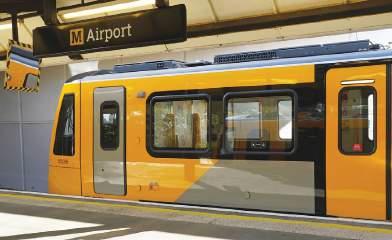
Local travel: To navigate many fare options, the Nexus website’s ‘Ticket finder’ section which covers its modes, local Northern rail services and passenger categories is recommended. Zone-based fares, with single-zone single fares from GBP2 (EUR2.27). Stored value/fare ‘Pop PAYG’ cards from Metro machines at stations. For the whole system, Shields Ferry and buses, the Tyne and Wear Day Rover (Adult) costs GBP6.80 (EUR7.73) (November 2025). Wider regional ticketing options including Metro are on https://networkonetickets.co.uk. The Metro Pop app’s ‘Track your Metro’ feature includes real-time position and direction of trains plus other service information. What is there to see? The Tyne gorge with seven bridges in contrasting styles between Newcastle and Gateshead is just one part of amongst the most striking of British cityscapes. The centrally-sited castle (www.newcastlecastle.co.uk) offers an overview which includes the famed railway junction of the Durham Coast and Edinburgh lines. Just part of the area’s transformation since the years of the Metro’s creation, former industrial quays have been brought into leisure use. The area's technological contributions are represented at the Discovery Museum; the Stephenson Steam Railway, recipient of Metrocar 4001 as a future exhibit, is on the former Metro test site. See www.northeastmuseums.org.uk for these and other collections. Impressive coastal scenery between Tynemouth and Whitley Bay, similarly north of Sunderland towards Marsden.
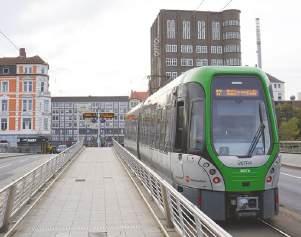
As one of the larger light rail systems in Germany, Hannover has benefited from recent fleet renewal and line extensions, as Andrew Thompson reports.
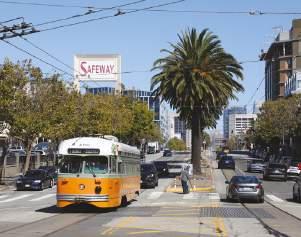
Andrew Grahl explores the San Francisco Bay Area and all of the traction highlights including San Francisco, San Jose and Sacramento.
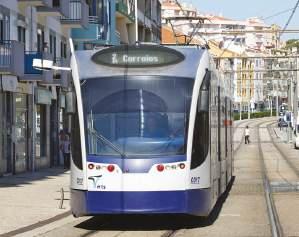
Neil Pulling heads over the River Tagus from Lisbon to explore the coverage and role of Portugal’s Metro Transportes do Sul light rail system.
+ Wheelsets and bogies
+ Classics: Grand parade of rolling stock in Poznań, Poland
+ The latest news and analysis, system and technical development

GOLD COAST. A test run was made between Broadbeach South and Miami North on 12 November, the first such run on G:link’s new AUD1.2bn (EUR677m) 6.7km (4.2-mile) extension to Burleigh Heads. R. Youl SYDNEY. Siemens has been awarded a contract to install ETCS Level 2 radio-signalling on the T1 North Shore commuter rail line. IRJ
GRAZ. Work started to double the last single-track sections of line 1’s Mariatrost arm on 3 November. Tram operation has been suspended.
The city centre bypass tramway (Jakominiplatz – Neutorgasse –Tegetthoffbrücke – Vorbeckgasse – Annenstrasse) opened on 29 November. It is used by lines 16 and 17. tramwayforum.at INNSBRUCK. Infrastructure work on the Südring ended on 14 October. Lines 1, 6 and the Stubaitalbahn have returned to their normal routes. BS LINZ. All 62 Bombardier Cityrunner trams are being fitted with new internal video surveillance systems to counter vandalism and anti-social behaviour. EB WIEN (Vienna). Trams 407/415 became the first two Flexity vehicles to enter service on line 1, on 3 November; car 422 entered service on line 43 on 20 November.
The price of the annual VOR KlimaTicket will increase to EUR1000 from 1 January (EUR700 for seniors and youths).
The mayor has ordered a review of plans for U-Bahn extensions (U2, Matzleinsdorferplatz – Wienerberg and U5 Frankhplatz – Hernals). This will focus on the projected costs (estimated at EUR5.7bn) and available budgets.
tramwayforum.at, EB BELGIUM BRUXELLES/BRUSSEL (Brussels). Line 22 is to resume its normal route via Rue du Bailli from 22 December.
Recent peak run-out has been 295 trams compared with 312 in September 2024.
Line 35 is the only one to be wholly worked by 2000-series trams. Lines 39 and 44 utilise 7700-series trams while the new 3200-series are working on lines 9 and 82. Their introduction to line 18 is imminent. T-2000 CHARLEROI. Villette metro station ceased to be used from 10 November while a year-long renovation of the viaduct to Sud station takes place.
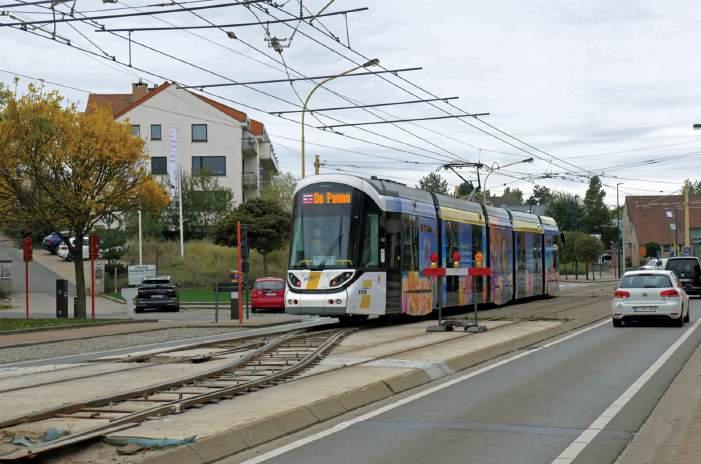
The former Anderlues tram system has been rebranded as metro line M2. BS GENT (Ghent). Plans for the new depot at Wissenhage (TAUT 1045) are in disarray after the Flemish regional administration decided to withdraw planning permission, on noise and environmental grounds. BS
TORONTO. Alstom Flexity 4662 was delivered in late October and 4663 came from Thunder Bay on 15 November. Flexity 4471 is still at Thunder Bay for repairs to flood damage.
WATERLOO – KITCHENER.
Regional councillors have voted in favour of extending the LRT line by 17km (11 miles) to Galt. skyscrapercity
SHANGHAI. Metro line 2 was extended by 1.7km (one mile) on 1 November, from National Exhibition & Convention Center to Panxiang Road. urbanrail.net
CZECH REPUBLIC
LIBEREC. Twin-axle set 351+1202 has been returned to Praha (Prague). Ex-Woltersdorf T57 27 is to operate the weekend special line during 2026. BS OLOMOUC. A tender has been issued for eight new trams. The last new vehicles were Pragoimex EVO-1s , delivered in 2023. TP PRAHA (Prague). Seven new Škoda 52T trams entered
line 12 service on 3 November. There should be 20 of these 32m air-conditioned vehicles in service by late December.
T3R.PLF 8777, officially a rebuild of 8225, entered service on 25 October. dopravek.eu
KØBENHAVN (Copenhagen). More than 15 000 passengers were carried free of charge on the Ishøj –Rødovre Nord light rail line’s first day, 26 October (TAUT 1055). HL
AL QAHIRAH (Cairo). An agreement for the fourth tranche of funding from the Japan International Co-operation Agency for metro line 4 was signed on 21 September. Line 4’s first phase will be 19km (12 miles) with 17 stations from ElMalek El-Saleh (interchange with line 1) to Giza (interchange with line 2). Eventually, it will extend to 31.8km (19.8 miles), reaching New Cairo. IRJ AL-ISKANDARIYA (Alexandria). Some of the 1982 Kinki Sharyo two-car units have been repainted blue and put into service on the El Raml line. They still work from Moharam Bek depot. RGI, BS
AJACCIO. The 3km (1.9-mile) POMA-built cableway opened on 18 October. It links Saint-Joseph with Mezzavia hospital and operates within the Corsican city’s tariff system. BS
LILLE. Testing of line 1’s new Alstom four-car metro trains started on 11 November. The initial order for 27 was placed in May 2012 and a further 15 were ordered in December 2024. The first should enter service in February and all 42 by 2028. lineoz.net LYON. Consultation has started on plans for a 17km (11-mile) tramway extension from Meyzieu to Crémieu. It could cost EUR250m and open in 2032. lineoz.net PARIS. December’s timetable change brought a takeover by RATP CAP Île-de-France of the operating contract for tram-train lines T12 and T13. A Keolis/SNCF consortium had operated them since 2022. lineoz.net
AUGSBURG. A dedicated railgrinder tram has been ordered from Windhoff to replace one built in 1996.
The new tram tunnel at Hbf is unlikely to open before the end of 2027. BS BAD SCHANDAU. Track replacement on the Kirnitzschtalbahn between the depot and Ostrauer Brücke started on 3 November. Buses have replaced trams over the whole line until completion, scheduled to be on 19 December. RVSOE BERLIN. A 900m section of line 21 was closed between Holteistrasse and Marktstrasse overnight on 21-22 November. Line 21 will operate in two sections for several years to enable track
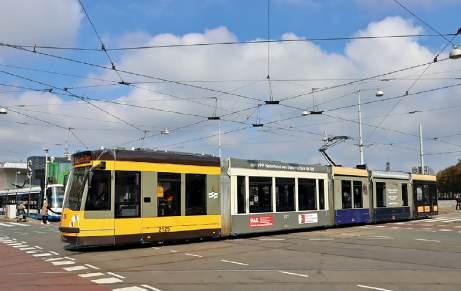
renewals in Boxhagener Strasse.
The Urbanliner trams have still to enter passenger service.
Verkehrsverbund BerlinBrandenburg fares were to increase by 6% from 1 January.
Plans to rebuild and modernise Weissensee depot have been dropped in favour of additional capacity at a new depot at Adlershof.
Line 1 will be withdrawn between Gleisdreieck and Wittenbergplatz to enable work to take place in the Nollendorfplatz tunnel. U3 is to operate Krumme Lanke – Spichernstrasse only, while U4 is to close completely 12 January-18 May.
All 140 Stadler JK U-Bahn cars were to have been delivered by the end of 2025 for service on U2.
Inauguration of S15 S-Bahn service (Wedding/Westhafen – Hbf) has been announced for 28 March. It is planned to extend the line to Yorckstrasse.
The last unmodernised Class 481 EMU was withdrawn on 30 September. BS, rbb24.de BONN. With deliveries of new Škoda trams continuing (225153, 2351-59 and 2451-63), Duewag low-floor trams 9451/55/5-61/67/69/70 have been sent to Pozna ń in Poland. BS BRANDENBURG. Škoda 48T trams were launched at a ceremony on 1 November; they entered service the following day. BS BREMEN. A parade is scheduled for 6 June to mark 150 years of tram operation. M. J. Russell CHEMNITZ. The last Tatra trams to operate in passenger service were 515/16 and 509/19 on 19 October.
A double-ended Variobahn has been repainted in the same livery as the latest Škoda trams.
Tatra T3DM 525 is being used to demonstrate SmarTram driverless technology. It has so far only been used within the depot. BS DÜSSELDORF. Rheinbahn and Alstom have agreed compensation
for the late delivery of HF6 cars and remediation of faults. The last two, 4358/59, have been made ready for delivery.
Alstom is to build a workshop facility next to Heerdt depot where repairs and overhauls will be carried out.
BS GENERAL. The Bundestag passed legislation to secure funding covering 2026-30 for the Deutschlandticket on 7 November. The 2026 price will be EUR63 per month. lok-report.de GÖRLITZ. The Sachsentram order with HeiterBlick has been cancelled. A joint tender has been issued for eight trams for Görlitz and six for Zwickau. There are options for six and 12 respectively. The tender specifies that the design should already have type approval in Germany, and be 28m-32m long and minimum 60% low-floor. They are to be ready to enter service in 2028. HeiterBlick filed for insolvency in April 2025 (TAUT 1050).
KT4D destination indicators are gradually failing due to a lack of spare parts. They are being replaced by metal signs although 2314/16 have returned to service with LED indicators. BS HALBERSTADT GT4 trams are no longer used to substitute for a Leoliner if one is being serviced; buses are used instead. BS HALLE. Stadler TINA 858 was delivered in late November. BS HAMBURG. U-Bahn services between Berne and Volsdorf were suspended from 12 October to permit bridge replacement.
New line S7 (Aumühle –Altona) is to come into effect on 14 December, while S2 now operates Bergdorf – Diebsteich. HANNOVER. A ceremony on 28 September marked 50 years of Stadtbahn operation. It included an appearance by original car 6001 and a staff reunion. BS HEIDELBERG (RNV). The last four Duewag M8C trams were withdrawn in November. DS
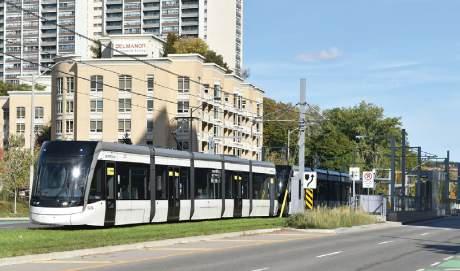
KARLSRUHE. Stadler was due to deliver the first VDV tram-trains before Christmas.
Line 3 resumed operation to Daxlanden on 15 November, after an 18-month, EUR42m renovation of 4.7km (2.9 miles) of route. BS KASSEL. Stadtbahn-M 421 and trailer 505 have been scrapped after an accident; 421’s bogies were sent to the tramway museum at Dortmund Mooskamp where they will be used to restore Essen 1101. This will return to service as Dortmund 101. With 418’s withdrawal, car 420 is Kassel’s sole Stadtbahn-M survivor. BS KÖLN (Cologne). The reopening of Mülheimer Brücke for trams on 15 September led to operational changes across the network. Lines 3 and 13 now reach Thielenbruch, while line 18 now terminates at Buchheim. Line 14 has been withdrawn. BS LEIPZIG. A timetable change on 11 November led to line 14 running to Eutritzsch, via Augustusplatz/Hbf. BS LÜBECK. Tramway proposals have been removed from the new transport development plan for financial reasons. HL-live LUDWIGSHAFEN (RNV). Planning applications have been lodged for the first tramway extensions for many years: Oppau to Pfingstweide and Rheingönheim to Waldsee. Finance is yet to be secured. BS MAGDEBURG. Alstom Flexity 1401 and 1402 were to return to the Bautzen factory in December to be brought up to series standard. Sudenburg museum depot has reopened after roof repairs. BS MAINZ. Lines 51 and 53 resumed crossing the Alicenbrücke to Lerchenberg from 27 October. Line 52 will not resume operation to Bretzenheim until March. BS MÜNCHEN (Munich). Deliveries of Siemens four-section Avenio trams continues; 2569 arrived in late October and four more are awaited.
The Westtangente tramline is to open on 27 February, subject to favourable winter weather. Line 19 is to resume operation to Pasing from 20 December. BS NÜRNBERG (Nuremburg). Line 8 was to resume operation between Hbf and Erlenstegen from 14 December.
Infrastructure work in Allersberger Allee will cause lines 6, 7 and 8 to be diverted from 23 February. BS ROSTOCK. The proposed 3.8km (2.4-mile) extension from Zoo to Reutershagen is now expected to cost EUR90m; a final decision on route and construction is to come in 2026. BS ZWICKAU. Following the cancelling of the Sachsentram order (see Görlitz), it has been decided to recruit more workshop staff and overhaul 12 Tatra KT4D trams.
EUR8.25m is being invested in modernising Schlachthofstrasse depot. BS
BUDAPEST (BKV). Delivery of 46 new CAF trams has led to the withdrawal of the exHannover series 6000 high-floor Stadtbahn cars. BS
CHENNAI. Faiveley Transport has won a contract to fit metro cars with an anti-drag safety system that will detect if clothing or other items are trapped in train doors. RGI INDORE. The Asian Development Bank is providing financial support for development of an 8.6km (5.3-mile) metro subway linking the city centre and the airport. It is hoped it can be completed by January 2030. RGI
DUBLIN. The Luas Red Line reopened between Connolly and The Point on 28 November after completion of work to repair
the fire-damaged George’s Dock bridge (TAUT 1055).
CAGLIARI. The 4km (2.5mile) Gennari – Caracalla section of line 1 reopened on 27 October after four years of track-doubling work. TR NAPOLI. The first Bozankaya tram was delivered on 21 November. urbanrail.net
TRIESTE. Reports were emerging as this issue closed for press that the Opicina tramline had closed again, apparently for technical reasons. BS
RIGA. Operator R īgas Satiksme is carrying out market consultation prior to issuing a tender for 24 new trams and 100 trolleybuses. TP
LUXEMBOURG
LUXEMBOURG. Festivities marking the succession of Grand Duke Guillaume on 4 October included eight trams. They conveyed guests from Kirchberg to Pont Grand-Duchesse Charlotte. T-2000
AMSTERDAM. Line 26 resumed operation to the front of Centraal Station from 10 November. However, an alternative terminus is set to come into effect again from April.
CAF trams are receiving remedial work to their motor bogies. As a result, blue-andwhite cars have appeared on line 25, where the trams usually carry R-net livery. OR DEN HAAG (The Hague). Leyenburg turning circle was removed in September, so line 6 trams now turn at De Uithof. OR ROTTERDAM. Following the completion of track relaying on Erasmusbrug, lines 3 and 5 resumed their normal routes from 6 October.
Cars 523+1020 and 834 operated special service 22 (Centraal Station – Hillegersberg) during a museum open day on 4 October. OR
GORZÓW WLPK. A PLN140m (EUR33m) contract was signed with PESA on 20 November for seven new 26m Twist trams. J. Carpenter POZNA Ń The first of 24 exBonn low-floor cars to appear on the network was 971. Formerly Bonn 9460, it ran during the 23 November jubilee parade. Delivery of double-ended Moderus Gamma trams 941-962 has permitted high-floor Moderus
Alfa 150-3/79/80 and 22 Konstal 105Na to be withdrawn.
The last 105Na trams are to be withdrawn by 31 December. BS WARSZAWA (Warsaw). The 50th anniversary of the Konstal 105N tram was marked on 11-12 October by the operation of eight on special line 50.
The 160th anniversary of tramway operation is expected to be celebrated on 16 June, with festivities to include a parade of old and new trams. BS, M. J. Russell WROCŁAW. PESA delivered the first of 16 146N Twist 100% lowfloor trams on 21 October.
The first of six Škoda 19T vehicles to be modernised by Saatz was presented to the media on 31 October. They now have air-conditioning. TP
ARAD. The latest Astra Imperio low-floor trams to be delivered are 2430-47. DS
RUSSIA
KALININGRAD. Work has started on a RUR22.6m (EUR250 488) project to provide platforms and new shelters at tram stops. Replacement of tyres on 126 Korsar trams is underway.
Track reconstruction at the Basseynaya end of route 5 was due to be completed by 31 December. J. Carpenter MOSKVA (Moscow). Crosscity line T1 began running on 13 November. This 27km (17-mile) line (Universitet –Metrogorodok) aims to offer metro-like performance thanks to reserved tracks and a six-minute headway. It uses line 90’s new tramway along Akademika Sakharova, which opened in September.
A second, similar line – T2 – is expected to open in May. At 33km (20.5 miles), it will link Chertanovska metro station to Novogireyevo commuter rail station. UTM
YEKATERINBURG.
Uraltransmash 71-415M 996 is on trial. It is a single-ended, low-floor bogie tram. transphoto.org
SOUTH KOREA
SEOUL. A ground-breaking ceremony for the northern branch of the Ui light metro took place on 24 November. The 3.9km (2.4-mile) line could open in 2032. skyscrapercity
SPAIN
PALMA – SÓLLER. The 914mmgauge interurban railway is closed 24 November-1 February for maintenance. Tranvía de Sóller also closed, but is due to reopen on 21 December. Mallorca Magazin
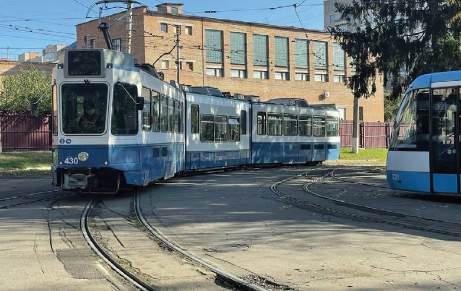
BASEL. Baselland Transport (BLT) line E11 (Wettstein – Messe – Dreirosenbrücke – Wiesenplatz) became line 12 on 27 October.
BLT plans to introduce limitedstop S-Tram route 17 in 2030 running between Rodersdorf and Badischer Bahnhof. Line 10 will then be cut back to Ettingen.
Tram stops at Marktplatz are to be rebuilt with new platforms to permit level boarding. While the work is carried out (29 June6 September), trams will not run Barfüsserplatz – Schifflände. DS, BS BERN. Stadler delivered car 901 on 2 October. A total of 27 of these single-ended Tramlinks will be used on line 9. BS YVERSON – STE-CROIX (TRAVYS). A new passing loop is to be installed at Six-Fontaines to permit a half-hourly service to be introduced, while maintaining connections at Yverdon. EA ZÜRICH. Fares were to increase by 2.1% from 14 December but, thanks to a city subsidy, a CHF365 (EUR392) annual ticket is to be introduced.
Delivery of Alstom Flexity trams had reached vehicle 4085 by the end of October.
Tram-2000 2054/57/65/73/78 and motorised trailers 2418/20 were to be withdrawn with the 14 December timetable change. lok-report.de
ADAPAZARI. Work is due to start in December on the 12km (7.5-mile) tramline from Sakarya Atatürk stadium to the university via the city centre.
ABU DHABI. Expressions of interest have been invited for the design and construction of a 20km (12-mile) tramway. Line 4 could connect Yas Island to Al Raha Zayed International Airport by 2030. A track-free system has not been ruled out. RGI
BLACKPOOL. Use of HMS Blackpool on Heritage Illumination Tours was to continue into 2026. It was to make three round trips on Friday and Saturday evenings until 3 January (26-27 December excepted).
BRADFORD. Redevelopment of Forster Square station has been put on hold to enable West Yorkshire Mass Transit to be incorporated into the scheme. Surveys are to take place into how WYMT might interface with the station.
CROYDON. The Rail Accident Investigation Branch has recommended that Network Rail take inspiration from light rail crossings in order to improve safety at rural foot crossings. The recommendation was made as part of a report into a fatal incident at a railway crossing at Kenley in January 2025.
GLASGOW. Gibson’s Engineering, which took over the former Caledonian Railway St Rollox works in 2021, has despatched its first overhauled vehicle: London Underground ‘Rail wagon’ RW815. This is the first of 23 wagons being overhauled by Gibson’s for Transport for London.
INDUSTRY. Matthew Wright has been appointed the Light Railway Safety & Standards Board’s new Standards Manager.
NOTTINGHAM. Nottingham Express Transit has reported a 17% increase in customer satisfaction in 2025 compared with 2024. A recent survey of 1200 people put satisfaction levels at 85%.
SHEFFIELD. Supertram fares will be frozen from 1 January, with prices aligned with local bus services. An Adult Long Distance Supertram single fare will actually reduce in price from GBP3.40 (EUR3.88) to GBP3 (EUR3.42); a child fare remains at GBP1 (EUR1.14).
A year-long, GBP12.8m (EUR13.7m) programme of track renewals ended on 31
October. Contractor VolkerRail has renewed 3.8km (2.4 miles) of rail while 4.6km (2.9 miles) of polymer sealant around the rails has also been replaced. The end of these works was marked by the launch of a new tramway advertising campaign. Social media content has been complemented by radio advertisements, billboards alongside major roads, and mobile advertising vans.
STOURBRIDGE. Pre-Metro Operations has named Class 139 139001 ‘The Stourbridge Lion’, in honour of the West Midlands-built locomotive that became the first to run in the USA in 1829. Classmate 139002 was named ‘George The Station Cat’ in August.
TYNE & WEAR. Nexus had originally hoped that half its Stadler Class 555 fleet would be in service on the Tyne & Wear Metro during 2025. This has been exceeded: 24 of out of the order for 46 are now operational. More than half the fleet of Metrocars have now gone for scrap.
Buses replaced Metro services between Regent Centre and Airport on 26-30 November to enable track to be renewed at the Ponteland Road bridge.
Wolverhampton St George’s reopened on 17 November. Trams last left this terminus in 2023, to permit redevelopment of Wolverhampton Station stop. Departures from Wolverhampton now alternate between the two.
Testing and driver training has started on the extension to Millennium Point. Passengers on some services towards Edgbaston Village have been asked to alight in order for drivers to access the extension from the delta junction in Corporation Street. An opening date has yet to be announced.
The Massachusetts Bay Transportation Authority board has received USD850m (EUR734m) from the Commonwealth Transportation Fund to improve safety and reliability. This includes renewing the Green Line subway signalling system as well as work to accommodate new Type 10 cars. J. May
CHARLOTTE, NC. A November referendum resulted in approval of a sales tax increase from 7.25% to 8.25% to fund a comprehensive transportation
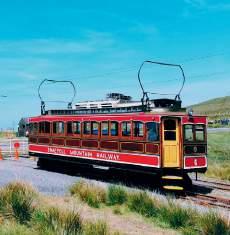

plan, with 40% going to rail-based expansion. This will include a commuter rail service, Silver Line light rail to Bojangles Coliseum, a Blue Line extension to Pineville, and Gold Line Streetcar expansion to Eastland Community Transit Center. J. May DETROIT, MI. The People Mover was closed 10-22 November to permit installation of a new turnout. A study is in progress to determine the line’s future. J. May HUDSON–BERGEN, NJ. NJ Transit has issued a Request for Proposals for a contractor to prepare the Draft Environmental Impact Statement for the 16km (ten-mile) light rail extension from Tonelle Ave to Englewood Hospital. It will have seven stations. J. May
NEW YORK, NY. The Metropolitan Transportation Authority Board has approved the purchase of 378 R268 subway cars from Kawasaki rail for USD1.5bn (EUR1.3bn). Due to be delivered from autumn 2028, they are to replace the R68 fleet. Mass Transit NEW YORK – NEW JERSEY (PATH). Fares are planned to increase to USD4 (EUR3.45) in 2026. The revenue is to be used to improve services, with daily operation of all lines and a boost to the number of rush-hour trains, plus advanced technology to combat fare evasion. PATH PHILADELPHIA, PA (PATCO).
A USD1.34m (EUR1.2m) rail-grinding project is underway on the 22.7km (14.2-mile) line. Night services are suspended until March. J. May PORTLAND, OR. The last Type 6 LRV, 627, arrived on 20 November. By that time 22 had entered service. Only 11 Type 1 cars remain in service.
The long-delayed request to tender for new Portland Streetcar trams with off-wire capability was issued on 30 October. It is for up to 15 cars.
S.J. Morgan SALT LAKE CITY, UT. TRAX has exercised its option for a further 20 Stadler Citylink LRVs, bringing the total on order to 40. J. May SAN FRANCISCO, CA (Muni).



Memorial Stadium, where the Washington Commanders National Football League team is due to play in future. J. May
MUSEUM NEWS
ANTWERPEN (BE). SNCV metre-gauge HL steam tram 1000 has left Groenenhoek museum to join the ASVi collection for restoration to working order; HL 1066 has arrived from Schepdaal museum to replace it. BS
COATBRIDGE (UK). Restoration of Glasgow Coronation Car 1245 at Summerlee Heritage Centre is expected to be completed in 2026. Seats are being fitted to the lower deck while air-braking pipework is being installed.
CRICH (UK). The Tramcar Sponsorship Organisation is to fund the overhaul of Johannesburg 60. This was built by United Electric Car Company in Preston and shipped to South Africa in 1906. Repatriated in the 1960s, it last worked at Crich in 2012.
ENSCHEDE (NL). Tram 1 of the Twentsche Electrische Tramweg Maatschappij was unveiled by the mayor on 15 October after restoration as part of the city’s 700-year celebrations. The tramway closed in 1933, but the body of 1908-built 1 survived as a garden house. A new truck was fabricated. BS LOWESTOFT (UK). The top deck of Glasgow 488 has been secured to the bottom deck, a significant step in its restoration at the East Anglia Transport Museum.
NÜRNBERG (DE). After five years of restoration work in both Kraków and Nürnberg, Zeppelin bogie tram 144 of 1909 was unveiled at St Peter museum depot on 15 October. BS
More than three months after the last use of Breda LRVs in service, 1534 returned for a farewell run on 12 November. It operated on the J Line. S.J. Morgan TYLER, TX. This east Texan city is exploring alternatives to the car to support its growth and is examining the possibility of running light rail on disused freight rail lines. A feasibility study is being carried out, as is public consultation. J. May WASHINGTON, DC. Metro is launching a study on how best to serve the Robert F. Kennedy
Worldwide items for inclusion should be sent to Michael Taplin at Flat 8, Roxan Villa, 33 Landguard Manor Rd, Shanklin, Isle of Wight PO37 7HZ, UK. Please fax: +44 (0)1983 862810 or e-mail miketap@mainspring.co.uk UK and Ireland items, please e-mail uknews@lrta.org.
Acknowledgements are due to Blickpunkt Straßenbahn (BS), dopravek.eu, Drehscheibe (DS), Eisenbahn (EB), Eisenbahn Amateur (EA), HL, HL-live, International Railway Journal (IRJ), lineoz.net, lokreport.de, Mallorca Magazin, Mass Transit, Op de Rails (OR), PATH, Railway Gazette International (RGI), rbb24.de, RVSOE, skyscrapercity, Today's Railways (TR), tramwayforum.at, Tram-2000 (T-2000), transphoto.org, Transport Publiczny (TP), urbanrail.net, and Urban Transport Magazine (UTM).
UKTram reflects on the lessons from 2025, and looks ahead to what 2026 promises.
As the UK’s representative body for light rail, UKTram is proud to reflect on a fantastic year of progress and collaboration across the sector. As it looks toward 2026 and beyond, UKTram says the industry is entering a new phase of maturity.
Last year, the organisation delivered record levels of engagement, hosting its highest-ever number of Functional Group meetings and Best Practice Days. Member participation has grown significantly, enabling more consistent knowledge sharing and problem-solving across the network.
The year also saw UKTram host its largest Annual Summit to date, with record-breaking attendance and a strong focus on sector-wide strategy.
UKTram has continued to play a leading role in raising the profile of light rail through active involvement in government initiatives, including the Integrated Transport Plan. Constructive engagement with ministers, the Department for Transport, devolved administrations and officials has helped secure record levels of investment and reinforced the sector’s contribution to public transport initiatives.
Across the country, operators, suppliers, promoters and local authorities have responded to rising demand and new expectations.
Passenger journeys in England reached 231.2 million, with journeys outside London rising by 6% and vehicle miles growing by 4%. Passenger revenue also increased by 6%, signalling renewed confidence in the sector and an encouraging shift towards more sustainable public transport.
Realisation Value of GBP4.3m (EUR4.9m), achieving a Value for Money ratio of over 7:1 and a Return on Investment of 7.17. These figures reflect not only efficiency but the benefits of collective effort and shared expertise across the sector.
As we move into 2026, we do so with a renewed sense of direction and a sharpened focus. Key priorities for this year centre on three interconnected trajectories: applying lessons from recent years; delivering the next phase of sector transformation; and shaping the long-term future of light rail through the emerging 2040 & Beyond Strategy.
Consistent functional group activity, rigorous best practice exchange and sector-wide collaboration have created a strong foundation. The challenge now is to translate that accumulated knowledge into tools, standards and support frameworks that enable networks to operate more efficiently and more flexibly.
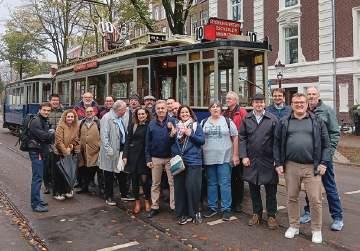
Behind these operational indicators sits a sector working more collaboratively than ever. UKTram’s partnerships continued to evolve, with strengthened relationships across Transport Scotland, Transport for Wales, the Department for Business & Trade, the Treasury and Combined Authorities, and new collaborative frameworks with the Rail Forum, Permanent Way Institution, Campaign for Better Transport, Urban Transport Group and the LRTA.
International engagement remained strong, with outputs from global events feeding directly into UK workstreams. This, combined with improved international data access through Rail Intel, broadened the sector’s collective intelligence and reinforced a shared ambition for a more connected, insight-led industry.
Progress in equality, diversity and inclusion also continued to build, supported through our partnership with Men for Inclusion and the strengthening of Women in Transport engagement.
And within UKTram itself, delivery remained focused and disciplined. Out of all commitments set for 2024-25, only three required revised timelines due to unavoidable data and resource constraints, while 100% of innovation targets were met. Sector growth objectives were achieved and new development priorities have been identified for the year ahead.
Perhaps most notably, the value delivered for members and the wider industry has been significant. On an operational budget of under GBP600 000 (EUR682 800), UKTram delivered a Sector
As new technologies mature, we are seeing greater interest from operators and suppliers in areas such as asset management, obsolescence solutions, smarter maintenance approaches and integrated mobility design. With this in mind, 2026 will see a continued push on digital transformation, innovation and evidence-led advocacy. The next phase of growth will be determined by how effectively the sector embeds these tools and learns from shared experience.
While 2025 was certainly a year of practical delivery, 2026 will focus on the future vision. Work on the 2040 & Beyond Strategy is already shaping the conversations we are having with members, government and our partners in the transport ecosystem.
This long-term vision is designed to help the sector look at immediate challenges and structural trends that will define the future, everything from decarbonisation pathways and local authority reforms to multimodal integration, scheme development and skills needs.
In essence, the future of light rail relies on a balanced approach: drawing from the experience of the past, applying it to present-day challenges and using that momentum to drive innovation and expansion for the future. This philosophy is embedded in UKTram’s mission and reflects our core aim: to maximise the growth, performance and benefits of the sector, while ensuring that light rail becomes the natural choice for sustainable, connected, thriving cities.
Reflecting on the year, James Hammett notes: “2025 showed what our sector can achieve when collaboration is consistent, and our collective purpose is clear. For 2026, our focus is firmly on supporting the next phase of growth, shaping long-term strategy and ensuring the sector is ready for the opportunities ahead.”
With a strong foundation and a shared sense of purpose, LRT enters 2026 poised to adapt to and shape the future.
Late summer and autumn brought a series of events marking tramway anniversaries in Amsterdam. The Dutch city’s offerings were more modest than September’s lavish event in Praha, but not without interest. Mike Russell reports.
The year just closing was one of anniversaries for the Amsterdam tramways. It marked 150 years since the first horse-drawn tram line was introduced, 125 since the start of electric tram service, and 50 since the founding and commencement of operation by the local tramway heritage organisation, the Stichting Electrische Museumtramlijn Amsterdam (EMA). The coincidence of these anniversaries offered the prospect of a big celebratory occasion, although the scale and scope was perhaps disappointing.
The sesquicentenary of tramway operation fell on 2 June, marking the date when the Amsterdamsche Omnibus Maatschappij) (AOM) launched its first horse-tramway line in the city; the company had three years earlier begun operations with an initial horse-drawn omnibus line. Then on 14 August came the 125th anniversary of the opening of the city’s first electric tram line. Finally, the weekend of 27-28 September was selected as that on which the foundation of the EMA would be marked.
Gemeentevervoerbedrijf Amsterdam (GVB), the local tramway operator, no doubt fully occupied with its regular daily business, indicated to EMA representatives that it would be welcome if the EMA was able to organise a tramcar parade on the Saturday or Sunday. In many ways this was a real accolade for the local group, even if GVB had made it clear that it lacked the time and resource to organise such an event itself. However, even with this promising overture the museum group was unable to offer more than a one-line demonstration run of several of its historic Amsterdam cars.
Held on the exact anniversary of the launch of electric tram service, the 14 August event may have been low-key but was far from being without interest. The route chosen was between Van Hallstraat (the traditional name of the current Westergasfabriek terminus) and Frederiksplein, describing a broad arc around the western part of the city close to the Southern and Western Canals along Nassaukade, Marnixstraat and Weteringschans. Amsterdam city is surrounded by a network of ancient canals, giving the townscape and the tramway a distinctive character, and this special route provided the opportunity for residents and visitors to sample what it was like to travel in a typical Amsterdam tramcar of yesteryear. The service was fare-free but passengers were invited to make a donation. Although initially disrupted by a traffic incident, the timetable was nominally every 15 minutes,
for which four cars or tram-sets were required. These were 144+663, 465+731, 602 and 794. Because the event had attracted minimal publicity, passengers who chose to travel had no difficulty in obtaining a seat.
Operation of a special service 11.00-17.00 over former line 16 was the major event of the weekend of 27-28 September. Line 16 was a victim of service cuts in recent years, although the track (no longer used for regular passenger service) remained intact for depotconnection use. The number of cars required to maintain this service was much greater than for the August event.
Additionally, Schörling railgrinder Rr3 of 1928, now owned by the Tramweg Stichting and on permanent loan to the Openluchtmuseum in Arnhem, returned to Amsterdam for the festivities and was repainted in its 1970s orange livery by the Utrecht tram workshops.
Frequency was nominally every ten minutes, but anyone familiar with traffic conditions in Amsterdam will readily understand how easily even the bestconstructed timetable can become disrupted, especially when a significant portion of the route is laid as street track. The service started from the eastern terminal loop at Centraal Station and travelled via Damrak, Dam and Rokin to Muntplein, where regular lines 4 and 14 diverged. This left 16 to travel via Vijzelstraat, Vijzelgracht to Weteringcircuit, and then south along Ferdinand Bolstraat to Albert Cuypstraat, and on via Cornelis Krusemanstraat to Stadionweg. In its last stages the line passed Haarlemmermeer Station, home of the EMA museum tram line, where the terminal arrangements have been subject to modification in recent years owing to widespread redevelopment; in turn this led to the thinning-out of the formerly extensive collection because of severe accommodation restrictions. Most of the tramcars from operators outside the Netherlands have found new homes, and although the extent of the previous collection was nothing if not cosmopolitan, it now has a more distinct emphasis on Dutch rolling stock generally, and that from Amsterdam in particular.
Car 144 is the oldest electric motor car in the EMA fleet, having been built by Raab with Union electrical equipment in 1904 and displayed in the National Railway Museum at Utrecht from 1950 to 1999. Its Werkspoor trailer car (663) dates from 1913.
Car 307 is a Werkspoor-built vehicle of 1910 fitted with SSW electrical equipment;
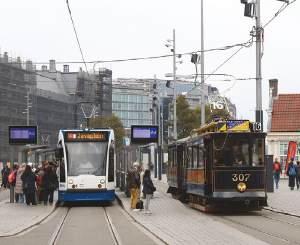
it was originally delivered as a trailer and motorised later. Its trailer was 792, another Werkspoor product but dating from 1918. It was formerly 882 and the body is mounted on the chassis of flat wagon H13.
Car 401 is the first of the inter-war delivery of rolling stock – in this case from Werkspoor in 1929; cars of this type were still in service until 1968. It hauls trailer 946, a classic centre-entrance Allan product of 1930. Beijnes supplied several trailers in 1929; car 465 was one and together with others was motorised in the 1930s. It hauled Werkspoorbuilt trailer 776 of 1914.
Trailer 748 is one of a group of Werkspoor cars of 1916, and for the September event was hauled by motor car 1236, delivered in 1913 as 236. All the aforementioned trams were of double-ended two-axle configuration, but after World War Two Amsterdam displayed a preference for three-axle cars and motor car 909, built by Werkspoor in 1949, is one such. For the September event it hauled trailer 987, a Werkspoor product of 1950.
We now move to more recent deliveries, rolling stock which does not really look out of place even after some 65-plus years. The oldest is six-axle Beijnes class 2G two-section articulated car 586 of 1959, in the grey and white livery characteristic of early deliveries, representing a stark contrast with the earlier dark blue. Class 3G car 602 dates from later in 1959 and in the latter-day yellow livery comes next, followed by 9G car 794 of 1979 built by Linke-Hoffman-Busch and class 12G car 820 of 1991, a Holec/BN product. These modernlooking articulated cars were in service until recent years.
Operation on Sunday 28 September was quite different, with historic motor buses and a smaller-scale operation on two routes.
Coming so soon after another tramway parade organised by one of Europe’s great city tramways, the Amsterdam event fell rather short. Adverse comparisons were drawn with the Praha (Prague) event one week earlier and the overall feeling seemed to be that if Praha could start planning for its extravaganza in 2021, surely Amsterdam could have done better than it did – as indeed it had for the electric centenary in 2000. Still, it was good to see so many veteran cars out on the city tracks carrying good loads of passengers, adding a sparkle of tramway heritage to the enduring high life of this Dutch city.
With thanks to Maurits van den Toorn for additional reporting.
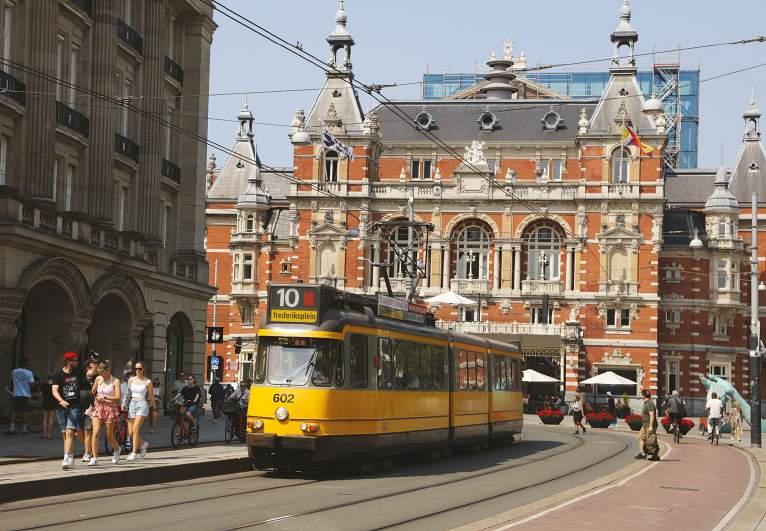
2
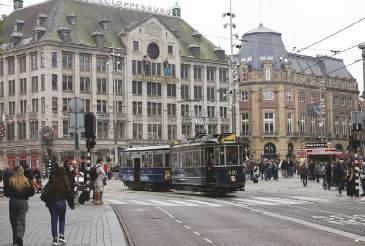
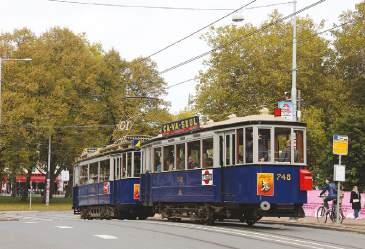
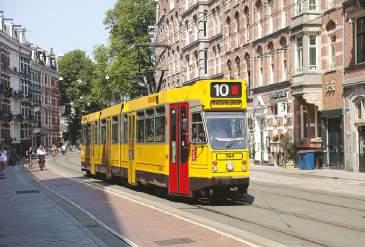
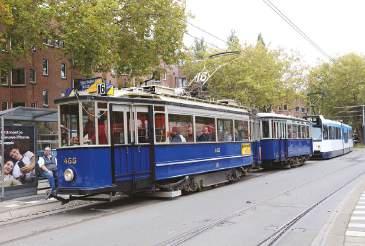
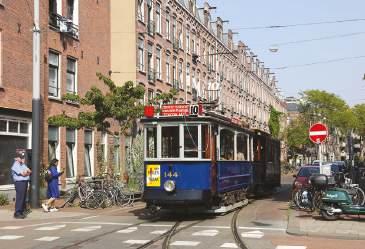
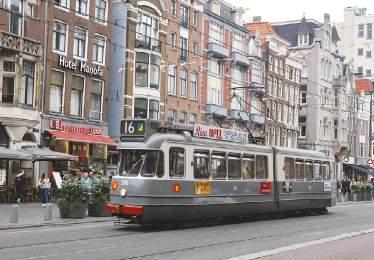
1. Although the advertised service on recreated line 16 finished at 17.00, there were a few later journeys to cater for passengers who needed to return to the station. Werkspoor motor car 307 and trailer 792 stand on the eastern loop at Centraal Station alongside Siemens Combino 2102.
2. Seen at Leidseplein during the August electric centenary service is Beijnes-built class 3G car 602, a three-section version completely different stylistically from the 2G class that arrived only a few months before in 1959.
3. Werkspoor motor car 401 and Allan two-axle centreentrance trailer 946 pass through the important city centre junction at Dam during the September EMA 50th anniversary service.
4. The loading point at Haarlemmermeerplein for recreated route 16, with Beijnes-built motor car 465 of 1929 and trailer 776 about to depart for Centraal Station. BN/Holec car 820 with low-floor centre section is about to draw up to the loading point.
5. Trailer 748 and motor car 1236 are descending the ramp from the canal bridge at Weteringlaan en route for Centraal Station on the September service.
6. One of the oldest motor car and trailer sets in the Amsterdam heritage fleet is currently 144, seen here hauling trailer 663 at Van Hallstraat terminal loop on the centenary service in August 2025. The Werkspoor motor car dates from 1904 and trailer from 1913.
7. Class 9G three-section articulated car 794 was a product of the LinkeHoffman-Busch works and, with preceding class 8G, represented a major change of supplier for GVB. It arrived in 1979 and was withdrawn in 2016. Here it is operating one of the duties on the August service in Leidestraat, amongst classic Dutch architecture.
8. Once a familiar sight in Amsterdam, this representative of class 2G articulated cars is seen in Dam on the September line 16 service. It dates from 1959 and was built by Beijnes. It was later rebuilt with a third (centre) section but has been restored as originally built.
All photography by Mike Russell on 14 August and 27 September 2025.
Dave Andrews explains why trams can form an important part of the mayoral offering.
Metro mayors and council leaders are often warned that backing a modern tram system is ‘political suicide’. The fear is that construction disruption, cost headlines, and vocal opposition will cause them to lose the next election. The available evidence does not support this fear.
Where tram projects are competently managed and clearly linked to wider city goals, they tend to become political assets rather than liabilities. This article examines three contrasting cases to demonstrate that even where construction problems occur, the political consequences are manageable, and that well-delivered trams can become sources of civic pride and electoral advantage.
Metro mayors operate on relatively short electoral cycles, but must make long-term infrastructure decisions. A modern tram system typically requires a multi-year construction period followed by decades of operation. The common political concern is: ‘If I start digging up streets for trams, I’ll be voted out before they ever run.’
This fear is reinforced by media focus on construction disruption and cost overruns, particularly following Edinburgh’s wellpublicised difficulties. However, closer examination of the evidence reveals a more nuanced picture: voters punish incompetent delivery, not the existence of tram infrastructure itself.
Jon Collins served as Leader of Nottingham City Council for 16 years (2003-19), during which he championed both phases of the Nottingham Express Transit (NET) system. Line 1 opened shortly after he became Leader; he then led the successful bid for Lines 2 and 3, which opened in 2015.
Crucially, Collins stepped down on his own terms in 2019, stating “I always think it’s a shame when politicians hang on to power until the bitter end... I want to go out at a time that suits me”. He was not voted out over the tram – he chose to retire after successfully delivering a major expansion of the network.
Collins explicitly contrasted Nottingham’s success with failed tram bids elsewhere:
“Leeds and Liverpool both wanted a tram system like ours, but because their councils kept changing party control they never got it”. Political stability enabled long-term infrastructure planning; the tram then
reinforced that stability by demonstrating competent delivery.
The NET system is now routinely cited as part of Nottingham’s economic and environmental success story. Academic evaluations describe it as successfully integrated into local planning, supporting development corridors, park-and-ride, and access to employment. Nottingham was named as one of the UK’s top places to live partly because of its ‘good public transport, including the city’s tram service’.
Edinburgh: Surviving controversy
Edinburgh is often named as the UK’s cautionary tale. The project suffered significant cost overruns (from GBP490m/ EUR557m to nearly GBP1bn/EUR1.14bn), was three years late, and delivered only 75% of the originally-planned route. Political disputes between parties over whether to proceed, scale back, or cancel the scheme generated sustained media criticism.
The project became so controversial that a public inquiry was established in 2014 –an inquiry that took longer than the delayed tram construction and cost over GBP11 million (EUR12.5m).
Despite this near ‘worst-case’ scenario in delivery, the Edinburgh tram did not become permanently toxic. Once operational in 2014, ridership exceeded predictions and customer satisfaction scores were consistently high . By 2015, support for completing the original route had recovered sufficiently for the Council to commission a case for extension.
In March 2019, Edinburgh Council voted 36:26 to approve the GBP207m (EUR235m) extension to Newhaven. The Transport Convener stated: “This is a crucial decision for Edinburgh – for today’s residents and for generations to come... I firmly believe the tram project is in the best interests of the city’s current and future residents”.
The Newhaven extension opened on schedule in June 2023, and in August 2025 a further north-south extension entered public consultation. Edinburgh’s tram network continues to expand under successive administrations.
Even when construction problems generated major controversy, successive councils chose to proceed and then extend the system. Process failures are politically painful, but the idea of modern tram infrastructure is not electorally toxic once operational.
Strasbourg: An electoral platform Strasbourg’s modern tramway, launched in the 1990s, is widely seen as a flagship of European tram renewal. Catherine Trautmann made the tram central to her political programme when she was elected as the first female mayor of Strasbourg in 1989. She was re-elected in 1995 while the tram system was being built and expanded.
The tram formed part of a wider urban transformation, including pedestrianisation of the historic centre and redevelopment of key corridors. Rather than suffering at the polls for supporting the tram, Trautmann saw the network become a source of civic pride and international reputation. Strasbourg’s tramway is now frequently cited in urbanplanning literature as a successful example of combining transport and place-making.
Across France, new tramways have often been delivered as explicit mayoral campaign commitments. Over 20 French cities have built new tram systems since the 1980s, driven by mayors who made projects central to their electoral platform and then delivered them. The pattern is the opposite of UK fears: delivering a visible, high-quality tram becomes proof of competence and ambition, helping rather than harming re-election prospects.
Evidence from Edinburgh suggests that voters object to construction pain and cost overruns, not to the long-term existence of tram infrastructure. Once operational, the tram becomes part of normal life and can even turn into a symbol of improvement.
In Nottingham and Strasbourg, trams are tied to themes that poll well with urban electorates: reliable modern public transport, cleaner air and climate responsibility, better access to jobs and education, and attractive public spaces. When a tram is framed as part of a credible vision for city prosperity and liveability, it supports rather than undermines the mayor’s political narrative.
Metro mayors are increasingly judged on their ability to deliver improvements in transport and growth. For growing cities with housing pressures, the greater risk may be continued congestion and poor public transport, failure to meet climate obligations, and being perceived as ‘timid’ or unable to secure investment. A well-managed tram project can be framed as decisive leadership; avoiding big projects can look like drift.

Order online from www.lrta.info/shop – or by post from:
LRTA Publications, 38 Wolseley Road, SALE, M33 7AU (Please provide telephone contact details and quote LRTA membership number if applicable)
Outside UK = Airmail to Europe (includes all of Russia) / Surface mail to rest of world; Airmail Zone 1 = outside Europe excluding Australia, New Zealand & USA; Airmail Zones 2/3 = Australia, New Zealand & USA
The popular annual review of developments in the low countries and the rest of Europe, covering all network and rolling stock changes with superb photographs. Extra section on trams in Africa. Dutch text.
> A5 softback; 276 pages, 275 colour pictures. £27.00 (UK); £32.50 (outside UK); £35.00 (Airmail Z1); £37.50 (Airmail Z2/3); LRTA Members: £2.70 discount
The first in a series of three books covering many of the tramways and electric light railways operational in Spain in the mid-1950s.
> A4 hardback, landscape format; 144 pages, fully illustrated in colour throughout.
£42.50 (UK); £54.00 (outside UK); £66.00 (Airmail Z1);
£67.50 (Airmail Z2/3); LRTA Members: £3.90 discount

The second in our new series of colour albums covering the historic Lisbon, Porto and Sintra tramways plus the new Metro do Porto and Metro Transportes do Sul light rail networks introduced in 2005/07.
> A4 hardback, 144 pages, 287 colour pictures plus 16 maps.
£33.50 (UK); £40.00 (outside UK); £47.50 (Airmail Z1); £52.50 (Airmail Z2/3); LRTA Members: £3.00 discount
This fascinating book details all the UK tram schemes that failed to see the light of day.
> A4 softback; 192 pages; 116 colour and 119 black & white pictures; 117 maps.
£23.00 (UK); £30.00 (outside UK); £37.50 (Airmail Z1); £42.00 (Airmail Z2/3); LRTA Members: £2.00 discount
I tram di Milano – Immagini a colori (1954-1978)
Third in the series of colour albums exploring the fascinating combination of urban and interurban tramways in and around Milan. The variety of rolling stock is amazing and is richly illustrated. English and Italian text.
> A4 hardback, 144 pages, 176 colour pictures plus two maps.
£33.50 (UK); £40.00 (outside UK); £47.50 (Airmail Z1);
£52.50 (Airmail Z2/3); LRTA Members: £3.00 discount
A comprehensive review of the tramways and trolleybuses of Japan with superb track maps for every system. Details of the car types operated and the routes on which they run are covered. English and German text.
> A4 softback; 272 pages, 423 colour and black & white pictures, 48 track maps.
£36.50 (UK); £46.50 (outside UK); £56.50 (Airmail Z1); £61.50 (Airmail Z2/3); LRTA Members: £3.25 discount
For further details of all these books go to our website.
Wednesday 14. Sussex 19.40. Tony Gwyther: Urban rail transport in present day Paris. Southwick Community Centre, Southwick, BN42 4TE. Contact: sussex@tlrs.info. GBP2 visitors. (TLRS)
Saturday 17. Taunton 14.00. Local
AGM followed by show and tell. West Monkton Village Hall, Monkton Heathfield, TA2 8NE Contact: westofengland@tlrs.info. GBP2 inc. light refreshments. (TLRS)
Monday 19. Liverpool 19.30. Brain Yates and Brian Robinson: Lancaster, Morecambe, Huddersfield trams. Sefton Park Community Association,
3 Croxteth Drive, Liverpool L17 3AG merseyside@tlrs.info. Cost GBP4. (TLRS)
Saturday 31. Nottingham 14.00. Area AGM followed by modelling session. Beeston Scout Hut, NG9 1GA. Contact: chair@tlrs.info. (TLRS)
Saturday 31. Garstang 14.00. Arthur
Dawson: Swiss city trams recently in Bern, Basel, Geneve. St Thomas Church Hall, Garstang PR3 1PA. Contact: northlancs@tlrs.info. Small fee GBP3 and refreshments. (TLRS)
The BIGGEST YEAR in our history.
The STRONGEST PROGRAMME we’ve ever delivered.
The event the ENTIRE SECTOR is talking about.

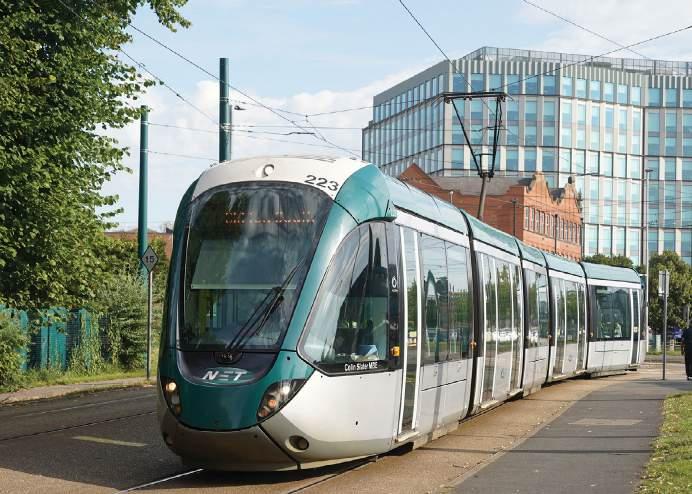



Be part of the milestone year that brings the entire UK light rail community together.
For our 20th anniversary, we’re returning to Nottingham Trent University, where it all began. We’re bringing a fresh new look inspired by sustainability, innovation, and the future of green transport.
This is your chance to:
• Build powerful relationships with UK and international leaders
• Hear industry-shaping insights from the people setting the agenda
• Discover new tech, solutions and suppliers
• Position your organisation at the heart of the next decade of light rail
This isn’t just another conference, it’s the UK’s most influential light rail gathering, trusted for two decades by operators, suppliers, policymakers, innovators and solution providers.