April TAUT - digi issue-compressed

Page 1


CONTENTS

Celebration for opening of Eglinton line.

NEW TRAM ORDERS 2026 128

Mike Taplin presents a somewhat more positive analysis of tram orders for the year ahead, with an uptick for the order books.

ASSET MANAGEMENT SYSTEMS 134

Tim Kay presents a case for better integrated asset management systems, beginning with: what actually are they?

UKTRAM: SHARED EXPERIENCE 137

Chelsea Branch considers how broadening UKTram membership helps to create a stronger platform for shared learning.

VIENNA: A GROWING GIANT 139

The latest two projects have strengthened this LRT giant, as Andrew Thompson finds.

NEW GROUND FOR COPENHAGEN 141

The return of light rail to the Danish capital marked two ‘firsts’ for the country.

IS NOW THE TIME FOR CAMBRIDGE? 144

Richard Foster uncovers the latest plans for an LRT network in this UK city.

SYSTEMS FACTFILE: LISBON 147

The hilly topography in this Portuguese city poses a challenge to public transport –yet 2027 will see the system add to its light rail network. Neil Pulling finds out more.

WORLDWIDE REVIEW 152

New Alstom cars unveiled for Santiago.

CLASSIC TRAMS:

SEASHORE TROLLEY MUSEUM 156

In his tour of the US, Mike Russell visits the country’s oldest tramway museum.

Going underground – will it ever be affordable?

There are often major obstacles in the way of expanding an inner-city tramway. How do you create extra capacity on routes that are victims of their own success?

Planners often turn to the idea of tunnels, and their brief isn’t hampered by small details such as the stratospheric cost.

As you can read in this issue, Greater Manchester, UK, is musing over how to cope with swelling numbers on its core lines, with what it describes as “considering an early feasibility study to confirm a subsequent strategic outline case” (how vague can you get?), for three tunnels to double service frequencies. There’s no need to set money aside for construction just yet then. The middle of the 21st Century maybe?

We have visited the idea of tunnels several times before, and many can recall the time-wasting exercise in Birmingham, the UK’s second-largest city, two decades ago. Politicians spoke of emulating London’s large-scale underground heavy metro. The studies (and eye-watering cost estimates), set back development of the conventional, common-sense Metro street-running scheme, and of course came to nothing. It’s even worse in Bristol, where the endless discussion about undergrounds, metro and light rail has led to nothing apart from a couple of new heavy rail suburban stations. The result is ever worsening road traffic chaos, clogging up twisting, narrow streets for most of the day and night.

On another tack, you will be heartened to read that world tram builders are buoyed by a year-on-year increase of orders to a total of 6656 vehicles, but their optimism may not last because governments seem to be tightening their belts in a world that is becoming more of a tinder box by the day. Better public transport inevitably slips down the list of priorities. Matt Johnston, Editor

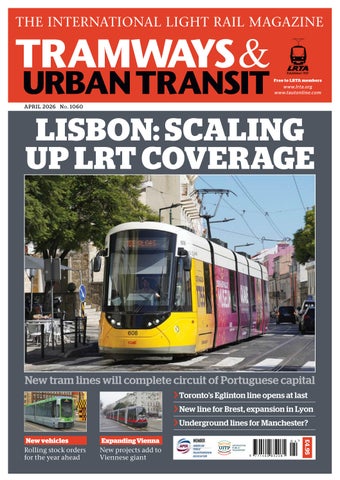
COVER: Advertising a museum based on the 1755 earthquake and tsunami that literally reshaped Lisbon, CAF Urbos 608 heads west at Largo da Princesa (Belém) on 5 October 2025. Neil Pulling

APRIL 2026 Vol. 89 No. 1060 www.tautonline.com

EDITORIAL

EDITOR – Matt Johnston matt@mainspring.co.uk

ASSOCIATE EDITOR – Tony Streeter tony.streeter@mainspring.co.uk

WORLDWIDE EDITOR – Michael Taplin miketap@mainspring.co.uk

SENIOR CONTRIBUTORS –Howard Johnston , Neil Pulling

WORLDWIDE CONTRIBUTORS

Richard Foster, Andrew Grahl, Andrew Moglestue, Herbert Pence, Mike Russell, Nikolai Semyonov, Alain Senut, Andrew Thompson, Witold Urbanowicz, Bill Vigrass, Thomas Wagner, Philip Webb.

PRODUCTION – Lanna Blyth Tel: +44 (0)1733 367604 production@mainspring.co.uk

DESIGN – Debbie Nolan

ADVERTISING

COMMERCIAL MANAGER – Geoff Butler Tel: +44 (0)1733 367610 geoff@mainspring.co.uk

Tramways & Urban Transit

13 Orton Enterprise Centre, Bakewell Road, Peterborough PE2 6XU, UK

Tramways & Urban Transit is published by Mainspring on behalf of the LRTA on the third Friday of each month preceding the cover date.

LRTA MEMBERSHIP (with TAUT subscription) Tramways & Urban Transit is sent free to all paid-up members of the Light Rail Transit Association.

LRTA WEBSITE AND DIARY Tim Kendell webmaster@lrta.org meetings@lrta.org

SUBSCRIPTIONS, MEMBERSHIP AND BACK ISSUES LRTA Membership Secretary (Dept T06), 38 Wolseley Road, Sale M33 7AU, UK. Tel: +44 (0)117 951 7785 membership@lrta.org Website: www.lrta.org FOR CORPORATE SUBSCRIPTIONS VISIT www.mainspring.co.uk

LRTA REGISTERED OFFICE 13 Orton Enterprise Centre, Bakewell Road, Peterborough PE2 6XU, UK Private company limited by guarantee, No. 5072319 in England and Wales.

LRTA CHAIRMAN – Paul Rowen chair@lrta.org

© LRTA 2026

Articles are submitted on the understanding they may also be used on our websites or in other media. A contribution is accepted on the basis that its author is responsible for the opinions expressed in it, and such opinions are not those of the LRTA or Mainspring. All rights reserved. No part of this magazine may be reproduced or transmitted in any form by any means, electronic or mechanical, including photocopying, recording or by any information storage and retrieval system, without prior permission in writing from the copyright owner. Multiple copying of the contents of the magazine without prior written approval is not permitted.

PRINT

The Manson Group Limited, St Albans, Herts AL3 6PZ

The official journal of the Light Rail Transit Association
Neil Pulling
Leif Jørgensen,

Škoda delivers Italian trams

Škoda Group unveiled the first of ten new 33.5m 49T ForCity Classic trams to representatives from the Italian city of Bergamo at its test track in Plze ň on 17 February. Škoda won the contract in July 2023 to supply the trams for Bergamo’s second, under-construction 1435mmgauge tramline.

These 100% low-floor, fivesection, double-ended vehicles are designed to carry up to 281 passengers (66 seated). They have a maximum design speed of 70km/h (43mph) and are the first Škoda trams fitted with anti-collision systems from new. They also boast retractable access ramps that are deployed automatically. All are to be delivered this year and a new depot to house them is being built at Petosino.

“The delivery of the first tram… represents a major milestone towards the activation of the new line and a further step forward in developing increasingly sustainable and efficient mobility for our region”, said Gian Battista Scarfone, CEO of Bergamo’s tramway operator Tramvie Elettriche Bergamasche (TEB).

Bergamo operated a tramway from 1884 to 1958 and then reintroduced trams in April 2009. An initial 12.5km (7.8mile) line used the alignment of a former railway between the city’s station and nearby Albino. AnsaldoBreda supplied 14 trams.

Construction of the second line, the 11.5km (seven-mile) T2 to Villa d’Almé, started in 2024. It is to share 2.5km (1.5 miles) with the existing route as far as a junction at Via Fratilli Bronzetti.

The new line will be flanked by a 10km (six-mile) cycle path and is to serve seven park-and-ride sites. It should open this summer.

Canada’s Eglinton Crosstown finally opens

Toronto light rail line starts running amidst calls for enquiry

The 15-year saga of Canada’s Eglinton Crosstown project came to an end on 8 February when the first public services ran between Mount Dennis and Kennedy station in Scarborough. There was no official opening ceremony, but free travel was offered on the first day. Wellwishers braved temperatures as low as -15oC to become the first passengers on a line that was initially proposed in 2007.

Construction started on the 19km (12-mile), 25-stop 1435mm-gauge route in 2011; it was due to open six years later. What is officially Line 5 Eglinton is owned by Metrolinx and operated by the Toronto Transit Commission. Maintenance is the responsibility of the Crosslinx consortium that built the line.

Bombardier delivered 76 lowfloor 31m Flexity Freedom Light Rail Vehicles in 2019-21. Based at the Mount Dennis depot, these run back-to-back, in coupled pairs. The 24 trains in service currently provide services at headways of 4-6 minutes. There is as yet no late evening service

– but a full timetable is due to implemented in May.

End-to-end running time is 55-59 minutes, giving an average speed of 28km/h (17mph).

Rolling stock is fitted with automatic train control for use on the 10km (six-mile) subway between Laird and Mount Dennis, where speeds can reach 80km/h (50mph).

Line 5 features interchanges with subway Line 1 at Eglinton and Cedarvale, and with Line 2 at Kennedy. On-board fare payment is not available;

passengers tap-on at platform machines, while machines are available for single-ride tickets.

News outlet The Albertan has reported a growing demand for a public enquiry into the project, the cost of which rose from CAD9.1bn (EUR5.6bn) to CAD13bn (EUR8bn).

Despite the problems encountered in delivering Line 5, it is hoped to extend the route west by 9km (5.6 miles) from Mount Dennis to Renforth Drive. The CAD4.7bn (EUR3bn) project could open by 2031.

Will trams be returning to Baku?

A five-line tram system has been proposed as a way to ease traffic congestion and pollution in Azerbaijan’s capital Baku. The scheme was unveiled in mid-February by the Minister for Digital Development & Transport, Rahman Hummatov. Hummatov said that work on

the first line is already underway and all five lines should be operational in 2030.

The first line will link Mehdiabad in the north via Binaqadi to 28 May Square in the city centre. It will include one interchange with the metro and another with the commuter rail

network. Estimates identify a possible reduction of more than 20 000 car trips along the route.

A second line could serve the Seabreeze district. Details of the remaining three lines have yet to be revealed.

A foreign consultancy will be appointed to design the network, while Azerbaijani Railways would operate it.

“There are several leading companies worldwide that build this type of infrastructure, including companies from China, Europe, and other countries”, Hummatov said.

“The goal is to select the most suitable proposal for us through a transparent tender once a fully detailed project is prepared.”

Baku’s tram system was horsedrawn from 1889 until electrified in 1924. It closed in 2004.

A metro has operated since 1967 and now comprises a 40.7km (25mile) network with 27 stations.

Don Valley is one of the subway stations on the Eglinton Crosstown line.
I. Folkard
The first Škoda tram for Bergamo on the Plzeň test track. Škoda Group

Manchester considers underground rapid transit to relieve congestion

Feasibility studies recommended for ways of relieving Metrolink congestion

Transport for Greater Manchester Network Director Chris Barnes has recommended that the Bee Network Committee commit GBP375 000 (EUR430 477) to studies into creating three Rapid Transit tunnels under the UK city. The Transport Infrastructure Pipeline report, presented by Barnes on 29 January, said that the funds would “cover early feasibility and demand studies to inform a subsequent Strategic Outline Case for tunnelled metro in Greater Manchester”.

Austin selects construction contractor

The city of Austin in Texas (US) has selected Austin Rail Contractors (ARC) to build its first light rail line, with construction due to start in 2027. Chosen after a competitive procurement process, ARC is a joint venture between Stacy Witbeck and Sundt Construction.

Pre-construction activity worth USD60m (EUR50.8m) is to start imminently.

The 15.8km (ten-mile) 15-stop line from 38th St to Oltorf/ Yellow Jacket should carry passengers by 2033. Further extensions are planned, north to Crestview and south to the airport.

ARC is to carry out all infrastructure and signalling works, including building an operations and maintenance facility. A tender for vehicles is to close in March.

Investigating underground solutions to enable “faster, more frequent and higher-capacity rapid transit services” formed part of the Greater Manchester Rapid Transit Strategy, published in July 2024. Barnes and his team have recommended building three new tunnels:

• Metrolink relief tunnel: Running southwest – northeast, this would shadow Metrolink’s Altrincham and Bury lines and could double the capacity of the network. According to the report: “Even after longer, walkthrough vehicles are implemented across

the Metrolink network as part of the ‘Next Generation Vehicle’ roll-out, the system’s capacity is still likely to be exceeded by midcentury.”

The existing surface network would then be used by Metrolink services not diverted through the new tunnel.

• High-capacity railway tunnel: This northwest – southeast axis tunnel would be aligned with the Castlefield Corridor and Salford Crescent – Piccadilly heavy rail lines. The report describes this tunnel as delivering “highfrequency, high-capacity

Mayor Kirk Watson said: “Austin is building the transportation system our growing city demands. Selecting a construction partner is a major step forward in delivering the voter-mandated transit system and will provide infrastructure careers for thousands in our region.

“This milestone reflects real progress towards improving mobility, supporting the long-term affordability and strengthening our economy.”

Nearly 60% of Austin respondents voted for a light rail system in a November 2020 referendum. The Federal Transit Administration permitted the scheme to go to advanced design and utility relocation stages in January (TAUT 1059).

services using an approach similar to the Paris RER, the Munich S-Bahn and London’s Elizabeth Line”.

• All-new underground metro: Not connected to either the heavy rail network or Metrolink, this “wholly segregated underground metro” would run north – south on an axis not currently served by the light rail system. It would connect the proposed Northern Gateway development near Rochdale to Manchester Airport “via a number of hospitals, universities and associated facilities”.

West of England transit optimism

West of England Mayoral Combined Authority (UK) has said that it plans to “commence delivery” of its first mass transit routes “within 4-5 years”. This is part of its West of England Transport Vision, unveiled on 11 February.

Described as building ‘A Transport Network You Can Trust’, the document includes developments to the road network and improving active travel, bus and heavy rail networks, as well as introducing some form of mass transit.

While artworks accompanying the launch depicted an LRV outside Bristol Airport, the document said that the form of mass transit selected depends on “what best meets the characteristics of each corridor: trams, rail, metrobus, guided buses, or other options”.

This network would connect “key corridors and growth zones, such as Central Bristol & Bath, Severn Estuary, Somer Valley, the North Somerset Growth Gateway and the West Innovation Arc”.

The report adds: “The right answer for each place will depend on several factors, including physical road space, costs, travel demand, and scale of growth planned for the area.

WEMCA has chosen two European cities as inspiration for its transport strategy: Toulouse in France and Malmö in Sweden.

A map of the planned light rail line in Austin. ATP

Sarajevo protests after collision

A fatal tram accident on 12 February resulted in street protests by student bodies from the University of Sarajevo. According to news outlet Balkan Insight, the protestors called for a “fully transparent investigation” and “the immediate withdrawal of all unsafe and outdated trams from service until they are properly repaired”.

The protests resulted in the resignation of Senad Mujagic, director of the Bosnian capital’s tram operator GRAS, on 16 February.

A 23-year-old man lost his life when line 1 Tatra K2YU 516 derailed and demolished a waiting shelter. Other people were injured.

All remaining K2YU trams were immediately withdrawn.

The Canton Prosecutor’s Office is carrying out an investigation. It has been revealed that the driver’s licence had expired in 2023 and the on-board video recording was not working.

New line opens in Brest…

Second tramline set to open for harbour city in Brittany

Brest’s second tramway opened on 14 February, with two days of free travel on the 5.1km (three-mile) line B between the Gare Gambetta SNCF and Hôpital de La Cavale-Blanche. Running via the University of Western Brittany campus, the new 11-stop line has an

interchange with the 14.3km (8.9-mile) Line A at Place de la Liberté in the city centre.

There is also a physical link between Lines A and B to permit trams on the new line to reach the system’s depot. Operated by RATP Dev, the existing fleet of 20 Alstom Citadis low-floor trams was boosted with eight more

Bremen uses new AI tram security system

Bremer Straßenbahn (BSAG), the public transit operator in the northern German city of Bremen, is using a system called AI Watch to detect potential security problems inside its trams. By the end of the year, BSAG plans to equip a third of its fleet with the software, which was developed in collaboration with the Bremen-based company Add AI.

With 37m trams, interior visibility for drivers is restricted. With this in mind, the AI Watch system will carry out real-time analysis of video images from

interior cameras and identify potential threats.

The system has been ‘trained’ using specially staged scenarios such as physical altercations and aggressive behaviour. Over four hours of footage was uploaded to the system. Should AI Watch be triggered, the relevant image is transmitted live to the BSAG control centre for assessment and response.

Germany’s Federal Ministry of Transport has covered the bulk of the EUR500 000 cost of developing the system and the subsequent trial on one vehicle.

32.5m cars built in La Rochelle in 2025-26 as part of a joint order with Besançon and Toulouse. Line B has end-to-end running times of 17 minutes; 25 000 passengers/day are expected. Work started in March 2023 and it has cost EUR225.5m to build.

Situated on France’s western coast, Brest had a first-generation tramway system from 1898 until it was destroyed by bombing in 1944. The city ran trolleybuses from 1947 until 1970.

The BHNS (Bus à Haut Niveau de Service) bus line D also started operation on 14 February. This runs on 4.3km (2.7 miles) of reserved way between Gare Gambetta and Lambézellec.

“The Brest network is a prime example of a metropolitan area transforming its mobility and committing to a shift in how people use transport”, said Matthieu Pouchard, Brest Line B Project manager at SYSTRA France’s Urban team (DPU).

Warszawa unveils new digital depot

Poland’s largest and newest tram depot has adopted software allowing the automated planning of vehicle movements.

Online at Tramwaje Warszawskie’s Annopol depot in Warszawa (Warsaw) since February, Peak Mobility’s PEAK. DMS depot management system selects trams for specific duties, while vehicles returning to the depot are sent for servicing and maintenance.

Opened in October 2024 (TAUT 1045), Annopol can look after 150 trams.

Peak Mobility said: “A higher

degree of automation in the washing facilities and the integration of diagnostic and measurement values optimise vehicle utilisation and increase operational safety”.

Installing the system involved fitting 84 radio-frequency identification aerials, 66 sensors, 272 track circuits and five induction loops to facilitate automatic control and monitoring of points and signals. All entry and exit points are connected to the system to avoid bottlenecks, and real-time data is available to the control room.

One of the new Alstom Citadis on Brest Line B. D. Cormier
Annopol depot now runs in automated mode. TW
Interior of a Bremen Siemens Avenio with security cameras. BSAG

… and Lyon extension completed

New section of T6 opens in France’s third city

Brest was not the only French city to open new tramway infrastructure on 14 February. Lyon did the same with the expansion of line T6 by 5.4km (3.4 miles) from Hôpitaux Est-Pinel to La DouaGaston Berger. The seven-year project has cost EUR175m.

The extension crosses T3/T7 at Gare de Villeurbanne and meets T1/T4 at La Doua, as well as having an interchange with metro line A at Gratte-Ciel. It boasts ten new, fully-accessible stops.

A through journey on the whole 12.1km (7.5-mile) T6 from Debourg to Hôpitaux Est takes 43 minutes and a ten-minute service is provided (04.30-00.50). It is expected that the opening of the extension will add 55 000 passengers/day to T6’s patronage.

In readiness for the expansion, Alstom supplied additional Citadis 402 trams 908-47 in 2024-26.

Axel Sabouret, T6 project manager at operator Sytral, said: “The extension marks the end of a project that was the subject of a long phase of studies, two consultations and a public inquiry, followed by three years of work.

“This tramway fits into a constrained urban environment, with streets that are sometimes narrow. We had a particular challenge of limiting land expropriations but also of preserving as much as possible the lives of residents and shopkeepers during the works. More than 5000 trees were planted along the tramway alignment.”

Work starts on new VLR track…

Colas Rail UK’s Urban Division has begun installation of the second Coventry VLR test track. Approval for the 800m twintrack line between Coventry Station and Coventry University Technology Park was approved in December (TAUT 1058).

Unlike the 220m section that was tested in 2025 (TAUT 1051), the new line will operate in a ‘live’ environment, interacting with traffic and traffic lights. Meanwhile, VLR Programme Director Nicola Small told council members in January that enquiries about using VLR technology have been received from afar afield as Canada and Australia.

She said, “[We] are trying to work very closely with South Yorkshire, who have a renewals programme, which would give us

an ideal opportunity to test the universal slab in Sheffield.”

The Coventry VLR team revealed to delegates at the 2025 UK Light Rail Conference that they believe that the speciallydeveloped VLR slab system could take heavier trams than those developed under the VLR scheme; Sheffield operates the heaviest trams in the UK.

Funding for the new test track was approved at a West Midlands Combined Authority board meeting on 13 February.

This involves drawing GBP50m (EUR57.3m) from the 2027-32 Transport for City Regions payment from the UK Government in order “to allow critical development activity to be commissioned for these projects… where the delivery timescales are particularly tight.”

Opening of the T6 extension is not the end of Lyon’s light rail development: two further lines are still under construction. These are the 11.3km (seven-

…as funding released for Eastside extension

Part of the Transport for City Regions GBP50m (EUR57.3m) funding will be allocated to developing the West Midlands Metro’s Eastside Extension beyond the HS2 terminus at Curzon Street to the Sports Quarter. This is a GBP100m (EUR119m) redevelopment east of Digbeth that centres around the construction of a new 62 000-seat football stadium due to open in 2029.

Mayor Richard Parker said that fans deserve “modern, reliable and affordable public transport to get them to and from their stadium on matchdays –so we have made these projects a priority and provided the funding to get them started straight away.”

He added: “This funding means we can complete essential design and survey work at an earlier stage and be ready to get spades in the ground next year.”

The contract for taking the Eastside Extension from Millennium Point to Curzon Street was awarded to Colas Rail (TAUT 1059).

mile) T9 (Croix-Luizet – Vaulxen-Velin) and the 7.8km (4.8mile) T10 (Halle Tony Granier – Vénissieux). Both are expected to open in 2027.

New trams for Sofia

The Bulgarian capital of Sofia has advertised a tender for up to 80 new 1009mm-gauge trams. Of these, 20 will be double-ended and 60 single-ended. The initial order is for 40 trams.

The tender also includes construction of a new depot at Banishora, crew training, and 30 years of maintenance.

Saudi metro progress

A design and consultancy tender has been issued for a 35km (22-mile) metro Blue Line linking Jeddah’s King Abdulaziz International Airport and the Haramain High Speed Railway station. It is to have 15 stops.

The Saudi Arabian project was first proposed in the 2010s but its scope and costs resulted in the scheme being paused.

Brazilian metro openings

A pair of Brazilian metro systems opened on 9 February. In Belo Horizonte, 440km (273 miles) north of Rio de Janeiro, line 1 was extended west by 1.5km (0.9 miles). Eldorado – Novo Eldorado is the system’s first extension since 2002.

In Fortaleza, the capital of Ceará, a 2.4km (1.5-mile) single-track branch to the airport has been added to the Metrofor network. Served by line 5, it connects with line 3 at Expedicionários.

Milan derailment

Two people have been killed and dozens injured, after a tram derailed in the Italian city of Milan on 27 February.

A full story will feature in next month’s News pages.

Lyon Alstom Citadis in special livery marks the opening of the T6 extension. There were free rides on opening day. Metropole de Lyon
The first slab sections for Coventry’s 800m VLR test track are being laid. Colas Rail UK

NEW TRAM ORDERS 2026

Michael Taplin presents his annual round-up of orders for the year ahead.

This is TAUT’s annual review of orders for trams that have yet to be delivered, or are in the process of delivery, also looking ahead to the future orders expected from tramway undertakings. Anyone who compares this year’s tables with those from 2025 will see there are still plenty of delays, where deliveries have slipped by a year, but the manufacturers are gradually overcoming the problems they experienced in the wake of the Coronavirus pandemic and the effects of war in Europe.

They will be pleased that this year shows an increase in the order book, with firm orders up from 6161 to 6656 and options down from 2605 to 2596. Looking ahead though, the future does not seem so rosy, with future orders falling for a second year from 1573 to 1541 (options down from 398 to 272). This reflects the tightening of city budgets as politicians try to juggle competing demands for the money they can raise from local taxes and declining grants from central governments. With a new low-floor tram costing around EUR4-5m these days, the potential of the ‘red pencil’ is ever-present. Some cities are using innovative ways to get

around reduced budgets; Mainz in Germany is buying 22 Škoda trams using a syndicated loan through the state-owned development bank for Rheinland-Palatine. It should also be remembered that for most of the manufacturers, the tramway sector is quite small compared with the railway sector, and the comments that follow do not necessarily reflect overall performance including heavy rail vehicles.

Alstom (which took over Bombardier five years ago) leads the field again, but its performance has been disappointing with orders down from 1729 to 1492 (options down from 663 to 378). Examination of the listings shows it has not been a good year for the rolling stock giant in the tramway sector, with no new orders and significant delay in getting stock to some of its best customers: Köln (Cologne) has still to see any of its low-floor trams ordered four years ago, while delivery of the new T class trams to Frankfurtam-Main started, but then cars delivered had to be returned to the factory for remediation of production faults; the customer is still not satisfied with the first to be dealt with. Rationalisation of the diverse production centres that resulted from the merger with

Bombardier has still to take effect.

If Alstom’s position in the market seems to be is in decline, which rival is benefiting? Well it has certainly been Stadler’s year, with firm orders up from 834 to 1128, and options up from 551 to 650. The company benefits from production sites in Switzerland, Germany, Spain, Poland and the USA, and has also developed particular expertise in the field of tram-trains. The first vehicles of its huge order for VDV-specified tram trains (246 firm orders that could potentially rise to 504) have been delivered and should be carrying passengers in Karlsruhe and Saarbrücken this year. These have been followed by orders from Aarhus, Budapest (HÉV), Frankfurt-am-Main (Regionaltangente West) and Alacant/ Valencia. Stadler’s low-floor product, the TINA, is entering service around Europe (but is having noise and vibration issues addressed), while the company was the winner of a large order from Helsinki/Vaanta. It is also entering the Stadtbahn market with a significant order from Frankfurt-am-Main. The first of its LRVs for a US operator will be produced in its Salt Lake City assembly plant. It is all very impressive for a company that

ABOVE: The Stadler Tango for Helsinki will be designed to operate in severe weather conditions. Stadler

12 years ago was producing just a small number of Swiss LRVs.

The Spanish company CAF has fallen back a little this year, with 879 firm orders compared with 902 in 2025 (options up slightly from 506 to 561) as some long-standing orders have been completed. Thanks to its acquisition of the moribund Soulé rolling stock factory at Bagneres-deBiggore in Hautes-Pyrénées, France, the company has found itself well-placed to challenge Alstom in the French tramway replacement market (Grenoble, Marseille, Montpellier and Tours) while, elsewhere, 2026 should see the arrival of the first CAF trams for Roma and Bologna in Italy, and high-floor cars for Hannover in Germany. Unlike Stadler, CAF has always had an interest in the US market, with a local assembly plant working on a batch of European-style low-floor trams for Boston. CAF also gained from Alstom’s required Bombardier divestments by acquiring another French factory, in Reichshoffen, Bas-Rhin, but this is only building railway stock at present.

Škoda is another recent serious competitor in the tram market, with firm orders of 534 up from last year’s order of 402 (options up slightly from 164 to 171). The company has a presence in Finland with the former Transtech company, and was therefore disappointed to lose the latest Helsinki order, by a whisker if reports are to be believed. By all accounts the latest 52T tram for Praha (Prague) is proving to be an excellent product and there are plenty of options that could be realised. Mainz represents the company’s latest success in the German market.

Siemens (which inherited the Duewag mantle, and was once dominant in the German market) has not had the best year in Europe, although firm orders worldwide are up from 931 to 976, and options down from 349 to 295. These days its low-floor trams are built in a factory at Kragujevac in Serbia, but apart from the yet-to-be-revealed Avenio high-floor vehicle, orders are in short supply. When Nürnberg decided to exercise its option for more Avenio cars, it was reportedly because it had been toldthat if it waited longer there might not be a Siemens tram-building operation in Europe! Of course an order for 100 from the Serbian capital, Beograd, would make a big difference, and that is what the relevant trades union is pushing for, having thwarted an attempt for an order to be placed with Astra. Across the Atlantic things are more positive, with the Sacramento plant in California busy building LRVs for several systems, although the San Francisco and Seattle production runs are coming to an end.

Another German manufacturer with troubles was Leipzig-based HeiterBlick, which ran out of working capital and declared administrative insolvency while it sought a buyer for the business. This came just as a new design of low-floor tram for Würzburg had started delivery and stopped the authorisation process, while work on the Sachsentram project for Leipzig, Görlitz and Zwickau never got off the ground as body shells subcontracted to Alstom’s Görlitz factory were cancelled. Fortunately the

LEFT, BELOW AND BOTTOM: CAF has shown its willingness to adapt its standard design to suit customer requirements. It is building the latest type of Hannover Stadtbahn high-floor car. The new delivery to the French city of Marseille features the nautical design of earlier cars, while in Tours the same philosophy is evident with the design of the next batch of trams. CAF

LEFT: The first three Bozankaya trams for Beograd (Belgrade) ready to enter service. Bozankaya
ABOVE: The latest design of Alstom Citadis prior to delivery to Brest. Alstom
ABOVE: The first Moderus Gamma tram from Modertrans is delivered to the Polish city of Szczecin. MPK

Tram orders 2026

Tram orders 2026

for Cottbus start here. Cottbus Verkehr

Polish company PESA of Bydgoszcz has now bought the company, based on assurances that Dortmund and Würzburg will maintain their orders, plus a firm order from Leipzig for 25 trams that will be the successor to Sachsentram. PESA will provide body shells from Poland.

PESA itself, which was in financial trouble a few years ago, has benefited from something of a boom in Polish tram orders, with firm orders up last year from 284 to 328, and options up from 52 in 2025 to 122. Its dependence on the eastern European market started to diminish when it won a large order from Jerusalem, and it sees the acquisition of HeiterBlick as a way into western Europe. Its big competitor in Poland is Poznan-based Modertrans, which has seen a reduction in firm orders from 59 to 40, and a drop in options from eight to zero.

The Romanian-based company Astra Vagoane survives on small orders from domestic tramways (19 this year compared to ten in 2025), but has hopes of breaking into the big time with a large order from outside Romania. It faces competition from Turkish manufacturer Bozankaya, which has 100 firm orders (last year 94) and surprised observers by sneaking an order from the Italian city of Napoli from under the noses of local producer Hitachi Rail Italia. Hitachi is holding its own though, with 63 firm orders (60 last year) and 81 options (70 in 2025).

Other small European builders are KONČAR in Croatia and Tatra-Jug in Ukraine, which serve their domestic markets after brief forays into international trade. It is difficult to get a full picture of what is happening in Belarus and Russia because trade announcements are limited; plenty of new trams are being built, in part thanks to the discovery of PPP-type arrangements for wholesale modernisation of some existing tramway systems. In the longer term the state of the Russian economy may become a limiting factor.

An addition to the listings this year is the Iranian company MAPNA, whose main business is power plants, but which has limited activity in the railway field, including light rail. The Mashad Urban Railway opened in 2011 and now covers 90km (56 miles). Initial operations used 60 low-floor LRVs from CRRC Changchun in China, but now MAPNA is to supply 60 more. It is unclear if this is for expansion or to replace the original stock. CRRC often acts as an arm of Chinese foreign policy by investing in areas where influence is sought, South America being a case in point. In Europe its only success has been in Porto, resulting in 88 firm orders compared with 55 last year and 25 options compared with 15.

ORDERS PENDING

Which leaves the Korean HyundaiRotem as the main representative of Asian rolling stock manufacturers in tram production. Orders are up from 104 to 150 thanks to Edmonton’s decision to invest in a low-floor fleet to run on its new line, alongside high-floor cars from the same manufacturer on the main system. It will be interesting to see what the new fleet for Alexandria in Egypt is based on.

Weaker order intentions are not as poor as they might have been due to the Polish city of Wrocław’s intention in invest in a large fleet,

and the Beograd order being up for grabs again. Look out for news of orders announced in our columns. Activity in the second-hand market is rather limited, with the Bonn cars sold to Poznan being the main commercial example and the rather curious case of a new tramway in Salvador, Brazil, which will be equipped with CAF trams delivered to Cuiaba 12 years ago but never used. Swiss trams coming to the end of their lives continue to be donated to Ukrainian tramways, where their quality is much appreciated.

Not many trams get numbered 1 in the fleet list, but the new Škoda cars
The Edmonton high-floor LRV that will be delivered by HyundaiRotem to start replacement of Siemens U2 cars. ETS
Siemens has delivered 30 S700 LRVs to Portland’s TriMet. S. J. Morgan

FATIGUE, DISTRATION AND THE FUTURE OF TRAMWAY SAFETY

Fatigue has long been recognised as one of the most persistent and complex driver risks in the transport sector. For Tram Operations Ltd – operator of the Croydon Tramlink network – the consequences of fatigue are not theoretical. A tragic incident ten years ago reshaped the organisation’s safety philosophy and accelerated its focus on adopting best-inclass technology to protect both drivers and passengers.

Today, driver fatigue remains a critical consideration in every transport operation, but the landscape is changing. Modern networks face a dual challenge: traditional fatigue risks alongside the escalating challenge of driver distraction. Streetrunning environments now blend trams with cyclists, e-scooters, delivery riders and pedestrians, creating a setting where the smallest lapse in attention can have significant consequences. At the same time, personal devices and digital distractions continue to impact driver behaviour across these industries.

This is where technology like Guardian by Seeing Machines is proving invaluable. For Tram Operations Ltd, Guardian began as a

86% reduction in fatigue-related incidents, it is now a core component of its safety management system and an important contributor to driver wellbeing. Beyond reducing fatigue and distraction-related driving events, the data from Guardian has enabled early detection of serious medical conditions such as sleep apnoea, diabetes, and overactive thyroid. These early interventions have not only improved individual wellbeing, but also reinforced confidence in Tram Operations Ltd’s safety culture.

Driver acceptance, which was initially a cultural challenge due to the urgent rollout in 2017, has transformed into strong support. Transparent engagement, clear communication, and reassurance that Guardian is not a surveillance tool have helped build trust. Today, drivers recognise Guardian as a safeguard that keeps them alert and protects their long-term health.

With the recent upgrade to Guardian Generation 3, Tram Operations is preparing for the future. Generation 3 provides enhanced accuracy, advanced analytics, and predictive fatigue modelling – key capabilities for an industry facing growing operational

“Upgrading to Guardian Generation 3 is more than a technology upgrade, it’s an investment in safety, wellbeing, and confidence” said Ben Groome, Service Delivery Director at Tram Operations Ltd. “It ensures we remain leaders in fatigue management and operational excellence, with Guardian helping us deliver on our promise every day.”

Looking ahead, the light rail sector must navigate tighter regulations, evolving shift patterns, and increasing pressure to prioritise mental health and wellbeing. AI-driven technologies will play a crucial role, shifting fatigue management from reactive control to proactive prevention.

For Tram Operations Ltd, Guardian is more than a safety device. It is a strategic investment in the next decade of operations, ensuring drivers are supported, passengers are protected, and the network remains a leader in safety innovation.

Simon Cunnell, Head of Aftermarket – EMEA Seeing Machines

Email: simon.cunnell@seeingmachines.com

Web: seeingmachines.com/fleet

ASSET MANAGEMENT: BUT WHAT IS IT? Asset

Tim Kay, Strategic Asset Management Advisor at Altevus, explains to TAUT the benefits of good practice asset management, and why it’s important to embed such systems into your business.

New lines and systems, orders for new trains and trams; that’s what makes the world of light rail so exciting and vibrant. You can flick through the pages of TAUT every month and be inspired by big announcements.

But away from the attention-grabbing headlines, any light rail system has a job to do: moving people as reliably, safely and efficiently as possible. Yes, it might seem boring and mundane, but doing the day job is vital for the smooth running of the area that it serves and the lives of the people who live there.

‘Asset management systems’: these three words are likely to elicit snores from some quarters, but an asset management system is one of those unglamorous aspects of light rail operation that goes unseen and yet is vital for ensuring continuing day-to-day reliability.

Yet ‘Asset management system’ is an often misunderstood phrase. Some networks might even – successfully, in some cases – be getting by without one. Or, perhaps they have one, but it isn't best practice.

Tim Kay is an asset management specialist who has led asset management transformation programmes across transport and infrastructure organisations globally, supporting executive teams in embedding

governance, risk and lifecycle decisionmaking into core operations.He told delegates at the 17th UK Light Rail Conference in Newcastle upon Tyne (TAUT 1029) what good practice asset management isn’t.

“Isn’t asset management just a posh name for maintenance manager?” he asked.

A lot of people, he says, conflate the two and, for that reason, implementing an asset management system is often seen as something that can be done once, for example, a system is up and running.

If an operator considers this asset management, what they’ve got is a maintenance management system “done a bit better… [with] some optimisation built in”.

He says, “It’s probably fair to say better maintenance management is part of asset management, but the two are not the same.”

Search for ‘asset management system’ online and you’ll receive lots of results for software systems and packages claiming to be asset management systems. These are enterprise asset management systems, tools that, Kay says, facilitate better maintenance and can support long-term strategic planning.

However, a piece of asset management software is not an asset management system.

“Without the underlying processes, competencies, data structures and alignment

of purpose, [a piece of software] won’t get you very far”.

People have been looking after assets ever since there have been assets to look after. But the concept of an asset management system is comparatively new. It grew from three disparate sources.

One was the fatal explosion on the Piper Alpha oil platform in the North Sea on 6-7 July 1988. In the aftermath, the energy industry began a systematic assessment of how it managed assets and other safetycritical systems.

Also published that year was Joseph Giglio’s Fragile Foundations: A Report on America’s Public Works

Then, in 1993, came the Total Asset Management Manual from New South Wales’ Public Works Department Policy Division after an investigation into falling levels of public services in Australia and New Zealand.

It’s worth taking a look at a couple of lines from Giglio’s work: “The quality of a nation’s infrastructure is a critical index of its economic vitality. Reliable transportation, clean water and safe disposal of wastes are basic elements of civilised society and a productive economy.

“Their absence or failure introduces an intolerable dimension of risk and hardship to everyday life and a major obstacle to

LEFT: It’s not just physical assets such as rolling stockthat can be included in an asset management system, which can include more intangible assets such as the value of a contract or a reputation. Pictured is Berlin's Alexanderplatz – a small part of an extensive light rail network, within which can be counted many actual, abstract and virtual assets. Axel Kuhlmann, Flickr CC BY 4.0

RIGHT: The IAM Ten-Box Capability contains ten Capabilities (boxes) – each of which can be broken down into Sections and Subjects. Each of these has to work in harmony with the other Sections and Subjects within the Capability – and each Capability has to interact with the other nine. Institute of Asset Management (IAM)

growth and competitiveness.”

Yet surely, the economic benefit that good public transport brings is something that we’re all interested in?

From such beginnings, asset management now has its own institute – the Institute of Asset Management (IAM) and its own set of International Organisation for Standardisation (ISO) standards. The ISO 55000 series was first published on 5 February 2014, after four years of development.

The IAM recognises that asset management is not an easy thing to get your head around. That’s why it’s published Asset Management –An Anatomy. This says, “Discussing football with someone who has never see a game, let alone been to a match or tried to play it, can be quite challenging. With something as abstract as asset management, this is even harder”.

So let’s start with something simpler: what is an asset?

It can be a piece of equipment, such as a tram. But ISO 55001 describes an asset as “a thing or entity which has potential for actual value to an organisation”.

This, Kay elaborates, doesn’t necessarily mean a “physical bit of kit”.

“It can include people, it can include contracts because contracts have an inherent value. Those contracts could be a licence to operate, but could also be a social contract, the reputational value that an organisation has.”

The way to approach an asset management system is to stop thinking of it as a thing, but to start thinking of it as a mindset.

“Asset management is sometimes seen as a cost”, Kay says, “[but] it’s actually an investment that ensures that time and effort and money are directed to the right place and it helps to avoid uncomfortable surprises.

Indeed, Kay defines asset management as “the coordinated activity of an organisation to realise value from its assets”.

He continues, “This is how the organisation operates. It’s about how all the activities across the assets, physical and otherwise, are managed together to deliver top-level objectives. These objectives typically include a mixture of finance, safety, performance and sustainability.”

The ‘Anatomy’ says, “The IAM takes the view that there is no single perfect model to describe asset management.”

It therefore included a Six-Box Capability Model. This has since been revised to a TenBox Capability Model.

The ‘Ten-Box’ model features nine coloured boxes, with the circular Life Cycle Delivery model making the tenth ‘box’. Across the top of the diagram is the Purpose & Context box.

Below are Leadership & Governance and Review & Continual Improvement boxes. Below that, the remaining five boxes are Organisation & People, Strategy & Planning, Asset Management Decision-Making, Risk Management and Information Management. Does that sound complicated? Kay admits that breaking the ‘Six-Box’ model down further creates significant levels of complexity. He can understand why it might provoke some people to start thinking about asset management as asset maintenance or some sort of software package. Instead, he likes to think of asset management as a stone arch, a concept he credits to Chris Knowles, the Rail Safety & Standards Board’s Director of System Safety and Health.

Using this comparison, each stone in the arch, he argues, must fit together, styled to fit its environment and scaled appropriately to the load it needs to carry.

“In the arch of asset management, the load comes from the objectives of the organisation, the outcomes it needs to support.

“Crucially though… all of the parts are needed. Miss one out and your asset management system won’t be effective and may simply fail. An arch cannot sustain a load if one of the stones is missing.

“Choose your own keystone at the top, one that resonates with the culture of the organisation and will be recognised. Just don’t forget all the other stones in the arch and, crucially, how they fit together.”

Here’s where the idea of asset management as a mindset comes into play. It becomes, Kay says, “a business philosophy”. It should not become something that is neglected when things become difficult. Indeed, an effective asset management system can help during tough times.

He cites the apocryphal story of J. F. Kennedy meeting a janitor at NASA’s Space Centre who responded to the US President’s enquiry into what he was doing with “I’m helping put a man on the moon”.

“However true that story may be”, says Kay, “consider how much better it is for all stakeholders to understand and truly believe their role in the bigger purpose.”

Transparent and consistent decisionmaking, he says, reflects an asset management system that is operating effectively.

“All stakeholders understand how decisions are made. They may not like the outcome but there’s trust in the process and an understanding that the decisions made are being made for the right reasons.

“Asset management is not a one-size-fits-all approach to business. Any asset management system needs scaling and designing for the business in which it operates.”

Breaking down the model

The other way to think of an asset management system is not as one system.

In the IAM’s Ten-Box Capability Model, each Capability – each box – contains Sections and Subjects. Each Section and Subject represents a separate system. However, each one has to work in harmony with other Sections and Subjects in their respective Capability. And each Capability has to interact with the other nine. Most importantly, every Section and Subject and every Capability undergoes constant monitoring and review.

We lack the space to discuss each Capability/Section and Subject in depth here. However, you can download the ‘Anatomy’ at https://theiam.org/

It is, though, worth taking a look at some examples and the language that is used.

In the Leadership & Governance Capability box, for example, Technical Standards & Legislations are defined as “the process used by an organisation to ensure all its activities, including asset management activities, are compliant with relevant technical standards, regulations and legislation”.

Shutdown & Outage Strategy & Planning – part of Strategy & Planning – is “an organisation’s processes for the identification, planning, scheduling, execution and control of work related to Shutdowns, Turnarounds or

Asset management

NEED HELP?

Many consultancy firms offer help and assistance in developing an asset management system. Below is a selection of those that who can help you on your asset management journey:

• AtkinsRéalis: www.atkinsrealis.com

• Frazer-Nash Consultancy: www.fnc.co.uk

Outages (STOs)… An STO event is measured as the period commencing from safe system shut down, hand-over for maintenance, isolation, performing the required work, system hand-back to operations, to safe system start-up and restoration of required service levels”.

Risk Management is the smallest Capability in the ‘Ten-Box’ model and just includes one Subject: Risk, defined as “The management of uncertainties on Asset Management objectives through policies and processes for identifying, quantifying, mitigating risk and exploiting opportunities associated with existing and future organisational and Asset Management objectives”.

Finally, let’s look at Configuration Management, part of Information Management: “A management process for establishing and maintaining consistency of an asset’s physical and functional attributes with its design and operational information throughout its life cycle.”

This highlights a valuable point: some parts of a light rail system, the track or station buildings, have very long asset lives. Some aspects might even have almost indefinite lifespans.

“Whilst operating contracts or concessions may be limited to five, seven [or] ten years, the functional use of the system, passenger conveyance and connectivity, is envisaged beyond the visible horizon”, Kay says. “So why don’t we plan for this?”

Why, he asks, do most financial budgets only cover the next couple of years?

“If we think short-term, it is very easy to kick things that are difficult or expensive down the line. Then there are things that were kicked into the long grass that have a nasty habit of being urgent or expensive problems [now], so the principle of [a] long-term strategic view is a really good one to apply to all strategic decisions.

Kay admits that asset management is “a bit of a hard slog” and will take time before it can deliver tangible results. In fact, he says that hard data on what improvements good practice asset management can actually bring is hard to come by.

“The main benefit is the avoidance of risk and it is notoriously difficult to measure that as a benefit. The unfortunate truth is that many organisations function reasonably well in the absence of a robust system because the people make things work. It works despite the system.”

However, many contracts require certifications such as ISO 55001 as evidence that the organisation is following good practice asset management. But Kay was able to point to examples of the benefits that

structured asset management can bring.

In one case, a transport organisation reported double-digit improvements in performance alongside measurable cost efficiencies and safety gains following an 18-month implementation programme.

He continued by saying good practice asset management resulted in two organisations that he had worked with getting 100% of their respective capital investment budgets approved, whereas previously they might have received half of what was asked for.

This was because they’d demonstrated “the alignment of objectives and risk”.

He says, “Several years down the line, they’re reaping the benefits from that investment in terms of performance.”

Organisations that have gained most from good practice asset management are “those who have considered it from the outset”, where it’s become “part of their organisational DNA, driven from the top”.

It’s also worth remembering that an asset management system isn’t a “one-time investment”, that you simply buy. It does, Kay says, “require maintenance, upgrades and adjustments”.

He concludes, “Plan it carefully and give it the attention it requires and it will reward you many times over. But it has to be supported from the top and embedded as a way of working. It’s never too late to embed good practice asset management.

“Those organisations creating new lines or networks are at an optimal point. Get it right from outset and life becomes gloriously boring, where everything works as it should and there are no big surprises.”

For more information, contact: Tim.kay@altevus.com

• Institute of Asset Management: www.theiam.org

• International Organisation for Standardisation: www.iso.org/standard/83053.html

ABOVE: Some parts of rail-based systems such as the track or station buildings have very long – potentially indefinite – asset lives. Barcelona’s Estació de França, also called the station of France or historically BarcelonaTerm, opened in 1929, so can be considered a long-term asset. Joan, Flickr CC BY-NC 2.0
BELOW: Assets can include people such as the workforce of an operator – but can also include less tangible aspects – so asset management is best approached by thinking of it more as a mindset – a coordinated activity of an organisation to realise value from all its assets. Ted McGrath, Flickr CC BY-NC-SA 2.0

Report

STRENGTHENING LINKS ACROSS THE LRT SECTOR

Expanding UKTram membership helps to create a stronger platform for shared learning and collective progress across the UK and Ireland’s light rail systems.

Collaboration in the sector is more crucial than ever as operators, authorities, suppliers and partners address shared challenges in delivery, cost, skills and long-term sustainability. In this context, UKTram’s expanding and diverse membership offers a strong platform for shared learning and collective progress.

UKTram’s role is to unite the sector. Over the past year, this focus has intensified, with greater emphasis on transforming collaboration into practical tools and structured engagement that supports UKTram members’ daily work.

A key initiative is the launch of the UKTram Members Hub, an exclusive digital space that supports cooperation and the sharing of knowledge. The hub has been developed to support members by providing access to practical information, shared experience and intelligence, all in one place.

At the heart of the hub is UKTram’s Request for Information (RFI) service, a unique benefit available to members. The RFI service allows members to submit questions on operational challenges, emerging technologies, policy issues or best practice. Queries are shared with the most relevant functional working groups and operators, helping ensure practical and informed responses.

Work is now underway to continue uploading historic material and explore automation that will make the library easier to search and navigate over time. Member feedback will play a key role in shaping the resource’s evolution.

Skills and competence remain a focus for the light rail sector, particularly as networks expand and experienced professionals begin to retire. In March, UKTram’s Lead Engineer, Phill Terry, delivered a dedicated OLE training programme, tailored to light rail systems in collaboration with industry partners and accredited providers. The course focused on improving safe working practices and introducing practical, sector-specific capability across networks.

In the same month, UKTram convened Trades and Trams: Delivering Light Rail Together, an online technical exchange delivered in partnership with the Light Rail Engineering Group (LREG). The well-attended session provided a platform for UKTram member supply chain organisations and engineers to exchange insight and lessons learned with positive feedback resulting in another session being planned.

Alongside this, UKTram continued to support multipartner collaboration through the Mixed Use Railway (MUR) initiative, working with colleagues from across the heavy and light rail sectors to improve understanding of shareduse and tram-train solutions. This work is being brought together through a dedicated, sector-led space on the UKTram website, helping ensure knowledge is easy to access, well signposted and grounded in real-world experience.

The appointment of Tim Bilby as UKTram’s Innovation and Stakeholder Manager at the start of the year has strengthened the organisation’s focus on collaboration and innovation across the sector. With a dedicated lead role, UKTram is better placed to connect members and partners and support shared learning to promote practical innovation and value for light rail.

Tim’s remit spans stakeholder engagement, best-practice activity and representation across industry forums, helping to strengthen relationships with partners, regulators and academia.

Reflecting on this focus, Tim said: “This year we’re continuing to build on the value we offer our members. Light rail has shown it can be agile and responsive, and that puts us in a strong position to deliver innovation that improves outcomes for both operators and passengers.”

Collaboration at leadership level also continued to evolve, with UKTram strengthening its Board through the appointment of senior figures with experience across both light and heavy rail. These additions bring further expertise in tram-train, mixed-use railway interfaces, operations and governance, reinforcing UKTram’s role as a bridge between modes and organisations. This breadth of experience supports more joined-up thinking across the sector, particularly as light rail plays an increasing role within wider rail reform and integrated transport planning.

Looking ahead, UKTram’s priority is to support a connected and confident sector. This means recognising that collaboration is a shared responsibility. UKTram will continue to invite feedback and participation to ensure the organisation reflects the needs and ambitions of its members.

ABOVE: Marilena Papadopoulou, Chair of the Light Rail Engineering Group.
LEFT: Tim Bilby (middle), UKTram Stakeholder and Innovation Manager. Both UKTram

IN YOUR NEXT ISSUE OF

AUSTRALIA: COUNTRY UPDATE

Richard Foster reports on the latest openings and extensions across Australia, and looks at what plans could make their mark on the country next.

AUBANE: NOT SO SMALL FOR LONG

The French city of Aubagne currently has the smallest tramway in France, but this is set to be expanded by an interurban tram-train line late in 2026.

+ European Light Rail Congress 2026 report

+ Classics: Ballarat, Australia

INCREASING LIGHT RAIL CAPACITY

Although having Berlin as its bigger neighbour, Potsdam has its own significance, as well as a multi-line tramway that is being re-equipped.

+ The latest news and analysis, system and technical development

WIEN: AN EXPANDING GIANT

Andrew Thompson considers the two latest projects that have grown the Austrian capital’s already-large tramway network, as well as the planned schemes that have been paused.

As one of the largest tramways in the world, the light rail network in the Austrian capital Vienna (Wien) is a giant that keeps growing. Serving the historic city on the River Danube, the urban tram system of the municipal operator Wiener Linien currently measures roughly 182km (113 miles). This follows the most recent opening of two extensions in autumn 2025. In early September, the 2km (1.2-mile) extension to line 12 was inaugurated, taking it from the junction at Rebhanngasse to a new terminus at Hillerstrasse. The extended alignment of line 12 runs through much of the so-called Nordbahnviertel, an urban district that has been built up over the past decade on land formerly occupied by the vast Wien Nord railway marshalling yard. As such, this area now boasts a vibrant mix of new housing estates, schools and leisure

“The new line mainly runs through open fields, which will likely see significant redevelopment and the construction of new housing estates. ”

areas. At Vorgartenstrasse, the extended line 12 offers interchange to underground line U1 and a number of bus services. In total, five new stops have opened as part of the project.

The terminus at Hillerstrasse has been built in the shape of an expansive, 380m-long turning loop that wraps around several

buildings and has a double-track platform at the passenger boarding point. On weekdays, line 12 runs every 7-8 minutes during regular hours, while at weekends the interval is every ten minutes.

The other major tram scheme opened in the northeast of the city a month later, in early October 2025. This 2.1km (1.3-mile) extension between the line 26 junction at Prinzgasse and the new line 27 terminus and U-Bahn interchange at Aspern Nord also primarily serves a residential district with six new stops. From the intermediate calling point at Stemolakgasse, via Schukowitzgasse to the main line railway overpass at Mayrederbrücke, the new line mainly runs through open fields, which will likely see significant redevelopment and the construction of new housing estates in coming years. The line 27 terminus and turning loop at Aspern Nord are currently

ABOVE: Running northbound on the line 12 extension to Josefstädter Strasse, ULF 726 passes the busy road junction by the U1 underground interchange at Vorgartenstrasse. To the rear is one of the city's many architecturally distinctive public housing estates, built during the 1920s. All images Andrew Thompson

Höchstädtplatz

Jägerstraße

Brigittaplatz

Traisengasse

Innstraße

Klosterneuburger Straße / Wallensteinstraße Wallensteinplatz

Friedensbrücke

Alserbachstraße

Hopfengasse

Koloniestraße

Autokaderstraße

Nordbrücke

Haussteinstraße Vorgartenstraße

flanked by building cranes, as the city continues its growth towards the periphery and the public transport infrastructure is meant to propel – while also channelling –such development. Line 27 services alternate between running every eight minutes during regular hours on weekdays and every ten minutes at weekends.

While both line 12 and 27 projects have been successfully implemented, another ambitious tram scheme in Vienna has been paused for political reasons. In April 2024, the proposed interurban extension of line 72 from Simmering to Rannersdorf Nord in Schwechat was put on hold indefinitely, due to a projected doubling of costs. Originally scheduled to open in 2025, the 2.8km (1.7-mile) extension to the commune east of the capital, which is best known as the location of Vienna’s international airport, has been shelved, while the regional government of Niederösterreich (Lower Austria) favours a cheaper bus option as a stop-gap solution for the coming years.

Another set-back for public transport projects occurred in mid-November 2025, when city authorities announced that the major underground extension with the complex U2/U5 scheme was delayed by four years, with the opening of the first phase pushed back to 2030 – once again, largely due to cost reasons.

Am Spitz Winkeläckerstraße

Nordbrücke, Gebauergasse

Floridsdorf

Hoßplatz Fultonstraße Carminweg Josef Baumann Gasse

Saikogasse Kagraner Platz

Kraygasse Forstnergasse Gewerbepark Stadlau

Oberfeldgasse Spargelfeldstraße Ziegelhofstraße

Prinzgasse Berresgasse

Aspern Nord Scheedgasse Stemolakgasse Schukowitzgasse

As part of this reframing of delivery timescales, the opening of line U5 on the central section from Karlsplatz to Frankhplatz will have to wait until 2030, when the new U2 section to Matzleinsdorfer Platz will have been commissioned and completed. By rescheduling construction

“The roll-out of the large series of low-floor Flexity LRVs continues at pace.”

Mayrederbrücke BELOW: At Haussteinstrasse, the new line 12 stop is framed by an old bus garage, which has now been converted into a supermarket.

Line 27 Extension

TOP RIGHT: Built without bogies, the Siemens ULF (Ultra Low Floor) LRV is a special development that primarily runs in Vienna but has not become a wider success due to high maintenance requirements. A total of 332 of these cars were built in four sub-series in a longer 35m and shorter 24m variant between 1996 and 2017. On 17 January car 738, which is a longer B type version, is seen approaching the new stop Berresgasse on the line 27 extension in the northeast of the city.

BELOW RIGHT: ULF 746 leaves the expansive turning loop at the new Hillerstrasse terminus of line 12; it is about to call at Jungstrasse.

works and altering the building processes, the city hopes to reduce costs by EUR18-20 million.

Additionally, the construction and opening of the add-on stages of U5, with the line eventually reaching the hospital (AKH) as well as the Hernals district in the northwest of the city, has been pushed back by years. Construction for these projects could start in 2028 at the earliest, with a view towards the soonest-possible completion being the mid-2030s.

On a positive note, the roll-out of the large series of low-floor Flexity LRVs continues at pace, with the locally-built Alstom trams pushing aside the onceubiquitous Duewag E2 high-floor cars. The last of the classic trams now only remain on a select few lines, including line 71 from Schottenring to Kaiserebersdorf. While the 100th car of the series was delivered in February 2025, all 146 trams are expected to be in service by late 2026.

BELOW: In what is a highly representative image of the rapid transformation of the Nordbahnviertel in Vienna, the short ULF 6 runs through the turning loop at Bruno-Marek-Allee with a line O service. This newer part of the network opened to trams in October 2020, though at that time the residential buildings had yet to be built. Contrast is provided by the protected old steam locomotive water tower, which at the time (January 2026) was being renovated into a community centre and cafe.

BREAKING NEW GROUND IN DENMARK

The opening of Copenhagen’s new light rail line at the end of 2025 marked a milestone in more than just one respect – TAUT finds out how the new driver training simulation marked another goal.

Opening of the Greater Copenhagen Light Rail (Hovedstadens Letbane) marks a landmark shift in Denmark’s capitalregion transit model, reintroducing tramstyle rail services for the first time since Copenhagen’s last streetcars ceased operation in 1972. This new light rail project was conceived to provide a suburban feeder connection that complements the existing radial S-tog (S-train) and metro networks –addressing cross-regional mobility gaps that conventional rail had not served effectively. Owned and coordinated by the Capital Region of Denmark in partnership with 11 municipalities, the light rail line follows a roughly 28km (17-mile) alignment along Ring 3, the major orbital road west of central Copenhagen. Designed as a modern light rail system operating on double-track with full electrification, the scheme was driven by goals of sustainability, modal shift away from cars, and better access to employment, education and key service centres across the metropolitan area.

However, when the line opened its first section in autumn 2025, it wasn’t just a milestone in terms of the line itself. Behind the scenes, another ‘first’ had already been achieved months prior to the opening: Denmark’s first-ever light rail driver training simulator had been brought in to ensure the new drivers would be ready to drive the route before the first customer ever stepped on board. It was developed in record time and delivered on budget.

The Copenhagen project

The project’s foundations date back over a decade of planning and inter-municipal cooperation, with civil works and system installation contracts awarded in the late 2010s. Core traction and systems integration were delivered under a turnkey contract led by Siemens Mobility in conjunction with Aarsleff Rail and other Danish contractors.

The first section of the new line entered revenue service on 26 October 2025, covering about 13km (eight miles) from Ishøj in the southwest to Rødovre Nord in the northwest. This southern segment includes 12 stations and was inaugurated with free passenger service and community events along the route.

The line is standard-gauge and principally segregated from road traffic, apart from at controlled level crossings. Its operational concept marries high frequency with regional reach, providing a new orbital corridor that intersects multiple S-tog stations and interfaces with local bus services.

The rolling stock fleet consists of 29 Siemens Avenio low-floor vehicles, each 36.9m long, 2.65m wide, and capable of carrying 260 passengers with a top speed of 70km/h (44mph).

Initial operations are running at tenminute headways on weekdays, with slightly higher frequency during peak periods. Early ridership has been encouraging, with reports indicating thousands of daily passengers in this early phase – significantly higher than the comparable bus services the LRT replaces.

Breaking new ground in Scandinavia Metro Service, the operator of the Copenhagen Metro and Greater Copenhagen Light Rail, identified early on that a stateof-the-art simulator could accelerate training and ensure operational readiness for the new Siemens Avenio trams. While simulators have become commonplace for UK tram operators, they remain rare across Scandinavia, and for the management team at Metro Service, the investment was about more than just technology. It was about building a culture of safety and equipping a new workforce with the confidence to handle modern light rail operations.

A tender issued in summer 2024 called for two driver workstations, an instructor console, and an observer station along with a geo-specific 3D model of the 18km (11-mile) southern section of the new line.

By December, UK-based Avansim had won the contract thanks to its attention to detail.

Ian Rowe, Director at Avansim, explained why that mattered: “For light rail drivers, realism is everything. Hazards and events are unique to each junction or layout, so accuracy and immersion are critical.

“Many of Greater Copenhagen’s new drivers are coming in with no light rail background, so we needed to make sure their training environment was as lifelike as possible.”

There was just one catch: the simulator had to be ready by July 2025, barely six months after the contract was awarded. To make matters even tougher, Metro Service secured extra funding mid-project to double the number of simulator cabs from two to four.

Avansim responded by designing its new T1 Compact cab, complete with full-scale controls but a smaller footprint. Close collaboration was key: Metro Service provided access to technical specifications, track alignments, and even construction sites so the 3D visual database could be captured accurately.

By March 2025, the first simulator had passed its factory acceptance test. The full suite, including four driving stations, an instructor console, and an observer station, was tested and shipped in June. Within weeks, it was installed at Metro Service’s depot in Glostrup on the outskirts of Copenhagen and handed over following train-the-trainer sessions.

For Metro Service, what stood out was not just the technical achievement, but the partnership behind it. Director of Metro Service’s light rail unit Thomas Gram Rasmussen reflected: “We never felt it was about selling a product – it was about

Metro Service

co-creating the best solution. The relationship quickly evolved into a genuine partnership, built on mutual respect and a shared goal. Avansim listened to our needs, engaged in open dialogue, and provided constructive sparring on ideas.”

The benefits of simulation training quickly became clear: Multiple drivers could now be trained simultaneously, free from the constraints of vehicle availability or track access. Trainers could introduce abnormal or degraded signalling scenarios, something almost impossible to replicate safely in the real world.

With every session being recorded, performance such as speed adherence and braking accuracy could be analysed in detail. This approach not only sharpened training but also helped to refine recruitment, allowing Metro Service to test candidates’ aptitude before investing in full training.

“We now have a simulator set-up that exceeds our expectations, with features we hadn’t even dared to hope for”, said Rasmussen.

“It shows what’s possible when both parties are invested in the outcome. This project has laid the foundation for better training, stronger safety, and a new benchmark for how projects should be delivered.”

A message beyond Copenhagen For Avansim, the success in Denmark a dds to a growing portfolio of international

COPENHAGEN LIGHT RAIL

projects and strengthens ties between UK and Nordic light rail systems. For Metro Service, it signals to stakeholders and passengers alike that safety and professionalism are at the heart of Greater Copenhagen’s newest transport network.

When the first passengers boarded the light rail line in late 2025, they may not have realised that every driver at the controls had already driven the line many times over. Thanks to the simulator, those journeys had already been made – virtually, safely, and with precision.

Completion and growth

The complete light rail line, extending the existing service north to Lundtofte (north of Lyngby) with 29 stations in total, is scheduled for full opening in summer 2026. At this stage, frequencies will increase to approximately every five minutes during daytime weekday operations and standard ten-minute intervals in evenings and weekends.

Once fully operational, the line is projected to carry in excess of 14 million passengers annually by 2030, offering a step change in regional mobility by knitting together residential, educational, health, employment and commerce zones.

Longer-term planning includes proposals for additional light rail corridors that could build a broader network of orbital and radial tram lines within

Glostrup, and Lyngby-Taarbæk.

Metroselskabet (the company behind the Copenhagen Metro) acts as the accountable body and is responsible for administration and financial management.

The light rail section between Ishøj and Rødovre Nord opened in autumn 2025. The remaining section to Lundtofte will open in summer 2026.

ABOUT AVANSIM

Avansim is proud to have partnered with Metro Service for this successful project. It is particularly pleased that its clients in Denmark are now ‘friends’ with its clients in the UK. UK systems are sharing experiences and advice, and building relationships in the Nordic region, creating a valuable collaboration.

The Avansim Group consists of a team of experienced consultants and technical experts. Avansim has developed award-winning simulator packages for driver and control system training in geo-specific environments for light rail applications across the world.

ABOVE: Mid-project, Metro Service secured extra funding to double its number of simulators. Metro Service

Greater Copenhagen. These ideas remain in preliminary stages but reflect interest in expanding LRT to support sustainable urban growth.

The Greater Copenhagen Light Rail exemplifies a modern suburban light rail project. As the northern extension comes online and operational data accrues, the system will offer valuable insights into planning and managing light rail in a mature European metropolitan context –serving as a reference for similar projects elsewhere.

Avansim Simulation is proud to have partnered with Metro Service AS to support the successful opening of the Letbane L3 line.

Contributingtosuchasignificantmilestonewasbotha privilegeandapleasure.Wegreatlyvaluedthe opportunitytocollaboratewiththeirhighlyskilledand dedicatedteam,whoseprofessionalismand commitmentwereinstrumentalindeliveringthis achievement.

Contactusifyouwishtoknowmoreaboutthe simulationorconsultancyservicesthatweoffer. tele:+44(0)1908921929 web:www.avansim.com

ABOVE: A Siemens Avenio at Ishøj Station on the opening day in 2025. Leif Jørgensen, CC BY-SA 4.0 Wikimedia Commons
The Greater Copenhagen Light Rail system is owned by the Capital Region of Denmark and 11 municipalities: Ishøj, Vallensbæk, Hvidovre, Albertslund, Brøndby, Rødovre, Høje-Taastrup, Herlev, Gladsaxe,

AMBITIONS FOR CAMBRIDGE Cambridge

Is Cambridge any closer to getting its own LRT system? Richard Foster looks at the latest plans to bring light rail to this famous UK university city.

Cambridge is one of those UK cities that has had a bit of an on-off affair with the concept of light rail. In fact, UK readers with long memories will probably roll their eyes and mutter “here we go again” when seeing references to ‘Cambridge’ and ‘light rail’ together.

But there are signs that this latest development could be different.

“Transport needs to match Cambridge’s growing ambition” is the message from Paul Bristow, who was elected Mayor of Cambridge & Peterborough Combined Authority in May 2025. He appointed Peter Cushing, who has roles at the Light Rail Safety & Standards Board, Midland Metro Alliance and Manchester’s Metrolink on his CV, as Light Rail Commissioner in September 2025. Then, on 10 February, the ‘Cambridge x Manchester Innovation Partnership’, described as a ‘cityto-city collaboration fostering innovation and growth’ was unveiled. A statement from C&PCA added that this included “knowledge-sharing on transport, with Manchester’s experience of the Metrolink system and Cambridge’s ongoing work to explore mass transit options to support future growth”.

Cambridge is a city of contrasts.

Archaeological evidence suggests that people have settled in this part of eastern England since the Bronze Age. But it is the University of Cambridge, founded in 1209 and one of the world’s premier places of study, which gives the city centre much of its historic flavour. Green spaces and dramatic architecture flank the River Cam as it cuts across the city.

Yet big changes are happening outside Cambridge’s boundaries. Plans for between 150 000 and 250 000 new homes have been announced. One development, on the former Royal Air Force base at nearby Waterbeach, could soon have a population of 25 000 people.

The other area of growth is in the software, electronics and biotech industries. The area around Cambridge known as ‘Silicon Fen’, a jokey reference to California’s Silicon Valley. Factor in two of the UK’s leading hospitals – Addenbrooke’s and Royal Papworth – as well as aerospace firm Marshall, and the contrast between what goes on in the area immediately outside Cambridge and relaxed punting on the River Cam couldn’t be greater.

Peter Graham, Mayor Bristow’s Chief of Staff, gave delegates at 2025’s UK Light Rail Conference (TAUT 1053) an overview

of the key Silicon Fen sites, starting at Cambridge Biomedical Campus. This is home to AstraZeneca’s global headquarters, which gives you an idea of the calibre of organisations employing the 22 000 people that work here.

“AstraZeneca already has plans to build another building there and expand”, Graham says. He adds that this is a“huge campus of international significance.”

Further south is Babraham Research Campus. This, says Graham, “has over 60 companies on it”. A short hop across the A11 dual carriageway is Granta Park, where, Graham says, “70% of global COVID sampling took place on this one site”.

“They’ve DNA sequencing capabilities that no one has anywhere else”, he adds.

West of the city is Cambourne Park, where optical specialist Zeiss is just one of the resident firms. Further south, close to where the A11 diverges from the M11 motorway is Wellcome Genome Campus, which also specialises in bio-research.

“Currently,” says Graham, none of these sites are served by regular buses. “They’re having to pay to lay on coaches and buses to railway stations to get their staff there.” He says, most employees are commuting by car.

LEFT: The ‘Cambridge x Manchester Innovation Partnership’ was recently announced. It focuses on sharing knowledge and Manchester’s experience of the Metrolink system, pictured, which could support Cambridge’s efforts to explore mass transit options. Neil Pulling

Cambridge is a challenging place for motorists, but conversely, the city also has a difficult relationship with public transport. Its railway network has contracted to the point that it’s now served by the London – King’s Lynn line, along with a branch heading east into Suffolk. Parts of former branch lines heading to Huntingdon and Bedford are now buried under the Cambridgeshire Guided Busway, which, at 25km (16 miles) is the world’s longest guided busway.

Yet Cambridge’s rail connections should be transformed with the coming of East West Rail (EWR). This multi-billion-pound project aims to link Cambridge with that other famous university city of Oxford, largely re-using mothballed and under-utilised railways. Between Bedford and Cambridge, however, the alignment will be new. EWR plans to reach Cambourne Park before dropping south to meet existing railway lines at Foxton for the final run into Cambridge. Exploratory work on this section has started

LEFT TOP AND BOTTOM: Situated on marshy ground with a river that cuts through the heart of the city, and narrow streets built-up with historic architecture, Cambridge is a tricky place to construct light rail. Previous plans have involved tunnelling under the city and river, which would prove costly. (Top) Antonio Mastrolia and (Bottom) Massimiliano Giani, both Flickr CC BY-NC-ND 2.0

BELOW: Cambridge’s railway network has contracted over the years. Parts of former branch lines to Huntingdon and Bedford have now been replaced by the Cambridgeshire Guided Busway, which runs for 25km between Huntingdon to the north and Trumpington to the south of the city. mwmbwls, CC BY-NC

while the new Cambridge South railway station – close to the BioMedical Campus and the hospitals – is due to open this summer.

Despite this, expansions to the guided busway were still being proposed, up to Mayor Bristow taking office. The most recent scheme was for a link from Cambridge South station to a new travel hub, approximately midway between Babraham and Granta Park. The total route was approximately 11km (seven miles).

Graham describes this as a “traffic release scheme… not a network scheme” which “doesn’t actually do a lot beyond relieving the road traffic”.

So, where does light rail fit in?

Witnessing the growth around the city and seeing the opportunity for light rail to help, Dr Colin Harris formed Cambridge Connect in 2016. We looked at this in more detail in TAUT 1040, but what’s proposed is a two-line network. However, despite working with leading transport campaign groups, this is fundamentally a privately-backed scheme.

‘Official’ backing was given to Cambridgeshire Autonomous Metro, proposed by Cambridge and Peterborough Combined Authority’s (C&PCA’s) first mayor, James Palmer, in 2017. It comprised rubber-tyred vehicles running on a 142km (88-mile) network around Cambridge. As with Cambridge Connect, this also involved tunnelling under the city and river, in this case to the extent that it would have created 11.2km (seven miles) of tunnels. Estimated to cost a minimum of GBP2bn (EUR2.3bn), CAM was scrapped by Nik Johnson, Palmer’s successor (and Bristow’s predecessor), in 2021 – in favour of busways.

Cambridge’s horse-drawn tram network disappeared from its streets in 1914, after 34 years. Therefore, Mayor Bristow’s team has inherited a blank sheet of paper from which to fulfil his manifesto pledge of providing Cambridge with a light rail system.

“In the past, the problem we’ve always been facing in the centre of Cambridge [is] you need a bridge or a tunnel and you’ve got university buildings,” Graham explains.

“It’s very controversial and very expensive.”

What makes the latest light rail proposal different is that there is no attempt to penetrate the city centre. Instead, the focus is on meeting the needs of the campuses and business parks.

“Rather than taking the centre on right at the start, we can actually try to put the spokes of the wheel together before we join them up with the hub.”

What the team is looking at is replacing that guided busway proposal between Cambridge South and Babraham/Granta Park

Mayor of Cambridgeshire and Peterborough,

former West Midlands

inherited a blank sheet of paper to fulfil his manifesto pledge of providing an LRT system for Cambridge – and needed something different to be able to succeed where other plans have failed.

LEFT:
Paul Bristow, pictured left with
Mayor Andy Street,
CAPCA
“There’s been dispute, disagreement, no certainty, no solutions... it’s time to sort it out. Cambridge deserves light rail.”

with a light rail line with stops actually on the campuses – and taking it all the way to Wellcome Genome Campus to potentially meet the main line at Great Chesterford.

“Rather than having a glorified park-andride scheme… you’re taking the pressure off the railway lines and you’re linking up… these sites that are doing so much stuff that’s cutting edge.”

Dubbed the ‘Life Sciences Line’, Graham admits that even if this became the only light rail system built in Cambridge, it would be one that has “merit in and of its own accord”.

C&PCA has also begun talks with East West Rail about connecting the proposed light rail line to Cambourne.

“We don’t expect [EWR] to budge from their route [but] if it proves to be too expensive to continue on their current plans… light rail actually provides a lowercost fallback position, which is that we take light rail out to Cambourne to give Cambourne the connectivity it needs.”

At approximately 16km (ten-miles) long, the ‘Life Sciences Line’ is an ambitious project. Nowhere during his presentation did Graham mention costs, but one only has to look at something such as proposals for West Yorkshire Mass Transit to know that this is going to run into billions of pounds. And Bristow is almost one year into his fouryear term.

Yet Graham is pleased with the progress that has been made so far. Phrases such as ‘transport corridors’ were introduced to “fudge the issue of whether they are light rail or a busway” but “we’re getting beyond that”.

“When he started, [Paul thought it] would take him six to nine months… to get everyone on the page saying ‘light rail is where we want to go’ because in Cambridge, there are lots of views, there’s lots of debate.”

Graham says that the shift to the ‘light rail page’ had actually taken place by the summer of 2025.

“Thankfully, the Cambridge Growth Company and Department for Transport are working with us and [are] responsive. They haven’t quite committed to light rail yet, but they have committed to looking at mass transit and the solutions that are available.”

Mayor Bristow’s team also views forthcoming administrative and legislation changes as helping to pave the way for light rail. C&PCA’s seven constituent local councils could be reduced to two unitary authorities – “a cleaner and easier situation to handle” – while the Devolution Bill, which is currently with the House of Lords, would give “the mayor far more power and ability to push things through”. And then there’s the promise of Integrated Settlement Payments, which Graham expects C&PCA will qualify for “as of spring [2026]”.

While Graham admits there will be “scepticism about how long it will take” for a project that’s still at such a formative stage, the ‘Life Sciences Line’ does have something that’s key to getting any project over the line: political backing.

“There’s been dispute, disagreement, no certainty about where we’re going, no solutions put in place”, he says. “We think it’s time to sort it out and we think that Cambridge deserves light rail.”

ABOVE: Imagining a case for Cambridge – could trams like these run around the city’s historic heart, rather than through the centre? Create Streets courtesy of Cambridge Connect
ABOVE:

Lisbon

SYSTEMS FACTFILE No.221

Lisbon, Portugal

The Portuguese capital has a tram system that has a much greater prominence than its length alone might suggest. New lines are now due to add substance to light rail coverage.

The sheltered position of Lisbon (Lisboa) just inland from the Atlantic contributed to it becoming a base for exploration, conquest and trade. Today’s cityscape owes much to the 1755 earthquake/ tsunami and ensuing reconstruction. Lisbon’s southern and eastern edge is defined by the Tagus (Tejo) river. From here a series of hills rise, around which are scattered districts of the city’s historic core. Although a challenge to local transport, the topography is a cornerstone of visitor appeal. Deep-water access to quays has made Lisbon a major cruise ship port, a business depositing thousands of short-term visitors in the central area.

The resident city population is now about 575 000, with high levels of commuter traffic amongst the three million in the 18 metropolitan

Urbos 3 612

a

municipalities. Despite metro, tram, heavy rail, bus and ferry coverage, a 2017 study identified that these modes handled only 22% of city journeys.

A tram service began in 1873 with animal haulage between Santos and Santa Apolónia, previously Lisbon’s main longdistance railway station. The first electric line opened in 1901, being similarly confined to low-lying riverside land, extending west from Cais do Sodré to Ribamar in the separate municipality of Algés. Already in the public sector and responsible for Lisbon’s buses, trams, funiculars and lifts, the operator Carris moved under city administration in 2017. Carris had begun operating buses in 1944 and now has a fleet of around 770. Rising car ownership and metro

expansion after the first opening in 1959 further weakened support for the less capacious and slower trams.

State-owned Metropolitano de Lisboa operates the 44.2km (27.6mile) 1435mm-gauge metro system comprising four colour-coded lines with 56 stations. Two more are due to be added during 2027 under a project to complete a circuit as a reconfigured Green Line. The metro’s ‘Violet Line’ project is for an 11.5km (7.2-mile) surface light rail addition connecting at the Yellow Line’s Odivelas station. Down from a 1958 maximum of 76km (47.5 miles), today’s 900mmgauge tramway has 31km (19 miles) of route. Abandoned tracks are clear reminders of the system’s contraction, although after closure in 1995, 2018 brought reinstatement of line 24E over about 2.8km (1.8 miles) between Praça Luis Camoes and Campolide.

Eastbound CAF
passing
starting point of tour trams on Praça do Comércio in the Baixa district on 5 October 2025.
Words and pictures by Neil Pulling

Lisbon

THE FLEET

Set beneath the 25 de Abril bridge’s northern ramp in Alcântara, the system’s only depot is on a site developed for transport use from 1874. A tram storage area visible beside line 15 at Estação Sto. Amaro stop adjoins the Carris transport museum ( https://museu.carris.pt). Rebuilt from mainly 1930s stock

as the single-ended Remodelado and renumbered 541-585, public service examples have stepped access to high floors, are 8.4m lon and 2.4m wide, with 20 seats and 38 standing. The three-section part low-floor Siemens vehicles were assembled by CAF (501-505) or Sorefame (507-510). They are

24 m long and have a capacity of 65 seated and 136 standing. Most remain in use, with some withdrawn for spares. Five-section fully low-floor CAF Urbos 3 (601615) entered service in September 2023: 28.5m long with space for 205, 40 seated. They can be fitted for operation on unwired sections.

ABOVE: A pair of Remodelado with line 28E services cross in hilltop Graça which has become a prime tourist area. Access to a short radius turning circuit is in the foreground.

RIGHT: Near the Museum of Contemporary Art in Belém; tram 601 is named André Marques in memory of the brakeman who died in the September 2025 Glória funicular accident.

BELOW: The most recent tramway addition was the 2018 restoration of line 24E from Praça Luis Camoes to this terminus at Campolide.

With about 58% of the system being in shared space, much on denselypacked streets, trams are not a rapid way of getting around, although this also applies to many other road-based journeys. Timetables at stops show frequencies, but local conditions are prone to create service gaps and bunching. For the visitor – of which Lisbon has enough for them to be very important for the economy – such issues may not be of great concern. Much less tiring than tackling hills on foot, trams also give leisurely views of picturesque neighbourhoods. Local users may avoid certain services at peak tourism times – there are usually bus alternatives – but trams still meet a core demand. Amongst Carris timetables, an ‘E’ suffix (Elétricos) denotes tram lines; destination panels may or may not include the E. The other Carris distinction is line operation by what are termed ‘Classic Trams’ (12E, 18E, 24E, 25E, 28E) or ‘Articulated Trams’ (15E only), which are respectively high-floor and low-floor types.

On another form of Lisbon’s historic urban transport, the Ascensor da Glória accident in September 2025 caused 16 deaths and brought international public attention to Carris. Predating Lisbon’s electric tramways, this funicular which opened in 1885 exemplifies a mode designed to make very steep locations more liveable. Following the disaster, all of Lisbon’s funiculars had services withdrawn for investigation and testing; also part of the Carris network, the vertical Carmo (Santa Justa) lift in Baixa was similarly affected.

Remodelado 555 runs downhill on Escolas Gerais in the Alfama district. There are single, double and interlaced tracks within a short distance on this street.

The city centre 15E terminus, Praça da Figueira, is on a loop around streets in the low-lying Baixa district. Used by other lines and also a base for separately-priced tram tours, tracks pass through Praça do Comércio (Square of Commerce). This expression of post-earthquake rebuilding and imperial power is overlooked by elegant buildings on three sides, with the fourth opening onto the Tagus. West of Cais do Sodré, an interchange with heavy rail, trams, ferries and metro, 15E largely replicates the original electric route and now ends at the Algés return loop. West of here to Cruz Quebrada are about 2km (1.2 miles) of disconnected tracks with overhead equipment in situ. Sightseeing is usually associated with Lisbon’s hills and ‘old’ trams, yet 15E handles considerable leisure traffic due to it passing through historic Belém, famed for monuments, museums and – judging by shop queues – pasteis de nata (custard tarts). Belém has a return loop for tour tram use.

Low-floor air-conditioned trams specifically for 15E were introduced in 1995, with ten Siemens vehicles being

LEFT:

LEFT: Amongst Remodelado routes, the outer reach of line 18E has a relatively low level of tourist demand: tram 564 fitted with an LED destination panel rests at Cemitério Ajuda terminus on 7 October 2025.

RIGHT: A sideon view of 555 on the junction near Santos station emphasises the short wheelbase of the 8.38m- long Remodelado trams.

Unlike at line 15E’s compact Algés terminus, at the eastern end trams are turned on the grid-layout Baixa streets with a terminus at Praça da Figueira. The Tagus is in the background.

NETWORK FACTS

Opened: 1873 (Electrification completed by 1905)

Lines: 6 + tours

Depots: 1

Approx. tram weekday hours: Wide variations

Approx. metro weekday hours: 06.30-00.30

Line frequency: Ten minutes (plus variations)

Gauge: 900mm

Power: 600V dc, overhead supply

Tram fleet: 64

Operator: Carris www.carris.pt

Metro operator: Metropolitano de Lisboa www.metrolisboa.pt

Lisbon tours including tram: https://yellowbustours.com

Civic information: Câmara Municipal de Lisboa www.lisboa.pt

Rua Maria da Fonte
do Operário Rua Angelina Vidal
Largo da Academia Nacional das Belas Artes
Apolónia

Lisbon

LOCAL TRAVEL

The concise Carris prices (effective from 1 January 2026) listing is on its website. One-hour Carris+Metro ticket at EUR1.90 would cover an airport to central Lisbon trip. Trams have on-board sales machines and validators. Individual tickets are, however, expensive compared with the fares as loaded onto Occasional Navegante (EUR0.50 per reusable card) at staffed outlets and the machines at metro stations. Navegante adds validity for ferries and CP/Fertagus suburban railway services, as may be used for reaching Sintra or the MTS tram system. Note that any unused credit on the ‘Zapping’ format will prevent loading of day passes. Outside public transport fares are permutations of tram/bus/ferry/attraction packages: see https://yellowbustours.com

RIGHT: The multi-mode Cais Do Sodre interchange. An approximately 2.4km (1.5-mile) right of way shared by trams and buses extends east of here beside the

BELOW: SiemensCAF 502 in Belém’s museum quarter, with the Jerónimos Monastery in the background.
LisbonEstoril railway.
RIGHT: Tour tram 6 returns to Santa Amaro depot in Alcântara.
ABOVE: The queue length at Martim Moniz indicates the scale of tourist demand for line 28E.

joined from 2023 by 15 five-section CAF Urbos 3. Except on this route, the system’s gradients, clearances and curves led to single short wheelbase two-axle trams becoming the only suitable vehicles. Whether in public, hire or Hills Tramcar Tour (https://carristur.pt) use, these trams accord to an historical image. Behind this perception is, however, some modernity, for the mid-1990s rebuilding programme to create these uni-directional Remodelado vehicles included entirely new equipment from Škoda, Knorr-Bremse and Kiepe. They are equipped with pantographs and trolley poles which are used according to infrastructure characteristics. Due to all of the lines except 15E using Remodelado, this experience is available to the leisure market on most scheduled services, yet 28E is by far the best known. Singled out in tourism listings, the eastern end of 28E crosses the Almada district, which is also the core tram tour attraction. Some very narrow streets have single and interlaced track sections, this often resulting in services being held for oncoming vehicles to pass.

With construction projected to start in 2027, the completed line 16E tram project will add 12km (7.5 miles) and 18 new stops. Supported by new roads and metro connections, much of Lisbon’s recent urban expansion has been at its eastern end. This notably includes the long-distance Oriente railway station opened in 1998 and repurposing of the adjacent Expo ‘98 World Fair site, now Parque das Nações. Represented as Lisbon’s first such line in entirely dedicated space, 16E will run near the Tagus bank from Praça do Comércio to Parque das Nações. Coverage will include Santa Apolónia and Oriente stations, the cruise terminal and transfer points with three metro lines. A 2024 government announcement indicated a 2034 opening for a new Lisbon international airport about 40km (25 miles) east of central Lisbon across the Tagus in Alcochete. This will require major infrastructure works and, as for the changing light rail coverage, substantial rolling stock orders.

WHAT IS THERE TO SEE?

Lisbon’s many attractions are well represented in guidebooks and on websites like www.visitlisboa.com

The adjoining seafront resorts of Estoril and Cascais are around 40 minutes by train from Cais Do Sodre. A ferry from this interchange to Cacilhas connects with the MTS tramway: TAUT 1055 (February 2026).

A popular side-trip from Lisbon by organised tour or the commuter railway from Rossio or Oriente stations, the hill town of Sintra is a UNESCO World Heritage Site as ‘an exceptional mixture of natural and cultural sites within a distinct framework’. It is also at one end of Sintra-Atlântico (Sintra Tram) – a metre-gauge operation that more closely than Lisbon’s system represents transport from another era; it is also Europe’s most westerly tram service.

Route changes, financial difficulties and closure periods have occurred since the line opened in 1904, but as a Sintra Monument of Municipal Interest since 2022 it is established amongst the area’s attractions.

A rudimentary roadside stubtrack terminus is about 600 metres from CP’s Sintra or Portela de Sintra stations. Mainly beside roads and cut back from a previous 16km (ten miles), the approximately 13km

LEFT: The Bica funicular in October 2025 during closure for safety testing. Trams pass both ends of this 245-metre long service which opened in 1892.

ABOVE: Expanding bus operations and the 1959 metro debut led to reduced tram coverage. ML95 stock at Alameda on the Red (Vermelha) line, which extended from Oriente station to Lisbon’s current international airport in 2012.

The crew obliges with photography on a blustery October day at Sintra Atlantico’s Praia das Maçãs seaside terminus.

(eight-mile) mostly single-track route shadows the Colares river’s picturesque descent to the seaside resort of Praia das Maçãs. The hard-working crews share driving and brakeman roles. Despite the historic aspects, updates are apparent in the line-side masts and at Ribeira depot, located on a raised site beside the revenue track.

The fleet mainly comprises restored Brill cars, consistent with the line’s early days. For the

unenthused, the approximately 45-minute journey each way can be noisy and jolting, with weather intruding if in an open-sided car. Joining at Sintra, tickets are sold at an office by the terminus; from Praia das Maçãs, the crews sell tickets. There is limited capacity, but the route is replicated by frequent bus services. Information including seasonal timetables: see Mobility section of https://visitsintra.travel.

ABOVE: A Lisbon public service Remodelado
ABOVE: Tram tracks encircle the fashionable Praça Luis Camoes in the Chiado district. This is at the southern end of the 2018 line 24E re-opening to Campolide.

Worldwide Review

AUSTRALIA

MELBOURNE. With daytime temperatures reaching 42.7oC in late January, City Circle services were suspended as the W8 trams used are not air-conditioned.

AUSTRIA

LINZ – EFERDING. The first of Schiene OÖ’s 20 Stadler tramtrains was delivered to Eferding workshops in late February. Delivery is by road from Valencia to Bilbao, ship to Antwerpen (Antwerp) and rail to Linz. The public will have the opportunity to inspect them at an event planned for 17-18 March. Stern & Hafferl WIEN (Vienna). Metro line U3 will be closed between Westbahnhof and Hütteldorf from 4 July to 23 August. Replacement tram E3 will operate from Westbahnhof and Breitensee. tramwayforum.at

BELARUS

MINSK. A contract worth RUR120.5m (EUR1.3m) has been placed with Metrowagonmash for 15 metro cars. RGI

BOSNIA-HERZEGOVINA

SARAJEVO. Tram service was cut back from Ilidža to Nedžarići on 20 February to permit work to start on the extension to Hrasnica. n1info.ba

BRAZIL

SÃO PAULO. The Chinese-led consortium selected to build the 17.6km (10.9-mile) metro line 9 has had its contract revoked after technical certificates were reportedly unable to be supplied.

Evening passenger-carrying trials with the people-mover at the international airport started on 20 February. IRJ, skyscrapercity

CANADA

EDMONTON. A CAD298.3m (EUR185m) contract has been signed with HyundaiRotem for 32 three-section high-floor LRVs. The new cars will enable the withdrawal of Siemens/Duewag U2 cars as well as providing cover for extensions to the system. There is an option for 21 more. Delivery is scheduled for 2029-30. twk.co.kr MISSISSAUGA. State Premier Doug Ford has committed to building the Hazel McCallion light rail line’s CAD1.6bn (EUR991m) downtown loop. P. Webb OTTAWA. Mobilité Infra Québec is to take over responsibility for the planned Gatineau tramway project. Plans for the 26km (16-mile) line were first announced in 2018, with the hope it would be completed by 2028. Both provincial and federal governments announced

CAD163.5m (EUR101m) worth of funding for studies into the project in 2024. cbc.ca TORONTO. Heavy snow in late January resulted in the closure of the subway. Finch West light rail was also closed.

The Spadina streetcar service was withdrawn for several days from 24 February due to an underground fire.

Ground-breaking has taken place for the Lakeshore East Go commuter rail line’s 18.7km (11.6-mile) extension to Bowmanville. CP24

CHILE

SANTIAGO. The first of 37 Alstom five-car metro trains for the 25.8km (16-mile) automated line 7 was unveiled at a press event on 20 January. Alstom is also supplying Urbalis communications-based signalling. The line is due to open in 2028. RGI

CHINA

CHONGQING. Metro line 4 was extended by approximately 10km (six miles) from Min’andadao to Shimahelijao on 8 February. urbanrail.net

GUANGZHOU. Guangzhou –Qingyuan Intercity commuter rail’s 22km (14-mile) extension from Huada to Guangzhoubaiyun opened on 28 January. The Intercity network, operated by Guangzhou Metro Group, now totals 516.4km (321 miles).

huacheng.gz-cmc.com

COLOMBIA

BOGOTÁ. It is hoped to finish infrastructure work on the 24km (15-mile) metro by the end of 2026; it was 72% complete at the

end of January. CRRC Changchun is delivering 30 six-car automated trains. skyscrapercity

CZECH REPUBLIC

BRNO. Work started on the 320m tram subway in Brno-Bystrc on 12 February. This will permit a direct line 1 service to run from the Kamechy housing estate to the city centre.

Operator DPMB has launched a recruitment campaign to find more drivers. dopravek.eu PRAHA (Prague). The first Škoda 14T tram, 9136, returned to service on 14 February after 1622 days in the workshops. As part of the work, it has been fitted with a new Sécheron pantograph. Škoda Ekova is to fit this pantograph type to the remaining 54 20year old 14Ts in the fleet as part of a CZK295m (EUR12.2m) refurbishment contract.

There was an error in our February report: the ex-Miskolc/ ex-Most KT8D5 now working from Hloubětín depot is 9102, not 91210. cs-dopravak, K. Thinggaard

DENMARK

KØBENHAVN (Copenhagen). Opened in October 2025 ( TAUT 1056), the Danish capital’s new tramline carried 400 000 passengers in its first three months, 50% more than forecast. tv2

EGYPT

AL ISKANDARIYA (Alexandria). Tramway operation on the Victoria – Mustafa Kamel section of the Raml line ceased on 1 February. The rest is due to close in April. This is temporary in order to permit modernisation (TAUT 1059). RGI

FRANCE

CHAMONIX – MONTNEVERS. This 5.1km (3.1-mile) rack tramway has tendered for up to six new trains. lok-report.de LILLE. Metro line 1 welcomed the first of its 42 new automated 52m Alstom Boa Metropolis rubber-tyred trains into service on 14 February. skyscrapercity PARIS. Île-de-France Mobilités (IdFM) has published three tenders for the operation of eight tram lines, ten depots, 270 trams and more than 200 tram stops for 5-10 years, starting from January 2030.

SNCF and IdFM have issued a joint tender for up to 300 doubledeck commuter trains, with an initial order for 52 planned.

The 14km (nine-mile) EUR123m T Zen 4 rapid transit bus route between Viry-Châtillon and Gare de Corbeil-Essonnes carried its first passengers on 10 February. There is interchange with tramline T12 at Ferme Neuve. A 15-minute service is provided by 30 24m-long Hess electric buses, powered by Alstom’s SRS ground-based static charging system. UTM

GERMANY

BERLIN. Freezing rain closed the 200km (124-mile) tramway on 26 January. Services resumed the following day after rail-mounted tower wagons de-iced the system. Tramways at Schöneiche and Woltersdorf were also affected; Schöneiche operated replacement buses while Woltersdorf managed to maintain service with a two-axle Gotha tram.

Alstom Urbanliner 5005 was delivered to Marzahn depot on 11 February, but a planned press event on 16 February to mark its

The extension of the Aubagne tramway in France, due to open soon, includes sections of single-track. Y. Allain

entry into service was cancelled by the supervisory and regulatory authorities. DS CHEMNITZ. A tender has been issued for the design, manufacture and commissioning of tram-mounted snowploughs. These are to replace the use of separate works cars.

City-Bahn Chemnitz has leased two Regio-Shuttle diesel units for 12-14 months to provide additional cover for its own fleet and to be able to provide additional services if required. lok-report.de

DÜSSELDORF. Stadtbahn line U80 is due to carry its first passengers from 28 June. It will run over 1.9km (1.2 miles) of new line from the station to the airport. U81 will connect the airport line to Arena/ Messe Nord when the latter hosts events and exhibitions. DS HALLE . Clearance for the 39 TINA 30.4m trams was given on 20 February. lok-report.de HERNE. A 1km (0.6-mile) urban cable car could be built from Herne-Wanne-Eickel station to the former Blumenthal coal mine site that is being redeveloped. lok-report.de JENA. Stadler is building nine more 32m Tramlink vehicles at its Valencia factory, with delivery due to start this autumn. Jena will eventually have 33 of these trams, 16 of them 42m long. JeNa LEIPZIG. Line 7 stopped running to Böhlitz-Ehrenberg on 26 February, due to the poor state of the Georg-Schwarz bridge. A replacement is unlikely to be ready until 2028; line 7 trams now turn at Leutzsch. DS MAGDEBURG. A total of seven ex-Berlin Tatra KT4D trams have been put up for sale via the VEBAG federal surplus sales platform.

C. T. Wagner MANNHEIM – HEIDELBERG (RNV). The former OEG line 5 is to receive Baden-Württemberg state funding for the first time: EUR5.3m in 2026 and EUR6.6m in 2027.

lok-report.de MÜNCHEN (Munich). The first 3km (1.9 miles) of the Westtangente tramway was to open on 27 February. Built on Fürstenrieder Strasse, between Agnes-BernauerStrasse and Ammerseestrasse, it will enable line 14 services to run between Gondrellplatz and Pasing station.

Siemens Avenio 2558 has been wrapped in a special livery to mark 150 years of München’s tramway; each of its four sections carries a different historic livery. An eraspanning celebratory tram parade is to take place on 17 October. OR.

GREECE

ATHÍNA (Athens). Line 7’s 130m extension to the Akti Poseidnos

tram stop, in the port of Piraeus, opened on 18 February. athenstransport.com

INDIA

DELHI. The 5.3km (3.3-mile) New Ashok Nagar – Sarai Kale Khan commuter rail link opened on 22 February. urbanrail.net

IRAQ

BAGHDAD. Turkish manufacturer Garatren has produced a two-axle battery tram with retro styling for Al-Rashid Street’s new tourist tramline. RGI

IRELAND

CORK. A further public consultation into the proposed Luas route is to take place in the second quarter of 2026. This aims to address concerns raised during 2025’s consultation ( TAUT 1056) into the proposed 18km (11-mile) system. DUBLIN. Figures published on 20 February revealed that 55 million journeys were made on the Luas network in the previous 12 months, a record number; the Red and Green Lines opened in 2004. MetroLink construction contracts totalling EUR7.3bn have been issued: M401 covers the southern section of the 18.8km (11.7-mile) route, from Charlemont to Northwood (EUR4bn), while the EUR3.3bn M402 is for the northern Northwood – Estuary section.

WATERFORD. Computer game designer Killian Mangan has developed a concept for a Luas network across the city in response to proposals for a shuttle bus running on a bridge across the River Suir.

ISLE OF MAN

DOUGLAS. Infrastructure

Minister Tim Crookhall has told the island’s parliament that the Business Case for reinstatement of the full length of the horse tramway to Sea Terminal is under review. If approved, work could start next year and be completed in approximately 40 weeks. Just 2.6km (1.6 miles) of line is currently operational.

MANX ELECTRIC RAILWAY. Car 32 has been lifted off its bogies as part of its winter maintenance programme. Car 7 was outshopped on 16 February after being repainted in blue and ivory livery, while 2 has been moved into the paintshop after receiving bodywork repairs.

ITALY

MILANO (Milan). The Malpensa Airport rail link opened on 23 January with a connection to Gallarate station, just in time for the winter Olympic Games, which started on 6 February.

Work started on metro line M1’s extension to Baggio and Olmi in February.

Restoration of the 12km (7.5-mile) Limbiate interurban line has started and it could reopen in 2029. Part of the EUR182m budget is to be spent on ten new Stadler low-floor trams. RGI

LATVIA

RIGA. A tender is being prepared for 24 trams to replace high-floor bogie cars. The new trams will be 42m long. RGI

MEXICO

MEXICO CITY. A two-stop 8.5km (5.3-mile) extension from Santa Fe opened on 2 February, bringing the El Insurgente commuter rail line into the city and an interchange with the metro at Observatorio station. The 58.2km (36-mile) line now connects Toluca with the Mexican capital. J. May

NETHERLANDS

AMSTERDAM. Line 13 is diverted via Hoofdweg, Burgemeester de Vlugtlaan and Slotermeerlaan from 16 February to 25 April while tracks are replaced in Burgermeester Van de Pollstraat.

Snow and ice during the first week of January caused little disruption thanks to the 47 tram drivers who operated all-night ‘Nightrider’ services to keep overhead wires clear. OR DEN HAAG (The Hague). Brine cars 3009/24/44 were deployed on all-night duties during wintry weather in January. OR ROTTERDAM. Museum volunteers operated works cars 2603 and 2605 on 4 January to clear snow and ice. However, further snowfall on 7 January caught operator RET off guard and four trams derailed on snowcovered points during the day. Services were suspended from 13.40 to 17.30. OR

NORWAY

BERGEN. A tender has been

issued to maintain and repair Bybanen trams. The eight-year contract (with the option of a four-year extension) is due to start on 1 December. lokreport.de

POLAND

SZCZECIN. Tramway services were suspended on 26-27 January due to freezing rain icing the overhead wires. Limited bus replacement was offered. Modertrans has delivered two Moderus Gamma trams from an order of 12. They were due to enter service in March. transphoto.org

WARSZAWA (Warsaw). Düwag six-axle articulated tram 2513 has joined the museum tram fleet. Built in 1957, it previously worked in Düsseldorf and Poznań transphoto.org

PORTUGAL

SINTRA. Storms in late January/ early February forced the suspension of tramway services. The suspension was still in force on 11 February. R. Holliday

ROMANIA

TIMIȘOARA. Bozankaya has won a RON105.7m (EUR21m) contract to supply a further ten trams. Already producing 40 low-floor trams, the Turkish manufacturer aims to deliver the first of the ten in 15 months. cs-dopravak.

RUSSIA

KALININGRAD. The city’s tramway carried 6.4m passengers in 2025, compared with 2.5m before COVID. Trams now carry 7.3% of all public transport traffic.

J. Carpenter

MOSKVA (Moscow). PKTS has been awarded a RUR587m (EUR6.5m) contract to refit 20 three-section 71-931 articulated trams with energy storage systems that will permit operation away from the overhead. RGI

SERBIA

BEOGRAD (Belgrade). A tender for 100 new trams has been

The new extension of line 3 in Marseille seen at Blvd de Ste-Marguerite with a CAF-built tram. Y. Allain

Worldwide Review

cancelled. A new tender for 85 three-section trams has been issued instead, with delivery of the first car just nine months after signing. All 85 would need to be delivered within 13 months. cs-dopravak

SOUTH KOREA

BUSAN. Woojin Industrial Systems has set up a subsidiary –Woojin Metro Yangsan – to operate and maintain the 11.4km (sevenmile) rubber-tyred light metro in the Yangsan district. The sevenstation automated line is expected to open in November. RGI

SPAIN

VITORIA-GASTEIZ. Euskotren and CAF have signed a EUR48.8m contract for nine 44m 100% low-floor trams. Delivery is due in 2028-29. RGI

SWEDEN

GÖTEBORG (Gothenburg ). Snow brought the tramway to a halt during the morning of 7 January. After two-axle trams from the museum were used to help clear track and pointwork, services resumed that evening. DS

SWITZERLAND

BASEL (BLT). The Federal Office of Transport has approved the partial automation of the 13km (eight-mile) metre-gauge Liestal –Waldenburg line 19. Trains will still have a driver aboard to operate the doors. UTM LAUSANNE. Stadler delivered Tramlink 1001 for the Le Flon –Renens tramline on 3 February. transphoto.org

TAIWAN

TAIPEI. A ground-breaking ceremony for the 15.6km (9.7mile) Keelung Mass Rapid Transit took place on 23 February. CAF is to supply 23 55m Urbos trams for the line, which will link Nangang District and Badu. It is due to open in 2033. RGI

THAILAND

BANGKOK. The 20km (12.4mile) Red Line metro extensions (Rangsit – Thammasat University and Siriraj – Salaya) have been approved. Construction is to start this year, with completion due in 2029. Daily News

KHON KAEN. The Rajamangala University of Technology in Thailand’s third-largest city has built a 450m demonstration tramway. Trials are in progress using a Thai-built three-section low-floor tram that uses both overhead and battery power. skyscrapercity

TURKEY

ANTALYA. Construction of the light rail system’s 16km (tenmile) Phase 4 link (Konyaaltı to Varsak Karşıyaka) was approved in January. Passenger services should start in 2028. RGI

UKRAINE

MYKOLAIV. Tramway operation was suspended from 22 January after Russian attacks on the power station. transphoto.org

UNITED KINGDOM

BLACKPOOL. A GBP50 000 (EUR57 340) grant from the UK Government’s Pride in Place fund will be used repair the workshop buildings at Rigby Road depot, allowing the Tramtown exhibition to reopen in March.

Lea Harrison has been named as Blackpool Transport Services’ new Managing Director. Formerly MD of Edinburgh Trams, he takes up his new role on 1 March, working alongside Jane Cole until her retirement in May.

CARDIFF. Transport for Wales aims to have all 36 Class 398 tram-trains in service by the end of 2026. They will be introduced to the Cardiff Bay line before taking over services to Aberdare, Merthyr Tydfil and Treherbert. A software glitch when running in multiple still needs to be resolved.

EDINBURGH. The city council has produced a London Undergroundstyle schematic map showing proposed new tramways. This includes Granton to the Edinburgh Royal Infirmary, although it shows alternative routes south of Crewe Toll as the route has not yet been finalised. The map also includes tram-trains on the ‘South Sub’ freight-only railway. Whether this map becomes reality depends on the availability of funding from the Scottish Government.

GLASGOW. The down escalator at Glasgow Subway’s Kelvinbridge station returned to use on 18 February, following repairs.

GREATER MANCHESTER

More than 600 schoolchildren have been using virtual-reality headsets to learn about the impact that verbal and physical assaults have on tramway employees. The headsets enable children to experience what it’s like to be a victim. Funded by the Light Rail Safety & Standards Board and KeolisAmey Metrolink, the scheme aims to reduce the number of attacks on Metrolink staff.

INDUSTRY. Alistair Gordon, CEO of Keolis UK, has called for the formation of a UK-wide ‘guiding mind’ – dubbed Great British Light Rail – in order to make the sector “a central pillar of Britain’s transport future”.

LONDON. Transport for London has awarded M Group Transport (Rail & Aviation) a GBP119m (EUR136m) contract to maintain bridges and other structures. Starting on 1 April, the five-year deal could be extended for a further three years.

LONDON (UNDERGROUND)

Concept drawings have emerged of a proposed new Northern Line depot at Totteridge & Whetstone, on the High Barnet branch. In order to increase frequency from 36 trains to 45 per hour, both the High Barnet and Edgware branches would require new depots.

NOTTINGHAM. A collision between Nottingham Express Transit tram 228 and a bus occurred at a level crossing at Inham Road, Chilwell, on 19 February. There were no serious injuries. Services were disrupted until the evening of 20 February while 228 was recovered from the scene; it had only returned to service on 4 December, having been involved in a collision with a car last summer.

East Midlands Combined County Authority is to undertake a feasibility study into extending NET to the suburb of Colwick, before continuing south to Gamston and terminating at a new park-and-ride facility somewhere in Rushcliffe District.

TYNE & WEAR. The final three Class 555s arrived at Tyne & Wear Metro’s Gosforth Depot on 21 February. Delivery of 555022/029/046 comes almost exactly three years after the arrival of the first Class 555 , 555003, on 28 February 2023.

The removal of Metrocar 4090 for scrap on 19 February means that just 23 of the original fleet remain on Metro metals.

Whitley Bay station’s footbridge is to be rebuilt. An extensive programme of work includes strengthening steelwork and installing new decking, stairs and handrails. Completion is due in May.

WEST MIDLANDS. The Dudley extension was connected to the rest of the West Midlands Metro network during February. Services from Wednesbury Great Western Street to Birmingham city centre and Edgbaston Village were curtailed from 21.00 on 16 February until the evening of 18 February to enable the new junction to be installed.

USA

BETHESDA – NEW

CARROLLTON, MD. The Purple Line light rail was 87% complete in

Novopolotsk in Belarus has a 9.1km line to serve the local factory, but in January during reconstruction of the line in the city centre trams ran only at the outer end.
KTM-5 tram 003 was built in 1987 and acquired from Mazyr in 2025. W. Blue
The first Stadler tram for the new line in the Swiss city of Lausanne has been delivered by road from Valencia. Stadler

mid-January but is not expected to open until 2028. The project has been delayed by disputes with the original contractor, COVIDrelated supply chain delays and the complexities of building in dense urban areas. G. Barsky BOSTON, MA. A winter storm that hit the area on 23 February disrupted most public transit services.

MBTA BUFFALO, NY. The NFTA has received federal approval of its Final Environmental Impact Statement for the planned 11.2km (sevenmile) extension of its light rail line to a new park-and-ride facility near Interstate 990. J. May CHICAGO – DYER, IL/IN. The South Shore Line’s West Lake Corridor branch from Hammond gateway to Dyer could open on 17 March. It is to be served by 28 trains/day. J. May DALLAS, TX. In order to prevent suburban cities withdrawing from DART, Dallas City Council has voted to surrender majority control, reducing its voting power in the agency to 45%. J. May

LOS ANGELES, CA. The Foothill Gold Line Construction Authority has awarded Parsons a design contract for the 3.7km (2.3-mile) light rail extension to Claremount. Mass Transit NEW JERSEY, NJ . Governor Mikie Sherrill has signed an order prohibiting US Immigration & Customs Enforcement (ICE) agents from accessing NJ Transit property without a warrant. J. May NEW YORK, NY. A ruling by a federal judge has forced the US government to release funding to the Gateway Development Commission. This is building and refurbishing rail tunnels under the River Hudson. Mass Transit PHILADELPHIA, PA. Trams on SEPTA’s former Red Arrow Media/ Sharon Hill lines D1 and D2 switched to a communicationsbased signalling system on 23 February. This has increased

running times from 7-9 minutes, although a 15-minute service is still offered.

SEPTA has leased ten cars from Maryland Area Rail Commuter to boost Trenton service during a shortage of Silverliner IV cars.

A new commuter rail timetable went into effect on 1 February.

J. May

PHOENIX, AZ. The city council has voted to re-evaluate plans to extend light rail from the city centre to the State Capitol after opposition from Republican members. J. May PORTLAND, OR. TriMet’s board approved an order with Siemens for up to 56 additional Type 6 LRVs on 28 January. The new vehicles will replace the 52 Type 2 LRVs.

Type 2 LRV 241 has returned from overhaul. It will be the only such vehicle to be overhauled.

S. J. Morgan

SAN FRANCISCO, CA

California’s Governor Gavin Newsom has announced a USD590m (EUR500m) loan for Bay Area transit agencies in order to prevent major service cuts. J. May

2021. A subsequent investigation was unable to assign blame and both sides denied responsibility. Through an agreement reducing its payments to Kawasaki (not all related to the derailment) by up to USD35m (EUR29.6m), WMATA can pay for technology designed to prevent another derailment.

Mass Transit

VIETNAM

HO CHI MINH CITY.

Construction of the 11km (sevenmile) underground metro line 2 started on 15 January. The B ế n Thành to Tham Luong line will feature driver-less automation. Skyscrapercity

MUSEUM NEWS

BEAMISH (UK). Contractor Inline has restored the gauge-corner of the museum’s tramway by Bank Stop. Meanwhile, side-keeps have been installed on the approach tracks to the depot in readiness for this section to be covered in asphalt, as part of the project to create a bus turning circle.

anniversary celebrations planned for 4-5 July. R. Dussart-Desart LOFTUS (AU). Sydney Tramway Museum trialled its preserved Variotram 2107, without passengers, on 21 February. STM MARIAZELL (AT). The museum tramway is to start its 2026 season on 23 May, with operation at weekends and holidays until 26 October. lok-report.de MILTON KEYNES (UK). Plans are afoot to build a new underframe and bogies for Milton Keynes Museum’s restored Wolverton & Stoney Stratford Tramway tram body so that it can be displayed on a demonstration track. The 1067mm-gauge tramway closed in 1926.

SHIPLEY (UK). Shipley Glen Tramway has launched an appeal to raise GBP89 000 (EUR102 102) to carry out work to the trackbed. This has been affected by extreme weather events and while safe to operate, requires work to secure its future. The 402m funicular, north of Bradford, opened in 1895.

CONTRIBUTORS

J. May

SAN JOSE, CA. More than 18 000 NFL Super Bowl attendees rode VTA light rail services on 8 February, with 40% transferring from Caltrain commuter rail. After the game, 13 000 passengers were transported in less than 90 minutes.

SEATTLE, WA. Simulated services on the Crosslake Connection started on 14 February. Revenue-earning services are due to start on 28 March.

With the potential costs increasing to USD410m (EUR347m), the 2km (1.2-mile) Central City Connector Streetcar project is considered likely to be cancelled. theurbanist.org WASHINGTON, DC. WMATA and Kawasaki have settled a dispute relating to the 748-car 7000-series metro train order. The disagreement originated after a 7000-series train derailed in

BUENOS AIRES (AR). The AAT museum group will mark its 50th anniversary on 16 July. Founded in 1976, it has operated the Buenos Aires historical tramway at Caballlito since 1980. AAT HEATON PARK (UK). Manchester City Council has contributed GBP400 000 (EUR458 894) to the overhaul of a substation that powers the 0.8km (0.5-mile) Heaton Park Tramway. Trams have not run for 18 months but should be back in action this summer, in time to mark 125 years of Manchester’s electric tramways.

LIEGE (BE). Vicinal 1893-built tram 1584, the only surviving passenger car with De Rechter radial axles, has been restored to operating condition by the Tramania association. It was transferred from the Liege museum to Erezée (TTA) on 23 February and will star at the TTA’s 60th

Worldwide items for inclusion should be sent to Michael Taplin at Flat 8, Roxan Villa, 33 Landguard Manor Rd, Shanklin, Isle of Wight PO37 6EA, UK. Fax: +44 (0)1983 862810 or e-mail miketap@mainspring.co.uk UK and Ireland items, please e-mail: uknews@lrta.org

Acknowledgements are due to: AAT, athenstransport.com, cbc.ca, CP24, cs-dopravak, Daily News, dopravek.eu, Drehscheibe (DS), huacheng.gz-cmc.com, International Railway Journal (IRJ), JeNa, lok-report.de, Mass Transit, MBTA, n1info.ba, Op de Rails (OR), Railway Gazette International (RGI), skyscrapercity, Stern & Hafferl, STM, theurbanist.org, tramwayforum. at, transphoto.org, tv2, twk.co.kr, urbanrail.net, and Urban Transport Magazine (UTM)

The Loop Trolley in St. Louis opened in 2018 and serves a residential, shopping, and entertainment district. Car 002 (ex-Portland 511), a Brill replica built by Gomaco, is westbound on Delmar Blvd in University City. S. J. Morgan
An amazing sight on the streets of Warszawa in 2026 is former Düsseldorf early Düwag articulated tram 2513 of 1957, which came to the Polish capital via Poznan. Andzis

Classic Trams THE SEASHORE TROLLEY MUSEUM

Continuing our progress around US tramway museums, we now reach the oldest – Maine’s Seashore Trolley. Mike Russell tries to do justice to its enormous collection. 1

Founded as long ago as 1939, the Seashore Trolley Museum in Maine, USA, is the world’s oldest tramway museum. It also has by far the biggest collection of exhibits.

The name is a trading identity of the New England Electric Railway Historical Society, founded in 1941 as a non-profit-making organisation. This was the inspired creation of Harvard University graduate Theodore (‘Ted’) Santarelli de Brasch, and Osmond Cummings, a New England railway historian, together with a group of ten like-minded enthusiasts. Their aim was to preserve examples of the rolling stock of the large number of US tramways – rural, seaside, city and interurban operations – that were already in the process of closing down. That vision soon expanded to include examples from the rest of the world and, later still, trolleybuses and motor buses. The total roster of vehicles in the society’s possession is around 260.

Both of the founders were accomplished photographers and film-makers and recorded the museum’s early days. Seashore has also benefited over the years from substantial legacies and a significant archive of negatives, slides, films and literature has been created.

The site chosen for the museum was in Kennebunkport, a small community in the State of Maine; to this day its remoteness means a special effort is required to visit.

Seashore continues to develop the site and its infrastructure, in pursuance of Santarelli’s dream. His name is not greatly remembered overseas now but those with an interest in tramways worldwide can only marvel at his vision, so far ahead of its time. British enthusiasts give thanks for his success in rescuing four UK trams at a time when official interest in preservation on the eastern side of the Atlantic was – other than in London and the nascent Tramway Museum Society collection – conspicuous by its absence.

By far the greatest component of the collection comprises the tramcars – with examples from the early horse and cablepropelled eras, as well as electrically-powered examples. From the outset, emphasis was placed on acquiring appropriate cars before it was too late, with the objective of ensuring their suitability for continued operation being a secondary consideration.

As time went on and tracks (all standardgauge) were laid on the museum campus, work started on preparing cars for operation and public service; the first such operation took place in December 1953. It should, however, come as little surprise that with the continually expanding rolling stock

collection, the proportion of vehicles in serviceable condition gradually reduced as a percentage of the total. Despite continuing restoration work, a large number of cars remain unfit for service.

UK survivors

Specific mention is due to the four British tramcars that have found their way here. Of these, only Blackpool Standard 144 of 1924 has ever operated, albeit on limited public trips. Glasgow Corporation Coronation 1274 of 1940 has run on limited non-service trial trips but otherwise remains unused (the small-scale re-gauging of the bogies being yet to be carried out). Built in 1939, Liverpool Baby Grand 293 made headlines when, as Liverpool’s ‘Last Tram’ in September 1957, it was announced that it would be sold at scrap price and shipped to the USA for preservation. Liverpool itself displayed no interest in saving one of its cars, until pressured by enthusiasts into keeping Baby Grand 245. However, 293 has never operated at Seashore and for many years was in open storage, exposed to several seasons of harsh Maine winter weather. Leeds 526, alias London Transport 2085, one of the Feltham cars of 1931, was damaged during transportation from England and requires major work to make it ready. Sadly, its condition as an out-of-service car at the back of one of the Seashore running sheds will dismay London enthusiasts.

US and European gems

We now concentrate on those cars that have been lovingly returned to serviceable condition.

The car that started it all way back in 1939, Biddeford & Saco Railroad 31, a Brill 12-bench cross-bench open car of 1900 on 22E maximum traction bogies, remains available for service.

To comply with local regulations, a portion of farmland was rented in the early days on Log Cabin Road in Kennebunkport, adjacent to the right-of-way for the Atlantic Shore Line Railway's Kennebunk – Biddeford route, and the tram was moved to it. From these inauspicious beginnings has the Seashore complex been developed.

A second car arrived in 1941. A further group of rail fans purchased a tram from the New Hampshire-based Manchester and Nashua Street Railway. The two groups merged, and the Nashua tramcar was brought to the Log Cabin Road site. Car 38 was a fully-enclosed equal-wheel bogie car built by Laconia in 1906.

Almost contemporaneous with Biddeford 31 is Connecticut Company 303. This massive 15-bench cross-bench open bogie car is displayed in its distinctive yellow livery.

One of the museum’s proudest acquisitions was Montreal Street Railway open observation car 2, one of four built for sightseeing duties in that tramways’ workshops in 1906 and in use almost until the end of tramway operation in the city. The bodywork design is unique but practical for its intended use, with banks of tiered seating each side of a central aisle rising progressively from front to back in cinema fashion, to provide good viewing opportunities for all passengers. All four vehicles have been preserved and car 2 is one of the most popular performers at Seashore during warm weather.

As the museum started to build a collection of cars from overseas (especially Europe), a welcome gift was made by the Mayor of Roma. This was four-wheel car 279 of the Italian capital’s ATAC tramway undertaking, a radial-axle enclosed car built in 1914 by Tabanelli.

A contrast in size is provided by Brooklyn Rapid Transit Company 4547, a convertible bogie car built by Jewett of Newark, Ohio in 1906, and one of the type that could be operated as a fully-enclosed car in winter and an open car in summer. To facilitate this transition the especially deep window panels could be removed for storage and replaced by wire screens or grilles.

From Texas comes Dallas 434, a standard product of the Stone B Webster company. It is a fully-enclosed bogie car dating from 1914. Wheeling Traction Company (of West Virginia) bogie car 39 was built by the Cincinnati Car Company in 1924. Connecticut Car Company 1160 was built by the John Stephenson Company of New York in 1906. Both these cars have been fully restored and are operational.

2026 season

The museum is located on Log Cabin Road in Kennebunkport, a small settlement in Maine. The 2026 season starts on 2 May and runs until 26 October. Opening times are 09.3016.30 and trams operate in May on Saturdays and Sundays, and from June to October from Wednesdays to Sundays inclusive. The museum’s running line is a 1.5-mile section of the former Atlantic Shore Railway. Departures are every 45 minutes, 09.45-15.45. Admission charges are USD15 (EUR12.50) for adults, with small reductions for youths and seniors, and USD7 for children. Well-behaved dogs are welcome!

1. North American winters are noted for their ferocity and any self-respecting tramway would include snow clearance cars in its fleet. B2 is a fourwheel example from Canada with copious rotating brushes.

2. One of the lightweight cars in the collection is former Wheeling Street Railway (West Virginia) car 39, built in 1924 by the Cincinnati Car Company as one of its ‘curveside’ cars. It carries its later fleet number of 639 and is seen against the background of the museum’s South Boston Carhouse.

3. On public opening days the tramcars provide rides on the rehabilitated section of the former Atlantic Shore Railway line to a turning loop specially constructed by the museum at Talbott Park. The car here is Connecticut Company 1160, built by Stephenson in 1906.

4. The first tramcar acquisition was Biddeford & Saco Railroad 31, a maximum traction cross-bench unvestibuled car dating from 1900 which has now been at the museum well over twice as long as it was in service with its original operator. It is still serviceable.

5. This massive convertible bogie car was 4547 in the fleet of Brooklyn, New Jersey. The deep glazing of the side windows could be removed for summer operation; unauthorised ingress and egress by passengers was discouraged by extensive grilles covering the openings.

6. Arrival in 1941 of car 38 of the New Hampshire-based Manchester and Nashua Street Railway, a fully-enclosed equal-wheel bogie car built by Laconia in 1906, was the catalyst for the merger of the two preservation groups. It is also the oldest and smallest interurban car in the collection.

7. Boston 396 is known as the ‘Cardinal Car’ after its full restoration in Boston MTA’s Everett shops for a commercial filming contract carried out on 24 February 1963 in Belmont Street, a Boston suburb. As originally built by the St Louis Company in 1900 it is restored to unvestibuled form.

8. The Donald G. Curry Townhouse Shop undertakes overhauls and rehabilitation works on so-far unrestored exhibits. Seen here is Portland & Lewiston Interurban bogie car 14 of 1912, undergoing complete reconstruction.

All photography by Mike Russell on 12 June 2025.

NEWS FROM THE LIGHT RAIL TRANSIT ASSOCIATION

LRTA grows momentum for Derby tram proposals

Following the successful launch and subsequent media interest in Regional Campaign Officer David Gibson’s report on trams for Derby, the LRTA is holding a meeting in the city to take forward the proposals. The move comes after the UK government awarded the East Midlands Combined Authority GBP2bn (EUR2.3bn) in city region funding for transport infrastructure schemes.

The LRTA believes some of this funding could be used to develop a light rail system in the city. This could be a standalone Derby tram (as proposed in the Mayor’s Vision consultation) and/or an extension of the existing NET system from Derby to

“Such a system could attract around 75 000 passenger trips per day.”

Nottingham. Such a system could attract around 75 000 passenger trips per day, mostly from car journeys. This modal shift would significantly reduce congestion and support the regeneration of the city centre. With key employers like Rolls-Royce and Alstom in the city, as well as a large teaching hospital, the light rail system would attract significant numbers out of their cars.

The meeting will be held on 16 April at the Orchard Hotel opposite the railway station. Several key players have been invited, which we hope will act as a catalyst to kickstart the proposal. Further details can be found on our Facebook page or on the website, where David Gibson’s report can also be found.

MEETINGS & EVENTS

Tuesday 5. Southampton 19.30. Bob Hodges shows film of the 2025 Amsterdam tram parade, plus Utrecht and the recent Turin trolley festival. Junction Church, Eastleigh, SO50 9FE. Contact: southern@lrta.org GBP3. (LRTA/SEG)

Thursday 7. Brentford 14.30. Roger Manley Films – Rome 1969/79, Amsterdam 1977/82, Kolkata 2023. London Museum of Water and Steam, Brentford TW8 0EN. Contact: thamesvalley@tlrs.info GBP5 inc. refreshments. (TLRS) Monday 11. Leeds 19.30. Mel Reuben

– Desirable street cars in the USA. The Engine House, Leeds, LS10 2JG GBP1 (inc. refreshments). Contact: enquiries@lths.co.uk. (LRTA/LTHS) Wednesday 13. Sussex 19.40. Peter Jones: Ventnor to Waterloo; A trip from the Isle of Wight to South London. Southwick Community Centre, BN42 4TE. Contact: sussex@ tlrs.info. GBP2 visitors. (SEG). Saturday 16. Cumbernauld 13.00. Scottish Area Group show and tell. Cumbernauld Theatre, South Kildrum, Cumbernauld, G67 2UF. Contact: scotland@tlrs.info. (TLRS)

Sunday 18. Liverpool 19.30. Short local TLRS AGM followed

saved

In TAUT 1058, we reported on plans to close TramTown and demolish the tram sheds. However, following public outcry both locally and nationally, these plans have been rescinded. The intervention and support of one of the town’s MPs, who put forward GBP50 000 (EUR57 500) to carry out emergency electrical repairs, means that work is now underway to get TramTown reopened. The LRTA welcomes this and looks forward to the submission of a Heritage Lottery bid and a full rescue package being put in place.

Compiled by the LRTA. For a full list of the year’s events and meeting places, including online meetings, visit www.lrta.org

by Martyn Hilbert’s unusual Metrolink perspectives. Sefton Park Community Association, L17 3AG. Contact: merseyside@tlrs.info Cost GBP4. (TLRS)

Sunday 18. Solent 19.30. Martin Petch and Paul Coles – The Southampton tram project restorations. St.Nicholas Church Hall, PO17 6HP. Contact: solent@tlrs. info. (TLRS)

Saturday 30. Nottingham 14.00. Tim Kendell – Tram-train innovations. Beeston Scout Hut, NG9 1GA. Contact: eastmidlands tlrs.info. (TLRS) Saturday 30. Blackpool 10.00.

John Whitehouse – Model tram show. Cleveleys Park Methodist Church Hall, Cleveleys, FY5 2BL. Contact: northlancs@tlrs.info. (TLRS)

JUNE

Tuesday 2. Southampton 19.30. Members’ digital images. Junction Church, Eastleigh, SO50 9FE. Email: southern@lrta.org. GBP3. (LRTA/SEG) Thursday 4. Brentford 14.30. Bob Hodges films. London Museum of Water and Steam, Brentford, TW8 0EN. Contact: thamesvalley@ tlrs.info. GBP5 inc. refreshments. (TLRS)

ABOVE: Bolton 66, which has been displayed in Tramtown, will soon be back on track. Tim Kendell TramTown
RIGHT: Will NET extend to Derby? P. Rowen

Bookshop

Order online from https://shop.lrta.org/ – or by post from:

LRTA Publications, 38 Wolseley Road, SALE, M33 7AU

(Please provide telephone contact details and quote LRTA membership number if applicable)

Outside UK = Airmail to Europe (includes all of Russia) / Surface mail to rest of world; Airmail Zone 1 = outside Europe excluding Australia, New Zealand & USA; Airmail Zones 2/3 = Australia, New Zealand & USA

Trams of Kolkata

The creeping decline of a colonial monument

This book is dedicated to the last operating tramway in South Asia. It covers the 152-year history of this huge Indian city’s tram system. The development of the network and descriptions of the lines in operation since 1998 can be traced with the help of the route and track maps. Well over 200 images illustrate the text. The book is complemented by a description of the operating facilities and the development of the routes and the rolling stock. It also illustrates the changes in the route network for readers who are not familiar with the area.

The book is bilingual in both English and German.

The author – Alexander Weber – was born in 1968 in Karlsruhe, and for more than three decades has been photographing trams and drawing track maps as a hobby. He has visited Kolkata three times since 1998. He is also the honorary cartographer of the LRTA historical journal Tramway Review

> A4 softback; 168 pages, 200+ colour and black & white pictures, 20 maps. Full price £37.50 – £5 discount if you pre-order your copy now (prices including shipping shown below); £35.50 (UK); £45.50 (outside UK); £51.50 (Airmail Zone 1); £55.50 (Airmail Zones 2/3). LRTA members’ discount not applicable. (£3.75 discount applies to full price after 31 March 2026)

Tramways and Light Railways of Barcelona, Mallorca and Valencia in Colour (1954-1980)

The first in a series of three books covering many of the tramways and electric light railways operational in Spain in the mid-1950s.

> A4 hardback, landscape format; 144 pages, fully illustrated in colour throughout.

£42.50 (UK); £54.00 (outside UK); £66.00 (Airmail Z1);

£67.50 (Airmail Z2/3); LRTA Members: £3.90 discount

U-Bahn, S-Bahn & Tram in Budapest

Urban Rail in the Hungarian Capital City

This new volume in the series of Robert Schwandl handbooks covers this city’s growing integrated transport system, with tramways, underground and the HÉV & MÁV suburban rail lines described in detail. German & English text.

> B5 softback, 128 pages, 300+ colour pictures, 15 maps.

£21.00 (UK); £26.00 (outside UK); £31.50 (Airmail Z1); £34.50 (Airmail Z2/3); LRTA Members: £1.75 discount

For further details of all this and other books, please go to our website.

The Baby Grands –Liverpool’s Last Trams Croydon Trams –The London Transport Era

Two nicely-presented black & white albums of atmospheric views of trams in the 1950s during the final stages of their lives in the two cities.

> Each 206x200 mm softback; 64 pages, 60 black & white full-page pictures. £12.99 each – www.uniquebooks.pub

120 let městské dopravy v Opavě

1905-2025

A comprehensive history of public transport in Opava from the first electric trams through to today’s trolleybus and bus network. Includes detailed fleet lists, several maps and scale drawings of most vehicle types. Czech text with brief German summary.

> 235x215mm hardback; 432 pages, fully-illustrated in colour and black & white.

£32.00 – www.nationaltrolleybus.org

The BIGGEST YEAR in our history.

The STRONGEST PROGRAMME we’ve ever delivered.

The event the ENTIRE SECTOR is talking about.

CELEBRATE 20 YEARS OF LIGHT RAIL EXCELLENCE

NOTTINGHAM, UK

Be part of the milestone year that brings the entire UK light rail community together.

For our 20th anniversary, we’re returning to Nottingham Trent University, where it all began. We’re bringing a fresh new look inspired by sustainability, innovation, and the future of green transport.

This is your chance to:

• Build powerful relationships with UK and international leaders

• Hear industry-shaping insights from the people setting the agenda

• Discover new tech, solutions and suppliers

• Position your organisation at the heart of the next decade of light rail

This isn’t just another conference, it’s the UK’s most influential light rail gathering, trusted for two decades by operators, suppliers, policymakers, innovators and solution providers.

www.mainspring.co.uk

Turn static files into dynamic content formats.

Create a flipbook