The IYARIC journal is a partnership between the Centre for Research on Latin America and the Caribbean and the Jean Augustine Chair in Education, Community & Diaspora and RBC Securing Black Futures Program.
We would like to extend a special thanks to the Provost, the Jean Augustine Chair and the Special Antiracist Initiative at LAPS for their continued support The IYARIC Initiative
The name Iyaric, which is also referred to as Dread Talk, is the Rastafari language that was created in opposition of the colonial language English that was imposed on enslaved Afro-Caribbeans, thus resulting in the loss of traditional African languages. Rasta culture utilizes Iyaric to cultivate cultural, spiritual, and linguistic liberation from their histories and contemporary oppressions.
This publication is intended to platform Black, Caribbean, and Indigenous voices as they contextualize their experiences and perspectives on what it means to disrupt systems of harm and how it feels to be surveilled.We have paired the anti-colonial framework of the Iyaric language with the work of Black, Caribbean, and Indigenous students at York University. The publication features original scholarship and research creation pieces that reflect the theme in the individual perspectives of the students at various stages in their academic careers.
IYARIC is published by York University’s Centre for Research on Latin America and the Caribbean. Its content is produced in line with the principles of Open Access research and in support of the greater global exchange of knowledge. As a result, IYARIC is freely available to the public via: https://www.yorku.ca/cerlac/lyaric-initiative/. IYARIC has an exclusive license for the articles published herein, limited to first right of publication granted by the author(s) who hold copyright. Articles herein are covered by applicable copyright law with authors retaining copyright of their manuscripts. This issue of IYARIC is published under a Creative Commons Attribution-ShareAlike 4.0 International License.
IYARIC nor its sponsors, including and not limited to the Centre for Research on Latin America and the Caribbean and the Jean Augustine Chair in Education, Community & Diaspora, are responsible for any views expressed in the included content. The publication, its editors and sponsors are indemnified against any loss, liability, damage, cost or expense of action arising from any breach, or alleged breach, of ownership representations espoused by its content creators, or any legal action arising from acceptance and publication of the author(s) work.
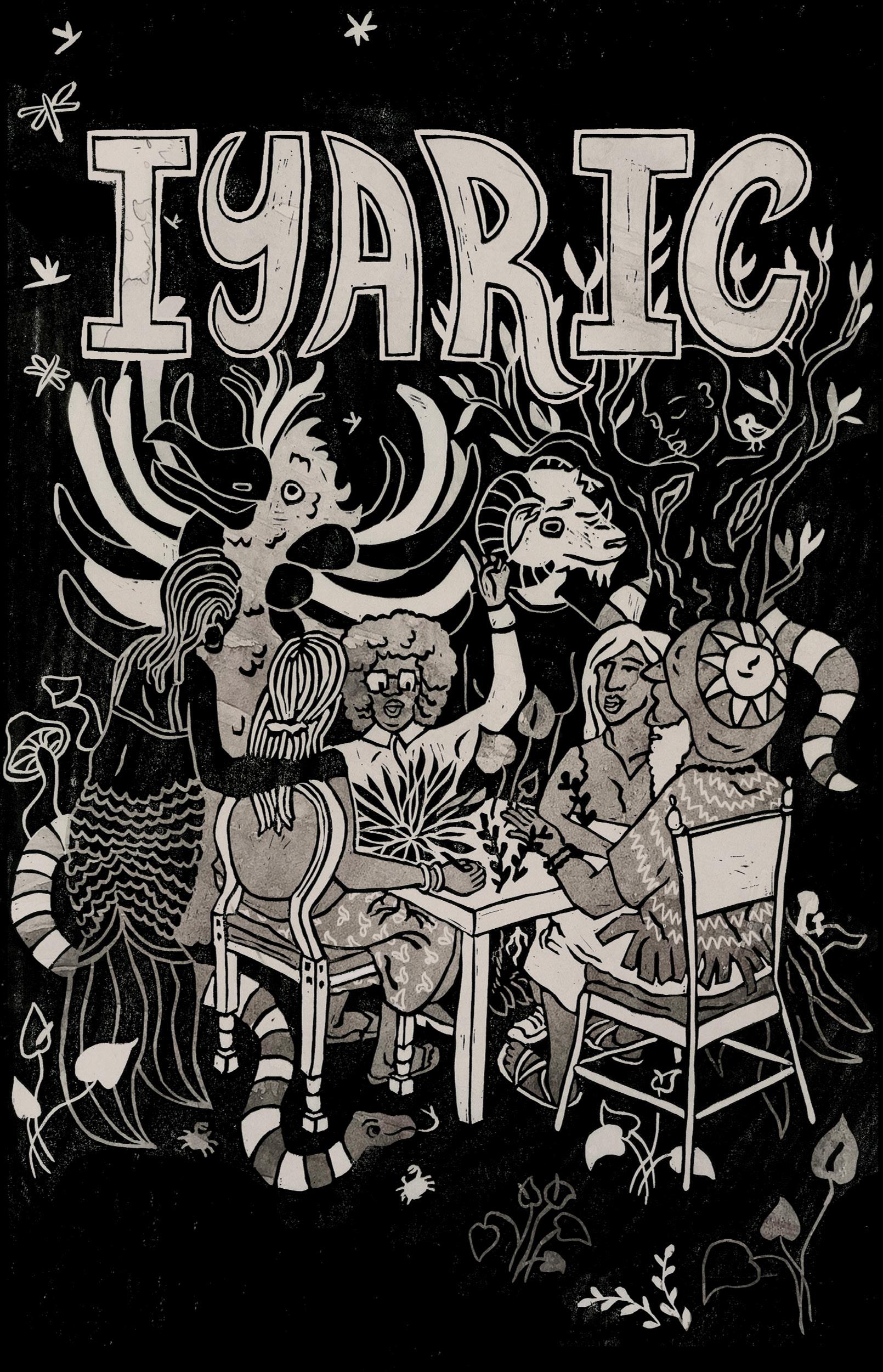
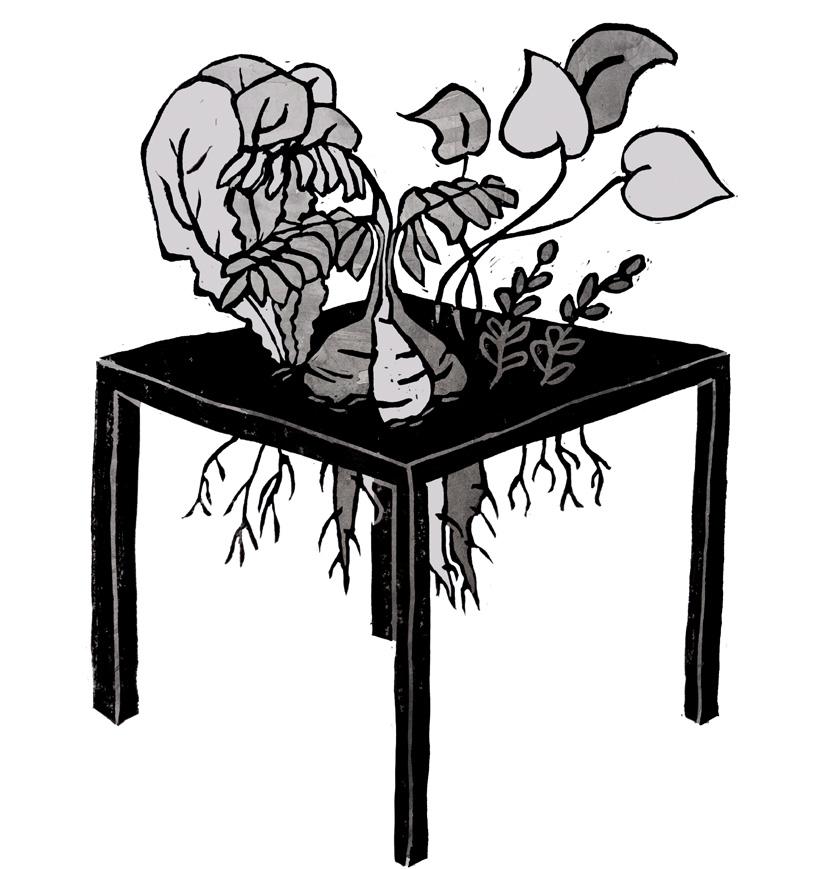
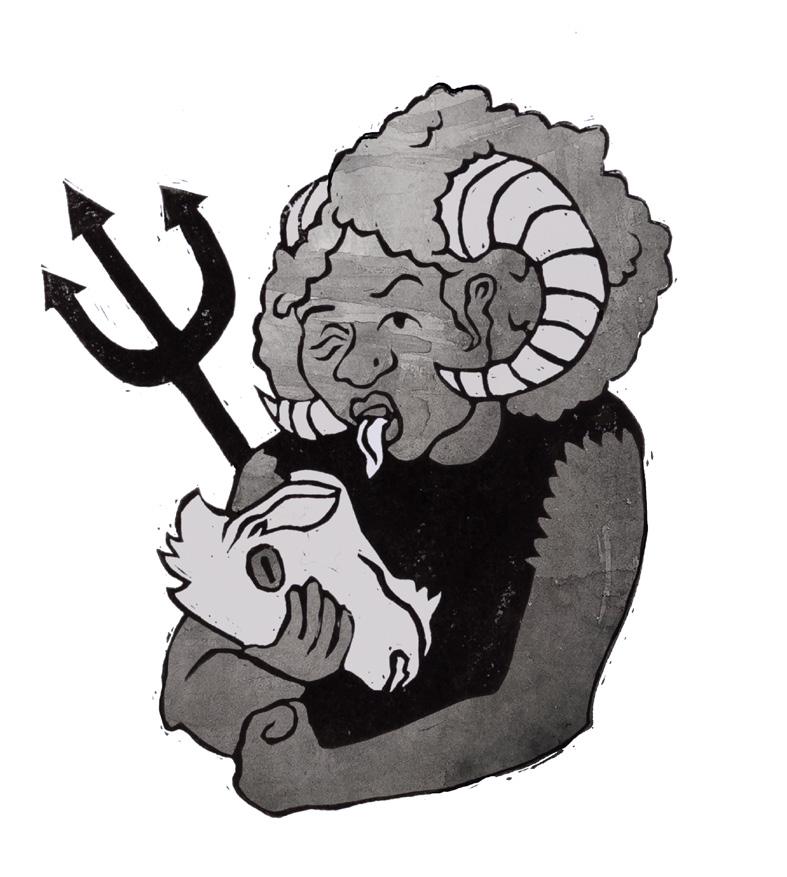
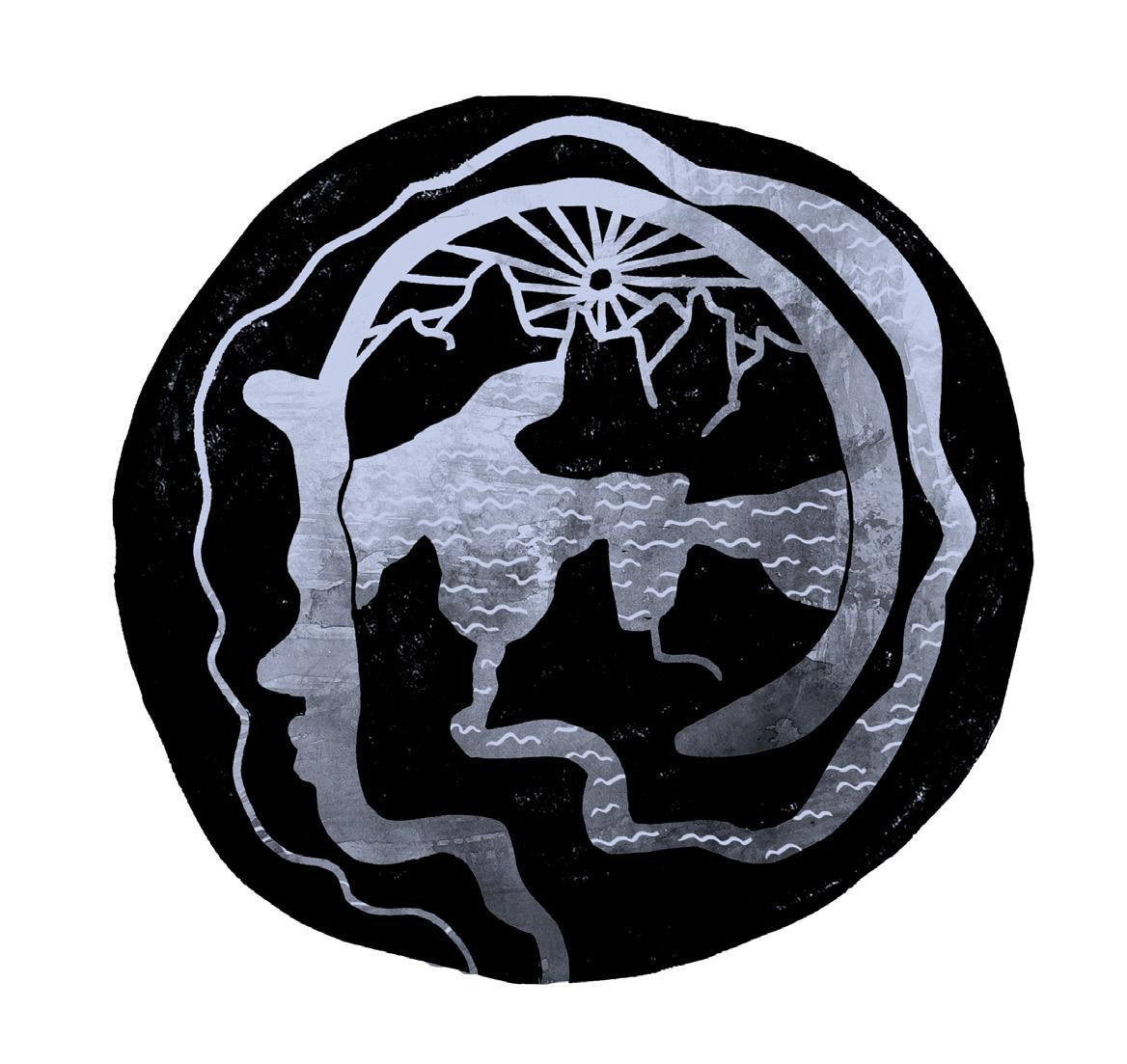
How does the colonial gaze of academic spaces alter when we prioritize our ancestors and community? As four people gather around a table, they notice they are not alone. Indeed, to disrupt and surveil takes a different form when reminders of community and home surround us.
Art by Pardis Pahlavanlu
Pardis Pahlavanlu is an artist and illustrator living as a guest between Tkaronto (Toronto) and unceded Coast Salish territories (Vancouver). While her academic studies have revolved around systems of power in contemporary colonial states, her artistic work has centred on the healing that is necessary in these contexts.
ISSN 2816-8267 (Print)
ISSN 2816-8275 (Online)
Using textured and bold imagery with a mixed media approach, she digs into the topics of mental health, exclusion/difference, and diaspora in hopes of finding new ways to imagine and reflect on her surroundings and experiences.
The IYARIC Initiative is based out of Tkaronto, an area that has been traditionally cared for by the Anishinabek Nation, the Haudenosaunee Confederacy, and the Huron-Wendat. Today it continues to be the home and gathering place of many Indigenous communities. We are mindful that the area’s current treaty holders are the Mississaugas of the Credit First Nation and that this territory is subject to the unhonoured Dish with One Spoon Wampum Belt Covenant.
In making this acknowledgement, we understand that such statements are merely symbolic steps toward decolonization and that the ultimate dissolution of settler projects across this hemisphere is imperative.
Together and apart: Defending old gains, fighting for new ones.
Iyaric emerged from the actions of CERLAC’s Black students who were brave enough to protest the treatment of Black and racialized folks by the campus security and police, demand democratic access to space at York and draw attention to their particular conditions and demands. This publication is a response to their call to action.
It is often students who see injustices most clearly, voice them and fight for them right across the world. Think of Idle No More, the Black Lives Matter sit in outside Police Headquarters in Toronto in 2016 or the Mexican student protests calling for democracy in 1968, the Frank Pais Movement of students that helped bring down the Baptista dictatorship in Cuba and the Sir George Williams Protest in Montreal, 1969 which called out Canadian Racism.
Without struggles like these most of us could not enjoy the privileges and possibilities that we take for granted - the weekend, access to university education, free health care, the right to abortion to name a few. Creating change means constantly reflecting on our practices, our contexts and the differences between them. That’s why it is important to create and nurture caring spaces of reflection like Iyaric, if we are to continue defend old gains, and fight for new ones.
For us at CERLAC, this means acknowledging that world doesn’t always look the same for everyone in this hemisphere. Finding justice means naming and honouring the needs of each particular group within our community, while prioritizing those who are most at risk from violence, exclusion and dispossession. Only when each sector studies and speaks from where they stand, is it possible to really work together in dialogue across different social locations. This publication is a small space for Black and Indigenous students here at CERLAC to speak from the ground on which they stand and to write about what they know, feel and live. What is exciting is that the voices in Iyaric speak with the support and solidarity offered by nonBlack and Non Indigenous students within CERLAC. This is a joyful indication of a shift away fragmented and isolated attempts at change and from homogenous universals that can mask inequality and serve only the privileged.
Congrats to everyone who has worked so hard to make this first issue happen. Congrats to Collin Xia and Jellisa Ricketts and their team, Thanks to the Provost and the Jean Augustine Chair for support and to the special antiracist initiative at LAPS. Here’s to you and to the challenges ahead as this issue enters the world only to be followed by another and another.
Honor Ford-Smith
Associate Director, CERLAC 2020-2022
Introducing IYARIC: a Student Journal Celebrating Black Artistry & Scholarship in the Caribbean
As CERLAC’s incoming Associate Director, it is my pleasure to celebrate the launch of IYARIC, a new magazine written, produced, and designed entirely by CERLAC’s students – Collin & Jellisa. The aim of this journal is to foreground Black student scholarship within CERLAC’s new Black, Indigenous, and Caribbean Initiatives Committee (BIC) and the awardees carried out this mandate with distinction. Upon receiving the baton to guide BIC from CERLAC’s distinguished Honor-Ford Smith, I had the privilege of overseeing some of the development of the magazine and the student team has done a fantastic job at creating a publication that is informative, while insightful, and perceptive.
It is my hope that this publication will serve as a point of departure for more inclusivity, reflection and celebration of the Black Latin American and Caribbean experience in CERLAC and at York University overall. Students, consider this magazine as a celebration of the region that your ancestors fought for and that your work celebrates. Fellows, consider this magazine as an invitation for you to be a torchbearer for our brilliant new scholars. It is our scholarly responsibility to do so.
I would like to thank the Provost, the Jean Augustine Chair and the Special Antiracist Initiative at LAPS for their financial support. This project would have been very difficult without your kind assistance.
Collin and Jellisa, may this be the beginning of careers rich in knowledge, progress and peace.
Love,
Prof. Tameka Samuels-Jones
The theme of the first issue of IYARIC, Disruption and Surveillance, was developed out of the intersections of the recent series of uprisings in the face of various forms of oppression; as well as the harmful methods used to monitor and police these uprisings. In collecting pieces for the publication, we asked what it means to cause disruption to the systems that have been put in place to oppress and marginalize? In what ways are those who are oppressed and marginalized by these systems surveilled? In some ways, disruption and surveillance exist on a binary end of a scale. Surveillance encourages assimilation, docility, and obedience. Whereas disruption encourages disorder, command and rebellion. In some ways, disruption is the response to surveillance. Rather than hiding from the watchful eye of the oppressor, disruption commands to be seen. Disruption forces the attention of oppressive gaze and says, “WE ARE HERE” and “WE AREN’T GOING ANYWHERE.”
The works in this publication unveils the vast nature of resistance in the face of oppressive surveillances. Sometimes it looks like community, convening around a table to imagine and grab hold of the future. Sometimes it looks like donning blue paint and channeling your energy on di road. And sometimes, it looks like survival – or care.
No matter the magnitude or medium, disruption matters. The creation of the publication was intended to reflect this philosophy, both in the sense that it is a publication that was made for the students, by the students; but also due to the community effort that was put into its development. The publication could not be made without the help of our amazing collaborators and contributors. We are deeply grateful for all the support that was given to make Iyaric a reality.
It is our hope that this first issue of the publication will be part of a continued legacy of mobilizing and organizing within York’s Black, Caribbean, and Indigenous communities, and we can’t wait to see what the future holds for the initiative.
“Indigenous, Black, and Women’s Voices”
CERLAC Resource Centre
The materials in the link form part of a small digitization project on “Indigenous, Black, and Women’s Voices” from Latin America and the Caribbean that was funded by the Equity, Diversity, and Inclusion (EDI) program of York University’s President. The original documents are all located in the CERLAC Resource Center and the Latin American Working Group Library (LAWG Library).
CERLAC’s Resource Center was founded by exiled students and scholars who escaped to Canada from Latin America’s military dictatorships of the 1970s and 1980s. They set up a program of publication exchanges with a broad range of institutions across the Americas and Europe. LAWG was originally founded as a response to the U.S. invasion of the Dominican Republic in 1965, and it functioned until 1995 as an independent civic organization that engaged in research, publication, and activism; it maintained a unique library of documents on Canadian solidarity and cooperation with Latin American and Caribbean churches, labour unions, peasant and Indigenous movements, women’s organizations, and the like.
The relatively rare and historic Black Voices items on the digitized site reflect the persistence of racism in well-known events in Caribbean history, including the banning of Black Power literature in Jamaica (1968), the triumph of the New Jewel Movement in Grenada (1979), the assassination of the Marxist historian Walter Rodney in Guyana (1980), and the Haitian refugee exodus (1980-81). They are presented to provide a sample of the kinds of documents that are available in the CERLAC and LAWG collections. Only documents that are in the “public domain”, that are not encumbered by “copy right restrictions”, are included.
Click here to explore: https://vitacollections.ca/cerlacresourcecentre/3763149/ data?g=d
Walk Good,
Collin Xia & Jellisa Ricketts
A seat at the Black Table
Dr. David Trotman
Answering the Blue Devil Call: Performing a repertoire of Resistance, Disruption, and Inspiration
Natalie Woods
15
Chevy Eugene 1 4 28 33
Mapuche Dreams: interview with Yaroslava Avila Montenegro
21
The womb: a site of domination and resistance in the Pre-emancipation British Caribbean
Collin Xia
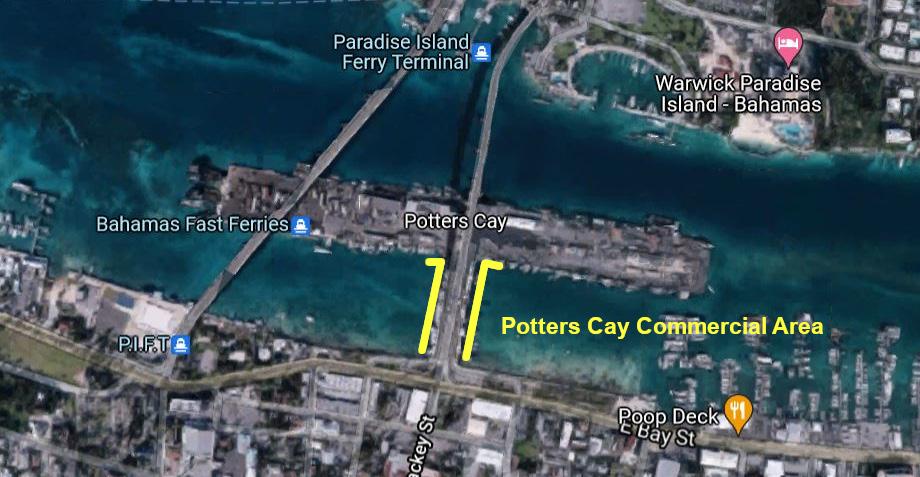
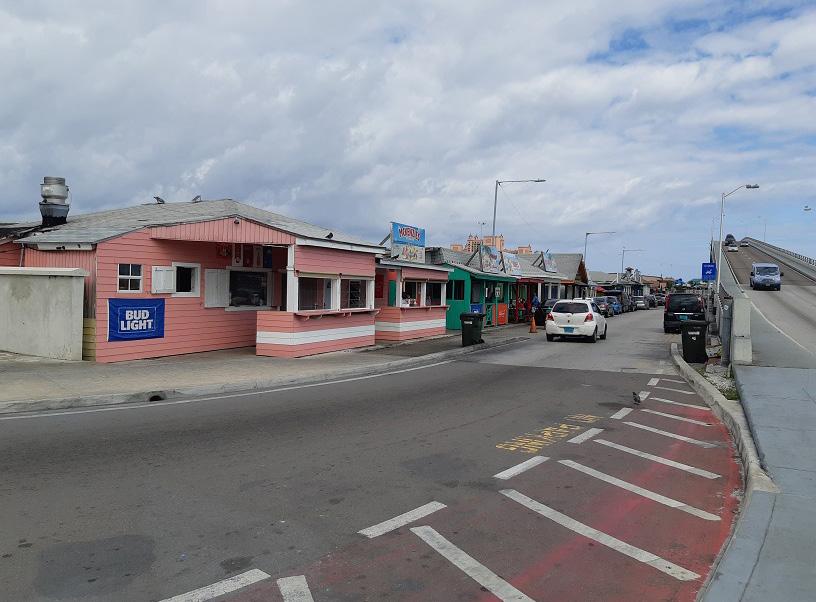
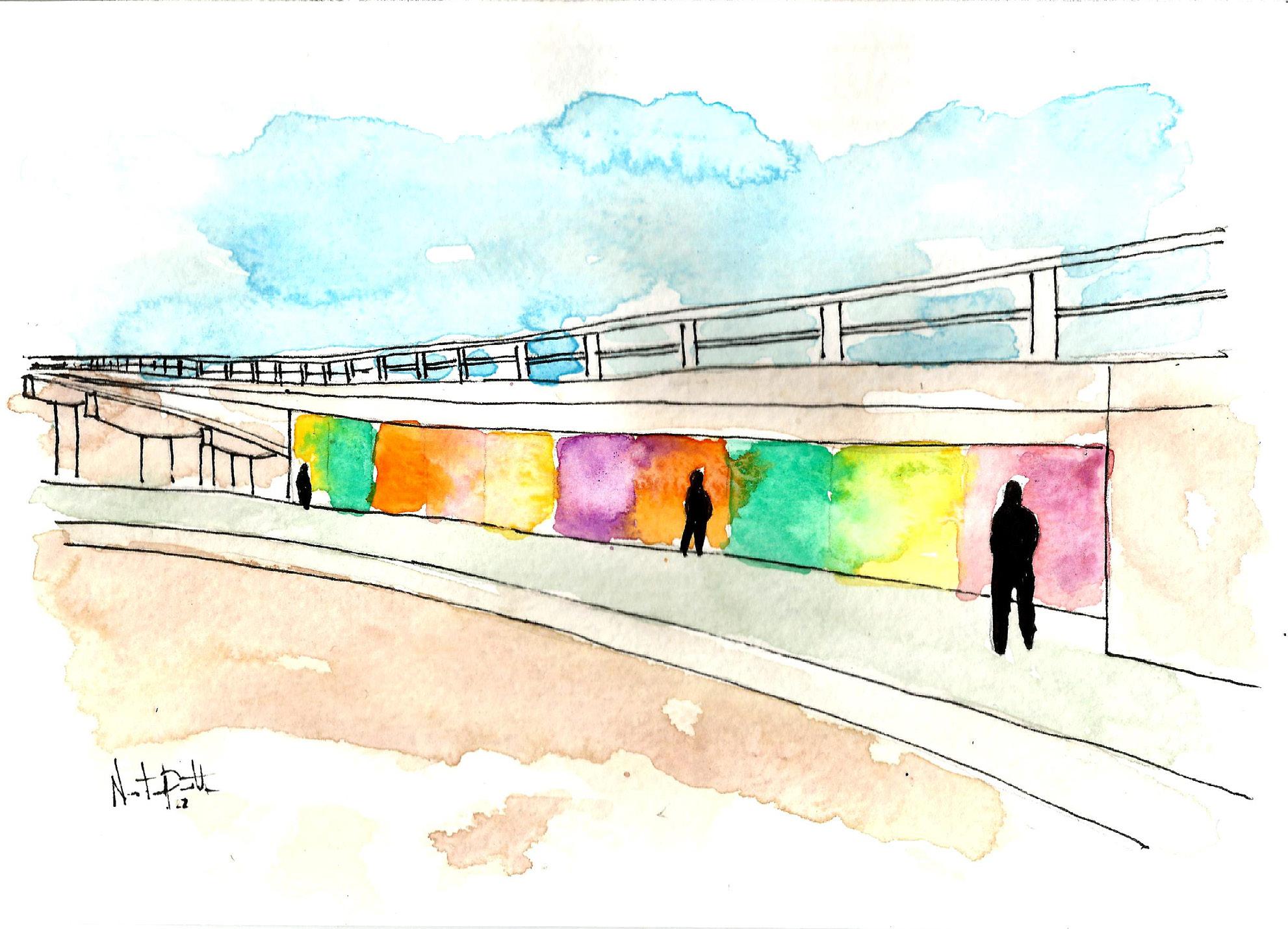
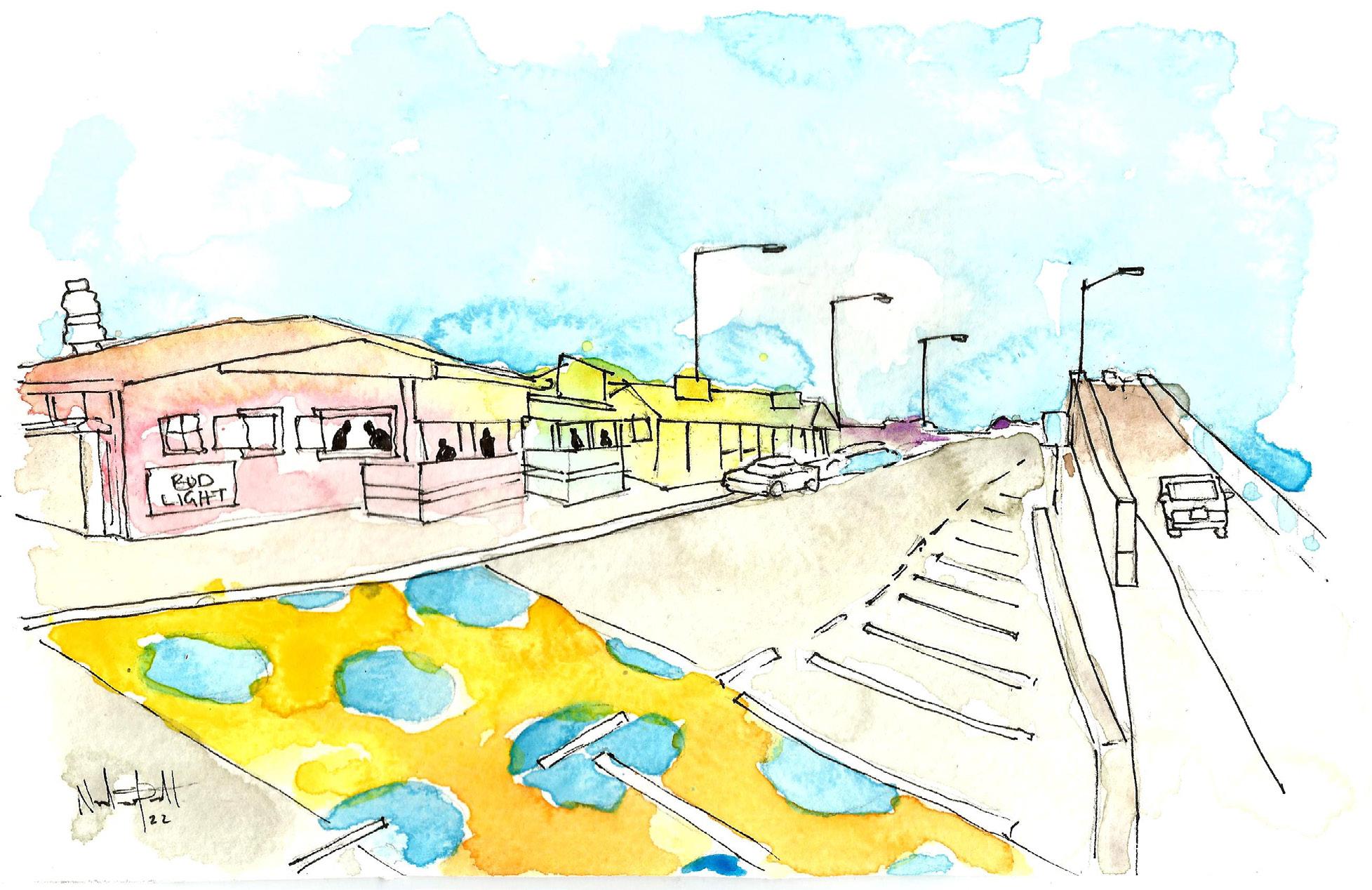
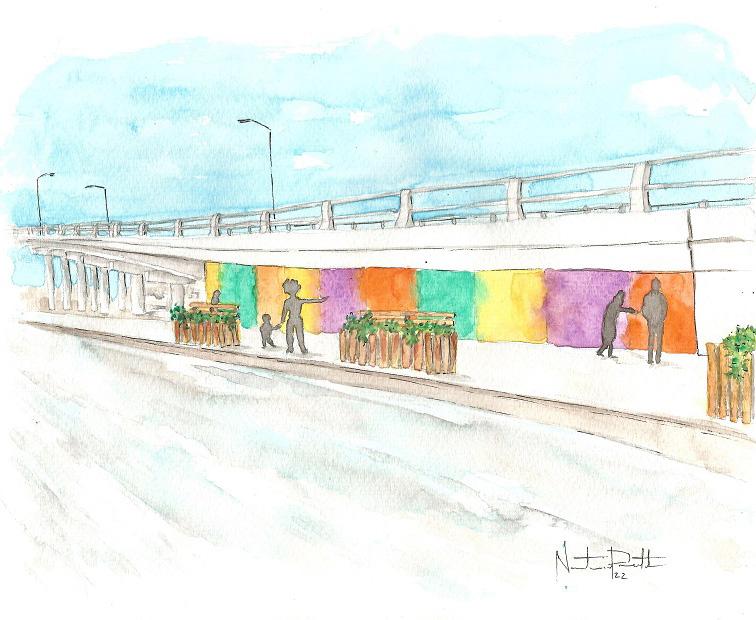
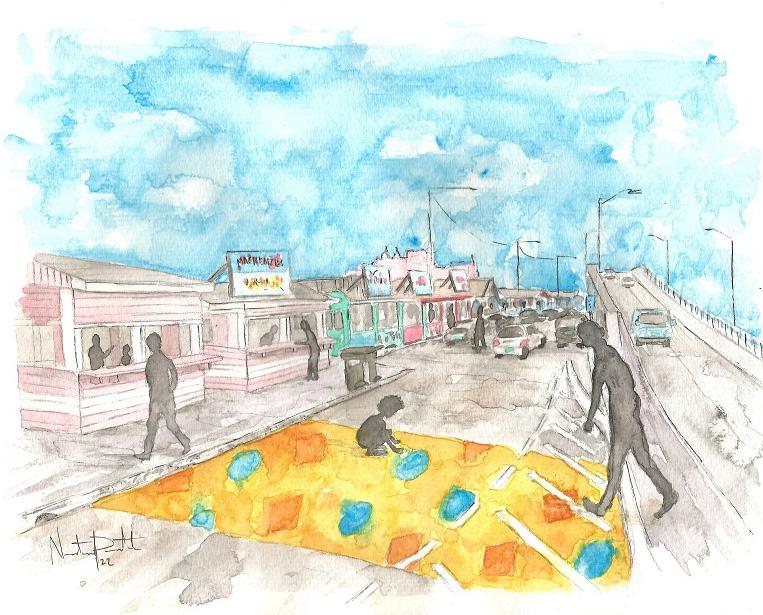
Potter’s Cay Reimagining: New Providence, The Bahamas
Nastassia S. Pratt
41
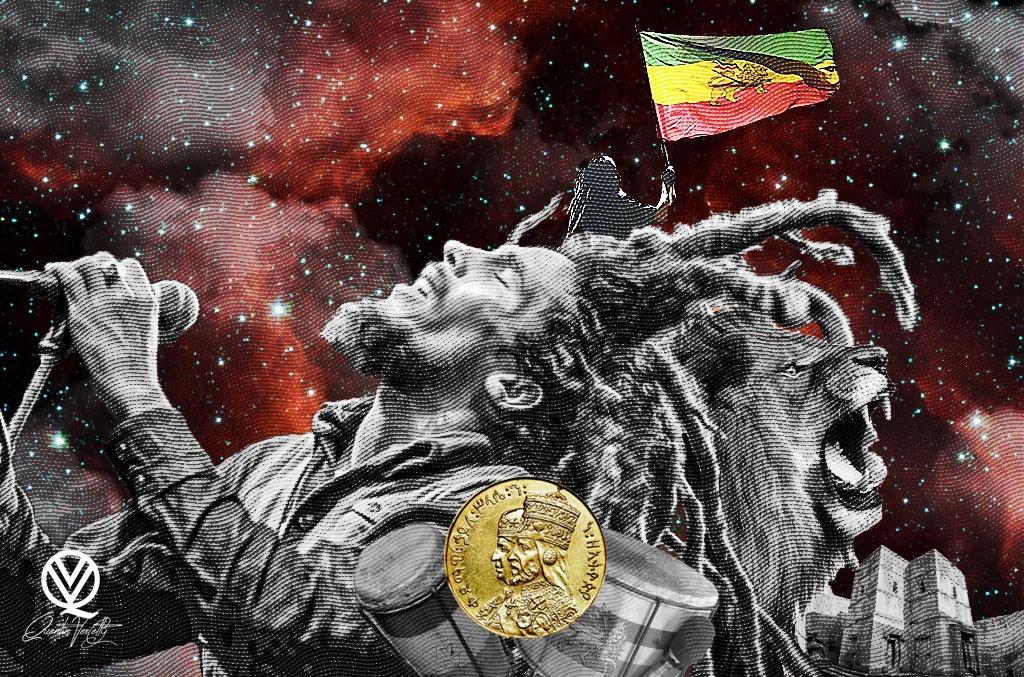
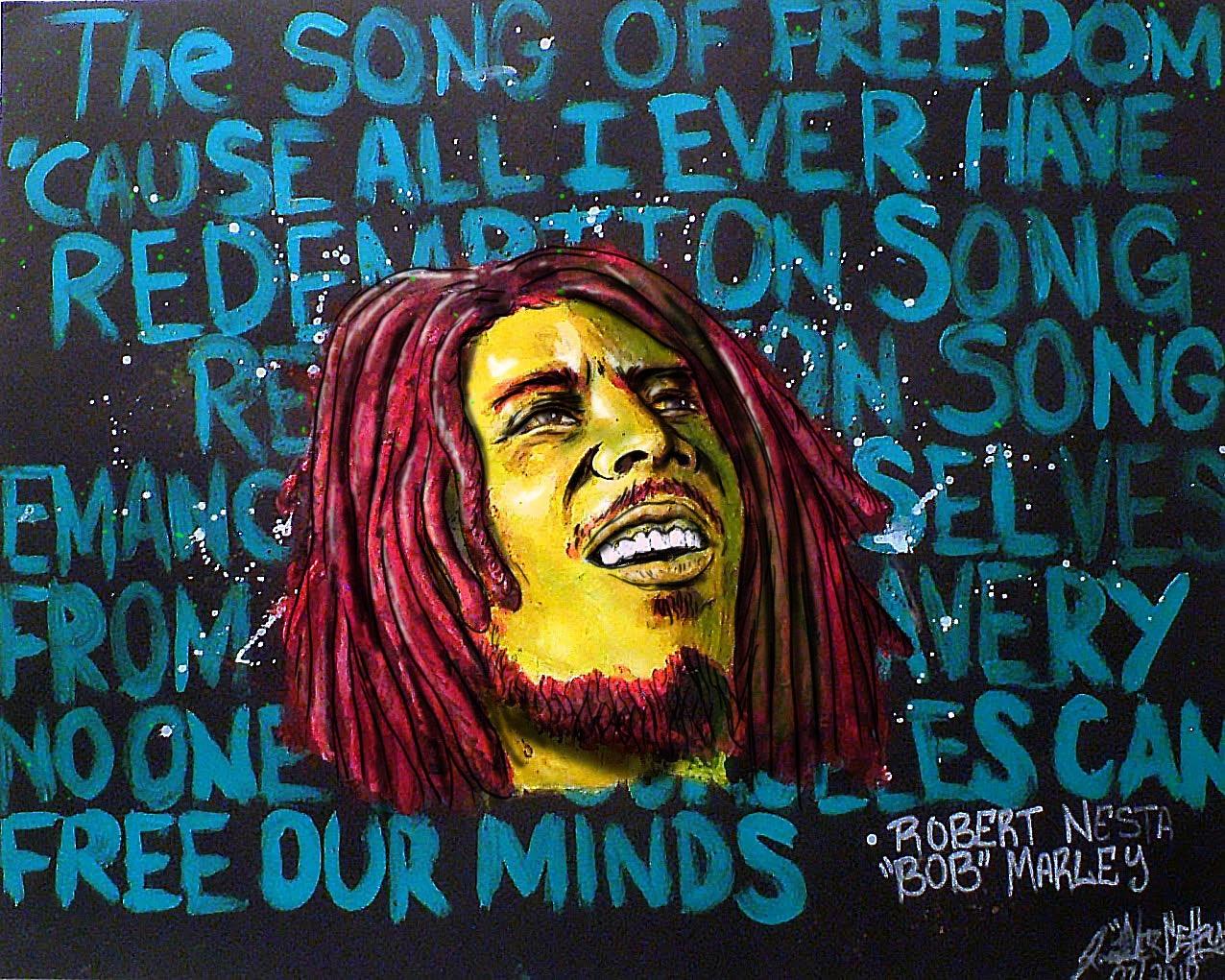
The Politics of Reparations in Rastafari Livity and Reggae
Dear Son...
Juanita Stephen
A seat at the Black Table
Dr. David Trotman
Transcribed and
edited by Jellisa Ricketts
On March 5th, 2021, Professor David Trotman from York University’s History Department led a conversation on York’s Black History and the way Black students used to congregate in order to inspire change in their communities and within the institution.
The following is a transcript of a select portion of the conversation
That table was an important site. We struggled of course until they were able to control the furniture. They were able to mash-up the line. But it was an important line in that - as I said it forced us to face each other. To talk to each other. To recognize common struggles. To recognize common problems. And to seek common solutions, etcetera. That is because there is no other space that captures the space in the cafeteria at the time. It was extremely important to the Black and Caribbean community at York.
The other issue, and it stems from what I described before as the background of Black students at York. The issue is what they call in English scholarship the struggle between crown and gown. That is the [inaudible] privileged class that’s operating at the university to develop your mind and to become the known scholar etcetera etcetera or do you have the responsibility for the community from which you came and the community from which you live. And that was a struggle because all of the predominantly of pre-
dominantly working-class background tend to see the university as a means for social mobility and to push them more securely into the middle class. It’s there. I mean you can’t deny that it was there. And therefore, the issue of whether we- or rather, town and gown. I think in retrospect it was handled well. That without destroying the group, that people who saw more interest in developing the academic side found their spaceand people who found a role to play in the community.
And out of that I don’t know how many of you know about the Black Education Project. The Black Education Project began as an attempt by York students, and some U of T students came on after but predominantly York students. In fact, it started at York University. The Black Education Project. To provide assistants to students- Black students in high school. There were not only Black students in high school – because the problem of Black students failing etcetera, to no reason of their own, and all of these problems that
we now understand facing Black youth in the education system was there then. And the Black Education Project was designed to deal with that or to help to contribute to that. And it meant not only students in high school because some of us thought that those Caribbean immigrants who came up and were looking to better their educational chances by finishing high school etcetera and they told them, what was then the UNIA the United Negro Improvement Association associated with Marcus Garvey was on College Street and we held classes there every evening. And Black students volunteered to go down and help high school students; help community members who were looking to finish their high school education and get into university. That I think is the greatest creation or legacy of that first generation of Black students. Understanding their responsibility to the community by creating the Black Education Project.
For a variety of reasons, which I will not go into now, it collapsed. It got caught up into a number of kinds of community politics. But if anybody is going to write the history of Black Toronto; or anybody who is going to write the history of Black students and Black Toronto must put in the Black Education Project as a major success and an indication of this group’s commitment to understanding their role. Not merely to getting their degrees and climb the social ladder, but their commitment to the community. Because it is not only students at the high school that they were helping at the time as I said, but it was other members of the community who needed that kind of educational assistance.
The other side of it or the other kinds of things we were involved in apart from the Black Education Project – working with another organization, that has now been taken over by A Different Booklist, but it was called A Third World Bookstore ran by Lenny [Leonard] Johnson. A major institution in this Black community. We used to meet there quite regularly. The discussions between those who were of a Marxist orientation and those who were of a Black nationalist orientation, it was in that bookstore. And I always remember Lenny Johnson was walking and looking in the back room and saw a book on
slavery, and he said the white man enslaved you, he writes about slavery, and he is selling it to you! That was Lenny Johnson. Lenny and Gwen built what was for us in that period the first community center or the first salon, if you will. He especially engaged university students. He used to push them when they would come in to buy books “so what are you doing for the community? You’re buying all these books but what are you doing for the community?” That kind of thing. Extremely important. Again, the Black Education Project, the Third World Bookstore was important.
And out of that came the library of Black people’s literature. Again, another institution that no longer exists but it existed for a while in which we would have a book fair at Caribana time. Once a year, generally around Caribana time we would show that there is another side to the community by this book exposition. Sponsored a lot, by Lenny’s Third World bookstore. So, there was a constant engagement with the town – with the community. I am using the phrase town and gown like the Europeans do but that engagement with the community. That constant engagement. But on the other side the concerns with the gown continued. Because after all you’re still spending a lot of time on campus so the concerns with the gown continued. This was a time when the Black Studies programs in the United States were on the rise. There was a lot of struggles over the establishment of Black Studies programs. But I think, I could be wrong - but I think because there weren’t that many Black Canadians among us; at the time Lenny’s daughter was there. May she rest in peace. I could count about five Black Canadians who were in this group, so the emphasis was always on the Caribbean and not on Blackness in that kind of sense. So therefore, there’s always a kind of struggle between a Black studies program and a Caribbean studies program. Now, if there were more Black Canadians there perhaps, we would have moved towards a Black Studies program much earlier. But the emphasis was then on the Caribbean. Because these Caribbean people – many of them are, as I said interested in social mobility. Some of them maintain this belief that they were going back home to help their country but some of them are
still here. The vast majority are still here. There’s this concern we are trying to understand from a region from which they had come, and they had come with not a very strong background of understanding that region from their high schools. So, when they got to the university, they wanted that kind of understanding or that kind of grounding from the region in which they originated. And therefore, the question of a Black studies program was not a major… in fact, when Rudy Grant started a course called the Black experience. There was a struggle in that course because the Black experience was essentially a Black American experience.
So, the interest then, especially pushed by those who believed at the time, in that first generation that somehow they were going to take the Caribbean out of that post-colonial state that it found itself in by the way in which they understood the region, then they could therefore go back and help the region. There was some interest also, in monitoring developments in Africa. But it was merely monetary. And two of the things that that group did – I’m only mentioning for historical routes rather than any possibility of doing it now. In those days departments put out a calendar when you were going to register every year. I don’t know if it’s online now, but they put out a booklet of all the courses that were being offered. The Black Peoples Movement produced a counter calendar every year, they produced a counter calendar. Because we encouraged Black students to report on classes to see whether in fact both in terms of the orientation of the course as well as the reading material, reflected the interest of Black students at York. And we produced a counter calendar. I got into some quarrels that some of my history factory at the time because they realized I had to be the one that was writing the counter calendar in the history section. But this was an important move. And again, it was facilitated by that table where you could sit down, now of course you can do it online, but we used to sit down at that table and talk. We used to warn students when registration time was coming “we know you like philosophy and you want to be known as a philosopher. Do not go to the philosophy department!” as simple as that. “Let Lenny bring the books and buy the books in
the library and read. Do not do any courses in the philosophy department.”
And yes, for the taping you can quote me on that! Because the philosophy department at that time was absolutely racist! And there has never been a Black student who graduated with a degree in philosophy from York university that year despite the attempts of many of them to do so. [Sarcastically] Perhaps Black people can’t do philosophy? You understand? Perhaps… So that counter calendar allowed for the development for the sense of Caribbean studies as not being history literature etcetera but this interdisciplinary understanding of the region from which they came, and the Black table allowed that course fertilization people to talk to each other the counter calendar also allowed that because it meant monitoring courses and dealing with those courses every single year. About what it is they are teaching what kinds of books they are reading, etcetera. So, the counter calendar was extremely important as part of the development of that sense of the Caribbean and a way of approaching Caribbean studies.
Unfortunately, of course the group was too small to do anything about hiring. And despite our best efforts when the history department moved to hire two African historians, they were both two white scholars. And I say this not because I am arguing against a certain ethnic group, or a certain pigmentation and their ability or inability to teach subjects, because I want to teach Irish history. The point is, despite all of that, you’re not in a position to influence because the group is too small to influence hiring. They can easily go behind your back and hire whoever they want because you don’t have any influence on that. And when Caribbean studies started, we saw no increase in hiring of Caribbean people.
Black students at York have been formulating counter spaces and creating change for decades. Because of the decision made by those who gathered at the Black table to disrupt the systems of oppression and take charge of their own education, Black students today have access to programs and a legacy of community.
Answering the Blue Devil Call: Performing a repertoire of Resistance, Disruption, and Inspiration
Natalie Wood
Abstract:
This paper explores performance, disruption, and the decolonial forces of the Caribbean Carnival and the Blue Devil masquerade. The Blue Devil performance can be linked to African cultural traditions (Dabiri, 2019) which emerged within the pre and post emancipation Trinidad Carnival and the Jab Jab or Molasses devil masquerade (Mas). Both Carnival and Devil Mas symbolize resistance, ritual and rebellion as practiced by enslaved Africans and their descendants (Hill, 1972; Liverpool, 2001; Bakhtin, 1968). In this paper I discuss the performance of the Blue Devil in resisting and disrupting historical and contemporary forces of oppression. I tie the ‘erotic’ energy of the Blue Devil to decolonial and abolition practices of imagining, creating, and inspiring strategies to change the world.
Inspiration
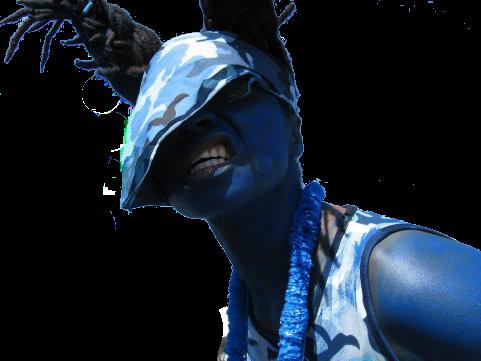
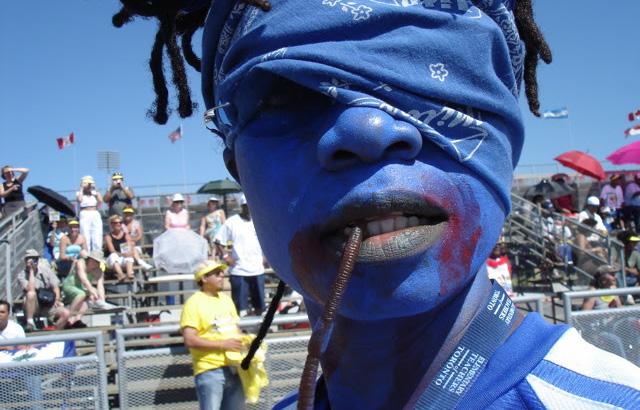
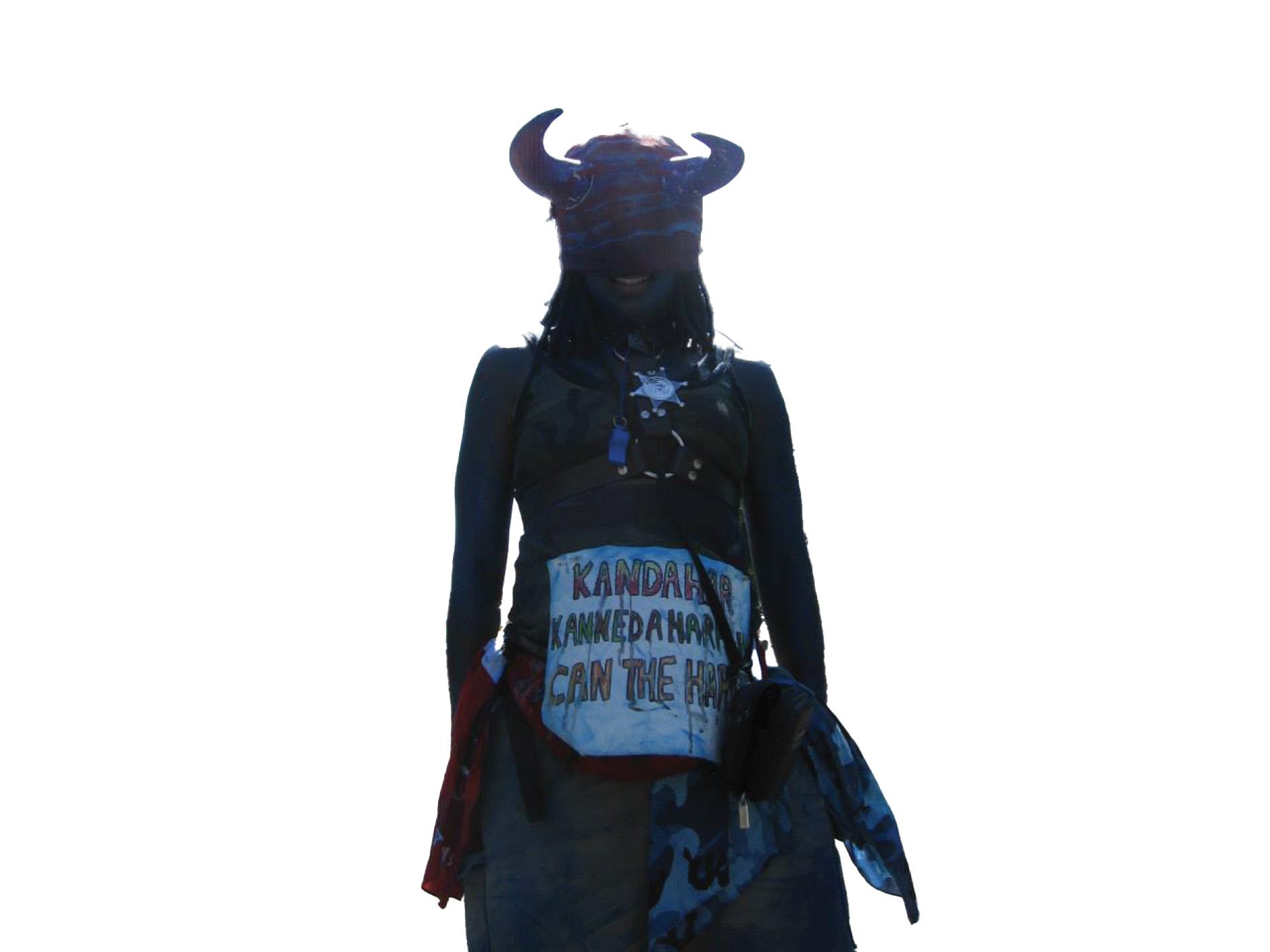
“Blue Devils. (Masqueraders) Entirely covered in blue mud and spewing red drool in imitation of blood. Blue Devils typically act berserk, sexual, and ravenous. To a degree their costumes are open to personal preference and can include pitchforks, various kinds of masks, wings, and horns.” (Martin, 1998, p. 222).
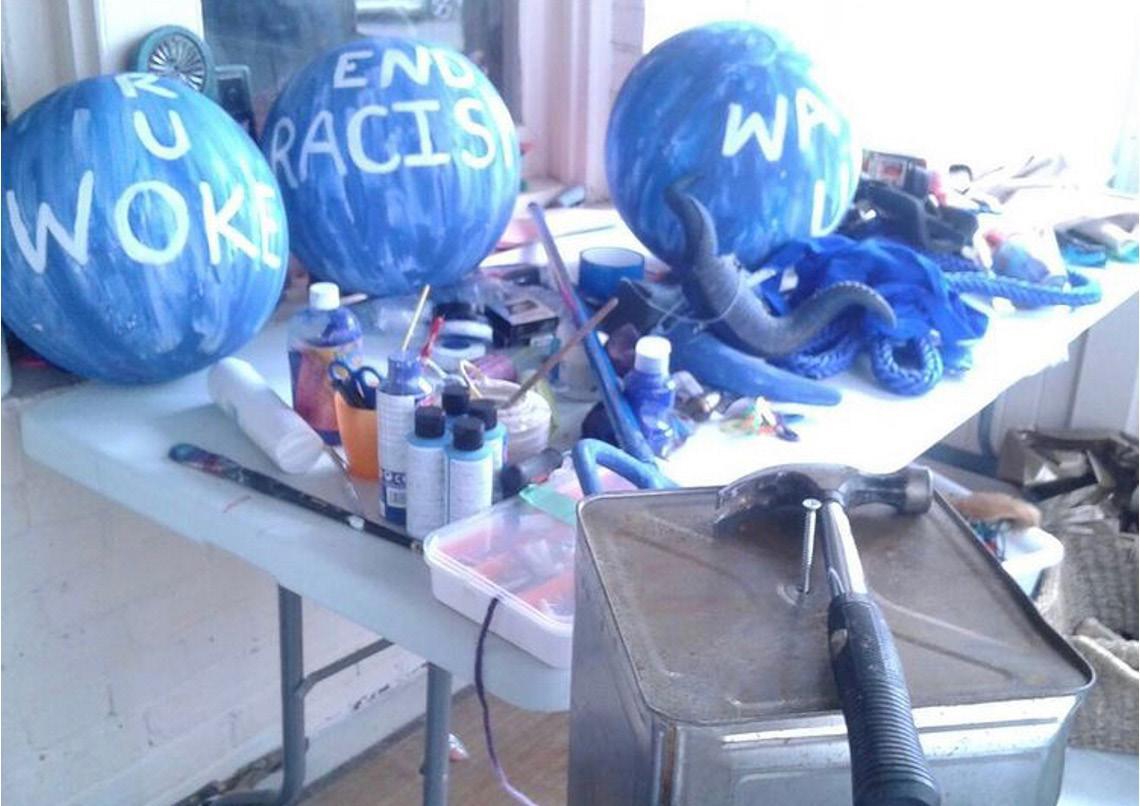
“This is the Blue Devil Call! Where meh jab jab? Where Meh Jab Jab! De devil woke! We are unbeatable! Unstoppable! We are resistance! Transformation! The grotesque! Power! Pleasure and Sexuality! De devil is on de stage tonight howling, wining screaming and threatening to mark all ah allyuh and what we want to know is allyuh woke! Allyuh woke?! Wake up!”
(Natalie Wood-Devil calling all the Devils performance at Toronto Pride Blockorama 2017).
As a Trinidad-born Canadian, Black, lesbian, feminist, artist, and mother, I am acutely aware that discrimination, and ongoing structural violence in Canada and the US have led to quantifiable premature deaths and impacted the ability of Black subjects, to live lives unfettered by the physical, emotional, and social experience of institutionalized and systemic oppression (Maynard, 2017; UN General Assembly, 2015). Anti-Blackness and the brutalizing of all Black lives is a global project which the UN International Decade for People of African Descent (2014–2024) was meant to address. This worldwide promotion of the need for recognition, justice, and development for African descended citizens, has been met with limited response (UN Human Rights Council, 2017). This failure provides proof of Hartman’s (2007) claim that it is impossible to overcome the violent rupture of enslavement (Hartman, 2007); McKittrick’s (2011) argument for the ongoing existence of plantation logics, and Walcott’s (2021) proposal that all Blacks still live in a long emancipation time, and freedom is yet to come.
This extends to living while Black and queer. In Canada, queerness has been legalized since 1969, however Ajamu and Cummings (2020) and others (Dryden et al., 2015) report that the absences and exclusions of Black and Caribbean diasporic queers still riddle the dominant narratives of Canadian queer histories and homonationalist imaginations. Countering and bringing a Black queer abolitionist perspective is the Queer activism of Black Lives Matter (BLM) Toronto, which acts to “rupture the violent way that Canada attempts to absent us” (Diverlus et al., 2020, p. 7). Their shut down of the Toronto Pride Parade in 2016 clearly and dramatically highlighted the discrimination and struggles of Queer, Trans, Black, Indigenous, People of Color (QTBIPOC) Torontonians. The rise of the #Blacklivesmatter global movement showcases the need for urgent action. There are now 13 chapters in the US and three in Canada. (Asmelash, 2020) and one in Trinidad that joined forces with WOMANTRA, an intersectional feminist organization in 2020 (Steuart,
2020; Nixon, 2020).
Decolonial and Abolition Praxis
Decolonial praxis began in the late fifteenth and early sixteenth centuries at the beginning of colonization and the settler state. Hoffman (2017) quotes Walter Mignolo who in an interview says: decoloniality means first to delink (to detach) from … a [Eurocentric, white supremacist and racial capitalist] overall structure of knowledge in order to engage in an epistemic reconstitution … of ways of thinking, languages, ways of life and being in the world that the rhetoric of modernity disavowed and the logic of coloniality implement (p.1.)
Epistemic reconstitution calls on Black, Indigenous, racialized, queer, impoverished subjects, artists, and activists to imagine and act together to create alternative forms of knowledge, being, and power and to change the world. (Maldonado-Torres, 2016). Similarly, “abolition is not primarily about dismantling, getting rid of, but it’s about re-envisioning, it’s about building anew” (Davis, 2020). As Moten and Harney argue, the challenge is [n]ot so much the abolition of prisons but the abolition of a society that could have prisons, that could have slavery, that could have the wage, and therefore not abolition as the elimination of anything but abolition as the founding of a new society (2004, p. 114).
Both abolition and decolonial theory call for reflecting, questioning, dismantling, imagining, and creating new and alternative caring relationships, knowledges, institutions, and futures together. Black Marxist scholars such as James (1967), Kelley (2002), and Moten (2003) agree that hope and imagination are intricately linked to a Black Futurity. In Freedom Dreams: The Black Radical Tradition (2002), Kelley links imagination to creating new visions that can build into a more hopeful future. This is done with the glance back (Muñoz, 2009)—a linking to the past to open to a future that Fanon (2005) says can seed and create a basis of hope and invite action. I hold that a Black liberatory future can embrace abolition and decolonial strategies present in the generative, replenishing, and provocative power of
the Carnival and the Blue Devil. Witnessing and performing the Blue Devil is connecting with the erotic, “a resource within each of us that lies in a deeply female and spiritual plane, firmly rooted in the power of our unexpressed or unrecognized feeling” (Lorde, 1984, p. 53). Maldonado-Torres (2016) identifies Rage and Love as two feelings that if recognized and expressed can act as a bridge to unleash the creative imaginings and actions to change the world.
Carnival, Resistance, Disruption, and the Blue Devil
The birth of creative forms of Black diasporic resistance exists wherever there was the institution of slavery such as in the Caribbean, South, Central, North America, and Canada. African slaves would engage in marronage, poisonings, Obeah, and Voodoo plotting, lighting fires to destroy crops (cannes brulés), murder, and suicide, and anything to disrupt the commodification of enslaved Africans and further their quest for freedom (Liverpool, 2001). The creative power to disrupt had to be performed and the desire to be
free had to be enacted, shared, and made visible. According to Taylor (2003), performance is a system of learning, storing, and transmitting knowledge vital to one’s identity, memory and being. The actions of the enslaved and oppressed to disrupt, form a “repertoire” of embodied practice of resistance, collective catharsis, and the quest for freedom (Taylor, 2003). Cedric J. Robinson (2000) defines this embodied practice of resistance as an ontological experience. He says Living while Black calls for “the continuing development of the collective consciousness informed by the historical struggles for liberation and motivated by the shared sense of obligation to preserve the collective being, the ontological totality (p. 171). This ontological totality has given birth to new cultural expressions like Carnival and Devil mas.
Carnival as a form of public action or performance developed on the cusp of emancipation in the early 19th century and was the syncretization of European, Asian, and African traditions. According to Benítez-Rojo (1996, p. ix). Carnival “expresses the strategies that the people of the Caribbean have for speaking at once of them-
selves and their relationship with the world, with history, with tradition, with nature, with God.” It was a way for African and other groups to “express their sense of life, their sense of freedom and identity” (Liverpool, 2001, p. 487). Like Liverpool (2001), Keith Nurse (1999) relates Carnival closely to resistance against slavery, racism, and colonialism. He says Carnival was “born out of the struggle of marginalized peoples to shape a cultural identity through resistance, liberation and catharsis” (p. 662.) Liverpool (2001) successfully argues that the shaping of this cultural identity has facilitated the exportation of Carnival wherever the Caribbean diaspora is located. This creative ritual of protest continues to be performed in diasporic communities living in cities such as Toronto and London, as Afro-Caribbean peoples continue to struggle against white supremacy, economic discrimination, and social inequality (Liverpool, 2001; Nurse, 1999). Whether thought of as a vernacular art form (Tancons, 2016), a Caribbean theater (Hill, 1972) a modern-day art practice (Cozier, 1998; Minshall, 1995), a ritual, or an expression of joy and spirituality, Carnival’s origins in emancipation, decolonial, liberatory, and abolitionist struggles clearly call for deep participation in inventing new worlds (Lorde, 1984).
Devil Mas
In this crucible of struggle and performance of resistance, the “erotic” bridging function of Carnival inspired the birth of Devil Mas. By the early 19th century and up to the middle of the 1920s it became one of the most popular masquerades in Trinidad and was seen as an opportunity for rebellion (Liverpool, 2001). Its popularity attests to the awareness that Blackness was often equated with evil and with the Devil. Fanon (1986) when discussing his theory of the release of collective aggression, a psychological state he identified mostly in European subjects, he analyzed European magazines and comic books pointing out that they often displayed “the Wolf, the Devil, the Evil Spirit, the Bad Man, the Savage [as] symbolized by Negroes or Indians” (p. 113.) Walter Rodney in How Europe underdeveloped Africa (1973) also declared that any “African ancestral belief was equated with the devil (who was Black
anyway)” (p. 401). Robinson (2000) and DeLoughrey (2007) add that Christian missionaries were the first to assign the Yoruba trickster god of the enslaved Africans, Eshu-Elegba, to the role of the Devil. Africans became associated with the Biblical Old Testament story of Ham whose descendants were cursed to be enslaved forever (Goldenberg, 2005), justifying slavery and assigning evilness to the enslaved and their descendants. Blackness as curse, Devil, and beast had for centuries filtered into the dreams and imaginations of the English and subsequently became “the grammar of the Church” (Robinson 2000, p. 86).
For enslaved Africans and African Caribbean peoples, the performance of the Devil was meant to mock Christianity and European fears of the Devil. According to Hollis (Calypsonian Chalkdust) Liverpool (2001), these Jabs or Devils are expressions of rebellion. He says, “they mocked Christian teachings, and collected money on Carnival Day from onlookers since the Christian Church …which was the real devil in the minds of the masqueraders, collected money all through the year from the faithful” (p. 409). As mentioned before, the Blue Devil emerges from the Jab Jab and Jab Molasse. The Jab Molasse or Molasses Devil masquerader covered themselves from head to toe in molasses, referencing, re-appropriating, and ritually enacting commodification, enslavement, and enforced labor on sugar plantations. Later in the 19th and early 20th centuries these Devil performers began to cover themselves in tar, grease, mud, and colors of red and blue. The Blue Devil emerges from this experimentation. They covered themselves in blue body paint made from ground up blue cubes used to whiten dingy clothes; they wore horns, tails, and carried pitchforks; they performed the mocking of the real Devils in power, and they danced provocatively moving their bodies to the deep rhythms of biscuit pans; they collected money, threatened to paint onlookers, “ate” fire, and sometimes walked with snakes. They are also associated with homoerotic performance. Forbes-Erickson (2009) argues that their display “grounded in slavery and emancipation, asserts sexual freedom and transgression against the symbolic emasculation … feminization [and the]
slave experiences … [of being] hypersexualized in colonial imaginations” (p. 239). Protest/rebellion, performance/play, spirituality/history, and freedom, transformation/catharsis are present in the performance, embodiment, and meaning of the Blue Devil.
Blue Devil Posse
I have had several encounters of the Blue Devil performance as an onlooker. First as a child observing my father playing Blue Devil and as an adult on a trip to Paramin in Trinidad, the mountain that is home to many Blue Devils. My connection to Blue Devil Mas in Trinidad inspired me to form the Blue Devil Posse in 2006 in Canada which is made up of artists, activists, queers, racialized, Black, non-racialized and Caribbean inspired folk who have a strong decolonial and social justice core.
Our first performance at Caribana in 2006 was chaos, rebellion, resistance, political, humorous, playful, spectacle, ritualistic, trance inducing, and transformative. The Caribana parade (now called the Toronto Caribbean Carnival) was the Caribbean Carnival celebration that has taken place in downtown Toronto on a Saturday at the
end of July or beginning of August since 1967. The parade itself is made up of costumed masqueraders who belonged or played with sections in a theme-based Mas band. The Mas band was produced by a designer who would design and then build costumes around specific themes which could be political or could reference elements, historic and contemporary events, nature, or folklore. The goal of these costumes was to look pretty, to create a spectacle of moving bodies with costumes glinting in the sun, transforming the Lakeshore highway into a mass of moving dancing masqueraders and their friends and onlookers. Joining the Mas bands were music trucks with live international soca performers or steel pan groups. Mas bands competed to get on the Lakeshore and to be judged as the best band of the year. According to Caribana Toronto (2022) every year over one million people would attend, flying in from the Caribbean, the USA and really all over the world. These bands are considered to be the “Pretty Mas” bands and formed one part of the two distinct Carnival spaces, “one for the upper and middle classes and one for the outsider, “low’ class” (Forbes-Erickson, 2009, p. 239).
The Blue Devils are one of the outsider bands, considered an Ole (old) Mas and Jouvert (the opening of Carnival at daybreak) tradition band,
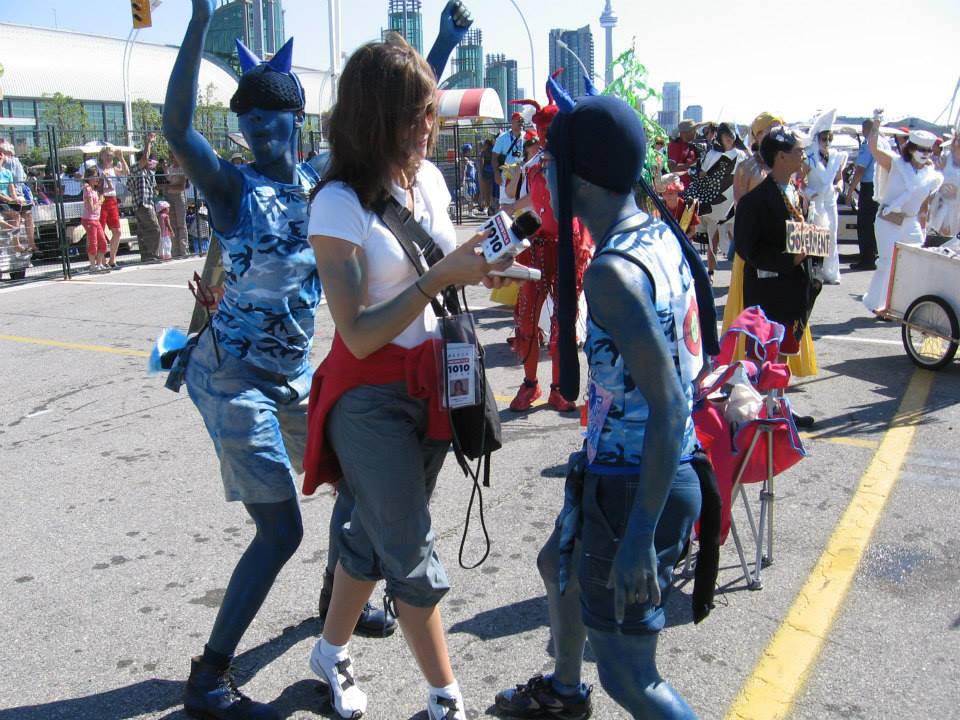
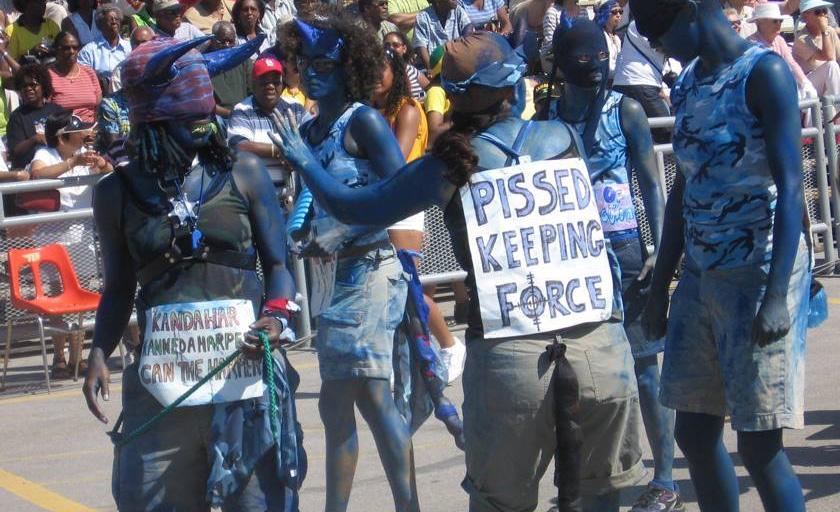
which meant we crossed the stage early in the morning. The Blue Devil Posse this first year of performance in 2006 chose to protest the presence of Canadian peace keeping forces in Afghanistan as we were concerned about abuses against prisoners and the shifting role of Canadian forces from peacekeepers to combatants. We called ourselves the “Blue Devil Piss Keeping Forces” to bring critique, to educate the public on the trauma of war, and to address coloniality and war making. The devils were mostly woman identified, either queer, lesbians, or trans folk. We joined Theatre Archipelago’s Ole Mas band put out by actor Rhoma Spencer and spent fruitless hours before the Saturday parade day practicing to somehow march in formation as we went on stage—fruitless, as once the Devils hit the stage they were in their performance and moving with the spirit of the devil. We had props such as a yoga ball with the world continents painted on it, that we either put our booted feet on or sat upon, we kept rubber worms and bugs in our mouths, and we attached placards with witty statements to our bodies. Some of the statements were “Officer peeping tom,” “Khandahar, Khanda Harper, Can the Harper,” “Prisons 4 Profit,” “War: Terrorism with a Bigger Budget,” and “Weapons of Misdirection.” Other props included bandanas, painted targets, a variety of masks, horns, and dildoes. We had whistles and painted our bodies blue. We also walked with blue body paint to paint unsuspecting onlookers.
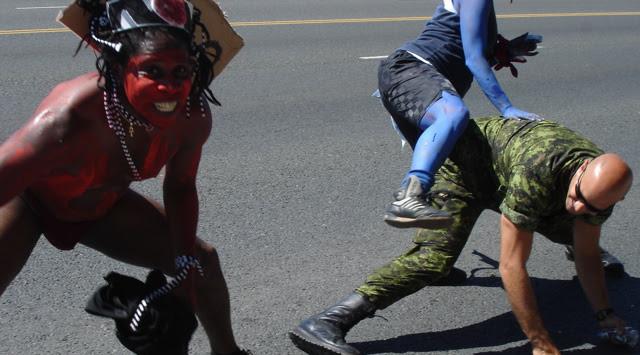
We almost did not make it on the parade as police officers doing guard duty tried to stop us. After tense negotiations which involved explaining the role of protest and rebellion in the history of Carnival and the value of free speech, we were reluctantly allowed on the parade. As the blue paint went onto bodies and the chaos of the music, and whistles began, our movements became jerky, jumpy and zig-zaggy. We began to yelp, scream, and pant noisily. We wine-d up on police, and the audience. We climbed barricades to get at the VIP seated guests. We put our blue handprints on trucks, on buildings, and on people’s hands and clothes; and we ran after friends and onlookers who seemed happy to be chased by the Devil. Parents brought their kids to be frightened by us saying to their kids that, “you have
to stand your ground, do not flinch, and look the devil in their eye, and they will leave you alone.” If they could do that, we left them alone. Our performance combined the erotic, protest, laughter, education, play, sexuality, catharsis, and freedom. In effect we disrupted the regular consumptive experience of Carnival.
In conclusion, the Blue Devil goes beyond disruption, intervention, and being a channel for abolitionist and decolonial practice, to become a character of voice, hope, and inspiration. Through its performances and gestures the Devil encourages refusal and rebellion against Black and Black queer subjectivity, provides a container for the expression of Black rage and healing, queers race, gender and sexuality, and concocts an alchemy of release and transformation. By embodying and performing the Devil, “a language—a poetics of the human body” (FordSmith, 2019), a transmitted epistemology (Taylor, 2003), becomes a strategy for challenging us to change the world.
Ajamu, McFarlane, C., & Cummings, R. (2020). Promiscuous archiving: Notes on the joys of curating Black Queer legacies. Journal of Canadian Studies/Revue d’études canadiennes 54(2), 585–615. https://www.muse.jhu. edu/article/780623
Asmelash, L. C. (2020, July 26). How Black Lives Matter went from a hashtag to a global rallying cry. CNN. https://edition.cnn.com/2020/07/26/us/blacklives-matter-explainer-trnd/index.html
Bakhtin, M. M. (1968). Rabelais and his world. Indiana University press.
Benítez Rojo, A., James E. M. (1996). The Repeating Island: the Caribbean and the Postmodern Perspective. 2nd ed. Duke University Press.
Caribana Toronto (2022). Caribana Toronto 2022. Retrieved from https://www.caribanatoronto.com
Cozier, C. (1998). Trinidad: Questions about contemporary histories. In Caribe Insular, exclusion, fragmentación y paraisó. Casa de América. 348–349.
Dabiri. (2019). How did the devil cross the deep blue sea?: Orality and the preservation of horned and devil mas in british caribbean carnivals. Caribbean Quarterly, 65(4), 603–620. https://doi.org/10.1080/00 086495.2019.1685765
Davis, Angela. (2020, June 12). Angela Davis on abolition, calls to defund police, toppled racist statues & voting in 2020 election. (2020, June 12). Democracy Now! Retrieved from https://www.democracynow. org/2020/6/12/angela_davis_on_abolition_calls_to
DeLoughrey. (2007). Routes and roots: navigating Caribbean and Pacific Island literatures. University of Hawai’i Press.
Diverlus, Rodney, Hudson, Sandy, and Ware, Syrus Marcus. (2020). Until We Are Free: Reflections on Black Lives Matter in Canada. University of Regina Press.
Dryden, O. S. H., Lenon, S., & Awwad, J. (2015). Disrupting queer inclusion: Canadian homonationalisms and the politics of belonging. UBC Press.
Fanon, F. (1986). Black skin white masks. Pluto Press. Fanon, F (2005). (trans. Richard Philcox). The Wretched of the Earth. Grove Press, (reprint edition).
Ford-Smith, H. (2019). The body and performance in 1970s Jamaica: Toward a decolonial cultural method. Small Axe (58), 150–168.
Forbes-Erickson, D. A. (2009). Sexuality in Caribbean performance: Homoeroticism and the African body in Trinidad. In Africans and the politics of popular culture. Eds. Falola, T., Agwuele, A. University of Rochester Press.
Hartman, S. (2007). Lose Your Mother: A journey along the Atlantic slave route. Farrar, Straus, and Giroux. Hill. E. (1972). The Trinidad carnival: mandate for a national theatre. University of Texas Press.
Hoffman, A. (2017). Interview with Walter Mignolo part 2: Key concepts. Retrieved in https://www.e-ir.info/2017/01/21/interview-walter-mignolopart-2-key-concepts/
James, C.L.R. (1967). Black Power, it’s past, today and the way ahead. A speech delivered in London. Retrieved from https://www.freedomarchives.org/Documents/Finder/Black%20Liberation%20Disk/Blac k%20Power!/SugahData/Books/ James.S.pdf.
Kelley, R. D. G. (2002). Freedom dreams: The Black radical imagination. Boston: Beacon Press.
Goldenberg, D. (2005). The curse of Ham: Race and slavery in early Judaism, Christianity and Islam. USA: Princeton University Press.
Liverpool, Hollis. (2001). Rituals of Power and Rebellion: The carnival tradition in Trinidad and Tobago—1763–1962. Research Associates School Times Publications/ Frontline Distribution Int’l Inc.
Lorde, A. (1984). Sister outsider: Essays and speeches. Crossing Press.
Maldonado-Torres, N. (2016). Outline of then theses on coloniality and decoloniality. Frantz Fanon Foundation.
Maynard, R. (2017). Policing black lives: State violence in Canada from slavery to the present. Fernwood Publishing.
Minshall, P. (1995). Carnival and its place in Caribbean culture and art. In Caribbean Visions: Contemporary painting and sculpture. Alexandria; Art Services International, 49–57.
Moten, F. (2003). In the break the aesthetics of the Black radical tradition. University of Minnesota Press. Moten, F. & Harney, S. (2004). The University and the Undercommons. Social Text 22(2), 101–115.
McKittrick, K. (2011). On plantations, prisons, and a black sense of place. Social & Cultural Geography, 12(8), 947–963. https://doi.org/10.1080/1464936 5.2011.624280
Muñoz, J. E. (2009). Cruising utopia: The then and there of queer futurity. New York University Press.
Nixon, A. (2020, July 6). Righteous rage—On protests & uprisings against police violence in Trinidad. Stabroek News. https://www.stabroeknews. com/2020/07/06/features/in-the-diaspora/righteous-rage-on-protests-uprisings-against-police-violence-in-trinidad/
Nurse, Keith. (1999). Globalization and Trinidad carnival: diaspora, hybridity and identity in global culture. Cultural Studies (d), 13(4), 661–690. https:// doi.org/10.1080/095023899335095 Robinson, C. J. (2000).
Black Marxism: the making of the Black radical tradition.
University of North Carolina Press.
Rodney, W. (1973). How Europe underdeveloped Africa. USA: Verso Press.
Steuart, J. (2020, June 10). Black Lives Matter protests
in Trinidad & Tobago spark discussions about race. Global Voices. https://globalvoices.org/2020/06/09/ black-lives-matter-protests-in-trinidad-tobago-sparkdiscussions-about-race/ Tancons, C. (2016). Curating Carnival? Performance in contemporary Caribbean art and the paradox of performance art in contemporary art. In Caribbean popular culture: Power, politics, and performance. Eds. Hume, Y & A. Kamugisha. pp. 347–61. Ian Randle Publishers.
Taylor, D. (2003). The archive and the repertoire: Performing cultural memory in the Americas. Duke University Press.
UN General Assembly (2015). International Decade for People of African Descent. Retrieved from https://www.un.org/en/events/africandescentdecade/
UN Human Rights Council (2017). Report of the Working Group of Experts on People of African Descent on its mission to Canada, A/ HRC/36/60/Add.1, Retrieved from https://www. refworld.org/docid/59c3a5ff4.html
Walcott, R. (2021). The Long Emancipation: Moving towards freedom. Duke University Press.
Mapuche dreams
The following is a transcript of an interview conducted by Collin Xia with Mapuche scholar and activist Yaroslava Avila Montenegro
C: Before today’s discussion can begin, I want to acknowledge that I am currently situated in Tkaronto, an area traditionally cared for by the Anishinabek Nation, the Haudenosaunee Confederacy, and the Huron-Wendat. Today it is home to many First Nation, Inuit and Métis communities. I want to acknowledge the current treaty holders are the Mississaugas of the Credit First Nation and that this territory is subject to the Dish with One Spoon Wampum Belt Covenant, an agreement that we are all implicated in, and has yet to be honoured.
Before I begin my questions, please introduce yourself briefly and the work that you do within academia and beyond.
Y: (…) my name is Yaroslava Avila Montenegro, I am a Mapuche organizer, and activist born and raised here in Tkaronto, Huron-Wendat, Anishinabek and Haudenosaunee Confederacy territory. And I am the daughter of Mapuche refugees from Wallmapu, so-called Chile. I have always organized on the topic of Indigenous rights, economic and social justice here in the city. Currently, I am a part of the Women’s Coordinating Committee for a Free Wallmapu, which deals with Mapuche land rights in so-called Southern Chile and helping Mapuche political prisoners; to be able to raise awareness on the issues that are happening within our territories and connect them to the issues of land back here on Turtle Island, work that is extremely important to develop between our nations. That’s the organization that I have been a part of since I was quite young with a group of elders and kin. Doing this work
and pushing this narrative out to an Anglo audience, translating the statements of our people, as well as being able to make those connections has been an honour. I am really happy and proud of that work. I am really honoured to be invited here today by CERLAC, having worked with them quite closely in the last year.
Professionally I am currently the Interim Operations Manager at Indigenous Climate Action, which is an organization based out of Turtle Island that focuses on Indigenous climate initiatives. Being able to raise our nations here on Turtle Island and being able to confront and deal with ongoing extractivism that’s happening on the territory has been a beautiful experience, and I’m really proud of being able to be part of that. I am currently also doing my doctoral degree. Currently, I’m a doctoral researcher in the Department of Political Science at York University. I focus on state securitization and criminalization of social and Indigenous liberation movements both here on Turtle Island and Abya Yala, which is what we call South America. My other areas of research include exploring Indigenous thought and politics in connection with radical socio-political thought: Marxism, post-colonialism etcetera. As well as exploring the intersection of international political economy, hegemony, and contested politics. That is really what I do in a nutshell.
C: That is really expansive and it’s all grounded in supporting Indigenous rights, land back, and decolonization. I wonder if there was a moment where this work began with you, or has it been a
part of your life throughout?
Y: I think it’s been part of my life having grown up as a daughter of Mapuche refugees coming from so-called Chile and that is something you grow up with. I didn’t grow up with my traditions, that was something I learned along the way. (…) from social movements that had been developing on the territory and then realizing our connections to the land as well as our family histories associated with the land and the communities. Growing up here on Turtle Island, I was completely separated from my extended family because of the political situation in so-called ChileComing in from that history it’s always been part of our reality here, both in our actions locally and our connections back home. That profound sense of justice has always been the guiding principle in that way.
C: Absolutely…I have always been interested in how other scholars navigate their place within the institution where their presence is inherently oppositional. Do you have any thoughts on this dilemma?
Y: So this is something I struggle with a lot in academia because of my particular discipline. I’m doing my research in Political Science and my discipline is notoriously colonial and capitalist in its approach to world issues. I come from a lived experience that is quite radical—anti-colonial, anti-imperialist,—coming into the discipline with that framework is a challenge. It is something that I still struggle with a lot, even though I have had the privilege of advancing quite a bit into the discipline. Being able to do my doctoral degree, I’m very grateful for that, but it’s always been a struggle. Especially with the material aspects of being from a working-class family as well as being refugees from so-called Latin America, Abya Yala; it’s difficult to be able to take on academia and put your foot in the door within a discipline that is designed to push you aside. I am really lucky to be at York! Initially, I was taking doctoral courses at other institutions across the province and found there to be such a lack of accommodation and huge disparities. In conjunction with my working-class background, having to deal with student debt, class oppression, as well as identi-
fying as Indigenous in these spaces was a challenge when broader structures are meant to keep us out. That is something I’ve struggled with. That said, part of the reason that I wanted to go to academia was to take some of the knowledge we learn in these spaces and bring it back to our communities in order to build counter-hegemonic structures. Especially with political science, you get an understanding of the logics of power, ruling class narratives, as well as other kinds of hegemonic colonial narratives that guide a lot of the structures of society. Being able to understand them and reinterpret them to empower our own communities has always been my goal. Not that we want to integrate the space given to us by institutions of power, but rather using that knowledge as a tool to dismantle them —this is one of the bigger reasons why I want to be in academia. Those tools are important; we need to know what we’re up against.
C: I think that strategy has been tried and tested for centuries. Learning settler structures and knowledge systems has been integral to Indigenous resilience.
The theme of our inaugural issue is disruption and surveillance. As an Indigenous activist and scholar, your livelihood is oppositional to the settler project and you live under carceral systems, including the university. How would you describe your life under anti-Indigenous carceral systems, being both invisible and hypervisible at the same time?
Y: So I’ll start from a broader sense and boil it down to the individual. I think our individual experiences are important but they are connected to a broader structure that we need to dismantle. From the perspective of histories of surveillance, histories of the carceral settle state, my nation, the Mapuche, has been fighting for decades—centuries, really—to take back the land. After 300 years of war with the Spanish, the Mapuche Nation remained an autonomous region in the 16th and 17th Centuries. It was only at the end of the Pacification of Araucania (i.e. Wallmapu) in the late 19th Century, when the Chilean state militarily occupied our ancestral territory. During the second half of the 20th Century, there was a period
of great revival, especially in the 60s and 70s with the period of the Allende government at its peak, with the reclamation of Indigenous land helped by the Agrarian Reform. After this booming period, much of the movement went underground in the mid-70s due to the dictatorship. But having lived through that tormentous period, our people carry that history with them. With the transition to democracy in the early 90s, we see the Mapuche nation taking the reins of our own destiny and reclaiming the land in a different way than had been done previously. In the past, our struggles were interconnected with different social movements such as with Marxist revolutionary organizations that were active in the territory. During the transition to democracy that shifts toward a specific liberation of our own peoples with our own identities and cosmologies. This comes with a great cost as state repression becomes increasingly targeted toward indigenous nations and their mobilizations for Land Back. It has led to 20 years’ worth of incarceration under the anti-terrorism law in Chile, which is unheard of in the Americas. There is a certain degree of understanding in other settler-colonial states that the reappropriation and reclamation of ancestral land are not charged under terrorism legislation (despite being heavily prosecuted by the state through other means), and yet the Mapuche have been charged under these laws continuously as a legacy of the dictatorship for decades. Part of the work that we do here is to expose these Human Rights violations and connect them to the criminalization suffered by Indigenous Nations under the colonial system here. Locally, we see Indigenous communities criminalized for reclaiming the land and fighting against pipelines. Within the last 30 years, there has been a huge spark within Indigenous movements within Abya Yala but also Turtle Island. At the same time, we see the deliberation of security and intelligence ops like that of Operation SITKA with the RCMP surveilling Indigenous communities protesting pipelines expanding into Mi’kmaqi territories. As organizers, exposing these conditions makes us hypervisible to the state. Our organization was very vocal and visible throughout the late-2000s, in solidarity with folks from Six Nations of the Grand River Territory, which is about 60 km west of Toronto. During this time in the late-2000s,
there was a land back reclamation movement in 2006 that we heavily supported. We interacted with many communities across the so-called province and were able to help different Indigenous communities thrive against state repression, and act in solidarity with the Six Nation’s reclamation efforts in Kahnonstaton specifically. That work led to organizing in different communities throughout the territory. It came to a big halt in the summer of 2010, during the G20 summit. Our organization was organizing a large event to connect the issue of land back to folks across the territories from Secwepemc in so-called British Columbia, all the way to the east toward Mi’kmaqi. The event was called Confront the Invasion.
We were there to denounce the exploitation of the land and the people. The fact is that our communities in the Global South, in Abya Yala, are being exploited by the very states that we live in the North. These governments have vested interests in maintaining the social and economic structures of neoliberalism in our territories to further exploit them. We made a stand against this and many of us had to pay the consequences, which was really traumatic as an organizer, seeing the aftermath of the G20 and the unravelling of the largest police and intelligence operation in Canadian history. It sent a signal on how the Canadian colonial state views Indigenous solidarity activism, the primary targets were those of us that were more ingrained in the Indigenous organizing at the time. You see ricochets of that in other operations like operation SITKA, which inspired much of my own research into the field of Critical Surveillance Studies on how states view our movements, how they disrupt them, and what can we learn from these instances, as traumatic as they are, to be able to build better-equipped movements in the future.
C: It’s incredible that you were able to take that experience and try to turn it into best practices. I found it interesting how systems of surveillance have followed you.
Y: Well, we’re in the belly of the beast, I think that’s the thing people tend to forget. This is the centre of where these systems come from. For example, we have the bloody history of the resi-
dential school system here on Turtle Island that people are still reeling from. We are seeing mass graves that are being pulled out of Indigenous territory. These are the people fighting for the territory firsthand, they’re land defenders on the ground and have to deal with the continuation of this repression. These systems are made here and exported abroad. What happened to my people during the dictatorship, that was exported from here. They were exported or at least approved by people here. The tortures in our territories were trained by people here. Within my discipline, we focus on authoritarianism and democracy as polar opposites. In reality, sometimes they sustain each other in that way. On our territory, that’s exactly what happened. There’s this whole notion of individual rights and freedom of speech but that is contingent on the exploitation of the frontier in the South. It’s the same machine, taking on different ideological forms of conditioning. It’s the same logic of expropriation, capitalism, and colonialism intertwined. I don’t see them as separate.
C: I really like thinking about this frontier, whether it manifests in Indigenous bodies or in an entire continent. It brings me to my next question. Many people think of land through notions of property and conquest, rendering it something that ought to be owned and conquered. They are not aware of the ethical relationships with land that are possible, thinking of land as more-thanhuman kin. As a Mapuche person and child of refugees on Turtle Island, what is your relationship to land?
Y: It’s a difficult question to ask in terms of my personal relationship to the land because of how displaced myself and my broader family are in terms of where we are from. we live that displacement on a daily basis. This idea of exile that happened in the 70s onward… Even though you are technically allowed to go back to the land, there are so many barriers that impede you from doing so. You also have a life on these territories, you are also connected with the folks on these territories. What I would say on a grander scale is that a connection to the land is what guides our nations to take back our land and reconstruct our Indigenous nations, our governance struc-
tures, cosmologies, and being able to connect our lands to that project. One of the ways that I can do that here is through solidarity and empowerment of Indigenous peoples here to do that for themselves. For me, the primary goal is being able to empower Indigenous nations to take back their land and have that kinship, pushing back on the colonialism that exists here in so-called Canada. That’s the relationship that I have to the land. Respecting the traditions of the folks here and helping empower them in solidarity any way that I can.
C: That’s also a responsibility as visitors or guests on this land to empower Indigenous people, our hosts, to reclaim that relationship that might have been severed over centuries of colonialism. In CERLAC and the university as a whole, there is a lack of Indigenous voices. What is your vision for your upcoming workshop with CERLAC? And what does the community need to learn or unlearn?
Y: In terms of the workshop itself, I’m still trying to figure out what I would like to do, in terms of the broader priorities and the specifics of the workshop. Ideally, I want to invite Indigenous voices from Abya Yala and connect with Indigenous peoples here. I think it’s important to understand the perspectives of Indigenous peoples locally, which is connected to our own struggles back in the South. These struggles are not disconnected. This stolen land all the way from socalled Alaska, all the way down to Patagonia so to speak. We have to understand that these are all connected, that this is the same struggle. In uplifting Indigenous voices, we need to deconstruct what Latin America means and that we are not a homogenous mass. We are not connected to our particular nation-states, and that there are debates on recognition and self-determination. So, for example in Quyasuyu, what is today Bolivia, these conversations veer towards pluri-nationalism, even though there are questions amongst Indigenous groups on whether that is the right way to go about decolonizing. In my territories, this debate leans towards self-determination, to become autonomous from the occupying colonial state but also to reconstruct our nations, and what does that look like. In the
context of Latin America, especially considering the Latin American Left that tends to focus on elections within the bounds of the state, we need to have these debates and difficult conversations.
In terms of CERLAC, we can begin by having these debates and bringing these perspectives to the table and have folks decide for themselves.
C: I am interested in how you see Black people in this conversation. Black people as settlers, Black people as Indigenous peoples, and Black people as enslaved peoples who were trafficked here as well.
Y: First of all, I don’t think we should consider Black people as settlers on this land. It’s something that needs to be said outright. As displaced peoples forced to be here, I don’t consider them settlers. We need to decolonize our thinking in that way. There are tensions between Indigenous communities and Black communities here and in Abya Yala. That was the whole project of colonialism from that start, being able to distinguish our different so-called races and split us up and divide us between groups of people we could very well ally ourselves with for our liberation. That allyship is really important as well as revisiting the historical connections that Indigenous nations have made to the project of Black liberation as a decolonial project. One thing that comes to mind is George Manuel, who was prominent in the Red Power Movement and wrote the book on the Fourth World, which furthered understandings of Indigenous positionalities unto colonialism and imperialism worldwide. He also visited Africa in the 1960s and 70s, when it was experiencing a wave of decolonization. He was able to connect anti-colonial struggles between Africa and Turtle Island. People don’t often think about these histories when we think about alliances. We need to look at what these alliances historically looked like to build from that. I believe it was in Mozambique that George Manuel went to start this project and it really builds into this idea at the time, in the 1960s and 70s, this idea of Third World liberation struggles and trying to encompass different anti-colonial movements around the world. While it was very classbased, I think we can take that idea of connectiv-
ity and push further as colonized peoples who have to deal with the wrath of both capitalism and colonialism on our home territories, having been displaced from our territories, having to live here and learn from those instances. We need to see how we can build that kind of solidarity locally from our differences and have a basic understanding of what our unity can mean in terms of building our own liberation struggles. I think that’s something we need to explore further. We have the opportunity to be on these territories and make those connections happen.
C: thank you for speaking on the issue of Black positionality on the land. It’s something I am still learning about as I navigate my complicity in the settler project. My last question is something you touched on already, which is what is your dream for Abya Yala and Turtle Island as well as what land back means to you?
Y: Within the context of this interview, my dream for Abya Yala and Turtle Island is the liberation of our nations. For me, what that means is looking at decolonialism as anti-capitalism. That is a project that my people have tried to take on. Many of the Land Defenders in Wallmapu, within the Coordinadora Arauco Malleco (the Arauco Malleco Coordinating Committee, CAM) speak specifically to this project of decolonialism from an anti-capitalist perspective. Because we cannot be indigenous nations without land, and the way the land is privatized right now is not our way. That’s something we need to highlight. Many times, especially on Turtle Island, decolonialism takes on a neoliberal perspective, based on inclusion into certain categories, job titles, and existing structures that we need to dismantle. Envisioning this liberation project through the CAM we would need to focus on the reconstruction of our nations through the productive takeover of our land. In Wallmapu, our people reclaim the territory that is usually in the hands of large landed estate owners (latifundios). For example, many forestry companies have invasive pine plantations on the territory, which is eroding the land. In taking back the territory, we develop what the Mapuche call “productive reclamations” in the which community moves on to reclaimed territory and live off the land, de-
veloping our own production relations as Indigenous peoples on the land. That is something that my people are already doing. One of the things I want to support is the reconstruction of our nations. We don’t talk about that enough. There is a lot of talk about recognition, or sometimes the idea that Land Back can somehow be led by state actors. In the experiences of folks from Abya Yala, you can’t expect these things to be given, they have to be fought for, which requires a lot of sacrifices. My perspective is that if we want to reach actual liberation, we need to work towards building our own structures, our own governance system, and our own ways of doing things on the land itself. We can bring in other toolkits to build that. For example, I am very socialist. That said, I think of it as a tool in a toolbox to bring to the table rather than the centre of everything. That’s what land back means to me, the reconstruction of our nation from the perspective of anti-capitalism. I don’t think indigeneity and our cosmology function with capitalism.
Dear Son…
Juanita Stephen
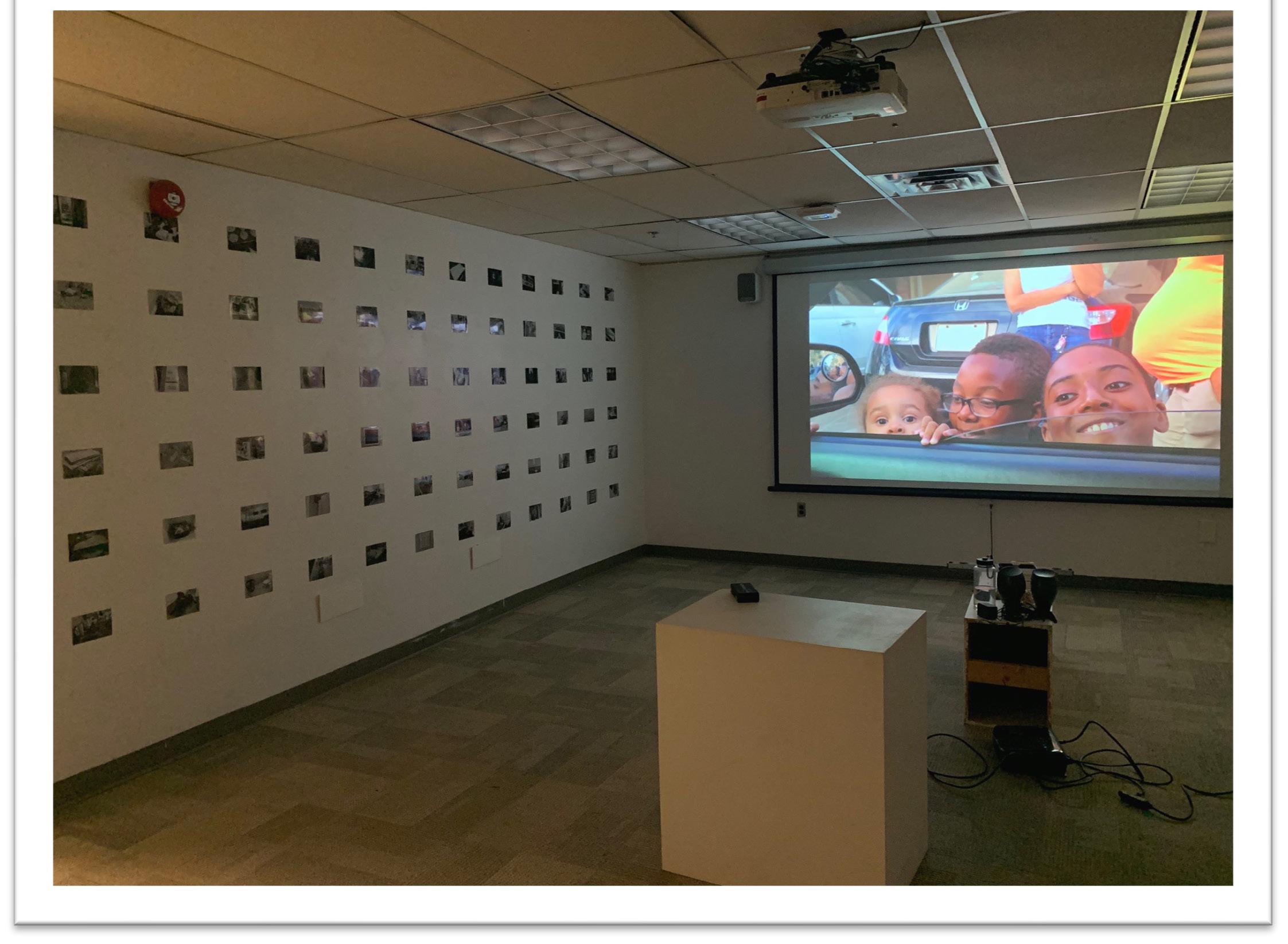
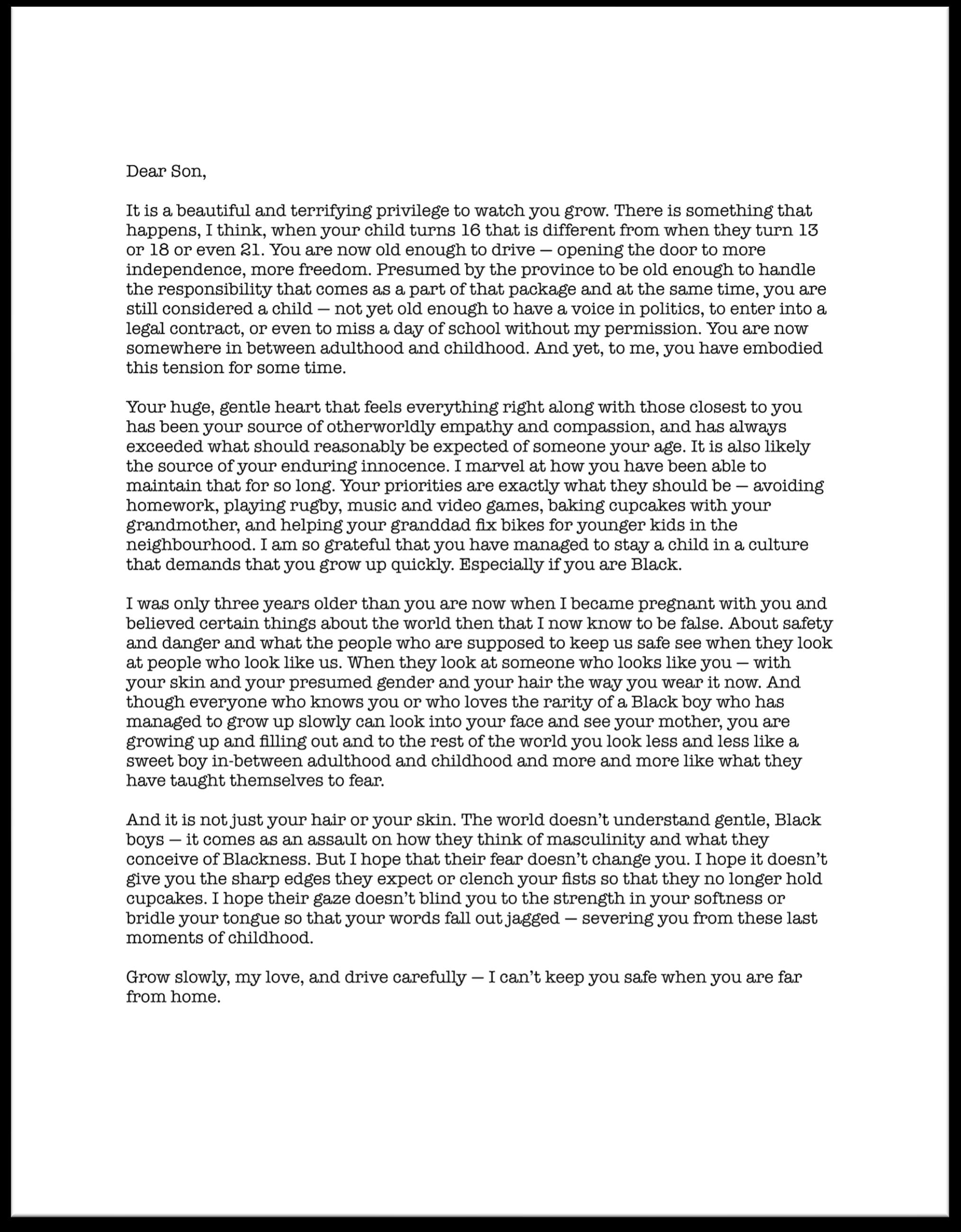
Son is a multi-media installation of sound, photograph, text and moving images as a meditation on parenting a Black son under the constant threat of racial violence. The installation featured 180 black and white photographs depicting the relatively unremarkable tasks of domestic care as the back drop to two videos playing at either end of the room. The first video is an open letter I wrote to my son shortly after his 16th birthday, warning him of the potential of increased surveillance and vulnerability that he may be subject to as he grows. As the letter is read, it is redacted several times to reveal messages not present in the original (or voiced) letter. The second video brings the perspectives of other parents of Black sons into conversation with my own as they answer the questions: What is your greatest hope/joy/fear for your son? Their responses are pieced together—never quite overlapping, but allowing very little space to discern when one emotion has ended and another has begun—and form the soundscape for the images and videos of my son and his Black boy kin – protected, connected, laughing, cared for, nourished, peaceful, safe.
Son is a conversation about Black care—that which can be seen and that which cannot—and the emotional complexities of parenting in a context that, as Audre Lorde (1997) reminds us, we were never meant to survive (p.255).
References
Lorde, A. (1997). Litany for Survival. The Collected Poems of Audre Lorde, Norton. Sharpe, C. (2017). In the Wake: On Blackness and Being. Duke University Press.
Figure 1: During setup of Son at the Eco Arts & Media Festival, York University (2020)
Figure 2: Two of the 180 photos that lined the walls of the installation.
Figure 3: Unredacted letter, part of Son (2020).
Figure 4: Redacted letter from Son (2020). It reads, “It is terrifying when your child is Black.”
Figure 5: Redacted letter from Son (2020). It reads, “gentle child clench your fists.”
Figure 6: Redacted letter from Son (2020). It reads, “gentle child you may need to clench your fists.” The text in red (“you may need to”) is an annotation not present in the original letter.
The womb: a site of domination and resistance in the
Pre-emancipation British Caribbean
Collin Xia
Abstract
Beginning in the 1780s, British Caribbean plantocracies faced the looming threat of slave trade abolition which would end the flow of enslaved African labour to Caribbean plantation colonies. An enslaved woman’s function as the source of blackness and legal slave status made their wombs essential to a future without readily available slave imports. Narratives centring the intensifying colonial domination of enslaved women’s wombs highlight abolitionists and slave owners’ deployment of enslave women’s reproductive labour in slave-breeding programs to produce a self-sustaining source of labour. This narrative neglects the agency enslaved women exerted in exacting control over their sexuality, marriage status, pregnancies, childbirth experience, and child-rearing process that jeopardised the institution of slavery in “gynecological revolt.” This essay privileges the feminized, unarmed, sexual, bodily defiance of enslaved women within the greater, often masculinized Caribbean slavery scholarship to argue that the womb was a site of intensifying colonial domination in the Age of Abolition but more significantly a site of women’s revolutionary struggle against slavery.
Figure 7: Redacted letter from Son (2020). It reads, “I hope my love can keep you safe.”
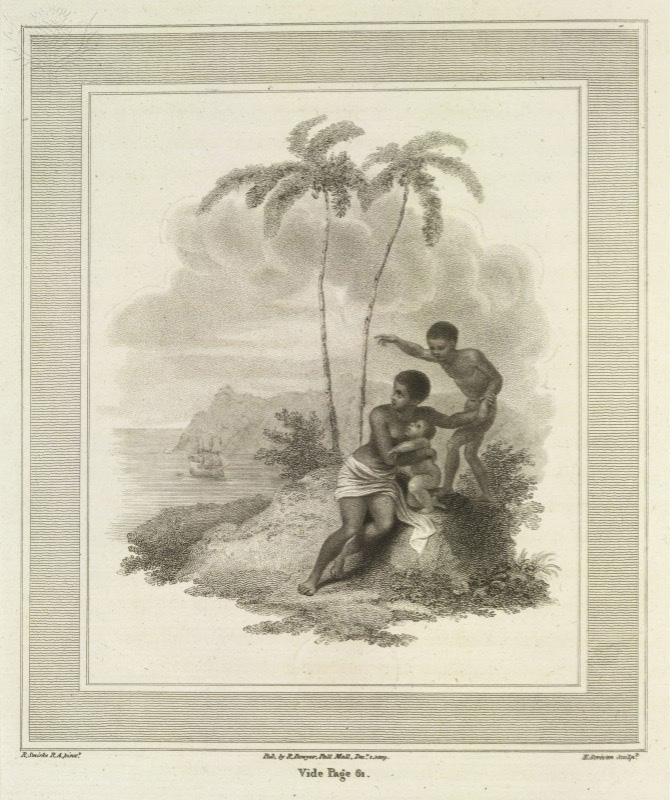
Poems on the Abolition of the Slave Trade; written. [Fine Art]. Retrieved from Encyclopædia Britannica ImageQuest.
Women’s bodies and labour have been at the heart of colonial monoculture export economies and the entire racial slavery system (Morgan, 2004, p.4). They were “important sites of political struggles over slavery, abolition, and colonial reform,” as their sexuality, reproductive labour, and childrearing practices acted as zones of conflict, in which abolitionists, slaveholders, the imperial government, and enslaved people competed to control (Turner, 2017, p. 10). Enslaved women’s reproductive labour held symbolic and legal significance in British colonial societies as their bodies reproduced “blackness” and its “enslavability,” allowing slave owners to claim the offspring of their female slaves as their property (Morgan, 2004, p.4). It was not until the 1780s, the beginning of the British abolition campaign, in which slave owners foresaw an existential threat to the plantocracy and sought to fully capitalize on the womb to sustain the colonial-slave system (Turner, 2017, p.18). From that point on, Anglo-Caribbean plantocracies demonstrated significant interest in enslaved women’s reproductive labour to manage slave demographics but enslaved women often defied their masters to exert control over their reproductive capacities in “gynecological revolt” that challenged the entire racial slave enterprise (Morgan, 2004, p.11).
This essay examines sources centred on Jamaica to argue that the wombs of enslaved women in the Anglo-Caribbean colonies were sites of colonial domination as slaveowners, abolitionists, and the imperial government fought to control it but were also sites of “gynecological revolt” as women exerted control over their sexuality, pregnancy, childbirth experience, and child-rearing process. The first section of this essay will describe the legal and ideological struggle between British abolitionists and slaveowners over slave trade abolition from the 1780s to 1807. The debate sparked increased control over women’s reproductive capacities as abolitionists sought to frame women as the source of a self-replenishing labour force that justified the abolition of the slave trade. As abolitionists gained momentum in Britain, slaveowners began slave breeding projects to secure a new source of labour for a future without readily available slave imports. The second section be-
gins to unravel the narrative that British intellectuals, parliamentarians, and humanitarians were the sole force fighting against the slave system by centring enslaved women who challenged slavery by exerting control over their bodies and reproduction in “gynecological revolt.” Finally, the conclusion will tie this investigation of reproductive resistance together and make concluding comments on the lack of significance slave scholarship places on women’s feminized, unarmed, sexual, bodily defiance.
Abolitionist narratives of the womb
To begin a discussion on women’s gynecological revolt during Britain’s Age of Abolition, defined in this research as the 1760s-1833, abolitionist strategies to abolish the slave trade and slavery employing women’s reproductive capacity must be examined in relation to slaveowner’s interests in preserving the status quo. According to Sasha Turner (2011), before the emergence of the abolitionist movement, slaveowners preferred male slaves who were thought to be “more versatile and capable of performing the sugar plantations’ variously demanding agro-industrial tasks” (p.39). On the other hand, Turner (2011) claims slaveholders “reluctantly bought females for their Jamaican sugar estates throughout the seventeenth century and maintained this practice until the late eighteenth century” as enslaved women were considered less valuable due to their physiological needs during and after pregnancies, which were “viewed as distractions by capitalistic planters whose main focus was maintaining productivity and profitability” (pp.39-40). Women’s symbolic role in reproducing the slave status through their reproductive labour were not as valued because it was more profitable to purchase a male adult at their physical prime than accommodate women’s pregnancies and raise their children. It was not until the 1780s when slaveowners began to reconsider the profitability of women’s reproductive labour as the abolitionist campaign began successfully lobbying the end of the slave trade. According to Turner (2011), the abolition of the slave trade, (abolitionist activists’ first step in abolishing slavery in the British Empire), strategically employed enslaved women’s reproductive labour to advocate for a racial
eugenics program that would supposedly make slave trading obsolete and sustain the plantation economy (p. 42). Abolitionists “mobilized a particular racial violence against black sexuality and motherhood” in which control of enslaved women’s fertility and maternity were central to creating a free labouring population that could be molded into ideal subject-citizens of the empire (Turner, 2011, p.42). While most Jamaican slaveowners rejected the notion that their slaves could be reformed into equally free subjects, they changed their slave purchasing patterns to select more women of child-bearing age to achieve sex-parity and began a plantation breeding program to secure an alternative labour force (Turner, 2011, p.43). Overall, the success of the movement to abolish British slave trading was hinged on a program to control black women’s reproductive labour to reproduce a “working population suitable for building and sustaining the British imperial enterprise” (Turner, 2011, p.42). As Turner (2011)reflects, “whether in slavery or antislavery rhetoric, black women’s bodies and their lives were defined by their ability to propagate workers for the colonial economy” (p.42). This era of abolition paradoxically ushered in a period of anxiety fuelled violence and control over a previously neglected resource, the womb.
Gynecological revolt
The narrative of the abolitionist-plantocracy struggle over enslaved women’s reproductive capacities to secure a stable post-slave trade labour force is significant but not inclusive of the power and agency enslaved women exercised in this transition period by sabotaging the abolitionist-plantocracy slave breeding project. One aspect of this project was the attempt by both abolitionists and slave owners to encourage monogamous slave marriages that would subjugate female sexuality under the institution of marriage and produce racially “pure” slave children. However, enslaved women engaged in gynecological resistance by rejecting monogamy, having interracial relationships that granted them privileged status in the plantation hierarchy, as well as liberating their bodies from sexual/reproductive slavery through marronage. Despite their conflicting
objectives, many slaveowners, policymakers, and abolitionists found common ground in using marriage as an institution that would encourage slave reproduction, control slave sexuality through the practice of monogamy, and preserve racial purity and hierarchy in colonies (Paugh, 2014, p.643).
In Katherine Paugh’s article (2014), “The Curious Case of Mary Hylas: Wives, Slaves and the Limits of British Abolitionism,” the institution of marriage and slavery are revealed to share a loss of civil identity for married women and slaves, a kind of “social death” that made enslaved women resistant to marriage (pp.629-630). Rhonda Reddock (1985) further argues that the contempt for marriage among slave women was because “it meant extra work and being confined to one man” when both men and women often maintained multiple relationships (p.69). Moreover, enslaved women actively resisted abolitionist and slaveowner interests in discouraging interracial sex and “cultivating a purely African plantation labour force” by having sex with non-African men which at times conferred elite status for themselves and their mixed-race children (Paugh, 2014, p.647). Paugh (2014) asserts that the sexual economies of British slave societies “could foster vastly unequal and even violently exploitative relationships between white men and Afro-Caribbean women,” but interracial reproduction also provided rare opportunities for some enslaved women to “carve out a relative independence” from husbands, masters, and abolitionists (p.647). While some enslaved women enjoyed privileged lives by rejecting racial sex restrictions, some women’s path to gynecological revolt was through marronage. Verene Shepherd (2008) asserts that many women did not give their bodies for reproduction or sex and chose marronage to remove their bodies “from the site of oppression” (p.139). By viewing marronage as a form of gynecological revolt, these women removed their wombs from colonial control, they removed an asset that reproduced slaves and created wealth for slaveowners. Their liberated bodies could then engage in sexual activity and reproductive labour outside the institution of marriage, the slave breeding program, and the jurisdiction of the colonial-slave system. In sum, enslaved wom-
en’s gynecological resistance involved resisting imperial programs to encourage slave marriages and sexual conformity as well as removing their bodies from the slavery system all together.
For enslaved women who did not have the luxury of upward mobility through interracial sex, the chance to escape the plantation, or the ability to resist sexual violence, the slave breeding project advocated by abolitionists and employed by slaveowners resulted in pregnancies. However, women’s gynecological resistance continued after conception as they exercised agency over their bodies and their children throughout their pregnancies and the child-rearing process. Many women chose abortion and infanticide while some chose to keep their babies and deliver them under the care of Black midwives and engage in African child-rearing practices against the wishes of the slaveowners. Shepherd (2008) suggests that enslaved women understood the implications of the abolition of the slave trade and acted to free their “enchained wombs” by refusing to bear children who would become slaves themselves (p.142). Kenneth Morgan (2006) attests to the use of abortive agents or physical violence to induce self-abortion as well as the practice of maternal infanticide. Morgan claims that these desperate acts of resistance were understood within “their woeful condition of perpetual chattel slavery” (pp.244-252). These women asserted control over their reproduction to prevent their children from living as slaves and robbed their owners of their “property” (Morgan, 2006, pp.245-246). These acts of resistance were often unnoticed by slaveowners as the reproduction rates among enslaved women in Jamaica was historically low due to the bodily and emotional damage caused by their tremendous workload and frequent abuse (Morgan, 2006, pp.252). These abortions and infanticides were difficult for slave owners to account for and are just as difficult for researchers to track as this form of resistance was silenced by the women themselves.
On the other hand, a woman choosing to keep her child and cherish them is also a form of resistance in a society that systematically tore families apart for profit and discouraged familial bonds. When many of these women carried their chil-
dren to term, they faced a choice of giving birth in their community with the aid of a midwife or in clinics operated by doctors hired by slave masters. Many women chose to deliver their babies in their communities against the advice of doctors who warned of unsafe conditions and poor midwife practices (Turner, 2017,14). Before slaveowners took a special interest in reproductive labour in the 1780s, enslaved women and community members held a measure of autonomy having developed “autonomous social networks and customs around maternal and infant care” (Turner, 2017,14). In choosing to rely on midwives and their community to successfully deliver their children, women exercised control over their bodies and challenged slaveowners’ power over the process by choosing who can touch them and care for their bodies/ reproductive health (Turner, 2017,149). Lastly, following the birth of their children, enslaved women employed African child-rearing practices which involved nursing their children for two years, sometimes up to three or four years, which stalled their reproductive capacities. Morgan (2006) claims that a longer nursing period entailed longer lactation, which served as a natural means of contraception, “either through the physiological suppression of fertility in the mother by producing breast milk or through the social impact of constant nurturing of infants and consequent unavailability to men” (p.243). Morgan (2006) suggests that long lactation periods and post-partum taboos against a mother’s resumption of intercourse during the nursing period are “carry-overs from traditions in West African societies” and contributed to extensive birth-spacing practice among slaves (pp.243-244). These practices protected enslaved mothers’ as they were able to fend off rape, prevent further pregnancies, and attend to their children. Gynecological revolt is undertaken through many forms of resistance after conception, from abortion and infanticide to observing culturally informed maternal health and child-rearing practices that inhibit productive capacities. In the end, all these forms of resistance contributed to sabotaging the demographic goals of enslavers and abolitionists.
To conclude, during the Age of Abolition, enslaved women’s reproductive capacities were
increasingly significant to slaveowners, abolitionists, colonial economies/societies, and the empire itself. This essay has examined Jamaican and British Caribbean sources that argue the wombs of enslaved women in the Anglo-Caribbean colonies were sites of colonial power as well as sites of “gynecological revolt” as women exercised agency over their sexuality, pregnancy, childbirth experience, and child-rearing process. This essay has centred the female body in slavery scholarship to reveal that the womb is a significant symbol in the struggles over freedom and slavery (Turner, 2017, p.177). Despite its importance, women’s bodily resistance is not privileged in narratives on slavery and abolition. While women have long participated in the armed struggles against slavery and colonialism and at times have been recognized in those efforts, by focusing on women’s bodies/the womb as a site of resistance, this essay has deconstructed resistance beyond imaginings of the “armed, militaristic, physical, and triumphant” struggle “particularly resonant in the Caribbean” and privileged the feminine, unarmed, clandestine, sexual, bodily resistance as revolutionary (Fuentes, 2016, p.10).
References
Fuentes, M. (2016). Dispossessed Lives: Enslaved Women, Violence and the Archive. University of Pennsylvania.
Morgan, J. L. (2004). Laboring Women: Reproduction and Gender in New World Slavery. University of Pennsylvania Press.
Morgan, K. (2006). Slave Women and Reproduction in Jamaica, C.1776–1834. History 91, no. 2, 1-252.
Paugh, K. (2014). The Curious Case of Mary Hylas: Wives, Slaves and the Limits of British Abolitionism. Slavery & Abolition 35, no. 4, 629-647.
Reddock, R. E. (1985). Women and Slavery in the Caribbean: A Feminist Perspective. Latin American Perspectives 12, no. 1, 69.
Shepherd, V. A. (2008). Women and the Abolition Campaign in the African Atlantic. The Journal of Caribbean History 42, no. 1, 139-142.
Turner, S. (2017). Contested Bodies: Pregnancy, Childrearing, and Slavery in Jamaica. University of Pennsylvania Press.
Turner, S. (2011). Home-grown Slaves: Women, Reproduction, and the Abolition of the Slave Trade, Jamaica 1788-1807. Journal of Women’s History 23, no. 3, 23-43.
Turner, S. (2017). Slavery, Freedom, and Women’s Bodies. Journal of Women’s History 29, no. 1, 177.
Potter’s Cay Reimagining: New Providence, The Bahamas
Nastassia S. Pratt
Abstract
This essay explores the state of public space within a waterfront commercial space in New Providence in The Bahamas, known as Potter’s Cay. Like many Caribbean nations, The Bahamas is a tourism-centric economy in which the tourism industry plays a key role in the organization of space into an environment that has been historically fraught with tensions, inequity, and uneven geographies. This is due to the significant influence of private landowners and resorts. This influence directly impacts the disinvestment of public spaces that are continuously activated by Black Bahamians and the increasingly restrictive public access to waterfront and coastal spaces. This essay suggests a community-led, arts-based approach to development that emphasizes the importance of Potter’s Cay as a waterfront space of cultural value through centering local Black life and experiences in the community’s development activity.
Introduction
The state of public space in tourism-centric Caribbean nations has historically been fraught with tensions, inequity, and uneven geographies. In The Bahamas, speculators, hoteliers and private landowners have increasingly used economic leverage to control how space is organized. By privatizing public lands and public spaces, landowners restrict local access to these spaces by the posting of a sign or construction of a fence. With a population in which 90% identify as Black, The Bahamas is complicit in this type of spatialization as most of the wealth and prized coastal lands are owned by a small minority of non-Blacks, who are oftentimes White. This means that the organization and privatization of space is a racialized process, which has made local access to public space and “policing” of these spaces an explicitly racial issue of critical importance and worthy of continuous examination.
The Potter’s Cay commercial strip that sits as the backdrop and foreground of a locally activated public space in New Providence, the capital of The Bahamas, is a space that is worthy of closer (re)examination and reimagining. Today, Potter’s Cay Dock, which abuts Nassau Harbour, contains the inter-island mail boat system and the
Ministry of Agriculture’s Produce Exchange from which Bahamian-grown produce is distributed. The Potter’s Cay commercial strip is located within Potter’s Cay Dock. This commercial area sprawls beneath the exit bridge from Paradise Island, stretching along its two edges in Nassau Harbour. Portrayed in tourism literature as a “sleepy fish market,” this space is a part of the Black Atlantic, a place where Black Bahamian culture is produced and where space is created through local exchanges and activation. Ensuring that this Black cultural node is not disinvested, misrepresented, and erased will require an organized community-led place-making strategy that brings a variety of interdisciplinary partners into the development fold. This essay will recommend a creative approach portrayed through two watercolors of a reimagined Potter’s Cay that is animated through art. This essay will attempt to historicize the racialization of the Potter’s Cay commercial area, explain its intrinsic cultural value, and recommend routes to envisioning an artsbased community approach to its recognition as an entry point to cultural place-making.
Historicizing the Racialization of Bahamian Public Space
Historians Craton and Saunders (1999) note that
Bahamian society has had Blacks comprising an overwhelming majority since 1787, since the moment White loyalists and their Black slaves departed from East Florida to settle the archipelago (Craton and Saunders, 1999). The society was formed out of colonial racial repression like the rest of contemporary Caribbean society (Craton and Saunders, 1999). The Bahamas was a significant player in the colonial project and residual traces of this unfinished project remain today in the form of physical structures, left over spaces, restrictive policies and social struggles that manifest as environmental and spatial injustices. Lipsitz (2007) notes that “the contours of racial inequality today flow directly from the racial and spatial heritage bequeathed to us from the past,” further aiding in focusing the lens of understanding “the racial meaning of places” (p. 17). McKittrick (2013) speaks to the existence of “plantation narratives” in modern society that are continuations of the haunting violence of the colonial plantation that thrived through dividing geographies into us/them resolutely (p. 12). Together these critical race lenses aid in centering historical Black life when considering the records of White elites and landowners exerting their supremacy over and subjugation of Blacks, through since repealed laws like the Markets and Slaughterhouses Act of 1947.
Today the resort, through the tourism project, is “the new plantation,” and draws lines in the proverbial and actual sand across all levels—societally, intellectually, economically and spatially, to name a few. These lines, both within the private lands of the hotel and outside of its property lines, instruct local Blacks about who they are, who they can be and where they are allowed to go and not go. These hotels that are funded primarily, and quite often entirely, by foreign direct investment (FDI) are frequently built on scarce, coastal public lands to further attract the tourist dollar. Speculators, government elites and wealthy landowners, have positioned tourism development as a “national development strategy” with evocative Eurocentric constructs masked as marketing, such as “Paradise Island” and “The New Bahamian Riviera” (Bennet, 2015, p. 116). One could argue that the tourism industry is a direct threat to Potter’s Cay, a cultural landscape in New Providence. Therefore, what is one to do with a waterfront public space that has no direct connection to the tourism project, is commercially and consistently occupied by Black businesses and stubbornly survives despite the government’s neglect and unfulfilled promises (Wells, 2015 and ZNSNetwork, 2013? This essay argues that the community should focus its improvements and development inwardly and
Fig 1:Aerial View of Potter’s Cay Commercial Edges
locally. Additionally, Potter’s Cay community members should center all discourse on the historical and cultural wealth of its local Black community and use the arts as an avenue to express their self-identified cultural value.
Intrinsic Cultural Value
The working definition of a cultural landscape in this essay is adopted from the Halifax Heritage Property Act of 1989 which states that “this is a distinct geographical area of property uniquely representing the combined worth of nature and/ or of people.” Potters Cay is a cultural landscape that is defined by its business owners, local visitors and the different ways that Black people produce space within and outside of its restaurants and stalls. This area is a part of a small network of formal and informal spaces in the nation’s capital where Blacks gather organically and help to render the spatiality of the Black experience in the country.
Potter’s Cay is the site of cultural erasure even as it echoes the highly regulated fish market that existed pre-independence that has since been removed (Bethel-Bennet, 2018). Traces of that market can be seen and heard at the stalls of the seafood and produce vendors and in the boats returning to dock with freshly caught fish and conch from islands across the Bahamian archipelago. This is also one of only two coastal, public commercial spaces where Black people are known to gather socially and publicly without being harassed or policed by private landowners and resort security.
Geographer Camilla Hawthorne (2019) notes that Black geographies assert the inherent spatiality of Black life—the spatial imaginaries, space-making practices, and sense of place rooted in our communities (para. 1). Here, seafood vendors have been selling their catches and patrons have been eating the local delicacy, conch salad, for decades (Britell, 2022). The taxi drivers with connections to various restaurants and bars at Potter’s Cay, like Mackenzie’s restaurant, are often seen sitting or standing outside of restaurants while the tourists they bring to the area enjoy Bahamian cuisine and local beer. Young children can be seen
selling wares, and along the water’s edge that eventually guides pedestrians into Potter’s Cay, there is often someone sitting on a bench ready for a witty hello.
Potter’s Cay matters, and keeping this space for local residents, strategically and with intentionality, will require a bottom-up approach that is community-led. One way to approach this is through arts-based engagement projects that revolve around what community members envision as the future of the area. This can also help the community to resist disinvestment, neglect and harmful development activity by highlighting the essence of the cultural value of Potter’s Cay (Rolle, 2020; ZNS, 2013).
Reimagining and Community-led Creative Place-making
A community-led development process proposed by Kretzmann and McKnight (1996) is assets-based mapping. This is characterized by the strengths of every local individual, family, civic association, local agency, private business, public institution, private institution, and public agency of the area being identified and leveraged for development (Kretzmann and McKnight, 1996). By doing this, new structures of opportunity, new sources of income and control, and new possibilities of production can be discovered and leveraged for self-driven development projects (Kretzmann and McKnight, 1996). This bottom-up approach is compatible with arts-based place-making, or creative place-making projects, which can potentially take a variety of forms and offer countless opportunities for innovative engagement strategies and reimagining of space. Daniel and Kim describe creative place-making as a specific type of planning that intentionally leverages the power of the arts, culture, and creative initiatives to implement changes in communities. Successful creative place-making has mostly made building partnerships across disciplines and governmental agencies a foundational principle. And creative place-making collaborations are not artist-focused but instead depend on ‘non-artist, non-planner stakeholder support for implementation.’ (Daniel and Kim, 2020).
Fig 2 and 3: Selection Views for Reimagining (Author)
Fig 4 and 5: Proposal Watercolor Sketches (Author)
Fig 6: Site View #1 Author’s rendering with art installation and planters
Fig 7: Site View #2 Author’s rendering with pedestrian street art installation
This essay argues that opportunities for creative place-making in Potter’s Cay abound. Building partnerships and bridging ideological ideas and presumptions about this important cultural node will aid in facilitating suggested improvement projects in the area that community members have already voiced (ZNS, 2013). These new relationships can then create avenues for this community sharing the complete story about what makes Potter’s Cay a hidden gem.
Local artists can help animate the newly discovered and understood definitions of Bahamian cultural processes and objects in Potter’s Cay developed through asset-mapping in the development process. Artists with a social practice in the region like John Beadle or Anina Major are asking important questions, like, who are the spatial actors in the region, who should they be, and what forces are driving their movement, actions, and reactions? Jamaican-Bahamian artist John Beadle’s practice is concerned with how “the Black individual and the environment are perceived as one materially” (Glinton-Meicholas, 2013). On the other hand, Major’s work explores how experiences are reclaimed, and the phenomena of objects being displaced through relocation—a relevant topic when one considers the Black Diaspora and the thread of intellectual and physical displacement that runs through so many Black communities. The watercolor paintings that I produced to accompany this essay are only a glimpse of a possible future for Potter’s Cay; a future that includes the community working with an array of local experts possessing local knowledge; where locals are leading creative place-making projects in partnership with government partners and professional planners as needed. Technocratic involvement in community-led initiatives is not a requirement for successful community development projects; it is only one option of many. Instead, Potter’s Cay has the potential to become a beacon in the Caribbean for intentional creative place-making that centers local Black life and voices within community-led development practices.
References
Bennett, I. B. (2015). The Resort Model and Structural Violence. Caribbean Quarterly, 61(4), 116–126. https://doi.org/10.1080/00086495.2015 .11878854
Bethell-Bennett, I. (2018, April 18). Potter’s Cay: Markets and the importance of public spaces. National Art Gallery of The Bahamas. https://nag-bahamas.squarespace.com/mixedmediablog/2018/4/18/potters-cay-markets-andthe-importance-of-public-spaces
Britell, A. (2022, January 26) In Nassau, The Bahamas, the crossroads of conch. Caribbean Journal.
https://www.caribjournal.com/2022/01/26/innassau-the-bahamas-the-crossroads-of-conch/ Craton, M. and Saunders, G. (1999). Islanders in the Stream: A History of the Bahamian People. From aboriginal times to the end of slavery. University of Georgia Press.
Daniel, J. L., and Kim, M. (2020). Creative placemaking: creating change by building partnerships. Journal of Public and Nonprofit Affairs, 6(1), pp. 96–110. https://doi.org/10.20899/ jpna.6.1.96-110
Glinton-Meicholas, P. (2013). Constructing Community and Nation in the Archipelago: Yesterday, Today and Tomorrow. International Journal of Bahamian Studies, 19(1), pp. 70–87. https://doi.org/10.15362/ijbs.v19i1.187
Hawthorne, C. (2019). Black matters are spatial matters: Black geographies for the twenty-first century. Geography Compass, 13(11), e12468. https://doi.org/10.1111/gec3.12468 Heritage Property Act. (1989). City of Halifax. https://nslegislature.ca/sites/default/files/ legc/statutes/heritage.htm
Kretzmann, J., and McKnight, J. P. (1996). Assets-based community development. National Civic Review, 85(4), pp. 23–30.
Lipsitz, G. (2007). The Racialization of Space and the Spatialization of Race: Theorizing the Hidden Architecture of Landscape. Landscape Journal,
26(1), pp. 10–23.
McKittrick, K. (2013). Plantation Futures. Small Axe: A Caribbean Journal of Criticism, 17(3), pp. 1–15.
https://doi.org/10.1215/07990537-2378892
Rolle, L. (2020, September 8). It’s really rough for Potter’s Cay vendors. Tribune. http://www. tribune242.com/news/2020/sep/08/its-reallyrough-for-potters-cay-vendors/
Well. R. (2016, March 10). Gray: $2m to be allocated for Potter’s Cay upgrade. http://www. tribune242.com/news/2016/mar/10/gray-2mbe-allocated-potters-cay-upgrade/ ZNSNetwork. (2013, April 29). Potter’s Cay dock to get a makeover. https://www.youtube.com/ watch?v=21vRD0P32rQ
The Politics of Reparations in Rastafari Livity and Reggae
Chevy Eugene
Abstract
In this paper, I explore the role of the Caribbean creative imagination in advancing the Caribbean reparations movement. To support my hypothesis on the role of the arts in reparations, I examine the politics of reparations in reggae music by my exploration of the studio albums of the most influential reggae artist - Bob Marley. The four themes underlined are: emancipation, chant down Babylon (destruction of the neoliberal construction of the world), repatriation, and the promised land.
Dread, Natty Dread now, Dreadlock Congo Bongo I.
Natty Dreadlock in a Babylon, A dreadlock Congo Bongo I. Eh! Children get your culture, And don’t stay there and gesture, Or the battle will be hotter, And you won’t get no supper.
- Bob Marley – Natty Dread
Introduction
The Caribbean creative imagination plays an integral part in the makeup of the cultural identities of the region, which are expressed through the arts produced by Caribbean nationals in the Caribbean or its diasporas. Rex Nettleford (2009) asserts that the creative imagination is critical in the process of decolonizing the spirit in the continuing pursuit of dignity, belonging, self-actualization, and purpose in the post-colonial world (p. 35). By engaging with the Caribbean creative imagination, this paper explores how the politics of reparations is conveyed in the Rastafari movement’s creative sounds of reggae, by examining the lyrics of cultural icon Bob Marley. Reggae offers a perspective utilizing the “gaze from below,” (Wynter and McKittrick, 2015, p. 11) through the “traditions of the oppressed” (Bogues, 2012, p. 30); that is, it offers a counter-narrative to Eurocentric epistemes in its creative and rhythmic sonic articulated from the “non-human.” Marley’s music has been selected because of its impact on cultural, political, and social movements in Jamaica, the Caribbean, and globally. In the Caribbean context, I believe that the reparations discourse should be centred on the advocacy for redress for the genocide of Indigenous People, transatlantic slavery, chattel slavery, and indentureship; however, my approach for this piece focuses primarily on restitution for transatlantic slavery. When this paper speaks to reparations, it refers to the challenge of repairing wrongs that were committed in the past and that have determined the framework of the present (unless defined otherwise). It does not focus primarily on the redistribution of wealth but, more importantly, on sovereignty and a shift of the global power dynamics.
In my analysis, the Marley albums explored were Burning (1973), Natty Dread (1974), Rastaman Vibration (1976), Exodus (1977), Kaya (1978), Survival (1979), Uprising (1980) and Confrontation (1983). My reference to the work does not follow a linear timeline but goes across time and space to draw from Marley’s liberation songs. In her analysis of Marley’s music, Carolyn Cooper (1995) asserts that the sound and lyrics are a mixture of “scribal and oral literary influences” (p. 117). The
scribal influences are mainly grasped from the Bible (according to Rastafari’s interpretation) and are traditionally transmitted orally. The latter originates in Jamaican philosophy, a collective of culture and traditions across generations (Cooper, 1995, p. 117)—the everyday lexicon of a nation’s people. My analysis of the lyrics does not claim authority over the artwork’s meanings but works with Marley’s openness to various interpretations of his music. In an interview, when Marley was questioned about the meanings of his album Kaya, he responded, “[y]ou have to play it and get your own inspiration. For every song have a different meaning to a man. Sometimes I sing a song and when people explain it to me I am astonished by their interpretation” (Wilson & Hall as quoted in Cooper, 1995, p. 118).
Reparations
In my examination of Marley’s creative and liberating artwork, the themes of redress that have been conceptualized are inspired by how some of the ideologies of Rastafari livity is conveyed in his music. Additionally, the themes were developed by how my dissertation project has taken up decoloniality, referencing Frantz Fanon (1965, 1967, 2004, 2008), Sylvia Wynter (2006, 2015), and Anthony Bogues (2012).
The first theme, emancipation, speaks to the process of decolonization one must experience for internal liberation. It can be expressed as an awareness of “self” that takes place when the newly liberated human embraces Rastafari livity. Additionally, the notion of emancipation is reflective of the seventh Rastafari principle —the ability to “reason” or to be “reasonable” (Williams, 2008, p. 17). As such, for one to have the capability to hold discourse as a Rastafarian, an internal liberation must occur.
The second theme, chant down Babylon is recognized in Rastafari philosophy as destroying the contemporary modern global system. The third tenet of Rastafari principles is to counter oppressive forces that take place across racial lines. That same rhetoric of the destruction of “Babylon” permeates through reggae; and Marley’s music is a prime example.
The third theme, repatriation, highlights the physical, mental, or spiritual return to Africa. Repatriation is one of the pillars of Rastafari livity, and as such, it is the fifth precept of Rastafari principles.
The final theme, promised land (access to land), is an extension of repatriation (the “movement of Jah people” (Marley, 1977)) into a new space—“Zion” (the land of God). This last, builds from the previous three themes that transcend the emancipated, chant down Babylon, and repatriated (physically, mentally, and spiritually) Rastafari in acquiring a central aspect of liberation— land. My usage of repatriation is tied to the idea of creating something new that is independent from Babylon’s influences. The four themes are interconnected and work to formulate what Black radical reparatory justice requires: the liberation of self, destruction of the global capitalist system and the establishment of just realities in decolonial spaces. More importantly, the themes do not occur in any particular order. Rather, they intersect with each other at various points. Further-
more, it is essential to note that my final selection of the music referenced is in accordance with the songs that most strongly support my hypotheses.
Emancipation
My construction of the reparatory theme in Marley’s music, emancipation, speaks with Fanon’s (2004; 2008), Wynter’s (2015) and Bogues’ (2012) articulations of decolonial thought. In my analysis of Marley’s music, emancipation is associated with the decolonization of the former colonial subject, mainly the descendants of the “living corpses.” In one of his most renowned musical sounds, “Redemption Song” (1980), Marley stresses the importance to “emancipate yourselves from mental slavery” in order to achieve liberation. Fanon (2004; 2008), Wynter and McKittrick (2015), and Bogues (2012), similar to Marley, outline emancipation as a process that must occur internally. Marley (1980) sings:
Emancipate yourselves from mental slavery
None but ourselves can free our minds
Have no fear for atomic energy
Cause none of them can stop the time
How long shall they kill our prophets
While we stand aside and look? Ooh!
Some say it’s just a part of it
We’ve got to fulfill the book.
(Redemption Song, 1980)
Marley carries that internal decolonization sentiment in the chorus of the iconic sound. He emphasizes the importance of liberating your mind from the hegemonic structures that have historically and currently suppressed Black life (“atomic energy”) via racial capitalism. He concludes by reverting to the “book”—the Bible—and promises made by the “Lord” to His/Her people. There, we can observe the connection of theology and emancipation in Marley’s creative sound expression.
Chant Down Babylon
Although one can chant down Babylon regardless of their acceptance of Rastafari’s teachings, the process of emancipation (the circular motion of redemption and self-actualization) positions that individual to be more heightened of the colonial and neocolonial “situation”—the violent manner in which “Babylon” functions. The “new human”—liberated person (Rastafarian) can now directly speak to the horrors of “Babylon,”—as addressed in Marley’s musical track “Babylon System” (1979) for instance. Rastafari’s call for the dismantling of the system, presents synergies with Fanon’s (2004), and Wynter’s (2006) postulation of the destruction of the system to create new possibilities detached from Eurocentric ideologies. From his 1973 album Burning, in the song “Rastaman Chant” he sings:
Hear the words of the Rastaman say: “Babylon, you throne gone down, gone down;” Said I hear the words of the Iyaman say: “Babylon, you throne gone down, gone down; And I hear the angel with the seven seals say: “Babylon throne gone down, gone down” (Rastaman Chant, 1973)
Marley places Rastafari as prophets who foretell the obliteration of the system that is built to
exploit the working class, subaltern, and poor people—specifically Black people. The Rastaman or Rastafari adherents in their stage of emancipation, recognize the collapse of the modern world and utilize scriptural references to support their belief. In the above extract, Marley starts the verse with the chants of the “Rastaman” who prophesies the destruction of the racial capitalist global system. In her assessment of Marley’s taking up of “Babylon” in his music, Cooper (1995) states, his “apocalyptic imagery of imminent collapse graphically suggests the fall of Babylon and the implosion of the political system” (p. 121). The passage “I hear the angel of the seven seals,” is taken from the book of Revelation—a book that speaks of the destruction of the world and the return of the Black Christ (as interpreted by Rastafari) to battle the anti-Christ.
Repatriation
Repatriation is the fifth principle of the spiritual Black Power movement (Williams, 2008) and is one of the most popular themes in the creative expression of reggae, which is reflected in Marley’s musical sermons. Reggae is continuously utilized by Rastafari to speak on their politics of freedom, or as Clinton Hutton (2010) coins it, “repatriational freedom”—that has its origins in West African spiritual practices that were violently disrupted by transatlantic slavery (p. 33). Rastafari’s socio-political history, the livity’s embracement of African culture and advocacy for the “return” to the continent (more specifically Ethiopia) since the movement’s origin, have inspired repatriation to be a tenet of the Caribbean Community (CARICOM) Reparations Commission’s 10-point reparations plan (Matthews 2017, p. 96). According to Rastafarian elder Ras Ishon Williams (2008), Rastafari’s fifth principle was inspired by Marcus Garvey’s notion of “Africa for Africans at home and abroad.” Furthermore, he postulates that repatriation begins with the mind and heart that recognizes one’s immediate environment and can also lead to actions that will result in the “return” to Africa. Marley’s track “Exodus” (1977) from the album with the same title captures the promises that come with embracing Rastafari livity—oppression and salvation via “Jah Kingdom.” Marley (1977) sings:
So we gonna walk—all right!—through de roads of creation
We the generation
Trod through great tribulation. Exodus, all right! Movement of Jah people!
Open your eyes and look within: Are you satisfied (with the life you’re living)?
We know where we’re going
We’re leaving Babylon
We’re going to our Father’s land (Exodus 1977)
The first two lines in the above passage speak to Rastafari as an emancipated being. Marley indicates that when one becomes self-actualized in the knowledge of Rastafari, they will experience oppression from the system. This is evident in how Rastafari have been historically treated in the Caribbean, specifically in Jamaica. The stanza concludes by stating that Rastafari must “trod through the great tribulation” which means the obstacles that practitioners of the faith experience when they take on the spiritual Black Power livity.
Promised Land (Zion)
The final aspect of the reparatory justice, as taken up in Rastafari praxis, is the component of land—the promised land (Zion). Part of the foundation of Rastafari livity is built upon the access to ownership of land away from “Babylon,” leading to sovereignty. Garvey’s (1986) philosophy in his expression of the Black Nationalist tradition, also included the ownership of land, but more importantly the title of property on the African continent to create a new Black-led nation. Although Garvey never got to execute his agenda of repatriating to the continent (Liberia), some Rastafari adherents were able to fulfill his vision to a certain extent by repatriating to Shashamane, Ethiopia, in the early 1950s. Marley, in his music, captures the full reparatory experience in Rastafari thought with the ultimate end goal of making it to the promised land. The process of emancipation takes place through accepting
Rastafari teachings, equipping the believer with the necessary intelligence to “reason” in order to chant down Babylon. This subsequently leads to repatriation, from the trenches of “Babylon” to the promised land. Marley speaks to this Rastafari teaching in the song “Zion Train” from the Uprising (1980) album. He sings:
Zion train is coming our way
The Zion train is coming our way
Oh, people, get on board
Thank the Lord
I gotta catch a train, ‘cause there is no other station
Then you going in the same direction (Zion Train, 1980)
In the above stanza, Marley is encouraging the adherents of the faith to get on “board” the train that will take them to “Zion” (the promised land). It is safe to argue that the “train” is the movement of Rastafari, with the ticket being the acceptance of the teachings and philosophies of the “Black Power movement with a spiritual nucleus” (Mutabaruka, 2021). For Marley, the notion of arriving in the promised land after completing his prophetic work is underscored in “Rastaman Chant” (1973). He sings:
I say fly away home to Zion (fly away home)
I say fly away home to Zion (fly away home)
One bright morning when my work is over, Man will fly away home (Rastaman Chant, 1973)
Upon arriving in the promised land, “Mount Zion,” Marley encourages the adherents of Rastafari to celebrate in the holy city where Jah resides on his throne by “jamming” (dancing/ “skanking”). Moreover, the promised land, similar to the theme of repatriation, is not limited to being “elsewhere” but can be the place where one stands, a state of being, and physical land, where one can dwell in freedom. As my work has argued thus far, it is safe to assert that “Mount Zion” is located in Ethiopia, where Jah has provided the practitioners of the livity with land.
Conclusion
In my exploration of Bob Marley’s music, my
work was able to draw out how the reggae icon was able to take on some elements of reparations in his music. In my analysis, four main themes were propositioned:
emancipation, a non-linear two-way process that includes redemption (internal decolonization) and self-actualization (awareness inspired by the embracement of Rastafari livity that is grounded on Rastafari principles);
chant down Babylon, the musical call that argues for destroying the global racial capitalist system;
repatriation, a central tenet in the theory of Rastafari livity that emphasizes the “return” to Africa (Ethiopia) which can occur in three states— physically, mentally, and spiritually, as a way to get to “Jah Kingdom”—“Zion;” and the Promised land (Zion)—the notion of access and ownership of land that comes with the ideations of reparations. Ownership of property is not the main element of the promised land, but
rather the idea of sovereignty, away from “Babylon” as Marcus Garvey attempted to establish on the African continent.
My examination of Marley’s music is an example of how the arts can be used as a possible tool to politicize and mobilize Caribbean civil society on the reparations conversation, similar to Marley’s usage of reggae to push Rastafari philosophies.
Bogues, A. (2012). And what about the human?: Freedom, human emancipation, and the radical imagination. Boundary 2, vol. 39(3), 29–46.
Cooper, C. (1995). Chanting down Babylon: Bob Marley’s song as literary text. Noises in the Blood: Orality, Gender, and the “Vulgar” Body of Jamaican Popular Culture. Duke University Press, 117–134.
Fanon, F. (1965). A dying colonialism. Grove Press.
Fanon, F. (1967). Toward the African Revolution. Grove Press.
Fanon, F. (2004). The Wretched of the Earth. Grove Press.Fanon, F. (2008). Black skin, white mask. Grove Press.
Fanon, F. (2008). Black Skin, White Mask. Grove Press.
Garvey, M. (1986). Message to the People: The Course of African Philosophy (Edited by Tony Martin). The Majority Press.
Hutton, C. (2010). The power of philosophy in Bob Marley’s music. Jamaica Journal, vol. 33(1–2), pp. 30–39.
Marley, B. (1979). Babylon System [Song]. On Survival [Album]. Island/Tuff Gong.
Marley, B. (1973). Burnin’ [Album]. Tuff Gong.
Marley, B. (1983). Confrontation [Album]. Tuff Gong.
Marley, B. (1977). Exodus [Album]. Island Records.
Marley, B. (1977). Exodus [Song]. On Exodus [Album]. Island/Universal Distribution.
Marley, B. (1977). Jamming [Song]. On Exodus [Album]. Island/Universal Distribution.
Marley, B. (1978). Kaya [Album]. Tuff Gong/ PolyGram.
Marley, B. (1974). Natty Dread [Album]. Tuff Gong.
Marley, B. (1973). Rastaman Chant [Song]. On Burnin’ [Album]. Tuff Gong/PolyGram.
Marley, B. (1976). Rastaman Vibration [Album]. PolyGram / Tuff Gong.
Marley, B. (1980). Redemption Song. [Song]. On Uprising [Album]. Tuff Gong.
Marley, B. (1979). Survival [Album]. Island/Tuff Gong.
Marley, B. (1980). Uprising [Album]. Tuff Gong.
Marley, B. (1980). Zion Train. [Song]. On Uprising [Album]. Tuff Gong.
Matthews, G. (2017). The Caribbean Reparations Movement and the British Slavery Apologies: An Appraisal. University of the West Indies Press, 51(1), 80–104
Mutabaruka. (2021, May 12). Mutabaruka speaks about white rastas and the rastafari movement [Video]. YouTube.
https://www.youtube.com/watch?v=LnwIN8VVeRQ
Nettleford, R. (2009). Decolonizing the spirit: the work of the creative imagination. UNESCO, vol. 61(4), pp. 35–40.
Ogunleye, T. (1998). Dr. Martin Robison Delany, 19th-century africana womanists: reflections on his avant-garde politics concerning gender, colorism, and nation building. Journal of Black Studies, vol. 28(5), pp. 628–649.
Tafari, S. L. (2008). Rastafari: From Religion to Social Theory. In Rastafari (pp. 25–37). Caribbean Quarterly.
Vercetty, Q. (2010). Redemption Song [digital art]. Toronto, Canada.
Vercetty, Q (2021). Rastafari Redemption [digital
art]. Toronto, Canada. Williams, W (Ras Ishon). (2008). The Seven Principles of Rastafari. Rastafari, Caribbean Quarterly, pp. 17–24.
Wynter, S. (2006). On How We Mistook the Map for the Territory, and Reimprisoned Ourselves in Our Unbreakable Wrongness of Being. Malden, Mass.
Wynter, S. and McKittrick, K. (2015). Unparallel Catastrophe for Our Species? Or, to Give Humanness a Different Future: Conversations. Sylvia Wynter on Being Human as Praxis, Duke University Press.
Dr. David Trotman
Most of my intellectual pursuits have been fuelled by a need to understand a life born in orisha, nurtured by the jamette world of steelband and calypso, and formed in the intoxicating pre-independence years of a colonial society. All of that is to say that my academic interests have in large measure been shaped by my social and cultural formation. But my intellectual curiosity has necessarily forced me beyond its initial motivating impulses. I subscribe to the belief that the study of the Caribbean is also a window into the wider world; for Caribbean scholars who know only the Caribbean have an impoverished understanding of the region.
In addition to my academic work, I have been involved in a number of social and cultural activities. I am a life long member of the Casablanca Steel Orchestra and worked as a Community Development Officer in Trinidad & Tobago.
In Toronto, I have been involved in both the judging and training of judges for the Ontario Association of Calypso Performers (OCAP). I have at times also trained judges for the Caribbean Cultural Committee (Caribana).
Some of my previous community involvement has been in the Toronto Black Education Project and I have also written research reports on youth tensions in Toronto for the Ontario Human Rights Commission.
Natalie Woods
I am a multi-media artist, researcher, and educator. I create work that cohabits the areas of art, popular culture and historical research associated with African presence, spirituality, and innovations in the Diaspora. My work stands as a counter-hegemonic force in the face of anti-Blackness, racism, homophobia, and sexism (Edmonds 2012; Wallen 2015).
I am the founder of the Blue Devil Posse, a queer feminist artist and activist group which has been in existence since 2006. We have performed at Caribana, Buddies in Bad Times Theatre, Harbourfront Jouvay, the Dyke March, Pride Toronto (where we raised money for SOY- Saving Our Youth) and collaborated with Pelau Masqueerade and Blockorama at Pride Toronto. As the Posse founder, I have used the creative strategy of the Blue Devil performance to intervene in both Caribana and Pride Toronto to challenge stereotypical, corporate, and dominant notions of who is welcomed in both these festivals. As a posse we confront racism, anti-Blackness, queer and transphobia, sexism, marketing, and profit - making values present in these cultural festivals. We seek to remind these festivals of their origins in protest and to acknowledge the creative and innovative strategies of resistance, abolition, and decolonization performed by subjugated and marginalized communities.
References
Wallen, G. (2015). There is always more than what we perceive. (Unpublished master’s thesis). Ontario College of Arts and Design University, Toronto, Canada.
Edmonds, P. WARC Gallery presents a multimedia installation by Natalie Wood. Retrieved from Arc Magazine. http://arcthemagazine.com/arc/2012/11/warc-gallery-presents-a-multimedia-installation-by-natalie-wood/
Yaroslava Avila Montenegro
Yaroslava Avila Montenegro, MA OCELT is a Mapuche indigenous doctoral researcher in the department of Political Science at York University, and member of the Toronto based Women’s Coordinating Committee for a Free Wallmapu. Her research focuses on state securitization and criminalization of social and indigenous liberation movements in Turtle Island and Abya Yala, currently exploring the involvement of hemispheric security organizations under the US-led Operation Condor. She has also explored the development of the Chilean Anti-terrorist law against Mapuche Land Defenders throughout democratic transition. Other areas of research include exploring indigenous thought in connection with radical social and political thought (marxism, post-colonialism, etc), and exploration into the intersection between state securitization and Far Right politics. Daughter of refugees, lifelong activist for political prisoner and indigenous rights in Wallmapu, Chile, as well as across Abya Yala and Turtle Island.
Juanita Stephen
Juanita Stephen is a PhD candidate in York University’s graduate program in Gender, Feminist and Women’s Studies where her doctoral research explores writing as care work. Looking to the clinical recording practices of care workers, personalized archival albums, and a family group chat as primary sites of inquiry, her dissertation considers how care is constructed, enacted, withheld and (re) inscribed through writing. Guided by more than 17 years of direct service, teaching, and research in Child and Youth Care, and informed by multiple Black feminist traditions, Stephen merges the personal, the theoretical, and the practical in her work to develop an auto-theoretical, research-creation doctoral project and a praxis of care she calls care-full writing.
Collin Xia
Collin Xia is a Master’s student at York University’s Political Science Department. His research interests include queer International Relations, settler-colonialism, and Black-Indigenous solidarity. Collin’s current research is an investigation of Canada’s appropriation of Indigenous sovereignty to strengthen its claim to the Arctic.
Nastassia S. Pratt
Born in The Bahamas, Nastassia is currently completing her graduate studies at York University in the Master in Environmental Studies Planning program. She’s enrolled in the Centre for Research in Latin America and the Caribbean Graduate Diploma that’s deepening her understanding of planning for more inclusive and equitable cities and communities in Canada and internationally. She has an architecture background through an undergraduate degree in Architectural Science from Toronto Metropolitan University. Nastassia is also a watercolour artist and has had several solo exhibitions of her watercolour in The Bahamas that include The Architecture of Community (The D’Aguilar Art Foundation, 2020) and Dwell II (Doongalik Art Gallery & Studios, 2015).
Chevy Eugene
Chevy Eugene is an educator, researcher, and international human rights activist. Currently, he is completing a Social Science Humanities Research Council (SSHRC) funded PhD entitled “Decolonizing the Caribbean Reparations” in the Social and Political Thought Program (SPTH),
at York University, Canada. His research scrutinizes the government-led Caribbean Reparations Campaign using an interdisciplinary theoretical framework and proposes a decolonial view in undertaking reparatory justice. Chevy’s work offers a radical intervention that draws from Frantz Fanon’s (1961) concept of new humanism; Sylvia Wynter’s (2015) genres of man, Walter Rodney’s (1969) praxis of groundings, and Robin Kelley’s (2021) nine theses of decolonization. Chevy is a strong advocate of critical praxis, and as such, his research builds from his work as an activist. For instance, in 2015, he represented the Caribbean in the Fifth UN Fellowship Program for People of African Descent in Geneva, Switzerland. Upon completing the fellowship program, he worked with the government of Saint Lucia to launch the International Decade for People of African Descent (IDPAD) in Saint Lucia. In June 2016, Chevy was invited to Berlin, Germany, to work with the German government to launch the IDPAD. Presently, he is the Caribbean ambassador for the Pan-African Council (PAC). PAC is a premier, action-oriented global leadership organization for visionary Pan-Africanists dedicated to uniting Africa and her Diaspora while fostering cooperation in the political, economic, and social spheres. As ambassador, he leads a collective of entrepreneurs, business leaders, cultural ambassadors, government actors, academics, and activists from the Anglophone, Francophone, Spanish, and Dutch Caribbean in the advancement of the Caribbean across sectors.
“If we do not do this work, if we do not collaboratively call into question a system of knowledge that delights in accumulation by dispossession and profits from ecocidal and genocidal prac- tices, if we do not produce and share stories that honor modes of humanness that cannot and will not replicate this system, we are doomed”