TheAirisCleanerOnTheOtherSideofTown: EnvironmentalJusticeintheEastBay
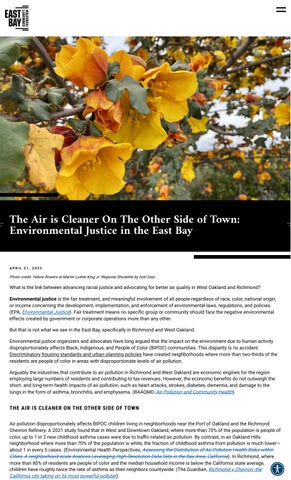
Photocredit:YellowowersatMartinLutherKingJr.RegionalShorelinebyItzelDiaz.
What is the link between advancing racial justice and advocating for better air quality in West Oakland and Richmond?

Environmental justice is the fair treatment, and meaningful involvement of all people regardless of race, color, national origin, or income concerning the development, implementation, and enforcement of environmental laws, regulations, and policies (EPA, EnvironmentalJustice) Fair treatment means no specic group or community should face the negative environmental effects created by government or corporate operations more than any other
But that is not what we see in the East Bay, specically in Richmond and West Oakland
Environmental justice organizers and advocates have long argued that the impact on the environment due to human activity disproportionately affects Black, Indigenous, and People of Color (BIPOC) communities. This disparity is no accident. Discriminatory housing standards and urban planning policies have created neighborhoods where more than two-thirds of the residents are people of color in areas with disproportionate levels of air pollution
Arguably the industries that contribute to air pollution in Richmond and West Oakland are economic engines for the region employing large numbers of residents and contributing to tax revenues However, the economic benets do not outweigh the short- and long-term health impacts of air pollution, such as heart attacks, strokes, diabetes, dementia, and damage to the lungs in the form of asthma, bronchitis, and emphysema (BAAQMD, AirPollutionandCommunityHealth)
THE AIR IS CLEANER ON THE OTHER SIDE OF TOWN
Air pollution disproportionately affects BIPOC children living in neighborhoods near the Port of Oakland and the Richmond Chevron Renery. A 2021 study found that in West and Downtown Oakland, where more than 70% of the population is people of color, up to 1 in 2 new childhood asthma cases were due to trac-related air pollution By contrast, in an Oakland Hills neighborhood where more than 70% of the population is white, the fraction of childhood asthma from pollution is much lower about 1 in every 5 cases (Environmental Health Perspectives, AssessingtheDistributionofAirPollutionHealthRiskswithin Cities:Aneighborhood-scaleAnalysisLeveragingHigh-ResolutionDataSetsintheBayArea, California) In Richmond, where more than 80% of residents are people of color and the median household income is below the California state average, children have roughly twice the rate of asthma as their neighbors countywide (The Guardian, RichmondvChevron:the Californiacitytakingonitsmostpowerfulpolluter)
ENVIRONMENTAL JUSTICE MEANS ACCOUNTABILITY
In Richmond, after arduous community organizing efforts to keep local entities accountable to their constituents, impacted residents and environmental justice groups had a critical win to reduce the disproportionate effects of air pollution caused by local reneries
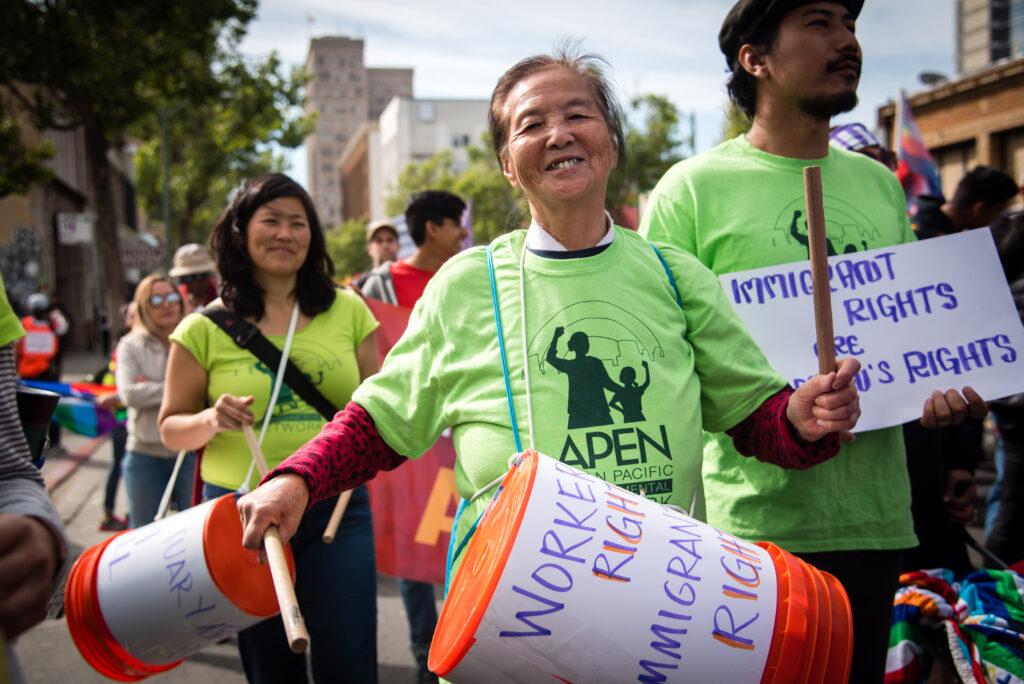
In 2021, Richmond residents and a coalition of environmental justice organizations that included Asian Pacic Environmental Network (APEN) and Communities for a Better Environment core grantee partners of East Bay Community Foundation rallied outside the Bay Area Air Quality Management District (BAAQMD) headquarters to demand the approval of a new cat cracker rule to reduce the pollution produced from the conversion process (e g the catalytic cracking process) used by local gasoline reneries
Soon after, the BAAQMD approved the rule, which requires local reneries to install wet gas scrubbing technology on their worst polluting units Wet scrubbers can remove particulate matter by capturing them in liquid droplets The droplets are then collected, with the liquid dissolving or absorbing the pollutant gases According to an analysis by the UCLA Luskin Center for Innovation and Inclusive Economics, this policy will result in signicant economic benets and cut the pollution that has been harming frontline communities in the area
Andres Soto, Richmond Organizer for Communities for a Better Environment, issued the following statement after the rule was approved, “This is a huge win for environmental justice communities who have been ghting for this rule for years as a matter of racial, environmental, and climate justice”
ENVIRONMENTAL JUSTICE MEANS SOLIDARITY
In Oakland, Communities for a Better Environment, West Oakland Environmental Indicators Project, and other environmental justice groups continue to partner with impacted residents to advocate in favor of lifting the ban on heavy trucks on Interstate 580—the only Interstate Freeway in the Bay Area not open to trucks The ban redirects the heavy truck trac from the Port of Oakland to Interstate 880, a freeway surrounded by predominately BIPOC neighborhoods
For years, students, families, and environmental justice groups have questioned the truck ban on Interstate 580. Their questions are captured in a July 2021 KQED article that details the effects of the ban from the perspective of impacted residents In the article, Angela Scott, Oakland Organizer for Communities for a Better Environment says, “We have to go beyond, ‘Oh, that was maybe a bad decision How do we undo all those bad decisions with all the things that we know now? How do we x it so that people are sharing burdens? That’s solidarity”
In response to the complaints from Oakland residents, Alameda County Supervisor Nate Miley hosted a meeting for residents and environmental justice groups to voice their opinions on the pros and cons of the truck ban. The December 2021 community meeting, proved that the ban continues to be divisive, placing communities living near both freeways against each other Still, the data presented conrms that black carbon and nitrogen dioxide levels are higher on Interstate 880 than Interstate 550, 80%, and 60%, respectively Both pollutants cause asthma and other serious diseases (Environmental Defense Fund, ATaleofTwoFreeways)
While the voices of impacted Oakland residents and environmental justice groups were heard by County and City ocials, any change surrounding the ban needs to come from the state as the ban was adopted into law by the California Vehicle Code in 1999. Environmental justice groups and community members continue to organize and build power to advocate for equitable solutions around this issue
ENVIRONMENTAL JUSTICE MEANS COMMUNITY ORGANIZING, POWER BUILDING & MOVEMENT BUILDING
Community organizing is about shifting and building long-term power to bring about the changes our communities are calling for Since Fall 2017, East Bay Community Foundation has distributed over $6.5 million in grants and contributions to support community-driven systems change We strongly believe individuals and families who have rst-hand experience with the root causes of injustice have the most valuable insights and are critical to developing best-t solutions for their communities For this reason, we fund organizations that work with individuals, families, and coalitions to develop, execute, and support community-led solutions These are organizations that we fund through our Community Organizing, Power Building, and Movement Building program strategy.
We invite you to learn more about the core grantee partners featured in this blog, along with other key grantees leading environmental and climate justice efforts listed below You can donate directly on their websites, fund this work through the Just East Bay Fund at EBCF, and EBCF fund advisors can make grant recommendations directly through Donor Central
ASIAN PACIFIC ENVIRONMENTAL NETWORK (APEN)
Asian Pacic Environmental Network is an environmental justice organization with deep roots in California’s Asian immigrant and refugee communities Since 1993, they have built a membership base of Laotian refugees in Richmond and Chinese immigrants in Oakland
Founded in 1978, Communities for a Better Environment (CBE) is one of the preeminent environmental justice organizations in the nation The mission of CBE is to build people’s power in California’s communities of color and low-income communities to achieve environmental health and justice by preventing and reducing pollution and building green, healthy and sustainable communities and environments
GettoKnowMoreEnvironmentalJusticeOrganizationsintheEastBay
In addition to the core grantee partners mentioned above, East Bay Community Foundation has supported the following organizations and programs through endowed environmental funds and the Foundation’s discretionary grantmaking We invite you to visit their websites and support their work
GREENBELT ALLIANCE
Envisions a Bay Area of healthy, thriving, resilient communities made up of lands and people that are safe during climate disasters and recover quickly from wildre, oods, and drought, where everyone is living with nature in new and powerful ways for generations to come.
LOCAL CLEAN ENERGY ALLIANCE
A membership organization working at the local, state, and national level to promote a clean energy future through the development and democratization of local renewable energy resources Local Clean Energy Alliances sees these resources as key to addressing climate change, advancing social and racial justice, and building sustainable resilient communities
ROSE FOUNDATION’S NEW VOICES ARE RISING PROGRAM
The program seeks to increase civic participation within under-represented communities, increase young people’s commitment to environmental justice, and reduce air and water pollution that severely impacts both human health and the health of the San Francisco Bay
Promotes walkable communities with excellent transportation choices to connect people of all incomes to opportunity, make California affordable, and help solve our climate crisis
URBAN HABITAT
Urban Habitat works to democratize power and advance equitable policies to create a just and connected Bay Area for lowincome communities of color They confront structural inequities impacting historically disenfranchised communities
Urban Tilth aims to build a more sustainable, healthy, and just local food system They help communities grow their own food, train and employ young people as “homegrown exerts,” and educate residents about the relationships between food, health, poverty, and justice
WEST OAKLAND ENVIRONMENTAL INDICATORS PROJECT
The West Oakland Environmental Indicators Project is a resident led, community-based environmental justice organization dedicated to achieving healthy homes, healthy jobs and healthy neighborhoods for all who live, work, learn and play in West Oakland, California