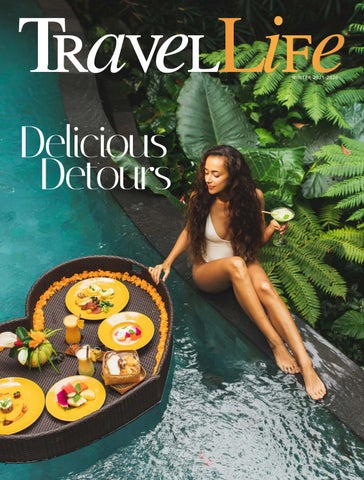
W I N T ER 2025-2026
Delicious Detours
TRAVELLIFE.CA WINTER 2025 | 1
EDITOR’S LETTER
Where Flavour and Discovery Meetrs F
ood is more than what we put on our plates; it can also be an emotional touchstone and a gateway into new experiences, especially when it comes to travel. One dish, or even one bite, can become an instant memory and forever anchor a specific place in our minds, often calling us to return. Whether that’s a quick snack from a street stall we can’t stop thinking about, or a more high-end plate that exceeds expectations, the result remains the same—food has the potential to connect us to a place and make our travels even more memorable. Our annual Delicious Detours section explores some of this theme and the many ways in which flavour plays a role in shaping our sense of a destination. I’m always amazed at how just being somewhere new can open up a seemingly endless variety of flavours I may never have discovered without getting on a plane or even “travelling” to a new neighbourhood.
“
— food has the potential to connect us to a place and make our travels even more memorable”s
To that end, some of our foodfocused features include one writer’s deep dive into some of the best food and wines on offer in Ontario’s Niagara region, while another story focuses on the many diverse influences that make up the culinary scene in Queensland, Australia. We also have a piece on the many reasons to put Vienna at the top of your must-visit list for the food alone, from traditional spaetzle and apple strudel to modern, Michelin-starred plates. Lucerne’s renowned CAAA restaurant offers a fun fusion of nature, art and culinary science, and we also head to Italy on a food-focused journey into the timehonoured art and taste of Modena’s prized vinegar. Over in Riviera Maya, Fairmont Mayakoba is home to several culinary experiences well worth travelling (and coming back) for. In addition to all of our rich culinary content, we also have a collection of great stories covering a range of exciting destinations. In Miami, one writer
Cooking class at Tau Beach Club, Casa Velas
discovers a world-class arts and culture scene having a moment, complete with underwater sculptures and movie-score symphonies. A visit to Puerto Vallarta with a stay at Casa Velas turns out to be the perfect recipe for an unforgettable girls’ getaway, while another contributor experiences a stylish stay at beautiful Nobu Barcelona. We also learn how to achieve peak relaxation at BASIN Glacial Waters, an exclusive new spa at Fairmont Chateau Lake Louise. Another writer takes us to Iceland and discovers that awe-Inspiring landscapes and soothing hot springs only scratch the surface when it comes to what makes the country so special As we head into the holiday season and prepare to welcome a new year, it feels like the perfect time to seek out experiences that nourish—whether through a remarkable meal, a restorative escape or a destination that surprises you in the best way. Here’s to a year ahead filled with memorable flavours, meaningful discoveries and journeys that remind us that there’s always more to discover.
Tammy Cecco EDITOR IN CHIEF
FOLLOW US FOR MORE TRAVEL INSPIRATION
@travellifemag TRAVELLIFE.CA WINTER 2025 | 1
CONTRIBUTORS SANGITA PATEL
TWO GIRLS, ONE SUNNY ESCAPE IN MEXICO, PAGE 10 Sangita is an award-winning television personality, content creator and engaging host who knows how to connect with an audience in any setting. She has co-hosted ET Canada, interviewed some of today’s biggest stars, hosted TLC’s Love and Translation and led HGTV’s Home to Win. Sangita is also a Canadian Screen Award winner. When she’s not busy in front of a camera, she loves to spend time exploring the world and eating delicious food wherever she goes. @sangita.patel
MARIA CHOWDHERY
TWO GIRLS, ONE SUNNY ESCAPE IN MEXICO, PAGE 10 In addition to being an avid traveller, Maria Chowdhery has over a decade of experience as a wardrobe stylist, including for ET Canada. She is currently the wardrobe stylist at The Social. Similarly to how a much-needed vacation can reset your vibe and elevate your mood, Maria knows that the right outfit can boost your confidence and help you embrace life’s adventures. @mariachowdhery
TIM JOHNSON
A BEER WONDERLAND, PAGE 64 While researching and writing articles for some of the world’s largest publications, Tim has visited an astonishing 151 countries on all seven continents, plus all 50 U.S. states and all ten provinces and three territories in Canada. These travels include dozens of safari trips in Africa and India, as well as 73 cruises and three trips to Antarctica. His passion for travel began early in life and shows no signs of waning. @timjohnsontravels
MACKENZIE CECCO
WINTER 2025-2026 ISSUE Food and travel often go hand in hand. Every journey is an opportunity to expand your palate and a delicious way to deepen your appetite for discovery.
PUBLISHER/ Tammy Cecco EDITOR IN CHIEF CONTRIBUTING EDITOR Jessica Padykula DIGITAL CONTRIBUTING Nicola Brown EDITOR DESIGN DIRECTOR Joyce Padilla PRODUCTION Gregory Alexander CONTRIBUTORS Nicola Brown Mackenzie Cecco Tammy Cecco Maria Chowdhery Wendy Helfenbaum Tim Johnson Paul Lillakas Jessica Padykula Sangita Patel Sabrina Pirillo Nicole Servinis Debra Smith Doug Wallace Melody Wren
ADVERTISING, marketing@travellife.ca SPONSORSHIP, Tel: 416.805.5159 OPPORTUNITIES & EVENT COVERAGE
ICELAND, UNCOVERED, PAGE 18
While fairly new to travel writing, Mackenzie has been globetrotting for as long as she can remember. Some of her fondest family memories involve travel, from visiting Italy for the first time at age eight to a celebratory family trip to Las Vegas for her 21st birthday. Mackenzie will soon be graduating with a major in Professional Communication and a double minor in Travel and Tourism and Public Relations. @mackenziececco, @packwithmackk
SUBSCRIPTIONS Travel Life is published every quarter by D.M.E. and is independently owned. Opinions expressed in Travel Life are those of the authors, and do not necessarily reflect the view of the publisher or advertisers. Travel Life does not assume liability for content. All rights reserved. Re-production in whole or in part without permission is prohibited. For re-production request send an email to info@travellife.ca
TRAVELLIFE.CA WINTER 2025 | 3
10
18
CONTENTS 1
EDITOR’S LETTER
2
CONTRIBUTORS
8
TRAVEL ESSENTIALS VACATION MUST-HAVES WITH SANGITA PATEL AND MARIA CHOWDHERY
10
DISCOVERIES TWO GIRLS, ONE SUNNY ESCAPE IN MEXICO
WHERE FLAVOUR AND DISCOVERY MEET
HELMED BY CHEF PIETRO CATALANO, LUCERNE’S CAAA RESTAURANT OFFERS A FUN FUSION OF NATURE, ART AND CULINARY SCIENCE
48
VIENNA ON A PLATE
50
VILLA LIVING WITH RESORT LUXURY IN TURKS AND CAICOS
PUERTO VALLARTA WAS THE PERFECT PLACE FOR AN UNFORGETTABLE GIRLS’ GETAWAY
18 ICELAND, UNCOVERED
AWE-INSPIRING LANDSCAPES AND SOOTHING HOT SPRINGS JUST SCRATCH THE SURFACE WHEN IT COMES TO WHAT MAKES ICELAND SO SPECIAL
22
28
52
MIAMI’S WORLD-CLASS ARTS AND CULTURE SCENE IS HAVING A MOMENT
54
36
IT’S A NEW SEASON FOR THE WINTER PARK EXPRESS
57
IT’S TIME FOR POZOLE
WELLNESS IN THE LAND OF SPIRIT HORSES
58
DO NIAGARA IN STYLE
62
FOOD FOR THOUGHT AT FAIRMONT MAYAKOBA
CLUB MED PHUKET: WHERE THAI CULTURE MEETS RESORT BLISS A RECENT STAY AT THIS STUNNING RESORT PROVIDED AN IMMERSIVE INTRODUCTION TO THE ISLAND
40
42
CANADA’S 10 BEST NEW RESTAURANTS
A CONVENIENT RAIL LINK FROM DENVER PROVIDES A SCENIC WAY TO REACH COLORADO’S WINTER PLAYGROUNDS
MEET THE CARRIERS OF STORY AND HEALING AT MADAHOKI FARM
38
ACHIEVE PEAK RELAXATION AT BASIN GLACIAL WATERS
A CULINARY AND CULTURAL TRADITION OF IXTAPA-ZIHUATANEJO
A CULINARY GETAWAY A CUT ABOVE AWAITS IN ONTARIO’S NIAGARA REGION, FILLED WITH NEW OPPORTUNITIES FOR EXCEPTIONAL FOOD AND WINE
HEAD TO THIS STUNNING RIVIERA MAYA RESORT FOR EXCEPTIONAL CULINARY EXPERIENCES WORTH TRAVELLING FOR
64
A BEER WONDERLAND
AN EXCLUSIVE NEW SPA OPENS AT FAIRMONT CHATEAU LAKE LOUISE PROVIDING EVERYTHING YOU NEED TO LEAVE STRESS BEHIND
67
DINE AROUND AT THE FIVES
ESCAPE THE CROWDS AND RECHARGE IN STYLE AT NOBU BARCELONA
69
MODENA IN A BOTTLE
THIS BEAUTIFUL HOTEL IS THE PERFECT PLACE TO BASE YOURSELF FOR A VISIT TO THIS MULTIFACETED SPANISH CITY
35
QUEENSLAND’S GLOBAL GASTRONOMY
48
CANADA’S BEST NEW RESTAURANTS ECHO OUR YEARNING FOR NATURAL LANDSCAPES, GENUINE HUMAN CONNECTION AND UNFLAPPABLE ROOTEDNESS
FROM REEFS TO RUINS, COZUMEL CAPTURES THE BEST OF THE MEXICAN CARIBBEAN
35
AUSTRIA’S CAPITAL IS PROVING ITSELF AS A CITY FOR SERIOUS FOOD LOVERS
DISCOVER A DIVERSE MELTING POT OF CULINARY CREATIONS, BLENDING LOCAL INGREDIENTS WITH INTERNATIONAL INFLUENCES
THERE’S MORE TO MIAMI
32 THERE’S A LOT TO LOVE ABOUT COZUMEL
22
THE REEF ESTATE VILLA AT SOUTH BANK RESORT PROVIDES THE PERFECT BALANCE BETWEEN STYLE, COMFORT AND ROOM TO ROAM
AN INSIDER’S GUIDE TO LORETO, BAJA CALIFORNIA SUR’S HIDDEN GEM LORETO CHARMS VISITORS WITH A BLEND OF HISTORY, NATURAL BEAUTY AND FOOD WORTH COMING BACK FOR
DELICIOUS DETOURS A FRESH TAKE ON SWISS GASTRONOMY
EXPERIENCING THE BEST OF THE GOOD STUFF IN CZECHIA
50 Get Your Glow On
FOOD AT THE FIVES HOTELS & RESIDENCES SETS ITSELF APART
A JOURNEY INTO THE TIME-HONOURED ART AND TASTE OF MODENA’S PRIZED VINEGAR
Visit Tan on the Run @tanontherun www.tanontherun.com
PHOTO CREDITS: 10 ROBERTO ESTRADA AND ALEXIS MAÑON 48 PAUL BAUER COURTESY OF VIENNA TOURIST BOARD
46
TRAVELLIFE.CA WINTER 2025 | 5
Travel Essentials
WITH
Sangita & Maria Packing efficiently doesn’t have to mean sacrificing style. Fresh off a sun-soaked girls’ getaway to Puerto Vallarta, award-winning TV personality Sangita Patel and Maria Chowdhery, wardrobe stylist for The Social, share some vacation essentials they never leave home without.
SPF TINT
Sangita’s Picks MASCARA
A reliable mascara is one of the fastest means of looking polished, even when you’re hopping off a flight or heading out for dinner after a day at the beach. Cover Girl makes several that hold up beautifully in heat and humidity and deliver an easy, breezy one-step wakeup call for your face with almost zero effort.
Sun protection that doubles as light, buildable coverage is a true vacation hero. Protec(tint) Daily Skin Tint SPF 50 by Supergoop! is filled with complexion-boosting ingredients and offers a natural finish for smooth, even-looking skin. It’s a beach-to-brunch staple that keeps things simple in hot weather while also protecting skin from the sun.
A MOTION SICKNESS SAVIOUR
If boats, long drives or winding roads aren’t your thing, a natural ginger formula like Gravol Ginger is the kind of low-key lifesaver you’ll be grateful for (as Sangita often is during her travels). Tucked into a purse or carryon they allow you to be prepared and enjoy the journey.
STYLISH SWIMSUIT
No vacation packing list is complete without a swimsuit that makes you feel—and look instantly beach-ready. This 70s-inspired two-piece from Canadian company Sun Vixen is one of Sangita’s favourites and the one you’ll spy her sporting here. It’s eye-catching without being over the top and features a fun wavy pattern, retro vibes and vibrant colours.
TRAVELLIFE.CA WINTER 2025 | 8
LUXE LINEN PANTS
Linen is the unofficial go-to fabric of warm weather vacations and a relaxed linen pant is about as versatile and comfortable as it gets. This flowy pair from Aritzia can easily be worn over a swimsuit for a low-key lunch or with a tank or lightweight shirt for a day of exploring. Breathable, soft and effortlessly chic.
TRAVEL ESSENTIALS PUERTO VALLARTA
Maria’s Picks RELAXED SHIRTDRESS
A bright dress in a bold colour can be a simple shortcut to looking pulled together without trying too hard. This cotton poplin piece from Banana Republic in a standout citrus shade ticks all of the boxes for a vacation-ready dress. The colour does the heavy lifting (minimal accessories required), making it ideal for travellers looking for a go-to statement piece they can depend on.
BOLD BUCKET HAT
Bright, playful accessories are one of Maria’s go-to ways of bringing colour into an outfit, especially for travellers who may shy away from prints. A structured sun hat, like this bold bucket style from Aldo, offers double-duty benefits: actual sun protection and a stylish finishing touch that helps even a simple outfit feel complete. Add the matching shoes to complete the ensemble.
STATEMENT NECKLACE
There’s something freeing about leaving delicate, valuable jewellery at home and embracing some bolder, brighter pieces on vacation. The Key Lago Charm Necklace by BRACHA fits the bill and easily adds instant interest to basics, be it a plain tank, linen dress, or swimsuit cover-up. The result is low-effort style tailor-made to make vacation photos pop.
MATCHING SET
A matching set is one of Maria’s secret weapons for effortless vacation style and efficient packing. It removes guesswork on busy mornings (just throw it on and go) while also offering versatility—mix the top with a maxi skirt, pair the bottoms with a tank, or wear both together for a coordinated look. This ultra-comfy option from Anthropologie works equally well poolside or for a relaxed dinner al fresco.
COLOURFUL TOTE BAG A colourful tote that’s both spacious and stylish is a true multipurpose travel must-have. The Journey Tote from BTB Los Angeles has a woven exterior with a fun fringed trim and can work as a beach bag or an everyday catch-all for vacation essentials.
TRAVELLIFE.CA WINTER 2025 | 9
Two Girls,
One Sunny Escape
in Mexico
A visit to Puerto Vallarta with a stay at Casa Velas turned out to be the perfect recipe for an unforgettable getaway BY SANGITA PATEL AND MARIA CHOWDHERY
S
ometimes all you need is a plane ticket, your best friend and a warm place to run away to when the cold sets in. In our case, that place was Puerto Vallarta, Mexico. From the moment we arrived we felt safe and dove into exploring, wandering the Malecon (the city’s scenic boardwalk) and trying every local spot that caught our eye. Puerto Vallarta embraced us instantly and the whole trip became a blend of culture, relaxation and easy adventure we would repeat in a heartbeat.
TRAVELLIFE.CA WINTER 2025 | 10
DISCOVERIES PUERTO VALLARTA
A Taco Tour and Malecon Photoshoot Our first full day in Puerto Vallarta was also one of out tastiest, thanks to a day filled with tacos. Our taco tour with Vallarta Food Tours (vallartafoodtours.com) ended up being one of those experiences that feels effortless. Because it was a walking tour we got to soak up the real spirit of the city— cobblestone streets, street food aromas and colourful murals tucked between shops. Our guide Miel was fantastic. She shared stories about the families behind each spot and described every dish with so much enthusiasm we felt like locals by the second stop. Our route included some heavy hitters flavour-wise, including El Cuñado for chorizo tacos, Mariscos el Guero for mahi mahi ceviche, La Michoacana for a popsicle break (pineapple with chilli for Sangita and chocolate covered coffee with coconut shavings for Maria) and Mariscos Cisneros for smoked marlin tacos and blue crab enchiladas. By the end we understood exactly why these spots are beloved local favourites that have lasted decades. We left feeling lucky to have experienced such an authentic slice of Puerto Vallarta.
Maria and Sangita’s highlight: the incredible ceviche
We ended the day on the Malecon where the sky was turning pink, just in time for a little professional photo shoot with a local photographer to commemorate our trip. We took photos at the Matamoros Street lighthouse lookout just off the boardwalk and soaked in the view; laughing, posing and creating memories we will treasure for a long time to come.
Sangita’s highlight: having photos that capture the joy we were feeling
Maria’s highlight: sunset views overlooking downtown
TRAVELLIFE.CA WINTER 2025 | 11
ATV
Chocolate, Charm and Raicilla in San Sebastián del Oeste
Enjoying churros
San Sebastián del Oeste is tucked into the Sierra Madre Mountains only a short trip from Puerto Vallarta yet worlds away in atmosphere. This picturesque colonial town captivates with cobblestone streets, mountain scenery and a timeless charm that makes it the perfect place to experience authentic Mexico. This is one of Mexico’s Pueblos Mágicos or Magic Towns, designated as such for their cultural richness, traditions and history. A chocolate tour is a delicious way to dive into local tradition here, and a Raicilla experience offers a fascinating look at the region’s signature spirit (sometimes referred to as Mexico’s other mezcal). One of the most memorable parts of the visit was having a chance to ride an ATV through the area. It adds a sense of adventure and gives you a real feel for the rhythms of daily life in this mountain town. Together, these experiences create an unforgettable blend of culture, flavour and discovery that truly showcases the soul of San Sebastián del Oeste.
Sangita’s highlight: taking Maria on an ATV ride
Maria’s highlight: fresh crunchy churros
TRAVELLIFE.CA WINTER 2025 | 12
Raicilla tasting and still enjoying churros
DISCOVERIES PUERTO VALLARTA
An Amazing Meal at icú During a trip filled with great food, a meal at award-winning icú (restauranteicu.com/en) was a particular standout. The name means corn in the language of the Wixaritari people and chef-owner Mauricio Leal uses this staple ingredient in many ways. Dishes change with the seasons and what produce is available, and they have a cellar stocked exclusively with Mexican wines. The contemporary space is filled with trees and our dinner was a five tostada tasting we’re still thinking about. Allergy friendly options were easy to find and the menu is made up of inventive takes on Mexican classics.
An amazing meal at icú
Casitas Maraika
A Beach Escape at Casitas Maraika A short drive and a fifteen minute boat ride brought us to Casitas Maraika (casitasmaraika.com), an eco‑luxury retreat set amidst tropical jungle and ocean that also offers day passes for their secluded beach club. The tucked away spot felt like our own secret hideaway with a stunning beach. The staff were extremely friendly and the on-site restaurant, Ritual Fire Kitchen, was excellent, serving up creative dishes made from local ingredients. The whole experience was a peaceful escape—almost like a getaway within our already relaxing getaway.
Special thanks to videographers/photographers Roberto Estrada and Alexis Mañon
Sangita’s highlight: soaking up every moment of the crystal clear water
Maria’s highlight: the great food with those beautiful ocean views
A special thank you to Air Canada Vacations Celebrating 50 years of making dreams travel aircanadavacations.com
Boutique-Style Luxury at Casa Velas. Mi Casa es Su Casa! Casa Velas (hotelcasavelas.com) welcomed us like a secret sanctuary. The adults-only, all-inclusive boutique hotel is located along the fairways of the Marina Vallarta Golf Club and just seconds from the beautiful beach. Upon arrival the property instantly felt like a home away from home. The intimacy of the resort creates a calm, welcoming energy and the staff treated us with such warmth that settling in was effortless. Our villa was stunning with thoughtful details in every corner plus a private cold plunge and hot tub we adored from the moment we walked in. The king bed was absolute heaven and for a girls trip, this place was perfect— peaceful, elegant and wonderfully private. Just a five-minute shuttle ride away, Tau Beach Club felt like a little pocket of beachy chic. Our first visit was for dinner during the golden hour, when the beach was nearly empty and the water glistened. As the sun melted into the horizon, the sky glowed with rich, warm tones of vibrant orange. Two singers performed while we ate which completed our perfect evening. It was simple, beautiful, and exactly what we needed. Open from 10 a.m. to 8 p.m., the beach club offers Bali beds, sun loungers, a full bar and more. We knew we’d be coming back to take full advantage of this prime sunbathing spot. Spa time at ABJA Spa provided a nice reset for both of us. Ten minutes of red light therapy, a soak in the jacuzzi and our treatments side by side proved to be both fun and restorative. Sangita tried the silk wrap which left her skin glowing, while Maria had her first cupping facial and loved the gentle lymphatic draining. Casa Velas offers a fantastic gym and a variety of wellness options in addition to their lovely spa. One day during our visit we met in the serene botanical garden for a gentle yoga session that slowly woke everything up followed by a relaxing guided meditation. Then came a tea blending workshop using traditional Mexican methods. It all felt grounding, cozy and very Zen, which in a way, sums up our whole stay. Looking back on our experience, this trip became everything two girls escaping the cold could hope for. Puerto Vallarta gave us sunshine, culture, incredible food and a sense of safety that made everything effortless. Casa Velas wrapped us in comfort and calm, and every local adventure added its own touch of magic. We laughed, explored, rested and ate our way through some of the best this region has to offer. Most of all, we left feeling connected, restored and already dreaming about the next sunny escape. TRAVELLIFE.CA WINTER 2025 | 14
hotelcasavelas.com
Tuna Tostada We joined chef Sandra Macias at Tau Beach Club for a cooking class that taught us how to make tuna tostadas with the freshest ingredients. The view was dreamy and the result? A delicious bite! Maria who doesn’t spend much time in the kitchen, left feeling confident she could actually recreate these dishes at home.
Tuna Tostada Recipe Ingredients: For tuna Fresh tuna, cubed (90g) Soya sauce (35ml) Cucumber, diced (15g) Lime juice (10ml) Salt and pepper Olive oil Sesame seeds Pineapple, diced (optional) For guacamole 1 avocado, mashed Salt and pepper Olive oil Instructions: Combine all guacamole ingredients. Spread a generous layer on a tostada. Combine tuna ingredients and spoon on top for a light and delicious bite.
Scan to Watch
TRAVELLIFE.CA WINTER 2025 | 15
TRAVELLIFE.CA WINTER 2025 | 17
Iceland, UNCOVERED
Awe-Inspiring landscapes and soothing hot springs just scratch the surface when it comes to what makes Iceland so special BY MACKENZIE CECCO
Travellers often head to Iceland chasing viral shots of dramatic scenery, of which there is a seemingly endless supply. But on a recent visit with my family I found the country’s true magic to be in the ways it makes you feel alive, grounded and part of something bigger.
Living Like a Viking
After an overnight flight and barely 45 minutes of sleep, we landed in Reykjavík at 8 a.m., equal parts excited and exhausted. When I asked my dad what was next, he replied, “Viking portraits.” I laughed, but he wasn’t joking. Soon, we were standing inside Mink Viking Portrait in downtown Reykjavík, suiting up in full Viking armor: fur cloaks, helmets and in my brother’s case, a 50-pound chain shirt. Between bursts of laughter and trying to look fierce, our photographer shared stories of Iceland’s Viking settlement and how deeply those roots still shape the country. Jetlagged or not, stepping straight into living history felt surreal and was the perfect start to our stay. Mink.IS
We did our best!
FlyOver Iceland
Next, FlyOver Iceland gave us an immersive sensory introduction to the landscapes we’d soon be exploring. Suspended above a sweeping spherical screen, we virtually flew over Iceland’s iconic lava fields, glaciers, waterfalls, cliffs and coastline. With wind, mist and motion as part of the experience, it really felt like we were soaring across the country’s epic landscape, making it a great preview of the amazing country we were about to discover. FlyOverIceland.com TRAVELLIFE.CA WINTER 2025 | 18
K’gari -Dune Resturaunt, Soft Shell Crab
DISCOVERIES ICELAND
Blue Lagoon Living
The milky blue water framed by black lava rock was as dreamlike as I expected, which is not surprising considering how peaceful, surreal and visually stunning the Blue Lagoon is. National Geographic named it as one of their 25 wonders of the world for a reason. The lagoon’s geothermal seawater isn’t found anywhere else in the world and floating in it’s gentle warmth with a drink in hand quickly became my happy place. BlueLagoon.com
South Coast Wonders
We covered Iceland’s South Coast with Friend in Iceland, a family-owned business specializing in private tours tailored to your interests. We visited the region’s iconic spots: Seljalandsfoss, a waterfall you can walk behind, and Reynisfjara’s black-sand beach, famous for its basalt columns and dramatic surf. I strolled the shoreline in awe, keeping a comfortable distance as recommended by the signs. The day offered a striking contrast to Reykjavík’s urban energy, opening up into vast landscapes, dramatic cliffs, tumbling waterfalls and stretches of untouched nature that no man-made structure could rival. friend.is
Bring Your Binoculars
On the morning of our third day, we set out on a whale-watching tour across the surprisingly calm waters of Faxaflói Bay. Luck was on our side as we spotted humpback whales, minke whales, white-beaked dolphins and harbour porpoises. Watching these beautiful creatures glide through their natural habitat was an unforgettable way to start the day.
end “Fri , r u ” O eland In Ic r a Gunn
TRAVELLIFE.CA WINTER 2025 | 19
Saddle Up
The adventure continued that afternoon with a horseback riding tour through Iceland’s otherworldly landscape. Each of us was paired with our own Icelandic horse. Mine, named Ösku, was the sweetest, calmest and most muscular horse I’ve ever ridden. Our guide explained Icelandic horses are a one-of-a-kind breed found only in Iceland. Their sturdy build and gentle nature are perfectly suited to the volcanic terrain. Riding a breed so deeply connected to the land made the experience feel all the more special. Fun Fact: Icelandic horses are so carefully protected that once one leaves the country, it’s never allowed to return. Strict dietary and health regulations help safeguard the breed from outside diseases.
Me and Ösku
Face To Face with Icelandic Lava
Iceland is one of the most volcanically active places on Earth, sitting right on the Mid-Atlantic Ridge where the North American and Eurasian plates pull apart. The Lava Show brought that reality to life. It’s the only place in the world where you can safely watch real lava (heated to 1,100°C (2,000°F) flow indoors. The team actually melts raw Icelandic lava right in front of the audience, recreating the drama of an eruption up close, compete with all the bubbling, cracking and cooling you would see during the real thing. With VIP seats, we even had time to enjoy a drink before the demonstration. It was a rare chance to safely witness the power of Iceland’s volcanoes up close. LavaShow.com
TRAVELLIFE.CA WINTER 2025 | 20
The Valley of Geysers
r adalu k u a a H g us givin up call wake
Next, we ventured into Haukadalur, the geothermal valley where Strokkur steals the show, erupting every 5–10 minutes. The moment it bursts, boiling water rockets skyward and the ground trembles just beneath your feet. One second you’re admiring the steam curling into the sky, the next you’re sprinting backward, soaked from head to toe as the geyser makes its dramatic entrance. It was definitely a wakeup call for our day of adventure.
DISCOVERIES ICELAND
Witnessing a Glacier Before It’s Gone
Riding a snowmobile across Langjökull Glacier was exhilarating and humbling. Our guide mentioned that this glacier is expected to vanish within 60 years and that Iceland’s glaciers as a whole could disappear within 200 years. That realization hit hard and I felt immense gratitude to witness such fragile beauty, knowing future generations might only see it in photographs.
Hidden Gems Beyond the Map
A Journey to Remember
Iceland wasn’t just another destination, but a journey that has stuck with me. The combination of breathtaking landscapes, quiet moments of wonder and encounters with welcoming locals created an experience both outwardly adventurous and inwardly moving, leaving me with memories that feel as extraordinary as the place itself.
We headed back out with boutique tour operator, Friend in Iceland for more exploring and our guide turned what could have been a simple checklist trip into a thoughtful and educational adventure. Sure, we saw the iconic Gullfoss and Skógafoss waterfalls, but Gunnar also led us to Álfaborg, or “Fairyland,” a hidden hiking trail said to be the home of Iceland’s elf queen. Whether you believe in folklore or not, the serenity of that spot made it feel magical. He upped the adventure by leading us on a hike that had us crossing rivers and jumping rocks—his very own obstacle course that brought Icelandic tales to life. Just like his tour on the south coast, we hit all the iconic spots, but also visited so many hidden gems blissfully void of crowds.
a We lucked out with bin show at Myrkholt Ca The Ideal Stay While You’re Here
Our stay at Myrkholt Cabin was a serene escape that had us perfectly tucked away from the everyday. Its seclusion only added to the charm. Cozy and comfortable, the cabin offers complete freedom from city lights and noise, making it an ideal spot to watch the northern lights shimmer across the sky. With eight bedrooms available, you can book them individually or reserve the entire cabin for a private retreat. Visit MyrkholtCabin.com to book or arrangements can be made as a perfect complement or your private tour with Friend.IS
For any cold weather adventures, I come prepared with Smartwool base layers. The Classic Thermal Merino Base Layer crew top and bottoms both offer warmth, comfort and breathability so I can focus on having fun, no matter where I am. smartwool.com TRAVELLIFE.CA WINTER 2025 | 21
An Insider’s Guide to Loreto, Baja California Sur’s Hidden Gem Small but mighty, Loreto charms visitors with a blend of history, natural beauty and food worth coming back for
L
oreto may be small, but what it lacks in size it more than makes up for in laid-back charm, excellent food and a unique and endless variety of things to see and do. Scenically situated between the Sierra de la Giganta mountains and Sea of Cortez on the east coast of the Baja California peninsula, Loreto offers a unique blend of sea, sand and desert, along with a laundry list of natural attractions and watersports opportunities. It’s also a destination filled with history. Case in point, Loreto was the first Spanish settlement on the Baja California Peninsula (founded in 1697) and the first capital of California. Loreto has also been awarded with the Pueblo Magico (Magic Town) designation for it’s rich history, authentic local culture and natural beauty both on land and at sea. We asked three of our contributors to share some of their favourite aspects of this multifaceted destination: Chef Paul Lillakas on food, travel writer and hotel reviewer Debra Smith on accommodation and host, reporter and producer Nicole Servinis on some of Loreto’s most memorable activities.
TRAVELLIFE.CA WINTER 2025 | 22
DISCOVERIES LORETO
Authentic Flavours Loreto’s small size might suggest limited culinary options, but food here surprises at every turn. Chef Paul Lillakas highlights the freshest local ingredients and traditional techniques that make dining in Loreto an experience in itself. For any fans of sport fishing—and sashimi—you won’t want to miss the opportunity for Yellowtail fishing out of Puerto Escondido. If you get lucky, you may get to indulge in the freshest sashimi of your life while cruising on the ocean watching dolphins jumping in the distance. At Oasis Restaurant you can experience a traditional method of cooking known as almejas tatemadas wherein clams (or in some cases oysters) are buried in a gravel pit and dried romerillo (a local shrub) is set ablaze on top, baking them in their shells. The shellfish are then served with a tangy mustard sauce right on the beach alongside a buffet of other local dishes. Take a step even closer to the delights of the sea by enjoying a clam and scallop-diving excursion with El Burro Baja Tours. The experience takes you to Bahía Concepción, which is about an hour and a half from Loreto. While your guides spearfish for local Spanish mackerel you can take a shot at diving and
digging for “queen clams.” Watch, or take part as guides transform the clams into a delightful ceviche right before your eyes. Fresh scallops, plucked and shucked just minutes later, were served simply with a squeeze of lime. Next, freshly-caught fish was cooked in a foil pouch over a fire and gently steamed along with onions, peppers and mustard. The tender fish, flaked into a fresh flour tortilla, was a treat made only more fabulous by the view, the smell of the fire and the sound of gently crashing waves. TRAVELLIFE.CA WINTER 2025 | 23
For another authentic taste of tradition, seek out a rancher’s breakfast experience in San Javier outside of Loreto. Here, you can dive into a simpler life and try your hand at milking a goat and turning that fresh milk into cheese. Prepare some flour tortillas on a woodfired plancha and enjoy them stuffed with simmered frijoles (beans) and queso fresco (fresh cheese). Here you can appreciate the simplicity of good ingredients served humbly with a truly relaxing farm vibe. A true culinary highlight in this region has to be Mexican birria, a deeply savoury, saucy braised meat dish usually made from beef or goat. Stuffed into tacos which are then caramelized on the griddle and served with a
TRAVELLIFE.CA WINTER 2025 | 24
spicy consommé for dipping, this is hands down one of the best, most addictive dishes you can find. One of the most taken-forgranted pleasures of Baja California Sur (and indeed Mexico as a whole) is the availability of tree-ripened fruits that offer a level of fragrant flavour we don’t often get to enjoy in other parts of North America. Take, for example, the tree-ripened mangoes and citrus fruits (grapefruit, sour oranges, limes and lemons) that are served alongside tacos, on tostadas, in salads, salsas and in cocktails of all kinds. These fruits are used to perfume all varieties of dishes and drinks and make every day a flavour sensation in Loreto.
Hospitality With Heart The charm of Loreto extends to the accommodations it offers. Instead of high-rise hotels and sprawling resort complexes common in many parts of Mexico, you can choose from family-run hotels and stylish haciendas. Debra Smith highlights some of the best options she’s come across.
Aventuras Hotel Set in the modern enclave of Nopolo, the newly built Aventuras Hotel will appeal to visitors looking for a sunny escape with all the conveniences of home plus luxury amenities. The rooftop bar overlooks the Bay of California, there’s a seasonal outdoor pool and Octillo, the hotel’s restaurant, serves up a Mediterranean influenced menu and award winning creative cocktails.
Bugambilias Suites Hotel This pretty, family-run apartment style hotel will win you over with friendly service and personal touches. Hop on a free bike and cycle over to nearby Playa la Darsena, a long stretch of warm sandy beach. Watch the sun rise over the Sierra de la Giganta Mountains or enjoy the sunset with a glass of wine on the flower filled terrace. The historic centre and shopping are just a short walk from the gated courtyard.
Hotel La Mision de Loreto Beyond the rough hewn oak doors of Hotel La Mision you’ll find an elegant blend of European and Spanish influenced decor. Marble floors, rustic Hacienda style furnishings and soft, comfortable beds create a luxurious and tranquil haven overlooking the Sea of Cortez and the Malecon, Loreto’s esplanade. Relax poolside with a wood fired pizza or dress for dinner at Los Olivos Restaurant, a legendary local favourite for fine dining. For more hotels, visit loreto.visitbajasur.travel/where-to-stay.
Activities for Everyone Loreto isn’t just a place to relax and unwind (and eat); there is so much to see and experience here. Nicole Servinis shares some of the destination’s most memorable must-dos. Sailing on the Sea of Cortez feels like stepping directly into a nature documentary. Dolphins lead the way, sea lions bask on rocks and blue-footed boobies dive into the water like tiny torpedoes. At pretty Honeymoon Cove, paddleboarding and a beachside picnic allow a serene pause to take in the sun, sea and epic scenery. A journey inland to La Purísima transports visitors back in time. Kayak along canals framed by palms and mountains and learn traditional skills like tortilla-making, date cultivation and local winemaking. The warmth and pride of the locals make this cultural experience unforgettable.
TRAVELLIFE.CA WINTER 2025 | 26
Loreto is also the birthplace of the Baja missions. The Mission of San Javier, tucked high in the Sierra de la Giganta mountains, offers cobblestone streets, a historic stone church and a 300-year-old olive tree. Beyond the beaches and watersports, it’s the stories and heritage preserved here that reveal Baja’s true character. From fresh seafood and traditional breakfasts to boutique hotels and immersive cultural adventures, Loreto offers a rich, authentic experience in Mexico. Savouring it’s many unique flavours, enjoying its varied and welcoming accommodations and exploring its natural and historical treasures all make Loreto a truly must-visit destination in Baja California Sur.
HOW TO GET THERE? WestJet: Direct service Calgary to Loreto twice weekly with connecting flights across Canada (November-April). Year-round flights are available out of major Canadian gateways via Los Angeles or Mexico City.
TRAVELLIFE.CA WINTER 2025 | 27
THERE’S MORE TO MIAMI
M
From underwater sculpture to movie-score symphonies, Miami’s world-class arts and culture scene is having a moment By Nicola Brown
Institute of Contempory Art
ention Miami and your mind’s eye will likely conjure sunny images of beaches and palms, poppy pastels and
perhaps even some neon-inflected high-energy nightlife. But there’s more to Miami for the sophisticated culture-hunter. While travel to the US has come under a critical lens of late, this unique moment in Miami’s history reveals how the role of art, and travelling to experience it, is taking on new forms of significance. Many of Miami’s performing and contemporary arts institutions are celebrating major milestones. The Institute of Contemporary Art celebrated its 10th anniversary in 2024. The Wolfsonian and the Miami City Ballet mark their 30th and 40th this year, respectively. In 2026, the Arsht Center will celebrate its 20th year as a pillar of Miami’s performing arts scene. Even on the bikini-clad shores of Miami Beach, the iconic Ocean Drive strip is honouring 100 years of Art Deco.
TRAVELLIFE.CA WINTER 2025 | 28
K’gari -Dune Resturaunt, Soft Shell Crab
Main photo by Destanie Martin-Johnson (R + A), bottom right photo by Tony Tur
DISCOVERIES MIAMI
The collective air of pride and camaraderie translates into a host of special programming, retrospectives and new unveilings that reflect on the vibrant history and interconnectedness of Miami’s artistic communities. Moreover, they remind us of the important role that art continues to play in shaping the identity of cities, people and the important conversations of our time. Taking cues from the influential street art movement that transformed Miami’s Wynwood district into a vibrant cultural hub, the backdrop for Miami City Ballet’s 40th season opener Heatscape was designed by legendary muralist Shepard Fairey. The melding of graffiti and classical ballet is aptly representative of the open-armed genre-crossing nature of Miami’s artistic scene: you needn’t pick a lane; you can enjoy it all. Walk the line between art museum and nightclub through immersive and interactive multi-sensory installations at Superblue. Catch world-renowned artists like Jean-Michel Basquiat, Jeff Koons and Yayoi Kusama at the Rubell Museum. Or cast a wide net at The Bass, a contemporary art museum that incorporates design, fashion and architecture into energetic exhibitions designed to reflect Miami Beach’s diverse cultural context.
Knight Concert Hall
There’s a characteristic youthfulness to the city’s creative soul, and nowhere is this more pronounced than at the New World Center, an impressive Frank Gehry-designed architectural gem home to the New World Symphony, a post-grad orchestra of young musicians experimenting with how music is presented and experienced. Catch a movie-soundtrack symphony (think familiar scores from Harry Potter, Indiana Jones and Star Wars), or settle in for an al fresco concert projection under the stars in the adjacent SoundScape Park to enjoy their state-of-theart sound in a natural setting with a picnic and a glass of wine. Perhaps now more than ever is a good time to remind ourselves just how powerful creative voice can be. Trace the threads back through history with an in-depth exploration of persuasiveness in art and design through the decades at the Wolfsonian.
Top photo by Cameron Catazaro and Anabel Katsnelson (choreography by Justin Peck), middle right photo by Ricardo Cornejo, ContemporAd; bottom photo by Tony Tur
Then don your snorkel or dive gear to explore the 2025 Art Basel debut of a one-of-a-kind underwater sculpture park off the coast of Miami Beach called REEFLINE, designed to catalyze the return of critical reef life in a breathtaking art-meets-activism initiative. Not only is Miami offering new ways to appreciate and immerse yourself in what the city is all about from multiple creative lenses, it’s leveraging its pedigreed creative voice to advance critical thinking, freedom of expression and creative forms of activism. If art is open to interpretation, here’s one perspective: Maybe travelling to support the cultural pillars of world-class cities like Miami is to act with intention in the service of narrowing the great divides we find ourselves straddling. Maybe you have other ideas. In Miami, the conversation continues.
WHERE TO DINE
Sofia: For design-forward Italian with impeccable oldworld-style service in the Design District
Uchi Miami: For elevated, non-traditional Japanese from James Beard-award-winning chef Tyson Cole in Wynwood Doya: For an extensive menu of finessed Aegean mezes designed for sharing in Wynwood LT Steak and Seafood: For elegant New American fare with French, Asian and Latin influences at The Betsy Hotel in South Beach MIMI Chinese: For inspired, genre-defying regional Chinese dishes and a glamorous night out in South Beach
Rooftop pool at The Betsy
Miami Culinary Tours: Discover Wynwood’s street art while feasting on globally-inspired bites around the neighbourhood from Cuban coffee to Venezuelan arepas
WHERE TO STAY Arlo Wynwood: The first of only two hotels to open in the popular Wynwood Arts District with a community-driven spirit and an artsy vibe. Save an afternoon for a dip in the heated rooftop pool and a birds-eye view of this trend-setting neighbourhood. The Betsy Hotel: A sophisticated reimagining of accommodation on Ocean Drive, connected to, yet at a comfortable distance from, Miami Beach’s perpetual buzz. Live jazz evenings, rotating photography exhibits and an extensive collection of art anchors a sense of breezy relaxation with cultural soul. TRAVELLIFE.CA WINTER 2025 | 30
A flavourful spread at Doya Top photo by Christian Lockerman and The Warhol Creative, middle left photo courtesy of The Betsy Hotel, bottom photo by Lollo Franco
Glow Essentials Kit Cleansing Oil Sculptor Guasha Muslin Facecloth Castor Oil + Frankincense Blend Face Tape
Meet the Glow Essentials Kit, curated by facialist Gianna Ugolini.
Here at Travel Life we know the importance of taking care of your skin pre and post travel. The Glow Essentials Kit by master facialist Gianna Ugolini includes everything you need to get your skin glowing. Ugolini has 30 years of international experience under her belt and she has brought her European spa level care to a kit so you can attain a spa-level glow right in your own home or on the go.
Available now for $150 CAD.
THERE’S A LOT TO LOVE ABOUT
Cozumel
The Mexican Caribbean is a destination you can return to again and again and always find something new to discover. With 900 kilometres of coastline, 19 archaeological sites, eight national parks and abundant opportunities for wildlife viewing, diving, snorkelling and islandhopping, it offers something for every type of traveller. The region consists of 12 interconnected destinations, each with its own personality. Cozumel in particular, combines stunning natural landscapes, rich Maya history and a culinary scene that just keeps getting better—making it an ideal base for exploring this beautiful part of Mexico.
FUN AND ADVENTURE ON (AND UNDER) THE WATER Cozumel is the largest island in the Mexican Caribbean and sits just off the east coast of the Yucatán Peninsula, a short ferry ride from Playa del Carmen. The surrounding waters are part of the Mesoamerican Barrier Reef, the second-largest reef system in the world TRAVELLIFE.CA WINTER 2025 | 32
Home to reefs, archaeological sites and remarkable food, Cozumel captures the best of the Mexican Caribbean in one unforgettable stop
making the island a haven for snorkellers and divers. The waters here are filled with over 500 types of fish and 65 species of coral, along with sea turtles, nurse sharks and eagle rays. Dive sites like Palancar and Columbia (both great for all levels) and Santa Rosa Wall (best for more advanced divers) each offer expansive underwater landscapes and the chance to spot some seriously diverse sea life. Beyond diving and snorkelling, there are many other fun ways to take advantage of Cozumel’s prime location. Getting out on the water in a sea kayak, on a paddleboard, or via a boat tour are incredible ways to get to know the region and everything it has to offer.
SPONSORED CONTENT COZUMEL
A CULINARY SCENE WORTH DISCOVERING While the beaches and reefs are an obvious draw, foodies will also have a lot to get excited about in Cozumel. The cuisine here is celebrated among locals and visitors alike and justifiably so, thanks to fresh flavours and a focus on local, seasonal ingredients. The island is known for its fresh seafood, beautifully showcased in fish tacos and bright ceviche. But don’t sleep on the many other local specialities on offer like panuchos, fried tortillas stuffed with black beans and typically topped with pickled onion, sliced avocado, shredded meat, lettuce and tomato. You’ll also find salbutes, deep fried tortillas topped similarly to panuchos, as well as succulent cochinita pibil, (slow-roasted pork with annatto).
WHERE HISTORY MEETS NATURE Cozumel is more than a diving destination. Archaeological sites like San Gervasio (the island’s most well-preserved site) and El Cedral (believed to be one of Cozumel’s oldest archeological sites) each showcase the island’s extensive Maya heritage and allow visitors to learn more about local history and culture. Taking a guided tour can help deepen your understanding of these sites which all act as a direct throughline to the rich history of Cozumel and the Mexican Caribbean as a whole. Beyond the island’s historical highlights, surrounding mangroves and jungles offer ample opportunities to immerse yourself in nature via hikes, jeep tours or simply beach-hopping among the islands many beautiful stretches of sand. Punta Sur Eco Beach Park is a sprawling ecological park on the southern tip of Cozumel where you’ll find varied wildlife, white sand beaches, lagoons and a historic lighthouse home to a small museum and panoramic views. Or Chankanaab National Park is a one-stop shop for everything from snorkelling and diving to swimming encounters with sea lions and manatees.
To get a real sense of the culinary treats on offer head to San Miguel de Cozumel, the heart of the island. Filled with shops, restaurants and bars, this is where you can experience local life and taste some of the island’s best dishes.
PLANNING YOUR VISIT Consistently warm weather means Cozumel is accessible year-round, and with more direct flights now connecting Canada to Cozumel, reaching this island destination has never been easier. Cozumel’s position in the Mexican Caribbean also makes it an
excellent base for exploring the surrounding region. Short ferry rides or day trips can easily take you to Playa del Carmen’s vibrant streets or the quieter beaches of Isla Mujeres and Isla Holbox. Whether your focus is adventure, beachhopping, culture or culinary exploration, Cozumel is both a gateway to and an integral part of the Mexican Caribbean that’s always worth spending time in.
FOR MORE TRAVEL INSPIRATION: MexicanCaribbean.travel
TRAVELLIFE.CA WINTER 2025 | 33
TRAVELLIFE.CA WINTER 2025 | 34
SPONSORED CONTENT AMTRAK WINTER PARK EXPRESS
IT’S A NEW SEASON FOR THE WINTER PARK EXPRESS A convenient rail link from Denver provides a scenic way to reach Colorado’s winter playgrounds If Colorado is on your winter radar (like it is ours), there’s a simpler way to reach the slopes than navigating mountain highways. The Amtrak Winter Park Express is ready for another season, returning with holiday runs in late December and full service from early January. It’s an efficient way to get to the consistently top-rated Winter Park Resort from Denver—a two-hour ride that trades traffic for Instagram-worthy views of the Rockies. You can also keep riding to neighbouring Fraser. The train eases into the season over the last two weekends of December, before settling into a regular Thursday-to-Sunday schedule on January 8 though to March 29. From Denver Union Station, the 7 a.m. departure reaches the 3,000+ acre Winter Park Resort by mid-morning, continuing on to Fraser shortly after. This means you can be out the door in Denver at dawn and on the snow well before lunch. Last season saw a surge in ridership, which jumped dramatically after a partnership with the Colorado Department of Transportation (CDOT) helped to lower fares and expand the schedule. With tickets starting at $9 (or $4.50 for kids), the train has become one of the easiest ways to get to Winter Park Resort and surrounding areas. Skis and snowboards
ride free as carry-ons, and onboard comforts include roomy seats, large windows, lots of legroom and the two-storey Sightseer Lounge with panoramic mountain views from the upper level and snacks and drinks for purchase downstairs. If you’re planning a longer stay in Denver, the city makes for an easy home base for extended winter fun— especially if you’re staying downtown. Union Station connects directly to the airport via commuter rail, and basing yourself in the city centre means you can grab a great meal, explore nearby neighbourhoods, or simply unwind at your
hotel before catching the morning train to the mountains. For more information or to book a ticket, visit amtrak.com/winterparkexpress. To find out more about Colorado, visit Colorado.com. TRAVELLIFE.CA WINTER 2025 | 35
Wellness in the Land of Spirit Horses Meet the carriers of story and healing at Madahoki Farm Words and photos by Melody Wren
We were welcomed to Madahoki Farm in Ottawa’s greenbelt with song. Makhena, our Abitibiwinni First Nation Cultural Ambassador, greeted us in a northern style of singing, a form without words, yet resonant with intention, spirit and warmth. She closed her eyes and confidently sang a melody that seemed to embody the land itself, inviting us to listen with more than our ears. So beautiful and calming, it moved me to tears. It was both an introduction to and a reminder that in this place, wellness is woven through sound, story and relationships. Just beyond the sound of Makhena’s voice, in the green fields of the farm, twelve rare Ojibwe Spirit Horses wait, living symbols of resilience and healing whose presence anchors the teachings we are about to receive.
DISCOVERIES OTTAWA
The Spirit Horses of Madahoki
At Madahoki Farm, wellness is about connection—to land, to ancestors, to culture and to animals who have lived here since time immemorial. Among the farm’s goats, sheep, pigs and chickens live the Ojibwe Spirit Horses, the last of their kind in Canada. These small, resilient ponies once roamed freely across Turtle Island, living in harmony with the people of the land. Today, their presence here is both a cultural revival and a wellness practice. They remind us of balance, humility and reciprocity, the same values that guide Indigenous ways of life. These features, along with their endurance and gentleness, make them living testaments to survival. A rare blend of Ojibwe and Mustang lineage, these horses carry the wild beauty of the Mustang with tiger-striped legs, a strong dorsal line and a swooped back, tempered by the gentle, resilient spirit of the Ojibwe. It’s their temperament that truly sets them apart. They move with a quiet awareness, leaning into your presence, offering a grounding strength and a comforting connection. In a single glance or gentle nuzzle, they communicate patience, trust and the exact support you didn’t realize you needed.
Wellness through relationships
In Indigenous tradition, Spirit Horses are not broken or dominated. Instead, people and horses form a relationship based on respect and listening. At Madahoki, this philosophy is embodied in Equine-Assisted Learning workshops, where the horses help youth and adults release emotions. Sensitive to human energy, they reflect what people carry within; calming beside a joyful person, restless beside someone anxious. Their yawns, stamps, or quiet companionship are not random gestures, but signs of empathy and release.
Stories painted in spirit
The cultural and spiritual significance of these horses comes vividly alive in the paintings of Rhonda Snow, whose work is shared at Madahoki Farm by Cultural Ambassador Belle Bailey, a member of the Pikwakanagan First Nation. Snow gathered oral histories from
Spirit Horses stamping and shuffling to hide the cries of children as RCMP came to take them to residential schools. Here, the horses become protectors, their strength a shield against trauma. Together, these paintings teach that healing is not linear; it is cyclical, woven through story, land and relationship with all beings.
Culture and context
Madahoki Farm is a living classroom for Indigenous knowledge. Visitors learn about the “three sisters” crops: corn, beans and squash, which thrive when planted together, highlighting the power of interdependence. They hear about tikinagans, or cradleboards, designed to keep infants safe while fostering awareness of the world around them. They see beadwork made with porcupine quills, learn how birchbark canoes float lightly on water and step inside a teepee or wigwam. Every lesson, like the stories of the Spirit Horses, connects back to the same principle: wellness through balance. To live well is to live in relationship with plants, with animals, with community and with the spirit of humility Elders and knowledge keepers, transforming them into visual narratives that now inform visitors of the legacy of the horses. Each canvas holds a lesson. Elders’ Story reminds us that Spirit Horses have always been here on Turtle Island. Trail on Turtle Island shows them moving freely with no fences, symbolizing harmony with the land. Three Living in Harmony portrays the deep interconnection between humans, horses, water and food, a holistic wellness rooted in reciprocity. Some stories tell of survival and resilience. In Young Girl in Blizzard, a Spirit Horse shelters a freezing Anishinaabe child, carrying her home through the storm. In Rescued from Wolves, a mare and her foal survive alongside a trapper, their partnership a symbol of trust and endurance. The Schoolhouse is perhaps the most haunting:
A new vision for healing
For the Anishinaabe, and many other Indigenous nations, wellness cannot be separated from the land or the beings we share it with. The Spirit Horses embody that worldview: they are not possessions but companions, carrying stories of survival, protection and healing. At Madahoki Farm, visitors encounter these rare ponies not as exhibits, but as teachers. They walk quietly alongside you, reminding you that true wellness is found not in ownership, but in relationship. As our visit draws to a close, I watch Belle closely communicate silently with one of the Spirit Horses. He lowers his head against her shoulder, and in that quiet moment the teaching becomes clear: wellness is not a practice we bear alone, but a circle of care shared between humans, animals and the land itself. TRAVELLIFE.CA WINTER 2025 | 37
By Nicola Brown
Club Med Phuket: Where Thai Culture Meets Resort Bliss A recent stay at this stunning resort surprised at every turn and provided an immersive introduction to the island By Tammy Cecco
When booking Club Med Phuket for our first stop in Thailand, my conscience struggled. Were we going to miss out on Thai culture by staying in an all-inclusive? We were embarking on a four country Asia tour with our best friends and although the intention was to take in as much of each country as we could, we also wanted to ensure we had some time to relax on the days we weren’t touring. Luckily any doubts vanished the moment we arrived. Nestled along the soft sands of Kata Beach, the resort is more than an all-inclusive getaway; it’s a beautifully immersive introduction to the colour, culture and calm that have long defined Thailand’s beloved island of Phuket. What struck me immediately was the lush vegetation wrapping around the resort like a natural welcome. Towering palms, bursts of bougainvillea and carefully preserved tropical greenery framed every pathway. As I wandered between my room, the pool and the beach, I often found myself slowing down just to take it all in. It wasn’t long before these surroundings became part of the rhythm of my day, a reminder of where I was and why this island is cherished by so many. Despite being an all-inclusive resort, Club Med Phuket TRAVELLIFE.CA WINTER 2025 | 38
K’gari -Dune Resturaunt, Soft Shell Crab
never felt separate from the destination. In fact, its design and atmosphere seemed intentionally threaded with Thai influences, from the architecture to the gentle presence of local art. Even the staff interactions carried a sense of warmth and hospitality deeply rooted in Thai culture. I felt immersed in the spirit of Phuket and not shielded from it as I had feared.
DISCOVERIES
CLUB MED PHUKET
This cultural grounding carried into the dining experience with Mamuang, the main buffet and Chu-da, offering traditional dishes a la carte. The buffet offered a generous selection of global dishes but the focus on Thai and broader Asian cuisine was unmistakable. From fragrant curries and papaya salads to fresh seafood, noodle soups and delicate stir-fries, each meal offered a reminder that terrific regional cuisine could be enjoyed without ever leaving the property. I loved that variety, but I appreciated even more that I never felt like I was missing out on “real” Thai food. If anything, Club Med Phuket brought traditional flavours to me in a thoughtful way, with the added security of food safety. To shed my jetlag, I treated myself to a visit to the on-property HARNN Spa for an authentic Thai massage which combined deep pressure, stretching and rhythmic movements. It was both grounding and invigorating and I appreciated getting the chance to experience a true reflection of Thailand’s healing traditions. The beach was another highlight during our stay. Kata Beach is known for its long stretch of golden sand and gently rolling waves, and each morning it seemed to shimmer with new shades of blue. Whether I walked its length after breakfast or watched the sunset glow sink into the horizon, the beach offered a tranquil contrast to the upbeat resort energy.
Within the resort itself, the facilities were robust. With four pools (including one exclusively for adults), there were plenty of options for unwinding in the sun. The activities ranged from fitness classes to water sports and evening entertainment brought a fun, social dimension to each day. That’s one of the things I love about Club Med Resorts; many of the things that are considered “extras” at other resorts are included with your stay. Yoga, golf, tennis and even Thai boxing are a few of the activities you can get involved in without an extra charge. Whether you’re someone who likes to stay active or someone who simply wants to recharge, there’s a little something for everyone. Adding to the resort’s fun atmosphere were Club Med’s warm, welcoming staff (known as G.Os), along with their signature Crazy Signs and lively themed evenings. Reflecting on my stay, what stands out most is how naturally everything came together: the tropical setting, the celebration of Thai culture, the regional cuisine and the warm pulse of island life. Club Med Phuket isn’t just a place to stay, it’s a place that gently invites you to feel connected to its surroundings. And long after leaving, I found that the colours, the flavours and the calm of that beach stayed with me, like a final whisper from Phuket itself.
ClubMed.ca TRAVELLIFE.CA WINTER 2025 | 39
Achieve Peak Relaxation at BASIN Glacial Waters An exclusive new spa opens at Fairmont Chateau Lake Louise providing everything you need to leave stress behind By Debra Smith
Enveloped up to my chin by a gently swirling
pool, I’m looking out over the azure waters of Lake Louise. I watch inky black ravens shake snowflakes from the evergreens and admire a brave soul kayaking on the frigid lake. Meanwhile, I’m luxuriating in the 41-degree Celsius waves of a hot pool at BASIN Glacial Waters, the new spa at Fairmont Chateau Lake Louise. This is Accor’s new flagship spa, the first of many to be built worldwide. After sampling seven pools, two saunas, two steam rooms and two gently heated dry rooms, my relaxation level has reached its peak. The only thing I’ve yet to experience is the Aufguss Sauna Ceremony that’s about to begin in a few moments. Although cell phones are off limits at the spa, a few clocks are discreetly ticking down the minutes of my standard three-hour session. Access to the spa is exclusively available to guests of the hotel and must be booked in advance. The reservation system ensures the 19,000 square foot spa is never overcrowded. Designed by AD100 architect Matteo Thun of Milan, the spa curves into the hillside and is topped with a flat green roof, incorporating it fully into the natural surroundings.
TRAVELLIFE.CA WINTER 2025 | 40
K’gari -Dune Resturaunt, Soft Shell Crab
DISCOVERIES LAKE LOUISE
spectacular view of the lake. It resembles a cave with a large central table of heated stones topped with snowballs infused with essential oils. Unlike other wellness ceremonies, Patrick’s approach is lighthearted as he encourages us to concentrate on relationships we would like to heal or release. “If I see someone with their head down or looking towards the door, I use the fans to bring cool air up from the floor to assist them, or if someone is looking for more intensity, I direct more heat their way,” he says. Having scented air wafted around you is surprisingly intense but joyful and I leave BASIN Glacier Waters utterly relaxed, refreshed and smiling at the end of my presence trail. It’s sheltered from the views of both the 539 guestrooms of the five-star hotel and the lakeshore path, but its orientation still affords stunning views of the surrounding mountains and lake through floor-to- ceiling windows. Rather than a straightforward series of spaces, the arched and curving pathways lead guests on a journey of exploration. To help you achieve your personal wellness goals, the staff suggests various routes, like the cleansing trail or the presence trail, based on your preferences at check-in. Fir and cedar clad walls soar up to massive, laminated beams in the Glacial Lounge and compressed smaller spaces, like the hot and cold Kneipp Walk, turn a tour through the spa into a serene adventure. In the lounge, enjoy a selection of delicate bites and sip nootropics and adaptogens purported to enhance cognitive functions and relieve stress while you gaze at the lake. As its name suggests, the spa sources its water directly from glacial-fed Lake Louise. Ever environmentally conscious, Fairmont Chateau Lake Louise has a dedicated water treatment facility that allows the hotel to draw less than fifty per cent of its Parks Canada water allotment. The mineral rich glacial water leaves skin soft as silk, although a curated collection of international products is available to elevate the result of the hydrotherapy circuit. For the hardy, there are two invigorating icy plunge pools. The indoor/outdoor infinity pool and the fiercely jetted indoor Hydro Pool are heated to body temperature at 32 degrees C. Just below water level in the outdoor pool, chrome recliners that bubble and tub chairs with jets are waiting to be discovered. Bentwood benches on the terrace surround outdoor fire tables. Canvas covered chaises and the softly glowing Himalayan salt wall in the Silent Salt Relaxation Room extend an invitation to nap.
BASIN Glacier Waters spa is open year-round at Fairmont Chateau Lake Louise. It’s about a twohour drive from Calgary and located in Banff National Park, a UNESCO World Heritage Site. The hotel’s history dates back to the 1890’s when it began as an original Canadian Pacific Railway hotel, drawing hikers and skiers to the Canadian Rocky Mountains. The guiding tradition remains strong at this internationally renowned hotel which offers a wide range of outdoor activities, along with its full-service spa, health club, indoor pool, two fine dining restaurants and several casual eateries. The hotel was awarded a Michelin Key in 2025 and is a Wine Spectator Best Award of Excellence recipient.
The Aufguss Sauna ceremony is a must. Sauna master Patrick was trained by the famous Norwegian sauna innovator Lasse Eriksen in the art of swiftly moving super heated air with towels and handheld fans to release tension and heighten the senses. Our group of about a dozen participants enters a room with a All photos by Chris Amat (@christopheramat), courtesy of Fairmont Chateau Lake Louise
TRAVELLIFE.CA WINTER 2025 | 41
Escape the Crowds and Recharge in Style at Nobu Barcelona This beautiful hotel is the perfect place to base yourself for a visit to this multifaceted Spanish city By Wendy Helfenbaum
Tucked away in a quieter corner of the bustling Catalonian capital famous for its jaw-dropping architecture, sprawling beaches and thriving gastronomy scene, the 23-story Nobu Barcelona is just far enough from the throngs of tourists to provide a welcome respite. Within minutes of stepping off the train at the Sants railway station linking Barcelona to Madrid and Paris by high-speed rail, I reached the luxury property that was once a drab 1970s office building. Since opening in 2019, Nobu Barcelona helped transform a not-so-sexy neighbourhood into one humming with eclectic vermouth bars and hip eateries.
An elegant setting Inspired by a traditional Japanese Shinto Temple gate, the hotel’s entrance sets the tone for a serene escape with soaring ceilings, warm wood panelling, soft lines and natural materials. Abstract tapestries inspired by sumi-e, Japanese ink art, adorn the common areas. The hotel’s 259 uber-sleek guest rooms and suites continue the Zen vibe. The minimalist décor in our airy Sake Suite set off the stunning views. A plush bed with a custom headboard inspired by Gaudi’s trencadís (a mosaic technique he developed using broken ceramics) and a traditional Japanese cedar-wood ‘Onsen’ bathtub overlooking the Sagrada Familia and city skyline enveloped us in comfort after a frenzied day Contempory Art of touring. I Institute found itofeasy to reach the city centre via a 10-minute taxi or train ride, or a brisk 35-minute walk. A subterranean spa Wellness options abound in Nobu Barcelona’s serene urban spa, which features three treatment rooms for massages and facials, along with a dry sauna, a steam bath and a thermal water circuit that restored my tired muscles after exploring the city on foot. It’s not large—there are a handful of loungers plus a few chairs—so I was glad a late-afternoon visit found the spa uncrowded. Spa access is included for guests staying in the Sake, Nobu or Umi suites; an additional fee applies if you’re staying in other rooms. There’s also a 24hour gym onsite, with free yoga classes for guests on the rooftop pool deck.
TRAVELLIFE.CA WINTER 2025 | 42
K’gari -Dune Resturaunt, Soft Shell Crab
DISCOVERIES BARCELONA
Taste your way through Barcelona with a walking tour
Barcelona’s highest rooftop terrace While tiny, the terrace’s plunge pool is perfect for a quick pre-dinner dip to cool off before heading to the openair bar and restaurant for handcrafted cocktails and Nobu-inspired tapas and snacks. There are three cabanas, a few hammocks and comfy loungers to relax in. The showstopper, of course, is the panoramic view over the city—don’t miss the sunset. Innovative dining The renowned Nobu brand is best known for its Japanese restaurants led by celebrated chef Nobu Matsuhisa, so we were eager to experience the ‘Omakase Barcelona’ six-course menu at the hotel’s 23rd floor eatery.
All photos courtesy of Nobu Hotel Barcelona
Highlights included sea bream in kumquat sauce, mackerel tacos, rock shrimp tempura and the city’s famous Iberian pork, which was marinated in paprika, soy, ginger and sesame oil. Dessert, served in a huge bowl packed with ice lit with LED bulbs from below, featured chocolate lava cake with green tea ice cream, mocha crème brulée and vanilla mochi—a delicious end to an unforgettable meal. For more information, visit nobuhotels.com/barcelona.
Walking food tours are one of the first things I do when arriving in a new city. In Barcelona, we enjoyed two experiences that offered a crash course in Catalan culture and history. Eating Europe recently expanded into three Spanish cities, and our Canadian tour guide Lindsay showcased Barcelona’s diverse culinary traditions, hidden gems and storied history on the Tapas and Wine Tour. We sipped vermouth and cava by the sea and sampled patatas bravas, bomba, paella and pinchos as we wandered through the Gothic Quarter, El Born and La Barceloneta. A few days later, we joined Devour’s Barcelona Tapas, Taverns & History Tour, where James took us through the city’s medieval plazas and winding alleys to try authentic tapas and regional wines. We visited a century-old tavern that served cured meats, Spanish cheese and tapas, and a local bar that’s served the same four tapas dishes since 1945, including local butifarra sausage and crispy fried fish.
TRAVELLIFE.CA WINTER 2025 | 43
A Grill Master’s Guide to Perfect Steak—and the Chimichurri That Elevates It Chef Rafael Ramírez Esquivel has established himself as one of the region’s top grill masters. Since 2022, Rafael has served as Executive Chef of Serrano Wine, Seafood & Grill (in Loreto, Mexico), leading the kitchen since its opening and elevating the restaurant’s dining experience with his creativity, discipline and mastery of the grill. His passion for fire, embers and authentic flavours has made him a well-known figure in Loreto’s food scene. Throughout his career, he has collaborated with some of the region’s most prestigious hotels, including Villa del Palmar at Danzante Bay and the legendary Hotel Oasis, where he perfected his technique and culinary style.
Chimichurri for Serrano’s USDA Prime Cuts The secret to the flavour of a good USDA Prime cut we use at Serrano is the mesquite wood and the chef’s seasoning, in addition to knowing the correct doneness of the cut. The other part of the secret is the delicious chimichurri that accompanies the meat. • 1 L of olive oil • 20 g of fresh cilantro • 10 g of dried oregano • 10 g of dried thyme • 5 g of dried rosemary • 20 g of garlic • 20 g of raw onion • 10 g of cumin • Pepper to taste • 3 teaspoons of apple cider vinegar Finely chop everything and mix it with the olive oil, cider vinegar, pepper and cumin. Brush it onto each USDA Prime cut and place it on the mesquite wood grill, cooking to the correct doneness. TRAVELLIFE.CA WINTER 2025 | 44
DISCOVERIES CLUB MED
Delicious Detours Get ready to dive into Delicious Detours, our annual special feature where flavour and wanderlust meet. This year’s edition takes us from Australia and Vienna to the heart of Niagara and beyond; each story showcasing how a destination is only enhanced by the unique flavours and dishes it offers. We invite you to read on to discover the many ways in which what we eat in our travels has the power to transform a journey.
TRAVELLIFE.CA WINTER 2025 | 45
A F R E S H TA K E O N
Swiss Gastronomy Helmed by chef Pietro Catalano, Lucerne’s CAAA restaurant offers a fun fusion of nature, art and culinary science By Doug Wallace
TRAVELLIFE.CA WINTER 2025 | 46
Main and far right photos courtesy of CAAA, left and middle photos by Doug Wallace
DELICIOUS DETOURS SWITZERLAND
eateries and pizzerias, and were among the first to introduce pizza to central Switzerland. This had a significant influence on Pietro’s career path and that of his sister Stefania Catalano, who serves as sommelier and oversees the CAAA front of house. On my visit, Pietro’s wife Elana Catalano was also in the open kitchen—this is very much a family affair. In a country where gastronomic tradition often leans into heartier fare like meat, potatoes and cheese, along comes self-taught chef Pietro Catalano, who blends haute cuisine with a sense of the avant-garde in central Lucerne. Having recently enjoyed his multi-course tasting menu, I found the experience both delicious and inventive. The 20-seat CAAA by Pietro Catalano, listed in the Michelin Guide, features a mix of transalpine cuisine mirroring Pietro’s Italian and Swiss cultural roots and incorporating techniques like fermentation, dehydration and distillation. The resulting three- to seven-course meals yield a dining adventure that is equal parts luxurious and approachable. “We practice what I call ‘dineology,’” Pietro says. He describes this culinary philosophy as one that blends contemporary Swiss alpine flavours with Mediterranean influences. “Our dishes are crafted not just as meals but as sensory journeys, where every bite tells a story and sparks an emotion.” Though Pietro began working as a chef at a modest alpine hut in 2018, his restaurant roots run much deeper. His parents operated Italian
Diner response since the restaurant opened in late 2023 has been stellar. “We’re grateful for the overwhelming feedback from our guests,” Pietro says. “Diners appreciate the creativity, flavours and emotional connection they experience here. Our guests are not just diners, they become part of our storytelling journey.” During my visit, we experienced what felt like an endless parade of meticulously composed dishes made with a myriad of ingredients: quail eggs, local lamb, foraged truffles. Each dish highlights the country’s natural bounty in some way. On any given night, you may tuck into pickled chanterelles, dehydrated basil, fermented apricot—and chocolate, too, of course. This is Switzerland after all. Sustainability and eco-conscious décor are restaurant-wide rules of thumb. “One of the most distinctive elements of CAAA is our ceiling, an architectural sculpture entirely 3D-printed from sustainable cellulose,” Pietro says. “It’s the first of its kind in a restaurant worldwide. But more than just design, it embodies our philosophy, blending new technology with natural materials to create an atmosphere that is both innovative and human.”
“We practice what I call ‘dineology’,’’ Pietro says. The mountain-landscaped ceiling and ethereal lighting, a mostly white palette and customdesigned ash and marble furniture set a tranquil tone. Guests often describe it as dreamlike, while 3D-printed dishware lends a futuristic touch. The restaurant’s beverage programme is equally unique. The bar itself is like a laboratory—they call it a bar zone—replete with equipment for vacuum distillation, centrifuge and fermentation. Many of the mixology ingredients are leftovers from the kitchen, adding yet another layer of circularcuisine sustainability. One of our courses is paired with a cocktail, rather than wine, while another comes with a mocktail. A new residency series launched this past September showcases visiting chefs, bartenders and other creative people who join the CAAA team for a few days of culinary conversation every month. “These encounters spark new ideas; they remind me that gastronomy is not static,” Pietro says. “Every day, I explore new techniques, ingredients and collaborations that allow me to evolve, looking for new stories to tell through food and drink.” It’s no surprise that patrons are eating it up.
Top photo by Doug Wallace, middle and bottom photos courtesy of CAAA
TRAVELLIFE.CA WINTER 2025 | 47
Vienna on a Plate From historic cafés to Michelin-starred kitchens, Austria’s capital is proving itself as a city for serious food lovers By Jessica Padykul a
�hen my parents picked me up from the airport after a recent trip
to Vienna, they said I sounded giddy, or bubbly, even, as I launched into a rapid-fire account of my experience. These are not adjectives I would normally use to describe myself following a sleepless nine-hour flight, but Vienna is a bit of showstopper; a place you want to talk about to anyone who will listen, even if you’re tired, dishevelled and dreading post-trip laundry. Having never visited the Austrian capital, I was still expecting history baked into every turn, pretty streets that demanded to
be photographed and lots of apple strudel—all of which I got. But something I didn’t expect was the phenomenal food. When you think about global culinary hotspots, Paris, New York and Rome might come to mind, or perhaps the endless tapas bars of Barcelona and Bangkok’s showstopping street food. But Vienna is quickly becoming a must-visit food destination—with good reason. This is a city that wears its ever-expanding culinary heart on its sleeve and it makes you want to dive headlong into the unforgettable food and drink here, starting with coffee.
Robust coffeehouse culture Vienna is a city that takes its coffee consumption seriously and there are seemingly endless places to grab a cup, both modern and traditional. But coffee here isn’t just about getting a caffeine boost; it’s about connection—and also lingering over your coffee of choice. Historic spots like Cafe Schwarzenberg are often grand in style with an atmosphere tailor-made for settling in. Coffeehouses, especially the traditional variety, are designed for slowing down. Servers won’t rush you, and your bill typically arrives only when you ask for it. Because the coffeehouse culture here is so unique and intrinsically tied to everyday life, UNESCO declared it an intangible cultural heritage in 2011. Expect a dedicated coffee menu alongside pastries, with numerous options on offer, from the frothy Wiener Melange (similar to a cappuccino and highly recommended) to the decadent Einspänner (espresso with whipped cream), and don’t be shy about staying a while.
TRAVELLIFE.CA WINTER 2025 | 48
K’gari -Dune Resturaunt, Soft Shell Crab
Photos courtesy of the Vienna Tourist Board. Main photo by Paul Bauer, bottom photo by Julius Hirtzberger
DELICIOUS DETOURS VIENNA
Modern bites
wine list spotlighting bottles that match the kitchen’s playful, modern energy.
Dinner at Z’SOM, recently awarded one Michelin Star, was a standout experience among many during this trip. There’s a relaxed feel to the cozy dining room that makes you want to settle in rather than rush through a meal. Owner and head chef Diego Briones blends his Latin American background and international experience with the kind of seasonal, hyper-local sourcing that Vienna does so well, resulting in dishes that feel fresh and exciting and taste as good as they look. Everything is plated with the utmost care and creativity, and co-owner and sommelier Judith Lergetporer curates a
For my last evening in Vienna I had a meal at bustling Rinkhy Delikatessen Bar, and for a person who prefers to share snacks across several plates versus tucking into a full meal solo, this spot fulfilled all of my gourmet grazing dreams. The stylish, seafood-forward restaurant boasts an in-house oyster aquarium where the ultra-fresh bivalves are shucked to order. If that’s not your vibe, there are numerous other corners of the menu to explore, from housemade stuffed focaccia and satisfying salads, to vibrant pickles, olives and phenomenal freshly baked bread.
A taste of tradition Getting lunch at Gastwirtschaft Steman on my first afternoon in Vienna felt like stepping back in time in the best way, and provided a great introduction to local culinary culture. The traditional Viennese restaurant was packed with locals when I visit (always a good sign). Everyone seemed in good spirits; chatting casually over drinks and lingering over plates of hearty Austrian classics like veal schnitzel, goulash, boiled beef and spaetzle.
Sweet treats Although I don’t bake often, I was excited to learn to make Apfelstrudel (apple strudel) at Kruste & Krume (Crust and Crumb), Vienna’s first bread baking school. Opened in 2018, the welcoming space offers various courses for beginners and advanced bakers in addition to strudel workshops. Working in pairs, we diced apples, kneaded dough, stretched it until it was nearly translucent, then wrapped the apples into a delicious package awaiting the oven. Our instructor was easygoing and patient, stepping in here and there to help out where needed and the end result was absolutely worth the effort.
Another tradition in Vienna where food is concerned is the humble sausage stand, or Würstelstand, a cornerstone of the city’s street food culture. You’ll find them throughout the city centre, with long lines of locals and visitors waiting to place an order. While I don’t eat meat, during a stroll past Bitzinger sausage stand (with it’s own lengthy line snaking down the street), I could appreciate this significant piece of the city’s culinary history. In fact, like traditional coffeehouse culture, the Viennese sausage stand was added to UNESCO’s intangible cultural heritage list in 2024.
Then there’s Schokov, possibly the smallest chocolate shop I’ve ever stepped into, and discovered by chance one afternoon. The pocket-sized space was filled with shelves neatly lined with handmade chocolates in both classic and unexpected flavours, that also happen to be award-winning. The samples alone could nudge any chocolate-lover to linger.
Tie it all together with an epic food tour To get a better sense of how Vienna’s diverse food scene fits together, a walking tour through the 7th district of Neubau with Rebel Tours Vienna proved to be both educational and delicious. This district is one of the city’s most creative pockets, and wandering it with someone who knows where all the good stuff hides felt a bit like being shown around by a friend who happens to eat exceptionally well. The tour had three stops, each revealing something special about the local food culture. At Hertz & Seele, a modern spin on the traditional Heuriger (wine tavern), we snacked on charcuterie boards and sipped crisp local whites. A few streets over at Ahrnst, a tiny artisan bakery, a plate of sweet and savoury treats provided a warm welcome. The croissants were some of the flakiest I’ve had (sorry, Paris) and I’m still thinking about the flavour-packed veggie sandwich. We wrapped up
K’gari the tour at Leitenbauer Delikatessen, a compact deli and wine shop that takes its time with curation and specializes in sausages and other local delicacies. The soul of Vienna lies not only in its passionate people and rich history but also in its food. What you eat and drink here connects you to the culture, even if you’re only visiting for a few days. From sampling local pastries and lingering at coffeehouses, to enjoying Michelin-starred meals, Vienna’s culinary roots run deep and offer something for every palate.
Photos courtesy of the Vienna Tourist Board. Top left photo by Gabriel Hyden, middle photo by Paul Bauer, bottom photo courtesy of Hotel Motto.
A stylish place to stay Walking into Hotel Motto’s bright, inviting lobby I had a feeling I would enjoy my stay, and I was not disappointed. Bold pops of colour abound and rooms are decked out with everything you need for a stylish stay away from home. Comfortable beds, super-soft duvets, walk-in rain showers, bathrobes, smart TVs and large French windows make for a welcoming place to base yourself. The hotel is well-located, close to shopping areas and just steps from public transportation. On-site Chez Bernard is a Bib Gourmand Michelin restaurant filled with greenery and a perfect blend of comfort and buzzing energy. Even on an early Tuesday evening the place was filled with locals and visitors alike. The ovenroasted beetroot with pesto and labneh was a standout, as was the mushroom quiche with nutty Comté and watercress. hotelmotto.at/en
DELICIOUS DETOURS TURKS AND CAICOS
Villa Living With Resort Luxury in Turks and Caicos The Reef Estate villa at South Bank Resort provides the perfect balance between style, comfort and room to roam BY TA M M Y C E C C O
T
here’s something undeniably special about settling into a villa-style accommodation that comes with full access to the perks of a luxury property. Knowing you’re not sacrificing amenities for extra space means you get the best of both worlds—the privacy of a villa and the convenience of a full-service resort. I experienced this firsthand at South Bank Resort’s sprawling Reef Estate, located on the scenic south coast of Providenciales. The stunning 5,300 square foot villa is ideal for a group, with six bedrooms, six-and-a-half baths, multiple terraces and its own private pool and hot tub. It offered all the comforts of home, accompanied by elevated service and thoughtful amenities. For our group, it was the perfect combination for a relaxed yet elevated island getaway. We loved having a spacious kitchen with sweeping ocean views. It gave us the freedom to prepare our own meals, lingering over coffee or cocktails while watching the light shift across the water. But we also found ourselves drawn to Lua Beach House, the resort’s laid back waterfront restaurant where global dishes are given an island-inspired twist. The wood‑fired lobster pizza quickly became a table favourite, especially when paired with a perfectly chilled rosé. One evening stands out in particular: a private dinner prepared right in our villa by chef Charles “Joe” Joseph. His passion for Turks and Caicos shone through in everything he prepared; each dish crafted with fresh island ingredients and introduced with its own unique story. It felt like a cultural and culinary exchange curated just for us. The creamy, decadent pumpkin soup he made for us turned out to be one of the most memorable dishes of my stay.
TRAVELLIFE.CA WINTER 2025 | 50
Lua’s lobster pizza
Creamy Pumpkin Coconut Soup
That sense of connection to the region only deepened when we were joined by David Bowen, beloved Cultural Ambassador of the Turks and Caicos Islands. With his trademark warmth and charisma, he captivated our group. His island stories and reflections on local customs brought the past to life in a way that felt intimate and enlightening. By the end of the night, I realized just how much more there is to discover across this beautiful archipelago. There’s no doubt I’ll be back. The resort’s full-service spa, with its serene lagoon-side relaxation lounge, was an unexpected highlight. The treatment list is
extensive, covering everything from facials and body scrubs to massages of all kinds. My Island Sun treatment featured a hot stone massage along with some relaxing reflexology, which proved to be a great way to unwind. For friends reconnecting over long conversations or families wanting space without compromising on luxury, the villa experience can be the perfect fit. South Bank proves that you don’t have to choose between the intimacy of a private villa and the amenities of a world-class resort. Here, you get both— and somehow, even more. Southbank.GraceBayResorts.com
Ingredients
• 1 kg pumpkin, peeled and cubed (any variety) • 500 mL vegetable stock • 250 mL coconut milk • 20 g fresh ginger, peeled and minced • 2–3 cloves garlic, minced • 2 tbsp extra-virgin olive oil (or coconut oil) for roasting • Salt and pepper to taste
Method
Preheat oven to 200°C (390°F).
Prepare pumpkin
Toss pumpkin cubes with olive oil, salt and pepper. Spread evenly on a baking tray. Roast the pumpkin for 25–35 minutes, until soft and lightly browned. Sauté aromatics: In a large pot, heat a little oil and cook the garlic and ginger for 1–2 minutes until fragrant. Add roasted pumpkin to the pot. Pour in the vegetable stock and bring to a gentle simmer for 5–10 minutes. Blend the soup with a stick blender (or carefully in a blender) until smooth. Stir in the coconut milk and warm it through. Season with extra salt and pepper to taste. Serve warm.
Chef Charles “Joe” Joseph is a highly esteemed culinary leader of the Turks and Caicos Islands, widely recognized for his artistry, discipline and rich experience in luxury resorts. TRAVELLIFE.CA WINTER 2025 | 51
Tales from David Bowen
QUEENSLAND’S GLOBAL GASTRONOMY Queensland, Australia boasts a diverse melting pot of culinary creations, blending local ingredients with international influences BY SABRINA PIRILLO
TRAVELLIFE.CA WINTER 2025 | 52 Dune Resturaunt, Soft Shell Crab
"I am in awe of the culinary scene in Queensland, but before my visit I didn’t know what to expect. I definitely wasn’t anticipating the gastronomic influences of neighbouring countries blended with Australian locality to bring about such a robust food scene. From Greek food and flaming wood-fire concept cooking in Brisbane, to Asian-fusion and local seafood on the Gold Coast, this culinary landscape is one-of-a-kind, just like Australia’s extraordinarily unique experiences."
Take Me to The Calile Located on the pool deck of the stylish The Calile Hotel in Brisbane, Hellenika focuses on authentic Greek cuisine. And just like in Greek culture, many dishes here are meant for sharing. Dolmades, various dips and pita, moussaka, spanakopita, chargrilled souvlakia and classic baked lamb are just some of the traditional dishes elevated by the use of local, fresh ingredients that will have you saying Yamas—Cheers! Cooking with Fire At the bottom of the Fortitude Valley in Queensland’s capital lies an old brick heritage building with a chic, minimalistic interior whose focus is on the ancient skill of cooking on an open fire. Agnes Restaurant is where locals come to dine and where everything is cooked through different wood-fire burning techniques using diverse types of wood. Ironbark, apple wood, cherry wood and olive wood interact with ingredients to bring out their distinct flavours. Executive chef, Ben Williamson and the team collaborate with regional suppliers and farmers to provide the freshest and best quality meat, seafood, poultry and vegetables.
DELICIOUS DETOURS AUSTRALIA
except for their delicious Moreton Bay Bug Roll served with bug mayonnaise and sriracha on a brioche bun—that you may want to keep all to yourself. No matter where you dine in Queensland, you’re bound to find exciting dishes that deftly combine local ingredients with farflung flavours.
Dining at Dune K’gari (Fraser Island) was inscribed on the World Heritage List in 1992 and boasts the largest sand island in the world, making it the ultimate 4WD playground. After a day of off-roading, your culinary adventure awaits at Dune Restaurant. Located inside the Kingfisher Bay Resort, a four-star eco accommodation, a vibrantly curated Asian-fusion menu features fresh produce and local seafood. A “bug” is short for a Moreton Bay Bug and looks like a cross between a lobster and a langoustine, and it’s a delectable seafood sensation. Prawn crackers, sizzling black pepper beef, duck spring rolls and vegetable curry are all part of Dune’s culinary journey. Odyssey’s Culinary Journey Home In the coastal city of Hervey Bay, Odyssey Bistro focuses on using sustainable, quality ingredients sourced from local purveyors who also share the same values. This ethos lends itself to the story behind the name. Just as Odysseus had an epic and challenging journey back to Ithaca, owners Scott Thompson and Jason England use their symbolic trident as momentum to constantly move forward with a desire to keep trying new things. Diners are presented with a waxsealed menu highlighting each local supplier, unveiling an experience from ocean and farm straight to your plate. Their menu selections pair perfectly with beer from Your Mates Brewing or a local Australian wine, and the baked Hervey Bay scallop is not to be missed.
Hellenika
Going For the Gold In addition to its renowned beaches and ancient rainforests, the Gold Coast region boasts a vibrant and Dune Restaurant local culinary scene. Akoya at The Langham, Gold Coast celebrate the simplicity of regional ingredients. From land to sea, Akoya’s culinary philosophy focuses on highlighting exceptional produce, allowing each natural flavour to shine, all while the sunshine of the Gold Coast illuminates the restaurant thanks to its picturesque beachfront location. Social Eating House & Bar is a casual fine dining restaurant in the Oracle precinct in Broadbeach, offering an extensive international tapas and shared plate menu with modern Australian favours that pair well with its all-encompassing wine list. Make sure to order the King prawn risotto with black truffle crème fraiche and caviar. Rick Shores is situated in one of the Gold Coast’s most iconic locations. With exceptional views across Burleigh Beach to Surfers Paradise in the distance, it’s the ideal setting to enjoy fresh, locally sourced produce combined with pan-Asian flavours with sharing in mind— Main and middle left photos courtesy of Kingfisher Bay Resort; Top right photo courtesy of The Calile Hotel, bottom right photo courtesy of The Langham, Gold Coast
Akoya
TRAVELLIFE.CA WINTER 2025 | 53
Canada’s 10 Best New Restaurantss From Vancouver to Nova Scotia, Canada’s best new restaurants echo our yearning for natural landscapes, genuine human connection and unflappable rootedness By Nicola Brown
Certain global shudderings have spurred many Canadians to seek out the comfort of home, opting for domestic trips that reassure through old-school hospitality; experiences that harken back to a time when things seemed simpler, and perhaps more wholesome. Similar sentiments are sweeping Canada’s dining scene, with many of the country’s best new restaurants (according to Air Canada’s 2025 ranking) digging deep and returning to fundamentals for inspiration, proving there’s something magical—and worth travelling for—to be found in the secret sauce of honest ingredients paired with human connection.
punctuated by dishes that celebrate individual ingredients, like wolf eel, delicately balanced with sea asparagus and crab hollandaise. Elsewhere, the balance is personal: Vancouver’s Niwa—a Japanese-inflected farmto-table spot—only opens Monday to Friday, to give staff their weekends, while they lend the space to others. It’s an unconventional model that prioritizes care and community.
Wedged between land and sea in the Halifax harbour, Mystic finds peace in the inevitable ebb and flow of maritime weather, from its vessellike interior with moss green banquettes to its seafood-forward menu, TRAVELLIFE.CA WINTER 2025 | 54
K’gari -Dune Resturaunt, Soft Shell Crab
Main photo courtesy of Mystic, middle photo by Alex Lesage, bottom photo by Johnny C.Y. Lam
DELICIOUS DETOURS CANADA
Canada is seeing a movement away from anonymous, hyper-polished dining and toward hospitality that feels human, warm, and emotionally intelligent,” says chef Malcolm Campbell of Mystic.
At Maven in Toronto, a nostalgic Polish-Jewish menu honours chef Shauna Godfrey’s grandmother Rose with elevated classics like chicken schnitzel topped with lacto-fermented plum compote, and pastrami-crusted short rib with maple and dill pickle. In Montréal, the dynamic team behind Le Violon make neighbourhood dining—of the smart-casual kind the city excels at—feel friendly and effortless. Artist Dan Climan’s giant dalmatian painting imparts a distinctly analog elegance as it oversees the dining room’s debonair choreography.
Richly flavourful plates of seasonal Quebec ingredients circulate amongst interesting bottles from smaller producers. It’s the kind of place you earmark for a second and third visit. Across the country, Canada’s favourite places to dine are stripping away pretense, living their values and brimming with personal warmth and reverence. It reads like an invitation to return to the elemental ritual of sharing a good, honest meal with others, and trying to leave the rest at the door.
Here’s the full list of Air Canada’s top 10 best new restaurants, and where to find them:
6
8 4 10
9
Vancouver, BC
3 5 Top photo by Jeremy Dionne, middle right photo by Johnny C.Y. Lam
7
1
2
Halifax, NS
Montréal, QC
1. Mystic - Halifax, NS 2. Le Violon - Montréal, QC 3. aKin - Toronto, ON 4. Sushi Hyun Omakase - Vancouver, BC 5. Maven - Toronto, ON 6. Nero Tondo - Vancouver, BC 7. Yan Dining Room - Toronto, ON 8. Sumibiyaki Arashi - Vancouver, BC 9. Pasta Pooks - Montréal, QC 10. Niwa - Vancouver, BC
Toronto, ON
TRAVELLIFE.CA WINTER 2025 | 55
TRAVELLIFE.CA WINTER 2025 | 56
DELICIOUS DETOURS POZOLE
Ingredients
Pozole: A Culinary and Cultural Tradition of Ixtapa-Zihuatanejo In Ixtapa-Zihuatanejo, pozole is more than just a dish—it’s a celebration of community, history and flavour. While pozole is beloved across Mexico, in Guerrero, it takes on a special significance. Here, the cherished tradition of Jueves Pozolero (Pozole Thursday) is when families, friends and neighbours come together to share a hearty meal. This ritual reflects not only the richness of Guerrero’s culinary heritage but also the warmth and closeness of IxtapaZihuatanejo’s local culture.
500 g dried hominy (white corn kernels, soaked overnight) 500 g pork shoulder, cut into chunks 200 g cooked chicken (optional, for mixed pozole) 1 medium onion, halved 4 cloves garlic 3 dried guajillo chiles, stemmed and seeded 2 dried ancho chiles, stemmed and seeded 1 tsp oregano ½ tsp cumin Salt and pepper to taste Garnishes: shredded lettuce or cabbage, radishes, sliced onion, lime wedges, tostadas and chili powder
Instructions
Rinse soaked hominy and cook in a large pot of water with half the onion and a clove of garlic until kernels are tender and slightly open, about 1–1.5 hours. In a separate pot, boil pork chunks with remaining onion, garlic, salt and pepper until tender, about 45–60 minutes. Remove meat, chop and set aside keeping the broth. Toast guajillo and ancho chiles lightly, then soak in hot water for 20 minutes. Blend with a little of the soaking water, oregano, cumin and a pinch of salt until smooth. Add the chile sauce to the pork broth, then mix in the cooked hominy. Simmer together for 15–20 minutes. Add cooked pork (and chicken, if using) back into the pot. Adjust seasoning. To serve, ladle hot pozole into bowls and let everyone garnish to taste. Don’t forget a squeeze of lime for that extra punch! TRAVELLIFE.CA WINTER 2025 | 57
Do Niagara in Style A culinary getaway a cut above awaits in Ontario’s Niagara region, filled with new opportunities for exceptional food and wine
By Nicola Brown
By Nicola Brown
Niagara has long been known as one of Canada’s best and oldest wine-growing regions, due to a particular geographical setting. Air rolling in off Lake Ontario bounces off the Niagara escarpment, circulating in a temperate microclimate that protects delicate
The Scotsman Hotel
grapes—and a range of agricultural produce— from weather extremes. Niagara’s built-in advantage gives its most distinguished wineries and restaurants a leg-up in presenting innovative and globally inspired farm-to-table fare from your glass to your plate. The Scotsman Hotel
A statement stay in the heart of Niagara-on-the-Lake One of Niagara-on-the-Lake’s newest boutique hotels—The Scotsman—is also one of its most striking. The town’s 1805 post office has been reimagined inside by internationally-renowned luxury designer Lori Morris in collaboration with well-travelled owners Blair and Brenda McArthur. It’s a dramatic, opulent, Scottish-inspired getaway embracing rich blacks, golds, greens and pinks, layered up with bold, textured fabrics, outspoken art pieces and statement hardware. Six individually-appointed rooms offer characterful sophistication, splicing the golden age of Hollywood glamour with Europe’s grand old-world hotels.
TRAVELLIFE.CA WINTER 2025 | 58
K’gari -Dune Resturaunt, Soft Shell Crab
Hearty hot breakfasts combine fresh local ingredients in Scottishleaning plates. In-room treats include sweet indulgences from Reid’s Chocolate. For the perfect introduction to Niagara’s viticultural highlights, ask about a carefully curated selection of local wines. When it comes time to explore the region, let The Scotsman’s team craft your itinerary. Husband-and-wife team Deanna Martin (manager) and Chris Babcock (chef) live on the property and spent decades catering to the likes of the Eaton family at a private hunting lodge on Georgian Bay’s Griffith Island. If you need further convincing that this boutique hotel is the most stylish stay in Niagara, just ask Canadian fashion icon Jeanne Beker, who’s stayed here more than once.
Photos courtesy of The Scotsman
DELICIOUS DETOURS NIAGARA
Oak Room at Southbrook Vineyard
Sophisticated food and wine destinations throughout the region Restaurants with pedigree On Niagara-on-the-Lake’s historic Main Street you’ll find Treadwell, a stalwart of the area’s farm-to-table dining scene, celebrating their 20th year in 2026, and boasting one of the largest selections of Ontario wines anywhere in the world. Let the sommelier guide your discovery through a wine pairing with their hyper-seasonal prix fixe menu, which changes weekly. Further afield the culinary accolades climb, with nearby St. Catharines emerging as one of the best destination dining towns in Ontario right now. Head to Fat Rabbit, a restaurant and whole animal butchery, for a flavour-packed set of house-made charcuterie plates and bright and balanced seafood and seasonal veggie dishes designed for sharing. All their animals are locally sourced from small, pasture-raised farms. A short drive west to the tiny enclave of Jordan Station, the newly minted two-star Michelin restaurant Pearl Morissette is the ultimate fine dining reservation in the Niagara region. Book well in advance. It’s one of only two two-starred restaurants in the country. Don’t miss the pre-dinner garden tour to whet your appetite for a truly imaginative and innovative chef’s tasting menu based on back pocket agriculture that takes its only-from-Canada ethos to exceptionally crafted new heights. Wineries with character Many of the area’s wineries also offer culinary elements, with everything from food-and-wine pairing workshops to restaurants on site. Two Sisters Vineyards does both with distinctly Italian flair in a family-style setting on a beautifully manicured property. Or head to their newly opened sibling winery, Stone Eagle, for an even more elevated experience.
Butter poached lobster and badger flame beets at Restaurant Pearl Morissette
Top right photo courtesy of Southbrook Vineyard, top left photo courtesy of Treadwell, middle left photo courtesy of Restaurant Pearl Morissette
Treadwell
Connect with your taste buds on a deeper level at Stratus’ Food and Wine Lab, where you’ll learn how core elements of a wine’s structure interact and change with foods that are acidic, sweet, salty, fatty and spicy—all while tasting some of the winery’s finest estate-grown grapes, which are painstakingly harvested by hand. Similar meticulousness is shown at Southbrook, the only biodynamic winery in the region and the second in Canada to receive ROC certification, a rigorous set of criteria for soil health, animal welfare and fairness for workers. As a pioneer of orange wine in Ontario, their innovative root-to-glass ethos is trendsetting. For a touch of glamour, head to AMO—one of Niagara’s newest wineries—for bold, showy wines in a dramatic
TRAVELLIFE.CA WINTER 2025 | 60
setting. Sip a tasting flight on plush banquettes in the moody central lounge at tables adorned with golden orbs and ostrich feathers. Or discover the magic of wild fermentation and the appasimento method at Big Head, where smallbatch, experimental winemaking yields some of the most exciting, terroir-expressive wines in Niagara today. Discerning drinkers should book the Lipinski Family Wines portfolio tasting with Jakub. Starting in spring, end your day with a private al fresco experience at Jackson Triggs by the fire, with generously stacked charcuterie boards and DIY S’mores kits to enjoy with your favourite glass or bottle—try the unconventional sparkling merlot from the Grand Reserve collection for something a little different.
Photo courtesy of Treadwell
Recipe: Roasted Heirloom Beet Salad with Dill Whipped Chèvre, Damson Jam & Toasted Hazelnut Vinaigrette from Treadwell’s executive chef Jason Williams The key to many a great chef-prepared recipe is the quality and seasonality of the ingredients. Here, Niagara-grown heirloom beets show off their fresh earthiness dressed simply with fluffy whipped chèvre, housemade Damson plum jam and a toasty hazelnut vinaigrette. For the Damson plum jam Ingredients: 1kg Damson or blue plums, pitted 1 kg sugar 200ml lemon juice Method: 1. Mix plums, sugar and lemon juice together, cover and refrigerate for 24 hours. 2. Bring plums to a boil, turn down to a simmer and cook the plums until soft. 3. Purée with a hand mixer and place into clean jars for canning. For the roasted beets Ingredients: Medium Ontario-grown beets, tops removed and scrubbed well Extra virgin olive oil Sea salt and freshly ground black pepper Method: 1. Preheat the oven to 400F 2. Place each beet on a piece of foil. Drizzle generously with olive oil and sprinkle with salt and pepper. Wrap the beets in the foil, place on a baking sheet and roast for 35-60 minutes, or until forktender. The timing will depend on the size and freshness of the beets. 3. Remove the beets from the oven, remove the foil and set aside to cool. When the beets are cool to the touch, peel off the skins. I like to hold them under running water and slide the skins off with my hands. 4. Cut or slice the beets and drizzle lightly with olive oil. Season to taste with salt and pepper, toss and plate. For the dill whipped chèvre Ingredients: Local chèvre (goat cheese) 35% cream or goat milk Fresh dill, finely chopped Method: 1. Whip the goat cheese in a stand mixer and slowly add the cream until light and fluffy. 2. Fold in chopped dill, season to taste and plate in gentle dollops interspersed with the beets.
For the hazelnut vinaigrette Ingredients: Whole peeled hazelnuts Champagne vinegar Hazelnut oil Method: 1. Toast hazelnuts in the oven at 375F for 10 minutes and allow to cool. 2. Chop hazelnuts and combine with vinegar and oil to make a vinaigrette. 3. Season to taste and drizzle over the beet salad at the end, together with a couple spoonfuls of the Damson plum jam. Wine pairing: Stratus 2023 Cabernet Franc Rosé
Niagara’s ever-growing recognition as a global wine destination and a place to find some of the country’s most exciting culinary experiences is attracting higher calibre accommodations and travel experiences to match. While the region’s homegrown charm stays true to its roots, discerning travellers now have more options for planning a culinary getaway a cut above. TRAVELLIFE.CA WINTER 2025 | 61
Food For Thought at Fairmont Mayakoba Head to this stunning Riviera Maya resort for exceptional culinary experiences worth travelling for
F
airmont Mayakoba is perennially popular for many reasons—from their outstanding accommodations and gorgeous grounds to the endless activities on offer. But another area where the award-winning beachfront property really shines is when it comes to culinary experiences. For travellers looking for unique dining options and ways to learn more about Mexican culture through its food, Fairmont Mayakoba is an excellent choice. From memorable meals to handson cooking workshops, there are many ways to satisfy your cravings at this sprawling Riviera Maya resort.
Maestro Taquero Experience By Melody Wren
TRAVELLIFE.CA WINTER 2025 | 62
For starters, you can learn the art of tacomaking in an interactive and flavourful workshop guided by Fairmont Mayakoba’s expert chefs. Discover the secrets behind crafting authentic Mexican tacos—from making handmade tortillas to choosing the perfect ingredients and balancing textures and flavours. Once you’ve mastered the basics, put your new skills to the test in a friendly competition to create the most delicious taco. The winner earns the honorary title of Maestro Taquero! This unforgettable experience blends fun, teamwork and tradition making it ideal for groups of friends or families looking to explore Mexican culture through its most iconic dish. Just note this activity needs to be booked in advance and requires a minimum of 10 participants.
DELICIOUS DETOURS FAIRMONT MAYAKOBA
Gaia
Make your way to Gaia, Fairmont Mayakoba’s fine-dining seafood experience, and start your meal in style with a glass of sparkling wine and a few bites from the raw bar where you’ll find a variety of fish, clams and oysters. The well-curated menu features a range of raw selections as well as sophisticated warm seafood creations where the ultrafresh ingredients speak for themselves. Each dish is sustainably prepared to highlight the freshness and flavours of the sea. Premium wines and signature cocktails are also on offer, along with several types of seafood, from fish and shrimp to lobster and scallops. Don’t miss the epic seafood tower, a combination of six types of seafood served with four sauces, or the black cod with caviar and brown butter sauce.
Tauro
Tauro is where to go to enjoy the property’s fine-dining American steakhouse with a Mexican touch. Here, you can indulge in premium cuts paired with equally excellent wines, and begin or end your evening at the elegant Martini Bar, located right next to Tauro. Its dry-aging chamber is the largest in Riviera Maya and allows the chefs to craft exceptional flavours and textures diners understandably come back for. One of the restaurant’s signature creations is the mezcal-aged steak, where the mezcal imparts a distinctive, smoky character to the meat. In addition to premium steaks like rib-eye and tomahawk, you’ll also find select fish and vegetable dishes on the menu.
In addition to the unforgettable culinary experiences on offer, guests have plenty to enjoy at Fairmont Mayakoba. With 401 beautiful rooms and suites set across multiple acres of lush mangroves and waterways, this is a place made for return visits. There are 10 pools (including the 10,000 square foot Las Olas pool), a gym, a spa and many luxury amenities to enjoy—all while being right on one of Riviera Maya’s most beautiful beaches.
Indulge in the experience: fairmont-mayakoba.com
TRAVELLIFE.CA WINTER 2025 | 63
A Beer Wonderland By Nicola Brown
Experiencing the best of the good stuff in Czechia By Tim Johnson
It’s a well-known fact: Czechs have, for decades consumed more beer (per capita) than any other country on earth. “We brew and serve the world’s most drinkable beer,” says Jakub Neuzil, a brewer, beer expert and co-owner of Prague Craft Beer Tours. And Neuzil notes that while the beer is good, the whole, overall experience is better. “I don’t even keep any beer in my home,” he says. “It’s all about the atmosphere.” That is: a big head of foam (to quickly release the gas), a cold, “beautiful” hand-washed glass, with the brew streaming out of a gleaming set of taps in a bustling pub. But it’s not just about the consumption. Prague and the rest of Czechia have lots of other amazing ways to experience a good brew. Here are three of the best.
TRAVELLIFE.CA WINTER 2025 | 64
K’gari -Dune Resturaunt, Soft Shell Crab
The Scotsman Hotel
Soak it all in
A beer bath is an essential Czech experience. Sure, they say there are a whole bunch of health benefits, including improving your skin and relaxing your muscles. But really? It’s just so much fun to slide into a deep-soaker filled to the brim with hops, barley, brewer’s yeast and hot water. At a spot called Spa Beerland Chateau, right near the Prague Castle, take your bath in a historic space once occupied by a 16th-century alchemist. He was searching for the fountain of youth. His conclusion: hops, yeast and warm water combine to cure body and mind. And the best part? While you recline in a tub made from reclaimed oak beer barrels, you can tap your own mug—good, unpasteurized brew is delivered here daily.
DELICIOUS DETOURS CZECHIA
Grub and pub
If you take a tour with Neuzil’s Prague Craft Beer Tours, they’ll get you off the beaten path. “We want to change the way people look at beer, open their eyes a little,” he says. That includes visiting pubs where actual Prazan—local people—enjoy a pint. And a plate. Pairing your beer with the right local food totally enhances the experience. Neuzil recommends a spot like U Glaubicu, on the far side of the Vltava River in Lesser Town. Walk across the Charles Bridge, order a frosty pint and enjoy it with a steaming meal of classic Czech goulash with bread dumplings.
Birthplace of brew (and a massage you’ll never forget)
Belly up to any bar in the world and, chances are, they’ll be able to serve you a Pilsner. And its birthplace, Pilsen, is an easy side excursion on a Prague visit. Hop on the train (it’s about 90 minutes by
rail) or, even better, book with aatcompany like DayTrip Oak Room Southbrook Vineyard and let them take care of the details, and the driving. A real, working town, Pilsen is also a bit of a beer fantasyland. You can take a tour of the massive Pilsner Urquell brewery, the original, which has been making Pilsner here since 1842. Visit the Brewery Museum, which is set in a 15th century brewing house, where the displays take you all the way back to the origins and ancient roots of brewing. And the best part: getting a beer massage. At Purkmistr, you can follow a guide through their microbrewery, have lunch with beer-infused foods, then head to the courtyard spa. In addition to beer baths, they offer wraps and massages that integrate their own beer into the oils and other elements involved in the treatments. And if you really love it? Stay at the on-site hotel, then do it all again the next day.
Three fast, fun facts: beer in the Czech A long history: Beer has been brewed in this country since at least 993 AD, when Benedictine monks started making the good stuff, although there’s evidence that the history goes back even further. Clickety-clack: Prague is definitely a city of trams, where these light rail cars can take you almost anywhere in town. And at Prvni Pivni Tramway, you can sit on board a vintage tram carriage for a pint. It’s a shame the train doesn’t actually go anywhere. The world has two brands of Budweiser: way back in 1785, the Czech town of Budweis started brewing beer. More than a hundred years later, an American company we all know decided to borrow the name Budweiser. Both still brew, and sell their beers around the world.
TRAVELLIFE.CA WINTER 2025 | 65
DELICIOUS DETOURS
THE FIVES HOTELS & RESIDENCES
Dine Around at The Fives Food at The Fives Hotels & Residences sets itself apart through fresh flavours, beautiful plating and exceptional service
Not all hotels and resorts are created equal, especially when it comes to food. For every positive dining experience you have while on vacation there might be one or two that turn out to be lacklustre—or worse. One hotel group where food is never a concern is The Fives Hotels & Residences, which have four beautiful properties on Mexico’s Caribbean coast, all of which take dining seriously.
A Curated Approach to Dining Forget about long buffet lines, steam tables, or mass-produced food that all seems to taste vaguely the same. No matter which property you stay with, every dish at The Fives Hotels & Residences is cooked to order, plated beautifully and served with care just like it would be at your favourite fine dining restaurant. This is all thanks to their innovative À la Carte All Inclusive approach, available at three resorts, with a European plan (EP) available at The Fives Downtown Hotel & Residences – Curio Collection by Hilton. and an EP option at The Fives Oceanfront Puerto Morelos. The À la Carte All Inclusive pillar is an important one for The Fives Hotels & Residences and one that keeps guests coming back—with good reason. Sitting down to a meal at any of their properties means chef-crafted menus, attentive service and fresh, locally sourced ingredients that elevate every dish. “We don’t cook for crowds—we cook for people. Every plate has a purpose and a story,” explains Renaud Pfeifer, VP of Operations.
Meals That Go Above and Beyond At The Fives Beach Hotel & Residences (À la Carte All Inclusive), Mestizo celebrates authentic Mexican flavours crafted with local ingredients, Arezzo is a trattoria and pizzeria focused on bringing Italian Tuscan-style cuisine to Riviera Maya, while OKA Sushi Bar offers everything from classic rolls to more innovative selections made with traditional Japanese techniques. On select dates, vibrant Casa de Rosa curates cultural experiences aimed at helping guests learn more about Mexico’s rich culinary roots, and brunch at Chechen y Chaka puts classic Yucatecan flavours front and centre. In town, The Fives Downtown Hotel & Residences – Curio Collection by Hilton (EP) is another excellent brunch option. Their “From the Heights” Rooftop Brunch experience pairs stunning city-meets-sea views with abundant options for a luxurious midmorning meal. At The Fives Oceanfront Puerto Morelos (À la Carte All Inclusive or EP), fresh seafood is a standout and sure to be a highlight of your stay. The Fish Market is where to go for the catch of the day, perfectly grilled right by the sea—you can’t get fresher than that.
A La Carte All Inclusive: TRAVELLIFE.CA WINTER 2025 | 66
TheFivesHotels.com
The adults-only Beachfront by The Fives Hotels in Playa del Carmen (À la Carte All Inclusive), is home to Santa Sirena, an intimate dining spot where just the right amount of restraint lets the regional ingredients speak for themselves. For post-dinner drinks, head to Agua Mala for ultra-creative jungle-set cocktails infused with tropical flavours. No matter which property you visit, every stay with The Fives Hotels & Residences puts the focus firmly on exceptional flavours you’ll want to come back for.
TRAVELLIFE.CA WINTER 2025 | 67
MODENA IN A BOTTLE A journey into the time-honoured art and taste of Modena’s prized vinegar By Melody Wren
In the heart of Italy’s Emilia-Romagna region lies Modena, a city revered for two culinary treasures: Parmigiano Reggiano and its worldrenowned balsamic vinegar. Nestled between ancient traditions and modern refinement, Modena offers the perfect climate for producing authentic balsamic vinegar—a tradition dating back to the Middle Ages.
UNDERSTANDING THE ESSENCE OF BALSAMIC
A VISIT TO ACETAIA MALPIGHI Our journey took us to Acetaia Malpighi, a fifth-generation balsamic producer, where we joined chef Stefano Corghi and his colleague Maria at Tenuta del Cigno. For several hours, chef Stefano immersed us in the rich tradition of balsamic making—an art passed down through the Malpighi family for over 200 years. Their five-hectare vineyard grows Lambrusco (red) and Trebbiano di Spagna (white) grapes, essential to their craft.
FROM GRAPES TO GOLD The process begins by crushing the grapes, seeds and stems into a paste called must and gently cooking the mixture with water for two days. As it condenses, the must transforms from pale to deep, dark brown. Remarkably, four litres of grape must yield just one litre of balsamic vinegar. Only the cooked must becomes DOP balsamic, which is aged meticulously in barrels made of chestnut, juniper, cherry, or mulberry—each wood lending its own unique character. Over time, the vinegar is transferred from barrel to barrel, condensing and developing complexity. We saw barrels dating back to 1921, 1927 and 1955. The tops are never sealed—simply covered with a stone or cloth to allow essential oxygenation. These stones, worn smooth by decades of acidic condensation, are artifacts in themselves. DOP balsamic is aged for at least 12 years, with extra-old reserves matured over 25 years. The result is a thick, rich vinegar that is not merely a condiment, but an ingredient in its own right. When I asked chef Stefano what balsamic was originally used for back in the 1920’s, he described it as a family treasure passed down through generations. When a daughter was born, a new batch of balsamic was started and when she got married, that aged balsamic was gifted to the newlywed couple.
In Modena, two types of balsamic vinegar are celebrated: DOP (Denominazione di Origine Protetta) and IGP (Indicazione Geografica Protetta). IGP balsamic is typically aged for five years in a single barrel. Contrast that with the deeply rooted traditions of producing DOP balsamic, which is aged in multiple wooden barrels over decades. Every step in producing DOP balsamic is strictly governed by a local consortium that verifies its quality and authenticity—from the label to the bottle’s shape. The shape is relatively recent, dating from 1987, when renowned Italian automotive designer Giorgetto Giugiaro was commissioned by the Modena Chamber of Commerce to design a bottle that would reflect the product’s heritage and quality. Giugiaro applied the imagination seen in lines of cars such as the DeLorean and the Volkswagen Golf to produce a unique bulbous shape and rectangular base now synonymous with traditional balsamic vinegar of Modena.
DELICIOUS DETOURS ITALY
GATHERING THE HARVEST Our culinary adventure began in the “supermarket vineyard,” where we foraged chicory, dandelion, plantain and grape leaves to prepare a lunch of risotto. We learned to make risotto from scratch: toasting rice, stirring in a homemade broth made from our foraged greens (simmered for just twenty minutes with pumpkin and onion) and finally finishing it with butter, Parmigiano and a few precious drops of balsamic. As chef Stefano reminded us, “Balsamic is an ingredient, not a condiment. Use it only at the end—it must not be too hot, or it will lose its flavour.”
THE PEOPLE BEHIND THE CRAFT Massimo Malpighi, a pioneer in the industry, is recognized as the world’s foremost balsamic vinegar producer and the first official master taster. Earning this title requires ten years of study and passing five to six rigorous exams annually—with no room for error. Our culinary guide, chef Stefano, trained at the prestigious Serramazzoni culinary school near Modena. After working in Modena’s prisons and opening two restaurants, he now freelances as a private chef and consultant for wine startups. His deep connection to the land and reverence for tradition made our hands-on experience truly unforgettable. As we admired the young white Trebbiano grapes—ideal for both Vin Santo and balsamic production—it was a vivid reminder of how deeply food, land and tradition intertwine in Modena.
BEYOND THE BARREL The Malpighi family also crafts a range of specialty vinegars—fig, truffle, rose (made with estate-grown flowers) and white mosto vinegar, which uses uncooked grape must that matures naturally in a single barrel. They also produce lavender and dandelion honey, showcasing the natural bounty of the region. Their best-selling product—a 15-euro bottle of aceto balsamico—strikes the perfect balance between quality and accessibility. We took home a bottle of DOP vinegar (€46), first sampled with Parmigiano, then again over the homemade risotto. Later, strawberries marinated for just an hour in Malpighi’s own white vinegar were finished with drops of DOP balsamic—a revelation of flavour. All photos by Melody Wren except bottom right
Modena’s balsamic vinegar is more than a product—it’s a legacy. Aged in wood and preserved through generations, every drop tells the story of a place where time and taste ferment into something truly extraordinary.
Visit acetaiamalpighi.it/en/ for more information.
TRAVELLIFE.CA WINTER 2025 | 70
MAKING SPIRITS BRIGHT AVAILABLE AT YOUR LOCAL LCBO PLEASE ENJOY RESPONSIBILY.
TRAVELLIFE.CA WINTER 2025 | 72
TRAVELLIFE.CA WINTER 2025 | 73
TRAVELLIFE.CA WINTER 2025 | 74