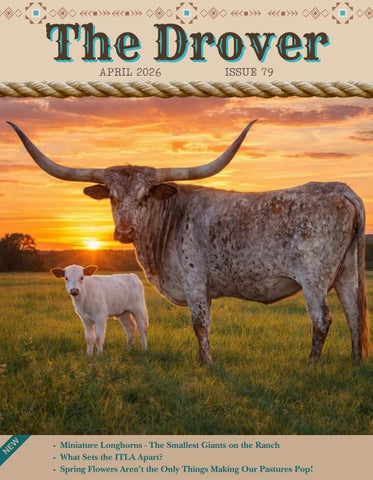
The Drover The Drover


![]()


214- 287-2303

brad@westmorelandlawfirm com www gangof5longhorns com

This past Sunday at church we sang a traditional hymn written by Will L. Thompson entitled “There’s a Great Day Coming” The chorus of the song repeats this line: “Are you ready? Are you ready? Are you ready for the judgement day?” Growing up near the top of the Texas Hill Country, I would spend my summers on my grandparents’ ranch just southeast of Glen Rose (where we have our awesome Headquarters) and with my other grandparents who lived a few miles away at Chalk Mountain where they kept the total population from dipping below two folks for many decades – three when I was there Both sets were ranchers, among other things. Often on Sunday mornings and evenings my grandfather on my father’s side (the Glen Rose side) would sing the line, “Are you ready?” to my grandmother Camilla who was notorious for taking her time getting ready for church services. She always wanted to look her best for worship. “O.Z.!” she would say, “I’ll be ready when I’m good and ready!” And they would laugh together I loved my grandparents.
It’s hard to believe that it’s already April, so here’s my question for you: “Are you ready?” As our fine Affiliates are gearing up for show season, are you ready to support them with your presence and your cattle? With your hands put to labor? With your encouragement? As the Board, our hardworking Staff, and our many Committees work together to plan a whopping-good International Championship Show as a crowning achievement to our ITLA year, are you ready to help us make it a success? Believe me, there is a great day coming. ITLA-wise, that day is October 6 when Texas Longhorn cattle start arriving in Glen Rose, Texas this year We need your help to make it great We have Committee chairpersons who are ready to put you to work; so please review the volunteer positions that are listed in this issue of The Drover and consider how you might be able to help us. Never say you’ve not been asked to help! I’m asking!
As we all do our best to prepare for these great days that are coming, may our patient God be with you, your Gang, and your cattle and give you the time and energy to make ready. Thank you for your support. Contact me anytime.


LADIESSHOPPINGEXCURSIONMANAGER

INTERNATIONALPHOTOCONTESTVIDEOGRAPHER
ADULTSHOWMANSHIPSIGN-UPMANAGER

ITLAMERCHANDISESALESPERSONS
SILENT&LIVEAUCTIONORGANIZERS


At the church where my family worships we often say that we should use Bible terms for Bible things, and do Bible things in Bible ways. Language is important. The words we choose can paint a beautiful picture, or over time they can erode a beautiful reality. How we conduct ourselves is equally important. Our actions have the ability to both honor our traditions, or shade them with contempt.
In this first of a series of articles detailing what sets the ITLA apart from the competition, we’ll examine the language of the ITLA and the importance of our words and deeds to this Western lifestyle that we cherish. From the outset, let me give credit where credit is due: I have borrowed heavily (and at times blatantly and unashamedly) from two of our founders: Mr. Darol Dickinson and Mr. Stan Searle. I appreciate their wisdom and application of lessons learned from history – but I repeat myself.
How is the ITLA different in its language? Let’s begin with the biggest event of the year: it is called the “International Championship Show.” It is not our “World Show.” It is not “Nationals.” Could you call it “Champ Show” among ITLA friends when in a hurry? Perhaps –but let’s not ignore the importance of our International members by leaving out that critical part of its name. When we refer to our International Championship Show, we are reiterating the fact that the ITLA is truly an international organization with active, vitally important members in 15 different countries and growing. And we are stressing that our biggest event of the year is truly a championship – with the finest Texas Longhorn cattle being judged by the most qualified Texas Longhorn judges in the world. To publicly call it “Champ Show” lessens the importance of it a bit; and it paints an incomplete picture for those not familiar with our biggest event of the year. Words matter.
Another example is the use of the word “producer.” Stan Searle tells me that about 40 years ago he noticed that Darol Dickinson started referring to ITLA members as Texas Longhorn “producers” rather than “breeders.” Darol did so, recognizing that the term “producer” encompasses a vast array of activities integral to the production of Texas Longhorn cattle, whereas “breeders” only make up a relatively small part of the industry. The farmer-member who raises the crops that feed his small handful of Texas Longhorns and thousands of others is a producer, more than a breeder. The diesel supplier, the marketeer, the seller of ranch equipment, the fence builders: these are producers. ITLA members are ALL producers; not all are breeders. Vocabulary matters.


A final example of our ITLA language is the most basic of all: in the ITLA we produce Texas Longhorn cattle. We do not produce “longhorns,” nor “Texas longhorns.” Being from God’s country, I can tell you that the Texas longhorns are my alma mater who used to play Texas A&M in football every year. But I especially appreciate how Stan Searle puts it:
“The term ‘longhorn’ without any further descriptor, can refer to any sort of Mexican corriente or crossbred mongrel with horns wider than its ears.” -Stan Searle
Do you raise those? Neither do I. So, in the ITLA when we are referring to our beautiful registered cattle, we are speaking of majestic Texas Longhorns - capital “T”, capital “L.” Nothing less.
You may be wondering to yourself: “Why the high horse, Brad? It’s only words!” To repeat: words matter. Not only do they paint a mental image in the mind of the hearer, they also have a direct effect on our actions...though sometimes those sneaky effects can take years to be seen; and by then it’s often way too late to correct the damage. Politicians know this well. Most lawyers worth their salt do too. Keep in mind that as Texas Longhorn producers, and proud ITLA members, we daily come in contact with an ever-increasing population that knows sadly little about anything related to agriculture. Thankfully, for many of them the Texas Longhorn remains a critter of mystique, and the cowboy or cowgirl are beings of mystery. The language that we use around these folks should honor what we do and the cattle that we are blessed to own. Likewise, it should reflect our pride in the ITLA and our very valuable Western traditions, which are oh-soeasily lost if repeatedly cheapened with careless words.
After all, for many of us, part of the enjoyment of owning Texas Longhorns is being identified with the ranching or the cowboy lifestyle. It is a thing of pride that should bear with it a deep respect for history, tradition, and personal integrity. That integrity should not only be be heard in how we speak, it should be seen in how we act. Men should treat women with respect and honor. Women should carry themselves with pride. Children should be cherished. We should all work hard. Even our clothing can cay a lot about whether (or not) we truly respect this lifestyle. My daily boots are not for show – they are tools I work with. My cap keeps the sun out of my eyes and rain off of my head. But when it’s Show time, or when representing the ITLA to the public, let’s clean up a bit and dress appropriately Western and let’s carefully guard our speech.
Ronald Reagan said that “Freedom is only one generation away from extinction. It has to be fought for and defended by each generation.” Folks, likewise the ranching and cowboy lifestyles haven’t yet died: but in many ways we are their last true vestiges. It is this generation who are the keepers of our great traditions. Let’s try to protect our Western heritage and our unique Association with thoughtful words and actions.
-Brad Westmoreland ITLA President


Breed Standards Committee: Dr. Keith Berkeley and Mike Tomey (co-Chairs)
Drover Oversight: Brad Westmoreland (chair)
Futurity: John Oliver and Gary Lake (co-Chairs)
IT/Computer: Kirk Dickinson (chair), with members Gary Lake and Micha Hammersky
By-Laws: Shadow Seaman (chair), with members Brett Kot, Brad Westmoreland & tony frazier
Youth: Meagan Minchew (chair)
mini longhorns: j.a. Thomas (chair) with members Shadow and Bonnie Seaman
Beef: Travis Casey (chair)
Marketing and Events: Russ and Anita Thompson (co-Chairs)
2026 Championship Show: Larry Smith (chair)
WITh members Russ Thompson, Travis Casey, Brett Kot, John and Brenda Oliver, and Brad Westmoreland
Affiliates: Doug and Sara Burris (co-Chairs) with member russ Thompson Judges Oversight: Larry Smith
Show Rules: John Oliver and John Moxley (co-Chairs)
with members Shadow Seaman and Larry Smith

interested in participating in any of these committees? please contact the noted Chair and/or Pres. Brad Westmoreland we WOULD WELCOME YOUR HELP!


The smallest giants on the ranch.

Miniature Texas Longhorns are not just small versions of their larger counterparts; they are a unique breed with a storied history, combining charm, beauty, and feisty personality into a compact package. These half-sized bovines are quickly gaining popularity among ranchers and hobby farmers alike, offering a delightful mix of tradition and modernity
Originating from the historic Texas Longhorn breed, Miniature Texas Longhorns have been selectively bred to retain the iconic long, curved horns while maintaining a smaller stature. Typically standing between 40 to 45 inches tall at the hips, these miniatures weigh between 40 to 750 pounds on average. The horns can span up to four feet, showcasing their striking appearance.

Miniature Texas Longhorns are known for their friendly and curious demeanor. Often affectionate, they make great companions and can be easily trained. Their playful nature makes them a favorite among families with children, as well as among hobby farmers looking for gentle livestock options.
Their striking appearance, shapely horns, and vibrant color patterns - from solid blacks and browns to beautifully speckled coats - make them a visual delight. Moreover, they can serve multiple purposes, such as:

PETS: With their friendly nature, they can be excellent pets.
PASTURE MANAGEMENT: Their smaller size allows them to graze on smaller plots of land and being Texas Longhorns, they browse a wide variety of undesirable vegetation in comparison to other cattle breeds.

SHOW CATTLE: Miniature Texas Longhorn competitions have emerged, often alongside standard Longhorn cattle highlighting their beauty and unique traits.

Caring for Miniature Texas Longhorns involves similar practices as other cattle but with a few adjustments for their size:
SHELTER: They are nature’s survivors; as long as they have a windbreak from severe winter windstorms, they can stand most other weather.
NUTRITION: A balanaced diet with quality hay, minerals, and grazing materials is essential; however they have adapted to survive on the barren lands of south Texas and Mexico.


SPACE: Even though they are smaller, they still need adequate space to roam and graze; but you can often keep two miniatures for one standard on pasture.
For show cattle, regular veterinary check-ups are necessary to keep these cattle in peak condition. Vaccinations and parasite control are essential elements of their healthcare routine. However, they survived for years adapting to nature and are considered parasite resistant.
Whether you are looking to enrich your farm, beautify your landscape, or simply enjoy the company of these charming creatures. Miniature Texas Longhorns are an alluring choice. Their intriguing blend of history, aesthetics, and practicality makes them an appealing option for anyone interested in unique livestock. Their gentle personalities and striking horns promise to capture the hearts of many!


By: Chip Bowdrie
I love the sounds around these hills: Killdeer cry, mockingbird repeaters. But nothing gives my soul the thrills Like wind in the grass and the cedars.
A bawling calf and answering mother.
The rumbles of the herd’s leaders. They’re mighty fine, but I’ll tell you brother: They ain’t wind in the grass and the cedars.
A rattler’s buzz will make me jump.
Catfish splash, those bottom feeders. Both can make my heart go thump; But not like wind in the grass and the cedars.
So haunt elsewhere you weavers of fears; And get you gone, you smile defeaters! ‘Cause on this night, my mind only has ears For sweet wind in the grass and the cedars.


It’s an exciting time for the ITLA youth! Elections for the ITLA Youth Board are coming up soon, giving members the chance to get involved, share ideas, and help plan activities for the year. If you’ve ever wanted to make a difference in the youth program, now’s your time. We also still have the rifle raffle fundraiser going on! It’s a great way to support the youth program and help fund fun events like cow camp. Speaking of cow camp, it’s coming up soon! It’s always a great time to learn, meet new friends, and enjoy being out on the ranch. With elections, the raffle, and cow camp all happening soon, there’s a lot to look forward to this spring for the ITLA youth!


The long winter days are behind us and we are making our way into spring and warmer brighter days. As we all know, the needs of our cattle change with the seasons. Fresh green grass is a welcome sight after a long winter.
As we move into spring, there are some things to consider when it comes to grazing management and nutrition. You are probably seeing some green-up of your forages, but that doesn’t necessarily mean that there is enough available for cattle to graze. A good thing to keep in mind this time of year: “If it’s just a haze, don’t graze!” If there isn’t enough forage for your herd, they will move around to seek out the higher-quality forage and by doing this they are expending more energy. When cattle are allowed to graze forage plants too early, animal performance suffers, but also plant persistence may be negatively affected due to the fact that the plants have not had enough time to develop plenty of root carbohydrates. If possible, you should wait until your grass is at least ten inches tall before you move cattle fully to pasture, or at least limit grazing and provide hay as well.
Another thing to consider is the transition from a mostly dry diet to a diet of fresh forage. Going to a high-moisture, low fiber forage can result in increased passage rates and diarrhea. You should slowly remove hay from the diet while adapting back to fresh pasture.
Another tip has to do with your body condition score. Low or moderate quality hay fed during the winter without the proper supplementation may have caused cows to drop body condition. Most importantly in cows that have just calved or are close to calving, a BCS of about six would be ideal. This allows them plenty of energy stores in their body in the form of fat to pull from while lactating. If cattle have been “roughed” through the winter, you may want to supplement to meet their energy needs. Body condition score at calving has an impact on the postpartum interval, meaning if BCS if too low, post-partum interval is longer and it takes cattle longer to breed back. This will lead to extended calving seasons the following year

Grass tetany is a worry that comes with spring, although it may not be incredibly common. Our cattle are longing for those lush green pastures by winter’s end and are willing to break through fences and bust through gates to get to them, but these grasses are high in moisture and potentially diluted of minerals. This can lead to a deadly condition known as grass tetany.
Grass tetany is a disease that is associated with low levels of magnesium in the blood. Grass tetany can affect cattle of all ages but older cows with calves at their side during late winter into early spring are at a higher risk. Cattle store magnesium in their bones and muscles, but cannot readily access and utilize these stores when needed. The animal constantly loses magnesium in urine, feces and milk; so when grazing lush green magnesium-deficient grass, cattle need magnesium supplements to meet daily requirements. A cow in peak lactation (six to eight weeks post calving) needs a constant source of magnesium to replace the large amount lost from the body in milk. There are some really great free choice minerals on the market that are high in magnesium and perfect for this time of year. Purina has a Wind & Rain high magnesium and Cargill also markets one through Nutrena called Right Now Gold. The Right Now line is a great line in that it changes with the seasons which makes it easy to keep track of when you need to change and what mineral your herd needs for each season. For at least one month after the new grass growth starts in spring, you should provide a free choice mineral with 10-14% magnesium to make sure that your cattle have plenty of magnesium in their system. Some cattle find hi-mag minerals unpalatable. If this is the case with your cattle you can mix the mineral with feed to make it more palatable for them.
There are several potential causes of grass tetany.
Cattle grazing in cool-season grasses and legumes, which have a lower concentration of magnesium.
Grasses grown on leached acid sandy soils have lower levels of magnesium.
Magnesium levels are low when potash and nitrogen fertilizers are used and growth is lush.
High moisture content in grass causing rapid gut transit and low uptake.
Reduced absorption of magnesium resulting from high rumen potassium, nitrogen and low rumen sodium.


Low energy intake, fasting or sudden changes in feed. Trasport stress.
Low intake of phosphorus and salt
Animals suffering from grass tetany are often found dead. There may be signs of struggle on the ground beside the animal indicating they were leg paddling before death. Early signs include some excitability with muscle twitching, an exaggerated awareness and a stiff gait. Aggressive appearance may be displayed and may progress into galloping, bellowing and then staggering. In cases that are less severe you may only notice a change in the overall character of your animal and they will become more difficult to handle.

Grass tetany can be complicated as it is a rapidly progressing and potentially fatal disorder. As mentioned earlier, grass tetany is caused by a lack of magnesium. Magnesium is an essential mineral vital to many enzymes of the major metabolic pathways, used in normal nerve conduction and muscle contraction and in bone mineral formation. Between 60-70% of total magnesium in the body of a Texas Longhorn is held in the bones.
Grass tetany occurs when the magnesium level in the blood drops rapidly which results in an inadequate amount of magnesium reaching the cerebrospinal fluid surrounding the brain and spinal cord. When there is no magnesium present in spinal fluid, there is uncontrolled activation of the nerves supplying muscles throughout the body. This causes constant overstimulation and contraction of muscles, which will at first appear as nervousness and then as stiffness and rigidity or “tetany”, that can progress to convulsions and eventually even death. Normal blood magnesium must be maintained by daily absorption of enough magnesium from the rumen to meet the amount required for milk production, soft tissue and bone growth, fetal development during pregnancy, and the small amount which is lost in feces.
And excess dietary magnesium is processed through the kidneys and expelled via urine. Cattle have no effective reservoir of tissue magnesium so shortage cannot be compensated for by removal from bones or increasing magnesium absorption from other sites on the body. In addition, magnesium is not controlled by horomones to keep it in balance as with other major minerals. A simple lack of magnesium intake in the diet can happen as in cases of starvation or if off feed. Deficiencies are most often due to interference with magnesium absorption in the rumen.

Many things can cause a magnesium deficiency in cattle but the most common stems from grazing them on early spring pastures. If you can wait until your pasture grasses reach a height of at least six inches you should be safe, but it is still recommended to provide a hi-mag mineral for them. Magnesium must be present in a soluble form (ionized) to be absorbed through the rumen wall. Grazing beef cattle have a higher rumen pH due to buffers present in the saliva and slower production of volatile fatty acids from forage fermentation compared to grain diets.
As previously mentioned, in a classic case of grass tetany, the cow is usually found dead and the ground around the carcass if disturbed due to paddling and seizures before death. The interval between the first signs of grass tetany and death may be as few as 4-8 hours. However, if noticed in the beginning stage, the earliest signs are twitching of the ears, facial muscles, shoulder and flank, and a stiff gait. The affected cow will separate from the herd and may show a variety of symptoms which would possibly include aggressive nature, bellowing, galloping and staggering and they may also appear as though they have gone blind.

As the decrease in magnesium progresses, muscle spasms will cause the cow to stagger and fall, legs stretched out and paddling their legs. Convulsions and seizures will follow and the heart rate may reach 150 beats per minute, which is about twice the normal rate, and can often be heard without the use of a stethoscope. The respiratory rate may reach 60 breaths per minute, again, twice the normal rate, and rectal temperature may reach 105 degrees as a result of the excessive muscle activity Animals may get up and repeat these episodes several times before death.
Cattle showing symptoms of grass tetany n e e d i m m e d i a t e v e t e r i n a r y t r e a t m e n t ; preferably magnesium given intravenously. Re s p o n s e to t re at m e n t d e p e n d s o n t h e length of time between the first signs of symptoms and treatment.
Cattle that do recover take at least an hour to return to normal. Many of these cows will relapse and will require additional magensium treatment within twelve hours.

Prevention of grass tetany is based on maintaining a consistent intake of soluble magnesium to be absorbed in the rumen of susceptible cattle when conditions for grass tetany exist.
The most susceptible groups include lactating cows or cows in the late stages of pregnancy, especially 2-3 weeks prior to grazing early spring grass. These groups should be provided supplementary sources of magnesium. The average beef cow reaches peak lactation at 6-8 weeks post-partum which is when she demands the highest amount of magnesium.
In addition to providing a good, quality hi-mag mineral you can also add magnesium acetate, magnesium chloride and magnesium sulfate (Epsom salts) at a rate of three grams per liter of water. Delay turn-out onto spring pasture as long as you can and until the grass is at least 6 inches tall. Graze your less susceptible cattle (heifers, dry cows) on the higher risk pastures since the threat of disease is lower in non-lactating cattle. Limit grazing to 2-3 hours per day and provide access to free-choice hay while cattle are grazing on spring pastures. Dry forage can provide magnesium and will also slow the passage through rumen which will increase the time for absorption. If you can, incorporate legumes into your pasture. Legumes are higher in magnesium and calcium than other grasses and can bring a balance to your pasture. When applying fertilizer, it is always best to obtain soil samples so that you know what your ground is lacking and can apply what you need. Shooting from the hip is never recommended when it comes to fertilizer application, nor is it economical. You should never apply more potassium than you need. When potassium is applied to forage in the early spring, plants take up more than need because it is like a “luxury” to them. High soil potassium will slow magnesium intake by forages. The result is forage high in potassium which blocks the uptake of magnesium in rumen.


B E E F P R O D U C E R S L I S T
RAIDER RANCH

OWNER: JOHNATHAN AELMORE PHONE: (281)239-5812 email: johnathan.aelmore@yahoo.com
DICKINSON CATTLE CO. LLC
PHONE: (740)758-5050 email: information@texaslonghorn.com
CASEY RANCH LONGHORNS
OWNER: TRAVIS CASEY PHONE: (719)650-5234 email: tcasey357@yahoo.com
DERBY CITY LONGHORNS
OWNER: RICK BUCHANAN PHONE: (502)321-1619 email: buchananrljr@aol.com
LAZY T-BONE CATTLE
OWNER: J.A. THOMAS PHONE: (209)761-7740 email: Jat1997@gmail.com
PLEASANT VALLEY PASTURES
OWNER: GREGG FENICLE & KELSEY STAAB PHONE: (717)682-4501 email: pleasantvalleypastures23@gmail.com
24/7 RANCH
OWNER: TYLER & LESLIE LAWS PHONE: (423)823-0369 email: tylaws2009@gmail.com
MAYOR FAMILY LONGHORNS PHONE: (605)786-5808
N E E D A D D E D TO T H E
C O N TAC T T H E I T L A O F F I C E TO DAY!


$ 5 0 . 0 0 P E R C A L E N D A R Y E A R ( M U S T B E A N I T L A M E M B E R )


Choose the image that would come next to complete each pattern correctly!


“Lasso” the correct word in the sentences below to make them grammatically correct! Take your time! Some of those homophones can be tricky!
1.A cowboy is only as good as his hoarse/horse.
2. The cowboy finished to lasso/lassoing his cattle.
3. Cowboys can’t stand to ride/riding in the hot sun.
4.The cowboys were happy to see a brake/break in the weather after the storm.
5.Your horse seems to be/being limping. It needs new shoes.
6.Did you remember to check the latch on the gait/gate?
7.Would you mind to saddle/saddling my horse for me?
8.Ranchers spend a lot of time taking care of there/their cattle.
9.You should always brand your cattle so that the bad guys don’t steel/steal them.
10.I always wanted to/too be a cowboy and wear a cool hat!
11.Our cattle always go through a lot of hay/hey during the winter months.
12.There is nothing worse than/then an unruly cowboy.
13.Always make sure that there isn’t a knot/not in your lasso!
14.Take thyme/time to enjoy the little things.
15.A cowboy is known to wear/ware his heart on his sleeve.
16.My cattle can always be found down by the creak/creek.
17.It seems like the herd is always happiest to see ewe/you at feeding time.
18.We knead/need to know if we can hall/haul all of our cattle in one trailer.
19.Maintaining a healthy herd is no easy feat/feet!
20.The cowboy got his heal/heel caught in his stirrup, lucky he didn’t brake/break his neck!

What do cowboys say to their cows at night?

epastur bedtime!


I N T E R N A T I O N A L


Spring is finally here, and I couldn’t be more excited! With warm weather arriving, the pastures are starting to fill with new calves, and everything just feels alive and full of energy.Even more exciting is that spring shows are coming up fast. I’m ready to get out there, show off my animals, and represent the ITLA. It’s that time of year where all the hard work pays off, and I can’t wait to compete and connect with other students who share the same passion.This season is all about new life, fresh opportunities, and getting out there to make the most of it and I’m ready!


Sincerely,


I hope everybody’s enjoying the warm weather. The cows are still in the barn but as it warms up and the pastures get green, we will be able to put them out on pasture. Since we had warm weather, I got our two big riding steers out and brushed them down. At the moment they’re shedding so as you can imagine it was a hairy mess.
I celebrated my 16th birthday this month with friends and family and some dancing in the barn. Visiting a fun new soda shop (Grit and Grace) and the wildflowers starting to bloom around our house make me so excited for summer. Another thing I’m excited for is the beginning of our show season in the Northeast. Our NETLA youth are working hard to get sponsorships for this coming show season. We always make the season a


2026itlalittlemiss


Spring has come and Easter along with it. Easter means a lot of things to me. It is a time to celebrate Jesus’s death and resurrection and also a time to spend with friends and family. Sure, all the egg hunts and bunny themed activities are fun, but it’s important to remember why we celebrate Easter in the first place.
I hope everyone had a great Easter celebration! Lately, I have been continuing to work with show projects and helping my family finish the fencing. I have also been really excited about our new calves on the ranch as well as a new heifer we are purchasing. We are growing our herd and I really like what we have so far.


Sincerely,
Macen Rogers
2026 ITLA Little Miss


CODY BAILEY
(780)352-6144 codylbailey1122@outlook com
com

(254)630-0053 danielle@whistlingtxlonghorns.com

hicksamericanbulldogs@yahoo com
plaindirtfarms@gmail com
russ.thompson13@gmail com BRAD
(765)720-0913 bradley fidler@yahoo com
elkrancher2@gmail com DOUG
(740)680-5973 dougburris45@gmail.com
le.longhorncc@gmail.com
mcmurdocvt@aol.com


BRAD WESTMORELAND PRESIDENT www gangof5longhorns com 214 287-2303

LARRY SMITH
DIRECTOR AT LARGE #1 larrypsmith2@yahoo.com 254-396-9185


KEITH BERKLEY
TRAVIS J CASEY VICE PRESIDENT kblb@frontiernet net 304-725-4202

GARY LAKE DIRECTOR AT LARGE #2 gary@searleranch.com 719-314-8294

SHADOW SEAMAN

SECRETARY REGION 4 tcasey357@gmail.com 719-650-5234

MICHA HAMERSKY REGION 1 contact@texaslonghorn.at
CRAIG KROEKER REGION 5 victoryranchlonghorns@gmail com 208-428-2484

JEREMY JOHNSON REGION 8 dosninosranch@gmail.com 210-413-2105

BRETT KOT REGION 10 brettkot@hotmail com 1-306-861-1526

REGION 6 ckroeker5536@gmail.com 620-285-5536

JOHN OLIVER REGION 9 joliver210@yahoo com 972-268-0083

RUSSELL FREEMAN PAST PRESIDENT russell@thefreemanranch com 254-396-9185
JOHN MOXLEY TREASURER REGION 2 crosswrenchranch@msn com 240-446-9950

MIKE TOMEY
REGION 3 tomeyfarms@yahoo com 812-583-4622

RUSS THOMPSON REGION 7 russ.thompson13@gmail.com 940-245-1411