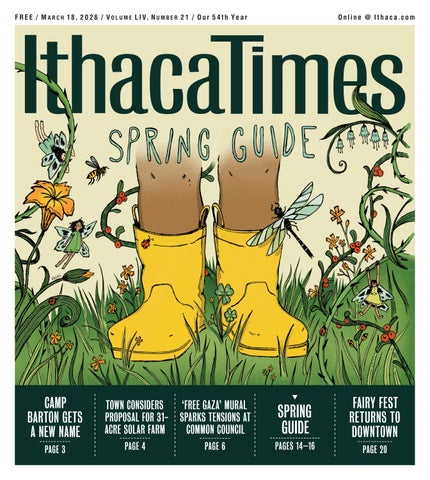
CAMP BARTON GETS A NEW NAME PAGE 3
TOWN CONSIDERS PROPOSAL FOR 31ACRE SOLAR FARM PAGE 4
‘FREE GAZA’ MURAL SPARKS TENSIONS AT COMMON COUNCIL PAGE 6 SPRING GUIDE PAGES 14–16
FAIRY FEST RETURNS TO DOWNTOWN PAGE 20
















































































CAMP BARTON GETS A NEW NAME PAGE 3
TOWN CONSIDERS PROPOSAL FOR 31ACRE SOLAR FARM PAGE 4
‘FREE GAZA’ MURAL SPARKS TENSIONS AT COMMON COUNCIL PAGE 6 SPRING GUIDE PAGES 14–16
FAIRY FEST RETURNS TO DOWNTOWN PAGE 20
By Mikayla Rovenolt
On March 9, the New York State Office of Parks, Recreation & Historic Preservation (NYS OPRHP) announced new park land by Cayuga Lake. Three Falls State Park, named for three scenic waterfalls on its 90-acres of land, will feature public trails and waterfront access to Cayuga Lake.
Three Falls State Park is the former Camp Barton boy scout camp site and was placed for sale in 2021 by the Baden Powell Council of the Boy Scouts of America. It was purchased by the New York State Parks system for $5 million in September 2024. Plans for the park were not announced until recently, when the former scout camp received its official name on March 9.
New York State Parks and Three Falls Local Development Corporation, who will manage the property, released a conceptual plan that will preserve the diverse ecology of the former camp, expand recreational opportunities, and improve infrastructure and public access.
The newly released Conceptual Development Plan for Three Falls State Park outlines the goals for a sustainable, accessible and affordable state park. Over four phases, the plan calls for the construction of modern amenities; implementation of an invasive species management strategy; and improvements to existing structures, trails and utilities.
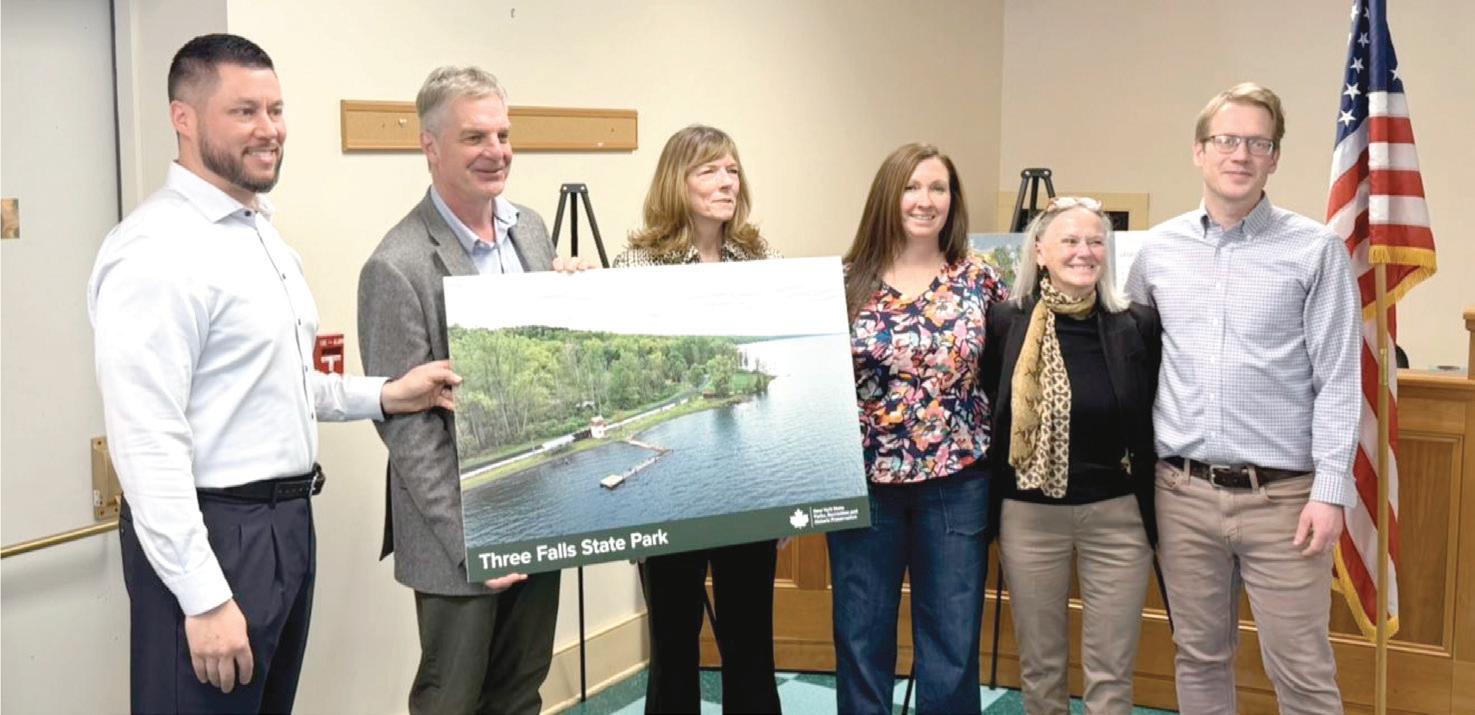
“Two things are important: one is public access and number two, of course, it is going to hopefully bring more visitors that want to come and see our beautiful new park that’s been out of sight for over 100 years,” Covert Deputy Town Supervisor Deborah Nottke said in an interview with the Ithaca Times. “I’m just hoping that it will increase the economic footprint for all of the counties involved. That would be Tompkins and Seneca County, so I’m looking forward to that. I welcome everybody to come and enjoy this beautiful area.”
Three Falls LDC is a collaborative group composed of representatives from the
T ake n ote
By Lorien Tyne
The YMCA of Ithaca and Tompkins County announced it is expanding its Mobile Food Pantry to increase food access for families living in rural and underserved areas throughout Cortland and Tompkins counties.
This spring, the YMCA will begin conducting outreach to rural areas twice a month. The pantry aims to strengthen food access and healthy eating by bringing fresh produce, healthy pantry staples and “culturally relevant” food items directly to communities in need. Rural families often face longer travel distances and fewer grocery options, which can be barriers to healthy eating, along with affordability.
According to a YMCA press release, funding
from Care Compass Network allowed the YMCA to purchase a truck and trailer dedicated to serving the Mobile Food Pantry initiative.
“The YMCA’s expansion reflects its broader commitment to advancing health equity and addressing food insecurity as a key social determinant of health,” the press release stated. “Food insecurity remains a pressing concern across the region, particularly for rural residents, older adults, and individuals managing chronic conditions such as diabetes and hypertension.”
Earlier in March the YMCA also opened a new Community Cupboard at the Cayuga Park building in addition to its cupboard in the Ithaca Mall. Both cupboards are stocked with free, farm-fresh food and perishables to those in need.
Towns of Covert and Ulysses and the Village of Trumansburg. Three Falls LDC has worked on the former Camp Barton project since 2023, though the work to form the LDC and acquire the former Camp Barton property has been ongoing since 2021.
“Having another piece of Cayuga Lake that is preserved forever because it’s now owned by New York State as a public access location is a tremendous thing. Everything that comes with that, whether it’s whether it’s community based events or youth recreation, or any of those things,
Continued on Page 21
Local agencies, healthcare providers and community organizations will aid the Mobile Food Pantry by identifying priority locations where this outreach is most needed. Beyond food distribution, the YMCA is offering community members the opportunity to connect with YMCA health programs, community health navigation and other supportive services.
The distribution schedules and locations will be announced each month on the YMCA’s website and social media channels. Any community members interested in getting involved with the Mobile Food Pantry can contact Kurt L. Kleefeld, director of community health at the YMCA of Ithaca and Tompkins County, at kkleefeld@ithacaymca.com.
“Our goal is simple: meet people where they are,” Kleefeld said in the press release.
o V enolt , r EP ort E r mack @ ithacatimes com
J ake S exton , a d M inistrativ E c oordinator jake @ ithacatimes com
M a R k S y V e R t S on , P
& M ark E ting lisa e @ ithacatimes com a nna l ee , a dv E rtising & M ark E ting anna @ ithacatimes com
f r EE lanc E rs : Barbara Adams, Charley Githler, Stephen Burke, Bill Chaisson, Ross Haarstad, Steve Lawrence, Marjorie Olds, Peter Rothbart, Austin Lamb, Clement Obropta, Jake Sexton, Kira Walter, Vasant Alex Laplam, and Ceili Ayoung
THE ENTIRE CONTENTS OF THE ITHACA TIMES ARE COPYRIGHT © 2026 BY PATHWAYS TO EQUITY, LLC. All rights reserved. Events are listed free of charge in TimesTable. All copy must be received by Friday at noon. The Ithaca Times is available free of charge from various locations around Ithaca. Additional copies may be purchased from the Ithaca Times offices for $1. SUBSCRIPTIONS: $139 one year. Include check or money order and mail to the Ithaca Times, PO Box 27, Ithaca, NY 14851. ADVERTISING: Deadlines are Monday 5 p.m. for display, Tuesday at noon for classified. Advertisers should check their ad on publication. The Ithaca Times will not be liable for failure to publish an ad, for typographical error, or errors in publication except to the extent of the cost of the space in which the actual error appeared in the first insertion. The publisher reserves the right to refuse advertising for any reason and to alter advertising copy or graphics deemed unacceptable for publication. The Ithaca Times is published weekly Wednesday mornings. Offices are located at 109 N. Cayuga Street, Ithaca, NY 14850 607-277-7000, FAX 607277-1012, MAILING ADDRESS is PO
27, Ithaca, NY 14851. The Ithaca
By Mark Syvertson
QUESTION OF THE WEEK:
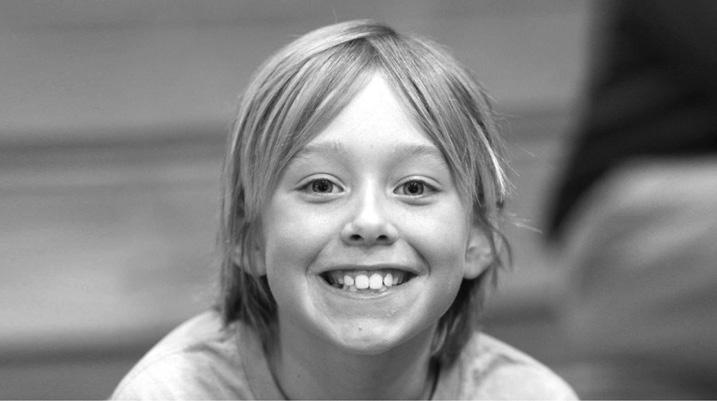
“I ASKED SOME YOUNG HOOPERS AT THE IVY LEAGUE BASKETBALL TOURNAMENT, “WHO’S YOUR FAVORITE BASKETBALL PLAYER?”
NOTE: If readers wish to participate in the Ithaca Times’ Inquiring Photographer column, contact Mark Syvertson at marksyvertsonphotography@gmail.com




By Philip O’Dell
The Town of Ithaca Planning Board took its first step toward reviewing the proposed Bomber Heights Solar project at its March 3 meeting, declaring its intent to lead the environmental review for the 31-acre facility.
The board’s meeting agenda said Nexamp Solar’s proposed project would be a new “community solar” farm on Troy Road. Nexamp’s project overview said Troy Heights, LLC is the property owner. If approved, the facility would feature a 5-megawatt system of high-tech panels that rotate to follow the sun throughout the day, supported by on-site battery storage and new utility poles to connect to the New York State Electric & Gas (NYSEG) grid.
The agenda said the project requires a rigorous state environmental review to study its impact on the surrounding neighborhood because of its size and residential location. No final decisions on the project's construction have been made yet.
Ryan McCune, the Nexamp vice president of business development, shared details of the project with board members. He said the site at 117 Troy Road will rest on a larger 62-acre parcel. Located directly north of the NYSEG transfer substation on King Road, McCune said the facility is designed to generate about 4.5 megawatts of solar power and include 15 megawatthours of energy storage using four Tesla megapacks. McCune said the western portion of the property will remain undeveloped to allow for future residential subdivisions at the landowner's request.
Once the project receives its special use permit and site plan approval, McCune said the company anticipates an eight-month lead time before construction begins. This period includes a six-month design phase to finalize structural and electrical plans with town code enforcement, followed by two months of pre-deployment contracting. Once the company breaks ground, construction of the facility is expected to take between 12 and 18 months to complete.
McCune said the primary physical challenge facing the project is the presence of existing NYSEG transmission corridors. Nexamp held preliminary meetings with NYSEG to coordinate crossing agreements, with a formal application expected to be submitted shortly.
McCune said Nexamp secured a property lease, identifying the site as the

only viable parcel on South Hill capable of connecting to the nearby substation.
While the 62-acre property contains wetlands, McCune said preliminary studies suggest the project may not require special environmental permits. He said the New York State Department of Environmental Conservation determined the wetlands are “non-jurisdictional,” meaning they do not fall under state protection.
Nexamp is awaiting a similar ruling from the U.S. Army Corps of Engineers. If the wetlands are deemed non-jurisdictional under EPA guidance, the company would be required to apply for federal permits. He said this could involve more rigorous coordination with federal and state regulators if the project disturbs more than a half-acre of land.
Planning Director C.J. Randall said Nexamp must submit a comprehensive fire safety compliance plan for the solar energy system as part of the site plan review process. The plan must show the facility and its safety controls align with the local fire code, detailing procedures for shutting down or isolating equipment during emergencies. Documentation must outline protocols for handling fires, explosions, leaks, or mechanical failures. All materials will be submitted to the Ithaca Fire Department for review.
Randall said Nexamp must submit a decommissioning plan to ensure the site is restored to a “useful and nonhazardous condition.” The plan requires a specific timeline for restoration and coordina-
tion with local utilities, backed by a bond or other financial security to guarantee completion. Under the town’s zoning laws, Nexamp has a 180-day window following the decommissioning date to remove all solar panels, battery storage systems, electrical structures, and security barriers. Randall said the town code requires solar energy systems to be designed and placed to minimize glare. Regulations aim to prevent light from reflecting off panels and toward nearby roads or occupied buildings on neighboring properties.
“The applicant is in the process of preparing a visual assessment, which is required as part of the site plan review process for a large-scale solar project, which will assist the Planning Board in deciding what materials or landscaping used to screen or mitigate any adverse effects of the system,” Randall said.
During the meeting, McCune presented the project’s multi-tiered review process, requiring approvals across local, state and federal levels. Once the town’s environmental review (SEQR) and site plan approvals are finalized, the project must secure a building permit from the town’s code enforcement officer. A Tompkins County Planning Board “239-m” review is also slated for submission to ensure the project aligns with broader regional planning and traffic safety goals.
New York State agencies have already
By Philip O’Dell
Cornell University’s Steven K. and Winifred A. Grinspoon Hillel Center for Jewish Community broke ground for its Harkavy Hall on March 8. According to the City of Ithaca, Grinspoon Hillel is constructing the three-story building on a roughly half-acre vacant parcel at 722 University Ave. on Cornell’s West Campus.
e student life center will include a kosher cafe and communal kitchen, beit midrash, classroom, study rooms, lounge, and roo op deck, according to Grinspoon Hillel’s press release. ere will also be a large multipurpose event hall with capacity for 230 students during Shabbat dinners.
Grinspoon Hillel is located at Anabel Taylor Hall, 548 College Ave., on the university’s Central Campus. Due to limited space at its current location, the organization launched its “Hillel is Home” campaign to raise funds for a dedicated building, according to the campaign website.
“I've seen how much our community can accomplish even without a standalone space,” said Noah Bodner, the Grinspoon Hillel student president. “Breaking ground on a building that future Cornell students will call home is a testament that Jewish life at Cornell matters, and it's here to stay.”
Grinspoon Hillel anticipates over 3,000 students will use the 24,000-square-foot hall annually, the organization’s press release said. Stakeholders have long awaited
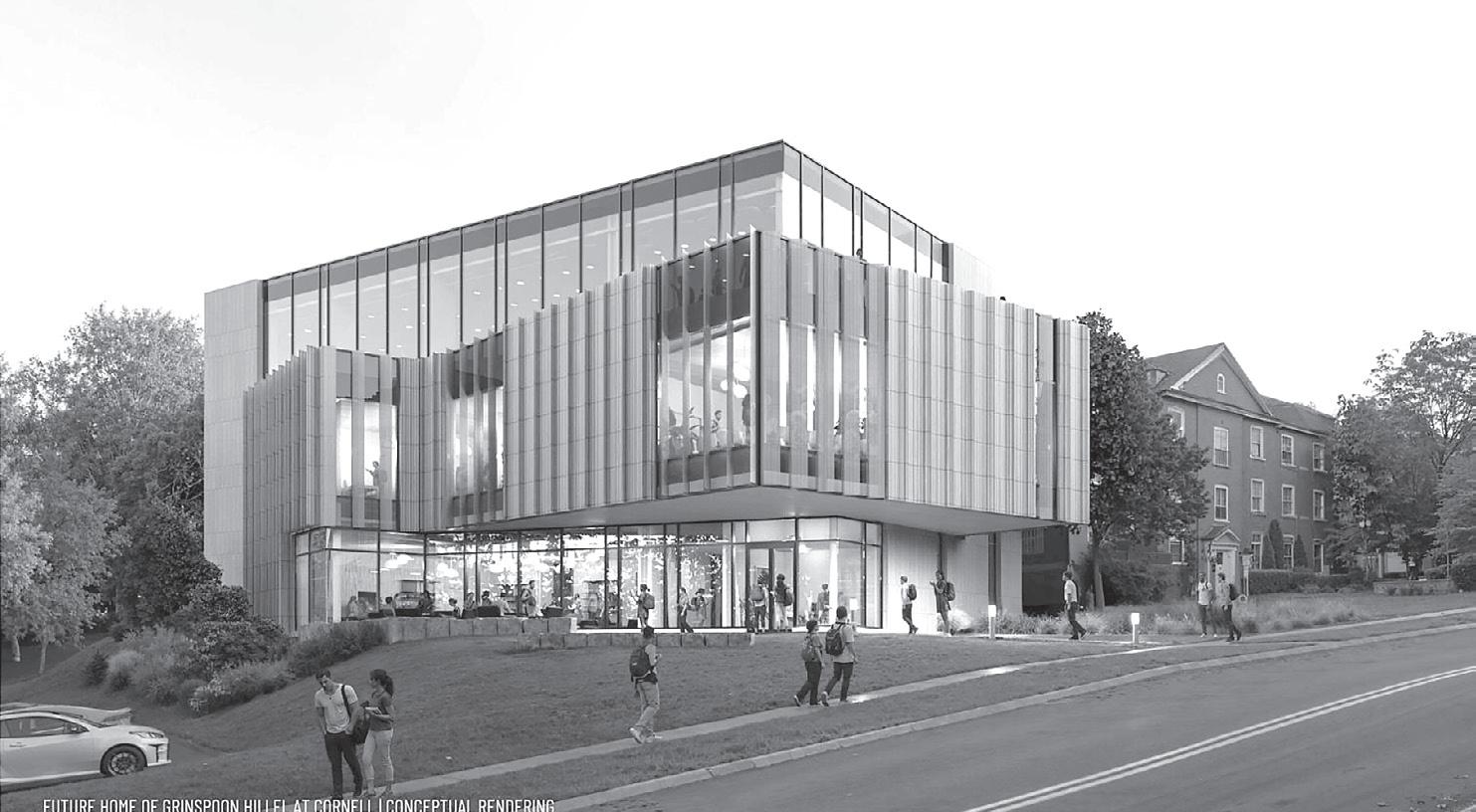
Pictured is the design for the future Hillel building at Cornell, Harkavy Hall. The new student life center will feature Herb’s, a kosher cafe, as well as a communal kitchen, a Beit Midrash, study rooms, and a multipurpose event hall with capacity for 230 students. The organization is located in Anabel Taylor Hall but is moving to the new site to address limited space. (Photo: Provided)
the project, as Cornell is currently the only Ivy League university without a dedicated Hillel building.
“Cornell has long been home to a vibrant and engaged Jewish community,” Cornell University President Michael Kotliko said in a release. “ is new center will ensure that tradition continues for generations to come.”
Hillel International President and CEO Adam Lehman said Grinspoon Hillel has fostered a dynamic Jewish community on campus for nearly 100 years despite lacking a dedicated facility.
“ is amazing new center will give Jewish Cornellians a special place to gather,


The Tompkins County Sheri ’s O ce and other participants will be jumping in Cayuga Lake on March 21 for the annual Ithaca Polar Plunge, which raises money for Special Olympics New York. The plunge will take place at noon at Taughannock State Park Beach in Trumansburg. Funds raised will help cover training, activities and competitions for athletes with disabilities.

Ithaca’s FedEx Ship Center near the Ithaca-Tompkins International Airport will shut down in June. As the company restructures its delivery network, several other New York locations are set to close. O cials have not con rmed if Ithaca’s FedEx kiosks at Walgreens stores, drop boxes and a FedEx O ce location will stay in operation.
grow, and build relationships that last long a er graduation,” Lehman said. “ is groundbreaking is a testament to the dedication of supporters, sta , and students who believe in the critical importance of ensuring strong, visible and vibrant Jewish life at Cornell for decades to come.”
e City of Ithaca Planning and Development Board granted preliminary and nal site plan approval to the proposed facility on Oct. 28, 2025. e project is in the university zoning district that guides development around Cornell University.
According to the Cornell Chronicle, the Grinspoon Hillel Center will own the facility and lease the land from Cornell.
Stakeholders plan for the building to become the premier gathering place for Cornell’s Jewish students. Grinspoon Hillel co-chairs Bonnie Altman and Len Feldman noted the importance of establishing a unique setting for Jewish students to ourish. Altman said she invested in the facility to re ect the community's warmth and provide the university with a center that matches its stature. Feldman said the groundbreaking represents a commitment to Jewish life on campus and lays the foundation for future generations to thrive.
Rabbi Ari Weiss, the Grinspoon Hillel CEO, said the long-awaited facility will provide a lasting sanctuary and sense of belonging for Jewish students.
“ is building is decades in the making, but what it represents goes far beyond bricks

OurBus has expanded its Ithaca-New York City service, increasing to up to eight daily departures and adding more than 1,500 weekly seats across its upstate network. OurBus’ media relations stated that the increased service is due to consistent demand, record ridership last fall and trips between Ithaca and New York up nearly 30% in February.

The Tompkins County Department of Assessment began operating from its new location at 31 Dutch Mill Road in Lansing on March 16. The Tompkins County O ce for the Aging will also temporarily relocate to the building in May.
IF YOU CARE TO RESPOND to something in this column, or suggest your own praise or blame, write editor@ithacatimes. com, with a subject head “U&D.”
Do you feel Ithaca effectively celebrates Women’s History Month?
11.8% Yes. 47.1% No.
41.2% I don’t care.

N EXT W EEK ’S Q UESTION : Does Tompkins County need more solar projects?
Visit ithaca.com to submit your response.
By Philip O’Dell
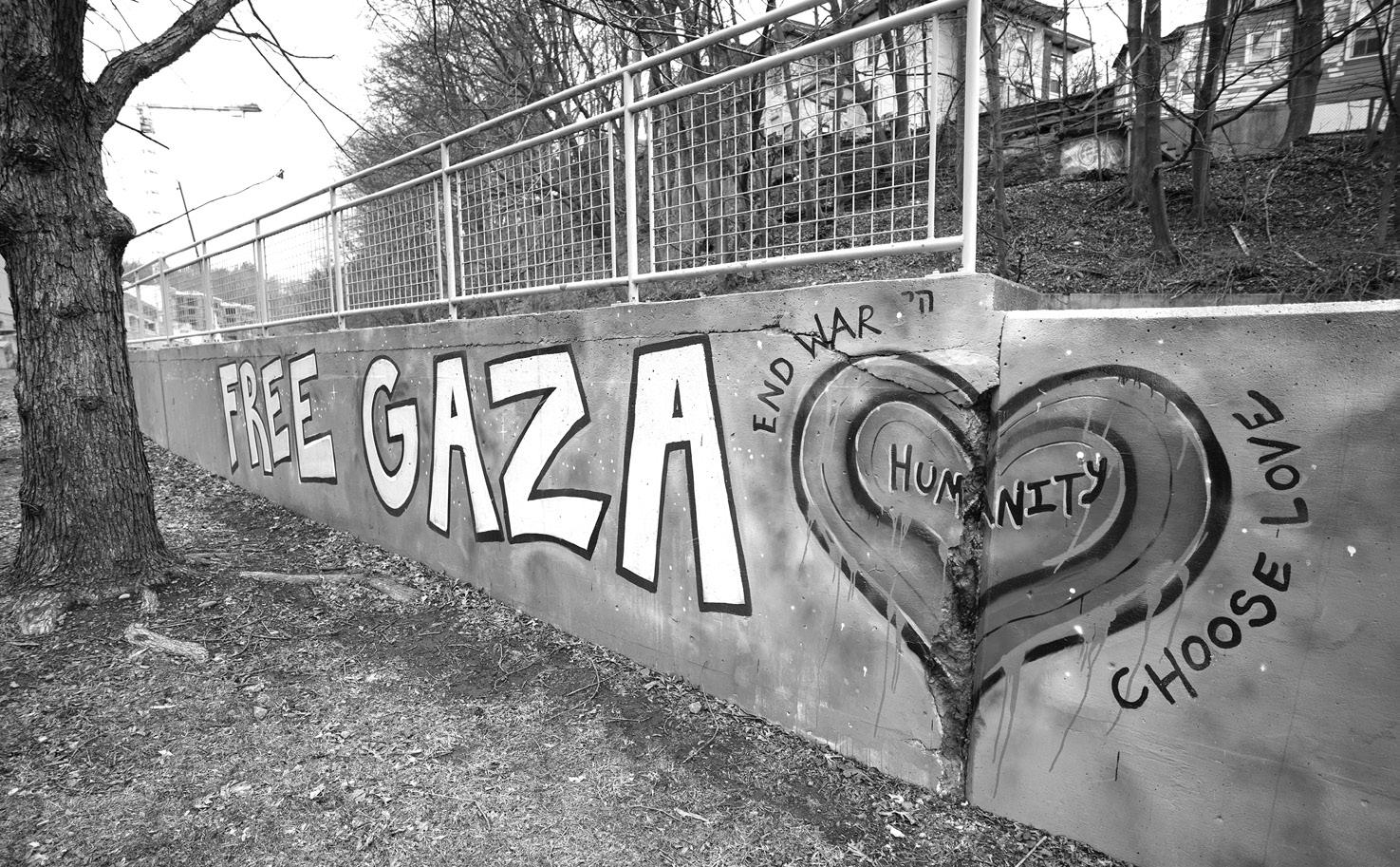
The Ithaca Common Council retroactively approved a mural on March 4, resolving a heated public dispute over the artwork featuring the phrase “Free Gaza.”
The Common Council amended the “ReAwakening the Underground Railroad” mural’s design in a 9-2 vote, with Alderpersons David Shapiro and Pat Sewell voting in disapproval. The mural is near the South Aurora Street bridge along East Green Street. The city will move forward with an updated agreement with Ithaca Murals, subject to review by the City Attorney’s Office.
In May 2025, the Ithaca Common Council approved a proposal from Ithaca Murals to install the new artwork in collaboration between the Southside Community Center and artists Maryam Adib, Cyepress Rite, and Terrance Van. The project updates Jonathan Matas’ 2010 mural depicting Harriet Tubman and Frederick Douglass. The artists completed the installation last fall.
The finished work included unsanctioned text such as “Free Gaza,” “Black Lives Matter,” and “Choose Love.” The resolution amends the city’s previous 2025 approval to encompass these additional features.
The war between Israel and Hamas began on Oct. 7, 2023, following an attack by Hamasled militants that killed approximately 1,200 people in southern Israel. Since the conflict’s inception, over 71,800 Palestinians have been killed, according to the Gaza Health Ministry. Despite a ceasefire on Oct. 10, 2025, military actions from Israel and Hamas continue, with over 550 Palestinians killed since the truce began.
denied service at businesses for advocating for the release of hostages. She compared these incidents to the discrimination faced by the LGBTQ+ community.
“(Van) decided to impose his own politics on us all,” Glaser said. “A politics that has nothing to do with Black history and everything to do with attacking Jews.”
Eva Winkler said individuals who claim to champion equal rights through slogans like “Black Lives Matter” and “Free Gaza” have said antisemitic remarks to her. Winkler condemned the artwork as “not a content neutral statement” and characterized it as “sneaky propaganda,” arguing that the artists used public property to impose a “personal, political and biased opinion.”
Sherrie Negrea, co-chair of the Ithaca Area United Jewish Community Antisemitism Task Force, spoke against both the “Free Gaza” mural and a nearby depiction of the Palestinian flag on Tioga Street. Negra, whose family survived the Holocaust and whose cousin’s son served in the Israel Defense Forces, argued the war cannot be reduced to a slogan. She felt the city took a side in the conflict.
not be so controversial.”
“Let's ask ourselves: who are we if we cover it up? What's next?”
— Local Artist Terrance Van
Resident Jeremiah Craig said the mural should remain in place, arguing its removal would contradict the project’s overarching themes of freedom and progress. He said collaborating with artists requires an acceptance that concepts may evolve during creative processes, noting that if art fails to challenge or expand ideas, it loses its purpose.
Caleb Thomas, a former member of the Public Art Commission, said the local public art movement resulted in over 400 murals across Ithaca, celebrating indigenous, Black, Asian, and Jewish histories. Thomas argued public art exists to generate community dialogue on important issues. He compared the “Free Gaza” messaging to the Black Lives Matter movement, asserting advocacy for a specific group in crisis doesn’t equal animosity toward other nations or peoples.
Shapiro said Ithaca’s commitment to being a welcoming community must extend to Jewish residents, including supporters of Israel. He said residents felt excluded by the project bearing the city’s endorsement.
rejected Sewell’s amendment in a 2–9 vote, with Sewell and Shapiro voting in favor.
As Alderperson Jorge DeFendini spoke, Glaser walked up to the council table and conversed with Shapiro. Cantelmo reminded the gallery that attendees are prohibited from approaching alderpersons while a meeting is in session.
DeFendini supported the retroactive approval, drawing a parallel between the mural dispute and the 1948 gag law in Puerto Rico that criminalized the flying of the Puerto Rican flag to suppress independence movements. As a Puerto Rican, DeFendini said opposing the artist’s intent or suppressing expression would contradict his personal heritage and core beliefs.
During the March 4 meeting, several attendees called for the removal of the “Free Gaza” text, arguing the addition is divisive and makes Jewish residents feel unsafe. Mayor Robert Cantelmo repeatedly called for “order in the chamber” as tensions flared during public comments.
Linda Glaser argued the slogan is used to harass and intimidate Jewish residents, claiming it unfairly holds them collectively responsible for the Israeli government’s actions. Glaser said local Jews were allegedly
Van said that as a father of two children, the phrase was included as a plea to end violence against Gazan children. He said the artwork is a response to tyranny and an antithesis to violence. Van denied any animosity towards Jewish people, saying the mural was his desire to preserve the dignity of those killed.
“Let's ask ourselves: who are we if we cover it up? What’s next?” Van asked.
Adib said the text is a moral reflection on the violence against Gaza’s majoritychild population. She argued Harriet Tubman and Frederick Douglass would support “Free Gaza” if they were alive today due to their work as abolitionists.
“I think art is something that is supposed to reflect our times,” Adib said. “A statement to free oppressed people should
“The legacy of Harriet Tubman and Frederick Douglas should stand on its own,” Shapiro said. “It should not be merged with or co-opted by unrelated international political debates.”
Shapiro proposed an amendment retroactively approving the mural while removing the “Free Gaza” text and directing the Department of Public Works to remove it from the wall within two weeks.
Sewell called to amend Shapiro’s proposal, specifying language for the retroactive inclusion of “Black Lives Matter” and “Choose Love,” while excluding “Free Gaza.” Sewell argued the “Free Gaza” text’s political nature should have required a formal public discussion rather than a retroactive approval.
The Common Council ultimately
Alderperson Hannah Shvets said voting for the mural’s removal would be inappropriate. Shvets, a granddaughter of Holocaust survivors and daughter of Ukrainian Jewish refugees, said Jewish residents lack consensus on the intent of Palestinian imagery, adding many do not perceive the phrase “Free Gaza” as a threat. Shvets also voiced support for a mural dedicated to opposing antisemitism. She defended the artists’ decision to expand the mural’s scope, stating it honors Black history while evolving into a broader vision of global justice.
Alderperson Robin Trumble said that as a Jewish resident, people should not conflate antisemitism with anti-Zionism, calling such a correlation dangerous. He said the city should remain open to projects evolving over time to reflect the fluid nature of art.
The nonprofit is trying to raise $100,000 by May 31 to maintain the full scope of its programs and keep its free public play space open.
By Kai Lincke
EDITOR’S NOTE: This article first appeared in Ithaca Week, a student publication at Ithaca College.
It is practically impossible to grow up in Tompkins County without interacting with Family Reading Partnership.
Since 1997, the organization has been working to help children develop strong language skills and a love of reading before starting school. The nonprofit wants to build a culture of literacy in Tompkins County and spread joy for reading in every neighborhood.
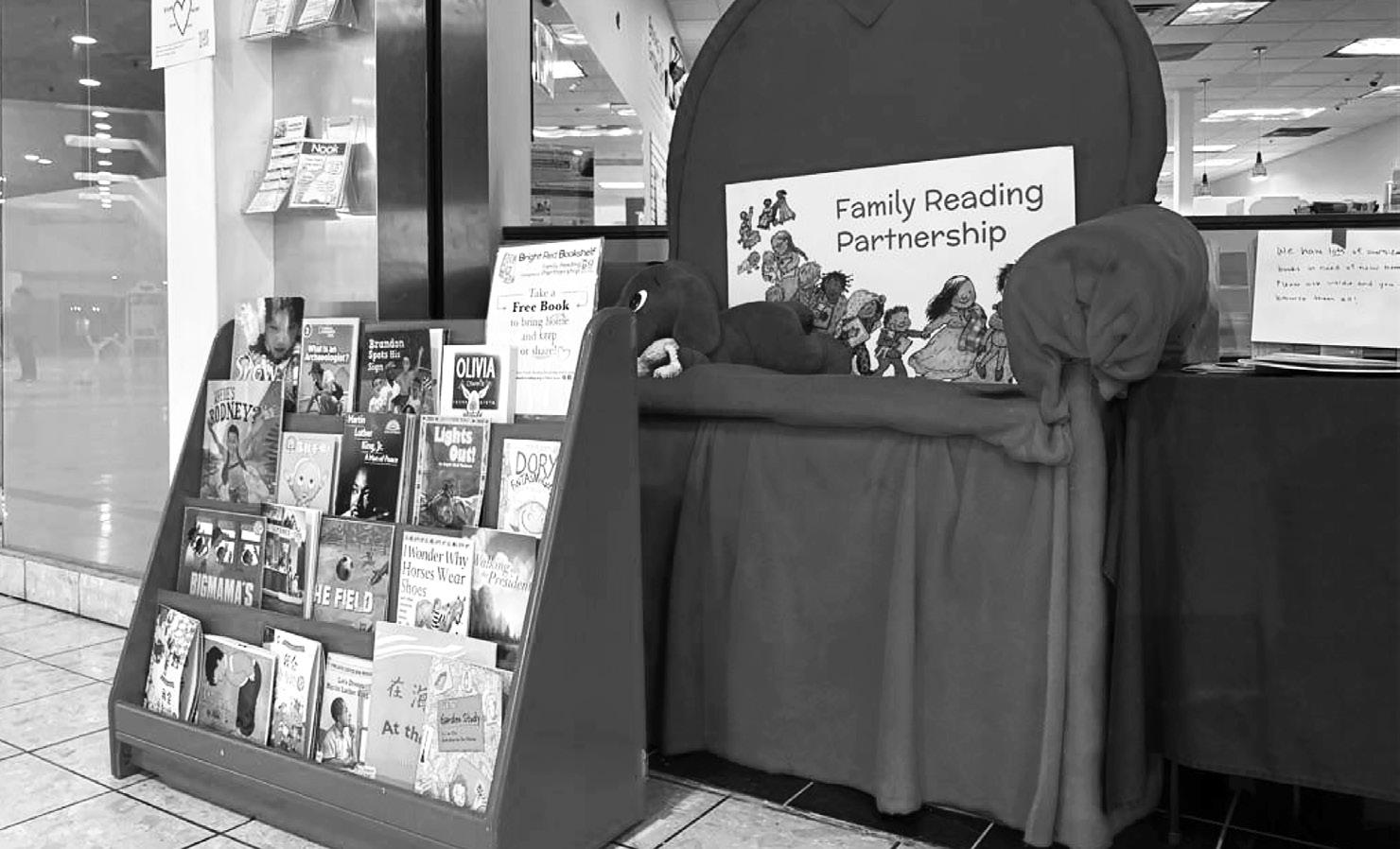
FRP’s Bright Red Bookshelves offer free children’s books in more than 50 locations across Tompkins County, including grocery stores, community centers, schools and food pantries. Through FRP’s Books to Grow On program, every child receives a free book during their well-child visits and their first day of kindergarten. The nonprofit brings books into community spaces through its story walks and traveling books programs, and provides free play bins with books and toys for families with limited resources through Talk, Sing, Read, Play with Me.
Executive director Amber Smith said FRP partners with many community organizations and agencies to distribute reading materials and advertise its resources in every corner of Tompkins County.
“It really is a community effort,” Smith said. “We’re here for all families, and we want people to come and take advantage of this.”
The nonprofit has given more than 350,000 books to more than 250,000 children over the last 30 years. FRP now hopes that some of the families it has impacted will return the support.
FRP launched a $100,000 fundraising campaign Feb. 3 to stabilize finances and replace its storefront’s heating and cooling system. If the organization does not raise enough funds by May 31, it will likely have to move to a much smaller space and reduce programming and staff.
FRP operates out of a storefront in the Shops at Ithaca Mall. Its space includes an office and a free family play area called The Nook.
Smith said the mall location makes it easier for families to access — or accidentally discover — their resources. FRP intentionally markets The Nook as a play space instead of a library.
“We want all families to feel comfortable here, whether they’re readers or not readers,” Smith said. “If we can get folks to come in because they see a free play space, then we can also find little ways to help encourage reading in their home lives.”
Ellie Fulmer, associate professor of

education at Ithaca College, said many teachers are told to use highly scripted reading programs and screen-based instruction, and therefore stop using real books or read-alouds in their classrooms. However, books can help children better process text and realize reading’s power to transport them to exciting new places.
Fulmer said FRP can help children develop a positive relationship with reading by building literacy into many community spaces and removing barriers to accessing books, like the need for a library card.
“If we’re not getting physical books into the hands of kids, then … we’re just shaping them into people that see reading as school related things, things they have to get through and get done with,” Fulmer said. “[FRP can] augment what a lot of really good teachers are still making sure happens in their classrooms … by making sure that kids have access to books outside of their classroom too.”
FRP is primarily supported by individual donors. Smith said FRP has an aging donor base and has struggled to find new donors at the same rate that it is losing them. Smith said it has also been harder for FRP to secure grant funding as grant applications become more competitive because it does not serve an immediate need like food or shelter.
Smith said FRP is constantly working to find new revenue pathways, but has had to use most of its reserves over the last few years and now needs to replace its storefront’s heating and cooling system.
Smith said that if FRP cannot meet its
$100,000 funding goal by May 31, it will likely have to move to a space about half the size of the mall location and without a dedicated play space. FRP would have to scale back to its core programming and lay off two part-time staff members.
Kellie Hummel, a physical therapist and Early Intervention and Evaluations team leader for Racker, said she hosts physical therapy visits with children with mobility needs in The Nook. Hummel said The Nook is one of very few places in Tompkins County where families — including those with mobility needs — can connect with their children and other families in all seasons, for free.
Hummel said it would be an enormous loss for the community if FRP has to close The Nook or reduce programming.
“I have trouble putting it in words,” Hummel said. “As a parent, it has provided just wonderful opportunities to engage in early literacy with my own child and a love of books and storytelling and connection, and then I’ve been able to see families and the children I work with have that same experience.”
Smith said she hopes the fundraising campaign will help families who have benefited from FRP’s services recognize that the nonprofit is in trouble.
“Our hope was really to just get a lot more eyes on the situation, and therefore hopefully bring in some donations from folks who said, ‘Oh, we had such wonderful memories of receiving books at the doctor’s office and we want to make sure that that continues,’” Smith said. “This [campaign] is the way to make sure that that continues.”
The Talk at
By Ithaca Times Readers
Reelection Endorsement of Trumansburg Mayor Rordan Hart
“As Town Supervisor of Ulysses, I am proud to o er my full, enthusiastic endorsement of Mayor Rordan Hart for re-election as the mayor of Trumansburg. Rordan has been a steady, forwardthinking mayor who brings both vision and pragmatism to the role. He has made meaningful investments in infrastructure, built durable partnerships across municipal lines and political parties, and consistently prioritized the health, nancial stability, and safety of Village residents. ese aren’t just talking points — they are the hallmarks of a leader who shows up and does the work.
What I value most about working with Rordan is his collaborative approach to problem-solving. He understands that the challenges facing Trumansburg don't stop at Village borders. Nothing demonstrates
this better than our joint work on the formation of the ree Falls Local Development Corporation and the creation of ree Falls State Park — achievements that will bene t residents of our community for generations to come.
Rordan's advocacy for improvements in rural emergency medical services is equally important. Access to timely, quality emergency care is essential and expensive, and he is committed to pushing Tompkins County and New York State to better support these fragile systems.
I strongly encourage Village residents to support his re-election on Wednesday, March 18th.” — Katelin Olson, Ulysses NY
“Now that the Ithaca Common Council has booted the national surveillance network Flock out of our city, it’s time for Tompkins County, Cornell, Ithaca College, Cayuga Heights, and Trumansburg to do the same.
Concerningly, however, the Tompkins County Legislature appears to be stalling. eir public safety committee has resolved to form another committee to study the issue, but no membership list is completed, and the committee’s charge remains vague. Meanwhile, the clock is ticking. If the county does not proactively cancel its Flock contract 30 days before the contract’s one-year anniversary, then it will auto-

renew for two years, at a cost of $162,000.
And when is that one-year anniversary? It depends on which county o cial you ask. We have until either April 28 OR July 17 to cancel the contract, depending on o cials’ con icting answers.
So the legislature appears resolved to do nothing, and thereby allow warrantless mass surveillance to continue in our communities.
Warrantless mass surveillance is a disaster for freedom and democracy, full stop. ere is no amount of policy, regulation, or trust in local law enforcement that will make it safe. I urge the full county legislature to take prompt action to end our complicity.” — Eliza Bettinger, Ithaca NY
“
ere were 1358 calls to Asteri in 2025, there are 181 units. at’s 7.5 calls per unit. ere are 40 of those units set aside for homeless individuals. If the city can identify how many of the 1358 calls were from these 40 apartments compared to the rest, it would be a good indication whether the experiment of providing these services is working or not. If not, nd alternatives.” — Steven Jones, Ithaca.com
“Rep. Andy Ogles (R-TN) recently posted on social media that ‘Muslims don’t belong in American society.’
Similarly, in February, Rep. Randy Fine (R-FL) wrote on X: ‘If they force us to choose, the choice between dogs and Muslims is not a di cult one.’
House Speaker Mike Johnson (R-LA)
“Is the spring coming?” he said.
“What is it like?”...
has declined to condemn these comments, asserting, ‘I’ve spoken to those members and all members, as I always do, about our tone and our message and what we say.’
Anti-Muslim racism receives little pushback in our country. Imagine the furor if the word ‘Jews’ was substituted for ‘Muslims’ in these statements.
Bigotry against any faith community undermines the principles our nation claims to uphold. History shows where such dehumanization leads. Both citizens and elected leaders must insist that dignity and equality belong to all Americans, without exception.” — Terry Hansen, Gra on WI
RE: Tompkins County Leaders Defend Sanctuary Policies Following Trump’s State of the Union Threats
“No human being is illegal on stolen land. try taxing the rich. ey’re the only socialist freeloaders in this country.” — Reeves Hughes, Ithaca.com
“‘Socialism in general has a record of failure so blatant that only an intellectual could ignore or evade it’ — omas Sowell.” — George Little, Ithaca.com
a Concert of “Lord of the Song”
“On 3/15/26, my wife and I attended a concert at the State theater in Ithaca. Featured was the Ukrainian orchestra “ e Lord of the Song”. ey are an international group apparently touring the U.S. Played were several of the works of Hans Zimmer, famous for many show-tunes. instantly recognizable. In addition, a unique lightshow accompanied the performance. Being seated in
Continued on Page 21


“It is the sun shining on the rain and the rain falling on the sunshine...”

Curated by Roy Allen: Director of Strategic Partnerships — Ithaca Times, Finger Lakes Community Newspapers, www.ithaca.com
Harvey Milk was the first openly gay man to be elected to public office in California. Milk’s June 25, 1978 “Hope Speech” inspired gay and lesbian groups across the country to seek protection under civil rights laws. Milk was later assassinated on November 25, 1978. Many voices have shaped the nation we call America. This week we feature slain human and civil rights activist and advocate — Harvey Milk — the first openly gay man elected to public office in America.
CURATOR’S NOTE: Harvey Milk spoke out not just for the gay and lesbian community, but for all marginalized people suffering from systemic social discrimination, whether those bosses stemmed from political or religious practices. Milk believed that public education and participatory democracy was fundamental to sustaining our republic. He was assassinated in November of 1978, just months after delivering his "Hope Speech” in June of 1978.
Speech Delivered on the steps of San Francisco City Hall during a mass rally to celebrate California Gay Freedom Day, 25 June 1978
By Harvey Milk — Board of Supervisors
— City of San Francisco
My name is Harvey Milk and I’m here to recruit you. I’ve been saying this one for years. It’s a political joke. I can’t help it—I’ve got to tell it. I’ve never been able to talk to this many political people before, so if I tell you nothing else you may be able to go home laughing a bit. This ocean liner was going across the ocean and it sank. And there was one little piece of wood floating and three people swam to it and they realized only one person could hold on to it. So they had a little debate about who the person was.
It so happened that the three people were the Pope, the President, and Mayor Daley. The Pope said he was titular head

of one of the greatest religions of the world and he was spiritual adviser to many, many millions and he went on and pontificated and they thought it was a good argument. Then the President said he was the leader of the largest and most powerful nation of the world. What takes place in this country affects the whole world and they thought that was a good argument. And Mayor Daley said he was mayor of the backbone of the United States and what took place in Chicago affected the world, and what took place in the archdiocese of Chicago affected Catholicism. And they thought that was a good argument. So they did it the democratic way and voted. And Daley won, seven to two.
About six months ago, Anita Bryant in her speech to God said that the drought in California was because of the gay people.
On November 9, the day after I got elected, it started to rain. On the day I got sworn in, we walked to City Hall and it was kinda nice, and as soon as I said the word “I do,” it started to rain again. It’s been raining since then and the people of San Francisco figure the only way to stop it is to do a recall petition. That’s the local joke. So much for that. Why are we here? Why are gay people here? And what’s happening? What’s happening to me is the antithesis of what you read about in the papers and what you hear about on the radio. You hear about and read about this movement to the right. That we must band together and fight back this movement to the right. And I’m here to go ahead and say that what you hear and read is what they want you to think because it’s not happening. The major media in this country has talked about
By Stephen Burke
Maybe you noticed that the city of Ithaca raised the price of trash collection at the start of the year. The tag you buy to have a container of trash weighing up to 40 pounds taken from your curb now costs $6, up from $5. Paid trash collection occurs weekly. There is free collection of recyclables bi-weekly. The separation is important environmentally, keeping recyclables out of landfills. It has the added benefit of lessening the amount of disposal you have to pay for.
Compostable material, namely food scraps and waste, has a status similar to recyclables. It is a resource with practical use. It is best kept out of landfills, where it not only takes up space but produces methane gas, a significant contributor to climate change.
One difference is that while disposal of compostable material is free in Ithaca, it has to be brought by residents themselves to designated sites. The main one is the Recycling and Solid Waste Center on Commercial Road, off Route 13 south. Its hours are 7 a.m. to 3 p.m., Monday through Saturday. There are a few others (Co-operative Extension on Willow Avenue, East Hill Plaza, Hancock and Fifth Streets), but with very limited hours.
There is no curbside compost collection in Ithaca, but a pilot program aims to change that. It begins April 1 in two city neighborhoods.
The New York State Department of Environmental Conservation sponsors the program in conjunction with Recycling and Materials Management of Tompkins County, which has a less bureaucratic moniker of Recycle Tompkins, and a user-friendly website name of recycletompkins.org. The program itself is called Fork ‘Em Over: Curbside.
The program will operate in Ithaca’s Northside and Southside neighborhoods. Participants must register. There’s a maximum of 360 households.
Weekly collection is planned, on the same day as each area’s trash collection. Participation is free, and containers are provided.
There is an inside container for the kitchen. It has an extended edge for hanging, for instance on a door opening beneath the sink, or can stand alone on a floor or surface. Liners for the bins are provided.

Outside bins, for collection, are about three feet high. They are made of lightweight plastic and have wheels and ergonomic features for easy handling.
Compostable materials include almost everything you eat and its scraps: meat, fish and bones; coffee grounds and tea bags; eggs and dairy; bread, grains and beans; and fruits and vegetables. Paper towels and napkins are also compostable. Among other destinations, collected compost will go to Cayuga Compost, which has a facility on Agard Rd. in Trumansburg. (For orientation: Ithacans might know Agard Road as the location of the large, original off-site parking area for the GrassRoots Festival.) Cayuga Compost processes and markets 50-pound bags of compost, available at its own site and at retail stores around town, regarded by gardeners and homeowners as particularly high-quality and low-cost. Studies show that about a third of trash disposed by households is compostable. Theoretically, then, despite the cost of trash tags going up this year by a dollar, or 20 percent, a household utilizing the curbside compost service (or performing its own compost removal to a free city site) would actually lower its expenses for waste removal this year from last year’s lower tag price by about 20 percent.
New York City, surprisingly for such a vast metropolis, has already figured out how to manage curbside composting. It is not just available but in fact mandated city-wide.
A notable rat problem was probably a factor in NYC's brisk readiness for compost collection. Previously, food scraps mixed with other trash could be left on curbs in plastic trash bags, practically a dinner invitation to rats. Ithaca also allows trash to be left on curbs in plastic bags, and while there is no widespread rat problem here, separation of compost and free collection can only help. NYC’s leadership is not readily duplicable, but offers encouragement. Fork ‘Em Over: Curbside is a project planned for a year, with hopes for eventual expansion from its two pilot neighborhoods to throughout Ithaca. At the time of this writing, slots are still available in the program for Northside and Southside residents. For others, check the Recycle Tompkins website for all recycling resources and opportunities.
By Roy Allen — Director of Strategic Partnerships — Ithaca Times
Each spring in Ithaca, the hills fill with caps, gowns, and proud families. Graduates leave the campuses of Cornell University and Ithaca College, stepping from lecture halls and studios into workplaces across the country. The ceremony represents a moment of transition: many years of structured learning give way to the open-ended discipline of professional life.
Yet many parents, employers, and mentors notice a familiar tension during this transition. Next gen workers often arrive educated and credentialed, but not always reliably practiced in the habits of daily work. The gap is not one of intelligence or intention. Rather, it is a gap between knowledge and consistent execution—between what roles education prepares students to perform versus those roles job providers need workers to execute every day.
Part of the explanation lies in how the culture of work and education has evolved. Universities today emphasize grade achievement, advancement, and graduation. At the same time, organizational environments— from classrooms to offices—have become more consciously designed. Beautiful spaces, safe spaces, collaborative studios, and carefully curated digital platforms signal that meaningful work should feel engaging and purposeful.
These changes have produced a generation that expects work to be customized to their personal preferences in real life work environments that many traditional businesses simply cannot afford to provide. In cities like Ithaca, where academic institutions shape the local culture, this expectation is especially strong. Students spend years in environments that do not reflect the actual business community or real life outside the government funded (loan guarantees, bond funding, grants, etc) constructed environs of school.
In recent years, other forces have subtly and not-so-subtly reshaped how students approach learning. The disruptions of COVID, the addictive pull of social media, and the emergence of large language models have all contributed to a
landscape where attention spans are short, focus is fragmented, and the discipline of sustained study is sometimes underdeveloped. Many students struggle to read and finish a book, prefer shortcuts where none exist, and perceive what once would have been a brief paper as a long, arduous task. Assigning traditional essays has become fraught because AI-generated outputs often blur originality, leaving instructors concerned about authenticity and critical engagement. Many students have lost their sense of self: personal agency and pride of creative ownership.
Layered onto these technological and cultural shifts is the financial reality of higher education. Rising tuition costs and the lifelong demands of repayment impose additional pressure on students, quietly shifting how they interpret the purpose of education itself. Learning that once felt exploratory increasingly feels transactional—less a journey of discovery and more an unpredictable investment whose value might or might not eventually justify its cost. For many students, the urgency of future repayment narrows the space for intellectual wandering or experimentation.
At the same time, students are observing something deeper: the erosion of predictability in the social systems they are preparing to enter. For much of the twentieth century, the cultural narrative surrounding education was relatively clear. If one studied diligently, developed competence, and behaved responsibly, a stable life would likely follow—career advancement, financial security, and the ability to build a family and community life.
Today that narrative feels far less certain.
Students watch entire careers vanish as organizations restructure or automate. They see competent workers laid off through shifts in profit margins, policy changes, or the stark efficiencies of advanced technologies. They observe moments when competence does not reliably lead to stability, and that promotions are sometimes influenced as much by how visible one’s work is to leadership as by merit.
Continued on Page 21
By Robert C. Gottlieb
Iam a member of Cornell Courage, a recently organized alumni organization standing in opposition to Cornell’s $60 million settlement with the Trump administration. In December 2025, Cornell Courage sent a letter to President Kotlikoff and all members of the Board of Trustees demanding that the university take concrete steps “to protect Cornell’s values, principles” that are under attack by its capitulation to Trump’s extortion.
We requested a meeting with the President and Board. On January 29, 2026, members of Cornell Courage had a virtual meeting with the V.P. for University Relations and V.P. for Alumni Affairs and Development, at which time we raised objections to the settlement and demanded information beyond what the university had previously provided. The meeting turned out to be highly unsatisfactory because of the administration’s failure to say anything beyond the carefully packaged public relations statements that had been disseminated following the settlement.
On February 3, 2026, we sent a followup letter to the administration’s representatives confirming our demand for more information about the settlement. That was more than one month ago. As of March 5, 2026, the administration has failed to respond. Here are some of the questions that remain unanswered:
• Trump promised to withdraw all lawsuits and investigations upon Cornell’s payment of millions of dollars to the federal government. Have all lawsuits and investigations been formally withdrawn? Do any lawsuits or investigations remain open?
• Is there a list of the lawsuits that have been withdrawn, and if so, it should be publicly released. Why hasn’t it been published?
• What specific procedures has Cornell adopted, or will adopt, to ensure that any student data submitted to the federal government as required by the settlement will remain anonymous and not be susceptible to data mining by the government to identify individual students? Who is the Cornell employee in charge of gathering and sharing student data with the federal government? Why is Cornell

opposed to providing advance notice to any student whose data is going to be turned over to the federal government?
• Why did Cornell agree to the settlement provision authorizing the federal government to share private student data with all federal agencies that include ICE, DOJ, Homeland Security, and FBI? What guarantees has Cornell received from Trump that this information will not target immigrants, foreign students, green card holders and other non-citizens for arrest and deportation?
• When Cornell collects information about antisemitism as required by the settlement, will it also collect and report on responses from students of other religious, ethnic and racial backgrounds as well from students of different sexualities and genders?
• Has Cornell changed the title or names of any offices, programs, course offerings, residences, student centers, other meeting places or buildings or dropped any academic fields or courses after the signing of the settlement?
These are just a few of the outstanding issues that Cornell has failed to adequately address to assure the entire Cornell Community that its capitulation to Trump has not endangered the university’s independence from government control, its historic commitment to diversity and academic freedom. Trump’s threat to withhold $250 million dollars in research grants sadly was sufficient to force the university to surrender to his extortion. Therefore, until the Cornell administration engages in meaningful discussions about the settlement and implements safeguards to protect students and the university’s independence from the government, alumni should seriously consider withholding their financial donations to Cornell. In lieu of contributions directly to the university, I propose establishing a separate fund for those donations to be held in reserve until Cornell implements steps necessary to protect student privacy, academic freedom and its commitment to independence from government interference.
Robert C. Gottlieb, class of ’72, former member of the Cornell Board of Trustees 1971-1973.

By Steve Lawrence
In terms of a best case/worst case scenario, the Cornell vs. Yale basketball game last weekend was somewhere in the middle.
Cornell hosted this year’s conference tournament — Ivy Madness, featuring the league's top four teams — and a few weeks ago it looked quite possible that the Big Red would be watching four other teams play in their gym. Alas, Cornell played tough enough down the stretch to secure fourth place in the league standings, and would face two-time defending Ivy champ Yale in the first of two semi-final games on Saturday. Yale is a tough team to be sure, but Cornell had actually beaten the Bulldogs at home 2 weeks earlier to serve notice that the Big Red definitely deserved to be in the tourney.
The best case scenario, obviously, would have seen Cornell beating Yale on Saturday and playing for the Ivy title — and an automatic bid to March Madness (the NCAA tournament) on Sunday. The hosts gave the defending champs a good game — trailing by a single point on numerous occasions — and the near-capacity crowd obviously featured a large number of Cornell fans.
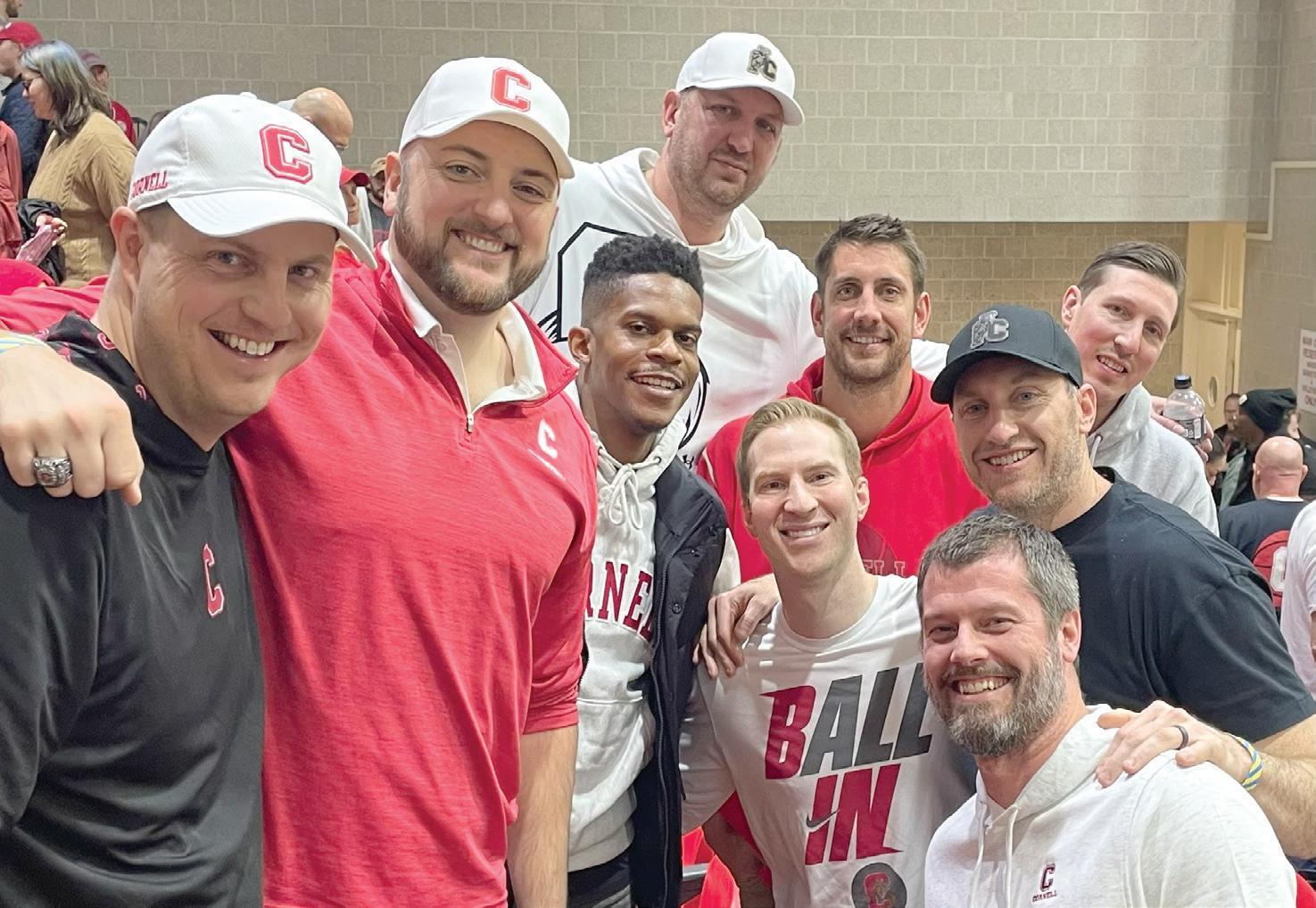
One particular group of fans — all sitting together a few rows behind the Cornell bench — was particularly raucous, and each of them looked tempted to report to the scorer’s table and check into the game. They knew what it felt like to play in front of Newman Nation... after all,
it was the guys from the 2010 graduating class, and to call that group legendary in any conversation about Cornell Basketball is not just acceptable, it’s required. The class of 2010 won three Ivy League Championships in a row (going 38-4 in Ivy play), made three trips to the Big Dance, and in 2010, after earning a convincing win over Temple, the Big became the darlings of the tournament by advancing to the Sweet 16 with a historic 87-69 win over mighty Wisconsin, picked my many to make the Final Four that year.
I watched some of the game with those guys on Saturday, and in case any longtime fans look at the photo of that group and notice that a guy is missing, it is because Jon Jaques is now the Big Red’s head coach. As I watched him pace the sidelines — as animated as any coach I have ever seen — I turned to Ryan Wittman — the secondleading scorer in the Big Red’s 125-year history history — and said, “Jaques looks like he would love to be on the court.” Wittman — or “The Hittman” as I called him during his playing days — turned to me and said, “I guarantee you, every one of us would love to be on the court.”
Ultimately, Yale was just the better team on that day. After the game, Coach Jaques said, “We had a rough start this season, but the players responded, and their belief in each other showed their resilience. I'm proud of our guys.”
On Saturday, Penn rolled over Princeton by 25 points, setting up Sunday's

championship game on Sunday. Penn would shock Yale on an overtime buzzer beater to win the Ivy crown.
Congratulations to Ithaca College wrestler Isaias Torres, who stepped up at the NCAA Division III tournament to keep two streaks alive. First, by finishing in seventh place, Torres followed up last year's All America recognition to run his own personal streak to two in a row. His achievement also ran the Bombers' team streak to 42 consecutive seasons with an All American on the roster.
The news follows the announcement that Marty Nichols — Ithaca College's head coach for 30 of those 42 seasons with a Bomber as an All American — was named the 2026 Regional Coach of the Year. Nichols also played a role in the 42year streak, given he was a three-time All American during his own stellar wrestling career at Ithaca College in the late 1980’s.
The Tompkins Girls Hockey Association (TGHA), also known as the Ithaca Shooting Stars, is the oldest girls hockey organization in New York State. Its 14U team made history by reaching the finals of the New York State Championships and earning a spot in the 2026 ChipotleUSA Hockey National Championships. It’s the first time a TGHA Tier 2 team has advanced to nationals. The championships
will take place on March 25–29 in Rochester, Michigan.
The Stars opened States against the #3-ranked Canton Blades and rebounded with wins over the NY Islanders (6-4) and Saugerties Fillies (2-1), advancing to a semi-final showdown with Mamaroneck Stateline. Tied 2-2 in regulation, the Stars scored on a 5-on-3 power play in overtime to punch their ticket to the finals.
In the championship game, the Stars faced the Canton Blades again. They played hard and scored the only goal the Blades allowed all tournament—a remarkable feat against the eventual state champions. Ultimately, the Stars fell to a former Tier 1 team that had dropped down to Tier 2 this season. Though they lost, the state tournament tested the Stars against elite competition in a way that will prepare them well for Nationals.
Head Coach Alex Hayes, assistant coaches Sean Anderson, Alex Chang, Stephen Vergamini, Jillian Woods, and Andrew Zimmerman, team manager Tom Hall, and locker room monitors Erica Anderson, Tracy Pierce, and Megan Turnbull congratulate the players on this incredible accomplishment. Families of the 14U Stars have also been key to this success.
A GoFundMe has been created to help support the team, and donations can also be made on the TGHA website under “Donate.” Contributions go directly to travel, accommodations, and tournament costs, ensuring every player can compete.






Imagine the sharpest, most passionate young journalists you’ve ever met (the ones who stay late chasing a story because they believe in this town) slowly packing their bags. Not because they want to leave… but because local rents force them out.
That’s the quiet heartbreak happening right now. Our best new writers, the ones who grew up here or fell in love with Ithaca in college, are being pushed toward cheaper cities just to survive.
The Rising Star Fund rewrites their story into a happy ending by sponsoring a simple monthly housing stipend (a hand up, never a handout) so they can keep living here, keep writing here, keep falling deeper in love with Ithaca… and keep telling the stories that make this city our home.
When a young journalist can afford to stay in Ithaca, you get:
● Fresh, fearless voices loyal to your local paper
● Someone at every city council meeting who believes local news matters
● The next great Ithaca story written by someone who actually lives here
● Your $25, $50, or $100 a month doesn’t just pay their rent.
● It keeps storytellers in our community and stops local brain drain.
● When our younger generation thrives, Ithaca’s future stays bright.
Keep local talent in Ithaca by donating today to the Rising Star Fund (an initiative of Pathways to Equity, Inc a registered 501(c)(3) nonprofit organization)
For more info: roy@ithacatimes.com
By Philip O’Dell
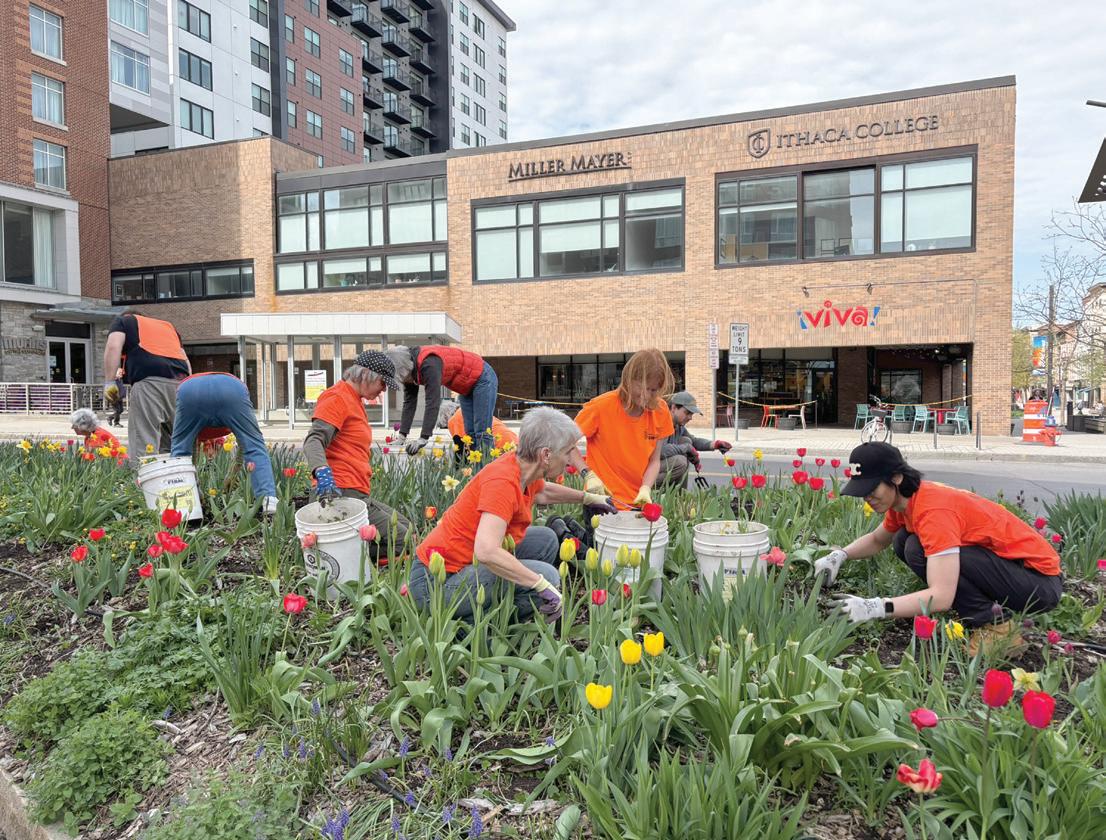
This spring, volunteers of the Beautication Brigade will transform the city’s public spaces into a vibrant landscape of diverse gardens. e group is part of the broader Community Beauti cation Program, administered by Cornell Cooperative Extension Tompkins County.
Sta and volunteers are currently managing seed starting, inventory, and tool maintenance for 28 local gardens, according to CCETC Community Beautication Coordinator Janine Willis. e team is conducting early spring cleanups and holding volunteer orientations, with the nal session from 5:30 to 7 p.m. on Wednesday, March 18, at 615 Willow Ave. in Ithaca. Registration details are on CCETC’s website.
“Community Beauti cation sta could never accomplish our goals without the help of volunteers,” Willis said. “In a very real way, they are responsible for making Ithaca a more beautiful and welcoming community. Beautifying public spaces with volunteers helps them to foster pride in their community, o en leading to community engagement in other areas.”
Wilis said the brigade maintains city landmarks, including the “Triangle Gardens” at the intersections of East State, Aurora, and Green Streets. eir work also includes the planter walls at the Tompkins County Public Library and the median near Purity Ice Cream on Route 13. e program maintains an open-door policy from April through November, welcoming new volunteers of all skill levels with no prior gardening experience or xed hourly requirements. Interested residents can join the e ort at any point during the season by emailing the organization, where sta helps new members navigate the enrollment process to get them out into the gardens.
Willis said the brigade draws a diverse group of volunteers, ranging from retirees and working professionals to student
groups such as Cornell University service fraternities and adult ESL students from Open Doors English. is intergenerational dynamic allows younger members and seniors to share gardening techniques and bond over common interests.
While most sessions occur weekdays from 10 a.m. to noon—attracting retirees and those with exible schedules—the program also o ers biweekly evening sessions and weekend workdays during the summer. ese expanded hours accommodate community members who work standard daytime shi s but still wish to participate.
e brigade’s roster spans generations, from 16 years old to the oldest member in their mid-80s. Willis said around 30 to 40 volunteers participate each season, while a core of 10 to 15 members o en volunteer three times a week. She added that members log between 700 to 1,000 hours of their time each year.
Willis said volunteers join not only for physical exercise, but emotional and social bene ts as well. She noted the combination of human interaction and time in nature helps lower stress levels and improves overall well-being.
Willis said volunteers gain hands-on experience in horticultural techniques, such as starting tropical bulbs, seeding annuals in a greenhouse, and transplanting seedlings. e program also provides practical training in spring garden cleanup, plant and weed identi cation, garden design, and the planting and maintenance of annuals, perennials, and shrubs.
Sun-drenched containers on the Commons feature staples such as canna, zinnia, marigolds, and petunias, along with rudbeckia and sweet potato vine. For shaded areas, the brigade utilizes elephant ears, begonias, impatiens, caladium, and coleus.
e Downtown Ithaca Alliance maintains the containers on the Commons, West State Street, and Cayuga Street by providing the regular watering needed to sustain the displays.
e brigade is incorporating more perennials into tra c medians and other planting areas to bolster biodiversity and reduce long-term water consumption. Plant selections depend on locations.
For areas lacking easy water access, Willis said the focus shi s to droughttolerant perennials and appropriate native


species. She added planting choices are o en adjusted to account for changing light conditions and wildlife activity.
According to Willis, former CCE staers Monika Roth and Chrys Gardener developed the brigade program around 2022. A city beauti cation committee proposed enhancing the county’s landscapes through public art and plantings. e plan secured funding in 2002 a er the county increased its hotel room occupancy tax to 5 percent to bolster tourism-focused programming. is nancial support allowed the program to expand beyond the Ithaca Commons and establish the brigade. Gardener trained the rst set of volunteers following her appointment as the county’s beauti cation coordinator that fall.
Willis said prospective volunteers can view a full job description online and contact the program at beauti cation@ cornell.edu to get involved. Annual orientation meetings are held each March, with registration details and additional information available on the organization’s event page.
By Mikayla Rovenolt
While the spring months may pull those in Tompkins County out of the deep snow, it does not mean the weather is much better. For those gray and rainy spring days, here are some ways to brighten your spirits.
Paleontological Research Institute/ Museum of the Earth
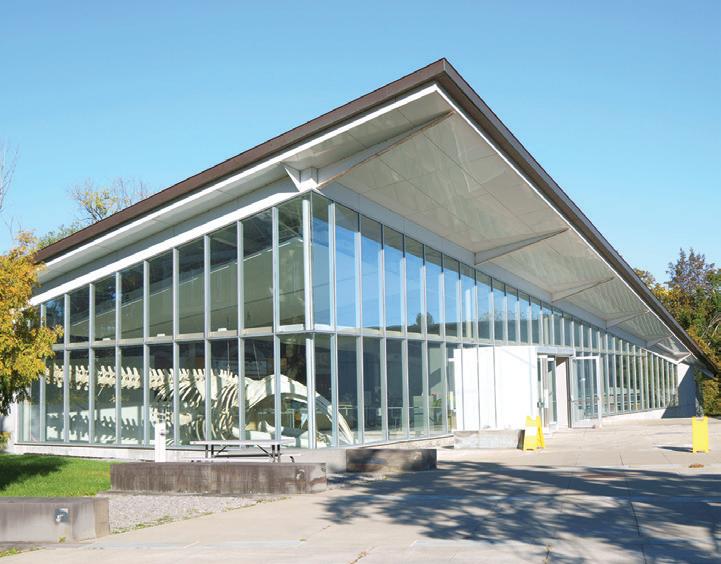
The Museum of the Earth, located on Trumansburg Road just outside Ithaca, is full of fun activities and a plethora of information that any age group can find enjoyment in. Even if you can’t make it out of the house, there are at home options for fun learning as well.
Established by the Paleontological Research Institute (PRI) in 2003, the Museum of the Earth features natural history displays, interactive science features, and art exhibitions. Their permanent natural history displays take visitors through 4.5 billion years of history with opportunities to interact and apply learning to everyday life.
More than just their in-person museum experience is a virtual landscape of educational programming through their Earth at Home program, which can be found on their website at https://www. museumoftheearth.org/.
Earth at Home offers educational information on Earth science, climate change, biodiversity and evolution. Each section contains various subtopics for further learning such as regional earth science where participants can select their region of the United States for more information, teacher guides, virtual fieldwork, and presentation videos on various topics. You can learn more about Earth at Home by visiting its website: https://earthathome.org/.
Tompkins County Library or local library
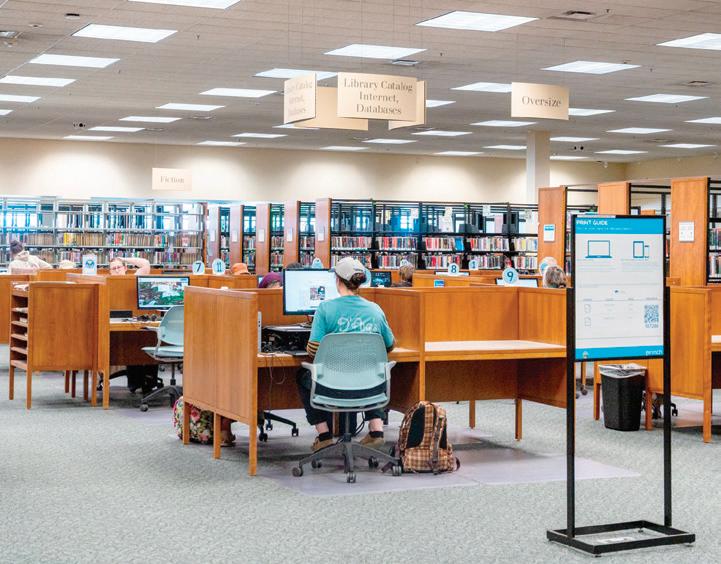
Visiting your local library or making the trip to the Tompkins County Public Library (TCPL) is a great option for brightening a rainy day. The libraries in Tompkins County offer more than just books and movies, many also have programming for children, teens, and adults. From SingSong classes for babies and toddlers to the 8 to 108 Board Game Club, there are many options at the county library that are open to the public. Learn more by visiting https://www.tcpl.org/ events/month.
Local libraries also offer classes and activities for a variety of ages. To learn what your town’s library offers, visit their website and head to the calendar or events section.
TCPL also has online services for members of the library to utilize. Libby and Hoopla are both free with a library card and can be accessed from any electronic device. They include ebooks, magazines, music, movies and more, so if you can not get out of the house, try utilizing these services on a rainy day.
Visit a bookstore
Autumn Leaves Book Store, Buffalo Street Books, Odyssey, Ulysses Books and Protagonist Books are all located right in Tompkins County and can offer a relaxing day of reading or shopping.
Located in Ithaca on or near The Commons are Autumn Leaves Book Store, Buffalo Street Books and Odyssey Book Store. Each offers its own unique selection of books and goods to explore.
In Ulysses is Ulysses Books, a used bookstore with plenty of books to go around. This house turned bookshop is packed with classic literature, music, art, and so many more topics worth checking out.
Protagonist Books is relatively new, opening in 2025 and offers coffee as well as books. This shop is woman-owned and author-owned, making this a special place for book lovers to chat with an author, find their next read and grab a coffee.
Sciencenter
The Ithaca Sciencenter is a great way to get the kiddos out of the house and into a fun learning environment on the less than

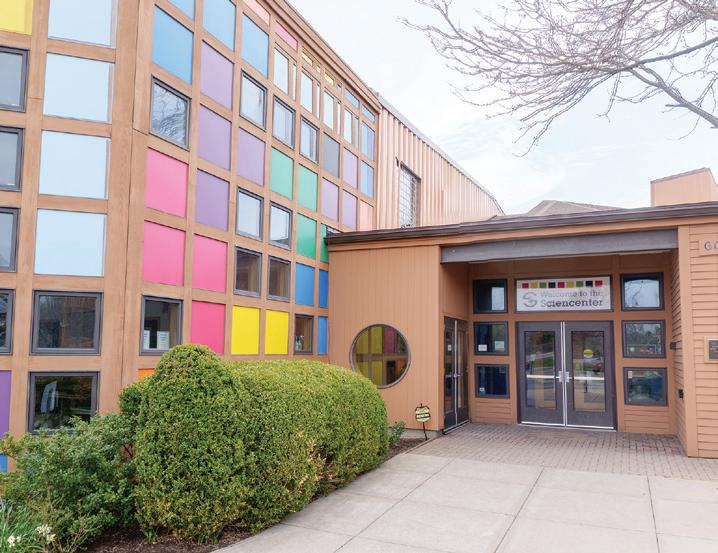
ideal weather days. They are open Tuesday through Sunday and offer a variety of activities for kids. Adults and teens can find the Sciencenter fun as well. With over 250 interactive exhibits, animals, and games such as mini golf, there is an activity for everyone.
Founded by a vision of hands-on science in 1982, the Sciencenter didn’t have a home until 1984 when storefronts were donated and volunteers built exhibits, some 40 years later, it has a home on 1st Street and serves local and visiting families alike. The Sciencenter also has a Science at Home page of their website where at home science projects can be found. These at home experiments are broken up by age group and an “additional” category. Feel free to utilize these activities on the next stay-in day at https://sciencenter.org/ resources-home/.
The Finger Lakes region was named wine region of the year in 2025, and for good reason, the region is loaded with wineries. For those who prefer other alcoholic beverages, the Fingerlakes also offers a variety of distilleries, cideries and breweries worth visiting. From Canandaigua Lake to Skaneateles Lake, there is something for everyone.
If you are looking to stay close to home, try the Seneca Lake Wine Trail or Cayuga Lake Wine Trail. Each has some variety in their wine selections and many of them are award winning wineries.
A full list of wineries, breweries, distilleries and cideries can be found with maps on the Fingerlakes Libations website. Click on the publications tab and scroll through their latest issue for maps and contact information for the Fingerlakes destination of your choice at https://fingerlakeslibations.com/.
By Maddy Vogel
Though spring hasn’t officially arrived, Ithaca has already caught a few early glimpses of the season. A 70-degree day in March is often enough to send many residents into a spring cleaning frenzy. Maybe it’s the sunlight and open windows revealing the dust collected during the winter season, or maybe it’s the itch for a decluttered fresh start after months indoors. But as closets are cleared and shelves reorganized, many will be looking for places to donate their unwanted items. From household appliances to used clothing, the Ithaca Times has rounded up organizations accepting donations.
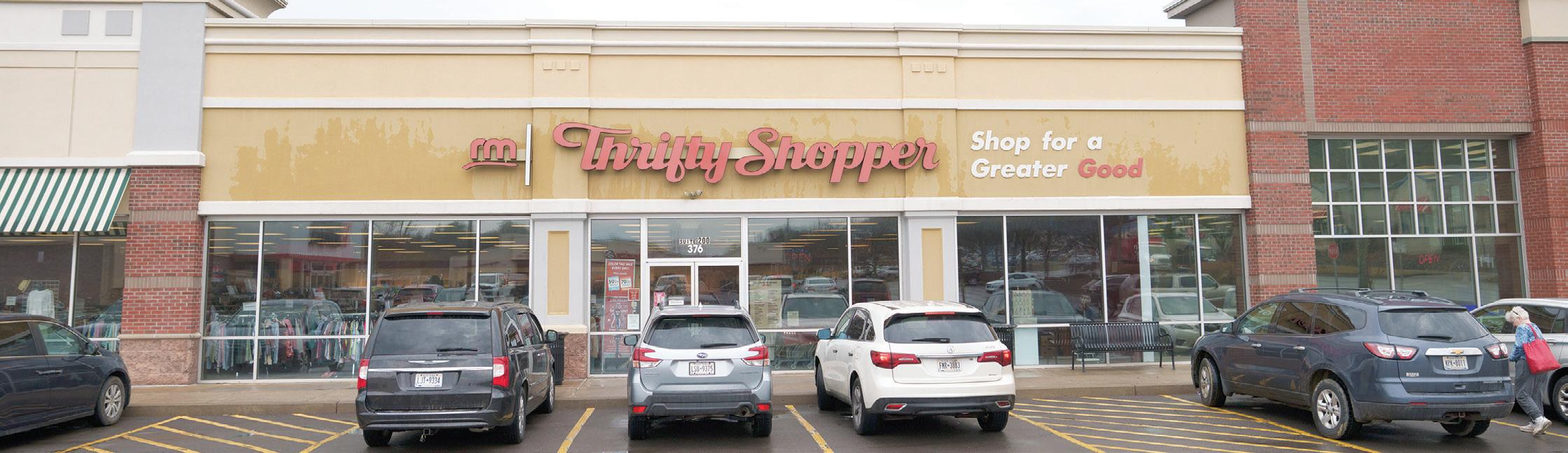
Ithaca ReUse is by far the most allencompassing place to donate goods locally. Accepting nearly everything from furniture to electronics, Ithaca ReUse welcomes donations every day but Thursday from 10 a.m. to 6 p.m. at their Elmira Road location.
It accepts quality used and surplus building materials, furniture, housewares, clothing, books, media, electronics, and more. Donations may be tax deductible and a donation receipt for tax purposes is available upon request. It asks that all donated items be complete, clean, and in good usable condition.
If part of your spring cleaning includes doing some home renovations, the Ithaca ReUse is a great place to purchase used lighting, hardware, tools and building materials.
For more information on donations at Ithaca ReUse, visit ithacareuse.org/ donategoods/#guidelines.
The Thrifty Shopper on Elmira Road accepts a variety of items, including clothing, shoes, jewelry, accessories, linens, toys, household items, sporting goods, electronics, small appliances and books. Donations can be conveniently dropped off at bins by the front door during the store’s open hours, 10 a.m. to 8 p.m. Monday through Saturday, and 11 a.m. to 6 p.m. on Sunday.
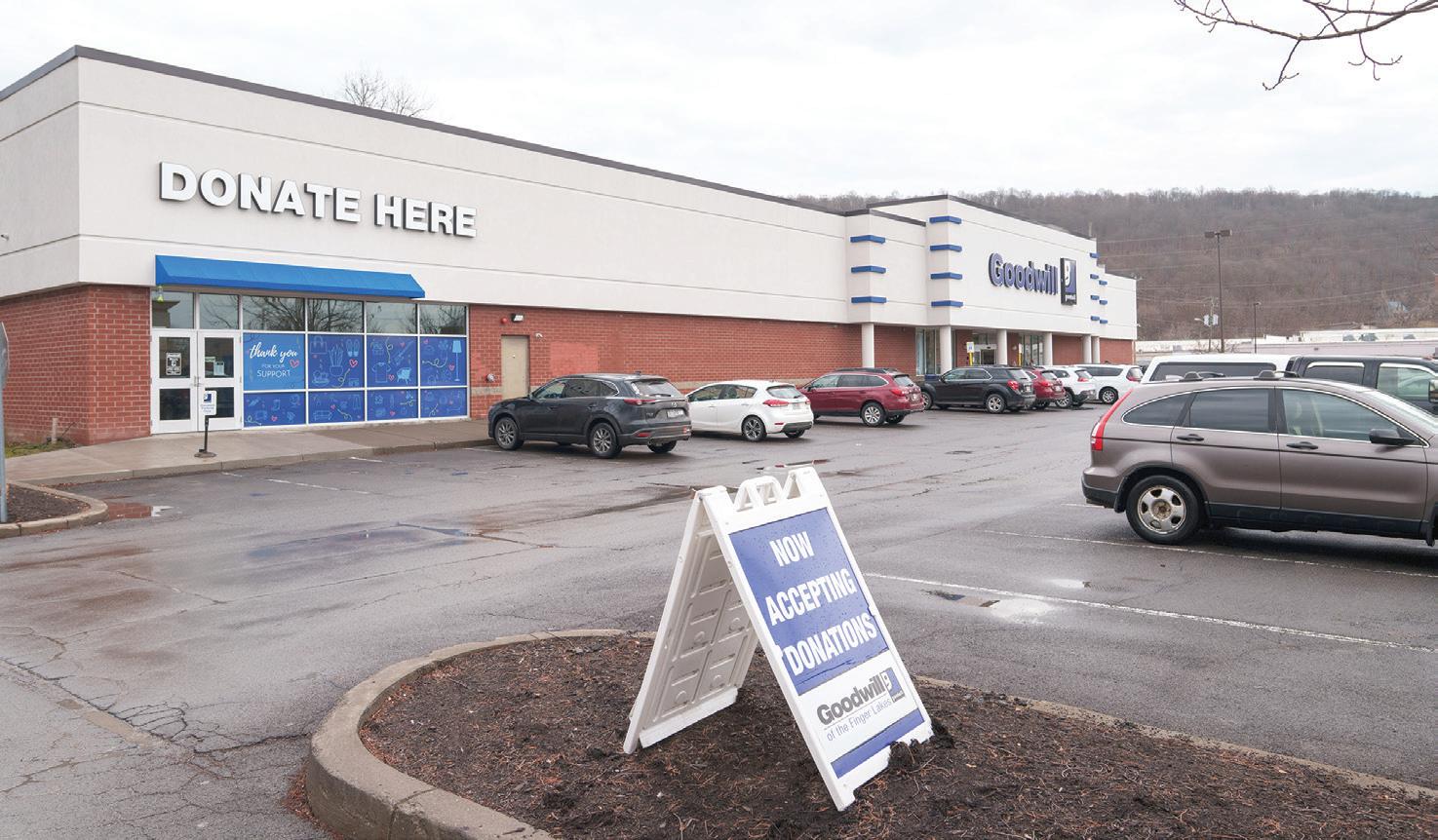
For more information, visit www. ishopthrifty.org/locations/ithaca-thriftyshopper/.
Goodwill
Having been open for just under a year now, business is booming at Ithaca’s Goodwill. The store will readily accept used clothing, books, linens, electronics, household goods, games, rugs, sports equipment, toys, TV’s and more.
Donations at the South Meadow Street Location can be made during store hours, Monday through Saturday from 9 a.m. to
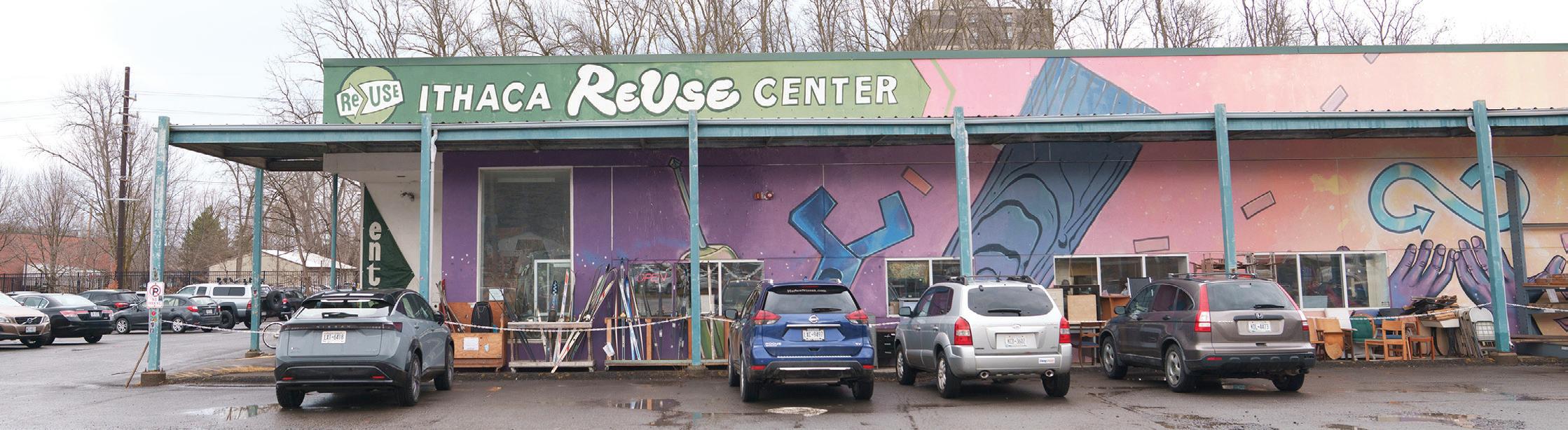
8 p.m., and Sunday from 10 a.m. to 6 p.m. There is a donation area adjacent to the store’s entrance.
For more information, visit www.goodwillfingerlakes.org/stores/donate-goods.
At the Salvation Army, a variety of goods can be donated at the donation area behind the store on Elmira Road. Although donations vary from location to location, the Salvation Army generally accepts used clothing, unbroken furniture, household goods, electronics, books, bicycles, toys and sports equipment.
The store accepts donations from Monday through Saturday from 9 to 7 p.m. It is closed on Sundays.
For more information, visit satruck. org/faq.
For those clearing out their closets of name-brand pieces, Plato’s Closet buys clean, gently used and new clothing. Bring items to the store on Fairgrounds Memorial Parkway between 10 a.m. and 8 p.m. Monday through Saturday, or 11 a.m. to 6 p.m. Sunday. A store associate will review your items and determine which ones the store will purchase.
For more information, visit platoscloset.com/locations/ithaca-ny/.
Right next to Plato’s Closet, there’s a large red bin soliciting donations of clothing, shoes and blankets. The bin is operated by the Hearts for the Homeless, a national nonprofit that distributes clothing and other assistance to people experiencing homelessness and others in need. Its location makes it a convenient spot to donate goods that Plato’s Closet doesn’t wish to purchase.

By Barbara Adams
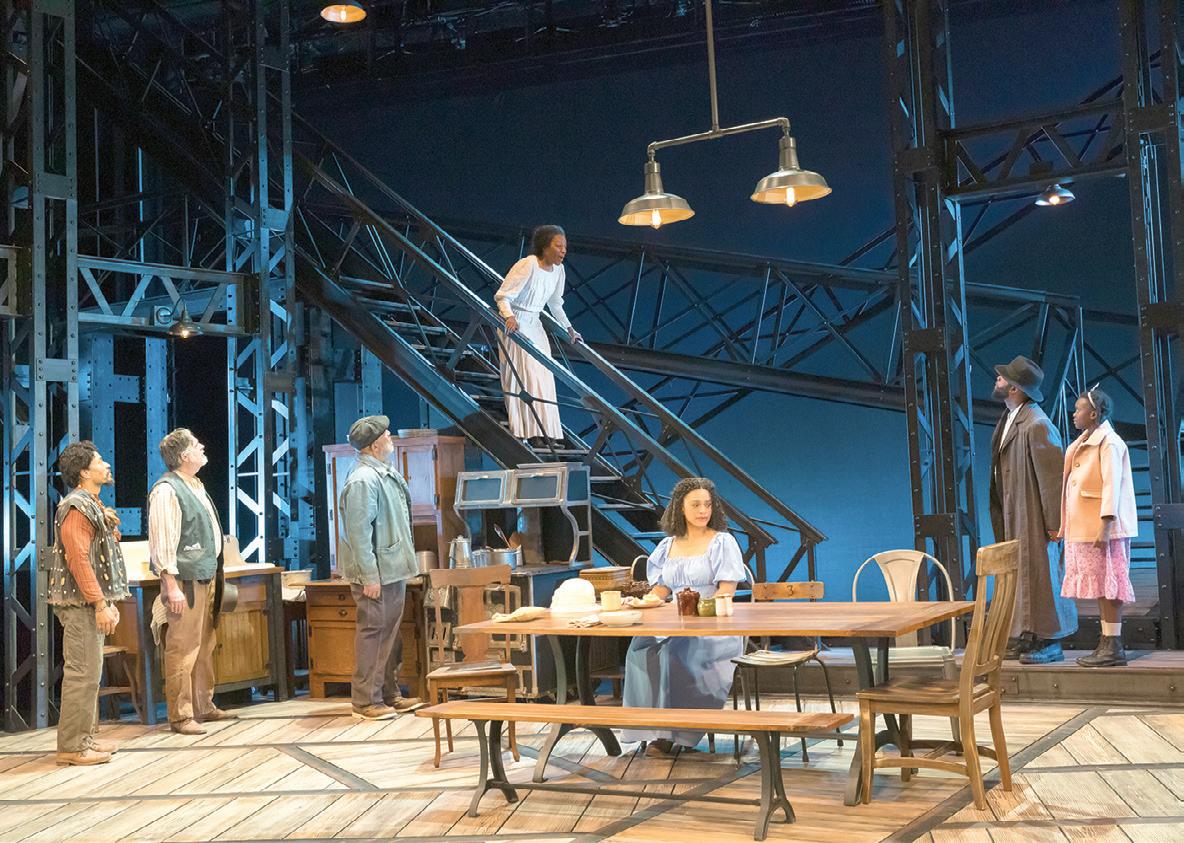
The richest art allows us to see anew our present through the lenses of the past — and that’s the singular achievement of playwright August Wilson’s American Century Cycle, 10 plays that chronicle, by decade, the Black experience in this country throughout the 20th century.
So it’s a rare opportunity to see the second play in that sequence, “Joe Turner’s Come and Gone.” Syracuse Stage’s handsome production, directed by Timothy Douglas — a collaboration with Indiana Repertory eatre — is the eighth in the cycle to be produced here.
Set in 1911, at the onset of the Great Migration, Wilson’s fourth play, written in 1986, unfolds in a Pittsburgh boardinghouse — a place where itinerants passing through cross paths. is idea of a temporary resting point, a safe house, aptly echoes the way-
“Joe Turner’s Come and Gone,” by August Wilson.
Directed by Timothy Douglas. At Syracuse Stage, 820 E. Genesee St., Syracuse. Through March 29. Wed.-Sat. 7:30 with Sat.-Sun. 2 p.m. matinees. Tickets at syracusestage.org and 315-443-3275.
stations on the underground railroad. Only in this era, the house shelters those free Black Americans already beginning to travel north, hoping to escape the abuses and violence of the Jim Crow South.
And in lieu of the abolition-era station master, now there’s Seth Holly, owner of the boardinghouse, blustery and fault- nding, whose tight dealings are so ened by his spirited wife, Bertha. Wayfarers in search of a better self, or life, enter their small secure world, nding community and comfort. en one day a surly man arrives, as threatening as a thundercloud.
e man, we learn, is Herald Loomis, and with his 11-year-old daughter in tow, he’s searching for his wife who disappeared a decade earlier. His history uncoils slowly and with great pain: he had been captured and illegally impressed into a work gang for seven long years by the notorious mancatcher Joe Turner. Such forced convict labor had brutally replaced slavery a er the collapse of Reconstruction, bene tting white industrialists and other businessmen. e play’s title itself is from one of the earliest blues songs about Turner.
Loomis’s searing story, the play’s throughline, takes place in a setting that evokes the continuing presence of that ominous industrial power. In the 1910s, Pittsburgh was known as “the workshop of the world,” and Tony Cisek’s set design places the house’s kitchen, like a luminous burrow (thanks to Jason Lynch’s lighting), gloomily wrapped by overwhelming iron girders and steel stairways.
As always, Wilson limns each character distinctly, giving them their full place and presence. Successive engaging scenes involving two or three individuals showcase their humanity and individuality — Seth and Bertha comically and ardently arguing about a misremembered event; the overcon dent young buck, Jeremy, wooing the far more worldly Molly; Bertha and the conjure man Bynum erupting in unbridled laughter that spreads restoratively.
Somehow, though, these scenes felt too distinctly and discretely set apart, like beads on a chain — each perhaps a pearl but a bit too separate, so that the ow and sense of the whole faded for a moment. is might have been a directorial choice, to give a jazz-like structure to the action, but the e ect seemed to me one of too many jazz solos. Another drawback occurs within the play itself: Wilson’s excessive repetition of key phrases and ideas. Again, this may re ect the repeating in blues or jazz ri s, but in a nearly three-hour drama — longer than a church service — even the faithful may waver.
Yet the themes of lingering trauma and uprooting and being lost to oneself, of searching for one’s “song” — these are powerfully and memorably conveyed through the dynamic acting. (Seen most lively, in a collective moment of spontaneous joy, in the soaring juba dance.)
As Seth Holly, Keith Randolph Smith is a big man, con dent and bossy, yet ready to
Continued on Page 18
By Clement Obropta
Afather (Sergi López) searches for his missing daughter at a rave in the Moroccan desert. That simple premise soon explodes into a million pieces, like a raver stepping on a landmine, in Óliver Laxe’s meditative and mystical “Sirāt.”
A military truck arrives to evacuate the ravers, instructing all EU citizens to join the convoy. War has just broken out, apparently. But Luis, his son Esteban (Bruno Núñez Arjona), and a gaggle of party people split from the escort, driving off into the desert, chasing the next party in Mauritania — as well as Luis’ daughter.
The quest across the Maghreb soon begins to resemble a death march when one tragedy after another befalls Luis and his band. The film’s final suspenseful, existential sequence sees them navigating across a minefield. Luis is a quarter-mile into it, unexploded. “How does this work?” one of the ravers asks. “I don’t know,” Luis replies. “I crossed without thinking.”
Naturally, there’s a spiritual dimension to the drama. The name “Sirāt” refers to the Islamic afterlife, where As-Sirāt is the bridge to eternal paradise that every Muslim must pass on the Day of Resurrection. Thinner than a strand of hair and as sharp as a knife, the bridge also crosses the fires of Hell, which burn sinners’ feet into falling. The implication here is that Luis and
company are atoning for their sins and fighting toward salvation
Laxe’s film announces this religious connection immediately and then doubles, triples, and quadruples down on it with Quran recitations, scenes of the Hajj (which seem to resemble a secular rave), and many, many images of bridges on-screen, from the unfurling tracks of a train to the winding mountain pass that the group traverses. Like if Michelangelo Antonioni remade “O Brother, Where Art Thou?” as a voyage into Islamic eschatology rather than a retelling of Greek myth, “Sirāt” is full of memorable images, poetic lines, and gorgeous landscapes, all matched with a slow, almost punishing pace typical of highbrow arthouse cinema.
Laxe says he has been working on this idea for the past 15 years, when the opening scene of the film came to him while he was at — where else? — a rave in Morocco. The father-son aspect of the story came later. This is only the filmmaker’s fourth film and by far his most commercial — the French-Spanish co-production was nominated for two Oscars this year, for Best International Film and Best Sound.
The Best Sound nod is particularly deserved. The soundtrack of “Sirāt” mostly comprises bass-heavy rave music. Essential to the narrative, this music — along with the drugs and the dancing — allows the characters to escape reality for a minute, or perhaps connect deeper to it. The music probably isn’t everyone’s cup of tea, but as Jade (Jade Oukid) tells Luis, “It’s not for listening, it’s for dancing.” On the strength of its inspired sound mix alone, “Sirāt” demands to be seen in a proper movie theater.
Unfortunately, for a spiritual allegory, the film itself lacks a certain profundity. Maybe it’s the script, which Laxe co-wrote

with Santiago Fillol. Big moments don’t sit long with the viewer before they’re shrugged off, and nobody is developed enough for the afterlife metaphor to ultimately mean much. Laxe and director of photography Mauro Herce also frame most of the action in medium and long shots with few closeups, as though they’re trying to prevent you from connecting too much with these tragic souls. But without that empathy, Luis and the ravers remain not just empty, but unlikable, too. The ravers are woke stereotypes who don’t hold anything sacred besides drugs and music and believe in sacrificing whatever they have to in order to attain their own selfsatisfaction, however temporary.
“Sirāt” bears the marks of a growing auteur unsure of his voice and eager to shock the audience. One particular twist — you’ll know it when you see it — immediately put a bad taste in my mouth. It’s perhaps the most affecting image in
the film, but not only does Laxe unveil it far too early — it also ruins the central religious metaphor.
Perhaps Laxe chose to make “Sirāt” too early in his career. The filmmaker is in his early 40s. Directors typically assemble a lifetime of experience and a sizable row of credits before tackling heady themes like sin, redemption, and life after death. I felt as though “Sirāt” is redundant at best and brazenly poseur-philosopher at worst. Its images and dialogue suggest depth without ever showing us. It feels mean-spirited, naïve, and pointless.
“Sirāt” definitely has an audience, as evidenced by the many awards and rave reviews. As for me, I think Laxe should try to remake “Sirāt” again in 30 years. Perhaps then the empty deserts of the film could be filled with meaning instead of merely lights and noise.
continued from page 17
be schooled by his wife. (As elsewhere, Wilson’s reverence for Black women shines here.) Stephanie Berry’s Bertha Holly is wiry, impish, and sharp, a compassionate and wise female force — I couldn’t take my eyes off her. (As was true for her turn in Playwrights Horizons’s “Staff Meal.”) Peter Bisgaier does a fine job as Rutherford Selig, the genial white “people finder,”
a man who in his travels locates missing Black family members for their relatives — reminding us of another legacy of slavery, separation and loss. When we learn how his trade was handed down from darker days, we shudder, even in the face of Seth’s friendship with him.
Jacques Jean-Mary totally charms as the flirtatious Jeremy, who wants to woo every skirt in sight, with or without his guitar. Dane Figueroa Edidi’s independent and feisty Molly is far too much woman for him. (Though I was confused by her
occasional sadness and near-tears.) As Mattie, the young woman who comes seeking a charm to bring her lover back, Kaitlyn Boyer is all pliancy, sadly trying to find herself in a man’s love; hers is a quiet, compelling performance. Near the play’s end, we finally meet Loomis’ lost wife, played by a stately Lilian A. Oben, carrying a world of grief.
Because Wilson’s world is multi-generational, two children are here to remind us of the future. Kerah Lily Jackson plays Zonia, Loomis’ daughter, with natural
restraint; and Christian Makai Lucas the neighboring boy Reuben, though reciting lines rather than feeling them. And unfortunately, the long scene where the two converse alone was largely indecipherable. The most intriguing member of the household is Bynum, a rootworker who messes about with bleeding pigeons and gathering herbs. Ignoring Seth’s impatience, he’s a cheerful and caring healer who “binds” people, bringing lost souls together.
By Peter Rothbart
Craftsmanship is just one of the skills necessary for creating good art. The ability to construct, assemble, or shape a block of wood or a slab of clay or a musical phrase is as important to the creation of art as is the spark of inspiration. But you need technical adeptness to put it all together. Sir Stephen Hough (pronounced Huff) possesses such traits and applies them to a variety of artistic endeavors, rightfully earning him the sobriquet “polymath”, which is often appended to his name.
Aside from Sir Stephen’s considerable skills as a pianist and composer, he is also a published author of four books, an awardwinning poet, and a visual artist. He has been awarded a MacArthur Fellowship, the first classical musician so honored, and has been nominated for several Grammys and eight Gramophone Awards and recorded the complete piano concertos of Beethoven, Brahms, and Rachmaninoff in addition to others. He has been commissioned to compose works for the Louvre, the National Gallery of London, Westminster Abbey and Cathedral, and the Naumburg Foundation. He’s written for the New York Times, the Times (London), and The Guardian. Oh, and he also teaches at Juilliard. For all this and more, King Charles of the UK awarded him a Knighthood for Services to Music in the Queen’s Birthday Honours in 2022, and you can call him “Sir.”
Sir Stephen brings his considerable writing and organizational skills to his concert programming and written program notes. His notes for his upcoming solo performance at Cornell’s Bailey Hall
Dallas Morse Coors Concert Series
Bailey Hall, Cornell University
Friday, March 20 at 7:30 p.m.
Tickets at: https://www.cornellconcertseries.com/
continued from page 5
and mortar,” Weiss said. “At a moment when Jewish students across the country are looking for places to belong, we’re
on March 20 are lighthearted and eminently readable while being delightfully informative and occasionally spiced with culinary metaphors.
Friday night’s performance at Cornell is programmed to reflect the historical growth of small form piano pieces, often called Klavierstück. They are elegant, short musical gems playable by amateur parlor musicians and therefore accessible to the increasingly educated middle class. Sir Stephen describes them as bonsai-sized. In an interview with music columnist Bruce Duffie, Sir Stephen explained, “With pieces that are unusual and are unknown, it’s important that they shouldn’t be too long, or you shouldn’t overwhelm your listener with them…I think there’s something very extraordinary in the small forms.”
Karlheinz Stockhausen’s Klavierstück III fits 55 notes into the 30-second piece. Beethoven’s Bagatelle Op. 119 No. 10 is only 19 seconds long, 13 if you play it up tempo. Franz Schubert’s Klavierstück No. 2 D.946 is a bit longer and opens the concert, a short Romantic era composition suitable for a soirée at home.
Johannes Brahms’ Klavierstück Op. 118 No. 6 is a languorous work that greatly expands Schubert’s vocabulary, adding harmonic dissonances that presage the coming century’s shift towards atonality. An elegiac Gregorian chant-like melody based upon the “Dies Irae” from his epic masterwork Requiem floats above and is eventually overrun by Brahms’s dark chordal voicings. It is the most foreboding work of the evening.
Arnold Schoenberg’s Kleine Klavierstücke Op. 19 was written as a set of pieces (only number 6 will be performed) and opens the door to the world of atonal music, adopting an expressionist perspective of unadorned, condensed melodies with abbreviated phrase lengths. The melodies are still there, listen for the beauty in the brevity.
Beethoven’s Sonata Op. 53 (Waldstein) is the program’s longest work, with three movements that follow the classical sonata
building a home that will stand for generations.”
In 2023, Cornell Hillel was renamed the Steven K. and Winifred A. Grinspoon Hillel Center for Jewish Community at Cornell, the organization’s website said.
“We’re honored to support this cam-

structure of fast, slow, and fast. Sir Stephen’s technical prowess, especially some pedaling acrobatics and paired glissandos in the last movement, should be obvious if you’ve not yet been clued into his prodigious skills.
Robert Schumann’s Carnaval Op. 9 is a series of 21 vignettes written to evoke a loose fantasy about a carnival. A fournote motive appears in all the pieces and anchors the theme and variation format.
Each of Schumann’s miniatures has its own identity and is infused with musical evocations of Italy’s commedia dell’arte clowns Pierrot and Harlequin, colleagues such as Niccolò Paganini and Frédéric Chopin, Schumann’s wife Clara, as well as quotes from his previous works.
paign and even prouder of what this building will mean for every Jewish student who walks through its doors,” Steven K. Grinspoon said. “This center will provide a beautiful new home for Jewish community, celebration and learning for decades to come.”
Absent from the concert are any of Sir Stephen’s considerable compositional contributions to the classical piano repertoire, but he does humor us by closing with his arrangement called “Mary Poppins Suite”. Bring the kids; they will love it. Short form piano pieces are a great way to introduce anyone with short attention spans to concert music, even adults.
Peter Rothbart is a Professor Emeritus of Music at the Ithaca College School of Music, Theatre, and Dance, where he taught electroacoustic and media music for 40 years. He directs the Ageless Jazz Band and remains active as a classical, jazz, and pop musician.
As of March 8, the “Hillel is Home” campaign has raised over $37 million from over 1,300 donors toward its $54 million goal, the campaign website said. Grinspoon Hillel plans to reach 1,800 donors total and accomplish its fundraising goal by June 30.
By Kira Walter
An unofficial coalition of Ithaca’s businesses has created a long term atmosphere of warmth and solidarity in the commons. As local owners develop strong roots and connections, lending a helping hand with mutual promotion or collaborative events isn’t uncommon. Sometimes, it even results in an impromptu festival.
So is the case with Fairy Fest, an expanding tradition only five years young, started by toy store staple Alphabet Soup. Kicking off on March 21 this year, the 10 a.m. to 4 p.m. extravaganza invites all Ithacans to dress in costume, and head downtown for a day of free fairytale activities, food, and performances.
It all began when owner Greta Perl recognized an abundance in flower crown kits, piling up in the aftermath of a sampling initiative. The probability of getting each into new ownership was looking bleak, so she banded together with neighbors to host Ithaca’s first fairy festival in 2019.
“Those 48 kits sold out in the first hour,” Perl recollected. “People had fond memories of Wizard Weekend, we had a springtime variation of that where people get to dress up and celebrate magic to see.”
Downtown Ithaca.
Saturday, March 21 from 10 a.m. to 4 p.m. Most activities free, all ages.
‘JOE
continued from page 18
DeShawn Harold Mitchell embodies his gentle energy and quality of quiet attention to everything. He is unquestionably a spiritual midwife, a figure often seen in Wilson’s plays, a scion of Aunt Ester, the mythical matriarch in his “Gem of the Ocean.” And, in a stunning scene, his most generous act is guiding Herald Loomis toward
After a tragic copyright calamity with Harry Potter, the beloved Ithaca festivity was brought to a close but reincarnated through Perl’s vision. And although the pandemic paused Fairy Fest until 2022, it’s garnered more participants every year.
“We have more performers this year than ever before,” Perl noted. From GIAC Jumpers to the Ithaca Children & Youth Chorus, a variety of different shows foreshadow larger audiences than previously seen. Circus Culture even begins with a 10 a.m. performance, followed by an interactive workshop and aerial photo booth.
Amongst stage talent, this year’s Fairy Fest headliners also include native artists displaying their creations at Faerie Market. The Mushroom Circle, Guppy Moss, The Grey Moon and many more will decorate the scene with thematically whimsical inspiration. Vendors will set up stalls in Farmers Market style around Buffalo Street Books and Dewitt Mall, allowing spectators to explore art both indoors and outdoors.
Art vendors are interspersed with an increase in food vendors this season, as Woodpepper Bakery and Angel Heart Donuts arrive at the scene. Since moving locations, the vegan cafe will be partaking for the first time, fingers crossed for some magically sweet treats.
“More businesses are coming downtown and more businesses are joining in.
So we’re letting it grow, while keeping it local and family oriented,” Perl explained. In typical fashion, Fairy Fest crafts are not only on display but in the works, as
finding his “song.” Shane Taylor’s Loomis is a looming block of a man, swathed in a long dark greatcoat and fedora (Kara Harmon’s muted, worn clothing throughout is excellent). Loomis’s obscured, tense presence keeps him unknowable and set apart from the life of the house, until he gradually begins to reveal his past, his voice raw. His every step back into life is memorable, like the frozen shiver when he’s first touched by Mattie. In another splendidly directed scene, Taylor moves Loomis from
the Community School Of Music & Arts plans a DIY accessory creation station. Thinking caps and vocal chords are valuable assets this Saturday, with a puzzle based Fairy Quest beginning at Comics for Collectors and fairy themed singalongs at K-house. Although the street fest ends at 4 p.m., the party continues at the karaoke house’s new downtown location, becoming 21+ only after 8 p.m.
“This year, you might want to plan your day a little. There’s more happening and you probably won’t be able to do all of it,” Perl advised. “That’s how big Fairy Fest has gotten this year. There’s things to do everywhere you go.”
However, while rampant new developments are added annually, some Fairy Fest traditions are staying constant. The Cosplay & Costume Contest will still take place at Riverwood Games, encouraging visitors to deck out in their most fantastical fits and wings for the local holiday. Original allies like Bool’s Flower Shop and Odyssey Bookstore will make their routine appearance, with blooms and tales galore for weaving and reading. Of course, the CSMA Magic Parade will also commence at Center Ithaca circa 1:00 p.m., leading marchers around the commons in triumphant celebration. Rain or shine, these Fairy Fest patrons will be out to keep the magic alive in 2026.
“There’s something about March in Ithaca, where we’re ready for spring but it isn’t quite spring yet. Everyone has cabin fever, everyone wants to get out, have
rigid isolation to total vulnerability; as he kneels, his now-bare baldness makes him seem even more exposed.
This play is brimful of fascinating figures, harrowing history, and heartwrenching moments. Wilson has deftly interwoven themes of loss, displacement, and spiritual redemption, all while naming, as Loomis does, the senseless contradictions of a racist society. “It lashes like a whip to anyone who can hear it,” director Timothy Douglas said in a recent inter-
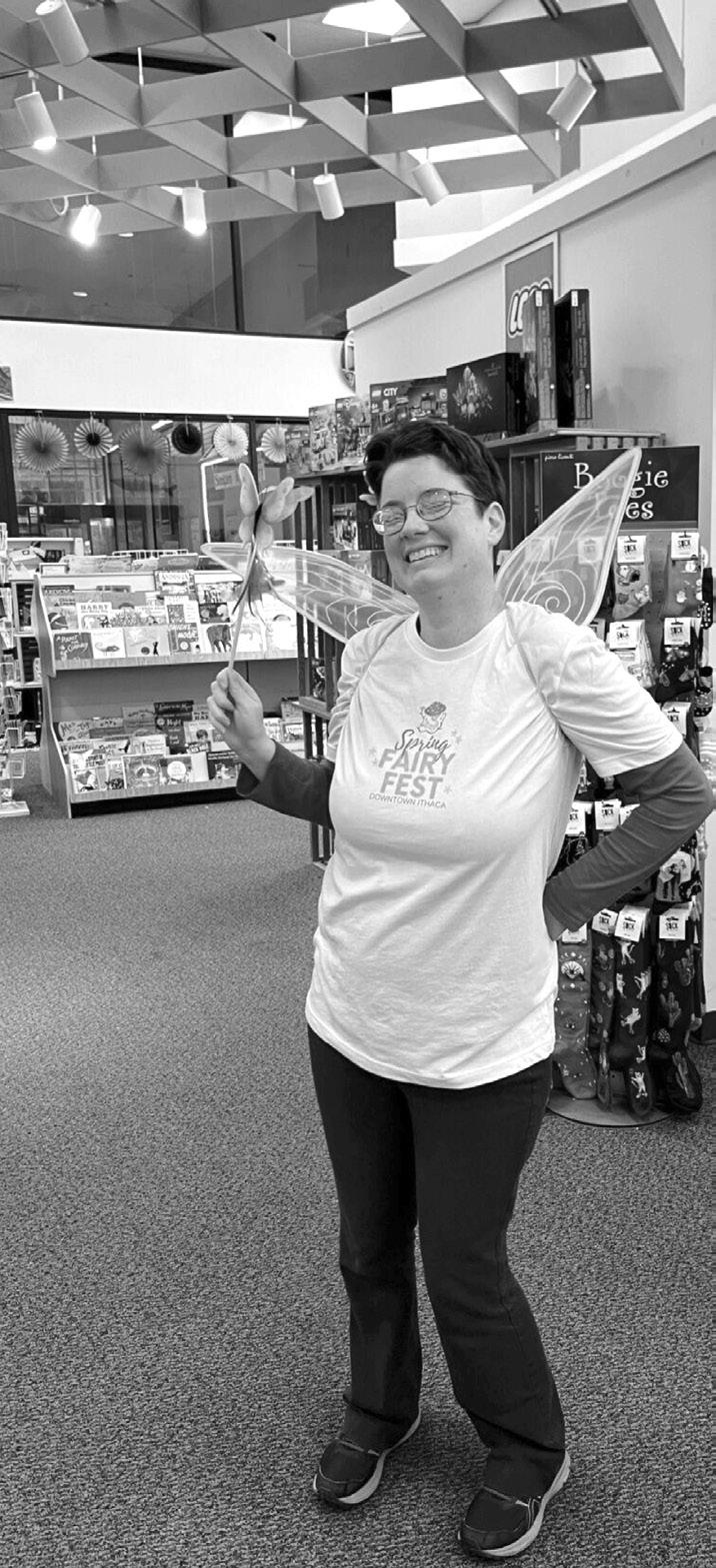
some fun and make a day of it. Fairy fest is really fulfilling that,” Perl said. The commons wide phenomenon is planned every year to help Ithacans enjoy some sun, or shield them from early April showers.
“We’re planning for March to be March, you know? Either way, the weather’s not going to stop us.”
It hasn’t in the past and it certainly won’t this time around. The most expansive Fairy Fest yet will take place on the commons this weekend, so whether coming for the spontaneous attire or fairy themed bites, the floral wands or local puzzling, this is surely a date to mark in your calendar.
view. “Loomis is physically free, but he still feels the bond — because that’s the reality of the world, the country we live in, with [an administration] determined to erase not only Black bodies but Blackness altogether.”
“Joe Turner’s Come and Gone” stands in testimonial against that erasure.
Barbara Adams is a regional theatre and arts journalist and retired professor of writing, Ithaca College.
continued from page 3
will all be positives,” Trumansburg Mayor Rordan Hart said, “It’s a bit of a hidden gem for folks who aren’t from this side of the lake, but it’s being able to have that as an outdoor recreational resource is going to be something that many hundreds of thousands or millions of people will get to enjoy over the next century.”
“The excitement is that this is going to open up more lakefront for the public
continued from page 8
as a state park, which is something the community really desired,” New York State Parks Finger Lakes Regional Director Fred Bonn said. “We’re going to be able to stand up new programming through this partnership with the Local Development Corporation. It’s going to take some time, but will create a great experience for people to enjoy.”
In a statement, State Park officials said many of the proposed upgrades in the Three Falls State Park strategic plan would repurpose structures at the site, aligning their goal of navigating capital invest-
the balcony and about 10 rows back, we were privy to bursts of light circles on the ceiling which I think those below us could not see. There were also light bars on the edge of the stage, as well as strung lights from above. Though they were bright and everchanging, I do not think they were distracting. A large screen behind the orchestra displayed graph-
continued from page 10
The signals this environment sends are complicated. As children, young people are taught that discipline, integrity, and perseverance are the foundations of personal success; yet the outcomes they observe as adolescents and young adults often appear disconnected from those principles. When that gap becomes acutely visible, a quiet — yet haunting — question naturally arises: If the system itself seems unpredictable, why should individual commitment to discipline, routine, or personal exceptionalism remain unwavering?
This tension reflects what might be called a form of 21st-century spiritual cannibalism—not cruelty in the literal sense, but a social environment in which institutions, attention economies, and competitive pressures gradually consume the values and trust that once held civic systems together. When individuals begin to believe that long-term effort may not be reliably rewarded, the temptation is to become more transactional: to extract opportunity quickly, protect oneself first, and assume stability may be temporary. For many students, this mindset is less cynical than adaptive. If the world appears “dog-eat-dog,” behaving selfishly within it may feel rational. Yet such an outlook can quietly erode the habits required in the workplace and the civic responsibility that healthy, resilient and sustainable communities require. This is where psychometric insight offers an important bridge. Psychometric science has long studied how people differ in intelligence, personality, motivation, and
ments towards the improvement of existing infrastructure. State Park officials also said the designs for the renovations will prioritize universal accessibility, creating equitable access to outdoor spaces.
“Land is finite. Waterfront land is rarer still. I’m deeply grateful to our state and local partners for turning this shared vision into reality,” Ulysses Supervisor Katelin Olson said in a release. “What we’ve created here is a gift to generations we’ll never meet — born from cooperation, compromise, and a trust that reaches far beyond any single municipal boundary."
ics that complemented the music. Tunes played included themes from “Pirates of the Caribbean”, “Game of Thrones”, James Bond and others. The music was amazing. Several of the pieces included individual performances by singers and
The timing of improvements will be determined following final review of the draft plan by New York State Parks and the availability of funding. Hart said the Three Falls LDC will draw on a variety of funding, including grants and community support. “The partnership is most important, and there’s the stewardship that we have handed down to us from the Boy Scouts that we need to take very seriously,” Nottke said. “They’ve taken good care of it. Now it’s our turn. We’ll do a great job, and we’re increasing the recreational aspect of it. And it’s going to last for generations.”
highlighted several instruments, like violins, cello, flute/piccolo, piano and horns. For me, it all ended too soon. Although I do not know their upcoming performance schedule, I am sure they will be well received.” — Richard “Dick” Winston, Owego NY
interests. Traditionally these tools were used to classify or evaluate the professional functionality of individuals. Increasingly, however, they are valuable as instruments of self-understanding. They help individuals recognize their cognitive habits, motivational triggers, and patterns of attention.
In the science of creativity, such insight functions much like a mirror. Individuals begin to notice when they concentrate best, what conditions stimulate their curiosity, and where their focus tends to drift. This awareness becomes the starting point for self-regulation. In a world where external systems may feel unpredictable, self-regulation becomes one of the few reliable anchors individuals can cultivate, leading to reliable idioms including: “if it’s going to be, it’s up to me,” and, “Become the change you want to see!”
Over time, self-regulation can become a craft — a learned skillset. Just as an apprentice learns from a master tradesman through repeated practice and feedback, workers can refine their reliability through small adjustments in daily behavior. They can design routines that support focus. They can monitor how their actions align with their intentions. Gradually, consistency emerges. Reliability, in this sense, is not merely a personality trait. It becomes a practiced tradecraft forged by discipline.
Understanding this distinction is crucial as one generation of leaders hopes to pass responsibility to the next. Experienced managers who developed their habits in more rigid professional environments now supervise younger colleagues shaped by more flexible, technologyinfused systems of assessment and illfated metrics of promotion. Each group
often interprets the other through incomplete assumptions. Older leaders may see inconsistency where younger employees experience uncertainty about expectations. Younger workers may perceive rigidity where experienced managers see the hard-earned lessons of reliability.
If this generational handoff is to succeed, both groups must learn how to work with one another rather than against one another. For employers and senior leaders, the challenge is to recognize that technological excellence, systems thinking, and aesthetic awareness are genuine strengths of an emerging workforce. These traits can invigorate organizations that might otherwise become stagnant. But young professionals might also benefit from clearer structures than many organizations currently provide. Explicit expectations, consistent routines, and visible models of disciplined work help transform potential into dependable performance. In other words, reliability should be taught as a craft, not merely demanded as a character trait.
For younger employees, the opportunity lies in applying the very tools they learned in school to their own professional development. Systems thinking can be turned inward. The same iterative mindset used to complete assigned tasks in the classroom can also be used to design personal routines, manage attention, and improve consistency. Reliability can be approached as a systems challenge: How might I structure my day so that my best thinking appears regularly? What habits can I develop that ensure my workplace commitments are met? How might reflection and measurement inform me how to improve my performance over time?
When observation, analysis, training and discipline intersect in this way, innovation becomes sustainable rather than sporadic. In a cap-and-gown city like Ithaca, this lesson carries particular resonance. The intellectual culture that thrives in its classrooms and libraries can also guide the practice of everyday work. But the lesson must extend beyond technical competence. In an era when social trust sometimes feels fragile, the quiet practice of reliability—showing up, thinking carefully, keeping commitments—becomes a form of civic infrastructure. Education, at its best, does not end with the diploma. It continues as a lifelong process of selfobservation, adjustment, and growth. Beyond the hill, then, lies another stage of learning—one shared by graduates and mentors alike. As the baton of leadership passes from one generation to the next, success will depend not only on knowledge or credentials but on the mutual willingness to practice reliability and transmit the habits of personal leadership across generations.
In uncertain times, reliability is no longer merely a professional virtue. It must be embraced as a stabilizing force—one capable of rebuilding trust in systems that sometimes appear to consume it. When that happens, the promises of civil society—celebrated in the passage to adulthood—mature into something much deeper: a community where insight becomes action, reliability becomes the norm, and self-leadership (agency) forms the foundation of participatory democracy. Such self-leadership can withstand external pressures—social, economic, and political for present and future generations.
Floor), 330 E. State St. | Led by Jen Pearcy-Edwards of Story House Ithaca, ‘Stepping into a Story’ is for anyone who has a love of stories and wants to build their con dence and skill in structuring and telling a story in front of an audience. | Free
Intuitive Stitch | 12 p.m., 3/22
Sunday | SewGreen, 112 W Green St. |
Learn to de-stress and free your creative muse in this all-levels “Intuitive Stitch” hand-stitching workshop led by Laura Braaten. | $25.00
3/19 Thursday
Bars/Bands/Clubs
3/18 Wednesday
The Canaan Session — Fiddletunes for Dancing! | 7 p.m. | Canaan Institute, 223 Canaan Rd., Brooktondale, NY 14817 |
3/22 Sunday
Bound for Glory Live with Low Lily | 2 p.m. | Lansing Area Performance Hall, 1004 Auburn Road, Lansing, NY | Free
3/24 Tuesday
Community Line Dance | 7 p.m., 3/24 Tuesday | Foundation of Light, 391 Turkey Hill Rd. | Community Line Dance lessons | Free
Afro-Cuban Traditional & Folkloric Dance Class | 7:30 p.m., 3/24 Tuesday | Treehouse Studio, 119 S Cayuga St. | Taught by Adolfo Castillo and Lisbet Lopez, accomplished professional dancers from Guantanamo, Cuba. Class is for all levels. Live percussion accompaniment. | $20.00
3/25 Wednesday
The Pelotones Swing Dance | 7 p.m. | TreeHouse Studio & Lounge, 119 S Cayuga St | $15.00
Thursday Morning Musicales presents Pianist Mark Spicer | 10:15 a.m. | North Presbyterian Church, 921 College Avenue | Free
Midday Music in Lincoln: Making Sound Futures (CU Music) | 12:30 p.m. | Lincoln Hall, 256 Feeney Way | Free
Making Sound Futures (CU Music) | 7:30 p.m. | Anabel Taylor Chapel, 548 College Ave | Free
3/20 Friday
Colton Dixon Presents The Love I Have For You Tour - Johnson City, NY | 7 p.m. | First Baptist Church of Johnson City, 1321 Reynolds Road
Dallas Morse Coors Concert Series presents Sir Stephen Hough, piano | 7:30 p.m. | Bailey Hall, 230 Garden Ave | $17.00 - $44.00
Sir Stephen Hough, piano | 7:30 p.m. | Cornell University, 144 East Ave. CONCERT: The Travelin’ McCourys — Young Guns Tour | 8 p.m. | Center for the Arts of Homer, 72 S Main St
3/22 Sunday
SU Brass Ensemble Concert | 2 p.m. | United Presbyterian Church of Cortland, 25 Church Street | Free Shih-Lin Chen, cello and Vera H. P. Hsu, piano (CU Music) | 3 p.m. | Barnes Hall, 129 Ho Plaza | Free

3/24 Tuesday
EZRAKH (CU Music) | 4:30 p.m. | Big Red Barn, 135 Presidents’ Drive | Free
Guest Recital: Jonathan Russell, composer and clarinet at Hockett Family Recital Hall | 7 p.m.
Wednesday
Senior Recital: Andrew Woodru , jazz piano at Ford Hall | 7 p.m.
Mark Edwards, harpsichord and organ (CU Music) | 7:30 p.m. | Anabel Taylor Chapel, 548 College Ave | Free
BAC Meet Up: Steeping Into a Story | 6:30 p.m., 3/18 Wednesday | The Community School of Music & Arts in Martha Hamblin Hall (3rd Floor), 330 E. State St. | Led by Jen Pearcy-Edwards of Story House Ithaca, ‘Stepping into a Story’ is for anyone who has a love of stories and wants to build their con dence and skill in structuring and telling a story in front of an audience. | Free
The Book of Mormon | 7:30 p.m., 3/18 Wednesday | Clemens Center, 207 Clemens Center Pkwy, Elmira, NY14901 | Ticket prices start at $66. Group Rates available for 10 or more.
Rise Dance Spring 2026 | 6 p.m., 3/20 Friday | State Theatre of Ithaca, 107 West State St. |
“Montana Smith and the Curse of the Golden Crocodile” Mystery

Dinner Theatre | 6:30 p.m., 3/20 Friday | Cortland Repertory Theatre Downtown, 24 Port Watson St. | Montana Smith and the Curse of the Golden Crocodile A Murder Mystery Dinner Theatre Experience!
PENUMBRA: 2026 ANNUAL SPRING
DANCE PRESENTING SERIES | 7:30 p.m., 3/20 Friday | Class of ‘56 Flexible Theatre, Schwartz Center for the Performing Arts, 430 College Ave. | Join PMA for an evening of original dance work featuring choreography by Babatunji Johnson and Prof. Danielle Russo. | Free
Ballet & Books: Spring 2026 | 2:30 p.m., 3/21 Saturday | Tompkins County Public Library, 101 East Green Street | Ballet & Books is a national, non-pro t organization that provides children ages 3 years – 4th grade with an opportunity to improve their literacy skills through a combination of dance
Dr. Seuss’s The Cat In The Hat — Live on Stage! | 6 p.m., 3/25 Wednesday | Clemens Center, 207 Clemens Center Parkway | Clemens Center presents DR. SEUSS’S THE CAT IN THE HAT Wednesday, March 25, 2026 at 6:00 p.m. Tickets on sale Thursday, January 15 at 11:30 a.m.
BAC Meet Up: Steeping Into a Story | 6:30 p.m., 3/18 Wednesday | The Community School of Music & Arts in Martha Hamblin Hall (3rd
PENUMBRA: 2026 ANNUAL SPRING DANCE PRESENTING SERIES
FRIDAY, MARCH 20 AND SATURDAY, MARCH 21 FROM 7:30 P.M. 8:30 P.M.
Schwartz Center for the Performing Arts, Cornell University | An evening of original dance featuring choreography by Babatunji Johnson and Assistant Professor of the Practice Danielle Russo. Penumbra presents two ensemble dance works that delve into the shadow self and the tensions between impulse, restraint, and the ego. (Photo: Provided)
TCPL Tours: Art and Ornithology at the Lab of O | 11 a.m., 3/19 Thursday | Tompkins County Public Library, 101 East Green Street | Join us for a guided tour at the Lab of Ornithology! Art and illustration have shaped the eld of ornithology for centuries.
Professional Headshot Sessions w/ Forest Floor Creatives | 10 a.m., 3/20 Friday | Tompkins Chamber, 124 Brindley Street | Appointment slots are 10 minutes long. | $75.00
The Artistry Guild | 5 p.m., 3/20 Friday | Lodi Whittier Library, 8484 S Main St. | The Artistry Guild is a series of workshops to build skills in art and creativity, facilitated by Basil Bakhshi from Lodi, NY. | Free
Dino Eggstravaganza | 10 a.m., 3/21 Saturday | Museum of the Earth, 1259 Trumansburg Road (Route 96) | Celebrate Spring with Dino Eggstravaganza! | $0.00 - $12.50
Photography Group Exhibit at The Gallery at South Hill | 12 p.m., 3/21 Saturday | The Gallery at South Hill, 950 Danby Rd. South Hill Business Campus | Free
Demo Day at Artist Alley Studios | 12 p.m., 3/21 Saturday | Artist Alley, Ithaca, 950 Danby Rd. South Hill Business Campus | Demo Day, open studios at Artist Alley in Ithaca. Please use back entrance. 12-4pm open studios, and demonstrations featuring printmaking, ceramics, tin type photography, lm processing, metal prints, watercolor, tattoo, mixed media, loom weaving, and more. | Free
3rd Annual She Shines | 1 p.m., 3/22 Sunday | Homer Hops, 722 RT-90 | If you’ve been craving a real “treat yourself” afternoon — shopping, sipping, sampling, and mingling with good people — this is it!
Three Bears Easter Egg Painting Class | 2 p.m., 3/22 Sunday | Three Bears Ovid, 7175 Main Street | Free 1.5 hour beginner friendly mandala painting class at Papa Bear taught by local teen Chelsea Neville on March 22nd from 2:00 to 3:30 p.m. | Free
Movie Night: Zootopia 2 | 6:30 p.m., 3/20 Friday | New eld Public Library, 198 Main St. | Free movie night at New eld Public Library! | Free Family Movies at TCPL: Dog Man | 2 p.m., 3/21 Saturday | Tompkins County Public Library, 101 E Green St. | Join us for a movie on our “big screen” in the Thaler Howell programming room.
120 E Green St, Ithaca New movies opening the week of March 18. Contact Cinemapolis for showtimes and continuing lms. Stationed At Home | March 19 only | On a clear and frigid Christmas Eve in 1998, in a small, forgotten city, a solitary taxi driver on the graveyard shift breathlessly awaits the sight of the International Space Station. As the hours count down, a parade of o beat mis ts derail his plans, propelling the story to its exhilarating climax. | NR 120 mins
The Anti-Films of Guy Debord: Three day lm festival presented in partnership with PM Press | March 20 – March 22 | Following the still-unsolved assassination of the lms’ producer in 1984, all the lms were withdrawn from circulation for nearly twenty years. Ken Knabb is the editor and translator of Guy Debord's “Complete Cinematic Works”, which was recently revised and expanded for a new edition from PM Press. Knabb will be leading Q&As and discussions at each of the three screenings. See cinemapolis.org for festival schedule. Free.
Project Hail Mary | Science teacher Ryland Grace (Ryan Gosling) wakes up on a spaceship light years from home with no recollection of who he is or how he got there. As his memory returns, he begins to uncover his mission: solve the riddle of the mysterious substance causing the sun to die out. He must call on his scienti c knowledge and unorthodox ideas to save everything on Earth from extinction…but an unexpected friendship means he may not have to do it alone. | PG-13 156 mins
The Adventures of Robin Hood | March 22 only | The Errol Flynn classic. When Prince John and the Norman Lords begin oppressing the Saxon masses in King Richard's absence, a Saxon lord ghts back as the outlaw leader of a rebel guerrilla army. | PG 102 mins | Free
Ri | March 24 only | Out of prison after a ve-year stretch, jewel thief Tony turns down a quick job his friend Jo o ers him, until he discovers that his old girlfriend Mado has become the lover of local gangster Pierre Grutter during Tony’s absence. | NR 118 mins
Cornell Women’s Softball vs Bucknell University | 2:30 p.m., 3/18 Wednesday | Niemand-Robison Softball Field, Cornell University
Ithaca College Baseball vs University of Rochester | 3 p.m., 3/20
Friday | Freeman Field, Ithaca College
Cornell Men’s Tennis vs University of Memphis | 3 p.m., 3/20 Friday | Reis Tennis Center, Cornell University
Cornell Women’s Rowing vs Duquesne University | Time TBA 3/21 Saturday | Cayuga Inlet, Ithaca
Cornell Women’s Lacrosse vs Columbia University | 12 p.m., 3/21 Saturday | Scoellkopf Field, Cornell University
Cornell Women’s Gymnastics at Gymnastics East Conference Championships | 12 p.m. and 5 p.m., 3/21 Saturday | Newman Arena, Cornell University
Cornell Men’s Tennis vs Middle Tennessee | 11 a.m., 3/22 Sunday | Reis Tennis Center, Cornell University
Ithaca College Men's Tennis vs New York University | 1 p.m., 3/22
Sunday | Ithaca College Tennis Courts or Glazer Arena, Ithaca College
Cornell Women’s Tennis vs Le Moyne College | 5 p.m., 3/25
Wednesday | Reis Tennis Center, Cornell University
Ithaca College Baseball vs St. John Fisher University | 3 p.m., 3/25
Wednesday | Freeman Field, Ithaca College
Fairy Fest 2026 | 10 a.m., 3/21 Saturday | Ithaca Commons, 171 E. State St., Martin Luther King Jr. Blvd |
Finger Lakes Lions Clubs Service
Carnival | 12 p.m., 3/21 Saturday | Arnot Mall, 3300 Chambers Road | Local Lions Clubs invite the community to a fun and engaging Service Carnival designed to showcase how Lions are making a di erence right here at home and around the world. | Free
DMAC Promotions presents FLEX Wrestling: Road Trip | 7 p.m., 3/21 Saturday | Hangar Theatre, 801 Taughannock Blvd. | FLEX Wrestling makes it’s Ithaca, NY debut live at The Hangar Theatre featuring former WWE Star Carlito! | $7.18
Climate Literature Discussion | 4 p.m., 3/18 Wednesday | Bu alo Street Books, 215 North Cayuga Street | Community discussions about climate change, seen through ction and non- ction books: this month’s book is “The Unworthy” by Agustina Bazterrica, Sarah Moses (Translator) | Free Faerie Market | 11 a.m., 3/21 Saturday | Bu alo Street Books, 215 North Cayuga Street | For lovers of the fae, unicorns and all things magical- utter on over to Bu alo Street Books for Down Ithaca’s Fairy Fest for all things magical and knowledgeable.
Spring Teen Creative Writing Workshop | 5:30 p.m., 3/24 Tuesday | Tompkins County Public Library, 101 E Green St. | Love to write your own stories? Have ideas for your own characters and worlds, or an interest in writing fan ction? Join Adrienne Raw for a Teen Creative Writing Workshop!
BIPOC Voices In Romance & Fantasy: “Cinderella is Dead” by Kalynn Bayron | 5 p.m., 3/25 Wednesday | Bu alo Street Books, 215 N Cayuga St. | Join us to discuss Cinderella is

FREE ANGELA DAVIS AND ALL POLITICAL PRISONERS
Dead joined by local author Kalynn Bayron | Free
Thriving With Your Spirited Child — Spring’26 | 6 p.m., 3/18 Wednesday | Virtual | Spirited Children are just a little “more” of everything. | Free Story + Craft | 4 p.m., 3/19 Thursday | Tompkins County Public Library, 101 E Green St | Story + Craft is our weekly reading + creating event for children! Join us for a read-aloud, followed by art-making or a guided craft.
Baby & Toddler Storytime | 10:30 a.m., 3/20 Friday | Tompkins County Public Library, 101 E Green St. | Caregivers and their children are invited to join Cassie for music, rhymes, movement and books. Storytime will be followed by a playtime from 11-12.
The Showcase! - Vendor Registration-2026 | 5:30 p.m., 3/20 Friday | J. M. McDonald Sports Complex, 4292 Fairground Drive
Math Fun with MathHappens! | 10 a.m., 3/21 Saturday | Sciencenter, 601 1st St. | Join us for playful, informal math learning with the MathHappens Foundation! Families and kids can explore hands-on activities that make math fun, creative, and connected to everyday life. | Free
Science Connections: Color & pH Exploration | 2 p.m., 3/22 Sunday | Sciencecenter, 601 1st Street | Join the American Institute of Chemical Engineers in an exploration of color and pH! | Free
“Li’l Sprouts” Waldorf class for Babies & Toddlers | 9 a.m., 3/23 Monday | Ithaca Waldorf School, 20 Nelson Road | A weekly Waldorf gathering for babies and toddlers with their parent/ caregiver, led by master teacher Karen Lonsky. | $30.00 - $175.00
Sit! Stay! Read! | 3 p.m., 3/23 Monday | Tompkins County Public Library, 101 E Green St. | Children are invited to practice their reading skills by sharing a story with a truly non-judgmental listener — a dog! Reading sessions will be held Mondays from 3-4 p.m.
Science Together: Flower Dissection | 10:15 a.m., 3/25 Wednesday | Sciencecenter, 601 1st Street | Practice using tools and making observations as we look at all the parts of a ower!
LGBTQ+ Youth Group | 4:30 p.m., 3/18 Wednesday | Tompkins County Public Library, 101 E Green St. | Join us at LGBTQ+ Youth Group to do crafts, play games, and socialize. Whether you’re lesbian, gay, bi, trans, questioning, or just trying to gure things out — we’re here for you!
Beauti cation Brigade Orientation | 5:30 p.m., 3/18 Wednesday | CCE-Tompkins Education Center, 615 Willow Avenue | The Beauti cation Brigade takes care of public ower plantings in Ithaca. Have fun, learn gardening techniques, and help keep Ithaca gorgeous. No experience required.
Pet Clinic | 6 p.m., 3/18 Wednesday | Southside Community Center Gym, 305 S Plain St. | Pet Clinic
What Lurks in the Lake? Making Sense of Harmful Algal Blooms | 12:30 p.m., 3/19 Thursday | Ulysses Philomathic Library, 74 E. Main St., Trumansburg, NY 14886 | Free public presentations unpack HAB data, lake health trends, and what reports really reveal about Cayuga Lake | Free
GO ITHACA Open Hours | 2 p.m., 3/19 Thursday | Tompkins County Public Library, 101 East Green Street | Our program makes sustainable

commuting accessible and a ordable for everyone.
M arch Community Choice Aggregation Public Meeting | 6 p.m., 3/19 Thursday | Zoom | The City of Ithaca and Local Power are hosting two virtual informational meetings on Thursday, March 19th at 6 p.m., and the Town of Ithaca leads at 7 p.m., to share information about the upcoming Community Choice Aggregation (CCA) program! Come to learn about how you can own or invest in local renewable energy projects!
Spring Seed Sowing Workshop | 10:30 a.m., 3/21 Saturday | The Human Services Complex — Room 120, 323 Owego St. | Learn a variety of low budget ways to get your Spring Seedlings started with Schuyler County Master Gardener Volunteers and Garden and Horticulture Coordinator, Shawn Tubridy. | $15.00
King’s Cemetary Annual Meeting | 11 a.m., 3/21 Saturday | Danby Community Church, 1859 Danby Rd. | Community Resource Day | 12 p.m., 3/24 Tuesday | New eld Public Library, 198 Main St. | Come stop by the Library to visit with a variety of di erent local organizations and nd out about the resources and services available. | Free Herbs for Spring Health | 6 p.m., 3/24 Tuesday | The Human Services Complex — Room 120, 323 Owego Street | Join Community Herbalist Andrea & Matthias Reisen of Healing Spirits Herb Farm & Education Center to learn how to support your health in the spring. | $15.00
Ithaca Lions Club Doug’s ToGo Fundraiser | 11 a.m., 3/25 Wednesday | Walgreens, 330 Pine Tree Rd. | proceeds to support programs: preschool vision screening, Lions Camp Badger in Spencer We will be collecting gently use eyeglasses and hearing aids for recycling
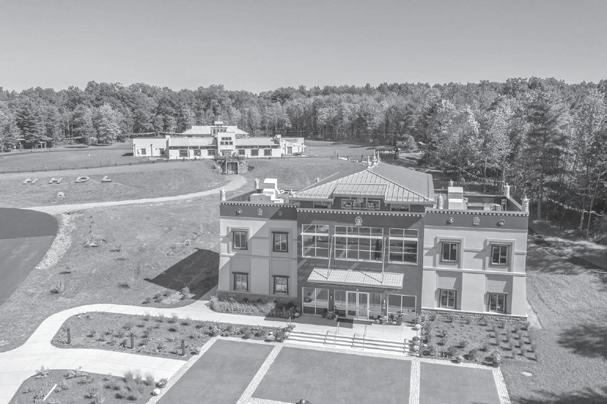
250/Merchandise
PREPARE FOR POWER OUTAGES TODAY!
...with a Generac Home Standby Generator. Act now to receive a FREE 5-year warranty with qualifying purchase. Call 1-877-516-1160 today to schedule a free quote. It’s not just a generator. It’s a power move. (NYSCAN)
11 Renwick Heights Rd, Ithaca, NY 14850 Friday & Saturday, 8am-6pm
800/Services
ATTENTION OXYGEN THERAPY USERS!
Discover Oxygen Therapy That Moves with You with Inogen Portable Oxygen Concentrators. FREE information kit. Call 1-833-661-4172. (NYSCAN)
Donate your car, truck, or SUV to assist the blind and visually impaired. Arrange a swift, no-cost vehicle pickup and secure a generous tax credit for 2025. Call Heritage for the Blind Today at 1-855-484-3467. (NYSCAN)

GET DISH SATELLITE TV + INTERNET!
Free Install, Free HD-DVR Upgrade, 80,000 On-Demand Movies, Plus Limited Time Up To $600 In Gift Cards. Call Today! 1-866-782-4069. (NYSCAN)
If you are overpaying for your service, call now for a free quote and see how much you can save! 1-833-323-0160. (NYSCAN)
DO YOU NEED A ROOF OR ENERGY EFFICIENT WINDOWS & HELP PAYING FOR IT?
YOU MAY QUALIFY THROUGH NEW RELIEF PROGRAMS (800) 944-9393 or visit NYProgramFunding.org to qualify. Approved applications will have the work completed by a repair crew provided by: HOMEOWNER FUNDING. Not affiliated with State or Gov Programs. (NYSCAN)
Do you know what’s in your water?
Leaf Home Water Solutions offers FREE water testing and whole home water treatment systems that can be installed in as little as one day.
15% off your entire purchase. Plus 10% senior and military discounts.
Restrictions apply. Schedule your FREE test today.
Call 1-866-247-5728 (NYSCAN)
PROTECT YOUR HOME from pests safely and affordably.
Roaches, Bed Bugs, Rodent, Termite, Spiders and other pests. Locally owned and affordable. Call for service or an inspection today! 1-833-549-0598. Have zip code of property ready when calling! (NYSCAN)
PREPARE FOR POWER OUTAGES!
With Briggs & Stratton PowerProtect (TM) standby generators – the most powerful home standby generators available. Industry-leading comprehensive warranty – 7 years ($849 value). Proudly made in the USA! Call Briggs & Stratton 1-888-605-1496. (NYSCAN)
SAFE STEP – NORTH AMERICA’S #1 WALK-IN TUB
Comprehensive lifetime warranty.
Top-of-the-line installation and service. Now featuring our FREE shower package and $1600 OFF for a limited time! Call today! Financing available. Call Safe Step 1-855-916-5473. (NYSCAN)



continued from page 4
provided significant clearance. The NYSDEC determined the project will have no impact on protected wetlands, though a stormwater management permit (SPDES) is still pending. Meanwhile, the State Historic Preservation Office is currently reviewing the site to ensure no archaeological or historic resources will be disturbed by the installation. Federal oversight is largely complete as the FAA issued a “no impact” designation, confirming the solar array won't interfere with regional aviation or create hazardous glare. While the U.S. Fish and Wildlife Service is still finalizing its “no impact” letter regarding local habitats, the U.S. Army Corps of Engineers confirmed no federal permits are required for the site.
continued from page 9
the movement to the right so the legislators think that there is indeed a movement to the right and that the Congress and the legislators and the city councils will start to move to the right the way the major media want them. So they keep on talking about this move to the right. So let’s look at 1977 and see if there was indeed a move to the right. In 1977, gay people had their rights taken away from them in Miami. But you must remember that in the week before Miami and the week after that, the word homosexual or gay appeared in every single newspaper in this nation in articles both pro and con. In every radio station, in every TV station and every household.
For the first time in the history of the world, everybody was talking about it, good or bad. Unless you have dialogue, unless you open the walls of dialogue, you can never reach to change people’s opinion. In those two weeks, more good and bad, but more about the word homosexual and gay was written than probably in the history of mankind. Once you have dialogue starting, you know you can break down prejudice.
In 1977 we saw a dialogue start. In 1977, we saw a gay person elected in San Francisco. In 1977 we saw the state of Mississippi decriminalize marijuana. In 1977, we saw the convention of conventions in Houston. And I want to know where the movement to the right is happening. What that is is a record of what happened last year. What we must do is make sure that 1978 continues the movement that is really happening that the media don’t want you to know about. That is the movement to the left. It’s up to CDC to put the pressures on Sacramento--but to break down the walls and the barriers so the movement to the left continues and progress continues in the nation.
We have before us coming up with several issues we must speak out on. Probably the most important issue outside the Briggs—which we will come to—but we do know what will take place this June. We know there’s an issue on the ballot called Jarvis-Gann. We hear the taxpayers talk about it on both sides. But what you don’t hear is that it’s probably the most racist issue on the ballot in a long time. In the city and county of San Francisco, if it
passes and we indeed have to lay off people, who will they be? The last in, and the first in, and who are the last in but the minorities? Jarvis-Gann is a racist issue. We must address that issue. We must not talk away from it. We must not allow them to talk about the money it’s going to save, because look at who’s going to save the money and who’s going to get hurt.
We also have another issue that we’ve started in some of the north counties and I hope in some of the south counties it continues. In the San Francisco elections we’re asking—at least we hope to ask— that the U.S. government put pressure on the closing of the South African consulate. That must happen. There is a major difference between an embassy in Washington which is a diplomatic bureau. and a consulate in major cities. A consulate is there for one reason only -- to promote business, economic gains, tourism, investment. And every time you have business going to South Africa, you’re promoting a regime that’s offensive. In the city of San Francisco, if everyone of 51 percent of that city were to go to South Africa, they would be treated as second-class citizens. That is an offense to the people of San Francisco and I hope all my colleagues up there will take every step we can to close down that consulate and hope that people in other parts of the state follow us in that direction. The battles must be started some place and CDC is the greatest place to start the battles. I know we are pressed for time so I’m going to cover just one more little point. That is to understand why it is important that gay people run for office and that gay people get elected.
I know there are many people in this room who are running for central committee who are gay. I encourage you. There’s a major reason why. If my non-gay friends and supporters in this room understand it, they’ll probably understand why I’ve run so often before I finally made it. Y’see right now, there’s a controversy going on in this convention about the gay governor. Is he speaking out enough? Is he strong enough for gay rights? And there is controversy and for us to say it is not would be foolish. Some people are satisfied and some people are not. You see there is a major difference — and it remains a vital difference — between a friend and a gay person, a friend in office and a gay person in office. Gay people have been slandered nationwide. We’ve been tarred and we’ve been brushed with the
picture of pornography. In Dade County, we were accused of child molestation.
It’s not enough anymore just to have friends represent us. No matter how good that friend may be. The black community made up its mind to that a long time ago. That the myths against blacks can only be dispelled by electing black leaders, so the black community could be judged by the leaders and not by the myths or black criminals. The Spanish community must not be judged by Latin criminals or myths. The Asian community must not be judged by Asian criminals or myths. The Italian community must not be judged by the mafia, myths. And the time has come when the gay community must not be judged by our criminals and myths. Like every other group, we must be judged by our leaders and by those who are themselves gay, those who are visible. For the invisible, we remain in limbo — a myth, a person with no parents, no brothers, no sisters, no friends who are straight, no important positions in employment.
A tenth of the nation supposedly composed of stereotypes and would-be seducers of children — and no offense meant to the stereotypes. But today, the black community is not judged by its friends, but by its black legislators and leaders. And we must give people the chance to judge us by our leaders and legislators. A gay person in office can set a tone, command respect not only from the larger community, but from the young people in our own community who need both examples and hope. The first gay people we elect must be strong. They must not be content to sit in the back of the bus. They must not be content to accept pablum. They must be above wheeling and dealing. They must be — for the good of all of us — independent, unbought. The anger and the frustrations that some of us feel is because we are misunderstood, and friends can’t feel the anger and frustration. They can sense it in us, but they can’t feel it. Because a friend has never gone through what is known as coming out. I will never forget what it was like coming out and having nobody to look up toward.
I remember the lack of hope — and our friends can’t fulfill it. I can’t forget the looks on faces of people who’ve lost hope. Be they gay, be they seniors, be they blacks looking for an almost-impossible job, be they Latins trying to explain their
problems and aspirations in a tongue that’s foreign to them. I personally will never forget that people are more important than buildings. I use the word "I" because I’m proud. I stand here tonight in front of my gay sisters, brothers and friends because I’m proud of you. I think it’s time that we have many legislators who are gay and proud of that fact and do not have to remain in the closet. I think that a gay person, up-front, will not walk away from a responsibility and be afraid of being tossed out of office. After Dade County, I walked among the angry and the frustrated night after night and I looked at their faces.
And in San Francisco, three days before Gay Pride Day, a person was killed just because he was gay. And that night, I walked among the sad and the frustrated at City Hall in San Francisco and later that night as they lit candles on Castro Street and stood in silence, reaching out for some symbolic thing that would give them hope. These were strong people, whose faces I knew from the shop, the streets, meetings and people who I never saw before but I knew. They were strong, but even they needed hope. And the young gay people in Altoona, Pennsylvania, and Richmond, Minnesota, who are coming out and hear Anita Bryant on television and her story. The only thing they have to look forward to is hope. And you have to give them hope. Hope for a better world, hope for a better tomorrow, hope for a better place to come to if the pressures at home are too great. Hope that all will be all right.
Without hope, not only gays, but the blacks, the seniors, the handicapped, the us’es, the us’es will give up. And if you help elect to the central committee and other offices, more gay people, that gives a green light to all who feel disenfranchised, a green light to move forward. It means hope to a nation that has given up, because if a gay person makes it, the doors are open to everyone.
So if there is a message I have to give, it is that I’ve found one overriding thing about my personal election, it’s the fact that if a gay person can be elected, it’s a green light. And you and you and you, you have to give people hope. Thank you very much.
Next week, we will celebrate Cesar Chavez — American labor leader and civil rights activist and his address to the Commonwealth Club in 1964.












Roy Allen: Director of Strategic Partnerships —Ithaca Times, Finger Lakes Community Newspapers, www.ithaca.com
Mental health disorders such as depression, post-traumatic stress disorder (PTSD), and traumatic brain injury (TBI) affect millions of Americans and frequently resist conventional treatment. For many patients, antidepressants, psychotherapy, and other standard interventions provide only partial relief. In recent years, scientific innovation has turned toward novel therapeutic approaches rooted in neuroscience, including the therapeutic potential of psychedelic compounds. Research on psilocybin and ibogaine—once on the margins of biomedical inquiry—has re-emerged in rigorous clinical and policy discussions, offering promising new ideas for addressing entrenched mental-health challenges.
At Cornell University, neuroscientist Alex Kwan and his team are illuminating how psilocybin may produce sustained therapeutic effects by acting on neural circuitry. Using advanced imaging tools that allow real-time observation of neural networks, Kwan’s research demonstrates that psilocybin induces rapid and persistent structural plasticity in the medial frontal cortex—promoting the growth of new dendritic spines critical for synaptic connectivity and cognitive flexibility. This plasticity is associated with improved behavior in animal models of depression, suggesting that psilocybin’s benefits go beyond temporary changes in mood to encompass durable reorganization of brain circuits that underlie negative thought patterns and emotional rigidity.
Additionally, studies from Kwan’s lab
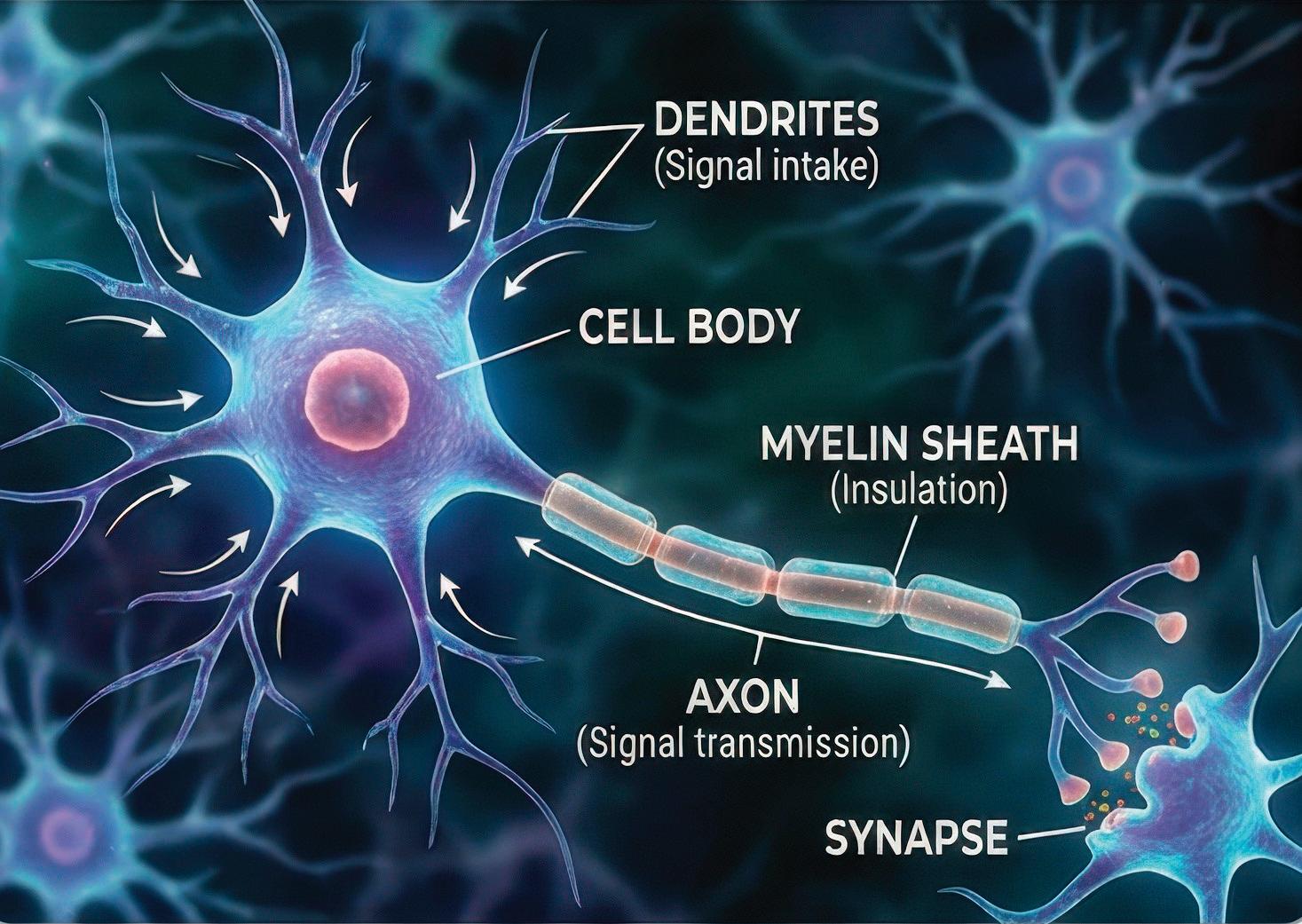
Illustration of the parts of a neuron. Structural changes in neurons are associated with learning and potentially with the therapeutic effects of psychedelic compounds such as psilocybin and ibogaine. (Illustration: Charming Studio/stock.adobe.com)
highlight specific neurons expressing serotonin 5-HT2A receptors as key mediators of these long-term effects, emphasizing a mechanistic basis for psilocybin’s therapeutic promise. Recently, Kwan confirmed that my understanding of the science is accurate, and appreciated us highlighting his research and new government funding initiatives revealed below. While psilocybin continues to be evaluated
for its potential in treating mood disorders such as depression and PTSD, ibogaine has attracted attention for its wide-ranging potential, especially in the contexts of addiction, PTSD, and TBI— conditions that often co-occur and compound one another. Ibogaine is a psychoactive alkaloid derived from the Tabernanthe iboga shrub, and its complex pharmacology engages multiple neurotransmitter systems, including dopamine,
glutamate, and opioid pathways, in addition to promoting neuroplasticity, making it a unique candidate for treating interrelated neurological and psychological dysfunctions.
In 2025, the State of Texas made a historic investment by allocating $50 million in public funding to support clinical trials of ibogaine, marking one of the largest government-level research investments in psychedelic medi-

cine in U.S. history. This funding—approved through state legislation—supports FDA-approved clinical trials intended to investigate ibogaine’s safety and efficacy in treating substance use disorders, trauma-related conditions, and TBI, potentially positioning Texas as a national leader in psychedelic research infrastructure. The Texas investment reflects bipartisan interest among policymakers in exploring alternatives to conventional psychiatric treatments and addressing conditions that have high societal and economic costs.
Shortly after Texas’s initiative, Arizona also moved forward with public funding for ibogaine research. In its 2025–2026 budget, Arizona lawmakers appropriated $5 million to study ibogaine in clinical trials focused on neurological conditions such as PTSD and TBI, with research institutions now able to apply for grants to conduct these studies. Former U.S. Senator Kyrsten Sinema played a high-profile advocacy role in advancing this legislation, testifying before the Arizona legislature and pledging to help raise matching private funds to support the research. Sinema emphasized that current treatment options for PTSD and brain injury are inadequate and that ibogaine research could provide new hope for veterans and others who have exhausted existing therapies.
According to Angela Skudin of Americans for Ibogaine, many states—including Oklahoma, Missouri, Mississippi, Louisiana, Oregon, Michigan and Ohio—have bills or proposals under discussion, with many first responders—supported through the Casey Skudin 343 Fund—providing testimony on the benefits of ibogaine treatment. Momentum continues to spread across America. Oklahoma's HB 3834 has successfully passed through two house committees and is expected to reach a floor vote soon.
➢ In Tennessee, lawmakers have introduced the Helping Open Pathways to Effective (HOPE) Treatment Act, which would create a Mental Health Innovation Fund to support FDA-supervised ibogaine clinical trials through public-private partnerships involving hospitals, research institutions, and drug developers.
➢ In Maryland, the proposed Veterans Mental Health Innovations Act would establish a state grant program to fund ibogaine clinical trials at in-state research institutions, drawing from the state’s opioid settlement funds and focusing in part on treatment options for veterans.
➢ In Vermont legislators have proposed creating a Psychedelic Therapy Advisory Board to review scientific evidence on psychedelic treatments, develop pilot programs, and support clinical trials— including initiatives centered on ibogaine.
Skudin also notes research led by the late Dr. Nolan Williams at Stanford University, which is further contributing to the scientific understanding of ibogaine’s effects. Skudin, who recently attended the 1st International Iboga & Ibogaine Conference in Libreville, Gabon, has facilitated ibogaine treatment access for over 200 first responders, highlighting both clinical outcomes and personal transformation. These combined efforts—state-level legislation, clinical research, and community advocacy— illustrate a growing movement to recognize ibogaine as a legitimate therapeutic intervention for complex mental health conditions and brain injuries. Many of these programs rely on opioid settlement funds or public-private research partnerships and aim to con-
organizations like Americans for Ibogaine highlight a pivotal moment in mental-health innovation. Rather than viewing psychedelics solely as substances of recreational or historical interest, scientists and policymakers are increasingly approaching them as tools for targeted, neuroscience-informed therapy. Psilocybin’s capacity to promote adaptive neural connectivity and ibogaine’s multi-modal potential in addressing complex brain injuries and co-morbid disorders reflect a shift in understanding mental illness as a condition of disrupted neuromodulation rather than simply a chemical imbalance.
This emerging paradigm emphasizes neuroplasticity, circuit remodeling, and integrative clinical approaches—opportunities that may yield more robust and enduring outcomes for individuals plagued by treatment-resistant depression, chronic PTSD, and the cognitive sequelae of brain injury. As research progresses from exploratory studies to well-funded clinical trials, psychedelics hold the promise not only of scientific insight but of meaningful therapeutic breakthroughs for millions of Americans in need of new, effective treatment strategies.
duct rigorous, FDA-regulated studies rather than informal or unregulated use. Policymakers increasingly view ibogaine research as a potential tool for addressing the intertwined crises of opioid addiction, trauma-related mental illness, and neurological injury.
Together, research and funding initiatives from institutions like Cornell, the public support seen in states such as Arizona, Texas, and Oklahoma, and the advocacy of
EDITOR’S NOTE: This article is intended to inform readers about ongoing scientific research and public policy developments related to psychedelic compounds. The information presented does not constitute an endorsement of any substance, treatment, or clinical practice. Research in this field is ongoing, and these substances remain regulated under federal and state law. Readers should not interpret this coverage as medical advice.