

Marvelous Mollusks: Now on Exhibit at the Museum of the Earth 1259 Trumansburg Rd., Ithaca, NY 14850 (607) 273-6623 www.museumoftheearth.org
![]()


Marvelous Mollusks: Now on Exhibit at the Museum of the Earth 1259 Trumansburg Rd., Ithaca, NY 14850 (607) 273-6623 www.museumoftheearth.org
A very big idea: evolution.
Darwin Day is an annual, international celebration of the life and ideas of Charles Darwin, born February 12, 1809, whose groundbreaking work On the Origin of Species forever changed how we understand life on Earth.
Each year, the Paleontological Research Institution (PRI) marks this occasion with Darwin Days — a week of engaging events celebrating evolution, curiosity, and scientific discovery.
In 2026, Darwin Days takes a delightfully colorful turn, exploring mol -
lusk evolution in honor of PRI’s current exhibition at the Museum of the Earth, Marvellous Mollusks: The Secret World of Shells. From ancient oceans to modern marvels, discover how these soft-bodied creatures have survived, adapted, and thrived for hundreds of millions of years.
Join us February 10 th – 14 th, for film, conversation, and hands-on family fun as we celebrate evolution, one shell at a time.
Learn more at priweb.org/darwindays

Tuesday Feb 10 - Saturday Feb 14


By Philip O’Dell
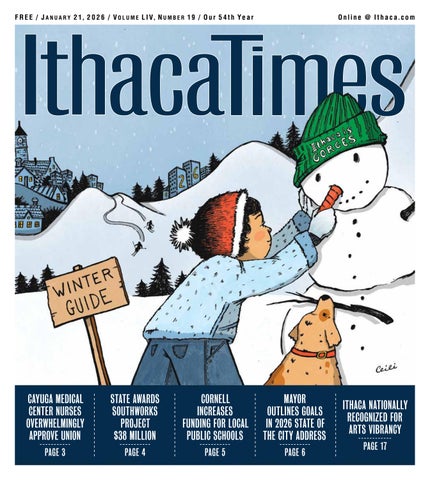
In a landmark shift for healthcare in the Finger Lakes region, nurses at Cayuga Medical Center (CMC) formally authorized their union on Jan. 15.
According to the Communications Workers of America (CWA), 82% of CMC nurses voted in favor of joining Cayuga United-CWA following the conclusion of the two-day voting period around 1 p.m. The election was overseen by the National Labor Relations Board (NLRB).
CWA said the nurses can begin bargaining with CMC management for a union contract to address concerns and improve workplace conditions. Cayuga United-CWA was formed in late 2025 to represent CMC’s 350 nurses.
The election marks the culmination of a high-pressure campaign defined by public rallies, federal labor charges, and concerns over patient safety and fair compensation.
“The hard work is just starting, but nurses are good at hard work,” said Shane Snyder, an in-patient wound nurse. “We’ve been delivering quality patient care for years while feeling unsupported and burnt out, and I'm excited to see what we can do with our union behind us. We are tenacious, we are strong, and we are ready to start bargaining our contract.”
Cardiac catheterization nurse Morgan Downing said her pride in her profession has deepened following the successful union vote.

“We are laying the groundwork for the generations of nurses to come after us, and we’re already hearing from other medical professionals inspired to join us,” Downing said. “I am so excited to have my seat at the table alongside my fellow nurses to start bargaining for our first contract. We are united and ready to continue to advocate for ourselves, our patients and our community.”
CWA District 1 Vice President Dennis Trainor described the authorization vote as “a shining example of what healthcare professionals can achieve” if they stand together.
By Lorien Tyne
Atthe Ithaca Town Board’s Jan. 14 meeting, the board passed the 2026 Agreement for the Expenditure of Highway Monies, which outlines road infrastructure that will be worked on this year.
The document states that $355,000 will be set aside for general repairs of town highways, such as sluices, culverts, pavement markings, guide rails and surface treating. A total of $80,000 will be set aside for permanent improvements of town highways not included in the capital project budget, such as re-establishing shoulders, milling asphalt and installing asphalt overlays.
Joe Slater, highway superintendent and director of public works, said the locations of general repairs and permanent improvements are unknown and come up throughout the year.
“General repairs is a lot for pavement markings and surface treating
“CMC nurses have overwhelmingly and repeatedly voiced their urgent desire for a union contract and it is time for management to join us at the bargaining table and get to work improving conditions for nurses and their patients,” Trainor said.
In a previous statement to the Ithaca Times, a CMC spokesperson said CEO Rob Lawlis and his leadership team will collaborate with nurses to improve the hospital’s environment and patient care regardless of the union election outcome.
Continued on Page 25
of the existing asphalt so we could get some longevity out of it,” Slater said. “Permanent improvements are smaller, little roads where we work with other municipalities to maybe borrow a paver and put asphalt down and which we would get a tonnage charge if we were to use a bigger contractor.”
Slater said that other planned roadwork is included in the town’s Capital Improvement Plan (CIP). He said these are roads where the town is taking out larger thicknesses of asphalt and replacing it.
Road work incorporated in the CIP includes asphalt replacement and rehabilitation on varying portions of Winners Circle, Penny Lane, Dove Drive, Pheasant Lane, Lois Lane, Stone Quarry Road and West King Road. The capital improvement budget for those roads totals about $860,000.
R o V enolt , r EP ort E r mack @ ithacatimes com J ake S exton , a d M inistrativ E c oordinator jake @ ithacatimes com M a R k S y V e R t S on ,
marksyvertsonphotography @ gmail com S te V e l aw R ence , s P orts c olu M nist stevesportsdude @ gmail com
f r EE lanc E rs : Barbara Adams, Charley Githler, Stephen Burke, Bill Chaisson, Ross Haarstad, Steve Lawrence, Marjorie Olds, Peter Rothbart, Austin Lamb, Clement Obropta, Jake Sexton, Kira Walter, Vasant Alex Laplam, and Ceili Ayoung THE ENTIRE CONTENTS OF THE ITHACA TIMES ARE COPYRIGHT © 2026 BY PATHWAYS TO EQUITY, LLC. All rights reserved. Events are listed free of charge in TimesTable. All copy must be received by Friday at noon. The Ithaca Times is available free of charge from various locations around Ithaca. Additional copies may be purchased from the Ithaca Times offices for $1. SUBSCRIPTIONS: $139 one year. Include check or money order and mail to the Ithaca Times, PO Box 27, Ithaca, NY 14851. ADVERTISING: Deadlines are Monday 5 p.m. for display, Tuesday at noon for classified. Advertisers should check their ad on publication. The Ithaca Times will not be liable for failure to publish an ad, for typographical error, or errors in publication except to the extent of the cost of the space in which the actual error appeared in the first insertion. The publisher reserves the right to refuse advertising for any reason and to alter advertising copy or graphics deemed unacceptable for publication. The Ithaca Times is published weekly Wednesday mornings. Offices are located at 109 N. Cayuga Street, Ithaca, NY 14850 607-277-7000, FAX 607277-1012, MAILING ADDRESS is PO Box 27, Ithaca, NY 14851. The Ithaca
was
by the
(1972–1978) and The
By Mark Syvertson
“WHAT YOUTH BOOKS ARE YOU ENJOYING?”
NOTE: If readers wish to participate in the Ithaca Times’ Inquiring Photographer column, contact Mark Syvertson at marksyvertsonphotography@gmail.com


By Mikayla Rovenolt
Ithaca’s SouthWorks project has been awarded $38 million in state funds, aiding in the ongoing redevelopment of the former Emerson Power Transmission site on South Hill.
Last month, Governor Kathy Hochul announced more than $463 million was awarded statewide through the State’s Regional Economic Development Council (REDC) initiative. Long Island, the Mohawk Valley, New York City and the Southern Tier were chosen as winners of the $150 million Advancing Collaboration for High-impact Initiatives for Economic Visions & Expansion competition (ACHIEVE).
Specifically, the SouthWorks ACHIEVE proposal was awarded $38 million to support the development of the mixed-use, adaptive reuse project.
“I remain grateful for everyone involved in advancing the work of the Regional Economic Development Councils,” Governor Hochul said. “Their dedication to this ongoing public-private effort has had a transformational impact in every corner of the state. (...) The focused investments laid out in the locally designed plans will create investment opportunities that will help to build an enduring and successful future for all New Yorkers.”

arts are also part of the development.
Wraparound services refers to a teambased, holistic, and customized approach to providing well-rounded support for people, especially youth and families, with complex needs, by aligning multiple support systems
and has a lot of parts on each other,” said Rob Lewis, project development manager.
“As you go and try to put together smaller grants or smaller ports for funding, even private funding, it can be challenging to move enough of those pieces in tandem where you really get to a collection of uses, a collection of spaces that work.”
“This crucial state investment will transform and revitalize a long-blighted industrial site and build a new neighborhood for our residents.”
— Ithaca Mayor Robert Cantelmo
SouthWorks will offer housing for various income levels, an innovation hub to support start-ups in advanced manufacturing, biotech and ag-tech, and a laboratory for trades-focused workforce development. Childcare and wraparound services, and an integrated neighborhood with local amenities for recreation, livability and the
to address challenges. This can include mental health professions, community resources, schools and family support offices.
Within the SouthWorks Master Plan are details for four distinct neighborhoods across the 95-acre development: The Gateway, The Hills, The Chainway, and The Woods. Each area is different in design and use.
“The SouthWorks project is complicated

Included in the $26.4 million awarded to the Southern Tier as a whole is more than $1 million for DMK Endeavors, Inc. to open a First Learning childcare center with a capacity for 144 children in the SouthWorks development.
“It’s going to take much more than $38 million to get this project done, but this chunk of money at the outset will allow us to address many contingencies right away so that we can bring things online more quickly” said Sarah Barden, SouthWorks’ community outreach and leasing coordinator from SHIFT Capital. “I think it just means an advancement of the timeline and one of the sort of outcomes of this project that, especially our partners in government, are really excited about is the opportunity to bring jobs back to the site, to bring a new variety of jobs to Tompkins County, and to bring them economic activity to life.”
Recently, Found moved into SouthWorks and Barden and Lewis both expressed excitement at having a local business relocate to the campus. SouthWorks is currently leasing business spaces and are also open to artists and other creators utilizing the space. Interested individuals or businesses are encouraged to reach out on the SouthWorks website contact page.
By Maddy Vogel
Cornell University has agreed to increase its annual voluntary contribution to the Ithaca City School District following private negotiation meetings between the institutions.
Cornell, a largely tax-exempt private institution, holds roughly 40% of the property within the Ithaca City School District. Each year, the university contributes a set amount of funds to the school district in lieu of property taxes due to its tax-exempt status. Board of education members, teachers and community members alike have called on the university to increase its contribution in recent years as the ICSD has faced financial strain.
In June 2024, then-board member Jill Tripp introduced a resolution that would ask the university to increase its contribution from $650,000 to $10 million annually. The resolution failed but did lead to the creation of a board advisory committee to begin negotiations.
ICSD Superintendent Luvelle Brown announced during the board’s Tuesday, Jan. 13 meeting that the university had agreed to increase its annual contribution by $50,000 for the 2025-26 school year. The university will increase its contribution by an additional $50,000 for both the 2026-27 and 2027-28 school years, and will implement an annual 3% increase each subsequent year.
The university pays approximately $1.6 million in taxes annually to the district on its properties that are not tax exempt, according to data previously provided to the Ithaca Times by Tompkins County Director of Assessment Jay Franklin. Between Cornell’s property taxes and voluntary contributions, the university’s financial contributions constitute less than 2% of the district’s annual budget, two-thirds of which is funded by local property taxes.
The university also contributes to the district in non-monetary forms, including access to educational opportunities and the use of the university’s lake source cooling system. Board President Sean Eversley Bradwell said that “in kind” contributions such as increased access to educational opportunities and the university's collaboration with the district’s STEM program were also discussed in negotiations.
“The conversation included more than just a financial check, it included other ways in which Cornell and ICSD could partner, and the contributions this institution provides up on the hill as well,” Eversley Bradwelll said. “I want to acknowledge the many ways in which Cornell helps to support the education that happens in our community.”
The negotiations came at a time when the university was facing significant financial stress, having millions in federal funding temporarily frozen and implementing a financial austerity plan as a result.


“With the external and internal pressures they are facing right now, that’s the best they could do at this time,” Brown said.
The Ithaca Teachers Association held rallies yielding public support for the district's negotiations with Cornell. The $50,000 increase is less than the lowest starting salary for a teacher in the ICSD.
Under the ITA’s latest collective bargaining agreement with the district, the lowest starting wage for a teacher in the 2025-26 school year will be $54,891.
“The ITA is pleased to see Cornell’s recognition that increasing their voluntary contributions and providing other services to the Ithaca City School District will help strengthen public schools in our community,” ITA President Kathryn Cernera said.
winter your favorite season in the Finger Lakes?

Cornell increase its financial contribution to ICSD beyond the newly agreed amount?

The New York State Association of Towns (NYSAOT) has awarded the Town of Ithaca the Towns of Excellence Gold Award, which is the highest designation in the Towns of Excellence Program. NYSAOT noted that it was impressed with the town’s commitment to workforce development and transparency. An award ceremony will be held in February at the NYSAOT’s annual meeting in New York City.

During an altercation on Winston Drive in the Town of Ithaca on Jan. 13, an individual was intentionally sprayed in the face with bear spray in an apartment building staircase. After an investigation, New York State Police determined that the bear spray was illegal to carry for selfdefense and arrested one man for Unlawful Possession of a Noxious Matter, a misdemeanor.

Beginnings Credit Union has opened applications for its annual Richard V.V. Stringham Scholarships, Walter Bazyldo Scholarships and Community Service Awards. High school seniors and full-time college students in Central and Western New York are eligible to apply. In 2025, Beginnings granted over $54,000 total in scholarships and awards to 25 recipients.

Seen
So What? Studio, a newly established social art club, is hosting its first event called Café Do What? at Café Dewitt on Jan. 28 from 5 to 7 p.m. The art club will be providing cardboard and magazines for crafting.
IF YOU CARE TO RESPOND to something in this column, or suggest your own praise or blame, write editor@ithacatimes. com, with a subject head “U&D.”
By Philip O’Dell
Ithaca Mayor Robert Cantelmo delivered his 2026 State of the City Address on Jan. 14, outlining an agenda centered on housing, zoning, climate action and the city’s outstanding financial audits.
“For some, the state of our city does not feel strong, and I understand why,” Cantelmo said during the Common Council meeting. “Housing is expensive. Infrastructure is strained. Trust needs to be rebuilt. But strength is not the absence of problems. It is the willingness to face them directly and do the hard work of change to become stronger, more accountable, and more prepared for the future that we are building together.”
Housing and zoning
Cantelmo said housing is his “top policy priority” and “the defining challenge of our time.” He said the city’s efforts to streamline development and boost affordability over the past year have resulted in hundreds of new unit approvals and the fastest project pace in years.
The city launched an interactive housing development dashboard, allowing residents to track inventory, project types and construction progress in real-time. This pilot tool aims to provide a measurable, data-driven look at the impact of recent housing reforms. Cantelmo said the city will refine the platform based on community feedback. He called the dashboard “a major step forward in an open data-driven governance structure.”
Cantelmo announced a comprehensive zoning rewrite will align city regulations with housing, equity, and sustainability goals. Key reforms include legalizing small-scale multi-unit housing — such as duplexes and rowhomes — citywide and eliminating or reducing off-street parking minimums. To guide these efforts, the city will appoint a Zoning Advisory Commission to collaborate with staff on modernizing residential and mixed-use regulations. He also said the city plans to enact legislation to expand the planned unit development (PUD) framework.
The mayor noted the SouthWorks project received $38 million from New York state’s ACHIEVE program for economic development. The initiative aims
to transform the blighted former Morse Chain Factory site into Ithaca’s next major mixed-use neighborhood.
The city will support revitalization of the West Martin Luther King Jr. Street corridor through a community-driven study of land use, infrastructure, and investment barriers. The effort aligns with the city’s broader downtown revitalization initiative proposal to strengthen Ithaca’s urban core and improve connectivity between downtown and surrounding neighborhoods. Cantelmo aims to forge new private and nonprofit investments on these initiatives.
Cantelmo said Ithaca’s growth must be rooted in fair labor standards, noting that the city has spent the past year aligning its economic development tools with workforce protections to ensure fairness, stability, and respect for employees.
“The economy we are building is one where employers can thrive, workers are treated with dignity, and residents have a clear sense of what responsible employment practices look like,” he said.
Cantelmo also emphasized the importance of trust, accountability and transparency in local government. He said completing the city’s outstanding audits is the “top operational priority,” noting he is working closely with Acting City Manager Dominick Recckio to finalize the process. Public briefings are scheduled to begin in February to inform both residents and alderpersons on the city's progress.
While the City of Ithaca finalized its 2021 financial audit in September 2025, it still faces a significant backlog of incomplete audits for 2022, 2023, and 2024. In April 2024, Moody’s Investors Service revoked Ithaca’s bond rating due to a "lack of sufficient information" stemming from the backlog. A bond rating measures a city's creditworthiness; without it, the city faces higher borrowing costs and potential financial instability, making it more difficult and expensive to fund major public projects.
Other administrative goals include recruiting a permanent city controller and human resources director to bolster financial discipline and reduce long-term debt. These hires, Cantelmo said, are part of a broader strategy to develop a multi-

year capital and facilities plan to end deferred maintenance and modernize city infrastructure.
The charter commission will modernize the city charter to explore election reform and clarify the specific roles of the mayor, alderpersons and city manager. Cantelmo said the updates will “strengthen democratic accountability” and ensure the city government’s structure is better understood.
The city officially transitioned from a council-mayor to a council-manager form of government in 2024, a structural shift that Ithaca residents approved in a 2021 vote.
“Residents deserve a system where responsibility is clear, authority is transparent, and outcomes can be fairly evaluated,” Cantelmo said.
To reinforce Ithaca as a national destination for arts and culture, Cantelmo announced plans to explore the creation of a formal arts and culture district as “economic infrastructure.” He noted Ithaca was ranked first on CNN’s list of “America’s Best Towns to Visit 2025” and second on SMU DataArts’ 2024 list of top midsized arts-vibrant communities nationwide.
Cantelmo said the city will spend 2026 focusing on stakeholder engagement and feasibility studies to identify “locations, governance models, funding strategies, and how cultural investment can advance
By Philip O’Dell
During a recent board of education meeting, Newfield Central School District Superintendent Jesse Harper said that lead was detected at six locations across the district during a recent round of testing.
Harper said the recent round of testing follows New York State Public Health Law and Department of Health (NYSDOH) regulations. These mandates require all public schools and BOCES to test lead levels in every water outlet intended for— or capable of being used for—drinking or cooking.
Under NYSDOH guidelines, schools must take immediate action to reduce exposure if lead is detected at any outlet at levels exceeding 5 parts per billion (ppb).
The district’s testing revealed six specific sites exceeding or nearing action thresholds. The high school recorded two instances—a sink near the auditorium (98.7 ppb) and another in the nurse’s office bathroom (6 ppb)—while the elementary
school saw elevated levels in the Maker Space (9.3 ppb) and two drinking fountains in Room 11 (5.2 ppb) and Room 50 (16.2 ppb). A sink in the bus garage storage room tested at 9.6 ppb.
During the board meeting, Harper clarified that the district tested 78 potential drinking water sources in December 2025. Per state requirements for testing every three years, this was the district's first comprehensive update since 2022.
In a Jan. 8 letter to the community, Harper said the district is committed to safety, noting that "safe and healthy environments can foster healthy and successful children.”
According to Harper, three of the affected outlets see little traffic since the two classroom drinking fountains are in rooms not currently in use, and the high school concession stand is used only occasionally. Harper explained that the elevated levels primarily result from water sitting stagnant in pipes or from dirty aerators. He noted that under the state’s previous threshold of 15 ppb, four of the six cur-


rently affected taps would have passed; however, New York state recently lowered the action level to a stricter 5 ppb.
To address the findings, the district must flush the lines for 12 hours and will implement a new preventive maintenance schedule to replace aerators every three
months. Additionally, Harper acknowledged a need for better signage to identify outlets that are either untested or have exceeded lead limits. He clarified that if the currently vacant classrooms return to use, their water sources will be retested immediately.

By Ithaca Times Readers
RE: Ithaca Businesses Seek Validation to Offset Parking Rate Hikes, End of Free Saturday Parking
“ Parking downtown Ithaca is a nightmare. The only day it was possible for me was Saturday. Due to ambulatory issues, even with a cane, it’s painful to walk half a block to find a machine to pay for parking. Now I NEVER go downtown anymore on a weekend. So Ithaca businesses do not get my $. Sad, but true.” — Elisabeth Hegarty, ithaca.com
“Charging for parking downtown on Saturdays is one of the dumbest ideas so far. Increase the fee for parking is the second dumbest idea. Businesses downtown hate the ideas. This is not the way to encourage people to shop or dine downtown.” — Brown Cats Productions, ithaca.com
“A few comments on the off chance someone might take Mr. Rieger’s conclusions seriously.
Technically part of Stewart Park, the golf course is already a city park and is located next to two bird sanctuaries. In essence Mr. Rieger suggests building over a park to fund new parks on less available land. Further, even a cursory net search reveals golf gaining popularity and participation. Golf is an ageless sport and here in Ithaca golf at Newman has a long history of developing good players, has an inclusive variety of leagues, and introduces youth to the game. Newman is accessible and available to everyone, it is affordable, and with its flat terrain is attractive to players who do not want, or cannot, navigate hills.
The uniqueness of the location is unparalleled in scenic beauty and within city limits. Building exclusive Luxe housing over public green space in a city the size of Ithaca reminds me of song lyrics in Joni Mitchell’s Big Yellow Taxi:
They paved paradise, put up a parking lot
With a pink hotel, a boutique, and a swingin’ hot spot
Don’t it always seem to go
That you don’t know what you’ve got ‘til it’s gone
They paved paradise, put up a parking lot” — Anne Adesso, Ithaca NY

“The current administration’s attack on the foreign born frightens me. I am the grandchild of immigrants to this country, my grandfather arriving in 1870, others followed. Not all of them became wealthy, most of his eleven children prospered and became good citizens. If I look around me, I see the same pattern among my friends—and some have married immigrants, and they are doing alright.
Ithaca was built on foreign labor: Blacks—themselves unwilling foreigners in this country, Irish, Canadians, Germans came into Tompkins County in the mid 19th century. They were followed by Jews, Hungarians, Italians, Greeks, Syrian and others, until the US immigration laws took hold in 1924 and limited immigration to percentages of the 1880 U. S. census.
These 19th century immigrants, especially those who could not claim land, faced difficult challenges. They competed for work with each other; they developed specialties; they worked, they created families and became the backbone of the city. And most importantly, most who worked in area industries were able with the help of the banks, to buy their own homes, sending their children to school. Students diversified Ithaca’s population. Ezra Cornell noted the variety of students in the earliest years, even finding one from the territory of New Mexico exotic. Then came Brazilians, Japanese, Chinese, Indians, and a Russian who returned to his homeland where he was executed for having revolutionary ideas. Yervant H. Maxudian, an Armenian immigrant-student established a phonograph company and served in the army during World War I. He said, When I first came to America, I was
most astonished to find so much freedom and liberty, the things for which I would gladly give my life….
Not all immigrants had rosy futures for many worked building our water and sewer systems, clearing the inlets of boulders and built-up silt, and on the roads, digging and hauling rocks and stones and gravel, laying bricks. It was hard and difficult work that very few earlier-born Americans cared to do. They quarried, hauled, dug, lay stone and gravel, dug wells, and lived with bruised knuckles, injuries from early machines, falls on the rails, slips from a ladder or high beam.
Looking at the restaurant industry in Ithaca shows the contributions of immigration to our cuisine. Restaurants in the late 19th century featured a few foods identified as “foreign” in German and Irish saloons. They were followed in the 20th century by an explosion of tastes that led, not only to eating, but to our coming into contact with other peoples and foods in a most vital way. Andrew’s Candy Store was opened by Greeks who came to live here, Joe’s was founded by Italian and Irish people, Wing and Susie Tang opened the Asiatic Garden, and today we live in a world of diverse ethnic cuisine.
This is not just an Ithaca story. Every city, town and village in this country can write its own immigrant story and they are all the same. When we had a telephone book we could look in that to see diversity of the immigrant experience.
Yet,
Cornplanter and Red Jacket and Joseph Brant would look at the rest of us and say, Harumph! Newcomers! Immigrants all. What kind of a nut sits in the White House attempting to make us think otherwise?” — Carol Kammen, Ithaca NY

“The issue for the city of Ithaca is not socialism. It’s housing, youth services, relationships with the county and Cornell, parking, and traffic. It would be possible for someone who calls himself a very liberal Democrat to support the same issues in the city.”
Former Ithaca Mayor (1989-1995) Benjamin Nichols told the Ithaca Journal during his 1989 campaign
By Roy Allen: Director of Strategic Partnerships — Ithaca Times
Welcome to the inaugural episode of Pocket Economics: Thoughts on Money — Yours, Ours and Theirs, a series exploring how financial policies and public investments shape not only markets, but people’s everyday lives and opportunities. This week, we examine the economics of public transportation through the lens of mobility, access, and human possibility, using Ithaca’s Tompkins Consolidated Area Transit (TCAT) as a case study in placemaking and placekeeping.
General Manager Matthew Rosenbloom-Jones , a longtime transportation professional, was appointed to his TCAT position after serving as transit director in Wisconsin. Before that, he was a transportation specialist in the City of Bowie, MD, and manager of scheduling for a Kentucky transit authority. Earlier in his career, he held similar positions for agencies in Minnesota, Long Island and Rochester. In addition to earning a master’s degree in regional planning, Rosenbloom-Jones also has a Bachelor of Arts degree in political science and urban studies from Canisius College, Buffalo, and a Master of Arts degree in history from Aberystwyth University in Wales.
Speaking with Rosenbloom-Jones, we discussed how public transportation is often framed in terms of budgets and balance sheets, but at its core it is a form of social infrastructure: a mobility system that enables people to participate in education, work, healthcare, and community life. Our goal in this essay is to inform readers about how transit systems function, how they are funded, and how they affect individuals, institutions, and local economies—while recognizing that mobility itself underpins freedom, inclusion, and opportunity.
Fred Schoeps serves on the Downtown Ithaca Alliance board of directors and chairs two DIA committees: Downtown Transportation (DTC) and Business Retention and Development (DTC). Schoeps believes that Rosenbloom has the dedication and skills to transform TCAT into a public/private hybrid model of the future, but his first task will be to stabi-

lize the operational model he inherited. We (at the Ithaca Times) hope essays like Pocket Economics help to raise awareness of how TCAT impacts the lives of many Ithacans every day throughout the year.
However, please note that this essay is not meant to be all inclusive, examining every aspect of public transportation. Future essays will include feedback from other members of the community - residents, students, visitors and service providers alike. We, at the Ithaca Times, believe that our role in the community goes beyond just covering local politics and culture — but society itself in the city we call home. Society without mobility is not freedom; it is isolation, limitation and much less than it might be.
Public transportation provides essential mobility for many residents, particularly students, workers, seniors, people with disabilities, and those who do not or cannot drive. Beyond moving people from place to place, transit expands freedom of movement, shaping who can access jobs, schools, services, and civic spaces. TCAT operates bus routes throughout the City of Ithaca, Cornell University, Ithaca College, and surrounding towns, serving tens of thousands of passengers each year. The system illustrates how a publicly funded transportation network can influence not only individual finances, but also social equity, community connection, and local economic life.
Frank Doldo, the Chief Transportation Office for Tompkins County, oversees federal- and state-funded transit projects, developing and implementing programs and services designed to break down transportation barriers in Tompkins County. Both Doldo and Rosenbloom-Jones report that public transit systems like TCAT rely on a mix of funding sources.
Rider fare revenue provides part of the operating budget, but the majority of funding comes from federal, state, and local subsidies, supplemented by direct subsidy contributions from Cornell University. Government grants—particularly from the Federal Transit Administration and NYS Department of Transportation, support capital investments such as new buses, facilities, and accessibility improvements.
From an economic perspective, analysts often study the balance between fares and subsidies to assess financial sustainability. From a mobility and justice perspective, these funding decisions also shape who can afford to move freely and who may face barriers to participation in daily life. Public funding reflects the understanding that mobility, like education or clean water, delivers shared benefits that extend beyond individual users.
The economics of public transportation involves trade-offs. Higher fares can increase revenue but may limit access for

lower-income riders. Greater reliance on subsidies supports affordability and access, but requires governments to make difficult budgeting decisions among competing public priorities. These trade-offs highlight how transit funding choices influence both fiscal outcomes and the distribution of opportunity within a community.
Public transportation generates both direct and indirect benefits. For individuals, it can reduce household transportation costs by lowering reliance on private vehicles, fuel, insurance, and parking. More fundamentally, it expands mobility for people who cannot drive, increasing access to employment, education, healthcare, entertainment and social networks. For the local economy, transit systems support workforce participation, connecting residents to businesses and services, and contribute to economic activity by enabling foot traffic in commercial districts. TCAT, for example, connects major employers, retail centers, and educational institutions, helping residents and visitors navigate the region without relying solely on cars. Researchers such as Dr Matthew Hall, an urban planning and transportation scholar at Cornell, examine how transit networks influence labor markets and accessibility. Their work shows that well-designed systems can improve access to employment opportunities, reduce congestionrelated costs, and support more inclusive economic participation—outcomes that extend beyond traditional metrics of return on investment.
Community Life Transportation also shapes how visitors experience a place and how tourism intersects with everyday community life. Local leaders like Nick Helmholdt — Principal Planner and Tourism Director for Tompkins County, study how visitors move through the region and interact with local businesses and institutions. According to Helmholdt — Visit Ithaca’s Resident Tourism Sentiment Survey “tries to gauge how people living in Tompkins County feel about tourism and its
Curated by Roy Allen: Director of Strategic Partnerships - Ithaca Times, Finger Lakes Community Newspapers, www.ithaca.com
Many voices have shaped the nation we call America. This week we feature former First Lady Eleanor Roosevelt, from her landmark speech “The Struggles for the Rights of Man, ” delivered at the Sorbonne in Paris on September 28, 1948. In a time of deep division, voices from the past can help guide us toward greater unity. These speeches were not delivered in silence— they were spoken across divides, sustained by courage, and animated by hope. They remind us that freedom is not a solo act, but a shared endeavor of hope, action, and sacrifice.
NOTE: The original speech exceeds 4,000 words. The abridged version presented here is curated. The full text is available online at https://erpapers.columbian.gwu.edu/struggle-human-rights-1948.
The Struggles for the Rights of Man: 1948 — Eleanor Roosevelt — Paris, France
I have come this evening to talk with you on one of the greatest issues of our time—the preservation of human freedom. I have chosen to discuss it here in France, at the Sorbonne, because in this soil the roots of human freedom have long struck deep and have been richly nourished. It was here that the Declaration of the Rights of Man was proclaimed, and the great slogans of the French Revolution—liberty, equality, fraternity—fired the imagination of men. I have chosen to discuss this issue in Europe because it has been the scene of the greatest historic battles between freedom and tyranny, and at this early meeting of the General Assembly because the issue of human liberty is decisive for the future of the United Nations.
The decisive importance of this issue was recognized by the founders of the United Nations. Concern for the preservation and promotion of human rights


and fundamental freedoms stands at the heart of the organization. Its Charter is distinguished by its preoccupation with the rights and welfare of individual men and women. In its preamble it declares the determination “to reaffirm faith in fundamental human rights, in the dignity and worth of the human person, and to promote social progress and better standards of life in larger freedom.” This reflects the basic premise of the Charter: that the peace and security of mankind depend upon mutual respect for the rights and freedoms of all.
One of the purposes of the United Nations is to promote and encourage respect for human rights and fundamental freedoms for all without distinction as to race, sex, language, or religion. To advance this purpose, the Human Rights Commission was given as its first and most important task the preparation of an International Bill of Rights. The General Assembly now has before it the first fruit of that labor, the International Declaration of Human Rights. This Declaration is intended to have great moral force. It says to the peoples of the world, “This is what we hope human rights may mean to all people in the years to come.” Without these rights, the full development of individual personality is impossible.
The Declaration emerged from the Commission with near-unanimous
By Marjorie Olds
David Keslick is launching a new project in the amazing South Hill Business Campus building that Andy Scirabia and Linda Luciano have transformed and maintained for over two decades on South Hill.
It all began in David’s home, just outside of Philadelphia. During his high school years, David loved photography, took lots of photos, and became skilled at processing his own film. One of three children, David, entered the Navy as a 17 year old, after graduating from high school. His three years in the Navy were spent mostly in the picturesque Rota, an oceanside town in Southern Spain. This friendly little town, like the rest of Spain, was experiencing a largely joyous renaissance post-Franco fascism and visitors were welcomed. During this stint David did lots of street photography, and became fluent in Spanish, when he was not working as a cryptologic technician in communications intelligence. Not long after he left, the Navy introduced computers at their Communications Station in Rota.
Upon return from the Navy, David found that he was drawn to theater as he went through college in Pennsylvania. And after some success in Philadelphia regional theater, and diverse acting gigs in various locales and productions, he made the decision to move to Los Angeles with a friend in 1998.
While still open to acting jobs, David took a job at Imageworks, a division of Sony Pictures, mostly working at first on visual effects for films, where he got some credits. As he delved into video work, he sensed its crucial role in theater. In the In and Out Department he experienced firsthand what it took to digitize film.
“We scanned the original negatives into a digital format for visual effects artists, then we converted the final digital images back to film, before sending the clips to the lab for processing,” he said.
David’s work placed him at the center of the transition from analog film capture to digital. All the while, he was moving from performing in front of the camera, to being the cameraman behind the lens.
Equally transformative, was that he fell in love with his future wife, Meg, who


was pursuing acting, auditioning for roles, studying improv and taking classes.
In 2008, David and Meg moved to Austin, Texas. Joined by a friend and guided by visits from his union electrician father, the two young men bought “fixer uppers” in the Austin area, and were able to flip the rehabbed houses, just before the housing market collapse hit Austin.
During his time in Texas, David also obtained a Master’s degree in International Studies at Texas State University in San Marcos while he delved into video productions and auditioned for regional theater and film projects.
Dean Brennan in the Educational Technology Center at Texas State University took notice of David’s work and encouraged him to expand his production skills to facilitate more post-production editing. For that, David began producing short films while he honed his technical skills. The video productions, some including theater productions, led Dean Brennan to hire David to create all kinds of original content videos for the university. In addition, David had the opportunity to work with faculty and students in Texas State’s large television style studios.
While at Texas State, David was also assigned to work on the video component of many instructional designed programs for online classwork. A relatively new field, the process was complicated and
By Mikayla Rovenolt
Winter in the Finger Lakes can be a slow time of year. There are no lake excursions, minimal vacationers, and unpredictable weather patterns. Despite the quiet appearance, the Cayuga Lake wineries keep bustling.
While winter is considered the offseason for local wineries, that does not mean its less busy than the harvest and tourism season. According to Shawn Kime, Winemaker and Vineyard Manager for the Thirsty Owl, winter is a season of preparation.
“December into January we’re getting wines ready for bottling,” Kime said. “We’re a long ways away, but that process has started. Stabilizing: heat stability, protein stability, and cold stability, and moving the wines into their final tanks, getting things where they need to be is important.”
In order to start the stabilization process, wines are moved into their final tanks. Kime added that during cold stabilization, there is a build up of crystals in the tanks. Thoroughly cleaning these crystals out of the giant tanks is time consuming, but an important part of the to-do list.
Nextdoor at Cayuga Ridge Estates, the winter tasks look similar, though each winery has their own way of doing things. For owners Tom and Susie Challen, it is also a time of rest when they have limited hours.
“January is quiet but in February we have two events coming up and we have to be ready for those,” Susie said. “There's organizing for [the events]. We have to get food prepared for the tastings, Galentine’s that is, and then we have a new one called ‘Pinch and Pour’ with an herb or spice, so there's more happening now in February. There’s not a lot of downtime.”
Galentine’s Weekend will take place Feb. 13 and 14 from 10 a.m. to 5 p.m. both days. Pinch and Pour is Feb. 21 and 22, also from 10 a.m. to 5 p.m. both days, and focuses on spice and wine pairings.
To prepare for the winter weather, Tom shared that the vineyards have a busy time preparing the vines so the cold is less likely to damage them. To protect the roots and crown of the vines, they pile dirt mounds around the base to keep them warm when
temperatures drop. This precaution helps keep the vines from dying out.
Tom added that they also plant rye in every other row to help harden off the vines. This is because the rye takes up nutrients and carbohydrates, which helps the vines survive the cooler temperatures.
“It also has a very extensive fibrous root system that opens up the soil and keeps it viable or porous and because of the organic matter in the soil, there are nutrients retained for the vines as well,” Tom said. “We do every other row because in the other rows we do subsoil in the fall. You’ll see the rows heaved because that subsoiling is compacting below the surface of the ground. We are breaking up any compaction that may be there and it opens up the soil so water can flow out and not drown the vines.”
This method proved useful for Tom last spring during the heavy rainstorms the region experienced. He said water was able to flow through the soil instead of becoming stagnant in the vineyard.
For Lucas Vineyards, the winter task list of shifting wine to new tanks, winterizing the vineyard, and preparing for the new year is similar. Winemaker Jeff Houck keeps a busy schedule.
“In the winery in the winter time we are analyzing the wines that were fermented this fall, putting the new vintages into barrels for dry reds and making projections for bottling for 2026,” Houck said. “Kind of similar to what the girls do, my assistant and I are looking at how much we’ll bottle of each thing and if we want to look at a new product too.”
Houck and his assistant also keep an eye on the vineyards, and plow between the vines and pile dirt at the base to keep the freezing temperatures from damaging the vine, similar to the process shared by Cayuga Ridge.
“This time of the year we’re open Friday through Monday so those days we are mostly in the tasting room,” said Stephanie Lucas Houck. “But there’s a lot happening in the winery right now as far as winemaking stuff and on the off days we try to get a little bit of time off, but we also meet and try to plan for the year.”

Lucas Houck and sister Ruthie Crawford work together, with Houck, to plan events and keep Lucas Vineyards looking to the year ahead.
Further down the lake, Bet the Farm, a winery located in Trumansburg, started in 2006 with a case production of 100 cases of wine. Originally located in the Village of Aurora, the winery eventually grew to a point where the owners could buy land in Tompkins County.
The Kalfs bought the land Bet the Farm is currently located on in 2017 and prepared the site for growing grapes, with planting and construction of the tasting room occurring in 2018. Since 2018, Bet the Farm has grown to be a 2,000 case winery with 6 acres of vinifera red grapes.
“We still host as many people as we can in the tasting room, but January through April is given over to preparing the wines that we harvested last year and fermented last year for bottling in the spring,” Managing Partner, Kit Kalfs, said. “We’re also maintaining the red wines in barrels which are bottled in the summer.”
According to Kalfs, in the winter they are also working on pruning the vineyard; taking excess wood and leaving the most viable canes for the upcoming growing season. The growing season starts in early
May and continues through September and October for harvest.
Kalfs also said that in addition to the vineyard and winery work that has to take place, Bet the Farm is hosting events that can be found on their website.
“We try to get as many activities here as possible,” Kalfs said. “We’re really quiet by design, don’t have bands coming in. We might have a euchre night and have been talking about an Industry Night on Mondays where restaurants or other wineries come in and do something. We’re a lowkey winery anyway and are just trying to get people in and to share with everyone.”
Being able to share their wine is a lengthy process that spans the entire year, from planting and pruning to stabilization, blending, and bottling. Each step requires special attention and does not happen overnight.
“It’s important for people to know that wine making is a long process; people don’t see all the in between stuff from picking grapes to bottling,” Kime concluded. “Every step is just as important as another. There’s a lot that goes in the vineyard as well such as repairing wires, and pruning. Things might slow down but they never stop.”
By Kira Walter
EDITOR’S NOTE: Kira was undoubtedly the Ithaca Times writer most capable of writing this piece. Having introduced me to several of the spots below, her winter survival instincts are unmatched.
Ithaca winter is not for the weak.
Ankles twist on hillside commutes, lake effect flurries move off Cayuga, and skidding out at the roundabout on West Spencer Street becomes every driver’s worst nightmare. As someone notoriously ill-fitted for winter, my greatest survival skill for the cold season is the same one that got me through two break-ups: knowing where to seek out comfort food.
With work, school, and procrastination in full session, eating cozy and casual while not breaking the bank is a top priority till Groundhogs day and beyond. Here are my favorite places to frequent for bites that warm the soul and senses right in town and around the greater Ithaca area.
It may be a bit of a hike down Taughannock Boulevard, but when it comes to a relaxing venue and comfort food clas-
sics, Glenwood Pines is where it's at. The restaurant branches off a 6th generation bison farm rooted in the food community for decades, though it wasn’t formally established until the 70’s.
A two story house on the waterfront, this spot is stocked with a game room, full bar, not to mention the largest bobble-head collection I’ve seen in 21 years. There are ample tv’s present to appease the sports fanatics. Though the patio and deck are six inches under, snowy views from the toasty pub still add charm to the dine-in experience.
Pinesburgers ground fresh on Ithaca bakery bread have received world-wide acclaim. Available all-year round, they’re joined on the menu by fried seafood, extraordinary sides and wings for a bargain. I’m always coming by for half a dozen smoked in their signature boulevard sauce, a blend between tangy barbecue and blue cheese. With original tater kegs, morsels of cheese, potato and chopped bacon, this meal is usually followed up by a very satiated nap.
I blame my next comfort food addiction on Lev Kitchen, whose renowned Malawach wraps aromatize the commons

all year round, stealing my treat money on a biweekly basis. Crispy Yemeni flatbread wrapped around both sweet and savory toppings is a winter must: I always coerce a friend into splitting wraps with a side of Kennebec fries or fried oyster mushrooms. Relatively new to Ithaca, Lev held its grand opening in 2022 and has been serv-

ing Middle Eastern inspired dishes since. The hip venue has a chalkboard for recs, many eclectic health drinks and a largely open kitchen. After ordering at the counter, I head for the upstairs seating where it’s typically empty and unusually warm. It’s the best place to dethaw and dig into Levant spices.
Another commons icon spicing up the scent of central Ithaca is Gorgers Subs, with bread made in house and hot soup specials. Since its 2012 opening, the local institution opened a second location in Cortland, continuing a legacy of serving fresh sandwiches stuffed to the brim. It’s a bit of a hole in the wall, but the all-red seating area is adjacent to the open stove, by the fryer always running and the oven always yielding fresh loaves. Gorgers is definitely casual maxing and the perfect spot to take very hungry friends after a long day. I like to say every person has their personal sandwich on the menu, and though I’ve explored delicious options from Nashville Hot Honey to Coconut Shrimp, I’m two years loyal to the Chupacabra sandwich. Pulled pork, sharp cheddar, cilantro, chipotle ranch and chimichurri come together in this titan of subs for a flavor bomb that never disappoints. On true treat yourself days, I get this guy with fried eggplant panda wings and their strawberry coconut limeade, similar to a virgin pina colada.

Folk-like instrumentals and alpine cabin energy are complemented by warm yellow light and strong heating. The glazed sweet-potato pound cake and mate infused dandy blend have become constant cravings. This spot caters to winter wanderers on an unbeatable budget.
Also on the outskirts of town, Dolce Delight is definitely worth the ride from c-town/downtown, or an awkward 20 minute walk from IC campus. At the corner of West King and Danby Road, the cafe-bakery has a festive vibe with holiday decor, truffles and a window sill collection of snowy miniature houses. The spot dates back to 2009, using local roasters like Gimme! Coffee at a full barista bar with several specialty drinks in rotation.
Due to its somewhat isolated location down Maple Ave, Coal Yard Cafe is certainly gatekept, even though there’s often a full house. The East Hill eatery has operated out of a former coal office since 2013: its rustic fireplace vibes interior is the ideal brunch/lunch spot for a snowy day. If you don’t come during rush hour, it's a great spot to hang around for some light work or reading to boot.
The menu offers a wide variety of both breakfast staples and “unusual suspects,” with whacky fan favorites like duck confit pancakes, ranch eggs, and my personal favorite, the jailhouse wrap. Packed with pork, avocado, rice, eggs, and crunch sweet potato hash, I get my regular with anything off the one of a kind latte menu. Lately I’m choosing between their banana syrup iced mocha and a wicked good salted caramel iced latte.
Despite controversy around the country, the Yellow Deli offers one of the inarguably coziest places to escape the windchill for quick casual dining. Its recent opening in 2023 provoked debate, but during three years in business, the joint has served full dinners for a little over ten dollars. Sandwiches served hot with chips and coleslaw come in baskets while soups and hearty salads hit hard with buttered bread.

Bagel Lover’s bagels out in Dryden supply the kitchen with inspiration for an innovative sandwich menu, while Purity ice cream is carried for dessert a la mode. Sourcing Ithaca flavors, this spot is my favorite place for a good gossip session—far enough out of town to first name last name folks—yet somehow, super Ithaca centric. I always get the Danby Sandwich, with a sesame bagel, egg, spinach, tomato, bacon and cream.
I try whatever latte is in season as the creators never disappoint.
The last comfort food obsession on
my list takes us back to the heart of town with Tacos CDMX in Press Bay Alley. Here, the menu is small and simple but it's impossible to place a bad order. Tacos come with crispy cheese, chopped cilantro, and salsa: you can pick your protein before lunch is made on a flattop stove just before your eyes.
Although the restaurant is an indoor-outdoor hybrid during summer, a tucked away glass wall facing the alley comes down in winter: the venue incubates the heat and aroma of seared tortillas. In acrylic seating with natural lighting, a hot hand-held lunch or dinner is easily available here at five bucks a pop.
I usually get Al Pastor and Asada for a full meal, with fresh pineapple or one taco to go if I’m just passing through. The stellar quality of ingredients and simplicity of a good taco here never gets old.
When a cold front moves through town, or I begin to doubt my strength against Ithaca winter, I cope and console with these comfort staples. Don’t get me wrong, our snowy wonderland has its charm. But without routinely treating myself to a hot culinary delight, I’d never make it to Punxsutawney Phil’s big decision day on Feb. 2. The Ithaca food scene is my lifeline till the first flower blooms in March.

By Steve Lawrence
Ilove the “local athlete makes good on a larger stage” narrative, and last week I wrote about Cornell grad Rory Guilday (class of 2025), who was recently named to the U.S. Olympic hockey team. Well, this week I am profiling another athlete who will be competing on the world stage, but this athlete doesn’t just check the box of “Local,” she fills it in completely.
Shea Baker — a home-grown lacrosse player who led the Ithaca High Little Red to Section IV titles in 2019 and 2021 — just earned her way onto the Team USA roster, and will be one of 22 players heading to Tokyo this summer to play in the World Games. (Since the games were launched in 1982, Team USA has won nine of the eleven titles.)
Since coming up through the local youth lacrosse programs and graduating from IHS in 2021, Shea has made quite an impact on the NCAA scene, earning First Team All-American and ACC Defender of the Year honors as a junior, with her Boston College Eagles finishing as the NCAA runner-up. The previous year, the Eagles hoisted the trophy as the champs, and Baker — a senior and once again a team captain — says that she and her teammates are gearing up to try to win the title back. (Since 2017, the Eagles have led the nation with 158 wins, and have won a pair of national championships over that time period.)

I caught up with Shea to congratulate her on making the team, and I asked her if it was her first year on the roster, she said, “Yes, I was on the U20 national team in 2024, but this my first ‘official’ season with Team USA.”
I pointed out that Boston College will be well-represented at the World Games, given 8 of the 22 players are Eagles, and that brought us to the upcoming season. “I got back to school a little over a week ago, and we have done our preseason testing and finished our first week of practice,” she said.
“The train,” Shea offered, “is rolling.”
We had a conversation about how she will hopefully be spending the next 2 years, and she made it clear that while she is totally dialed into recapturing the NCAA title, she would not be truthful if she said she was not looking to 2028. That will be when Women’s Lacrosse will make its return at the Olympic Games in Los Angeles, and Shea told me, “There will definitely be an overlap from this pool of players (Team USA) who will be trying to make the Olympic team.” She pointed out that the roster will be considerably smaller — 16 players compared to Team USA’s 22 — and that she “plans to stay in the game until 2028.” She said, “It is my hope that whatever job I have — either in or out of the lacrosse world — will allow me the flexibility to carve out time to keep training.”

We also talked about the launch of a new professional league that will af -

ford many players to keep their skills sharp. “The inaugural season is coming up,” Baker offered, “and there will definitely be opportunities there. There will be four teams, they will play about five games.” She added that “Many of the girls will have full-time jobs, so a shorter season will work at this point.” Were the league to grow to the point that more money was being generated through sponsorships and ticket sales, circumstances could change, but at this point, “Nobody is in it for the money,” Shea points out.
I once asked Shea’s parents — Todd and Cristin — how many miles they have racked up over the course of the 15 years their daughters (Shea’s sister, Reid, was a college player as well) began playing, and they just laughed. I said to Shea, “So your parents won’t be getting a break anytime soon?” and she said, “They don't want a break! When this all ends, they will have an identity crisis!”


Imagine the sharpest, most passionate young journalists you’ve ever met (the ones who stay late chasing a story because they believe in this town) slowly packing their bags. Not because they want to leave… but because local rents force them out.
That’s the quiet heartbreak happening right now. Our best new writers, the ones who grew up here or fell in love with Ithaca in college, are being pushed toward cheaper cities just to survive.
The Rising Star Fund rewrites their story into a happy ending by sponsoring a simple monthly housing stipend (a hand up, never a handout) so they can keep living here, keep writing here, keep falling deeper in love with Ithaca… and keep telling the stories that make this city our home.
When a young journalist can afford to stay in Ithaca, you get:
● Fresh, fearless voices loyal to your local paper
● Someone at every city council meeting who believes local news matters
● The next great Ithaca story written by someone who actually lives here
● Your $25, $50, or $100 a month doesn’t just pay their rent.
● It keeps storytellers in our community and stops local brain drain.
● When our younger generation thrives, Ithaca’s future stays bright.
Keep local talent in Ithaca by donating today to the Rising Star Fund (an initiative of Pathways to Equity, Inc a registered 501(c)(3) nonprofit organization)
For more info: roy@ithacatimes.com


By Mikayla Rovenolt
Ithaca was recently ranked as the sixth most vibrant arts community out of 100 areas surveyed in 2025 by the SMU DataArts, the National Center for Arts Research, and a project of the Meadows School of the Arts at Southern Methodist University.
SMU DataArts’ mission is to provide evidence-based insights that aid in building “strong, vibrant, and equitable arts communities.” Its research efforts range from academic papers published in leading journals, applied research with community partners, and actionable insights shared directly with arts practitioners. Its programs provide business tools and resources to help arts leaders use data to answer important management questions and connect research analyses to their work.
“For more than ten years, Ithaca has been recognized as one of the Top Small City arts destinations,” Erin Rafalowski, Visit Ithaca’s director of marketing, said. “It is exciting to see that the quality of the arts has been elevated beyond small cities to the excellent destinations on this list. Ithaca has always been a special destination that has attracted makers and creators, rankings like this are promising signs that this energy will continue to thrive.”
SMU released its 10th annual ranking of the most arts-vibrant communities in the United States, in early January. In this ranking, Ithaca was recognized as a community frequently mentioned within the last five years, illustrating continued arts vibrancy in the post-COVID era.

The rankings are based on SMU DataArts’ Arts Vibrancy Index (AVI), which is developed through a data-driven approach that analyzes the level of supply, demand, and government support for the arts using data from more than 900 communities across the United States.
“It is gratifying for the hard work of so many people to be recognized in this way,” said Megan Barber, Executive Director of the Community Arts Partnership of Tompkins County.
“Our community didn’t achieve this ranking by accident. We achieved it because of the artistry of our creative workforce, the commitment of our arts supporters, and the passion of our audiences. We should all be proud.”

To mark the 10th anniversary of AVI, SMU DataArts expanded the list to include 100 communities instead of the 40 communities surveyed in previous years. In addition to identifying the top arts communities, theSMU DataArts has analyzed and ranked all 50 states.The state-level analysis shows New York as the number one titleholder for the third consecutive year.
The Arts Vibrancy Index is composed of 13 unique measures which cover aspects of supply, demand, and public support for arts and culture, and are adjusted for cost of living and population differences among communities. Communities are measured using Core Based Statistical Areas (CBSAs), which are metropolitan and micropolitan regions defined by the U.S. Census Bureau that capture the economic and cultural reach of a county or group of counties and their socially-integrated surrounding areas.
“Visit Ithaca and the Tompkins Chamber have collaborated with and supported Ithaca Murals and the Community Arts Partnerships in many ways over the years, most recently in creating a public art digital pass,” Rafalowski said. “Visit Ithaca also appreciates the variety of performing arts in our community and consistently promotes theatre and live music events. We know that live performances can be one of the most memorable experiences for visitors.”
Visit Ithaca and The Chamber encourage people to experience the arts through Gallery nights, theatre, open studio weekends and buying locally made items to keep Ithaca and Tompkins County a vibrant arts community.
By Clement Obropta
Like the long peal of thunder arriving after the swift bolt of lightning that was “Parasite,” “No Other Choice” is an unsettling anti-capitalist satire that follows a paper plant manager who decides to knock off his competition one by one.
The paper man, Yoo Man-su (Lee Byung-hun), has been in the industry for 25 years. He’s devastated when he loses his job, but he insists to his wife, Lee Mi-ri (Son Ye-jin), and their two kids that something will come up. However, after months of too many interviews and no bites, Mi-ri realizes that they have to make some lifestyle adjustments — like trading out their SUV for a modest sedan, sending their dogs to live with grandma and grandpa, and likely selling their beloved home. But something clicks (or snaps) within Man-su, who, unwilling to lose his middle-class comforts, takes matters into his own hands.
He places an ad in “Pulp Man,” the paper trade magazine, for a fake job to suss out his competition. As his rivals submit their resumes, he begins building profiles on each of them, concluding that only two men are more qualified than him in the current job market: the washed-up dreamer Goo Beom-mo (Lee Sung-min), who lives in the countryside in a happy but troubled marriage, and the humble Ko Si-jo (Cha Seung-won), who since got a job at a shoe store.
Rated R
Directed by Park Chan-wook
Currently playing at Cinemapolis
120 East Green St., Ithaca
time-consuming: David videoed and then edited his product before it was embedded on the course online pages. In addition to classes online, David also developed and shot promotional videos for the university, which the administration loved the most.
With Dr. Dennis Dunn’s Center for
And so Park Chan-wook’s frightening, funny, and brutal “No Other Choice” is off and running. The Korean auteur rose to fame with dark revenge sagas like “Oldboy” and “Lady Vengeance,” which helped put South Korean cinema on the map, before turning to more mature, darkly comic psychological dramas like “The Handmaiden” and “Decision to Leave” — films about romance, obsession, and the ties that bind us, sometimes literally, together. “No Other Choice” is the perfect amalgam of those interests, a blackly humorous satire centered on a man allergic to introspection who is willing to kill to get what he thinks life owes him.
“No Other Choice” slowly builds to the first murder and then catches you offguard when Park endlessly and brilliantly complicates it — Man-su turns Beommo’s music up so loud that their shouted conversation must be subtitled, Beommo is so drunk that he doesn’t realize he’s being held at gunpoint and mistakes Man-su for his wife’s lover, and Beommo’s wife tries to batter Man-su over the head with her husband’s Pulp Man of the Year trophy.
The five-minute-long sequence ends with three adults flopping around on the floor reaching for a pistol like a “Looney Tunes” cartoon gone horribly wrong, only to come crashing back down to reality when the gun finally fires. It’s a memorable example of how the entire film breathlessly alternates between a wry, coal-black satire and a savage psychological thriller in the “Oldboy” vein.
Lee masterfully captures that straight line connecting Man-su’s pitiable, goofy salaryman to the dispassionate murderer he becomes. As his wife, Son gives an equally riveting performance, particularly toward the film’s climax, when she begins to piece things together. In a story
International Studies support, David received a fellowship which enabled him to travel to Cambodia to document the collaboration between Texas State University and the University of Phnom Penh.
In the summer of 2012, David headed to Cambodia, returning with a love for the beauty of the country and the people he met, from which he created his film Cambodia: A Country in Transition
In 2019 Meg and David decided it was

like this, it would be easy to make the wife character an oppositional force, yet another barrier to Man-su’s happiness. Instead, it’s a credit to the screenplay — and to Park’s more nuanced take on female characters since he made “Oldboy” — that Mi-ri comes across as a threedimensional character, too, one who understands and supports her jobless husband and gamely makes sacrifices on behalf of their family.
“No Other Choice” has plenty on its mind, from the toothsome commentary on the latent violence of capitalism to the uncomfortable observations on Korean society’s complex relationship with corporate work culture. Park has been persistently trying to get this film made since 2009, and the sad thing is that, aside from some dialogue about smartphones and a late plot point involving artificial intelligence, “No Other Choice” would’ve been just as relevant then as it is now.
time to return closer to their roots in the Northeast. With David’s parents in Pennsylvania and Meg’s family living in Ithaca, this seemed like the right next move. They were here settled as Ithacans before David’s mother-in-law also relocated from Las Vegas to Ithaca.
Since 2019, David has been working with eCornell to create online classroom programs. Meg, in the meantime, earned the credentials and experience to become
As much as “No Other Choice” is about competition under capitalism, it also explores poisonous male ego and satirizes the upper middle-class. Man-su resolves to murder his competition not because a new job will provide meaning or fulfill a dream, but rather because he’s going to lose his luxurious lifestyle. The punchline of “No Other Choice” is that Man-su didn’t need to stay in the paper industry — he could have gotten another job, anywhere, but for that voice in his head that tells him to instead stay the course, that he deserves this, that he has no other choice but to kill these men to succeed. It’s a furious, vengeful tale — not because of Man-su, but because “No Other Choice,” like Bong Joon Ho’s “Parasite” six years ago, uses his ridiculous murder odyssey to expose the cracks in our own world.
Clement Obropta is a film columnist for the Ithaca Times.
a mental health counsellor, and now is in great demand in her private practice, with close colleagues, located in west Ithaca. Serving initially as an Assistant Director and now a Senior Video Producer for eCornell, David has spent his workday creating video products with animations, and graphic design for the past six years. Housed in the spacious South Hill Business Campus, David is about to unveil his new project, so stay tuned.
By Mikayla Rovenolt
The Community Arts Partnership was awarded $317,000 from New York State Council on the Arts to support local arts and artists, the organization announced last week. The funding is part of NYSCA’s $80.9 million investment in nonprofits across the 10 regions of New York State, as well as awards to numerous individual artists receiving direct support.
For 2026, NYSCA awarded 1,658 grants for organizations and over 600 grants for artists. 2026 Capital Projects Fund grants will be announced in Spring 2026.
CAP received $49,500 to support its organizational operations, along with $267,800 to administer NYSCA’s Statewide Community Regrant (SCR) Program in Tompkins County. The SCR award includes $208,844 to be regranted through three CAP-managed grant programs: Grants for Arts Programs, Arts Education grants, and Artist in Community grants. These grants support cultural organizations and municipal arts events, K-12 arts learning and artist in community programs.
The Grants for Arts Program is for public arts events in Tompkins County, such as performances, visual art exhibitions, literary events and artistic films. This grant is part of NYSCA’s “Statewide Community Regrant” program and is made possible by NYSCA with the support of the Office of the Governor and the New York State Legislature.
The Artist in Community grant is for Tompkins County artists to share their work in an immersive and impactful way with a local community of their choosing, also supported by NYSCA, the Office of the Governor, and the NYS Legislature. K-12 public schools, after school programs, or closed student groups at com-
economic opportunity and cultural equity across the city.” The initiative seeks to drive tourism and support small businesses.
Climate action
On climate action, Cantelmo said

munity organizations are supported by the Arts Education grants, supported by the same offices as the previous two grants.
“Some of the money is general operating support and the money that’s allotted to our re grant programs is up almost $9,000 from last year,” said Robin Schwartz, CAP’s community and grant director. “We’re very, very happy about that, because we didn’t know if we’d be able to get an increase. We’re very happy that the New York State Council of the Arts has been supporting us so well.”
In addition to regrant funding, CAP served as fiscal sponsor for two Tompkins County artists who will each receive a $10,000 NYSCA “Support for Artists” grant: Sorayya Khan and Brian Arnold.
the Tompkins Green Energy Network is scheduled to launch this September. This community choice aggregation program aims to provide residents with cleaner energy at competitive rates, with public outreach beginning in February. Additionally, the city’s Climate Action Plan (CAP) — a roadmap to address climate change through decarbonization and community resilience — is on track for
Khan received support for continued work on her novel Compass Rose, an unexpected story of migration and love, Compass Rose: A Novel spans post-World War II Netherlands and communist purges in Indonesia two decades later.
Arnold’s support is for an interactive photographic exhibition, Identity, Memory, and Place, designed to engage the Bosnian immigrant community living in Utica, NY, in collaboration with the Bosnian American Community Association.
“In the past, New York State Council on the Arts was really for not-for-profits, or groups that could apply for grants through a not-for-profit sponsor, but the individual grant, the grant for artists, is
formal adoption this spring following public input.
Cantelmo said a new $1.5 million federal grant will support the Energy Warriors program and clean energy investment in the Ithaca City School District. He said the funding will link climate action to workforce development.
The mayor reaffirmed that participatory budgeting would allow residents
fairly new,” Schwartz said. “Both artists approached us and asked if we could be their sponsor for this so we’re really excited for both of them.”
“During these challenging times, the New York State Council on the Arts has been a stalwart and innovative funder,” NYSCA Executive Director, Erika Mallin, said. “These grants will serve artists and organizations in every region and county, fueling our economy and serving our communities. We know this support isn’t just an investment in the arts; it’s an investment in New York’s future. Congratulations to the Community Arts Partnership and thank you for your perseverance, your creativity, and your tireless service to New York State.”
to directly decide how public funds are invested, which it has since 2024. His administration plans to advance datadriven flood mitigation projects and pursue official map revisions. The city will provide updates as these initiatives progress.
“The future of Ithaca is not something that happens to us,” Cantelmo said. “It is something that we are going to build.”
impact on the community.” This survey, launched in late 2025, will “provide feedback on the positive and negative impacts of tourism across 30+ indexes, including the local economy, quality of life, entertainment, infrastructure, and more.”
The County Tourism program also completed a Visitor Profile Study (2024), reporting that 8.3% of visitors used public transit (TCAT) while visiting Tompkins County. Engaging students, residents and visitors — individually and as a population — through regular surveys and feedback initiatives might also provide context for understanding how visitor travel patterns intersect with public transit, reinforcing the role of mobility systems in supporting both economic vitality and community well-being.
Helmholdt suggests that “another aspect to consider is how public transit serves workers in the tourism sector. We don’t know how many people who work in local hotels, restaurants, etc. rely on public transit to get to work.” Perhaps, this might be a great collective impact opportunity for the various stakeholders — TCAT, the City of Ithaca and, the business community, and the various Tompkins County agencies (Tourism, Transportation Council, Workforce Development, et al) to join hands and add one more key survey to the batch — the impact of TCAT on recruitment, retention and career development of workers within the tourism sector.
Operating a transit system requires substantial and ongoing investment. TCAT’s budget includes vehicle purchases and maintenance, operator wages, fuel and energy costs, insurance, and infrastructure upkeep. These costs fluctuate with ridership levels, fuel prices, service changes, and capital needs.
Local experts emphasize that small cities face distinct challenges. Communities like Ithaca must balance broad geographic coverage and frequent service with fiscal constraints. Decisions about routes, service hours, and fleet upgrades carry economic consequences, but they also determine how reliably people can access daily necessities and opportunities.
The combined cost of housing and transportation are significantly higher in Ithaca than the national average. Ithaca’s

total housing and transportation costs are about 23 % higher than the national combined average.Initiatives like Get Your GreenBack Tompkins highlighted this in their study reporting both as a major affordability challenge to many residents. Though that group closed after 12 years of local advocacy, their real work will continue to depend on education, partnership and community — which is what this Pocket Economics series hopes to promote.
Public transportation plays a significant role in shaping land use and development patterns. Areas served by transit often experience denser development, greater accessibility, and more concentrated economic activity. Effective public transit facilitates efficient land use aka density, which increases tax revenues per acre while simultaneously reducing the cost of delivery of public services (police, fire, water and transportation infrastructure being the big ones).
Local governments would be wise to consider the fiscal impacts (impacts on local government revenues and expenditures) of land use and transportation decisions, but often fail to fully account for the net positive benefits in investments in transit, only seeing it as an expense rather than an investment in quality of life and a necessary ingredient in environmental stewardship. There is definitely a symbiotic fiscal relationship between transit and density. Investments in transit make density possible; density often reduces the cost of infrastructure (water, sewers, utilities, roads) and service delivery (police, fire, trash, etc) on a per household basis; and density increases local property tax revenues per acre. But conceptual fiscal accounting is not always top of mind when decisions
about transit decisions are being made. It is often more about equity, quality of life and environmental stewardship — all which are critically important — but are also harder to quantify and “squishier” than local government bottom lines. Transit with sprawling land use patterns is often cost-prohibitive.
Effective urban planning and access to rural communities (often populated by people who work in the city) rely on a symbiotic relationship requiring human mobility. Transit with sprawling land use patterns doesn’t work and density without excellent transit doesn’t work. One way to make sure that transit works well for rural communities is to align local land use planning with a nodal development concept, as laid out in “Building Vibrant Communities in Tompkins County”, found online at www.tompkinscountyny.gov.
In Ithaca, TCAT routes support carfree or car-light lifestyles for students and residents, helping reduce household transportation costs while reinforcing compact, walkable communities. The per household rate of vehicle ownership downtown Ithaca is much lower than in outlying areas. Where would you store all of those cars if everyone drove instead of using TCAT? Transit also increases the use of walking and biking to get around. After all, every transit trip starts and ends as a walking or biking trip. Certainly, other mobility solutions exist too.
Bike share, carshare, programs like GoIthaca, 211, and Transportation Scout are also important parts of a successful multi-modal public transportation system. However, none of these independently can deliver 100% of human mobility needs or wants. They are interdependent — each being personal choice options for getting around Tompkins County — which is what freedom of choice in a civil society is all about.
Environmental impacts add another layer to transit economics. By reducing car trips, public transportation lowers greenhouse gas emissions, air pollution, and traffic congestion. These environmental benefits translate into economic and social value through improved public health and quality of life. Scholars such as Dr� Joan Casey, a Cornell researcher in environmental health and policy, examines how transportation choices affect health outcomes and long-term community well-being. Furthermore, TCAT’s recent experience with their new electric bus fleet has been extremely positive, notwithstanding the incorrect public perception that modern electric buses are not as reliable as the older fossil fuel models —
or, even earlier eclectic versions. The fleet upgrades are funded through TCAT’s $24,096,428 operating budget for 2025.
Last but not least, quality of life in Ithaca and throughout Tompkins County means something different depending on one’s social and economic circumstances. In 2020, the Tompkins County Transportation Equity Coalition was formed to address factors that affect access to safe, efficient transportation for Tompkins County residents, especially those from underserved communities. For example, low-income individuals are more likely to rely on TCAT public buses and active transportation (walk, bike). Barriers include lack of bus service when needed and cost of transportation, which disproportionately affect low-income residents. Driving alone increases with income — lower commute share among low-income groups. Census ACS mode shares show higher walk and transit use relative to many rural counties, especially in Ithaca city.
The Transportation Equity Coalition is currently made up of representatives from TCAT, Gadabout, the Center for Community Transportation (including Ithaca Bikeshare, Ithaca Carshare and Bike Walk Tompkins), Cornell Cooperative Extension of Tompkins County’s Way2Go program, GO ITHACA, Tompkins County Planning Department and the Ithaca-Tompkins County Transportation Council (ITCTC). Their 2023 Needs Assessment can be found online at ccetompkins.org/resources.
While Ithaca is a small city, the principles shaping its transit system reflect broader national and regional trends. Larger cities such as Boston or Portland face similar questions about funding, ridership, and service design. Comparing systems highlights how integrated funding strategies, thoughtful planning, and community engagement influence both economic performance and equitable access.
Understanding public transportation through the combined lenses of economics and mobility helps residents engage more fully in civic discussions. It allows people to consider not only costs and revenues, but also how transit decisions affect freedom of movement, access to opportunity, and the lived experience of a place. Tom Littman, a nationally recognized expert with the Victoria Transport Institute, has authored a great

Bars/Bands/Clubs
1/21 Wednesday
What’s Cookin’ Jazz Trio | 6-8 p.m. | Brookton’s Market, Brooktondale NY | Free Firefly Trio | 6:30 p.m. | Deep Dive Ithaca, 415 Old Taughannock Blvd.
1/22 Thursday
Brewhouse Blues Jam | 6 p.m. | Hopshire Farm and Brewery 1771 Dryden Rd., Freeville NY | Free
1/23 Friday
The Rongo Band | 5-7 p.m.| Trumansburg MainStreet Market, 21 E MainSt., Trumansburg NY
The Soul Benders | 6 p.m. | Hopshire Farm and Brewery, 1771 Dryden Rd., Freeville NY | Free
1/24 Saturday
Patrick Young | 4 p.m. | Treleaven Wines, 658 Lake Road, King Ferry NY
1/27 Tuesday
T i Ti Chickapea — Richie Stearns, Hank Roberts, Eric Aceto | 7 p.m. | The Farmhouse at Grist Iron Brewing Co., 4880 State Rte 414, Hector NY
Concerts/Recitals
1/22 Thursday
Felix Piano Quartet | 7:30 p.m. | Corning Museum of Glass, 1 Museum Way, Corning NY | $40.00
Musicians’ Choice Chamber Music Series | 7:30 p.m. | Corning Museum of Glass, 1 Museum Way, Corning NY
Mystery Sonatas: Biber Meditation Project (CU Music) | 7:30 p.m. | Anabel Taylor Chapel, 548 College Ave. | Free
1/23 Friday
Their Swan Songs: Schubert and Stucky (CU Music) | 5 p.m. | A. D. White House, 27 E Ave. | Free
1/24 Saturday
Imposters: A Faculty Recital | 5 p.m. | Hockett Family Recital Hall, Ithaca College | Free
G. Love & Special Sauce | 8 p.m. | Center for the Arts of Homer, 72 S Main St., Homer NY
1/25 Sunday
Amanda Mole, organ | 3 p.m. | Sage Chapel, Cornell University, 147 Ho Plaza | Free
Ithaca College Annual MLK Celebration | 4 p.m. | Ford Hall, Ithaca College | Free
Undressed: The Musical | 7 p.m., 1/21 Wednesday | Kitchen Theatre Company, 417 W State / W MLK, Jr. St. | Undressed: The Musical is a hilarious musical made up on the spot about an audience member’s embarrassing story. | $15.00 - $45.00

Rabit Hole | 7:30 p.m., 1/23 Friday | Clemens Center, 207 Clemens Center Parkway, Elmira NY | Elmira Little Theatre’s production of the 2007 Pulitzer Prize winning play Rabbit Hole by David Lindsay-Abaire takes us into a universe of parallel worlds. | $18.00 - $25.00
Festival 24 | 7:30 p.m., 1/24 Saturday | Flex Theatre, Schwartz Center for the Performing Arts, Cornell University, 430 College Ave. | It’s that time of the semester again... Festival 24!
Festival 24 is a once-per-semester festival where Cornell students write, direct, and perform a compilation of 15-minute plays and films all within 24 hours! | Free
Contemporary Mapping : One Foot Forward | November 8-January 31, Wednesdays through Saturdays 11a.m. – 4p.m. | Corners Gallery, 903 Hanshaw Rd., Suite 101A | Contemporary Mapping: One Foot Forward features work by 34 artists! | Free 23rd Mini Print International |
December 6-January 23, Wednesday through Friday 1-6 p.m. and Saturday 12-4 p.m. | The Ink Shop, 330 E MLK/ State St. | A juried exhibition of prints no larger than 4” × 4” that has been held bi-annually since 1985. Featuring artists from around the world, the wonderful prints are displayed in 6” × 6” frames that are available for sale, making great gifts | Free
New Year/New Work | January 2 –February 2, Thursday-Sunday 12-5 p.m. | State of the Art Gallery, 120 W
State St. | Celebrate the new year with a selection of work from fourteen of our artist members. Featuring paintings, photos, sculpture, and fiber arts representing a broad spectrum of styles. | Free
Small Works Invitational | January 10 – February 1. Fridays 4-7 p.m., Weekends 12-4 p.m. | The Gallery at South Hill, 950 Danby Rd., South Hill Business Campus | Featureing artworks 14 inches or less in image size. With over 20 artists, this exhibit gives the viewer an inside look at the artistic practice. | Free
Paste Paper | Christa Wolf | 1 p.m., 1/24 Saturday | The Ink Shop, 330 E. MLK/State St. | We will try different techniques to create a variety of designs and drawings on paper using a simple, non-toxic approach that can easily be brought back to your home. Use the papers you make in this class to cover your own books in the DIY Sketchbook Workshop!
Sugarcane: Film and Discussion | 7 p.m., 1/21 Wednesday | First Congregational Church of Ithaca, 309 Highland Rd. | In 2021, evidence of unmarked graves near an Indian residential school run by the Catholic Church in Canada sparked a national outcry about forced separation, assimilation, & abuse many children experienced at this network of schools designed to destroy the culture and social fabric of Indigenous communities. | Free
120 E. Green St., Ithaca
New movies opening the week of January 14. Contact Cinemapolis for showtimes and continuing films.
The Testament of Ann Lee | The extraordinary true legend of Ann Lee, founder of the devotional sect known as the Shakers. Academy Award nominee Amanda Seyfried stars as the Shaker’s irrepressible leader, who preached gender and social equality and was revered by her followers. The Testament of Ann Lee captures the ecstasy and agony of her quest to build a utopia, featuring more than a dozen traditional Shaker hymns reimagined as rapturous movements. | R 137 mins
Ithaca Underground Music Video Festival | This will be the second Ithaca Underground Music Video Festival! Join us for a night (or 2!) of music videos featuring the musical talents of Ithaca and the surrounding area. The same program will run on Wed. January 28 and Thurs. January 29 at 8 p.m. Ithaca Underground was founded in 2007, in an attempt to organize a local underground music community in Ithaca. | NR 90 mins
Cornell Men’s Hockey vs. Dartmouth University | 7 p.m., 1/23
Friday | Lynah Rink, Cornell University
Ithaca College Women’s and Men’s Track & Field | 11 a.m., 1/24 Saturday | Glazer Arena, Ithaca College
Cornell Women’s Basketball vs Harvard University | 1 p.m., 1/24
Saturday | Newman Arena at Bartels Hall, Cornell University
Cornell Men’s Hockey vs. Harvard University | 7 p.m., 1/24 Saturday | Lynah Rink, Cornell University
Winter Chill 5K Series | 10 a.m., 1/25 Sunday | Cass Park, 701 Taughannock Blvd. | This is the last in this
series of Finger Lakes Runners Club 5K races. Beginning behind the Cass Park Rink and following the Waterfront Trail along the Cayuga Inlet. Pre-registration is required. Ithaca College Men’s and Women’s Swimming & Diving: Bomber Invitational | 10 a.m., 1/25 Sunday | Bird Natatorium, Ithaca College Cornell Wrestling vs Brown University | 12 p.m., 1/25 Sunday | Friedman WrestlingCenter, Cornell University
Cornell Women’s Gymnastics Quad Meet - West Chester, Brockport, Bowling Green | 1 p.m., 1/25 Sunday | Newman Arena at Bartels Hall, Cornell University
Cornell Wrestling vs Harvard University | 2 p.m., 1/25 Sunday | Friedman Wrestling Center, Cornell University
Play Water Polo! Adult and Youth Opportunities | 7 p.m., 1/27 Tuesday | Ithaca High School Pool, 1401 N Cayuga St. | Adult Co-Ed Water Polo Program! Beginner players welcome. Get more information on adult and youth programs by visiting www. ithacawaterpolo.com and getting on the email list. | Free
Homer Winterfest | 1/23 Friday –1/25 Sunday | Homer, NY | A welcome bright spot in our central NY winters. Ice sculptures, ice cream, music, puppetry, food, beer tasting, ice skating, kickball, fireworks, and more. | Some events require ticket purchase.
Winter Tracking Workshop | 6-8 p.m., 1/23 Friday and 9 a.m. – 3:30 p.m. 1/24 Saturday | Register for Location | Primitive Puruits offers an adult weekend tracking workshop this winter — learn a new skill and
(Photo:

make new friends! Evening class and full day. Register at https://primitivepursuits.com/earth-skills-for-adults/ |
$150.00 - $250.00
Let’s Read and Talk About Climate | 4 p.m., 1/21 Wednesday | Buffalo Street Books, 215 N Cayuga St. | Community-led conversations about climate change, as we discuss The Deluge. | Free Book Discussion & Visit With Author Becky Ferreira | 6 p.m., 1/22 Thursday | Tompkins County Public Library, 101 E Green St. | Join us for a discussion with author Becky Ferreira about her new book, First Contact: The Story of Our Obsession with Aliens.
Poetry Reading with Mary Gilliland and James Byrne | 6:30 p.m., 1/22 Thursday | Odyssey Bookstore, 115 W Green St., Lower Level | Join poets Mary Gilliland and James Byrne as they read from their latest books Within the Shop of the Divine and Nightsongs for Gaia. | Free
So You Want to Write a ... | 2 p.m., 1/24 Saturday | Tompkins County Public Library, 101 E Green St. | No matter where you are with your project-whether it's a novel, short story, screenplay, or poetry collectionthis practical workshop will help you map the path to completion of the ideas that keep you up at night.
Family Playgroup — Winter ’26
Round #1 | 3 p.m., 1/21 Wednesday | CCE-Tompkins Education Center, 615 Willow Ave. | Free 6 weeks series, January 7 – February 11
Animal Feeding | 4 p.m., 1/21 Wednesday | Sciencenter, 601 1st St. | Join an Animal Keeper to observe snakes, lizards, frogs, and fish snacking on their preferred prey.
Story + Craft | 4 p.m., 1/22 Thursday | Tompkins County Public Library,
101 E Green St. | Story + Craft is our weekly reading + creating event for children! Join us for a read-aloud, followed by art-making or a guided craft.
Baby & Toddler Storytime | 10:30 a.m., 1/23 Friday | Tompkins County Public Library, 101 E Green St. | Caregivers and their children are invited to join Cassie for music, rhymes, movement and books. Storytime will be followed by a playtime from 11-12.
Math Fun with MathHappens! | 10 a.m., 1/24 Saturday | Sciencenter, 601 1st St. | Join us for playful, informal math learning with the MathHappens Foundation! Families and kids can explore hands-on activities that make math fun, creative, and connected to everyday life.
Study Buddies | 10:30 a.m., 1/24 Saturday | Tompkins County Public Library, 101 E Green St. | The study buddies program is brought to you for Ithaca students, by Ithaca students. High school student volunteers will be matched up with younger students for homework help and general tutoring.
Play Together, Learn Together with Cornell B.A.B.Y. Lab | 2 p.m., 1/24 Saturday | Tompkins County Public Library, 101 E Green St. | Join us for an interactive workshop from Cornell B.A.B.Y Lab on how everyday interactions shape growing brains.
Science Connections: Cornell Undergraduate Research Board |
2 p.m., 1/25 Sunday | Sciencecenter, 601 1st St. | Cornell Undergraduate Research Board (CURB), is excited to partner with the Sciencenter to bring science to our local community!
Family Open Play | 9:30 a.m., 1/26 Monday | CCE-Tompkins Education Center, 615 Willow Ave. | Free space for families to come with their children — ages 0 to 4 years old — to play and socialize with other families.
Baby & Toddler Playtime | 10 a.m., 1/26 Monday | Tompkins County Public Library, 101 E Green St. | Baby
& Toddler Playtime is an unstructured play and social time for children and caregivers offering a warm, child-friendly space with books and age-appropriate toys.
Homeschool Get Ready To Read | 1 p.m., 1/26 Monday | Cortland Free Library, 32 Church St., Cortland NY | Mondays at 1 p.m. A program for emergent readers ages 4-7 yrs.
Ready, Set, Read! | 6 p.m., 1/26 Monday | Cortland Free Library, 32 Church St. | Mondays at 6 p.m. A program for emergent readers ages 4-7 yrs.
Early Reader Book Club | 3 p.m., 1/27 Tuesday | Tompkins County Public Library, 101 E Green St. | Children in grades K-2 are welcome to join our Early Reader Book Club.
Crafty Kids | 4 p.m., 1/27 Tuesday | Cortland Free Library, 32 Church St., Cortland NY | We will make a different craft each month. Meets on the last Tuesday of each month at 4 p.m. Open to ages 6-12 yrs. Registration is limited & is required each month.
Science Together: Worms | 10:15 a.m., 1/28 Wednesday | Sciencecenter, 601 1st St. | Observe and measure live worms! Science Together activities are designed for ages 0-4.
Tompkins County Community Organizations Active in Disasters | 1 p.m., 1/21 Wednesday | Tompkins County Public Library, 101 E Green St.
Rolling With Pride: LGBTQ game night at Riverwood Gifts | 5 p.m., 1/21 Wednesday | Riverwood, 116 E State St. | Join us at Riverwood Gifts for a night of fun and board games! Celebrating our LGBTQ community, Riverwood is a safe and inclusive place to come hang out and play! Pizza provided by Sal’s Pizzeria.

ITHACA COLLEGE ANNUAL MLK CELEBRATION
SUNDAY, JANUARY 25 AT 4 P.M.
Ford Hall, Ithaca College | For more than twenty years, the Ithaca College School of Music, Theatre, and Dance has honored the legacy of Dr. Martin Luther King Jr. through this annual musical tribute celebrating his life, leadership, and enduring influence. The theme of the 2026 concert, Fanfare for the Common Man, explores the profound impact of Dr. King’s life and work on the ongoing struggle for social justice, human rights, and collective humanity. Free and open to the public. (Photo: Provided)
Pet Clinic | 6 p.m., 1/21 Wednesday | Southside Community Center Gym, 305 S Plain St.
Trivia Night! | 6:30 p.m., 1/21 Wednesday | Hopshire Farm and Brewery, 1771 Dryden Rd., Freeville NY| Join us, and the entertaining Dave Ashton, for our weekly Trivia Night — where fun meets knowledge!
Trivia! | 7 p.m., 1/21 Wednesday | Liquid State Brewery, 620 W Green St. | Grow your brain or just show it off to a loveable bunch of Trivia-lovers. Hosted by Ithaca’s Trivia legend, Bob Proehl. Get there early as seats fill up fast! | Free
Open Mic | 7-10 p.m., 1/21 Wednesday | Nocturnal Cafe, 103 S Geneva St.
Latin Wednesday | 9 p.m., 1/21
Wednesday | The Upstairs, 106 S Cayuga St. | Ithaca’s longest running weekly dance party. Meet new dancers, learn new moves, and have fun!
Fundraiser of Facts for Cortland Reuse | 5:30 p.m., 1/22 Thursday | Homer Center of Arts, 72 S Main St., Homer NY | Support Cortland Reuse with your Secondhand Knowledge during our Trivia Night on January 22nd hosted by our own Bobcat. Prizes including $100 cash! | $15.00 Open Mic Night | 6:30-9 p.m., 1/22 Thursday Crossroads Bar and Grill, 3120 N Triphammer Rd., Lansing NY
Karaoke with Elephant Sound | 8 p.m., 1/22 Thursday | 23 North Restaurant and Bar, 23 Cinema Dr. | Show off your singing chops every Thursday night during “Karaoke Night” at 23 North in Ithaca! Great food, great drinks, great FUN! | Free Art Cafe | 6 p.m., 1/23 Friday | The Clay School’s Art Room, 950 Danby Rd. | The Clay School’s ART Room features an Art Cafe! Like a restaurant, but you order from a menu of art projects. Family friendly. | Free, but projects cost $10+
Friday Trivia Nights | 6:30 p.m., 1/23
Friday | Treleaven Wines, 658 Lake Road, King Ferry NY | It’s a night of tasty Treleaven wines and braintesting trivia every Friday | Free Cortland Community Arts Challenge: Opening Reception | 6:30 p.m., 1/23 Friday | Center for the Arts of Homer, 72 S Main St., Homer NY
Food Pantry | 12 p.m., 1/24 Saturday | Southside Community Center Gym, 305 S Plain St.
Sarvay Shoe Store: Trials & Tribulations, 1893-2014 | 1 p.m., 1/24 Saturday | Central New York Living History Center, 4386 US Rte. 11 Cortland NY | Presentation by Dale Taylor, the hometown boy who took over th e Sarvay family’s 100-year-old business. Come enjoy Dale’s account of the history of Sarvay Shoes, with funny anecdotes and behind-thescenes events.
Psychic Show | 3 p.m., 1/25 Sunday, The Trees Estate, 1822 Trumansburg Rd., Trumansburg NY | Get ready for mind-blowing readings and spooky fun at our in-person Psychic show
DJ Trivia with Dave Ashton | 7 p.m., 1/25 Sunday | Crossroads Bar and Grill, 3120 N Triphammer Rd., Lansing NY |
Join Dave every Sunday at Crossroads for DJ Trivia...where fun meets knowledge! | Free
Learn to Sew One-on-One | 3 p.m., 1/26 Monday | Tompkins County
Public Library, 101 E Green St. | Learn the basics of using a modern sewing machine! Join Therese for a one hour instructional introduction to sewing. You will learn the parts, threading, and basic use of the machine.
Tompkins Chamber’s Unity in Shades Roundtable | 5 p.m., 1/26 Monday | Envious Vegan Handbags, 123 S Cayuga St. (ground fl) | The perfect platform for Black, Indigenous, Latinx, and Asian professionals to

cultivate relationships, explore topics relevant to their professional journeys, and advocate for representation in Tompkins County.
PB & Jam — Jazz Jam Session | 5:30 p.m., 1/26 Monday | Personal Best Brewing Co., 321 E MLK Jr, St. | Free
DJ Trivia | 7 p.m., 1/26 Monday | 23 North Restaurant and Bar, 23 Cinema Dr. | Join Kurt for DJ Trivia every Monday night at 23 North Restaurant and Bar in Ithaca! Bring your friends and family for an evening of amazing food, drink and (of course) trivia! | Free Garden Tool Care Workshop | 5:30 p.m., 1/27 Tuesday | CCE-Tompkins Education Center, 615 Willow Ave. | Properly maintained garden tools are essential for making our work easier. | $25.00
Crafting Social Club | 6 p.m., 1/27 Tuesday | Newfield Public Library, 198 Main St., Newfield NY | Bring your craft project and hang out with other craft-lovers while staying cozy inside! We can drink tea and listen to music while we craft. | Free Trivia | 6 p.m., 1/27 Tuesday | Brewer’s Taproom and Kitchen, 1384 Dryden Rd. | Put your knowledge to the test at Trivia Night every Tuesday in January! Grab some food, enjoy a drink, and bring your team for a fun night of friendly competition and great vibes. | Free Creating Anxiety-Resilient Families with Dr. Megan McCormick | 4:30 p.m., 1/28 Wednesday | Ithaca Waldorf School, 20 Nelson Rd. | A community conversation and learning experience where parents will examine the root causes of escalating anxiety and Dr. McCormick will provide practical skills for building familial resilience against the negative impacts of anxiety. | $10.00
Community Police Board Meeting | 4:30 p.m., 1/28 Wednesday | Council Chambers, 3rd Floor City Hall |
WINTER TRACKING WORKSHOP
FRIDAY, JANUARY 23, FROM 6–8 P.M. (INDOORS) PLUS SATURDAY, JANUARY 24, FROM 9 A.M. TO 3:30 P.M. (IN THE FIELD)
Register for Locations | Long-time tracking instructors Jed Jordan and Jason Hamilton will review the foundations of mammal track identification, and then guide you through some of the best tracking hot spots our area has to offer. You and other participants will practice the art of seeing and identifying the clues left behind by all the creatures out there, with instruction and coaching for all experience levels. This workshop will also demonstrate replicable teaching methods for anyone looking to teach tracking to others. Register at https:// primitivepursuits.com/earth-skills-for-adults/ (Photo: Stock)
Phone: Mon.-Fri. 9 a.m. - 5 p.m. Fax: 277-1012 (24 Hrs Daily)
We buy 8,000 cars a week. Sell your old, busted or junk car with no hoops, haggles, or headaches. Sell your car to Peddle. Easy three-step process. Instant offer. Free pickup. Fast payment. Call 1-855-403-3374. (NYSCAN)
...with a Generac Home Standby Generator. Act now to receive a FREE 5-year warranty with qualifying purchase. Call 1-877-516-1160 today to schedule a free quote. It’s not just a generator. It’s a power move. (NYSCAN)
Internet: www.ithaca.com Mail: Ithaca Times Classified Dept PO Box 27 Ithaca NY 14850 In Person: Mon.-Fri. 9 a.m. - 5 p.m. 109 North Cayuga Street
Discover Oxygen Therapy That Moves with You with Inogen Portable Oxygen Concentrators. FREE information kit. Call 1-833-661-4172. (NYSCAN)
All your entertainment. Nothing on your roof! Sign up for Direct and get your first free months of Max, Paramount+, Showtime, Starz, MGM+ and Cinemax included. Choice package $84.99/mo. Some restrictions apply. Call DIRECTV 1-888-534-6918. (NYSCAN)

If you are overpaying for your service, call now for a free quote and see how much you can save!
1-833-323-0160. (NYSCAN)
Donate your car, truck, or SUV to assist the blind and visually impaired. Arrange a swift, no-cost vehicle pickup and secure a generous tax credit for 2025. Call Heritage for the Blind Today at 1-855-484-3467. (NYSCAN)
Free Install, Free HD-DVR Upgrade, 80,000 On-Demand Movies, Plus Limited Time Up To $600 In Gift Cards. Call Today! 1-866-782-4069. (NYSCAN)
Don’t Accept the insurance company’s first offer. Many injured parties are entitled to major cash settlements. Get a free evaluation to see what your case is really worth. 100% Free Evaluation. Call Now: 1-833-323-0318. Be ready with your zip code to connect with the closest provider. (NYSCAN)
YOU NEED A
OR ENERGY EFFICIENT WINDOWS & HELP PAYING FOR IT?
YOU MAY QUALIFY THROUGH NEW RELIEF PROGRAMS (800) 944-9393 or visit NYProgramFunding.org to qualify. Approved applications will have the work completed by a repair crew provided by: HOMEOWNER FUNDING. Not affiliated with State or Gov Programs. (NYSCAN)
Do you know what’s in your water?
Leaf Home Water Solutions offers FREE water testing and whole home water treatment systems that can be installed in as little as one day. 15% off your entire purchase. Plus 10% senior and military discounts. Restrictions apply. Schedule your FREE test today. Call 1-866-247-5728. (NYSCAN)

UPDATES in as little as ONE DAY!
Superior quality bath and shower systems at AFFORDABLE PRICES! Lifetime warranty & professional installs. Call Now!
1-833-807-0159. (NYSCAN)
from pests safely and affordably.
Roaches, Bed Bugs, Rodent, Termite, Spiders and other pests. Locally owned and affordable.
Call for service or an inspection today! 1-833-549-0598. Have zip code of property ready when calling! (NYSCAN)
With Briggs & Stratton PowerProtect (TM) standby generators – the most powerful home standby generators available. Industry-leading comprehensive warranty – 7 years ($849 value). Proudly made in the USA! Call Briggs & Stratton 1-888-605-1496. (NYSCAN)
Comprehensive lifetime warranty. Top-of-the-line installation and service. Now featuring our FREE shower package and $1600 OFF for a limited time! Call today! Financing available. Call Safe Step 1-855-916-5473. (NYSCAN)
WE BUY HOUSES FOR CASH AS IS
No repairs. No fuss. Any condition. Easy three step process: call, get cash offer and get paid. Get your fair cash offer today by calling Liz Buys Houses: 1-888-704-5670. (NYSCAN)
855/Misc.
The same reliable, nationwide coverage as the largest carriers. No long-term contract, no hidden fees and activation is free. All plans feature unlimited talk and text, starting at just $20/month. For more information, call 1-844-919-1682. (NYSCAN)
GET BOOST INFINITE! Unlimited Talk, Text and Data For Just $25/mo! The Power Of 3 5G Networks, One Low Price! Call Today and Get The Latest iPhone Every Year On Us! 844-329-9391. (NYSCAN)
875/Travel
SAVE ON YOUR TRAVEL PLANS!
Up to 75% More than 500 AIRLINES and 300,000 HOTELS across the world. Let us do the research for you for FREE! Call: 877-988-7277. (NYSCAN)
continued from page 3
Although CWA filed federal labor charges on Dec. 9 and Dec. 18 alleging illegal interrogation and coercive tactics by hospital management, the NLRB general counsel issued a dismissal letter regarding those allegations on Jan. 6.
CMC nurses rallied on Dec. 20, 2025, outside Ithaca Town Hall to build public support prior to the authorization vote. Nurses expressed concerns regarding
continued
acceptance, but the abstentions reflect a fundamental difference in the conception of human rights. It is therefore essential to be clear about what freedom means and what it does not mean. Basic human rights are simple and easily understood: freedom of speech and a free press; freedom of religion and worship; freedom of assembly and the right of petition; and freedom from arbitrary arrest and punishment. Democracy, freedom, and human rights have come to have a definite meaning for the peoples of the world, and we must not allow these great words to be used to disguise suppression and dictatorship. There are basic differences between democratic and totalitarian systems, differences that appear even in the use of words. We believe that certain rights can never be granted to governments, but must be kept in the hands of the people. In totalitarian systems, institutions such as the press or trade unions exist primar-
report titled: Evaluating Transportation Economic Development Impacts. His work can be found online at: www.vtpi.org.
Tom Knipe, formerly the Director of the Tompkins County Tourism Program, and most recently the Deputy Director of Economic Development for the City of Ithaca, was recently appointed as the Director of the Ithaca-Tompkins County Transportation Council. He believes that mobility is essential to all sectors of the community — residents, students and visitors. Tom’s perspective supports informed civic engagement by recognizing public transportation as a foundation for economic success, social connection, and shared community
patient safety and workplace sustainability. Some cited chronic understaffing and high patient loads—particularly in the emergency department—as factors that compromised the quality of care. They hoped to negotiate legally binding staffing ratios, arguing that a formal contract is necessary to ensure frontline care remains the hospital's operational priority.
Nurses pointed to stagnant wages and wage compression, where senior staff saw minimal growth compared to new hires, as well as a lack of raises that kept pace with the local cost of living. The
ily to enforce duties rather than to assert rights. In democracies, trade unions are instruments of the workers themselves, free to develop their own opinions and to represent workers in their relations with government and management.
The so-called “right to work” illustrates this difference clearly. Assignment to work by government decree is not freedom. A society in which everyone works is not necessarily a free society and may indeed be a slave society. Freedom means the right of choice—choice of work, of belief, of expression. At the same time, we recognize that economic insecurity can make freedom an empty promise, and that people have a right to demand that their government not allow them to starve. But we would not consider ourselves more free if we were compelled to work where and when we were told by a dictatorial authority. The right of choice remains fundamental.
Freedom of speech, freedom of the press, freedom of information, and freedom of assembly are not abstract ideals;
experiences. His dedication to Ithaca and Tompkins County residents, students and visitors was instrumental in developing this article.
• Mobility as Access: Public transit enables participation in work, education, healthcare, and community life, shaping freedom of movement and opportunity.
• Funding Sources: Transit relies on fares, public subsidies, and institutional contributions, each influencing affordability and access.
• Economic and Social Benefits: Transit reduces household costs, supports workforce access, and strengthens local business activity.
reported erosion of benefits, including changes to pension plans and increased healthcare out-of-pocket costs, was frequently cited as a primary driver of staff turnover and a barrier to long-term retention.
The campaign was further defined by a debate over workplace culture and administrative transparency. While hospital leadership maintained that they preferred a direct relationship with employees, many nurses alleged that the use of thirdparty labor consultants created an environment of pressure and misinformation.
they are tools with which free people create a way of life. Democratic processes are often slow, and it is sometimes said that a benevolent dictatorship could achieve results more quickly. But there is no way to ensure that a dictatorship will remain benevolent, or that power once seized will ever be returned without struggle. We accept the slow processes of democracy because short-cuts compromise principles on which no compromise is possible.
The final expression of the will of the people in a democracy is through free and honest elections. The secret ballot is essential, but there must also be genuine choices on basic issues. In this way, basic decisions of society are made through the expressed will of the people, and when these liberties are threatened, democracies do not weaken—they unite.
We do not claim perfection. We recognize that problems of discrimination exist, but through free discussion, democratic processes, and the rule of law, progress can be made. Freedom from discrimina-
• Costs and Operations: Staffing, maintenance, fuel, and infrastructure create ongoing pressures for small-city systems.
• Land Use and Environment: Transit shapes development patterns, environmental outcomes, and long-term quality of life.
• Local Perspectives: Scholars and sector experts including Drs. Matthew Hall, and Joan Casey, along with tourism leaders like Nick Helmholdt, provide insight into how mobility systems intersect with economics, health, and community life.
By examining TCAT through both economic analysis and the broader framework of mobility, access, and human possibility, this episode equips readers to better understand how transportation systems operate and why they matter.
PUBLISHER’S NOTE: Pocket Economics is a project of Pathways to Equity, Inc.,
Organizers expressed concern over the hospital’s financial transparency and the outsourcing of key services, ultimately framing the union as a mechanism to achieve greater accountability and a permanent voice in the facility’s decisionmaking processes.
According to CWA, union recognition is expanding with nurses at CMC-affiliated offsite locations joining as well. CWA said registered nurses at the CMC Cancer Centers and at CMC Surgicare Center seek union recognition after supermajorities signed union authorization cards.
tion alone is not enough. Without freedom of speech, conscience, religion, fair trial, and freedom from arbitrary arrest, the absence of discrimination has little meaning.
The field of human rights is not one in which compromise on fundamental principles is possible. To limit basic rights by qualifications that allow governments to deny them is not compromise but nullification. Unanimity achieved at the cost of principle is not progress.
Among free men, the end cannot justify the means. The single political party and the control of thought and expression are ancient patterns of tyranny against which men have struggled for centuries. People who have glimpsed freedom will never be content until they have secured it for themselves. The United Nations must hold fast to the heritage of freedom won by the struggles of its peoples and help pass it on, strengthened and enlarged, to generations to come. Next week, we will publish Margaret Chase Smith’s 1950 speech — The Declaration of Conscience�
the nonprofit parent of the Ithaca Times, Finger Lakes Community Newspapers, and ithaca.com. This first of the series: The Economics of Public Transportation will be followed by the Economics of Financial Literacy; the Economics of Education; and the Economics of Healthcare — Costs, Access, and Community Impact; and — as we approach the 250th Anniversary of the Declaration of Independence on July 4, 2026, the the Economics of Local Action within a Global Economy.
All of these topics have a significant impact on the quality of life in Ithaca, Tompkins County, and in many communities across the nation. We hope the Ithaca Times can do its part in educating and informing our readers so they can make the best decisions possible for themselves, their families and our community.


Amit Shrivastava, MD
Board Certified. Father of two, he likes to combine western medicine with a holistic approach.


Kimberly Welch, MSN, PNP


Wali M. Ahmadzai, M.S., P.A - C Father of five with over 22 years experience. Fluent in English, Pashto, Dari, Farsi, and Urdu. A
M.S., P.A - C
Father of fi e ith o er ears e perience. Fl ent in English, Pashto, Dari, Farsi, and Urd .
The Ithaca Times and Finger Lakes Community Newspapers invite local students, residents and visitors of all ages to become volunteer readers for Sounds of Democracy , a new, community-driven media literacy and civic engagement initiative that turns local journalism into shared listening.
As our nation approaches the 250th anniversary of the Declaration of Independence on July 4, 2026 —and continues through September 2037 , the 250th anniversary of the U.S. Constitution —Sounds of Democracy will create a living audio archive of essays, letters to the editor, and news stories originally published in our local papers.
Participants volunteer a small amount of time to read selected pieces aloud. These recordings will be shared online, allowing listeners to hear local news and ideas in the voices of their neighbors—young and old, longtime residents and newcomers alike.
The project fosters media literacy by helping participants engage
more deeply with journalism, strengthens civic connection by bridging readers, listeners, and reporters, and revives an oral tradition that echoes the town criers and pamphleteers whose words helped shape American democracy.
In an era of social and political dis-ease, Sounds of Democracy offers a simple but powerful act: listening to one another .
No professional experience is required—just a willingness to lend your voice. Participants will be credited online as storytellers in the Sounds of Democracy archive. (Minors may participate with parental permission.)
If you’re interested in volunteering, please contact Roy Allen , Director of Strategic Partnerships, at Roy@ithacatimes.com .
Use “Sounds of Democracy” in the subject line so we can keep everything organized.
We look forward to hearing from you. Thank you for listening.
— The Ithaca Times, Trumansburg Free Press, Ovid Gazette, Interlaken Review,
Finger Lakes Community Newspapers


