Feb. 25, 2026

Page 1


SPONSORED CONTENT

Planting Seeds for a Brighter Future

Young people are shaped by the experiences and relationships around them, especially during their formative years. They learn by observing the adults and peers in their lives and by responding to the opportunities available to them. When surrounded by encouragement, stability, and positive examples, children are more likely to develop confidence, healthy coping skills, and a strong sense of purpose. When those supports are inconsistent or limited, young people may struggle to navigate challenges constructively.

“Many of the young people we serve have grown up facing significant challenges — including limited access to consistent supports, stable environments, or opportunities in their communities,” says Helen M. Hulings, Executive Director of The William George Agency for Children’s Services (WGA). “Those circumstances can influence a young person’s social and emotional development, sense of identity, and academic progress. When youth arrive on our campus, our first priority is to provide structure, clear expectations, and steady guidance, delivered with consistency and care.”

“Setting expectations helps establish boundaries, and when consistently followed, it builds trust,” says Theresa Thomas, a Manager and Independent Living Skills (ILS) Coordinator at WGA. ILS workers encourage youth to learn and adopt healthy daily living behaviors so that they can function autonomously when in the community, to the extent each is able. They teach youth practical skills in such areas as meal preparation, money management, hygiene, safety, and communication.

Thomas has worked at WGA for nearly three decades.

“I came here thinking I’d be here for six months,” said Thomas. “I’d heard rumors in the community back then that this was where the ‘bad’ kids go. But when I got here, what I experienced was very different. No one is born ‘bad’. In time, I understood that some youth aren’t committed to change and just go through the motions, while others work really hard to turn their lives and prospects around. In either case, we continue to sow seeds of change every day.”

Today, Thomas manages the Pathways to Independence Program at WGA, which specializes in helping youth with emotional and intellectual disabilities reach their personal goals. As part of her job, she looks for activities that connect young people with the community and provide opportunities to practice the skills they have learned. Twelve years ago, she helped establish WGA’s annual Walk-A-Thon for struggling families in the Adopt-A-Family program of the Salvation Army Ithaca Corps. This past holiday, youth walked 3 miles and raised enough money to support 7 local families, including 14 children. Other recent activities include The Rock Orchestra concert in Ithaca, a Cornell University hockey game at Lynah Rink, and a trip to see the Harlem Globetrotters’ 100 Year World Tour in Binghamton.

“It’s wonderful to see the kids take and apply what they’re learning here and be successful in the community, especially through special events like the Globetrotters’ tour. The experience was entertaining and also reinforced the idea that skills can be developed with practice and focus,” says Thomas. “Their lives are hard. We’ve expanded their horizons to know the possibilities, and they regularly show us that they can meet expectations and have fun doing it.”

Kera Simmons is another ILS coordinator who predominantly works with youth in the STRIVE program. STRIVE is a therapeutic program for boys who have experienced a high degree of complex

trauma and have struggled to succeed in community-based environments and services.

Simmons recently coordinated a co-ed game night on campus that was attended by youth from multiple residences.

“Co-ed events are great because they give space for practicing appropriate interactions. Staff set expectations up front and are present to model pro-social behavior and offer correction, if needed. Kids learn to respect the space and each other,” says Simmons.

Firefighter For A Day is another activity Simmons has coordinated several times. The event has attracted dozens of interested youth and has brought seasoned firefighters and EMTs on-site to teach them about fire safety and emergency response through simulated exercises. Youth learn from EMT demonstrations and get to put on fire gear and complete timed drills and crawls. Most importantly, they learn the importance of teamwork, communication, good judgment, and remaining calm under stress.

The William George Agency for Children’s Services is committed to providing a safe and caring residential environment supported by proven, therapeutic, clinical, and medical care for at-risk youth. For more information, visit their website: www. wgaforchildren.org.

THE WILLIAM GEORGE AGENCY

N ews line

Cayuga Nurses Broaden Union Reach After CMC Election

Following successful union recognition of over 350 nurses at Cayuga Medical Center (CMC), nurses at Cayuga Health Surgicare clinic and Cayuga Cancer Center have joined the movement, winning union recognition last month.

Cayuga United-CWA was formed by a coalition of nurses at CMC seeking improved working conditions, specifically citing concerns of understaffing and deteriorating conditions at the hospital. The union was formally authorized following a two-day voting period on Jan. 15.

A release from the Communications Workers of America said nurses at Cayuga Cancer

Center and Surgicare won voluntary recognition, which it called “a streamlined pathway to union recognition.” Voluntary recognition is when a company recognizes a union and does not require workers to participate in a formal election, allowing workers seeking unionization to express their interest by signing union authorization cards.

The union now represents 23 nurses at Cayuga Cancer Center and 14 nurses at Cayuga Health Surgicare in addition to hundreds of nurses at CMC. Unionized nurses may begin bargaining with management for a union contract.

“When nurses join together, we can make a positive change for our patients and our profes-

sion,” April Mendez, Hematology and Oncology RN said in a statement. “We have been in-

T ake n ote

X Webb Honors IC Professor with Black History Month Commendation Award

In recognition of Black History Month, Senator Leah Webb highlighted Black leaders from the Southern Tier by giving five Commendation Awards. The awards honor local individuals, including one recipient from Ithaca, who have made an impact on the community through their leadership, service and dedication, according to a Feb. 19 press release from Webb’s office.

“Black History Month is a time to celebrate the achievements and leadership of individuals who are creating meaningful change in our communities,” Webb stated in the press release. “I am honored to recognize this year’s distinguished honorees for their outstanding contributions to education, mentorship, entrepreneurship, faithbased service, music and the arts, community advocacy, and youth empowerment. Each of these leaders reflects the vision and compassion that define Senate District 52. Their dedication to uplifting families, supporting young people, and expanding opportunity across the Southern Tier inspires us all. While we take special time in February to celebrate their impact, their work is shaping a brighter, more just, and more equitable future for our region every single day of the year.”

The awards were presented to Gladys Brangman, founder and CEO of Business Leaders of Colors; Donald Cole, leader of My Brother’s Keeper at Binghamton High School; Bernice Cooper, business administrative assistant at SUNY Cortland; Amy Rice, executive director of the Astor D. Rice Foundation, Inc.; and Baruch Whitehead, professor of music education at Ithaca College and founding director of the Dorothy Cotton Jubilee Singers.

The Dorothy Cotton Jubilee Singers is an ensemble dedicated to preserving the Negro Spiritual in the concert tradition. The group

spired by our coworkers at CMC

Continued on Page 25

has performed in many venues, including the Kennedy Center in Washington, D.C.; Lincoln Center in New York City; and internationally in Toronto, Canada.

Among other projects and accomplishments, Whitehead is the co-founder of the Community Unity Music Education Program, which provides accessible music and arts education centered around inclusion and equity. He also works in partnership with the Southside Community Center to mentor Ithaca College students in teaching music that fosters collaboration and respect.

“I am deeply honored to receive this recognition and grateful for the opportunity to serve through music education,” Whitehead stated in the press release. “My work is rooted in building community, preserving cultural traditions, and creating spaces where students can discover their voices and their purpose. The most rewarding part of my career is witnessing students grow not only as musicians, but as confident, compassionate leaders. I take great pride in contributing to a field that values artistry, education, and service.”

rtising & M ark E ting lisa e @ ithacatimes com a nna l ee , a dv E rtising & M ark E ting anna @ ithacatimes com

f r EE lanc E rs : Barbara Adams, Charley Githler, Stephen Burke, Bill Chaisson, Ross Haarstad, Steve Lawrence, Marjorie Olds, Peter Rothbart, Austin Lamb, Clement Obropta, Jake Sexton, Kira Walter, Vasant Alex Laplam, and Ceili Ayoung THE ENTIRE CONTENTS OF THE ITHACA TIMES ARE COPYRIGHT © 2026 BY PATHWAYS TO EQUITY, LLC. All rights reserved. Events are listed free of charge in TimesTable. All copy must be received by Friday at noon. The Ithaca Times is available free of charge from various locations around Ithaca. Additional copies may be purchased from the Ithaca Times offices for $1. SUBSCRIPTIONS: $139 one year. Include check or money order and mail to the Ithaca Times, PO Box 27, Ithaca, NY 14851. ADVERTISING: Deadlines are Monday 5 p.m. for display, Tuesday at noon for classified. Advertisers should check their ad on publication. The Ithaca Times will not be liable for failure to publish an ad, for typographical error, or errors in publication except to the extent of the cost of the space in which the actual error appeared in the first insertion. The publisher reserves the right to refuse advertising for any reason and to alter advertising copy or graphics deemed unacceptable for publication. The Ithaca Times is published weekly Wednesday mornings. Offices are located at 109 N. Cayuga Street, Ithaca,

The unionization campaign at CMC was marked by public rallies, federal labor charges, and concerns over patient safety and fair compensation. (Photo: Philip O’Dell/Ithaca Times File)

IN UIRING PHOTOGR PHER Q A

QUESTION OF THE WEEK:

“IF YOU COULD ESCAPE THIS WINTER WEATHER, WHERE WOULD YOU WANT TO GO?”

NOTE: If readers wish to participate in the Ithaca Times’ Inquiring Photographer column, contact Mark Syvertson at marksyvertsonphotography@gmail.com

“I would want to go to an all-inclusive resort in the Caribbean.”

– Colleen

“Somewhere warm that I’ve never been to before. Maybe the Bahamas.”

– Louise

“Jupiter. Not the planet, the city in Florida.” – Oliver

“The beach!” – Tate

“Escape the winter weather? Who’d want to do that? Buncha snowflakes, if you ask me.”

– Name Not Given

Ithaca YMCA Awarded $6.2 Million NY SWIMS Grant for Major Aquatic Center Renovation

The YMCA of Ithaca and Tompkins County received over $6.2 million from the New York Statewide Investment in More Swimming (NY SWIMS) program to transform its aging aquatic center into a modern community hub.

State Sen. Lea Webb announced a combined $10.6 million investment through NY SWIMS across Tompkins and Cortland counties.

“Swimming facilities are important gathering places that support public health, recreation, and community connection,” Webb said. “I’m proud to support funding that strengthens our local infrastructure and ensures families across Senate District 52 have access to high-quality aquatic facilities for generations to come.”

According to New York state’s website, NY SWIMS is a $150 million initiative designed to expand public access to safe swimming facilities, particularly in underserved communities, while providing resources for lifeguard training and drowning prevention.

Located at 50 Graham Road West in Ithaca, the YMCA offers aquatic programs including swim lessons for all ages, lifeguard training, water exercise classes, and lap swimming.

Gunnar Madison, the Ithaca YMCA’s regional executive director, said the facility’s aquatic center has not received a major renovation beyond essential maintenance since it opened in the mid-1980s. Over the years, the YMCA has spent heavily on basic repairs for pool pumps, filtration equipment, and chemical monitoring items. Madison said the large pool shows signs of age, including cracks in the lining. The constant humidity and chlorine in the air caused corrosion to the building's main electrical transformer.

“The NY SWIMS grant allows us to modernize and expand this critical community resource so we can meet current demand, improve accessibility, and serve Tompkins County safely and effectively for decades to come,” Madison said.

Madison said the YMCA partnered with a design-build firm to finalize plans and permits by late summer, with construction slated to begin this fall. The project is expected to take approximately

two years, with a targeted completion date of late 2027.

With a total project cost of $7.8 million, the YMCA must provide a 20% match or about $1.6 million as part of the NY SWIMS grant requirement. To raise the additional funds, the YMCA is planning a community capital campaign and expects a public launch in the coming months. Once final designs are set, the YMCA will share the project’s full timeline and community impact. The fundraising strategy will include a mix of additional grants, corporate partnerships, and a broad public campaign designed to allow families to participate.

The facility’s aquatic programs saw a 30% jump in 2025 compared to the previous year, serving over 1,200 swimmers and pushing the aging facility beyond its original design capacity. The YMCA seeks to improve accessibility and inclusivity for seniors and resolve scheduling conflicts between swim lessons and lap swimming with the grant funds.

Gunnar said the project will roll out in several phases, starting with a new programming pool to replace the existing smaller one. This new space will feature a “zero-depth” entry and warmer water to better serve families, swim lessons, and people with disabilities. The first phase also includes building extra lap lanes and a modern mechanical room designed to improve energy efficiency and automate daily operations.

The project’s next phase includes renovating the main pool with a new liner, updated tiling, and permanent stairs built directly into the structure. These stairs will replace the current removable ones, free-

ing up a swimming lane. The final stages include a complete renovation of the men’s and women’s locker rooms, the addition of a pool-side hydrotherapy spa, and upgraded lighting.

The new hydrotherapy spa will provide a low-impact wellness option for seniors and people with chronic pain or arthritis, offering warm-water therapy to improve joint stiffness, circulation and mobility.

Construction will be completed in phases to ensure the community retains access to essential swim lessons and wellness programs with minimal disruption. By using a temporary partition wall, the YMCA plans to keep at least one pool open as activities shift to the new pool once it is finished so renovations can begin on the existing one. If brief closures occur, members can use the Cortland YMCA or other nearby facilities through the YMCA Nationwide Membership program at no extra cost.

Madison said the Ithaca YMCA is a perfect fit for a NY SWIMS investment because it focuses on fair access for all Tompkins County residents. Unlike seasonal outdoor pools, the facility stays open year-round and is easy to reach using several TCAT bus routes to ensure equitable access. He said people do not need a membership to swim at the facility that offers affordable day passes and hosts free events like Healthy Kids Day to keep the community active. The Ithaca YMCA partners with local groups like the Ithaca Youth Bureau, Unity House, and TST BOCES to provide water safety lessons and fitness programs regardless of a person’s ability to pay.

The Ithaca YMCA has received significant state funding to help modernize its aquatic center in a two-year renovation project. (Photo: Mark Syvertson/Ithaca Times)

City and Town of Ithaca to Debut T-GEN This September, Giving Residents More Utility Control

The city and town of Ithaca are considering an energy initiative from an energy engineering and policy firm that offers residents more collective bargaining power over utility bills and carbon footprints.

Local Power CEO and President Paul Fenn presented the Tompkins Green Energy Network (T-GEN) to the town board on Feb. 18 and to common council on Feb. 19 at the Greater Ithaca Activities Center. T-GEN consists of the Community Choice Aggregation (CCA) and "Own Your Power” programs.

Last year, the town and city of Ithaca’s elected officials selected Local Power as their CCA administrator.

Fenn said T-GEN plans to launch this September and that Local Power will notify residents of their enrollment in August and September. It will also provide instructions on how to opt out at any time without penalty.

Fenn said both T-GEN programs are legally distinct to comply with New York state regulations, though they are designed as complementary services. T-GEN’s website says its mission focuses on helping municipalities transition to local energy systems to combat climate change.

CCA program

Under a CCA model, a municipality aggregates the electricity and natural gas usage of residents and small businesses. This collective bargaining power allows municipalities to negotiate rates or dictate energy service quality, such as prioritizing renewable sources over fossil fuels.

In New York state, Westchester Power is a CCA launched in 2016 that has expanded to 29 communities in Westchester County, servicing 145,000 electric customers or 40% of county residents.

Fenn said CCAs focus on market leverage and procurement, while Own Your Power targets a shift toward localized energy independence. The programs aim to provide the community with transparent information on energy choices and improve market options.

As CCA administrator, Fenn said Local Power designs and implements the energy program while serving as strategic advisor

to municipalities. Responsibilities include drafting operational plans, securing data protection agreements with NYSEG, and filing necessary regulatory documents with the Public Service Commission. Local Power also monitors market volatility to advise the town on the best timing for soliciting energy bids and establishing consumer pricing.

Fenn said CCA will only launch if T-GEN can meet or beat current NYSEG electricity and gas rates. While New York regulations allow CCA rates to sit up to 5% above the utility’s 12-month average at launch, the network intends to secure lower prices for residents.

“We don’t want to launch unless we are competitive and that’s been the plan all along with the town and the city,” Fenn said.

Fenn said New York defines renewable energy through certificates rather than physical supply, so most consumers currently receive a "system mix" of gas, nuclear, and large-scale hydro. To ensure a greener supply, T-GEN will purchase renewable energy certificates (RECs) that exceed state Clean Energy Standard requirements, provided the cost does not push rates above NYSEG’s default service.

Fenn said CCA gives municipalities control over energy supplies, and fosters community responsibility through public meetings and elected representatives’ decisions. Although market volatility dictates final pricing, the program offers small consumers the collective bargaining power typically reserved for large commercial entities.

Residents will continue to receive their standard NYSEG bills and avoid duplication of paperwork or billing services. Fenn said CCA provides greater flexibility than traditional energy markets, allowing the community to enter the market when pric-

es are low and exit if conditions become unfavorable. He said this approach protects small customers and local businesses from being locked into disadvantageous long-term contracts.

Fenn said the current energy market leaves most small customers with virtually no buying power or ability to evaluate complex supply options, as providers typically prioritize large industrial consumers. To counter this, CCA utilizes an opt-out enrollment method to create immediate economies of scale for residents and small businesses.

Residents and small businesses are enrolled in the program on an opt-out basis, while municipalities and large businesses may choose to opt in, as both the city and town of Ithaca have already done for their own electricity and gas accounts.

Although the source of energy supply will change, Fenn said the physical delivery of utilities remains unchanged. NYSEG will continue to manage transmission, distribution, and maintenance, including repairs for power outages or meter issues, under the same terms and pricing currently provided to all customers. Residents will continue to use the same utility bills and contact the same customer service lines for any on-premises issues.

Regarding costs, Fenn said standard utility tariffs fluctuate monthly based on real-time and day-ahead markets, but the town can choose between indexed or fixed-rate supply costs. The delivery portion of the bill remains regulated by the Public Service Commission and cannot be altered unless NYSEG successfully petitions for a rate change, ensuring that the transition to the network does not impact basic distribution service.

UPS DOWNS&

Ups

Tompkins County’s “Future Voter” Sticker Contest for grades K-5 and “I Voted” Sticker Contest for grades 6-12 is open for submissions. The deadline is May 25, after which the community will be able to vote on the winning designs. This year’s theme for the annual Election Sticker Design Contests is about celebrating the 250th anniversary of the signing of the Declaration of Independence.

Downs

Last Tuesday, Feb. 17, the Ithaca Police, Ithaca Fire Department, and Bang’s Ambulance responded to a personal injury motor vehicle accident on the 300 block of Elmira Road. The crash occurred at about 6:19 p.m. and police shut down part of the road while they investigated the scene. No further details have been released.

HEARD SEEN&

Heard

The Tompkins County Republican Committee has elected Thomas Corey of Dryden to serve as its chairperson, succeeding Chantel Marquis. Corey is a retired business owner and former trustee of the village of Dryden. He also ran as an independent for the Tompkins County Legislature in 2025 to represent District 10, but lost to Democrat Dan Wakeman.

Seen

New York state Gov. Kathy Hochul directed the State Liquor Authority to suspend enforcement of alcohol service hours on Feb. 22 between 6 a.m. and 10 a.m., so bars and restaurants could open early for the U.S. hockey team’s Olympic gold medal game. Team U.S. beat Canada and took home an Olympic gold medal.

IF YOU CARE TO RESPOND to something in this column, or suggest your own praise or blame, write editor@ithacatimes. com, with a subject head “U&D.”

QUESTION OF THE WEEK

Should municipalities prohibit their police departments from assisting ICE? 86.5% Yes.

No.

I don’t care.

N ext W eek ’s Q uestio N : What is the top issue affecting Ithacans today?

Visit ithaca.com to submit your response.

Local Power CEO and President Paul Fenn presented the Tompkins Green Energy Network (T-GEN) to residents on Feb. 18 at the Ithaca Town Hall. (Photo: Philip O’Dell/Ithaca Times)

County Legislature Receives Update on NYSEG Rate Case

At its Feb. 17 meeting, the Tompkins County Legislature heard presentations from Chief Sustainability Officer Terry Carroll and NYSEG representatives on an ongoing rate increase case. In June 2025, New York State Electric and Gas filed a request with the New York State Public Service Commission (PSC) to increase the cost of its delivery rates. NYSEG services more than 40% of upstate New York, including Tompkins County.

Carroll explained the steps of a rate increase case, saying it’s “an arduous process.” The case is currently in the discovery stage, in which Department of Public Service staff and intervenors can submit information requests to better understand the rate increase request, and then participating parties will put together a case, or responsive testimony.

In its request, NYSEG seeks to increase residential delivery rates by 34.7% for electricity customers and 39.4% for natural gas customers. If approved, DPS estimates monthly bills will increase by about $33 for typical residential customers using 600 kilowatt-hours or 83 therms. Rates would increase over a 12-month span ending April 30, 2027.

NYSEG and Rochester Gas and Electric Corporation (RG&E) both filed new requests to increase their annual electric and gas delivery rates for the period ending April 30, 2027. NYSEG's previous rate increase that PSC approved in 2023 increased delivery rates by 62% for electricity and gas rates by 17.8%. with its final phase fulfilled in May 2025.

In the company’s rate case statements, NYSEG argued that the rate hike is necessary to “support investments to meet growing energy demand across New York and to upgrade aging infrastructure and systems to improve reliability and customer service,” according to PSC. For the gas delivery rate increase request, NYSEG stated the main reasoning

is due to wage requirements, federal and state pipeline safety mandates requiring system investments and upgrades, and costs to meet clean energy goals.

Drivers of the rate increase listed in Carroll’s presentation include state policies, legacy issues, and base activity needs. On the state policy side, this includes covering costs of items such as broadband expansion, call center laws, state mandates and taxes, as well as customer support programs and the Roadway Excavation Quality Assurance Act. Legacy issues refers to things like storm recovery costs, and more timely recovery of reclamation and danger tree expenses, to name a few.

Base activity needs include vegetation management, capital spending on improvements, updates to customer care needs and digital enhancements, and natural gas.

For the discovery portion of the rate increase case, Tompkins County’s testimony topics currently include affordability, demanding management, virtual power plants, battery storage projects and incentives, dedicated heat pump rates, billing problems and bill clarity, electrification tariff (NYSEG’s answer to communities who want to electrify), and opposition to the closure of the Ithaca Walk-in Center.

At a Feb. 9 evidentiary hearing in Albany, NYSEG entered a one-year agreement. Caroll said administrative law judges denied the county’s informal request for remote participation, limiting the county’s participation in the hearings. Carroll said the City of Ithaca submitted a formal reconsideration letter on Feb. 2, which judges denied the next day.

Following the hearing, parties can write post-hearing briefs. After a final decision from the judges, Tompkins County can comment on the decision with agreements and disagreements. The case will ultimately be submitted to the PSC for final approval.

“Where we’re left at is unless you’re able to go to Albany for four weeks straight every day starting at 9:30 [a.m.], you are

opportunity,” Madison said.

not participating in this case,” Carroll said during his presentation. “There are no daily transcripts. There is no daily summary of motions made or of cross examination topics that are being discussed in depth. You just have an overview of what’s being discussed, of any motions made, of any areas of disagreement or agreement, so it’s really hard to follow at this point.”

Following Carroll’s update, four NYSEG representatives —Timothy Ellis, vice president of state government relations; Joe Sayre, manager economic Development; Pat Fox, senior director of energy services, and Eric Verfus, community manager — shared information on NYSEG’s service territory, Ithaca data, rate information and influences, and an energy delivery and supply overview.

The NYSEG representatives used a 715-kilowatt hours bill from January 2026 as an example to explain what makes up a customer’s bill: 44% is supply charges that NYSEG doesn’t profit from, 12% is government charges, 40% is utility charges, and 4% is authorized recovery mechanisms. The 40% utility charge, also known as a delivery charge, is the basis of the rate increase case. Ellis said the rest of the bill is outside the utility’s control.

Supply charges are the costs of the ac-

tual electricity produced and purchased on customers’ behalf, often fluctuating based on market conditions. These charges are separate from delivery fees managed by the utility supplier.

NYSEG representatives shared that energy supply costs vary based on the company that supplies the energy and that the wholesale price of energy will impact energy costs to varying degrees depending on the delivery service class and who is providing the energy.

Following the presentation from NYSEG, legislators raised concerns about the delivery charge increases, affordability, reliability, vegetation management, lack of transparency, and the overall impact of the repeated rate increases. Several legislators questioned how investments will translate to measurable reliability improvements and whether customers would see tangible benefits.

“You are able to spend money on anything that needs to have money spent on and if you can prove that it was a prudent investment you would be reimbursed for that so the expenditure is allowed further,” Legislator Irene Weiser said. “This was pointed out in this current rate case in the review by the [DPS] staff. We were billed for $100 million worth of electric infrastructure investments that you did not make.”

continued from page 4

“We are incredibly grateful for the NY SWIMS investment, and community support will be essential to ensuring we can fully deliver on this once-in-a-generation

hub dedicated to public health priorities, including drowning prevention, inclusive recreation, fall prevention for older adults, and chronic disease management.

Anyone interested in contributing to the campaign can donate through the organization’s website at ithacaymca.com/ main/support-the-y/. ITHACA YMCA AWARDED $6.2 MILLION

Madison said the grant reinforces the YMCA’s role as a regional backbone that supports schools and agencies while serving as the area’s largest American Red Cross provider, having trained nearly 100 lifeguards in 2025 alone. The investment ensures the long-term stability of a modern

“This project expands capacity, improves accessibility, and positions our aquatics center to better serve people of all ages and abilities, especially those who rely

on the YMCA because they do not have access to private facilities, transportation to seasonal swimming options, or other alternatives,” Madison said.

NYSEG is seeking to increase residential delivery rates for residential electric and gas customers. The Tompkins County Legislature has concerns about how local residents will afford the hikes. (Photo: Mark Syvertson/Ithaca Times File)

LETTERS TO THE EDITOR

What Would Be The Benefit of TeraWulf Data Center?

“Recent discussion about TeraWulf's planned data center in Lansing seems to be lacking an essential element. What is the benefit, or lack thereof, for the ‘product’ being generated by this company? The previous use, Milliken power station, provided electricity for the community and despite its faults, provided a useful product. What benefit will our community or the broader society gain from Google collecting data or Core42, the United Arab Emirates company, leasing part of the Cayuga plant? What data is collected, from whom, and how will it be used? Will there be bitcoin processing and, if so, who benefits from that? The potential environmental impacts are so important, of course, but I would like to see more discussion about the utility of the ‘product’ being produced by this potential data center. These data cen-

ters seem to be popping up like mushrooms all over the country. Promises of transformational AI generated by these data centers may not hold up or may benefit a few but could potentially harm the society through loss of privacy, loss of control of personal data, and job loss through automation.” —

What’s Happening at Deep Dive? What’s Happening to the Ithaca Music Scene?

“I'm a professional musician who just moved to Ithaca last July. Since I’ve been here, three beloved music venues have closed their doors to live music: first The Downstairs closed at the end of 2025, then South Hill Cider announced they will no longer host live music due to neighbors' complaints, and now Deep Dive appears to be closed. All three of these venues have been pillars of the local music scene, hosts to regular jam sessions and outlets of expression for local musicians, and they are suddenly dropping like flies.

Deep Dive’s website has been down for weeks, and the bands I know who were planning on performing there have received no communication from the venue and have had to scramble to make other last minute performance plans. I haven't seen any announcements from Deep Dive's management apart from their plea last fall for $85,000 through a GoFundMe to stay open. I’ve heard that even Deep Dive employees

haven’t gotten any official communication from the owners and have been left to fend for themselves.

I can’t help but ask: why are these small and independent music venues closing? Why is this happening to the Ithaca music scene? Is there something Ithaca musicians and music lovers can do to better support a music scene that is chock full of talented players from IC, Cornell, and elsewhere?

Just a few hours’ drive to our east is the town of Northhampton, Massachusetts, a town comparable in size and shape to ours — they’re a college town with about 31,000 residents, we’re a college town with about 33,000 residents – and they successfully support multiple well-known and widely-regarded live music venues of various sizes. What makes them different?

My experience has been that performing artists, especially independent musicians and venues, make up an industry on the cutting edge of economic trends. Perhaps these venues closing are early signs of an economic downturn. Perhaps the cost of living is too high and rising too quickly, and perhaps the income live music generates is not growing apace. Perhaps people are drinking less, and perhaps venues who normally make their money from the bar are profiting less. Perhaps it’s the winter weather, perhaps it’s easier than ever to stay home and stream movies and TV. Perhaps it’s a New York thing: two famous small venues in NYC also recently closed, Rockwood Music Hall in Manhattan and The Owl in Brooklyn.

One bright spot is the new owners of The Downstairs seem to be open to hosting live music performances under the venue’s new name K-House. And two weeks ago, I performed a single release

Voices Through the Gorges

In an April 2000 interview with the Ithaca Times, Kevin Cuddleback, founder of the recently-opened Gimme! Coffee on Cayuga Street, said,

“Gimme! is inspiring more traditional forms of communication. [...] Gimme! is really the epitome of a neighborhood coffeehouse”

concert at the Nocturnal Café here in Ithaca. The Cafe is a somewhat unconventional and DIY venue not solely dedicated to live music, but as far as I can tell, it is perhaps the last independent concert venue for live local music in town. I'm not counting the State Theater, which is too big for many local bands to be able to play, or Cornell and Ithaca College concert halls, which are similarly inaccessible to talent unaffiliated with those institutions.

My prediction is that venues like K-House, The Nocturnal Café, and breweries are the future of live music in Ithaca. Spaces that make their money from something unrelated to live music: karaoke, café drinks, or beer, as may be the case. Outside of privately held house concerts, Ithaca music lovers might need to get used to straining to hear their favorite local band over the sound of something else going on.” — Kelly Cuchulain, Ithaca NY

Pay Attention and Vote!

“The U.S. Department of Justice (DOJ) has four main functions:

1. Uphold the rule of law by ensuring that Congressional laws are upheld;

2. Protect public safety from foreign and domestic threats;

3. Protect civil rights so ALL INDIVIDUALS are treated fairly without discrimination;

4. Provide legal advice to the President and represent the U.S. in legal matters according to the Constitution and rules of law.

Trump has perverted the functions of the DOJ. Our right to speak against the government, our right to protest, our

Continued on Page 25

The Talk at

Civics, Pigeons and the Press

In any functioning democracy, information is the lifeblood of collective action, and the mechanisms by which it circulates shape both perception and capacity. Three intertwined elements illuminate this dynamic. Civic intelligence represents the collective ability of a society to deliberate, adapt, and solve shared problems effectively. Solutions journalism contributes to that intelligence by rigorously reporting on responses to social challenges, highlighting evidence, context, and limitations without abandoning accountability. Finally, the press as a carrier pigeon serves as a metaphor for the trusted transmission of knowledge across communities: a system that carries vital messages from point to point, shaping civic understanding and action. When these elements are considered together, they reveal how democracy can move beyond mere exposure of failure to a proactive sharing of what works, anchored in moral integrity and sustained trust.

To deepen the metaphor of the press as a carrier pigeon, we must consider not only what messages are carried, but why the community trusts the messenger at all. Trust, in both journalism and pigeon keeping, is not accidental. It is formed through discipline, fidelity, and demonstrated reliability over time. When we integrate the moral dimensions of solutions journalism into this image, the analogy becomes richer and more revealing.

A carrier pigeon is not trusted because it flies quickly or travels far. It is trusted because it has been trained to return home. The pigeon keeper releases the bird with confidence not because the sky is predictable, but because the bird has internalized a homing instinct. It knows where it belongs. In much the same way, the press historically earned public trust through visible standards—editorial oversight, factchecking, corrections, and reputational accountability. Print journalism in particular cultivated a sense of deliberation and permanence. Ink on paper signaled that a story had passed through layers of scrutiny before reaching the public. It bore weight. Solutions journalism strengthens this

homing instinct within the press. Organizations such as Solutions Journalism Network emphasize that reporting on responses to social problems must meet the same evidentiary standards as investigative reporting. It must examine effectiveness, limitations, and context. It must resist boosterism. In moral terms, this is the virtue of prudence—the disciplined evaluation of claims before endorsement. The press, like the trained pigeon, returns again and again to its home coordinates: evidence, transparency, and accountability. This fidelity is especially significant in an era when digital and social media ecosystems often privilege speed and engagement over verification. Many messages now travel farther and faster than ever before, yet lack institutional grounding. The result can feel like a sky filled with birds in flight, none clearly tethered to a loft. The issue is not digital technology itself, but the weakening of visible formation. When algorithms shape distribution, the “homing” function of editorial judgment can become obscured. The historical trust many people place in print over digital media reflects this perception of formation and return. Print’s physical permanence implies deliberation. Errors cannot be silently edited; reputations are staked on each edition. Readers may not examine every fact themselves, just as a pigeon keeper does not track every mile of flight. But trust is informed by a pattern of reliability. Over time, consistency becomes character.

Solutions journalism reinforces this character by expanding what the press carries without abandoning rigor. If watchdog reporting delivers warnings of fire and corruption, solutions journalism carries blueprints and field reports from communities attempting repair. It communicates not only that a roof has collapsed, but that elsewhere new supports have been tested. This does not diminish accountability; it complements it. By showing evidence of response—while carefully noting constraints and tradeoffs—the press strengthens the public’s capacity for reasoned judgment.

This dynamic aligns closely with the idea of civic intelligence, articulated by thinkers such as Douglas Schuler. Civic intelligence depends on shared learning loops.

Community on the Menu, Up the Road

Last time, this column reported on a profusion of food and drink businesses closing in downtown Ithaca.

A couple of them gave fairly specific reasons on their websites. One farewell was far-ranging, mentioning “stagnant wages” for many people, “scaremongering” about conditions downtown, and political capitulations to the Trump administration by Cornell that have been dispiriting to the Ithaca community and detrimental to the local economy.

The closing statements each cited clearcut business issues such as rising costs, declining foot traffic downtown and changes in spending patterns.

Is it easier away from downtown? Within the past year or so, two eateries have opened on major roads outside town: the Richford Diner, just off Route 79 east of Ithaca, and Danby Food and Drink, south of Ithaca on Route 96.

Both the Richford Diner and Danby Food and Drink are owned by residents of those places. Both saw business opportunities, with a dearth anywhere near them of other eateries or gathering spots.

Beyond that similarity, the places are quite different. Danby Food and Drink has a roster of gourmet coffee drinks. It has prepared foods and a small menu of sandwiches (including breakfast) made to order. It has craft beers and ciders on tap. It sells groceries, leaning toward local and natural foods.

Danby Food and Drink’s natural bent comes naturally. Owner Kartik Sribarra is a veteran of Greenstar Co-op, and of many progressive causes and movements. The adage “all politics is local” applies here.

A rainbow sign on the door says “Everyone Is Welcome Here.” On Saturdays there are “Local Resilience” meetings. The store’s website has a “land acknowledgement” of this area as “the traditional homelands” of the Cayuga Nation.

Some evenings feature Open Mics. From late spring through early fall there are free weekly music events outside the store; performers include many GrassRoots Festival regulars.

On the store’s website, owner Kartik calls himself “an extrovert and customer service professional” with “a natural

proclivity to create and cultivate community,” for whom “working and supporting others in environments that help create community is a pure joy.”

Meanwhile, diners are traditionally places of hearty fare, warmth and easy camaraderie, and the Richford Diner’s new owners, AJ and Danielle Banfield, aim to sustain that legacy. There are creative features to the menu, but essentially the Richford is an old-school country diner.

Richford Diner has a long history. Danielle is from the local area and often went there with her family as a child.

When the diner closed recently and was put up for sale, the Banfields bought it. Danielle and AJ met years ago, working in a restaurant. They talked about owning a place someday, as restaurant workers will. Danielle left restaurants for other work some time ago, but AJ is a lifer as a cook and manager. Leaving steady work elsewhere was not an easy step to take, but they did it. Danielle’s mother lives in nearby Brooktondale and was a big proponent of the move. So were Danielle’s sister and many friends. They knew, and Danielle did too, how much the diner meant to the area, and how major its loss would be.

Now, as longtime community members, the Banfields are counting on their community to sustain the business.

They are also reaching out for new support. The diner can be easy to miss on rural Route 38, but it’s just a few hundred feet north of Route 79, a main road for Ithaca commuters and other travelers.

The Richford Diner is a good place to know, with nowhere else for food between Ithaca and Interstate 81, half an hour apart. “Not even coffee, except for gas stations,” Danielle said. With specialty coffee from Coffee Mania and other menu highlights, the goal is to be “a destination spot.”

The diner has an active Facebook presence, advertising daily specials and promotions like dollar wings on Super Bowl Sunday (Richford Diner is an easy place to find talk about the Buffalo Bills). The page is lively and funny.

“In the end, it’s all about connection,” Danielle said. That feeling is something these two new businesses have in common. It hopefully will serve them well as they serve others in years ahead.

The Enduring Voice of Patsy Mink — 1972

Many voices have shaped the nation we call America. This week we feature former Congressperson from the State of Hawaii — Patsy Mink and her efforts in bringing the Equal Rights Amendment (ERA) to the House of Representatives in 1972. Unfortunately, her exact remarks were not digitized which means they are not readily available, Therefore we are publishing her remarks made on June 23, 1997 to the House of Representatives celebrating the 25th Anniversary of Title IX of the Education Act Amendments of 1972.

CURATOR’S NOTE: PAtsy Mink was the first Woman of Color and the first Asian-American Woman to be elected to Congress, where she served for 24 years. In this floor speech, Mink spoke about her role in crafting and defending Title IX. This speech provides her first-hand account of the legislative struggle behind the law.

BACKGROUND LEADING TO PASSAGE OF HISTORIC TITLE IX

Congressional Record — House (July 26, 1999)

The SPEAKER pro tempore� Under a previous order of the House, the gentlewoman from Hawaii (Mrs. Mink) is recognized for 5 minutes.

Mrs� Mink of Hawaii� Mr. Speaker, I thank my colleagues for this honor that they are bestowing on me this evening and I want to arrive here in 1965. I have had two generations of service in this Congress. I came here in 1965, and I left in 1976 to try to get to the other body, but they did not want or were not ready for me quite at that point.

But we had a number of hearings, and Representative Edith Green was always up front chairing that committee. She called this hearing in June of 1970, and wanted to amend the Civil Rights

Act to add the protections for women in that legislation which was not yet established.

This was all going on at the same time that all the women in the country were getting excited about the ERA. Remember the Equal Rights Amendment? So you have to put this in the context of where this Nation was at this time and all of the foment that was going on in terms of our communities and here in the Congress. And so we tried to get a civil rights bill, but the Justice Department intervened and said, no, we cannot support an amendment of the Civil Rights Act; why do you not put this measure in the education bill? And really that is the genesis of title IX. It was not a surrender, but it was a concession to the Department of Justice at that time that insisted we do this.

So finally, when the education amendments came up in November of 1971, we were able to argue all of this. In the final comment, I must say that the tribute really and the sustenance of this legislation has to go to my daughter because on the floor when there was an attempt made to water down this legislation, I was on the floor helping to get it through. But at the critical moment of just a minute or so

New York’s Climate Rules Are Slowing the Switch to Eco-Friendly Solutions

Electrification is one of the most effective tools we have to cut emissions, modernize our homes, and build a cleaner energy future here in New York.

I’ve built my business around installing heat pumps, electric vehicle chargers, and other technologies that help Ithaca homeowners move away from fossil fuels. We see the demand firsthand from people in Tompkins County who want cleaner, more efficient homes. Our elected officials, like Assemblymember Anna Kelles, have been strong supporters of reducing emissions and advancing New York’s climate goals. And contractors like me want to help turn those goals into reality.

That’s why I’m concerned that New York’s current refrigerant regulation, known as Part 494 and required by the Climate Leadership and Community Protection Act (CLCPA), is standing in the way of the emissions reductions it’s meant to support.

To be clear, the goals of the CLCPA are goals I share. Reducing greenhouse gas emissions from refrigerants is important. In fact, the federal government has already made aggressive national updates to refrigerant requirements this year, and contractors and manufacturers are working hard to adapt. But from the contractor’s perspective, the way the Department of Environmental Conservation is implementing the goals under Part 494 creates a major disconnect between policy and reality, especially for up-and-coming technologies.

Heat pump water heaters, for example, are one of the most practical electrification upgrades available today. Compared to gas or oil systems, they dramatically reduce emissions, lower homeowners’ utility bills, and work well with renewable electricity. For many households, they’re an accessible first step for households beginning the transition away from fossil fuels.

Under Part 494, however, no major manufacturer currently offers a compli-

ant heat pump water heater. Despite that, New York is set to ban the models that are available at the end of this year. New York is the only state banning this amazing and proven technology. That leaves contractors and homeowners in an impossible position. We’re encouraged (and rightly so) to electrify. Incentives exist to promote these upgrades. Customers ask for them. But the regulation effectively says we can’t install the equipment because compliant products don’t exist.

This issue is playing out in local homes every week. When a water heater fails, homeowners need a replacement now! If the only legal options don’t align with what’s actually available on the market, electrification gets delayed or doesn’t happen at all. That outcome should concern everyone who cares about New York’s climate goals.

Contractors are not resisting change or clinging to outdated technology. My business depends on electrification moving forward. We’ve invested in training and equipment because we believe this transition is necessary. But regulations must reflect how work gets done in the real world. When agencies move faster than the available technology allows, the result is paralysis. There’s a better path forward that starts with acknowledging that Part 494, as written, is not ready for real-world implementation.

With the rules this far ahead of the market, it is clear that the problem is the regulation itself. The Legislature directed these climate goals, and only the Legislature can step in to correct course. Before the end-of-year ban takes effect, lawmakers can maintain strong climate leadership by stepping in to fix the issues caused by Part 494. The goal should be to remove barriers so electrification can actually happen at scale, across communities like Ithaca and throughout the state.

Electrification isn’t a future concept. It is happening now, and if we want it to move faster, our policies must align with technological reality. Otherwise, we risk turning a promising climate policy into a roadblock, and that’s something New York can and should fix.

(Official House of Representatives Portrait)

WANTED: COMMUNITY READERS

Your Voice Matters—Now More Than Ever

Become volunteer readers for Sounds of Democracy , a new, community-driven media literacy and civic engagement initiative that turns local journalism into shared listening.

As our nation approaches the 250th anniversary of the Declaration of Independence on July 4, 2026—and continues through September 2037, the 250th anniversary of the U.S. Constitution— Sounds of Democracy will create a living audio archive of essays, letters to the editor, and news stories originally published in our local papers.

In an era of social and political dis-ease, Sounds of Democracy offers a simple but powerful act: listening to one another . Please contact Roy Allen , Director of Strategic Partnerships, at Roy@ithacatimes.com for more information. We look forward to hearing from you.

— The Ithaca Times, Trumansburg Free Press, Ovid Gazette, Interlaken Review, News Chronicle, Tompkins Independent and Prime Times.

Finger Lakes Community Newspapers

Miles of Mentorship Before States

Find a mentor... Put in the work.... Be a mentor... Pay it forward…

That is the pathway followed by Ithaca High senior Koen Anderson, who is gearing up for his fourth and final trip to the New York State championships, which will be held at Ithaca College on March 6 and 7. First, the mentor. Anderson's older brother, Carter, swam for the Little Red before the pandemic, and went on to swim at Williams College in Massachusetts. Koen saw what went into that path, and he also saw a new role emerging within that journey. In Koen's words, “The program was very strong for many years, and then we had a bit of a lapse after Covid.” He added, “We have had a wave of young swimmers come up, and I want to work

hard to show the younger kids that we are on the way back up.”

Indeed, actions speak louder than words, and in addition to competing for the Little Red, Koen trains with the Victor Swim Club. I asked him how often he makes that nearly 2-hour drive, and he said, “This week, we were on break so I was able to stay with friends and get in nine practices.” What about the weeks, I asked him, when he's not on break? “I'll usually drive up four times a week,” the young road warrior said, “and get in six practices.” (He swam for the Ithaca Swim Club from age 8-12, then moved on to the Syracuse Chargers prior to signing on with Victor.)

As for being an inspiration for the younger swimmers, Anderson's impact does not end with the stories of the many hours on the road and in the pool. The

Section IV Championships were just held at Watkins Glen, and Koen came away with the Sectional championship in the 200-Free and also qualified for the States in the 100-Fly. I asked him if he felt a lot of pressure to qualify in his final season swimming for the Little Red, and he said “No, in addition to qualifying via the Sectionals, there are auto qualifying times for each event, and I reached those early in the season.” He added, “Of course, I was racing to win, but I knew I had already

made States.” (Corning-Painted Post would finish first in the Sectional team standings, with Ithaca finishing second.) Koen and I noted the irony in the fact that he puts in many hours of road time to practice, but the States will be held 10 minutes away, at Ithaca College. Of his fourth trip to the States, he said, “I'm not super stressed about it. I just want to enjoy my last state meet and go as fast as I can.”

Continued on Page 25

Ithaca High senior Koen Anderson qualified for his fourth trip to the State Championships. (Photo: Georgia Michel Photography)

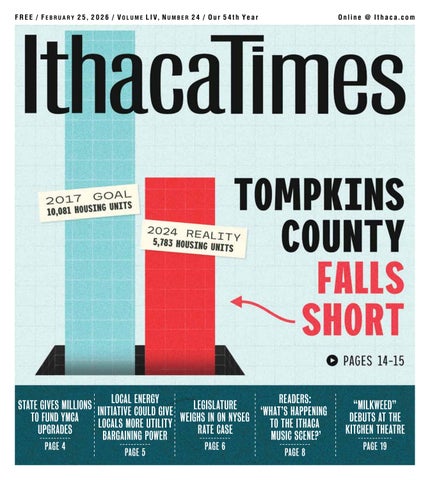
New Report Shows Tompkins County is Behind on Housing Production Goals

2024 Housing Snapshot shows Tompkins County housing production reached roughly half of 2017 goals

The Tompkins County Department of Planning and Sustainability released its 2024 Housing Snapshot, revealing the county fell short of its housing production goals.

Tompkins County achieved 57% of production targets in its 2017 housing strategy, a multi-year plan to address the region’s housing crisis.From 2017 through 2024, developers in Tompkins County constructed 5,783 housing units and beds out of a 10,081-unit target for 2025.

Tompkins County aimed for 3,800 new ownership units and 2,000 affordable rentals by 2025, the report says. The county completed 666 ownership units — 646 new single-family homes and 20 condomini-

ums — and 755 income-restricted rentals. Developers completed 68 subsidized senior apartment units of a 100-200 target. There is no progress on a Medicaid Assisted Living Program facility in the 2017 strategy.

While the county exceeded its goal of 100 permanent supportive housing (PSH) beds, creating 189, it established only four singleroom occupancy (SRO) units of a 100-unit target.

Between 2016 and 2024, developers created 3,988 units for student housing, satisfying its goal of 3,981 to address a 2016 deficit and increased college enrollment.

The county built 5,683 new units, the report says — a 13.6% growth outpacing state and national rates during the same period. American Community Survey estimates

from 2023 report that housing stock in Tompkins County rose to 47,362 units, up from 41,679 in 2013. County officials, however, noted in the report that production failed to reach targets required for a “healthy housing balance.”

The report says nearly 36% of housing in Tompkins County was built before 1960, including over 11,000 units constructed before 1940. The report says such units likely require significant upgrades to meet modern safety and energy standards.

According to 2024 assessment data, over 1,500 residential properties are in “poor” or "fair" condition, showing signs of excessive deterioration and requiring extensive rehabilitation to remain viable and meet health regulations.

Tompkins County’s population was nearly static between 2018 and 2023, decreasing from $103,065 by 0.1%, to an estimated 102,962.

Between 2018 and 2023, the number of households increased 9% to about 43,269. The report says this is driven by a trend toward smaller, one- and two-person living arrangements. This shift has created a “critical mismatch” between the county’s existing housing stock and residents’ needs, particularly as individuals 65 and older remain the only age group seeing major growth. The county’s median age, 32.8, is nearly seven years younger than the state average, officials say the rise in both seniors and small households fueled a shortage of studio and one-bedroom apartments.

AFFORDABILITY

The report says housing is considered affordable when residents spend no more than 30% of their gross income on rent or mortgage payments and utilities. Those who exceed this limit are labeled “cost-burdened,” while those spending more than half of their income are “severely cost-burdened.” Even residents who move to rural areas for cheaper housing, may find added commuting costs negate long-term savings on housing.

The report shows a divide between county homeowners and renters. While the percentage of cost-burdened homeowners decreased between 2013 and 2023, over half of the county's renters remain cost-burdened. Among renters, 35% are considered severely cost-burdened, as median rental costs increased faster than median incomes.

The report also identifies racial disparities in the local market. Residents identifying as "white alone" are represented in owner-occupied households at a rate significantly higher than other groups when compared to their overall share of the county population.

Current homeowners often face lower financial pressure than potential buyers because many purchased properties when prices and interest rates were lower. Despite this, 7.4% of homeowners with mortgages and 3.6% of those without mortgages are considered severely cost-burdened.

The report says individuals experiencing homelessness increased in Tompkins County from 2020 to 2024. During that period, the number of residents accessing emergency housing services for at least one night rose from 612 to 711. In the report, county officials noted the lack of units for “very low-income residents” and limited permanent supportive housing options make the transition back to stable shelter difficult.

NEXT STEPS

support and funding for affordable and permanent supportive housing. The report says the county must look beyond traditional development and implement policies that incentivize builders while creating new financial structures to bridge the gap between high construction costs and affordable rents.

OFFICIALS WEIGH IN

Tompkins County Legislature Chairperson Shawna Black noted that while the county lacks direct authority over local zoning, municipal efforts like Ithaca’s regulations on short-term rentals have converted units back into long-term housing. Despite these gains, Black said inflation has neutralized progress toward lowering costs, leaving local single-family home prices 40% higher than in neighboring counties. Black said the legislature is pivoting toward property tax relief, including existing exemptions for veterans and first-responders and a pending resolution to increase deductions for income-eligible seniors.

Regarding economic strategies, Black said academic institutions kept the local economy steady for years until recent economic downturns.

of for-sale manufactured homes that typically require less financial assistance than traditional construction.

Borgella said officials are researching successful models from other regions to implement locally. She said the housing market functions as an interconnected system where any new development helps the broader crisis. Even if dedicated affordable units are not built, adding market-rate housing increases the total supply and reduces competition for existing homes. She said this could slow rising costs or lower prices by creating a market surplus. Regarding the 57% overall housing goal met, Borgella said that figure does not include market rate non-student housing.

“The market’s significant increase in vacancy has been driven by dramatic increases in multifamily housing units that we didn’t set a target for, but that financially works in our market,” Borgella said.

City of Ithaca’s streamlined plans for accessory dwelling units and home rehabilitation programs for low-income owners. The 2026 budget maintains a $20,000 allocation for these rehabilitations, following a 2025 cycle in which the county increased funding midyear to cover every applicant.

Officials say the rise in both seniors and small households has fueled a shortage of studio and one-bedroom apartments.

“We have to focus our efforts on diversifying our economy. In order to do that we have to work with small businesses and make Tompkins County an attractive and competitive site,” Black said. “We need to continue to focus on creating more housing. When we talk about housing, we also must talk about better services for young families too, including childcare, public transportation, medical services, and safe communities.”

Black wants to use the county's focus on the environment to attract new people. She said new residents move from places like New York City and the West Coast because they value the area's clean air, water and commitment to the climate.

The report says the department plans to launch a new 10-year housing strategy in 2026 to guide development through 2035. To prevent the local housing crisis from worsening, the report recommends future policies, including subsidies and creative partnerships to build units the private market cannot produce alone. While the 2017 Housing Strategy guided investments through 2025, planners report that soaring construction costs now require a more robust approach to protect the community’s most vulnerable residents.

The upcoming 10-year strategy is expected to prioritize securing greater community

“We need to continue to focus on creating more housing,” Black said. “When we talk about housing, we also must talk about better services for young families too, including childcare, public transportation, medical services, and safe communities.” County Planning Commissioner Katherine Borgella said student housing flourished due to Cornell University's investments and city of Ithaca zoning reforms, such as removing parking requirements. However, senior and workforce developments often cost twice as much as people can afford. The county also relies on limited pools of government subsidies. Borgella said the county is exploring proactive measures, such as encouraging development

While the percentage of cost-burdened homeowners decreased over the past decade, over half of the county's renters remain cost-burdened.

Borgella said market-rate construction costs far outpace what workforce households and low-income seniors can afford. She identified three paths forward: drastically reducing construction costs, providing development subsidies, or increasing the overall housing supply to alleviate a decades-long demand inflating prices for older units. Significant barriers still remain, she said, including high labor and material costs, lengthy review processes, and a lack of land with water and sewer access. Borgella mentioned restrictive zoning—such as excessive parking requirements and limits on missingmiddle housing, such as duplexes and townhouses—as an obstacle to county targets.

Legislator Greg Mezey, chair of the Housing and Economic Development Committee, said the county’s strategy is shifting toward municipal support and targeted financial aid. While single-family home prices in the area sit 75% higher than in neighboring counties, Mezey noted this figure applies to existing homes driven by high demand rather than the cost of new builds.

“Tompkins County and our surrounding counties see very little new single-family home construction, and most new construction we do see is custom homes, not homes built to sell, because the market rate for existing homes is so far below the cost of new construction,” Mezey said.

Tompkins County will incentivize growth through technical assistance and grants to municipalities with zoning, Mezey said. Programs like the Housing Affordability and Supportive Infrastructure Grant (HASIG) funded efforts such as the

To ensure long-term affordability for workforce housing, the county relies on the Community Development Housing Fund, a collaborative pool supported by local governments, Cornell University, and the Tompkins County Industrial Development Agency. This fund provides annual grants for both rental and forsale developments. For-sale homes receiving this support are required to be part of a Community Housing Trust, a mechanism that locks in permanent affordability and prevents these units from being priced out of reach for single-income earners in the future.

For the 2026–2035 housing strategy, Borgella said officials will set and track targets for all types of housing, including marketrate units, and provide the marketability data to secure financing for developers. She said the planning department aims to diversify local development and provide a plan for increasing county housing production by offering clearer guidance to municipalities and financial institutions.

Mezey said the county is adopting a dual-track strategy to bridge the widening gap between stagnant wages and rising housing costs. He said officials seek to invest in workforce and economic development to boost median incomes for essential workers. Officials plan to lower barriers to construction and development to achieve healthier vacancy rates and reduce overall costs for residents.

Acknowledging a 16.1% surge in local individuals experiencing homelessness since 2020, Black said upcoming budget discussions must pivot from temporary shelters toward comprehensive supportive housing. Mezey said the county is accelerating production of permanent supportive housing and low-barrier shelter beds.

Mezey said local projects are already in the final stages of development. The Stately will soon provide 20 supportive units within a 57-apartment complex. The Meadow on Seneca project is planned to include 35 supportive units out of 70 total apartments, bolstered by state funding and a $100,000 grant from the Community Development Housing Fund. The county is also moving forward with its plan for a permanent homeless shelter on Cherry Street to meet growing demands for beds.

INNOVATIONS IN SCIENCE

HIGHLIGHTING RESEARCH & DEVELOPMENTS IN SCIENTIFIC FIELDS, TECHNOLOGY & SOCIAL SCIENCES

A NEW SERIES FROM THE ITHACA TIMES

Exploring the Impacts and Advances in Scientific Disciplines

INan era when the boundaries of human knowledge are expanding at an unprecedented pace, the Ithaca Times is proud to launch Innovations in Science, a new series dedicated not merely to reporting discoveries, but to exploring the revolutionary ways scientists are reimagining how knowledge itself is built. From the intricate dance of subatomic particles to the complex webs of human societies, we will delve into the natural, social, formal, and applied sciences—illuminating not just breakthroughs, but the paradigm shifts that propel them forward.

Local news is often assumed to concern city council debates, school board votes, and the rhythms of community festivals. Those stories matter. But local journalism is also about the people in our midst who are transforming the world beyond our borders—the researchers, students, entrepreneurs, and neighbors whose ideas ripple outward from Ithaca into global conversations. To cover science locally is not to narrow our focus; it is to recognize that world-changing innovation frequently begins in places exactly like this one.

As we move deeper into 2026, artificial intelligence is reshaping research methodologies, while climate imperatives demand adaptive strategies grounded in evidence rather than ideology. Innovation today is not simply about inventing faster chips or publishing more papers. It is about challenging entrenched assumptions and forging new intellectual pathways. It is about reframing the questions.

Here in Ithaca, that spirit is tangible. Anchored by institutions such as Cornell University and Ithaca College, our community thrives at the intersection of disciplines. Laboratories, startups, classrooms, farms, and civic forums all participate in a shared experiment: How might we think differently about the world we inhabit? The answers developed here do not stay here. They influence policy debates, technological design, and scientific theory across continents.

RETHINKING NATURE: FROM REDUCTIONISM TO INTEGRATION

In the natural sciences, traditional reductionist approaches—breaking systems down into their smallest parts—are giving way to integrative frameworks that treat complexity as fundamental rather than inconvenient. Climate science, for example, now fuses atmospheric chemistry, ecology, computational modeling, and economics into a unified analytical lens. Perhaps more striking is the emergence of quantum biology. Once dismissed as speculative, this field investigates how quantum phenomena such as superposition and entanglement may influence biological processes. Researchers are

examining whether migratory birds navigate using quantum effects in their eyes and whether photosynthesis achieves extraordinary efficiency through quantum coherence. Such work blends physics and biology in ways that challenge deterministic models of life, suggesting that nature may operate on probabilistic, wave-like principles at scales once thought purely classical.

This is not incremental refinement. It is conceptual reorientation. If neural signaling or enzyme behavior incorporates quantum tunneling, the implications for medicine could be profound, potentially reshaping how we approach neurodegenerative diseases or metabolic disorders. Innovation here lies less in a single device than in a willingness to cross boundaries once considered fixed.

REIMAGINING SOCIETY THROUGH DATA AND EMPATHY

The social sciences are undergoing their own renaissance. Behavioral economics—advanced by scholars such as Daniel Kahneman—overturned the tidy assumption that humans are purely rational actors. Today, with AI systems parsing vast datasets, researchers are mapping emotional contagion across social networks, analyzing how information cascades amplify outrage, solidarity, or misinformation.

This new thinking integrates psychology, network theory, and computational modeling. Societies are increasingly understood not as rigid hierarchies, but as dynamic, self-organizing systems. Agent-based simulations allow

Earth and Sky Science: The Birth of Stars and Planets. (Photo: James Webb Space Telescope)

economists to test how small policy changes ripple through housing markets or labor systems. Locally, participatory modeling initiatives are being used to explore equitable approaches to urban planning and community development, blending social science insight with civic engagement.

Innovation in the social sciences is not cold quantification. It is data-driven empathy: using evidence to design systems that better reflect how humans actually think, decide, and cooperate. And in Ithaca, that means translating abstract models into lived impact—informing how neighborhoods are designed, how resources are distributed, and how communities adapt to change.

THE FORMAL FOUNDATIONS: LOGIC IN THE AGE OF ALGORITHMS

Beneath these transformations lie the formal sciences—mathematics, logic, statistics, and theoretical computer science. Their innovations are quieter, yet foundational. Machine learning systems now assist in generating mathematical proofs and identifying patterns that might elude human intuition. The rise of explainable AI reflects a renewed philosophical concern: not just whether an algorithm works, but whether its reasoning can be understood and justified. Abstract fields such as category theory are finding unexpected applications, offering unifying frameworks that connect quantum computing, database design, and even linguistics. Error-correcting codes designed for quantum computers could secure future digital infrastructures. Meanwhile, blockchain-based verification systems are being explored as tools to increase transparency in scientific peer review, blending computational rigor with institutional reform.

Such developments reveal an important truth: innovation in science often begins in abstraction. The equations scribbled on a chalkboard today may underpin tomorrow’s medical diagnostic or energy grid—and those chalkboards may well sit inside classrooms and labs just a few blocks from where this paper is printed.

APPLIED SCIENCES: WHERE IDEAS MEET CONSTRAINT

If the natural sciences reveal patterns and the social sciences interrogate systems, the applied sciences ask a practical question: What do we build next?

Materials science is shifting toward biomimicry and self-assembling systems, drawing inspiration from cellular organization rather than industrial brute force. Engineers are developing adaptive materials that can heal cracks or alter properties in response to environmental stress. In biomedical research, gene-editing technologies such as CRISPR are evolving toward subtler forms of epigenetic reprogramming, adjusting gene expression without permanently altering DNA sequences.

These advances, however, cannot be separated from ethics. Who benefits from these therapies? How are clinical trials designed? Increasingly, AI-driven drug discovery platforms incorporate fairness constraints to mitigate bias in datasets that have historically excluded marginalized populations.

(Photo: www.socialsciencespace.com )

Innovation, in other words, is not merely technical. It is moral and civic. And local reporting must examine not only what is being built, but who it serves—and how the people building it here in Ithaca are shaping global standards of responsibility.

A SERIES COMMITTED TO CRITICAL CURIOSITY

Innovations in Science will not treat progress as inevitable or uncomplicated. Interdisciplinary breakthroughs bring interdisciplinary dilemmas. Who owns patents derived from quantum biological insights? How do we prevent predictive social models from enabling surveillance rather than empowerment? How should we weigh probabilistic risks in emerging technologies whose long-term effects remain uncertain?

Our series will draw on the rigor of the formal sciences, the contextual awareness of the social sciences, the empirical grounding of the natural sciences, and the pragmatism of the applied sciences to examine such questions in depth. We will profile local trailblazers—from ecologists experimenting with drone-assisted forest regeneration to economists modeling

post-carbon economies—and connect their work to global shifts in thinking.

Because local news is not small news. It is proximate news. It is the story of how people in our community are testing ideas that may redefine medicine, climate resilience, artificial intelligence, and democratic governance. It is about the graduate student refining a new algorithm, the engineer prototyping sustainable materials, the social scientist designing a more equitable policy—and how their work reverberates far beyond Cayuga Lake.

In a world saturated with information yet vulnerable to misinformation, local journalism has a vital role to play. By bridging esoteric labs and everyday readers, we aim to cultivate a culture that values evidence, complexity, and intellectual humility.

Science is not a static body of facts. It is a living, evolving pursuit shaped by audacious ideas and disciplined skepticism. With Innovations in Science, the Ithaca Times invites you to reconsider what science is—and what it might become. Join us as we explore the new architectures of thought reshaping our world—beginning right here at home.

Arts & Entertainment

Faces of Modern Science (Photo: UNESCO.org L'Oréal-UNESCO For Women in Science )

Tigran Hamasyan’s Genre Defying Music Comes to Bailey Hall

Cornell’s Dallas Morse Coors Concert Series continues to populate the Bailey Hall stage with musicians whose music defies categorization. When pianist Tigran Hamasyan arrives on February 27, he will eliminate any chance of pigeon-holing his work into a single specific genre. It’s that complex. He integrates such disparate elements as ancient Armenian folk and sacred melodies and quartal harmonies with western classical musical phrases and chord structures. He mingles frenetic bebop and free jazz melodies with modern modal harmonies all shaped by progressive rock forms and laden with heavy metal/thrash interjections.

Born in Armenia, he became fascinated with Armenian folk and sacred music, a 3000 year old music tradition with its own system of melody-making using scales, harmonies, and rhythms that rival the lyricism and colors of western European and South Asian musical systems.

As a pianist growing up in Armenia, he studied Western classical music and jazz before moving to the US at the age of 16. He continued his jazz and improvisational studies while becoming enamored of the progressive rock and thrash metal

Tigran Hamasyan: Manifeste

February 27, 2026

7:30 PM

Bailey Hall Cornell University

Ithaca, NY

NATION SPEAKS

continued from page 10

Tickets: https://www.cornellconcertseries.com/ before the vote, I was called off the floor because my daughter had gotten into an accident, and so I rushed off to Ithaca to see how she was. And in leaving the floor,

genres. Before returning to Armenia to live, he won the Montreux Jazz Piano Competition as well as the Thelonious Monk International Jazz Piano Competition, both of which earned him the respect of the jazz world.

Unpredictability undergirds much of Hamasyan’s music. His music is full of surprises that bubble up from an inner spiritual and intellectual wellspring. Transitions between phrases are often abrupt, a defining characteristic found in the progressive rock music of bands such as King Crimson and Emerson, Lake, and Palmer. His sudden metric changeups and modulations are sourced from Armenian folk music’s predilection for mixed meters but with a nod towards the rhythmic juxtapositions of Frank Zappa and Igor Stravinsky. Think about it as assembling blocks of sounds one after, or on top, of another.

The rhythms in Armenian folk music are rooted in duple or triple, but unusual mixed meters (2+2+3 for example) are plentiful and the driving force behind much of Hamasyan’s music. He also displaces accents in such a way that you can hear the downbeat when it comes around, but you can’t exactly predict when it’s going to happen, very Pat Metheny-like.

Whistling and choral or solo vocalizations provide important countermelodies to many of his lines and add an airy, ethereal quality, like an angel hovering above the musical mashup. Perhaps it is a nod to the spirituality Hamasyan acknowledges in his music and life.

In quieter moments, Hamasyan’s solo piano playing channels Keith Jarrett’s ostinato-based improvisations, but with a Bill Evans lightness of touch. He crashes

the amendment which was a devastating amendment passed by one vote, 212 to 211, and so the next week the Speaker of the House, Carl Albert, took the floor, asked for a revote, and we captured the situation.

So she (my daughter) called me the

freely from Armenian quartal chords (Intervals of a fourth which characteristic of modal jazz as well as much of Debussy’s work) to powerful thrash rock sounding bass heavy ostinatos in mixed meters. Thrash metal moments are fast-paced synthesizer or sampled passages that are bass heavy, summoning the hard edged aggressiveness of heavy metal groups such as Metallica or King Crimson.

But make no mistake, the river running through Hamasyan’s music is the sacred sound of Armenian texts and ancient rhythms shaped by a harmony and melody making system that predates Christianity. He is hardly a musical chameleon or shape shifter.

Each of his albums are unique snapshots of his development from a classic jazz pianist to an experimentalist who defies categorization. His latest album, released just a few weeks ago, is entitled “Manifeste” and is filled with sophisticated assemblages of Western instruments, electronic and sampled sounds, choirs, and whistling, as well as an array of Armenian folk instruments.

The first cut, “Prelude For All Seekers,” sports mixed meters with shifting accents at a frenetic pace. Cascading downward arpeggios, like water over a fall, are followed by chord clusters overlayed with a flute melody repeated in the piano. An aggressive synth and bass unison line suddenly yields to a simple and gentle piano line in its more delicate upper register.

“Yerevan Sunrise” opens with lightly textured tinklings over a sinister, dark

other night and said, “If you’re going to talk about title IX, you must mention my role in it and how your commitment to me almost caused a catastrophe.” But the House of Representatives reacted and restored common sense and dignity to the debate, and so title IX lived on forever

synth cluster that provides the terra firma for most of the piece. A continuously evolving melody endlessly unravels like a ribbon floating in the wind.

The album’s title cut, “Manifeste,” is another mixed meter affair with a controlled thrashing sound to it. Thickly voiced progressive rock chords provide structural support and join with the drums at strategic moments to punctuate the structure of the work. Ostinatos propel the work forward under choral vocalization sections that periodically interpose on the sound.

Peter Rothbart is a Professor Emeritus of Music at the Ithaca College School of Music, Theatre, and Dance where he taught electroacoustic and media music for 40 years. He directs the Ageless Jazz Band and remains active as a classical, jazz, and pop musician.

with no one ever being able to challenge it ever again.

So that is the story of title IX. Next week, we will celebrate former First Lady Betty Ford and her 1975 Address to the American Cancer Association.

Pianist Tigran Hamasyan will perform at Cornell’s Bailey Hall on Friday, Feb. 27 at 7:30 p.m. (Photo: Provided)

“Milkweed” Takes Flight

Wendy Dann’s New Play Debuts at the Kitchen

“I am over the moon about this” are the first words Wendy Dann utters when we sit down to talk about her new play, Milkweed, receiving its world premiere Feb. 25 through March 15 from the Kitchen Theatre Company.

“When I think about a new play, I think about it having a really long gestation workshop period, and this all happened so fast—in a good way,” she continues.

In January 2025, Wendy was visiting her mother in Florida.

“I’m out on her lanai, as they call it,” Dann said. “She sleeps until … 9 a.m. or something. So I would tiptoe across the living room out to the lanai at 6:30 in the morning and write. And this fell out of me in like two weeks… It doesn’t usually happen like that for me. Like, I’m writing a new play now and it’s a real slog. I always think about that Edward Albee quote. Somebody asked him if he was working on a new play, and his response was, ‘I think there’s one working on me.’”

Earlier I had interviewed the play’s director, Emily Jackson, Producing Artistic Director at the Kitchen: “Wendy and I were having coffee a couple of times last year, and we were trying to figure out if she might direct…but she said, I have a couple of plays I’ll send you.”

Wendy’s version: “I did a one weekend workshop of the play last April…I sent it to Emily. And I said, I think it needs work. But maybe you can help me. And she said we should speak face to face. This was back in June or July.… She had already announced the season. And so I knew that the phone call was either a no or we will offer you a workshop…. She got on the Zoom call and said, ‘I’m removing a title from the season and putting this in.’ I was like, ‘What are you talking about? I’m only 4 or 5 months into this!’ I don’t think I’ve ever had anything happen that quickly in my artistic life.”

The Kitchen describes the play as “an intimate, surprising piece that delves into the charged space between students and teachers, at the intersection of physics and theater, where knowledge and desire blur.”

Wendy had been juggling two thoughts for a while—“what it means to be a teacher, what it means to be a student, and how that dialogue happens kind of in the middle, right? It’s not like knowledge lives over here and it’s transferred over here.”

Part of a family of ‘science nerds,’ in college she chose theatre over her other interest, astrophysics. Now she was contemplating the path not taken.

“Then one day, my friend Molly texted me… ‘Did you know that the monarch butterflies takes four generations to migrate northward?’” she said.

The flight south takes just one butterfly. But returning “the first generation leaves Mexico, and they can only make it to, like, Texas-ish, and they look for milkweed, where they land and they have their young and they die. And when the young butterfly is old enough to travel, it continues the migration. So the butterflies we see here in the northeast are the great grandchildren of the monarchs that left Mexico.”

So the play in part asks, what do we pass on. Emily quotes a scientist from a documentary who is “on the brink of discovering another layer of what dark energy means. And he says this is only possible because of generations of learning and passing on the knowledge, because one scientist can’t finish the work. That’s just mind boggling.”

Generations returning to home. Teachers, mentors, students. Everything about the Kitchen Theatre Company’s new production is itself a sort of homecoming.

Scenic designer David L. Arsenault launched his professional career at the Kitchen, when Rachel Lampert hired

“Milkweed”

him out of Ithaca College’s BFA program, where Wendy had been one of his teachers. “I was the very first person to put paint on this floor that now has 16 seasons of paint,” he says. David told Rachel she should check out another IC BFA, Tyler M. Perry, who also cut his teeth at the Kitchen. He is designing Mu lights and projections. Wendy herself had started as an actor at the Kitchen, when Rachel tossed her into directing a new play. That opened a path away from acting to directing and teaching. Emily was mentored by Rachel as an intern (and coincidentally met Tyler—now her husband and collaborator—on a Kitchen show.)

“We stacked the deck with this show,” says Tyler. “We’re really excited about doing a world premiere again. It’s been a while since we’ve had this kind of really brand new play where the playwright’s in the room and a playwright who trained us and who we were really fond of… So we tried to put all of our best people on it, but also, our friends because we wanted it to be fun. So, it is really exciting to see generations of Ithaca College people involved in the show.” (Of the four actors, three studied at IC.)

There’s a definite buzz in the air at the Kitchen as they ready themselves for tech rehearsals. Given the nature of the play, a lot of it won’t be realized until the designers finish their magic. The show also features the design work of Ariana Cardoza on sound and Stefanie Genda on costumes.

Wendy Dann’s new play “Milkweed” makes its world premiere at the Kitchen Theatre Company. (Photo: Rachel Phillipson/Kitchen Theatre)
Cast and creative team members rehearse for the world premiere of “Milkweed” at the Kitchen Theatre Company. (Photo: Rachel Phillipson/Kitchen Theatre)

“Pillion”: Provocative, Polarizing, and Bittersweet

EDITOR’S NOTE: This piece contains discussion of explicit sexual content featured in the movie “Pillion.”

Motorcycle movies used to be all the rage. Back when men used to ride in biker gangs, where they drank excessively and wore leather proudly with other men, American and British filmmakers would make movies about how gay they were. It was a delicate balance. It’s been a long time since the biker movie craze of the 1960s — when directors like Kenneth Anger and Sidney J. Furie captured the latent homoeroticism of the bad-boy motorcyclist subculture — but the new British film “Pillion” proudly and queerly carries the torch into the 21st century of biker cinema.

A British-Irish coproduction set in the suburbs of London, “Pillion” is the directorial debut of Harry Lighton, starring Harry Melling (Dudley Dursley from the “Harry Potter” films) as Colin, a meek and repressed parking attendant who sings in bars in a barbershop quartet. Alexander Skarsgård co-stars as the sexy leatherclad Viking, Ray, who arrives to sweep him off his feet. But this isn’t a fairy tale or a Hallmark movie — Ray and Colin’s relationship is a sub-dom dynamic, and an extreme one at that. Ray makes Colin cook his meals and do the housework, and Colin isn’t allowed to sleep on the bed —

“Pillion”

Rated R

Directed by Harry Lighton

Playing at Cinemapolis starting Feb. 27

120 East Green St., Ithaca

“MILKWEED” TAKES FLIGHT

continued from page 19

Frequent collaborators, David and Tyler describe their process as one brain plus one brain equals eight brains.

When Emily sent him the play, David knew he had to design it. “It’s a new play in the relatively recent realm of multiverse plays. But I feel like it…treats the multiverse differently than some of the others, like Constella-

instead, he sleeps on the floor, like a dog. They also have intense sex regularly. On Colin and Ray’s first “date,” Ray takes Colin into a dark alley and tells him to get on the wet ground and lick his boots. They do many other things that are difficult to discuss in a local newspaper (albeit an alt-weekly). Colin, it must be said, enjoys this lifestyle, though his parents (Douglas Hodge and Lesley Sharp) aren’t so sure that Ray’s the best partner for their little angel. If this sounds like it might teeter on the edge of being an abusive relationship, that’s partially the point. “Pillion” is many things — provocative, funny, and, ultimately, surprisingly bittersweet — but “easily palatable” is not one of them. For people who don’t really know much about BDSM subcultures or sub-dom relationships in general, “Pillion” is likely to be as world-shattering as if you showed “Transformers” to a Victorian child.

Many critics now have lauded the film’s supposed great humor and romance, but these qualities are difficult to find if you recognize Ray’s straightforwardly abusive behavior for what it is. Typical sub-dom relationships are built on consent and mutual trust — not so with Ray and Colin, though. Colin’s new lifestyle brings him a sense of community and a mega-hot boyfriend, but he becomes increasingly irritated with his own lack of agency as the film progresses. As “Pillion” is a character study first and foremost, it never substantively engages with these questions of consent. One gets the sense that the film effectively, under the pretense of openminded depiction, yokes abusive behavior to a subculture that remains woefully misunderstood compared to traditional heteronormative relationships.

For all its questions of consent and depictions of sex — it’s easily got the most

tions and Heisenberg, both of which I have worked on…including the original Broadway production of Constellations. I really liked what Wendy was saying, and I felt like she was taking a major risk exploring certain elements in this play that I thought were exciting, and it feels so specifically Ithaca.”

“The characters are talking about these big ideas, but they have these basic human desires for connection and intimacy… while at the same time, you know, they’re talking about like, well, does time curve back on itself?”

sex scenes I’ve ever seen in a theatrical film — “Pillion” is also surprisingly subdued. Many scenes quietly focus on Melling and Skarsgård’s performances, with little fancy camerawork, dramatic music or ambitious set design to get in the way.

Melling and Skarsgård deliver such virtuosic, lived-in, real, aching performances that you can simultaneously read them like books and remain utterly fascinated by them. Melling excels at playing a timid person desperate for something beyond intimacy. He feels like the personification of quintessential British sexual conservatism, which makes it ironic to see him dive head-first into a carnal and unpredictable relationship.

Skarsgård has never been better, either — beneath his steely, terse demeanor, he teases a philosophical and perhaps tragic depth to Ray that we’re never allowed

“We still don’t know what it is in three dimensions,” David continues, “where I think when you’re doing something more traditional,…you sort of have a good sense.… We wanted to create an environment that allows us to perpetually explore [time and space]. I feel like it’s one more production in my long line of how do you create a black void in a very small space? So we put some tricks in that I’m hoping will help, you know, make the intimate, bold engaging Kitchen Theater feel expansive when it needs to.”

to explore further. Skarsgård has spent his whole career with his top off, from “True Blood” to “The Legend of Tarzan” and “The Northman,” but no project has weaponized his sexuality quite like “Pillion.” That Hollywood handsomeness and hypermasculinity is part of the reason his character is able to get away with the things he does to Colin.

If you want to follow Colin down the dark alley and see whether he and his Adonis biker can go the distance, I hope that you too find “Pillion” to be a delightful, well-written, complex and beautifully acted surprise. Gay biker cinema is back, baby! Definitely a weird one to watch with your kids or parents, though, so I don’t recommend that.

Times.

Tyler adds on, “There’s magic in the show. There’s like, it’s theater magic, it’s real magic, it’s abstract magic. I’m excited about taking those moments and making them really sing.”

One element remains: the audience. After all, it’s a new play. It’s being rewritten throughout the three weeks of rehearsal. But the Kitchen’s audience will help the playwright learn what she hopes will be the final rewrite as she sends it out to the universe.

Clement Obropta is a film columnist for the Ithaca
Ray (Alexander Skarsgård) approaches Colin (Harry Melling) at a bar. (Photo: IMDb/A24)

2/27 Friday

Live Music — Sometimes String Band | 6 p.m. | Hopshire Farm and Brewery, 1771 Dryden Rd., Freeville, NY

The Small Kings | 6:00 p.m. | Stonbend Farm, Newfield, NY | $5.00

Bluegrass Alley and Penny Royal | 7 p.m. | The Gallery at South Hill, 950 Danby Rd. South Hill Business Campus | Free Concerts/Recitals

2/25 Wednesday

Midday Music for Organ: Andrew Johnson and Yuhe Su (CU Music) | 12:30 p.m. | St. Luke Lutheran Church, 109 Oak St. | Free

2/26 Thursday

Solas | 8 p.m. | Center for the Arts of Homer, 72 S Main St., Homer NY

2/27 Friday

Tigran Hamasyan: Manifeste | 7:30 p.m. | Bailey Hall, 230 Garden Ave. | $17.00 - $39.00

Lunasa with Special Guests Daoiri Farrell and Cathal Hayden | 8 p.m. | Hangar Theatre, 801 Taughannock Blvd. | $30.00 - $35.00

The Boys in the Band | Cidermill Playhouse, 2 South Nanticoke Ave. | $33.00

2/28 Saturday

Cornell Chorus’ Empowerment Through Music (CU Music) | 3 p.m. | Barnes Hall, 129 Ho Plaza | Free

Jonatha Brooke | 8 p.m., 2/28

Saturday | Hangar Theatre, 801 Taughannock Blvd.

Experimental Sound Series at Cornell: Rhodri Davies (CU Music) | 7:30 p.m. | Anabel Taylor Chapel, 548 College Ave. | Free

The Machine Performs Pink Floyd | 8 p.m. | State Theatre of Ithaca, 107 W State St.

Jonatha Brooke | 8 p.m. | Hangar Theatre, 801 Taughannock Blvd.

Sonny Landreth Band & The Iguanas | 8 p.m. | Center for the Arts of Homer, 72 S Main St., Homer NY

3/1 Sunday

Junior Recital: Thomas Papke, trumpet | 1 p.m. | Hockett Family Recital Hall, Ithaca College

Cornell Chamber Orchestra Concert (CU Music) | 3 p.m. | Barnes Hall, 129 Ho Plaza | Free

The Circle of Friendship (a Concert for the Community) | 4 p.m. | St. Paul’s United Methodist Church, 402 N Aurora St. | Free

3/3 Tuesday

Benjamin Kjell, organ (CU Music) | 7:30 p.m. | St. Luke Lutheran Church, 109 Oak Ave. | Free

Stage

The Epic of Gilgamesh | 7:30 p.m., 2/27 Friday | The Cherry Artspace, 102 Cherry Street | The Babylonian Epic of Gilgamesh performed by Jay Leeming, with music by the Calliope Chorus. | Free Comedy Club | 8 p.m., 3/2 Monday | Mandeville Hall, Clemens Center, 207 Clemens Center Parkway, Elmira NY | See three great stand-up comedians perform live on stage at the Clemens Center, with host Danny Liberto. | $40.00 - $60.00

Art

Stitch Club | 1 p.m., 2/27 Friday | Tompkins County Public Library, 101 E Green St. | Stitch Club is an opportunity for knitters, crocheters, needle-pointers, and other stitchers to come together and work.

Figure Drawing Friday at CSMA | 6 p.m., 2/27 Friday | Ithaca Community School of Music and Arts, 330 E State St. | Drop in for a figure drawing session at CSMA, generally held on the 2nd and 4th Friday evenings of each month!

Photography Group Exhibit, Photo Equipment & seconds/art

supply sale | 11 a.m., 2/28 Saturday | The Gallery at South Hill, 950 Danby Rd. South Hill Business Campus | The Gallery at South Hill Photography Group Exhibit and Photo Equipment sale & seconds/art supplies open studios. | Free

Mindful Collage | 11:30 a.m., 3/1 Sunday | SewGreen, 112 W Green St. | Join a relaxing, all-levels workshop on Mindful Collage where you’ll use provided materials and personal memorabilia to explore artistic expression through mindfulness. | $25.00

Film

Professional Directions: 95 and 6 To Go with Filmmaker Kimi Takesue | 5 p.m., 2/25 Wednesday | Film Forum, Schwartz Center for the Performing Arts, 430 College Ave. | After the screening of 95 and 6 To Go, filmaker Kimi Takesue will participate in a talkback. The event will be moderated by PMA Associate Professor Jeffrey Palmer and Associate Professor Kelly Gallagher, Film and Media, Syracuse University, and is free and open to the public. | Free

Lights, Camera, Action | Oscar Buzz with the Chamber | 5 p.m., 2/26 Thursday | Watkins Glen International, 2790 Co Rte 16, Watkins Glen NY | Description This event takes place at the Glen Theater and is a private viewing of the Oscar-nominated animated and live-action short films. | $10.00

Teen Film Fridays | 4 p.m., 2/27 Friday | Tompkins County Public Library, 101 E Green St. | Join us in the Digital Lab on the last Friday of every month and enjoy a free movie screening! For teen patrons ages 13-18 only. Snacks will be provided.

3rd Annual Ithaca Experimental Film Festival | 6 p.m., 2/27 Friday & 2/28 Saturday | Cornell Cinema & cinemopolis, 104 Willard Straight Hall | The Ithaca Experimental Film Festival returns for its third year with three short film blocks at Cinemapolis and Cornell Cinema. | $5.00 - $10.00

Family Movies at TCPL: Gnomeo & Juliet | 2 p.m., 2/28 Saturday | Tompkins County Public Library, 101 E Green St. | Join us for an afternoon movie on our “Big Screen” in the Thaler/Howell Programming Room.

This Saturday we will be screening the animated family film Gnomeo & Juliet.

Cinemopolis

Cinemapolis Student Film

Showcase Screening | One showing 2/25 at 8 p.m. | Join us for the special screening of three short films from Daniil Lazuka & Logan Perzi, filmed entirely in Ithaca, NY! Two young drifters escape small-town life in a roadside motel. Movie theater employee meets an enigmatic girl from Russia. An aspiring triangle player is invited to an orchestra’s private afterparty. NR 90 mins

EPiC: Elvis Presley in Concert | While making his 2022 film ELVIS, visionary filmmaker Baz Luhrmann discovered sixty-eight boxes of previously-unseen 35mm and 8mm footage in the Warner Bros. film archives. In this new film, described by Luhrmann as neither fully a concert film nor a documentary, but 'something new in the Elvis canon,’ Elvis sings and tells his story like never

before in a new cinematic experience. | PG-13 90 mins

Pillion | A timid man is swept off his feet when an enigmatic, impossibly handsome biker takes him on as his submissive. | NR 107 mins

The Ithaca Experimental Film Festival | The Ithaca Experimental Film Festival’s mission is to provide a platform for filmmakers to screen their work and discuss it among a community of DIY independent filmmakers. | Check website for showtimes and runtimes

All That’s Left of You | One showing 3/1 at 2:30 p.m. | A deeply moving, multigenerational drama following a Palestinian teenager who gets swept into a protest in the Occupied West Bank and experiences a moment of violence that rocks his family. The film unfolds as his mother recounts the political and emotional threads that led to that fateful moment. Spanning seven decades, the film traces the hopes and heartaches of one uprooted family, bearing witness to the scars of dispossession and the enduring legacy of survival. | NR 146 mins

Breathless | One showing, March 4 at 6 p.m. | A small-time thief steals a car and impulsively murders a motorcycle policeman. Wanted by the authorities, he attempts to persuade a girl to run away to Italy with him. | NR 90 mins

Sports

Ithaca Men’s Wrestling in NCAA Regionals (Day 1) | 11 a.m. 2/27 Friday | A & E Center, Ithaca College

Cornell Women’s Ice Hockey in ECAC Hockey Quarterfinals | 3p.m. 2/27 Friday | Lyah Rink, Cornell University

Men’s Basketball vs Yale University | 6 p.m. 2/27 Friday | Newman Arena, Cornell University

3RD ANNUAL ITHACA EXPERIMENTAL FILM FESTIVAL

BLOCK 1: FRIDAY, FEB. 27 FROM 6–8 P.M.

BLOCK 2 & 3: SATURDAY, FEB. 28 AT 2 AND 6 P.M.

Cornell Cinema (Friday) and Cinemapolis (Saturday) | Join us for the 3rd Annual Ithaca Experimental Film Festival (ITHEX). ITHEX provides a platform for bold, unconventional films. From documentaries and animation to non-traditional narratives, we showcase work that pushes creative boundaries. Our mission is to create a space where filmmakers can screen their films, share ideas, and connect with a community that values diversity, experimentation, and DIY filmmaking. (Photo: Provided) THE EPIC OF GILGAMESH: STORYTELLING BY JAY LEEMING WITH MUSIC BY CALLIOPE CHORUS FRIDAY, FEB. 27 FROM 7:30–9 P.M. The Cherry Artspace, 102 Cherry Street | What happens when all-powerful king Gilgamesh is challenged by a hair-covered beast-man sent to earth by the gods? Environmental devastation, fighting in the streets and a journey to the underworld all follow—of course! Come hearken to this 4,000-year-old myth that’s as fresh as today’s headlines, in which humans wrestle with natural disaster, death and the gods through the rambunctious power of live storytelling. (Photo: Provided)

Men's Ice Hockey vs St. Lawrence

University | 7 p.m. 2/27 Friday |

Lynah Rink, Cornell University

Ithaca Men’s Wrestling in NCAA Regionals (Day 2) | 10 a.m. 2/28

Saturday | A & E Center, Ithaca College

Men’s Lacrosse vs University of Richmond | 12 p.m. 2/28 Saturday | Schoelkopf Field, Cornell University

Women’s Lacrosse vs Penn State University | 3 p.m. 2/28 Saturday | Schoelkopf Field, Cornell University

Men’s Basketball vs Brown University | 6 p.m. 2/28 Saturday | Newman Arena, Cornell University

Men's Polo vs Virginia Tech | 6 p.m. 2/28 Saturday | Oxley EquestrianCenter, Cornell University

Men's Ice Hockey vs Clarkson University | 7 p.m. 2/28 Saturday | Lyah Rink, Cornell University

Women’s Tennis vs FDU | 12 p.m. 3/1 Sunday | Reis Tennis Center, Cornell University

Women’s Gymnastics vs Southern Connecticut State University | 1 p.m. 3/1 Sunday | Newman Arena, Cornell University

Cornell Women’s Ice Hockey in ECAC Hockey Quarterfinals |

3 p.m. 3/1 Sunday | Lyah Rink, Cornell University

Ithaca Men’s Lacrosse vs Nazareth University | 4 p.m. March 4 Wednesday | Higgins Stadium, Ithaca College

Special Events

19th Century Games from Genesee Country Village & Museum | 5 p.m., 2/26 Thursday | The Dundee Library, 32 Water St., Dundee NY | Step back in time and experience how people played in the 19th century during this interactive program presented

by the Genesee Country Village and Museum.

Tully’s First Annual Winterfest at ONCO! | 1 p.m., 2/28 Saturday | ONCO Fermentations, 397 NY RT 281, Suite O, Tully NY | Free Festival of Fire & Ice | 3 p.m., 2/28

Saturday | Ithaca Children’s Garden, 121 Turtle Lane | Fire performances, snow play, puppets, storytelling, and hot chocolate light up the Children’s Garden at the Festival of Fire & Ice. | Free

Books

Silent Cellar Silent Book Club | 5 p.m., 2/25 Wednesday | Atwater Vineyards, 5055 State Route 414, Burdett NY |

The Gilda Stories: A Discussion | 6 p.m., 2/25 Wednesday | Buffalo Street Books, 215 N Cayuga St. | Queer Horror x BIPOC Voices Book Club collaborate to discuss The Gilda Stories by Jewelle Gomez! | Free Uncle Jimmy’s Book Club | 5 p.m., 2/26 Thursday | Buffalo Street Books, 215 N Cayuga St. | Join us for a thought-provoking conversation led by Kofi Acree on James Baldwin’s Nothing Personal. | Free

A Single Excellent Night: Conversation with Lee Carlson | 5 p.m., 2/27 Friday | Buffalo Street Books, 215 N Cayuga St. | Join us for an in-depth conversation with journalist, author and Zen practitioner, Lee Carlson | Free Panel by Panel Graphic Novel Book Club | 6:30 p.m., 3/2 Monday | Tompkins County Public Library, 101 East Green Street | In honor of Will Eisner Week , join us to discuss Feeding Ghosts: A Graphic Memoir by Tessa Hulls: An astonishing, deeply moving graphic memoir about three generations of Chinese women, exploring

YS Graphic Novel Book Club | 4 p.m., 3/3 Tuesday | Tompkins County Public Library, 101 East Green Street | Join us for a Graphic Novel Book Club to celebrate Will Eisner Week.

Magical Realism: A Fiction Writing Workshop | 5:30 p.m., 3/3 Tuesday | Tompkins County Public Library, 101 E Green St. | Join Augusto Luiz Facchini and enhance your craft in a new writing workshop focused on Magical Realism!

Comic Book Club Meeting -“Comic Book Memes!” | 7 p.m., 3/3 Tuesday | Tompkins County Public Library, Schwarz Jacobson Room, 101 E Green St. | Comic books and strips lend themselves to re-interpretation across a wide variety of media. In the digital age, for better and for worse, generating new images with established characters has never been easier. This month, we look at some of the most popular comic book memes. | Free

Kids

Animal Feeding | 4 p.m., 2/25 Wednesday | Sciencenter, 601 1st St. | Join an Animal Keeper to observe snakes, lizards, frogs, and fish snacking on their preferred prey.

Life Skills: Dollars and Dilemmas | 6 p.m., 2/25 Wednesday | Tompkins County Public Library, 101 E Green St. | An engaging 7-week course designed to provide the real-world money skills that kids actually need. Give your children the money tools they’ll actually use for the rest of their lives.

Story + Craft | 4 p.m., 2/26 Thursday | Tompkins County Public Library, 101 E Green St. | Story + Craft is our weekly reading + creating event for children! Join us for a read-aloud, followed by art-making or a guided craft.

FESTIVAL OF FIRE AND ICE

SATURDAY, FEB. 28 FROM 3–6 P.M.

Ithaca Children’s Garden, 121 Turtle Lane | The Festival of Fire & Ice is a joyful, all-ages celebration of winter’s magic and the power of coming together outdoors. During the Festival, the Garden transforms into a glowing winter wonderland filled with warmth, wonder, and community spirit. This beloved seasonal celebration invites families and friends to embrace winter through hands-on activities, storytelling, and dazzling performances that light up the Garden as day turns to night. (Photo: Provided)

Baby & Toddler Storytime | 10:30 a.m., 2/27 Friday | Tompkins County Public Library, 101 E Green St. | Caregivers and their children are invited to join Cassie for music, rhymes, movement and books. Storytime will be followed by a playtime from 11-12.

Spanish Storytime | 4 p.m., 2/27 Friday | Tompkins County Public Library, 101 E Green St. | Children of all ages and their caregivers are welcome to join us for Spanish storytime — songs, rhymes, stories, and crafts — completely in Spanish!

Math Fun with MathHappens! | 10 a.m., 2/28 Saturday | Sciencenter, 601 1st St. | Join us for playful, informal math learning with the MathHappens Foundation! Families and kids can explore hands-on activities that make math fun, creative, and connected to everyday life.

CCE Schuyler Presents: 4-H Forensics | 10 a.m., 2/28 Saturday | The Elizabeth B Pert Library, 5736 Route NY 414 | Join us for 4-H Forensics: Uncover the truth and crack the case using the detective’s arsenal of forensic skills!This free activity is intended for youth ages 8-16. Registration is required. | Free

Ballet & Books: Spring 2026 | 2:30 p.m., 2/28 Saturday | Tompkins County Public Library, 101 East Green Street | Ballet & Books is a national, non-profit organization that provides children ages 3 years – 4th grade with an opportunity to improve their literacy skills through a combination of dance “Li’l Sprouts” Waldorf class for Babies & Toddlers | 9 a.m., 3/2 Monday | Ithaca Waldorf School, 20 Nelson Rd. | A weekly Waldorf gathering for babies and toddlers with their parent/ caregiver, led by master teacher Karen Lonsky. | $30.00 - $175.00

Family Open Play | 9:30 a.m., 3/2 Monday | CCE-Tompkins Education Center, 615 Willow Ave. | Free space for families to come with their children — ages 0 to 4 years old — to play and socialize with other families.

Baby & Toddler Playtime | 10 a.m., 3/2 Monday | Tompkins County Public Library, 101 E Green St. | Baby & Toddler Playtime is an unstructured play and social time for children and caregivers offering a warm, child-friendly space with books and age-appropriate toys.

Sit! Stay! Read! | 3 p.m., 3/2 Monday | Tompkins County Public Library, 101 E Green St. | Children are invited to practice their skills by sharing a story with a non-judgmental listener — a dog!

Science Together: Sink or Float | 10:15 a.m., 3/4 Wednesday | Sciencecenter, 601 1st Street | Test and sort items with a water play, sink or float experiment!

Read to Dogs | 3 p.m., 3/4 Wednesday | Newfield Public Library, 198 Main St. | Children are invited to the Newfield Library to practice their reading skills by reading to one of Cornell Companion’s volunteer therapy dogs! | Free

Notices

Trumansburg Farmers Market | 4 p.m. to 7 p.m., 2/25 Wednesday | 4431 E. Seneca Rd. | Every Wednesday!

LGBTQ+ Youth Group | 4:30 p.m., 2/25 Wednesday | Tompkins County Public Library, 101 E Green St. | Join us at LGBTQ+ Youth Group to do crafts, play games, and socialize. Whether you’re lesbian, gay, bi, trans, questioning, or just trying to figure things out — we’re here for you!

Swing Dance Party | 7 p.m., 2/25 Wednesday | Treehouse Studio, 119 S Cayuga St. | The Ithaca Swing Dance Network hosts a swing dance party with DJ Kendall. Come practice your dance moves in this friendly atmosphere! Large wood dance floor. $5 cover. | $5.00

L atin Wednesday | 9 p.m., 2/25 Wednesday | The Upstairs, 106 S Cayuga St. | Ithaca’s longest running weekly dance party. Meet new dancers, learn new moves, and have fun! Doug’s Fish Fry To Go | 11 a.m., 2/27 Friday | Walgreens, 330 Pine Tree Rd., Ithaca, NY 14850, USA | A portion of the proceeds will benefit Cayuga Water Safety and Conservation | Free Food Pantry | 12 p.m., 2/28 Saturday | GYM-Southside Community Center, 305 S Plain St. |

Senator Lea Webb’s Satellite Office Hours | 10 a.m., 3/2 Monday | Virtual | Free

YWCA Cortland, 14 Clayton Ave. | Community Line Dance | 7 p.m., 3/3 Tuesday | Foundation of Light, 391 Turkey Hill Rd.

Afro-Cuban Traditional & Folkloric Dance Class | 7:30 p.m., 3/3 Tuesday | Treehouse Studio, 119 S Cayuga St. | Taught by Adolfo Castillo and Lisbet Lopez, accomplished professional dancers from Guantanamo, Cuba. Class is for all levels. Live percussion accompaniment. | $20.00 Pet Clinic | 6 p.m., 3/4 Wednesday | Southside Community Center Gym, 305 S Plain St.

Tabletop Role-Playing Game Brainstorming Group | 6 p.m., 3/4 Wednesday | Tompkins County Public Library, 101 E Green St. | A gathering of the gaming community to support each other’s creativity.

THE CIRCLE OF FRIENDSHIP (A CONCERT FOR THE COMMUNITY)

SUNDAY, MARCH 1 AT 4 P.M.

St. Paul’s United Methodist Church, 402 N Aurora St. | Opus Ithaca has assembled an incredible ensemble of professional musicians who will perform Grieg’s Holberg Suite, Schubert’s Trout Quintet, Charlie Parker’s Bird With Strings, and more. The concert will feature the Opus Chamber Orchestra, conducted by Guillaume Pirard; Odyssey Choir, directed by Melissa Rooklidge; Opus Jazz Quintet, featuring Colin Gordon on saxophone; and Ithaca

Country

Classifieds

INJURED IN AN ACCIDENT?

Don’t Accept the insurance company’s first offer. Many injured parties are entitled to major cash settlements. Get a free evaluation to see what your case is really worth. 100% Free Evaluation. Call Now: 1-833-323-0318. Be ready with your zip code to connect with the closest provider. (NYSCAN)

830/Home

AFFORDABLE TV & INTERNET.

BEAUTIFUL BATH

UPDATES IN AS LITTLE AS ONE DAY!

Superior quality bath and shower systems at AFFORDABLE PRICES! Lifetime warranty & professional installs. Call Now! 1-833-807-0159. (NYSCAN)

DO YOU NEED A ROOF OR ENERGY EFFICIENT WINDOWS & HELP PAYING FOR IT?

PEST

CONTROL: PROTECT YOUR HOME from pests safely and affordably. Roaches, Bed Bugs, Rodent, Termite, Spiders and other pests. Locally owned and affordable. Call for service or an inspection today! 1-833-549-0598. Have zip code of property ready when calling! (NYSCAN)

250/Merchandise

PREPARE FOR POWER OUTAGES TODAY!

...with a Generac Home Standby Generator. Act now to receive a FREE 5-year warranty with qualifying purchase. Call 1-877-516-1160 today to schedule a free quote. It’s not just a generator. It’s a power move. (NYSCAN)

800/Services

ATTENTION OXYGEN THERAPY USERS!

Discover Oxygen Therapy That Moves with You with Inogen Portable Oxygen Concentrators. FREE information kit. Call 1-833-661-4172. (NYSCAN)

GET DISH SATELLITE TV + INTERNET!

Free Install, Free HD-DVR Upgrade, 80,000 On-Demand Movies, Plus Limited Time Up To $600 In Gift Cards. Call Today! 1-866-782-4069 (NYSCAN)

DIRECTV-

All your entertainment. Nothing on your roof! Sign up for Direct and get your first free months of Max, Paramount+, Showtime, Starz, MGM+ and Cinemax included. Choice package $84.99/mo. Some restrictions apply. Call DIRECTV 1-888-5346918 (NYSCAN)

GET A BREAK ON YOUR TAXES

Donate your car, truck, or SUV to assist the blind and visually impaired. Arrange a swift, no-cost vehicle pickup and secure a generous tax credit for 2025. Call Heritage for the Blind Today at 1-855-484-3467. (NYSCAN)

If you are overpaying for your service, call now for a free quote and see how much you can save! 1-833323-0160. (NYSCAN)

PREPARE FOR POWER OUTAGES!

With Briggs & Stratton PowerProtect (TM) standby generators – the most powerful home standby generators available. Industry-leading comprehensive warranty – 7 years ($849 value). Proudly made in the USA! Call Briggs & Stratton 1-888-605-1496. (NYSCAN)

YOU MAY QUALIFY THROUGH NEW RELIEF PROGRAMS (800) 944-9393 or visit NYProgramFunding.org to qualify. Approved applications will have the work completed by a repair crew provided by: HOMEOWNER FUNDING. Not affiliated with State or Gov Programs. (NYSCAN)

FREE WATER TESTING

Do you know what’s in your water?

Leaf Home Water Solutions offers FREE water testing and whole home water treatment systems that can be installed in as little as one day. 15% off your entire purchase. Plus 10% senior and military discounts. Restrictions apply. Schedule your FREE test today. Call 1-866-247-5728. (NYSCAN)

SAFE STEP – NORTH AMERICA’S #1 WALK-IN TUB

Comprehensive lifetime warranty. Top-of-the-line installation and service. Now featuring our FREE shower package and $1600 OFF for a limited time! Call today! Financing available. Call Safe Step 1-855-916-5473. (NYSCAN)

875/Travel

SAVE ON YOUR TRAVEL PLANS!

Up to 75% More than 500 AIRLINES and 300,000 HOTELS across the world. Let us do the research for you for FREE! Call: 877-988-7277. (NYSCAN)

Own Your Power

Fenn said the Own Your Power energy service aims to reduce pollution from four controllable carbon sources: power, heat, transportation and waste. These four sources account for 75% of all greenhouse gas emissions worldwide.

According to the Town of Ithaca’s website, Own Your Power uses an opt-in enrollment model, requiring participants to sign up via the T-GEN website or by calling the program administrator, Local Power. Once enrolled, Local Power identifies site-specific opportunities, designs systems, and presents vendor and financing options. The initial process requires no upfront payment.

Own Your Power will facilitate com-

LETTERS TO THE EDITOR

continued from page 8

right to refuse the search of a private residence without judicially signed warrants, are all constitutionally protected rights that have been abandoned by the Trump chosen U.S. Attorney General and Office of Legal Counsel. Trump has repeatedly bypassed Congressional laws by enacting Executive Orders that are not laws. Trump’s use of “payment for pardons” and the murder of those he deems gang members decimate the rule of law. Trump, who seeks to prosecute people who

WE THE PEOPLE

continued from page 9

Societies improve when they can evaluate experiments, disseminate findings, and adapt. Solutions journalism feeds these loops. It transforms isolated local efforts into transferable civic knowledge. In doing so, it increases collective efficacy—

CAYUGA NURSES

continued from page 3

sticking together through a union busting campaign and winning their election. And we are proud to win our union as well. Now, we’re paving the way for the next group of healthcare workers by building the power to win a union.”

Officials at Centralus Health did not respond to a request for comment from the Ithaca Times regarding the expansion of Cayuga United-CWA.

munity-wide adoption of locally owned, advanced distributed energy resources (DERs). Fenn said DERs are within the low-voltage distribution system and encourage local ownership. DERs encompass onsite solar, geothermal systems, battery storage, electric vehicles, and electrification of households and businesses.

Advanced DERs are being designed for interoperability, meaning separate energy machines, like gasoline cars or natural gas furnaces, are converging into networkable appliances. For example, electric vehicles with bidirectional chargers can power a house and serve as a significant energy resource because their batteries are very large.

Local Power will serve as the city and town’s DER administrator, identifying interested participants and grouping neighbors together to create economies of scale for high-performance energy systems.

disagree with him or his goals, is a threat to public safety, and the Epstein File Coverup in America protects only Trump and his interests.

The U.S. Department of Justice has become the Department of Trump’s view of justice. We must defend the Constitution. Vote.” — Nathaniel Taylor, Spencer NY Ithaca School Board Ignores Public Opinion

“Jill Tripp’s description of the ICSD School Board and administration taking decisions without considering public input resonates with those of us who have tried to take part in discussions of key

the belief that problems can be addressed through coordinated action.

Trust, then, emerges at the intersection of virtue and structure. It requires integrity in the messenger and accountability in the institution. The pigeon keeper trusts because the bird has been formed through repeated, disciplined practice. Citizens trust when they see that the press returns

MILES OF MENTORSHIP BEFORE STATES

continued from page 13

In the fall, Anderson will be following in his brother’s footsteps — or in his wake — to Williams College, where he will study Math and Economics. I asked him why he was committed to making so many trips to Victor when his place in the State meet was assured, as was his plan to go to Williams, and he said, “I really enjoy swim-

As DER administrator, Local Power analyzes an applicant's specific energy usage, roof size, and lifestyle patterns to provide preliminary engineering advice and conceptual designs before any payment is required. A critical component of the program involves securing financing that allows the participant to eventually own the hardware. Fenn noted that because renewable assets are composed entirely of hardware with no fuel costs, they require significantly more upfront capital than non-renewable energy. The program aims to move away from traditional solar leases, where investment banks retain ownership, in favor of direct resident ownership.

To ensure accessibility, Fenn said Local Power will manage solicitations to attract developers capable of working with local labor and high-capacity technology. The firm will develop a variety of agreement templates to accommodate a diverse popu-

policies. In my case, I went to the board meeting in August of 2024, after the second budget vote had passed. Before the vote, the district had circulated a document indicating, among other things, that student-facing positions, including building substitutes (I was one) and guidance counselors would not be eliminated or reduced, except by attrition. Right after the vote, we heard that they were planning to do just that — eliminate all building substitutes and reduce hours for some of the guidance counselors. At the board meeting, about 15 of us used what we thought was the space for public input to argue strongly against the cuts (no one argued in favor) — after

reliably to evidence, corrects its course when necessary, and distinguishes clearly between verified findings and speculation.

In this integrated vision, the press as carrier pigeon is not merely an alarm system nor a cheerleader. It is a trained and principled courier of democratic learning. Its moral center—reinforced by the disciplined practices of solutions journalism—

ming with athletes who are willing to put in the work to go to the next level. There are five or six other guys who swim about at my speed, and we push each other. We see a lot of measurable progress.”

That’s one hard and fast rule of swimming. If you’re a gymnast, or a figure skater or a diver, an outside force can make you or break you, as the opinions of judges factor into your score. If you’re a swimmer, and you touch the wall first, you win. That seems to be a good fit for a young man about to major

lation, including renters and those with varying credit scores. While the administrator provides technical and financial guidance, the applicant has the final decision to move forward with development. Residents can manage their participation through several channels, Fenn said. To opt out of the Community Choice Aggregation program, utility customers may return the self-addressed envelope provided in their enrollment letter, visit ithacaTOWNcca.com, or call 888-262-0484. Fenn said more information or customer service on Own Your Power can be obtained by calling 607-216-8440 or visiting tompkins-gen.com/decarbonizeservice. Local Power, headquartered in Haydenville, Massachusetts, provides general assistance via email at T-GEN@ localpower.com and maintains a standard business line at 888-262-0484, available weekdays from 9 a.m. to 5 p.m.

which every board member, and then the superintendent, explained that there was not enough money and the cuts would go through. The decision had already been made before the so-called ‘public input’ session. They never clarified whether we had been lied to to get our votes, or there was a careless error on the most important prevote budget document ever that they only caught right after the budget passed. Either way, it was clear that public opinion counted for nothing. The recent decision to extend the superintendent’s contract without public debate, arguably the most important board decision since then, only makes it clearer.” — Stan Malinowitz, Ithaca NY

anchors its flight amid turbulent skies. When that center holds, the community can release the messenger with confidence, knowing that what returns will be not rumor or spectacle, but knowledge capable of strengthening civic intelligence. A democracy that trusts its messenger can deliberate about its future. A democracy that distrusts every flight risks losing its way.

in math. No abstracts, just absolutes. It was another frustrating day at Newman Arena on Saturday, as I watched the Big Red men’s basketball team repeat a troubling pattern. Twice before this season, I watched Cornell get off to a very slow start, expend a lot of energy to claw their way back into the game, then run out of gas. The hosts dropped a conference game to Harvard, and now must fight to make the Ivy League Tournament, which will be held on their home court in mid-March.

HOROSCOPES

ARIES — You’re learning that endings are not defeats — they’re ignition points. When something leaves your life, energy is freed. Instead of chasing what’s gone, channel that fire into a new beginning. Your power is forward motion.

TAURUS — You honor stability, but life thrives in seasons. What falls away nourishes what will grow next. Instead of holding on, celebrate what that chapter gave you. Roots deepen after every winter.

GEMINI — A chapter closing doesn’t end your story. It adds dimension. Curiosity is your gift — let it pull you toward what’s next instead of replaying what’s over. There’s always another conversation ahead.

CANCER — You feel deeply, and grief can linger like the tide. But tides recede — and return. Trust that love never truly disappears; it transforms. Celebrate what was by carrying its warmth forward.

LEO — When something ends, the spotlight simply moves. Your life has many acts. Instead of mourning the applause, prepare for your next en-

trance. Reinvention is part of your brilliance.

VIRGO — Grief can feel like unfinished business. But life reorganizes itself beautifully. Tend to small routines. Clean, plant, organize, reset. The cycle continues in practical, grounding ways.

LIBRA — Balance isn’t standing still — it’s a graceful adjustment. When something leaves, the scales shift. Instead of resisting, lean into the new equilibrium forming around you.

SCORPIO —You understand better than most that death precedes rebirth. Release is sacred, not tragic. Celebrate who you are becoming rather than who you were.

SAGITTARIUS — When something ends, your world grows wider. Instead of grieving the closed door, look at the open landscape. Life is an ongoing expedition.

CAPRICORN — Not all endings erase progress. What you built still matters. Celebrate how far you’ve come. The foundation remains even if the structure changes.

AQUARIUS —Detachment can be wisdom. Instead of clinging to what was, honor the evolution. You are meant to outgrow versions of yourself.

PISCES — Grief may feel like dissolving — but so is rebirth. Let yourself flow forward gently. Celebrate the beauty of impermanence. Life moves in waves, not straight lines.

AROUND THE BEND

In Living Color

PICK-A-VOWEL

Fill in the missing vowels to complete the phrase.

by Adam G. Perl
by Adam G. Perl

Keep Your “Eyes the Times”

ЦNDAL at Ithaca

Don’t Let Ithaca Lose Its Storytellers

Imagine the sharpest, most passionate young journalists you’ve ever met (the ones who stay late chasing a story because they believe in this town) slowly packing their bags. Not because they want to leave… but because local rents force them out.

That’s the quiet heartbreak happening right now. Our best new writers, the ones who grew up here or fell in love with Ithaca in college, are being pushed toward cheaper cities just to survive.

The Rising Star Fund rewrites their story into a happy ending by sponsoring a simple monthly housing stipend (a hand up, never a handout) so they can keep living here, keep writing here, keep falling deeper in love with Ithaca… and keep telling the stories that make this city our home.

When a young journalist can afford to stay in Ithaca, you get:

● Fresh, fearless voices loyal to your local paper

● Someone at every city council meeting who believes local news matters

● The next great Ithaca story written by someone who actually lives here

● Your $25, $50, or $100 a month doesn’t just pay their rent.

● It keeps storytellers in our community and stops local brain drain.

● When our younger generation thrives, Ithaca’s future stays bright.

Keep local talent in Ithaca by donating today to the Rising Star Fund (an initiative of Pathways to Equity, Inc a registered 501(c)(3) nonprofit organization)

For more info: roy@ithacatimes.com

Turn static files into dynamic content formats.

Create a flipbook